
Marietta City Zoning Code
DIVISION 710
SUPPLEMENTARY DISTRICT REGULATIONS1
Cross reference— Establishment of districts, div. 702; application of district regulations, div. 704; district standards and permitted uses, div. 708.
710.01 - Zoning review requirements for single-family homes.
In order to determine compliance with zoning regulations, all building permit applications for any new single-family home on a lot of record shall be accompanied by either:
A.
A site plan stamped by a registered surveyor or engineer that must include the footprint of all existing and proposed structures; or
B.
An accurately scaled sketch of the property, including the footprint of all existing and proposed structures and their distance from surrounding property lines. All sketches must be accompanied by a subdivision plat or tax plat. If no plat is available, then a site plan as identified in Subsection A. of this section must be provided.
The Director of the Department of Development Services may require submission of a site plan certified by a surveyor or engineer if a submitted sketch does not allow a definitive judgment to be made in regards to zoning conformity. If approved, the site plan or sketch along with the subdivision plat or tax plat will be filed with the building permit. The Director of the Department of Public Works may require additional information regarding storm water management, floodplain, erosion control and other matters.
(Ord. No. 7047, 6/13/2007, § 1)
710.02 - Temporary buildings.
Temporary buildings and trailers shall not be allowed in any district except when utilized for construction site contracting work or for use pending completion of a permanent building being constructed at the same site. This exception for temporary buildings and trailers shall only apply during the period of an active construction permit, and all such temporary buildings and trailers must be removed upon expiration or termination of the permit. Utility hookups to temporary buildings must be screened from view through fencing or landscaping subject to approval by the Director of Development Services. Temporary structures associated with seasonal sales at an individual lot may be approved by the Director of Development Services once per calendar year for a period no longer than 45 consecutive days, subject to concurrence by the Fire Marshall and Public Works Director.
(Code 1996, § 7-8-2-14-020; Ord. No. 8442, 3/12/2025, § 2)
710.03 - Requirements for moving a building.
No dwelling unit or other permanent structure shall be moved within or into the City unless it is first approved by the Planning and Zoning Director who shall verify that it meets all the zoning standards of the district in which the structure will be located. The Public Works Director shall represent the City in all manners pertaining to the actual relocation of the structure.
(Code 1996, § 7-8-2-14-030)
710.04 - Fences and walls.
A.
In all cases:
1.
Except as otherwise provided, fences or walls shall not be constructed within 2 feet of a public right-of-way.
2.
The finished side of a fence shall be to the exterior. For purposes of this section, the finished side of the fence shall be defined as the side of the fence that contains no visible support structures. Further, the following fences shall be considered as allowable exterior finishes:
a.
Shadowbox fences (example shown below).
b.
Dual sided fences with decorative elements on both sides including, but not limited to, trim, post caps, and x-cross beams (example shown below).
3.
Where allowed, chain link fences shall not be subject to regulations regarding the finished side of the fence.
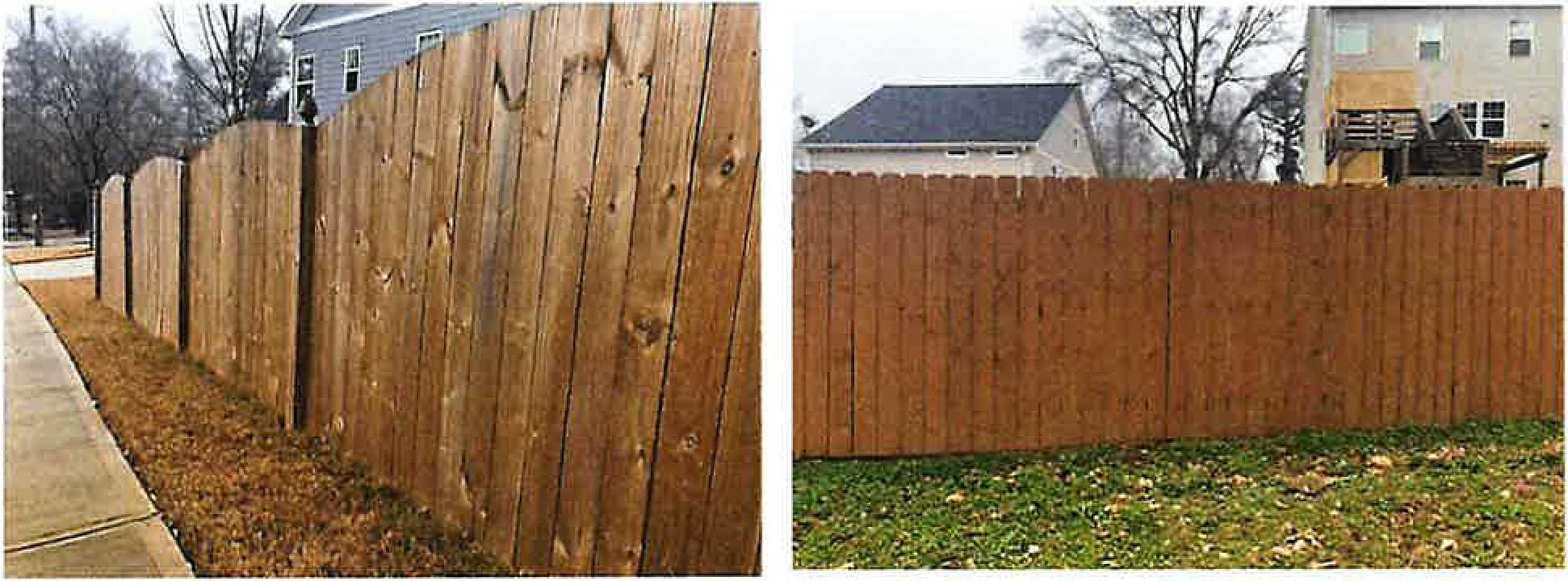
Examples of the finished side of a fence
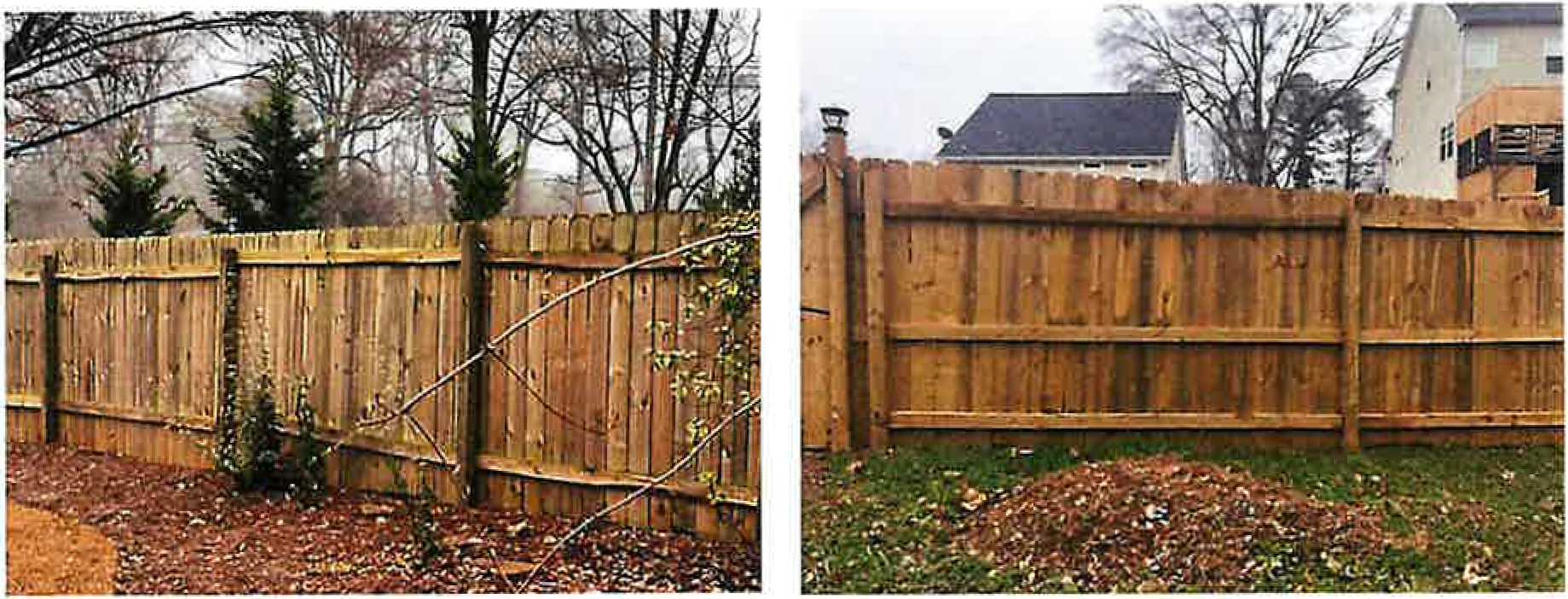
Examples of the unfinished side of a fence
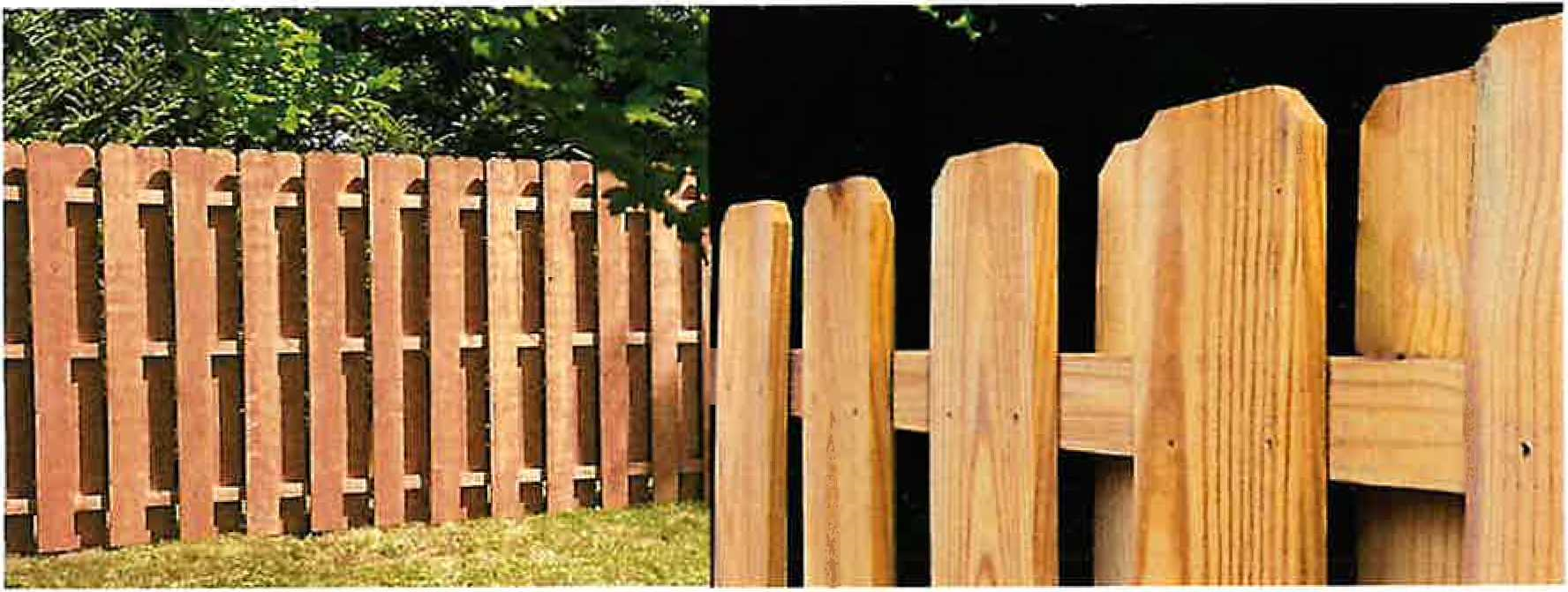
Shadowbox fence
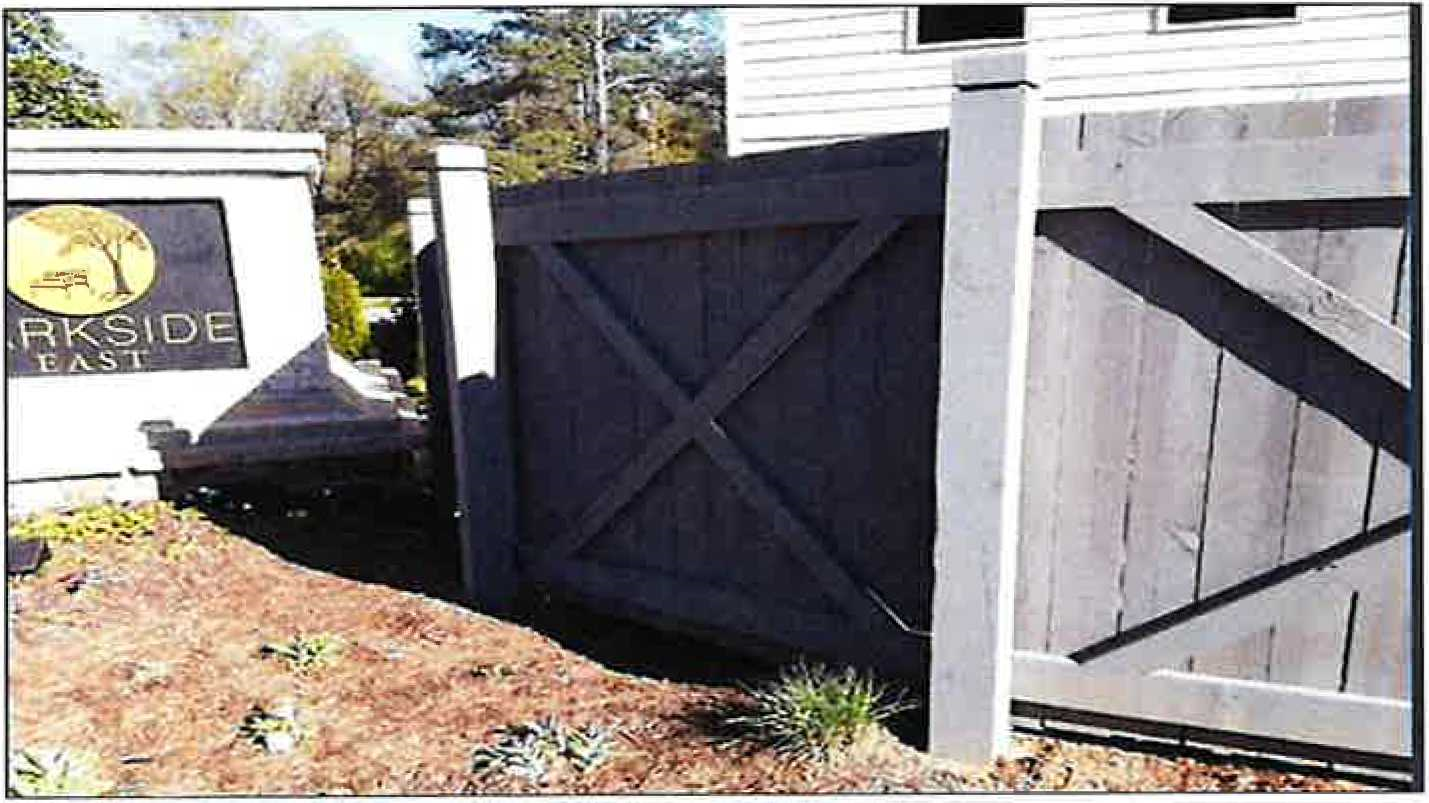
Dual sided fence with decorative elements
B.
In all zoning districts, decorative or ornamental fences or walls, as required by this section, shall be constructed of durable materials such as wood, brick, stone, or wrought iron, or split rail; but shall not be constructed of exposed concrete block, or used or discarded material in disrepair, including, but not limited to, pallets, tree trunks, trash, tires, junk or other similar items.
C.
Reserved.
D.
In all zoning districts, except LI, HI, and PID [see 710.04(E)]:
1.
Fences or walls within the front yard of any parcel of land on a public/private street shall not exceed 4 feet in height and shall be ornamental or decorative in nature.
2.
Fences or walls within major side yards or within the rear yard of double frontage lots shall not exceed 6 feet in height and shall be ornamental or decorative in nature.
3.
In residentially zoned areas, a subdivision entrance, fence or wall along the right-of-way, which must be maintained by the owner or an established home owners association, shall not exceed 8 feet in height, shall be ornamental or decorative in nature, composed of high grade metal, wood, brick, stone or stucco, have columns (composed of only brick, stone or stucco) spaced no further apart than 40 feet and must be reviewed and approved by City staff prior to construction.
4.
In all other instances, fences and walls shall be no more than 8 feet in height.
E.
Fences or walls located in the front yard of any parcel of land located on arterial or collector streets on property zoned LI, HI, or PID shall have a maximum height of 6 feet and shall be ornamental or decorative in nature. In all other instances, fences and walls shall be no more than 8 feet in height.
F.
When this article requires a fence to be constructed, such fence shall be completed prior to occupancy of the primary use structure. Telecommunications towers are not subject to the requirements set forth in Section 710.04, but must meet all requirements listed in Section 712.07. Retaining walls are not subject to the requirements of Section 710.04. All properties must also be in accordance with Section 716.04.
G.
A fence equipped with or having barbed wire, spikes, or similar device, or electric charge shall not contain said devices within 6 feet of the ground level. No fence shall have barbed wire, spikes, or similar devices, or an electric charge in a yard fronting a street on property zoned for residential, commercial, central business district, or office use. Barbed wire, spikes, or similar devices, or an electric charge on fences shall not exceed more than 20 inches above the height of the fence.
H.
All swimming pools shall be enclosed by a fence having a height of not less than 4 feet with a self-closing, self-latching gate unless otherwise approved by the Director of Development Services.
(Code 1996, § 7-8-2-14-070; Ord. No. 6372, 3/13/2002, § 1; Ord. No. 7605, 10/10/2012, § 1; Ord. No. 7929, 11/9/2016, § 1; Ord. No. 7939, 1/11/2017, § 1; Ord. No. 7961, 6/14/2017, § 11; Ord. No. 8338, 6/14/2023, § 1; Ord. No. 8461, 6/11/2025, § 3)
710.05 - Buffers.
Buffers, as required by this article, shall be established and maintained by the property owner to separate and partially screen noise and views. Buffers shall meet the following requirements:
A.
Property owners and developers shall leave undisturbed the natural topography and growth of the land, except vegetation determined to be:
1.
Dead or diseased*;
2.
Natural growth where too dense for normal growth*;
3.
Trees that are a danger to property or people*;
4.
Poison ivy and other noxious vegetation;
5.
Creeping vines and invasive species that threaten the viability of desirable plant growth (e.g. kudzu).
*
Determinations must be certified by a registered arborist or licensed landscape architect for trees in these categories to be removed.
The Planning and Zoning Director or his/her designee may require additional landscape improvements in buffers that lack sufficient topography or foliage to provide for visual screening and diffusion of sound. These improvements may include natural features that supplement the existing landscape such as trees, berms, shrubs, flowers, grass, stone, rocks, and other landscaping materials.
B.
Buffers must not be used for parking or contain any structure other than a permanent wall or fence as required by the city.
Vehicular access, public utilities, and stormwater drainage are allowed in a buffer provided they are crossing perpendicularly to the buffer. Such facilities shall be designed so as to cause the least amount of intrusion possible. Stormwater retention and detention facilities shall not be placed in a required buffer. Bike paths and greenways are excluded from these restrictions.
C.
Reserved.
D.
Buffers shall consist of a permanent wall or solid fence not less than 6 feet in height and a screen of evergreen plantings, so designed and developed to provide for visual screening and diffusion of sound. The Planning and Zoning Director may provide an administrative variance to allow a buffer to be established without the fence, when it can be demonstrated that the existing or proposed landscape serves a satisfactory screening function and the adjacent affected property owner consents to the issuance of said variance. The Planning and Zoning Director shall not provide an administrative variance when it has been approved as a stipulation of zoning. All required fencing shall be installed prior to issuance of the certificate of occupancy. See Section 712.08 (Tree Protection and Landscaping) for a listing of additional requirements pertaining to species and location requirements.
E.
Any grading, improvements or construction adjacent thereto shall be conducted far enough from the buffer area so as not to disturb or encroach upon the buffer area.
F.
Buffer area shall be counted in addition to the setback requirement.
G.
Buffers need not be established in those instances in which a street separates zoning districts.
H.
No buffer shall be required in circumstances in which the rezoning of a parcel or parcels of property creates a condition in which a buffer would be required along the boundary of an adjacent property or properties, where no buffer had previously been required. Where a buffer was previously required on adjacent property before the rezoning, and the size of that buffer would be increased due to the rezoning, the previously required buffer shall remain the same size.
(Code 1996, § 7-8-2-14-080; Ord. No. 6630, 3/10/2004, § 1; Ord. No. 6737, 10/13/2004, § 21; Ord. No. 8461, 6/11/2025, § 4)
710.06 - Fire safety requirements.
Accessibility for fire equipment on hard surfaced sub-base (subgrade plus an asphalt first layer or bound crushed stone) shall be maintained through all stages of construction from the time framing begins. Minimum width of private access driveways within a development, excluding parking, shall be 20 feet and the minimum turning radius shall be 35 feet. Fire hydrants and water service shall be installed to within 300 feet of units under construction before proceeding with framing.
(Code 1996, § 7-8-2-14-090)
710.07 - Storage in residential areas.
A.
Donation boxes are not permitted within any residential zoning districts.
B.
Portable Storage Units in Residential Areas.
1.
A portable storage unit or similar enclosure is limited to 14 days annually in residential areas without a building permit.
2.
Permission shall be obtained from the Department of Development Services after 14 days in order to extend this period for not longer than 60 days.
3.
A portable storage unit or similar enclosure shall be kept in the driveway of the property at the furthest accessible point from the street. A portable storage unit is prohibited from being placed within the public right-of-way.
4.
Only 1 portable storage unit may be placed at any residential property at one time.
5.
In cases where hardship can be demonstrated, the Director of Development Services has the authority to grant administrative approval to extend the time period that a portable storage unit or similar enclosure may remain on a property for up to 30 days. Additional 30-day periods may be granted by request. The burden of proof of a hardship rests upon the applicant and/or property owner. A hardship may be caused by an accidental or unintentional fire, flood or natural disaster that creates the need for additional time for the unit to be in place.
C.
Temporary Bulk Waste Containers.
1.
Temporary bulk waste containers shall not be located within a single-family district except in cases where a building permit has been issued and an active renovation, remodeling or building project is under way. In such cases in which temporary bulk waste containers are allowed, they shall be kept in the driveway of the property at the furthest accessible point from the street. In cases where location within a driveway is not possible, administrative approval may be granted to allow the location of storage containers in an appropriate location. The temporary bulk waste containers must be immediately removed no later than 90 days from the issuance of an associated building permit.
a.
In cases where hardship can be demonstrated, the Director of Development Services has the authority to grant administrative approval to extend the time period that a temporary bulk waste container may remain on a property for up to 90 days, which must be approved in increments of 30 days as requested. The burden of proof of a hardship rests upon the applicant and/or property owner. A hardship may be caused by an accidental or unintentional fire, flood or natural disaster that creates the need for additional time for the unit to be in place.
b.
In cases where construction costs exceed 50% of the principal structure's replacement cost, or when the construction is part of a new development project, the Director of Development Services has the authority to grant administrative approval to extend the time period that a temporary bulk waste container may remain on a property for up to the duration of the building permit.
(Code 1996, § 7-8-2-14-100; Ord. No. 7148, 6/11/2008, § 1; Ord. No. 8224, 5/12/2021, § 1)
Editor's note— Ord. No. 8224, § 1, adopted May 12, 2021, changed the title of § 710.07 from storage to storage in residential areas.
710.08 - Storage in non-residential areas.
A.
Outdoor Storage Areas.
1.
Outdoor storage areas shall only be permitted as a primary use in LI and HI districts.
2.
Outdoor storage areas may be permitted as an accessory to an allowable primary use in CRC, RRC, OS, LI, and HI districts, but must be located in the rear yard behind the principal structure and enclosed by a solid fence not less than 6 feet in height to provide visual screening.
3.
Such use shall be subject to the following:
a)
The regulations of the applicable zoning district.
b)
No storage of wrecked or non-operative automobiles and trucks.
c)
No parts or waste materials shall be stored outside any building.
B.
Bulk sanitation containers, temporary bulk waste containers, and donation boxes.
1.
Bulk sanitation containers and donation boxes are limited to rear or side yards and must be located in such a manner as to be screened from view from the public right-of-way.
2.
No bulk container or donation box shall be located within 50 feet of a structure utilized for detached single-family residential purposes.
3.
The Director of the Department of Development Services may provide for an exemption from this requirement when conditions cannot be met. In such cases, the property owner or tenant may submit a plan for the Director's approval. Such plan may include provision for an alternative container utilizing appropriate screening such as a nontransparent fence not less than 6 feet in height with a gate which will open in full to allow service.
4.
Temporary bulk waste containers shall not be located within non-residential districts except in cases where a building permit has been issued and an active renovation, remodeling or building project is under way. In such cases in which temporary bulk waste containers are allowed, they shall be kept at the furthest accessible point from the street. In cases where such location is not possible, administrative approval may be granted to allow the location of storage containers in an appropriate location. The temporary bulk waste containers must be immediately removed at the expiration of the building permit.
(Code 1996, § 7-8-2-14-230; Ord. No. 7095, 10/10/2007, § 4; Ord. No. 7148, 6/11/2008, § 2; Ord. No. 8224, 5/12/2021, § 2; Ord. No. 8364, 12/20/23, § 11)
Editor's note— Ord. No. 8224, § 2, adopted May 12, 2021, changed the title of § 710.08 from bulk sanitation containers, temporary bulk waste containers, and donation boxes to storage in non-residential areas.
710.09 - Substandard lots of record.
No substandard lot of record may be developed without approval by the Board of Zoning Appeals or, if applicable, permission of the Planning and Zoning Director.
710.10 - Density calculations.
Residential density standards determining the number of families, individuals, dwelling units or housing structures per unit of land shall be calculated from all the land within the boundaries of the area excluding wetlands, floodplain areas and standing bodies of water.
710.11 - Height requirements exceptions.
Except as otherwise provided, height limitations stated in this article shall not apply to:
A.
Belfries, cupolas, domes, chimneys and smokestacks, provided such structure does not exceed 15 percent of the maximum building height;
B.
Bulkheads, elevator penthouses, water tanks and heating and air conditioning units, provided that such structures shall not cover more than 25 percent of the total roof area of the building on which such structures are located or exceed 15 percent of the maximum building height.
C.
In industrial districts (LI, HI, PID), silos, storage tanks, and other accessory structures, provided that when such structures are located within 100 feet from any property zoned for residential purposes, then the maximum height of all such structures is limited to 50 feet.
(Ord. No. 7840, § 6, 9/9/2015)
710.12 - Corner lots.
Corner lots which adjoin 2 or more public streets shall provide the required front setback along that street upon which the structure faces provided said frontage's length is at least 75% that of the longest frontage. The required major side setback shall be provided on all other street frontages not deemed the front setback. All corner visibility regulations shall be met.
710.13 - Double frontage lots.
Lots which adjoin a public street in the front and rear shall provide the minimum required front yard on each street, except where such lot adjoins a limited access facility which provides no access to the lot.
710.14 - Projections into yards.
A.
An open unenclosed porch or hard surfaced terrace, steps, stoops, and similar fixtures of a building may project into a required setback no more than 50% of that established by the zoning district.
B.
Fences, walls and hedges over 3 feet in height may not be established within 15 feet of a right of way intersection unless approved by the Public Works Director. In residential districts fences in front yards are restricted to 4 feet in height.
(Code 1996, § 7-8-2-14-180)
710.15 - Electrical and communications equipment on building exteriors.
All electrical service equipment, telephone or cable service equipment, or any other such equipment attached to the exterior of any structure shall be located to the side or rear of the structure and in no case shall be attached to any building face which abuts a street or other public right-of-way or is visible from such street or right-of-way.
(Ord. No. 6414, 6/12/2002, § 1)

