
Marietta City Zoning Code
DIVISION 714
SIGNS1
Editor's note— Ord. No. 7867, § 1, adopted Jan. 13, 2016, amended Div. 714 in its entirety to read as set out herein. Former Div. 714, §§ 714.01—714.09, pertained to similar subject matter and derived from Ord. No. 7710, § 1, adopted Dec. 11, 2013.
714.01 - Findings and purpose.
The City of Marietta makes the following findings of fact:
A.
The City of Marietta finds that signs are a proper use of private property, are a means of personal free expression and a necessary component of a commercial environment. As such, signs are entitled to the protection of the law. In the absence of regulation, however, the number of signs tends to proliferate, with property owners desiring ever increasing numbers and sizes of signs, leading to cluttered and aesthetically blighted thoroughfares. In addition, the competition among competing sign owners for visibility of their signs contributes to safety hazards for both vehicles and pedestrians and undermines the sign owners' original purpose of presenting a clear message of its idea or identification of its premises.
B.
Regulation of the size, height, number and spacing of signs is necessary to protect the public safety, to assure compatibility of signs with surrounding land uses, to enhance the business and economy of the city, to protect the public investment in the streets and highways, to maintain the tranquil environment of residential areas, to promote industry and commerce, to eliminate visual clutter and blight, to provide an aesthetically appealing environment, and to provide for the orderly and reasonable display of advertising for the benefit of all the City's citizens.
C.
The City further finds that there is a substantial difference between signs erected by public authority and signs erected by private citizens or businesses. Signs erected by public authority are virtually all erected for the purpose of maintaining the public safety either through direct control of traffic or through provision of such type signage as street signs which enable the traveling public to know where they are located and to find where they are going. As such nearly all governmental signs are erected purely for public safety purposes. Moreover, their use in the public right-of-way is necessary to ensure their visibility to the motoring public. The Mayor and City Council finds that public utility signs are frequently of the same nature as those signs erected by governmental entities in that they provide necessary information to safeguard the public from downed power lines and from street excavations. Even where signs serve a propriety purpose, such as identifying markings on utility poles, public utility signs are marked primarily for the purpose of benefiting the public generally through identification of locations where there may be temporary losses of power.
D.
The City finds that some signage has a single targeted function and that identification of such signage by description is impossible without referring to its function. For instance, address numerals are used for the sole purpose of providing addresses, which is of benefit to persons looking for those addresses and is essential to public safety personnel responding to emergencies. Signs at the entrances to subdivisions or major developments favor a similar purpose in enabling both the traveling public and emergency personnel to quickly locate entrances for the purpose of either visitation or responding to emergency calls. While such signage is referenced based upon the function it serves within the context of this division, the provisions of this division are unrelated to the content of the speech provided and allow maximum expressive potential to sign owners. The City further finds that holiday decorations such as strings of light are not signs, but rather seasonal ornamentation not controlled by this division.
E.
In considering the appropriate level of sign regulation for the City, the Mayor and City Council has considered planning studies, reports, news articles and related information from a variety of sources. The Mayor and Council has determined that digital signs pose unique and substantial hazards to traffic caused by a higher level of distractibility than non-digital signs. In addition, digital signs are inconsistent with the aesthetic standards established for the City.
These standards are intended to:
A.
Promote signs that are subordinate to and in aesthetic harmony with their location on buildings and their surrounding environment;
B.
Identify requirements that safeguard life, public health, aesthetic quality and welfare by regulating the location, size, number, illumination, construction, maintenance and quality of materials of all signs and eliminate visual clutter and blight within the City.
C.
Promote the safety of persons and property by providing that signs do not create traffic or other hazards due to collapse, fire, visual obstruction, decay or abandonment.
D.
Promote and encourage designs that reflect the appropriate scale, historic character, and pedestrian orientation of the city, as well as encourage designs that reflect the architectural scale, aesthetic quality, and vehicular and pedestrian orientation of commercially zoned districts within the City.
(Ord. No. 7867, 1/13/2016, § 1)
714.02 - Permit requirements.
The following requirements and limitations shall apply with regard to signs, in addition to provisions appearing elsewhere in the text of these regulations or in the schedule of zoning district regulations:
A.
Unless specifically exempted from obtaining a permit by other provisions of this division, any property owner, business, tenant, agent, or contractor shall be required to obtain a permit prior to the erection, replacement, reconstruction, or relocation of a sign. Where a building permit is required for sign installation, the building permit shall be obtained from the Public Works Department with input from the Department of Development Services and shall constitute the sign permit. If no building permit is required, the sign permit shall be obtained from the Department of Development Services. The tenant must have a current license to do business in the City at the location where the erection, replacement, reconstruction, or relocation of a sign is to take place. However, when a business is to be located at a newly constructed site or a site under reconstruction, a permit for a sign may be obtained prior to the issuance of a business license. Agents or contractors actively erecting or maintaining signs must have a license to do business in the State of Georgia.
B.
Each application for a sign permit shall contain the following information:
1.
Name of property owner, tenant and agent.
2.
Name of sign owner (if different from property owner).
3.
Name, address, and telephone number of the sign erector/contractor.
4.
Freestanding signs require scaled drawings detailing the location of any structure on the lot upon which the sign is to be attached or erected and the exact position of the sign in relation to nearby buildings or structures and to nearby streets. Also, freestanding signs require that elevation plans be provided that show the dimensions, schematics, materials, and all other information that shows the design of the sign. Wall and other signs require scaled building elevation plans and detailed schematics to be submitted that detail the size of the building face and the location of the sign on the structure and the materials and design of the sign.
5.
Plans, specifications and structural details of construction and attachment to the building or in the ground. A single submission may be permitted for standardized signs. All signs must conform to the standards of the current National Electrical and Standard Building Codes issued at the time of application and/or other codes of the City that may be applicable. The applicable issues of the Standard Building Code and National Electrical Code, as amended, are incorporated herein by reference as though fully set forth herein, a copy of which shall be maintained on file with the City Clerk for inspection and review by the public. The Chief Building Official shall be responsible for enforcing the guidelines set forth in the Standard Building Code and the National Electric Code.
6.
Permit Fees. Permit fees are required for all sign permits. The permit fees for signs are established from time to time by the Mayor and City Council and are identified in the City of Marietta Fee Chart.
C.
Upon receipt of a properly completed sign permit application as identified in Section 714.02B., the sign permit application shall be examined and either approved or denied within 45 business days or else the application shall be deemed granted on the 46th business day. All permit applications meeting the standards of this division and all applicable zoning regulations shall be granted.
D.
The City shall deny permits to applicants who submit applications for signs that do not comply with the provisions of this division, are incomplete, or contain any material false statements.
E.
Should it be determined that a sign permit was issued pursuant to an incomplete application or an application containing a false material statement, or that a permit has been erroneously issued in violation of this division, the permit shall be revoked by the same officer who issued the permit. The City is further authorized and empowered to revoke any permit issued by it upon failure of the holder thereof to comply with any provisions of this division within 10 days of the receipt of written notice to the property owner or the refusal of the property owner to accept the written notice.
F.
Upon denial of the sign permit application or revocation of a sign permit, the applicant and/or permit holder shall be given written notice from the Department making the sign permit decision, stating the reason for the denial or revocation. Upon denial of the sign permit application or revocation of the permit, the applicant or permit holder may appeal to the Board of Zoning Appeals (or in the case of billboards, appeal shall be made to Mayor and City Council) within 10 days of the receipt of notice of the final decision of the Department making the denial decision. The appeal hearing shall take place within 60 days of the filing of the appeal with the City Clerk with final decision to be rendered no later than 30 days from the close of hearing.
(Ord. No. 7867, 1/13/2016, § 1)
714.03 - Signs exempt from permit requirements.
The following classes of signs are exempted from permit requirements, but other limitations, regulations, and requirements concerning such signs remain applicable. The Chief Building Official shall be responsible for enforcing the guidelines set forth in the Standard Building Code and the National Electrical Code.
A.
Signs, notices and traffic signs conforming to the standards of the Manual of Uniform Traffic Control Devices or other federal or state standard.
B.
Flags that are attached to a flagpole mounted on the ground or to flagstaffs attached to the facade of a structure, limited to 3 flags per premises, plus 1 additional flag for every 10 feet of road frontage.
C.
Incidental signs. Incidental signs that are visible from the public right-of-way are limited to 6 square feet per sign face and 3 feet in height, limited to 1 per curb cut. Incidental signs that are not visible from the public right-of-way are limited to 20 square feet per sign face and 8 feet in height.
D.
Delivery receptacles for mail and newsprint deliveries.
E.
One sign not to exceed 15 square feet for development projects involving 2 or more acres in residential districts or 50 square feet in non-residential districts placed at a location under construction or alteration. All such signs shall be removed from the site upon issuance of a certificate of occupancy.
F.
Standard informational signs. Standard informational signs in residential districts that otherwise meet the standards of this division.
G.
Window signs meeting the standards of this division.
H.
Building address numerals not exceeding 12 inches in height in residential districts and 24 inches in height in nonresidential districts and emergency information.
I.
Inflatable devices or balloons.
J.
Panel replacements. The changing of a sign face or panel in or on an existing approved sign or a legally nonconforming sign shall not require a sign permit. However, if the proposed panel replacement creates a need for structural repair or causes a change in the size, shape, location, or design of the sign, then a sign permit shall be required to bring the sign into compliance with the requirements of this division.
K.
A-frame signs placed on private property and directed toward pedestrians. Such signs shall not be intended to attract the attention of passing motorists on the public right-of-way. A-frame signs shall be allowed according to the following conditions:
1.
Signs shall be located more than 10 feet away from any property line.
2.
The sign must be within 15 feet of the front door of the place of business.
3.
Each storefront is allowed 1 sign and in no case shall a storefront be allowed more than 1 sign.
4.
The location of the sign must not block or restrict passageway along the sidewalk to less than 4 feet in width, block the ingress/egress to any building, interfere with vehicular traffic flow, or block required parking spaces.
5.
The sign is limited to a maximum area of 10 square feet and a maximum height of 4 feet.
6.
The sign must be adequately weighted and shall not be illuminated, animated, or electrically powered in any way. Signs must be made of durable materials designed to withstand exterior conditions.
7.
The sign is allowed only during the sign owner's business hours and must be moved inside when the business is not open.
8.
All signs must be located on an adjacent sidewalk.
(Ord. No. 7867, 1/13/2016, § 1; Ord. No. 8301, 9/14/2022, § 1)
714.04 - General regulations.
All signs shall be located on private property and shall abide by those regulations that pertain to each class of signs. The permit number shall be permanently affixed to each permitted sign. In all cases sign regulations shall be applied on a parcel level basis. If several buildings or tenants are located upon the same parcel, the allocation of sign space for multiple uses shall be controlled by the property owner provided that the total number of signs (and the sum of the areas) shall not exceed that permitted for the parcel as a whole. The Board of Zoning Appeals shall not grant and does not have the authority to grant a variance that allows for any new pylon signs or changes in the shape, size, location, or design of existing pylon signs. Materials, colors, and shapes of the proposed sign structure shall be compatible with the principal buildings. Staff shall review the style and architectural design of each sign structure in order to insure that it is compatible with the materials and colors of its principal structure.
A.
Projecting Signs. Are permitted in nonresidential districts and shall be securely fastened by metal supports to the building surface and meet all applicable building codes while maintaining a clear height of 8 feet above the ground level. No projecting sign may extend above the parapet wall. Permissible sign area shall be calculated the same as wall signage and shall be considered inclusive of the total wall sign area allowance for the building.
B.
Wall Signs. Are permitted in nonresidential districts and shall be securely fastened to the building surface meeting all applicable building codes. Walls signs may project from the building face a maximum of 18 inches from the building provided that, if they project more than 4 inches from the building surface, they shall maintain a clear height of 8 feet above the ground level. No wall sign may extend above the parapet wall. Wall signs on building faces that abut public roadways or designated access drives to planned centers are restricted to covering no more than 15% of the wall face. The maximum sign area for walls not directly facing a public roadway or designated access drive to a planned center is limited to covering no more than 5% of the wall face on which the sign is attached. The total permissible sign area for a single business may be incorporated within wall, canopy, under canopy, projecting or window signage provided that in aggregate, the total sign area does not exceed the 15% limit.
C.
Canopy Signs. Are permitted in nonresidential districts and shall be securely fastened by metal supports to the building surface and meet all applicable building codes. Canopy signs may not extend above the parapet wall and shall maintain a clear height of 8 feet above the ground level. Permissible sign area shall be calculated the same as wall signage and shall be considered inclusive of the total wall sign area allowance for the building.
D.
Under Canopy Signs. May be no larger than 6 square feet and must be no less than 8 feet above the ground at the lowest extremity of the sign and attached to the supporting structure at no less than 2 points. Permissible sign area shall be considered inclusive of the total wall sign area allowance for the building.
E.
Window signs. Are permitted in nonresidential districts subject to those standards, which apply to wall signs. Permissible sign area shall be calculated the same as wall signage and shall be considered inclusive of the total wall sign area allowance for the building. No more than 50% of the windows of a business shall be used to display window signs and the signage in a single window shall not account for more than 50% of a window face.
F.
Freestanding Signs. Are permitted in all zoning districts, except in those designated as single-family residential, unless specifically allowed under other sections of this division.
1.
All new detached signs must be either monument or nostalgic signs. Pylon signs are not allowed. The Board of Zoning Appeals shall not issue and is not granted the authority to issue variances to allow any new pylon signs or changes in the shape, size, location, or design of existing pylon signs.
2.
For each property line that abuts public right-of-way for a distance of at least 75 feet, 1 freestanding sign is permitted provided the sign area is located at least 5 feet from any property line. The Public Works Director or his/her designee may require additional setback distances based upon site conditions for traffic safety. In the case of corner lots, a single sign with up to 4 sides may be erected in lieu of 2 or more separate signs. In no case shall a property contain multiple detached signs along the same road frontage, unless specifically allowed.
3.
The maximum allowable height and sign area of detached signs shall be determined in accordance with the type of roadway along which the sign is to be located to account for varying travel speeds, sight distances and commercial conditions (see Table H). In no case shall the area of a message board exceed 50% of the allowable sign face.
TABLE H. MAXIMUM HEIGHT AND SIGN AREA FOR DETACHED SIGNS
*As defined on the Official Thoroughfare Map of the City.
**Sign structures are limited to 100% of the allowable sign face.
***As defined on the Official Zoning Map of the City.
The numerical address of the property must be included on the sign, and must be clearly visible and legible from the street on which the property fronts. Numbers should be no less than 6 inches high and shall not be considered signage, nor shall they be included in the calculation of sign size.
4.
Digital signs. Digital Signs may be used in accordance with the following provisions, provided that billboard signs shall not be converted to digital except in accordance with the provisions of Section 714.04G. The following shall apply to all digital signs:
a.
Digital signs are prohibited in residential zones and within 200 feet of any residential property line. However digital signs shall be allowed in residential zones for places of assembly that have been granted a Special Land Use Permit by the Marietta City Council provided the digital sign is located beyond 200 feet of any residential property line.
b.
Digital signs shall only be used in conforming, freestanding monument signs and shall not be allowed as canopy, wall, or awning signs as defined in this ordinance, except as otherwise provided in this division.
c.
Digital signs shall not exceed 50% of the total sign face and must be located below the static copy area.
d.
Digital signs shall contain static messages only and shall not have movement nor flashing on any part of the sign structure, design, or pictorial segment of the sign, nor shall such sign have varying light intensity during the display of any single message. Transitions between messages shall not use frame effects or other methods which result in movement of a displayed image during such transition.
e.
Each individual static message must be displayed for a minimum of 20 seconds.
f.
Digital signs are prohibited from projecting beams or rays of light of such intensity or brilliance as to cause glare or to impair the vision of the driver of any motor vehicle or obscure or interfere with the effectiveness of an official traffic sign, device, or signal.
g.
Each sign must have a light sensing device that will adjust the brightness of the display as the natural ambient light conditions change.
h.
Digital signs may not operate at brightness levels of more than 0.20 foot candles above ambient light levels (at measurement conditions) as measured at a distance of 125 feet.
i.
The owner of said electronic sign shall provide to the City of Marietta, information for a 24 hour contact able to turn off the digital sign promptly if a malfunction occurs. If, at any time more than 50% of the digital display lights malfunction or are no longer working, the owner of said digital sign shall turn off the display until repairs are made.
j.
City of Marietta staff may request a certification of the brightness (under measurement conditions) by an independent contractor (if such has not been certified within the preceding 12 months). If this investigation and certification indicates that the digital sign exceeds the brightness levels specified in this division, the owner of the sign, within 24 hours of a request by the staff of the City of Marietta, shall turn off the sign until the brightness of the sign is corrected to comply with this division at owner's expense.
k.
No digital sign shall utilize, house or contain any interactive features or components, or function as an interactive sign.
l.
No digital sign shall extend beyond the width of the sign structure.
G.
Billboards. All billboards are subject to the following restrictions regarding their location and permitting. No billboard lawfully in existence on December 11, 2013 shall be altered or moved unless it is made to comply with the provisions of this division. Billboards are not allowed outside of the area within 100 feet of the right-of-way of Interstate 75.
1.
Billboards shall also be regulated as a principal use and are required to meet all dimensional standards of the applicable zoning district. All distances shall be measured to the nearest point of the sign. The applicant is required to file an exemption plat through the City of Marietta with the Cobb County Superior Court to designate the area on the property that is to be used for the purpose of the general advertising or off-premises sign billboard.
2.
No billboard shall be placed within 500 feet of a residential zoning district, church, school, park, public building or cemetery on the same side of Interstate 75 that the billboard is to be located on.
3.
No billboard shall contain a sign area in excess of 672 square feet.
4.
No billboard shall contain more than 2 faces; nor shall any multi-message billboard be allowed, including signs that contain tri-vision panels or other changeable faces, electronic message boards, LCD, LED or plasma panels or screens, or any similar electronic signage devices or technology, unless as strictly regulated in this Section 714.04G.
5.
No billboard shall be located within a 1,000-foot radius of another billboard.
6.
No billboard may exceed 70 feet in height along an interstate as measured from the established road grade at the nearest point of the aforementioned road.
7.
When it can be demonstrated that a reduction of the required setback for a billboard is necessary in order to preserve trees along interstate right-of-way, the Director of the Department of Development Services may administratively reduce the setback by up to 50 percent. In order to ensure that no trees will be cut in locating or erecting such outdoor advertising signs, the applicant and/or landowner must provide a survey to identify those trees to be preserved. Failure to preserve any trees so identified shall be considered a violation of this article. In addition, GDOT approval must be obtained by the applicant.
8.
No billboard shall be located or erected on a substandard lot. In addition, billboards shall meet all other zoning district regulations, including required setbacks and lot widths. Support structures shall meet the setback requirement; however sign faces may extend 25% into any required setback. All distances shall be measured to the nearest point of the sign.
9.
No billboard shall be located or erected on a lot upon which a building is located if such lot or the building thereon has any sign located thereon.
10.
No billboard may be located closer to a permanent structure than a distance that is equal to or greater than the height of the sign.
11.
Billboards shall be permitted in LI, HI, CRC, RRC, PCD, and OHR zoning districts. Billboards are prohibited in all other zoning districts.
12.
Billboards shall not be permitted within any right-of-way or easement provided for a railroad.
13.
Digital billboards:
a.
Purpose Statement for Digital Billboards: In addition to the other standards listed in the Purpose Statement of the Sign Ordinance (Section 714.01 Purpose) the Mayor and City Council find that the proliferation in number, size and manner of outdoor advertising unreasonably distracts motorists, bicyclists, and pedestrians and promotes confusion with regard to traffic lights, signs, or signals or other interference with the effectiveness of traffic regulations and is therefore hazardous to roadway users; that the inadequately controlled proliferation of billboards visible from highways endangers the uniqueness of our City and our community and our scenic beauty; that tourism and trade from both resident and nonresident roadway users is an essential part of our economy; that tourist-oriented directional signs and logo signs erected pursuant to authority of the Georgia Department of Transportation offer businesses cost-effective means of announcing their presence to the highway users without harm to the City of Marietta's scenic beauty.
1.
The erection and maintenance of new billboards should be strictly limited in areas adjacent to Interstate 75, and are prohibited in all other areas in order to protect the public investment in such roadways, preserve the City's scenic beauty and distinctiveness, and promote the general health and welfare of the public.
2.
The Mayor and City Council find that the vast majority of billboards within the City of Marietta are legal non-conforming uses, and consistent with the provisions of Division 706 Non-Conforming Uses and Section 714.06C: Nonconforming Signs, it is the desire of the City of Marietta that such non-conforming uses be reduced over time. Despite this intent, the number of legal non-conforming signs has not been materially reduced in a significant fashion.
3.
This division is adopted based upon concerns for the distractions that digital billboards can cause. However, the Mayor and City Council find that the modification of a limited number of existing static billboards to digital signs, in exchange for a reduction in the overall number of billboards achieves a net improvement in public safety and character.
b.
Digital panel replacement for existing billboards within 100 feet of the right-of-way of Interstate 75 or U.S. Highway 41 shall be permitted provided applicants meet the following requirements:
1.
An existing billboard panel may be replaced with a digital panel if no less than 4 existing billboard panels are removed in their entirety. An existing panel that is to be retrofitted with a digital panel(s) shall not count toward the aforementioned panel to be removed.
2.
This removal must include the complete removal of the structure to the foundation supporting each sign face. The applicant must also agree that the sign will be removed voluntarily and that no right to compensation exists for the removed sign under any law. The applicant shall indemnify, defend and hold harmless the City from any legal actions taken by the property owner of existing sites in the implementation of this division. If the removed sign structure is one for which a state permit is required by state law, the applicant must surrender its permit to the state upon removal of the sign.
3.
Multiple sign structures may be removed and counted for exchange if the sum of their sign panels is equal to or greater than 2,400 square feet.
4.
If the applicant complies with the permit requirements noted above, the city will issue a billboard permit for the designated billboard. A building permit shall only be issued once all the required sign structures are removed. Except for the replacement of the sign face with the digital panel, and any associated structural improvements necessary and approved by the City of Marietta, the retrofitted legal non-conforming sign shall not be, moved, increased in size or height, or otherwise modified in contravention of this division. This permit will allow a digital display to occupy 100 percent of the potential copy and graphic area. The designated sign must:
i.
Not be greater than 672 square feet;
ii.
Not be located within 500 feet of a residential zoning district if located on U.S. Highway 41 or within 500 feet of a residential zoning district on the same side of Interstate 75 that the billboard is located;
iii.
Not be more than 70 feet in height as measured at the nearest road grade if permitted along I-75, nor more than 35 feet in height as measured at the nearest road grade if permitted along U.S. 41;
iv.
Be in full compliance with the Sign Ordinance Sections 714.02, 714.06, 714.07, 714.09 and meet all other requirements of Sections 12, 13 and 14 of this division.
5.
Only billboard structures lawfully in existence on December 11, 2013 are eligible to contain digital panels, except as allowed under paragraph 15 of this section.
6.
Unless approved otherwise by City Council, billboards removed as part of another government agreement, including right-of-way condemnation and/or a zoning condition, shall not count toward the removal threshold for this exchange program.
14.
A digital billboard shall:
a.
Contain static messages only, and shall not have movement, scrolling, fading or flashing on any part of the sign structure, design, or pictorial segment of the sign, nor shall such sign have varying light intensity during the display of any single message.
b.
Every line of copy and graphics in a digital display must be at least 15 inches in height. If there is insufficient room for copy and graphics of this size in the maximum allowable sign area, then no digital display is allowed.
c.
Digital billboards may not operate at brightness levels of more than 0.20 foot candles above ambient light levels as measured at the following distances:
d.
The owner of said digital billboard shall arrange for an annual certification of the brightness showing compliance by an independent contractor and provide said certification to the City of Marietta.
e.
Each digital billboard must have a light sensing device that will adjust the brightness of the display as the natural ambient light conditions change.
f.
No digital billboard shall be located within 5,000 feet of another digital billboard on the same side of the road.
g.
The owner of said digital billboard may coordinate with the local authorities to display, when appropriate, emergency information important to the traveling public including, but not limited to Amber Alerts or alerts concerning emergency management information.
h.
The owner of said digital billboard shall provide to the City of Marietta information for a 24-hour contact able to turn off the electronic sign promptly after a malfunction occurs. If, at any time more than 50% of the digital display lights malfunction or are no longer working, the owner of said digital billboard shall make repairs to the sign within 60 days or the sign will require removal.
i.
If the staff of the City of Marietta finds that the digital billboard exceeds the brightness specified in paragraph C. above, the owner of the sign, within 24 hours of a request by the staff of the City of Marietta, shall reduce the intensity of the sign to be in compliance with this division and provide said certification.
j.
Each sign must comply with all Georgia Department of Transportation rules and regulations applicable to electronic changeable message signs, where not in conflict with this division.
k.
A digital billboard existing on December 11, 2013 must comply with the operational standards listed above.
15.
Unless allowed as part of an exchange agreement, new billboard structures located within 100 feet of the right-of-way of Interstate 75 may contain electronic message boards, LCD, LED or plasma panels or screens, or any similar electronic signage devices or technology, provided that such electronic sign face shall be limited to 672 square feet and the designated sign must meet all other requirements of this division.
16.
All variance requests seeking relief from these standards must be made to City Council. Application shall be made through the Department of Development Services.
(Ord. No. 7867, 1/13/2016, § 1)
714.05 - Special conditions.
There exist unique conditions that require greater diligence due to their ability to more greatly harm the public good by creating unsafe, unsanitary or unkempt conditions. As such, the City hereby imposes additional regulations and standards on the following types of signage. Unless otherwise noted, permits are required for all signs in this section.
A.
Shopping Centers. In shopping centers and shared commercial buildings, individual tenants are entitled to wall, canopy and under canopy signage utilizing those standards noted previously in this section, calculated by tenant space. Individual tenants are not entitled to any freestanding signage on the premises, however, the property owner or manager may request 1 freestanding, monument based, sign for each property line which abuts public right-of-way provided the sign area is located at least 5 feet from any property line for a distance of at least 75 feet. The Public Works Director or his/her designee may require additional setback distances based upon site conditions for traffic safety. In instances where a shopping center has over 100,000 square feet of floor area and has multiple entrances, the property owner or manager may request 1 additional sign on a single road frontage, provided that both signs are located at entryways and that the entryways are located at least 300 feet apart. The maximum size of the sign shall be based upon the gross square footage of the shared center (exclusive of outparcels) as shown in Table I:
TABLE I. DETACHED SIGNS STANDARDS FOR SHARED COMMERCIAL SPACE
*As defined on the Official Thoroughfare Map of the City
**Sign structures are limited to 100% of the allowable sign face
***As defined on the Official Zoning Map of the City
B.
Standard Informational Signs. Standard informational signs are permitted in all single-family residential districts subject to the following standards. Each residence shall be permitted 2 standard informational signs on the lot at all times, provided that during the period commencing with the qualification of candidates through the date of final determination of all candidates and issues from each election, a residence may erect an unlimited number of standard informational signs meeting the standards of this division. Each standard informational sign shall be set back from the right-of-way at least 1 foot, shall measure no greater than 6 square feet in sign area, be erected to a height of no more than 4 feet, and shall be composed of metal, plastic, laminated cardboard or other durable and waterproof material. Standard informational signs meeting these same standards are permitted on other residentially zoned properties, excluding multi-family zoning districts.
C.
Gas Stations with Canopy Covering Pumping Area. Gas stations that incorporate a canopy covering the pumping area may place signage along the canopy eaves. Such signage may be placed on no more than 3 sides and is limited to 10 square feet per side. Signs forming an integral part of a gasoline pump do not require a permit.
D.
Official State Emission Station. Each official state emission station shall be allowed to display signs meeting the standards of the Georgia Motor Vehicle Emission Inspection and Maintenance Act, O.C.G.A. § 12-9-40 et seq. No sign shall exceed 36 inches by 48 inches. Such signs shall be mounted as a wall sign in accordance with Section 714.04B., or shall be located as a freestanding sign in accordance with Section 714.04E. All provisions of the "Georgia Motor Vehicle Emission Inspection and Maintenance Act" (O.C.G.A. 12-9-40 et seq.) shall be satisfied.
E.
Temporary Signs. Temporary signs shall be allowed in nonresidential districts and multi-family districts for a period not to exceed 30 consecutive days and are further limited to 60 total days annually at any location:
1.
Only one temporary sign may be displayed on a lot at a time.
2.
The permit number and expiration date shall be affixed to each permitted temporary sign.
Temporary signs shall be removed immediately upon permit expiration.
3.
Temporary signs may only be located upon a building face that abuts a public street or designated access drive.
4.
Detached signage will not be permitted as temporary signs.
5.
In shopping centers and shared commercial buildings, individual tenants may be entitled to 1 temporary sign to be displayed on a building face which abuts a public street or designated access drive.
6.
A permit must be obtained for all temporary signs.
7.
Banners shall be subject to all dimensional standards that apply to wall signage and are only allowed as temporary signs.
8.
Detached signage in conjunction with seasonal sales may be permitted from November 15—January 1. Such signage shall be limited to 8 feet in height, 50 square feet in area and shall be located at least 12 feet from any property line.
9.
Inflatable advertising device(s) greater than 2 feet in diameter will only be permitted on roofs of buildings (less than 35 feet in height above the roof from its highest point). Approval from the Fire Department is required for any gas-filled figure.
F.
Weekend Standard Informational Signs (WSJS).
1.
Purpose. Many people travel to, from, and through the city on a daily basis. During the weekday rush hours when the majority of people on the roads are commuting to or from work, roads are often nearly beyond their capacity. Traffic hazards and distractions must be minimized. However, people at times need the benefit of directional signs to help find their destinations, particularly destinations of a temporary or time limited duration. Properly regulated, such directional signs may actually aid the flow of traffic while limiting the negative impact of such signs on the aesthetic qualities of an area. The following regulations recognize the difference in weekday and weekend traffic and are intended to promote and protect the health, safety, and welfare of the residents, visitors and businesses of the city, including the aesthetics of the community. Improperly located weekend standard informational signs are hereby determined to pose an immediate safety threat and traffic hazard to members of the public traveling on City roads.
2.
Weekend standard informational signs (WSIS) are allowed in nonresidential districts subject to the following standards.
3.
Permitting. All WSIS shall be required to obtain a permit for each location. The permit shall be available through the City's Department of Development Services and shall require at a minimum:
a.
Property owner's permission to install the WSIS.
b.
Permit identification on sign. Each permit for a WSIS shall include a 24-hour contact number. Each WSIS must affix a permit sticker provided by the Department of Development Services.
c.
Construction. WSIS shall not exceed 6 square feet of sign area and 4 feet in height and may be double-faced. WSIS shall be mounted on an independent single or double pole device. WSIS shall not be affixed in any manner to trees, natural objects, streetlight poles, utility poles, or other sign structures. WSIS shall be made of metal, plastic, laminated cardboard or some other durable and waterproof material. No sign shall be made of paper.
d.
Location. There shall be only 1 WSIS for any given place, activity or event per 300 feet of road frontage, and within a 3-mile radius of the ultimate location to which it provides direction. No WSIS shall be located closer than 14 feet from the back of curb or edge of pavement, or 1 foot behind the right-of-way, whichever ensures that the WSIS is not within the right-of-way.
e.
Time allowed. WSIS shall be allowed from 3:00 p.m. on Friday to 11:59 p.m. on Sunday. It shall be the responsibility of the sign owner to remove all WSIS, including stakes, anchoring or pole devices, etc. prior to 11:59 p.m. on Sunday.
f.
Expiration. Permits issued for WSIS shall expire 6 months from the date of issuance or upon the earlier completion of the event or activity for which the WSIS was erected.
G.
Signs Erected at Entrances to Subdivisions. Signs may be erected at the entrances to subdivisions as follows. Such signs may be freestanding monument signs or they may be incorporated into an entrance wall or fence. Such signs shall not exceed 8 feet in height, shall not have a sign face greater than 64 square feet, and shall be located at least 5 feet from any property line. The Public Works Director or his/her designee may require additional setback distances based upon site conditions for traffic safety. Permits are required for signs at the entrance to subdivisions.
H.
Signs in Glover Park. No additional signs, monuments or memorials shall be erected, authorized or permitted in Glover Park (The Marietta City Square). Any existing sign, monument or memorial in place prior to September 1, 1993 shall be permitted to remain, provided it is not changed, modified or expanded. This section is adopted due to the space limitation of the square and to allow citizens to enjoy the natural surroundings of the square.
I.
Vehicular Signs. Vehicular signs shall conform to the following restrictions:
1.
Vehicular signs shall contain no flashing or moving elements.
2.
Vehicular signs shall not be attached to a vehicle so that the driver's vision is obstructed from any angle.
3.
Signs, lights and signals used by authorized emergency vehicles shall not be restricted.
4.
Commercial vehicles with signs may not be parked within 50 feet of the public right-of-way in a manner as to serve as additional signage for the establishment, except when actively servicing a customer site.
J.
Planned Office Park, Industrial Park or Residential Subdivision. In a planned office park, industrial park or residential subdivision where right-of-way is dedicated to the City, signage in compliance with all other district regulations will be allowed in the right-of-way median, provided:
1.
All such signs are shown on any submitted and amended plats.
2.
A permanent maintenance agreement acceptable to the City as approved by the City Council shall be filed with the Clerk of Superior Court at the time of the final plat indicating how the sign will be maintained, and that the sign may be removed by the City at the property owner expense if it is not maintained.
3.
All signs shall be located within a median on the main interior street within the development.
K.
Single-Family Residential Zoning Districts. In addition to the allowance for standard informational signs within single family residential zoning districts, any nonresidential use within such districts may incorporate wall signage subject to the following restrictions:
1.
The number of building faces that may contain wall signage shall be equal to the number of property lines that abut public roadways for a minimum of 50 feet.
2.
No more than 10% of any wall face may contain wall signage with a maximum of 12 square feet allowed.
3.
No wall sign may extend above the parapet wall.
4.
Signs in residential zones shall not be internally illuminated but may use external illumination to provide adequate visibility.
L.
Places of assembly, parks and Cemeteries. On parcels where places of assembly, parks and cemeteries are established on properties zoned R-1, R-2, R-3, R-4, RM-8, RM-10 or RM-12, freestanding monument signs are permitted provided such signs may not exceed 32 square feet in sign area nor 8 feet in height. For each property line that abuts public right-of-way for a distance of at least 75 feet, 1 freestanding monument sign is permitted provided it shall be at least 5 feet from any property line. Such signs shall not be internally illuminated but may use external illumination to provide adequate visibility.
(Ord. No. 7867, 1/13/2016, § 1)
714.06 - Prohibited signs.
A.
The following signs are prohibited in all zoning districts:
1.
Pylon signs.
2.
Signs, fliers, bills, posters, or any other such object placed upon or affixed to sidewalks, curbs, or public rights-of-way or any publicly owned building or structure, whether located within or outside of the public right-of-way. These signs shall be removed immediately upon notice by the Development Services Department. Any damage or defacement resulting from such prohibited placement shall immediately be repaired or otherwise corrected by the responsible party. For purposes of enforcement, the responsible party shall be deemed to be the party benefiting or intending to benefit from the advertisement, notice or message that is required to be removed.
3.
Signs attached to a fence, fence post, tree, tree trunk, street sign, or utility pole or painted on or otherwise attached to a rock or other natural objects.
4.
Signs, which emit sound, odor, or visible matter such as smoke or vapor.
5.
Flashing or blinking signs, or signs using varying light intensity.
6.
Rotating signs or animated signs involving motion of the body of the sign.
7.
Signs that advertise an activity that is illegal under local, state, or federal laws or regulations.
8.
Signs which are erected or maintained that obstructs any fire escape, any means of egress or ventilation, or which prevent free passage from 1 part of a roof to any other part thereof, or attached in any manner to a fire escape.
9.
Portable display signs or trailer display signs.
10.
Billboards located on property which has an existing sign.
11.
Pennants or other nonpermanent displays attached together or to a building, vehicle or other object by rope, string, wire or other device.
12.
Abandoned or dilapidated signs.
13.
Air- and gas-filled devices greater than 2 feet in diameter, except as permitted under other provisions of this division (see Section 714.05E.9).
14.
Roof signs or signs where a portion of the sign extends above the roof of the building where the sign is located.
B.
Signs not to constitute a traffic hazard. No sign, noise emission or revolving beam or beacon of light shall be erected at any location where by reason of the position, shape or color it may interfere with, obstruct the view of, or be confused with any authorized traffic sign, signal or device. The Director of the Department of Development Services, or in the alternative, the Director of Public Works, shall determine whether any such sign, noise emission, or illumination creates a hazard to the motoring public. Also, the Director of the Department of Development Services, or the Director of Public Works, shall determine if any sign obstructs or impairs the sight of any vehicle operator. In all zoning districts, no sign or other obstruction to vision, except utility poles, light or street sign standards or tree trunks shall be permitted within 15 feet of the intersection of the right-of-way lines of streets, roads, highways or railroads.
C.
Non-conforming signs.
1.
In those cases in which there exist more than 1 freestanding sign per property frontage, any signs which are non-conforming with respect to the requirements herein shall be removed within 1 year after the passage of this division, after which time they are declared to be illegal.
2.
A non-conforming sign shall not be replaced by another non-conforming sign except that the substitution or interchange of poster panels, painted boards or demountable materials on non-conforming signs shall be allowed under Section 714.03M. if the structure remains in place during said substitution or interchange, notwithstanding those signs described in subsection A. above. Signs which represent a hazard to the public health, safety or welfare shall not be considered non-conforming nor derive any protection therefrom.
3.
Minor repairs and maintenance of nonconforming signs such as repainting and electrical repairs shall be permitted. However, no structural repairs or changes in the size, shape, location, or design of this sign shall be permitted except to make the sign comply with the requirements of this division.
4.
In the event that a nonconforming sign is destroyed wholly or in part by accidental or unintentional fire, flood or natural disaster, then said sign may be repaired or rebuilt, or a new sign may be built, on the same building footprint as the original sign. Even with this exception, a permit shall be required.
5.
In cases where there are existing nonconforming signs on a parcel in which there will be a renovation of the primary structure exceeding 50% of its replacement cost or there is redevelopment of a vacant lot, the entire sign (in each case) shall be required to come into compliance with the City of Marietta Sign Ordinance.
(Ord. No. 7867, 1/13/2016, § 1)
714.07 - Compliance requirements.
A.
Sign Inspections. The Director of the Department of Development Services may require the building inspector or other City Code Enforcement Officials to perform field inspections to determine that the sign being erected, replaced, reconstructed, expanded, relocated, or used is being pursued in accordance with the Standard Building Code and all other applicable ordinances for which a sign permit has been issued.
B.
Notice of Violation. If any sign is erected or maintained in violation of any of the provisions of this division or other ordinances, the City shall have the power to give the owner thereof notice of such violation by either certified written notice or hand delivery. Said notice shall include a brief statement of the particulars in which this division or other ordinances are violated and the manner in which such violation is to be remedied. If a sign has been registered with the City, notice to the registered owner or the person or firm receiving the permit shall be sufficient. If a sign has not been registered and the owner is not known, affixing of a copy of the notice to the sign, sign structure, or building for a period of 5 days shall be sufficient. If a sign owner cannot be found, the duty to perform corrections or removal of the sign will be upon the property owner on whose property the sign is attached. Permanent signs are allotted a period of 10 days for removal. Temporary and/or portable display signs have 5 days for removal. In addition, citations may be issued immediately to either the party benefiting or intending to benefit from the advertisement and/or their agent.
C.
Unsafe and Unlawful Signs. If the City shall find that any sign is unsafe or insecure or has been constructed, erected or maintained in violation of the provisions of this division, it shall give written notice as provided above to the owner of record specifying the particular violations and demanding their remedy, and the City may proceed with action as provided by law. The City may cause any sign that is an immediate peril to persons, property, or public safety to be removed without notice. The cost of sign removal will be charged against the sign owner if known or against the property owner on which the sign is attached.
1.
Any signs, fliers, bills, posters, or any other such object illegally placed upon or affixed to the public right-of-way or any publicly owned building or structure, whether located within or outside of the public right-of-way may be removed immediately without notice by the City. Any damage or defacement resulting from such prohibited placement shall immediately be repaired or otherwise corrected by the responsible party. For purposes of enforcement, the responsible party shall be deemed to be the party benefiting or intending to benefit from the advertisement, notice or message required to be removed.
D.
Abandoned Signs. Signs that advertise a discontinued product, place, activity, person, institution, or business are considered abandoned signs. These signs shall be removed within 6 months from the date of discontinuance. If such signs are not removed or brought into compliance with the City of Marietta Sign Ordinance within this time period, the City shall take steps, following proper notice (as listed in Section 714.07 Subsections G. and H.), to have the signs removed. The Marietta Municipal Court may issue fines and/or orders in accordance with the penalties section of this division.
E.
Maintenance and Appearance of Signs.
1.
All signs shall be maintained in good condition, so as to present a neat and orderly appearance. Neglected or dilapidated signs shall be manifested by the following: rust or holes on or in the sign or sign structure, or broken, missing, loose or bent parts, faded or flaking paint, nonoperative or partially non-operative illuminating or mechanical devices or missing letters in sign copy. Neglected and dilapidated signs are prohibited as listed in Section 714.06. The City may cause to be removed after due notice any sign which shows gross neglect or becomes dilapidated.
2.
The City shall give the owner 10 days written notice to correct the deficiencies or to remove the sign or signs. If the owner refuses to correct the deficiencies or remove the sign, the City may take steps, following proper notice (as listed in Section 714.07C.) to have the sign removed at the expense of the owner. The Marietta Municipal Court may issue fines and/or orders in accordance with the penalties section of this ordinance.
F.
Enforcement and Penalties.
1.
Violation Deemed Public Nuisance. Any violation of this division is hereby declared to be a public nuisance. Improperly located signs or prohibited signs are hereby determined to pose an immediate safety threat and traffic hazard to members of the public traveling on City roadways.
2.
Removal of Signs Without Notice. The enforcement personnel or any other agent of the City having jurisdiction under the circumstances may remove or direct the removal of any sign in violation of this division without giving notice to any party, if such sign:
(i)
Is upon the public right-of-way or upon other public property; or
(ii)
Poses an immediate threat to the life or health of any members of the public.
In the event that enforcement personnel remove or cause to be removed any sign under this section, criminal charges for such violation may be issued to anyone or combination thereof of the following:
(i)
To the owner of the sign;
(ii)
To the erector of the sign;
(iii)
To the property owner upon which such illegal sign is located; or
(iv)
To the person or to the business entity who procured the erection of the sign.
3.
Any sign that is removed and confiscated by the enforcement personnel shall constitute evidence in any subsequent prosecution regarding the illegal sign. Each sign that is caused to be removed shall constitute a separate violation of this division.
4.
Penalties. Violators are subject to penalties as identified in Section 714.07.1.
G.
Enforcement. Any violation of the provisions of this division which continues after proper notice by any person, agent, or tenant who has control over any sign located on property on which the sign is located is hereby deemed in violation of this division. The City Code Enforcement Officers, Director of the Department of Development Services or any law enforcement officer of the City is hereby authorized and directed, upon discovery of any violation of any provision of this division, to issue a citation for the violator or violators to appear before the appropriate court on a day and time certain to answer to the charges. Nothing herein contained shall prevent the City from taking such other lawful action as is necessary to prevent or remedy any violation.
H.
Penalties.
1.
Any person who violates this division or fails to comply with any of its requirements shall, upon conviction thereof, be fined up to $1,000.00 for each violation and/or imprisoned for not more than 6 months, or both, and in addition shall pay all costs and expenses involved in each separate offense. The Marietta Municipal Court may issue an order requiring the removal of any sign in violation of this division. If business or property owner fails to comply with a removal order within 10 days of court hearing, City staff shall remove the illegal sign. The cost of sign removal will be charged against the sign owner or property owner if known or a lien shall be placed against the property on which the sign is attached. Except for a different violation, each day such violation continues shall be considered a separate offense. Nothing herein contained shall prevent the City from taking such other lawful action as in necessary to prevent or remedy any violation, as mentioned in Section 718.08 of the Marietta Zoning Ordinance.
2.
Penalties for the first violation of this code section shall be a minimum fine of $100.00. The penalty for second violations of the same provisions of this Code section by the same owner or tenant shall be a minimum fine of $500.00. Third or repeat violations of the same provisions of this Code section by the same owner or tenant shall be punished by a minimum fine of $1,000.00.
(Ord. No. 7867, 1/13/2016, § 1; Ord. No. 8442, 3/12/2025, § 3)
714.08 - Downtown Marietta Sign District.
A.
District Identified. The Downtown Marietta Sign District shall be delineated as that area shown on the Official Historic Map of Marietta as defined in Section 7-8-8-020. It will be deemed unlawful for any person to place, erect or maintain any sign display case of any type other than publicly maintained street and directional signs, within the special sign district except as provided for in this section.
B.
Permit Requirements. Any property owner, tenant, agent, or contractor must obtain a permit from the Department of Development Services prior to the erection, replacement, reconstruction, or relocation of a sign after approval by the Marietta Historic Board of Review. Said permit shall be required for all signs, except those specifically exempted within this division and shall be subject to the requirements set forth in Section 714.02.
C.
Marietta Historic Board of Review. The Marietta Historic Board of Review created in Article 7-8-8 shall:
1.
Establish guidelines for colors and design of signs that can be approved without review by Marietta Historic Board of Review.
2.
Review and approve all applications for signage within the Historic District in accordance with established, ascertainable standards.
3.
Grant variances and designate such conditions in connection therewith to those regulations for the Downtown Marietta Sign District set forth herein where strict application of such regulations would result in practical difficulty or unnecessary hardship; but only in harmony with the spirit and intent of these regulations and in such manner as to grant relief without substantial injury to the public interest and rights. Any person aggrieved by the decision of the Marietta Historic Board of Review regarding the grant or denial of a variance may appeal to city council by filing a written notice of appeal with the city clerk within ten days from the date of the decision.
D.
Restricted Signs. All signs in the Downtown Marietta Sign District shall comply with all other regulatory provisions of this division; provided that in the event of conflict between this Section 714.08 and any other provision, the regulations of this section shall prevail and be controlling. In addition, the following signs are prohibited within the Downtown Marietta Sign District unless permitted by the Marietta Historic Board of Review in accordance with established, ascertainable standards:
1.
Temporary banners, pennants and streamers across road rights-of-way.
2.
Signs erected on or located on any street or public right-of-way, curbs, curbstone, hydrant, lamppost, trees, barricade, temporary walk, public fence or on a fixture of a fire alarm or public system except public directory and information signs.
3.
Signs painted directly on the exterior walls or windows of a building or structure not including graphic design.
4.
Signs with revolving or rotating beams of light.
5.
Roof-mounted signs.
6.
Signs placed upon a structure in any manner so as to disfigure or conceal any window opening, door or significant architectural feature or detail of any building.
7.
Freestanding or detached signs.
E.
General Regulations. One principal use sign (either a wall sign or projecting sign) shall be permitted for each business establishment. Where a business fronts on more than 1 street or pedestrian walkway providing public access, 1 principal use sign for each such frontage shall be permitted; provided that the maximum sign area shall be computed for each individual street. If the linear frontage per public street exceeds 200 feet, 1 additional sign shall be permitted for each additional 100 feet of street frontage or a fraction thereof. Additionally, supplemental signs, not exceeding an aggregate sign area of 3 square feet, shall be permitted adjacent to each entrance of the principal use. Such supplemental signs shall be mounted or attached flat against the building. For the purpose of calculating the area of supplemental signs, the area of any sign attached to, the interior of a glass window or door shall not be included.
F.
Regulation by Sign Type.
1.
Wall Signs. Maximum size shall not exceed 15% of the square footage of each principal building front. Wall signs shall not extend above the parapet wall of the buildings or extend within 3 feet of the property line or common building line nor project out from the building facade more than 15 inches. The total permissible sign area for a single business may not exceed 15% of the building's facade and may be incorporated within wall, canopy, building identification, projecting or window signage provided that in aggregate, they do not exceed the 15% limit. No sign attached to, or painted upon, the interior glass window of door shall be included in the calculation of the 15% allowable area.
2.
Awning or Canopy Signs. Canopy signs may not extend above the parapet wall and shall maintain a clear height of 8 feet above the ground level while being securely fastened by metal supports to the building surface to meet all applicable building codes. Permissible sign area shall be calculated the same as wall signage and shall be considered inclusive of the total wall sign area allowance.
3.
Under Canopy Signs. In addition to other signs, 1 sign attached to the underside of the canopy or awning shall be permitted for each principal entrance providing access. The display area of such sign shall not exceed 6 square feet per sign face. Signs shall be at least 8 feet above the sidewalk and 1 foot from the outer edge of the canopy.
4.
Projecting Signs. Are permitted 1 square foot of display area per sign face per linear foot of frontage occupied by each principal use; provided that a maximum sign area of 45 square feet shall be permitted per sign face for each projecting principal use sign allowed. The outer edge of a projecting sign shall not extend more than 5 feet from the building to which it is attached. The height of a projecting sign shall not extend above the parapet wall of the building and the lowest point shall be at least 8 feet above the established grade. Permissible sign area shall be calculated the same as wall signage and shall be considered inclusive of the total wall sign area allowance.
5.
Marquee Signs. A motion picture theater marquee sign may be extended to the leading edge of a marquee if located on a marquee existing on the adoption date of this division; however, the total sign area of such sign shall not exceed a total of 90 square feet. No additional permit shall be required where a sign is affixed to or part of such marquee in accordance with this division until such marquee is replaced, remodeled, or altered. New or remodeled signs shall not extend farther than 8 feet from the facade of a building nor exceed a sign area of 45 square feet. The height of a new or remodeled marquee sign shall not extend above the parapet wall of the building, and the lowest point of the marquee sign shall not be less than 8 feet above the established grade.
6.
Building Markers. Building markers shall be permitted along each building facade. The maximum aggregate size of such signs shall not exceed an area of 75 square feet.
7.
Temporary Signs. Temporary signs shall be permitted through the Department of Development Services provided that:
a)
Exterior temporary signs shall be located on private property and may not exceed 50% of that permitted for a principal use fascia sign.
b)
Temporary signs shall be allowed for a period not to exceed 30 consecutive days and are further limited to 60 days annually at any location. A permit is required for all temporary signs.
c)
All temporary signs shall have the date it is first displayed written in the lower right-hand corner.
8.
Digital Signs. Digital signs shall be allowed when approved by the Marietta Historic Board of Review and subject to the standards set forth in Section 714.04F.4.a., c—l.
9.
A-frame Signs. A-frame signs shall be permitted by the Director of the Department of Development Services or the City Manager upon a City sidewalk or within any City rights-of-way according to the following conditions:
a)
An application for a sign permit shall be made to the Department of Development Services on a form deemed appropriate by the Department Director and must be approved annually. The applicant shall be notified of the decision on the issuance or denial of the permit not later than 30 days after the filing of a complete application.
b)
The sign must be within 10 feet of the front door of the place of business.
c)
Each storefront is allowed 1 sign and in no case shall a storefront be allowed more than 1 sign.
d)
The location of the sign must not block or restrict passageway along the sidewalk to less than 4 feet in width or block the ingress/egress to any building. In areas of congested pedestrian activity, a wider pedestrian path shall be required for the protection and welfare of the public. If the location of the sign is determined to be detrimental to the health, safety or welfare of the general public, the sign permit shall be denied, suspended or revoked and the sign shall be immediately removed from the public right-of-way.
e)
The sign is limited to a maximum area of 10 square feet and a maximum height of 4 feet.
f)
The sign must be adequately weighted and shall not be illuminated, animated, or electrically powered in any way. Signs must be made of durable materials designed to withstand exterior conditions.
g)
The sign is allowed only during the advertising entity's business hours and must be moved inside when the business is not open.
h)
The City Manager or designee is authorized to remove any A-frame sign without prior notice within the sole discretion of the City of Marietta, where such sign is impeding pedestrian traffic, is not well maintained or is otherwise utilized in a manner contrary to the public safety and welfare. The City shall not have any liability regarding the removal of such sign. The owner of the sign shall execute a release and indemnity agreement in favor of the City of Marietta prior to the erection of any A-frame sign, shall provide the City with a copy of the liability insurance policy in an amount not less than $1,000,000.00 and such policy shall show the City as an additional insured.
(Ord. No. 7867, 1/13/2016, § 1; Ord. No. 8061, 11/14/2018, § 1)
714.09 - Definitions.
1.
Flag: A sign consisting of any fabric attached to a pole or staff and anchored along only 1 edge or supported or anchored at only 2 corners.
2.
Sign: Any structure, part thereof, or device attached thereto or painted or represented thereon or any material or thing, illuminated or otherwise, which displays or includes any numeral, letter, word, model, banner, emblem, insignia, device, trademark or other representation used as or in the nature of an announcement, advertisement, direction or designation of any person, group, organization, place, commodity, product, service, business, profession, enterprise, industry or idea which is located upon any land or any building or upon a window.
3.
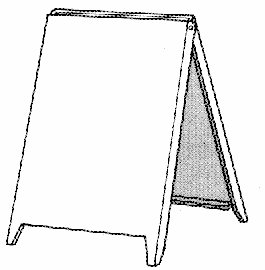
Sign, A-frame: A detached, movable sign which has 2 display areas, hinged on top, and an interior angle not to exceed 60 degrees or less.
Example:
4.
Sign, abandoned: Any permitted sign or sign structure which was erected on a premises in conjunction with a particular use which has been discontinued for a period of 6 months or more.
5.
Sign, animated: A sign that has moving parts or includes action, motion, or color changes, or the optical illusion of action, motion or color changes, including signs using electronic ink, signs set in motion by movement of the atmosphere, or made up of a series of sections that turn, including any type of screen using animated or scrolling displays.
6.
Sign, banner: Any sign with or without characters, letters, illustrations, or ornamentation applied to cloth, paper, plastic, or fabric of any kind with only such material for backing, but excluding flags.
7.
Sign, billboard: A detached sign which has a sign area greater than 250 square feet.
8.
Sign, building marker: A sign made of bronze, stone or other permanent material and permanently installed as a portion of the exterior wall of the building in such manner it cannot be removed or replaced without substantial damage to the building surface.
9.
Sign, canopy: A sign imposed upon or painted on any roof-like structure, such as an awning, either permanently or temporarily extended over a sidewalk or walkway, which can be mounted flush or suspended.
10.
Sign, changeable copy: A sign that is designed so that characters, letters, or illustrations can be changed or rearranged without altering the face or surface of the sign.
11.
Sign, detached: See Sign, freestanding.
12.
Sign, digital: Electronic signage that uses LED (light emitting diode) screens, plasma panels, or any similar electronic signage devices or technology as the digital display sign where content is displayed as an image.
13.
Sign, dilapidated: Any sign which in the City's reasonable opinion is structurally unsound, has defective parts, or is in need of painting or maintenance.
14.
Sign, face: The part of a sign that is or can be used for the display of any graphics, letters, numerals, or characters including any background material, panel, trim, color, or illumination that differentiates the sign from a facade or sign structure.
15.
Sign, flashing: A sign, the illumination of which is not kept constant in intensity at all times when in use, and which exhibits sudden or marked changes in lighting effects including message boards or similar technology.
16.
Sign, freestanding: Any permanent sign affixed to a structure installed directly into the ground and which is wholly independent of any building or other support.
17.
Sign, illuminated: A sign illuminated directly or indirectly by gas, electricity or other artificial light including reflective or fluorescent light.
18.
Sign, incidental: A sign of no more than 6 square feet erected within reading distance of the right-of-way. Alternatively, a sign not exceeding 40 square feet, located not within reading distance of the right-of-way.
19.
Sign, interactive: A sign whose displayed message is changed or modified as a result of the exchange of information or instruction between the sign and a person viewing the sign, or is otherwise designed to modify the message displayed based upon the identity of a specific individual viewing the sign.
20.
Sign, internally illuminated: Any sign which has light transmitted outward through its face or any part thereof.
21.
Sign, marquee: A projection sign attached to a roofed structure of a building which may project over public or private sidewalk or rights-of-way.
22.
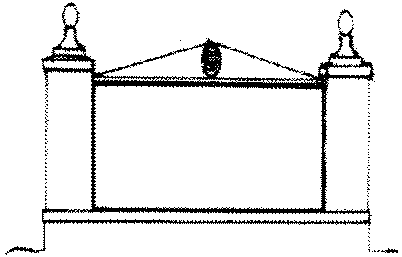
Sign, monument: A freestanding sign that forms a solid structure from the top of the sign to the ground. No open spaces which allow a direct line of sight from 1 side of the sign to the other are permissible in the area beneath the highest point of the sign face.
Example:
23.
Sign, nonconforming: Any sign that was legal at the time of construction, but which does not meet the requirements of this division.
24.
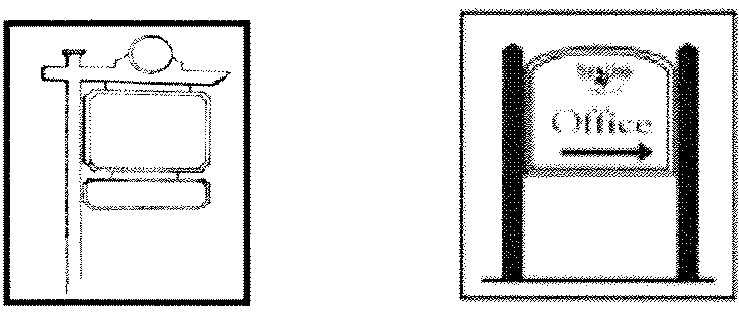
Sign, nostalgic: Any decorative sign made of wood, wrought iron, or similar material which contains 1 decorative post that has a sign extending from the arm; or which contains 2 decorative posts with a sign between them, as long as the sign does not exceed the height of the 2 posts.
Examples of types of nostalgic signs:
25.
Sign, portable display: A mobile/temporary, electrical or non-electrical changeable copy sign that is mounted on a trailer-type frame with or without wheels or skids or portable wood or metal frame and not permanently attached to the ground.
26.
Sign, projecting: A sign which is attached to the building wall and which extends more than 18 inches from the face of such wall.
27.
Sign, pylon: Any freestanding sign which rests upon a pylon or pole.
28.
Sign, roof: A sign that is mounted on the roof of a building or which is wholly dependent upon a building for support or which projects above the point of a building with a flat roof, the eave line of a building with a gambrel, gable or hip roof or the deck line of a building with a mansard roof.
29.
Sign, standard informational. A sign with an area not greater that 6 square feet, with a sign face for short-term use, containing no reflective elements, flags, or projections, and which, when erected, stands at a height not greater than 4 feet, and is mounted on a wooden stake or metal frame with a thickness or diameter not greater than 1½ inches.
30.
Sign, temporary: A display, sign, banner, or other advertisement device with or without a structural frame, not permanently attached to a building, structure or the ground and intended for a limited period of display. This definition does not include portable display signs.
31.
Sign, trailer: Any sign mounted on wheels and that may be moved from 1 location to another.
32.
Sign, vehicular: Any sign on an operable vehicle or any vehicle parked temporarily, incidental to its principal use for transportation. This definition shall not include signs which are being transported to a site for erection.
33.
Sign, wall: Any sign attached to or erected against a wall which is an integral part of the building, and projects no more than 18 inches from the wall of the building. Such a sign may be constructed without constituting an encroachment into a required side or front yard setback line. A single-face sign which is in any manner attached or fixed flat to an exterior wall of a building or structure. Individual letters in addition to the "box type" (i.e., letters and symbols on an attached backing) sign may also be installed.
34.
Sign, window: A sign affixed to or displayed within 1 foot of a window in any maimer so as to be visible from a public right-of-way.
35.
Sign area: The entire face of a sign, its supporting structure and all wall work including illuminated tubing incidental to its decoration. In the case of an open sign made up of individual letters, figures, or designs attached directly to the building or standard the space between such letters, figures or designs shall be included as part of the sign area. When a sign has parallel sides or where the interior angle formed by the faces is less than 45°, the sign shall be considered double-faced. The calculation for a double-faced sign shall be the area of 1 face only. The copy area of all "V" or "L" shaped signs with an internal angle of greater than 45° shall be considered as a single face. If the faces of a double-face sign are of unequal area, the area of the sign shall be taken as the area of the larger face.
36.
Sign clearance: The vertical distance from the established finished grade of the sidewalk or ground to the lower edge of a sign.
37.
Sign height: The distance in vertical feet from the grade of the road or the grade of the sign location, whichever is higher, to the highest point of the sign.
(Ord. No. 7867, 1/13/2016, § 1; Ord. No. 8301, 9/14/2022, § 2)
714.10 - Severability.
It is hereby declared to be the intention of the Mayor and Council that the sections, paragraphs, sentences, clauses, and phrases of this article are severable, and if any phrase, clause, sentence, paragraph, or section of this division be declared unconstitutional or invalid, it shall not affect any of the remaining phrases, clauses, sentences, paragraphs and sections of this division.
(Ord. No. 7867, 1/13/2016, § 1)
714.11 - Substitution of non-commercial copy for commercial copy.
Notwithstanding any provision of this division to the contrary, to the extent that this division permits a sign containing commercial copy, it shall permit a non-commercial sign to the same extent.
(Ord. No. 8301, 9/14/2022, § 3)

