
Marshall City Zoning Code
ARTICLE 86
VI SUPPLEMENTAL REGULATIONS
25-014
22-005
24-009
26-011
22-011
24-022
24-025
25-011
26-007
22-014
23-007
687 2nd Series
749 2nd Series
23-022
26-008
23-009
23-023
25-006
26-012
Section 86-161 Height Modifications
- Building height limitations set forth elsewhere in this chapter may be increased by 100 percent when applied to the following:
- Church spires and belfries which do not contain usable spaces.
- Monuments.
- Water towers.
- Chimneys or smokestacks.
- Cooling towers.
- Commercial silos.
- Industrial equipment.
- Building height limitations set forth elsewhere in this chapter may be increased by 25 percent when applied to the following:
- Elevator and mechanical penthouses, stair enclosures, and church domes.
- Clearstories, skylights, and other above roof structures with a footprint less than ten percent of the roof area.
- Light poles.
- Sign and flag height limitations are determined by Sign Ordinance Division 86-VI-2.
(Code 1976, § 11.19(4)(A); Ord. No. 466, § 2, 10-15-2001; Ord. No. 750 2nd series, § 1, 6-23-2020; Ord. No. 21-002, § 1, 4-27-2021)
Amended by Ord. 25-014 on 11/25/2025
Section 86-162 Yard Modifications
Measurements shall be taken from the nearest point of the wall of a building to the lot line in question, subject to the following qualifications:
- Cornices, awnings, marquees, eaves, pergolas, chimneys not wider than six feet, and balconies may extend into the required front yard a distance not exceeding four feet, and the required side yard distance not exceeding two feet.
- Fire escapes in existing buildings may extend into the required front and side yards a distance not exceeding five feet. Basement egress window wells projecting no more than three feet from the building may extend 20 feet into required front and three feet into required side yard.
- A landing or deck may extend into the required front yard to a distance not exceeding eight feet, if they have the floor no higher than the main floor of the building, except a landing installed at the main entrance of existing residential structure and projecting no more than four feet from the structure may extend 15 feet into required front yard. A four-foot square landing, not including stair, or a five-foot square landing serving a ramp, shall always be permitted at the main entrance of existing residential structures if replacing an existing landing. An open railing no higher than three feet may be placed around such structures.
- A bay window having a bow, or angled sides, with windows on all faces projecting no more than two feet from the building wall may extend 20 feet into required front yard and two feet into required side yard.
- The architectural features listed in paragraphs (a) through (d) may also extend into the required rear yard to the same extent as permitted for extension into the required front yard. If an easement coincides with, or is wider than, a required yard, architectural features listed in paragraphs (a) and (b) may extend into such easement not more than two feet with written approval of the city engineer.
- Retaining walls, fences, and other similar structures located in any yard shall not exceed seven feet in height in any of the classes of residential and business districts, unless required by a condition for a variance adjustment, or conditional or interim use permit granted for an unrelated issue. Barbed wire or electrical fencing materials are prohibited in these locations.
- Retaining walls, fences or any other structures, both permanent and temporary, except pylon signs, located in the front yards, shall not exceed three feet in height as measured above the curb if placed within a 25-foot visibility triangle of the property corner for corner lots at street intersection and within a ten-foot visibility triangle adjacent to alleys and driveways for all properties.
- On double frontage lots, the required front yard shall be provided on both streets. On corner lots, the required front yard shall be provided on all streets. On curved portions of cul-de-sac lot frontages, the required front yard may be reduced to 15 feet.
- In determining the depth of a rear yard for any building where the rear yard opens into an alley, one-half the width of the alley, but not exceeding ten feet, may be considered as a portion of the rear yard.
- Any structure, including fences, built in the rear or side yard that opens into an alley, must not be placed less than three feet from the property line defining this alley. Any garage with overhead door facing, and having a direct vehicle access from, an alley must not be placed less than 18 feet from the alley.
- No front, side or rear yard shall be required in the downtown district, except for one and two-family dwellings.
- On a corner lot fronting two intersecting streets, either yard opposite the street may be designated as the rear yard; in case of a triangular corner lot, the yard not adjacent to streets shall be deemed the rear yard but shall meet the setback requirements of a side yard. On a corner lot fronting three streets, the yard opposite the front yard located between two other front yards shall be deemed the rear yard but shall meet the setback requirements of a side yard.
- On a flag lot, the lot side, which faces the street that this lot has an access from, shall be designated as the front yard. For such lots, the lot depth calculations shall not include the length of the narrow access portion of the lot.
- On a lot that faces, and is exclusively accessed from, a public roadway easement or recorded access easement providing access to at least one other property beyond said lot, the lot side facing the easement shall be designated as the front yard.
- On an interior triangular lot, no rear yard shall be required.
(Code 1976, § 11.19(4)(B); Ord. No. 374 2nd series, § 1, 8-4-1997; Ord. No. 699 2nd series, § 1, 9-9-2015; Ord. No. 725 2nd series, § 1, 1-23-2018; Ord. No. 750 2nd series, § 1, 6-23-2020; Ord. No. 21-002, § 1, 4-27-2021)
Amended by Ord. 22-005 on 5/10/2022
Amended by Ord. 24-009 on 5/14/2024
Amended by Ord. 25-014 on 11/25/2025
Section 86-163 Accessory Buildings
- Purpose. These regulations governing accessory buildings are established to provide for the orderly development and use of land and to minimize conflicts among land uses by regulating the type, size and location of accessory buildings.
- Accessory buildings shall comply with the following regulations in addition to other requirements of this chapter:
- An accessory building must not be placed on a lot where there is no permitted use main building except in a case when such lot is not substandard and is adjacent to the lot where a permitted use main building is located, provided both lots have the same owner(s), and the owner(s) sign and record an agreement prohibiting the sales or transfer of individual lots unless a new main structure is built on a lot where a standalone accessory building, compliant with the city ordinance, is located or said accessory building is removed. If such accessory structure is allowed under above conditions, the city ordinance shall be applied as if two adjacent lots are combined into one.
- An accessory building must not be placed less than five feet from the main building or another accessory building.
- An accessory building must not be placed in a required front yard or side yard, or less than 12 feet to the rear property line except one accessory building less than 200 square feet in area and less than ten feet in height may be placed not less than five feet to the side or rear property line. For accessory buildings over 1,000 square feet or over ten feet in height, the distance to the rear property line shall be increased by one-foot for every 100 square feet area increase over 1,000 square feet and every one-foot height increase over ten feet until ordinance required rear yard depth is reached.
- An accessory building must not exceed 1,000 square feet in area in the R-1 one-family residence district, nor exceed 600 square feet in area per dwelling unit in residential structures in any other residential district, nor exceed 80 percent of the footprint area of the main use building when its footprint exceeds 1,200 square feet in all classes of residential and business districts, except an accessory building size may be increased 50 percent if located on lots of more than seven-tenths of an acre in the R-1 one-family residence district and the R-2 one- to four-family residence district. In all classes of residential and business districts, all accessory buildings combined must not exceed the area of the main building nor occupy more than 25 percent of the area of a rear or front yard.
- In all classes of residential and business districts an accessory building must not be more than one-story or greater than 15 feet in height. An accessory building located 25 feet or more from all property lines on a lot of seven-tenths of an acre or more must not be more than one and one-half stories, nor more than 18 feet in height. Accessory buildings must not be greater in height than the main building. Open lofts and mezzanines shall not be considered stories.
- In the R-1 one-family residence district and the R-2 one- to four-family residence district, an accessory building must not be located a lesser distance to a front property line than the main building; on double frontage lots one accessory building may be permitted on the side opposite to the lot access point provided it meets applicable front yard requirements and matches the main structure in appearance.
- On lots of more than seven-tenth of an acre with a front yard depth at least two times greater than the required front yard, an open gazebo under 200 square feet in area and 12 feet in height may be placed in front of the main building,
- On lots of more than seven-tenth of an acre with a front yard depth at least two times greater than the required front yard, a detached garage may project up to ten feet past the nearest main building front wall, provided it is located less than ten feet away from such main building and projection is less than half of garage's full depth,
- In all classes of residential and business districts, accessory buildings located in, or protruding into, the front yard shall be finished to match the main use building.
- In the R-1 one-family residence district and the R-2 one- to four-family residence district there must not be more than two accessory buildings placed on a lot of less than seven-tenths of an acre, nor more than three accessory buildings placed on a lot of more than seven-tenths of an acre. An open gazebo under 200 square feet in area and 12 feet in height may be built in addition to the number of accessory building limitations indicated above.
- All accessory buildings must be constructed to comply with all requirements of the building code including structural requirements.
- No accessory building shall be used, permanently or temporarily, for human habitation; any building containing provisions for human habitation shall be considered a main use. In the R-1 one-family residence district and the R-2 one- to four-family residence district, one travel trailer, camper, motor-home or recreational vehicle may be used as a temporary guest residence for no more than ten days per calendar year. If placed in the front yard, it shall not project into public right-of-way or visibility triangles. The ten days limit may be extended to 30 days by an interim use permit.
- Trailers, semi-trailers, and storage containers (including, but not limited to, cargo and shipping container and PODS or any structures made of the above components) shall not be considered or used as accessory buildings.
- Any accessory building exceeding 300 square feet, capable of storing street legal motorized vehicles, shall be provided with a street access in a form of a driveway that shall be paved from the street through the required front yard. No driveway shall be required for secondary garages, provided a minimum double garage is attached to the house; however, if such driveway is installed, it shall be paved within the public right-of-way.
- Accessory buildings must not be located within any utility easements. Overhangs and eaves may extend into such easement not more than two feet with written approval of the city engineer.
- In all classes of residential and business districts accessory buildings, including carports but excluding temporary structures installed for less than 90 days, must not use cloth, canvas, plastic sheathing, tarps, or similar materials as finish building materials.
- Temporary family health care dwellings are not permitted, pursuant to authority granted by Minn. Stat. § 462.3593, subd. 9.
(Code 1976, § 11.19(4)(C); Ord. No. 574, § 1, 6-4-2007; Ord. No. 614, § 1, 10-13-2009; Ord. No. 681 2nd series, § 1, 9-24-2013; Ord. No. 699 2nd series, § 1, 9-9-2015; Ord. No. 711 2nd series, § 1 8-8-2016; Ord. No. 750 2nd series, § 1, 6-23-2020; Ord. No. 21-002, § 1, 4-27-2021)
Section 86-164 Accessory Equipment And Structures
- In all the classes of residential districts, accessory equipment shall be subject to the following qualifications:
- Accessory equipment, except a single basketball hoop, shall not be located in any required front yard, side yard, or within 12 feet of any rear lot line. Accessory equipment cumulatively less than 200 square feet in area and less than eight feet in height and sport courts shall not be placed less than five feet to the side or rear property line. Residential type AC units are permitted within required side or rear yards.
- Accessory equipment shall not exceed 12 feet in height when measured from the lowest point of the finished surface of the ground within five feet of the support structure to the top of the equipment. Equipment mounted on the roof of the building shall not project beyond the highest portion of the pitched roof structure of the building nor exceed four feet above the flat roof structure.
- When the accessory equipment is attached structurally and not just electrically to a building, it shall comply in all respects with the requirements of this chapter as applicable to the buildings and also to the requirements of the building code.
- Accessory equipment shall not be placed on a lot where there is no permitted principal use building except in a case when such lot is not substandard and is adjacent to the lot where a permitted principal use building is located, provided both lots have the same owner(s), and the owner(s) sign and record an agreement prohibiting the sales or transfer of individual lots unless a new principal use structure is built on a lot where accessory equipment, compliant with the city ordinance, is located or said accessory equipment is removed. If such accessory equipment is allowed under above conditions, the city ordinance shall be applied as if two adjacent lots are combined into one, except a sports court may be located at a lesser distance tothe front property line than the principal use building.
- In the R-1 one-family residence district and the R-2 one- to four-family residence district accessory equipment shall not be located a lesser distance to the front property line than the principal use building except residential type AC units or unless fully screened from public right-of-way by solid fence. On double frontage lots accessory equipment may be permitted on the side opposite to the lot access point provided it meets applicable front yard requirements.
- Accessory equipment, including any projections, shall not be located within any utility easements.
- Roofed structures shall be subject to accessory buildings area limits per Section 86-163 (b) (4).
- In all the classes of business districts, accessory equipment shall be subject to subsections (a)(1), (2), (3) and (6).
- In all the classes of industrial districts, accessory equipment shall be subject to subsections (a)(1), (3) and (6).
(Code 1976, § 11.19(4)(D); Ord. No. 681 2nd series, § 1, 9-24-2013; Ord. No. 750 2nd series, § 1, 6-23-2020; Ord. No. 21-002, § 1, 4-27-2021)
Amended by Ord. 26-011 on 9/8/2026
Section 86-165 Structures In Residential Districts
For all permitted non-accessory structures in the R-1, R-2, R-3 and R-4 Districts, the following shall apply:
- Such structures shall comply with all applicable zoning regulations for the zone in which they are located and with all applicable state statutes and codes.
- A building permit and any other required permits shall be obtained for such structures.
- No such structures shall have a footprint of less than 800 square feet, not including an attached garage, unless such garage has habitable space above.
- No such structures shall have a dimension of less than 24 feet at its narrowest point, as measured from faces of exterior walls, in any direction, except entries, porches, and similar attachments.
- Any such structure shall be placed on permanent building code compliant foundation that is continuous around the entire perimeter of the building except for decks, porches, or similar attached structures or rooms constituting less than 25 percent of the building footprint area.
- Any such structure shall have exterior wall finish materials extend down to foundation or within 12 inches above grade, whichever is less. Wainscoting, if used, shall be minimum of 36 inches high.
- Any such structure shall have a sloped roof with at least 3/12 pitch over at least half of the building; a flat roof is permitted over entire buildings larger than 1,200 square feet in footprint or taller than two stories.
- No such structure shall use materials with exposed fasteners as an exterior finish, except sloped roofs.
- In R-1 one family residence district, direct and independent connection to city utilities shall be required for each such structure and no exterior above-ground fuel tanks shall be allowed, except one tank, 100 gallons or less, properly located and screened, may be permitted.
- In R-1 one-family residence district, not more than one such structure may be built on a single lot.
- Nothing in this article shall prevent the regulation of uses of property by means of restrictive covenants.
(Code 1976, § 11.19(5); Ord. No. 732 2nd Series, § 1, 1-8-2019)
State law reference(s)—Manufactured home park to be conditional use in any district allowing buildings used or intended to be used by two or more families, Minn. Stat. § 462.357, subd. 1b.
Amended by Ord. 22-011 on 11/7/2022
Amended by Ord. 24-022 on 11/12/2024
Section 86-166 Certification Of Cannabis Business License Application With Zoning
- Definitions:
- Cannabis or hemp edible business means any business that requires licensure under Minnesota Statutes, Chapter 342.
- OCM means the Minnesota Office of Cannabis Management.
- Potential licensee means an applicant that is seeking a license to operate a cannabis or hemp edible business from the OCM.
- The city administrator, or their designee, is authorized to certify whether a proposed cannabis business complies with the city’s zoning ordinances, this chapter, and if applicable, state fire code and building code pursuant to Minnesota Statutes, section 342.13. Potential licensees are responsible for requesting and scheduling any inspections related to building and fire code compliance. Potential licensees may contact the city to have such inspections conducted prior to the city receiving the request for certification from the OCM. If a potential licensee is not able to have any building or fire code inspection complete within the 30-day review period provided under state law, the city will not certify the application.
Adopted by Ord. 24-025 on 12/10/2024
Section 86-180 Purpose And Findings
- Purpose. The sign ordinance is intended to establish a comprehensive and balanced system of sign control that accommodates the need for a well- maintained, safe, and attractive community, and the need for effective communications including business identification. It is the intent of this section to promote health, safety, general welfare, aesthetics, and image of the community by regulating signs that are intended to communicate to the public, and to use signs that meet the city's goals by authorizing:
- permanent signs that establish a high standard of aesthetics;
- signs that are compatible with their surroundings;
- signs that are designed, constructed, installed, and maintained in a manner that does not adversely impact public safety or unduly distract motorists;
- signs that are large enough to convey the intended message and to help citizens find their way to intended destinations;
- signs that are proportioned to the scale of, and are architecturally compatible with, principal structures;
- permanent signs that give preference to the on- premises owner or occupant; and
- temporary signs that provide an opportunity for grand openings and special events while managing visual clutter and restricting hazards at public right-of-way intersections.
- Findings. The city of Marshall finds it is necessary for the promotion and preservation of the public health, safety, welfare, and aesthetics of the community that the construction, location, size, and maintenance of signs be controlled. Further, the city finds:
- permanent and temporary signs have a direct impact on and relationship to the image of the community;
- the manner of installation, location, and maintenance of signs affects the public health, safety, welfare, and aesthetics of the community;
- an opportunity for viable identification of community businesses and institutions must be established;
- the safety of motorists, cyclists, pedestrians, and other users of public streets and property is affected by the number, size, location and appearance of signs that unduly divert the attention of drivers;
- installation of signs suspended from, projecting over, or placed on the tops of buildings, walks or other structures may constitute a hazard during periods of high winds and an obstacle to effective fire-fighting and other emergency service;
- uncontrolled and unlimited signs adversely impact the image and aesthetic attractiveness of the community and thereby undermine economic value and growth;
- uncontrolled and unlimited signs, particularly temporary signs which are commonly located within or adjacent to public right-of-way or are located at driveway/street intersections, result in roadside clutter and obstruction of views of oncoming traffic. This creates a hazard for drivers and pedestrians and also adversely impacts a logical flow of information;
- commercial signs are generally incompatible with residential uses and should be strictly limited in residence zoning districts; and
- the right to express noncommercial opinions in any zoning district must be protected, subject to reasonable restrictions on size, height, location and number.
- Severability. Every section, subdivision, clause, or phrase of Division 2 is declared separable from every other section, subdivision, clause, or phrase. If any such part is held to be invalid by competent authority, no other part shall be invalidated by such action or decision.
Adopted by Ord. 25-011 on 9/9/2025
Section 86-181 Definitions
- Abandoned Sign means a sign remaining without a message for a period of six months or more, or pertaining to a time, event, location, or purpose, including a discontinued business (unless evidence is provided that a business is temporarily suspended due to a change in ownership or management), which no longer applies, or remaining after demolition of a principal structure.
- Alteration means any change, reconstruction, relocation or enlargement of a sign, but shall not include routine maintenance, painting or change of facing or wording on an existing sign.
- Awning Sign means a sign or graphic woven into, printed on, or otherwise permanently attached to the awning material.
- Balloon means a temporary sign consisting of a bag made of lightweight material supported by hot or pressurized air or helium inside.
- Banner means a temporary sign made of paper, fabric, cloth, canvas, plastic sheathing or any other flexible non-rigid material with no enclosing framework, and mounted to stay flat. One banner per property that gets reinstalled repeatedly in the same location for same purpose with the same size for less than 30 days each time and all banners placed inside sign cabinets shall be considered permanent flat signs.
- Cluster Sign means several flat signs that identify multiple establishments in a building grouped together in one location on that building, and that are of the same size and generally similar appearance.
- Commercial Sign means any sign that is used to advertise or identifies a product, business, service, profession, commodity, entertainment or any other matter of a commercial nature.
- District means a City zoning district, as defined in the City' s zoning ordinance.
- Directional Sign means a sign erected for the single purpose of directing pedestrian or vehicular traffic onto or about the property upon which such sign is located, including menu boards and signs marking entrances and exits, circulation direction, parking areas, and pickup and delivery areas. Business name and logo shall not occupy more than 25 percent of such sign area or be greater than 5 square feet.
- Double face Sign means a sign that has images or text on opposite parallel or near parallel (less than 15 degrees) sides mounted not more than 24 inches apart on a single structural component, or a spherical sign. Only one side shall be counted toward the total permitted sign surface area.
- Dynamic Display means any sign or characteristics of a sign that appear to have movement or that appear to change, caused by any method other than physically removing and replacing the sign or its components, whether the apparent movement or change is in the display, the sign structure itself, or any other component of the sign. This includes a display that incorporates a technology or method allowing the sign face to change the image without having to physically or mechanically replace the sign face or its components. This also includes any rotating, revolving, moving, flashing, blinking, or animated display and any display that incorporates rotating panels, LED lights manipulated through digital input, " digital ink" or any other method or technology that allows the sign face to present a series of images or displays.
- Electronic Graphic Display Sign means any sign or portion thereof that displays electronic static or moving images, with or without text information, defined by a number of matrix elements using different combinations of light emitting diodes (LEDs), fiber optics, or other illumination devices within the display area where the message change sequence is accomplished immediately or by means of fade, re-pixelization or dissolve modes. These signs include computer programmable, microprocessor controlled electronic or digital displays and projected images or messages with these characteristics onto buildings or other objects.
- Feather Sign means a temporary sign with a rounded top edge supported by a continuation of a ground- mounted staff or pole bent accordingly and with a height much greater than the width.
- Flashing Sign means a directly or indirectly illuminated sign or portion thereof that exhibits changing light or color effect by any means, so as to provide intermittent illumination that changes light intensity in sudden transitory bursts and creates the illusion of intermittent flashing light by streaming, graphic bursts showing movement, or any mode of lighting which resembles zooming, twinkling, or sparkling with an interval between flashes of less than eight seconds.
- Flag means any fabric or similar flexible lightweight piece of material attached at one edge or two points, usually to a pole, but possibly to the underside of a roof structure or a horizontal bar, so as to allow free movement of the material by atmospheric changes.
- Flat Sign means a permanent sign mounted on a building or its elements parallel to its vertical or near-vertical (less than 15 degrees off vertical plane) surface and projecting no more than 18 inches off that surface.
- Freestanding Sign means a permanent, non- movable sign supported upon the ground by poles, pylons, braces, foundation, solid base or any other permanent structure and not attached to any building.
- Gas Pump Sign means a sign factory painted or mounted on a side or top of an operational gas pump.
- Government Sign means a sign that is erected and owned by a governmental unit on the public property or right of way.
- Ground Sign means a freestanding sign erected on the ground or solid base or mounted on the pole(s) or pylon(s) so that the bottom edge of the sign display area is eight feet or less above the point of contact with the ground.
- Height of Sign means maximum vertical distance from the point of contact with the ground to the highest point of the sign.
- Illumination, internal means a light source within the sign.
- Illumination, external means a light source which is not internal to the sign.
- Integral Sign means a sign which is made an integral part of the building structure.
- Multifaced Sign means a sign containing two or more non-parallel faces located at least 24 inches apart on at least one end and mounted on a single structural component. Each face shall be counted separately toward the maximum allowable sign surface area.
- Non-commercial Sign means signs that are not commercial in nature, which include, but may not be limited to, expression of politics, religion, public services or ideologies.
- On-premises Sign means a sign that is not off-premises.
- Off-premises Sign means a sign exclusively advertising a business, person, activity, goods, products, or services not located on the site, or on an adjacent site, or within 200 feet of where the sign is installed. Permanent off-premises signs shall be considered a "use" as defined in Section 86- 1 and regulated accordingly as " structures". Temporary off-premises signs shall not be permitted.
- Permanent Sign means any sign other than a temporary sign.
- Portable Sign means any temporary sign which is manifestly designed to be transported or easily moved, including by trailer or on its own wheels, even though the wheels of such sign may be removed and the remaining chassis or support is converted to another sign or attached temporarily to the ground since this characteristic is based on the design of the sign.
- Projecting Sign means a sign mounted on a building or its elements, including below canopies or awning, perpendicular to its surface, with or without additional ground support or a sign mounted parallel to the building surface but projecting more than 18 inches.
- Pylon Sign means a freestanding sign mounted on one or more individual pylon(s), pole(s), post(s) or other similar support(s) so that the bottom edge of the sign display area is more than eight feet above the point of contact with the ground surface.
- Roof Sign means a sign, except flags, mounted on a building or the building' s elements and projecting above the roof edge or parapet line of a building or marquee with a flat roof or the eave line of a building, awning or canopy with a gambrel, gable, mansard or hip roof.
- Rotating or Moving Sign means a sign which revolves or rotates on its axis by mechanical means or has otherwise physical moving parts.
- Sandwich Sign means a portable sign, typically A-shaped, with two visible sides spread apart that is placed near the main entrance to a building or on a sidewalk.
- Sign means any writing, pictorial presentation, number, illustration or decoration, flag, banner or other device that is used to announce, direct attention to, identify, advertise, or otherwise make anything known. For the purpose of this Section, the term "sign" shall not be deemed to include: the terms "building" or "landscaping", or any architectural embellishment of a building not intended to communicate information; building addresses required by the ordinance; works of art; or any sign structure or device that is not visible from an adjacent street, property line or building on adjacent property.
- Surface Area means the entire area within a single continuous perimeter enclosing the extreme limits of the actual sign surface. In the case of flat signs consisting of individual not overlapping letters and symbols, not located within clearly defined sign border or frame and mounted on a common background, the surface area shall consist of the combined areas within the continuous outside perimeter of each individual letter, symbol, provided those outside perimeters do not overlap. Graphic striping, patterns, and color bands backgrounds shall not be included in surface area computations unless located within clearly defined sign border or frame. Sign Clusters shall be considered one sign when calculating the relevant surface area for the sign cluster. Surface area shall not include any clearly defined structural elements outside the limits of such sign and not forming an integral part of the display. Only one side of a double-face sign structure shall be used in computing total surface area. The area of a spherical sign shall be calculated as the area of a circle with 25 percent reduction; the area of a cylindrical sign shall be calculated as the area of a rectangle with 20 percent reduction.
- Temporary Sign means a sign not permanently affixed to a building or foundation structure and intended for temporary, even if repeated, use due to the temporary nature of the sign message or low durability of sign materials.
- Utility Box Sign means a sign painted on or attached to the side surface of any utility box.
- Window Sign means a sign attached to, placed upon or painted on the interior of a window outward facing, or mounted on the inside within the exterior wall thickness in the window opening and intended for viewing from the exterior of the building.
- Zoning Administrator means the zoning administrator of the City or a person designated as such by the City Administrator.
Additional definitions as applicable may be found in Section 86- Definitions
Adopted by Ord. 25-011 on 9/9/2025
Section 86-182 Citation: Administration And Enforcement
- Citation. This division may be cited as the Marshall Sign Ordinance.
- Administration and enforcement. Pursuant to Section Chapter 1, Section 1-8 of the Marshall Code, the City Administrator, or their delegee as Zoning Administrator, is empowered to enforce the provisions of this Ordinance as necessary to carry out the purpose of this Ordinance. The City Administrator, or their delegee as Zoning Administrator, may cause to be removed any sign that endangers the public safety, such as an abandoned, dangerous, or electrically or structurally defective sign or a sign for which no permit has been issued or a sign which obstructs or interferes with the public right-of-way. A notice of violation shall be mailed to the sign holder citing the violation. If the violation is not corrected within ten (10) days, the City shall have the authority to remove the sign or impose a fine pursuant to Article 2- VII. No notice is required to be provided to the holder of a temporary sign listed in 86-184, subd. (b) of this Section in violation of this Code, and the Public Works Director, Chief of Police or Zoning Administrator, or their designees are hereby expressly authorized to immediately remove and impound such a temporary sign, the costs of which removal and impoundment may result in an administrative fine against the owner of the site on which the sign was displayed. The sign owner may retrieve the sign during normal business hours from the City within 15 days from the date of impounding. After 15 days, the city will dispose of the sign; and the city may not be held liable for any damage to impounded signs.
Adopted by Ord. 25-011 on 9/9/2025
Section 86-183 Permits And Procedure
In all districts, any sign authorized under this Chapter is allowed to contain noncommercial copy in lieu of other copy.
- Permit not required. The following signs do not require a permit but must meet the regulations in this Section and Section 86-184:
- Traffic control devices erected and maintained to comply with the Manual on Uniform Traffic Control Devices adopted in the State of Minnesota.
- Signs required by law or ordinance for regulatory, notification, or safety purposes.
- Signs with a surface area that does not exceed two (2) square feet.
- Directional signs.
- Signs located on gas pumps.
- Utility box signs.
- Flags mounted on a roof or a wall.
- Government signs.
- Integral signs.
- All temporary signs.
- Awning signs or canopy mounted signs located on the vertical edges and consisting of separate letters.
- Window signs.
- Signs allowed pursuant to Minnesota Statutes Section 211B..
- Permit required. Other than in subsection (a) above, no sign shall be installed or placed without first obtaining a sign permit from the City. No permitted sign shall be altered in size, location or type without reapplying for a sign permit from the City.
- Permit procedure. Sign permit applications shall be handled in the same manner as building permits.
- Fee. Except as modified by this subdivision, applications must be accompanied by payment of the fee as established by the City, to cover the city' s costs in processing the application, the investigation and administering the provisions of this section. The application fee is nonrefundable.
- Application for a permit must be on a form provided by the city and must include the following information:
- name and address of the owner of the sign;
- street address or location of the property on which the sign is to be located, along with the name and address of the property owner;
- the type of sign as defined in this section;
- site plan showing the location of the proposed sign;
- specifications and scale drawings showing the materials, design, dimensions, structural supports, method of attachment and electrical components of the sign; drawings for freestanding and projecting signs shall be certified by a structural engineer licensed in the State of Minnesota.
- plan showing the location and size of all existing signs located on the same premises upon city request;
- sign permit fee as set in the same manner as building permits pursuant to section 18-23.
- The City Administrator or their designee serving as Zoning Administrator shall approve or deny a sign permit application within 30 business days after a complete application is submitted. A decision must be made in writing and must be mailed or electronically delivered to the applicant at the address or email address provided in the application. If a permit is denied, the reason must be stated in writing.
- An applicant may appeal a denial by submitting a request in writing within 10 days after the decision was mailed or electronically delivered. The appeal must be scheduled for planning commission review as soon as as practicable but no later than 30 days after the appeal was submitted. The applicant may appeal a planning commission denial by submitting a request in writing within 10 days after the decision. The appeal must be scheduled for city council review as soon practicable, but no later than 30 days after the appeal was submitted. All reviews of a sign permit application must be based solely on whether the application complies with city ordinances.
- Permit expiration. A sign permit becomes null and void if the sign is not installed within 180 days after issuance of the permit, and a new application must be submitted.
- When applicable, no sign permit shall be issued unless an Ordinance compliant building address is present or will be installed as a part of proposed work.
Adopted by Ord. 25-011 on 9/9/2025
Section 86-184 General Regulations
- Scope. The regulations in this section 86-184 apply to signs in all zoning districts.
- Prohibited Sign. The following signs are considered dangerous and prohibited in all districts. Signs
- Which purport to be or resemble an official traffic control device, sign, signal, railroad sign or signal; or which hide from view or interferes in any material degree with the effectiveness of any traffic control device, sign, signal, railroad sign or signal, or which obstruct or interfere with the driver' s view of approaching, merging, or intersecting traffic within visibility triangles. This includes signs higher than three (3) feet installed within visibility triangles.
- Which prominently display the word " stop" or" danger" unless necessary for real warning or as traffic control.
- Which contains statements, words, or pictures of an obscene nature.
- Which are placed on any public right- of-way or recorded easement, except as otherwise provided or allowed by city code or state law, including Minn. Stat 211B.045, or otherwise approved by council pursuant to Section 62-9 of the Marshall Code, and sandwich signs placed on sidewalks in the Downtown District in those instances when a clear five-foot-wide passage on that same sidewalk exists at the point of sign location.
- Which are placed on private land without the consent of the owner thereof.
- Which are attached to trees, shrubs, or which are painted or drawn upon rocks or natural features; which are affixed to utility poles, flagpoles, and pylons supporting another sign, except government signs.
- Which give off intermittent or rotating light beams or produce flashing, pulsating or moving lights or images.
- Which are structurally unsafe, in disrepair or abandoned.
- Which have dynamic displays unless otherwise allowed herein. All displays shall be shielded to prevent any light to be directed at oncoming traffic in such brilliance as to impair the vision of any driver. No device shall be illuminated in such a manner as to interfere with or obscure any official traffic signs or signal. Any illumination of a sign shall not shine directly upon any part of a residence.
- Which protrude over roadways, alleys, access easements, driveways, parking, or any other vehicular traffic areas.
- Roof signs.
- Freestanding banners except those installed in conjunction with city-wide special events.
- Size, time and location requirements. Signs shall meet the applicable requirements in this Section and under the table incorporated by reference herein, unless otherwise exempted from regulation. If requirements contradict each other, the most stringent one shall apply:
- Signs may not be located on property without the permission of the property owner.
- Unless specifically required otherwise, all ground signs must maintain a minimum 5- foot setback from all lot lines. The city engineer may require a greater setback because of public safety reasons which may include the following conditions: vehicle sight distance, distance from intersection, or designation of adjacent right-of-way.
- All signs shall comply with side and rear yard setback requirements.
- Except for Temporary Signs located on active construction sites surrounded by temporary fence, signs may not be attached to fences.
- Signs may not be located so as to obstruct any door, fire escape, stairway or opening intended to provide light, air, ingress, or egress for any structure.
- A single window sign per glass pane is permitted; multiple signs within a single pane may be permitted if they are coordinated and neatly and symmetrically placed; neon tube signs, signs consisting of individual letter less than six (6) inches in height, and transparent glass film signs are always permitted. Window signs greater than 10 square feet shall be counted towards flat wall sign allowance for façade.
- Temporary Signs shall not be installed for more than fourteen (14) consecutive calendar days and, in no instance, more than a cumulative sixty (60) calendar days in any one calendar year. As an exception, sandwich signs under six (6) feet in surface area and installed in the Downtown district do not have time limitation provided they are removed nightly.
- Balloon and Feather Signs shall not exceed fifteen (15) feet in height. Balloon Signs must be ground mounted and must not utilize tether lines or tie-downs in a manner which risks the health or safety of the public.
- Flag Signs shall not exceed forty (40) feet in height unless limited otherwise. The bottom edge of Flag Signs mounted on a horizontal bar or projecting more than twenty-four (24) inches from the mounting poles shall provide a minimum vertical clearance of eight (8) feet above ground.
- Temporary signs located at construction sites shall be installed no more than seven (7) days prior to construction commencement, provided a valid permit is issued for construction.
- Unless otherwise provided in the Section, Temporary Signs shall not exceed six (6) feet in height and shall not be illuminated or have moving parts. Temporary Signs left unattended shall be attached to the wall, anchored to the ground or weighted down to be able to withstand 90 mile per hour wind. No temporary signs shall be placed upon the required parking space or access drive.
- All Freestanding Signs or other Sign protruding above dedicated paved walking surfaces shall provide a minimum vertical clearance of more than eight (8) feet above ground. Projecting signs in the Downtown District may protrude over pedestrian sidewalk no more than six (6) feet or two thirds of sidewalk width, whatever is less.
- Signs in the Heritage District shall also comply with Section 86-287 of the Marshall City Code.
- All signs with electrical components, temporary or permanent, are subject to the State Electrical Code and approval of the Electrical Inspector.
- Installation of full- size objects as elements mounted on a sign may be allowed by a conditional use permit in all commercial, mixed, and industrial districts.
- Electronic Graphic Display signs. Electronic Graphic Display (EGD) signs shall be subject to the following requirements:
- EGD signs, except signs used as Off-premises Signs, shall not exceed 40 percent of permitted sign surface area or 60 square feet, whichever is less, in all classes of business or industrial districts, and 60 percent of permitted sign surface area in all classes of residence districts. The remainder of the sign must not have the capability to change messages even if not used.
- EGD signs shall display only static images for intervals of at least six (6) seconds per image, except plain text on low- resolution signs may be allowed to scroll. The image change shall be accomplished by means of instantaneous re-pixelization. Fading, dissolving, scrolling, traveling, or any transition that creates the illusion of movement is prohibited. Intervals between successive displays shall be less than 0.5 seconds. Only one image or message may be displayed at a time and images utilizing split screens are prohibited.
- EGD signs shall have an automatic dimmer control that detects ambient light and automatically adjusts the sign' s brightness in direct correlation with natural ambient light conditions for all times during the day. Maximum brightness level at any time shall not exceed 0.3 foot-candles (3 lux) above ambient light as measured from a of ten times the square root of the sign area measured in square feet. Maximum luminance of the sign shall not exceed 6,000 nits during daylight hours and 500 nits at night (1 Nit as the approximate equivalent of 3.426 ANSI Lumens).
- EGD signs displays shall be able to freeze an image in one position if a malfunction occurs and shall also have a mechanism to discontinue the display if the sign malfunctions for longer than one hour.
- Sign construction and maintenance.
- Construction specifications.
- all permanent signs must be constructed in accordance with the Minnesota state building code; and
- signs shall not be painted on the wall of a building or structure; however, a sign may be painted on a water tower or a grain elevator.
- Sign maintenance and repair. All signs must be maintained in a safe, presentable and good structural condition at all times, including the replacement of defective parts, cleaning and other items required for maintenance of the sign. Vegetation around, in front of, behind, and underneath the base of ground signs for distance of ten (10) feet must be neatly trimmed and free of weeds. Rubbish or debris under or near the sign that would constitute a fire or health hazard must be removed.
- Removal of Abandoned Signs, Signs in Disrepair.
- Abandoned signs and signs in disrepair. An abandoned sign or sign in disrepair is prohibited and shall be removed by the owner of the premises within 30 days after notification for permanent signs and seven days after notification for temporary signs. If compliance with the provisions of this section is not achieved within 30 days, the city may remove the sign as a public nuisance or impose an administrative fine. If an abandoned permanent sign remains in good condition and without holes or other evidence of disrepair or damage, the sign shall not be considered as abandoned for a period of six months.
- Nonconforming Signs.
- Any permanent sign that complied with all applicable laws and ordinances at the time it was erected but since has been or is made nonconforming due to a subsequently enacted amendment of this city code is considered a legal nonconforming sign. Any permanent sign that was installed without a permit shall be brought into compliance by applying for a permit within 30 days after notification.
- Any permanent sign that complied with all applicable laws and ordinances at the time it was erected but since has been or is made nonconforming due to a subsequently enacted amendment of this city code is considered a legal nonconforming sign. Any permanent sign that was installed without a permit shall be brought into compliance by applying for a permit within 30 days after notification.
- Construction specifications.
Adopted by Ord. 25-011 on 9/9/2025
Section 86-185 District Regulations
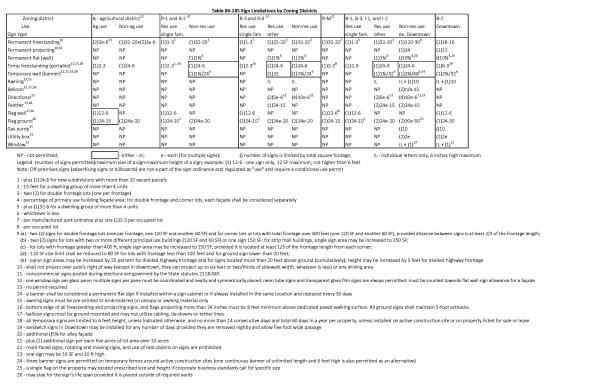
The Zoning District specific sign requirements are listed in Table 86-185.
Table 86-185 Sign Limitations by Zoning Districts
Adopted by Ord. 25-011 on 9/9/2025
Amended by Ord. 26-007 on 4/14/2026
Section 86-246 Generally
It is the intent of this division to provide that in all classes of zoning districts, business, industry and all daily activities shall be established and maintained with proper appearance from streets and adjoining properties, and to provide that each such permitted use shall be a good neighbor to adjoining properties by the control of the items described in this division.
(Code 1976, § 11.19(3)(B); Ord. No. 687, § 1, 6-10-2014)
Section 86-247 Landscaping
- In all classes of residential and business districts, all exposed ground areas surrounding a principal and accessory use buildings, including street boulevards and easements, and which are not devoted to parking, drives, walks, patios, designated retail display areas or other such uses shall be landscaped except vegetation areas left in a natural state during initial construction may remain if properly maintained. Downtown district is exempted from the landscaping requirements.
- Fences, bushes, shrubs, and any other landscape elements placed upon easements are subject to removal at owner's expense if required for maintenance or improvement of the utility. The city shall not be required to pay compensation for the items to be removed from a utility easement. Retaining walls shall not be placed upon easements.
- Trees planted within, or adjacent to, public right-of-way shall comply with the city tree policy.
- All landscaped areas, including vegetable, flower, and pollinator gardens, shall be kept neat, clean, uncluttered and be properly maintained. Landscaped areas shall not be used for the recurring parking of vehicles, except as allowed in section 86-230 for overflow parking, or temporary storage of materials, supplies, and merchandise.
- Vegetation within a 25-foot visibility triangle of the property corner at street intersections and within a 10-foot visibility triangle adjacent to alleys and driveways shall not be taller than three feet measured from the top of the street curb. All vegetation upon, and adjacent to, boulevards shall comply with the city tree policy.
- Private vegetable, flower and pollinator gardens are allowed in all residential and, except vegetable gardens, in all business districts. All such gardens shall not be placed on the right-of-way or closer than five (5) feet to all property lines or buildings.
- As an exception, for residential lots where there is no permitted use principal building, flower and pollinator gardens are permitted but shall not be placed closer than fifteen (15) feet to all property lines.
- Community vegetable gardens may be allowed in all business zoning districts by an interim use permit. Such gardens shall not be located in the required yards or closer than ten feet to any building.
- Where required, landscaped area shall occupy not less than 25 percent of the area of the lot not covered by buildings. Landscape area shall include not less than 50 percent live materials (vegetation, including flower and pollinator gardens) with the balance being permeable landscaping decorative materials such as landscape rock or mulch.
- Grade slope over one-foot in three feet is prohibited unless existing site grading is unique and special measures are taken to prevent erosion.
- The trees shall be planted at a rate of at least one tree per 5,000 square feet of landscaped area or one tree per 50 feet of lot street frontage, whichever is greater; existing trees protected during construction may be counted toward the total number of trees required. If more than five trees are required, at least two species shall be used.
- Overgrown vegetation and sizable broken or dead limbs shall be trimmed; and dead or severely damaged trees shall be replaced. Infected trees shall be treated in accordance with chapter 82, Vegetation.
- Elms, ash, and box elder trees shall not be used unless disease resistant species are utilized.
- In all classes of business and industrial districts yards adjoining any of the classes of residence districts or public parks shall be landscaped with buffer planting screens unless an adjacent residence district property contains a non-residential use. Residential lots containing more than eight dwelling units shall be separated from adjacent residential lots containing fewer than four dwelling units with buffer planting screens.
- Buffer planting screens shall be at least 80 percent opaque year-round and six feet high. Planting screens shall be planted in such manner that, when fully grown, they remain entirely within the property boundaries. A maintenance-free opaque fence or other means deemed comparable to planting screens by the city staff may be used to substitute for the required buffer planting screens provided requirements of subsection (b) are met.
- Building enlargements and expansions over 50 percent of existing building footprint area or construction of additional principal use buildings on site shall cause an entire site landscaping review by city staff for ordinance compliance.
- All requirements of this section shall be satisfied within one year of receiving a temporary certificate of occupancy; a permanent certificate of occupancy shall not be issued until requirements of this section are met, with the exception of tree planting on residential lots containing fewer than four dwelling units.
(Code 1976, § 11.19(3)(A)(1); Ord. No. 687, § 1, 6-10-2014; Ord. No. 727 2nd series, § 1, 4-24-2018; Ord. No. 749 2nd series, § 1, 6-23-2020)
Amended by Ord. 687 2nd Series on 6/10/2014
Amended by Ord. 749 2nd Series on 6/23/2020
Amended by Ord. 23-022 on 11/14/2023
Amended by Ord. 26-008 on 4/14/2026
Section 86-248 Outside Storage
- In all classes of residential districts, open storage and accumulation of materials and equipment shall be prohibited. In all other zoning districts, open storage of materials and equipment shall be prohibited in the required front, side, and rear yards, except storage shall be allowed in the required rear yard in industrial districts. Unless prohibited elsewhere in the ordinance, any other outside storage, including outdoor storage tanks, shall be located or screened so as not to be visible from public right-of-way, public parks or any lot within 500 feet in any of the classes of business or residence districts, except in industrial and agricultural zoning districts screening from public right-of-way is not required. The screening may be achieved by fencing or landscaping means compliant with section 86-247. In all classes of business districts, the storage area shall be paved or graveled to control erosion and shall be properly maintained. Temporary storage of building materials intended for construction use on premises shall be allowed during ongoing construction and up to two weeks prior to construction and is exempt from the above requirements provided a valid building permit is obtained.
- Outdoor display of retail merchandise intended for sale or rent and open to public shall be allowed in all classes of business and industrial districts. In all classes of business districts, the display area, except live plants sales area, shall be paved to control dust and erosion and facilitate accessibility and general access to, and moving of, displayed products. Outdoor display areas adjacent to any of the classes of residence districts shall be screened by fencing or landscaping means compliant with section 86-247. Outdoor display area shall be adequately lighted.
- Small off-road vehicles, golf carts, small farm and lawn care equipment , including subcompact tractors, and pre-built sheds may be displayed in the landscaped area, provided they are all located within seven feet of a paved surface contiguous with the required parking, and all site landscaping requirements are met. Display areas with five or fewer displayed units shall be exempted from this requirement. All display areas shall be regularly maintained in a neat and safe manner.
- Except licensed automobile, motorcycle, off-road vehicle, recreational vehicles, as defined in Section 74-131, and boat sales lots, and golf carts and new small, motorized lawn care equipment sales, the display area shall not be located in the required front and side yards.
- In all classes of residential districts and residential properties within other zoning districts, outdoor display and sale shall be allowed during garage and yard sales only. The display and sales area shall be located entirely within the pertinent residential property.
- Any related signage shall be limited to premises and to other private properties provided permission from the property owners is obtained; all signage shall be erected not earlier than one-day before sale and shall be removed at the termination of the sale. Such signs shall be limited to three square feet each.
- There shall be no more than four garage sales conducted during any period of 12 calendar months; there shall be no more than two garage sales conducted during any period of 30 calendar days; there shall be no garage sales conducted for more than four consecutive days; and there shall be no garage sales conducted before 7:00 a.m. or after 8:00 p.m.
- Building enlargement and expansions over 50 percent of existing building footprint area, construction of additional buildings on site, or changes of use resulting in new exterior storage or display area shall cause an exterior storage/display area review by city staff for ordinance compliance.
- Trash, garbage, refuse, recycling materials or any other items intended for disposal shall be stored in designated containers or dumpsters which, with the exception of R-1 and R-2 residence districts, shall be located within areas set for collection of garbage as prescribed by section 50-23. In R-1 and R-2 residence districts trash cans shall not be stored in the required front yard except on the day of garbage collection. In R-1 and R-2 residence districts furniture and other bulky items may be left at the curb for pick up by the licensed garbage hauler or anywhere in the front yard for anyone to take for no more than 48 hours. In all classes of business and industrial districts, similar items intended for disposal may be piled together for temporary storage no longer than six months within garbage collection areas in a single stack not higher than five feet and with area no more than 100 square feet.
- In all classes of multiple-family and business districts, garbage collection areas shall be paved and fully enclosed with secured access and shall not be located in the required front yard. The enclosure shall be between five and six feet high and fully opaque. If it is located next to the building, it shall be finished with materials matching the exterior of the building. Enclosure requirement does not apply in the Downtown district.
- Temporary construction dumpsters intended for demolition and other construction debris may be located outside of such enclosures during ongoing construction and up to one week before and after construction provided a valid building permit is obtained. No temporary construction dumpster shall be set on public right-of-way or public parking lot unless a city permit is secured.
- Storage units are not allowed as permanent storage in all classes of residential or business districts. Storage units include motor vehicle trailers, including semi-trailers, designed to carry cargo; cargo or shipping containers constructed out of prefabricated metal and designed for overseas shipping or mounting on rail cars or truck trailers; or steel framed, weatherproof moving containers, commonly known as PODS. Utilization of a single unit is allowed for temporary storage for no more than 30 days in a calendar year; in Business districts, the 30 days limit may be extended for longer by an interim use permit, provided such unit is painted to match the building with no signage, lettering, or advertising of any sort and is not placed in the front yard or required side or rear yards. The above listed units used for temporary construction related storage shall be allowed during an ongoing construction project and up to a month prior to construction, provided a valid building permit is obtained. As an exception, storage units totaling less than 1,000 square feet or ten percent of the main building area, whichever is less, may be permitted by an interim use permit in a B-3 general business district, with the following conditions:
- The containers shall not be placed in any front or required side or rear yard.
- The containers shall be located so as not to be visible from the public right-of-way, public parks, or any lot in any of the classes of business or residence districts within 500 feet of the containers. It may be screened by fencing or landscaping means compliant with section 86-247. If a fence taller than otherwise permitted by the Ordinance is required for screening by an interim use permit condition, a variance for such fence construction shall not be required.
- The containers shall be new or freshly painted with neutral colors with no painted signage, lettering, or advertising and shall be properly maintained.
- The interim use permit shall expire when the property changes ownership or earlier as approved by the council.
- In all classes of residential districts, a licensed boat, open or closed trailer, camper, motor-home, recreational vehicle or other motorized vehicle, but no more than three units, may be stored outside on the property as regulated in section 74-131. One snowmobile, ATV, golf cart, riding mower, trailer, boat, or camper can be displayed for sale in the front yard, provided it has not been purchased or consigned for resale and is not displayed for longer than seven consecutive days or longer than 30 days in a calendar year. No storage or accumulation of any materials in trailers is permitted.
- No unit listed above shall be placed on a lot where there is no principal use building except in a case when such lot is adjacent to the lot where a permitted use main building is located, in which case the city ordinance shall be applied as if the two adjacent lots are combined into one.
(Code 1976, § 11.19(3)(A)(2); Ord. No. 687, § 1, 6-10-2014; Ord. No. 749 2nd series, § 1, 6-23-2020; Ord. No. 21-002, § 1, 4-27-2021)
Editor's note(s)—Ord. No. 687, § 1, adopted June 10, 2014, amended the title of § 86-248 to read as set out herein. Previously § 86-248 was titled storage of materials.
Amended by Ord. 687 2nd Series on 6/10/2014
Amended by Ord. 749 2nd Series on 6/23/2020
Amended by Ord. 22-005 on 5/10/2022
Amended by Ord. 23-009 on 5/9/2023
Amended by Ord. 23-023 on 11/14/2023
Amended by Ord. 25-006 on 7/22/2025
Amended by Ord. 26-012 on 9/8/2026
Section 86-249 Noise
Noise shall be muffled so as not to become objectionable due to intermittence, beat frequency, shrillness or intensity as measured at the property line of the tract on which the operation is located.
(Code 1976, § 11.19(3)(A)(3))
Section 86-250 Odors
Odors from any use hereafter begun shall not be discernible at the property line.
(Code 1976, § 11.19(3)(A)(4))
Section 86-251 Glare
Glare, whether direct or reflected, such as from floodlights or high temperature processes, and as differentiated from general illumination, shall not be visible at any property line.
(Code 1976, § 11.19(3)(A)(5))
Section 86-252 Exterior Lighting
Any lights used for exterior illumination shall direct light away from adjoining properties.
(Code 1976, § 11.19(3)(A)(6))
Section 86-253 Vibration
Vibration shall not be discernible at any property line to the human sense of feeling for three minutes or more duration in any one hour.
(Code 1976, § 11.19(3)(A)(7))
Section 86-254 Smoke
Measurements shall be at the point of emission. The Ringelmann Smoke Chart, published by the United States Bureau of Mines, shall be used for the measurement of smoke. Smoke not darker or more opaque than no. 2 on such chart may be emitted except that smoke not darker or more opaque than no. 3 on such chart may be emitted for periods not longer than four minutes in any 30 minutes. These provisions, applicable to visible gray smoke, shall also apply to visible smoke of a different color but with an equivalent apparent opacity.
(Code 1976, § 11.19(3)(A)(8))
Section 86-255 Dust
Solid or liquid particles shall not be emitted at any point in concentrations exceeding 0.3 grain per cubic foot of the conveying gas or air.
(Code 1976, § 11.19(3)(A)(9))
Section 86-256 Fumes Or Gases
Fumes or gases shall not be emitted at any point in concentrations or amounts that are noxious, toxic or corrosive.
(Code 1976, § 11.19(3)(A)(10))
Section 86-257 Hazard
Every operation shall be carried on with reasonable precautions against fire and explosion hazards. Construction sites for projects over $500,000.00 in value or projected to last over six months shall be enclosed with a fence at least four feet tall; industrial district lots not adjacent to residential or business districts are exempt from this requirement.
(Code 1976, § 11.19(3)(A)(11); Ord. No. 687, § 1, 6-10-2014)
Section 86-258 Water Supply
The design and construction of water supply facilities and water supply source shall be in accordance with city standards and regulations.
(Code 1976, § 11.19(3)(A)(12))
Section 86-259 Waste
All sewage and industrial wastes shall be treated and disposed of in such manner as to comply with city standards and requirements.
(Code 1976, § 11.19(3)(A)(13))
Section 86-260 (Reserved)
Editor's note(s)—Ord. No. 728 2nd series, § 1, adopted April 24, 2018, repealed § 86-260 in its entirety. Former § 86-260 pertained to "Exterior appearance standards," and was derived from Ord. No. 687, § 1, 6-10-2014.
Section 86-261 Unsanitary Conditions
Trash, garbage, junk, debris, dead organic matter, and similar materials shall not accumulate on the property unless properly collected in accordance with the section 86-248(c) nor shall aforementioned objects be allowed to disseminate to adjacent properties in any quantities. Stagnant water shall not accumulate on site.
(Ord. No. 687, § 1, 6-10-2014)
Section 86-276 Definitions
Central heritage district means an area in the city within the downtown district as shown on the city zoning map and generally described as limited by Sixth Street, Lyon Street, First Street and Main Street and the alleys behind them.
(Ord. No. 634 2nd series, § 1, 4-26-2011)
Section 86-277 Intent And Purpose
The intent and purpose of these exterior construction standards are to preserve and enhance the traditional "main street" character of a portion of the city's original central business area and to ensure that new developments compliment and fit the established nature of this neighborhood.
(Ord. No. 634 2nd series, § 1, 4-26-2011)
Section 86-278 Applicability
- The following standards shall apply, as extra requirements in addition to the building and zoning codes, to all additions, alterations, rehabilitations, renovations, or other exterior modifications to existing structures, new buildings and structures, demolitions, signage, and maintenance within the central heritage district as defined in this division.
- No building or demolition permit for a building or structure, or exterior renovation to a structure in the central heritage district shall be granted, nor any new building or structure shall be erected or exterior modification shall be made, without written approval from the zoning administrator that the project meets the standards in this division unless approval authority is granted as required to the planning commission or the city council in section 86-279. If a project cannot meet one or more of the standards, the planning commission may approve the reasonable departure from these design standards, based on written findings from the building owner and the zoning administrator. The planning commission may make amendments or apply conditions to the proposed design before granting approval. This division shall apply to all exterior walls of new buildings, stand alone structures or modification to the exterior walls of existing buildings, including changes in building materials, finishes, colors, windows, doors, and attached signage, but not to the interior of new buildings nor interior remodeling or renovation which is not visible from the outside. This division shall apply to roofing work only if such roofing is clearly visible as part of the exterior of the building, such as a pitched or mansard roof, but otherwise does not apply to flat roofs or parts of roofs not visible from the street level.
(Ord. No. 634 2nd series, § 1, 4-26-2011)
Section 86-279 Administration And Appeals
- All applications for new or renovation projects in the central heritage district governed by this division must first be submitted to the zoning administrator for initial review. The zoning administrator shall either approve the application as meeting the requirements of the standards or forward it, along with comments and recommendations, to the planning commission, who shall determine conformance of the proposed work with the intent and requirements of this division.
- The planning commission shall either approve or deny on application. Prior to planning commission meeting, the notice shall be mailed to each of the owners of the land located with 130 feet from the point of exterior construction being reviewed.
- An applicant or any land owner or tenant within the central heritage district that is not satisfied with a decision of the planning commission shall have 30 days from the decision of the committee to appeal the decision to the city council. The city council shall review this at its next regular scheduled meeting, including five advance business days from the council agenda posting, after the notice of appeal has been made.
- All applications for projects governed by this division shall be on a form provided by the zoning administrator. No work shall be allowed for projects governed by this division that is not specifically reviewed and approved by the zoning administrator, the planning commission, or the city council on a certificate prepared by the zoning administrator.
(Ord. No. 634 2nd series, § 1, 4-26-2011)
Section 86-280 Fees
The city council may, by resolution, establish the fees for the review in accordance with this division.
(Ord. No. 634 2nd series, § 1, 4-26-2011)
Section 86-281 General Guidelines
The following guidelines shall be considered in reviewing and approving new and rehabilitation construction projects for the exterior of buildings in the central heritage district:
- Whenever possible the proposed work shall not materially impair the architectural character of the buildings and the surrounding neighborhood.
- Whenever possible, the distinguishing original qualities or character of a building, structure, or site and its environment shall be preserved. The removal or alteration of any distinctive architectural features shall be avoided whenever possible.
- All buildings, structures, and sites shall be recognized as products of their own time. Building materials, windows, doors, etc. used in restoration, rehabilitation, remodeling and additions should be selected to resemble the buildings original design intent and be compatible with the surrounding neighborhood.
- Changes, which may have taken place over the course of time, are evidence of the history and development of a building, structure, or site and its environment and may be taken into consideration.
- Distinctive stylistic features or examples of skilled craftsmanship which characterize a building, structure, or site shall be treated with sensitivity and preserved whenever possible.
- Whenever possible, deteriorated architectural features shall be repaired rather than replaced. In the event replacement is necessary, the new material should resemble the material being replaced in composition, design, color, texture, and other visual qualities. Repair or replacement of missing architectural features should be based on accurate duplications of features, substantiated by physical or pictorial evidence rather than on conjectural designs or the availability of different architectural elements from other buildings or structures.
- The surface cleaning of structures shall be undertaken with the gentlest means reasonably available. Sandblasting and other cleaning methods that will damage the existing building materials shall not be undertaken unless approved by the planning commission.
- Contemporary design for new buildings, alterations and additions to existing properties shall not be discouraged when such new buildings, alterations and additions do not destroy significant architectural or cultural material, and such design is compatible with the size, scale, color, material, and character of the property, neighborhood, or environment.
- The cost of the improvement shall be considered reasonable when evaluating design guidelines.
(Ord. No. 634 2nd series, § 1, 4-26-2011)
Section 86-282 Exterior Materials
The following provisions shall apply to any exterior materials used for new construction or for alterations and renovations of existing buildings fronting a public street or directly facing a public parking area. All colors shall be selected per section 86-286. Exterior materials for buildings without such frontage are encouraged to be respectful of the guidelines but do not need to follow the provisions below.
- Wall materials. The following materials may be used as exposed materials for wall surfaces:
- New replacement brick generally matching surrounding surfaces or tuckpointing of existing brick.
- Colored stucco or EIFS.
- Precast concrete.
- Decorative concrete masonry units.
- Natural stone.
- Any other materials approved by the planning commission.
- Roof materials. The following materials may be used as exposed materials for roof surfaces:
- Asphalt, wood, metal, cement, clay, concrete or slate shingles and tile.
- Any other materials approved by the planning commission.
(Ord. No. 634 2nd series, § 1, 4-26-2011)
Section 86-283 Windows And Doors
The following provisions shall apply to any windows or doors fronting a public street or directly facing a public parking area. Windows or doors on buildings without such frontage are encouraged to be respectful of the guidelines but do not need to follow the provisions below.
Window and door units shall be replaced in a fashion that duplicates or resemble the original style and proportions of the original window or door, as closely as possible. Casement escape/rescue windows are permitted with the use of mullions to fit the character of the building. Filling existing window openings or covering them with any materials is prohibited.
(Ord. No. 634 2nd series, § 1, 4-26-2011)
Section 86-284 Shutters
Shutters, unless original features of the building are prohibited unless approved by the planning commission.
(Ord. No. 634 2nd series, § 1, 4-26-2011)
Section 86-285 Awnings And Marquees
Awnings and marquees, no more than six feet in height for awnings and three feet in height for marquees, are allowed on buildings within a horizontal band at least eight feet and no more than 15 feet above the ground, unless there is clear evidence that such awning or marquees in a different location or of different height is appropriate for the building in question as proven by physical or pictorial evidence. Canopies supported by posts are not allowed.
Awnings and marquees shall be in accordance with all applicable provisions of the city zoning ordinance, state building code, and this division. Awnings shall be fire retardant, either water-repellant canvas or vinyl-coated canvas material, supported by aluminum or fire-retardant wood frame. Aluminum or wooden structures are not allowed, unless there is clear evidence that such structure is appropriate for the building in question as proven by physical or pictorial evidence. All colors shall be selected per section 86-286.
Awnings and marquees may project to within two feet from the street curb but no more than six feet from the front edge of the building nor more than two thirds of the public sidewalk width. Awnings and marquees may not extend over a public right-of-way or public property by more than 12 inches unless attachment to the building is certified by a professional engineer. Awnings and marquees may not extend over a public parking area or alley.
(Ord. No. 634 2nd series, § 1, 4-26-2011)
Section 86-286 Building Color Selection
All colors shall be selected from, or be close to, those designated as the central heritage district color palette as adopted or thereafter amended by resolution of the city council. The number of colors used on one building shall not exceed four.
(Ord. No. 634 2nd series, § 1, 4-26-2011)
Section 86-287 Signs And Graphics
All signs erected on any new or existing building or land in the central heritage district must comply with the sign standards of the city zoning ordinance, except as modified by the following provisions. Minor variations may be approved by the planning commission.
- The message of the sign shall be simple and direct, its letter style clear and easy to read.
- Wall signs.
- Wall signage is allowed on buildings within a horizontal band no more than four feet in height, at least eight feet and no more than 15 feet above the ground, unless there is clear evidence that a sign or sign band in a different location or of different height appropriate for the building in question as proven by physical or pictorial evidence. When there are multiple businesses located inside a building, a directory at eye level with total area up to eight square feet is permitted. Signs shall not cover or mask architectural details such as, but not limited to, stone arches and decorative brickwork.
- Wall signage may be either:
- Flat. Parallel to the surface of the building and projecting no more than one foot from it, or
- Projecting. Perpendicular to the surface of the building and no more than one foot in thickness.
- Wall signage shall consist of individual letters or script logos, or rigid boards with the sign background colors.
- Projecting signs.
- Projecting signs may project to within two feet from the street curb but no more than six feet from the front edge of the building nor more than two thirds of the public sidewalk width and be no more than 12 square feet in area.
- Projecting signs with area over three square feet may not extend over a public right-of-way or public property by more than 12 inches unless attachment to the building is certified by a professional engineer.
- Projecting signs may not extend over a public parking area or alley.
- Freestanding permanent signs attached to structural foundation and installed on private property are allowed. Such signs shall be no more than 18 square feet in individual area and no more than one foot in thickness, and the overall height shall not exceed 16 feet. Freestanding permanent signs may not extend over a public right-of-way or public property.
- Permanent exterior signs shall be made of durable materials not subject to weathering. Cloth or fabric banners are allowed as temporary signs only as regulated elsewhere in this division. Paper and cardboard poster signs are prohibited.
- Box or cabinet signs are allowed. Lighted box or cabinet signs and back lighted signs that provide a silhouette of cutout elements are permitted.
- Signs on canopies and marquees are allowed only if they are flat and parallel to the vertical surface of the canopies or marquee and projecting no more than two inches from that surface. No signs shall project above or below the vertical surface of the canopy or marquee.
- Allowable area of wall signs shall be in accordance with the signage provisions of the city zoning ordinance. Each wall shall be calculated individually and sign area may not be transferred from one side of a building to another.
- Directional signs at driveways and within parking areas are permitted, if no more than five feet in height and no more than six square feet in total area. Directional signs must be set back at least two feet from right-of-way, lot lines, and parking spaces.
- Temporary portable advertising signs may be allowed during business hours only in the form of approved sandwich boards or similar devices provided they are constructed of durable materials not subject to weathering and internally weighted down. Such signs may not be more than four feet in height and three feet in width and their total area shall be limited to seven square feet per 22 feet of the building frontage and 12 square feet per single property frontage. No more than two temporary freestanding signs per single property frontage may be allowed. Placement of such signs shall not interfere with safe use of sidewalks and driveways as determined solely by the city zoning administrator. The property owner shall provide a certificate of insurance covering liability for the signs placed on public right-of-way.
- Window signs, attached to the inside of the glass or mounted on the inside within the exterior wall thickness in the window opening, are allowed.
- Temporary banners and promotional event signs are allowed per the signage standards of the city zoning ordinance.
- Neon and dynamic display signs including electronic LED message signs are allowed per the signage standards of the city zoning ordinance and this division when recommended by the planning commission and approved by the city council.
- Art projects and graphics are allowed on individual basis when recommended by the planning commission and approved by the city council.
(Ord. No. 634 2nd series, § 1, 4-26-2011)
Section 86-288 Rear And Side Walls
The design of improvements to rear and side walls, including the alley and rear facade, which are visible from a public street or directly facing a public parking area, shall follow all standards for the street fronts of buildings. The walls that are only visible from the alleys or noticeable from significant distance are encouraged to be respectful of the guidelines but do not need to follow all standards for exterior materials.
(Ord. No. 634 2nd series, § 1, 4-26-2011)
Section 86-289 Fences
Fences shall be in accordance with all applicable provisions of the city zoning ordinance and this division including materials and colors. Chain link fences are prohibited. Fences shall have openings comprising at least ten percent of the fence area evenly distributed throughout the fence.
(Ord. No. 634 2nd series, § 1, 4-26-2011)
Section 86-290 Demolition
Exterior demolition shall be done in such a manner as not to compromise the character of the adjacent building features and surrounding neighborhood. All walls and building features, including those of adjacent buildings, exposed as a result of the demolition process shall be in accordance with this division including materials and colors.
(Ord. No. 634 2nd series, § 1, 4-26-2011)
Section 86-291 Maintenance
All existing buildings in the central heritage district shall be maintained in a neat and adequate manner. Deteriorating, crumbling, or loose paint, cracked masonry, and any broken, rotted, or otherwise faulty exterior wall, door, window, and canopy materials constitute an inadequate maintenance and shall be fixed, replaced, or repaired as determined by the zoning administrator. Installation of window air conditioners in windows facing public streets, alleys, or parking lots is prohibited.
(Ord. No. 634 2nd series, § 1, 4-26-2011)
Section 86-292 Nonconforming Materials And Signs
Existing materials and signs that do not conform to the provisions of this division may remain except otherwise provided in this section. All temporary banners and promotional event signs, window signs, and temporary freestanding signs shall comply with this division, including time limits, and be subject to continuous review.
(Ord. No. 634 2nd series, § 1, 4-26-2011)
Section 86-293 Severability
If any section or portion of this division shall be found unconstitutional or otherwise invalid or unenforceable by a court of competent jurisdiction, the findings shall not serve as an invalidation or affect the validity and enforceability of any other section or provision of this division.
(Ord. No. 634 2nd series, § 1, 4-26-2011)
Section 86-301 Purpose And Intent
In order to accommodate the communication needs of residents and businesses while protecting the public health, safety, and general welfare of the community, the council finds that these regulations are necessary in order to:
- Facilitate the provision of wireless telecommunication services to the residents and businesses of the city;
- Minimize adverse visual effects of towers through careful design and siting standards;
- Avoid potential damage to adjacent properties from tower failure through structural standards and yard requirements; and,
- Maximize the use of existing and approved towers and buildings to accommodate new wireless telecommunication antennas in order to reduce the number of towers needed to serve the community.
(Ord. No. 466, § 1, 10-15-2001)
Section 86-302 Definitions
- The following words and terms when used in this chapter shall have the following meanings unless the context clearly states otherwise:
Amateur radio antennas means any equipment or device used to transmit, receive or transmit/receive electromagnetic signals for "amateur radio service" communications as defined in 47 C.F.R. Sec. 97.3(4), and as used in 47 C.F.R. Sec. 97.15(a).
Antenna means any structure or device used for the purpose of collecting or transmitting electromagnetic waves, including but not limited to directional antennas, such as panels, microwave dishes; and satellite dishes, and omni-directional antennas, or whip antennas.
Commercial wireless telecommunication services means commercial wireless telecommunication services including cellular, personal communication services (PCS), specialized mobilized radio (SMR), enhanced specialized mobilized radio (ESMR), paging, and similar services that are marketed to the general public.
Public utility means persons, corporations, or governments supplying gas, electric, transportation, water, sewer, or land line telephone service to the general public. For the purpose of this ordinance, commercial wireless telecommunication service facilities shall not be considered public utility uses, and are defined separately.
Tower means any ground or roof mounted pole, spire, structure, or combination thereof taller than 15 feet, including supporting lines, cables, wires, braces, and masts, intended primarily for the purpose of mounting an antenna, meteorological device, or similar apparatus above grade.
Tower, multi-user means a tower to which is attached the antennas of more than one user.
Tower, single-user means a tower to which is attached only the antennas of a single user, although the tower may be designed to accommodate the antennas of multiple users as required in this Code.
(Ord. No. 466, § 1, 10-15-2001; Ord. No. 557 2nd series, 8-29-2006)
Section 86-303 Towers And Antennas In Agricultural And Residential Districts
- Towers only supporting amateur radio, antennas either standing alone or supported by a building shall be allowed only in the rear yard.
- Towers supporting commercial antennas and conforming to this Code shall be allowed only in the following;
- Church buildings, when camouflaged as steeples or bell towers;
- Public parks, when compatible with the nature of the park;
- Government, school and public utility buildings and structures.
- Antennas attached to buildings may project 25 feet above the tower height as shown in section 86-307.
(Ord. No. 466, § 1, 10-15-2001)
Section 86-304 Co-Location Requirements
- A proposal for a new commercial tower shall not be approved unless the city council finds that the telecommunications equipment planned for the proposed tower cannot be accommodated on an existing or approved tower or building within a one mile search radius of the proposed tower due to one or more of the following reasons:
- The planned equipment would exceed the structural capacity of the existing or approved tower or building, as documented by a qualified and licensed professional engineer, and the existing or approved tower cannot be reinforced, modified, or replaced to accommodate planned or equivalent equipment at a reasonable cost.
- The planned equipment would cause interference with the usability of other existing or planned equipment at the tower or building as documented by a qualified and licensed professional engineer and the interference cannot be prevented at a reasonable cost.
- Existing or approved towers and buildings within the search radius cannot accommodate the planned equipment at a height necessary to function reasonably as documented by a qualified and licensed professional engineer.
- Other unforeseen reasons that make it infeasible to locate the planned telecommunications equipment upon an existing or approved tower or building.
- Towers must be designed, structurally, electrically, and in all respects, to accommodate both the applicant's antennas and comparable antennas for at least two additional users if the tower is over 100 feet in height or for at least one additional user if the tower is over 60 feet in height. Towers must be designed to allow for future rearrangement of antennas upon the tower and to accept antennas mounted at varying heights.
(Ord. No. 466, § 1, 10-15-2001)
Section 86-305 Tower And Antenna Design Requirements
- Towers should be of a monopole design if possible, but may be of a truss design if adequate yard requirements are met to prevent damage to adjacent structures upon collapse.
- Towers shall meet the yard requirements of the zoning district.
- Towers shall be located away from existing and planned public rights of ways by a minimum distance equal to one half of the height of the tower including all antennas and attachments.
- Towers must not be located between a principal structure and a public street, except on sites adjacent to public streets on all sides.
- Towers must not be illuminated by artificial means and shall not display strobe lights unless such lighting is specifically required by the Federal Aviation Administration or other federal or state authority. When incorporated into the approved design of the tower, light fixtures used to illuminate ball fields, parking lots, or similar areas may be attached to the tower.
- The use of any portion of a tower for signs other than warning or equipment information signs is prohibited.
- All utility buildings and structures accessory to a tower shall be architecturally designed to blend in with the surrounding environment and shall meet the minimum yard requirements of the zoning district. Ground mounted equipment shall be screened from view by suitable vegetation, except where a design of non-vegetative screening better reflects and complements the architectural character of the surrounding neighborhood.
- The placement of wireless antennas on roofs, walls, and existing towers may be approved by the city engineer, provided the antennas meet the requirements of this Code. The city engineer may require submittal of a final site and building plan, and a report prepared by a qualified and licensed professional engineer indicating the existing structure or tower's suitability to accept the antenna, and the proposed method of affixing the antenna to the structure. Complete details of all fixtures and couplings, and the precise point of attachment shall be indicated.
- No new or existing telecommunications service shall interfere with public safety telecommunications. All applications for new service shall be accompanied by an intermodulation study which provides a technical evaluation of existing and proposed transmissions and indicates all potential interference problems. Before the introduction of new service or changes in existing service, telecommunication providers shall notify the city at least ten calendar days in advance of such changes and allow the city to monitor interference levels during the testing process.
(Ord. No. 466, § 1, 10-15-2001)
Section 86-306 Construction And Maintenance Of Antennae And Supporting Towers
- Permits.
- It shall be unlawful for any person, firm, or corporation to erect, construct in place, place or re-erect, replace, or repair any tower without first making application to the building official and securing a building permit.
- The applicant shall provide at the time of application sufficient information to indicate that construction, installation, and maintenance of the antenna and tower will not create a safety hazard or damage to the property of other persons.
- Permits are not required for:
- Adjustment or replacement of the elements of an antenna array affixed to a tower or antenna, provided that replacement does not reduce the safety factor.
- Antennas and/or towers erected temporarily for test purposes, for emergency communication, or for broadcast remote pick-up operations. Temporary antennas shall be removed within 72 hours following installation.
- Fee. The fee to be paid is that prescribed by council resolution.
- Construction requirements. All antennas and towers erected or constructed within the city, and all wiring thereof, shall comply with the following requirements:
- With the exception of necessary electric and telephone service and connection lines approved by the city engineer, no part of any antenna or tower nor any lines, cable, equipment or wires or braces in connection with either shall at any time extend across or over any part of the right-of-way, public street, highway, sidewalk, or property line.
- All signal and remote control conductors of low energy extending substantially horizontally above the ground between a tower or antenna and a structure, or between towers, shall be at least eight feet above the ground at all points, unless buried underground.
- Every tower affixed to the ground shall be protected to discourage climbing of the tower by unauthorized persons.
- Exemptions. Antennas and antenna support structures for federally licensed amateur radio operators are hereby exempted from the provisions of this Ordinance:
- Site plan. No amateur radio antenna support structures shall be constructed unless the site plan has received prior approval through the proper building permit application as secured from the city. Said applicant must comply with the provisions of the Building Code for the city.
- Support structure construction. Amateur radio support structures (towers) must be installed in accordance with the instructions furnished by the manufacturer of that tower model. Because of the experimental nature of the amateur radio service, antennas mounted on such a tower may be modified or changed at anytime, so as long as the published allowable load on the tower is not exceeded and the structure of the tower remains in accordance with the manufacturer's specifications.
- Compliance with Marshall Municipal Airport zoning ordinance. The height of the amateur radio support structures (towers) and any attachments must be in compliance with the Marshall Municipal Airport zoning ordinance as regulated by FAA.
(Ord. No. 466, § 1, 10-15-2001; Ord. No. 557, 8-29-2006)
Section 86-307 Submittal Requirements
Applications for towers shall include the following information:
- A report from a qualified and licensed professional engineer which:
- Describes the tower height and design including a cross section and elevation;
- Documents the height above grade for all potential mounting positions for co-located antennas and the minimum separation distances between antennas;
- Describes the tower's capacity, including the number and type of antennas that it can accommodate;
- Documents what steps the applicant will take to avoid interference with established public safety telecommunications;
- An engineer's certification and registration number; and,
- Other information necessary to evaluate the request.
- For all commercial wireless telecommunication service towers, a letter of intent committing the tower owner and his or her successors to allow the shared use of the tower if an additional user agrees in writing to meet reasonable terms and conditions for shared use.
- Before application for a building permit, the following information shall be submitted to the City Engineer:
- Proof that the proposed tower complies with regulations administered by Federal Aviation Administration; and,
- A report from a qualified and licensed professional engineer which demonstrates the tower's compliance with this chapter.
(Ord. No. 466, § 1, 10-15-2001)
Section 86-308 Height
- The height of towers shall be determined by measuring the vertical distance from the tower's point of contact with the ground to the highest point of the tower. When towers are mounted upon other structures, the combined height of the structure and tower must not exceed the height limitations.
- Height limitations table.
Zoning District Permitted Maximum Height Conditional Use Permit For Height Over A 30' 30' R-1 30' Not permitted R-2 30' Not permitted R-3 35' Not permitted R-4 35' Not permitted R-5 35' Not permitted B-1 35' Not permitted B-2 45' 45' B-3 45' 45' B-4 45' 45' I-1 75' 75' I-2 75' 75'
(Ord. No. 466, § 1, 10-15-2001)
Section 86-309 Abandoned Or Unused Towers Or Portions Of Towers
- Abandoned or unused towers and associated facilities shall be removed within 12 months of the cessation of operations at the site unless a time extension is approved by the city engineer. A copy of the relevant portions of a signed lease which requires the applicant to remove the tower and associated facilities upon cessation of operation at the site shall be submitted at the time of application. In the event that a tower is not removed within 12 months of the cessation of operations at a site, the tower and associated facilities may be removed by the city and the costs of removal assessed against the property.
- Unused portions of towers above a manufactured connection shall be removed within six months. The replacement of portions of a tower previously removed requires the issuance of a new permit.
(Ord. No. 466, § 1, 10-15-2001)
Section 86-310 Existing Antennas And Towers
Antennas and towers in residential districts and in existence on the date of adoption of this ordinance which do not conform to or comply with this section are subject to the following provisions:
- Towers may continue in use for the purpose now used and as now existing but may not be replaced or structurally altered without complying in all respects with all sections of this section.
- Towers damaged or destroyed due to any cause may be repaired and restored to its former use, location, and physical dimensions upon obtaining a building permit but without otherwise complying with this section, provided, however, that if the cost of repairing the tower to the former use, physical dimensions, and location is ten percent or more of the cost of a new tower of like kind and quality, the tower must be repaired or restored in full compliance with all sections of this section.
(Ord. No. 466, § 1, 10-15-2001)
Section 86-326 Purpose And Intent
The purpose of this division is to accommodate the wind energy needs of the city while protecting the public health, safety, and general welfare of the population by establishing regulations and procedures for the location, construction, and operation of wind energy conversion systems (WECS).
(Ord. No. 609 2nd series, § 2, 4-28-2009)
Section 86-327 Application
- These regulations apply to the location, size, use, design, construction, operation, maintenance, appearance, and removal of all WECS, windmills, wind turbines, wind generators, wind chargers, or similar devices.
- Ornamental windmills, not used for energy conversion, that are less than 24 feet in height, and less than 120 square feet in horizontal area, are exempt from this division. All other applicable regulations in this Code apply.
- Large wind energy conversion systems (LWECS), regulated by the state environmental quality board in accordance with Minn. Stat. ch. 216, are exempt from these regulations.
- Small wind energy conversion systems (SWECS) are regulated by this Code pursuant to Minn. Stat. ch. 216.
(Ord. No. 609 2nd series, § 2, 4-28-2009)
Section 86-328 Location
- Wind energy conversion systems may be allowed by conditional use permit only in the classes of districts listed in this section. A conditional use permit may be issued only if the use meets the requirements of this division, the district regulations, the supplemental regulations, and the conditional use permit regulations within this chapter. WECS are not permitted in any other district.
- WECS may be allowed by conditional use permit in the districts:
- A agricultural district;
- B-3 general business district;
- I-1 limited industrial district;
- I-2 general industrial district.
- WECS must not be located within any yard required in the use district.
- WECS must not be located within 500 feet of a property line common to a residential or business district, other than the B-3 general business district.
- WECS must be located at least one foot away from all property lines for each one foot of the total extended height (including rotor blades) of the system. When located on a building, only the WECS need be used for the total extended height.
(Ord. No. 609 2nd series, § 2, 4-28-2009)
Section 86-329 Height
- The height of WECS shall be determined by measuring the vertical distance from the point of contact with the ground to the highest extended point of the system. The maximum height must not exceed 75 feet.
- WECS constructed on a building must not exceed the building height regulations of the use district.
(Ord. No. 609 2nd series, § 2, 4-28-2009)
Section 86-330 Equipment Requirements
- Rotor blades must have a ground clearance of 20 feet minimum.
- Systems must be equipped with both a manual and automatic blade brake system capable of stopping operation at a wind speed of 40 miles per hour.
- Rotor blades diameter must not exceed 35 feet.
- All equipment including support towers must be white, gray, or galvanized color.
- The system must be protected against lightning strike.
- No signs, other than for public safety warning and equipment identification labels or information shall be placed anywhere on the location, except one two square foot sign with the location address, and the name and telephone number of the emergency contact is required.
- All power and communication lines serving the system must be underground.
- No lighting is permitted on the equipment except as required by the Federal Aviation Administration or airport zoning administrator.
- The system must not create interference with radio, television, or telecommunication systems.
- Noise produced by the system must not exceed NPC1 and NPC2 standards of the MN Pollution Control Agency.
- Towers for WECS must be self supporting monopole or free standing without guy-wires or support cables unless otherwise approved in the conditional use permit. Exposed ladder or truss designs are discouraged.
- All equipment must be unclimbable to a level of 20 feet above grade to prevent access by unauthorized climbers.
- WECS structurally supported by a building must comply with the regulation of the use district.
- Systems must be designed and constructed in compliance with the building code. All structural components must be designed by an engineer registered in the state. The engineer must provide drawings, specifications, and calculations for review by the building official before an application for a building permit may be provided for the project.
(Ord. No. 609 2nd series, § 2, 4-28-2009)
Section 86-331 Permit Application Requirements
- Applications for a conditional use permit must only be considered when the applicant has provided information showing the WECS will comply with the provisions of this Code. The zoning administrator may request, and the applicant shall provide, any additional information deemed necessary to perform an evaluation of the request.
- The application shall include:
- A statement identifying the purpose and description of the proposed system;
- A drawing to scale of the proposed location, the property lines, roads, site utilities, existing and proposed buildings, general topographic features, proximity of adjacent buildings and structures, and adjacent use district designations with current land use;
- Manufacturers data supporting compliance with these regulations;
- A statement verifying compliance with Federal Aviation Administration regulations and with local airport regulations for clear zones;
- A statement verifying compliance with the Federal Communications Commission regulations for interference of communications systems;
- A letter of approval from the city municipal utilities commission for review of conflict with city utilities operations and maintenance and;
- A plan and guarantees for decommissioning, demolition, and site restorations.
(Ord. No. 609 2nd series, § 2, 4-28-2009)
Section 86-332 Inspection
The city may perform inspections for safety and maintenance at any time as a right upon issuing a conditional use permit. The owner must promptly correct deficiencies upon notification by the zoning administrator.
(Ord. No. 609 2nd series, § 2, 4-28-2009)
Section 86-333 Abandonment
Any WECS equipment or structures regulated by this section that is not operational for the intended use for a time period of one year is deemed abandoned. The system must be removed in compliance with the conditional use permit decommissioning plan and guarantees. Failure to comply with the conditional use permit provides the city with the right to remove, or have removed, all components of the system and recover expenses through any means provided by law.
(Ord. No. 609 2nd series, § 2, 4-28-2009)
Section 86-201 Compliance With Division Provisions
- All off-street parking and loading shall conform to the provisions of this division and any other provisions of this Code and regulations of the city, such as landscaping the ordinance, and shall apply to all buildings and uses of land.
- All uses located within the limits of the downtown district are exempt from the required number of parking spaces requirements of this article.
- The use of parking lots containing non-conforming number of parking spaces on June 1, 2014, may be continued except as otherwise provided in this section.
- Building enlargement and expansions over 25 percent but less than 50 percent of existing building footprint area, changes of use, and new building construction on a site with existing building shall require construction of new parking spaces on the basis of new demand created by the expansion area, change of use, or new building construction; in no case total number of parking spaces on site shall be required to exceed what would be required if all buildings and uses on site were considered. Building enlargements and expansions over 50 percent of existing building footprint area shall require full site compliance with the parking ordinance.
- Temporary structures or uses intended for utilization for longer than 90 days shall be accounted for in the total parking spaces calculations.
(Ord. No. 686, § 1, 6-10-2014)
Section 86-202 Reduction And Use Of Parking And Loading Space
- Off-street parking facilities existing at July 8, 1983, shall not subsequently be reduced below the requirements of this division for a similar new building or use. Off-street parking facilities provided to comply with the provisions of this chapter shall not subsequently be reduced below the requirements of this chapter.
- Required parking or loading spaces shall not be used for storage of goods or for storage of business vehicles belonging to building owner or occupant, vehicles that are inoperable and vehicles intended for sale or rent. Parking space shall be provided for each business vehicle necessary for the operation of the use that is maintained on the premises in addition to the parking space requirements listed in table 86-230. Parking spaces provided to comply with this division shall be clearly distinguishable from other parking spaces. Except residential uses, not more than ten percent of required parking spaces may be reserved for specific use or people not counting required accessible spaces. Temporary structures and tents shall not reduce the number of parking spaces by more than ten percent from the required number. Use of required parking spaces shall not be time restricted nor shall a fee be charged for their use.
(Ord. No. 686, § 1, 6-10-2014)
Section 86-203 Yards
- In the classes of residential districts, off-street parking and loading facilities or paving, except street access drive, shall be subject to the front yard, side yard and rear yard regulations for the use district in which the parking is located except rear yard does not have to exceed 25 feet. For one- and two-family dwellings, paving may be installed within required side yard provided it is not used for parking and meet[s] adjacent property grade elevations or an agreement with a neighbor is signed and recorded.
- In all classes of non-residential districts, no off-street parking, stacking or loading shall be located within ten feet of any property line that abuts a street right-of-way or any of the classes of residence districts.
- Non-residential uses located in residential districts and all residential districts abutting non-residential districts shall be regulated by subsection (b).
(Ord. No. 686, § 1, 6-10-2014; Ord. No. 696 2nd series, § 1, 5-26-2015)
Section 86-204 Fences And Planting Screens
- In all classes of non-residential zoning districts and in all classes of residence districts containing a non-residential use, off-street parking, stacking, and loading areas near or adjoining any of the classes of residence districts or public parks and open to them shall be screened with buffer planting screens unless an adjacent residence district property contains a non-residential use. In R-3 and R-4 multiple family residence districts, parking near or adjoining lower classes of residence districts and open to them shall be screened with buffer planting screens unless a multiple family residence district property contains exclusively one- to four-family residences. Parking located across the street or alley is not considered adjoining for the purpose of this section.
- Buffer planting screens shall be at least 80 percent opaque year round and minimum six feet high. Planting screens shall be planted in such manner that, when fully grown, they remain entirely within the property boundaries. A maintenance-free opaque fence or other means deemed comparable to planting screens by the city staff may be used to substitute for the required buffer planting screens provided landscaping requirements are met.
(Ord. No. 686, § 1, 6-10-2014)
Section 86-205 Access
- Parking and loading spaces shall have proper access from a public right-of-way. Except one- and two-family dwellings, access to any parking or loading space shall be by access drive not less than 24 feet wide for two-way traffic and 15 feet wide for one-way traffic. As an exception, a two-way access drive width may be reduced to 20 feet beyond the required front yard, provided no parking spaces are located along the side of, and accessed directly from, such reduced width access drive.
- The number, width and location of access drives shall be such as to minimize traffic congestion and traffic hazard. Access drives openings to street shall not be located closer than 25 feet to the nearest intersection.
- In all business districts, direct access shall be provided to a street right of way.
- Vehicular access to non-residential uses across property in any residence districts shall be prohibited.
(Ord. No. 686, § 1, 6-10-2014)
Amended by Ord. 22-014 on 12/13/2022
Section 86-206 Construction And Maintenance
- In all classes of residence districts and in all classes of business districts, required parking, principal use parking, stacking area, loading areas, and access drives must be paved with concrete, bituminous, or solid pavers. In all classes of industrial districts and in agricultural district, required parking and loading areas and access drives serving commercial uses commonly visited by general public, such as, but not limited to, stores, service shops, animal hospitals, parks, etc. must be paved as required in business districts. All other uses located in industrial districts and agricultural district may have required parking and loading areas and access drives located off the required front yard surfaced with at least six inches of crushed stone or granite; access drives within right-of-way and required front yard must be paved. Parking area surfaces shall be drained to storm sewers where available and away from adjacent properties.
- The operator of the principal building or use shall maintain required parking and loading areas, access drives and stacking spaces in a neat and adequate manner including restriping when it becomes necessary. Except one- to four-family dwellings, required parking areas shall be cleared of snow within 24 hours of the end of any snowfall event.
(Ord. No. 686, § 1, 6-10-2014)
Amended by Ord. 22-014 on 12/13/2022
Section 86-207 Lighting
Any parking, stacking, and loading areas serving commercial, industrial and multiple-family dwellings uses shall be sufficiently illuminated. Lighting shall be reflected away from the public right-of-way and nearby or adjacent classes of residence districts.
(Ord. No. 686, § 1, 6-10-2014)
Section 86-208 Required Site Plan
Any application for a building permit shall include a site plan or plot plan drawn to scale and dimensioned showing off-street parking and loading space to be provided in compliance with this chapter. A site plan may not be required where determined by the zoning administrator where the work for which a building permit is required will not cause a use to become nonconforming.
(Ord. No. 686, § 1, 6-10-2014)
Section 86-209 Required Loading Areas
Loading and unloading areas for goods, supplies and services shall be provided on site and shall be sufficient to meet the requirements of each use. In all business districts, loading areas shall not be located in the front yards except on double frontage lots. In all industrial districts, loading areas located directly across the street from any classes of residence districts shall be screened as described in section 86-204.
(Ord. No. 686, § 1, 6-10-2014)
Section 86-210 Required Stacking Spaces
Stacking spaces for vehicles waiting in line shall be provided on site and shall be sufficient to meet the requirements of each use providing drive-through and drive-up service. There shall be at least three stacking spaces per drive-up window, car wash bay or fast food menu board. Stacking area must be independent from all required parking and loading areas and access drives and shall not interfere with the above site features and pedestrian movement. Stacking lanes must be clearly identified with painted lines on the surface and signage.
(Ord. No. 686, § 1, 6-10-2014)
Section 86-226 Minimum Size Regulations
- Each required off-street parking space shall have a width of not less than eight and one-half feet, and a length of not less than 20 feet except parking space placed against sidewalk wider than five feet, curb, or lawn may be reduced to 18 feet. Spaces intended for parallel parking and spaces within angled parking area shall be not less than 22 feet long. Oversize space, where required, shall be not less than 55 feet long and ten feet wide.
- Each space shall be adequately served by access drives and independently accessible except parking garages provided for dwellings may have one parking space immediately in front of each garage space. Each off-street loading space shall contain a minimum area of not less than 500 square feet and be adequate for a largest [large] delivery truck serving the building including access. All required parking and loading spaces shall be identified with painted lines on the parking surface except parking for one- to four-family dwellings. Accessible parking spaces shall be provided and constructed per Minnesota State Building Code.
(Ord. No. 686, § 1, 6-10-2014)
Amended by Ord. 22-014 on 12/13/2022
Section 86-227 Computing Requirements
In computing the number of such parking spaces required, the following rules shall govern:
- Where fractional spaces result, the parking spaces required shall be construed to be the nearest whole number.
- The parking space requirement for a use not specifically mentioned in this division shall be the same as required for a use of similar nature as determined by the zoning administrator.
- Where secured or unit assigned parking garages or spaces are provided for multiple-family dwellings, garage spaces, parking spaces immediately in front of them if any, and unit assigned spaces may be considered to provide a maximum of 90 percent of the number of spaces required.
- The parking space requirement for unassigned spaces shall be based on the most likely future use; if two or more uses are equally possible, the most restrictive use shall be considered.
(Ord. No. 686, § 1, 6-10-2014)
Section 86-228 Location Of Parking Facilities
Required off-street parking spaces shall be provided on the same or adjacent lot as the principal building or use provided a permanent parking easement is recorded for parking located on adjacent property. In all classes of business and industrial districts, a lot located across the street or alley may be utilized for required parking provided a permanent parking easement is recorded and a marked pedestrian street crossing exists within 200 feet of the building served by the parking across the street. For all residential uses, all required parking spaces shall be no more than 500 feet from the building main entrance.
(Ord. No. 686, § 1, 6-10-2014)
Section 86-229 Combined Facilities
Combined or joint parking facilities may be provided on the same property for one or more buildings or uses in R-2, R-3 and R-4 residence districts and in all classes of business and industrial districts, provided that the total number of spaces shall equal the sum of the requirements for each building or use. If a common parking agreement is recorded, the total number of parking spaces may be reduced by ten percent provided all participating uses are different.
(Ord. No. 686, § 1, 6-10-2014)
Section 86-230 Required Number Of Spaces
Off-street parking areas of sufficient size to provide parking for patrons, customers, suppliers, visitors and employees shall be provided for each use. For mixed use buildings, the required number of parking spaces shall be calculated separately for each area use and then added up. Unless otherwise noted, required off-street parking noted as a S.F. (square foot) ratio is to be applied to the gross building area for each use. The minimum number of off-street parking spaces for each use is listed in table 86-230.
| Apartment (more than 4 units) | 1/ efficiency or one bedroom unit plus 2/ two or more bedroom unit plus 1/ 4 units for visitors |
| Assisted and congregate living facility | 0.5/ unit plus 1 |
| Art gallery, museum | 1/ 500 S.F. |
| Assembly or auditorium with fixed seats, theatre | 1/ 4 seats |
| Assembly without fixed seats not listed anywhere else, arcade | 1/ 100 S.F. |
| Auction house | 1/ 100 S.F. or 1/ 4 fixed seats, whichever is greater |
| Bank | 1/ 300 S.F. |
| Baseball, soccer, football field, arena or stadium | 1/ 4 seats plus 20/ field (court, rink, etc.) plus 1 oversize space/field (court, field, etc.) |
| Beauty salon, barber shop, massage or tattoo parlor, tanning salons | 2/ service station or bed |
| Bed and breakfast | 1/ guest bedroom plus 2 |
| Boarding or lodging house | 1/ rented bed plus 2 |
| Boat, ATV, RV sales and service | 1/ 1,000 S.F. plus as required for outside sales lot |
| Bowling alley | 4/ alley plus 2 |
| Car wash | 2 |
| Church | 1/ 5 seats in largest auditorium |
| Clinic, medical, dental, etc., doctor or chiropractic office | 1/ 250 S.F. |
| Convenience store | 1/ 200 S.F. plus 1 plus 1 oversize space plus as required for fuel station if applicable |
| Corrections facility, jail | 1/ 10 beds plus 1/ employee |
| Court, tennis or racquetball, without fixed seating | 2/ court plus 1 |
| Dance hall | 1/ 50 S.F. |
| Day care | 1/ classroom plus 1/ 10 participants |
| Dwellings, one to four units | 2/ dwelling plus one for each roomer or boarder or each tenant beyond four for units not rented to a single family |
| Drinking or dining establishment, sit down or buffet restaurant, bar | 1/ 50 S.F. of seating area , plus 1/ 100 S.F. of kitchen and storage area |
| Dining establishment: fast food restaurant | 1/ 75 S.F. of seating area , plus 1/ 100 S.F. of kitchen and storage area |
| Farm implement, industrial equipment, and truck sales and service | 1/ 1,000 S.F. plus 50% of required for outside sales lot |
| Fraternity or sorority house, dorm | 1 / bedroom plus 1/ 4 bedrooms for visitors |
| Funeral home | 1/ 100 S.F. or 1/ 4 fixed seats in largest parlor, whichever is greater |
| Furniture, large appliances, spas, building materials, garden supplies sales, retail greenhouse | 1/ 500 S.F. for area less than 20,000 S.F. plus 1/ 1,000 S.F. for area over 20,000 S.F. |
| Golf course | 4/ green plus 1/ 200 S.F. of clubhouse |
| Grocery, food, and beverage sales | 1/ 200 S.F. plus 1 oversize space/ 30,000 S.F. |
| Golf, miniature course | 2/ hole plus 1 |
| Golf, driving range | 2/ tee plus 1 |
| Hospital | 1/ 2 beds plus 1/ employee |
| Kennel | 1/ 10 kennels plus 1/ employee |
| Library | 1/ 500 S.F. plus 1/ employee |
| Manufactured home park | 2/ home plus as required for office building |
| Manufacturing, fabricating, processing or printing plants | 1/ 800 S.F. |
| Motor vehicle fuel station | 1 plus as required for convenience store if applicable |
| Motor vehicle sales | 1/ 500 S.F. plus as required for outside sales lot |
| Motor vehicle repair | 3/ service stall plus 1 |
| Motor vehicle garage (commercial) | 1/ stall plus 1 |
| Motel or hotel | 2 plus 1/ room plus 1 oversize space/ 30 rooms |
| Nursing or rest home, memory care | 1/ 6 beds plus 1/ employee |
| Office: business (data processing center, call center, radio and TV station, etc.) | 1/ 200 S.F. |
| Office: professional (insurance, accountant, travel agent, etc.), public (city, county) or industrial/contractor | 1/ 300 S.F. |
| Outside sales lot | 1/ 5,000 S.F. for area less than 20,000 S.F. plus 1/ 10,000 S.F. for area over 20,000 S.F. |
| Park | 4/ acre plus 2/ playground plus 5/ shelter plus 20/sports field |
| Recreation: fitness club, gymnasium, dance and martial arts studio, without fixed seating | 1/ 200 S.F. |
| Residential facility, group home | 0.5/ bedroom plus 2 |
| Retail store: general, department, hardware, discount, drug; shopping center; pawn shop; wireless store | 1/ 200 S.F. for area less than 2,000 S.F. plus 1/ 300 SF for area over 2,000 S.F. but less than 100,000 S.F. plus 1/ 1,000 S.F. for area over 100,000 S.F. |
| Retail store: specialized, boutique | 1 plus 1/ 500 S.F. |
| Service establishment: laundry, repair, dry-cleaning, rental, phot studio, etc. | 1/ 500 S.F. plus 1 |
| Service establishment (labor intensive): glazing shop, take out only restaurant, bridal shop, etc. | 1/ 500 S.F. plus 3 |
| School: Elementary or junior high, private or public | 1.5/ classroom or 1/ 20 students or 1/ 4 seats in the largest auditorium, whichever is greater |
| School: Senior high, public or private | 10/ classroom or 1/ 3 students or 1/ 4 seats in the largest auditorium or gymnasium, whichever is greater |
| School: post-secondary, professional or business (educational buildings) | 15/ classroom |
| Short-term rental | 1/ bedroom minus 1, but not fewer than 2 |
| Skating rink | 25 |
| Swimming pool | 1/ 200 S.F. of lap pool area plus 1/ 500 S.F. of kids pool area plus 1/ employee |
| Terminal, passenger-bus, train, airline | 1/ 200 S.F. |
| Veterinary clinic | 1/ 500 S.F. |
| Rental storage units | 1/ 4 units plus 1 plus as required for office if applicable |
| Wholesale sales and warehouse | 1/ 2,000 S.F. |
Table footnotes:
- Continuous benches and pews shall be assumed to allow one person per 22 inches of length.
- Rental storage units parking spaces located in front of storage units do not require painted line identification and independent access.
- When parking requirements are determined by employee counts, such calculation shall be based on the maximum number of employees on the premises at any one time; when parking requirements are determined by student or participant count, such calculations shall be based on the maximum design or licensed capacity.
- Parking spaces for all outside sales lots and other outside uses shall be calculated separately based on this table in addition to building parking requirements.
- The number of required parking spaces for parks, sports fields, churches, and stadiums may be reduced by 20 percent if gravel or grassy overflow space, adequate to compensate for reduced parking, is provided and all landscaping section requirements are met without considering overflow space.
- In all industrial zoning districts, the city may allow a reduction in the number of required parking spaces for industrial uses when the owner can demonstrate, in documented form, a required need less than prescribed by the ordinance . The city may require the additional land that is necessary to meet the required parking standard to be placed in reserve for parking development should the use change or parking provided be determined inadequate. If at any time the city determines parking to be inadequate, the city may require construction of any or all of the additional parking held in reserve.
- Buildings or building areas where an accessory storage constitutes more than 30 percent of the use area shall be considered mixed uses and parking calculations shall be based on mixed use requirements.
- Buildings where an auxiliary use serving the main use constitutes more than 20 percent of building human occupancy or building area and people not using the rest of the facility are allowed to be present shall be considered mixed use buildings and parking calculations shall be based on mixed use requirements except only 90 percent of parking spaces required for auxiliary uses shall be provided.
- If calculated number of parking spaces is less than five, an accessible space shall be provided in addition to those spaces.
(Ord. No. 686, § 1, 6-10-2014)
Amended by Ord. 23-007 on 4/26/2023

