
Marshall City Zoning Code
ARTICLE 86
VII AIRPORT SAFETY ZONING
Title And Introduction
SOUTHWEST MINNESOTA REGIONAL AIRPORT ZONING ORDINANCE MARSHALL-LYON COUNTY JOINT AIRPORT ZONING BOARD AN ORDINANCE REGULATING AND RESTRICTING THE HEIGHT OF STRUCTURES AND OBJECTS OF NATURAL GROWTH, AND OTHERWISE REGULATING THE USE OF PROPERTY, IN THE VICINITY OF THE SOUTHWEST MINNESOTA REGIONAL AIRPORT BY CREATING THE APPROPRIATE ZONES AND ESTABLISHING THE BOUNDARIES THEREOF; PROVIDING FOR CHANGES IN THE RESTRICTIONS AND BOUNDARIES OF SUCH ZONES; DEFINING CERTAIN TERMS USED HEREIN; REFERRING TO THE SOUTHWEST MINNESOTA REGIONAL AIRPORT ZONING MAP WHICH IS INCORPORATED IN AND MADE A PART OF THIS ORDINANCE; PROVIDING FOR ENFORCEMENT; ESTABLISHING A BOARD OF ADJUSTMENT; AND IMPOSING PENALTIES. AN ORDINANCE AMENDING AND REPLACING THE MARSHALL MUNICIPAL AIRPORT ZONING ORDINANCE TO INCORPORATE ZONING TO REFLECT THE CURRENT RUNWAY 12-30 CONFIGURATION; TO REFLECT FUTURE PLANS FOR RUNWAY 2-20 PER THE AIRPORT LAYOUT PLAN; TO REVISE PROCEDURAL REQUIREMENTS; AND TO UPDATE OTHER PROVISIONS OF THE AIRPORT SAFETY ZONING ORDINANCE IS NOW IN ORDER. IT IS HEREBY ORDAINED BY THE MARSHALL-LYON COUNTY JOINT AIRPORT ZONING BOARD PURSUANT TO THE AUTHORITY CONFERRED BY MINNESOTA STATUTES SECTION 360.061 THROUGH 360.074, AS FOLLOWS:
Adopted by Ord. 24-013 on 7/9/2024
Section I: Purpose And Authority
The Marshall-Lyon County Joint Airport Zoning Board (JAZB) was created and established by joint action of the City Council of the City of Marshall, in coordination with the City Council of the City of Ghent, the Board of Commissioners of Lyon County, and the Town Board of Grandview Township. The establishment of the JAZB was also closely coordinated with the jurisdictions of The City of Minneota, and the Townships of Amiret, Clifton, Eidsvold, Fairview, Lake Marshall, Lynd, Nordland, Sodus and Westerheim, all of which thereafter declined their right of representation on the JAZB following the request made pursuant to Minn. Stat. 360.063 Subd. 3(c). Pursuant to the provisions and authority of Minnesota Statutes Section 360.063, the Marshall-Lyon County Joint Airport Zoning Board hereby finds and declares that:
- An airport hazard endangers the lives and property of the users of the Southwest Minnesota Regional Airport, as well as the property or occupants of land in its vicinity; if of the obstructive type, in effect reduces the size of the area available for the landing, takeoff, and maneuvering of aircraft, thus tending to destroy or impair the utility of said Airport and the public investment therein.
- The creation or establishment of an airport hazard is a public nuisance and an injury to the region that is served by the Southwest Minnesota Regional Airport.
- For the protection of public health, safety, order, convenience, prosperity, and general welfare, and for the promotion of the most appropriate use of land, it is necessary to prevent the creation or establishment of airport hazards.
- The prevention of these airport hazards should be accomplished, to the extent legally possible, by the exercise of the police power without compensation.
- The prevention of the creation or establishment of airport hazards, and the elimination, removal, alteration, mitigation, or marking and lighting of existing airport hazards are public purposes for which political subdivisions may raise and expend public funds.
- The Southwest Minnesota Regional Airport is an essential public facility that serves an important public transportation role and provides a public good.
Adopted by Ord. 24-013 on 7/9/2024
Section II: Short Title
This Ordinance shall be known as the “Southwest Minnesota Regional Airport Zoning Ordinance.” Those sections of land affected by this Ordinance are indicated in Exhibit “A”, which is attached to this Ordinance.
Adopted by Ord. 24-013 on 7/9/2024
Section III: Definitions
As used in this Ordinance, unless the context otherwise requires:
“AIRPORT” means the Southwest Minnesota Regional Airport located in Section 6, Township 111 North, Range 41 West, 5th Principal Meridian.
“AIRPORT ELEVATION” means the established elevation of the highest point on the usable landing area which elevation is established to be 1182.8 feet above mean sea level.
“AIRPORT HAZARD” means any structure, tree, or use of land which obstructs the air space required for, or is otherwise hazardous to, the flight of aircraft in landing or taking off at the airport; and any use of land which is hazardous to persons or property because of its proximity to the airport.
“COMMISSIONER” means the Commissioner of the Minnesota Department of Transportation.
“CONFORMING USE” means any structure, tree, or object of natural growth, or use of land that complies with all the applicable provisions of this Ordinance or any amendment to this ordinance.
“DWELLING” means any building or portion thereof designed or used as a residence or sleeping place of one or more persons.
“EXISTING LAND USES” means an area which were in existence at the time of the adoption of this ordinance shall be considered a conforming use that shall not be prohibited except as provided below in SECTION V B 5, EXEMPTIONS – EXISTING LAND USES
“HEIGHT,” for the purpose of determining the height limits in all zones set forth in this Ordinance and shown on the zoning map, the datum shall be mean sea level elevation unless otherwise specified.
“LANDING AREA” means the area of the airport used for the landing, taking off, or taxiing of aircraft.
“LOW DENSITY RESIDENTIAL STRUCTURE” means a single-family or two-family home.
“LOW DENSITY RESIDENTIAL LOT” means a single lot located in an area which is zoned for single-family or two-family residences and in which the predominant land use is such type of residences.
“NONCONFORMING USE” means any pre-existing structure, tree, natural growth, or land use which is inconsistent with the provisions of this Ordinance or an amendment hereto.
“NONPRECISION INSTRUMENT RUNWAY” means a runway having an existing or planned straight-in instrument approach procedure utilizing air navigation facilities with only horizontal guidance, and for which no precision approach facilities are planned or indicated on an approved planning document.
“OTHER THAN UTILITY RUNWAY” means a runway that is constructed for and intended to be used by jet aircraft or aircraft of more than 12,500 pounds maximum gross weight; or is 4,900 feet or more in length.
“PERSON” means an individual, firm, partnership, corporation, company, association, joint stock association, or body politic, and includes a trustee, receiver, assignee, administrator, executor, guardian, or other representative.
“PLANNED,” as used in this Ordinance, refers only to those proposed future airport developments that are so indicated on a planning document having the approval of the Federal Aviation Administration, Minnesota Department of Transportation Office of Aeronautics, and the City of Marshall.
“PRECISION INSTRUMENT RUNWAY” means a runway having an existing instrument approach procedure utilizing an Instrument Landing System (ILS), a Microwave Landing System (MLS), or a Precision Approach Radar (PAR), a Transponder Landing System (TLS), or a satellite-based system capable of operating to the same level of precision guidance provided by the other included systems. Also, a runway for which a precision instrument approach system is planned and is so indicated on an approved planning document.
“RUNWAY” means any existing or planned paved surface or turf covered area of the airport which is specifically designated and used or planned to be used for the landing and/or taking off of aircraft.
“SLOPE” means an incline from the horizontal expressed in an arithmetic ratio of horizontal magnitude to vertical magnitude.
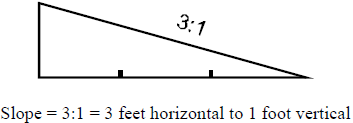
“STRUCTURE” means an object constructed or installed by man, including, but without limitations, buildings, towers, smokestacks, earth formations, and overhead transmission lines.
“TRAVERSE WAYS,” for the purpose of determining height limits as set forth in this Ordinance, shall be increased in height by 17 feet for interstate highways; 15 feet for all other public roadways; 10 feet or the height of the highest mobile object that would normally traverse the road, whichever is greater, for private roads; 23 feet for railroads; and for waterways and all other traverse ways not previously mentioned, an amount equal to the height of the highest mobile object that would normally traverse it.
“TREE” means any object of natural growth.
“UTILITY RUNWAY” means a runway that is constructed for, and intended to be used by propeller-driven aircraft of 12,500 pounds maximum gross weight and less; and is less than 4,900 feet in length.
“VISUAL RUNWAY” means a runway intended solely for the operation of aircraft using visual approach procedures, with no straight-in instrument approach procedure and no instrument designation indicated on an approved planning document.
“WATER SURFACES” for the purpose of this ordinance, shall have the same meaning as land for the establishment of protected zones.
“ZONING ADMINISTRATOR” means the City of Marshall Planning and Zoning Administrator
Adopted by Ord. 24-013 on 7/9/2024
Section IV: Air Space Obstruction Zoning
- AIR SPACE ZONES: In order to carry out the purpose of this Ordinance, as set forth above, the following air space zones are hereby established: Primary Zone, Horizontal Zone, Conical Zone, Approach Zone, Precision Instrument Approach Zone, and Transitional Zone, and whose locations and dimensions are as follows:
- PRIMARY ZONE: All that land which lies directly under an imaginary primary surface longitudinally centered on a runway and:
- Extending 200 feet beyond each end of Runway 12/30 and Runway 2/20.
- Coinciding with each end of Runway 12/30 and Runway 2/20. The elevation of any point on the primary surface is the same as the elevation of the nearest point on the runway centerline. The width of the primary surface is:
- 1,000 feet for Runway 12/30.
- 500 feet for Runway 2/20.
- HORIZONTAL ZONE: All that land which lies directly under an imaginary horizontal surface 150 feet above the established airport elevation, or a height of 1332.8 feet above mean sea level, the perimeter of which is constructed by swinging arcs of specified radii from the center of each end of the primary surface of each runway and connecting the adjacent arcs by lines tangent to those arcs. The radius of each arc is:
- 10,000 feet for Runway 12/30 and Runway 2/20. When a 5,000-foot arc is encompassed by tangents connecting two adjacent 10,000-foot arcs, the 5,000-foot arc shall be disregarded in the construction of the perimeter of the horizontal surface.
- CONICAL ZONE: All that land which lies directly under an imaginary conical surface extending upward and outward from the periphery of the horizontal surface at a slope of 20:1 for a horizontal distance of 4,000 feet as measured outward from the periphery of the horizontal surface.
- APPROACH ZONE: All that land which lies directly under an imaginary approach surface longitudinally centered on the extended centerline at each end of a runway. The inner edge of the approach surface is at the same width and elevation as, and coincides with, the end of the primary surface. The approach surface inclines upward and outward at a slope of:
- 50:1 for Runway 12/30, a precision instrument runway
- 34:1 for Runways 2/20, a non-precision runway The approach surface expands uniformly to a width of:
- 4,000 feet for Runway 12/30 at a distance of 10,000 feet, then continues at the same rate of divergence for an additional 4,000 feet to the periphery of the conical surface.
- 3,500 feet for Runway 2/20 at a distance of 10,000 feet, then continues at the same rate of divergence to the periphery of the conical surface.
- PRECISION INSTRUMENT APPROACH ZONE: All that land which lies directly under an imaginary precision instrument approach surface longitudinally centered on the extended centerline at each end of Runway 12/30, a precision instrument runway. The inner edge of the precision instrument approach surface is at the same width and elevation as, and coincides with, the end of the primary surface. The precision instrument approach surface inclines upward and outward at a slope of 50:1 for a horizontal distance of 10,000 feet expanding uniformly to a width of 4,000 feet, then continues upward and outward for an additional horizontal distance of 40,000 feet at a slope of 40:1, expanding uniformly to an ultimate width of 16,000 feet.
- TRANSITIONAL ZONE: All that land which lies directly under an imaginary surface extending upward and outward at right angles to the runway centerline and centerline extended at a slope of 7:1 from the sides of the primary surfaces and from the sides of the approach surfaces until they intersect the horizontal surface or the conical surface. Transitional surfaces for those portions of the precision instrument approach surface which project through and beyond the limits of the conical surface, extend a distance of 5,000 feet measured horizontally from the edge of the precision instrument approach surface and at right angles to the extended precision instrument runway centerline.
- PRIMARY ZONE: All that land which lies directly under an imaginary primary surface longitudinally centered on a runway and:
- HEIGHT RESTRICTIONS: Except as otherwise provided in this Ordinance, and except as necessary and incidental to airport operations, no structure or tree shall be constructed, altered, maintained, or allowed to grow in any air space zone created in SECTION IV A so as to project above any of the imaginary air space surfaces described in said SECTION IV A hereof. Where an area is covered by more than one height limitation, the more restrictive limitation shall prevail.
Adopted by Ord. 24-013 on 7/9/2024
Section V: Land Use Safety Zoning
- SAFETY ZONE BOUNDARIES: In order to carry out the purpose of this Ordinance, as set forth above, to restrict those uses which may be hazardous to the operational safety of aircraft operating to and from the Southwest Minnesota Regional Airport, and, furthermore, to limit population and building density in the runway approach areas, thereby creating sufficient open space to protect life and property in case of an accident, there are hereby created and established the following land use safety zones:
- SAFETY ZONE A: All land in that portion of the approach zones of a runway, as defined in SECTION IV A hereof, which extends outward from the end of the primary surface a distance equal to two-thirds of the planned length of the runway, which distance shall be:
- 4,814 feet for Runway 12.
- 4,814 feet for Runway 30 with the outer length affixed to the eastern most edge of the right-of-way of Country Club Drive.
- 3,199 feet for Runway 2.
- 3,199 feet for Runway 20.
- SAFETY ZONE B: All land in that portion of the approach zones of a runway, as defined in SECTION IV A hereof, which extends outward from Safety Zone A a distance equal to one-third of the planned length of the runway, which distance shall be:
- 2,407 feet for Runway 12.
- 2,407 feet for Runway 30 with the inner length affixed to the western most edge of the right-of-way of Country Club Drive.
- 1,599 feet for Runway 2.
- 1,599 feet for Runway 20.
- SAFETY ZONE C: All land which is enclosed within the perimeter of the horizontal zone, as defined in SUBSECTION IV A hereof, and which is not included in Safety Zone A or Safety Zone B.
- EXCEPTIONS – EXISTING LAND USES: The following described properties are designated as Existing Land Uses that do not present an airport hazard so severe that public safety considerations outweigh the public interest in continuing the existing land use as outlined by MN Statutes 360.0655 Subd. 2 (Protection of Existing Land Uses). The following existing land uses were in existence at the time of the adoption of this ordinance and are exempt from the USE RESTRICTIONS of SECTIONS V B 2 and V B 3 below, and are subject to the provisions of SECTION V B 5 below.
- Table 1 : Existing Land Uses - Runway 30 Approach (Maps B7 and B8)
- Table 2: Existing Land Uses - Runway 20 Approach (Map B9)
- SAFETY ZONE A: All land in that portion of the approach zones of a runway, as defined in SECTION IV A hereof, which extends outward from the end of the primary surface a distance equal to two-thirds of the planned length of the runway, which distance shall be:
- USE RESTRICTIONS:
- GENERAL: Subject at all times to the height restrictions set forth in SECTION IV B, no use shall be made of any land in any of the safety zones defined in SECTION V A which creates or causes interference with the operations of radio or electronic facilities on the airport or with radio or electronic communications between the airport and aircraft, make it difficult for pilots to distinguish between airport lights and other lights, results in glare in the eyes of pilots using the airport, impairs visibility in the vicinity of the airport, or otherwise endangers the landing, taking off, or maneuvering of aircraft.
- ZONE A: Subject at all times to the height restrictions set forth in Subsection IV B and to the general restrictions contained in Subsection V B 1, areas designated as Zone A shall contain no buildings, temporary structures, exposed transmission lines, or other similar above-ground land use structural hazards, and shall be restricted to those uses which will not create, attract, or bring together an assembly of persons thereon. Permitted uses may include, but are not limited to, such uses as agriculture (seasonal crops), horticulture, animal husbandry, raising of livestock, wildlife habitat, light outdoor recreation (non-spectator), cemeteries, and automobile parking.
- ZONE B: Subject at all times to the height restrictions set forth in Subsection IV B, and to the general restrictions contained in Subsection V B 1, areas designated as Zone B shall be restricted in use as follows:
- Each use shall be on a site whose area shall not be less than three acres.
- Each use shall not create, attract, or bring together a site population that would exceed 15 times that of the site acreage.
- Each site shall have no more than one building plot upon which any number of structures may be erected.
- A building plot shall be a single, uniform, and non-contrived area, whose shape is uncomplicated and whose area shall not exceed the following minimum ratios with respect to the total site area:
- The following uses are specifically prohibited in Zone B: Churches, hospitals, schools, theaters, stadiums, hotels, motels, trailer courts, campgrounds, and other places of frequent public or semi-public assembly.
- ZONE C: Zone C is subject only to height restrictions set forth in SECTION V B, and to the general restrictions contained in SECTION V B 1.
- EXEMPTIONS – EXISTING LAND USES
- Existing Land Uses which existed at the time of the adoption of this ordinance, as set forth in SECTION V A 4 above, and as shown on the zoning map, are subject to the height restrictions of SECTION IV B and the general restrictions of SECTION V B 1. Land uses which come into existence after the adoption of this ordinance, are treated as though they were not an Existing Land Use and are subject to Zone A or Zone B restrictions as the case may be.
- Existing Land Uses which violate any of the following restrictions are prohibited as safety hazards and must be acquired, altered, or removed at public expense. Those conditions are as follows:
- The following land uses, if they exist in Safety Zones A or B, are considered by the Commissioner to constitute airport safety hazards so severe, either to persons on the ground or to the air-traveling public, or both, that they must be prohibited under local airport zoning ordinances;
- Any structure which a person or persons customarily use as a principal residence and which is located entirely inside Safety Zone A within 1000 feet of the end of the primary zone;
- Any structure which a person or persons customarily use as a principal residence and which is located entirely within Safety Zone A or B and which penetrates an imaginary approach surface as defined by SECTION IV A;
- Any land use in Safety Zone A or B which violates any of the following standards:
- the land use must not create or cause interference with the operation of radio or electronic facilities on the airport or with radio or electronic communication between the airport and aircraft;
- the land use must not make it difficult for pilots to distinguish between airport lights and other lights;
- the land use must not result in glare in the eyes of pilots using the airport or impair visibility in the vicinity of the airport.
- Any isolated residential building lot zoned for single-family or two-family residences on which any structure, if built, would be prohibited by subparagraphs b.(1)(a), (b) or (c) above. An “isolated” residential building lot is one located in an area in which the predominant land use is single family or two-family residential structures; and
- Any other land use which presents, in the opinion of the Commissioner, a material danger to the landing, taking off, or maneuvering of aircraft or to the safety of persons on the ground. In making such a determination, the Commissioner shall consider the following factors:
- possibility that the land use may contribute to or cause a collision of two or more aircraft or an aircraft and some other object;
- possibility that the land use may, in case of an aircraft accident, cause an explosion, fire, or the release of harmful or noxious fumes, gases, or substances;
- tendency of the land use to increase the number of persons that would be injured in case of an aircraft accident;
- effect of the land use on availability of clear areas for emergency landings;
- flight patterns around the airport, the extent of use of the runway in question, the type of aircraft using the airport, whether the runways are lighted, whether the airport is controlled, and other similar factors.
Since the existing land uses are exempted by MN Statutes 360.0655 Subd 2, the properties as identified and alterations thereof shall be exempted from the conditions and restrictions of this zoning ordinance provided the primary land use of the property remains as-is as of the time of adopting this ordinance. It is the opinion of the Marshall-Lyon County Joint Airport Zoning Board that the continued use of the existing subject parcels in the manner that they are currently used does not present an airport hazard so severe that public safety considerations outweigh the public interest in continuing the existing land use, preventing disruption to that land use. Exemption of these parcels from the conditions and restrictions of this zoning ordinance shall remain in effect so long as the primary use and zoning of the parcels remains unchanged.
Adopted by Ord. 24-013 on 7/9/2024
Section VI: Airport Map
The several zones herein established are shown on the Southwest Minnesota Regional Airport Zoning Map consisting of 9 sheets, prepared by Toltz, King, Duvall, Anderson & Associates, and dated July 2023, attached hereto and made a part hereof, which map, together with such amendments thereto as may from time to time be made, and all notations, references, elevations, data, zone boundaries, and other information thereon, shall be and the same is hereby adopted as part of this Ordinance.
Adopted by Ord. 24-013 on 7/9/2024
Section VII: Non-Conforming Uses
Regulations not retroactive. The regulations prescribed by this Ordinance shall not be construed to require the removal, lowering, or other changes or alteration of any structure or tree not conforming to the regulations as of the effective date of this Ordinance, or otherwise interfere with the continuance of any nonconforming use. Nothing herein contained shall require any change in the construction, alteration, or intended use of any structure, the construction or alteration of which was begun prior to the effective date of this Ordinance and is diligently prosecuted and completed within two years thereof.
Adopted by Ord. 24-013 on 7/9/2024
Section VIII: Permits
- FUTURE USES: Except as specifically provided in Paragraphs 1 and 2 hereunder, no material change shall be made in the use of land and no structure shall be erected, altered, or otherwise established in any zone hereby created unless a permit therefore shall have been applied for and granted by the zoning administrator, hereinafter, provided for. Each application for a permit shall indicate the purpose for which the permit is desired, with sufficient particularity to permit it to conform to the regulations herein prescribed. If such determination is in the affirmative, the permit shall be granted.
- However, a permit for a tree or structure of less than 75 feet of vertical height above the ground shall not be required in the horizontal and conical zones or in any approach and transitional zones beyond a horizontal distance of 4,200 feet from each end of the runway except when such tree or structure, because of terrain, land contour, or topographic features, would extend the height or land use limit prescribed for the respective zone.
- Nothing contained in this foregoing exception shall be construed as permitting or intending to permit any construction, alteration, or growth of any structure or tree in excess of any of the height limitations established by this ordinance as set forth in SECTION IV and the land use limitations set forth in SECTION V.
- EXISTING USES: Before any existing use or structure may be replaced, substantially altered or repaired, or rebuilt within any zone established herein, a permit must be secured authorizing such replacement, change, or repair. No permit shall be granted that would allow the establishment or creation of an airport hazard or permit a nonconforming use, structure, or tree to become a greater hazard to air navigation than it was on the effective date of this Ordinance or any amendments thereto, or than it is when the application for a permit is made. Except as indicated, all applications for such a permit shall be granted.
- NONCONFORMING USES ABANDONED OR DESTROYED: Whenever the zoning administrator determines that a nonconforming structure or tree has been abandoned or more than 80% torn down, deteriorated, or decayed, no permit shall be granted that would allow such structure or tree to exceed the applicable height limit or otherwise deviate from the zoning regulations. Whether application is made for a permit under this paragraph or not, the zoning administrator may order the owner of the abandoned or partially destroyed nonconforming structure, at his own expense, to lower, remove, reconstruct, or equip the same in the manner necessary to conform to the provisions of this Ordinance. In the event the owner of the nonconforming structure shall neglect or refuse to comply with such order for ten days after receipt of written notice of such order, the zoning administrator may, by appropriate legal action, proceed to have the abandoned or partially destroyed nonconforming structure lowered, removed, reconstructed, or equipped and assess the cost and expense thereof against the land on which the structure is or was located. Unless such an assessment is paid within ninety days from the service of notice thereof on the owner of the land, the sum shall bear interest at the rate of eight percent per annum from the date the cost and expense is incurred until paid and shall be collected in the same manner as are general taxes.
Adopted by Ord. 24-013 on 7/9/2024
Section IX: Variances
Any person desiring to erect a structure or increase the height of any existing structure, permit the growth of any tree, or use his property not in accordance with the regulations prescribed in this Ordinance may apply to the Board of Adjustment, hereinafter provided for, for a variance from such regulations. If a person submits an application for a variance by certified mail to the members of the Board and the Board fails to grant or deny the variance within four months after the last member receives the application, the variance shall be deemed to be granted by the Board. When the variance is granted by reason of the failure of the Board to act on the variance, the person receiving the variance shall notify the Board and the Commissioner, by certified mail, that the variance has been granted. The applicant shall include a copy of the original application for the variance with this notice to the Commissioner. The variance shall be effective sixty days after this notice is received by the Commissioner subject to any action taken by the Commissioner pursuant to Minnesota Statutes Section 360.063, Subdivision 6a. Such variances shall be allowed where it is duly found that a literal application or enforcement of the regulations would result in practical difficulty or unnecessary hardship, and relief granted would not be contrary to the public interest but do substantial justice and be in accordance with the spirit of this Ordinance provided any variance so allowed may be subject to any reasonable conditions that the Board or Commissioner may deem necessary to effectuate the purpose of this Ordinance. The Board of Adjustment may request review of a variance application by the Mn/DOT Office of Aeronautics prior to making a decision.
Adopted by Ord. 24-013 on 7/9/2024
Section X: Hazard Marking And Lighting
- NONCONFORMING USES: The owner of any nonconforming structure or tree is hereby required to permit the installation, operation, and maintenance thereon of such markers and lights as shall be deemed necessary by the zoning administrator, to indicate to the operators of aircraft in the vicinity of the airport the presence of such airport hazards. Such markers and lights shall be installed, operated, and maintained at the expense of the Southwest Minnesota Regional Airport.
- PERMITS AND VARIANCES: Any permit or variance deemed advisable to effectuate the purpose of this Ordinance and be reasonable in the circumstances, and granted by the zoning administrator or Board, shall require the owner of the structure or tree in question, at his own expense, to install, operate, and maintain thereon such markers and lights as may be necessary to indicate to pilots the presence of an airport hazard.
Adopted by Ord. 24-013 on 7/9/2024
Section XI: Airport Zoning Administrator
It shall be the duty of the City of Marshall Planning & Zoning Administrator, Lyon County Zoning Administrator, City of Ghent Administrator, and Grandview Township Administrator to serve as the Airport Zoning Administrator to administer and enforce the regulations prescribed herein for lands within their respective municipalities. In the event that one or more of the above-described Airport Zoning Administrators does not administer this Ordinance or enforce its regulations, the Marshall-Lyon County Joint Airport Zoning Board hereby appoints the City of Marshall Planning & Zoning Administrator (or their designee) to administer this Ordinance in the municipality or municipalities. If any official position designated above ceases to exist or to perform or serve its present function, the successor position as designed by the applicable jurisdiction shall become the Airport Zoning Administrator for that entity and shall perform or serve such functions. Applications for permits and variances shall be made to the Airport Zoning Administrator upon a form furnished by the Airport Zoning Administrator and pursuant to their applicable zoning ordinance and Board of Adjustment procedures. Permit or development certificate applications shall be promptly considered and granted or denied by them in accordance with the regulations prescribed herein, in the zoning ordinance for the individual jurisdiction, and all applicable statutes. Variance applications shall be forthwith transmitted by the Airport Zoning Administrator for action by the Board of Adjustment, hereinafter provided for. The Airport Zoning Administrator shall transmit copies of all permits and variances granted or denied pertaining to the provisions of this Ordinance to the City of Marshall Planning & Zoning Administrator.
Adopted by Ord. 24-013 on 7/9/2024
Section XII: Board Of Adjustment
- ESTABLISHMENT: The City of Marshall Planning Commission shall serve as the Board of Adjustment for the Southwest Minnesota Regional Airport Safety Zoning Ordinance within the City of Marshall. The Lyon County Planning Commission shall serve as the Board of Adjustment for the Southwest Minnesota Regional Airport Safety Zoning Ordinance outside of the City of Marshall.
- POWERS: The Board of Adjustment shall have and exercise the following powers:
- Hear and decide appeals from any order, requirement, decision, or determination made by the administrator in the enforcement of this Ordinance.
- Hear and decide special exceptions to the terms of this Ordinance upon which such Board of Adjustment under such regulations may be required to pass.
- Hear and decide specific variances.
- PROCEDURES:
- The Board of Adjustment shall adopt rules for its governance and procedure in harmony with the provisions of this Ordinance. Meetings of the Board of Adjustment shall be held at the call of the chairperson and at such other times as the Board of Adjustment may determine. The chairperson, or in his absence the acting chairperson, may administer oaths and compel the attendance of witnesses. All hearings of the Board of Adjustment shall be public. The Board of Adjustment shall keep minutes of its proceedings showing the vote of each member upon each question or, if absent or failing to vote, indicating such fact, and shall keep records of its examinations and other official actions, all of which shall immediately be filed in the office of the zoning administrator and shall be a public record.
- The Board of Adjustment shall make written findings of facts and conclusions of law giving the facts upon which it acted and its legal conclusions from such facts in reversing, affirming, or modifying any order, requirement, decision, or determination which comes before it under the provisions of this ordinance.
- The concurring vote of a majority of the members of the Board of Adjustment shall be sufficient to reverse any order, requirement, decision, or determination of the zoning administrator or to decide in favor of the applicant on any matter upon which it is required to pass under this Ordinance, or to effect any variation in this Ordinance.
Adopted by Ord. 24-013 on 7/9/2024
Section XIII: Appeals
- Any person aggrieved, or any taxpayer affected by any decision of the zoning administrator made in his administration of this Ordinance may appeal to the Board of Adjustment. Such appeals may also be made by any governing body of a municipality, county, or airport zoning board, which is of the opinion that a decision of the zoning administrator is an improper application of this Ordinance as it concerns such governing body or board.
- All appeals hereunder must be commenced within 30 days of the zoning administrator’s decision, by filing with the zoning administrator a notice of appeal specifying the grounds thereof. The zoning administrator shall forthwith transmit to the Board of Adjustment all the papers constituting the record upon which the action appealed from was taken. In addition, any person aggrieved, or any taxpayer affected by any decisions of the zoning administrator made in his administration of this Ordinance who desires to appeal such decision shall submit an application for a variance, by certified mail, to the members of the Board of Adjustment in the manner set forth in Minnesota Statutes Section 360.068, Subdivision 2.
- An appeal shall stay all proceedings in furtherance of the action appealed from, unless the zoning administrator certifies to the Board of Adjustment after the notice of appeal has been filed with it, that by reason of the facts stated in the certificate a stay would, in his opinion, cause imminent peril to life or property. In such case, proceedings shall not be stayed except by order of the Board of Adjustment on notice to the zoning administrator and on due cause shown.
- The Board of Adjustment shall fix a reasonable time for hearing appeals, give public notice and due notice to the parties in interest, and decide the same within a reasonable time. Upon the hearing, any party may appear in person, by agent, or by attorney.
- The Board of Adjustment may, in conformity with the provisions of this ordinance, reverse or affirm, in whole or in part, or modify the order, requirement, decision or determination appealed from and may make such order, requirement, decision or determination, as may be appropriate under the circumstances, and to that end shall have all the powers of the zoning administrator.
Adopted by Ord. 24-013 on 7/9/2024
Section XIV: Judicial Review
Any person aggrieved, or taxpayer affected, by any decision of a board of adjustment, or of any action of the commissioner taken under section 360.063, subdivisions 6 or 6a, or any governing body of a municipality or county, or any joint airport zoning board, which believes that a decision of a board of adjustment or action of the commissioner is illegal may appeal in accordance with Minnesota Statutes Chapter 14.
Adopted by Ord. 24-013 on 7/9/2024
Section XV: Penalties
Every person who shall construct, establish, substantially change, alter or repair any existing structure or use, or permit the growth of any tree without having complied with the provision of this Ordinance or who, having been granted a permit or variance under the provisions of this Ordinance, shall construct, establish, substantially change or substantially alter or repair any existing growth or structure or permit the growth of any tree, except as permitted by such permit or variance, shall be guilty of a misdemeanor and shall be punished by a fine of not more than $1,000 or imprisonment for not more than 90 days or by both. Each day a violation continues to exist shall constitute a separate offense. The airport zoning administrator may enforce all provisions of this Ordinance through such proceedings for injunctive relief and other relief as may be proper under the laws of Minnesota Statutes Section 360.073 and other applicable law.
Adopted by Ord. 24-013 on 7/9/2024
Section XVI: Conflicts
Where there exists a conflict between any of the regulations or limitations prescribed in this Ordinance and any other regulations applicable to the same area, whether the conflict be with respect to the height of structures or trees, the use of land, or any other matter, the more stringent limitation or regulation shall govern and prevail.
Adopted by Ord. 24-013 on 7/9/2024
Section XVII: Severability
- In any case in which the provision of this Ordinance, although generally reasonable, is held by a court to interfere with the use or enjoyment of a particular structure or parcel of land to such an extent, or to be so onerous in their application to such a structure or parcel of land, as to constitute a taking or deprivation of that property in violation of the constitution of this state or the constitution of the United States, such holding shall not affect the application of this Ordinance as to other structures and parcels of land, and to this end the provisions of this Ordinance are declared to be severable.
- Should any section or provision of this Ordinance be declared by the courts to be unconstitutional or invalid, such decision shall not affect the validity of the Ordinance as a whole or any part thereof other than the parts so declared to be unconstitutional or invalid.
Adopted by Ord. 24-013 on 7/9/2024
Section XVIII: Effective Date
This ordinance shall take effect on the 6th day of February, 2024. Copies thereof shall be filed with the Commissioner through the Office of Aeronautics and the Office of the Lyon County Recorder. Passed and adopted after public hearing by the Marshall-Lyon County Joint Airport Zoning Board this 6th day of February, 2024.
Adopted by Ord. 24-013 on 7/9/2024
Exhibit A
This Ordinance affects all or a portion of the following sections of land:
| NAME AND NUMBER OF TOWNSHIP | AIR SPACE OBSTRUCTION ZONING: Section IV of Ordinance; Page(s) B1, B2, & B3 of Zoning Map | LAND USE SAFETY ZONING: Section V of Ordinance; Page(s) B4, B5 & B6 of Zoning Map |
| City of Marshall | Sections: 2, 3, 4, 5, 6, 7, 8, 9, 10, 15, 16, 17 | Sections: 4, 5, 6, 7, 8, 9, 16, 17, 18 |
| City of Ghent | Sections: 10, 15, 16 | Sections: - |
| City of Minneota | Sections: 25, 26, 35, 36 | Sections: - |
| Amiret Township | Sections: 4, 5, 6, 7, 8, 9, 17, 18 | Sections: - |
| Clifton Township | Sections: 18, 19, 20, 21, 27, 28, 29, 30, 31, 32, 33, 34 | Sections: - |
| Eidsvold Township | Sections: 36 | Sections: - |
| Fairview Township | Sections: 19, 20, 21, 27, 28, 29, 30, 31, 32, 33, 34 | Sections: 28, 29, 30, 31, 32, 33 |
| Grandview Township | Sections: 4, 5, 6, 7, 8, 9, 10, 14, 15, 16, 17, 18, 19, 20, 21, 22, 23, 24, 25, 26, 27, 28, 29, 30, 33, 34, 35, 36 | Sections: 25, 26, 35, 36 |
| Lake Marshall Township | Sections: 3, 4, 5, 6, 7, 8, 9, 10, 11, 13, 14, 15, 16, 17, 18, 19, 20, 21, 22, 23, 24, 25, 26, 27, 28, 34, 35, 36 | Sections: 4, 5, 6, 7, 8, 9, 16, 17, 18 |
| Lynd Township | Sections:1, 2, 3, 10, 11, 12, 13, 14, 24 | Sections: 1, 2, 11, 13 |
| Nordland Township | Sections: 1, 2, 11, 12, 13, 14, 23, 24 | Sections: - |
| Sodus Township | Sections: 2, 7, 12 | Sections: - |
| Westerheim Township | Sections: 29, 30, 31, 32, 33 | Sections: - |
Adopted by Ord. 24-013 on 7/9/2024
Exhibit B: Maps
- B1 Airspace Zoning Map
- B2 Runway 12 Extended Approach
- B3 Runway 30 Extended Approach
- B4 Land Use & Zoning Map
- B5 Runway 12/30 Land Use & Zoning Map
- B6 Runway 2/20 Land Use & Zoning Map
- B7 Existing Land Use - Runway 30 Custom Safety Zone A
- B8 Existing Land Use - Runway 30 Custom Safety Zone
- B9 Existing Land Use - Runway 20 Safety Zones A & B
Adopted by Ord. 24-013 on 7/9/2024

