
Maumelle City Zoning Code
ARTICLE IV
SUPPLEMENTAL REGULATIONS
Sec. 94-551. - Accessory buildings.
(a)
An accessory building may be erected detached from the principal building or may be erected as an integral part of the principal building. For purposes of this section, a storm cellar and a satellite receiving station are construed to be accessory buildings and shall be screened by appropriate fencing or landscaping means. No accessory building shall be greater than 25 percent of the principal building in square footage of floor area.
(b)
An accessory building attached to the principal building shall be made structurally a part of and have a common wall with the principal building and shall comply in all respects with the requirements of this chapter applicable to the principal building. Unless so attached, the accessory building shall be located on the rear half of the lot.
(c)
The setback requirements for accessory buildings in the various zoning districts are as follows:
(1)
In the R-1 single-family detached district:
a.
Side yard, eight feet.
b.
Rear yard, ten feet.
(2)
In the R-1 single-family cluster and zero-lot-line district:
a.
Side yard, four feet.
b.
Rear yard, seven feet; except when the rear yard for the principal building is reduced to seven feet by reason of abutting common open space, the accessory building setback may be placed on the rear yard property line.
(3)
In the R-2 multifamily district:
a.
Side yard, eight feet.
b.
Rear yard, ten feet.
(4)
In the I-1 industrial district:
a.
Side yard, 25 feet.
b.
Rear yard, 25 feet.
Sec. 94-552. - Nonconforming uses.
(a)
Continuing existing nonconforming uses. Any use of land, building or structure existing at the time of the enactment of the ordinance from which this chapter is derived may be continued even though such use, building or structure may not conform with the provisions of this chapter for the district in which it is located.
(b)
Limitations on nonconforming uses. A nonconforming use of a building or land shall not be changed, extended, reconstructed, enlarged or structurally altered unless:
(1)
Such change is required by law or order.
(2)
Authority is granted by the planning commission and the city council.
(3)
Such repairs and maintenance work are required to keep the building structurally sound.
(c)
Cessation of nonconforming use. A lawful nonconforming use of a building, structure or land that has been voluntarily discontinued for a period of six calendar months shall not thereafter be resumed. Whenever a nonconforming use has been changed to a conforming one, such use shall not thereafter be changed to a nonconforming use.
(d)
Replacement of damaged or destroyed nonconforming uses. With exceptions, any nonconforming building or structure damaged by fire, flood, explosion, wind, earthquakes, or other calamity or act of natural consequences may be restored, reconstructed or used as before the calamity or natural consequence, provided such restoration is completed within six months of such happening. Exceptions:
(1)
If the nonconforming building can be restored or reconstructed to achieve conformity, i.e., meet minimum yard or height requirements of this chapter, the owner/builder is required to achieve conformity.
(2)
If the nature of the nonconformity is the use of the land or building, the use shall not be changed after restoration to a use that is less compatible with the zone in which it is located. In no case shall a building or the use of a building or use of land be restored if such use or building has been declared by law to be a public or private nuisance.
Sec. 94-553. - Off-street loading.
(a)
Every building or structure constructed in any district for nonresidential purposes requiring the receipt or distribution by vehicles of material or merchandise shall provide and maintain on the same lot with such building at least one off-street loading space for the first 5,000 square feet, or fraction of 5,000 square feet, of gross floor area, and one additional such space for each 10,000 square feet or major fraction of 10,000 square feet of gross floor area in excess of 5,000 square feet.
(b)
Each loading space shall not be less than ten feet in width, 35 feet in length, and 14 feet in height. An access drive not less than ten feet in width shall be provided leading from the street to the loading area, except when the loading space abuts a street or alley or easement of access.
(c)
Such space may occupy all or any part of any required yard space, but no such space may be closer to a residential district than 25 feet unless the space is wholly within a closed building or unless enclosed on all sides facing such residential district by a solid fence or wall at least six feet in height.
Sec. 94-570. - Generally.
This division describes the special conditions under which certain uses are permitted in a zoning district.
Sec. 94-571. - Flammable liquids and gases, storage of.
The storage of flammable liquids and gases shall comply with the state fire prevention code.
Sec. 94-572. - Home occupations.
(a)
Purpose. The purpose of this section is to allow only home business/occupations that are compatible with the residential neighborhood in which they are located.
(b)
Definitions. The following words, terms and phrases, when used in this section, shall have the meanings ascribed to them in this subsection, except where the context clearly indicates a different meaning:
Home business/occupation means an accessory use of a dwelling unit, involving the manufacture, provision, or sale of goods and/or services, which is carried on by members of the immediate family residing on the premises. Home businesses/occupations shall not include garage sales and yard sales nor home parties which are held for the purpose of the sale or distribution of goods or services. However, if the collective total of all such sales and/or parties exceeds four at any one location in any calendar year, such sales and/or parties shall be considered a home business/occupation. "Home business/occupation" does not include an occasional refreshment stand operated by a minor who is sixteen or younger. This subsection separates home business/occupations into two different and distinct categories as follows:
(1)
Low-impact home business/occupation, which has little if any effect on the existing neighborhood. Typically, this type of home business/occupation is an office use where the resident occupant conducts no business other than by telephone, mail, facsimile or computer modem; where customers are not typically received on the premises; where no deliveries are accepted on a regular basis; and where an office is needed for the purposes of sending and receiving mail, telephone calls, maintaining records and other similar functions. A low-impact home business/occupation is a home business/occupation operated in such a manner that the average neighbor would be unaware of its existence. Examples of this type of home occupation include but are not limited to artist, telephone solicitors, housecleaners, homemade crafts for sale off site, babysitting (five children maximum), tutoring (five maximum), office facility for a salesman, sales representative or manufacturer's representative provided that no transactions are made in person on the premises.
(2)
Moderate-impact home business/occupation, which has some type of impact on the existing neighborhood. Typically, this type of home business/occupation is an office use where the resident occupant conducts business with customers on site; where equipment, other than office equipment, exists to conduct the home business/occupation; where a company vehicle and/or company trailer exist. A moderate-impact home business/occupation is a home business/occupation operated in such a manner that the average neighbor would be aware of its existence due to traffic, noise or equipment. Examples of this type of home business/occupation include but are not limited to contractor's office, locksmiths, swimming pool cleaning, financial planning, lawn care/maintenance, day care center (more than five children), etc.
(c)
Permit requirements. Home business/occupations complying with the criteria established in this section and defined as low-impact occupations shall be permitted by right with no accessory use permit required. Moderate-impact occupations shall commence operation only after the receipt of an accessory use permit from the city.
(d)
Compliance criteria for home business/occupations. The home business/occupation permit shall be denied when any one of the following conditions is found to exist:
(1)
Not more than 33 percent or a maximum of 1,000 square feet, whichever is lesser, of the principal residential structure shall be used for the operation of the home business/occupation.
(2)
Not more than one service or company vehicle with a capacity of less than one ton shall be parked, stored or maintained on the premises. The following types of vehicles are expressly prohibited at any time:
a.
All commercial tow vehicles or vehicle carriers.
b.
Dump trucks or trash haulers.
c.
Flat bed or stake bed trucks.
d.
Trucks or buses used in interstate or intrastate commerce.
e.
Vans with a capacity of one ton or larger, used for other than a private passenger vehicle.
f.
School or church buses or vans one ton in carrying capacity or greater.
(3)
Not more than one trailer shall be allowed as long as the trailer is attached to the service or company vehicle and is used for the transportation of equipment. The trailer shall not be allowed if disconnected from the service or company vehicle without being stored in a garage or behind an approved fence enclosure. The trailer shall not be parked or stored in the street and shall not be parked or stored with trash, rubbish or other nuisance materials.
(4)
No temporary or permanent outside storage of equipment or materials shall be allowed.
(5)
There shall be no use of an accessory structure on the property for storage or any other purpose of conducting the business/occupation.
(6)
No more than one employee or independent contractor shall be permitted to report to the premises for job assignment or to work at the premises. No more than one employee shall be allowed at the premises while functioning as an employee other than immediate family members who reside on the premises.
(7)
No additional building or remodeling shall be allowed on the premises to accommodate the home business/occupation.
(8)
There shall be no display that will indicate from the exterior that the premises are being utilized in part for any purpose other than that of a dwelling unit. There shall be no product display visible from the street.
(9)
No commodity shall be sold upon the premises except that which is prepared on the premises. Retail businesses are not allowed.
(10)
No home business/occupation shall create a hazard to persons or property; or any offensive conditions such as excessive noise, vibrations, dust, electrical interference, odor; or any other form of pollution of any nature.
(11)
No mechanical, electrical or chemical equipment or any form of apparatus shall be utilized which interferes with or substantially disrupts the integrity or the character of the neighborhood.
(12)
Deliveries that pertain to the business which have an adverse impact on the neighborhood traffic, but shall not include Federal Express, UPS or similar type carriers.
(e)
Enforcement procedures.
(1)
Any home business/occupation permitted by the city under the accessory use permit provisions shall only be valid for the applicant, business/occupation and residence for which the permit is issued. A home business/occupation accessory use permit shall be subject to cancellation in the event of any noncompliance with or continued violation of any provisions of this section by action of the board of adjustment.
(2)
Home business/occupation applicants or operators shall agree to permit the code enforcement officer to inspect the premises to determine compliance with the rules and regulations set forth in this section.
(3)
Any aggrieved person believing that a violation of this section is occurring and who desires that action be taken by the city shall notify the city code enforcement officer in writing of such alleged violation. Within 30 calendar days after receipt by the code enforcement officer of such written allegation, the code enforcement officer shall complete an investigation of the alleged allegation to determine its merits. Within ten calendar days after the code enforcement officer has completed the investigation, the following actions shall be taken:
a.
If the code enforcement officer determines that no violation as alleged or otherwise is occurring, then notification of that decision shall be given to the complaining person or a spokesperson for the complaining party by certified mail return requested.
b.
If the code enforcement officer determines that a violation is occurring or has occurred as alleged, then notification of that decision and a time for compliance shall be sent by certified mail return requested to both the violator and complaining person or a spokesperson for the complaining party. The notification shall also state what action, if any, will be taken if compliance is not performed within 30 calendar days.
c.
If compliance does not take place or violations continue to occur, the city shall conduct a hearing before the board of adjustment to decide whether or not to revoke the accessory use permit. Notification of the hearing will be sent to the holder of the accessory use permit in the form of a certified letter.
d.
Any person feeling aggrieved by a decision of the code enforcement officer may appeal that decision to the board of adjustment.
e.
Decision of the board of adjustment is final.
(f)
Renewal of home business/occupation accessory use permit. Home business/occupations shall not require permit renewal provided there has not been any violations of the provisions of this section. Should violations occur or continue to occur, the board of adjustment reserves the right to revoke the accessory use permit as stated in subsection (e) of this section.
(g)
Violations. Any person operating or continuing to operate a home business/occupation in violation of the provisions of this section shall be guilty of a misdemeanor and upon conviction shall be punished by a fine of at least $100.00 but not more than $500.00. Each day in which a violation shall occur constitutes a separate offense.
(Ord. No. 229, § 3, 4-5-1994; Ord. No. 1107, § 1, 2-5-2024)
Sec. 94-573. - Signs and sign structures, including billboards.
For sign regulations, refer to chapter 58.
Sec. 94-574. - Landscaping.
For landscaping requirements, refer to chapter 90.
Sec. 94-600. - General conditions.
The requirement to provide and maintain the off-street parking space required in this division shall be the joint and several responsibility of the operator and owner of the use and the operator and owner of the land on which off-street parking space is required to be provided and maintained. All parking and drives shall be paved with concrete or asphalt as approved by the city engineer. No land shall be used or occupied; no structure shall be designed, erected, altered, used or occupied; and no use shall be operated unless the off-street parking space required in this division is provided in at least the amount specified and maintained in the manner set forth in this division. Parking space and access for the handicapped shall be provided in accordance with state law concerning handicapped parking.
Sec. 94-601. - Location of off-street parking space.
Off-street parking space shall be located on the same lot as the use for which provided and may be composed of one or several separated parcels unless otherwise provided for in this division.
Sec. 94-602. - Separation of combined space.
Separate off-street parking space shall be provided for each use of the parking space required of two or more uses located on the same lot but may be combined and used jointly; however:
(1)
Where off-street parking space is combined and used jointly by two or more uses having different standards for determining the amount of off-street parking space required, the parking space shall be adequate in area to provide the sum total of off-street parking space requirements of all such uses.
(2)
Where off-street parking space is combined and used jointly by two or more uses having the same standard for determining the amount of off-street parking space required, all of such uses, for the purpose of this section, shall be considered a single unit; and the gross floor area of all such uses in all structures on the same lot or the number of employees of all such uses in all structures on the same lot, as fixed by the applicable standard, shall be taken as a single total for the purpose of determining the amount of off-street parking space required.
Sec. 94-603. - Site plan requirements.
(a)
The site plan submitted shall show the location and design of entrances and exits to public roads, the location and size of all buildings and structures, location of parking spaces, directional markings, traffic control devices and signs, walls, fences, landscaped areas, banks, berms, change of grades and planting materials, including the type and names of the materials proposed to be planted, and shall contain such other information in the form required by the city. The site plan shall be prepared with careful regard to the location of the parking facilities with relation to adjoining and neighborhood commercial, industrial, multifamily and other residential improvements, and shall be devised to have the least adverse effect on such adjoining or neighboring properties. Shrubs, vines, trees, walls, fences, berms and other materials used shall be of a nature to be permanent and requiring as little maintenance as possible. Planting strips in which trees or other natural growth are located shall be of sufficient width or shall be of the designed kind to not have offensive or injurious gum, moisture, fruit or seed droppings. Plantings and structures shall be located with due regard to traffic safety and effective mechanical snow removal. Refer to chapter 90 for further details.
(b)
When the parking facilities are housed in an underground garage or a multistoried structure or on the roofs of buildings, a site plan shall be submitted under this section for approval of interior traffic directions, slope of ramp, for location of entrances and exits on public roads, for approval of sight distances at such entrances and exits and at corners of intersecting public roads, and for approval of the effective screening of the cars located in or on the parking structure from adjoining properties and from public roads.
Sec. 94-604. - Plans and design standards.
(a)
Designs and plans for areas to be used for automobile off-street parking and loading shall show in detail the location and extent of the area and other features, conditions or requirements of this chapter.
(b)
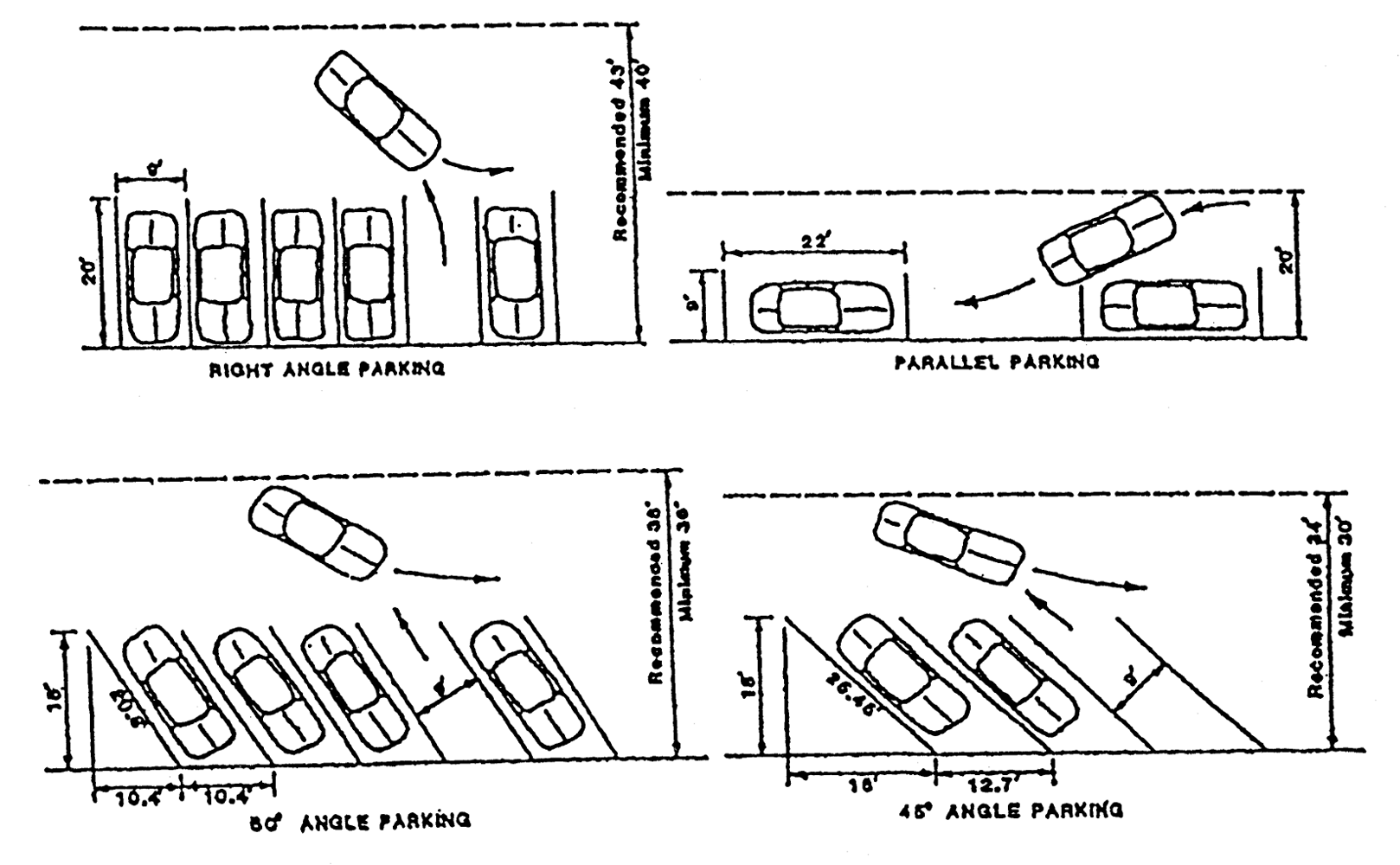
The following four parking angles are allowed with their respective width and depth dimensions for stalls and maneuvering areas:
In addition, there shall be provided adequate interior, entrance and exit driveways to connect each parking space with a street or alley open to use by the public. However, a driveway within a required front yard for a single-family residence, zero-lot-line or townhouse may count as one parking space.
The following diagrams illustrate the parking space and maneuvering space used for the various parking designs:
Parking Space and Maneuvering Space Used for Various Parking Areas
(c)
For group parking facilities with capacity for six or more vehicles:
(1)
All such off-street parking facilities shall be so drained as to prevent damage to abutting properties and/or public streets.
(2)
All parking spaces shall be separated from sidewalks, roads, streets or alleys by curbing; and all roads, streets, alleys, sidewalks and other public rights-of-way shall be protected from vehicular overhang by wheel bumpers, curbs, five-foot spacing between the right-of-way line and the parking area, or other method approved by the planning commission.
(3)
Interior driveways and entrance and exit driveways shall be at least ten feet in width to allow safe and expeditious movement of vehicles; one-way movement in such driveways shall be provided for whenever possible; and entrance and exit driveways shall be separately provided wherever possible, or if combined shall be not less than 20 feet in width.
(4)
All such off-street parking areas shall be so arranged and marked as to provide for orderly safe loading, unloading, parking and storage of vehicles with individual parking spaces clearly defined, and directional arrows and traffic signs provided as necessary for traffic control.
(5)
Adequate lighting shall be provided if the parking facilities are used at night.
(6)
Pedestrian walkways and sidewalks shall be provided in addition to all required parking spaces and drives on all off-street parking facilities where found necessary for pedestrian safety by the planning commission. Such walkways and sidewalks shall be protected from vehicular overhang and movement by bumpers, curbs or other methods.
(7)
Lighting of off-street parking facilities shall be installed and maintained in a manner not to reflect or cause glare into abutting or facing residential premises, nor to cause reflection or glare which adversely affects the safe vision of operators of vehicles moving on roads and highways.
(8)
If such off-street parking facilities adjoin or are across a street or alley from property classified residential, the entrance and exit driveways of such facilities shall, wherever possible, be located so that they will not be in close proximity to or across a street or alley from the residential property.
(9)
If a parking lot adjoins a residential district, all parking surfaces, spaces and driveways shall be set back a distance not less than 25 feet from the adjoining residential zone; except that if the adjoining land is across an existing or planned public right-of-way 50 feet or greater in width, this provision shall not apply.
(10)
For the purpose of this section, the number of employees shall be the average number of persons to be employed taking into consideration day, night and seasonal variations.
(11)
No automobile off-street parking facility shall be reduced in area or encroached upon by buildings, vehicle storage or any other use where such reduction or encroachment will reduce the area below that required.
(12)
a.
All garage or other space allocated for the parking of vehicles within buildings or in basements or on the roof of buildings shall be considered part of the required off-street parking facilities and may be included as such in computing the area's requirements outlined in the schedule of parking requirements, section 94-606.
b.
When the parking facilities are housed in an underground garage or a multistoried structure or on the roofs of buildings, a site plan shall be submitted under this division for approval of interior traffic directions, slope of ramp, for location of entrances and exits on public roads, for approval of sight distances at such entrances and exits and at corners of intersecting public roads, and for approval of the effective screening of the cars located in or on the parking structure from adjoining properties and from public roads.
(13)
All automobile off-street parking facilities shall be located so that the major point of pedestrian access to the facilities is no more than 500 feet walking distance from the entrance to the establishment to be served by such facilities.
(14)
a.
When any land or building is used for two or more purposes, the number of parking spaces required shall be the sum of the requirements for each use; parking facilities for one use shall not be considered as providing the required parking facilities for any other use.
b.
Computation for one use can govern when the two uses are used during separate times in the day or night.
(15)
Requirements for the provision of parking facilities with respect to two or more property uses of the same or different types may be satisfied by the permanent allocation of the requisite number of spaces for each use in a common parking facility, cooperatively established and operated, provided that the number of spaces designated is not less than the sum of the individual requirements for each use, and provided further that all regulations contained in this section are complied with.
(d)
Handicapped accessible parking spaces shall be required if parking spaces are provided for self-parking by employees or visitors, or both. The number of accessible spaces shall be in conformance with the table in this subsection. Spaces required by the table need not be provided in the particular lot. They may be provided in a different location if equivalent or greater accessibility, in terms of distance from an accessible entrance, cost and convenience is ensured.
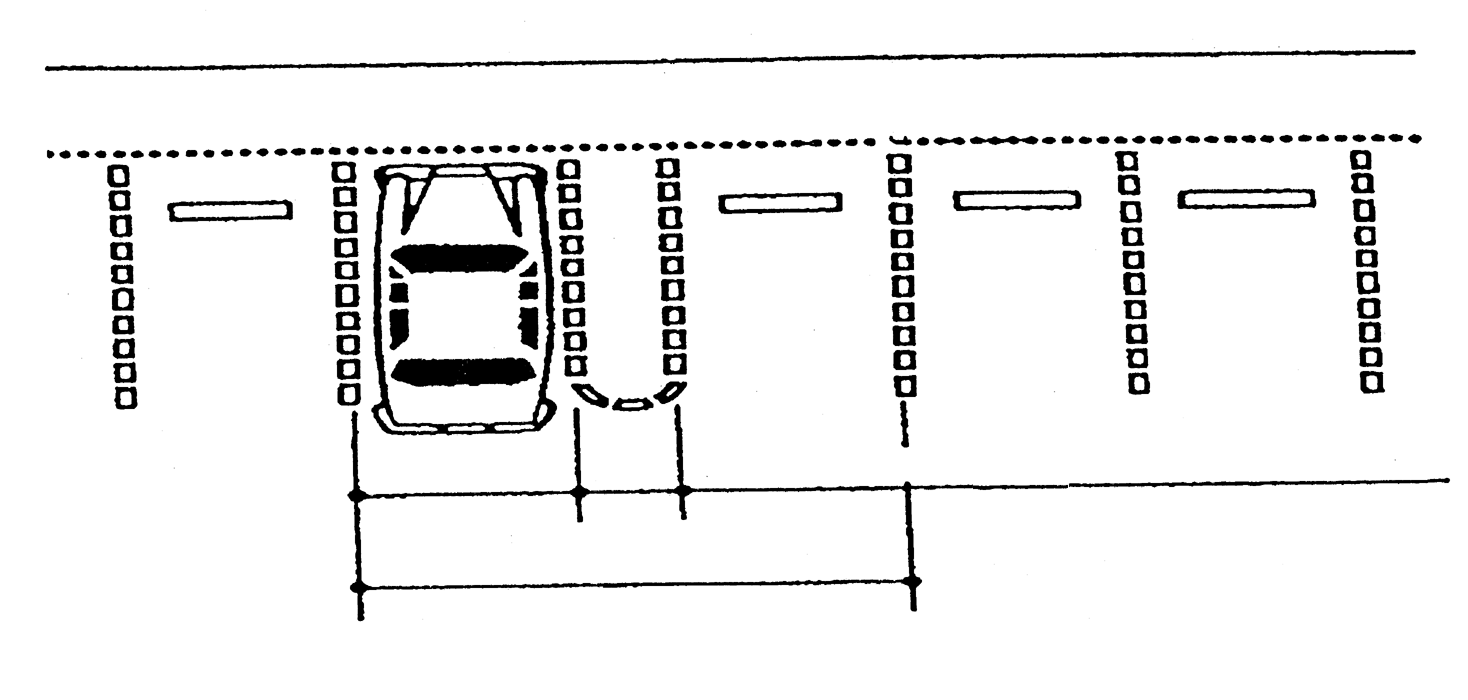
The width and depth of accessible parking spaces shall be the same as in subsection (b). Access aisles adjacent to accessible spaces shall be 60 inches wide minimum. One in every eight accessible spaces, but not less than one, shall be served by an accessible aisle 96 inches wide minimum and shall be designated van accessible. All accessible parking spaces shall be designated as reserved by a sign showing the symbol of accessibility. Spaces designed with the 96-inch-wide accessible aisle shall have an additional sign "Van Accessible" mounted below the symbol of accessibility. Such signs shall be located so they cannot be obscured by a vehicle parked in the space.
_____
(e)
The following diagram illustrates the dimensions of accessible parking spaces and the access aisles:
Dimensions of Accessible Parking Spaces and Aisle
(Ord. No. 295, § 1, 7-7-1997; Ord. No. 542, § 1, 12-20-2004)
Sec. 94-605. - Schedule of parking requirements.
Off-street parking space shall be provided as follows:
Ambulance service or rescue squad, adequate space to accommodate all motor vehicles operated in connection with such use and two additional parking spaces per each such vehicle.
Apartment, same as multiple-family dwelling.
Automobile filling station, two parking spaces for each car wash bay, grease bay or similar service area, and one parking space for each employee.
Automobile repair and service station, one parking space for each 300 square feet of total floor area, and one parking space for each employee.
Care home, one parking space for each three beds.
Church, synagogue or other place of worship, one parking space for each four persons for which seating is provided in the main auditorium. No additional spaces will be required if the church, synagogue or other place of worship is located within 500 feet of any public parking lot or any commercial parking lot where sufficient spaces are available during the time of services to make up the additional spaces required.
Commercial establishment devoted to retail sales, trade, merchandising or other similar use, one space per 200 square feet of gross floor area up to 10,000 square feet. For structures larger than 10,000 square feet, the gross floor area parking ratio shall be as follows:
As used herein, gross leasable area is defined as the total floor area designed for tenant occupancy and exclusive use, including basements, mezzanines and the upper floors if any, expressed in square feet measured from centerlines of joint partitions and exteriors of outside walls. Not included in this definition are separate standing office or professional buildings, or theaters. This definition does include banks and other such activities which are a part of a shopping center.
Commercial establishments with drive-in facilities. In addition to the provisions set forth in this section, drive-in commercial facilities (banks, restaurants, dry cleaners, and similar uses) shall provide not less than three holding, or stacking spaces for each service window, lanes and tube delivery points.
Charitable and philanthropic institution, one parking space for each employee, plus one parking space for each 400 square feet of total floor area for residents and visitors.
Community center, library, museum, civic club, private club, lodge and similar uses, one parking space for each 400 square feet of floor space.
Educational institution:
Elementary schools: (Grades K—5)
1.
One and one half (1.5) parking spaces is required for each employee.
2.
The institution must comply with ADA parking requirements.
3.
Furnish sufficient off street stacking space(s) for the safe and convenient loading and unloading of students.
4.
Visitor parking will be provided at a rate of ten percent of the employee parking spaces, with a minimum of six. These visitor spaces are in addition to other parking requirements.
Middle schools (Grades 6 -8): Same as elementary schools.
High schools/vocational technology schools/colleges: (grades 9 and up)
1.
One and one half (1.5) parking spaces for each employee.
2.
Comply with ADA requirements and furnish an additional one space for each three students, based on maximum school capacity.
3.
Sufficient off street stacking spaces for the safe and convenient loading and unloading of students should be facilitated.
Educational institution, private, one parking space for each employee, including teachers and administrators, plus sufficient off-street parking space for the safe and convenient loading and unloading of students, plus additional facilities for all student parking.
Fraternity, sorority and dormitory, 1.5 parking space for each two students residing on the premises in a fraternity, a sorority, and a dormitory, plus one additional space for each housemother or manager and each employee.
Furniture store, one parking space for each 500 square feet of total floor area plus one space for each employee.
Heliport, if at ground level, adequate space for off-street parking of at least 15 vehicles. If elevated, reasonable parking space shall be provided or be available for use, either at ground level or on or in an elevated structure, as the discretion of the planning commission may require for the convenience of persons using or working at the facility.
Hospital, one parking space for each one bed, plus one space for each resident doctor, plus adequate reserved space for visiting staff doctors, plus one space for each three employees.
Hotel, one space for each transient bedroom; plus one parking space for each two employees; plus one parking space for each 400 square feet of area used for ballrooms, private meeting rooms, dining rooms and other similar places of assembly.
Industrial or manufacturing establishment or warehouse, one parking space for each employee on two shifts, plus one space for every vehicle used in connection with the business.
Manufactured home park, two parking spaces for each manufactured home space, plus one space for each four home spaces in common areas for visitor parking.
Medical or dental clinic, one parking space for each 200 square feet of the total floor area of the building.
Mortuary or funeral parlor, one parking space for each four persons for which seating is provided in the main chapel or parlor, plus one parking space for each employee on the major shift and one parking space for each vehicle used in connection with the business.
Multiple-family dwelling, for each apartment with no separate bedroom, one space; for each apartment with one separate bedroom, 1.5 spaces; for each apartment with two separate bedrooms, two spaces; for each apartment with three or more separate bedrooms, 2.5 spaces. Not more than 50 percent of the total area of the minimum required yards shall be occupied by parking spaces; drives; access roads to, from and between such spaces; turnarounds; or other surfaces designed for vehicular use.
Nonspecified uses, in areas where structures are built and no specific uses are defined (example: strip malls) the minimum required parking requirement shall be one parking space for each 150 square feet of gross floor area.
Nursing home, one parking space for each three beds.
Office building, professional office building, medical practitioner's office, or similar uses, one parking space for each 300 square feet of the sum of the gross areas of the several floors of the building measured from the exterior faces of the exterior walls or from the centerline of party walls, which area shall include cellars or basements but shall not include floor area used for off-street parking. For structures larger than 10,000 square feet, this requirement shall be provided; and the following percentage shall be taken of the remaining gross floor area:
One-family dwelling, two parking spaces for each dwelling unit.
Professional office other than medical practitioner, two spaces for each professional person occupying or using the office.
Recreational establishment, commercial, other than a theater, auditorium or stadium:
Skating rink, one parking space per 200 square feet of gross floor area;
Health club or spa, ten spaces plus one parking space per 200 square feet of gross floor area in excess of 1,000 square feet;
Bowling alley, three parking spaces per alley;
Tennis courts, two parking spaces per court plus one parking space for each 200 square feet of gross floor area of a clubhouse in excess of 1,000 square feet;
Amusement park, one parking space per 1,000 square feet of site area;
Golf course, five parking spaces per hole, plus one parking space per 200 square feet of gross floor area of a clubhouse in excess of 1,000 square feet.
If use not listed, one parking space for each 80 square feet of floor area.
Restaurant or similar place dispensing food, drink or refreshments, one parking space for each 100 square feet of gross floor area within the establishment and one parking space for each 80 square feet of ground area devoted to patron use on the property outside the structure; however, a minimum of 20 parking spaces shall be required, regardless of the gross floor area.
Roominghouse and boardinghouse, one parking space for each guest accommodation.
Semidetached or two-family dwelling, same as one-family dwelling.
Swimming pool, commercial and/or community, one parking space for every three persons lawfully permitted in the pool at one time.
Theater, auditorium or stadium, one parking space for each three seats or similar vantage accommodations provided, plus one space for each employee.
Townhouse, two parking spaces for each townhouse.
Tourist home, cabin or motel, one space for each transient bedroom; plus one parking space for each two employees; plus one parking space for each 400 square feet of area used for ballrooms, private meeting rooms, dining rooms and other similar places of assembly.
Trailer coach space or tourist cabin camp, one parking space for each trailer space, and one parking space for each employee.
(Ord. No. 295, § 1, 7-7-1997; Ord. No. 542, § 1, 12-20-2004)
Sec. 94-606. - Maximum parking lot size.
(a)
Multifamily, commercial or industrial parking lots containing 200 or more parking spaces shall be divided into parking areas of not more than 200 cars each and shall be separated by landscaping (see chapter 90), change of grades, buildings, or other natural or artificial means. Not less than five percent of the total parking area shall be devoted to such internal landscaping and interior parking separation areas. In multifamily parking lots, the five percent requirement shall not be in addition to but shall be computed as a part of any green area requirement.
(b)
Maintenance of these areas is important for their general preservation.
(c)
The city will require that provisions are made by each project for maintenance.
Sec. 94-607. - Off-street loading requirements.
Off-street loading berths, open or enclosed, are permitted accessory to any use (except one- or two-family residences) subject to the following minimum provisions:
(1)
Uses for which required. Accessory off-street loading berths shall be provided for any use specified below. Any land which is developed as a unit under ownership and control shall be considered a single lot for the purpose of these minimum loading requirements:
a.
For a public library, museum or similar quasi-public institution, or government building, community center, hospital or sanatorium, nursing or convalescent home, institution for children or the aged, or school with floor area of 10,000 square feet, one berth, for each additional 25,000 square feet or fraction, one additional berth.
b.
For buildings with professional, governmental or business offices, or laboratory establishments, with floor area of 10,000 to 25,000 square feet, one berth; for each additional 25,000 square feet or fraction up to 100,000 square feet, one additional berth; for each additional 50,000 square feet or fraction, one additional berth.
c.
For buildings with offices and retail sales and service establishments, one berth for 8,000 to 25,000 square feet of floor area, and one additional berth for each additional 25,000 square feet of floor area or fraction so used.
d.
For undertakers and funeral homes, one berth for each chapel. Such berths shall be at least ten feet wide, 20 feet long, and 14 feet high.
e.
For hotels, motels and resorts, one berth for each 25,000 square feet of floor area.
f.
For manufacturing, wholesale and storage uses, and for dry cleaning and rug cleaning establishments and laundries, one berth for 5,000 to 10,000 square feet of floor area in such use, and one additional berth for each additional 20,000 square feet of floor area or fraction so used.
(2)
Size of spaces. Each required loading berth shall be at least 12 feet wide, 33 feet long, and 14 feet high.
(3)
Location and access. Unobstructed access, at least ten feet wide, to and from a street shall be provided. Such access may be combined with access to a parking lot. All permitted or required loading berths shall be on the same lots as the use to which they are accessory, except as provided in subsection (4) of this section. No entrance or exit for any off-street parking area shall be located within 50 feet of any street intersection. No off-street loading berth shall be located in any front yard.
(4)
Joint facilities. Permitted or required loading berths, open or enclosed, may be provided in spaces designed to serve jointly two or more adjacent establishments; the number of required berths in such joint facilities shall not be less than the total required for all such requirements.
Sec. 94-608. - Screening, traffic control, safety and site plan requirements.
(a)
All off-street parking areas with spaces for more than five vehicles shall be effectively screened on each side which adjoins or faces a residential zone or institutional premises; except such screening shall not be required where the parking area is already effectively screened (as determined by chapter 90) from the residential zone or institutional premises by a natural terrain feature, railroad track on elevated ground, change in grade or other permanent natural or artificial screen or is separated by a road with a right-of-way width of 120 or more.
(b)
Such screening shall be a solid wall or a substantial, opaque solid fence, not less than five feet in height. In lieu of such fence, a compact evergreen hedge not less than three feet in height at time of original planting may be used. The fence, wall and/or hedge, or permanent natural or artificial screen shall be maintained in good condition; and no advertising shall be placed on the screening. The screening shall be designed and maintained so that safe vehicle sight distance shall not be affected at entrances, exits or at street intersections. Where one off-street parking area adjoins or abuts another such parking area under different ownership or use, a landscaped planting strip not less than five feet wide maintained in good condition may be used in lieu of the required screening. The screening shall normally be located abutting the side, rear or front property line but may be located at the most appropriate place as approved by the planning commission between the perimeter of the parking area and the property line to provide the most effective shield for the adjoining or facing premises from car lights, noise and traffic movement.
(c)
Effective screening of parking lots contiguous or adjacent to any public road.
(d)
Such screening may be accomplished by depression in grade by three feet or more by a berm, a hedge, a wall, or any type of appropriate natural or artificial permanent division.
(e)
Any screening barrier required shall be not less than three feet high and intermittently should have trees or other similar features. Entrances and exits to public roads shall provide safe sight distances free of any obstruction. It shall be mandatory that there be ample safe sight distances at the corner of intersecting public roads clear of any building or other artificial or natural obstructions.
(f)
Effective channelization and division of parking areas within the interior of the parking lot for pedestrian and vehicular traffic may be accomplished by use of landscaped areas with trees, walls, fences, other natural growth or artificial features, raised curbs, marked directional lanes and controls, change of grade or other devices to mark points of turn, to separate parking areas, and to control traffic movement. Traffic channelization and traffic controls will be approved by the planning commission with regard to ingress and egress to public roads and to safe movement of traffic on the parking lot.
(Ord. No. 178, § 2E, 7-15-1991)
Sec. 94-636. - Purpose and intent.
It is the purpose of this article to regulate sexually oriented businesses to promote the health, safety, and general welfare of the citizens of the city, and to establish reasonable and uniform regulations to prevent the concentration of sexually oriented businesses within the city. The provisions of this chapter have neither the purpose nor the effect of imposing a limitation or restriction on the content of any communicative materials, including sexually oriented materials. Similarly, it is not the intent nor the effect of this article to deny access by adults to sexually oriented materials protected by the First Amendment, or to deny access by the distributors and exhibitors of sexually oriented entertainment to their intended market, unless otherwise restricted by law.
(Ord. No. 513, § 94-110, 5-17-2004)
Sec. 94-637. - Definitions.
Adult arcade. Any place to which the public is permitted or invited wherein coin-operated or slug operated or electronically, electrically, or mechanically controlled image producing devices are maintained to show images to five or fewer viewers at one time, and where the images so displayed are distinguished or characterized by the depicting or describing of "specified sexual activities" or "specified anatomical areas."
Adult bookstore or adult video store. A commercial establishment which, as one of its principal business purposes, offers for sale or rental for any form of consideration any one or more of the following:
(1)
Books, magazines, periodicals, or other printed matter, or photographs, files, motion pictures, video cassettes, or video reproductions, slides, DVDs, or other visual representations which depict or describe "specified sexual activities" or "specified anatomical areas."
(2)
Instruments, devices, or paraphernalia which are designed for use in connection with "specified sexual activities."
The determination of the principal business purpose of an establishment is based on the visual inventory or commercial activity of the establishment; provided, there shall be a rebuttable presumption that any commercial establishment which utilizes ten percent or more of total display (whether open display or controlled access) area for merchandise of any type described in this definition shall be deemed to be engaged in the business of an adult bookstore or adult video store as its principal business purpose.
Adult cabaret. A nightclub, bar, restaurant, or similar commercial establishment which presents:
(1)
Persons who appear in a state of nudity; or
(2)
Live performances which are characterized by "specified sexual activities" or by the exposure of "specified anatomical areas."
(3)
Films, motion pictures, video cassettes, slides, DVDs, or other photographic reproductions which are characterized by the depiction of "specified anatomical activities" or "specified anatomical areas."
Adult motel. A motel, hotel, or similar commercial establishment that:
(1)
Offers accommodation to the public for any form of consideration and provides patrons with closed-circuit television transmissions, films, motion pictures, video cassettes, slides, or other photographic reproductions that are characterized by the depiction or description of "specified anatomical activities" or "specified anatomical areas," and has a sign visible from the public right of way that advertises the availability of this type of adult pornographic reproductions; or
(2)
Offers a sleeping room for rent for a period of time that is less than 24 hours; or
(3)
Allows a tenant or occupant of a sleeping room to sub-rent the room for a period of time that is less than 24 hours.
Adult motion picture theater. A commercial establishment where, for any form of consideration, films, motion pictures, video cassettes, DVDs, slides, or similar photographic reproductions are regularly shown which are characterized or distinguished by an emphasis on matter depicting, describing or relating to "specified sexual activities" or "specified anatomical areas."
Adult sex shop means a commercial establishment offering goods for sale or rent and that meets any of the following tests:
(1)
The establishment offers for sale items from any of the following categories: (a) adult media, as set out in the definition of adult book store or adult video store above; (b) leather goods, clothing, or other items marketed or presented in a context to suggest their use for sexual activities or sadomasochistic practices; or (c) any merchandise, toy, or novelty which is marketed or presented inside or on the exterior of the establishment in a manner that depicts nudity, specified anatomical areas, or specified sexual activities; and the open display of any or all such items occupies ten percent or more of its total display area.
Adult theaters. A theater, concert hall, auditorium, or similar commercial establishment, which regularly features persons who appear in a state of nudity or live performances which are characterized by "specified sexual activities" or by the exposure of "specified anatomical areas."
Nudity or state of nudity.
(1)
The appearance of the bare human buttock, anus, male genitals, female genitals, or female breast.
(2)
A state of dress which fails to opaquely cover a human buttock, anus, male genitals, female genitals, or the areola of the female breast.
Nude model studio. Any place where a person who appears in a state of nudity or semi-nudity, or who displays "specified anatomical areas" is provided to be observed, sketched, drawn, painted, sculptured, photographed, or similarly depicted by other persons for consideration, with the exception of those persons or places exempted by this article.
Person. An individual, proprietorship, partnership, corporation, association, limited liability company, or other legal entity.
Premises. The real property upon which the sexually oriented business is located, and all appurtenances thereto and buildings thereon, including, but not limited to, the sexually oriented business, grounds, private walkways, and parking lots and/or parking garages adjacent thereto, under the ownership, control, or supervision of the business owner or operator.
Residential district. Any land within the city limits of the City of Maumelle which is zoned as R-1, R-2, R-3, R-4, R-5, or PRD, as further defined by this Code.
Semi-nude. A state of dress in which clothing covers no more than the genitals, pubic region and or the female breast, as well as portions of the body covered by supporting straps or devices.
Sexual encounter center. A business or commercial enterprise that, as one of its principal business purposes, offers for any form of consideration;
(1)
Physical contact in the form of wrestling or tumbling between persons of the opposite sex; or
(2)
Activities between male and female persons and/or persons of the same sex when one or more of the persons is in a state of nudity.
Sexually oriented business. An adult arcade, adult bookstore or adult video store, adult cabaret, adult motel, adult motion picture theater, adult sex shop, adult theater, nude model studio, or sexual encounter center, or any other business or commercial enterprise whose inventory, merchandise, or performances are characterized by a preponderance of "specified sexual activities" or by the exposure of "specified anatomical areas."
Specified sexual activities.
(1)
Human genitals in a state of sexual stimulation or arousal;
(2)
Acts of human masturbation, sexual intercourse, oral copulation, or sodomy, whether actual or simulated;
(3)
Any act of sexual gratification involving the fondling or other erotic touching, either directly or through clothing, of human genitals, pubic region, buttock, or female breast;
(4)
Excretory functions as part of or in connection with any of the activities set forth in subsections (1) through (3) above.
(5)
Acts which would be classified as the criminal offense of sodomy pursuant to Arkansas law.
Specified anatomical areas.
(1)
Less than completely and opaquely covered human genitals, pubic regions, buttock, and female breast below a point immediately above the top of the areolas; and
(2)
Human male genitals in a discernibly turgid state, even if completely and opaquely covered.
(Ord. No. 513, § 94-111, 5-17-2004; Ord. No. 801, § 1, 7-2-2012)
Sec. 94-638. - Classification.
Sexually oriented businesses are classified as follows:
(1)
Adult arcades;
(2)
Adult bookstores or adult video stores;
(3)
Adult cabarets;
(4)
Adult motels;
(5)
Adult motion picture theaters;
(6)
Adult sex shop;
(7)
Adult theaters;
(8)
Nude model studios; and
(9)
Sexual encounter centers.
(Ord. No. 513, § 94-112, 5-17-2004; Ord. No. 801, § 2, 7-2-2012)
Sec. 94-639. - Location of sexually oriented businesses.
(a)
A person commits an offense if he operates or allows to be operated a sexually oriented business in any zone not classified as I-1, or, regardless of classification within 1,000 feet of:
(1)
A public or private elementary, secondary, or post-secondary school;
(2)
A daycare, pre-school, or childcare facility;
(3)
A church or other religious facility;
(4)
A boundary of a residential zone or use;
(5)
A public park, or a building or facility owned or used by public or government offices or functions;
(6)
A hospital or other medical facility; or
(7)
Properties listed on the National Register of Historical Places or local historic districts as identified in the Arkansas Historic Preservation Programs.
(b)
A person commits an offense if he cause or permits the operation, establishment, or maintenance of a sexually oriented business within 1,000 feet of another sexually oriented business.
(c)
For the purposes of subsection (a), measurement shall be made in a straight line, without regard to intervening structures or objects, from the nearest property line of the premises where a sexually oriented business is conducted, to the nearest property line of the premises of an affected public or private elementary, secondary, or post-secondary school, daycare, preschool, or childcare, church or other religious facility, residential lot, district or use, public park, public building, public facility, hospital or other medical facility, or properties listed on the National Register of Historical Places or local historic districts as identified in the Arkansas Historic Preservation Programs.
(d)
For the purposes of subsection (b) of this section, the distance between any two sexually oriented businesses shall be measured in a straight line without regard to intervening structures or objects, from the closest exterior wall of the structure in which each business is located.
(e)
A person commits an offense under this article if he causes or permits any form or manner of gambling, any sale or use of alcoholic beverages, or the distribution or consumption of controlled substances on or near the premises of the sexually oriented business.
(Ord. No. 513, § 94-113, 5-17-2004)
Sec. 94-640. - Nonconforming sexually oriented business—Amortization.
(a)
Any sexually oriented business lawfully operating on May 18, 2004 which is in violation of section 94-639 shall be deemed a nonconforming use. The nonconforming use will be permitted to continue from the date of the passage of the ordinance from which this article derives, unless sooner terminated for any reason or discontinued for a period of 90 days or more.
Such nonconforming uses shall not be increased, enlarged, extended or altered except that the use may be changed to a conforming use. If two or more sexually oriented businesses are within 1,000 feet of one another and otherwise in a permissible location, the sexually oriented business which was first established and continually operating at a particular location is the conforming use and the later-established business(es) is nonconforming.
(b)
A sexually oriented business lawfully operating as a conforming use is not rendered a nonconforming use by the subsequent location of a church, public or private elementary or secondary school, public park, residential district or residential lot within 1,000 feet of the sexually oriented business. This provision applies only to an ongoing sexually oriented business, not to a sexually oriented business that has been terminated for any reason or discontinued for a period of 90 days or more subsequent to the location of the church, public or private elementary or secondary school, public park, residential district or residential lot.
(Ord. No. 513, § 94-114, 5-17-2004)
Sec. 94-641. - Exterior portions of and signage for sexually oriented businesses.
(a)
No owner or operation of a sexually oriented business shall allow the merchandise or activities of the establishment to be visible from a point outside the establishment.
(b)
No owner or operation of a sexually oriented business shall allow the exterior portion of the sexually oriented business to have any photographs of any person in a state of nudity or engaging in any specified sexual activity, nor shall such owner or operator allow the exterior portion of the sexually oriented business to have any pictorial or other representations of any kind of any person in a state of nudity or engaging in any specified sexual activity.
(c)
Notwithstanding any other city ordinance, code, or regulation to the contrary, the operator of any sexually oriented business or any other person shall not erect, construct, or maintain any sign for the sexually oriented business other than the one primary sign and one secondary sign, as provided herein.
(d)
Primary signs shall have no more than two display surfaces. Each such display surface shall:
(1)
Conform with the city's sign code;
(2)
Be a flat plane, rectangular in shape; and
(3)
Not exceed 75 square feet in area.
(e)
Primary signs shall contain no photographs, and shall contain no pictorial or other representations of any kind of any person in an state of nudity or engaging in any specified sexual activity.
(f)
Secondary signs shall have no more than one display surface. Such display shall:
(1)
Conform with the city's sign code;
(2)
Be a flat plane, rectangular in shape;
(3)
Not exceed 20 square feet in area;
(4
Not exceed five feet in height and four feet in width; and
(5
Be affixed or attached to any wall or door of the enterprise.
(g)
The provisions of subsection (e) above shall also apply to secondary signs.
(h)
A person convicted of the violation of any provisions of this article shall be subject to a fine equal to twice the cost of the permit which is required for the posting of any such signage in the city. If the violation is, in its nature, continuous in respect to time, the penalty for allowing the continuance thereof is a fine not to exceed $25.00 for each day that the same is unlawfully continued.
(Ord. No. 513, § 94-115, 5-17-2004)
Sec. 94-642. - Enforcement.
(a)
Any person violating any part of this article, upon conviction, is punishable by a fine not to exceed the maximum amount as stated by state law A.C.A. § 14-55-504.
(b)
If the violation is, in its nature, continuous in respect to time, the penalty for allowing the continuance thereof is a fine not to exceed $250.00 for each day that the same is unlawfully continued.
(c)
A person who operates or causes to be operated a sexually oriented business in violation of section 94-639 will be subject to a suit for injunction under Arkansas law as well as prosecution for criminal violations.
(Ord. No. 513, § 94-116, 5-17-2004)
Sec. 94-643. - Exemptions.
It is a defense to prosecution under this article that a person appearing in a state of nudity or semi-nudity did so in a modeling class operated:
(1)
By a proprietary school, licensed by the State of Arkansas, a college, junior college, or university supported entirely or partly by taxation; or
(2)
By a private college or university that maintains and operates educational programs in which credits are transferable to a college, junior college, or university supported entirely or partly by taxation.
(Ord. No. 513, § 94-117, 5-17-2004)
Sec. 94-644. - Requirements for businesses not classified as sexually oriented businesses.
Any business which is not otherwise classified as a sexually oriented business but which carries for sale or rental, any of the following items:
(1)
Books, magazines, periodicals, or other printed matter, or photographs, films, motion pictures, video cassettes, or video reproductions, slides or other visual representations which depict or describe "specified sexual activities" or "specified anatomical areas"; or
(2)
Instruments, devices, or paraphernalia which are designed for use in connection with "specified sexual activities",
may not allow any of the above-described merchandise or activities of the establishment to be visible from a point outside the establishment and may not advertise or promote the adult merchandise therein either on the exterior or interior of the establishment. Further, such merchandise must be maintained in a physically separated section, area, or "back room" with controlled access prohibiting admittance to persons under 18 years of age. However, this provision may be waived when the only identified items in the business are magazines or periodicals (as described above) provided that the magazine covers are completely obscured and maintained behind the cashier.
(Ord. No. 801, § 3, 7-2-2012)

