
Maumelle City Zoning Code
ARTICLE V
- STORMWATER, POLLUTION PREVENTION AND EROSION CONTROL
Sec. 94-791. - Purposes.
The purpose and objectives of this article are as follows:
(1)
To maintain and improve the quality of water impacted by the storm drainage system within the city.
(2)
To prevent the discharge of contaminated stormwater runoff and illicit discharges from industrial, commercial, residential, and construction sites into the storm drainage system within the city.
(3)
To promote public awareness of the hazards involved in the improper discharge of trash, yard waste, lawn chemicals, pet waste, wastewater, oil, petroleum products, cleaning products, paint products, hazardous waste, sediment and other pollutants into the storm drainage system.
(4)
To encourage recycling of used motor oil and safe disposal of other hazardous consumer products.
(5)
To facilitate compliance with state and federal standards and permits by owners of construction sites within the city.
(6)
To enable the city to comply with all federal and state laws and regulations applicable to the National Pollutant Discharge Elimination System (NPDES) permitting requirements for stormwater discharges.
(Ord. No. 585, § 1, 12-5-2005)
Sec. 94-792. - Administration.
Except as otherwise provided herein, the department responsible shall administer, implement, and enforce the provisions of this article.
(Ord. No. 585, § 1, 12-5-2005)
Sec. 94-793. - Abbreviations.
The following abbreviations when used in this article shall have the designated meanings:
ADEQ—Arkansas Department of Environmental Quality.
BMP—Best management practices.
CFR—Code of Federal Regulations.
EPA—U.S. Environmental Protection Agency.
HHW—Household hazardous waste.
MS4—Municipal separate storm sewer system.
NPDES—National Pollutant Discharge Elimination System.
SWP3—Stormwater pollution prevention plan.
(Ord. No. 585, § 1, 12-5-2005)
Sec. 94-794. - Definitions.
Unless a provision explicitly states otherwise, the following terms and phrases as used in this article, shall have the meanings hereinafter designated:
Best management practices (BMPs) here refers to management practices and methods to control pollutants in stormwater. BMPs are of two types: "source controls" (nonstructural) and "treatment controls" (structural). Source controls are practices that prevent pollution by reducing potential pollutants at their source, before they come into contact with stormwater. Treatment controls remove pollutants from stormwater. The selection, application and maintenance of BMPs must be sufficient to prevent or reduce the likelihood of pollutants entering the storm drainage system.
City means the City of Maumelle, Arkansas.
Clearing means the act of cutting, removing from the ground, burning, damaging or destroying trees, stumps, hedge, brush, roots, logs, or scalping existing vegetation.
Commercial means pertaining to any business, trade, industry, or other activity engaged in for profit.
Construction site means any location where construction activity occurs.
Contaminated means containing harmful quantities of pollutants.
Contractor means any person or firm performing or managing construction work at a construction site, including any construction manager, general contractor or subcontractor. Also includes, but is not limited to, earthwork, paving, building, plumbing, mechanical, electrical or landscaping contractors, and material suppliers delivering materials to the site.
Coordinator means the person, in the department responsible, appointed to the position of stormwater program coordinator by the City of Maumelle, Arkansas.
Discharge means any addition or release of any pollutant, stormwater or any other substance whatsoever into storm drainage system.
Discharger means any person who causes, allows, permits, or is otherwise responsible for, a discharge, including, without limitation, any owner of a construction site or industrial facility.
Domestic sewage means sewage originating primarily from kitchen, bathroom and laundry sources, including waste from food preparation, dishwashing, garbage grinding, toilets, baths, showers and sinks.
Earthwork means the disturbance of soils on a site associated with clearing, grading, or excavation activities.
Environmental Protection Agency (EPA) means the United States Environmental Protection Agency, the regional office thereof, any federal department, agency, or commission that may succeed to the authority of the EPA, and any duly authorized official of the EPA or such successor agency.
Facility means any building, structure, installation, process, or activity from which there is or may be a discharge of a pollutant.
Fertilizer means a substance or compound that contains an essential plant nutrient element in a form available to plants and is used primarily for its essential plant nutrient element content in promoting or stimulating growth of a plant or improving the quality of a crop, or a mixture of two or more fertilizers.
Fire protection water means any water, and any substances or materials contained therein, used by any person to control or extinguish a fire, or to inspect or test fire equipment.
Garbage means putrescible animal and vegetable waste materials from the handling, preparation, cooking, or consumption of food, including waste materials from markets, storage facilities, and the handling and sale of produce and other food products.
Groundwater means any water residing below the surface of the ground or percolating into or out of the ground.
Harmful quantity means the amount of any substance that the coordinator determines will cause an adverse impact to storm drainage system or will contribute to the failure of the city to meet the water quality based requirements of the NPDES permit for discharges from the MS4.
Hazardous substance means any substance listed in Table 302.4 of 40 CFR Part 302.
Hazardous waste means any substance identified or listed as a hazardous waste by the EPA pursuant to 40 CFR Part 261.
Household hazardous waste (HHW) means any material generated in a household (including single and multiple residences) that would be classified as hazardous.
Illegal discharge: See illicit discharge below.
Illicit discharge means any discharge to the storm drainage system that is prohibited under this article.
Illicit connection means any drain or conveyance, whether on the surface or subsurface, which allows an illicit discharge to enter the storm drainage system.
Industrial waste (or commercial waste) means any wastes produced as a byproduct of any industrial, institutional or commercial process or operation, other than domestic sewage.
Infrastructure means all platted streets, drainage, walkpaths, sidewalks, street lighting, utility connections, or other improvements which are a part of the basic improvements of a subdivision.
Land alteration means the process of grading, clearing, filling, excavating, quarrying, tunneling, trenching, construction or similar activities.
Mechanical fluid means any fluid used in the operation and maintenance of machinery, vehicles and any other equipment, including lubricants, antifreeze, petroleum products, oil and fuel.
Mobile commercial cosmetic cleaning (or mobile washing) means power washing, steam cleaning, and any other method of mobile cosmetic cleaning, of vehicles and/or exterior surfaces, engaged in for commercial purposes or related to a commercial activity.
Municipal Separate Storm Sewer System (MS4) means the system of conveyances, including roads, streets, curbs, gutters, ditches, inlets, drains, catch basins, pipes, tunnels, culverts, channels, detention basins and ponds owned and operated by the city and designed or used for collecting or conveying stormwater, and not used for collecting or conveying sanitary sewage.
NPDES means the National Pollutant Discharge Elimination System.
NPDES permit means a permit issued by EPA that authorizes the discharge of pollutants to waters of the United States, whether the permit is applicable on an individual, group, or general area-wide basis.
Notice of violation means a written notice detailing any violations of this article and any action expected of the violators.
Oil means any kind of oil in any form, including, but not limited to: petroleum, fuel oil, crude oil, synthetic oil, motor oil, cooking oil, grease, sludge, oil refuse, and oil mixed with waste.
Owner means the person who owns a facility, part of a facility, or land.
Person means any individual, partnership, co-partnership, firm, company, corporation, association, joint stock company, trust, estate, governmental entity, or any other legal entity; or their legal representatives, agents, or assigns, including all federal, state, and local governmental entities.
Pesticide means a substance or mixture of substances intended to prevent, destroy, repel, or migrate any pest.
Pet waste or animal waste means excrement and other waste from domestic animals.
Petroleum product means a product that is obtained from distilling and processing crude oil and that is capable of being used as a fuel or lubricant in a motor vehicle or aircraft, including motor oil, motor gasoline, gasohol, other alcohol blended fuels, aviation gasoline, kerosene, distillate fuel oil, and #1 and #2 diesel.
Pollutant means any substance attributable to water pollution, including but not limited to rubbish, garbage, solid waste, litter, debris, yard waste, pesticides, herbicides, fertilizers, pet waste, animal waste, domestic sewage, industrial waste, sanitary sewage, wastewater, septic tank waste, mechanical fluid, oil, motor oil, used oil, grease, petroleum products, antifreeze, surfactants, solvents, detergents, cleaning agents, paint, heavy metals, toxins, household hazardous waste, small quantity generator waste, hazardous substances, hazardous waste, soil and sediment.
Pollution means the alteration of the physical, thermal, chemical, or biological quality of, or the contamination of, any water that renders the water harmful, detrimental, or injurious to humans, animal life, plant life, property, or public health, safety, or welfare, or impairs the usefulness or the public enjoyment of the water for any lawful or reasonable purpose.
Potable water means water that has been treated to drinking water standards and is safe for human consumption.
Private drainage system means all privately or publicly owned ground, surfaces, structures or systems, excluding the MS4, that contribute to or convey stormwater, including but not limited to, roofs, gutters, downspouts, lawns, driveways, pavement, roads, streets, curbs, gutters, ditches, inlets, drains, catch basins, pipes, tunnels, culverts, channels, detention basins, ponds, draws, swales, streams and any ground surface.
Public improvement plans means engineering drawings subject to approval by the city engineer for the construction of public improvements.
Qualified person means a person who possesses the required certification, license, or appropriate competence, skills, and ability as demonstrated by sufficient education, training, and/or experience to perform a specific activity in a timely and complete manner consistent with the regulatory requirements and generally accepted industry standards for such activity.
Release means to dump, spill, leak, pump, pour, emit, empty, inject, leach, dispose or otherwise introduce into the storm drainage system, whether intentional or unintentional.
Rubbish means nonputrescible solid waste, excluding ashes that consist of:
(a)
Combustible waste materials, including paper, rags, cartons, wood, excelsior, furniture, rubber, plastics, yard trimmings, leaves, and similar materials; and
(b)
Noncombustible waste materials, including glass, crockery, tin cans, aluminum cans, metal furniture, and similar materials that do not burn at ordinary incinerator temperatures (1,600 to 1,800 degrees Fahrenheit).
Sanitary sewage means the domestic sewage and/or industrial waste that is discharged into the city sanitary sewer system and passes through the sanitary sewer system to the city sewage treatment plant for treatment.
Sanitary sewer means the system of pipes, conduits, and other conveyances which carry industrial waste and domestic sewage from residential dwellings, commercial buildings, industrial and manufacturing facilities, and institutions, whether treated or untreated, to the city sewage treatment plant (and to which stormwater, surface water, and groundwater are not intentionally admitted).
Sediment means soil (or mud) that has been disturbed or eroded and transported naturally by water, wind or gravity, or mechanically by any person.
Septic tank waste means any domestic sewage from holding tanks such as vessels, chemical toilets, campers, trailers, septic tanks and aerated tanks.
Shall means mandatory; May means discretionary.
Site means the land or water area where any facility or activity is physically located or conducted, including adjacent land used in connection with the facility or activity.
Solid waste means any garbage, rubbish, refuse and other discarded material, including solid, liquid, semisolid, or contained gaseous material, resulting from industrial, municipal, commercial, construction, mining or agricultural operations, and residential, community and institutional activities.
State means the State of Arkansas.
Storm drainage system means all surfaces, structures and systems that contribute to or convey stormwater, including private drainage systems, the MS4, surface water, groundwater, Waters of the State and Waters of the United States.
Stormwater means runoff resulting from precipitation.
Stormwater pollution prevention plan (SWP3) means a document that describes the best management practices to be implemented at a site, to prevent or reduce the discharge of pollutants.
Subdivision development includes activities associated with the platting of any parcel of land into two or more lots and includes all construction activity taking place thereon.
Surface water means water bodies and any water temporarily residing on the surface of the ground, including oceans, lakes, reservoirs, rivers, ponds, streams, puddles, channelized flow and runoff.
Uncontaminated means not containing harmful quantities of pollutants.
Used oil or used motor oil means any oil that as a result of use, storage, or handling, has become unsuitable for its original purpose because of impurities or the loss of original properties.
Utility agency means private utility companies, city departments or contractors working for private utility companies or city departments, engaged in the construction or maintenance of utility distribution lines and services, including water, sanitary sewer, storm sewer, electric, gas, telephone, television and communication services.
Wastewater means any water or other liquid, other than uncontaminated stormwater, discharged from a facility.
Water of the state or water means any groundwater, percolating or otherwise, lakes, bays, ponds, impounding reservoirs, springs, rivers, streams, creeks, estuaries, marshes, inlets, canals, inside the territorial limits of the state, and all other bodies of surface water, natural or artificial, navigable or nonnavigable, and including the beds and banks of all water courses and bodies of surface water, that are wholly or partially inside or bordering the State or inside the jurisdiction of the state.
Water quality standard means the designation of a body or segment of surface water in the state for desirable uses and the narrative and numerical criteria deemed by state or federal regulatory standards to be necessary to protect those uses.
Waters of the United States means all waters which are currently used, were used in the past, or may be susceptible to use in interstate or foreign commerce, including all waters which are subject to the ebb and the flow of the tide; all interstate waters, including interstate wetlands; all other waters the use, degradation, or destruction of which would affect or could affect interstate or foreign commerce; all impoundments of waters otherwise defined as waters of the United States under this definition; all tributaries of waters identified in this definition; all wetlands adjacent to waters identified in this definition; and any waters within the federal definition of "waters of the United States" at 40 CFR § 122.2; but not including any waste treatment systems, treatment ponds, or lagoons designed to meet the requirements of the Federal Clean Water Act.
Wetland means any area that is inundated or saturated by surface or groundwater at a frequency and duration sufficient to support, and that under normal circumstances does support, a prevalence of vegetation typically adapted for life in saturated soil conditions. Wetlands generally include swamps, marshes, bogs, and similar areas.
Yard waste means leaves, grass clippings, tree limbs, brush, soil, rocks or debris that result from landscaping, gardening, yard maintenance or land clearing operations.
(Ord. No. 585, § 1, 12-5-2005)
Sec. 94-801. - Prohibitions.
(1)
No person shall release or cause to be released into the drainage system any discharge that is not composed entirely of uncontaminated stormwater, except as allowed herein. Common stormwater contaminants include trash, yard waste, lawn chemicals, pet waste, wastewater, oil, petroleum products, cleaning products, paint products, hazardous waste and sediment.
(2)
Any discharge shall be prohibited by this section if the discharge in question has been determined by the coordinator to be a source of pollutants to the storm drainage system.
(3)
The construction, use, maintenance or continued existence of illicit connections to the storm drain system are prohibited. This prohibition expressly includes, without limitation, illicit connections made in the past, regardless of whether the connection was permissible under law or practices applicable or prevailing at the time of connection.
(4)
No person shall connect a line conveying sanitary sewage, domestic sewage or industrial waste, to the storm drainage system, or allow such a connection to continue.
(5)
No person shall maliciously destroy or interfere with BMPs implemented pursuant to this article.
(Ord. No. 585, § 1, 12-5-2005)
Sec. 94-802. - Exemptions.
The following nonstormwater discharges are deemed acceptable and not a violation of this section:
(1)
A discharge authorized by an NPDES permit other than the NPDES permit for discharges from the MS4;
(2)
Uncontaminated waterline flushing and other infrequent discharges from potable water sources;
(3)
Infrequent uncontaminated discharge from landscape irrigation or lawn watering;
(4)
Discharge from the occasional noncommercial washing of vehicles on properties zoned R1, R2, R3, R4, R5 and PRD;
(5)
Uncontaminated discharge from foundation, footing or crawl space drains, sump pumps and air conditioning condensation drains;
(6)
Uncontaminated groundwater, including rising groundwater, groundwater infiltration into storm drains, other utility structures, or pumped groundwater and springs;
(7)
Diverted stream flows and natural riparian habitat or wetland flows; and
(8)
A discharge or flow of fire protection water that does not contain oil or hazardous substances or materials.
(Ord. No. 585, § 1, 12-5-2005)
Sec. 94-803. - Requirements applicable to certain dischargers.
(1)
Private drainage system maintenance. The owner of any private drainage system shall maintain the system to prevent or reduce the discharge of pollutants. This maintenance shall include, but is not limited to, sediment removal, bank erosion repairs, maintenance of vegetative cover, and removal of debris from pipes and structures.
(2)
Minimization of irrigation runoff. A discharge of irrigation water that is of sufficient quantity to cause a concentrated flow in the storm drainage system is prohibited. Irrigation systems shall be managed to reduce the discharge of water from a site.
(3)
Cleaning of paved surfaces required. The owner of any paved parking lot, street or drive shall clean the pavement as required to prevent the buildup and discharge of pollutants. The visible buildup of mechanical fluid, waste materials, sediment or debris is a violation of this article. Paved surfaces shall be cleaned by dry sweeping, wet vacuum sweeping, collection and treatment of washwater or other methods in compliance with this Code. This section does not apply to pollutants discharged from construction activities.
(4)
Maintenance of equipment. Any leak or spill related to equipment maintenance in an outdoor, uncovered area shall be contained to prevent the potential release of pollutants. Vehicles, machinery and equipment must be maintained to reduce leaking fluids.
(5)
Materials storage. In addition to other requirements of this Code, materials shall be stored to prevent the potential release of pollutants. The uncovered, outdoor storage of unsealed containers of hazardous substances is prohibited.
(6)
Pet waste. Pet waste shall be disposed of as solid waste or sanitary sewage in a timely manner, to prevent discharge to the storm drainage system.
(7)
Pesticides, herbicides and fertilizers. Pesticides, herbicides and fertilizers shall be applied in accordance with manufacturer recommendations and applicable laws. Excessive application shall be avoided.
(8)
Prohibition on use of pesticides and fungicides banned from manufacture. Use of any pesticide, herbicide or fungicide, the manufacture of which has been either voluntarily discontinued or prohibited by the Environmental Protection Agency, or any federal, state or city regulation is prohibited.
(9)
Open drainage channel maintenance. Every person owning or occupying property through which an open drainage channel passes shall keep and maintain that part of the drainage channel within the property free of trash, debris, excessive vegetation, and other obstacles that would pollute, contaminate, or retard the flow of water through the drainage channel. In addition, the owner or occupant shall maintain existing privately owned structures adjacent to a drainage channel, so that such structures will not become a hazard to the use, function, or physical integrity of the drainage channel.
(10)
Concrete washout facilities. Any subdivision, phase, development, or construction site which will utilize or require the provision of concrete must provide reasonable, all-weather access to a concrete washout facility and maintain the same in accordance with this article or shall make arrangements with the concrete provider to fully remove and dispose of any concrete waste. Construction sites that do not have reasonable access to a phase, subdivision or development concrete washout facility must provide and adequately maintain a facility on-site or make alternate arrangements for the removal of the same. All concrete trucks or concrete-coated equipment shall be cleaned in a manner which prevents any concrete, runoff, or other discharge which may be contaminated by the concrete from entering the drainage system. Further requirements may be set forth herein for said washout facilities.
(Ord. No. 585, § 1, 12-5-2005; Ord. No. 768, § 1, 4-4-2011)
Sec. 94-804. - Release reporting and cleanup.
Any person responsible for a known or suspected release of materials which are resulting in or may result in illegal discharges to the storm drainage system shall take all necessary steps to ensure the discovery, containment, abatement and cleanup of such release. In the event of such a release of a hazardous material, said person shall comply with all state, federal, and local laws requiring reporting, cleanup, containment, and any other appropriate remedial action in response to the release. In the event of such a release of nonhazardous materials, said person shall notify the department responsible no later than 5:00 p.m. of the next business day, with special allowances for emergency situations.
(Ord. No. 585, § 1, 12-5-2005)
Sec. 94-805. - Authorization to adopt and impose best management practices.
The city may adopt and impose requirements identifying best management practices for any activity, operation, or facility, which may cause a discharge of pollutants to the storm drainage system. Where specific BMPs are required, every person undertaking such activity or operation, or owning or operating such facility shall implement and maintain these BMPs at their own expense.
(Ord. No. 585, § 1, 12-5-2005)
Sec. 94-811. - General requirements for construction sites.
(1)
The owner of a site of construction activity shall be responsible for compliance with the requirements of this article.
(2)
Waste disposal. Solid waste, industrial waste, yard waste and any other pollutants or waste on any construction site shall be controlled through the use of best management practices. Waste or recycling containers shall be provided and maintained by the owner or contractor on construction sites where there is the potential for release of waste. Uncontained waste that may blow, wash or otherwise be released from the site is prohibited.
(3)
Ready-mixed concrete, or any waste or materials resulting from the cleaning of vehicles or equipment containing or used in transporting or applying ready-mixed concrete, must be fully and adequately contained on the construction site; within a concrete washout pit provided by the site, phase, subdivision, or development; or must be completely removed from the site for proper disposal. Any release of these materials is expressly prohibited. The person or entity responsible for any release shall be subject to penalties expressed herein.
(4)
Erosion and sediment control. Best management practices shall be implemented to prevent the release of sediment from construction sites. Disturbed areas shall be minimized, disturbed soil shall be managed and construction site entrances shall be managed to prevent sediment tracking. Excessive sediment tracked onto public streets shall be removed immediately.
(5)
Upon completion of permitted construction activity on any site, the property owner and subsequent property owners will be responsible for continued compliance with the requirements of this article, in the course of maintenance, reconstruction or any other construction activity on the site.
(Ord. No. 585, § 1, 12-5-2005; Ord. No. 768, § 2, 4-4-2011)
Sec. 94-812. - Construction sites requiring an approved SWP3.
This section applies to all construction sites where construction on a site will disturb soil or remove vegetation on one or more acres of land during the life of the construction project, and to any commercial site that requires the submission of a large-scale development plan, regardless of size. An approved stormwater pollution prevention plan (SWP3) for the project must be provided and implemented by the construction site owner as follows:
(1)
The area disturbed shall be assumed to include the entire property area unless all applicable plans specifically exclude certain areas from disturbance.
(2)
The SWP3 must be provided by the owner and submitted to the city for approval. Two copies of the SWP3 shall be submitted to the department responsible. For sites subject to plan review by the planning office, the plan will not be released for construction until an approved SWP3 has been obtained.
(3)
The department responsible will review the SWP3 submitted for the site and will return either an approval of SWP3 or a request for revisions. Construction activity, including any soil disturbance or removal of vegetation, shall not commence on the site until the department responsible has issued an approval of SWP3.
(4)
The owner/developer bears the responsibility for implementation of the SWP3 and notification of all contractors and utility agencies on the site.
(Ord. No. 585, § 1, 12-5-2005)
Sec. 94-813. - Subdivision developments requiring an approved SWP3.
Where construction of a subdivision development will disturb soil or remove vegetation on one or more acres of land during the life of the development project, approved stormwater pollution prevention plans (SWP3s) for the project must be provided and implemented by the subdivision owner/developer as follows:
(1)
The area disturbed shall be assumed to include the entire platted area.
(2)
SWP3s must be provided by the subdivision owner/developer.
(3)
SWP3s must be provided for all phases of development, including sanitary sewer construction, storm drainage system construction, waterline, street and sidewalk construction, and general grading. The subdivision owner/developer will not be required to develop an SWP3 for the activities specific to utility agencies within the subdivision.
(4)
The subdivision owner/developer shall provide a copy of the approved SWP3s to all utility agencies prior to their working within the subdivision.
(5)
The subdivision owner/developer bears the responsibility for implementation of the approved SWP3s for all construction activity within the development regarding infrastructure, excluding construction managed by utility agencies.
(6)
The subsequent owner or builder of an individual lot bears the responsibility for implementation of approved SWP3s for all construction activity within or related to the individual lot, excluding construction managed by utility agencies.
(7)
The installation and documentation of all initial SWP3 (SWIP) Best Management Practices (BMPs) must be fully functional and inspected prior to the commencement of any land-clearing or grading activity.
(Ord. No. 585, § 1, 12-5-2005; Ord. No. 1166, § 6, 2-2-2026)
Sec. 94-814. - Stormwater pollution prevention plans.
Preparation and implementation of stormwater pollution prevention plans for construction activity shall comply with the following:
(1)
Preparation.
(a)
The SWP3 shall be prepared under the direction of a qualified person.
(b)
The SWP3 shall provide the name, address and phone number of the project owner for purposes of correspondence and enforcement, as well as an emergency after hours number.
(c)
The SWP3 shall identify existing natural resources such as streams, forest cover and other established vegetative cover.
(d)
The SWP3 shall specify and provide detail for all BMPs necessary to meet the requirements of this article, including any applicable BMPs that have been adopted and imposed by the city.
(e)
The SWP3 shall specify when each BMP will be installed, and for how long it will be maintained within the construction sequence. Multiple plans may be required for major phases of construction such as rough grading, building construction and final grading.
(f)
The SWP3 shall delineate all anticipated disturbed areas and specify the vegetative cover that must be established in those areas to achieve final stabilization.
(2)
Implementation.
(a)
BMPs shall be installed and maintained by qualified persons. The owner/developer or their representative shall be able to provide upon the request of the department responsible, a copy of the SWP3 on site and shall be prepared to respond to unforeseen maintenance of specific BMPs immediately.
(b)
The owner/developer or their representative shall inspect all BMPs at least once per month and within 24 hours after a rainfall of one-half inch or more as measured at the site or as measured by the National Weather Service as having fallen in the city for the period not exceeding 24 hours from the prior to the time of inspection. Logs of such inspections shall be kept on site and available for inspection by code enforcement officials.
(c)
Based on inspections performed by the owner/developer or by authorized city personnel, modifications to the SWP3 will be necessary if at any time the specified BMPs do not meet the objectives of this article. In this case, the owner/developer or authorized representative shall meet with authorized city personnel to determine the appropriate modifications. All modifications shall be completed within seven days of the referenced inspection, except in circumstances necessitating more timely attention, and shall be recorded on the owner's copy of the SWP3.
(d)
Overall subdivision SWP3 shall be kept at a central location, close enough to the development so as to be delivered on site at the request of staff.
(e)
Builders will be requested to keep ADEQ permit certificate and on-site stormwater construction notice at individual building sites.
(Ord. No. 585, § 1, 12-5-2005)
Sec. 94-815. - Requirements for utility construction.
(1)
Utility agencies shall be responsible for compliance with the requirements of this article.
(2)
Utility agencies shall implement best management practices (BMPs) to prevent the discharge of pollutants or the release of sediment on any site of utility construction within the city. If deemed necessary, the city may adopt and impose BMPs on utility construction activity.
(3)
Disturbed areas shall be minimized, disturbed soil shall be managed and construction site entrances shall be managed to prevent sediment tracking. Excessive sediment tracked onto public streets shall be removed immediately.
(4)
Prior to entering a construction site or subdivision development, utility agencies shall have obtained from the owner a copy of any SWP3s for the project. Any disturbance to BMPs resulting from utility construction shall be repaired as soon as practical by the utility company in compliance with the SWP3.
(5)
Utility agencies effecting emergency utility repairs within the city shall be exempted from compliance with this article except as compliance becomes practical in consideration of the circumstances leading to the emergency which necessitated the repairs.
(Ord. No. 585, § 1, 12-5-2005)
Sec. 94-816. - Construction sites not requiring an approved SWP3.
All construction sites that do not require an SWP3 will be required to implement and maintain erosion control best management practices throughout the duration of the project, and until final site stabilization, all constructions sites are subject to the fines stated in this article regardless of size or SWP3 requirement.
(Ord. No. 585, § 1, 12-5-2005)
Sec. 94-821. - Enforcement personnel authorized.
The following personnel employed by the city shall have the power to issue notices of violations and implement other enforcement actions under this article as provided by the city:
(1)
All inspectors, code enforcement officers, or other authorized personnel under the supervision of the department responsible for enforcement of this article.
(Ord. No. 585, § 1, 12-5-2005)
Sec. 94-822. - Right of entry and sampling.
(1)
Whenever the departments responsible has cause to believe that there exists, or potentially exists, in or upon any premises any condition which constitutes a violation of this article, the enforcement personnel shall have the right to enter the premises at any reasonable time to determine if the discharger is complying with all requirements of this article. In the event that the owner or occupant refuses entry after a request to enter has been made, the city is hereby empowered to seek assistance from a court of competent jurisdiction in obtaining such entry.
(2)
The enforcement personnel shall have the right to set up on the property of any discharger to the storm drainage system such devices that are necessary to conduct sampling of discharges.
(Ord. No. 585, § 1, 12-5-2005)
Sec. 94-823. - Enforcement procedures.
This policy establishes a formal enforcement procedure to be followed by the city department responsible when enforcement action is necessary on sites that do not comply with the city's stormwater pollution prevention or erosion control ordinance. Enforcement cases can be generated in any of three ways: (1) through the construction review process; (2) through complaints from individuals, groups, etc.; and (3) through referrals from city/state agencies. Procedures to be followed for each of these methods are outlined below.
(1)
Construction review. Every effort is made to use the construction review process to correct deficiencies in site compliance whenever possible. Should that process fail to achieve expected results or if the site reviewer feels that a violation is serious enough to warrant enforcement action, the following procedures shall be followed:
a.
Issuance of notice of violation. If site deficiencies are noted, the owner/developer or authorized agent shall be given a notice of violation. The notice of violation shall be specific as to the noted violation, corrective measures to be taken, and time frame allowed to complete the work.
b.
Compliance review. At the end of the time period specified above, a follow-up site inspection shall take place to determine whether compliance has been achieved. Depending on that determination, the following actions may occur:
1.
Site violations corrected. If all previous site violations have been corrected, the site reviewer shall issue an inspection report stating that fact and the site shall be returned to a normal construction review status.
2.
Previous violations not corrected. If previously noted violations have not been satisfactorily corrected, the further actions may be initiated as outlined in the following section.
(2)
Submissions from the general public. Members of the general public may submit information pertaining to this article to the city. The department responsible will consider such submissions as they pertain to the implementation and enforcement of this article and will provide written or verbal response to the person submitting the information.
(3)
Referrals. Referrals from other agencies will be handled in the following manner:
a.
Cases will be referred directly to the stormwater staff or enforcement personnel of the department responsible. At this point the department responsible will determine if enforcement actions are warranted and if proper documentation has been obtained. If the stormwater staff determines that action is required, the enforcement process will be set into motion.
b.
Cases received by stormwater staff will handled on a first come, first served basis. All enforcement actions will be initiated by a site inspection to verify site conditions that caused the case to be referred. If conditions have been corrected or do not exist as stated in the referral, the case will be returned to file for documentation and reporting purposes. If conditions exist as stated in the referral, enforcement actions will proceed.
c.
Once site conditions have been verified and the site is determined to be in a state of noncompliance two avenues of enforcement can be pursued, one for the infrequent offender and one for the frequent offender.
1.
Infrequent offender. If an individual or company is being reviewed for a violation by the stormwater staff for the first time or it has been at least two years since the last violation in the city (24 months has elapsed since last review), notice to comply will be issued to the owner/developer informing them they are not in compliance with the city's stormwater pollution prevention and erosion control ordinance, the steps needed to be taken to get into compliance, and that they have an established time frame to complete the work. At the end of the period stormwater staff will reinspect to check for compliance. If all work has been satisfactorily completed the case will be returned to file for documentation and reporting purposes. If the work has not been satisfactorily completed within the established time frame a citation (ticket) will be issued to the owner developer and follow up will be done until the site is brought into compliance.
2.
Frequent offender. If an individual or company has been reviewed for a violation by stormwater staff at any time in the preceding 24 months, and have made no effort to comply, they will be considered repeat offenders. Repeat offenders will be issued a citation (ticket) by stormwater staff upon verification of noncompliance with the city's stormwater pollution prevention and erosion control ordinance and after consulting with the responsible department. Follow-up will continue until the site has been brought into compliance.
(Ord. No. 585, § 1, 12-5-2005)
Sec. 94-824. - Enforcement options for failure to comply.
(a)
City of Maumelle stormwater staff, in conjunction with the responsible department, may issue a stop work order to any persons violating any provision of the city's stormwater pollution prevention and erosion control ordinance by ordering that all site work stop except that necessary to comply with any administrative order.
(b)
City of Maumelle stormwater staff may request that the office of the responsible department or building inspections office refrain from performing any further building inspections on any lot currently in violation of the stormwater ordinance, until outstanding violations have been remedied.
(c)
City of Maumelle stormwater staff may initiate penalties as stipulated herein. Complete information concerning enforcement and penalties is described below.
(Ord. No. 585, § 1, 12-5-2005)
Sec. 94-825. - Action without prior notice.
Any person who violates a prohibition or fails to meet a requirement of this article will be subject to one or more of the enforcement actions. This may take place immediately, without notice, when attempts to contact the person have failed and the enforcement actions are necessary to stop an actual or threatened discharge which presents or may present imminent danger to the environment, or to the health or welfare of persons, or to the storm drainage system.
(Ord. No. 585, § 1, 12-5-2005)
Sec. 94-826. - Enforcement actions.
(a)
Recovery of costs. Within 30 days after abatement by city representatives, the coordinator shall notify the property owner of the costs of abatement, including administrative costs, and the deadline for payment. The property owner may protest the assessment before the city council. The written protest must be received by the mayor's office within 15 days of the date of the notification. A hearing on the matter will be scheduled before the city council. The decision of the city council shall be final. If the amount due is not paid within the protest period or within ten days of the decision of the city council, the charges shall become a special assessment against the property and shall constitute a lien on the property for the amount of the assessment. A copy of the resolution shall be turned over to the county clerk so that the clerk may enter the amounts of the assessment against the parcel as it appears on the current assessment roll, and the treasurer shall include the amount of the assessment on the bill for taxes levied against the parcel of land.
(b)
Performance bonds. Where necessary for the reasonable implementation of this article, the authorized personnel from the responsible department may, by written notice, order any owner of a construction site or subdivision development to file a satisfactory bond, payable to the city, in a sum not to exceed a value determined by staff to be necessary to achieve consistent compliance with this article. The owner may protest the amount of the performance bond before the city council. The written protest must be received by the mayor's office within 15 days of the date of the notification. A hearing on the matter will be scheduled before the city council.
(c)
Criminal prosecution. Any person who violates or continues to violate a prohibition or requirement of this article shall be liable to criminal prosecution to the fullest extent of the law, and shall be subject to criminal penalties.
(Ord. No. 585, § 1, 12-5-2005)
Sec. 94-827. - Criminal penalties.
The violation of any provision of this article shall be deemed a municipal offense. Any person violating this article shall, upon an adjudication of guilt or a plea of no contest, be fined according to the schedule of fines. Each separate day on which a violation is committed or continues shall constitute a separate offense.
(Ord. No. 585, § 1, 12-5-2005)
Sec. 94-828. - Other legal action.
Notwithstanding any other remedies or procedures available to the city, if any person discharges into the storm drainage system in a manner that is contrary to the provisions of this article, the city attorney may commence an action for appropriate legal and equitable relief including damages and costs in any court of competent jurisdiction. The city attorney may seek a preliminary or permanent injunction or both which restrains or compels the activities on the part of the discharger.
(Ord. No. 585, § 1, 12-5-2005)
Sec. 94-829. - Violations/schedule of fines.
A violation of any of the foregoing provisions shall be punished according to the following schedule of fines:
(Ord. No. 585, § 1, 12-5-2005)
Sec. 94-830. - Transition period.
Any construction or development project under way as of the date of the effective date of this article shall come into full compliance with the requirements of this article within 60 days of the effective date of this article.
(Ord. No. 585, § 1, 12-5-2005)
Sec. 94-836. - Introduction.
(a)
Effects of urbanization. Urban development alters the hydrology of watersheds and streams by disrupting the natural water cycle. Impacts include:
(1)
Runoff volumes increase up to 50 percent over predeveloped volumes.
(2)
Peak runoff discharges increase two to five times predeveloped discharges.
(3)
Runoff velocities increase.
(4)
Time of concentrations decrease.
(5)
Frequency of bankfull and near bankfull events increase.
(6)
Flooding increases.
(7)
Dry weather flows (baseflow) decrease.
(b)
Sources of pollutants. Urbanization increases the amount of sediment, nutrients, microbes, organic matter, toxic pollutants, and trash in stormwater flows.
(1)
Sediment in water (suspended solids, dissolved solids, and/or turbidity) is the cause of:
a.
Filling of lakes and reservoirs.
b.
Stream turbidity.
c.
Habitat changes.
d.
Recreation/aesthetic loss.
e.
Transport of other contaminants.
(2)
Nutrients in water (nitrate, nitrite, ammonia, organic nitrogen, phosphate, and total phosphorus) are the cause of:
a.
Algae blooms.
b.
Eutrophication.
c.
Ammonia Toxicity to aquatic life.
d.
Nitrate Toxicity.
(3)
Microbes in water (total and fecal coliform, fecal streptococci, viruses, E.Coli, enteroccus) can be the cause of:
a.
Gastrointestinal diseases.
b.
Ear/Intestinal infections.
c.
Shellfish bed closure.
(4)
Organic matter (vegetation, septic tank overflows, pet waste) in water is the cause of:
a.
Dissolved oxygen depletion.
b.
Odors.
c.
Fish kills.
(5)
Toxic pollutants (heavy metals such as cadmium, copper, lead, zinc, organics, hydrocarbons, pesticides/herbicides) can be the cause of:
a.
Human and aquatic toxicity.
b.
Bioaccumulation in the food chain.
c.
Thermal pollution dissolved oxygen depletion.
d.
Habitat changes.
(6)
Trash and debris cause:
a.
Recreation loss.
b.
Aesthetic loss.
(Ord. No. 585, § 1, 12-5-2005)
Sec. 94-837. - Construction BMPs.
(1)
Purpose. Construction BMPs fall into two categories, erosion control and sediment control. Erosion control is the protection of the soil surface from the impact of rain drops and the resulting detachment of soil particles. Sediment control are the practices that capture soil particles that have been detached and transported down slope. It is far more efficient and cost effective to prevent erosion than to capture sediment.
(2)
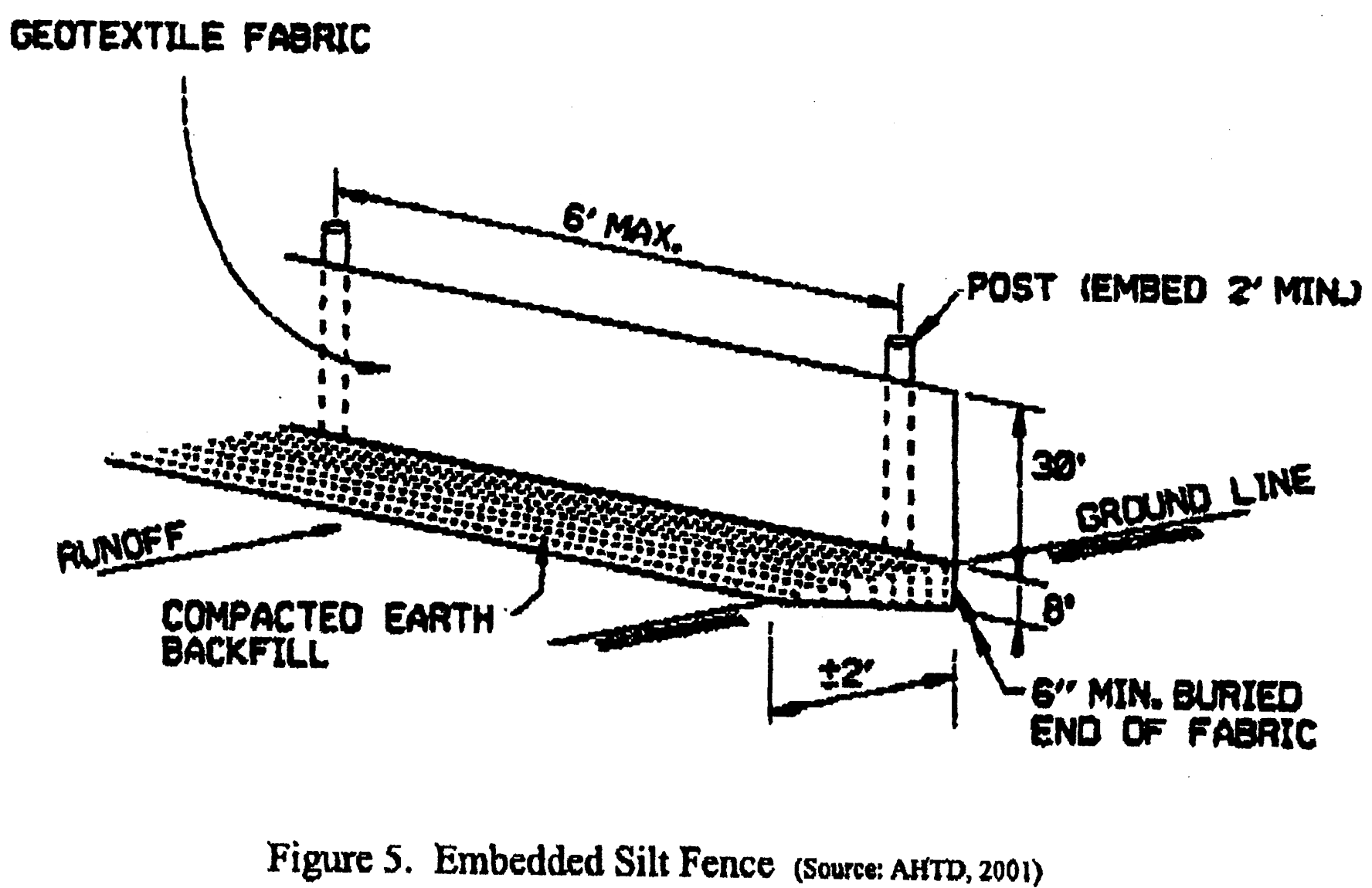
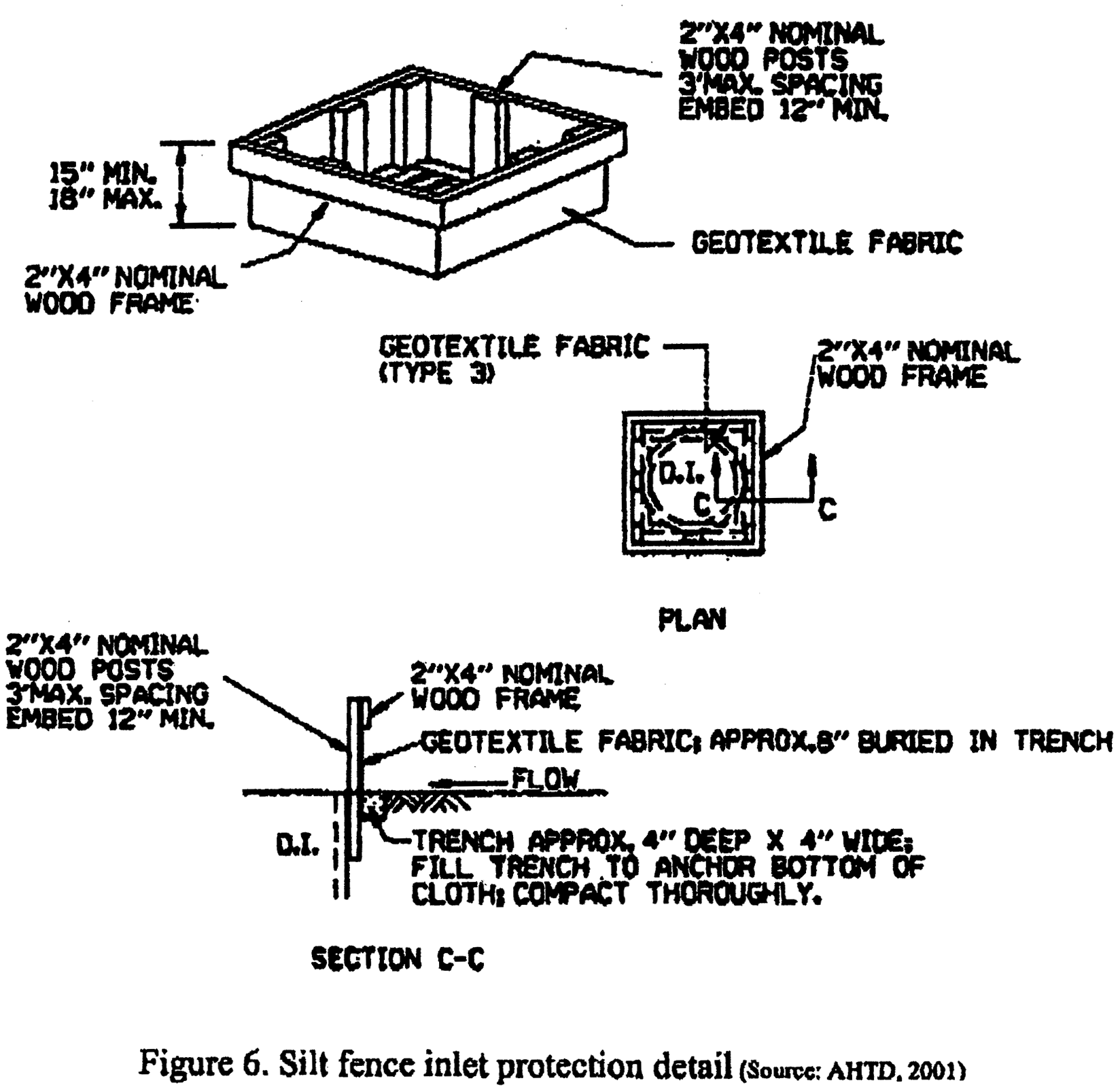
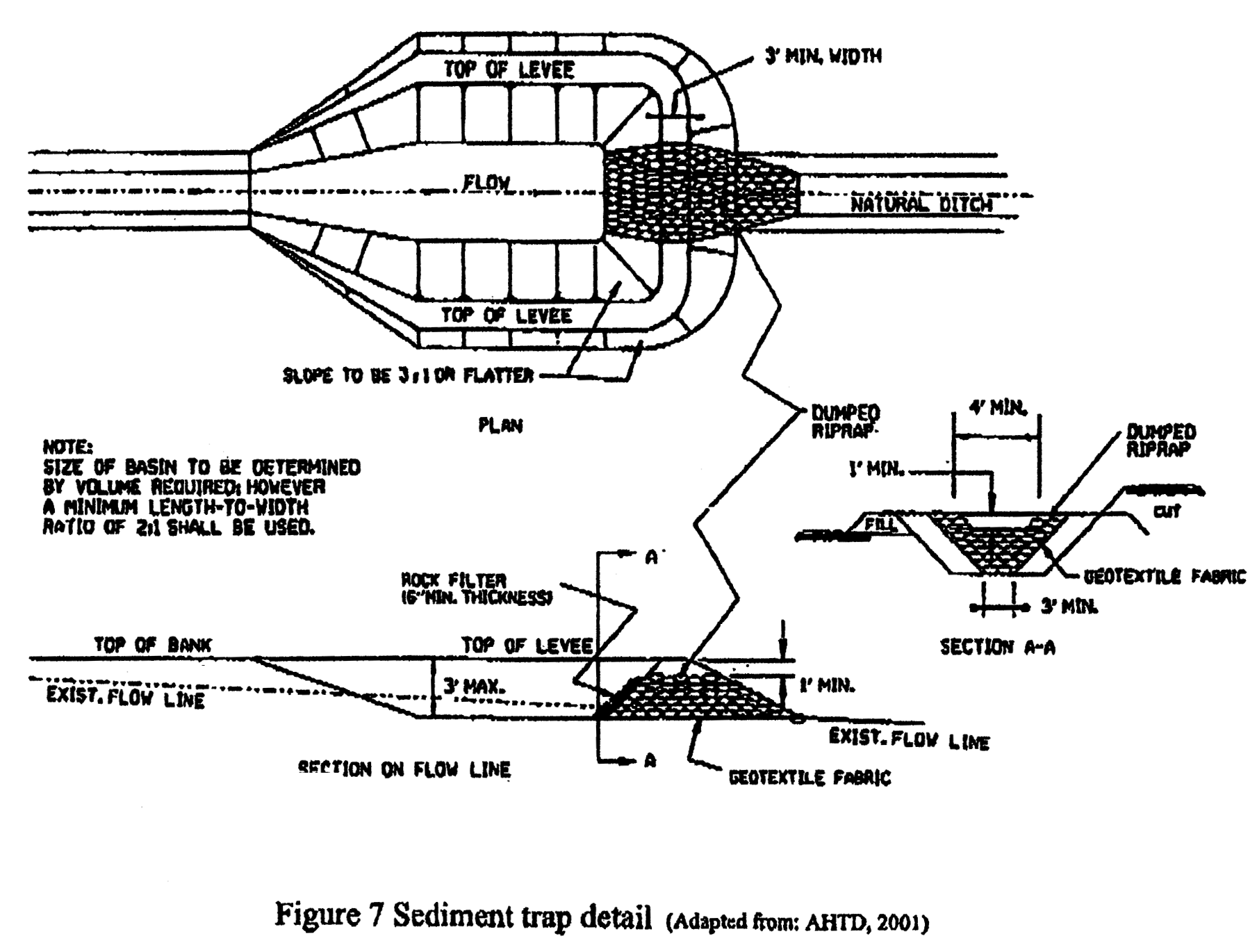
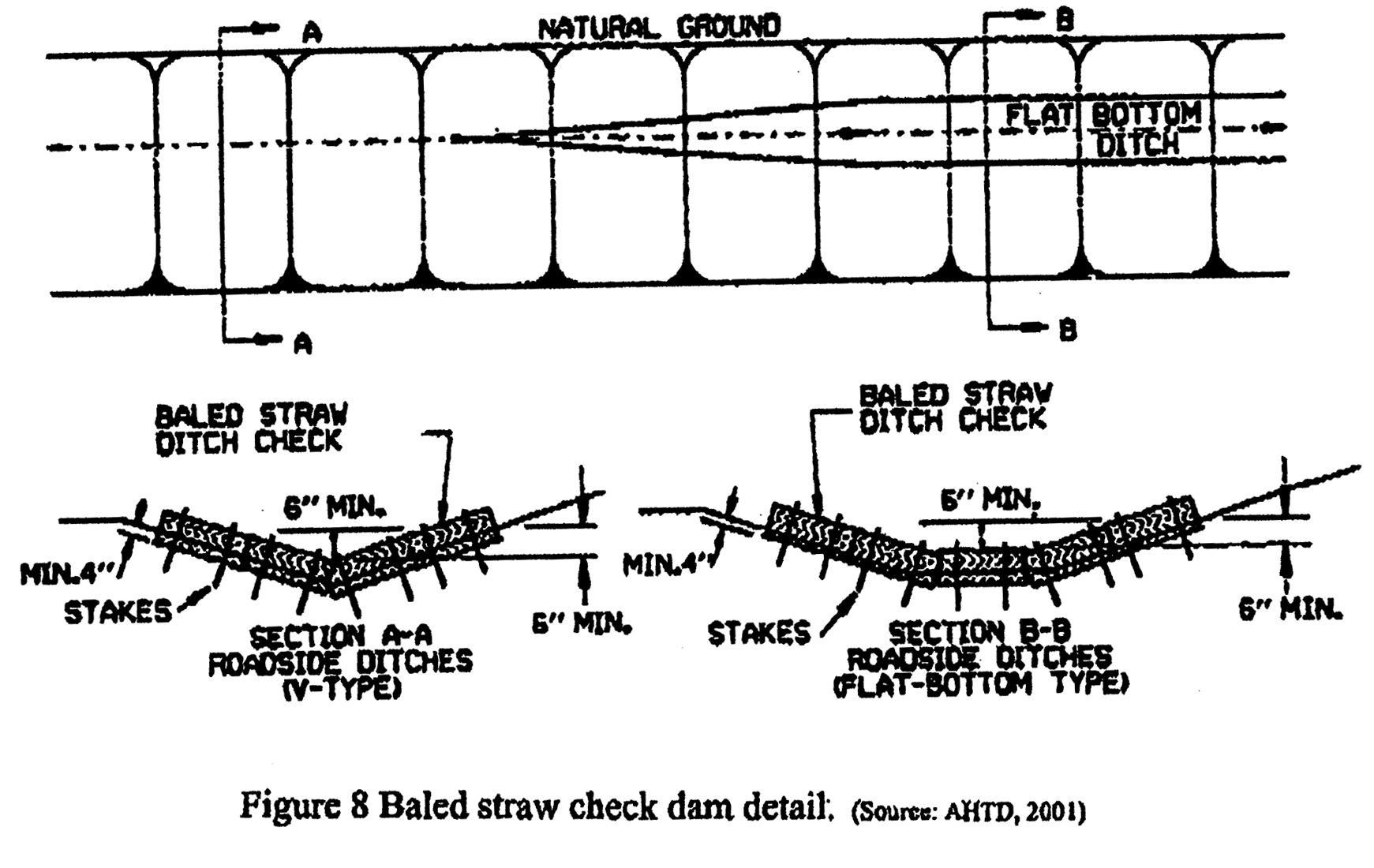
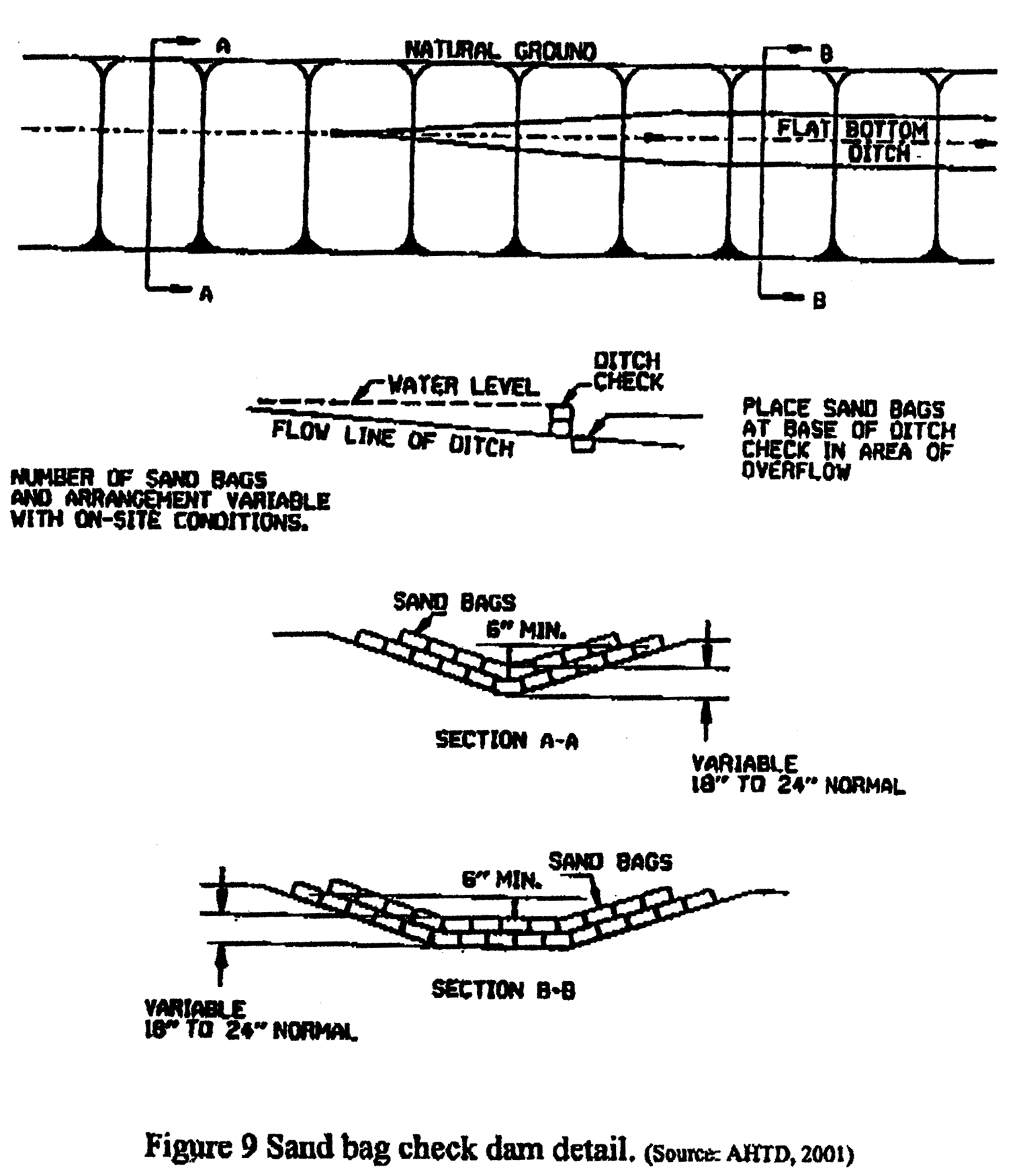
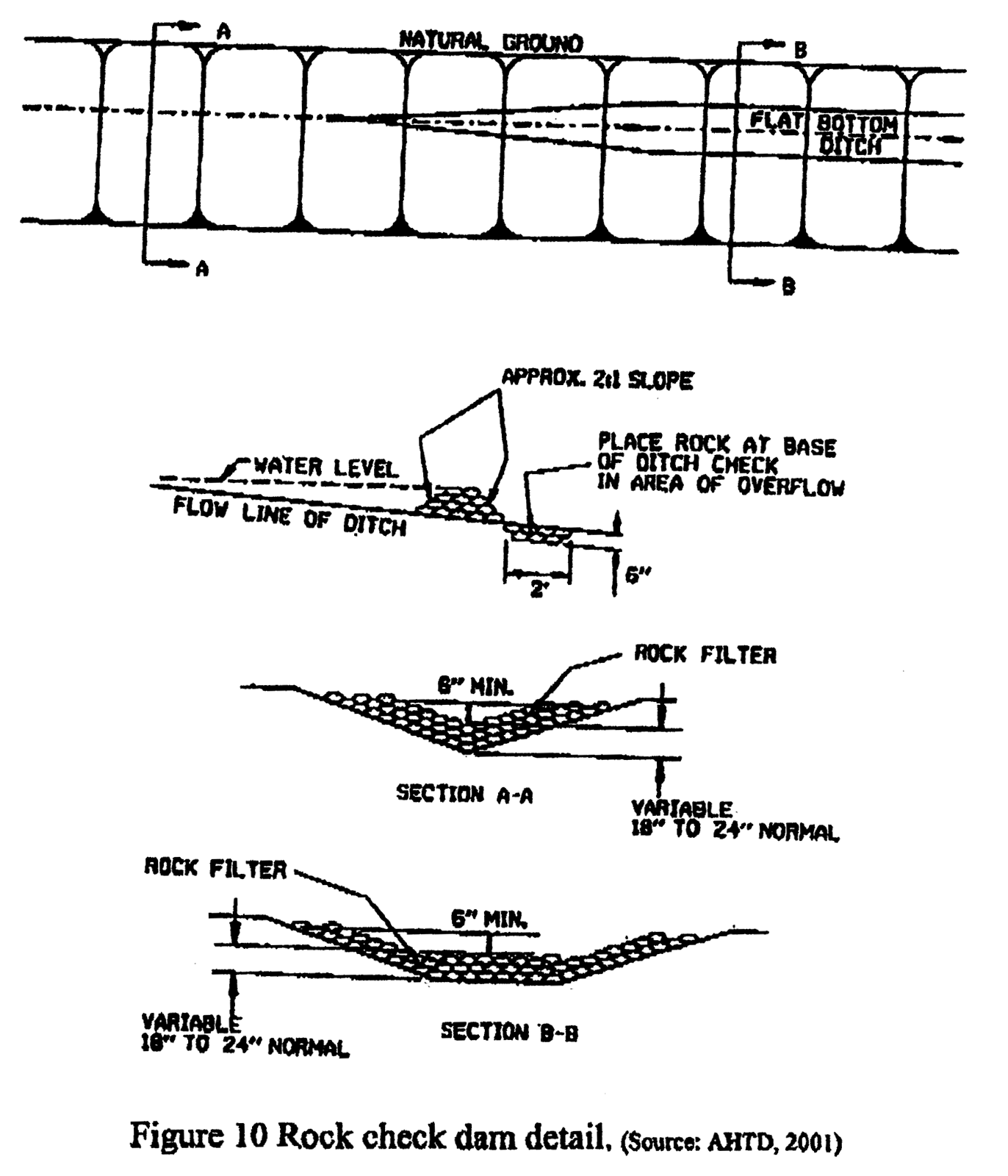
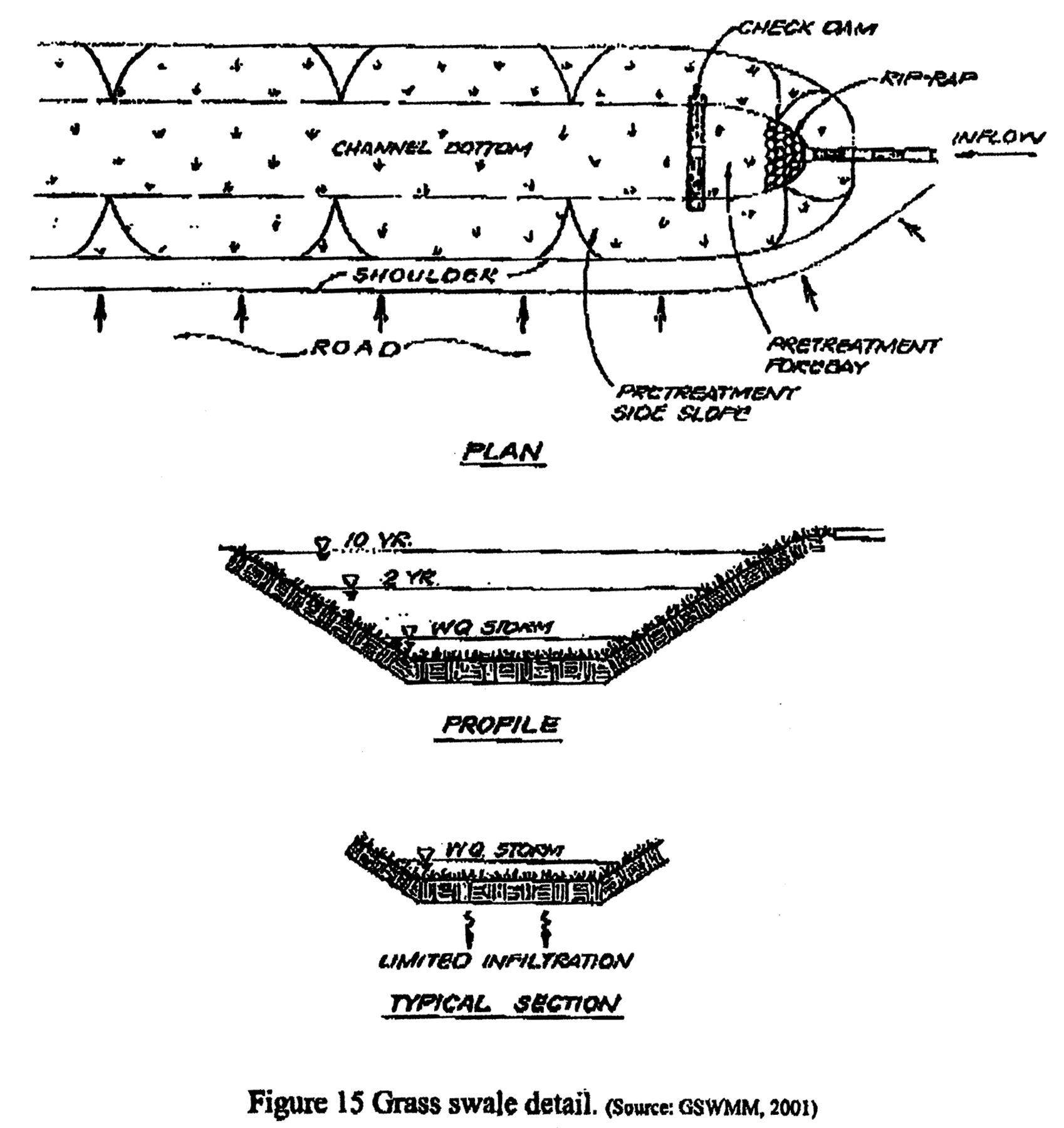
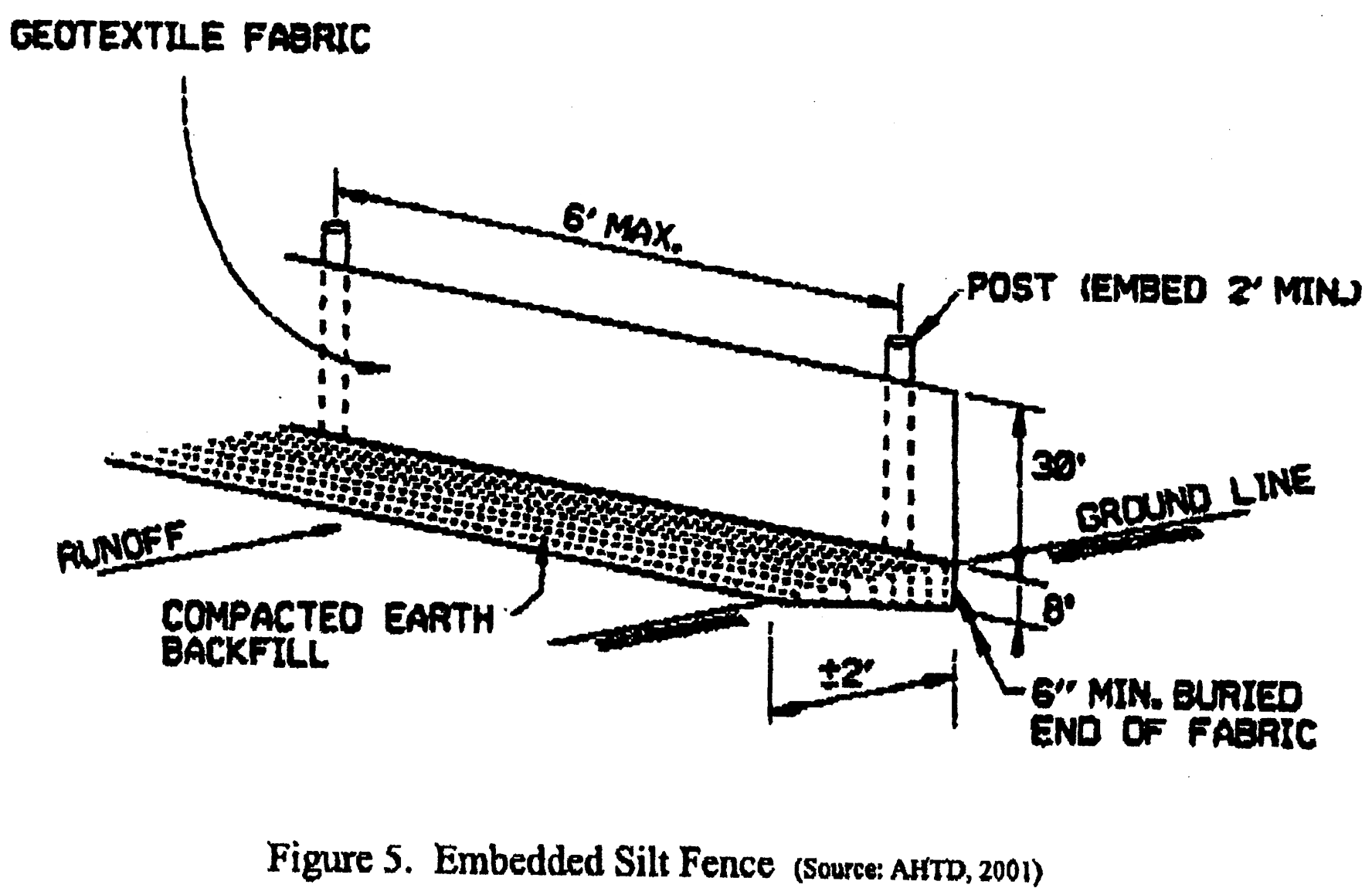
Design methodology and BMP selection criteria. Construction BMPs are typically designed for erosion control, sediment control, or control of wastes (hazardous, solid, etc.). For the best results, BMPs should be used in series with one or more BMPs. The operator of the construction site should concentrate efforts on erosion control; but, provide sediment control backup BMPs. A listing of construction erosion and sediment control BMPs and the benefits each provides is shown in Figures 5 through 10.
(3)
Construction planning. Minimize clearing and compaction.
(a)
Description. Clearing of natural vegetation and vehicular traffic on the site will expose and compact soils causing erosion and greater amounts of runoff. Minimization of clearing and compaction will decrease the amount of soil exposed to erosion and will decrease the amount runoff from due to compacted soil.
(b)
Applicability. Existing vegetation can often be incorporated into the design and construction of a development lessening the amount of bare soil exposed to rain and wind. Compacted soil does not allow for adequate infiltration of precipitation, therefore increasing runoff quantities and flowrates. Increased flowrates increase erosion and sediment transport.
(c)
Design criteria. Landscaping and clearing requirements vary from project to project. Vehicular traffic within the construction site should be limited and confined to areas that are protected with adequate sediment control practices.
(d)
Limitations. Some native plants and grasses are not considered appropriate for developed sites; so, non-native grasses and plants would need to be planted.
(e)
Maintenance requirements. Maintenance of protective fencing as needed.
(4)
Construction sequencing.
(a)
Description. Exposing soil before required for construction can expose the soil to erosion for an extended period. Construction sequencing coordinates land disturbing activities with construction requirements to minimize the amount of soil exposed to erosion at any time.
(b)
Applicability. Only land needed for building activities and vehicular traffic should be cleared. Projects on larger sites and on projects that land disturbing activities can be phased are best suited for construction sequencing.
(c)
Design criteria. Areas of the site to be preserved should be clearly marked on the plans and delineated on the site. The timing of clearing and access to different areas of the site should be indicated in the contract documents.
(d)
Limitations. Sometimes, smaller projects do not lend themselves to sequencing of land disturbing activities.
(e)
Maintenance requirements. Maintenance of protective fencing as needed.
(5)
Runoff and run-on control BMPs.
(1)
Construction entrances; description. Mud and sediment carried off-site on the tires of equipment and vehicles will be deposited on the neighboring streets. This sediment will end up in the local streams if not swept up. Development construction entrances are systems that clean vehicles of mud, sediment, and aggregate prior to leaving the site.
(a)
Development construction (for construction or development on one acre or larger).
(i)
Applicability. Any entrance/exit of a construction site upon which one acre is being developed.
(ii)
Design criteria. A six-inch layer of washed gravel or c-ballast (greater than one inch) can be used to stabilize construction site entrances. The stabilized entrance should be at least 50 feet long or as long as the longest vehicle that will enter the site, whichever is larger. If larger volumes of traffic are expected, a two-lane entrance is appropriate.
(b)
Small lot construction (for construction on less than one acre)
(i)
Applicability. Any entrance/exit of a construction site upon which less than one acre is being developed.
(ii)
Design criteria. A layer of washed gravel or c-ballast (greater than one inch in diameter) of at least two inches can be used to stabilize construction site entrances. In certain circumstances, a greater amount may be required by persons authorized to enforce this chapter. The stabilized entrance should measure from the curb to the building line on the lot.
(c)
Criteria applicable to all construction.
(i)
Other methods of removing mud from vehicles are wheel wash facilities (dunk or mechanical) and rubble strips (cattle guard, logs, etc.).
(ii)
A dunk wheel wash is a water filled, stabilized (one inch or greater gravel or stone) pit. The water depth should be at least two feet deep and the pit should be at least 20 feet long. The pit should be two-vehicle lengths from the construction site exit and the entrance and exit to the pit should be stabilized.
(iii)
Limitations. In order to avoid puncturing tires, stabilized entrances should not be constructed with sharp edge stones.
(iv)
Maintenance requirements. Stabilized entrances require periodic cleaning or addition of stone as the voids in the stones fill with mud and sediment.
(v)
Wheel wash facilities and rubble strips will need to be cleaned as the pits fill in order to provide more room to store new mud and sediment.
(vi)
The street in front of the entrance should be cleaned as required to remove sediment that has been tracked off site.
(2)
Interceptor swale and dike.
a.
Description. Water running onto the site will increase erosion and be a nuisance to construction activities. Additionally, runoff from the construction site can have excessive amounts of sediment that can end up in local streams. Interceptor swales and dikes are diversion systems used to divert runoff around a site or to direct runoff from a site to a pond in order to settle out sediment prior to discharge from the site.
b.
Applicability. Any area that that is subject to runoff from up hill drainage areas.
c.
Design criteria. The swale (channel) and dike should be situated to capture runoff uphill of the work area with a vegetative buffer uphill of the swale to remove sediment before it enters the swale. The stabilized swale and ditch should be in-place prior to all other earthwork on the project. The channel should be designed to handle the 25-year storm, with the bottom and sides protected for the anticipated water velocity. Typically, the ditch will be two feet wide at the bottom and six feet wide at the top. Maximum water velocity in the swale should not exceed five feet per second. Side slopes should be no steeper than 1:3 (vertical: horizontal). Energy dissipation should be provided at the exit from the swale as needed.
d.
Limitations. Excessive flowrates can cause scour in the swale; therefore requiring a sediment control pond at the end of the swale. In the event that the dike over flows during larger storm events, the site can be damaged and excessive erosion and sediment transport can occur.
e.
Maintenance requirements. The swale should be cleared of debris and excessive vegetation as required.
(3)
Slope drain.
a.
Description. Gullying and excessive erosion will take place on slopes subjected to concentrated flows of runoff. Slope drains are conduits (open or closed) used to direct water down a slope while protecting the slope from erosion.
b.
Applicability. Slopes with the potential for intended or unintended concentrated flows
c.
Design criteria. Slope drains (rundowns, pipe slope drains, etc.) should be placed where runoff from uphill drainage areas will concentrate. Slope drains should be sized to handle a 25-year storm from an area no greater than five acres. Minimum size for a pipe slope drain is 12-inch diameter. Slope rundowns (stone or riprap lined channels) should be constructed with the middle sufficiently lower than the sides to ensure flow stays in the rundown. Slope drains operate best when used in conjunction with interceptor swales and dikes on the top of the slope. Appropriate energy protection should be placed at the outlet of the pipe.
d.
Limitations. For larger storms, the slope drain may not operate properly and can cause excessive gullying and slope erosion as well as damage to the construction site. Slope drains that are improperly designed or constructed such that the flow does not stay in the drain will cause excessive erosion.
e.
Maintenance requirements. Slope drains should be inspected weekly and kept clear of trash, debris, and vegetation.
(4)
Energy dissipation—Riprap aprons.
a.
Description. Water exiting a channel, swale, pipe, or culvert (any water carrying conduit) typically is in a concentrated stream with a relatively high velocity. This high energy stream of water erodes unprotected soil. Energy dissipation is a structural BMP placed at the exit of a water-carrying conduit to slow the velocity and decrease the turbulence of the water. Permanent energy dissipation controls can be used during the construction phase of the project, and should be designed according to methods described in the residential and commercial BMPs section of this article.
b.
Applicability. All channels or pipes carrying runoff at velocities that will erode the soil in the discharge area.
c.
Design criteria. Determine the required median size (d 50 ) of riprap using graph in Figure 3 below. Enter the graph on the X-axis with the discharge in cubic feet per second, move vertically to intersect either the appropriate depth of flow (d) line or the velocity of flow (v) line, then read to the horizontally to Y-axis on the right side to determine the required median diameter of riprap (d 50 ). Determine the minimum required apron length using the graph in Figure 3. Enter the graph on the X-axis with the discharge in cubic feet per second, move vertically to the second set of lines to intersect the appropriate depth of flow (d), then read horizontally to the left to determine the minimum required length of apron (L a ) in feet.
d.
Limitations. Riprap aprons are best suited for applications where the Froude Number at the conduit exit is less than 2.5. Some communities do not allow riprap as a permanent control method of energy dissipation.
e.
Maintenance requirements. The apron should be inspected after large storms to ensure that the riprap is in place. Riprap should be replaced when it is dislodged or missing.
(Ord. No. 585, § 1, 12-5-2005; Ord. No. 1019, §§ 8, 9, 1-4-2021)
Sec. 94-838. - Erosion control BMPs.
(a)
Soil roughening.
(1)
Description. Water flowing down a bare slope will erode soil and transport soil to the bottom of the slope. Soil roughening is the practice of increasing the roughness of exposed soil by making grooves, tracks, or terraces (stair-steps) which run perpendicular to the flow path (parallel to slope) slowing flow and trapping sediment.
(2)
Applications. Soil roughening can be used on a wide variety of slopes and in conjunction with seeding and mulching.
(3)
Design criteria. Tracking with lugged tracked equipment is appropriate on sandy material so as to not excessively compact the soil. Grooving can be accomplished using a plow with the furrows three inches deep and less than 15 inches apart. Terraced (stair-stepping) slopes should have the vertical cuts no more than two feet deep and the horizontal steps should be wider than the depth of the vertical cut. The horizontal step should slope backward to the vertical cut upslope on the hill. The slope should be seeded immediately after roughening and mulch or chemical stabilization should be utilized where appropriate.
(4)
Limitations. Soil roughening should not be used on rocky soils or soils that are high in clay content. Tracking may cause excessive compaction which can lead to greater erosion
(5)
Maintenance requirements. Roughened slopes should be inspected after one-half inch and greater storms and problem areas noted. After a rain event, slopes may need reconstruction, re-roughening, reseeding, and remulching.
(b)
Chemical stabilization.
(1)
Description. Erosion is caused by rainfall impact detaching soil particles and runoff carrying the particles downslope. Chemical stabilization is the practice of spraying chemicals (tackifiers, soil binders) on the soil to hold the soil particles in place and protect against erosion.
(2)
Applicability. Areas that have been cleared of vegetation or do not have a protective cover on the soil. If temporary seeding can not be used or would not be effective due to the time of year, steepness of slope, or other reasons, chemical stabilizers can be applied to protect against erosion. Chemical stabilization can be used in conjunction with seeding and mulching.
(3)
Design criteria. The type of chemical used (asphalt emulsion, polyacrylamides (PAM), vinyl, or rubber), the application rate, and application method should meet the manufactures recommendations.
(4)
Limitations. Improper application methods or rates can result in over application which can diminish infiltration and cause additional runoff.
(5)
Maintenance requirements. Chemically stabilized areas should be inspected regularly and after one-half inch or greater rainfalls and stabilizer reapplied as required.
(c)
Mulch.
(1)
Description. Erosion is caused by rainfall impact detaching soil particles and runoff carrying the particles downslope. Mulch can be applied to the area to hold the soil particles in place and protect against erosion. Mulching is the practice of applying a layer of organic material (hay, straw, wood fiber, paper fiber, etc.) to protect the soil from impact of precipitation.
(2)
Applicability. Areas that have been cleared of vegetation or do not have a protective cover on the soil. Mulches are typically used to protect areas that have been seeded. Mulching can be used in conjunction with chemical stabilization.
(3)
Design criteria. Straw mulch should be evenly applied at a rate of two tons of dry straw per acre. The mulch should be crimped into the soil immediately after application. Mulch should not be applied in areas with concentrated flows or on steep slopes. Mulch is typically applied using a mulch blower; but, can be applied by hand in small or hard to reach areas.
(4)
Limitations. Wind and concentrated water flows can blow or wash mulch from the application area.
(5)
Maintenance requirements. Mulched areas should be inspected regularly and after one-half inch or greater rainfalls and mulch reapplied as required.
(d)
Erosion control mats.
(1)
Description. Erosion is caused by rainfall impact detaching soil particles and runoff carrying the particles downslope. Erosion control mats can be applied to the area to hold the soil particles in place and protect against erosion. Erosion control mats are manufactured blankets of netting with organic filler or geosynthetic material used to protect the soil from impact of precipitation.
(2)
Applicability. Areas that have been cleared of vegetation or do not have a protective cover on the soil. Erosion control mats are typically used to protect short steep slopes or in areas of concentrated water flows.
(3)
Design criteria. There are many different types of erosion control mats and each is made for different situations (slope, duration of protection, amount of protection, soil, degradability of mat, etc.); therefore, the type of erosion control mat used and the installation methods should meet the manufactures recommendations.
(4)
Limitations. If not properly installed (anchored to the ground and overlapped on the edges), erosion control mats can be washed downslope.
(5)
Maintenance requirements. Areas with erosion control mats should be inspected regularly and after one-half inch or greater rainfalls and problem areas corrected as required.
(e)
Vegetation.
(1)
Description. Erosion is caused by rainfall impact detaching soil particles and runoff carrying the particles downslope. Vegetation (seeded or sodded) can hold the soil particles in place and protect against erosion.
(2)
Applicability. Any area of a construction site that the natural vegetation has been removed. Seeding or sodding can be used as a temporary or a final erosion control measure. A substantial savings can be realized by completing the earthwork for an area and implementing final vegetative stabilization.
(3)
Design criteria. The type temporary vegetation appropriate for a site is dependent upon the time of year. Prior to application of seed, grading of the site should be complete including all erosion and sediment control practices. If the soils have become compacted, they should be loosened to a depth of at least six inches. If the pH of the soil is less than six, lime should be added to the top six inches of soil. Fertilizer (10-10-10) should also be incorporated into the top six inches of soil at a rate of 100 lb/acre. Soil roughening techniques should be used for slopes greater than 3:1, 33 percent. The seed bed should be loose, without large clods, and uniform before seeding.
(4)
Limitations. Vegetation is not appropriate for heavily trafficked areas (vehicular and pedestrian) and is not appropriate for rocky, gravelly, or course grained soils. For these types of soils, apply six inches of clean topsoil before seeding.
(5)
Maintenance requirements. Vegetated areas should be protected from runoff from adjacent areas and traffic (vehicular and pedestrian). Until established, the vegetation will require fertilization and water.
(Ord. No. 585, § 1, 12-5-2005)
Sec. 94-839. - Sediment control BMPs.
(a)
Embedded silt fence.
(1)
Description. Water flowing in sheet or shallow flow will carry sediment down a slope and off-site. Embedded silt fence (ESF) is a barrier made of geotextile fabric placed along a contour to capture water, slow the flowrate, trap sediment, and allow water to filter through the fabric. Silt fence used within the planning jurisdiction of the city may be wire reinforced/wire backed, if necessary, as deemed by inspection of the site.
(2)
Applications. Small drainage areas with sheet flow or shallow flow.
(3)
Design criteria. Embedded silt fence (ESF) used within the planning jurisdiction of the city may be wire reinforced/wire backed. Embedded silt fence (ESF) should be placed on a contour and designed to hold runoff from the 25-year storm from an area of 100 square feet for each foot of fence. The maximum depth of retained water on the upstream side of the fence should be two feet. The maximum slope length above the fence should be no more than 100 feet. The maximum slope above the fence is 1:1. The fabric shall be buried in a trench that is at least eight-inch deep posts shall be made of metal (T-post) or wood (two inches by two inches) and placed no more than eight feet apart.
(4)
Limitations. Silt fence must be embedded or it will not function properly and should not be installed in rocky soil where it cannot be properly embedded. Silt fence is not designed to hold back concentrated flow and therefore should not be placed across channels, gullies, or streams. Silt fence should not be run down slopes as it will concentrate flow causing gully erosion and causing downstream BMPs to fail. Silt fence should not be placed at the top of slopes as it will not provide any sediment control but will increase costs.
(5)
Maintenance requirements. ESF should be inspected weekly and after one-half inch or greater rainfalls for proper installation, defective fencing, erosion on the ends, and excessive sediment buildup behind the fence (half the fence height).
(b)
Inlet protection.
(1)
Description. Runoff from a construction site often carries sediment into the stormwater sewer system, which discharges into local streams. Besides the problems caused by sediment, other pollutants (e.g. oil, grease, and nutrients) are often attached to the sediment. Inlet protection is the practice of placing gravel, sand bags, or silt fence around an inlet to allow runoff to pond and sediment to settle out prior to entering the stormwater sewer system.
(2)
Applications. Any storm drain inlet that could receive runoff from the construction site.
(3)
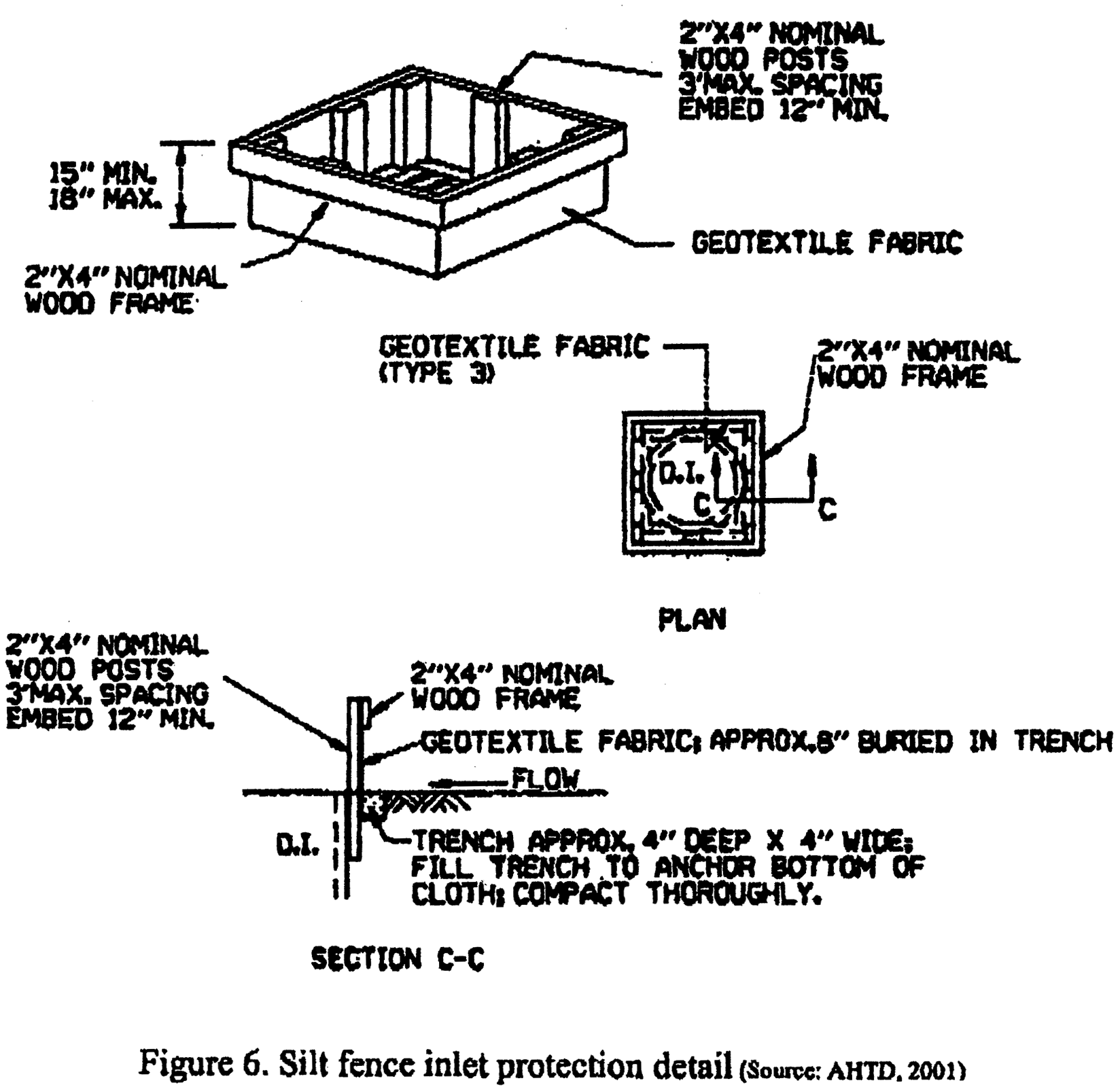
Design criteria. For inlets that are not in paved areas, a detention pond should be excavated around the inlet that is at least one foot deep (below the inlet crest) and that has a detention volume of at least 35 yards per disturbed acre of watershed. The pond should start at the toe of the dam material; so, if gravel or sandbags are to be used the pond will be at least three feet from the inlet, whereas if silt fence is used, the pond can start at the edge of the inlet. The side slopes of the detention pond should be no greater than 2:1. If silt fence is used as the dam material, the post should be driven at the edge of the inlet and should be no greater than three feet apart. The fence should be installed according to the detail in Figure 6. For inlets in paved areas, either gravel or sandbags should be used as the dam material. If gravel is to be used as the dam material, the gravel should be at least one inch in diameter. The dam should be no higher than one foot high and the side should have no greater than a 2:1 (horizontal: vertical) slope. If sandbags are used as the dam material, the bags shall be no heavier than 50 pounds and shall be stacked no higher than three bag diameters high, with the bags layered in a pyramid formation.
(4)
Limitations. Inlet protection control measures are not capable of handling large quantities of sediment and can require maintenance during rain events in order to protect nearby facilities and to eliminate flooding. Ponding can cause flooding problems for surrounding facilities.
(5)
Maintenance requirements. Inlet protection measures should be inspected during storm events to ensure surrounding facilities are not flooded. Inlet protection measures should be inspected weekly and after one-half inch or greater rainfalls for proper installation, defective fencing, erosion, and excessive sediment buildup and defective measures repaired or replaced within 24 hours.
(c)
Sediment trap.
(1)
Description. Water carrying sediment off-site can cause damage to neighboring property and local streams. Sediment traps provide an area for sediment to settle out of the runoff prior to discharge from the site.
(2)
Applications. Sediment traps are well suited for sites that will be required to have a permanent stormwater control basin; but, should be used for any concentrated flow (culvert, pipe, swale, etc.) that could have sediment in the runoff leaving the site.
(3)
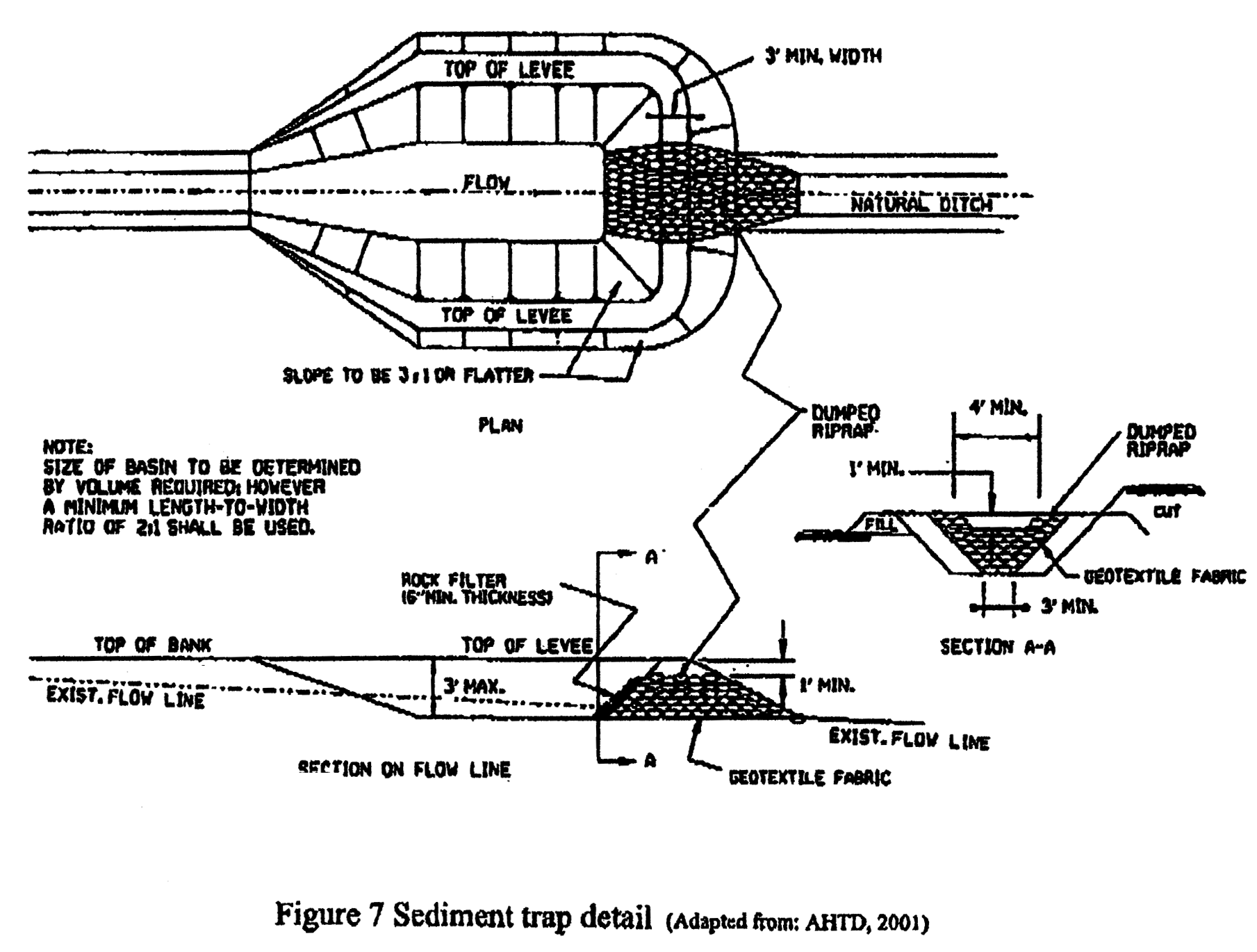
Design criteria. The removal efficiency of sediment traps is a function of the total surface area of the pond, the shape of the pond, the influent flow rate, and the type of soil in the runoff. The maximum drainage area for a sediment trap shall be three acres, for larger areas a sediment basin shall be used. Trap minimum bottom area and spillway width are given in Table 3. The berm or levee will curving upstream to hold the water, the berm will have 3:1 side slopes (maximum) and have a maximum depth of three feet. The outlet spillway shall be made of six inches of stone (six-inch diameter minimum) and be placed on a geotextile fabric.
Table 3
Minimum Sediment Trap Dimensions
(4)
Limitations. Sediment traps do not have sufficient surface area to allow for settling of very small particles (e.g. clay, silt). Sediment traps are not appropriate for runoff from areas greater than three acres.
(5)
Maintenance requirements. Sediment traps should be inspected weekly and after one-half inch or greater rainfalls for proper installation, erosion, and excessive sediment buildup and defective measures repaired or replaced within 24 hours.
(d)
Check dams.
(1)
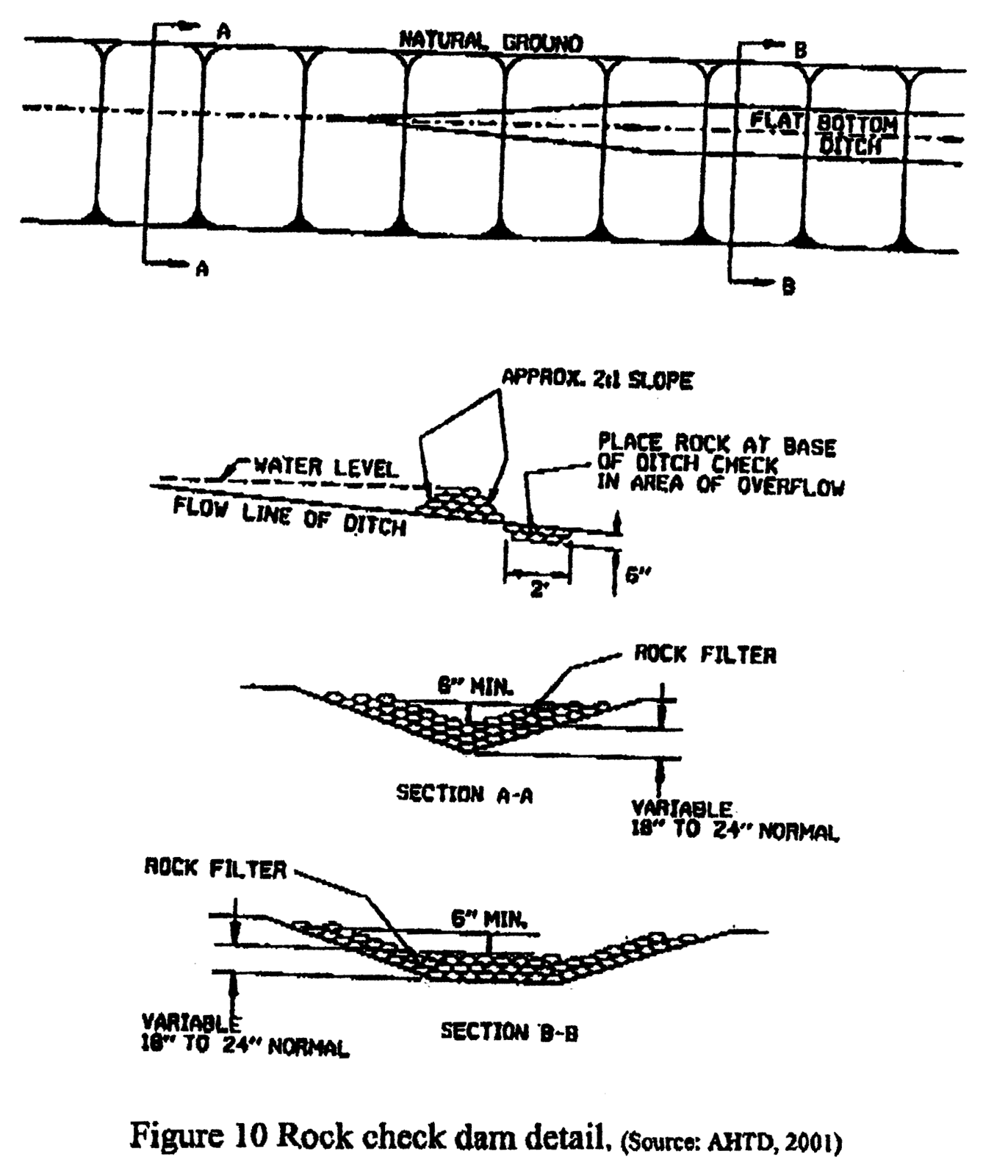
Description. Excessive velocity of water in swales or channels causes erosion and transports the sediment downstream to local streams. Check dams (ditch check) slow water in channels and provide an area for sediment to settle out of the water before it flows over the dam.
(2)
Applications. Any unlined channel or any channel that the vegetative protection has not developed. Steeper slopes are more subject to erosion than flatter slopes.
(3)
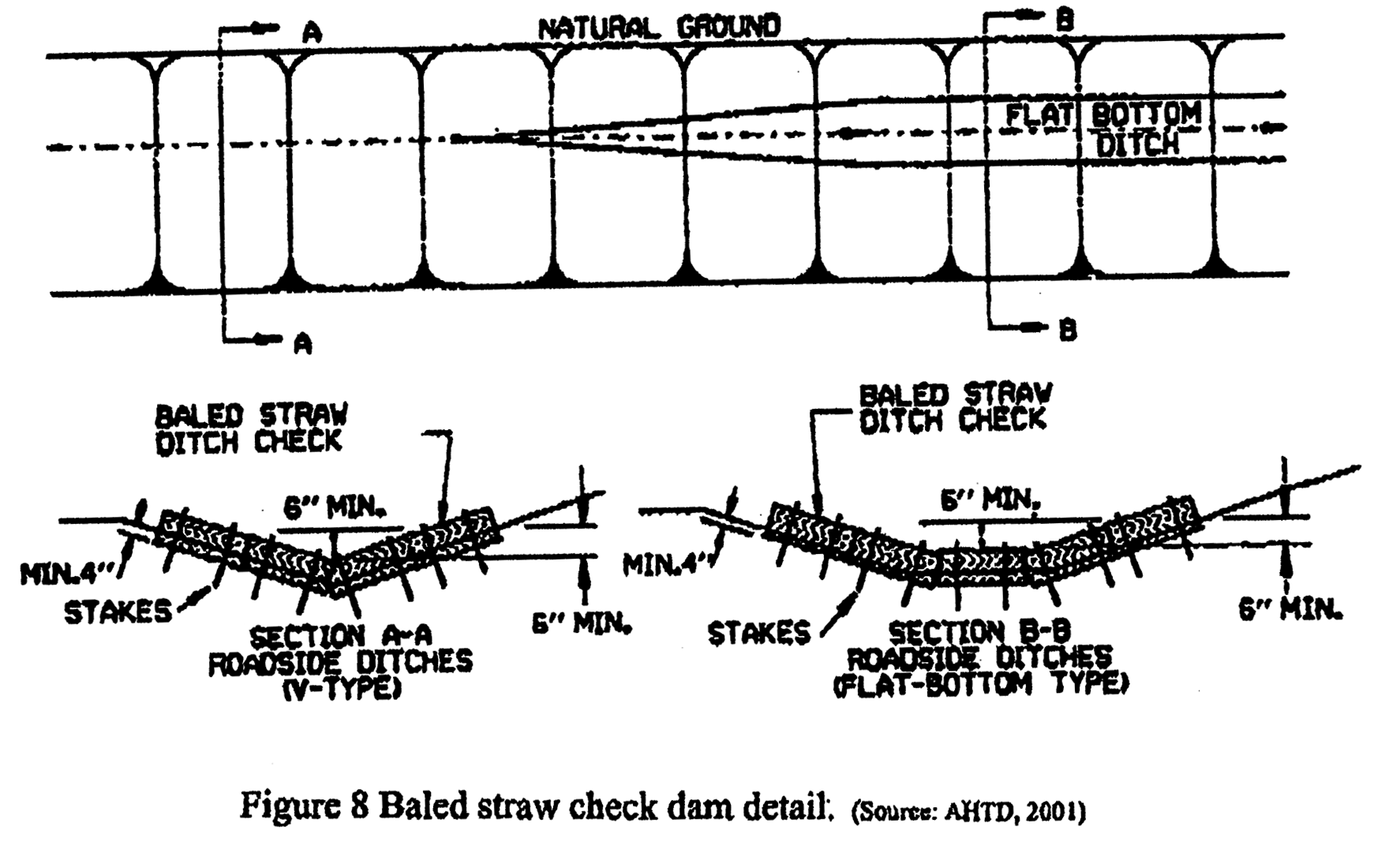
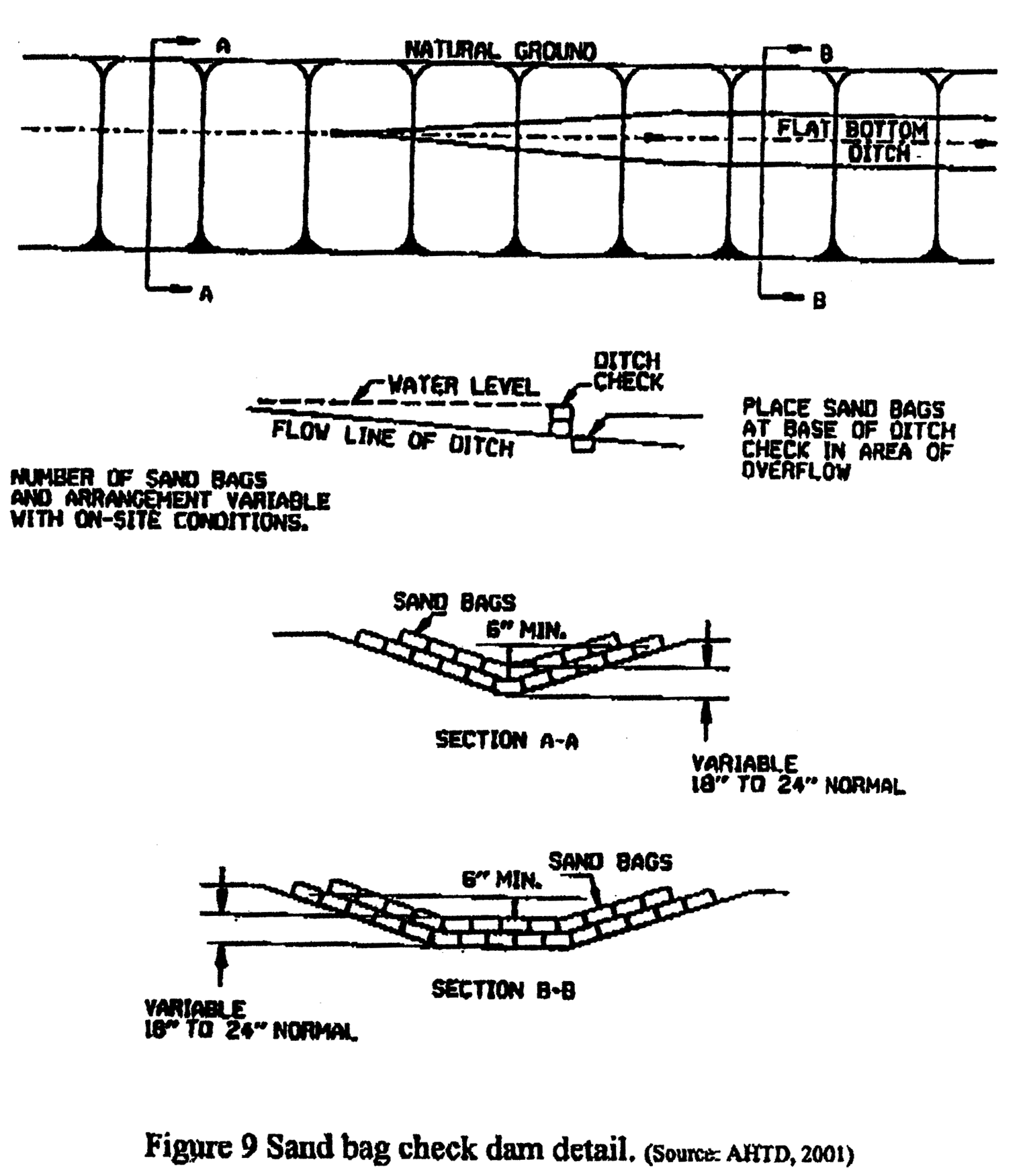
Design criteria. Place ditch checks such that the top of the downstream check is at the same elevation as the bottom of the next upstream check. Checks must constructed such that the top elevation of the center of the check is at least six inches below the bottom elevation of both ends of the check. The dam must be excavated into the channel no less than six inches as shown in Figures 8, 9, and 10.
(4)
Limitations. If improperly constructed, water will flow around or through the check dam and erode the banks of the channel. Large flows (less frequent storms) can washout the check dams, erode the banks at the end of the check dams, or cause excessive scour at the outfall of the check dam.
(5)
Maintenance requirements. Check dams should be inspected weekly and after one-half inch or greater rainfalls for proper installation, erosion, and excessive sediment buildup and defectives should be repaired or replaced within 24 hours.
(e)
Solid waste management.
(1)
Description. Solid wastes that are improperly disposed of, can be blow or washed from construction sites causing others to pickup the wastes from their property. Solid waste management refers to the proper handling and disposal of all construction wastes.
(2)
Applications. All construction sites.
(3)
Criteria. Trash and waste construction blowable materials should be picked up daily and properly disposed of.
(4)
Limitations. None.
(5)
Maintenance requirements. Daily pickup of trash and construction waste materials.
(f)
Hazardous waste management.
(1)
Description. Hazardous wastes can be washed or accidentally dumped into the stormwater system causing serious pollution of local streams. Hazardous waste management is the proper handling, storage, use, and disposal of material listed as hazardous by EPA and/or ADEQ.
(2)
Applications. All materials listed as hazardous by EPA and/or ADEQ.
(3)
Criteria. Guidelines published by EPA and OSHA for the types of materials to be used on the construction site should be incorporated into the SWPPP.
The types of materials that are generally considered hazardous are:
Fuels (diesel, gas, etc.).
Oils and greases (lubricating, cutting, etc.).
Petroleum based materials (asphalt, emulsions, solvents).
Paints (including wood preservatives, stains, and lead based).
Solvents (paint thinners, cleaners, etc.).
Pesticides, herbicides, insecticides.
Proper management of hazardous materials entails:
Replace hazardous materials with a nonhazardous materials.
Minimize the use of hazardous materials.
Reuse and recycle hazardous materials.
Proper use of hazardous materials.
Proper storage and handling of hazardous materials.
Proper disposal of hazardous materials.
Employees must be trained in the use, storage, and disposal of hazardous wastes. Hazardous materials should be stored so only authorized personnel can use the material.
The following methods should be followed for spill prevention and clean-up:
The manufacturers recommended methods for spill clean-up should be clearly posted and personnel should be trained in the location of clean-up supplies and clean-up procedures.
Clean-up supplies should be kept in a secure on site.
Personnel should wear proper protective clothing when cleaning up the spill.
Spills should be cleaned up immediately and the waste properly disposed of.
Licensed hazardous waste haulers must be used to transport hazardous wastes to approved treatment and disposal sites.
(g)
Concrete waste management.
(1)
Description. Concrete waste from washout of ready mix trucks, concrete pumps, and other concrete equipment causes chemical and changes in runoff by increasing sediment and changing the pH. Concrete waste management is the practice of capturing all concrete wastes and protecting the drainage system from any discharge contaminated by concrete. This concrete waste includes sweepings from concrete or other concrete slurry wastes.
(2)
Applications. Concrete waste management requirements shall apply to all construction sites, phases, subdivisions, or developments with concrete work. This includes the use of concrete delivered by truck or other concrete coated equipment, mortar-mixing stations, or where concrete dust, debris, or slurry is created by either construction or demolition. Concrete waste management practices shall also apply to any operator of a vehicle used to deliver or apply concrete products.
a.
Until a phase, subdivision, or development is 75 percent built out, the phase, subdivision, or development must provide and identify a minimum of one facility within a reasonable distance for the use of all lots under construction, renovation, or destruction within the phase subdivision or development.
b.
If a construction site is not within a phase, subdivision, or development as described in subsection (2)a. above, the construction site shall provide and identify a reasonable concrete washout facility for the use of those providing concrete or concrete-related services on that site or make arrangements for the removal of concrete waste.
c.
In some cases, particularly in the case of an owner-builder construction or renovation of a single structure in an otherwise fully developed subdivision, the concrete provider is expected to dispose of or washout any excess concrete or debris in a manner consistent with this section even if the site does not lend itself to a separate washout facility.
(3)
Design criteria. Provide a minimum of six cubic feet of containment volume for every ten cubic yards of concrete to be poured. There must be a minimum freeboard of six inches for those facilities built above the ground or a minimum of 12 inches for those built below grade. Prefabricated washout facilities are allowed so long as they meet the criteria of temporary facilities in terms of capacity, protection from runoff and clean out requirements. All washout areas must:
a.
Be located as far away from storm drains, ditches, or other bodies of water as is practical. In phases, subdivisions, or developments, washout areas must be at least 50 feet from storm drains, ditches, or other bodies of water.
b.
Provide all-weather access with sufficient controls to keep mud or debris from the streets surrounding the facility.
c.
Physically restrict all runoff from the area by construction of temporary pit or bermed area of sufficient size. Artificial berms may be created from straw bales or sand bags so long as the same is staked and is double or triple-lined with polyethylene sheeting of sufficient thickness and without holes or tears.
d.
Be clearly marked by signage.
e.
Be lined with polyethylene sheeting of sufficient thickness and which is free from holes, tears, or defects that compromise the impermeability of the material.
(4)
Limitations. Improperly sized washout area can overflow and washout will not be contained.
(5)
Maintenance requirements. The washout pit shall be cleaned and maintained on a regular basis.
a.
The facility must be removed or cleaned out when the facility is no longer required for work in the area or when the facility is at 75 percent capacity.
b.
To remove or clean the facility, the hardened concrete should be removed and disposed of. Materials used to construct the temporary facility must also be removed and disposed of when they are no longer suitable for use or no longer needed.
c.
Any holes or depressions caused by a temporary washout facility should be backfilled and repaired and the soil shall be stabilized.
d.
Be cleaned up immediately in the event that any liquid or other contaminant is found outside the washout facility.
e.
All concrete waste material must be properly disposed of.
(Ord. No. 585, § 1, 12-5-2005; Ord. No. 768, § 3, 4-4-2011; Ord. No. 1019, § 10, 1-4-2021)
Sec. 94-840. - Residential and commercial BMPs.
(a)
Introduction. Historically, stormwater management policies were developed to mitigate the impact of land development in terms of the quantity of water released; therefore, systems were sized to reduce the post-development peak discharge rates to the predevelopment rates. But, stormwater systems sized to reduce peak discharge are not effective at removal of pollutants; therefore, the design of stormwater systems must now incorporate methods for improving water quality.
(b)
Dry basin.
(1)
Description. Increased flow rates due to development cause increased erosion and increased stream bank erosion. In addition, runoff leaving as developed site it will carry sediment and attached pollutants. A dry basin is a surface storage structure designed to provide water quantity control through decrease and attenuation runoff peaks and by providing an area for sedimentation to remove sediment and attached pollutants.
(2)
Application. Dry basins are applicable for large drainage areas and should used in conjunction with a water quality control structure. In addition, the basin can be used for recreational and other open space opportunities between storm runoff events.
(3)
Design criteria. The maximum contributing drainage area to be served by a dry basin is 75 acres. Dry basins should be sized to temporarily store the volume of runoff required to reduce the post-development peak flow of the five-year, ten-year, 25-year, and 50-year storm events to the pre-development rates, and control the 100-year storm if required. The basin should an elongated and irregular shape with a length to width ratio of 2:1; but 3:1 is preferred. Routing calculations must be used to demonstrate that the storage volume is adequate. A detail of a dry basin is shown below. Embankments shall be less than eight feet in height and shall have side slopes no steeper than 3:1 (horizontal to vertical). Geotechnical slope stability analysis is recommended for embankments greater than four feet in height. The bottom area of storage facilities should be graded toward the outlet to prevent standing water conditions. A low flow or pilot channel across the facility bottom from the inlet to the outlet is recommended to convey low flows and prevent standing water conditions. Adequate maintenance access must be provided for all basins. Inlet inflow channels are to be stabilized with flared riprap aprons, or the equivalent. A sediment forebay sized to 0.1 inches per impervious acre of contributing drainage should be provided. Seepage control or anti-seep collars should be provided for all outlet pipes. Riprap, plunge pools or pads, or other energy dissipators are to be placed at the end of the outlet to prevent scouring and erosion. If the basin discharges to a channel with dry weather flow, care should be taken to minimize tree clearing along the downstream channel, and to reestablish a forested riparian zone in the shortest possible distance. An emergency spillway is to be included in the stormwater pond design to safely pass the extreme flood flow. The spillway prevents pond water levels from overtopping the embankment and causing structural damage. The emergency spillway must be designed and located so that downstream structures will not be impacted by spillway discharges. A minimum of one foot of freeboard must be provided, measured from the top of the water surface elevation for the extreme flood, to the lowest point of the dam embankment not counting the emergency spillway. In the event that further reduced peak flowrates are required to protect the downstream channel, a dry extended detention basin can be utilized. Dry extended detention basins should be equipped with a low flow orifice capable of releasing the channel protection volume over 24 hours must. The channel protection orifice should have a minimum diameter of three inches and should be adequately protected from clogging by an acceptable external trash rack. A detail of a dry extended detention basin is shown below.
(4)
Limitations. Dry basins are only moderately effective at removing suspended pollutants (sediment and attached pollutants, nutrients and metals) and are ineffective at removing dissolved pollutants. During some periods of the year, dry ponds can be a breeding site for mosquitoes.
(5)
Maintenance. Dry ponds require inspection and maintenance as shown below.
Bi-weekly or as needed, mow and tend to grass around pond.
Monthly or more frequently if required, remove trash and debris from pond, outlet structure, and surrounding area.
Annually, inspect embankments, outlets, and spillways for damage and maintain as required.
Annually, inspect for sediment buildup and remove buildup as required.
Annually, remove any invasive vegetation.
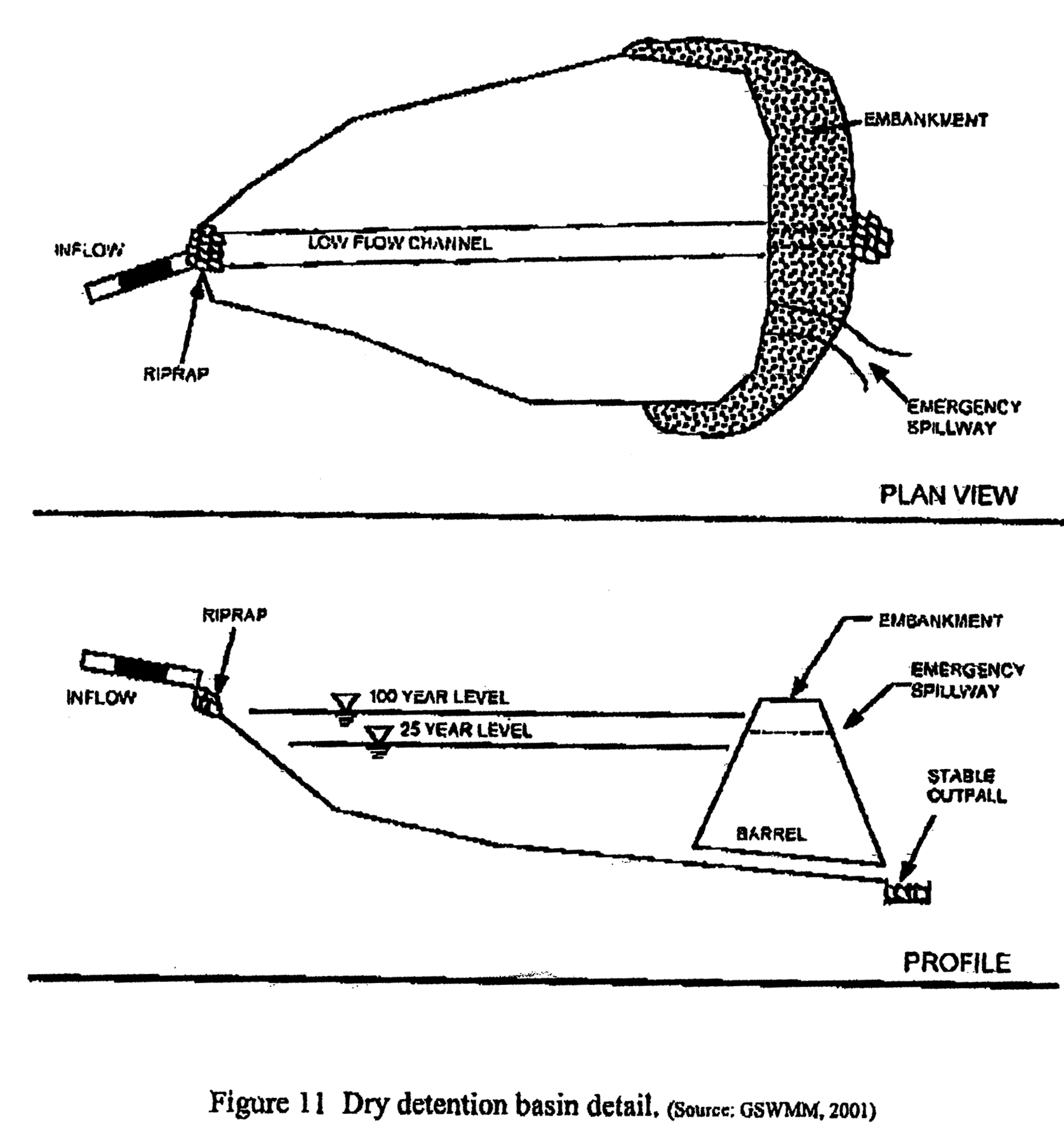
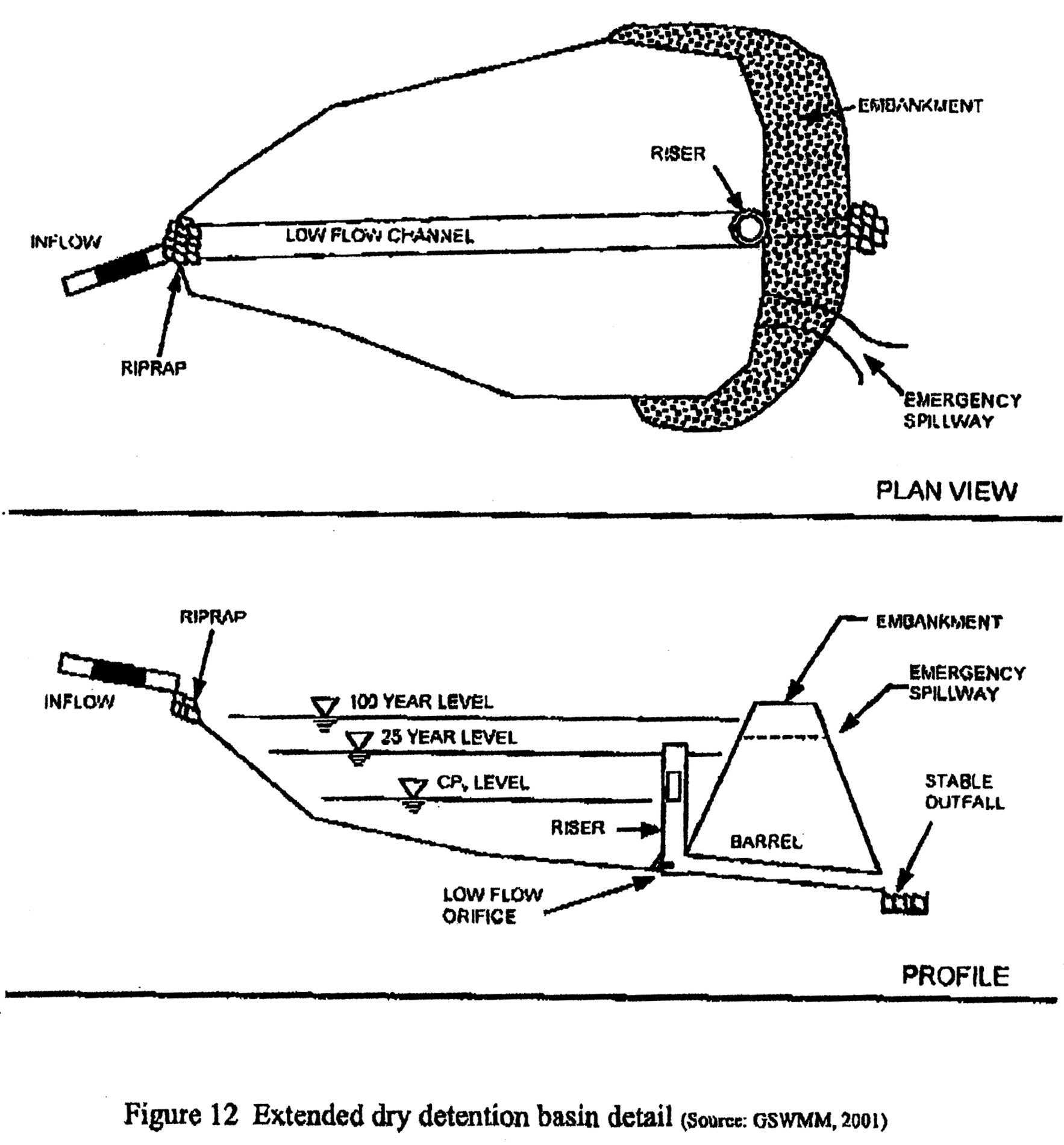
(c)
Wet basin.
(1)
Description. Increased flowrates due to development cause increased erosion and increased stream bank erosion. In addition, runoff leaving as developed site it will carry sediment and attached pollutants. Wet ponds (retention ponds, wet extended detention ponds) are constructed to provide a permanent pool of water during the wet season or year-round. The pond provides for peak discharge attenuation and pollutant removal. Pollutants are removed from stormwater by settling and biological uptake.
(2)
Applicability. Wet ponds can be designed to enhance the landscaping and provide an attractive addition to a development. To maintain a permanent pool, wet ponds typically require about a minimum drainage area of 25 acres. Maintenance needs, dissolved oxygen requirements, and safety concerns should be addressed during design.
(3)
Design criteria. The maximum contributing drainage area to be served by a wet basin is 75 acres and the minimum is 25 acres. The active pool of the wet Basins should be sized to temporarily store the volume of runoff required to reduce the post-development peak flow of the five-year, ten-year, 25-year, and 50-year storm events to the pre-development rates, and control the 100-year storm if required. The basin should an elongated and irregular shape with a length to width ratio of 2:1; but 3:1 is preferred. Routing calculations must be used to demonstrate that the storage volume is adequate. A detail of a wet basin is shown in Figure 13 and a typical cross section of a wet basin is shown in Figure 14. The designer must conduct a water balance to ensure that sufficient inflow is available to maintain the permanent pool. The permanent pool should be at least four feet deep is discourage growth of aquatic plants. Embankments shall be less than eight feet in height and shall have side slopes no steeper than 3:1 (horizontal to vertical). Geotechnical slope stability analysis is recommended for embankments greater than four feet in height. Adequate maintenance access must be provided for all basins. Inlet inflow channels are to be stabilized with flared riprap aprons, or the equivalent. A sediment forebay sized to 0.1 inches per impervious acre of contributing drainage should be provided. Seepage control or anti-seep collars should be provided for all outlet pipes. Riprap, plunge pools or pads, or other energy dissipators are to be placed at the end of the outlet to prevent scouring and erosion. If the basin discharges to a channel with dry weather flow, care should be taken to minimize tree clearing along the downstream channel, and to reestablish a forested riparian zone in the shortest possible distance. An emergency spillway is to be included in the stormwater pond design to safely pass the extreme flood flow. The spillway prevents pond water levels from overtopping the embankment and causing structural damage. The emergency spillway must be designed and located so that downstream structures will not be impacted by spillway discharges. A minimum of one foot of freeboard must be provided, measured from the top of the water surface elevation for the extreme flood, to the lowest point of the dam embankment not counting the emergency spillway.
(4)
Limitations. Depending on the location, wet ponds can require maintenance to remove trash and overgrowth. In developments with excess nutrients (nitrogen and phosphorus in particular) due to over fertilization, wet ponds can require mechanisms (fountains, bubblers) to input oxygen. In some developments a permanent pool of water can be viewed as a safety concern.
(5)
Inspection and maintenance. Wet ponds should be inspected and maintained according to the following schedule:
Bi-weekly or as needed, mow and tend to grass around pond.
Monthly or more frequently if required, remove trash and debris from pond, outlet structure, and surrounding area.
Annually, inspect embankments, outlets, and spillways for damage and maintain as required.
Annually, inspect for sediment buildup in forebay and wet pool, remove buildup if required.
Annually, harvest wetland vegetation (if used) and remove any invasive vegetation.
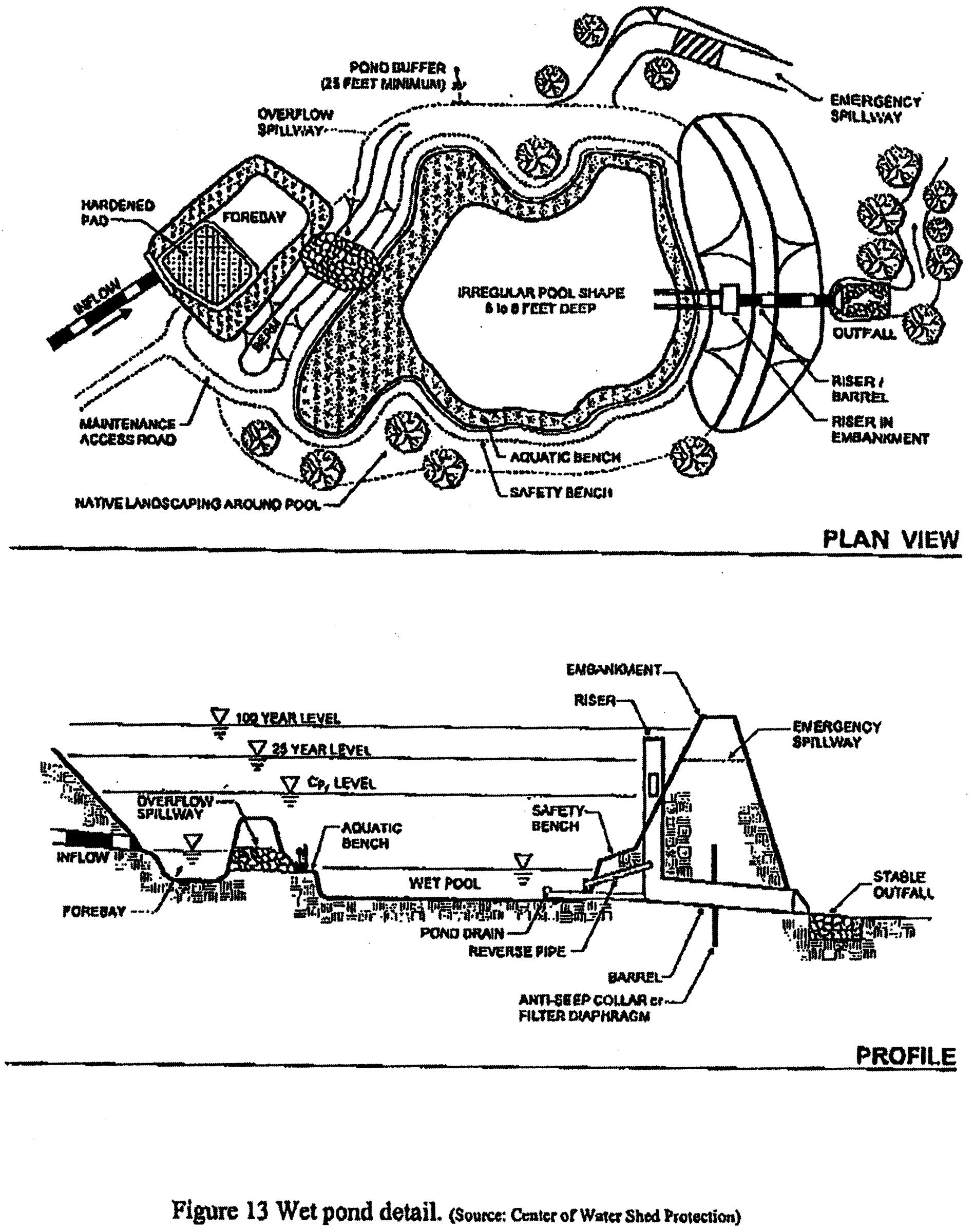
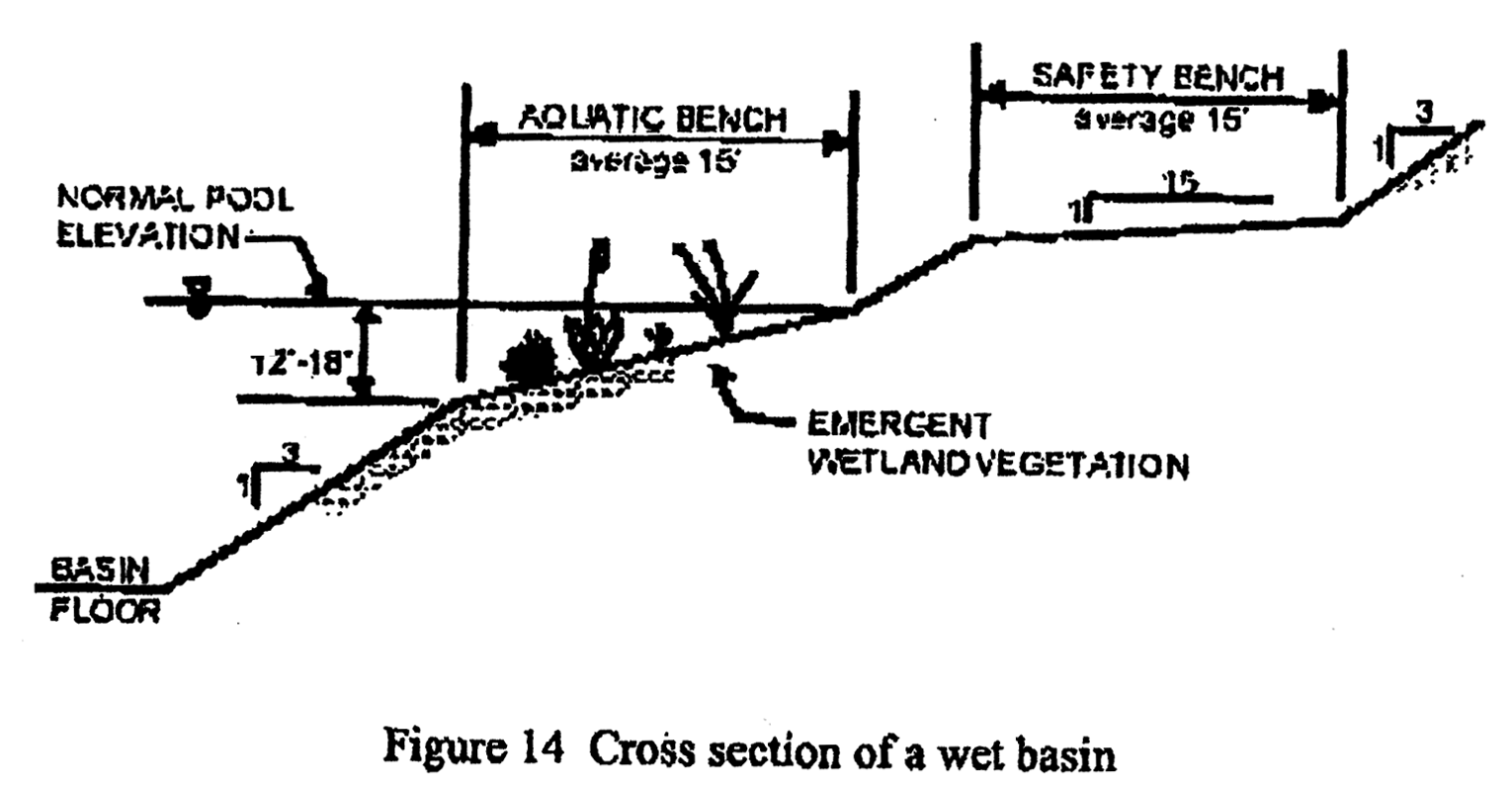
(d)
Vegetated swales and strips.
(1)
Description. Vegetated swales (grass lined swales, biofilters, grassed channels) combine a channel, storage, and vegetation. The channel is used to move stormwater from one place to another; but, the channel is designed to provide some stormwater storage. The swale is designed to allow ponding (backwater) in the channel to enhance infiltration and pollutant removal. The vegetation provides increased pollutant (sediment, nutrients, metals) removal.
(2)
Section criteria. Swales are best suited for sites with long narrow areas available for stormwater handling and storage. Swales are also well suited for areas that generate highly contaminated runoff such as filling stations. Generally swales are appropriate for drainage areas of five acres or less and should be constructed on flat slopes (one to two percent). The bottom of the swale should be two feet above the seasonally high water table.
(3)
Design and sizing. Swales function best if the stormwater moves through the channel slowly and they are designed to maximize the channel surface area wetted by the flow. A swale should be designed such that a one-inch storm will take ten minutes to travel down the swale and should be designed as shown in the detail below. Swales should be designed as trapezoidal or parabolic channels with longitudinal slopes of one to two percent and side slopes no greater than 4:1 (25 percent). The channel bottom should be two to eight feet wide. The swale should have dense vegetative cover that should be able to withstand the velocities induced by larger storms (25-year storm).
(4)
Limitations. Pollutant removal capabilities are substantially decreased for swales in highly impermeable soils, for swales constructed on steep slopes, and for swales handling runoff from too large of drainage areas.
(5)
Inspection and maintenance. Swales should be inspected and maintained as indicated below:
Bi-weekly or as needed, keep grass at a height of three to four inches.
Monthly or more frequently if required, remove trash and debris, outlet structure, and surrounding area.
Annually, inspect embankments and outlets for damage and maintain as required.
Annually, inspect for sediment buildup and remove buildup when required.
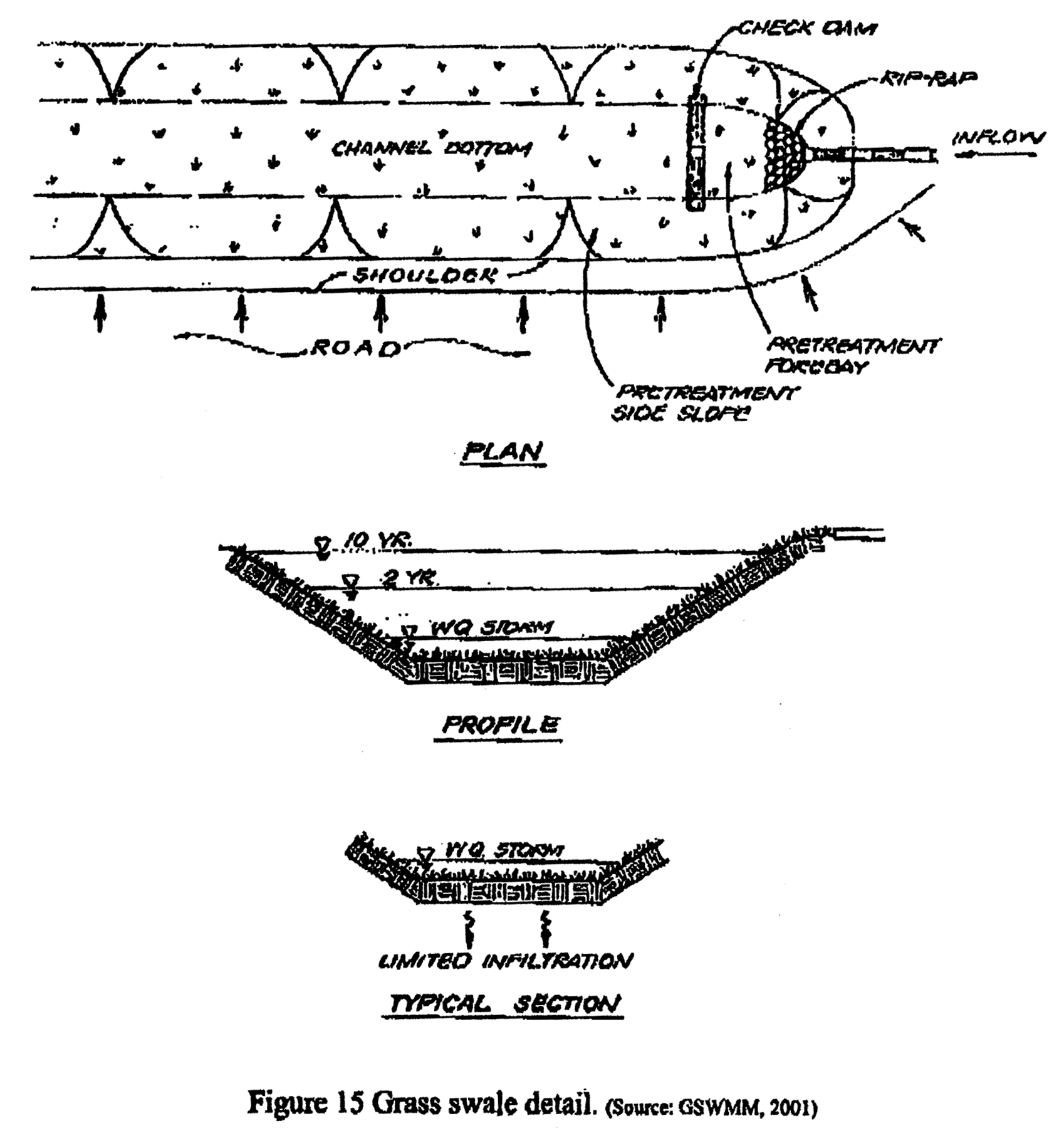
(e)
Grass filter strip.
(1)
Description. Runoff flowing in sheet flow and carrying sediment and associated pollutants will end up in the local streams causing the steams to be polluted. Grass filter strips remove sediment from runoff in sheet flow.
(2)
Application. Areas adjacent to low or medium density residential or commercial areas on gentle slopes (less than 15 percent) with a width of strip running along the contour.
(3)
Design criteria. Grass filter strips should be placed adjacent to low or medium density residential or commercial areas with a width equal to the width of the runoff area. The filter strip should have a dense mat of vegetation to bind the soil and should have a moderate slope (five percent or less). The length of the strip should meet the minimum standards shown in Table 4. Filter strips should be layout according to the detail in Figure 16. A stone drop made from pea gravel should be built at the head of the filter to pretreat the runoff and to act as a level spreader. The stone drop should be at least one foot wide and one foot deep.
Table 4
Minimum length of filter strips (Source: MAACD, 1995)
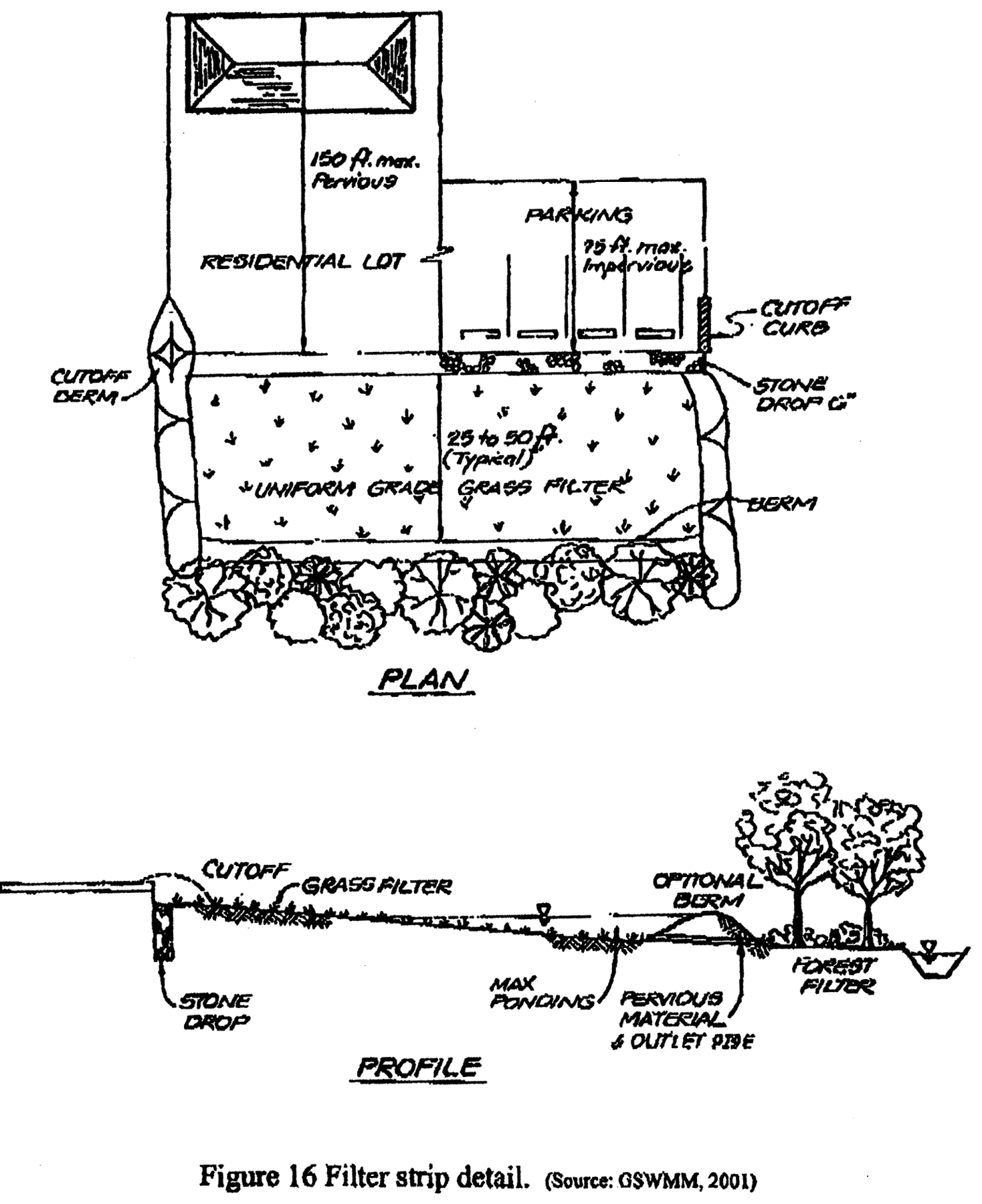
(4)
Limitations. If not planned properly, the land requirements of filter strips can be a problem in some developments. If the filter strip does not have a uniform grade, runoff will concentrate and could cause erosion in the filter strip.
(5)
Inspection and maintenance. Filter strips should be inspected periodically to ensure that the filter strip is working properly and that no erosion is taking place. The strip should be mowed to height of four to six inches as required.
(f)
Inlet floatables interceptor.
(1)
Description. Trash, debris, and lawn wastes are picked up by stormwater and carried to local streams causing unsightly conditions and pollution of the stream. Inlet floatable interceptors are placed in curb or drop inlets to screen the floatables out of the runoff.
(2)
Applicability. Curb inlets and drop inlets that are subject to excess trash and debris.
(3)
Design and sizing. Inlet floatable interceptors are manufactured BMPs that fit into curb inlets or drop inlets. The inserts should be purchased, installed, and maintained according to the manufacturers recommendations.
(4)
Limitations. Inlet floatable interceptors are very high maintenance BMPs. Debris that is collected from one storm can dry between storms be resuspended during the next storm. Increased public education on proper disposal of trash might provide better results.
(5)
Inspection and maintenance. Inlet floatable interceptors should be inspected at least weekly and after every one-half inch or greater rain and any accumulated debris removed.
(g)
Oil-sediment separator.
(1)
Description. Runoff from filling stations, vehicle service areas, and truck parking lots typically has large concentrations of hydrocarbons (oil, grease, fuel) and other vehicle fluids. Oil-sediment separators are used in these hot spots to remove the hydrocarbons from the stormwater prior to discharge to the stormwater system.
(2)
Applicability. Any high use area that has the potential for large amounts of sediment and/or hydrocarbons in the runoff.
(3)
Design and sizing. Individual oil-sediment separators are appropriate for drainage areas of one acre or less and should be sized to provide a detention volume of 400 cubic feet/acre of drainage area. The detention volume is the volume of water behind the last overflow weir as shown in the detail below. The minimum depth of water in the detention volume should be three feet. Sediment will be removed in the first chamber and oil and floating debris will be trapped in the first and second chambers; therefore, adequate volume must be provided for storage of these pollutants based upon the runoff source and the prescribed maintenance schedule.
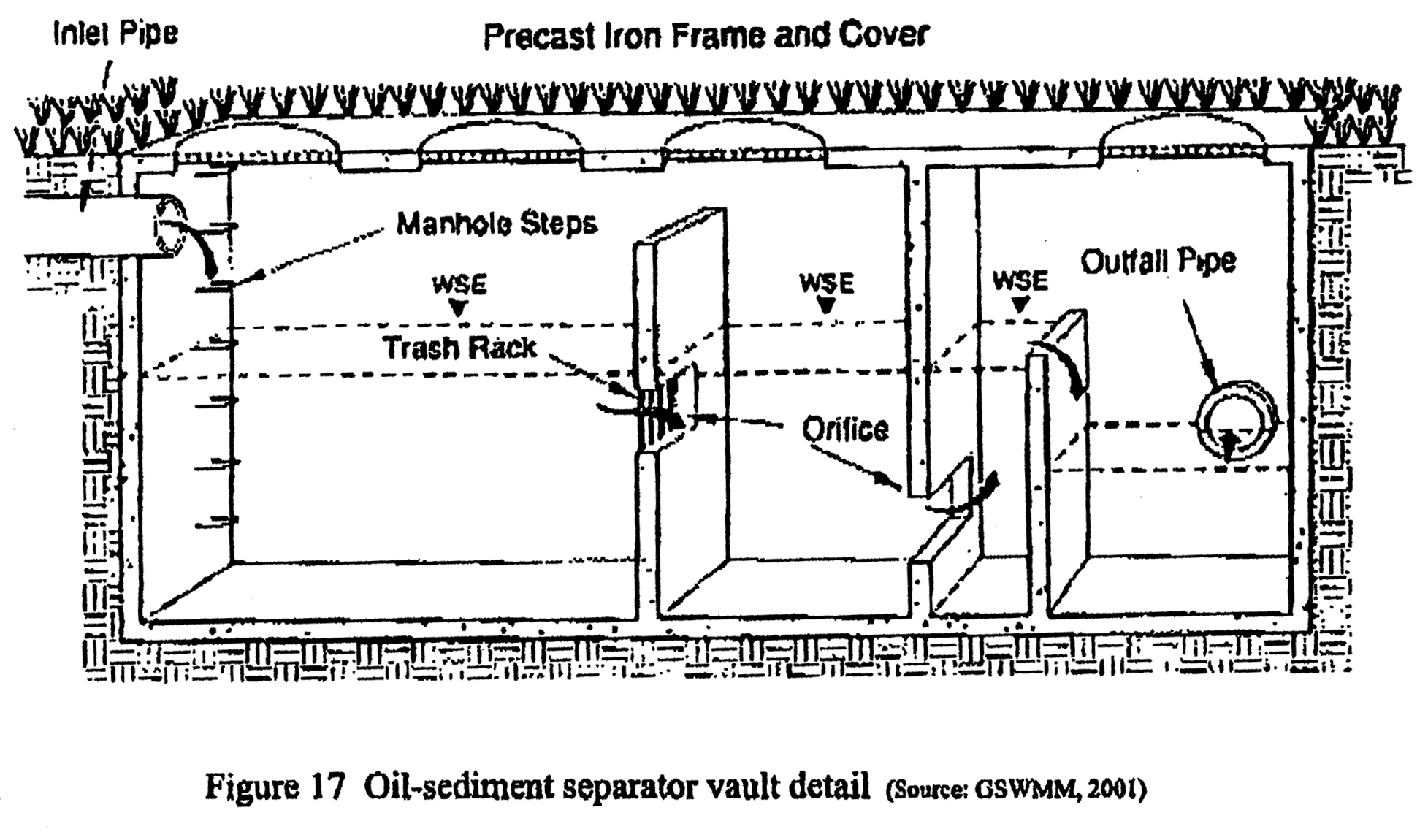
(4)
Limitations. If oil and sediment are not removed regularly, oil-sediment separators will not function properly.
(5)
Inspection and maintenance. The separator should be inspected monthly for buildup of sediment, oil, and floatables and removed as required.
(h)
Infiltration trench.
(1)
Description. Pollutants and sediment in runoff from developed areas cause pollution in local streams. Infiltration trenches are structural BMPs that take the first flush of rainfall and provide for decreased peak runoff flowrates and removal of pollutants.
(2)
Applicability. Infiltration trenches are appropriate BMPs for residential and light commercial areas. The runoff should not have large amounts of sediment.
(3)
Design criteria. Infiltration trenches can be used for drainage areas of five acres or less and should only be constructed in areas with soils that have an infiltration rate of 0.5 inches per hour or greater. Infiltration Trenches should be only be placed in areas that the bottom of the trench will be a minimum of three feet above the season high water table. The trench should be designed such that the voids in the trench will hold one-half inch of rainfall from the drainage area. The trench should only be filled with uniform aggregate of two-inch or three-inch diameter. The trench should have a grass filter strip on the upstream side to remove sediment and prolong the useful life of the trench. An observation well must be provided to allow inspection of the trench and determine if the trench is draining properly. The detail below is a typical layout of an infiltration trench.
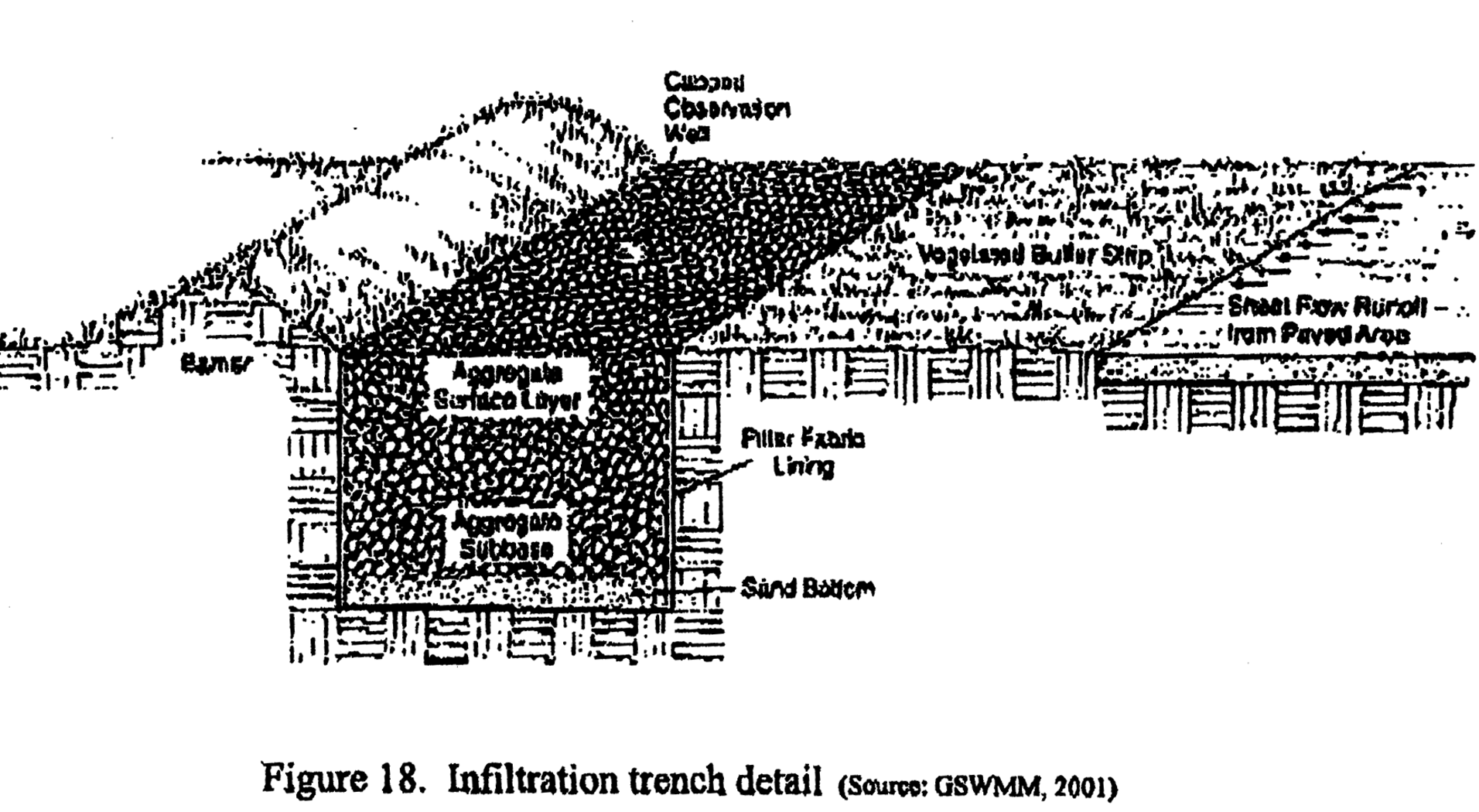
(4)
Limitations. Runoff with excessive sediment will plug the pore space in the trench and decrease the useful life of the trench; therefore, infiltration trenches should only be used for runoff that will not care large amounts of sediment.
(5)
Inspection and maintenance. The trench and drainage area should be inspected monthly and after any rainfall event to ensure that both are fee of debris and sediment build up. The observation well should be checked four times a year to determine if the captured water is draining within three days after the rainfall stops. If the trench is not working properly, the rock media and filter fabric must be removed, the trench walls must be scarified to expose new soil, and the filter fabric and trench rock media replaced.
(i)
Porous pavement.
(1)
Description. Runoff from paved areas often pollutants from vehicles (e.g. oil, brake fluid, antifreeze) that are carried to the local streams. Excessive runoff from parking lots causes erosion and stream bank erosion. Porous pavement is a stormwater management practice that allows runoff to infiltrate into and through the pavement, which decreases the amount of the runoff from the pavement and for treatment of the pollutants.
(2)
Applicability. Porous pavement is best suited for low traffic or overflow parking lots on soils with adequate infiltration capacity.
(3)
Design criteria. Porous pavement should only be used in low traffic or overflow parking lots that will not receive large amounts of sediment from vehicles. The pavement structure should be constructed according to the detail in Figure 19 and must be placed on soils with a minimum infiltration capacity of one inch per hour. The stone reservoir should have a capacity of holding one inch of rainfall in the voids of the stones. The pavement should be placed at least three feet above the seasonal high water table.
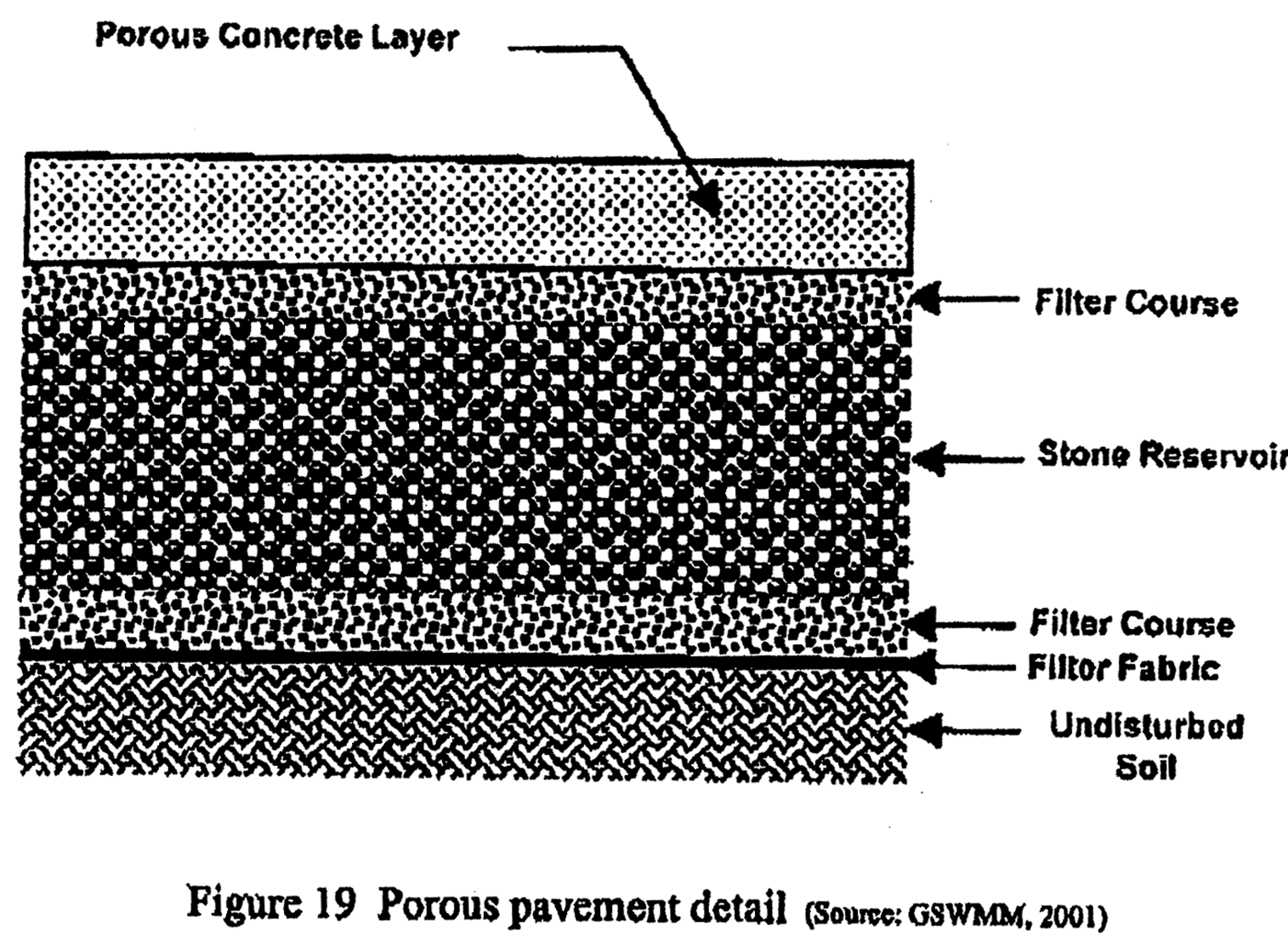
(4)
Limitations. Failure of porous pavement is typically do to excessive sediment build up on the pavement surface from either too much sediment being tracked onto the pavement or from inadequate cleaning of the pavement. Porous pavement should not be used in areas that require sanding during icy conditions.
(5)
Inspection and maintenance. The pavement should be inspected and vacuum swept monthly or more frequently as required to keep the pavement clean. Sediment buildup should be removed after ever storm. The pavement should not be resurfaced with non-porous pavement.
(j)
Underground detention vault.
(1)
Description. In high density development areas, dry basins and wet basins may take too much land space that is needed for development. Underground detention vaults provide are a structural BMP that provides for peak flow attenuation and reduction without taking up valuable surface area.
(2)
Application. Ultra-urban or high density developments where land space is not available for surface detention basins.
(3)
Design criteria. Underground detention systems are sized to temporarily store the volume of runoff required to reduce the post development peak flow of the 25-year storm event to the predevelopment rate. Due to the storage volume required, underground detention vaults and tanks are typically not used to control the 100-year storm except for very small drainage areas (less than one acre). Routing calculations must be used to demonstrate that the storage volume is adequate. Underground detention tanks and vaults must meet structural requirements for overburden support and traffic loading if appropriate. The minimum pipe diameter for underground detention tanks is 36 inches. Whereas, underground detention vaults must be constructed with a minimum of 3,000 psi structural reinforced concrete and all construction joints must be provided with water stops. Cast-in-place wall sections must be designed as retaining walls. The maximum depth from finished grade to the vault invert should be 20 feet. Underground vaults should be designed according to the detail shown below. Adequate maintenance access must be provided for all underground detention systems. Access must be provided over the inlet pipe and outflow structure. Access openings can consist of a standard frame, grate and solid cover, or a removable panel. Vaults with widths of ten feet or less should have removable lids. A separate sediment sump or vault chamber sized to 0.1 inches per impervious acre of contributing drainage should be provided at the inlet for underground detention systems. Outlet orifices or weirs should be designed to match the predevelopment flowrates of the frequencies of storms as required by local regulations.
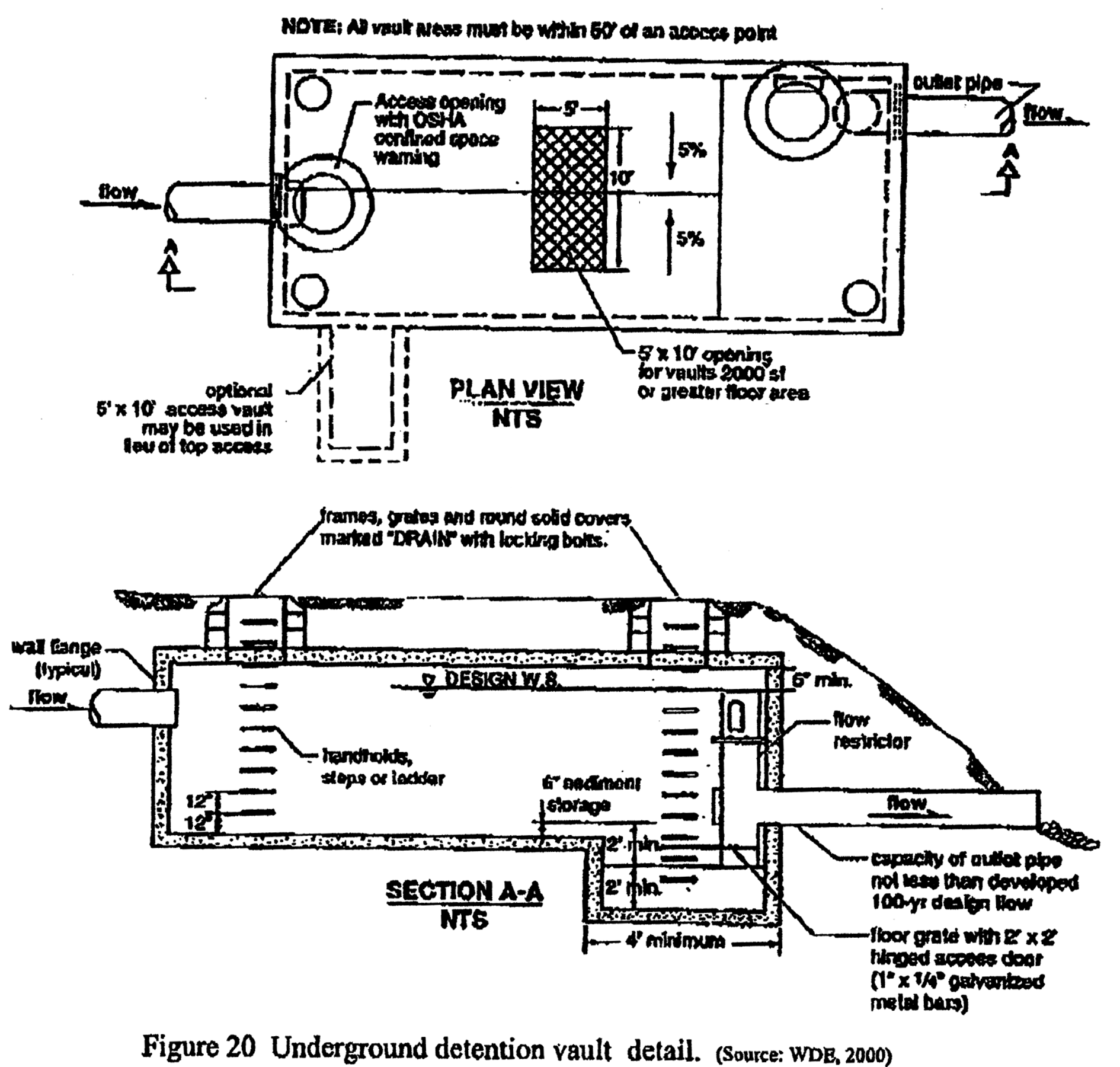
(4)
Limitations. Underground detention vaults are not typically designed to remove pollutants. Extra construction costs and maintenance costs make utilization of underground detention vaults prohibitively expensive except where land costs make them affordable. Runoff should go through a pollutant removal BMP prior to the underground vault.
(5)
Inspection and maintenance. The inlet to the vault should be inspected and trash or sediment removed. Quarterly the vault or tank should be inspected for buildup of sediment and trash, which should be removed as required.
(Ord. No. 585, § 1, 12-5-2005)

