
Mcdonough City Zoning Code
CHAPTER 17
100 - SUPPLEMENTAL STANDARDS
Sections:
17.100.010 - Introduction.
All structures, land uses, land use changes, structural alterations, structural relocations, structural additions, and structural enlargements that are constructed, created, established, or otherwise occur after the effective date of this code shall be subject to all development standards and regulations for the applicable zoning district.
(Ord. No. 25-01-02, § 1, 1-2-2025)
17.100.020 - Expansion or modification of existing uses and structures.
No structure, parking area, or other site feature regulated by this code shall be enlarged, altered, or expanded unless the minimum requirements of this code met by the property to the extent of its alteration or expansion.
An alteration or expansion to an existing property is substantial when the area or square footage of the expanded or altered land (including property used for building space, parking, or storage) or structure, respectively, exceeds twenty-five (25) percent of the area or square footage of the existing land or structure, exclusive of the alteration or expansion.
(Ord. No. 25-01-02, § 1, 1-2-2025)
17.100.030 - Height standards.
A.
The maximum height permitted shall be as noted in each zoning district.
B.
No structure may be erected or changed so as to make its height greater than specified in the applicable zoning district, except as noted below. Exceptions to the height standards include:
1.
The following structures may exceed the permitted height:
a.
Church steeples,
b.
Water towers, and
c.
Utility transmission towers.
2.
The following structures may exceed the permitted height standards by up to fifteen (15) feet, but shall be completely screened from view:
a.
Mechanicals, and
b.
Elevator bulkheads.
(Ord. No. 25-01-02, § 1, 1-2-2025)
17.100.040 - Accessory use/structure standards.
All accessory uses and structures shall be permitted on the same lot as the primary use or structure only.
A.
No accessory structures shall be placed in any required setbacks and shall otherwise comply with all development standards for the zoning district in which they are located.
B.
Accessory uses and structures shall not be permitted to be located, placed, or established on any lot prior to the establishment of a primary use or structure unless otherwise permitted by this code.
C.
Structures not deemed accessories include swing sets, mailboxes, lamp posts, doghouses, tree houses, and other such incidentals except as otherwise stated in this code.
D.
The following accessory structures require a building permit, and are subject to all the applicable requirements of this code:
1.
Attached and detached decks,
2.
Patios that are two (2) feet or more above the natural grade of the surrounding yard,
3.
Gazebos, pergolas, outdoor kitchens,
4.
Garden sheds, lawnmower sheds, greenhouses, barns,
5.
Guesthouses, in-law houses, cabanas,
6.
Dumpsters, and
7.
Similar structures related to the primary use.
E.
Accessory uses and structures shall comply with the following requirements:
1.
In RA, R-200, R-100, and R-85 zoning districts, no more than three (3) accessory structures may be placed on any one (1) lot. A detached accessory dwelling unit is included in the three (3) accessory structure maximum; and
2.
In R-75 and R-60 zoning districts, no more than one (1) accessory structure may be placed on any one (1) lot. Detached accessory units are prohibited; and
3.
The combined area of all accessory uses and structures on any one (1) lot may not exceed an amount equal to fifty (50) percent of the heated floor area of the primary structure on that lot. (Depends on lot size)
4.
No accessory structures shall encroach on any platted easement.
5.
No accessory structures shall be placed in any operable septic fields.
6.
A minimum separation of twenty (20) feet shall be provided between an accessory structure and any primary structure or other accessory structure.
7.
All accessory structures shall be placed a minimum of five (5) feet from the side and rear property lines, unless otherwise restricted by ordinance.
(Ord. No. 25-01-02, § 1, 1-2-2025)
17.100.050 - Accessory dwelling units (guesthouses, in-law suites, caretaker houses).
A.
Accessory dwelling units include basement apartments, garage apartments, caretaker or other employee quarters, guest houses, and other accessory dwellings.
B.
Accessory dwelling units shall not be used as rental property. They may only be occupied by family members, guests, or employees of the property owner.
C.
Accessory dwelling units are permitted within a principal dwelling or as a freestanding dwelling as noted below.
D.
Accessory dwelling units contained within a principal dwelling of all single-family zoning districts shall comply with the following standards:
1.
No more than one (1) accessory dwelling shall be established within a principal dwelling unit, and the accessory dwelling shall meet all the setback requirements of the principal residence.
2.
One (1) additional parking space shall be provided to serve an accessory dwelling.
3.
Accessory dwelling units shall comply with all building and health code standards.
4.
Accessory dwelling units located within the principal residence must have an interior connecting door to be in compliance with this code.
E.
Freestanding accessory dwelling units in all single-family zoning districts shall comply with the following standards:
1.
No more than one (1) freestanding accessory dwelling unit shall be established on a residential lot.
2.
An accessory dwelling unit may be located on the second floor over a detached garage, or it may be a separate structure.
3.
Accessory dwelling units shall be located within the side or rear yard.
4.
Accessory dwelling units shall be located within a minimum of twenty (20) feet from the primary structure.
5.
The residential lot shall comply with the minimum lot area standards for the district, except that in no case shall an accessory dwelling unit be located on a lot served by county sewer having less than one (1) acre of lot area.
6.
One (1) additional required parking space shall be provided to serve the accessory dwelling unit.
(Ord. No. 25-01-02, § 1, 1-2-2025)
17.100.060 - Temporary building standards.
Temporary buildings that are used in conjunction with construction work may only be permitted in any district during the period that the construction work is in progress, but such temporary buildings shall be removed upon completion of the construction work. Facade approval is required, along with any necessary building permits.
(Ord. No. 25-01-02, § 1, 1-2-2025)
17.100.070. - Home occupation standards.
Home occupations are those which meet the following standards; representing requirements which permit minimal business practices in certain residential zoning districts while maintaining residential character. The home occupation must not involve retail sales or manufacturing and shall be limited to small home-office operations.
A.
Location. Home occupation shall be conducted only within the principal residential structure, including garage area, and only if garage door remains closed.
1.
No home occupation permit/license shall be issued for a hotel, motel, intown suite, short-term rental, extended stay facility or any similar type of facility.
2.
If the garage is used as a work area for a home occupation, the residence must still meet the required parking requirements for the district where the lot is located.
B.
Use of premises. An area equal to not more than twenty-five (25) percent of the full area of the principal structure and garage area may be utilized for home occupational purposes.
C.
Group instruction/assembly. No home occupation shall be permitted wherein group instruction or group assembly, or activity is involved. To that end, no dance instruction, exercise classes or similar activities.
D.
Employees. Only members of a family residing on the premises may be employed on the premises in pursuit of the business, trade, or occupation or profession.
E.
Commodity. No commodity shall be sold on the premises.
F.
Outdoor storage. No outdoor storage of any items related to the business, trade, profession, or occupation shall be allowed in connection with any home occupation.
G.
Maintenance of residential character. No alteration of the residential character of the premises may be made, and the home occupation shall not be allowed to create a nuisance or to create any undue disturbance.
I.
Signs. No signs relating to the home occupation shall be allowed on the premises.
J.
Noise. No business, trade, profession, or occupation shall qualify as a home occupation if the pursuit of such generates noise which is audible beyond the property lines of the property upon which the premises is located.
K.
Vehicles.
1.
No business, trade, profession, or occupation which generates vehicular trips of nonresidents to the premises exceeding ten (10) per day shall qualify as a home occupation.
2.
No business delivery may be made to the premises holding the home occupation license by any semi-tractor trailer.
3.
For purposes of this paragraph, the term "common carrier" shall include any delivery vehicle having more than two (2) axles.
4.
No vehicles which display advertising relating to an occupation, business, trade, or profession carried on the premises of a home occupation may be utilized in such a manner so as to avoid the restriction on signs contained above.
5.
No more than one (1) passenger vehicle displaying advertising relating to the business, trade, profession, or occupation carried on the premises may be parked on or about the premises at any one (1) time. Off street parking must be provided on paved surfaces.
N.
Storage or parking of equipment. Except as allowed by subsection K.5 above, no business, trade, occupation, or profession otherwise qualifying as a home occupation shall be permitted to park or store any vehicular or motorized equipment, including, but not limited to, trucks, vans, tractors, earth moving equipment, construction vehicles, trailers, or like items used in conducting of such business on the premises.
O.
Chemicals. No business, trade, occupation, or profession which would otherwise qualify as home occupation may store any chemical not normally used for common household purposes on the premises.
P.
Inspections. If complaints are received by the city concerning a home occupation, the home occupation licensee agrees that the city may conduct an inspection during normal business hours for the purpose of determining whether the provisions of this code are being complied with by the licensee.
Q.
Occasional use. The occasional use of portions of the premises for the receipt of telephone calls, or the maintenance of a home office by an employee or owner of a business which maintains an active office location in a properly zoned area shall not require a home occupation permit, provided that all the other limitations of this section shall control.
R.
Produce. Nothing contained within this chapter shall prohibit the occasional sales of seasonal produce grown entirely upon the premises from a home garden.
S.
Interference. No equipment or processes shall be used in such home occupation, which creates noise, vibration, glare, fumes, odors, or electrical interference, outside the dwelling unit. In the case of electrical interference, no equipment or process shall be used which creates visual or audible interference in any television or radio receivers off the premises or causes fluctuations in line voltage off the premises.
T.
Permitted provisions. The following are permitted home occupations provided they do not violate any of the provisions of this section or any other section within this article:
1.
Dressmaking, sewing and tailoring.
2.
Painting, sculpturing, writing and other fine arts.
3.
Telephone answering and marketing.
4.
Home crafts, such as model making, rug weaving, and lapidary work.
5.
Instruction or teaching, such as academic, tutoring, performing arts, or fine arts limited to one (1) student at any given time.
6.
Computer application and internet sales, not including the sale of computers.
7.
Office uses for consulting professionals, such as attorneys, realtors, insurance agents, engineers, architects, and other consultants, accountants, brokers, etc.
8.
Administrative or clerical support services, such as transcription, court reporters, stenographers, notary public, or addressing services.
9.
Repair of clocks, instruments or other small appliances which do not create a nuisance due to noise, vibration, glare, fumes, odors or result in electrical interference.
10.
Janitorial and cleaning services.
11.
Consultants and representatives for the sales industry having no product displays onsite.
12.
Dispatch and administrative services for a taxi service, limousine rental, and/or medical transportation (non-emergency) with no storage of vehicles to be dispatched.
13.
Tutoring services to children six (6) years of age and above with no more than two (2) students at any one (1) time. Tutoring services can only be offered after schools have been let out during the week and any time on weekends.
U.
Prohibited. Due to incompatibility with the residential character and qualities of residential zoning districts, no license shall be issued for a home occupation in any of the following trades or businesses:
1.
Automotive repair.
2.
Auto sales.
3.
Firearms and firearms' supplies dealers/sales/service (including gunsmithing).
4.
Group assembly or instruction involving more than four (4) persons.
5.
Dancing or band instrument instruction in groups involving two (2) or more persons.
6.
Mobile oil change.
7.
Pest control services.
8.
Septic tank operation or repair.
9.
Storage of taxicabs, limousines, and/or medical transportation vans/buses.
10.
In-home children or adult day care, non-family member.
(Ord. No. 25-01-02, § 1, 1-2-2025)
17.100.081 - Purpose.
The purpose of this section is to determine where age-restricted adult housing may be located and to provide minimum standards. The intent of this section is to encourage age-appropriate housing for individuals with mobility, sensory, and cognitive limitations. Though these regulations require that overall developments feature a measure of accessibility, full accessibility is encouraged. Accessibility is defined by the Georgia Accessibility Code as amended, and any age-restricted adult housing development must meet the same standards required by Georgia Accessibility Code 120-3-20-.54 in order to be considered fully accessible.
Senior adult housing may be allowed in the following zoning districts as either the primary use or supplemental use, in addition to another permitted use: RA, R-200, R-100, R-85, R-75, R-60, MR-75, and MU, provided that, at a minimum, the following restrictions apply.
Final plats and all required construction documents shall include a notation specifying "age-restricted adult housing." the development standards for senior adult housing are listed below. Developments must also comply with the districts in which they are located, including any overlay districts. In this section, "senior adult housing" does not include assisted living facilities or nursing homes.
A.
Unit types allowed:
1.
Only single-family detached units may be allowed in RA, R-200, R-100, and R-85.
2.
R-75 and R-60 districts have additional requirements which can be found in Section 17.100.81.N of this code.
3.
Assisted living facilities and nursing homes are allowed in age-restricted communities in RA, R-200, R-100, and R-85 with a special use permit.
4.
Only multifamily units may be allowed in MR-75 and MU districts.
5.
Single-family detached units, duplexes, assisted living facilities and nursing homes are allowed by right in C-3 highway commercial if there is an existing grocery store within two thousand six hundred fifty (2,650) feet or half (0.5) mile.
6.
See Section 17.100.081.(N, O, and P) for additional requirements for R-75, R-60, MR- 75, and MU districts.
B.
An age-restricted housing development shall have a minimum of twenty (20) dwelling units.
C.
The maximum net density shall meet the future land use plan requirements.
D.
At least forty (40) percent of the gross site area shall be open space. The open space shall provide amenities such as pathways, seating areas, and recreation areas for residents. Open space shall be protective of natural features.
E.
The minimum square footage of an on-site community building shall be based on the following heated floor area:
1.
Twenty (20) square feet of heated floor area per dwelling unit for the first ninety-nine (99) units with a minimum of five hundred (500) square feet; and
2.
Ten (10) square feet of heated floor area per additional dwelling unit for all dwelling units greater than ninety-nine (99) units.
F.
For phased developments, open space and amenities shall be provided in each phase and meet the requirements as stated herein of the residents of each phase. All the amenity options shall be found in Section 17.120.092. The developer shall provide a schedule for the installation of facilities at the time of the first permit approval. For a phased development, all the approved amenities per phase shall be one hundred (100) percent complete before the next phase shall be permitted.
G.
Before the first permit application, the developer shall establish how the age restrictions will be implemented and maintained over time. If the development is anything other than a rental community under single ownership, a common entity such as a condominium association, a homeowners' association, or a property management company is mandatory and shall be established to maintain and enforce the age restrictions in addition to the City of McDonough's enforcement of zoning regulations.
H.
The minimum unit size shall be twelve hundred (1,200) square feet for single-family and duplexes.
I.
All single-family and duplexes shall be one-story if sold or rented as age-restricted.
I.
All single-family and duplexes shall feature a two-car garage.
J.
All open space and amenities (See 17.120.091 and 17.120.092) shall be fully accessible and shall be managed and maintained by the owner of the development or a common entity such as a condominium association, or a homeowner's association.
K.
All structures within the development shall be fully accessible. The development shall incorporate universal design features, as are listed below. The application shall include descriptions of the universal design features of proposed dwellings to demonstrate their appropriateness for the age-restricted population. The material that is submitted shall indicate how universal design features will be used to make individual dwellings adaptable to individuals with mobility, sensory, or otherwise functional limitations; and how the design will provide accessible routes between parking areas, sidewalks, the front doors of the dwelling units, and common areas. These routes shall be a minimum of ten (10) feet wide, allowing mobility-enhancing devices to meet and pass safely.
1.
"No-step" (maximum vertical floor level change of one-quarter (¼) inch, except where a tapered threshold is used, which has a maximum height of one-half (½) inch access to the front door entrance to all dwelling units and community buildings is required. If a no-step front entrance is not feasible, an alternate no-step walkway to the front floor may be approved by the director.
2.
A minimum thirty-six-inch-wide front door with exterior lighting at the entrance is required. Exterior doors shall be provided with an artificial light source located in the immediate vicinity of the exterior door. The illumination of the exterior light shall be controlled from inside the dwelling, except for lights that are continuously illuminated or automatically controlled. All exterior lighting shall be shielded to reduce light pollution, minimize glare and sky glow, improve health, comply with code, and to increase energy efficiency.
3.
All interior doorways must have a minimum of thirty-six-inch clear width in the open position.
4.
A thirty-six-inch fully accessible route must connect throughout the floor, which is served by the front door of the dwelling unit. The maximum vertical floor level change is one-quarter (¼) inch, except where a tapered threshold is used, which has a maximum height of one-half (½) inch.
5.
A complete living area, including, but not limited to, kitchen, dining area, laundry room, master bedroom, and bathroom, shall be located on the floor served by the front door of the dwelling unit.
6.
Lever handles are required on all interior and exterior doors.
7.
Clear floor space of thirty (30) inches by forty-eight (48) inches shall be provided and centered on each appliance and fixture in the kitchen. floor space can overlap.
8.
Walls shall be reinforced (blocked) to allow for the installation of grab bars around the toilet, tub, and shower stall; and of wall-hung bench shower seat.
9.
Maneuvering space shall be provided within the bathroom to permit a person using a mobility aid to enter the room, close the door, and reopen the door with a clear floor space of thirty (30) inches by forty-eight (48) inches. Clear floor space of thirty (30) inches by forty-eight (48) inches shall be provided and centered on each fixture in the bathroom. Floor space may overlap.
10.
Wall-mounted electrical outlets, light switches, and environmental controls shall be mounted for a reaching range of a minimum of fifteen (15) inches to a maximum of forty-eight (48) inches above the floor. Such wall-mounted devices shall feature a contrasting color from the surrounding wall.
K.
Assisted-living facilities and/or nursing homes are permitted by right in an age-restrict housing district zoned R-75, R-60, RM-75, and MU along as they meet all the supplemental standards found in subsections 17.100.81.L, M, and/or N.
L.
In an assisted-living facilities, the minimum square footage for a studio unit shall be four hundred (400) square feet, seven hundred (700) square feet for a one-bedroom unit, and one thousand (1,000) square feet for a two-bedroom unit.
M.
Ten (10) percent of all dwelling units shall be wheelchair accessible. These dwelling units shall include the following features at minimize:
1.
Entry: Wheelchair accessible entrances, including zero-step entrances.
2.
Doorways: Doorways that are at least thirty-six (36) inches wide, with lever handles instead of knobs.
3.
Hallways: Wider hallways to allow for maneuvering.
4.
Kitchens: Kitchens with low counters and sinks, roll-under cooktops, and appliances that are close together. The kitchens shall feature pull-down upper shelves.
5.
Bathrooms: Bathrooms with reinforced walls for grab bars, and wheel-in showers.
6.
Bedrooms: Bedrooms shall be sized to allow a king-sized bed to have a thirty-six-inch pathway on each side of the bed along with the typical bedroom furnishes.
7.
Closets: Closets with slide or bi-fold doors that have at least forty-eight (48) inches of clear space from the opened door's edge.
8.
Electrical outlets, light switches, and thermostats: Electrical outlets, light switches, and thermostats that are wheelchair accessible and located within reach.
9.
Flooring: Luxury vinyl plank (LVP) and/or luxury vinyl tile (LVT) flooring that is slip-resistant and easy to roll over in a wheelchair.
10.
Textures: Different textures on glass and fabrics to help people navigate the space.
11.
Rounded corners: Rounded corners that are easier for people to navigate than sharp corners.
12.
Laundry area: Shall meet requirements set forth in the ADA Standards for washing machines and clothes dryers.
N.
To utilize an R-75 or R-60 district for senior adult housing, the following additional requirements shall be met:
1.
A twenty-four-hour urgent care shall be located onsite or within one (1) mile of the development.
2.
Shall have on-site community center that features a restaurant that is capable of serving breakfast, lunch and dinner. The dining area shall be a minimum of twenty (20) square feet in size per residential unit and located within the on-site community center.
3.
Shall have a multi-purpose area for use by the residents within the residential building. The multi-purpose area shall be a minimum of twenty (20) square feet in size per residential unit and shall be separate from the dining area.
4.
Shall have a fitness center with exercise equipment, including treadmills, weights, exercise classes, etc. on-site or within one (1) mile of the development.
5.
Each unit shall be handicap accessible and each unit shall be designed and constructed to be able to be fully utilized by handicapped persons as required by the Americans with Disabilities Act ("ADA").
6.
Guest parking shall be provided at a ratio of one (1) parking space per five (5) residential units and occupy no more than twenty-five (25) percent of said area.
7.
Shall have a full self-contained kitchen facility and washer and dryer hookups in each residential unit.
8.
Shall have an architecturally designed outdoor covered pavilion in a common area with ceiling fans, men's and women's restrooms with a minimum of two (2) stalls each, and at least two (2) commercial grade charcoal or natural gas grills. The pavilion shall be at least one thousand five hundred (1,500) square feet in size.
9.
Shall be entirely non-smoking within any enclosed portion of any building or structure, or residential units.
10.
Twenty (20) percent of all dwelling units shall be wheelchair accessible.
11.
Shall not have an overall net density in excess of fifteen (15) residential units per acre with one (1) bedroom units being no smaller than one thousand two hundred (1,200) square feet in size; and two (2) bedroom units being no smaller than one thousand four hundred (1,400) square feet in size. Units greater than two (2) bedrooms shall not be permitted.
12.
Shall be residential in appearance with a pitched roof and clad in brick on all facades.
13.
Shall have appropriate restrictive covenants and a duly organized condominium or homeowners' association to ensure the perpetual maintenance of all common areas and building(s).
14.
Shall be located within a half (0.5) mile of a supermarket with a pharmacy or a freestanding pharmacy.
15.
Housing types permitted shall be single-family residences and duplexes.
O.
To utilize an RM-75 or MU district for senior adult housing, the following additional requirements shall be met:
1.
In an MR-75 or MU district, the minimum number of units is fifty (50).
2.
Shall have twenty-four-hour on-site medical and nursing care provided by certified medical care providers.
3.
Shall have a common area for dining with three (3) hot meals prepared each day for residents. This common area shall be a minimum of twenty (20) square feet in size per residential unit and located within an on-site community center.
4.
Shall have a multi-purpose area for use by the residents within the residential building. The multi-purpose area shall be a minimum of twenty (20) square feet in size per residential unit.
5.
Shall have a fitness center with exercise equipment, including treadmills, weights, and exercise classes. The fitness center shall be a minimum of ten (10) square feet in size per residential unit and located within the on-site community center.
6.
Shall have heated and air-conditioned interior hallways for access and egress to each residential unit connected to a central secured exterior access point.
7.
Twenty (20) percent of units shall have handicap accessibility, and each unit shall be designed and constructed to be able to be fully utilized by handicapped persons as required by the Americans with Disabilities Act ("ADA"). Handicap accessibility shall be a feature of all interior hallways and elevators.
8.
Twenty-five (25) percent of all dwelling units shall be wheelchair accessible
9.
Shall have handicap accessible covered exterior balconies for each unit which shall be at least one hundred twenty (120) square feet in size.
10.
Shall have a van accessible covered drop off and pick up entry/exit point at the centralized secured exterior access point.
11.
Shall have appropriate and customary facilities for health and safety, including a barber shop, beauty shop, and drycleaners in all assisted living centers containing fifty (50) dwelling units or more. Such facilities shall be restricted to residential use.
12.
Shall have a multi-purpose area for use by the residents within the residential building. The multi-purpose area shall be a minimum of twenty (20) square feet in size per residential unit.
13.
Shall be located within a half (0.5) mile of a supermarket with a pharmacy or a freestanding pharmacy.
14.
Van service shall be provided for all residents for shopping, medical appointments, worship services, field trips, etc. The vehicle utilized for the van service shall feature ramps and kneeling systems.
P.
No variances are allowed from the additional requirements for senior adult housing located in R-60, MR-75, or MU districts.
(Ord. No. 25-01-02, § 1, 1-2-2025)
17.100.090 - Day care facilities and centers standards.
A.
All children's day care facilities shall the following requirements when located within a commercial building or commercial zoning district:
1.
All regulated facilities shall comply with the state regulation and acquire applicable state licenses for operation.
2.
Each child day care facility shall provide not less than thirty-five (35) square feet of indoor play area for each child, based on maximum permissible enrollment.
3.
Each child day care facility shall provide not less than two hundred (200) square feet of outdoor play area for each child, based on maximum permissible enrollment.
4.
All facilities must apply for and receive a city business license.
(Ord. No. 25-01-02, § 1, 1-2-2025)
17.100.100 - Personal care home, group home, and boarding home standards.
A.
Personal care home, group home, and boarding home having three (3) or less persons. Each personal care home, boarding home, and group home having three (3) or less persons shall be subject to the following requirements:
1.
All regulated facilities shall comply with the state regulations and acquire applicable state licenses for operation.
2.
The exterior appearance of any residential structure for which a personal care home, boarding home, or group home is approved, shall be maintained as a residential structure and no signs shall be erected.
3.
Meet all regulations as identified in the adopted building code and adopted fire code.
4.
Meet all parking standards as identified within this code.
5.
Each bedroom in a personal care, group and/or boarding home shall have an ensuite bathroom and one (1) employee bathroom that meet all applicable ADA requirements.
6.
Each personal care, group and/or boarding home shall have a hard-wired smoke, carbon dioxide, and/or burglar system with a hardwired connection to a twenty-four-hour a day service center that shall call police, fire, and/or ambulance as needed.
7.
All facilities must apply for and receive a city business license and will be subject to inspection with no advance notice.
B.
Personal care home, group home, and boarding home having four (4) or more persons. Each personal care home, boarding home, and group home having four (4) or more persons shall be subject to permitted subject to approval of a special use permit by the mayor and city council and the following requirements:
1.
All regulated facilities shall comply with the state regulation and acquire applicable state licenses for operation.
2.
The exterior appearance of any residential structure for which a personal care home, boarding home, or group home is approved, shall be maintained as a residential structure and no signs shall be erected.
3.
Meet all regulations as identified in the adopted building code and adopted fire code.
4.
Meet all parking standards as identified within this code.
5.
Each bedroom in a personal care, group and/or boarding home shall have an ensuite bathroom and one (1) employee bathroom that meets all applicable ADA requirements.
6.
Each personal care, group and/or boarding home shall have a hard-wired smoke, carbon dioxide, and/or burglar system with a hardwired connection to a twenty-four-hour a day service center that shall call police, fire, and/or ambulance as needed.
7.
All facilities must apply for and receive a city business license and will be subject to inspection with no advance notice.
(Ord. No. 25-01-02, § 1, 1-2-2025)
17.100.110 - Halfway houses.
A.
Halfway houses shall meet the following requirements:
1.
The exterior appearance of any halfway house shall be residential in design and shall blend with the surrounding residential structures and shall be maintained as a residential structure with no identification signage.
2.
Meet all regulations as identified in the adopted building code and adopted fire code.
3.
Meet all parking standards as identified within this code.
4.
Each bedroom in a halfway house shall have an ensuite bathroom that meets all applicable ADA requirements. One (1) employee bathroom that meets all applicable ADA requirements shall be provided.
5.
Each halfway house shall have a hard-wired smoke, carbon dioxide, and/or burglar system with a hardwired connection to a twenty-four-hour a day service center that shall call police, fire, and/or ambulance as needed.
6.
All facilities must apply for and receive a city business license and shall be subject to inspections with no advance notice.
7.
The facility provides laundry facilities on the premises for the residents' personal laundry.
8.
No alcoholic beverages or controlled substances shall be stored, served, sold, consumed, or in the possession of any person in the facility.
9.
The number of halfway houses within the city limits of the City of McDonough does not exceed one (1) facility for each twenty thousand (20,000) citizens or fraction thereof, according to the closest United States Decennial Census.
10.
No halfway houses shall be located within a one-mile radius of another halfway house, residential facility, personal care home, group home, or boarding homes.
11.
Permitted locations: Halfway houses or residential facility shall be authorized uses only in the following districts:
a.
O-I office institutional district.
B.
Additional public hearing requirements. When a proposed zoning decision relates to or will allow the location or relocation of a halfway house, an initial public hearing shall be held for discussion on the proposed action. The initial public hearing shall be held at least six (6) months but not more than nine (9) months prior to the date of final action on the zoning decision. Final action on the zoning decision shall be by way of a second public hearing which shall then be held. The city shall give notice of the initial hearing required under this section by:
1.
Posting notice in a conspicuous location on the property not less than fifteen (15) days prior to the date of the hearing. Such notice shall include a prominent statement that the proposed zoning decision relates to or will allow the location or relocation of a halfway house. Such notice shall additionally include the current zoning classification of the property, the proposed zoning classification of the property, and the date of the initial public hearing.
2.
In addition to the notice above, the city shall cause to run in a newspaper of general circulation within the territorial boundaries of the local government, at least fifteen (15) days and not more than forty-five (45) days prior to the date of the hearing, notice which shall include a prominent statement that the proposed zoning decision relates to or will allow the location or relocation of a halfway house. Such notice shall also set forth the location of the property, the current zoning classification of the property, the proposed zoning classification of the property, and the date of the initial public hearing. Said published notice shall not be located in the classified advertising section of the newspaper.
(Ord. No. 25-01-02, § 1, 1-2-2025)
17.100.120 - Standards for automobile uses.
A.
Automobile uses cannot be combined except for the following:
1.
New automobile dealerships with auto repairs and collision centers; and
2.
New automobile dealerships with rental facilities; and
3.
Auto wash and wax centers with gasoline stations.
B.
Location of automobile sales and rental facilities.
1.
No property used for automobile sales and service, or rental facilities shall be located within fifty (50) feet of any property that is being used for any residential purposes. The distance shall be measured between the nearest property line of the vehicle sales or rental use to the nearest property line of the residential use.
2.
Automobile sales and service facilities shall not be located in multi-tenant centers or strip commercial centers.
3.
Automobile sales (indoor, showroom). Automobile sales and service or rental facilities in which the entire operation is housed completely indoors with no outdoor storage, or display, or a vehicle service component shall be considered as a retail use for the purpose of landscape and buffers and shall be allowable as specified in the allowable use table (see Section 17.90.040).
4.
Towing companies may carry a license for accessory, wholesale vehicle sales of no more than seven (7) vehicles at any one (1) time and must carry a wholesale dealer license through the State of Georgia. No retail automobile sales will be allowed and the presence of any signage indicating sale to the public at the location shall be considered evidence of a code violation. All automobiles shall be buffered by an opaque fence of six (6) feet in height and a twenty-five-foot-wide required landscape buffer. The other supplemental standards for vehicle sales do not apply to the towing business beyond those listed in this section.
5.
Automobile rental facilities for any vehicles that are not cars, light trucks, or vans, are only allowed in C-3 and M-1 districts.
C.
All areas for display or sale shall be pervious surface and shall not be elevated above the existing grade. Areas for display or sale are limited to those that are clearly marked on the approved site plan. Such areas shall not include the parking lots or parking spaces required to meet off-street parking requirements. All required parking areas and driveways shall be impervious surfaces.
D.
Only motor vehicles, trailers, and marine vehicles that are operable may be sold or leased. For the sale of cars and trucks, there is a required minimum lot size of two (2) acres and be consistent with all other requirements of this code.
E.
The owner of a new or used motor vehicle, marine, recreational vehicle sale, lease or rental facility or lot shall formulate a plan and inventory for the safe storage of flammable or hazardous materials to be stored or used on the property. The inventory shall be submitted to the city prior to the building permit approval, and it shall list the type, quantity and location of these materials and be kept current pursuant to direction provided by the city.
F.
Under no circumstances shall any vehicles, signs, banners, tents, or other items be stored, parked, displayed, or otherwise placed on public rights-of-way at any time. Tents, along with attention getting devices are permitted only with the approval of a temporary use permit, pursuant to sign code.
G.
No exterior lighting shall shine or cause glare on any abutting property.
H.
Telephone loudspeakers or paging systems are prohibited.
I.
All outside storage and loading areas shall be screened from view from adjacent properties with a twenty-five (25) buffer along the entire side and rear property lines. For properties exceeding five (5) acres in size, the city may require a masonry wall and additional landscape buffering along rear yard, side yards and front yards if determined necessary to mitigate visual impacts of the use. to further the same goal, the city may require landscaping improvements or a contribution to the city for landscaping and irrigation improvements to be installed and maintained within the public right-of-way adjacent to the frontage of the property.
The outdoor storage of inoperable/wrecked vehicles, automobile parts, discarded tires, or similar materials shall be permitted in a fenced area featuring a six-foot wooden fence at the rear of the property outside of any required landscape buffer. Items can be stored in this area for no longer than thirty (30) days.
J.
No loading or unloading of any vehicles may occur on any public right-of-way or in any off-site location, unless prior approval has been received from the city.
K.
All applications for automobile sales or rental facility that does not currently exist on the property or for the expansion of existing legally conforming vehicle sales or rental facilities where additional lands are taken shall require a site plan consistent with all of the requirements of this code. The site plan must demonstrate full compliance with this section along with all current applicable development design standards, including, but not limited to, parking, storm-water management, setbacks, architecture, and landscape. Existing infrastructure and buildings to be used as part of a new or expanded vehicle sales or rental facility shall be treated as new construction and must comply with all design standards, including meeting all current stormwater management regulations, regardless of prior use or time unoccupied and without any credit given for existing infrastructure towards stormwater management requirements.
L.
The city may impose conditions upon the requested automobile sales facility and operation to mitigate against its traffic impacts concerning sales events or other events that cause high level of traffic generation to and from the property. Such conditions may include the submittal and implementation of an acceptable maintenance of traffic plan and a requirement to hire police officers to direct and regulate traffic during such events.
M.
Minor automotive repair businesses such as oil change facilities, muffler shops, shock absorber replacement, tire stores, minor engine repair, subject to the following conditions:
1.
All repair work shall be conducted completely within an enclosed building.
2.
The shop shall feature garage doors that are located on the side or rear of the building. No garage doors are allowed on the front façade.
3.
No outdoor display of rims and/or new tires in the front yard setback, and this includes adjacent to the front of the building.
4.
Vehicles shall not be allowed to be stored outside for more than forty-eight (48) hours unless awaiting repair for which a work order, signed by the vehicle owner, is posted in the vehicle so as to be visible from outside the vehicle. Vehicles with valid work orders may be stored in the rear yard for up to thirty (30) days.
5.
The applicant shall submit a pollution incidence protection plan (PIPP). The PIPP shall describe measures to prevent air, soil and groundwater contamination caused by spills, discharges or leakage, such as, but not limited to, special check valves, drain back catch basins and automatic shut off valves. The site and business operation shall be maintained in accordance with the PIPP and all applicable local, state and federal environmental protection laws, ordinances and regulations.
6.
In the event that an automotive repair business has been abandoned or terminated, a new conditional use approval shall be required before the site can be re-occupied for any use.
7.
The outdoor storage of inoperable/wrecked vehicles, automobile parts, discarded tires, or similar materials shall be permitted in a fenced area featuring a six-foot wooden fence at the rear of the property outside of any required landscape buffer. Items can be stored in this area for no longer than thirty (30) days.
8.
An automotive repair business cannot be located within one-half (½) mile radius of another automotive repair business.
N.
Major auto repair, including but not limited to engine and transmission repair and replacement are subject to the following:
1.
All repair work shall be conducted completely within an enclosed building.
2.
The shop shall feature garage doors that are located on the side or rear of the building. No garage doors are allowed on the front façade.
3.
Vehicles shall not be allowed to be stored outside for more than forty-eight (48) hours unless awaiting repair for which a work order, signed by the vehicle owner, is posted in the vehicle so as to be visible from outside the vehicle. Vehicles with valid work orders may be stored in the rear yard for up to fourteen (14) days.
4.
The applicant shall submit a pollution incidence protection plan (PIPP). The PIPP shall describe measures to prevent air, soil and groundwater contamination caused by spills, discharges or leakage, such as, but not limited to, special check valves, drain back catch basins and automatic shut off valves. The site and business operation shall be maintained in accordance with the PIPP and all applicable local, state and federal environmental protection laws, ordinances and regulations.
5.
In the event that an automotive repair business has been abandoned or terminated, a new conditional use approval shall be required before the site can be re-occupied for any use.
6.
The outdoor storage of inoperable/wrecked vehicles, automobile parts, discarded tires, or similar materials shall be permitted in a fenced area featuring a six-foot wooden fence at the rear of the property outside of any required landscape buffer. Items can be stored in this area for no longer than thirty (30) days.
7.
In accordance with the PIPP and all applicable local, state and federal environmental protection laws, ordinances and regulations.
O.
Automobile collision centers are allowable uses pursuant to the following supplemental standards:
1.
All service, repair, body and paint work shall only be conducted within an enclosed building which meets all applicable local, federal and state requirements, including health, safety and fire prevention regulations. All major overhaul, body and fender work, upholstering and welding shall be conducted within a completely enclosed building.
2.
All spray painting shall be conducted within an approved spray booth.
3.
No outdoor storage of inoperable vehicles, automobile parts, discarded tires, or similar materials shall be permitted.
4.
Body shops are allowed as a primary use in C-3 and M-1 districts pursuant to the following standards in addition to all other relevant standards in this code:
a.
The shop shall feature garage doors that are located on the side or rear of the building. No garage doors are allowed on the front façade.
b.
Where a body shop is adjacent to a residential area, an eight-foot wall of brick, stone, or decorative pre-fabricated concrete is required.
c.
All spray painting shall be conducted within a spray booth that is reviewed and permitted by the city.
d.
When adjacent to residentially-zoned property or property in residential use, all applications for a body shop shall be accompanied by an environmental mitigation plan that indicates how steps will be taken to reduce noise, smell, and other potential impacts to adjacent properties. Elements of the plan may include windows, doors, and filtration systems that reduce outside impacts.
e.
The building must be a minimum of five thousand (5,000) square feet, made of concrete block construction with a decorative exterior including a high level of architectural design.
P.
Mechanical repairs, body and paint repairs are permitted as an accessory use to conforming facilities providing automotive, boat and recreational vehicle sales. Such repairs shall only be conducted within an enclosed building which meets all applicable local, federal and state requirements, including health, safety and fire prevention regulations.
Q.
The applicant shall submit a pollution incidence protection plan (PIPP). The PIPP shall describe measures to prevent air, soil and groundwater contamination caused by spills, discharges or leakage, such as but not limited to special check valves, drain back catch basins and automatic shut off valves.
R.
Automobile wash, automatic or self-service are subject to the following supplemental standards:
1.
New car washes shall not be located within a one-mile radius of an existing car wash, whether or not the existing car wash is within the city limits or not. The distance shall be measured from the closest property line of each property.
2.
All washing facilities shall be within a completely enclosed building.
3.
Vacuuming and drying may be located outside the building but shall not be located in the required front yard and shall be set back at least fifty (50) feet from any residential district or existing residential use.
4.
All cars required to wait for access to the facilities shall be provided stacking spaces fully off the street right-of-way that does not conflict with vehicle maneuvering areas to access gasoline pumps or vacuums and required parking spaces.
5.
All signs located throughout the site such as those that label the vacuum stations shall count toward to the total sign area permitted for the site.
(Ord. No. 25-01-02, § 1, 1-2-2025)
17.100.130 - Gas station standards.
Gas stations shall meet the following standards:
A.
No gas station shall be located within a one-mile radius of another gas station.
B.
Gasoline pump islands may be permitted only when they can be located between the rear of the principal building and the rear lot line.
C.
One (1) trash receptacle shall be placed between each service pump, and one (1) trash receptacle shall be placed by each entry door to the store.
D.
Detention facilities for gas stations shall utilize underground detention/retention facilities. An underground detention/retention facility that is deemed not feasible by the City of McDonough Stormwater division shall apply for an administrative waiver from the director of public works.
(Ord. No. 25-01-02, § 1, 1-2-2025)
17.100.140 - Drive-thru standards.
To be permitted, a drive-thru shall be constructed and screened as follows:
A.
Drive-through windows, doors, canopies, and call boxes shall be screened from view from any dedicated rights-of-way and from adjacent residentially zoned property and/or any existing residential use.
B.
No outdoor speakers shall be directed toward adjoining residentially zoned property and/or any existing residential use.
C.
Surveillance cameras shall be required in accordance with standards set forth by the police department.
D.
Overflow of the drive-through line shall not block or back-up on a public street at no time.
(Ord. No. 25-01-02, § 1, 1-2-2025)
17.100.150 - Hotel and extended stay hotel standards.
A.
Hotel and extended-stay hotel standards apply to all zoning districts where permitted.
1.
No more than five (5) percent of a hotel guest rooms shall have fixed cooking appliances located therein. If more than five (5) percent of a hotel guest rooms contain fixed cooking appliances, such hotel is considered an extended-stay hotel and subject to the below regulations regarding extended-stay hotels.
a.
For the purposes of this section, the term "fixed cooking appliances" shall mean a stove top burner; hotplate; conventional oven; convection oven; or any oven producing heat using resistance heating elements, induction heating, or infrared heating sources.
2.
Surveillance cameras shall be required in accordance with standards set forth by the police department.
B.
These extended stay hotel standards apply to all zoning districts.
1.
No extended-stay hotel shall be initially constructed or thereafter operated; or no hotel may be converted to or operated as an extended-stay hotel unless in full compliance with each of the following provisions:
a.
The minimum square footage per guest room of an extended-stay hotel shall be three hundred and fifty (350) square feet.
b.
An extended-stay hotel shall be no less than four (4) stories or forty-five (45) in height.
c.
An extended-stay hotel must have an enclosed, heated and air-conditioned laundry space containing at least two (2) clothes washers and two (2) clothes dryers for guests for every two (2) floors.
d.
An extended-stay hotel shall include a lobby with a minimum of two thousand (2,000) square feet of dedicated indoor space for a business center, conversation areas, or recreational use by guests.
f.
An extended-stay hotel shall include a dedicated outdoor space with a minimum of one thousand (1,000) square feet for every two (2) floors to be utilized for passive or recreational use.
g.
Parking areas of extended-stay hotels must have secured, lighted parking area that meets the requirement of this code and is approved by the director.
[h.
Reserved.]
i.
Extended-stay hotels shall be classified as one (1) of the following chain segments to operate in the city: Upper midscale; upscale; upper upscale; or luxury as classified by the STR Chain Scales Report. No extended-stay hotels shall be constructed or thereafter operated unless the extended-stay hotel is classified in one (1) of the applicable segments. For the purposes of this section, "the STR Chain Scales Report" means a report produced by Smith Travel Research, a leading lodging industry data and benchmarking firm, which is updated on an annual basis to reflect equivalent Average Daily Rates (ADR) across lodging chains within a particular market or geography.
j.
The city may re-evaluate the chain scale classification report every twelve (12) months to reflect current market conditions.
(Ord. No. 25-01-02, § 1, 1-2-2025)
17.100.160 - Pawn shops or pawnbrokers.
A.
No pawn shop shall be located within a one-mile radius of any existing pawn shop.
B.
A pawn shop shall not be established or expanded within one thousand (1,000) feet of a residential use.
C.
A pawn shop shall not be established or expanded within one thousand (1,000) feet of the place of worship, school or public park.
D.
All measurements are from closest property line to closest property line measured in a straight line.
E.
See Chapter 5.40, pawnshops for additional requirements.
(Ord. No. 25-01-02, § 1, 1-2-2025)
17.100.170 - Places of assembly.
A.
The following are designated as specific type(s) of place of assembly:
1.
Movie theaters;
2.
Banquet halls;
3.
Concert halls;
4.
Private commercial/vocational schools (including martial arts or dance studios, and technical or vocational training); and
5.
Clubs and/or lodges.
B.
In the event any of the uses in subsection (A) above shall be designed to serve more than one hundred (100) people at any given time, the parcel shall:
1.
Shall be located on a lot fronting a major thoroughfare.
2.
Shall be located on a tract of land not less than five (5) acres in area and having a street frontage of not less than two hundred (200) feet; and
3.
Shall meet the parking requirements set forth within this ordinance [title].
(Ord. No. 25-01-02, § 1, 1-2-2025)
17.100.180 - Places of worship.
A.
Places of worship shall meet the following standards:
1.
A twenty-five (25) feet wide buffer strip is established along all lot lines not abutting a public right-of-way.
2.
Places of worship are subject to the landscape requirements of the underlying zoning district.
3.
A ten-foot-wide landscape strip is provided along any public right-of-way.
4.
No cemetery shall be located on the premises.
5.
A place of worship shall meet the parking and parking lot landscape requirements set forth in this ordinance, one hundred (100) percent of the parking shall be provided in the rear or side yard. No parking is allowed between front wall of the main assembly building and a public road.
6.
Shall be located on a lot fronting a major thoroughfare or collector.
7.
Be located on a tract of land not less than two (2) acres in area and having a street frontage of not less than two hundred (200) feet.
(Ord. No. 25-01-02, § 1, 1-2-2025)
17.100.190 - Cemetery.
A.
Cemeteries shall meet the following standards:
1.
All buildings and graves shall be set back at least fifty (50) feet from any property line.
2.
A twenty-five (25) feet buffer strip is established along all abutting interior lot lines; and
3.
The lot is at least ten (10) acres.
4.
Cemeteries shall be subject to the landscape requirements of the underlying zoning district.
(Ord. No. 25-01-02, § 1, 1-2-2025)
17.100.200 - Small box stores.
A.
Small box stores shall meet the following requirements:
1.
Shall not be located within a one-mile radius of another existing small box store, full-service supermarket or big box store.
2.
The distance shall be measured in a straight line from the outer property line of an existing small box store, full-service supermarket or big box store to the closest property boundary line of the proposed small box discount variety store.
B.
Incidental outdoor displays are prohibited at any small box stores.
C.
A nonconforming small box discount variety store in existence prior to the adoption of this code may relocate on the same parcel or within the same shopping center that it currently resides.
D.
Dumpsters must be enclosed on four (4) sides with one (1) single opening accessible for solid waste pick up and physically closed and secured at all other items. See dumpster standards.
E.
For box cart enclosures, see Section 17.100.230.
(Ord. No. 25-01-02, § 1, 1-2-2025)
17.100.210 - Self-storage facilities and mini warehousing.
A.
Self-storage facilities and mini warehousing shall meet the following standards:
1.
All self-storage and mini warehousing facilities shall be separated by at least two (2) miles.
2.
All self-storage and mini warehousing facilities shall be climate controlled and provide access through the interior of the building.
3.
Any outdoor storage must be enclosed on three sides and covered.
4.
Any outdoor storage shall only be permitted within the rear and side yards and completely screened from the right-of-way.
5.
Any fencing adjacent to a public street shall be a six (6) foot wrought iron or metal fencing with an additional center horizontal member at three (3) feet that prevents the pickets from being spread apart.
(Ord. No. 25-01-02, § 1, 1-2-2025)
17.100.220 - Dumpster enclosures.
A.
Shall be constructed of concrete block to a minimum height of eight (8) feet and clad with brick or stone to match the façade of the primary building.
B.
Drawings of the footing details shall be provided that are stamped by a registered engineer.
C.
Solid steel gates utilizing heavy duty hardware shall be provided.
D.
The gates shall not be mounted to the masonry walls of the dumpster enclosures for any reason. These gates shall be mounted to steel posts that are sized to support the weight and operation of the solid steel gates.
E.
One (1) inch diameter cane bolts with raised position hooks shall be provided.
F.
Drilled cane bolt anchors for closed and open gate positions shall be provided.
G.
Bollards shall be located within the dumpster enclosure to prevent damage to the masonry walls. There shall be one (1) foot of clearance between the back of the bollard and the adjacent masonry walls.
H.
Additional requirements shall be added based on the use(s) that utilize the dumpster.
(Ord. No. 25-01-02, § 1, 1-2-2025)
17.100.230 - Box cart enclosures.
A.
Box carts shall be stored behind a six-foot, wooden fence that is adjacent to the dumpster enclosure.
B.
The box cart enclosure shall adequately contain all box carts within a four-sided, fenced area and that features an eight-foot double gate on one side for access purposes.
C.
Box carts shall be stored in the enclosure at all times and not left outside in the parking or loading area.
D.
One (1) inch diameter cane bolts with raised position hooks shall be provided.
E.
Drilled cane bolt anchors for closed and open gate positions shall be provided.
F.
The gates shall be mounted to steel posts that are sized to support the weight and operation of wooden gates.
(Ord. No. 25-01-02, § 1, 1-2-2025)
17.100.240 - Swimming pools.
All swimming pools shall comply with the following requirements:
A.
Construction plan. An application for a permit to construct a swimming pool shall be submitted to and approved by the building official.
B.
Pool location. Swimming pools and their auxiliary structures shall maintain a twenty-foot setback from side and rear property lines or the same setback as the principle structure, whichever is less. Swimming pools shall not be located within the required front yard of any lot or closer to the front lot line than the principal building on the lot. Pools may also not be located within a buffer or easement.
C.
Accessory buildings. Pool houses, cabanas and other structures related to a swimming pool shall be subject to all of the requirements for "accessory buildings" and shall maintain a minimum ten-foot setback from side and rear lot lines or the same setbacks as the principal.
D.
Fencing. All swimming pools shall be enclosed by a fence that is at least five (5) feet in height and constructed so as not to pass a four-inch diameter sphere through any opening. The fence must be maintained in good condition, and the gates shall be self-closing and self-latching. The fencing shall be located so as to not obstruct visibility at road intersections.
(Ord. No. 25-01-02, § 1, 1-2-2025)
17.100.250 - Infill lots.
In the case of a primary structure being built on an infill lot, the front setback shall be based on the average of the front setbacks of the adjacent primary structure on the left and right sides of the infill lot. If the abutting property is an empty lot(s), the front setback of the nearest adjacent primary structure shall be used. Additional methods of averaging the front setback of an infill structure shall be approved by the director.
(Ord. No. 25-01-02, § 1, 1-2-2025)
17.100.260 - Public and private development.
A.
All development involving two (2) or more parcels of land or principal buildings shall be done in compliance with this code. Streets constructed as a part of sub-dividing a parcel of one- and two-family dwelling unit subdivisions must be dedicated to the City of McDonough as public rights-of-way.
B.
Driveways constructed in new multifamily developments such as apartment and condominium complexes must be constructed in accordance with the minimum standards set forth in this code for local residential streets.
C.
Driveways constructed in new multifamily developments may only be dedicated as public rights of way upon approval of the mayor and city council.
D.
The requirements for installation of improvements found in the Code may only be altered when part of a planned development and such alteration is part of the plan approved by the mayor and city council.
E.
Private roads constructed for the purpose of establishing gated communities may be granted as a variance by city council only after development plans meeting the following conditions are submitted by the developer and reviewed and approved by the city:
1.
All private roads must be designed and constructed according to this code.
2.
Gates must be set back a minimum of fifty (50) feet from public right-of-way. Minimum gate width must equal the required road width plus the width of any utility easements present, but in no case shall the width be less than thirty (30) feet, provided, however, that the required gate width may be accomplished through the combination of adjacent entrance and exit gates of equal width.
3.
Gate width and placement must be reviewed by, and are subject to approval by, both the fire department and department of public works.
D.
Arrangements for access through the gate for emergency service vehicles must be reviewed by, and are subject to approval by, the fire department. Emergency service vehicles include, but are not limited to, fire suppression equipment, medical emergency vehicles and law-enforcement vehicles. Necessary arrangements include, but are not limited to: Emergency mechanical disconnects (crash bolts), siren activated entry (siren operated sensor) compatible with all city equipment which is currently used or may be used in the future, Knox/fire boxes for keyed/keyless entry, keypad code entry, occupant telephone authorized entry, and automatic gate opening upon power disconnect.
E.
Arrangements for access through the gate for nonemergency service vehicles must be reviewed by, and are subject to approval by, the department of public works. Nonemergency public service vehicles include, but are not limited to, mail delivery, garbage pickup, public utility meter reading and public utility maintenance. Necessary arrangements include, but are not limited to, access easements for refuse collection vehicles and appropriate utility easements for public utility development and maintenance.
F.
Gates may not restrict access to any public right-of-way or publicly owned property within the proposed development.
G.
The city must be properly indemnified against any liability resulting from the proposed development. This indemnification shall be evidenced by: 1) The release and indemnity agreement placed on the plat; 2) a separate release and indemnity agreement executed by the developer; 3) a clause in each deed of conveyance by the developer for each lot in the subdivision acknowledging the release and indemnity agreement; 4) assumption of liability of the release and indemnity agreement by the homeowners association; and 5) assumption of liability of the release and indemnity agreement in the protective covenants which shall become part of the covenants of the subdivision. The developer's liability shall end three (3) years after the last lot has been sold by the developer, provided that there are then no pending or threatened claims against the developer, the city or the homeowners' association. all language for liability agreements and covenants shall read as required by the city.
H.
The developer shall grant such easements to the appropriate governing authority or utility company as are necessary for public purposes regarding said community.
I.
In the event that the developer does not obtain any approval required hereunder, same shall not alleviate the requirement of obtaining such approval.
J.
The following standards shall be used by mayor and city council when considering any variance request for gated communities:
1.
The number of units in the development shall not be excessive as identified on the future land use map of the city.
2.
The developer must demonstrate adequate provision for maintenance of the private road and any other infrastructure associated with the development, including, but not limited to, a note on the plat and a clause in each deed of conveyance by the developer for each lot in the subdivision acknowledging the perpetual maintenance of the private road (and other private infrastructure) by the homeowners' association.
3.
The developer must demonstrate an adequate strategy for necessary access.
4.
The private road and gate must not unreasonably impede the logical future development of public roads in the vicinity of the project.
5.
The private road and gate must not unreasonably restrict public access to sites of cultural, historical or natural significance.
6.
The private road and gate must not unreasonably restrict previously established pedestrian access.
7.
The establishment of gated communities must not have unreasonable negative effects on the health and welfare of the community or the good order of the city.
(Ord. No. 25-01-02, § 1, 1-2-2025)
17.100.270 - Private street notification by developer and homeowners' association.
In conjunction with the creation of the mandatory homeowners' association, there shall be master protective covenants for the communities that have private streets.
A.
The master protective covenants shall be recorded in the Deed Records of Henry County, Georgia, and shall contain covenants, rules, and regulations applicable to the residential community. The master protective covenants must be approved by the city before being recorded.
B.
The mandatory association shall be responsible for the enforcement of the covenants. The covenants shall require the home owners association to budget or plan appropriately for all maintenance costs associated with all private streets within the proposed community.
C.
Further, within all sales information, purchase contracts, and the like, notification shall be provided to all future and potential future homeowners of the requirement for the homeowners' association to maintain all private streets.
(Ord. No. 25-01-02, § 1, 1-2-2025)
17.100.280 - Cluster residential development projects (CRD).
A.
Cluster residential development projects provide for the grouping of attached and detached tiny homes on lots that may be smaller than allowed in a zoning district, for the purpose of providing permanent common use of common space land, preservation of natural terrain features, and economy in the provision of public facilities and services. A cluster subdivision may be allowed as part of a PUD. Water and sanitary sewer are required.
B.
Required information. The information required for THC projects shall be the same as required for preliminary plats. In addition, the following information shall be required:
1.
Building elevation plans showing typical building design.
2.
Typical floor plans of individual dwelling units.
3.
Restrictive covenants specifying the ownership of common space and recreation facilities and their method and responsibility for maintenance.
4.
Rules and regulations for condominium arrangements, and provisions for the continuance of the homeowner's association.
C.
Development standards. The planning commission and the mayor and city council may approve a site plan for the CRD comprehensive development, including a preliminary and final plat which departs from the standard street and lot arrangement requirements of this ordinance if the departure can be made without altering the purpose and intent of these regulations, and which will fulfill the objective of a comprehensively planned development that will provide maximum preservation of common spaces, natural features, and livability for the occupants of the development.
(Ord. No. 25-01-02, § 1, 1-2-2025)
17.100.290 - Tiny home cluster development projects (THC).
A.
Tiny home cluster development projects (THC) provide for the grouping of attached and detached tiny homes on lots that may be smaller than allowed in a zoning district, for the purpose of providing permanent common use of common space land, preservation of natural terrain features, and economy in the provision of public facilities and services. A tiny home cluster subdivision may be allowed as part of a PUD. Water and sanitary sewer are required.
B.
Required information. The information required for THC projects shall be the same as required for preliminary plats. In addition, the following information shall be required:
1.
Building elevation plans showing typical building design.
2.
Typical floor plans of individual dwelling units.
3.
Restrictive covenants specifying the ownership of common space and recreation facilities and their method and responsibility for maintenance.
4.
Rules and regulations for condominium arrangements, and provisions for the continuance of the homeowner's association.
C.
Development standards. The planning commission and the mayor and city council may approve a site plan for the THC development, including a preliminary and final plat which departs from the standard street and lot arrangement requirements of this ordinance [title] if the departure can be made without altering the purpose and intent of these regulations, and which will fulfill the objective of a comprehensively planned development that will provide maximum preservation of common spaces, natural features, and livability for the occupants of the development.
(Ord. No. 25-01-02, § 1, 1-2-2025)
17.100.300 - Dwelling, "for-rent" residential.
A.
Standards for developing for-rent residential units in R-75 and R-60.
1.
Required off-street parking spaces shall be located at the rear of the unit and be no greater than six hundred (600) feet. The off-street parking shall be thirty (30) feet in depth as measured from the rear door of the unit to the public right-of-way
2.
Buildings with "for-rent" use shall incorporate outdoor amenity spaces and available as passive or active recreational space by occupants, subject to the following:
a.
Outdoor amenity space shall be provided at a minimum ratio of seventy-five (75) square feet per dwelling unit.
b.
Outdoor amenity space may be met in one (1) contiguous open area or in multiple open areas. To receive credit the area must be at least ten (10) feet in both length and depth.
c.
In calculating the minimum outdoor amenity space requirement, the following can be included: swimming pools, paved surfaces and structures when they are a part of approved features such as gazebos, fountains, and plazas (but excluding any parking areas serving such approved features), ground-level active and passive recreational facilities, roof decks, and roof top gardens.
B.
Standards for developing for-rent residential units in RTD.
1.
Be oriented to the sidewalk.
2.
Provide individual unit entrance from the exterior of the building.
3.
Provide individual stoops or porches.
4.
Provide a minimum of one (1) ground floor window facing the sidewalk.
5.
No storage sheds, interior furniture, or any other item, except patio furniture or potted plants, may be placed on decks, patios or porches.
6.
All required parking shall be located in an attached or detached garage at the rear of the unit. This garage shall be a minimum of five hundred (500) square feet
C.
Standards for developing for-rent residential units in MU mixed use district.
1.
In calculating the minimum outdoor amenity space requirement, open and public spaces counting towards the minimum requirements of the applicable zoning district may not be included.
2.
For-rent dwellings are prohibited on first floor of building on a storefront street. A maximum of two (2) building sides shall be permitted first floor dwellings. In addition, all ground floor residential units shall:
a.
Be oriented to the sidewalk.
b.
Provide individual unit entrance from the exterior of the building.
c.
Provide individual stoops or porches.
d.
Provide a minimum of one (1) ground floor window facing the sidewalk.
3.
A minimum of one hundred (100) percent of dwelling units above the first-floor shall have balconies with a minimum floor dimension of six (6) feet by eight (8) feet.
4.
No bicycles, storage boxes, storage crates, interior furniture, or any other item, except patio furniture or potted plants, may be placed on balconies.
5.
First floor shall be a minimum of fourteen (14) feet as measured from floor to ceiling, additional floors shall be a minimum of nine-foot floor to ceiling.
6.
Adequate provision for the disposal of refuse shall be made within each apartment building, or such refuse shall be conveyed to a central point or points to facilitate collection.
7.
A minimum of thirty (30) square feet of separate storage closet shall be provided for each dwelling units. This storage space should be convenient to the outdoor balcony and appropriate for storage of trunks and items of dead storage.
8.
For rent units shall be incorporated as part of a mixed-use project and incorporate a neighborhood grocery of sufficient size to support the development.
9.
All required parking shall be located within four hundred (400) feet of each building containing "for-rent" residential units.
(Ord. No. 25-01-02, § 1, 1-2-2025)
17.100.310 - Procedures to establish a residential infill overlay district.
A.
The city shall require the filing of a petition and completed application for any residential infill overlay district on forms promulgated by the community development department director. A residential infill overlay district shall apply to established neighborhoods without a homeowner's association (HOA).
B.
Any person(s) interested in pursuing the approval of a residential infill overlay district upon request to the community development department will be provided with a petition and application form. The petition will allow for persons to sign in favor of the approval of a residential infill overlay district. All signatories to the petition must be real property owners residing within the proposed residential infill overlay district. The community development director shall not allow the petition process for the adoption of a residential infill overlay district ordinance to begin to be reviewed and investigated by city staff until thirty (30) percent of the property owners in the proposed residential infill overlay district have voted in favor of the imposition of the residential infill overlay district designation by signing the petition described in this division. Once the thirty (30) percent threshold has been achieved, the community development director shall initiate notice to all property owners within the proposed district of a public hearing to be held at the planning commission and city council meetings.
C.
Application forms must be accompanied by a boundary map and a complete list of each property located in the residential infill overlay district by street address or tax parcel identification number(s). All applications must be accompanied by a written description of why the particular properties qualify for a residential infill overlay district designation. This written description shall include an analysis of all the following criteria that shall guide the planning commission and city council in deciding if specific property should be classified as a residential infill overlay district:
1.
Whether the built environment of a neighborhood and its location, size or age, is one in which it is desirable to ensure that new and remodeled single-family dwellings and related accessory uses and structures are compatible with the height, size, and level of forestation of the existing dwellings and lots; and
2.
Whether there is a need to establish and maintain a balance between preserving the character of a mature neighborhood while accommodating compatible new residential developments.
D.
All applications and petitions for a residential infill overlay district shall become final upon presentation and approval at a public hearing before the planning commission and city council, at which time the petition will include a minimum of two-thirds (⅔) of the property owners having voted in favor of the imposition of the residential infill overlay district designation.
E.
The staff of the community development department shall conduct a site inspection on all complete applications for a residential infill overlay district designation and shall investigate and prepare an analysis of such application and shall include a written analysis of whether the properties at issue satisfy the criteria identified in subsection C. The staff of the community development department shall present its findings and recommendations in written form to the planning commission and city council. Copies of the written findings shall be reasonably available to the public.
F.
In addition to all other applicable standards and criteria, the planning commission and city council shall consider whether the property at issue satisfies the criteria set forth in subsection c. If the planning commission and city council approves the creation of a specific residential infill overlay district, the newly created district shall be governed by the regulations in this division and any other applicable regulations in the code.
(Ord. No. 25-01-02, § 1, 1-2-2025)
17.100.320 - Compliance to Title 17, zoning regulations for existing developments.
A.
Conditions for compliance. Development and structures existing prior to adoption of this code shall comply with the requirements of this code when any of the following conditions are met:
1.
Change of permitted use. Structures utilized by a single business which are not a part of a development with multiple land uses such as a shopping center, and which structures were in existence prior to the adoption of the Code, shall comply with these Code requirements upon change of permitted use that would require an increase in the number of parking and loading spaces needed to service the structure.
2.
Additions. Any additions to developments or structures, including construction of parking lots, that add fifty (50) percent or more to the size of the original development shall comply with all Code requirements.
3.
Renovations. Developments and structures existing at the time of the adoption of this code shall comply with its requirements when (1) renovation of any structure involves a change in the user and use of the area involved in the renovation and (2) renovation expenses in any twelve-month period exceed fifty (50) percent of the fair market value of the existing improvements in the development as shown by the most recent tax assessment, which tax assessment information shall be provided by the applicant in affidavit form. A change in the entity that is the user shall not be considered a change of user when there is no material change between the owners of the prior and new user entities.
B.
Support buildings and structures. New support buildings or structures or the relocation on the same development site of existing support buildings or structures shall, in accordance with subsection (A)(3) hereof, comply with all Code requirements for support buildings and structures.
C.
Space limitations of existing structures. When a condition for compliance applies, an existing development or structure shall comply with all Code requirements to the maximum extent practicable subject to space limitations of existing structures and improvements in accordance with the general intent of the landscaping and buffer provisions of this code. Removal of an existing structure, improvement, or required legal off-street parking space will not be required in order to comply with Code requirements.
D.
Development for structures with multiple land uses and occupants. When any portion of a development or structure with multiple land uses such as a shopping center meets any of the conditions delineated in subsections (A)(2) or (3), a comprehensive plan shall be required to bring the site into compliance with Code requirements. The site shall be required to come into compliance with the Code requirements in proportion to the cost of the renovation or additions in gross floor area to the existing development. The plan shall show the improvement that could be made to bring the developer into compliance with the Code considering space limitations, the cost of each of those improvements and shall list the improvements to be made. The cost of the improvements to be made shall equal or exceed the cost of the renovation or addition to the existing development.
E.
Development approval. The director may approve a site plan for an existing development that complies with Code requirements to the maximum extent practicable. A feature of the plan that fails to meet to the maximum extent practicable, or any new structure or improvement that fails to fully meet Code requirements shall be subject to the procedures for site plan review with variances.
(Ord. No. 25-01-02, § 1, 1-2-2025)
17.100.330 - Vape, smoke, and tobacco store standards.
A.
Location and minimum distance.
1.
No license shall be issued under this division for the sale of alternative nicotine products and/or vapor products if the intended premises is within three hundred (300) feet of any church building, or on any property owned or leased to a church, or in or within six hundred (600) feet of any school building, educational building, school grounds, college campus, or on any property owned or leased to a public or private school or school board for elementary or secondary education.
2.
Vape, smoke and tobacco store shall not be located within a one-mile radius of another existing vape, smoke and tobacco store.
3.
Provided, however, that any premises that sells alternative nicotine products and/or vapor products as of January 1, 2025, and that is located within such restricted proximity may continue to sell such products in such premises, provided that said license holder remains in compliance with all other provisions of this division and the use of the premises to sell alternative nicotine products and/or vapor products remains ongoing and continuous, and provided further than no license renewal application is denied for violating this section if at the time of the original license application the location was in compliance with this section.
4.
If the sale of alternative nicotine products and/or vapor products is discontinued, the grandfathering entitlement under this paragraph shall be forfeited.
(Ord. No. 25-01-02, § 1, 1-2-2025)
17.100.340 - Retail sales of alcoholic beverages near churches, school buildings, or other sites.
A.
No person knowingly and intentionally may sell or offer to sell:
1.
Any distilled spirits in or within three hundred (300) feet of any church building or within six hundred (600) feet of any school building, educational building, school grounds, or college campus;
2.
Any wine or malt beverages within three hundred (300) feet of any school building, school grounds, or college campus. This subparagraph shall not apply at any location for which a license has been issued prior to July 1, 1981, nor to the renewal of such license. Nor shall this subparagraph apply at any location for which a new license is applied for if the sale of wine and beer was lawful at such location at any time during the twelve (12) months immediately preceding such application. Nothing in this subparagraph shall prohibit a grocery store licensed for the retail sale of only wine and malt beverages for consumption off the premises from selling wine or malt beverages within three hundred (300) feet of any school building or college campus, where so permitted by resolution or ordinance of the county or municipality. As used in this subparagraph, the term "grocery store" means a retail establishment which has a total retail floor space of at least ten thousand (10,000) square feet of which at least eighty-five (85) percent is reserved for the sale of food and other nonalcoholic items, conducts all of its sales inside the building containing its retail floor space, and meets such other criteria as may be required by the local governing authority of the county or municipality; or
3.
Any distilled spirits, wine, or malt beverages within three hundred (300) feet of an alcoholic treatment center owned and operated by this state or any county or municipal government therein. This paragraph shall not apply to any business having a license in effect on July 1, 1981.
4.
As used in this section, the term "school building" or "educational building" shall apply only to state, county, city, or church school buildings and to such buildings at such other schools in which are taught subjects commonly taught in the common schools and colleges of this state and which are public schools or private schools.
(Ord. No. 25-01-02, § 1, 1-2-2025)
17.100.351 - Intent.
Building design contributes to the City of McDonough's sense of place by using predominant materials, elements, features, and land uses tailored specifically to an area and its context. The portfolio is a requirement of the land development permit, rezoning, and/or preliminary plat processes. through the portfolio, the city can provide the public with a visual expectation of a new development. In addition, the portfolio uses building design regulations to promote quality architecture style that preserves the City of McDonough's heritage and sense of place.
(Ord. No. 25-01-02, § 1, 1-2-2025)
17.100.352 - Applicability.
The provisions of this division apply to all single-family, two-family, multi-family, and townhouses in all zoning districts.
(Ord. No. 25-01-02, § 1, 1-2-2025)
17.100.353 - Façades.
Façades must be articulated by using color, arrangement, or change in materials to emphasize the façade elements. Exterior wall planes may be varied in height, depth, or direction and utilize the Golden Ratio Principle of Design. Design elements and detailing, including the presentation of windows and window treatments (for walls that face the public right-of-way), trim detailing, and exterior wall materials, must be continued completely around the structure. Doors and windows must be detailed to add visual interest to the façade.
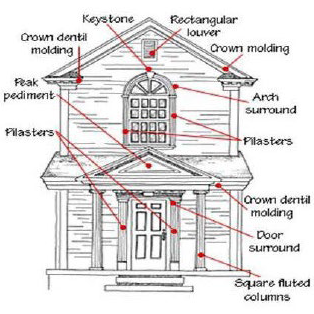
Common Examples of Detailing
(Ord. No. 25-01-02, § 1, 1-2-2025)
17.100.354 - Required elements.
Single-family, two-family, multifamily, and townhouses must include at least one (1) of the following elements:
A.
Either:
1.
Side, rear, or alley-loaded garage, or detached garage; or
2.
Front-loading garage comprising no more than twenty (20) percent of the total width of the front façade and pushed back no less than six (6) feet from the widest front wall;
B.
A functional front porch at least one hundred (100) square feet in size.
C.
At least three (3) elements per house from one (1) of the McDonough, Georgia Residential Styles listed in Section 17.200.345(B).
D.
One (1) of the following green building certifications:
1.
National association of Homebuilders National Green Building Programs: ANSI ICC 700-2008 National Green Building Standard, Bronze, Silver, or Gold; or
2.
U.S. Green Building Council Leadership in Energy and Environmental Design (LEED): Certified, Silver, Gold, or Platinum.
(Ord. No. 25-01-02, § 1, 1-2-2025)
17.100.355 - Architectural portfolio.
The portfolio shall contain the follow:
A.
Architectural plans. The following shall be included for each house type utilized in the proposed development:
1.
Exterior façade drawings for all sides of a structure with basic dimensions to scale.
2.
A basic floor plan with dimensions and the various spaces identified.
3.
A landscape plan for each house type utilized in the development. The landscape plan shall include a list of trees and shrubs utilized for each house type in the development. The planting list shall be different for each house and cannot be repeated for adjacent houses.
4.
The overall design of each house should reflect the elements of one (1) the housing styles found in the next section, the architectural styles found in the residences of McDonough, GA.
5.
Other architectural styles may be used if approved by the director.
B.
Residential architectural styles of McDonough, GA.
1.
Georgian. A Georgian style house is a symmetrical, rectangular form with a central entrance and symmetrically placed windows to either side. Bold and big features such as heavy columns and pediments based on classical details are characteristic.
Emphasis is placed on the entrance with a transom and decorative crown supported by pilasters or columns surrounding the door. Windows are double-hung, typically with many small panes, often nine-over-nine. The classical cornice is emphasized with a row of lentils or other decorative molding. The roof may be either tall and hipped or side-gabled.
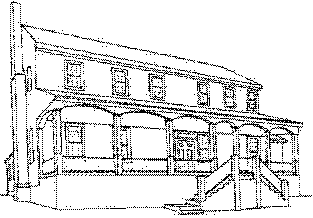
2.
Early classical revival. The most prominent identifying feature of the early classical revival style is a full height entrance portico of columns supporting a triangular pediment. This robust and heavy portico is taken directly from the ancient Roman temple form. The same symmetrical, rectangular house form is still used, and the central entrance has windows symmetrically placed to either side. The cornice is usually decorated with dentils or modillions. The entrance is emphasized with a semi-circular or elliptical fanlight, sidelights, and pilasters. While the early classical revival may have features similar to the federal style, such as an elliptical fanlight or delicately detailed interior mantels, the early classical revival has a more direct association with Roman architecture and, as a result, more correct Roman details and heavier proportions. Sometimes the Roman temple form was simply added onto the front of an otherwise plain farmhouse.
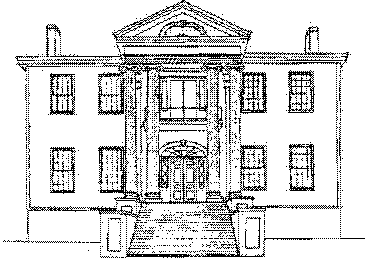
3.
Gothic revival. Gothic revival houses typically have steeply pitched gabled roofs with both front- and side-facing gables. Decoratively sawn bargeboards are commonly found along the eaves. Window and door openings often have either pointed arched tops or heavily molded or pointed hoods. Porches are usually supported by slender posts with sawn woodwork forming flattened arches or brackets. Some houses have vertical board-and-batten siding. This style emphasized picturesqueness, verticality, and varied use of materials. To encourage blending with the landscape, gothic revival houses were usually painted with earth tones. The irregular lines and dark colors of this style contrasted with the regular lines and stark whiteness of the Greek Revival.
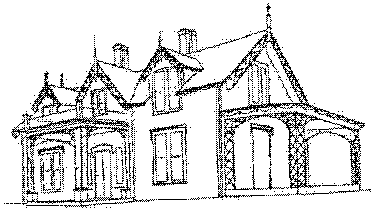
4.
Queen Anne. A Queen Anne style house is asymmetrical with complex roof and wall shapes. It displays a variety of textures, materials, and detailing. Details are generally a combination of medieval and classically inspired features. The asymmetrical shape results from a floor plan that is open and flowing. The roof is often steeply pitched and hipped with both front- and side-facing, or cross, gables. Wall surfaces avoid a smooth appearance through the use of projecting bays and materials such as patterned shingles that provide texture. The porch is usually asymmetrical and often wraps around two (2) sides of the house. It is supported with slender turned posts and often decorated with sawn brackets and spindlework friezes. Roof gables may also be decorated with sawn ornamentation or spindlework and covered with patterned shingles. There are often prominent and elaborate brick chimneys with patterned and corbeled brickwork. A round or multisided tower may be found at a corner. Some Queen Anne houses have more classically inspired details such as porch columns, Palladian windows, and cornices with lentils. Windows are generally one-over-one or may have a multi-paned border around the top sash.
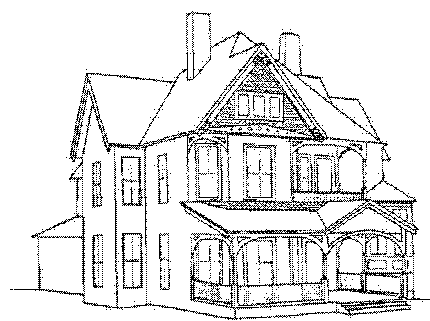
5.
Folk Victorian. The folk Victorian house is basically a house type such as a gabled ell, central hallway, or I-House. Decorative details are added to the porch, in the gables, and around the window and door openings. Details are usually turned or jigsawn woodwork such as brackets, spindlework, porch posts, other bric-a-brac and gingerbread. This elaborately applied ornamentation is sometimes referred to as Eastlake detailing.
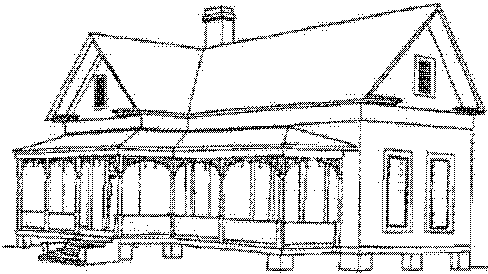
6.
Prairie. A defining characteristic of the prairie style is its emphasis on the horizontal. This developed from the idea that a building should relate to its site, specifically the flat midwestern prairie. A prairie style house is usually two (2) stories with one-story porches and wings. The roof is low-pitched and may be hipped or gabled. Eaves are widely overhanging and open with exposed rafters. Windows may be placed in rows. These features all combine to create a horizontal effect. Porches have massive masonry supports. There is emphasis on expression of structure and materials. The Prairie house as developed by Wright had an open and functional plan that revolved around a central living area and was a move toward the development of the modern house plan. Most Prairie examples in Georgia do not incorporate this interior plan but simply add exterior Prairie style features to an already established house form. Prairie features may also be combined with other stylistic influences, particularly the Craftsman style.
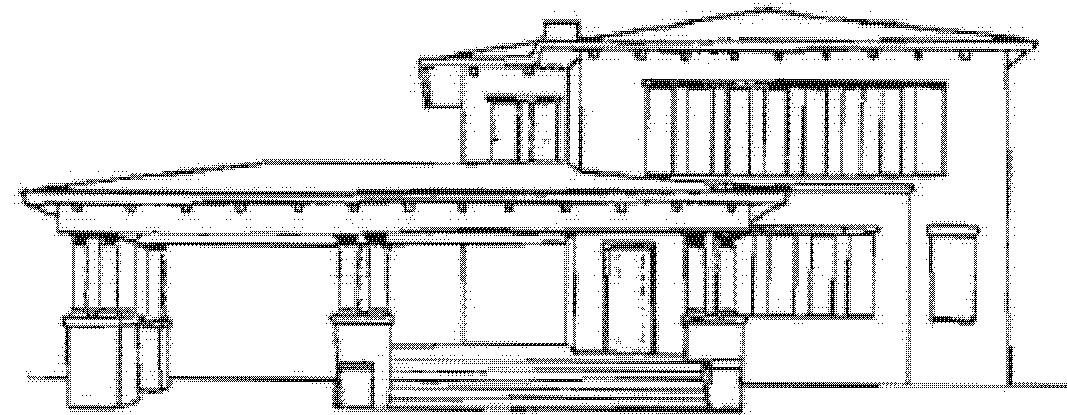
7.
Craftsman. The Craftsman house uses a wide variety of materials both for its structure and decorative detailing. It has a low-pitched roof that is usually gabled but may also be hipped, giving a generally horizontal effect. The widely overhanging eaves are open with exposed rafters. Large gables have decorative brackets or braces at the eaves and may be covered with half-timbering. Roof dormers are sometimes found. Walls are most often wood but may also be covered with shingles or a masonry veneer of stone or brick. Porches have short square columns set on heavy masonry piers extending to the ground. Windows may have a multi-paned sash over a large one-pane sash. Craftsman houses are most often asymmetrical with a generally open and functional plan. The Craftsman style is closely associated with the bungalow house type; however, it was popular as ornamentation for many different house forms.
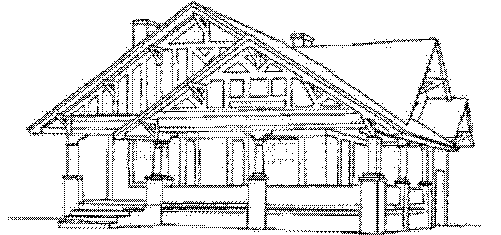
8.
English vernacular revival. Characteristics of English vernacular revival houses are a steeply pitched gabled roof with dominant front-facing gable and decorative half-timbering in the gables. Almost all have masonry walls. Most are masonry-veneered, a recently developed technique for applying a thin layer of masonry to a wall. Some houses have patterned brickwork, while others may be completely stuccoed. Often a variety of materials are used, such as brick walls with stone trim, wood half-timbering, and stuccoed gables. Massive masonry chimneys with decorative tops are common. Windows are generally tall and narrow, grouped together, multipaned, and casements rather than double-hung. Some openings, particularly the entrance may be emphasized by a round arch. Houses of this style are generally asymmetrical.
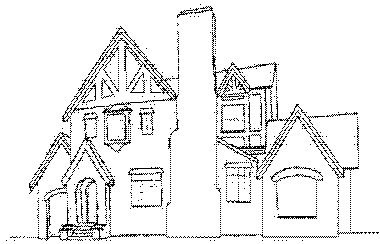
(Ord. No. 25-01-02, § 1, 1-2-2025)
17.100.360 - Standards for lounges and nightclubs (stand alone).
A.
Any "lounge" or "nightclub" requires a special use permit (SUP) per Section 17.90.060 special use permit standards.
B.
The SUP process requires submitting application, two (2) neighborhood meetings with residential groups and neighboring property owners within a half (½) mile of the proposed location, zoning review board, planning commission and the mayor and city council. This process shall take a minimum of three (3) months.
C.
The liquor license is not part of this SUP process and is handled through the City of McDonough's Finance Department, Occupational Tax Division.
D.
A site plan including buildings, marked parking areas, landscaped area and trees, driveways and adjacent rights-of-way.
E.
A traffic and parking management plan (including signage).
F.
A description of the operational/business plan (including security).
G.
A pedestrian queuing plan (including barriers and signage).
H.
A maintenance plan (including regular trash/debris receptacles and clean-up).
I.
A sound and light mitigation plan.
(Ord. No. 25-01-02, § 1, 1-2-2025)
17.100.370 - Standards for tattoo, piercing, and body art studios.
A.
Purpose. The purpose of this ordinance [title] is to acknowledge and define the various forms of tattooing and body art; to establish regulations and requirements pertaining to tattooing and body art within the City of McDonough; to provide for penalties for violation of this article; to provide for an effective date; to provide for the repeal of conflicting ordinances; and for other purposes.
These body art studio and body artist rules and regulations are adopted for the purpose of establishing reasonable standards for individuals performing body art procedures and the facilities from which they are provided, with the intent to promote the health and safety of all individuals performing and receiving body art services within the city limits.
B.
Definitions. As used in this chapter, the term:
Board of health means the Henry County Board of Health or its duly authorized representatives.
Body art means a tattoo or piercing placed on the body of a person for aesthetic or cosmetic purposes. Body art does not include practices that are considered medical procedures by the Georgia State Medical Board, which shall not be performed in a body art studio. Body art does not include the painting of the skin with tempura or temporary, non-indelible inks, paints, or dyes. Body art does not include piercing of the outer perimeter or lobe of the ear with pre-sterilized, single-use stud and clasp ear piercing systems.
Body art studio means any facility or building on a fixed foundation wherein a body artist performs body art. Body art studio permit means the authorization granted by the board of health to the owner to operate a body art studio. Such permit is the property of the Fayette County Board of Health.
Body artist means any person who performs body art. Such term shall not include in its meaning any physician or osteopath licenses by the State of Georgia, not shall it include any technician acting under the direct supervision of such licensed physician or osteopath, pursuant to this code.
Body piercing means puncturing or penetration of the skin or mucosa of a person with any sharp instrument and/or the insertion of jewelry or other adornment thereto in the opening.
Cosmetic tattooing means to mark or color the skin by pricking in, piercing, or implanting indelible pigments or dyes under the skin or mucosa. Cosmetic tattooing shall include permanent cosmetics, micro-pigmentation, permanent color technology, and micro-pigment implantation.
Microblading of the eyebrow means a form of cosmetic tattoo artistry where ink is deposited superficially in the upper three (3) layers of the epidermis using a handheld or machine powers tool made up of needles known as a microblade to improve or create eyebrow definition, to cover gaps of lost or missing hair, to extend the natural eyebrow pattern, or to create a full construction if the eyebrows have little to no hair.
Owner means the person, partnership, corporation, association, or any other form of business organization that owns, maintains, or controls a body art studio and who is responsible for the operation of the studio.
Tattoo means to mark or color the skin by pricking in, piercing, or implanting indelible pigments or dyes under the skin. Such term includes cosmetic tattooing and microblading of the eyebrow.
C.
Regulation. Within the city limits of McDonough, body art shall be performed only by a physician duly licensed to practice medicine within the State of Georgia. This provision shall not apply to microblading of the eyebrow as long as this service is performed by a cosmetologist duly licensed to practice cosmetology within the State of Georgia, and in accordance with the provisions herein.
D.
Operating requirements; permit required.
1.
No body artist or cosmetologist performing microblading of the eyebrow shall operate within the corporate limits of the city outside of an approved body art or cosmetology studio.
2.
No body art studio or cosmetology studio offering microblading of the eyebrow shall commence operation within the corporate limits of the city or obtain an occupational tax certificate from the city without first obtaining a body art studio permit from the board of health pursuant to state law (O.C.G.A. §§ 16-5-71, 16-12-5, 31-3-4, and O.C.G.A. tit. 31, chs. 5 and 40) and in accordance with the most recent rules and regulations, as adopted and amended, by the board of health.
3.
No owner shall allow a body art studio or cosmetology studio offering microblading of the eyebrow to remain in operation if the board of health suspends or revokes said permit, until said permit has been reissued.
4.
No body artist shall operate within the corporate limits of the city outside of an approved body art studio.
5.
No body art studio shall commence operation within the corporate limits of the city or obtain an occupational tax certificate from the city without first obtaining a body art studio permit from the board of health pursuant to state law (O.C.G.A. §§ 16-571, 16-12-5, 31-3-4, and O.C.G.A. tit. 31, chs. 5 and 40) and in accordance with the most recent rules and regulations, as adopted and amended, by the board of health.
6.
No owner shall allow a body art studio to remain in operation if the board of health suspends or revokes said permit, until said permit has been reissued.
E.
Violations. It shall be unlawful for any person to violate this article. Any person who violates this article may be tried before the municipal court of the City of McDonough and punished to the extent provided by the city's Charter.
F.
Enforcement. The responsibility for the issuance and revocation of body art studio permits and overall enforcement shall be vested in with the county health department. The provisions of this chapter may also be enforced by the city's police department and/or code enforcement staff.
(Ord. No. 25-01-02, § 1, 1-2-2025)
17.100.380 - Self-storage multi-story.
A.
Self-storage multi-story facilities shall meet the following standards:
1.
Self-storage multi-story/class "a" facilities and self-storage mini-warehouses shall be separated by a radius of two (2) miles.
2.
All self-storage multi-story facilities shall be climate controlled and provide access through the interior of the building.
3.
Any fencing adjacent to a public street shall be a six-foot wrought iron or metal fencing with an additional center horizontal member at three (3) feet that prevents the pickets from being spread apart.
4.
A multi-story building shall be designed to mirror a class "A" commercial office space.
(Ord. No. 25-01-02, § 1, 1-2-2025)

