
Mcgregor City Zoning Code
ARTICLE 7
- ADMINISTRATION
Sec. 7.1. - Administration of the ordinance.
1.
Administrator. The building official of the City of McGregor shall be the person designated to administer and enforce this ordinance except that the City Manager or his designee shall be the person to administer special permits under this ordinance.
2.
Zoning Administration Rules. The building official shall adopt rules indicating the procedures to be followed in the administration of this ordinance including rules specifying the application forms required by this part.
3.
Zoning Administration Records. The building official shall maintain records in which he shall record all permits and certificates issued by him and all enforcement actions taken by him in the administration of this ordinance. All applications for building permits shall be accompanied by three (3) sets of plans, drawn to scale, showing the actual dimensions of the lot to be built upon, the size of the building to be erected, the use of the property, and such other information as may be necessary to provide for the enforcement of these regulations. A careful record of such applications and plats shall be kept in the office of the building official. A record of all certificates of occupancy shall be kept on file in the office of the building official, and copies shall be furnished on request to any person having a proprietary or tenancy interest in the building affected.
4.
Building Permits. No building shall be erected, constructed, moved, or structurally altered until an application has been made for a building permit and a building permit has been issued by the building official. No building permit shall be issued by the building official except in compliance with the provisions of this ordinance. Building permits in planned developments shall be issued under the provisions of this ordinance.
5.
Certificate of Occupancy for Buildings. No buildings hereafter erected, constructed, or structurally altered shall be used or occupied until a certificate of occupancy has been issued by the building official stating that the building or proposed use of a building or premises complies with the building code and the provisions of this ordinance. An application for a certificate of occupancy shall be made concurrent with an application for a building permit. The building official shall issue a certificate of occupancy within ten (10) days after the construction or structural alteration of a building if he determines that the building and any site development requirements have been completed in compliance with the provisions of this ordinance and that the building official has been notified that the building has been completed. Certificates of occupancy in planned developments shall be issued in accordance with the provisions of this ordinance.
6.
Excavation Permit. No permit for the excavation for any building shall be issued until an application has been made for a certificate of occupancy.
7.
Certificate of Occupancy for Change in Use. No building or premises shall be changed in use until a certificate of occupancy has been issued by the building official stating that the proposed use of the building or premises complies with the building code and the provisions of this ordinance. For purposes of this section, a "change in use" includes a change in occupancy or type of business.
8.
Inspection. The building official may inspect or cause to be inspected any building on any premises on which work is in progress and to order in writing that the owner shall correct any violation of this ordinance found to exist. After the building official has served an order for correction, no work shall proceed on any building covered by such an order except to correct such violation.
9.
Injunction. The city attorney may bring an action for an injunction to enjoin any violation of this ordinance.
10.
Authority of City Council. The City Council of the City of McGregor, may, from time to time, amend, supplement, or change by ordinance the boundaries of the zoning districts herein established or the regulations herein contained.
Sec. 7.2. - Planning and zoning commission.
A.
Composition of the Planning and Zoning Commission. The Council in accordance with Section 10.1 of the City Charter shall appoint a zoning commission to be known as the "McGregor Planning and Zoning Commission" consisting of five (5) members and two (2) alternate members. The Commission shall elect a chairman and vice chairman from among its membership and shall meet once each month or as requested by the City Council. All meetings of the Commission shall be open to the public. A majority of the members shall constitute a quorum. The Commission shall keep minutes of its proceedings which shall be of public record. The Commission shall serve without compensation.
B.
Terms of Office.
1.
Each candidate for an appointment as a member of the Planning and Zoning Commission shall meet the following requirements:
a.
Shall reside within the City and be a registered voter of the city;
b.
Reserved;
c.
Shall not be in arrears in the payment of any taxes or other liabilities due the City. "In arrears" is defined herein to mean that payment has not been received within ninety (90) days from due date.
d.
In addition to any other qualifications prescribed by law, each member of the Planning and Zoning Commission shall continue to meet the above conditions while in office.
2.
All members will be appointed by a majority vote of the City Council. Members may be removed by a majority vote of the members of the City Council, for cause on a written charge after a public hearing. Commission members may be appointed to succeed themselves.
3.
The members shall serve for a period of two (2) years and until their successors are duly appointed and qualified. Two (2) members and the first alternate member shall be appointed in odd numbered fiscal years and three (3) members and the second alternate member shall be appointed in even numbered fiscal years.
4.
Vacancies shall be filled by an alternate member for the unexpired term of a member whose term becomes vacant. Vacancies of an alternate member shall be filled by appointment of the City Council by majority vote. Any member absent for three (3) regular consecutive meetings shall be deemed to have vacated such office unless such absences were:
a.
due to sickness of the member or the member's family
b.
with leave being first obtained from the Chairman.
C.
Powers and Duties. The Planning and Zoning Commission is hereby authorized to:
1.
Recommend to the city council approval or disapproval of proposed changes in this Ordinance and the zoning map;
2.
Formulate and recommend to the City Council for its adoption a city master plan for the orderly growth and development of the city and its environs and from time-to-time recommend such changes in the plan as it finds will facilitate the movement of people and goods, and the health, recreation, safety, and general welfare of the citizens of the city.
3.
Formulate a zoning plan as may be deemed best to carry out the goals of the city master plan; hold public hearings and make recommendations to the City Council relating to the creation, amendment, and implementation of zoning regulations and districts as provided in Chapter 211 of the Texas Local Government Code, as amended, authorizing cities to pass regulations; all powers granted under said Act are specifically adopted and made a part hereof.
4.
Recommend to the City Council approval or disapproval of plans, plats or replats. The final approval or disapproval of plans, plats or replats shall be made by the City Council. Exercise all other powers of a commission as to approval or disapproval of plans, plats or replats set out in Chapter 212 of the Texas Local Government Code.
5.
Study and recommend on the location, extension and planning of public rights-of-way, parks or other public places, and on the vacating or closing of same.
6.
Study and recommend on the general design and location of public buildings, bridges, viaducts, street fixtures and other structures and appurtenances. Study and recommend on the design or alteration and on the location or relocation of works of art which are, or may become, the property of the city.
7.
Initiate, in the name of the city, for consideration at public hearing all proposals: (a) for the opening, vacating or closing of public rights-of-way, parks or other public places; (b) for the change of zoning district boundaries on an area-wide basis. No fee shall be required for the filing of any such proposal in the name of the city.
8.
Formulate and recommend to the City Council for its adoption policies and regulations consistent with the adopted city plan governing the location and/or operation of utilities, public facilities, and services owned or under the control of the city.
9.
Recommend to the City Council approval or disapproval of special use permit requests.
D.
Public Hearings. The Planning and Zoning Commission is authorized to conduct public hearings jointly with the City Council or separately as a Commission as deemed necessary.
(Ord. No. O-3-18, § 1(Exh. A), 3-12-2018; Ord. No. O-13-18, § 2—6, 10-8-2018)
Sec. 7.3. - Zoning board of adjustment.
A.
Composition of the Zoning Board of Adjustment. There is hereby created a Zoning Board of Adjustment to be composed of five (5) members and two (2) alternate members who shall be residents and qualified voters of the City of McGregor and shall serve without compensation.
B.
Terms of Office.
1.
All members will be appointed by a majority vote of the City Council. Members may be removed by a majority vote of the members of the City Council, for cause on a written charge after a public hearing. Board members may be appointed to succeed themselves.
2.
The members shall serve for a period of two (2) years and until their successors are duly appointed and qualified. Two (2) members and the first alternate member shall be appointed in odd numbered fiscal years and three (3) members and the second alternate member shall be appointed in even numbered fiscal years.
3.
Vacancies shall be filled by an alternate member for the unexpired term of a member whose term becomes vacant. Vacancies of an alternate member shall be filled by appointment of the City Council by majority vote. Any member absent for three (3) regular consecutive meetings shall be deemed to have vacated such office unless such absences were:
a.
due to sickness of the member or the member's family
b.
with leave being first obtained from the Chairman.
4.
Meetings of the Board shall be held at the call of the Chairman and at such other times as the Board may determine. All meetings of the Board shall be open to the public. Four (4) members of the Board shall constitute a quorum for the conduct of business. All cases to be heard by the Board of Adjustment will always be heard by a minimum number of four (4) members.
C.
Authority of Board. The Board of Adjustment shall have the authority, subject to the standards established in Section 211.009 of the Texas Local Government Code, as amended, and those established herein, to exercise the following powers and perform the following duties:
1.
Hear and decide an appeal that alleges error in an order, requirement, decision, or determination made by an administrative official in the enforcement of this ordinance; and
2.
Hear and decide variances to the terms of this ordinance when it requires the Board to do so; and
3.
Inquire into, on its own motion or upon cause presented by interested persons, the abatement, vacation, demolition, removal, expansion, extension, resumption, repair, reconstruction, of, other action permitted by Section 3.1, of a nonconformity.
4.
Authorize in specific cases a variance from the terms of this ordinance if the variance is not contrary to the public interest and, due to special conditions, a literal enforcement of the ordinance would result in unnecessary hardship, and so that the spirit of this ordinance is observed and substantial justice is done.
5.
In exercising its authority under "1" above, the Board may reverse or affirm, in whole or in part, or modify the administrative official's order, requirement, decision, or determination from which an appeal is taken and make the correct order, requirement, decision, or determination, and for that purpose the Board has the same authority as the administrative official.
The concurring vote of four (4) members of the Board is necessary to:
1.
Reverse an order, requirement, decision, or determination of an administrative official;
2.
Decide in favor of an applicant on a matter on which the Board is required to pass under a zoning ordinance; or
3.
Authorize a variance from the terms of this ordinance.
D.
Limitations on Authority of Board.
1.
The Board may not grant a variance authorizing a use other than those permitted in the district for which the variance is sought.
2.
The Board shall have no power to grant or modify specific use permits.
3.
The Board shall have no power to grant a zoning amendment. In the event that a request for a zoning amendment is pending before the Planning and Zoning Commission or the City Council, the Board shall neither hear nor grant any variances with respect to the subject property until final disposition of the zoning amendment.
4.
The Board shall not grant a variance for any parcel of property or portion thereof upon which a Site Plan, Preliminary Plat, or Final Plat, where required, has not been finally acted upon by both the Planning and Zoning Commission and, where required, by the City Council. All administrative remedies available to the applicant shall have been exhausted prior to a hearing by the Zoning Board of Adjustment.
E.
Variances.
1.
In order to grant a variance from these zoning regulations, the Board of Adjustment must make written findings that the variance creates undue hardship, using the following criteria:
a.
That literal enforcement of the controls will create an unnecessary hardship or practical difficulty in the development of the affected property;
b.
That the situation causing the hardship or difficulty is neither self-imposed nor generally affecting all or most properties in the same zoning district;
c.
That the relief sought will not injure the permitted use of adjacent conforming property; and
d.
That the granting of a variance will be in harmony with the spirit and purpose of these regulations.
2.
A variance shall not be granted to relieve a self-created or personal hardship, nor shall it be based solely on economic gain or loss, nor shall it permit any person a privilege in developing a parcel of land not permitted by this Ordinance to other parcels of land in the particular zoning district. No variance may be granted which results in undue hardship on another parcel of land.
3.
The applicant bears the burden of proof in establishing the facts justifying a variance.
F.
Procedures.
1.
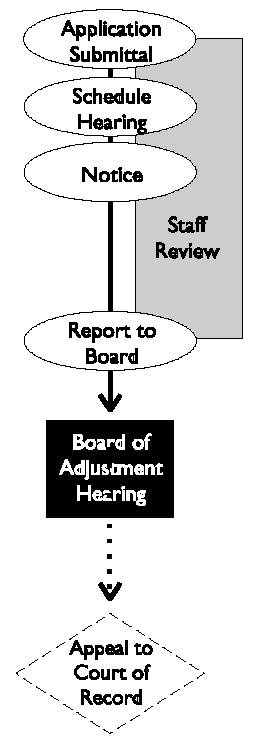
Application and Fee. An application for granting a variance by the Board of Adjustment, other than an appeal, shall be in writing using forms provided by the City and shall be accompanied by a fee.
2.
Notice and Hearing. The Board of Adjustment shall hold a public hearing no later than 45 days after the date the application for action or an appeal from a zoning administration decision is filed on each such application or appeal. Notice of a public hearing shall be provided to all property owners within two hundred (200) feet of the affected property ten (10) days prior to the public hearing and also published in the official local newspaper.
G.
Appeals.
1.
An appeal may be taken from the decision of an administrative official by an applicant for the permit on which the decision is rendered, by any person or persons directly aggrieved by the decision or by any officer, department, board or bureau of the municipality affected by the decision.
2.
The appellant must file with the Board and the official against whom the appeal is taken a written notice of appeal specifying the grounds for the appeal within fifteen (15) days after the decision has been rendered. The official against whom the appeal is taken shall immediately forthwith transmit to the Board all papers constituting the record of the action that is appealed.
3.
An appeal stays all proceedings in furtherance of the action that is appealed unless the official from whom the appeal is taken certifies in writing to the Board facts supporting the official's opinion that a stay would cause imminent peril to life or property. In that case, the proceedings may be stayed only by a restraining order granted by the Board or a court of record on application, after notice to the official, if due cause is shown.
4.
The Board shall set a reasonable time for the appeal hearing and shall give public notice of the hearing and due notice to the parties in interest. The appellant party may appear at the appeal hearing in person or by agent or attorney.
H.
Judicial Review. Any person or persons, jointly or severally, aggrieved by a decision of the Board of Adjustment, or any taxpayer, or any officer, department, or Board of the City may present to a court of record a petition, duly verified, setting forth that such decision of the Board is illegal, in whole or in part, and specifying the grounds of the illegality. Such petition must be presented within ten (10) days after the date the decision is filed in the Board's office.
(Ord. No. O-14-18, § 2—6, 10-8-2018)
Sec. 7.4. - Appeals.
1.
The Zoning Board of Adjustment shall hear and decide appeals where it is alleged there is error in any order, requirement, decision, or determination made by the building official in the administration and enforcement of this ordinance.
2.
Appeals to the Zoning Board of Adjustment may be taken by any person aggrieved, or any officer, department, board, or bureau of the City of McGregor affected by any order, requirement, decision, or determination made under this ordinance by the building official. An appeal may be taken within the time provided by the rules of the Board of Adjustment, by filing with the building official and with the Board of Adjustment a notice of appeal specifying the grounds on which the appeal is taken. The building official shall transmit to the Board of Adjustment all papers constituting the record upon which the action appealed was taken.
3.
An appeal shall stay all proceedings in furtherance of the action appealed from unless the building official certifies to the Board of Adjustment after the notice of appeal is filed with him that, by reason of the facts stated in the certificate, a stay would, in his opinion, cause imminent peril to life or property. In such case, the proceedings shall not be stayed except by a restraining order for due cause shown, granted by the Board of Adjustment or by court of record after an application has been made to the court for a stay and notice of the application has been given to the building official.
4.
The Board of Adjustment shall hold a public hearing on the appeal. Notice shall be given as prescribed in Section 7.3F.
5.
The Board of Adjustment shall act on the appeal within forty-five (45) days following the public hearing. The board may reverse or affirm, wholly or partly, or may modify the order, requirement, decision, or determination from which an appeal, decision, or determination as ought to be made. The board shall notify the appellant of its decision by mail.
Sec. 7.5. - Variances and nonconforming uses.
1.
Variances Not Authorized. The Board of Adjustment may not grant variances from the following regulations in this ordinance:
a.
The provisions in the zoning district regulations specifying the square footage required for lots or a minimum lot size; and
b.
A driveway location which has been identified as hazardous in the plan review process; and
c.
The sign regulations, except as provided for under Article 6, and
2.
Variances Authorized. The Board of Adjustment may grant variances only with signed approval of the planning director from any provision of this ordinance, other than the provisions specified in this ordinance, if it finds:
a.
That the application of this ordinance to the lot or building would create practical difficulties because the lot is exceptionally irregular, narrow, shallow, or steep, or because the lot or building is subject to the exceptional physical conditions unique to it and not applicable to other lots or buildings in the same zoning district; or
b.
That the application of this ordinance to the lot or building would result in unnecessary hardship not applicable to other property in the same zoning district that deprives the owner of the reasonable use of the land or building; and
c.
That the practical difficulties or unnecessary hardship were not created by the applicant for the variance; and
d.
That the variance is the minimum necessary to prevent a practical difficulty or an unnecessary hardship; and
e.
That the variance will not impair an adequate supply of light and air to adjacent property, substantially increase congestion in the pubic streets, increase the danger of fire, endanger the public safety, or substantially diminish or impair property values within the neighborhood; and
f.
That the variance will be in harmony with the general purposes and intent of this ordinance.
3.
Nonconforming Uses. The Board of Adjustment may make the following orders concerning nonconforming use:
a.
Permit the reconstruction of a building occupied by a nonconforming use if such reconstruction does not prevent the return of such building to a conforming use; or
b.
Permit the extension or enlargement of a building occupied by a nonconforming use, under such conditions as the Board of Adjustment finds necessary to protect other property in the neighborhood. The board must find that such extension or enlargement:
(1)
Does not prevent the return of such building to a conforming use; and
(2)
Does not exceed fifty (50) per cent of the ground area of the existing building; and
(3)
Will not prevent compliance with applicable side yard requirements; or
c.
Require the discontinuance of a nonconforming use under a plan filed by the applicant and approved by the Board of Adjustment which provides for the amortization of the full value of the building within a reasonable number of years, taking into consideration the general character of the neighborhood and the necessity for all property to conform to the regulations of this ordinance; or
d.
Permit a nonconforming use to be changed to another nonconforming use, provided:
(1)
The proposed use will be more compatible with the surrounding neighborhood and less intrusive than the existing nonconforming use.
(2)
The proposed use will not prevent the return of the building or property to a conforming use.
(3)
If the change to the proposed use is granted, the property may not be returned to the former nonconforming use.
4.
Conditions. The Board of Adjustment may adopt any conditions it considers necessary when it grants a variance or issues an order concerning a nonconforming use.
5.
Applications.
a.
Any person requesting a variance or an order concerning a nonconforming use shall file an application with the Board of Adjustment on forms prescribed by the board by rule. The application shall state the reasons why the applicant requests a variance of an order concerning a nonconforming use. A copy of the application shall be made available by the board for public inspection at least twenty (20) days prior to the public hearing on the application.
b.
The application shall contain a development plan, including maps and drawings, sufficiently dimensioned to illustrate the following:
(1)
Existing and proposed locations and arrangement of uses on the site, and on abutting sites within fifty (50) feet and any other information needed to describe or identify the proposed development; and
(2)
Existing and proposed site improvements; building elevations for buildings on the site; off site improvements, utilities, facilities, and drainage systems; street features; and trees. Building elevations shall indicate the general height, bulk, scale and architectural character of buildings; and
(3)
Existing and proposed topography, grading, landscaping, exterior lighting, screening, irrigation facilities, and erosion control measures; and
(4)
When access to a public water or sanitary sewer line is available at the site, details of proposed connections if the water line is greater than one inch or if the sewer line is greater than four (4) inches; and
(5)
Existing and proposed parking, loading, and traffic and pedestrian circulation features on the site.
c.
The Building Official may waive the development plan requirement or may waive the inclusion of some of the required elements of the development plan if it is found that a development plan or the omitted elements of the development plan are not necessary for the variance of the order concerning a nonconforming use that is proposed by the application.
6.
Report of Building Official. The Building Official shall review and prepare a report on the application. The report shall be filed with the Board of Adjustment and shall be available to the applicant and the public at least five (5) days prior to the public hearing.
7.
Notice and public hearing. The Board of Adjustment shall hold a hearing on each application. Notice shall be given as prescribed in Section 7.3F.
8.
Decision by the Board of Adjustment.
a.
The Board of Adjustment shall act on the application not more than forty-five (45) days following the close of the public hearing.
b.
The board may approve the application, may approve the application in modified form, or subject to conditions, or may deny the application.
c.
The board's decision shall include affirmative findings fact on the criteria for variances prescribed by Section 7.5 or on the criteria for orders concerning nonconforming uses prescribed by Section 7.5. The findings of fact shall also indicate why the board agrees or disagrees, either wholly or in part, with the reasons for the variances or order concerning a nonconforming use contained in the application.
d.
A board decision approving a variance or an order concerning a nonconforming use shall include the development plan if one is contained in the application, either as submitted by the applicant or as modified by the board.
e.
The applicant shall file the variance decision on the deed record for which the variance was authorized.
9.
Appeal of Board Decision. Appeals from the decision of the Board of Adjustment shall be as prescribed in this ordinance.
(Ord. No. 28-10, § 2, 10-11-2010; Ord. No. O-3-18, § 1(Exh. A), 3-12-2018)
Sec. 7.6. - Development plan review.
1.
Purpose. Development plan review is intended to promote a standard of development in the city which will contribute to the long term maintenance of economic vitality, protection of public and private investment in land and structures, and desirable working and living environment for residents of the city. Development plan review for compliance with site development standards is required for those uses which, because of type or intensity of use, location within major transportation corridors, or density of development, have a potential impact on adjacent uses, public facilities, or environmental conditions.
2.
When Required. Any person who applies for a Specific Use Permit or a building permit or certificate of occupancy for a building other than a single family dwelling shall include a development plan which meets the requirements of this section, unless the building official waives the development plan requirement based on the criteria set out in this section.
3.
Contents of the Development Plan.
a.
The development plan shall include maps and drawings sufficiently dimensioned to illustrate the following:
(1)
Existing and proposed locations and arrangements of uses on the site and on abutting sites within fifty (50) feet and any other information necessary to describe or identify the proposed development; and
(2)
Existing and proposed site improvements; building elevations for buildings on the site; off site improvements, utilities, facilities, and drainage Systems; location of all aboveground and below ground accessory structures; street features; and trees. Building elevations shall indicate the general height, bulk, scale, and architectural character of buildings; and
(3)
Existing and proposed topography, watercourses, grading, landscaping, exterior lighting, screening, irrigation facilities, and erosion control measures; and
(4)
When access to a public water or sanitary sewer line is available at the site, details of proposed connections if the waterline is greater than one (1) inch or if the sewer line is greater than four (4) inches; and
(5)
Existing and proposed parking, loading, and traffic and pedestrian circulation features on the site; and
(6)
Where applicable, the location of the 100 year flood plain and the escarpment zone; and
(7)
The approximate site and location of proposed signs, if known.
b.
Two (2) sets of the development plans shall also contain floor plans. The third set of development plans shall contain one complete set of detailed construction plans for review by the building official to determine compliance with the relevant building codes.
c.
If a developer makes application to the zoning Board of Adjustment for a variance or any other relief or decision, the application to such board shall include a development plan as required by this ordinance.
d.
Where an applicant wishes to obtain preliminary site plan approval prior to application for a building permit or certificate of occupancy, the submittal may exclude some requirements however, this requirement must be met prior to final approval of development plans and the issuing of a building permit or certificate of occupancy. Preliminary plan approval shall be considered binding if final plans are in complete conformity.
4.
General Development Plan Review Standards.
a.
Significant features of a site such as mature or native tree cover, topographic variations with ridges, slopes and ravines, water features, and geologic and soil characteristics provide potential assets for development of high quality. Changes in such natural features may also have an impact on adjacent properties or an even wider area. Protection of the significant natural features of a site should, therefore, be considered at each stage of the development process.
b.
The relationship of the proposed development to existing and potential adjacent uses should also be considered. Proposed development should be designed and oriented to avoid intrusive or adverse impacts on adjacent existing uses with mitigating measures, where necessary. Proposed development should also be coordinated with future development in the vicinity where necessary to ensure that adequate public facilities and desirable relationships between adjoining uses can be provided.
5.
Specific Development Plan Review Standards.
a.
Grading and Drainage.
(1)
The existing basic topographic pattern on a site including the overall rise or fall and direction of slope shall be maintained except where modification is necessary to improve a buildable area, or where the modification will contribute to a specific aesthetic enhancement.
(2)
Proposed grade changes shall be clearly identified, and any slope greater than 3:1 measure shall require geotechnical evaluation to insure the stability of such slopes.
(3)
Retaining walls and other structural elements, if required, shall be designed by a registered professional engineer.
(4)
Direction and volume of storm water drainage on the site shall be designed to minimize adverse effects on surrounding property and avoid ponding on the site and adjacent properties, except as provided for in designated storm water control facilities. The grading and drainage plans shall clearly show the effect of proposed changes on direction and flow of drainage in the vicinity of the site.
b.
Erosion and Sedimentation Control.
(1)
All grading, excavation, or other construction activity involving the moving or removal of earth shall require that appropriate measures be taken during construction to prevent excessive erosion of soil on the site which may result in deposit of sediment in roadways, streams, and drainage channels, sewers, and adjacent property.
(2)
The following procedures shall be followed as required during construction to prevent excessive erosion and sedimentation:
(a)
Temporary vegetation or, where appropriate, mulching or other cover shall be used to protect exposed areas from erosion during development.
(b)
Sediment basins, debris basins, desalting basins, or silt traps shall be installed and maintained to remove sediment from runoff waters from land undergoing development.
(c)
Provisions shall be made on site to effectively detain and release at a controlled rate the increased runoff caused by soil and surface alterations during development.
(3)
Proposed erosion and sedimentation control measures shall be identified on all grading and drainage plans.
c.
Public Improvements.
(1)
Where connection to the public water and sanitary sewer systems requires off-site improvements, such improvements shall be designed by a registered professional engineer. Plans and specifications for all off site improvements submitted with the development plan shall be accompanied by the required bond.
(2)
Where more than two (2) buildings are connected to a sanitary sewer line, a manhole shall be required at such connection.
(3)
All public improvements including streets, utilities, and drainage shall be designed in accordance with the engineering construction standards of the City of McGregor.
d.
Parking, Loading, and Site Access. Design of all parking, loading, and site access facilities (including streets, sidewalks and driveways) shall comply with any parking and access design standards and policies for site development as may be adopted now or in the future by the City of McGregor and with the following additional standards.
(1)
All drive approaches and driveways or parking spaces in required front or side street side yards in any district shall have an impervious surface. Every parking lot and driveway shall be graded for proper drainage and provided with an impervious surface as approved by the city engineer, maintained at all times in such manner as to prevent the release of dust, and shall be kept free of dust, trash, and debris. All new construction, or additions, repairs and remodels that exceed 60% of the taxable value of the structure(s) as shown on the McLennan County tax roll shall be required to meet the full requirements of this ordinance. Driveways, except where designed for one way traffic flow within a parking lot, shall not be less than sixteen (16) feet or more than thirty-six (36) feet in width. The driveway system shall allow for unobstructed emergency access at least sixteen (16) feet in width as close as possible to each structure and shall be clearly marked to prohibit parking or other obstruction of such emergency access.
(2)
All areas from City right of way to parking area must also be covered with an impervious surface.
(3)
Drive lanes and parking space sizes shall be required as shown in the illustration located in Section 5.7. A driveway for access to any non-residential single parking space or to a parking lot shall not measure less than that shown in the parking layout illustration. All drive approach widths shall be no less than fifteen (15) feet wide. All two-way drive lanes shall be a minimum of twenty-four (24) feet in width.
(4)
Parking spaces shall be nine (9) feet wide by eighteen (18) feet deep for all ninety (90) degree parking spaces.
(5)
A required off-street loading space shall be at least twelve (12) feet in width and at least forty-five (45) feet in length exclusive of access drives, aisles, ramps, maneuvering space, columns, and work areas. It shall have a vertical clearance of not less than fifteen (15) feet. Where a use is not required to have a loading space, provisions shall be made for incidental deliveries and refuse pickup and shall not interfere with on site or off site traffic movements.
(a)
All drives and approaches shall provide adequate space and clearances to allow for the maneuvering of trucks on-site. Each site shall provide a designated maneuvering area for trucks.
(b)
No portion of a loading facility may extend into a public right-of-way or into an off-street parking facility elsewhere herein required.
(c)
Areas designated for off-street loading shall be used only for the loading and unloading of passengers, equipment, supplies or merchandise.
(d)
In all districts when screening of loading areas facing a street is required, screening shall be provided not less than six (6) feet in height adjacent to the loading area at the property line. Said screening shall be required along all streets except where such use was in existence at the date of adoption of this ordinance.
(6)
Each required off-street loading space shall be designed with appropriate means of vehicular access to a street or drive in a manner which will least interfere with traffic movements, and no area allocated to any off-street loading spaces shall be used to satisfy the space requirements for any off-street parking facilities.
(7)
All open street loading spaces, access drives, aisles, and maneuvering space shall be improved with a compacted base and a permanent wearing surface as approved by the city engineer.
e.
Site coverage and open space.
(1)
In all NC, GC, CBD, LI, MI, and HI districts the maximum coverage of the site by buildings and paved areas shall not exceed ninety (90) percent of the total lot area.
(2)
In the R-10, R-7.2, R-6, MD, MF and MH districts the maximum coverage of the site by structures and paved areas shall not exceed seventy-five (75) percent of the total lot area. Not less than fifty (50) percent of the total lot area not covered by structures or paved areas shall be usable open space accessible to residents.
(3)
Areas of the lot covered by structures or paved area used solely for recreational purposes may be included as usable open space and not counted as part of the site coverage.
f.
Preservation of Vegetation. Existing mature trees of six (6) inches or greater in diameter or native vegetation (including live oak, Spanish oak, cedar, elm, shin oak, bald cypress, post oak, or black walnut, and small native trees such as Texas madrone, black cherry, Texas mountain, evergreen, sumac, Mexican buckeye, flame leaf sumac, or Texas persimmon) shall be preserved through:
(1)
Avoidance of clear cutting outside necessary construction area.
(2)
Retention of existing vegetation in required yard areas, open space, screening areas, and boundary parking lot landscaping.
g.
Landscaping.
(1)
"Landscaping" Defined. Landscaping shall consist of plant material, including, but not limited to grass, trees, shrubs, flowers, vines, and other ground cover, native plant materials, planters, brick, stone, natural forms, water forms, aggregate or other landscape features, but not including the use of smooth concrete or asphalt; provided however, that the use of brick, stone, aggregate, or other inorganic materials shall not predominate over the use of organic plant material.
(2)
Open Space. All open space on the site shall be permanently landscaped. All cuts and fills shall be restored with appropriate vegetation.
(3)
Boundary Landscaping. In all GC, CBD, LI, MI and HI Districts, boundary landscaping shall be provided along the abutting public rights-of-way (except an alley). Such landscaping shall consist of a combination of ground cover and deciduous and evergreen shrubs and may also include trees; Provided that they will not obstruct sight distances or vehicular or pedestrian circulation. No specific spacing shall be required for boundary landscaping; provided that the landscaping is appropriate to the character of the site and that the landscaped areas are of a size to allow proper maintenance. Parkway may be counted in meeting the minimum landscape requirements except where documented plans propose an action which will involve the eventual utilization of the parkway for such purposes as widening of a street, placement of a sidewalk, or installation of storm drainage. Landscaping within the parkway shall be executed in such a manner as to provide for pedestrian passage.
(4)
Parking Lot Landscaping. For any off-street parking lot containing over ten (10) spaces, or for any combinations of parking areas on a single lot providing more than ten (10) spaces, landscaping shall be required in the ratio of ten (10) square feet of landscaped area for every four hundred (400) square feet of area occupied by such parking facilities. Parkway may be counted in meeting the minimum landscape requirements except where documented plans propose an action which will involve the eventual utilization of the parkway for such purposes as widening of a street, placement of a sidewalk or installation of storm drainage. Landscaping within the parkway shall be executed in such a manner as to provide for pedestrian passage.
The required landscaping may be located within or adjacent to a parking lot and no specific spacing shall be required; provided that the landscaping is appropriate to the character of the site and that the landscaped areas are sufficient in size to allow proper maintenance.
(5)
Maintenance of Landscaping. All landscaping required shall be maintained in a neat and healthy condition, and such maintenance shall be an ongoing obligation of the owner of the property and prompt replacement shall be made of diseased or dead plant material.
h.
Screening.
(1)
Screening is required along all lot lines:
(a)
In an MF district abutting a lot located in a R-10, R-7.2, or MH District.
(b)
In a NC, GC, CBD, LI, MI or HI district abutting any residential district.
i.
Signage. Signs shall be located in accordance with the requirements of Article 6 of this ordinance.
j.
Building Setback and Orientation. In addition to the yard requirements applicable for the district in which a structure is located:
(1)
All buildings shall comply with the setback requirements of the building code.
(2)
Where more than one (1) principal building is located on a lot, the distance between any multiple family residential building(s) and any other buildings on the lot shall be not less than ten (10) feet; provided that such distance shall be increased by one (1) foot for each two (2) feet or fraction thereof by which each building exceeds twenty-five (25) feet in height.
k.
Lighting.
(1)
Street lighting shall be provided in accordance with the City of McGregor lighting policy.
(2)
Where hazards exist which can be minimized or eliminated by lighting, or where use extends into hours of darkness, the lighting of parking areas, walks, and drives may be required in such manner and during such hours as may be deemed necessary in the interest of public safety and security. Such lighting may be attached to a building or freestanding fixture. Free standing fixtures should be kept to the minimum height needed to provide adequate lighting. The height and design of the fixture should be such as to minimize their effect on adjoining properties. Both free standing and attached fixtures and exposed accessories should be harmonious with building design. No fixed spacing of on-site lighting shall be required; provided that illumination is even through parking areas and along walks and drives.
l.
Building Elevations and Materials. The intent of this section is to promote good design. Upgrading of the quality of development through better design and execution of projects is encouraged. Contrasting design, when sensitive to the surrounding environment, is recognized as a valid means of adding interest and vitality to an area. The elevations of buildings designed to be open to view from a public street or right-of-way, kind and texture of the building, and the relationship of building elevations and materials to adjacent building or structures create an architectural character for development, and the following standards are designed to promote quality and compatibility of building design:
(1)
Materials should be selected for suitability to the type of buildings and style in which they are used, and for harmony with adjoining buildings.
(2)
In any building in which the structural frame is exposed to view, the structural materials should also meet the above criteria.
(3)
Building components and appurtenances, including doors, windows, canopies, and trim should maintain a harmonious proportion to each other and to the building as a whole.
(4)
Mechanical equipment on roof, ground, or building should be screened from public view at ground level with materials harmonious with the building, or located so as not to be visible from any public street or residential area.
(5)
Miscellaneous structures and objects, excluding works of art such as outdoor sculpture, adjacent to a building should be compatible with the architectural style of the main buildings in scale, materials, and colors.
(6)
Variation in architectural detail, variations in building massing, or varied siting of individual buildings should be used to provide visual interests where more than one building is located on a single parcel.
m.
Refuse and Trash collection areas shall not be located in front of the main building.
6.
Review of Development Plans. The building official shall distribute the development plan to the city staff. The city staff shall review the development plan to determine whether it complies with the development plan review standards contained in this section. If a city department finds that the development plan does not comply with one or more of these standards, it may recommend an amendment to the development plan that complies with these standards.
7.
Appeal of Development Plan Amendments. An applicant may appeal a development plan amendment to the Board of Adjustment upon completion of the staff development plan review process. The appeal shall be initiated by giving written notice to the planning department stating that the development plan amendment is based on an improper interpretation or application of the development plan on the next regularly scheduled agenda of the Board of Adjustment, assuming that a minimum of three (3) days are allowed for posting notice. The board shall act on the development plan amendment at that meeting.
8.
Board of Adjustment Decision on Appeal. The board shall approve a development plan amendment if it finds that the development plan standards were properly interpreted or applied. The board shall disapprove or modify a development plan amendment if it finds that the development plan standards were improperly interpreted or applied. The board shall adopt its findings in writing.
9.
Approval of Development Plans. The building official shall approve a development plan if:
a.
No amendments have been made by the city departments; or
b.
Amendments have been made by the city departments but said amendments have been disapproved by the Board of Adjustment on appeal; or
c.
Amendments have not been appealed or have been approved by the Board of Adjustment on appeal, and the applicant has revised the development plan to comply with the amendments; or
d.
The amendments have been appealed to and modified by the Board of Adjustment, and the applicant has revised the development plan to comply with the modified amendments.
(Ord. No. O-3-18, § 1(Exh. A), 3-12-2018)
Sec. 7.7. - Notice required for public hearings.
1.
In any public hearing required under this part, notice shall be given as follows:
a.
Notice shall be given by mail to the applicant at least ten (10) days prior to the date of the public hearing.
b.
Notice shall be given by mail to the owner of each site within two hundred (200) feet of the property which is the subject of the application at least ten (10) days prior to the public hearing.
c.
Notice of any public hearing before the city council shall be given by publication of an information notice in a newspaper of general circulation at least sixteen (16) days prior to the date of the public hearing. At the option of the director of planning, notice may be given of any other public hearing.
d.
At the option of the director of planning, notice may be given by mail to the owner of any site more than two hundred (200) feet from the property which is the subject of the application at least ten (10) days prior to the date of the public hearing.
e.
At the option of the director of planning, notice may be given by mail to the community organization having an interest in the application at least ten (10) days prior to the date of the public hearing.
f.
At the option of the director of planning, notice may be given by posting a notice on the property which is the subject of the application at least ten (10) days prior to the date of the public hearing.
Sec. 7.8. - Amendments and specific use permits.
A.
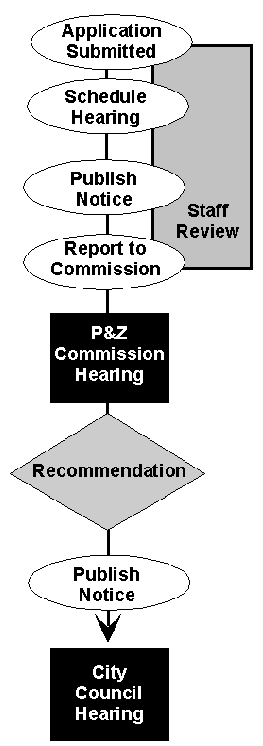
Generally. The regulations, restrictions, and district boundaries created by this ordinance may be amended from time to time or Specific Use Permits granted by the city council, following recommendation of the Planning and Zoning Commission.
B.
Amendment or Specific Use Permit Initiation. An amendment to this ordinance may be initiated by the City Council on its own motion; the Planning and Zoning Commission; or an owner or agent having proprietary interest in any property. An owner or agent must submit an application for a Specific Use Permit to the Commission, on a form provided by the City, which describes and states the reason for the proposed use. The form must be available for public inspection at least 10 day prior to the public hearing.
C.
Procedure. Any amendment to this ordinance or Specific Use Permit shall require public hearings to be held before the planning and zoning commission and the city council. A joint public hearing may be held before the planning and zoning commission and city council, as provided in V.T.C.A., Local Government Code § 211.007.
D.
Specific Use Permit Criteria.
1.
The proposed use is consistent with the Comprehensive Plan and the purpose and intent of this Ordinance; and
2.
The proposed use is compatible with the appropriate and orderly development of the neighborhood in which it is located; and will not adversely affect said neighborhood; and
3.
The proposed use will not be more objectionable to neighboring properties because of traffic congestion, noise, fumes, vibrations or other use characteristics than any other use permitted in the zoning district without the grant of a Special Use Permit; and
4.
The available community facilities and services, including the road system providing access to the proposed use, are adequate for the proposed use; and
5.
The site plan as required by Section 7.6 except that in existing structures the site plan shall include only the items that are relevant to the to the Specific Use Permit.
E.
Notice. When any amendment relates to a change in classification, a Specific Use Permit or the boundary of a zoning district, written notice of all public hearings before the planning and zoning commission and city council on proposed changes and classifications shall be sent to owners of real property lying within 200 feet of the property on which the change in classification is proposed. Such notice will be given not less than ten days before the date set for hearing, to all owners as the ownership appears on the last approved city tax roll. Such notice may be served by depositing the same, properly addressed, postage paid, in the city post office. Notice shall also be posted along with the agenda for all hearings and related meetings in accordance with the applicable laws of the State of Texas.
When an amendment relates to a change of zoning classification or to the text of this ordinance not affecting specific property, notice of the public hearings before the planning and zoning commission and city council shall be given by publication in a newspaper of general circulation in the city without necessity of notifying property owners by mail. The notice shall state the time and place of the hearing and the nature of the subject to be considered, which time shall not be earlier than 15 days from the date of publication.
F.
Protest. In case the planning and zoning commission does not approve the change, or in case of a written protest against such change, filed with the city secretary and signed by the owners of 20 percent or more, either of the area of the lots included in such proposed change, or of those lying within 200 feet of the property on which the change is requested, the amendment shall not be approved except by the favorable vote of three-fourths of all members of the city council.
G.
Frequency of Petition. A property owner, lessee, developer or option holder may petition the city council for an amendment to the text or district map of this ordinance or a Specific Use Permit, provided that before any action shall be taken as provided in the section, the party or parties petitioning for amendment shall deposit with the city secretary the fee amount stipulated by resolution of the city council to cover the approximate cost of this procedure, and under no condition shall said sum or any part thereof be refunded for failure of such proposed amendment to be enacted into law. A party shall not initiate the same action for a zoning amendment or specific use permit affecting the same land more often than once every 12 months.
Sec. 7.9. - Violations and penalties.
A.
Complaints Regarding Violations. Whenever a violation of this ordinance occurs, or is alleged to have occurred, any person may file a written complaint. Such complaint stating fully the causes and basis thereof shall be filed with the administrative official. He shall record properly such complaint, immediately investigate, and take action thereon as provided by this ordinance.
B.
Penalties for Violation. Any person, firm, association of persons, corporation, or other organization who shall violate any provision of this ordinance shall be guilty of a misdemeanor and, upon conviction, shall be fined an amount not to exceed $2,000.00. Each day a violation of this ordinance shall continue shall constitute a separate offense. Nothing herein contained shall prevent the city from taking such other lawful action as is necessary to prevent or remedy any violation.
Sec. 7.10. - Severability.
The sections, paragraphs, sentences, clauses, and phrases of this ordinance are severable, and if any phrase, clause, sentence, paragraph, or section of this ordinance shall be declared by the courts to be unconstitutional or invalid, such decision shall not affect the validity of the remaining phrases, clauses, sentences, paragraphs, or sections of this ordinance, since the same would have been enacted by the City Council without the incorporation in this ordinance of any such unconstitutional or invalid phrase, clause, sentence, paragraph, or section.

