
Mead City Zoning Code
Sec. 16-3-110
Alternative residential development options.
The alternative development options of this Section allow for variety in development standards, while maintaining the overall character of single-family residential developments.
(1)
Flagpole lots may be allowed in all residential zoning districts in accordance with the standards of this Subsection.
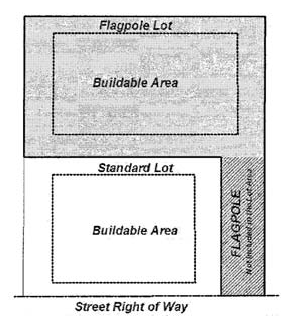
Figure 3.5 Flagpole Lots
a.
Frontage. Each flagpole lot shall have at least twenty (20) feet of street frontage and at least twenty (20) feet of width for the entire length of the flagpole.
b.
Number. A maximum of one (1) flagpole lot is allowed in subdivisions of four lots or less. No more than twenty percent (20%) of the lots within a subdivision containing five (5) or more lots shall be flagpole lots. No more than two (2) flagpole lots may be contiguous.
c.
Lot area calculation. The area of the flagpole may not be counted as part of the lot area.
d.
Driveways. Driveways shall be designed to allow vehicles to drive out forward. Common driveways shall be required when two (2) flagpole lots are contiguous. Driveways shall comply with the "Standard Design Criteria and Construction Requirements." Driveways may not be an easement, but must be deeded property attached to the property, whereby the principal building being accessed is located.
(2)
Attached single-family development shall be allowed in accordance with the use table of this code, subject to the following standards:
a.
Lot width. Attached housing is exempt from the lot width standard of the underlying zoning district, but it is not exempt from minimum lot area requirements.
b.
Setbacks. No interior side setback is required on the attached side of a lot containing an attached house. The street, side and rear setback standards shall apply around the perimeter of an attached housing development.
c.
Number of units. In the RSF-4, and more restrictive districts, no single structure may contain more than eight (8) dwelling units.
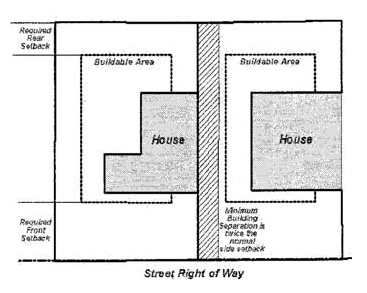
Figure 3.6 Zero Lot Line Development
(3)
Zero lot line. In a zero lot line development, houses are shifted to one (1) side of the lot. This provides for greater usable yard space on each lot. These developments require that planning for all of the house locations be done at the same time. Because the exact location of each house is predetermined, greater flexibility in site development is possible while assuring that the single-family detached character is maintained.
a.
Applicability zero lot line developments are allowed in any residential zoning district. They may be allowed in the AG district if approved as part of a rural cluster development.
b.
Review and approval. Review for compliance with the standards of this Section shall occur during the platting process. Restrictions that assure the minimum distance between houses and any required easements must be recorded on the deeds of the applicable lots. Proof of such recordation must be submitted as part of the building permit application.
c.
Setbacks. The side building setback on one (1) side of the house may be reduced to zero. This reduction does not apply to the street side setback, or to the interior side setback adjacent to lots that are not part of the zero lot line project, development or subdivision.
d.
Additional standards.
1.
Distance between houses. The minimum distance between all buildings in the development must be equal to twice the required side setback required by the underlying zoning district. A deed restriction must be recorded on the deed of each applicable lot to ensure continued compliance with this setback.
2.
Eaves. The eaves on the side of a house with a reduced setback may project a maximum of twenty-four (24) inches over the adjacent property line. In this case, an easement for the eave projection must be recorded on the deed for the lot where the projection occurs.
e.
Maintenance easement. An easement to allow for maintenance or repair is required when the eaves or side wall of a house are within four (4) feet of the adjacent property line. The easement on the adjacent property must provide at least ten (10) feet of unobstructed space between the furthermost projection of the structure and be wide enough to allow five (5) feet between the eaves or side wall and the edge of the easement.
f.
Privacy. If the side wall of the house is on the property line, or within three (3) feet of the property line, windows or other openings that allow for visibility into the side yard of the adjacent lot are not allowed. Windows that do not allow visibility into the side yard of the adjacent lot, such as a clerestory window or a translucent window, are allowed.
(4)
A cluster development is a residential subdivision in which most of the lots are allowed to be smaller (in area and width) than otherwise required for the underlying zoning district, but in which the overall density cannot exceed the maximum density limit for the underlying zoning district. Under the cluster development option, a subdivision can contain no more lots than would otherwise be allowed for a conventional subdivision in the same zoning district, but the individual lots within the development could be smaller than required in a conventional subdivision. Smaller lot sizes within a cluster development are required to be offset by an increase in open space, and the open space is required to be preserved from development in perpetuity through the use of a recorded deed restriction. Cluster developments shall also be allowed in accordance with the Urban and Rural Cluster Bonus provisions of this code.
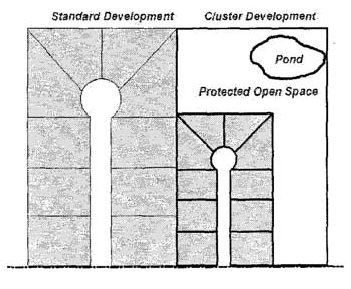
Figure 3.7 Cluster Development
a.
Minimum lot sizes shall be established by the Town of Mead at the time of approval of the cluster development. Minimum lot size requirements shall be based on the Town of Mead Comprehensive Plan, facility adequacy and site-specific conditions.
b.
The lots and building sites must be located to avoid adverse impacts on steep slopes, ridge lines, wetlands and wildlife habitats, wildfire hazard areas, floodplains and, within the Agricultural Planning Area, any prime, or prime and unique agricultural land.
c.
Structures on the clustered lots must comply with the dimensional standards in Table 3-3 (Table of Density and Dimensional Standards) applicable to the zoning district that allows the minimum lot size in the cluster development (e.g., if the clustered development minimum lot size is 4,000 square feet, the setbacks and other dimensional standards for the RMF-14 Zoning District apply).
d.
No direct access to the existing abutting road right of way will be allowed, unless local road in an adopted Transportation Plan.
(Ord. 653 §1, 2009)

