
Mead City Zoning Code
Sec. 16-3-60
Accessory uses.
(a)
Allowed Uses. Permitted uses and approved conditional uses shall be deemed to include accessory uses and activities that are necessarily and customarily associated with, and appropriate, incidental and subordinate to the principal uses allowed in zoning districts. There must be a principal use on a parcel in order to have an accessory use. Accessory uses and activities shall be subject to the same regulations as apply to principal uses in each district, unless otherwise expressly stated.
(b)
Time of Establishment. No accessory use shall be permitted, and no accessory structures shall be allowed on the subject parcel, until after all required permits and approvals for the principal use or activity have been constructed, or unless a temporary permit has been obtained.
(c)
Dimensional and Operational Standards. The standards of this Section shall apply in all districts unless otherwise expressly stated.
(1)
Height. The maximum height of accessory buildings or structures is defined in the density and dimensional standards of this Code.
(2)
Setbacks.
a.
Street setbacks. Accessory structures shall be subject to all street setback requirements of the zoning district in which they are located.
b.
Interior side and rear setbacks. Accessory structures shall be subject to all interior side and rear setback requirements of the zoning district in which they are located.
c.
Easements. Regardless of the above setbacks, accessory structures shall not be located over any recorded easement.
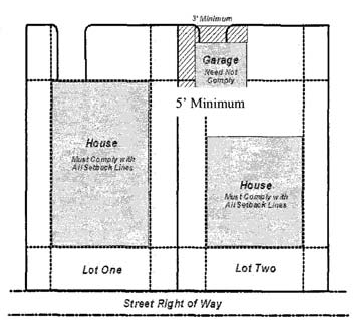
Figure 3.1 Example of Side and Rear Setback for Accessory Uses
(3)
Operation. Accessory structures, buildings and uses shall be constructed, maintained and conducted to avoid production of noise, vibration, concussion, dust, dirt, smoke, odors, noxious gases, fly ash, heat, glare from artificial illumination or from reflection of natural light.
(d)
Animals. Unless otherwise expressly defined or identified as a principal use, the keeping of animals shall be considered an allowed accessory use, subject to the provisions of this Section. (Note: A full discussion of the ordinances of the Town pertaining to the keeping of domestic hoofed livestock is found in the Town of Mead Ordinances 451, 622 and 635)
(1)
Keeping of animals. Household pets inclusive of, but not limited to dogs and cats shall be permitted in all zoning districts allowing for residential use provided that no more than four (4) animals over four (4) months of age are kept by the occupant of any residential unit.
(2)
Lot area requirements for domestic hoofed livestock; number permitted. The minimum lot size for the keeping of domestic hoofed livestock shall be three-quarters (¾) acre. No owner shall keep more than one (1) animal unit of domestic hoofed livestock for each one-third (?) acre of area of the premises. Young animals under four (4) months of age or until weaned may be kept without being counted toward the allowable number of animals. The area in which the livestock is confined shall provide at least one-quarter (¼) acre of irrigated forage for each animal kept therein. The keeping of hoofed livestock on nonirrigated property requires a minimum of one (1) acre of native grass or dryland forage for each animal.
(3)
Lot area requirements for small livestock; number permitted. No owner shall keep more than ten (10) small livestock on the premises regardless of the size of the premises. Young animals under six (6) months of age may be kept without being counted toward the allowable number of animals.
(4)
Minimum area of corrals. Although the entire lot may be fenced, a corral must be provided where domestic hoofed livestock will normally be penned and given supplementary feed. The corral shall be adequate in size for the number of animals involved and shall not exceed twenty-five percent (25%) of the gross lot acreage or one-quarter (¼) acre, whichever size is smaller.
(e)
Caretakers and security guards. Housing for caretakers and security personnel shall specifically be allowed as a conditional use within all Nonresidential zoning districts.
(f)
Home Occupations. It is the intent of this subsection to regulate home occupations so that the average neighborhood resident, under normal circumstances, will not be negatively impacted by and will be minimally aware of their existence. Home occupations shall be a permitted accessory use and shall meet all of the following criteria:
(1)
Home occupations shall be registered with the Town of Mead prior to initiation of a home occupation. Registrant shall complete a Home Occupation Affidavit form describing the nature of the home occupation and certifying that it will comply with all applicable Code standards and limitations. Affidavits shall be filed with the Town of Mead prior to initiation of a home occupation and annually thereafter with the business Sales and Use Tax report. Forms will be available online or with the Town Clerk or Deputy Clerk.
(2)
Home occupations shall be conducted predominately within the principal structure or an accessory structure associated with the residential use and shall be primarily conducted by one or more residents of the principal dwelling. No more than two (2) non-residents may assist in the on-site conduct of the home occupation.
(3)
Home occupations shall be clearly incidental and secondary to the use of the dwelling for dwelling purposes and shall not change the residential character of the property and neighborhood.
(4)
There shall be no advertising or other display or indications of a home occupation, with the exception of signage permitted per Chapter 16, Article 7 of this Code.
(5)
There shall be no substantial retailing or wholesaling of stocks, supplies, or products conducted on the premises of a home occupation; however, delivery of retail products to the consumer off the premises, such as in the course of a mail order business, shall be permitted.
(6)
There shall be no exterior storage on the premises of supplies or material used in the home occupation, nor of any chemically hazardous, explosive, or combustible material within the dwelling or upon the premises upon which the dwelling is situated.
(7)
A home occupation shall not generate or result in nuisances such as traffic, excessive on-street parking, noise, vibration, odor, glare, fumes, electrical interference, or hazards greater than that usually associated with residential uses.
(8)
The maximum number of clients that may visit the home occupation per day is ten (10). Family child care homes are exempt from this requirement, and capacity is governed under state law and Department of Human Services regulations.
(9)
The property containing the home occupation shall adequately accommodate all parking needs (residents, clients, customers, employees, etc.) utilizing the public right-of-way immediately adjacent, onsite driveways or off-site parking facilities.
(10)
The following uses shall not be permitted as home occupations:
(i)
Auto repair or motorized implement maintenance or repair;
(ii)
Painting of vehicles, trailers, boats, or similar items;
(iii)
Motor vehicle towing operation;
(iv)
Welding shop;
(v)
Barber or beauty shops having more than one (1) chair.
In addition to the prohibited uses specified herein, the Mead Planning Director shall have the authority to prohibit other uses upon a determination that such uses are likely to result in external impacts comparable to the prohibited uses specified herein or are otherwise inconsistent with the residential character of the area.
(11)
In addition to the provisions of this Section 16-3-60(f), medical marijuana primary caregivers are subject to Section 6-2-130(e) of the Mead Municipal Code.
(g)
Small Renewable Energy Equipment. Consumer-scale renewable energy equipment may be an accessory use to another permitted use subject to the following additional standards, and provided it meets all other requirements for a building permit. Equipment that does not meet the limits of this Section shall be considered a principal renewable energy facility use and shall be allowed only allowed as permitted in Section 16-3-40.
(1)
Renewable energy equipment must be located on the same lot as the principal use in order to qualify as an accessory use. The principal use and accessory use shall utilize the same utility meter. A portion or all of the energy generated by the renewable energy equipment shall be utilized as electricity for on-site consumption.
(2)
Accessory use wind turbines must have a vertical axis rotor. Horizontal axis wind turbines are not permissible as an accessory use.
(3)
Solar and wind energy-generating equipment is subject to the following standards as an accessory use:
*Subject to otherwise-applicable maximum building height standards.
(4)
Geothermal equipment is permissible as an accessory use to an allowed building.
(Ord. 653 §1, 2009; Ord. 687 §4, 2011; Ord. 716 §5, 2012; Ord. 743 §§1—3, 2014; Ord. 936, §13—15(Exh. A), 2020; Ord. 961, § 2(Exh. A-1), 2021; Ord. 1064, §3(Exh. B), 2024)

