
Merced City Zoning Code
PART 3
GENERAL REGULATIONS
Chapter 20.30 - WALLS AND FENCES
Sections:
Chapter 20.34 - CREEK BUFFERS
Sections:
Chapter 20.42 - ACCESSORY DWELLING UNITS[2]
Editor's note— Ord. No. 2555, § 4, adopted Sept. 18, 2023, repealed the former Ch. 20.42, §§ 20.42.010—20.42.050, and enacted a new Ch. 20.42 as set out herein. The former Ch. 20.42 pertained to similar subject matter and derived from Ord. No. 2521, § 1, adopted March 15, 2021.
Chapter 20.56 - DENSITY BONUS[3]
Editor's note— Ord. No. 2556, § 1, adopted Sept. 18, 2023, repealed the former Ch. 20.56, §§ 20.56.010—20.56.090, and enacted a new Ch. 20.56 as set out herein. The former Ch. 20.56 pertained to similar subject matter and derived from Ord. No. 2465, § 2(Exhs. A., B.), adopted Sept. 19, 2016.
Chapter 20.62 - SIGNS[4]
Editor's note— Ord. No. 2549, § 1(Exh. A), adopted Oct. 16, 2023, repealed the former Ch. 20.62, §§ 20.62.010—20.62.050, and enacted a new Ch. 20.62 as set out herein. The former Ch. 20.62 pertained to similar subject matter and derived from Ord. No. 2465, § 2(Exhs. A., B.), adopted Sept. 19, 2016; and Ord. No. 2508, § 1, adopted Dec. 2, 2019.
20.24.010 - Height measurement.
The height of a structure shall be measured as the vertical distance from the average contact ground level at the front wall of the structure to the highest point of the structure, excluding chimneys, vents and other similar projecting features. See Figure 20.24-1.
Figure 20.24-1 Structure Height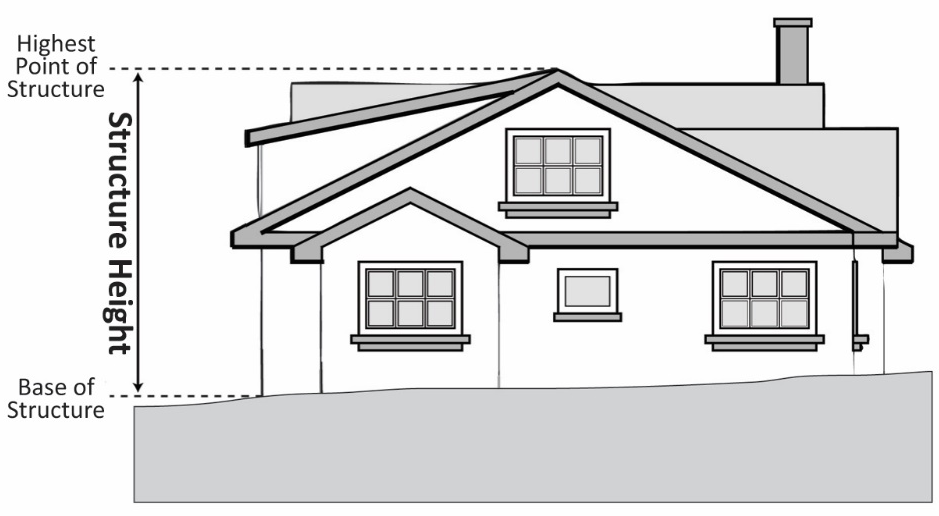
(Ord. No. 2465, § 2(Exhs. A., B.), 9-19-2016)
20.24.020 - Exceptions.
A.
Permitted Height Exceptions.
1.
The following features may exceed the maximum permitted structure height in the applicable zoning district:
a.
Barns, silos or other agricultural structures, provided these are fifty (50) feet or more from any property line.
b.
Church spires, belfries, cupolas and domes, monuments, water towers, fire and hose towers, observation towers, distribution and transmission towers, lines and poles, windmills, chimneys, smokestacks, flagpoles, radio towers, masts and aerials and other similar projecting features, provided these do not occupy an area greater than fifteen (15) percent of the building footprint area.
c.
Outdoor theater screens with no outdoor advertising matter.
d.
Places of public assembly and other permitted public and semi-public buildings, including schools and churches.
(1)
Located on the first floor of the building.
(2)
For each one (1) foot exceeding maximum height requirement for appropriate zoning district, its side and rear yards shall be increased by one (1) foot.
2.
Height exceptions are not permitted within the airport environs (/AE) overlay zone.
(Ord. No. 2465, § 2(Exhs. A., B.), 9-19-2016)
20.26.010 - Setback measurement.
Setbacks shall be measured as the distance between the property line and the nearest point of the structure along a line at a right angle to the property line. (See Figure 20.26-1: Setback Measurements.) Minor modifications of no more than twenty-five (25) percent of the required setback may be approved by the director of development services through the minor use permit process.
Figure 20.26-1 Setback Measurements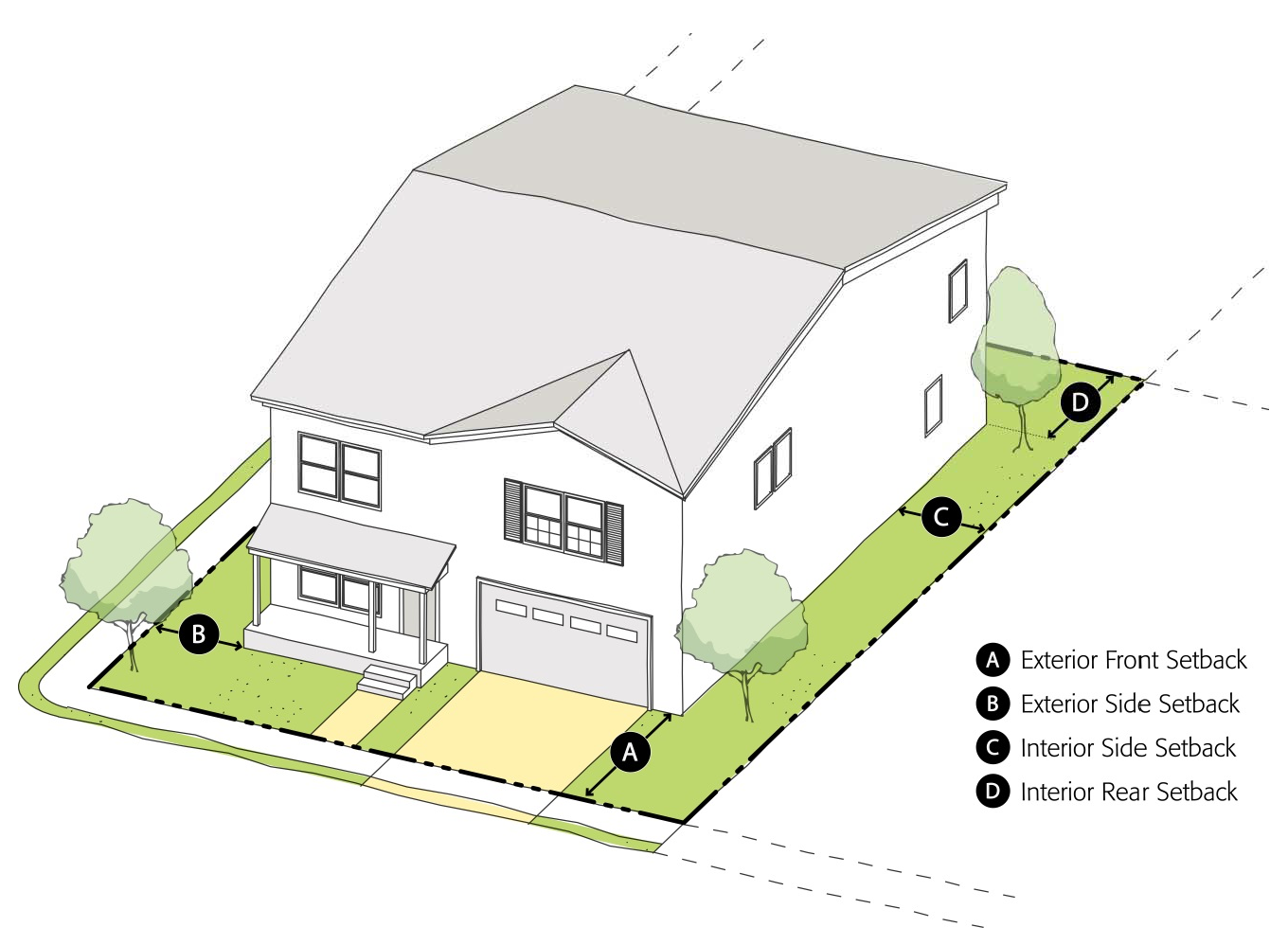
(Ord. No. 2465, § 2(Exhs. A., B.), 9-19-2016)
20.26.020 - Projections.
A.
Projections over Property Lines. Structures may not extend beyond a property line or into the public right-of-way, except when allowed with a temporary encroachment permit.
B.
Projections into Required Setback. Building features may extend into required setback areas as shown in Table 20.26-1, subject to the requirements of the building code.
Notes:
[1] Projection allowed if features provide no additional floor area within the building.
[2] Wall projections may not exceed one-third (⅓) (in aggregate) of the width of the wall in which it is located.
[3] Ground floor only; open railing required with maximum railing height of thirty (30) inches.
[4] May be located in required yards with no restrictions.
(Ord. No. 2465, § 2(Exhs. A., B.), 9-19-2016)
20.28.010 - General requirements.
A.
Separation Between Structures. Accessory structures shall be set back from other structures on the same lot as required by the building code.
B.
Attached Structures. Accessory structures attached to a primary structure shall be considered a part of the primary structure and shall comply with all standards applicable to the primary structure, including lot coverage requirements.
(Ord. No. 2465, § 2(Exhs. A., B.), 9-19-2016)
20.28.020 - Residential accessory structures.
A.
Permitted Residential Accessory Structures and Uses. Accessory structures and uses permitted in residential zones include:
1.
Home occupations (See Chapter 20.48).
2.
Second units (See Chapter 20.42).
3.
State licensed foster homes, state-licensed small family day care homes of one (1)—eight (8) children, and state-licensed large family day care homes of no more than fourteen (14) children.
4.
Accessory buildings and uses customarily appurtenant to a permitted use, such as garages, carport, off-street parking areas, personal storage buildings, fences, etc.
5.
Temporary subdivision tract offices, building yards, and tract signs, for a period not to exceed six (6) months after completion of construction of the tract.
6.
Rooming houses and boarding homes of no more than one (1) person in R-1 zones and no more than two (2) persons in R-2, R-3, and R-4 zones.
7.
Other uses listed in Section 20.28.020.C and 20.28.020.D.
8.
Underground public utility distribution and transmission lines.
B.
Development Standards.
1.
The maximum height and minimum setbacks for accessory structures in residential zoning districts shall be as specified in Table 20.28-1 and as shown in Figure 20.28-1.
2.
Accessory structures shall be subject to all other development standards that apply to primary structures in the applicable zoning district.
Notes:
[1] Five (5) feet minimum for garages off an alley or any accessory structure exceeding one hundred twenty (120) square feet.
Figure 20.28-1 Development Standards for Residential Accessory Structures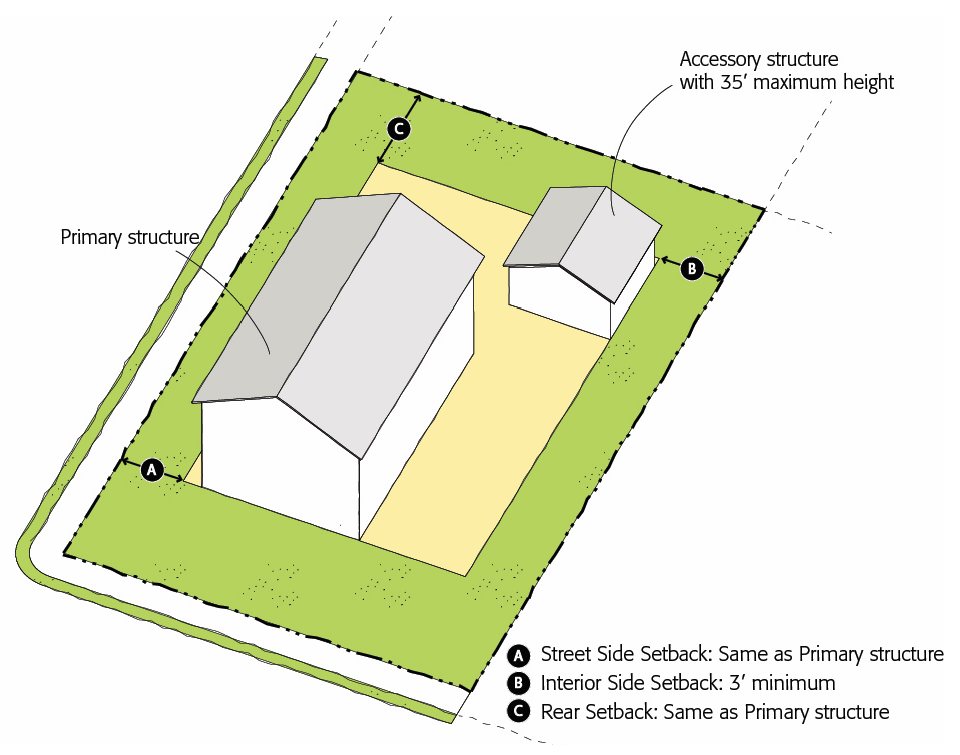
C.
Habitable Accessory Structures.
1.
Rear Dwellings.
a.
An accessory structure to the rear of a primary structure on the same lot shall be used for residential purposes only if it conforms to all the lot area, setback, open space, and off-street parking requirements within the applicable zoning district.
b.
Vehicle access to all such rear dwellings shall be provided by a driveway with a minimum width of ten (10) feet for lots with two (2) dwelling units and twenty (20) feet for lots with three (3) or more dwelling units.
2.
Dwelling Units over Garages. Accessory structures with a dwelling unit above a ground floor garage shall be set back a minimum of three (3) feet from a rear property line abutting an alley with the garage itself requiring a minimum setback of five (5) feet.
3.
Guest Houses.
a.
Guest houses or detached servants' quarters shall be located on the rear half of the lot.
b.
No kitchen facilities shall be permitted and no plumbing or utilities shall be allowed except for heating, air conditioning, and the discharge of wastes from a toilet or bathroom.
D.
Swimming Pools.
1.
Swimming pools shall be set back a minimum of five (5) feet from all property lines, unless otherwise allowed under the building code.
2.
Fences, barriers, and pool equipment storage areas for swimming pools shall be provided as required by the building code and state law.
(Ord. No. 2465, § 2(Exhs. A., B.), 9-19-2016)
20.28.030 - Nonresidential accessory structures.
Accessory structures in nonresidential zoning districts are subject to the same development standards (e.g., height and setbacks) as primary structures in each zoning district. Accessory structures in nonresidential zoning districts shall be limited to those structures needed to support the primary structure or land use on the site, including, but not limited to, off-street parking facilities, storage buildings, equipment buildings, utility buildings, etc., subject to the discretion of the director of development services.
(Ord. No. 2465, § 2(Exhs. A., B.), 9-19-2016)
20.30.010 - Measurement of fence and wall height.
A.
Measurement from Finished Grade. The height of a fence or wall shall be measured from the adjacent finished grade at the base of the fence or wall, to the top edge of the fence or wall.
B.
Ornamental Features. Ornamental features that provide a screening function and are fifty (50) percent or more opaque shall be included in the height measurement of a fence or wall.
C.
Fences Atop Walls. If a fence is atop a wall, the total height shall be measured from the base of the wall.
D.
Different Finished Grades. If the adjacent finished grade is different on opposite sides of a fence or wall, the height shall be measured from the side with the highest finished grade to the highest point on the fence. See Figure 20.30-1 (Fence and Wall Height).
Figure 20.30-1 Fence and Wall Height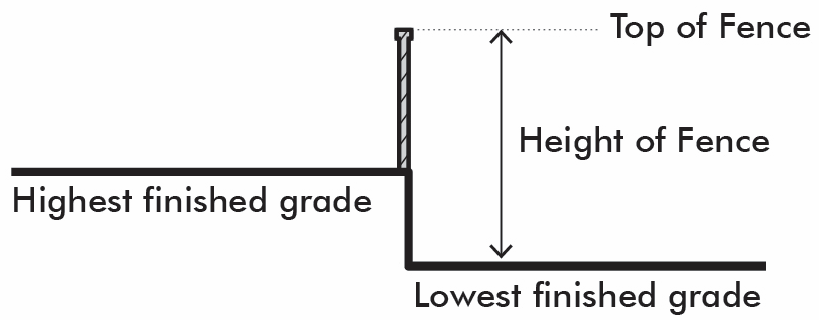
(Ord. No. 2465, § 2(Exhs. A., B.), 9-19-2016)
20.30.020 - Height limits.
A.
Residential Zoning Districts.
1.
Basic Standards. Fences, walls, and hedges in residential zoning districts shall comply with the standards in Table 20.30-1 (Fence Height in Residential Zoning Districts) and as illustrated in Figure 20.30-2 (Height Limits for Fences, Walls, and Hedges).
2.
Decorative Features and Materials.
a.
Any lattice or other similar material on top of a wall or fence cannot extend above the maximum fence height.
b.
Decorative arches and other similar entry features within these setback areas may be up to eight (8) feet in height.
Notes:
[1] Fence height for non-solid fences (wrought iron, chain link, picket, etc., that are mostly transparent) may be increased to a maximum of six (6) feet with a minor use permit.
[2] As shown in Figure 20.30-02, a driveway vision triangle is the area on the street side of a line connecting two (2) points, one (1) on the back of sidewalk (or property line, whichever is closer to the street) and one (1) on the side line of any public or private driveway or alley, each point being ten (10) feet from the point of intersection of the back of sidewalk (or property line, whichever is closer to the street) and the side line of the driveway or alley.
[3] In multi-family zones, may be increased to eight (8) feet with a minor use permit.
[4] Only if corner lot exterior yard doesn't abut the front yard of an adjacent lot or possible adjacent lot.
Figure 20.30-2 Height Limits for Fences, Walls, and Hedges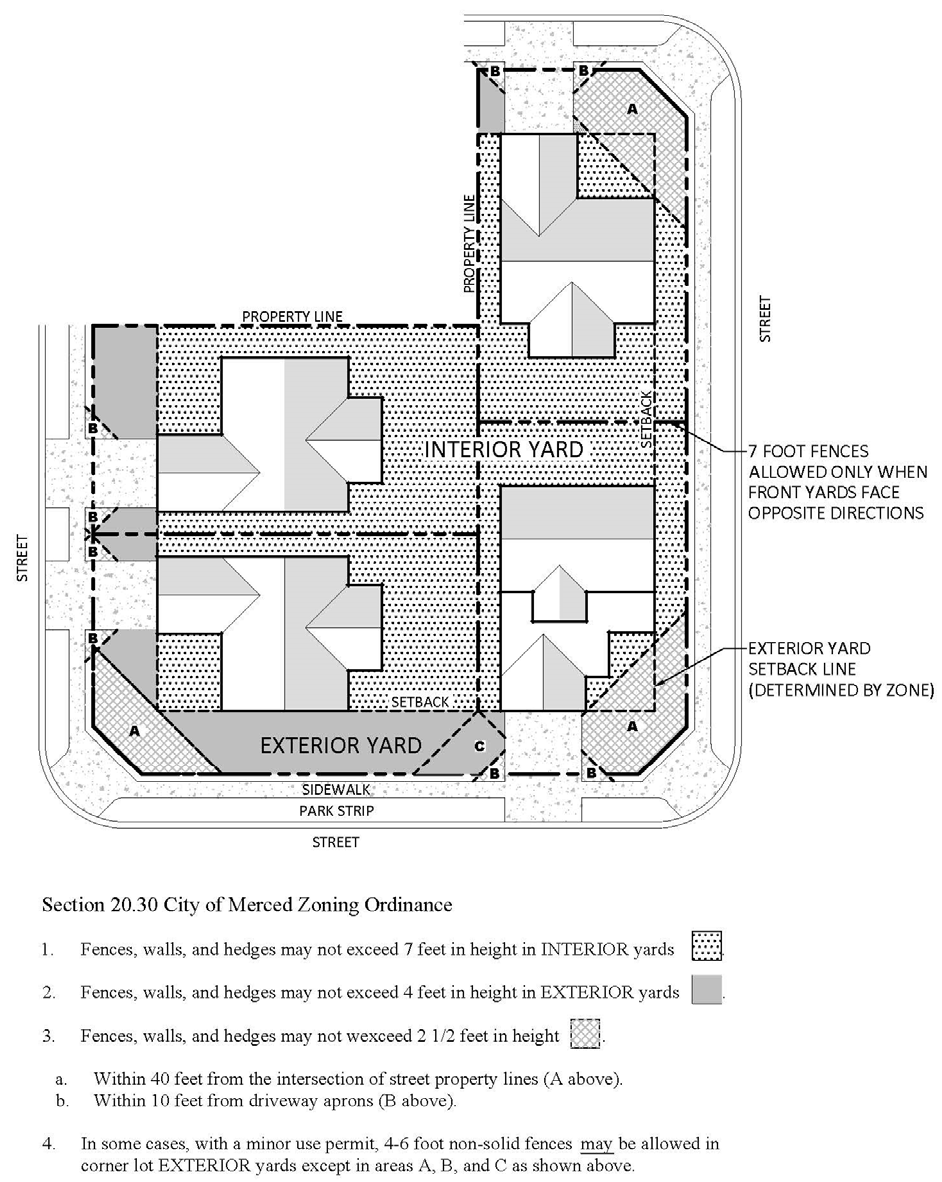
3.
Reversed Corner Lots. Reversed corner lots are those whose front yard directly abuts the side or rear yard of the adjacent lot instead of another side or rear yard.
a.
With a minor use permit, fences, walls or hedges not exceeding seven (7) feet in height may be located in the required exterior side yard of a reversed corner lot: however, the fences, walls or hedges may not encroach into the triangular area, two (2) equal sides of which are the first twenty (20) feet of property lines of the subject reversed corner lot, measured from the point of intersection of the exterior side yard property line and the exterior yard property line shared with the adjacent lot.
b.
If the front of a house is located on the exterior side yard on a reversed corner lot, then the front yard of the lot may be treated as a side yard.
4.
Through Lots. On through lots with frontage on two (2) parallel public streets, either property line separating the lot from a public street may be treated as the front lot line. In such cases, the minimum rear yard shall be the average of the yards on the lots next adjoining. If such adjoining lots are undeveloped, the minimum rear yard shall conform to the front yard setback for the zone in which the lot is located.
5.
Hedges in Exterior Yards. Hedges or other plantings of any height are allowed in exterior yards if they are at least fifteen (15) feet from the property line.
6.
Open Ended Cul-De-Sac Lots. For open-ended cul-de-sac lots, fences and gates in the required front yard or exterior side yard of a lot at the end of an open-ended cul-de-sac are permitted with approval of a minor use permit. Any such fence or gate shall remain open for public to access into the block from the public right-of-way.
Figure 20.30-3 Open Ended Cul-de-Sac Lots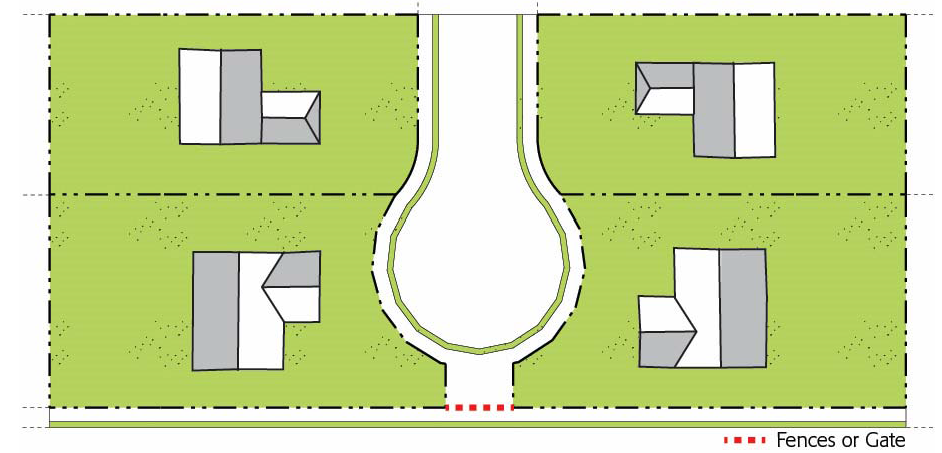
B.
Nonresidential Zoning Districts
1.
The maximum height of a fence or wall within a nonresidential zoning district shall be eight (8) feet.
2.
Fences up to ten (10) feet in height may be approved with a site plan review permit or with any other discretionary permit if required for the same project.
C.
Minor Use Permits for Fences. In addition to the requirements in Section 20.68.020 (Minor Use Permits), to approve a minor use permits for fences, the following findings must be made by the reviewing authority:
1.
The fence materials are of high quality with an aesthetically-pleasing appearance that fit in well with the neighborhood.
2.
The added fence height or alternative material is necessary to address privacy, noise, interface, or security concerns and/or issues with animals.
(Ord. No. 2465, § 2(Exhs. A., B.), 9-19-2016)
20.30.030 - Corner vision triangles.
A.
Definition. The minimum required area of a corner vision triangle is based on abutting street type as shown in Table 20.30-2 (Required Vision Triangle Distances by Street Type). The corner vision triangle is the area formed by measuring the distance "X" along the front and side property lines from the point of intersection, and then diagonally connecting the ends of the two (2) lines. The back of sidewalk line may be used instead of the property line if the back of sidewalk is closer to the street and the property line is more than one and one-half (1½) feet behind the back of the sidewalk. See Figure 20.30-2 (Height Limits for Fences, Walls, and Hedges).
B.
Maximum Height. The maximum height of a fence or wall within a corner vision triangle is two and one-half (2½) feet.
C.
Exceptions: Maximum fence and wall height within corner vision triangles do not apply within a zoning district with no required exterior yards.
(Ord. No. 2465, § 2(Exhs. A., B.), 9-19-2016)
20.30.040 - Materials.
A.
Permitted Materials. Fences and walls shall be constructed of decorative masonry, ornamental steel or iron, or wood and shall be of a complementary color and material with adjacent buildings. Other materials may be permitted if the director of development services determines the design to be compatible with adjacent structures and its surrounding neighborhood.
B.
Prohibited Materials.
1.
Fences and walls shall not be constructed of inappropriate materials such as sheet metal, vehicles, underground/above-ground tanks, garage doors, aluminum siding, corrugated tin, and other similar materials not specifically designed for use as fencing.
2.
Barb-wire fences are prohibited in all zoning districts unless approved with a minor use permit.
3.
Razor wire fences are prohibited in all zoning districts unless approved with a minor use permit.
C.
Electric Fences. Electric fences are prohibited in all residential zones. Electric fences are permitted in nonresidential zoning districts only with a minor use permit if set back a minimum of five (5) feet from an exterior property line and located so that it cannot be touched by any person in the public right-of way.
(Ord. No. 2465, § 2(Exhs. A., B.), 9-19-2016)
20.32.010 - Purpose.
This chapter establishes special permit requirements for projects proposed near to existing land uses that might be negatively impacted by the new use. These requirements are intended to protect existing single-family neighborhoods and to ensure that new development is designed in a manner to minimize negative impacts on nearby uses to the greatest extent possible to promote harmonious and orderly development, and the stability of land values and investments.
(Ord. No. 2465, § 2(Exhs. A., B.), 9-19-2016; Ord. No. 2543, § 57, 9-6-2022)
20.32.020 - Definitions.
The following terms when used in this chapter are defined as follows:
A.
A parcel is "abutting" another parcel if it is located immediately adjacent to another parcel and shares at least one (1) property lot line.
B.
A parcel is "across from" another parcel if any of its property lines when extended across the street or alley touch the parcel on the other side of the street.
C.
A parcel is "developed" if there is a minimum of twenty (20) percent lot coverage and the parcel contains a land use legally conforming to the zoning district within which it is located.
(Ord. No. 2543, § 57, 9-6-2022)
20.32.030 - Minor use permit.
A.
A proposed use in a "high impact" zoning district shall require a minor use permit if it is abutting or across from a developed parcel in a "low impact" zoning district. For example, if a proposed use is located in the C-T zoning district and is abutting or across from a parcel in the R-1 zoning district, then a minor use permit is required. Table 20.32-1 lists out all cases that require a minor use permit pursuant to this chapter. Figure 20.32-1 illustrates the concept.
B.
The director of development services may refer any application to the planning commission for review and final decision.
Figure 20.32-1 — Minor Use Permit Requirement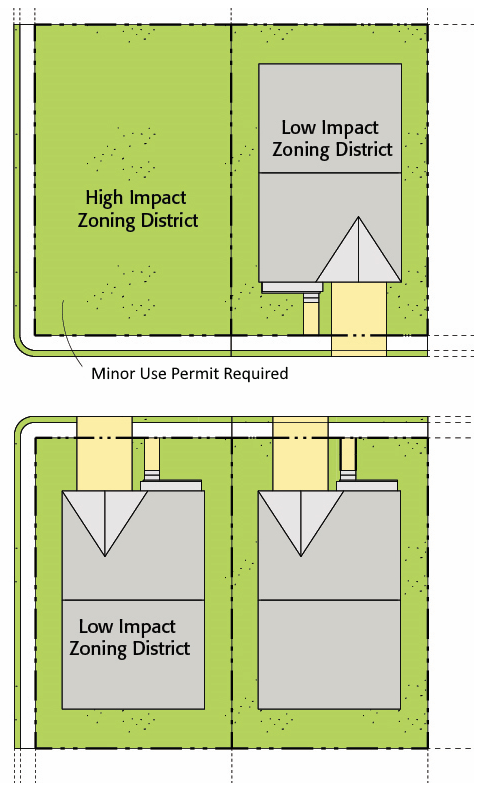
(Ord. No. 2465, § 2(Exhs. A., B.), 9-19-2016; Ord. No. 2543, §§ 57—59, 9-6-2022)
Editor's note— Ord. No. 2543, §§ 57—59, amended § 20.32.030 and in doing so changed the title of said section from "Site plan review" to "Minor use permit," as set out herein.
20.32.040 - Exceptions.
This section shall not apply to parcels across the street if the street is a proposed or existing arterial or higher order street as shown on the general plan circulation map.
(Ord. No. 2465, § 2(Exhs. A., B.), 9-19-2016; Ord. No. 2543, § 57, 9-6-2022)
20.34.010 - Purpose.
This article establishes standards for land uses and development in areas adjacent to creeks. These standards are intended to:
A.
Reduce risks to property owners and the public from erosion and flooding;
B.
Protect and enhance the chemical, physical, and biological integrity of water resources in the city;
C.
Minimize pollutants entering water bodies from urban stormwater runoff; and,
D.
Preserve riparian vegetation and protect wildlife habitat and wildlife corridors along natural drainage ways.
(Ord. No. 2465, § 2(Exhs. A., B.), 9-19-2016)
20.34.020 - Applicability.
The standards in this chapter apply to all riparian areas within the City of Merced. As shown in Figure 20-34-1 (Creek Buffer Measurement), riparian areas are defined as areas between the banks and twenty-five (25) feet in width measured from the top of bank or fifty (50) feet in width measured from centerline of any intermittent or perennial stream or river landward, whichever is greater. Excluded from this definition are stock ponds and other stock watering facilities, culverted sections of creeks and engineered systems developed by a public agency for collection of storm or flood waters, or systems other than natural creeks designed to deliver irrigation or water supplies.
Figure 20.34-1 Creek Buffer Measurement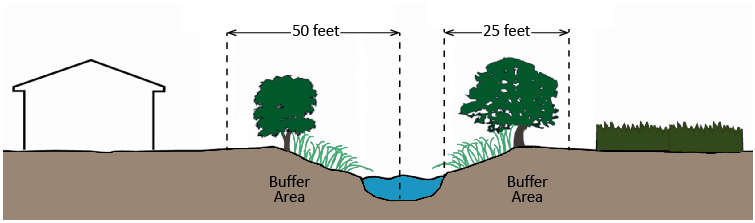
(Ord. No. 2465, § 2(Exhs. A., B.), 9-19-2016)
20.34.030 - Land use regulations.
A.
Permitted Activities. The following activities are permitted by right in riparian areas:
1.
Livestock grazing and agricultural practices where permitted by the applicable zoning district;
2.
Native landscaping;
3.
Fencing that does not interfere with the flow of flood waters or wildlife migration corridors;
4.
Utilities, including the installation, operation, and maintenance of water pumps;
5.
Storm drains into riparian areas and creeks;
6.
Trails, including pedestrian and bicycle trails, and recreational activities not involving the establishment of any structures, except for small accessory structures such as benches or signs;
7.
Construction and maintenance of publicly-owned culverts, rip-rap, and other drainage facilities; and,
8.
Construction and maintenance of publicly-owned bridges.
B.
Conditionally Permitted Uses.
1.
Uses, structures, and activities permitted in the applicable zoning district are permitted within riparian areas only with approval of a minor use permit.
2.
To approve a minor use permit for riparian area development, the director of development services shall make all of the following findings in addition to the findings in Section 20.68.020 (Conditional Use and Minor Use Permits):
a.
The proposed use, structure, or encroachment cannot be feasibly located outside the riparian area because such location would have a more adverse effect on the stream environment or alter the flood plain.
b.
Measures are included that provide adequate protection of wildlife habitat, water quality and in-stream habitat, and capacity for flood management.
(Ord. No. 2465, § 2(Exhs. A., B.), 9-19-2016)
20.34.040 - Performance standards.
A.
Construction. Construction is prohibited in riparian areas over which the city maintains jurisdiction unless the necessary permits have been obtained from other responsible governmental agencies and plans have been approved by the director of development services.
B.
Grading or Alterations to Riparian Vegetation. Grading, alteration of the natural contours of the land, or cutting or alteration of natural vegetation that protects a riparian habitat is prohibited within riparian areas except when such action is:
1.
Necessary to protect public health and safety as determined by the director of development services; or,
2.
Associated with an approved creek restoration and enhancement project intended to improve the health and environmental integrity of the waterway; or,
3.
Associated with an approved land use entitlement.
C.
Streambed Alteration. Filling, grading, excavating, or obstructing streambeds is prohibited except in the following circumstances or under any applicable provisions of state or federal law:
1.
Placement of city-approved storm drain and irrigation outflow structures shall be designed so as to eliminate or minimize increases in the rate and amount of storm or irrigation water discharge;
2.
Placement of public and nonpublic utility lines;
3.
Construction of bridges and their connecting roadways;
4.
Maintenance activities necessary to protect public health and safety;
5.
Creek restoration and improvement projects; and,
6.
Development associated with an approved land use entitlement.
(Ord. No. 2465, § 2(Exhs. A., B.), 9-19-2016)
20.34.050 - Coordination with other regulatory agencies.
A.
Required Permits. All required permits from the California Department of Fish and Game, the U.S. Army Corps of Engineers, the California State Water Resources Control Board, the Central Valley Flood Protection Board, Merced Irrigation District (MID), or other applicable agencies, including any permit required under an approved Habitat Conservation Plan, shall be obtained prior to, concurrently with, or as a condition of, the approval of any city permits for development within riparian areas.
B.
Submittal of Approvals. Evidence of approval or pending approval of any such permit shall be submitted to the planning division, including all appropriate supporting materials, environmental documentation, and studies.
(Ord. No. 2465, § 2(Exhs. A., B.), 9-19-2016)
20.36.010 - Purpose.
The landscaping standards contained in this chapter are intended to enhance the aesthetic appearance of developed areas within Merced and to promote the efficient use of water resources.
(Ord. No. 2465, § 2(Exhs. A., B.), 9-19-2016)
20.36.020 - Applicability.
This chapter applies to all new development with landscape areas as follows:
A.
Greater than five hundred (500) square feet; or,
B.
Rehabilitated landscape projects with an aggregated landscape area equal to or greater than two thousand five hundred (2,500) square feet.
(Ord. No. 2465, § 2(Exhs. A., B.), 9-19-2016)
20.36.030 - Water efficient landscaping ordinance.
In addition to the standards contained in this chapter, all applicable development in Merced shall also comply with Municipal Code Chapter 17.60 (Water Efficient Landscaping and Irrigation) and any subsequent amendments or emergency drought regulations. Chapter 17.60 implements the California Water Conservation in Landscaping Act (Government Code Section 65591 et seq.). In the event of a conflict, Chapter 17.60 or State regulations will prevail, whichever is more stringent.
(Ord. No. 2465, § 2(Exhs. A., B.), 9-19-2016)
20.36.040 - Landscape and sprinkler plans.
A.
Landscape and Sprinkler Plan Required. Projects subject to the requirements of this chapter and Chapter 17.60 shall submit a landscape and sprinkler plan as part of applications for all permits as required by the zoning ordinance and as part of subsequent building permit applications.
B.
Required Contents. Landscape plans shall include the following features and information:
1.
Site boundaries.
2.
Existing structures on the property.
3.
Structures immediately adjacent to the property.
4.
All new structures and improvements proposed as part of the development project.
5.
Existing landscaping, trees, and vegetation to be retained.
6.
All new landscaping proposed, including parking lot and street trees, as part of the development project specifying plant location, species, and size.
7.
Irrigation plan specifying the location, type, and size of all components of the irrigation system, including backflow prevention devices.
8.
Water efficient landscape calculations, including hydrozone information table, water budget calculations, maximum applied water allowance, estimated total water use, and soil management and grading plans per Chapter 17.60.
9.
Any additional information as determined by the director of development services to demonstrate compliance with the requirements of this chapter.
C.
Review and Approval. The development services department shall review all landscape plans to verify compliance with the requirements of this chapter. Landscape plans shall be approved by the review authority acting upon the permit application for the proposed new development.
D.
Changes to Approved Landscape Plans.
1.
Substantial modifications to an approved landscape plan shall be made only by the review authority which approved the landscape plan.
2.
The director of development services may approve minor modifications to a landscape plan previously approved by the planning commission or city council. Minor modifications are defined as changes to a landscape plan that bring the plans into conformance with state law (including emergency drought regulations), do not significantly decrease the total amount of landscaped area, alter the general design character or water conservation of the landscaped area, or alter a feature of the landscaped area specifically required by the decision-making authority, unless as otherwise required by state law.
(Ord. No. 2465, § 2(Exhs. A., B.), 9-19-2016)
20.36.050 - Required landscape areas.
A.
Residential Zoning Districts.
1.
All required exterior setback areas, excluding areas required for access to the property, shall be landscaped. See Figure 20.36-1.
Figure 20.36-1 Required Landscape Area for Residential Zoning Districts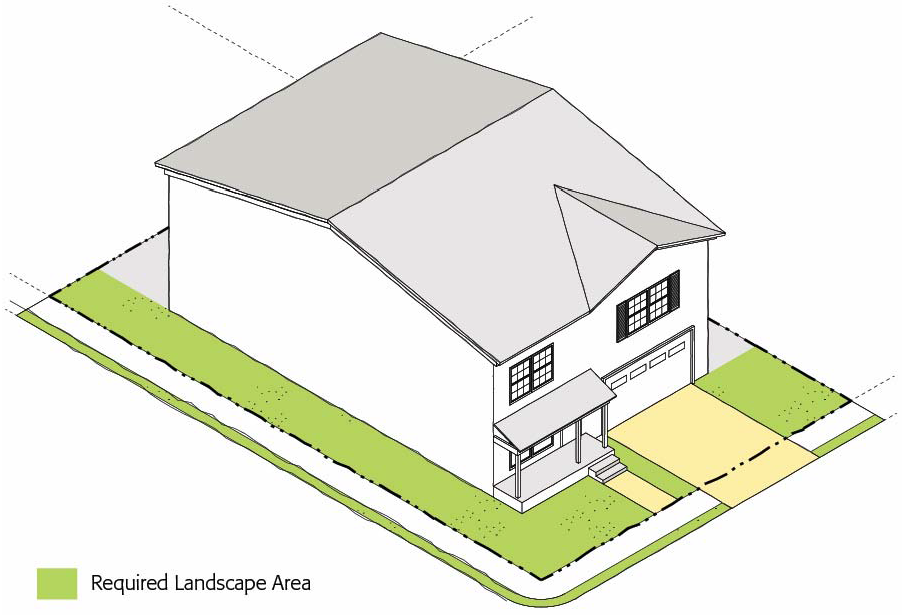
2.
Landscaping may consist of any combination of living plants such as trees, shrubs and turf; related natural features such as rock, stone or bark chips; or artificial turf that meets acceptable standards as determined by the department of development services. Decorative hardscape featuring pervious materials are permitted within required landscaping areas. Drought tolerant landscape materials are required, unless otherwise approved with a minor use permit.
3.
Street trees per city standards.
B.
Nonresidential Zoning Districts.
1.
The minimum landscaped area on a site shall be as shown in Table 20.36-1. Outdoor dining areas and other similar quasi-public outdoor seating areas do not count toward landscaping requirements.
2.
All required exterior setback areas excluding areas required for access to the property and public or quasi-public open space such as courtyards and outdoor seating shall be landscaped.
(Ord. No. 2465, § 2(Exhs. A., B.), 9-19-2016)
20.36.060 - Landscape standards.
A.
General Standards. The following standards apply within all zoning districts.
1.
Plant Selection. A minimum of ninety (90) percent of plants and trees shall be selected drought-tolerant, non-invasive species, unless otherwise approved with a minor use permit.
2.
Turf Lawns.
a.
Natural turf areas shall be limited to no more than fifty (50) percent of the landscaped area. The planning commission may approve larger areas if the lawn area provides functional open space for ballfields, etc.
b.
Drought-resistant grass species shall be used exclusively.
c.
Turf shall not be used on berms, slopes greater than twenty-five (25) percent, street median, or park strips less than ten (10) feet wide unless sub-surface irrigation is used.
d.
Artificial turf may be used in all areas if it meets the minimum standards as established by the development services department.
3.
Plant Groupings. Where irrigation is proposed, plants shall be grouped in separate hydrozones (i.e., plants within each irrigation valve area shall have the same watering requirements).
4.
Water Features. Decorative water features (e.g., fountains, ponds, waterfalls) shall have recirculating water systems.
5.
Public Safety. Plant species shall be selected and located so that at maturity they do not interfere with pedestrian, bicycle, or vehicular circulation and do not conflict with overhead lights, or utility lines.
B.
Irrigation and Water Efficiency. Landscaped areas shall comply with the following irrigation and water efficiency.
1.
Irrigation System. Water-efficient irrigation systems (e.g., bubbler type, drip, mini-spray) shall be required. Irrigation systems shall include check valves to prevent low head drainage, appropriate nozzles to prevent overspray, and automatic and self-adjusting irrigation controllers that include moisture and/or rain sensor shutoff; or other systems meeting minimum standards as established by the development services department.
2.
Irrigation Schedule. Landscape irrigation hours shall be in compliance with Section 15.42 (Water Shortage Regulations).
C.
Timing of Installation. Landscaping systems shall be installed prior to final building permit inspection or certification of occupancy.
D.
Maintenance.
1.
General. Landscape areas shall be maintained in a neat and healthful condition at all times, except in times of an official drought declaration by the Merced City Council.
2.
Replacement of Dead or Dying Plants. Within ninety (90) days of a determination by the director of public works that a plant is dead or severely damaged or diseased, the plant shall be replaced by the property owner in accordance with the standards specified in this chapter.
3.
Removal of Landscaping. Any removed mature landscaping shall be replaced with landscaping of similar size and maturity as that which was removed. Mature trees shall be replaced with a twenty-four (24) inch-box tree at minimum.
4.
Irrigation Systems. Irrigation systems shall be maintained in a fully functional manner as approved by the city and required by this chapter.
(Ord. No. 2465, § 2(Exhs. A., B.), 9-19-2016)
20.38.010 - Purpose.
This chapter establishes off-street parking requirements in order to:
A.
Provide a sufficient number of off-street parking spaces for all land uses;
B.
Provide for functional off-street parking areas that are safe for vehicles and pedestrians;
C.
Ensure that parking areas are well-designed and contribute to high-quality design environment within Merced;
D.
Allow for flexibility in off-street parking requirements to support a multi-modal transportation system and sustainable development pattern; and,
E.
Ensure that off-street parking areas do not adversely impact land uses on neighboring properties.
(Ord. No. 2465, § 2(Exhs. A., B.), 9-19-2016)
20.38.020 - Applicability.
A.
New Structures and Uses. All new structures and uses shall comply with the standards in this chapter, including the amount of required off-street parking as specified in Table 20.38-1 (Off-Street Parking Requirements).
B.
Changes in Existing Structures and Uses.
1.
Additional parking shall be required for a change in use or any modification to an existing structure that results in an increase in the unit of measurement used to determine the amount of required off-street parking as specified in Table 20.38-1 (Off-Street Parking Requirements).
2.
Additional off-street parking shall be required only to accommodate the incremental change or expansion of the structure or use. Additional parking shall not be required to remedy parking deficiencies existing prior to the change to an existing structure or use.
3.
Additional parking for nonresidential uses is not required if the parking needed to accommodate the change is either:
a.
Two (2) or fewer parking spaces; or,
b.
Ten (10) percent or less of the total required off-street parking spaces for the use.
(Ord. No. 2465, § 2(Exhs. A., B.), 9-19-2016; Ord. No. 2502, § 5, 8-19-19; Ord. No. 2543, §§ 60, 61, 9-6-2022)
20.38.030 - Required parking spaces.
A.
Number of Spaces. All land uses shall provide a minimum number of off-street parking spaces as specified in Table 20.38-1 (Off-Street Parking Requirements), except as provided in Section 20.38.050 (Parking Reductions).
B.
Unlisted Uses.
1.
The director of development services shall determine the minimum number of required off-street parking spaces for land uses not listed in Table 20.38-1 based on the requirements for the most comparable use in this chapter or an analysis of parking requirements for similar uses in other jurisdictions or state or national standards.
2.
Off-street parking requirements for unlisted land uses shall be based on the parking requirements of similar uses in Table 20.38-1.
3.
The director of development services may require the preparation of a parking demand study at the expense of the applicant to determine the parking requirement for unlisted uses.
C.
Mixed or Multiple Uses. When more than one (1) land use is conducted on a parcel, the minimum number of required off-street parking spaces shall be the sum of the number of parking spaces required for each individual use.
D.
Unknown Uses.
1.
The director of development services shall determine the minimum number of required off-street parking spaces for nonresidential "shell" structures with no identified tenants.
2.
Off-street parking requirements for nonresidential "shell" structures shall be based on anticipated tenants for the structures, as determined by the director.
E.
Units of Measurement.
1.
For the purpose of this chapter, "floor area," in the case of offices, merchandising or service types of uses, means the gross floor area used or intended to be used by tenants, or for service to the public as customers, patrons, clients, or patients, including areas occupied by fixtures and equipment used for display or sale or merchandise. It shall not include areas used principally for nonpublic purposes such as incidental repair, processing or packaging of merchandise, for show windows, for restrooms, for utilities, or for dressing rooms, fitting rooms, or alteration rooms. Unless additional information is provided by the applicant, these "non-public areas" will be assumed to be fifteen (15) percent of the total gross floor area and will not be used in calculating floor area for parking purposes.
2.
In indoor or outdoor places of assembly in which spectators or patrons occupy benches, pews, or other similar seating facilities, each twenty (20) inches of such seating facilities shall be counted as one (1) seat for the purpose of determining off-street parking facilities.
3.
When units of measurements determining the number of required parking spaces result in requirements of a fractional space, fractions of spaces over one-half (½) shall be rounded up to the next whole number.
F.
Conforming Status. Structures or uses established prior to the effective date of the zoning ordinance shall not be deemed nonconforming by reason of providing fewer off-street parking spaces than required by Table 20.38-1. However, no such structure or use may further reduce the number of provided off-street parking spaces below the requirements of this chapter.
G.
Additional Required Parking. The planning commission may require more off-street parking than required by Table 20.38-1 if the commission determines that additional parking is needed to serve the proposed use and to minimize adverse impacts on neighboring properties.
(Ord. No. 2465, § 2(Exhs. A., B.), 9-19-2016)
20.38.040 - General requirements.
A.
Availability and Use of Spaces.
1.
Required parking spaces shall be permanently available and maintained for parking purposes for the use they are intended to serve.
2.
Owners, lessees, tenants, or persons having control of the operation of a use for which parking spaces are required shall not prevent or restrict authorized persons from using these spaces.
3.
Required parking spaces shall be used exclusively for the temporary parking of vehicles and shall not be used for the sale, lease, display, repair, advertising, or storage of vehicles, trailers, boats, campers, mobile homes, merchandise, or equipment, or for any other use not authorized by the zoning ordinance.
B.
Location of Parking.
1.
Required parking spaces shall be located on the same lot as the use they are intended to serve, except as allowed by subsection C below.
2.
When the required off-street parking for a one-family or two-family structure in any R district is not to be provided in a covered garage or carport, each required car space shall be so located that it may later be covered by a garage or carport structure in accordance with the provisions of this chapter.
C.
Off-Site Parking.
1.
For multi-family housing and nonresidential uses, the site plan review committee may approve off-site parking if it finds that practical difficulties prevent the parking from being located on the same lot it is intended to serve.
2.
Off-site parking shall be located within four hundred (400) feet of the use it is intended to serve or another reasonable distance as determined by the site plan review committee.
3.
If off-site parking is approved, a covenant record, approved by the city attorney, shall be filed with the county recorder. The covenant record shall require the owner of the property where the off-site parking is located to continue to maintain the parking space so long as the building, structure, or improvement is maintained within the city. This covenant shall stipulate that the title and right to use the spaces shall not be subject to multiple covenants or contracts for use, or termination, without prior written consent of the city.
D.
Parking for Persons with Disabilities.
1.
Parking spaces for persons with disabilities shall be provided in compliance with California Code of Regulations Title 24.
2.
Parking spaces required for the disabled shall count toward compliance with the number of parking spaces required by Table 20.38-1.
(Ord. No. 2465, § 2(Exhs. A., B.), 9-19-2016)
20.38.050 - Parking reductions.
The minimum number of required off-street parking spaces as specified in Table 20.38-1 may be reduced as described below.
A.
Shared Parking. Multiple land uses on a single parcel or development site may use shared parking facilities when operations for the land uses are not normally conducted during the same hours, or when hours of peak use differ. Requests for the use of shared parking may be approved if:
1.
A parking demand study approved by the director of development services demonstrates that there will be no substantial conflicts between the land uses' principal hours of operation and periods of peak parking demand;
2.
The total number of parking spaces required for the land uses does not exceed the number of parking spaces anticipated at periods of maximum use;
3.
The proposed shared parking facility is located no further than four hundred (400) feet from the primary entrance of the land use which it serves; and,
4.
A covenant record as described in Section 20.38.040.C.3 shall be recorded.
B.
Common Parking Facilities. Common parking facilities, public or private, may be provided in lieu of the individual requirements contained in this chapter, provided, the total of such off-street parking facilities, when used together, shall not be less than the sum of the various uses computed separately. Such common facilities shall be approved by the planning commission with a conditional use permit, and the planning commission may grant a reduction in the total required parking for the uses by no more than fifteen (15) percent.
C.
Low Demand. The number of parking spaces may be reduced if the land use will not utilize the required number of spaces due to the nature of the specific use, as demonstrated by a parking demand study approved by the director of development services.
D.
Transportation Demand Management Plan. The number of parking spaces may be reduced by the director of development services up to twenty (20) percent if the project applicant prepares a transportation demand management plan which demonstrates a reduction in the demand for off-street parking spaces by encouraging the use of transit, ridesharing, biking, walking, or travel outside of peak hours.
E.
Bus Stop/Transportation Facility Credit. The number of parking spaces may be reduced by up to five (5) percent for commercial or multiple-family development projects within four hundred (400) feet of a City-approved bus stop. If a commercial or multiple-family development project is located within four hundred (400) feet of a transit center, the project may reduce parking spaces by up to ten (10) percent.
F.
Mixed-Use Projects. A mixed-use project with commercial and residential units may reduce parking requirements by up to thirty (30) percent as demonstrated by a parking demand analysis approved by the director of development services.
(Ord. No. 2465, § 2(Exhs. A., B.), 9-19-2016)
20.38.060 - Parking assessment districts.
If a parking assessment district has been established, a fee may be paid to the city in lieu of providing required off-street parking within the district.
A.
Exception for Parking Districts. Property located within a district in which special assessments have been or are to be levied for providing public off-street parking shall not be required to provide off-street parking facilities for the ground floor of any such structure.
B.
Special Assessment Financing.
1.
In any special assessment proceedings for financing the cost of public off-street parking facilities, any improved property shall be granted a credit against the assessment to be levied, in such ratio as the city Council shall determine, for any improved customer, owner, tenant or employee parking spaces or reasonable access areas.
2.
In determining the amount of assessment credit, the area of credit shall be improved in accordance with this code. If not so improved at the time of granting the credit, the owner shall cause the area to be so improved within sixty (60) days thereafter, or otherwise the credit shall be removed. A parking space is defined as an area of eight and one-half (8½) by twenty (20) feet in dimension. The determination of the city council as to the amount of "reasonable access" shall be final.
3.
Areas used for parking of delivery vehicles or other commercial or industrial vehicles, and open areas used for storage or otherwise in the operation of the business, shall not be included in any area of credit. Any area for which a credit for parking is granted shall remain subject to the requirements of this chapter for providing off-street parking.
C.
In-lieu Parking Fee. In lieu of providing off-street parking within a special assessment parking district, an owner may pay to the city a sum equal to one thousand two hundred dollars ($1,200.00) per parking space, which money shall be deposited in a special fund and used for providing, improving or maintaining off-street parking facilities in said district.
D.
Additions to Parking Districts.
1.
Each owner of a property not included within a district in which special assessments are levied for providing public off-street parking, but within four hundred (400) feet of a public parking lot located within such a district, may pay a participation fee to defray the cost of providing required off-street public parking facilities, in exchange for the benefits and the responsibilities of inclusion in said district. Upon payment of the participation fee as provided in Section 20.38.060.D.2 and continuing payment of assessments imposed by the district, the owner of the subject property shall not be required to provide off-street parking facilities for the ground floor of any structure on the property, and may also pay in-lieu parking fees as provided in Section 20.38.060.C.
2.
The participation fee shall be deposited in a special fund and used for providing, improving, or maintaining off-street parking facilities in said district. The amount of participation fee shall be computed as follows:
a.
Participation fee = (Basic Charge + Cost Index)
b.
"Basic charge" is ninety (90) cents per square foot of the subject property, and two hundred forty-five dollars ($245.00) per front foot of the subject property, measured as the subject property's frontage along the public right-of-way with the highest traffic volume.
c.
"Cost index" is the most current cost index (calculated on an annual basis based on the previous year's Consumer Price Index, All Urban Consumers, published by the U.S. Department of Labor), multiplied by the total square foot and front foot of the subject property. In the event of discontinuation of such index, the index most closely resembling said index.
(Ord. No. 2465, § 2(Exhs. A., B.), 9-19-2016)
20.38.070 - Parking design and development standards.
A.
Dimensions. The minimum required dimensions for off-street parking spaces shall conform to the latest edition of the city's Standard Designs of Common Engineering Structures. However, all parking spaces shall be a minimum of nine (9) feet in width.
B.
Compact Spaces.
1.
A maximum of twenty-five (25) percent of required off-street parking spaces may be compact spaces.
2.
All parking spaces for compact cars shall be clearly marked with the word "Compact" either on the wheel stop or curb, or on the pavement at the opening of the space.
C.
Parking Access. The required dimensions for driveways providing access to off-street parking spaces shall conform to the latest edition of the city's Standard Designs of Common Engineering Structures.
Figure 20.38-1 Example of 90-Degree Parking Space Dimensions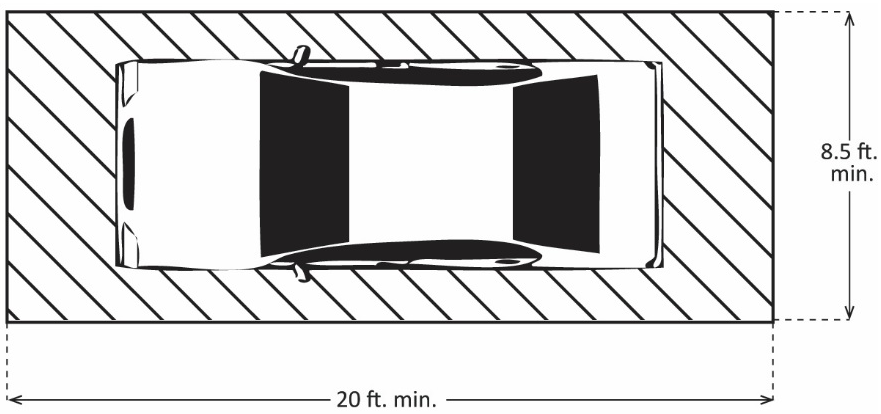
D.
Surfacing.
1.
All permanent parking spaces and drive aisles shall be paved with asphalt, concrete or other all-weather surface per the latest edition of the city's Standard Designs of Common Engineering Structures.
2.
Permeable paving materials, such as porous concrete/asphalt, open-jointed pavers, and turf grids, are a permitted surface material, subject to approval by the city engineer.
E.
Tandem Parking Spaces. Tandem parking spaces may be permitted for all residential land uses, provided that they comply with the following standards:
1.
Parking spaces in a tandem configuration shall be reserved for and assigned to a single dwelling unit.
2.
All required guest parking shall be provided as single, non-tandem parking spaces.
3.
Tandem parking spaces shall not block the use of the drive aisle to access other parking spaces located within the parking area.
4.
Tandem parking spaces shall be used to accommodate passenger vehicles only.
F.
Landscaping.
1.
General Standards. All landscaping within parking areas shall comply with the requirements of Chapter 20.36 (Landscaping) in addition to the standards within this section.
2.
Landscaping Defined. Except as otherwise specified in this section, landscaping and landscaped areas shall consist of drought-tolerant plant materials, including any combination of trees, shrubs, and ground cover.
3.
Parking Lot Standards. As illustrated in Figure 20.38-2 (Parking Lot Landscaping Standards), the following landscaping standards, as well as the standards in the city's Standard Designs of Common Engineering Structures, shall apply to parking lots containing six (6) or more parking spaces. All landscape areas shall have an irrigation system.
Figure 20.38-2 Parking Lot Landscaping Standards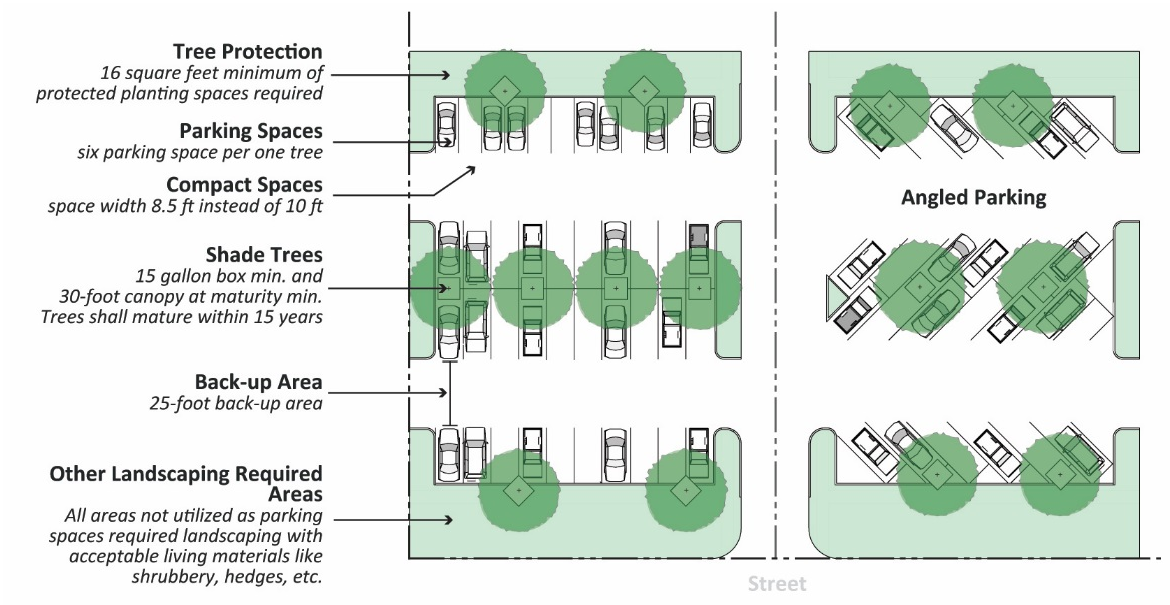
a.
Interior Landscaping. All areas within a parking lot not utilized for parking spaces or access/circulation shall be landscaped with plantings with drought-tolerant, non-invasive species.
b.
Shade Trees.
(1)
One (1) shade tree shall be provided for every six (6) parking spaces, or portion thereof, in a parking lot in addition to street trees.
(2)
Shade trees shall be a minimum fifteen (15) gallon box in size and shall provide a minimum thirty (30)-foot canopy at maturity.
(3)
Shade trees shall be of a type that can reach maturity within fifteen (15) years of planting and shall be selected from a city-approved list of canopy tree species suitable for the valley climate.
(4)
Shade trees shall be arranged in a parking lot to provide maximum shade coverage (based on a thirty (30)-foot canopy) on August 21. The arrangement should approximate nearly fifty (50) percent shade coverage at noon on August 21 within fifteen (15) years of planting.
(5)
The above standards may be modified with a minor use permit if alternative shade structures (including solar carports) are provided. Design standards for such shade structures shall be approved as part of the minor use permit process as well.
4.
Concrete Curbs
a.
All landscape areas shall be separated from parking spaces, drive aisles and driveways by a raised concrete curb. Raised concrete curbs shall be a minimum of six (6) inches high by six (6) inches deep.
b.
The city may approve alternatives to raised concrete curbs as needed to comply with any mandatory storm water drainage standards.
5.
Parking Space Landscaping. A maximum of two (2) feet at the front end of a parking space may be landscaped in lieu of paving surface.
6.
Timing. Landscaping shall be installed prior to the city's authorization to occupy any buildings served by the parking area, or prior to the final inspection for the parking lot, unless otherwise approved by the director of development services.
G.
Lighting.
1.
A parking area with six (6) or more parking spaces shall include outdoor lighting that provides a minimum illumination of 1.0 foot candles over the entire parking area or as otherwise required by the building code.
2.
Outdoor lighting as required by Subsection G.1 above shall be provided during nighttime business hours.
3.
All parking space area lighting shall be energy efficient and designed so that any glare or spillage is directed away from residential properties.
4.
All fixtures shall be hooded.
H.
Pedestrian Access. Parking lots shall include pedestrian walkways in compliance with American with Disabilities Act (ADA) requirements and the California Building Code.
I.
Screening. Parking lots of six (6) spaces or more shall comply with the following screening standards, unless otherwise approved with a minor use permit.
1.
Location. Screening with a minimum width of five (5) feet shall be provided along the perimeter of parking lots fronting a public or private street or abutting a residential zone.
2.
Height.
a.
Screening adjacent to streets shall have a minimum height of two and one-half (2½) feet.
b.
Screening abutting a residential zoning district shall have a minimum height of six (6) feet, except in required setback areas, where the minimum height shall be four (4) feet.
c.
Commercial parking lots abutting residential zoning districts shall have a solid wall with a minimum height of six (6) feet.
3.
Materials. Required screening may consist of one (1) or more of the following materials:
a.
Low-profile walls constructed of brick, stone, stucco or other durable material with graffiti-proof coating materials or landscaping/vines.
b.
Evergreen plants that form an opaque screen.
c.
An open fence combined with landscaping to form an opaque screen.
d.
A berm landscaped with ground cover, shrubs, or trees.
(Ord. No. 2465, § 2(Exhs. A., B.), 9-19-2016)
20.38.080 - Bicycle parking.
A.
Applicability. All multi-family and nonresidential land uses shall provide bicycle parking as specified in this section and in accordance with Sections 20.38.020 (Applicability) and 20.38.030 (Required Parking Spaces), except for the following uses:
1.
Gas and service stations
2.
Maintenance and repair services
3.
Vehicle repair
4.
Vehicle sales and rental
5.
Wholesaling
6.
Construction and material yards
7.
Warehousing and distribution
8.
Other similar uses as determined by the director of development services.
B.
Types of Bicycle Parking.
1.
Short-Term/Class II Bicycle Parking. Short-term/Class II bicycle parking provides shoppers, customers, and other visitors who generally park for two (2) hours or less a convenient and readily accessible place to park bicycles.
2.
Long-Term/Class I Bicycle Parking. Long-term/Class I bicycle parking provides employees, residents, visitors and others who generally stay at a site for several hours a secure and weather-protected place to park bicycles.
C.
Bicycle Parking Spaces Required. The number of required bicycle parking spaces shall be as specified in Table 20.38-4 (Required Bicycle Parking Spaces).
D.
Short-Term/Class II Bicycle Parking Standards. Short-term bicycle parking shall be located within one hundred (100) feet of the primary entrance of the structure or use it is intended to serve, be readily visible to passers-by, and at least twenty-five (25) percent of required short-term bicycle parking spaces shall be covered.
E.
Long-Term Bicycle Parking Standards. Following standards shall be recommended for long-term bicycle parking:
1.
Location. Long-term bicycle parking shall be located in highly visible, well-lighted areas that are convenient to the street and users.
2.
Cover. A minimum of seventy-five (75) percent of required long-term bicycle parking spaces shall be covered.
3.
Parking Facilities. Long-term bicycle parking spaces must be secure and may include:
a.
Covered, lockable enclosures with permanently anchored racks for bicycles; or,
b.
Lockable bicycle rooms or areas with permanently anchored racks; or,
c.
Lockable, permanently anchored bicycle lockers.
F.
Parking Space Dimensions.
1.
Minimum dimensions of two (2) feet by six (6) feet shall be provided for each bicycle parking space (illustrated in Figure 20.38-3).
2.
An aisle of at least five (5) feet shall be provided behind all bicycle parking to allow room for maneuvering.
3.
Two (2) feet of clearance shall be provided between bicycle parking spaces and adjacent walls, polls, landscaping, pedestrian paths, and other similar features.
4.
Four (4) feet of clearance shall be provided between bicycle parking spaces and adjacent automobile parking spaces and drive aisles.
G.
Rack Design. Bicycle racks must be capable of locking both the wheels (one (1) wheel with a U-type lock), providing at least two (2) points of contact with the frame of the bicycle, and supporting bicycles in an upright position. "Inverted U" bicycle racks are highly recommended.
H.
Cover. Required cover for bicycle parking spaces shall be permanent, designed to protect the bicycle from sun and rainfall, and be at least seven (7) feet above the floor or ground.
Figure 20.38-3 Short-Term/Class II Bicycle Parking Dimensions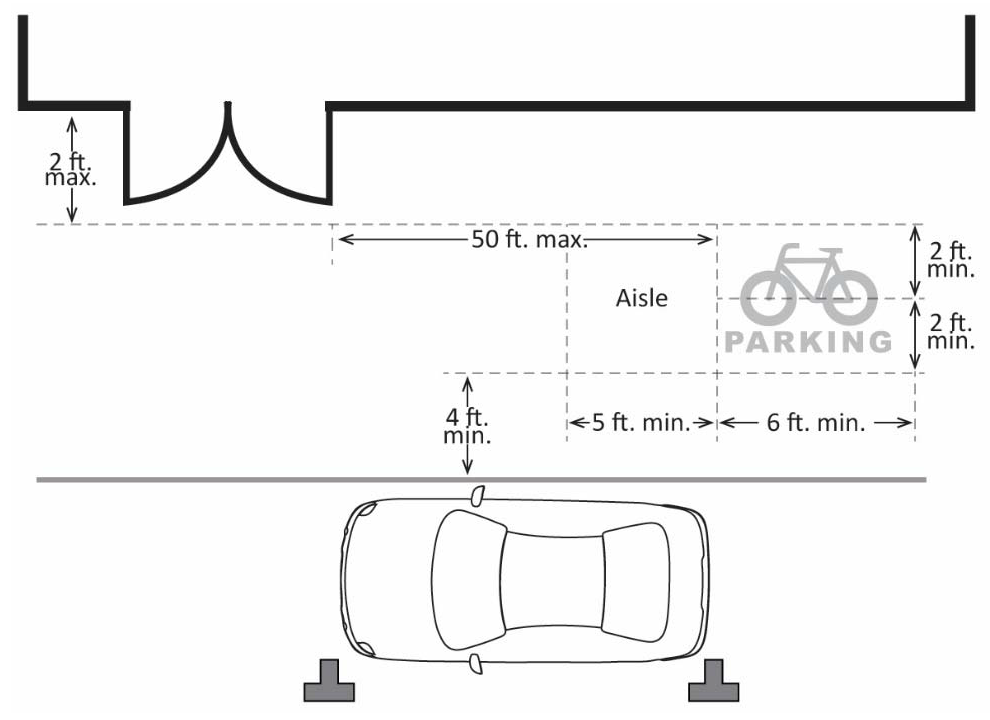
(Ord. No. 2465, § 2(Exhs. A., B.), 9-19-2016)
20.38.090 - Off-street loading.
A.
Applicability. All retail, restaurant, hotel, warehousing, manufacturing, hospitals, laundry, and similar uses that involve the frequent receipt or delivery of materials or merchandise shall provide off-street loading spaces consistent with the requirements of this section.
B.
Number of Loading Spaces. The minimum number of required loading spaces shall be as specified in Table 20.28-5 (Required Loading Spaces).
Figure 20.38-4 Off-Street Loading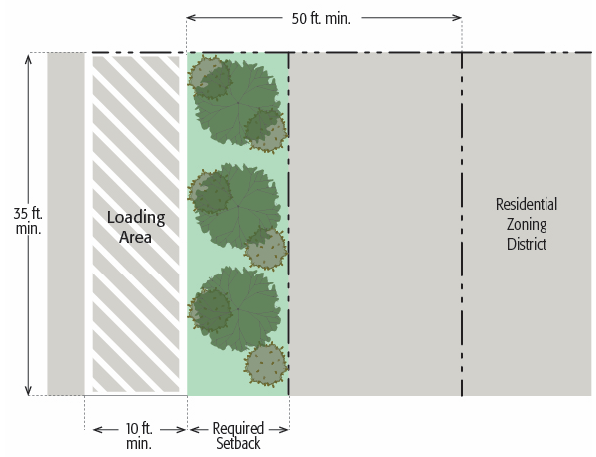
C.
Location.
1.
Required loading spaces shall be located on the same lot as the use they are intended to serve.
2.
A formal agreement among property owners shall be required and recorded if an immediately adjacent lot is used as required loading spaces.
3.
No loading space shall be located closer than fifty (50) feet to a residential zone, unless the loading space is wholly enclosed within a building or screened by a solid wall not less than eight (8) feet in height.
D.
Dimensions.
1.
Each loading space shall have minimum dimensions of ten (10) feet wide, thirty-five (35) feet long, and fourteen (14) feet in vertical clearance.
2.
Deviations from the minimum dimensions standards may be approved by the director of development services if the spatial needs are less than the minimum required due to the truck size and type that will be utilized in the operation of a specific business.
E.
Design and Configuration.
1.
Loading spaces shall be configured to ensure that loading and unloading takes place on-site and not within adjacent public rights-of-way.
2.
Sufficient maneuvering area shall be provided for loading spaces so that vehicles may enter and exit an abutting street in a forward direction.
3.
Loading spaces and their associated maneuvering areas shall not encroach into required employee or visitor parking areas or other on-site areas required for vehicle circulation.
4.
Loading spaces shall be striped and clearly identified as for loading purposes only.
(Ord. No. 2465, § 2(Exhs. A., B.), 9-19-2016)
20.40.010 - Purpose.
The purpose of small lot single-family home provisions is to allow for increased flexibility in the design of new residential development in a manner that increases housing choices for residents, utilizes land resources efficiently, and ensures a high quality neighborhood.
(Ord. No. 2465, § 2(Exhs. A., B.), 9-19-2016)
20.40.020 - Location.
Small lot single-family homes may be proposed in residential planned development (RP-D), inner village residential (R-IV), outer village residential (R-OV), and low medium density residential (R-2) zoning districts. The city may determine that a proposed small lot single-family home subdivision is not allowed where public facilities and services are insufficient for the proposed development.
(Ord. No. 2465, § 2(Exhs. A., B.), 9-19-2016)
20.40.030 - Permits required.
Small lot single-family homes shall require approval of a conditional use permit. All subdivisions of land shall receive permits and approvals required by Title 18 (Subdivisions) of the Merced Municipal Code.
(Ord. No. 2465, § 2(Exhs. A., B.), 9-19-2016)
20.40.040 - Use regulations.
A small lot single-family home may be developed with only those uses allowed in the zoning district applicable to the site.
(Ord. No. 2465, § 2(Exhs. A., B.), 9-19-2016)
20.40.050 - Development standards and guidelines.
A.
Basic Standards.
1.
Development standards for small lot single-family homes shall be established for each development with the approval of the conditional use permit. In general, small lot single-family homes should comply with the city's most recent edition of the Small Lot Single-Family Home Design Guidelines, Table 20.40.050 (Development Standards for Small Lot Single-Family Homes), and other standards and guidelines in this chapter, unless otherwise specified in the conditional use permit. The Guidelines provide for two (2) types of lots:
a.
PD-1-4 Designation: Lots between forty (40) feet and fifty (50) feet in width
b.
PD-1.3 Designation: Lots between less than forty (40) feet but no less than thirty (30) feet in width.
2.
Small lot single-family homes shall also comply with Section 20.22.040 (Urban Residential Overlay Zone) if those same individual residential building types (as illustrated in Figures 20.22-1 through 20.22-11) are proposed, unless otherwise specified in the conditional use permit.
B.
Parking Standards
1.
All required parking spaces shall be set back a minimum of twenty (20) feet from the front property line and/or sidewalk, whichever is closer.
2.
Shared driveway access between two (2) adjacent parcels is allowed when the garages are set back behind the primary residential unit or recessed so the home's entry elevation retains a dominant visual appearance.
3.
Two (2) on-site parking spaces shall be provided per unit with at least one (1) being covered. Spaces in the driveway shall count toward this requirement.
C.
Other Standards and Guidelines. Small lot single-family homes should comply with the guidelines for façade design, open space, service area, lane (alley), parking configurations, driveway access, fencing, public streets, and architectural features in the city's most recent edition of the Small Lot Single-Family Home Design Guidelines, available under separate cover from the city planning division, unless otherwise specified in the conditional use permit.
(Ord. No. 2465, § 2(Exhs. A., B.), 9-19-2016)
20.42.010 - Purpose and applicability.
This chapter establishes standards for the development of accessory dwelling units ("ADU" or "ADUs") that are intended to be in conformance with Government Code Sections 65852.2 and 65852.22. The provisions of this chapter are intended to be applied so as to not conflict with State law. These standards are intended to allow for ADUs and junior accessory dwelling units ("JADU" or "JADUs") as an important form of affordable housing while preserving the character and integrity of residential neighborhoods within the city.
The provisions of this chapter apply to all parcels in the City of Merced that are zoned residential or that allow residential uses.
(Ord. No. 2555, § 4, 9-18-2023)
20.42.020 - Application process and review and nonconforming conditions.
A.
Ministerial Review. A permit application that meet the provisions of this chapter for the installation of or construction of an ADU, JADU or THOW shall be granted with ministerial review, approval, and issuance of a building permit. The correction of nonconforming zoning conditions ("a physical improvement on a property that does not conform to zoning standards") or the installation of public improvements cannot be required as a condition for ministerial approval.
B.
Processing Time. If there is an existing single-family or multi-family dwelling on the parcel subject to the application, the city shall act on the application to create an ADU or a JADU within sixty (60) days from the date a complete application is received, unless either:
1.
The applicant requests a delay, in which case the sixty-day time period shall be tolled for the period of the delay; or
2.
The construction of a single-family dwelling is proposed at the same time as a construction of an ADU or a parcel, in which case, the city shall not approve the permit for the ADU prior to the approval of the permit for the single-family dwelling and shall not issue a certificate of occupancy for the ADU prior to the issuance of a certificate of occupancy for the single-family dwelling.
If the local agency has not acted upon the completed application within sixty (60) days, and neither of the above criteria is met, the application shall be deemed approved.
C.
Nonconforming Conditions. Notwithstanding Chapter 20.52, Nonconforming Parcels, Uses, and Structures, to the contrary, an owner of an ADU or JADU that receives a notice to correct violations or abate nuisance, in relation to the ADU or JADU, may request a delay for five (5) years in enforcement of a building standard, as long as the violation is not a health and safety issue as determined by the City of Merced, subject to compliance with the Health and Safety Code Section 17980.12 and the following conditions:
1.
The ADU was built before January 1, 2020; or
2.
The ADU was built on or after January 1, 2020 in a local jurisdiction with a noncompliant ADU ordinance, but the ordinance is compliant at the time the request is made; and
3.
The city shall not approve any such applications after January 1, 2030; and
4.
This section shall remain in effect only until January 1, 2035 and as of that date is repealed.
D.
State ADU Law. If any portion of this chapter conflicts with ADU law or other applicable state law, then state law shall supersede this chapter. Any ambiguities in this chapter shall be interpreted to be consistent with state ADU law.
(Ord. No. 2555, § 4, 9-18-2023)
20.42.030 - Type and number of accessory dwelling units and site and design standards.
A.
Location. ADUs shall be permitted in districts zoned to allow single-family or multi-family residential or mixed use as provided in Part 2 (Zoning Districts).
B.
Types of Accessory Dwelling Units. An ADU approved under this chapter may take any of the following forms:
1.
Attached. An ADU may be a new habitable space attached to an existing or proposed single-family dwelling.
2.
Detached. An ADU may be a new detached habitable structure located on the same parcel as an existing or proposed single-family dwelling.
3.
Converted. An ADU may be located within areas converted to habitable space that complies with the California Building Code for a dwelling, such as:
a.
An area within an existing single-family dwelling (e.g. an attached garage); or
b.
An existing accessory structure (e.g. a detached garaged or pool house) located on the same parcel as the single-family dwelling; or
c.
Portions of existing multi-family structures that are not used as livable space, including, but not limited to, storage rooms, boiler rooms, passageways, attics, basements, or garages.
4.
Junior Accessory Dwelling Unit. A JADU is a dwelling, contained entirely within an existing or proposed single-family dwelling, that is a maximum of five hundred (500) square feet in size. A JADU may include separate facilities or may share sanitation facilities with the existing single-family dwelling. JADUs shall comply with Section 20.42.050, Standards for Junior Accessory Dwelling Units.
5.
Tiny Home on Wheels.
C.
Number of Accessory Dwelling Units Permitted Per Parcel.
1.
Parcels with a Single-Family Dwelling. One (1) attached ADU (new or converted), one (1) detached ADU (new or converted), and one (1) JADU shall be allowed per lot with a proposed or existing single-family dwelling in conformance with the rest of this chapter.
2.
Parcels with Multi-Family Dwelling(s).
a.
Converted ADUs. The number of converted ADUs, on a parcel with an existing multi-family dwelling, shall not exceed twenty-five (25) percent of the total number of dwelling units.
b.
Detached ADUs. Not more than two (2) detached ADUs may be located on a parcel that contains an existing multi-family dwelling.
D.
Site Requirements.
1.
No Minimum Parcel Size. ADUs that comply with this chapter shall be permitted on all legally established parcels, regardless of parcel size.
2.
An ADU may only be established if a single-family or multi-family dwelling unit ("primary dwelling") exists on the parcel or is being built at the same time.
3.
Statewide Exemption ADU. No lot coverage, floor area ratio, open space, or minimum lot size requirement shall preclude the construction of an ADU up to eight hundred (800) square feet, sixteen (16) feet in height, and with four-foot side and rear yard setbacks. The construction of a detached statewide exemption ADU may be combined with a JADU within any zone allowing residential or mixed use.
E.
Size/Floor Area.
1.
Attached or Converted Accessory Dwelling Units. The floor area of an attached or converted ADU shall not exceed fifty (50) percent of the living area of the existing primary dwelling on the parcel or one thousand two hundred (1,200) square feet, whichever is less. Garages and carports are excluded from floor area calculations for both the primary dwelling and accessory dwelling unit. These limits do not include up to one hundred fifty (150) square feet of area added to the primary dwelling for the sole purpose of providing ingress and egress to the ADU.
2.
Detached Accessory Dwelling Units. The floor area of a detached ADU shall not exceed one thousand two hundred (1,200) square feet, excluding any space devoted to a carport or garage.
F.
Development Standards.
1.
An ADU shall comply with all current objective development and design standards of the general plan and zoning ordinance that are applicable to the primary dwelling, including, but not limited to, building setbacks, parcel coverage, building height, and architectural design, with certain exceptions, discussed in this chapter.
2.
The ADU in compliance with this section shall not be considered to exceed the allowable density for the lot upon which it is located and shall be deemed to be a residential use which is consistent with the existing general plan and zoning designations for the lot. The ADU shall be deemed to be an accessory use or accessory building and shall not be considered in the application of any local ordinance, policy, or program to limit residential growth.
3.
No lot line adjustment, subdivision of land, air rights or condominium shall be allowed to enable the sale, transfer, or disposal of the accessory dwelling unit independently of the primary dwelling unit or any portion of the property except in accordance with Section 20.42.040(C). This stipulation shall be included in a recorded deed restriction on the property.
4.
An ADU or JADU shall only be allowed on parcels connected to public water and sewer service.
G.
Design Requirements.
1.
Height. The maximum height of a detached ADU shall be as follows.
a.
The height of an attached ADU on a parcel containing a single-family or multi-family dwelling shall not exceed the height of the existing single-family or multi-family dwelling or twenty-five (25) feet, whichever is lower.
b.
The height of a detached ADU on a parcel containing a-single-family or multi-family dwelling-shall not exceed sixteen (16) feet, unless one of the following conditions are met:
i.
The maximum height for a detached ADU on a parcel with an existing or proposed single-family or multi-family dwelling unit that is within one-half (½) mile walking distance of a major transit stop or a high-quality transit corridor, as defined in Section 21155 of the Public Resources Code shall be eighteen (18) feet. The maximum height may be increased by an additional two (2) feet, to twenty (20) feet, for the purpose of accommodating a roof pitch on the ADU that is aligned with the roof pitch of the primary dwelling unit; or
ii.
The maximum height for a detached ADU on a lot with an existing or proposed multi-family, multi-story dwelling shall be eighteen (18) feet.
2.
Finish Materials and Roof Form. The ADU or JADU entrance shall have the same exterior finish materials as the existing or proposed single-family or multi-family dwelling on the parcel and shall be of the same construction typical of other dwelling units in the zone. The ADU or JADU shall have the same roof form as the primary dwelling and shall not have a flat roof.
3.
Setbacks.
a.
When an existing detached accessory structure is converted to a detached ADU, no additional setbacks shall be required.
b.
When an ADU is constructed above a detached garage, a four-foot side and four-foot rear setback are required.
c.
No additional setbacks shall be required when a new structure containing an ADU is constructed in the same location (and to the same dimensions as the existing detached accessory structure).
d.
Four-foot side and four-foot rear setbacks shall be required for detached ADUs on parcels containing either existing single or multi-family dwellings.
4.
Addresses. The addresses of both the primary dwelling and the ADU shall be displayed and clearly visible from the street for public safety purposes.
5.
Fire Sprinklers and Passageways. Fire sprinklers are not required to be provided with an ADU if they are not required for the single-family dwelling. No passageway defined as "a pathway that is not unobstructed, clear to the sky, and extends from a street to one (1) entrance of an ADU or JADU" shall be required.
H.
Parking.
1.
A maximum of one (1) additional off-street parking space shall be provided for an ADU or per bedroom, whichever is less. Parking for an ADU may be provided as tandem parking on an existing driveway or in the front or rear setback areas. These spaces shall not be covered if located within the setback areas.
2.
When all or a portion of a garage, carport, or other parking structure is converted or demolished to construct an accessory dwelling unit, the parking spaces displaced by the conversion are not required to be replaced.
3.
The parking standards provided in this section and otherwise in this code do not apply to an ADU in any of the following instances:
a.
It is located within one-half (½) mile walking distance of public transit (defined as "a location including but limited to a bus stop or train station, where the public may access strains, subways, buses, or other forms of transportation that charges set fares, runs on fixed routes, and are available to the public");
b.
It is located within an official architecturally and historically significant historic district;
c.
It is part of the proposed or existing primary residence or an accessory structure;
d.
On-street parking permits are required but not offered to occupants of an ADU;
e.
A car share vehicle is located within one (1) block of the ADU; and
f.
The ADU is an attached or converted ADU. To qualify for any of the above exemptions, the applicant shall provide supporting evidence as part of a building permit application.
(Ord. No. 2555, § 4, 9-18-2023)
20.42.040 - Occupancy standards and fee requirements.
A.
Owner Occupancy. The city shall not impose owner occupancy requirements on any ADUs or associated primary dwellings permitted between January 1, 2020, and January 1, 2025. After January 1, 2025, the following section shall apply. The owner of a parcel with an ADU shall be permitted to rent either the primary unit or the ADU, but not both, and may reside in either the primary dwelling unit or the ADU, if the ADU is located within an R-1 Zoning District or equivalent designation in a Planned Development or Residential Planned Development only. This requirement does not apply to any other zoning districts.
B.
Rental Term. An ADU or JADU may be rented, provided the rental term is at least thirty (30) continuous days or more. Non-continuous or transient occupancy is prohibited.
C.
Separate Conveyance. An ADU shall not be sold or otherwise conveyed separately from the principal residence, except when sold by a qualified nonprofit corporation to a qualified buyer in accordance with Government Code Section 65852.26 with affordability restrictions.
D.
Fees and Other Requirements.
1.
ADUs are not a new residential use for the purposes of calculating connection fees or capacity charges for utilities, including water and sewer service unless the ADU or JADU is constructed with a new single-family dwelling; and any utility fee or charge imposed on the creation of a detached ADU must not exceed the reasonable cost of providing the service.
2.
ADUs contained within the existing space of a single-family residence or accessory structure are not required to install a new or separate utility connection and cannot be charged for a related connection fee or capacity charge.
3.
A new ADU shall be required to pay all applicable fees, including impact fees. However, no impact fees shall be imposed on ADUs of less than seven hundred fifty (750) square feet. For an ADU larger than seven hundred fifty (750) square feet, any impact fee shall be charged proportionately in relation to the square footage of the single-family dwelling.
4.
Prior to occupancy of the ADU, a new address shall be assigned by department of development services.
5.
A JADU shall not be considered a separate or new dwelling for the purposes of providing service for water, sewer, and/or power.
(Ord. No. 2555, § 4, 9-18-2023)
20.42.050 - Standards for Junior Accessory Dwelling Units.
A.
All other provisions for ADUs in this chapter shall also apply to JADUs except as provided below.
B.
Location. A JADU shall be entirely within the walls of an existing or proposed single-family dwelling.
C.
Number. A maximum of one (1) JADU is allowed per parcel within an existing or proposed single-family dwelling.
D.
Size. A JADU shall not exceed five hundred (500) square feet in size.
E.
Entrance.
1.
A JADU shall have an entrance that is separate from the main entrance of the existing or proposed single-family dwelling.
2.
A converted ADU or JADU may include an expansion of a maximum one hundred fifty (150) square feet beyond the physical dimensions as the existing accessory structure or single-family dwelling. This expansion shall be limited to accommodating ingress and egress from the ADU or JADU.
F.
Kitchen. A JADU shall include an efficiency kitchen which shall include all of the following:
1.
Cooking facilities with appliances; and
2.
Food preparation counter and storage cabinets that are of reasonable size in relation to the size of the JADU.
G.
Owner Occupancy. The owner shall reside on the property in either the newly created JADU or the remaining portion of the single-family dwelling, unless the owner is a governmental agency, land trust, or housing organization.
H.
No Separate Conveyance. A JADU shall not be sold or otherwise conveyed separately from the single-family dwelling on a parcel, except when sold to a qualified buyer in accordance with Government Code Section 65852.26.
I.
Deed Restriction. Prior to issuance of a building permit, a deed restriction shall be recorded on the property indicating the following:
1.
The size of the JADU is restricted to a maximum of five hundred (500) square feet; and the JADU shall contain cooking facilities with appliances and food preparation counter and storage cabinets that are of reasonable size in relation to the size of the JADU;
2.
The deed restriction shall run with the land and may be enforced against future property owners;
3.
Owner-occupancy is required in either the JADU or the remaining portion of the single-family dwelling; and
4.
The JADU shall not be sold or otherwise conveyed separately from the single-family dwelling.
(Ord. No. 2555, § 4, 9-18-2023)
20.42.060 - Standards for tiny homes on wheels.
A.
Permit. All other provisions for ADUs in this chapter shall also apply to THOWs except as provided below. In addition to building permit issuance as a detached THOW as an accessory dwelling unit, a THOW shall be approved ministerially by the director if the following additional conditions are met:
1.
The THOW is licensed and registered by the California Department of Motor Vehicles;
2.
The THOW has been certified as meeting American National Standards Institute (ANSI) A119.2, National Fire Protection Association (NFPA) 1192 standards, Recreational Vehicle Standards and A119.5 Park Model Recreational Vehicle Standard requirements;
3.
A THOW permit if approved shall cease, expire, or be revoked if any of the following occur:
a.
The THOW is removed from the property in which it was approved; or
b.
The THOW fails to comply with annual registration with the California Department of Motor Vehicles, including all registration fees; or
c.
The THOW out of compliance with ANSI A119.2, NFPA 1192 standards, Recreational Vehicle Standards and A119.5 Park Model Recreational Vehicle Standard requirements.
d.
The THOW fails to renew with the City of Merced every five (5) years.
B.
Location. THOWs shall be permitted in districts zoned to allow single-family or multi-family residential or mixed use as provided in Title 20 Part 2 (Zoning Districts).
C.
Number of THOWs permitted per parcel.
1.
Parcels with a Single-Family Dwelling.
a.
One (1) THOW shall be allowed per lot with a proposed or existing single-family dwelling in conformance with the rest of this chapter.
2.
Parcels with Multi-Family Dwelling(s).
a.
Not more than two (2) detached ADUs total (THOW or otherwise) may be located on a parcel that contains an existing multi-family dwelling.
D.
Development Standards
1.
Setbacks. THOWs shall provide a minimum of five (5) foot setback for rear and side yards.
a.
In no case shall a THOW be placed in the front exterior yard.
b.
Additional setback requirements may be imposed as necessary to comply with any recorded utility easements or setback restrictions.
2.
Distance from buildings and structures. A minimum of six (6) feet shall be required between a THOW and any building or structure at all times.
3.
Floor Area. Floor area must be less than four hundred (400) square feet excluding lofts. THOWs shall have a minimum of one hundred (100) square feet of first floor interior living space.
4.
Height. Total building height shall not exceed fourteen (14) feet. The maximum height is established by the California Department of Motor Vehicles for towing on public roadways at the time of application.
a.
Ceiling heights in sleeping and storage lofts are permitted to be less than six (6) feet eight (8) inches.
5.
Design Standards.
a.
THOWs shall not be located in front of the primary residential structure and shall not be parked in the driveway.
b.
Flat roofs are prohibited. Roof pitch or slope shall be no less than a ration of two (2) inches vertical rise for each twelve (12) inches horizontal run (2:12).
c.
THOWs shall have the same exterior finish materials or similar style as the existing or proposed primary dwelling on the parcel.
d.
The THOW should be designed and built to look like a conventional building structure.
e.
The wheels and hitch mechanism shall be attached and screened from view.
f.
In no circumstance shall motorhomes or other recreational vehicles serve as a THOW approved by the provisions of this chapter.
6.
Utilities.
a.
Electricity. Tiny homes on wheels shall be connected to a source of electricity in compliance with ANSI 119.5 and the California Electrical Code in effect at time of application for building permit.
b.
Water and Sewer. Tiny homes on wheels shall be connected to service for water and sewage disposal in compliance with the California Plumbing Code in effect at time of application for building permit.
i.
The City of Merced permits only one water and sewer connection per parcel.
7.
Parking. No additional parking is required.
8.
Parking Pad Requirements
a.
All THOWs must be parked on a paved parking pad that meets one of the following requirements:
i.
Paved pad with hard, durable asphaltic paving at least two (2) inches thick after compaction; or
ii.
Paved pad with cement paving at least three (3) inches thick; or
iii.
Paved pad with permeable pavers or permeable interlocking concrete pavers that are at least eighty (80) millimeters (three and fourteen tenths (3.14) inches) thick;
iv.
Paved pad with alternative materials that may consist of porous asphalt; porous concrete, decomposed granite, crushed rock or gravel; plastic or concrete grid system confined on all sides and filled with gravel or grass in voids; or other similar materials as approved by the city where the underlying drainage material is installed to meet manufacturer's, other qualified third-party inspection, specifications.
b.
Wheels must remain attached to a THOW unit at all times. If wheels are removed and a THOW is attached to a foundation, the unit no longer qualifies as a THOW and will be subject to all California Building Standards.
F.
Miscellaneous.
1.
No lot line adjustment, subdivision of land, air rights or condominium shall be allowed to enable the sale, transfer, or disposal of the accessory dwelling unit independently of the primary dwelling unit or any portion of the property except in accordance with Section 20.42.040(C). This stipulation shall be included in a recorded deed restriction on the property.
2.
Floodplain Management. All THOWs shall meet the flood elevation requirements for manufactured homes outlined in Chapter 17.48.170 THOWs shall comply with California Building Standards including, but not limited to, Fire Code, Electrical Code, Mechanical Code, and Plumbing Code.
(Ord. No. 2555, § 4, 9-18-2023)
20.44.010 - Alcoholic beverage sales for off-premises consumption.
A.
Permit Required. A conditional use permit is required for any use with alcoholic beverage sales for off-premises consumption with a building size less than twenty thousand (20,000) square feet.
B.
Findings. To approve a conditional use permit for a use with alcoholic beverage sales for off-premises consumption, the city shall make all of the following findings in addition to the findings in Section 20.68.020 (Conditional Use and Minor Use Permits):
1.
The proposed use will not result in an "undue concentration" of establishments dispensing alcoholic beverages as defined in Sections 23958 and 23958.4 of the California Business and Professions Code and giving consideration to the California Department of Alcoholic Beverage Control's guidelines related to the number and proximity of such establishments within a one thousand (1,000) foot radius of the site.
2.
The proposed use shall not adversely affect the economic and societal welfare of the pertinent community or residentially zoned community in the area of the city involved, after giving consideration to the distance of the proposed use from residential zoning districts, churches, schools, hospitals, playgrounds, public parks, or any other similar uses as determined by the director of development services.
3.
The proposed use shall not significantly adversely affect the crime rate in the area of the proposed site. Particular attention shall be given to those crimes involving public drunkenness, the illegal sale or use of narcotics, drugs or alcohol, disturbing the peace and disorderly conduct.
(Ord. No. 2465, § 2(Exhs. A., B.), 9-19-2016)
20.44.020 - Food trucks in fixed locations.
A.
Location. Food trucks (or "mobile food vendors") that park in fixed locations, instead of being "street and sidewalk vendors" as defined in Chapter 5.54 (Street and Sidewalk Vendors), are only permitted in zoning districts as shown in the land use regulation tables in Part 2 (Zoning Districts) and planned developments with those same designations. A "fixed location" is considered to be parked on any one (1) parcel for more than one (1) hour a day.
B.
Permits Required. A site plan review permit or conditional use permit is required for all food trucks that park in a fixed location as shown in the land use regulation tables in Part 2 (Zoning Districts) or in planned developments with a conditional use permit. Such permits are required for each location if there are multiple locations.
C.
Operational Standards.
1.
Number per Parcel. Only one (1) food truck shall be allowed per developed site and shall not be allowed on vacant parcels without another permitted use operating on the site, unless otherwise approved by conditional use permit as part of a food truck parking area as defined in Subsection 7 below.
2.
Hours of Operation. Food trucks shall be operated only between 7:00 a.m. and 9:00 p.m. daily, unless otherwise approved by site plan or conditional use permit.
3.
Parking and Access. Food trucks shall only be allowed in parking lots which are paved and striped to city standards. Each food truck shall provide parking as required in Chapter 20.38 (Parking and Loading) and shall not utilize parking spaces required for another permitted use on the site. Food trucks shall not block driveways or parking aisles.
4.
Maintenance. The site shall be maintained free of trash and debris at all times and provision shall be made for refuse collection containers for patrons.
5.
Advertising. All signage shall be contained on the catering vehicle. No A-frame signs, banners, flags, or moving or portable signs shall be permitted for the use anywhere on or off the site.
6.
Licenses. Food trucks shall comply with all city business license requirements as well as all requirements of the Merced County Health Department, including provisions for food safety, approved commissary, and employee restrooms (no portable toilets allowed).
7.
Establishment of Multiple Food Truck Parking Areas. With a conditional use permit in any zoning district which permits food trucks, parking areas for multiple food trucks may be established. The city may require permanent seating, shelters, refuse containers, and other amenities with the conditional use permit.
(Ord. No. 2465, § 2(Exhs. A., B.), 9-19-2016)
20.44.030 - Bed and breakfast.
A.
Permits Required. A conditional use permit is required to establish a bed and breakfast in any zoning district as provided in Part 2 (Zoning Districts).
B.
Owner Occupancy. The owner shall reside on the premises of a bed and breakfast, and separate owner's quarters shall be maintained.
C.
Maximum Accommodation. The maximum number of rooms to accommodate overnight guests shall not exceed twelve (12).
D.
Meals. Meals may be provided to overnight guests only.
E.
Parking. Off-street parking to be provided in accordance with Chapter 20.38 (Parking and Loading).
(Ord. No. 2465, § 2(Exhs. A., B.), 9-19-2016)
20.44.040 - Check cashing/payday loan establishments.
A.
Location.
1.
Check cashing/payday loan establishments are only permitted in zoning districts as shown in the land use regulation tables in Part 2 (Zoning Districts).
2.
Check cashing/payday loan establishments shall not be permitted within one thousand (1,000) feet of another check cashing/payday loan establishment.
B.
Operational Standards.
1.
Hours of Operation. Check cashing/payday loan establishments shall be operated only between 7:00 a.m. and 9:00 p.m. daily. No loitering shall be permitted during, before, and after hours of operation.
2.
Transparency. No windows or doors fronting public streets shall be obscured in any way, and adequate interior lighting shall be provided to be visible from the businesses across the street.
3.
Security Plan. A security plan, reviewed and approved by Merced Police Department, shall be submitted with other submittal materials for city permits.
4.
Lighting Plan. On-site lighting plan shall be required upon submittal for city permits. On-site lighting plan shall ensure safety and security of the property, including parking and access areas.
(Ord. No. 2465, § 2(Exhs. A., B.), 9-19-2016)
20.44.050 - Community gardens.
A.
Location. Community gardens are only permitted in zoning districts as shown in the land use regulation tables in Part 2 (Zoning Districts).
B.
Required Permits. A site plan review or conditional use permit per the land use regulation tables in Part 2 (Zoning Districts) shall be required before applying for a building permit for construction of a community garden.
C.
Applicant. An applicant shall be a public entity, civic organization, or community-based organization, which would manage and maintain community gardens.
D.
Operational Standards.
1.
Owner's Agreement. The applicant shall be required to bring a signed affidavit from the property owner, if applicant is not the owner.
2.
Hours of Operation. The community gardens shall only be operated between 8:00 a.m. and 8:00 p.m. daily.
3.
Animals Prohibited. No animals, including bees and fish, shall be allowed to be housed in community gardens. Only produce, plants, or flowers shall be allowed to grow in community gardens. Marijuana plants are prohibited.
4.
Commercial Activities. On-site sale of community garden products shall be prohibited, unless located in a commercial zone or as otherwise authorized by a site plan or conditional use permit.
5.
Lighting Plan. On-site lighting plan shall be required upon submittal for a city permit. On-site lighting plan shall ensure safety and security of the property, including parking and access areas.
6.
Maintenance. Community gardens shall be maintained free of weeds, trash, and debris.
(Ord. No. 2465, § 2(Exhs. A., B.), 9-19-2016)
20.44.060 - Fraternities/sororities.
A.
Permit Required. A conditional use permit is required to establish and operate fraternity and sorority houses.
B.
Application Materials. In addition to materials required by Chapter 20.68 (Permit Requirements), an application for a fraternity or sorority house shall include the following materials:
1.
Annual report of the names, addresses, and telephone numbers of all fraternity and sorority officers residing at the fraternity or sorority house and two (2) community sponsors. Such a report shall be submitted to the city in October of each year.
2.
Written authorization from the property owner granting the applicant permission to operate a fraternity or sorority house on the property.
3.
A copy of the adopted by-laws and regulations and registration showing proof of being a campus organization for the fraternity or sorority.
4.
The application shall be signed by an officer of the fraternity or sorority and shall contain an acknowledgment that all state and local laws and ordinances must be complied with, including but not limited to, the Merced Municipal Code regarding trash and recyclables collection area, signs, parking and noise.
C.
Performance Standards.
1.
Noise. Any fraternity or sorority houses shall comply with the noise element of Merced General Plan.
2.
Public Nuisance. Any fraternity or sorority houses shall maintain the premises and operate in compliance with Chapter 8.40 (Nuisance), Chapter 9.64 (Disruptive Parties and Gatherings on Private Property), and Chapter 9.65 (Hosting Parties Where Alcohol is Consumed by Persons Under the Age of 21 on Private Property) of the Merced Municipal Code.
3.
Occupancy. The maximum number of residents permitted shall be based on building code requirements.
4.
Revocation. The city council may revoke the conditional use permit if found that such establishment degrades the health and safety of the public or creates a nuisance per the provisions of Chapter 8.40 (Nuisance).
(Ord. No. 2465, § 2(Exhs. A., B.), 9-19-2016)
20.44.070 - Gas and service stations.
A.
Minor Repair Permitted.
1.
Minor automobile repairs are permitted on the premises of a gas and service station. Examples of minor automobile repairs include detailing services, quick lube services, and tire and battery sales and installation. Major automobile repairs, including body repair and painting, are prohibited, unless otherwise permitted in that zoning district (Part 2). See Chapter 20.90 for definitions of minor and major repair.
2.
Incidental sales of products, accessories, and services directly related to minor automobile repair services are permitted as are general convenience goods.
3.
All automobile services and repairs shall be done in a completely enclosed building.
B.
Sale of Alcoholic Beverages.
1.
Conditional Use Permit Required. A conditional use permit is required for the sale of alcoholic beverages, including beer and wine, if the retail outlet is less than twenty thousand (20,000) square feet in building size.
2.
Standards. Uses engaged in the concurrent sale of alcoholic beverages and gasoline or diesel fuel shall comply with the following performance standards:
a.
No alcohol shall be displayed within five (5) feet of the cash register or the front door.
b.
No advertisement of alcoholic beverages shall be displayed on motor fuel islands, in landscaped areas, or outside the building.
c.
No self-illuminated advertising for alcoholic beverages shall be located on buildings or windows.
d.
No sale of alcoholic beverages shall be made from a drive-up window.
e.
No display or sale of beer or wine shall be made from an ice tub.
f.
Employees shall be at least twenty-one (21) years old to sell alcohol.
(Ord. No. 2465, § 2(Exhs. A., B.), 9-19-2016)
20.44.080 - Live/work.
A.
Limitations on Use.
1.
Nonresidential uses of a live/work unit shall be only those uses that are allowed within the applicable zoning district.
2.
A live/work structure shall be occupied only by the business operator and family or employees and family. Live/work structures shall serve primarily as a business with accommodations for living space.
3.
Exclusive residential use is not allowed in a live/work unit.
B.
Prohibited Uses. The following uses are not permitted as part of a live/work unit:
1.
Adult entertainment businesses.
2.
Vehicle sales, service, maintenance, or repair.
3.
Welding, machining, or open-flame work, unless approved with a minor use permit.
4.
Manufacturing or processing activities, unless approved with a minor use permit.
5.
Any use that might affect the health or safety of nearby residents or associated with hazardous materials and other uses determined incompatible by the director of development services because of their potential to create dust noise, vibration, noxious gases, odors, smoke, or any other negative impacts are not permitted in live/work units.
C.
Design Standards.
1.
Floor Area Requirements. The minimum floor area of the live/work unit shall be one thousand (1,000) square feet. A maximum of fifty (50) percent of this space shall be reserved for work space; the rest reserved for occupancy.
2.
Access. Each unit shall be clearly separate from other units and any different uses which may be in the structure should be accessed from common public access areas, corridors, halls, and/or public sidewalks.
3.
Commercial or Industrial Use. The design of live/work units shall be similar to structures occupied by commercial or industrial uses commonly found in the vicinity of the live/work units.
D.
Operating Standards.
1.
Occupancy. Living space and working space shall not be separately rented or sold separately as a residential space for persons not working on the premises or as a place of business for persons not living on the premises, but both uses shall be occupied by the same persons, the business operator and family or employee and family.
2.
Business License. The operator and resident of a live/work space shall maintain at all times a valid City of Merced business license.
(Ord. No. 2465, § 2(Exhs. A., B.), 9-19-2016)
20.44.090 - Recycling facilities.
A.
Permits Required. Permits required for recycling facilities are shown in the land use regulation tables in Part 2 (Zoning Districts). In considering a permit for a recycling facility, the city shall make the following findings:
1.
The recycling facility will not have a detrimental effect on the public health, safety, and general welfare.
2.
Conditions with respect to location, construction, maintenance, operation, color, signs, and site planning for the protection of adjacent properties and public interest have been imposed.
B.
Reverse Vending Machines.
1.
Accessory Use Only. Reverse vending machines are allowed only as an accessory use to a commercial, industrial, or public use permitted in the applicable zone.
2.
Maximum Allowed. Maximum of three (3) machines allowed per site.
3.
Location. If located outside of a structure, reverse vending machines shall be located within one hundred (100) feet of the entrance to the primary structure on the parcel and shall not obstruct pedestrian or vehicular circulation or occupy required on-site parking spaces.
4.
Size. Reverse vending machines shall occupy no more than one hundred (100) square feet of floor space per unit, including any protective enclosure, and shall be no more than eight (8) feet in height.
5.
Signs. The maximum sign area shall be one (1) square foot per unit, exclusive of operating instructions, and shall be located on the unit.
C.
Small Collection Facilities.
1.
Location.
a.
Small collection facilities shall not be located within two hundred (200) feet of a residential zoning district.
b.
Small collection facilities shall be set back at least ten (10) feet from any public right-of-way and shall not interrupt pedestrian or vehicular traffic.
2.
Size. A small collection facility shall occupy no more than five hundred (500) square feet of area.
3.
Screening. All outdoor storage and centralized refuse storage and collection areas shall be enclosed with a solid six-foot-high fence; the latter shall be covered.
4.
Operating Standards. Small collection facilities shall not use power-driven processing equipment and shall only accept glass, metal, plastic containers, paper, and reusable items. Sites shall be maintained free of trash, loose debris, and graffiti at all times.
5.
Noise. Noise level shall not exceed 60 dBA when measured at the closest residential property; otherwise, noise level shall not exceed 70 dBA.
6.
Hours of Operation. Small collection facilities shall be attended and operate only between 9:00 a.m. and 7:00 p.m. daily.
D.
Large Collection Facilities.
1.
Location. A large collection facility shall be located at least five hundred (500) feet from a residential zone.
2.
Size. A large collection facility is defined as occupying five hundred (500) square feet of area or more.
3.
Screening. Large collection facilities shall be enclosed in a structure or screened from view by an opaque fence or wall at least six (6) feet in height.
4.
Operating Standards. Power-driven processing shall not produce dust, fumes, odor, smoke, or vibration in excess of ambient levels. Sites shall be maintained free of trash, loose debris, and graffiti at all times.
5.
Hours of Operation. Large collection facilities shall be attended and operate only between 9:00 a.m. and 7:00 p.m. daily.
E.
Recycling Processing Facilities.
1.
Location. Parcels occupied by a recycling processing facility shall not abut or be located across the street from a residential zone and shall be limited to the C-G, I-L, and I-H zoning districts only.
2.
Allowed Activities. Baling, compacting, crushing, grinding, shredding, sorting, and repairing are allowed. Only beverage and food containers and paper/cardboard may be baled, compacted, or shred.
3.
Exterior Storage. Exterior storage of material shall also be located in sturdy storage containers or be enclosed.
4.
Screening. Processing facilities shall be enclosed in a structure or screened from view by an opaque fence or wall at least eight (8) feet in height.
5.
Operating Standards. Dust, fumes, odor, smoke, or vibration shall not exceed ambient levels. Sites shall be maintained free of trash, loose debris, and graffiti at all times.
(Ord. No. 2465, § 2(Exhs. A., B.), 9-19-2016)
20.44.100 - Outdoor displays of merchandise.
A.
Minor Use Permit Required. A minor use permit is required for any permanent outdoor display of merchandise, including propane exchange displays and automated retail, water, or movie rental vending machines.
B.
Standards. Outdoor displays of merchandise shall comply with the following standards:
1.
Displayed items shall not exceed eight (8) feet in height.
2.
Movable sale items (not vending machines) shall be displayed only during operating hours of the primary commercial use. Items shall be removed from display and moved into a permanently enclosed structure upon close of business, unless otherwise stated on the approved minor use permit.
3.
Items shall be located on the same parcel as the associated primary use and shall not be placed within any permanent landscaped area, required parking space, or loading area.
4.
No items shall be displayed within the public right-of-way.
5.
Display areas shall not be placed in a location that would cause a safety hazard, obstruct the entrance to a building, encroach upon driveways, or otherwise create hazards for pedestrian or vehicle traffic.
6.
Display areas shall have at least four (4) feet of clear space and comply with any other Americans with Disabilities Act (ADA) requirements at all times.
7.
Automated retail, water, or movie rental vending machines shall occupy no more than twenty-five (25) square feet of floor space per machine or display.
(Ord. No. 2465, § 2(Exhs. A., B.), 9-19-2016)
20.44.110 - Photovoltaic energy systems and public utility distribution lines.
A.
Applicability. Regulations and standards in this section only apply to photovoltaic energy systems for onsite use only.
B.
Permitted in all Zoning Districts. Photovoltaic energy systems are permitted in all zoning districts as an accessory structure.
C.
Standards. Photovoltaic energy systems shall comply with the following standards:
1.
Ground-mounted photovoltaic solar panels shall meet the height and setback requirements of the applicable zoning district.
2.
Ground-mounted photovoltaic solar panels should be screened from public view.
3.
Roof-mounted photovoltaic solar panels shall meet the height requirement of the designated zoning district, but may be allowed to extend higher in accordance with the California Building Code.
4.
Whenever feasible, photovoltaic solar panels should be integrated into the structure design as one of its architectural elements.
5.
Photovoltaic solar panels shall meet all applicable safety and performance standards established by the National Electrical Code, the Institute of Electrical and Electronic Engineers, and the Public Utilities Commission regarding safety and reliability as well as all applicable building code requirements.
6.
If determined to increase efficiency or performance of photovoltaic solar panels and not adversely impact public health and safety, the director of development services may modify standards in this section through a minor use permit.
7.
Solar carports can be approved by a minor use permit, which could allow modifications to the above standards.
D.
Public Utility Distribution Lines. Public utility distribution and transmission lines, if underground, shall be permitted in all zoning districts without a zoning permit as are small public utility structures, such as transformers. However, overhead lines shall require a conditional use permit in all zoning districts.
(Ord. No. 2465, § 2(Exhs. A., B.), 9-19-2016)
20.44.120 - Single room occupancy.
A.
Location. A single-room occupancy (SRO) use, including college dormitories, shall not be located within three hundred (300) feet of any other SRO use or emergency shelter, unless such use is located within the same building, on the same lot, or on the same college campus.
B.
Development Standards.
1.
SRO units shall have a minimum size of one hundred (150) square feet and a maximum of one thousand two hundred (1,200) square feet.
2.
Each unit shall accommodate a maximum of two (2) persons.
3.
SRO uses shall provide adequate exterior security lighting.
4.
Laundry facilities must be provided in a separate room at the ratio of one (1) washer and one (1) dryer for every twenty (20) units or fractional number thereof, with at least one (1) washer and dryer per floor.
5.
An SRO unit is not required to, but may contain, partial or full bathroom facilities.
a.
A partial bathroom facility shall have at least a toilet and sink; a full facility shall have a toilet, sink and bathtub, shower, or bathtub/shower combination.
b.
If a full bathroom facility is not provided, common bathroom facilities shall be provided in accordance with the currently adopted building code for congregate residences with at least one (1) full bathroom per ten (10) units or one (1) per floor, whichever is greater.
6.
A partial or full kitchen facility may be provided in each unit, but is not required.
a.
A full kitchen includes a sink, a refrigerator and stove, range top, or oven. A partial kitchen is missing at least one (1) of these appliances.
b.
If a full kitchen is not provided, common kitchen facilities shall be provided with at least one (1) full kitchen per floor. If meals are provided, one (1) large cafeteria or dining facility may substitute for the individual kitchens.
7.
Each SRO unit shall have a separate closet.
8.
Each SRO unit shall comply with all requirements of the currently adopted building code, and all units and common areas shall meet applicable accessibility and reasonable accommodation requirements.
C.
Management Standards.
1.
An SRO facility with ten (10) or more units shall provide on-site management.
2.
An SRO facility with less than ten (10) units may provide a management office off-site.
D.
Tenancy. Tenancy of SRO units shall not be for less than thirty (30) days.
E.
Existing Structure. An existing structure may be converted to an SRO facility, consistent with the provisions of this section. Any such conversion must bring the entire structure up to current building code standards, including accessibility and adaptability standards, unless otherwise exempted by the city building official.
(Ord. No. 2465, § 2(Exhs. A., B.), 9-19-2016)
20.44.130 - Underground storage tanks.
A.
Location Requirement. All underground storage tanks (except for those that store only water) shall be located a minimum of four hundred fifty (450) feet away from any parcel containing a city water well.
B.
Exemption. Underground storage tanks existing prior to the adoption of Ordinance No. 2220 (effective date of January 6, 2006) shall be exempted from the above requirements.
C.
Removal or Relocation. When leakage is discovered from tanks located within four hundred fifty (450) feet of any parcel with a city water well, then the leaking tank shall be removed immediately and relocated away from any city water well site in accordance with this section.
(Ord. No. 2465, § 2(Exhs. A., B.), 9-19-2016)
20.44.140 - Wrecking and salvage establishments.
A.
General Requirements. All wrecking and salvage establishments shall be in compliance with Chapter 5.32 (Wrecking Establishments) of the Merced Municipal Code.
B.
Permits. A conditional use permit is required to establish or operate any wrecking and salvage establishments.
C.
Location Standards.
1.
Wrecking and salvage establishments shall be only located in C-G, C-T, I-L, and I-H zoning districts.
2.
Wrecking and salvage establishments shall not be located within five hundred (500) feet of a residential zoning district, churches, schools, hospitals, playgrounds, public parks, and any other similar uses as determined by the director of development services.
3.
No wrecking and salvage establishments shall be located within one hundred (100) feet from any highway right-of-way unless the area is zoned industrial or used for industrial uses.
D.
Performance Standards. Wrecking and salvage establishments shall comply with the following performance standards:
1.
Noise. Operation shall be in compliance with standards in the noise element of the Merced General Plan.
2.
Vibration. No vibration of the ground shall be permitted beyond the property line.
3.
Screening.
a.
Wrecking and salvage establishments shall be conducted entirely behind a solid wall or board fence not less than eight (8) feet high, but may be higher per the requirements of Chapter 20.30 (Walls and Fences). Materials shall not be stored above the height of the wall or fence.
b.
The planning commission may require, among other special considerations, a planted barrier of evergreen trees.
4.
Hours of Operation. Hours of operation shall be limited to between 7:00 a.m. and 8:00 p.m.
5.
Cleanup. In case of a revoked or denied permit, applicant shall clean up the site properly within six (6) months of the decision date.
(Ord. No. 2465, § 2(Exhs. A., B.), 9-19-2016)
20.44.150 - Emergency shelters.
A.
Permits. Emergency shelters are principally-permitted uses in the C-G zone. Permits required in other zones are shown in the land use regulation tables in Part 2 (Zoning Districts).
B.
Development Standards.
1.
Beds. The maximum number of beds on a property is two hundred (200).
2.
Parking. Off-street parking is required as shown in Section 20.38 (Parking and Loading).
3.
Lighting. Adequate lighting shall be provided in all parking, pedestrian paths, and entry areas and shall be shielded and reflected away from adjacent uses.
4.
Management/Security. Adequate management, support staff, and security must be present during the hours of operation, with a minimum of one (1) supervisory staff member, and one (1) employee of the same gender as clients.
5.
Length of Stay. The maximum length of stay shall be no longer than that established by the California Health and Safety Code for emergency shelters.
6.
Outdoor Activity. Outdoor activity shall be allowed only during the hours of 8:00 a.m. to 10:00 p.m.
7.
Pets. If pets are allowed, all pets shall be housed within the emergency shelter or within cages in a protected area.
8.
Services. Supportive services may include counseling, medical services, showers, and laundry facilities within the facility.
(Ord. No. 2465, § 2(Exhs. A., B.), 9-19-2016)
20.44.160 - Tobacco sales prohibited near schools.
A.
Prohibited within One Thousand (1,000) Feet of Schools and within Six Hundred (600) Feet of Other Youth-Oriented Facilities. New tobacco retailers (including the sale of cigarettes, cigars, e-cigarettes, smokeless tobacco, and all other tobacco products or paraphernalia restricted by the State of California for sale to minors) are prohibited within one thousand (1,000) feet of any parcel which is legally occupied at the time an application for a business license to sell tobacco is submitted to the city by a "school" as defined below and within six hundred (600) feet of other youth-oriented facilities' as defined below:
1.
The City of Merced shall establish an official "List of Schools" which are located within the City of Merced by resolution of the city council after a public hearing. Said list shall be reviewed on an annual basis on or before January 31st of each year. If amendments are needed, the amendments shall be considered by the City Council at a public hearing;
2.
"Youth-Oriented Facilities" for this subsection only are defined as day care centers, youth centers, libraries, or public parks. For purposes of this subsection only, a public park shall not include any park designated in Merced Municipal Code Section 9.70.030 as a bike path.
B.
Measurement and Exceptions.
1.
Measurement. One thousand (1,000) feet and six hundred (600) feet shall be the horizontal distance measured in a straight line from the nearest point on the property boundary to the nearest point of the other property boundary without regard to intervening structures.
2.
Exceptions.
a.
The above prohibition does not apply to any tobacco retailer which is operating legally and continues to operate with a suspension of no more than ninety (90) days at its current location as of the date of the ordinance from which this section is derived.
b.
The above prohibition does not apply to a tobacco retailer which occupies in its entirety a building of more than twenty thousand (20,000) square feet.
c.
After a public hearing, the planning commission may grant an exception to a new tobacco retailer within six hundred (600) feet of a "youth-oriented facility" only as defined in this subsection through the approval of a conditional use permit following the requirements of Section 20.68.020 of this code. Not exceptions may be granted for tobacco retailers within one thousand (1,000) feet of a "school."
(Ord. No. 2465, § 2(Exhs. A., B.), 9-19-2016; Ord. No. 2535, § 1, 12-20-2021)
20.44.170 - Regulation of commercial cannabis activities—Commercial cannabis business permit required.
A.
Zoning Compliance and Commercial Cannabis Business Permit Requirements. Specific commercial cannabis businesses are allowed as a special use in the C-C, C-O, C-G, C-N, C-T, B-P, I-L, and I-H Zoning Districts and Planned Developments which have the equivalent General Plan land use designations of those zones. Commercial cannabis activities are expressly prohibited in all other zones in the City of Merced. Commercial cannabis businesses shall apply for and conduct business only in the appropriate zones as described in Table 20.44-1 and the City of Merced's zoning ordinance as a requisite for obtaining a commercial cannabis business permit (CCBP). No commercial cannabis business may operate in the City of Merced without a commercial cannabis business permit. This land use table 20.44-1 shall be used to determine whether a cannabis business is not permitted—"X," or permitted—"P." Any commercial cannabis business in the City of Merced shall also operate in compliance with the city's zoning ordinance. If a zoning district is not listed in the land use table in this section, then the use is expressly not permitted.
Footnotes:
1.
Only five (5) dispensaries shall operate within the Merced City Limits. At least one (1) of those dispensaries shall also dispense medicinal cannabis goods. If State law allows medical and adult use dispensaries on the same premises, the City of Merced would allow a combined use, but in no case shall more than five (5) dispensaries of any kind be allowed within the City of Merced at any one time.
2.
Dispensaries (medical or adult use) are prohibited in the City Center area between 19th and 16th Streets and O Street and Martin Luther King Jr. Way, including properties fronting on either side of each of the above streets.
3.
Only allowed in General Commercial (C-G) zones if it meets the provisions of Section 20.44.170 (K)(10).
4.
If listed as "permitted" in a specific zone above, then that use is also "permitted" in Planned Development (P-D) zones that have the equivalent general plan land use designation as that zone.
5.
No cannabis dispensary may be located within a one thousand-foot radius from a school or within a six hundred-foot radius from a day care center, youth center, library or public park that is in existence at the time the application for a commercial cannabis business permit is submitted to the city, as required in Merced Municipal Code Section 20.44.1 70(E)(3)(f). No cultivation facility, manufacturing facility, testing facility or any other commercial cannabis business facility may be located within a six hundred-foot radius from a school, day care center, youth center, library, or public park that is in existence at the time the application for a commercial cannabis business permit is submitted to the city, as required in Merced Municipal Code Section 20.44.170(E)(3)(f).
Land use classifications:
Greenhouse, Commercial A—Permitted cultivation area: Zero (0) to five thousand (5,000) square feet.
Greenhouse, Commercial B—Permitted cultivation area: Five thousand (5,000) to ten thousand (10,000) square feet.
Greenhouse, Commercial C—Permitted cultivation area: Ten thousand (10,000) to twenty-two thousand (22,000) square feet.
Greenhouse, Commercial D—Permitted cultivation area: Twenty-two thousand (22,000) square feet.
B.
Cultivation of Cannabis for Personal Use in Residential Zones
1.
When authorized by state regulations, an authorized resident shall be allowed to cultivate cannabis only in a private residence in a residential zone, only indoors, and only for personal use, subject to the following regulations:
a.
The cannabis cultivation area shall be located indoors within a residential structure and shall not exceed fifty (50) square feet and not exceed ten (10) feet in height, nor shall it come within twelve (12) inches of the ceiling or any cultivation lighting, nor shall it exceed the limits set forth in Section 20.44.170(8)(I)(i) below. Cultivation in a greenhouse or other legal accessory structure on the property of the residence, but not physically part of the home, is permitted as long as it is fully enclosed, secure, not visible from a public right-of-way, and meeting all requirements in this chapter. Additionally, all structures must meet setback, height limitations, and be constructed in accordance with all local requirements as well as all applicable building codes.
b.
If the resident is not the property owner, they must have the property owner's express written authorization to conduct cannabis cultivation. Nothing contained herein shall limit the property owners right to deny or revoke permission to allow cannabis cultivation as set forth by state law.
c.
The use of gas products such as, but not limited to, CO2, butane, methane, or any other flammable or non-flammable gas for marijuana or cannabis cultivation or processing is prohibited.
d.
There shall be no exterior visibility or evidence of cannabis cultivation outside the private residence from the public right-of-way, including, but not limited to, any marijuana or cannabis plants, equipment used in the growing and cultivation operation, and any light emanating from cultivation lighting.
e.
The authorized resident shall reside full-time on the property where the cannabis cultivation occurs.
f.
The residence shall include fully functional and usable kitchen, bathroom, and bedroom areas for their intended use by the resident authorized grower, and the premises shall not be used primarily or exclusively for cannabis cultivation.
g.
The cannabis cultivation area shall be in compliance with the current adopted edition of the California Building Code including Section 1203.4, Natural Ventilation, or Section 402.3, Mechanical Ventilation (or equivalent), as amended from time to time.
h.
The building official may require additional specific standards to meet the California Building Code and Fire Code, including, but not limited to, installation of fire suppression sprinklers.
i.
The cannabis cultivation area shall not result in a nuisance or adversely affect the health, welfare, or safety of the resident or nearby residents by creating dust, glare, heat, noise, noxious gasses, odors, smoke, traffic, vibration, or other impacts, or be hazardous due to use or storage of materials, processes, products or wastes.
j.
No more than six (6) cannabis plants, mature or immature, for personal use, are permitted per residence for indoor personal cultivation under this chapter, unless permitted under state regulations.
k.
Cannabis in excess of twenty-eight and one-half (28.5) grams produced by plants kept for indoor personal cultivation under this chapter must be kept in a locked space on the grounds of the private residence not visible from the public right-of-way.
i.
The authorized grower shall not provide any cannabis in any form to animals or any minors that are not authorized users under Medical Marijuana Regulation and Safety Act or the Adult Use of Marijuana Act. Anyone found in violation shall be prosecuted pursuant to state regulations.
ii.
Outdoor cultivation of cannabis is expressly prohibited in all zones and districts of the City of Merced.
C.
Definitions. The definitions are incorporated herein as fully set forth and are applicable to this section. All definitions are intended to comply with those set forth by the State of California for all commercial cannabis activities.
1.
"Applicant" means a person who is required to file an application for a permit under this chapter, including an individual owner, managing partner, officer of a corporation, or any other operator, manager, employee, or agent of a dispensary.
2.
"Cannabis" means all parts of the Cannabis sativa Linnaeus, Cannabis Indica, or Cannabis ruderalis, whether growing or not; the seeds thereof; the resin, whether crude or purified, extracted from any part of the plant; and every compound, manufacture, salt, derivative, mixture, or preparation of the plant, its seeds, or resin. "Cannabis" also means the separated resin, whether crude or purified, obtained from marijuana. "Cannabis" also means marijuana as defined by Section 11018 of the California Health and Safety Code as enacted by Chapter 14017 of the Statutes of 1972. "Cannabis" does not include the mature stalks of the plant, fiber produced from the stalks, oil or cake made from the seeds of the plant, any other compound, manufacture, salt, derivative, mixture, or preparation of the mature stalks (except the resin extracted therefrom), fiber, oil, or cake, or the sterilized seed of the plant which is incapable of germination. For the purpose of this chapter, "cannabis" does not mean industrial hemp as that term is defined by Section 81000 of the California Food and Agricultural Code or Section 11018.5 of the California Health and Safety Code.
3.
"Cannabis waste" means waste that is not hazardous waste, as defined in Public Resources Code section 40191, that contains cannabis and that has been made unusable and unrecognizable in the manner prescribed by the state.
4.
"Canopy" means all of the following:
a.
The designated area(s) at a licensed premises that will contain mature plants at any point intime;
b.
Canopy shall be calculated in square feet and measured using clearly identifiable boundaries of all area(s) that will contain mature plants at any point in time, including all of the space(s) within the boundaries;
c.
Canopy may be noncontiguous, but each unique area included in the total canopy calculation shall be separated by an identifiable boundary such as an interior wall or by at least ten (10) feet of open space; and
d.
If mature plants are being cultivated using a shelving system, the surface area of each level shall be included in the total canopy calculation.
5.
"City" means the City of Merced.
6.
"Commercial cannabis business permit (CCBP)" means a permit issued by the city pursuant to this chapter to a commercial cannabis business.
7.
"Commercial cannabis activity" includes the cultivation, possession, manufacture, processing, storing, laboratory testing, labeling, distribution, delivery, or sale of cannabis or a cannabis product, except as set forth in Section 19319 of the Business and Professions Code, related to qualifying patients and primary caregivers.
8.
"Commercial vehicle" means a vehicle as defined in Vehicle Code Section 260.
9.
"Concentrated cannabis product" means a consolidation of cannabinoids made by dissolving cannabis in its plant form into a solvent.
10.
"Cultivation" means any activity involving the propagation, planting, growing, harvesting, drying, curing, grading, or trimming of cannabis.
11.
"Customer" means a natural person twenty-one (21) years of age or over or a natural person eighteen (18) years of age or older who possesses a physician's recommendation.
12.
"Day care center" means any child day care facility other than a family day care home, and includes infant centers, preschools, extended day care facilities, and school age child care centers as defined in Health and Safety Code Sections 1596.76, 1596.7915, 1576.750, and 1596.78.
13.
"Delivery" means the commercial transfer of cannabis or cannabis products to a customer. "Delivery" also includes the use by a retailer of any technology platform owned and controlled by the retailer, or independently licensed under this division, that enables customers to arrange for or facilitate the commercial transfer by a licensed retailer of cannabis or cannabis products.
14.
"Delivery employee" means an individual employed by a licensed dispensary who delivers cannabis goods from the permitted dispensary premises to a medical cannabis patient or primary caregiver or qualified purchaser at a physical address.
15.
"Dispensary" means a premises where cannabis, cannabis products, or devices for the use of cannabis or cannabis products are offered, either individually or in any combination for retail sale, including an establishment that delivers cannabis or cannabis products as part of a retail sale.
16.
"Display" means cannabis goods that are stored in the licensed dispensary's retail area during the hours of operation.
17.
"Display case" means container in the licensed dispensary retail area where cannabis goods are stored and visible to customers.
18.
"Distribution" means the procurement, sale, and transport of cannabis or cannabis products between entities licensed pursuant to the Medical and Adult Use of Cannabis Regulation and Safety Act and any subsequent State of California legislation regarding the same.
19.
"Edible cannabis product" means manufactured cannabis that is intended to be used, in whole or in part, for human consumption. An edible cannabis product is not considered food as defined by Section 109935 of the California Health and Safety Code or a drug as defined by Section 109925 of the California Health and Safety Code.
20.
"Fully enclosed and secure structure" means a fully-enclosed space within a building that complies with the California Building Code ("CBSC"), as adopted in the City of Merced, or if exempt from the permit requirements of the CBSC, that has a complete roof, a foundation, slab or equivalent base to which the floor is secured by bolts or similar attachments, is secure against unauthorized entry, is accessible only through one (1) or more lockable doors, and is not visible from a public right-of-way. Walls and roofs must be constructed of solid materials that cannot be easily broken through such as two-inch by four-inch nominal or thicker studs overlaid with three-eighths (⅜) inch or thicker plywood or the equivalent. Plastic sheeting, regardless of gauge, or similar products do not satisfy this requirement. If indoor lighting or air filtration systems are used, they must comply with the California building, electrical, and fire codes as adopted in the City of Merced.
21.
"Free sample" means any amount of cannabis goods provided to any person without cost or payment or exchange of any other thing of value.
22.
"Greenhouse" means a facility in which plants are grown and is inclusive of facilities using solely artificial light and facilities using mixed-light. In order to be lawful and permitted in the City of Merced, a greenhouse must be a "fully enclosed and secure structure" as defined above in 20.44.170(C)(20).
23.
"Indoors" means within a fully enclosed and secure structure as that structure is defined above in 20.44.170(C)(20).
24.
"Labor peace agreement" means an agreement between a licensee and any bona fide labor organization that, at a minimum, protects the city's proprietary interests by prohibiting labor organizations and members from engaging in picketing, work stoppages, boycotts, and any other economic interference with the applicant's business. This agreement means that the applicant has agreed not to disrupt efforts by the bona fide labor organization to communicate with, and attempt to organize and represent, the applicant's employees. The agreement shall provide a bona fide labor organization access at reasonable times to areas in which the applicant's employees work, for the purpose of meeting with employees to discuss their right to representation, employment rights under state law, and terms and conditions of employment. This type of agreement shall not mandate a particular method of election or certification of the bona fide labor organization.
25.
"License" means a state license issued under this division and includes both an A-license and an M-license, as well as a testing laboratory license.
26.
"Limited-access area" means an area in which cannabis goods are stored or held and which is only accessible to a licensee and the licensee's employees and contractors.
27.
"Medical" or "medicinal" have the same meaning under the terms of this section.
28.
"Medical cannabis goods" means cannabis, including dried flower, and manufactured cannabis products.
29.
"Medical cannabis patient" is a person whose physician has recommended the use of cannabis to treat a serious illness, including cancer, anorexia, AIDS, chronic pain, spasticity, glaucoma, arthritis, migraine, or any other illness for which cannabis provides relief.
30.
"Manufacturer" means a licensee that conducts the production, preparation, propagation, or compounding of cannabis or cannabis products either directly or indirectly or by extraction methods, or independently by means of chemical synthesis, or by a combination of extraction and chemical synthesis at a fixed location that packages or repackages cannabis or cannabis products or labels or relabels its container.
31.
"Manufacturing" or "manufacturing operation" means all aspects of the extraction and/or infusion processes, including processing, preparing, holding, storing, packaging, or labeling of cannabis products. Manufacturing also includes any processing, preparing, holding, or storing of components and ingredients.
32.
"Nonvolatile solvent" means any solvent used in the extraction process that is not a volatile solvent. For purposes of this chapter, a nonvolatile solvent includes carbon dioxide used for extraction, or as it may be defined and amended by the state.
33.
"Operating hours" means the hours within a day during which a permitted retail sales outlet may allow qualified cannabis purchasers and primary caregivers to enter the dispensary premises and purchase cannabis goods.
34.
"Owner" or "ownership interest" means an interest held by a person or entity who is an owner as defined by State of California commercial cannabis regulations or who has a financial interest in the commercial cannabis business of five (5) percent or more. In the event an entity holds a financial interest in the commercial cannabis business of five (5) percent or more, any person who holds a financial interest in said entity of five (5) percent or more is also considered an' owner' of the commercial cannabis business.
35.
"Package" and "packaging" means any container or wrapper that may be used for enclosing or containing any cannabis goods for final retail sale. "Package" and "packaging" does not include a shipping container or outer wrapping used solely for the transport of cannabis goods in bulk quantity to a licensee.
36.
"Patient or qualified patient" shall have the meaning given that term by California Health and Safety Code and possesses a valid physician's recommendation.
37.
"Person" includes any individual, firm, partnership, joint venture, association, corporation, limited liability company, estate, trust, business trust, receiver, syndicate, or any other group or combination acting as a unit, and the plural as well as the singular.
38.
"Pest" means undesired insect, rodent, nematode, fungus, bird, vertebrate, invertebrate, weed, virus, bacteria, or other microorganism that is injurious to human health.
39.
"Physician's recommendation" means a recommendation by a physician and surgeon that a patient use cannabis provided in accordance with the Compassionate Use Act of 1996 (Proposition 215), found at Section 11362.5 of the Health and Safety Code.
40.
"Premises" means the designated structure(s) and land specified in the application that are in possession of and used by the applicant or licensee to conduct the commercial cannabis activity.
41.
"Pre-roll" means dried cannabis flower rolled in paper prior to retail sale.
42.
"Primary caregiver" has the same meaning as that term is defined in Section 11362.7 of the Health and Safety Code.
43.
"Private security officer" has the same meaning as that term as defined in the State of California Business and Professions Code Section 7574.01.
44.
"Publicly-owned land" means any building or real property that is owned by a city, county, state, federal, or other government entity.
45.
"Purchase" means obtaining cannabis goods in exchange for consideration.
46.
"Purchaser" means a person who is engaged in a transaction with a licensee for purposes of obtaining cannabis goods.
47.
"Quarantine" means the storage or identification of cannabis goods, to prevent distribution or transfer of the cannabis goods, in a physically separate area clearly identified for such use.
48.
"Retail area" means a building, room, or other area upon the licensed dispensary premises in which cannabis or other goods are sold or displayed.
49.
"School" means those sites upon which full-time instruction in any of grades K through 12 is provided where the primary purpose is education, as determined in the sole discretion of the city council, and which are identified as a school on the city's official list of schools as provided in Section 20.44.170(E)(3)(f)(i). "School" does not include any private site upon which education is primarily conducted in private homes.
50.
"Security monitoring" means the continuous and uninterrupted attention to potential alarm signals that can be transmitted from a security alarm system for the purpose of summoning law enforcement.
51.
"Selection panel" means the group consisting of the city manager, chief of police, and director of development services, or their designees, convened for the purpose of evaluating applicants based on the merit-based scoring system, and making recommendations to the planning commission with respect to issuance of commercial cannabis business permits.
52.
"Sell," "sale," and "to sell" include any transaction whereby, for any consideration, title to cannabis is transferred from one (1) person to another, and includes the delivery of cannabis goods pursuant to an order placed for the purchase of the same and soliciting or receiving an order for the same, but does not include the return of cannabis goods by a licensee to the licensee from whom such cannabis goods were purchased.
53.
"Sublet" means to lease or rent all or part of a leased or rented property.
54.
"State" means the State of California.
55.
"Testing laboratory" means a facility, entity, or site that offers or performs tests of cannabis or cannabis products, and that is accredited as operating to ISO standard 17025 by an accrediting body, and registered with the State Department of Public Health.
56.
"Vehicle alarm system" is a device or series of devices installed to discourage theft of the commercial vehicle or its contents and is intended to summon general attention or to summon law enforcement as a result of an indication of an attempted breach of the commercial vehicle.
57.
"Volatile solvent" means any solvent that is or produces a flammable gas or vapor that, when present in the air in sufficient quantities, will create explosive or ignitable mixtures. Examples of volatile solvents include, but are not limited to, butane, hexane, propane, and ethanol, or as it may be defined and amended by the state.
58.
"Wholesale" means the sale of cannabis goods to a distributor for resale to one (1) or more dispensaries.
59.
"Youth center" means any public or private facility that is primarily used to host recreational or social activities for minors, including, but not limited to, private youth membership organizations or clubs, social service teenage club activities, video arcades with over ten (10) or more video games on the premises, or similar amusement park facilities, or as otherwise described in Health and Safety Code Section 11353.1(e)(2).
D.
Compliance with State and Local Licensing Requirements. Any dispensary, cultivation facility, manufacturing facility, testing facility or any other commercial cannabis activity as defined by the State of California or the City of Merced shall operate in conformance with all regulations and standards set forth in this section of the Municipal Code to assure that the operations of the dispensary, cultivation facility, manufacturing facility, distribution facility, testing facility or any other commercial cannabis activity as defined by the State of California or allowed by the City of Merced are in compliance with local and state law and are established to mitigate any adverse secondary effects from its operations.
Cannabis operators shall be required to obtain a state license once they become available, and shall comply with any applicable state licensing requirements, such as operational standards and locational criteria.
Multiple cannabis uses and licenses proposed on any one (1) site shall occur only if authorized by the state and the City of Merced and only if all uses proposed are allowed pursuant to the city's Zoning Code.
E.
General Provisions for Commercial Cannabis Activities in the City of Merced.
1.
Commercial Cannabis Business Permit Required.
a.
Each business shall have a commercial cannabis business permit specific to the business activity defined by the state pertaining to that activity and whether the activity is medical or non-medical or any other commercial cannabis activity the state may define and as they may be amended. Following is a list of current license types:
i.
Cultivation;
ii.
Distribution;
iii.
Manufacturing;
iv.
Retail sales (dispensary);
v.
Testing.
b.
It shall be unlawful for any person, association, partnership, corporation, or other entity to engage in, conduct or carry on, in or upon any premises within the City of Merced, any commercial cannabis business without a commercial cannabis business permit. A cannabis business shall register and obtain a commercial cannabis business permit from the City of Merced prior to operation. The commercial cannabis business permit applicant shall pay an annual non-refundable regulatory fee in an amount and at a frequency established by the city council by resolution.
c.
A copy of the commercial cannabis business permit shall be displayed at all times in a place visible to the public.
d.
A commercial cannabis business permit shall be valid for one (1) year or until December 31 of each year, unless sooner revoked. In the event a commercial cannabis business permit is issued on or after October 1, said permit shall be valid until December 31 of the following calendar year. No permit granted herein shall confer any vested right to any person or business for more than the above-referenced period.
e.
A commercial cannabis business permit shall not be issued to an individual or a business entity owned or managed in whole or in part by an individual or a business entity employing an individual who has a previous conviction for or has entered a plea of nolocontendere/no contest to any of the following:
i.
A felony offense listed in California Health and Safety Code Section 11590.
ii.
A felony offense listed in California Penal Code Section 667.S(c).
iii.
A felony offense listed in California Penal Code Sections 1197.2(c) or Section 1192.8.
iv.
A felony or misdemeanor offense that substantially relate to the qualifications, functions, or duties of the business or profession.
v.
A felony conviction involving fraud, deceit, or embezzlement.
vi.
A felony or misdemeanor offense involving the sale or giving to a minor of controlled substances, cannabis, alcohol, or tobacco.
A commercial cannabis business permit may be issued, at the discretion of the city, to an individual with a conviction listed above provided a period of ten (10) years has elapsed in which the individual has remained free of criminal convictions or violations of parole or probation, and the individual has either obtained a certificate of rehabilitation pursuant to Penal Code Section 4852.01 or received expungement pursuant to California Penal Code Section 1203.4.
f.
The commercial cannabis business permit shall be issued to the specific person/persons/entity listed on the cannabis permit application.
g.
A commercial cannabis business permit is not transferable except under the terms of Merced Municipal Code Section 20.44.170(L)(7), and does not run with the land or with the business.
2.
Maintenance of Records and Reporting. All records for the commercial cannabis business of the following activities shall be maintained and available to the City of Merced for at least seven (7) years. Records shall be produced within twenty-four (24) hours of a request by an authorized City of Merced representative:
a.
The business shall obtain and maintain a valid seller's permit from the State Board of Equalization.
b.
Financial records include, but are not limited to: bank statements, sales invoices, receipts, tax records, and all records required by the California State Board of Equalization under Title 18 California Code of Regulations Section 1968.
c.
Personnel records, including each employee's full name, address, phone number, social security, or individual taxpayer identification number, date of beginning employment, and date of termination of employment if applicable.
d.
Training records, including, but not limited to, the content of the training provided and the names of the employees that received the training.
e.
Contracts with other licensees regarding commercial cannabis activity.
f.
Permits, licenses, and other local authorizations to conduct the licensee's commercial cannabis activity, including BOE sellers permit.
g.
Security records.
h.
Records shall be kept in a manner that allows the records to be produced for the city in either hard copy or electronic form, whichever the city requests.
i.
Proof of building ownership or landlord letter acknowledging business type.
j.
Proof of insurance.
3.
Operational Standards for All Commercial Cannabis Business Activities
a.
Interior and exterior locations of the business property shall be monitored at all times by closed circuit cameras for security purposes. The cameras and recording system shall be of adequate quality, color rendition and resolution to allow the sufficient identification of any individual committing a crime on the location premises. Cameras shall record twenty-four (24) hours a day at a minimum of twenty (20) frames per second.
b.
The applicant shall conduct and pay for any required CEQA reviews and analyses, and pay for all costs, including those of the city, associated with project review under CEQA.
c.
The surveillance system storage device or cameras shall be transmission control protocol/TCP capable of being accessed through the internet by the Merced Police Department or their designee on request.
d.
All controlled access areas, security rooms and all points of ingress/egress to limited access areas and all point of sale (POS) areas shall have fixed camera coverage capable of identifying activity occurring within a minimum of twenty (20) feet. Camera video recordings shall be maintained unaltered in a secure location for a period of not less than thirty (30) calendar days, and be available for inspection at any time. The City of Merced or law enforcement may request the recordings in connection with an investigation. If the recordings are not voluntarily provided, the city or law enforcement may seek a warrant or court order for the recordings.
e.
All commercial cannabis businesses shall create and maintain an active account within the state's track and trace system prior to commencing any commercial cannabis activity. In the event of system failure, the business shall keep a hard copy record and transfer the information to the track and trace system within twenty-four (24) hours of the system being available.
f.
No cannabis dispensary may be located within a one thousand-foot radius from a school or within a six hundred-foot radius from a day care center, youth center, library or public park that is in existence at the time the application for a commercial cannabis business permit is submitted to the city. No cultivation facility, manufacturing facility, testing facility or any other commercial cannabis business facility may be located within a six hundred-foot radius from a school, day care center, youth center, library, or public park that is in existence at the time the application for commercial cannabis business permit is submitted to the city. For purposes of this subsection only, a public park shall not include any park designated in Merced Municipal Code Section 9.70.030 as a bike path. The distance specified in this section shall be the horizontal distance measured in a straight line from the property line of the sensitive use noted above to the closest property line of the lot on which the commercial cannabis business shall be located without regard to intervening structures.
i.
The city shall establish an official "list of schools" which are located within the City of Merced by resolution of the city council after a public hearing. Said list shall be reviewed on an annual basis on or before January 31 st of each year, and/or whenever a commercial cannabis business permit for a dispensary becomes available. If amendments are needed, the amendments shall be considered by the city council at a public hearing.
g.
No physical modification of the permitted premises is allowed without written prior permission by the City of Merced and payment of any additional fees required by the city.
h.
All commercial cannabis activities shall provide adequate off-street parking and comply with the City of Merced Municipal Code requirements in Chapter 20.38, Parking and Loading, to service customers without causing negative impact.
i.
The commercial cannabis business shall provide adequate handicapped parking per the requirements in the California Building Code.
j.
The commercial cannabis business shall provide adequate interior and exterior lighting for safety and security as determined by the police chief or designee.
k.
The commercial cannabis business shall minimize nuisances such as trash, litter, and graffiti.
l.
Any and all signage, packaging, and facilities shall not be "attractive," as it is defined by the state, to minors.
m.
All commercial cannabis facilities shall be required to provide an air treatment system that ensures off-site odors shall not result from its operations. This requirement at a minimum means that the facility shall be designed to provide sufficient odor absorbing ventilation and exhaust systems so that any odor generated inside the location is not detected outside the building, on adjacent properties or public rights-of-way, or within any other unit located within the same building as the facility if the use occupies only a portion of a building. The air treatment system must also prevent the build-up of mold within the facility.
n.
A permitted commercial cannabis business entity shall have one hundred eighty (1800 days after permit issuance by the City of Merced to begin initial operations, unless otherwise approved by the development services director or designee. A permitted commercial cannabis business entity that remains inoperative for more than sixty (60) calendar days after initial operations begin shall be deemed "abandoned" and the permit shall be forfeited. A business may temporarily suspend operations for a period of time as may be reasonably required to affect upgrades, modifications, repairs, or other property issue mitigations as approved by the development services director or designee.
o.
The cannabis business shall comply with all state and City of Merced regulations regarding testing, labeling and storage of all cannabis products.
p.
The cannabis business shall meet all state and local regulations for the disposal of all cannabis materials and materials used in conjunction with processing, distributing and cultivating of cannabis as well as any unsold cannabis or cannabis products.
q.
The cannabis business shall conform to all state regulations regarding the use of appropriate weighing devices.
r.
The cannabis business shall conform to all state and local regulations regarding water usage. No liquids of any kind shall be discharged into a public or private sewage or drainage system, watercourse, body of water or into the ground, except in compliance with applicable regulations of the California Regional Water Quality Control Board (California Administrative Code, Title 23, Chapter 3).
s.
The cannabis businesses' electrical and plumbing shall comply with state and local regulations.
t.
The cannabis business shall maintain a comprehensive general liability combined single occurrence insurance policy issued by an "A"-rated insurance carrier in an amount no less than two million dollars ($2,000,000.00) and naming the City of Merced as additional insured.
u.
No free samples of any cannabis or cannabis product may be distributed at any time.
v.
All agents, private security officers or other persons acting for or employed by a licensee shall display a laminated identification badge at least two (2) inches by two (2) inches in size, issued by the licensee. The badge, at a minimum, shall include the licensee's "doing business as" name and license number, the employees first and last name, and a color photo of the employee that shows the full front of the employee's face.
w.
The commercial cannabis business shall have a centrally monitored fire and burglar alarm system which shall include all perimeter entry points and perimeter windows.
x.
A licensee shall ensure a licensed alarm company operator or one (1) or more of its registered alarm agents installs, maintains, monitors, and responds to the alarm system. The alarm company shall obtain a City of Merced business license.
y.
Meet all state deadlines for applying for a state license and receive a state license within six (6) months after the date the state begins issuing licenses. This may be waived if the state has longer delays in issuing licenses of the type the commercial cannabis business seeks. The permittee must inform the city in writing within ten (10) days of receipt of a state license. Said notification shall be addressed to the director of development services or designee at 678 W. 18th St., Merced, CA 95340.
z.
All persons hiring employees to engage in commercial cannabis activities shall document compliance with the following employee safety practices:
i.
Emergency action response planning as necessary;
ii.
Employee accident reporting and investigation policies;
iii.
Fire prevention;
iv.
Hazard communication policies, including maintenance of material safety data sheets;
v.
Materials storage and handling policies;
vi.
Personal protective equipment policies;
vii.
Operation manager contacts;
viii.
Emergency responder contacts;
ix.
Poison control contacts.
aa.
All persons with ownership interest; and all employees agents, officers or other persons acting for or employed by a permittee must be at least 21 (twenty-one) years of age.
F.
Additional Regulations for Dispensary and Retail Sales of Cannabis.
1.
Only five (5) dispensaries shall operate within the Merced City Limits, regardless of the location's compliance with any other section specified in this section. At least one (1) of those dispensaries shall also dispense medicinal cannabis goods. If state law allows medical and adult use dispensaries on the same premises, the City of Merced would allow a combined use, but in no case shall more than five (5) dispensaries of any kind be allowed within the City of Merced.
2.
No retail cannabis facility may engage in check cashing activities at any time.
3.
Only one (1) dispensary permit per person with ownership interest is allowed in the City of Merced. Any person with community property rights of an ownership interest is considered a person with ownership interest in this section.
4.
Restrooms shall remain locked during business hours and not open to the public.
5.
The total number of dispensaries in operation shall be determined based on the number of locations which have been issued a commercial cannabis business permit for a dispensary by the city.
6.
Display of cannabis products shall be limited to only an amount necessary to provide a visual sample for customers.
7.
At all times, when the cannabis dispensary is open to the public, the dispensary shall provide at least one (1) security guard who is registered with Bureau of Security and Investigative Services, and possesses a valid and current security guard registration card on their person while on-duty.
8.
Security guards are permitted, but not mandated, to carry firearms.
9.
All cannabis products available for sale shall be securely locked and stored.
10.
The security guard and cannabis dispensary personnel shall monitor the site and the immediate vicinity of the site to ensure that patrons immediately leave the site and do not consume cannabis in the vicinity of the dispensary or on the property or in the parking lot.
11.
Medical cannabis dispensaries shall maintain the full name, address, and telephone number(s) of all patient members to whom the business provides medical cannabis, and a copy of a physician-issued recommendation card or state-issued card for all patient members.
12.
Dispensaries shall also record on the video surveil lance system point-of-sale areas and areas where cannabis goods are displayed for sale.
13.
Any commercial cannabis retail or medical retail sales facility shall be open to the public a minimum of forty (40) hours per week, unless otherwise specified in the commercial cannabis business permit.
14.
Hours of operation in Commercial Office (C-O) zones shall be limited to no earlier than eight a.m. Pacific Time and no later than seven p.m. Pacific Time. Hours of operation in all other zones shall be limited to no earlier than eight a.m. Pacific Time and no later than ten p.m. Pacific Time, unless zoning regulations specify more restrictive hours.
15.
Exterior signage shall be limited to one (1) wall sign not to exceed twenty (20) square feet in area. Interior signage or advertising may not be visible from the exterior. No temporary signs (banners, A-frames, etc.) or window signs are allowed.
16.
On-site consumption of cannabis or cannabis products is specifically prohibited on the premises at all times. The following information shall be provided on a sign posted in a conspicuous location inside the cannabis dispensary: "Smoking, ingesting or consuming cannabis on this property or within 100 feet of the business is prohibited."
17.
An adult use license shall not sell cannabis products to persons under twenty-one (21) years of age or allow any person under twenty-one (21) years of age on its premises, unless such licensee also holds a medicinal license and the licensee holds a CCBP for both adult use and medicinal cannabis. A medicinal licensee may sell cannabis products to and allow on the premises, any person eighteen (18) years of age or older who possesses a valid government issued identification card, and either a valid county-issued identification card under Section 11362.712 of the Health and Safety Code or a valid physician's recommendation for himself or herself or for a person for whom he or she is a primary caregiver.
18.
Adequate signage shall clearly state that the City of Merced has not tested or inspected any cannabis product for pesticides, or other regulated contaminants, distributed at this location.
19.
No recommendations from a doctor for medical cannabis shall be issued on-site.
20.
Shipments of cannabis goods may only be accepted during regular business hours.
21.
There shall be no on-site sales of alcohol or tobacco products, and no on-site consumption of food, alcohol, or tobacco by patrons.
22.
Inventory shall be secured and locked in a room, safe, or vault, and in a manner reasonably designed to prevent diversion, theft, and loss during non-business hours.
23.
No cannabis product shall be visible from the exterior of the business.
24.
All required labelling shall be maintained on all product, as required by state regulations, at all times.
25.
The business shall post signs that spell out the "prohibited conduct involving marijuana and marijuana products" contained in Health and Safety Code Section 11362.3 in a conspicuous manner on the business premises for the education of patrons. The city shall develop a standard format and content for such signs.
26.
The use of vending machines (i.e., a machine that dispenses articles when a coin, bill, or token is inserted) to dispense cannabis is strictly prohibited.
27.
No drive-through facilities shall be allowed, and no cannabis shall be sold through a drive-through facility.
G.
Additional Regulations for Commercial Cannabis Delivery Services.
1.
Commercial cannabis deliveries may be made only from a commercial cannabis dispensary permitted by the city in compliance with this section, and in compliance with all state regulations.
2.
All employees who deliver cannabis shall have valid identification and a copy of the dispensary's commercial cannabis business permit at all times while making deliveries.
3.
All commercial cannabis businesses shall provide proof of insurance in a minimum amount of one million dollars ($1,000,000.00) for any and all vehicles being used to transport cannabis goods.
4.
Deliveries may only take place during the hours of eight a.m. and seven p.m. daily.
5.
A customer requesting delivery shall maintain a physical or electronic copy of the delivery request and shall make it available upon request by the licensing authority and law enforcement officers, only as required by state regulations.
6.
The following applies to all deliveries of cannabis products:
a.
May only be made to a physical address in California; and
b.
A licensed delivery employee shall not leave the State of California while possessing cannabis products.
7.
A dispensary shall maintain a list of all deliveries, including the address delivered to, the amount and type of product delivered, and any other information and for the duration of time required by state regulations.
8.
A cannabis business shall only deliver cannabis in aggregate amounts as ordered by the customer. A cannabis business shall ensure compliance with state delivery limits as they regard the amount of cannabis and cannabis products.
9.
A manifest with all information required in this section shall accompany any delivery person at all times during the delivery process and delivery hours.
10.
Any delivery method shall be made in compliance with state regulations and as it may be amended, including use of a vehicle that has a dedicated GPS device for identifying the location of the vehicle (cell phones and tablets are not sufficient).
11.
The maximum limit of any cannabis goods carried by the delivery vehicle may not exceed three thousand dollars ($3,000.00) at any time.
12.
Each delivery request shall have a receipt prepared by the dispensary with the following information:
a.
Name and address of the licensed dispensary;
b.
The name of the employee who delivered the order;
c.
The date and time the delivery request was made;
d.
The complete delivery address;
e.
A detailed description of the cannabis goods requested for delivery including the weight or volume, or any accurate measure of the amount of cannabis goods requested;
f.
The total amount paid for the delivery including any fees or taxes; and
g.
At the time of the delivery, the date and time delivery was made, and the signature of the person who received the delivery.
13.
The delivery business shall provide a flyer that spells out the "prohibited conduct involving marijuana and marijuana product" contained in Health and Safety Code Section 11362.3 to all delivery customers. The city shall develop a standard format and content for such flyers.
H.
Additional Requirements for Manufactured Cannabis Businesses.
1.
A licensed cannabis manufacturing facility may conduct all activities permitted by the state. This includes, but is not limited to, volatile and non-volatile extractions, repackaging and relabeling, and infusions.
2.
Any manufacturing activity that will be conducted by the licensee shall be included on the application. No additional manufacturing activity can be conducted without applying for and receiving written permission from the City of Merced for that additional activity.
3.
At all times, the cannabis manufacturing facility will be compliant with all state regulations for cannabis manufacturing including Health and Safety Code 11362.775 and as it may be amended.
4.
Inspections by the city fire chief or designee may be conducted anytime during the business' regular business hours.
5.
Cannabis manufacturing facilities shall not contain an exhibition or product sales area or allow for retail distribution of products at that location.
6.
All cannabis manufacturing activities shall occur indoors within a fully enclosed and secured structure and also within a secure fence at least eight (8) feet in height that fully encloses the premises. The fence must include a lockable gate(s) that is locked at all times, except for during times of active ingress/egress. Said fence shall not violate any other ordinance, code section, or provision of law regarding the height, location, materials, or other fencing restrictions and shall not be constructed or covered with plastic or cloth. All screening shall conform to the requirements of applicable area, community, specific and design plans. Notwithstanding the foregoing fencing requirements, the director of development services shall have the discretion to grant an exception in the event fencing which fully encloses the premises is impossible or impractical, and there are other appropriate security measures in place on the premises. Outdoor manufacturing of cannabis is expressly prohibited.
I.
Additional Requirements for Cannabis Cultivation Businesses.
1.
The cannabis business shall register with the Department of Pesticide Regulation if using any pesticides.
2.
From a public right-of-way, there shall be no exterior evidence of marijuana cultivation.
3.
The building official may require additional specific standards to meet the California Building Code and Fire Code, including, but not limited to, installation of fire suppression sprinklers.
4.
Compliance with Section 13149 of Water Code as enforced by the State Water Resources Control Board.
5.
All outdoor lighting used for security purposes shall be shielded and downward facing.
6.
The use of generators for cultivation is prohibited, except for temporary use in the event of a power outage or emergency.
7.
Cannabis plants shall not be visible from offsite or the public right-of-way. All cannabis cultivation activities shall occur within a fully enclosed and secured structure and within a secure fence at least eight (8) feet in height that fully encloses the premises. The fence must include a lockable gate(s) that is locked at all times, except for during times of active ingress/egress. Said fence shall not violate any other ordinance, code section, or provision of law regarding the height, location, materials, or other fencing restrictions and shall not be constructed or covered with plastic or cloth. All screening shall conform to the requirements of applicable area, community, specific and design plans. Notwithstanding the foregoing fencing requirements, the director of development services shall have the discretion to grant an exception in the event fencing which fully encloses the premises is impossible or impractical, and there are other appropriate security measures in place on the premises. Outdoor cultivation of cannabis is expressly prohibited.
J.
Additional Requirements for Cannabis Testing Laboratory Businesses.
1.
A licensed cannabis testing facility shall comply with all state regulations.
2.
Any cannabis testing facility shall maintain all certifications required by the state.
3.
A licensed cannabis testing facility business, its owners and employees may not hold an interest in any other cannabis business except another testing business.
4.
Inspections by the city fire chief or designee maybe conducted anytime during the business's regular business hours.
K.
Additional Requirements for Cannabis Distribution Businesses.
1.
A licensed cannabis distribution facility shall comply with all state regulations.
2.
Any cannabis distribution facility shall provide proof of a bond of at least five thousand dollars ($5,000.00) to cover the costs of destruction of cannabis or cannabis products if necessitated by a violation of licensing requirements.
3.
Inspections by the city police chief or designee may be conducted anytime during the business's regular business hours.
4.
A distributor shall ensure that all cannabis goods batches are stored separately and distinctly from other cannabis goods batches on the distributor's premises.
5.
A distributor shall ensure a label with the following information is physically attached to each container of each batch:
a.
The manufacturer or cultivator's name and license number;
b.
The date of entry into the distributor's storage area;
c.
The unique identifiers and batch number associated with the batch;
d.
A description of the cannabis goods with enough detail to easily identify the batch; and
e.
The weight of or quantity of units in the batch.
6.
A distributor shall store harvest batches and edible cannabis products that require refrigeration at thirty-five (35) to forty-two (42) degrees Fahrenheit. In addition, a distributor shall store harvest batches in a darkened area with no more than sixty (60) percent humidity.
7.
A distributor shall store medical cannabis goods in a building designed to permit control of temperature and humidity and shall prevent the entry of environmental contaminants such as smoke and dust. The area in which medical cannabis goods are stored shall not be exposed to direct sunlight. A distributor may not store medical cannabis goods outdoors.
8.
Employee breakrooms, eating areas, changing facilities, and bathrooms shall be completely separated from the storage areas.
9.
All cannabis distribution activities shall occur within a fully enclosed and secured structure and within a secure fence at least eight (8) feet in height that fully encloses the distribution area. The fence must include a lockable gate(s) that is locked at all times, except for during times of active ingress/egress. Said fence shall not violate any other ordinance, code section, or provision of law regarding the height, location, materials, or other fencing restrictions and shall not be constructed or covered with plastic or cloth. All screening shall conform to the requirements of applicable area, community, specific and design plans. Notwithstanding the foregoing fencing requirements, the director of development services shall have the discretion to grant an exception in the event fencing which fully encloses the premises is impossible or impractical, and there are other appropriate security measures in place on the premises.
10.
If located in a General Commercial (C-G) Zone,
a.
The cannabis distribution business shall be located on a parcel no less than twenty thousand (20,000) square feet in size; and
b.
All loading and unloading activities shall take place within the secured fenced area required above.
L.
Commercial Cannabis Business Permit Selection Process.
1.
Selection Process for Dispensaries/Retail Sales (Limited Number of Permits Available).
a.
The commercial cannabis business permit selection process will be conducted in two (2) phases, Phase 1, and Phase 2. In Phase 1, each Applicant interested in operating a commercial cannabis business will pay an application fee in an amount established by the city council by resolution. The application will be reviewed for completeness by the director of development services or designee.
b.
A pre-application conference with the director of development services is strongly encouraged. A pre-application conference can be scheduled by calling 209-385-6858 during regular City of Merced business hours.
c.
The City of Merced has established a merit-based scoring system to objectively award permits as described in the application documents in Phase 2 to be used in the event that there are more applications than there are commercial cannabis business permits for a specific license type, such as for retail dispensaries.
d.
The initial application period shall be twenty-one (21) calendar days from the date the applications are released. Should the twenty-first (21 st ) day fall on a day when City Hall is closed, the application period shall be extended to the next open day at four p.m. Following the application period, the director of development services or designee shall stop accepting applications and review all applications received as described in Phase I. The director of development services or designee will evaluate the applications received and determine the eligibility of each application. Each application that is complete and in compliance with the application requirements in Phase 1 shall be placed on the "Qualified Commercial Cannabis Business Application List—Dispensaries/Retail Sales" and shall be notified in writing that they are a "Qualified Commercial Cannabis Business Applicant—Dispensaries/Retail Sales." The qualified applicants will be entered into the Phase 2 review process.
e.
If any of the items listed in the application process are not met, the director of development services shall notify the applicant of the deficiency within thirty (30) calendar days, after which the applicant will have ten (10) calendar days from receipt of notice to correct the deficiency or to amend or supplement the information that addresses the merit-based selection criteria (to be done solely at the applicant's discretion as city staff will not be responsible for pointing out any deficiencies in the materials that address the merit-based selection criteria). Should the tenth (10 th ) day fall on a day when City Hall is closed, the correction period shall be extended to the next open day at four p.m. If the deficiency is not corrected within ten (10) calendar days, the director of development services may deny the permit and notify the applicant of this determination in writing within ten (10) calendar days following the director of development services decision.
f.
Commercial Cannabis Business Permit-Dispensaries/Retail Sales Selection—Phase 1—Initial Review. The director of development services or designee(s) shall determine whether each application demonstrates compliance with the minimum requirements and be placed on the "Qualified Applicant List For Dispensaries/Retail Sales" and entered into the Phase 2 review process. These requirements include, but are not limited to:
i.
All Application documents required in the city's Phase 1 application package;
ii.
Application was submitted during the application period.
iii.
Application forms are filled out completely;
iv.
Business owner(s)/applicant(s) referenced on the application provide a live scan that was conducted within fourteen (14) days prior to submitting the application;
v.
Phase 1 application fee is paid; and
vi.
A signed statement that the proposed location of the commercial cannabis business on the application meets the zoning criteria established in this section including, but not limited to, any and all sensitive use separation criteria required by this section.
vii.
It is the applicant's responsibility to include and to clearly label (with the specific section number and letter of the selection criteria) in the application any information that addresses the merit-based scoring system selection criteria most recently adopted by city council resolution. city staff will not evaluate this information or point out any deficiencies in this area of the application in this initial completeness phase.
g.
Commercial Cannabis Business Permit-Dispensaries/Retail Sales Selection—Phase 2—Final Review and Scoring. Phase 2 requirements include, but are not limited to:
i.
Phase 2 application fee is paid and a comprehensive background check of any person or entity holding an ownership interest of five (5) percent or more, is completed to the satisfaction of the chief of police. Upon completion of the comprehensive background check, the chief of police shall have the discretion to disqualify an applicant if any of the following are discovered:
a.
Any civil judgment(s) against any owner for torts involving dishonesty, including, but not limited to, fraud, embezzlement, theft, and breach of fiduciary duties;
b.
Any outstanding liens and/or judgments against any owner for unpaid state, federal, or local taxes; or
c.
Any material misrepresentation made by the applicant in the application for a commercial cannabis business permit.
In the event an applicant is disqualified by the chief of police as provided herein, the applicant shall be given written notice of the disqualification within ten (10) days of such decision. Thereafter, the application will be removed from the Phase 2 process. The decision of the chief of police shall be final and there shall be no further right to appeal said decision.
ii.
The building official or designee has inspected all structures in which the use is located to determine that all applicable standards and requirements are met. If a building permit is required for site improvements, permit issuance will be deferred until a certificate of occupancy or other building permit approval is issued. Additionally, the building official has determined that there are no notices of nuisance or other code compliance issues recorded or on the property.
iii.
The zoning administrator or designee has issued a provisional zoning clearance documenting compliance with the following:
a.
The use is permitted in the zoning district;
b.
The location of the cannabis business meets the distance requirements from sensitive uses;
c.
All land use permits, if any, have been approved and all conditions of approval have been met or are in good standing;
d.
No zoning violations exist on the property;
e.
A planning and/or building permit with a receipt proving payment for processing from the City of Merced Planning Department for the property location the commercial cannabis business will occupy; and
f.
The provisional zoning clearance shall be subject to final approval by the planning commission.
iv.
The director of development services or designee, after reviewing the applications approved in Phase 1 and the aforementioned information, will convene a selection panel composed of the city manager, chief of police, and the director of development services, or their designees. The selection panel will review all application documents required in the city's Phase 1 application package plus an additional background check of all owners conducted to the satisfaction of the chief of police, and individually score each application in accordance with the merit-based scoring system established by resolution of the city council. A complete description of the merit-based system and all merit-based considerations shall be included with the application forms. An average score for each applicant based upon the merit-based scoring of the selection panel shall be calculated and the applications shall be ranked from highest to lowest in accordance with the average score. The director of development services may correct any clerical or mathematical errors in the calculation of the average score and the rankings within ten (10) days of the rankings being released or the rankings being re-released upon the availability of a permit. The applications, in order of ranking, shall then be placed on the qualified commercial cannabis business application list—dispensaries/retail sales in the order of ranking. The selection panel will recommend the highest ranked applicant(s) on the qualified commercial cannabis business application list—dispensaries/retail to the planning commission for the issuance of a commercial cannabis business permit—dispensaries/retail sales. The number of applicants recommended to the planning commission by the selection panel shall be the same number of commercial cannabis business permits—dispensaries/retail sales then available. Any element of an application that provided a successful applicant with points on the merit-based scoring system is subject to review and inspection by the city, business permit—dispensaries/retail become available after September 20, 2019, whether by creation of a new permit or by vacancy of an existing permit, then a new application period shall be opened as provided in Section 20.44.170(L)(1).
a.
The qualified commercial cannabis business application list-dispensaries/retail shall be valid for a period not to exceed one year from the date the last available commercial cannabis business permit—dispensaries/retail issued by the planning commission or issued by the city council on appeal becomes operational and opens for business to the public. The city shall have no further obligations to applicants on the qualified commercial cannabis business application list—dispensaries/retail after one (1) year has elapsed since the last available commercial cannabis business permit became operational.
b.
If a business with an approved retail permit fails to become operational within the time required by (look at MMC 20.44 170 (L)(1)(g)(iv)(c)), and after confirmation by the development services director, of the previously-determined average scores and rankings of the remaining applicants by the selection panel, the top-ranked business on the qualified commercial cannabis business application list—dispensaries/retail will be considered for the available permit by the planning commission. The considered business must undergo updated Phase 2 screening prior to public hearings.
h.
Commercial Cannabis Business Permit—Dispensaries/Retail Sales Selection—Phase 2—Planning Commission. The planning commission will review the commercial cannabis business permit—dispensaries/retail sales application(s) recommended by the selection Panel as provided herein, and all other relevant information, and determine if a CCBP should be development Services Director, of the previously-determined average scores and rankings of the remaining applicants by the selection panel, the top-ranked business on the qualified commercial cannabis business application list—dispensaries/retail will be considered for the available permit by the planning commission. The considered business must undergo updated Phase 2 screening prior to public hearings.
i.
Commercial Cannabis Business Permit—Dispensaries/Retail Sales Selection—Phase 2—Planning Commission. The planning commission will review the commercial cannabis business permit—dispensaries/retail sales application(s) recommended by the selection panel as provided herein, and all other relevant information, and determine if a CCBP should be granted, granted with conditions, denied, or modified. Prior to issuing a commercial cannabis business permit—dispensaries/retail sales, the planning commission will provide all public notices and conduct a public hearing as described in the City of Merced Municipal Code Section 20.70.010 through Section 20.70.040. No commercial cannabis business permit-dispensaries/retails sales shall be issued otherwise.
2.
Selection Process for All Other Commercial Cannabis Business Permits (No Limits On the Number of Permits Available).
a.
The commercial cannabis business permit—all other cannabis businesses selection process will be conducted in two (2) phases, Phase 1 and Phase 2. In Phase 1, each applicant interested in operating a commercial cannabis business will pay an application fee in an amount established by the city council by resolution. The application will be reviewed for completeness by the director of development services or designee.
b.
A pre-application conference with the director of development services is strongly encouraged. A pre-application conference can be scheduled by calling 209-385-6858 during regular City of Merced business hours.
c.
The initial application period shall be twenty-one (21) calendar days from the date the applications are released. Should the twenty-first (21 st ) day fall on a day when City Hall is closed, the application period shall be extended to the next open day at four p.m. Following the application period, the director of development services or designee shall stop accepting applications and review all applications received as described in Phase 1. The director of development services or designee will evaluate the applications received and determine the eligibility of each application. Each application that is complete and in compliance with the application requirements in Phase 1 shall be placed on the "Qualified Commercial Cannabis Business Application List-All Other Cannabis Businesses" and shall be notified in writing that they are a "Qualified Commercial Cannabis Business Applicant—All Other Cannabis Businesses." The qualified applicants will be entered into the Phase 2 review process. The director of development services shall maintain the "qualified application list for all other cannabis businesses."
d.
If any of the items listed in the application process are not met, the director of development services shall notify the applicant of the deficiency within thirty (30) calendar days, after which the applicant will have ten (10) calendar days from receipt of notice to correct the deficiency. Should the tenth (10 th ) day fall on a day when City Hall is closed, the correction period shall be extended to the next open day at four p.m. If the deficiency is not corrected within ten (10) calendar days, the director of development services may deny the permit and notify the applicant of this determination in writing within ten (10) calendar days following the director of development services' decision. A new application, with new fees, would then be required for any subsequent consideration of that same or similar proposal at the same location.
e.
Commercial Cannabis Business Permit—All Other Cannabis Businesses Selection—Phase I—Initial Review. The director of development services or designee(s) shall determine whether each application demonstrates compliance with the minimum requirements and be placed on the "qualified applicant list for all other cannabis businesses" and entered into the Phase 2 review process. These requirements include, but are not limited to:
i.
All application documents required in the city's Phase 1 application package;
ii.
Application was submitted during the application period;
iii.
Application forms are filled out completely;
iv.
Business owner(s)/applicant(s) referenced on the application provide a live scan that was conducted within fourteen (14) days prior to submitting the application;
v.
Phase 1 application fee is paid; and
vi.
A signed statement that the proposed location of the commercial cannabis business on the application meets the zoning criteria established in this section including, but not limited to, any and all sensitive use separation criteria required by this section.
f.
Commercial Cannabis Business Permit—All Other Cannabis Businesses Selection—Phase 2—Final Review. Phase 2 requirements include, but are not limited to:
i.
Phase 2 application fee is paid and a comprehensive background check of any person or entity holding an ownership interest of five (5) percent or more, is completed to the satisfaction of the chief of police. Upon completion of the comprehensive background check, the chief of police shall have the discretion to disqualify an applicant if any of the following are discovered:
a.
Any civil judgment(s) against any owner for torts involving dishonesty, including, but not limited to, fraud, embezzlement, theft, and breach of fiduciary duties;
b.
Any outstanding liens and/or judgments against any owner for unpaid state, federal, or local taxes; or
c.
Any material misrepresentation by the applicant in the application for a commercial cannabis business permit.
In the event an applicant is disqualified by the chief of police as provided herein, the applicant shall be given written notice of the disqualification within ten (10) days of such decision. Thereafter, the application will be removed from the Phase 2 process. The decision of the chief of police shall be final and there shall be no further right to appeal said decision.
ii.
The building official or designee has inspected all structures in which the use is located to determine that all applicable standards and requirements are met. If a building permit is required for site improvements, permit issuance will be deferred until a certificate of occupancy or other building permit approval is issued. Additionally, the building official has determined that there are no notices of nuisance or other code compliance issues recorded or on the property.
iii.
The zoning administrator or designee has issued a provisional zoning clearance documenting compliance with the following:
a.
The use is permitted in the zoning district;
b.
The use meets the distance requirements from sensitive uses;
c.
All land use permits, if any, have been approved and all conditions of approval have been met or are in good standing;
d.
No zoning violations exist on the property;
e.
A planning and/or building permit with a receipt proving payment for processing from the City of Merced Planning Department for the property location the commercial cannabis business will occupy; and
f.
The provisional zoning clearance shall be subject to final approval by the planning commission.
iv.
The director of development services or designee, after reviewing the applications approved in Phase I and reviewing the foregoing information will make a recommendation to the planning commission to approve or reject the application for the commercial cannabis business permit for all other cannabis businesses.
g.
Commercial Cannabis Business Permit—All Other Cannabis Businesses Selection—Phase 2—Planning Commission. The planning commission will review the commercial cannabis business applications for all other cannabis businesses recommended by the director of development services and all other relevant information and determine if a CCBP should be granted, granted with conditions, denied, or modified. Prior to issuing a commercial cannabis business permit for all other cannabis businesses, the planning commission will provide all public notices and conduct a public hearing as described in the City of Merced Municipal Code Section 20.70.010 through Sections 20.70.040. No commercial cannabis business permit shall be issued otherwise.
3.
Minor Modifications to Pending Application for Commercial Cannabis Business Permit (All Types).
a.
Applicants may make a written request to the director of development services for a minor modification to a commercial cannabis business permit application at any point in the application process.
b.
The director of development services shall have the discretion to approve minor modifications to the application. Minor modifications to an application include, but are not limited to, the following:
i.
A change to the name of the proposed business and/or entity;
ii.
A change in the organizational structure of a proposed business;
iii.
A change of owner or ownership interest, provided that any change in ownership affecting a financial interest of five (5) percent or more shall require a new and separate background investigation, payment of fees for the costs for investigation, and must meet the requirements of Section 20.44.170(E)(1)(e);
iv.
A change in building elevations, floorplans, or site plans;
v.
A change in operational procedures or security plans or procedures;
vi.
Modifications to the parcel upon which the proposed commercial cannabis business will be located, provided that the modifications do not otherwise render the parcel nonconforming to the underlying zoning district standards.
c.
The director of development services will review any proposed modifications to the application and shall provide a written determination within thirty (30) days from the day the written request is received by the city. The decision of the director of development services shall be final and there shall be no further right to appeal.
4.
Appeal or Approval of Denial of Commercial Cannabis Business Permit (All Types). The planning commission will review the commercial cannabis business applications and all other relevant information, and determine if a CCBP should be granted, as provided in Sections 20.44.1 70(L)(1)(h) and 20.44.170(L)(2)(g) herein. If the planning commission determines that the permit shall not be granted, the reasons for denial shall be provided in writing to the applicant. Any decision of the planning commission may be appealed to the city council.
a.
A written appeal shall be filed within five (5) business days (excluding official city holidays) following a planning commission decision.
b.
When an appeal has been filed, the matter shall be scheduled for a public hearing before the city council. The public hearing should be heard within ninety (90) calendar days of receiving the appeal, unless otherwise mutually agreed to by the applicant and appellant or continued pursuant to 20.44.170(L)(4)(d).
c.
Notice of the hearing of the appeal shall be provided to the applicant at least ten (10) calendar days prior to the public hearing.
d.
Any interested person may appear and be heard regarding the appeal.
e.
A matter being heard on appeal may be continued for good cause.
f.
The city council's review shall be a de novo review. At the conclusion of the hearing, the city council will make its own determination to grant, deny, modify, or hold in abeyance per MMC 20.44.170(L)(4)(g) the permit. The decision of the city council shall be the city's final decision in this regard and shall be dispositive of the matter subject to judicial review under the provisions of California Code of Civil Procedure Sections 1094.5 and 1094.6.
g.
If the city council wishes to consider a change in location for a retail cannabis dispensary permit under appeal based on its location only, the city council may agree to hold the appeal in abeyance while the permit applicant is given an opportunity to submit an application within one hundred twenty (120) days to the director of development services at no additional cost for a retail cannabis permit at a new location which meets all the requirements of the city's ordinance, including the distance from sensitive uses, and would be eligible for at least the same amount of merit-based non-discretionary points based on location per MMC 20.44.170(L)(1)(g)(4) per the determination of the director of development services. If no application for the change in location is submitted within one hundred twenty (120) days, the appeal shall be returned to the city council for further action within thirty (30) days. If an application for change in location is submitted, the director of development services shall schedule a public hearing before the planning commission to be held within sixty (60) days of the application submittal regarding the change in location only for the planning commission to make a recommendation to the city council on whether the change in location should be approved. Within sixty (60) days of the planning commission hearing on this matter, the change in location and the appeal that has been held in abeyance shall be scheduled and heard at a public hearing before the city council. At the conclusion of the hearing, the city council shall make its own determination to grant or deny the appeal, and to approve or deny the permit and/or the change in location. The city shall provide all public notices and conduct all public hearings as described in the City of Merced Municipal Code Section 20.70.010 through 20.70.040.
5.
Commercial Cannabis Business Permit Annual Renewal (All Types).
a.
Applications for the renewal of a permit shall be filed with the director of development services at least sixty (60) calendar days before the expiration of the current permit. Any permittee allowing their permit to lapse, or which permit expired during a suspension shall be required to submit a new application, pay the corresponding original application fees and be subject to all aspects of the selection process.
b.
Any person desiring to obtain a renewal of their respective permit shall file a written application under penalty of perjury on the required form with the director of development services who will conduct a review. The application shall be accompanied by a nonrefundable filing fee established by the city council to defray the cost of the review required by this section. An applicant shall be required to update the information contained in their original permit application and provide any new and/or additional information as may be reasonably required by the director of development services in order to determine whether said permit should be renewed. The development services director, in consultation with the selection panel if they were involved in the original review, will review all commercial cannabis business renewal applications and all other relevant information, and determine if a renewal CCBP should be granted.
c.
The director of development services or designee may deny the annual renewal of a commercial cannabis business permit if the permittee or the permittee's agent or employee has committed any one (1) of the following acts:
i.
Any act which would be considered a ground for denial of the permit in the first instance;
ii.
Violates any other provision of this section or any City of Merced or state law, statute, rule, or regulation relating to the business's permitted activity;
iii.
Engages in or permits misconduct substantially related to the qualifications, functions, or duties of the permittee;
iv.
Conducts the permitted business in a manner contrary to the health, safety, or welfare of the public;
v.
Fails to take reasonable measures to control patron conduct, where applicable, resulting in disturbances, vandalism, or crowd control problems occurring inside of or outside the premises, traffic control problems, or creation of a public or private nuisance, or obstruction of the operation of another business;
vi.
Violates or fails to comply with the terms and conditions of the permit; or
vii.
Fails to pay all applicable city, state, or federal taxes and fees.
6.
Appeal of Denial of Commercial Cannabis Business Permit Renewal (All Types).
a.
The development services director, in consultation with the selection panel if they were involved in the original review, will review all commercial cannabis business renewal applications and all other relevant information, and determine if a renewal CCBP should be granted. If the development services director determines that the permit shall not be granted, the reasons for denial shall be provided in writing to the applicant. The applicant shall have fourteen (14) calendar days from the date of the receipt of the written denial to correct the reasons for denial and request in writing reconsideration of permit issuance. Following review of the amended permit application, the development services director will approve or deny the permit by providing written notice to the applicant.
b.
Any decision of the development services director may be appealed to the planning commission. An appeal shall be filed within five (5) business days (excluding official city holidays) following a decision by the director of development services.
i.
When an appeal has been filed, the matter shall be scheduled for a public hearing before the planning commission. The public hearing should be heard within ninety (90) calendar days of receiving the appeal, unless otherwise mutually agreed to by the applicant and appellant or continued pursuant to 20.44.170(L)(6)(b)(v).
ii.
Notice of the hearing shall be provided to the applicant at least ten (10) calendar days prior to the public hearing.
iii.
Any interested person may appear and be heard regarding the appeal.
iv.
The planning commission's review of the appeal shall be limited to review of the development services director decision and shall not be a de novo review.
v.
A matter being heard on appeal maybe continued for good cause.
vi.
The decision of the planning commission may be appealed to the city council.
a.
A written appeal shall be filed within five (5) business days (excluding official city holidays) following a planning commission decision.
b.
When an appeal has been filed, the matter shall be scheduled for a public hearing before the city council. The public hearing should be heard within ninety (90) calendar days of receiving the appeal, unless otherwise mutually agreed to by the applicant and appellant or continued pursuant to 20.44.170(L)(6)(b)(vi)(e).
c.
Notice of the hearing of the appeal shall be provided to the applicant at least ten (10) calendar days prior to the public hearing.
d.
Any interested person may appear and be heard regarding the appeal.
e.
A matter being heard on appeal may be continued for good cause.
f.
The city council's review shall be a de novo review. At the conclusion of the hearing, the city council will make its own determination to grant or deny the permit. The decision of the city council shall be the city's final decision in this regard and shall be dispositive of the matter subject to judicial review under the provisions of California Code of Civil Procedure Sections 1094.5 and 1094.6.
7.
Modifications to Commercial Cannabis Business Permit (All Types).
a.
A commercial cannabis permit holder may make a written request to the director of development services for modification of an existing permit at any time.
b.
The director of development services shall have the discretion to approve minor modifications to the permit. Minor modifications to an application include, but are not limited to, the following:
i.
A change to the name of the proposed business and/or entity;
ii.
A change in the organizational structure of a proposed business;
iii.
A change of owner or ownership interest, provided that any change in ownership affecting a financial interest of five (5) percent or more shall require a new and separate background investigation, payment of fees for the costs for investigation in accordance with 20.44.170(O)(7), and must meet the requirements of Section 20.44.170(E)(1)(e). Any business approved after November 3, 2021, that is awarded points on the merit-based selection criteria for local ownership shall not be approved for any request for minor modification that proposes to reduce local ownership below the minimum threshold for which points were awarded in the first place, those businesses awarded prior to November 3, 2021, are exempt from these requirements;
iv.
A change in building elevations, floor plans, or site plans;
v.
A change in operational procedures or security plans or procedures;
vi.
Modifications to the parcel upon which the proposed commercial cannabis business will be located, provided that the modifications do not otherwise render the parcel nonconforming to the underlying zoning district standards.
c.
Any change to the location of a commercial cannabis business after issuance of a commercial cannabis business permit may require a new application with payment of associated fees, at the discretion of the director of development services. Any change to the location of a commercial cannabis business shall be subject to approval by the planning commission. Prior to approval of a change in location of a commercial cannabis business, the planning commission will provide all public notices and conduct a public hearing as described in the City of Merced Municipal Code Section 20.70.010 through 20.70.040.
d.
The director of development services will review any requests for modifications to the permit and shall provide a written determination within thirty (30) days from the day the written request is received by the city. The decision of the director of development services shall be final and there shall be no further right to appeal.
8.
Revocation of Commercial Cannabis Business Permit (All Types).
a.
The director of development services or designee may suspend or revoke a commercial cannabis business permit when the permittee or the permittee's agent or employee has committed any one (1) or more of the following acts:
i.
Any act which would be considered a ground for denial of the permit in the first instance.
ii.
Violates any other provision of this section or any City of Merced or state law, statute, rule, or regulation relating to the business's permitted activity.
iii.
Engages in or permits misconduct substantially related to the qualifications, functions, or duties of the permittee.
iv.
Conducts the permitted business in a manner contrary to the health, safety, or welfare of the public.
v.
Fails to take reasonable measures to control patron conduct, where applicable, resulting in disturbances, vandalism, or crowd control problems occurring inside of or outside the premises, traffic control problems, or creation of a public or private nuisance, or obstruction of the operation of another business.
vi.
Violates or fails to comply with the terms and conditions of the permit.
vii.
Fails to pay all applicable city, state, or federal taxes and fees.
b.
Prior to suspension or revocation of the applicable permit, the director of development services shall conduct a hearing. Written notice of the time and place of such hearing shall be served upon the permittee at least ten (10) calendar days prior to the date set for such hearing. The notice shall contain a brief statement of the grounds to be relied upon for revoking or suspending the permit. Notice may be given either by personal delivery or by certified U.S. mail, postage prepaid.
c.
Any decision of the development services director may be appealed to the planning commission. An appeal shall be filed within five (5) business days (excluding official city holidays) following a decision by the director of development services.
i.
When an appeal has been filed, the matter shall be scheduled for a public hearing before the planning commission. The public hearing should be heard within ninety (90) days of receiving the appeal unless otherwise mutually agreed to by the applicant and appellant or continued pursuant to 20.44.170(L)(8)(c)(v).
ii.
Notice of the hearing shall be provided to the applicant at least ten (10) calendar days prior to the public hearing.
iii.
Any interested person may appear and be heard regarding the appeal.
iv.
The planning commission's review of the appeal shall be limited to review of the development services director's decision and shall not be a de novo review.
v.
A matter being heard on appeal may be continued for good cause.
vi.
The decision of the planning commission may be appealed to the city council.
a.
A written appeal shall be filed within five (5) business days (excluding official city holidays) following a planning commission decision.
b.
When an appeal has been filed, the matter shall be scheduled for a public hearing before the city council. The public hearing should be heard within ninety (90) calendar days of receiving the appeal, unless otherwise mutually agreed to by the applicant and appellant or continued pursuant to 20.44.170(L)(8)(c)(vi)(e).
c.
Notice of the hearing of the appeal shall be provided to the applicant at least ten (10) calendar days prior to the public hearing.
d.
Any interested person may appear and be heard regarding the appeal.
e.
A matter being heard on appeal may be continued for good cause.
f.
The city council's review shall be a de novo review. At the conclusion of the hearing, the city council will make its own determination to grant or deny the permit. The decision of the city council shall be the city's final decision in this regard and shall be dispositive of the matter subject to judicial review under the provisions of California Code of Civil Procedure Sections 1094.5 and 1094.6.
M.
Limitations on the City's Liability. To the fullest extent permitted by law, the city shall not assume any liability whatsoever, with respect to approving any commercial cannabis business permit pursuant to this section or the operation of any cannabis facility approved pursuant to this chapter. As a condition of approval of a commercial cannabis business permit as provided in this chapter, the applicant or its legal representative shall:
1.
Execute an agreement indemnifying the city from any claims, damages, injuries, or liabilities of any kind associated with the registration or operation of the commercial cannabis facility or the prosecution of the applicant or permittee or its members for violation of federal or state laws;
2.
Maintain insurance in the amounts and types that are acceptable to the city attorney or designee;
3.
Name the city as an additionally insured on all city required insurance policies;
4.
Agree to defend, at its sole expense, any action against the city, its agents, officers, and employees related to the approval of a commercial cannabis business permit; and
5.
Agree to reimburse the city for any court costs and attorney fees that the city may be required to pay as a result of any legal challenge related to the city's approval of a commercial cannabis business permit. The city may, at its sole discretion, participate at its own expense in the defense of any such action, but such participation shall not relieve the operator of its obligation hereunder.
N.
Enforcement.
1.
A violation of the regulations in this section by an act, omission, or failure of an agent, owner, officer, or other person acting in concert with or employed by a permittee within the scope of their employment or office, shall be deemed the act, omission, or failure of the permittee.
2.
A permitted commercial cannabis business shall notify the police chief or designee of the City of Merced upon discovery of any of the following situations:
a.
A discrepancy of more than one thousand dollar ($1,000.00) in inventory over a period of twenty-four (24) hours or three thousand dollars ($3,000.00) over a period of seven (7) days.
b.
A reason to suspect diversion, loss, theft or any other criminal activity pertaining to the operation of the commercial cannabis business.
c.
The loss or alteration of records related to cannabis goods, registered medical cannabis patients, caregivers or dispensary employees or agents.
d.
Any other reason to suspect any other breach of security.
3.
Each and every violation of this section shall constitute a separate violation and shall be subject to all remedies and enforcement measures authorized by the Municipal Code. Additionally, as a nuisance per se, any violation of this article shall be subject to injunctive relief, revocation of the business's commercial cannabis business permit, disgorgement, and payment to the city of any and all monies unlawfully obtained, costs of abatement, costs of investigation, attorney fees, and any other relief or remedy available at law or equity. The city may also pursue any and all remedies and actions available and applicable under local and state laws for any violations committed by the cannabis business and/or any owner, agent, officer, or any other person acting in concert with or employed by the cannabis business.
4.
City officials or their designees may enter and inspect the location of any commercial cannabis business during normal business hours to ensure compliance with this section. In addition, law enforcement may enter and inspect the location of any cannabis business and the recordings and records maintained as required by this section, except that the inspection and copying of private medical records shall be made available to law enforcement only pursuant to a properly executed search warrant, subpoena, or court order. A person engaging in commercial cannabis business without a permit and associated unique identifiers required by this chapter shall be subject to civil penalties of up to twice the amount of the permit fee for each violation, and the department, state or local authority, or court may order the destruction of cannabis associated with that violation. A violator shall be responsible for the cost of the destruction of cannabis associated with the violation, in addition to any amount covered by a bond required as a condition of licensure. Each day of operation shall constitute a separate violation of this section.
O.
Fees and Taxes. All cannabis operations shall pay applicable fees and taxes, which may include one (1) or more of the following:
1.
Initial Application Fees. The business applicant shall submit a non-refundable fee to cover the cost of processing an initial application for the commercial cannabis business. These fees may be divided into two (2) fees according to initial review (Phase 1) and final review (Phase 2).
2.
Application Renewal Fees. The business owner shall submit a non-refundable fee to cover the cost of processing an application renewal annually.
3.
Business License Fee. The business owner shall at all times maintain a current and valid business license and pay all business taxes required by the Merced Municipal Code.
4.
Commercial Cannabis Regulatory Fee. The business owner shall pay an annual regulatory fee ("regulatory fee") to cover the costs of anticipated enforcement relating to the cannabis operation. The amount of the fee shall be set by resolution of the city council and be supported by the estimated additional costs of enforcement and monitoring associated with the cannabis operation. The regulatory fee shall be due and payable prior to opening for business and thereafter on or before the anniversary date. The regulatory fee may be amended from time to time based upon actual costs.
5.
All required taxes including sales and use taxes, business, payroll etc.
6.
Additional cannabis-specific gross receipts, excise, cultivation, or any other tax approved by the voters of the City of Merced.
7.
Fees for background checks for businesses with more than one (1) owner of five (5) percent or more interest in a commercial cannabis business. The application fees approved by city council in resolution 2021-43 account for a single owner's background check. Fees for additional owners shall be determined by the chief of police, approved by the finance officer, and updated each fiscal year. Requests for minor modifications to permits in accordance with 20.44.170(L)(7)(b)(iii) that propose changes to ownership and require background checks for new owners with five (5) percent or more interest in a commercial cannabis business will be subject to the same fees.
P.
Labor Peace Agreements.
1.
All commercial cannabis businesses with five (5) or more employees applying for a commercial cannabis business permit on or after November 3, 2021, shall provide the city with a notarized statement that the business will enter into, or demonstrate to the city that it has already entered into, and abide by the terms of a labor peace agreement. Such statement or demonstration shall be provided to the city as part of the application for a commercial cannabis business permit.
2.
All commercial cannabis business with five (5) or more employees that received a commercial cannabis business permit prior to November 3, 2021, are encouraged to provide to the city a statement or demonstration consistent with 20.44.170(P)(1) above.
3.
All commercial cannabis businesses with four (4) or fewer employees that apply for a commercial cannabis business permit on or after November 3, 2021, shall provide a notarized statement indicating that the applicant will enter into and abide by the terms of a labor peace agreement within sixty (60) days of employing its fifth (5 th ) employee. Such statement shall be provided to the city as part of the application for a commercial cannabis business permit.
4.
All commercial cannabis businesses with four (4) or fewer employees that received a commercial cannabis business permit prior to November 3, 2021, are encouraged to provide to the city with a statement consistent with 20.44.170(P)(3) above.
(Ord. No. 2480, § 5, 12-4-2017; Ord. No. 2498, § 1, 3-18-2019; Ord. No. 2523, §§ 2—6, 5-17-2021; Ord. No. 2532, § 1, 10-4-2021; Ord. No. 2550, § 1, 8-21-2023; Ord. No. 2571, § 1, 11-18-2024)
Editor's note— Ord. No. 2480, § 5, adopted December 4, 2017, amended the Code by repealing and replacing former § 20.44.170. Former § 20.44.170 pertained to similar subject matter and derived from Ord. No. 2465, § 2(Exhs. A., B.) adopted September 19, 2016.
20.46.010 - Purpose.
This chapter establishes design standards for residential uses, in addition to regulations set forth in Chapter 20.08 (Residential Zones), except that parking, location, and address requirements in Section 20.46.020 do not apply to accessory dwelling units.
(Ord. No. 2465, § 2(Exhs. A., B.), 9-19-2016; Ord. No. 2502, § 7, 8-19-19)
20.46.020 - Design standards for single-family dwellings and mobile homes.
A.
Applicability. The following standards shall apply to all single-family developments and mobile homes, unless exceptions from individual standards are granted through a minor use permit per Section 20.68.020.
B.
Siding. No shiny or reflective exterior siding materials, which are more reflective than semi-gloss paint, shall be permitted.
C.
Exterior Walls.
1.
Materials shall extend to the ground where a unit is mounted at grade-level or the top of the solid concrete or masonry perimeter foundation where an above-grade foundation is used.
2.
Materials shall be limited to stucco, wood, brick, stone, glass, or decorative concrete block. No tin or other metallic exterior wall material shall be used.
3.
Materials shall be the same as or complementary to the wall materials and roofing materials of the dwelling unit.
D.
Windows.
1.
All windows, doors, and gable ends shall be architecturally treated with a trim.
2.
No shiny or reflective materials shall be permitted for trim which are more reflective than semi-gloss paint.
E.
Roof.
1.
Roof Pitch Slope. The slope or inclination of a pitched roof shall be no less than a ratio of four (4) inches vertical rise for each twelve (12) inches horizontal run (4:12).
2.
Projection. Overhanging eves shall be at least twelve (12) inches from the exterior vertical walls.
3.
Materials.
a.
Roofs shall be composed of non-wood or fire-retardant-treated wood shingles or shake shingles, non-reflective and matte-finish metal, rock or concrete or adobe or composition tile, or other similar materials commonly used in the area.
b.
Fascia boards shall be used on all sides of the structure to screen exposed elements, like rafters and vents, and to give the roof a finished edge.
c.
Roofing materials for a garage or carport shall be the same as the wall materials and roofing materials of the dwelling unit.
4.
Mechanical and Utility Equipment. All mechanical and utility equipment shall be screened from the public right-of-way.
F.
Parking. Each unit shall have at least two hundred (200) square feet of off-street parking outside of required setback areas.
G.
Width. Each unit shall have a width of at least twenty (20) feet.
H.
Location. Each dwelling shall face or have frontage upon a street or permanent means of access to a street by way of a public or private easement other than an alley. Such easements shall not be less than ten (10) feet in width.
I.
Landscaping. All front yards, and all side yards exposed to public view on corner lots, shall be landscaped with drought-tolerant ground cover, trees, and shrubs, including, but not limited to, city street trees. Underground irrigation of the required landscaping shall be required. All shall be installed prior to occupancy. (Refer to Chapter 20.36.)
J.
Foundation. All homes and mobile homes must be attached to a permanent foundation system that complies with all building codes of the city.
K.
Addresses. The street address number of the house shall be displayed on the front wall of the house clearly visible from the street and shall be a minimum height of four (4) inches with a ½ inch stroke (or as otherwise required in the California Residential and Fire Codes.)
(Ord. No. 2465, § 2(Exhs. A., B.), 9-19-2016; Ord. No. 2543, §§ 62, 63, 9-6-2022)
20.46.030 - General design standards for multi-family dwellings.
A.
Applicability. The following standards shall apply to all multi-family residential development of three (3) units or more in any zoning district, unless exceptions from individual standards are granted through a minor use permit per Section 20.68.020.
B.
Exterior Treatment.
1.
Blank walls shall be treated with a variety of textures, use of projecting details that create shade/shadow and contrasting trim materials.
2.
Any pipes, vents or tubes, etc., on the roof shall be painted or otherwise covered to match roof color or shall be screened.
3.
Ground-mounted air conditioning units shall be screened from public view, using either landscaping or a combination of landscaping and screening comprised of the same materials as used on the buildings.
C.
Landscaping. (Also refer to Chapter 20.36.)
1.
An automatic irrigation system shall be provided to all planting areas within the project.
2.
Landscaping other than turf shall be located a minimum of three (3) feet from any fire hydrant to allow access.
D.
Parking.
1.
Parking areas shall be screened from public right-of-way by landscaping, which may include berms or fencing/screening.
2.
Parking areas shall be landscaped with a minimum of one (1) tree per every six (6) spaces.
3.
Parking areas shall be lit at night for security reasons, but the lighting shall not spill over onto adjacent properties.
E.
Trash Collection Area.
1.
No trash collection area shall be located within ten (10) feet (horizontal) of the outermost extent allowable for a roof projection on a residential structure.
2.
Refuse collection areas shall be screened with the same and/or complementary materials and colors used on the main buildings.
F.
Apartment Unit.
1.
Each apartment unit shall have unique identification (i.e. numbers, letters, etc.) and all unit identification shall be in proper sequential order.
2.
Unit identifications shall be six (6) inches to eight (8) inches in height.
3.
Unit identifications shall be treated so that it is clearly read from a street or access.
4.
The project "mail directory" required by the postal service shall be located to be only accessible to the postal carrier, and not to the general public.
G.
Location. Each dwelling shall face or have frontage upon a street or permanent means of access to a street.
H.
Safety and Defensible Space.
1.
Placement of windows and doors should facilitate neighborhood surveillance of their neighbor's entryways.
2.
The number of apartments that enter their front door from the same hallway or courtyard should be limited to no more than twelve (12) (or as otherwise approved by city staff) so that residents can learn to distinguish fellow neighbors from visitors and/or intruders.
3.
Apartment common recreational areas should be easily viewed by residents within the units and shall be defined by a physical boundary.
4.
Physical changes (such as picket fences, porches, decks, or landscape features) to mark and define areas near a dwelling as that unit's "territory" should be installed.
5.
Keyed access gates and surveillance cameras should be installed to enter common areas.
I.
Private Outdoor Space.
1.
Ground Floor Units. Every dwelling unit which is on the ground floor should have a private outdoor usable space, if feasible, of a minimum size of five (5) feet by eight (8) feet.
2.
Units Above Ground Floor. Every dwelling unit which is above the ground floor should, if feasible, have a useable outdoor balcony space of a minimum size of five (5) feet by eight (8) feet.
(Ord. No. 2465, § 2(Exhs. A., B.), 9-19-2016; Ord. No. 2543, §§ 64, 65, 9-6-2022)
20.46.040 - Specific design standards for multi-family dwellings.
A.
All Multi-Family Dwelling in the Planned Development Zoning District and Multi-Family Dwellings with Five (5) or More Units (or Three (3) or More Units on Corner Lots) in Non-Planned Development Zoning Districts. In addition to the standards in Section 20.46.040 above, such units shall comply with the following, unless exceptions from individual standards are granted through a minor use permit per Section 20.68.020:
1.
Building construction shall not exceed the plane established by 1:1 height and setback ratio from any exterior property line of a lot or parcel, for more than fifty (50) percent of the allowable building area at any established distance from said exterior property line.
2.
A minimum of one (1) tree per three (3) units is required, and foundation plantings with a minimum mean horizontal depth of three (3) feet covering the equivalent of a minimum of fifty (50) percent of the overall horizontal building frontage shall be required in the overall project area.
3.
Fences.
a.
Private balconies or patios shall be screened with solid or near-solid fencing/railings.
(1)
Materials used shall be comparable quality and aesthetics to those used on the rest of the project.
(2)
The color shall complement or match building trim.
b.
Patio or Swimming Pool. Following standards exclude perimeter fencing.
(1)
Fencing shall use the same materials, textures and colors as are used for the main building.
(2)
Fencing shall not include chain link.
c.
Chain link may be allowed for tennis courts if it uses vinyl-covered (or equivalent shading) chain link in complementary colors and masonry pilasters with complementary landscaping.
4.
Parking, Garage, and Carports.
a.
Carports shall have fascia boards. Materials for the fascia board shall match building material(s) of main structures; both fascia boards and vertical members (supports, screening elements, etc.) shall be painted to match or complement building trim.
b.
A directory, with a list of all apartment unit identifications and a schematic or other locational device/site plan, shall be required in proximity to each parking lot entrance for use by emergency vehicles or visitors:
(1)
Materials and color(s) of the directory will match/complement the building(s).
(2)
City's approval is required for its placement and dimension, including orientation and lighting arrangements.
5.
Mechanical and Utility Equipment and Trash Collection Area.
a.
No roof-mounted air-conditioning equipment shall be permitted.
b.
Trash Collection Areas.
(1)
The perimeter of trash enclosures shall be planted with landscaping, such as shrubs or climbing evergreen vines, unless otherwise required by the city.
(2)
Decorative gates shall enclose a trash area; walk-in access for tenants, other than the main gates to the trash area, shall be provided unless otherwise required by the city.
c.
Utility meters shall not be located within setback nor should they be visible from the public right-of-way, consistent with the following:
(1)
A three-foot clear space shall be provided in front of the meters;
(2)
The meters shall be located near the front of the complex, but may be along the side of a unit;
(3)
The meters may be screened with plants or materials as long as the utility company can still reach the meters to read them;
(4)
Screening materials shall be the same as used on main buildings and shall be painted to match/complement building colors; and,
(5)
The meters shall be located away from parking areas where they could be hit or backed into.
B.
Multi-Family Dwellings in the Planned Development Zoning District. In addition to the standards in Sections 20.46.030 and 20.46.040.A above, such units shall comply with the following, unless exceptions are granted through a minor use permit per Section 20.68.020: No composition roof materials shall be permitted except three-dimensional, architectural grade shingles.
C.
Multi-Family Dwellings with Three (3) to Five (5) Units in Non-Planned Development Zoning District. In addition to the standards in Section 20.46.030 above, such units shall comply with the following: Roof-mounted air conditioning units shall be screened (to provide sufficient air circulation) with materials that will blend into the rest of the roof structure and block any view of the unit.
(Ord. No. 2465, § 2(Exhs. A., B.), 9-19-2016; Ord. No. 2543, § 66, 9-6-2022)
20.48.010 - Purpose.
This chapter establishes standards for home occupations to allow residents to conduct businesses in their homes in a manner that minimizes negative impacts on surrounding properties.
(Ord. No. 2465, § 2(Exhs. A., B.), 9-19-2016)
20.48.020 - Categories.
A.
Minor Home Occupation. A minor home occupation is a business conducted in a home office involving the use of the telephone, computer, mail, and common delivery services only. A minor home occupation does not involve regular visits (more than twice a week) from employees, customers, clients, students, patients, or persons in similar relationships with the office's affairs.
B.
Major Home Occupation. A major home occupation is a home-based business that does not meet the definition of a minor home occupation described above. A cottage food operation as defined by the California Homemade Food Act (AB 1616) shall be considered a major home occupation.
(Ord. No. 2465, § 2(Exhs. A., B.), 9-19-2016)
20.48.030 - Permits required.
A.
Minor Home Occupation. A minor home occupation that complies with this chapter is permitted by-right. No special permits or approvals from the Planning Division are required to establish or operate a minor home occupation, except a home occupation certificate and a city business license.
B.
Major Home Occupation.
1.
Minor Use Permit. A minor use permit shall be required to establish or operate a cottage food operation.
2.
Site Plan Review Permit. A site plan review permit shall be required for other major home occupations. A public hearing shall be required in accordance with Section 20.68.050 (Site Plan Review Permits) and Chapter 20.70 (Public Notice and Hearings).
(Ord. No. 2465, § 2(Exhs. A., B.), 9-19-2016)
20.48.040 - Standards.
A.
All Home Occupations. All home occupation shall comply with the following standards:
1.
Size. Home occupations shall not occupy more than twenty-five (25) percent of the floor area of the dwelling unit or four hundred (400) square feet, whichever is less.
2.
Sales and Displays. Products shall not be sold directly to customers within a home occupation. Home occupations may not establish window displays of products to attract customers.
3.
Advertising. No newspaper, radio, or television service shall be used to advertise the location of business; however, contact information, including phone numbers and email address (but not the location address), shall be allowed on such advertisements.
4.
Signs. One (1) single, non-illuminated, wall-mounted outdoor sign of not more than one (1) square foot in area is permitted.
5.
Vehicle Traffic. A home occupation shall not generate vehicle traffic greater than normally associated with a residential use. No more than two (2) vehicles associated with the business shall be parked in the immediate neighborhood.
6.
Deliveries. Deliveries and pick-ups for home occupations shall not interfere with vehicle circulation, and shall occur only between 8:00 a.m. and 8:00 p.m., Monday through Saturday.
7.
Mechanical Equipment. No mechanical equipment shall be permitted that is not normally associated with a residential use.
8.
Performance Standards. Home occupations shall not generate dust, odors, noise, vibration, or electrical interference or fluctuation that is perceptible beyond the property line.
9.
Hazardous Materials and Auto Repair Prohibited. The storage of flammable, combustible, or explosive materials is prohibited as is auto repair in either minor or major home occupations.
B.
Minor Home Occupations. Minor home occupations shall comply with the following additional standards:
1.
Employees. Employees of a minor home occupation shall be limited to the persons residing in the dwelling unit.
2.
Clients. No clients or customers are permitted to visit a minor home occupation.
3.
Outdoor Storage. Goods, equipment, materials associated with a home occupation shall be stored within an enclosed structure or in a manner that is not visible from beyond the property line.
C.
Major Home Occupations. Major home occupations shall comply with the following additional standards:
1.
Employees. Major home occupations are allowed one (1) additional employee in addition to those residing in the dwelling unit as long as one (1) additional off-street parking space is provided for such employee.
2.
Clients. Not more than six (6) clients per day may visit a major home occupation. Hours for visits shall be between 8:00 a.m. and 8:00 p.m. on weekdays only, unless otherwise approved by the site plan review committee.
3.
Outdoor Storage. Goods, equipment, materials associated with a home occupation shall be stored within an enclosed structure or in a manner that is not visible from beyond the property line.
4.
Cottage Food Operations. An approved cottage food operation permit from the Merced County's Department of Health, along with the required self-certification checklist shall be submitted as part of a minor use permit application for a cottage food operation. Cottage food operations are exempt from the restrictions on customers coming to the home, the sale of goods from the home, and any of the standards in this chapter if in conflict with state law.
(Ord. No. 2465, § 2(Exhs. A., B.), 9-19-2016)
20.48.050 - Suspension of permit.
The director of development services may suspend the approval of a home occupation if any of the following applies:
A.
The home occupation has become:
1.
Detrimental to public health, safety, welfare, or character of a neighborhood.
2.
In violation of any city, county and/or state code, ordinance, rule or regulation.
3.
A hazard or nuisance to pedestrian, vehicular circulation or parking, or the community in general.
4.
A different form than which the permit was issued.
B.
The home occupation does not commence within one (1) year of approval; or,
C.
The home occupation ceases for a period greater than one (1) year.
(Ord. No. 2465, § 2(Exhs. A., B.), 9-19-2016)
20.50.010 - Purpose.
This chapter establishes requirements for the establishment and operation of temporary uses and structures. These requirements are intended to allow for temporary uses and structures in Merced while ensuring that they do not negatively impact neighboring properties and the community at large.
(Ord. No. 2465, § 2(Exhs. A., B.), 9-19-2016)
20.50.020 - Temporary uses allowed by right.
The following temporary uses are permitted by right. No permits or approvals from the planning division are required.
A.
Garage Sales. Garage sales in residential zoning districts that comply with Chapter 9.54 (Garage Sales) of the Merced Municipal Code.
B.
Fund Raising Events. Fund raising events when sponsored by a non-profit organization directly engaged in civic or charitable efforts. Fund raising events require property owner permission and shall not involve vehicle sales.
C.
On-Site Construction Yards. Temporary construction yards and office trailers that are located on-site, less than 1 (1) acre in size, and established in conjunction with an approved project. The construction yard and trailer shall be immediately removed within thirty (30) days of completion of the construction project or expiration of the building permit.
D.
Temporary Outdoor Displays of Merchandise in Nonresidential Zones. Temporary outdoor displays of merchandise in nonresidential zones that comply with the following standards.
1.
Items are displayed in a manner consistent with Section 20.44.100 (Outdoor Displays of Merchandise).
2.
Items may be displayed for a maximum of seven (7) consecutive days, no more than four (4) times per year on any one (1) property.
3.
Following the completion of the temporary display, all signs, stands, poles, electrical wiring, or any other fixtures, appurtenances or equipment associated with the display shall be removed from the premises.
(Ord. No. 2465, § 2(Exhs. A., B.), 9-19-2016)
20.50.030 - Temporary uses requiring a permit.
A temporary outdoor use permit per Section 20.50.050 is required for the following temporary uses, except for farmer's markets which require permits as shown below:
A.
Farmer's Markets. Farmer's markets for a maximum of three (3) days per week.
1.
Nonresidential Zoning Districts. A minor use permit shall be required.
2.
Residential Zoning Districts. A conditional use permit shall be required. To approve a conditional use permit for a farmer's market, the city shall make all of the following findings:
a.
The market is certified by California Department of Food and Agriculture.
b.
The market obtained appropriate permits from the fire department.
c.
Adequate parking is available on-site and within one-fourth (¼)-mile radius. Parking requirement may be reduced upon approval from the director of development services.
B.
Seasonal Sales. Seasonal sales (e.g., Christmas trees, pumpkins, fireworks) for a maximum of thirty (30) consecutive calendar days, no more than four (4) times per year on a single property. Seasonal flower sales are allowed up to six (6) times per year by a business on a same parcel. Seasonal sales shall not be permitted on any residentially zoned property and shall not involve vehicle sales.
C.
Off-Site Construction Yards. Construction yards located off-site in conjunction with an approved project. The construction yard shall be immediately removed within thirty (30) days of completion of the construction project or expiration of the building permit.
D.
Employee Trailers. Trailer or commercial modular units used as a work site for employees of a business, for a maximum of twelve (12) months.
E.
Real Estate Offices. Real estate offices used exclusively for the sale of homes or other real estate for a maximum of three (3) years or within thirty (30) days when the last home is sold, whichever comes first.
F.
Circuses and Carnivals. Circuses and carnivals that comply with the following standards:
1.
The use will be open to the public for no longer than seven (7) days.
2.
Merced County Health Department approval is obtained for food vendors.
3.
The use is not located within five hundred (500) feet of any residential zone.
4.
Off-street parking is provided as determined necessary by the director of development services.
5.
A security plan is submitted and approved by the City of Merced Police Department.
6.
A fire safety plan shall be approved by the Merced Fire Department. The plan shall describe, with appropriate illustrations, all electrical, vehicle ingress, egress, and maximum occupancy of the site.
7.
A business license is required per Title 5 (Business Licenses and Regulations) of the Merced Municipal Code.
8.
The use shall meet all building code and fire code requirements.
G.
Other Similar Activities. Similar temporary activities determined by the director of development services to be compatible with the applicable zoning district and surrounding uses.
(Ord. No. 2465, § 2(Exhs. A., B.), 9-19-2016)
20.50.040 - Sidewalk dining.
Temporary sidewalk dining within the public right-of-way is permitted with the approval of a restaurant encroachment permit as described in Chapter 12.36 (Restaurant Encroachment Permit) of the Merced Municipal Code.
(Ord. No. 2465, § 2(Exhs. A., B.), 9-19-2016)
20.50.050 - Temporary outdoor use permit.
A.
Conditions. Upon the approval of the temporary outdoor use permit, the director of development services may attach the conditions relating to the following and any others which are considered reasonably necessary in connection with temporary use:
1.
Restrictions on hours of operation.
2.
Maintenance of accessibility for the disabled.
3.
Protection of fire lanes and access.
4.
Preservation of adequate on-site circulation.
5.
Cleanup of the location or premises.
6.
Use of lights or lighting or other means of illumination.
7.
Operation of any loudspeaker or sound amplification in order to prevent the creation of any nuisance or annoyance to the occupants of or commercial visitors to adjacent buildings or premises.
8.
Temporary outdoor use permits are limited to the actual owner or tenant of the premises and must be for the existing use being conducted in an enclosed building on the premises by the owner or tenant.
B.
Bond. In addition to any other conditions imposed, the Director may require the posting of a cash bond in an amount sufficient to guarantee the removal of any fixtures, equipment, or stands and the cleanup of the location or premises immediately upon the expiration of any such temporary use.
C.
Appeal. The applicant shall follow the appeal procedure in Chapter 20.74 (Appeals), except:
1.
The applicant shall appeal the decision of the director of development services to the planning commission within three (3) calendar days of the date of any such action.
2.
No appeal is allowed for the action of the planning commission.
(Ord. No. 2465, § 2(Exhs. A., B.), 9-19-2016)
20.52.010 - Purpose.
This chapter establishes regulations for nonconforming parcels, uses and structures. These regulations are intended to:
A.
Allow for the development and use of legal nonconforming parcels;
B.
Ensure that nonconforming uses and structures do not adversely impact neighboring properties;
C.
Allow for the limited enlargement or intensification of nonconforming uses and structures;
D.
Allow for limited repairs and maintenance to nonconforming structures; and,
E.
Provide for the elimination of nonconforming uses as appropriate due to abandonment, obsolescence, and destruction.
(Ord. No. 2465, § 2(Exhs. A., B.), 9-19-2016)
20.52.020 - Applicability.
This chapter applies to existing parcels, uses, and structures that do not conform to the regulations of the zoning district in which they are located at the time of the effective date of the adoption of the zoning ordinance.
(Ord. No. 2465, § 2(Exhs. A., B.), 9-19-2016)
20.52.030 - General.
A.
Continuation. A nonconforming parcel, use, or structure may be continued if it was legally established in compliance with all applicable regulations in effect at the time it was established.
B.
Legally Established Defined. To be considered legally established, a legal nonconforming parcel, use, or structure shall have been physically constructed or in existence, not merely contemplated. Conditional use permits, variances, building permits, or other permits not exercised within the required time do not establish the right to a legal nonconformity unless the parcel, use or structure was under construction (with a valid building permit) at the time of adoption of this ordinance.
C.
Burden of Proof. Any person asserting a right to a nonconforming use or structure has the burden of proof to demonstrate that the nonconformity was legally established.
(Ord. No. 2465, § 2(Exhs. A., B.), 9-19-2016)
20.52.040 - Nonconforming parcels.
A.
Development Permitted. Legally established parcels with nonconforming dimensions (e.g., parcel width and depth) shall be permitted all development rights of the zoning district in which it is located.
B.
Conformance with Standards. Development on legal nonconforming parcels shall comply with all setback, building coverage, parking, and other standards of the applicable zoning district.
C.
Adjacent Narrow Parcels. Two (2) or more adjacent parcels in single ownership that are each twenty-five (25) feet or less in width shall be considered a single parcel and may be developed as such. Development on such parcels shall comply with all setback, building coverage, parking, and other applicable standards of the applicable zoning district.
D.
50-foot Frontages. All other provisions of this title notwithstanding, lots with a minimum frontage of fifty (50) feet may be created if they meet the following criteria:
1.
The lot is in an "R" district and in a block where at least one-half (½) of the existing lots in the same block are fifty (50) feet wide or less.
2.
All other applicable lot area and yard requirements shall apply after the lot creation takes place.
3.
Use of the resulting parcel(s) shall be limited to a maximum of one (1) residential unit on each interior lot or a maximum of two (2) residential units on a corner lot where permitted provided that each unit's driveway is accessed from different sides of the lot.
4.
Vehicle access to the resulting lots shall be through a shared or alley accessed drive when fronting on a collector or higher order street.
(Ord. No. 2465, § 2(Exhs. A., B.), 9-19-2016)
20.52.050 - Nonconforming use of land.
A.
Continuation Permitted. A nonconforming use of land not conducted within a structure may continue so long as:
1.
The nonconforming use is not enlarged, increased, or extended to occupy a greater area of land; and,
2.
The nonconforming use is not moved in whole or in part to any other portion of the lot or parcel.
B.
Cessation of Use. If any such nonconforming use of land ceases for a period of more than thirty (30) days, any subsequent use of such land shall conform to the regulations of the zoning district in which the land is located.
(Ord. No. 2465, § 2(Exhs. A., B.), 9-19-2016)
20.52.060 - Nonconforming use of structures.
A.
Change in Ownership, Tenancy, or Management. A change in ownership, tenancy, or management of a nonconforming use shall not affect its legal nonconforming status.
B.
Resuming a Nonconforming Use. A nonconforming use changed to a conforming use shall not return to a nonconforming use.
C.
Replacement of a Nonconforming Use. A nonconforming use may not be replaced by another nonconforming use.
D.
Intensification of Use.
1.
The enlargement of a structure or site occupied by a nonconforming use, or the intensification in any way of the operation of a nonconforming use, shall require the approval of a minor use permit.
2.
To approve a proposed intensification to a nonconforming use, the director of development services shall make all minor use permit findings (Chapter 20.68) in addition to the findings in Section 20.52.090 (Findings).
E.
Discontinuation of Use. A nonconforming use discontinued for six (6) consecutive months or for eighteen (18) months during any three-year period shall not be reestablished and may be replaced only by a conforming use.
F.
Nonconforming Use of Land and Structure in Combination. Where a property contains a nonconforming use of land and a nonconforming use within a structure, the removal or destruction of the structure shall require the elimination of the nonconforming use of land.
G.
Grocery Stores in Residential Zoning Districts.
1.
A grocery store located in a residential zoning district may be enlarged, constructed, or reopened after discontinuance or abandonment with the approval of a conditional use permit.
2.
In considering such an application, the planning commission shall determine whether such approval would adversely impact the established pattern of area development. The planning commission shall consider the traffic generated by the use, the nature of outside storage, loading and parking, and the visual appearance of the use, in addition to considering the location, size, design, and operating characteristics of the use.
H.
Reconstruction of a Residential Structure. An applicant may reconstruct a single-family home or duplex upon the approval of a minor use permit. Reconstruction shall not deviate from the original development standards, including total floor area, degree of nonconformity of yards, and off-street parking standards.
(Ord. No. 2465, § 2(Exhs. A., B.), 9-19-2016)
20.52.070 - Nonconforming structures.
A.
Voluntary Alterations.
1.
Alterations Permitted By Right. Alterations to a nonconforming structure that do not increase or exacerbate the nonconforming aspect of the structure are permitted by right, provided the project complies will all other applicable standards and regulations. The proposed project may also require permits and approvals for other reasons not related to its nonconforming status.
2.
Alterations Requiring a Minor Use Permit.
a.
Alterations to a nonconforming structure that increase or exacerbate the nonconforming aspect of the structure require the approval of a minor use permit. For example, a project that further increases the floor area of a structure when a floor area ratio that is already greater than allowed in the applicable zoning district would require a minor use permit.
b.
Alteration to a nonconforming structure shall comply with setback requirement of the applicable zoning district.
c.
To approve such an alteration, the director of development services shall make all minor use permit findings (Chapter 20.68) in addition to the findings in Section 20.52.090 (Findings).
3.
Substantial Demolition.
a.
If a nonconforming structure is "substantially demolished" as part of an alteration or addition, the structure shall be brought into full compliance with the requirements of the zoning ordinance (i.e., legal nonconforming status shall be lost).
b.
A substantial demolition shall mean the removal or replacement of:
(1)
Fifty (50) percent or more of the lineal footage of existing interior and exterior walls; or,
(2)
Fifty (50) percent or more of the area of existing floor, ceilings, and roof structures.
c.
Determination of a substantial demolition shall include all repairs, alterations, and additions cumulatively made to the property over the preceding five (5) years.
B.
Involuntary Damage or Destruction.
1.
Nonconforming structures damaged or destroyed by earthquake, fire, flood, or other calamity may be repaired or reconstructed provided that the nonconforming aspects of the structure are not increased or exacerbated.
2.
The repair or reconstruction of a nonconforming structure shall begin within one (1) year and shall be completed within three (3) years. The director of development services may approve an extension of two (2) additional years to complete reconstruction of the demolished structure if the delay was caused by circumstances over which the applicant has no fault or control.
C.
Moved Structures. A nonconforming structure that is moved to a new location shall conform to all standards that apply in its new location.
(Ord. No. 2465, § 2(Exhs. A., B.), 9-19-2016)
20.52.080 - Maintenance and repair.
A.
Public Safety. Nothing in this chapter shall be deemed to prevent compliance with the orders of any city official to strengthen or restore a structure to safe condition.
B.
Rehabilitation. Nothing in this chapter shall be deemed to prevent the rehabilitation of single-family or duplex units in connection with official city housing division activities.
(Ord. No. 2465, § 2(Exhs. A., B.), 9-19-2016)
20.52.090 - Findings.
The director of development services may approve a minor use permit for a nonconforming use or structure if all of the following findings can be made in addition to the findings in Chapter 20.68 (Conditional Use and Minor Use Permits):
A.
Available evidence indicates that the nonconforming use was legally established;
B.
The nonconforming use has not resulted in a notable negative impact or nuisance to the surrounding area;
C.
The nonconforming use is compatible with the general character of the surrounding area; and,
D.
The proposed action is consistent with the purpose and intent of the applicable zoning district.
(Ord. No. 2465, § 2(Exhs. A., B.), 9-19-2016)
20.54.010 - Purpose.
This chapter establishes standards for common ownership projects involving both new construction and the conversion of existing structures into condominium units.
(Ord. No. 2465, § 2(Exhs. A., B.), 9-19-2016)
20.54.020 - Definitions.
A.
"Association" or "Home Owners Association" refers to the organization of persons who own a lot, parcel, area, condominium, or right of exclusive occupancy in a residential development.
B.
"Common ownership" and "common ownership project" include the following: a condominium project, as defined in Section 1350 of the Civil Code, containing two (2) or more condominiums, as defined in Section 783 of the Civil Code; a community apartment project, as defined in Section 11004 of the Business and Professions Code, containing two (2) or more rights of exclusive occupancy; a stock cooperative, as defined in Section 11003.2 of the Business and Professions Code, containing two (2) or more rights of exclusive occupancy; and a planned development, as defined in Section 11003 of the Business and Professions Code, containing two (2) or more separately owned lots, parcels, or areas.
C.
"Developer" means to the owner or subdivider with a controlling proprietary interest in the common ownership project, or the person or organization making application under this chapter.
D.
"Organizational documents" means the declaration of restrictions, articles of incorporation, bylaws, and any contracts for the maintenance, management, or operation of all or any part of a common ownership project.
(Ord. No. 2465, § 2(Exhs. A., B.), 9-19-2016)
20.54.030 - Conditional use permit.
A.
Permit Required.
1.
Approval of a conditional use permit is required prior to the sale, lease, use, or occupancy of any residential building as common ownership.
2.
A conditional use permit is required regardless of the previous use, occupancy, or tenancy of the building, or whether any physical changes have been made to any portion of the building.
B.
Application Materials. In addition to the materials required by Chapter 20.68 (Permit Requirements), a conditional use permit application for a common ownership project shall include the following:
1.
The Association's organizational documents.
2.
A preliminary annual operating budget containing a sinking fund, which is a fund established by setting aside revenue over a period of time to fund a future capital expense or repayment of a long-term debt, reasonably calculated to accumulate reserve funds to pay for major anticipated maintenance, repair, or replacement expenses.
3.
A list of all names and addresses of persons owning property adjacent to or across from the proposed common ownership project.
4.
The names and addresses of all tenants presently residing or under contract to reside in the common ownership project.
5.
One (1) copy of a preliminary title report of the entire property, including a legal description.
6.
A plan showing landscaped and usable open areas, including areas for private or common use and private space dedicated to each unit.
7.
Plans showing proposed storage spaces in addition to normal kitchen cabinets, pantries, or clothes closets.
8.
The location and screening of any proposed storage of vehicles intended for recreation purposes, including land conveyances, vessels, and aircraft.
9.
A structural pest report prepared by a licensed structural pest control firm. This report shall investigate and assess any pest infestations which could relate to structural damage to the building, thereby affecting the health, safety, and welfare of residents.
10.
A soils report on new developments and a foundation report on conversions prepared by a licensed soils engineering firm.
11.
A report by a licensed engineer or architect relative to compliance with zoning, building, housing, and fire codes.
12.
A description of measures to maintain building security and prevent crime.
13.
A description of the history of buildings and other improvements, including:
a.
The date of construction of the various components of the community ownership project;
b.
A statement as to the current ownership of all improvements and underlying land and property rights;
c.
A specific list of all major renovation activities since initial construction; and,
d.
The condition and useful life of roof, foundation, mechanical, electrical, plumbing, structural elements, and permanent appliances of all existing buildings and structures.
14.
A summary of the rental history of the community ownership project, including size of units, current rental rates over the prior two (2) years, the vacancy rate over the prior two (2) years, and rent increases over the prior two (2) years.
15.
Preliminary site plans and architectural elevations and signs.
(Ord. No. 2465, § 2(Exhs. A., B.), 9-19-2016)
20.54.040 - Organizational documents.
A.
Maintenance and Landscaping. The organizational documents for a common ownership project shall provide that the association is responsible for maintenance and landscaping of all parts of the communal ownership project which are held in common and that such maintenance shall be performed to the standard of maintenance prevalent in the neighborhood. The organizational documents shall contain the following language:
"The owners of all parcels subject to these covenants, conditions and restrictions (CC&R's) recognize that proper maintenance of the Common Area is for the benefit of all citizens of the City of Merced, and that the City of Merced is an intended third party beneficiary of these covenants, conditions and restrictions and may, upon notice and hearing as set forth below, exercise the same powers of enforcement as the Association insofar, and only insofar as said covenants, conditions and restrictions pertain to proper maintenance of the Common Area."
"In the event the City determines that the Association has not adequately maintained the Common Area, then the City of Merced may give written notice to the Association, which notice shall contain the date for a hearing of the matter (which hearing shall be held no sooner than 15 days after mailing of such notice) and in the event after such hearing the City determines to so act, then the City may perform, or cause the performance of, the maintenance of such Common Area. Any and all costs incurred by the City in so maintaining such Common Area shall be a lien against the maintenance fund and the property subject to assessment, and shall be the personal obligation of the members of the Association."
"The paragraphs above relating to the rights of the City shall not be amended without the consent of the City of Merced."
B.
Association Control. The organizational documents shall allow the Association to terminate the contract of any person or organization engaged by the developer to perform management or maintenance duties three (3) months after the association assumes control of the communal ownership project or any time thereafter.
C.
City Attorney Approval. The organizational documents shall be submitted to the city attorney for a determination that such documents comply with the requirements of this chapter.
(Ord. No. 2465, § 2(Exhs. A., B.), 9-19-2016)
20.54.050 - Building and site standards.
A.
All Projects. The following building and site standards shall apply to all common ownership projects.
1.
Hydrants. Hydrants and fire flow shall meet the requirements of Chapter 15.32 of the Merced Municipal Code and the fire code.
2.
Open Space. Adequate common and private area (passive and active) open space amenities shall be provided for residents.
3.
Screening. Adequate screening shall be provided for the storage of vehicles intended for recreation purposes, including land conveyances, vessels, and aircraft.
4.
Fire Walls and Noise. Wall and floor/ceiling assemblies shall comply with fire wall separation and noise standards as specified in the latest adopted edition of the building code.
5.
Utility Meters. The consumption of gas and electricity within each dwelling unit shall be separately metered so that the unit owner can be separately billed for each utility. A water shutoff valve shall be provided for each unit. The requirements of this subsection may be waived by the planning commission for existing structures if not practical.
B.
New Construction. Proposed new construction in common ownership (i.e., new buildings that have not been previously occupied or used) shall comply with the following standard in addition to those in Section A above.
1.
Sound Insulation. Wall sound insulation shall comply with the building code.
C.
Existing Structures. Common ownership projects involving existing buildings which have been previously occupied shall comply with the following standards in addition to those in Section A above.
1.
Notification of Tenants. The developer shall certify that all tenants in any building or structure have been or will be notified individually and in writing prior to the time of filing of an application under this chapter.
2.
Tenant's Pre-Emptive Right. The developer shall provide each tenant a pre-emptive right to purchase a unit or right of exclusive occupancy. The right shall be irrevocable for a period of sixty (60) days after the commencement of sales or the issuance of the final public report by the real estate commissioner.
3.
Property Report. The developer shall submit a property report describing the condition and useful life of the roof, foundations, mechanical, electrical, plumbing, and structural elements of all existing buildings and structures. The report shall be prepared by a registered civil or structural engineer, or a licensed general building contractor or general engineering contractor.
4.
Structural Pest Report. The developer shall submit a structural pest report. The report shall be prepared by a licensed structural pest control operator pursuant to Section 8516 of the Business and Professions Code, relating to written reports on the absence or presence of wood-destroying pests or organisms.
(Ord. No. 2465, § 2(Exhs. A., B.), 9-19-2016)
20.56.010 - Purpose.
This chapter provides incentives for the production of housing for very low-income, low-income, and senior households and for the production of housing for moderate-income households residing in condominium and planned development projects. In enacting this chapter, it is the city's intent to facilitate the development of affordable housing through the granting of density bonuses and to implement the goals, objectives, and policies of the city's general plan housing element. This chapter is enacted under the authority of Government Code Sections 65915 through 65917.5 and the definitions in Government Code Sections 65915 through 65917.5 are incorporated by reference into this chapter.
(Ord. No. 2556, § 1, 9-18-2023)
20.56.020 - Density bonus; incentives.
A.
General.
1.
The city shall grant a density bonus and other incentives to an applicant for a housing development of five (5) or more units if they meet the requirements of this chapter.
2.
The deed restriction and other applicable documents, approved by city attorney, of a property subject to density bonus shall include a period of continuation of affordability not less than fifty-five (55) years or a longer period of time.
3.
Neither the granting of an incentive nor the granting of a density bonus shall be interpreted, in and of itself, to require a general plan amendment, zoning ordinance amendment, or other discretionary approval.
4.
If any portion of this chapter conflicts with density bonus law or other applicable state law, then state law shall supersede this chapter. Any ambiguities in this chapter shall be interpreted to be consistent with state density bonus law.
B.
Density Bonus—Minimum Requirement (Target Units). The city shall grant a density bonus to an applicant for a housing development of five (5) or more units who seeks a density bonus and agrees to construct housing units that meet at least one (1) of the following:
1.
Very Low-Income. Five (5) percent of the total units of the housing development as target units affordable to very low-income households;
2.
Low-Income. Ten (10) percent of the total units of the housing development as target units affordable to low-income households;
3.
Moderate-Income. Ten (10) percent of the total units of a newly constructed condominium project or planned development as target units affordable to moderate-income households, provided all the units are offered for purchase; or,
4.
Senior. A senior citizen housing development of thirty-five (35) units or more, or a mobile home park that limits residency based on age requirements for housing older persons under Civil Code Section 798.76 or 799.5.
5.
Transitional Foster Youth, Disabled Veterans or Homeless Persons. At least ten (10) percent of the housing units are for transitional foster youth, disabled veterans or homeless persons, with rents restricted at the very low-income level.
6.
Low Income College Students. At least twenty (20) percent of the housing units are for low income college students in housing dedicated for full-time students at accredited colleges.
For purposes of this section, "housing development" includes a shared housing building development, which is defined as residential or mixed-use structure, with five (5) or more shared housing units and one (1) or more common kitchens and dining areas designed for permanent residence of more than thirty (30) days by its tenants. The kitchens and dining areas within the shared housing building shall be able to adequately accommodate all residents.
C.
Density Bonus—Calculation of Bonus Units.
1.
In determining the number of density bonus units to be granted under Subsection B above, the maximum residential density for the site shall be multiplied by 0.20 for Subsections B.1, B.2 and B.4 above and by 0.05 for Subsection B.3 above, unless a lesser number is selected by the developer.
a.
Very Low-Income. For each one (1) percent increase above five (5) percent in the percentage of units affordable to very low-income households, the density bonus is increased by two and one-half (2½) percent up to a maximum of thirty-five (35) percent.
b.
Lower-Income. For each one (1) percent increase above ten (10) percent in the percentage of units affordable to lower-income households, the density bonus is increased by one and one-half (1.5) percent up to a maximum of thirty-five (35) percent.
c.
Moderate-Income. For each one (1) percent increase above ten (10) percent of the percentage of units affordable to moderate-income households, the density bonus is increased by one (1) percent up to a maximum of thirty-five (35) percent.
d.
Senior. For senior housing, the density bonus shall be twenty (20) percent of the number of senior housing units.
2.
The density bonus units shall not be included when determining the number of target units required to qualify for a density bonus. When calculating the required number of target units, any calculations resulting in fractional units shall be rounded to the next larger number.
3.
The developer may request a lesser percentage of density bonus than the project is entitled to. Regardless of the number of target units, no housing development is entitled to a density bonus of more than thirty-five (35) percent.
D.
Density Bonus Summary. Table 20.56-1 summarizes the density bonus information described in this subsection.
E.
Incentives. Subject to the findings included in Section 20.56.080 (Application Requirements), when a developer seeks a density bonus, the city shall grant incentives listed in Section 20.56.070 (Modifying Development Standards as an Incentive) as follows:
1.
One (1) incentive for a project that includes at least ten (10) percent of the total units for low-income households, at least five (5) percent for very low-income households, or at least ten (10) percent for persons and families of moderate income in a condominium or planned development.
2.
Two (2) incentives for a project that includes at least seventeen (17) percent of the total units for lower income households, at least ten (10) percent for very low-income households, or at least twenty (20) percent for persons and families of moderate income in a condominium or planned development.
3.
Three (3) incentives for a project that includes at least twenty-four (24) percent of the total units for lower income households, at least fifteen (15) percent for very low-income households, or at least thirty (30) percent for persons and families of moderate income in a condominium or planned development.
4.
An incentive may be requested only if an application is also made for a density bonus, except for childcare facilities under Section 20.56.040.
5.
Under no circumstances shall a waiver of development fees or of the installation of the public frontage improvements be granted.
F.
Incentives—Summary. Table 20.56-2 (Incentives Summary) summarizes the incentives described in this subsection.
(Ord. No. 2556, § 1, 9-18-2023)
20.56.030 - Land donation.
A.
General. When an applicant for a housing development donates land to the city as provided for in this section, the applicant is entitled to a fifteen (15) percent increase above the otherwise maximum allowable residential density under the zoning ordinance and general plan land use element for the entire development. For each one (1) percent increase above the minimum ten (10) percent land donation described in Section B.2 below, the density bonus shall be increased by one (1) percent, up to a maximum of thirty-five (35) percent. This increase shall be in addition to any increase in density required by Section 20.56.020 (Density Bonus; Incentives), up to a maximum combined density bonus of thirty-five (35) percent if an applicant seeks both the increase required under this Section 20.56.020 (Density Bonus; Incentives). When calculating the number of permitted density bonus units, any calculations resulting in fractional units shall be rounded to the next larger number. An applicant is not eligible for an increase in density bonus for the donation of land required by the city's parkland dedication ordinance or for any other legally required land dedication.
B.
Eligibility. A housing development applicant shall be eligible for the density bonus described in this section if the city makes all of the following findings:
1.
The applicant will donate and transfer the land no later than the date of approval of the final subdivision map, parcel map, or residential development application.
2.
The developable acreage and zoning classification of the land being transferred are sufficient to permit construction of units affordable to very low-income households in an amount of at least ten (10) percent of the number of residential units of the proposed development or will permit construction of a greater percentage of units if proposed by the developer.
3.
The transferred land is at least one (1) acre in size or of sufficient size to permit development of at least forty (40) units, has the appropriate general plan designation, is appropriately zoned for development as very low-income housing, and is now or at the time of construction will be served by adequate public facilities and infrastructure. The land must also have the appropriate zoning and development standards to make the development of the very low-income units feasible. No later than the date of approval of the final subdivision map, parcel map, or residential development, the transferred land will have all of the permits and approvals, other than building permits, necessary for the development of the very low-income housing units on the transferred land.
4.
The transferred land and the affordable units constructed on the land will be subject to a deed restriction ensuring continued affordability of the units consistent with Sections 20.56.060.B and C, which restriction will be recorded on the property at the time of dedication.
5.
The land will be transferred to the city or to a housing developer approved by the city. The city may require the applicant to identify a developer of the very low-income units and to require that the land be transferred to that developer.
6.
The transferred land is within the boundary of the proposed housing development or within a quarter mile of the boundary.
(Ord. No. 2556, § 1, 9-18-2023)
20.56.040 - Child care facilities.
A.
Incentives. When an applicant proposes to construct a housing development that includes target units as specified in Section 20.56.020 (Density Bonus; Incentives) and includes a child care facility that will be located on the premises of, as part of, or adjacent to the housing development, the city shall grant either of the following if requested by the developer:
1.
An additional density bonus in an amount of square feet of residential space that is equal to or greater than the amount of square feet in the child care facility;
2.
An additional incentive that contributes significantly to the economic feasibility of the construction of the child care facility.
B.
Findings. A housing development is eligible for the density bonus or incentive described in this section if the city makes both of the following findings:
1.
The child care facility will remain in operation for a period of time that is as long as or longer than the period of time during which the target units are required to remain affordable under Sections 20.56.060.B and C.
2.
Of the children who attend the child care facility, the percentage of children of very low-income households, low-income households, or moderate-income households shall be equal to or greater than the percentage of dwelling units that are proposed to be affordable to very low-income households, low-income households, or moderate-income households.
C.
Necessity. Notwithstanding any requirement of this section, the city is not required to provide a density bonus or incentive for a child care facility if it finds, based upon substantial evidence, that the community already has adequate child care facilities.
(Ord. No. 2556, § 1, 9-18-2023)
20.56.050 - Condominium conversions.
A.
Incentives. The city shall grant either a density bonus or other incentives of equivalent financial value if the applicant for a conversion of existing rental apartments to condominiums agrees to provide thirty-three (33) percent of the total units of the proposed condominium project as target units affordable to low- or moderate-income households, or to provide fifteen (15) percent of the total units in the condominium conversion project as target units affordable to low-income households. All such target units shall remain affordable for the period specified in Section 20.56.060.
B.
Density Bonus Defined. For purposes of this section, a "density bonus" means an increase in units of twenty-five (25) percent over the number of apartments to be provided within the existing structure or structures proposed for conversion.
C.
Eligibility. No condominium conversion is eligible for a density bonus if the apartments proposed for conversion constitute a housing development for which a density bonus or other incentives were previously provided under this section or Government Code section 65915.
(Ord. No. 2556, § 1, 9-18-2023)
20.56.060 - Affordability and development standards.
A.
Timing of Construction. Target units shall be constructed concurrently with non-restricted units or pursuant to a schedule included in the density bonus housing agreement.
B.
Continued Affordability-Rent. Target units offered for rent for low-income and very low-income households shall be made available for rent at an affordable rent as defined in state law and shall remain restricted and affordable to the designated income group for a minimum period of thirty (30) years. A longer period of time may be specified if required by any construction or mortgage financing assistance program, mortgage insurance program, or rental subsidy program applicable to the housing development.
C.
Continued Affordability-For Sale. Target units offered for sale to very low-, low-, or moderate income households in condominiums and planned developments shall be sold at an affordable ownership cost as defined in state law.
1.
The maximum resale price homes to very-low or low-income households shall be the lower of (1) fair market value, or (2) the seller's initial purchase price, increased by the lesser of (i) the rate of increase of area median income during the seller's ownership, or (ii) the rate at which the consumer price index increased during the seller's ownership. The seller of the unit shall retain the market value at the time of sale of any capital improvements made by the seller, the down payment, and the seller's proportionate share of appreciation.
2.
If upon resale the market value is lower than the initial market value, then the value at the time of the resale shall be used as the initial market value.
D.
Initial Occupants. The initial occupant of the moderate-income units that are directly related to the receipt of the density bonus units in a condominium project or a planned unit development must be persons or families of moderate income. Upon resale, the seller of the unit shall retain the value of any improvements, the down payment, and the seller's proportionate share of appreciation. The city shall recapture any initial subsidy and its proportionate share of appreciation, equal to (1) the fair market value of the home at the time of initial sale minus the initial sales price to the moderate income household, plus the amount of any down-payment assistance or mortgage assistance ("initial subsidy") plus (2) the ratio of the initial subsidy to the fair market value of the home at the time of initial sale ("proportionate share of appreciation").
E.
Location and Design. Target units shall be built on site and shall be dispersed within the housing development. The number of bedrooms of the target units shall be equivalent to the bedroom mix of the non-target units of the housing development, except that the developer may include a higher proportion of target units with more bedrooms. The design and appearance of the target units shall be compatible with the design of the total housing development. Housing developments shall comply with all applicable development standards, except those which may be modified as provided by this section.
F.
Parking.
1.
Upon the request of the applicant, the city may not require a vehicular parking ratio, inclusive of handicapped and guest parking, of a development meeting the criteria of Section 20.56.020 (Density Bonus; Incentives) that exceeds the ratios in Table 20.56-3 (Maximum Required Parking).
2.
If the total number of parking spaces required for a development is other than a whole number, the number shall be rounded up to the next whole number. For purposes of this section, a development may provide "on-site parking" through tandem parking or uncovered parking, but not through on-street parking.
(Ord. No. 2556, § 1, 9-18-2023)
20.56.070 - Modifying development standards as an incentive.
A.
Eligible Incentives. Incentives requested under Sections 20.56.020 (Density Bonus; Incentives) and 20.56.030 (Land Donation) may include the following:
1.
A reduction of a site development standard or a modification of a zoning ordinance requirement which exceeds the minimum building standards provided in Health and Safety Code Section 18901 and following and which result in identifiable, financially sufficient, and actual cost reductions, including, but not limited to the incentives shown in Table 20.56-4 (Incentives).
2.
Approval of mixed use zoning in conjunction with the housing development if nonresidential land uses will reduce the cost of the housing development and if the city finds that the proposed nonresidential uses are compatible with the housing development and with existing or planned development in the area where the proposed housing development will be located. (Approval of mixed use zoning is considered six (6) incentives.)
3.
Other regulatory incentives proposed by the developer or the city which result in identifiable, financially sufficient, and actual cost reductions. The city has the right to establish the incentive value for any other incentive proposed by an applicant.
B.
Necessity. An applicant may seek a waiver or modification of development standards that will have the effect of precluding the construction of a housing development meeting the criteria of Section 20.56.020 (Density Bonus; Incentives) at the densities or with the incentives permitted by this section. The developer shall show that the waiver or modification is necessary to make the housing units economically feasible. The city may retain a consultant to review the financial report with costs borne by the applicant.
C.
No Waivers Granted. Under no circumstances shall a waiver of development fees or the installation of public improvements be granted.
(Ord. No. 2556, § 1, 9-18-2023)
20.56.080 - Application requirements and review.
A.
Application. An application for a density bonus, incentive, waiver, modification, or revised parking standard under this chapter shall be submitted with the first application for approval of a housing development and processed concurrently with all other applications required for the housing development. The application shall be submitted on a form prescribed by the city, including all applicable fees for processing the application, and shall include at least the following information:
1.
Site plan showing total number of units, number, and location of target units, and number and location of proposed density bonus units.
2.
Level of affordability of target units and proposals for ensuring affordability. [See Section 20.56.060 (Affordability and Development Standards)]
3.
Description of any requested incentives, waivers, or modifications of development standards, or modified parking standards.
4.
For all incentives, the application shall include substantial evidence that the requested incentives result in identifiable, financially sufficient, and actual cost reductions.
5.
For waivers or modifications of development standards, the application shall provide substantial evidence to show that the waiver or modification is necessary to make the housing units economically feasible and that the development standards, without waiver or modification, will have the effect of precluding the construction of a housing development meeting the criteria of Section 20.56.020 (Density Bonus; Incentives) at the densities or with the incentives permitted by this section.
6.
The applicant shall submit a development pro forma in a form prescribed by the city or the city's economic consultant. The applicant shall pay the cost of peer review of the development pro forma.
7.
If a density bonus or concession is requested for a land donation, the application shall show the location of the land to be dedicated and provide evidence that each of the findings included in Section 20.56.030 (Land Donations) can be made.
8.
If a density bonus or incentive is requested for a child care facility, the application shall show the location and square footage of the child care facility and provide substantial evidence that each of the findings included in Section 20.56.040 (Child Care Facilities) can be made.
B.
Approval Body.
1.
An application for a density bonus, incentive, waiver, modification, or revised parking standard under this section shall be considered by and acted upon by the city council with authority to approve the housing development. The city council may ask for a recommendation from the planning commission on the project prior to approval.
2.
Neither the granting of an incentive, waiver, or modification nor the granting of a density bonus shall be interpreted, in and of itself, to require a general plan amendment, zoning change, variance, or other discretionary approval.
C.
Findings for Approval. Before approving an application for a density bonus, incentive, waiver, or modification, the approval body shall make the following findings:
1.
The findings included in Section 20.56.030 (Land Donation) if the density bonus is based all or in part on donation of land.
2.
The findings included in Section 20.56.040 (Child Care Facilities) if the density bonus, incentive, or concession is based all or in part on the inclusion of a child care facility.
3.
The findings included in Section 20.56.070 (Modifying Development Standards) if the incentive or concession includes mixed use development.
4.
If a waiver or modification is requested, the developer has to prove by submitting substantial evidence that the waiver or modification is necessary to make the housing units economically feasible.
D.
Findings Required for Denial of Incentive. If a request for an incentive is otherwise consistent with this section, the approval body may deny an incentive if it makes a written finding, based upon substantial evidence, of either of the following:
1.
The incentive is not required to provide for affordable rents or affordable ownership costs.
2.
The incentive would have a specific adverse impact upon: (i) public health or safety; (ii) the physical environment; or (iii) on any real property that is listed in the California Register of Historical Resources; and there is no feasible method to satisfactorily mitigate or avoid the specific adverse impact without rendering the development unaffordable to low- and moderate-income households.
3.
For the purpose of this subsection, "specific adverse impact" means a significant, quantifiable, direct, and unavoidable impact, based on objective, identified, written public health or safety standards, policies, or conditions as they existed on the date that the application was deemed complete.
E.
Findings Required for Denial of Waiver or Modification. If a request for a waiver or modification is otherwise consistent with this section, the approval body may deny the waiver or modification only if it makes a written finding, based upon substantial evidence, of either of the following:
1.
The waiver or modification would have a specific adverse impact upon health, safety, or the physical environment, and there is no feasible method to satisfactorily mitigate or avoid the specific adverse impact without rendering the development unaffordable to low- and moderate-income households.
2.
For the purpose of this subsection, "specific adverse impact" means a significant, quantifiable, direct, and unavoidable impact, based on objective, identified, written public health or safety standards, policies, or conditions, as they existed on the date that the application was deemed complete.
3.
The waiver or modification would have an adverse impact on any real property that is listed in the California Register of Historical Resources.
F.
Findings Required for Denial of Bonus or Incentive for Child Care Facility. If a density bonus or concession is based on the provision of child care facilities, the approval body may deny the bonus or concession if it finds, based on substantial evidence, that the city already has adequate child care facilities.
(Ord. No. 2556, § 1, 9-18-2023)
20.56.090 - Density bonus housing agreement.
A.
Agreement Required. An applicant requesting a density bonus shall agree to enter into a density bonus housing agreement (or affordable housing agreement, or other appropriate title) with the city. The agreement shall be made a condition of each discretionary planning permit for the housing development under this subsection.
B.
Recordation. The density bonus housing agreement shall be recorded as a restriction on any parcel on which the target units or density bonus units will be constructed. It shall be recorded before or concurrently with final or parcel map approval, or, where the housing development does not include a map, before issuance of a building permit for any structure in the housing development. The density bonus housing agreement shall run with the land and bind all successors in interest.
C.
Contents. The density bonus housing agreement shall include, but not be limited to, the following:
1.
The total number of units approved for the housing development, the number, location, and level of affordability of target units, and the number of density bonus units.
2.
Standards for determining affordable rent or affordable ownership cost for the target units as well as the length of time of affordability restrictions.
3.
The location, unit size in square feet, and number of bedrooms of target units.
4.
Provisions to ensure affordability in accordance with Sections 20.56.030 (Land Donation) and 20.56.050 (Condominium Conversions).
5.
A schedule for completion and occupancy of target units in relation to construction of non-restricted units.
6.
A description of any incentives, waivers, or reductions being provided by the city.
7.
A description of remedies for breach of the agreement by either party. The city may identify tenants or qualified purchasers as third party beneficiaries under the agreement.
8.
Procedures for qualifying tenants and prospective purchasers of target units.
9.
Other provisions to ensure implementation and compliance with this section.
D.
For-Sale Housing Provisions. In the case of for-sale housing developments, the density bonus housing agreement shall include the following conditions governing the sale and use of target units during the applicable use restriction period:
1.
Target units shall be owner-occupied by eligible very low-, low-, or moderate-income households, or by qualified residents in the case of senior citizen housing developments. Target units shall be the purchaser's principal residence.
2.
The purchaser of each target unit shall execute an instrument approved by the city and to be recorded against the parcel including such provisions as the city may require to ensure continued compliance with this section, including restrictions on resale or rental of the unit.
E.
Rental Housing Provisions. In the case of rental housing developments, the density bonus housing agreement shall provide for the following:
1.
Procedures for establishing affordable rent, filling vacancies, and maintaining target units for eligible tenants.
2.
Provisions requiring verification of household incomes.
3.
Provisions requiring maintenance of records to demonstrate compliance with this subsection.
F.
Child Care Facility or Land Dedication Provisions. A density bonus housing agreement for a child care facility or land dedication shall ensure continued compliance with all conditions included in Sections 20.56.040 (Child Care Facilities) and 20.56.030 (Land Donation), respectively.
(Ord. No. 2556, § 1, 9-18-2023)
20.56.100 - Density bonus for mixed-use projects.
A.
Commercial development that includes affordable housing may apply for density bonus benefits. A qualifying project would include a commercial developer partnering with a housing developer to provide housing that includes thirty (30) percent low income units or fifteen (150 percent very low income units. The housing shall be on the same site as the commercial development, or within city boundaries in a location proximate to public amenities. Eligible commercial projects shall be entitled the following incentives:
1.
Up to twenty (20) percent increase in the maximum allowable intensity defined in the general plan for the underlying commercial zone district;
2.
Up to a twenty (20) percent increase in maximum allowable floor area ratio;
3.
Up to a twenty (20) percent increase in maximum height requirements;
4.
Use of a limited use/limited applicable elevator for upper floor accessibility; an exception to a zoning ordinance or other land use regulation.
(Ord. No. 2556, § 1, 9-18-2023)
20.58.010 - Purpose.
This chapter establishes standards for wireless communication facilities. These standards are intended to:
A.
Minimize adverse aesthetic impacts of wireless communications facilities;
B.
Provide clear and objective standards for the placement, design, and continuing maintenance of wireless communications facilities;
C.
Allow for wireless communication providers to improve and expand their systems over time; and,
D.
Encourage co-location and use of other existing structures instead of construction of new towers.
(Ord. No. 2465, § 2(Exhs. A., B.), 9-19-2016)
20.58.020 - Definitions.
A.
Antenna Array. One (1) or more wireless communication devices—including omni-directional antenna (whip), directional antenna (panel) and parabolic antenna (dish)—that are mounted to a support tower and used for the transmission or reception of radio frequency (RF) signals. For the purposes of this chapter, there are two (2) classifications of antennas or antenna arrays:
1.
Type A.
a.
Have aggregate square footage of less than sixty (60) square feet.
b.
Extends up to five (5) feet above the roofline or is co-located on an existing support tower.
c.
For arrays, contain less than thirteen (13) antennas.
2.
Type B.
a.
Have aggregate square footage of sixty (60) square feet or more.
b.
Extends five (5) feet or more above the roofline or is not co-located on an existing support tower.
c.
For arrays, contain thirteen (13) or more antennas.
B.
Central Computer Switching System. Equipment connecting a call placed by a wireless phone or device to either a conventional telephone or another wireless phone or device.
C.
Co-Location. The mounting of a wireless communication facility on the same support tower as another wireless communication facility.
D.
Equipment Shelter. An enclosed structure, cabinet, shed, or box to house batteries, electrical equipment, and other ancillary equipment for a wireless communication facility.
E.
Guyed Tower. A monopole, lattice, or other support tower tied to the ground, another object, or surface by diagonal cables (guy wires).
F.
Height. The distance measured from ground level to the highest point on the wireless communication facility. Antenna mounted on a support tower shall be considered part of the facility and shall be included in measurements to determine height.
G.
Lattice Tower. A self-supporting tower with multiple legs and characterized by an open framework of lateral cross members that stabilize the tower.
H.
Monopole Tower. A self-supporting tower with a single shaft of wood, steel, concrete, or other material.
I.
Search Ring. A geographic area identified by the wireless communications service provider within which a wireless communication facility is needed to enhance or expand their service.
J.
Stealth Wireless Communication Facility. A wireless communications facility designed to blend in with the existing physical environment, whereby support towers and antenna array cannot be easily detected. Examples include but are not limited to:
1.
Antennas placed on flagpoles, water tanks, electricity transmission towers, freestanding signs, architectural features of a building or other structures; or
2.
Wireless communications facilities designed to appear as other objects such as a natural feature of the environment, such as a tree or a building's architecture.
K.
Support Tower. A freestanding structure, other than a building, on which antenna arrays are mounted.
L.
Wireless Communications. Any personal wireless services as defined in the Federal Telecommunications Act of 1996 which includes FCC licensed commercial wireless telecommunications services including cellular, personal communications services (PCS), specialized mobile radio (SMR), enhanced specialized mobile radio (ESMR), paging, and similar services that currently exist or that may in the future be developed.
M.
Wireless Communication Facility. Any facility for the transmission or reception of radio frequency (RF) signals through electromagnetic energy, including all wireless communications not exempted by Section 20.58.030, usually consisting of an equipment shelter or cabinet, a support tower and antenna array used to achieve the necessary elevation, and the transmission and reception devices or antenna.
(Ord. No. 2465, § 2(Exhs. A., B.), 9-19-2016)
20.58.030 - Exemptions.
The following facilities are exempt from the standards in this chapter:
A.
Send-and-receive citizen band radio antennas operated by federally licensed amateur "ham" radio operators.
B.
Industrial, scientific, and medical equipment as regulated by the FCC in 47 CFR Part 18.
C.
Facilities used to broadcast television and radio signals.
D.
Military and government radar antennas and associated communication towers used for navigational purposes as regulated by the FCC by Title 47 CFR Parts 97 and 95.
E.
Government owned communications facilities utilized for a public purpose.
(Ord. No. 2465, § 2(Exhs. A., B.), 9-19-2016)
20.58.040 - Development standards.
A.
Airport Environs. Notwithstanding any other requirements of this chapter, wireless communication facilities shall comply with all requirements of the Merced County Airport Land Use Compatibility Plan.
B.
Setbacks and Siting.
1.
All equipment shelters or other on-the-ground ancillary equipment shall meet the setback requirements of the zoning district in which they are located.
2.
Antenna and antenna arrays are exempt from setback requirements.
3.
Support towers less than or equal to one hundred twenty-five (125) percent of the height limit of the zoning district in which they are located shall meet the setback requirements of the zoning district in which they are located.
4.
Support towers greater than one hundred twenty-five (125) percent of the height limit of the zoning district in which they are located shall meet the setback requirements of the zoning district in which they are located or one (1) foot for every ten (10) feet of total tower height, whichever produces the greater setback.
5.
To the greatest extent possible, support towers should be placed to the rear or side of buildings.
C.
Support Tower Location. All wireless communication facilities shall comply with the following location requirements:
1.
Historic Resources. The installation of a support tower on a local, state or national historic resource is prohibited. Applications to attach an antenna or antenna array shall comply with Chapter 17.54 (Historic Preservation) of the Merced Municipal Code.
2.
Residential Zoning Districts. The installation of a support tower within three hundred (300) feet of a residential zoning district or residential designation as shown on the land use diagram of the Merced General Plan shall require a conditional use permit regardless of the review procedures set forth in Table 20.58-2 (Review Procedures for Support Towers for Wireless Communication Facilities).
D.
Color. Support towers shall be provided in a color that best allows it to blend into the surroundings. Antennas shall be placed and colored to blend into the architectural detail and coloring of the host structure.
E.
Display. No signs or display shall be located on a support tower or ancillary facilities except for warning and safety signage.
F.
Lighting. Except as specifically required by the Federal Aviation Administration (FAA) or other applicable authority, support towers shall not be artificially lighted. In order to reduce glare, lighting for on-the-ground ancillary equipment shall be shielded from the community to the extent allowed by the FAA. Equipment shelters may use security lighting that is appropriately down-shielded to keep light within the boundaries of the site and to minimize impacts on surrounding properties.
G.
Screening. All wireless communication facilities shall be screened or stealthed to the maximum extent possible and comply with the following standards:
1.
Landscaping. Landscaping shall effectively screen views of a wireless communication facility tower site from adjacent properties and be served by an automatic underground irrigation system.
2.
Buffers. The standard buffer shall consist of a landscaped strip at least four (4) feet wide at the site perimeter, and fencing. Vegetation shall be used to cover the fence. Use of barbed wire is prohibited. Existing mature tree growth and natural landforms on the site shall be preserved to the maximum extent possible.
H.
Equipment Shelters. Equipment shelters shall be:
1.
Located in underground vaults; or,
2.
Designed consistent with the architectural features of the buildings immediately surrounding the site locations; or,
3.
Camouflaged behind an effective year-round landscape buffer.
I.
Radio Frequency Radiation. Upon request to construct a wireless communications facility or to mount wireless communication antennas to an existing wireless communication facility, the applicant shall provide certification by a RF engineer, stating the RFR measurements and documenting that they meet FCC radio frequency radiation standards.
J.
Interference. Wireless communication facilities shall not cause interference with public safety communication equipment.
K.
Abandoned Wireless Communications Facilities.
1.
Upon approval of a wireless communications facility, the city may require financial security acceptable to the city attorney from the applicant to ensure that the facility, including the support tower, is dismantled and removed if abandoned.
2.
Any wireless communication facility that is not operated for a continuous period of six (6) months shall be deemed abandoned. The owner of the property and owner or lessee of the wireless communication facility shall restore the site to its pre-existing condition within ninety (90) days of abandonment. If removal and restoration does not occur within ninety (90) days, then the city may remove the wireless communication facility and may restore the site to its preexisting condition.
L.
Maximum Support Tower Height and Height Limits. The maximum height of support towers, excluding stealth facilities, shall be as specified in Table 20.58-1 (Maximum Heights for Support Towers). The "Height Limits" for each Zoning District are also shown below for use with Table 20.58-2.
Notes:
[1] The maximum height of support towers with co-location may be increased by an additional twenty (20) feet as part of the permit process in Table 20.58-2.
(Ord. No. 2465, § 2(Exhs. A., B.), 9-19-2016)
20.58.050 - Permits required.
A.
Permits Required.
1.
Type A Antenna Arrays. A proposed Type A antenna array shall be approved administratively by the planning division if it complies with all applicable standards in this chapter.
2.
Type B Antenna Arrays.
a.
A proposed Type B antenna array requires the approval of a site plan review permit.
b.
Any Type B antenna or antenna array considered by the planning division to be a stealth facility may be approved administratively by the planning division if it complies with all applicable standards in this chapter.
3.
Wireless Communication Facilities with Support Towers. Table 20.58-2 identifies permits required for wireless communication facilities with support towers. Required permits depend on the type of support tower, the height of the facility, and the zoning district in which the facility is located.
4.
Referral to Planning Commission. The planning division or the site plan review committee may refer any application for a wireless communication facility for review and final decision by the planning commission. In such cases the proposed facility shall require planning commission approval of a conditional use permit.
5.
State and Federal Regulations. If any provisions of this chapter conflict with any state or federal law, the state or federal law shall prevail over the requirements of this chapter. If an applicant wishes to assert their rights under the federal "shot clock" rule pursuant to FCC Report and Order 14-153 or the State's AB 57, the applicant shall inform the city in writing of such at the time of application and meet all requirements of those regulations and this chapter.
Key
KA = Administrative approval by Planning Division (Building Permit)
KSP = Site Plan Review Permit required
KC = Conditional Use Permit required
KX- = Prohibited
K* = Cannot exceed Maximum Height Limits in Table 20.58-1.
(Ord. No. 2465, § 2(Exhs. A., B.), 9-19-2016)
20.58.060 - Applications.
A.
Administrative Approvals.
1.
Wireless communication facilities requiring administrative approval by the planning division shall be reviewed as part of the building permit process.
2.
The applicant shall submit all information needed by the planning division to verify compliance with the requirements of this chapter as part of the building permit application.
B.
Site Plan Review and Conditional Use Permits. An application for a proposed wireless communication facility that requires a site plan review or conditional use permit shall submit the following information in addition to the materials required by Chapter 20.68 (Permit Requirements).
1.
Visual Impact Study. A graphic simulation showing the appearance of the proposed tower, antennas, and ancillary facilities from at least five (5) points within a one-mile radius. Such points shall be chosen by the applicant with review and approval by the director of development services to ensure that various potential views are represented.
2.
Co-location Information. Evidence demonstrating co-location or that co-location is impractical for reasons of:
a.
Lack of existing support structures.
b.
Structural support capabilities.
c.
Electromagnetic interference that cannot be corrected.
d.
Fees, costs, or contractual provisions required by the owner in order to share an existing support tower or to adapt an existing support tower for sharing are unreasonable (e.g. costs exceeding new tower development are presumed to be unreasonable).
e.
Failing to meet service coverage area needs.
f.
Other limiting factors that render existing support towers unsuitable.
3.
Capacity Information. A report documenting the anticipated capacity of the proposed support tower, including the number and types of antennas.
4.
Coverage Map. Within a three-mile radius of the proposed facility, a map with locations and boundaries of the coverage areas and search ring analysis for all of the applicant's anticipated tower sites.
5.
Engineer's Statement. A statement from a qualified radio engineer documenting the reasons for the location, design, and height of the proposed facility.
(Ord. No. 2465, § 2(Exhs. A., B.), 9-19-2016)
20.58.070 - Findings.
To approve a wireless communication facility requiring a site plan review or conditional use permit, the review authority must make the following findings (if applicable) in addition to the findings required by Chapter 20.68 (Permit Requirements) for the applicable permit:
A.
For a proposed lattice tower located in other than an industrial district, the applicant has demonstrated that there is no feasible alternative to use of a lattice tower at the proposed site or within the search ring.
B.
The proposed wireless communication facility is designed at the minimal functional height.
C.
The location for the wireless communication facility minimizes the visibility of the facility from residentially zoned property and minimizes the obstruction of scenic views from residentially zoned property.
D.
Projection of the antenna or antenna array has been minimized to the greatest extent possible.
E.
In the case of an application for use of a new site for wireless communication facilities, all reasonable opportunities to locate the facility or to co-locate the facility on an existing structure have been exhausted by the applicant and are not feasible.
F.
Support towers located in an agricultural zoning district are located and designed to minimize dangers to aerial sprayers.
G.
Sites near the project area, which are poorly suited for other forms of development, are unavailable for use by the wireless communication facility.
H.
For planned developments, the underlying land use designation permits and would not be adversely affected by the proposed type of wireless communication facility. For example: in an industrial planned development, a lattice tower may be found to be acceptable while in a residential planned development, a stealth facility or monopole may be found to be acceptable, but a lattice tower would not. To determine the effect of the proposed wireless communication facility on the land use designation and the permit process required, use Table 20.58-2.
(Ord. No. 2465, § 2(Exhs. A., B.), 9-19-2016)
20.60.010 - Purpose.
It is the intent of this chapter to prevent community-wide adverse economic impacts, increased crime, decreased property values, and the deterioration of neighborhoods which can be brought about by the concentration of adult entertainment businesses in close proximity to each other or proximity to other incompatible uses such as schools for minors, churches, and residentially zoned districts or uses. The city council finds that it has been demonstrated in various communities that the concentration of adult entertainment businesses causes an increase in the number of transients in the area, and an increase in crime, and in addition to the effects described above can cause other businesses and residents to move elsewhere. It is, therefore, the purpose of this chapter to establish reasonable and uniform regulations to prevent the concentration of adult entertainment businesses or their close proximity to incompatible uses, while permitting the location of adult businesses in certain areas.
This chapter identifies permitted locations for adult entertainment businesses within the City of Merced. Additional permit requirements for adult entertainment business can be found in Chapter 5.58 (Adult Entertainment Businesses) of the Merced Municipal Code.
(Ord. No. 2465, § 2(Exhs. A., B.), 9-19-2016)
20.60.020 - Definitions.
See Chapter 5.58 (Adult Entertainment Businesses) for definitions of adult entertainment businesses and related activities used in this Chapter as well as the following definitions:
A.
Church. The term "church," as used in this article, is a structure that is used primarily for religious worship and related religious activities.
B.
School. The term "school" is any child or day care facility, or an institution of learning for minors, whether public or private, offering instruction in those courses of study required by the California Education Code and maintained pursuant to standards set by the State Board of Education. This definition includes a nursery school, kindergarten, elementary school, middle or junior high school, senior high school, or any special institution of education, but it does not include a vocational or professional institution of higher education, including a community or junior college, college, or university.
(Ord. No. 2465, § 2(Exhs. A., B.), 9-19-2016)
20.60.030 - Location.
A.
Zoning Districts. Adult entertainment businesses shall be established or located only within the light industrial (I-L) or heavy industrial (I-H) zoning districts.
B.
Distance Requirements.
1.
An adult entertainment business shall not be established or located within:
a.
One thousand (1,000) feet of any other adult business; or
b.
One thousand (1,000) feet from any residential zone or use, park, religious facility, or school.
2.
Minimum distances shall be measured as a direct line from the primary entrance of the adult entertainment business to the nearest property lines of the uses identified above.
C.
Establishment Defined. The establishment of an adult entertainment business (as defined in Chapter 5.58 or any other business with similar operating characteristics or where "specified anatomical areas" as defined in Chapter 5.58 are regularly depicted, described, or displayed) shall mean:
1.
The opening or commencement of any adult entertainment business as a new business;
2.
The conversion of an existing business, whether or not an existing adult business, to any adult entertainment business defined in the Chapter 5.58 (Adult Entertainment Businesses);
3.
The addition of any new activities associated with an adult entertainment business as defined in the Chapter 5.58 (Adult Entertainment Businesses) to any existing adult entertainment business; or,
4.
The relocation of any adult entertainment business.
(Ord. No. 2465, § 2(Exhs. A., B.), 9-19-2016)
20.62.010 - Purpose.
A.
The purpose of this chapter is to regulate signs as an information system that preserves and enhances the aesthetic character and environmental values of Merced, its residential neighborhoods, its downtown, and its commercial and industrial areas, while also providing an effective means for the public to express themselves through the display of signs. These regulations recognize both the importance of business activity to the economic vitality of Merced and the need to protect the visual environment. Specifically, these regulations are intended to implement the Merced General Plan and to:
1.
Provide minimum standards to safeguard life, health, property, public welfare, and traffic safety by controlling the design, quality of materials, construction, illumination, size, location, and maintenance of signs and sign structures.
2.
Preserve and enhance the visual order and attractiveness of the city for residents, businesses, and visitors.
3.
Protect and enhance property values and community appearance by encouraging signs that are compatible with the architectural style, character, and scale of the building to which they relate, and with adjacent buildings and businesses.
4.
Restrict signs that may create visual clutter or a nuisance to nearby properties, violate privacy, or create hazards or unreasonable distractions for pedestrians and drivers of vehicles.
5.
Provide adequate opportunity for the exercise of free speech by display of a message or image on a sign, while balancing that opportunity with other community and public interests.
6.
Ensure that commercial signs are accessory or auxiliary to a principal business or establishment on the same premises, rather than functioning as general advertising for hire.
7.
Prohibit signs that may cause traffic or pedestrian safety hazards or interfere with ingress and egress.
B.
It is the City of Merced's policy to regulate signs in a constitutional manner that is content neutral as to messages, which are within the protections of the First Amendment to the U.S. Constitution and the corollary provisions of the California Constitution.
(Ord. No. 2549, § 1(Exh. A), 10-16-2023)
20.62.020 - Applicability and severability.
This chapter regulates signs that are located or mounted within the jurisdictional boundaries of Merced, California. The provisions in this chapter apply in all zoning districts within the city. No sign within the regulatory scope of this chapter shall be erected or maintained anywhere in the City of Merced except in conformance with this Chapter. If any part, section, subsection, paragraph, subparagraph, sentence, phrase, clause, term, or word in this chapter is declared invalid, such invalidity shall not affect the validity or enforceability of the remaining portions of the chapter.
(Ord. No. 2549, § 1(Exh. A), 10-16-2023)
20.62.030 - No discrimination against non-commercial speech.
Subject to the property owner's consent, a non-commercial message of any type may be substituted, in whole or in part, for any commercial message or any other non-commercial message provided that the sign structure or mounting device is legal without consideration of message content. Such substitution of message may be made without any additional approval or permitting. This provision prevails over any more specific provision to the contrary within this title. The purpose of this provision is to prevent any inadvertent favoring of commercial speech over non-commercial speech or favoring of any particular non-commercial message over any other non-commercial message. This provision does not create a right to increase the total amount of signage on a parcel, nor does it affect the requirement that a sign structure or mounting device be properly permitted.
(Ord. No. 2549, § 1(Exh. A), 10-16-2023)
20.62.040 - Exempt signs.
A.
The following signs are exempt from the permit requirements of this chapter and do not count toward the total sign area limit for a site, provided that they conform to applicable standards:
1.
One (1) permanent sign per residence or business premises, mounted on a wall and not exceeding two (2) square feet in area.
2.
Barber poles, not exceeding eighteen (18) inches in height, located in a non-residential zone district, and containing no lettering.
3.
Signs on vehicles, provided that the sign does not utilize changeable copy or special illumination.
4.
Holiday and cultural observance decorations on private property that do not include commercial advertising. This exemption includes strings of lights associated with a holiday decoration.
5.
Official notices issued by a court or public agency and posted in the performance of a public duty; notices posted by a utility or other quasi-public agency; signs erected by a governmental agency to direct or regulate pedestrian or vehicular traffic; non-commercial bus stop signs erected by a public transit agency, or other signs required or authorized by law. This exemption also covers signs and banners provided or approved by the city for special civic events erected by the city, which may be displayed in public rights-of-way.
6.
Signs that are located entirely within a building or enclosed structure and are not visible from the public right-of-way.
7.
Signs located on a private area of a lot that is not accessible by the general public, such as a backyard, and are not visible from the public right-of-way.
8.
Signs fixed to mobile vending carts, up to a maximum of eight (8) square feet of sign area.
9.
Signs that are part of a vending machine, fuel pump, or similar structure.
10.
Signs mounted on carrier vehicles such as buses, taxicabs, mobile vendors, and limousines that legally pass through the city.
11.
Window signs that conform to the standards of Section 20.62.180.
B.
Exempt signs that have electrical connections or engineered supports shall obtain the appropriate building permit, as required by the California Building Code.
C.
This chapter shall not prohibit or limit a public agency (city, county, school district, etc.) from placing signs on their public property for a public purpose.
(Ord. No. 2549, § 1(Exh. A), 10-16-2023)
20.62.050 - Prohibited signs.
The following signs shall be prohibited in all zones:
A.
Signs located, placed, or erected in or upon any public right-of-way, except as specifically allowed by this chapter.
B.
Signs illuminated with red, green, or amber lights placed in such a position that it could reasonably be perceived to interfere with, or be confused with any official traffic control device, traffic signal, or official directional guide sign.
C.
Signs placed within the "corner vision triangle" as defined in Section 20.30.030 of the Merced Municipal Code, except for signs erected by a governmental agency to direct or regulate pedestrian or vehicular traffic.
D.
Signs placed in a location that would prevent free ingress and egress from any door, window, or fire escape.
E.
Outdoor advertising structures located on a site other than the site on which the advertised commercial use is located or on which the advertised commercial product is produced.
F.
Building signs extending above the peak of a pitched roof, or the parapet line of a flat roof.
G.
Reflecting, flashing, sparkling, glittering, twinkling, or shimmering signs.
H.
Signs with open letters that can be viewed from the reverse side.
I.
Streamers, balloons, blimps, or other floating, inflatable, or hanging devices secured with a rope or string, unless specifically permitted with a temporary use permit.
J.
Signs located, placed, or attached upon any tree, utility pole, or fence, except as specifically allowed by this chapter.
K.
Signs placed on private property without permission of the property owner.
L.
Non-conforming signs and sign structures associated with an activity, business, product, events, or service that has not been sold, produced, provided, or conducted on the premises for a period of ninety (90) days.
M.
Signs that revolve or are animated, except barber poles.
N.
Signs containing statements, words, symbols, or characters of an obscene nature. Obscene nature will be determined by the development services director using the three-part obscenity test established in Miller v. California, 413 U.S. 15 (1973).
O.
Signs emitting sound.
P.
Signs located within five (5) feet of a fire hydrant, traffic control sign, or traffic signal.
Q.
Signs over four (4) feet in height located within the "corner vision triangle" area adjacent to a public street intersection as defined in Merced Municipal Code Section 20.30.030.
R.
Signs within ten (10) feet of a driveway or alleyway entrance or exit from the public street.
(Ord. No. 2549, § 1(Exh. A), 10-16-2023)
20.62.060 - Required address numbers.
All commercial uses, industrial uses, and residential uses of over four (4) units shall install street address numbers of at least six (6) inches high that are clearly visible from the nearest street. Sample street address numbers shall be shown on all construction drawings for building permits and on building elevations required for any city permit. The numbers shall be considered an architectural feature with color and/or material consistent with the building trim. Street address numbers shall not count toward the number or amount of signage allowed on a site.
(Ord. No. 2549, § 1(Exh. A), 10-16-2023)
20.62.070 - Permits required.
A.
No sign shall be erected, altered, reconstructed, or relocated without a sign permit. A permit is not required for ordinary maintenance and repairs to signs and for temporary signs on private property that conform to the standards of this chapter. The development services director will review all applications for sign permits for consistency with this chapter.
B.
Signs that project over or extend into a public street or sidewalk shall also require approval of an encroachment permit or license agreement by the city engineer pursuant to the provisions of Title 12 of the Municipal Code.
C.
Consent of the property owner and business owner is required before any sign permit may be approved.
(Ord. No. 2549, § 1(Exh. A), 10-16-2023)
20.62.080 - Sign design principles.
The following sign design principles should be used as criteria for review and approval of sign permits and master sign programs. Applications for sign permits or master sign programs that are determined by the development services director to be substantially inconsistent with these sign design principles may be denied.
A.
Architectural Compatibility. A sign, including its supporting structure, if any, should be designed as an integral design element of a building's architecture and be architecturally compatible, including color and scale, with any building to which the sign is to be attached. A sign that covers a window or that spills over "natural" boundaries or architectural features and obliterates parts of upper floors of buildings is considered detrimental to visual order and attractiveness of the city. Common indicators of compatibility are quality sign design and construction, proportional size and scale, and use of materials, shapes, textures, and colors that complement the building's architectural style and the surrounding environment.
B.
Legibility. The size and proportion of the elements of the sign's message, including logos, letters, icons, and other graphic images, should be based on the average distance and average travel speed of the viewer. Sign messages oriented toward pedestrians should typically be smaller than those oriented toward automobile drivers. Colors chosen for the sign text and/or graphics should have sufficient contrast with the sign background to be easily read during both day and night. Symbols and logos can be used in place of words. Signs deemed too difficult to read based on one (1) or more of these criteria may be considered detrimental to public safety.
C.
Placement. Often, a building's architectural details create logical places for signage. Signs should not cover or interrupt architectural details or ornaments of a building's façade. On buildings with a monolithic or plain façade, signs should establish or continue appropriate design rhythm, scale, and proportion. Well-designed and well-located retail signs create visual interest and continuity with other storefronts on the same or adjacent buildings. Signs deemed to be architecturally incompatible based on their placement on the building may be considered detrimental to visual order and attractiveness of the city. Signs should not obstruct windows or doors except as allowed by this chapter.
D.
Materials. Signs shall be made of sturdy, durable materials. Paper, cardboard, or other material subject to rapid deterioration can only be used for signs that comply with applicable requirements for temporary signs. Fabric signs are restricted to awnings, canopies, flags, temporary building signs, and temporary freestanding signs. Signs deemed to not be made of durable materials may be considered detrimental to both public safety and visual order and attractiveness of the city.
(Ord. No. 2549, § 1(Exh. A), 10-16-2023)
20.62.090 - Rules for sign measurement.
A.
For the purposes of this chapter, lot frontage shall be calculated as follows:
1.
If a lot fronts on two (2) streets (excluding alleyways), both frontages shall be used to determine the allowable sign placement area.
2.
If a lot fronts on three (3) or more streets (excluding alleyways), the length of only two (2) contiguous sides shall be added together to determine allowable sign placement area.
B.
The building frontage shall be the building facade in which main customer access is provided to the establishment. Building frontage is considered continuous if projections or recesses in the building facade do not exceed ten (10) feet in any direction. For buildings with two (2) or more frontages, the length of the building frontage and allowable sign placement area shall be calculated separately for each building frontage. See Figure 20.62.090-1.
Figure 20.62.090-1
Building Frontage Calculation Examples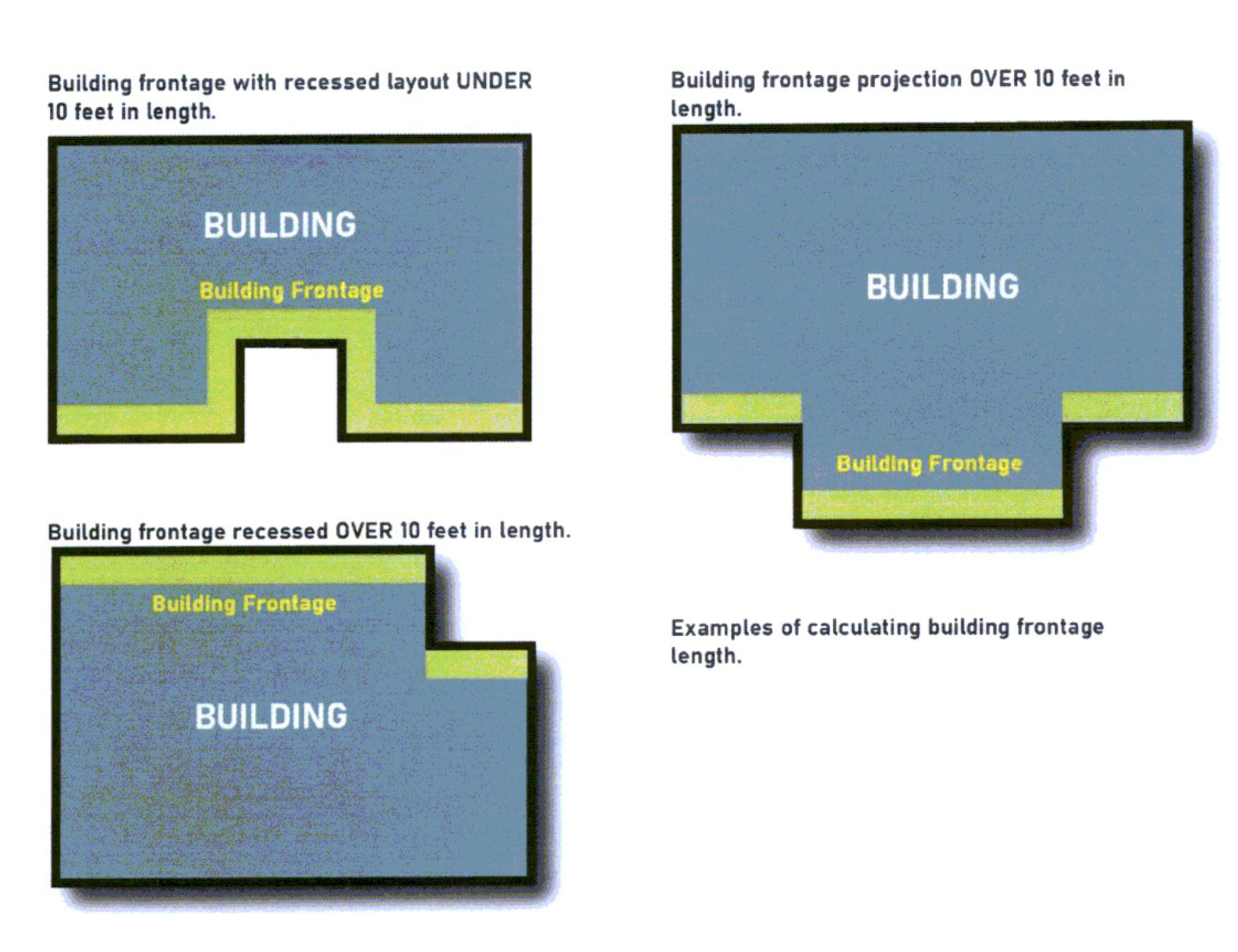
C.
The area of an individual sign shall be calculated as follows:
1.
Sign area shall include the entire area within a single continuous perimeter composed of squares or rectangles that enclose the extreme limits of all sign elements, including, but not limited to, sign structures or borders, written copy, logos, symbols, illustrations, and color. Supporting structures such as sign bases and columns are not included in sign area provided that they contain no lettering or graphics.
2.
Where two (2)faces of a double-faced sign are located two (2) feet or less from one another at all points or located at an interior angle of forty-five (45) degrees or less from one another, the sign area shall be calculated as the area of one (1) face. Where the two (2) faces are not equal in size, the larger sign face shall be used. Where two (2) faces of a double-faced sign are located more than two (2) feet or forty-five (45) degrees from one another, both sign faces shall be counted toward sign area.
3.
On a three-faced sign, where at least one (1) interior angle is forty-five (45) degrees or less, the sign area shall be calculated as the sum of the largest and the smallest face. In all other situations involving a sign with three (3) or more sides, the sign area shall be calculated as the sum of all faces.
4.
Three-Dimensional Signs. The size of signs that consist of, or have attached to them, one (1) or more three-dimensional objects (i.e., balls, cubes, clusters of objects, sculpture, or statue-like trademarks), shall be calculated as the sum of the square footage of the two (2) adjacent sides of the smallest theoretical cube that would encompass the sign.
Figure 20.62.090-2
Illustration of three-faced and three-dimensional signs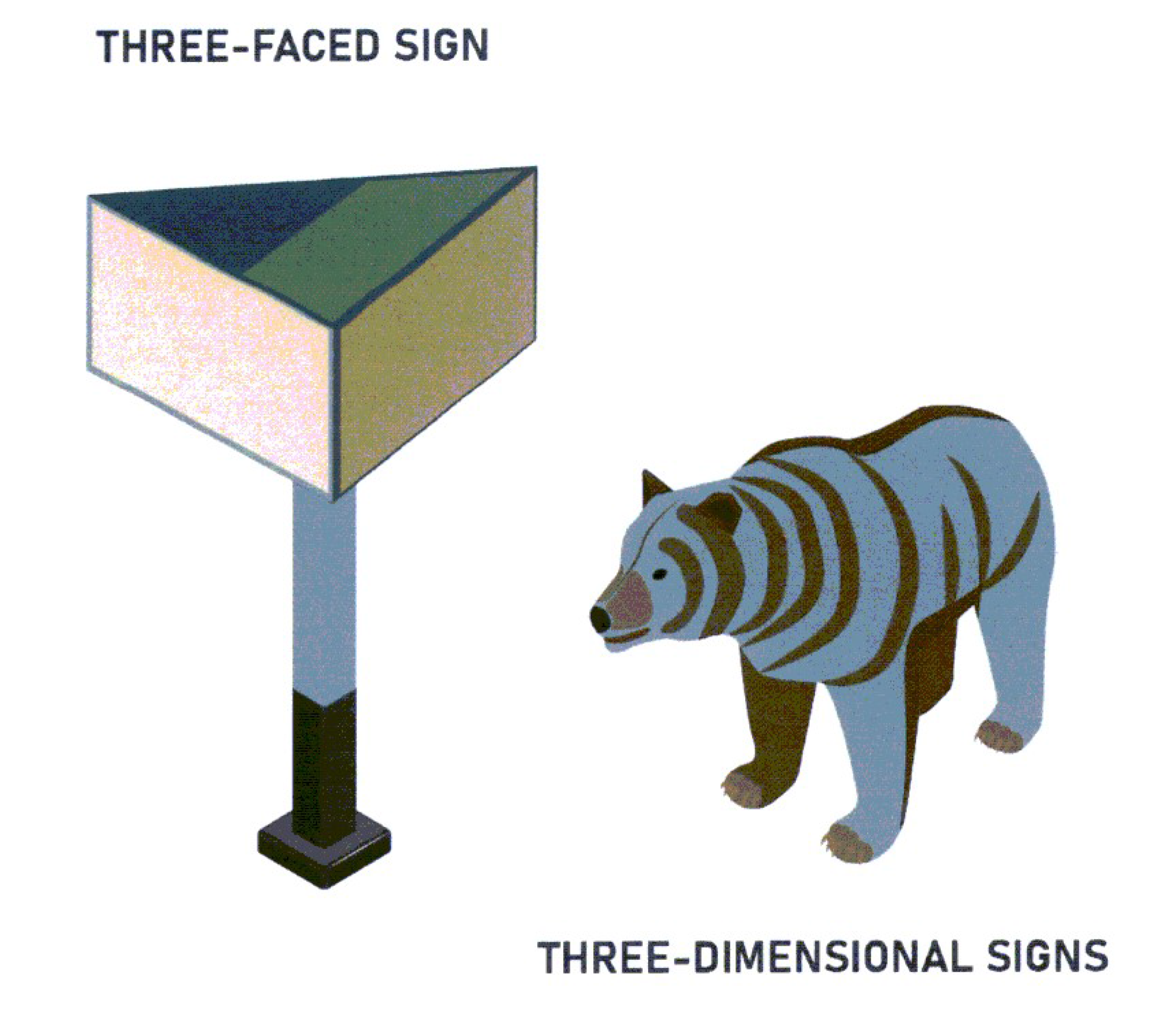
D.
The height of a sign shall be calculated as follows.
1.
Building Sign Height. The height of a building sign shall be the vertical distance measured from the ground level directly beneath the sign to the highest point at the top of the sign, including any structural or architectural components of the sign.
2.
Freestanding Sign Height. The height of a freestanding sign shall be measured as the vertical distance from grade at the edge of the right-of-way along which a freestanding sign is placed to the highest point of the freestanding sign, including any structural or architectural components of the sign. When the grade at the edge of the right-of-way is higher than the site on which the sign is placed, that portion of the sign below the grade at the edge of the right-of-way shall not be included in determining the freestanding sign's overall height. Freestanding signs oriented towards a freeway shall be measured from the site's finished grade or pad, whichever is lower.
3.
Freestanding Sign Height Clearance. Sign clearance shall be measured as the smallest vertical distance between finished grade and the lowest point of the sign, including any framework or other embellishments.
4.
Shopping Center Signs. For the purpose of determining the allowed number and size of signs, an integrated shopping center shall be considered as one (1) site.
E.
Illustrations of rules for sign measurement are shown in Figure 20.62.090-3. If an interpretation discrepancy exists between the illustrations and the text of this section, the text shall prevail.
Figure 20.62.090-3
Illustration of Rules for Sign Calculation and Height Measurement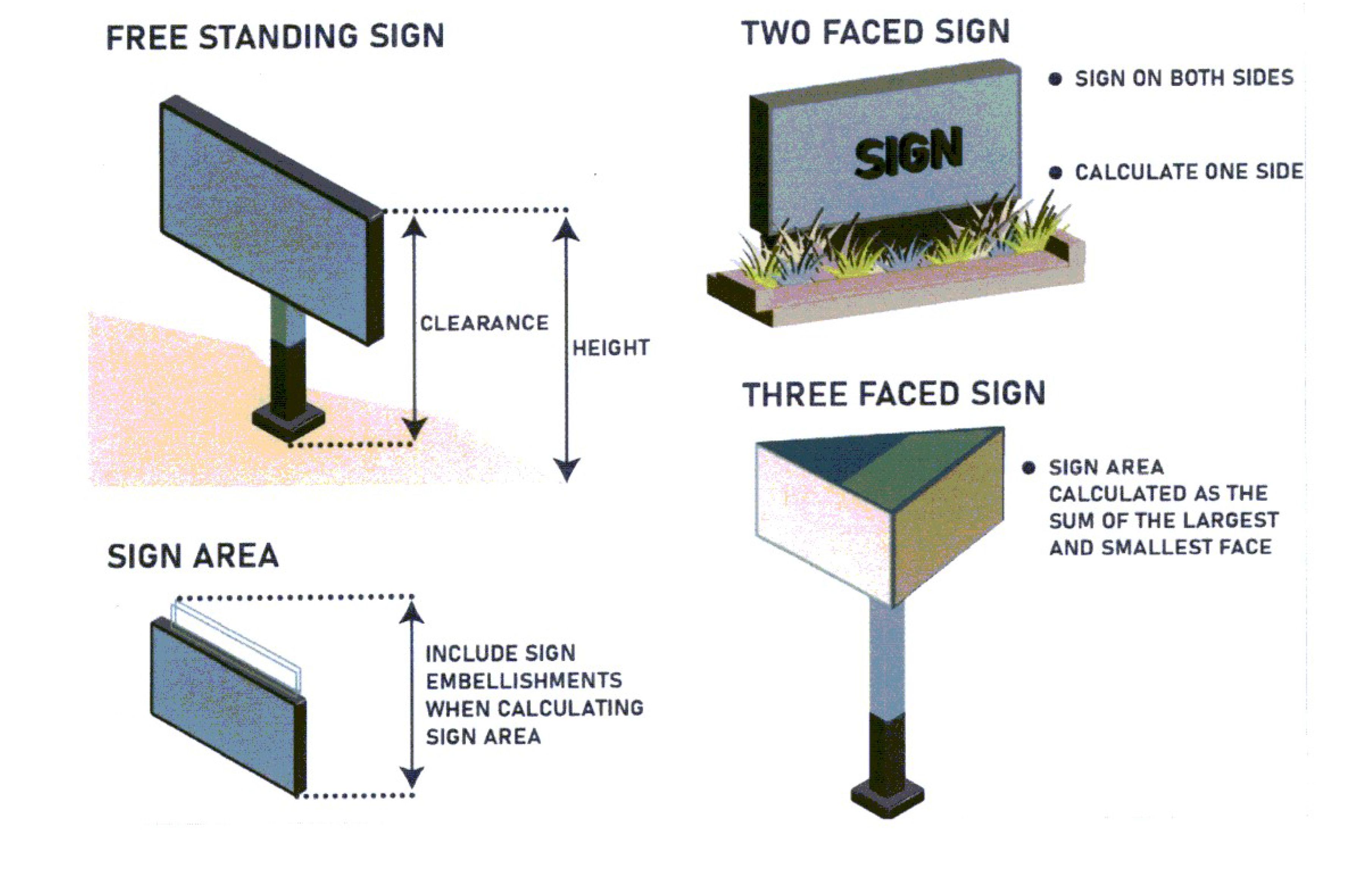
(Ord. No. 2549, § 1(Exh. A), 10-16-2023)
20.62.100 - Sign standards on developed sites by zone district.
A.
For the purpose of this chapter, signs are grouped into four (4) types: permanent building signs, permanent freestanding signs, temporary building signs, and temporary freestanding signs. Figure 20.62.100-1 illustrates the types of signs. The sign types are also defined in Section 20.62.360.
B.
This section establishes standards for the number of signs, size of signs, placement of signs, and illumination of signs for developed sites based on the zone district in which the signs are located. New signs placed on private property shall conform to these standards.
1.
Table 20.62.100-1 establishes sign standards for residential uses in residential zones.
2.
Table 20.62.100-2 establishes sign standards for commercial and office uses in residential zones.
3.
Table 20.62.100-3 establishes sign standards for residential uses in all non-residential zones.
4.
Table 20.62.100-4 establishes sign standards for commercial and office uses in General Commercial, Neighborhood Commercial, Shopping Center Commercial, Thoroughfare Commercial, Village Commercial, and Planned Development zones.
5.
Table 20.62.100-5 establishes sign standards for commercial and office uses in the Regional/Central Commercial zone.
6.
Table 20.62.100-6 establishes sign standards for commercial and office uses in Office Commercial, Business Park, and Downtown Office zones.
7.
Table 20.62.100-7 establishes sign standards for commercial and office uses in Downtown Core and Downtown Commercial zones.
8.
Table 20.62.100-8 establishes sign standards for commercial and office uses in Public Facility, Parks and Open Space, and Public Parking District zones.
9.
Table 20.62.100-9 establishes sign standards for commercial, office, and industrial uses in Agriculture and Urban Transition zones.
10.
Table 20.62.100-10 establishes sign standards for commercial, office, and industrial uses in all industrial zones.
11.
For the purpose of the tables identified in this section, uses that are not considered residential, office, or industrial shall be considered commercial uses. This includes public assembly and community uses.
12.
Sign standards for uses within a Planned Development zone shall be those standards in the tables in this section established for the zoning district that is equivalent to the site's general plan land use designation per Table 20.06-1 ("Base Zoning Districts"). Special standards for signs may be established with the adoption of the planned development zone that modify and supersede the standards in this section.
Figure 20.62.100-1
Illustration of Types of Signs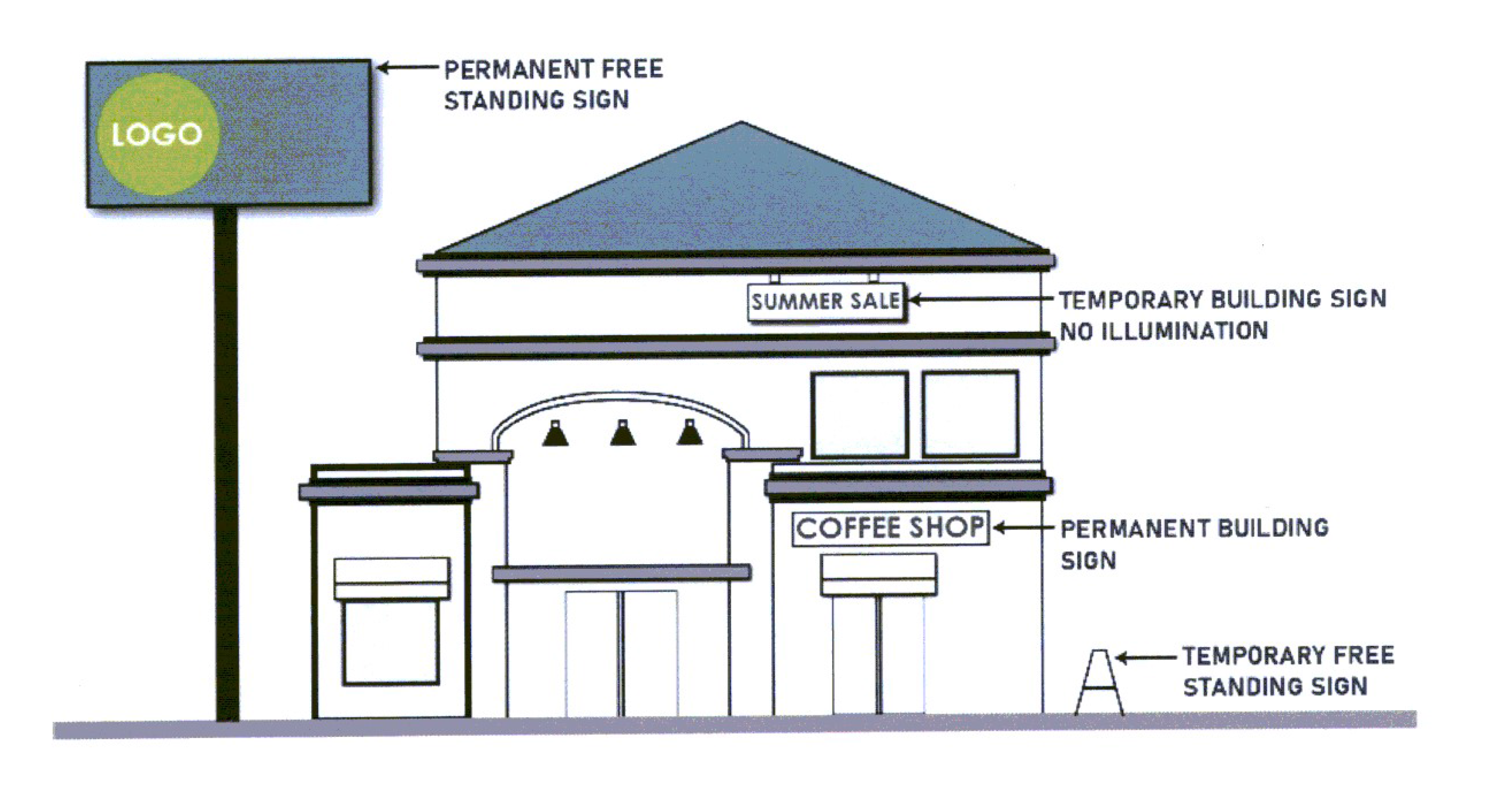
Table 20.62.100-1
Sign Standards for Residential Uses in All Residential Zones
Table 20.62.100-2
Sign Standards for Commercial and Office Uses in All Residential Zones
Table 20.62.100-3
Sign Standards for Residential Uses in Non-residential Zones
Table 20.62.100-4
Sign Standards for Commercial and Office Uses in General Commercial, Neighborhood
Commercial, Shopping Center Commercial, Thoroughfare Commercial, Village Commercial,
and Planned Development Zones
NOTE: In addition to the above, "Shopping Center Signs" are allowed per the provisions of Section 20.62.140.
Table 20.62.100-5
Sign Standards for Commercial and Office Uses in the Regional/Central Commercial and
Planned Development Zones
NOTE: In addition to the above, "Shopping Center Signs" are allowed per the provisions of Section 20.62.140.
Table 20.62.100-6
Sign Standards for Commercial and Office Uses in Office Commercial, Business Park,
and Downtown Office Zones
NOTE: In addition to the above, "Shopping Center Signs" are allowed per the provisions of Section 20.62.140.
Table 20.62.100-7
Sign Standards for Commercial and Office Uses in Downtown Core and Downtown Commercial
Zones
Table 20.62.100-8
Sign Standards
*
for Commercial and Office Uses in Public Facility, Parks and Open Space, and Public
Parking District Zones
* Standards do not apply to City of Merced signage.
Table 20.62.100-9
Sign Standards for Commercial, Office, and Industrial Uses in Agriculture and Urban
Transition Zones
Table 20.62.100-10
Sign Standards for Commercial, Office, and Industrial Uses in All Industrial Zones
(Ord. No. 2549, § 1(Exh. A), 10-16-2023)
20.62.110 - Old 99 Overlay District.
A.
The sign standards in Section 20.62.100 are modified in accordance with this section for parcels located within the Old 99 Overlay District. The area of Old 99 Overlay District is defined as the area shown in Figure 20.62.110-1.
Figure 20.62.110-1
Old 99 Overlay District Boundary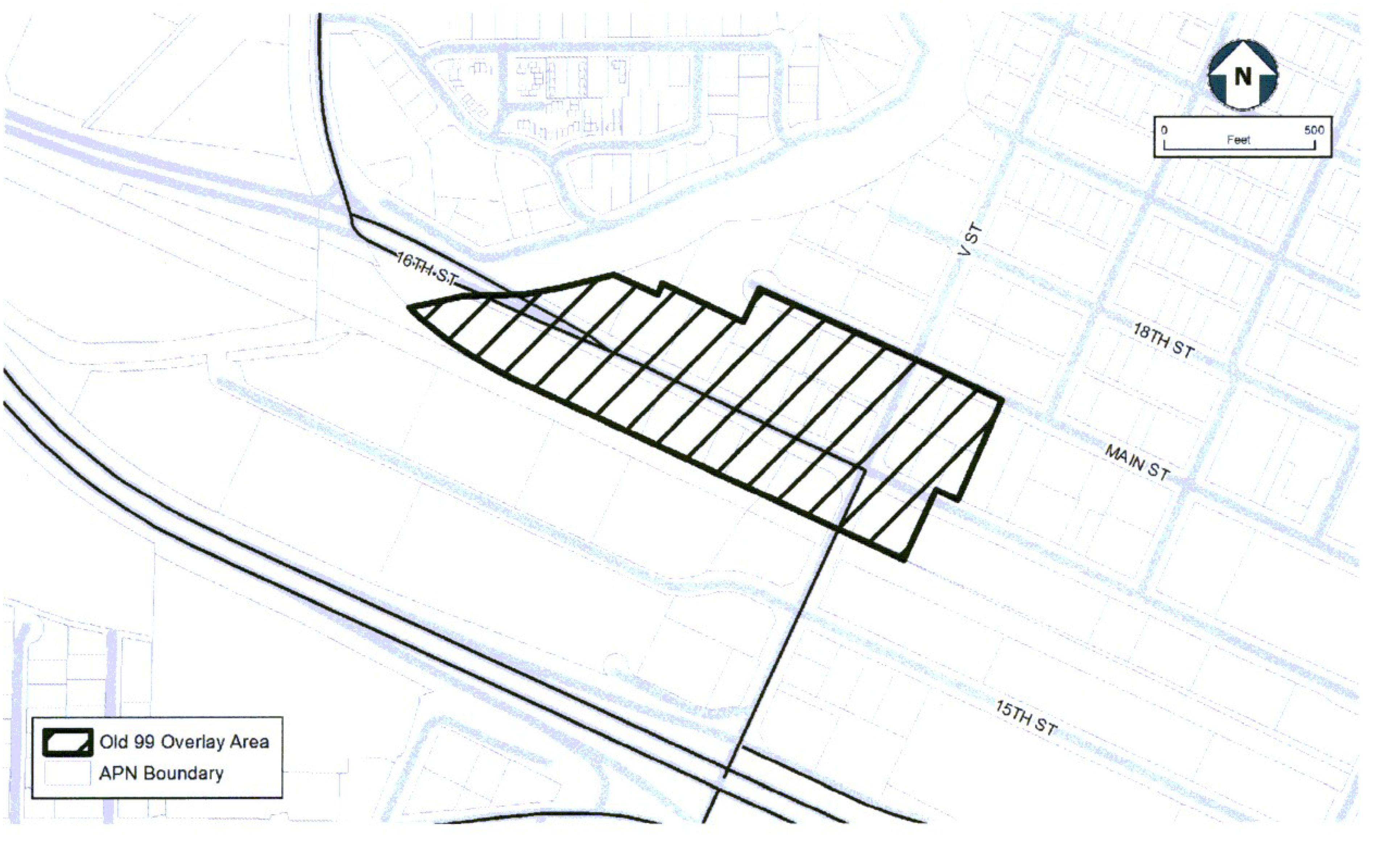
B.
In addition to the signs allowed in Section 20.62.100, parcels located within the Old 99 Overlay District are allowed one (1) permanent freestanding sign not to exceed two hundred (200) square feet with a maximum height of twenty-five (25) feet. The sign may be internally or externally illuminated. This sign shall be in addition to the signs allowed by Section 20.62.100.
(Ord. No. 2549, § 1(Exh. A), 10-16-2023)
20.62.120 - Downtown Overlay District.
A.
The sign standards for non-residential uses in Section 20.62.100 are superseded by this section for parcels located within the Downtown Overlay District. The area of the Downtown Overlay District is defined as the area shown in Figure 20.62.120-1.
Figure 20.62.120-1
Downtown Overlay District Boundary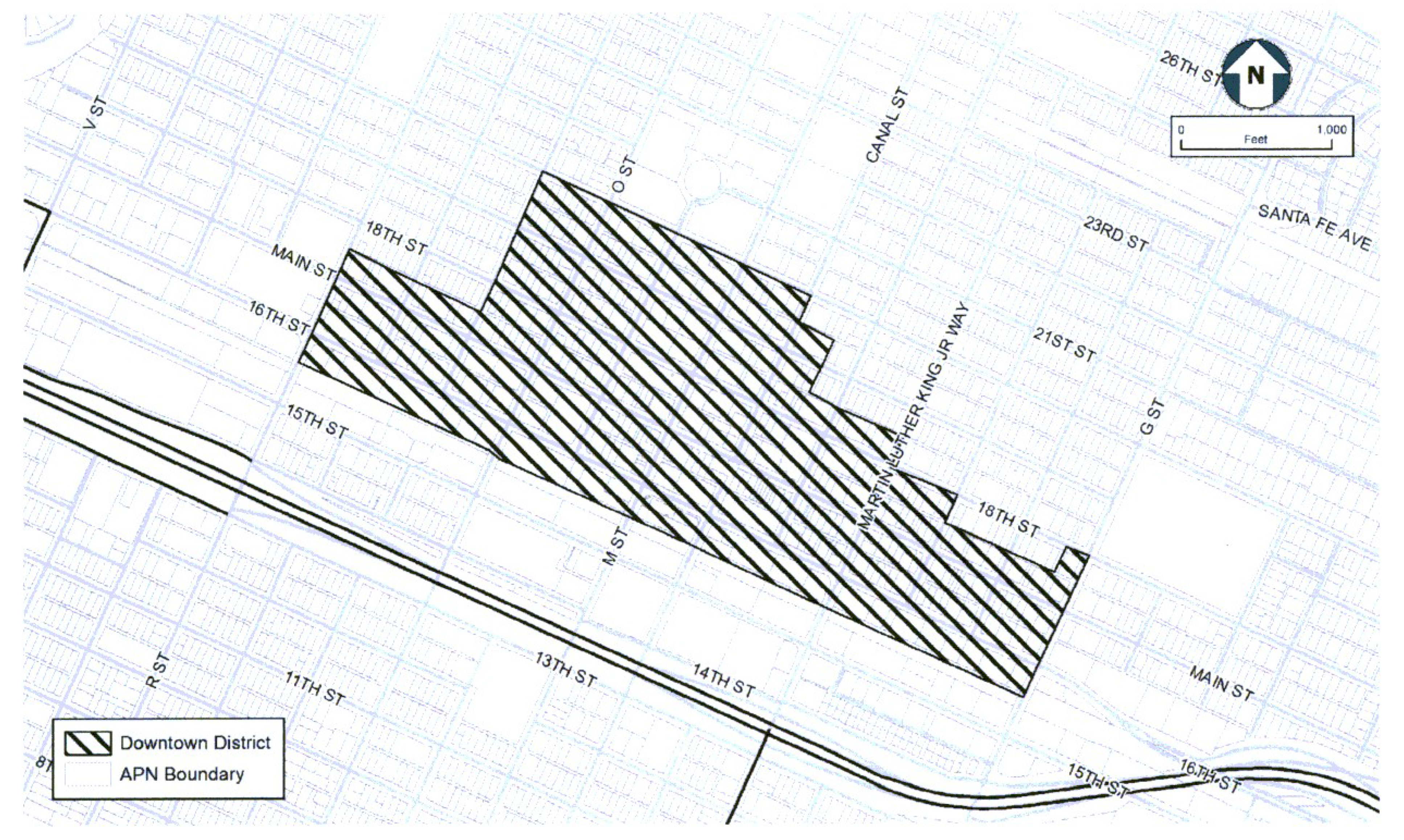
B.
In place of signs allowed in Section 20.62.100, this section establishes standards for the number of signs, size of signs, placement of signs, and illumination of signs for non-residential uses in the Downtown Overlay District. Table 20.62.120-1 establishes specific regulations for non-residential uses for permanent building signs, permanent freestanding signs, temporary building signs, and temporary freestanding signs.
C.
In addition to signs allowed in Section 20.62.100, one (1) additional permanent building sign oriented to pedestrians may be allowed up to ten (10) square feet. The sign type is limited to a projecting sign or an arcade or hanging sign. A minimum eight-foot clearance shall be provided under signs hanging over pedestrian paths of travel.
D.
In addition to signs allowed in Section 20.62.100, window signs placed on the inside of the window are allowed. Signs shall not cover more than twenty (20) percent of the window.
Table 20.62.120-1
Sign Standards for Non-residential uses in the Downtown Overlay District
E.
Blade signs are counted towards the maximum allowed permanent building sign area for a particular parcel. Blade signs may be permitted in Downtown Overlay District, by an application for administrative staff review through the planning department, if the following requirements are met:
1.
A blade sign must have a vertical clearance of eight (8) feet above the sidewalk or other public right-of-way and cannot exceed a height of more than six (6) feet above the height of the entryway of the building on which the sign is mounted or as otherwise approved by the planning commission through the approval of a comprehensive master sign program.
2.
A blade sign shall not exceed five (5) square feet of signage per side, shall be placed at least six (6) inches away from the building wall and the edge of the sign nearest the building, and shall not project more than forty-two (42) inches from the building wall on which it is mounted.
3.
A blade sign must be attached by a wrought iron or similar metal framework to the building wall. Materials, color, and arrangement of the sign shall be compatible and consistent with the building and neighboring structures.
(Ord. No. 2549, § 1(Exh. A), 10-16-2023)
20.62.130 - Freeway Overlay District.
A.
The sign standards in Section 20.62.100 are modified in accordance with this section for parcels located within the Freeway Overlay District. The Freeway Overlay District is defined as the area shown in Figure 20.62.130-1 and Figure 20.62.130-2.
B.
In addition to the signs allowed in Section 20.62.100, parcels in the Freeway Overlay District with a commercial use may, upon issuance of a freeway-oriented sign permit, establish a pole sign or a pylon sign consistent with the following standards:
1.
There shall be a maximum of one (1) such pole or pylon sign per parcel.
2.
The sign shall have a maximum of two (2) sides.
3.
The maximum size shall be one hundred (100) square feet per side.
4.
The maximum height shall be ninety (90) feet.
5.
The sign shall be set back a minimum of ten (10) feet from all property lines and rights-of-way.
6.
The sign shall be set back a minimum of forty (40) feet from any residential zone district.
7.
The sign shall be located in a landscaped planter at least three (3) feet wider than the base of the sign on all sides. The planter may encroach into the required minimum sign setback areas.
C.
In lieu of the single sign allowed in subsection B above, up to six (6) multiple commercial uses that are located on the same parcel or uses that are located on adjacent parcels may, upon issuance of a freeway-oriented sign permit, establish a pylon sign consistent with the following standards:
1.
There shall be a maximum of one (1) such pole or pylon sign per parcel.
2.
The sign shall have a maximum of two (2) sides.
3.
The maximum size shall be one hundred (100) square feet per commercial use per side.
4.
The maximum height shall be ninety (90) feet.
5.
The sign shall be set back a minimum of fifteen (15) feet from all property lines and rights-of-way.
6.
The sign shall be set back a minimum of eighty (80) feet from any residential zone district.
7.
The sign shall be located in a landscaped planter at least three (3) feet wider than the base of the sign on all sides. The planter may encroach into the required minimum sign setback areas.
D.
Freeway-oriented signs may be internally lit but shall not be externally lit. Signs must be compliant with Chapter 2 of the California Manual on Uniform Traffic Control Devices (MUTCD) which contains guidance for signs on highways and private roads.
Figure 20.62.130-1
Freeway Overlay District Boundary—Part 1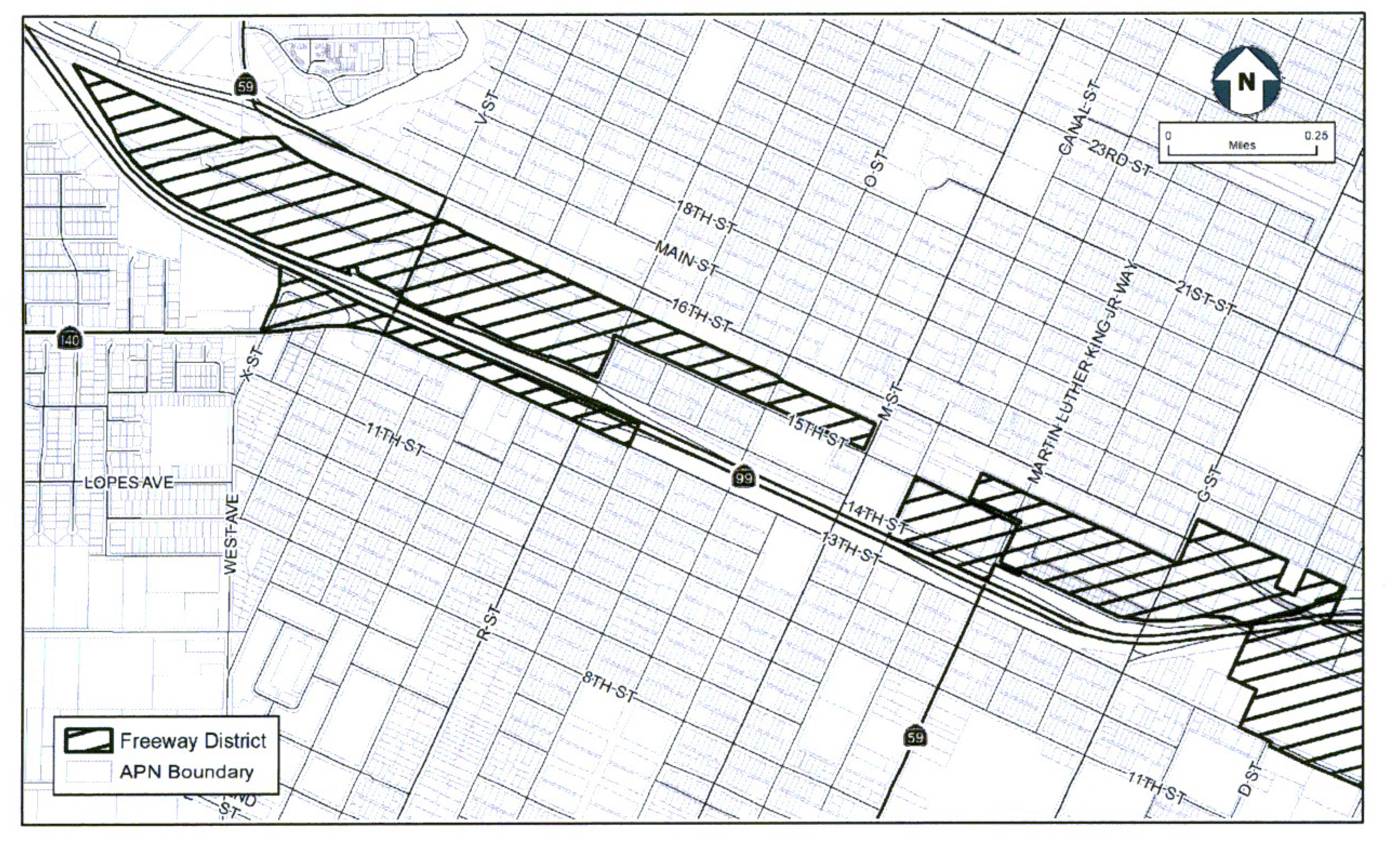
Figure 20.62.130-2
Freeway Overlay District Boundary—Part 2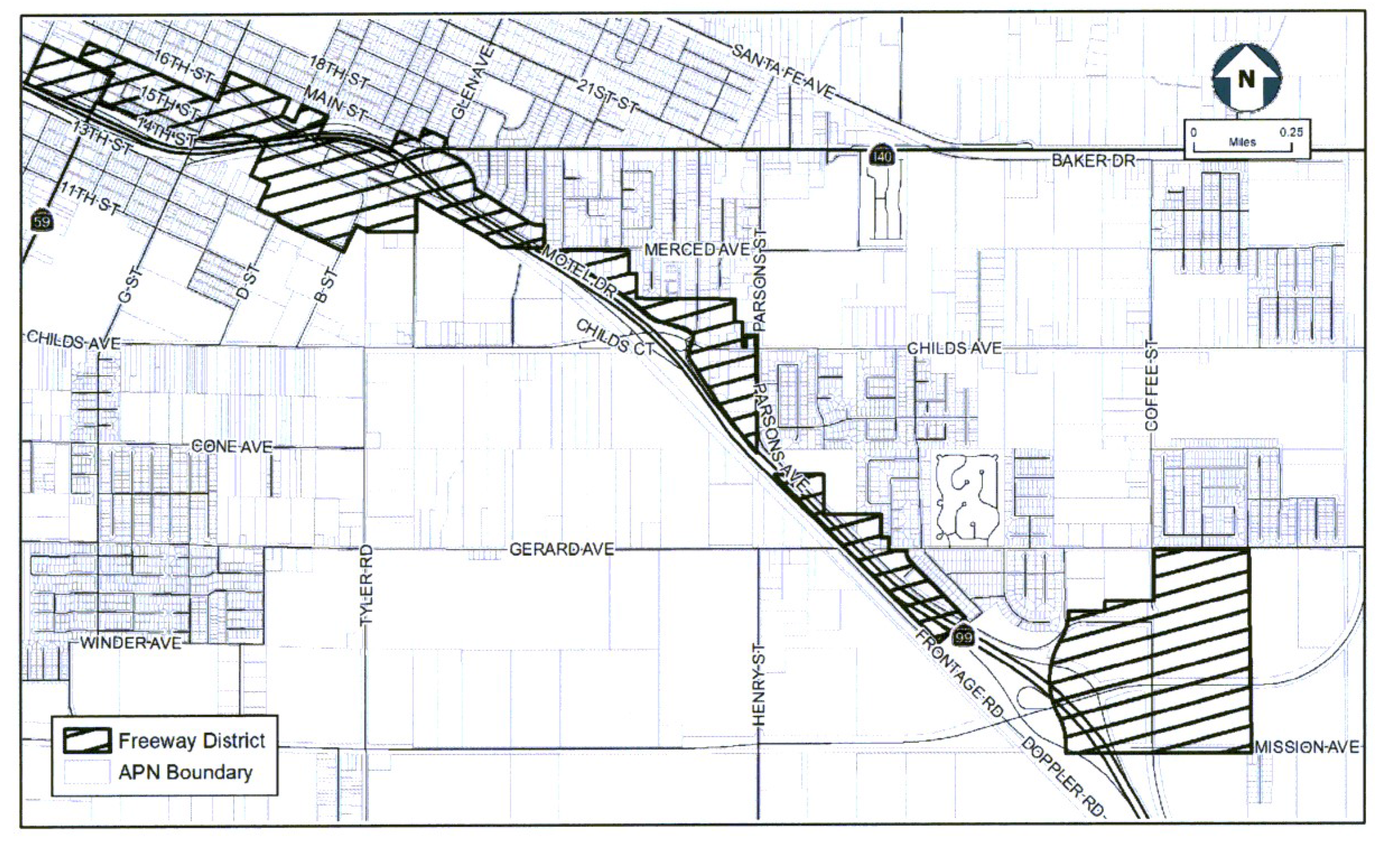
(Ord. No. 2549, § 1(Exh. A), 10-16-2023)
20.62.140 - Additional shopping center signs.
A.
Shopping centers or office complexes with a mix of retail and/or professional office tenants having a combined total of twenty-five thousand (25,000) square feet or more of gross floor area and located within a commercial zone and a P-D zone may be allowed an additional permanent freestanding or permanent building sign beyond what is allowed in Section 20.62.100 if the sign conforms to the following provisions:
1.
The shopping center sign may advertise the name of the center, the tenants in the center, or both the center and tenant names. Tenant advertising on a shopping center sign is not counted as part of the overall sign area permitted by Table 20.62.100-4. The area of the name of the shopping center is in addition to the permitted copy area. Only advertising for businesses located on the parcel is allowed.
2.
The sign may be illuminated unless adjacent to residential uses, in which case the development services director may require conditions on the type of illumination to protect against negative effects on the adjacent residential uses. The sign must be constructed of a material that is compatible with the texture and materials of the shopping center buildings. Individual letters and logos may be internally illuminated.
3.
Materials, color, and arrangement shall be compatible and consistent with the shopping center buildings.
4.
A maximum of two (2) shopping center signs on one (1) arterial street may be allowed. At least four hundred (400) feet of combined arterial street frontage is required to qualify for one (1) sign, except that shopping centers existing at the time of adoption of this section meeting all other requirements of this section are not bound by this requirement. An additional eight hundred (800) feet of frontage is required for a second sign.
5.
The maximum height and size allowances for shopping center signs are different in the Neighborhood Commercial (C-N), Thoroughfare Commercial (C-T), and Regional/Community Commercial (R-C) land use designations or Planned Developments with the equivalent General Plan designation. See Table 20.62.140-1 below:
Table 20.62.140-1
Shopping Center Sign Size
6.
A minimum of ten (10) square feet is required for each tenant displayed on a shopping center sign.
7.
The width of the foundation base of a shopping center permanent freestanding sign shall be a minimum of eighty (80) percent of the sign face.
8.
The sign structure shall have a minimum three-foot setback from any property line.
9.
A building permit application to construct a shopping center sign shall be signed by all property owners of the shopping center.
B.
With the adoption of a comprehensive master sign program in accordance with Section 20.62.180, a shopping center or office complex with a mix of retail and/or professional office tenants may be eligible for "bonus" sign area greater than allowed under an overall sign area permitted by Section 20.62.100.650.
1.
A "bonus" of up to thirty (30) percent shall be granted if a permanent copy is included on the shopping center sign that states "City of Merced," "Welcome to Merced," or equivalent language, as approved by the planning commission.
2.
A "bonus" of up to sixty (60) percent may be granted, pending approval by the planning commission, if enhanced design features (such as additional landscaping, water features, decorative artwork, seating areas, etc.) are incorporated into the shopping center.
3.
A "bonus of up to seventy (70) percent may be granted if the criteria of both "a" or "b" above are met.
4.
A "bonus" that would allow a "changeable copy sign" of no more than fifty (50) percent of the total sign area to be incorporated into the shopping center sign; and if the owner agrees to allow the city to advertise city- or community-sponsored events, at the discretion of the city, on the sign on a continuous and ongoing basis as part of a continuous rotation of advertising or as otherwise defined by the planning commission. The planning commission may increase the total sign area and/or reduce the amount of city advertising for unique circumstances, such as motion picture/performing arts theaters. Other than those city events above, the changeable copy sign shall not advertise any business, commodity, service, industry, or other activity, that is not sold, offered, or conducted on the premises upon which the sign is located or affixed.
5.
A "bonus" consisting of an increased maximum allowable height of a shopping center sign, not to exceed fifty (50) percent of the maximum allowable height spelled out in the table in Section 17.36.667.E, may be granted, pending approval by the planning commission, if the criteria for either "a" or "b" above are met and/or if the shopping center is located on the corner of two (2) arterial streets, as defined in the Merced General Plan.
(Ord. No. 2549, § 1(Exh. A), 10-16-2023)
20.62.150 - Temporary building sign standards.
A.
Temporary building signs in non-residential zones shall only be allowed for a total of six (6) months in any twelve-month period for any single parcel or business.
B.
Temporary building signs in non-residential zones over four (4) square feet in size that will be in place for more than thirty (30) days shall require a temporary sign permit. With such a permit, the signs may be up to thirty (30) square feet in size and may be in place for up to six (6) months.
C.
Feather banners, balloons, and banners shall not be used as permanent signs.
D.
Temporary building signs shall not be internally illuminated.
(Ord. No. 2549, § 1(Exh. A), 10-16-2023)
20.62.152 - Temporary freestanding sign standards.
A.
Feather banners and balloons will be allowed only for grand openings and are not to exceed being on display in excess of thirty (30) days.
B.
Feather banners and balloons shall not be used as permanent signs.
C.
Banners and feather banners shall be constructed of durable, weather-resistant materials not subject to rapid deterioration or fading and shall be professional in appearance. Acceptable materials include, but are not limited to, vinyl, nylon-reinforced vinyl, polyethylene or polyester-like materials, or durable fabric.
D.
Temporary freestanding signs in non-residential zones shall not be placed in the following locations:
1.
In any public right-of-way, including sidewalks, except as allowed by Section 10.62.110 in the Downtown Overlay District.
2.
In parking lot driving lanes, drive aisles, or parking spaces.
3.
On multi-use trails or sidewalks on private property if they would block a four-foot-wide pedestrian path of travel.
4.
Any location where the sign would block the pedestrian path of travel or access to a building.
5.
Within twenty (20) feet on either side or in front of a permanent freestanding sign.
6.
Within twenty (20) feet of an adjoining property line.
7.
Within twenty (20) feet from any other temporary freestanding sign.
8.
Within five (5) feet of a public right-of-way.
E.
Temporary freestanding signs shall be affixed to supporting structures made of a durable, rigid material such as, without limitation, wood, plastic, or metal. Freestanding signs placed on hard surfaces in conformance with this chapter are exempt from this subsection provided they have a weight and mass that makes them difficult to inadvertently move and they do not block a four-foot-wide pedestrian path of travel, do not have any motorized or other such mechanisms to cause them to move or flutter, and are only displayed between one (1) hour before and one (1) hour after the site's establishment is open for business.
(Ord. No. 2549, § 1(Exh. A), 10-16-2023)
20.62.160 - Illumination standards for signs.
The illumination of signs, from either an internal or external source, must be designed to avoid negative impacts on surrounding rights-of-way and properties. The following standards apply to all illuminated signs:
A.
Sign lighting shall not be of an intensity or brightness that will create a nuisance for residential uses in a direct line of sight to the sign. Light sources shall be shielded from all adjacent buildings and streets. The lighting shall not create excessive glare to pedestrians and/or motorists and will not obstruct traffic control or any other public informational signs. Illuminated signs located adjacent to any residential area shall be controlled by a rheostat or other acceptable method to reduce glare.
1.
Illumination of signs shall be limited to a maximum illumination of four hundred sixty-five (465) lumen per square foot (or five thousand (5,000) nits) during daylight hours and a maximum illumination of forty-seven (47) lumen per square foot (or five hundred (500) nits) between dusk to dawn as measured from the sign's face. It is strongly recommended that automatic dimmers be installed in the sign.
2.
Signs in residential zones may only be indirectly illuminated by a concealed light source, shall not remain illuminated between the hours of eleven p.m. and six a.m., and shall not flash, blink, or fluctuate. Illuminated signs in residential zones must also be located on an arterial or collector street.
B.
Internally illuminated signs shall be designed with an opaque, semi-opaque, or matte finish background on the sign face. Internally illuminated signs shall only be located on arterial or collector streets. Internally illuminated signs must not be located within one hundred (100) feet of a residential zone.
C.
Light sources for externally illuminated signs shall meet the following standards:
1.
Low-pressure sodium lighting is the preferred light source to minimize undesirable light in the night sky.
2.
High-pressure sodium, metal halide, fluorescent, quartz, LED, and incandescent light sources shall be fully shielded.
3.
Metal halide and fluorescent light sources shall be filtered. Most glass, acrylic, or translucent enclosures satisfy these filter requirements.
4.
Mercury vapor light sources shall be prohibited.
D.
External conduits, boxes, and other connections related to the function of a sign and associated lighting shall not be exposed nor pass through a public right-of-way.
(Ord. No. 2549, § 1(Exh. A), 10-16-2023)
20.62.170 - Sign regulations on undeveloped or developing sites.
A.
Undeveloped sites shall be allowed a maximum of two (2) temporary freestanding signs with a maximum size of thirty-two (32) square feet each. The maximum height shall be ten (10) feet. Signs shall be set back at least ten (10) feet from all property lines and the public right-of-way. Illumination of the sign is prohibited.
B.
Developing sites, i.e., construction sites, shall be allowed a maximum of two (2) temporary freestanding signs or temporary building signs with a maximum size of thirty-two (32) square feet each. The maximum height shall be ten (10) feet. Signs shall be set back at least ten (10) feet from all property lines and the public right-of-way. Illumination is prohibited. Temporary signs that are not visible from any public right-of-way shall not be counted in the maximum number or size of signs.
C.
In addition to any sign permitted pursuant to subsection B above, residential subdivision sites where ten (10) or more new residences are offered for sale shall be allowed one (1) temporary building sign or freestanding sign of a maximum size of thirty-two (32) square feet. Illumination of the sign is prohibited. The maximum height shall be ten (10) feet. Additional temporary signs, temporary freestanding signs, and flags may be maintained within the boundaries of a residential subdivision provided that they are not visible from outside the residential subdivision and do not create a safety hazard by obstructing the clear view of pedestrian and vehicular traffic.
D.
Construction Locations (Example: Remodel of a Building). Signs may be placed during a construction event pursuant to the conditions of a permit issued by the city on the lot. Construction events begin on the date of the local structural permit approval and end on the date the permit is final or expires.
(Ord. No. 2549, § 1(Exh. A), 10-16-2023)
20.62.180 - Signs placed in windows.
A.
Signs affixed to windows shall not cover more than twenty (20) percent of each window and shall be placed so that there is an unobstructed view of the interior of the premises.
B.
Signs in windows shall not be counted toward the maximum allowable temporary or permanent building sign size.
(Ord. No. 2549, § 1(Exh. A), 10-16-2023)
20.62.190 - Signs in public rights-of-way.
Only a governmental agency with authority over public right-of-way may place signs in the public right-of-way, with the following specific exceptions:
A.
Building signs may be located in the Downtown Overlay zone that project into the public right-of-way, provided that the width of the projecting sign is a maximum of four (4) feet and that the bottom of the sign is eight (8) feet above the sidewalk or finished grade below it. An encroachment permit or licensing agreement is required.
B.
Building signs located on or under awnings in the Downtown Overlay zone that meet the provisions of this chapter.
C.
Temporary freestanding signs placed on the public sidewalk in the Downtown Overlay zone that meet the provisions of this chapter and when a minimum four-foot-wide clear path of travel is provided.
D.
Government agencies, public institutions, and non-profit organizations may place banners on existing light poles in the public right-of-way, subject to a minor use permit issued by the development services director and, if deemed necessary, an encroachment permit/license agreement issued by the city engineer.
(Ord. No. 2549, § 1(Exh. A), 10-16-2023)
20.62.200 - Comprehensive master sign programs.
A.
The purpose of the comprehensive master sign program provisions is to provide a coordinated and flexible design approach to signage for Merced's commercial shopping districts, industrial districts, and office parks. A master sign program is required for any site that contains more than three (3) commercial establishments in a shopping center, industrial park, or office park.
B.
The comprehensive master sign program shall consist of all permanent building signs and permanent freestanding signs on the premises that can be viewed from a public street. The comprehensive master sign program shall establish a comprehensive design theme and set forth size, location, illumination, materials, and other design requirements for all signs.
C.
A comprehensive master sign program may be approved by the development services director as a minor use permit. The planning commission may approve a master sign program when it is proposed with a development project that requires a conditional use permit if the information is available at the time of conditional use permit issuance. Otherwise, the director may approve with a minor use permit.
D.
A comprehensive master sign program shall not be used to grant a special privilege nor provide more visibility or exposure than is available to similarly situated properties.
E.
Comprehensive master sign programs shall feature a unified and coordinated approach to the materials, color, size, type, placement, and general design of signs proposed for a project or property.
F.
Reasonable conditions of approval may be imposed to achieve the purposes of this section and ensure internal sign design consistency on the site.
G.
After approval of a comprehensive master sign program, no sign shall be erected, placed, painted, or maintained, except in conformance with such program, and such program shall be enforced in the same way as any provision in this section.
H.
The master sign program and all conditions of approval applicable to a site shall be included with lease agreements for all leasable space subject to the comprehensive master sign program.
I.
Approval of a comprehensive master sign program does not waive the permit requirements for individual signs that are subject to the program.
J.
The development services director may approve amendments to a comprehensive master sign program or at the director's discretion, may be referred to the original approving body.
K.
Proposed amendments to a comprehensive master sign program shall include written concurrence by the affected property owners.
(Ord. No. 2549, § 1(Exh. A), 10-16-2023)
20.62.210 - Offsite temporary signs for residential subdivisions.
A.
Residential subdivision sites where ten (10) or more new residences are offered for sale shall be allowed up to four (4) offsite temporary freestanding signs with a size not to exceed thirty-two (32) square feet each and a height not to exceed ten (10) feet. Signs shall be located on private, non-residential zoned parcels, or on private, residential zoned parcels that are part of a residential subdivision under construction, vacant, and otherwise free from any structures or buildings. Banners and flags with or without an advertising message shall not be permitted offsite.
B.
In addition to any sign permitted pursuant to subsection A above, up to four (4) non-illuminated offsite temporary freestanding signs in an A-frame configuration, with a size not to exceed twelve (12) square feet per face or four (4) feet in height, may be permitted per residential subdivision. A-frame signs shall be located on private, non-residential property or on public property behind any existing sidewalks, and in such a manner so as not to create a safety hazard by obstructing the clear view of, or otherwise hinder or impede, pedestrian and vehicular traffic. A-frame signs may only be displayed during operating hours for the residential subdivision sales office and shall be located no further than one thousand five hundred (1,500) feet from the subject residential subdivision entry.
(Ord. No. 2549, § 1(Exh. A), 10-16-2023)
20.62.220 - Historic signs.
A.
Notwithstanding any other provision of this chapter, a sign that has been designated a historic resource in accordance with Chapter 17.54 or the reproduction of such a sign shall not be subject to the requirements of this chapter, other than the requirement to obtain applicable building permits.
B.
Notwithstanding any other provision hereof, a structure that has been designated a historic resource in accordance with Chapter 17.54 or a structure over two (2) stories within the downtown area are eligible to adopt a comprehensive master sign program that meets the requirements of Section 20.62.200, and which may grant exceptions to the provisions of this chapter.
C.
The planning commission may allow or require specific refurbishment or alteration of the sign designated as a historic resource. The applicant shall provide illustrations to satisfactorily describe how the sign will look after refurbishment.
D.
The planning commission may approve a change to the sign copy of a sign designated as a historic resource if it finds that the sign will retain its general historic appearance.
(Ord. No. 2549, § 1(Exh. A), 10-16-2023)
20.62.230 - Signs with manual changeable copy.
A.
Manual changeable copy is allowed on signs in residential zones or in conjunction with residential uses in non-residential zones with a minor use permit. (Examples of uses that may need such signs are public assembly, schools, multi-family, etc.)
B.
Manual changeable copy shall represent no more than twenty (20) percent of the total allowable sign area on commercial signs in commercial or industrial zones.
C.
This section shall not apply to signs that indicate the price of motor vehicle fuel in conformance with the State Business and Professions Code that otherwise are in conformance with the other sections of this title. Motor vehicle fuel price signs in conformance with state law shall be allowed and are exempt from size, height, and other requirements in the ordinance from which this chapter is derived that might interfere with them meeting the requirements of state law as regards to visibility, the prices being posted for all fuel types, the prices being visible from the public rights-of-way.
(Ord. No. 2549, § 1(Exh. A), 10-16-2023)
20.62.240 - Signs with electronic changeable copy.
A.
Electronic changeable copy may be allowed on signs in residential zones or in conjunction with residential uses in non-residential zones with a minor use permit. (Examples of uses that may need such signs are public assembly, schools, multi-family, etc.)
B.
Electronic changeable copy is allowed as a display medium on freestanding signs in the commercial and industrial zone districts with a minor use permit if the sign face changes less than once per minute. This includes signs that indicate the price of motor vehicle fuel in conformance with the State Business and Professions Code that otherwise are in conformance with the other sections of this title.
C.
Electronic changeable copy is allowed as a display medium on freestanding signs with a conditional use permit issued pursuant to this title where the electronic copy changes more than once per minute.
D.
Signs with electronic changeable copy shall meet the following standards:
1.
The electronic sign face shall be directed in a manner that is not visible from the front or side of residential properties located in a residential zone district.
2.
The electronic sign face shall be an integral part of the remainder of the sign area.
3.
Electronic copy shall be limited to a maximum illumination of four hundred sixty-five (465) lumen per square foot (or five thousand (5,000) nits) during daylight hours and a maximum illumination of forty-seven (47) lumen per square foot (or five hundred (500) nits) between dusk to dawn as measured from the sign's face. It is strongly recommended that automatic dimmers be installed in the sign.
4.
No portion of the electronic changeable copy shall change more frequently than once per minute without a minor use permit. The maximum electronic changeable copy can be allowed to once every eight (8) seconds with a minor use permit. Scrolling, flashing, or other moving messages are not allowed.
5.
The electronic sign shall not emit any audible sound, buzz, or noise.
6.
Sign copy or electronic picture displays shall be limited to advertising related to the use(s) on the premises on which the freestanding sign is located, except for message substitution, as allowed in Section 20.62.030.
7.
No change of lighting intensity may occur during a display or between displays except to respond to a change in ambient lighting conditions.
(Ord. No. 2549, § 1(Exh. A), 10-16-2023)
20.62.250 - Digital display signs.
A.
Digital display signs are allowed on freestanding signs with a conditional use permit issued pursuant to this title only within the Thoroughfare Commercial zone, Regional/Central Commercial zone, General Commercial zone, Neighborhood Commercial zone, Commercial Shopping Center zone, Freeway Overlay District, Old 99 Overlay District, and any Planned Development zone that has the equivalent general plan land use designation per Table 20.06-1 ("Base Zoning Districts") to the previously mentioned zones.
B.
Digital display signs shall meet the following standards:
1.
The digital display sign face shall be directed in a manner that is not visible from the front or side of residential properties located in a residential zone district.
2.
The digital display sign face shall be an integral part of the remainder of the sign area and shall be framed with a sign structure border that is a minimum of three (3) inches wide around the edge of the digital display area.
3.
The digital display sign shall be limited to a maximum illumination of four hundred sixty-five (465) lumen per square foot (or five thousand (5,000) nits) during daylight hours and a maximum illumination of forty-seven (47) lumen per square foot (or five hundred (500) nits) between dusk to dawn as measured from the sign's face. It is strongly recommended that automatic dimmers be installed in the sign.
4.
No portion of the digital display sign face shall change more frequently than once every eight (8) seconds. No portion of the digital display sign face shall flash, blink, or include a video display.
5.
The electronic sign shall not emit any audible sound, buzz, or noise.
6.
Sign copy shall be limited to advertising related to the use(s) on the premises on which the freestanding sign is located, except for message substitution, as allowed in Section 20.62.030.
7.
No change of lighting intensity may occur during a display or between displays except to respond to a change in ambient lighting conditions.
(Ord. No. 2549, § 1(Exh. A), 10-16-2023)
20.62.260 - Flags and flagpoles.
A.
Flags that do not include commercial advertising on flagpoles shall not count toward the maximum sign area.
B.
Flagpoles shall not be located within any required interior side or rear building setback areas. Flagpoles may be mounted on the ground or on the roof or wall of a building.
C.
The maximum height of a flagpole shall be as follows:
1.
Flagpoles located in residential zone districts shall have a maximum height of thirty-five (35) feet.
2.
Flagpoles located in non-residential zones shall have a maximum height of fifty (50) feet if mounted on the ground, or twenty (20) feet plus the height of the building if mounted on a building. The maximum height may be increased to one hundred (100) feet if the flagpole is located at least two hundred (200) feet from any property line or public right-of-way.
(Ord. No. 2549, § 1(Exh. A), 10-16-2023)
20.62.270 - Search lights and klieg lights.
Search lights and klieg lights are prohibited, except when used for public safety purposes or when specifically approved with a temporary use permit for a special event.
(Ord. No. 2549, § 1(Exh. A), 10-16-2023)
20.62.280 - Wall murals.
The city council, planning commission, or arts and culture advisory commission may authorize a wall mural. When authorized, a mural would not be considered a sign for the purposes of this chapter. A wall mural is to be public art, not for the purpose of identifying, advertising, or drawing attention to a particular business, service, or economic activity. In the case that a mural is specifically identifying, advertising, or drawing attention to a particular business, the mural would need to be counted toward the allowable signage area for the business or activity and shall be subject to a sign permit. Less than ten (10) percent of the size of the mural may be used to identify the sponsor of the mural.
(Ord. No. 2549, § 1(Exh. A), 10-16-2023)
20.62.290 - Off-premises signs in city right-of-way.
Notwithstanding any other provisions of this title, the city council may approve, through a special right-of-way leasing agreement, the erection of an off-premises sign within the city right-of-way. It must be deemed under the city council to provide community benefit as defined and be under all the following circumstances:
A.
The sign shall be for a land use that addresses specific community benefits or priorities (i.e., the provision of groceries in a USDA-defined "food desert," affordable housing, the provision of needed services within an income-qualified census tract, etc.).
B.
The size, location, height, and other design standards for the sign shall be determined on a case-by-case basis through the licensing agreement.
C.
The sign may incorporate a "changeable copy sign" of no more than fifty (50) percent of the total actual sign area unless otherwise approved by the city council.
D.
The owner of the land use that provides the community benefits shall erect the sign and maintain it at their sole expense.
E.
The owner shall agree to allow the city to advertise city- or community-sponsored events or emergency messages (traffic advisories, amber alerts, etc.), at the discretion of the city, on the sign on a continuous and ongoing basis as part of a continuous rotation of advertising or as otherwise defined by the city council.
F.
Other than those city events above and the land use above that provides community benefits, the changeable copy sign shall not advertise any business, commodity, service, industry, or other activity that is not sold, offered, or conducted on the premises upon which the sign is located or affixed.
(Ord. No. 2549, § 1(Exh. A), 10-16-2023)
20.62.300 - Non-conforming signs.
A sign of any character lawfully occupying a site prior to the adoption of this chapter or on the effective date of applicable amendments to this chapter that, as a result of the adoption or amendment to, does not conform with the standards for the district in which it is located, shall be deemed to be a non-conforming sign, and may be displayed and maintained in said district. Modifications to non-conforming signs may be allowed through a minor use permit.
(Ord. No. 2549, § 1(Exh. A), 10-16-2023)
20.62.310 - Billboards.
A.
No new billboard shall be permitted within the city after the adoption of this chapter, except as provided in this section.
B.
Billboards existing in industrial zones on and prior to the adoption of this chapter may continue to exist at their current location, subject to the provisions of this chapter, and may be maintained or replaced from time to time, provided, however, that the total display area of any existing billboard shall not be enlarged in size or increased in height in any way.
C.
Billboards existing in any zone other than an industrial zone on and prior to the adoption of this chapter are considered a non-conforming sign.
D.
No part of a billboard shall include a digital display sign, manual changeable copy, or electronic changeable copy.
(Ord. No. 2549, § 1(Exh. A), 10-16-2023)
20.62.320 - Maintenance of signs.
A.
All signs and associated supporting structures shall be maintained in like-new condition, without rips, tears, fading, and similar damage that inevitably occurs as a result of normal wear and aging.
B.
All signs shall be reasonably free from deterioration, rot, rust, and loosening so that they do not create a hazard to persons or property or constitute a nuisance.
C.
Any sign or sign structure that is sagging, leaning, fallen, decayed, broken, deteriorated, ripped, torn, faded, or other deteriorating or dilapidated condition shall be promptly repaired to the satisfaction of the city or removed in accordance with city ordinance code 8.36.080.
D.
Graffiti on a sign shall be removed by the property owner (or designee) within two (2) days of notice of its placement on such sign. If graffiti is not removed, it will be subject to [Section] 8.36.070.
(Ord. No. 2549, § 1(Exh. A), 10-16-2023)
20.62.330 - Hazardous signs.
Whenever any sign, by virtue of its physical nature and condition, is deemed by the development services director, chief building official, or public works director to be an immediate and serious threat to public safety, city personnel may remove the sign or repair the physical deficiency to the extent necessary to protect the public safety. The cost of such removal or repair shall be assessed against the sign owner.
(Ord. No. 2549, § 1(Exh. A), 10-16-2023)
20.62.340 - Abandoned or obsolete signs.
An on-premises sign advertising an activity, business, service, or product must be removed within ninety (90) days following the actual discontinuance of the activity, business, service, or product. If the sign is not so removed, the development services director may have the sign removed in accordance with the public nuisance abatement provisions of this title. A sign structure is not required to be removed, however, the sign face shall be removed or replaced with a blank face or other sign face consistent with this chapter.
(Ord. No. 2549, § 1(Exh. A), 10-16-2023)
20.62.350 - Illegal signs.
Any sign, banner, or sign structure not erected, constructed, or located in conformance with this chapter and not classified as a legal non-conforming sign is an illegal sign and is subject to abatement in accordance with the public nuisance abatement procedures of Section 8.40.080.
(Ord. No. 2549, § 1(Exh. A), 10-16-2023)
20.62.360 - Enforcement.
Signs erected after the effective date of this chapter that either do not conform to the provisions of this chapter or are erected without obtaining a required permit are declared to be unlawful and a public nuisance. All signs declared to be unlawful by this chapter and all persons erecting or maintaining them shall be subject to the provisions of Merced Municipal Code Section 1.09.020 (Code Enforcement Authority and Powers). The remedies provided for in this section are cumulative and non-exclusive.
(Ord. No. 2549, § 1(Exh. A), 10-16-2023)
20.62.370 - Definitions.
The following terms are defined for this chapter. Illustrations of rules for sign measurement are shown in Figure 20.62.090-1. The accompanying images and Figure 20.62.370-1 are intended to illustrate some of the sign types that are defined in this section. If an interpretation discrepancy exists between the illustrations and the text of this Section, the text shall prevail.
A.
"A" definitions.
1.
"A-Frame sign" means a sign made of wood, plastic, or other lightweight and rigid material having the capability to stand on its own support(s) and being portable and movable.
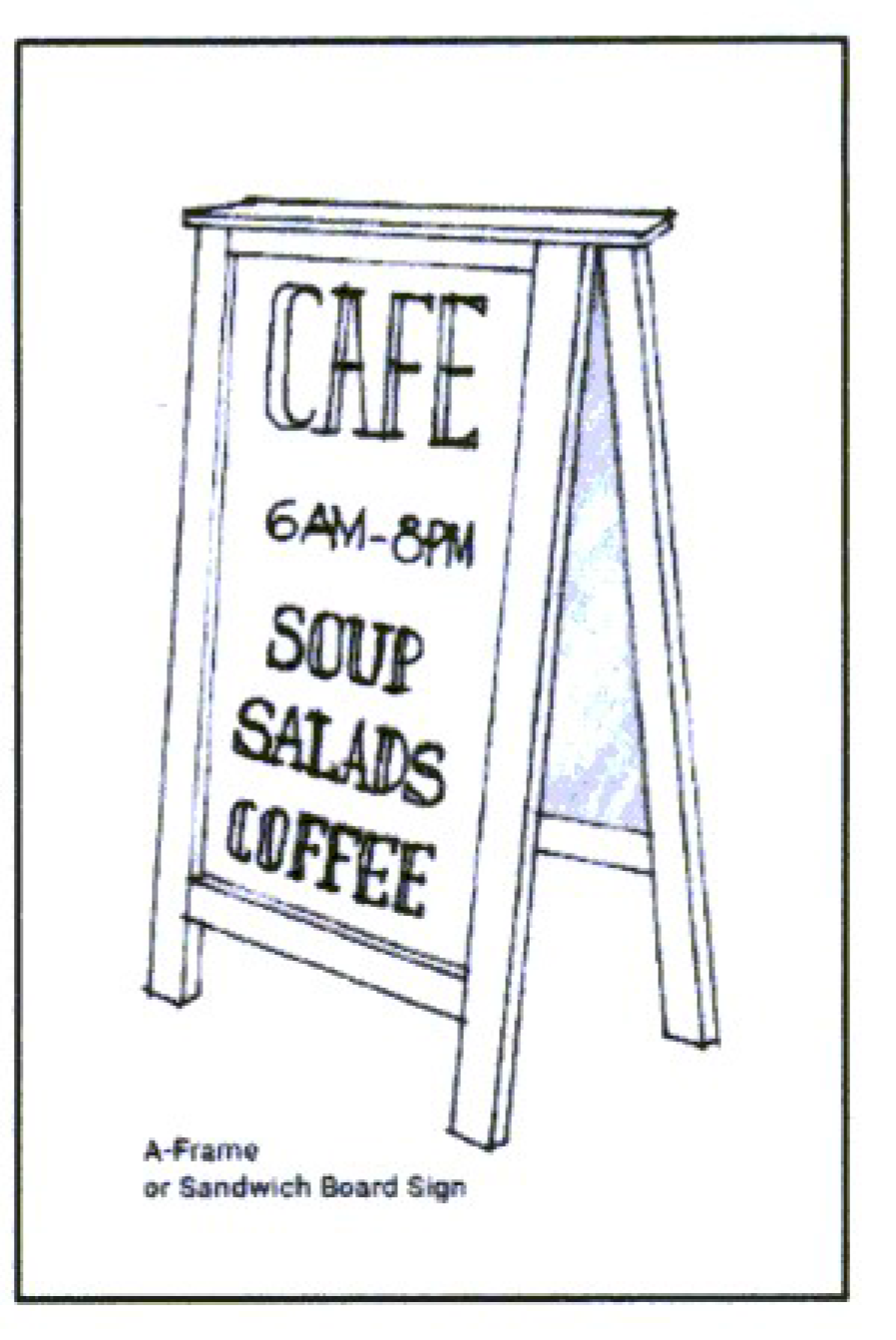
2.
"Animated sign" means a sign with action or motion, whether by flashing lights, color changes, wind, rotation, movement of any parts of the sign or letters or parts of the sign structure, or other motion.
3.
"Arcade sign" means a sign suspended from the ceiling of a covered pedestrian walkway, which is attached to the building and oriented perpendicular to the building face to which the covered walkway is attached.
4.
"Awning sign" means a sign placed on a shelter supported entirely from the exterior wall of a building and composed of a frame covered with non-rigid material.
B.
"B" definitions.
1.
"Banner" means any flexible material, such as cloth, plastic, vinyl, paper, cardboard, or thin metal, with or without a "message," attached outdoors to a building, structure, or mounting device, or attached indoors to a building, structure, or mounting device so as to be visible from the exterior of a building, or structure. This definition includes a pennant, scroll, or bunting.
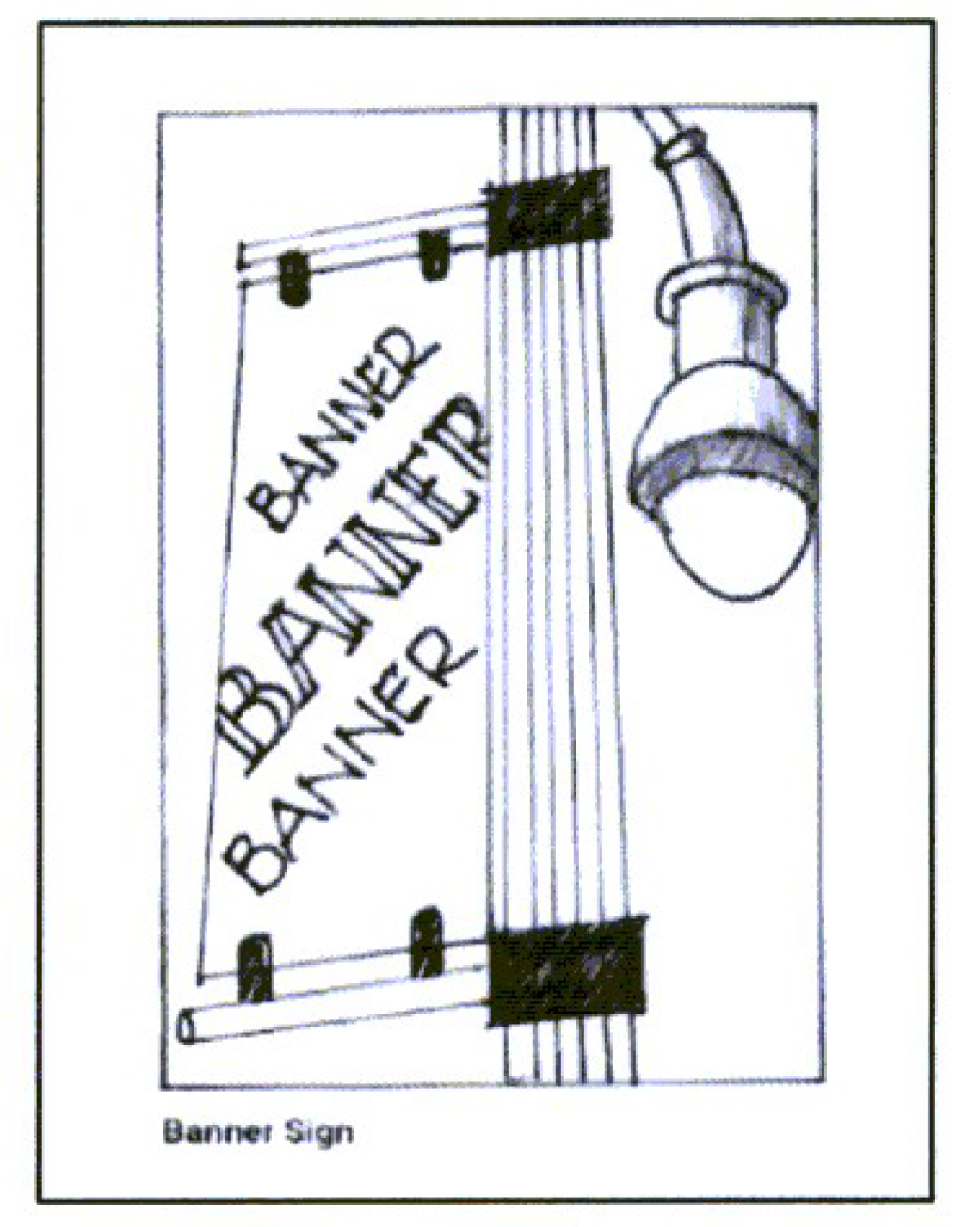
2.
"Barber pole" means a pole with diagonal stripes of red and white or of red, white, and blue used as a sign for a barbershop that may or may not rotate.
3.
"Billboard" means a sign that directs attention to a business, community service, or entertainment not exclusively related to the premises where such sign is located.
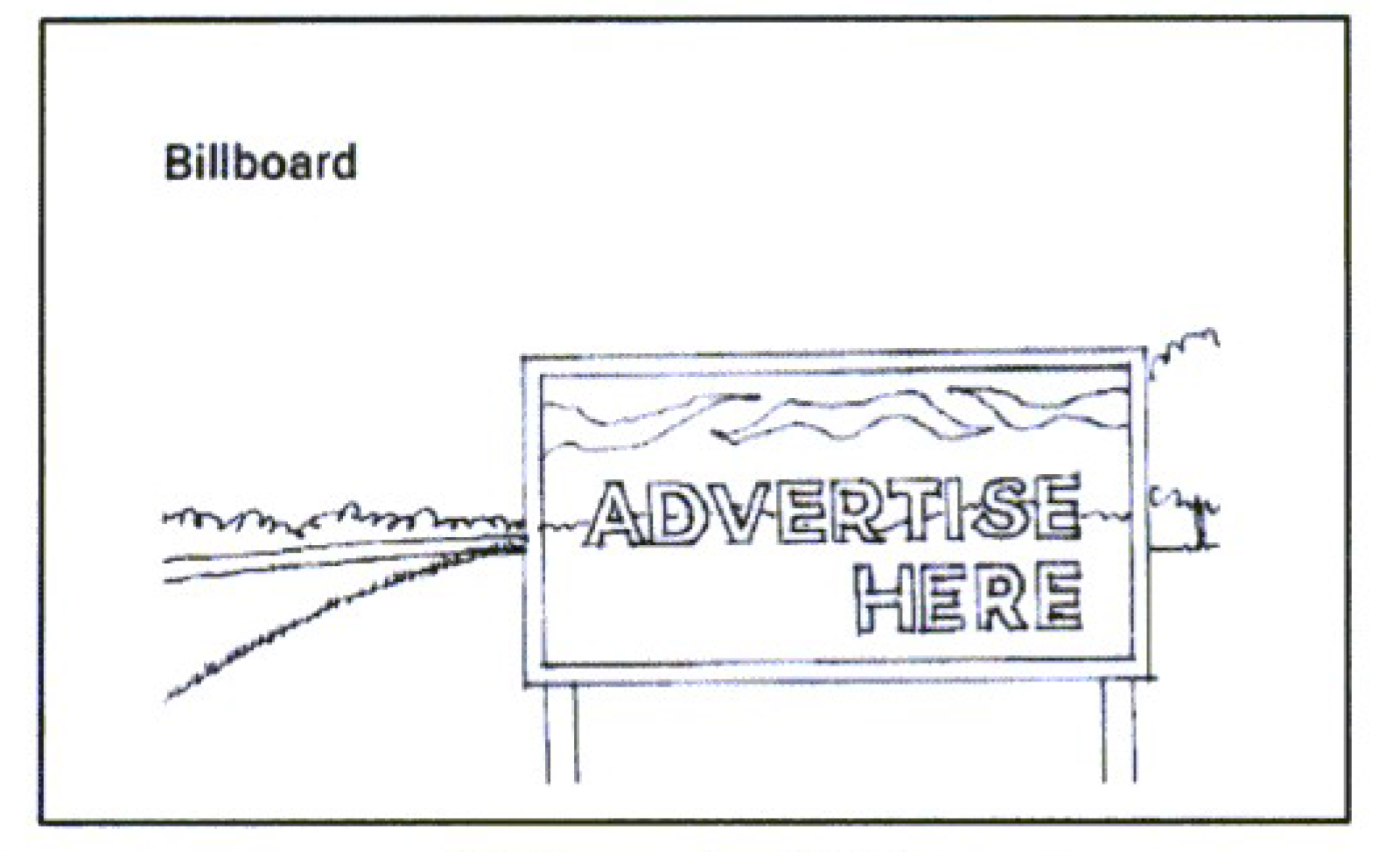
4.
"Blade sign" means a pedestrian-oriented, non-internally illuminated double-faced sign, comprised of one (1) individual panel, projecting from the building wall on which it is mounted.
5.
"Business premises" means a specific business occupancy within a building or upon a parcel of land, typically having a specific address and discrete entrance(s) and exit(s).
C.
"C" definitions.
1.
"Can or cabinet sign" means a sign that contains all the text and/or logo symbols within a single enclosed box-shaped cabinet where the translucent face of the sign can be interchanged to change the sign message without having to remodel the cabinet. It is mounted to a wall or other surface and illuminated from within the cabinet.
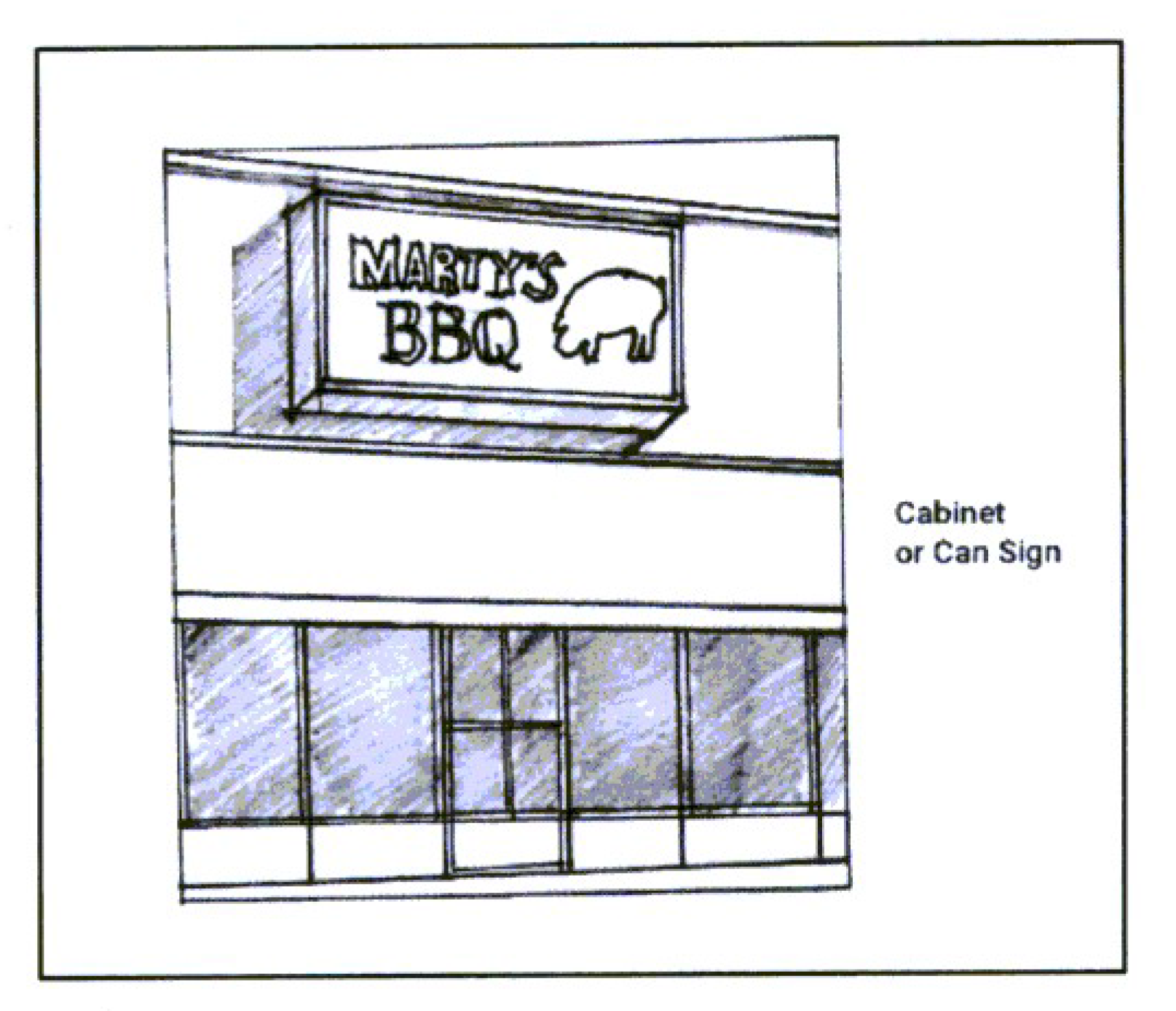
2.
"Changeable copy, electronic" or "electronic changeable copy sign" means the display of a message that can change by means of electronic lights, light emitting diodes, video screens, or other illuminated electronic or electric format.
3.
"Changeable copy, manual" or "manual changeable copy sign" means the display of a message that can change by manually arranging and attaching individual letters, numbers, or symbols.
D.
"D" definitions.
E.
"E" Definitions.
1.
"Electronic digital display sign" means a sign that displays images with or without a message through the use of grid lights, cathode ray projections, light emitting diode displays, plasma screens, liquid crystal displays, fiber optics, or other similar electronic media that may be changed remotely through electronic means.
2.
"Erect" means and includes erect, construct, place, relocate, enlarge, substantially alter, attach, suspend, paint, post, maintain, and display.
3.
"Externally illuminated sign" means a sign that has light cast on its surface from an artificial exterior source installed for the purpose of illuminating the sign.
F.
"F" definitions.
1.
"Flag" means a flat piece of cloth, with distinctive colors, patterns, or symbols used to represent a country or group, having one (1) end of the cloth attached to a vertical staff (directly or by a rope and pulley mechanism) and all other ends freely flowing under natural movement of wind.
2.
"Freestanding sign" means a sign that is permanently supported on the ground by one (1) or more uprights, braces, poles, or other similar structural components that are not attached to any building. This category includes both monument and pole signs.
3.
"Frontage, building" means the distance between the two (2) most distant corners of a building measured in a straight line along the building face.
4.
"Frontage, street" means the distance between the two (2) most distant corners of a site along a single street measured in a line along the street curb, including drive approaches, but excluding curb returns at street intersections.
G.
"G" definitions.
H.
"H" Definitions.
I.
"I" definitions.
1.
"Internally illuminated sign" means any sign whose illumination originates from within the structure of the sign and the source of which is not visible from the exterior of the sign.
2.
"Install" or "installation" means the act by which a sign is constructed or placed on land or a structure, or the act of attaching, painting, printing, producing, or reproducing, or using any other method or process by which a visual message is presented or placed upon a surface.
J.
"J" definitions.
K.
"K" definitions.
L.
"L" definitions.
M.
"M" definitions.
1.
"Message" means any form of visual communication presented on any type of media. It is not material whether the communication has any logical, practical, literary, or artistic significance or not. It includes any form or combination of letters, graphics, symbols, or designs. The term is not intended to include mono-color paint applied to the exterior, trim, fascia, or other architectural elements of a building for protection against the elements.
2.
"Monument sign" means a low-profile freestanding sign supported by a structural base or other solid structural features other than support poles and may contain signage on more than one side (see drawing).
3.
"Mural" means a sign painted on the exterior wall of a building consisting of graphics or images, either alone or in combination with letters.
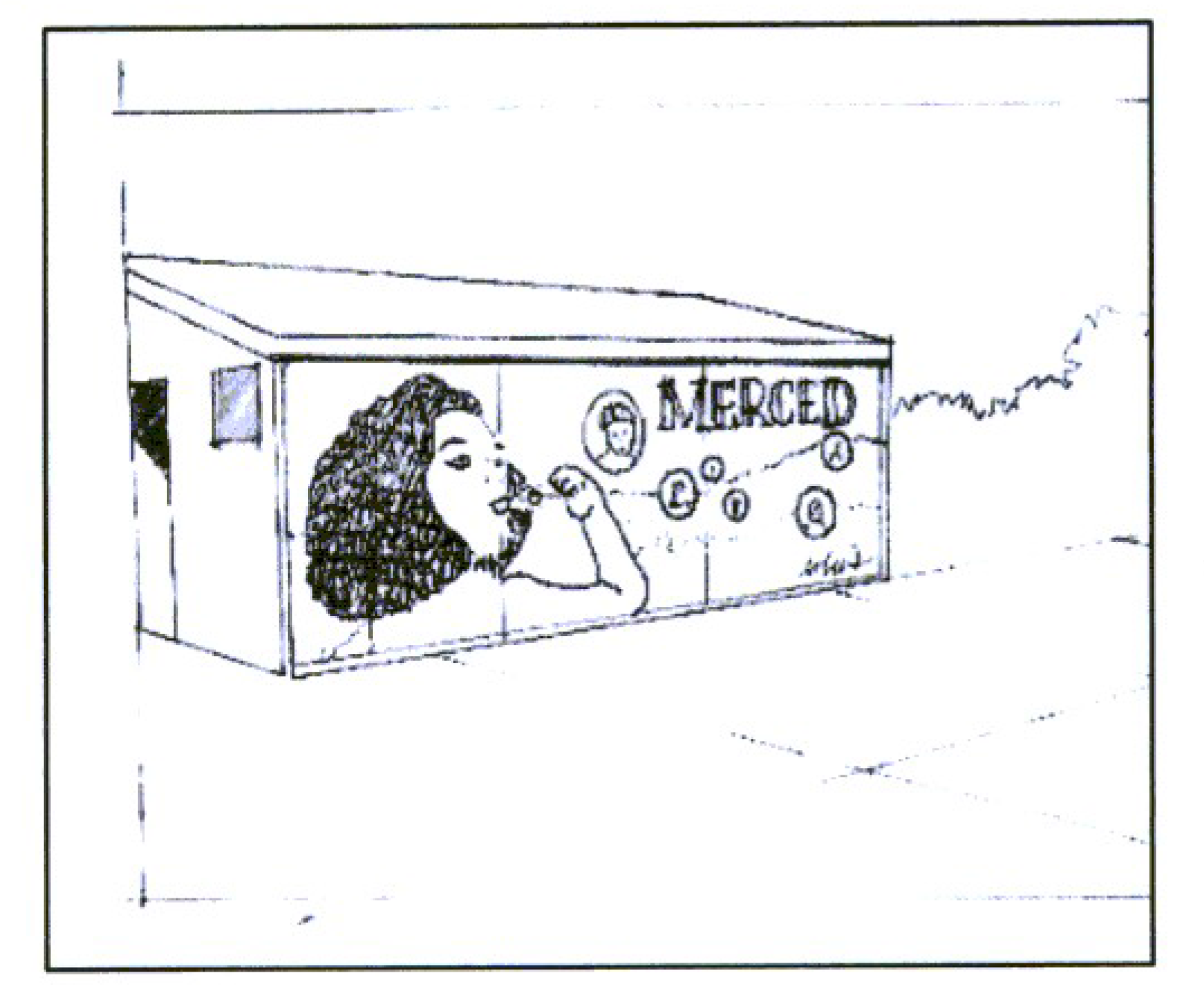
N.
"N" definitions.
O.
"O" definitions.
1.
"Off-site," "off-site sign," or "off-premises sign" refers to a sign or banner that promotes or advertises goods, services, or activities located or offered on a business premises or parcel that is separate from the parcel where the sign is located, even if the two (2) sites or parcels are contiguous to each other.
2.
"On-site," "on-site sign," or "on-premises sign" refers to a sign or banner that promotes or advertises goods, services, or activity located or offered on the business premises or parcel of property where the sign is located.
3.
"Outdoors" means a location on undeveloped property or to the exterior of a building or structure.
4.
"Outdoor advertising" refers to the placement of a message on signs or banners located outdoors or located indoors in a manner such that the message is visible from the exterior of a building or structure.
5.
"Outdoor advertising structure" means a structure erected or maintained for the main purpose of displaying commercial outdoor advertising and located on a site other than the site on which the advertised commercial use is located or on which the advertised commercial product is produced.
P.
"P" definitions.
1.
"Painted sign" refers to a sign that comprises only paint applied on a building or structure.
2.
"Parapet wall" means an exterior wall that extends vertically above the roofline.
3.
"Parcels" or "property" or similar references or descriptions shall refer to parcels defined or delineated by assessor parcel numbers maintained by the county tax assessor or as defined in the glossary of this code.
4.
"Pedestrian access" means a doorway that has been designed for the primary use of the patrons or customers of that particular use.
5.
"Permanent sign" means a sign that is solidly attached to a building, structure, or he ground by means of mounting brackets, bolts, welds, or other combination of attachment methods, thereby rendering the sign non-moveable or difficult to reposition without the use of machinery, cutting devices, or mechanical devices. See also "temporary sign."
6.
"Placed" includes constructing, erecting, posting, painting, printing, tacking, nailing, gluing, sticking, carving, or otherwise fastening, affixing, or making visible in any manner whatsoever.
7.
"Pole sign" means a permanently mounted, freestanding sign that is supported above the ground by one (1) or more uprights, braces, poles, or other similar structural components.
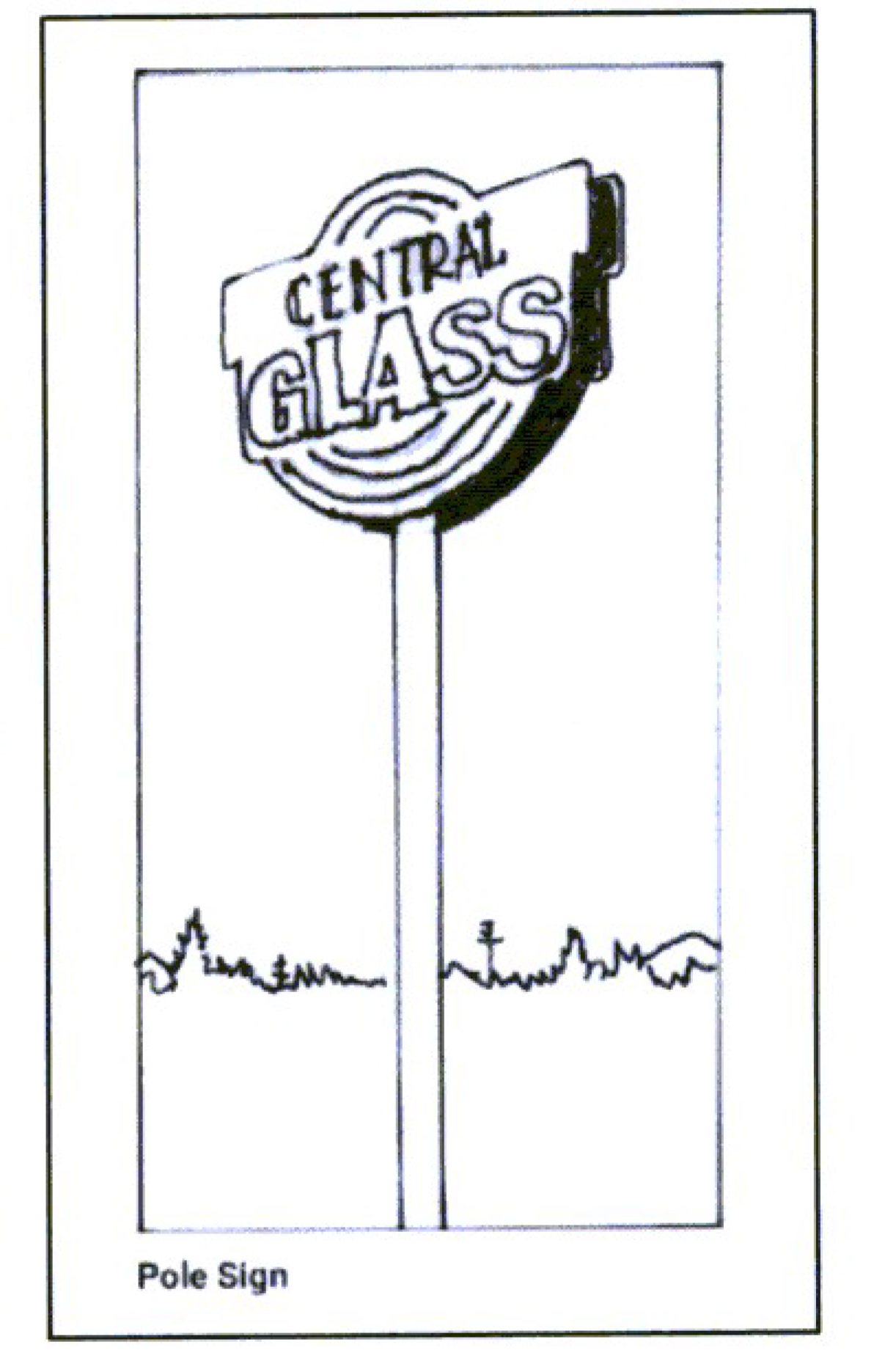
Q.
"Q" definitions.
R.
"R" definitions.
1.
"Roofline" means the highest point of a parapet wall or the main roof structure or the highest point of a parapet wall other than such architectural features as cupolas, pylons, projections, or raised portions of the roof.
2.
"Rooftop or roof-mounted sign" means a sign that extends above the ridgeline of the roof of a building, or a sign attached to any portion of the roof of a building. Rooftop or roof-mounted signs are not allowed.
S.
"S" definitions.
1.
"Sign" means any letter or symbol made of cloth, metal, paint, paper, wood, or other material of any kind whatsoever placed for advertising, identification, written expression, or other similar purposes on the ground or on any wall, post, fence, building, structure, vehicle, or on any place whatsoever.
2.
"Sign area" means the geometric area of a sign including all elements such as board or frames, perforated or a solid background, ornamental embellishments, arrows, or other sign media. For the purposes of a freestanding sign the structural elements necessary to support the sign are included in the sign area.
3.
"Sign copy" means any words, letters, numbers, figures, designs, or other symbolic representations incorporated into a sign face and/or its structure with the purpose of attracting attention to the subject matter.
4.
"Sign face" means the panel surface of a sign that carries the advertising, information, or identification message.
5.
"Sign structure" means any structure that supports or is capable of supporting a sign. A sign structure may or may not be an integral part of a building. For the purpose of a freestanding sign, the sign structure shall include the aggregate area of the sign including the sign copy and all structural elements of the sign.
6.
"Structural alteration" means any change to the sign structure.
T.
"T" definitions.
1.
"Temporary sign" means a sign that is easily moveable and not attached to a building, structure, or the ground in such a manner as to be rendered a permanent sign.
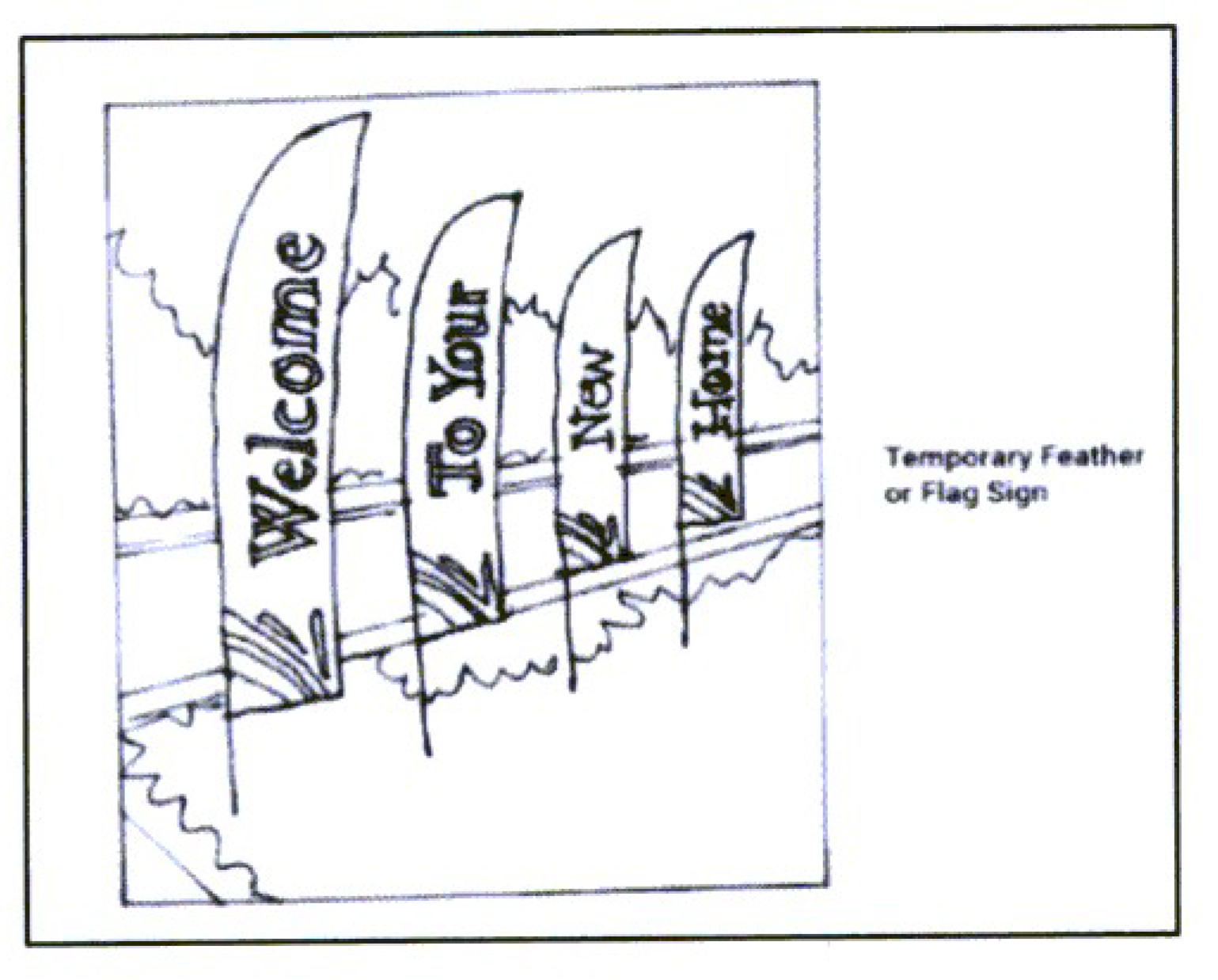
U.
"U" definitions.
V.
"V" definitions.
W.
"W" definitions.
X.
"X" definitions.
Y.
"Y" definitions.
Z.
"Z" definitions.
Table 20.62.370-1
Illustration of Sign Types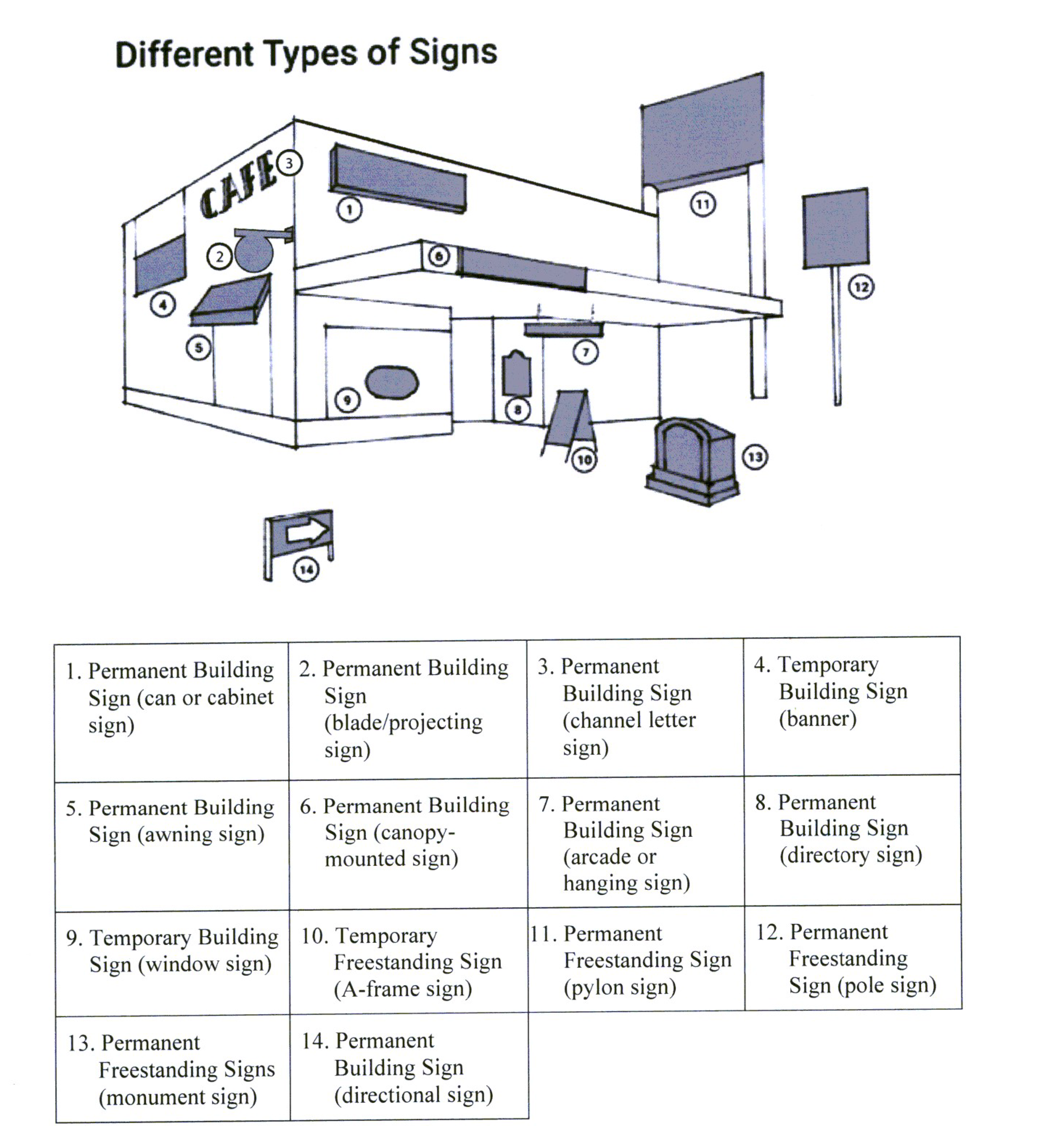
(Ord. No. 2549, § 1(Exh. A), 10-16-2023)

