
Merced City Zoning Code
PART 4
PERMITS AND ADMINISTRATION
20.64.010 - Purpose.
This chapter describes the authority and responsibilities of the city council, planning commission, site plan review committee, and director of development services in the administration of the zoning ordinance.
(Ord. No. 2465, § 2(Exhs. A., B.), 9-19-2016)
20.64.020 - Planning agency.
The city council, the planning commission, the site plan review committee, and the director of development services shall function as the planning agency and as the advisory agency in compliance with Government Code Section 65100.
(Ord. No. 2465, § 2(Exhs. A., B.), 9-19-2016)
20.64.030 - City council.
The role of the city council in the administration of the zoning ordinance includes:
A.
Serving as the review authority on legislative actions as shown in Table 20.64-1; and,
B.
Reviewing appeals filed from planning commission decisions.
Notes:
[1] "Recommend" means that the review authority makes a recommendation to a higher decision-making body; "Decision" means that the review authority makes the final decision on the matter; "Appeal" means that the review authority may consider and decide upon appeals to the decision of an earlier decision-making body.
[2] The director of development services may defer action and refer the request to the planning commission for consideration and final action.
(Ord. No. 2465, § 2(Exhs. A., B.), 9-19-2016)
20.64.040 - Planning commission.
The role of the planning commission in the administration of the zoning ordinance includes:
A.
Serving as the review authority on permit and approval applications as shown in Table 20.64-1;
B.
Reviewing appeals filed from site plan review committee decisions on site plan review permit applications;
C.
Reviewing appeals filed from development services director decisions on discretionary permit applications;
D.
Providing recommendations to the city council on legislative actions as shown in Table 20.64-1; and
E.
All decisions or recommendations of the planning commission noted above shall require at least four (4) members of the planning commission to vote to approve such an action; otherwise, the action is deemed denied.
(Ord. No. 2465, § 2(Exhs. A., B.), 9-19-2016; Ord. No. 2523, § 7, 5-17-2021)
20.64.050 - Site plan review committee.
A.
Membership.
1.
The site plan review committee shall consist of three (3) members holding the positions of the chief building official, director of development services, and the city engineer or their respective designees.
2.
In the event any of these positions are vacant for more than thirty (30) days, the city manager may designate another city employee as a temporary substitute during the vacancy.
B.
Role. The role of the site plan review committee in the administration of the zoning ordinance includes:
1.
Serving as the review authority on site plan review applications; and,
2.
Referring action as needed on any Site Plan Review Permit to the Planning Commission for review and final decision.
(Ord. No. 2465, § 2(Exhs. A., B.), 9-19-2016)
20.64.060 - Director of development services.
The role of the director of development services in the administration of the zoning ordinance includes:
A.
Serving as the review authority on permit and approval applications shown in Table 20.64-1;
B.
Interpreting the zoning ordinance as specified in chapter 20.04 (interpretation of the zoning ordinance); and,
C.
Referring action as needed on any permit, approval, or interpretation to the planning commission for review and final decision.
(Ord. No. 2465, § 2(Exhs. A., B.), 9-19-2016)
20.66.010 - Purpose.
This chapter establishes procedures and requirements for the preparation, filing, and initial processing of permit applications required by the Zoning Code. The term "permit" when used in this chapter refers to any action, permit, or approval listed in Table 20-64-1.
(Ord. No. 2465, § 2(Exhs. A., B.), 9-19-2016)
20.66.020 - Application preparation and filing.
A.
Pre-Application Conference.
1.
The city encourages prospective applicants to request a pre-application conference with the development services department (planning division) before completing and filing a permit application.
2.
The purpose of a pre-application conference is to:
a.
Inform the applicant of city requirements as they apply to the proposed project;
b.
Review the city's review process, possible project alternatives and conditions, or modifications; and,
c.
Identify information and materials the city will require with the application, and any necessary technical studies and information relating to the environmental review of the project.
3.
Information and materials provided by city staff to the applicant at the pre-application conference shall not be construed as a recommendation for either approval or denial of the proposed project.
4.
Failure by city staff to identify at a pre-application conference all studies or application requirements shall not constitute a waiver of those studies or requirements.
B.
Application Contents.
1.
All permit applications shall be filed with the development services department on an official city application form or approved digital format.
2.
The application shall be filed with all required fees, deposits, information, and materials as specified by the development services department.
C.
Eligibility for Filing.
1.
An application may only be filed by the owner of the subject property or the property owner's authorized agent.
2.
The application shall be signed by either:
a.
The owner of the subject property; or
b.
The property owner's authorized agent with written authorization from the owner filed concurrently with the application.
D.
Rejection of Application. If the development services department determines that an application is substantially incomplete and needs more information before it can be processed by the city, the development services department shall not accept the application for processing.
(Ord. No. 2465, § 2(Exhs. A., B.), 9-19-2016)
20.66.030 - Application fees.
A.
Fee Schedule. Application fees required for any permit application shall be paid as established by the most current City of Merced Planning and Development Application Fee Schedule. Application fees allow the recovery of costs incurred by the city in the processing and review of permit applications.
B.
Timing of Payment. Permit applications shall not be deemed complete until all required application fees have been paid.
C.
Refunds and Withdrawals. Processing fees cover city costs for public hearings, mailings, staff and consultant time, and other activities involved in processing permit applications. Consequently, no refund due to denial shall be provided. In the case of an application withdrawal, the development services department may authorize a partial refund based upon the pro-rated costs to-date and the status of the application at the time of withdrawal.
D.
Fee Adjustments. The director of development services shall have the discretion to lower or increase the fee amount in any individual case, not to exceed the actual cost of staff time, or waive payment for another governmental agency, or non-profit, tax exempt organization, or where good cause appears. If the director elects to increase the fee, he/she shall notify the applicant in writing within five (5) business days of application submittal and the applicant shall have ten (10) business days from that notice to pay the increased fee or withdraw the application.
(Ord. No. 2465, § 2(Exhs. A., B.), 9-19-2016)
20.66.040 - Application review.
A.
Review for Completeness.
1.
Initial Review. The development services department (planning division) shall review each application for completeness and accuracy before it is accepted as being complete and officially filed.
2.
Basis for Determination. The development services department acceptance shall be based on the city's list of required application contents and any additional written instructions provided to the applicant in a pre-application conference or during the initial application review period.
3.
Notification of Applicant. Within thirty (30) calendar days of application acceptance, the development services department shall inform the applicant in writing if the application is incomplete and that additional information is required. If no such written notice is issued, then the application is deemed to be complete.
4.
Submittal of Additional Information. When the development services department determines that an application is incomplete, the time used by the applicant to submit the required additional information shall not be considered part of the time within which the determination of completeness for resubmitted materials shall occur. The additional required information shall be submitted in writing or in a form deemed acceptable by the planning division.
5.
Environmental Information. After the city has accepted an application as complete, the development services department may require the applicant to submit additional information for the environmental review of the project in compliance with the California Environmental Quality Act (CEQA).
B.
Referral of Application. At the discretion of the development services department, or where otherwise required by the Zoning Code, state, or federal law, an application may be referred to any public agency that may have an interest in the proposed project.
C.
Multiple Applications. If a proposed project requires multiple permit approvals by both the planning commission and the development services department, the planning commission shall act upon all required permits as part of a single application.
(Ord. No. 2465, § 2(Exhs. A., B.), 9-19-2016)
20.66.050 - Project evaluation and staff reports.
A.
Staff Evaluation. Development services department staff shall review all applications to determine if they comply with the Zoning Code, other applicable provisions of the city code, the general plan, and other applicable city policies and regulations.
B.
Staff Report. Development services department staff shall provide a written recommendation to the planning commission or city council, as applicable, as to whether the application should be approved, approved with conditions, or denied.
C.
Report Distribution. Each staff report shall be furnished to the applicant at the same time it is provided to the review authority before action on the application.
(Ord. No. 2465, § 2(Exhs. A., B.), 9-19-2016)
20.66.060 - Environmental review.
A.
CEQA Review. After acceptance of a complete application, planning staff shall review the project in compliance with CEQA to determine whether:
1.
The proposed project is not a project as defined by CEQA;
2.
The proposed project is exempt from the requirements of CEQA;
3.
A negative declaration may be issued;
4.
A mitigated negative declaration may be issued; or
5.
An environmental impact report (EIR) is required.
B.
Compliance with CEQA. These determinations and, where required, the preparation of appropriate environmental documents, shall be in compliance with CEQA and any adopted city CEQA Guidelines or requirements.
C.
Special Studies Required. Special studies for traffic, air quality, biology, etc., paid for in advance by the applicant, may be required to supplement the city's CEQA compliance review. Administrative processing fees for environmental reviews are also required per the fee schedule.
(Ord. No. 2465, § 2(Exhs. A., B.), 9-19-2016)
20.66.070 - Applications deemed withdrawn.
A.
Response Required. If an applicant does not provide any information within six (6) months of being requested by the development services department, the application shall expire and be deemed withdrawn without any further action by the city.
B.
Refund of Fees. Any remaining fees submitted with the project application shall be returned to the applicant in the event that an application is deemed withdrawn. Refunds can only be given within one (1) year after application submittal due to budgeting constraints.
C.
Resubmittal. After the expiration or withdrawal of an application, future city consideration shall require the submittal of a new complete application and associated fees.
(Ord. No. 2465, § 2(Exhs. A., B.), 9-19-2016)
20.68.010 - Purpose.
This chapter identifies the purpose, thresholds for review, and findings for approval for each planning permit required by the zoning ordinance.
(Ord. No. 2465, § 2(Exhs. A., B.), 9-19-2016)
20.68.020 - Conditional use and minor use permits.
A.
Purpose. A conditional use or minor use permit is required for uses that are generally appropriate within a zoning district but potentially unsuitable in a particular location or in large numbers. A conditional use or minor use permit is a discretionary action that enables the city to ensure that a proposed use is consistent with all general plan goals and policies and will not create negative impacts to adjacent properties or the general public.
B.
Application Submittal and Review. Application for a conditional use or minor use permit shall be filed and reviewed in compliance with Chapter 20.66 (Permit Application and Review).
C.
Review Authority.
1.
Conditional Use Permits. The planning commission shall take action on all conditional use permit applications. At least four (4) members of the planning commission shall be required to vote to approve a conditional use permit; otherwise, the permit is deemed denied.
2.
Minor Use Permits.
a.
The director of development services shall take action on all minor use permit applications.
b.
The director of development services may refer any minor use permit application to the planning commission for review and final decision.
D.
Public Notice and Hearing.
1.
Public notice and hearing for a conditional use permit shall be provided in compliance with Chapter 20.70 (Public Notice and Hearing).
2.
No public notice or hearing is required for a minor use permit although all records relating to the permit shall be public records and shall be available for review upon request.
E.
Findings for Approval. The review authority may approve an application for a conditional use or minor use permit application only if all of the following findings can be made:
1.
The proposed use is consistent with the purpose and standards of the zoning district, the general plan, and any adopted area or neighborhood plan, specific plan, or community plan.
2.
The location, size, design, and operating characteristics of the proposed use will be compatible with the existing and future land uses in the vicinity of the subject property.
3.
The proposed use will not be detrimental to the public health, safety, and welfare of the city.
4.
The proposed use is properly located within the city and adequately served by existing or planned services and infrastructure.
F.
Conditions of Approval. The review authority may attach conditions to the approval of a conditional use or minor use permit as needed to ensure compliance with the general plan, zoning ordinance, Merced Municipal Code, city design standards, or any applicable specific plan, community plan, or area plan, policy, or ordinance adopted by the city.
G.
Appeals. Decisions on conditional use and minor use permits may be appealed as provided for in Chapter 20.74 (Appeals).
H.
Post-Decision Procedures. Procedures and requirements relating to effective dates, time limits, changes to approved projects, resubmittals, and permit revocation shall apply to conditional and minor use permits as provided in Chapter 20.72 (Post-Decision Procedures).
I.
Time Limits. If not exercised within five (5) years of approval, the conditional use permit shall expire. Time extensions of up to two (2) years may be approved by the director of development services. (Refer to Section 20.72.060(B) and (C) for definition of "exercised" and time extension procedures.)
(Ord. No. 2465, § 2(Exhs. A., B.), 9-19-2016; Ord. No. 2523, § 8, 5-17-2021)
20.68.030 - Design review permit.
A.
Purpose. A design review permit is required for most types of development in portions of downtown Merced and areas directly west of the downtown area, see Figure 20.68-1 (Design Review Boundaries). A design review permit is a discretionary action that enables the planning commission and staff to ensure high quality development that enhances the visual qualities of Merced and creates and supports the city's economic development objectives.
B.
Applicability.
1.
A design review permit shall be required for the establishment of all new structures and modifications to existing structures within area identified in Figure 20.68-1, except for:
a.
Single-family detached dwellings;
b.
Structures accessory to single-family detached dwellings; and,
c.
Structures located in the I-L and I-H zoning districts, which are subject to site plan review permits (Section 20.68.050) instead.
2.
A legal description of the area subject to design review permit approval can be found in City Council Ordinance No. 2409 approving Zoning Ordinance Amendment No. 13-01 on June 17, 2013.
Figure 20.68-1 Design Review Boundaries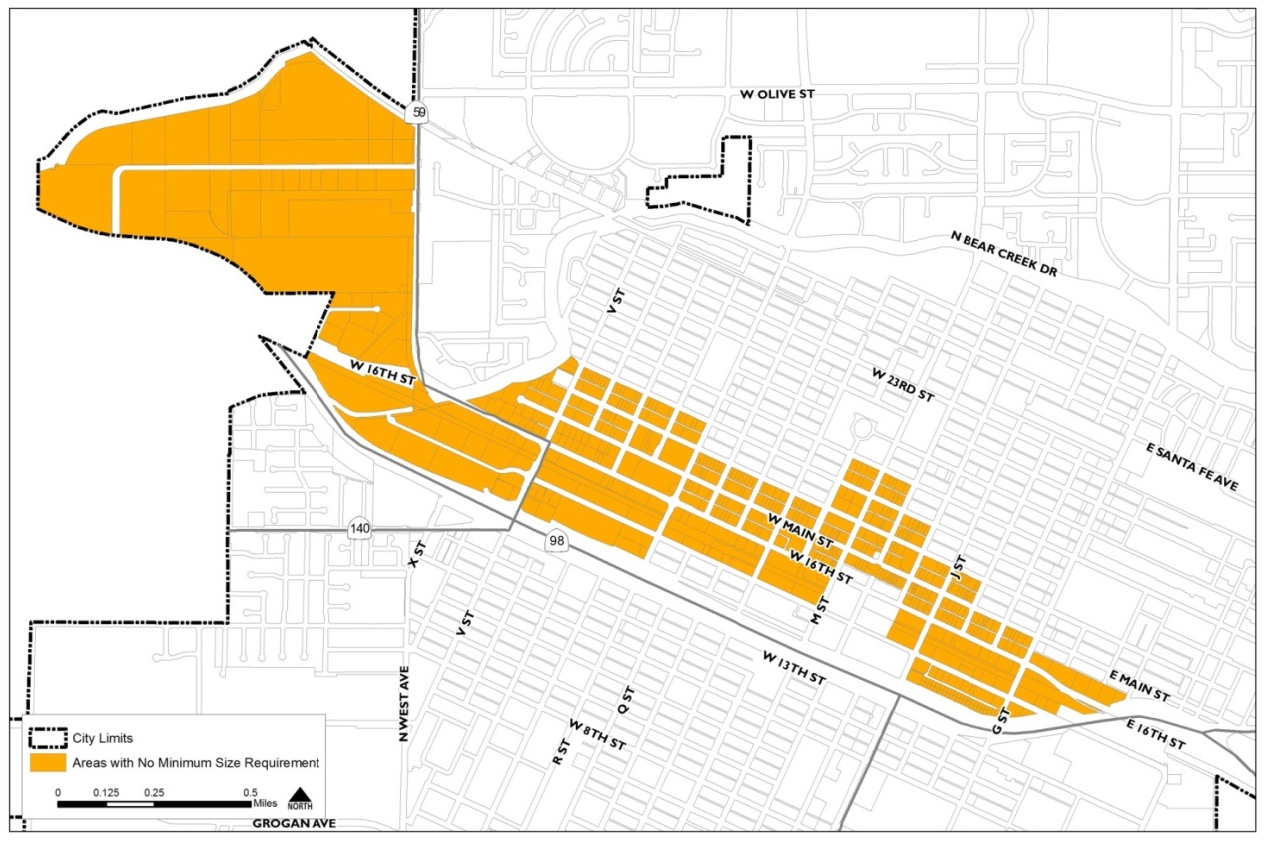
C.
Review Authority.
1.
Planning Commission. The planning commission shall take action on all design review permit applications except as specified in Sections 2 and 3 below. At least four (4) members of the planning commission shall be required to vote to approve a design review permit; otherwise, the permit is deemed denied.
2.
Development Services Department. Development services department staff shall take action on design review permit applications for the following projects:
a.
Change in exterior wall paint color.
b.
Installation of new signage and maintenance of existing signage, including new copy, painting, repair, and replacement of defective sign parts that does not alter the basic copy, design, or structure of the sign.
c.
Any items referred to staff following planning commission review.
d.
Minor modifications to design review permits approved by the planning commission or site plan review committee which do not alter the basic design or structure of the project.
e.
Façade improvements to existing structures which do not increase the floor area of the structure by more than five (5) percent.
f.
New structures less than ten thousand (10,000) square feet that are deemed by the director of development services to be minor in nature.
3.
Staff Referral. The director of development services may choose to refer any design review permit application for review and final action by the planning commission.
D.
Application Submittal and Review. Application for a design review permit shall be filed and reviewed in compliance with Chapter 20.66 (Permit Application and Review).
E.
Public Notice and Hearing. Public notice and hearing for a design review permit shall be provided in compliance with Chapter 20.70 (Public Notice and Hearing). Public hearings are only required for those Design review permits which go to the planning commission for approval, not staff-level reviews.
F.
Features to Consider. When reviewing a design review permit application, the city may consider, but is not limited to, the following features of the project design:
1.
The location of all structures on the property and compatibility with surrounding uses.
2.
Proposed and existing landscaping, fencing, and other screening materials.
3.
Design of all circulation, parking and loading facilities for vehicles, bicycles, pedestrians, and transit.
4.
Screening of refuse facilities, utility meters, and mechanical equipment.
5.
Building and site design, including exterior colors and architecture style.
6.
Design and location of public infrastructure including curb cuts, curbs, gutters, sidewalks, sidewalk design, drainage, and fire hydrants.
7.
Location, design, and intensity of all onsite exterior lighting.
8.
Location and design of address system and graphics for mail delivery system.
9.
Design of all open space areas.
10.
Design, placement, dimension, and color of all signs and exterior graphics, including sign materials, lighting, sign intensity, and temporary signs.
11.
Review of design and placement of facilities for physically handicapped or persons with disabilities.
G.
Design Review Principles. When reviewing design review permit applications, the planning commission or city staff may consider the following design review principles:
1.
Review of architectural character shall not be so restrictive that individual initiative is stifled in the design of any particular building or site. Rather, review exercised shall be the amount necessary to achieve the overall purpose and objective of the design review process.
2.
Good architectural character is based upon the suitability of a building and site for its purposes; upon the appropriate use of sound materials, good relationship with other structures, and the character of the city; and upon the principles of harmony, preparation and design in the elements of the building and site.
3.
Review of sign graphics shall be based upon suitability of the sign colors, placement, design to overall building design, and adjacent sign themes. The planning commission or city staff shall consider the extent, design and location of all temporary signs as well as permanent signs in the review of sign graphics.
H.
Findings. The review authority may approve an application for a design review permit application only if all of the following findings can be made:
1.
The proposed project is consistent with the general plan, and any adopted area, community, specific, or neighborhood plan.
2.
The proposed project complies with all applicable provisions of the Zoning Code and Municipal Code.
3.
The design and layout of the proposed project will not interfere with the use and enjoyment of existing and future neighboring properties and structures.
4.
The proposed building design makes use of appropriate materials, texture and color, and will remain aesthetically appealing and appropriately maintained.
5.
The proposed design will not be materially detrimental to the public health, safety, or welfare, or be injurious to the property or improvements in the vicinity of the proposed project.
I.
Conditions of Approval. The review authority may attach conditions to the approval of a design review permit as needed to ensure compliance with the general plan, Zoning Ordinance, Merced Municipal Code, city design standards, or any applicable specific plan, community plan, or area plan, policy, or ordinance, adopted by the city.
J.
Appeals. Decisions on design review permits may be appealed as provided for in Chapter 20.74 (Appeals).
K.
Post-Decision Procedures. Procedures and requirements relating to effective dates, time limits, changes to approved projects, resubmittals, and permit revocation shall apply to design review permits as provided in Chapter 20.72 (Post-Decision Procedures).
(Ord. No. 2465, § 2(Exhs. A., B.), 9-19-2016; Ord. No. 2523, § 9, 5-17-2021)
20.68.040 - Minor modification.
A.
Purpose. A minor modification allows for small deviations from development standards to accommodate projects which meet the needs of property owners, are consistent with the purpose of the Zoning Ordinance and general plan, and do not negatively impact neighboring properties or the community at large.
B.
Applicability.
1.
Permitted Modifications. A minor modification may be granted to allow for a maximum ten (10) percent deviation from a physical development standard that applies to the subject property. Types of physical development standards eligible for a minor modification include:
a.
Maximum height of buildings, fences, walls, and other structures;
b.
Minimum and maximum setbacks from property lines;
c.
Maximum lot coverage;
d.
Dimensional standards for parking spaces, driveways, parking lots, and loading areas; and,
e.
Other similar dimensional standards as determined by the director of development services.
2.
Excluded Modifications. Minor modifications shall not be granted for:
a.
Lot area, width, or depth; or,
b.
Minimum number of off-street parking spaces; or,
c.
Maximum residential density.
C.
Review Authority.
1.
The director of development services shall take action on requested minor modifications.
2.
The director of development services may choose to refer any minor modification application to the planning commission for review and final decision.
D.
Application Submittal and Review. An application for a minor modification shall be filed and reviewed in compliance with Chapter 20.66 (Permit Application and Review). The application shall include the information and materials specified by the development services department, together with all required application fees.
E.
No Public Notice and Hearing. No public notice and hearing shall be required for a minor modification application although all records relating to the modification shall be public records and shall be available for review upon request.
F.
Findings for Approval. To approve a minor modification application, the director of development services shall make all of the following findings:
1.
The modification will be compatible with adjacent structures and uses and is consistent with the character of the neighborhood or district where it is located.
2.
The modification will not adversely impact neighboring properties or the community at large.
3.
The modification is necessary due to unique characteristics of the subject property, structure, or use.
4.
Unique characteristics necessitating the modification generally do not apply to other properties in the vicinity or in the same zoning district as the subject property.
5.
There are no feasible design alternatives that meet the project objectives while eliminating the need for the requested modification.
6.
The modification will be consistent with the purpose of the zoning district, the general plan, and any adopted area, community, or neighborhood plan.
7.
The modification will not establish an undesirable precedent.
G.
Conditions of Approval. The granting of a minor modification for approval by the director of development services may include such conditions as deemed reasonable and necessary to carry out the intent of this chapter, the Zoning Code, Merced Municipal Code, and the general plan.
(Ord. No. 2465, § 2(Exhs. A., B.), 9-19-2016)
20.68.050 - Site plan review permit.
A.
Purpose. A site plan review permit is a discretionary action that enables the city to determine a project's compliance with the zoning ordinance and ensure that it will not create negative impacts to adjacent properties or the general public.
B.
Applicability. The following uses and structures require a site plan review permit:
1.
All uses as shown in Part 2 (Zoning District Standards), and,
2.
All proposed uses and structures within the light industrial (I-L) and heavy industrial (I-H) zoning districts.
C.
Review Authority.
1.
The site plan review committee shall take action on all site plan review permits.
2.
The site plan review committee may refer any site plan review permit application to the planning commission for review and final decision.
D.
Application Submittal and Review. Application for a site plan review permit shall be filed and reviewed in compliance with Chapter 20.66 (Permit Application and Review).
E.
Public Notice and Hearing. No public notice and hearing for a site plan review permit shall be provided in compliance with Chapter 20.70 (Public Notice and Hearing), except for those properties that are directly adjacent to any residentially zoned property in the city. In those cases, public notice shall be given to those directly adjacent properties at least ten (10) days prior to the site plan review meeting.
F.
Findings for Approval. The site plan review committee may approve an application for a site plan review permit only if all of the following findings can be made:
1.
The proposed project is consistent with the general plan, and any adopted area, specific, community, or neighborhood plan.
2.
The proposed project complies with all applicable provisions of the zoning ordinance and Municipal Code.
3.
The design and layout of the proposed project will not interfere with the use and enjoyment of existing and future neighboring properties and structures.
4.
The proposed architectural design makes use of appropriate materials, texture and color, and will remain aesthetically appealing and appropriately maintained.
5.
Any proposed landscaping design, including color, location, size, texture, type, and coverage of plant materials, as well as provisions for irrigation, maintenance, and protection landscaping elements, will complement structures and provide an attractive environment.
6.
The proposed design will not be materially detrimental to the public health, safety, or welfare, or be injurious to the property or improvements in the vicinity of the proposed project.
G.
Appeals. Decisions on site plan review permits may be appealed as provided for in Chapter 20.74 (Appeals).
H.
Post-Decisions Procedures. Procedures and requirements relating to effective dates, time limits, changes to approved projects, resubmittals, and permit revocation shall apply to site plan review permits as provided in Chapter 20.72 (Post-Decision Procedures).
(Ord. No. 2465, § 2(Exhs. A., B.), 9-19-2016; Ord. No. 2543, § 67, 9-6-2022)
20.68.060 - Special project permit.
A.
Purpose. The special project permit allows for high quality development that deviates from development standards required by the applicable zoning district. The special project permit is intended to promote creativity in building design and innovation in development concepts in a manner consistent with the general plan. The special project permit provides applicants with enhanced flexibility to take advantage of unique site characteristics to develop projects that will provide public benefits and enhance the quality of life in Merced.
B.
Applicability. A special project permit may be granted in any zoning district provided that:
1.
The proposed project is located on a minimum three (3)-acre parcel; and,
2.
The proposed land uses are consistent with the applicable general plan land use designation.
C.
Review Authority. The city council shall take action on all special project permits with a recommendation from the planning commission.
D.
Adjustment of Standards. With approval of a special project permit, the city may allow for adjustment, up to fifty (50) percent unless otherwise provided for in the code, to all physical development standards that apply to the subject property, with the exception of an increase to the allowable residential density or intensity. Examples of physical development standards include height, setbacks, open space, lot coverage, and off-street parking requirements.
E.
Application Submittal and Review. Application for a special project permit shall be filed and reviewed in compliance with Chapter 20.66 (Permit Application and Review).
F.
Public Notice and Hearing. Public notice and hearing for a special project permit shall be provided in compliance with Chapter 20.70 (Public Notice and Hearing).
G.
Findings for Approval. The city may approve an application for a special project permit only if all of the following findings can be made:
1.
The proposed project is consistent with the purpose of the zoning district, the general plan, zoning ordinance, Merced Municipal Code, and any adopted area, specific, community, or neighborhood plan.
2.
The proposed project will produce a development with greater public benefits than what might otherwise result from using the standard development regulations.
3.
Public benefits provided by the proposed project are commensurate with the requested deviation from the standard development regulations.
4.
The subject property is adequate in terms of size, shape, topography, and circumstances to accommodate the proposed development.
5.
The proposed project will not be materially detrimental to the public health, safety, or welfare, or be injurious to the property or improvements in the vicinity of the subject property.
H.
Post-Decision Procedures. Procedures and requirements relating to effective dates, time limits, changes to approved projects, resubmittals, and permit revocation shall apply to special project permits as provided in Chapter 20.72 (Post-Decision Procedures).
(Ord. No. 2465, § 2(Exhs. A., B.), 9-19-2016)
20.68.070 - Variance.
A.
Purpose. A Variance is a discretionary permit that allows for deviation from physical development standards contained in the zoning ordinance. A Variance may be granted only when the strict application of development standards creates a unique hardship due to an extraordinary situation or circumstance associated with the property.
B.
Applicability.
1.
Allowable Variances. A Variance may be granted to allow for deviation from any physical development standard that applies to the subject property. Examples of physical development standards include height, setbacks, open space, lot coverage, and off-street parking requirements.
2.
Variances Not Allowed. A variance shall not be granted to allow:
a.
A land use that is prohibited in the applicable zoning district;
b.
Deviation in excess of fifty (50) percent of a measurable requirement of the zoning ordinance;
c.
Deviation from general plan policies; or,
d.
Deviation from sign requirements in Chapter 17.36 (Signs) or Section 20.62 (Signs).
C.
Review Authority. The planning commission, acting as the board of zoning adjustment, shall take action on all variance applications. At least four (4) members of the planning commission shall be required to vote to approve a variance; otherwise, the variance is deemed denied.
D.
Application Submittal and Review. Application for a variance shall be filed and reviewed in compliance with Chapter 20.66 (Permit Application and Review).
E.
Public Notice and Hearing. Public notice and hearing for a variance shall be provided in compliance with Chapter 20.70 (Public Notice and Hearing).
F.
Findings for Approval. The planning commission may approve an application for a variance only if all of the following findings can be made:
1.
There are unique circumstances applicable to the subject property, including size, shape, topography, location, or surroundings, that do not generally apply to other properties in the vicinity or in the same zoning district as the subject property. Unique circumstances required for approval of a variance shall not include conditions created by any act of the property owner or occupant; personal, family, or financial conditions; loss of prospective profits; or neighboring violations.
2.
The strict application of the zoning ordinance requirements would deprive the subject property of privileges enjoyed by other property in the vicinity or in the same zoning district as the subject property.
3.
The variance is necessary to preserve a substantial property right possessed by other property in the vicinity or in the same zoning district as the subject property.
4.
The variance will not be materially detrimental to the public health, safety, or welfare, or be injurious to the property or improvements in the vicinity or in the same zoning district as the subject property.
5.
The variance does not constitute a grant of special privilege inconsistent with the limitations upon other properties in the vicinity or in the same zoning district as the subject property.
6.
The variance complies with applicable standards in the zoning ordinance, other city ordinances, the general plan and any other applicable community, neighborhood, specific, or area plan adopted by the city.
G.
Precedent. The approval of a variance shall not set the precedent for the granting of any future variances. Each application shall be considered only on its individual merits.
H.
Appeals. Decisions on variances, as quasi-judicial permits, may only be appealed to a court of law.
I.
Post-Decision Procedures. Procedures and requirements relating to effective dates, time limits, changes, resubmittals, and permit revocation shall apply to variances as provided in Chapter 20.72 (Post-Decision Procedures).
(Ord. No. 2465, § 2(Exhs. A., B.), 9-19-2016; Ord. No. 2523, § 10, 5-17-2021)
20.70.010 - Purpose.
This chapter provides procedures for public hearings required by the zoning ordinance. When a public hearing is required, advance notice of the hearing shall be given, and the hearing shall be conducted, in compliance with this chapter and applicable state law. In the event of any conflict between these provisions and requirements of state law, state law shall control.
(Ord. No. 2465, § 2(Exhs. A., B.), 9-19-2016)
20.70.020 - Notice of hearing.
When the zoning ordinance requires a noticed public hearing before a decision on a permit, or for another matter, the public will be provided notice of the hearing as required by this chapter.
A.
Content of Notice. Notice of a public hearing shall include all of the following information, as applicable.
1.
Hearing Information. The date, time, and place of the hearing; the name of the hearing body; and the phone number and street address of the development services department where an interested person could call or visit to obtain additional information.
2.
Project Information. The name of the applicant, the city's file number assigned to the application, a general explanation of the matter to be considered, a general description of the location of the subject property, and any recommendation from a prior hearing body.
3.
Statement on Environmental Document. A statement that the proposed project is determined exempt under the California Environmental Quality Act (CEQA), or that a negative declaration, mitigated negative declaration, or environmental impact report has been prepared for the project. The hearing notice shall state that the hearing body will consider approval of the CEQA determination or document prepared for the proposed project.
B.
Method of Notice Distribution. Notice of a public hearing shall be given as follows:
1.
Mailing. Notice shall be mailed or delivered at least ten (10) days (or as otherwise provided by CEQA) before the scheduled hearing to the following recipients:
a.
Project Site Owners and the Applicant. The owners of the subject property or the owners' authorized agent, and the applicant.
b.
Local Agencies. Each local agency expected to provide roads, schools, wastewater, streets, water, or other essential facilities or services to the subject property, whose ability to provide those facilities and services may be significantly affected.
c.
Affected Owners. All owners of real property within three hundred (300) feet of the exterior boundaries of the subject property. The department of development services may distribute notice to additional properties as needed to ensure adequate public notification of the proposed project.
d.
Persons Requesting Notice. Any person who has filed a written request for notice with the department of development services.
e.
Other Persons. Any other person whose property might, in the judgment of the department of development services, be affected by the proposed project.
2.
Alternative to Mailing. If the number of property owners to whom notice would be mailed in compliance with Subsection 1 above is more than one thousand (1,000), the department of development services may choose to provide notice by placing a display advertisement of at least one-eighth (⅛) page in at least one (1) newspaper of general circulation in Merced at least ten (10) days prior to the hearing.
3.
Publication and Posting. If notice is mailed or delivered as described in Subsection 1 above, the notice shall also be published at least once in a newspaper of general circulation in Merced at least ten (10) days before the scheduled hearing and posted to the city's website.
4.
Additional Notice. In addition to the types of notice required above, the department of development services may provide any additional notice, including the posting of signs, and content deemed necessary or desirable.
(Ord. No. 2465, § 2(Exhs. A., B.), 9-19-2016)
20.70.030 - Scheduling of hearing.
After the completion of any environmental document required by the California Environmental Quality Act (CEQA), a development services department staff report, and any additional materials required to render a decision, a matter requiring a public hearing shall be scheduled on the next available agenda reserved for public hearings, but no sooner than any minimum time period established by state law.
(Ord. No. 2465, § 2(Exhs. A., B.), 9-19-2016)
20.70.040 - Hearing procedure.
A.
General. Hearings shall be conducted in a manner consistent with the procedure adopted or endorsed by the hearing body.
B.
Time and Place of Hearing. A hearing will be held at the date, time, and place for which notice was given, unless the required quorum of hearing body members is not present.
C.
Continued Hearing. Any hearing may be continued from time to time without further notice; provided that the chair of the hearing body announces the date, time, and place to which the hearing will be continued before the adjournment or recess of the hearing.
D.
Motion of Intent. The hearing body may announce a tentative decision, and defer its action on a final decision until appropriate findings and conditions of approval have been prepared.
(Ord. No. 2465, § 2(Exhs. A., B.), 9-19-2016)
20.70.050 - Decision or recommendation by planning commission.
A.
After a public hearing, any decision of the planning commission shall require at least four (4) members of the planning commission to vote to approve an action; otherwise, the action is deemed denied.
B.
After a public hearing resulting in a planning commission recommendation to the city council, the development services department shall forward the recommendation to the city council. A copy of the recommendation shall be mailed to the applicant at the address shown on the application. If at least four (4) members of the planning commission do not vote to recommend approval or denial, then that action shall be deemed a recommendation of denial.
(Ord. No. 2465, § 2(Exhs. A., B.), 9-19-2016; Ord. No. 2523, § 11, 5-17-2021)
Editor's note— Ord. No. 2523, § 11, adopted May 17, 2021, amended the title of § 20.70.050 to read as herein set out. The former § 20.70.050 title pertained to recommendation by planning commission.
20.70.060 - Decision and notice.
A.
Date of Action. With the exception of appeals to the city council, the hearing body shall take action on the matter being considered following the close of the public hearing. The hearing body shall also take action on projects within the following timeframe as required by the California Environment Quality Act (CEQA):
1.
Within sixty (60) days of the date a negative declaration or mitigated negative declaration has been adopted for project approval, the city shall take action on the accompanying discretionary project.
2.
Within one hundred eighty (180) days from the date the decision-making authority certifies a final environmental impact report (EIR), the city shall take action on the accompanying discretionary project.
B.
Decision.
1.
The hearing body may announce and record its decision on the matter being considered at the conclusion of a scheduled hearing, or make a motion of intent and continue the matter to a later meeting agenda.
2.
At the conclusion of a hearing conducted by the development services director, the development services director may choose to refer the matter to the planning commission for review and final decision. Referral to the planning commission may be chosen in cases of unusual public sensitivity, controversy, or complexity relating to a requested approval.
C.
Conditions of Approval. The review authority may attach conditions to the approval of a discretionary permit, approval, or legislative action as needed to ensure compliance with the Merced Municipal Code, general plan, or any applicable specific plan, community plan, or area plan adopted by the city council.
D.
Notice of Decision. Following a final decision, the city will provide notice of its final action to the applicant and to any person who specifically requested notice of the final action.
(Ord. No. 2465, § 2(Exhs. A., B.), 9-19-2016)
20.70.070 - Effective date of decision.
A.
Development Services Director's or Planning Commission's Decision. The decision of the director of development services or planning commission is final and effective after 5:00 p.m. on the fifth (5 th ) business day following the date the decision is rendered, when no appeal to the decision has been filed in compliance with Chapter 20.74 (Appeals).
B.
City Council Decision. A decision of the city council is final and shall be effective on the date the decision is rendered.
(Ord. No. 2465, § 2(Exhs. A., B.), 9-19-2016)
20.72.010 - Purpose.
This chapter establishes procedures and requirements that apply following a city decision on a permit or other approval required by the zoning ordinance.
(Ord. No. 2465, § 2(Exhs. A., B.), 9-19-2016)
20.72.020 - Issuance of permits.
Permits shall not be issued until the effective date, provided no appeal of the review authority's decision has been filed in compliance with Chapter 20.76 (Appeals).
(Ord. No. 2465, § 2(Exhs. A., B.), 9-19-2016)
20.72.030 - Performance guarantees.
A.
Security Required. The director of development services may require an applicant to provide adequate security to guarantee the proper completion of any approved work or compliance with any conditions of approval.
B.
Form of Security. The security shall be in the form of cash, a certified or cashier's check, or a performance bond executed by the applicant and a corporate surety authorized to do business in California and approved by the city.
C.
Amount of Security. The director of development services shall determine the amount of the security necessary to ensure proper completion of the approved work or compliance with applicable conditions of approval.
D.
Duration of Security. The security shall remain in effect until all work has been completed and conditions fulfilled to the satisfaction of the director of development services or until a specified warranty period has elapsed.
E.
Release of Security. The security deposit shall be released upon completion of the approved work or compliance with applicable conditions of approval.
F.
Failure to Comply.
1.
Upon failure to complete any work or comply with conditions, the city may complete the work or fulfill the condition, and may collect from the applicant or surety all costs incurred, including administrative, engineering, legal, and inspection costs.
2.
Any unused portion of the security shall be refunded to the funding source.
(Ord. No. 2465, § 2(Exhs. A., B.), 9-19-2016)
20.72.040 - Legislative action agreement.
A.
Agreement Required. Approval of a general plan amendment, zoning ordinance amendment (text or map), conditional zoning, annexation/prezoning, or other legislative action is subject to the applicant entering into a written agreement with the City of Merced known as a legislative action agreement.
B.
The legislative action agreement shall state the applicant agrees to:
1.
Comply with all conditions of the legislative action.
2.
Pay all required fees, taxes, and assessments in effect when any subsequent permits or approvals are issued, including, but not limited to, public facilities impact fees, regional traffic impact fees, and Mello-Roos taxes. Payment shall be submitted at the time of building permit issuance for each phase of development unless the city requires payment at a different time.
C.
The city council shall approve the legislative action agreement with the applicant at the same meeting at which the related legislative action is approved.
(Ord. No. 2465, § 2(Exhs. A., B.), 9-19-2016)
20.72.050 - Changes to an approved project.
An approved project shall be established only as approved by the review authority, except when changes to the project are approved in compliance with this section.
A.
Request for a Change.
1.
An applicant shall request desired changes in writing, and shall submit appropriate supporting materials, an explanation of the reasons for the request, and applicable processing fees.
2.
Changes may be requested either before or after construction or establishment and operation of the approved use.
B.
Notice and Hearing. If the matter originally required a noticed public hearing, the review authority shall hold a public hearing for the requested change, except as allowed by Subsection C (Minor Changes) and shall give notice in compliance with Chapter 20.70 (Public Notice and Hearings).
C.
Minor Changes. The director of development services may authorize minor changes to an approved project if the changes comply with all of the following criteria:
1.
The requested changes are consistent with all applicable requirements of the zoning ordinance.
2.
The requested changes are consistent with the spirit and intent of the original approval.
3.
The requested changes do not involve a feature of the project that was a basis for findings in a negative declaration, mitigated negative declaration, or environmental impact report for the project.
4.
The requested changes do not involve a feature of the project that was a basis for conditions of approval for the project.
5.
The requested changes do not involve a feature of the project that was a specific consideration by the review authority in granting the approval.
6.
The requested changes do not involve any expansion or intensification of the use or structure by no more than ten (10) percent.
(Ord. No. 2465, § 2(Exhs. A., B.), 9-19-2016)
20.72.060 - Time limits and extensions.
A.
Expiration of Permit. A permit or approval not exercised within two (2) years after the date of approval shall be eligible for revocation as provided in Section 20.72.070 (Permit Revocation) below, except where an extension of time is approved as allowed by Subsection C (Extension of Time).
B.
Exercised Defined. A permit or approval shall be considered exercised when:
1.
A building permit is issued and construction has commenced; or,
2.
A certificate of occupancy is issued; or,
3.
A business license is issued; or,
4.
The use is established.
C.
Extension of Time. The director of development services may approve an extension to a permit or approval in the following manner:
1.
The applicant shall submit to the development services department a written request for an extension of time no later than ten (10) days before the expiration of the permit or approval.
2.
The director of development services may extend the permit or approval for an additional one (1) year period if the applicant has proceeded in good faith and has exercised due diligence in efforts to exercise the permit or approval in a timely manner.
3.
The burden of proof is on the applicant to demonstrate that the permit should be extended.
4.
The director of development services may choose to refer any extension of time requests to the planning commission for review and final decision.
(Ord. No. 2465, § 2(Exhs. A., B.), 9-19-2016)
20.72.070 - Permit revocation.
Any discretionary permit may be revoked, or conditions of approval modified, as provided for in this section.
A.
Review Authority.
1.
A permit may be revoked or modified by the review authority which originally approved the permit.
2.
In instances where the director of development services was the approval authority, the director of development services may choose to refer any action to revoke or modify a permit to the planning commission for review and final decision.
B.
Public Notice and Hearing. Public notice and hearing for any action to revoke or modify a permit shall be provided in full compliance with Chapter 20.70 (Public Notice and Hearings).
C.
Findings. The review authority may revoke or modify a permit only if one (1) or more of the following findings can be made:
1.
The applicant or property owner has altered the circumstances under which the permit was granted to a degree that one (1) or more of the findings required to grant the original permit can no longer be made. Altered circumstances include, but are not limited to, the modification of the business, a change in scope, emphasis, size, or nature of the business, or the expansion, alteration, reconfiguration, or change of use.
2.
Permit issuance was based on misrepresentation by the applicant, either through the omission of a material statement in the application, or in public hearing testimony.
3.
One (1) or more conditions of approval have been violated, or have not been complied with or fulfilled.
4.
The use or structure for which the permit was granted no longer exists or has been discontinued for a continuous period of at least twelve (12) months.
5.
The applicant or property owner has failed or refused to allow inspections for compliance.
6.
Improvements authorized by the permit are in violation of the zoning ordinance or any law, ordinance, regulation, or statute.
7.
The use or structure is being operated or maintained in a manner which constitutes a nuisance.
8.
The permit was not exercised within two (2) years after the date of approval.
D.
Effect of Revocation. The revocation of a permit shall have the effect of terminating the approval and denying the privileges granted by the permit.
(Ord. No. 2465, § 2(Exhs. A., B.), 9-19-2016)
20.72.080 - Resubmittals.
A.
Resubmittals Prohibited. For a period of twelve (12) months following the denial or revocation of a permit, no application for approval of the same or substantially similar project shall be submitted, unless the denial or revocation was made without prejudice, and so stated in the record.
B.
Determination. The director of development services shall determine whether the new application is for a project which is the same or substantially similar to the previously denied or revoked permit.
C.
Appeal. The determination of the director of development services may be appealed to the planning commission, in compliance with Chapter 20.74 (Appeals).
(Ord. No. 2465, § 2(Exhs. A., B.), 9-19-2016)
20.72.090 - Permits to run with the land.
Permits and approvals issued in compliance with the zoning ordinance remain valid upon change of ownership of the site, structure, or use that was the subject of the permit application, unless revoked by the city in accordance with Section 20.72.070 (Permit Revocation).
(Ord. No. 2465, § 2(Exhs. A., B.), 9-19-2016)
20.74.010 - Purpose.
This chapter establishes procedures for the appeal of decisions made by the planning commission, the site plan review committee, and the director of development services.
(Ord. No. 2465, § 2(Exhs. A., B.), 9-19-2016)
20.74.020 - Appeal subjects and jurisdiction.
A.
Director of Development Services and Site Plan Review Committee Decisions. Any decision by the director of development services and site plan review committee on discretionary permits and approvals may be appealed to the planning commission.
B.
Planning Commission Decisions. Any decision of the planning commission may be appealed to the city council.
(Ord. No. 2465, § 2(Exhs. A., B.), 9-19-2016)
20.74.030 - Filing and processing of appeals.
A.
Eligibility. Any person or persons may submit an appeal of a decision by the director of development services, site plan review committee, or planning commission.
B.
Timing of Appeal. An appeal shall be filed within five (5) business days (excluding official city holidays) following a planning commission decision, and five (5) business days (excluding official city holidays) following a decision by the director of development services or site plan review committee.
C.
Form of Appeal.
1.
An appeal shall be submitted in writing in a form acceptable to the city together with all required application fees.
2.
The appeal application shall specifically state the pertinent facts and the basis for the appeal.
3.
The whole decision or part of the decision may be appealed. If an appellant chooses, an appeal may be taken solely from any finding, action, or condition.
D.
Effect of Appeal. Once an appeal is filed, any action on the associated project is suspended until the appeal is processed and a final decision is rendered by the review authority.
E.
Report and Noticed Hearing
1.
When an appeal has been filed, the development services department shall prepare a report on the matter, including all of the application materials in question, and schedule the matter for a public hearing by the appropriate review authority. Said public hearing should be heard within ninety (90) calendar days of receiving the appeal, unless otherwise mutually agreed to by the applicant and appellant or continued by the appropriate review authority pursuant to 20.74.030.F.3.
2.
Notice of the hearing shall be provided, and the hearing shall be conducted in compliance with Chapter 20.70 (Public Notice and Hearings).
3.
Any interested person may appear and be heard regarding the appeal.
4.
All appeals on a single project shall be considered together at the same hearing.
F.
Hearing and Decision.
1.
During the appeal hearing, the review authority may take action on the specific basis for the appeal, or may reconsider the project in its entirety ("de novo" review). The review authority shall make its own decision supported by findings. In doing so, it may:
a.
Affirm, affirm in part, or reverse the action that is the subject of the appeal; or,
b.
Adopt additional conditions of approval that address the matter appealed; or,
c.
Remand the appeal for further review, recommendation, or action to the previous review authority.
2.
The review authority's action shall be based upon findings of fact about the particular case. The findings shall identify the reasons for the action on the appeal and verify the compliance of the subject of the appeal with the zoning ordinance.
3.
A matter being heard on appeal may be continued for good cause (e.g., additional CEQA review is required).
4.
If the hearing body is unable to reach a decision on the matter appealed, the decision of the previous review authority shall remain in effect.
G.
Effective Date of Appeal Decision.
1.
City Council Decisions. A decision of the city council is final and shall be effective on the date the decision is rendered.
2.
Planning Commission Decisions. A decision of the planning commission is final and effective after 5:00 p.m. five (5) business days following the date the decision is rendered, when no appeal to the decision has been filed in compliance with this chapter. In the event the completion of the appeal period falls on a weekend or holiday, the decision shall become effective after 5:00 p.m. of the next business day.
(Ord. No. 2465, § 2(Exhs. A., B.), 9-19-2016; Ord. No. 2523, § 1, 5-17-2021)
20.74.040 - Judicial review.
No person may seek judicial review of a city decision on a permit or other matter in compliance with the zoning ordinance until all appeals to the planning commission and city council have been first exhausted in compliance with this article.
20.76.010 - Purpose.
This chapter provides procedures for obtaining a covenant for an easement, pursuant to California Government Code Sections 65870 to 65875.
(Ord. No. 2465, § 2(Exhs. A., B.), 9-19-2016)
20.76.020 - Applicability.
A.
General. This chapter shall apply to all development projects approved by the city, and acts independently from any other authority or method for the city to require an easement.
B.
Limitations.
1.
The provisions of this chapter shall only apply when the covenant for easement is for:
a.
Parking; or,
b.
Ingress, egress, or emergency access; or,
c.
Light or air access; or,
d.
Landscaping; or,
e.
Open space purposes.
2.
At the time of recording the covenant of easement, all the real property benefited or burdened by said covenant shall be in common ownership.
(Ord. No. 2465, § 2(Exhs. A., B.), 9-19-2016)
20.76.030 - Procedures.
A.
Record of Covenant. Whenever the planning commission, director of development services, or city council determines that a covenant of easement is needed for one (1) or more of the purposes identified in Section 20.76.020 (Applicability), the approval shall not become effective unless or until said covenant of easement is recorded and applicable city fees are submitted.
B.
Preparation of Covenant. Whenever a covenant of easement is required, the covenant shall be either:
1.
In a form and manner approved by the city attorney based upon the advice of the city engineer and director of development services; or,
2.
Prepared by the city attorney. Whenever the city attorney prepares a covenant of easement, the city shall be entitled to reimbursement from the applicant for all associated costs.
(Ord. No. 2465, § 2(Exhs. A., B.), 9-19-2016)
20.76.040 - Content of covenant.
A covenant of easement required by this chapter shall contain, at a minimum, the following elements:
A.
Identification of Owner. Identification of the owner or owners of the real property to be burdened, including a statement that both the burdened and benefited parcels are under common ownership.
B.
Consent. A consent to the covenant of easement and its recording by the record owner or owners to the covenant.
C.
Identification of Property. Identification and legal description of the real property to be benefited and to be burdened by the covenant.
D.
Covenant as Easement.
1.
A statement that said covenant shall act as an easement pursuant to Chapter 3 (commencing with Section 801) of Title 2 of Part 2 of Division 2 of the California Civil Code, including an express statement that the easement and covenant of easement shall not merge into any other interest in real property pursuant to California Government Code Section 65871(b).
2.
A statement that the covenant of easement shall run with the land, be binding upon all successors in interest to the burdened real property, inure to all successors in interest to the real property benefited, and be subject to California Civil Code Section 1104.
3.
A statement of the purpose of the easement (i.e. for access, parking, etc.).
E.
Identification of Approval. Identification of the approval, permit, or designation granted which required the covenant.
F.
Release Statement. A statement identifying the Merced Municipal Code section which sets forth the procedure for release of the covenant.
G.
Execution. An appropriate section for execution of the covenant of easement by the record owner of the subject property.
(Ord. No. 2465, § 2(Exhs. A., B.), 9-19-2016)
20.76.050 - Release of covenant.
A.
Applicability. Any person may request that the city make a determination as to whether the restriction imposed by the covenant of easement is still necessary to achieve the city's land use goals. The determination of the need for the covenant of easement shall be made by the review authority that took final action on the original application. A person shall be entitled to only one such determination in any twelve-month period.
B.
Request for Determination. To obtain a determination as mentioned above, a "Request for Determination" application shall be made and filed with the planning division or city clerk. The application shall include a fee as set by city council resolution.
C.
Public Hearing and Notice. Upon receipt of a completed application, the planning division or city clerk shall set the matter for public hearing before the planning commission or city council, as appropriate, in a manner consistent with Chapter 20.70 (Public Notice and Hearings).
D.
Decision. At the conclusion of the public hearing, the review authority shall determine and make a finding, based upon substantial evidence in the record, whether or not the restriction imposed by the covenant of easement is still necessary to achieve the land use goals of the city. If the review authority determines that the covenant for easement is still required, the review authority shall by resolution determine that the need still exists.
E.
Approval of Release. If the review authority finds that the covenant of easement is no longer necessary, the review authority shall by resolution make the determination and finding and direct the city attorney to prepare a release thereof and transmit the same to the city clerk for recording.
F.
Appeal of Planning Commission Decision. Planning commission action on the continuing need for the covenant of easement is subject to appeal by following the procedure set forth in Chapter 20.74 (Appeals).
G.
Finality. The city council's determination shall be final and conclusive.
(Ord. No. 2465, § 2(Exhs. A., B.), 9-19-2016)
20.78.010 - Purpose.
Conditional zoning is a discretionary action that enables the city to ensure that proposed zoning map amendments do not create negative impacts to the community or public service provision.
(Ord. No. 2465, § 2(Exhs. A., B.), 9-19-2016)
20.78.020 - General.
A.
Imposition of Conditions. Upon the establishment of zoning for any property newly annexed, or upon any rezoning of property within the City of Merced, the city council may impose conditions deemed necessary to:
1.
Protect the community against potentially negative effects of uses permitted in the zoning district regulations; or,
2.
Facilitate meeting the community's public service demands created or affected by use of such parcel of land as permitted by the zoning district regulations.
B.
Zoning Map Notation. Imposition of conditions pursuant to this chapter shall be indicated by appropriate designation on the official zoning map.
(Ord. No. 2465, § 2(Exhs. A., B.), 9-19-2016)
20.78.030 - Initiation of development.
Three (3) years after the approval of conditional zoning, the planning commission may review the conditional zoning district to determine development progress. If at that time no progress has been made towards the development for which the conditional zoning was obtained, the planning commission may recommend to the city council that the conditional zoning be revoked and the land revert to its original zoning designation.
(Ord. No. 2465, § 2(Exhs. A., B.), 9-19-2016)
20.78.040 - Amendments to conditions.
A.
General. Any amendments or changes to approved conditions shall be approved by the city council. The city council shall hold a noticed public hearing for the requested change in compliance with Chapter 20.70 (Public Notice and Hearings).
B.
Minor Changes. Minor changes to conditions may be approved by the director of development services, provided that the changes comply with the criteria in Section 20.72.050 (Minor Changes).
(Ord. No. 2465, § 2(Exhs. A., B.), 9-19-2016)
20.78.050 - Subsequent zone changes.
A.
Zone Changes Permitted. Nothing in this chapter shall be deemed to prohibit the city from rezoning all or a portion of a property subject to conditional zoning to another zoning district.
B.
Effect of Zone Change. When a property subject to conditional zoning is rezoned to a different zoning district, the conditions imposed under the former zoning designation shall cease to exist.
(Ord. No. 2465, § 2(Exhs. A., B.), 9-19-2016)
20.78.060 - Compliance and enforcement.
A.
Compliance Required. All uses and development established on a property subject to conditional zoning shall comply with the conditions imposed by the city as part of the rezoning.
B.
Violations. Any failure to comply with a condition shall constitute a violation of the zoning ordinance and shall be corrected in a manner consistent with Title 1 of the Merced Municipal Code.
C.
Rezoning. If a violation of a condition is not corrected, the city may revoke the conditional zoning and rezone the property to any other zoning district as deemed appropriate. Such rezoning shall occur in a manner consistent with Chapter 20.80 (Zoning Ordinance Amendments).
(Ord. No. 2465, § 2(Exhs. A., B.), 9-19-2016)
20.80.010 - Purpose.
This chapter establishes procedures for amending the zoning ordinance text and map. All amendments to the zoning ordinance shall be processed as set forth in Government Code Section 65853 et seq. and as specified in this chapter.
(Ord. No. 2465, § 2(Exhs. A., B.), 9-19-2016)
20.80.020 - Initiation.
A.
Zoning Map Amendment or Zone Change. A request for an amendment to the zoning map may be initiated by:
1.
The city council; or,
2.
The planning commission (with the concurrence of the city council); or,
3.
The director of development services (with the concurrence of the city council); or,
4.
One (1) or more owners of the property for which the amendment is sought.
B.
Zoning Ordinance Text Amendment. A request for an amendment to the text of the zoning ordinance may be initiated by:
1.
The city council; or,
2.
The planning commission (with the concurrence of the city council); or,
3.
The director of development services (with the concurrence of the city council); or,
4.
Any resident, property owner, or business owner in the City of Merced.
(Ord. No. 2465, § 2(Exhs. A., B.), 9-19-2016)
20.80.030 - Application.
An application for a zoning ordinance amendment shall be filed and reviewed in compliance with Chapter 20.66 (Permit Application and Review). The application shall include the information and materials specified by the development services department, together with all required application fees. For amendments submitted by a resident, property owner, or business owner, it is the responsibility of the applicant to provide evidence in support of the findings required by Section 20.80.060 (Findings and Decision).
(Ord. No. 2465, § 2(Exhs. A., B.), 9-19-2016)
20.80.040 - Planning commission hearing and action.
A.
General. The planning commission shall conduct a public hearing on a proposed zoning ordinance amendment in compliance with Chapter 20.72 (Public Notice and Hearings).
B.
Recommendation of Approval. The planning commission may recommend to the city council the approval or conditional approval of the proposed zoning ordinance amendment, based upon the findings specified in Section 20.80.060 (Findings and Decision) below. The development services department shall forward the planning commission's recommendation, and the reasons for the recommendation, to the city council within ninety (90) days after the date the hearing was closed to the public. A recommendation for approval shall be made by a majority vote of the total membership of the planning commission.
C.
Denial.
1.
The planning commission may recommend denial of the proposed zoning ordinance amendment based upon the findings specified in Section 20.80.060 (Findings and Decision) below.
2.
If at least four (4) members of the planning commission do not vote to recommend approval or denial, then the action shall be deemed a recommendation of denial.
3.
For a zoning map amendment, if the action of the planning commission is to recommend denial, the city council is not required to take further action on the proposed amendment unless an interested party requests a hearing in writing (along with applicable fees) with the city clerk or planning division within five (5) business days after the planning commission recommendation is filed with the city council.
(Ord. No. 2465, § 2(Exhs. A., B.), 9-19-2016)
20.80.050 - City council hearing and action.
A.
General. After receipt of the planning commission's recommendation of approval on the proposed zoning ordinance amendment, the city council shall conduct a public hearing in compliance with Chapter 20.70 (Public Notice and Hearings). If the planning commission recommends denial or their action was deemed a recommendation of denial, then the city council shall not be required to take any further action on the amendment unless an interested party requests a hearing by filing a written request with the city clerk or planning division within five (5) business days after the planning commission files its recommendations with the city council.
B.
Approval or Denial. The city council may approve, conditionally approve, or deny the proposed zoning ordinance amendment. The city council shall approve zoning ordinance amendments by ordinance.
C.
Finality of Action. The action by the city council shall be by a majority vote of the entire Council and shall be final and conclusive.
D.
Referral to Commission. If the city council proposes to adopt a substantial modification to the zoning ordinance amendment not previously considered by the planning commission, the proposed modification may be first referred to the planning commission for its recommendation.
E.
Failure to Report. Failure of the planning commission to report back to the city council within sixty (60) days following the referral, or within the time set by the city council, shall be deemed a recommendation for approval.
(Ord. No. 2465, § 2(Exhs. A., B.), 9-19-2016)
20.80.060 - Effective dates.
A zoning ordinance amendment becomes effective thirty (30) calendar days following the second reading and adoption of the ordinance by the city council at the first regular council meeting following the introduction of the ordinance at the conclusion of the public hearing. (See Government Code Section 36937).
(Ord. No. 2465, § 2(Exhs. A., B.), 9-19-2016)
20.82.010 - Purpose.
This article establishes procedures for amending the general plan. All amendments to the general plan shall be processed as set forth in Government Code Section 65350 et seq. and as specified in this chapter.
(Ord. No. 2465, § 2(Exhs. A., B.), 9-19-2016)
20.82.020 - Initiation.
A.
Land Use Map Amendments. A request for an amendment to the general plan land use map may be initiated by:
1.
The city council; or,
2.
The planning commission (with the concurrence of the city council); or,
3.
The director of development services (with the concurrence of the city council); or,
4.
One (1) or more owners of the property for which the amendment is sought.
B.
Text Amendments. A request for an amendment to the text of the general plan may be initiated by:
1.
The city council; or,
2.
The planning commission (with the concurrence of the city council); or,
3.
The director of development services (with the concurrence of the city council); or,
4.
Any resident, property owner, or business owner in the City of Merced.
(Ord. No. 2465, § 2(Exhs. A., B.), 9-19-2016)
20.82.030 - Application.
An application for a general plan amendment shall be filed and reviewed in compliance with Chapter 20.66 (Permit Application and Review). The application shall include the information and materials specified by the development services department, together with all required application fees.
(Ord. No. 2465, § 2(Exhs. A., B.), 9-19-2016)
20.82.040 - Planning commission hearing and action.
A.
General. The planning commission shall conduct a public hearing on a proposed general plan amendment in compliance with Chapter 20.70 (Public Notice and Hearings).
B.
Recommendation. After the close of the public hearing, the planning commission shall make a written recommendation on the general plan Amendment. A recommendation for approval shall be made by the affirmative vote of not less than a majority of the total membership of the planning commission. If at least four (4) members of the planning commission do not vote to recommend approval or denial, then that action shall be deemed a recommendation of denial. The planning commission shall send its recommendation to the city council.
(Ord. No. 2465, § 2(Exhs. A., B.), 9-19-2016)
20.82.050 - City council hearing and action.
A.
General. After receipt of the planning commission's recommendation of approval, the city council shall conduct a public hearing in compliance with Chapter 20.70 (Public Notice and Hearings). If the planning commission recommends denial or their action was deemed a recommendation of denial, then the city council shall not be required to take any further action on the general plan amendment unless an interested party requests a hearing by filing a written request (along with any applicable fees) with the city clerk or planning division within five (5) business days after the planning commission files its recommendations with the city council.
B.
Approval or Denial. The city council may approve, modify or disapprove the recommendation of the planning commission. The city council shall approve the general plan amendment by resolution.
C.
Finality of Action. The action by the city council shall be by a majority vote of the entire council and shall be final and conclusive.
D.
Referral to Commission. If the city council proposes to adopt a substantial modification to the general plan amendment not previously considered by the planning commission, the proposed modification may be first referred to the planning commission for its recommendation.
E.
Failure to Report. Failure of the planning commission to report back to the city council within sixty (60) days following the referral, or within the time set by the city council, shall be deemed a recommendation of approval.
(Ord. No. 2465, § 2(Exhs. A., B.), 9-19-2016)
20.82.060 - Effective dates.
A general plan amendment becomes effective immediately following the adoption of the resolution by the city council.
(Ord. No. 2465, § 2(Exhs. A., B.), 9-19-2016)
20.82.070 - Timing of amendments.
There shall be no limit on the number of times the general plan may be amended in a single calendar year.
(Ord. No. 2465, § 2(Exhs. A., B.), 9-19-2016)
20.84.010 - Purpose.
In accordance with federal and state fair housing laws, it is the purpose of this chapter to provide reasonable accommodations in the city's zoning and land use regulations, policies, and practices when needed to provide an individual with a disability an equal opportunity to use and enjoy a dwelling. A reasonable accommodation is typically an adjustment to physical design standards to accommodate the placement of wheelchair ramps or other exterior modifications to a dwelling in response to the needs of a disabled resident.
(Ord. No. 2465, § 2(Exhs. A., B.), 9-19-2016)
20.84.020 - Review authority.
A.
The director of development services shall approve, conditionally approve, or deny all applications for a reasonable accommodation.
B.
If the project for which the request for reasonable accommodation is made requires another city staff-level discretionary permit or approval, then an applicant may request that the director of development services hear the request for a reasonable accommodation at the same time as the other discretionary permit or approval is heard. If the applicant does not request a simultaneous hearing, then the request for a reasonable accommodation shall not be heard until after a final administrative decision has been made regarding the other discretionary permit or approval.
C.
If the project for which the request for a reasonable accommodation is made requires another discretionary permit or approval that is subject to planning commission action, the applicant may elect to have the planning commission hear the request for a reasonable accommodation and act as the review authority at the same time as the other discretionary permit or approval is heard. If the applicant does not request a simultaneous hearing, then the request for a reasonable accommodation shall not be heard until after a final decision has been made by the city regarding the other discretionary permit or approval.
(Ord. No. 2465, § 2(Exhs. A., B.), 9-19-2016)
20.84.030 - Application submittal and review.
A.
Applicant. A request for reasonable accommodation may be made by any person with a disability, their representative, or a developer or provider of housing for individuals with a disability. A reasonable accommodation may be approved only for the benefit of one (1) or more individuals with a disability.
B.
Application. An application for a reasonable accommodation from a zoning regulation, policy, or practice shall be made in writing in a form acceptable to the development services department. No fee shall be required for a request for reasonable accommodation, but if the project requires another discretionary permit, then the prescribed fee shall be paid for all other discretionary permits.
C.
Other Discretionary Permits. If the project for which the request for reasonable accommodation is made requires another discretionary permit or approval, then the applicant may file the request for reasonable accommodation together with the application for the other discretionary permit or approval. The processing procedures of the discretionary permit shall govern the joint processing of both the reasonable accommodation and the discretionary permit.
D.
Required Submittals. In addition to materials required under other applicable provisions of this code, an application for reasonable accommodation shall include the following:
1.
Documentation that the applicant is:
a.
An individual with a disability; or,
b.
Applying on behalf of one (1) or more individuals with a disability; or,
c.
A developer or provider of housing for one (1) or more individuals with a disability.
2.
The specific exception or modification to the Zoning Code provision, policy, or practices requested by the applicant;
3.
Documentation that the specific exception or modification requested by the applicant is necessary to provide one (1) or more individuals with a disability an equal opportunity to use and enjoy the dwelling; and,
4.
Any other information that the director of development services reasonably concludes is necessary to determine whether the findings required by Section 20.86.040 (Decision), hereof, can be made, so long as any request for information regarding the disability of the individuals benefited complies with fair housing law protections and the privacy rights of the individuals affected.
(Ord. No. 2465, § 2(Exhs. A., B.), 9-19-2016)
20.84.040 - Decision.
A.
Hearing Officer Action.
1.
The director of development services shall issue a written determination to approve, conditionally approve, or deny a request for reasonable accommodation, and the modification or revocation thereof in compliance with subsection B below.
2.
The reasonable accommodation request shall be heard with, and subject to, the notice, review, approval, and appeal procedures prescribed for a minor use permit (Section 20.68.020).
3.
The standard of review on appeal shall not be de novo and the planning commission or city council, as applicable, shall determine whether the findings made by the hearing officer are supported by substantial evidence presented during the evidentiary hearing.
4.
The planning commission or city council, as applicable, acting as the appellate body, may sustain, reverse, or modify the decision of the hearing officer or remand the matter for further consideration, which remand shall include specific issues to be considered or a direction for a de novo hearing.
B.
Findings.
1.
The written decision to approve, conditionally approve, or deny a request for reasonable accommodation shall be based on the following findings, all of which are required for approval:
a.
The requested accommodation is requested by or on the behalf of one (1) or more individuals with a disability protected under the fair housing laws.
b.
The requested accommodation is necessary to provide one (1) or more individuals with a disability an equal opportunity to use and enjoy a dwelling.
c.
The requested accommodation will not impose an undue financial or administrative burden on the city as "undue financial or administrative burden" is defined in fair housing laws and interpretive case law.
d.
The requested accommodation will not result in a fundamental alteration in the nature of the city's zoning program, as "fundamental alteration" is defined in fair housing laws and interpretive case law.
e.
The requested accommodation will not, under the specific facts of the case, result in a direct threat to the health or safety of other individuals or substantial physical damage to the property of others.
2.
In making these findings, the decision maker may approve alternative reasonable accommodations which provide an equivalent level of benefit to the applicant.
C.
Criteria for Decision.
1.
The city may consider, but is not limited to, the following factors in determining whether the requested accommodation is necessary to provide one (1) or more individuals with a disability an equal opportunity to use and enjoy a dwelling:
a.
Whether the requested accommodation will affirmatively enhance the quality of life of one (1) or more individuals with a disability.
b.
Whether the individual or individuals with a disability will be denied an equal opportunity to enjoy the housing type of their choice absent the accommodation.
c.
In the case of a residential care facility, whether the requested accommodation is necessary to make facilities of a similar nature or operation economically viable in light of the particularities of the relevant market and market participants.
d.
In the case of a residential care facility, whether the existing supply of facilities of a similar nature and operation in the community is sufficient to provide individuals with a disability an equal opportunity to live in a residential setting.
2.
The city may consider, but is not limited to, the following factors in determining whether the requested accommodation would require a fundamental alteration in the nature of Merced's zoning regulations:
a.
Whether the requested accommodation would fundamentally alter the character of the neighborhood.
b.
Whether the accommodation would result in a substantial increase in traffic or insufficient parking.
c.
Whether granting the requested accommodation would substantially undermine any express purpose of either the city's general plan or an applicable specific plan.
d.
In the case of a residential care facility, whether the requested accommodation would create an institutionalized environment due to the number of and distance between facilities that are similar in nature or operation.
D.
Rules While Decision is Pending. While a request for reasonable accommodation is pending, all laws and regulations otherwise applicable to the property that is the subject of the request shall remain in full force and effect.
E.
Effective Date. No reasonable accommodation shall become effective until the decision to grant such accommodation shall have become final by reason of the expiration of time to make an appeal. In the event an appeal is filed, the reasonable accommodation shall not become effective unless and until a decision is made by the planning commission or city council as, applicable, on such appeal, under the provisions of Chapter 20.74 (Appeals).
(Ord. No. 2465, § 2(Exhs. A., B.), 9-19-2016)
20.84.050 - Post-decision procedures.
A.
Expiration. Any reasonable accommodation approved in accordance with the terms of this chapter shall expire within twenty-four (24) months from the effective date of approval or at an alternative time specified as a condition of approval unless:
1.
A building permit has been issued and construction has commenced;
2.
A certificate of occupancy has been issued;
3.
The use is established; or,
4.
A time extension has been granted.
B.
Time Extension. The hearing officer may approve a time extension for a reasonable accommodation for good cause for a period or periods not to exceed three (3) years. An application for a time extension shall be made in writing to the director of development services no less than thirty (30) calendar days or more than ninety (90) calendar days prior to the expiration date.
C.
Notice. Notice of the hearing officer's decision on a time extension shall be provided as required for a minor use permit (Section 20.68.020). All written decisions shall give notice of the right to appeal and to request reasonable accommodation in the appeals process as set forth in subsection D below.
D.
Appeal of Determination. A time extension for a reasonable accommodation shall be final unless appealed to the city council within fourteen (14) calendar days of the date of mailing of the determination. An appeal shall be made in writing and shall be noticed and heard pursuant to the procedures established in Chapter 20.74 (Appeals), as modified by Section 20.84.040 (Decision).
E.
Violation of Terms. Any reasonable accommodation approved in accordance with the terms of this code may be revoked if any of the conditions or terms of such reasonable accommodation are violated, or if any law or ordinance is violated in connection therewith.
F.
Discontinuance. A reasonable accommodation shall lapse if the exercise of rights granted by it is discontinued for one hundred eighty (180) consecutive calendar days. If the persons initially occupying a dwelling vacate, the reasonable accommodation shall remain in effect only if the director of development services determines that:
1.
The modification is physically integrated into the residential structure and cannot easily be removed or altered to comply with the code; and,
2.
The accommodation is necessary to give another disabled individual an equal opportunity to enjoy the dwelling.
3.
The director of development services may request the applicant or his or her successor-in-interest to the property to provide documentation that subsequent occupants are persons with disabilities. Failure to provide such documentation within ten (10) business days of the date of a request by the city shall constitute grounds for discontinuance by the city of a previously approved reasonable accommodation.
G.
Revocation. Procedures for revocation shall be as prescribed by Chapter 20.72 (Post-Decision Procedures).
(Ord. No. 2465, § 2(Exhs. A., B.), 9-19-2016)
20.84.060 - Amendments.
A request for changes in conditions of approval of a reasonable accommodation, or a change to plans that would affect a condition of approval shall be treated as a new application. The director of development services may waive the requirement for a new application if the changes are minor, do not involve substantial alterations or addition to the plan or the conditions of approval, and are consistent with the intent of the original approval.
(Ord. No. 2465, § 2(Exhs. A., B.), 9-19-2016)
20.86.010 - Purpose.
A development agreement is a contract between the city and an applicant for a development project, in compliance with Government Code Section 65864 et seq. The purpose of a development agreement is to:
A.
Facilitate development projects for which there is significant applicant contribution toward infrastructure, public facilities, open space or other amenities, or other programs of benefit to the city and its residents.
B.
Assure the applicant that upon approval of the subject project, the project may proceed in accordance with existing city policies, rules, and regulations in place at the time of development agreement approval.
C.
Encourage private participation in comprehensive planning and provision of public facilities, including, but not limited to, streets, sewage, transportation, potable water, schools and utilities.
D.
Provide a net benefit to the city and its residents not otherwise obtainable through other processes.
(Ord. No. 2465, § 2(Exhs. A., B.), 9-19-2016)
20.86.020 - Applicability.
A.
The city may enter into a development agreement with any person or their authorized agent who has legal or equitable interest in real property for the development of the property.
B.
The procedures and regulations of this chapter are not meant to preclude or limit the power of the city to approve and implement development agreements by other means.
(Ord. No. 2465, § 2(Exhs. A., B.), 9-19-2016)
20.86.030 - Review authority.
A development agreement is a legislative act. The city council shall take action on all development agreement applications after considering the recommendation of the planning commission and city staff. Procedures for considering development agreements are spelled out in this chapter and in city council Resolution No. 1995-06, adopted on February 6, 1995.
(Ord. No. 2465, § 2(Exhs. A., B.), 9-19-2016)
20.86.040 - Application submittal and review.
An application for a development agreement shall be filed and reviewed in compliance with Chapter 20.66 (Permit Application and Review). The application shall include the information and materials specified by the development services department, together with all required fees.
(Ord. No. 2465, § 2(Exhs. A., B.), 9-19-2016)
20.86.050 - Public notice and hearings.
Public notice and hearing for an application for a development agreement shall be provided in compliance with Chapter 20.70 (Public Notice and Hearings).
(Ord. No. 2465, § 2(Exhs. A., B.), 9-19-2016)
20.86.060 - Planning commission action.
After the public hearing on a development agreement application, city staff shall forward a written recommendation of the planning commission. The recommendation shall be transmitted to the city council within ninety (90) calendar days after the date the hearing was closed to the public.
(Ord. No. 2465, § 2(Exhs. A., B.), 9-19-2016)
20.86.070 - City council action.
A.
Approval or Denial.
1.
Upon receipt of the planning commission's recommendation on a development agreement application, the city council shall conduct a public hearing and take action on the application.
2.
The action by the city council shall be by a majority vote of the entire council and shall be final and conclusive.
B.
Referral to Commission.
1.
If the city council proposes to adopt a substantial modification to the development agreement not previously considered by the planning commission, the proposed modification may be first referred to the planning commission for its recommendation.
2.
Failure of the planning commission to report back to the city council within sixty (60) calendar days following the referral or other such time set by the council shall be deemed an approval by the planning commission of the proposed modification.
C.
Adoption by Ordinance. If the city council approves the development agreement, it shall do so by adoption of an ordinance. The effective date of the development agreement shall be the effective date of the ordinance approving the development agreement.
(Ord. No. 2465, § 2(Exhs. A., B.), 9-19-2016)
20.86.080 - Finding.
The city council may approve an application for a development agreement only if the development agreement is consistent with the general plan and any applicable specific or community plan.
(Ord. No. 2465, § 2(Exhs. A., B.), 9-19-2016)
20.86.090 - Conditions of approval.
The city council may attach conditions to the approval of a development agreement as needed to ensure compliance with all applicable policies, standards, and regulations in the general plan, zoning ordinance, and other titles of the Merced Municipal Code.
(Ord. No. 2465, § 2(Exhs. A., B.), 9-19-2016)
20.86.100 - Content of the development agreement.
A.
Mandatory Contents. All development agreements shall specify all of the following:
1.
The specified duration of the development agreement.
2.
The permitted uses of the subject property.
3.
The permitted density or intensity of development of the subject property.
4.
The maximum permitted height and size of proposed structures.
5.
Provisions for the dedication or preservation of land for public purposes, if applicable.
B.
Optional Contents. Development agreements may specify any of the following:
1.
The conditions, terms, restrictions, and requirements for subsequent discretionary actions, as long as such provisions do not prevent development of the land for the uses and the density or intensity as set forth in the agreement.
2.
Requirements that construction be commenced within a specified time and that the project or any phase of the project be completed within a specified time.
3.
Terms and conditions related to applicant financing of necessary public facilities and subsequent reimbursement over time.
(Ord. No. 2465, § 2(Exhs. A., B.), 9-19-2016)
20.86.110 - Recordation.
A.
Within ten (10) calendar days after the city enters a development agreement, the city clerk shall record the agreement with the county recorder.
B.
The city clerk shall record with the county recorder if at any time the development agreement is amended, cancelled, terminated, or modified.
(Ord. No. 2465, § 2(Exhs. A., B.), 9-19-2016)
20.86.120 - Effect of development agreement.
Unless otherwise provided by the development agreement, the rules, regulations, and official policies governing allowed uses of the land, density, design, improvement, and construction standards and specifications applicable to development of the property subject to a development agreement are the rules, regulations, and official policies in force at the time of execution of the agreement.
(Ord. No. 2465, § 2(Exhs. A., B.), 9-19-2016)
20.86.130 - Periodic review.
A.
The city may perform a periodic review of the development agreement at any time that the city considers to be appropriate, but no more than once every twelve (12) months, at which time the property owner shall demonstrate good faith compliance with the terms and conditions of the development agreement. The review shall be limited in scope to compliance with the terms and conditions of the development agreement.
B.
The city manager or the city manager's designee shall begin the review by giving notice to the property owner that the city intends to undertake a review of the development agreement. The planning commission shall hold a noticed public hearing to assess compliance with the terms and conditions of the development agreement. Public notice shall be given at least ten (10) calendar days in advance of the day the planning commission will be conducting the review.
C.
The costs of notice and related costs incurred by the city for review shall be borne by the property owner.
D.
If the planning commission finds the property owner has complied in good faith with the terms and conditions of the development agreement during the period under review, the review for that period is concluded.
E.
Failure of the city to conduct a periodic review shall not constitute a waiver by the city of its rights to enforce the provisions of the development agreement. The property owner shall not assert any defense to the enforcement of the development agreement by reason of the failure of the city to conduct a periodic review.
(Ord. No. 2465, § 2(Exhs. A., B.), 9-19-2016)
20.86.140 - Amendment or termination.
A.
General.
1.
Either the property owner or the city may propose an amendment to or cancellation in whole or in part of an existing development agreement.
2.
Except as specified in Section B below, the procedure for proposing and adopting an amendment to or cancellation in whole or in part of the development agreement is the same as the procedure for entering into an agreement.
B.
Amendment or Termination Following Periodic Review. If, as a result of review under Section 20.86.130 (Periodic Review), the city determines that the property owner has not complied in good faith with the terms and conditions of the development agreement, the city may modify or terminate the development agreement.
(Ord. No. 2465, § 2(Exhs. A., B.), 9-19-2016)
20.86.150 - Pre-annexation development agreements.
A.
Pre-Annexation Development Agreement Required. Prior to annexation into the City of Merced, the owner of any property located in unincorporated Merced County shall enter into a pre-annexation development agreement with the city in a manner consistent with the requirements of this chapter and city council Resolution No. 2005-101, adopted on September 6, 2005.
B.
Operative Date. A pre-annexation development agreement established prior to annexation shall not become operative unless annexation proceedings are completed by the Local Agency Formation Commission (LAFCO) within the period of time specified by the agreement. If the annexation is not completed within the time specified in the agreement or any extension of the agreement, the agreement is null and void.
(Ord. No. 2465, § 2(Exhs. A., B.), 9-19-2016)

