
Miami Shores City Zoning Code
ARTICLE V
- SUPPLEMENTARY REGULATIONS
DIVISION 24. - MIAMI SHORES DOWNTOWN DISTRICT[6]
Editor's note— Ord. No. 2018-06, § 1, adopted Feb. 20, 2018, set out provisions intended for use as Div. 22, §§ 545—555. Inasmuch as there were already provisions designated as Div. 22, the provisions were redesignated as Div. 24, §§ 577—587 at the editor's discretion.
Sec. 500.- Permitted uses deemed to include accessory uses.
The uses permitted in each district shall be deemed to include all uses accessory thereto and located on the same plot therewith.
Sec. 501. - Prohibited uses.
No use shall hereafter be established in any district unless the same is included among the uses permitted in such district as set forth in the schedule adopted by Article IV, either by specific listing or by the application of standards specified in this ordinance. For the purpose of clarification, the following list sets forth uses that are among those that shall not be deemed to be permitted anywhere in the village:
(1)
Advertising signs, including the type commonly known as billboards.
(2)
The sale of alcoholic beverages, as the same is defined in Florida Statutes 1955, Chapter 561.01 for consumption on the premises, except as permitted under Chapter 4 of the Code.
(3)
Except as otherwise permitted as appurtenant to a university in a district zoned S-1, billiard rooms, pool halls, electronic video game rooms and similar places of amusement, including "penny arcades," except that not more than two electronic or mechanical game machines may be installed as an incidental operation to a primary commercial enterprise.
(4)
Cemeteries, undertaking establishments and other places for the retention, care or disposal of the remains of deceased human being or animals.
(5)
Commercial swimming pools.
(6)
Dance halls.
(7)
Fortunetelling, clairvoyance or any similar activity.
(8)
Hospitals of any kind, whether for human beings or for animals.
(9)
Except as otherwise permitted as appurtenant to a university in a district zoned S-1, keeping of any kind of livestock, poultry and fowl, including pigeons, excepting, however, domestic pets and animals kept in pet shops which are operated in accordance with the provisions of this ordinance.
(10)
Outdoor amusement devices.
(11)
Storage or disposal of junk, trash, including but not limited to derelict, inoperable, or partially dismantled trailers, boats, vehicles, machinery, refrigerators, washing and drying machines, plumbing fixtures, or any other similar type of personal property; provided, nevertheless, it is not the intent hereof to prohibit the deposit of such items in a usual location for waste collection, provided it is not or will not become a nuisance, and the same will be collected by the waste division of the public works department, or a Miami Shores Village authorized commercial waste collector. However, in the case of hazardous waste (as defined by the Miami-Dade County Code), such waste shall be promptly transported to a certified hazardous waste disposal facility.
(12)
Tourist camps.
(13)
Use of any of the following as a dwelling of any type: accessory building, building not designed for residential purposes, houseboat, temporary building, tent, trailer or similar building or object.
(14)
Use of other than electrical power in excess of five horsepower.
(15)
Used car lots, except such display and sales of used automobiles as may be incidental and subordinate to the conducting of a permitted establishment for the sale of new automobiles and located on the same plot therewith.
(16)
Yards for contractors' or other construction materials or equipment.
(17)
Uses similar to those listed above.
(18)
The storage, parking or keeping of boats, except under the following conditions:
a.
Boats of not over 26 feet in length as rated by the manufacturer may be kept, stored or parked in R and A districts provided that:
1.
No such boat shall be kept, stored or parked so that any part shall extend into the front yard beyond the front building line;
2.
Not more than one boat may be kept on any one plot;
3.
Such boats and the place where kept shall be maintained in a clean, neat and presentable condition;
4.
No repairs to such boat except those of a minor nature shall be made or performed on the premises, the making of which will not tend to disturb the neighbors;
5.
Such boat shall at all times be kept on and secured to a transporting trailer;
6.
Such boat shall not be used for sleeping or living quarters while kept on such premises.
(19)
The storage, parking or keeping of house cars, campers or house trailers:
a.
No house car, camp car, camper or house trailer nor any vehicle or part of a vehicle designed or adapted for human habitation, by whatever name known, whether such vehicle moved by its own power or by power supplied by a separate unit, shall be kept or parked on public or private property within the village; provided, however, that house cars, campers or trailers may be kept if they are enclosed within the confines of a garage or parked in the backyard and if said house car, camper or trailer or any similar vehicle is less than 20 feet in length and ten feet or less in height, or if said vehicle is parked upon a duly licensed or legally operating parking area.
b.
Under no circumstances and in no area, however zoned, shall any vehicle be used as living or sleeping quarters within the village limits.
(20)
The storage, parking or keeping of houseboats:
a.
No boat, houseboat, vessel or watercraft of any kind may be used as a place of abode or dwelling while anchored, moored or tied up in any waterway, canal or within the village limits in Biscayne Bay.
b.
No houseboat not propelled by its own power shall be allowed to remain in any of the waterways, canals or Biscayne Bay within the limits of Miami Shores Village for more than 12 hours.
(21)
Heliports or the storage, parking or keeping of helicopters, the landing or takeoff of the same, except in the case of police, fire or civil disorder emergencies, and then only when operated under the supervision and authority of a federal, state, county or municipal agency, and except in S-1 district.
(22)
The following business operations between the hours of 1:00 a.m. and 6:00 a.m.:
a.
The sale of food, beverages, clothing, firearms and firearm ammunition.
b.
Motor vehicle sales and repairs and the sale of fuels and lubricants therefor.
c.
Theaters, banks and savings and loan institutions, churches, schools, social club meetings, except as otherwise lawfully permitted in private residences.
d.
Massage business, public auctions. Provided, nevertheless, that there shall be exempt from this subsection any of the above-named businesses that have been heretofore established and are in operation upon the date of the adoption of this subsection December 7, 1982, unless hereafter discontinued for a period of 60 days, in which event said exemption shall terminate.
(23)
Overnight outdoor storage of vehicles, including rental vehicles, in minor motor vehicle repair establishments shall be prohibited.
(24)
The outdoor display of products for sale, rent or to attract patrons shall be prohibited except for vehicles as otherwise permitted by this ordinance.
(25)
No animals, birds, reptiles or insects of any kind shall be raised, bred or kept on any plot or buildings thereon except that dogs, cats and other household pets may be kept, provided that they are not kept, bred or maintained for any commercial purpose. No animal, bird, insect or reptile shall be kept in such a manner as to constitute a nuisance, either public or private.
(26)
No person shall keep, maintain, possess or harbor any household pets upon their premises greater than a total of four in number as same shall constitute prima facie evidence of creating and maintaining a nuisance and a violation of this chapter. The limitation established herein shall not apply to dogs or cats under three months of age.
(27)
The sale of fruit or merchandise from trucks, wagons or other vehicles parked on or along public or private streets, on a swale, on public or private parking lots, or from open stands or vacant lots shall be prohibited. Such business on private or public property shall be conducted only from within buildings.
(28)
All commercial use activities shall be conducted within completely enclosed buildings unless otherwise specifically provided herein.
(29)
Medical marijuana treatment center dispensing facilities and such other facilities that may be excluded by a municipality pursuant to F.S. § 381.986, or other applicable statute, as may be amended.
a.
Definitions. For purposes of this section 501(29), the following words, terms, and phrases, including their respective derivatives have the following meanings:
1.
Marijuana means all parts of any plant of the genus Cannabis, whether growing or not; the seeds thereof; the resin extracted from any part of the plant; and every compound, manufacture, salt, derivative, mixture, or preparation of the plant or its seeds or resin, including low-THC cannabis, which are dispensed from a medical marijuana treatment center for medical use by a qualified patient. Also known as "cannabis".
2.
Medical marijuana treatment facility means business entities that cultivate, process, and dispense cannabis for medicinal purposes to qualified patients in the medical marijuana use registry and who are issued a physician certification as provided by F.S. § 381.986.
3.
Medical marijuana treatment center dispensing facility means a facility that is authorized by law to dispense low-THC cannabis, medical cannabis, and cannabis delivery devices and any other cannabis product in any form.
4.
Marijuana product means any product that contains marijuana, however administered.
5.
Independent testing laboratory means a laboratory, including the managers, employees, or contractors of the laboratory, which has no direct or indirect interest in a dispensing organization.
6.
Low-THC cannabis means a plant of the genus Cannabis, the dried flowers of which contain eight-tenths of one percent or less of tetrahydrocannabinol and more than ten percent of cannabidiol weight for weight; the seeds thereof; the resin extracted from any part of such plant; or any compound, manufacture, salt, derivative, mixture, or preparation of such plant or its seeds or resin that is dispensed from a medical marijuana treatment center.
7.
Low-THC cannabis dispensary means an establishment where low-THC cannabis is dispensed at retail.
8.
Medical cannabis means all parts of any plant of the genus Cannabis, whether growing or not; the seeds thereof; the resin extracted from any part of the plant; and every compound, manufacture, sale, derivative, mixture, or preparation of the plant or its seeds or resin that is dispensed only from a dispensing organization for medical use by an eligible patient as defined in F.S. § 499.0295.
9.
Marijuana delivery device means an object used, intended for use, or designed for use in preparing, storing, ingesting, inhaling, or otherwise introducing marijuana into the human body, and which is dispensed from a medical marijuana treatment center for medical use by a qualified patient.
(Ord. No. 700-13, § 1(App. A), 5-7-13; Ord. No. 711-15, § 2, 11-3-15; Ord. No. 2018-08, Exh. A, 4-3-18)
Sec. 502. - Uses customarily conducted within buildings.
Every use customarily conducted within a building shall be conducted within a building enclosed on all sides. It is intended by this provision to prohibit anywhere within the village:
(1)
The maintaining of an open front building for any use except an accessory carport or garden structure, and
(2)
The conducting of any use outside a building except as specifically permitted in this ordinance, including as a part of the latter such outdoor servicing of motor vehicles as is customary in the operation of a gasoline station.
Sec. 503. - Use of frame shanty in connection with construction job.
A frame shanty, constructed as approved by the building official, or construction trailer, may be used for necessary purposes in connection with any construction job when located on the same plot therewith and at the rear thereof, unless there is a physical obstruction to such location. Such shanty shall be removed immediately on the completion of the job to which it is appurtenant.
Sec. 504. - Signs.
(a)
The following signs may be displayed in any district.
(1)
Any flag, notice or direction displayed by any governmental agency.
(2)
Any normal display of goods in a window of a permitted business establishment.
(3)
Any badge or insigne, such as that of a service club, all parts of which may be contained within a rectangle no dimension of which exceeds four feet.
(b)
The following incidental signs may be displayed in any R district:
(1)
Signs identifying permitted home professional offices, not to exceed four inches in one dimension and 18 inches in the other, in black and white color only and not illuminated, located only on a building and not protruding beyond the front thereof, and not exceeding one sign on any one plot.
(2)
Signs advertising the sale of land or the sale, rental or lease of a building, not exceeding 120 square inches in area and not exceeding one sign on any one plot. The sign shall be constructed of metal, plastic, wood or pressed wood and shall be fastened to a supporting member constructed of angle iron not exceeding one inch by one inch. The supporting member shall be driven into the ground to provide that the top of the face of such sign shall not be more than four feet above the finished grade of the ground. All such signs shall be lettered professionally. Such sign shall be erected or placed so that its face is parallel to the front property line. Such sign shall not be erected or placed closer than ten feet to the front property line unless the main part of the building or surrounding masonry wall is less than ten feet from the front property line, in which case the sign may be placed in or upon a front or side door, window, elevation of the building or surrounding masonry wall. In addition, one sign not exceeding 120 square inches in area indicating that a building is open for inspection may be displayed thereon at such times that a person in charge of such inspection is actually on the premises; also one sign not exceeding 32 square feet in area may be displayed on a plot on which construction work is in progress, giving public warning, or displaying any of the following: Name of contractor, builder or architect for the work or materials used therein; provided that such sign is located not less than ten feet from any front property line or at such less distance therefrom as may be necessitated by physical obstructions, and provided further that such sign shall be removed immediately on the completion of the exterior of the building or on the completion of any construction work other than that of a building. No sign permitted by this paragraph shall be illuminated.
(3)
Bulletin boards and similar signs of churches, schools and clubs, not exceeding 24 square feet in area, located not less than ten feet from any street line, and not exceeding one sign facing each street bounding the plot.
(c)
The following incidental signs may be displayed in any A-1 district:
(1)
For uses permitted in R districts: Such signs as are permitted in R districts.
(2)
For multifamily dwellings: Four square inches of sign area for each one foot of length of the front wall only of the building, which sign area may be displayed in a total of not to exceed two signs on the plot which signs may face any street line bounding the plot, but shall be located only on a building and not protruding more than ten inches beyond the front thereof. The foregoing limitations as to location shall not apply to any sign that is approved by the planning and zoning board as a harmonious part of the architectural design of the building. Provided, however, that when construction of a building has begun upon any parcel of land in an A district a temporary permit may be issued for a period not exceeding nine months from the date of the permit for such building, within which period the permittee may be permitted to maintain a sign either on the premises or nearby and similarly zoned though vacant property advertising the fact that the premises will be ready for occupancy, giving directions as to its location and its intended use, but not including sales or rental prices. Said permit shall be issued only if the planning and zoning board has approved the location, design, color, text and size of the sign and such action of the planning and zoning board has been approved by the council. In all such cases, the owner shall be required to give security to the village that the sign will be removed upon the expiration of the period specified in the permit, such security to be either in the form of cash or bond in the discretion of the village manager and conditioned that if the sign is not removed within the time required the village manager may remove the same at the expense of the permittee. If the sign is not located upon property owned by the permittee the consent of the owner to the installation of such sign and the removal therefrom under such conditions shall be obtained. The village council for good cause shown may renew the aforesaid permit for a period of 90 days from the date of its expiration.
(d)
The following incidental signs may be displayed in any A-2 district
(1)
For uses permitted in A-1 districts: Such signs as are permitted under the provisions of paragraph (1) of subsection (f) of this section and subject to all limitations specified therein, except that the aggregate sign area shall not exceed two square feet for each one foot of building wall, measured as provided in said paragraph.
(2)
For hotels: Such signs as are approved as part of the approval of a site plan, as provided in Article VI.
(e)
The following incidental signs may be displayed in any PRO district:
(1)
Such signs as are permitted in R districts.
(2)
For professional office buildings: As set forth under "Permitted Uses" in the Schedule of Regulations adopted as a part of Article IV.
(f)
The following incidental signs may be displayed in B-1 or C districts:
(1)
Signs advertising only a use conducted on the same plot, located only on a building and not protruding more than ten inches beyond the front thereof and not any distance above the roof thereof, not exceeding in aggregate sign area one and one-half square feet in a B-1 or C district, or three square feet in any B-2 district (except that signs may protrude above the roof in a B-2 district if approved by the planning and zoning board), for each one foot of building wall facing a street line bounding the plot, which total may include the street frontage of driveways and other open space on the plot to a maximum of 50 percent of the aforesaid building dimension; provided that the foregoing limitations as to size shall not apply to notices of current prices displayed inside the windows of retail stores or to necessary directional signs, and that the foregoing limitation as to location shall not apply to any sign that is approved by the village council on recommendation by the planning and zoning board as a harmonious part of the architectural design of the building and all other improvements on the plot.
(2)
Regardless of the foregoing, signs on a parking lot shall not:
a.
Exceed 12 square feet in area for any one sign;
b.
Contain any wording or device other than such as is sufficient to identify the lot;
c.
Be illuminated at any time other than during the hours of operation of such lot or the hours of business or other operation of the use to which the lot is appurtenant, but in no event later than 10:00 p.m.;
d.
Exceed in number one sign adjacent to each street bounding or most nearly adjacent to the lot.
(3)
Each sign on a parking lot shall be subject to approval by the planning and zoning board.
(4)
In a B-2 district a sign advertising name and use only may be displayed under a building canopy, which sign shall not be in excess of four feet one inch in length and a maximum of 15 inches in depth, and shall be affixed to the permanent building canopy which shall cover the front of more than one business.
(5)
In a B-1 or B-2 district real estate signs advertising the availability of the land, improved or unimproved, where said signs are erected for the purpose of sale, leasing or rental. No sign shall exceed three square feet in area for each legal address, provided, nevertheless, that in B-2 districts there shall be permitted an additional sign, not in excess of 32 square feet in area, with a limitation of one such larger sign on land with one or more legal addresses, but which land is contiguous and shares a common ownership.
(g)
The following signs may be displayed in any district other than those specified in subsections (b) to (f), inclusive, of this section:
(1)
For uses permitted in R districts: Such signs as are permitted in R districts.
(2)
For other uses permitted in the district: Such signs as may be necessary for the proper identification of the uses to which they are appurtenant, as determined by the planning and zoning board and subject to approval of each sign by the planning and zoning board as harmonious part of the architectural design of all buildings and other improvements on the plot.
(h)
No sign shall be displayed in any manner that will cause any glare when observed from within any R, A or Pro district nor be equipped or displayed with moving, flashing or intermittent illumination. All signs shall be maintained in good repair; improvements shall be made at the direction of the director of planning and zoning.
(i)
On a plot contiguous to any R, A or PRO district or contiguous to open land that is contiguous to any such district, no sign shall be displayed on the side or rear of any building so as to face such R, A or PRO district, except that a nonilluminated identification sign not exceeding six square feet in area may be displayed on, but not protruding above the roof of, any building so as to face any accessory parking space serving such building or any parking lot serving the same and located contiguous to the plat on which such building is situated. Any street or alley shall be disregarded in applying the provisions of this paragraph.
(j)
In A-2 districts hotels or motels maintaining dining facilities under the provisions of Ordinance No. 270, as amended, may display signs announcing that such dining accommodations are furnished. Only one such sign shall be permitted which may be double-faced but shall be no larger than three square feet in area on each face.
(k)
Signs otherwise complying with the terms of this ordinance may be erected at the rear entrance of businesses in B-1 and B-2 zones or districts for identification purposes only. Letters shall not exceed six inches in height and such signs shall be firmly affixed to the exterior wall surface and may not be illuminated.
(Ord. No. 2023-02, § 2, 4-4-23)
Sec. 504.1. - Sign area.
The sign area as defined in Section 240 shall include the area of all faces of a sign except a second face that is at an angle of less than 20 degrees with the first face. Neon tubing that is used to outline a building or part thereof or any other object shall be deemed to have a sign area equal to the length of such tubing multiplied by one-half foot.
Sec. 504.2. - Temporary political signs.
No temporary political signs shall be placed on public rights-of-way or on property owned or used by the village, on any unimproved lot or lot with a vacant building without the written consent of the property owner filed with the village clerk prior to posting of the sign, or upon any public utility pole or equipment, traffic control device or structure, bridge, guardrail or public traffic or location sign.
Each candidate shall, prior to the installation or construction of signs in accordance with this article, post or cause to be posted with the village a refundable cash bond in the amount of $250.00 to ensure compliance with the conditions of this section. Any candidate who has qualified for a Miami Shores Village municipal election shall be exempt from the requirement of posting the cash bond.
Temporary political signs shall be permitted in all zoning districts, provided that no temporary political sign shall be permitted to remain longer than seven days after the election which is the subject matter of such sign. Any candidate who fails or causes to fail in the removal of all temporary political signs within the stated time frame shall forfeit the cash bond.
Each parcel of property shall be permitted one sign per candidate or ballot issue. The maximum size of any individual temporary political sign shall not exceed 4.5 square feet in area. The total sign area for temporary political signs located on any single property shall not exceed 27 square feet (six signs).
No temporary political sign shall be placed within five feet of any easement of the property upon which the sign is located. No temporary political sign shall be located within ten feet of the edge of the pavement. Temporary political signs shall be located solely on the property side of the sidewalk if there is a sidewalk.
No temporary political signs shall be located on property in such a manner as to interfere with or present a hazard to the flow of traffic along the streets adjacent to the property upon which the temporary political sign is located.
All temporary political signs placed on vehicles (except bumper stickers) shall not exceed 4.5 square feet and shall be securely fastened to the vehicle in order to ensure that the vehicle is capable of being operated in a safe manner.
No freestanding, sandwich-board or portable political signs other than those securely fastened to vehicles shall be allowed.
Any individual or entity who posts or causes to be posted a bond pursuant to this article and the owner and tenant of the property where a temporary political sign is located shall be responsible for any hazard to the general public which is caused by, or created by reason of, the installation or maintenance of temporary political signs. The candidate shall also be responsible for the prompt removal of such signs.
No political signs shall be installed more than 45 days prior to the date of the election which is the subject matter of such sign nor more than 30 days prior to a primary election scheduled prior to a regular election.
Any temporary political sign not posted in accordance with the provisions set forth and any such sign which exists in violation of this article shall be deemed to be a public nuisance and shall be subject to removal by the candidate, the property owner or the village. If the village removes the sign as a last resort, the village manager or his designee shall deduct the cost and expense of the removal from the posted cash bond, but nothing contained herein shall limit the liability to the village of any candidate, property owner or tenant to only the amount of such bond, and the village may recover its actual costs without limitation.
Notwithstanding the above regulations, the village manager may cause the immediate removal of any sign that constitutes a nuisance or poses an immediate danger to the health, safety or welfare of the community. Village personnel may enter onto premises, with or without the property owner's consent, for emergency removal.
This article shall be subject to enforcement under F.S., ch. 162.
Sec. 504.3. - Authority granted to planning director to administratively approve applications for specific types of signs.
(a)
Notwithstanding anything to the contrary in the Miami Shores Village Code of Ordinances, the planning director shall be authorized to approve building permits or special sign permits for signs that comply with the provisions of this subsection subject to the additional approval by the building official of any building permits required for said sign.
(b)
The following temporary signs may be administratively approved by the planning director.
(1)
Temporary window or door signs:
a.
Temporary window or door signs may be approved for grand openings of new businesses only. Sales or special sales such as anniversary sales do not qualify under this provision. Only one such permit will be issued to a new business and it is non-renewable.
b.
Applicants requesting administrative approval for a temporary window or door sign shall submit a special sign permit application for said sign to the planning department. A nonrefundable submittal fee shall accompany all special sign permit applications.
c.
Temporary window or door signs may be constructed of cardboard, vinyl, paper or similar sheet material.
d.
Temporary window or door signs may be affixed to the inside surface of a main floor window or door or located on a stand within three feet inside the window or door.
e.
Two temporary window or door signs totaling up to 12 square feet in the aggregate area may be approved per storefront.
f.
One additional sign of up to four sq. ft. in area may be allowed to display the company logo of the new business.
g.
The design and color of the sign, lettering and sign elements shall be harmonious with the building that it is located on and the neighborhood.
h.
Temporary signs may be permitted in addition to the sign allowance for a building or storefront.
(2)
Temporary banner signs:
a.
Temporary banner signs may be approved for grand openings of new businesses only. Sales, special sales such as anniversary sales or special events do not qualify under this provision. Only one such permit will be issued to a new business and it is non-renewable.
b.
Applicants requesting administrative approval for a temporary banner sign shall submit a building permit application for said sign to the building department. A nonrefundable submittal fee shall accompany all building permit applications.
c.
Temporary banner signs shall be constructed of flexible vinyl or scrim material designed to be installed with attachments at each corner and fastened to a building façade.
d.
Temporary banner signs must be securely attached to the building façade of the business to which the sign is appurtenant.
e.
Temporary banner signs must be installed in a taught manner to restrict movement or damage by the natural environment and shall be maintained in this manner at all times. Any banner sign not being maintained in this manner shall be secured or removed.
f.
Not more than one temporary banner sign shall be permitted per storefront. The sign shall not exceed one and one-half square feet per linear foot of storefront fronting the principal street or a total area of 75 square feet, whichever is less.
g.
The top of a temporary banner sign shall not be installed higher than the roof line of the building to which it is attached or 20 feet above the building level, whichever is less.
h.
The design and color of the sign, lettering and sign elements shall be harmonious with the building that it is located on and the neighborhood.
i.
Temporary banner signs may be permitted in addition to the sign allowance for a building or storefront.
(c)
Signs complying with a master sign agreement approved by the planning and zoning board may also be administratively approved by the planning director. Applicants requesting administrative approval for signs complying with a master sign agreement, shall submit a building permit application for said sign to the building department. A nonrefundable submittal fee shall accompany all building permit applications.
(d)
The planning director shall reject any building permit or special sign permit application containing any omissions, false statements, or that is not accompanied by the applicable information and application fee. The planning director shall reject any application that the planning director determines fails to comply with the requirements of Section 504 and this subsection, or which fails to seek a variance required for the sign to be permitted as proposed. Any rejected or denied application later resubmitted shall be deemed to have been submitted on the date of resubmission, instead of original submission date.
(e)
Administrative approval and denial.
(1)
The planning director may approve, conditionally approve, disapprove, or refer a sign that is the subject of a building permit or special sign permit to the planning and zoning board for review and final determination.
a.
For the purpose of administering this subsection, the planning director may approve building permits or special sign permits for signs specified in Section 504.3(b) and (c) that are determined to comply with all the requirements of this subsection, and that do not require any variances from the terms and performance standards of this subsection. For the purpose of administering this subsection, applications that can be administratively denied are those that, in the determination of the planning director, fail to comply with the requirements of this subsection or that would require a variance from the terms or performance standards of this division or any other section of the zoning code and where the applicant has failed to apply for such variance.
b.
The planning director may refer signs specified in Section 504.3(b) and (c) to the planning and zoning board for a decision under the following circumstances:
1.
The planning director is unable to reach a determination as to whether the application complies with the terms of this subsection.
2.
The planning director determines that the application does not comply with all requirements of this subsection.
3.
The application seeks variances to the terms or performance standards of this subsection which will require the approval of the planning and zoning board.
(f)
Duration and revocation of building permits and special sign permits for signs that are regulated by this subsection.
(1)
The planning director's administrative approval of a building permit or special sign permit for a temporary sign will become void if the sign for which it was granted is not installed within 14 days of approval of the building permit or special sign permit for the sign, whichever is later.
(2)
The building permit or special sign permit for a temporary sign shall be valid for a period of up to 30 days and is not renewable. A temporary sign shall be removed no later than the first business day following expiration of the special sign permit.
(3)
The work to construct a sign that is the subject of a building permit for a sign that is the subject of a master sign agreement shall begin and shall be completed in compliance with the time limitations of the master sign agreement and the Florida Building Code.
(4)
The planning director or building official may revoke the building permit or special sign permit for a sign under any of the following circumstances:
a.
The planning director determines that the application was materially false or misleading, or
b.
The sign as installed does not conform to the building permit or special sign permit application, or
c.
The sign installed violates the Miami Shores Village Code of Ordinances, the Florida Building Code or other applicable law, regulation, or ordinance.
Such sign shall be removed no later than the first business day following revocation of the building permit or special sign permit.
(Ord. No. 2023-02, § 2, 4-4-23)
Sec. 504.4. - Master sign plans.
(a)
Purpose. The purpose of a master sign plan is to allow an applicant, subject to site plan review by the planning and zoning board under Article VI, the option of designating a sign plan that will define unique characteristics in all sign elements including type, design, and location. The goal of a master sign plan is to:
(1)
Promote consistency among signs within a development thus creating visual harmony amongst signs, buildings, and other components of the property;
(2)
Enhance the compatibility of signs with the architectural and site design features within a development;
(3)
Encourage signage that is in character with planned and existing uses thus creating a unique sense of place; and
(4)
Encourage multi-tenant commercial uses to develop a unique set of sign regulations in conjunction with zoning code requirements.
(b)
Applicability. No permit shall be issued for a sign within a multi-building or multiple-occupant plot that is the subject of a master sign plan and no sign shall be erected, placed, painted, modified or maintained, except in accordance with such master sign plan, and such plan may be enforced in the same way as any provision of this code of ordinances. In case of any conflict between a provision of a master sign plan and one or more provisions of the zoning code, the master sign plan shall control.
(c)
Application process. The applicant shall develop a master sign plan that is consistent with the purpose of Section 504.4(a). The application shall be filed on forms provided by the village and shall be submitted to the planning and zoning department. The planning director shall forward a complete application to the planning and zoning board for site plan review under Article VI and final determination.
(d)
Master sign plan required. A master sign plan shall be required as part of site plan review and approval for new multi-building sites and new multi-tenant developments. A master sign plan shall also be required as part of site plan review and approval for existing buildings that require site plan review for additions, façade changes, renovations or other modifications to the overall building. A master sign plan may be amended by the same application process and review as required for a new master sign plan.
(Ord. No. 2023-02, § 2, 4-4-23)
Sec. 505.- Towers, gables, water tanks, etc.
(a) Towers, gables, penthouses, scenery lofts, cupolas, and similar structures and (b) water tanks and necessary air conditioning and other mechanical appurtenances, when appropriately screened, may be erected on a building to a height greater than the limit established for the district in which the building is located, provided that no such exception shall:
(1)
Cover at any level more than 15 percent of the roof on which it is located;
(2)
Exceed a height equal to the least distance from such structure to the line of any plot in an R, A or PRO district;
(3)
Be used for sleeping or housekeeping purposes;
(4)
Be used for any commercial purpose other than may be incidental and subordinate to the permitted use of the main building.
Sec. 506. - Chimneys, church spires, transmission towers, etc.
The height limitations of this ordinance shall not apply to:
(1)
Chimneys, church spires, standpipes, water towers, flag poles or monuments;
(2)
Transmission towers and cables approved by appropriate public authority;
(3)
Radio or television antennae or towers that conform to all the following requirements:
a.
Are approved by:
1.
The Federal Aviation Administration,
2.
The Federal Communications Commission,
b.
Are located only in a rear yard,
c.
Do not exceed a height equal to the least distance from such structure to any line of the plot on which it is located, and
d.
Are approved by the village council.
Sec. 507. - Elevation of first floor joists.
Building elevation shall be as required by the Florida Building Code and Chapter 8.5 of the Miami Shores Code of Ordinances.
Sec. 508. - Established grade of plot.
The finished grade of a plot shall be not less than four inches above street grade; but any use of fill shall be harmonious with the surrounding neighborhood.
For those properties located in areas identified as flood zones.
(1)
The established finished floor of a plot shall be at or above the minimum FEMA base flood elevation.
(2)
For residential dwellings the maximum permitted height in all districts shall be 30 feet from the finished grade, or minimum finished floor established by FEMA (if located in a flood zone plus any additional mitigation requirements).
(Ord. No. 2018-16, § 1, 9-17-18)
Sec. 509.- Projection of awnings, canopies, open balconies, etc.
Canopies, awnings, open balconies, pivoted or casement sash, cornices, eaves and similar architectural features may project:
(1)
Not more than 48 inches from the front face of a building into any front yard. Not less than eight feet of clear headroom including the frame, cover and valance shall be provided under such projection.
(2)
Not more than 36 inches from the side or rear face of a building into any side or rear yard Not less than seven feet of clear headroom including the frame, cover and valance shall be provided under such projection.
(3)
Fixed or retractable awnings on buildings located in B districts where front or side yards are provided:
a.
May project not more than nine feet from the building wall into a front yard.
b.
Shall not extend closer than two and one-half feet to the interior side property lines when projected from side walls, or closer than two and one-half feet to the rear property line.
c.
Shall have the lowest elevation of the awning frame a minimum vertical height of eight feet above the sidewalk elevation. The awning shall provide an unobstructed, clear space between the grade and the bottom of the cloth cover of at least seven feet.
d.
Shall be subject further to all state, county and village regulations.
e.
Shall be architecturally integrated into the buildings, design and color.
(4)
Fixed or retractable awnings on buildings in B districts where no front yard is provided or where the front yard is less than nine feet in depth, may be permitted on said building closer to the official right-of-way than would otherwise be permitted, subject to review and approval of the planning and zoning board and under the following conditions:
a.
That the awning shall have the lowest elevation of the awning frame a minimum vertical height of eight feet above the sidewalk elevation. The awning shall provide an unobstructed, clear space between the grade and the bottom of the valance of at least seven feet.
b.
That said awning does not extend more than nine feet from the building wall.
c.
That where the awning extends over dedicated right-of-way and a curb and sidewalk exist, the awning shall come no closer than 18 inches to the curb line, no extension shall be made over dedicated right-of-way if no curb and sidewalk exist.
d.
An agreement shall be executed and recorded by the property owner and tenant if other than an owner occupant, stating that the property owner shall remove the awning at their expense if required for any reason by the village director of public works or state or Miami-Dade departments responsible for the right-of-way.
e.
Subject further to all state, county and village regulations.
(5)
Canopies in the CF, and P districts may encroach:
a.
From an entrance door to within 18 inches of the street line. Where a sidewalk or curb exists, the canopy may extend to within 18 inches of the curb line. Such canopies shall not be screened or enclosed in any manner and shall provide an unobstructed, clear space between the grade and the bottom of the canopy valance of at least seven feet. The location of vertical supports for the canopy shall be subject to review and approval by the director of public works.
b.
Subject further to all state, county and village regulations.
(Ord. No. 2023-02, § 2, 4-4-23)
Sec. 510. - Projection of wing wall.
A wing wall at the front of a building, designed as an architectural feature thereof, and not exceeding a height of five feet may project across the side yard to the side lot line when a gate or access opening of not less than three feet in width is provided.
Sec. 511. - Projection of chimneys.
Chimneys may project not to exceed 24 inches into any side or rear yard, to a maximum width, at right angles to such projection, of not to exceed six feet.
Sec. 512. - Projection of steps.
Steps, including platforms in connection therewith, not exceeding the first floor level in height, may extend into any yard for a distance not exceeding four feet, and may be provided with railings not exceeding three feet in height above the surface of the steps or platform.
Sec. 513. - Buildings to face toward normal frontage of plot.
All buildings shall be faced toward the normal frontage of the plot on which situated. Anyone desiring to erect a building facing otherwise shall file with the planning and zoning board a site plan showing the proposal. The planning and zoning board, acting in accordance with the provisions of Article VI, may authorize such other facing, or such revision thereof as said board deems to be advisable, including modification of the yard requirements of this ordinance, subject to:
(1)
Provision on the plot of open space at least equal in aggregate area to that would result from the application of the specific yard requirements of this ordinance.
(2)
A finding that the authorized building location and arrangement will be fully harmonious with its surroundings and will not have any detrimental effect thereon with respect to access of light, movement of air or appearance.
(Ord. No. 2023-02, § 2, 4-4-23)
Sec. 514. - Construction of main building prerequisite to construction of accessory building.
No accessory building shall be constructed prior to the construction of the main building to which it is accessory.
Sec. 515. - Location of accessory building where plot is of such size as to permit creation of another plot.
An accessory building located to one side of a plot that is of such size as to permit the creation of another plot by longitudinal division of such plot shall be so placed that, in the event of such division and the erection of a main building on the new plot, such new main building and such accessory building will be located in full conformity with all the provisions of this ordinance.
Sec. 516. - Structures constituting accessory buildings.
Accessory buildings shall be deemed to include the following or any combination thereof:
(1)
Private garages, carports, garden toolhouses and similar buildings.
(2)
Children's playhouses.
(3)
A dish antenna, as hereinafter defined, when constructed in accordance with the following criteria:
a.
Definitions.
1.
Dish antenna (earth station) means a dish antenna intended for the purpose of receiving communications from orbiting satellites and other extraterrestrial sources, a low-noise amplifier (L.N.A.) which is situated at the focal point of the receiving component for the purpose of magnifying and transferring signals, a coaxial cable for the purpose of carrying signals to the interior of a building, or a combination of any of these elements.
2.
Dish antenna height means the distance measured vertically from the bottom of the base (at ground level) which supports the dish antenna to its highest point when positioned for operation.
b.
Location.
1.
Ground mounted:
i.
Residential dish antennas must be located in the rear yard, except as provided for under subsection (3)b.2.iii. of this section. The minimum rear setback must be at least equal to the antenna height, which in no event shall be less than five feet, and provided they do not encroach on any other required setbacks in a residential district. Dish antennas shall be excluded from the fifteen-foot setback requirement from the main building and shall be situated so that they are between the prolongations of the sidelines thereof.
ii.
Commercial or noncommercial dish antennas, that is, those other than residential, may be ground mounted, provided they comply with setbacks in districts they are located in and other provisions of these ordinances.
2.
Roof mounted:
i.
Single-family residential roof mounted dish antennas shall not be permitted.
ii.
Commercial dish antennas may be mounted on a commercial structure with a minimum setback from the building perimeter at the roof not less than the total height of the installed antennas.
iii.
Noncommercial dish antennas, including condominium structures, may be roof mounted with a minimum setback from the building perimeter at the roof not less than the total height of the installed antennas.
c.
Dimensions. The height of a dish antenna shall not exceed 16 feet, with a diameter not in excess of 12 feet. Where a dish antenna is erected on the roof the height thereof shall not exceed 16 feet from the roof structure where situated.
d.
Screening and color.
1.
Ground mounted. Where permitted, dish antennas shall be screened by landscaping and maintained to obscure same at ground level when viewed from abutting property and the public streets.
2.
Roof mounted. Where permitted, shall be screened in a manner so as to preclude observation of the antennas from ground level, and must be harmonious with the existing structure as per intent of Section 523.
3.
All dish antennas shall be neutral in color.
e.
Number. Only one dish antenna shall be allowed for a single-family residence or townhouse unit.
f.
Anchorage. All dish antennas shall be anchored securely to the ground, or, in the case of commercial antennas, roof structure, in compliance with requirements of the South Florida Building Code relative to structures.
g.
Permit required. No dish antennas shall be erected except on the basis of a permit issued by the Miami Shores Building and Zoning Department, and the application for said permit shall be accompanied by a site plan showing the type, color and proposed location and landscaping to be installed.
h.
Maintenance. Dish antennas and related appurtenances must be maintained in good and operable condition, and the surrounding landscaping shall likewise be continuously maintained for the intended screening purpose.
i.
Exceptions. Any private, noncommercial dish antenna existing upon passage of this ordinance, if same complies with the criteria hereinabove set forth, upon the condition that a building permit has been issued therefor or is obtained within 30 days of the adoption of this ordinance.
(4)
Structures for raising plants, subject to approval by the planning and zoning board for any such structure exceeding 80 square feet in area of ground coverage.
(5)
Utility sheds. Notwithstanding any other provisions of this ordinance, a utility shed may be constructed of construction material permitted under the Florida Building Code and having Miami-Dade product approval, provided that:
a.
The utility shed is located in the rear yard.
b.
The utility shed must not be located in front of a door or window.
c.
The utility shed complies with the setback requirements for an accessory structure except that a utility shed as regulated under Subsection 516(5) is not required to maintain a 15-foot separation distance from the main building as required for accessory structures under Section 400, Schedule of Regulations, or from other accessory structures.
d.
The utility shed does not exceed 120 square feet in area.
e.
The utility shed does not exceed eight feet in height as measured from the adjacent grade measured to the center line of the roof.
f.
A building permit is obtained from Miami Shores Village prior to the erection of the utility shed.
g.
Utility sheds must not contain electric, water or telephone service, and must not be used for a commercial purpose.
h.
An accessory building shall not be used for human habitation and must not contain any household facilities or sleeping accommodations of any kind.
(6)
A basketball goal, as herein defined, when constructed in accordance with the following criteria, which shall be excluded from criteria set forth in the Schedule of Regulations being a part of Article IV of said ordinance.
a.
Definitions.
1.
Basketball goal means an official size fan shaped backboard, basket and supporting structure intended for the purpose of recreation by the family residing in the dwelling.
2.
Basket height means the distance measured vertically from the top of the basket to ground level.
b.
Location. All structures shall be setback a minimum of ten feet from the side property line, five feet from the rear property line, 12½ feet from the front property line and shall face the interior yard.
c.
Dimensions. Basket height may be up to ten feet.
d.
Material.
1.
Backboard. Shall be of a metal, plastic, or composite material, or three-fourths inch B, or better, or equivalent, sealed exterior plywood.
2.
Basket. Basket shall be metal.
3.
Support structure shall be metal.
e.
Color.
1.
Backboard. Clear or white with official outlining.
2.
Basket. Shall be orange or red.
3.
Support structure. Harmonious with the house color, black or galvanized.
4.
Court area shall not be outlined or painted.
f.
Number. One per residence.
g.
Anchorage. Shall be in compliance with the South Florida Building Code.
h.
Permit. A permit shall be required for the erection of each basketball goal.
i.
Maintenance. Shall be kept in clean sightly manner.
j.
Compliance. Any existing basketball goals not in compliance herewith shall be so modified as to be in compliance herewith within six months from the adoption date hereof.
(7)
Air conditioning units, and mechanical equipment (including pool pumps and generators). In the R and PRO districts shall be setback a minimum of ten feet from the side plot line, five feet from the rear plot line, and shall not be located in the front yard less than 25 feet from the front property line. Air conditioning units, and mechanical equipment (including pool pumps and generators), are not permitted in the first 25 feet from the front property line in any land use district. Proposals which would place mechanical equipment in the front yard more than 25 feet from the front property line shall require planning and zoning board approval. Existing air conditioning units, and mechanical equipment (including pool pumps and generators), that were previously permitted and installed within the required yards may be replaced in their current location.
(8)
A fallout or bomb shelter may be constructed within five feet of the rear property line in all districts and without regard to the spacing requirement applicable to buildings located on the same premises if such shelter is attached to an existing building or accessory to an existing building; provided, that such shelter shall otherwise conform to all other setback requirements prescribed for the principal building and further provided, that such shelter shall be designed and constructed in accordance with the provisions of the South Florida Building Code, approved by the planning and zoning board and the council, and in accordance with the minimum specifications and requirements as prescribed in the pamphlets published by the office of Civil and Defense Mobilization designated as Fallout Shelter Surveys; Guide for Architects and Engineers, MP-10-2 National Plan Appendix Services, May 1960; Family Fallout Shelters of Wood, NP-21, December, 1960. The Family Fallout Shelter, MP-15, June, 1959; and Clay Masonry Family Fallout Shelters, MP-18, February, 1960, which pamphlets are hereby adopted as a part hereof by reference.
(9)
Landscape structures.
a.
Landscape structures shall be constructed of stone, brick, cement or cement products unless otherwise specified.
b.
One water fountain or one lawn ornament may be permitted within the front yard provided it is located not less than ten feet from the side plot line and five feet from the front plot line. A fountain or lawn ornament shall not exceed five feet in height, five feet in width, length or diameter and is subject to plot coverage regulations. The water depth in a fountain shall not exceed eleven inches in water depth.
c.
Permanent landscape planters are permitted within all yards provided they do not exceed thirty inches in height, thirty-six inches in width and subject to lot coverage regulations.
d.
Walkways are permitted in all yards, subject to lot coverage regulations, provided that if any part of the sidewalk is located within ten feet of the side plot line or within five feet of the rear plot line they shall not exceed three feet in width.
e.
Water fountains and lawn ornaments may be permitted in the rear yard provided they are located not less than ten feet from the side plot line and five feet from the rear plot line.
(10)
Holiday decorations.
a.
Holiday decorations. Decorative elements of a temporary nature intended for the acknowledgement of a holiday or holiday season, exclusive of decorations, which contain business, product sales, or service advertising content.
b.
Holiday decorations may be permitted on buildings or in yards provided that they are displayed and removed from display within 35 days prior to and ten days after the holiday for which they are specifically identified and which do not advertise or promote the interests of any person, premises or activity.
(Ord. No. 737-17, § 1, 4-4-17; Ord. No. 2019-09, § 1, 12-3-19; Ord. No. 2023-02. § 2, 4-4-23)
Sec. 517. - Fencing of private swimming pools.
The part of any plot that is occupied by a private swimming pool, or the yard in which the same is located, shall be enclosed by a fence which:
(1)
Has a minimum height of four feet;
(2)
Otherwise conforms to the provisions of Section 518; and
(3)
Is approved by the planning and zoning board in a particular case or conforms to specifications prescribed by the board.
(4)
Bulkheads, canals and navigable waterways may be permitted as a barrier in lieu of a fence.
(5)
Notwithstanding anything to the contrary in the Miami Shores Village Code of Ordinances, the planning and zoning board may approve, as part of site plan review for a pool in the front yard, a fence up to five feet in height within the front yard outside of the required twenty-five foot front yard setback.
(Ord. No. 2023-02, § 2, 4-4-23)
Sec. 518. - Fences, walls and hedges.
Fences, walls and hedges may be located within any yard, including the margining thereof, subject to the following requirements:
(1)
Maximum height of fences and walls in R districts:
a.
Three and one-half feet in the front yard, except for residential lots abutting a platted lot designated as park, (and only for the distance, of the common property line, or less) where a maximum of six feet shall be permitted.
b.
Six feet in the side yard, rear yard, and the margining thereof.
(2)
Maximum height of hedges in R districts:
a.
Eight feet within the front yard in the following locations:
1.
Biscayne Boulevard: NE 92 nd Street to NE 105 th Street;
2.
NE 2 nd Avenue: NE 90 th Street to NE 94 th Street and NE 101 st Street to NE 115 th Street;
3.
NE 6 th Avenue: NE 93 rd Street to NE 107 th Street;
4.
N Miami Avenue;
5.
NE 10 th Avenue: NE 91 st Street to Biscayne Boulevard;
6.
111 th Street;
7.
103 rd Street: NW 2 nd Avenue to NE 6 th Avenue;
8.
96 th Street: N Miami Avenue to NE 12 th Avenue;
9.
95 th Street: N Miami Avenue to Grand Concourse;
10.
107 th / 108 th Streets: NE 10 th Court to NE 11 th Avenue;
b.
Three and one-half feet in the front yard in all other locations.
c.
Twelve feet in the side yard or rear yard.
(3)
Fences, walls and hedges are subject to the safe site distance/triangle requirements of Subsection 521(b)(1)f. and no such feature higher than three and one-half feet shall be established or maintained, whether previously existing or not, on any corner plot within a distance of 20 feet, measured along plot lines, from the point of intersection of the street lines bounding the plot.
(4)
Fences, walls and hedges along a side plot line in an R, A or PRO district that is contiguous to or across an alley from a business or commercial district may be erected to a height not exceeding eight feet (1) along any rear plot line, or (2) along any side plot line rearward from a point ten feet distant from the front plot line.
(5)
A wall not to exceed six feet in height is permitted in the front yard of all A-1 zoned properties that abut property lying outside village limits provided the wall is set back not less than five feet from the front property line.
A chain link fence not to exceed 12 feet in height may be constructed around tennis courts located on A-1 zoned properties that abut property lying outside village limits provided the fence is set back not less than ten feet from the front property.
(6)
Maximum height for fences, walls or hedges in CF districts:
a.
Eight feet in the required side yard outside the required front yard or in the rear yard.
b.
Three and one-half feet in the front yard.
c.
Twelve feet or as required for fences serving village owned parks and recreational activities.
d.
Eight feet in required front, side or rear yards for universities, schools and playground.
(7)
Notwithstanding any other provisions to the contrary:
a.
On gate posts and fence corner posts not wider than six inches by six inches, finials, post caps, luminaries, or similar decorative features as determined by the planning director, may exceed the maximum allowed height for the yard of any fence and/or wall by not more than 12 inches. Luminaries shall have a maximum output of 1,000 lumens per fixture (the approximate output of one 60 watt incandescent bulb), shall be fully or partially shielded such that the bulb is not visible, and the fixture shall have an opaque top to keep light from shining directly up.
b.
Ornamentation on top of gates may exceed the maximum allowed height for the yard of any fence and/or wall by not more than 12 inches.
(8)
The following fence and wall materials are permitted:
a.
Ornamental masonry.
b.
Precast concrete.
c.
Ornamental metal, metal board and metal posts; all exposed metal shall have a colored finished coat applied to them and be preserved against rust and corrosion.
d.
Polyvinyl chloride (but not vinyl chloride).
e.
Metal board.
f.
Wood, composite board or composite material.
g.
Ornamental metal fences and gates in the front yard may have a solid metal privacy screen affixed to the inside of the gate or fence.
h.
Ornamental metal fences and gates in any yard may have a solid metal privacy screen affixed to the inside of the gate or fence.
i.
Black or green colored chain-link is permitted outside the front yard within the side and rear yards.
(9)
Any fence material not specifically permitted is prohibited. Without limiting the forgoing, the following fence and wall materials are among those prohibited:
a.
Lattice, bamboo, reed, screen mesh, fabric, barbed wire or razor wire and similar fencing materials.
(10)
Waste material removal area required. A clear space of not less than 40 square feet in area, not less than six feet in width and not less than three feet in depth onto the plot along the alley line, must be provided along any fence, wall or hedge hereafter established adjacent to a rear plot line along an alley.
(11)
Orientation of fences. The vertical and horizontal supporting members of a fence shall face the interior of the plot on which the fence is located and the finished side shall face the adjoining lot or any abutting right-of-way.
(12)
Temporary construction site fencing. Temporary construction site fencing may be allowed on those sites for which an approved building permit has been issued by the building department and while the building permit remains active. The temporary fencing shall be permitted only with the issuance of a fence permit. Temporary fences shall be removed prior to expiration of the building permit or finalizing the building permit whichever comes first. The building official may allow construction fencing to remain in place if existing safety hazards on the site warrant continued fencing of the site.
(13)
Calculating fence height. The height of a fence, as defined herein, shall be measured from grade at the base of the fence to the topmost point on the fence or fence post. If the grade elevation at the plot line of the abutting plot is not a reasonable match to the grade elevation at which the wall, fence or hedge is to be placed, the height of the wall, fence or hedge shall be measured from the lower of the conflicting grade elevations. When a fence is installed at or near the top of a mound or retaining wall, both the mound or retaining wall and the fence shall be included in the height measurement for the purposes of this section.
(14)
Repair of existing non-conforming chain link fences (i.e. non-coated exposed chain link) shall be permitted, provided the repair does not exceed 20 percent of the overall fence length for the property line on which it is located; however, no more than two such repairs to the same property, within a single calendar year, shall be allowed.
(15)
Location and maximum height of temporary fences in commercial districts for locations where an existing structure has been demolished and where new construction is intended:
a.
Six feet in all areas not abutting a residential district.
(16)
Only the following materials are permitted for temporary fences:
a.
Black or green colored vinyl chain-link.
(Ord. No. 700-13, § 1(App. A), 5-7-13; Ord. No. 709-15, §§ 1, 2(Att.), 6-16-15; Ord. No. 727-16, §§ 1, 2(Att.), 6-7-16; Ord. No. 731-16, §§ 1, 2(Att.), 9-20-16; Ord. No. 2018-07, § 1, 3-6-18; Ord. No. 2018-14, § 1, 7-17-18; Ord. No. 2020-03, § 1, 3-17-20)
Sec. 519. - Screening of plot adjoining R, A or PRO district where main building used for nonresidential purpose.
On any plot on which is located a main building used for any nonresidential purpose, which plot adjoins a plot in any R, A or PRO district (regardless of any intervening alley), there shall be established, along every plot line that so adjoins, a wall, fence or hedge five feet in height that is of a character approved by the planning and zoning board in a particular case or conforming to specifications prescribed by the board, which wall, fence or hedge shall be established as follows:
(1)
As a condition of the issuance of a building permit and subsequent certificate of occupancy for any new or reconstructed building.
(2)
Within three years after the adoption of this ordinance for any existing building, subject to such modification of this requirement as the planning and zoning board may find to be necessary on a finding of the existence of unusual conditions with respect to the location of such existing building that would affect the location of such wall, fence or hedge.
(Ord. No. 2023-02, § 2, 4-4-23)
Sec. 520.- Applicability; general provisions.
(a)
Parking required. Parking in multi-family and non-residential districts shall be provided at the time any building or structure is erected, enlarged or increased in capacity by a change to a more intense use, or by the addition of dwelling units, transient units, floor-area, seats, beds, employees, or other factors impacting parking demand as stated in this article. In all districts, required parking spaces shall be located on site and not on right-of-ways; off-street parking shall not be used for storage or parking commercial vehicles, whether or not they are related to the uses at the site. Required parking shall not be used to provide accessory uses (tents, barbecues, etc.), which would cause a reduction in required parking.
(b)
Parking on same plot. Parking spaces for all uses and structures which are provided as required parking in conformance with the schedule of off-street parking and other applicable provisions shall be located on the same lot or plot and have the same land use district as the principal use or structure they are intended to serve. All required parking shall be located on the same plot with the principal building to which it is appurtenant and shall indicate the area to be used for parking as well as any reserved areas.
(c)
Existing uses. The owner of an existing structure for which there has been a use category established on or before the date of adoption of this ordinance, and for which there is insufficient space within the lot, plot, or parcel of land upon which said structure is situated for the owner of said structure to establish off-street parking and off-street loading space, as required by this division, the owner shall be required to comply with this division to the extent possible with regard to existing space available to said owner and the owner shall be required to obtain approval of a new site plan for said lot, plot or parcel of land as may be determined by the planning and zoning board. Any existing building or structure may be modernized, altered, or repaired without providing additional off-street parking facilities provided there is no increase in habitable floor area and there is no change to a more intense use which would require additional parking. A change of use category is defined as being a change from one enumerated use to another as listed for the various districts in the zoning code that would increase the number of parking spaces required under the Code.
(d)
Site plan and parking area required on permit application. The parking spaces shall be delineated on a site plan and the applicant shall submit a scaled drawing, which shall be approved and filed by the administrative official. Prior to the issuance of a building, paving, grading, leveling, or other permit, two sets of plans, an original survey, performed within the last six months, must be submitted, or if the presented survey is older than six months, an affidavit by the owner, contractor, architect, or engineer, attesting to its accuracy, shall be filed with the administrative official. A sketch must be presented and approved by the planning and zoning director indicating the parking layout, drainage plan for the premises, and all driveway approaches extending from the street/alley to the property. In reviewing the plan, the planning and zoning director shall take into consideration the scale and the aesthetic appearance of the driveway, the location of existing trees, the volume of traffic to be generated, public safety, the pattern and conflict with adjacent road traffic, the number of driveways and approaches proposed, their proximity to each other, the location and proximity of median cuts, visual clearances or obstructions at the driveways or in the parking area, and other factors that may affect the safety and welfare of the public. All driveways that extend to or are accessed to a state roadway shall have access aisles and shall meet with the approval of the state department of transportation and Miami Shores Village.
(e)
Parking spaces to be reserved. The land comprising approved parking spaces required by this article shall be maintained as off-street parking spaces in perpetuity and shall not be used for other purposes unless there is a village council or planning and zoning board approved change in land use or site plan on the premises which warrants a change in design, layout, or number of required parking spaces.
(f)
Required parking not to be operated as commercial parking lot. An area designated as a parking area in connection with a designated use or uses shall not be operated as a commercial parking lot where patrons are charged for the use of the lot.
(g)
Impervious surfaces. All parking spaces shall be considered impervious for the purpose of calculating required green space pursuant to district requirements established in the Code for pervious and impervious areas.
(h)
Paving. All off-street parking areas and access aisles shall be surfaced with a minimum of a rolled six-inch rock base and a one-inch durable, weatherproof asphaltic pavement or concrete. Alternatively, single-family residences may use bricks or pavers on sand.
(i)
Drainage/maintenance. All off-street parking areas shall be kept in working order and be free from hazards, potholes, cracks, and be properly sloped and of sufficient capacity to prevent standing water. Additionally, areas shall be properly drained so that no nuisance will be caused to adjacent or nearby properties. All construction shall comply with design standards established by applicable laws, ordinances and regulations.
Sec. 521. - Required off-street parking.
(a)
Schedule of off-street parking requirements. Proper parking spaces shall be provided at the time of the erection or occupancy of any main building or structure, or at the time any main building or structure is increased in occupant capacity, or at the time any use or occupancy of an existing building is changed to a use or occupancy which increases the requirements for off-street parking facilities. Where uses are mixed, the areas shall be identified and calculated by use. Credit for non-useable space in buildings shall be allowed for restroom and hallway facilities only. Credit for pedestrian access shall be allowed at one space per access corridor according to the parking diagram. The number of parking spaces required is specified in the following schedule of off-street parking requirements:
MINIMUM OFF-STREET PARKING SCHEDULE REQUIREMENTS BY USAGE*
Determination for unlisted uses. In the case of uses not listed in this schedule, the village shall make a determination of the minimum required off-street parking spaces. In reaching the determination, the village shall be guided by the requirements for similar uses, the number and kind of vehicles likely to be attracted to the proposed use and studies of the parking requirements of such uses in other jurisdictions or as referenced in nationally recognized parking standards.
* Usage—All square footage measurement is gross floor area per fraction thereof. All fractions for spaces required are rounded up (i.e. 1.5 spaces = 2 spaces).
** Where special circumstances exist with an above average amount of deliveries/pick-ups, the planning and zoning director may require one additional loading space.
(b)
Size, materials, and location of off-street parking spaces and access aisles.
(1)
General requirements.
a.
Driveways, parking spaces and access aisles must be paved with asphalt, bitumen, concrete or interlocking pavers or bricks. Loose materials such as gravel or mulch are prohibited. A right-of-way covenant, signed by the owner, is required prior to paving on the right-of-way.
b.
With the exception of single-family dwellings, parking lots shall have each parking space marked according to the dimensions contained in Illustrations #1 and #2 of the off-street parking requirements. All required parking spaces shall be located at grade level or above.
c.
Temporary parking shall be allowed on the swale/parkway provided that no damage occurs to the grass and landscaped areas and that parking does not cover any portion of the sidewalk.
d.
Each parking space shall be paved and accessible from a street or alley, from an adequate paved aisle or driveway leading to a street or alley without driving through any other space except as may be provided for in the Code.
e.
In all districts, the parking shall be arranged so that there is no back out movement into adjacent properties.
f.
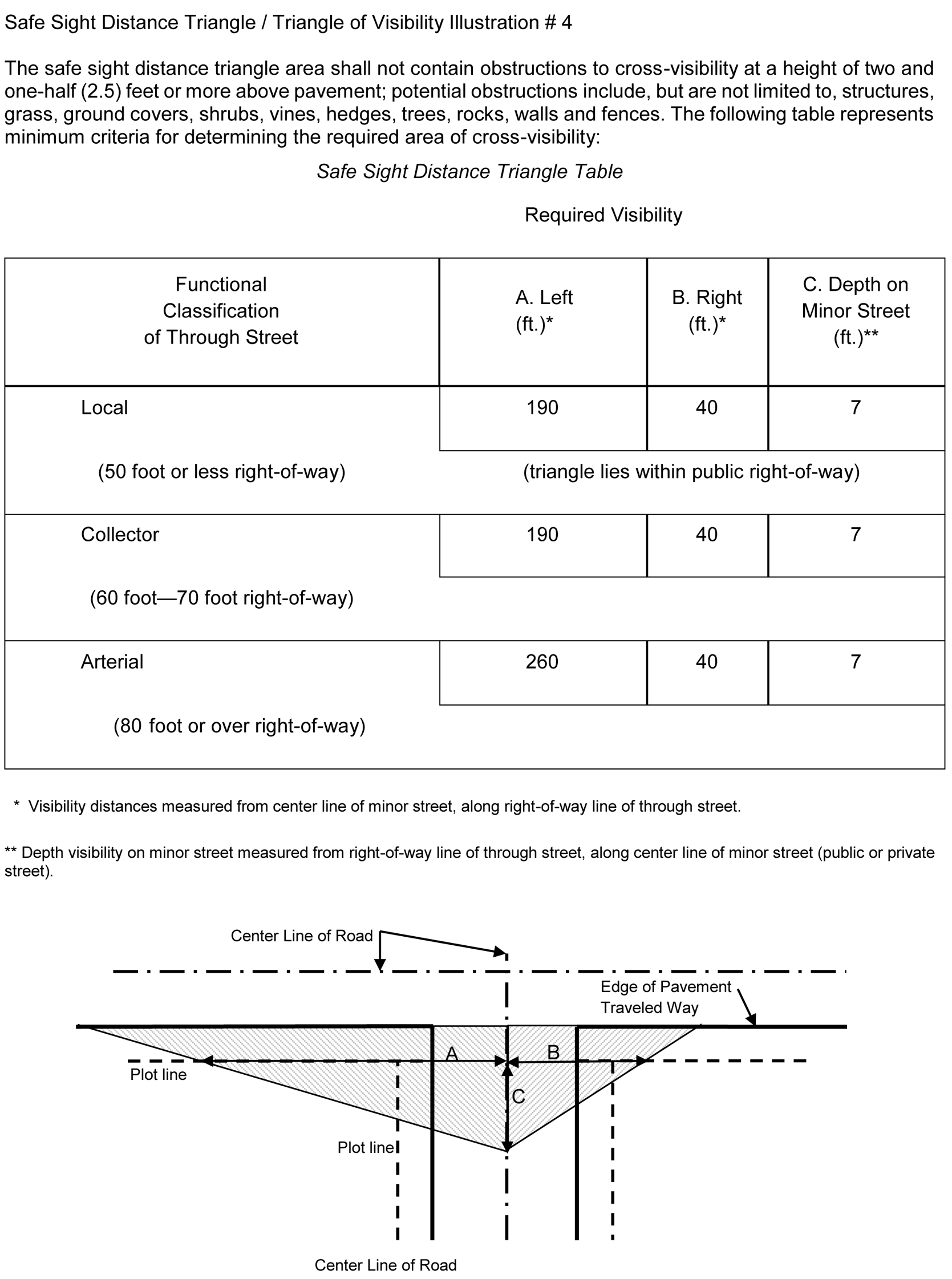
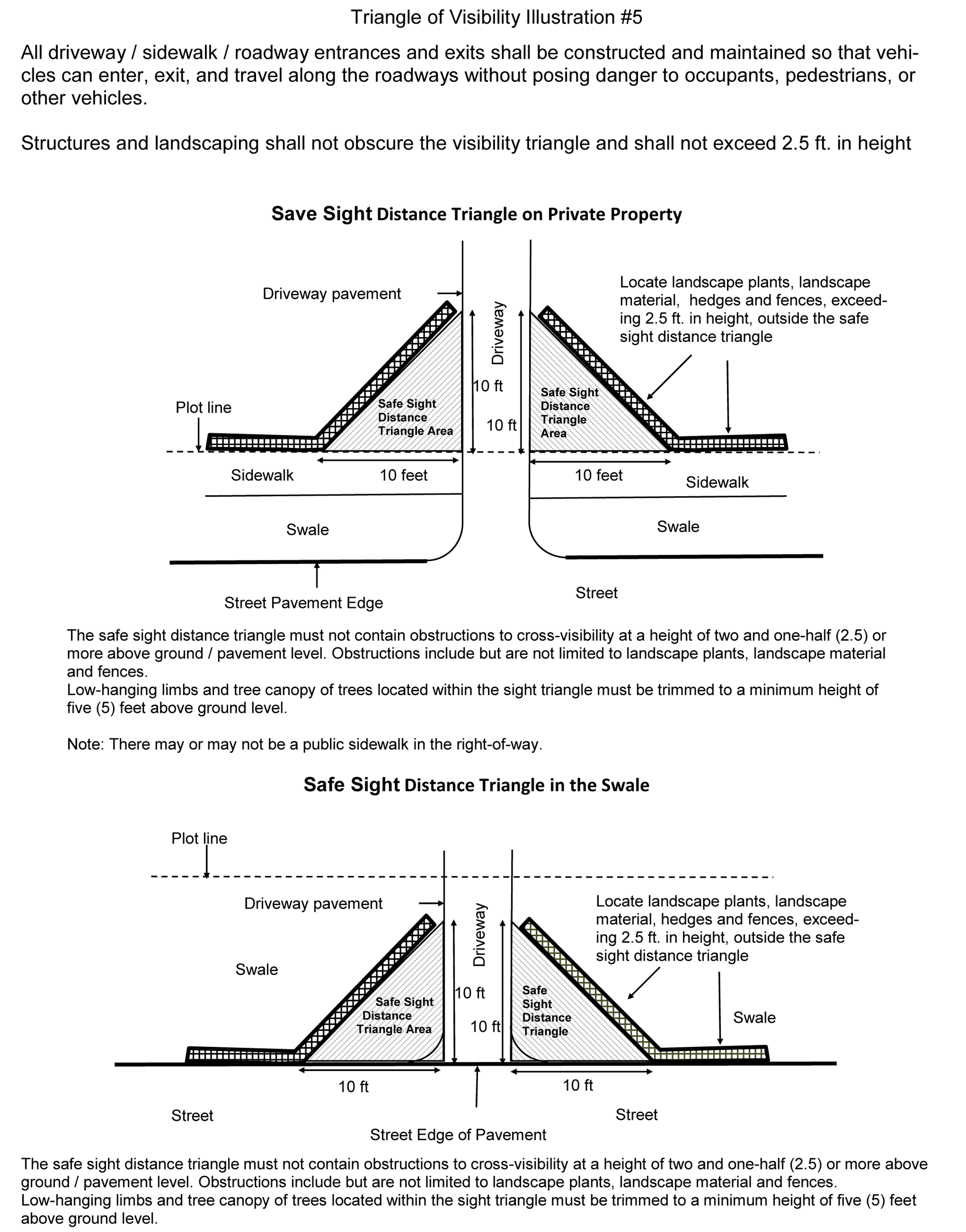
All driveways and access aisles shall meet the safe site distance/triangle of visibility requirements as noted in Illustrations #4 and #5 of the off-street parking requirements.
g.
The required parking spaces for a single-family dwelling shall have a minimum length of 18 feet and a minimum width of nine feet when located within an enclosed structure.
h.
The required parking spaces for a single-family dwelling shall have a minimum length of 18 feet and a minimum width of eight feet, or nine feet in width if located side by side, when located on an open driveway or parking pad.
i.
Not less than 50 percent of the front yard or swale/parkway shall be maintained as green space (pervious area).
(2)
Single-family uses.
a.
Driveway/parking spaces on the single-family plot. For all single-family uses, driveway/parking spaces on the plot shall comply with the following requirements.
1.
Driveways shall be a minimum of 8 feet wide and a maximum of 20 feet wide.
2.
All driveway areas must be a minimum of 10 feet from adjoining property lines at all points.
3.
All driveways on the right-of-way must be a minimum of five feet from the prolongation of the property lines extended except driveway flares may be located not less than three feet from the prolongation of the property lines extended.
4.
When located in the rear and serviced from an alley, access aisles shall be a minimum of eight feet wide and shall not be wider than 20 feet.
5.
All aisles must be 15 feet from an intersection and must meet setbacks as required in this division.
6.
Circular drives located wholly on the plot and their extension through the swale/parkway to the edge of the paved roadway may be a minimum of eight feet wide and a maximum of 12 feet wide.
7.
The total of all paved areas in the front yard shall not occupy more than 50 percent of the required front yard with at least 50 percent of the front yard to be maintained as green space (pervious area).
8.
All driveways on the property that do not connect to a garage or carport must be setback a minimum of five feet from any point on any building.
9.
Parking areas in the front, side and rear yard must be setback a minimum of ten feet from each side yard plot line.
10.
Driveway flares shall not exceed 5 feet in width.
b.
Driveway/parking spaces on right-of-way. Parking for adjoining single-family detached residences may be approved on the swale/parkway subject to the following requirements:
1.
All required parking must be located on the plot it serves. Street, sidewalk or parkway/swale areas may not be used for required off-street parking purposes. No paving (except village projects) shall be permitted on the swale/parkway unless all required parking spaces consistent with this Code are provided on and for the adjoining property.
2.
A public works permit is required and must be applied for and approved before any paving, planting or any other activity not undertaken by the village, takes place in the swale. Swale/parkway areas may be paved for driveways or parking if the design is approved by the director of public works.
3—8.
Reserved.
9.
A covenant for the maintenance of the parkway/swale area must be completed and signed by the adjoining property owner who is the applicant for a public works permit. A covenant shall be signed by such owner of the adjoining property in consideration of the approval of a public works permit to construct in the swale/parkway. The covenant signed by the adjoining property owner shall at a minimum confirm the responsibility of such adjoining property owner for maintenance of the swale/parkway, liability and removal or relocation of the driveway in the right-of-way if required by the village.
(3)
Multi-family, commercial, community facility, college, and university uses.
a.
Minimum parking space dimensions. Off-street parking spaces shall consist of parking spaces having minimum dimensions and shall be identified as required in the diagrams for off-street parking (see Illustration #1 through #5). Access drives and aisles shall be at or greater than the minimum widths shown but not more than the maximum allowed, unless approved on the site plan.
b.
Parking plans. The parking plan must be so arranged that each automobile may be placed and removed from the parking space assigned thereto and taken to and from the property without the necessity of moving any other automobile to complete the maneuver. A rental car agency or a new car dealer storage building, where vehicles are held for sale or rent to the public, may be allowed to stack vehicles if approved on a site plan. Under these provisions, vehicles may be stacked except for employee and customer parking as approved on the site plan.
c.
Parking to be on site. Street and/or sidewalk areas may not be used for required off-street parking purposes.
d.
Parking setbacks. Parking areas shall not extend closer than ten feet to any abutting property line for residential and five feet for nonresidential. Required front, side or rear yards may be used for off-street parking except as may be approved by the planning and zoning board as part of site plan approval.
e.
Landscape and screening of parking areas. All parking areas shall be landscaped in conformance with the paved area landscape requirements in the landscape code of the village. All areas abutting right of ways shall be screened and landscaped according to ordinance requirements.
f.
Size and location of access aisles. Individual ingress and egress drives extending across the public sidewalks and curbs and connecting the off-street parking spaces to the public street areas shall be a minimum of 12 feet and a maximum of 20 feet for any multi-family or a non-residential one-way drive and a minimum of 22 feet and a maximum of 30 feet for any two-way drive. Commercial access aisles are permitted at the distance of one per 100 feet of frontage but must be 15 feet from any street intersection.
g.
Cross access agreements. Two or more owners and operators of commercial buildings or uses of the same type of land use classifications requiring off-street parking facilities may take collective provision for such ingress and egress facilities provided that the combined facility is compatible with the land use being served. Where a parking area is adjacent to a park, community facility, or another business, no connecting driveway shall be allowed from one property to the next without village and the adjoining property owner's approval.
h.
Reserved spaces. Spaces marked reserved or designated for a certain use may not be counted as fulfilling parking requirements where businesses share parking (e.g., shopping centers). Each use must provide parking on site as required in this division.
i.
Pedestrian walkway credit. Credit for one parking space per pedestrian access aisle per row of spaces crossed may be allowed by the administrative official. (Refer to Parking Illustration # 1).
j.
Parking or storage of rental vehicles. Parking or storage of rental vehicles in connection with a licensed and authorized rental car agency shall be located on the same lot or parcel of property as the licensed office of the rental car agency as may be permitted as an allowed use. Such lot or parcel shall be contiguous to the lot or parcel on which the main rental agency or office is located. The storage of rental cars does not require standard parking spaces for storage areas provided such areas are located within an enclosed parking structure which is used and accessed only for retrieval and removal of rental vehicles, is not used by the public, and is approved at a public hearing.
(4)
Plan approval for ingress/egress, curbs, and sidewalks. The plan for ingress and egress, curbs and sidewalks associated with any off-street parking areas is subject to the approval of the village. Curbs or sidewalks may not be cut or altered in any manner without a permit from the village and all other applicable county or state agencies. Interior parking lot curbs may be cut to allow for drainage and for pedestrian access, subject to approval by the administrative official. Curbing must be installed throughout the parking areas in all parking lots other than single-family properties in order to protect landscaping. Bumper stops may be installed in lieu of curbing when approved by the administrative official.
(c)
Off-site parking spaces. Notwithstanding anything to the contrary contained herein, off-site parking may be allowed in the commercial, college, community facilities, and park land use districts after approval at a public hearing by the planning and zoning board, provided the following conditions are met and agreed to by the applicant in a form acceptable to the village:
(1)
The off-site parking facility is located within one-quarter mile of the main parcel for which permission for off-site parking is being sought.
(2)
An application, as required by the administrative official has been filed with and accepted by the administrative officials as being in compliance with the requirements set forth herein.
(3)
The application, as filed with the administrative official, is in the name or names of the owner of the real property seeking permission to utilize an off-street parking facility, the name of any tenant or business on such real property seeking permission to utilize an off-street parking facility, and in the name of the owner of the real property proposed for use as an off-site parking facility.
(4)
The applicants provide to the village an opinion of title acceptable to the administrative official showing the ownership of both parcels in question to be listed in the names of the applicants as of the date of any action by the village council on the request for special exception.
(5)
The property proposed to be utilized as an off-site parking facility is not currently required parking for any other use granted by the village and it shall have sufficient unallocated parking available.
(6)
The application reflects that all parties acknowledge that the off-site parking facility is to be used only for off-site parking as required by the proposed business, and that such off-site parking facility shall not be available for any other use.
(7)
The parties acknowledge that no nonconforming status shall attach to the business, use, structure or real property having such off-site parking, and in the event such business or land shall lose its authority or permission to utilize such off-site parking, any such use which has been allowed based upon the use of such off-site parking facility shall immediately cease.
(8)
The agreement provided to the village shall be properly witnessed and notarized, shall be recorded in the official records of the county, and shall be binding upon the parties' heirs, assigns, and devices.
(9)
Any cost to the village for recording of such agreement or attorney's fees in the preparation, review or filing of such agreement shall be prepaid by the applicant prior to any village council action on such request for special exception.
(10)
Any parking provided on any such off-site parking facility should be upgraded to meet current village codes for required parking including landscape requirements.
(11)
The agreement shall specify that the business for which off-site parking is being sought shall have all owners, employees or agents of such business park on such off-site facility, and not park on the real estate for which permission for off-site parking is being sought, and any violation of such parking restriction shall cause such agreement to be revocable by action of the planning and zoning board.
(12)
The agreement provided to the village, and any agreement for use of off-site parking facilities, shall not be assignable by the applicants, and any agreement for the use of off-site parking facilities shall be subject to being revoked by action of the planning and zoning board in the event that any of the applicants shall sell or covey the facility for which permission for utilization of off-site parking is being sought, the off-site parking facility, or the business seeking permission for utilization of an off-site parking facility.
(13)
Any certificate of occupancy or business tax receipt issued concerning the property for which off-site parking is being sought shall specifically be issued conditioned upon the owner or holder of any such approval maintaining the exclusive right to use such off-site parking facility.
(d)
Handicapped parking. Handicapped parking shall meet the requirements of the state handicapped access code, F.S. 553.501 et. seq.
(e)
Utilization of parking structures. When off-street parking facilities are located within a separate parking structure, the following conditions and restrictions shall apply:
(1)
The structure shall conform to all lot, yard and bulk requirements of the district in which it is located and shall be approved after a public hearing before the planning and zoning board.
(2)
The parking facilities shall conform to all other provisions of this Code and all other ordinances of the village.
(3)
All nonstructural portions of the exterior elevations except for vehicular ingress and egress areas shall, in addition to any required safety provisions, be screened by a sight block of no more than 60 percent solidity for the total areas between dock levels, such sight blockage to be determined by elevation. Screening shall extend the full distance between deck levels except for vehicular ingress and egress as set out in this article and as may be approved at the time the site plan is approved.
(4)
When parking facilities are located on the roof of a structure, a five-foot sight block shall be provided unless modified at the required public hearing. The height of a building shall be measured to the top of the sight block.
(5)
Lighting may be located along the inside wall of the sight block to cast light away from adjacent properties.
This subsection shall not apply to or be construed to prohibit the construction of freestanding carports or garages as accessory structures to single-family dwellings
(f)
Replacement of legal non-conforming driveways. A legal non-conforming driveway, as defined herein, may be replaced with new construction thereof, without losing its status as a legal non-conforming structure, only if such replacement complies with all of the following standards:
1.
Replacement materials must comply with and be consistent with Section 536(2) and 521.
2.
Replacement of legal non-conforming driveways shall be required to comply with Section 521(b)(1)f, safe distance visibility requirements.
3.
The new driveway to replace a legal non-conforming driveway, in order to preserve its legal non-conforming status, must be in the same location as was the legal non-conforming driveway and must be no larger than the size of the legal non-conforming driveway.
(Ord. No. 711-15, § 3, 11-3-15; Ord. No. 739-17, § 2, 11-7-17; Ord. No. 2022-03, § 1, 2-1-22)
Editor's note— Ord. No. 2022-03, § 1, adopted Feb. 1, 2022, set out provisions intended for use as § 521(b)(1)g. Inasmuch as there were already provisions so designated, said section has been codified herein as § 521(f) at the discretion of the editor.
Sec. 521.1. - Lighted off-street parking facilities.
All required off-street parking facilities for multiple family residential development and all non-residential land uses shall install light fixtures which project the light rays directly to the parking surface and shall include shields or be designed so as to restrict projection of light rays outward to adjacent properties and also restrict the upward projection of light rays into the night sky. All lighting shall comply with minimum standards and shall not cast more than one foot candle at the property line. Photometric drawings, by a certified engineer, shall be provided at time of permitting and prior to final approval. Such calculations shall certify compliance with the Code. Lighting shall be arranged so as not to interfere with landscaping and shall be of the type of lighting designated to give maximum true lighting according to established "Crime Prevention through Environmental Design and Techniques."
Sec. 521.2. - Parking pavement markings; wheelstops; curbing.
For all occupancies other than single-family dwellings, the parking spaces shall be marked with double striping on each side of the space to identify and facilitate their use. All painted striping shall be white contrasting with the pavement, except for handicapped parking spaces, which shall be painted blue. Dimension requirements, as noted in Illustration #2, shall be measured to the center point of the double stripe, as shown on the "Striping Detail." Notwithstanding the above provisions and striping details, where striping is required for multi-family residential users, not less than a single four-inch stripe shall be provided, with parking stall dimensions to be measured to the center line of the strip. Where a parking space heads into and abuts a walkway, the paved parking space shall be furnished with a wheel stop or curb positioned two feet to the rear of the front end of the parking space for purposes of protecting landscaped areas and the walkway and its users from encroachment by vehicles.
Sec. 521.3. - Parking lot buffers.
A continuous hedge and a five feet landscape strip, as provided in the landscape code, shall screen all parking lots adjacent to a right-of-way alley or private street (See Landscape Buffer Section). The five feet strip shall have a changing/rolling elevation from grade up to three feet in order to visually screen the parking areas. In addition, a five feet masonry wall shall screen all single-family residential areas from vehicular use areas and from dissimilar uses (i.e. residential adjacent to commercial; single-family adjacent to multi-family or nonresidential). Even if separated by an alley, landscaping shall be planted at 18 inches on center at a height of 24 inches from adjacent grade at time of installation to discourage graffiti. Trees shall be planted at one tree per 25 feet of lineal buffer area (refer to landscape buffer requirements).
Sec. 521.4. - Parking spaces for persons transporting young children and strollers.
(a)
Number of spaces. For all uses other than single-family, duplex, townhouse, or multi-family uses, parking spaces specifically designated for persons transporting young children hereby defined as ages two years or less, with strollers shall be provided as follows:
(1)
Location of spaces. Such spaces shall be located as closely as possible to spaces designated for the persons with disabilities. Spaces shall be located on the shortest route to an accessible entrance.
(2)
Sign and markings. All parking spaces for persons transporting young children and strollers shall be prominently outlined with green paint and posted with an approved permanent above ground sign which shall conform to the figure entitled "Baby Stroller Parking Sign." The bottom of the sign must be at least 5 feet above grade when attached to a building, or seven feet above grade for a detached sign.
Sec. 521.5. - Space allocation for bicycle parking.
All parks, shopping centers, office, and restaurant properties with parking lots containing more than 25 automobile spaces shall provide space for bicycle racks and storage as required in Miami-Dade County Ordinance 99-81. Design, type, location, and construction shall be as follows:
Property owners have the option of installing indoor storage facilities for bicycles. All outdoor facilities shall be covered and protected from the elements, be well marked and lit, and must not impede pedestrian travel. Racks must accommodate all sizes of bicycles, must allow at least one wheel to be locked with the standard "U" lock, and must be of solid construction to resist corrosion and theft.
Sec. 521.6. - University Parking Master Plan.
Purpose and applicability. Institutions of higher education constitute a unique mix of land uses, facilities and activities and the village recognizes the desirability of establishing procedural and substantive regulations to govern off-street parking on the campus to ensure that sufficient parking is provided on campus to meet the needs of students, staff and visitors, and to prevent parking issues from affecting abutting residential areas or other off-campus areas as a result of inadequate campus parking.
Notwithstanding anything to the contrary in Miami Shores Code of Ordinances, and in the schedule and zoning map which form a part thereof, the parking requirement for universities may be established by a university parking master plan, approved by the planning and zoning board as set forth for site plans in Article VI Special Approvals Section 600:
(1)
The university may prepare a university parking master plan consistent with the university's campus master plan if any.
a.
The university parking master plan shall include the following information or documentation:
1.
A site plan.
2.
Location and quantity. The location of off-street parking shall be shown on the university parking master plan, and shall be provided in such amounts and areas within the development so that students, faculty, employees, and visitors will not park in or otherwise detrimentally impact abutting residential areas or other off-campus areas as a result of inadequate campus parking. In projecting parking needs, standard traffic engineering methods shall be used and consideration shall be given to daily regular users of the university, auto driver visitors, persons arriving by mass transportation, and persons being served by the university shuttle system.
3.
Vehicular access and circulation. Vehicular traffic flow shall be designed and oriented so that it will not detrimentally affect nearby residential neighborhoods.
4.
A development chart shall be provided which identifies the square footage of all existing and planned buildings and structures, the number of classrooms in each building, the number of beds in each dormitory, and the number of students and staff. Students and staff may be further broken down to differentiate between day time and evening classes if applicable.
5.
A Mobility Plan as defined in Sec. 521.6(5).
6.
A traffic impact study.
7.
Such other materials as the planning director or planning and zoning board shall determine may be required to support and demonstrate compliance with the parking standard proposed by the university parking master plan.
(2)
University parking master plan to govern.
a.
Notwithstanding anything to the contrary contained in the Miami Shores Land Development and Zoning Code, and in the schedule and zoning map which form a part thereof, the adopted university parking master plan, shall establish the parking requirement and parking provision for the university for which it is approved.
b.
No building permit will be issued for any development that is not consistent with the university parking master plan.
c.
Approval of a building permit application for new development shall not be granted unless the university demonstrates that required parking and traffic capacity for each phase of development would be available prior to or concurrent with such development.
(3)
Modifications to adopted university parking master plan.
a.
Modifications to the adopted university parking master plan may be approved by the planning and zoning board as provided for site plans in Article VI Special Approvals, Section 600.
b.
The university shall prepare an amended university parking master plan with site plan and development chart identifying all new development and changes to the approved university parking master plan, the parking demand generated, and the provision of parking or other actions to meet the new parking demand.
c.
An amendment to the university parking master plan shall be accompanied by either a traffic impact study or a justification why a traffic study is not warranted.
(4)
Development that may be approved without amendment of the university parking master plan.
a.
The planning and zoning board may approve a new building or structure on campus, or any modification, relocation or reconfiguration of any building or structure included in the adopted university parking master plan or campus master plan as provided for site plans in Section 600 without amendment of the university parking master plan provided the new development, modification, relocation or reconfiguration does not involve an increase in intensity that would raise parking demand beyond what is projected in the adopted university parking master plan and provided for on campus.
b.
A building permit may be issued for any development approved through site plan approval upon issuance of a development order.
(5)
Mobility plan.
a.
Mobility plan. The mobility plan shall be consistent with the transportation element of the village's comprehensive plan and the campus master plan. The mobility plan shall identify specific programs to promote the use of alternative modes of transportation other than the single occupant automobile including walking, bicycles, intercampus shuttles, transit, van pools, car pools, parking management strategies and programs designed to reduce external trips and shorten trips lengths wherever possible. The mobility plan shall provide for management programs for on-campus parking. The mobility plan shall establish measurable targets for various modes of travel and identify sources and means for achieving those targets.
(6)
Required reports.
a.
Annual report. On an annual basis, on or before June 1, the university shall submit an annual report to the village setting forth any changes to any adopted campus master plan that would affect the university parking master plan or changes to the university parking master plan and any actual development which has occurred in the prior calendar year or development that is planned for the next five years. The level of detail provided in the annual report is a function of a changes proposed to any campus master plan or university parking master plan and the progress in implementing the plans.
b.
Parking capacity monitoring. The university shall monitor the capacity and utilization of its off-street parking facilities and perform a supply/demand analysis to assess the level of utilization, availability and appropriateness of location of campus parking facilities. The analysis shall also indicate the type of user and the extent to which parking is used jointly by different components of the campus. The results of the monitoring and analysis shall be incorporated in a parking impact analysis report prepared by a certified traffic planner or engineer to be provided by September 1, 2016, and every five years thereafter as part of the annual report for that year.
c.
Annual mobility plan implementation report. The university shall annually submit a mobility plan to the village as part of the annual report identifying any changes from the previous year's mobility plan and describing the progress in implementation of the mobility plan with reference to the measurable objectives set out in the mobility plan. The level of detail provided in the annual report is a function of the changes proposed to the mobility plan and progress in implementing the plan.
d.
Independent review. The village may utilize the services of a traffic engineer to review the parking impact analysis report under Section 521.6(6)(b). The cost of the independent review is to be covered by the university.
(Ord. No. 2023-02, § 2, 4-4-23)
Sec. 521.61. - Combined off-street parking.
Nothing in this article shall be construed to prevent collective provision for, or joint use of, off-street parking facilities for two or more buildings or uses by two or more owners or operations, provided that the total of such parking spaces when combined or used together shall not be less than the sum of the requirements of the several individual uses computed separately in accordance with this article. In such cases, a recorded agreement shall be executed in the same manner as provided for in Section 521.63.
Sec. 521.62. - Shared usage.
Required parking spaces may be utilized for meeting the parking requirements of two or more separate permitted uses in accordance with the provisions of this Code. The applicant shall clearly establish that the different uses will only utilize the spaces at different times of the day, week, month or year such that the total number of parking spaces required by this article for each use is fully available during the operation of each use. Table 521.631 Shared Parking Calculation, shall be utilized to calculate the parking requirement. The owners of the property and all businesses or tenants involved shall submit a recordable covenant, with the correct legal description, in a form acceptable to the village attorney. The covenant shall be recorded in the public records of Miami-Dade County at the applicant's expense, and shall run with the land. The covenant shall provide that the use or portion of a use, that requires the shared parking in order to obtain the necessary permits or other village approvals, shall cease and terminate upon any change in the uses' respective schedules of operation that results in conflicting or overlapping need for or usage of the parking facilities, and that no use may be made of that portion of the property until the required parking facilities are available and provided. The covenant shall also provide that the village may recover its attorneys' fees if litigation is necessary to enforce the requirements of this section.
Sec. 521.63. - Calculating required parking.
(a)
Uses not specifically mentioned. The parking requirements for uses not specifically mentioned shall be the same as provided in Table 521.64 for the most similar use and if no similar use exists the parking requirements shall be as determined by the planning director.
(b)
The parking requirement for mixed uses and shared parking shall be subject to review and approval by the planning and zoning board in accordance with Article VI.
(c)
Shared parking shall be authorized only though the execution of a parking agreement between the applicant and the village setting forth the terms of the alternative parking agreement, establishing business hours for businesses that are a party to the agreement. The agreement shall require recalculation of required parking spaces based upon changes to the business operation, or other terms and conditions the village deems necessary to ensure the alternative parking calculation will remain appropriate.
(d)
Fractional spaces. When units or measurements determining the total number of required off-street parking spaces result in a fractional space, any such fraction shall require a full off-street parking space.
(e)
Mixed uses and shared parking.
(1)
In the case of mixed uses, the total requirement for off-street parking spaces shall be the sum of the various uses computed separately, except as provided for certain combinations of use in Table 521.631, below and as provided for shopping centers, general industrial complexes and storage or distribution warehouses which each have single, comprehensive parking ratios to account for all permitted uses within such centers.
(2)
Shared usage. Table 521.631, "Shared usage," designates the requirements for time of operation differences between uses.
a.
Computation. The number of shared spaces for 2 or more distinguishable land uses shall be determined by the following procedure:
1.
Calculate the minimum parking requirement, as set forth in Section 521 for each use as if it were the only use.
2.
Multiply the minimum parking requirement for each individual use by the percentage indicated in Table 521.631, for each of the six designated time periods.
3.
Add the resulting sums of all uses in each of the six columns representing the six time periods.
4.
Select the single time period with the highest total parking requirement to determine the shared parking requirement.
5.
Captive market allowance. Reduce the shared parking requirement calculated from one through four above an additional 15 percent to account for people visiting more than one business.
Table 521.631
Shared Parking Calculations
*Offices qualifying for this percentage must not be open to the public during weekend hours, and may be required to execute enforceable restrictions to this effect in a form acceptable to the Village Attorney.
**Includes attached restaurant and lounge
(Ord. No. 2023-02, § 2, 4-4-23)
Sec. 521.64. - Alternative parking generation standards.
(a)
The planning and zoning board may approve a parking needs analysis justifying an alternative parking generation rate(s) provided by a petitioner for development approval or change of use, if such alternate rate is the result of unique operating characteristics of the proposed use or mix of uses upon the property, if there are distinctions between the parking demand generated by the proposed use(s) and the parking standard(s) for the most similar use(s) contained in this article, or where the petitioner provides recent, professionally acceptable data and analysis demonstrating that an alternate parking generation rate or stacking space requirement is more appropriate for a class of use than that contained in this article.
(b)
A parking needs analysis shall include one or more of the following, as applicable, to support the needs analysis:
(1)
Estimates of parking needs based on recommendations in studies such as those from the Urban Land Institute, Institute of Traffic Engineers, or industry standards based on data collected from geographic areas and uses or combinations of uses that are similar to the proposed uses(s). The analysis shall document the source of the data used to develop particular recommendations.
(2)
Actual parking counts for the development indicating that the full complement of parking spaces or stacking spaces is not required. Such parking or stacking counts shall be taken during peak demand parking and drive-thru hours.
(3)
An analysis of the extent to which other parking options exist that would lessen on-site parking requirements.
(4)
An operational procedure indicating that the full complement of parking spaces is not required and a guarantee of continuity of such operational procedure.
(c)
The parking needs analysis shall include a statement of remedies in the event the village makes a future determination that the full complement of parking or stacking is required. If for any reason a traffic impact statement is required, the parking needs analysis shall be prepared by the registered professional engineer who prepared the traffic impact statement. In the event that a needs analysis is approved and the village makes a future determination that insufficient parking or stacking spaces exists, the property owner shall be notified by certified mail that a remedy shall be implemented within 60 days. A determination of insufficiency shall be made using one or more of the following methods: monitoring of the parking/stacking; increased parking/stacking in the rights-of-way caused by insufficient off-street parking or stacking on the site; or, verified complaints of parking on neighboring properties by employees or visitors of the property in question.
(d)
The petitioner shall execute a parking agreement with the village pursuant to the procedures specified in Section 521.63, setting forth the terms of the alternative parking or stacking generation standard, which may require recalculation based upon changes to the business operation, or other terms and conditions the village deems necessary to ensure the alternative parking or stacking calculation will remain appropriate.
(Ord. No. 2023-02, § 2, 4-4-23)
Sec. 522.- Minimum building cubage.
On a plot not exceeding 50 feet in width, which plot is situated in an R district in which the required minimum building cubage is more than 20,000 cubic feet, the village council, on recommendation by the planning and zoning board, may permit the erection of a dwelling having a cubage of less than that required in the district, but not less than 20,000 cubic feet.
(Ord. No. 2023-02, § 2, 4-4-23)
Sec. 523.- Quality of buildings generally.
All buildings shall be generally harmonious in character and appearance, including exterior color, with existing buildings in the neighborhood and shall be appropriate to their surroundings. In the event that an application is made for a building permit for the construction of a building, or the performance of work on an existing building, that, prima facie, would be inharmonious or inappropriate in the manner indicated above, such permit shall not be issued except on recommendation by the planning and zoning board and approval by the village council, as provided in Article VI.
(Ord. No. 2023-02, § 2, 4-4-23)
Sec. 523.1. - Construction.
All buildings and structures shall be constructed of materials approved by and in a manner consistent with the then most current version of the Florida Building Code:
(1)
Materials. Interior structural walls shall be constructed of stone, wood, steel, brick, or cement or cement products. Construction of all exterior walls and exterior structural elements of a building shall be of stone, brick, tile, cement or cement products with the following exceptions:
a.
Trim. Door and window spaces may be trimmed in any material.
b.
Architectural features. Non-structural architectural features may be constructed of other materials.
c.
Columns. Structural columns for entryways or patios, with sides unenclosed, may be constructed of metal.
d.
Trusses, joists, and beams. Trusses, joists, and beams may be constructed of metal or wood.
e.
Swimming pool enclosures. Swimming pool enclosures may be framed in metal with screen mesh roof and walls.
f.
Screened porches in residential districts. Screened porches in residential districts every part of which is situated to the rear of the main building and between the prolongations of the side lines thereof, may be framed in metal.
(2)
Decks. Decks in the rear and side yards designed by a registered architect or professional engineer, meeting setback requirements and situated to the rear of the main building or to the side of the main building, may be framed in wood and may utilize wood or wood composite materials for decking.
(3)
Carports. A carport, every part of which is situated to the rear of the building and between the prolongations of the side lines thereof, may be framed in metal with a metal or fabric roof, subject to section 523.1(9).
(4)
Covered passageways. A covered passageway, with sides unenclosed, between a main building and an accessory building shall be constructed with materials identified in the first sentence of section one above.
(5)
Trellises, arbors, and pergolas. A heavy framework of cross members in an ornamental openwork construction serving as a protective screen, not to exceed in height the roof eave line on a single-story residence to which it is attached, or not to exceed ten feet in height on a detached structure; in rear yards not to exceed more than 20 percent of the area of the yard; with minimum required setbacks as follows: No minimum separation distance is required between structures; Front yard, 25 feet; side yard, ten feet; and rear yard, five feet; to be designed by a registered architect and constructed of a material approved by the Florida Building Code.
(6)
Roofing materials. All roofs with inclines of not less than two and one-half inches per foot and all mansard fascia's shall be limited to the following materials:
a.
Clay tile the color of which is impregnated with the same color intensity throughout;
b.
White concrete tile;
c.
Solid colored cement tile impregnated with the same color intensity throughout;
d.
Thick butt variegated slate;
e.
Metal with a factory finish and that has received a "notice of acceptance" from Miami-Dade County and that is labeled "Miami-Dade County Product Control Approved" may be used as roofing material for residences and commercial buildings subject to review and approval of the planning director, in accordance with the following:
1.
The subject residence is constructed in the high modern, post-war modern, ranch or Key West architectural style, or a variation thereof.
2.
The type of roof shall be limited to standing seam metal and shall specifically exclude metal roofing intended to replicate barrel tile or Spanish-S tile.
3.
The metal roof shall be one solid color throughout the roof.
4.
The color of the roof material shall be a non-reflective neutral color that shall not overwhelm or cause the roof to stand out in a significant manner. Primary colors and white are prohibited. No bright, electric or florescent colors shall be used.
5.
The metal roof shall have a finish that is non-reflective with an initial solar reflectance (IR) or (SR) of .50 or less or a solar reflective index (SRI) of 60 or less.
6.
Paint applied to painted metal roof panels must be applied to the panels at the factory using materials and a baking or other process that prevents the paint from cracking or chipping through normal wear and tear of a residential roof. All unfinished metal roofing is prohibited. Field applied painting of metal roofs is prohibited.
7.
The details, color, and manner of installation shall be consistent with the architectural design, style, and composition of the residential or commercial structure and the character of the surrounding neighborhood.
8.
An applicant for a metal roof shall submit a metal sample and color chart to the building department along with a completed building permit application for a roof.
f.
Glazed tiles.
g.
Slurry coats for concrete tiles are not permitted.
h.
Asphalt shingles may be used to replace an existing asphalt shingle roof if an engineer's evaluation is provided to the village certifying that the roof is not structurally adequate to utilize any of the approved roofing materials.
i.
Metal shingles may be used in commercial zones only.
j.
Notwithstanding the above, multicolored roofs and nonstandard colors may only be used upon advance approval by the planning and zoning board.
k.
Any substantial change from existing materials in place, shall require the approval of village staff for aesthetics and harmony with other buildings in the proximity thereof.
(7)
Additional materials. All roofs having an incline of less than two and one-half inches per foot shall be constructed of build-up roofing material and gravel modified bitumen, or fiberglass cap.
a.
Any substantial change from existing materials in place shall require the approval of village staff for aesthetics and harmony with other buildings in the proximity thereof.
(8)
Flat roofs. Flat roofs are permitted on additions to existing pitched-roof structures providing:
a.
A sloped roof is not practical, and this shall be determined by the planning and zoning board.
b.
The addition shall not exceed 15 percent of the ground area of the pitched roof section of the existing buildings, or a maximum of 300 square feet, whichever is greater (any existing flat roof sections shall count against allowable new area).
c.
The addition is not visible from the front elevation of the building on an inside lot, or is not visible from the front or side street elevations on a corner lot.
(9)
Metal, fabric roofs. Metal or fabric roofs are permitted to cover porches, patios and carports in residential districts, providing:
a.
The structure is located in the rear of the building and shall be situated so that it is between the prolongations of the sidelines thereof; and
b.
The metal or fabric roof material shall be colored by a factory process and shall be harmonious in color with the main building; and
c.
The total area covered by metal or fabric roofs shall not exceed 15 percent of the ground area of the main building, or, a maximum of 300 square feet, whichever is greater.
(10)
This subsection shall not be construed to permit the use of imitation barrel tiles or chickees both of which are prohibited.
a.
Chickees legally constructed and existing on the effective date of this ordinance may continue subject to the following regulations but may not be replaced:
1.
A chickee shall be properly maintained at all times free of insects, vermin and mold, and shall be rethatched as necessary; and
2.
A chickee shall be treated with a water-based fire retardant. The fire retardant is to be reapplied annually and the property owner shall provide proof of the reapplication to the building official annually prior to the anniversary date of the chickee's certificate of completion; and
3.
The village building official may order that the chickee be rethatched if visual inspection confirms that the roof has deteriorated structurally or aesthetically so as to become structurally unsound or unsightly.
(Ord. No. 741-17, § 1, 11-21-17; Ord. No. 2018-17, § 1, 9-17-18; Ord. No. 2023-02, § 2, 4-4-23)
Sec. 523.2. - Hybrid roofs.
In addition to the roofing materials permitted under Section 523.1 Construction, the following hybrid roofing systems and materials may be permitted.
(1)
A metal pan tile with clay cap tile roofing system may be utilized for residences subject to planning and zoning board review and approval and in accordance with the following criteria:
(2)
All roof sections must begin and end with clay cap tiles at the hip, rake and ridge lines, and not begin or end with pan tiles. The rake line must end with a cap tile and rake tile.
(3)
Clay cap tiles are to be set perpendicular to the roof eave in a straight line from the eave to the roof ridge with a variation in spacing between the rows of not more than four inches within a variation of one inch plus or minus.
(4)
The clay cap tile shall be impregnated with the same color intensity throughout.
(5)
The metal pan tiles and clay cap tiles shall be of natural clay colors and shall match each other in color to the greatest extent possible.
(6)
The details, color, and manner of installation shall be consistent with the architectural design, style, and composition of the residential structure, the neighborhood and community.
(7)
No material of any kind shall be placed between the clay cap tiles except for the metal pan tiles.
(8)
All work on the construction, alteration or repair of roofs shall be performed in a good and workmanlike manner according to accepted, standards and practices in the trade.
(Ord. No. 2023-02, § 2, 4-4-23)
Sec. 524.- Nonconforming buildings, or uses of buildings, lands, or buildings in combination with lands.
As used in this section, a nonconforming building, or nonconforming use of a building, land or building in combination with land, is a building or use of a building, land or building in combination with land that was legally permitted and fully legally established under the applicable zoning code requirements in effect at the time it was established, but which is no longer allowed under the current code.
(1)
Nothing in this article shall be interpreted as authorization for, or approval of, the continuation of the use of a structure or premises in violation of any ordinance in effect at the time the use was initially established on the premises.
(2)
The casual, temporary or illegal use of land or a structure, or part thereof, shall not be sufficient to establish the existence of a nonconforming use or to create any vested rights in the continuance of such a use.
Sec. 525. - Nonconforming buildings.
The following regulations shall apply to a building or parts thereof, that was legally permitted and fully legally established under the applicable zoning code requirements in effect at the time it was established, but which is no longer allowed under the current code:
(1)
Additions, extensions or alterations. A nonconforming building shall not be enlarged or altered in a way which increases its nonconformity.
a.
Additions, extensions or alterations to nonconforming structures are subject to site plan review by the planning and zoning board under Article VI and shall comply with all applicable provisions of this Code.
(2)
Maintenance. Ordinary maintenance and repair on nonconforming structures shall be allowed, in accordance with all applicable code provisions.
(3)
Reconstruction. In the event any nonconforming structure is damaged such that the cost of repair or replacement would exceed 50 percent of the then current county tax-assessed value of the structure, the structure and its associated on-site improvements shall not be reconstructed except in full conformance with all then applicable requirements of this Code.
(Ord. No. 2023-02, § 2, 4-4-23)
Sec. 526. - Nonconforming use of land, buildings or land in combination with buildings.
The following regulations shall apply to the use of land, buildings or land in combination with buildings, that was legally permitted and fully legally established under the applicable zoning code requirements in effect at the time it was established, but which is no longer allowed under the current code made nonconforming either by the adoption of this ordinance or by any subsequent amendment thereof:
(1)
Additions, extensions or alterations. A nonconforming use of a building or portion of a building shall neither be expanded into any other portion of the building nor changed except to a conforming use. The nonconforming use of land shall not be enlarged, expanded or extended in area.
a.
Additions, extensions or alterations are permitted to buildings containing nonconforming uses provided same conforms to the provisions of this Code and the nonconforming use does not expand into the new space.
b.
Additions, extensions or alterations to nonconforming buildings containing nonconforming uses are subject to site plan review by the Planning and Zoning Board under Article VI and may be approved provided the addition, extension or alteration is conforming to the provisions of this code and the nonconforming use does not expand into the new space.
(2)
Discontinuance of use. If the nonconforming use of a building or land ceases for any reason for a period of six months or more, that use shall lose any lawful, nonconforming status, and the building or land on which the nonconforming use took place shall from then on be used for conforming uses only. Maintenance of a local business tax receipt for the nonconforming use shall not in and of itself be considered proof that the use has been in continuous operation.
(3)
Maintenance. Ordinary maintenance and repair of buildings containing nonconforming uses shall be allowed, in conformance with all applicable code provisions.
(4)
Change or intensification of use. The nonconforming use of a building or land shall not be permitted to change in mode or character of operation that will result in an intensification of the use except for changes that otherwise comply with all applicable code provisions.
(Ord. No. 2023-02, § 2, 4-4-23)
Sec. 527. - Signs.
Every nonconforming sign legally permitted and fully legally established under the applicable zoning code requirements in effect at the time it was established, but which is no longer allowed under the current code, previous zoning code amendments, or subsequent zoning code amendments shall, within three years after the time that it becomes nonconforming, be removed or brought into conformity with the regulations as to signs that are set forth in Section 504.
Sec. 528.- Submittal requirements.
Any subdivision of land as defined in Section 245.5 shall require the submittal of a plat (as defined in Section 228.5) for approval by the planning and zoning board and village council. The plat shall be prepared in accordance with the provisions of Chapter 28 of the Code of Metropolitan Dade County, Florida, the provisions of said Chapter 28, as from time to time amended, being made a part hereof by reference thereto.
(Ord. No. 2023-02, § 2, 4-4-23)
Sec. 529.- Level-of-service standard.
On-site drainage (structural drains or detention) shall meet the drainage level-of-service standards specified in Section 906(a) plus all appropriate county and state requirements.
Sec. 530.- Approval requirements.
Any development requiring a new septic tank or other on-site sewage disposal facility shall not receive a building permit until the soil suitability for the proposed system has been approved by Miami-Dade County.
Sec. 532.- Requirements; approval; denial.
(a)
"Community residential homes" as defined in Section 210.5 shall be permitted as a dwelling in all residential districts if:
(1)
They have six or less clients;
(2)
A distance of at least 1,000 feet is maintained between such community residential homes; and
(3)
The sponsoring agency or the Florida Department of Children and Families has notified the city village manager as to its conformance with all Florida Department of Children and Families licensing requirements.
(b)
Facilities with seven to 14 clients shall be permitted in all multifamily residential districts (A-1, A-2 and PRO) if a 1,200-foot minimum distance is maintained and the requirements of (d) below are met.
(c)
Community residential homes under both (a) and (b) above shall also meet the following standards:
(1)
The resident administrator has had college level courses in relevant social sciences plus a high school diploma and three years of relevant experience.
(2)
The facility has at least:
1.
Thirty-five square feet of combined living room and dining area per client resident;
2.
Sixty square feet of bedroom space per resident unless in single bedrooms, the 80 square feet per bedroom;
3.
One toilet, lavatory and bathing facility per four residents; and
4.
Otherwise meet the Florida Department of Children and Families standards.
(d)
Community residential homes with seven to 14 residents ((b) above) and locating in multifamily (A-1, A-2 and PRO) districts shall undergo the following review process:
(1)
When a site has been selected by a sponsoring agency, the agency shall notify the village manager in writing and include in such notice the specific address of the site, the residential licensing category, the number of residents and the community support requirements of the program. Such notice shall also contain a statement from the district administrator of Florida Department of Children and Families indicating the need for and the licensing status of the proposed community residential home and specifying how the home meets applicable licensing criteria for the safe care and supervision of the clients in the home. The district administrator shall also provide to the village manager the most recently published data compiled that identifies all community residential homes in the district in which the proposed site is to be located. The village council shall review the notification of the sponsoring agency in accordance with this ordinance.
(2)
Pursuant to such review, the village council may:
1.
Determine that the siting of the community residential home is in accordance with local zoning and approve the siting. If the siting is approved, the sponsoring agency may establish the home at the site selected.
2.
Fail to respond within 60 days. If the local government fails to respond within such time, the sponsoring agency may establish the home at the site selected.
3.
Deny the siting of the home.
c.
The village council shall not deny the siting of a community residential home unless it establishes that the siting of the home at the site selected fails to meet one of the following criteria:
1.
Does not otherwise conform to existing zoning regulations applicable to other multifamily uses in the area.
2.
Does not meet applicable licensing criteria established and determined by Florida Department of Children and Families, including requirements that the home be located to assure the safe care and supervision of all clients in the home.
3.
Would result in such a concentration of community residential homes in the area in proximity to the site selected, or would result in a combination of such homes with other residences in the community, such that the nature and character of the area would be substantially altered. A home that is located within a radius of 1,200 feet of another existing community residential home in a multifamily zone shall be an overconcentration of such homes that substantially alters the nature and character of the area. A home that is located within a radius of 500 feet of an area of single-family zoning substantially alters the nature and character of the area.
(4)
If agreed to by both the village council and the sponsoring agency, a conflict may be resolved through mediation as provided for in Chapter 89-372, Laws of Florida.
(5)
Florida Department of Children and Families shall not issue a license to a sponsoring agency for operation of a community residential home of seven to 14 residents if the sponsoring agency fails to notify the local government of its intention to establish a program, as required by law and outlined above.
(e)
Adult congregate living facilities (ACLF) as defined in Section 201 shall be permitted in A-2 multifamily districts.
Sec. 533.- Retention of existing lakes.
All existing lakes, including Mirror Lake, shall be retained with no filling permitted.
Sec. 534.- Development.
Any new development on land adjacent to Biscayne Bay, Biscayne Canal or other tributaries of the bay shall be subject to special approval under Article VI of this ordinance. The site plans shall be reviewed with respect to:
(1)
Retention of natural vegetation near the water's edge;
(2)
Storm drainage that detains the first one inch in natural or filtered structural facilities; and
(3)
Construction that is sensitive to the floodplain and avoids its filling.
(4)
Unless otherwise specified, setbacks for waterfront plots shall be measured from the plot line. Where the plot line extends into the canal or bay or over the bulkhead, seawall or riprap, setbacks shall be measured from the landward edge of the cap of the bulkhead, seawall or the top of the riprap (where said riprap has been placed in accordance with the provisions of Chapter 24 of the Miami-Dade County Code) or from the mean high water line as defined in Chapter 177, Part 2, Florida Statutes, where no bulkhead, seawall or riprap exists.
Sec. 535.- Construction.
Construction of any new principal building shall require the construction of public sidewalks within the right-of-way by the plot owner if not already existing unless waived by the planning and zoning board.
(Ord. No. 2023-02, § 2, 4-4-23)
Sec. 536.- Design standards.
(1)
Green space:
a.
Must be planted with living plant material including, but not limited to, one or a mix of shrubs, lawn, turf grass, sod or living ground cover, that provides complete ground coverage, except:
1.
Up to ten percent of the green space area in the front yard may be covered with decorative landscaping stone of not less than one-half inch in diameter when used for decorative purposes as an adjunct to planting beds.
2.
Up to 20 percent of the green space area in the side and up to 20 percent of the green space area in the rear yard may be covered with decorative landscaping stone of not less than one-half inch in diameter when used for decorative purposes as an adjunct to planting beds.
b.
Not less than two trees must be planted on a plot.
(2)
The use of impervious material in the front, side and rear yards is prohibited except for areas dedicated to approved patios, pool decks tennis courts, village play fields and vehicular driveways where brick, concrete and asphalt must be used for the driveway and where the spaces between driveway slabs not more than six inches in width may be filled with minimum three-quarter inch dimension natural colored rock including crushed rock, slate, river rock and pebbles. Chattahoochee stone or similar materials must not be substituted for grass, sod or living ground cover.
(3)
A boat storage area of 260 square feet surfaced by gravel rock of one-half inch diameter, or greater, is permitted.
(4)
Use of mulch or decorative landscaping stone as ground cover to enhance the growth of an adjacent shrub or tree is permitted in green spaces; however cypress mulch, shell, crushed stone pebbles, inorganic mulch, plastic, rubber and glass must not be used.
(5)
Vegetable gardens are permitted in rear yards only.
(6)
Safe site distance/triangle driveways. Hedges and all landscaping plants and material are subject to the driveway safe site distance/triangle requirements of subsection 521(b)(1)f. Hedges and other landscaping plants and material must not exceed two and one-half feet in height within the safe site distance/triangle.
(7)
Synthetic turf standards for the rear and side yards:
Synthetic turf is permitted in the rear and side yards of any lot in any residential zoning district, provided it complies with the following:
a.
Permit required. A building permit must be obtained prior to the installation of any synthetic turf in the rear and side yards. As part of the application, the applicant shall provide:
1.
A landscape plan that includes:
i.
Dimensions and details of the landscaped area (a table showing the pervious area and the proposed area is required) including the synthetic turf and other landscaping materials.
ii.
Drawings that include scaled cross sections of the proposed landscaping materials and details showing the methods of installation and attachment of the synthetic turf as well as drainage information.
iii.
Coverage. Synthetic turf located in the rear and side yards may be used throughout the entire rear and side yards areas, provided the synthetic turf is set back a minimum of five feet from the rear and side plot lines.
iv.
Turf shall not be permitted within 36 inches of an unfenced side property lot line. The 36-inch buffer shall be landscaped with living plant material.
2.
Material description including manufacturer's product data, specifications and installation instructions, installer information and qualifications, and warranty information.
3.
A detailed description of the synthetic turf, specifying the materials and characteristics.
4.
Maintenance information for the synthetic turf.
5.
Material. Synthetic turf must simulate the appearance of natural live grass and shall:
i.
Be of a type known as cut-pile infill with parallel long slit blades. The long slit blades shall be manufactured from polyethylene or polypropylene. The minimum pile length shall be one and one-half inches and the maximum pile length shall be two and one-half inches. The turf shall contain a beige or tan thatch layer. The synthetic turf blades (not including the thatch layer) shall be required to contain at least two colors. The synthetic turf shall comply with all federal and state standards related to lead and heavy metal content. Turf that is made from recycled materials is encouraged. The use of indoor or outdoor plastic or nylon carpeting is prohibited.
ii.
Be constructed to maximize dimensional stability, resist damage during normal use and to minimize UV degradation. Further, the synthetic turf shall be resistant to staining, weather, insects, rot, mildew and fungus growth, and shall be non-allergenic and nontoxic.
iii.
Contain an infill material of clean silica sand or zeolite material that is brushed into the synthetic turf to keep the blades upright and achieve a natural grass look. Any replacement infill shall be silica sand or zeolite material. Rubber infill is prohibited.
iv.
Be affixed to a permeable triple layer primary backing with a tuft bind strength of at least eight pounds. The backing shall allow water to percolate through the synthetic turf at a drain rate of at least 15 inches per hour. The synthetic turf system shall allow for the free movement and drainage of water through the system to prevent runoff, pooling, and flooding.
v.
Have a manufacturer's warranty lasting at least eight years.
vi.
Have spacing between tufting rows (gauge) of no more than three-eighths inch as defined by the manufacturer.
vii.
Have a face weight of at least 60. The "face weight" is defined as the weight in ounces of the synthetic turf fibers found in one square yard of synthetic turf as defined by the manufacturer.
viii.
Have tear grab strength of at least 200 pounds.
6.
Installation. Synthetic turf shall be installed pursuant to manufacturer's requirements by licensed professionals who are experienced in the installation of the synthetic turf. In addition:
i.
The synthetic turf shall be installed over at least three inches of a compacted aggregate base that provides adequate drainage. The base material shall be installed over subgrade that is compacted to a firm condition to ensure stability and maintain adequate drainage.
ii.
Seams shall not be visible and shall be fastened in a manner that ensures they are firm, tight and permanent. Seams shall be sewn and fibers shall be brushed to provide full coverage of the fibers over the seams.
iii.
The synthetic turf shall be anchored over the entire coverage area and shall be installed with a nailer board or any such substitute recommended by the manufacturer intended to conceal edges and ensure proper anchoring of turf.
iv.
All existing irrigation infrastructure in the synthetic turf area including piping and sprinkler heads that are no longer used must be capped or removed and shall not be visible.
v.
All reasonable efforts shall be made to protect existing trees and tree roots from damage during installation.
vi.
Maintenance. Synthetic turf shall be maintained in an attractive and clean condition and shall not contain holes, tears, stains, discoloration, seam separations, uplifted surfaces, heat degradation, or excessive wear.
(8)
Synthetic turf standards for the driveway:
a.
Permit required. A building permit must be obtained prior to the installation of any synthetic turf in the driveway. As part of the application the applicant shall provide:
1.
A site plan.
2.
Dimensions and details of the proposed driveway (a table showing the pervious and impervious calculations for the front yard area is required).
3.
Drawings that include scaled cross sections of the proposed driveway with details showing the methods of installation and attachment of the synthetic turf as well as drainage information.
4.
Material description including manufacturer's product data, specifications and installation instructions, installer information and qualifications, and warranty information.
5.
A sample of the proposed synthetic turf material that is at least six inches by six inches.
6.
Maintenance information for the synthetic turf.
b.
Standards:
1.
Material. Synthetic turf must simulate the appearance of natural live grass and shall:
2.
Be of a type known as cut-pile infill with parallel long slit blades. The long slit blades shall be manufactured from polyethylene or polypropylene. The minimum pile length shall be three-fourths inches and the maximum pile length shall be two and one-half inches. The turf shall contain a beige or tan thatch layer. The synthetic turf blades (not including the thatch layer) shall be required to contain at least two colors. The synthetic turf shall comply with all federal and state standards related to lead and heavy metal content. Turf that is made from recycled materials is encouraged. The use of indoor or outdoor plastic or nylon carpeting is prohibited.
3.
Be constructed to maximize dimensional stability, resist damage during normal use and to minimize UV degradation. Further, the synthetic turf shall be resistant to staining, weather, insects, rot, mildew and fungus growth, and shall be non-allergenic and nontoxic.
4.
Contain an infill material of clean silica sand or zeolite material that is brushed into the synthetic turf to keep the blades upright and achieve a natural grass look. Any replacement infill shall be silica sand or zeolite material. Rubber infill is prohibited.
5.
Have a manufacturer's warranty lasting at least eight years.
6.
Have spacing between tufting rows (gauge) of no more than three-eighths inch as defined by the manufacturer.
7.
Have a face weight of at least 60. The "face weight" is defined as the weight in ounces of the synthetic turf fibers found in one square yard of synthetic turf as defined by the manufacturer.
8.
Have tear grab strength of at least 200 pounds. Installation: Synthetic turf shall be installed pursuant to manufacturer's requirements by licensed professionals who are experienced in the installation of the synthetic turf. In addition:
9.
Seams shall not be visible and shall be fastened in a manner that ensures they are firm, tight and permanent. Seams shall be sewn and fibers shall be brushed to provide full coverage of the fibers over the seams.
10.
All reasonable efforts shall be made to protect existing trees and tree roots from damage during installation.
11.
Maintenance. Synthetic turf shall be maintained in an attractive and clean condition and shall not contain holes, tears, stains, discoloration, seam separations, uplifted surfaces, heat degradation, or excessive wear.
c.
Coverage. Synthetic turf located in the driveway may not exceed a width of six inches.
d.
Permeable installations:
1.
The elevation of the drainage fill must be no more than ½ inch below all hardscape after compaction. This will prevent any trip hazards or toe stubbing after years of foot traffic
2.
Compaction to be done by a hand tamper—compacted at least to 80 percent—otherwise the turf ribbons will settle over time.
3.
Nail spikes shall be placed in the center of each ribbon approximately one foot apart (this will prevent the tuff sections from moving during cutting).
4.
Edges of the turf must be secured with five inches nails every 16 inches at all edges and five inches nails every 12 inches down the center of ribbon.
5.
Three and one-half inch (16d common sinkers-framing nails) every four inches on center between the five inches nails placed at the edge, turf ribbons require many nails to secure the edge.
When all sections are cut, use seam tape and glue to adhere the sections together
e.
Impermeable applications: (glued down)
1.
Concrete surface must be clean and prepared properly to ensure that the adhesive/glue will penetrate and provide a strong bond.
2.
Proper thickness of glue must be applied to penetrate the backing of the turf.
3.
Proper compression force must be applied.
(Ord. No. 726-16, § 1, 6-7-16; Ord. No. 730-16, §§ 1, 2(Att.), 9-20-16; Ord. No. 2019-06, § 1, 5-21-19; Ord. No. 2022-11, § 2, 12-6-22)
Sec. 537. - Maintenance standards.
(1)
Property owners are responsible for the proper maintenance of landscaping on their property in accordance with the ordinances of Miami Shores Village.
(2)
Landscape and yard maintenance:
a.
Landscape plants and material installation, maintenance and upkeep:
1.
Landscape plants and material must be installed in compliance with the landscape requirements as set forth in sections 536 and 537. Plant materials that are native or emphasize drought-tolerance are encouraged. Plant selection should be based on the plants adaptability to the existing conditions present at the landscaped area and native plant communities, particularly considering appropriate hardiness zone, soil type and moisture conditions, light, mature plant size, desired effect, color and texture.
2.
Landscape plants and material must be maintained so as to present a healthy and neat appearance free from refuse and debris.
b.
Organic mulch must be maintained and reinstalled as necessary to maintain its effectiveness.
c.
Private property must not be allowed or permitted to become overgrown with vegetation including trees, shrubbery, ground covers, lawns and other plants.
d.
Dead, decayed, trees, shrubs, or other vegetation must be removed. If any tree or plant dies which is being used to satisfy current landscape requirements, such tree or plant must be replaced with the same landscape material or an approved substitute. All work with trees must be undertaken in full compliance with Miami-Dade Code of Ordinances chapter 24, article IV, division 2, tree preservation and protection.
e.
Trees must be pruned according to the current ANSI A300 Standards and the Miami Dade County Landscape Manual.
f.
The removal of living trees from property within the village is governed by section 24-49, Miami-Dade County Code, except in the case of properties designated as "historic landmarks", in which case section 11-6 of this Code governs.
g.
Public property must be maintained by the adjoining property owner in a clean, litter-free condition, including public sidewalks, grass strips, swale areas, or rights-of-way up to the edge of pavement of any public street.
h.
Irrigation systems must be maintained to eliminate water loss due to damaged, missing or improperly operating sprinkler heads, emitters, pipes and all other portions of the irrigation system.
i.
Trees, shrubs and hedges must be carefully selected and properly planted and maintained so that they:
1.
Do not interfere with service lines and traffic safety sight areas;
2.
Prevent physical damage to adjoining public improvements;
3.
Do not extend into a public right-of-way.
(3)
Hedges must be pruned and maintained so as to avoid unsightly appearance and to avoid vehicular sight hazards. Hedges must be planted and then pruned in such a manner that the hedge does not grow over property lines and over neighboring properties or public rights-of-way. Property owners that have hedges that are over eight feet in height must trim the hedge on their neighbor's side if requested by that neighbor.
(4)
Lawn, turf grass and sod must be mowed regularly, must not exceed eight inches in height and at all times lawn must be kept at a length that provides a neat, well-kept appearance.
(5)
All yards must be kept in a healthy appearance and must be maintained to limit ponding of water, and the total of all non-growth areas must not exceed 25 percent of the front yard nor 25 percent of the combined area of the side and rear yards.
(7)
Property owners are responsible for maintaining the landscaping on parkway areas with the exception of trees. (See section 20-17 of code of ordinances.)
(8)
Shrubs and trees must be trimmed in accordance with the Miami Shores Village Code of Ordinances. (See section 10-10).
(9)
Maximum allowable heights for hedges parallel to property lines must be maintained as provided by section 518, as amended.
(10)
All required planting must be a minimum grade of Florida No. 1, or better.
(11)
Prohibited and controlled tree species, controlled plant species and prohibited plant species, that are prohibited by Miami-Dade County, must not be planted in the village.
(12)
The Miami-Dade County Landscape Ordinance and Landscape Manual as amended, may be utilized as the primary source to identify recommended and approved trees and ground cover except as otherwise provided by provisions of the Village Code.
(13)
All landscaping plants, material, mulch or impervious material proposed to be placed in the swale/parkway, with the exception of lawn, turf grass or sod, must be reviewed and approved by the public works director before it may be installed. Driveways or parking areas must be reviewed and approved by the planning director before they are installed. Property owners or their designees must not remove or trim trees within the city right-of-way.
(Ord. No. 730-16, §§ 1, 2(Att.), 9-20-16)
Sec. 538. - Landscaping descriptions and definitions.
Decorative landscaping stone. Stones of not less than one-half inch in diameter when used for decorative purposes as an adjunct to planting beds.
Florida Number One. The minimum standards for plant quality and acceptable method for installation and culture as established by the State of Florida Department of Agriculture in the publication, Grades and Standards for Nursery Plants, Part I and II.
Green space. All areas of plot not occupied by buildings or impervious surfaces of any kind and that is located at ground level.
Ground cover. A planting of low growing plants that provide a complete cover over an area in one growing season and including the area of lawful mulch around the plant.
Landscaping. Living plant material purposely installed for functional or aesthetic reasons at ground level and open to the sky.
Landscape maintenance. The irrigation and cultivation, mowing, trimming, fertilizing and watering of landscaping to keep a healthy, vigorous, neat, and orderly appearance, including removal of debris and refuse, replacement of required plantings and the control of growth thereof.
Lawn, turf grass and sod. The surface layer of soil that is bound by a solid cover of grassy plants and roots including but not limited to Bermuda, St. Augustine, Zoysia and similar Florida grasses.
Mulch. An organic soil additive or decorative topping such as chipped bark or wood chips used for reducing evaporation, weed control, soil enrichment or decorative purposes.
Non-growth area. An area that is not covered by approved plantings and that consists of mulch areas or unplanted areas around shrubs or trees.
(Ord. No. 730-16, §§ 1, 2(Att.), 9-20-16)
Sec. 538.1. - Florida-friendly fertilizer use on urban landscapes.
(a)
Definitions. For the purposes of this article, the following words and phrases shall have the meanings respectively ascribed to them by this section unless the context clearly indicates otherwise.
Application [or] apply, or variants thereof means the actual physical deposit of fertilizer to turf or landscape plants.
Applicator means any person who applies fertilizer on turf and/or landscape plants in the village.
Best management practices means turf and landscape practices or combination of practices based on research, field-testing, and expert review determined to be the most effective and practicable on-location means, including economic and technological considerations, for improving water quality, conserving water supplies, and protecting natural resources.
Commercial fertilizer applicator or commercial applicator means any person who applies fertilizer on turf and/or landscape plants in the village in exchange for money, goods, services, or other valuable consideration.
Fertilize, fertilizing, or fertilization means the act of applying fertilizer to turf, specialized turf, or landscape plants.
Fertilizer means any substance or mixture of substances (except pesticide/fertilizer mixtures such as "weed and feed" products), that contains one or more recognized plant nutrients and promotes plant growth, controls soil acidity or alkalinity, provides other soil enrichment, or provides other corrective measures to the soil.
Institutional applicator means any person other than a non-commercial or commercial applicator (unless such definitions also apply under the circumstances) that applies fertilizer for the purpose of maintaining turf and/or landscape plants. Institutional applicators shall include, but shall not be limited to, owners and managers of public lands, schools, parks, religious institutions, utilities, industrial or business sites, and any residential properties maintained in condominium and/or common ownership.
Landscape plant means any native or exotic tree, shrub, or groundcover (excluding turf).
Low maintenance zone means an area a minimum of ten feet wide adjacent to watercourses which is planted and managed in a fashion so as to minimize the need for fertilization, watering, mowing, etc.
Person means any natural person, business, corporation, limited liability company, partnership, limited partnership, association, club, organization, or group of people acting as an organized entity.
Prohibited application period means the time period during which a flood watch or warning, a tropical storm watch or warning, or a hurricane watch or warning issued by the National Weather Service is in effect for any portion of the village, or if heavy rain is likely.
Restricted application period means June 1 through September 30.
Saturated soils means soil which has absorbed water or other liquid to the extent that any additional water or liquid may cause ponding at the surface for a period of 12 hours or more.
Slow release, controlled release, timed release, slowly available, or water insoluble nitrogen means nitrogen in a form which delays its availability for plant uptake and use after application or which extends its availability to the plant longer than a reference rapid or quick release product.
Turf, sod, or lawn means a piece of grass-covered soil held together by the roots of the grass.
(b)
Applicability. This section shall be applicable to and shall regulate any and all applicators of fertilizer and areas of application of fertilizer within the village unless:
a.
Such applicator is specifically exempted by the terms of this article from the regulatory provisions of the ordinance from which this section is derived;
b.
Or an existing contract is in effect at the time the ordinance from which this section is derived passes which provides other regulatory provisions in which case such contractual provisions shall govern only until such existing contract terminates, expires, or is amended;
c.
Or during any declared state of emergency. This section 539 shall apply prospectively only and shall not impair any existing contracts.
(c)
Time of fertilizer application.
(1)
No applicator shall apply fertilizers containing nitrogen and/or phosphorus to turf and/or landscape plants during the prohibited application period or to saturated soils. In addition, fertilizer containing nitrogen or phosphorus shall not be applied to turf or landscape plants during the restricted application period, which is defined as June 1 to September 30.
(2)
Fertilizer shall only be applied to actively growing vegetation.
(3)
Fertilizer containing nitrogen or phosphorus shall not be applied before seeding or sodding a site and shall not be applied for the first 30 days after seeding or sodding (except when hydro-seeding for temporary or permanent erosion control in an emergency situation, or in accordance with the storm-water pollution prevention plan for that site).
(d)
Fertilizer free zones. Fertilizer shall not be applied within 15 feet of any pond, stream, watercourse, lake, canal, or wetland as defined by the Florida Department of Environmental Protection ("FDEP"), currently codified in Fla. Admin. Code 62-340, or from the top of a seawall. If more stringent Miami Dade County Code regulations apply, this provision does not relieve the requirement to adhere to the more stringent regulations. Newly planted turf and/or landscape plants may be fertilized in this zone only for a 60-day period beginning 30 days after planting if needed to allow the plants to become well established. Caution shall be used to prevent direct deposition of nutrients into the water.
(e)
Low maintenance zones. A voluntary ten-foot low maintenance zone is strongly recommended, but not mandated, adjacent to any pond, stream, water course, lake, or wetland. A swale/berm system is recommended for installation at the landward edge of this low maintenance zone, to capture and filter runoff. If more stringent Miami Dade County Code regulations apply, this provision does not relieve the requirement to adhere to the more stringent regulations. No mowed or cut vegetative material should be deposited or left remaining in the low maintenance zone or deposited in the water. Care should be taken to prevent the over-spray of aquatic weed products in the low maintenance zone. Care must be taken to ensure erosion of the surface soil does not occur. Excessive erosion may result in additional pollution hazard.
(f)
Fertilizer content and application rates.
(1)
Fertilizers applied to turf and/or landscape plants within the city shall be applied to turf and/or landscape plants at the lowest recommended rate according to the "Florida Green Industries Best Management Practices for Protection of Water Resources in Florida, December 2008," as updated, with no more than four pounds of nitrogen per 1,000 square feet applied in any calendar year.
(2)
Liquid fertilizers containing nitrogen applied to turf and/or landscape plants within the city shall not be applied at a rate that exceeds 0.5 pounds per 1,000 square feet per application.
(3)
Granular fertilizers containing nitrogen applied to turf and/or landscape plants within the city shall contain at least 50 percent slow release, controlled release, timed release, slowly available, or water insoluble nitrogen per guaranteed analysis label. Caution should be used to prevent direct deposition of nutrients in the water.
(4)
No fertilizer containing phosphorus shall be applied to turf and/or landscape plants within the city, except where a phosphorus deficiency has been demonstrated in the soil underlying the turf and/or landscape plants by a soil analysis test performed by a State of Florida certified laboratory. Any person who obtains a soil analysis test showing a phosphorus deficiency and who wishes to apply phosphorus to turf and/or landscape plants shall provide a copy of the test results to the city prior to the application of phosphorus.
(g)
Application practices.
(1)
Spreader deflector shields are required when fertilizing via rotary (broadcast) spreaders. Deflectors must be used and positioned such that fertilizer granules are deflected away from all impervious surfaces, fertilizer-free zones, and water bodies including wetlands.
(2)
Fertilizer shall not be applied, spilled, or otherwise deposited on any impervious surfaces.
(3)
Any fertilizer applied, spilled, or deposited, either intentionally or accidentally, on any impervious surface shall be immediately and completely removed to the greatest extent practicable.
(4)
Fertilizer released on an impervious surface must be immediately contained and either applied to turf or any other legal site in accordance with section 538.1, or returned to the original or other appropriate container.
(5)
In no case shall fertilizer be washed, swept, or blown off impervious surfaces into storm-water drains, ditches, conveyances, or water bodies.
(h)
Management of grass clippings and vegetative matter. In no case shall grass clippings, vegetative material, and/or vegetative debris, either intentionally or accidentally, be washed, swept, or blown off into storm-water drains, ditches, conveyances, water bodies, wetlands, sidewalks, or roadways. Any material that is accidentally so deposited shall be immediately removed to the maximum extent practicable.
(i)
Exemptions. The provisions set forth in this article shall not apply to:
(1)
Properties not subject to or covered under the Florida Right to Farm Act that have pastures used for grazing livestock provided that fertilizers are applied in accordance with the appropriate best management practices manual adopted by the Florida Department of Agriculture and Consumer Services, Office of Agricultural Water Policy for the crop in question, if applicable in the village.
(2)
Fruit trees and shrubs, provided that fertilizer application rates do not exceed University of Florida Institute of Food and Agricultural Sciences (UF/IFAS) recommendations.
(3)
Vegetable gardens, owned or maintained by individual property owners or a community, provided that fertilizer application rates do not exceed UF/IFAS recommendations per SP 103 Florida Vegetable Gardening Guide, December 2008, as amended.
(4)
Yard waste compost, mulches, or other similar materials that are primarily organic in nature and are applied to improve the physical condition of the soil.
(5)
Tree trunk injection fertilization treatments that are performed by a certified arborist.
(6)
Golf courses. For all golf courses, the provisions of the Florida Department of Environmental Protection document, titled "BMPs for the Enhancement of Environmental Quality on Florida Golf Courses, January 2007," as amended, shall be followed when applying fertilizer to golf courses.
(j)
Training.
(1)
All commercial and institutional applicators of fertilizer within the village shall abide by the teachings of, and successfully complete the six-hour training program in the "Florida-Friendly Best Management Practices for Protection of Water Resources by the Green Industries" offered by FDEP through the University of Florida Extension "Florida-Friendly Landscapes" program.
(2)
Private, non-commercial applicators should follow the recommendations of the University of Florida Institute of Food and Agricultural Sciences (UF/IFAS) Florida Yards and Neighborhoods program when applying fertilizers.
(k)
Licensing of commercial applicators.
(1)
All commercial applicators of fertilizer within the village shall abide by the teachings of, and successfully complete training and continuing education requirements in the "Florida-friendly Best Management Practices for Protection of Water Resources by the Green Industries" offered by FDEP through the University of Florida Institute of Food and Agricultural Sciences (UF/IFAS) "Florida-Friendly Landscapes" program prior to obtaining a Village local business tax receipt for any category of occupation which may apply any fertilizer to turf and/or landscape plants. Commercial fertilizer applicators shall provide proof of completion of the program to the Department of Code Compliance when applying for the BTR within 180 days of the effective date of this article.
(2)
All businesses of any category of occupation who apply fertilizer to turf and/or landscape plants (including, but not limited to, application to residential lawns, commercial properties, and/or multi-family and condominium properties) must ensure and demonstrate that at least one employee has an appropriate "Florida-Friendly Best Management Practices for Protection of Water Resources by the Green Industries" training certificate prior to the business owner obtaining a BTR.
(l)
Enforcement.
(1)
Penalties. Any violation of provision of this section shall be punishable pursuant to the provisions of chapter 2section 2-81. The village, including its departments, boards, and agencies, may take any and all appropriate action to enforce the provisions of this section. The use of one remedy shall not preclude the use of another.
(Ord. No. 2022-01, § 1, 1-4-22)
Editor's note— Ord. No. 2022-01, § 1, adopted Jan. 4, 2022, set out provisions intended for use as App. A, § 539. Because App. A, § 539 already exists in the Code and at the editor's discretion, these provisions have been included as App. A, § 538.1.
Sec. 539.- Home occupation requirements.
The following specific standards shall apply to all home occupations:
(1)
Home occupations shall be restricted to a home office.
(2)
The use of the dwelling unit for the home occupation shall be clearly incidental and secondary to its use for residential purposes.
(3)
The area of the dwelling unit devoted to a home occupation shall not exceed 20 percent of the area of one floor thereof.
(4)
No home occupation shall be conducted in any accessory building or other structure detached from the residence.
(5)
Storage in conjunction with a home occupation shall be restricted to the home office.
(6)
The home occupation must be conducted only by a member of the household residing in the dwelling unit. Nonresident employees, partners or contractors are not permitted on the premises and all sales and all services or work that requires the presence of such individuals shall take place off premises.
(7)
Not more than one customer, vendee, client or other patron shall be served in person on the site at a time,
(8)
No person shall provide facilities or services, whether compensated or not, to allow individuals who are not members of the household residing in the dwelling unit to use the premises as a meeting room or to conduct business on the premises.
(9)
No home occupation shall be conducted that requires the use of an electrical generator.
(10)
The home occupation shall not create noise, vibration, glare, fumes or odors detectable to the normal senses outside the dwelling unit.
(11)
No equipment or process shall be used which creates visual or audible interference in any radio, television or computer off the premises, or causes fluctuations in line voltage.
(12)
There shall be no change in the outside residential character of the building or premises as a result of the conduct of such home occupation, or any visible evidence thereof except for signs as regulated by Section 504(b)(1) and as required by state regulations.
(13)
No traffic shall be generated by such home occupation in greater volume than would normally be expected in the neighborhood.
(14)
The swale shall not be utilized for parking in conjunction with a home occupation.
(15)
All vehicle parking required for the conduct of the home occupation shall be off-street and located on the same plot as the home occupation it serves.
(16)
Activities such as, but not limited to an animal hospital, barbershop, beauty parlor, clinic, hospital or any similar use shall not be deemed to be a home occupation.
(17)
The use must qualify for and secure all necessary local, state and federal licenses, certificates and permits.
(18)
No person shall engage in any home occupation without first having paid the amount of local business tax required and without first having obtained from the village a local business tax receipt.
(19)
Home occupations not specifically permitted are hereby prohibited.
Sec. 541.- Open air cafe regulations.
(a)
An applicant for an open air cafe in conjunction with a restaurant, and in accordance with the terms of this division, shall be referred to the planning and zoning board which shall transmit to the village council a report and recommendation as to the disposition thereof. Thereafter, upon consideration of the planning and zoning board's report and recommendation, the village council may accept, modify or reject such recommendation, and may approve such open-air cafe in conjunction with a restaurant as a conditional special use accessory to a restaurant in the B-1 zoning district, subject to all Code requirements and subject to the additional conditions and restrictions contained in this division.
(b)
Each application for such use shall be filed on the appropriate application form with the planning and zoning department and be submitted to the village council for review. Such application shall include a site plan delineating the floor plan of the existing restaurant, and the proposed open air cafe, including tables, chairs and restrooms. The site plan shall also show the existing parking, any existing landscaping, proposed lighting, layout of all tables, chairs, benches, and other furniture, and pedestrian ingress and egress. An open air cafe located on sidewalks must remain at the elevation of the existing sidewalk.
(c)
Each application filed seeking to obtain approval for an open air cafe shall, in the case of a lease or sublease, be accompanied by a written statement from the landlord and owner of the underlying property, consenting to the use of the real property as an open air cafe.
(d)
An annual administrative fee of $250.00 will be charged for the issuance of an open air cafe "conditional special use" permit in addition to the business tax receipt charged by the village. The open air cafe permit expires annually and creates no vested rights to renewal and is not transferrable, or portable.
(e)
The operation of the open air cafe shall not interfere with pedestrian or vehicular traffic on the adjoining streets, alleys or sidewalks. The open air cafe shall not obstruct public access to any crosswalks, public seating areas, transit stops, service easements, handicap facilities or access to adjacent commercial establishments.
(f)
An open air cafe shall not occupy an area of more than 30 percent of the total area of the primary restaurant operation appurtenant thereto.
(g)
Open air cafe areas shall not be permitted facing a residential zoning district.
(h)
Open air cafe areas shall be restricted to the length of the sidewalk or public right-of-way immediately fronting the established restaurant. The space for such use shall not extend beyond the plane of the interior wall which is perpendicular to the front or rear wall closest to such use. All open air cafe areas shall be set-back from any right-of-way landscaping or paved roadway by no less than five feet.
(i)
All kitchen and/or beverage service equipment used to service the open air cafe area shall be located within the kitchen of the primary restaurant appurtenant thereto. The service of patrons of the open air cafe shall be at tables only and no counter service, self-service or pass through window shall be permitted.
(j)
The owner/operator of the open air cafe shall be responsible for maintaining the establishment in a clean and safe condition at all times. After the close of business, all outdoor items and tables and chairs shall be removed from the right-of-way. Open air cafe garbage shall be placed with the established restaurant's garbage.
(k)
Notwithstanding any other provisions of the Code, no additional fixed signage shall be allowed for the open air cafe. For the purpose of displaying the menu items, temporary menu boards on stanchions with removable letters may be located outside during operating hours provided that they are relocated within the restaurant at the close of business daily.
(l)
No outdoor speaker, stereo system, live bands, or outdoor entertainment shall be allowed for open air cafes.
(m)
The open air cafe hours of operation shall be no greater than those of the principal restaurant appurtenant thereto.
(n)
Parking requirements shall be calculated as for restaurants; however the first 100 square feet of the open air cafe is exempt from providing additional spaces.
(o)
Awnings shall be allowed provided that they are totally supported by the building and a seven-foot height clearance is maintained. Individual table umbrellas shall not extend outside of the setback requirement as set forth above and must also maintain a seven-foot height clearance. Approval of awning/umbrella color selection shall be required as part of the special approval process. Umbrellas in the right-of way shall maintain a seven and one-half foot clearance.
(p)
There shall be no permanent fencing, railings, plantings or other barriers installed or erected to delineate the open air cafe. The sidewalk right-of-way shall not be drilled or altered to accommodate poles, posts, or similar type items.
(q)
The owner/operator of every open air cafe, as a precondition of such use, shall provide the village with a hold harmless agreement indemnifying the village from any claims for damages to property or injury to persons relating to such open air cafes, in a form reasonably acceptable to the village attorney.
(r)
The owner/operator of every open air cafe, as a precondition of such use, shall furnish the village proof of applicable insurance coverage(s) in an amount no less than $1,000,000.00 each, for bodily injury and property damage per occurrence. Such insurance shall include the provision that the policy shall not be terminated or cancelled prior to the expiration of the annual open air cafe permit, without 30-days written notice to the Miami Shores Village Manager. Said insurance policies shall name Miami Shores Village as an additional insured. Lapse or absence of said insurance shall be grounds for revocation of the open air cafe permit.
(s)
In approving an open air cafe, the village council may prescribe appropriate conditions and safeguards in conformity with the provisions of the Code. Violations of such conditions and safeguards or of the provisions of this section, when made a part of the terms under which the open air cafe is approved, shall be deemed grounds for revocation of the conditional special use, and punishable as a violation of the Code.
(Ord. No. 2023-02, § 2, 4-4-23)
Sec. 542.- Portable Storage units.
(a)
Definitions. For the purpose of this subsection, the following definitions shall apply unless the context clearly indicates or requires a different meaning.
(1)
Portable storage units. Any container, not including trailers, designed for the outdoor storage of personal property which container is typically rented to owners or occupants of property for their temporary use and which is delivered and removed by vehicle.
(2)
User. The owner or occupant of property entering into an agreement with a portable storage unit company for the placement of a portable storage unit on a site located in the village.
(b)
Location of portable storage units.
(1)
Portable storage units may be temporarily located in the R District provided they are placed on the user's plot, are not located in the right-of-way including the swale, do not obstruct the sidewalk and are located not less than ten feet from side plot lines.
(2)
Portable storage units may be allowed in the A District or AM District only upon the applicant demonstrating, to the satisfaction of the village, that the specific location and site has sufficient space to place a portable storage unit and continue to provide adequate parking, public safety access and comply with all health, safety and welfare concerns.
(c)
Size of portable storage units. The portable storage unit shall be no larger than 130 square feet in area, 16 feet in length, eight feet in height and eight feet in width.
(d)
Permits.
(1)
A building permit for a portable storage unit issued by the building department is required for the placement of a portable storage unit on a plot. Application for the site permit shall be made to the village on a form provided by the building department.
(2)
The plot owner is required to sign the permit application in order to ensure that the plot owner consents to the placement of the portable storage unit on the site and acknowledges the requirements of this section.
(3)
A portable storage unit permit fee shall be submitted with the completed application. The user shall pay the portable storage unit permit application fee.
(4)
The portable storage unit permit shall be valid for a period not to exceed fourteen days.
(e)
Duration.
(1)
Portable storage units shall not remain on a plot in excess of fourteen days.
(2)
Users are limited to a maximum of two portable storage unit permits per calendar year.
(f)
Maintaining portable storage units.
(1)
The user and the portable storage unit company shall be responsible to ensure that the portable storage unit is in good condition, free from evidence of deterioration, weathering, discoloration, rust, ripping, tearing or other holes or breaks.
(2)
A portable storage unit shall have no signage other than the name, address and telephone number of the person or firm engaged in the business of renting or otherwise placing the portable storage unit. The sign must be permanently adhered to, or painted on, the portable storage unit.
(3)
When not being loaded or unloaded the portable storage unit shall be kept locked.
(4)
The owner/occupant of any site on which a portable storage unit is placed shall be responsible for ensuring that no hazardous substances are stored or kept within the portable storage units.
(5)
In the event of a hurricane warning, as defined by the National Oceanic and Atmospheric Administration (NOAA) the portable storage unit company shall use their best efforts to contact customers and remove storage units in a timely manner prior to the storm.
Sec. 543.- Hotels.
(a)
The following restrictions shall apply to all hotels:
(1)
New hotels, motels or site plans and modifications to existing hotels, motels or site plans, the design of the buildings, and all display of signs in connection therewith shall be referred to the planning and zoning board as provided in Article VI for review and the recommendation of the planning and zoning board shall be forwarded to the village council for final determination as provided in Article VI.
(2)
Hotels or motels having not less than 35 sleeping rooms may contain dining facilities operated primarily for the benefit of guests thereof. The seating capacity of such facilities shall not exceed a number which is 70 percent of the total number of rooms contained in the hotel or motel. Ingress and egress to such dining area shall be entirely from within the building in which such area is located.
(3)
Occupancy of any hotel shall be restricted to guests who are in transient occupancy. The guest is not in transient occupancy if the dwelling unit is the sole residence of the guest as evidenced by lack of a permanent address elsewhere, receipt of mail at the address of the dwelling unit, listing of the dwelling unit address as a permanent address in any official record or identification such as a driver license reflecting the address of the dwelling unit.
(Ord. No. 2023-02, § 2, 4-4-23)
Sec. 544.- Dumpster enclosures.
(a)
Dumpster enclosures. Shall be subject to the following requirements:
(1)
All commercial uses and multi-family dwellings with more than four units shall be provided with dumpsters.
(2)
All dumpsters shall be kept within opaque enclosures that block the dumpsters from view from within the site and from off-site.
(3)
All dumpster enclosures shall be built to comply with all building code requirements.
(4)
No dumpster or dumpster enclosure shall be located within a required front yard or landscape buffer, and dumpsters shall not be located within a required rear or side yard unless a street or dedicated alley separates the plot from any adjacent residential plot.
(5)
Dumpsters shall be maintained free of jagged or sharp edges or inside parts that could prevent the free discharge of their contents.
(6)
Properties with dumpsters existing on the effective date of this ordinance shall be brought into full compliance with the requirements of this section within three years after the adoption of this ordinance.
(7)
Properties with dumpsters existing on the effective date of this ordinance shall be brought into full compliance with the requirements of this section within three years after the adoption of this ordinance.
Sec. 560.- Seawall regulations.
(a)
NAVD88 or the North American Vertical Datum means the vertical control datum of orthometric height established for vertical control surveying in the United States of America based upon the General Adjustment of the North American Datum of 1988.
(b)
Seawall means vertical or near vertical structures placed between an upland area and a waterway.
(c)
All seawalls must be designed and built in a substantially impermeable manner to prevent tidal waters from flowing through the seawall while still allowing for the release of hydrostatic pressure from the upland direction.
(d)
The minimum seawall elevation shall meet four feet NAVD88 or five and one-half NGVD29. Property owners choosing to construct seawalls are strongly encouraged to have the foundation designed to accommodate a future seawall height extension up to a minimum elevation of five feet NAVD88 or six and one-half NGVD29.
(e)
Seawall improvements constituting substantial repair at the time of permit application shall meet the minimum elevation and consider the design recommendations of this section for the continuous seawall for the length of the property. For the purposes of this section, "substantial improvement" means any combination of repair, reconstruction, replacement, rehabilitation, addition, or other improvement of the wall taking place during a one-year period, the cumulative cost of which equals or exceeds 50 percent of the value of the seawall structure before the improvement or repair is started.
(f)
All property owners must maintain their seawalls in good repair. A seawall is presumed to be in disrepair if it allows for upland erosion, allows for transfer of material through the seawall or allows tidal waters to flow unimpeded through the seawall to adjacent properties or any public right-of-way.
(Ord. No. 2018-04, § 1(Exh. A), 2-20-18)
Editor's note— Ord. No. 2018-04, § 1(Exh. A), adopted Feb. 20, 2018, set out provisions intended for use as § 600. Inasmuch as there were already provisions so designated, the provisions were redesignated as § 560 at the editor's discretion.
Sec. 577.- Purpose.
This division is intended to provide for orderly and quality development within the "Miami Shores Downtown District," hereafter referred to as the Miami Shores Downtown District (MSDD), consistent with the design principles of the "Downtown Miami Shores Village, Architectural Design Manual," hereafter referred to as the Architectural Review Manual (ARM) and the "downtown design manual." This will protect the general health, safety, and welfare of the community by making efficient use of the land, which is consistent with the visual character and vision of the community.
(1)
Design requirements and guidelines, and this Code are critical tools in guiding private development in a way that realizes the communities' goals and objectives. These design requirements and guidelines, and special zoning code provisions are intended to:
a.
Cultivate a community identity, create an image and coordinate the visual aesthetic of the downtown;
b.
Raise the level of community expectations for the quality of the built environment;
c.
Respect the need for continued re-investment in the downtown;
d.
Foster the attractiveness and functional utility of the downtown as a place to live and work;
e.
Balance parking needs with an accessible, walkable pedestrian-oriented environment;
f.
Ensure that new developments maintain or improve neighborhood character and livability;
g.
Promote economic vitality and preserve and protect property value;
h.
Communicate these purposes to the applicant and to assist the applicant in achieving these purposes; and
i.
Provide clear objectives for those starting on the planning and design of projects in the downtown as identified in section 578.
(Ord. No. 2018-06, § 1, 2-20-18)
Sec. 578. - Scope.
The requirements of the Architectural Design Manual apply to new or existing buildings located within the "Miami Shores Downtown District" defined as the B1 zoned properties directly abutting NE 2nd Avenue or the adjoining side streets within one block of NE 2nd Avenue, and located between NE 101st Street and NE 94th Street.
(Ord. No. 2018-06, § 1, 2-20-18)
Sec. 579. - Architectural Design Manual adopted.
The "Downtown Miami Shores Village, Architectural Design Manual" as amended is hereby adopted and made part of this division and shall apply to all property in the Miami Shores Downtown District as described in section 578. Building design and construction must conform with the Architectural Design Manual and design and construction that does not conform is prohibited.
The requirements and guidelines within the ADM are the minimum standards and where the specific requirements of this Code vary or conflict with the regulations contained in this division, the stricter provisions shall apply.
(Ord. No. 2018-06, § 1, 2-20-18)
Sec. 580. - Miami Shores Downtown District land use restrictions.
(1)
The goals of the Architectural Design Manual are supported by "Miami Shores Downtown District" development and first floor land uses that:
a.
Encourage active uses at the street level.
b.
Generate pedestrian activity throughout the day and in the evening.
c.
Restrict purely daytime uses from locating at street level.
d.
Prohibit incompatible uses.
(2)
The following land uses are incompatible with the goals and purpose of this division for "Miami Shores Downtown District" development and are prohibited:
a.
Engraver.
b.
Firearms and accessories.
c.
Flooring store, greater than 5,000 square feet.
d.
Furniture store, greater than 5,000 square feet.
e.
Sporting goods store, greater than 5,000 square feet.
f.
Stationary, office supply store, greater than 5,000 square feet.
g.
Toys, hobbies and crafts store, greater than 5,000 square feet.
h.
Dry cleaner, except drop-off only.
i.
Employment agency.
(3)
Development bonus program.
a.
The following program shall be available to incentivize specific development practices within the "Miami Shores Downtown District "to help accelerate achievement of the goals of this division of the Code. In order to implement the concepts and ideas fundamental to the ultimate vision, creative ways to manage and improve the limited available space within the Downtown District should be explored and addressed to attract and promote development most consistent with the goals of this division. The intent of this development bonus program is to provide development design options that contribute to the overall quality of a project, and/or to incentivize such future development and contribute to the construction of amenities that provide a public benefit within the downtown area. Bonuses shall be available in the form of special exceptions to allow residential uses on the second and third floors of properties within the Miami Shores Downtown District in accordance with the requisites of this section.
b.
New construction. Any new construction adjacent to 2nd Avenue, within the Miami Shores Downtown District, for which the owner thereof agrees (through a recorded deed restriction in a form approved by the village) to limit and restrict uses on all portions of the ground floor of such development adjacent to 2nd Avenue, solely to restaurant and/or retail uses, shall be entitled to obtain (via special exception) zoning approval for residential uses on any second and/or third floor of such development. Such special exception shall operate to deem such uses at such location to be permitted uses but shall not waive, release or operate as a special exception from any other requirements under the Code applicable to such uses.
c.
Existing buildings. Any existing buildings adjacent to 2nd Avenue, within the Miami Shores Downtown District, for which the owner thereof agrees (through a recorded deed restriction in a form approved by the village) to limit and restrict uses on all portions of the ground floor of such building adjacent to 2nd Avenue, solely to restaurant and/or retail uses, shall also be entitled to obtain (via special exception) zoning approval for residential uses on any second and/or third floor of such building. If at the time of the recordation of the deed restriction, any lawful uses within the building on the ground floor adjacent to 2nd Avenue are other than restaurant or retail, then those other uses would become legal non-conforming uses, and would be entitled to continue until such time as such uses cease (including but not limited to cessation by means of the business operating such use closing at that location or otherwise vacating the property or abandoning such use), at which point the space would be limited to restaurant or retail uses in accordance with the deed restriction. Such special exception shall operate to deem such uses at such location to be permitted uses but shall not waive, release or operate as a special exception from any other requirements under the Code applicable to such uses. In order to be eligible to obtain the special exception otherwise available under this subsection, the property owner must request same in a written application received by the village within 12 months from the date of adoption of this division; and upon the expiration of such 12 month period, the development bonus incentive detailed herein shall no longer be available for existing buildings.
(Ord. No. 2018-06, § 1, 2-20-18)
Sec. 581. - Parking standards in the Miami Shores Downtown District.
Notwithstanding anything in this Code to the contrary, the provisions of this section shall apply to parking in the Miami Shores Downtown District:
(1)
Minimum off-street parking schedule requirement by usage.
a.
Banks, one space/300 square feet.
b.
Government buildings, one space/500 square feet.
c.
Office (non-medical), one space/400 square feet.
d.
Medical office, one space/400 square feet.
e.
Retail, one space/300 square feet.
f.
Restaurant, takeout, one space/300 square feet.
g.
Restaurant, wine and craft beer cafe, sit-down, one space/four seats or one space/300 square feet of total area, whichever is less. New construction one space/100 square feet. There shall be no off-street parking requirement for any restaurant, wine and craft beer cafe or alcoholic beverage establishment located in a building for which a certificate of occupancy was issued on or before December 31, 2015. New construction shall be defined as any new principal building or structure for which a certificate of occupancy was issued on or after January, 2016, or any addition or improvement to a building or structure the cost of which exceeds 50 percent of the then current county tax-assessed value of the building or structure before the improvement as determined by the Miami-Dade County property appraiser. The value of the building or structure may also be established by independent certified appraisal of the building or structure that is found acceptable by the village.
h.
Residential use, one bedroom/one space, two bedrooms/two spaces, three bedrooms/two spaces. Guest parking shall be provided for all developments with ten units or more at a rate of one space for every ten units.
(2)
Off-site parking facilities for required or additional parking may be located anywhere in the downtown district and up to one-half mile outside the district on B1, CF and PK district zoned properties.
a.
Existing parking lots are not required to comply with landscape and screening requirements until such time as the site is redeveloped.
(3)
Valet parking in conjunction with subsection 581(2) may be used to provide up to 100 percent of required parking.
(Ord. No. 2018-06, § 1, 2-20-18)
Sec. 582. - Design review within the downtown district.
Design review is required for all new development, all redevelopment and all exterior changes requiring a building permit. Prospective applicants must engage in a "pre-application review" meeting with planning and building staff prior to the submission of a zoning permit or building permit application.
(Ord. No. 2018-06, § 1, 2-20-18)
Sec. 583. - Design review process.
(1)
Planning and zoning board review.
a.
All new construction, and all renovations constituting substantial improvement that equal or exceed 50 percent of the building value before the renovation and that occur during a five-year period beginning on the date of the first improvement or repair of that building or structure, require review and approval by the planning and zoning board prior to an application for building permits. A building may be subject to planning and zoning board review if estimated construction costs are exceeded during a five-year period beginning on the date of the first improvement or repair of that building or structure and the work totals over 50 percent of the building value before the renovation.
b.
The planning and zoning board will review for compliance with the Architectural Review Manual in addition to all other Code requirements.
c.
Applicant must complete a planning and zoning board application and submit the form to the planning department with all required information in sufficient detail to verify compliance with the ARM and all requirements of this Code.
(2)
Administrative review for projects not subject to planning and zoning board review.
a.
All exterior changes requiring a building permit that are not subject to planning and zoning board review require administrative review and approval by the building official and planning director.
b.
The planning director will review for compliance with the Architectural Review Manual in addition to all other Code requirements, and the building official will review for building code compliance.
c.
Applicant must complete a building permit application and submit the application to the building department with all required information in sufficient detail to verify compliance with the ARM and building code compliance.
(3)
Referral to planning and zoning board.
a.
The planning director may refer any application subject to administrative review to the planning and zoning board for review.
b.
An applicant may waive administrative review and request that their project be referred to the planning and zoning board for review.
c.
An applicant may appeal the decision of the planning director to the planning and zoning board.
(Ord. No. 2018-06, § 1, 2-20-18; Ord. No. 2023-02, § 2, 4-4-23)
Sec. 584. - Design review criteria.
An application received pursuant to the provisions of this division shall be reviewed in accordance with the Architectural Design Manual regulations and guidelines as amended, adopted under section 579, and any supplemental requirements and guidelines adopted by the village council.
(1)
Requirements and guidelines.
a.
The Architectural Review Manual consists of requirements and guidelines. Development must comply with all requirements. Guidelines provide methods to achieve compliance with the requirement. If the project does not conform to the design criteria, the board and/or staff will indicate the requirements that have not been met.
(2)
Illustrations.
a.
Illustrations are intended to be in harmony with their accompanying text. In the event of conflict between text and an illustration, the text shall govern.
(Ord. No. 2018-06, § 1, 2-20-18)
Sec. 585. - Imposition of conditions.
The planning and zoning board, and the building official and planning director in the case of administrative approval have the authority to impose such approved conditions and safeguards as deemed necessary to protect and enhance the health, safety, and welfare of the surrounding area, and to ensure that the proposed project for which design review approval is sought, fully meets the criteria as set forth in this division.
(Ord. No. 2018-06, § 1, 2-20-18; Ord. No. 2023-02, § 2, 4-4-23)
Sec. 586. - Nonconforming use of land, buildings or land in combination with buildings.
Buildings and the use of land, buildings or land in combination with buildings made nonconforming by this division shall be governed in accordance with Zoning Code section 525 (nonconforming buildings) and Zoning Code section 526 (nonconforming use of land, buildings or land in combination with buildings). Nothing contained in this division shall be deemed or construed to prohibit the continuation of any existing legally established, non-conforming use or structure. However, such uses may be affected by deed restrictions regarding the development bonus program detailed in section 580 above. The intent of this section is to encourage non conformities to be brought into compliance with these current regulations.
(1)
Existing lawful nonconforming uses of land, buildings or land in combination with buildings.
a.
Buildings and the use of land, buildings or land in combination with buildings lawful immediately prior to adoption of this division, and made nonconforming by this division, shall be permitted to continue in their current location.
b.
Reserved.
c.
A nonconforming use of land, buildings or land in combination with buildings shall not be changed to another nonconforming use and may only be changed to a conforming use.
(2)
Expansions, repairs, alterations and improvements to nonconforming structures shall be permitted in accordance with the following provisions:
a.
Internal and external repairs or improvements (general upkeep) which do not increase the square footage of the nonconforming structure shall be permitted.
b.
Expansions to a non-conforming structure shall be permitted as follows:
(i)
If the total square footage of the proposed expansion is less than or equal to 30 percent of the structure's square footage at the time it became nonconforming a one-time expansion shall be permitted.
(ii)
Any request for expansion or alteration of a non-conforming structure shall require site plan approval from the planning and zoning board.
(Ord. No. 2018-06, § 1, 2-20-18)
Sec. 587. - Appeal of planning and zoning board decision.
Any person aggrieved by any decision of the planning and zoning board under the provisions of article VI or article VII may appeal to the village council as prescribed in section 800.
(Ord. No. 2018-06, § 1, 2-20-18; Ord. No. 2023-02, § 2, 4-4-23)
Editor's note— Ord. No. 2023-02, § 2, adopted April 4, 2023, amended § 587 and in doing so changed the title of said section from "Appeal of planning board decision" to "Appeal of planning and zoning board decision," as set out herein.
Sec. 590.- Purpose.
The purpose of the Community Residential (CR) district is to provide implementing land development regulations for the properties designated community residential on the village comprehensive plan future land use map. The CR district permits detached one-family residential development at a density not to exceed six dwelling units per gross acres in accordance with the one-family (R) district regulations. The Community Residential district permits the development of attached multifamily dwellings and townhouses at a density not to exceed 13 dwelling units per gross acre in order to broaden and diversify the housing stock in the village, providing more housing choices for village residents.
(Ord. No. 2025-04, § 2, 3-4-25)
Sec. 591. - CR district development guidelines.
(a)
Zoning guidelines and general standards. No land, body of water, or building shall be used or permitted to be used, nor shall any building be erected, constructed, moved, reconstructed, structurally altered, or maintained for any purpose except the following uses. No more than 85 percent of the total dwelling units within a development in the CR district shall consist of the same housing type. Permitted housing types shall consist of one-family dwellings, multifamily dwellings, and townhouses.
(1)
One-family dwellings.
a.
Maximum density: Six dwelling units per gross acre.
b.
Development standards: One-family development shall comply with the regulations governing one-family (R) districts.
(2)
Multifamily dwellings.
a.
Maximum density: 13 dwelling units per gross acre.
b.
Development standards: Multifamily development shall comply with the regulations governing the A-1 multi-family district.
c.
Maximum FAR: 0.5.
d.
Multifamily dwelling units shall only be allowed along NW 115th street and consist of no more than 15 percent of the entire development site. Multifamily dwelling units shall not be located adjacent to single family residences and all vehicular ingress/egress to multifamily dwelling units shall only be allowed from/to NW 115 th street.
(3)
Townhouses. Townhouses shall comply with section 592 of this division.
(b)
Common open space requirements for all development within the CR district.
(1)
A minimum of 35 percent of any site to be developed within the CR district shall be provided as common open space. All common open spaces shall be open to the public, free of barriers, and free of charge except that one clubhouse and one swimming pool area may be exclusive to residents of a CR district residential development. Standards and procedures for ownership and maintenance of common open spaces within the development shall be specified in a development agreement, to be negotiated and approved by the village council at the time of site plan review.
(2)
For townhouses, common open space shall be calculated on the net acreage of each individual townhouse grouping on a block as measured to the back of sidewalk or right-of-way around the perimeter of the block. Roadways and alleys shall be excluded from this calculation. Fifty percent may be used as swimming pools, tennis courts, shuffleboards, pedestrian walks, and other recreational uses and counted towards the common open space requirement.
(3)
Common open space shall be unencumbered with any structure or parking and maintained with grass, trees, and shrubbery. No more than 55 percent of common open space shall consist of impervious materials, unless a higher threshold is required by Miami-Dade County standards. Permeable parking spaces may be classified as pervious only when immediately adjacent to a public place of assembly.
(4)
Common open space shall prioritize social, passive, and recreational uses but can also be used for civic, and/or natural environmental purposes when installed with amenities.
(5)
Common open space may be provided as a neighborhood park as a form of open space which shall be used to enhance the value and amenity of the surrounding development. Neighborhood parks typically consist of swimming pools, barbeque areas, tennis courts, playgrounds, community gardens, dog parks, and/or other similar improvements that are appropriate to enhance the recreational outdoor enjoyment of community members. Remnant lots not large enough for dwelling units, inaccessible or non-usable open space, and/or perimeter landscape areas will not qualify as common open space.
(6)
Common open space, such as plazas and neighborhood parks, shall be landscaped with at least 30 percent Florida native plant material.
(7)
Common open space areas shall include amenities and pedestrian-friendly features, including, but not limited to, pathways, bike trails, seating areas, and landscaping that promote internal community connections throughout the residential subdivision as well as to the existing residential neighborhood. Amenities within common open spaces may include benches, trash bins, water fountains, trails, maintained pollinator gardens, and pathways.
(c)
Streetscape. Streetscape improvements shall be provided on the public rights-of-way from the back of the street curb to the property line.
(1)
Streetscape improvements shall include sidewalks or pathways, landscape planting beds, and tree canopies to provide shade and character to the street experience.
(2)
Minimum lane width shall be 11 feet.
(3)
Sidewalk and planting strip shall include a six-foot sidewalk and an eight-foot planting strip bounded by a curb and gutter system.
(4)
Developments in the CR district shall include shade trees spaced up to 20 feet apart to ensure at least 85 percent of the street-side sidewalk is shaded.
(Ord. No. 2025-04, § 2, 3-4-25)
Sec. 592. - Regulations governing townhouses.
(a)
General. Townhouse development shall comply with the regulations of this section. Each townhouse shall be constructed upon a townhouse or condominium parcel. Each townhouse development shall provide common open space(s) to be used and shared by the townhouse owners and maintained by a homeowner's or condominium association.
(b)
Ownership, townhouse modification, access. Townhouse ownership shall be fee simple with common areas to be owned and maintained by a condominium or homeowners' association. All roadway(s), street(s), alleyway(s) and means of vehicular ingress/egress shall be publicly owned and maintained. All modifications to the exterior of a townhouse, including façade elevation or modifications to townhouse parcels or open spaces, shall require documentation of review by the condominium or homeowners' association, submitted with any request to the village.
(c)
Development standards.
(d)
Review criteria.
(1)
Site plan review. All townhouse developments shall be subject to site plan review by this division. If applicable and not addressed in this division, the requirements of Appendix A shall be met. The required site plan for a townhome development shall be prepared by a registered architect, plan sheets stamped with an architectural seal, to be submitted as part of such application. If the application is approved, the townhouse development shall be in accordance with such plan.
a.
Tentative plat. A tentative plat of the proposed development is required for site plan approval. At a minimum, it shall include the location of buildings in relation to property and property lines, off-street parking spaces or bays, patios and service areas, including garbage disposal areas, landscaping, walls, public streets, driveways, all common facilities, open space, parks and walkways, and utilities showing the same underground where such is required. In addition, the typical lot size square footage of each townhouse shall be included as data on such plans.
b.
Required frontage. Notwithstanding anything in the Code to the contrary, townhomes shall have frontage and access to public streets and support or provide elements that improve pedestrian connectivity, like enhanced mid-block pedestrian crossings, pedestrian-scale lighting, and accessibility features.
c.
Required landscape plan. A landscape plan is required in conformance with provisions in division 17, Landscaping, of Appendix A. Landscaping shall be utilized to enhance the overall aesthetic quality of the development., landscape buffers, and plantings shall be placed strategically along and between buildings to break up building frontages. Perimeter buffers where required shall include trees, shrubs, hedges, and/or grasses. Existing specimen trees on site shall be protected during construction and incorporated into the site's final development.
(2)
Public hearing. The planning, zoning, and resiliency department shall review plans for compliance with zoning regulations and compliance with the site plan review criteria. The purpose of the site plan review is to encourage logic, imagination, innovation, and variety in the design process and thereby ensure the congruity of the proposed development and its compatibility with the broader context of the village.
(3)
Criteria. In addition to the applicable standards, the development of townhomes in the CR district shall conform to the following:
a.
Front yard gardens are required for all townhomes with primary frontage on a public street. Front yard gardens shall be landscaped with varying Florida native or Florida-friendly trees and plant materials. They may include hedges to be installed by the time of the townhouse's certificate of occupancy or the subdivision's temporary certificate of occupancy. These gardens shall be maintained by the future property owner or through an agreement between the unit owner and the homeowner or condominium association. Front porches and patios are encouraged.
b.
One tree or three palms are required within the front yard gardens. No more than 20 percent of the trees required for the front yard gardens shall be of a palm species.
c.
All trees shall be a minimum of 12 feet high and have a minimum caliper of three inches at the time of planting. Native species shall meet 30 percent of the tree requirement with a minimum height of eight feet and a minimum caliper of one and one-half inches at the time of planting. When selecting tree species, preference shall be given to those species listed as being medium or highly tolerant to wind.
(e)
Supplemental guidelines.
(1)
Placement of main entrances.
a.
Individual entrances shall be visible from the street and be adequately illuminated and easily accessible.
b.
The main entrance of each primary structure must be located on the front façade. On corner lots, the main entrance shall face either of the streets or be oriented to the corner. These areas shall be accessed directly from the street.
c.
Front gardens shall be provided as required and may be landscaped with varying plants, materials, and hedges, with a preference for native or Florida-friendly landscaping materials.
(2)
Building expression.
a.
Vertical articulation is required to ensure the development is harmonious with the surrounding area and provides visual harmony. This can be achieved through variations in building heights and roof types.
b.
Buildings are encouraged to have varying fenestration expression, as well as varied treatments or surfaces on the exterior to articulate the building massing.
c.
Well-designed buildings, using high-quality materials, are required. Materials may include, but are not limited to, glass, aluminum or metal, painted stucco, architectural precast concrete, wood, brick, stone veneer, or natural stone. Use of painted stucco shall be kept to a minimum on all building frontages.
d.
Building elevation volumes, proportions, and architectural elements, such as overhangs, trellises, projections, awnings, insets, material, texture, and color, shall be used to create shadow patterns that contribute to a building's character. Material selection shall take into account durability and climate sensitivity.
e.
Similar materials and detailing shall be continued on all sides of the townhouse. There shall be no blank walls indicated along any elevation.
f.
Window and/or door openings shall be articulated on all elevations of the building through the use of projecting flat or arched lintels and sills of a different material than the primary material, overhangs, or surrounds (trims) - using sustainable materials or similar material treatments.
g.
Variation in front elevations adds character and interest to communities. In order to avoid monotony, different floor plans and façade treatments shall be utilized to give residences their own identity. While some common elements may be shared, aspects such as color, material, detailing and landscaping can be used to differentiate homes.
h.
Building facades shall be articulated to provide opportunities for landscaping wherever possible.
(3)
Step backs in addition to setbacks.
a.
For every story above the first level, an additional step back is required from the minimum front and/or side yard line setbacks established for the subdivision or townhome group.
1.
The second-story step back shall be equal to 15 percent of the individual lot width.
2.
The third-story step back shall be equal to 12 percent of the second-story width.
b.
When a townhome greater than one story is proposed within 25 feet of a public street frontage, the façade width of the second or third story elevation within this 25 feet shall be limited to 80 percent of the vertical plane width allowed for the first story. Secondary structures that front single-family residential zoned property shall not be allowed to encroach into the required yard depth.
(4)
Roofs.
a.
Roofs, if pitched, may be cladded with clay tile, standing seam roofing, concrete tile, or shingles. Colors may vary depending on the material. If flat, parapets shall be installed to screen the flat roofs, with a maximum height of 36 inches and shall be included within the maximum building height allowed for the district.
b.
Gutters, downspouts, and projecting drainpipes shall be painted galvanized metal or copper or finished with a material similar to its natural color.
c.
Principal roofs may be flat or sloped and shall be accented by decorative roof features. Flat roofs should be surrounded by continuous horizontal parapet walls, which may be broken with metal railings. Parapet walls are required for screening flat roofs. The maximum height for parapet walls used for screening flat roofs shall be 36 inches and are included in the maximum building height calculation.
d.
Roof penetrations, including vent stacks, shall be placed back from the principal frontage of the roof and finished to match the color of the roof.
e.
Skylights, if provided, should be flat and mounted away from the principal frontage of the roof.
(5)
Doors shall be painted metal, painted fiberglass, or made of aluminum or glass. Glass may be clear or lightly tinted but not dark or reflective.
(6)
Solid metal security gates, solid roll-down windows, shutters and similar features shall be prohibited.
(7)
Windows shall be sliding, single or double hung, or operable casements.
(8)
Walls, arches and piers, frontage walls, and retaining walls may be finished in stone, stone veneer, brick, or wood.
(9)
Stoops may be finished in stone, stone veneer, stucco brick, or wood.
(10)
Fences should be made of decorative metal.
(11)
Wood, if visible, should be painted or stained.
(12)
Trellises and other garden elements should be made of aluminum or wood.
(13)
Front walks may be made of brick stone, concrete pavers, exposed aggregate concrete, or pervious pavers.
(14)
Awnings shall not be internally lit.
(f)
Mechanical equipment, including air conditioning (HVAC) units, generators, utility meters, antennae, and play equipment, should be screened from view from public rights-of-way except for alleyways. When installed on walls, appropriate landscaping or screening should be used so the equipment is not visible from the public right-of-way. When installed on roofs, they should be screened by surrounding roof features such as parapets or decorative elements. Vertical encroachment beyond the allowable building height in the Community Residential (CR) district is not permitted for mechanical equipment or its screening.
(1)
Lighting. Lighting shall be harmonious with the development's design. Any light posts used shall have a maximum height of 15 feet from grade. A photometric plan is required for all proposed lighting and shall be coordinated with the landscape plan. No lighting proposed shall extend beyond the property limits or cause a nuisance to neighboring properties. No lighting shall be pointed towards the sky, except for low luminant landscape lighting.
(2)
Universal design. Aging-in-place and universal design principles are encouraged in at least ten percent of the townhouses. Vertical access features should not be visible from the public right-of-way. Aging-in-place housing options should follow the U.S. Department of Housing and Urban Development (HUD) Federal Housing Administration (FHA) guidelines to promote accessibility and adaptability for individuals as they age. To support this goal, townhouses designed for aging in place are encouraged to include usable bathrooms and kitchens on every floor and be implemented across a variety of unit types and sizes within the development.
(Ord. No. 2025-04, § 2, 3-4-25)

