
Middletown City Zoning Code
CHAPTER 17
32 - DESIGN STANDARDS GENERALLY
17.32.010 - Uses not listed.
Any use not specifically enumerated as being allowed in at least one district in this title shall be allowed by special exception in the district where and to the extent that similar uses are permitted by right or allowed by special exception. All such uses must meet the general requirements and where applicable the specific requirements for a special exception. This section shall not apply to any use (or similar use) that is expressly listed in this title as being prohibited.
(Ord. 182 § 2.2.4, 1976)
17.32.020 - Essential public services.
A.
The following essential services of public utility, municipal or other governmental agencies are permitted in any district provided that a comprehensive plan for such service is submitted for the review and approval of the town planning commission:
1.
Substations for transforming, boosting, switching or pumping purposes;
2.
Underground or overhead systems for electrical, gas, communication, steam, water or sewer transmission, distribution, collection supply or disposal;
3.
The previously mentioned systems include lines, poles, guy wires, towers, repeaters, boosters, transformers, regulators, pumps, mains, drains, sewers, pipes, conduits, wires, cables, traffic signals and similar accessories and equipment used in conjunction with and constituting an integral part of such systems.
B.
The planning commission's review of essential services will assure that the proposals are in accordance with the town master plan; do not unnecessarily form an obstruction to movement and community growth; and do not prove themselves objectionable by reason of hazard, unsightliness, odor, smoke, gas fumes, noise, vibration, radiation, refuse matter or water-carried waste. Once a long-range plan is approved, erection or construction of parts thereof can proceed according to the approved plan without individual approval.
(Ord. 182 § 2.2.5, 1976)
17.32.030 - Required open area not to be infringed upon.
Yards, parking space, or lot area required for one building cannot be used for another main building nor can the size of a lot be reduced below the requirements of this title.
(Ord. 182 § 2.2.3, 1976)
17.32.040 - Prohibited uses.
A.
Billboards are prohibited in all districts.
B.
Private or public rifle shooting ranges are prohibited in all districts.
C.
Junk yards are prohibited in all districts.
D.
Salvage yards of any waste materials are prohibited in all districts.
E.
Mobile homes and mobile home courts or parks are prohibited in all districts.
F.
Video lottery facilities are prohibited in all districts. This provision does not apply to gaming permitted under Frederick County Code Section 1-2-101, et seq.
(Ord. No. 15-06-02, § II, 6-8-2015; Ord. 08-01-01 § 2 (part), 2008: Ord. 182 § 2.9, 1976)
17.32.045 - Storage and disposal containers.
A.
Except as otherwise provided in this section, storage and disposal containers are prohibited in the Town of Middletown, and no person who owns, leases, occupies or has charge of any premises or property, in whole or in part, shall place, keep or maintain a storage or disposal container on the premises or property. For purposes of this section, "disposal container" means a large capacity container such as a dumpster, a bagster bag, (dumpster in a bag), or similar large object which is used to hold trash, waste or debris.
B.
In a commercial or industrial zone, and upon application to and approval by the zoning administrator for a zoning certificate, storage and disposal containers may be placed, kept or maintained on premises or property for a period of no more than six consecutive months. The zoning administrator may, upon application, extend the six-month period of time for another six-month or less period. The storage or disposal container shall be used in accordance with the conditions placed upon it by the zoning administrator, who shall give due consideration to the following: the positioning or locating of the storage or disposal container in such a manner as to not obstruct or otherwise interfere with the sight of motorists or pedestrians and their ability to safely enter or exit the property; and locating the storage or disposal container in such a manner as to minimize its impact on adjoining properties. No storage or disposal container may exceed a height of twelve (12) feet or a width of eight feet. Storage and disposal containers may not be stacked on top of each other.
C.
The zoning administrator may, upon application, approve the placing, keeping or maintaining of a storage or disposal container on property or premises in any zone if the storage or disposal container is to be used for and in connection with a construction, reconstruction or renovation project on the property or premises. The storage or disposal container shall be used in accordance with the conditions placed upon it by the zoning administrator. All approved storage or disposal containers shall be removed from the property or premises immediately upon the completion of the project or at such time as provided in the zoning administrator's approval letter.
D.
In town commercial (TC) and general commercial (GC) districts, businesses are permitted to permanently place a trash disposal container on their property provided it is enclosed by a fence or other structure approved by the zoning administrator that effectively screens the trash disposal container from adjoining and adjacent properties. A zoning certificate/building permit is required before the container is permanently placed on a GC or TC commercial zoned property. The trash disposal container's placement on the property should minimize its impact on customer/employee parking, and pedestrian and vehicular traffic flow on the property and to meet other placement and zoning requirements as determined by the zoning administrator.
(Ord. 16-08-01, § I, 8-8-2016: Ord. No. 15-06-02, § II, 6-8-2015; Ord. 04-10-01 § 2, 2004; Ord. No. 18-06-02, § I, 8-13-2018)
17.32.050 - Lot of record.
On a lot held in single and separate ownership on the effective date of the ordinance codified in this title, or any amendment thereto, which does not fulfill the regulations for the minimum lot area and/or lot width for the zone in which it is located, a building may be erected, altered and used and the lot may be used for a conforming (permitted) use providing the yard and other requirements of this title are not less than the minimum specified for the zone in which the lot is located.
(Ord. 182 § 8.0, 1976)
17.32.060 - Off-street parking.
A.
Size of Parking Space. Each parking space shall not be less than nine feet wide and twenty (20) feet long, exclusive of passageways and driveways appurtenant to the space and giving access to it. Where five or more parking spaces are required, the total parking area, including passageways and driveways, must average three hundred (300) square feet per required parking space.
B.
Spaces Required. Off-street parking spaces must be provided for each building erected or enlarged in accordance with the following schedule:
C.
Location. Required off-street parking shall be located on the same property as the proposed or existing use. Parking may be located on adjoining or nearby premises only upon the granting of a variance by the board of appeals.
D.
Layout. Parking areas must be arranged so there will be no need for motorists to back over:
1.
Local streets except in the case of single-family detached and duplex residential uses;
2.
Major thoroughfares as designated in the comprehensive plan.
E.
Parking Area Adjacent to Street. For multifamily and nonresidential uses where a parking area or other area open to movement of vehicles abuts the right-of-way line of a public street, then a pipe railing, post and chain barricade, raised curbs or equally effective devices satisfactory to the town must line the public right-of-way except at access points so that parked vehicles will not extend into the street right-of-way.
F.
Paving. All required parking areas and all access drives shall be paved with concrete or bituminous paving material or other dust free surface.
G.
Access Driveways. Within ten (10) feet of a street right-of-way line, access driveways for parking areas may not exceed thirty-five (35) feet in width. Such driveways may not enter a public street within forty (40) feet of the street right-of-way line of an intersecting street and within twenty-five (25) feet of another access drive on the same property.
H.
Existing Buildings. Existing buildings not complying with off-street parking requirements may be remodeled, repaired and structurally altered, but any enlargement or change of use must provide the required parking spaces for such enlargement or change of use.
I.
Parking requirements may be waived or reduced by the planning commission in the town commercial district or any other instances based on a demonstrated hardship.
J.
Off-Street Parking in Residential Districts and for Residential Use Property in the TC (Town Commerical) District.
1.
This subsection applies to any property located in a residential zoning district and to any property used for residential purposes in the TC (town commerical) district.
2.
Unregistered or inoperable and/or uninsurred vehicles are prohibited from being parked or stored on private property unless concealed from public view in a fully enclosed garage, shed, barn or similar covered structure. It is also forbidden to use public streets or parking lots for unregistered or inoperable vehicle storage.
3.
A person may only park a motor vehicle on an impervious surface.
4.
Except as otherwise provided in subsection 5. of this section, a person may not park a restricted vehicle in a front yard.
5.
The following are exempt from the prohibition of subsection 4. of this section:
a.
A vehicle parked for the purpose of loading or unloading freight or passengers;
b.
A vehicle parked in connection with the performance of services to any property or public utility; and
c.
Emergency vehicles as defined in Maryland Transportation Code Annotated § 11-118, civil emergency vehicles including public utility crews vehicles and snow plows, and recovery vehicles including tow trucks.
(1)
The operator shall submit proof from the governmental entity/agency that he is under contract to provide emergency assistance and is on call for said purpose including the dates and times.
(2)
The parking of any such vehicle shall be limited to seven times per month.
(Ord. No. 22-01-01, § II, 2-14-2022; Ord. No. 20-07-01, § I, 7-13-2020; Ord. 16-08-03, § I, 8-8-2016: Ord. No. 15-06-02, § II, 6-8-2015; Ord. No. 11-03-01, § II, 7-11-2011, eff. 7-31-2011; Ord. No. 10-10-02, § VII, 10-25-2010; Ord. 08-01-01 § 2 (part), 2008; Ord. 05-09-01 § 1 (part), 2005; Ord. 182 § 2.4, 1976)
Editor's note— Ord. No. 20-07.01, § I, adopted July 13, 2020, changed the title of § 17.32.060 from "Off-street parking in residential districts" to read as herein set out.
17.32.065 - On-street parking of restricted vehicles in residential districts.
A.
Except as otherwise provided in subsection (B) of this section, a person may not park a restricted vehicle on any street in or adjacent to any residential district in Middletown.
B.
The following are exempt from the prohibition of subsection (A) of this section:
1.
A vehicle parked for the purpose of loading or unloading freight or passengers; and
2.
A vehicle parked in connection with the performance of services to any property or public utility.
(Ord. No. 11-03-01, § II, 7-11-2011, eff. 7-31-2011)
17.32.070 - Off-street loading space requirements.
A.
Every building or structure used for commercial and industrial uses and constructed after the adoption of the ordinance codified in this title shall provide space on the property to be used exclusively for loading and unloading of vehicles. Such space shall be in accordance with the following schedule:
B.
For the purpose of determining adequacy of loading area, each space shall not be less than twelve (12) feet in width, forty-five (45) feet in length, and fourteen (14) feet in height.
(Ord. No. 15-06-02, § II, 6-8-2015; Ord. 182 § 2.5, 1976)
17.32.080 - Obstructions to vision at intersections prohibited.
On any corner lot in all districts there shall be no obstruction to traffic visibility, including shrubbery, trees and fences, within thirty-five (35) feet of the intersection of the two street property lines of the corner lot.
(Ord. 182 § 2.6, 1976)
17.32.090 - Residential uses in basements.
Residential uses, including apartment units, shall be permitted in basements in accordance with Chapters 17.16 and 17.20; provided that, each unit has a separate exterior entrance and meets the requirements of the Frederick County Building Code.
(Ord. No. 15-06-02, § II, 6-8-2015; Ord. 182 § 2.7, 1976)
17.32.100 - Storage of inflammable fuels.
Storage of compressed gases and fuels shall conform to the following:
A.
Compressed Gases/Fuels.
1.
No storage of compressed gases/fuels and liquid fuels shall be allowed to serve more than one lot unless specified on an approved site plan. The planning commission shall review all such requests for compatibility with the lots to be served, compatibility with adjacent property uses, safety issues, location of storage tanks and distribution lines, tank filling locations, etc. All storage and distribution lines shall be located in approved and recorded easements for these facilities. Location of storage facilities shall conform to the guidelines found in this section. Prior to issuance of a permit, the application must have a franchise agreement approved by the burgess and commissioners.
2.
All compressed gases/fuels and liquid fuel systems approved by the planning commission to serve more than one lot must be approved prior to construction by the director of public works for safety of materials, construction standards, and inspection procedures. A construction permit specific to the compressed gases/fuels or liquid fuel system is required prior to installation. A fee for this permit can be found in the list of fees for the town. The installation of the tank(s) must be inspected by the Frederick County plumbing/gas fitting inspector or authorized representative.
3.
Above ground storage of compressed gases/fuels used for individual houses, apartment houses, and commercial establishments may be above ground in all districts if the total capacity of all containers is equal to or less than five hundred (500) gallons and provided that such containers that are from fifty to five hundred (50-500) gallons are at least ten (10) feet from the nearest line of adjoining property and any accessory building(s). Containers less than fifty (50) gallons are exempt from this chapter. All containers shall be screened by evergreen plantings or other approved screening as to obscure the containers from view.
4.
Below ground storage of compressed gases/fuels used for individual houses, apartment houses, and commercial establishments is allowed in all districts. Below ground storage is required for all containers that exceed five hundred (500) gallons. Each individual container shall be located with respect to the nearest property line of adjoining property and any accessory building(s) as follows:
B.
Gasoline, Kerosene, Fuel Oil and Other Liquid Fuels. Gasoline, kerosene, fuel oil and other liquid fuels shall be stored underground or within the structure to be heated. Each individual container shall be located with respect to the nearest line of adjoining property as follows:
(Ord. No. 15-06-02, § II, 6-8-2015; Ord. 02-08-01 § 1, 2002; Ord. 182 § 2.10, 1976)
17.32.110 - Outdoor events benefiting fire company or other nonprofit organizations.
A.
One temporary outdoor carnival; two other events (each not to exceed eight days' duration); sales of Christmas trees during the season; up to fifteen (15) temporary events annually, each not to exceed two days in length, sponsored or co-sponsored by the Middletown Volunteer Fire Company, shall be permitted.
B.
In addition to the above, the events of other nonprofit organizations may be scheduled that have no more than two hundred fifty (250) people in attendance and in which all activities end by dusk.
The provisions of this section are subject to the following:
1.
That no permanent storage of carnival rides, vendors' concessions or grandstands be permitted except for seven days before and after the event.
2.
That a buffer zone of thirty (30) feet devoid of all activities, including parking and travel lanes, be maintained from all adjacent residential property lines. Such a buffer shall be properly landscaped with white pine plantings of no less than six feet in height, and thirty (30) feet apart. A six foot fence be erected separating parking area from adjoining residential uses;
3.
That no lighting be directed off-site;
4.
That a safe and orderly flow of traffic can be ensured. Any entrance shall require a paved driveway at least twenty (20) feet in width and two hundred twenty-five (225) feet long;
5.
Pedestrian access is provided via paved sidewalk meeting minimum town standards;
6.
Minimum lot size is ten (10) acres.
(Ord. 182 § 2.11, 1976)
17.32.120 - Yard sales.
Yard sales shall be permitted as accessory uses in all districts. Yard sales shall be limited to no more than three such events a year with a duration of no more than three consecutive days each. Items sold at yard sales shall be limited to those items normally found at a residential premises and shall not include heavy commercial, industrial or agricultural equipment.
(Ord. 182 § 2.12, 1976)
17.32.125 - Sales of motor vehicles in residential districts and for residential use property in the TC (town commercial) district.
A.
As used in this section, "motor vehicle" is defined as any self-propelled device in, or by which any individual or property is or might be transported or towed on a highway, and includes, but is not limited to automobiles, trucks, motorcycles, low-speed vehicles and off-highway recreational vehicles.
B.
Sales of motor vehicles are permitted in any residential district and on property used for residential purposes in the TC (town commercial) district subject to the following:
1.
Only one motor vehicle may be for sale at any one time.
2.
The motor vehicle for sale must be currently titled in the name of a person who resides on the property where the motor vehicle is for sale.
3.
The motor vehicle for sale must be parked in a designated parking space on the property as provided in Section 17.32.060 and may not be parked on yards or other grassy or vegetative areas on the property.
(Ord. 16-08-02, § I, 8-8-2016: Ord. No. 12-11-01, § I, 11-12-2012, eff. 12-2-2012)
Editor's note— Ord. No. 16-08-02, § I, adopted Aug. 8, 2016, changed the title of § 17.32.125 from "sales of motor vehicle in residential districts" to read as herein set out.
17.32.130 - Swimming pools.
A.
Setbacks. All private swimming pools shall be located no closer than thirty (30) feet from the nearest interior living space of a neighboring property (garages not included), nor closer than ten (10) feet to any property line (measured from the interior edge of the pool).
B.
Lighting. All lighting for pool and deck areas must be directed so as not to shine on adjacent and neighboring properties.
C.
Fencing. All fencing and screening shall be in compliance with Chapter 17.32.165 Fences, per the 2018 International Swimming Pool and Spa Code, and as amended, the construction sites for in-ground swimming pools and spas shall be provided with construction fencing to surround the site from the time that any excavation occurs up to the time that the permanent barrier is completed. The fencing shall be not less than 4 feet in height.
(Ord. No. 23-03-01, § IV, 4-10-2023; Ord. 182 § 8.3, 1976)
17.32.140 - Recreational equipment.
No recreational equipment shall be used for living, sleeping or other occupancy. Parking or storage of such equipment is not permitted in the front yard setback areas of any lot, and such equipment is not permitted to be parked or stored on public streets and rights-of-way. Any recreational equipment which is stored in the side and rear yards shall be appropriately screened from adjoining properties, and such screening shall be reviewed and approved by the zoning administrator in order to comply with this subsection. Parking or storage of recreational equipment shall not be allowed in multifamily developments such as townhouse developments and apartment complexes where the provided parking is common parking except upon approval of a site plan or preliminary plan for such parking areas. Recreational equipment over eight feet wide, or eight feet tall, or twenty-two (22) feet long shall be deemed "restricted vehicles." See Section, 17.32.150, for restricted vehicle provisions.
(Ord. No. 11-03-01, § III, 7-11-2011, eff. 7-31-2011; Ord. 08-01-01 § 2 (part), 2008: Ord. 182 § 2.13, 1976)
17.32.150 - Restricted vehicles.
The following provisions shall apply to restricted vehicles in the residential districts:
A.
It is unlawful to park a restricted vehicle except upon approval of a special exception by the Middletown Board of Appeals. The standards for approval of such special exceptions are in Section 17.48.320.
B.
This section shall not be construed to prohibit any vehicle from parking in a residentially zoned district for a reasonable time necessary to load or unload freight and/or passengers.
C.
This section shall not apply to school buses parked on school property in any residentially zoned district, provided they are not parked in the minimum front yard required for that zoning district.
(Ord. 08-01-01 § 2 (part), 2008; Ord. 182 § 2.14, 1976)
17.32.160 - Demolition site plan—Required in all districts.
A.
In all districts a proposal and permit application for the demolition of any building or structure, as defined in Section 17.04.030, shall require site plan approval by the Town of Middletown Planning Commission prior to the issuance of a permit for said demolition. The demolition site plan shall show:
1.
The dimensions and boundaries of the property and the location of all improvements thereon;
2.
The location of the building or structure proposed to be demolished;
3.
The location of all adjacent properties and structures (to include fences and accessory structures);
4.
The proposed date and time of demolition, the anticipated length of time for demolition, and the proposed manner or type of demolition to be used;
5.
The identity of the person(s) or entity that will perform the demolition and information confirming the experience and professional credentials of such person(s) or entity;
6.
Information describing any type of explosive or incendiary device proposed to be used in performing the demolition;
7.
A safety plan that outlines the precautions to be taken for the demolition in order to ensure the safety and protection of persons and surrounding properties;
8.
The location of all existing public utilities on the property and in the area and confirmation of a plan for the discontinuance of utility service to the structure or building proposed to be demolished prior to the demolition taking place;
9.
Assurances that the proposed demolition will be in compliance with all federal, state and local laws, ordinances and regulations including, but not limited to, any and all laws and regulations governing "Hazardous Materials" and the disturbance and/or removal of "Hazardous Materials" from the property; and
10.
A proposal and plan for any grading, seeding, sodding, or post demolition restoration of the demolition site.
Upon any demolition site plan approval granted by the planning commission and upon the issuance of a demolition permit (zoning certificate) by the Town of Middletown, all such demolitions and post demolition restoration shall be completed within ninety (90) days of issuance of a demolition permit unless otherwise approved by the Middletown Planning Commission.
For purposes of this section, fences of any type shall not be considered a "structure" and shall, therefore, be exempt from this requirement. Any structures that are under five hundred (500) square feet, and are not considered a contributing resource to the middletown historic district, shall only require review and approval by the zoning administrator.
B.
All site plans for demolition shall be submitted a minimum of thirty (30) days prior to a regularly scheduled planning commission meeting. The planning commission may require bonds or guarantees to ensure restoration of the site. All plans for demolition of structures less than five hundred (500) square feet shall be submitted to the zoning administrator a minimum of thirty (30) days prior to the proposed demolition.
C.
Notices. In addition to posting a public notice sign on the property advising of the proposed demolition, an applicant seeking to demolish a building or structure hereunder shall be required to give written notice thereof to all adjacent and contiguous property owners not more than ten (10) days after submitting the demolition permit application and the demolition site plan to the Town of Middletown Planning Commission, advising of the date, time and manner of the proposed demolition. A record of such notice shall be made to the planning commission, or to the zoning administrator for proposed demolitions of less than five hundred (500) square feet.
D.
Responsibility for Damages and Indemnification. An applicant who demolishes any building or structure in the Town of Middletown shall repair and restore, at its sole cost and expense, any adjacent, contiguous, nearby or other property or structure which is damaged, in whole or in part, by the demolition performed on their property. An applicant who demolishes any building or structure in the Town of Middletown shall be liable for any personal injury, property damage, or business interruption caused by or arising from, in whole or in part, the demolition, including by or from the release of any particulate matter and other hazardous material.
(Ord. No. 15-06-02, § II, 6-8-2015; Ord. 07-09-01 § 2, 2007; Ord. No. 18-06-01, § I, 8-13-2018)
17.32.165 - Fences.
Allowable projections of fences into yards. Except as may be reauthorized by special exception, as found in Section 17.48.360 of town code, fences may be constructed in or project into yards providing that a zoning certificate, as required by the town, is issued. Fences may be constructed over utility easements but require a signed fence easement agreement to be submitted prior to the issuance of a zoning certificate.
(1)
Front yard regulations.
A.
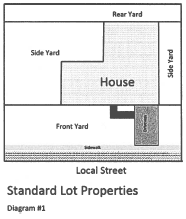
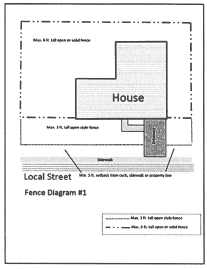
No fences more than three feet high may be located closer to the front of the lot than the principal building. See fencing detail diagrams #1 and #2.
B.
Any fence erected in a front yard shall be placed at least five feet back from the curb line, sidewalk or any proposed sidewalk and/or property line.
C.
Any fence erected in the front yard must be split rail, wrought iron, picket or other transparent fences of a similar nature. No chain link or wire fences are allowed as primary fencing but wire fencing may be attached behind allowable primary fencing as long as it remains largely transparent.
(2)
Side and rear yard standard lot regulations.
A.
No fence more than six feet high shall be allowed on any part of a residential lot. Fences may be open or solid style construction.
B.
Any fence erected in the side or rear yard may be placed up to the property line.
(3)
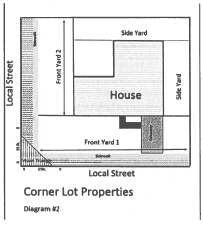
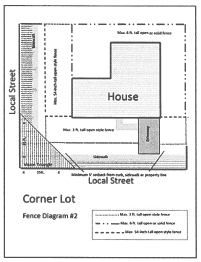
Corner Lot Regulations. (See "Lot, Corner" and "Yard, Front" definitions, Section 17.04.030 and fencing detail diagram #2 "Corner Lot").
A.
No fences more than three feet high may be located in front yard #1, between the curb line, sidewalk, or proposed sidewalk and/or the front corner of the principal dwelling.
B.
No fences more than fifty-four (54) inches high may be located, in front yard #2, behind the front corner of the house and the rear property line.
C.
Any fence erected in a front yard shall be placed at least five feet back from the curb line, sidewalk or any proposed sidewalk and/or property line.
D.
All comer lots adjacent to a public street/road shall also be considered front yards. A comer lot must comply with the front yard regulations for front yards on each property line/yard which is adjacent to a public street/road.
E.
On every comer lot abutting the intersection of two streets/roads, a triangular area within the lot shall remain clear of any structure, wall, fences, planting or other visual obstruction which might cause danger to traffic by obscuring the view.
F.
Such triangular area shall be delineated by a line drawn across the lot to connect points on the two street/road lines at a distance of thirty-five (35) feet from the intersection of the street/road lines.
(4)
Swimming Pool Fencing. Per the 2018 International Swimming Pool and Spa Code, and as amended, the construction sites for inground swimming pools and spas shall be provided with construction fencing to surround the site from the time that any excavation occurs up to the time that the permanent barrier is completed. The fencing shall not be less than four feet in height.
(Ord. No. 23-07-02, § I, 8-14-2023; Ord. No. 23-03-02, § II, 4-10-2023; Ord. No. 22-01-02, § I, 2-14-2022)
17.32.170 - Modifications to yard requirements.
A.
Allowable Projections of Structure into Yard and Other Modifications to Yard Requirements. Architectural features of buildings such as window sills, cornices, roof overhangs, and unenclosed porches that do not have a roof may project into the required yard not more than six feet but may not be closer than six feet to a lot line. Open fire escapes, fireproof outside stairways, chimneys and flues may project into the required yard not more than six feet. Unenclosed ground floor terraces or unenclosed patios may extend into any yard area but may not be closer than six feet to a lot line.
B.
Side Yards Not Required for Second-Story Residential Uses in Nonresidential Structures. Side yards shall not be required for residential dwellings erected above commercial structures.
C.
Allowable Projections of Business Structures into Yards. Signs, awnings, canopies, marquees as attached to and part of a building may project into the front yard in the commercial districts only and in conformance with the provisions of Chapter 17.36 Signs.
D.
Allowable Projections of Accessory Buildings into Yards. One-story accessory buildings with a maximum height of sixteen (16) feet measured at the peak of the roof may project into yards provided that:
(1)
The square footage for an accessory building or structure for business purposes shall not exceed six hundred (600) square feet;
(2)
The height of any accessory building or structure shall not exceed the height of the principal dwelling, if the height of the principal dwelling is less than sixteen (16) feet;
(3)
When more than ten (10) feet from the building, it may project into the side or rear yards providing it projects no closer than six feet to the side or rear lot lines;
(4)
Garage accessory buildings entered from alley or street in the case of double frontage lots are not closer than ten (10) feet to the street or alley line.
(5)
One-story accessory structures on townhouse lots may be located up to two feet of a side property line and six feet of a rear property line provided the accessory structure is no more than eighty (80) square feet in size;
(6)
All accessory structures defined as sheds must be located to the rear of the principal structure;
(7)
All accessory buildings and structures shall be located behind the front building line of the principal building;
(8)
In any easement area, no accessory building or structure except for public utility panels or boxes shall be erected;
(9)
All accessory buildings or structures shall be a minimum of one foot from easements;
(10)
When located on a residential-zoned property, the square footage of all floors of the accessory building or structure shall not exceed the footprint of the principal dwelling;
(11)
No accessory building or structure shall be used for sleeping or other occupancy;
(12)
If a residential property is subject to the rules, restrictions, and covenants of a home owners' association, a homeowner shall obtain all home owners' association approvals, if required, to construct an accessory structure;
(13)
The cumulative area of all accessory structures may not exceed the following square footage based on residential zone:
E.
Allowable Projections of Freestanding Signs into Yards. Freestanding signs (not attached to a building) as permitted in the particular district may project into the front yard and in conformance with the provisions of Chapter 17.36 Signs.
F.
Yard Requirements for Corner Lots. There shall be a front yard setback for each street frontage and the remaining yard setbacks shall be considered side yards.
G.
Additions to Townhouses. No additions shall be permitted in the front and rear yards of townhouse units with the exception of ground-level patios or unenclosed decks or porches. Hipped or flat roofs, including decks, shall only be permitted over ground-level patios.
(Ord. No. 23-03-03, § IV, 4-10-2023; Ord. No. 23-03-02, § III, 4-10-2023; Ord. No. 20-07-01, § II, 7-13-2020; Ord. No. 10-11-02, § I, 11-8-2010; Ord. 08-01-01 § 2 (part), 2008; Ord. 04-05-01 § 1, 2004; Ord. 182 § 8.1, 1976)
17.32.180 - Modifications to height limitations.
A.
Public and Semipublic Buildings may Exceed Height Limitations. Public buildings, places of worship, medical care facilities, institutions, may exceed the height limits to a total height of seventy (70) feet providing all yards required in the particular district are increased one foot for each two feet in excess of the height limitation.
B.
Architectural or Mechanical Appurtenances may Exceed Height Limitations.Chimneys, church steeples, cooling towers, elevators, bulkheads, fire towers, monuments, stacks, stage towers, or scenery lofts, tanks, water towers, spires, radio and television towers, grain elevators, or other such architectural and mechanical appurtenances are exempt from height regulations except that freestanding structures must be set back a distance equal to the height of the structure when located adjacent to an R district and set back one-half the height of the structure when located adjacent to TC, GC, OS and SC/LM districts.
C.
Planning Commission Comprehensive Plan Review and Approval for Essential Public Services. (See Section 17.32.020, Essential Public Services.)
(Ord. No. 15-06-02, § II, 6-8-2015; Ord. 182 § 8.2, 1976)
17.32.190 - Modifications to yard requirements in areas of older residential developments.
For properties located within neighborhoods that were predominantly constructed prior to the effective date (1969) of the ordinance codified in this title, the planning commission may allow the following modifications to yard requirements in residential zoning districts if the planning commission determines that the proposed modification will result in development that is compatible with the existing neighborhood, in the same zoning classification. A site plan must be filed with the request for modification. The planning commission may require a planning staff report be developed to evaluate the proposed site modifications and any impact they may have on the existing neighborhood (e.g., lot access, parking, consistency with the existing neighborhood, etc.). Any approved modifications, consistent with the standards outlined in this section and any associated terms and/or conditions assigned by the planning commission in the approval of these modifications, shall be noted in the approved site plan.
A.
Front Yard Modifications for Existing Building Alignment. When appropriate, the planning commission may increase or decrease the depth of the required front yard in any residential district so that such front yard will approximate the average depth of the existing front yards of the existing dwellings on adjoining lots on each side, or if there are no such adjoining dwellings, shall approximate the average depth of the front yards of the nearest dwellings on the same side of the street within two hundred (200) feet.
B.
Modifications to Lot Width. When appropriate, the planning commission may allow a reduction of up to twenty (20) percent of the required minimum lot width if the lot area equals or exceeds the minimum lot area for the district in which the lot is located.
(Ord. 182 § 8.4, 1976)
17.32.200 - Continuance of nonconforming uses and structures.
Any lawful use of land or structure existing at the time of adoption of the ordinance codified in this title, or subsequent amendment of this title, may be continued with the following limitations:
A.
Expansion of Nonconforming Uses and Structures. A nonconforming use or structure may be expanded, upgraded, repaired or altered; provided, however, that a site plan for any such expansion, upgrade, repair or alteration shall be first approved by the planning commission.
B.
Any such change authorized by subsection A must meet the following requirements:
1.
Expansion or other authorized change is limited to the lot that exists at the time of adoption of the ordinance codified in this title, as amended from time to time, and additional acreage or dwelling units shall not be added to expand or otherwise change any nonconforming use or structure.
2.
Provision for access drives, off-street parking and loading shall be consistent with the requirements for the use as provided in this title.
3.
Provisions for yards, building height and building area shall be consistent with the requirements for permitted uses for the district in which the nonconformity is located.
4.
The expansion or other authorized change shall not create new dimensional nonconformities or further increase existing dimensional nonconformities.
5.
Buffers and screens shall be provided as determined by the planning commission to adequately protect adjacent or adjoining properties. This includes, but is not limited to, fences, walls, plantings and open space.
(Ord. No. 15-06-02, § II, 6-8-2015; Ord. 182 § 2.3, 1976)
17.32.210 - Replacement of destroyed nonconforming structures.
If any structure containing a nonconforming use is destroyed by fire, flood or other calamity, it may be immediately restored and the nonconforming use continued as a matter of right to the same size and dimensions and in the same location as the destroyed building on the same lot, subject to the provisions of Section 17.32.200, without application to the board of appeals, provided that a building permit for restoration is issued within one year from the date upon which such building was destroyed, and further provided that construction pursuant to said building permit begins within six months after the date of issuance of such permit, and is substantially completed within one year. The building permit shall be revoked if these conditions are not met. The site plan review as provided in Section 17.32.200(A) shall allow the planning commission architectural review for conformance with the previous nonconforming structure. Nothing contained herein shall be deemed to permit the intentional demolition and reconstruction of any building containing a non-conforming use by owner or occupant. Nothing in these regulations shall prevent the strengthening of or restoring to a safe condition any building declared to be unsafe by the office of permits and inspections.
(Ord. No. 15-06-02, § II, 6-8-2015; Ord. 182 § 2.3.2—2.3.4, 1976)
17.32.215 - Discontinued nonconforming use.
No nonconforming use shall be established or re-established after having been discontinued for twelve (12) continuous and consecutive months. Vacating of premises or building or nonoperative status shall be evidence of a discontinued use.
(Ord. No. 15-06-02, § III, 6-8-2015)
17.32.215A - Nonconforming uses to be substituted.
A nonconforming use may be replaced by another nonconforming use of a lesser degree of nonconformity upon approval of a special exception therefor by the board of appeals in accordance with Section 17.44.060.
(Ord. No. 15-06-02, § III, 6-8-2015)
17.32.220 - Home occupations.
Home occupations in residences are subject to the requirements of the district in which located except as herein modified and provided:
A.
No person outside the family residing in the dwelling may be employed or engaged in the occupation.
B.
The character of external appearance of the dwelling unit or accessory structure must be that of a dwelling or its accessory structure. No display of products or equipment may be shown as to be visible from outside the dwelling. A nameplate not larger than two square feet in area is permitted. It must be illuminated only by indirect lighting and not project more than one foot beyond the building.
C.
Not more than twenty-five (25) percent of the floor area of a dwelling unit or an accessory structure may be devoted to a home occupation or profession.
D.
No wholesale or retail stock shall be kept upon the premises.
(Ord. No. 15-06-02, § II, 6-8-2015; Ord. 08-01-01 § 3, 2008)
17.32.225 - Adult entertainment business.
A.
It is the purpose of this ordinance to regulate adult entertainment business in order to promote the health, safety, and general welfare of the citizens of the town, and to establish reasonable and uniform regulations to prevent the deleterious secondary effects of adult entertainment business within the town. It is the intent of the burgess and board of commissioners in adopting this ordinance to enact a content neutral ordinance that imposes time, place and manner restrictions in order to address the adverse secondary effects of adult entertainment business. It is not the intent of the burgess and board of commissioners to suppress any speech protected by the First Amendment to the United States Constitution or Article 40 of the Maryland Declaration of Rights. Similarly, it is neither the intent nor effect of this ordinance to restrict or deny access by adults to sexually oriented materials protected by the First Amendment, or to deny access by the distributors and exhibitors of sexually oriented entertainment to their intended market. Neither is it the intent nor effect of this ordinance to condone or legitimize the distribution of obscene material.
B.
Adult entertainment businesses are permitted provided that such businesses are not located within one thousand five hundred (1,500) feet of any school, park, child day care center, church or house of worship or another adult entertainment business or within six hundred (600) feet of the property line of any property located in a Residential zoning district. For the purpose of this sub-section, measurement shall be made in a straight line, without regard to intervening structures or objects, from the nearest portion of the building or structure used as a part of the premises where an adult entertainment business is conducted to the nearest property line of the school, park, child day care center, church or house of worship, other adult entertainment business or property in a residential zoning district.
(Ord. No. 14-08-03, § II, 10-13-2014)
17.32.226 - Formula restaurants restricted.
A.
"Formula restaurant" shall mean an eating establishment devoted to the preparation and offering of food and beverages for sale to the public for consumption either on or off the premises which, by contractual or other arrangement, established or recognized business practice, or membership affiliation, maintains any of the following:
1.
Business name common to a similar business located elsewhere;
2.
Standardized menus, ingredients, food preparation, uniforms, or other standardized features common to a restaurant located elsewhere;
3.
Interior decor common to a similar business located elsewhere;
4.
Architecture or exterior signs common to a similar business located elsewhere;
5.
Use of a trademark or logo common to a similar business located elsewhere (but not including logos or trademarks used by chambers of commerce, better business bureaus, or indicating a rating organization including, but not limited to, AAA, Mobil or Michelin); or
6.
A name, appearance, or food presentation format which causes it to be substantially identical to another restaurant within or outside Middletown.
B.
The following restaurants shall be exempt from the provisions of this section:
1.
Businesses of identical name, appearance, or food presentation format with fewer than ten (10) locations in the Midatlantic region that are locally owned and operated but are not franchised.
2.
Formula restaurants without drive-through service, that are part of a "food court", or part of a physically connected group of other restaurants or businesses, sharing the same building structure.
3.
Formula restaurant gas stations are also limited to a maximum of six-tenths (0.60) of an acre, twenty-six thousand one hundred six (26,136 sq. ft.) in total location site square footage.
(Ord. No. 21-10-01, § I, 12-13-2021)
17.32.230 - Site plans required for approval by planning commission.
A site plan shall be submitted to the planning commission for review and approval for all commercial, multifamily residential, public, institutional, and industrial buildings unless all of the following conditions are met:
A.
There is no change in the amount of parking needed;
B.
The intensity of use has not changed;
C.
There are no exterior structural changes;
D.
The building or use has not been grand fathered;
E.
The building or site meets all existing regulations of the district in which it is located.
Parking requirements may be waived upon approval by the planning commission. The zoning administrator shall review all change of use permits to assure site plan requirements have been met.
(Ord. No. 15-06-02, § II, 6-8-2015; Ord. No. 10-10-03, § II, 10-25-2010; Ord. 08-01-01 § 2 (part), 2008)
17.32.240 - Site plan requirements.
The site plan, or site development plan, shall comply with the following requirements and contain the following information:
A.
General Style and Form.
1.
Provide Information. It shall provide accurate, reliable and pertinent information as hereinafter set forth and that may be necessary for the planning commission and burgess and commissioners to properly consider the proposed development.
2.
Show Plan of Development. It shall show the general plan of development for the property, covering the entire tract of land or so much of it as may be considered to be necessary for an adequate consideration of the part to be developed. This information shall be drawn to scale.
3.
Drawing Material. It shall be drawn in ink, on a reproducible material, and shall be at a scale no smaller than one inch per one hundred (100) feet. Unless otherwise excused by the planning commission for good cause, the plan shall also be provided electronically as well.
4.
Include Key Map. It shall include a small scale key map showing the location of the property and its relation to major subdivisions, roads, streams, etc. The key map shall be at a scale of one inch equals twelve hundred (1,200) feet.
5.
Title Information. Title information shall include:
a.
Proposed site name, if applicable, which shall not duplicate nor closely approximate the name of any other site in the county or town;
b.
Names and addresses of owner, developer, and the designer, surveyor or engineer;
c.
Description of site location by streets, tract, political subdivision, or other identifying feature;
d.
Scale, north point, and date.
6.
Approval Block. There shall be an approval block for the planning commission with a space for date and signature by the chairperson.
B.
Information as to Existing Physical Conditions. The following existing physical conditions shall be shown:
1.
Boundaries. The boundaries of the land being developed in heavy outline, and the acreage therein. Exterior development boundary must be accurate with dimensions to one one-hundredths of a foot and bearings to half minutes as determined by an accurate field survey and closed within an error of closure not to exceed one foot in five thousand (5,000) feet. Names of adjacent property owners shall be included on the plan;
2.
Topography. Topographic contours at five-foot intervals. Contours shall extend one hundred (100) feet beyond the site boundary except across a public road;
3.
Physical Features. Watercourses, floodplain areas, wooded areas, buildings, transmission lines, pipe lines, other utilities, bridges, and any other significant physical items, with the sizes and grades of any water or sewer lines;
4.
Streets and Roads. Locations, widths and names of all existing roads, streets, alleys, or other public ways within or adjoining the site or intersecting any street that bounds it, including those recorded but unimproved (shown, by dotted lines); railroad, utility, or other rights-of-way or easements; parks and other public spaces; subdivisions, lots, and property lines; corporate lines; and the locations and outlines of permanent buildings.
C.
Information as to Proposed Development. The following proposed development information shall be shown:
1.
Buildings. Layout, numbering and dimensions of buildings;
2.
Open Spaces. Portions of the property intended to be conveyed or temporarily reserved for public use or for the joint use of property owner, with an explanation of the provisions or conditions of such conveyance or reservation and the proposed arrangements for ownership and maintenance;
3.
Utilities. Locations for utilities and drainage facilities, with six-foot easements for same along all property lines. Method of water and sewer service shall be stated on the plan;
4.
Building Setback. Proposed building lines along all streets, with the amount of setback indicated.
5.
Proposed Zoning Change. Proposed uses of property and any proposed zoning change.
6.
Stormwater Management Plan. Proposed method of storm water management for the site which will comply with the 2009 Maryland Stormwater Regulations, as amended from time to time.
7.
In cases of condominium or multi-family projects (apartment, townhouse, etc.) the following additional items shall be shown:
a.
Location of each building;
b.
Total number of units in each building;
c.
Number of parking spaces in each off-street parking area, and total thereof;
d.
Interior road or street access, whether public or private.
(Ord. No. 15-06-02, § II, 6-8-2015; Ord. No. 10-10-03, § III, 10-25-2010)
17.32.245 - Outdoor lighting standards.
A.
The purpose of this section is to establish outdoor lighting standards that reduce the impacts of glare and spillover of light onto adjacent properties or into the sky, to protect against glare onto public rights-of-way that can impair vision of motorists, pedestrians, and bicyclists, to promote safety and security, and to encourage energy conservation.
B.
General Lighting Requirements. Exterior lighting shall comply with the following requirements and contain the following information with regard to outdoor lighting:
1.
Pole and Stand-alone Lighting.
a.
All street lighting shall comply with the Street Lighting Design Manual regulations.
b.
All other lights, light fixtures, light poles and other structures holding or supporting lighting fixtures shall be located at least ten (10) feet from the closest exterior property line.
c.
All stand-alone light poles or other structures holding or supporting lighting fixtures which are located between ten (10) feet and twenty-five (25) feet of the closest exterior property line shall not exceed a maximum height of fifteen (15) feet which height shall include any base, wall pedestal, platform or other supporting building or structure. All other stand-alone light poles or other structures holding or supporting lighting fixtures shall not exceed a maximum height of twenty (20) feet which height shall include any base, wall pedestal, platform or other supporting building or structure.
2.
Wall-mounted Lighting.
a.
Any lighting which is mounted or secured to a wall of a building, including wall-packs, shall not be located more than twenty-five (25) feet above the surface of the ground directly below it. All such lighting shall be located, aimed and shielded, so as to reflect light downward, below the horizontal and so that the light from such fixture is not directed toward adjacent streets, roads or adjacent properties.
b.
Wall-mounted light fixtures which are positioned and aimed to direct lighting in an upward direction on the façade of a building are not permitted. Fixtures designed and located so as to direct lighting in a downward direction down the building surface are preferred.
3.
Landscape and Architectural Lighting. Lighting which is used to illuminate flags, statues, signs or other objects mounted on a pole, pedestal or platform, and spotlighting or floodlighting used for architectural or landscaping purposes shall consist of full cut-off or directionally shielded lighting fixtures that are aimed and controlled so that the directed light shall be substantially confined to the object intended to be illuminated. Directional control shields may be required in order to limit the amount of light shining outside the intended direction and in particular to shield and protect motorists and pedestrians from the glare of such lighting.
4.
Exterior lighting fixtures shall include full cutoff features and shall be directed downward on site, so that the light does not create excessive glare on adjacent properties. Light trespass from originating property shall not exceed 0.5 footcandle measured on a vertical plane five (5) feet above grade at the property line.
C.
Site Plan Submissions.
1.
The planning commission may require a lighting plan on any site plan submission required by Section 17.32.230 which site plan shall include:
a.
The specific location, height and type of illuminating devices, fixtures, lamps, or any other light sources;
b.
A full description of each light source, fixtures, lamps, and other devices, to include catalog cuts by manufacturers and diagrams, where appropriate;
c.
Photometric data, such as that furnished by manufacturers, or similar information demonstrating the angle of cutoff and/or light emissions;
d.
Analysis and luminance level diagrams showing that the proposed installation conforms to the lighting level standards of this section;
e.
Tests, reviewed by a lighting engineer, indicating that the lighting plan is sufficient to meet IESNA recommendations, i.e., not to exceed IESNA recommendations, may be required by the planning commission; and
f.
Computer-generated, point-by-point lighting calculations on a scaled site plan with a ten-foot by ten-foot grid of footcandle readings indicating initial horizontal footcandles at grade, and initial vertical footcandles five (5) feet above grade at the property line.
2.
If the planning commission is unable to determine that the lighting plan complies with this section, the planning commission may require the plan to be submitted to a lighting engineer or recognized testing laboratory for review. The report of such engineer or laboratory shall be submitted to the planning commission and the applicant shall bear the cost of the review and report.
3.
The site plan requirements may be modified by the planning commission if it is determined that the general intent of this section can be realized without providing all the information outlined above in subsection C.1.
D.
Alterations after Site Plan Approval. No alteration or change in the approved site plan lighting plan may be made unless approved by the planning commission in accordance with this section, provided, however, that the zoning administrator may approve the replacement of a failed, broken or damaged lamp, light, fixture or supporting structure if such replacement will be in accordance with the requirements of this section.
E.
Pre-existing Lighting. Exterior lighting, including fixtures, lamps, lights, poles and supporting structures, existing on property subject to this section on the date of the enactment of this ordinance shall be permitted to remain. No changes or alterations or additions to such existing exterior lighting may be made without a zoning certificate being submitted to and approved by the zoning administrator in accordance with the requirements of this section. The zoning administrator may approve the replacement of a failed, broken or damaged lamp, light, fixture or supporting structure if such replacement will be substantially similar to the lighting to be replaced.
F.
Exemptions. The following shall be exempt from the provisions of this section:
1.
All vehicle lighting, emergency traffic lighting, and traffic control lighting;
2.
All athletic events and stadium use on Frederick County Public School properties;
3.
For lighting which is reasonably related to sports, amusements, entertainment events or other public gatherings operating as part of an athletic contest, carnival, fairground activity, parade or public celebration:
a.
If a permit has been issued for such event, until 12:00 midnight;
b.
If no permit has been issued to authorize such event, until 10:00 p.m.
4.
Temporary lighting which is typically and traditionally used for the celebration or recognition of a holiday and which is installed and removed within a reasonable period of time prior to and after the holiday.
5.
Lighting required in order to address an emergency, including lighting required for emergency street, utility or construction repairs if such lighting is discontinued immediately upon abatement of the emergency.
(Ord. No. 17-02-01, § I, 2-13-2017)
17.32.250 - Planning commission site plan review, approval and expiration.
A.
All site plan approvals shall automatically expire three years after the date on which the planning commission approves the site plan, unless substantial construction of site improvements pursuant to a validly issued permit has begun in good faith. In the event a site plan approval was obtained from the planning commission prior to the enactment of this section, such site plan shall expire three years after the date on which this section was enacted, unless substantial construction of site improvements pursuant to a validly issued permit has begun in good faith.
B.
Upon written request submitted to the planning commission no later than one month prior to the expiration date, and for good cause shown by the applicant, a one-time extension for a period not to exceed six months may be granted by the planning commission. Extension of the site plan may be granted by the planning commission for delays attributable to town, county or state agencies.
(Ord. No. 10-10-03, § III, 10-25-2010; Ord. No. 21-01-01, § I, 4-12-2021)
Editor's note— Ord. No. 21-01-01, § I, adopted Feb. 12, 2021, changed the title of § 17.32.250 from "Planning commission site plan review" to read as set out herein.

