
Middletown City Zoning Code
CHAPTER 17
36 - SIGNS2
Editor's note— Ord. No. 23-01-01, § I, adopted Jan. 23, 2023, amended ch. 17.36 in its entirety to read as herein set out. Former ch. 17.36, §§ 17.36.010—17.36.160, pertained to signs, and derived from Ord. No. 10-11-01, § I, adopted Nov. 8, 2010; Ord. No. 14-04-02, § I, adopted April 14, 2014; Ord. No. 15-12-03, §§ I, II, adopted Dec. 14, 2015; and Ord. No. 16-10-01, § I, adopted Dec. 12, 2016.
17.36.010 - Purpose and intent.
It is the purpose of this section to promote the public health, safety and general welfare of the town through reasonable, consistent and non-discriminatory sign standards. Much valuable information can be and is conveyed by the signs of local retail and service establishments to the mutual benefit of both the business establishments and the public. It is the policy of the burgess and board of commissioners and the intent of this chapter to promote signs which are compatible with the landscape/streetscape and architecture of surrounding buildings, which are not distracting to motorists, which are constructed and maintained in a structurally sound and attractive condition, and which are consistent with the terms and conditions of the regulations set forth in this chapter.
(Ord. No. 23-01-01, § I, 1-23-2023)
17.36.020 - Definitions.
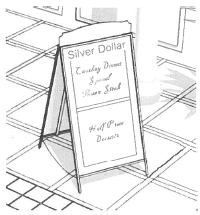
"A-frame/sandwich board/T-frame sign." A sign that is constructed in the shape of an "A", also referred to as a "sandwich board" sign, or an upside-down "T" and which is composed of two back to back sign faces oriented in opposing directions aligned in the shape of the letter "A" or an upside-down "T" and which is generally used to identify goods and services available at the business establishment or other entity displaying or sponsoring the sign.
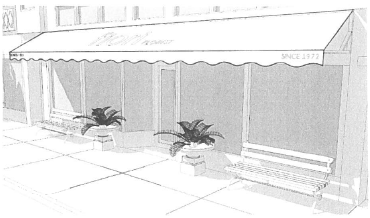
"Awning/canopy sign." a sign placed directly on or attached to the surface of an awning or canopy.
"Banner." Any cloth, bunting, plastic, or similar non-rigid material attached to any building, structure, staff, pole, rope, wire, or framing which is anchored on two or more edges or at all four corners. Banners are temporary in nature and do not include feather flag signs.
"Building frontage." The architecturally designed front of a building on a public street, parking lot, or pedestrian walk. In the case of a building located on the corner of two rights-of-way, and where the primary entrance is located on the corner of the building, the "building frontage" is the longer of the two sides which front along the rights-of-way.
"Directional or informational sign." A sign designed to provide direction to pedestrian and vehicular traffic into and out of, or within a site. The name or logo of the business or use to which the sign is giving direction may also be included on the sign.
"Directory sign." A sign on which the names and locations of occupants within a building or property is identified.
"Feather flag." A vertical portable temporary sign that contains a harpoon-style pole or staff driven into a base or the ground.

"Freestanding sign." Any sign mounted on supports that are placed on, or anchored in, the ground and that are independent from any building or other structure.
"Grade plane." Grade plane means a reference plane representing the average of finished ground level adjoining the sign structure.
"Historic sign." A sign deemed important because of its association with history, or because of its unique architectural style and scale as approved by the burgess and commissioners in conformance with section 17.36.100.D.
"Illuminated sign." a sign which is illuminated in any manner by an artificial light source, whether internally or externally lit.
"Incidental sign." A sign, generally informational, that has an incidental purpose to the use of the lot on which it is located, such as "No Parking," "Entrance," "Exit," "Loading Only," and other similar directives. These signs shall include, but not be limited to signs on automatic teller machines, gas pumps, vending machines or newspaper delivery boxes.
"Lot frontage." The length of the property abutting a street right-of-way, measured as a straight line between the extreme property corners along a street right-of-way.
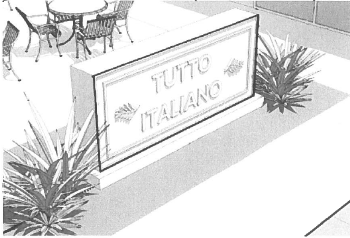
"Monument sign." A freestanding sign attached to a contiguous structural base or berm, which base shall be of the same width as or greater than the message portion of the sign, and is permanently affixed to the ground.
"Nonconforming sign." Any sign which was lawfully erected in compliance with the applicable regulations of the zoning ordinance prior to the effective date of this chapter and which fails to conform to the current standards or restrictions.
"Projecting sign." Any sign that is wholly or partly dependent upon a building for support and which projects more than twelve (12) inches from the building; angle of projection shall be 90° from the building.
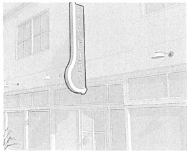
"Roof line." The top of a flat roof or the ridge of a gable, hip or gambrel roof.
"Sandwich board sign." See A-frame sign.
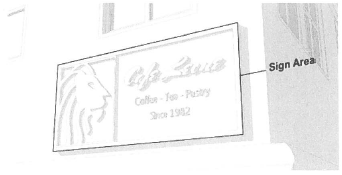
"Sign." Sign means any device, display, or structure, or any part thereof, illuminated or otherwise, which is visible from a public place and which displays or includes any numeral, letter, word, model, banner, emblem, symbol, logo, insignia, device, trademark, or projected image.
"Temporary sign." A sign that is neither permanently installed in the ground nor affixed to a building or structure. The term "temporary sign" includes, but is not limited to, A-frame signs, wall signs, ground signs, banners, feather flags, and window signs. The term "temporary sign" does not include flags, and signs that are intended to regularly move, such as motorized signs. The contents of any temporary sign shall be limited in scope and limited in duration as specified in section 17.36.130.
"Wall sign." Any sign attached to any part of a building and which does not project more than twelve (12) inches from such building.
"Window." A window is an opening in the wall or roof of a building that is filled with glass or other transparent material in a frame to admit light or air and allow people to see out.
"Window sign." Any permanent sign, pictures, symbol, or combinations thereof, designed to communicate information about the business that is placed inside a window or upon the window panes or glass and is visible through the window.
(Ord. No. 23-01-01, § I, 1-23-2023)
17.36.030 - Zoning certificate procedures for signs.
A.
The zoning administrator or its delegate must approve all signs being erected, constructed, installed, attached, altered, relocated or reconstructed for compliance with the provisions of this chapter, except as otherwise provided. This includes the location, placement and size of the sign, and includes temporary banner signs.
B.
A zoning certificate shall be required for all signs erected or installed after the effective date of this ordinance, including temporary banner signs, except as otherwise provided in this chapter.
C.
An application for a zoning certificate shall be submitted on a zoning certificate from our website or provided by the zoning administrator, shall contain the information required as set forth herein, and shall be accompanied by the required application fee.
D.
An application for a zoning certificate shall contain, or have attached thereto, the following information in either written or graphic form:
1.
Name, address and telephone number of the sign erector and the sign owner.
2.
A site location plan showing the street name and street number of the location or building where the sign is to be placed and the position of the sign in relation to adjacent lot lines, buildings, sidewalks, streets and intersections.
3.
The type of sign and a general description of the structural design and construction materials to be used.
4.
One set of drawings and/or photos of the proposed sign which shall contain specifications indicating the height, perimeter and area dimensions, means of support, method of illumination, colors, and any other significant aspect of the proposed sign.
5.
Any other information requested in order to carry out the purpose and intent of this chapter.
E.
A signage plan identifying the location, height, and size of all freestanding/monument signs shall be included on all site plans reviewed by the planning commission.
F.
Any sign which is erected, constructed, installed, attached, altered, relocated or reconstructed without a zoning certificate and for which a zoning certificate is required shall be deemed a violation of this chapter.
1.
The owner or other person responsible for the sign shall be subject to a fine and enforcement measures as provided for in chapter 17.08 of this title.
2.
In addition, the zoning administrator may order the owner or other person responsible for the sign to remove the sign at the sole cost of such the owner or other person responsible.
G.
The zoning administrator may approve minor changes that are not within strict compliance of this ordinance if the intent of this chapter may still be met, upon a showing that an owner, lessee or other person seeking to display a sign is unable to effectively display one or more signs in compliance with the requirements of this chapter due to unusual conditions on the property such as size, location, topography or other situation.
(Ord. No. 23-01-01, § I, 1-23-2023)
17.36.040 - General sign standards.
All signs which are painted, constructed, erected, remodeled, relocated or expanded shall comply with the following standards:
A.
Illuminated signs.
1.
Signs which are illuminated shall be shaded so as to avoid casting bright light upon any property which is located in any residential district or upon any public street.
2.
Any illuminated sign which is facing any residential district and which is visible from such residential district, shall only be illuminated when the business is open for business or to the public.
3.
For the purposes of this section, the term "illuminated sign" shall include, but not be limited to, illuminated window signs.
B.
Flashing or moving signs. No flashing sign, rotating or moving sign, animated sign or sign with moving lights or lights which create the illusion of movement are permitted.
1.
A sign on which the current time and/or temperature is indicated by intermittent lighting shall not be deemed a flashing sign if the lighting changes are limited to the numerals indicating the time and/or temperature.
2.
For the purposes of this article, the term "flashing, rotating, animated or moving signs" shall include, but not be limited to, flashing, rotating, animated or moving window signs.
C.
Determination of sign height. The height of a sign shall be measured from grade plane to the average height of the highest sign surface. If a sign is located on a mound, berm, or other raised area for the purpose of increasing the height of the sign, the height of the mound, berm, or other raised area shall be included in the height of the sign.
D.
Measurement of sign area. Each face of a sign shall be counted when computing the total sign area for a site, the exception being that, when two sign faces are placed back-to-back so that both faces cannot be viewed from any point at the same time and each contains identical text and graphics, the area of only one side shall be counted when computing the area of that sign.
E.
Number of sign faces. No sign shall have more than two sign faces.
F.
Determination of monument sign area. The surface area of the largest face of a monument sign will be used to determine the total square footage of the monument sign.
1.
This calculation will exclude the first eighteen (18) inches of the base if it does not include any sign copy or other graphic.
2.
In addition, a planter structure which does not exceed one foot in height or include sign copy or graphics will also be excluded from the area calculation.
G.
Condition of signs.
1.
All signs shall be designed, constructed and installed with permanent materials and finishes (except for temporary signs) and shall be maintained in good repair and in a safe, clean and attractive condition.
2.
Signs shall not be maintained or permitted to exist in such a condition as to constitute a public nuisance or other hazard to the public health, safety or welfare.
3.
In addition to any other lessee, owner or other person responsible for a sign, the owner of the property on which a sign is located shall also be responsible for the maintenance of the sign as required herein.
H.
Unless otherwise permitted by law, all signs shall be erected, installed or otherwise located on the property which is used for the purposes which are associated with or which relate to the content of the sign.
1.
Sign applicants must have approval of property owner.
2.
Each sign shall be located within the owner's property boundaries and shall not be located within the public right-of-way.
I.
Temporary signs, such as but not limited to vinyl banners, shall not be used as permanent signs.
J.
An application may be made to the Middletown Board of Appeals for a variance from these sign regulations where it is alleged that the provisions inflict unnecessary hardship upon the applicant on a case-by-case basis.
(Ord. No. 23-01-01, § I, 1-23-2023)
17.36.050 - Signs permitted in any districts.
The following signs are permitted in all zoning districts subject to the provisions and requirements of this chapter:
A.
A sign for an approved home occupation subject to the following.
1.
Such signs shall be either unlighted or indirectly lighted.
2.
Such signs shall not exceed two square feet in area.
3.
Such signs shall be attached to the building in which the home occupation use is operating.
B.
Directional and informational signs not exceeding twelve (12) square feet in size, and shall be consistent in construction and appearance with the materials used on the building(s) on the premises.
C.
Wall-mounted directory signs for multiple use buildings, provided:
1.
Signs shall be located beside the entry door;
2.
The maximum size for directory signs is twelve (12) square feet.
(Ord. No. 23-01-01, § I, 1-23-2023)
17.36.060 - Measuring signs for building frontages.
A.
Procedures for measuring signs. Channel letter signs (individual or raceway mounted) measure around outside edge of letters, but do not include descenders of letters. Logos shall be included in measurements for area maximums.
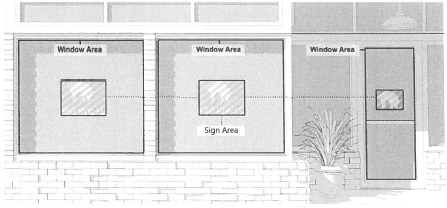
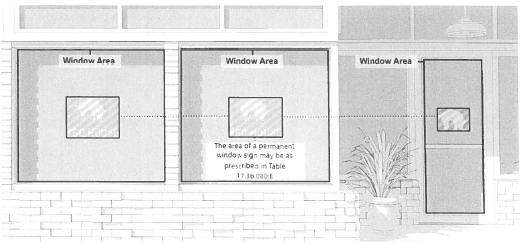
For calculating maximum area of window signs, the window area is calculated as a continuous surface until divided by an architectural or structural element.
B.
Procedures for measuring building frontage.
1.
Sign area calculations are based on width of front entrance wall.
2.
For town commercial district storefronts and other strip store tenants: Measure width of lease space on front entrance wall.
3.
For two-sided storefronts (display windows and customer entry doors on two sides): Measure width of lease space on both front entrance walls.
4.
For buildings or lease spaces that front on two or more public streets:
i.
Front entrance wall: Measure width as prescribed for that district;
ii.
Secondary walls on public streets: Thirty (30) percent of width of front entrance wall.
5.
For buildings containing multiple tenants (office buildings, upper floors of town commercial storefront buildings): Measure width of building on front entrance wall. If building has customer entrances on more than one wall, measure width of each entrance wall.
(Ord. No. 23-01-01, § I, 1-23-2023)
17.36.070 - Maximum number of signs permitted.
A.
Maximum number of signs. Each individual business located on one lot may have a maximum of three signs for each street or public right-of-way on which the property fronts.
B.
Multiple occupant buildings. If a building contains multiple non-residential occupants (e.g., office buildings, town commercial district buildings), total wall mounted sign area is limited to formula prescribed for the entire building.
1.
For example, if the maximum sign area for a building is thirty (30) square feet, the total for all signs must add up to thirty (30) or less square feet in area.
2.
Each business shall be limited to a maximum of two signs per street or public right-of-way.
C.
Freestanding/monument signs. Except in accordance with section 17.36.070 below, there shall be no more than one freestanding/monument sign installation per building or shopping center per each street on which the building has frontage. No lot shall be permitted to have erected both a projecting sign and a freestanding/monument sign.
(Ord. No. 23-01-01, § I, 1-23-2023)
17.36.080 - Sign dimensional and design requirements.
Site plan applicants are required to present a signage plan as part of a required site plan that integrates the design of signs with the design of the building (and/or development) on which they will be displayed and with the surrounding area.
(1)
An office complex may display no more than one freestanding/monument sign to identify the complex at each exit and entrance.
(2)
The style, color and materials of signs shall be consistent with other signs on the property and with the main structure.
Regardless of whether a sign's installation is part of a project that requires a site plan, dimensional and design requirements are as follows.
A.
Freestanding/monument signs.
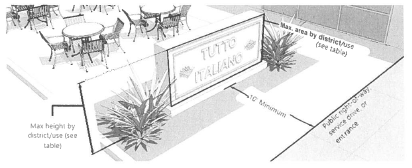
* For approved non-residential uses.
All zoning certificate applications for freestanding/monument signs shall include a plan for landscaping the base of the sign, which shall include, but is not limited to, low lying native shrubs, flowers and other plantings. Such plantings shall be maintained and kept in presentable condition. Failure to maintain landscaping as approved as part of the zoning certificate for the sign shall constitute a violation of this article.
Freestanding/monument signs shall have a minimum setback of ten (10) feet from any public right-of-way, service drive or entrance and shall be located as to allow clear and ample visual sight lines for driveways leading into a street and at intersecting streets and alleys.
B.
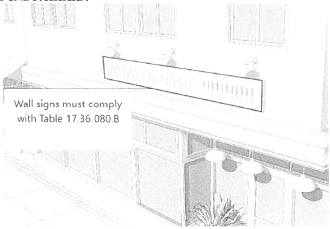
Wall-mounted signs. A wall sign may not extend above the highest point of the roof and may not project beyond twelve (12) inches from the wall on which it is installed.
C.
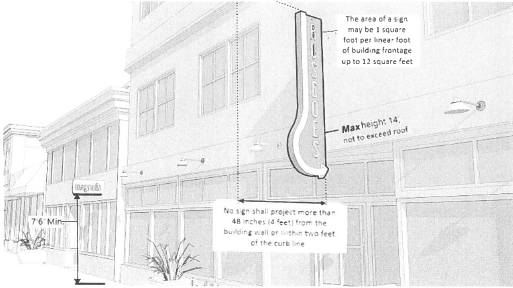
Projecting signs. No sign shall project more than forty-eight (48) inches (four feet) from the building wall or within two feet of the curb line.
1.
The minimum vertical clearance above the surface of the ground shall be at least seven and one-half feet.
2.
Projecting signs may not extend above the highest point of the roof. Dimensional and design requirements are as follows for all zoning districts, excluding residential districts:
D.
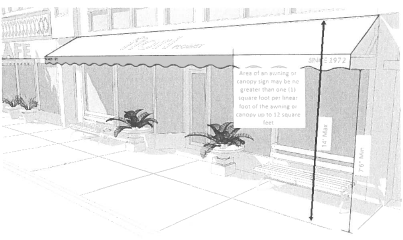
Awning and canopy signs. The lettering, graphics or other sign content on an awning or canopy shall be placed parallel to and shall not project above or below the face of the awning or canopy.
1.
An awning or canopy shall not be situated in a location which interferes with or obstructs pedestrian or vehicular traffic.
2.
The minimum vertical clearance above the surface of the ground shall be at least seven and one-half feet and may not extend above the highest point of the roof.
E.
Permanent window signs. The maximum area for a window sign is determined by measuring the width and height of the outermost edges of the sign lettering or graphics.
(Ord. No. 23-01-01, § I, 1-23-2023)
17.36.090 - Subdivision and community identification signs.
Subdivision and community identification signs are permitted in the right-of-way of monumented, public streets or in locations approved by the Middletown Planning Commission. In addition, the following conditions shall be met:
A.
Subdivision/community signs.
1.
Shall not be positioned or located in such a manner as to obstruct or otherwise interfere with the sight of motorists or pedestrians and their ability to safely enter or exit the premises or traverse the rights-of- way.
2.
Shall not be located within utility easements or in a location which will adversely impact utility lines.
3.
The planning commission shall have the authority to approve the location and orientation of the sign.
4.
The town does not assume any responsibility for maintenance of subdivision or community signs;
B.
The sign shall be of a permanent nature, such as brick, stone or concrete, and shall be kept in good repair and in safe, neat, clean and attractive condition by the community association, if existing;
C.
If a sign is located in a median strip or monumented island, no portion of the sign may be located within ten (10) feet of any end of the median strip or monumented island.
(Ord. No. 23-01-01, § I, 1-23-2023)
17.36.100 - Pre-existing non-conforming signs and historic signs.
A.
Any sign which was lawfully established in accordance with all applicable regulations in effect at the time of its establishment but which does not conform to the requirements set forth in this chapter shall be deemed a lawful non-conforming sign.
B.
A lawful non-conforming sign may remain at its location, subject to the following conditions:
1.
Lawful non-conforming signs shall be maintained in good repair and condition. Any such sign which is determined by the town zoning administrator, town administrator or other authorized town official not to be-so maintained or to be unsafe shall be restored, repaired, rebuilt, or removed.
2.
Except as otherwise provided herein, lawful nonconforming signs may not be enlarged, extended, relocated structurally altered, or changed in nature or character.
3.
The wording and content of a lawful non-conforming sign may be changed to accommodate and reflect a change in use of the property from one business to a similar business occupying the same property.
4.
A lawful non-conforming sign shall either be removed or altered to comply with the requirements of this chapter when there is a substantial change in the use of the property on which the sign is located, when there is a substantial alteration to the primary structure on the property on which the sign is located or when there is a change in nature or character of the sign.
C.
The owner of or other person responsible for a lawful nonconforming sign which sign is in violation of any of the conditions set forth in this section shall correct such violation or remove such sign within ninety (90) days of being given notice of the violation and shall be subject to a fine and enforcement measures as provided for in chapter 17.08 of this title.
D.
Historic signs. The burgess and board of commissioners may designate individual signs at its discretion as historic signs. Historic signs shall be exempt from the provisions of this chapter subject to the following conditions:
1.
Historic signs shall be kept in good repair and condition. Any such sign which is determined by the town zoning administrator, town administrator or other authorized town official not to be so maintained or to be unsafe shall be restored, repaired, rebuilt, or removed.
2.
Historic signs may not be enlarged, extended, relocated or structurally altered.
3.
Historic signs may not be displayed on any other portion of the property or building other than its location on the date of the enactment of the ordinance codified in this chapter, and may not be displayed on another property.
(Ord. No. 23-01-01, § I, 1-23-2023)
17.36.110 - Exempt signs.
A zoning certificate shall not be required for the following signs; provided, however, that all such signs shall comply with the other applicable requirements of this chapter:
A.
Any public notice or warning required by a valid and applicable federal, state, or local law, regulation or ordinance;
B.
Signs erected by the town, county, state, or federal government in furtherance of their governmental responsibility;
C.
Signs prepared by or for the local, state or federal government marking sites or buildings of historical significance;
D.
Ballfield/sports complex signs and scoreboards.
E.
Government sponsored banners affixed to light standards promoting community events.
F.
Gasoline price signs as required by Maryland law: Maryland law requires the price of gasoline be posted on properties where it is sold and sets minimum standards for such posting. Signs posting the price of gasoline shall not be included in the calculation of permitted sign area up to a minimum required by state law. That which exceeds the minimum required by state law shall be included in the calculation of sign area. Signs shall not exceed eight feet in height.
(Ord. No. 23-01-01, § I, 1-23-2023)
17.36.120 - Removal of signs.
Any sign which advertises, identifies, or is otherwise related to or associated with a business, group, event or activity which is no longer in existence or active shall, within thirty (30) days from the time such business, group, event or activity ceases, either be removed from the premises or altered or resurfaced by the owner of the property on which the sign is located so that the sign will not display letters, numerals, symbols, figures, designs or any other device for visual communications pertaining to the former business, group, event or activity. Upon petition of the owner of the property on which the sign is located, the zoning administrator may, but is not required to, permit such sign to remain on the premises for an additional thirty (30) days.
(Ord. No. 23-01-01, § I, 1-23-2023)
17.36.130 - Temporary signs.
Other than as provided below and in subsections 17.36.130.B through 17.36.130.D, temporary signs shall meet the criteria set forth in section 17.36.130.A Temporary Signs: General Criteria and Limitations by Zoning District. A temporary sign may be displayed as a ground sign or a wall sign, inclusive of a window sign. Banner signs require zoning certificate approval by the zoning administrator.
A.
General criteria for temporary signs. A temporary sign must meet the criteria established for the zoning district in which the temporary sign is located, as set forth and described below in Table 17.36.130.A, Temporary Signs: General Criteria and Limitations by Zoning District. However, except as otherwise provided below, the general criteria and limitations in this section 17.36.130.A Do not apply to A-frame and T-frame signs, banner signs, and feather flags. Incorporation of florescent color or exhibition of florescence, lighting or illumination, or movement are not allowed.
1 The single-family residence is open for public inspection and shall not exceed six square feet in area per sign.
2 Multiply the maximum sign area by the maximum number of signs to calculate the aggregate maximum sign area. There is no limit to the number of separate messages that may appear on the allowable surface(s) of any temporary sign.
3 Window signs shall not cover more than twenty-five (25) percent of the first-floor window area.
4 Minimum sign setbacks are measured from the edge of the curb or road. Setbacks do not apply to wall signs.
B.
A-frame signs and T-frame signs. A-frame signs and T-frame signs must meet the criteria and limitations set forth in the following Table 17.36.130.B A-Frame And T-Frame Signs: Criteria and Limitations.
1.
A-frame signs and T-frame signs are permitted in all zoning districts but may be placed in Single-Family Residential zoning districts only in conjunction with non-residential uses.
2.
A-frame signs and T-frame signs must be located adjacent to the parcel or business advertised thereon, supported by a base of sufficient weight and durability to withstand wind gusts, and maintained in a professional manner free from fading, tearing, and tattering. The zoning administrator may approve minor changes that are not within strict compliance of this ordinance if the intent of this chapter may still be met, upon a showing that an owner, lessee or other person seeking to display a sign is unable to effectively display one or more signs in compliance with the requirements of this chapter due to unusual conditions on the property such as size, location, topography or other situation.
3.
A-frame signs and T-frame signs shall not be placed in raised or painted medians, with stakes fastened to or driven into concrete, across the street from the business being advertised, and must be placed at grade level.
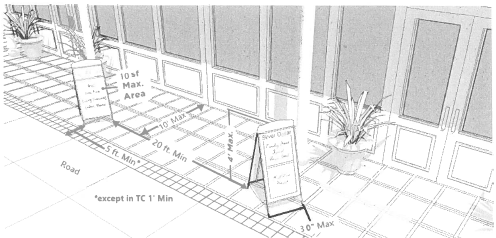
1 The combined total number of A-frame, T-frame, and flying banner signs shall not exceed four per business.
2 Signs may be allowed at the perimeter of a multiple-tenant commercial/office complex or employment park, but only pursuant to an approved sign plan.
C.
Banner signs. Banner signs are permitted in all zoning districts but may be placed in Single-Family Residential zoning districts only in conjunction with non-residential uses. Banner signs must meet the criteria and limitations set forth below in Table 17.36.130.C, Banner Signs: Criteria and Limitations.
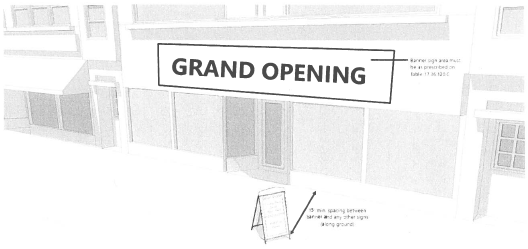
1 The square footage limitation is per side for a double-sided banner sign. For example, a forty (40) square foot limitation means there is a limit of forty (40) square feet of surface area per side of the double-sided banner sign.
2 Minimum sign setbacks are measured from the edge of the curb or roadway. Setbacks do not apply to a banner sign displayed on walls.
3 Not applicable to signs displayed on flagpoles.
D.
Feather flag signs. Feather flag signs must meet the criteria and limitations set forth below in Table 17.36.130.D, Feather Flag Signs: Criteria and Limitations.
1.
Feather flag signs are permitted in all zoning districts but may be placed in Single-Family Residential zoning districts only in conjunction with non-residential uses.
2.
Feather flag signs must be located adjacent to the parcel or business advertised thereon, supported by a base of sufficient weight and durability to withstand wind gusts, and maintained in a professional manner free from fading, tearing, and tattering.
3.
Feather flag signs shall not be placed in raised or painted medians, with stakes fastened to or driven into concrete, or across the street from the business being advertised and must be placed at grade level.
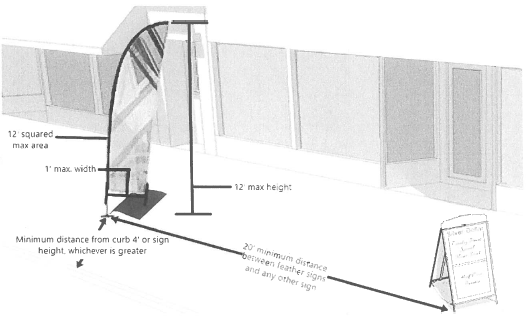
1 The combined total number of feather flag signs, A-frame signs, and T-frame signs shall not exceed four per business.
(Ord. No. 23-01-01, § I, 1-23-2023)

