
Midway City Zoning Code
CHAPTER 16
13 SUPPLEMENTARY REQUIREMENTS IN ZONES
16.13.010 Yard Space For One Building Only
No required yard or other open space around an existing building, or which is hereafter provided around any building, which is needed to comply with the provisions of this Code, shall be considered as providing the yard or open space for any other building; nor shall any yard or other required open space on an adjoining lot be considered as providing the yard or open space on the lot whereon a building is to be erected or established.
16.13.020 Every Dwelling To Be On A Zoning Lot
All buildings which contain a dwelling unit shall be located and maintained on a zoning lot as defined in this Title. Two-family or multi-family dwelling units may be in more than one building on a lot as allowed in the R-1-7 and R-1-9 zones. This section does not apply to dwelling units in Planned Unit Developments.
(2010-12, Section Replaced, eff. 6/2/2010)
16.13.030 Sale Or Lease Or Required Space Prohibited
No space needed to meet the width, yard, area, coverage, parking, or other requirement of this Title for a lot or building may be sold or leased apart from such lot or building unless other space so complying is provided.
16.13.040 Yards To Be Unobstructed--Exceptions
Every part of a required yard shall be open to the sky and unobstructed except for permitted accessory buildings and except for ordinary and customary projection of sills, cornices, and other ornamental features and unenclosed steps and un-walled stoops and porches, which may project up to three feet into a required yard.
16.13.050 Area Of Accessory Buildings
Accessory buildings in any residential zone shall not cover more than 25 percent of the rear yard.
16.13.060 Accessory Buildings Prohibited As Living Quarters
- It shall be a violation of the Midway City Code to use, or to allow the use of, an accessory building as living quarters. Violations of this section of the Code shall be enforced as set forth in the Midway City Code for other violations.
- Living quarters in any building other than the main residential building are prohibited except as allowed for detached two family dwellings in the R-1-7 and R-1-9 zones.
- It shall be a violation of this Code to rent, lease or otherwise allow for any person to use an accessory building for living quarters except as allowed for detached two family dwellings in the R-1-7 and R-1-9 zones.
- An accessory building shall be considered living quarters if it includes all of the following: sleeping area (including bedrooms), kitchen, and bathroom facilities (three-quarter or full bathroom).
- Accessory buildings may include rooms such as offices, hobby rooms, game rooms, music rooms, sleeping areas (including bedrooms), and craft rooms.
- An accessory building may include either:
- A full kitchen and a half-bath (sink and toilet only); or
- A bathroom (three-quarter or full bathroom) and a wetbar (sink, refrigerator, dishwasher, and microwave but does not include a stove or oven).
- Accessory buildings are to be used exclusively by the owners or occupants of the main residential building and their temporary guests or invitees.
- No building permit shall be issued for construction of living space (defined as areas which could be used for living, sleeping, eating, and/or cooking, but excluding utility rooms, bathrooms, halls, and storage) in any accessory structure until after completion of construction and issuance of a certificate of occupancy for the main dwelling.
(2010-12, Section Replaced, eff. 6/2/2010; 2021-19, Section Replaced, eff. 9/1/2021)
Amended by Ord. 2026-04 on 3/5/2026
16.13.070 Kitchen Units In Motels And Hotels
Kitchen and laundry facilities for individual short-term rental units (hotels, motels, Airbnb, VRBO, etc.) are not allowed in the C-2 and C-3 zones except for a residence that has been approved by the Land Use Authority as part of a mixed-use development and any dwellings that are legal nonconforming.
Amended in its entirety by Ord. 2022-27 on 11/2/2022
16.13.080 Storage Of Commercial Vehicles In Residential Zones Prohibited
It shall be unlawful to park a double axel truck having a rated capacity of two tons or more on any public street in any residential zone for a continuous length of time of three hours or more except in the case of current City Public Works projects. It shall also be unlawful to so park any construction equipment, such as graders, compressors, etc.
16.13.090 Storage Of Junk And Debris In Residential Zones Prohibited
No yard or other open space surrounding an existing building in any residential zone, or which is hereafter provided around any building in any residential zone, shall be used for the storage of junk, debris, or obsolete vehicles; and no land shall be used for such purposes, except as specifically permitted herein.
16.13.100 Maximum Height Provisions For All Buildings
The height of any building shall not exceed 35 feet. The total height shall be measured as the vertical distance from the natural grade, as defined in this Title, to the highest point of a roof. To allow for unusual conditions or appurtenances the following exceptions apply:
- Antennas, chimneys, flues, vents, or similar structures may extend up to 5 feet above the specified maximum height limit.
- Water towers and mechanical equipment may extend up to 5 feet above the specified maximum height limit.
- Bell towers, finials, and like architectural features as well as flag poles, may extend above the specified maximum height limit by up to 50 percent of the height limit (52 feet 6 inches for a 35-foot building), but shall not contain any habitable spaces above the maximum height.
- The height of buildings in Resort Zones may exceed 35 feet if all the requirements of the Recreational Resort Chapter of this Title are satisfied.
- Special height requirements for some buildings on benches and slopes greater than 10 percent are imposed by the Sensitive Lands Chapter of this Title. These restrictions on building height shall be applied where applicable.
- Church steeples may extend up to 70 feet from natural grade to apex if all the following requirements are satisfied. If the following requirements are not satisfied, the maximum steeple height is 52’6”.
- The church building is located on a lot that is a minimum of 3 acres.
- Steeples shall be set back from the front property line(s) or projected right(s)-of-way, whichever is greater, the minimum distance required by the zone. The height of the steeple may increase by one foot (with a beginning maximum steeple height of 52’6”) for each additional foot the steeple is set back into the property, to a maximum of 70’ (e.g., a 35’ church height at a minimum 30’ setback is allowed a steeple height of 52’6”, a 35’ church height at a 47’6” setback (where the minimum zone setback is 30’) is allowed a steeple height of 70’, a 35’ church height at a minimum 50’ setback is allowed a steeple height of 52’6”, a 35’ church height at a minimum 67’6” setback (where the minimum zone setback is 50’) is allowed a steeple height of 70’). Maximum steeple height is also subject to subsection (F)(7) below.
- The steeple setbacks from the rear and side property lines are 100 feet minimum.
- The steeple shall not contain any habitable spaces above the building maximum height limit.
- The portions of the steeple above the building shall not exceed 12 feet in width or depth.
- A maximum of one steeple is allowed on the building or property.
- The maximum building-to-steeple height ratio is 1:1.5.
- No lighting of a steeple. A steeple shall not be lit from the ground or from other fixtures on the church or any other building or source. Light fixtures or lighting of any kind shall not be installed on or in the steeple.
- Church steeples shall be designed and constructed to exhibit clear tapering from the base (lowest point of the steeple where it meets the main structure of the church or, for a detached steeple, from natural grade) to the apex (top of the steeple). The gradual tapering effect must be visually perceptible from public rights-of-way and surrounding properties. The average width of the top third of the steeple spire shall be less than half the width of the steeple base.
Amended by Ord. 2023-08 on 6/28/2023
Amended by Ord. 2025-06 on 5/21/2025
16.13.110 Minimum Height Required For Buildings
No dwelling shall be erected which has a ceiling height of less than 7 feet 6 inches or one story above grade, whichever is greater.
16.13.120 Minimum Width Required For Buildings Containing Dwelling Units
No dwelling shall be erected, for which the narrowest width is less than 20 feet from outside face of opposing walls. This shall not include bay windows or offsets less than 6 feet in depth.
16.13.130 Setback Exceptions For Historic Building Structural Reinforcement On Small Lots
- Where an existing recorded lot does not meet the current minimum lot area and/or width/depth requirements and the lot contains a legally built and existing structure that meets the definition of a historic structure under the Code, the structure may be structurally reinforced to preserve the historic structure and appearance of the building provided the structural changes do not increase the existing footprint of the structure that is currently nonconforming in any direction by more than eighteen (18) inches for habitable space and/or by more than four (4) feet for non-habitable space (e.g., porch). Nothing in this section shall limit a conforming addition to a historic structure.
- Procedure: Before applying for a building permit, an owner seeking to structurally reinforce a historic building on a small lot under this section shall apply for and obtain a recommendation from the Midway City Historic Preservation Committee and forward its recommendation to the Planning Director, who is the City’s land use authority for building permit decisions.
Repealed by Ord. 2024-03 on 7/31/2024
Adopted by Ord. 2024-07 on 7/31/2024
16.13.140 Drainage
Surface water from rooftops, lots or irrigation ditches shall not be allowed to drain onto adjacent lots or streets.
16.13.150 Clear View Triangle Of Intersecting Streets
No obstruction which will obscure the view of automobile drivers shall be placed on a corner lot within a triangular area formed by the street property lines and a line connecting them at points 45 feet from the intersection of the street lines.
16.13.160 Effect Of Street Plan
Wherever a front or side yard is required for a building which abuts on a proposed street which has not been constructed but which has been designated by the City as a future street, the depth of such front or side yard shall be measured from the planned street lines.
16.13.170 Exception To Front And Side Setback Requirements
The setback from the street for any dwelling located between two existing dwellings in any residential zone may be the same as the average for the said two dwellings, provided the existing dwellings are on the same side of the street and are located within 150 feet of each other. However, no dwelling shall be located closer than 20 feet from the street.
16.13.180 Concessions In Public Parks And Playgrounds
Concessions, including but not limited to amusement devices, recreational buildings, and refreshment stands, shall be permitted on a public park or playground when approved by the City Council.
16.13.190 Sewage Disposal
Domestic liquid waste facilities in all dwellings and other buildings used for human occupancy which buildings are located on property of which the property line is within 300 feet to an available public sewer shall be connected to a public sewage system. Where domestic liquid waste facilities are located of which the property line is further away than 300 feet from any available public sewer, a public sewer shall either be extended to connect with such facilities or else the facilities must be constructed in accordance with health department standards before a building permit shall be issued for the building in which the sewage facilities are to be constructed.
(2015-09 Section Changed eff. 6/10/15)
16.13.200 Location Of Gasoline Pumps
Gasoline pumps islands shall be set back at least 20 feet from any street line or residential zone boundary line. If the pump island is set in an angle on the property, it shall be so located that automobiles stopped for service will not extend over the property line. In no case shall pumps be set closer than 10 feet from any side or rear property line. Lots from which gasoline is dispensed to customers at retail shall be not less than 75 feet by 100 feet in size. Canopies over pump islands may extend to within 5 feet of the property lines.
16.13.210 Motor Vehicle Access
Access to all lots and parcels of land having frontage on a public street shall be controlled as follows:
- Access shall be by not more than two driveways from any one street, except as may be permitted by the City Council, when it can be shown that additional driveways will promote traffic safety.
- On corner lots, no driveway shall be closer than 40 feet to the point of intersection of the front property line with the side property line which abuts upon a street.
16.13.220 Landscaping Plan
A plan that demonstrates how the surface of the earth as approved for a building or as part of a Final Plan will be maintained to preserve the final grade for the drainage and storm water plan, control noxious weeds, provide economy of maintenance, water use and environmental protection, as well as providing aesthetic enhancement suitable to the project. In all cases, such a plan will show the finished grade, location, type, and size of plants. It shall include irrigation equipment, water demand, paving, curbs, berms, and other protective procedures around the edge of the planting beds.
At least 70 percent of the area contained within a required front or side yard adjacent to a street shall be landscaped. The purpose of the landscaping requirement in this Title shall be to provide a plan that when implemented, will provide the means to reasonably protect buildings, utilities, surrounding properties and public facilities from damage from surface drainage, conserve irrigation water, control dust, increase efficiency of maintenance for landscaped areas, enhance the appearance of buildings, to protect and enhance the beauty of the property and City, and to stabilize property values by encouraging pleasant and attractive surroundings and thus create the necessary atmosphere for the orderly development of a pleasant community. Landscaping also contributes to the relief of heat, noise, and glare through the proper placement of plants and trees.
- Scope of Requirement. Where landscaping is required, such landscaping shall comply with the requirements set forth in this Section for the specific use and location, and shall be specific enough so that the implementation of the plan can be valued for installation costs, monitored for compliance with the plan by the City or a third party as approved by the City and, if required by the terms of this Title, be secured for completion by a construction and a warranty bond.
- Site Grading Plan. Provide reasonable drainage away from the buildings by establishing grade lines to positively control water in coordination with existing or approved storm water drainage plans, to minimize erosion, and to protect landscaped surfaces from damage by concentrated runoff.
- When landscaping is required as part of a site plan, conditional use, standard subdivision, PUD, resort, commercial, or other development approved under this Title, such landscape plans shall incorporate compliance with all other required conditions of the City for the project.
- Maintenance Required. Required landscaped areas shall be maintained in a neat, clean, orderly, and healthful condition. This is meant to include proper pruning, mowing lawns, weeding, removal of litter, fertilizing, replacement of dead plants, and the regular watering of all plantings. A landscape plan shall include a description of the landscape maintenance plan and the plan by which funds sufficient to maintain the plan shall be provided. This shall be demonstrated by a drainage plan and reference to the storm drain plan, a list of planting material, including watering requirements and nutrient needs, surface material key and maintenance guidelines for the surface material, irrigation system maintenance plan and operational instructions.
- Irrigation Plan. Where landscaping is required, such landscaping shall include an irrigation system suitable to maintain the landscape material subject to the plan.
- Screening Requirements. Where landscape screening is required, said screening shall consist of evergreen shrubs, closely spaced and maintained at substantially the specified height of said required screening. When not otherwise specified, natural screening shall be maintained at a height of at least 6 feet.
- Site Plan Required. Where landscaping is required in this Title, a site plan showing the proposed landscaping development, watering system and use of the property shall be submitted to the land use authority for approval.
- Landscape Minimums. Where landscaping is required in this Title, the following landscape requirements must be met.
- Approved native grass and wildflower seed mixes may only be used on slopes of 20% or greater.
- When property is developed, it must include trees at the following rates. These are in addition to any required street trees. At a minimum, trees must be spaced to accommodate their mature size. Existing trees on the development parcel that comply with the minimum requirements, as outlined in this section, may count towards the requirement:
- Residential Development: One tree per 2,904 square feet (gross) of common and open space area (15 trees per acre).
- New Commercial, New Mixed-Use or Business and Manufacturing Park Development: One tree per 2,904 square feet (gross) of common and open space area (15 trees per acre). If the applicant does not have suitable tree locations on site, then the trees may be given to the City and the City, at its own discretion, will plant the trees in a suitable location within the City limits.
- New Resort Development: One tree per 2,904 square feet (gross) of common and open space area (15 trees per acre).
- Street trees will be required at the following rates. Required street trees are in addition to trees required above in subsection 2:
- Planned Unit Development: Trees will be required in all park strips, or adjacent to roadways, spaced at a maximum interval of 40’.
- Large Subdivision: Trees are only required in park strips, or adjacent to roadways, when it abuts common space or open space, spaced at a maximum interval of 40’.
- New Commercial, New Mixed-Use, Business and Manufacturing Park or New Resort Developments: Trees will be required in all park strips, or adjacent to roadways, spaced at a maximum interval of 40’.
- All deciduous trees must have a minimum caliper of 2” at time of installation. All conifer trees must be a minimum of 6’ in height at time of installation.
- In all developments, no more than 20% of the proposed trees required for open space areas may be the same species. Required street trees may all be of the same species. All proposed trees should be in compliance with any approved or prohibited tree list that is maintained by Midway City.
- Trees that are proposed near trails must be installed in compliance with regulations found in Chapter 16.29.
- Landscape plans must note how landscaping will be irrigated (broadcast, drip, etc.)
- Non-Conforming Status. Any use of property, which, on the effective date of this Chapter is non-conforming only as to the regulations relating to landscaping, may be continued in the same manner as if the landscaping were conforming, unless such use constitutes a nuisance.
- It is not required that any particular species of plants or grasses shall be provided, except that the landscape plan shall explain the choice for each plant material and demonstrate that the plant material is appropriate to the function of the landscape plan and can survive in this climate with the water rights and irrigation equipment proposed to implement the landscape plan. The landscape plan may include water wise plantings; however, any plan that does include water conserving plants or natural non-irrigated plan elements must demonstrate how noxious weed species can be controlled within the landscape plan area.
- Construction Bond Required. When required by the provisions of this Title, all landscaping planting plans shall post a bond equal to 110 percent of the cost of construction and inspection of all elements of the landscaping planting plan as determined by the City Engineer, in writing, to assure the completion of the plan and a warranty bond for two years after construction is complete to assure the implementation of the constructed plan.
Amended by Ord. 2021-40 on 3/16/2022
16.13.230 Maintenance Of Undeveloped Areas--Large Scale Developments
All areas within a large-scale development shall be maintained and, other than noxious weeds, kept mowed to 8 inches or less by the developer, until permanent landscaping and infrastructure are installed. Noxious weeds, as identified by the Wasatch County Weed Board, shall be controlled using Weed Board-approved treatment procedures for the selected weed species.
16.13.240 Trails
All large-scale developments shall connect any trails shown on the City Trails Master Plan for the area.
Amended by Ord. 2024-17 on 12/31/2024
16.13.250 Pollution Prevention
Any use which emits or discharges gases, fumes, dust, glare, noise, or other pollutants into the atmosphere in amounts which exceed the standards as prescribed by the Utah State Air Conservation Board or the Board of Health and any use which emits or discharges liquids or solid material onto the soil or water in amounts exceeding the standards prescribed by the Utah State Water Pollution Control Board or the Board of Health, shall be prohibited. This Section shall not prohibit the use of burning for agricultural purposes.
16.13.260 Recreational Vehicles, Manufactured Homes, And Mobile Homes
- It shall be unlawful to place a mobile home within the corporate limits of Midway City.
- A recreational vehicle shall not be placed on any lot or parcel of land in an area covered by the zone map and to use the same for human habitation except in compliance with one or more of the following conditions:
- When temporarily parked on a lot and occupied by relatives or friends of the residing family, but not to exceed 14 days.
- When temporarily located on a lot on which a building is being constructed provided the recreation vehicle is connected to approved water and sewer facilities and that a bond in the amount of $200.00 (or an amount as set by the City Council from time to time) shall first be posted with the City Treasurer guaranteeing that human habitation of the recreational vehicle will be terminated upon completion of construction, but no later than one year from the date of permit.
- Any two of the following shall be prima facia evidence of human habitation of a recreational vehicle:
- Connection to an electrical power source.
- Connection to water source.
- Connection to a private or public sanitary sewer system.
- Manufactured homes may be placed within the residential areas of Midway City, when they meet all zoning criteria for a residential dwelling unit, when the home is placed on a permanent foundation, and when meeting the criteria of State law.
16.13.270 Home Occupations
A conditional use permit for home occupations, as described below, may be approved by the Zoning Administrator when he or she finds the application to be in compliance with the following:
- Home occupations are permitted in the zone.
- The home occupation is clearly incidental to and secondary to the residential use of the dwelling unit and does not occupy more than 500 square feet or 25 percent of the total floor area of such dwelling unit, whichever is less.
- The home occupation is carried on entirely within the dwelling unit by one or more of the residents residing within the dwelling. For the purposes of this Section, a garage, carport, patio, breezeway or any accessory building is not considered to be part of the dwelling.
- It shall not be permitted to conduct any activity of the home occupation outside of the dwelling unit or store materials or products outside of the dwelling unit. There shall be no external evidence of the home occupation. Signs shall be as permitted as outlined in this Title.
- The home occupation shall not have customers or other persons coming to the home to conduct business. Note: Home-based businesses where customers come to the home are regulated in this Title.
- The home occupation shall be in compliance with Title 5 requirements of this Code.
- The home occupation must comply with all Midway City building and fire codes.
- The home occupation shall apply for, be issued, and keep current a Midway City business license after conditional use approval and before commencing operations.
- No known zoning violations shall be in existence on the applicant’s property in order to be approved for a conditional use or for approval of subsequent business licenses thereafter. In the event that complaints concerning a home occupation are filed with the City, the Zoning Administrator shall investigate problems identified in the complaint to determine if the home occupation is being conducted in violation of this Code. If the Zoning Administrator determines the home occupation is in violation of this Code, the Administrator shall pursue the elimination of the violating activity in accordance with this Title.
16.13.280 Cottage Industries
Cottage industries allow limited business activity from the home but shall not alter the character of the neighborhood or create adverse impacts to the neighborhood including, but not limited to, significant increases in traffic and on-street parking.
- Cottage industries include:
- Arts and crafts-making, such as pottery and jewelry.
- Tailoring or seamstress services.
- Music instruction and similar specialized tutorial or instructional endeavors provided no more than two (2) students are present at one time.
- Mail-order or internet sales where no retail occurs on-site.
- Computer-based services such as programming, web design, graphics, and computer repair.
- State licensed or certified hair, nail or similar beauty or barber services (limited to one (1) service chair).
- State licensed or certified counseling.
- Small professional office for services such as attorney, accountant, and/or architect.
- Space for art, photography, writing or composing.
Standards for Permitted Use:
- The Planning Director, or his/her/their designee, may consider, approve or deny an application for a permit for a cottage industry. All permit applications shall meet the following minimum conditions:
- The cottage industry is permitted in the zone.
- The cottage industry is incidental, secondary, and subordinate to the residential use of the dwelling unit.
- The cottage industry is fully enclosed within the primary dwelling unit, is conducted entirely within such unit, and does not occupy more than five hundred (500) square feet or twenty-five percent (25%) of the total floor area of such dwelling unit, whichever is less. For the purposes of this Section, a garage, carport, patio, breezeway or any accessory building is not considered to be part of the dwelling.
- There shall be no more than one (1) cottage industry per dwelling.
- The site of the cottage industry is the primary legal residence of the person(s) conducting the cottage industry. No persons other than those legally residing on the premises shall be engaged in the cottage industry.
- There shall be no construction of or alteration to the outside appearance of the building or premises which would suggest or give visible evidence of the conduct of such cottage industry.
- There shall be no more than two (2) customer/client vehicles parked in connection with the cottage industry at any one time.
- There shall be no exterior storage on the lot, parcel or tract of land of material, equipment, or commodities associated with the cottage industry, and there shall be no exterior or window displays for the cottage industry.
- Space outside the dwelling, including the yard, may not be used to conduct business.
- Vehicles larger than 10,000 pounds gross weight may not be operated to or from the premises and may not be parked on the property or adjacent streets.
- The hours of operation for visitors, loading and delivery of materials shall be limited to between 7:00 a.m. and 8:00 p.m., Monday through Saturday.
- Retail sales are limited to products created in the cottage industry or incidental items associated with the cottage industry such as hair care products in beauty salons, sheet music offered by an instructor, implements for knitting, and other similar items.
- There is no use of electrical or mechanical equipment which would change the fire rating of the structure, necessitate a change from a single phase electrical service in the structure, create visible or audible interference in radio or television receivers, or which would cause fluctuations in line voltage outside the dwelling.
- There is no offensive noise, vibration, smoke, dust, odors, heat or glare noticeable beyond the boundary line of the lot, parcel or tract of land due to the cottage industry which would exceed that normally associated with a dwelling or which does not comply with the Midway City Code, including Title 5.
- The cottage industry must comply with all applicable city building and fire safety regulations and any requirements of other permitting agencies.
- No signs shall be permitted for cottage industries in residential zones except one (1) identification plaque no larger than four (4) inches by six (6) inches affixed to the residence next to the client entrance door, which shall be for identification purposes only.
- If the applicant is leasing the property, the applicant shall provide written proof to the City that the applicant has the landowner’s permission to operate the cottage industry business.
Procedures:
- Application for Cottage Industry Permit:
- Any person wishing to establish a cottage industry shall submit an application to the Planning Department on forms available at the City Planning Department and pay any applicable fee.
- The Planning Director, or his/her/their designee, shall review the application and approve or deny the application in accordance with the requirements of this Provision. In granting an application, the Planning Director, or his/her/their designee, may impose conditions deemed necessary to minimize impacts to neighboring properties.
- Violation and/or Revocation of Permit:
- If the City receives a filed complaint or is otherwise placed on notice of an alleged violation concerning a cottage industry, the Planning Director, or his/her/their designee, shall investigate the alleged violation to determine if the cottage industry is in violation of this Chapter.
- If the Planning Director, or his/her/their designee, finds evidence of violation, the Planning Director, or his/her/their designee, shall mail a written notice describing the violation(s) and corrective measures required to the permit holder, who shall have fifteen (15) calendar days from the mailing of the notice of violation to comply with all conditions imposed.
- A permit issued under this Chapter is revocable by the Planning Director, or his/her/their designee, for violation of any requirements or conditions imposed upon the cottage industry. Upon revocation of the permit, the Planning Director. or his/her/their designee, shall send written notice of the revocation to the permit holder, together with a written statement of findings upon which the revocation is based. The revocation shall be effective five (5) calendar days after mailing.
Amended in its entirety by Ord. 2024-02 on 7/31/2024
16.13.290 Frontage On A Public Street
Except in large scale developments and on approved private streets, one side on each lot used as a dwelling site shall abut upon a street which has been designated or dedicated to the public for street purposes, and the length of such abutting side measured at the setback line shall be at least as great as the width required for dwelling sites in the zone in which such building site is located.
16.13.300 Transitional Use
Uses which are permitted on either portion of a lot which lot is divided by a zone boundary line or which is coterminous with a zone boundary line may be permitted to extend to the entire lot, but not more than 100 feet beyond the boundary line of such zone in which such use is permitted. Before a permit for such a use may be granted, however, the City Council must find that the General Plan of zoning will be maintained and that a more harmonious mixing of uses will be achieved thereby.
16.13.310 Moving Of Homes
The legal moving of a dwelling from one location to another is defined and permitted as follows: Dwellings, which have had prior use, shall be permitted within all zones in which dwellings are permitted when approved by the City Council, subject to the following conditions:
- An application has been filed with the City Council containing the following information.
- Location and address of both the old and new sites.
- Plot plan of the new site, showing adjacent lots on all sides of the property and indicating all structures and improvements on said lots.
- Plans and specifications for the proposed improvements at the new location, including plans for landscaping treatment.
- Certification by a licensed structural engineer that the structure is sound enough to be moved shall be provided to the Building Inspector and a site plan and other documents showing that the condition, location, and use of the building will comply with the Land Use Title and all other applicable codes and ordinances.
- The City Council finds.
- That the building will have no appreciable detrimental effect on the living environment and property values in the area into which the structure is to be moved.
- That the building is in conformity with the quality of buildings existing in the area into which it is proposed to be moved.
- That said building and the lot on which the building is to be located will conform to the requirements of the Land Use Title and other applicable sections of the Municipal Code.
- That the location on the lot does not in any substantial way adversely affect buildings or uses on abutting properties.
- That all landscaping, walkways and masonry work about the premises and the required dedications and improvements for streets and facilities and buildings shall be provided in conformity with the standards of the City.
- That a bond or other assurance has been posted as a guarantee that the building and grounds will be improved as stipulated by the City Council before the building is occupied, and that the vacated site will be restored to a safe and sightly condition. The amount of the bond or other assurance shall be at least equal to the cost of employing a contractor to make the improvement to the buildings and premises as required by the City Council.
16.13.320 Uses Not Expressly Listed As Permitted Or Conditional Are Prohibited
It is the express intent of the City Council that all uses not expressly listed as a permitted or conditional use in a particular zone are prohibited in that zone of the City.
(2018-13, Section Amended, eff. 04/11/18)
16.13.330 Fences, Walls, And Hedges
- Fences, walls, and hedges shall be permitted in all zones to a height of 6 feet unless prohibited by this Section.
- No fence, wall, or hedge shall exceed 4 feet in height within 30 feet of any existing or proposed City street right-of-way or within 55 feet of a center line of a proposed or existing City street or right-of-way, whichever is the greater distance.
- Notwithstanding subsection B above, for an existing dwelling that is within 30 feet of any existing or proposed City street right-of-way or within 55 feet of a center line of a proposed or existing City street or right-of-way and is legally non-conforming, a fence may align with the edge of the dwelling parallel to said street right-of way line, but not closer than 20 feet.
- Notwithstanding subsection B above, a fence up to 6 feet high may be constructed within 30 feet of an existing or proposed City street right-of-way or within 55 feet of a center line of a proposed or existing City street or right-of-way if the street in question is a Collector Street, Minor Collector Street, or Local Collector Street (see Transportation Capital Facilities Plan) and if the following conditions are met:
- Said six (6) foot fence shall be located only within the "rear yard" and/or "side yard" defined in Section 16.02 (fences over four (4) feet in height are prohibited within the area defined as the "front yard");
- Gates in fences on double frontage lots are encouraged for ease of maintenance of the planter strip and fence setback area; however, the maximum gate width shall be four (4) feet; and
- New subdivisions which contain double or triple frontage lots must have Covenants, Conditions, and Restrictions for the subdivision approved by the City through the subdivision process and recorded with the subdivision plat, addressing standardized fence height, materials, and color for fences constructed along the subdivision’s frontages of collector roads. Said subdivisions are also required to install a decorative fence, as defined in section 16.02.
- Notwithstanding subsection B above, commercial outside retail establishments are allowed a 6-foot-high decorative fence within 30 feet of an existing street right-of-way or within 55 feet of a center line of a proposed or existing City street or right-of-way if the fence complies with the following criteria:
- The fence is non-sight obtrusive.
- The fence is not chain link.
- The fence is not located in the clear view of intersecting streets as explained in Section 16.13.150.
- The Vision Architectural Committee shall first review and forward its recommendations for the proposed fence to the Planning Director.
- Fences, walls, hedges or other obstructions shall not be located in the clear view of intersecting streets as explained in Section 16.13.150.
- No fence, wall, hedge or other obstruction over (4) feet in height shall be constructed or placed within 30 feet of any driveway which would interfere with the visibility of pedestrians and traffic.
- All private fences, walls, hedges or other obstructions, regardless of fence height or property zoning classification, shall be constructed upon private property and not within the street right-of-way.
(2011-04, Sub-section Amended, eff. 12/14/2011; 2011-12, Section Replaced, eff. 1/25/2012)
16.13.340 Heliports And Private Aircraft
Due to the close proximity of the City of Midway to the regional airport located in Heber City, the need for additional land within the City limits to be designated for heliports or the landing of other types of aircraft has been determined to not be necessary. Temporary landing of helicopters may be permitted only after request and approval by the City Council in a regularly scheduled City Council meeting. Nevertheless, the landing of emergency medical or firefighting aircraft, regardless of its type, shall be permitted within the City limits in the event of emergency situations. It is not intended to regulate or restrict the use of non-motorized aircraft by the passage of this Section.
16.13.350 Bed And Breakfast Establishments
Bed and breakfast establishments shall be allowed as a conditional use in any zone, but only if at least one of the following criteria is met and such a use is not prohibited by private Covenants, Conditions, and Restrictions (CC&R’s) governing the lot:
- Located in the Transient Rental Overlay District (TROD)
- Established in a structure that is at least 75 years old
- Located on a lot that is at least two acres in size
In addition, all bed and breakfast establishments shall be subject to the following provisions:
- The lot shall have at least 100 feet of frontage on a dedicated street;
- One off-street parking space shall be provided for each employee plus one space per sleeping room. Parking shall not be allowed in the front setback area. Parking must be paved.
- Breakfast shall be the only meal served. Breakfast meals shall only be served to residents, employees, and overnight lodgers.
- No cooking facilities shall be allowed in the sleeping rooms.
- Such use shall conform to all applicable health, safety and building codes.
- No structural alterations shall be allowed which change the residential character of the structure.
- Alcoholic beverages may not be served unless a license has been granted by the Utah Department of Alcoholic Beverage Control and the City Council has specifically approved the same as part of the conditional use permit.
- If located in the C-2, C-3 or RZ zones, receptions, banquets, or catering may be permitted as an additional use to an approved bed and breakfast conditional use when the applicant can show adequate facilities and parking exists on the lot or when arrangements are made with the permission of surrounding lot owners.
- Any commercial or retail use shall be incidental to the bed and breakfast establishment use, i.e. gift shop, and shall be limited to 5 percent of the total square footage of the main floor of the residence.
- All signs shall comply with the current Title 16.
- A Midway City business license shall be required as a condition of approval.
- The bed and breakfast establishment shall, at the time of approval and thereafter, be the property owner’s primary residence. If a bed and breakfast establishment with an active permit is sold, the new owner will be required to apply for a business license and submit a signed affidavit stating that the property is their primary residence before operation of the establishment resumes.
(2021-35, Sub-section Amended, eff. 11/10/2021) - Supervision by an on-site manager or owner shall be required on an overnight basis when the establishment has guests.
- Care shall be taken to ensure that no exterior lighting shines directly onto adjoining property. Incident light at the property line shall not measure more than ten foot-candles.
- A fire hydrant shall be within 250 feet from the property.
- The Fire Marshal shall determine maximum occupancy.
- A site plan shall be submitted with the conditional use application.
- If located in the R-1-7, R-1-9, R-1-11, or R-1-15 zones, a maximum of six (6) rooms may approved for short-term rent. If located in the R-1-22 or RA-1-43 zones, a maximum of 12 rooms may approved for short-term rent.
(2015-11, Section Replaced, eff. 7/8/15; 2020-23, Section Amended, eff. 2/24/2021)
16.13.360 Commercial PUDs And Condominium Projects
Commercial projects within the C-2 and C-3 Zones may be approved and recorded as PUDs or condominiums under the following criteria:
- Commercial condominium projects shall be considered a conditional use and in addition to these requirements, shall be subject to the State of Utah Condominium laws and Midway City Conditional Use and Special Exception Approvals and Regulations, as outlined in this Title.
- Standards and Requirements. Commercial PUDs and condominiums shall meet the standards and requirements of the Commercial C-2 and C-3 Zones, and supplementary requirements in Zones, all as outlined in this Title.
- Approval Process. Any person wishing to construct a commercial PUD or condominium project shall obtain information from the City regarding the City’s plan of land use, streets, public facilities and other requirements affecting the land to be developed. The developer shall then prepare plans and seek approval based on the information received.
- Mixed use developments may include commercial and residential condominiums. Owners Association bylaws along with covenants, conditions and restrictions for the various commercial and residential uses must be established per item A of this section.
(2018-03, Section E. Added eff. 1/24/18); (2018-04, Original Section D Deleted eff. 1/24/18)
16.13.370 Commercial, Resort, And Places Of Worship Architectural Requirements
- All commercial buildings and structures, walkways, or lighting in the C-2, C-3, or Resort Zones of Midway City, civic buildings, and places of worship in any zone, including all new construction or substantial alteration or remodeling of existing construction shall conform in exterior design to the Swiss-European architectural theme adopted in the City’s Vision Statement. This requirement does not apply to structures listed on the national or local historic register.
- For purposes of this Section, the term “substantial alteration or remodeling” shall be defined as: any interior and/or exterior alteration or remodeling, the total cost of which (including, but not limited to electrical, mechanical, plumbing, and structural changes) for a building or structure within an 18-month period equals or exceeds 25 percent of the assessed value of that building or structure at the time the alteration or remodeling is started. When a project qualifies as a “substantial alteration or remodeling,” the entire building, including the existing structure and any new additions or remodeling, becomes subject to this section, including, but not necessarily limited to, conformance to the Swiss-European architectural theme of the City.
- The following structures or items shall comply, to the maximum extent practical and feasible, with the Swiss-European architectural theme of the City when they are located upon or used in conjunction with any commercial building or structure in any commercial or resort zone of the City:
- Ornamental roof-like structures such as canopies.
- Utility boxes.
- Meters.
- Garbage receptacles and dumpsters.
- Outside fuel containers and dispensers.
- Outside vending machines.
- Newspaper dispensers.
- Telephone booths.
- Fencing.
- All mechanical equipment such as heating and air conditioning equipment, air handling ducts, and compressors shall be screened from view. False balconies, false chimneys, railings, and parapet walls may be used as screenings to enhance the Swiss-European theme. Screening plans and designs must be included in the architectural elevations presented for VAC review.
- Rain gutters, downspouts, and/or heat tapes shall be required for all eaves to eliminate the possibility of drainage onto sidewalks.
- All signs for commercial structures and buildings must conform to Title 16 including, but not limited to, review and recommendation by the VAC.
- Parking plans are subject to review and recommendation by the Land Use Authority and the VAC. When Main Street parking spaces cannot provide for adequate parking, parking lots shall be located behind buildings where they are not visible to passersby, unless the VAC and/or Land Use Authority determines this is not feasible, in which case steps shall be taken through berming and landscaping, etc. to shield parking areas from view.
- Serving windows to outdoor, privately owned staging areas shall be set back a minimum of eight feet from the sidewalk or public right-of-way.
- Commercial buildings shall not be occupied or opened for business until the approved exterior design features of that building are finished. A temporary exemption may be recommended by the VAC and granted by the City Council for not more than six months due to weather or other circumstances beyond the control of the owner.
- All applications for construction or improvements in the C-2, C-3, or Resort Zone, subject to the provisions of this Section, shall be submitted to the VAC for their review and recommendation.
- The terms, conditions, and requirements of this Section shall be in addition to and not in lieu of the requirements of Midway City’s building and other uniform codes adopted by the City or in any other ordinance, State statute, or regulation governing the construction, building, zoning, or other similar regulations applicable within the City.
- The VAC, in making a recommendation for or against approval of a design in accordance with this ordinance, shall consider the following criteria. This list is intended to serve as a guide for prospective developers/owners who are either substantially altering/remodeling or building new commercial structures in the commercial and resort overlay zones of Midway City. The following design elements shall be incorporated, as applicable, in design proposals brought before the Midway Vision/Architectural Committee to implement the Swiss-European architectural theme in the city of Midway.
- Structural Features.
- Large Structural exposed beams. Exposed beams are representative of Swiss-European design features. When used, beams should be stained or natural in color.
- Carved exposed beams for post supports, roof overhangs, and deck supports. Carved beams are a standard feature in Swiss-European architecture design and can greatly enhance the appearance of buildings where effectively employed. Scrolled lookout beams are encouraged.
- Knee bracing for unsupported decks. Knee bracing shall be scrolled or of an arched design. The size of the knee braces should be sufficiently proportional to the size of the deck.
- Roof overhangs. Overhangs shall be expansive on the front and sides and usually require rafter and ridge beams. Scrolled ridge beams are encouraged and should not extend beyond the fascia. If roof rafters are exposed (open soffit), the underside of the roof covering should be crafted from one of the following materials: tongue and groove boards, exterior finish sheeting, exterior re-sawn plywood or solid wood.
- Roof overhangs covering outside decks. Overhangs on outside decks will extend past the deck itself consistent with traditional Swiss-European architectural design. Deck overhangs usually require lookout beams. Ridge beams shall not extend beyond the fascia.
- Flared curved rooflines at the soffit on "Riegelhaus" style buildings. Riegelhaus designs have a great deal of decorative wood on the exterior of the building and include the curved roofline near the bottom of the roof pitch.
- Dutch gables on "Oberland" style buildings. Dutch gables are characterized by the front of the roof cut off to a slope consistent with the pitch of the roof.
- Shingles. The following shingle types are acceptable: actual or simulated slate, wood shingles or shakes, and tile shingles.
- Rounded arch doors and doorways. Main entrance doors of a rounded design reinforce a Swiss-European look and feel. The arched doorway or entryway should be constructed of wood, stone or stucco.
- Exterior walls. Exterior walls should be finished with a combination of stucco and heavy timbered wood, stucco and stone, or wood and stone. The use of stucco and heavy wood timbers are a Swiss-European architecture feature that is enhanced when corner stones are added. Riegelhaus patterns have more intricate, curved wood when used as an exterior wall finish. When adding color to stucco a color palette must be submitted for approval.
- Exposed corner stones. Natural stone, irregularly shaped rock and some forms of cultured stone are acceptable. Painted concrete or stucco is not considered acceptable options.
- Turrets, towers, finials and oriel windows. Must be of a Swiss-European design. Round, octagon and hexagon shapes are acceptable.
- Finish Features.
- Clocks and bells in towers and on buildings. They shall be of a Swiss-European design that lends itself to the theme of the community.
- Scalloped fascia with exposed soffit. Scalloped, scrolled or carved fascia reinforce the desired architectural theme.
- Wood shutters with cutouts or painted designs. Cutout designs are an integral part of Swiss-European architecture.
- Decorative design railings. Metal railings of a Swiss-European design add to the desired theme.
- Carved and cutout wood railings. There are many different patterns to choose from which will reinforce the desired look.
- Window flower boxes. These add beauty and charm to a Swiss-European community when constructed and painted appropriately.
- Metal outside fixtures. Light fixtures, lampposts, sign fixtures and exterior wall designs shall be of a traditional Swiss-European design.
- Rain gutters and supports. Decorative rain gutters and supports will enhance the desired look and reinforce the stability of the rain gutter itself.
- Flags and banners extending from buildings. Flags and banners of a Swiss-European design provide a special atmosphere to the community.
- Carved names, dates and statements. These can be carved in wood or stone to depict an address, a name or a sentiment.
- Painted embellishments on exteriors and/or "fresco-style" murals. Paintings are used extensively in Switzerland to enhance the beauty of a building and to accentuate its architectural features. Decorative embellishments are often added around windows, under soffits, on exterior walls and on carved moldings. Painted murals, depicting historical or fictional scenes, are often added as a final touch that can transform a building into a work of art.
- Fountains and statues. These add to the old-world dimension found in many Swiss villages.
- Carved embellishments and layered decorative moldings. These add beauty and charm to a Swiss-European community when done with authenticity.
- Roofline facades. High quality designs are often an integral part of Swiss-European architecture.
- Structural Features.
(2010-24, Sub-section Added, eff. 8/25/2010)
Amended by Ord. 2026-09 on 5/7/2026
16.13.380 Internal Accessory Dwelling Units
- As used in this section:
- “Internal Accessory Dwelling Unit” means an accessory dwelling unit created:
- Within a primary dwelling;
- Within the existing footprint of the primary dwelling at the time the internal accessory dwelling unit is created; and
- For the purpose of offering a long-term rental of 30 consecutive days or longer or habitation without fee.
- “Primary dwelling” means a single-family dwelling that:
- Is detached; and
- Is occupied as the primary residence of the owner of record.
- “Internal Accessory Dwelling Unit” means an accessory dwelling unit created:
- Permitted Use.
- The use of one internal accessory dwelling unit within a primary dwelling is a permitted use in any area zoned primarily for residential use.
- An internal accessory dwelling unit shall comply with all applicable building, health, and fire codes, except that:
- A structure whose egress window in an existing bedroom complied with the construction code in effect at the time that the bedroom was finished is not required to undergo a physical change to conform to the current construction code if the change would compromise the structural integrity of the structure;
- The discharge of return air from an accessory dwelling unit into another dwelling unit, or into an accessory dwelling unit from another dwelling unit, is not prohibited; and
- An occupant of an accessory dwelling unit is not required to have access to the disconnect serving the dwelling unit in which they reside.
- Restrictions and Requirements:
- The following are prohibited in all internal accessory dwelling units located in the City:
- Installing a separate utility meter;
- Creating an internal accessory dwelling unit within a mobile home;
- Creating an internal accessory dwelling unit within a primary dwelling served by a failing septic tank;
- Renting an internal accessory dwelling unit located within a dwelling that is not the owner’s primary residence;
- Renting or offering to rent an internal accessory dwelling unit for a period of less than 30 consecutive days;
- The following are required of all internal accessory dwelling units located in the City:
- One additional on-site parking space, regardless of whether the primary dwelling is existing or new construction;
- Any required parking spaces contained within a garage or carport removed for the creation of an internal accessory dwelling unit must be replaced, which could require the creation of new onsite parking spaces. Parking shall comply with the following standards:
- Parking associated with an internal accessory dwelling unit may not be in tandem with required parking of the main dwelling, or on the existing primary dwelling access driveway unless all the following criteria are met:
- All parking spaces shall comply with the general size requirements for parking stalls (9’ x 20’).
- Parking shall not be on a sidewalk or trail.
- Parking shall be located on the lot or parcel where the IADU is located.
- Parking shall not limit access to another parking area.
- To limit access means that a hypothetical 20' long vehicle could be reasonably expected to have access to any space at any time. In particular, spaces that are aligned in tandem:
- Require an unblocked lane of travel for each lane that is to be counted as parking (min 9’ width per lane).
- Where parallel parking access is not possible, there must be an extra 20’ of spacing between counted spaces to allow pull-in access to each counted space.
- Where parallel parking is possible, each space accessed in this manner requires 2’ of extra length (24’ total) front-to-back.
- To limit access means that a hypothetical 20' long vehicle could be reasonably expected to have access to any space at any time. In particular, spaces that are aligned in tandem:
- Parking associated with an internal accessory dwelling unit may not be in tandem with required parking of the main dwelling, or on the existing primary dwelling access driveway unless all the following criteria are met:
- The owner of a primary dwelling desiring to rent out an internal accessory dwelling unit must obtain a City license and any applicable permits to do so;
- Lot containing the primary dwelling shall be a minimum of 6,000 square feet in size;
- No common or limited common area may count towards the 6,000 square foot minimum.
- An internal accessory dwelling unit should be designed in a manner that does not change the appearance of the primary dwelling as a single-family dwelling. Specifically, it must comply with the following:
- New exterior entrances that benefit an internal accessory dwelling unit are prohibited along the front façade of the structure. This does not prevent the internal accessory dwelling unit from using an existing front entrance but prevents the creation of a new entrance for the internal accessory dwelling unit along the front façade of the structure. An additional entrance may be added along the side or rear façades of the structure.
- No parking spaces may be located within the front setback or the secondary frontage setback adjacent to a street, except for within an approved driveway as described in C.2.b. A required IADU parking stall shall not be in front of the dwelling except as described in C.2.b. A driveway associated with an IADU or parking stall associated with an IADU may not be located in the secondary frontage setback.
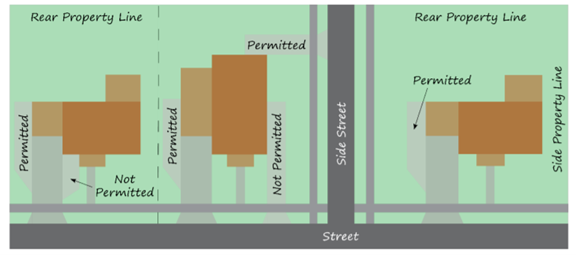
- The minimum dimension of the parking stall is 9’ x 20’ and shall have a surface consisting of either asphalt, concrete, pavers, gravel, or road base.
- The City has discretion to pursue the following concerning internal accessory dwelling units:
- The City may hold a lien against a property containing an internal accessory dwelling unit in accordance with Subsection 4; and
- The City may record a notice for an internal accessory dwelling unit in accordance with Subsection 5.
- The following are prohibited in all internal accessory dwelling units located in the City:
- Liens.
- In addition to any other legal or equitable remedies available to the City, the City may hold a lien against a property containing an internal accessory dwelling unit if:
- The owner of the property violates any of the provisions of Subsections 3 or 4;
- The City provides a written notice of violation in accordance with Subsection D.2;
- The City holds a hearing and determines that the violation has occurred in accordance with Subsection D.4, if the owner files a written objection in accordance with Subsection D.2.d;
- The owner fails to cure the violation within the time period prescribed in the written notice of violation under Subsection D.2;
- The City provides a written notice of lien in accordance with Subsection D.3; and
- The City records a copy of the written notice of lien described in Subsection D.1.d with the Wasatch County recorder.
- The written notice of violation shall:
- Describe the specific violation;
- Provide the owner of the internal accessory dwelling unit a reasonable opportunity to cure the violation that is:
- No less than 14 days after the day on which the City sends the written notice of violation, if the violation results from the owner renting or offering to rent the internal accessory dwelling unit for a period of less than 30 consecutive days; or
- No less than 30 days after the day on which the City sends the written notice of violation, for any other violation;
- State that if the owner of the property fails to cure the violation within the time period described in Subsection D.2.b, the City may hold a lien against the property in an amount of up to $100 for each day of violation after the day on which the opportunity to cure the violation expires;
- Notify the owner of the property:
- That the owner may file a written objection to the violation within 14 days after the day on which the written notice of violation is post-marked or posted on the property; and
- Of the name and address of the City office where the owner may file the written objection;
- Be mailed to:
- The property’s owner of record; and
- Any other individual designated to receive notice in the owner’s license or permit records; and
- Be posted on the property.
- The written notice of lien shall:
- State that the property is subject to a lien;
- Specify the lien amount, in an amount of up to $100 for each day of violation after the day on which the opportunity to cure the violation expires;
- Be mailed to:
- The property’s owner of record; and
- Any other individual designated to receive notice in the owner’s license or permit records; and
- Be posted on the property.
- If an owner of property files a written objection in accordance with Subsection D.2.d, the City shall:
- Hold a public hearing to conduct a review and determine whether the specific violation described in the written notice of violation under Subsection D.2 has occurred; and
- Notify the owner in writing of the date, time, and location of the hearing described in Subsection D.4.a no less than 14 days before the day on which the hearing is held.
- If an owner of property files a written objection under Subsection D.2.d, the City may not record a lien under this Subsection 4 until the City holds a hearing and determines that the specific violation has occurred.
- If the City determines at the hearing that the specific violation has occurred, the City may impose a lien in an amount of up to $100 for each day of violation after the day on which the opportunity to cure the violation expires, regardless of whether the hearing is held after the day on which the opportunity to cure the violation has expired.
- If an owner cures a violation within the time period prescribed in the written notice of violation under Subsection D.2, the City may not hold a lien against the property, or impose any penalty or fee on the owner, in relation to the specific violation described in the written notice of violation under Subsection D.2.
- In addition to any other legal or equitable remedies available to the City, the City may hold a lien against a property containing an internal accessory dwelling unit if:
- Recording Notices.
- If the City issues a license and any applicable permits to an owner of a primary dwelling to rent an internal accessory dwelling unit, or a building permit to an owner of a primary dwelling to create an internal accessory dwelling unit, the City may record a notice in the office of the Wasatch County recorder.
- The notice described in Subsection E.1 shall include:
- A description of the primary dwelling;
- A statement that the primary dwelling contains an internal accessory dwelling unit; and
- A statement that the internal accessory dwelling unit may only be used in accordance with the City’s land use regulations.
- The City shall, upon recording the notice described in Subsection E.1, deliver a copy of the notice to the owner of the internal accessory dwelling unit.
- Home Owner Associations.
- A home owner association may not restrict or prohibit the rental of an internal accessory dwelling unit constructed within a lot owner’s residential lot, if the internal accessory dwelling unit complies with all applicable:
- Land use ordinances;
- Building codes;
- Health codes; and
- Fire codes.
- A home owner association may not restrict or prohibit the rental of an internal accessory dwelling unit constructed within a lot owner’s residential lot, if the internal accessory dwelling unit complies with all applicable:
(2010-04, Section (Protection of Older Buildings for Historic Preservation) Repealed, eff. 7/28/2010)
Adopted by Ord. 2022-06 on 4/27/2022
Corrected by Other 2025-01 Corrections to Citations on 12/11/2025
16.13.390 Off-Street Parking And Loading
The following regulations are established to increase safety and lessen congestion in the public streets, to provide adequately for parking needs associated with the development of land and increased automobile usage, to set standards for off-street parking according to the amount of traffic generated by each use, and to reduce the on-street storage of vehicles.
- The number of spaces required below for each land use are established as minimum requirements.
- Residential structures shall provide two (2) parking spaces per unit.
- Hospitals shall have one (1) visitor parking space per two (2) patient beds, plus one (1) parking space for each employee at work in the hospital during daylight hours.
- Residential Facility for Elderly Persons and Residential Treatment Facilities shall have one (1) visitor parking space per three (3) patient beds, plus one (1) parking space for each employee at work in the facility during daylight hours.
- Short-term lodging facilities shall have one (1) parking space per room or suite, plus one (1) parking space for each employee at work on the premises during daylight hours.
- Recreational activity businesses shall have one (1) parking space per two (2) patrons or customers participating in an activity of the business. Retail areas of a recreational activity business shall have parking spaces at the rate of four per one thousand (1,000) square feet of retail floor area.
- Churches shall have one parking space per three (3) seating spaces in the main assembly room. No parking shall be located between the front setback and the church. If the church is located on a corner lot or parcel, only one frontage will be restricted in this manner. The City Council, upon an applicant’s request, may approve a parking plan different than listed in this section based on specific circumstances of the site and building orientation or specific use of a proposal.
- Theaters, auditoriums, sports arenas, and spaces of assembly shall have one (1) parking space per four (4) people based on the design of the structure.
- Mortuaries or funeral homes shall have forty (40) parking spaces or one space for each sixty (60) square feet of floor space in all assembly rooms, whichever is greater.
- Medical clinics shall have four (4) parking spaces per staff doctor, plus one (1) parking space for each non-doctor employee at work on the premises during daylight hours.
- Restaurants and cafes shall have one parking space per two hundred (200) square feet of dining room floor space. No additional parking is required for any outdoor dining area (open-air dining) which totals less than 50% of the indoor dining area. In cases where the outdoor dining area totals more than 50% of the indoor dining area, the additional parking required for the portion of the outdoor dining area exceeding 50% of the total of the indoor dining area shall be calculated at one parking space per 250 square feet of the outdoor dining area.
- Banks, professional offices, and other business buildings not specifically mentioned elsewhere in this sub-section shall have one parking space per two hundred and fifty (250) square feet of floor area in the building devoted to public use.
- Retail stores, personal service shops, and other business buildings shall have parking spaces at the rate of four per one thousand (1,000) square feet of retail floor area.
- Drive-in restaurants shall have at least twelve (12) off-street parking spaces or enough off-street parking spaces to accommodate all patrons or customers, whichever is greater. No patron or customer may be served in automobiles parked on public streets.
- Industrial, manufacturing, and wholesale establishments shall have one parking space per two employees based on the largest shift.
- Mixed-use residential dwellings shall provide the following amount of parking spaces:
- Studio, One (1) bedroom or Two (2) bedroom: Two (2) spaces
- Three (3) bedrooms or more: Two and a half (2.5) spaces
- Car washes shall have one space per six hundred (600) square feet of floor area in the building devoted to public use plus three stacking spaces per bay. Wash bay areas are excluded from the parking stall requirement calculation.
- Auto detailing shall have four (4) spaces per bay.
- Day care shall have one (1) space per employee at work on the premises and two stalls for pick up and drop off.
- Repair shops (includes bikes) shall have one space per three hundred (300) square feet of gross floor area.
- New and used vehicle sales and rentals shall have one space per eight hundred (800) square feet of gross floor area.
- Public and quasi-public buildings shall have one (1) space for every two hundred (200) square feet of gross floor area.
- Barber, beauty shops, massage therapy and day spas shall have one (1) space per two hundred (200) square feet of gross floor area or two (2) per chair whichever is greater.
- Veterinarian and pet grooming services shall have one (1) space per five hundred (500) square feet of gross floor area.
- Private academies/studios shall have one (1) space per two hundred (200) square feet of gross floor area.
- Carpentry and woodworking shops shall have one (1) space per seven hundred (700) square feet of gross floor area plus required parking for office and accessory uses or one stall for each employee at work on the premises, whichever is greater.
- Electrician and plumbing shops shall have one (1) space per seven hundred (700) square feet of gross floor area plus required parking for office and accessory uses or one stall for each employee at work on the premises, whichever is greater.
- Uses not mentioned. The required off-street parking for any use not listed above shall be reviewed by the Planning Commission and shall make a recommendation to the City Council. The review by the Planning Commission and final decision by the City Council shall make the determination based on similar uses listed above.
- Location and Control of Parking Facilities. The off-street parking facilities required by this Ordinance shall be located on the same lot or parcel of land as the use they are intended to serve except if the following apply:
- A cross parking agreement has been entered into with a neighboring party; said agreement must be approved by the City Council.
- 75% of the required parking may be located off-site at a city approved area that is not in the right-of-way. If outdoor dining required parking stalls, 100% of the required parking for the outside dining area may be located off-site at a city approved area that is not in the right-of-way. A parking stall fee will be assessed with the approval of the initial issuance of the business license and an annual fee per required stall will be assessed at the time of business license renewal each year. Renewal is automatic, unless the City determines a review is warranted, in which case renewal shall be at the discretion of the City Council. The required fee will be adopted by the City Council as part of the City’s fee schedule.
- Parking at or above natural grade shall not have building area above such parking within 50’ of the edge of the right-of-way of the following: Main Street, Center Street, River Road, any collector or arterial roads as shown on the Master Street Plan, or from roads fronting the Town Square, which includes the following:
- 100 North (100 West to 200 West),
- 100 West (Main Street to 100 North), and
- 200 West (Main Street to 200 North).
- C-2, C-3 and RZ zones.
- In the C-2, C-3, and RZ zones, below natural grade parking is allowed under required or voluntary open space if the design of the below natural grade parking allows the open space to be visually indistinguishable from open space areas that do not have parking below. The open space shall be completely landscaped and may include any of the following: grass, gardens (including waterwise or xeriscaping), pergolas, benches, and walkways, although hardscape (such as pavers, pavement, and concrete) shall be limited to 10% of the covered parking area. Anything above 10% shall be subject to City Council discretion and approval. Access ramps to below natural grade parking shall not have direct access from Main Street, Center Street, River Road, any collector or arterial roads as shown on the Master Street Plan, or from roads fronting the Town Square, which includes the following:
- 100 North (100 West to 200 West),
- 100 West (Main Street to 100 North), and
- 200 West (Main Street to 200 North).
- 100 North (100 West to 200 West),
- Access ramps shall not be in any required or voluntary open space.
- In the C-2, C-3, and RZ zones, below natural grade parking is allowed under required or voluntary open space if the design of the below natural grade parking allows the open space to be visually indistinguishable from open space areas that do not have parking below. The open space shall be completely landscaped and may include any of the following: grass, gardens (including waterwise or xeriscaping), pergolas, benches, and walkways, although hardscape (such as pavers, pavement, and concrete) shall be limited to 10% of the covered parking area. Anything above 10% shall be subject to City Council discretion and approval. Access ramps to below natural grade parking shall not have direct access from Main Street, Center Street, River Road, any collector or arterial roads as shown on the Master Street Plan, or from roads fronting the Town Square, which includes the following:
- Computation of Required Parking Spaces. For the purpose of computing off-street parking spaces (75% of required stalls shall be a space nine (9) feet wide and twenty (20) feet deep and the other 25% of required stalls shall be ten (10) feet wide and twenty (20) feet deep), which are required by this Ordinance, the following rules shall apply:
- Floor area shall mean gross floor area, unless otherwise specified for a particular use.
- In stadiums, sports arenas, churches, and other places of assembly in which benches or pews are used in place of seats, each eighteen (18) inches of length of such benches or pews shall be counted as one (1) seat.
- Combined Parking Areas. The required off-street parking and loading facilities may be provided collectively for two (2) or more buildings or uses, provided that the total number of parking spaces shall not be less than the sum of the requirements for each of the individual uses. Nevertheless, if the applicant can show, by using recognized studies a lower parking requirement or parking need based on noncurrent use, the City Council may reduce the amount of parking. If any modification is proposed to the approval, then the combined parking will be reassessed, and additional parking may be required based on the proposed change or use.
- Mixed Uses. If two (2) or more uses occupy the same zoning lot or parcel of land, the total requirements for off street parking and off-street loading space shall be the sum of the requirements of the various uses computed separately. Nevertheless, if the applicant can show, by using recognized studies a lower parking requirement or parking need based on noncurrent use, the City Council may reduce the amount of parking. If any modification is proposed to the approval, then the combined parking will be reassessed, and additional parking may be required based on the proposed change or use.
- Access to Parking Facilities and Width of Parking Lot Driveway Lanes.
- Access driveways for two-way traffic are a standard of twenty-four (24) feet wide. Based on a determination from the City Engineer, driveway widths may vary from twenty (20) to twenty-six (26) feet and provide for ingress to and egress from all parking and loading facilities. Widths above twenty-six feet (26), accommodating a dedicated turn lane, shall be approved by the City Engineer. Access driveways for one-way traffic shall be a minimum of twelve (12) feet wide. Each parking and loading space shall be easily accessible to the intended user. On properties with commercial uses in the C-2 and C-3 zones, the City Engineer may approve a driveway width of 18’ for ingress and egress driveway access or a driveway width of 10’ for one-way driveway access if the following criteria are met:
- The property is in the C-2 or C-3 Zone
- The primary building or structure is an existing structure and is not new construction. This applies to the main structure and not to accessory structures.
- The available width between the primary building or structure and the side or rear property line is a minimum of eighteen feet (18) and maximum of twenty feet (20) for ingress and egress driveways and a minimum of ten feet (10) and maximum of twelve feet (12) for one-way traffic.
- There is no other on-site option for accessing the parking area of the business.
- In the circumstance that one-way traffic access is desired but only 10-12 feet of space is available between the structure and the property line and there is the option of a two-way access driveway on one side of the structure, the reduced width for the one-way driveway access reduction will be allowed on the driveway impacted by limited space.
- The proposed parking facilities must comply with all other parking related requirements including stall widths, stall depths and drive aisle depths.
- Forward travel in an automobile to and from parking facilities from a dedicated street or alley shall be required for all uses except for the following:
- Parking which has been provided in connection with one and two-family dwelling
- Parking in commercial zones that meet the following criteria:
- A significant landscaped or open area (a minimum of forty-five (45) feet in width and 0.15 acres is preserved by incorporating the required off-street parking into the street right-of-way).
- No required parking is provided along the street frontage of a building.
- Required off-street parking in the street right-of-way is only allowed on local streets within the commercial zones. Required off-street parking in the street right-of-way of collector, arterial, highways, 100 East south of Main Street is prohibited.
- A six-foot (6’) asphalt buffer area is required between the edge of the local road and the end of the twenty-foot (20’) parking stall.
- The property owner is required to maintain the asphalt parking area and the buffer area.
- The Midway City Council may require a development agreement for commercial properties that use local street right-of-way for their required off-street parking. The development agreement will set forth other conditions and obligations that apply to the property.
- If the required open area is developed, then the parking that was allowed because of the open area must be removed and will not be “grandfathered.” Required parking from the original development and for the development on the open area must meet all the off-street parking requirements.
- A pedestrian sidewalk must be provided the length of the development. The sidewalk shall be five feet (5’) wide and there shall be a three-foot (3’) park strip located between the parking stalls and the sidewalk. The landscaping in the park strip must not be over six inches (6”) in height.
- Access to all off-street parking facilities shall be designed in a manner that will not interfere with the movement of a vehicular and pedestrian traffic. Off-street parking areas shall be adequate to facilitate the turning of vehicles to permit forward travel upon entering a street.
- Access driveways for two-way traffic are a standard of twenty-four (24) feet wide. Based on a determination from the City Engineer, driveway widths may vary from twenty (20) to twenty-six (26) feet and provide for ingress to and egress from all parking and loading facilities. Widths above twenty-six feet (26), accommodating a dedicated turn lane, shall be approved by the City Engineer. Access driveways for one-way traffic shall be a minimum of twelve (12) feet wide. Each parking and loading space shall be easily accessible to the intended user. On properties with commercial uses in the C-2 and C-3 zones, the City Engineer may approve a driveway width of 18’ for ingress and egress driveway access or a driveway width of 10’ for one-way driveway access if the following criteria are met:
- Circulation within a Parking Area. Circulation within a parking area shall comply with the following requirements:
- Parking area with more than one aisle must be so arranged that a car need not enter the street to reach another aisle within the same parking area. Aisles must be at least twenty-four (24) feet wide for perpendicular stalls. Aisle width for angled parking and parallel parking will be determined by the City Engineer.
- Directional signs shall be required to differentiate between entrance and exit access points to the streets.
- Location of Parking Facilities. Restricted parking and loading facilities shall be located at the side and rear of buildings. Off-street parking space which is required in connection with a use shall be construed to be part of that use and shall not be located within a zone unless expressly permitted herein.
- Lighting of Parking Areas. Any lighting used to illuminate off street parking facilities or vehicle sales areas shall be so arranged as to reflect the light away from the adjoining premises in any residential zone. Lighting shall meet the requirements of the Midway City Nuisance Ordinance.
- Continuing Obligation. The required off-street parking and loading facilities shall be a continuing obligation of the property owner so long as the use requiring vehicle parking or vehicle loading facilities continues. It shall be unlawful for an owner of any building or use to discontinue or dispense with the required vehicle parking or loading area which meets the requirements of this Ordinance.
- Plot Plan Approval Required. At the time a building permit is requested for any building or structure, or at the time the use of land is changed which requires additional off-street parking spaces, a plot plan shall be submitted showing the location and layout of such required spaces along with access aisles, roadways, curbs and curb cuts. The Planning Commission shall disapprove such plans if it finds that the required spaces are not usable for standard sized automobiles or do not comply with the requirements for off-street parking as set forth in this Ordinance.
- Parking Structures.
- A parking structure is defined as a building designed for car parking and where there is more than one floor or level on which parking takes place. It is essentially an indoor, stacked parking lot. Parking Structures are not allowed except if all the following requirements are met:
- Only one layer of parking is above natural grade.
- Any lower parking levels (surface parking area to the roof) are completely below natural grade and such lower parking level(s) shall not be visible from adjacent streets, neighboring properties, or within the development.
- Berms shall not be used to create a visual barrier for lower parking levels or to create a new “natural grade”. Visual obstruction or camouflaging cannot change this.
- Access ramps to below natural grade parking shall not have direct access from Main Street, Center Street, River Road, any collector or arterial roads as shown on the Master Street Plan, or from roads fronting the Town Square, which includes the following:
- 100 North (100 West to 200 West),
- 100 West (Main Street to 100 North), and
- 200 West (Main Street to 200 North).
- 100 North (100 West to 200 West),
- Access ramps to below natural grade parking shall not exceed 10% grade unless they are protected from the elements or heated to avoid ice and other hazards.
- Below natural grade parking lots with more than 150 parking stalls below natural grade shall have two accesses.
- At grade parking shall comply with other applicable surface level parking requirements.
- Amenities may be installed above the below natural grade level parking and may include landscaping, sports facilities (roofless), and parking.
- Any area gained by creating below natural grade parking cannot be used as additional building area for any structures. Any area gained must be used for landscaping, sports facilities (roofless), or parking.
- At the time of building permit, below grade parking lots must comply with all applicable codes, rules, regulations, and engineering standard specifications and drawings.
- Only one layer of parking is above natural grade.
- A parking structure is defined as a building designed for car parking and where there is more than one floor or level on which parking takes place. It is essentially an indoor, stacked parking lot. Parking Structures are not allowed except if all the following requirements are met:
- Commercial Drive-Throughs Prohibited. The creation of new commercial drive-throughs is prohibited in all zones. All active drive-throughs that legally exist on the date this code provision takes effect may continue as allowed elsewhere in this title. A request to use a currently existing but inactive drive-through must be made to the City Council.
(2009-15, Section Added, eff. 12/23/2009) (2016-02, Section Amended, eff. 3/9/2016; 2018-11, Sub-Section F Amended, eff. 3/14/2018; 2019-06, Section Amended, eff. 6/18/2019; 2021-14, Sub-Section F Amended, eff 8/18/2021)
Amended by Ord. 2024-04 on 7/31/2024
Amended by Ord. 2025-06 on 5/21/2025
Amended by Ord. 2025-19 on 8/14/2025
Amended by Ord. 2025-18 on 8/14/2025
Amended by Ord. 2025-22 on 9/18/2025
16.13.400 Requirements For Single-Family Dwelling Units
- A one-family or single-family dwelling may not include more than one kitchen unless one of the following options are met;
- There is not a separate access to the second kitchen from outside the dwelling or from the garage; or
- There is not a door, wall, or physical barrier between the two kitchens.
- If either of the aforementioned requirements are met that allow for a second kitchen then a second kitchen affidavit must be recorded with the County Recorder on the lot or parcel before a building permit is issued for the kitchens. The second kitchen affidavit prohibits any area of the dwelling from being rented separately from the rest of the dwelling.
- Wet bars are allowed in one-family or single-family dwellings and are not subject to the same restrictions as second kitchens and may include a sink, microwave, and refrigerator but may not include a stove or oven.
- Outside kitchens are allowed and are not subject to the same restrictions as second kitchens.
- Single-family dwelling units shall be constructed on permanent foundations.
- Each single-family dwelling unit shall be not less than twenty (20) feet in depth at the narrowest point. The depth shall be considered to be the lesser of the two (2) primary dimensions of the dwelling exclusive of attached garages, bay windows, room additions, or other similar appendages.
(2010-26, Section Added, eff. 8/25/2010; 2016-05, Section Amended, eff. 5/11/16; 2021-18, Section Amended, eff. 9/15/2021.)
16.13.410 Requirements For Solar Panels
- The purpose of this section is to regulate the permitting of solar panels for personal use and encourage renewable energy practices with minimal regulation while mitigating negative effects.
- Flush mounted roof solar panels are allowed as a permitted use in any zone as long as the panels are mounted flush (or minimum parallel separation allowed for cooling) with the roof and are a maximum of 4” thick.
- Structured roof mounted solar panels are a conditional use in any zoning district. Structured panels are defined as a panel that does not mount flush with the roof but has some type of structure to change the angle of the panel.
- Free standing solar panel structures are a permitted use in any residential zoning district with the following regulations:
- A maximum height of 15' from natural grade.
- A maximum area of 300 square feet.
- The solar panel structure shall meet all the setback requirements for an accessory structure as required in the zoning district in which it will be located.
- Solar panels require a building permit in all cases except when all the following requirements are met:
- The solar panels are not hooked into any local electrical provider’s system.
- The size of the panels is no more than 2’ x 2’.
- No more than 2 amps are produced.
(2010-30, Section Added, eff. 10/27/2010)
16.13.420 Plat Amendment Recording Requirements
The duration of a plat amendment approval shall be for one year from the date of approval of the amendment by the City Council. Should the amended plat not be recorded by the County Recorder within the one-year period of time, the plat amendment’s approval shall be voided, and approval must be re-obtained, unless, upon request by the applicant and on a showing of extenuating circumstances, the City Council extends the time limit for recording, with or without conditions. Such conditions may include, but are not limited to, provisions requiring that: (a) each extension will be for a one-year period only, after which time an annual review must be requested by the applicant and presented before the City Council; and/or (b) no more than three one-year extensions will be allowed. The granting or denying of any extension, with or without conditions, is within the sole discretion of the City Council, and an applicant has no right to receive such an extension.
(2011-06, Section Added, eff. 12/14/2011)
16.13.430 Plat Amendment Planning Commission Recommendation
Proposed plat amendments which meet any of the following conditions shall be reviewed and will receive a recommendation from the Planning Commission before being considered by the City Council:
- Density is being increased.
- The street layout is being revised.
- Open space configuration is being changed.
(2012-06, Section Added, eff. 3/14/2012)
16.13.440 Cul-De-Sac Lots Or Lots On Inside Curves
- Lots that front on the bulb of a cul-de-sac or an inside curve shall have a minimum frontage of sixty feet (60') at the right of way line, and the minimum lot width required for the particular zone or development type, at the required setback line. In order to qualify for this reduced frontage requirement, at least seventy five percent (75%) of the frontage of the lot must be contained within the bulb of the cul-de-sac, or inside curve.
- Cul-de-sac length and unit density. Cul-de-sacs shall not exceed 1300’ to the center of the furthest bulb from the initial single point of access. Cul-de-sacs longer than 500’ may provide access up to a maximum of 11 buildable lots. Cul-de-sacs 500’ or less shall be allowed density in accordance with the frontage requirements of the applicable zone. Lots on cul-de-sacs greater than 500’ in length must be deed restricted and noted on the plat so they can never be further subdivided. If the cul-de-sac ever becomes a through road the deed restrictions prohibiting further subdivision and the plat note may (at the discretion of the City Council) be removed through the plat amendment process. Cul-de-sacs shall be measured from the initial single point of access. Any branch off of a cul-de-sac that occurs beyond the initial single point of access shall not be counted as a new cul-de-sac. Regardless of the number of branches that occurs beyond the initial single point of access it shall all be considered one cul-de-sac, and if it is longer than 500’ shall be subject to the limitation of 11 buildable lots.
- Existing public roads exceeding 500’ in length and lacking a second point of access. Within Midway City there are roads that lead into areas with only one point of ingress and egress (i.e. Lime Canyon, Swiss Alpine Road, 500 S., etc.). For safety purposes, proposed development along any road that meets this description shall be limited to existing frontage and may only be further subdivided as long as the proposal complies with the frontage requirements of the applicable zoning code. If a property owner desires to increase density by installing new city or private roads internal to a development within any of the areas accessed by a road that meets the description above, the following will be required: 1) a secondary access/exit out of the area; 2) the secondary access shall be built to City standards; and 3) the secondary access shall be constructed and paid for by the landowner. This section shall not apply to Rural Preservation Subdivisions located within the areas accessed by the above-mentioned roads.
(2012-14, Section Added, eff. 5/9/2012; 2019-05, Section Amended, eff. 3/5/19)
16.13.450 Commercial Greenhouses
- Purpose and Intent of Agricultural Greenhouses. The purpose and intent of the City Council is to encourage open space, encourage less density, encourage healthy lifestyle by healthy eating, provide job opportunities and economic diversity, support and recognize agriculture as an economic industry for over 100 years in the City, encourage benefits of a local food system, including the support to small businesses and recirculation of capital within the city.
- Requirements for Agricultural Greenhouses.
- An agricultural greenhouse project requires a conditional use permit. The consideration of an application for a conditional use shall be governed by the following standard of Utah Code:
- A conditional use shall be approved if reasonable conditions are proposed, or can be imposed, to mitigate the reasonably anticipated detrimental effects of the proposed use in accordance with applicable standards.
- If the reasonably anticipated detrimental effects of a proposed conditional use cannot be mitigated by the proposal or the imposition of reasonable conditions to achieve compliance with applicable standards, the conditional use may be denied.
- All new projects must conform to Midway City Municipal Ordinances including Public Health and Safety, Water, Building and Construction, Supplementary Requirements in Zones, and Sensitive Lands. The project must also comply with applicable Department of Agriculture regulations.
- A minimum of five (5) acres.
- The area of the agricultural greenhouse(s) including support buildings shall not exceed more than 35 percent of the total parcel acreage. This does not include any other buildings allowed within the zoning district or any existing buildings.
- A recommended greenhouse height of twenty-five (25) feet. The maximum height shall not exceed thirty-five (35) feet.
- A minimum of a one hundred (100) foot setback on all sides for agricultural greenhouses and all support buildings.
- Berming, screening and landscaping.
- If aquaculture or aquaponics are approved by the City Council, the slaughtering, processing, or packaging of fish for commercial purposes are not allowed on-site. The fish must be transported alive to an appropriate off-site facility for these activities.
- An agricultural greenhouse project requires a conditional use permit. The consideration of an application for a conditional use shall be governed by the following standard of Utah Code:
- Project Management Plan. The applicant shall provide a proposed project management plan that addresses any probable impacts of the type described below and includes any proposed mitigation measures. The plan shall include, without limitation:
- Site plan prepared to scale on a topographic base by a professional planning team which shows the concept of the major features of the projects, including roads in relation to existing conditions and developments within one-fourth of a mile of the outside 67 boundaries of the development. Handwritten plans will not be accepted. Twenty copies of the plan on 11” x 17” size paper shall be submitted to the Planning Department.
- Description of how the development will implement Midway City’s Vision
- Name of project
- Applicant entity name, primary contact name, civil engineer, etc. with respective contact addresses, phone numbers, fax numbers, and email addresses for each.
- Legal description with section tie
- Zone boundaries and designations
- North point and a scale consistent with a scale that is on a standard engineering scale ruler
- Identification, location and description of all sensitive lands and a proposal to protect such lands
- Adjacent property owners
- Title report
- Landscape plan
- Drainage plan
- Lighting plan, interior and exterior
- Description of the type of equipment necessary or intended for use in each season and the frequency and duration of anticipated use;
- Disclosure of any intent to spray or otherwise apply agricultural chemicals or pesticides, frequency and duration of application, and the plants, diseases, pests or other purposes they are intended for
- Proposed sediment and erosion control plan
- Noxious weed control plan
- Location of office, bathroom, warehouse facilities or any other support buildings associated with the agricultural greenhouse
- Photosimulation of the project from the surrounding area.
- Demolition bond. The developer set aside money in a five (5) year performance bond, which is held in escrow and can be used to demolish the greenhouse(s) should they cease to function as originally approved. The amount of the bond will be determined by staff based on the size and scope of the project.
- Site plan prepared to scale on a topographic base by a professional planning team which shows the concept of the major features of the projects, including roads in relation to existing conditions and developments within one-fourth of a mile of the outside 67 boundaries of the development. Handwritten plans will not be accepted. Twenty copies of the plan on 11” x 17” size paper shall be submitted to the Planning Department.
- Potential Impacts and Mitigation. The application shall be approved if reasonable conditions are proposed, or can be imposed, to mitigate the reasonably-anticipated detrimental effects of the proposed use in accordance with applicable standards. If the reasonably-anticipated detrimental effects of the proposed use cannot be mitigated by the proposal or the imposition of reasonable conditions to achieve compliance with applicable standards, the conditional use may be denied. The City Council, in determining whether to approve or place reasonable conditions on the application, shall consider the potential impacts and mitigation as outlined in the following, but not limited to:
- Water Quality and Soils. Impacts of irrigation run-off on adjacent properties, water bodies and environmentally critical areas, and proposed sediment and erosion control measures.
- Traffic, Deliveries, and Parking. Impacts related to the number of staff onsite during work hours, and the number of potential visitors regularly associated with the site. Commercial deliveries and pickups will be included in the daily trip count of any required traffic study.
- Visual Impacts and Screening. Visual impacts relating to the proposed nature, location, design, and size of proposed features, structures and activities, planting areas and any existing or proposed screening including landscaped berms as listed in the site plan.
- Noise and Odor. Impacts related to the location of any trash, storage areas, additional accessory structures and any other noise-generating or odor-generating equipment and practices. No odors or fumes shall be allowed to escape into the open air in such amounts as to be detrimental to the health of any individuals or the public; or noticeable, discomforting or disagreeable so as to offend the sensibilities of a reasonable individual from the property line. All compost and/or organic matter storage must be contained and enclosed.
- Use of Chemicals. Impacts related to the use of chemicals, including any fertilizer and pesticide.
- If grow lights are used between the hours of 10pm and 6am the greenhouse will be required to shade the light from escaping to the exterior.
- Drainage. The site shall be designed and maintained to prevent water from irrigation, fertilizer or other activities from draining onto adjacent property.
- Compost, Refuse Storage and Disposal. Trash areas shall be provided and screened on at least three (3) sides from public view by an opaque impact-resistant fence of sufficient height to screen the dumpster(s) and shall be located at least 100’ from any property line. Compost shall be located at least 100’ from any property line.
- City Council may impose conditions to mitigate any potential impacts including but not limited to the aforementioned items.
(2013-02, Section Added, eff. 5/8/2013; 2014-07, Section Replaced, eff. 06/10/15)
16.13.460 Warehousing And Mini Storage Units
The following requirements apply to Warehousing and Mini-Storage Units in zones where they are allowed:
- All Warehousing and Mini-Storage Units shall have a setback of 150’ from any public road.
- The colors used on Warehousing and Mini-Storage Units structures shall be neutral and will be reviewed by the VAC.
- All storage, including vehicles, of any items in Warehousing and Mini-Storage Units facilities shall be located under a roof.
- All applicants for Warehousing and Mini-Storage Units shall be required to propose and build on the site one or more additional structures not used for storage, to be located within the 150’ setback area, in order to reasonably screen the Warehousing and Mini-Storage Units from view from the frontage of the property. Such structures shall be built prior to or concurrently with construction of the Warehousing and Mini-Storage Units and shall be subject to review by the VAC.
- A combination of a fence and appropriate landscaping shall be used on all sites of a Warehousing and Mini-Storage Unit facility to screen the structures from view and provide security for the property. The fencing and landscaping plan shall be proposed by the applicant and reviewed and approved by the City as part of the conditional use process.
(2015-04, Section Added, eff. 7/8/2015)
16.13.470 Transmission Lines
- Transmission Lines are a conditional use in all zones.
- The purpose of this section is to regulate all electric transmission lines that exceed 55 feet in pole height above grade. It is not the intent of this section to regulate the replacement or maintenance of existing transmission lines that exceed 55 feet in pole height. Existing transmission poles that currently exist within City boundaries, so long as they are replaced with a pole of identical height, diameter, and material, no permit nor approval shall be required. A proposal to alter the height, diameter, or material of existing transmission lines that exceed 55 feet shall require a conditional use permit under this section.
- Prior to beginning construction on any new or proposed power transmission line that exceeds 55 feet in pole height above grade within any portion of the Midway City boundaries, a power company shall:
- Apply for and receive approval of a conditional use permit as set forth in this title.
- In addition to the information required in the application process as set forth in this title, the applicant shall also provide all information, design criteria, and studies deemed necessary by the City Planner, including, but not limited to: 1) the cost and pole height of standard transmission poles with height included for distribution lines; 2) the cost difference and pole height difference of burying just the distribution lines; 3) the cost difference of burying both the transmission and distribution lines; and 4) alternate routes for the transmission line (if not proposed within an existing and historical easement), including cost differential and studies on which route has the least impact on surrounding areas. Any requested studies shall be thorough and may include environmental impact studies, studies to determine costs of different options, and studies to determine the visual and aesthetic impact of the proposed transmission line project. At the City’s sole discretion, the City may require outside third-party providers to conduct some or all of the studies, do independent studies, or to review the studies prepared by the applicant and verify the information contained therein. All reasonable costs incurred by third party studies shall be borne by the applicant.
- Notice requirements shall comply with Section 16 of the Midway City Code and shall include notice to all property owners within 600’ of the proposed route of the transmission line.
- Preferred Conditions on any above ground transmission power lines located within the boundaries of Midway City:
- Existing Easement Restrictions. New lines shall be preferred in corridors where existing 46kv lines are already in place.
- Height and Span Restrictions. There shall be a preference for the shortest poles allowed by industry standards, considering the impact a shorter or longer span between poles may have on the view corridor. All options will be considered for aesthetics and for harmonizing with the vision of Midway City as described in the General Plan.
- Aesthetic Restrictions. No galvanized poles, or poles with other reflective materials shall be used. Pole color and material shall be focused on minimizing the visual impact of the transmission line. Wood poles will also be considered.
- Other restrictions as reasonably imposed by the City.
- City’s option to require burial of transmission lines, or distribution lines that share the transmission line pole.
- It is Midway City’s objective to minimize the visual and aesthetic impact of above ground transmission lines within Midway City.
- Midway City Council shall have the option of requiring transmission power lines approved under this section to be buried within the Midway City limits. Midway City Council shall also have the option of requiring just the distribution lines that commonly share the poles of transmission lines to be buried, if such a requirement would lower the overall height of the transmission poles.
- As set forth above, to aid Midway City Council in making its determination, Applicant shall be required to submit studies that establish: a) the cost and pole height of standard transmission poles with height included for distribution lines; b) the cost difference and pole height difference of burying just the distribution lines; c) the cost difference of burying both the transmission and distribution lines; and d) alternate routes for the transmission line (if not proposed within an existing and historical easement), including cost differential and studies on which route has the least impact on surrounding areas.
- Prior to making any decision, the City shall carefully review the different costs associated with each option.
- Any requirements imposed by the City to bury some or all of either the transmission lines or distribution lines shall be subject to then existing law that may require the City to cover some or all of the costs.
- In making the decision to bury some or all of the transmission or distribution lines, Midway City Council shall be allowed to consider all reasonable information available to it and shall not be limited to just an analysis of cost as the determining factor.
(2019-02, Section Added, eff. 1/15/19)
16.13.480 Double Frontage Lots
Double frontage lots shall not be permitted in zones R-1-7, R-1-9, R-1-11, R-1-15, R-1-22, and RA-1-43 except in situations where access is not allowed onto a collector (does not include local or minor collector roads) or arterial roads as outlined in the Midway Road System Master Plan. (2020-18, Section Added, eff. 2/24/2021)
16.13.490 On-Site Agricultural Sales
- Owners of private property in residential zones may sell agricultural crops that are grown onsite with the approval of the zoning administrator or its designee and in compliance with the following guidelines:
- Property Owners must submit a no-cost special use application to the Midway City planning department that addresses the following:
- Provide a list of what agricultural crops will be sold onsite. Only agricultural crops, eggs and honey may be sold. All agricultural crops, eggs, and honey being sold must be grown and/or produced on-site. The sale of agricultural crops grown off-site, animals, animal byproducts other than eggs or honey, or processed foods are strictly prohibited.
- Provide a site plan showing the following:
- Any proposed improvements.
- The location of any proposed farm retail stand. Retail stands may not exceed 150 square feet (gross square footage) and must be located outside of the right-of-way on the applicant’s private property. Retail stands must be temporary structures and can only be erected between June 15th and October 15th. If the stand is not used for ten consecutive calendar days, it must be removed. Retail stands must be properly anchored and must be approved by the Midway City Fire Chief.
- Proposed parking must be shown to ensure it is safe and adequate. Parking in the public right-of-way may be allowed if there is adequate room and it is in a location that is deemed safe. If parking in the right-of-way is not possible, then all parking must be located on private property. All parking is subject to the approval of the zoning administrator or its designee.
- Allowed hours of operation: 8:00 a.m. to dusk, Monday through Saturday.
- Allowed signage: One sandwich board sign up to nine square feet per side that may be located on the edge of the right-of-way at ground level. The sign may not be taller than four feet in height. Signs may only be displayed while agricultural crops are actively being sold.
- Agricultural retail stands must comply with any local or state health and agricultural department requirements.
- Property Owners must submit a no-cost special use application to the Midway City planning department that addresses the following:
Adopted by Ord. 2021-34 on 10/5/2021

