
Midway City Zoning Code
CHAPTER 16
11 R-1-22 RESIDENTIAL ZONE
16.11.010 Objective And Characteristics
The objective in establishing the R-1-22 Residential Zone is to encourage the creation and maintenance of residential areas within the City which are characterized by medium to large size lots on which single-family dwellings are situated, surrounded by well-kept lawns, trees and other plantings. A minimum of vehicular and pedestrian traffic and quiet residential conditions favorable to family living are also characteristic of this zone. In order to accomplish the objectives and purposes of this Chapter and to promote the characteristics of this zone, the following regulations shall apply in the R-1-22 Residential Zone.
16.11.020 Permitted Uses
- One-family dwellings and related accessory buildings and uses. Accessory uses and buildings include garages, personal greenhouses less than one thousand (1,000) square feet and carports.
(2013-02, Sub-section Amended, eff. 5/8/2013) - Customary household pets, including but not limited to cats, dogs and canaries. This does not include the breeding of dogs and cats or other pets for sale or other use. Notwithstanding the foregoing, no more than three cats or three dogs are permitted at one time at any single-family residence.
- Temporary buildings and yards for the storage of materials and equipment incidental to the construction of dwellings and other permitted uses, provided that a permit for such temporary buildings shall not be effective for more than one year.
- Home Occupations, Cottage Industries
(2010-21, Sub-section Added, eff. 7/28/2010) - The keeping of animals and fowl in numbers according to the following point system on lots/parcels that are at least one acre in size:
- Animals may total 50 points per 1/2 acre.
- Animals shall be worth the following points each:
- Rabbits, chicken hens, and pigeons: 2 points.
- Geese, ducks, peafowl, turkeys, pheasants, peacocks, and other similarly sized birds: 10 points.
- Sheep, llamas, calves, foals, and other similarly sized animals: 25 points.
- Horses, cattle, and other similarly sized animals: 40 points.
- For the purpose of this point system, an animal and one offspring shall be considered one animal until six (6) months after the birth of the offspring.
- Hens (females) of any chicken species may be kept. However, roosters (males) are prohibited. Rabbits are also allowed.
- Chickens and rabbits must be kept on the owner’s property at all times and are not allowed to run or roam free onto neighboring properties.
- Coops and rabbit pens shall not be located within the front yard and shall be located at least twenty-five (25) feet from any neighboring dwellings, and shall be located at least twenty (20) feet from the edge of any open waterway that drains into a natural stream. Surface drainage from coops shall not be permitted to drain into a waterway that drains into a natural stream.
- Up to three (3) chickens or rabbits may be kept on a detached single-family home lot which contains at least 5,000 square feet. One (1) additional chicken or rabbit may be kept for each 1,000 square feet of lot area above the 5,000 square foot minimum, for a maximum of eight (8) chickens or rabbits permitted on each lot.
- The premises upon which chickens or rabbits are kept shall be maintained in a clean, sanitary, and reasonably odor-free condition.
- Definitions.
- "Coop" means a cage, pen, enclosure, or building for the sheltering of chickens.
- Internal Accessory Dwelling Unit
(2017-15, Section Added, eff. 1/24/2018)
Amended by Ord. 2022-06 on 4/27/2022
Amended by Ord. 2025-20 on 8/14/2025
Amended by Ord. 2026-13 on 6/4/2026
16.11.030 Conditional Uses
- Public buildings, primary and secondary schools, churches, but not temporary revival tents or buildings.
Amended in its entirety by Ord. 2024-17 on 12/31/2024
16.11.040 Area Requirements
The minimum area for lots for one-family dwellings shall be one-half acre (21,780 square feet), except for dwellings which are located within an approved large-scale development.
16.11.050 Width And Frontage Requirements
The minimum width and frontage for a lot for a one-family dwelling shall be 115 feet.
(2012-13, Section Amended, eff. 5/9/12)
16.11.060 Location Requirements
- Front Setback:
- Dwellings - All dwellings shall be setback from front property lines a minimum distance of forty feet (40’). On corner lots or lots with more than two frontages, the front setback for the secondary frontage(s) shall be the same as for the primary frontage.
- Accessory Structures - All accessory structures shall be setback from front property lines a minimum distance of fifty feet (50’). On corner lots or lots with more than two frontages, the front setback for the secondary frontage(s) shall be the same as for the primary frontage.
- Side Setback:
- Dwellings - All dwellings shall be setback from side property lines a minimum distance of twenty feet (20’).
- Accessory Structures - All accessory structures shall be setback from the side property lines a minimum distance of ten feet (10’). The maximum height of an accessory structure at the minimum side setback line is ten feet (10’). The height of the accessory structure may increase by one foot for each additional foot it is setback into the property, to a maximum of 35’ (e.g., a 35’ building height allowed at the 30’ side setback). For additional detail, see Exhibit 1 in this section.
- Rear Setback:
- Dwellings - All dwellings shall be setback from the rear property line a minimum distance of forty feet (40’).
- If the front and rear setbacks limit the main dwelling structure to a depth that is less than 45', the rear setback may be reduced by the amount needed to allow for up to a 45' structure depth. In no case shall the rear setback be less than 30' and a reduction assumes that a proposed structure will be built to the minimum front setback line.
- Accessory Structures - All accessory structures shall be setback from the rear property lines a minimum distance of ten feet (10’). The maximum height of an accessory structure at the minimum rear setback line is ten feet (10’). The height of the accessory structure may increase by one foot for each additional foot it is setback into the property, to a maximum of 35’ (e.g., a 35’ building height allowed at the 30’ side setback). For additional detail, see Exhibit 1 in this section.
- Dwellings - All dwellings shall be setback from the rear property line a minimum distance of forty feet (40’).
- Accessory structures that are 200 square feet or less in size, are 12’ or less in height, and have temporary foundations, may be located a minimum of 5’ from a side or rear property line in any residential zone. There are no exceptions to the front or secondary front setback. At the owner’s risk, they may be located on a platted public utility easement. If a utility is to be placed in the public utility easement, the property owner is responsible for removal of the structure to allow for the installation of the utility. A property owner is required to remove the structure within 30-days of receiving notice. All drainage from the accessory structure must be maintained on site.
Exhibit 1
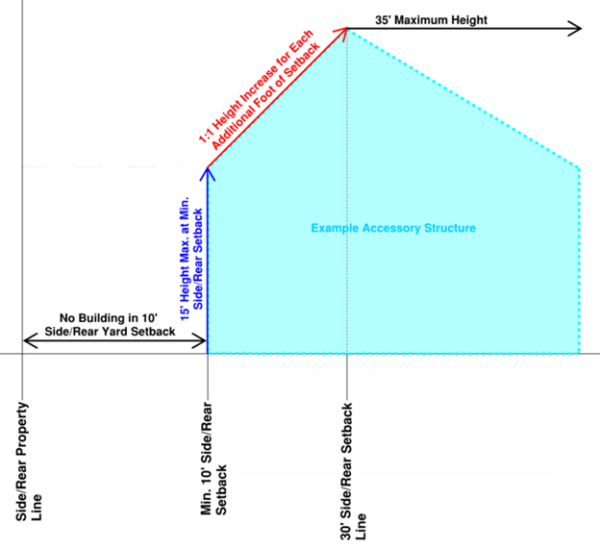
Repealed & Replaced by Ord. 2022-02 on 3/16/2022
16.11.070 Size Of Dwellings
The ground floor area of all dwellings shall be not less than 1,400 square feet except as may be approved in a large-scale development.
16.11.080 Supplementary Requirements
See Chapter 16.13 Supplementary Requirements in Zones.

