
Mint Hill City Zoning Code
ARTICLE 2
- INTERPRETATIONS; RULES OF CONSTRUCTION; DEFINITIONS
Section 2.1 - Official Zoning Map
A.
There shall be a map known and designated as the Official Zoning Map ("Zoning Map"), which shall show the boundaries of all zoning districts within the Town's planning jurisdiction. This map shall be developed using the latest technology (such as GIS) and may be printed on various media and shall be kept in the planning department. Current and former zoning maps shall be maintained for public inspection in the Town Hall office on either paper of digital format. Any state or federal agency maps incorporated by reference into the zoning map will also be maintained in paper or digital format in the Town Hall office.
B.
The map entitled "Zoning Map of the Town of Mint Hill, North Carolina," is hereby adopted by reference and declared to be a part of this Ordinance. The zoning of the districts as indicated on said map is hereby declared to be the proper zoning for said districts of the Town as of the effective date of this Ordinance. This map shall be interpreted in accordance with Section 2.2 and amendments to this map shall be made and posted in accordance with Section 8.5.
(Ord. No. 598, 4-14-2011; Ord. No. 798, 7-8-2021)
Section 2.2 - Interpretation of Official Zoning Map
A.
The Board of Adjustment is authorized to interpret the zoning map and to pass upon disputed questions of lot lines or district boundary lines and similar questions. If such questions arise in the context of an appeal from a decision of the Administrator, they shall be handled as provided in Subsection 2.2(B). The Board of Adjustment shall then interpret zoning district lines as needed, and in such case, the decision of the Board of Adjustment shall only apply to the particular question being determined and shall not effect other zoning districts or boundaries.
B.
For purposes of interpretation of district boundaries as shown on the zoning map, the following rules shall apply:
1.
Boundaries which appear to follow the centerlines of roads, streams, power line easements or similar identifiable land characteristics shall be construed to follow such centerlines. If the actual location of such right-of-way, easement, or waterway varies slightly from the location as shown on a map, then the actual location shall control.
2.
Boundaries indicated as approximately following plotted lot lines shall be construed as following such lot lines.
3.
Where a map shows a boundary line as being located a specific distance from a street line or other physical feature, that distance shall control. Distances not specifically indicated on the zoning map shall be determined by the scale of the map.
4.
Where a district boundary line divides a lot which was in single ownership on the effective date of this Ordinance, the entire lot shall be deemed to be in that district in which the greater part of the lot lies, except as provided in Subsection 2.2(B)(5) below.
5.
In the event that a lot is so divided as indicated in Subsection 2.2(C)(4) above, and contains sufficient area and dimension in each divided parcel to comply with all minimum zoning requirements for the uses permitted in the respective districts, such lot may be so divided in compliance with this Ordinance.
6.
Boundaries indicated as approximately following lot lines, city limits, or extraterritorial boundary lines shall be construed as following such lines, limits or boundaries.
7.
In instances when a zoning case file contains detailed information regarding the boundary, that information will be used as the correct boundary location.
(Ord. No. 598, 4-14-2011)
Section 2.3 - Rules of Construction and Interpretation
A.
Rules of Construction. The following rules of construction shall be followed in interpreting words and terms used in this Ordinance:
1.
These regulations will be construed to achieve the purposes for which they are adopted. Interpretations shall be guided by statements of purpose.
2.
Words used in the present tense include the future.
3.
Words used in the singular number include the plural, and words used in the plural include the singular, unless the context of the particular usage clearly indicates otherwise.
4.
The word "shall" or "must" is always mandatory; the word "may" is permissive in nature, except when the context of the particular use is negative (as in "may not"); in which case it is mandatory.
5.
References to "days" will always be construed to be business days, excluding weekends and holidays, unless the context of the language clearly indicates otherwise.
6.
The words "used" or "occupied" as applied to any land or building shall be construed to include the words "intended, arranged, or designed to be used or occupied".
7.
"Town" means the Town of Mint Hill, North Carolina.
8.
"Governing Authority," "Commissioners," or "Board of Commissioners" means the Mayor and Board of Commissioners of the Town of Mint Hill, North Carolina.
9.
"Planning Board" means the Planning Board of the Town of Mint Hill, North Carolina.
10.
"Board of Adjustment" means the Board of Adjustment of the Town of Mint Hill.
11.
"Mint Hill Planning Department," "Planning Department," or "Staff" means the "Town of Mint Hill Planning Department."
12.
"Administrator," means the person(s) administrating this Ordinance.
13.
The word "Map" or "Zoning Map" means the Official Zoning Map of the Town of Mint Hill, North Carolina.
14.
The term "zoning jurisdiction" shall also mean "planning jurisdiction" and shall refer to the geographical area in which this Ordinance has applicability.
15.
The word "person" includes a firm, association, partnership, corporation, trust, and company as well as an individual.
16.
Any word denoting gender includes the female and the male.
17.
The word "structure" shall include the word "building."
18.
The word "lot" shall include the words, "plot," "parcel," or "tract."
19.
The term "street" shall also mean "road."
20.
For purposes of this Ordinance, the "use" or "occupation" of a building or land relates to anything and everything that is done to, on, or in that building or land.
21.
The term "screening", "buffering" and "buffer" shall all mean the same and may be used interchangeably.
22.
The following acronyms may be used throughout this Ordinance:
i.
UDO Unified Development Ordinance
ii.
NCDOT North Carolina Department of Transportation
iii.
LUESA Mecklenburg County's Land Use and Environmental Services Agency
iv.
PIM Public Information Meeting
v.
CZ Conditional Zoning
vi.
PUD-CD Planned Unit Development
vii.
BOC Board of Commissioners
viii.
BOA Board of Adjustment
ix.
TRC Technical Review Committee
x.
PCO Post-Construction Ordinance
B.
Fractional Requirements. When any requirement of this Ordinance results in a fraction of a unit, a fraction of one-half (½) or more shall be considered a whole unit and a fraction of less than one-half (½) shall be disregarded.
C.
Text Controls Over Graphics. This Ordinance contains numerous graphics, pictures, illustrations and drawings. However, in case of conflict between the text and a graphic, picture, illustration or drawing or any other depiction, the Land Use Administrator shall determine the intent of the section.
D.
Conflicting Provisions.
1.
The provisions of this UDO shall be held to be minimum requirements. Whenever the provisions of this UDO are at variance with any other lawfully adopted rules, regulations or ordinances, the most restrictive, or those imposing the higher standards shall govern. Further, where the provisions of this Ordinance are inconsistent with those of the state or federal government, the more restrictive provisions shall apply, however those provisions will be enforced by the designated regulatory agencies.
2.
Where there is a conflict or apparent conflict between provisions of this UDO, the more restrictive provision shall control.
3.
Where it is possible to implement, administer or construe a particular provision in more than one way, it shall be implemented, administered or construed in the way that eliminates or minimizes conflicts with other provisions of this UDO.
4.
This Ordinance is not intended to interfere with, abrogate, or annul any deed restriction or other agreement between private parties. The Town and its staff shall not enforce any such private agreements.
5.
This UDO references and relies upon standards and design requirements in the Mecklenburg County Land Development Standards Manual. The Town of Mint Hill is currently in the process of developing a similar manual with standards and design requirements specific to the Town. Upon the development of such a manual (the "Town of Mint Hill Standards Manual" or whatever other name it may be given), it shall supersede and replace the Mecklenburg County Land Development Standards Manual to the extent there is a conflict.
(Ord. No. 598, 4-14-2011; Ord. No. 798, 7-8-2021)
Section 2.4 - Terms Defined in this Ordinance
For purposes of interpreting this Ordinance, certain words, concepts, and ideas are defined below. Except as defined herein, all other words used in this Ordinance shall have their standard dictionary definition. Additional definitions, specific to the particular articles, are included in Article 6, Sections 6.6 and 6.6A (Floodplain Regulations) and (Surface Water Improvement Management (S.W.I.M.) Stream Buffers); Article 6, Section 6.7 (Soil Erosion and Sediment Control); and Article 6, Section 6.8 (Post-Construction Ordinance). Unless otherwise specified, the following words shall have the following meanings throughout this Ordinance.
| ABC Store | A retail establishment at which liquors are sold to the general public and which is run under the auspices of the local Alcohol and Beverage Control (ABC) Board. |
| Accessory Structure | A structure subordinate or incidental to the principal structure on a lot in square footage and primary use. Accessory structures include detached garages (with or without mother-in-law suites or rental cottages), storage buildings, pool houses, and material storage areas. See also "Garage, Private." |
| Accessory Use | Minor uses or structures which are necessary to the operation or the enjoyment of a permitted principal use and are appropriate, incidental and subordinate to any such uses. See Section 6.9.7 for regulation, and interpretive guidance. |
| Adjacent Property(ies) |
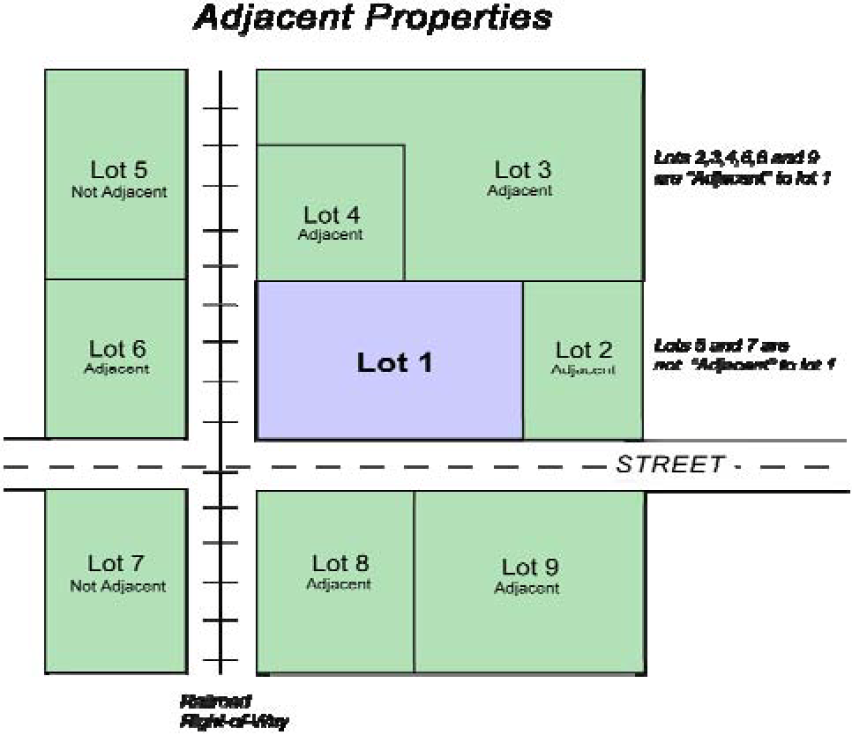
One or more lots or tracts that abut or touch and having a boundary, or portion thereof,
which is contiguous to the lot in question. Such determination shall be made by extending
the exterior lot lines of the lot in question to adjacent lots and/or across adjacent
roads, streams, easements or rights-of-way. The term "adjacent" or "adjacent property"
shall also mean "contiguous" or "contiguous property", "abutting" or "abutting property",
"adjacent or adjacent property". An example of how this definition is to be applied
is shown below:
 |
| Administrator | See Subsection 8.1(D). The Planning Director for the Town unless otherwise designated by the Board of Commissioners and other staff designated by the Town Manager. The term "staff" or "planning staff" is sometimes used interchangeably with the term "administrator". |
| Adult Bookstore | A retail establishment that has: |
| As one of its principal business purposes the sale or rental of or a substantial or significant portion of its stock in trade for sale or rental: | |
| Publications which are distinguished or characterized by their emphasis on matter depicting, describing or relating to specified anatomical areas or specified sexual activities as defined in this Section; or | |
| Sexually oriented devices, as defined in this Section. | |
| As used in this definition, publications include, by way of illustration, books, magazines, other periodicals, movies, video tapes and other products offered in photographic, electronic, magnetic, digital or other imaging medium. | |
| Any of the following shall be indicia that an establishment has as one of its principal business purposes the sale or rental of: 1) publications which are distinguished or characterized by their emphasis on matter depicting, describing or relating to specified sexual activities or specified anatomical areas, as defined in this Section and/or 2) sexually oriented devices, as defined in this Section. | |
| The business advertises the sale or rental of adult publications and/or sexually oriented devices. | |
| Access by persons under eighteen (18) years of age to the business establishment or portions of the business establishment is restricted. | |
| Signs or notices are posted outside and/or inside the business establishment indicating that the material offered for sale or rental might be offensive. | |
| The building or portion of the building containing the business establishment does not have windows or has windows that are screened or otherwise obstructed or are situated in a manner that restricts visual access from outside the building to materials displayed within for sale or rental. | |
| Such indicia shall be considered along with all other factors and available information. | |
| Notwithstanding the foregoing, a general circulation video store that does not offer for sale any sexually oriented devices shall not constitute an "adult bookstore" even though it offers for sale and/or rental video tapes which are distinguished or characterized by their emphasis on matter depicting, describing or relating to specified anatomical areas or specified sexual activities as defined in this Section, so long as: | |
| Such described video tapes are stocked and displayed in a room separate from the area of the business establishment where general circulation video tapes are stocked and displayed; | |
| Access by persons under eighteen (18) years of age to the room where such described video tapes are stocked and displayed is restricted; | |
| The square footage of the separate room where such described video tapes are stocked and displayed is no more than ten (10) percent of the square footage of the area where general circulation video tapes are stocked and displayed; and | |
| The general circulation video tape portion of the business establishment offers a quantity and selection of new release general circulation video tapes that is typical of a general circulation video store and offers a quantity and selection of other general circulation video tapes that are organized and displayed in a manner that is typical of a general circulation video store. | |
| Adult Establishment | Adult bookstores, adult motion picture theatres, adult mini-motion picture theatres, adult live entertainment and all other places contained in G.S. 14-202.10. |
| Adult Live Entertainer | An employee who engages in or performs adult live entertainment. |
| Adult Live Entertainment | Any performance of or involving the actual presence of real people which exhibits specified sexual activities or specified anatomical areas, as defined in this Section. |
| Adult Live Entertainment Business | Any establishment or business which has as one of its principal business purposes the presentation of adult live entertainment for observation by patrons. |
|
Adult Mini-Motion
Picture Booth | Any booth or partitioned area of less than one hundred fifty (150) square feet in an adult mini-motion picture theatre that is designed to hold patrons for the presentation and viewing of still or motion pictures (slides, film, video tape, laser disc, CD-ROM or other imaging media) that are distinguished or characterized by their emphasis on matter depicting, describing or relating to specified anatomical areas or specified sexual activities, as defined in this Section. |
|
Adult Mini-Motion
Picture Theatre | A commercial establishment with one or more adult mini-motion picture booths where: |
| One of the principal business purposes is the presentation and viewing of still or motion pictures in the viewing booths that are distinguished or characterized by their emphasis on matter depicting, describing or relating to specified anatomical areas or specified sexual activities, as defined in this Section; | |
| A substantial or significant portion of the stock of still or motion pictures available for viewing or that are actually viewed in the viewing booths are distinguished or characterized by their emphasis on matter depicting, describing or relating to specified anatomical areas or specified sexual activities, as defined in this Section; | |
| Any of the following shall be indicia that the business establishment has as one of its principal business purposes the presentation and viewing in viewing booths still or motion pictures which are distinguished or characterized by their emphasis on matter depicting, describing or relating to specified sexual activities or specified anatomical areas, as defined in this Section: | |
| Restricted access to the business establishment or portions of the business establishment where viewing booths are located by persons under eighteen (18) years of age; and | |
| Posted signs or notices outside and/or inside the business establishment indicating that the material offered for presentation and viewing in the viewing booths might be offensive. | |
| Such indicia shall be considered along with all other factors and available information. | |
| Adult Motion Picture Theatre | A commercial establishment that regularly presents motion pictures which are distinguished or characterized by an emphasis on matter depicting, describing or relating to specified sexual activities or specified anatomical areas, as defined in this Section, in an area, whether enclosed or not, of one hundred fifty (150) square feet or greater, for observation by patrons therein. |
| Agricultural Use | The commercial production, keeping or maintenance, of plant and animals useful to man, including, but not limited to: forages and sod crops; grains and seed crops; dairy animals and dairy products, poultry and poultry products; livestock, including beef cattle, sheep, swine, horses, ponies, mules, or goats or any mutations or hybrids thereof (except for breeds that are defined as "Household Pets"), including the breeding and grazing all of such animals; bees and apiary products; fur animals; trees and forest products; fruits of all kinds, including nuts; vegetables; nursery, floral and ornamental products; or lands devoted to a soil conservation or forestry management program. Uses which shall not be deemed as "agricultural uses" include: (i) zoos, (ii) kennels, (iii) riding stables, and (iv) retail or wholesale nurseries. |
| Airport | A facility where aircraft can land and take off on a recurring basis and which is equipped with hangars, refueling facilities and/or repair facilities. |
| Airstrip | An area of land or water that is designed or used on a recurring basis for the landing and takeoff of aircraft, ultra lights, model airplanes or other flying apparatus excluding hot air balloons and which does not contain hangars, refueling facilities or repair facilities. |
| Alteration | A change in the size, configuration, or location of a structure; or a change in the use of a structure or lot from a previously approved or legally existing size, configuration, location, or use. |
| Amusement and Sporting Facility, Indoor | A facility providing entertainment or games of skill activities to the general public for a fee and that is wholly enclosed in a building. This shall include, but not be limited to: a bowling alley, skating rink and movie theater. This definition does not include game rooms. |
| Amusement and Sporting Facility, Outdoor | A facility providing recreational activities outside of an enclosed building. Typical uses include: miniature golf, golf driving range, skeet shooting, skating rink, etc., but does not include a stadium. |
| Amusement Arcade | A place of entertainment primarily featuring coin-operated gaming machines. |
|
Amusement Game
Room | A building or a part of a building containing eight (8) or more billiard/pool, video, pinball, or similar player operated amusement devices, in any combination, for commercial use. An establishment containing a game room may have more than one principal use. |
| Amusement Park | A commercially operated park that offers rides, games, and other forms of entertainment. |
| Animal Grooming Services for household pets | A facility where animals are groomed, shampooed, clipped, etc. No long term stay shall be allowed. |
|
Animal Hospital
(indoor kennels) | A place where animals are given medical or surgical treatment and the boarding of animals is incidental to the hospital use. All facilities associated with an animal hospital shall be located indoors. |
|
Animal Hospital
(outdoor kennel) | A place where animals are given medical or surgical treatment and the boarding of animals is incidental to the hospital use. Facilities may be located outdoors and may include, but not be limited to: kennels and training/exercise areas. |
| Animal Kennel: | A commercial operation that provides boarding services for pets. |
| Animal Shelter | A facility which is used to house or contain animals and which is owned, operated, or maintained by an incorporated, humane society, animal welfare society, society for the prevention of cruelty to animals, or other nonprofit organization devoted to the welfare, protection and humane treatment of animals. |
| Antenna | Any system of wires, poles, rods, or similar devices used for the transmission or reception of electromagnetic waves external to or attached to the exterior of any building. |
| Apartment | See "Dwelling, Multifamily." |
| Applicant | For purposes of this Ordinance, including application for a "vested right," an applicant shall be any owner of a legal or equitable interest in real property, including the heirs, devisees, successors, assigns, and personal representative of such owner and for purposes of submitting a proposed site specific development plan, may be a designated agent holding a valid option to purchase the owner's real property. |
| Art Gallery | A commercial establishment where individual pieces of art are sold to the general public on a retail basis. Works of art may also occasionally be sold on an auction basis at such an establishment. |
| Arterial Street | Please see the definition for "Street" and the subdefinitions contained therein. |
| Articulation | A building's detailing and ornamentation, which includes windows, balconies, porches, entries, etc. It divides large buildings into smaller identifiable pieces. |
|
Assisted Living
Facility | A facility that provides supervision or assistance with activities of daily living, coordination of services by outside health care providers, monitoring of resident activities to help to ensure health, safety, and well-being but does not provide medical care in the way it is provided at a Nursing Home. See also definition of "Nursing Home." |
| ATM (Automated Teller Machine) | An automated device that performs banking or financial functions at a location outside of or remote from the controlling financial institution. |
| ATM (Automated Teller Machine), Freestanding | A machine or device through which a customer can conduct certain banking transactions and which is not located on the same lot as the bank or financial institution with which such machine is associated. The purpose of this definition is to distinguish between teller machines operated as accessory uses to banks located in principal buildings where customers can choose to do their banking either inside the building or at the teller machine, and teller machines that are totally separate from bank buildings and therefore generate additional traffic. |
| Auditorium/Assembly Hall/Amphitheatre | A structure or facility designed, intended, or used primarily for outside and/or inside performing art events or other spectator events and contains seating for spectators of those events. The sale of beverages, snack foods, and sundries geared to on-premises consumption or usage by spectators shall be permitted. |
| Automobile Body Shop | Any building, premises and land in which or upon which a business is conducted that primarily involves the painting of vehicles or external repairing of damaged vehicles. |
|
Automobile Repair
Shop | A commercial establishment whose primary purpose involves the maintenance and servicing of vehicles. "Auto body work" (i.e., work normally associated with an "automobile body shop,") may not be performed on premises unless the zoning district in which the use is located allows an "automobile body shop." The sale of automotive fuels and accessory automobile parts to the public may be provided on an accessory basis. Notwithstanding, an "automobile repair shop" is differentiated from an "auto parts store" in that the sale of automotive parts is not the primary service being offered. |
|
Automobile Service
Station | A use where vehicular fuels are sold at the retail level and where the installation of automotive items such as lubricants, tubes, batteries and similar accessories takes place and where minor automobile repair and maintenance work is conducted. Vehicle repair services (except for paint and body work) may be conducted on premises. Not more than one automatic car wash may be provided on site so long as the car wash meets all of the criteria in that zoning district for an "Automatic Car Wash". Such use shall be distinguished from a "convenience store" given that the primary product for sale is automotive fuel and not food and sundry items. Such use shall be allowed to have up to one towing vehicle. |
| Automobile Towing and Wrecker Service | An establishment primarily engaged in the towing of motor vehicles and vehicular storage associated with vehicle accidents and violations. This shall not include vehicular salvaging operations or the sale of salvaged vehicular parts. This use is not to be construed as a junkyard and salvage yard. An "Automobile Towing and Wrecker Service" may be part of an "Automobile Body Shop" in zoning districts where an "Automobile Body Shop" is allowed. |
|
Automobile/Boat/Heavy Equipment/
Manufactured Home Sales and Service | Any building, premises, and land, in which or upon the primary use of land is a business which involves the maintenance, servicing or sale of new or used automobiles, boats, heavy equipment and/or manufactured homes generally but may include light trucks (i.e., trucks weighing less than two and one-half (2.5) tons) or vans, trailers, or recreation vehicles and including any parking service, preparation or repair work conducted as an accessory use. This definition includes, but is not limited to, auto dealerships, auto body shops, auto service stations, boat repair or sales, heavy equipment leasing, sales, or service, manufactured home sales or service, and oil/lube servicing. This does not include the sale of parts or related products (i.e., auto parts store). |
| Awning |
A structure made of cloth, metal, or other material affixed to a building in such
a manner that the structure may be raised or retracted from a building to a flat position
against the building, but need not be. This definition is distinguishable from a canopy.
 |
| Banner | A sign intended to be hung either with or without a frame, possessing characters, letters, illustrations, or ornamentations applied to plastic or fabric of any kind, excluding flags and emblems of political, professional, religious, educational, or corporate organizations. |
| Base Flood | See Article 6, Section 6.6A, S.W.I.M. (Surface Water Improvement and Management) Stream Buffers and Flood Regulations. |
| Bed and Breakfast (Inn) | A business of not more than eight (8) guestrooms that offers bed and breakfast accommodations on a per night basis for a period of less than one week, and that: |
| Serves the breakfast meal to guests; | |
| Includes the price of breakfast in the room rate; and | |
| Is the permanent residence of the owner or the manager of the business. | |
| Bedroom | A private room planned and intended for sleeping, separated from other rooms by a door, and accessible to a bathroom without crossing another bedroom. |
| Berm | Any elongated earthen mound designed or constructed on a site to separate, screen or buffer adjacent land uses. |
|
Best Management
Practices (BMPs) | See also Article 6, Section 6.8 (Post-Construction Ordinance). |
| A structural or nonstructural management-based practice used singularly or in combination to reduce non-point source input to receiving waters in order to achieve water quality protection goals. | |
| Nonstructural BMPs. Non-engineered methods to control the amount of non-point source pollution. These may include land-use controls and vegetated buffers. | |
| Structural BMPs. Engineered structures that are designed to reduce the delivery of pollutants from their source or to divert contaminants away from the water supply. These may include wet detention ponds, detention basins, grass swales and ditches, and infiltration devices. | |
| Bona Fide Farm | The production and activities relating or incidental to the production of crops, fruits, vegetables, sod, or ornamental and flowering plants, dairy, livestock, poultry, and all other forms of agricultural products having a domestic or foreign market meeting one of the present use value criteria: |
| Agricultural land, consisting of at least ten (10) acres, or horticultural land, consisting of at least five (5) acres, both of which may be in one or more contiguous tracts that are in actual production. These tracts may be owned or leased by the operator and had minimum sales of one thousand dollars ($1,000.00) for the three (3) years preceding January 1 of the year of application; or | |
| A minimum of twenty (20) acres of forestland for which a woodland management plan has been prepared by the N.C. Forest Service. | |
| Bowling Lanes | A building, which contains one or more alleys or lanes for bowling, whereby a bowling ball is rolled on an alley or lane (flat surface) in order to knock down objects called pins. |
| Brewery Tap Room | A separated area of the brewery maintained predominately for the purpose of tasting, selling and consumption of the alcohol beverages manufactured on the premises or at a production facility of a related entity, including the sale of take home containers such as kegs, growlers, bottles and cans as may be allowed under Federal and State law. May provide entertainment. |
| Buffer | In conjunction with Article 6, Section 6.6A, S.W.I.M. (Surface Water Improvement and Management) Stream Buffers, a natural or vegetated area through which stormwater runoff flows in a diffuse manner so that the runoff does not become channelized and which provides for infiltration of the runoff and filtering of pollutants. See also Article 6, Section 6.8 (Post-Construction Ordinance). |
| Buffer Widths | In conjunction with Article 6, Section 6.6A, S.W.I.M. (Surface Water Improvement and Management) Stream Buffers, viewed aerially, the stream buffer width is measured horizontally on a line perpendicular to the surface water, landward from the top of the bank on each side of the stream. See also Article 6, Section 6.8 (Post-Construction Ordinance). |
| Buffer Zones |
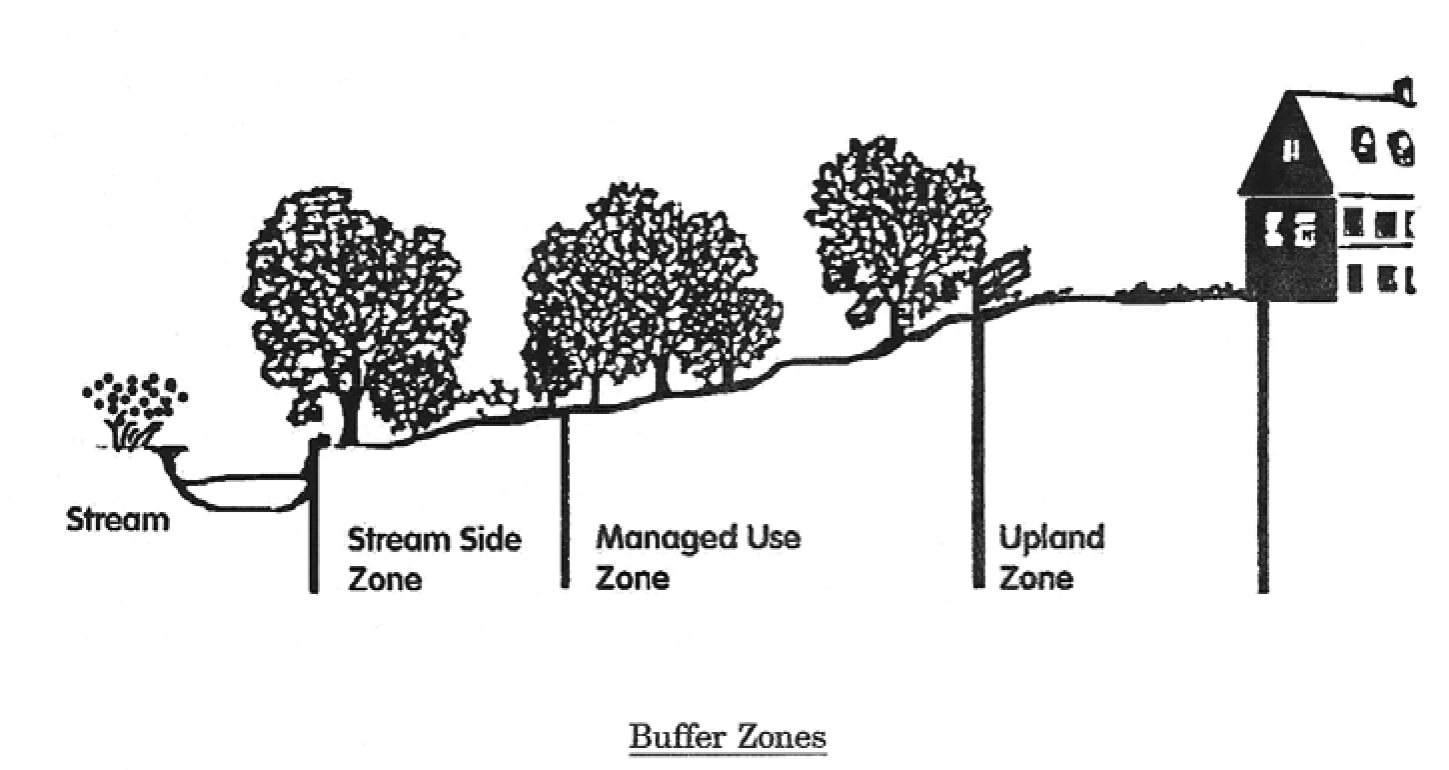
The stream buffer for Article 6, Section 6.6A, S.W.I.M. (Surface Water Improvement and Management) Stream Buffers, is comprised
of three (3) zones as shown below. See also Article 6, Section 6.8 (Post-Construction Ordinance).
 |
| Building | A structure having a roof supported by columns or walls for the shelter, housing, or enclosure of persons, animals or goods. Also see definitions for Accessory Building and Principal Building. See also Article 6, Section 6.8 (Post-Construction Ordinance). |
| Building Elevation | The view of any building or other structure from any one of four (4) sides showing features such as construction materials, design, height, dimensions, windows, doors, other architectural features, and the relationship of grade to floor level. |
| Building Footprint |
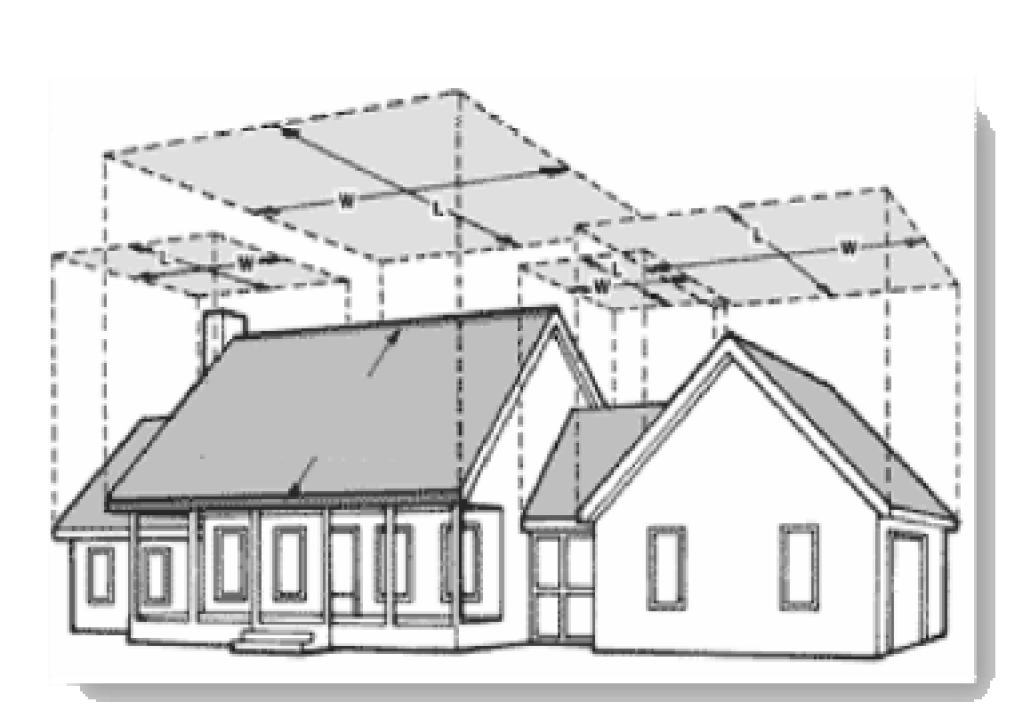
The outline of the total area of a lot or site that is surrounded by the exterior
walls of a building or portion of a building, exclusive of courtyards. In the absence
of surrounding exterior walls, the building footprint shall be the area under the
horizontal projection of the roof.
 |
| Building Height | Except for structures located in the DO-A and DO-B districts, the vertical distance from the mean elevation of the finished grade along the front of the building to the highest point of a flat roof, a mansard roof, or a gable, hip or gambrel roof. Roof appurtenances such as skylights; roof structures for elevators; stairways; tanks; heating, ventilating and air conditioning equipment; or similar operating and/or maintenance equipment shall be excluded from this measurement. In computing the height of a building, the height of a basement, if below the grade from which the height is measured, shall not be included. For structures located in the DO-A and DO-B districts the vertical distance from the finished grade to the lowest part of the roof line. |
| Building Lines | Lines that are tangent to the exterior surfaces of buildings or structures, or the surfaces of cantilevered projections therefrom, parallel to front, side and rear lot lines, and referred to as front, side and rear building lines, respectively. |
| Building Permit | An official document issued by Mecklenburg County pursuant to this Ordinance and the State building code that authorizes the erection, construction, reconstruction, restoration, alteration, enlargement, conversion, remodeling, demolition, moving, or repair of a building or structure. |
| Caliper | A horticultural method of measuring the diameter of a tree trunk for the purpose of size grading. The caliper of the trunk is measured six (6) inches above the ground for trees up to and including four (4) inches in diameter, twelve (12) inches above the ground for trees greater than four (4) inches up to twelve (12) inches in diameter, and a height of four and one-half (4.5) feet for trees greater than twelve (12) inches in diameter. |
| Canopy |
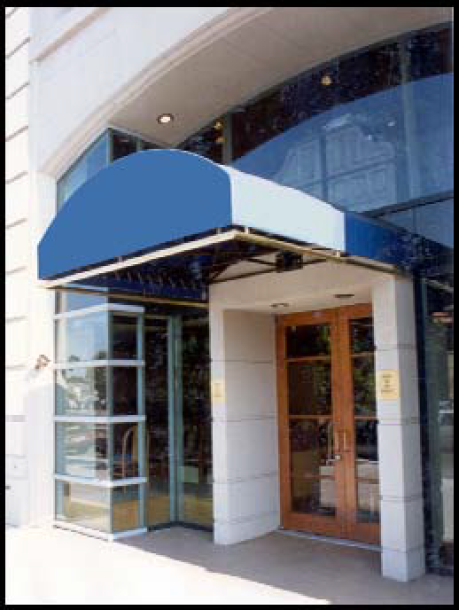
A permanent structure other than an awning made of cloth, metal or other material
attached or unattached to a building for the purpose of providing shelter to patrons
or automobiles, or as a decorative feature on a building wall. A canopy shall not
be considered as being a completely enclosed structure.
 |
| Car Wash, Automatic | A commercial establishment primarily engaged in the washing of automobiles, motorcycles, and pick-up and panel trucks. Such washing shall be done using a combination of automatic washing devices and manual labor provided by the commercial establishment. The retail sale of fuels may also be provided in an accessory capacity. Accessory self-vacuuming facilities shall be allowed. |
| Car Wash, Self Service | A commercial establishment primarily engaged in the washing of automobiles, motorcycles, and pick-up and panel trucks. Such washing shall be done manually by the customer (i.e., the use of fully automated devices which move the vehicle through a washing device shall not be permitted). Accessory self-vacuuming facilities shall be allowed. |
| Cemetery | Property used for the interment of the dead, which use may include the commercial sale and location of burial lots, crypts, or vaults for use exclusively on the subject property. A cemetery shall not be used for the preparation or embalming of bodies or the cremation of bodies. This definition shall be construed to include bona fide pet cemeteries. |
|
Certificate of
Compliance | A statement, signed by the Administrator, setting forth that a building, structure or use complies with this Ordinance. |
|
Certificate of
Occupancy | A document issued by the proper authority allowing the occupancy or use of a building and certifying that the structure or use has been constructed or will be used in compliance with all applicable building codes and regulations. |
| Certify | Whenever this Ordinance requires that some agency certify the existence of some fact or circumstance to the Town, the Town may require that such certification be made in any manner that provides reasonable assurance of the accuracy of the certification. By way of illustration, and without limiting the foregoing, the Town may accept certification by telephone from some agency when the circumstances warrant it, or the Town may require that the certification be in the form of a letter or other document. |
|
Charitable Service
Facility | A facility, other than a food pantry (see definition), operated by a public or private entity that directly distributes charity or relief services directly to the public. Examples of such a facility include soup kitchens and homeless shelters. Public office facilities (e.g., Department of Social Services facilities) and a church/place of worship shall not be deemed a charitable service facility. |
| Circulation Area | That portion of the vehicle accommodation area used for access to parking or loading areas or other facilities on the lot. Essentially, driveways and other maneuvering areas (other than parking aisles) comprise the circulation area. |
| Civic Building | Specialized buildings intended to serve as public gathering places. Uses include governmental offices, churches or other places of worship, schools, hospitals, post offices, and nonprofit or charitable clubs and organizations. |
| Close | A small green area surrounded by a drive way providing vehicular access to several buildings, performing the same function as a cul-de-sac but creating a socially useful space. The width of the close must correspond to the standard turning radius requirement. A close may be built to economical driveway standards unless it is accessed regularly by utility vehicles. |
| Commercial Vehicles | Passenger and non-passenger self-propelled or pulled type vehicles which are used by the owner, lessee or licensee directly for an occupation, employment or enterprise, except for farming, when pertaining to Section 7.2.21 (Supplemental Use Regulations for Commercial Vehicle Parking in Residential Districts), that is carried on for profit, i.e., buses, dump trucks, refrigerator trucks, tractor trailers, etc. Attached tractor trailers are considered one vehicle; however, any vehicular payload on the trailer such as a bulldozer or backhoe is considered a second vehicle. |
| Common open space | Open space that is designated to serve the residents of the immediate block or neighborhood. Ownership and maintenance of such areas shall be in fee-simple title to a homeowners association or similar organization. |
| Community Gardens | A grouping of garden plots available for small-scale cultivation, generally to residents of apartments or other dwelling types without private gardens. Community gardens should accommodate individual storage sheds. Community gardens are valuable for their recreational and communal role, similar to that of a club. |
| Comprehensive Plan | A plan, formally adopted by the local governing board, that includes policy statements, goals and objectives, maps and statistical data for the physical and economic development of the community. The document may also be referred to as Land Use Plan. |
| Conditional Zoning District | Conditional Zoning Districts are zoning districts in which the development and use of the property is subject to the rules, regulations, and conditions imposed as part of the legislative decision creating the district and applying the CZ district, and the agreed upon site-specific development requirements, to the particular property. All of the property specific standards and conditions (typically including a site plan) are incorporated into the zoning district regulations. |
| Conditional Zoning | Conditional Zoning is a legislative zoning map amendment with site-specific conditions incorporated into the zoning map amendment. |
| Condominium | The ownership of single units in a multi-unit structure with common areas and facilities. |
| Condominium Unit | An enclosed space consisting of one or more rooms occupying all or part of a floor in a building or one or more floors or stories regardless of whether it is designed for residence, for office, for the operation of industry or business, or for any other permitted use and shall include such accessory spaces and areas as may be described in the declaration, such as garage space, storage space, balcony, terrace or patio, provided it has a direct exit to a thoroughfare or to a given common space leading to a thoroughfare. |
| Convenience Store | A one story, retail store containing less than three thousand (3,000) square feet of gross floor area that is designed and stocked to sell primarily fuel, food (packaged and/or prepared), beverages, and other household supplies to customers who purchase relatively few items (in contrast to a "grocery store"). A "convenience store" is designed to attract and depends upon a large volume of stop-and-go traffic. Such a use may permit car washes as an accessory use but shall not include an Automobile Service Station (as that term is defined herein). |
| Crematorium | A facility whose primary function is for the cremation of human bodies or animals. |
| Cul-de-sac | Please see the definition for "Street" and the subdefinitions contained therein. |
|
Customary Home
Occupation | A use which is a profession or a hobby, or which is educational or domestic in nature and which occupation is carried on for financial gain within, and limited to the occupants of the residence, unless otherwise provided for in this Ordinance. |
| Day Care Center, Child | A building housing an agency, organization or individual whose primary purpose is to provide daytime care for six (6) or more preschool children and more than three (3) school-age children, unrelated by blood or marriage to, and not the legal wards or foster children of, the attendant. |
| Day Care, Home Small Group | A residential dwelling unit occupied by the operator that provides daytime care of not more than five (5) preschool age children including preschoolers living in that home and not more than three (3) school age children unrelated by blood or marriage to, and not the legal wards or foster children of, the attendant adult, within an occupied residence. |
| Day Care/Day Health Center, Adult | A facility where an individual, agency or organization provides supervision or care during the daytime for adults in need of care because of physical or mental disability in a place other than their usual place of abode. |
| Deck |
A structure without a roof, either freestanding or attached to a building, which is
supported by posts or pillars.
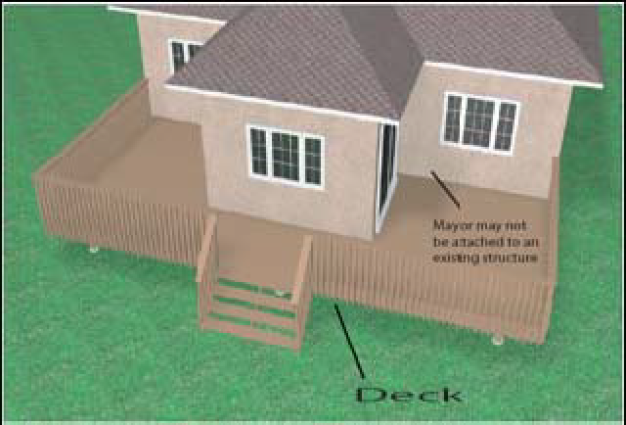 |
| Developer | Any person seeking approval under these regulations for any form of development. |
| Development | Except as limited in this subsection, the carrying out of any building activity, the making of any change in the use or appearance of any structure or land, or the subdividing of land into two (2) or more parcels. |
| Except as provided in Subsection (c) hereof, for the purposes of these regulations, the following activities or uses shall be considered "development:" | |
| The reconstruction, alteration of the size, or substantial change in the external appearance of a structure on land or water; | |
| A change in the intensity of use of land, such as an increase in the number of dwelling units in a structure or on land or a material increase in the number of businesses, manufacturing establishments, offices, or dwelling units in a structure or on land, but only so long as the increase in the number of such establishments materially increases the number of persons occupying or employed on the premises. | |
| Alteration of the shore or bank of a pond, lake, river, or other waterway; | |
| Commencement of drilling (except to obtain soil samples), mining, or excavation on a parcel of land; | |
| Clearing of land, including clearing or removal of vegetation and including any significant disturbance of vegetation or soil manipulation; or | |
| Deposit of refuse, solid or liquid waste, or fill on a parcel of land. | |
| When appropriate to the context, "development" refers to the act of developing or to the result of development. Reference to any specific operation is not intended to mean that the operation or activity, when part of other operations or activities, is not development. Reference to particular operations is not intended to limit the generality of this definition. | |
| For the purpose of these regulations the following operations or uses shall not be considered "development:" | |
| Work involving the maintenance, renewal, improvement, or alteration of any structure, if the work affects only the color or decoration of the exterior of the structure or interior alterations that do not change the use for which the structure was constructed; | |
| Work involving the maintenance or replacement of existing landscaped areas and existing rights-of-way; | |
| A change in use of land or structure from a use within a specified category of use to another use in the same category; | |
| A change in the ownership or form of ownership of any parcel or structure; | |
| The creation or termination of rights of access, riparian rights, easements, covenants concerning development of land, or other rights in land unless otherwise specifically required by law; or | |
| The clearing of survey cuts or other paths of less than four (4) feet in width. | |
| Also see definition in Article 6, Section 6.6A, S.W.I.M. (Surface Water Improvement and Management) and Article 6, Section 6.8 (Post-Construction Ordinance). | |
| Drainage Basin | The area of land which drains to a given point on a body of water. |
| Drive-In Facility |
A business or facility which is designed or intended to enable a customer to transact
business without exiting a motor vehicle; typically the motor vehicle is turned off
because the transaction of business (such as eating or watching a movie) takes longer
than a few minutes.
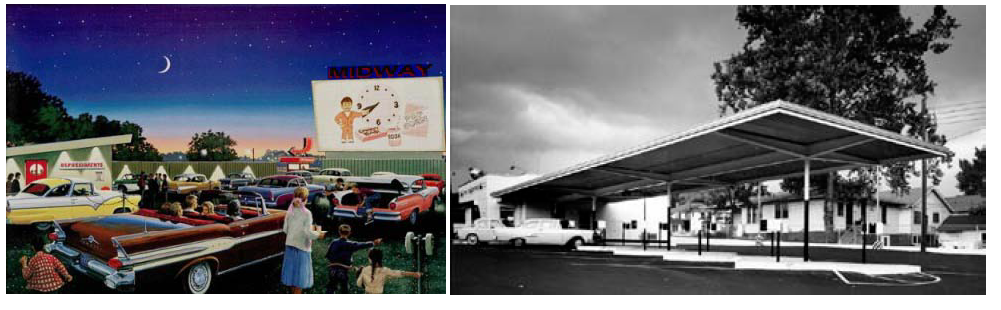 |
| Drive-Through Facility | A business or facility which is designed or intended to enable a customer to transact business without exiting a motor vehicle moving through the premises. A car-wash facility is not considered a drive-thru facility. |
| Drive-Through Window |
A window or other opening in the wall of a principal or accessory building through
which goods or services are provided directly to customers in motor vehicles by means
that eliminate the need for such customers to exit their motor vehicles.
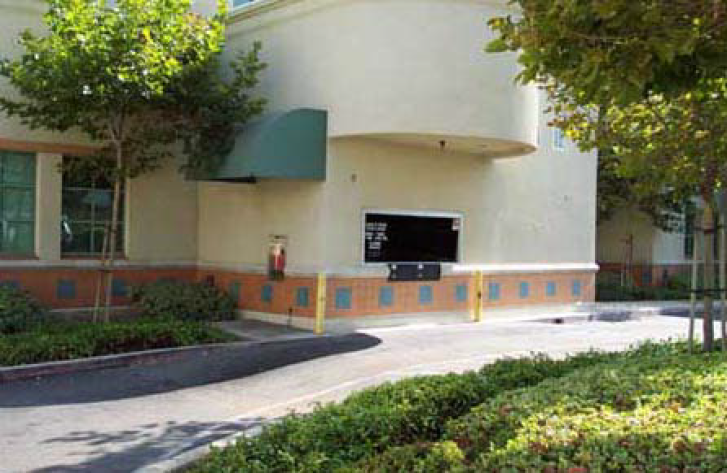 |
| Driveway | That portion of the vehicle accommodation area that consists of a travel lane bounded on either side by an area that is not part of the vehicle accommodation area. |
| Driving Range | An area for golfers to practice drives: a place or facility where golfers can practice their drive strokes, usually consisting of a row of small tees fronting an open area of ground. |
| Dry Cleaning/Laundry Plant | A commercial facility at which clothes are brought to be dry cleaned and/or laundered from individual dry cleaning service outlets. Such a facility may be a freestanding use or may be combined with a Laundromat. |
| Dry Cleaning/Laundry Service Outlet | Establishments engaged in providing laundry, dry cleaning and other related services on a pick up and drop off basis to individual customers. |
| Duplex |
A single-family attached dwelling where two (2) dwelling units located on the same
lot are joined by a common building wall.
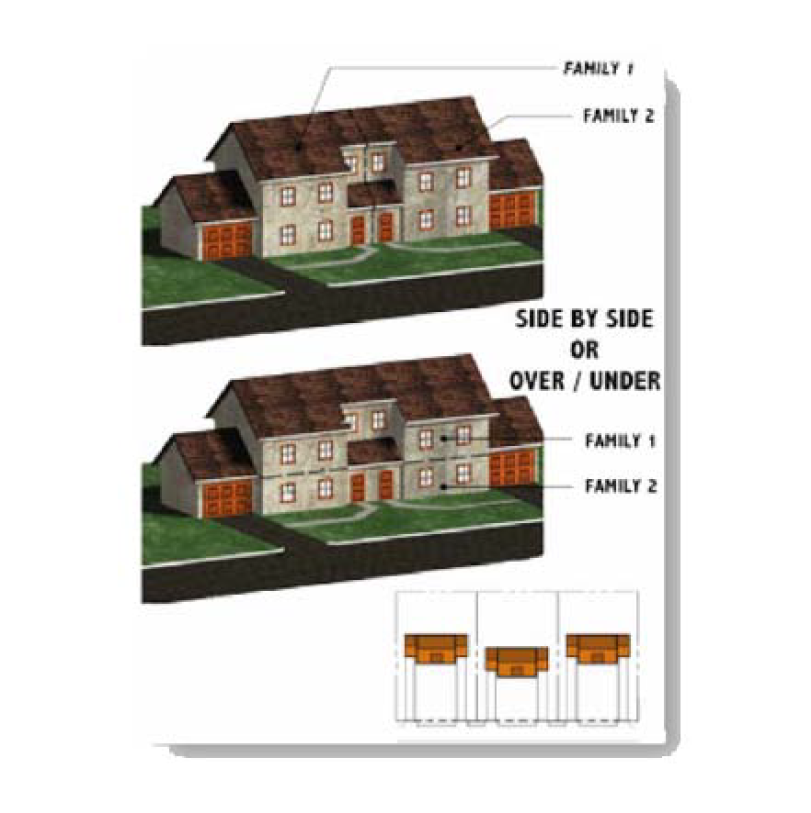 |
| Dwelling Unit | An enclosure of one or more rooms and separate bathroom and kitchen facilities designed and constructed as a unit for permanent residential occupancy by one family. |
| Dwelling, Detached | A dwelling unit not attached to another dwelling unit. |
|
Dwelling,
Manufactured Home | As defined under G.S. 143-145, as may be updated. A manufactured home must bear a seal certifying that it was built to the standards of the current National Manufactured Housing Construction and Safety Standards Act. A manufactured home may also be referred to as a "mobile home." The term manufactured home shall not include the terms travel trailers, motor homes, travel and/or motorized coaches, pick-up coaches, camping trailers, recreational vehicles, pop-up campers, prefabricated and modular structures and/or homes. |
| Dwelling, Mixed Use | A structure that contains both a principal residential and nonresidential (i.e., office or retail) use. See also "Live-Work Unit." |
|
Dwelling,
Modular Home, Building or Structure | A factory-fabricated building comprised of transportable module units designed to be incorporated at a building site into a permanent structure for residential, office, classroom, church hall, commercial or industrial use; furthermore, said units shall be only those having no integrated chassis, axle, wheels or other assemblies for the purpose of transport by means of its own integrated components whether or not separate vehicle is required for towing or otherwise powering the unit in transport; furthermore, said units shall be only those having no integrated means of disassembly for the purpose of transport to a subsequent location for reuse; furthermore, said units shall be only those bearing the official mandated insignia required of modular units sold in the state; furthermore, said units shall be only those conforming to state and/or federal requirements regarding design and/or construction; furthermore, said units shall be only those manufactured by only those persons, corporations, partnerships and/or firms licensed to sell new and/or manufactured modular structures in the state; furthermore, said units shall be only those requiring site-built permanent foundations as requirement by the building code adopted by the Town. The term modular home, building or structure shall not include the term mobile home or manufactured home. This type of construction is sometimes referred to as "Off-Site Construction." |
|
Dwelling, Multifamily
(Apartment) | A building designed, constructed or reconstructed and used for more than five (5) dwelling units, with each dwelling unit having a common structural or load-bearing wall of at least ten (10) lineal feet with any other dwelling unit on the same floor or building level. See also Multifamily definition in Article 6, Section 6.8 (Post-Construction Ordinance). See definitions for Duplex, Triplex, and Quadplex for multifamily structures with less than five (5) dwelling units. |
|
Dwelling,
Single-Family Attached (Townhouse) |
A single-family dwelling where two (2) or more dwelling units located on separate
lots are joined by a common building wall.
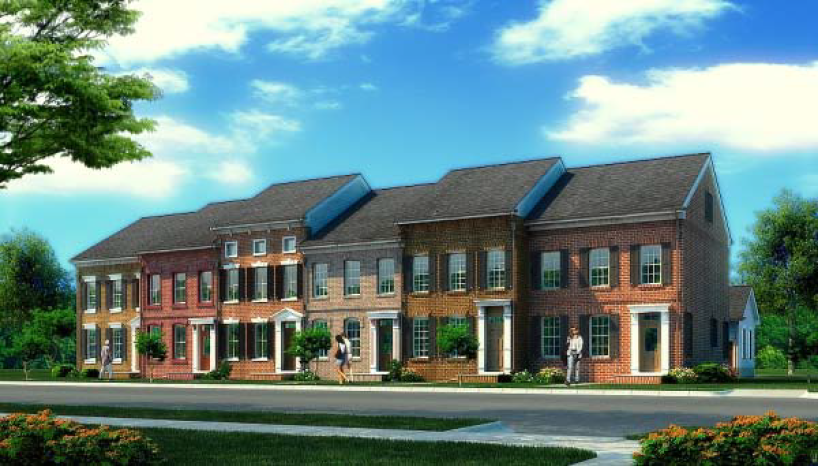 |
|
Dwelling,
Single-Family Detached |
A building other than a mobile home, designed constructed and used to house one family.
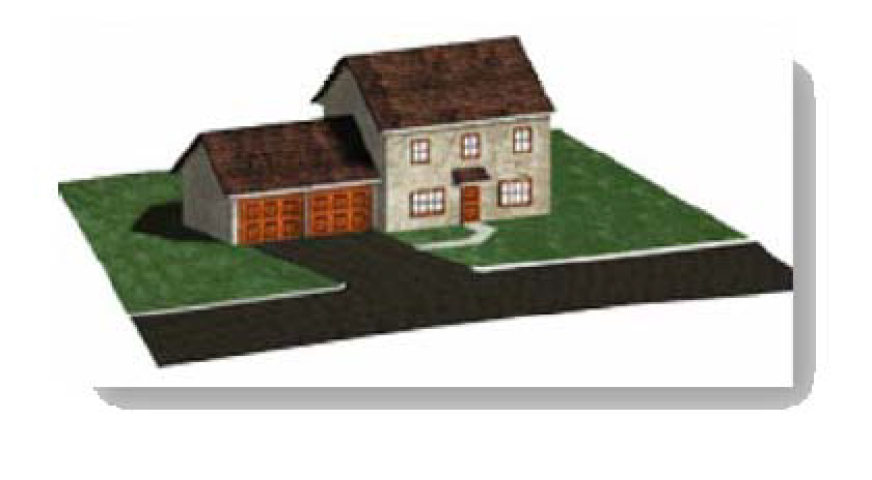 |
| Dwelling, Two-Family | See definition for "Duplex." |
| Easement | Agrant by a property owner to the public, a corporation, or other person or persons of the right to use an identifiable piece of land for specified purposes, such as for access or utilities, and which has been recorded in the Mecklenburg County Register of Deeds Office. |
| Encroachment | The projection or intrusion of a building, structure, or other land-disturbing activity into an area where such projections are typically prohibited. |
| Entertainment Use | Any establishment that provides active recreational opportunities such as miniature golf, batting cages, arcades, carnival games, go-cart or other motorized vehicle tracks, waterslides, or passive recreation such as movie theaters. |
| Environmentally Sensitive Areas | Areas determined by the planning department to be: (a) wetlands (e.g., lands that are seasonally or permanently wet. These areas are also made up of soils in which water is ponded at the surface for at least three (3) months of the year) and floodplains (e.g., those areas expected to be covered with two (2) or more feet of water at least once during the time period that is specified (typically one hundred (100) years); S.W.I.M. buffers (e.g., a natural or vegetated area through which stormwater runoff flows in a diffuse manner so that the runoff does not become channelized and which provides for infiltration of the runoff and filtering of pollutants); large, mature stands of trees (e.g., part of woodlands that comprise the largest, oldest, and healthiest stands of mature native trees); steep slopes (e.g., slopes with gradients over twenty-five (25) percent that are more difficult for clearing, regrading, or construction purposes due to their high potential for erosion and consequent sedimentation of water bodies); significant wildlife habitats (e.g., habitats of threatened or endangered wildlife species); street classification buffer (e.g., buffering adjacent to properties that abut the right-of-way of a freeway or expressway as shown on the adopted thoroughfare plan); historic and archaeological features (e.g., places on the National Register of Historic Places and other historic and/or archaeological site inventories identified for their historic and cultural significance. Some examples include old buildings and burial grounds). |
| Essential Services | Publicly or privately owned facilities or systems for the distribution of gas, electricity, steam, or water, the collection and disposal of sewage or refuse; the transmission of communications; or similar functions necessary for the provision of public services. The provision of public safety services (i.e., law enforcement, emergency medical services, rescue services, fire protection), governmental uses, and related services shall be included as an essential service as described in Essential Service, Class 4. Essential Services are divided into the following four (4) classes as defined below. |
|
Essential Services,
Class 1 | Transmission lines (whether, subterranean or overhead) including electrical, natural gas, and water distribution lines; sewer gravity lines and pressure mains; underground septic tanks and drain fields, cable television and telephone transmission lines; or similar utility lines; pumping stations; lift stations; telephone switching facilities (up to one-hundred (100) square feet gross floor area). |
|
Essential Services,
Class 2 | Elevated water storage tanks; booster stations, package treatment plants, telephone switching facilities (over one hundred (100) square feet gross floor area), substations, or other similarly required facilities in connection with telephone, electric, steam, water, sewer, or other similar utilities, and solid waste/recycling convenience center. |
|
Essential Services,
Class 3 | Generation facilities such as power plants; sanitary landfills; septic tank waste disposal facilities; water treatment plant; sewage treatment plants (excluding package treatment plants); microwave towers. |
|
Essential Services,
Class 4 | A use or facility owned or operated by the Town or its designee, serving in one of the following capacities, including, but not limited to: an agency office, rescue services (including volunteer rescue services), emergency medical services, public safety station, fire station (including volunteer fire station), public safety services and dispatch, or personnel training and development center. A public safety station may contain living quarters for on-duty personnel. Facilities for the maintenance of equipment housed at the operation site are also permitted. The following uses and/or activities shall not be classified as a Class 4 Essential Service: vehicle storage yard; outdoor/indoor firing range; jail; prison; sanitary landfill; solid waste transfer or disposal facility; wastewater treatment facility; educational or health institution; university; group home; half- way house or housing for persons who are participating in work release programs or who have previously served and completed terms of imprisonment for violations of criminal laws. |
|
Extraterritorial
Jurisdiction ("ETJ") | That portion of the Town of Mint Hill's planning jurisdiction that lies outside the Town's corporate boundaries. |
| Facade | That portion of any exterior elevation on the building extending from grade to top of the parapet, wall or eaves and the entire width of the building elevation. A porch or stoop is not considered part of the facade. |
| Family | An individual, or two (2) or more persons related by blood, marriage, or adoption living together as a single housekeeping unit; or group of not more than six (6) persons, who need not be related by blood, marriage, or adoption, living together as a single housekeeping, family care or group home unit. |
| Farm | Any tract of land at least ten (10) acres in size used for the raising of any agricultural products, including livestock, except swine, commercial poultry or fur bearing animals. See also "Bona Fide Farm." |
| Farm Supply Store | An establishment where feed, seed, animal and agricultural supplies are primarily sold in bulk quantities. |
| Farmers Market | A larger destination market with multiple vendors at which fruits and vegetables are regularly sold to the general public on a retail basis. Other food items, handmade crafts, and baked goods may also be sold at such establishments. |
| FEMA Fringe | See definition in Article 6, Section 6.6A, S.W.I.M. (Surface Water Improvement and Management) Stream Buffers and Flood Regulations. |
| Fence | A barrier enclosing or bordering a parcel of land used to prevent entry, to confine, or to mark a boundary. |
| Final Plat | The final subdivision plat that is approved by the procedures specified in this Ordinance and then recorded with Mecklenburg County. |
| Financial Institution | A commercial bank, a mortgage bank, a savings bank, a saving and loan association, or a credit union any of which are licensed, insured or chartered by the United States of America or the State of North Carolina. Manned drive-through services may be provided on site. Outdoor automatic teller machines (ATMs), drive-through or walk-up, may or may not be provided. |
| Firing Range | An indoor practice range for target practice |
| Flea Market | A market held in an open area or structure where goods are offered for sale to the general public by individual sellers from open or semi-open facilities, booths, or temporary structures. |
| Flex Space | A building or portion thereof that can be used and/or easily converted to use for office, retail sales, wholesale sales, distribution or storage use. |
| Floodplain | See definition in Article 6, Section 6.6A, S.W.I.M. (Surface Water Improvement and Management) Stream Buffers and Flood Regulations. |
| Floodplain Land Use Map (FLUM) | See definition in Article 6, Section 6.6A, S.W.I.M. (Surface Water Improvement and Management) Stream Buffers and Flood Regulations. |
| Floodway | See definition in Article 6, Section 6.6A, S.W.I.M. (Surface Water Improvement and Management) Stream Buffers and Flood Regulations. |
| Floor | The top surface of an enclosed area in a building (including basement), i.e., top of slab in concrete slab construction or top of wood flooring in a frame construction. The term does not include the floor of a garage used solely for parking vehicles. See Article 6, Section 6.6A, S.W.I.M. (Surface Water Improvement and Management) for all matters pertaining to floodplain and floodway regulations. |
| Floor Area, Gross | The total floor area enclosed within a building, including interior balconies and mezzanines, exclusive of stairways and elevator shafts. For multifamily units the total floor area contained within the individual units as measured from the inside of the exterior walls of the unit exclusive of stairways. |
| FLUM Floodway | See definition in Article 6, Section 6.6A, S.W.I.M. (Surface Water Improvement and Management) Stream Buffers and Flood Regulations. |
|
FLUM Floodway
Encroachment Lines | See definition in Article 6, Section 6.6A, S.W.I.M. (Surface Water Improvement and Management) Stream Buffers and Flood Regulations. |
| Food Pantry | A facility operated by a public or nonprofit entity that directly distributes unprepared packaged food items to the public on a charitable basis. Such facilities may also distribute clothing to the general public in such manner. |
| Fruit/Vegetable Stand | A single vendor's, small, roadside stand established to sell fruits and vegetables to the general public on a retail basis. |
| Garage, Private | A building or portion thereof that is accessory to a principal structure and providing for the storage of automobiles, and in which there is no occupation or business for profit carried on. Such garage shall be enclosed on all four (4) sides, and may be attached to or detached from the principal dwelling unit. |
|
Garage, Rear Load
Detached | A building, attached or detached, which is loaded and accessible only by an alley way or street along the rear of the lot, and where there is no vehicular access from the front street. |
| Golf Course | An area of land laid out for playing the game of golf with a series of nine (9) or eighteen (18) holes each including tee, fairway, and putting green and often one or more natural or artificial hazards. |
| Grade, Finished | A reference plane representing the average of finished ground level adjoining the building at all exterior walls. When the finished ground level slopes away from the exterior walls, the reference plane shall be established by the lowest points within the area between the building and the lot line or between the building and a point six (6) feet from the building and the lot line or between the building and a point six (6) feet from the building, whichever is closer to the building. |
| Grade, Street | The height of the top of the curb, or if no curb exists, the height of the edge of pavement in the lane of travel adjacent to the side of the street at which the grade is being measured. |
| Green | A medium-sized public space available for unstructured recreation, circumscribed by building facades, its landscape consisting of grassy areas and trees, naturalistically disposed and requiring only limited maintenance. |
| Greenway | A corridor encompassing a trail for bicycles or pedestrians consistent with standards adopted by Mecklenburg County Parks and Recreation, but at no time should be less than ten (10) feet in width. The trajectory of a greenway should lead through rural as well as urban areas, connecting the countryside to urban parks. The landscaping pattern should be appropriate to the location: naturalistic within the countryside, and formal within the neighborhoods. |
|
Grocery Store
(Food Store) | An establishment, over three thousand (3,000) square feet in area, which may sell a wide variety of fresh produce, canned and packaged food items, small household goods and similar items which are consumed and used off premises. In addition, the store may contain a delicatessen section in which prepared foods are sold and may be consumed on premises in a specially designed sit-down area. Such stores may also contain manned internal bank branches or unmanned ATMs. |
| Grooming Services | Establishments engaged primarily in providing services to a person's grooming needs. Such services include, but are not limited to: barbershops, beauty shops, tanning salons and nail salons. Tattoo parlors shall not be included under this definition. |
| Gross Density | The quotient of the total number of dwelling units divided by the base site area of a site, expressed in dwelling units per acre. |
| Health Center | A center, providing outpatient and short term hospital facilities for medical and mental health patients, as well as dental and social services. |
| Health Club, Spa, Gymnasium (principal use) | A place of business with equipment and facilities for exercising and improving physical fitness. |
| Health Department | The Mecklenburg County Health Department. |
|
Health Massage/
Bodywork Therapist | Any person who is engaged in the practice of health massage/bodywork therapy and who is licensed under N.C. law. |
|
Health Massage/
Bodywork Therapy | Systems of activity applied to the superficial or deep tissues (muscles, tendons, ligaments, connective tissue, skin) of the body by means of applying pressure with the hands, feet, arms or elbows for therapeutic and/or relaxing purposes. Soft tissue health massage/bodywork practices are designed to promote general relaxation, improve flexibility and pliability of the soft tissues or relieve stress and muscle hypertension and to enhance a general sense of well-being in the client. The term "therapy" does not include the diagnosis or treatment of illness or disease, medical procedure or the use of modalities for which a license to practice medicine, chiropractic, physical therapy, acupuncture or podiatry is required by law. |
|
Health Massage/
Bodywork Therapy Establishment | Any business or establishment wherein massage/bodywork therapy is performed solely by health massage/bodywork therapists. |
| Heavy, Industrial, Farm Equipment Sales and Service | A facility where vehicles or other apparatus commonly used in commercial, industrial or construction enterprises are sold and serviced. This includes, but is not be limited to: trucks, trailers, bulldozers, cranes, backhoes, rollers, loaders, and lifts, each having a gross weight of two and one-half (2.5) tons or more. |
| Heliport/Helistop | A facility or structure that is intended or used for the landing and takeoff of rotary wing aircraft in support of principal permitted uses, but not including the regular repair, fueling or maintenance of such aircraft or the sale of goods or materials to users of such aircraft. |
| Highest Adjacent Grade | See definition in Article 6, Section 6.6A, S.W.I.M. (Surface Water Improvement and Management) Stream Buffers and Flood Regulations. |
| Holiday Decorations | Displays erected on a seasonal basis in observance of religious, national, or state holidays which are not intended to be permanent in nature and which contain no advertising material. |
| Home for the Aged | See definition for "Nursing Home." |
|
Home Occupation,
Customary | A commercial activity that: (i) is conducted by a person on the same lot where such person resides, and (ii) is not so insubstantial or incidental or is not so commonly associated with the residential use as to be regarded as an accessory use, but that can be conducted without any significantly adverse impact on the surrounding neighborhood. See Section 6.9.1 for regulations and further illustrations. |
| Hospital | As defined in G.S. 131E-76, as may be amended from time to time. |
| Household Pet | A tame animal that is kept as a pet and is not a wild animal or livestock, including, but not limited to, dogs, cats, fish and fowl/chickens. Additionally, miniature goats, which are defined as pygmy, Nigerian dwarf, and Pygora goats, are classified as Household Pets on lots that are greater than one acre. |
| HVAC Equipment |
External heating, ventilation, air conditioning, and other mechanical and utility
equipment, including, but not limited to, hoses, pipes, vents, fans, compressors,
pumps, and heating and cooling units associated with buildings and accessory structures.
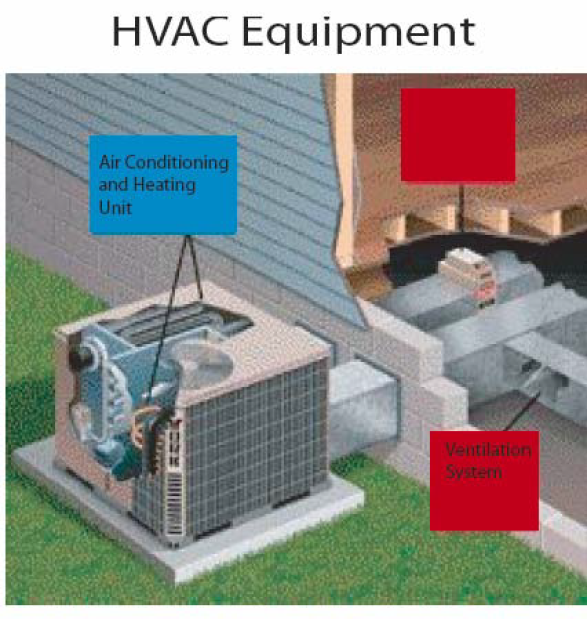 |
| Improved open space | Open space that is improved with pedestrian trails used for walking or jogging; improvements built in accordance with the officially adopted cross section diagram for walking trails, biking trails, and/or picnic areas. |
| Industrial Heavy Equipment Bulk Storage Yard | Storage area, either open or enclosed for heavy equipment, new or used, including refrigeration equipment, chillers, boilers, motorized heavy equipment, bulk production equipment, and other miscellaneous equipment not covered under Junk Yard definition or other sections of this Ordinance. |
| Inn | See definition for "Bed and Breakfast." |
| Intermittent Stream | A stream or portion of a stream that flows only in direct response to precipitation. It receives little or no water from springs and only temporary supply from melting snows or other sources. It is dry for a large part of the year. |
| Junkyard and Salvage Yard | The use of more than five hundred (500) square feet of the area of any lot for the outdoor storage, keeping or abandonment of junk, including scrap metals or other scrap materials, or for the dismantling, demolition or abandonment of two (2) or more automobiles, vehicles or machinery, farm equipment or parts thereof. |
| Kindergarten | An agency, organization, or individual whose primary purpose is to provide pre-school instruction for six (6) or more children, unrelated by blood or marriage to, and not the legal wards or foster children of, the attendant adult. |
| Land Use Plan | The land use plan as referenced herein is the comprehensive plan for the present and future development of the Town of Mint Hill prepared, adopted and from time to time amended by the Board of Commissioners. |
| Laundromat | A commercial facility open to the general public where coin operated washing and drying machines are available for use. |
| Lawn and Garden Center | A retail sales and service establishment with retail sales of nursery stock and accessory supplies, fresh produce, landscaping supplies, lawn furniture, playground equipment, topsoil, mulching materials, garden tractors, utility vehicles, and lawn mowers and similar powered lawn and garden equipment and other similar supplies and equipment used for lawn and garden purposes and retail repair and service for such equipment. |
| Library | A public facility for the shared use of literary, musical, audio-visual, artistic, or reference materials. |
| Livestock | Cows, beef cattle, sheep, swine, horses, ponies, mules, goats (except for breeds that are defined as "Household Pets"), llamas, alpaca, emu, ostrich or any other animals typically used by man for use on a farm or raised for sale or profit including mutations or hybrids of such animals such as miniature horses or miniature ponies. |
| Live-Work Unit | Small commercial enterprises with the ground floor occupied by commercial uses and a residential unit above. Commercial space may be a home-based business or may be leased independently. |
| Lot | A parcel of land where boundaries have been established by some legal instrument such as a recorded deed or a recorded map and which is recognized as a separate legal entity for purposes of transfer of title. |
| Lot Coverage | The amount of land permitted to be covered with structures as expressed by a percent of the total lot area. |
| Lot Fronting | A corner lot shall be deemed to front on that street which is parallel to the street property line with the smaller dimension. |
| Lot of Record | A lot, described by plat or metes and bounds, approved by the Planning Board and recorded in the office of the Register of Deeds or a lot which was recorded prior to the date the prior subdivision ordinance or this Ordinance became effective on such lot. |
| Lot Width | The distance between the side lot lines, measured along the setback line as established by this Ordinance, or if no setback line is established, the distance between the side lot lines measured along the street line. |
| Lot, Corner | A lot which occupies the interior angle at the intersection of two (2) streets and which has frontage on both streets. |
| Lot, Through | A lot, other than a corner lot, having frontage on more than one street (also sometimes referred to as a double frontage lot). |
| Lot, Zoning | A parcel of land or a contiguous combination of several parcels of land in one ownership, and of sufficient area and dimension to comply with all minimum zoning requirements for the uses permitted in the district in which such lot or lot combination is located. |
| LUESA | Mecklenburg County Land Use and Environmental Services Agency. |
| Machine, Metal and Woodworking Shop | A workshop, in which work, including, but not limited to, metal and woodwork, is machined, assembled or finished. |
| Manufacturing Use | The assembly, fabrication, production or processing of goods and materials using processes that ordinarily have greater than average impacts on the environment, or that ordinarily have significant impacts on the use and enjoyment of other properties in terms of noise, smoke, fumes, odors, glare, or health or safety hazards, or that otherwise do not constitute "light manufacturing," or any use where the area occupied by outdoor storage of goods and materials used in the assembly, fabrication, production or processing exceeds twenty-five (25) percent of the floor area of all buildings on the lot. "Heavy manufacturing" shall include, but not be limited to, the following: enameling, lacquering, or the plating or galvanizing of metals; foundries or mills producing iron and steel products; industrial chemical manufacture; meat packing plants; mixing plants for concrete or paving materials, and manufacture of concrete products; oxygen manufacture and/or storage; pottery, porcelain, and vitreous china manufacture; poultry dressing for wholesale; pressure treating of wood; stonecutting; tire recapping and retreading; tobacco products manufacture; tobacco stemming and redrying plants. This shall include resource extraction and recycling and salvage operations. |
| Marginal-Access Street | Please see the definition for "Street" and the subdefinitions contained therein. |
| Meadow | An area available for unstructured recreation outside of a neighborhood. A meadow is naturalistic, consisting of native plants, growing unchecked, and requiring minimal maintenance. |
|
Medical Education
Center | A center for the ongoing training and education of licensed healthcare personnel. Such centers include nursing schools and medical education centers in support of principal permitted uses. |
| Mining | Removal of natural deposits, minerals, ores, soils, or other solid material from original location excluding on-site processing for sale. |
| Mini-Warehouse | A structure containing separate storage spaces of varying sizes leased or rented on an individual basis. No outdoor storage shall be allowed in conjunction with the facility with the following exceptions: boats, cars; motorcycles; trailers; motor homes, pickup trucks and similar-type and size vehicles. All such areas devoted for outdoor storage shall be in areas so designated for such storage. Use of the leased storage spaces shall be for storage purposes only. |
|
Minor Industrial
Access Street | Please see the definition for "Street" and the subdefinitions contained therein. |
|
Minor Residential
Access Street | Please see the definition for "Street" and the subdefinitions contained therein. |
| Mitigation | Actions taken either on-site or off-site as allowed by Article 6, Section 6.6A, S.W.I.M. (Surface Water Improvement and Management) Stream Buffers to offset the effects of temporary or permanent loss of the buffer. See also Article 6, Section 6.8 (Post-Construction Ordinance). |
| Mobile Home Park | Any lot, tract or parcel of land used, maintained or intended to be used, leased or rented for occupancy by mobile homes and developed in accordance with the standards provided for in this Ordinance. This definition shall not include mobile home sales lots on which unoccupied mobile homes are parked for the purpose of inspection and sale. |
| Mobile Home Space | Any premises within a mobile home park used or intended to be used or occupied by one mobile home that is anchored in place or supported by a foundation or other stationary supports, together with automobile parking space, utility structures, and other required facilities incidental thereto. |
| Motels | An establishment providing transient accommodations containing six (6) or more rooms with at least twenty-five (25) percent of all rooms having direct access to the outside without the necessity of passing through the main lobby of the building. |
| Mother-in-Law Suite | An accessory dwelling sharing ownership, site and utilities with the principal dwelling unit in the form of a guest house or garage apartment that is either attached, part of or separate from the principal dwelling unit, provided that it meets the requirements for accessory uses under this Ordinance and is occupied by the owner or owner's family and is not rented and provided that the principal dwelling unit on the lot containing the mother-in-law suite shall be owner-occupied. |
|
Moving and Storage
Facilities | A facility that provides pickup and hauling of items and temporary on-site storage sometimes referred to as "ministorage". Moving vehicles for rent or hire and associated supplies may be purchased or rented. |
| Multifamily | See definition for "Dwelling, Multifamily." |
| Museum | A structure that serves as a repository for a collection of curiosities or objects of interest or works of art intended to be viewed by members of the public with or without admission costs. It may include an accessory use with the sale of goods/gifts to the public and/or an eating establishment for visitors and employees. |
| Nonconforming Lot | A lot existing at the effective date of this Ordinance (and not created for the purposes of evading the restrictions of this Ordinance) that does not meet the minimum requirements of the zoning district in which the lot is located. |
| Nonconforming Use | A nonconforming situation that occurs when property is used for a purpose or in a manner made unlawful by the use regulations applicable to the zoning district in which the property is located. (For example, a commercial office building in a residential district may be a nonconforming use.) The term also refers to the activity that constitutes the use made of the property. (For example, all the activity associated with running a bakery in a residentially zoned area is a nonconforming use.) |
| Non-Pedestrian-Oriented Street | A public street that serves primarily as a service street for the routing of commercial vehicles. Non-pedestrian streets (and their reduced pedestrian-orientation) are permissible in the street network if a pedestrian oriented street is provided within four hundred (400) feet. |
| Nurseries, Retail | See "Lawn and Garden Center." |
| Nurseries, Wholesale | A place where plants are propagated and grown to usable size. Wholesale nurseries sell only to businesses such as other nurseries and to commercial gardeners. Some wholesale nurseries sell by mail. |
| Nursing Home | A licensed facility that provides supportive service to six (6) or more elderly or disabled in-house residents who need a wide range of health and support services located on the site, such as medical and nursing care, central dining, and transportation services. Nursing Homes typically provide a full spectrum of medical care, where as Assisted Living Facilities offer assistance with some basic tasks and medication reminders but not medical care. See also definition for "Assisted Living Facility." |
| Office Use | Professional, service, and governmental occupations within a building or buildings which do not generally involve the on-site sale of goods to customers. |
| Office, Medical Services | An office (as herein defined) facility containing space for patient waiting rooms, treatment areas and laboratory space for medical doctors (MDs), osteopaths, chiropractors, dentists, podiatrists, acupuncturists, psychologists, licensed nurse/midwifes, licensed physical therapists, licensed nurse practitioners, licensed respiratory therapists or optometrists. |
| Open space | All areas not covered by building or parking lots, dry detention, streets or required setbacks. |
|
Outdoor Resale
Business | A business that sells used merchandise (other than automobiles, trucks, boats, motorcycles, manufactured homes or recreational vehicles) and stores or displays this merchandise outdoors on a regular basis. |
| Outparcel |
A parcel of land generally located on the perimeter of a large commercial parcel of
land with no more than one principal use and which is subordinate to the larger parcel
for access, drainage and parking purposes.
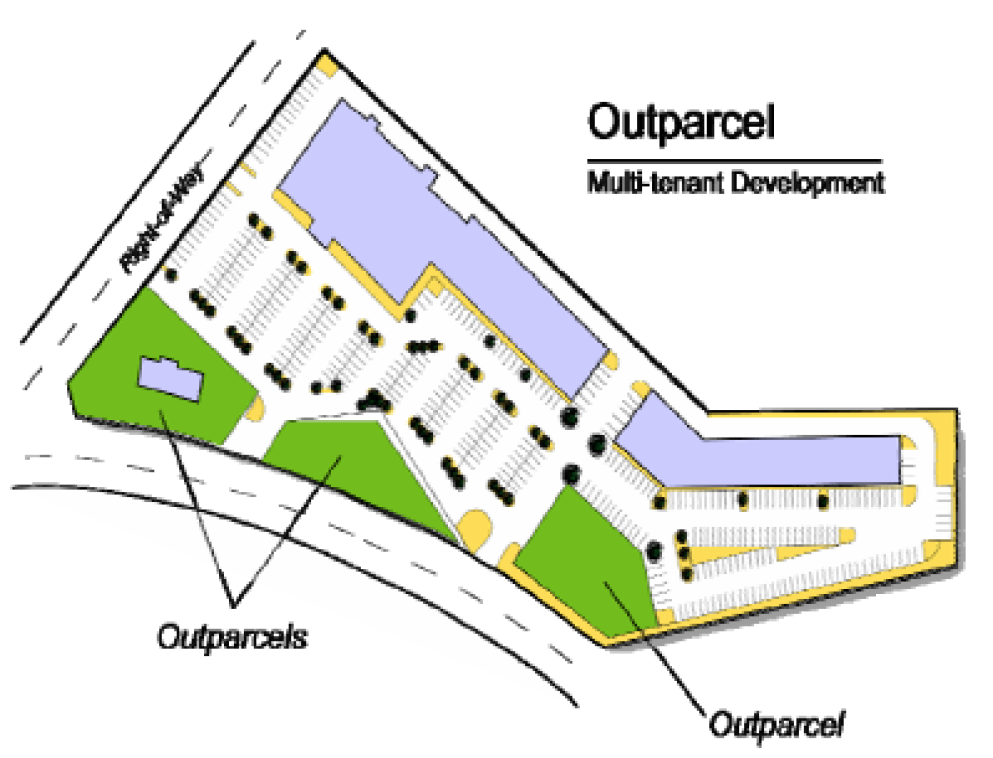 |
|
Outpatient Wellness
Center | A center designed for the ongoing health care needs of established medical patients which can include a variety of services, including, but not limited to, physical or mental therapy in support of principal permitted uses. Such centers shall not be deemed to include YMCAs or YWCAs or commercial physical fitness centers. |
|
Outside Display of
Goods for Sale or Rent | Display outside of a fully enclosed building of the particular goods or pieces of merchandise or equipment that are themselves for sale or rent. Outside display is to be distinguished from outside storage of goods that are not prepared and displayed for immediate sale or rent. |
| Park | A facility operated by an entity, other than the Town of Mint Hill, that may or may not be open to the general public for outdoor active recreational uses, including, but not limited to: ball fields, swimming facilities, camping facilities, and which contains improvements designed specifically for such active recreational uses. Such facilities may also contain improvements designed for passive recreational uses. (See Section 7.2.15, Nonresidential Use in the Residential Zoning District.) |
|
Park and Recreation
Committee | The Mint Hill Park and Recreation Committee. |
| Parking Area Aisles | A portion of the vehicle accommodation area consisting of lanes providing access to parking spaces. |
|
Parking Facility,
Overflow | An off-street parking area intended for the storage of vehicles for special, athletic or other occasional events. Such a facility is not typically used more than ten (10) times a year. |
|
Parking Lot
(principal use) | An open, hard-surfaced area, other than a street or public way, that is used for the storage, for limited periods of time, of passenger vehicles and commercial vehicles, and is available to the public, whether for compensation or free. Off-street parking areas that are provided in association with a particular use shall not be considered as being a "parking lot" as herein defined. |
| Parking Space | A portion of the vehicle accommodation area set aside for the parking of one vehicle. |
| Passenger Vehicle | A car, pickup truck, passenger van, minivan, motorcycle, and any similar automobile designed and used for basic transportation. |
| Passive Open Space | Open space that is left natural and undisturbed. |
| Patio (Terrace) | A paved area adjoining a house, typically used for outdoor dining and recreation. |
| Personal Health Clinic | A medical or health clinic which routinely provides for the care and treatment of and testing for physical emotional or mental injury, illness or disability and which may include overnight patient care. |
|
Planned Unit
Development | A development constructed on a tract of land at least one hundred fifty (150) acres, planned and developed as an integral unit, and consisting of a combination of principal uses that could not be combined in any district other than a planned unit development district. See Section 7.2.31 (Supplementary Use Regulations for Planned Unit Development - Conditional Zoning). |
| Planning Jurisdiction | The area within the Town limits as well as the area beyond the Town limits within which the Town is authorized to plan for and regulate development pursuant to the authority granted in G.S. Chapter 160D, Article 2. |
| Playground | An area developed with facilities primarily for children's recreation that may include benches, slides, play equipment, walk trails, etc. As opposed to a "park," a playground is usually smaller and does not contain athletic fields. However, a park may contain a playground. |
| Playground | A small open area specifically designed and equipped for the play of small children. A playground is usually fenced and may include an open shelter. Playgrounds should be interspersed within residential areas, a short walking distance from dwellings. |
| Plaza |
A paved area surrounded by buildings or streets and located in such manner so as to
be accessible by pedestrians. Such area is improved with benches, ornamental and/or
drinking fountains, works of art, etc. Part of the plaza may contain a grassed area.
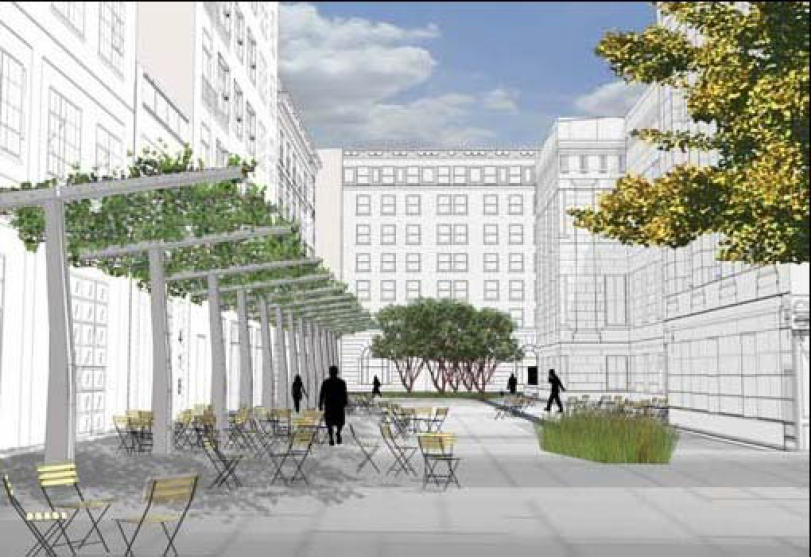 |
| Plaza | A public space at the intersection of important streets set aside for civic purposes and commercial activities. A plaza is circumscribed by frontages; its landscape consists of durable pavement for parking and trees requiring little maintenance. All parking lots on frontages should be designed as plazas with the paving not marked or detailed as parking lots. |
| Porch | A projection from an outside wall of a dwelling which is covered by a roof and/or sidewalls (other than the sides of the building to which the porch is attached) for the purpose of providing shade or shelter from the elements and which may or may not be screened. |
| Preliminary Plat | The initial subdivision plan submitted to the Mint Hill Planning Board for approval in order to proceed with development of any major or minor subdivision. See Subsection 8.2(B)(3). |
| Pre-Sketch Drawing | An informal submittal meeting the requirements of Subsection 8.2(B)(1) containing very basic information about the existing features of a property typically using the Charlotte-Mecklenburg Polaris GIS Mapping System and which depicts the Applicant's idea for the proposed development project. See Subsection 8.2(B)(1). |
|
Principal Building
or Structure | A building or structure containing the principal use of the lot. |
| Principal Use | The primary purpose or function that a lot serves or is intended to serve. Uses are listed in the Table of Principal Permitted Uses in Section 5.2. |
| Produce Stand | See "Fruit/Vegetable Stand." |
|
Public Informatio
Meetings (PIM) | Meetings to provide an opportunity for area residents and developers to meet, review and discuss proposed develop plans. See Subsection 8.3(A)(3). |
| Public Open Space | Open space that is designated to serve the public and that has free and public access (although hours of access may be reasonably restricted for health or safety reasons). Ownership and maintenance of such areas shall be in fee simple title to a nonprofit conservancy organization or a local government, homeowners association or similar organization. |
|
Quadraplex or
Quadplex |
A single-family attached dwelling where four (4) dwelling units located on the same
lot are joined by a common building wall.
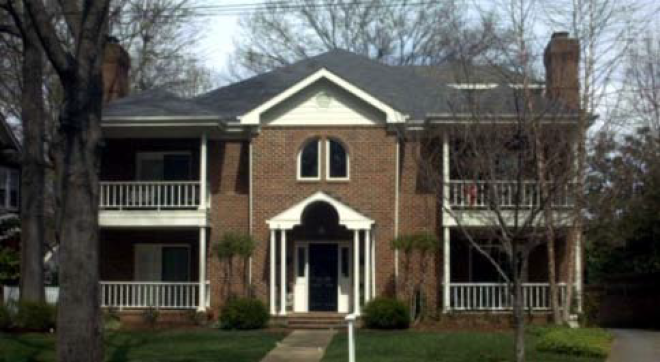 |
| Railroad Terminal and Yard | An area of land covered with tracks for switching, storing, moving, repairing, and weighing of railroad cars, trains, or engines. |
| Recreational Vehicle | Any vehicle or portable structure designed primarily to provide temporary living quarters for recreation, camping or travel use; either mounted on wheels or designed to be mounted upon and carried by another vehicle. This definition is intended to include overnight camping trailers, travel trailers, utility trailers and boats. |
| Rental Cottage | An apartment located in an accessory building, secondary in size to the principal building, sharing ownership, site and utilities with the principal building. In the DO-A Overly District, the principal building shall be owner-occupied. |
| Restaurant | A commercial establishment where food and drink are prepared, and purchased on premises (either outdoors or indoors). The establishment may provide indoor or outdoor eating facilities or may be geared partially or primarily for takeout food. If food consumption facilities are provided, they shall largely be within the building. Such establishment shall not have manned drive-through facilities. Restaurants, if properly licensed, may also serve alcoholic beverages. Also known as a "dine-in" restaurant with a "to-go" or "curb-side" service. |
|
Restaurant Within
Other Facilities | A restaurant located within another principal business and is incidental to that business. Food and drink are prepared primarily for sale and consumption by the customers of the principal business. The restaurant use is not a principal use within the building and may not be accessed from the outside. Examples of such restaurant are: canteen within a business, grill within a convenience store or bowling alley, etc. |
|
Restaurant with
Drive-Through | A commercial establishment where food is prepared, and purchased within the principal building or through a drive-through window. The establishment may provide indoor eating facility or may be geared partially or primarily for takeout food. Also known as a "fast food" restaurant. |
| Retail Use | A building, property, or activity the principal use or purpose of which is the retail sale of goods, products, or merchandise directly to the consumer. Such a retail establishment shall not be classified as a "Retail" use, if listed elsewhere in the Table of Principal Permitted Uses of this Ordinance (see Section 5.2). Examples of excluded uses include: restaurants and convenience stores, etc. |
| S.W.I.M. Buffer | See Article 6, Section 6.6A, for detailed guidance for Surface Water Improvement Management (S.W.I.M.) Stream Buffers. |
| Satellite Dish | A dish-shaped antenna designed for the reception of electronic signals from satellites. |
| School Board | The Charlotte-Mecklenburg Board of Education. |
| School, Home | A nonpublic school in which one or more children of not more than two (2) families or households receive academic instruction from parents or legal guardians, or a member of either household. This shall apply to children of compulsory school attendance age as established by the state. |
| Secondary Street | Please see the definition for "Street" and the subdefinitions contained therein. |
| Setback, Established | The distance between a road right-of-way or property line and the front, side or rear of a building or structure, as constructed. |
| Setback, Rear | The distance between property line or a road right-of-way, whichever is closer to the proposed structure, and the rear of a building or structure, whichever is closer to the proposed structure, that shall remain unoccupied and unobstructed upward except as may be permitted elsewhere in this Ordinance. |
| Setback, Required | A minimum distance required for front, rear and side yards in the various zoning districts measured inward from a property line or a road right-of-way, whichever is closer to the proposed structure, that shall remain unoccupied and unobstructed upward except as may be permitted elsewhere in this Ordinance. |
| Setback, Side | The distance between property line or a road right-of-way, whichever is closer to the proposed structure, and the side of a building or structure, that shall remain unoccupied and unobstructed upward except as may be permitted elsewhere in this Ordinance. |
| Shooting Range | An outdoor enclosed firing range with targets for rifle or handgun practice. |
| Shopfront Building | A small scale structure less than twenty thousand (20,000) square feet which can accommodate a variety of uses. |
| Shopping Center | A group of two (2) of more retail establishments constructed and developed in one or more phases with customer and employee parking and merchandise and other loading facilities provided on-site. A shopping center may be located and developed on one or more lots, may contain one or more outparcels, and may include one or more principal buildings. |
| Sign | Any surface, fabric, or device bearing lettered, pictorial, or sculptured matter designed to convey information visually and exposed to public view; or any structure (including billboard or poster panel) designed to carry the above visual information. |
| Sign Area | The area of a sign, composed in whole or in part of freestanding letters, devices or sculptured matter, not mounted on a measurable surface, shall be constructed to be the area of the least square, rectangle or circle that will enclose the letters, devices, and/or sculptured matter. The area of a double faced sign shall be the area of one face of the sign. |
| Sign Face | The portion of the sign used for display of sign copy including all background area, pictures, and any other advertising devices shown in the sign. Excluded from this definition are the sign frame and supports. |
| Sign Illumination |
(1) Lighted Sign: A lighted sign shall mean any sign illuminated by an artificial light cast upon the
sign from an external light source.
(2) Luminous Sign: A luminous sign shall mean any translucent sign illuminated by an artificial light source radiating from within the sign itself. |
| Sign, Advertising | A sign which directs attention to a business, commodity, service or entertainment conducted, sold or offered either: |
| In a location other than upon the premises where the sign is displayed; or | |
| As a minor and incidental activity upon the premises where the sign is displayed. | |
| Sign, Awning |
A sign located on an awning.
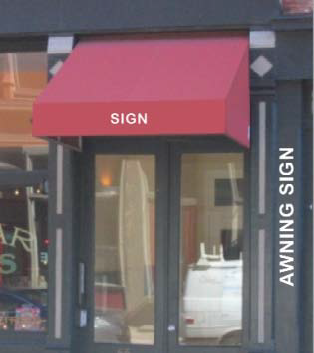 |
| Sign, Business | A sign which directs attention to a business, profession or industry located upon the premises where the sign is displayed, to type of products sold, manufactured, or assembled and/or to service or entertainment offered on said premises, but not a sign pertaining to the preceding if such activity is only minor and incidental to the principal use of the premises. |
| Sign, Canopy |
A sign located on a canopy.
 |
| Sign, Directional |
A sign fronting on a road containing only the name of the principal use, insignia,
trademark, directional arrow and/or distance to the principal use. Such use shall
not be visible to the motorist at the location at which the sign is placed, meaning
that the sign is not places in front of the building or site.
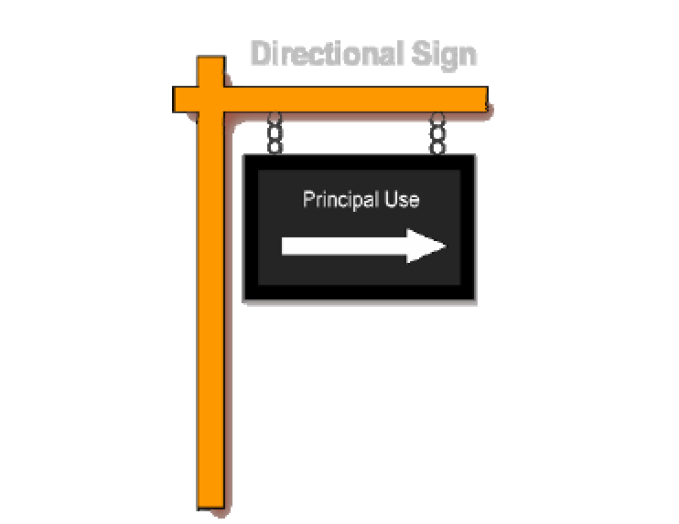 |
| Sign, Flashing | A sign, the illumination of which is not constant in intensity when in use, and that exhibits sudden or marked changes in lighting effects. |
| Sign, Freestanding | A sign that is not attached to, suspended from, erected on or supported by a building or other structure having a principal function other than the support of such sign but is instead supported by some structure, such as a pole or post, or is without supporting elements, such as an A-frame or monument base. Any sign on a fence located within the required building setback area shall be considered a freestanding sign, and canopy signs may be interpreted as either freestanding or wall signs. |
| Sign, Government | A sign usually erected and maintained by a public agency that provides the public with information and in no way relates to a business, commercial activity or specific use. Examples include, but are not limited to: speed limit signs, city limits signs, stop signs and street name signs. |
| Sign, Ground | See "Sign, Monument." |
| Sign, Ground-Mounted |
A free standing sign that is intended to be incorporated into some form of landscaping
design scheme or planter box, is attached to the ground by means of a free-standing
support structure, is typically solid from grade to the top of the structure, has
materials that are constructed of the same primary building materials as the principal
structure, and is placed directly on the ground or on an interior planter base which
is incorporated into a design arrangement. The "copy and graphic" of a ground monument
sign is the gross area of copy and graphics attached to or incorporated as part of
the sign. Materials typically include brick or stone or some other substantial material
resembling a monument.
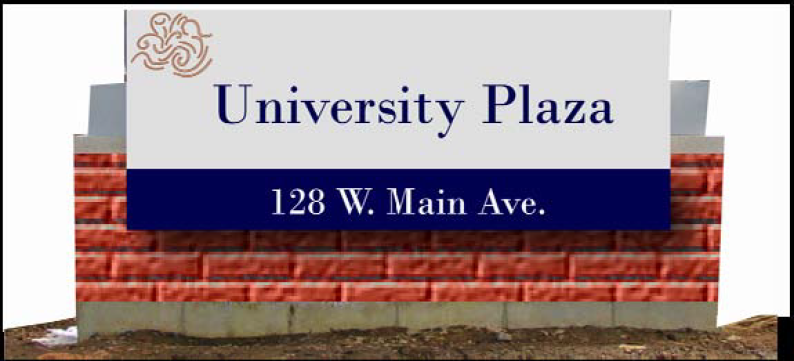 |
| Sign, Identification | A sign, used to identify only the name of the individual, family organization, or enterprise occupying the premises; the profession of the occupant or the name of the building on which the sign is displayed; of the name of the shopping center on which the sign is located. |
| Sign, Incidental |
A sign, generally informational, that has a purpose secondary to the use of the site
on which it is located, such as "no parking," "entrance," "loading only," "telephone,"
and other similar information and directives. No sign with a commercial message legible
from a position off the site on which the sign is located shall be considered an "incidental
sign."
 |
| Sign, Light Emitting Diode (LED) |
A sign using light emitting diode technology that is designed to project an advertising
display that is controlled via the use of a computer or similar type equipment. Such
sign may emit messages that are either scrolled or static.
 |
| Sign, Mailbox |
The writing, text, representation, graphic, emblem or other display, together with
any material or color forming an integral part of the background of the display that
is placed on or is in any way affixed to a mailbox used for the purposes of official
mail delivery to a lot.
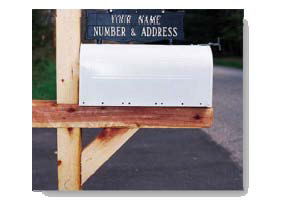 |
| Sign, Marquee | A sign attached to a permanent structure often bearing a sign board with changing information usually associated with a theater or hotel. |
| Sign, Monument | See definition of "Sign, Ground-Mounted." |
| Sign, Multiple-Business | A sign of major significance designed to inform persons off the premises of the businesses which comprise a shopping center or business complex. It may or may not bear the name of the complex but must list the entities within the complex. |
| Sign, Nonconforming | A sign that, on the effective date of this Ordinance does not conform to one or more of the regulations set forth in this Ordinance. |
| Sign, Pole |
A detached sign erected and maintained on a freestanding frame, mast, or pole and
not attached to any building but not including ground-mounted or monument signs. The
bottom of such signs shall be equal or greater than two (2) feet from the ground directly
beneath the sign.
 |
| Sign, Political | A sign advertising a ballot measure or candidate for public office. |
| Sign, Portable |
Any sign not permanently attached to the ground or other permanent structure, nor
specifically constructed for such attachment; or a sign designed to be transported,
including, but not limited to, the following: signs designed to be transported by
means of wheels; signs converted to A- or T-frames; gas or hot air filled balloons.
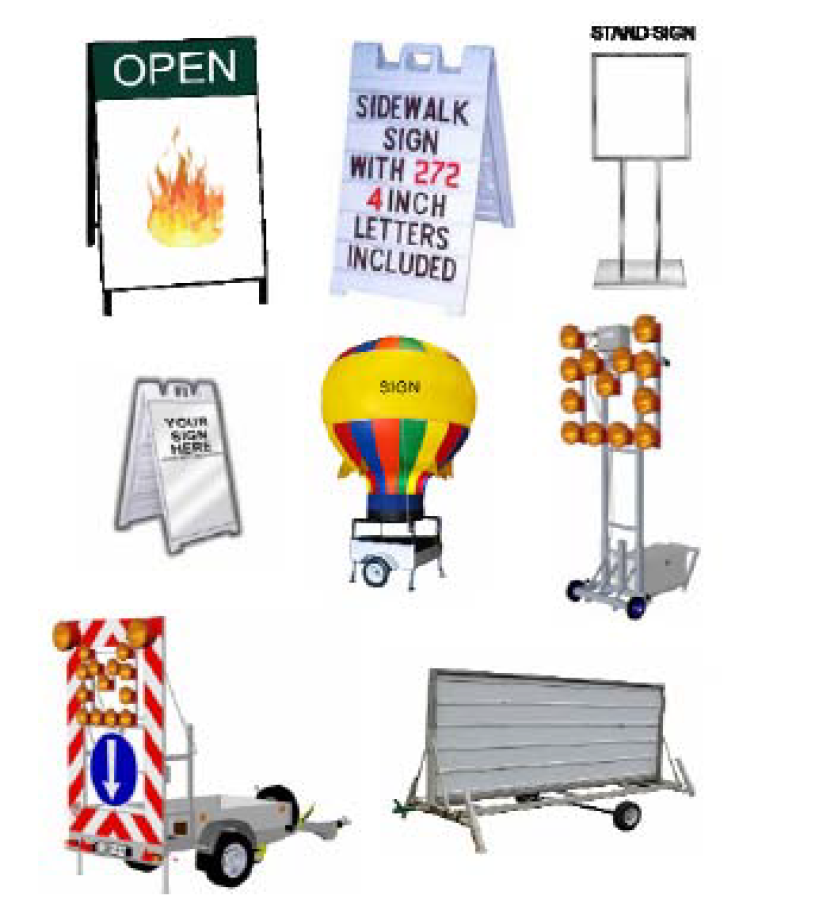 |
| Sign, Projecting |
Any sign other than a wall, awning, canopy, or marquee sign, which is affixed to a
building and is supported only by the wall on which the sign is mounted.
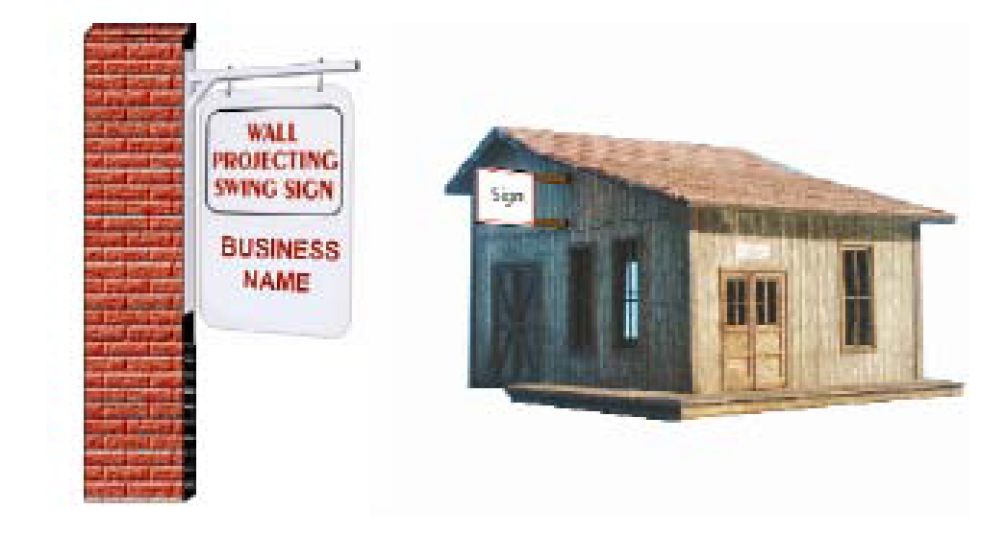 |
| Sign, Public Bulletin Board | A sign of a permanent nature used to announce meetings or programs to be held on or off the premises of a church, school, library, museum, community recreation center, or similar noncommercial uses. |
| Sign, Temporary | A sign that is designed for short-term use or is used in connection with a circumstance or event expected to take place or be completed within a reasonably short period of time. Temporary signs are usually banners, but need not be. If a sign display area is permanent but the message is subject to periodic change, that sign shall not be regarded as temporary. |
| Sign, Wall |
Any sign directly attached to an exterior wall of a building or dependent upon a building
for its support with its exposed face parallel or approximately parallel to the plane
of the building or structure on which the sign is affixed. Signs directly painted
on walls shall be considered wall signs.
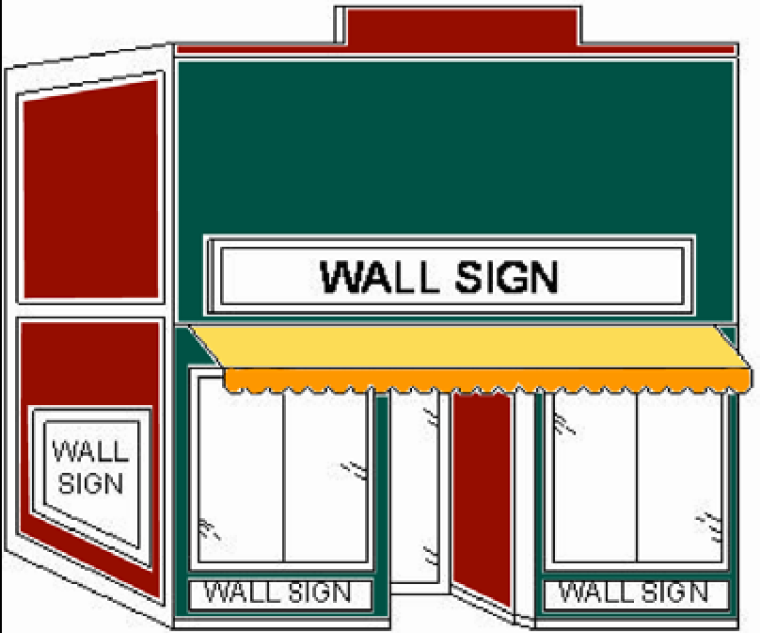 |
| Signs, Vehicular | Signs on parked vehicles visible from the public right-of-way where the primary purpose of the vehicle as parked is to advertise a product or to direct people to a business or activity located on the same or nearby property. (For clarification, this definition is not meant to include vehicles with logos, identification and advertising used for daily transport, business and delivery purposes.) |
| Single-Family Homes | See "Dwelling, Single-Family Detached." |
| Site Plan | The Site Plan (and in the case of a subdivision application, a Preliminary Plat) is a formal application submittal meeting the requirements of Subsection 8.2(b)(4), typically containing very detailed information, include engineering and construction level drawings. See Subsection 8.2(B)(3). |
| Site Specific Development Plan | A plan of land development submitted to the town for the purposes of obtaining any zoning or land use permits or approvals in accordance with the terms and conditions set forth elsewhere in this UDO (e.g., a "Zoning Plan" as defined herein or a "Site Plan" as defined herein). Neither a variance, a sketch plan nor any other document that fails to describe with reasonable certainty the type and intensity of use for a specified parcel or parcels of property shall constitute a site specific development plan. |
| Sketch Plan | The Sketch Plan is a pre-approval submittal meeting the requirements of Subsection 8.2(B)(2), typically containing information comparable in detail to a Concept Plan (PCO-1) required by Article VI hereof but typically will not include construction level drawings. |
| Sportsfield/Stadiums | An open area or facility and its related ancillary buildings specifically designed and equipped for large-scale structured recreation. Such fields should be confined to the edges of neighborhoods as their size is disruptive to the fine-grained network which is required for pedestrian travel. |
| Square |
An open space area that is surrounded by streets and/or buildings, that is accessible
by the pedestrian, and that includes walks, lawns and trees. As opposed to a "plaza",
a "square" consists primarily of landscaped and natural areas.
 |
| Square | A public space, seldom larger than a block, at the intersection of important streets. A square is circumscribed spatially by frontages; its streetscape consists of paved walks, lawns, trees, and civic building all formally disposed and requiring substantial maintenance. |
| Stadium | A structure or facility designed, intended, or used primarily for outdoor athletic events and containing seating for more than one hundred (100) spectators of those events, but not including a racetrack. The sale of beverages, snack foods, and sundries geared to on-premise consumption or usage by spectators shall be permitted. |
| Stoop | A small, unroofed platform. |
| Story | That part of a building or structure above ground level between a floor and a floor or the roof above it, a distance typically measuring between nine (9) and fourteen (14) feet. A mezzanine shall be considered a story if it exceeds one-third (⅓) of the area of the floor immediately below. A penthouse shall be considered a story if it exceeds one-third (⅓) of the area of the roof. The term story does not include any building level(s) that are substantially enclosed below the finished grade at the front of the building, so long as the finished grade does not substantially differ from the pre-construction, natural grade. |
| Stream | A drainage feature on the land surface for conveying water. For definitions and regulatory requirements, see Article 6, Section 6.6 (Surface Water Improvement and Management) and Article 6, Section 6.8 (Post-Construction Ordinance). |
| Street | A public right-of-way set aside for public travel and either: |
| Which has been accepted for maintenance by the state or the Town; | |
| Has been established as a public street prior to the adoption of this Ordinance; or | |
| Which has been dedicated to the state, or the Town, for public travel by the recording of a plat of a subdivision that has been approved by the Planning Board of the Town. | |
| Street Property Line | A street property line is that line which separates a lot or parcel of land from a street right-of-way created by dedication or reservation for future right-of-way resulting from the recording of a subdivision plat. |
| Street Right-of-Way | Shall mean any public right-of-way set aside for public travel. |
| Street, Alley | A travel way that affords only a secondary means of access to an abutting property and is not intended for general traffic circulation. |
| Street, Arterial | An arterial street is a federal or state highway or a street connecting widely separated areas and which carries or may be expected to carry a large volume of traffic between such areas. |
| Street, Cul-de-Sac | A street designed to be permanently closed at one end, or a street that may not reasonably be expected to be extended in the future. |
| Street, Half | A street bordering one or more boundary lines of a tract of land or parcel, one-half (½) or less of the required right-of-way width. |
| Street, Marginal-Access | A marginal-access street is a street adjoining and parallel to an arterial street to relieve the arterial street of the necessity of providing access to abutting property. |
|
Street, Minor
Industrial Access Street | A minor industrial access street is a street used predominantly to provide access to abutting industrial properties. |
|
Street, Minor
Residential Access | A minor residential access street is a street used predominately to provide frontage for service and access to abutting residential properties. These streets shall carry only traffic having either destination or origin on the street itself and limited to serving no more than sixteen (16) residential lots. |
| Street, Secondary | A secondary street is a street that connects minor access streets with arterial streets or provides direct connection between arterial streets and may be expected to carry a significant volume of traffic having neither origin nor destination on the street. |
| Structure | Anything constructed or erected, the use of which either requires location on the land or attachment to something having a permanent location on the land. See also definition in Article 6, Section 6.6A, S.W.I.M. (Surface Water Improvement and Management) Stream Buffers and Flood Regulations. |
| Stucco | Masonry (hard-coat) stucco. |
| Subdivision | All division of a tract or parcel of land into two (2) or more lots, building sites, or the divisions when created for the purpose of sale or building development (whether immediate or future) and shall include all divisions of land involving the dedication of a new street or a change in existing streets; but the following activities do not constitute a subdivision and are expressly exempt from the design and improvement standards of this Section: |
| The combination or recombination of portions of previously subdivided and recorded lots where the total number of lots is not increased and the resultant lots are equal to or exceed the standards of the Town as shown in this Ordinance; | |
| The division of land into parcels greater than ten (10) acres where no street right-of-way dedication is involved; | |
| The public acquisition by purchase of strips of land for the express purpose of widening or opening of streets; | |
| The division of a tract in single ownership whose entire area is no greater than two (2) acres into not more than three (3) lots, where no street right-of-way dedication is involved and where the resultant lots are equal to or exceed the standards of the Town as required by this Ordinance. | |
| Subdivision Monument | A decorative structure located within the common area of a residential development. |
|
Subdivision,
Conservation | Specially designed subdivisions placing clusters of home sites on smaller lots than the minimum lot size requirements in Section 6.1.1 to preserve environmentally sensitive areas and to create permanent open space. Conservation subdivision provisions provide flexible development options to (1) protect environmentally sensitive areas, (2) allow for common or public open areas within a development project, (3) support reductions in development costs, reducing the amount of grading and infrastructure needed, and (4) reducing the amount of impervious area for improved stormwater runoff. See Section 7.3.3 (Special Requirements for Conservation Subdivisions). |
| Subdivision, Major | A subdivision that is characterized by any of the following conditions: |
| Involves five (5) or more lots on an existing approved street. | |
| Involves the construction of a new street or prospectively requiring a new street for access to interior property. | |
| Requires extension of public sewage or water lines or creation of new drainage easements through lots to serve property at the rear. | |
| Creates new or residual parcels not conforming to the requirements of these regulations and related ordinances. | |
| Subdivision, Minor | A subdivision: |
| Involving four (4) or fewer lots on an existing approved street. | |
| Not involving any new street nor prospectively requiring any new street for access to interior property. | |
| Not requiring extension of public sewage or water lines or creation of new drainage easements through lots to serve property at the rear. | |
| Creating no new or residual parcels not conforming to the requirements of these regulations and related Ordinance. | |
| Substance Abuse Treatment Facility (Short-Term Care) | An institution or facility (other than a hospital) licensed through the state or other regulatory organization whose primary function is the treatment of substance abuse including medically monitored detoxification and treatment services; and, mental health impatient treatment services. It does not include half-way houses, family care home, boarding houses or other facilities that provide primarily a supportive environment, even if counseling is provided in such facilities. |
| Terrace | See definition for "Patio." |
| Top of Bank | The landward edge of the stream channel during high water or bank full conditions at the point where the water begins to overflow onto the floodplain. |
| Tower | A structure whose principal function is to support one or more antennas. |
| Tower, Co-location on | The location of antennae and equipment on an existing telecommunications tower by more than one provider. |
| Town Park | A facility operated by the Town of Mint Hill that is open to the public for recreational, community, social, educational, and cultural activities. Uses, including, but not limited to, community centers, recreation centers, ball fields, swimming facilities, and which contain improvements designed specifically for such active recreational uses. Such facilities may also contain improvements designed for passive recreational uses. |
| Townhouse | See definition for "Dwelling, Single-Family Attached." |
| Tract | A lot. The term is used inter-changeably with the term lot, particularly in the context of subdivisions, where one "tract" is subdivided into several "lots." |
| Trailer Park, Overnight Camping | A site, tract of land or lot upon which not less than two (2) overnight camp sites and/or overnight trailers occupied for temporary shelter, dwelling, recreational or vacation uses may be located, regardless of whether or not a charge is made for such service. |
|
Trailer, Overnight
Camping | A vehicle or structure designed to be transported and intended for human occupancy as either a temporary shelter or dwelling for travel, recreational and/or vacation uses. |
| Trailer, Travel | A vehicle, with or without its own motive power, equipped or used for temporary living purposes and mounted on wheels or designed to be so mounted and transported. |
|
Trailer, Utility or
Hauling | A vehicle or structure designed to be transported and intended for carrying animals or goods. |
| Transit Station | Any premises designed for the loading and unloading of rail and/or bus passengers from a public transit system. Facilities commonly referred to as "bus stops" and which are designed to accommodate a handful of passengers (at most) at one time, shall not be considered as being "transit stations." |
| Tree, Canopy | A large maturing tree, either single or multi-stemmed (i.e., in clump form) that has a height of at least ten (10) feet and is of a species which, at maturity, can be expected to reach a height in excess of forty (40) feet under normal growing conditions in the local climate. |
| Tree, Understory | A small maturing tree, either single or multi-stemmed (i.e., in clump form) which has a height of at least five (5) feet and is of a species which at maturity, can be expected to reach a height of ten (10) to forty (40) feet under normal growing conditions in the local climate. |
| Triplex |
A single-family attached dwelling where three (3) dwelling units located on the same
lot are joined by a common building wall.
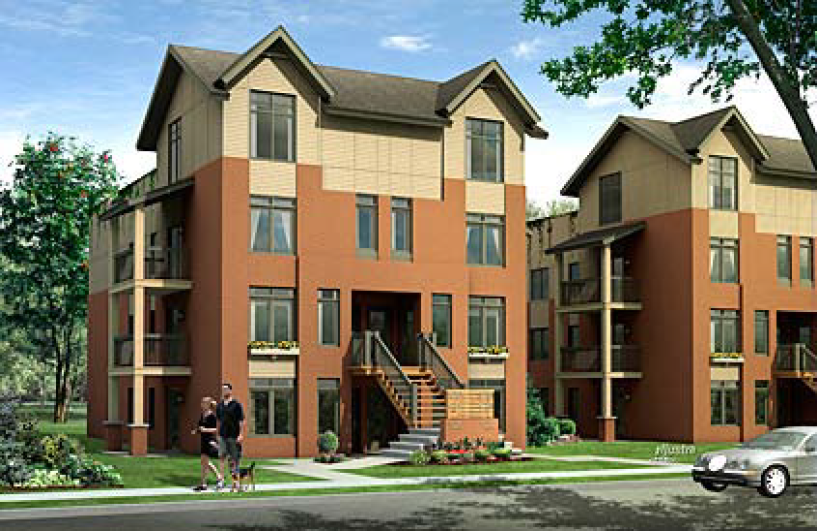 |
| Truck Stop | A facility typically offering multiple services to the traveling public that is particularly designed to serve the need of freight trucks and their drivers. Such facilities typically include fuel stations (dispensing fuel for trucks, and perhaps, for automobiles), one or more eating establishments and/or sale of prepared food, sales of convenience and sundry items, shower facilities, and overnight lodging facilities. Not all such facilities are provided at all truck stops. The foregoing definition distinguishes a "truck stop" from: (i) a convenience store, (ii) mini-mart, express fuel, (iii) shopping center, and (iv) planned multi-tenant development. |
|
Truck Washing
Facility | A commercial establishment primarily engaged in the washing of tractor-trailer trucks. Such washing shall be done using self-service facilities or by fully automated machines. |
| Use | The activity or function that actually takes place or is intended to take place on a lot or in a building. |
| Variance | A grant of permission by the Board of Adjustment that authorizes the recipient to do that which, according to the strict letter of this Ordinance, he or she could not otherwise legally do. |
| Vested Right | A right pursuant to G.S. 160D-108 or under standards established by common law to undertake and complete a development and use of property under the terms and conditions of an approved site-specific development plan. See Section 3.6.3 (Vested Rights - General Exception) and Section 8.8 (Vested Rights in Certain Circumstances). |
| Vinyl and/or Approved Vinyl | Reference to "vinyl" and/or "approved vinyl" in the Downtown Overlay Code shall be interpreted to be "architectural grade vinyl shakes." |
| Watercourse | See Section 6.6A.6 (Definitions section in Article 6, Section 6.6A, S.W.I.M. (Surface Water Improvement and Management) Stream Buffers and Flood Regulations). |
| Wooded Area | An area of contiguous wooded vegetation where trees are at a density of at least one six-inch or greater caliper tree per three hundred twenty-five (325) square feet of land where the branches and leaves form a contiguous canopy. |
| Workplace Building | A fixed commercial building type of greater than twenty thousand (20,000) square feet with commercial use throughout. |
| Yard, Established Front | An open, unoccupied space between the street property line, or the equivalent thereto as provided in Section 6.1.4 (Measurement of Setback and Building Lines), and the front of a building or structure, as constructed, projected to the side lines of the lot. Article 6, Section 6.1, provides illustrations of how to measure yards on standard and non-standard lots. |
| Yard, Established Rear | The area extending from the rear building line to the rear lot line between the side lot lines. Article 6, Section 6.1, provides illustrations of how to measure yards on standard and non-standard lots. |
| Yard, Required Front | The minimum open, unoccupied space required between the street property line, or the equivalent thereto as provided in Section 6.1.4 (Measurement of Setback and Building Lines), and the front building line of a principal building or structure, projected to the side lot lines of the lot. Article 6, Section 6.1, provides illustrations of how to measure yards on standard and non-standard lots. |
| Yard, Required Rear | The minimum open space required between the rear lot line and the rear building line of a principal building or structure, projected to the side lot lines of the lot, and which may contain permitted accessory buildings, structures or uses. Article 6, Section 6.1 provides illustrations of how to measure yards on standard and non-standard lots. |
| Yard, Required Side | The minimum open, unoccupied space including driveways and parking areas required between the side lot line and the side building line, extending from the required front yard to the required rear yard. If no front yard is required, the side yard shall be defined as extending from the street line to the required rear yard. Article 6, Section 6.1, provides illustrations of how to measure yards on standard and non-standard lots. |
| Yard, Street | The minimum open, unoccupied space required between the street property line, or the equivalent thereto as provided in Section 6.1.4 (Measurement of Setback and Building Lines), and the building line on the street upon which the lot fronts, and on the street upon which the lot sides in the case of a corner lot. |
| Zoning Plan | The Zoning Plan is a formal application submittal meeting the requirements of Subsection 8.2(B)(3) that is a submittal to Board of Commissioners in connection with a request for a Conditional Zoning District. A Zoning Plan contain (a) all information required for a Sketch Plan, (b) planned streetscape (e.g., pedestrian lights, paver bands, streets trees, etc.), (c) detailed four-sided architectural elevations with elevation exposed to the public street clearly marked and a materials list included, and (d) applicable zoning conditions proposed by the applicant. Additionally, a Zoning Plan must be consistent with any applicable PCO Concept Plan and incorporate recommendations of any applicable TIA. The Zoning Plan shall also indicate response to any issues raised in any applicable PIM. |
(Ord. No. 598, 4-14-2011; Ord. No. 633, 3-14-2013; Ord. No. 653, 6-12-2014; Ord. No. 656, 9-11-2014; Ord. No. 659, 4-9-2015 Ord. No. 690, 11-9-2017; Ord. No. 798, 7-8-2021; Ord. No. 907, 1-9-2025; Ord. No. 909, 2-13-2025)

