
Mint Hill City Zoning Code
ARTICLE 7
- CONDITIONS FOR CERTAIN USES
Section 7.1 - By-Right With Special Requirements
7.1.1
Special Requirements. All uses listed in the Table of Principal Permitted Uses, Section 5.2, as being in the Special Requirements "SR" use group shall comply with the pertinent regulations listed in the following subsections, in addition to any and all general requirements set forth in Article 6 and elsewhere in this UDO.
A.
Submittal of Information. An application for a Building Permit shall be accompanied by plans indicating all requirements outlined in this Article and the other requirements of this UDO will be complied with.
B.
Site Plan Approval. Site plan approval by the Administrator shall be required prior to the issuance of a Building Permit and such approval shall be given if all requirements herein are met.
C.
Building Permit. No Building Permit shall be issued in any area which is part of the Site Plan except in strict conformity with the approved Site Plan. A Site Plan, once approved, shall become a part of the Building Permit.
7.1.2
Special Requirements for Car Washes.
A.
Off-street waiting space shall be provided within the site, for five (5) times the number of vehicles which can be served simultaneously.
B.
Where such use is located at the intersection of two (2) streets, the location of any driveway shall be no closer than 30 feet from the point of intersection of the two (2) street property lines or the equivalent of such lines as provided for in Section 6.1.4 (Measurement of Setback or Building Lines).
C.
Where such use is adjacent to a residential district or a site used for residential or institutional purposes, the driveways for egress and ingress to such use shall be a minimum of thirty (30) feet from such adjacent property line.
D.
The use of any public road, alley or public way for the purpose of parking vehicles, or causing vehicles waiting to be serviced to temporarily stop, shall be prohibited.
7.1.3
Special Requirements for Commercial Parking Areas.
A.
Such use shall be so located as not to generate traffic congestion on adjacent streets, and so as not to adversely affect adjacent uses.
B.
Vehicular circulation in the parking lot shall be in accordance with good site planning standards and shall comply with the standards for parking areas as provided for in Article 6, Section 6.3 (Off-Street Parking and Loading) of this Ordinance.
C.
Such lots shall not be used for the sale or storage of any motor vehicles.
D.
Where such use is located on a corner lot, no driveway shall be closer than thirty (30) feet from the intersection of both property lines or the equivalent thereto as provided in Section 6.1.4 (Measurement of Setback or Building Lines).
E.
Where such use is located adjacent to a residential district, or to a residential or institutional use, no driveway shall be located closer than thirty (30) feet from the adjacent lot line.
F.
No driveway shall be located closer than one hundred (100) feet from any school, park or playground.
7.1.4
Special Requirements for Lumber or Building Material Yards. Such use shall not be located within two hundred (200) feet of a residential district or a site used for residential or institutional purposes.
7.1.5
Special Requirements for Manufacturing, Processing or Fabrication.
A.
All new uses shall comply with environmental standards enacted by the County, State or Federal governments, and applicable to Mint Hill.
B.
For any application for a Building Permit or a Certificate of Occupancy the Planning Board may require the Applicant, at his own expense, to provide expert proof that the proposed use will comply with all environmental standards. In addition, the Planning Board may obtain expert advice at the Applicant's expense, prepaid, prior to further consideration of the application.
C.
The Planning Board may require the installation, maintenance and operation of monitoring equipment at the Applicant's expense to demonstrate the affect of operation of any device used to control or lessen noise, vibration, glare, air pollution, water pollution, fire or other safety hazards.
7.1.6
Special Requirements for Funeral Homes. In addition to the parking requirements of Subsection 6.3.1(L) (Off-Street Parking and Loading), off-street area(s) shall be provided, on the site, to accommodate thirty (30) passenger vehicles for the purpose of forming a funeral procession. In the event on-site area is not available, such off-street area may be provided within three hundred (300) feet of the funeral home, as measured to the nearest property lines.
7.1.7
Special Requirements for Two-Family Dwellings.
A.
Such use shall be permitted on corner lots only, in such districts as are indicated in the Table of Principal Permitted Uses, Section 5.2.
B.
The corner lots shall be fifty (50) percent larger in area than the minimum lot size permitted in the respective districts.
C.
Dimensional requirements shall be as indicated for the respective districts in the Tables of Dimensional Requirements, Section 6.1.1 (Dimensional Requirements).
D.
The entrance to each unit shall be from different streets.
7.1.8
Special Requirements for Retail Farm Products Located on a Farm.
A.
Fruits, vegetables and other farm products may be sold on the property where grown and displayed during season, in temporary structures or stands.
B.
Such temporary stands shall not be located closer than thirty (30) feet to the centerline of the road.
C.
Off-street parking spaces shall be provided as required in Subsection 6.3.1(L) (Off-Street Parking and Loading) of this Ordinance. All applicable requirements of Article 6, Section 6.3 (Off-Street Parking and Loading), shall be met except that pavement, as specified in Subsection 6.3.1(I) (Off-Street Parking and Loading), shall not be required.
7.1.9
Special Requirements for Animal Hospitals (indoor kennels).
A.
Facility where animals are given medical or surgical treatment and the board of animals is incidental to the hospital use. All facilities associated with an animal hospital shall be located indoors [and] shall be permitted in a B-G, B-P, I-G and O-A district with the following requirements:
1.
There shall be no outside facilities; unless the facility is approved through the conditional zoning process as an Animal Hospital (outdoor kennel)
2.
There shall be no grooming or boarding of animals; outside unless the facility is approved through the conditional zoning process as an Animal Hospital (outdoor kennel)
3.
New construction and improvements shall be compatible with surrounding development.
4.
The yard requirements established for the district in which the facility is located shall apply.
7.1.10
Special Requirements for Home Small Group Day Care.
A.
A day care home must be clearly incidental to the residential use of the dwelling and must not change the essential residential character of the dwelling; all buildings and lot standards for the residential dwelling shall be maintained.
B.
For each child there shall be provided one hundred (100) square feet of outdoor play area located on the same property as the residential dwelling.
C.
Such outdoor play space shall be located to the rear of the building line of the main building on the lot.
D.
Outdoor play area required by this Section shall be enclosed by a fence with a minimum height of five (5) feet. Such fence shall comply with applicable requirements of Section 6.9.2 (Fences and Walls Permitted).
E.
No other business shall be conducted on the property.
F.
No home school shall be operated on the property.
G.
Any provider of day care established hereunder shall not care for more than five (5) preschool age children including preschoolers living in that home and not more than three (3) school age children unrelated by blood or marriage to, and not the legal wards or foster children of, the attendant adult, within an occupied residence.
7.1.11
Special Requirements for Automatic Car Wash.
A.
Off-street waiting spaces shall be provided within the site, for five (5) times the number of vehicles which can be served simultaneously.
B.
No additional driveways will be permitted for the automatic car wash except those already provided for the principal structure.
C.
Screening shall be provided as required in Section 6.4.2 (Screening and Landscaping) of this Ordinance.
D.
Exterior materials shall conform to existing principal structure.
E.
The use of any public road, alley or public way for the purpose of parking vehicles, or causing vehicles waiting to be serviced to temporarily stop, shall be prohibited.
7.1.12
Special Requirements for One-Family Dwellings with Zero Lot Line.
A.
Purpose and Intent. To provide a voluntary alternative to conventional single-family housing, by incorporating the amenities of a single-family, detached dwelling within a conventional residential development for those seeking location, convenience and lower maintenance in a secure environment. The structure contains two (2) individual dwelling units, attached at a common wall, with each dwelling unit situated on a separate lot, with open yards on three (3) sides and larger lots than those commonly seen in condominium communities. Each dwelling unit shall be owned in fee simple, controlled by a homeowners association that provides exterior maintenance, lawn service and other conditions, which may be required in G.S. Chapter 47A and other articles applicable to "attached housing."
B.
General Standards. The single-family zero-lot-line, attached on one side only, may be integrated into a conventional residential subdivision, provided the designated tract is served with public water and sewer. The total number of structures (each structure contains two (2) single-family, attached dwellings) shall not exceed twenty (20) percent of the total number of detached single-family lots within the subdivision. (Example: Should the approved subdivision have eighty (80) detached lots, there will be permitted sixteen (16) zero-lot-line structures for a total of thirty-two (32) dwelling units.)
These homes must be grouped together in a centralized section of the development and separated from the conventional single-family homes by brick privacy walls between the properties as follows:
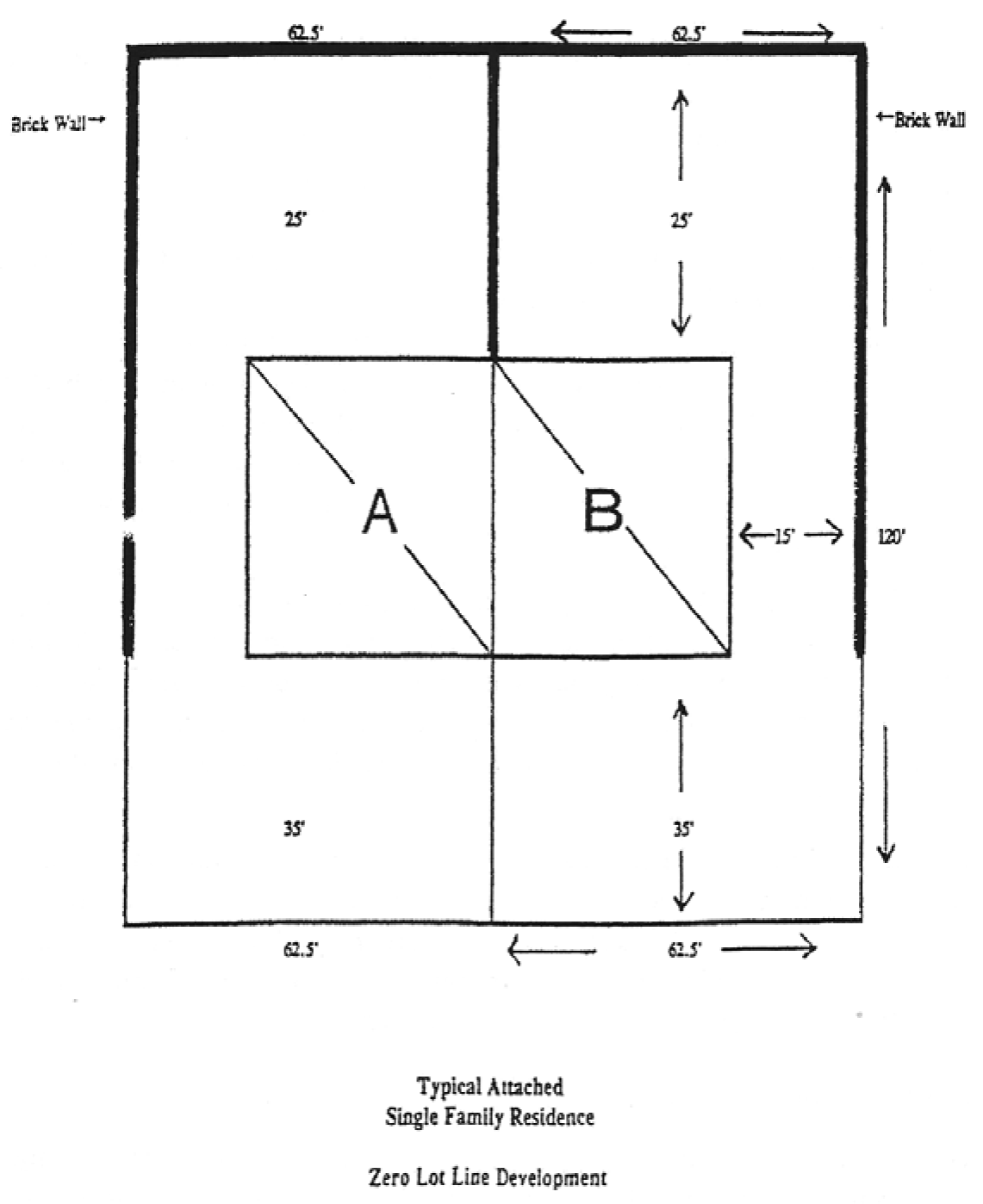
C.
Design Standards. Each structure will have the street appearance of a single-family home, with an attached double garage, with doors. The garages shall load from the side or rear. Front load garages are prohibited. The architectural design and materials must be consistent with the other dwellings within the conventional portion of the development. Each dwelling unit shall have a separate drive with a turn around area that will accommodate four (4) conventional, standard-sized vehicles, limiting street parking and each driveway shall be paved with concrete or brick pavers, beginning at the street and continuing throughout the drive/turn around area.
D.
Street and Sidewalk Requirements. The street system, including the sidewalk requirements shall conform to the requirements of Article 6, Section 6.2 (Streets and Sidewalks). Exception: There shall be a sidewalk installed on each side of the street. The street system should be designed to avoid the zero-lot-line concept on major and minor thoroughfares within the conventional subdivision.
E.
Sign Requirements. The single-family zero-lot-line, attached portion of the development is allowed one ground-mounted sign at the entrance not to exceed twelve (12) square feet located behind the street property line to signify this portion of the development in addition to the entrance signs permitted for the overall subdivision in Article 6, Section 6.5 (Signs).
7.1.13 Special Requirements for Family Care Homes.
A.
All Family Care Homes must comply with all applicable Federal, State, local licensing requirements and health regulations.
B.
New Family Care Homes (also referred to as Group Homes) shall be separated from existing Family Care Homes in single-family residential district by a distance of two thousand six hundred forty (2,640) feet measured from the closest point of each lot property line in a straight line.
(Ord. No. 598, 4-14-2011; Ord. No. 656, 9-11-2014; Ord. No. 662, 6-11-2015)
Section 7.2 - Initial Conditions for Conditional Uses
7.2.1
Conditional Zoning—Conditions for Specific Uses. One special type of zoning text and map amendment is Conditional Zoning approval whereby a specific site plan and written conditions are reviewed and approved by the Board of Commissioners. As provided in the Table of Principal Permitted Uses (Section 5.2), some land uses are of such a nature or scale that they have significant impacts on both the immediately surrounding area and/or the entire community that cannot be predetermined and controlled by general district standards and thus are only permitted with Conditional Zoning approval. Additionally, there may be instances where a general zoning district designation is clearly inappropriate for a certain property, but a specific use permitted under that district and subject to restrictive conditions would be consistent with the spirit and objectives of this Ordinance and applicable land plans. Both of these circumstances are reasonably addressed through a Conditional Zoning process. Conditional Zoning is a legislative procedure which is summarized in Article 8.
Some uses listed in the Table of Principal Permitted Uses, Section 5.2, requiring Conditional Zoning approval have pre-set, initial conditions set forth herein. Accordingly, all uses listed in the Table of Principal Permitted Uses, Section 5.2, as being in the Conditional Zoning use group and appear in this Section and have pre-set, initial conditions, shall comply with the following regulations, in addition to any and all general requirements set forth in Article 6 and elsewhere in this UDO and all applicable local, County and State requirements.
7.2.2
Supplementary Use Regulations for Parking Areas in Residential Districts.
A.
Such parking areas shall be considered to satisfy, in whole or in part, the off-street parking requirements for business, industrial or institutional uses when such requirements cannot be met in the district in which the use is permitted.
B.
Such parking areas shall have a common property line for a minimum distance of 50 feet, with the lot containing the permitted principal use.
C.
Access by motor vehicles to such parking areas shall be only through the lot containing the principal permitted use.
D.
The lot containing the parking areas shall be screened in accordance with the provisions of Section 6.4.2 (Screening and Landscaping) of this Ordinance, when adjacent to a residential district, or to a residential or institutional use.
E.
Such parking areas shall comply with the design standards and all other applicable requirements of the off-street parking regulations, Article 6, Section 6.3 (Off-Street Parking and Loading) of this Ordinance.
F.
Outdoor lighting shall be extinguished no later than 11:00 p.m.
G.
The lot containing the parking areas shall be owned by the same person, firm or corporation that owns the property upon which the permitted principal use is located.
7.2.3
Supplementary Use Regulations for Service Stations.
A.
On corner properties the driveways shall be located no closer than thirty (30) feet from the point of intersection of two (2) street property lines, or the equivalent thereto, as provided for in Section 6.1.4 (Measurement of Set Backs or Building Lines).
B.
Driveways shall be located no closer than thirty (30) feet from adjacent properties in residential districts or from properties used for residential or institutional uses.
C.
No gasoline pump shall be located closer than twenty (20) feet from any street property line, or the equivalent thereto, as provided for in Section 6.1.4 (Measurement of Set Backs or Building Lines).
D.
Parking of motor vehicles for a fee or awaiting damage estimates, and storage or display of trailers, campers, boats or similar equipment is expressly prohibited.
E.
Freestanding canopies may be placed over properly located pumps or pump islands provided:
1.
They are a minimum distance of ten (10) feet from the primary structure;
2.
They do not overhang the right-of-way of any street; and
3.
They are not used as a sign structure or as the sign base.
7.2.4
Supplementary Use Regulations for Bus Stations.
A.
Such use shall be so located with relation to arterial streets and adjacent uses so as not to create traffic congestion or adversely affect such adjacent uses.
B.
In the event such use is created adjacent to the R (Residential) District or adjacent to any residential or institutional use, a wall or fence shall be erected, or a solid hedge be planted, in accordance with the requirements in Section 6.4.2 (Screening and Landscaping) of this Ordinance.
C.
Off-street parking shall be provided as specified in Article 6, Section 6.3 (Off-Street Parking and Loading) of this Ordinance.
D.
Servicing and repairing of busses are expressly prohibited.
7.2.5
Supplementary Use Regulations for Public or Quasi-Public Utilities (Essential Services, Class 3).
A.
All Essential Service, Class 3 uses such as power generating or transmission facilities, pressure regulator stations, sewage treatment plants and/or discharge points and telephone repeater stations, shall comply with the following:
1.
The facility shall be constructed and operated to comply at all times with applicable local, State and Federal regulations.
2.
No structure for the treatment and disposal of wastewater, except individual septic tanks as permitted herein, and/or point of discharge of a sewage treatment plant shall be located within three hundred (300) feet of any existing or proposed residential structure in any zoning district or within one hundred (100) feet of any adjoining property line in any zoning district.
3.
Sewer main and system distribution design shall be based upon pipe, pump and other structural capacity standards necessary to service both build-out development projections for the subject project and any future contiguous areas to be serviced by the subject treatment plant and system as may be determined necessary by the Charlotte-Mecklenburg Utility Department.
4.
The plant and all attendant structures and other facilities, including discharge points, shall be designed, constructed and operated to have the least negative impacts on the health, safety and general welfare of the community. The Administrator may require an Environmental Impact Statement for these Applications.
5.
Structures shall conform to all dimensional and other requirements, except lot area requirements, of the district in which such structures are located.
6.
Fences which are not easily climbed and other safety devices shall be installed and maintained around electric and gas substations and wastewater treatment plants in order to make such facilities inaccessible to the general public. The required front yard shall not be fenced, but shall be adequately screened. The point of discharge of a sewage treatment plant shall be fenced in order to make such facilities inaccessible and shall be adequately screened as if such discharge point were a structure.
7.
Structures shall be screened from public view as well as from adjacent residential districts or from adjacent residential and institutional uses. The screening shall be located on all sides of the structure and shall be provided in accordance with applicable standards set forth in Section 6.4.2 (Screening and Landscaping) of this UDO. All required trees/shrubbery shall be outside the required fencing.
8.
Wherever possible, facilities shall be located on interior properties rather than on properties aligned with other lots that have a continuous street frontage.
9.
No business office, storage of vehicles, or maintenance shops shall be permitted in the R (Residential) Zoning District.
10.
A standby power source for a sewage treatment plant shall be provided for peak flow operation for all equipment by one of the following sources: (1) standby from another power substation with automatic voltage detection throw over switch devices; (2) automatic start generators with automatic voltage detection throw over switch devices.
11.
Equipment startup and throw over devices shall be tested and certified to be working properly at least once a month by an independent inspector approved by the Town, the cost of which shall be borne by the operator.
B.
Uses such as pumping stations, water towers and tanks, when in residential districts, shall be encouraged to locate on parcels of land hidden from view behind regular lots and shall comply with the following:
1.
There shall be no minimum lot size except when required by other regulations.
2.
The minimum yard requirement from any lot line shall be equivalent to the minimum requirement from the common lot line on the adjacent lot, but in no event shall such minimum distance be less than thirty (30) feet.
3.
All other applicable requirements of Subsection 7.2.5(A) above shall be met.
4.
In the event the lot does not meet the provisions as stated in this Subsection B, all the requirements of Subsection 7.2.5(A) above shall be applicable.
7.2.6
Supplementary Use Regulations for Radio or Television Masts or Towers, and Similar Structures (other than telecommunication towers, which can be found in Section 7.2.22).
A.
Such structures shall be the greater of two hundred (200) feet or the height of the tower from the property lines of adjacent residential districts.
B.
In order that the dangers of an attractive nuisance may be reduced, an eight-foot-high fence shall be constructed around the structure.
C.
The tower may exceed the maximum height of the zoning district with approval of Conditional Zoning.
D.
Towers shall comply with all applicable federal, state and local regulations (e.g., Federal Communications Commission).
E.
The lot on which a radio or television transmitting and/or receiving facility is located shall have a minimum gross land area of three and one-half (3.5) acres.
F.
All lighting shall be located in such a manner as to not cast direct lighting on adjacent properties.
G.
All towers shall be accessible by a well-maintained gravel or paved driveway of at least fifteen (15) feet in width.
H.
No building associated with radio or television towers or similar structures shall be used as an employment center, except for periodic monitoring and/or maintenance of equipment and instruments.
I.
Screening is required along all sides of the perimeter of the fenced tower in the form of a double row of trees and/or evergreen shrubs as outlined in Subsection 6.4.2(D) (Screening and Landscaping) of this Ordinance.
7.2.7
Supplementary Use Regulations for Bulk Storage of Flammable Liquids and Gases.
A.
The storage of flammable liquids and gases shall comply with all applicable regulations as contained in the most recently adopted version of the Fire Prevention Code of Mecklenburg County, North Carolina, and all other codes as adopted by reference by the County, as all such codes may hereafter be amended ("Fire Code").
B.
The dimensional requirements of this Ordinance shall apply only when such regulations are more stringent than the requirements of the Fire Prevention Code of Mecklenburg County.
C.
The aggregate capacity of all tanks shall be less than one hundred thousand (100,000) gallons.
D.
Storage tanks and loading facilities shall not be located closer to a residential district or a residential or institutional use than as permitted by the Fire Code.
E.
Screening of the tanks and other structures shall be provided in accordance with the provisions of Section 6.4.2 (Screening and Landscaping) of this Ordinance.
F.
Before any Building Permit or Certificate of Occupancy shall be issued, the approval of the Mecklenburg County Fire Administrator shall be obtained.
G.
Storage areas shall be accessible only from major arterials and shall not require the use of minor residential streets for access to the sites.
H.
In the event the applicant is required to submit an environmental impact statement or other regulatory report or analysis to another federal, state, or county agency (for example, due to the nature of the materials being stored), the applicant shall provide a copy of such to the Town.
7.2.8
Supplementary Use Regulations for Nursing Homes, Rest Homes and Homes for the Aging.
A.
The minimum site area for a facility having fifty (50) beds or less shall be three (3) acres. For each additional fifty (50) beds or fraction thereof, the minimum acreage requirement shall be increased by one acre.
B.
The minimum building setback from any street shall be one hundred (100) feet. The area between the street property line, or the equivalent thereto, as provided in Section 6.1.4 (Measurement of Building and Setback Lines), and the building setback line shall be landscaped. Off-street parking and loading shall be prohibited in this area.
C.
The minimum side yard shall be fifty (50) feet.
D.
The minimum rear yard shall be fifty (50) feet.
E.
Whenever such land abuts property used for residential or institutional uses not in the same ownership or a part of the subject site, the minimum side and rear yards shall be one hundred (100) feet.
F.
The heights of any building shall be limited to the height permitted in the respective districts.
G.
Off-street parking and loading shall be provided as required by this Ordinance in Article 6, Section 6.3 (Off-Street Parking and Loading). Screening shall be provided for parking and loading areas as required by this Ordinance in Section 6.4.2 (Screening and Landscaping).
H.
Outdoor recreation areas shall be provided for the use of the residents of the facility, equal in amount to not less than twenty (20) percent of the total site area. No portion of the off-street parking or loading areas or no portion of the front yard area shall qualify as part of the recreation area.
7.2.9
Supplementary Use Regulations for Shooting Ranges.
A.
Skeet or trap-shooting ranges shall comply with the following:
1.
The minimum site area shall be fifteen (15) acres.
2.
The distance from any firing point, as measured in the direction of fire to the nearest property line, shall be not less than three hundred (300) yards.
B.
Rifle or pistol ranges shall comply with the following:
1.
The minimum site shall be twenty (20) acres.
2.
The range shall have a backstop along the entire length of the target line meeting the following specification: For ranges up to three hundred (300) yards in length, an earth embankment shall be provided, not less than twenty-five (25) feet in height and not less than ten (10) feet in thickness at the top. Such earth embankment shall be well sodded to retain a slope of thirty-five (35) degrees from the perpendicular or if sodding is impractical, the slope may be terraced with timber or log retaining walls. Such embankment shall be topped with an earth-filled, double fence barricade not less than fifteen (15) feet in height and not less than three (3) feet in thickness at the top. For ranges greater than three hundred (300) yards in length, ten (10) feet in overall height shall be added to the backstop for each additional one hundred (100) yards or fraction thereof in additional range. In no case shall the earth embankment be less than ten (10) feet in thickness at its top. The required backstop may be either a natural terrain feature or a manmade earth embankment. In the case of a natural terrain feature, a topographic map at a scale of not less than one inch to two hundred (200) feet and four-foot contour interval showing the terrain feature shall be submitted with the request for a Conditional Zoning.
C.
No firing point shall be located less than three hundred (300) yards from any property line.
D.
The use of firearms shall be permitted from 8:00 a.m. until 7:00 p.m. every day except Sunday. On Sunday the hours shall be from 1:00 p.m. until 7:00 p.m.
E.
In the event the applicant is required to submit an environmental impact statement or other regulatory report or analysis to another federal, state, or county agency (for example, due to the high volume of lead that may impact the soil), the applicant shall provide a copy of such to the Town.
F.
Depending upon the location of the shooting range and the configuration of the site layout, the administrator may require an eight-foot perimeter fence.
G.
Proper signage, including safety signage is required.
7.2.10
Supplementary Use Regulations for Bed and Breakfasts/Inns.
A.
Bed and breakfast establishments must meet all of the dimensional requirements in Section 6.1.1 (Dimensional Requirements) for the district in which they are located and have the required road frontage on an arterial street i.e., (major and minor thoroughfares) or a secondary street.
B.
The principal use of the structure is the single-family dwelling and the bed and breakfast is a secondary function within the principal house structure. No separate exterior doorways for individual guest rooms shall be permitted unless the separate doorway was part of the architecture of the house prior to the establishment of the bed and breakfast.
C.
Bed and breakfast establishments in any permitted district shall be the principal residence of the owner/manager of the establishment. Exterior alterations required by North Carolina Building Code, such as fire escapes, handicap ramps, doorways, etc., shall be in keeping with the exterior architectural character of the structure. Guest rooms will be located within the principal house structure and limited to one existing accessory structure without cooking facilities to be used as a guest room in residential districts. Additions to increase the number of available guestrooms may only be made to the principal house structure and must conform to Mint Hill setbacks.
D.
Bed and breakfast establishments may provide food service to guests lodging in the facility or during special events held on site. Individual guest rooms shall not be equipped with cooking facilities.
E.
Guests are limited to a length of stay no more than seven (7) consecutive days. The manager of any bed and breakfast establishment shall keep a current guest register including names, permanent addresses, dates of occupancy and motor vehicle license number of all guests.
F.
Screening and street trees shall be provided as required in Section 6.4.2 (Screening and Landscaping) of this Ordinance. Off-street parking and loading facilities shall provide landscaping and screening as per Article 6, Section 6.3 (Off-Street Parking and Loading) of this Ordinance.
G.
Driveway widths shall be in compliance with Section 6.2.2 of this Ordinance.
H.
Off-street parking and loading shall comply with all applicable requirements in Article 6, Section 6.3 (Off-Street Parking and Loading) of this Ordinance. The paving requirements may be waived in the R (Residential) District, in order to keep the residential character of the area.
I.
Events shall be allowed if sufficient off-street or satellite parking is provided and documented. These special events must be held between the hours of 9:00 a.m. and 11:00 p.m.
J.
Bed and breakfasts. Bed and breakfasts are limited to eight (8) guest rooms.
7.2.11
Supplementary Use Regulations for Shopping Centers and Large Commercial Developments.
A.
All proposed commercial developments involving over ten thousand (10,000) square feet and three (3) or more acres of land shall be subject to the requirements outlined in this Section. An application for rezoning to B-P (Planned Business) District shall be in the form of an application for Conditional Zoning and is to include the plans and other information in compliance with the following:
1.
The purpose of this district is to provide for a coordinated shopping center or large commercial development, either in one building or group of buildings, properly related to common off-street parking and loading areas, malls and plazas, with particular attention being given to safe pedestrian and motor vehicle circulation.
B.
Uses permitted in this district are as follows:
1.
All uses permitted in the B-P (Planned Business) District as indicated in the Table of Principal Permitted Uses, Section 5.2.
C.
The following are the dimensional requirements:
1.
The minimum site for a shopping center or large commercial development shall include adequate land for the accommodation of all buildings, all required yards, off-street parking, off-street loading, landscaping and screening requirements and any other pertinent requirements of this Ordinance.
2.
The minimum setback from any street shall be fifty (50) feet.
3.
The minimum side and rear yards shall be fifty (50) feet.
4.
The maximum height of any structure shall be two (2) stories and thirty-five (35) feet, except for such structures or portions of structures for which the height may be increased, as provided for in Section 6.1.6 (Height of Buildings and Exemptions) of this Ordinance.
D.
In the public interest, it is imperative that healthy property values be created and maintained in order that surrounding properties are not adversely affected over a period of time. The general welfare of the people, therefore, requires the following:
1.
The design of structures and their environs shall be considered in light of the rural atmosphere of the community, and such structures, therefore, must be compatible with their surroundings.
2.
A complete landscaping plan shall be provided and executed upon approval and maintained. This includes all open spaces, interior common spaces and off-street parking areas, both on the perimeter and in the interior of such parking areas.
3.
Screening shall be required as provided in Sections 6.4.2 (Screening and Landscaping) and 6.9.2 (Fences and Walls Permitted) of this Ordinance.
E.
The shopping center site shall be so located as not to create traffic hazards or problems or be the cause of undue traffic through residential areas.
F.
The interior roads, whether private or public, shall be constructed to the same standards as are required in Article 6 of the UDO for this type of use.
G.
Off-street parking and loading shall comply with all applicable requirements in Article 6, Section 6.3 (Off-Street Parking and Loading) of this Ordinance.
H.
Signs shall comply with requirements of Article 6, Section 6.5 (Signs) of this Ordinance. Only detached signs for identification of the shopping center as a whole shall be permitted. Individual uses within the center shall be limited to on-structure signs as permitted in Article 6, Section 6.5 (Signs), except that each use shall be permitted to occupy a portion of the detached identification shopping center sign provided the sign area does not exceed the maximum size permitted.
7.2.12
Supplementary Use Regulations for Sanitary Landfills.
A.
A sanitary landfill may be established subject to "Regulations Governing the Storage, Collection, Transporting and Disposal of Solid Waste in Mecklenburg County" as adopted by the Mecklenburg County Board of Health and the requirements established herein.
B.
It is the purpose of the following regulations to provide a viable method of disposing of putrescible and nonputrescible refuse on a site that will, upon completion of the landfill operation, result in an area of land that would be compatible with its surroundings, as well as being usable for park and recreation purposes and other uses not requiring thoroughly compacted land.
C.
Extreme care shall be exercised in the selection of the site and in the method and conduct of the landfill operation, to assure that any drainage area is not impeded or so affected as to pollute any stream or body of water. If the Board of Commissioners finds that such pollution is possible, the application for a Conditional Zoning for such use shall be denied.
D.
The dimensional requirements are as follows:
1.
No excavation, dumping, processing, weighing or any operation or facility shall be located closer than three hundred (300) feet from any street right-of-way or property line.
2.
No activity or facility, as indicated in item (1) above shall be located closer than five hundred (500) feet from any adjacent property in a residential district or from property used for residential or institutional purposes.
3.
The setback areas indicated in items (1) and (2) above may be used for access roads, stockpiling of soils for restoration purposes or for permitted signs.
E.
The routes for transporting the material to the site shall be paved and shall be so located as to avoid residential neighborhoods. Such routes shall be indicated on the plans presented for approval.
F.
Landscaping shall be provided which will both screen out objectionable views of the operation, as well as enhance the appearance of the site in the future. Screening shall be provided as required by Section 6.4.2 (Screening and Landscaping) of this Ordinance. Such landscaping and screening shall be indicated on the plans submitted for approval. Stands of existing trees shall be delineated on the plans presented for approval and shall be removed only with the approval of the Board of Adjustment.
G.
Burning shall be expressly prohibited on the site.
H.
The sanitary landfill shall be conducted in accordance with accepted engineering practice, and the trench method shall be used whenever feasible. Whenever, in the opinion of the Board of Adjustment, the trench method is not feasible, the area method may be used. The trench method shall be conducted in the following manner and applicable aspects of this method shall be applied to the area method when used:
1.
Refuse shall be arranged in trenches and compacted daily to a density of not less than six hundred (600) pounds per cubic yard.
2.
At the end of each day's operation, the compacted refuse shall be covered with a seal layer of earth at least six (6) inches deep and compacted.
3.
When the final deposits have been made in a trench or area, the refuse shall be compacted and covered with a layer of earth at least three (3) feet deep.
4.
When the fill capacity for a site has been reached, the entire site shall be graded to the elevations indicated on a contour map which had been submitted for approval. Additional landscaping in accordance with the plans submitted shall be planted.
I.
The operation shall be conducted and maintained in a clean and sanitary condition and the following shall be required:
1.
Safe chemicals shall be used when necessary to reduce odor and fly breeding.
2.
Fencing shall be installed when necessary to catch blowing papers.
3.
Scavenging shall be prohibited.
4.
All equipment shall be maintained in a clean and neat condition.
5.
Toilet facilities, subject to the approval of the Mecklenburg County Board of Health, shall be provided on site for employees.
J.
The landfill shall be operated not later than 7:00 p.m. every day except Sunday, upon which day it shall not be operated. To assist in the control of the time of operation, a metal fence and gate shall be installed at the entrance.
K.
In the event the applicant is required to submit an environmental impact statement or other regulatory report or analysis to another federal, state, or county agency, the applicant shall provide a copy of such to the Town.
7.2.13
Supplementary Use Regulations for Animal Kennels.
1.
All facilities, including runways, shall be located a minimum distance of three hundred (300) feet from any street property line, or the equivalent thereto as provided in Section 6.1.4 (Measurement of Buildings and Setback Lines), in the R (Residential) Zoning District.
2.
All outdoor facilities shall be maintained to provide clean, sanitary environment for the animals being kept and to eliminate odors to all degrees possible.
7.2.14
Supplementary Use Regulations for Distributive Business Districts. 7.2.14.A and A.1
A.
Uses established in the B-D Zoning District shall be subject to the following specific regulations, supplemented by pertinent development regulations contained in other sections of this Ordinance and any particular regulations or limitations approved and made a part of the Conditional Zoning by the Board of Commissioners.
1.
Subsequent to approval of a Conditional Zoning, all development of said property shall be in accordance with the specific plans submitted and approved by the Board of Commissioners.
2.
Parking shall be provided in accordance with the standards established in Article 6, Section 6.3 (Off-Street Parking and Loading) for the appropriate use. All parking and driveways shall be paved in accordance with standards set forth therein. Notwithstanding Subsection 6.3.1(F)(5) (Off-Street Parking and Loading), parking may be extended halfway into the front and side street setbacks provided additional landscaping is provided in accordance with Subsection 7.2.14(D)(5). However, in no event shall parking areas be within twenty-five (25) feet of the existing or future right-of-way.
3.
No outside storage of materials or equipment is permitted. Loading docks shall not be visible from the street and shall be screened from view from any adjoining residential zoning.
4.
All dumpsters or other containers for collection of trash or other refuse shall be located behind the building.
5.
Existing trees shall, to the greatest extent possible, be retained and left to minimize any potential adverse affects on nearby residential areas. Landscaping, use of berms or other forms of screening around the perimeter of this district is encouraged and required to the extent that the intent of Section 6.4.2 (Screening and Landscaping), will be achieved. If parking is extended into the front and side street setbacks in accordance with Subsection 7.2.14(D)(2), additional landscaping must be provided in the form of one grassed island, nine (9) feet × eighteen (18) feet in size with an ornamental tree at least two and one-half (2½) inches in caliper and eight (8) feet in height at time of planting for every ten (10) parking spaces within these setbacks.
6.
Access to this district shall be from arterial streets and only by way of approved driveway connections, except that access may be provided from a street constructed into a proposed development in cases where such street does not connect with residential access streets.
7.
All uses permitted within this district shall be subject to all other local, State and Federal regulations.
7.2.15
Supplementary Use Regulations for Nonresidential Uses in the Residential Zoning District.
A.
Purpose. The purpose of this Section is to ensure that new construction and expansion of allowed nonresidential uses in residential areas are in harmony with the spirit and intent of the residential district. This Section provides additional requirements for certain uses in the residential district which will promote, preserve and protect the health and general welfare of the Town neighborhoods. These requirements are intended to encourage respect and compatibility with existing residential development, to help maintain the general quality and appearance of the residential areas and to recognize existing building and architectural styles as a major part of the identity of a residential area, to stabilize and improve property values and to reduce conflicts between the existing residential construction and new construction or expansion of nonresidential uses (nonresidential construction). These special requirements are based, in part, on the findings that:
1.
The residential areas in Mint Hill contribute substantially to the overall image of the Town and as such these neighborhoods are important to the overall welfare of the Town.
2.
Standards which ensure a high level of compatibility between new nonresidential construction and existing residential uses will retain the values of the nearby residential property and promote good neighborhoods.
3.
Provisions which assure that nonresidential uses of property in residential districts are based on land plan configuration and/or architectural design which are compatible in appearance and scale will ensure that these uses of property are appropriate for these neighborhoods and will offer social and cultural benefits to the citizens of Mint Hill.
B.
Location. Unless provided elsewhere in this Ordinance, the location of a nonresidential use in a residential area shall have frontage on a public major or minor thoroughfare. The Board of Commissioners shall approve access to a public thoroughfare. The site may be served by a connecting driveway to a minor or collector residential street if approved by the Board of Commissioners and if said driveway is no more than three hundred (300) feet from the intersection of such streets and a thoroughfare.
The existing infrastructure shall be sufficient to support the proposed nonresidential use at the time of application or it shall be provided as a part of the proposed project. Sufficient infrastructure includes, but is not limited to, water distribution, sanitary sewer, storm drainage, streets and rights-of-way, greenway connectors and/or sidewalks. If athletic fields are provided, a one hundred-foot setback shall apply to all fields that adjoin residentially zoned properties. Screening shall be provided in accordance with Section 6.4.2 (Screening and Landscaping). All lighting for athletic fields must be shielded and meet the requirements of Section 6.9.8 (Outdoor Lighting). Lights on athletic fields must be extinguished by 10:00 p.m.
C.
Site Plan Review. The Board of Commissioners shall evaluate the design of new structures and expansions of existing structures and renovations in terms of the degree in which they meet the intent of this part to preserve and enhance the existing built environmental characteristics, integrity and attractiveness of the surrounding residential area. The major objective shall be the maintenance of the sense of human scale and architectural appropriateness. New and expanded nonresidential development in residential districts shall be appropriate to the site, taking into account the safety, convenience and amenity of the surrounding neighborhood and shall be evaluated in relation to existing adjacent or surrounding dwellings to ensure compatibility with the surrounding area.
1.
The Board of Commissioners may vary the standards of Subsections 7.2.15(C) and (D) hereunder if it is determined that the proposed project is not detrimental to the public welfare and the intent of this part. Development proposals and site plans shall be evaluated with respect to the existing features of the site, such as large trees and other significant vegetation, the existing appearance of street frontage and landscaping, the existing topography, architectural appropriateness, proposed access drives, traffic flows and parking.
2.
The Board of Commissioners may deny the site plan if the Board finds the plan does not contain adequate measures to protect the surrounding residential area from possible adverse effects expected from the proposed nonresidential development.
D.
New Structures. New structures shall be similar to existing structures in terms of scale, orientation, visual impact, major divisions in the facade and the proportion and relationship of windows and doors to the total wall surface. All nonresidential structures shall meet the following standards:
1.
Building Materials.
a.
Exposed foundations shall be stone or brick masonry or cement parging. No unfinished concrete masonry units shall be allowed.
b.
Walls shall be brick, stone masonry, stucco or lapped horizontal or vertical board and batten siding. No unfinished concrete masonry walls or metal siding similar in appearance to siding used in commercial or industrial applications shall be used.
c.
Windows shall be either double-hung, casement or fixed pane. No metal frame storefront windows shall be allowed.
d.
Roofing materials shall be shingles, standing seam metal or roofing tiles.
2.
Building Elements.
a.
Porches and stoops are required, with a minimum covered surface at the main entrance of twenty-four (24) square feet. Elevated porches and stoops visible from the ground require foundations or skirting to the ground.
b.
Primary roof surfaces shall not be less than 4-on-12 pitch or more than a 12-on-12 pitch. Roof profiles compatible with the surrounding area are encouraged.
c.
Mechanical equipment and service entrances located on the ground or building walls shall be completely hidden from the street. If located in the side yard, these shall be screened with evergreen shrubs or fencing.
E.
Environmental Impact Statement. In the event the applicant is required to submit an environmental impact statement or other regulatory report or analysis to another federal, state, or county agency, the applicant shall provide a copy of such to the Town.
F.
In addition to the requirements in this Section, nonresidential uses in residential areas shall conform to all applicable requirements of the Code of Ordinances of Mint Hill.
1.
Noises generated by these uses, including, but not limited to, public address or paging systems shall not be louder than a normal human voice at the property line and in no case be louder than sixty-five (65) decibels, unless a variance has been granted as provided in Section 10-34 (Permits for Temporary Variances), in Chapter 10, "Environment," Article II, "Noise," of the Code of Ordinances of the Town of Mint Hill.
2.
In addition to the requirements governing signs set forth in Article 6, Section 6.5 (Signs) of these regulations, all signage shall be ground-mounted at approved entrances.
3.
In addition to the requirements of Section 6.9.8 (Outdoor Lighting) of this Ordinance, no outdoor lighting shall be permitted after 11:00 p.m. except in parking areas.
7.2.16
Supplementary Use Regulations for Adult Establishments.
A.
Purpose. The purpose of this Section is to provide guidelines for the location of adult establishments in the Town. Location of adult establishments in the Town shall be in such a manner as to improve the overall quality of commercial and business development in the Town. In addition, these guidelines shall strive to reduce adverse external effects perceived to result from a concentration of adult establishments, including, but not limited to, the potential for deterioration of neighborhoods and an increase in crime. These special requirements shall be based, in part, on the findings that:
1.
A proposed location and use are compatible with maintaining a stable, healthful environment in the Town.
2.
The proposed adult establishment will not impair the Town's interest in preserving residential neighborhoods.
3.
Provisions for location of adult establishments are appropriate for the surrounding area and protect the overall health, safety and welfare of the citizens of the Town.
B.
Site Plan Review. The Board of Commissioners shall evaluate and may impose reasonable conditions concerning the design, location, screening, parking, signage and hours of operation of proposed adult establishments in terms of the degree in which they meet the intent of this part to preserve and enhance the existing commercial development environment and protect the integrity of surrounding residential areas, churches, schools, day cares, public parks and playgrounds.
The Board of Commissioners may deny the site plan if the Board finds that the plan does not contain adequate measures to protect the Town from possible adverse effects associated with the proposed adult establishment.
C.
In addition to other applicable federal, state and local laws and ordinances, adult establishments shall meet the following requirements:
1.
No adult establishment can be located within a 1,500-foot radius (determined by a straight line and not street distance) of any church, school, public park, child care center or establishment with an on-premises ABC license, in the Town's jurisdiction, as measured from closest point property line to closest point property line, including off-street parking areas.
2.
No adult establishment can be located within a 310-foot radius (determined by a straight line and not street distance) of any residential use as measured from property line to property line, including off-street parking areas.
3.
No more than one adult establishment can be located within a 2,000-foot radius (determined by a straight line and not street distance) from any other adult establishment or massage parlor as measured from property line to property line including off-street parking areas.
4.
The Town Board of Adjustment shall have no authority to grant a variance from the separation standards set forth in Subsections 7.2.16(C)(1), (2), and (3) hereunder.
5.
No more than one adult business establishment as a principal or accessory use shall be located on the same property or in the same building, structure, property or portion thereof.
6.
The maximum total floor area of any adult establishment shall not exceed five thousand (5,000) square feet.
7.
Signage shall be as provided in The Table of Sign Requirements found in Article 6, Section 6.5 (Signs), in the Miscellaneous Category. No other advertisements, displays or other promotional material shall be visible to the public from streets, pedestrian sidewalks or walkways.
8.
No printed material, slide, video, photograph, written text, live show or other visual presentation format shall be visible from outside the walls of the establishments, nor shall any live or recorded voices, music or sounds be heard from outside the walls of the establishment.
9.
Note: Adult establishments are required to be licensed as designated in Chapter 8, Article V, of the Town of Mint Hill Code of Ordinances. Requirements for escort and dating services are established in Chapter 8, Article IV, of the Town of Mint Hill Code of Ordinances.
D.
An adult establishment lawfully operated as a conforming use is not rendered a nonconforming use by the subsequent location of a church, school, public park, child care center, an establishment with an on-premise ABC license or residential district with respect to the spacing requirements of Subsections 7.2.16(C)(1) and (2).
E.
All existing adult establishments that are nonconforming with respect to this Section 7.2.16 will be granted a two (2) calendar year amortization period from the effective date of this amendment, at the end of which time said establishments must either come into compliance with the requirements of this Section or discontinue the nonconforming aspects of its operation.
7.2.17
Supplementary Use Regulations for Contractor Offices and Similar Uses with Accessory Storage.
A.
This use is permitted only when the storage facility is a legitimate accessory use with the office portion of the use being located on the same premises. In no case shall a storage or warehouse facility be allowed as a principal use of the property under the provisions of this Section.
B.
Storage of materials such as lumber, pipe, brick, block or any other building materials shall be permitted only within enclosed buildings.
C.
Equipment and vehicle parking except passenger vehicles such as cars, pickup trucks and vans shall be permitted only within the area behind the rear building line of the main building. On a corner lot all such parking, except private passenger vehicle parking or storage, shall also be located behind the building line that is parallel and tangent to the side of the building nearest the side street.
D.
Vehicle and equipment parking areas, except private passenger vehicle parking areas, shall be screened from view on all sides in accordance with Subsection 6.4.2(D) (Screening and Landscaping) of this Ordinance.
E.
Off-street parking shall be provided in the amount provided under Article 6, Section 6.3 (Off-Street Parking and Loading) in Subsection 6.3.1(L) for Warehouse and Industrial Uses.
7.2.18
Supplementary Use Regulations for Public Garages, Service Buildings and Yards.
A.
This use may be established within the R (Residential) Zoning District with the approval of a Conditional Zoning for such use by the Board of Commissioners in accordance with the procedures established in this Ordinance and subject to the following requirements:
1.
This use may be established and operated only by state or local government or a branch thereof.
2.
The minimum lot size for this use in the R (Residential) Zoning District shall be five (5) acres.
3.
Buildings associated with this use shall not be located nearer than fifty (50) feet to any adjoining R (Residential) Zoning District nor within seventy-five (75) feet of the right-of-way of any street.
4.
Equipment parking and storage shall not be nearer to any adjoining R (Residential) Zoning District than twenty-five (25) feet. Such storage areas shall be enclosed by a fence having a minimum height of six (6) feet.
5.
Storage of petroleum or petroleum products shall not be located nearer than fifty (50) feet to any adjoining residential property, or the distance set forth in the Fire Prevention Code of the North Carolina State Building Code or the NFPA Code, whichever is the most restrictive and shall be approved by the Fire Marshall.
6.
Screening and landscaping shall be provided in accordance with Section 6.4.2 (Screening and Landscaping) of this Ordinance.
7.
Any site utilized for this purpose shall, as near as practicable, be left in its natural and undisturbed state to minimize any potential effect on the surrounding residential area.
7.2.19
Supplementary Use Regulations for Automotive Repair Shops.
A.
Automotive repair shops providing tune-ups, adjustments, tire repair, balancing and alignment, and similar minor mechanical repairs may be permitted within the B-G (General Business) Zoning District, subject to the approval of a Conditional Zoning by the Board of Commissioners and subject to the following provisions.
B.
Body repair, painting, engine overhaul and similar major repairs are expressly prohibited under this provision.
C.
Dismantled or partially dismantled vehicles awaiting repair shall be kept within an enclosed building or to the rear of the front building line and screened in accordance with Section 6.4.2 (Screening and Landscaping) of this Ordinance from view from the street and from any adjoining R (Residential) Zoning District.
D.
All tires, mufflers, scrap parts and other articles associated with the use shall be kept within an enclosed building or within an area to the rear of the front building line and screened from view on all sides. Screening shall meet the specifications contained in Section 6.4.2 (Screening and Landscaping) with respect to height, spacing and opacity.
E.
Oil, grease and other petroleum products shall be properly disposed of and in no case drained onto the ground or parking area. Containers for the collection of these substances shall not be visible from any public street.
F.
Stockpiling or collection of automobiles for dismantling and use as spare parts is expressly prohibited.
G.
This use is subject to all other pertinent provisions of this Ordinance and all other pertinent state and local laws.
7.2.20
Supplementary Use Regulations for Institutional District Uses.
A.
Institutional District Uses. Institutional District uses established in the (I) Zoning District are typically located on large tracts of land and can have significant adverse impact on the surrounding areas. Therefore, these uses shall be subject to the requirements contained in this and other sections of this Ordinance and any particular requirements or limitations approved and made part of Conditional Zoning by the Board of Commissioners. These requirements are intended to encourage respect and compatibility with existing development, especially when occurring adjacent to residential neighborhoods. Development of these uses will be in such a manner as to stabilize or improve property values and to reduce conflict between the proposed and existing land use.
B.
Location. The location of the institutional use shall have frontage on a public major or minor thoroughfare or a collector street. Road improvements may be required for each of these streets.
C.
Site Plan Review. The Board of Commissioners shall evaluate the design and layout of structures and improvements for proposed institutional use in terms of the degree in which they meet the intent of this part to protect property values and reduce conflict between the proposed and existing development. All proposed construction shall require Site Plan approval by the Board of Commissioners.
D.
Development proposals and Site Plans shall be evaluated with respect to the existing features of the site such as large trees and other significant vegetation, the existing topography, architectural appropriateness and proposed access drives, traffic flows and parking.
E.
New construction and improvements shall be compatible with surrounding existing development in terms of scale, orientation and mass.
F.
The Board of Commissioners may deny the Site Plan if the Board finds the plan does not contain adequate measures to protect the surrounding area from possible adverse effects expected from the proposed institutional development and is not compatible with the goals of the Land Use Plan.
7.2.21
Supplementary Use Regulations for Commercial Vehicle Parking in R (Residential) Zoning Districts.
A.
Except as permitted in Section 6.9.10 (Commercial Vehicle Parking in Residential Districts), all commercial vehicle parking shall meet the requirements of this Section.
B.
Applicants approved under this Section shall be exempt from Subsection 6.9.1(G) (regulating type and number of vehicles for Customary Home Occupations).
C.
The parking of commercial vehicles, excluding petro-chemical tanker vehicles, shall be allowed by approved Conditional Zoning on owner occupied property within residential districts provided that the commercial activity or use of said vehicles is conducted or managed by the property owner/resident and the following requirements are complied with:
1.
Minimum lot size shall be three (3) acres.
2.
Maximum of six (6) commercial vehicles allowed.
3.
Commercial vehicle parking and circulation areas must be a minimum of one hundred (100) feet from any residence not on the subject property and twenty-five (25) feet from the property line.
4.
Commercial vehicle parking and circulation area must either have direct access on a publicly maintained street or be served by an exclusive access easement at least fifteen (15) feet in width.
5.
No oil or tire changing, washing of interior cargo areas nor mechanical servicing work is permitted and no flammable liquids in conjunction with this accessory use shall be permitted on the site.
6.
All commercial vehicle parking and circulation areas shall either be paved or receive a top dressing of washed stone in order to control dust.
7.
No commercial vehicle with attached refrigeration units shall be operated between the hours of 8:00 p.m. and 6:00 a.m.
8.
Outdoor lighting in conjunction with said parking and circulation area shall be extinguished no later than 10:00 p.m.
9.
Screening along the parking area of commercial vehicles shall be in accordance with Section 6.4.2 (Screening and Landscaping) of this Ordinance.
7.2.22
Supplementary Use Regulations for Telecommunication Towers and Facilities.
A.
In recognition of the Telecommunications Act of 1996, it is the intent of the Town of Mint Hill to allow communication providers the opportunity to locate towers and related facilities within its jurisdiction in order to provide an adequate level of service to its customers while protecting the health, safety and welfare of the citizens of Mint Hill and its ETJ. Wireless towers may be considered undesirable with other types of uses, most notably residential, therefore special regulations are necessary to ensure that any adverse effects to existing and future development are mitigated.
B.
Wireless telecommunication towers (including cellular towers, digital towers, and PCS towers), are permitted uses requiring the approval of a Conditional Zoning in all zoning districts pursuant to the regulations set forth in this Section and subject to the procedural requirements for approval of Conditional Zoning.
C.
Telecommunication towers constructed within the Mint Hill jurisdiction shall be of the monopole variety except when providers can document and demonstrate need for lattice-type towers. If a tower must be higher than 199.9 feet, the provider should explore means for stealth antennae locations.
D.
Applicants shall explore all options for antennae locations on existing structures or towers in an effort to reduce the number of towers in Mint Hill's jurisdiction. The Town requires providers to construct new telecommunication towers such that a minimum of two (2) additional telecommunication providers may be afforded the opportunity to co-locate facilities on the new tower. The owners of the towers with co-location space shall negotiate in good faith with other providers space at a reasonable lease cost and publicize the fact that space is available on a lease basis. As a means to facilitate co-location, any provider petitioning the Town to allow an additional tower site within the Mint Hill jurisdiction shall provide a plan of coverage for that jurisdiction with a forecast of additional tower areas necessary to provide such coverage.
E.
The maximum height of any tower located in all residential office-apartment, business, industrial and institutional districts is 199.9 feet unless documentation is provided to show a taller tower is required for a minimal service and need.
F.
No telecommunication tower is allowed to be located within the front yard of any existing development.
G.
The Town of Mint Hill, by federal law, cannot prohibit a telecommunication tower nor deny an application for approval of a Conditional Zoning on the basis of environmental or health concerns relating to radio emissions if the tower complies with the Federal Radio Frequency Emission Standards. The Town requires that the provider must provide documentation proving that the proposed tower does comply with the Federal Radio-Frequency Emission Standards.
H.
A minimum lot size of two (2) acres shall be required within all zoning districts except I-G for towers up to 199.9 feet in height, provided all setbacks required herein are met; for towers exceeding 199.9 feet in height, minimum lot size shall be the greater of two (2) acres or land area required to meet setback requirements. The minimum lot size shall be required whether the site is purchased by the provider or leased. A minimum lot size shall not be required when the telecommunications provider can locate stealth antennas on existing structures or buildings.
I.
In a residential district the telecommunications tower shall be the principal use on the site, unless the tower is a stealth antenna location. The only accessory use allowed on the site shall be equipment shelters.
J.
Wherever feasible, all accessory structures on the ground which contain switching equipment or other related equipment must be designed to closely resemble the neighborhood's basic architecture or the architecture and style of the principal use on the property.
K.
In order that the dangers of an attractive nuisance may be reduced, an eight-foot-high fence shall be constructed around the structure and all accessory structures housing equipment and switching equipment.
L.
Screening is required along all sides of the perimeter of the fenced tower area in the form of a double row of trees and/or evergreen shrubs as outlined in Subsection 6.4.2(D) (Screening and Landscaping) of this Ordinance. It will be the responsibility of the owner/tenant to keep all landscaping material free from disease and properly maintained in order to fulfill the purpose for which it was established. The owners of the property, and any tenant on the property where screening is required, shall be jointly and severally responsible for the maintenance of all screen materials. Such maintenance shall include all actions necessary to keep the screened area free of litter and debris, to keep plantings healthy and to keep planting areas neat in appearance. Any vegetation that constitutes part of the screening shall be replaced in the event it dies.
M.
In all districts, a minimum setback requirement, on all sides of the property, shall be one hundred fifty (150) feet or one and one-half (1.5) feet for every one foot of actual tower height (i.e., a 150-foot tower would require a 225-foot setback), whichever is greater. If the Applicant can document a reduced collapse area, then the setback shall be the greater of that distance or one hundred fifty (150) feet. In all zoning districts setbacks shall be measured from the edge of all property lines to the edge of the concrete pad.
N.
Telecommunication towers located in residential and office-apartment districts and having a height of 199.9 feet or less shall not contain lights or light fixtures at a height exceeding fifteen (15) feet unless required by the FAA with satisfactory documentation supporting such lighting. Furthermore, lighting of all towers in any district shall be directed toward the tower and/or equipment shelters to reduce the glare.
O.
Towers and related facilities must be removed by the telecommunications provider if abandoned for a period greater than six (6) consecutive months. The provider shall provide a bond with terms satisfactory to the Town Board of Commissioners for the removal of such structure in an amount to be determined for the length of the lease, including extensions.
P.
Additional provider antennas and equipment shelters to an approved telecommunication tower site may be made with the approval of the Administrator, without additional review by the Planning Board and Town Board of Commissioners, provided said changes do not increase the height of the tower or the type of tower construction.
Q.
Freestanding signs are prohibited. One wall sign, for the purpose of identification, is allowed on any equipment shelter provided it does not exceed ten (10) percent of the total wall area of the wall on which it is located.
R.
The provider must show proof of adequate insurance coverage for any potential damage caused by or to the telecommunication tower prior to the approval of a Conditional Zoning.
S.
Outdoor storage of equipment or other related items is prohibited on a telecommunication tower site.
T.
All applications for a Conditional Zoning for a telecommunication tower must include the following information:
1.
Identification of intended provider(s);
2.
Documentation by a registered engineer that the tower has sufficient structural integrity to accommodate more than one user;
3.
A statement from the owner indicating intent to allow shared use of the tower and how others will be accommodated;
4.
Evidence that the property owners of residentially zoned property within three hundred (300) feet of the site have been notified by the Applicant of the proposed tower height and design;
5.
Documentation that the telecommunication tower complies with the Federal Radio Frequency Emission Standards;
6.
Documentation that towers over 199.9 feet are necessary for a minimal level of service, if applicable;
7.
Screening must be shown on the site plan detailing the type, amount of plantings and location; and
8.
Documentation of crumple zones.
U.
The following requirements apply for telecommunication tower Conditional Zoning requests:
1.
Decisions by the Town Board of Commissioners to approve or deny a Conditional District rezoning for a telecommunication tower must be in writing to the Applicant, along with detailed reasoning for the approval/denial, as per federal law.
2.
The Applicant and the public must reduce their comments and arguments into a written submission prior to addressing the Town Board of Commissioners at the public legislative hearing, as per federal law.
3.
The decision of the Town Board of Commissioners must be based on substantial evidence which must be recorded in the minutes, as per federal law.
4.
In determining if a telecommunication tower should be approved/denied, the Planning Board and Town Board of Commissioners may take into account the tower's harmony with the surrounding area and its compatibility with adjacent properties. The aesthetic effects of the tower, as well as any mitigating factors concerning the aesthetics may be used to evaluate the application for approval of Conditional Zoning. In reaching a decision, the Town Board of Commissioners may request the height, design, screening, placement or other characteristics of the tower be modified to produce a more harmonious situation.
7.2.23
Supplementary Use Regulations for Day Care Centers, Nurseries and Kindergartens.
A.
The minimum lot size for a parcel of land containing such use shall be twenty thousand (20,000) square feet. For each additional five (5) children or fraction thereof over five (5) children, the lot size shall be increased by one thousand five hundred (1,500) square feet.
B.
For each child, there shall be provided one hundred (100) square feet of outdoor play area. Such area shall not include driveways, parking areas or any other area that may endanger, hamper or adversely affect the children in their activities.
C.
Such play areas shall be completely fenced and shall not include any areas specifically or by inference indicated in Subsection 7.2.23(B) herein. The fence shall comply with all the applicable requirements of Section 6.9.2 (Fences and Walls Permitted) of this Ordinance. The minimum height of the fence shall be five (5) feet.
D.
The facility shall be licensed by the proper authorities when such license is required.
E.
The Mecklenburg County Health Department shall approve the method of sewage disposal for the proposed use.
F.
No other business shall be conducted on the property except gymnastics, dance and music education which would require approval of Conditional Zoning for such use by the Board of Commissioners in accordance with the procedures established by this Ordinance.
G.
No home school shall be operated on the property (on which the day care center is located).
7.2.24
Supplementary Use Regulations for Hospitals and Health Centers.
A.
The minimum site size shall be five (5) acres.
B.
No structure may be located closer to the interior lot lines than one hundred (100) feet.
C.
The minimum setback from any street shall be fifty (50) feet. In districts requiring a larger setback, such larger setback shall prevail.
D.
The maximum portion of the lot to be covered by all buildings or structures shall be twenty (20) percent.
E.
The maximum height of any building shall be five (5) stories and fifty (50) feet.
F.
All open areas shall be adequately landscaped.
G.
Off-street parking and loading areas shall comply with the design standards and all other applicable provisions of this Ordinance.
H.
All driveways from public streets shall be located at least thirty (30) feet from any adjacent lot line.
I.
Sources of nuisance factors, such as but not limited to laundries, power plants, kitchens, ambulance entrances, loading areas, incinerators, animal laboratories, etc., shall be located a minimum of two hundred (200) feet from any adjacent interior lot line.
J.
Outpatient wellness centers, medical training centers, nursing schools and helistops are permitted as accessory uses to health centers/hospitals.
7.2.25
Supplementary Use Regulations for Community Recreation Centers.
A.
Such centers shall be owned and operated on a nonprofit basis by a neighborhood organization for recreational and social purposes.
B.
The center may consist of, but not be limited to, buildings, swimming pools, courts for various athletic games and ancillary uses.
C.
All structures, pools, courts and off-street parking areas shall be located a minimum distance of one hundred (100) feet from any property line.
D.
Outdoor lighting shall be so shielded as to cast no direct light upon adjacent property or public roads. Such lighting shall be extinguished no later than 11:00 p.m.
E.
Any public address system shall not exceed the normal noise level generated by uses permitted on adjacent properties.
F.
Adequate landscaping shall be provided.
G.
Community Recreation Centers permitted under this Section shall be located on interior lots.
7.2.26
Supplementary Use Regulations for Commercial Riding Stables.
A.
The minimum site size shall be five (5) acres.
B.
All buildings and structures, including a riding rink, shall be located a minimum distance of one hundred (100) feet from any property line.
C.
Areas for manure heaps or composting shall be located a minimum distance of two hundred (200) feet from any property line and shall be screened as specified in Section 6.4.2 (Screening and Landscaping) of this Ordinance.
7.2.27
Supplementary Use Regulations for Wholesale Nurseries.
A.
The storage of fertilizer, chemicals, materials, equipment or machinery shall be located a minimum distance of one hundred (100) feet from any property line. All fertilizer, chemicals, materials shall be stored and enclosed in sealable storage containers.
B.
Parking and loading areas shall be located a minimum distance of fifty (50) feet from any property line.
C.
Driveways from public roads to the property shall be located no closer than fifty (50) feet from any adjacent property line.
D.
Screening shall be in accordance with the regulation provided in Section 6.4.2 (Screening and Landscaping) of this Ordinance.
E.
Greenhouses associated with wholesale nurseries shall be located a minimum of fifty (50) feet from any property line adjacent to residential zoning.
7.2.28
Supplementary Use Regulations for Cemeteries.
A.
Private or public cemeteries are permitted in the R (Residential) Zoning District in accordance with the following requirements:
1.
Tombstones, crypts, monuments and mausoleums must be located at least twenty-five (25) feet from any side or rear lot line which adjoins residential lots and at least ten (10) feet from any side or rear lot line which adjoins nonresidential lots. In any case, they must be at least fifty (50) feet from a street right-of-way.
2.
Buildings for the maintenance, management, rent and/or sale of cemetery lots must be located at least one hundred (100) feet from any lot line which adjoins residential lots. Otherwise any such buildings must conform to the requirements for principal uses in the R (Residential) Zoning District.
3.
Full compliance with all other applicable state and county public health and environmental laws and the administering agencies.
7.2.29
Supplementary Use Regulations for Extended Family Care Facility.
A.
Extended Family Care Facility. Two (2) single-family dwelling units located on adjacent parcels of land totaling five (5) acres or greater shall be permitted to be connected by a walkway in order that the two (2) adjacent single-family dwelling units can be used together as an extended family care facility provided the Town Board of Commissioners finds that the following conditions are satisfied:
1.
The two (2) adjacent lots, collectively, are five (5) acres or greater;
2.
The two (2) adjacent lots are owned by the same individual(s);
3.
The single-family dwelling units and accessory structures are located on the two (2) lots in compliance with this Ordinance;
4.
The two (2) single-family units are in fact being used as an extended family care facility which shall mean that the two (2) units are occupied by immediate family members which is deemed to mean spouse, children, grandparents, great-grandparents, brothers or sisters only; and
5.
The connecting walkway shall be covered and handicapped accessible.
At such time as the two (2) single-family dwelling units are no longer used collectively as an extended family care facility, the walkway must be removed by the owner.
7.2.30
Supplementary Use Regulations for Adult Day Care/Day Health Centers.
A.
Where a facility in a R (Residential) Zoning District will provide care for adults, the minimum lot size shall be increased by five hundred (500) square feet for each adult to be cared for.
B.
Indoor Area. At least fifty (50) square feet of floor area shall be provided for each adult excluding bathrooms, hallways and other areas unsuitable for activity area.
C.
Outdoor Area. At least seventy-five (75) square feet of well drained and otherwise suitable outdoor area shall be provided for each adult. The area shall be completely enclosed by a fence with a minimum height of four (4) feet and constructed with gate(s) and in such a manner that maximum safety to the adults is ensured.
D.
Screening shall be provided in accordance with Section 6.4.2 (Screening and Landscaping) along all property lines that adjoin residentially zoned properties.
E.
The facility shall be licensed by the proper authorities, when such license is required.
7.2.31
Supplementary Use Regulations for Planned Unit Development-Conditional Zoning Districts (PUD-CZD).
A.
Uses Permitted by Right. The following uses shall be permitted in the PUD-CZD District, provided they meet all requirements of this Section and all other requirements established in these regulations and other applicable Ordinance provisions:
1.
Health clubs, not to exceed twenty-five thousand (25,000) square feet, and spas.
2.
Barber and beauty shops.
3.
Civic, social service and fraternal facilities.
4.
Offices, professional and business.
5.
Cultural facilities (i.e.. art galleries, museums and performing art centers).
6.
Dry cleaning establishments less than four thousand five hundred (4,500) square feet.
7.
Equipment rental and leasing within an enclosed building.
8.
Financial institutions.
9.
Retail florists.
10.
Retail lawn and garden stores.
11.
Public safety facilities, limited to fire, police and emergency medical response only.
12.
Jewelers.
13.
Satellite college and university campuses, located in a multi-use structure.
14.
Clinics, medical, dental and optical.
15.
Parks (including associated children's recreational areas), trails, greenways and arboretums.
16.
Post offices, limited to five thousand (5,000) square feet.
17.
Retail printing and publishing, up to six thousand (6,000) square feet.
18.
Photography studios.
19.
Repair or servicing of any article, within an enclosed building, the sale of which is permitted in the district.
20.
Restaurants.
21.
Retail stores and shops.
22.
Theaters, motion pictures indoor only.
23.
Vocational schools, within an enclosed building.
24.
Meeting and event centers.
25.
Amphitheaters.
26.
Art galleries and studios.
27.
Personal service establishments such as professional therapists and skin care.
28.
Hotels, provided they are at least two (2) stories with internal access to guests' rooms.
29.
Convenience store with petroleum dispensing facilities.
30.
Grocery stores not to exceed twenty-five thousand (25,000) square feet.
31.
Day care and short-term child care centers.
B.
Uses Permitted Under Prescribed Conditions. The following uses shall be permitted in the PUD-CD district, if they meet the standards established in this Section and all other requirements of these regulations:
1.
Building material sales, retail, provided that:
a.
All portions of the business including the storage of all materials must be housed within a completely enclosed building; and
b.
Only retail sales of building materials will be permitted. For the purpose of this Section this means the sales to the ultimate consumer.
2.
Bus stop shelters, may be constructed and maintained provided they meet Charlotte Area Transit System (CATS) standards:
a.
Shelters may be located within any street right-of-way or within the required setback of property which abuts a street, but may not be located so that they obstruct the vision of drivers on the street. However, only governmental signs are permitted in association with a bus stop shelter.
b.
A schematic plan must be submitted and approved by the Town of Mint Hill and the Charlotte Department of Transportation for the construction of a bus shelter. The plan must include the following information: The location of the proposed shelter relative to street, property and setback lines; building materials; and any public convenience or safety features such as a telephone, lighting, heating or trash containers. A building permit will be issued for a bus stop shelter only after the plan has been approved by the Town of Mint Hill and the Charlotte Department of Transportation regarding the design, location, construction and transit service used for the shelter.
c.
A bus stop shelter may be removed if the Town of Mint Hill in conjunction with the Charlotte Department of Transportation determines it no longer serves the best interest of the public.
3.
Off-street parking, subject to Subsection 7.2.31(G).
4.
Public utility structures, subject to Section 7.2.5 (Supplementary Use Regulations for Public or Quasi-Public Utilities).
5.
Public utility transmission and distribution lines such as, but not limited to, electricity, telephone and cable which deliver service to the end user from a transmission line providing service to an area larger than the individual parcel or project area. In developing or redeveloping areas, such public utility transmission or distribution lines shall be installed underground unless terrain, subsurface or surface obstructions inhibit installation.
6.
Radio and television broadcasting studios without towers, provided all satellite dishes, antennas or other external equipment required for the use of such facility is screened from view.
C.
Prohibited Uses. Any uses not permitted pursuant to Subsections 7.2.31(A), (B), and (D) herein shall be prohibited in the PUD-CD District, including without limitation:
1.
Automotive service stations, except that a convenience store with petroleum dispensing facilities shall be permitted.
2.
Laundromats.
3.
Funeral homes, embalming and crematories.
4.
Motels.
5.
Religious institutions.
6.
Night clubs.
7.
Public and private schools, except post-secondary schools.
8.
Freestanding buildings over one hundred ten thousand (110,000) square feet of enclosed area on any single level (not including garden center sales areas), with respect to retail stores and shops and over seventy thousand (70,000 square feet with respect to other uses permitted in the district, except those uses listed under prescribed conditions.
9.
Towers.
10.
Commercial outdoor recreation.
11.
Adult establishments as defined by applicable state statutes.
12.
Vending machines for cigarettes.
13.
Businesses that primarily sell adult oriented merchandise as defined by applicable state statutes.
D.
Permitted Accessory Uses and Structures. The following uses shall be permitted in the PUD-CD district as accessory uses and structures:
1.
Accessory uses and structures clearly incidental and related to the permitted use or structure on the lot subject to Section 6.9.7 (Accessory Uses and Structures).
2.
Drive-thru windows as an accessory to the principal use (located behind or beside the principal use building when adjacent to a public street)
3.
Dumpsters, trash handling areas and service entrances, shall be screened on three (3) sides by walls to be of similar material and visually compatible with the primary building construction and planting materials. At a minimum, equal space shall be allocated to recycling containers and to dumpsters used for the collection of solid waste.
4.
Outdoor lighting, subject to the regulations of Section 6.9.8 (Outdoor Lighting).
5.
Petroleum storage, accessory to a permitted use or structure, subject to the Fire Prevention Code of the National Board of Underwriters.
6.
Petroleum storage, underground, accessory to permitted automotive stations, subject to the Fire Prevention Code of the National Board of Underwriters.
7.
Vending machines for candy and soft drinks located within an enclosed building as an accessory to the uses in the principal building.
8.
Outdoor seasonal sales as an accessory to retail stores and shops.
9.
Indoor recreation as an accessory to a restaurant or other retail use permitted in the district.
10.
Gunsmiths as an accessory to a sporting goods store or similar retail use.
11.
Veterinary and grooming services as an accessory to a retail pet specialty store.
12.
Telephone booths.
13.
Bars and lounges, as an accessory to a restaurant use permitted in the district.
14.
Farmers market.
15.
Petroleum dispensing facilities and tire installation services as an accessory to a retail use permitted in the district.
16.
Short-term child care centers. [Note: Intent is that a short-term child care center, as allowed in this Subsection, will be used as an accessory to a retail business and located within the business unit].
E.
Development Standards. All uses and structures in the PUD-CD District shall meet the following development standards:
1.
Minimum project size must be at least one hundred fifty (150) acres.
2.
Shopping centers and total retail establishments must be larger than five hundred thousand (500,000) square feet of floor area.
3.
All principal buildings and structures located within the project area shall meet a minimum front setback of thirty-five (35) feet, a minimum side yard and rear yard of twenty-five (25) feet from any exterior property line.
4.
All development and uses at the project perimeter shall be separated by a 100-foot buffer from any abutting residential district and a fifty-foot buffer abutting freeways or expressways.
5.
A building in a district may not be erected to a height in excess of sixty (60) feet.
6.
The minimum setback of thirty-five (35) feet, as prescribed in Subsection (3) above, may be reduced to fourteen (14) feet from the back of curb or zero feet at the public right-of-way limit as determined by the Mint Hill Board of Commissioners, if the following criteria are met:
a.
Street walls. The first floors of all buildings, including structured parking must be designed to encourage and complement pedestrian-scale interest and activity.
It is intended that this be accomplished principally by the use of transparent windows and doors arranged so that the uses are visible from and/or accessible to the street on at least fifty (50) percent of the length of the first floor frontage facing the street.
Where expanses of blank wall are necessary, they may not exceed twenty (20) feet in length. A blank wall is a facade which does not add to the character of the streetscape and does not contain transparent windows or doors or sufficient ornamentation, decoration or articulation.
Doors may not swing open into the minimum fourteen-foot setback area or public right-of-way, except emergency exit doors.
b.
Elevations shall be approved by the Town Board of Commissioners during the conditional zoning negotiation and approval process prior to construction. The use of metal and Exterior Insulation Finishing System (EFIS) as a primary exterior material is prohibited. Vinyl is prohibited.
c.
Structured parking facilities. Structured parking facilities must be designed so that the only openings at the street level are those to accommodate vehicle entrances and pedestrian access to the structure.
d.
In the event any openings for ventilation, service or emergency access are located at the first floor level in the building facade, they must be decorative and must be an integral part of the overall building design. These openings, as well as pedestrian and vehicular entrances, must be designed so that cars parked inside are not visible from the street. The remainder of the street level frontage must be either occupied retail space or an architecturally articulated facade designed to screen the parking areas of the structure, to encourage pedestrian scale activity, and to provide for urban open space.
e.
Cars on all levels of a structured parking facility must be screened from view from the street utilizing decorative elements such as grillwork or louvers. In no instance will cabling alone be sufficient to meet this screening requirement.
f.
Service and loading areas. No service or loading area may be oriented towards the street from which the reduced setback will occur, nor be within the area between any building line and the street.
g.
Streetscape requirements. The streetscape requirements for the reduced setback are as follows:
i.
Street trees and sidewalks are required in accordance with the Downtown Overlay Code for any main street. Street trees must be a minimum of two and one-half (2½) inches in caliper and eight (8) feet in height at time of planting and spaced no more than fifty (50) feet apart. Street trees and sidewalks are required on all streets (private or public). Street trees shall be located in a minimum six-foot planting strip between the sidewalk and curb or behind the sidewalk opposite the curb. Sidewalks shall be in accordance with Section 6.2.3 (Sidewalks) unless there is an adopted streetscape plan which then shall apply.
ii.
Decorative street signs and stop signs shall be required as part of the entire project.
7.
All buildings shall share a frontage line with a public or private street or public open space. Subdivision within the PUD-CD development may occur without individual subdivided lots abutting a public street or right-of-way so long as the overall PUD-CD development abuts a public right-of-way and provides access, via a reciprocal easement agreement or similar documents, to all parcels through private/public streets and parking areas. Subdivided lots within a PUD-CD will not be required to meet the minimum development standards so long as the parcels are part of the overall PUD-CD approved Site Plan (Master Plan) that meets the standards of setbacks, buffers, parking and open space.
F.
Accessways. In regards to access, the following restrictions shall apply:
1.
A traffic impact analysis must be completed prior to site plan approval and road improvements will be required.
2.
The minimum distance for any driveway or new street from an interchange shall be nine hundred (900) feet with the North Carolina Department of Transportation's approval.
3.
One driveway is permitted for every three hundred (300) feet of frontage, unless traffic safety considerations otherwise warrant lesser or greater restrictions.
4.
No parcel of land removed by the developer from the rest of the project area by subdivision or by metes and bounds description shall be permitted to have driveway access to the street unless an approved site plan provides otherwise.
G.
Parking. Parking lot screening standards shall be in accordance with Section 6.4.2 (Screening and Landscaping). In addition, parking lot landscaping must contain large maturing canopy trees with a minimum caliper of two and one-half (2½) inches and eight (8) feet in height at time of planting. No parking space shall be less than 60 feet from the base of a canopy tree. Retail uses shall provide parking at one space per two hundred fifty (250) square feet. Office uses shall provide parking at three (3) spaces per one thousand (1,000) square feet. All other permitted uses permitted in the PUD-CD District shall meet the applicable development standards set out in Article 6, Section 6.3 (Off-Street Parking and Loading).
Each required parking space shall meet the minimum dimensional requirements of Article 6, Section 6.3 (Off-Street Parking and Loading).
H.
Signs. Project identification signs are permitted that do not exceed twenty (20) feet in height and one hundred (100) square feet in sign area. These signs shall be coordinated with and be sensitive to the overall architecture of the PUD-CZD. Such signs shall be setback twenty (20) feet from the public street right-of-way. Out-parcel signage shall be ground-mounted in accordance with Article 6, Section 6.5 (Signs). All wall signage shall meet Article 6, Section 6.5 (Signs).
I.
Street Standards. Street design (public and private) within a PUD-CD shall promote the comfortable use of the street by pedestrians, bicyclists and vehicular traffic. Innovative standards in design that will allow pavement drive lane widths to be reduced shall be explored without compromising safety or accessibility. On-street parking shall be allowed with the street network of the PUD-CD.
The use of traffic calming devices such as roundabouts, raised crosswalks, landscaping bulb-outs, or traffic circles is encouraged as alternatives to conventional traffic control measures.
J.
Building Restrictions, Easements and Covenants. The developer shall adopt building restrictions, easements and covenants pertaining to each parcel developed where the developer deems appropriate to be submitted to the Town of Mint Hill for review. Without limiting the generality of the foregoing, the developer shall prepare a reciprocal easement agreement ("REA") covering the project and providing for, among other matters, maintenance and repair of common areas, rights of ingress and egress between anchor stores, the regional shopping center, the outparcels and public rights-of-way.
K.
All Areas to be Platted. Prior to, or in conjunction with development or transfer of ownership of any portion of the PUD-CD District, said area shall be platted in accordance with the subdivision requirements of this Ordinance (see Article 8 for the procedures for Preliminary and Final Plat approval) to delineate within a plat the parcel or any portion thereof to be developed.
1.
Right-of-way and Easement Plat. At developer's option, the first Subdivision Plat of the project may be for purposes of dedicating public rights-of-way to the Town of Mint Hill and establishing public and private easements affecting the project.
2.
Plats may include building pads. Plats of the project or portions thereof may include multiple buildings separated by parking areas or drives and lots less than sixty thousand (60,000) square feet in size, provided that such plats and the lots shown therein are supported by appropriate and legally sufficient easements and covenants providing such lots with access to public rights-of-way, public utility easements, and off-street parking. Any such plat shall be approved by the Town Board of Commissioners as an acceptable master plan for the property legally described in such plat.
7.2.32 Supplementary Use Regulations for Family Care Home Subdivision.
A.
Family Care Home Subdivision is a subdivision development consisting of four (4) or more residential lots, subdivided in accordance with the Mint Hill Subdivision regulations, created for the purpose of permitting Family Care Homes in close proximity with one another. The development shall be owned and operated by a single entity.
7.2.33 Supplementary Use Regulations for Substance Abuse Treatment Facility.
A.
The facility may provide services for up to sixty (60) individuals.
B.
Adequate on-site management shall be provided on a twenty-four-hour basis. This includes having staff (employees or volunteers) on the premises twenty-four (24) hours a day. The staff must be accessible to residents, law enforcement personnel, and any other individuals who need to establish communication upon or about the premises. Adequate on-site management also requires that the staff have the authority to exercise control over the premises to ensure that the use of the premises does not result in littering, nuisance activities, noise, or other activities that interfere with the peaceful enjoyment and use of surrounding properties.
C.
Off-Street Parking Requirements: A minimum of two (2) guest parking spaces is required, plus one (1) parking space per each employee/volunteer.
D.
A minimum of three (3) acres is required for this.
(Ord. No. 598, 4-14-2011; Ord. No. 611, 4-12-2012; Ord. No. 656, 9-11-2014; Ord. No. 662, 6-11-2015; Ord. No. 798, 7-8-2021; Ord. No. 909, 2-13-2025)
Editor's note— Ord. No. 798, adopted July 8, 2021, amended the title of § 7.2 to read as herein set out. The former § 7.2 title pertained to initial conditions for conditional zoning.
Section 7.3 - Requirements for Subdivisions
7.3.1
Required Residential Minimum Lot Size Related to Water Supply and Wastewater Disposal System To Be Made Available and Utilized.
A.
Any residential lot(s) proposed to be developed under the provisions of this Ordinance shall conform to the minimum lot size and other related dimensional requirements for the type of water supply and wastewater disposal systems available and proposed to be utilized as set forth in Section 6.1.1 (Dimensional Requirements), except as otherwise provided for in these regulations.
B.
Any unimproved or improved residential lot(s) of record existing at the time of adoption of the R (Residential) Zoning District regulations shall not be considered nonconforming as to lot size because of noncompliance with water supply and wastewater disposal system requirements but shall be required to conform with all other dimensional requirements, including Section 6.1.1, of these regulations and all applicable state and county laws, unless and until further subdivision of said unimproved or improved residential lot(s) of record is initiated by the owner.
7.3.2
General Requirements for Subdivisions.
A.
Conformity. All proposed subdivisions shall be planned so as to facilitate the most advantageous development of the entire neighboring area.
B.
Extension of Existing Streets. The proposed street system shall extend existing streets on their proper projection at the same width or, at the option of the subdivider, greater width than the minimum required by this Ordinance.
C.
Access to Unsubdivided Property. The proposed street system shall be designed to provide for desirable access to and not to impose undue hardship upon unsubdivided property adjoining the subdivision. Reserve strips adjoining street right-of-way for the purpose of preventing access to adjacent property shall not be permitted.
D.
Relation to Topography. In sloping terrain, streets shall parallel the contours of the land, in so far as practicable, to avoid steep grades and the concentration of storm surface runoff.
E.
Access to Parks, Schools, Etc. Streets shall be designed or walkway easements provided to assure convenient access to parks, playgrounds, schools and other places of public assembly. Walkway easements shall not be less than ten (10) feet in width.
F.
Connectivity Required. Streets shall interconnect within a development and with adjoining development(s). Cul-de-sacs are permitted only where topographic conditions and/or exterior lot line configurations offer no practical alternatives for connection or through traffic. Street stubs should be provided with development adjacent to open land to provide for future connections. Streets shall be planned with due regard to the designated corridors shown on the Thoroughfare Plan. The use of circuitous routes and/or traffic calming devices is required.
G.
Relation to Railroad Rights-of-Way. When a subdivision adjoins a railroad right-of-way, the subdivider may be required to arrange the street pattern to provide for future grade separation of street and railroad crossings.
H.
Half-Streets. Whenever an existing half-street is adjacent to a tract of land to be subdivided, the other half of the street shall be platted within such tract. New half-streets shall be prohibited except when essential to the reasonable development of the subdivision in conformity with the other requirements of these regulations and where it will be practicable to require the dedication of the other half when the adjoining property is subdivided.
I.
Access Streets, Etc. Where a tract of land to be subdivided adjoins an arterial street, the subdivider may be required to provide a marginal access street parallel to the arterial street or reverse frontage on an interior street for the lots to be developed adjacent to the arterial street. Where reverse frontage is established, deed restrictions or other means shall be provided to prevent private driveways from having direct access to the arterial street.
J.
School Sites. Where a tract of land that has been approved by the school board as a proposed school site lies wholly or partially within an area proposed to be subdivided, and provided the school board has notified the Board of Commissioners and Planning Board and the property owner of its approval of the school site prior to or within ten (10) days after the presentation of a Preliminary Subdivision Plan to the Board of Commissioners and Planning Board for approval, the subdivider shall reserve the proposed school site for a period of not more than sixty (60) days from the date of tentative approval of the Preliminary Subdivision Plan.
K.
Recreation Sites. When a tract of land that has been approved by the Board of Commissioners as a site for a recreation facility lies wholly or partially within an area proposed to be subdivided, and provided the Board of Commissioners has notified the Planning Board and the property owner of its approval of the recreation site prior to or within ten (10) days after the presentation of the preliminary subdivision plan for Planning Board approval, the subdivider shall reserve the proposed recreation site for a period of not more than thirty (30) days from the date of tentative approval of the preliminary subdivision plan.
L.
Street Names. Proposed street names shall not duplicate nor too closely approximate phonetically the name of any street within Mecklenburg County. Where proposed streets are extensions of existing streets, the existing street names shall be used except where a new name can reasonably be used to facilitate the proper house numbering or to avoid further street name duplication.
M.
Easements. Easements to the width and in the locations required by the Mecklenburg County Engineer, but in any case not less than ten (10) feet wide, shall be provided for open or piped storm drainage, sanitary sewers, water lines and other utilities.
N.
Proposed Sewerage System. The Preliminary Subdivision Plan must be accompanied by satisfactory evidence as to the proposed method and system of sanitary sewage collection and disposal.
Where the system is to be connected to a sanitary sewage system owned and operated by Mecklenburg County or any municipality therein, but not constructed by the county or municipality, the preliminary subdivision plan shall be accompanied by a complete set of construction plans for the proposed system, prepared by a registered engineer, and approved by the appropriate official of the county or municipality owning and operating the system.
Where the proposed system of sewage disposal does not contemplate the use of facilities owned and operated by Mecklenburg County or any municipality therein, the proposed facilities for the disposal of sanitary wastes shall be approved by the health department, prior to the tentative approval of the Preliminary Subdivision Plat. The health department shall certify that the subdivision will be serviced by approved facilities for the disposal of sanitary wastes prior to the tentative approval of the Subdivision Plat.
O.
Restrictions on the Subdivision for Residential Purposes of Land Subject to Flooding. Lots that are subject to flooding shall not be established in subdivisions for the purpose of creating residential building sites except as herein provided. Lots shall be construed to be subject to flooding when a flood crest recurring with a probable frequency of one time in one hundred (100) years (one percent annual chance) would inundate any part of a proposed lot.
If any part of a proposed residential lot is or may be subject to flooding, the prospective subdivider may make a determination of the crest elevation of a flood of one hundred (100) years probable frequency in accordance with generally accepted engineering practice. This determination must reflect the actual conditions imposed by the completed subdivision and must give due consideration to the effects of urbanization and obstructions.
No proposed residential building lot shown that is wholly subject to flooding as designed herein shall be approved.
No proposed residential building lot that is partially subject to flooding as defined herein shall be approved unless there is established on the lot plan a line representing an actual contour at an elevation two (2) feet above the 100-year flood. Such line shall be known and identified on the lot plan as the "building restriction flood line." All buildings or structures designed or intended for residential purposes shall be located on such a lot so that the lowest useable and functional part of the structure shall not be below the elevation of the building restriction flood line. "Useable and functional part of the structure" shall be defined as being inclusive of living areas, basements, crawl spaces, sunken dens, basement utility rooms, attached carports and mechanical appurtenances such as furnaces, air conditioners, water pumps, electrical conduits and wiring, but shall not include water lines or sanitary sewer traps, piping and cleanouts, provided openings serving the structure are above the building restriction flood line.
Where only a portion of a proposed residential building lot is subject to flooding as defined herein, such lot may be approved only if there will be available for building a useable lot area of not less than one thousand two hundred (1,200) square feet. The useable lot area shall be determined by deducting from the total lot area the area of the setback required by this Ordinance plus all additional yards and setbacks required by any applicable zoning district regulations, plus any remaining area of the lot lying below the building restriction flood line.
During the construction, preparation, arrangement and installation of subdivision improvements and facilities in subdivisions located at or along a stream bed, the developer shall maintain the stream bed of each stream, creek or backwash channel contiguous to the subdivision in an unobstructed state and shall remove from the channel and banks of the stream all debris, logs, timber, junk and other accumulations of a nature that would, in time of flood, clog or dam the passage of water in their downstream course; installation of appropriately sized stormwater drains, culverts or bridges shall not be construed as obstructions in the stream.
P.
Utilities. Underground utilities are required for all new residential developments.
Q.
Open Spaces. All subdivisions shall comply with the requirements of Article 6, Section 6.4, Section 6.4.1 (Undisturbed Open Space and Tree Plant Requirements).
R.
Street Trees. Street trees shall be planted every fifty (50) feet. These trees must be staggered on both sides of every street, be a minimum of eight (8) feet in height and two and one-half (2½) inches in caliper measured at a height of six (6) inches above the ground at time of planting and appear on the approved list of trees. In the event overhead power lines are present, trees shall be planted in accordance with the "Overhead Power Line Tree Planting Guide Checklist" supplemental to the City of Charlotte's Tree Ordinance.
7.3.3
Special Requirements for Conservation Subdivisions.
A.
Purpose and Intent. These conservation provisions provide voluntary alternatives to standard residential development practices. These land development techniques involve placing clusters of home sites on smaller lots than those permitted under conventional development regulations to preserve environmentally sensitive areas and to create permanent open space.
Conservation provisions provide flexible development options to:
1.
Protect environmentally sensitive areas;
2
Allow for common or public open areas within a development project;
3.
Support reductions in development costs, reducing the amount of grading and infrastructure needed; and
4.
Reduce the amount of impervious area for improved stormwater runoff.
B.
Standards.
1.
Minimum Size of Tract; Public Water and Sewer; Environmentally Sensitive Areas. Conservation developments may be established in any R District if: the tract is greater than twenty (20) acres; is served by public water and sewer; and, contains a minimum of fifteen (15) percent environmentally sensitive areas (as defined in Subsection 7.3.3(F)) compared to the total (gross) acreage of the project.
2.
Detached Single-Family Housing Only. Only detached single-family dwelling units are allowed.
3.
Reserved.
4.
Exterior Materials. Exterior materials shall be brick, stone, stucco, or cementitious fiber board or shakes. At least fifty (50) percent of homes shall have brick and/or stone on all four sides of the home. With the exception of approved accent materials on the architectural elements such as gables and dormers, mortarless brick is prohibited.
5.
Garages. All houses shall have a standard attached two-car garage. No more than fifty (50) percent of the lots shall have garages located closer to the public street than the house itself.
6.
Driveways. All driveways shall be paved with concrete from the street and should only be wide enough to accommodate two (2) cars parked side by side. Each lot shall have a driveway and each driveway shall accommodate four (4) cars. Garages count for required parking.
7.
Slab Foundation. Any house built on a slab foundation shall have a brick or stone veneer skirt on the exposed exterior of the foundation.
8.
Chimneys. All exposed chimneys shall have a brick or stone veneer.
9.
Roofs. Roof pitch shall be a minimum of 6/12. If fiber glass shingles are used, they must be "architectural shingles. Three-tab shingles are prohibited. No monopitch roof shall be less than 3/12.
10.
Mailboxes. Uniform mailboxes and posts shall be provided throughout the development at each residence.
11.
Yard Trees. The front yard of each lot must contain at least two (2) trees suitable for healthy growth in the local climate, each with a minimum caliper of two and one-half (2½) inches measured at a height of six (6) inches above the ground and a minimum height of eight (8) feet at the time of planting.
12.
Buffer Requirements. Except as provided below, a twenty-five-foot buffer shall be required along all peripheral boundaries of a conservation development. This buffer shall be a natural, undisturbed wooded area. If existing natural, undisturbed wooded area does not exist, a planted buffer will be required as follows:
Such a buffer is not required if the perimeter lots meet the standards in Subsection 7.3.4(C)(2) herein.
13.
Accessory Structures. Accessory structures and uses are permitted in accordance with Section 6.9.7 (Accessory Uses and Structures); except notwithstanding any other provision of this Ordinance any detached accessory structure(s) must be located within the established rear yard.
14.
Recreational Vehicles. Notwithstanding any other provision of this Ordinance, any recreational vehicle(s) must be located within the established rear yard or within an enclosed building structure.
15.
Stormwater Management. The subdivision design should conform to the existing site topography to minimize clearing, grading and associated run-off. Stormwater management should utilize the natural drainage patterns.
16.
Pedestrian Lighting. Decorative pedestrian lights shall be provided throughout the neighborhood (any decorative upcharge shall be paid in advance by the developer of the property).
C.
Dimensional Requirements.
1.
Interior Lots. Interior lots in conservation developments shall meet the following standards:
Lot Size (minimum): Twelve thousand five hundred (12,500) square feet.
Lot Width at Setback (minimum): Eighty (80) feet.
Front Setback (minimum): Thirty (30) feet.
Side Setback (minimum): Eight (8) feet.
Side Street Setback (minimum): Twelve (12) feet.
Rear Setback (minimum): Thirty (30) feet.
Building Height (maximum): Thirty-five (35) feet.
2.
Perimeter Lots. Perimeter lots (those along the property boundaries) shall be in accordance with the standards for interior lots if a twenty-five-foot buffer in accordance with Subsection 7.3.3(B)(12) herein is provided. If no such buffer is provided, then perimeter lots shall meet the following standards:
Lot Size (minimum): Twenty thousand 920,000) square feet.
Lot Width at Setback (minimum): One hundred (100) feet.
Front Setback (minimum): Thirty (30) feet.
Side Setback (minimum): Fifteen (15) feet.
Corner Lot Setback (minimum): Twenty (20) feet.
Rear Setback (minimum): Forty (40) feet.
Building Height (maximum): Thirty-five (35) feet.
3.
Except where perimeter lots abut existing single-family lots smaller than twenty thousand (20,000) square feet the following dimensional requirements shall apply:
Lot Size (minimum): Twenty thousand (20,000) square feet.
Lot Width at Setback (minimum): Eighty (80) feet.
Front Setback (minimum): Thirty (30) feet.
Side Setback (minimum): Ten (10) feet.
Corner Lot Setback (minimum): Twelve (12) feet.
Rear Setback (minimum): Thirty-five (35) feet.
Building Height (maximum): Thirty-five (35) feet.
D.
Streets and Sidewalks.
1.
Streets shall be laid out to minimize i) crossing environmentally sensitive areas and ii) the length of new streets. Cul-de-sacs shall be avoided except where needed to protect environmentally sensitive areas.
2.
Streets and sidewalks shall be constructed in accordance with the cross-sections provided in this Ordinance as "Mint Hill Local Residential Street for Conservation Development."
3.
Street trees shall be planted every fifty (50) feet. These trees must be staggered on both sides of every street, be a minimum of eight (8) feet in height and two and one-half (2½) inches in caliper measured at a height of six (6) inches above the ground at time of planting, and on the approved list of trees listed in Subsection 7.3.3(E) herein. In the event overhead power lines are present, trees shall be planted in accordance with the "Overhead Power Line Tree Planting Guide Checklist" supplemental to the City of Charlotte's Tree Ordinance.
4.
Street lights installed by the developer shall be decorative. The decorative upcharge shall be paid in advance by the developer.
5.
Decorative street signs and stop signs approved by Staff shall be erected by the developer within the conservation development. Replacement of such sign(s) shall be of similar design and equal or exceed the existing sign(s).
E.
Trees. Whenever this Section 7.3.3 requires trees to be planted, the developer and the Planning Department shall agree to a planting plan for the trees in advance that complies with these requirements. A list of approved trees are on file in the Planning Department.
F.
Standards for Open Space Preservations.
1.
At least twenty-five (25) percent of the total acreage of the proposed conservation development shall be dedicated as either common open space or public open space. Land located within a floodway cannot be used as part of the required open space. Floodway fringe may be used to provide not more than fifty (50) percent of the required open space and cannot be used as part of the required active open space. Steep slopes may be used to provide not more than twenty-five (25) percent of the required open space. Utility easements can be located within the common open space areas; however, only those easements twenty (20) feet wide or greater may be counted as part of the required twenty (20) percent. Wetlands, S.W.I.M. buffers (outside floodway and fringe), Freeway/Expressway buffers and large mature stands of trees may be counted as one hundred (100) percent of open space. Fifty (50) percent of the required perimeter buffer may be used towards the open space requirement. Where possible, the common open space shall be centrally located within the development, rather than located on the periphery. Open space shall also be located to: (1) provide common green space in the development for aesthetic and pedestrian use; and (2) Adequately serve the needs of residents by its character amount and arrangement.
2.
Walking trails/biking trails shall be required; however, no more than ten (10) percent of the total amount of Common Open Space and Public Open Space shall be Improved Open Space.
3.
Open space shall be located to:
a.
Preserve the environmentally sensitive areas;
b.
Provide common green space in the development for aesthetic and pedestrian use;
c.
Adequately serve the needs of residents by its character, amount and arrangement; and
d.
Be centrally located within the development, rather than located on the periphery to the extent reasonably feasible to do so.
4.
Any areas designated as common open space or public open space shall have a minimum width of twenty (20) feet.
7.3.4
Conformity to the Transportation Plan. Whenever a tract of land included within any proposed subdivision includes any part of a street or proposed street as depicted on the most currently adopted version of the local Thoroughfare Plan or Comprehensive Transportation Plan, the subdivider shall:
A.
Plat the part of such proposed public way in the location and to the width indicated on the Thoroughfare Plan, if such street is part of the network of streets within or providing access to the proposed subdivision; or
B.
Reserve the part of such public way for street purposes and establish appropriate building setback lines therefore if such street is not part of the network of streets within or providing access to the proposed subdivision.
7.3.5
Storm Sewage and Surface Water Drainage.
A.
No surface water drainage shall empty into any sanitary sewer line.
B.
If a public storm drainage system is reasonably accessible to the subdivision either by being within or by adjoining its boundaries, the subdivider shall connect with such storm drainage system and shall do all grading and ditching and shall provide and install all piping, appurtenances and drainage structures deemed necessary by the County or NCDOT to properly carry the water to the storm drainage system.
C.
If a storm drainage system is not reasonably accessible to the subdivision (as set forth in Subsection 7.3.5(B)), the subdivider shall do all grading and ditching, provide and install all piping, appurtenances and structures that are necessary to properly carry the surface water to locations within the boundaries of the subdivision which are acceptable to the County or NCDOT.
D.
The size, location, design of structures, mode of installation and type of materials for all construction of storm sewers shall be as approved by LUESA or NCDOT. All storm drainage system pipes bearing vehicular loading shall be reinforced concrete pipe (ASTM C-76, latest amendment) or equivalent. All storm drainage construction shall be in accordance with the NCDOT standards and may be inspected during construction by Mecklenburg County or NCDOT.
E.
The subdivider shall provide a general drainage and utility easement for each and every underground pipe or open ditch drain when located in other than a public way and such easement shall be of a width satisfactory to the County or NCDOT.
F.
Where new drainage ways are required, they shall be coordinated with existing and proposed general drainage systems and designed with due regard for safety, appearance and geological effects.
G.
Drainage ways shall be located and constructed to maintain a natural appearance, shall be limited to safe water depths in easily accessible areas and shall be designed to avoid excessive rates of flow, erosion or overflow into developed areas subject to damage.
H.
In circumstances where there is to be a drainage way between two (2) lot lines or crossing a lot(s), the drainage way will be piped to the rear lot line or to a point as approved by the County.
7.3.6
Survey Monuments.
A.
Control Corner. In accordance with G.S. Chapter 39, Article 5A, whenever a subdivider shall divide any parcel of real estate into lots and lay off streets, he shall cause at least two (2) or more corners of the development to be designated as a control corner and place at such control corner a permanent marker. The permanent marker shall be as prescribed in the G.S. 47-30 Mapping Requirements, as amended; Standards of Practice for Land Surveying in North Carolina, amended effective February 1, 1996, or latest amendment, published by the North Carolina State Board of Registration for Professional Engineers and Land Surveyors, G.S. Chapter 89C, as amended, and the requirements of the Mecklenburg County Register of Deeds (or the Union County Register of Deeds as applicable) shall apply to all surveys and maps.
B.
Lot Corners. All lot corners shall be accurately established and shall be marked with a permanent or semi-permanent marker provided by the subdivider, such as concrete monuments or iron or steel pins or pipes of an appropriate length and driven in so as to project approximately two (2) inches above the ground. Front corner irons of lots should be placed after the streets are graded, so that sidewalk areas may be graded to the proper elevation without destroying the lot corners.
7.3.7
Subdivision Monuments.
A.
Subdivision monuments may be located within residential districts, subject to review and approval by the Planning Board of submitted plans and elevations. Applicants shall submit plans and elevations as part of the preliminary subdivision plat application package. The Planning Board shall consider the following factors when considering a subdivision monument for approval:
1.
The proposed monument shall not be visually overbearing or aesthetically incompatible with surrounding development or character;
2.
The proposed monument shall be complementary in size, scale and materials to adjacent signage and monuments; and
3.
The proposed monument shall not impede the safe movement of vehicular and pedestrian traffic in the vicinity.
B.
Monuments may be ornate, but in no case shall the monument(s) contain signage, logos or text except as permitted by permit and in accordance with Section 6.5.2 (Signs Requiring a Permit).
C.
Subdivision monuments shall not exceed eighteen (18) feet in height; however, such height represents the maximum allowable height and the Planning Board has the authority to require a height less than eighteen (18) feet based on the considerations and findings in Subsection 7.3.7(A) herein.
D.
Subdivision monuments shall comply with all provisions of this Ordinance, including specifically the provisions of Section 6.9.5 (Visibility at Intersections).
E.
Subdivision monuments may not be located within the public right-of-way of any street or proposed future right-of-way.
F.
Medians containing monuments or structures shall not be accepted as a right-of-way and must be dedicated as common area.
G.
Subdivision monuments shall be permitted only where an association of homeowners has been established with the legal and financial responsibility for maintenance of the monument.
H.
In the event a subdivision monument becomes a nuisance, either through lack of maintenance or other event as determined by the Administrator, or becomes a hazard to traffic, the Town may remove said monument at the expense of the property owner on whose property the monument is located, or at the expense of the association, or both.
(Ord. No. 598, 4-14-2011; Ord. No. 632, 3-14-2013; Ord. No. 798, 7-8-2021)
Section 7.4 - DO-A and DO-B Overlay Districts (Downtown Overlay Code)
1.0
PURPOSE: This Downtown Overlay Code was specifically designed to implement the Downtown Mint Hill Master Plan. To that end, the Town of Mint Hill has found that it is necessary to enact a new Downtown Overlay Code that addresses specific design issues that are not present in the current development regulations.
Properties located in this Area have been placed in a Downtown District which regulates the form and use of all existing and new development.
These regulations have been designed to permit a greater variety of uses in close proximity to one another than was previously permitted. In order to manage this flexibility a specific set of design guidelines has been established to regulate the buildings and their relationship to the public realm of the street and formal open spaces.
1.1
APPLICABILITY:
1.
The regulations found in this Section 7.4 (also referred to as the "Downtown Overlay Code") shall be considered applicable to all appropriate districts indicated on the Downtown Mint Hill Zoning District Map.
2.
Notwithstanding Section 3.7, (Nonconforming Situations), it is intended that any uses or structures made nonconforming because the property upon which such structures are located is zoned to the DO-A or DO-B District, shall be permitted to expand provided such expansion complies with the provisions of this Section 7.4. The Administrator is permitted to alter requirements not to exceed ten (10) percent that relate to parking, building height, setbacks and building footprint so long as the proposed expansion complies with the spirit and intent of this Downtown Overlay Code. Alterations above ten (10) percent, requires Conditional Zoning approval.
3.
This Downtown Overlay Code shall be implemented as two (2) new Zoning Districts. The classification of property in this area is as follows:
Downtown A (DO-A) - Neighborhood
Downtown B (DO-B) - Town Center
4.
The Administrator shall be responsible for the administration of this District and the issuance of all related zoning permits, except:
a.
Where exceptions are noted in these requirements; and
b.
The subdivision or resubdivision of land which shall be processed in accordance with normal procedures outlined in the Subdivision Ordinance.
5.
Exceptions to the provisions of this Ordinance (except for Permitted Uses and Excluded Uses) may be approved as a Conditional Zoning approval by the Board of Commissioners upon a recommendation by the Planning Board. In granting a Conditional Zoning approval as an exception to these provisions, the Board shall first determine that:
a.
No practical design alternatives exist; and
b.
The variations/exceptions requested are consistent with the purpose and intent of this District as well as Section 1.2 General Building Design Guidelines.
6.
The Gross Density (inclusive of all rights-of-way and common areas) for any project shall not exceed six (6) dwelling units/acre except where noted in the Master Plan.
1.2
GENERAL BUILDING DESIGN GUIDELINES:
A.
All buildings shall share a frontage line with a street or public open space.
B.
All buildings, except accessory structures, shall have an entrance opening onto a street or public open space, unless otherwise noted. If such entrance is not the principal entrance, it shall nonetheless provide adequate architectural treatment to create a sense of place and ensure pedestrian-friendly design.
C.
Adjacent buildings should be similar in scale, height, and configuration. Similar building types should face each other. Transitions to dissimilar building types (i.e., detached house to office buildings) should generally occur at the rear lane/alley or rear property line.
D.
Important street vistas should terminate in a focal point, such as a building or other architectural or natural feature. Buildings at corner locations should provide adequate architectural treatment to create a sense of place and ensure pedestrian-friendly design.
E.
Architectural elements like openings, sill details, bulkheads, posts, and other architectural features shall be used to establish human scale at the street level.
F.
Buildings shall avoid long, monotonous, uninterrupted walls or roof planes on their visible facades. Building wall offsets, including projections, recesses, and changes in floor level shall be used in order to: add architectural interest and variety; relieve the visual effect of a single, long wall; and subdivide the wall into human size proportions. Similarly, roofline offsets shall be provided to lend architectural interest and variety to the massing of a building and to relieve the effect of a single, long roof. For larger scale developments, the building facade shall create repetitive bays, or the facades shall be divided into a balanced, yet asymmetrical, composition.
G.
All visibly exposed facades shall have a base, a middle, and a top with:
1.
A recognizable base course consisting of, but not limited to:
a.
Thicker walls, ledges or sills;
b.
Integrally textured materials such as stone or other masonry;
c.
Integrally colored and patterned materials such as smooth finished stone or tile;
d.
Lighter or darker colored materials, mullions, or panels; and/or
e.
Planters.
2.
A recognizable top consisting of, but not limited to:
a.
Cornice treatments, other than just colored stripes or bands, with integrally textured materials such as stone or other masonry or differently colored materials;
b.
Sloping roof with overhangs and brackets;
c.
Stepped parapets; and/or
d.
A cornice capping the top of a building wall.
3.
Taller buildings shall be constructed by repeating the middle elements.
| DOWNTOWN A - NEIGHBORHOOD | DOWNTOWN B - TOWN CENTER | |
|---|---|---|
| 2.3 MIXED USE PROVISIONS | 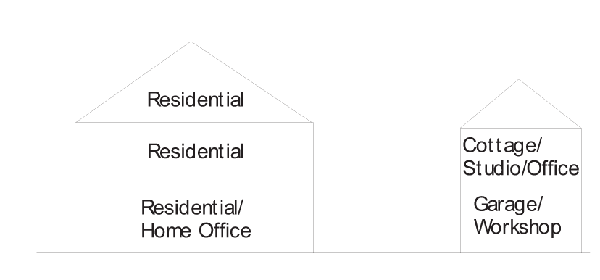 | 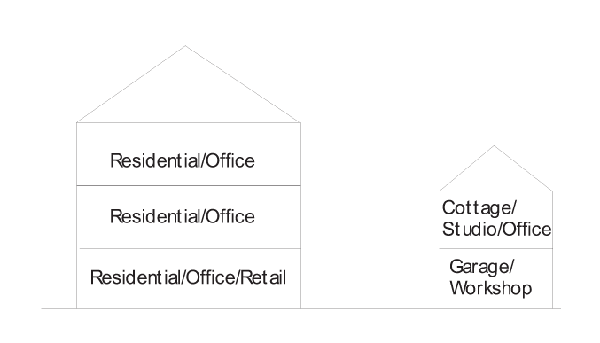 |
| 2.4 SPECIFIC BUILDING TYPES PERMITTED
Except where topographic conditions prohibit, all buildings shall enfront on public streets or parks. |
Detached House - Street Lot
Detached House - Alley Lot Townhouse Civic Building |
Detached House - Street Lot
Detached House - Alley Lot Townhouse Shopfront Building Workplace Building Civic Building |
| 2.5 PERMITTED OPEN SPACE TYPES |
Greenway
Park Sportsfield Green Square Plaza Community Garden Close Playground |
Square
Green Plaza Playground |
| 2.6 MAX. HEIGHT | 2½ Stories | 3 Stories |
| 2.7 SIGNAGE | All Permitted Signage | All Permitted Signage |
|
2.8 USE
PROVISIONS | ||
| To the extent that any uses permitted in the Downtown Overlay Code are inconsistent with the uses permitted in the underlying zoning district, the uses permitted in the Downtown Overlay Code shall control. | ||
| Residential: Premises available for long-term human habitation by means of ownership and rental, but excluding short-term letting of less than a month's duration | Limited Residential: The number of dwellings is limited by the requirement of 1.5 assigned parking spaces for each dwelling.
Permitted Uses: Single-family homes and Duplexes. Multifamily dwellings are permitted but shall be subject to the issuance of Conditional Zoning approval by the Board of Commissioners | Open Residential: The number of dwellings is limited by the requirement of 1.5 assigned parking spaces for each dwelling, a ratio that may be reduced according
to the shared parking standard (Section 6.4).
Permitted Uses: Single-family homes, Duplexes, and Multifamily dwellings |
| Lodging: Premises available for short-term human habitation, including daily and weekly letting | Limited Lodging: The number of bedrooms available for lodging is limited by the requirement of one
assigned parking space for each bedroom, in addition to the parking requirement for
each dwelling. Food service may only be provided in the morning.
Permitted Uses: Rental Cottages and Bed and Breakfast Inns. | Open Lodging: The number of bedrooms available for lodging is limited by the requirement of one
assigned parking space for each bedroom, in addition to the parking requirement for
each dwelling. Food service may be provided at all times.
Permitted Uses: Hotels and Inns, Rental Cottages. |
| Office: Premises available for the transaction of general business, but excluding retail sales and manufacturing | Restricted Office: Customary home occupation uses are permitted.
Permitted Uses: Home Occupations, Professional Offices are permitted along Wilgrove-Mint Hill Road only with a Conditional Zoning approval. | Open Office: The area available for office use is limited by the requirement of 3 assigned parking
spaces for each 1000 sq ft, a ratio that may be reduced according to the shared parking
standards (Section 6.4).
Permitted Uses: Office Uses, Live-Work Units |
| Retail: Premises available for the commercial sale of merchandise and prepared foods, but excluding manufacturing | Restricted Retail: Retail use is not permitted within residential buildings; with the exception of child
care centers in residential structures.
Permitted Uses: Child Care Center. | Open Retail: The area available for retail use is limited by the requirement of one assigned parking
space for each 250 square feet of gross retail space, a ratio that may be reduced
according to the shared parking standards (Section 6.4).
Permitted Uses: Retail Uses, Restaurants, Entertainment Uses, and Day Care Centers Automotive Parts Retail, Convenience Stores, Gas Stations, Drive-Through Facilities and Car Washes (subject to the issuance of a Conditional Zoning approval) to the Downtown Code. Excluded Uses: Automotive/Boat/Heavy Equipment/Manufactured Home Sales and Service, Adult Establishments and Adult Video Stores. |
| Manufacturing: Premises available for the creation, assemblage, and repair of items including their retail sale except when such activity creates adverse impacts | Restricted Manufacturing: Manufacturing uses are not permitted. | Restricted Manufacturing: Manufacturing uses are not permitted. |
| Civic: Premises available for not-for-profit organizations dedicated to religion, arts and culture, education, government, social service, transit, and other similar functions | Open Civic: Civic uses shall be permitted, except those uses that exceed 25,000 square feet shall be subject to the issuance of Conditional Zoning approval by the Board of Commissioners. | Open Civic: Civic uses shall be permitted, except those uses that exceed 25,000 square feet shall be subject to the issuance of Conditional Zoning approval by the Board of Commissioners. |
| Conditional Zoning Provisions |
1. The provisions of Section 1.2-General Building Design Guidelines shall be adhered
to.
2. Where adjacent buildings are residential in character, the infill building shall maintain that character using architectural techniques that are consistent with residential styles. 3. For Gas Stations, the pump canopy shall be located to the side or rear of the principal building. No canopy may be placed in a yard adjacent to a street (i.e., on corner lots). 4. Drive thru lanes and services shall be minimized so as not to negatively impact the pedestrian realm of the fronting street with excessive curb cuts or frequent travel. Circulation lanes in the front of the building, if permitted, should not exceed 10 feet in total width and should be visually differentiated using a brick or concrete paver, stamped and/or colored pavement technique, or a treatment similar in appearance. | |
H.
Windows shall be vertically proportioned. Exceptions include storefront windows on the ground level (which are generally square or rectangular) and certain window configurations that are stylistically accurate with recognized architectural styles (international or modern). Also, to the extent possible, upper story windows shall be vertically aligned with the location of windows and doors on the ground level, including storefront or display windows.
I.
Metal buildings are prohibited.
2.0
DISTRICT STANDARDS
2.1
TRANSECT DIAGRAM—DOWNTOWN MINT HILL:
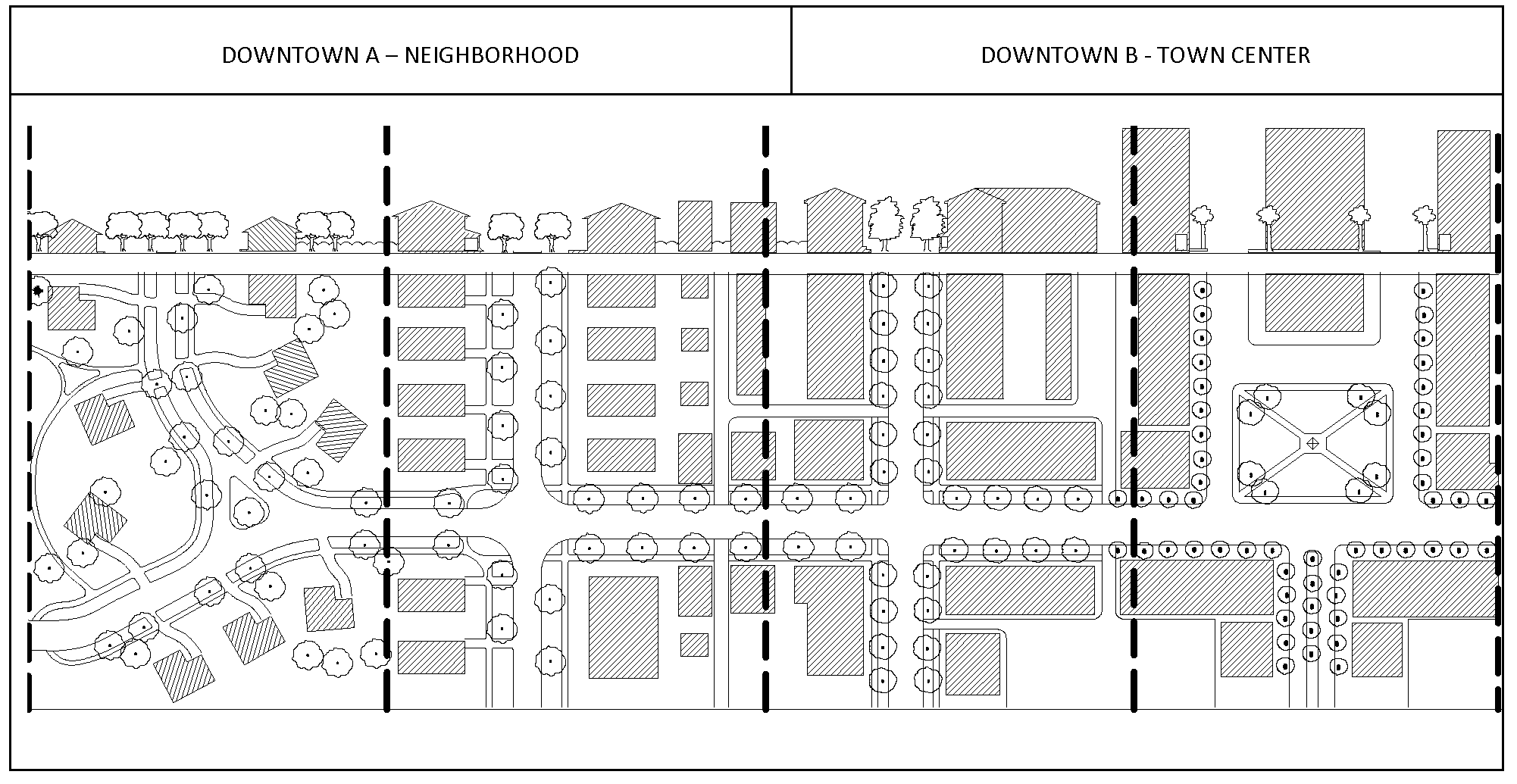
2.2
DESCRIPTION:
A.
DOWNTOWN A - NEIGHBORHOOD. The Neighborhood zone is mixed in function, but principally residential in character. It is the largest area of the Downtown.
B.
DOWNTOWN B - TOWN CENTER. The Town Center is the most dense business, service, and institutional center as it is shared by many neighborhoods in the Downtown area. Buildings in the Town Center are close to the street and off-street parking is generally to the rear to create an active pedestrian environment.
3.0
OPEN SPACE REQUIREMENTS
3.1
APPLICABILITY AND IMPLEMENTATION:
A.
All residential development shall be subject to these provisions.
B.
Open space types may be combined (i.e., a playground in a park).
3.2
GENERAL PROVISIONS:
A.
Common open space is defined as all areas not covered by building or parking lots, dry detention structures, streets, and required setbacks. The intent of these requirements is to allow for the usage of centrally located unencumbered land as neighborhood open spaces and not to permit the use of leftover or otherwise unusable land to fulfill the requirements of this Section.
B.
Residential development shall provide common open space in accordance with the specifications of this Downtown Overlay Code. Developments shall provide common open space at a rate of five hundred (500) square feet per bedroom unit. For the purposes of this calculation, developers shall make a good faith estimate (with a margin of error not exceeding ten (10) percent) at the time of Preliminary Plat submission. Greenways are credited towards this requirement at a rate equal to the length of the path times sixteen (16) feet in width.
C.
Common open space shall be planned and improved, accessible and usable by persons living nearby. Improved shall mean cleared of underbrush and debris and shall contain one or more of the following improvements: landscaping, walls, fences, walks, statues, fountains, ball fields, and/or playground equipment.
D.
Significant stands of trees, streambed areas, and other valuable topographic features shall be preserved within the required open space areas where practical. Areas noted on the Master Plan as open space should be preserved and dedicated where practical and feasible and may be left unimproved in accordance with the Plan.
E.
Playground equipment, statues, and fountains should be located toward the interior of squares and parks.
F.
Common open space should be fronted by streets and buildings to encourage their use and patrol their safety.
G.
Required common open space shall be separately deeded to either a homeowner's association, a nonprofit land trust or conservancy, Mecklenburg County, the Town of Mint Hill, or otherwise permanently protected through deed restriction.
3.3
PERMITTED TYPES: Greenway, Meadow, Park, Sportsfield/Stadiums, Green, Square, Plaza, Community Gardens, Close, and Playground (see Article 2 for definitions of each).
4.0
BUILDING TYPES
4.1
DETACHED HOUSE - TYPE A (STREET LOT):
Description. The detached house is the predominant building type in the Town of Mint Hill. It is flexible in use (where permitted), accommodating single-family uses, multifamily uses up to four (4) units, home occupations, professional offices, and limited retail uses. When other building types are integrated with Detached Houses, the scale of the Detached House shall control (exception: Civic Buildings).
Applicability. The street lot is a medium or large sized lot that provides primary vehicular access from the street. The use permitted within the building is determined by the District in which it is located.
1.
Lot Requirements.
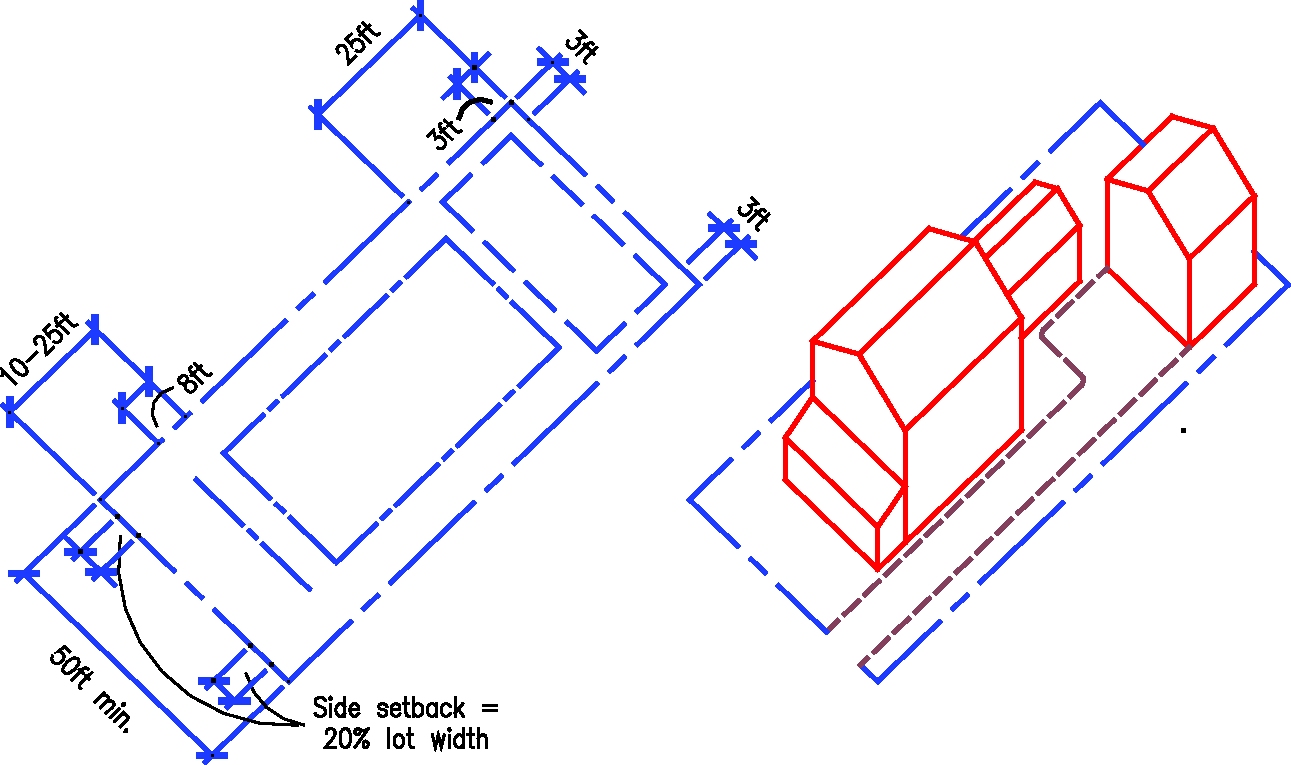
Setbacks: Front yard and side yard setbacks for structures on infill lots shall generally be equal to the average setbacks for all principal structures within three hundred (300) feet or one block length (whichever is greater). Where no frontage condition currently exists, the build-to line and/or setbacks shall be as follows:
Front Build-To Line: Ten (10) to twenty-five (25) feet.
Sides: The total of both side setbacks shall equal twenty (20) percent of the lot width at the frontage line, but shall not be less than 6 feet, except in new developments, where the entire setback may be allocated to one side).
Rear: Fifteen (15) feet.
Minimum Lot Width: Fifty (50) feet.
Driveway: The minimum length of any driveway shall be twenty-four (24) feet such that the surface area for outdoor parking of vehicles either in front of a closed residential garage or next to a residential structure on a parking pad shall eliminate situations where vehicles park on, over or across sidewalks.
Maximum Height: Two and one-half (2½) stories (as measured from the fronting street).
Encroachments: Balconies, stoops, stairs, chimneys, open porches, bay windows, and raised doorways are permitted to encroach into the front setback a maximum of twelve (12) feet.
Building Lot Coverage (Maximum): Fifty (50) percent.
Accessory Structures:
Side/Rear Setback: Three (3) feet.
Maximum Footprint: Six hundred fifty (650) square feet.
Maximum Number of Structures: One.
2.
Architectural Requirements.
A.
General Requirements.
(1)
Useable porches and stoops should form a predominate motif of the building design and be located on the front and/or side of the home. Useable front porches are at least six (6) feet deep and extend more than fifty (50) percent of the facade.
(2)
Garages with front loading bays shall be recessed from the front facade of the house and visually designed to form a secondary building volume. All garages with more than two (2) bays shall be turned such that the bays are not visible from the street. At no time shall the width of an attached garage exceed the greater of twenty (20) feet or forty (40) percent of the total building facade.
(3)
Fences or walls shall be no greater than six (6) feet in height behind the front building line. Fences shall be no greater than four (4) feet in height and walls no greater than three (3) feet in height in the front yard setback.
(4)
Garage doors are not permitted on the front elevation of any detached house on a lot less than fifty (50) feet wide.
(5)
All front entrances shall be raised from the street grade (at the curb or sidewalk) a minimum of one and one-half (1½) feet. (Exceptions may be granted by the Administrator to accommodate accessibility for the elderly/disabled on a site by site basis.)
(6)
Decorative mailboxes shall be uniform throughout the development.
B.
Materials.
(1)
A minimum of fifty (50) percent of the total dwelling units shall have brick and/or stone on all vertical walls of the home, with the exception of approved accent materials on the architectural elements such as gables and dormers. Residential building walls of other units shall be wood clapboard, wood shingle, wood drop siding, primed board, wood board and batten, cementitious fiber board, brick, stone or masonry stucco. Accessory buildings with a floor area of one hundred forty-four (144) square feet or greater shall be clad in materials similar in both type and appearance to the principal structure.
(2)
Garden walls may be of brick, stone or stucco matching the principal building. Front yard fences shall be wood picket or wrought iron only. Side and rear yard fences may be wood, wrought iron, or similar material. All side and rear yard fences over four (4) feet in height shall be wood or similar material unless landscaped from view by adjacent properties using trees, hedges, ivy or similar plant material.
(3)
Residential roofs shall be clad in wood or architectural shingles, clay tile, or standing seam metal (copper, zinc, or terne) or materials similar in appearance and durability.
(4)
Foundation walls (except those under porches) shall be finished with brick or stone. The crawlspace of porches may be enclosed with a combination of brick, stone, and wood lattice.
C.
Configurations.
(1)
Main roofs on residential buildings shall be symmetrical gables or hips with a pitch between 6:12 and 12:12. Monopitch (shed) roofs are allowed only if they are attached to the wall of the main building. No monopitch roof shall be less then 3:12.
(2)
Two (2) wall materials may be combined horizontally on one facade. The heavier material should be below.
(3)
Exterior chimneys visible from public streets shall be finished in brick or masonry stucco. All other roof equipment should be screened from the view of the fronting street.
(4)
The crawlspace of buildings shall be enclosed.
D.
Techniques.
(1)
Overhanging eaves may expose rafters.
(2)
Flush eaves shall be finished by profiled molding or gutters.
All rooftop equipment shall be enclosed in building material that matches the structure or is visually compatible with the structure.
4.2
DETACHED HOUSE - TYPE B (ALLEY LOT):
Description: The detached house is the predominant building type in the Town of Mint Hill. It is flexible is use (where permitted), accommodating single-family uses, multifamily uses up to four (4) units, home occupations, professional offices, and limited retail uses. When other building types are integrated with Detached Houses, the scale of the Detached House shall control (exception: Civic Buildings).
Applicability: The alley lot is a lot with an average width not exceeding fifty (50) feet. Primary vehicular access is provided using a rear lane or alley only. No curb cuts or driveways are permitted along the frontage except on previously platted lots or where the condition currently exists. The use permitted within the building is determined by the District in which it is located.
1.
Lot Requirements.
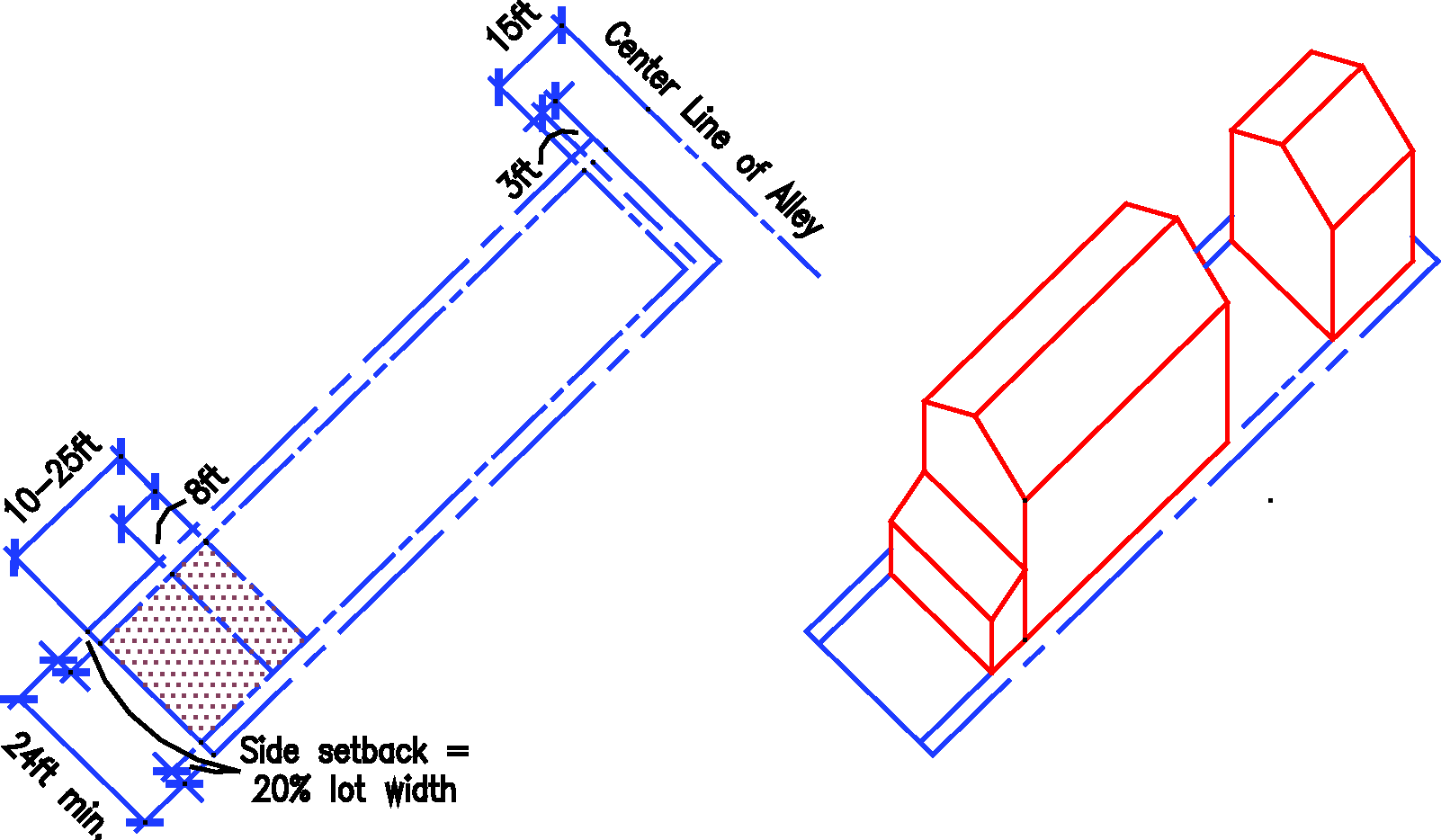
Setbacks: Front yard and side yard setbacks for structures on infill lots shall generally be equal to the average setbacks for all principal structures within three hundred (300) feet or one block length (whichever is greater). Where no frontage condition currently exists, the build-to line and/or setbacks shall be as follows:
Front Build-To Line: Ten (10) to twenty-five (25) feet.
Side: Six (6) feet each side, however the total of both side yards may be allocated to one side in new development.
Rear: Fifteen (15) feet from centerline of alley.
Minimum Lot Width: Twenty-four (24) feet.
Maximum Height: Two and one-half (2½) stories (as measured from the fronting street).
Encroachments: Balconies, stoops, stairs, chimneys, open porches, bay windows, and raised doorways are permitted to encroach into the front setback a maximum of twelve (12) feet.
Building Lot Coverage (Maximum): Fifty (50) percent.
Accessory Structures:
Side/Rear Setback: Three (3) feet.
Maximum Footprint: Six hundred fifty (650) square feet.
Maximum Number of Structures: One.
2.
Architectural Requirements.
A.
General Requirements.
(1)
Useable porches and stoops should form a predominate motif of the building design and be located on the front and/or side of the home. Useable front porches are at least six (6) feet deep and extend more than fifty (50) percent of the facade.
(2)
Fences or walls shall be no greater than six (6) feet in height behind the front building line. Fences shall be no greater than four (4) feet in height and walls no greater than three (3) feet in height in the front yard setback.
(3)
All front entrances shall be raised from the street grade (at the curb or sidewalk) a minimum of one and one-half (1½) feet.
(4)
Decorative mailboxes and decorative sign posts shall be uniform throughout the development.
B.
Materials.
(1)
A minimum of fifty (50) percent of the total dwelling units shall have brick and/or stone on all vertical walls of the home, with the exception of approved accent materials on the architectural elements such as gables and dormers. Residential building walls of other units shall be wood clapboard, wood shingle, wood drop siding, primed board, wood board and batten, cementitious fiber board, brick. Accessory buildings with a floor area of one hundred forty-four (144) square feet or greater shall be clad in materials similar in both type and appearance to the principal structure.
(2)
Garden walls may be of brick, stone or stucco matching the principal building. Front yard fences shall be wood picket or wrought iron only. Side and rear yard fences may be wood, wrought iron, or similar material. All side and rear yard fences over four (4) feet in height shall be wood or similar material unless landscaped from view by adjacent properties using trees, hedges, ivy or similar plant material.
(3)
Residential roofs shall be clad in wood or architectural shingles, clay tile, or standing seam metal (copper, zinc, or terne) or materials similar in appearance and durability.
(4)
Foundation walls (except those under porches) shall be finished with brick or stone. The crawlspace of porches may be enclosed with a combination of brick, stone, and wood lattice.
C.
Configurations.
(1)
Main roofs on residential buildings shall be symmetrical gables or hips with a pitch between 6:12 and 12:12. Monopitch (shed) roofs are allowed only if they are attached to the wall of the main building. No monopitch roof shall be less then 3:12.
(2)
Two (2) wall materials may be combined horizontally on one facade. The heavier material should be below.
(3)
Exterior chimneys visible from public streets shall be finished in brick or masonry stucco. All other roof equipment should be screened from the view of the fronting street.
(4)
The crawlspace of buildings shall be enclosed.
D.
Techniques.
(1)
Overhanging eaves may expose rafters.
(2)
Flush eaves shall be finished by profiled molding or gutters.
(3)
All rooftop equipment shall be enclosed in building material that matches the structure or is visually compatible with the structure.
4.3
TOWNHOUSE:
Description: The townhouse is a building with two (2) or more residential units that are located side-by-side. When an entrance is provided at-grade, the townhouse may be used as a live-work unit.
Applicability: The use permitted within the building is determined by the District in which it is located.
1.
Lot Requirements.
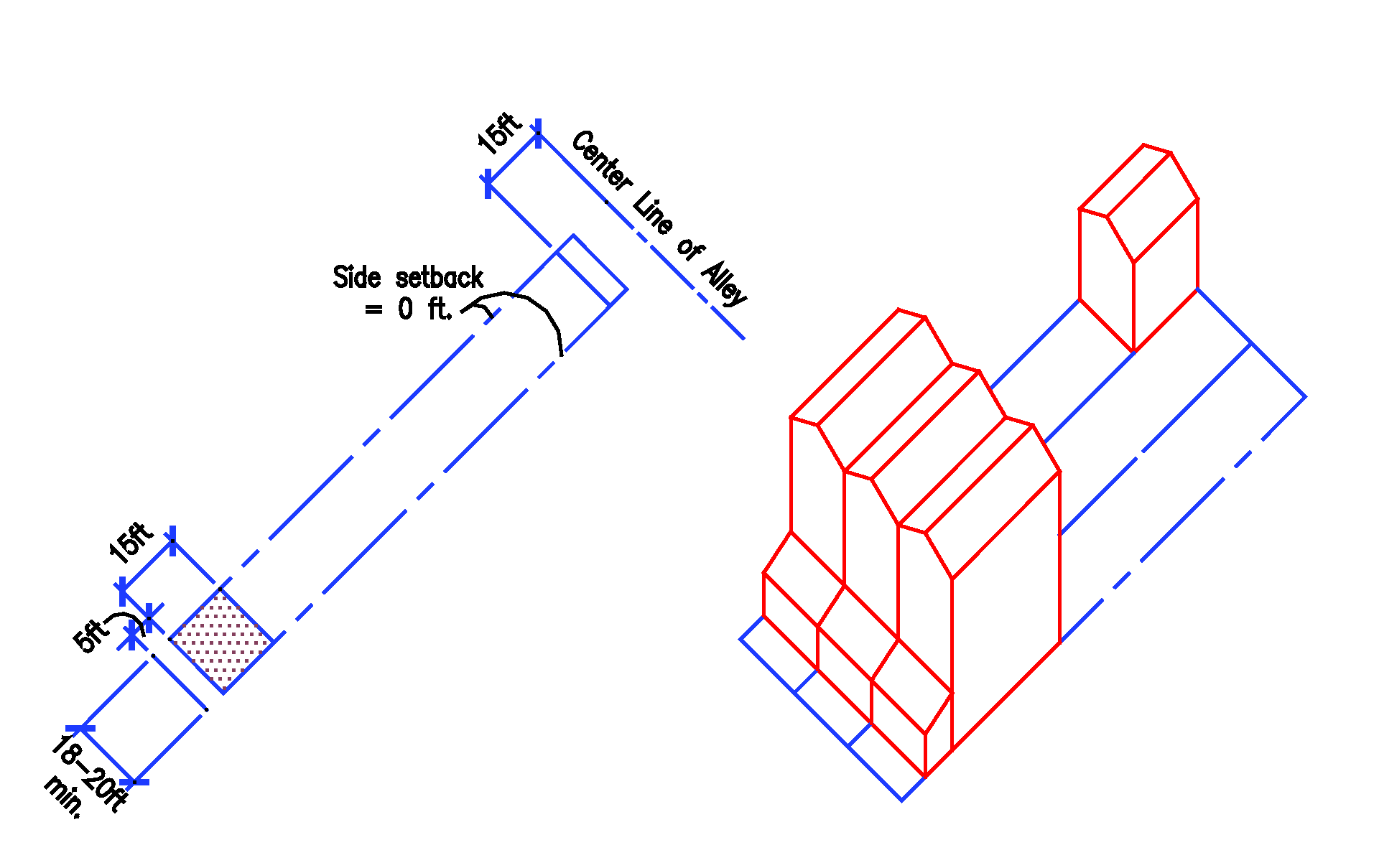
Setbacks:
Front (Maximum): Zero (0) to fifteen (15) feet.
Sides: Zero (0) feet (corner—six (6) feet).
Rear: Fifteen (15) feet from centerline of alley.
Parking and Vehicular Access: Primary vehicular access is provided using a rear lane or alley only. Off-street parking shall be located in the rear yard only. No curb cuts or driveways are permitted along the frontage.
Minimum Unit Width: Eighteen (18) feet (with a minimum average of twenty (20) feet per building block).
Encroachments: Balconies, stoops, stairs, chimneys, open porches, bay windows, and raised doorways are permitted to encroach into the front setback.
Accessory Structures:
Side/Rear Setback: Zero (0) feet.
Maximum Footprint: Six hundred fifty (650) square feet.
Maximum Number of Structures: One.
2.
Architectural Requirements.
A.
General Requirements.
(1)
Useable porches and stoops should form a predominate motif of the building design and be located on the front and/or side of the building. Useable front porches are at least six (6) feet deep and extend more than fifty (50) percent of the facade.
(2)
Garage doors are not permitted on the front elevation of any townhouse.
(3)
Fences or walls shall be no greater than six (6) feet in height behind the front building line. Fences shall be no greater than four (4) feet in height and walls no greater than three (3) feet in height in the front yard setback.
(4)
All building elevations visible from the street shall provide doors, porches, balconies, and/or windows. A minimum of sixty (60) percent of front elevations, and a minimum of thirty (30) percent of side and rear building elevations, as applicable, shall meet this standard. "Percent of elevation" is measured as the horizontal plane (lineal feet) containing doors, porches, balconies, terraces and/or windows. This standard applies to each full and partial building story.
(5)
All front entrances shall be raised from the street grade (at the curb or sidewalk) a minimum of one and one-half (1½) feet.
(6)
All townhouses shall provide detailed design along all elevations. Detailed design shall be provided by using at least three (3) of the following architectural features on all elevations as appropriate for the proposed building type and style (may vary features on rear/side/front elevations):
a.
Dormers.
b.
Gables.
c.
Recessed or covered porch entries.
d.
Cupolas or towers.
e.
Pillars or posts.
f.
Eaves (minimum six-inch projection).
g.
Off-sets in building face or roof (minimum sixteen (16) inches); window trim (minimum four (4) inches wide).
h.
Bay windows.
i.
Balconies.
j.
Decorative patterns on exterior finish (e.g., scales/shingles, wainscoting, ornamentation, and similar features).
k.
Decorative cornices and roof lines (for flat roofs).
B.
Materials.
(1)
Sixty-five (65) percent of residential building walls shall be of brick or stone; a maximum of thirty-five (35) percent of front and rear facades may be of wood clapboard, wood shingle, wood drop siding, primed board, wood board and batten, cementitious fiber board, masonry stucco or approved vinyl. End walls of corner units shall be brick. Accessory buildings with a floor area greater than one hundred fifty (150) square feet shall be clad in materials similar in appearance to the principal structure. Gable ends may be detailed in brick, shakes, or siding (nonvinyl only).
(2)
Garden walls may be of brick, stone or stucco matching the principal building. Front yard fences shall be wood picket or wrought iron only. Side and rear yard fences may be wood, wrought iron, or similar material. All side and rear yard fences over four (4) feet in height shall be wood or similar material.
(3)
Residential roofs shall be clad in wood or architectural shingles, clay tile, or standing seam metal (copper, zinc, or terne) or materials similar in appearance and durability.
(4)
Foundation walls shall be finished with brick or stone.
C.
Configurations.
(1)
Main roofs on residential buildings shall be symmetrical gables or hips with a pitch between 6:12 and 12:12. Monopitch (shed) roofs are allowed only if they are attached to the wall of the main building. No monopitch roof shall be less then 3:12.
(2)
Two (2) wall materials may be combined horizontally on one facade. The heavier material should be below.
(3)
Exterior chimneys visible from public streets shall be finished in brick or stucco. All other roof equipment should be screened from the view of the fronting street.
(4)
The crawlspace of buildings shall be enclosed.
D.
Techniques.
(1)
Overhanging eaves may expose rafters.
(2)
Flush eaves shall be finished by profiled molding or gutters.
4.4
SHOPFRONT BUILDING:
Description: A small scale structure less than twenty thousand (20,000) square feet which can accommodate a variety of uses. A group of shopfront buildings can be combined to form a mixed-use neighborhood center. Individual shopfront buildings can be used to provide some commercial service, such a neighborhood store, in close proximity to homes. Office buildings, hotels and inns can be placed in shopfront buildings.
Applicability: The use permitted within the building is determined by the District in which it is located.
1.
Lot Requirements.
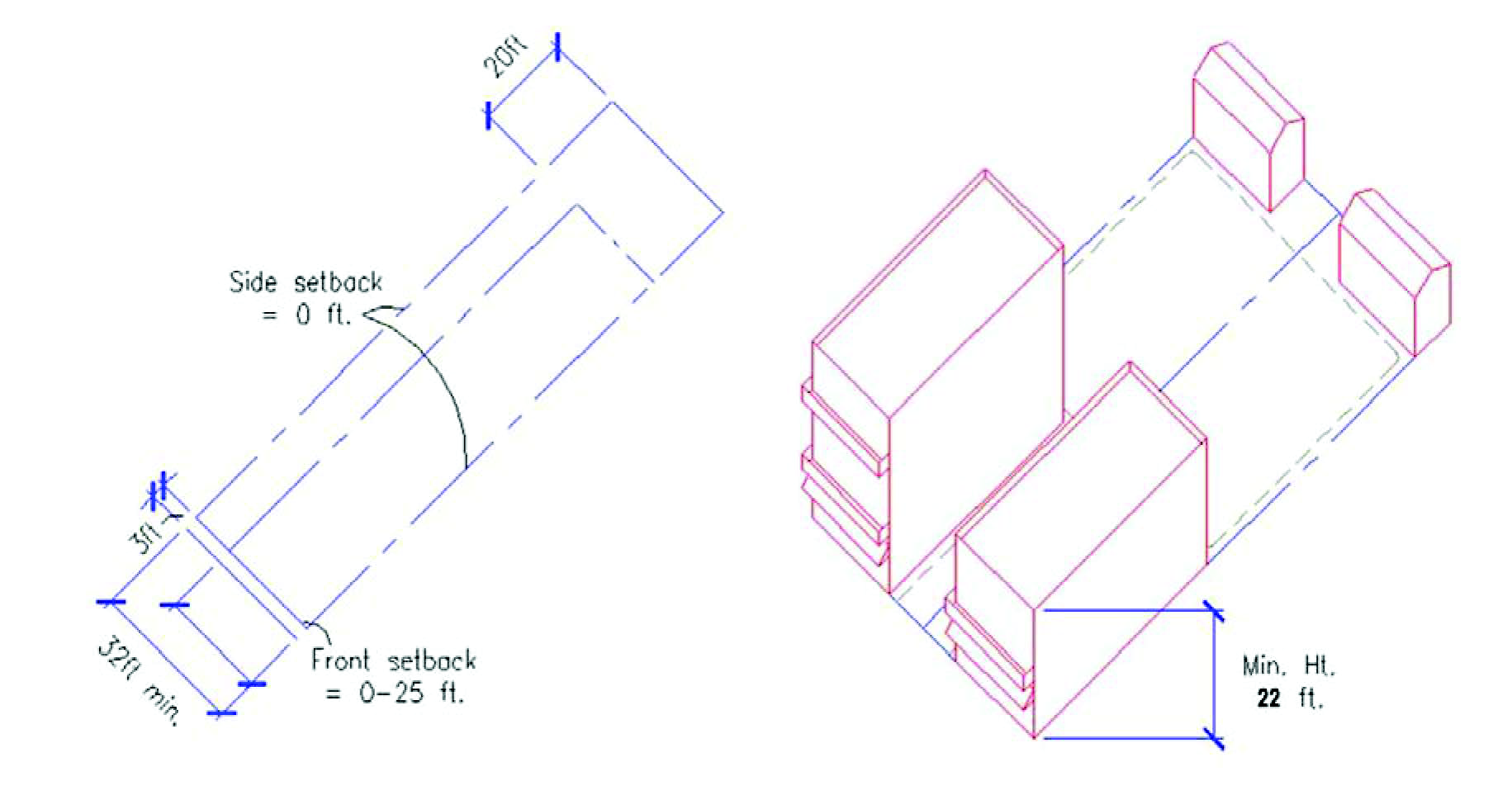
Minimum Front Height: Twenty-six (26) feet within the Square (as defined in the Downtown Mint Hill Master Plan); otherwise, twenty-two (22) feet.
Maximum Height: Per Zone requirements.
Setbacks:
Front: Zero (0) to twenty-five (25) feet.
Sides: Zero (0) feet.
Rear: Twenty (20) feet.
Parking and Vehicular Access: Primary vehicular access is provided using a rear lane or alley only. Off-street parking shall be located in the side or rear yard only. No curb cuts or driveways are permitted along the frontage.
Accessory Structures:
Side/Rear Setback: Zero (0) feet.
2.
Architectural Requirements.
A.
General Requirements.
(1)
No frontage wall shall remain unpierced by a window or functional general access doorway for more than sixteen (16) feet. Street level windows shall be visually permeable. Mirrorized glass, faux or display casements are not permitted in lieu of exterior window treatments for the frontage elevation except along non-pedestrian oriented streets.
(2)
A functional doorway for public or direct-entry access into a building shall be from the fronting street facade. For buildings along NC 51, pedestrian pathways from the street shall be provided at least every one hundred (100) feet. Corner lot buildings shall have either corner entrances or a separate entrance for each street front.
(3)
Decorative cornices shall be provided for buildings with a flat roof. Alternatively, eaves shall be provided with a pitched roof.
(4)
A building canopy, awning, or similar weather protection may be provided and should project three (3) to five (5) feet from the facade. Encroachments into the right-of-way shall be permitted by the Town or NCDOT.
B.
Materials.
(1)
Commercial building walls shall be brick, masonry stucco, stone, marble, or other masonry products. Any concrete block utilized shall be decorative, except that regular concrete block may be used on buildings not visible from a public street. All accessory buildings shall be clad in materials similar in appearance to the principal structure.
(2)
Pitched roofs shall be clad in wood or architectural shingles, clay tile, or standing seam metal (copper, zinc, or terne) or materials similar in appearance and durability.
(3)
Signs on the inside of glazed openings may be neon.
(4)
The pedestrian pathways referenced in Subsection 4.4.2(A)(2) above shall be made of brick pavers.
C.
Configurations.
(1)
All visibly exposed facades shall have a recognizable base course, which shall align with the sill level of the first story consisting of, but not limited to: thicker walls, ledges or sills; integrally textured materials such as stone or other masonry; integrally colored and patterned materials such as smooth finished stone or tile; lighter or darker colored materials, mullions, or panels; and/or planters.
(2)
Buildings at corner locations should provide adequate architectural treatment to create a sense of place and ensure pedestrian-friendly design.
(3)
Two (2) wall materials may be combined horizontally on one facade. The heavier material should be below.
(4)
Sky-lights shall be flat (non-bubble).
D.
Techniques.
(1)
Windows shall be set to the inside of the building face wall.
(2)
All rooftop equipment, utility boxes, transformers, meters, and similar structures must be screened from public view. The rooftop equipment shall be screened in building material that matches the structure or is visually compatible with the structure. Meters shall not be located on the building elevation facing Matthews-Mint Hill Road or Lawyers Road nor should the meters be installed in the yard area between building and said roads; however, the Administrator and Town Manager are authorized to waive this requirement if there are practical difficulties installing the meters elsewhere. The backflow enclosure box shall be green in color unless at the discretion of the Town Manager and Administrator another color is deemed more appropriate.
4.5
WORKPLACE BUILDING:
Description: A fixed commercial building type of greater than twenty thousand (20,000) square feet with commercial use throughout. Office buildings are among the largest urban types as they must accommodate large floor plans.
Applicability: The use permitted within the building is determined by the District in which it is located.
1.
Lot Requirements.
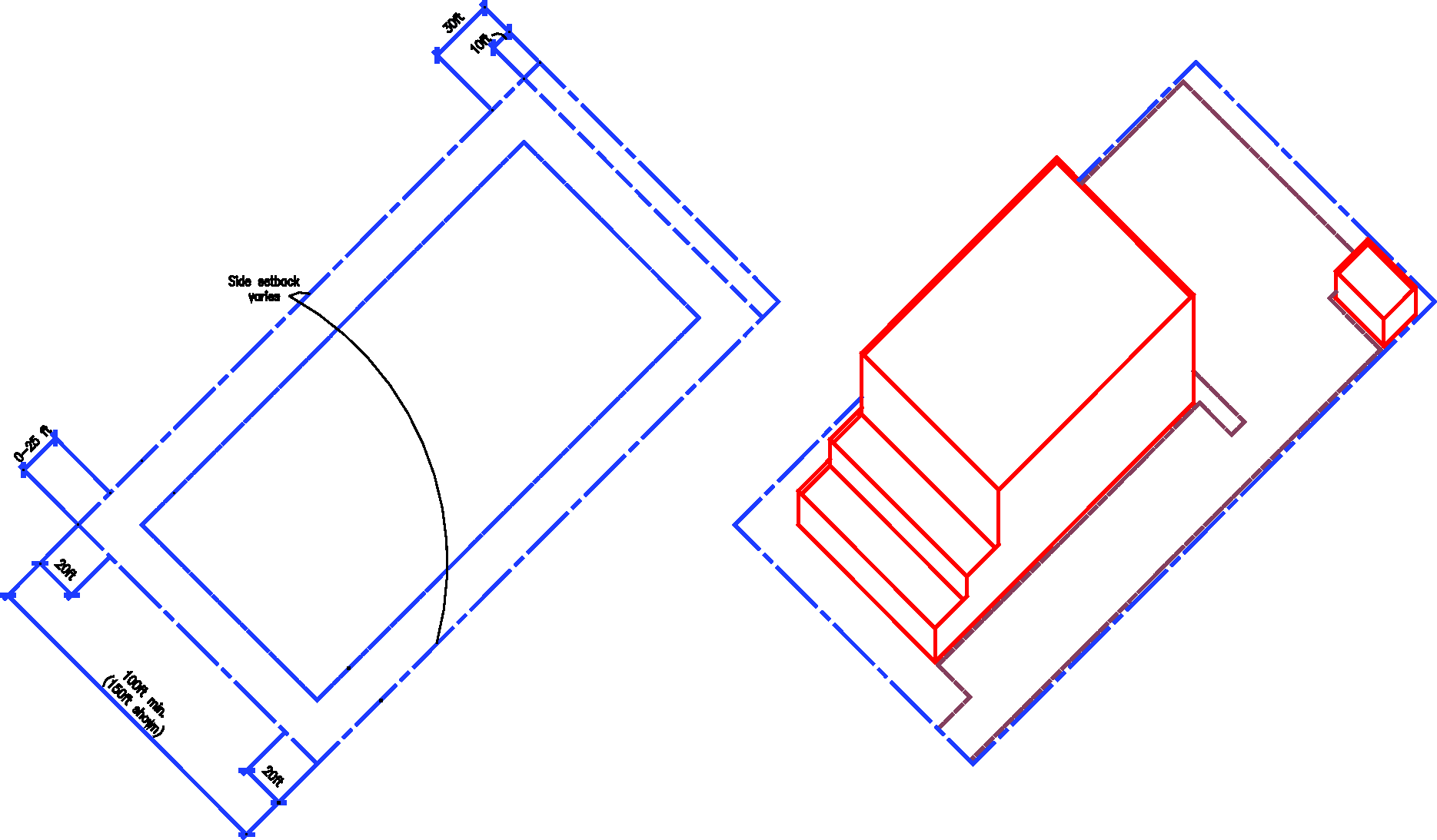
Setbacks:
Front: Zero (0) to twenty-five (25) feet.
Side: Varies.
Rear: Thirty (30) feet.
Accessory Structure Setback: Ten (10) feet.
Parking Setback: Ten (10) feet.
Minimum Lot Width: One hundred (100) feet.
Minimum Height: Twenty-six (26) feet.
2.
Architectural Requirements.
A.
General Requirements.
(1)
At least fifty (50) percent of the width of street level frontages shall be in windows doorways, or articulation in the facade. Street level windows shall be visually permeable. Mirrorized glass is not permitted in any location. Faux or display casements are not permitted in lieu of exterior window treatments for the frontage elevation.
(2)
No frontage wall shall remain unpierced by a window or functional general access doorway for more than sixteen (16) feet.
(3)
A functional doorway for public or direct-entry access into a building shall be from the fronting street facade. Corner lot buildings shall have either corner entrances or a separate entrance for each street front.
(4)
Decorative cornices shall be provided for buildings with a flat roof. Alternatively, eaves shall be provided with a pitched roof.
(5)
A building canopy, awning, or similar weather protection may be provided and should project three (3) to five (5) feet from the facade Encroachments into the right-of-way shall be permitted by the Town or NCDOT.
B.
Materials.
(1)
Commercial building walls shall be brick, masonry stucco, stone, marble, or other masonry products. Any concrete block utilized shall be decorative, except that regular concrete block may be used on buildings not visible from a public street. All accessory buildings shall be clad in materials similar in appearance to the principal structure.
(2)
Pitched roofs shall be clad in wood or architectural shingles, clay tile, or standing seam metal (copper, zinc, or terne) or materials similar in appearance and durability.
(3)
Signs on the inside of glazed openings may be neon.
C.
Configurations.
(1)
All visibly exposed facades shall have a recognizable base course, which shall align with the sill level of the first story consisting of, but not limited to: thicker walls, ledges or sills; integrally textured materials such as stone or other masonry; integrally colored and patterned materials such as smooth finished stone or tile; lighter or darker colored materials, mullions, or panels; and/or planters.
(2)
Two (2) wall materials may be combined horizontally on one facade. The heavier material should be below.
(3)
Sky-lights shall be flat (non-bubble).
D.
Techniques.
(1)
Stucco shall be float finish.
(2)
Windows shall be set to the inside of the building face wall.
(3)
All rooftop equipment, utility boxes, transformers, meters, and similar structures must be screened from public view. The rooftop equipment shall be screened in building material that matches the structure or is visually compatible with the structure. Meters shall not be located on the building elevation facing Matthews-Mint Hill Road or Lawyers Road nor should the meters be installed in the yard area between building and said roads; however, the Administrator and Town Manager are authorized to waive this requirement if there are practical difficulties installing the meters elsewhere. The backflow enclosure box shall be green in color unless at the discretion of the Town Manager and Administrator another color is deemed more appropriate.
4.6
CIVIC BUILDING:
Description: Specialized buildings intended to serve as public gathering places. Such uses include governmental offices, churches or other places of worship, schools, hospitals, post offices, and nonprofit or charitable clubs and organizations.
Applicability: The use permitted within the building is determined by the District in which it is located.
1.
Lot Requirements.
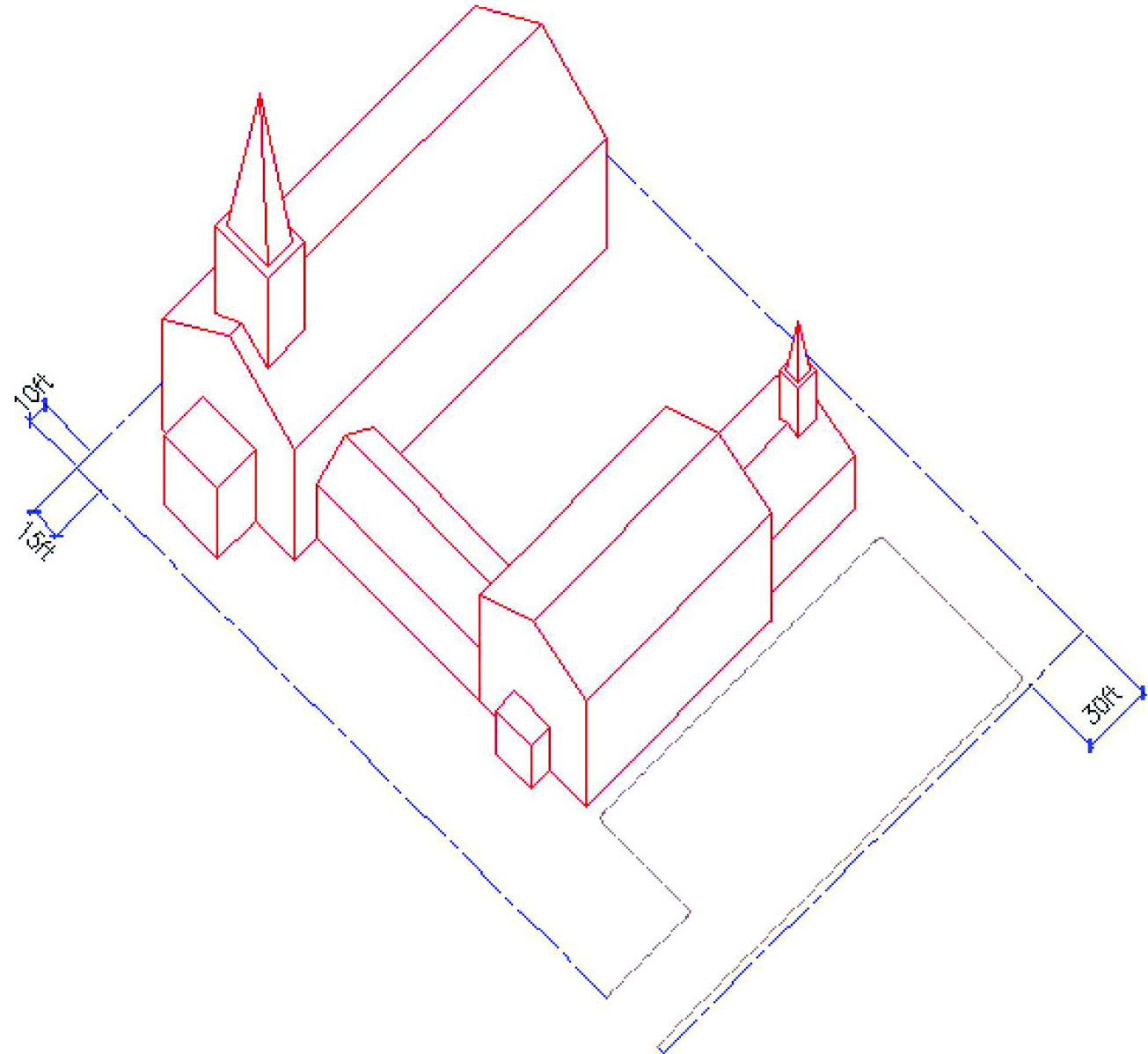
Setbacks:
Front: Ten (10) feet.
Sides: Fifteen (15) feet.
Rear: Thirty (30) feet.
Accessory Structure Side/Rear Setback: Five (5) feet.
Minimum Lot Width: Seventy (70) feet.
Encroachments: Balconies, stoops, stairs, open porches, bay windows, and raised doorways are permitted to encroach into the front setback a maximum of ten (10) feet.
2.
Architectural Requirements.
A.
General Requirements.
(1)
Schools, churches, and government buildings should be built so that they terminate a street vista whenever possible, and shall be of sufficient design to create visual anchors for the community.
(2)
Off-street parking shall be provided in the side or rear yards only.
B.
Materials.
(1)
Civic building walls shall be clad in clapboard, cementitious fiber board, stone, stucco, brick, or marble. Decorative cast concrete and wood siding may be used as a minority element on facades facing public streets.
(2)
Civic roofs shall be clad in slate, sheet metal, corrugated metal, or architectural shingles, or other material similar in appearance and durability.
(3)
Gutters and down spouts shall be made of copper, galvanized painted metal, or aluminum.
(4)
The orders, if provided, shall be made of wood, marble, or cast concrete.
(5)
Stained glass or other decorative window treatments are encouraged.
C.
Configurations.
(1)
Two (2) wall materials may be combined horizontally on one facade. The heavier material should be below.
(2)
Civic building roofs shall be pitched or have a similar architectural roof form.
D.
Techniques.
(1)
Windows shall be set to the inside of the building face wall.
(2)
All rooftop equipment shall be enclosed in building material that matches the structure or is visually compatible with the structure.
5.0
STREET TYPES AND STANDARDS
5.1
DESIGN STANDARDS:
Street designs shall permit the comfortable use of the street by cars, bicyclists, and pedestrians. Pavement widths, design speeds, and the number of vehicle lanes should be minimized without compromising safety. The specific design of any given street must consider the building types which front on the street and the relationship of the street to the Town's street network. New development with frontages on existing publicly maintained streets shall be required to upgrade all their frontages to meet the standards of this Section. This Code encourages the development of a network of interconnecting streets that work to disperse traffic while connecting and integrating neighborhoods with the existing urban fabric of the Town. Equally as important, the Code encourages the development of a network of sidewalks and bicycle lanes that provide an attractive and safe mode of travel for pedestrians and cyclists.
Minor variations and exceptions to street cross-sections may be permitted with approval of the Administrator and the County Engineer if applicable. Such exceptions include variations to the pavement width, size and location of on street parking, sidewalks, tree planting areas, street grade, and centerline radii in accordance with principles below.
•
Streets shall interconnect within a development and with adjoining development. Cul-de-sacs are permitted only where topographic conditions and/or exterior lot line configurations offer no practical alternatives for connection or through traffic. Street stubs should be provided with development adjacent to open land to provide for future connections. Streets shall be planned with due regard to the designated corridors shown on the Thoroughfare Plan.
•
Streets shall be designed as the main public space of the Town and shall be scaled to the pedestrian.
•
Streets shall be bordered by sidewalks on both sides.
•
Streets shall be designed with street trees planted in a manner appropriate to their function. Commercial streets shall have trees which compliment the face of the buildings and which shade the sidewalk. Residential streets shall provide for an appropriate tree canopy, which shades both the street and sidewalk, and serves as a visual buffer between the street and the home.
•
Wherever possible, street locations should account for difficult topographical conditions, paralleling excessive contours to avoid excessive cuts and fills and the destruction of significant trees and vegetation outside of street rights-of way on adjacent lands.
•
All streets shall be constructed in accordance with the design and construction standards in this code and shall permit public access whether by easement or by public dedication. Closed or gated streets are strictly prohibited.
•
All on-street parking provided shall be parallel. Curb or angle parking is permitted when the fronting buildings are more than twenty-six (26) feet in height to ensure a safe and usable pedestrian realm and where traffic speeds are very low (twenty (20) mph or less).
•
The use of traffic calming devices such as raised intersections, landscaping bulb-outs, and traffic circles are encouraged as alternatives to conventional traffic control measures.
5.2
DESIGN STANDARDS: The following specifications shall apply to street design:
A.
Sidewalks. Sidewalks shall be constructed along both sides of all streets except alleys and lanes. Cul-de-sacs and closes shall be reviewed on a site-by-site basis for this requirement. Residential sidewalks shall be a minimum of five (5) feet in width. Sidewalks serving mixed use and commercial areas shall be a minimum of eight (8) feet in width (ten (10) to twelve (12) feet is preferable in front of shop fronts); however the Administrator and Town Manager may reduce this minimum width to (no less than five (5) feet) if there are practical difficulties with a wider sidewalk. All sidewalks shall be constructed in brick pavers, concrete, or a similar material. Concrete sidewalks shall be a minimum of four (4) inches in depth.
B.
Street Trees and Planting Strips. Large maturing canopy trees a minimum of two and one-half (2½) inches in caliper and eight (8) feet in height at time of planting shall be planted in the planting strip or in tree wells (in DO-B) spaced fifty (50) feet on-center. The minimum width of all planting strips, if required, shall be six (6) feet or as approved by Mecklenburg County LUESA. For large maturing canopy trees such as Willow Oaks and Red Maples a minimum of eight (8) feet planting strip is required.
C.
Cul-de-Sacs. Where practical, a close should be used in place of a cul-de-sac. Cul-de-sacs, if permitted, shall not exceed two hundred fifty (250) feet in length from the nearest intersection with a street providing through access (not a cul-de-sac). Cul-de-sacs shall be offset from the street centerline and shall form a square.
D.
Curb Return Radii. Curb radii shall be designed to reduce pedestrian crossing times along all streets requiring sidewalks. In general, curb radii should not exceed twenty (20) feet.
E.
Utility Location. Underground utilities (except water and sewer) should be located in alleys and lanes. If no alley or lane is provided, then a five-foot (minimum) utility easement shall be provided behind the sidewalk located within either the right-of-way or a public utility easement.
F.
Curbs and Drainage. Curbs shall be constructed in accordance with Mecklenburg County Land Development Standards. Vertical face curbing is required along all streets with on-street parking and around all required landscaping areas and parking lots. Mountable curbing is permitted around center medians, roundabouts, and other features in order to facilitate the infrequent use by vehicles with larger turning radii Valley curbing is permitted along streets which serve homes with front-loaded off-street parking or that have infrequent on-street parking. Streets with a grade exceeding two (2) percent shall use standard curbs. Drainage shall be provided using curb and gutter piped systems along all streets except along parkways that may use open swales upon approval of the Administrator and the County Engineer. All drainage grates must be safe for bicyclists. Bicycle-safe drainage grates are Types E, F, and G as approved by the NCDOT.
G.
Centerline Radius. Centerline radii may be varied for low-speed streets in accordance with the following table (see also ITE TND Standards p. 26):
H.
Street Signs and Stop Signs. Decorative street signs and stop signs approved by staff shall be erected by the developer within all new development located in the Downtown. Replacement of such sign(s) shall be of similar design and equal or exceed the existing sign(s).
5.0
STREET TYPES AND STANDARDS
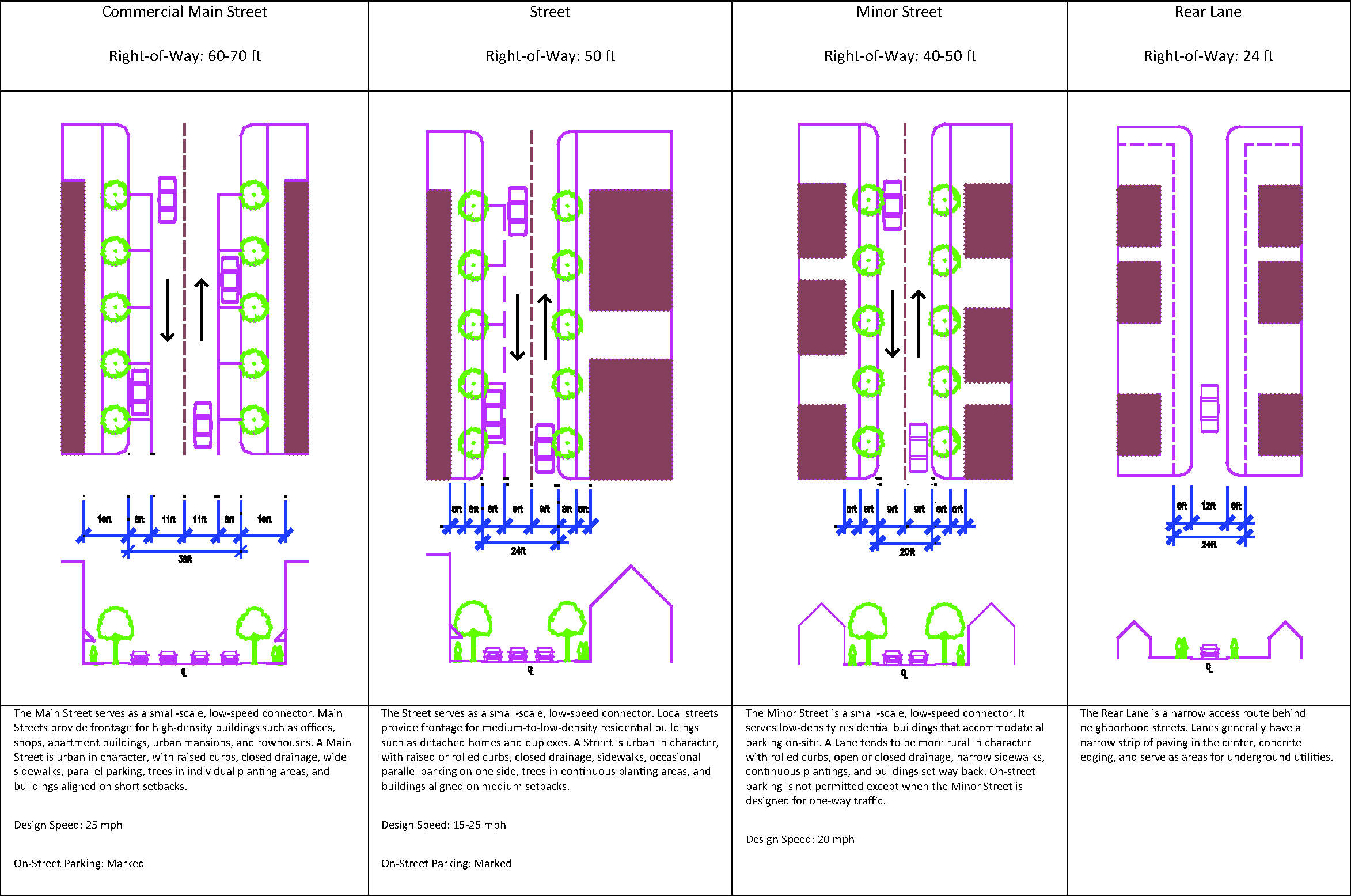
6.0
PARKING STANDARDS
6.1
GENERAL PRINCIPLES:
A.
Parking lots should not dominate the frontage of pedestrian-oriented streets, interrupt pedestrian routes, or negatively impact surrounding neighborhoods. Lots should be located behind buildings or in the interior of a block whenever possible.
B.
Parking areas shall not abut pedestrian-oriented street intersections or civic buildings, be adjacent to squares or parks, or occupy lots which terminate a vista.
C.
No off-street parking area shall be located within any front yard except for single-family residential uses. All off-street parking spaces for multifamily buildings shall be in the rear yard only.
D.
Parking lots shall not occupy more than one-third (⅓) of the frontage of the adjacent building or no more than seventy-five (75) feet, whichever is less.
E.
All parking areas visible from the right-of-way shall be screened from view. Parking structures shall be wrapped by buildings along the primary facade.
F.
Off-street parking areas shall be designed to facilitate adequate movement and access by sanitation, emergency, and other public service vehicles without posing a danger to pedestrians or impeding the function of the parking area.
G.
Off-street parking areas shall be designed so that parked vehicles do not encroach upon or extend onto public rights-of-way, sidewalks or strike against or damage any wall, vegetation, utility, or other structure.
H.
Large surface parking lots should be visually and functionally segmented into several smaller lots. Alternative parking area designs incorporating planting islands and trees shall create separate and distinct outdoor rooms for no more than thirty-six (36) cars per room. The size of any single-surface parking lot shall be limited to three (3) acres, unless divided by a street or building.
I.
All parking areas shall be curbed using a standard curb with a minimum width of one foot six (6) inches. Landscape islands shall be similarly curbed.
J.
Handicap parking spaces where required by building standards shall be located as close to the primary entrance as possible.
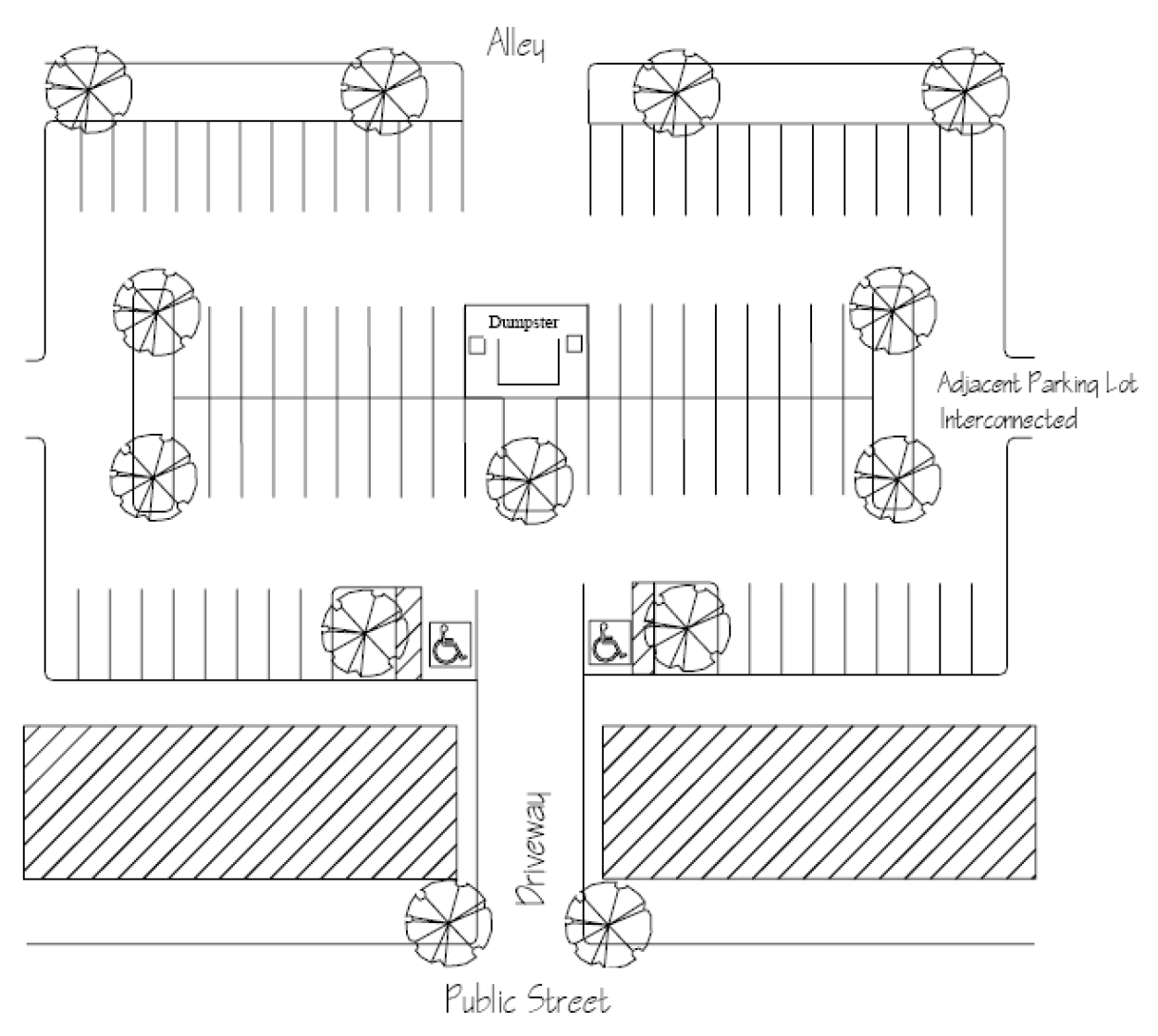
6.2
PARKING SPACE DIMENSIONS:
A.
Parking space dimensions (other than those designed for the disabled) shall be a minimum of eighteen (18) feet long and nine (9) feet wide. Parking spaces shall be dimensioned in relation to curbs or aisles, so long as their configuration, area, and dimensions satisfy the requirements of this Section.
B.
Parallel parking space dimensions shall be a minimum of twenty (20) feet by eight (8) feet. Parallel parking spaces along higher traffic streets should be at least twenty-two (22) feet long.
C.
Aisle widths and angle space dimensions shall be in accordance with the Manual of Architectural Graphic Standards, 10th edition.
6.3
MINIMUM PARKING RATIOS: All square footage is in leasable square feet. Parking requirements may be satisfied using on-street parking in front of buildings or public lots within three hundred (300) feet of primary building entrances.
6.4
SHARED PARKING STANDARDS:
A.
The joint use of shared off-street parking between two (2) uses may be made by contract between two (2) or more adjacent property owners. Adjacent lots shall be interconnected where practical.
B.
Developments that operate at different times may jointly use or share the same parking spaces with a maximum of one-half (½) of the parking spaces credited to both uses if one use is a church, theater, assembly hall or other use whose peak hours of attendance will be at night or on Sundays, and the other use or uses are ones that will be closed at night or on Sundays or upon the normal hours of operation.
7.0
LIGHTING STANDARDS
7.1
PURPOSE AND GENERAL PROVISIONS:
A.
The purpose of this Section is to provide direction in controlling light spillage and glare so as not to adversely affect motorists, pedestrians, and land uses of adjacent properties. Lighting intensities should be controlled to assure that excessive light spillage and glare are not directed at adjacent properties, neighboring areas, and motorists.
B.
As a general rule, lighting should be provided with lower-intensity, full-spectrum bulbs mounted on poles eight (8) to twelve (12) feet in height.
C.
Exterior lighting should be architecturally integrated with the architectural character of the building. Downcast or cutoff type lighting fixtures should be generally used to illuminate pedestrian or traffic circulation corridors. Bollard or decorative cutoff-type lighting fixtures are generally suited for pedestrian applications such as for pedestrian circulation or transitional areas.
D.
Determination of light fixtures and level of illumination to achieve a certain function or desired effect should also reduce or eliminate the hazardous aspects and nuisance of glare and light spill over. All exterior lighting, with the exception of street lighting, that is used in and around buildings, recreation areas, parking lots, and signs, shall be designed to protect against the spill-over of light to adjacent properties.
E.
Lighting may be characterized by the kind of fixtures to be installed (such as incandescent, fluorescent, etc.); by use or activity being served, (i.e., sports activities, utility lighting, lot lighting, or security lighting); or by desired effect, (i.e., spot lighting). Lighting design, location, and fixture selection should be planned to serve the primary lighting objective.
7.2
STREET LIGHTING STANDARDS:
A.
No street light shall be more than two hundred fifty (250) feet from another street light. In addition, lighting shall be placed at every intersection.
B.
A lighting plan shall be submitted with all developments requiring site plan approval.
C.
Pedestrian lighting along Matthews-Mint Hill Road (NC 51) and Lawyers Road shall be consistent with the standard fixture and service provider specified by the Town. The one-time decorative charge must be paid in full for each light fixture.
All non-residential development and/or redevelopment in the downtown overlay district that fronts on a public right-of-way or proposes a new public right-of-way shall install decorative pedestrian lights consistent with the standard fixture and service provider specified by the Town along the existing or new right-of-way. The decorative one-time charge shall be paid in full. For mixed use projects, the non-residential portion of road frontage shall be subject to the aforementioned light installation.
7.3
OUTDOOR LIGHTING STANDARDS:
A.
All outdoor lighting shall conform to the following standards:
1.
Outdoor lighting shall be designed, located and mounted at heights no greater than twelve (12) feet above grade for pedestrian lights, or thirty-five (35) feet above grade for street lighting; and located at least ten (10) feet from property lines defining rear and side yards or required perimeter landscaped areas required by this Code.
2.
All outdoor lighting shall be designed and located such that the maximum illumination measured in footcandles at the property line shall not exceed .3 for non cut-off lights and 1.5 for cut-off lights. The average intensity illumination for outdoor lighting shall not exceed six (6) footcandles in intensity as measured at grade. Fixtures should be placed to provide uniform distribution of light and to avoid intense lighting that produces excessive glare.
3.
Lighting fixtures in scale with pedestrian activities shall provide for uniform distribution of lighting to produce minimal shadows.
4.
Because of their unique requirements for nighttime visibility and limited hours of operation, the lighting of active recreation areas, such as for ball fields and tennis courts are not considered in this Section. Lighting conditions for such uses shall be approved by the Administrator in accordance with approved standards and specifications.
5.
No flickering or flashing lights shall be permitted. Light sources should not be located within any perimeter-landscaped areas except on pedestrian walkways.
B.
Lighting levels are to be measured in footcandles with a direct-reading, portable light meter. The meter sensor shall be mounted not more than six (6) inches above ground level in a horizontal position. The Administrator takes readings only after the cell has been exposed long enough to provide a constant reading. Measurements are made after dark with the light source in question on, then with the same source off. The difference between the two (2) readings shall be compared to the maximum permitted illumination and at the property line at ground level.
8.0
LANDSCAPING
The three (3) types of landscaping are defined as follows, and shall meet the following performance requirements. All new development, changes in principal use, and building expansions shall comply with these provisions.
The responsibility for the installation shall rest solely with the proposed development and shall be located on the development's site or in a landscaping easement granted by an adjacent landowner.
8.1
TYPES OF LANDSCAPING:
A.
TYPE A (Opaque Screen/Buffer). This type functions as an opaque screen from the ground to a height of at least eight (8) feet. This type excludes visual contact between uses and creates a strong impression of spatial separation. Composition of the Type A landscaping may include a wall, landscaped earthen berm, planted vegetation, existing vegetation, or any appropriate combination of these elements. Intermittent planting of deciduous and evergreen trees shall obtain a height at maturity of no less than 20 feet and have no unobstructed openings wider than ten (10) feet between tree canopies upon maturity. Shrub plantings shall have a minimum height of three (3) feet at installation and have no unobstructed openings wider than four (4) feet. At least fifty (50) percent of the required trees, and at least seventy-five (75) percent of the required shrubs, shall be evergreen species locally adapted to the area. The use of existing vegetation to satisfy this requirement is encouraged. Supplemental planting may be required in addition to native materials.
•
LOCATION AND REQUIRED USAGE: Rear and/or side transition yards between DO-B and non-DO-B lots (minimum width thirty (30) feet) and the transition yard between DO-A nonresidential and multifamily uses and adjacent single-family uses (minimum width ten (10) feet).
B.
TYPE B (Semi-Opaque Screen). This type functions as a semi-opaque screen from the ground to at least a height of four (4) feet for screening of car lights and glare. Composition of the Type B landscaping may include a wall, fence, planted vegetation, existing vegetation, or any appropriate combination of the elements. Intermittent planting of deciduous and evergreen trees shall obtain a height at maturity of no less than twenty (20) feet and have no unobstructed openings wider than twenty (20) feet between canopies upon maturity. Shrub plantings shall have no unobstructed openings wider than four (4) feet. At least seventy-five (75) percent of the required shrubs shall be evergreen species locally adapted to the area.
All side yard parking areas in the DO-B district shall be screened from the sidewalk by low walls, fences or constructed as a continuation of the building wall a minimum of three (3) feet in height. Landscaping may be used in combination with walls or fences but shall not exceed fifty (50) percent of the total required width. The use of existing vegetation to satisfy this requirement is encouraged. Supplemental plantings may be required in addition to native materials. The minimum height upon installation for effectively screening storage areas is six (6) feet. This type of planting should be opaque to screen the off-site view of parking areas from neighboring properties and streets.
•
LOCATION AND REQUIRED USAGE: Perimeter yard of all multifamily, mixed-use, and nonresidential parking areas visible from the street (minimum width ten (10) feet).
C.
TYPE C (Interior Plantings). This type functions as a tree ceiling over a parking area providing shelter from sun and rain. Large maturing canopy trees shall be planted in a manner that provides shade for the entire parking area at maturity. To this end, no parking space shall be less than sixty (60) feet from the base of a canopy tree. The use of differing species around the parking area is encouraged to promote diversity in the overall urban tree canopy. The use of existing vegetation to satisfy this requirement is encouraged. Supplemental plantings may be required in addition to native materials.
•
LOCATION AND REQUIRED USAGE: Interiors of all parking areas with more than sixteen (16) parking spaces (not applicable to structured parking facilities).
D.
TYPE D (Sod Requirement). This type functions as the required ground cover for lawn areas exposed to public view. To this end sod shall be installed in a manner consistent with best practices prior to the certificate of occupancy being issued, including planting strips for newly constructed public streets. Exceptions may be authorized by the administrator when temporary ground cover is required for erosion control purposes (e.g. outparcels)
8.2
MAINTENANCE OF LANDSCAPING:
All landscaping required by this Section 8.0 shall be irrigated, with an underground sprinkler system, and all such landscaping shall be maintained in a good and healthy condition.
(Ord. No. 598, § 7.1.13, 4-14-2011; Ord. No. 593(B), 6-24-2010; Ord. No. 623, 10-25-2012; Ord. No. 654, 8-21-2014; Ord. No. 669, 2-11-2016; Ord. No. 725, 8-16-2018; Ord. No. 786, 5-13-2021; Ord. No. 798, 7-8-2021)

