
Mint Hill City Zoning Code
ARTICLE 6
- GENERAL REQUIREMENTS
Section 6.1 - Building Lot Standards and Dimensional Requirements
Dimensional Requirements.
A.
Requirements for lot area; lot width and frontage; front, side and rear yard; maximum lot coverage; and maximum height of structures shall be as provided in the tables of dimensional requirements, Table 1 (Dimensional Requirements per District) and Table 2 (Dimensional Requirements for a Residential District), unless otherwise indicated (for example, as is required in the special requirements section for structures located in the DO-A or DO-B Overlay Districts).
B.
The applicable dimensional requirements on a cul-de-sac shall be measured as provided in the drawing entitled, "Dimensional Requirements, Cul-de-Sac," shown below.
C.
Except as may be specifically set forth elsewhere in this Ordinance (such as special requirements or conditions for specific uses in Article 7 or uses in DO-A or DO-B), the following Table 6.1-1 (Dimensional Requirements per District) and Table 6.1-2 (Dimensional Requirements for a Residential District) indicate the dimensional requirements for principal structures.
TABLE 1. DIMENSIONAL REQUIREMENTS PER DISTRICT
(1)
See Section 7.2.14 (Supplementary Use Regulations for Distributive Business Districts).
(2)
See Section 7.2.11 (Supplementary Use Regulations for Shopping Centers and Large Commercial Developments).
(3)
See Section 7.2.20 (Supplementary Use Regulations for Institutional District Uses).
(4)
See Sections 6.1.3 (Front Yard Exceptions) and 6.1.4 (Measurements of Setbacks or Building Lines).
(5)
See Section 6.1.6 (Heights of Buildings and Exemptions) for measurement requirements and uses permitted to exceed the height limitations.
(6)
To be a minimum of 40 feet when abutting R (Residential) Districts.
TABLE 2. DIMENSIONAL REQUIREMENTS FOR A RESIDENTIAL DISTRICT
(1)
See Section 4.4.1.
(2)
R (Residential) District variable minimum lot size depending upon type of water supply and wastewater disposal systems available and utilized:
a.
Twenty thousand (20,000) square feet - Approved public* water supply and approved public* wastewater disposal systems; or
b.
Thirty thousand (30,000) square feet - Approved public* water supply or individual well, approved public* wastewater disposal systems, including approved packaged wastewater treatment plants; or individual private septic tanks and drain fields and approved public* water supply; or
c.
Forty thousand (40,000) square feet - Approved private well and septic tank with drain field systems on individual lot or lots or private community system**.
*
An approved public system is a public utility such as Charlotte-Mecklenburg Utilities.
**
An approved private community system is a privately owned and operated system that provides services to the general public.
(3)
See Sections 6.1.3 (Front Yard Exceptions) and 6.1.4 (Measurements of Setbacks or Building Lines).
(4)
See Section 6.1.6 (Heights of Buildings and Exemptions) for measurement requirements and uses permitted to exceed the height limitations.
6.1.2
Lot Design Standards.
A.
Frontage on Streets. Each lot shall have frontage on a public street with the following exceptions:
1.
Proposed lots for use by single-family detached dwellings and which do not have frontage on a public street ("easement lots") may be approved by the Administrator after making the following findings:
a.
Such lot is a minimum of two (2) acres in size; and
b.
Such lot is provided with access to a public street by means of an easement at least fifteen (15) feet in width for the exclusive use of the dwelling to be established on such lot and such easement is a visible identifiable access driveway which is maintained in a condition passable for service and emergency vehicles; however, in no event shall lots be created that result in more than a maximum of four (4) access easements to lots without road frontage; and
c.
Creation of such lot is made necessary by virtue of the fact that development of said property by conventional means (i.e., extension of public street) is impractical due to disproportionate costs of required improvements as compared to the relative value of lots created; and
d.
Creation of such lots does not unduly restrict or impair future development or extension of an adequate system of public streets within the immediate area.
Proposed easement lots hereunder may be denied by the Administrator in the event such criteria are not affirmatively met.
2.
Lots which do not have frontage on a public street may be approved by the Administrator for uses such as substations, radio and television towers, repeater huts, water towers or tanks, sewage treatment facilities, and similar uses of a public or quasi-public nature when the Administrator in its review finds that:
a.
Adequate access to such facility will be provided by other means such as an easement or right-of-way; provided, however, that in no case shall a right-of-way or easement of less than fifteen (15) feet in width be allowed;
b.
The objectives of the Comprehensive Land Use Plan will be better served by allowing such lot without road frontage; and
c.
Such lots are adequate in size to meet the setback requirements established in this Ordinance for such use.
3.
Lots designed for single-family attached dwellings need not front on a street provided that all portions of the dwelling unit proposed for such lots shall be located within three hundred (300) feet of a public street that furnishes direct access to the property and that access to each such lot be made available via either a public right-of-way or a private vehicular or pedestrian way owned by the individual lot owner in fee or in common ownership.
4.
Lots designed for single-family semi-detached dwellings need not front on a street provided that at least one unit of each dwelling group has frontage on a street and that access to each dwelling unit is made available via either a public right-of-way or a private vehicular or pedestrian way owned by the individual lot owner in fee or in common ownership.
B.
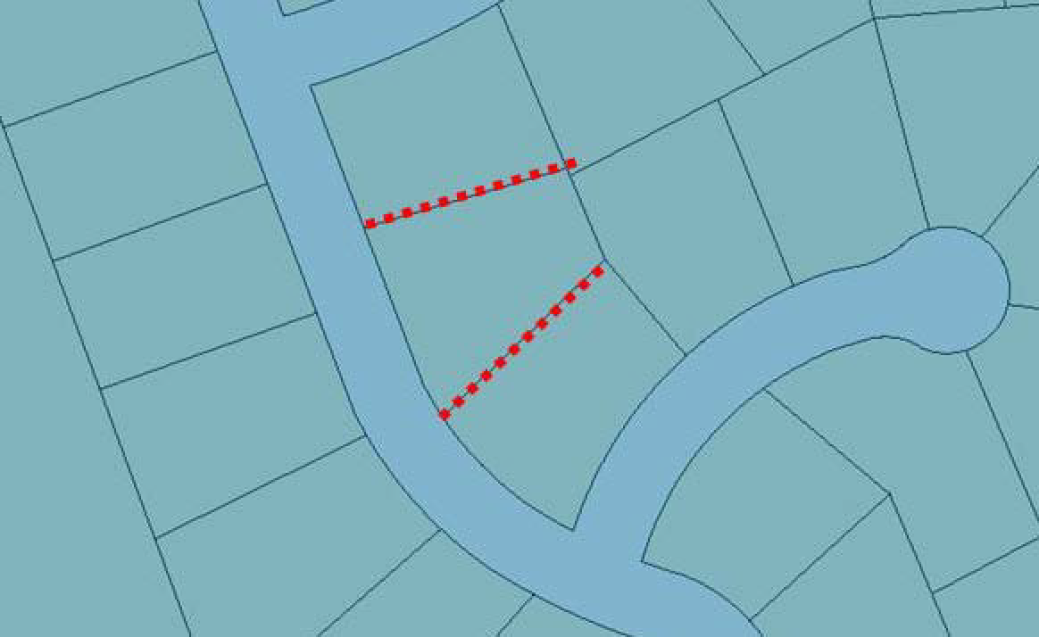
Side Lot Lines in Subdivisions. Side lot lines in subdivisions shall, as nearly as practicable, be at right angles to or radial to street lines. Where side lot lines intersect at the rear of the lot, the angle of intersection shall not be less than sixty (60) degrees.
6.1.3
Front Yard Exceptions. The requirements for exceptions to the front yard provisions of Section 6.1.1 are as follows:
A.
Where fifty (50) percent, or more, of a block is developed with structures, the average front yard dimension of such structures may be considered the minimum required front yard for a proposed building. Unless required by the front yard established on a subdivision map, such front yard need not be greater than the front yard required in the chart, Section 6.1.1. A front yard indicated on a duly recorded map of a subdivision, shall in no event be reduced.
B.
Where it is proposed to erect a structure between two (2) existing structures not over tweo hundred (200) feet apart, the required front yard distance may be the average of the two (2) structures. Unless required by the front yard established on a subdivision map, such front yard need not be greater than the front yard required in the Tables in Section 6.1.1. A front yard indicated on a duly recorded map of a subdivision shall in no event be reduced.
6.1.4
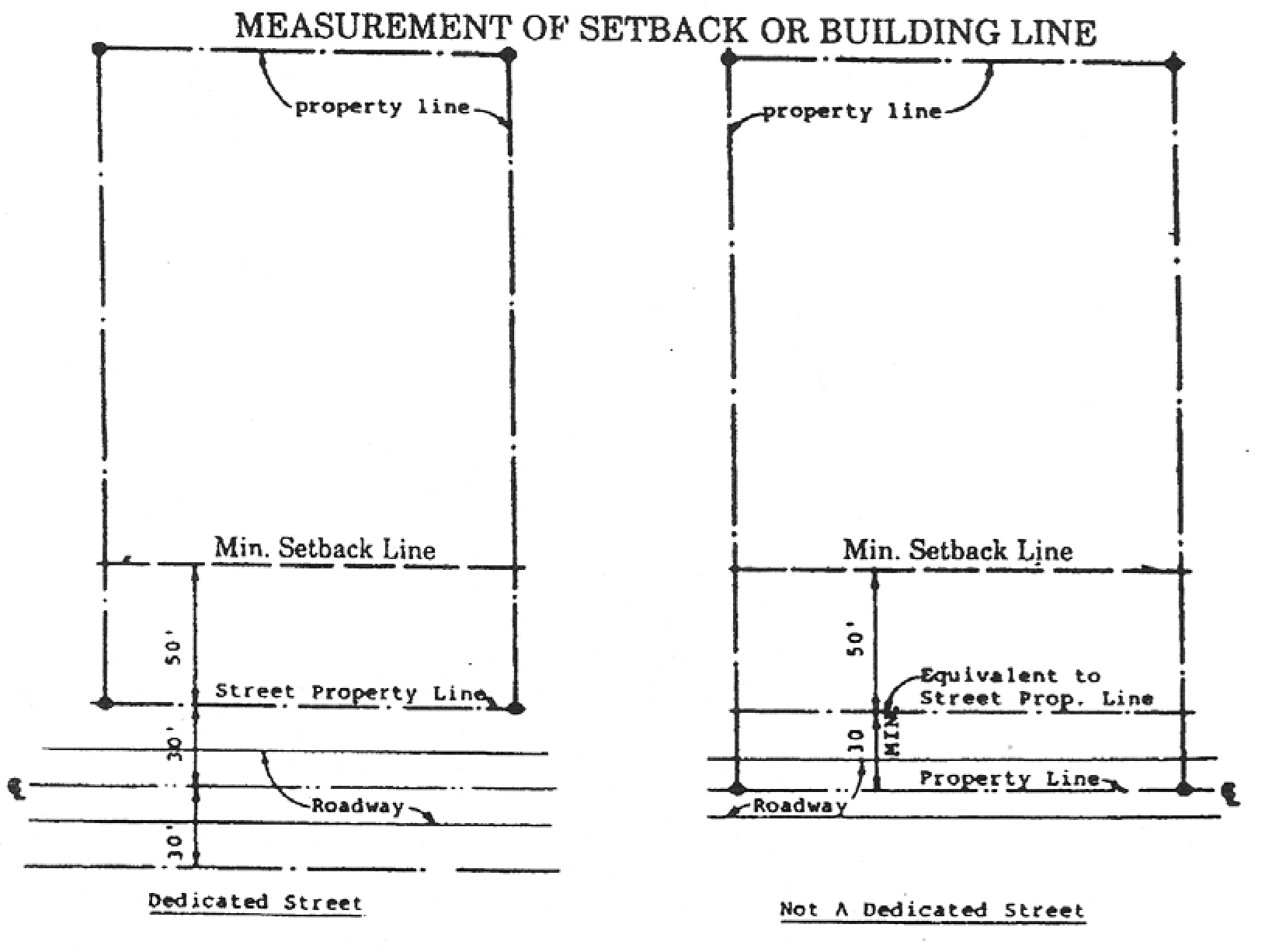
Measurement of Setback or Building Line. Setbacks or front or side street building lines or other applicable elements required by this Ordinance, shall be measured from a street property line as such term is defined in Article 2. When a street or roadway is established by some method other than dedication by recording a subdivision plat, setbacks or front or side street building lines, or other related elements required by this Ordinance, shall be measured from a line that is equivalent to the street property line on such a dedicated street. Such equivalent line shall be located a minimum of thirty (30) feet from the centerline of the street or roadway.
In the event of a conflict between the currently adopted Mecklenburg Union Metropolitan Planning Organization (MUMPO) Transportation Plan and the Town's currently adopted Comprehensive Transportation Plan as to how much right-of-way shall be dedicated from the centerline, the transportation plan requiring the greater amount shall control.
6.1.5
Rear Yard, Triangular Lot. A triangular shaped lot, where the two (2) side lot lines intersect at the rear of the lot, shall provide a rear yard as indicated in the respective districts. An arc shall be drawn with the intersection of the two (2) side lot lines being the center point, such arc to intersect both such lot lines, a distance from the center point equal, as a minimum, to the required rear yard for the respective districts. The area created by the two (2) lot lines and the arc shall be the rear yard.
6.1.6
Heights of Buildings and Exemptions.
A.
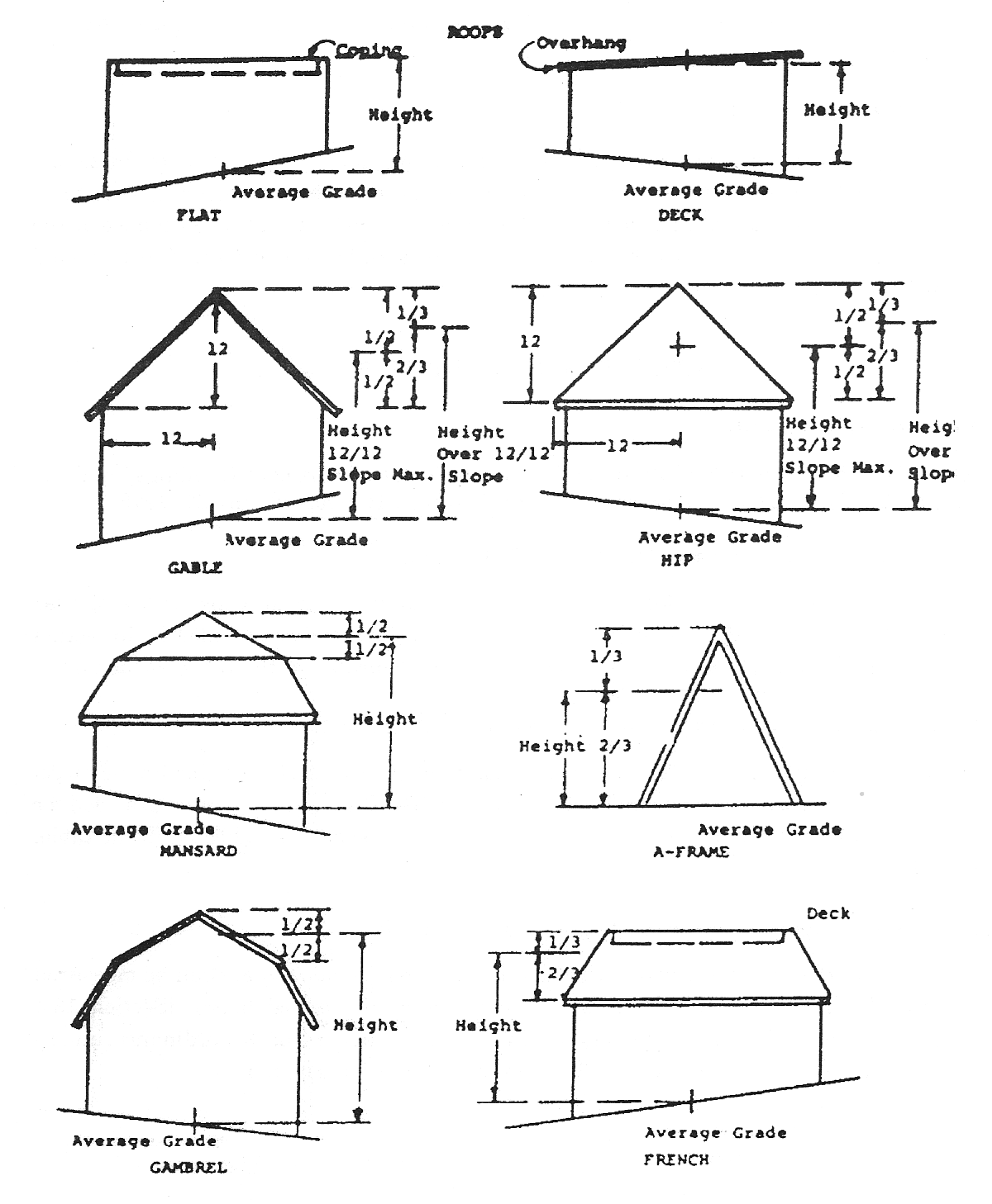
The heights of buildings shall be measured in the manner as provided in the drawing, entitled "Measurement of Building Heights," shown below.
B.
The height of all other structures shall be measured from the average grade to the extreme top of the structure.
C.
The maximum heights, as indicated in the various districts in the Tables of Dimensional Requirements in Section 6.1.1, may be exceeded for specific uses as provided in the following:
1.
Roof structures not intended for human occupancy, such as skylights, housing for elevators, stairways, water tanks, ventilating fans, air conditioning equipment, steeples, spires, belfries, cupolas, chimneys or radio and television reception and transmission towers, may exceed the maximum allowable heights as provided in the Tables of Dimensional Requirements in Section 6.1.1.
2.
For parking garages; power generating or transmission facilities; water towers, tanks and pumping stations; colleges, academic; town hall; churches, synagogues and other places of worship; theaters; shopping centers; hospitals and health centers; and farm structures which exceed the maximum allowable heights as provided in the Tables of Dimensional Requirements in Section 6.1.1, or the maximum allowable heights permitted for the above-noted structures by any special requirements (for example in the DO-A or DO-B Overlay Districts or in a Conservation Subdivision) or conditions for approved Conditional Zoning Districts or special requirements in Article 7, the side yards and the rear yard shall be increased by one foot for each two (2) feet of height or fraction thereof, above the maximum permitted height.
6.1.7
Projections into Yards.
A.
The following architectural features and appurtenances in Table 6.1.7-1 may project into the required yards, unless such projections would obstruct a driveway used for service or for emergency purposes.
TABLE 3. PROJECTION ALLOWANCES
(Ord. No. 598, 4-14-2011; Ord. No. 726, 9-13-2018; Ord. No. 755, 12-12-2019; Ord. No. 798, 7-8-2021; Ord. No. 803, 9-9-2021)
Section 6.2 - Streets, Driveways, Sidewalks, Curbs and Gutters, Etc.
6.2.1
Streets.
A.
Streets Required; Required Offers of Dedication and Reservation of Right-of-Way. All streets and associated road improvements (e.g., turn lanes, signals, road extensions or additions, driveway locations) shall be required as follows:
1.
By any applicable TIA; and/or
2.
By applicable NCDOT driveway permit regulations; and/or
3.
When road improvements which are reasonably attributable to the proposed development project are recommended by the Applicable Thoroughfare Plan (thoroughfare plans include the most recently adopted Mecklenburg Union Metropolitan Planning Organization ("MUMPO") Thoroughfare Plan and/or Town Comprehensive Transportation Plan.) In the event the two (2) transportation plans conflict, then the Administrator shall determine which transportation plan's recommendations shall govern for a proposed development (Applicable Thoroughfare Plan); and/or
4.
As otherwise required by this Ordinance (e.g., as required by Sections 7.4 (DO-A and DO-B Overlay Districts) and 7.3.2 (General Requirements for Subdivisions)).
5.
Whenever required by Mecklenburg County or Union County.
Whenever road improvements are required in connection with a development, then the Applicant shall plat and dedicate to the Town or NCDOT, as appropriate, a right-of-way for the street(s) on which road improvements are made in the location and to the width specified in the Applicable Thoroughfare Plan.
Whenever road improvements are not required in connection with a development, then the Applicant shall nonetheless plat and dedicate to either the Town of Mint Hill or NCDOT, as appropriate, right-of-way as follows:
a.
If a development project abuts an existing public street that has a right-of-way of less than sixty (60) feet (thirty (30) feet from centerline) and if any Applicable Thoroughfare Plan contemplates such public street to be at least a sixty-foot right-of-way, then dedication of right-of-way of at least thirty (30) feet from the centerline shall be required. In some circumstances, the currently adopted Land Use Development Standards Manual cross section(s) may require right-of-way of less than sixty (60) feet in width (for example, in the DO-A, DO-B and Conservation Subdivisions, a right-of-way of fifty (50) feet (twenty-five (25) feet from centerline) may instead be required), in which case, dedication shall be in accordance with the width requirements contained therein.
b.
If a development project abuts an existing public street that has a right-of-way of less than sixty (60) feet (thirty (30) feet from centerline) and if any Applicable Thoroughfare Plan contemplates such public street to be greater than a sixty-foot right-of-way, then the Applicant shall dedicate to the Town or NCDOT, as appropriate, the amount of new right-of-way in excess of soxty (60) feet (thirty (30) feet from the centerline) that is reasonably attributable to the proposed development project. If Town staff and the Applicant do not agree on the appropriate width of right-of-way to be dedicated in such circumstances, then the determination whether such additional right-of-way is reasonably attributable to the project shall be evaluated in light of any applicable TIA. The Administrator shall then make a determination in light of the Applicable Thoroughfare Plan, the currently adopted Land Use Development Standards Manual, any applicable TIA, and other facts and circumstances specific to the proposed development.
If dedication of right-of-way is not required as provided herein, then an Applicant shall reserve for future use right-of-way to the width specified in the Applicable Thoroughfare Plan any streets identified on the Applicable Thoroughfare Plan that abut or cross the proposed development property. In such case, the Applicant shall document in the Site Plan Application the reservation of the public right-of-way.
Reservation of right-of-way means that the property owner retains ownership of the area planned for future public right-of-way and does not dedicate such area to the Town or NCDOT.
B.
Other Required Improvements.
1.
Driveways. Driveways shall be required and constructed as set forth in Section 6.2.2 below.
2.
Sidewalks. Sidewalks shall be required and constructed as set forth in Section 6.2.3 below.
3.
Curb and Gutter. Curb and gutter shall be required and constructed as set forth in Section 6.2.4 below.
4.
Stormwater Improvements. Stormwater drainage and improvements shall be required and constructed as set forth in this Ordinance (Article 6, Section 6.8, in general and Section 6.8.1(107) specifically which references the Stormwater Design Manual as well as the MLDSM).
5.
Street Signals and Signs. All required streets signals and traffic signs shall be installed as required by NCDOT.
6.
Street Markers. Street markers shall be only be required to be installed at one corner of all street intersections and shall conform to the design requirements of this Section 6.2, Streets and Sidewalks.
7.
Barricades. Barricades shall only be installed at the end of all dead-end streets, except permanent cul-de-sac streets, which have been improved with a permanent turn-around as required by this Ordinance. Such barricades shall have a minimum length of twenty-five (25) feet, plus end sections and shall conform to the other design requirements of the Mecklenburg County Land Development Standards Manual or the Town of Mint Hill Standards Manual, when adopted.
C.
Street Design and Construction.
1.
Standard for Design and Performance Guarantee. All required road improvements shall be designed, constructed, completed and approved in accordance with the standards set forth in the most recently adopted Mecklenburg County Land Development Standards Manual and, when adopted, the Town of Mint Hill Standards Manual as well as in accordance with the requirements of Section 7.3.2 (General Requirements for Subdivisions) (in addition to any NCDOT requirements for driveways). In the event road improvements have not been completed at the time of the request for Final Plat approval and/or a Certificate of Occupancy, the Final Plat shall be approved and/or the Certificate of Occupancy issued only where an Applicant has submitted a bond or other performance guarantee in accordance with the requirements of Article 6, Section 6.10 (Guarantees and Performance Bonds), for completion of the street improvements. Any bond or other performance guarantee for street improvements shall be in addition to any other bond(s) that may be required for other improvements. (Note: Notwithstanding the foregoing, NCDOT may not allow issuance of a Certificate of Occupancy for incomplete driveways despite posting of a bond or other performance guarantee.)
2.
Related to Topography. Streets shall be related appropriately to the topography. In particular, streets shall be designed to facilitate the drainage and stormwater runoff objectives set forth in Article 6, Sections 6.6, 6.7, and 6.8 of this Ordinance and subject to the design requirements relating to maximum grades set forth in the Mecklenburg County Land Development Standards Manual.
3.
Block Lengths. Block lengths and widths shall not be more than one thousand six hundred (1,600) feet, except as hereinafter provided. Where a longer block will reduce the number of railroad grade crossings, major stream crossing or where longer blocks will result in less traffic through residential subdivisions from adjoining business or industrial areas, the Administrator may authorize block lengths in excess of one thousand six hundred (1,600) feet. Block widths shall be sufficient to allow two (2) tiers of lots; except where single tiers of lots will facilitate nonresidential development, the separation of residential and nonresidential development or the separation of residential development from traffic arteries.
4.
Cul-de-Sacs. Cul-de-sacs, when permitted under this Ordinance, shall not be longer than eight hundred (800) feet and shall be terminated by a circular right-of-way not less than eighty (80) feet in diameter; however, this requirement may be waived where topographical conditions or land use relationships offer no practical alternative.
5.
Medians. Medians containing monuments or structures shall not be accepted as a right-of-way and must be dedicated as common area.
6.
Special Requirements Control. To the extent any special requirements (for example in the DO-A or DO-B Overlay Districts or in a Conservation Subdivision) or conditions for approved Conditional Zoning Districts contain street design and/or construction standards (including for street markers and other related improvements), then they shall control over these general requirements; however, where the requirements do not directly conflict, then these general requirements shall supplement.
7.
Temporary Cul-de-Sacs. To the extent these are used they shall conform to the Mecklenburg County Land Development Standards Manual or the Town of Mint Hill Standards Manual, when adopted.
6.2.2
Driveways.
A.
Driveways Required. Every lot shall have access sufficient to afford a reasonable means of vehicular ingress and egress for all those likely to need or desire access to the property in its intended use. Driveways shall comply with other laws and codes, including, but not limited to, the Fire Prevention Code of the North Carolina State Building Code or applicable NFPA codes, to the extent applicable to accommodate emergency vehicles, such as fire trucks. All driveways shall be located in accordance with an approved Site Plan and driveways may vary in location/placement on a development by development basis depending on the following factors, including, but not limited to: street trees, type of use, topography of the property to be developed, type of road and associated traffic volume, etc. For proposed developments located on roads maintained by NCDOT, all driveways shall be located as determined by NCDOT (using the NCDOT Policy on Street and Driveway Access to North Carolina Highways hereinafter the "NCDOT Driveway Manual" for guidance). On Town maintained roads, all driveways shall be located as reasonably determined by the Administrator. The Administrator may use the NCDOT Driveway Manual as a guiding document in its determination of required driveway locations in conjunction with the following standards to be used for guidance:
All driveway entrances and other openings onto streets within the Town's planning jurisdiction shall be constructed so that:
1.
Vehicles can enter and exit from the lot in question without posing any substantial danger to themselves, pedestrians or vehicles traveling on abutting streets; and
2.
Interference with pedestrian movement and the free and convenient flow of traffic in abutting or surrounding streets is minimized.
3.
In considering (1) and (2) above, the following factors shall be considered:
a.
The nature of the abutting street, its capacity, use, speed and flow, and reasonably anticipated changes to the street; and
b.
The nature of the proposed use of the land, the traffic generated, the existence and number of drive-through window(s), the internal system for moving vehicles while on the lot; and
c.
The nature of the exit and entrance, the site distance, the distance from intersections, the alignment with other drives and streets, turning controls or limitations.
d.
The requirements for drive location/separation near an intersection of an existing or planned arterial or collector road found in the Mecklenburg County Land Development Standards Manual.
4.
Shared driveways are encouraged to the extent they accomplish these goals.
B.
Driveway Design and Construction.
1.
All required driveway improvements shall be designed, constructed, completed and approved in accordance with the standards set forth in the most recently adopted Mecklenburg County Land Development Standards Manual. Notwithstanding the foregoing, for apartments, institutional uses, offices, business or industrial development, driveways for access to and from a public street, shall not be wider than thirty-five (35) feet as measured at the property line or future right-of-way line and shall be defined by curbing at such locations as designated by the State and the Town. The minimum width of such driveways shall be twenty-four (24) feet for two-way traffic and fourteen (14) feet for one-way traffic.
2.
To the extent any special requirements (for example in the DO-A or DO-B Overlay Districts or in a Conservation Subdivision) or conditions for approved Conditional Zoning Districts contain driveway design and/or construction standards, then they shall control over these general requirements; provided however, where the requirements do not directly conflict, then these general requirements shall supplement.
(Note: As provided in G.S. 136-93, no person may construct any driveway entrance or other opening onto a State-maintained street except in accordance with a permit issued by the North Carolina Department of Transportation.)
6.2.3
Sidewalks.
A.
Sidewalks Required. Sidewalk installation is required along all public streets both fronting and within a proposed development, except:
1.
For minor residential subdivisions (five (5) lots or less); or
2.
Where a special regulation or condition would prohibit sidewalks (e.g,. an environmentally sensitive area identified and officially designated for low impact development by the Mecklenburg County Water Quality Division or NCDENR).
In addition, a material enlargement or expansion of existing construction shall be required to construct sidewalks along all public streets fronting and/or within the proposed development for not only the newly proposed expansion or enlargement area, but also for the development as it was first proposed and exists at the time of the proposed enlargement or expansion. For purposes hereunder, material enlargement or expansion shall be determined by a total cumulative twenty (20) percent increase in the total square footage of all existing structure(s) within a project area as and since the original date the project area was first proposed. Expansion of an existing project to include adjoining land with existing structures shall not exempt an Applicant or developer from the requirements of this Section.
B.
Sidewalk Design and Construction.
1.
All sidewalks shall be located in accordance with an approved Site Plan and sidewalks may vary in location/placement on a development by development basis depending upon the following factors, including, but not limited to: street trees, type of use, topography of the property to be developed, type of road and associated traffic volume, etc. The preferred guidance for location of sidewalks for proposed developments shall be the most recently adopted Town Comprehensive Transportation Plan.
2.
All required sidewalk improvements shall be designed, constructed, completed and approved in accordance with the standards set forth in the most recently adopted Mecklenburg County Land Development Standards Manual. In the event sidewalk improvements have not been completed at the time of request for Final Plat approval and/or a Certificate of Occupancy, the Final Plat shall be approved and/or the Certificate of Occupancy issued only where an Applicant has submitted a bond or other performance guarantee in accordance with the requirements of Article 6, Section 6.10 (Guarantees and Performance Bonds) for completion of the sidewalk improvements. Any bond or other performance guarantee for sidewalk improvements shall be in addition to any other bond(s) that may be required for other improvements.
3.
Special Requirements Control. To the extent any special requirements (for example in the DO-A or DO-B Overlay Districts or in a Conservation Subdivision) or conditions for approved Conditional Zoning Districts contain sidewalk design and/or construction standards, then they shall control over these general requirements; provided however, where the requirements do not directly conflict, then these general requirements shall supplement.
6.2.4
Curb and Gutter.
A.
Curb and Gutter Required. Curb and gutter installation is required as follows:
1.
Along all public streets currently or proposed to be under Town maintenance. Therefore, if a development proposes new Town maintained streets or develops on a parcel that fronts on an existing Town maintained street, curb and gutter shall be installed along all Town right-of-way with any other infrastructure improvements determined to be required in the approval process.
2.
Along all streets existing or proposed within the adopted Downtown Consensus Overlay Boundary Map regardless of maintenance responsibility (Town maintained streets versus NCDOT maintained streets).
3.
Along NCDOT maintained streets if the impact and magnitude of a proposed development requires the construction of a cross section defined in the Town of Mint Hill Comprehensive Transportation Plan (typically any four-lane road or boulevard with a median) then curb and gutter shall be required consistent with the Comprehensive Transportation Plan cross section for the corridor in question. For clarification, a deceleration lane, left turn lane or lane expansion might not necessarily trigger this requirement.
4.
Along NCDOT maintained streets as may be required by NCDOT.
When curb and gutter is required, it shall be installed on streets both fronting and within a proposed development, except for Minor Subdivisions or where a special regulation or condition would prohibit curb and gutter (e.g., an environmentally sensitive area identified and officially designated for low impact development by the Mecklenburg County Water Quality Division or NCDENR). An Applicant may choose between valley curb and gutter or standard curb and gutter styles except:
a.
Where a special regulation or condition requires a particular style (e.g., a requirement of the PCO or the most recent Comprehensive Transportation Plan);
b.
Where a zoning district or overlay district (e.g., DO-A) requires a particular style; or
c.
Where curb and gutter for a proposed development will connect or tie into existing curb and gutter, then the style for the proposed development must match the existing style.
B.
Curb and Gutter Design and Construction.
1.
All required curb and gutter improvements shall be designed, constructed, completed and approved in accordance with the standards set forth in the most recently adopted Mecklenburg County Land Development Standards Manual. In the event curb and gutter improvements have not been completed at the time of request for Final Plat approval and/or a Certificate of Occupancy, the Final Plat shall be approved and/or the Certificate of Occupancy issued only where an Applicant has submitted a bond or other performance guarantee in accordance with the requirements of Article 6, Section 6.10 (Guarantees and Performance Bonds) for completion of the curb and gutter improvements. Any bond or other performance guarantee for curb and gutter improvements shall be in addition to any other bond(s) that may be required for other improvements.
2.
Special Requirements Control. To the extent any special requirements (for example in the DO-A or DO-B Overlay Districts or in a Conservation Subdivision) or conditions for approved Conditional Zoning Districts contain curb and gutter design and/or construction standards, then they shall control over these general requirements; provided, however, where the requirements do not directly conflict, then these general requirements shall supplement.
6.2.5
Coordination of Utilities. It shall be the responsibility of the developer of any new subdivision to notify all utility providers (including, but not limited to, power, water/sewer, cable, and telephone) of plans for the subdivision as soon as practical after the approval of the Site Plans by the Planning Board to ensure all the utilities within the development are installed simultaneously to the greatest extent practicable. Easements necessary to accommodate such facilities shall be made available as needed by the developer and as set forth in the approved Site Plan.
(Ord. No. 598, 4-14-2011; Ord. No. 798, 7-8-2021)
Section 6.3 - Off-Street Parking and Loading
6.3.1
Off-Street Parking.
A.
Every new use, or an enlargement, expansion or alteration of an existing use, shall require off-street parking in compliance with this Section, unless specifically exempt from such provisions or portions thereof. To the extent any special requirements (for example in the DO-A or DO-B Overlay Districts) or conditions for conditional zoning districts contain off-street parking requirements, then they shall control over these general requirements; provided, however, where the requirements do not directly conflict, then these general requirements shall supplement.
B.
Any unlisted use shall be referred to the Board of Adjustment for a determination as to the class of use in which such unlisted use may be placed and the off-street parking requirements for such use.
C.
Off-street parking spaces shall be increased when a change of use of either a structure or of land requires additional parking spaces in compliance with this Section. Parking spaces may be decreased when a change of use of either a structure or of land requires less spaces than provided for the replaced use.
D.
Enlargement of a structure or increase in the amount of land used may be made for existing uses deficient in off-street parking, provided that the enlargement of increase does not represent a requirement in excess of three (3) off-street parking spaces. In the event such increase represents a requirement in excess of three (3) off-street parking spaces, such increase shall require complete compliance of the provisions of this Section for the entire use.
E.
No loading area shall be part of the required off-street parking area.
F.
Off-street parking shall be located as follows:
1.
Parking as required herein shall be located on the same lot as the principal use except when specifically permitted to be located elsewhere.
2.
Cooperative provisions for off-street parking may be made by contract between owners of adjacent property and such contract filed with the Administrator. The parking area provided on any one lot may be reduced to not less than half the parking spaces required for the use occupying such lot. Such cooperative parking shall not be less than the sum of the parking spaces for the uses computed separately.
3.
No parking area shall be located over a sand filter or nitrification field.
4.
In residential areas, the temporary parking or storage of motor vehicles, trailers, or recreational vehicles shall be prohibited in the area between the street property line or the equivalent thereof and the building setback line, except that the temporary parking of automobiles is permitted in such area upon a driveway or parking areas constructed of a dust free surface. Trailers and other types of recreational vehicles shall be parked or stored behind the residence in the rear yard or in the side yard behind the established front building line except on side streets.
5.
Parking areas may be extended into the required rear and side yards, except when such side yard is adjacent to a street and except into such areas required by Article 6, Section 6.4.2 (Screening and Landscaping).
G.
Design standards for parking areas are as follows:
1.
A parking space shall be not less than nine (9) feet in width nor less than eighteen (18) feet in length. In lots of more than 20 spaces, compact stalls shall be permitted on the basis of one compact stall to each additional five (5) standards stalls. Each compact stall shall be seven (7) feet wide and seventeen (17) feet long and clearly marked "small cars only". All parking stalls shall be clearly marked and such markings shall be maintained so as to be easily seen.
2.
Parking areas shall be designed in accordance with accepted standard practice for parking at various angles, with aisles being of such widths as to permit the entering and leaving of a parking space with ease and safety.
3.
Access to all required parking areas shall be by roads adequate in width to accommodate two-way traffic, except for residential uses containing not more than six (6) dwelling units and for parking areas designed and clearly marked for one-way traffic. Except by way of approved driveways, access from or egress to a public road from a parking area shall be expressly prohibited. Adequate provisions shall be made to insure compliance by the use of fences, walls, wheel stops, landscaping or a combination of those devices.
4.
No motor vehicle shall be required to be moved for the purpose of permitting another vehicle either to obtain ingress to, or egress from, any required off-street parking space, unless an attendant is on duty at all times to provide this service.
5.
Upon entering an off-street parking area, such maneuvering as is necessary to gain access to a parking space shall be within the confines of the parking facility property only.
6.
Wheel stops, curbs or other devices shall be provided in such locations as to prevent any vehicle from encroaching either on a public right-of-way or on adjacent property.
7.
Parking areas shall be so designed as to retain existing trees and other plant life. Where no trees or other plant life exists, adequate landscaping shall be provided, both within the parking area and on the external boundaries of such area.
8.
Screening shall be provided as required in Section 6.4.2 of this Ordinance.
9.
Signs shall be permitted in compliance with Article 6, Section 6.5, of this Ordinance.
10.
Lighting shall be permitted in compliance with Section 6.9.8 of this Ordinance.
11.
In the interior of all parking areas with more than sixteen (16) parking spaces, large maturing canopy trees shall be planted in a manner that provides shade for the entire parking area at maturity. Trees shall be a minimum of eight (8) feet in height and two and one-half (2½) inches in caliper at time of planting. To this end, no parking space shall be less than sixty (60) feet from the base of a canopy tree. The use of differing species around the parking area is encouraged to promote diversity in the overall tree canopy. The use of existing vegetation to satisfy the requirement is encouraged. (See also Subsection 6.4.2(I).)
H.
Permits for driveway locations on State-maintained roads shall be obtained from the North Carolina Department of Transportation.
I.
Pavement on all parking areas and approach driveways shall be constructed with a one-inch I-2 or sand asphalt surface course, over a four-inch compacted aggregate base course (CABC), except that when sidewalks exist or are required, such sidewalk area that is part of the driveway, and a section on either side of the driveway, shall be constructed of six (6) inches of concrete.
J.
Storm drainage facilities shall be required and shall be so designed as to protect any public right-of-way or adjacent property from damage.
K.
The requirements for off-street parking spaces shall be computed as follows:
1.
When units of measurement determining the number of required parking spaces result in a fractional space, any fraction of one-half (½) or more shall require one parking space.
2.
Lots containing more than one principal use shall provide parking in the amount equal to the total of the requirements for each use.
L.
The following table is to be used as a guide for calculating the appropriate number of off-street parking spaces. Case-by-case flexibility is necessary to minimize over or under parking. Uses that are not listed in the following table shall provide parking spaces per the provision in the Planning Advisory Service (PAS), Report 510/511, Parking Standard, published by the American Planning Association ("PAS Parking Guidance"), which is adopted by reference herewith, as may be amended from time to time. In addition, the Administrator may, within his or her discretion, rely on the PAS Parking Guidance in lieu of the guidance set forth in the following table.
*
Calculating parking for institutional/civic uses will be a collaborative process that will depend on factors specific to the individual development proposal.
6.3.2
Off-Street Loading.
A.
Every new use or an enlargement, expansion or alteration of an existing use, shall require off-street loading in compliance with this Section, unless specifically exempt from such provisions or portions thereof. To the extent any special requirements (for example in the DO-A or DO-B Overlay Districts) or conditions for conditional zoning districts contain off-street parking requirements, then they shall control over these general requirements; provided however, where the requirements do not directly conflict, then these general requirements shall supplement.
B.
Off-street loading spaces shall be increased when a change of use of either a structure or of land requires additional loading spaces in compliance with this Section. Loading spaces may be decreased when a change of use of either a structure or of land requires less spaces than provided for the replaced use.
C.
No parking area shall be part of the required off-street loading area.
D.
Off-street loading shall be located as follows:
1.
Loading areas as required herein shall be located on the same lot as the principal use except when specifically permitted to be located elsewhere.
2.
Cooperative provisions for off-street loading may be made by contract between owners of adjacent property and such contract filed with the Planning Board of Mint Hill. Such cooperative loading shall not be less than the sum of the loading spaces required by each use.
3.
No loading area shall be located over a sand filter or nitrification field.
4.
Loading areas may be extended into the required rear and side yards, except when such side yard is adjacent to a street and except into such areas required by Section 6.4.2 (Screening and Landscaping).
E.
Design standards for loading areas are as follows:
1.
Access to all required loading areas shall be by roads adequate in width to accommodate two-way traffic, except for loading areas designed and clearly marked for one-way traffic.
2.
Upon entering an off-street loading area, such maneuvering as is necessary to gain access to a loading space shall be within the confines of the loading facility property only.
3.
Wheel stops, curbs or other devices shall be provided in such locations as to prevent any vehicle from encroaching either on a public right-of-way or on adjacent property.
4.
Screening shall be provided as required in Section 6.4.2 of this Ordinance.
5.
Signs shall be permitted in compliance with Article 6, Subsection 6.5.5(B), of this Ordinance.
6.
Lighting shall be permitted in compliance with Section 6.9.8 of this Ordinance.
F.
Permits for driveway locations on Sate-maintained roads shall be obtained from the North Carolina Department of Transportation.
G.
Pavement on all loading areas and approach driveways shall be constructed with two (2) inches of I-2, or sand asphalt surface course, over an eight-inch compacted aggregate base course (C.A.B.C.) or equal.
H.
Storm drainage facilities shall be required and shall be so designed as to protect any public right-of-way or adjacent property from damage.
I.
An off-street loading area in compliance with the requirements of this Section shall be provided for uses in any use category, if truck deliveries are made to, or shipments are made from, such use. Such loading shall be adequate to accommodate the maximum number and size of vehicle simultaneously being loaded or unloaded.
(Ord. No. 598, 4-14-2011; Ord. No. 798, 7-8-2021)
Section 6.4 - Undisturbed Open Space, Trees, Screening and Landscaping
6.4.1
Undisturbed Open Space.
A.
All new development (including Minor Subdivisions) shall comply with all Undisturbed Open Space requirements of the Post-Construction Ordinance (Article 6, Section 6.8, Section 6.8.4). Projects with less than twenty (20) percent built upon area shall not be exempt from the Undisturbed Open Space requirements of the Post-Construction Ordinance and shall reserve fifteen (15) percent of the project area for Undisturbed Open Space (to conform with the standard for projects greater than or equal to twenty (20) percent and less than fifty (50) percent built-upon area). The following new developments shall not be required to comply with this Section:
1.
Changes in use that do not require submission of a Site Plan;
2.
Enlargement or expansion of use that is not a material enlargement or expansion. For purposes hereunder, material enlargement or expansion shall be determined by a total cumulative twenty (20) percent increase in the total square footage of all existing structure(s) within a project area as and since the original date the project area was first proposed. Expansion of an existing project to include adjoining land with existing structures shall not exempt an Applicant or developer from the requirements of this Section.
The requirements of this Section are in addition to and not in lieu of any requirements for plantings of yard or street trees that may be found in Article 7, Section 7.3 (Conditions for Subdivisions).
6.4.2
Screening and Landscaping, Buffering Adjacent to Freeways and Expressways, and Street Trees.
A.
Screening required by one of the following subsections or by any other section of this Ordinance shall be provided in accordance with the following standards unless otherwise stated in this Section. Such screening shall be located on the property with the use to which it is associated or required and shall materially screen the subject use from the view of adjoining property. Screening in the form of natural planting or artificial screening such as opaque fencing may be provided. When screening is in the form of natural vegetation, a strip of land at least ten (10) feet in width shall be reserved as a planting strip. This strip shall be free of all encroachment by buildings, parking areas or impervious coverage. Shrubs, which shall be arranged in at least one row, shall be a minimum of three (3) feet high at the time of planting and shall be spaced not more than five (5) feet apart. Shrubs and/or small maturing understory or large maturing canopy trees may be used as natural screening provided that when trees are used, only varieties that bear limbs and foliage down to within one foot of ground level shall be allowed. Trees or shrubs installed as a planted screen shall be evergreen and of a variety which can be expected to achieve a height of at least six (3) feet within two (2) years from planting. When screening is provided in the form of fencing, such fencing shall be opaque and shall be a minimum of five (5) feet in height as measured from the ground up along the adjoining property line. Unless provided otherwise, where both trees and/or shrubs and fencing shall be required, said trees and/or shrubs shall be placed outside the fence line. Berms may be used as screening provided that such berms are at least six (6) feet in height. Any combination of the methods described in this Section may be employed to achieve the intent of this Section when such alternate method is approved by the Administrator. It shall be the responsibility of the property owner to maintain any screening or landscaping required by this Ordinance. For any trees planted pursuant to this Section, large maturing canopy trees shall be a minimum of two and one-half (2½) inches in caliper and eight (8) feet in height at planting and small maturing understory trees shall be a minimum of two (2) inches in caliper and five (5) feet in height at time of planting.
B.
Business and industrial uses adjacent to residential zoning shall provide screening to materially screen the subject use from the view of the adjoining R (Residential) Zoning District in accordance with this Section.
C.
Off-street parking and loading facilities adjacent to residential zoning shall provide screening in the same manner as indicated for business and industrial uses in Subsection 6.4.2(B).
D.
For open-air storage, or an unenclosed structure consisting of a roof, but no walls used for storage of materials, products, wastes or equipment associated with business or industrial uses, screening shall be provided on all sides of such area used for storage. Such screening may be located anywhere on the subject property provided the storage is effectively screened. Screening required by this Subsection shall be in accordance with this Section 6.4.2 except that either an opaque fence shall be provided or a double row of trees and/or shrubs shall be provided as screening.
E.
In cases where screening is required by this Ordinance and devices such as existing vegetation or topographical features or extreme size of the tract involved would render the installation of additional screening unnecessary, the Zoning Administrator of Mecklenburg County is hereby empowered to accept the existing features as meeting the general screening requirements. Such decision shall be based on the spirit and intent of this Section. The vacancy or non-use of adjacent property shall not negate the necessity for installation of screening. If at any time after such existing features are accepted, such features are altered so as to render them inadequate as screening, the owner of the land shall be required to provide screening as described herein to achieve the required screen.
F.
The foregoing subsections shall be construed to require screening along the side and/or rear property lines adjacent to residential zoning but in no case shall screening be required along a public street, except as provided in Subsection 6.4.2(D).
G.
Uses permitted within the business and industrial zoning districts and uses requiring a Conditional Zoning in residential zoning districts shall provide street trees as landscaping along the front property line and along the side street property line on a corner lot as herein specified. Such trees shall be installed in accordance with the following standards:
1.
Trees may be evergreen or deciduous.
2.
Large maturing canopy trees shall be a minimum of two and one-half (2½) inches in caliper and eight (8) feet in height at planting. Small maturing understory trees shall be a minimum of two (2) inches in caliper and five (5) feet in height at time of planting.
3.
The maximum spacing between trees or shrubs shall be thirty (30) feet.
4.
Trees should, when possible, be located behind the right-of-way of the street. When it is necessary to locate landscaping required by this Section on the right-of-way of a State-maintained road, an encroachment agreement shall be obtained from the North Carolina Department of Transportation. Consideration should be given to the alignment of trees or shrubs installed on an adjoining lot and when possible the alignment should be continued along the street. Encroachment into the sight distance area, as defined in Section 6.9.5 of this Ordinance, shall be allowed subject to the requirement that landscaping installed within a sight distance shall be set back as far as is practicable from the intersection of the two (2) streets forming the intersection.
5.
In cases where existing trees on a lot or lots are located within the required setback, as specified in Section 6.1.1 (Dimensional Requirements) of this Ordinance, and such existing trees would inhibit or restrict the growth of street trees required by this Section, low growing shrubbery may be installed in lieu of trees. Such shrubs shall adhere to the locational requirements of Subsections 6.4.2(G)(3) and (4) herein.
H.
In cases where properties are zoned residential and have yards that abut the right-of-way of a freeway or expressway as shown on the Adopted Thoroughfare Plan, a thirty-foot buffer is required to primarily provide a visual screen between the residential use and the freeway/expressway. A secondary objective is to provide a noise buffer to some degree between these transportation corridors and residential uses. Existing vegetation and topographic features shall be retained within this thirty-foot buffer. Clearing and grading within the buffer is not allowed except as described in Subsection 6.4.2(H)(6). Where no natural vegetation exists, or where the quality of existing vegetation fails to meet the purpose of providing an opaque barrier between the road and abutting use, supplemental buffer materials will be required as stated in Subsection 6.4.2(H)(1). These requirements will not be applicable if the North Carolina Department of Transportation (NCDOT) provides a noise abatement or screening wall.
1.
Such buffer will consist of a minimum of ten (10) trees and forty (40) shrubs per one hundred (100) linear feet in an area of sufficient width to support the plant materials.
2.
Fifty (50) percent of the required trees within the buffer shall be large maturing canopy trees;
3.
All large maturing canopy trees shall have a minimum caliper of two and one-half (2½) inches, measured six (6) inches aboveground, with a minimum height of eight (8) feet at the time of planting and all small maturing understory trees shall be a minimum of two (2) inches in caliper and five (5) feet in height at time of planting;
4.
Shrubs shall be evergreen and at least three (3) feet tall when planted with an average height of six (6) feet within four (4) years. However, twenty-five (25) percent of the shrubs may vary from the above standard. The allowed variations are as follows:
a.
Shrubs may be deciduous; or
b.
Shrubs may be two (2) feet tall when planted, provided an average height of three (3) to four (4) feet is expected as normal growth within four (4) years.
Shrubs planted on a berm may be of a lesser height, provided the combined height of the berms and plantings is at least six (6) feet after four (4) years.
5.
All trees and shrubs shall be locally adapted to the area and meet the specifications for the measurement, quality and installation of trees and shrubs in accordance with "American Standards for Nursery Stock," published by the American Association of Nurserymen. The arrangement of trees and shrubs in the buffer shall be done in a manner that provides maximum visual separation of abutting uses from the use to be buffered, taking into consideration topography and sight lines from abutting uses. In most cases, screening shrubs should be concentrated near the property line and massed to achieve the maximum screening effect, while trees in the buffer should be distributed throughout the buffer's width.
6.
Required buffers shall not be disturbed for any reason, except for required driveways, sidewalks or other pedestrian or bicycle paths, walls, fences or required landscaping, landscaping maintenance and replacement or maintenance and construction of berms or utility lines. However, utility line construction must meet the following requirements:
a.
The removal of any tree larger than eight-inch caliper shall require the approval of the Mint Hill Planning and Zoning Department.
b.
If utility lines run longitudinally within a buffer yard, the width of the buffer yard shall be increased by the same amount that is cleared for placement of the utility lines; and
c.
To the extent possible, the path cleared for the utility lines shall be replaced with plant materials that are consistent with those that existed prior in the buffer yard.
7.
In situations where a natural buffer does not exist, the buffer area may be created with a landscaped earthen berm or a solid masonry fence, both with a minimum of six (6) feet to a maximum of ten (10) feet in height. Berms of six (6) feet in height or less shall have a maximum slope of 3:1, and those over six feet shall have a maximum slope of 4:1. No mature trees eight (8) inches in caliper shall be removed to create a landscaped earthen berm.
8.
In the event that topographical or other unusual conditions exist which would make strict adherence to the requirements of this Section serve no meaningful purpose or would make it physically impossible to install and maintain the required buffer or screen, the Administrator may alter the requirements of this Section as long as the existing features of the development site in combination with any additional buffer materials comply with the spirit and intent of this Section. Such an alteration may occur only at the request of the property owner, who shall submit a plan to the Administrator showing existing site features that would buffer or screen the proposed use and any additional buffer materials the property owner will plant or construct to buffer or screen the proposed use. The Administrator shall not alter the requirements of this Section unless the developer demonstrates that the existing site features in combination with any additional buffer materials will screen the proposed use as effectively as the required buffer or screening.
9.
The buffer area may be included as part of the required minimum yards or setback areas and must be indicated on any plats or plans.
I.
In the interior of all parking areas with more than sixteen (16) parking spaces, large maturing canopy trees shall be planted in a manner that provides shade for the entire parking area at maturity. To this end, no parking space shall be less than sixty (60) feet from the base of a canopy tree. The use of differing species around the parking area is encouraged to promote diversity in the overall tree canopy. The use of existing vegetation to satisfy the requirement is encouraged. (See also Subsection 6.3.1(G)(11).)
(Ord. No. 598, 4-14-2011; Ord. No. 798, 7-8-2021)
Section 6.5 - Signs
6.5.1
General Provisions.
A.
The requirements of this Section 6.5 shall apply to signs in all districts, unless otherwise specifically noted.
B.
The area of signs composed in whole, or in part, of freestanding letters, devices or sculptured matter not mounted on a measurable surface, shall be construed to be the area of the least square, rectangle or circle that will enclose the letters, devices or sculptured matter. The area of a double-faced sign shall be the area of one face of the sign.
6.5.2
Signs Requiring a Sign Permit.
A.
Except as otherwise provided in this Ordinance, no sign may be erected, moved, enlarged or substantially altered except in accordance with the provisions of this Section.
B.
The following signs shall require a permit:
1.
Permanent residential subdivision identification signs, not to exceed twelve (12) square feet in area and identifying only the development upon which the sign is located. No more than two (2) such signs per entrance may be allowed. In addition, one ground-mounted sign may be allowed at the entrance of sub-areas within the subdivision not to exceed six (6) square feet located behind the street property line to signify sub-areas of a development.
2.
Signs not exceeding six (6) square feet in area giving information pertaining to the location or use of accessory off-street parking facilities or off-street loading facilities.
3.
Nonresidential temporary real estate signs advertising specific property for sale, lease, or development on private property provided such signs are located only on the property being advertised. The size of the sign shall be determined by applying the following formula: One square foot of sign area for each five (5) linear feet of frontage of the advertised property which abuts a street, not to exceed two hundred (200) square feet. Only one temporary sign shall be permitted, except that one additional sign is permitted when development fronts on three (3) or more streets or is on a through lot. The additional sign shall be subject to the same regulations and size formula as set forth herein. All temporary signs may remain on the advertised property for a period not to exceed two (2) years from the date of issuance of permit for the temporary sign. Such temporary sign shall be kept in good repair at all times.
6.5.3
Signs Not Requiring a Permit.
A.
The following signs shall not require a permit:
1.
One sign, per dwelling unit, including a mobile home, denoting the name of the occupant and/or street address, not to exceed one and one-half (1½) square feet in area.
2.
Historical markers placed by a governmental agency or a recognized historical society.
3.
Signs required to be posted by law.
4.
Signs established by governmental agencies.
5.
One sign advertising real estate "for sale," not greater than six (6) square feet in area, located behind the street property line on the property so advertised. In addition, one directional sign, not exceeding two (2) square feet in area, the message thereon being restricted to "Lot (Home) For Sale," and an arrow, shall be permitted to be located off the subject premises, on private property. Such signs shall be removed within seven (7) days after the property has been sold.
6.
Temporary signs advertising events of religious, charitable, civic, fraternal, or similar organizations are allowed thirty (30) days in advance of the advertised date of that event. Such signs shall be removed within forty-eight (48) hours after the termination of the advertised event.
7.
Political campaign signs are in accordance with G.S. 136-32(b—f).
8.
A maximum of two (2) temporary signs not exceeding four (4) square feet in area for the sale of seasonal products produced on the property on which such sign (or signs) is displayed.
9.
Warning signs and no trespassing signs.
6.5.4
Prohibited Signs.
A.
All portable signs are prohibited.
B.
No sign except that posted by a public agency for safety purposes, shall use the word "stop," "danger" or any other word, phrase, character, color or symbol, in a manner that might be misconstrued as a public safety warning or traffic sign.
6.5.5
Permitted Signs; Location, Size and Number.
A.
No sign shall be located on the roof of any structure or extended above the parapet or eave line of any structure.
B.
All signs attached to a structure shall be located flat against the wall upon which they are mounted and shall not project a distance greater than eighteen (18) inches from the wall. Such signs shall not project more than six (6) inches into any street right-of-way, except that when the bottom of the signs are a minimum of ten (10) feet above the grade immediately under said signs, such signs may extend eighteen (18) inches from the face of the wall.
C.
Signs shall comply with the provisions of Section 6.9.5 (Visibility at Intersection), except that sign support structures with a maximum combined width of 12 inches shall be permitted in the space between a height of two and one-half (2½) feet and ten (10) feet above the elevation of the intersection of the center lines of the two (2) streets.
D.
No electric sign shall be located with relation to pedestrian traffic so as to permit such sign to be easily reached by any person. The bottom of such sign shall be located a minimum of ten (10) feet above the grade immediately under said sign, if the sign is in the line of pedestrian traffic.
E.
No ground-mounted sign shall be located higher than six (6) feet above average grade as measured to the top of the sign. No freestanding sign shall be located higher than twenty (20) feet above grade as measured to the top of the sign. Notwithstanding the foregoing, a ground-mounted sign associated with a multi-tenant medical office building located in any zoning district in which such use is permitted, excluding the Downtown Overlay District, and that contains more than 50,000 square feet of gross building area shall have a maximum height of ten (10) feet above average grade as measured to the top of the sign.
6.5.6
Sign Design and Construction Standards.
A.
The signs in the Table of Sign Requirements are permitted with a permit as accessory uses to a principal permitted use in the respective districts, as the uses in each district are indicated in the Table of Principal Permitted Uses, Section 5.2 of this Ordinance.
B.
Signs under arcades, porticos, porches or any other roofed area in which the signs are visible from a street, except temporary nonflashing signs located within a building, are subject to all the requirements of this Ordinance.
C.
Uses not specifically indicated shall be placed in the category having similar uses by action of the Board of Adjustment. At such time, sign requirements for such uses shall be established.
D.
The following table indicates the sign requirements for each use category, A, B, C, etc., as indicated in the Table of Principal Permitted Uses, Section 5.2. Specific uses in each category, having different requirements, are so indicated.
6.5.7
Sign Lighting Standards.
A.
Lighted or luminous signs shall employ only devices emitting a light of constant intensity, and no signs shall be illuminated by a flashing, intermittent, rotating or moving light.
B.
Any illuminated sign or lighting device shall be so oriented as not to cast light upon a public right-of-way so as to cause glare or reflection that may constitute a traffic hazard or a nuisance or cast light upon adjacent property that may constitute a nuisance. Such signs or devices adjacent to a public street shall be subject to G.S. 136-32.2.
6.5.8
Change of Use in a Multi-Tenant Medical Office Building.
A.
In the event that a building that was previously determined to be a multi-tenant medical office building for signage purposes is subsequently devoted to nonmedical uses such that it is no longer considered to be a multi-tenant medical office building by the Land Use Administrator, then the owner(s) of the building must remove the monument sign structure and the monument sign approved pursuant to Subsections 6.5.5(E) and 6.5.6(D) of the Ordinance within thirty (30) days of receiving written notice of such determination. The owner(s) of the building may then install signage that complies with the signage regulations applicable to the new use or uses.
B.
In lieu of removing the monument sign structure, the owner(s) of the building may modify the monument sign structure so that it complies with the signage regulations applicable to the new use or uses of the building.
6.5.9
Abandoned Signs and Signs for Abandoned Uses. Any sign which has been abandoned or advertises any product, business or activity which product is no longer sold, or such business or activity is no longer in existence, for at least sixty (60) days, shall be removed within thirty (30) days after notice to that effect from the Administrator, the Land Use Administrator or the Planning Director or their designee.
6.5.10
Permitted Modification of Size or Number of Permitted Signs.
A.
Within business and industrial zoning districts, permitted uses shall be allowed to increase the size of attached business or identification signs in accordance with any of the following regulations:
1.
Any legal use shall be allowed to display attached business or identification signs in the number and size indicated in the Table of Sign Requirements, except the maximum aggregate size of such signs shall be allowed to be increased to a maximum of not more than seven and one-half (7.5) percent of the elevation of the wall of the building oriented toward the street on which said building fronts, provided that no use will be allowed to display signs under this provision where the combined aggregate area of such signs would exceed three hundred (300) square feet. For the purposes of this Section, multiunit buildings will be entitled to increase the size of signs at the stated ratio for the portion of the front elevation of the building which is in front of a particular unit of said multiunit building.
2.
Any legal use shall be allowed to increase the maximum aggregate size of attached signs at a ratio of fifty (50) percent additional permitted area for each additional fifty (50) feet beyond the minimum required setback observed by the building. In cases where a use is eligible for a sign area bonus under Subsections 6.5.10(A)(1) and (2), the maximum aggregate size of signs shall be computed by first applying the building elevation bonus of Subsection 6.5.10(A)(1) and then applying the increased setback bonus of this Subsection provided that no use shall be allowed to display signs under this provision in excess of three hundred (300) square feet.
3.
Within business or industrial districts, the number of permitted attached building signs may be increased to three (3) provided that the combined aggregate area of all such signs attached to the building does not exceed the maximum permitted area as shown in the Table of Sign Requirements and as supplemented by Subsections 6.5.10(A)(1) and (2).
(Ord. No. 598, 4-14-2011; Ord. No. 606, 10-13-2011; Ord. No. 798, 7-8-2021)
Section 6.6A - Surface Water Improvement Management (S.W.I.M.) Stream Buffers
6.6A.1 Purpose. The purpose of the stream buffer network in Mecklenburg County is to ensure that the stream and adjacent lands will fulfill their natural functions. Stream systems are comprised of the stream and their drainage basins. Streams have the primary natural functions of conveying storm and ground water, storing floodwater and supporting aquatic and other life. Vegetated lands adjacent to the stream channel in the drainage basin serve as a "buffer" to protect the stream system's ability to fulfill its natural functions. Primary natural functions of the buffer include:
• Protect water quality by filtering pollutants;
• Provide storage for floodwaters;
• Allow channels to meander naturally; and
• Provide suitable habitats for wildlife.
6.6A.2 Applicability.
1.
All properties shall be subject to the buffer requirements of this Section except those properties which, as of the effective date July 20, 2000, fit into one of the following categories:
A.
Have been issued a Certificate of Building Code Compliance.
B.
Have a valid building permit.
C.
Have been subdivided by a recorded subdivision plat.
D.
Are included on a valid preliminary subdivision plan.
E.
Have otherwise secured a vested property right under State law or local ordinance.
2.
Redevelopment or expansions to uses included in the above categories are not subject to the buffer requirements of this Section unless it would result in an increase in the total impervious area within the buffer.
3.
In the event that stream buffers are required by another section of this Ordinance, the more stringent stream buffer requirements apply.
6.6A.3 Buffer Standards. Required stream buffer widths vary based on the size of the upstream drainage basin. Mecklenburg County's Geographic Information System (GIS) will serve as a tool to delineate the size of drainage basins and specify the corresponding buffer widths. S.W.I.M. stream buffer requirements specified in this Section begin at the point where the stream drains fifty (50) acres or greater. Refer to the Charlotte-Mecklenburg Stormwater Design Manual for optional buffers on streams which drain less than fifty (50) acres.
1.
Buffer Widths for Streams Draining Equal to and Greater than Fifty Acres. Buffers are required for streams draining areas equal to or greater than fifty (50) acres as specified below. Buffer widths for these streams are measured horizontally on a line perpendicular to the surface water, landward from the top of the bank on each side of the stream.
Footnotes:
(1) Buffer widths for drainage areas of > 640 acres:
1.
The FEMA fringe and Community encroachment lines will be used for floodplain and buffer calculations.
2.
If the floodplain is less than one hundred (100) feet wide, the total width of the buffer on that side of the stream will be one hundred (100) feet except as provided in 3., below.
3.
So long as the total buffer width is maintained, the buffer may vary in width on either side of the stream based on individual stream side topography provided that the owner(s) control both sides of the stream and the stream side zone is maintained on both sides of the stream.
2.
Buffer Description. Buffer function, vegetation and use vary according to the different buffer zones as described in the following table.
Footnotes:
(1) Re-vegetation of disturbed buffers is required as specified in the Charlotte-Mecklenburg Land Development Standards Manual when such disturbances result in the failure of the buffer system to comply with the vegetative targets specified above. The manual also contains recommended tree densities for each zone for voluntary reforestation efforts.
(2) Fill material cannot be brought into the buffer. Grading is allowed only in the Upland Zone. Commercial buildings or occupied structures are not allowed in the buffer. Permitted uses within the buffer zones should be coordinated to ensure minimal disturbance of the buffer system. For example, if it is necessary to install utilities within the buffer, every attempt should be made to build greenway trails so they follow the cleared areas instead of additional clearing.
3.
Diffuse Flow Requirement. Diffuse flow of runoff shall be maintained in the buffer by dispersing concentrated flow and reestablishing vegetation. Techniques for providing diffuse flow are specified in the Charlotte-Mecklenburg Land Development Standards Manual.
A.
Concentrated runoff from ditches or other manmade conveyances shall be converted to diffuse flow before the runoff enters the buffer.
B.
Periodic corrective action to restore diffuse flow shall be taken by the property owner as necessary to prevent the formation of erosion gullies.
4.
Ponds. Ponds which intersect the stream channel shall have the same buffers as the original stream measured from the top of the bank of the pond. Buffer requirements shall not apply to wet ponds used as structural BMPs.
5.
Buffer Delineation. The following buffer delineations are required:
A.
Streams and buffer boundaries including all buffer zones must be clearly delineated on all construction plans, including grading and clearing plans, erosion, drainage and sediment control plans and site plans.
B.
Outside buffer boundaries must be clearly marked on-site prior to any land disturbing activities.
C.
The outside boundary of the buffer must be permanently marked at highway stream crossings.
D.
Streams and buffer boundaries including the delineation of each buffer zone must be specified on all surveys and record plats.
E.
Buffer boundaries including the delineation of each buffer zone as well as all buffer requirements must be specified on all surveys and record plats, on individual deeds and in property association documents for lands held in common.
6.6A.4 Mitigation.
1.
Purpose. The purpose of this Section is to set forth the basis on which mitigation is required for unavoidable or approved buffer impacts within any of the buffer zones. This mitigation basis shall allow the property owner or other entity the opportunity to disturb a buffer, provided that steps are taken to offset the buffer loss. Mitigation is to take place in the same drainage basin within the Town of Mint Hill's jurisdiction. Prior to any buffer impact, any person or entity seeking approval of a buffer impact shall submit the requisite site and mitigation information for approval to the Mecklenburg County Department of Environmental Protection as specified below, to the extent approval is required by this Section.
2.
Buffer Impacts Not Requiring Mitigation. The following buffer impacts do not require mitigation or specific plan approval but are required to comply with the specifications provided in the Charlotte-Mecklenburg Land Development Standards Manual for stabilization of disturbed areas to minimize negative water quality impacts.
A.
Road crossings for connectivity or transportation links where the Town of Mint Hill has granted site plan approval.
B.
Utility crossings.
C.
Parallel water and sewer utility installation as approved by Charlotte-Mecklenburg Utilities.
D.
Public paths and trails parallel to the stream outside the Stream Side Zone and stream crossings. Pathways must use existing and proposed utility alignments or previously cleared areas and minimize tree cutting to the maximum extent practicable. To the extent possible, pathways shall preserve existing drainage patterns and avoid drainage structures that concentrate stormwater.
E.
Incidental drainage improvements/repairs for maintenance.
F.
Individual pedestrian paths connecting homeowners to the stream in the form of narrow, pervious footpaths with minimal tree disturbance.
G.
New domesticated animal trails (farming) where existing trails are lost as a result of action beyond the farmer's control. Stream crossings should be constructed and maintained to minimize impacts to the Stream Side Zone with fencing perpendicular and through the buffer to direct animal movement.
H.
Mitigation approved by a State or federal agency acting pursuant to Sections 401 or 404 of the Federal Clean Water Act.
3.
Buffer Impacts Requiring Mitigation. Impacts to stream buffers not specified in Subsection 6.6A.5(2), proposed to allow development or other land use in a buffer, shall be required to mitigate or offset the proposed impact in accordance with this Section. Buffer impacts requiring mitigation and plan approval include:
• Filling or piping of streams.
• Removal of vegetation from the Stream Side or Managed Use Zones other than as specified by Subsection 6.6A.3(2) "Vegetative Targets."
• Paths proposed within the Stream Side Zone.
• Stream relocations.
• Fences and walls requiring tree removal in the Stream Side or Managed Use Zones.
• Other buffer impacts not permitted under Subsection 6.6A.4(2).
The landowner or other entity proposing any of the impacts specified above shall prepare and submit for approval a site specific plan to the Mecklenburg County Department of Environmental Protection. This site plan shall show the extent of the proposed impact and clearly specify the proposed mitigation technique.
4.
Preapproved Mitigation Techniques. The following techniques are available to landowners for mitigation of buffer impacts, upon review and approval of a specific site mitigation plan by the Mecklenburg County Department of Environmental Protection. Specifications for these preapproved mitigation techniques are provided in the Charlotte-Mecklenburg Land Development Standards Manual.
A.
Installation of Structural BMPs: The installation of an on-site structural BMP designed to achieve specified pollutant removal targets will allow for stream buffer impacts on the specific site. The BMP should remain outside the Stream Side Zone if practical. A detailed BMP design plan must be submitted to the Mecklenburg County Department of Environmental Protection for approval based on specifications and pollutant removal targets contained in the Charlotte-Mecklenburg Land Development Standards Manual. This plan must also include a long-term maintenance strategy for the BMP complete with the establishment of adequate financing to support the proposed maintenance practices.
B.
Stream Restoration: The owner may restore and preserve the buffer area on any stream of equivalent or greater drainage area the condition of which is determined to be qualified for restoration by the Mecklenburg County Department of Environmental Protection on a 1:1 basis in linear feet of stream. This restoration shall include stream bank improvements and Stream Side and Managed Use Zone re-vegetation, in accordance with the Charlotte-Mecklenburg Land Development Standards Manual.
C.
Stream Preservation: The owner may purchase, fee simple, other stream segments at equivalent or greater drainage area on a 1:1 linear foot basis and convey fee simple and absolute title to the land to the Town of Mint Hill or other conservation organization.
D.
Wetlands Restoration: On a 2:1 acreage basis for disturbed stream and buffer area (two (2) acres of wetland for each acre of disturbed area), the owner may provide a combination of the preservation and/or restoration of wetlands with protective easements, and the implementation of structural or nonstructural BMPs to achieve specific pollutant removal targets within the impacted area as specified in the Charlotte-Mecklenburg Land Development Standards Manual.
E.
Bottom Land Hardwood Preservation: On a 2:1 acreage basis for impacted stream and buffer area (two (2) acres of bottomland hardwood for each acre of disturbed area), the owner may provide a combination of the preservation of existing bottom land hardwood forest or other specifically approved natural heritage area by conservation easement or other legal instrument, and the implementation of structural or nonstructural BMPs to achieve specific pollutant removal targets within the impacted area as specified in the Charlotte-Mecklenburg Land Development Standards Manual.
F.
Controlled Impervious Cover: The owner may commit to, and provide, a specific site development plan that limits overall site impervious cover in accordance with Section 6.1 of the Mint Hill Unified Development Ordinance.
G.
Open Space Development: The submission of a specific site development plan which preserves fifty (50) percent of the total land area as undisturbed open space shall allow for stream buffer impacts on the specific site.
H.
Mitigation Credits: The purchase of mitigation credits on a 1:1 basis utilizing linear feet of stream impacted and the prevailing rate of purchase as established by the Mecklenburg County Department of Environmental Protection shall allow for stream buffer impacts on the specific site. Mitigation credits purchased under any other program (i.e., U.S. Army Corps of Engineers) shall not cover this requirement unless the issuing agency agrees to relinquish the funds to the appropriate local government agency.
5.
Other Mitigation Techniques. No provision of this Part shall prevent the creative development of alternative mitigation plans. The owner shall submit such plan with proposed buffer impacts and detailed mitigation information to the Mecklenburg County Department of Environmental Protection for approval. The criteria used to judge the acceptability of any alternative plan shall be the degree to which the plan addresses the preservation of the four (4) primary natural functions of stream buffers. Such plans may be submitted in conjunction with a mitigation plan submission to the U.S. Army Corps of Engineers and N.C. Department of Environment and Natural Resources for proposed stream or wetland impacts. The Mecklenburg County Department of Environmental Protection, when considering proposed mitigation alternatives, shall give equal weight to proposals which utilize the preservation of unique or endangered habitat or natural areas against proposed buffer impacts.
6.
Posting of Financial Security Required for Structural BMPs. When structural BMPs (wet detention ponds and other BMPs) are approved for mitigation of a buffer disturbance, the approval shall be subject to the owner filing a surety bond or letter of credit or making other financial arrangements which are acceptable to the Mecklenburg County Department of Environmental Protection, in a form which is satisfactory to the County Attorney, guaranteeing the installation and maintenance of the required structural BMPs until the issuance of certificates of occupancy for seventy-five (75) percent of all construction which might reasonably be anticipated to be built within the area which drains into the BMPs, allowing credit for improvements completed prior to the submission of the final plat. At such time that this level of occupancy is achieved, written notice thereof must be given by the owner to the Mecklenburg County Department of Environmental Protection. The owner must also verify the adequacy of the maintenance plan for the BMPs including the necessary financing to support the proposed maintenance practices. The Mecklenburg County Department of Environmental Protection will inspect the structural BMPs and verify the effectiveness of the maintenance plan and if found satisfactory, will within thirty (30) days of the date of the notice notify the owner in writing.
7.
Maintenance Responsibilities for Structural BMPs—Civil Penalties. Maintenance of all structural BMPs shall be the responsibility of the property owner or his designee. Any person who fails to maintain the required BMPs in accordance with the approved maintenance plan shall be subject to a civil penalty of not more than five hundred dollars ($500.00). Each day that the violation continues shall constitute a separate violation. No penalties shall be assessed until the person alleged to be in violation has been notified in writing of the violation by registered or certified mail, return receipt requested, or by other means which are reasonably calculated to give actual notice. The notice shall describe the nature of the violation with reasonable particularity, specify a reasonable time period within which the violation must be corrected, and warn that failure to correct the violation within the time period shall result in assessment of a civil penalty or other enforcement action.
6.6A.5 Appeals and Variances. Appeals and variances from this Section shall be subject to Article 9 of these regulations. The Mecklenburg County Department of Environmental Protection shall review and submit findings to the Town of Mint Hill Board of Adjustment prior to any decision being rendered for appeal or variance.
(Ord. No. 598, 4-14-2011; Ord. No. 635, 4-11-2013)
Section 6.6 - Floodplain Regulations
SECTION I. STATUTORY AUTHORIZATION, FINDINGS OF FACT, STATEMENT OF PURPOSE AND DEFINITIONS
6.6.1
Short Title. The regulations set out in this Ordinance (sometimes herein referred to as "this regulation" or "this Ordinance") shall be known and may be cited as the "Floodplain Regulations of Mint Hill, North Carolina."
6.6.2
Statutory Authorization. The Legislature of the State of North Carolina has in G.S. Chapter 143, Article 21, Part 6; 160D-923; and 160D-702, delegated to local governmental units the responsibility to adopt regulations designed to promote the public health, safety, and general welfare.
6.6.3
Findings of Fact.
A.
The flood hazard areas of Mint Hill and Mint Hill's Land Use jurisdiction are subject to periodic inundation which results in loss of life, increased health and safety hazards, destruction of property, and disruption of commerce and governmental services. Inundation from floodwaters results in public expenditures for flood protection, flood disaster relief, and impairment of the tax base, all of which adversely affect the public health, safety, and general welfare.
B.
These flood losses are created by the cumulative effect of obstructions in floodplains, causing increases in flood heights and velocities and by the occupancy in flood hazard areas by uses vulnerable to floods or hazards to other lands which are inadequately elevated, floodproofed or otherwise unprotected from flood damages.
6.6.4
Statement of Purpose. It is the purpose of this Ordinance to promote public health, safety, and general welfare and to minimize public and private losses due to flood conditions in specific areas by provisions designed to:
A.
Restrict or prohibit uses which are dangerous to health, safety and property due to water or erosion hazards or which result in damaging increases in erosion or in flood heights or velocities;
B.
Require that uses vulnerable to floods, including facilities which serve such uses, be protected against flood damage at the time of initial construction;
C.
Control the alteration of natural floodplains, stream channels and natural protective barriers which are involved in the accommodation of floodwaters;
D.
Control filling, grading, dredging and other development which may increase erosion or flood damage; and
E.
Prevent or regulate the construction of flood barriers which will unnaturally divert floodwaters or which may increase flood hazards to other lands.
6.6.5
Objectives.
A.
The regulations of the Special Flood Hazard Areas herein set forth are intended to protect areas of designated floodplains subject to and necessary for regulating floodwaters and to permit and encourage the retention of open-land uses which will be so located and designed as to constitute a harmonious and appropriate part of the physical development of the Town as provided in the comprehensive plans as such are adopted and amended from time to time.
B.
The specific intent in establishing Special Flood Hazard Areas composed of floodways and flood fringe areas includes the following:
1.
To control uses such as fill dumping, storage of materials, structures, buildings and any other works which, acting alone or in combination with other existing or future uses, would cause damaging flood heights and velocities by obstructing flows and reducing floodplain storage;
2.
To protect human life and health;
3.
To minimize the expenditure of public money for costly flood-control projects;
4.
To minimize the need for rescue and relief efforts associated with flooding and generally undertaken at the expense of the general public;
5.
To permit certain uses which can be appropriately located in flood hazard areas and to assure such permitted uses will not impede the flow of floodwaters or otherwise cause danger to life and property at or above or below their locations along the floodways;
6.
To minimize prolonged business interruptions;
7.
To protect existing drainage courses that carry abnormal flows of stormwater in periods of heavy precipitations;
8.
To minimize damage to public facilities and utilities, such as water and gas mains, electric, telephone and sewer lines and streets and bridges located in floodplains;
9.
To meet the needs of the streams to carry floodwaters and protect the creek channels and floodplains from encroachment so that flood heights and flood damage will not be increased;
10.
To inform existing and potential property owners that property is in a Special Flood Hazard Area as well as the associated flood risks and development restrictions;
11.
To minimize future flood losses by depicting Community Flood Fringe Areas on the Flood Insurance Rate Maps; and
12.
To help maintain a stable tax base by providing for the sound use and development of floodprone areas.
C.
This Ordinance is intended to permit only that development within the floodplain which is appropriate in light of the probability of flood damage and presents a reasonable social and economic use of land in relation to the hazards involved. The regulations hereinafter set forth shall apply to all property located within the Special Flood Hazard Area as shown on the Flood Insurance Rate Maps (FIRM) including FEMA and/or locally approved revisions to data shown on the FIRMs. It is the intent that these regulations combine with and coordinate with the zoning ordinance regulations for the zoning district in which such property is located. Any use not permitted by the zoning regulations shall not be permitted in the Special Flood Hazard Area, and any use permitted by the zoning regulations shall be permitted in these districts only upon meeting conditions and requirements as prescribed in this Ordinance.
6.6.6
Definitions. Unless specifically defined in this Section, words or phrases used in this Ordinance shall be interpreted so as to give them the meaning they have in common usage and to give this Ordinance its most reasonable application. The following words, terms and phrases, when used in this Ordinance, shall have the meanings ascribed to them in this Section, except where the context clearly indicates a different meaning.
1.
Accessory structure means a structure which is located on the same parcel of property as the principal structure and the use of which is incidental to the use of the principal structure. Garages, carports and storage sheds are common urban accessory structures. Pole barns, hay sheds and the like qualify as accessory structures on farms, and may or may not be located on the same parcel as the farm dwelling or shop building.
2.
Addition (to an existing building) means an extension or increase in the floor area or height of a building or structure.
3.
Alteration of a watercourse means a dam, impoundment, channel relocation, change in channel alignment, channelization, or change in cross-sectional area of the channel or the channel capacity, or any other form of modification associated with development which may increase the FEMA or Community Base Flood Elevations.
4.
Appeal means a request for a review of the Floodplain Administrator's interpretation of any provision of this Ordinance.
5.
Basement means any area of the building having its floor subgrade (below ground level) on all sides.
6.
Building means any structure built for support, shelter or enclosure for any occupancy or storage.
7.
Chemical storage facility means a building, portion of a building, or exterior area adjacent to a building used for the storage of any chemical or chemically reactive products.
8.
Community base flood means the flood determined using future land use conditions having a one percent chance of being equaled or exceeded in any given year.
9.
Community base flood elevation means the water surface elevation shown on the Flood Insurance Rate Map and in the Flood Insurance Study, having a one percent chance of being equaled or exceeded in any given year, determined using future land use conditions.
10.
Community Conditional Letter of Map Revisions (CoCLOMR) means a letter from the Floodplain Administrator that provides conditional approval of a study that proposes to change the location of the Community Encroachment Lines, and/or the location of the Community Flood Fringe Line, and/or Community Base Flood Elevations.
11.
Community Encroachment Area means the channel of a stream or other watercourse and the adjacent land areas that must be reserved in order to discharge the FEMA Base Flood without cumulatively increasing the water surface elevation more than 0.1 foot (see attachments).
12.
Community Encroachment Lines are lateral limits of the Community Encroachment Area, within which, in the direction of the stream or other body of water, no structure or fill may be added, unless specifically permitted by this Ordinance (see attachments).
13.
Community Flood Fringe Area means the land area located between the Community Encroachment Line and the Community Flood Fringe Line as defined herein (see attachments).
14.
Community Flood Fringe Line is the line that depicts the outer limits of the Community Flood Fringe Area (outer limits of the Community Special Flood Hazard Area).
15.
Community Letter of Map Revision (CoLOMR) means a letter from the Floodplain Administrator that provides final approval of a study, based on as-built conditions, that changes the location of the Community Encroachment Lines and/or the Community Flood Fringe Lines.
16.
Community Special Flood Hazard Area is the land subject to a one percent or greater chance of flooding in any given year from a Community Base Flood. It includes the FEMA Floodway, Community Encroachment Area, FEMA Flood Fringe Area, and the Community Flood Fringe Area (see attachments ).
17.
Conditional Letter of Map Revision (CLOMR) means a formal review and comment as to whether a proposed project complies with the minimum NFIP requirements for such projects with respect to delineation of special flood hazard areas. A CLOMR does not revise the effective Flood Insurance Rate Map or Flood Insurance Study; upon submission and approval of certified as-built documentation, a Letter of Map Revision may be issued by FEMA to revise the effective FIRM.
18.
Critical facility means a building used to house a function that is vulnerable or essential to the community. Uses include but are not limited to: child and adult day care facilities, nursing homes, schools, hospitals, fire, police and medic facilities and other uses as deemed by the Floodplain Administrator.
19.
Development means any manmade change to improved and unimproved real estate, including, but not limited to, buildings or other structures, mining, dredging, filling, grading, paving, excavating, drilling operations or storage of equipment or materials.
20.
Disposal means, as defined in G.S. 130A-290(a)(6), the discharge, deposit, injection, dumping, spilling, leaking, or placing of any solid waste into or on any land or water so that the solid waste or any constituent part of the solid waste may enter the environment or be emitted into the air or discharged into any waters, including groundwaters.
21.
Dry public street means a public street at the intersection of an existing or proposed driveway where the surface of the pavement is at an elevation above the Community Base Flood Elevation.
22.
Dryland access means a gravel, paved or concrete access route, at least twelve (12) feet wide, which is above the Community Base Flood Elevation and connects an Habitable building to a Dry public street.
23.
Effective Date means the date Flood Insurance Rate Maps and Flood Insurance Studies for a community are officially approved by FEMA and are to be used for local regulation and for compliance with NFIP sanctions.
24.
Elevated building means a non-basement building built to have the lowest floor elevated above the ground level by, solid foundation perimeter walls, pilings, columns (posts and piers), or shear walls.
25.
Encroachment means the advance or infringement of uses, fill, excavation, buildings, permanent structures or development into a floodplain, which may impede or alter the flow capacity of a floodplain. Building renovations contained within the existing building footprint area are not considered an encroachment.
26.
Existing Manufactured Home Park or Manufactured Home Subdivision means a parcel (or contiguous parcels) of land divided into two (2) or more manufactured home lots for rent or sale for which the construction of facilities for servicing the lot on which the manufactured home is to be affixed (including, at a minimum, the installation of utilities, either final site grading or the pouring of concrete pads and the construction of streets) was completed before October 13, 2005 (initial Flood Ordinance adoption date).
27.
Existing Building and Existing Structure means any building and/or structure for which the "start of construction" commenced before the effective date of the initial Flood Insurance Rate Map.
28.
FEMA is the Federal Emergency Management Agency.
29.
FEMA Base Flood means the flood determined using land use conditions at the time of the study having a one percent chance of being equaled or exceeded in any given year.
30.
FEMA Base Flood Elevation (BFE) means the water surface elevation shown on the Flood Insurance Rate Map and the Flood Insurance Study having a one percent chance of equaling or exceeding that level in any given year determined using land use conditions present at the time of the study.
31.
FEMA Flood Fringe Area is the land area located between the FEMA Floodway Lines and the line depicting the maximum elevation subject to inundation by the FEMA Base Flood as defined herein (see attachments).
32.
FEMA Flood Fringe Line is the line on a map that depicts the outer limits of the FEMA Flood Fringe Area (see attachments).
33.
FEMA Floodway means the channel of a river or other watercourse and the adjacent land areas that must be reserved in order to discharge the FEMA Base Flood, without cumulatively increasing the water surface elevation more than one-half (0.5) foot (see attachments).
34.
FEMA Floodway Lines are the lateral limits of the FEMA Floodway (see attachments).
35.
FEMA Special Flood Hazard Area is the land subject to a one percent or greater chance of flooding in any given year from a FEMA Base Flood. It includes the FEMA Floodway, Community Encroachment Area, and the FEMA Flood Fringe Area (see attachments).
36.
Flood or flooding means a general and temporary condition of partial or complete inundation of normally dry land areas from:
a.
The overflow of inland or tidal waters; and/or
b.
The unusual and rapid accumulation of run-off of surface waters from any source.
37.
Flood Insurance means the insurance coverage provided under the National Flood Insurance Program.
38.
Flood Insurance Rate Map (FIRM) means an official map of a community, in both digital and printed format, on which the Federal Emergency Management Agency has delineated the Special Flood Hazard Area and the risk premium zones applicable to the community. The date of Mint Hill's original FIRM is February 4, 2004, and this date should be used to determine whether a structure is pre-FIRM or post-FIRM.
39.
Flood Insurance Study is an examination, evaluation, and determination of Special Flood Hazard Areas, corresponding water surface elevations, flood insurance risk zones, and other flood data in a community. The study includes a Flood Insurance Study report, and/or Flood Insurance Rate Map (FIRMs).
40.
Floodplain means the land subject to inundation by the Community Base Flood and is encompassed by the Community Special Flood Hazard Area.
41.
Floodplain Administrator or Administrator means the person, agent, or his or her designees, appointed to administer, implement and enforce the provisions of this Ordinance.
42.
Floodplain Development Permit means either an Individual Floodplain Development Permit or a General Floodplain Development Permit issued for development in the Floodplain per the requirements of Section 6.6.16 of this Ordinance.
43.
Floodplain Management means the operation of an overall program of corrective and preventive measures for reducing flood damage and preserving and enhancing, where possible, natural resources in the floodplain.
44.
Floodplain Regulations Technical Guidance Document is a document developed by Charlotte-Mecklenburg Storm Water Services Staff to more clearly explain the application of the provisions of this ordinance, specifically the Floodplain Development Permit provisions, through the use of charts and related written materials. The Technical Guidance Document shall not be a part of this ordinance, and shall be solely for illustrative and educational purposes. If there is any discrepancy between the Technical Guidance Document and this ordinance, the provisions of this ordinance shall control.
45.
Floodproofing means any combination of structural and nonstructural additions, changes, or adjustments to structures, which reduce or eliminate risk of flood damage to real estate or improved real property, water and sanitation facilities, or structures with their contents.
46.
Flood Protection Elevation means the elevation to which all structures located within the Community Special Flood Hazard Area or FEMA Special Flood Hazard Area must be elevated (or floodproofed if nonresidential). This elevation is the Community Base Flood Elevation plus one foot of freeboard.
47.
Flood-resistant Material means any building product [material, component or system] capable of withstanding direct and prolonged contact (minimum seventy-two (72) hours) with floodwaters without sustaining damage that requires more than low-cost cosmetic repair. Any material that is water-soluble or is not resistant to alkali or acid in water, including normal adhesives for above-grade use, is not flood-resistant. Pressure-treated lumber or naturally decay-resistant lumbers are acceptable flooring materials. Sheet-type flooring coverings that restrict evaporation from below and materials that are impervious, but dimensionally unstable are not acceptable. Materials that absorb or retain water excessively after submergence are not flood-resistant. Please refer to Technical Bulletin 2, Flood Damage-Resistant Materials Requirements, and available from the FEMA. Class 4 and 5 materials, referenced therein, are acceptable flood-resistant materials.
48.
Floodwall means a wall built along a shore or bank to protect an area from flooding.
49.
Floodway means the either the FEMA Floodway or the Community Encroachment Area, including the area above a bridge or culvert when applicable.
50.
Floodway Engineering Analysis means an engineering analysis of the impact that a proposed encroachment into a floodway is expected to have on the floodway boundaries and flood levels during the occurrence of the base flood discharge. The evaluation shall be prepared by a qualified North Carolina licensed engineer using standard engineering methods and models.
51.
Flood Zone means a geographical area shown on a Flood Insurance Rate Map that reflects the severity or type of flooding in the area.
52.
Floor (see "Lowest floor").
53.
Freeboard means the height added to the Community Base Flood Elevation (BFE) to account for the many unknown factors that could contribute to flood heights greater than the height calculated for a selected size flood and floodway conditions, such as wave action, blockage of bridge openings, and the hydrological effect of urbanization of the watershed.
54.
Functionally dependent facility means a facility that cannot be used for its intended purpose, unless it is located or carried out in close proximity to water, limited to a docking or port facility necessary for the loading and unloading of cargo or passengers, shipbuilding, ship repair or seafood processing facilities. The term does not include long-term storage, manufacture, sales or service facilities.
55.
General Floodplain Development Permit is a permit issued for certain types of development in the floodplain per Section 6.6.16 of this Ordinance.
56.
Habitable building means a structure designed primarily for, or used for human habitation. This includes, but is not limited to, houses, condominiums, townhomes, restaurants, retail establishments, manufacturing buildings, commercial buildings, office buildings, manufactured homes, and similar uses. It does not include "accessory structures" (see definition above).
57.
Hazardous waste management facility means a facility for the collection, storage, processing, treatment, recycling, recovery, or disposal of hazardous waste as defined in G.S. Chapter 130A, Article 9.
58.
Highest adjacent grade means the highest natural elevation of the ground surface, prior to construction, next to the proposed walls of the structure.
59.
Historic structure means any structure that is:
a.
Listed individually in the National Register of Historic Places (a listing maintained by the U.S. Department of Interior) or preliminarily determined by the Secretary of Interior as meeting the requirements for individual listing on the National Register;
b.
Certified or preliminarily determined by the Secretary of Interior as contributing to the historical significance of a registered historic district or a district preliminarily determined by the Secretary to qualify as a registered historic district;
c.
Individually listed on a local inventory of historic landmarks in communities with a Certified Local Government (CLG) Program; or
d.
Certified as contributing to the historical significance of a historic district designated by a community with a Certified Local Government (CLG) Program. Certified Local Government (CLG) Programs are approved by the US Department of the Interior in cooperation with the North Carolina Department of Cultural Resources through the State Historic Preservation Officer as having met the requirements of the National Historic Preservation Act of 1966 as amended in 1980.
60.
Individual Floodplain Development Permit means a permit for development in the floodplain that involves activities not listed in Subsection 6.6.16(B)(1) and may not qualify for a General Floodplain Development Permit.
61.
Letter of Map Revision (LOMR) means an official revision to the current effective FEMA FIRM based on as-built conditions and/or more accurate data. It is issued by FEMA and may change FEMA Base Flood Elevations, the location of the FEMA Floodway Lines and/or the location of the FEMA Flood Fringe line.
62.
Letter of Map Amendment (LOMA) means a letter from FEMA that officially removes a property or building from the FEMA Special Flood Hazard Area (SFHA) that was inadvertently shown in the SFHA on the FIRM.
63.
Letter of Map Revision based on Fill (LOMR-F) means a determination that a structure or parcel of land has been elevated by fill above the BFE and is, therefore, no longer located within the special flood hazard area. In order to qualify for this determination, the fill must have been permitted and placed in accordance with the community's floodplain management regulations.
64.
Levee means a manmade structure, usually an earthen embankment, floodwall or a combination of both that is designed and constructed to contain, control or divert the flow of water so as to provide protection from temporary flooding.
65.
Levee system means a flood protection system which consists of levee(s) and/or floodwall(s) and associated structures, such as closure and drainage devices.
66.
Light Duty Truck means any motor vehicle rated at eight thousand five hundred (8,500) pounds Gross Vehicular Weight Rating or less which has a vehicular curb weight of six thousand (6,000) pounds or less and which has a basic vehicle frontal area of forty-five (45) square feet or less as defined in 40 CFR 86.082-2 and is:
(a)
Designed primarily for purposes of transportation of property or is a derivation of such a vehicle,
(b)
Designed primarily for transportation of persons and has a capacity of more than twelve (12) persons; or
(c)
Available with special features enabling off-street or off-highway operation and use.
67.
Lowest Adjacent Grade (LAG) means the elevation of the ground, sidewalk or patio slab immediately next to the building, or deck support, after completion of the building.
68.
Lowest floor means the lowest floor of the lowest enclosed area (including the basement). An unfinished or flood-resistant enclosure, usable solely for parking of vehicles, building access or storage in an area other than a basement area, is not considered a building's lowest floor provided that such enclosure is not built so as to render the structure in violation of the applicable non-elevation design requirements of this Ordinance.
69.
Manufactured home means a structure, transportable in one or more sections, which is built on a permanent chassis and designed to be used with or without permanent foundation when connected to the required utilities. The term "manufactured home" does not include a "recreational vehicle."
70.
Manufactured Home Park or Subdivision means a parcel (or contiguous parcels) of land divided into two (2) or more manufactured home lots for rent or sale.
71.
Market value means the value of a building, excluding land value, that is determined by an appraiser certified in North Carolina using the cost approach method. Use of the "income capitalization approach" is not acceptable. Market value must be determined based on the building condition prior to start of construction (for proposed improvements) or before damage occurred (for damage repair). The value of the land and site improvements (landscaping, driveways, detached accessory structures, etc.) is not included. The values of the use and occupancy (business income) are not included. The Floodplain Administrator may use the tax value of the building in lieu of other methods described herein.
Market value also means the actual cash value (ACV) of a building minus depreciation. Actual cash value is the cost to replace a building on the same parcel with a new building of like-kind quality, minus depreciation due to age, use, and neglect. ACV does not consider loss in value mainly due to outmoded design or location factors. Depreciation accounts for the physical condition of a structure. Depreciation does not take into account functional obsolescence or factors that are external to the structure.
72.
National Flood Insurance Program means a federal program that provides insurance coverage for flood damage to qualified buildings in communities that agree to adopt and enforce ordinances that meet or exceed FEMA requirements to reduce the risk of flooding.
73.
New construction means construction of a replacement structure commenced after total demolition, or renovation/rehabilitation of an existing structure that results in the partial or complete removal of two (2) external walls and has a total cost equal to or exceeding fifty (50) percent of the market value of the structure before the "start of construction" of the improvement. For flood insurance purposes, new construction also means structures for which the start of construction commenced on or after February 4, 2004, and includes subsequent improvements to such structures (see definition of "Flood Insurance Rate Map").
74.
New Manufactured Home Park or Subdivision means a manufactured home park or subdivision for which the construction of facilities for servicing the lots on which the manufactured homes are to be affixed (including, at a minimum, the installation of utilities, the construction of streets, and either final site grading or the pouring of concrete slabs) is completed on or after October 13, 2005 (initial Flood Ordinance adoption date).
75.
NFIP (see National Flood Insurance Program).
76.
Nonconforming building or use means any legally existing building or use which fails to comply with the provisions of this Ordinance.
77.
Non-solid fence means a fence with at least seventy-five (75) percent open area and with vertical supports each no more than twenty-five (25) square inches in cross sectional area.
78.
No-Rise Certification means a certification statement signed by a duly-qualified engineer licensed to practice in the state of North Carolina certifying that a proposed Project will not impact the FEMA Base Flood Elevations or the Community Base Flood Elevations at modeled cross sections in the vicinity of the proposed Project.
79.
North American Vertical Datum as corrected in 1988 (NAVD or NAVD 1988), is a vertical control used as a reference for establishing varying elevations within the floodplain. If a datum other than NAVD 88 is used then use the datum listed as the reference datum on the applicable FIRM panel for use on Elevation Certificate completion. See Flood Insurance Administration (FIA)-20 part 1, 8.
80.
Open House Forum is a public meeting held by the owner of the proposed levee and the Director of Mecklenburg County Stormwater Services, or his designee. The purpose of the Open House Forum is to provide an opportunity for discussion between the owner that has submitted an application for the construction of a levee, nearby property owners, and other interested parties.
81.
Plot Plan means a scaled drawing of a parcel of land showing the location of significant natural features and existing and proposed manmade features.
82.
Post-FIRM means construction or other development for which the "start of construction" occurred on or after the effective date of the initial Flood Insurance Rate Map.
83.
Pre-FIRM means construction or other development for which the "start of construction" occurred before the effective date of the initial Flood Insurance Rate Map.
84.
Preliminary Flood Insurance Rate Map (PFIRM) means a map(s) released by the Federal Emergency Management Agency (FEMA) for public comment prior to the Effective Date of the FIRM as established by FEMA. The map may be in both digital and printed format and shows the Community and FEMA Special Flood Hazard Areas, Community Encroachment Areas and FEMA Floodways, FEMA and Community Base Flood Elevations, flood insurance risk premium zones and other data. The data and maps are subject to change prior to the effective date.
85.
Preliminary Flood Insurance Study (PFIS) means a narrative report released by the Federal Emergency Management Agency for public comment prior to the effective date. Information contained in the PFIS includes a description of past flooding and studies, the study area, engineering methods, Community and FEMA Base Flood Elevations, other community and FEMA flood data. The Flood Insurance Rate Maps are also included as part of the Flood Insurance Study. The data and maps are subject to change prior to the effective date.
86.
Principally above ground means that at least fifty-one (51) percent of the actual cash value of the structure is above ground.
87.
Project means a development activity that is physically separate, functionally independent and not constructed at the same time as another development activity.
88.
Public safety and/or nuisance means anything which is injurious to the safety or health of an entire community or neighborhood, or any considerable number of persons, or unlawfully obstructs the free passage or use, in the customary manner, of any navigable lake, or river, bay, stream, canal, or basin.
89.
Recreational vehicle means a vehicle which is: (1) built on a single chassis; (2) four hundred (400) square feet or less when measured at the largest horizontal projection; (3) designed to be self-propelled or permanently towable by a car or light duty truck; and (4) designed primarily not for use as a permanent dwelling, but as temporarily living quarters for recreational, camping, travel or seasonable use; and (5) is fully licensed and ready for highway use.
90.
Reference level is the top of the lowest floor, for regulatory purposes, of structures in the FEMA and/or Community Special Flood Hazard Area.
91.
Remedy a violation means to bring the structure or other development into compliance with this Ordinance or, if this is not possible, to reduce the impacts of its noncompliance. Ways that impact may be reduced include protecting the structure or other affected development from flood damages, implementing the enforcement provisions of this Ordinance or otherwise deterring future similar violations, or reducing federal financial exposure with regard to the structure or other development.
92.
Repetitive loss means flood-related damages sustained by a structure during any ten-year period for which the total cost of repairs equals or exceeds fifty (50) percent of the market value of the structure before the damage occurred. Repetitive Loss damages include flood-related damages sustained prior to November 16, 2018 for which the cost of repairs equaled or exceeded twenty-five (25) percent of the Market Value of the structure before the damage occurred if within the relevant ten-year period.
93.
Riverine means relating to, formed by, or resembling a river (including tributaries), stream, brook, etc.
94.
Salvage yard means any nonresidential property used for the storage, collection, and/or recycling of any type of equipment, and including, but not limited to, vehicles, appliances and related machinery.
95.
Solid waste disposal facility means any facility involved in the disposal of solid waste, as defined in G.S. 130A-290(a)(35).
96.
Solid waste disposal site means, as defined in G.S. 130A-290(a)(36), any place at which solid wastes are disposed of by incineration, sanitary landfill, or any other method.
97.
Special Flood Hazard Area means the FEMA Special Flood Hazard Area.
98.
Start of construction means the date the building permit was issued, provided the actual start of construction, repair, reconstruction, rehabilitation, addition, or improvement was within one hundred eighty (180) days of the permit date. The actual start means the first placement of permanent construction of a structure (including a manufactured home) on a site, such as pouring a slab or footing, installation of piles, construction of columns, or any work beyond the state of excavation or the placement of a manufactured home on a foundation. Permanent construction does not include the installation of streets and/or walkways; nor does it include excavation for a basement, footings, piers, or foundations, or the erection of temporary forms; nor does it include the installation on the property of accessory buildings, such as garages or sheds not occupied as dwelling units or not parts of the main structure. For substantial improvement, the actual start of construction means the first alteration of any wall, ceiling, floor, or other structural part of the building, whether or not that alteration affects the external dimensions of the building.
99.
Structure means for floodplain management purposes, a walled and roofed building, a manufactured home, a gas or liquid storage tank, that are principally above ground.
100.
Substantial damage means damage of any origin sustained by a structure over a ten-year period whereby the cost of restoring the structure to the condition before damage occurred would equal or exceed fifty (50) percent of the market value of the structure before the damages occurred. Substantial damage includes flood-related damages sustained by a structure prior to November 16, 2018 for which the cost of repairs at the time of the flood event equaled or exceeded twenty-five (25) percent of the Market Value of the structure before the damage occurred if within the relevant ten-year period. (see definition of "Substantial improvement").
101.
Substantial improvement means any repairs, reconstruction, rehabilitation, addition, or other improvement of a structure, or combination thereof, where the total cost over a ten-year period equals or exceeds fifty (50) percent of the market value of the structure before the "start of construction" of the improvement. This term includes structures which have incurred "substantial damage," regardless of the actual repair work performed. Substantial Improvement includes any repairs, reconstruction, rehabilitation, addition, or other improvement of a structure, or combination thereof prior to November 16, 2018 for which the cost of repairs at the time of the flood event equaled or exceeded twenty-five (25) percent of the Market Value of the structure before the damage occurred or the Substantial Improvement began if within the relevant ten-year period. The term does not, however, include either:
a.
Any correction of existing violations of State or Community health, sanitary, or safety code specifications which have been identified by the community code enforcement official and which are the minimum necessary to assure safe living conditions; or
b.
Any alteration of a historic structure, provided that the alteration will not preclude the structure's continued designation as a historic structure.
c.
Any replacement subject to the requirements of Section 6.6.29 (A) (5) (c) of this ordinance.
For the purposes of this definition, "substantial improvement" is considered to occur when the first alteration of any wall, ceiling, floor or other structural part of the building commences, whether or not that alteration affects the external dimensions of the structure.
102.
Technically measurable means an activity and/or condition that can be modeled within the stated or commonly known accuracy of a Floodway Engineering Analysis or other engineering computations, and may have an impact on base flood elevations. The Floodplain Administrator may require a No-Rise Certification by a licensed engineer to determine if a proposed activity and/or condition meets the "technically measurable" definition.
103.
Temperature Controlled means having the temperature regulated by a heating and/or cooling system, built-in or appliance.
104.
Variance is a grant of relief to a person from the requirements of this Ordinance.
105.
Violation means the failure of a structure or other development to be fully compliant with this Ordinance. A structure or other development without the elevation certificate, other certifications or other evidence of compliance required in Sections IV and V is presumed to be in violation, until such time as the documentation is provided.
106.
Watercourse means a lake, river, creek, stream, channel or other topographic feature on or over which waters flow at least periodically. Watercourse includes specifically designated areas in which substantial flood damage may occur.
107.
Water Surface Elevation (WSE) means the height, in relation to NAVD 1988, of floods of various magnitudes and frequencies in the floodplains of riverine areas.
SECTION II. GENERAL PROVISIONS
6.6.7
Lands to Which This Ordinance Applies. This Ordinance shall apply to all lands in the land use jurisdiction, including the Extra-Territorial Jurisdiction (ETJ) of the Town of Mint Hill within the area shown on the Flood Insurance Rate Maps (FIRM) or any FEMA and/or locally approved revisions to data shown on the FIRMs, as being located within the Community Special Flood Hazard Areas or land adjacent to the Community Special Flood Hazard Areas if it is affected by the work that is taking place.
6.6.8
Basis for Establishing the Special Flood Hazard Areas. The FEMA and Community Special Flood Hazard Areas are those identified in the effective Flood Insurance Study (FIS) dated November 16, 2018 and the accompanying Mecklenburg County Flood Insurance Rate Maps (FIRM), and local or FEMA approved revisions to the FIRM and/or FIS, are adopted by reference and declared to be part of this Ordinance. Future revisions to the Flood Insurance Survey (FIS) and Digital Flood Insurance Rate Maps (DFIRM) panels that do not change flood hazard data within the jurisdiction authority of Mint Hill are also adopted by reference and declared a part of this ordinance.
In areas where a Preliminary FIRM and Preliminary FIS exist, Community Base Flood Elevations shown on the Preliminary FIRM and Preliminary FIS shall be used for local regulatory purposes, if they are higher than those shown on the effective FIRM and FIS.
The initial Flood Insurance Rate Maps are as follows for the jurisdiction areas at the initial date: Mecklenburg County Unincorporated Area, dated August 15, 1978.
6.6.9
Floodplain Development Permit Required. A Floodplain Development Permit shall be required in conformance with the provisions of this Ordinance prior to the commencement of any development activities. The Floodplain Regulations Technical Guidance Document may be used for illustrative purposes to assist in determining the applicable type of Floodplain Development Permit required.
6.6.10
Compliance. No structure or land shall hereafter be located, extended, converted or structurally altered without full compliance with the terms of this Ordinance and other applicable regulations.
6.6.11
Abrogation and Greater Restrictions. It is not intended by this Ordinance to repeal, abrogate, annul or in any way impair or interfere with any existing provisions of laws or ordinances or any rules, regulations or permits previously adopted or issued, or which shall be adopted or issued, in conformity with law, relating to the use of buildings or premises; nor is it intended by this Ordinance to interfere with or abrogate or annul any easements, covenants or other agreements between parties; provided, however, that, where this Ordinance imposes a greater restriction upon the use of buildings or premises or requires larger yards, courts or other open spaces than are imposed or required by such existing provisions of laws or ordinances, or by such rules, regulations or permits or by such easements, covenants or agreements, the provisions of this Ordinance shall control.
6.6.12
Interpretation. In the interpretation and applications of this Ordinance, all provisions shall be:
A.
Considered as minimum requirements;
B.
Liberally construed to meet the purposes and objectives of this regulation as stated in Sections 6.6.4 and 6.6.5; and
C.
Deemed neither to limit nor repeal any other powers granted under state statutes.
6.6.13
Warning and Disclaimer of Liability. The degree of flood protection required by this Ordinance is considered reasonable for regulatory purposes and is based on scientific and engineering consideration. Larger floods can and will occur on rare occasions. Flood heights may be increased by manmade or natural causes. This Ordinance does not imply that land outside the Special Flood Hazard Areas or uses permitted within such areas will be free from flooding or flood damages. This Ordinance shall not create liability on the part of the Town of Mint Hill, Mecklenburg County, or on any agent, officer or employee thereof for any flood damages that result from reliance on this Ordinance or by any administrative decision lawfully made hereunder.
6.6.14
Penalties for Violation. Violation of the provisions of this Ordinance or failure to comply with any of its requirements including violation of conditions and safeguards established in connection with grants of Floodplain Development Permits, or variances, shall constitute a misdemeanor. Any person who violates this Ordinance or fails to comply with any of its requirements shall, upon conviction thereof, be fined not more than five hundred dollars ($500.00) or imprisoned for not more than thirty (30) days. Each day such violation continues shall be considered a separate offense. Nothing herein contained shall prevent the Town of Mint Hill or the Floodplain Administrator from taking such other lawful action as is necessary to prevent or remedy any violation, including, but not limited to, seeking injunctive relief, orders of abatement, or other similar equitable relief.
SECTION III. ADMINISTRATION AND ENFORCEMENT
6.6.15
Designation of Floodplain Administrator. The Town Manager designates the Planning Director or his or her designee as the Floodplain Administrator, and the County Floodplain Administrator or his or her designated agent, as the persons with the authority to administer, implement and enforce the provisions of this Ordinance through a properly executed, legally binding interlocal agreement.
6.6.16
Floodplain Development Permits and Certification Requirements.
A.
A Floodplain Development Permit is required for any Development within the Community Special Flood Hazard Area (CSFHA) and is subject to the conditions below. The Floodplain Administrator is authorized to create, and amend from time to time as necessary, a Floodplain Regulations Technical Guidance Document to help explain the application of the provisions of this Ordinance, specifically the Floodplain Development Permit provisions, through the use of charts and related written materials. The Floodplain Regulations Technical Guidance Document shall not be a part of this Ordinance, and shall be solely for illustrative and educational purposes. If there is any discrepancy between the Floodplain Regulations Technical Guidance Document and this Ordinance, the provisions of this Ordinance shall control.
B.
Floodplain Development Permits fall into one of two (2) types: General Floodplain Development Permits (GFDP) and Individual Floodplain Development Permits (IFDP). If the proposed development activities meet the requirements of the General Floodplain Development Permit, an Individual Floodplain Development Permit is not required.
1.
General Floodplain Development Permit. The intent of the General Floodplain Development Permit (GFDP) is to allow uses or activities in the Community Special Flood Hazard Area (including the FEMA Floodway and Community Encroachment Area) which inherently will not increase FEMA and/or Community Base Flood Elevations. The following uses and activities are permitted under a GFDP, without the need for an Individual Floodplain Development Permit, Floodway Engineering Analysis or variance, as long as they result in no Technically Measurable increases in FEMA and/or Community Base Flood Elevations. A No-Rise Certification may be required by the Floodplain Administrator to demonstrate no technically-measurable increases.
a.
General farming, pasture, horticulture, forestry, wildlife sanctuaries, gardens, lawns, landscaping, mulch twelve (12) inches or less in depth, and other similar activities;
b.
Utility infrastructure (poles, sewer manholes, vent pipes, underground utilities, etc.), sign poles, non-solid fences, and other similar activities.
c.
On-grade driveways, trails, sidewalks, boardwalks, roads and road maintenance; storm drainage system construction, repairs and maintenance (Major and Minor system), and other similar activities. The Floodplain Administrator must be notified in writing, including a project description and sketch plan, prior to commencement of these activities.
d.
Interior renovations with a value of less than ten thousand dollars ($10,000.00), to a structure with its Lowest Floor below the Flood Protection Elevation must meet the requirements of Subsections 6.6.30(A)(1), (2).
e.
Interior renovations of any value, to a structure with its lowest floor at or above the flood protection elevation. The renovations must meet the requirements of Subsections 6.6.30(A)(1), (2).
2.
Individual Floodplain Development Permits. Individual Floodplain Development Permits are required for projects that do not meet the requirements of a General Floodplain Development Permit. Application for an Individual Floodplain Development Permit (IFDP) shall be made to the Floodplain Administrator on forms furnished by him or her prior to any Development activities proposed to be located within the Community Special Flood Hazard Area. Requirements for submittal are available from the Floodplain Administrator.
3.
Certification Requirements.
a.
A Final As-Built Elevation Certificate (FEMA Form 086-0-33) (for either residential or nonresidential buildings) or Floodproofing Certificate (FEMA Form 086-0-034) with supporting data, an operational plan, and an inspection and maintenance plan is required after construction is completed and prior to the issuance of a Certificate of Occupancy or a Temporary Certificate of Occupancy. It shall be the duty of the permit holder to submit to the Floodplain Administrator a certification of final as-built construction of the elevation or floodproofed elevation of the reference level and all attendant utilities. Said certification, operational plan, and inspection and maintenance plan shall be prepared by or under the direct supervision of a registered land surveyor or professional engineer and certified by same. When floodproofing is utilized, said certification shall be prepared by or under the direct supervision of a professional engineer or architect and certified by same. The Floodplain Administrator shall review the certificate data, operational plan, and inspection and maintenance plan submitted. Deficiencies detected by such review shall be corrected by the permit holder immediately and prior to the issuance of a Certificate of Occupancy or Temporary Certificate of Occupancy. In some instances, another certification may be required to certify corrected as-built construction. Failure to submit the certification or failure to make said corrections required shall be cause to withhold the issuance of a Certificate of Occupancy or Temporary Certificate of Occupancy.
b.
For proposed development to be located in the Community or FEMA Special Flood Hazard Area but outside of the Community Encroachment Area and the FEMA Floodway, a certification from a registered land surveyor or professional engineer that states that no fill material or other development was placed within the FEMA Floodway or Community Encroachment Area of any watercourse, will be required prior to issuance of a Certificate of Occupancy or Temporary Certificate of Occupancy.
c.
For proposed development within the Community Encroachment Area or the FEMA Floodway, an as-built topographic map prepared by a registered land surveyor or professional engineer will be required prior to issuance of a Certificate of Occupancy or Temporary Certificate of Occupancy. This is in addition to a Floodway Engineering Analysis or CLOMR that may be required as specified in Subsection 6.6.30(A)(7).
d.
If a manufactured home is placed within the floodplain and the elevation of the chassis is thirty-six (36) inches or higher above adjacent grade, an engineered foundation certification is required.
e.
Certification Exemptions. The following structures, if located within the Floodplain, are exempt from the elevation/floodproofing certification requirements specified in items a. and b., above:
i.
Recreational vehicles meeting requirements of Subsection 6.6.30(A)(10);
ii.
Temporary structures meeting requirements of Subsection 6.6.30(A)(11); and
iii.
Accessory structures less than one hundred fifty (150) square feet meeting requirements of Subsection 6.6.30(A)(12).
4.
Permit Application Requirements.
a.
A plot plan drawn to scale which shall include, but shall not be limited to, the following specific details of the proposed floodplain development:
(i)
The nature, location, dimensions, and elevations of the area of development/disturbance; existing and proposed structures, utility systems, grading/pavement areas, fill materials, storage areas, drainage facilities, and other development;
(ii)
The location of the Community Flood Fringe Line, Community Encroachment Line, FEMA Flood Fringe Line and FEMA Floodway Line as shown on the FIRM or other flood map, or a statement that the entire lot is within the Special Flood Hazard Area;
(iii)
Flood zone(s) designation of the proposed development area as determined on the FIRM or other flood map;
(iv)
The FEMA Base Flood Elevation (BFE), Community Base Flood Elevation (CBFE), and Flood Protection Elevation (FPE);
(v)
The existing and proposed location of any watercourse that will be altered or relocated as a result of proposed development;
(vi)
The certification of the plot plan by a registered land surveyor or professional engineer as deemed necessary by the Floodplain Administrator.
b.
Proposed elevations of all development within the Community or FEMA Special Flood Hazard Area including, but not limited to:
(i)
Elevation in relation to NAVD 1988 of the proposed reference level (including basement) of all structures;
(ii)
Elevation in relation to NAVD 1988 to which any nonresidential structure in Zone AE, will be floodproofed; and
(iii)
Elevation in relation to NAVD 1988 to which any proposed utility systems will be elevated or floodproofed;
c.
If floodproofing, a Floodproofing Certificate (FEMA Form 086-0-034) with supporting data and an operational plan that includes, but is not limited to, installation, exercise, inspection and maintenance of floodproofing measures.
d.
A Foundation Plan, drawn to scale, which shall include details of the proposed foundation system to ensure all provisions of this Ordinance are met. These details include, but are not limited to:
(i)
The proposed method of elevation, if applicable (i.e., fill, solid foundation perimeter wall, solid backfilled foundation, open foundation on columns/posts/piers/piles/shear walls);
(ii)
Openings to facilitate automatic equalization of hydrostatic flood forces on walls when solid foundation perimeter walls are used in Community Special Flood Hazard Area (Subsection 6.6.30 (A)(5));
(iii)
Usage details of any enclosed areas below the lowest floor;
(iv)
Plans and/or details for the protection of public utilities and facilities such as sewer, gas, electrical, and water systems to be located and constructed to minimize flood damage;
(v)
Certification that all other Local, State and Federal permits required prior to floodplain development permit issuance have been received;
(vi)
Documentation for proper placement of recreational vehicles and/or temporary structures, when applicable, to ensure that the provisions of Subsections 6.6.30(A)(10), (11) are met.
(vii)
A description of proposed alteration of a watercourse, when applicable, including an engineering report on the effects of the proposed project on the flood-carrying capacity of the watercourse and the effects to properties located both upstream and downstream; and a map (if not shown on plot plan) showing the location of the proposed alteration of a watercourse.
e.
If placing fill within the Special Flood Hazard Area, a demonstration of compliance with Section 9 and 10 of the Federal Endangered Species Act (ESA) is required. The demonstration of compliance must be provided to the Floodplain Administrator.
5.
Permit Requirements. The Floodplain Development Permit shall include, but not be limited to:
a.
A description of the development to be permitted under the floodplain development permit.
b.
The Special Flood Hazard Area determination for the proposed development.
c.
The flood protection elevation required for the reference level and all attendant utilities.
d.
The flood protection elevation required for the protection of all public utilities.
e.
All certification submittal requirements with timelines.
f.
A statement that no fill material or other development shall encroach into the Community Encroachment Area or FEMA Floodway of any watercourse, unless the requirements of Subsection 6.6.30(A)(7) are met.
g.
The flood openings requirements per Subsection 6.6.30(A)(5).
h.
A statement that all construction materials below the FPE shall be constructed entirely of flood-resistant materials.
6.6.17
Duties and Responsibilities of the Floodplain Administrator. The Floodplain Administrator is authorized to and shall perform, but not be limited to, the following duties:
A.
Reviewing, approving, and issuing all Floodplain Development Permits in a timely manner to assure that the permit requirements of this Ordinance have been satisfied.
B.
Reviewing, approving and issuing all documents applicable to Letters of Map Change.
C.
Advising the permittee that additional federal or state permits may be required; and if specific federal or state permits are known, requiring that copies of such permits be provided and maintained on file with the Floodplain Development Permit.
D.
Notifying adjacent communities and the North Carolina Department of Public Safety, Division of Emergency Management, State Coordinator for the National Flood Insurance Program prior to any alteration of a watercourse and submitting evidence of such notification to the Federal Emergency Management Agency.
E.
Assuring that within available resources, maintenance is provided within the altered or relocated portion of any altered Watercourse so that the flood-carrying capacity is maintained.
F.
Not issuing a Floodplain Development Permit for Encroachments within the Community Encroachment Area and/or the FEMA Floodway unless the certification and flood hazard reduction provisions of Section V are met.
G.
Reviewing and recording the actual elevation (in relation to NAVD 1988) of the Reference Level (including basement) of all new or substantially improved structures, in accordance with Subsection 6.6.16(A)(3).
H.
Reviewing and recording the actual elevation (in relation to NAVD 1988) to which the new or substantially improved nonresidential structures have been floodproofed, in accordance with Subsection 6.6.16(A)(3).
I.
Obtaining certifications from a registered professional engineer or architect in accordance with Subsection 6.6.30(A)(2) when floodproofing is utilized for a particular nonresidential structure.
J.
Making the interpretation of the exact location of boundaries within the FEMA Special Flood Hazard Area or the Community Special Flood Hazard Area when, for example, where there appears to be conflict between a mapped boundary and actual field conditions. The person contesting the location of the boundary shall be given a reasonable opportunity to appeal the interpretation as provided in this Ordinance. Procedures for changing flood hazard area boundaries and lines depicted on the Flood Insurance Rate Maps are identified in the National Flood Insurance Program regulations (44 CFR Parts 59-78).
K.
Permanently maintain all records that pertain to the administration of this Ordinance and make these records available for public inspection, recognizing that such information may be subject to the Privacy Act of 1974, as amended.
L.
Making on-site inspections of projects.
M.
Serving notices of violation, issuing stop work orders, revoking permits and taking corrective actions.
N.
Maintaining a copy of the Letter of Map Amendment issued from FEMA when a property owner has received a Letter of Map Amendment (LOMA). (A LOMA is typically applied for and approved when the exact location of boundaries of the FEMA Special Flood Hazard Area conflicts with the current, natural topography information at the site.)
O.
Determining the required information to be submitted with an application for approval of an Individual Floodplain Development Permit.
P.
Reviewing information provided by a property owner or his designated agent for the purpose of making a determination of the total cost of repairs as it relates to a substantial improvement, including a determination of whether a series of repairs, reconstructions or improvements constitute one single alteration such that the total cost of the repairs, reconstructions or improvements will be the cumulative cost from the first alteration.
Q.
Reviewing information provided by a property owner or his designated agent for the purpose of making a determination of whether the proposed construction activities constitute new construction for purposes of this Ordinance.
R.
Reviewing and acknowledging FEMA Conditional Letters of Map Revision and FEMA Letters of Map Revision.
S.
Reviewing and approving Community Conditional Letters of Map Revision and Community Letters of Map Revision.
T.
Making on-site inspections of work in progress. As the work pursuant to a Floodplain Development Permit progresses, the Floodplain Administrator shall make as many inspections of the work as may be necessary to ensure that the work is being done according to the provisions of the local ordinance and the terms of the permit.
U.
Issuing stop work orders. Whenever a building or part thereof is being constructed, reconstructed, altered or repaired in violation of this Ordinance, the Floodplain Administrator may order the work to be immediately stopped. The stop work order shall be in writing and directed to the person doing the work. The stop work order shall state the specific work to be stopped, the specific reasons for the stoppage and the conditions under which the work may be resumed. Violation of a stop work order constitutes a misdemeanor.
V.
Revoking Floodplain Development Permits. The Floodplain Administrator may revoke and require the return of the Floodplain Development Permit by notifying the permit holder in writing stating the reason for the revocation. Permits shall be revoked for any substantial departure from the approved application, plans or specifications; for refusal or failure to comply with the requirements of state or local laws; or for false statements or misrepresentation made in securing the permit. Any permit mistakenly issued in violation of an applicable state or local law may also be revoked. Revoked permits may be resubmitted for approval using the requirements of the ordinance in effect at the time of the original submittal unless they were revoked because of the intentional submission of incorrect information by the permittee or his agent, or under other circumstances where allowing resubmittal using the requirement of the ordinance in effect at the time of the original submittal would not be equitable or consistent with public policy. However, base flood elevations that govern the elevation to which the structure is built must comply with the regulations and flood elevations in effect at the time of application for the building permit.
W.
Making periodic inspections. The Floodplain Administrator and each member of his inspections department shall have a right, upon presentation of proper credentials, to enter on any premises within the territorial jurisdiction of the department at any reasonable hour for the purposes of inspection or other enforcement action.
X.
Providing owners of structures in the floodplain with information concerning their flood risk, and (for structures with the lowest floor below the flood protection elevation) inform potential buyers of Substantial Improvement restrictions through the recordation of a notice in the property chain of title or other similar notice.
Y.
Obtain actual elevation (in relation to NAVD 1988) of the reference level (including basement) and all attendant utilities of all new and substantially improved structures, in accordance with the provisions of Subsection 6.6.16(B)(3).
Z.
Obtain actual elevation (in relation to NAVD 1988) of all public utilities in accordance with the provisions of Subsection 6.6.16(B)(3).
AA.
Maintain a current map repository to include, but not limited to, historical and effective FIS Report, historical and effective FIRM and other official flood maps and studies adopted in accordance with the provisions of Section 6.6.8 of this ordinance, including any revisions thereto including Letters of Map Change, issued by FEMA. Notify State and FEMA of mapping needs.
6.6.18
Corrective Procedures.
A.
Violations to be corrected. When the Floodplain Administrator finds violations of applicable state and local laws and notifies the property owner or building occupant of the violation, the owner or occupant shall immediately remedy each violation of law cited in the notice.
B.
Actions in event of failure to take corrective action. If the owner or occupant of a building or property shall fail to take prompt corrective action, the Floodplain Administrator shall give written notice, by certified or registered mail to the last known address or by personal service that:
1.
The building or property is in violation of the Floodplain Regulations;
2.
A hearing will be held before the Floodplain Administrator at a designated place and time, not later than twenty (20) calendar days after the date of the notice; at which time the owner or occupant shall be entitled to be heard in person or by counsel and to present arguments and evidence pertaining to the matter; and
3.
Following the hearing, the Floodplain Administrator may issue such order to alter, vacate or demolish the building, or to remove fill or other unauthorized Encroachment, as appears appropriate.
4.
Order to take corrective action. If, upon a hearing held pursuant to the notice prescribed above, the Floodplain Administrator shall find that the building or development is in violation of the Floodplain Regulations, he shall issue an order in writing to the owner or occupant, requiring the owner or occupant to remedy the violation within such period, not less than sixty (60) calendar days, nor more than one hundred eighty (180) calendar days. If the Floodplain Administrator determines there is imminent danger to public health, safety, or welfare, or other property, he may order that immediate corrective action be taken and if no corrective action is taken as ordered, the Floodplain Administrator, with the written authorization of the Town Manager, shall have the authority to enter upon the property to perform the work necessary to correct the condition and the owner or occupant shall be responsible for the actual costs incurred.
5.
Appeal. Any owner or occupant who has received an order to take corrective action may appeal the order to the Mint Hill Zoning Board of Adjustment (hereinafter referred to as the "Board of Adjustment" or "Board") as provided in Section VI, Section 6.6.20. In the absence of an appeal, the order of the Floodplain Administrator shall be final. The Board of Adjustment shall hear an appeal within a reasonable time and may affirm, modify and affirm or revoke the order.
6.
Failure to comply with order. If the owner or occupant of a building or property fails to comply with an order to take corrective action from which no appeal has been taken, or fails to comply with an order of the Board of Adjustment following an appeal, he/she shall be guilty of a misdemeanor and shall be punished in the discretion of the court. In addition, the owner or occupant shall be subject to civil enforcement as described in Section III, Section 6.6.14.
SECTION IV. APPEALS AND VARIANCES
6.6.19
Authority of Board of Adjustment.
A.
The Board of Adjustment shall hear and decide appeals from any order, decision, determination or interpretation made by the Floodplain Administrator pursuant to or regarding these regulations.
B.
The Board of Adjustment shall hear and decide petitions for Variances from the requirements of this Ordinance.
6.6.20
Initiation and Filing of Appeal.
A.
An appeal of an order, decision, determination or interpretation made by the Floodplain Administrator may be initiated by any person aggrieved by any officer, department, board or bureau of the Town.
B.
A notice of appeal in the form prescribed by the Board of Adjustment must be filed with the Board's Clerk, with a copy to the Floodplain Administrator, within twenty (20) days of the order, decision, determination or interpretation and must be accompanied by a nonrefundable filing fee as established by the Town council. Failure to timely file such notice and fee will constitute a waiver of any rights to appeal under this Section and the Board of Adjustment shall have no jurisdiction to hear the appeal.
6.6.21
Standards and Hearing Procedure.
A.
The Board of Adjustment will conduct the hearing on an appeal of an order, decision, determination or interpretation of these regulations in accordance with its normal hearing procedures as set out in the Town of Mint Hill Zoning Code.
B.
At the conclusion of the hearing, the Board of Adjustment may reverse or modify the order, decision, determination or interpretation under appeal upon finding an error in the application of these regulations on the part of the Floodplain Administrator who rendered the decision, determination or interpretation. In modifying the decision, determination or interpretation, the Board will have all the powers of the officer from whom the appeal is taken.
6.6.22
Initiation and Filing of Variance Petition.
A.
A petition for Variance may be initiated only by the owner of the affected property, or an agent authorized in writing to act on the owner's behalf.
B.
A petition for a Variance from these regulations in the form prescribed by the Board of Adjustment must be filed with the Board's Clerk, with a copy to the Floodplain Administrator, and be accompanied by a nonrefundable filing fee as established by the Town Council.
6.6.23
Factors for Consideration and Determination of Completeness.
A.
In passing upon variances, the Board of Adjustment shall consider all technical evaluations, all relevant factors, all standards specified in other sections of this Ordinance, and the:
1.
Danger that materials allowed to be placed in the floodway as a result of the variance may be swept onto other lands to the injury of others during a Community Base Flood;
2.
Danger to life and property due to flooding or erosion damage from a Community Base Flood;
3.
Susceptibility of the proposed facility and its contents to flood damage and the effect of such damage during the Community Base Flood;
4.
Importance of the services provided by the proposed facility to the community;
5.
Necessity to the facility of a waterfront location, where applicable;
6.
Availability of alternative locations, not subject to flooding or erosion damage during a Community Base Flood, for the proposed use;
7.
Compatibility of the proposed use with existing and anticipated development;
8.
Relationship of the proposed use to the Mecklenburg County Floodplain Management Guidance Document, Mecklenburg County Flood Hazard Mitigation Plans, the Mecklenburg County Greenway Plan, and any other adopted land use plans for that area;
9.
Safety of access to the property in times of a Community Base Flood for ordinary and emergency vehicles;
10.
Expected heights, velocity, duration, rate of rise and sediment transport of the floodwaters during a Community Base Flood expected at the site; and
11.
Costs of providing governmental services during and after flood events, including maintenance and repair of public utilities and facilities, such as sewer, gas, electrical and water systems and streets and bridges.
B.
A written report addressing each of the above factors shall be submitted with the application for a variance.
C.
Upon consideration of the factors listed above and the purposes of this Ordinance, the Board of Adjustment may attach such conditions to the granting of variances as it deems necessary to further the purposes of this Ordinance.
D.
Variances may be issued for the repair or rehabilitation of historic structures upon the determination that the proposed repair or rehabilitation will not preclude the structure's continued designation as a historic structure and the variance is the minimum necessary to preserve the historic character and design of the structure.
E.
Functionally dependent facilities if determined to meet the definition as stated in Section I [Subsection 6.6.6(54)] of this Ordinance, provided provisions of Section 6 [sic] have been satisfied, and such facilities are protected by methods that minimize flood damages during the base flood and create no additional threats to public safety; or
F.
Any other type of development, provided it meets the requirements of this Section.
6.6.24
Conditions for Variances.
A.
Variances shall not be issued when the variance will make the structure in violation of other federal, state, or local laws, regulations, or ordinances.
B.
Variances shall not be issued within any designated floodway if the variance would result in any increase in flood levels during the Community and/or FEMA Base Flood discharge unless the requirements of Subsection 6.6.30(A)(7) are met.
C.
Variances shall only be issued upon a determination that the Variance is the minimum necessary, considering the flood hazard, to afford relief.
D.
Variances shall only be issued prior to approval of a Floodplain Development Permit.
6.6.25
Standards for Granting Variance.
A.
Variances shall only be issued upon:
1.
A showing of good and sufficient cause;
2.
A determination that failure to grant the variance would result in exceptional hardship; and
3.
A determination that the granting of a variance will not result in increased flood heights (unless the requirements of Subsection 6.6.30(A)(7) are met), additional threats to public safety, extraordinary public expense, create nuisance, cause fraud on or victimization of the public, or conflict with other existing local laws or ordinances.
B.
The fact that the property could be utilized more profitably or conveniently with the variance than without the variance shall not be considered as grounds for granting the variance.
6.6.26
Miscellaneous Conditions.
A.
In addition to consideration of the items in Subsection 6.6.23(A), if dryland access cannot be obtained, a variance to the requirement for dryland access may be granted by the Board of Adjustment upon consideration of the following conditions:
1.
Aa determination that all possible alternatives have been investigated in an attempt to provide the safest access from a proposed habitable building to a dry public street.
2.
The existence of a site plan prepared by a licensed land surveyor or professional engineers indicating that the proposed access to habitable buildings on the property poses the least risk from flooding.
B.
In addition to consideration of the items in Subsection 6.6.23(A), a variance may be issued by the Board of Adjustment for solid waste disposal facilities, hazardous waste management facilities, salvage yards, and chemical storage facilities that are located in Special Flood Hazard Areas provided that all of the following criteria are met:
1.
The use serves a critical need in the community.
2.
No feasible location exists for the use outside the Special Flood Hazard Areas.
3.
The lowest floor of any structure is elevated above the Flood Protection Elevation or is designed and sealed by a professional engineer or a registered architect to be watertight with walls substantially impermeable to the passage of water and with structural components capable of resisting hydrostatic and hydrodynamic loads and the effects of buoyancy.
4.
There will be no storage of materials or tanks which could flood within the Special Flood Hazard Area unless they are contained in a structure as defined in Subsection (3) above.
5.
The use complies with all other applicable laws and regulations.
6.
The Town of Mint Hill has notified the Secretary of the North Carolina Department of Public Safety of its intention to grant a variance at least thirty (30) calendar days prior to granting the Variance.
6.6.27
Notification and Recordkeeping.
A.
Any applicant to whom a variance from the FEMA Base Flood Elevation is granted shall be given written notice specifying the difference between the FEMA Base Flood Elevation and the elevation to which the structure is to be built and a written statement that the cost of flood insurance will be commensurate with the increased risk resulting from the reduced lowest floor elevation. Such notification shall be maintained with a record of all variance actions.
B.
The Floodplain Administrator shall maintain the records of all appeal actions and report any variances regarding FEMA minimum standards to the Federal Emergency Management Agency and the State of North Carolina upon request.
6.6.28
Appeal from Board of Adjustment.
A.
Any person aggrieved by the final decision of the Board of Adjustment to grant or deny a Floodplain Development Permit shall have thirty (30) days to file an appeal to Mecklenburg County Superior Court, as provided in G.S. 143-215.57(c).
B.
Any party aggrieved by the decision of the Board of Adjustment related to any other order, decision, determination or interpretation of these regulations, including the granting or denial of a variance, shall have thirty (30) days from the receipt of the Board's decision to file a petition for review in the nature of certiorari in Mecklenburg County Superior Court.
SECTION V. PROVISIONS FOR FLOOD HAZARD REDUCTION
6.6.29
General Standards.
A.
In all Special Flood Hazard Areas, the following provisions are required:
1.
All new construction and substantial improvements shall be anchored to prevent flotation, collapse or lateral movement of the structure;
2.
Manufactured homes shall be anchored to prevent flotation, collapse or lateral movement. Methods of anchoring may include, but are not limited to, the use of over-the-top or frame ties to ground anchors. This standard shall be in addition to and consistent with applicable state requirements for resisting wind forces;
3.
All new construction and substantial improvements shall be constructed with materials and utility equipment resistant to flood damage;
4.
All new construction or substantial improvements shall be constructed by methods and practices that minimize flood damage;
5.
All new electrical, heating, ventilation, plumbing, air-conditioning equipment and other service facilities shall be designed, constructed, installed and/or located so as to prevent water from entering or accumulating within the components during conditions of flooding to the Flood Protection Elevation. These include, but are not limited to, HVAC equipment, water softener units, bath/kitchen fixtures, ductwork, electric meter panels/boxes, utility/cable boxes, appliances (i.e., washers, dryers, refrigerator, etc.), hot water heaters, electric wiring, and outlets/switches;
a.
Replacements part of a substantial improvement, electrical, heating, ventilation, plumbing, air conditioning equipment, and other service equipment shall also meet the above provisions.
b.
Replacements that are for maintenance and not part of a substantial improvement, may be installed at the original location provided the addition and/or improvements only comply with the standards for new construction consistent with the code and requirements for the original structure.
c.
The cost for replacements that are for maintenance, are not part of a substantial improvement, and that are installed at the original location are not included as substantial improvement costs if the replacements are designed and/or located so as to prevent water from entering or accumulating within the components during conditions of flooding to the Flood Protection Elevation.
6.
All new and replacement water supply systems shall be designed to minimize or eliminate the infiltration of floodwaters into the system;
7.
New and replacement sanitary sewage systems shall be designed to minimize or eliminate the infiltration of floodwaters into the system and discharges from the systems into floodwaters;
8.
On-site waste disposal systems shall be located and constructed to avoid impairment to them or contamination from them during flooding;
9.
Any alteration, repair, reconstruction or improvements to a structure which is in compliance with the provisions of this Ordinance, shall meet the requirements of "new construction" as contained in this Ordinance;
10.
Construction of new solid waste disposal facilities, hazardous waste management facilities, salvage yards, and chemical storage facilities shall not be permitted except by variance, in a Special Flood Hazard Area. A structure or tank for chemical or fuel storage incidental to an allowed use or to the operation of a water treatment plant or wastewater treatment facility may be located in a Special Flood Hazard Area only if the structure or tank is either elevated above the Community Base Flood Elevation or designed to be watertight with walls substantially impermeable to the passage of water and with structural components capable of resisting hydrostatic and hydrodynamic loads and the effects of buoyancy;
11.
Any new critical facility must be located outside of the 500-year (0.2%) flood fringe area and elevated at least one foot above the 500-year (0.2%) flood elevation or the Community Base Flood Elevation whichever is greater. The determination of this flood fringe area and elevation will be provided by the Floodplain Administrator;
12.
Subdivisions. All development proposals submitted for review and approval in accordance with the Town of Mint Hill Subdivision Ordinance shall also comply with the following provisions:
a.
Locate and construct public utilities and facilities, such as sewer, gas, electrical and water systems, to minimize flood damage;
b.
Construct all new streets located in a Community Special Flood Hazard Area in accordance with the applicable provisions of the Subdivision Ordinance;
c.
Design and construct adequate drainage to reduce exposure to flood hazards; and
d.
Take such other appropriate measures needed to minimize flood damage.
[13.
Reserved.]
14.
When a structure is partially located in a Community or FEMA Special Flood Hazard Area, the entire structure shall meet the requirements for new construction and substantial improvements.
15.
When a structure is located in multiple flood hazard zones or in a flood hazard risk zone with multiple base flood elevations, the provisions for the more restrictive flood hazard risk zone and the highest base flood elevation shall apply.
6.6.30
Specific Standards.
A.
Except for road or driveway crossings and utility construction (which must meet all other provisions of this Ordinance), No encroachments, including fill, new construction, substantial improvements, or new development shall be permitted within the FEMA Special Flood Hazard Area. In cases where development is proposed in the Community Special Flood Hazard Area, but outside the FEMA Special Flood Hazard Area, or allowed by a variance in the FEMA Special Flood Hazard Area, the following provisions are required:
1.
Residential Construction.
a.
New construction or substantial improvement of any residential structure shall have the lowest floor, elevated at least one foot above the Community Base Flood Elevation.
b.
Non-substantial improvements notice renovations/rehabilitations, repair, reconstruction, or improvement costing between ten (10) percent and fifty (50) percent of the market value of the existing building and said building having the lowest floor below the Flood Protection Elevation, will require the property owner to record a Notice of Floodplain Improvements (provided in the Floodplain Regulations Technical Guidance Document) with the Mecklenburg County Register of Deeds Office prior to the issuance of a Building Permit.
2.
Nonresidential Construction. New construction or substantial improvement of any commercial, industrial or nonresidential structure shall meet the requirements for residential construction in Subsection 6.6.30(A)(1), above, or the structure may be floodproofed in lieu of elevation, provided that all areas of the structure below the required elevation are watertight with walls substantially impermeable to the passage of water, using structural components having the capability of resisting hydrostatic and hydrodynamic loads and the effects of buoyancy. A registered professional engineer or architect shall certify that the standards of this Subsection are satisfied. Such certification shall be provided to the Floodplain Administrator as set forth in Subsection 6.6.16(B)(3).
3.
New Buildings Removed from the FEMA Special Flood Hazard Area by Fill. When new buildings have been constructed on land that has been removed from the FEMA Special Flood Hazard Area by the placement of fill, they must have the lowest floor (including basement) elevated at least one foot (two (2) feet on the Catawba River) above the Community Base Flood Elevation.
4.
Non-substantial Improvements Notice. Renovations/rehabilitations, repair, reconstruction, or improvement costing between ten (10) percent and fifty (50) percent of the Market Value of an existing building having the Lowest Floor below the Flood Protection Elevation, will require the property owner to record a Notice of Floodplain Improvements (provided in the Floodplain Regulations Technical Guidance Document) with the Mecklenburg County Register of Deeds Office prior to the issuance of a Building Permit.
5.
Elevated Buildings. New construction or substantial improvement of elevated buildings, that include fully enclosed areas formed by foundation and other exterior walls below the Community Base Flood Elevation shall meet the requirements of Subsection 6.6.30(A), and shall be designed to preclude finished living space and shall only be used for parking of vehicles, building access, or limited storage of maintenance equipment used in connection with the premises. The walls shall be designed to allow for the entry and exit of floodwaters to automatically equalize hydrostatic flood forces on exterior walls.
a.
Designs for complying with this requirement must either be certified by a professional engineer or architect or meet the following minimum criteria:
(i)
Provide a minimum of two (2) openings, having a total net area of not less than one square inch for every square foot of enclosed area subject to flooding;
(ii)
The bottom of all openings shall be no higher than one foot above adjacent grade at the opening;
(iii)
Openings may be equipped with screens, louvers, valves or other coverings or devices, provided they permit the automatic flow of floodwaters in both directions;
(iv)
Openings must be on different sides of the enclosed area if possible; and
(v)
If the building has more than one enclosed area, each must have openings.
b.
Foundation enclosures:
(i)
Vinyl or sheet metal skirting is not considered an enclosure for regulatory and flood insurance rating purposes. Therefore such skirting does not require hydrostatic openings as outlined above;
(ii)
Masonry or wood underpinning, regardless of structural status, is considered an enclosure and requires hydrostatic openings as outlined above to comply with this Ordinance;
c.
Access to the enclosed area shall be the minimum necessary to allow for parking of vehicles (garage door) or limited storage of maintenance equipment used in connection with the premises (standard exterior door) or enter to the living area (stairway or elevator);
d.
The interior portion of such enclosed area shall not be partitioned or finished into separate rooms, except to enclose storage areas;
e.
The enclosed area shall be constructed entirely of flood resistant materials at least to the Flood Protection Elevation.
f.
The enclosed area shall not be temperature controlled.
6.
Dryland Access. Access to habitable buildings during a flood event is extremely hazardous. Dryland access must be provided to new or substantially improved habitable buildings according to the following criteria:
a.
Dryland access is required if any portion of either the habitable building or vehicular access route, connecting the habitable building to a public street, is within the floodplain. If dryland access cannot be obtained, a variance to the requirement for dryland access may be granted by the Board of Adjustment. Plans and details for the dryland access must be submitted by a registered professional engineer or surveyor and approved by the Floodplain Administrator.
b.
The following are exempt from the dryland access requirement:
(i)
Substantial improvement to an existing habitable building where the property does not have any access to a dry public street.
(ii)
Construction of a new habitable building where both the habitable building and the access route connecting it to a public street, are located entirely outside the Community Encroachment Area and where the property does not have any access to a dry public street. Under this exemption, access from the habitable building to the public street must:
(a)
Connect to the highest point of the public street adjacent to the property;
(b)
Be constructed of gravel, pavement or concrete and be at least twelve (12) feet wide; and
(c)
Be constructed entirely at or above the elevation of highest point of the public street adjacent to the property.
7.
FEMA Floodway and Community Encroachment Area. The FEMA Floodway and the Community Encroachment Area are very hazardous areas due to the velocity of floodwaters which carry debris and potential projectiles and have erosion potential. The following provisions shall apply within each of these designated are:
a.
Community Encroachment Area. No Encroachments, requiring an Individual Floodplain Development Permit (Section 6.6.16), including fill, new construction, substantial improvements and other development shall be permitted within the Community Encroachment Area unless it has been demonstrated through a Floodway Engineering analysis performed in accordance with standard engineering practice that such encroachment would not result in increased flood heights of greater than 0.10 feet during the occurrence of a Community Base Flood. Such certification and associated technical data by a registered engineer shall be approved by the Floodplain Administrator. Any change which would cause a rise of more than 0.10 feet in the Community Base Flood Elevation will require notification of impacted property owners, and a Community Conditional Letter Of Map Revision (CoCLOMR) from the Floodplain Administrator. If approved and constructed, as-built plans must be submitted and approved by the Floodplain Administrator and a Community Letter of Map Revision (CoLOMR) issued. A Certificate of Occupancy will not be issued without the above stated Community Letter of Map Revision. Projects impacting existing Habitable Buildings that increase the Community Base Flood Elevation more than 0.00 feet will not be allowed without a Variance.
b.
FEMA Floodway. No encroachments requiring an Individual Floodplain Development Permit (Section 6.6.1), including fill, new construction, substantial improvements and other development shall be permitted within the FEMA Floodway unless it has been demonstrated through a Floodway Engineering analysis performed in accordance with standard engineering practice that such Encroachment would not result in any (0.00 feet) increase in the FEMA Base Flood Elevations during the occurrence of a FEMA Base Flood and no increase in the Community Base Flood Elevations during the occurrence of the Community Base Flood. Such analysis performed by a registered professional engineer shall be approved by the Floodplain Administrator. Any change which would cause a rise in the FEMA Base Flood Elevation during the occurrence of the FEMA Base Flood will require notification of impacted property owners, and a Conditional Letter Of Map Revision from FEMA. If approved and constructed, as-built plans must be submitted by the property owner and approved by FEMA and a Letter Of Map Revision issued. A Certificate of Occupancy will not be issued without the above stated Conditional Letter of Map Revision. Any change which would cause a rise in the Community Base Flood Elevation during the occurrence of the Community Base Flood will require notification of impacted property owners, and a Community Conditional Letter Of Map Revision (CoCLOMR). Projects which cause a rise of greater than 0.00 feet in the FEMA Base Flood Elevation and impact an existing habitable building, will not be allowed.
c.
Temporary Encroachments. Certain temporary Encroachments into the Community Encroachment Area and/or the FEMA Floodway may be exempt from meeting the requirements of Sections 6.6.30(A)(7)(a) and (b). Examples of temporary Encroachments include but are not limited to: sediment control devices including basins, check dams diversions, etc., temporary stream crossings, haul roads/construction entrances, storage of equipment, soil stockpiling. The following conditions that must be met to qualify for the exemption;
(i)
The proposed Encroachment shall not be in place more than three (3) months and is renewable for up to one year with written approval from the Floodplain Administrator. Temporary sediment control devices may be kept in place longer than one year if required by the appropriate regulatory agency, and,
(ii)
Supporting documentation, including a Floodway Engineering Analysis (if required by the Floodplain Administrator) must be submitted by a registered professional engineer indicating that the proposed project will not impact any existing habitable building or overtop any roadway surfaces.
(iii)
The temporary Encroachment will require an Individual Floodplain Development Permit unless it is included in another IFDP.
d.
No manufactured homes shall be permitted, except in an existing manufactured home park or subdivision. A replacement manufactured home may be placed on a lot in an existing manufactured home park or subdivision provided the anchoring and the elevation standards of Subsection 6.6.30(A)(9) are met.
8.
Additions/Improvements.
a.
Additions and/or improvements to non-compliant areas of pre-FIRM structures whereas the addition and/or improvements in combination with any interior modifications to the existing structure.
(i)
Are not a substantial improvement, the addition and/or improvements must be designed to minimize flood damages and must not be any more nonconforming than the existing structure or add additional nonconforming enclosed area to the structure.
(ii)
Are a substantial improvement, both the existing structure and the addition and/or improvements must comply with the standards of Subsection 6.6.30(A)(1).
b.
Additions to post-FIRM structures with no modifications to the existing structure other than a standard door in the common wall require only the addition to comply with the standards of Subsection 6.6.30(A)(1).
c.
Additions and/or improvements to post-FIRM structures whereas the addition and/or improvements in combination with any interior modifications to the existing structure:
(i)
Are not a substantial improvement, the addition and/or improvements only must comply with the standards for new construction.
(ii)
Are a substantial improvement, both the existing structure and the addition and/or improvements must comply with the standards of Subsection 6.6.30(A)(1).
(iii)
Customary maintenance and/or repair are not considered additions or improvements.
9.
Manufactured Homes.
a.
New and replaced manufactured homes shall be elevated such that the lowest floor of the manufactured home is elevated at least one foot above the Community Base Flood Elevation.
b.
Manufactured homes shall be anchored to prevent flotation, collapse, or lateral movement. For the purpose of this requirement, manufactured homes must be anchored to resist flotation, collapse, or lateral movement, either by certified engineered foundation system, or in accordance with the Regulations for Mobile Homes and Modular Housing adopted by the Commissioner of Insurance pursuant to G.S. 143-143.15. Additionally, when the elevation would be met by raising the chassis at least thirty-six (36) inches or less above the grade at the site, the chassis shall be supported by reinforced piers or other foundation elements of at least equivalent strength. When the elevation of the chassis is above thirty-six (36) inches in height an engineering certification is required.
c.
An evacuation plan must be developed for evacuation of all residents of all new, substantially improved or substantially damaged manufactured home parks or subdivision located within the Special Flood Hazard Area. This plan shall be filed with and approved by the Floodplain Administrator and the local Emergency Management Coordinator.
d.
All enclosures or skirting below the lowest floor shall meet the requirements of Subsection 6.6.30(A)(5).
10.
Recreational Vehicles. Recreational vehicles shall either:
a.
Be on site for fewer than one hundred eighty (180) consecutive days and be fully licensed and ready for highway use (a recreational vehicle is ready for highway use if it is on its wheels or jacking system, is attached to the site only by quick disconnect type utilities, and has no permanently attached additions); or
b.
Meet all the requirements for new construction.
11.
Temporary Structures. Prior to issuance of a Floodplain Development Permit for a temporary structure the following requirements must be met:
a.
All applicants must submit to the Floodplain Administrator a plan for removal of such structure(s) in the event of a hurricane or flash flood notification. The plan must include the following information:
(i)
A specified time period for which the temporary use will be permitted. The time specified may not exceed three (3) months, and is renewable up to one year;
(ii)
The name, address, and phone number of the individual responsible for the removal of the structure;
(iii)
The time frame prior to the event at which a structure will be removed;
(iv)
A copy of the contract or other suitable instrument with a trucking company to ensure the availability of removal equipment when needed; and
(v)
Designation, accompanied by documentation, of a location outside the floodplain to which the temporary structure will be removed.
(vi)
The above information shall be submitted in writing to the Floodplain Administrator for review and written approval.
12.
Accessory Structure. When accessory structures (sheds, detached garages, etc.), are to be placed in the floodplain the following criteria shall be met:
a.
Accessory structures shall not be used for human habitation (including working, sleeping, living, cooking or restroom areas);
b.
Accessory structures shall be designed to have a low flood damage potential;
c.
Accessory structures shall be firmly anchored in accordance with Subsection 6.6.29(A)(1); and
d.
Service facilities such as electrical equipment shall be elevated in accordance with Subsection 6.6.29(A)(5).
e.
Accessory structures shall have hydrostatic openings per Subsection 6.6.30(A)(5).
f.
Accessory structures under one hundred fifty (150) square feet do not require an elevation or floodproofing certificate.
g.
Accessory structures shall not be temperature-controlled.
13.
Parking Spaces. the lowest elevation of any parking space required for new or substantially improved non-single-family habitable buildings must be no more than one-half (0.5) inch below the Community Base Flood Elevation.
14.
Tanks. When gas and liquid storage tanks are to be placed within a Special Flood Hazard Area, the following criteria shall be met:
a.
Underground tanks. Underground tanks in flood hazard areas shall be anchored to prevent flotation, collapse or lateral movement resulting from hydrodynamic and hydrostatic loads during conditions of the Community and/or FEMA Base Flood, including the effects of buoyancy assuming the tank is empty;
b.
Above-ground tanks, elevated. Above-ground tanks in flood hazard areas shall be elevated to or above the Flood Protection Elevation on a supporting structure that is designed to prevent flotation, collapse or lateral movement during conditions of the Community and/or FEMA Base Flood. Tank-supporting structures shall meet the foundation requirements of the applicable flood hazard area;
c.
Above-ground tanks, not elevated. Above-ground tanks that do not meet the elevation requirements of Section 9-102 (b) of this ordinance shall be permitted in flood hazard areas provided the tanks are designed, constructed, installed, and anchored to resist all flood-related and other loads, including the effects of buoyancy, during conditions of the Community and/or FEMA Base Flood and without release of contents in the floodwaters or infiltration by floodwaters into the tanks. Tanks shall be designed, constructed, installed, and anchored to resist the potential buoyant and other flood forces acting on an empty tank during design flood conditions;
d.
Tank inlets and vents. Tank inlets, fill openings, outlets and vents shall be:
(i)
At or above the Flood Protection Elevation or fitted with covers designed to prevent the inflow of floodwater or outflow of the contents of the tanks during conditions of the Community and/or FEMA Base Flood; and
(ii)
Anchored to prevent lateral movement resulting from hydrodynamic and hydrostatic loads, including the effects of buoyancy, during conditions of the Community and/or FEMA Base Flood.
15.
Fill. Proposed placement of fill within the Special Flood Hazard Area requires demonstration of compliance with Section 9 and 10 of the Federal Endangered Species Act (ESA). The demonstration of compliance must be provided to the Floodplain Administrator.
6.6.31
[Levees.]
A.
Levees. Levees will be treated as development in the floodplain and are subject to all applicable Sections of this Ordinance.
1.
A levee shall not be constructed solely to protect vacant property from flooding.
2.
With the exception of a levee that protects a building or feature that must be located in the vicinity of a stream to be functional such as a stream monitor, water/sewer facility or other uses approved by the Floodplain Administrator, proposed Levees require the approval of the Director of Mecklenburg County Stormwater Services (Director), or his designee, regardless of their location within the Floodplain.
3.
With the exception of a levee that protects a building or feature that must be located in the vicinity of a stream to be functional such as a stream monitor, water/sewer facility or other uses approved by the Floodplain Administrator, the owner of the levee and the Director of Mecklenburg County Stormwater Services, or his designee, shall conduct an Open House Forum prior to consideration of approval. The Open House Forum initiates a thirty-day comment period for the Director or his designee to receive comments from the public.
4.
Owners of land adjacent to a proposed Levee shall be notified of the Open House Forum and be provided an opportunity to submit written comments during the thirty-day comment period. Notification is to occur through regular mail, as well as a sign being placed at a conspicuous place at the creek and along the public and private road(s) of the properties that would be protected by the proposed levee.
5.
After the end of the thirty-day comment period, but no more than sixty (60) days from the end of the comment period, the Director shall approve or disapprove the application or request more information from the owner of the Levee. If the Director determines that the additional information is sufficiently significant, the Director may offer an additional thirty-day comment period to all parties involved. Consistent with Section VI, the Director's decision may be appealed to the Zoning Board of Adjustment.
6.
Regardless of whether the proposed levee would meet FEMA certification requirements, floodplain lines and flood elevations will not be modified on the landward side of the levee, based on the location, performance or any other aspects of the levee.
7.
An instrument must be recorded in the chain of title for all parcels protected by a levee indicating the level of protection provided by the levee and the maintenance requirements as described in 6.6.31 (B)(7) below.
B.
Levee Permitting Requirements. Prior to the issuance of a Floodplain Development Permit for construction of a proposed levee, the applicant must submit the following information in writing to the Floodplain Administrator for review and written approval:
1.
Plans and/or specifications showing the location of the proposed levee is as far away from the adjacent creek as reasonably possible;
2.
A copy of the written approval for the levee received from the Director of Mecklenburg County Stormwater Services;
3.
Verification of notification to owners of land adjacent to the proposed levee (those within five hundred (500) feet of the property lines of the parcel on which the proposed levee is to be located or within a distance equal to the length of the proposed levee, whichever is greater), Notification is also to include properties that are in the Community Special Flood Hazard Area and within the hydraulic modeling limits as described below;
4.
Copies of all written comments received from property owners referenced above;
5.
If the levee is proposed to be located within the Community Encroachment Area, a Floodway Engineering Analysis must be provided by a registered professional engineer and performed in accordance with standard engineering practice. In addition to the requirements of Section 6.6.30, (A)(7) (a) and (b), the analysis shall also:
a.
Show no increase in water surface elevations on any existing habitable building using the current and future discharges for the 10, 25, 50, 100-year frequency flows,
b.
Account for all feasible future levees in the area as deemed appropriate by the Floodplain Administrator;
6.
A copy of the contract with the entity responsible for construction of the proposed levee;
7.
A copy of the maintenance plan for the levee which has been certified by a North Carolina Professional Engineer, which shall include a description of the process by which the levee will be inspected annually and provide for updated plans to be provided annually to property owners and residents intended to benefit from the Levee.
8.
Levees constructed on an individual single family residential parcel are exempt from the requirements of Section 6.6.31(A) (2), (3), (4), (5), and (7); and 6.6.31(B).
SECTION VI. LEGAL STATUS PROVISIONS
6.6.32
Legal Status Provisions.
A.
Effect on Rights and Liabilities Under the Existing Floodway Regulations. This Ordinance in part comes forward by reenactment of some of the provisions of the Floodplain Regulations enacted October 13, 2005, as amended, and it is not the intention to repeal but rather to reenact and continue to enforce without interruption such existing provisions, so that all rights and liabilities that have accrued thereunder are reserved and may be enforced. The enactment of this Ordinance shall not affect any action, suit or proceeding instituted or pending. All provisions of the Floodplain Regulations enacted on October 13, 2005, as amended, which are not reenacted herein, are repealed. The date of the initial Flood Damage Prevention Ordinance for Mecklenburg County is June 1, 1981.
B.
Effect Upon Outstanding Floodplain Development Permits. Nothing herein contained shall require any change in the plans, construction, size or designated use of any development or any part thereof for which a Floodplain Development Permit has been granted by the Floodplain Administrator before the time of passage of this Floodplain Regulation Ordinance; provided, however, that when construction is not begun under such outstanding permit within a period of two (2) years subsequent to passage of this Ordinance or any revision thereto, such permit shall become void and construction or use shall be in conformity with the provisions of this Ordinance.
Any application(s) for a Floodplain Development Permit received prior to the effective date of these Floodplain Regulations shall be reviewed under the regulations in effect at the time of the initial application. Any incomplete application(s) for a Floodplain Development Permit will be valid only for ninety (90) days after the Floodplain Administrator has requested additional information from the applicant or his agent. If ninety (90) days after the owner or his agent has received the request for additional information the applicant has failed to submit reasonably complete information that demonstrates a good faith effort to provide all the additional information requested, as determined by the Floodplain Administrator, the application will become void. Any subsequent submittals will be considered as new applications and reviewed under the regulations in effect on the date the subsequent submittal is received by the Floodplain Administrator.
C.
Expiration of Floodplain Development Permits Issued After Floodplain Regulation Adoption. Individual Floodplain Development Permits issued pursuant to this Ordinance expire two (2) years after the date of issuance unless (i) the work has commenced within two (2) years after the date of issuance, or (ii) the issuance of the permit is legally challenged in which case the permit is valid for two (2) years after the challenge has been resolved.
Any incomplete application(s) for an Individual Floodplain Development Permit will be valid only for ninety (90) days after the Floodplain Administrator has requested additional information from the Applicant or his agent. If ninety (90) days after the owner or his agent has received the request for additional information the applicant has failed to submit reasonably complete information that demonstrates a good faith effort to provide all the additional information requested, as determined by the Floodplain Administrator, the application will become void. Any subsequent submittals will be considered as new applications and reviewed under the regulations in effect on the date the subsequent submittal is received by the Floodplain Administrator.
6.6.33
Severability. If any section, clause, sentence, or phrase of the Ordinance is held to be invalid or unconstitutional by any court of competent jurisdiction, then said holding shall in no way effect the validity of the remaining portions of this Ordinance.
6.6.34
Effective Date. This Ordinance shall become effective upon adoption.
(Ord. No. 598, 4-14-2011; Ord. No. 635, 4-11-2013; Ord. No. 649, 2-18-2014; Ord. No. 724, 9-13-2018; Ord. No. 798, 7-8-2021)
Section 6.7 - Soil Erosion and Sedimentation Control
6.7.1
Title. This Ordinance may be cited as the "Town of Mint Hill Soil Erosion and Sedimentation Control Ordinance."
6.7.2
Preamble. The sedimentation of streams, lakes, wetlands and other waters of this State constitute a major pollution problem. Sedimentation occurs from the erosion or depositing of soil and other materials into the waters. Control of erosion and sedimentation is deemed vital to the public interest and necessary to public health and welfare, and expenditures of funds for erosion and sedimentation control programs shall be deemed for public purpose. It is the purpose of this Ordinance to provide for creation, administration, and enforcement of the program through procedures and for the adoption of mandatory standards that will permit development of this Town to continue with the least detrimental effects from pollution by sedimentation. In recognition of desirability of early coordination of sedimentation control planning, it is the intention of the Board of Commissioners that preconstruction conferences be held among the affected parties.
6.7.3
Definitions. As used in this Ordinance, unless the context clearly indicates otherwise, the following definitions apply:
A.
Accelerated erosion means any increase over the rate of natural erosion as a result of land-disturbing activity.
B.
Act means the North Carolina Sedimentation Pollution Control Act of 1973 and all rules and orders adopted pursuant to it.
C.
Adequate erosion control measures, structures, or devices means ones that control the soil material within the land area under responsible control of the person conducting the land-disturbing activity.
D.
Affiliate means a person that directly, or indirectly through one or more intermediaries, controls, is controlled by, or is under common control of another person.
E.
Being conducted means a land-disturbing activity has been initiated and permanent stabilization of the site has not been completed.
F.
Borrow means fill material that is required for on-site construction and is obtained from other locations.
G.
Certificate of Occupancy means the document required by the North Carolina State Building Code certifying that a new building shall not be occupied or a change made in occupancy, nature or use of a building until after all required building and services systems have been inspected for compliance with the technical codes and other applicable laws and ordinances and released by the Code Enforcement Department.
H.
Code Enforcement Department means the Mecklenburg County, Land Use and Environmental Services Agency, Code Enforcement Department, formerly known as Building Standards.
I.
County Engineer means the Mecklenburg County Director of the Land Use and Environmental Services Agency or the Director's duly authorized representatives.
J.
Commission means the North Carolina Sedimentation Control Commission.
K.
Committee means The Charlotte-Mecklenburg Stormwater Advisory Committee as established by the joint resolution of the Mecklenburg County Board of Commissioners and the Charlotte City Council, together with any amendments thereto.
L.
Competent person means a person that has obtained and maintains in good standing an approved certification that is recognized by the County Engineer.
M.
Completion of construction or development means that no further land-disturbing activity is required on a phase of a project except that which is necessary for establishing a permanent ground cover.
N.
Contractor conducting the land-disturbing activity means any person who participates in the land-disturbing activity, including, but not limited to, the general contractor and subcontractors with the responsibility for supervising the work on the tract for the changing of the natural cover or topography of the tract, or any part thereof.
O.
Days means calendar days unless otherwise specified.
P.
Department means the North Carolina Department of Environment and Natural Resources.
Q.
Director means the Director of the Division of Land Resources of the Department of Environment and Natural Resources.
R.
Discharge point means that point at which concentrated flow runoff leaves a tract of land.
S.
Energy dissipater means a structure or a shaped channel section with mechanical armoring placed at the outlet of pipes or conduits to receive and break down the energy from high velocity flow.
T.
Erosion means the wearing away of land surface by the action of wind, water, gravity, or any combination thereof.
U.
Forest Practice Guidelines means the written directions related to water quality prepared by the Department's Division of Forest Resources and the United States Forest Service, including, but not limited to, the "Forestry Best Management Practices Manual" prepared by the Department.
V.
Ground cover means any vegetative growth or other material that renders the soil surface stable against accelerated erosion.
W.
Lake or watercourse means any stream, river, brook, swamp, sound, bay, creek, run, branch, canal, waterway, estuary, and any reservoir, lake or pond, natural or impounded, in which sediment may be moved or carried in suspension, and which could be damaged by accumulation of sediment.
X.
Land-disturbing activity means any use of the land by any person in residential, governmental, industrial, educational, institutional, or commercial development, highway and road construction and maintenance that results in a change in the ground cover or topography and that may cause or contribute to sedimentation.
Y.
Local Government means any county, incorporated village, town, or city, or any combination of counties, incorporated villages, towns, and cities, acting through a joint program pursuant to the provisions of the Act.
Z.
Natural erosion means the wearing away of the earth's surface by water, wind, or other natural agents under natural environmental conditions undisturbed by man.
AA.
Parent means an affiliate that directly, or indirectly through one or more intermediaries, controls another person.
BB.
Performance reservation means the subjective evaluation that proposed measures may or may not be adequate to meet the design standard.
CC.
Permit means the "permit to conduct land-disturbing activities" (grading permit) issued by the County Engineer after a plan is approved.
DD.
Person(s) means any individual, partnership, firm, association, joint venture, public or private corporation, trust, estate, commission, board, public or private institution, utility, cooperative, interstate body, or other legal entity.
EE.
Person responsible for the violation, as used in this Ordinance, means:
1.
The developer or other Person who has or holds himself out as having financial or operational control over the land-disturbing activity;
2.
The landowner or person in possession or control of the land who has directly or indirectly allowed the land-disturbing activity or has benefited from it or has failed to comply with any provision of this Ordinance, the Act, or any order adopted pursuant to this Ordinance or the Act; and/or
3.
The contractor with control over the tract or the contractor conducting the land-disturbing activity.
FF.
Phase of grading means one of two (2) types of grading, rough or fine.
GG.
Plan(s) means an erosion and sedimentation control plan.
HH.
Sediment means solid particulate matter, both mineral and organic, that has been or is being transported by water, air, gravity, or ice from its site of origin.
II.
Sedimentation means the process by which sediment resulting from accelerated erosion has been or is being transported off the site of the land-disturbing activity or into a wetland, lake or watercourse.
JJ.
Storm drainage facilities means the system of inlets, conduits, channels, ditches and appurtenances that serve to collect and convey stormwater through and from a given drainage area.
KK.
Stormwater runoff means the direct runoff of water resulting from precipitation in any form.
LL.
Subsidiary means an Affiliate that is directly, or indirectly through one or more intermediaries, controlled by another Person.
MM.
Ten-year storm means a rainfall of an intensity expected to be equaled or exceeded, on the average, once in ten (10) years, and of a duration that will produce the maximum peak rate of runoff, for the watershed of interest under average antecedent wetness conditions.
NN.
Tract means all land and bodies of water being disturbed, developed or to be disturbed or developed as a unit, regardless of ownership.
OO.
twenty-five-year storm means a rainfall of an intensity expected to be equaled or exceeded, on the average, once in twenty-five (25) years, and of a duration that will produce the maximum peak rate of runoff, from the watershed of interest under average antecedent wetness conditions.
PP.
Uncovered means the removal of ground cover from, on, or above the soil surface.
QQ.
Undertaken means the initiating of any activity, or phase of activity, which results or will result in a change in the Ground Cover or topography of a tract of land.
RR.
Velocity means the average velocity of flow through the cross section of the main channel at the peak flow of the design storm. The cross section of the main channel shall be that area defined by the geometry of the channel plus the area of flow below the flood height defined by vertical lines at the main channel banks. Overload flows are not to be included for the purpose of computing velocity of flow.
SS.
Waste means surplus materials resulting from on-site construction and disposed of at other locations.
TT.
Watershed means any water supply watershed protection area regulated with various controls within the jurisdictional boundaries of Mecklenburg County.
UU.
Wetland(s) means land having the vegetative, soil and hydrologic characteristics to be regulated by Section 401 and 404 of the Federal Clean Water Act as defined by the United States Army Corp of Engineers.
VV.
Working days means days exclusive of Saturday, and Sunday and County government holidays during which weather conditions or soil conditions permit land-disturbing activity to be undertaken.
6.7.4
Scope and Exclusions. This Ordinance shall regulate land-disturbing activity within the jurisdiction of the Town of Mint Hill and authorizes Mecklenburg County to enforce this Ordinance in their town limit and extra-territorial jurisdiction. This Ordinance shall not apply to the following land-disturbing activities:
A.
Activities including the breeding and grazing of livestock, undertaken on agricultural land for the production of plants and animals useful to man, including, but not limited to:
1.
Forages and sod crops, grains and feed crops, tobacco, cotton, and peanuts.
2.
Dairy animals and dairy products.
3.
Poultry and poultry products.
4.
Livestock, including beef cattle, sheep, swine, horses, ponies, mules and goats.
5.
Bees and apiary products.
6.
Fur producing animals.
B.
Activities undertaken on forest land for the production and harvesting of timber and timber products and conducted in accordance with best management practices set out in Forest Practice Guidelines.
C.
Activities for which a permit is required under the Mining Act of 1971, G.S. Chapter 74, Article 7, of the General Statutes.
D.
For the duration of an emergency, activities essential to protect human life.
E.
Land-disturbing activity over which the State has exclusive regulatory jurisdiction as provided in G.S. 113A-56(a).
6.7.5
Forest Practice Guidelines.
A.
The Town Board adopts by reference the Forest Practice Guidelines.
B.
If land-disturbing activity undertaken on forest land for the production and harvesting of timber and timber products is not conducted in accordance with Forest Practice Guidelines, the provisions of this Ordinance shall apply to such activity and any related land-disturbing activity on the tract.
6.7.6
General Requirements.
A.
Erosion and Sedimentation Control Measures. All land-disturbing activities, including those that disturb less than an acre, shall provide adequate erosion control measures, structures, or devices in accordance with this Ordinance.
B.
Plan Required. No person shall initiate, direct, allow or conduct any land-disturbing activity on a tract that meets any of the following criteria without having a copy of an approved Erosion and Sedimentation Control Plan on the job site, or a plan approved by the County Engineer with performance reservations on the job site.
1.
Uncovers one acre or more,
2.
In borrow and waste areas covered by Subsection 6.7.9(F), with a disturbed area greater than one acre.
C.
Compliance. Persons who submit a plan to the County Engineer shall comply with the provisions of Sections 6.7.10 and 6.7.11 of this Ordinance.
D.
Protection of Property. Persons conducting land-disturbing activity shall take all reasonable measures to protect all public and private property from damage caused by such activity and associated sedimentation.
E.
More Restrictive Rules Shall Apply. Whenever conflicts exist between federal, state or local laws, ordinances, or rules, the more restrictive provision shall apply.
6.7.7
Basic Control Objectives. A plan may be disapproved pursuant to Section 6.7.10 of this Ordinance if the plan fails to include adequate erosion control measures, structures, or devices to address the following control objectives:
A.
Identify Critical Areas. On-site areas that are subject to severe Erosion and off-site areas that are especially vulnerable to damage from erosion and/or sedimentation are to be identified and receive special attention.
B.
Limit Time of Exposure. All land-disturbing activity is to be planned and conducted to limit exposure to the shortest feasible time.
C.
Limit Exposed Areas. All land-disturbing activity is to be planned and conducted to minimize the size of the area to be exposed at any one time.
D.
Control Surface Water. Surface water runoff originating upgrade of exposed areas should be controlled to reduce erosion and sediment loss during the period of exposure.
E.
Control Sedimentation. All land-disturbing activity is to be planned and conducted so as to prevent sedimentation damage.
F.
Manage Stormwater Runoff. When the increase in the velocity of stormwater runoff resulting from a land-disturbing activity is sufficient to cause accelerated erosion of the receiving watercourse, plans are to include measures to control the velocity at the discharge point so as to minimize accelerated erosion of the site and to decrease sedimentation to any lake or watercourse.
6.7.8
Mandatory Standards for Land-Disturbing Activity. No land-disturbing activity subject to the control of this Ordinance shall be undertaken except in accordance with the following mandatory standards:
A.
Lake, Watercourse and Wetland Protection. Additional erosion control measures structures, or devices as specified in the "Policies and Procedures" statement issued by the County Engineer shall be required to provide a higher level of protection to lakes, watercourses, and wetlands from sedimentation.
B.
Graded Slopes and Fills. The angle for graded slopes and fills shall be no greater than the angle that can retain vegetative cover or other adequate erosion control measures, structures, or devices. Permanent or temporary stabilization sufficient to restrain erosion is to be provided with twenty-one (21) calendar days after completion of any phase of grading.
C.
Ground Cover. The person conducting the land-disturbing activity shall plant or otherwise provide a permanent ground cover sufficient to restrain erosion after completion of construction or development provisions for a permanent ground cover sufficient to restrain erosion must be accomplished within twenty-one (21) calendar days following completion of construction or development. For an area of a site that is inactive for a period of twenty-one (21) calendar days or longer, temporary ground cover would be required.
D.
Prior Plan Approval. No person shall initiate any land-disturbing activity on a tract if one acre or more is to be disturbed unless a plan for that activity has been submitted and approved in accordance with Subsection 6.7.10(B).
E.
Preconstruction Conference. If one acre or more is to be uncovered, the person(s) conducting land-disturbing activity or an agent of that party shall contact the County Engineer at least forty-eight (48) hours before commencement of the land-disturbing activity. The purpose is to arrange an on-site meeting with the County Engineer to review and discuss the approved plan and the proposed land-disturbing activity.
F.
Monitoring. The person(s) conducting land-disturbing activity or an agent of that party shall inspect all erosion and sedimentation control measures at least once a week and within twenty-four (24) hours after any storm event of greater than 0.5 inches of rain per twenty-four-hour period or more frequently if required by State or Federal Law. The person performing this monitoring shall have certification approved by the County/City Engineer.
1.
If one acre or more is to be disturbed, a record of inspections shall be kept by the person conducting the land-disturbing activity or an agent until six (6) months after construction is completed and approved by the County Engineer. The record shall include the date and time of inspection, weather conditions, any repairs or maintenance needed, and the signature and certification number of the person who performed the inspection. Additional record keeping may be required by State or Federal Law and as stated on the approved plans.
2.
Corrective action on the repairs and maintenance indicated on the record is initiated within twenty-four (24) hours after a rain event or within twenty-four (24) hours of the last inspection if a rain event did not prompt the inspection, unless additional time is allowed by the County Engineer. The date of the completion of such repairs noted. The records of inspection shall be made available to the County Engineer upon request.
3.
Persons that have had a Notice of Violation or repeated warning about off-site sedimentation or nonmaintenance of adequate erosion control measures, structures, or devices may be required to provide the County Engineer with a self-inspection record for the particular tract.
6.7.9
Design and Performance Standards.
A.
Design Storm. Adequate erosion control measures, structures, and devices shall be planned, designed, constructed and maintained so as to provide protection from the calculated maximum peak of runoff from the ten-year storm. Runoff rates shall be calculated using the procedures in the U.S.D.A., Natural Resource Conservation Services (formerly Soil Conservation Service's) "National Engineering Field Manual for Conservation Practices," or other acceptable calculation procedures including, but not limited to, the Charlotte-Mecklenburg Stormwater Design Manual.
B.
Innovative Measures. Erosion and sedimentation measures applied alone or in combination to satisfy the intent of this Section are acceptable if they are sufficient to prevent adverse secondary consequences. Innovative techniques and ideas will be considered and may be used following approval by the County Engineer if it can be demonstrated that such techniques and ideas are likely to produce successful results.
C.
Responsibility for Maintenance. During the development of a site, the person conducting the land-disturbing activity shall install and maintain all temporary and permanent erosion and sedimentation control measures as required by the approved plan or any provision of this Ordinance, the Act, or any order adopted pursuant to this Ordinance or the Act. After development, the landowner or person in possession or control of the land shall install and maintain all necessary permanent erosion and sediment control measures.
D.
Additional Measures. Whenever the County Engineer, determines that erosion and sedimentation will likely continue, despite installation and maintenance of protective practices, the person conducting the land-disturbing activity will be required to take additional protective action.
E.
Storm Drainage Facilities Protection. Persons shall design the plan and conduct land-disturbing activity so that the post-construction velocity of the ten-year storm does not exceed the maximum nonerosive velocity tolerated by the soil of the receiving watercourse or the soil of the receiving land.
F.
Borrow and Waste Areas. When the person conducting the land-disturbing activity is also the person conducting the borrow or waste disposal activity, the following areas are considered as part of the land-disturbing activity:
1.
Areas from which Borrow is obtained that are not regulated by the provisions of the Mining Act of 1971 and its subsequent amendments, or
2.
Waste areas for surplus materials other than landfills regulated by the Department's Division of Solid Waste Management.
When the person conducting the land-disturbing activity is not the person conducting the borrow or waste disposal activity, the activity shall be considered a separate land-disturbing activity.
The responsible person conducting the borrow or waste areas shall provide adequate erosion control measures, structures, or devices and comply with all provisions of this Ordinance.
G.
Access and Haul Roads. Temporary access and haul roads, other than public roads, constructed or used in connection with any land-disturbing activity shall be considered a part of such activity.
H.
Operations in Lakes or Watercourses. Land-disturbing activity in connection with construction in, on, over, or under a lake or watercourse shall be planned and conducted in such a manner as to minimize the extent and duration of disturbance of the lake or watercourse. The relocation of a stream, where relocation is an essential part of the proposed activity, shall be planned and executed so as to minimize changes in the stream flow characteristics, except when justification for significant alteration to flow characteristic is provided.
6.7.10
Erosion and Sedimentation Control Plans.
A.
Plan Requirements. All plans required for land-disturbing activities as identified in Subsection 6.7.6(B) of this Ordinance shall meet the following requirements:
1.
Plans shall contain architectural and engineering drawings, maps, assumptions, calculations, and narrative statements as needed to adequately describe the proposed development of the tract and the measures planned to comply with the requirements of this Ordinance. Plan content may vary to meet the needs of specific site requirements. Detailed guidelines for plan preparation may be obtained from the County Engineer on request.
2.
Plans must contain an authorized statement of financial responsibility and ownership signed by the person financially responsible for the land-disturbing activity or that person's attorney in fact. The statement shall include the mailing and street addresses of the principal place of business of the Person financially responsible and of the owner of the land or their registered agents. If the person financially responsible is not a resident of North Carolina, a North Carolina agent must be designated in the statement for the purpose of receiving service of process and notice of compliance or noncompliance with the plan, the Act, this Ordinance, or rules or orders adopted or issued pursuant to this Ordinance.
3.
If the applicant is not the owner of the land to be disturbed, the draft erosion and sedimentation control plan must include the owner's written consent for the applicant to submit a draft erosion and sedimentation control plan and to conduct the anticipated land-disturbing activity.
4.
The land-disturbing activity described in the plan shall comply with all federal, state and local water quality laws, rules and regulations, including, but not limited to, the Federal Clean Water Act. The County Engineer may require supporting documentation.
5.
The land-disturbing activity described in the plan shall not result in a violation of rules adopted by the Environmental Management Commission to protect riparian buffers along surface waters.
6.
The land-disturbing activity described in the plan shall not result in a violation of any local ordinance, law, rule or regulation, including, but not limited to, zoning, tree protection, stream, lake and watershed buffers, and floodplain regulations.
7.
If the plan is submitted for land-disturbing activity for which an environmental document is required by the North Carolina Environmental Policy Act (G.S. 113A-1 et seq.), such as required on tracts involving public money or public land, a complete environmental document must be presented for review. The County Engineer's time for reviewing the plan will not commence until a complete environmental document is available for review.
8.
Copies of the plan shall be filed with the County Engineer. A copy of the approved plan shall be maintained on the job site.
9.
Effort should be made not to uncover more than twenty (20) acres at any one time. If more than twenty (20) acres are to be uncovered at any one time, the plan shall contain the following:
a.
The method of limiting time of exposure and amount of exposed area to achieve the objectives of this Ordinance.
b.
A cut/fill analysis that shows where soil will be moved from one area of the tract to another as ground elevation is changed.
c.
Construction sequence and construction phasing to justify the time and amount of exposure.
d.
Techniques to be used to prevent sedimentation associated with larger disturbed areas.
e.
Additional erosion control measures, structures, and devices to prevent sedimentation.
B.
Plan Review Process. The County Engineer will review each complete plan submitted and within thirty (30) days of receipt thereof will notify the person submitting the plan (hereinafter "the applicant") that it has been approved, approved with modifications, approved with performance reservations, or disapproved. Should the plan be filed and not reviewed within the specified time frame, the land-disturbing activity may commence subject to the provisions of Subsection 6.7.8(E) and Subsection 6.7.10(A)(5), and the County Engineer will endeavor to review the plan on an expedited schedule.
In the event the Plan is disapproved, the County Engineer shall notify the Applicant and, if required, the Director of such disapproval within ten (10) days thereof. The County Engineer shall advise the Applicant and the Director in writing as to the specific reasons that the Plan was disapproved. The Applicant shall have the right to appeal the County Engineer's decision as provided in Section 6.7.16 of this Ordinance.
Plans for which land-disturbing activity has not commenced within three (3) years from the initial plan approval are void.
C.
Amendments to Plans. If the County Engineer, either upon review of such plan or upon inspection of the job site, determines that the plan is inadequate to meet the requirements of this Ordinance or that a significant risk of accelerated erosion or off-site sedimentation exists, then the County Engineer may require a revised plan. Pending the preparation of the revised plan, work on affected area may cease or may continue only under conditions outlined by the County Engineer.
Amendments or revisions to a plan must be made in written and/or graphic form and may be submitted at any time under the same requirements for submission of original plans. Until such time as the County Engineer approves any amendments or revisions, the land-disturbing activity shall not proceed, except in accordance with the plan as originally approved.
The County Engineer must approve, approve with modifications, approve with performance reservations, or deny a revised plan within thirty (30) days of receipt, or it is deemed to be approved as submitted, unless such approval conflicts with other federal, state or local regulations.
D.
Grounds for Disapproval of Plans. Any plan that is not in accordance with the requirements set forth in Subsection (A) above shall be disapproved. In addition, a plan may be disapproved upon a finding that the financially responsible person, or any parent or subsidiary thereof:
1.
Is conducting or has conducted land-disturbing activity without an approved plan, or has received notice of violation of is not in compliance with the provisions of the notice;
2.
Has failed to pay a civil penalty assessed pursuant to the Act, or a local ordinance adopted pursuant to the Act, by the time the payment is due;
3.
Has been convicted of a misdemeanor pursuant to G.S. 113A-64(b) or any criminal provision of a local ordinance adopted pursuant to the Act; or
4.
Has failed to substantially comply with State rules or local ordinances and regulations adopted pursuant to the Act.
E.
Violations. Any person engaged in land-disturbing activity who fails to file a required plan in accordance with this Ordinance shall be deemed in willful violation of this Ordinance. Any person who conducts a land-disturbing activity except in accordance with provisions of an approved plan shall be deemed in violation of this Ordinance.
6.7.11
Permits. No person shall undertake any land-disturbing activity subject to this Ordinance without first obtaining a permit from the County Engineer. The only exception to this requirement is a land-disturbing activity that:
A.
Has been preapproved by the County Engineer at a preconstruction conference,
B.
Is for the purpose of fighting fires,
C.
Is for the stock piling of raw or processed sand, stone, or gravel in material processing plants and storage yards, provided that sediment control measures are utilized to protect against off-site damage, or
D.
Does not exceed one acre of disturbed area. In determining the size of the disturbed area, lands being developed as a unit will be aggregated regardless of ownership. Although a plan and a permit may not be required for activity comprising less than one acre, such activity is subject to all other requirements of this Ordinance.
6.7.12
Inspections and Investigations.
A.
The County Engineer is authorized to inspect the sites of land-disturbing activity to determine compliance with the Act, this Ordinance, or rules or orders adopted or issued pursuant to this Ordinance, and to determine whether the activity is being conducted in accordance with the Ordinance and the approved plan and whether the measures required in the plan are effective in controlling erosion and sediment resulting from land-disturbing activity. Notice of the right to inspect shall be included in the notification of each plan approval or issuance of the permit.
B.
No person shall willfully resist, delay, or obstruct the County Engineer while the County Engineer is inspecting or attempting to inspect a land-disturbing activity under this Ordinance.
C.
If, through inspection, it is determined that a person engaged in land-disturbing activity has failed to comply with the Act, this Ordinance, or rules, or orders adopted or issued pursuant to this Ordinance, or has failed to comply with an approved plan, the County Engineer will serve upon the landowner, the landowner's agent, or other person in possession or control of the land a written notice of violation. The notice may be served by any means authorized under G.S. 1A-1, Rule 4, or other means reasonably calculated to give actual notice. A notice of violation shall identify the nature of the violation and set forth the measures necessary to achieve compliance with the Ordinance. The notice shall, if required, specify a date by which the person must comply with this Ordinance, and advise that the person is subject to civil penalty or that failure to correct the violation within the time specified will subject that person to the civil penalties including those provided in Section 6.7.13 of this Ordinance or any other authorized enforcement action. The notice of violation need not be given for those violations identified in Subsection (F) below.
D.
In determining the measures required and the time for achieving compliance, the County Engineer shall take into consideration the technology and quantity of work required, and shall set reasonable and attainable time limits.
E.
The County Engineer shall use local rainfall data approved by the County Engineer to determine whether the design storm identified in Subsection 6.7.9(A) has been exceeded.
F.
Penalties may be assessed concurrently with a notice of violation for any of the following:
1.
Failure to submit a plan.
2.
Performing land-disturbing activities without an approved plan and pre-construction conference, or permit.
3.
Obstructing, hampering or interfering with an authorized representative who is in the process of carrying out official duties.
4.
A repeated violation for which a notice was previously given on the same tract or to the person responsible for the violation.
5.
Willful violation of this Ordinance.
6.
Failure to install or maintain adequate erosion control measures, structures, or devices per the approved plan and additional measures per Subsection 6.7.9(D) such that it results in sedimentation in a wetland, lake or watercourse, or other designated protected areas.
7.
Failure to install or maintain adequate erosion control measures, structures, or devices per the approved plan and additional measures per Subsection 6.7.9(D) such that it results in off-site sedimentation.
G.
The County Engineer shall have the power to conduct such investigation as it may reasonably deem necessary to carry out its duties as prescribed in this Ordinance, and for this purpose to enter at reasonable times upon any property, public or private, for the purpose of investigating and inspecting the sites of any land-disturbing activity. No Person shall refuse entry or access to the County Engineer who requests entry for purpose of inspection or investigation, and who presents appropriate credentials, nor shall any person obstruct, hamper, or interfere with the County Engineer while in the process of carrying out official duties.
H.
The County Engineer shall also have the power to require written statements, or the filing of reports under oath as a part of investigating land-disturbing activity.
I.
With regard to the development of any tract that is subject to this Ordinance, the Code Enforcement Department shall not issue a Certificate of Occupancy where any of the following conditions exist:
1.
There is a violation of this Ordinance with respect to the Tract.
2.
If there remains due and payable civil penalties that have been levied against the person conducting the land-disturbing activity for violation(s) of this Ordinance. If a penalty is under appeal, the County Engineer may require the amount of the fine, and any other amount that the person would be required to pay under this Ordinance if the person loses the appeal, be placed in a refundable account or surety prior to issuing the Certificate of Occupancy.
3.
The requirements of the plan have not been completed and the building for which a Certificate of Occupancy is requested is the only building then under construction on the tract.
4.
On the tract which includes multiple buildings on a single parcel, the requirements of the plan have not been completed and the building for which a Certificate of Occupancy is requested is the last building then under construction on the tract.
5.
On a tract which includes multiple parcels created pursuant to the applicable subdivision regulations, the requirements of the plan have not been completed with respect to the parcel for which the Certificate of Occupancy is requested.
6.7.13
Penalties.
A.
Any person who violates any of the provisions of this Ordinance, or rules or orders adopted or issued pursuant to this Ordinance, or who initiates or continues a land-disturbing activity for which a plan is required except in accordance with the terms, conditions, and provisions of an approved plan, is subject to a civil penalty. A civil penalty may be assessed from the date the violation first occurs. No penalty shall be assessed until the person alleged to be in violation has been notified of the violation except as provided in Subsection 6.7.12(F) of this Ordinance. Refusal to accept the notice or failure to notify the County Engineer of a change of address shall not relieve the violator's obligation to comply with the Ordinance or to pay such a penalty.
B.
The maximum civil penalty for each violation of this Ordinance is five thousand dollars ($5,000.00). Each day of continuing violation shall constitute a separate violation.
C.
The amount of the civil penalty shall be assessed pursuant to the following:
1.
Violations involving conducting a land-disturbing activity without an approved plan.Any person(s) engaged in a land-disturbing activity without a required approved plan and preconstruction conference, or permit in accordance with this Ordinance, or who initiates, directs or allows a land-disturbing activity without a required, approved plan and preconstruction conference, or prmit shall be subject to a civil penalty of five thousand dollars ($5,000.00) per day, per violation. The penalty may be decreased based on mitigating circumstances.
2.
Violations resulting in sediment entering a wetland, lake or watercourse. Violations resulting in sediment entering a wetland, lake or watercourse subjects the violator to a civil penalty of three thousand dollars ($3,000.00) per day, per violation. The penalty may be increased up to five thousand dollars ($5,000.00) per day or decreased.
3.
Violations resulting in off-site sedimentation. Violations of this Ordinance that result in off-site sedimentation subject the violator to a civil penalty of one thousand dollars ($1,000.00) per day, per violation. The penalty may be increased up to five thousand dollars ($5,000.00) per day or decreased. Violations of this type may include, but are not limited to, the following:
a.
Conducting land-disturbing activities beyond the limits of an existing permit without approval of an amended plan and permit that results in off-site sedimentation.
b.
Failure to properly install or maintain erosion control measures in accordance with the approved plan or the Charlotte/Mecklenburg Land Development Standards Manual that results in off-site sedimentation.
c.
Failure to retain sediment from leaving a land-disturbing activity as required by this Ordinance.
d.
Failure to restore off-site areas affected by sedimentation during the time limitation established in a Notice of Violation and as prescribed in the "Policies and Procedures" statement.
e.
Any other violation of this Ordinance that results in off-site sedimentation.
4.
Violations of this Ordinance not resulting in off-site sedimentation. Violations of this Ordinance that do not result in off-site sedimentation subject the violator to a civil penalty of five hundred dollars ($500.00) per day, per violation. The penalty may be increased up to five thousand dollars ($5,000.00) per day or decreased. Violations of this type may include, but are not limited to, the following:
a.
Failure to comply with the mandatory standards for land-disturbing activity as specified in Section 6.7.8 of this Ordinance, except Subsections 6.7.8(D) and 6.7.8(E).
b.
Failure to submit to the County Engineer for approval an acceptable revised erosion and sedimentation control plan after being notified by the County Engineer of the need to do so.
c.
Failure to maintain adequate erosion control measures, structures, or devices to confine sediment.
d.
Failure to follow the provisions on the approved plan.
e.
Any other action or inaction that constitutes a violation of this Ordinance that did not result in off-site sedimentation.
D.
In determining the amount of the civil penalty, the County Engineer shall consider any relevant mitigating and aggravating factors including, but not limited to, the effect, if any, of the violation; the degree and extent of harm caused by the violation; the cost of rectifying the damage; whether the violator saved money through noncompliance; whether the violator took reasonable measures to comply with this Ordinance; whether the violation was committed willfully; whether the violator reported the violation to the County Engineer; and the prior record of the violator in complying or failing to comply with this Ordinance or any other erosion and sedimentation control ordinance or law. The County Engineer is authorized to vary the amount of the per diem penalty set out in Subsection 6.7.13(C) to take into account any relevant mitigating factors.
E.
Repeat violators may be charged by a multiple of the base penalty determined in Subsection 6.7.13(C) of this Ordinance. The penalty for a repeat violator may be doubled for each previous time the person responsible for the violation was notified of a violation of this or any other soil erosion and sediment control ordinance or the North Carolina Act. In no case may the penalty exceed the maximum allowed by Subsection 6.7.13(B).
F.
The County Engineer shall determine the amount of the civil penalty and shall notify the person who is assessed the civil penalty of the amount of the penalty and the reason for assessing the penalty. The notice of assessment shall be served by any means authorized under G.S. 1A-1, Rule 4, and shall direct the violator to either pay the assessment or contest the assessment as specified in Section 6.7.16. If a violator does not pay a civil penalty assessed by the County Engineer within thirty (30) days after it is due, or does not request a hearing as provided in Section 6.7.16, the County Engineer shall request the County Attorney to institute a civil action to recover the amount of the assessment. The civil action shall be brought in Mecklenburg County Superior Court or in any other court of competent jurisdiction.
G.
A civil action must be filed within three (3) years of the date the assessment was due. An assessment that is not contested is due when the violator is served with a notice of assessment. An assessment that is contested is due at the conclusion of the administrative and judicial review of the assessment.
H.
Civil penalties collected pursuant to this Ordinance shall be credited to the County's general fund as non-tax revenue.
I.
Any person who knowingly or willfully violates any provision of this Ordinance or who knowingly or willfully initiates or continues a land-disturbing activity for which an plan is required, except in accordance with the terms, conditions, and provisions of an approved plan, shall be guilty of a Class 2 misdemeanor and may be subject to a fine not to exceed five thousand dollars ($5,000.00). This is in addition to any civil penalties that may be charged. Each day of continuing violation shall constitute a separate violation.
J.
A violation of the County Soil Erosion and Sedimentation Control Ordinance that is not knowing or not willful shall not constitute a misdemeanor or infraction punishable under G.S. 14-4, but instead shall be subject to the civil penalties provided in this Ordinance.
6.7.14
Injunctive Relief.
A.
Whenever the County Engineer has reasonable cause to believe that any person is violating or threatening to violate this Ordinance or any term, condition, or provision of an approved plan, the County Engineer may, either before or after the institution of any other action or proceeding authorized by this Ordinance, authorize the County Attorney to institute a civil action in the name of the Town of Mint Hill, for injunctive relief to restrain the violation or threatened violation. The action shall be brought pursuant to G.S. 153A-123 in Mecklenburg County Superior Court
B.
Upon determination by a court that an alleged violation is occurring or is threatened, the court shall enter such orders or judgments as are necessary to abate the violation or to prevent the threatened violation. The institution of an action for injunctive relief under this Section shall not relieve any party to such proceedings from any civil or criminal penalty prescribed for violations of this Ordinance.
6.7.15
Restoration of Areas Affected by Failure to Comply. The County Engineer may require a person who engaged in any land-disturbing activity and failed to retain sediment generated by the activity to restore the waters and land affected by the failure so as to minimize the detrimental effects of the resulting pollution by sedimentation. This authority is in addition to any other civil penalty or injunctive relief authorized under this Ordinance.
6.7.16
Appeals.
A.
Disapproval or Modification of Proposed Plan.
1.
The disapproval or modification of any proposed plan by the County Engineer shall entitle the person submitting the plan ("petitioner") to an evidentiary hearing before the Stormwater Advisory Committee ("Committee") if such Person submits written demand for a hearing to the Clerk of the Committee ("Clerk") within thirty (30) days after receipt of written notice of the disapproval or modification. The demand for a hearing filed with the Clerk shall be accompanied by a filing fee as established by the Stormwater Advisory Committee. The Committee may order the refund of all or any part of the filing fee if it rules in favor of the petitioner. Failure to timely file such demand and fee shall constitute a waiver of any rights to appeal under this Ordinance and the Stormwater Advisory Committee shall have no jurisdiction to hear the appeal.
2.
Within five (5) days of receiving the demand for a hearing, the Clerk shall notify the Chairman of the Committee ("Chairman") of the demand for hearing. As soon as possible after the receipt of said notice, the Chairman shall set a time and place for the hearing and notify the petitioner by mail of the date, time and place of the hearing. The time specified for the hearing shall be either at the next regularly scheduled meeting of the Committee from the submission of the notice, or as soon thereafter as practical, or at a special meeting. The hearing shall be conducted by the Committee in accordance with the provisions of Subsection 6.7.16(C) of this Ordinance.
3.
If the Committee upholds the disapproval or modification of a proposed Plan following the evidentiary hearing, the petitioner shall have thirty (30) days from the receipt of the decision to appeal the decision to the North Carolina Sedimentation Control Commission pursuant to Title 15, Chapter 4B, Section .0018(b) of the North Carolina Administrative Code and G.S. 113A-61(c).
B.
Issuance of a Notice of Violation with an Assessment of a Civil Penalty.
1.
The issuance of a notice of violation with an assessment of a civil penalty by the County Engineer shall entitle the person responsible for the violation of the Ordinance ("petitioner") to an evidentiary hearing before the Stormwater Advisory Committee ("Committee") if such person submits written demand for a hearing to the Clerk of the Committee ("Clerk") within thirty (30) days of the receipt of the notice of violation, assessment of a civil penalty or order of restoration. The demand for a hearing filed with the Clerk shall be accompanied by a filing fee as established by the Stormwater Advisory Committee. The Committee may order the refund of all or any part of the filing fee if it rules in favor of the petitioner. Failure to timely file such demand and fee shall constitute a waiver of any rights to appeal under this Ordinance and the Stormwater Advisory Committee shall have no jurisdiction to hear the appeal.
2.
Within five (5) days of receiving the petitioner's demand for a hearing, the Clerk shall notify the Chairman of the Committee ("Chairman") of the request for hearing. As soon as possible after the receipt of said notice, the Chairman shall set a time and place for the hearing and notify the petitioner by mail of the date, time and place of the hearing. The time specified for the hearing shall be either at the next regularly scheduled meeting of the Committee from the submission of the notice, or as soon thereafter as practical, or at a special meeting. The hearing shall be conducted pursuant to the provisions of Subsection 6.7.16(C) of this Ordinance.
3.
Any party aggrieved by the decision of the Committee with regard to the issuance of a notice of violation, assessment of civil penalties or order of restoration shall have thirty (30) days from the receipt of the decision of the Committee to file a petition for review in the nature of certiorari in Superior Court with the Clerk of Mecklenburg County Superior Court.
C.
Hearing Procedure. The following provisions shall be applicable to any hearing conducted by the Committee pursuant to Subsection 6.7.16(A) or (B) above.
1.
At the hearing, petitioner and the County Engineer shall have the right to be present and to be heard, to be represented by counsel, and to present evidence through witnesses and competent testimony relevant to the issue(s) before the Committee.
2.
Rules of evidence shall not apply to a hearing conducted pursuant to this Ordinance and the Committee may give probative effect to competent, substantial and material evidence.
3.
At least seven (7) days before the hearing, the parties shall exchange a list of witnesses intended to be present at the hearing and a copy of any documentary evidence intended to be presented. The parties shall submit a copy of this information to the Clerk. Additional witnesses or documentary evidence may not be presented except upon consent of both parties or upon a majority vote of the Committee.
4.
Witnesses shall testify under oath or affirmation to be administered by the Court Reporter or another duly authorized official.
5.
The procedure at the hearing shall be such as to permit and secure a full, fair and orderly hearing and to permit all relevant, competent, substantial and material evidence to be received therein. A full record shall be kept of all evidence taken or offered at such hearing. Both the representative for the County and for the petitioner shall have the right to cross-examine witnesses.
6.
At the conclusion of the hearing, the Committee shall render its decision on the evidence submitted at such hearing and not otherwise.
a.
If, after considering the evidence presented at the hearing, the Committee concludes by a preponderance of the evidence that the grounds for the County Engineer's actions (including the amount assessed as a civil penalty) with regard to either disapproving or modifying a proposed plan, issuing a notice of violation, assessing a civil penalty or ordering restoration are true and substantiated, the Committee shall uphold the action on the part of the County Engineer.
b.
If, after considering the evidence presented at the hearing, the Committee concludes by a preponderance of the evidence that the grounds for the County Engineer's actions (including the amount assessed as a civil penalty) are not true and substantiated, the Committee shall, as it sees fit either reverse or modify any order, requirement, decision or determination of the County Engineer. The Committee bylaws will determine the number of concurring votes needed to reverse or modify any order, requirement, decision or determination of the County Engineer. If the Committee finds that the violation has occurred, but that in setting the amount of a penalty the County Engineer has not considered or given appropriate weight to either mitigating or aggravating factors, the Committee shall either decrease or increase the per day civil penalty within the range allowed by this Ordinance.
Any decision of the Committee which modifies the amount of the civil penalty shall include, as part of the findings of fact and conclusions of law, findings as to which mitigating or aggravating factors exist and the appropriate weight that should have been given to such factors by the County Engineer in setting the amount of the civil penalty levied against the petitioner.
7.
The Committee shall keep minutes of its proceedings, showing the vote of each member upon each question and the absence or failure of any member to vote. The decision of the Committee shall be based on findings of fact and conclusions of law to support its decision.
8.
The Committee shall send a copy of its findings and decision to the applicant/petitioner and the County Engineer. If either party contemplates an appeal to a court of law, the party may request and obtain, at that party's own cost, a transcript of the proceedings.
9.
The decision of the Committee shall constitute a final decision.
6.7.17
Severability. If any Section or Sections of this Ordinance is/are held to be invalid or unenforceable, all other Sections shall nevertheless continue in full force and effect.
6.7.18
Effective Date. This Ordinance shall be effective upon adoption.
6.7.19
Revisions. The Town of Mint Hill shall incorporate revisions required by the Commission within eight (8) months following receipt of the required revisions.
(Ord. No. 598, 4-14-2011; Ord. No. 798, 7-8-2021)
State Law reference— Local erosion and sedimentation control programs, G.S. 113A-60 et seq.
Section 6.8 - Post-Construction Ordinance
6.8.1
General Provisions.
(101)
Title. This ordinance shall be officially known as the "Post-Construction Storm Water Ordinance." It is referred to herein as "this ordinance."
(102)
Authority. The Town of Mint Hill is authorized to adopt this ordinance pursuant to North Carolina law, including, but not limited to, Article 14, Section 5 of the Constitution of North Carolina; G.S. 143-214.1, 143-214.7, 143-215.3(a)(1), 143-215.8A., and rules promulgated by the N.C. Environmental Management Commission thereunder; Session Law 2004-163; Chapter 160A, §§ 174, 185; Session Law 2006-246; and Session Law 2015-246.
(103)
Findings. It is hereby determined that:
Development and redevelopment alter the hydrologic response of local watersheds and increase storm water runoff rates and volumes, flooding, soil erosion, stream channel erosion, non-point source pollution, and sediment transport and deposition, as well as reduce groundwater recharge,
These changes in storm water runoff contribute to increased quantities of water-borne pollutants and alterations in hydrology which are harmful to public health and safety as well as to the natural environment,
The Goose Creek District in the Yadkin Pee-Dee River Basin provides habitat for the Carolina heelsplitter, an aquatic animal species that is listed as federally endangered by the U.S. Fish and Wildlife Service under the provisions of the Endangered Species Act, 16 U.S.C. 1531-1544. Maintenance and recovery of the water quality conditions required to sustain and recover the Carolina heelsplitter thereby protects the biological integrity of the waters; and
These effects can be managed and minimized by applying proper design and well-planned controls to manage storm water runoff from development sites.
Further, the Federal Water Pollution Control Act of 1972 ("Clean Water Act") and Federal Phase II Storm Water Rules promulgated under it, as well as rules of the N.C. Environmental Management Commission promulgated in response to Federal Phase II requirements, compel certain urbanized areas, including the Town of Mint Hill, to adopt storm water controls such as those included in this ordinance.
Therefore, the Town of Mint Hill establishes this set of water quality and quantity regulations to meet the requirements of State and Federal law regarding the control of storm water runoff and protection of the Carolina heelsplitter.
(104)
Purpose.
(A)
General. The purpose of this ordinance is to protect, maintain and enhance the public health, safety, environment and general welfare by establishing minimum requirements and procedures to control the adverse effects of increased post-construction storm water runoff and non-point source pollution associated with new development and redevelopment. Additionally, the purpose of this ordinance is for the maintenance and recovery of the water quality conditions required to sustain and recover the federally endangered Carolina heelsplitter (Lasmigona decorata) species. It has been determined that proper management of construction related, and post-construction storm water runoff and maintenance of stabile stream banks will minimize damage to public and private property and infrastructure, safeguard the public health, safety, and general welfare, and protect water and aquatic resources.
(B)
Specific. This ordinance seeks to meet its general purpose through the following specific objectives and means:
(1)
Establishing decision-making processes for development that protect the integrity of watersheds and preserve the health of water resources,
(2)
Minimizing changes to the pre-development hydrologic response for new development and redevelopment in their post-construction state in accordance with the requirements of this ordinance for the applicable design storm in order to reduce flooding, streambank erosion, and non-point and point source pollution, as well as to maintain the integrity of stream channels, aquatic habitats and healthy stream temperatures,
(3)
Establishing minimum post-construction storm water management standards and design criteria for the regulation and control of storm water runoff quantity and quality,
(4)
Establishing design and review criteria for the construction, function, and use of structural storm water best management practices (BMPs) that may be used to meet the minimum post-development storm water management standards,
(5)
Managing the streamside buffer zones to stabilize streambanks and prevent sedimentation is critical to restoring water quality to sustain and enable recovery of the federally endangered Carolina heelsplitter,
(6)
Encouraging the use of better management and site design practices, such as the use of vegetated conveyances for storm water and preservation of greenspace, stream buffers and other conservation areas to the maximum extent practicable,
(7)
Establishing provisions for the long-term responsibility for and maintenance of structural and nonstructural storm water BMPs to ensure that they continue to function as designed, are maintained appropriately, and pose minimum risk to public safety, and
(8)
Establishing administrative procedures for the submission, review, approval and disapproval of storm water management plans, for the inspection of approved projects, and to assure appropriate long-term maintenance.
(105)
Applicability and Jurisdiction.
(A)
Goose Creek District. As of March 11, 2010 (effective date of this ordinance), all developments and redevelopments within the corporate limits and extraterritorial jurisdiction of the Town of Mint Hill in the Goose Creek District as defined in the "Post-Construction Ordinance Map of the Town of Mint Hill" described in Section 105(E) of this ordinance are subject to the applicability provisions contained in Section 305(A)(2) for storm water controls requirements and Section 305(C)(2) for stream buffer requirements.
(B)
Catawba District and Clear Creek District. The requirements of this ordinance shall apply to all developments and redevelopments within the corporate limits and extraterritorial jurisdiction of the Town of Mint Hill in the Catawba District and Clear Creek District as defined in the "Post-Construction Ordinance Map of the Town of Mint Hill" described in Section 105(E) of this ordinance, unless one of the following exceptions applies to the development or redevelopment as of June 30, 2007:
(1)
For residential development, major and minor preliminary subdivision plan complete application submitted and accepted for review,
(2)
For nonresidential development, preliminary subdivision plan application submitted and accepted for review, provided that subdivision-wide water quality and quantity features required at the time of submittal are contained within the submittal and provided the plan is subsequently approved and all necessary easements are properly established,
(3)
Zoning use application submitted and accepted for review for uses that do not require a building permit,
(4)
Certificate of Building Code Compliance issued by the proper governmental authority,
(5)
Valid building permit issued pursuant to G.S. 153A-344, so long as the permit remains valid, unexpired, and unrevoked,
(6)
Common law vested right established (e.g., the substantial expenditure of resources (time, labor, money) based on a good faith reliance upon having received a valid governmental approval to proceed with a project, and/or
(7)
A conditional zoning district (including those districts which previously were described variously as conditional district, conditional use district, parallel conditional district and parallel conditional use district) approved prior to June 30, 2007, provided formal plan submission has been made and accepted for review either prior to five (5) years from June 30, 2007 in the case of conditional zoning districts approved on or after July 20, 2000, or prior to two (2) years from June 30, 2007 in the case of conditional zoning districts approved prior to July 20, 2000, and provided such plans encompass either a minimum of twenty-five (25) percent of the area of the project, or any phase of a project so long as such phase is part of a project that includes project-wide water quality requirements to achieve eighty-five (85) percent TSS removal from developed areas. If no such formal plan submission occurs within the above-described five-year or two-year time frames, the requirements of this ordinance shall be applied to the project, except for undisturbed open space and stream buffer requirements not in effect at the time of the approval of the conditional zoning district, all of which do not apply. Any change deemed to be a minor change to a conditional zoning district necessary to comply with the requirements of this ordinance shall be made through administrative amendment and not through a rezoning.
(C)
Catawba District and Clear Creek District Exemptions. The following exemptions shall apply to all developments and redevelopments within the corporate limits and extraterritorial jurisdiction of the Town of Mint Hill in the Catawba District and Clear Creek District as of June 30, 2007:
(1)
Development that cumulatively disturbs less than one acre and is not part of a larger common plan of development or sale is exempt from the provisions of this ordinance.
(2)
Redevelopment or expansion that cumulatively disturbs less than one acre and is not part of a larger common plan of development or sale is exempt from the provisions of this ordinance.
(3)
Redevelopment or expansion that results in no net increase in built-upon area and provides equal or greater storm water control than the previous development is exempt from the requirements of this ordinance.
(4)
Development and redevelopment that disturb less than one acre are not exempt if such activities are part of a larger common plan of development or sale, even though multiple, separate or distinct activities take place at different times on different schedules.
(5)
Activities exempt from permit requirements of Section 404 of the Federal Clean Water Act, as specified in 40 CFR 232 (primarily, ongoing farming and forestry activities).
(6)
The undisturbed open space requirements of this ordinance shall not apply to any redevelopment or to development that has less than twenty (20) percent built-upon area.
(D)
No Development or Redevelopment Until Compliance and Permit. No development or redevelopment shall occur except in compliance with the provisions of this ordinance or unless exempted. No development for which a permit is required pursuant to this ordinance shall occur except in compliance with the provisions, conditions, and limitations of the permit.
(E)
Map. The provisions of this ordinance shall apply within the areas designated on the map titled "Post-Construction Ordinance Map of the Town of Mint Hill, North Carolina" (hereafter referred to as the "Post-Construction Ordinance Map"), which is adopted simultaneously herewith. The Post-Construction Ordinance Map and all explanatory matter contained thereon accompanies and is hereby made a part of this ordinance. The Post-Construction Ordinance Map shall be kept on file by the Storm Water Administrator or designee (hereinafter referred to as the "Storm Water Administrator") and shall be updated to take into account changes in the land area covered by this ordinance and the geographic location of all structural BMPs permitted under this ordinance. In the event of a dispute, the applicability of this ordinance to a particular area of land or BMP shall be determined by appeal through the Storm Water Administrator.
(106)
Interpretation.
(A)
Meaning and Intent. All provisions, terms, phrases, and expressions contained in this ordinance shall be construed according to the general and specific purposes set forth in Section 104, Purpose. If a different or more specific meaning is given for a term defined elsewhere in the Zoning Ordinance, Subdivision Regulations or other adopted land use regulations for the Town of Mint Hill, the meaning and application of the term in this ordinance shall control for purposes of application of this ordinance.
(B)
Text Controls in Event of Conflict. In the event of a conflict or inconsistency between the text of this ordinance and any heading, caption, figure, illustration, table, or map, the text shall control.
(C)
Authority for Interpretation. The Storm Water Administrator has authority to interpret this ordinance. Any person may request an interpretation by submitting a written request to the Storm Water Administrator who shall respond in writing within thirty (30) days. The Storm Water Administrator shall keep on file a record of all written interpretations of this ordinance.
(D)
References to Statutes, Regulations, and Documents. Whenever reference is made to a resolution, ordinance, statute, regulation, manual (including the Design and Administrative Manuals), or document, it shall be construed as a reference to the most recent edition of such that has been finalized and published with due provision for notice and comment, unless otherwise specifically stated.
(E)
Computation of Time. The time in which an act is to be done shall be computed by excluding the first day and including the last day. If a deadline or required date of action falls on a Saturday, Sunday, or holiday observed by the Town of Mint Hill, the deadline or required date of action shall be the next day that is not a Saturday, Sunday or holiday observed by the Town of Mint Hill. References to days are calendar days unless otherwise stated.
(F)
Delegation of Authority. Any act authorized by this ordinance to be carried out by the Storm Water Administrator of the Town of Mint Hill may be carried out by his or her designee.
(G)
Usage.
(1)
Mandatory and Discretionary Terms. The words "shall," "must," and "will" are mandatory in nature, establishing an obligation or duty to comply with the particular provision. The words "may" and "should" are permissive in nature.
(2)
Conjunctions. Unless the context clearly indicates the contrary, conjunctions shall be interpreted as follows: The word "and" indicates that all connected items, conditions, provisions or events apply. The word "or" indicates that one or more of the connected items, conditions, provisions or events apply.
(3)
Tense, Plurals, and Gender. Words used in the present tense include the future tense. Words used in the singular number include the plural number and the plural number includes the singular number, unless the context of the particular usage clearly indicates otherwise. Words used in the masculine gender include the feminine gender, and vice versa.
(H)
Measurement and Computation. Disturbed area refers to the amount of horizontal land area contained inside the limits of the land disturbance. Lot area refers to the amount of horizontal land area contained inside the limits of the lot lines of a lot or site.
(107)
Design Manual.
(A)
Reference to Design Manual. The Storm Water Administrator shall use the policy, criteria, and information, including technical specifications and standards, in the Design Manual as the basis for decisions about Storm Water Management Permits and about the design, implementation and performance of structural and non-structural storm water BMPs.
The Design Manual includes a list of acceptable storm water treatment practices, including the specific design criteria for each storm water practice. Storm water treatment practices that are designed and constructed in accordance with these design and sizing criteria will be presumed to meet the minimum water quality performance standards of this ordinance and the Federal Phase II Storm Water Rules. Failure to construct storm water treatment practices in accordance with these criteria may subject the violator to a civil penalty as described in Section 6 of this ordinance.
(B)
Relationship of Design Manual to Other Laws and Regulations. If the specifications or guidelines of the Design Manual are more restrictive or apply a higher standard than other laws or regulations, that fact shall not prevent application of the specifications or guidelines in the Design Manual.
(C)
Changes to Standards and Specifications. Standards, specifications, guidelines, policies, criteria, or other information in the Design Manual in affect at the time of acceptance of a complete application shall control and shall be utilized in reviewing the application and in implementing this ordinance with regard to the application.
(D)
Amendments to Design Manual. The Design Manual may be updated and expanded from time to time, based on advancements in technology and engineering, improved knowledge of local conditions, or local monitoring or maintenance experience.
The Storm Water Administrator may amend or update the Design Manual from time to time. Prior to amending or updating the Manual, proposed changes shall be generally publicized and made available for review, and an opportunity for comment by interested persons shall be provided.
(108)
Relationship to Other Laws, Regulations and Private Agreements.
(A)
Conflict of Laws. This ordinance is not intended to modify or repeal any other ordinance, rule, regulation or other provision of law. The requirements of this ordinance are in addition to the requirements of any other ordinance, rule, regulation or other provision of law, and where any provision of this ordinance imposes restrictions different from those imposed by any other ordinance, rule, regulation or other provision of law, whichever provision is more restrictive or imposes higher protective standards for human or environmental health, safety, and welfare, shall control.
(B)
Private Agreements. This ordinance is not intended to revoke or repeal any easement, covenant, or other private agreement. However, where the regulations of this ordinance are more restrictive or impose higher standards or requirements than such easement, covenant, or other private agreement, then the requirements of this ordinance shall govern. Nothing in this ordinance shall modify or repeal any private covenant or deed restriction, but such covenant or restriction shall not legitimize any failure to comply with this ordinance. In no case shall the Town of Mint Hill be obligated to enforce the provisions of any easements, covenants, or agreements between private parties.
(109)
Severability. If the provisions of any section, subsection, paragraph, subdivision or clause of this ordinance shall be adjudged invalid by a court of competent jurisdiction, such judgment shall not affect or invalidate the remainder of any section, subsection, paragraph, subdivision or clause of this ordinance.
(110)
Effective Date and Transitional Provisions.
(A)
Effective Date. This ordinance shall take effect on March 11, 2010.
(B)
Violations Continue. Any violation of the provisions of this ordinance existing as of the effective date of this ordinance shall continue to be a violation under this ordinance and be subject to penalties and enforcement unless the use, development, construction, or other activity complies with the provisions of this ordinance.
6.8.2
Administration and Procedures.
(201)
Review and Decision Making Entities.
(A)
Storm Water Administrator.
(1)
Designation. The Mecklenburg County Water Quality Program Manager has been designated as the Storm Water Administrator by the Town of Mint Hill for the purpose of administering and enforcing this ordinance.
(2)
Powers and Duties. In addition to the powers and duties that may be conferred by other provisions of the Town of Mint Hill Zoning Ordinance and other laws, the Storm Water Administrator shall have the following powers and duties under this ordinance:
(a)
To review and approve or disapprove applications submitted pursuant to this ordinance.
(b)
To make determinations and render interpretations of this ordinance.
(c)
To establish application requirements and schedules for submittal and review of applications and appeals.
(d)
To enforce this ordinance in accordance with its enforcement provisions.
(e)
To maintain records, maps, and official materials as related to the adoption, amendment, enforcement, or administration of this ordinance.
(f)
To provide expertise and technical assistance upon request to the Town of Mint Hill and the Storm Water Advisory Committee (SWAC).
(g)
To designate appropriate other person(s) who shall carry out the powers and duties of the Storm Water Administrator.
(h)
To provide information and recommendations relative to variances and information as requested by SWAC in response to appeals.
(i)
To take any other action necessary to administer the provisions of this ordinance.
(j)
To provide information to the EMC in response to appeals and variances within the Goose Creek Watershed.
(202)
Review Procedures.
(A)
Permit Required; Must Apply for Permit. A Storm Water Management Permit is required for all development and redevelopment unless exempt pursuant to this ordinance. A permit may only be issued subsequent to a properly submitted, reviewed and approved permit application, pursuant to this Section. The content and form of the permit shall be established by the Storm Water Administrator.
(B)
Effect of Permit. A Storm Water Management Permit shall govern the design, installation, and construction of storm water management and control practices on the site, including structural BMPs and elements of site design for storm water management other than structural BMPs.
The permit is intended to provide a mechanism for the review, approval, and inspection of the approach to be used for the management and control of storm water for the development or redevelopment site consistent with the requirements of this ordinance, whether the approach consists of structural BMPs or other techniques such as low-impact or low-density design. Compliance after project construction is assured by the maintenance provision of this ordinance.
(C)
Authority to File Applications. All applications required pursuant to this ordinance shall be submitted to the Storm Water Administrator by the landowner or the landowner's duly authorized agent or anyone having interest in the property by reason of a written contract with the owner.
(D)
Establishment of Application Requirements, Schedule, and Fees.
(1)
Application Contents and Form. The Storm Water Administrator shall establish requirements for the content and form of all applications and shall amend and update those requirements from time to time. At a minimum, the Storm Water Management Permit Application shall describe in detail how post-construction storm water runoff will be controlled and managed, the design of all storm water facilities and practices, and how the proposed project will meet the requirements of this ordinance.
(2)
Submission Schedule. The Storm Water Administrator shall establish a submission schedule for applications. The schedule shall establish deadlines by which complete applications must be submitted for the purpose of ensuring that there is adequate time to review applications, and that the various stages in the review process are accommodated.
(3)
Permit Review Fees. The Town of Mint Hill shall establish permit review fees as well as policies regarding refund of any fees upon withdrawal of an application and may amend and update the fees and policies from time to time.
(4)
Administrative Manual. For applications required under this ordinance, the Storm Water Administrator shall compile into an Administrative Manual the application requirements, submittal checklist, submission schedule, fee schedule, maintenance agreements, a copy of this ordinance, and where to obtain the Design Manual, as well as other information and materials necessary for the effective administration of this ordinance. This Administrative Manual shall be made available to the public.
(E)
Submittal of Complete Application. Applications shall be submitted to the Storm Water Administrator pursuant to the application submittal schedule in the form established by the Storm Water Administrator, along with the appropriate fee established pursuant to this Section.
An application shall be considered as timely submitted only when it contains all elements of a complete application pursuant to this ordinance, along with the appropriate fee. If the Storm Water Administrator finds that an application is incomplete, the applicant shall be notified of the deficient elements and shall be provided with an opportunity to submit a complete application. However, the submittal of an incomplete application shall not suffice to meet a deadline contained in the submission schedule established above.
(F)
Review. Within thirty (30) working days after a complete application is submitted, the Storm Water Administrator shall review the application and determine whether the application complies with the standards of this ordinance.
(1)
Approval. If the Storm Water Administrator finds that the application complies with the standards of this ordinance, the Storm Water Administrator shall approve the application and issue a Storm Water Management Permit to the applicant. The Storm Water Administrator may impose conditions of approval as needed to ensure compliance with this ordinance. The conditions shall be included in the permit as part of the approval.
(2)
Fails to Comply. If the Storm Water Administrator finds that the application fails to comply with the standards of this ordinance, the Storm Water Administrator shall notify the applicant and shall indicate how the application fails to comply. The applicant shall have an opportunity to submit a revised application.
(3)
Revision and Subsequent Review. A complete revised application shall be reviewed by the Storm Water Administrator within fifteen (15) working days after its re-submittal and shall be approved, approved with conditions or disapproved.
If a revised application is not re-submitted within sixty (60) calendar days from the date the applicant was notified, the application shall be considered withdrawn, and a new submittal for the same or substantially the same project shall be required along with the appropriate fee.
(203)
Applications for Approval.
(A)
Concept Plan and Consultation Meeting. A Concept Plan shall be submitted to and approved by the Storm Water Administrator prior to approval of the preliminary plan for a project and prior to submittal of a Storm Water Management Permit Application. The Concept Plan should be submitted for review along with Sketch Plans for the project. The purpose of the Concept Plan is to demonstrate how a proposed project shall comply with the post-construction ordinance requirements in the early stages of project design.
At the time of submittal of a Concept Plan, the Storm Water Administrator or landowner or the landowner's duly authorized agent or anyone having interest in the property by reason of a written contract with the owner may request consultation(s) on the Concept Plan for the post-construction storm water management system to be utilized in the proposed development project. This consultation meeting(s) should take place at the time of the preliminary plan of the subdivision or other early step in the development process. The purpose of this meeting(s) is to discuss the post-construction storm water management measures necessary for the proposed project, as well as to discuss and assess constraints, opportunities and potential approaches to storm water management designs before formal site design engineering is commenced. Local watershed plans and other relevant resource protection plans may be consulted in the discussion of the Concept Plan.
To accomplish this goal, the following information should be included in the Concept Plan, which should be submitted in advance of the meeting as specified in the Administrative Manual:
(1)
Existing Conditions/Proposed Site Plans. A Concept Plan shall include existing conditions and proposed site layout sketch plans, which illustrate at a minimum: existing and proposed topography; perennial and intermittent streams; mapping of predominant soils from soil surveys; boundaries of existing predominant vegetation and proposed limits of clearing and grading; proposed Undisturbed Open Space area; and location of existing and proposed roads, buildings, parking areas and other built-upon areas.
(2)
Natural Resources Inventory. A Concept Plan submitted prior to a consultation meeting shall include a written or graphic inventory of the natural resources at the site and surrounding area as it exists prior to the commencement of the project. This description should include a discussion of soil conditions, forest cover, geologic features, topography, wetlands, and native vegetative areas on the site, as well as the location and boundaries of other natural feature protection and conservation areas such as lakes, ponds, floodplains, stream buffers and other setbacks (e.g., drinking water well setbacks, septic system setbacks, etc.). Particular attention should be paid to environmentally sensitive features that provide particular opportunities or constraints for development.
(3)
Storm Water Management System Concept Plan. A Concept Plan shall include the proposed post-development storm water management system including: preliminary selection and location of proposed structural storm water controls; low impact design elements; location of existing and proposed conveyance systems such as grass channels, swales, and storm drains; flow paths; location of proposed Undisturbed Open Space areas; location of all floodplain/floodway limits; relationship of site to upstream and downstream properties and drainages; location of all stream buffers; and preliminary location of proposed stream channel modifications, such as bridge or culvert crossings.
(B)
Storm Water Management Permit Application. The Storm Water Management Permit Application shall detail how post-construction storm water runoff will be controlled and managed and how the proposed project will meet the requirements of this ordinance, including Section 3, Standards. All such plans submitted with the application shall be prepared by a registered North Carolina professional engineer or landscape architect. The engineer or landscape architect shall perform services only in their area of competence and shall verify that the design of all storm water management facilities and practices meets the submittal requirements for complete applications, that the designs and plans are sufficient to comply with applicable standards and policies found in the Design Manual, and that the designs and plans ensure compliance with this ordinance.
The submittal shall include all of the information required in the submittal checklist established by the Storm Water Administrator. Incomplete submittals shall be treated pursuant to Section 202(E).
(C)
As-Built Plans and Final Approval. The applicant shall certify that the completed project is in accordance with the approved storm water management plans and designs and shall submit actual "as-built" plans for all storm water management facilities or practices after final construction is completed. Failure to provide approved as-built plans within the time frame specified by the Storm Water Administrator may result in assessment of penalties as specified in Section 6, Violations and Enforcement. At the discretion of the Storm Water Administrator, performance securities or bonds may be required for storm water management facilities or practices until as-built plans are approved.
As-built plans shall show the final design specifications for all storm water management facilities and practices and the field location, size, depth, and planted vegetation of all measures, controls, and devices, as installed, and location and size of all Open Space areas and tree plantings. The designer of the storm water management measures and plans shall certify, under seal, that the as-built storm water measures, controls, and devices are in compliance with the approved storm water management plans and designs and with the requirements of this ordinance.
Final as-built plans and a final inspection and approval by the Storm Water Administrator are required before a project is determined to be in compliance with this ordinance. At the discretion of the Storm Water Administrator, certificates of occupancy may be withheld pending receipt of as-built plans and the completion of a final inspection and approval of a project.
(204)
Approvals.
(A)
Effect of Approval. Approval authorizes the applicant to go forward with only the specific plans and activity authorized in the permit. The approval shall not be construed to exempt the applicant from obtaining other applicable approvals from local, State, and Federal authorities.
(1)
Time Limit/Expiration. A Storm Water Management Permit and accompanying plan approved under the provisions of this ordinance shall remain valid for a period of three (3) years from the date of approval. If no work on the site in furtherance of the plan has commenced within the three-year period, the permit and plan approval will become null, and void and a new application will be required to develop the site. If work on the site in furtherance of the plan has commenced that involves any utility installations or street improvements except grading, the permit and plan shall remain valid and in force and the project may be completed in accordance with the approved plan.
(205)
Appeals and Variances. The provisions of this Section shall apply to appeals and variances in the Catawba, Clear Creek, and Goose Creek Districts as described in Section 105(E) of this ordinance with the exception of appeals and variances pertaining to stream buffers located in the Goose Creek District, which shall be subject to the requirements contained in Section 305(C)(10) of this ordinance.
(A)
Powers and Duties of the Storm Water Advisory Committee. The Storm Water Advisory Committee, hereinafter referred to as SWAC, shall have the following powers and duties:
(1)
Administrative Review. To hear and decide appeals according to the procedures set forth in this Section where it is alleged there is an error in any order, decision, determination, or interpretation made by the Storm Water Administrator in the enforcement of this ordinance, including assessments of remedies and/or penalties.
(2)
Variances. To grant variances in specific cases from the terms of this ordinance according to the standards and procedures herein.
(B)
Petition to SWAC for Appeal or Variance. An appeal may be initiated by any aggrieved person affected by any decision, order, requirement, or determination relating to the interpretation or application of this ordinance. A petition for variance from the requirements of this ordinance may be initiated by the owner of the affected property, an agent authorized in writing to act on the owner's behalf, or a person having written contractual interest in the affected property.
(1)
Filing of Notice of Appeal. A notice of appeal shall be filed with the Storm Water Administrator contesting any order, decision, determination or interpretation within thirty (30) working days of the day of the order, decision, determination or interpretation made or rendered by the Storm Water Administrator in the enforcement of this ordinance, including assessments of remedies and penalties. SWAC may waive or extend the thirty-day deadline only upon determining that the person filing the notice of appeal received no actual or constructive form of notice of the order, decision, determination or interpretation being appealed. The notice filed with the Storm Water Administrator shall be accompanied by a nonrefundable filing fee as established by SWAC as well as a list of adjoining properties including tax parcel numbers and the name and address of each owner. Failure to timely file such notice and fee shall constitute a waiver of any rights to appeal under this ordinance.
Upon receipt of a notice of appeal, the Storm Water Administrator shall transmit to SWAC copies of all administrative papers, records, and other information regarding the subject matter of the appeal.
The filing of such notice shall stay any proceedings in furtherance of the contested action, except the Storm Water Administrator may certify in writing to SWAC that because of facts stated in the certificate, a stay imposes an imminent peril to life or property or would seriously interfere with the enforcement of this ordinance. SWAC shall then review such certificate and may override the stay of further proceedings.
(2)
Filing a Variance Petition. A petition for variance, in the form prescribed by SWAC, shall be filed with the Storm Water Administrator accompanied by a nonrefundable filing fee as established by SWAC as well as a list of adjoining properties including tax parcel numbers and the name and address of each owner. Upon receipt of a variance petition, the Storm Water Administrator shall transmit to SWAC copies of all information regarding the variance.
(3)
Notice and Hearing. SWAC shall, in accordance with the rules adopted by it for such purposes, hold public hearings on any appeal or variance petition which comes before it. SWAC shall, prior to the hearing, mail written notice of the time, place and subject of the hearing to the person or persons filing the notice of appeal or variance petition, to the owners of the subject property and to the owners of property adjacent to the subject property. The hearing shall be conducted in the nature of a quasi-judicial proceeding with all findings of fact supported by competent, material evidence.
(4)
Standards for Granting an Appeal. SWAC shall reverse or modify the order, decision, determination or interpretation under appeal only upon finding an error in the application of this ordinance on the part of the Storm Water Administrator. In modifying the order, decision, determination or interpretation, SWAC shall have all the powers of the Storm Water Administrator from whom the appeal is taken.
If SWAC finds that a violation of this ordinance has occurred, but that in setting the amount of the penalty the Storm Water Administrator has not considered or given appropriate weight to either mitigating or aggravating factors, SWAC shall either decrease or increase the per day civil penalty within the range allowed by this ordinance. Any decision of SWAC that modifies the amount of a civil penalty shall include, as part of the findings of fact and conclusions of law, findings as to which mitigating or aggravating factors exist and the appropriate weight that should have been given to such factors by the Storm Water Administrator in setting the amount of the civil penalty levied against the Petitioner.
(5)
Standards for Granting a Variance. Before granting a variance, SWAC shall have made all the following findings:
(a)
Unnecessary hardships would result from the strict application of this ordinance.
(b)
The hardships result from conditions that are peculiar to the property, such as the location, size or topography of the property.
(c)
The hardships did not result from actions taken by the petitioner.
(d)
The requested variance is consistent with the spirit, purpose, and intent of this ordinance; will secure public safety and welfare; and will preserve substantial justice.
(6)
Variance Conditions. SWAC may impose reasonable and appropriate conditions and safeguards upon any variance it grants.
(7)
Action by SWAC. SWAC bylaws will determine the number of concurring votes needed to grant an appeal or request for variance. SWAC shall grant or deny the variance or shall reverse, affirm or modify the order, decision, determination or interpretation under appeal by recording in the minutes of the meeting the reasons that SWAC used, and the findings of fact and conclusions of law made by SWAC to reach its decision.
(8)
Rehearing. SWAC shall refuse to hear an appeal or variance petition which has been previously denied unless it finds there have been substantial changes in the conditions or circumstances relating to the matter.
(C)
Review by Superior Court. Every decision of SWAC shall be subject to Superior Court review by proceedings in the nature of certiorari. Petition for review by the Superior Court shall be filed with the Clerk of Superior Court within thirty (30) days after the later occurring of the following:
(1)
The decision of SWAC is filed; or
(2)
A written copy thereof is delivered to every aggrieved party who has filed a written request for such copy with SWAC at the time of its hearing of the case.
6.8.3
Standards.
(301)
General Standards. All development and redevelopment to which this ordinance applies shall comply with the standards of this Section.
Watershed Districts. Standards for development and redevelopment vary depending on the watershed district in which a project is located as described in the "Post-Construction Ordinance Map of the Town of Mint Hill, North Carolina," which is adopted simultaneously herewith as described in Section 105(E). The Town of Mint Hill is divided into the following watershed districts for purposes of this ordinance.
(A)
Catawba District. That area of land that drains to Irvins Creek in the Catawba River basin in the Town of Mint Hill and its extraterritorial jurisdiction, including all creeks and tributaries.
(B)
Clear Creek District. That area of land that drains to Clear Creek, including Sherman Branch and Long Branch in the Yadkin River basin in the Town of Mint Hill and its extraterritorial jurisdiction, including all creeks and tributaries.
(C)
Goose Creek District. That area of land that drains to Goose, Stevens and Duck Creeks in the Yadkin River basin in the Town of Mint Hill and its extraterritorial jurisdiction, including all creeks and tributaries.
(303)
Development Standards for Catawba District.
(A)
Development Standards for Low Density Projects. Any drainage area within a project is considered low density when said drainage area has less than twenty-four (24) percent built upon area as determined by the methodology established in the Design Manual. Such low-density projects shall comply with each of the following standards.
(1)
Vegetated Conveyances. Storm water runoff from the development shall be transported from the development by vegetated conveyances to the maximum extent practicable.
(2)
Stream Buffers.
(a)
Stream Buffer Delineation. The S.W.I.M. Stream Buffer requirements apply as described in the Town of Mint Hill's Zoning Ordinance. S.W.I.M. Stream Buffers shall be delineated by Mecklenburg County through its geographic information system (GIS) using the most current digital elevation model (DEM) of no greater than ten-foot cells. This stream buffer delineation including buffer widths shall be periodically updated as new data becomes available. The most recent delineation shall be maintained for public use on Mecklenburg County's website.
(b)
Stream Buffer Widths. All streams draining less than fifty (50) acres shall have a minimum thirty-foot vegetated stream buffer including a ten-foot zone adjacent to the bank. Disturbance of the stream buffer is allowed; however, any disturbed area must be revegetated and disturbance of the ten-foot zone adjacent to the bank shall require stream bank stabilization using bioengineering techniques as specified in the Design Manual. All perennial and intermittent streams draining greater than or equal to fifty (50) acres and less than three hundred (300) acres shall have a thirty-five-foot stream buffer with two (2) zones, including a twenty-foot stream side and fifteen-foot upland zone. Streams draining greater than or equal to three hundred (300) acres and less than six hundred forty (640) acres shall have a fifty-foot stream buffer with three (3) zones, including a twenty-foot stream side, twenty-foot managed use and ten-foot upland zone. Stream buffers for streams draining greater than or equal to six hundred forty (640) acres shall be one hundred (100) feet in width or include the entire floodplain, whichever is greater. This stream buffer shall consist of a thirty-foot stream side, forty-five-foot managed use and twenty-five-foot upland zone or the entire FEMA floodplain, whichever is greater. Stream buffer widths shall be measured horizontally on a line perpendicular to the surface water, landward from the top of the bank on each side of the stream. The table below provides a summary of minimum stream buffer widths.
Minimum Stream Buffer Widths by Basin Size and Buffer Zone
(B)
Development Standards For High Density Projects. Any drainage area within a project is considered high density when said drainage area has greater than or equal to twenty-four (24) percent built upon area as determined by the methodology established in the Design Manual. Such high-density projects shall implement storm water treatment systems that comply with each of the following standards.
(1)
Storm Water Quality Treatment Volume. Storm water quality treatment systems shall treat the runoff generated from the first inch of rainfall.
(2)
Storm Water Quality Treatment. All structural storm water treatment systems used to meet these requirements shall be designed to have a minimum of eighty-five (85) percent average annual removal for Total Suspended Solids. Low Impact Development techniques as described in the Design Manual can be used to meet this requirement.
(3)
Storm Water Treatment System Design. General engineering design criteria for all projects shall be in accordance with 15A NCAC 2H .1008(c), as explained in the Design Manual.
(4)
Stream Buffers.
(a)
Stream Buffer Delineation. The S.W.I.M. Stream Buffer requirements apply as described in the Town of Mint Hill's Zoning Ordinance. S.W.I.M. Stream Buffers, throughout the jurisdiction of the Town of Mint Hill, shall be delineated by Mecklenburg County through its geographic information system (GIS) using the most current digital elevation model (DEM) of no greater than ten-foot cells. This stream buffer delineation including stream buffer widths shall be periodically updated as new data becomes available. The most recent delineation shall be provided for public use through Mecklenburg County's website.
(b)
Stream Buffer Widths. All streams draining less than fifty (50) acres shall have a minimum thirty-foot vegetated stream buffer including a ten-foot zone adjacent to the bank. Disturbance of the stream buffer is allowed; however, any disturbed area must be revegetated and disturbance of the ten-foot zone adjacent to the bank shall require stream bank stabilization using bioengineering techniques as specified in the Design Manual. All perennial and intermittent streams draining greater than or equal to fifty (50) acres and less than three hundred (300) acres shall have a thirty-five-foot stream buffer with two (2) zones, including a twenty-foot stream side and fifteen-foot upland zone. Streams draining greater than or equal to three hundred (300) acres and less than six hundred forty (640) acres shall have a fifty-foot stream buffer with three (3) zones, including a twenty-foot stream side, twenty-foot managed use and ten-foot upland zone. Stream buffers for streams draining greater than or equal to six hundred forty (640) acres shall be one hundred (100) feet in width or include the entire floodplain, whichever is greater. This stream buffer shall consist of a thirty-foot stream side, forty-five-foot managed use and twenty-five-foot upland zone or the entire FEMA floodplain, whichever is greater. Stream buffer widths shall be measured horizontally on a line perpendicular to the surface water, landward from the top of the bank on each side of the stream. The table below provides a summary of minimum stream buffer widths.
Minimum Stream Buffer Widths by Basin Size and Buffer Zone
(5)
Storm Water Volume Control. Storm water treatment systems shall be installed to control the volume leaving the project site at post-development for the one-year, twenty-four-hour storm. Runoff volume drawdown time shall be a minimum of twenty-four (24) hours, but not more than one hundred twenty (120) hours.
(6)
Storm Water Peak Control. For residential developments exceeding twenty-four (24) percent built-upon area, peak control shall be installed for the appropriate storm frequency (i.e., ten (10), twenty-five (25), fifty (50) or one hundred (100) year, six (6) hour) as determined by the Storm Water Administrator based on a downstream flood analysis provided by the owner or designee using the criteria specified in the Design Manual or if a downstream analysis is not performed the peak shall be controlled for the ten-year and twenty-five-year, six-hour storms. For commercial development exceeding twenty-four (24) percent built-upon area, peak control shall be installed for the ten-year, six-hour storm and additional peak control provided for the appropriate storm frequency (i.e., twenty-five (25), fifty (50) or one hundred (100) year, six (6) hour) as determined by the Storm Water Administrator based on a downstream flood analysis provided by the owner or designee using the criteria specified in the Design Manual or if a downstream analysis is not performed the peak shall be controlled for the ten-year and twenty-five-year, six-hour storms. Controlling the one-year, twenty-four-hour volume achieves peak control for the two-year, six-hour storm. The emergency overflow and outlet works for any pond or wetland constructed as a storm water BMP shall be capable of safely passing a discharge with a minimum recurrence frequency as specified in the Design Manual. For detention basins, the temporary storage capacity shall be restored within seventy-two (72) hours. Requirements of the Dam Safety Act shall be met when applicable.
(304)
Development Standards for Clear Creek District.
(A)
Development Standards for Low Density Projects. Any drainage area within a project is considered low density when said drainage area has less than twelve (12) percent built upon area as determined by the methodology established in the Design Manual. Such low-density projects shall comply with each of the following standards.
(1)
Vegetated Conveyances. Storm water runoff from the development shall be transported from the development by vegetated conveyances to the maximum extent practicable.
(2)
Stream Buffers.
(a)
Stream Buffer Delineation. The S.W.I.M. Stream Buffer requirements apply as described in the Town of Mint Hill's Zoning Ordinance. S.W.I.M. Stream Buffers, throughout the jurisdiction of the Town of Mint Hill, shall be delineated by Mecklenburg County through its geographic information system (GIS) using the most current digital elevation model (DEM) of no greater than ten-foot cells. This stream buffer delineation including stream buffer widths shall be periodically updated as new data becomes available. The most recent delineation shall be provided for public use through Mecklenburg County's website.
(b)
Stream Buffer Widths. All streams draining less than fifty (50) acres shall have a minimum thirty-foot vegetated stream buffer including a ten-foot zone adjacent to the bank. Disturbance of the stream buffer is allowed; however, any disturbed area must be revegetated and disturbance of the ten-foot zone adjacent to the bank shall require stream bank stabilization using bioengineering techniques as specified in the Design Manual. All perennial and intermittent streams draining greater than or equal to fifty (50) acres and less than three hundred (300) acres shall have a thirty-five-foot stream buffer with two (2) zones, including a twenty-foot stream side and fifteen-foot upland zone. Streams draining greater than or equal to three hundred (300) acres and less than six hundred forty (640) acres shall have a fifty-foot stream buffer with three (3) zones, including a twenty-foot stream side, twenty-foot managed use and ten-foot upland zone. Stream buffers for streams draining greater than or equal to six hundred forty (640) acres shall be one hundred (100) feet in width or include the entire floodplain, whichever is greater. This stream buffer shall consist of a thirty-foot stream side, forty-five-foot managed use and twenty-five-foot upland zone or the entire FEMA floodplain, whichever is greater. Stream buffer widths shall be measured horizontally on a line perpendicular to the surface water, landward from the top of the bank on each side of the stream. The table below provides a summary of minimum stream buffer widths.
Minimum Stream Buffer Widths by Basin Size and Buffer Zone
(B)
Development Standards For High Density Projects. Any drainage area within a project is considered high density when said drainage area has greater than or equal to twelve (12) percent built upon area as determined by the methodology established in the Design Manual. Such high-density projects shall implement storm water treatment systems that comply with each of the following standards.
(1)
Storm Water Quality Treatment Volume. Storm water quality treatment systems shall treat the runoff generated from the first inch of rainfall.
(2)
Storm Water Quality Treatment. All structural storm water treatment systems used to meet these requirements shall be designed to have a minimum of eight-five (85) percent average annual removal for Total Suspended Solids. Low Impact Development techniques as described in the Design Manual can be used to meet this requirement.
(3)
Storm Water Treatment System Design. General engineering design criteria for all projects shall be in accordance with 15A NCAC 2H .1008(c), as explained in the Design Manual.
(4)
Stream Buffers.
(a)
Stream Buffer Delineation. The S.W.I.M. Stream Buffer requirements apply as described in the Town of Mint Hill's Zoning Ordinance. S.W.I.M. Stream Buffers, throughout the jurisdiction of the Town of Mint Hill, shall be delineated by Mecklenburg County through its geographic information system (GIS) using the most current digital elevation model (DEM) of no greater than ten-foot cells. This stream buffer delineation including stream buffer widths shall be periodically updated as new data becomes available. The most recent delineation shall be provided for public use through Mecklenburg County's website.
(b)
Stream Buffer Widths. All streams draining less than fifty (50) acres shall have a minimum thirty-foot vegetated stream buffer including a ten-foot zone adjacent to the bank. Disturbance of the stream buffer is allowed; however, any disturbed area must be revegetated and disturbance of the ten-foot zone adjacent to the bank shall require stream bank stabilization using bioengineering techniques as specified in the Design Manual. All perennial and intermittent streams draining greater than or equal to fifty (50) acres and less than three hundred (300) acres shall have a thirty-five-foot stream buffer with two (2) zones, including a twenty-foot stream side and fifteen-foot upland zone. Streams draining greater than or equal to three hundred (300) acres and less than six hundred forty (640) acres shall have a fifty-foot stream buffer with three (3) zones, including a twenty-foot stream side, twenty-foot managed use and ten-foot upland zone. Stream buffers for streams draining greater than or equal to six hundred forty (640) acres shall be one hundred (100) feet in width or include the entire floodplain, whichever is greater. This stream buffer shall consist of a thirty-foot stream side, forty-five-foot managed use and twenty-five-foot upland zone or the entire FEMA floodplain, whichever is greater. Stream buffer widths shall be measured horizontally on a line perpendicular to the surface water, landward from the top of the bank on each side of the stream. The table below provides a summary of minimum stream buffer widths.
Minimum Stream Buffer Widths by Basin Size and Buffer Zone
(5)
Storm Water Volume Control. Storm water treatment systems shall be installed to control the volume leaving the project site at post-development for the one-year, twenty-four-hour storm. Runoff volume drawdown time shall be a minimum of twenty-four (24) hours, but not more than one hundred twenty (120) hours.
(6)
Storm Water Peak Control. For residential developments exceeding twelve (12) percent built-upon area, peak control shall be installed for the appropriate storm frequency (i.e., ten (10), twenty-five (25), fifty (50) or one hundred (100) year, six (6) hour) as determined by the Storm Water Administrator based on a downstream flood analysis provided by the owner or designee using the criteria specified in the Design Manual or if a downstream analysis is not performed the peak shall be controlled for the ten-year and twenty-five-year, six-hour storms. For commercial development exceeding twelve (12) percent built-upon area, peak control shall be installed for the ten-year, six-hour storm and additional peak control provided for the appropriate storm frequency (i.e., twenty-five (25), fifty (50) or one hundred (100) year, six (6) hour) as determined by the Storm Water Administrator based on a downstream flood analysis provided by the owner or designee using the criteria specified in the Design Manual or if a downstream analysis is not performed the peak shall be controlled for the ten-year and twenty-five-year, six-hour storms. Controlling the one-year, twenty-four-hour volume achieves peak control for the two-year, six-hour storm. The emergency overflow and outlet works for any pond or wetland constructed as a storm water BMP shall be capable of safely passing a discharge with a minimum recurrence frequency as specified in the Design Manual. For detention basins, the temporary storage capacity shall be restored within seventy-two (72) hours. Requirements of the Dam Safety Act shall be met when applicable.
(305)
Development Standards for Goose Creek District.
(A)
Storm Water Control Requirements.
(1)
Delegation of Authority. The storm water control requirements contained in Section 305(A) of this ordinance are adopted pursuant to the adoption by the N.C. Environmental Management Commission of the "Site Specific Water Quality Management Plan for the Goose Creek Watershed" (hereinafter referred to as "the Plan") promulgated under 15A NCAC 02B .0601 and 15A NCAC 02B .0602. The authority to implement and enforce the Plan has been delegated by the N.C. Environmental Management Commission to the N.C. Division of Water Quality. The Plan authorizes the N.C. Environmental Management Commission to grant and rescind local government delegation of the authority to implement and enforce the storm water control requirements within the Plan in accordance with the provisions of 15A NCAC 02B.0602(c). In the absence of such local delegation of authority, the provisions of Section 305(A) of this ordinance shall apply; however, plan approvals and determinations for storm water control requirements shall be performed by the Director of the N.C. Division of Water Quality for compliance with the Plan as well as the local Storm Water Administrator for the Town of Mint Hill for compliance with this ordinance. Upon issuance of local delegation of authority, plan approvals and determinations for storm water control requirements shall be made by the Storm Water Administrator. The following conditions shall apply to this local delegation of authority:
(a)
The Storm Water Administrator has the authority to implement and enforce the State's storm water control requirements within the Town of Mint Hill's jurisdiction following the delegation of such authority by the N.C. Environmental Management Commission.
(b)
The Storm Water Administrator shall maintain on-site records for a minimum of five (5) years and must furnish a copy of these records to the Director of the N.C. Division of Water Quality within thirty (30) days of receipt of a written request for the records. The N.C. Division of Water Quality may inspect Mint Hill's storm water programs to ensure that the programs are being implemented and enforced in keeping with an approved delegation.
(c)
The N.C. Environmental Management Commission, upon determination that the Storm Water Administrator is failing to implement or enforce the requirements in keeping with a delegation, shall notify the Storm Water Administrator in writing of the inadequacies. If the Storm Water Administrator has not corrected the deficiencies within ninety (90) days of receipt of the written notification, then the N.C. Environmental Management Commission shall rescind the delegation of authority to the Storm Water Administrator and shall implement and enforce the State's storm water requirements.
(d)
The N.C. Environmental Management Commission shall have jurisdiction to the exclusion of the Storm Water Administrator to implement the State's storm water protection requirements for the following types of activities:
(i)
Activities undertaken by the State,
(ii)
Activities undertaken by the United States,
(iii)
Activities undertaken by multiple jurisdictions, and
(iv)
Activities undertaken by local units of government.
(2)
Applicability. As of March 11, 2010 (effective date of this ordinance), the following storm water control requirements shall apply to all development and redevelopment activity that disturbs one acre or more of land within the Goose Creek District and that will result in the addition of built-upon area, with the exception of NC Department of Transportation and N.C. Turnpike Authority activities that shall be regulated in accordance with provisions of that agency's NPDES Storm Water Permit. The Undisturbed Open Space requirements contained in Section 403 of this ordinance shall not apply to any redevelopment or to development that has less than twenty (20) percent built-upon area.
(3)
Storm Water Quality Treatment Volume. Structural storm water quality treatment systems shall be used to control and treat the difference in the storm water runoff from the predevelopment and post-development conditions for the one-year, twenty-four-hour storm.
(4)
Storm Water Quality Treatment. All structural storm water quality treatment systems used to meet these requirements shall be designed to have a minimum of eighty-five (85) percent average annual removal for Total Suspended Solids. Structural storm water quality treatment systems that promote the infiltration of flows and groundwater recharge as defined in the Charlotte-Mecklenburg Design Manual shall be used within the Goose Creek District to maintain stream base flow. If it is not practical to use these infiltration practices, a written explanation must be submitted to the Storm Water Administrator along with the Concept Plan Application described in Section 203(A) of this ordinance.
(5)
Storm Water Volume Control. Storm water treatment systems shall be installed to discharge the difference in the storm water runoff volume from the predevelopment and post-development conditions for the one-year, twenty-four-hour storm at a rate equal or less than the pre-development discharge rate for the one-year, twenty-four-hour storm. Runoff volume drawdown time shall be a minimum of twenty-four (24) hours, but no more than one hundred twenty (120) hours.
(6)
Storm Water Peak Control. For residential developments exceeding ten (10) percent built-upon area, peak control shall be installed for the appropriate storm frequency (i.e., ten (10), twenty-five (25), fifty (50) or one hundred (100) year, six (6) hour) as determined by the Storm Water Administrator based on a downstream flood analysis provided by the owner or designee using the criteria specified in the Design Manual or if a downstream analysis is not performed the peak shall be controlled for the ten-year and twenty-five-year, six-hour storms. For commercial development exceeding ten (10) percent built-upon area, peak control shall be installed for the ten-year, six-hour storm and additional peak control provided for the appropriate storm frequency (i.e., twenty-five (25), fifty (50) or one hundred (100) year, six (6) hour) as determined by the Storm Water Administrator based on a downstream flood analysis provided by the owner or designee using the criteria specified in the Design Manual or if a downstream analysis is not performed the peak shall be controlled for the ten-year and twenty-five-year, six-hour storms. Controlling the one-year, twenty-four-hour volume achieves peak control for the two-year, six-hour storm. The emergency overflow and outlet works for any pond or wetland constructed as a storm water BMP shall be capable of safely passing a discharge with a minimum recurrence frequency as specified in the Design Manual. For detention basins, the temporary storage capacity shall be restored within seventy-two (72) hours. Requirements of the Dam Safety Act shall be met when applicable; and
(7)
Storm Water Treatment System Design. General engineering design criteria for all projects shall be in accordance with 15A NCAC 2H .1008(c), as explained in the Design Manual described in Section 107 of this ordinance.
(8)
Appeals and Variances. Pursuant to the local delegation of authority described in Section 305(A)(1) above, appeal and variance requests for storm water control requirements within the Goose Creek District shall comply with Section 205 of this ordinance.
(B)
Control Toxicity Including Ammonia. No activity that results in direct or indirect discharge is allowed if it causes toxicity to the Carolina heelsplitter (Lasmigona decorata) endangered mussel as promulgated under 15A NCAC 02B .0604. For any direct or indirect discharge that may cause ammonia toxicity to the Carolina heelsplitter freshwater mussel, action shall be taken to reduce ammonia (NH 3 -N) inputs to achieve 0.5 milligrams per liter or less of total ammonia based on chronic toxicity defined in 15A NCAC 02B .0202. This level of total ammonia is based on ambient water temperature equal to or greater than 25 degrees Celsius.
(C)
Stream Buffer Requirements.
(1)
Delegation of Authority. The stream buffer requirements contained in Section 305(C) of this ordinance are adopted pursuant to the adoption by the N.C. Environmental Management Commission of the "Site Specific Water Quality Management Plan for the Goose Creek Watershed" (hereinafter referred to as "the Plan") promulgated under 15A NCAC 02B .0605, 15A NCAC 02B .0606, 15A NCAC 02B .0607, 15A NCAC 02B .0608, and 15A NCAC 02B .0609 effective February 1, 2009. The authority to implement and enforce the Plan has been delegated by the N.C. Environmental Management Commission to the N.C. Division of Water Quality. The Plan authorizes the N.C. Environmental Management Commission to grant and rescind local government delegation of the authority to implement and enforce portions of the Plan in accordance with the provisions of 15A NCAC 02B.0607(f), including the stream buffer protection requirements contained in this Section. In the absence of such local delegation of authority, the provisions of Section 305(C) of this ordinance shall apply; however, plan approvals and determinations for stream buffer requirements shall be performed by the Director of the N.C. Division of Water Quality for compliance with the Plan as well as the local Storm Water Administrator for the Town of Mint Hill for compliance with this ordinance. Upon issuance of local delegation of authority, plan approvals and determinations for stream buffer requirements shall be made by the Storm Water Administrator. The following conditions shall apply to this local delegation of authority:
(a)
The Town of Mint Hill has designated the Storm Water Administrator to coordinate the implementation and enforcement of the stream buffer protection program as described in Section 305(C) of this ordinance. The Storm Water Administrator shall attend an initial training session by the N.C. Division of Water Quality and subsequent annual training sessions. The Storm Water Administrator shall ensure that local government staffs working directly with the program receive training to understand, implement and enforce the program.
(b)
The Storm Water Administrator has the authority to implement and enforce the State's stream buffer protection requirements within the Town of Mint Hill's jurisdiction following the delegation of such authority by the N.C. Environmental Management Commission.
(c)
The Storm Water Administrator shall maintain on-site records for a minimum of five (5) years and must furnish a copy of these records to the Director of the N.C. Division of Water Quality within thirty (30) days of receipt of a written request for the records. The N.C. Division of the Water Quality may inspect the Storm Water Administrator's buffer protection programs to ensure that the programs are being implemented and enforced. The Storm Water Administrator's records shall include the following:
(i)
A copy of variance requests,
(ii)
The variance request's finding of fact,
(iii)
The result of the variance proceedings,
(iv)
A record of complaints and action taken as a result of the complaint,
(v)
Records for stream origin calls and stream ratings, and
(vi)
Copies of requests for authorization, records approving authorization and Authorization Certificates.
(d)
The N.C. Environmental Management Commission, upon determination that the Storm Water Administrator is failing to implement or enforce the stream buffer protection requirements in keeping with an approved delegation, shall notify the Storm Water Administrator in writing of the inadequacies. If the Storm Water Administrator has not corrected the deficiencies within ninety (90) days of receipt of the written notification, then the N.C. Environmental Management Commission shall rescind the delegation of authority to the Storm Water Administrator and shall implement and enforce the State's stream buffer protection requirements.
(e)
The N.C. Environmental Management Commission has jurisdiction to the exclusion of the Storm Water Administrator to implement the requirements of the State's program for the following types of activities:
(i)
Activities undertaken by the State,
(ii)
Activities undertaken by the United States,
(iii)
Activities undertaken by multiple jurisdictions,
(iv)
Activities undertaken by local units of government, and
(v)
Forestry operations.
(2)
Applicability. As of March 11, 2010 (effective date of this ordinance), the stream buffer requirements contained in this Section shall apply to all properties located within the Goose Creek District unless one of the following applies:
(a)
A use is existing and ongoing within the stream buffer. Only the portion of the stream buffer that contains the footprint of the existing and ongoing use is exempt. Pursuant to Section 305(C)(1) above, the determination of whether a use is existing and ongoing shall be made by the Storm Water Administrator. A use is existing and ongoing when it is a completed and maintained activity, an activity with appropriate valid permits, or an activity with documentation for unexpired vested rights, as described below:
(i)
A use that was present within the stream buffer as of February 1, 2009 (effective date N.C. Site Specific Water Quality Management Plan for Goose Creek) and has continued since that time. Existing uses shall include agriculture, buildings, industrial facilities, commercial areas, transportation facilities, maintained lawns, utility lines and on-site sanitary sewage systems. Change of ownership through purchase or inheritance is not a change of use. Activities necessary to maintain uses are allowed provided that the site remains similarly vegetated, no built-upon area is added within the stream buffer area where it did not exist as of as February 1, 2009 and existing diffuse flow is maintained.
(ii)
A use that can be documented to the Storm Water Administrator that meets at least one of the following criteria prior to February 1, 2009:
(I)
Project requires a 401 Certification/404 Permit, and such permits are still valid,
(II)
Project requires a State permit, such as a landfill, NPDES wastewater discharge, land application residuals and road construction activities, and has begun construction or is under contract to begin construction and has received all required State permits,
(III)
Project is being reviewed through the Clean Water Act Section 404/National Environmental Policy Act Merger 01 Process or Safe Accountable Flexible Efficient Transportation Equity Act; a Legacy for Users (published by the US Army Corps of Engineers and Federal Highway Administration, 2003) or its immediate successor and that have reached agreement with Department of Environment and Natural Resources on avoidance and minimization, or
(IV)
Project is not required to be reviewed by the Clean Water Act Section 404/National Environmental Policy Act Merger 01 Process or Safe Accountable Flexible Efficient Transportation Equity Act; a Legacy for Users (published by the US Army Corps of Engineers and Federal Highway Administration, 2003) or its immediate successor if a Finding of No Significant Impact has been issued for the project and the project has the written approval of the Division of Water Quality.
(iii)
At the time an existing use is changed to another use, the stream buffer requirements contained in this Section shall apply. Change of use includes the following:
(I)
To add built-upon area within the stream buffer,
(II)
An agricultural operation within the stream buffer is converted to a non-agricultural, or
(III)
A lawn within the stream buffer that ceases to be maintained.
(b)
Redevelopment of a structure that was present within the stream buffer as of February 1, 2009 and has continued to exist since that time provided the following conditions are met:
(i)
The redevelopment occurs on the same footprint as the existing development.
(ii)
Existing storm water controls remain, including diffuse flow conditions.
(iii)
The redevelopment of nonresidential structures results in the disturbance of less than a half-acre.
(iv)
The site remains vegetated in a manner similar to existing conditions.
(v)
Applicable storm water control requirements of Section 305(A) of this ordinance are met.
(c)
Land within a riparian buffer area in which neither the State nor its subdivisions hold any property interest may be used by the property owner to satisfy any other development-related regulatory requirements based on property size, including, but not limited to:
(i)
Residential density and nonresidential intensity calculations and yields.
(ii)
Tree conservation purposes.
(iii)
Open space or conservation area requirements.
(iv)
Setbacks.
(v)
Perimeter buffers.
(vi)
Lot area requirements.
(3)
Stream Buffer Delineation and Protection. The protected stream buffer shall consist of an area that is undisturbed except for uses provided for in the table in Section 305(C)(9) of this ordinance. Stream buffers are required for all intermittent and perennial streams as well as ponds, lakes and reservoirs (excluding wetlands and agricultural ponds) with hydrologic connections to these streams as approximately shown on either the most recent published version of the soil survey map prepared by the Natural Resources Conservation Service of the United States Department of Agriculture (USDA) or the most recent version of the 1:24,000 scale (7.5 minute) quadrangle topographic maps prepared by the United States Geologic Survey (USGS). Pursuant to Section 305(C)(1) above, perennial and intermittent streams shall be subject to the stream buffer requirements of this Section if stream evaluations made by the Storm Water Administrator determine that intermittent or perennial streams are present based on the latest version of the N.C. Division of Water Quality's publication entitled Identification Methods for the Origins of Intermittent and Perennial Streams. In addition, non-agricultural ponds, lakes and reservoirs with a hydrologic connection to such streams shall be subject to the stream buffer requirements. Such determinations can also be requested from a landowner or other concerned party. Surface waters that appear on the maps shall not be subject to this ordinance if an on-site evaluation by the Storm Water Administrator shows that they fall into one of the following categories:
(a)
Ditches and manmade conveyances other than modified natural streams.
(b)
Manmade ponds and lakes that are not intersected by a buffered stream segment and that are located outside natural drainage ways.
(c)
Ephemeral (storm water) streams.
(d)
Agricultural ponds.
(4)
Stream Buffer Widths. In the Goose Creek District, undisturbed stream buffers are required at the following widths for all intermittent and perennial streams as well as the ponds, lakes and reservoirs (excluding wetlands and agriculture ponds) with hydrologic connections to such streams:
(a)
Two hundred-foot wide if located within the 100-Year Floodplain.
(b)
One hundred-foot wide if located outside the 100-Year Floodplain.
The 100-Year Floodplain is the one percent Annual Chance Floodplain as delineated by the North Carolina Floodplain Mapping Program in the N.C. Division of Emergency Management.
(5)
Stream Buffer Location. The location of the stream buffer shall be as follows:
(a)
For intermittent and perennial streams, the stream buffer shall begin at the most landward limit of the top of bank or the rooted herbaceous vegetation and extend landward on all sides of the surface water, measured horizontally on a line perpendicular to the surface water.
(b)
For ponds, lakes and reservoirs located within a natural drainage way, the stream buffer shall begin at the most landward limit of the normal water level or the rooted herbaceous vegetation and extend landward, measured horizontally on a line perpendicular to the surface water.
(6)
Requirements for Categories of Uses and Mitigation. Uses designated as exempt, potentially allowable, and prohibited in the table in Section 305(C)(9) of this ordinance shall have the following requirements:
(a)
Exempt. Uses designated as exempt are allowed within the stream buffer. Exempt uses shall be designed, constructed and maintained to minimize soil disturbance and to provide the maximum water quality protection practicable. In addition, exempt uses shall meet requirements listed in the table for the specific use.
(b)
Potentially Allowable. Uses designated as potentially allowable may proceed within the stream buffer provided that there are no practical alternatives to the requested use pursuant to Section 305(C)(7) of this ordinance. Pursuant to Section 305(C)(1) above, these uses require written authorization from the Storm Water Administrator. Some of these uses require mitigation, as indicated in the table provided in Section 305(C)(9) of this ordinance.
(c)
Prohibited. Uses designated as prohibited or not included in the table provided in Section 305(C)(9) of this ordinance may not proceed within the stream buffer unless a variance is granted pursuant to Section 305(C)(10) of this ordinance. Site-specific mitigation may be required as one condition of a variance approval.
(d)
Mitigation. Persons who wish to undertake uses designated as allowable with mitigation shall obtain approval for a mitigation proposal pursuant to Section 305(C)(11) of this ordinance.
(7)
Determination of No Practical Alternatives. Pursuant to Section 305(C)(1) above, persons who wish to undertake uses designated as potentially allowable shall submit a request for a "no practical alternatives" determination to the Storm Water Administrator. The applicant shall certify that the criteria identified in Subsection (a) below are met. The Storm Water Administrator shall grant an Authorization Certificate upon a "no practical alternatives" determination. The procedure for making an Authorization Certificate shall be as follows:
(a)
For any request for an Authorization Certificate, the Storm Water Administrator shall review the entire project and make a finding of fact as to whether the following requirements have been met in support of a "no practical alternatives" determination:
(i)
The basic project purpose cannot be practically accomplished in a manner that would better minimize disturbance, preserve aquatic life and habitat, and protect water quality.
(ii)
The use cannot practically be reduced in size or density, reconfigured or redesigned to better minimize disturbance, preserve aquatic life and habitat, and protect water quality.
(iii)
Plans for practices shall be used if necessary to minimize disturbance, preserve aquatic life and habitat, and protect water quality.
(iv)
The Storm Water Administrator must consider the impacts that may affect conditions required to sustain and recover the federally endangered Carolina heelsplitter (Lasmigona decorata).
(b)
Requests for an Authorization Certificate shall be either approved or denied by the Storm Water Administrator within sixty (60) days of receipt of a complete submission based on the criteria in Subsection (a) above. Failure to issue an approval or denial within sixty (60) days shall constitute that the applicant has demonstrated "no practical alternatives." The Storm Water Administrator may attach conditions to the Authorization Certificate that support the purpose, spirit and intent of the stream buffer protection program. Complete submissions shall include the following:
(i)
The name, address and phone number of the applicant,
(ii)
The nature of the activity to be conducted by the applicant,
(iii)
The location of the activity, including the jurisdiction,
(iv)
A map of sufficient detail to accurately delineate the boundaries of the land to be utilized in carrying out the activity, the location and dimensions of any disturbance in stream buffers associated with the activity, and the extent of stream buffers on the land,
(v)
An explanation of why this plan for the activity cannot be practically accomplished, reduced or reconfigured to better minimize disturbance to the stream buffer, preserve aquatic life and habitat and protect water quality, and
(vi)
Plans for any practices proposed to be used to control the impacts associated with the activity.
(c)
Any disputes over determinations regarding Authorization Certificates shall be referred to the Director of the N.C. Division of Water Quality for a decision. The Director's decision is subject to review as provided in G.S. Chapter 150B, Articles 3 and 4.
(8)
Approval of Allowable Uses and Uses Allowable with Mitigation. Pursuant to Section 305(C)(1) above, the Storm Water Administrator shall review proposed uses within the stream buffer and issue approvals under the following provisions if the uses meet the stream buffer protection requirements:
(a)
The Storm Water Administrator shall issue an Authorization Certificate for uses if the proposed use meets the requirements, including provisions for mitigation set forth in Section 305(C)(11) of this ordinance.
(b)
The N.C. Division of Water Quality may challenge a decision made by the Storm Water Administrator for a period of thirty (30) days after the Authorization Certificate is issued. If the N.C. Division of Water Quality does not challenge an Authorization Certificate within thirty (30) days of issuance, then the Storm Water Administrator's decision shall stand.
(9)
Stream Buffer Categories and Uses. Stream buffers along surface waters in the Goose Creek District shall be maintained. Some uses within stream buffers are exempt and some uses are potentially allowable. Any exempt or potentially allowed use shall require storm water control as outlined in Section 305(A) of this ordinance if the one-acre threshold is met. The following chart sets out the uses and their designation under this ordinance as exempt, potentially allowable requiring Storm Water Administrator approval (pursuant to Section 305(C)(1) above) or potentially allowable requiring both Storm Water Administrator approval (pursuant to Section 305(C)(1) above) and mitigation or prohibited as described in Section 305(C)(6) above. The United States Environmental Protection Agency Endangered Species Protection Program at www.epa.gov/espp and N.C. Pesticide Board regulates pesticide application (see rules at 02 NCAC 09L .2201 through .2203).
(10)
Variances and Appeals for Activities Within Stream Buffers. Persons who wish to undertake uses designated as prohibited within the protected stream buffer area may pursue a variance. The variance request procedure shall be as follows:
(a)
Pursuant to Section 305(C)(1) above, for any variance request the Storm Water Administrator shall make a finding of fact as to whether the following requirements have been met. The applicant must submit information to the Storm Water Administrator to demonstrate that:
(i)
There are practical difficulties or unnecessary hardships that prevent compliance with the strict letter of the stream buffer protection requirements. Practical difficulties or unnecessary hardships shall be evaluated in accordance with the following:
(I)
If the applicant complies with the provisions of the stream buffer requirements, he/she can secure no reasonable return from, nor make reasonable use of, his/her property. Merely proving that the variance would permit a greater profit from the property is not adequate justification for a variance. Moreover, the Storm Water Administrator shall consider whether the variance is the minimum possible deviation from the terms of the stream buffer requirements that will make reasonable use of the property possible.
(II)
The hardship results from application of the stream buffer requirements to the property rather than from other factors such as deed restrictions or other hardship.
(III)
The hardship is due to the physical nature of the applicant's property and is unique to the applicant's property, such as its size, shape, or topography, such that compliance with the provisions of this ordinance would not allow reasonable use of the property.
(IV)
The applicant did not cause the hardship by knowingly or unknowingly violating the stream buffer requirements.
(V)
The applicant did not purchase the property after February 1, 2009 and then request a variance.
(ii)
The variance is in harmony with the general purpose and intent of the State's stream buffer protection requirements and preserves its spirit; and
(iii)
In granting the variance, the public safety and welfare have been assured, water quality has been protected, and substantial justice has been done.
(b)
A variance request pertains to any activity that is proposed to impact any portion of the stream buffer. Pursuant to Section 305(C)(1) above, if the Storm Water Administrator has determined that a variance request meets the requirements in Section 305(C)(10)(a) above, then a preliminary finding shall be prepared within thirty (30) days of the receipt of the request and submitted to SWAC for approval. Once that approval is obtained, then the Storm Water Administrator shall submit the variance to the Director of Division of Water Quality (DWQ) to present to the N.C. Environmental Management Commission. Preliminary findings on variance requests shall be reviewed by the N.C. Environmental Management Commission within ninety (90) days after receipt by the DWQ. Requests for appeals of determinations that the requirements of Section 305(C)(10)(a) have not been met shall be made to the Office of Administrative Hearings for determinations made by the Division of Water Quality or the Storm Water Advisory Committee as described in Section 205 of this ordinance for determinations made by the Storm Water Administrator. The purpose of the N.C. Environmental Management Commission's review is to determine if it agrees that the requirements in Section 305(C)(10)(a) above have been met. Requests for appeals of decisions made by the N.C. Environmental Management Commission shall be made to the Office of Administrative Hearings. The following actions shall be taken depending on the N.C. Environmental Management Commission's decision on the variance request:
(i)
Upon the N.C. Environmental Management Commission's approval, the Storm Water Administrator shall issue a final decision granting the variance.
(ii)
Upon the N.C. Environmental Management Commission's approval with conditions or stipulations, the Storm Water Administrator shall issue a final decision, which includes these conditions or stipulations.
(iii)
Upon the N.C. Environmental Management Commission's denial, the Storm Water Administrator shall issue a final decision denying the variance.
(c)
Pursuant to Section 305(C)(1) above, requests for appeals of determinations made by the Storm Water Administrator regarding the stream buffer requirements contained in Section 305(C) of this ordinance shall be made to the Storm Water Advisory Committee as described in Section 205 of this ordinance.
(11)
Mitigation Requirements for Stream Buffer Impacts.
(a)
Purpose. The purpose of this Section is to set forth the mitigation requirements that apply to the Goose Creek District existing stream buffer protection program, as described in Section 305(C) of this ordinance in accordance with 15A NCAC 02B .0295.
(b)
Applicability. This Section applies to persons who wish to impact a stream buffer in the Goose Creek District when one of the following applies:
(i)
A person has received an Authorization Certificate pursuant to Section 305(C)(9) above for a proposed use that is designated as potentially allowable requiring both Storm Water Administrator approval and mitigation pursuant to Section 305(C)(1) above.
(ii)
A person has received a variance pursuant to Section 305(C)(10) and is required to perform mitigation as a condition of a variance approval.
(c)
The Area of Mitigation. Pursuant to Section 305(C)(1) above, the required area of mitigation shall be determined by the Storm Water Administrator according to the following:
(i)
The impacts in square feet to the stream buffer shall be determined by the Storm Water Administrator by adding the following:
(I)
The area of the footprint of the use causing the impact to the stream buffer.
(II)
The area of the boundary of any clearing and grading activities within the stream buffer necessary to accommodate the use.
(III)
The area of any ongoing maintenance corridors within the stream buffer associated with the use.
The Storm Water Administrator shall deduct from this total the area of any wetlands that are subject to and compliant with riparian wetland mitigation requirements under 15A NCAC 02H .0506 and are located within the proposed riparian buffer impact area.
(ii)
The required area of mitigation shall be determined by applying the following multipliers to the impacts determined in Subsection (c)(i) above to each zone of the stream buffer:
(I)
Impacts to the stream buffer shall be multiplied by three (3).
(II)
Impacts to wetlands within the stream buffer that are subject to mitigation under 15A NCAC 02H .0506 shall comply with the mitigation ratios in 15A NCAC 02H .0506.
(d)
The Location of Mitigation. The mitigation effort should be within the Goose Creek District, as close to the location of the impact as feasible. Mitigation may be done within other watersheds with the same federally listed threatened or endangered aquatic species as long as the impacts are in the same river basin as the mitigation site.
(e)
Issuance of Mitigation Determination. Pursuant to Section 305(C)(1) above, the Storm Water Administrator shall issue a mitigation determination that specifies the required area and location of mitigation pursuant to Subsections (c) and (d) above.
(f)
Options for Meeting the Mitigation Determination. The mitigation determination made pursuant to Subsection (e) above may be met through one of the following options:
(i)
Payment of a compensatory mitigation fee pursuant to Subsection (g) below.
(ii)
Donation of real property or of an interest in real property pursuant to Subsection (h) below.
(iii)
Restoration or enhancement of a non-forested stream buffer. This shall be accomplished by the applicant after submittal and approval of a restoration plan pursuant to Subsection (i) below.
(iv)
Alternative buffer mitigation pursuant to Subsection (j) of this rule; or other buffer mitigation as approved by the Storm Water Administrator as a condition of a variance approval pursuant to Section 305(C)(10).
(g)
Payment to the Stream Buffer Restoration Fund. Persons who choose to satisfy their mitigation determination by paying a compensatory mitigation fee shall meet the following requirements:
(i)
The amount of payment into the Fund shall be determined by multiplying the acres or square feet of mitigation determination made pursuant Subsection (e) above by the rate established pursuant to 15A NCAC 02R.0601.
(ii)
Pursuant to Section 305(C)(1) above, the required fee shall be submitted to the Storm Water Administrator prior to any activity that results in the removal or degradation of the protected stream buffer for which a "no practical alternatives" determination has been made.
(iii)
The payment of a compensatory mitigation fee may be fully or partially satisfied by donation of real property interests pursuant to Subsection (h) below.
(h)
Donation of Property. Persons who choose to satisfy their mitigation determination by donating real property or an interest in real property to fully or partially offset an approved payment into the Stream Buffer Restoration Fund pursuant to Subsection (g) above shall do so in accordance with 15A NCAC 02B .0295 and 15A NCAC 02R .0403.
(i)
Stream Buffer Restoration or Enhancement. Persons who choose to meet their mitigation requirement through stream buffer restoration or enhancement shall do so in accordance with 15A NCAC 02B .0295. requirements pursuant in accordance with 15A NCAC 02R.0403 Section (n) Riparian Buffer Mitigation Restoration Site or Enhancement Site.
(j)
Alternative Buffer Mitigation Options. Persons who wish to meet mitigation requirements by way of alternative buffer mitigation options shall do so pursuant to 15A NCAC 02B .0295.
(306)
Diffuse Flow Requirement. Direct discharges of runoff to streams are not allowed. Techniques for providing diffuse flow are specified in the Charlotte-Mecklenburg Land Development Standards Manual or currently adopted Town's standards' manual. Diffuse flow of runoff shall be maintained in the stream buffer by dispersing concentrated flow and reestablishing vegetation, as follows:
(A)
Concentrated runoff from new ditches or manmade conveyances shall be converted to diffuse flow before the runoff enters the stream buffer; and
(B)
Periodic corrective action to restore diffuse flow shall be taken if necessary to impede the formation of erosion gullies.
(307)
Ponds, Lakes and Reservoirs. Ponds, lakes and reservoirs with a hydrologic connection to a perennial or intermittent stream shall comply with the buffer requirements applicable to the stream.
(308)
Wetlands. Sewer lines and associated structures must be a minimum of fifty (50) feet from jurisdictional wetlands associated with the floodplain.
(309)
Stream Buffer Delineation. The following stream buffer delineations are required:
(A)
Streams and stream buffer boundaries including all buffer zones must be clearly delineated on all construction plans, including grading and clearing plans, erosion, drainage and sediment control plans and site plans.
(B)
Outside buffer boundaries must be clearly marked on-site prior to any land disturbing activities.
(C)
The outside boundary of the stream buffer must be permanently marked at highway stream crossings.
(D)
Streams and stream buffer boundaries including the delineation of each buffer zone must be specified on all surveys and record plats.
(E)
Stream buffer boundaries including the delineation of each buffer zone as well as all buffer requirements must be specified on all surveys and record plats, on individual deeds and in property association documents for lands held in common.
(310)
Standards for Storm Water Control Measures.
(A)
Evaluation According to Contents of Design Manual. All storm water control measures and storm water treatment practices (also referred to as Best Management Practices, or BMPs) required under this ordinance shall be evaluated by the Storm Water Administrator according to the policies, criteria, and information, including technical specifications, standards and the specific design criteria for each storm water best management practice contained in the Design Manual. The Storm Water Administrator shall determine whether these measures will be adequate to meet the requirements of this ordinance.
(B)
Determination of Adequacy; Presumptions and Alternatives. Storm water treatment practices that are designed, constructed, and maintained in accordance with the criteria and specifications in the Design Manual will be presumed to meet the minimum water quality and quantity performance standards of this ordinance. Whenever an applicant proposes to utilize a practice or practices not designed and constructed in accordance with the criteria and specifications in the Design Manual, the applicant shall have the burden of demonstrating that the practice(s) will satisfy the minimum water quality and quantity performance standards of this ordinance before it can be approved for use. The Storm Water Administrator may require the applicant to provide such documentation, calculations, and examples as necessary for the Storm Water Administrator to determine whether such an affirmative showing is made.
(C)
Submittal of Digital Records. Upon submittal of as-built plans, the location of storm drainage pipes, inlets and outlets as well as the location of all BMPs as well as Undisturbed Open Space must be delivered to the Storm Water Administrator in the digital format specified in the Administrative Manual.
(311)
Deed Recordation and Indications on Plat. The approval of the Storm Water Management Permit shall require an enforceable restriction on property usage that runs with the land, such as plat, recorded deed restrictions or protective covenants, to ensure that future development and redevelopment maintains the site consistent with the approved project plans. The location of all designated Undisturbed Open Space for a site shall be recorded at the Register of Deeds Office as "Undisturbed Open Space." Streams and stream buffer boundaries including the delineation of each buffer zone must be specified on all surveys and record plats. The applicable operations and maintenance agreement pertaining to every structural BMP shall be referenced on the final plat and shall be recorded with the Mecklenburg County Register of Deeds Office upon final plat approval. If no subdivision plat is recorded for the site, then the operations and maintenance agreement shall be recorded with the Mecklenburg County Register of Deeds Office so as to appear in the chain of title of all subsequent purchasers under generally accepted searching principles. A copy of the recorded maintenance agreement shall be provided to the Storm Water Administrator within fourteen (14) days following receipt of the recorded document. A maintenance easement shall be recorded for every structural BMP to allow sufficient access for adequate maintenance. The specific recordation and deed restriction requirements as well as notes to be displayed on final plats and deeds shall be contained in the Administrative Manual.
6.8.4
Undisturbed Open Space.
(401)
Purpose. Undisturbed Open Space provides for a reduction in the negative impacts from storm water runoff through non-structural means. The combination of the structural BMPs described in Section 3 with the non-structural Undisturbed Open Space provisions described in this Section allow the objectives of this ordinance to be fulfilled.
(402)
General Description. Undisturbed Open Space is required for new development as described below unless mitigated (undisturbed open space is not required for redevelopment). The percentage of Undisturbed Open Space required depends on a project's built-upon area as described below. Undisturbed Open Space requirements can be met in stream or lake buffers, designated common areas or on individual lots for residential development (e.g., backyards, borders, etc.). Undisturbed Open Space cannot be designated within rights-of-way, utility easements, etc. where re-disturbance could occur. Grass fields can also be used to meet Undisturbed Open Space requirements; however, the fields must be replanted in accordance with the tree planting provisions described in Section 405 (C) below. Undisturbed Open Space is preferred where it will provide maximum water quality benefit (i.e., around gullies and existing drainage areas, adjacent to streams and wetlands, around structural BMPs, etc.).
(403)
Undisturbed Open Space Criteria. Undisturbed Open Space requirements apply to projects as described below.
(A)
Less Than Twenty (20) Percent Built-Upon Area. Undisturbed Open Space is not required for development that has less than twenty (20) percent built-upon area.
(B)
Greater Than or Equal to Twenty (20) Percent and Less Than Fifty (50) Percent Built-Upon Area. A project with greater than or equal to twenty (20) percent and less than fifty (50) percent built-upon area shall include as Undisturbed Open Space within the boundaries of the project a minimum of fifteen (15) percent of the project area.
(C)
Greater Than or Equal to Fifty (50) Percent Built-Upon Area. A project with greater than or equal to fifty (50) percent built-upon area shall include as Open Space within the boundaries of the project a minimum of ten (10) percent of the project area.
(404)
Undisturbed Open Space Designation. The Undisturbed Open Space location shall be recorded at the Register of Deeds Office as "Undisturbed Open Space" and future disturbance is prohibited except for greenway trails with unlimited public access, new Charlotte-Mecklenburg Utility lines and channel work/maintenance activities by Charlotte-Mecklenburg Storm Water Services. Other utility work may be allowed in the Undisturbed Open Space area provided it will not result in loss of Undisturbed Open Space as approved by the Town of Mint Hill.
(405)
Undisturbed Open Space Mitigation.
(A)
Purpose. The purpose of this mitigation is to reduce the cost of complying with the Undisturbed Open Space requirement while ensuring the reduction of pollution loads and achievement of ordinance objectives.
(B)
General Description. Approved disturbance to the Undisturbed Open Space area described in Section 403 above must be off-set by an allowable form of mitigation, including on-site and off-site mitigation as well as through payment-in-lieu.
(C)
Undisturbed Open Space Mitigation Criteria.
(1)
On-Site Mitigation. On-site mitigation shall allow the disturbance of designated Undisturbed Open Space area on a project with the fulfillment of the following criteria on the project site:
(a)
Fifty (50) percent increase in total Undisturbed Open Space area designation above the requirements specified in Section 403 above, except when the Undisturbed Open Space area qualifies as a "grass field" in which case the size of the required Undisturbed Open Space area remains unchanged. The portion of the Undisturbed Open Space area that is a grass field, whether or not disturbed, must be replanted with trees as specified in Subsection (c) below.
(b)
Establishment of a minimum of six (6) inches of top soil to the disturbed Open Space area following the completion of construction activities. This material may be obtained from on-site when available.
(c)
Planting of a minimum of thirty-six (36) trees per acre of Undisturbed Open Space area as follows:
(i)
Trees shall have a minimum caliper of one and one-half (1.5) inches.
(ii)
Trees shall be of a quality set forth by the American Standard for Nursery Stock and will be selected from a list of acceptable native species for planting in Undisturbed Open Spaces established in the Administrative Manual.
(iii)
Planted trees shall contain a mix of at least three (3) different species in roughly equal proportions and be "large mature shade tree species" as defined in the Administrative Manual.
(iv)
Trees shall be planted in accordance with specifications provided in the Administrative Manual.
(v)
Trees shall be warranted for a minimum of two (2) years following planting and any dead or diseased trees must be replaced.
(d)
The area around and between trees must be stabilized using an approved vegetative ground cover and mulch.
(e)
The slope of any graded or disturbed area that is dedicated for Undisturbed Open Space cannot exceed three (3) to one.
(f)
The flow of water across the Undisturbed Open Space area must be controlled to prevent soil erosion or mulch disturbance.
(2)
Off-Site Mitigation. On a case-by-case basis and at the sole discretion of the Storm Water Administrator, the Town of Mint Hill may allow Undisturbed Open Space disturbance and off-site mitigation through the acceptance for ownership or conservation easement properties for the protection of Undisturbed Open Space, provided the result will be an increased protection of water quality over what would be attained through preservation of Undisturbed Open Space or on site mitigation (see Administrative Manual).
(3)
Payment-In-Lieu of Undisturbed Open Space Dedication. Payment-in-lieu of Undisturbed Open Space dedication is only allowed for industrial and commercial developments and multi-family projects that are in excess of fifty (50) percent built upon area. Payment-in-lieu shall only be allowed to the extent an approved disturbance cannot be offset by on-site mitigation as determined by the Storm Water Administrator. The following criteria shall be fulfilled for the payment-in-lieu option:
(a)
A fee shall be paid to the Town of Mint Hill based on the following formula: 1.25 x (appraised value of subject property including intended use without improvements). The appraised value of the subject property shall be determined by a licensed, independent real estate appraiser retained by the developer or owner. The Town of Mint Hill may accept the appraised value or at its discretion obtain its own appraisal. In the event the parties cannot agree on the appraised value, the two (2) appraised values shall be averaged together to determine the final appraised value to be used in the formula above.
(b)
Payment shall be accepted by the Town of Mint Hill prior to land disturbing activities.
(c)
The Town of Mint Hill shall use the payment-in-lieu to purchase Undisturbed Open Space in the same delineated watershed as the property to be disturbed within a maximum of two (2) years of the end of the calendar year from the receipt of the payment. The three (3) delineated watershed districts used for mitigation purposes are described in Section 302 above. As an option, the Town of Mint Hill may elect to use up to ten (10) percent of the fee to purchase and plant trees within the Town of Mint Hill.
(D)
Approval Criteria for Undisturbed Open Space Mitigation.
(1)
Application for Undisturbed Open Space Mitigation. The Storm Water Administrator shall receive, review, approve, disapprove or approve with conditions an "Application for Undisturbed Open Space Mitigation." The Storm Water Administrator shall design this application to include all pertinent information, including at a minimum a "mitigation plan" describing the desired mitigation option as discussed in previous sections and an effective demonstration that all reasonable efforts have been undertaken to fulfill the Undisturbed Open Space requirement on the particular site. An application for on-site mitigation shall show the location of the restored Undisturbed Open Space on the property and the location, type and size of all trees and ground cover to be planted as well as contain a warranty statement for the trees. An off-site mitigation application shall show the location and description including acreage, etc. of the property to be used for mitigation and contain a legally valid instrument demonstrating that the applicant has legal title to the property for transfer to the Town of Mint Hill. A payment-in-lieu application shall at a minimum contain the location and description of the site to be mitigated and an approved appraisal by a licensed, independent real estate appraiser
(2)
Pre-Approved Undisturbed Open Space Mitigation. The following is pre-approved for on-site mitigation and does not require the submittal of an application to the Storm Water Administrator; however, these mitigation areas shall be described on the Storm Water Management Permit Application.
(a)
Residential, Commercial and Multifamily Uses. Twenty-five (25) percent of the required Undisturbed Open Space area as described in Section 403 above is pre-approved for on-site mitigation provided the size of mitigation area is one hundred fifty (150) percent of the disturbed area. Other forms of mitigation as described above must receive approval from the Storm Water Administrator.
(b)
Industrial Uses. One hundred (100) percent of the required Undisturbed Open Space area as described in Section 403 above is pre-approved for on-site mitigation with no increase in total required Undisturbed Open Space area. Other forms of mitigation as described above must receive approval from the Storm Water Administrator.
(E)
Undisturbed Open Space Designation. All designated Undisturbed Open Space areas included as part of an approved mitigation must be recorded at the Register of Deeds Office as "Undisturbed Open Space" and any future disturbance of this area is strictly prohibited except for greenway trails with unlimited public access, Charlotte-Mecklenburg Utility lines and channel work/maintenance activities by Charlotte-Mecklenburg Storm Water Services. Other utility work may be allowed in the Undisturbed Open Space area provided it will not result in loss of Undisturbed Open Space as approved by the Town of Mint Hill.
6.8.5
Maintenance.
(501)
Dedication of BMPs, Facilities and Improvements.
(A)
Maintenance and Operation of BMPs. The owner of a structural BMP installed pursuant to this Ordinance shall maintain and operate the BMP so as to preserve and continue its function in controlling storm water quality and quantity at the degree or amount of function for which the structural BMP was designed.
(B)
Damage or Removal of Trees. The following provisions apply to trees contained in permitted Undisturbed Open Space areas or in BMPs that are damaged or removed:
(1)
For trees damaged or removed due to natural disasters, the owner shall be required to replace the trees in accordance with the undisturbed open space mitigation criteria described in Section 405(C)(1)(c) of this Ordinance within a timeframe specified by the Storm Water Administrator.
(2)
For trees damaged or removed due to reasons other than (1) above, the owner shall be required to replace the trees in accordance with the open space mitigation criteria described in Section 405(C)(1)(c) of this Ordinance within a timeframe specified by the Storm Water Administrator with the following exception, the trees shall be replaced at twice the specified density. In addition, the owner may be subject to fines as described in Section 6, Violations and Enforcement.
(C)
Annual Maintenance Inspection and Report. The person responsible for maintenance of any BMP installed pursuant to this Ordinance shall submit to the Storm Water Administrator an inspection report from a qualified registered North Carolina professional engineer or landscape architect performing services only in their area of competence. All inspection reports shall be on forms supplied by the Storm Water Administrator that are contained in the Administrative Manual. An original inspection report shall be provided to the Storm Water Administrator beginning one year from the date of as-built certification and each year thereafter on or before the anniversary date of the as-built certification.
(502)
Operation and Maintenance Agreement.
(A)
General. At the time that as-built plans are provided to the Storm Water Administrator as described in Section 203(C) and prior to final approval of a project for compliance with this Ordinance, but in all cases prior to placing the BMPs in service, the applicant or owner of the site must execute an operation and maintenance agreement that shall be binding on all current and subsequent owners of the site, portions of the site, and lots or parcels served by the structural BMP. Failure to execute an operation and maintenance agreement within the time frame specified by the Storm Water Administrator may result in assessment of penalties as specified in Section 6, Violations and Enforcement. Until the transference of all property, sites, or lots served by the structural BMP, the original owner or applicant shall have primary responsibility for carrying out the provisions of the maintenance agreement. At the discretion of the Storm Water Administrator, certificates of occupancy may be withheld pending receipt of an operation and maintenance agreement. The operation and maintenance agreement shall require the owner or owners to maintain, repair and, if necessary, reconstruct the structural BMP, and shall state the terms, conditions, and schedule of maintenance for the structural BMP. In addition, it shall grant to the Town of Mint Hill a right of entry in the event that the Storm Water Administrator has reason to believe it has become necessary to inspect, monitor, maintain, repair, or reconstruct the structural BMP; however, in no case shall the right of entry, of itself, confer an obligation on the Town of Mint Hill to assume responsibility for the structural BMP.
Standard operation and maintenance agreements for BMPs shall be developed by the Storm Water Administrator and made available in the Administrative Manual. The operation and maintenance agreement must be approved by the Storm Water Administrator prior to plan approval, and it shall be referenced on the final plat as described in Section 311.
(B)
Special Requirement for Homeowners' and Other Associations. For all structural BMPs required pursuant to this Ordinance that are to be or are owned and maintained by a homeowners' association, property owners' association, or similar entity, the required operation and maintenance agreement shall include the provisions described in the Administrative Manual.
(503)
Inspection Program. Inspections and inspection programs by the Town of Mint Hill may be conducted or established on any reasonable basis, including, but not limited to, routine inspections; random inspections; inspections based upon complaints or other notice of possible violations; and joint inspections with other agencies inspecting under environmental or safety laws. Inspections may include, but are not limited to, reviewing maintenance and repair records; sampling discharges, surface water, groundwater, and material or water in BMPs; and evaluating the condition of BMPs.
If the owner or occupant of any property refuses to permit such inspection, the Storm Water Administrator shall proceed to obtain an administrative search warrant pursuant to G.S. 15-27.2 or its successor. No person shall obstruct, hamper or interfere with the Storm Water Administrator while carrying out his or her official duties.
(504)
Performance Security for Installation and Maintenance. The Town of Mint Hill may require the submittal of a performance security or bond with surety, cash escrow, letter of credit or other acceptable legal arrangement prior to issuance of a permit in accordance with the provisions contained in the Administrative Manual.
(505)
Records of Installation and Maintenance Activities. The owner of each structural BMP shall keep records of inspections, maintenance, and repairs for at least five (5) years from the date of creation of the record and shall submit the same upon reasonable request to the Storm Water Administrator.
(506)
Maintenance Easement. Every structural BMP installed pursuant to this Ordinance shall be made accessible for adequate inspection, maintenance, reconstruction and repair by a maintenance easement. The easement shall be recorded as described in Section 311 and its terms shall specify who may make use of the easement and for what purposes.
6.8.6
Violations and Enforcement.
(601)
General.
(A)
Authority to Enforce. The provisions of this ordinance shall be enforced by the Storm Water Administrator, his or her designee, or any authorized agent of the Town of Mint Hill. Whenever this Section refers to the Storm Water Administrator, it includes his or her designee as well as any authorized agent of the Town of Mint Hill.
(B)
Violation Unlawful. Any failure to comply with an applicable requirement, prohibition, standard, or limitation imposed by this ordinance, or the terms or conditions of any permit or other development or redevelopment approval or authorization granted pursuant to this ordinance, is unlawful and shall constitute a violation of this ordinance.
(C)
Each Day a Separate Offense. Each day that a violation continues shall constitute a separate and distinct violation or offense.
(D)
Responsible Persons/Entities. Any person who erects, constructs, reconstructs, alters (whether actively or passively), or fails to erect, construct, reconstruct, alter, repair or maintain any structure, BMP, practice, or condition in violation of this ordinance, as well as any person who participates in, assists, directs, creates, causes, or maintains a condition that results in or constitutes a violation of this ordinance, or fails to take appropriate action, so that a violation of this ordinance results or persists; or an owner, any tenant or occupant, or any other person, who has control over, or responsibility for, the use or development of the property on which the violation occurs shall be subject to the remedies, penalties, and/or enforcement actions in accordance with this Section. For the purposes of this article, responsible person(s) shall include but not be limited to:
(1)
Person Maintaining Condition Resulting In or Constituting Violation. Any person who participates in, assists, directs, creates, causes, or maintains a condition that constitutes a violation of this ordinance, or fails to take appropriate action, so that a violation of this ordinance results or persists.
(2)
Responsibility For Land or Use of Land. The owner of the land on which the violation occurs, any tenant or occupant of the property, any person who is responsible for storm water controls or practices pursuant to a private agreement or public document, or any person, who has control over, or responsibility for, the use, development or redevelopment of the property.
(602)
Inspections and Investigations.
(A)
Authority to Inspect. The Storm Water Administrator shall have the authority, upon presentation of proper credentials, to enter and inspect any land, building, structure, or premises to ensure compliance with this ordinance, or rules or orders adopted or issued pursuant to this ordinance, and to determine whether the activity is being conducted in accordance with this ordinance and the approved storm water management plan, Design Manual and Administrative Manual and whether the measures required in the plan are effective. No person shall willfully resist, delay, or obstruct the Storm Water Administrator while the Storm Water Administrator is inspecting or attempting to inspect an activity under this ordinance.
(B)
Notice of Violation and Order to Correct. When the Storm Water Administrator finds that any building, structure, or land is in violation of this ordinance, the Storm Water Administrator shall notify in writing the responsible person/entity. The notification shall indicate the nature of the violation, contain the address or other description of the site upon which the violation occurred or is occurring, order the necessary action to abate the violation, and give a deadline for correcting the violation. The notice shall, if required, specify a date by which the responsible person/entity must comply with this ordinance, and advise that the responsible person/entity is subject to remedies and/or penalties or that failure to correct the violation within the time specified will subject the responsible person/entity to remedies and/or penalties as described in Section 603 of this ordinance. In determining the measures required and the time for achieving compliance, the Storm Water Administrator shall take into consideration the technology and quantity of work required and shall set reasonable and attainable time limits. The Storm Water Administrator may deliver the notice of violation and correction order personally, by certified or registered mail, return receipt requested, or by any means authorized for the service of documents by Rule 4 of the North Carolina Rules of Civil Procedure.
If a violation is not corrected within a reasonable period of time, as provided in the notification, the Storm Water Administrator may take appropriate action, as provided in Section 603, Remedies and Penalties, to correct and abate the violation and to ensure compliance with this ordinance.
(C)
Extension of Time. A responsible person/entity who receives a notice of violation and correction order, or the owner of the land on which the violation occurs, may submit to the Storm Water Administrator a written request for an extension of time for correction of the violation. On determining that the request includes enough information to show that the violation cannot be corrected within the specified time limit for reasons beyond the control of the responsible person/entity requesting the extension, the Storm Water Administrator may extend the time limit as is reasonably necessary to allow timely correction of the violation, up to, but not exceeding sixty (60) days. The Storm Water Administrator may grant thirty-day extensions in addition to the foregoing extension if the violation cannot be corrected within the permitted time due to circumstances beyond the control of the responsible person/entity violating this ordinance. The Storm Water Administrator may grant an extension only by written notice of extension. The notice of extension shall state the date prior to which correction must be made, after which the violator will be subject to the penalties described in the notice of violation and correction order.
(D)
Penalties Assessed Concurrent with Notice of Violation. Penalties may be assessed concurrently with a notice of violation for any of the following in which case the notice of violation shall also contain a statement of the civil penalties to be assessed, the time of their accrual, and the time within which they must be paid or be subject to collection as a debt:
(1)
Failure to submit a storm water management plan.
(2)
Performing activities without an approved storm water management plan.
(3)
Obstructing, hampering or interfering with an authorized representative who is in the process of carrying out official duties.
(4)
A repeated violation for which a notice was previously given on the same project and to the same responsible person/entity responsible for the violation.
(5)
Willful violation of this ordinance.
(6)
Failure to install or maintain best management practices per the approved plan.
(E)
Authority to Investigate. The Storm Water Administrator shall have the authority to conduct such investigation as it may reasonably deem necessary to carry out its duties as prescribed in this ordinance, and for this purpose to enter at reasonable times upon any property, public or private, for the purpose of investigating and inspecting. No Person shall refuse entry or access to the Storm Water Administrator who requests entry for purpose of inspection or investigation, and who presents appropriate credentials, nor shall any Person obstruct, hamper, or interfere with the Storm Water Administrator while in the process of carrying out official duties.
The Storm Water Administrator shall also have the power to require written statements, or the filing of reports under oath as part of an investigation.
(F)
Enforcement After Time to Correct. After the time has expired to correct a violation, including any extension(s) if authorized by the Storm Water Administrator, the Storm Water Administrator shall determine if the violation is corrected. If the violation is not corrected, the Storm Water Administrator may act to impose one or more of the remedies and penalties authorized by Section 603.
(G)
Emergency Enforcement. If delay in correcting a violation would seriously threaten the effective enforcement of this ordinance or pose an immediate danger to the public health, safety, or welfare, then the Storm Water Administrator may order the immediate cessation of a violation. Any Person so ordered shall cease any violation immediately. The Storm Water Administrator may seek immediate enforcement, without prior written notice, through any remedy or penalty specified in Section 603.
(603)
Remedies and Penalties. The remedies and penalties provided for violations of this ordinance, whether civil or criminal, shall be cumulative and in addition to any other remedy provided by law, and may be exercised in any order.
(A)
Remedies.
(1)
Withholding of Certificate of Occupancy. The Storm Water Administrator or other authorized agent may refuse to issue a certificate of occupancy for the building or other improvements constructed or being constructed on the site and served by the storm water practices in question until the applicant or other responsible person has taken the remedial measures set forth in the notice of violation or has otherwise cured the violations described therein.
(2)
Disapproval of Subsequent Permits and Development Approvals. As long as a violation of this ordinance continues and remains uncorrected, the Storm Water Administrator or other authorized agent may withhold, and the Town of Mint Hill may disapprove, any request for permit or development approval or authorization provided for by this ordinance or the zoning, subdivision, and/or building regulations, as appropriate for the land on which the violation occurs.
(3)
Injunction, Abatements, Etc. The Storm Water Administrator, with the written authorization of the Town Manager may institute an action in a court of competent jurisdiction for a mandatory or prohibitory injunction and order of abatement to correct a violation of this ordinance. Any person violating this ordinance shall be subject to the full range of equitable remedies provided in the General Statutes or at common law.
(4)
Correction as Public Health Nuisance, Costs as Lien, Etc. If the violation is deemed dangerous or prejudicial to the public health or public safety as provided in G.S. 153A-140, the Storm Water Administrator, with the written authorization of the Town Manager, may cause the violation to be corrected and the costs to be assessed as a lien against the property.
(5)
Restoration of Areas Affected by Failure to Comply. By issuance of an order of restoration, the Storm Water Administrator may require a Person who engaged in a land development activity and failed to comply with this ordinance to restore the waters and land affected by such failure so as to minimize the detrimental effects of the resulting pollution. This authority is in addition to any other civil penalty or injunctive relief authorized under this ordinance.
(B)
Civil Penalties.
(1)
Violations of Ordinance. A violation of any of the provisions of this ordinance or rules or other orders adopted or issued pursuant to this ordinance may subject the violator to a civil penalty. A civil penalty may be assessed from the date the violation occurs. No penalty shall be assessed until the person alleged to be in violation has been notified of the violation except as provided in Section 602(D) of this ordinance in which case the penalty is assessed concurrently with a notice of violation. Refusal to accept the notice or failure to notify the Storm Water Administrator of a change of address shall not relieve the violator's obligation to comply with this ordinance or to pay such a penalty.
(2)
Amount of Penalty. The maximum civil penalty for each violation of this ordinance is five thousand dollars ($5,000.00). Each day of continuing violation shall constitute a separate violation. In determining the amount of the civil penalty, the Storm Water Administrator shall consider any relevant mitigating and aggravating factors including, but not limited to, the effect, if any, of the violation; the degree and extent of harm caused by the violation; the cost of rectifying the damage; whether the violator saved money through noncompliance; whether the violator took reasonable measures to comply with this ordinance; whether the violation was committed willfully; whether the violator reported the violation to the Storm Water Administrator; and the prior record of the violator in complying or failing to comply with this ordinance or any other post-construction ordinance or law. The Storm Water Administrator is authorized to vary the amount of the per diem penalty based on criteria specified in the Administrative Manual and based on relevant mitigating factors. Civil penalties collected pursuant to this ordinance shall be credited to the Town of Mint Hill's general fund as non-tax revenue.
(3)
Notice of Assessment of Civil Penalty. The Storm Water Administrator shall determine the amount of the civil penalty and shall notify the violator of the amount of the penalty and the reason for assessing the penalty. This notice of assessment of civil penalty shall be served by any means authorized under G.S. 1A-1, Rule 4 and shall direct the violator to either pay the assessment or file an appeal within thirty (30) days of receipt of the notice as specified in Section 603(B)(5) below.
(4)
Failure to Pay Civil Penalty Assessment. If a violator does not pay a civil penalty assessed by the Storm Water Administrator within thirty (30) Days after it is due or does not request an appeal as provided in Section 603(B)(5), the Storm Water Administrator shall request the initiation of a civil action to recover the amount of the assessment. The civil action shall be brought in Mecklenburg County Superior Court or in any other court of competent jurisdiction. A civil action must be filed within three (3) years of the date the assessment was due. An assessment that is appealed is due at the conclusion of the administrative and judicial review of the assessment.
(5)
Appeal of Remedy or Penalty. The issuance of an order of restoration and/or notice of assessment of a civil penalty by the Storm Water Administrator shall entitle the responsible party or entity to an appeal before the Storm Water Advisory Committee (SWAC) if such Person submits written demand for an appeal hearing to the Clerk of SWAC within thirty (30) days of the receipt of an order of restoration and/or notice of assessment of a civil penalty. The demand for an appeal shall be accompanied by a filing fee as established by SWAC. The appeal of an order of restoration and/or notice of assessment of a civil penalty shall be conducted as described in Section 205 of this ordinance.
(C)
Criminal Penalties. Violation of this ordinance may be enforced as a misdemeanor subject to the maximum fine permissible under North Carolina law.
6.8.7
Definitions.
1.
Administrative Manual. A manual developed by the Storm Water Administrator and distributed to the public to provide information for the effective administration of this ordinance, including, but not limited to, application requirements, submission schedule, fee schedule, maintenance agreements, criteria for mitigation approval, criteria for recordation of documents, inspection report forms, requirements for submittal of bonds, a copy of this ordinance, and where to obtain the Design Manual.
2.
Best Management Practices (BMPs). A structural management facility used singularly or in combination for storm water quality and quantity treatment to achieve water quality protection goals.
3.
Buffer. See "Stream Buffer" definition below.
4.
Built-Upon Area (BUA). That portion of a development project that is covered by impervious or partially impervious surface including, but not limited to, buildings; pavement and gravel areas such as roads, parking lots, and paths; and recreation facilities such as tennis courts. "Built-upon area" does not include a wooden slatted deck or the water area of a swimming pool.
5.
Carolina heelsplitter. A rare species of freshwater mussel found in the Goose Creek Watershed that is listed as federally endangered by the U.S. Fish and Wildlife Service under the provisions of the Endangered Species Act, 16 U.S.C. 1531-1544.
6.
Commercial Development. Any development that is not residential development as defined herein.
7.
Design Manual. The storm water design manual shall be approved for use in the Town of Mint Hill by the North Carolina Department of Environment and Natural Resources and shall be at least as stringent as the storm water design manual approved for use in Phase II jurisdictions by the Department for the proper implementation of the requirements of the federal Phase II storm water program. All references herein to the Design Manual are to the latest published edition or revision.
8.
Development. New development created by the addition of built upon area to land void of built upon area as of the effective date of this ordinance.
9.
Disturbance. Any use of the land by any person or entity which results in a change in the natural cover or topography of the land.
10.
Drainage Area. That area of land that drains to a common point on a project site.
11.
Floodplain. The low, periodically flooded lands adjacent to streams. For land use planning purposes, the regulatory floodplain is usually viewed as all lands that would be inundated by the Regulatory Flood.
12.
Goose Creek District. The watershed area located within the corporate limits of or within the extraterritorial jurisdiction of Mint Hill that drains to Goose Creek, Stevens Creek, Duck Creek and all tributaries to such creeks.
13.
Grass Field. Land on which grasses and other herbaceous plants dominate and trees over six (6)feet in height are sparse or so widely scattered that less than five (5) percent of the land area is covered by a tree canopy.
14.
Industrial Uses. Land used for industrial purposes only. Commercial (or other non-industrial) businesses operating on industrially zoned property shall not be considered an industrial use.
15.
Larger common plan of development or sale. Any contiguous area where multiple separate and distinct construction or land disturbing activities will occur under one plan. A plan is any announcement or piece of documentation (including, but not limited to, public notice or hearing, drawing, permit application, zoning request, or site design) or physical demarcation (including, but not limited to, boundary signs, lot stakes, or surveyor markings) indicating that construction activities may occur on a specific plot.
16.
Low Impact Development (LID). The integration of site ecology and environmental goals and requirements into all phases of urban planning and design from the individual residential lot level to the entire watershed.
17.
Mitigation. Actions taken either on-site or off-site as allowed by this ordinance to offset the impacts of a certain action.
18.
Multifamily. A group of two or more attached, duplex, triplex, quadruplex, or multi-family buildings, or a single building of more than twelve (12) units constructed on the same lot or parcel of land under single ownership and planned and developed with a unified design of buildings and coordinated common open space and service areas in accordance with the requirements of Chapter 9 (of the Zoning Ordinance) for the zoning district in which it is located.
19.
Non-Point Source (NPS) Pollution. Forms of pollution caused by sediment, nutrients, organic and toxic substances originating from land use activities and carried to lakes and streams by surface runoff.
20.
Owner. The legal or beneficial owner of land, including, but not limited to, a fee owner, mortgagee or vendee in possession, receiver, executor, trustee, or long-term or commercial lessee, or any other person or entity holding proprietary rights in the property or having legal power of management and control of the property. "Owner" shall include long-term commercial tenants; management entities, such as those charged with or engaged in the management of properties for profit; and every person or entity having joint ownership of the property. A secured lender not in possession of the property does not constitute an owner, unless the secured lender is included within the meaning of "owner" under another description in this definition, such as a management entity.
21.
Person(s). Any individual, partnership, firm, association, joint venture, public or private corporation, trust, estate, commission, board, public or private institution, utility, cooperative, interstate body, or other legal entity.
22.
Redevelopment. Rebuilding activities on land containing built-upon area as of the effective date of this ordinance.
23.
Residential Development. A development containing dwelling units with open yards on at least two (2) sides where land is sold with each dwelling unit.
24.
Stream Buffer. A natural or vegetated area adjacent to a stream, lake or other surface water body through which storm water runoff flows in a diffuse manner so that the runoff does not become channelized, and which provides for infiltration of the runoff and filtering of pollutants.
25.
Stream Buffer Widths. Viewed aerially, the stream buffer width is measured horizontally on a line perpendicular to the surface water, landward from the top of the bank on each side of the stream.
26.
Stream Buffer Zones. Areas of the buffer with varying widths, uses and vegetative targets.
27.
Storm Water Administrator. The Mecklenburg County Water Quality Program Manager as designated by the Town of Mint Hill to administer and enforce this ordinance.
28.
Storm Water Advisory Committee (SWAC). The Charlotte-Mecklenburg Storm Water Advisory Committee as established by joint resolutions of the Charlotte City Council, Mecklenburg County Board of Commissioners and the Towns of Cornelius, Davidson, Huntersville, Matthews, Mint Hill and Pineville, together with any amendments thereto.
29.
Storm Water Management Permit. A permit required for all development and redevelopment unless exempt pursuant to this ordinance, which demonstrates compliance with this ordinance.
30.
S.W.I.M. An acronym for the Surface Water Improvement and Management initiative by the Mecklenburg County Board of Commissioners for the purpose of restoring the quality and usability of Mecklenburg County's surface water resources. The S.W.I.M. initiative resulted in the adoption of county wide buffers on streams that are termed S.W.I.M. Buffers.
31.
Top of Bank. The landward edge of the stream channel during high water or bankfull conditions at the point where the water begins to overflow onto the floodplain.
32.
Topsoil. Natural, fertile soil capable of sustaining vigorous plant growth that is of uniform composition throughout with an admixture of subsoil, has an acidity range of pH 5.5—7.0.
33.
Total Suspended Solids (TSS).Total suspended matter in water which includes particles collected on a filter with a pore size of two (2) microns as measured by Standard Method 2540-D, which is commonly expressed as a concentration in terms of milligrams per liter (mg/l) or parts per million (ppm).
34.
Townhomes. Attached dwellings developed side by side where land is sold with each unit.
35.
Undisturbed Open Space. Land that consists of natural areas containing trees and other natural shrubs consisting of either undisturbed areas or disturbed areas that have been replanted in accordance with the criteria established in this ordinance.
(Ord. No. 598, 4-14-2011; Ord. No. 617, 7-12-2012; Ord. No. 674, 7-21-2016; Ord. No. 798, 7-8-2021; Ord. No. 834, 10-13-2022; Ord. No. 898, 9-12-2024)
Section 6.9 - Miscellaneous General Provisions and Use Regulations
To the extent any special requirements (for example as contained in Article 7 or in the DO-A or DO-B Overlay Districts) or conditions for conditional zoning districts contain requirements similar to those contained in the following sections, then they shall control over these general requirements; provided however, where the requirements do not directly conflict, then these general requirements shall supplement.
6.9.1
Customary Home Occupations.
A.
Customary home occupations may be established in any principal dwelling unit or accessory structure (such as a garage) as allowed by North Carolina State Building Code. Customary home occupations shall be incidental to a residential unit and shall not be considered a substitute to traditional retail establishments that rely on a substantial amount of walk-in traffic. Customary home occupation requirements shown herein shall apply in addition to all other applicable requirements of this Ordinance for the district in which such principal dwelling unit is located.
B.
The home occupation shall be clearly incidental and subordinate to the residential use of the dwelling and shall not change the exterior residential character of the dwelling.
C.
Use of the dwelling for the home occupation shall be limited to twenty-five (25) percent of the gross heated floor area of the principal structure.
D.
The operator of the customary home occupation must reside on the same lot as where the customary home occupation takes place. Residents of the dwelling plus a maximum of one nonresident may be engaged in the customary home occupation or otherwise report to work at the dwelling.
E.
No products, goods, materials, or equipment associated with the customary home occupation shall be visible from any adjoining street or properties. All such products, goods, materials or equipment shall be stored within the residential dwelling unit or garage or other accessory structure. On-premise sales of products are limited to those made or reconditioned on the premises and those that are necessary to the service being provided.
F.
No external alterations inconsistent with the residential use of the dwelling shall be permitted and outside display of goods for sale or rent is prohibited.
G.
Only vehicles used primarily as passenger vehicles (i.e., passenger automobiles, passenger vans and passenger pickup trucks) shall be permitted in connection with the conduct of the customary home occupation. No more than two (2) vehicles shall be used in conjunction with the customary home occupation. Parking in association with the customary home occupation shall only take place in the driveway or garage. The home occupation shall not generate traffic in a greater volume or consisting of larger vehicles than would normally be expected in a residential neighborhood.
H.
Chemical, mechanical or electrical equipment or any other activity associated with the customary home occupation that creates odors, light emission, noises or interference in radio or television reception detectable outside the dwelling shall be prohibited.
I.
Hours of operation shall be between the hours of 8:00 a.m. to 8:00 p.m. only.
J.
Private instruction in the school of the arts of music, dance and similar subjects shall be limited to a maximum of two (2) students at a time (including the number of persons waiting on the property to receive such instruction).
K.
The Administrator shall have the authority to allow a customary home occupation that is not listed above, provided the Administrator determines that the use will be harmonious with all existing and potential nearby residential uses and meets all of the performance criteria associated with customary home occupations listed herein.
L.
The application process for a Customary Home Occupation Permit is located in Section 8.7.2.
M.
The Applicant shall, at all times, be and remain responsible to obtain whatever additional permits or licenses may be required by Mecklenburg County or the State of North Carolina (for example, the Mecklenburg County Department of Health inspects kitchen facilities and requires a separate permit for food preparation). Any permit issued hereunder by the Town satisfies only the zoning requirement and shall not be deemed an approval, permit or license fulfilling any other legal requirements that any customary home occupation may require under law.
6.9.2
Fences and Walls Permitted. Unless otherwise noted in this Ordinance (for example, as a special requirement in the DO-A or DO-B Overlay District) or approved by the Board of Commissioners as part of conditional zoning, fences and walls permitted in the various districts are subject to the following regulations:
A.
In residential districts (including the O-A District), the maximum height of a fence or wall shall be as follows:
1.
Front yard: Five (5) feet.
2.
Side yard: Seven (7) feet.
3.
Rear yard: Seven (7) feet.
All privacy fences for reverse frontage lots (whether privately owned or part of an approved uniform plan) which are located adjacent to a thoroughfare or a collector street right-of-way shall be installed with landscaping so that no more than one-third (⅓) of the fence surface area shall be visible from the right-of-way within three (3) years of the erection of the fence. The minimum required plant materials must be evergreen, however, it may be enhanced with deciduous plantings. In all cases, the fence shall be set back a minimum of ten (10) feet from the property line in order to allow space for the shrubs or trees to grow, mature and be maintained. The finished side of the fence shall face towards the right-of-way.
B.
In commercial or industrial districts, the maximum height of a fence or wall shall be as follows:
1.
Front yard: Five (5) feet.
2.
Side yard: Eight (8) feet.
3.
Rear yard: Eight (8) feet.
C.
The capital of a fence post or column may extend up to one foot above the maximum height limit, provided said capitals are spaced at least five (5) feet apart.
D.
No fence or wall shall be constructed within a utility easement or a storm drainage easement which will block or materially impede the flow of stormwater runoff.
E.
For all fence installations, the finished side of the fence shall face the outside of the fenced area.
F.
Fences or walls shall comply with the visibility at intersection requirements of Section 6.9.5.
G.
All fences shall be maintained in a safe manner plumb (vertical) to the ground. Fences no longer maintained in a safe manner through neglect, lack of repair, manner of construction, method of placement or otherwise, shall be repaired, replaced or demolished at the expense of the property owner.
6.9.3
Lot to Abut a Public Street. No building or structure shall be erected or located, nor shall any principal use be instituted on a lot which does not abut a public street except as set forth in Section 6.1.2.
6.9.4
One Principal Building. No more than one single-family dwelling unit (consisting of a principal structure and any allowable accessory structures, such as a garage or mother-in-law suite meeting the accessory structure requirements of Section 6.9.7) shall be permitted on a lot or parcel of land in the single-family dwelling districts. No more than one principal building shall be permitted on a lot or parcel of land in the office-apartment district, unless otherwise stated in this Ordinance.
6.9.5
Visibility at Intersections. Visibility at all intersections shall comply with the most recent NCDOT standards.
6.9.6
Temporary Uses and Structures.
A.
Temporary structures and uses, when in compliance with this Ordinance and all other ordinances of the Town of Mint Hill, shall be approved by the administrator. The following temporary structures and uses shall be permitted:
1.
In the event of a disaster, the result of which would require the rebuilding of a dwelling, the owner and his family may occupy a trailer or mobile home on the property.
2.
Trailers and temporary buildings, when used by a contractor for field offices and storage during the building of structures on the same site.
3.
Carnivals, circuses, turkey shoots, sales of Christmas trees, 4-H shows, block parties, parades, outdoor auctions, flea markets and other commercial and charitable uses of a limited nature and for a limited time.
4.
Structures, whether temporary or permanent, located in a subdivision, and used as sales offices for the subdivision development. At the completion of the sales in a tract, the temporary structure shall be removed, and the permanent structure, temporarily used as a sales office, shall be used only for the purpose for which it was constructed.
5.
Any owner/operator of a farmer's market must receive a temporary permit in advance from the Town which describes the type of sale involved and the duration of the operation. The Town reserves the right to revoke such permit in the event said owner/operator does not adhere to the following conditions:
a.
The farmer's market may only be located on property zoned B-G and DO-B. The temporary use shall not operate as an extension of the principal use on the property. The temporary use shall not be located on a lot which adjoins a residential use unless the lot is located on a major thoroughfare.
b.
The farmer's market shall not involve or require the construction of a permanent building.
c.
Signs will be limited to a maximum of thirty-two (32) square feet, shall be of a temporary nature, shall not be lit or luminous, shall conform to all setbacks in the B-G or DO-B Zoning Districts and shall be removed upon cessation of the farmer's market.
d.
Adequate on-site parking spaces and maneuvering space shall be provided. Paved parking areas and driveways are not required.
e.
All parking and maneuvering areas shall observe a fifteen-foot setback from all road rights-of-way and from any adjoining property zoned residential.
f.
The owner/operator is responsible for the removal within ten (10) days of any vestige upon cessation of the farmer's market, including signage.
g.
The owner/operator shall be responsible for garbage and debris removal from the site at the termination of each business day.
6.9.7
Accessory Uses and Structures.
A.
Minor uses or structures which are necessary to the operation or the enjoyment of a permitted principal use and are appropriate, incidental and subordinate to any such uses, shall be permitted in all districts as an accessory use, subject to the following:
1.
Such accessory uses or structures shall be permitted only on the same lot as the principal permitted use. The total square footage of all accessory structures combined shall be less than the square footage of the principal structure.
2.
Such accessory uses or structures must comply with the front yard setback and with the side street setback on a corner lot except as provided for in Subsection 7.2.3(E).
3.
Such accessory structures or uses must comply with side yard requirements contained in Section 6.1.1, (Dimensional Requirements), except as provided in Subsection 6.9.7(A)(4).
4.
Detached accessory structures may be located within eight (8) feet of side or rear property lines when located within the established rear yard as defined in Article 2, provided that all other pertinent provisions of this Ordinance are complied with.
5.
In R (Residential) Districts no accessory use shall be permitted that involves or requires any construction features not residential in character.
6.
Except for detached garages (see Subsection 6.9.7(A)(11)), nonresidential uses allowed by Conditional Zoning, or as otherwise set forth herein, an accessory structure in any R (Residential) District (including, for example a mother-in-law suite), shall not exceed eighteen (18) feet in height. Except for detached garages (see Subsection 6.9.7(A)(11)), no accessory building may exceed 900 square feet of total floor area per building.
7.
A detached accessory building in an R (Residential) District shall not be located closer than ten (10) feet to a principal structure.
8.
An accessory building, attached to, or which is part of, a principal structure, shall comply with all the yard requirements of a principal structure.
9.
Livestock is not permitted to be kept on any property unless (a) the property is a farm or (b) such property is in a single-family residential district and the requirements of this Section are satisfied. Livestock, for noncommercial purposes, may be kept in a single-family dwelling district on a lot having a minimum area of two (2) acres, upon which lot no more than two (2) animals shall be permitted. For each additional one acre of land, one additional animal shall be permitted. Any property upon which livestock is kept shall be maintained in a clean and sanitary manner and shall comply with all health regulations of Mecklenburg County, in addition to the following:
a.
Any structure housing livestock shall be located a minimum distance of one hundred (100) feet from any street property line or the equivalent thereto as provided in Section 6.1.3 (Measurement of Setbacks or Building Lines), or any interior lot line.
b.
Refuse removed from any structure housing livestock and stockpiled for future use or disposal shall be located no closer than one hundred (100) feet to any residence. Adequate steps shall be taken to reduce odor and flies attracted to such refuse.
c.
All property owners currently violating this provision shall be given until August 4, 2003, to come into compliance with this provision, provided this "grace period" shall not apply to any other zoning violations or other violations of law that are the result of the presence of livestock on a property. Thus, for example, if livestock on a property violates any provision of the Animal Control Ordinance, any action authorized pursuant to the Animal Control Ordinance may be pursued immediately without regard to this paragraph.
10.
In the R (Residential) District, a greenhouse shall comply with all the yard requirements herein required for accessory uses. Such structure, or combined area of all such structures, shall be limited to four hundred (400) square feet and shall not be over fifteen (15) feet in height.
11.
A detached garage in any residential district shall comply with all yard requirements herein required for accessory uses. Such structure is limited to nine hundred (900) square feet of total footprint floor area and the maximum height allowed in the R District. For detached garages with a floor area footprint over nine hundred (900) square feet, the Administrator may approve if the following requirements can be met:
a.
The site must consist of two (2) or more acres; and
b.
The garage must be located in the rear yard; and
c.
The rear and side setbacks are increased to twenty (20) feet; and
d.
A site plan drawn to scale of the property along with the location of the garage and any other structures must be provided; and
e.
Elevations must be provided that indicate exterior building materials will be compatible with exterior building materials of principal structure; and
f.
The purpose and intended use must be stated on the application; and
g.
No business may be operated in a detached garage except as permitted by a Customary Home Occupation Permit (see Sections 6.9.1 and 8.7.2); and
h.
Buffers or additional screening may be required depending on circumstances of the site.
12.
A satellite dish, in any district except residential, shall comply with all the yard requirements herein required for accessory uses.
13.
In a residential district, a satellite dish shall comply with all the yard requirements herein required for accessory uses, in addition to the following:
a.
A satellite dish shall not be permitted within the established front yard as defined in Article 2.
b.
A satellite dish shall not be located closer than ten (10) feet to a principal structure with the exception of a satellite dish eighteen (18) inches or smaller which may be mounted on a structure.
14.
In a residential district, a swimming pool shall comply with all the yard requirements herein required for accessory uses.
15.
In a commercial or industrial district, an automatic car wash shall comply with all the yard requirements herein required for accessory uses, in addition to the following:
a.
An automatic car wash shall not be permitted within the "established front yard" as defined in Article 2.
b.
In cases where the automatic car wash is adjacent to residential zoning the setbacks will be twenty (20) feet.
c.
Such automatic car wash must comply with the provisions of Section 7.1.11.
16.
No more than one mother-in-law suite shall be permitted per principal structure.
17.
Any accessory building that requires a building permit shall be constructed with the same external materials as the principle structure (e.g., brick, hardi-plank siding, cedar shingles, etc.) on the lot and shall be designed, located and constructed in keeping with the quality and character of the development and surrounding structures. This requirement shall apply to new construction and shall also apply to renovation or adaptive reuse construction for an accessory building (e.g., converting a detached garage to a mother-in-law suite).
6.9.8
Outdoor Lighting. Outdoor lighting shall be so located as not to reflect on adjacent property or on public streets in such manner as to adversely affect the enjoyment of adjacent property or endanger the motorist traversing such public streets.
6.9.9
Setbacks for Outdoor Storage. The storage of goods, materials and equipment, where permitted on a permanent or continuous basis, shall be so arranged as to meet all the yard requirements for accessory structures, as required in Section 6.9.7 (Accessory Uses and Structures).
6.9.10
Commercial Vehicle Parking in Residential Districts. The parking of one commercial vehicle which does not require a gross weight dependent commercial driver's license to operate shall be permitted on the premises of any dwelling unit within all residentially zoned properties when such vehicle is used for transportation to and from work. Such vehicles shall be permitted without Conditional Zoning. All other commercial vehicle parking in Residential Districts requires a Conditional Zoning approval and the minimum requirements found in Section 7.2.21 shall apply.
6.9.11
Uses of Trailers, Mobile Homes and Similar Structures. A structure that has been designed for permanent or temporary occupancy for dwelling purposes, or for transport of goods and fitted with wheels for the purpose of transporting such structure over public roads to its destination, shall not be used for any purpose other than for a dwelling and then only where permitted in compliance with all applicable provisions of this Ordinance, except that such a structure may be used for purposes other than for a dwelling, on a temporary basis, in compliance with Section 6.9.6 of this Ordinance.
(Ord. No. 598, 4-14-2011; Ord. No. 798, 7-8-2021)
Section 6.10 - Guarantees and Performance Bonds.
6.10.1
Authorizing Use, Occupancy, or Sale Before Completion of Development.
A.
In cases when, because of weather conditions or other factors beyond the control of the Applicant (exclusive of financial hardship), it would be unreasonable to require the Applicant to comply with all requirements of this Ordinance before commencing the intended use of the property or occupying any buildings or selling lots in a subdivision, the Administrator may release the hold on the Certificate of Occupancy and authorize the commencement of the intended use or the occupancy of buildings or the sale of subdivision lots (insofar as the requirements of this Ordinance are concerned) if the Applicant provides a performance bond or other security in accordance with the requirements of this Section 7.3.3.
B.
With respect to residential and nonresidential subdivisions in which the Applicant is selling only undeveloped lots and with respect to residential subdivisions in which the Applicant is selling developed lots, the Administrator may authorize Final Plat approval and the sale of lots before all the requirements of this Ordinance are fulfilled if the Applicant provides a performance bond or other security in accordance with the requirements of this Section 6.10 to ensure that all of these requirements will be fulfilled within a reasonable time after Final Plat approval.
6.10.2
Bond or Other Surety Required to Secure Construction of Required Improvements.
A.
Whenever occupancy, use or sale is allowed before the completion of all facilities or improvements intended for dedication, the Applicant shall post a performance bond or other sufficient surety to guarantee such facilities or improvements shall be completed by the Applicant within one (1) year, unless the developer determines that the scope of work for the required improvement necessitates a longer duration. The amount of such performance bond or other surety shall be equal to 125% estimated cost of installing all required improvements, such estimate to be determined by the Town or its authorized agent. To assist the Town, or its authorized agent, in determining the estimated cost of all required improvements, the owner shall cause a licensed engineer or general contractor to submit a written cost estimate for review and consideration by the Town or its authorized agent.
B.
Type. The type of performance guarantee shall be at the election of the developer. The term "performance guarantee" means any of the following forms of guarantee:
1.
Surety bond issued by any company authorized to do business in this State.
2.
Letter of credit issued by any financial institution licensed to do business in this State.
3.
Other form of guarantee that provides equivalent security to a surety bond or letter of credit.
C.
Duration—Extension. A developer shall demonstrate reasonable, good-faith progress toward completion of the required improvements that are secured by the performance guarantee or any extension. If the improvements are not completed to the specifications of the local government, and the current performance guarantee is likely to expire prior to completion of the required improvements, the performance guarantee shall be extended, or a new performance guarantee issued, for an additional period. An extension under this subdivision shall only be for a duration necessary to complete the required improvements. If a new performance guarantee is issued, the amount shall be determined by the procedure provided in subdivision (3) of this subsection and shall include the total cost of all incomplete improvements.
D.
Release. The performance guarantee shall be returned or released, as appropriate, in a timely manner upon the acknowledgement by the local government that the improvements for which the performance guarantee is being required are complete. The local government shall return letters of credit or escrowed funds upon completion of the required improvements to its specifications or upon acceptance of the required improvements, if the required improvements are subject to local government acceptance. When required improvements that are secured by a bond are completed to the specifications of the local government, or are accepted by the local government, if subject to its acceptance, upon request by the developer, the local government shall timely provide written acknowledgement that the required improvements have been completed.
6.10.3.
Maintenance Bonds.
A.
When the Administrator, or his/her designee, determines that construction will likely cause defects in either (i) existing public streets or infrastructure or (ii) public streets or other improvements to be offered for dedication to the Town, the Applicant shall post a performance bond or other sufficient surety to guarantee that any such defects that are caused by the Applicant shall be corrected by the Applicant. For purposes of this Section, the term "defects" refers to any condition in such existing or to be publicly dedicated facilities or improvements that requires repair over and above the normal amount of maintenance normally expected or required. If such defects appear, the guaranty may be enforced regardless of whether the facilities or improvements were constructed in accordance with the requirements of this Ordinance.
B.
For determining the amount of the bond required by this Section, the Administrator shall consider the following:
1.
The length of streets in the existing subdivision or previously completed sections of the subject subdivision from the new subdivision site out to the nearest arterial street which is most likely to be used to provide access to the site;
2.
The condition of any existing streets which are likely to be utilized for access to the property being developed;
3.
Any existing defects noted by the Public Works Director of the Town of Mint Hill as provided for in Subsection 6.10.3.C below;
4.
Number of lots in the proposed development.
C.
The maintenance bond required by this Section shall not be released until the phase under development has met the criteria for acceptance of streets as outlined in Article 8, Section 8.4, of this Ordinance and it has been determined by the appropriate inspector(s) and the Public Works Director of the Town of Mint Hill that streets which were used for access to future phases or adjoining tracts are in an acceptable condition and that any damage suffered by said streets has been repaired. For the purpose of this Section, any damage suffered by a street used for access to property being developed shall be presumed to have been caused by construction traffic except any defects noted by the Public Works Director of the Town of Mint Hill as herein provided for. The Public Works Director shall, on request from the developer inspect existing streets likely to be used by construction traffic and document the condition of said streets prior to commencement of development of said subdivision. Any existing defects in streets will be noted and the developer will not be responsible for repair of such existing defects.
6.10.4
Inspections and Certifications.
A.
All subdivision construction, whether or not guaranteed by a surety bond or irrevocable letter of credit or other approved form of security, shall be inspected at all phases by appropriate inspector(s) as designated by the Administrator, accompanied as appropriate by the Public Works Director of the Town of Mint Hill. Notice of all such inspection requests by the developer shall be given to the Administrator or his/her designee's office at least forty-eight (48) hours prior to the date such inspection is requested to be made. Upon completion of all the improvements required by this Ordinance, written notice shall be given by the developer to Administrator or his/her designee. The authorized inspector(s), accompanied by Public Works Director shall inspect said improvements and within thirty (30) days either authorize the release of the security given or indicate to the developer any areas of noncompliance. In no case shall securities be released prior to the installation of the improvements required by this Ordinance except that the phased release of a bond or other form of security may be allowed in accordance with the current Mecklenburg Land Development Standards Manual, provided such phased release is recommended by the Administrator or as provided for in Subsection 6.10.5(C).
B.
An engineer retained by the Applicant shall certify to the Town that all facilities and improvements to be dedicated to the Town have been constructed in accordance with the requirements of this Ordinance and the Land Development Standards Manual as applicable. This certification shall be a condition precedent to acceptance by the Town of the offer of dedication of such facilities or improvements.
6.10.5
Completing Developments in Phases.
A.
If a development is constructed in phases or stages in accordance with this Section, then, subject to Subsection (C), the provisions of this Ordinance shall apply to each phase as if it were the entire development.
B.
As a prerequisite to taking advantage of the provisions of Subsection (A), the Applicant shall submit plans that clearly show the various phases or stages of the proposed development and the requirements of this Ordinance that will be satisfied with respect to each phase or stage.
C.
In the event there is no definite beginning date for the commencement of future phases and it would be, in the opinion of the Administrator, unreasonable to require the continuation of securities, LUESA (or other Town agent) may release the posted securities. This may be done only after appropriate inspector(s) and the Public Works Director of the Town of Mint Hill have determined that all work guaranteed by the securities filed has been completed within the subject phase in compliance with the standards set forth in this Ordinance and that barricades approved in accordance with Article 6, Section 6.2, have been installed at the termination point of any street leading into future phases of the development.
D.
All subsequent development of future phases or development of adjoining tracts, whether or not such phases are shown on the Site Plan or plat required by Article 8 of this Ordinance, shall not be allowed nor shall the removal of barricades required by Article 6, Section 6.2, of this Ordinance be allowed and no access to adjoining property for development purposes shall be allowed via previously completed sections of a subdivision within the Town of Mint Hill until the developer shall first have filed a bond or irrevocable letter of credit or other form of security in accordance with the requirements of this part.
6.10.6
Maintenance of Common Areas, Improvements, and Facilities. The recipient, or his or her successor, of any permit, Site Plan or Plat approval or Conditional Zoning approval, shall be responsible for maintaining all common areas, improvements or facilities required by this Ordinance or any permit issued in accordance with its provisions, except those areas, improvements or facilities with respect to which an offer of dedication to the public has been accepted by the appropriate public authority. As illustrations, and without limiting the generality of the foregoing, this means that private drives and parking areas and recreational facilities must be properly maintained so that they can be used in the manner intended, and required vegetation and trees used for screening, landscaping or shading must be replaced if they die or are destroyed. Such areas shall be maintained by the owner unless and until such offer of dedication is accepted by the appropriate public authority.
(Ord. No. 598, 4-14-2011; Ord. No. 678, 8-18-2016; Ord. No. 798, 7-8-2021)

