
Missouri City City Zoning Code
SECTION 7A
ARCHITECTURAL DESIGN STANDARDS
Sec. 7A.1.- Purpose; applicability; relation to zoning classifications.
A.
Purpose. The purpose of the regulations set forth in this section is to encourage high quality nonresidential, condominium and multifamily development by avoiding poor building design and by creating a rich, harmonious blend of quality buildings. This is accomplished by creating architectural design standards to ensure quality building design that is architecturally pleasing and harmonious and by proscribing certain approaches to architectural design, construction and reconstruction of buildings as set forth herein. This section is intended to influence architectural design, construction and reconstruction of buildings in a manner that achieves a visually desirable environment in a safe and beneficial manner complementing such buildings' surroundings and protecting private property values.
This section should achieve such aesthetic objectives as protecting scenic views, prohibiting eyesores, and protecting and exploiting visual resources. Travelers along roadways should be shielded from unwelcome obtrusion of business appeals in a manner that also ensures travelers' safety. Commercial areas should be attractive to visitors as well as to the city's own citizens. This, in turn, promotes economic growth and preserves property values to the betterment of all property owners.
As shown in the citizens' responses in surveys as part of the comprehensive planning process, there is a consensus by the citizens of Missouri City that there should be a certain confluence among the nonresidential, condominium and multifamily buildings. The appearance of visually intrusive structures should be minimized. This avoids visual blight, allows a "flow" experience that, as an aesthetic experience, has intrinsic value, fosters an identity associated with the city as a community, and reduces stress by maintaining an attractive visual environment within which to live, work and recreate. The architectural design standards are designed to achieve this. This section is intended to improve the overall visual environment of nonresidential, condominium and multifamily districts in Missouri City.
The criteria for the architectural design standards and the proscriptions regarding approaches to architectural design, construction and reconstruction are mandatory.
It is the intent of the city to encourage the use of quality materials, well-conceived design, natural muted colors on all exterior walls and roofing visible from the street, and changes in exterior building elements and articulation in buildings to provide visual relief from large expanses of walls.
Outside storage areas, loading docks and delivery areas should be positioned out of view of adjacent property and public street rights-of-way and should be screened from view.
The siting of buildings and structures in a condominium or multifamily development should relate appropriately in size and bulk to surrounding uses and roadways, to create a unifying visual identity for the development, to promote safe and efficient vehicular and pedestrian circulation patterns, and to ensure privacy for residents located within such development, as well as for persons located in adjoining properties. Dwelling-unit buildings located along a street should be designed, sited, oriented, and/or landscaped to avoid multiple parallel orientations and blank walls.
B.
Applicability. This section 7A applies to properties meeting the following criteria:
1.
Be a nonresidential, a condominium, or a multifamily development; and
2.
Be at least partially located within 1,000 feet of the center line of the right-of-way of major thoroughfares as indicated on the city's major thoroughfare plan, if a nonresidential development.
C.
Relation of architectural design standards to zoning classifications. The establishment of architectural design standards does not repeal the underlying zoning classification of property to which the designation applies, but is in addition to the authorizations and requirements of the underlying zoning district. In the event of a conflict between the requirement of the architectural design standards and the underlying zoning classification, the more stringent shall apply, except that the terms of a PD planned development ordinance may expressly override one or more requirements set forth in this section.
(Ord. No. O-08-41, § 4, 7-21-2008)
Sec. 7A.2. - Architectural design standards for nonresidential, condominium and multifamily development.
A.
Purpose. Architectural design standards with specific color and material standards are created for nonresidential, condominium and multifamily uses.
B.
Objectives for architectural design standards. Building orientation and location should reflect consideration for the following:
1.
Streetscape;
2.
Landscape;
3.
Existing structures within and overall aesthetics of the subject property and adjacent properties;
4.
Parking and traffic circulation;
5.
Existing vegetation; and
6.
Surrounding property.
C.
General standards for nonresidential, condominium and multifamily development. The following standards shall apply to buildings subject to this section 7A:
1.
The basic design of a building shall generally consist of geometric forms of a distinguished, suburban, and traditional nature. Accessory buildings and structures shall be complementary in design and materials to the principal building. In general, pad site and out parcel buildings within and adjacent to shopping centers shall be similar in design and materials to the principal buildings of such development.
2.
One hundred percent of exterior walls, excluding windows and doors, shall consist of masonry.
3.
In addition to the masonry requirements of exterior walls set forth in subsection 7A.2.C.2 above, exterior walls in nonresidential developments shall meet one of the following:
a.
A minimum of 33 percent of each exterior wall located within view of a roadway or driveway used by the general public shall consist of approved primary materials, as set forth in subsection 7A.2.F.; or
b.
A minimum of 50 percent of all exterior walls, not including windows and doors and not including the rear of buildings not located within view of a roadway or driveway used by the general public, shall consist of the approved primary materials for building and structure exteriors, as set forth in subsection 7A.2.F.
4.
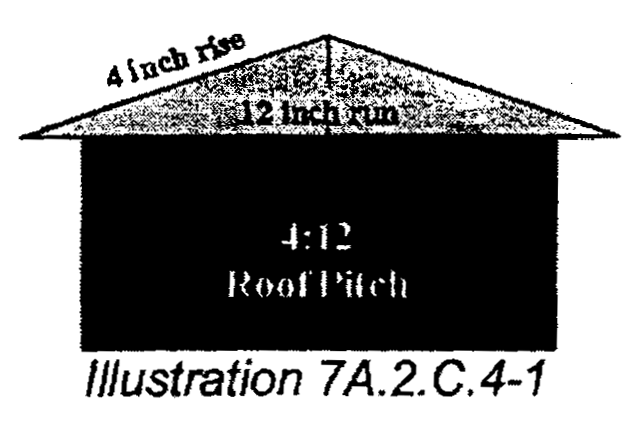
The use of visible pitched roofs or architectural elements with visible pitched roofs is required for all buildings except for fuel station canopies and for those buildings used for an industrial use located within an I industrial district. All such roofs shall have a minimum pitch of 4:12 (i.e., four inches rise per 12 inches run) and consist of one of the approved materials as set forth in subsection 7A.2.F. See illustration 7A.2.C.4-1, below.
5.
All solid exterior doors, overhead doors, down spouts, exterior utility receptacles, service boxes, exterior lighting fixtures, frames and mullions of all doors and windows containing storefront glass panels, permitted trim, accent, and traditional decorative elements and materials, such as canopies and wrought iron, shall be of a color selected from the approved accent colors, as set forth in subsection 7A.2.F., and shall be complementary to the development's overall color scheme. Additionally, frames and mullions of all doors and windows containing storefront glass panels shall be anodized.
6.
Mechanical equipment shall not be visible from the ground within 1,000 feet from the building, and shall be screened in accordance with the following: Roof-mounted mechanical or other equipment shall be screened by roofing and/or by parapet walls. Ground-mounted equipment, within view of a roadway or driveway used by the general public, shall be screened by masonry walls. Ground-mounted equipment, not within view of a roadway or driveway used by the general public, shall be screened by landscaping, at a minimum.
7.
Outside loading docks and delivery areas within view of a roadway or driveway used by the general public shall be screened from view by masonry walls. Outside loading docks and delivery areas not within view of a roadway or driveway used by the general public shall be screened from view by landscaping, at a minimum. It is preferred for loading docks and delivery areas to be located to the side or rear of the building.
8.
Awnings and bollards.
a.
Awnings may be constructed and maintained in accordance with this subsection.
i.
Location. An awning may be located over a storefront, a window, or a building entry. An awning may extend over the framing of a window or the framing of a building entry. An awning located over a storefront shall be located over the building entry of the storefront and any window located within one foot of such building entry.
ii.
Visibility. An awning shall not visually dominate the building to which such awning is attached and shall complement the character and design of the building.
iii.
Width. A single awning shall not extend beyond the frame of a window or a building entry. If an awning is located over a storefront, such awning shall not extend beyond the lesser of: the outermost frame of a window located within one foot of a building entry or 30 feet.
iv.
Height. The bottom of an awning shall not be higher than the top frame of a storefront building entry or window, a building entry, or a window of the building to which such awning is attached and shall be no higher than 12 feet from the finished floor as determined by measuring 12 feet from the finished floor specified in the permitted building plans of the business establishment using such awning to the top of the awning.
v.
Shape. An awning shall be pedestrian-scaled.
vi.
Material. An awning shall be constructed of fabric, metal, or glass. Canvas awnings with a matte finish are preferred.
vii.
Color. An awning shall complement the overall color scheme of the building facade. An awning shall be of a color selected from the approved accent colors, as set forth in subsection 7A.2.F. Solid colors or subtle striped patterns are preferred.
viii.
Shopping centers and integrated business developments. Awnings located within a shopping center or an integrated business development shall be attached to each business establishment within such shopping center or integrated business development and shall be uniform in shape, material, color, and design.
b.
Bollards. A bollard shall complement the overall color scheme of a building facade. Bollards shall be of a color selected from the approved accent colors, as set forth in subsection 7A.2.F. Solid colors or subtle patterns are preferred.
9.
Window coverings.
a.
Window coverings shall be installed in accordance with the following regulations:
i.
Authority. Window coverings that are visible from a street may be installed in nonresidential developments in lieu of window signs or, in addition to window signs, provided that such window coverings shall meet the requirements set forth herein.
ii.
Maximum quantity. Window coverings, or a combination of window coverings and window signs, shall not exceed 25 percent of the aggregate window area of a nonresidential development.
iii.
Color. A window covering shall be one color and shall be either beige, black, bronze, brown, buff, cream, sand, or tan. Window coverings shall complement the overall scheme of the building façade.
b.
Affirmative defenses. It shall be an affirmative defense to prosecution under this subsection that a window covering is:
i.
Required by other law;
ii.
Installed to secure property from a natural or man-made disaster no earlier than three days before, during, or no later than three days after such disaster;
iii.
Comprised of tempered glass, spandrel glass, or similar material; or
iv.
Specifically authorized for energy conservation purposes pursuant to the Commercial Energy Conservation Code of the City of Missouri City, Texas.
D.
Additional standards for condominium or multifamily development. For condominium or multifamily development, the following additional standards shall apply:
1.
Dwelling-unit buildings shall be located and oriented to screen all parking areas from view of adjoining uses, including roadways.
2.
Dwelling-unit buildings shall transition in height from lower to higher from the perimeter to the interior of the development. The taller buildings in the development shall be located in the interior part of the development. Buildings with up to two-story dwelling units may be located around the perimeters of the development, except that three-story buildings will be allowed around perimeters if they are part of buildings that include both two and three stories.
3.
Long uninterrupted expanses of building facades are prohibited. Articulation is required through the use of jogs, projections or retreats in the building walls, windows, balconies, entryways and bays.
4.
All building entries adjacent to a street shall be pedestrian-scaled and shall include two or more of the following architectural treatments: distinctive doorways; distinctive entry canopies or awnings; projected or recessed entry bays; porches; changes in paving material, texture, or color; landscaping providing entry focal points; fountains; decorative benches; and ornamental glazing, railings, and balustrades.
5.
Stairs, hallways, and elevators shall be located within buildings and structures and not on the exterior of buildings and structures. No more than 25 percent of front doors to units shall be located on the exterior of the buildings.
6.
Excluding windows and doors, a minimum of 50 percent of the exterior of dwelling unit buildings shall consist of brick, stone and/or stucco.
7.
Roofing materials shall consist of standing seam metal, slate, tile or concrete products.
8.
The roof structures for all dwelling-unit buildings shall be pitched, with a minimum slope ratio of 5:12 for the main slope and a minimum of 8:12 for any accent gables and hips.
9.
The roof structures for accessory buildings, including any detached garages and carports, shall be pitched with a minimum slope ratio of 4:12, if within view of adjoining properties, including roadways.
10.
Garages may be attached, detached, the first floor of a multistory residence or multistory freestanding structures.
11.
If freestanding parking structures are used, such structures shall be located so as to be easily accessible to the buildings in which the dwelling units they service are located.
12.
The exteriors of freestanding multistory parking structures shall have architecturally-designed masonry panels. Notwithstanding anything in this section 7A to the contrary, there shall be no pitched roof requirements for these structures.
13.
The vehicular entrance to garages or parking areas shall not face a street. Vehicle entrances to garages shall be set back at least 30 feet from all internal vehicular access roads, driveways or roads.
14.
Garage doors of attached garages shall not comprise more than 60 percent of the total length of a building's frontage, and there shall be no more than six such garage doors in succession on a building.
15.
No more than four detached garages shall be located side by side.
16.
Any carport section shall be limited to housing no more than six vehicles, up to a maximum of 120 feet in length, including enclosed storage areas.
17.
At least one garage with square footage sufficient to house a minimum of two seven-foot by 18-foot automobiles in addition to normal yard maintenance equipment shall be provided for each condominium unit.
18.
The square footage for garages for a multifamily development shall be of adequate square footage to house a minimum of one seven-foot by 18-foot automobile. At least 50 percent of the required total number of parking spaces in accordance with section 12 hereof for a multifamily development shall be provided within covered parking such as garages or carports. At least 25 percent of the required total number of parking spaces in accordance with section 12 hereof for a multifamily development shall be housed in garages.
E.
Additional standards for hotel development. For hotel development, the following additional standards shall apply:
1.
Long uninterrupted expanses of building facades are prohibited. Articulation is required through the use of jogs, projections or retreats in the building walls, windows, balconies, entry ways and bays.
2.
All building entries adjacent to a street shall be pedestrian-scaled and shall include two or more of the following architectural treatments: distinctive doorways; distinctive entry canopies or awnings; projected or recessed entry bays; porches; changes in paving material, texture, or color; landscaping providing entry focal points; fountains; decorative benches; and ornamental glazing, railings, and balustrades.
3.
Stairs, hallways, and elevators shall be located within buildings and structures and not on the exterior of buildings and structures.
4.
Guestrooms may be accessible only through interior corridors.
5.
Excluding windows and doors, a minimum of 50 percent of the exterior of buildings shall consist of architectural masonry units, brick, or stone.
6.
The roof structures for accessory buildings shall be pitched with a minimum slope ratio of 4:12, if within view of adjoining properties, including roadways.
7.
If freestanding parking structures are used, such structures shall be located so as to be easily accessible to the buildings in which the guestrooms they service are located.
8.
The exteriors of freestanding multistory parking structures shall have architecturally-designed masonry panels. Notwithstanding anything in this section 7A to the contrary, there shall be no pitched roof requirements for freestanding multistory parking structures.
9.
Outdoor delivery or service areas within view of any right-of-way or residential area shall be screened from view by masonry walls. Outdoor recreational space within view of any right-of-way or residential area shall be screened from view by a combination of fencing and landscaping. The use of chain link fencing materials shall not satisfy the requirements for screening outdoor recreational space.
F.
Designated architectural design zones.
1.
Architectural design zone 1. Architectural design standards for nonresidential developments, other than industrial developments, at least partially located within 1,000 feet of the center line of the right-of-way of a major thoroughfare as indicated on the city's major thoroughfare plan; condominiums; and multifamily developments shall be as follows:
a.
Primary materials and colors for building and structure exteriors and fencing:
Architectural masonry unit, brick: Beige, brown, burgundy, gray, orange, red, rose, sage.
Stone: Beige, brown, cream, tan.
b.
Materials and colors for visible roofing:
Standing seam metal, slate, or concrete tile: Black, bronze, brown, gray.
Half-barrel clay tile: Orange, gray.
c.
Accent exterior colors: Beige, black, bronze, buff, cream, forest green, gray, olive, rose, rust, sage, sand, sepia, tan, terracotta, white, a business identity color, as provided by subsection 7A.2.G.
2.
Architectural design zone I-1. Architectural design standards for industrial developments located within an I industrial district south and west of Beltway 8 or within an I industrial district north and east of Beltway 8 and south of Fondren Park Subdivision and South Main Gardens Subdivision shall be as follows:
a.
Primary materials and colors for building and structure exteriors and fencing:
Architectural masonry unit, brick, stone, concrete tilt wall, Exterior Insulation and Finish System (EIFS), split-face concrete masonry unit, or stucco: Beige, black, bronze, buff, cream, forest green, gray, olive, red, rose, rust, sand, sage, sepia, tan, terracotta, white.
Sheet metal on the side and/or back of a building, provided such side and/or back does not face a public or private street immediately adjacent to the tract on which the building is located: Beige, black, bronze, buff, cream, forest green, gray, olive, red, rose, rust, sage, sand, sepia, tan, terracotta, white.
b.
Materials and colors for visible roofing: Standing seam metal, slate, concrete tile: Bronze, gray.
c.
Accent exterior colors: Beige, black, bronze, buff, cream, forest green, gray, olive, rose, rust, sage, sand, sepia, tan, terracotta, white, a business identity color, as provided by subsection 7A.2.G.
3.
Architectural design zone I-2. Architectural design standards for industrial developments in an I industrial district contained within South Main Gardens Subdivision shall be as follows:
a.
Primary materials and colors for building and structure exteriors and fencing: Architectural masonry unit, brick, stone, concrete tilt wall, Exterior Insulation and Finish System (EIFS), split-face concrete masonry unit, stucco or metal with a minimum of 25 percent brick or stone on the frontage: Beige, black, bronze, buff, cream, forest green, gray, olive, red, rose, rust, sand, sage, sepia, tan, terracotta, white.
b.
Materials and colors for visible roofing: Standing seam metal, slate or concrete tile: Bronze, gray.
c.
Accent exterior colors: Beige, black, bronze, buff, cream, forest green, gray, olive, rose, rust, sand, sage, sepia, tan, terracotta, white, a business identity color, as provided by subsection 7A.2.G.
G.
Business identity colors. Business identity colors may be incorporated into the architectural design of a building as provided for herein:
1.
Business identity colors shall complement the building design.
2.
Business identity colors shall not dominate the building design and shall not be designed to create an advertisement of the building itself.
3.
Business identity colors shall be exempt from subsection 7A.3.2.
4.
A maximum of five percent of each exterior wall may consist of business identity colors. Business identity colors located on awnings are excluded from the calculation of the maximum percentage of business identity colors allowed on each exterior wall.
H.
Portfolios of preferred designs for nonresidential developments. Portfolios, including photographs, of preferred designs for buildings for commercial and industrial uses are to be used as architectural models to guide the preparation of building design throughout the city. The city does not desire to achieve exact or even near replicas of the buildings identified in the portfolios. Instead, such buildings should be used for general purposes of reference before plans are prepared. Portfolios are maintained in the department of planning.
(Ord. No. O-08-41, § 4, 7-21-2008; Ord. No. O-11-26, § 9, 7-18-2011; Ord. No. O-12-30, § 4, 9-17-2012; Ord. No. O-17-34, § 3, 9-18-2017)
Sec. 7A.3. - Prohibitions.
Except as expressly provided for otherwise in this zoning ordinance, the following construction materials and details may not be visible on the exterior of a building:
1.
Any back-lit or internally-lit panel, canopy, or awning.
2.
Bright or glossy colors on major building elements and electric, fluorescent, neon, or metallic color schemes on any part of a building.
3.
Concrete cinder block, except that painted cinder block may be used on the rear of buildings not backing a street or driveway used by the general public.
4.
Corrugated materials used as walls or roofs.
5.
Exterior neon lighting.
6.
Multiple layers of awnings on a single story of a building.
7.
Temporary buildings, other than construction trailers.
(Ord. No. O-08-41, § 4, 7-21-2008; Ord. No. O-11-26, § 10, 7-18-2011)
Sec. 7A.4. - Modified standards for existing nonresidential, multifamily and condominium projects.
A.
A tract containing a nonconforming nonresidential principal building, multifamily project or condominium project built prior to September 20, 1999, the nonconforming status of which is terminated pursuant to section 16 of this zoning ordinance and which complies with the following conditions, shall be exempt from the requirements contained in subsections 7A.2.C.3, 7A.2.C.4, and 7A.3.4 and shall further qualify for the modified standards set forth in subsection 7A.4.B:
1.
Exteriors and any visible roofing of all buildings and structures within the given tract are cleaned or repainted and maintained in an approved earth-tone color scheme complementary to that required for new development;
2.
A building or structure constructed with metal siding on walls located within view of a roadway or driveway used by the general public, having existing landscaping or having additional landscaping installed, immediately adjacent to such walls at ten-foot intervals, except for doorways. Such landscaping may be installed in planters;
3.
Accessory buildings and structures, including new construction, located in such tracts are, at a minimum, similar in materials and design to the existing principal building. New buildings and structures, however, must consist completely of masonry, except for windows and doors;
4.
Any existing temporary building, visible from a roadway or driveway used by the general public, is screened by a masonry wall and/or landscaping; and
5.
Each trash disposal area is located to the rear or side of buildings, where possible, and is in compliance with section 9.14 of this ordinance.
B.
Development meeting all of the conditions contained in subsection 7A.4.A above shall qualify for the following modified standards:
1.
Setbacks. The occupancy of buildings with nonconforming setbacks is allowed provided that life safety regulations are met.
2.
Landscaping. The following reductions/deviations in landscaping are allowed:
a.
When the existing land area within the subject site is not sufficient to comply with subsection 11.6.A.1, a reduction in the required landscaping area shall be allowed to the greater of the following two alternatives: The total landscaping area that currently exists or an area equivalent to not less than 25 percent of that required by subsection 11.6.A.1.
b.
If the total area of existing planting islands and diamonds does not comply with subsection 11.5.B.1.b.i, a reduction in the required area shall be allowed to the greater of the following two alternatives: The area that currently exists or an area equivalent to not less than 25 percent of that required by subsection 11.5.B.1.b.i.
c.
The minimum dimensional requirements for the size of planting islands and diamonds, as set forth in subsections 11.5.B.1.b.ii and 11.5.B.1.b.iii, shall be waived for existing planting islands and diamonds, if the planting areas are sufficiently sized to support and promote the viability of installed plants.
d.
The minimum distance requirement between parking spaces and planting islands and diamonds, as set forth in subsection 11.5.B.1.b.iv, shall be waived for existing planting islands and diamonds.
e.
The required installation of subsurface irrigation pursuant to subsection 11.9.A. shall be waived if other means of adequate irrigation for new landscaping is available within the subject site.
3.
Parking. A reduction of up to 25 percent in the total number of parking spaces as required by section 12 shall be allowed if sufficient parking is available on an adjoining tract having adequate pedestrian access and if a shared parking agreement between the property owners is on file with the city.
(Ord. No. O-08-41, § 4, 7-21-2008; Ord. No. O-11-26, § 11, 7-18-2011; Ord. No. O-14-46, § 3, 11-17-2014)
Sec. 7A.5. - Administration.
A.
Upon the submission of an application for a building permit, specific-use permit, or rezoning to planned development district, an applicant shall submit a design review application and the applicable fee as set forth in a resolution adopted by city council adopting a schedule of fees. Such application shall contain proposed preliminary elevations of proposed buildings showing details of exterior colors, materials and architectural style. Samples of the proposed exterior materials shall also be submitted.
B.
Upon review of such applications, a list of required changes, if any, shall be provided to the applicant by the city.
C.
A building permit will not be granted until:
1.
An applicant has submitted a color board containing samples of the approved exterior, fencing, roofing and accent materials;
2.
A design review application for the proposed development has been submitted and approved; and
3.
The building permit application complies with all applicable ordinances, laws, rules, and regulations.
(Ord. No. O-08-41, § 4, 7-21-2008; Ord. No. O-11-26, § 12, 7-18-2011)

