
Moberly City Zoning Code
ARTICLE VI
SIGNS
Sec. 46-236. - Intent and purpose.
It is the intent and purpose of this article to qualify, supplement or define the allowable uses of the several types of signs allowed in the district regulations appearing elsewhere in this regulation.
(Code 1987, app. A, § 50; Ord. No. 7365, § 1(part), 2-5-2001)
Sec. 46-237. - Applicability.
All signs are, by definition, structures. No land, personal property or structure shall be used for sign purposes except as specified in this article.
(Code 1987, app. A, § 51; Ord. No. 7365, § 1(part), 2-5-2001)
Sec. 46-238. - Exemptions.
(a)
Total exemptions. The following signs shall be exempt from the requirements of this article, except for the provisions of section 46-240:
(1)
Flags or emblems of a government or of a political, civic, philanthropic, educational or religious organization, displayed on private property.
(2)
Signs of a duly constituted governmental body, including traffic or similar regulatory signs, legal notices, warnings at railroad crossings and other instructional or regulatory signs having to do with health, safety, parking, swimming, dumping, etc.
(3)
Memorial signs displayed on public or private property.
(4)
Small signs, not exceeding three square feet in area, displayed on private property for the convenience of the public, including signs to identify entrance and exit drives, parking areas, one-way drives, restrooms, freight entrances, and other similar signs; except that such signs shall not display logos or other business advertisements.
(5)
Scoreboards in athletic stadiums.
(6)
Temporary signs for the sale of household goods at a residence (for example, garage sales or auctions) for a period not to exceed five days.
(7)
Political signs set outside the public right-of-way and in compliance with sight triangle requirements.
(b)
Exemptions from sign permit requirements. The following signs are exempt from the sign permit section of this article, but shall comply with the other regulations imposed by this article:
(1)
Name plate signs not exceeding two square feet in gross area accessory to a single-family or two-family dwelling.
(2)
Bulletin board signs not exceeding 100 square feet in gross area accessory to a church, school or public or non-profit institution.
(3)
Business signs when located on property used for agricultural purposes and pertaining to the sale of agricultural products produced on the premises.
(4)
Real estate signs not exceeding nine square feet in area.
(5)
Construction signs not exceeding nine square feet in area.
(6)
Window signs not exceeding 25 percent of the window surface in commercial and industrial districts.
(Code 1987, app. A, § 58; Ord. No. 7365, § 1(part), 2-5-2001)
Sec. 46-239. - Classification of signs.
(a)
Functional types.
(1)
Advertising sign (billboard). A sign which directs the attention of the public to any goods, merchandise, property, business, service, entertainment or amusement conducted or produced which is bought or sold, furnished, offered or dealt in elsewhere than on the premises where such sign is located or to which it is affixed.
(2)
Bulletin board sign. A sign that indicates the name of an institution or organization on whose premises it is located and which contains the name of the institution or organization, the names of persons connected with it, and announcement of persons, events or activities occurring at the institution. Such sign may also present a greeting or similar message.
(3)
Business sign. A sign which directs attention to a business or profession conducted, or to products, services or entertainment sold or offered upon the premises where such sign is located, or to which it is affixed.
(4)
Identification sign. A sign giving only the name and address of a structure, business, development or establishment. Such signs may be wholly or partly devoted to a readily-recognized symbol.
(5)
Memorial sign. A sign, monument or statue serving to help people remember some person or event.
(6)
Name plate sign. A sign giving the name or address of the owner or occupant of a structure or premises on which it is located and, where applicable, a professional status.
(7)
Temporary sign. A display sign as listed below that is limited in time that such sign may remain in use either by the limitations of this article or the conditions of a sign permit.
a.
Real estate sign. A temporary sign pertaining to the sale or lease of a lot or tract of land on which the sign is located, or to the sale or lease of one or more structures, or a portion thereof on which the sign is located.
b.
Construction sign. A temporary sign indicating the names of the architects, engineers, landscape architects, contractors and similar artisans involved in the design and construction of a structure, complex or project only during the construction period and only on the premises on which the construction is taking place.
c.
Political campaign sign. Any sign relating to a candidate, political party, ballot issue, or other issue to be voted upon in any public election.
(b)
Structural types.
(1)
Awning, canopy or marquee sign. A sign that is mounted on, painted on, or attached to, an awning, canopy or marquee. No such signs shall project above, below or beyond the awning, canopy or marquee.
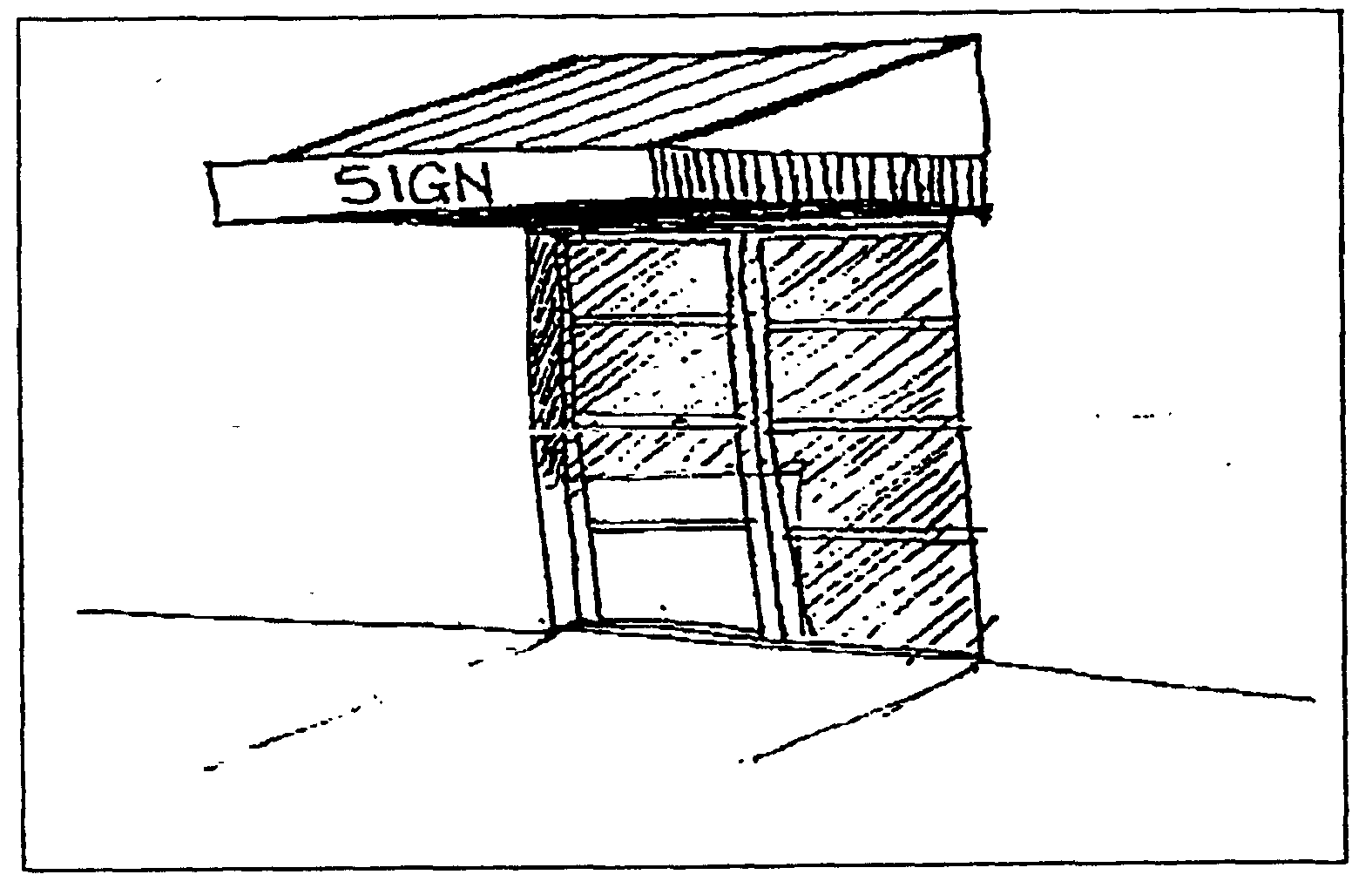
FIGURE 5. CANOPY SIGN
(2)
Ground sign. Any sign placed upon, or supported by, the ground, independent of the principal structure on the property, where the bottom edge of the sign is less than six feet above the ground, the height is no greater than ten feet.
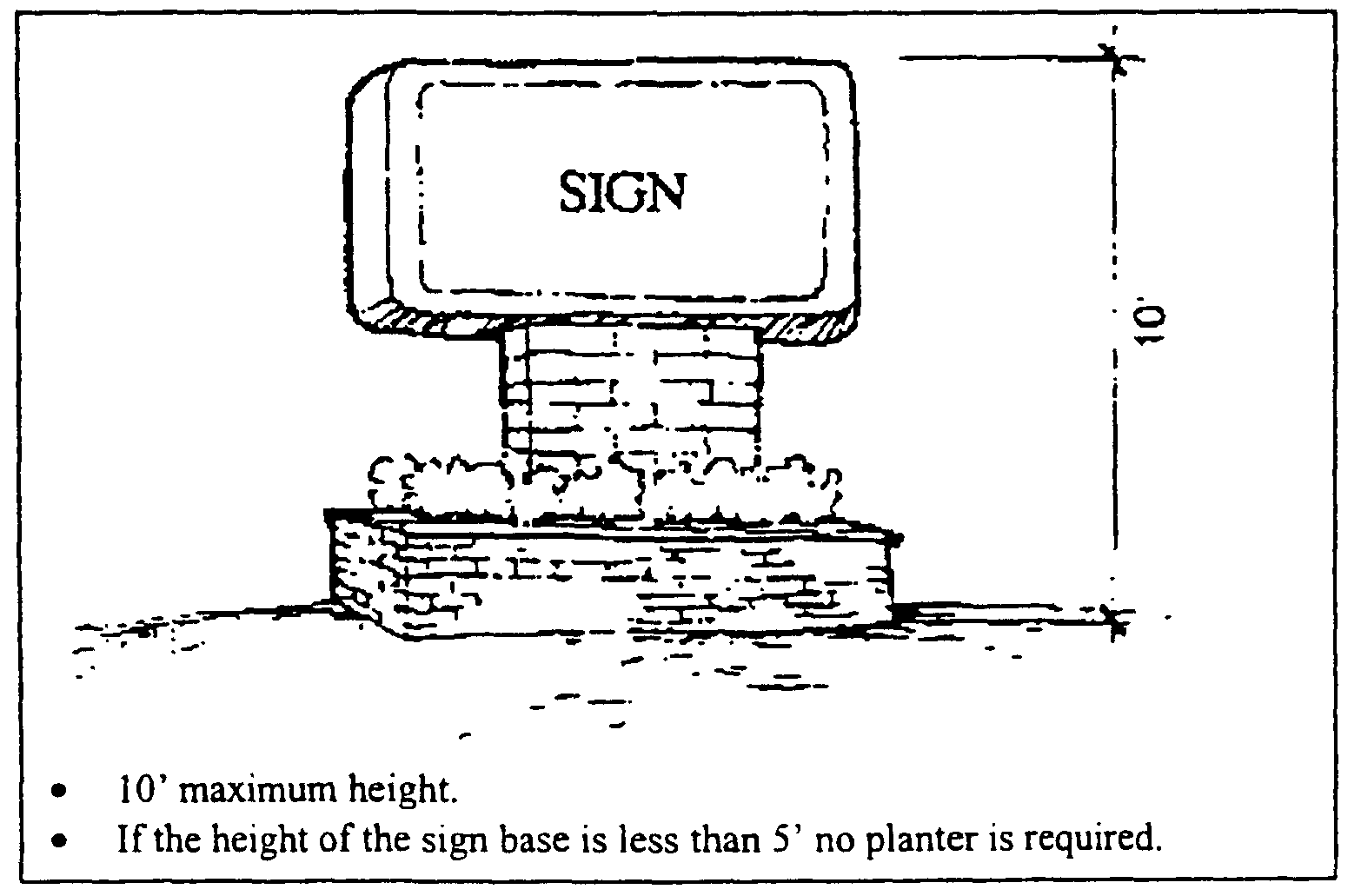
FIGURE 6. GROUND SIGN
(3)
Monument sign. A freestanding sign supported primarily by an internal structural framework or integrated into landscaping or other solid structural features other than support poles and whose height is no greater than six feet.
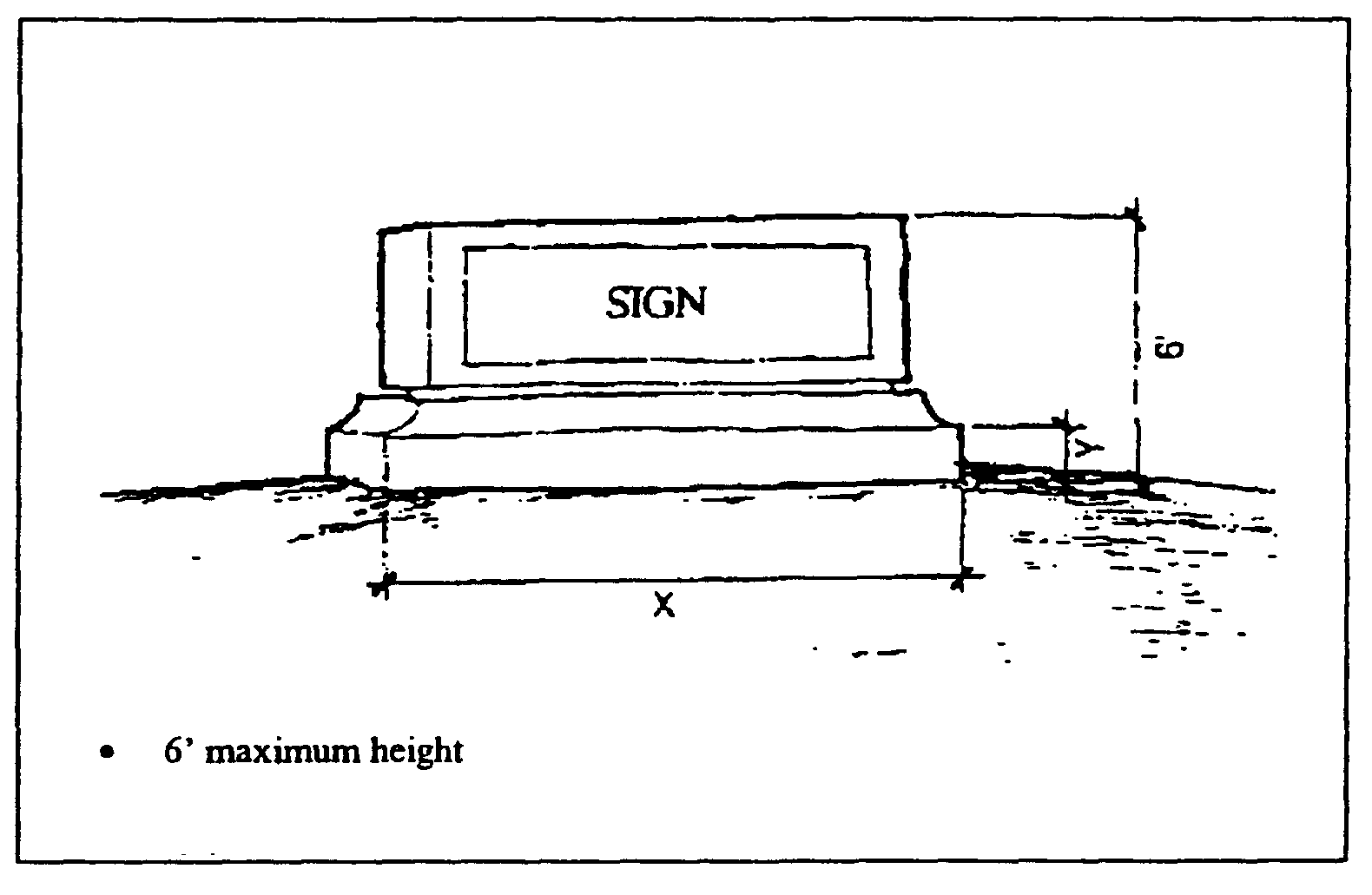
FIGURE 7. MONUMENT SIGN
(4)
Elevated sign. Any sign placed upon, or supported by, the ground, independent of the principal structure on the property, where the bottom edge of the sign is ten feet or more above the ground level with a top elevation of 30 feet.
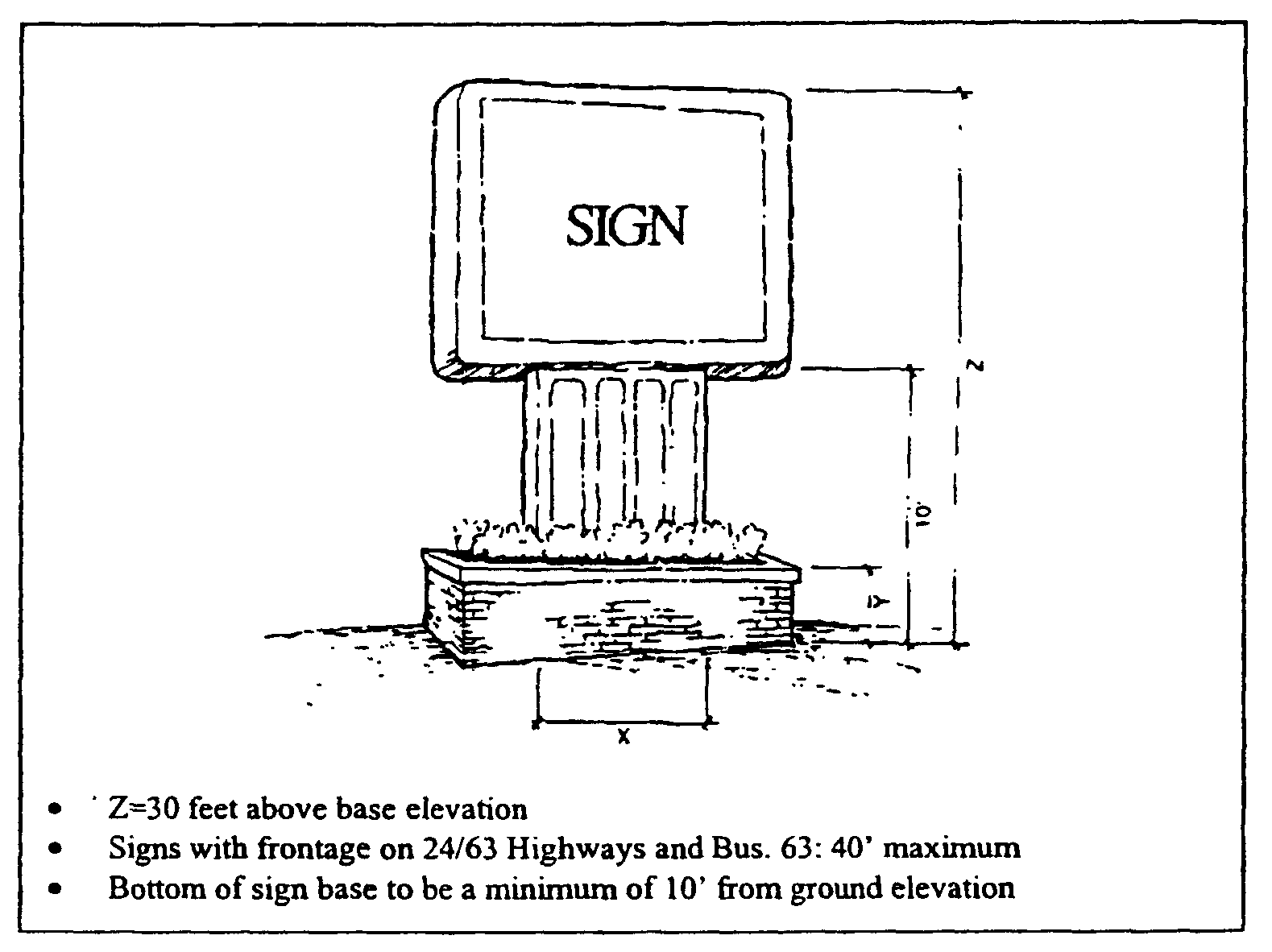
FIGURE 8. ELEVATED SIGN; RECOMMENDED DESIGN
(5)
Portable display sign. Any movable display structure, capable of relocation, under its own power, or towed by a motor vehicle. The display message of the sign may be painted or non-painted and capable of being readily altered. Portable display signs may be with or without electrical illumination and power, and with or without wheels.
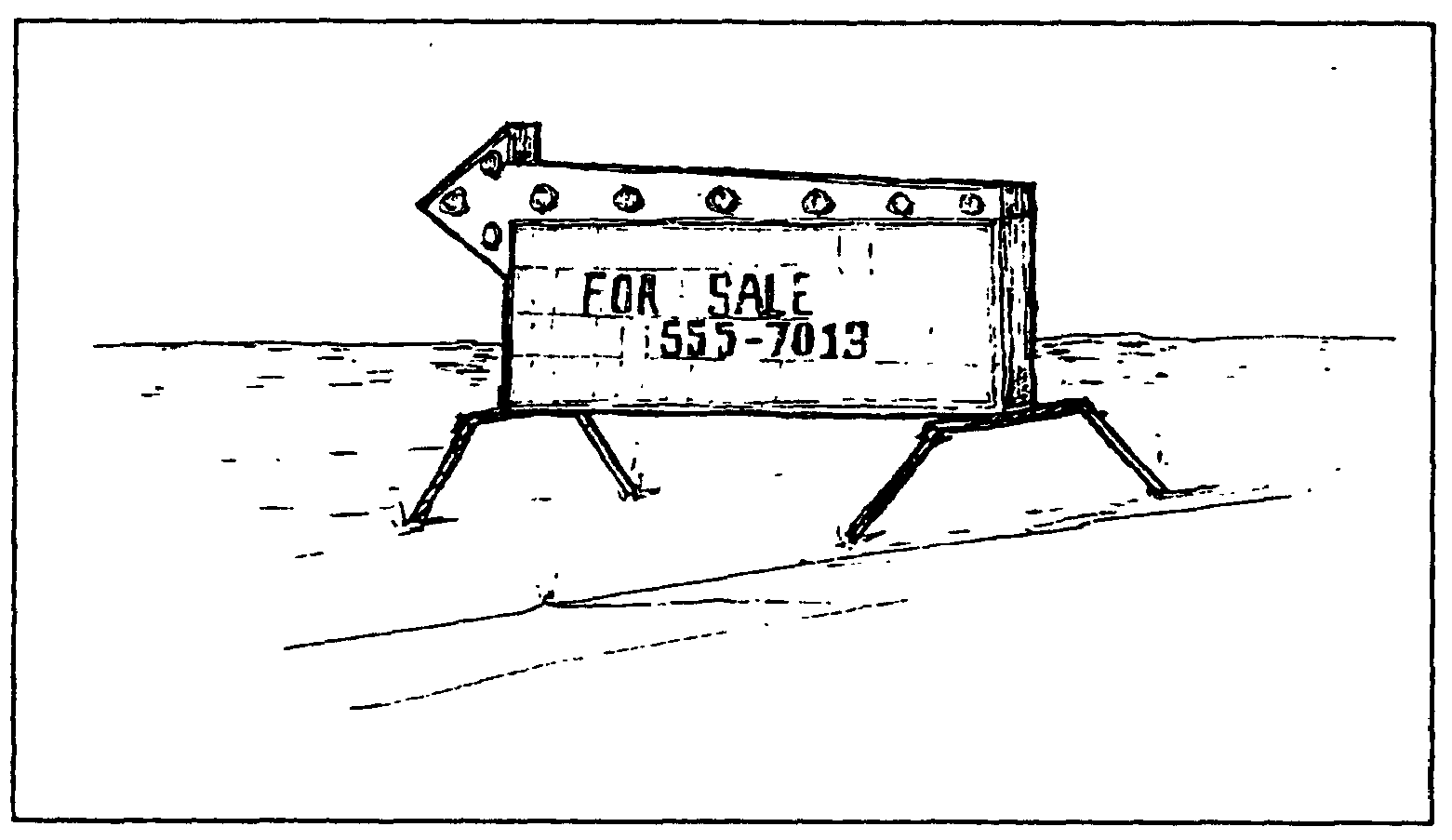
FIGURE 9. PORTABLE DISPLAY SIGN
(6)
Projecting signs. Must be wholly or partly (at least 75 percent) dependent upon a structure and which projects more than 12 inches from the structure. May not utilize a separate freestanding pole, column or other freestanding structure erected for the sole purpose of support for the sign.
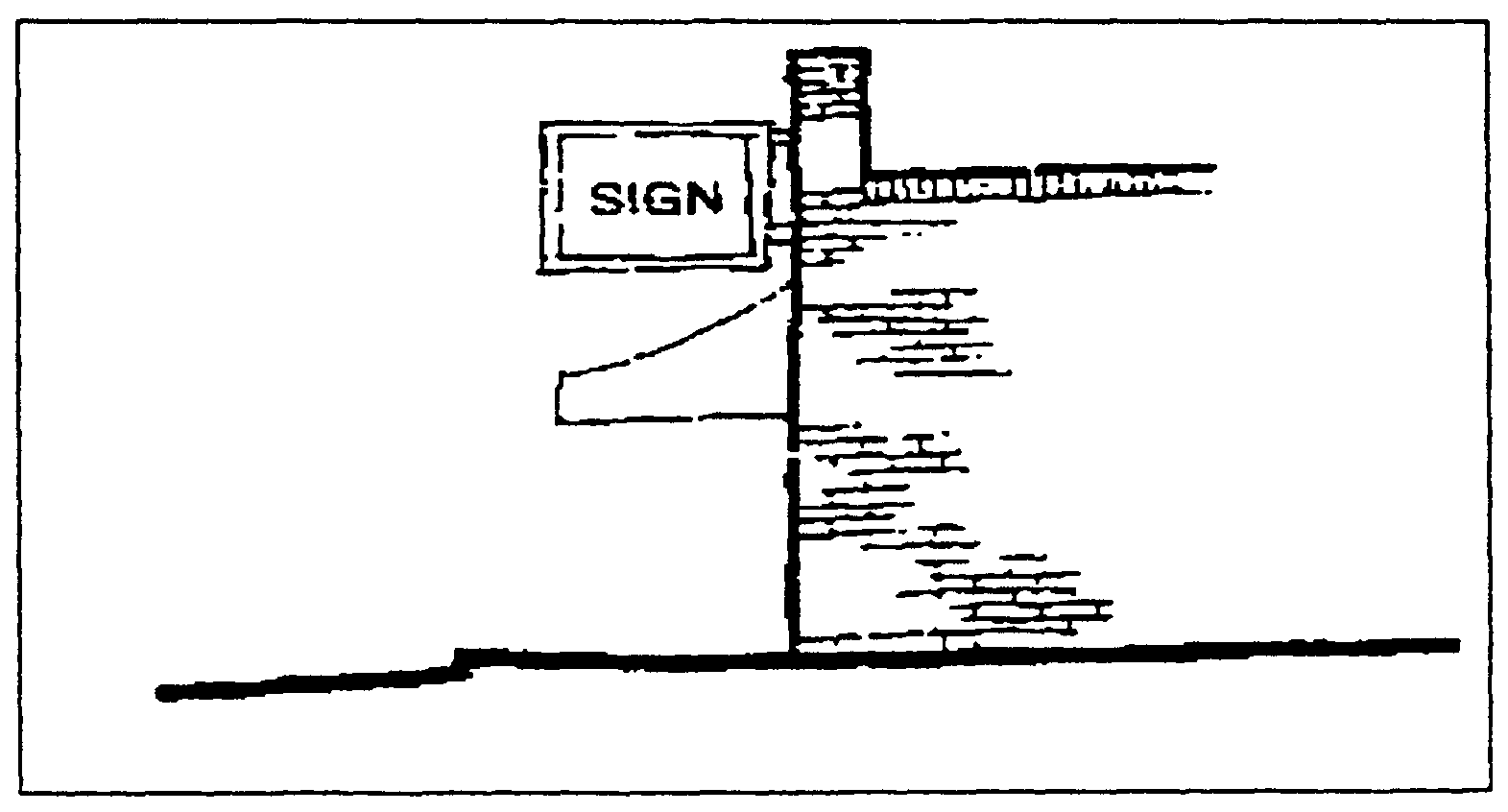
FIGURE 10. PROJECTING SIGN
(7)
Wall sign. A sign fastened to or painted on a wall of a structure in such a manner that the wall becomes merely the supporting structure or forms the background surface, and which does not project more than 12 inches from such structure.
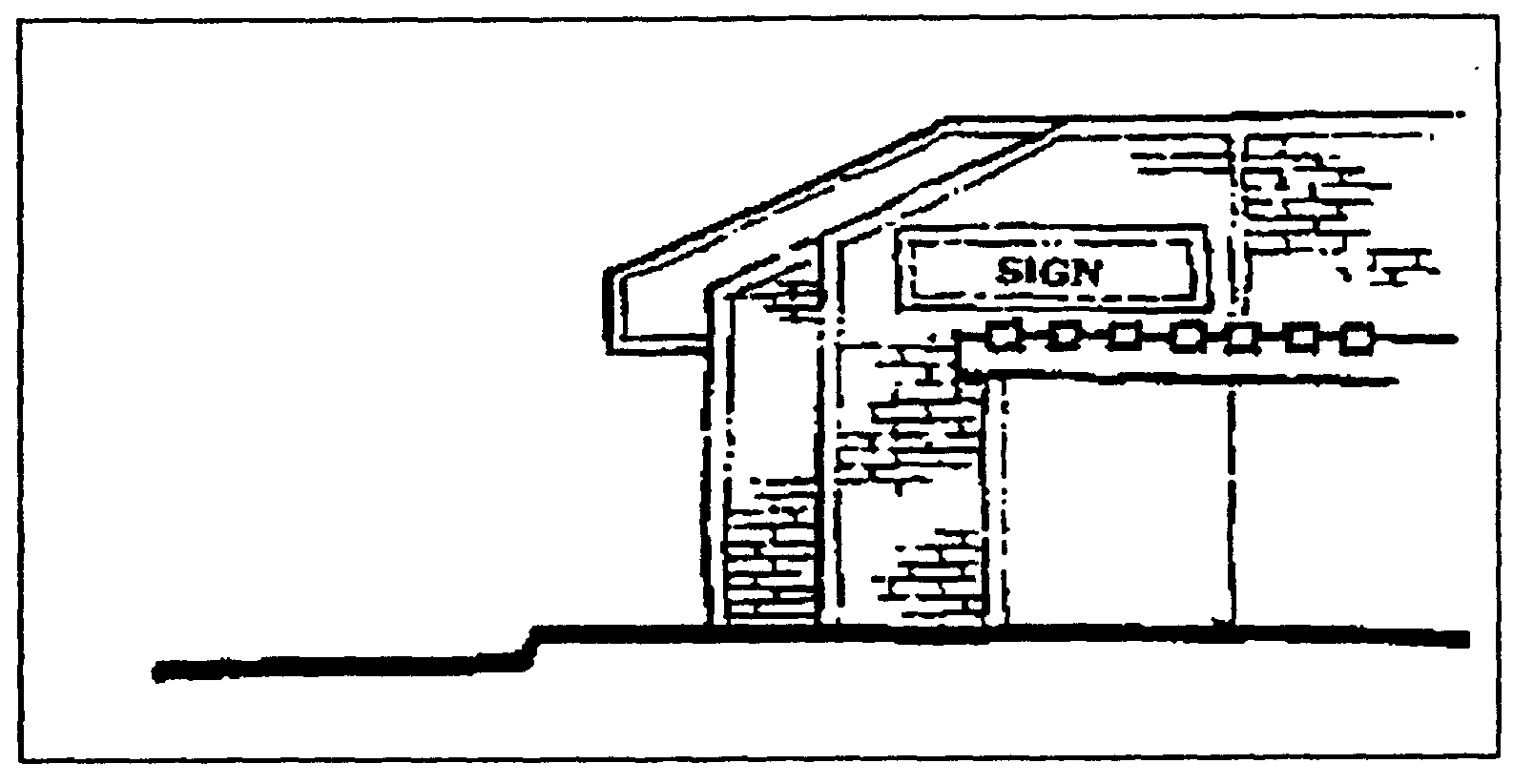
FIGURE 11. WALL SIGN
(8)
Roof sign. A sign totally supported on the roof of a structure. Roof signs shall not project more than 12 inches above the roofline.
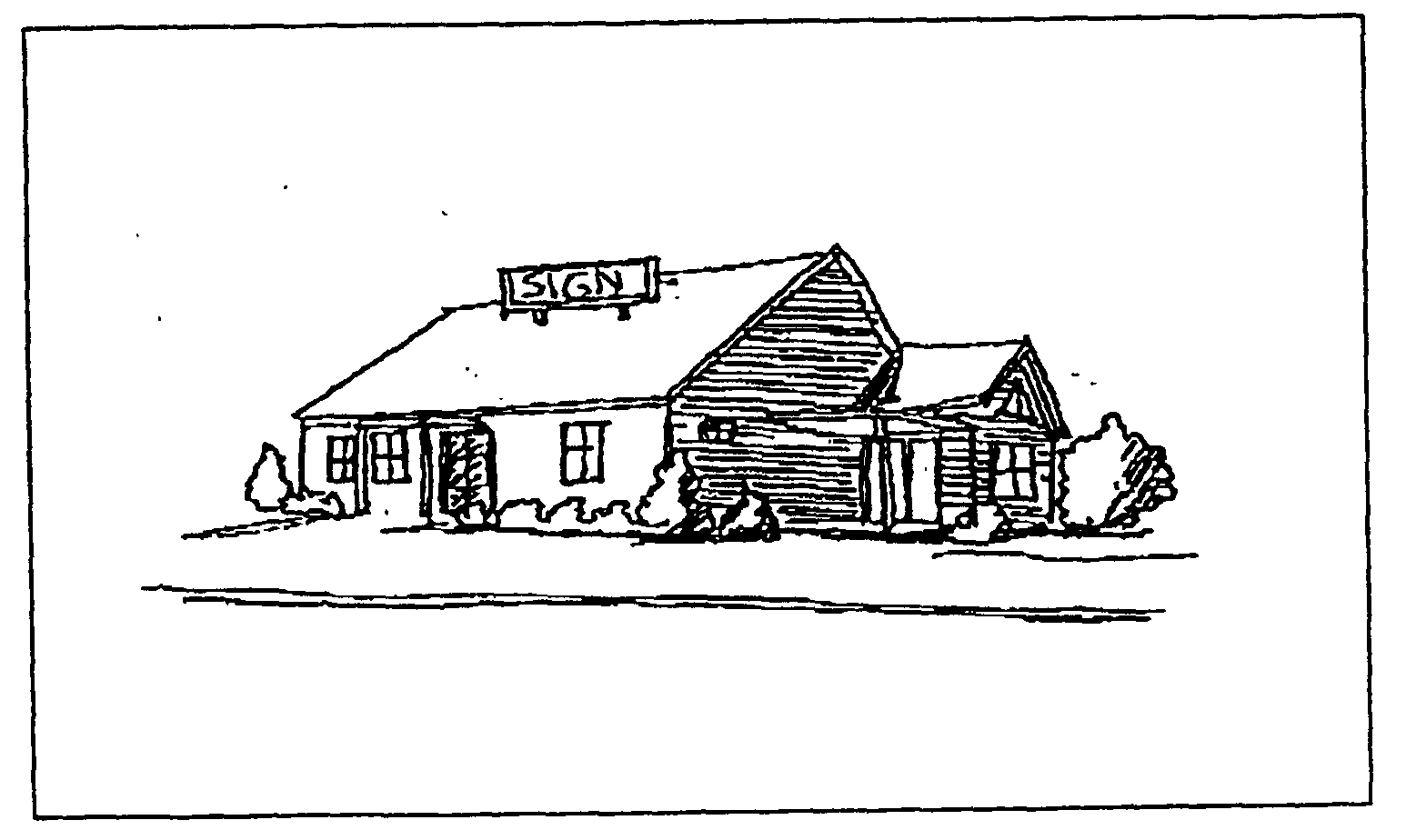
FIGURE 12. ROOF SIGN
(9)
Window sign. Any sign, pictures, symbol, or combination thereof, designed to communicate information about an activity, business, commodity, event, sale, or service, that is placed inside a window or upon the window panes or glass and is visible from the exterior of the window.
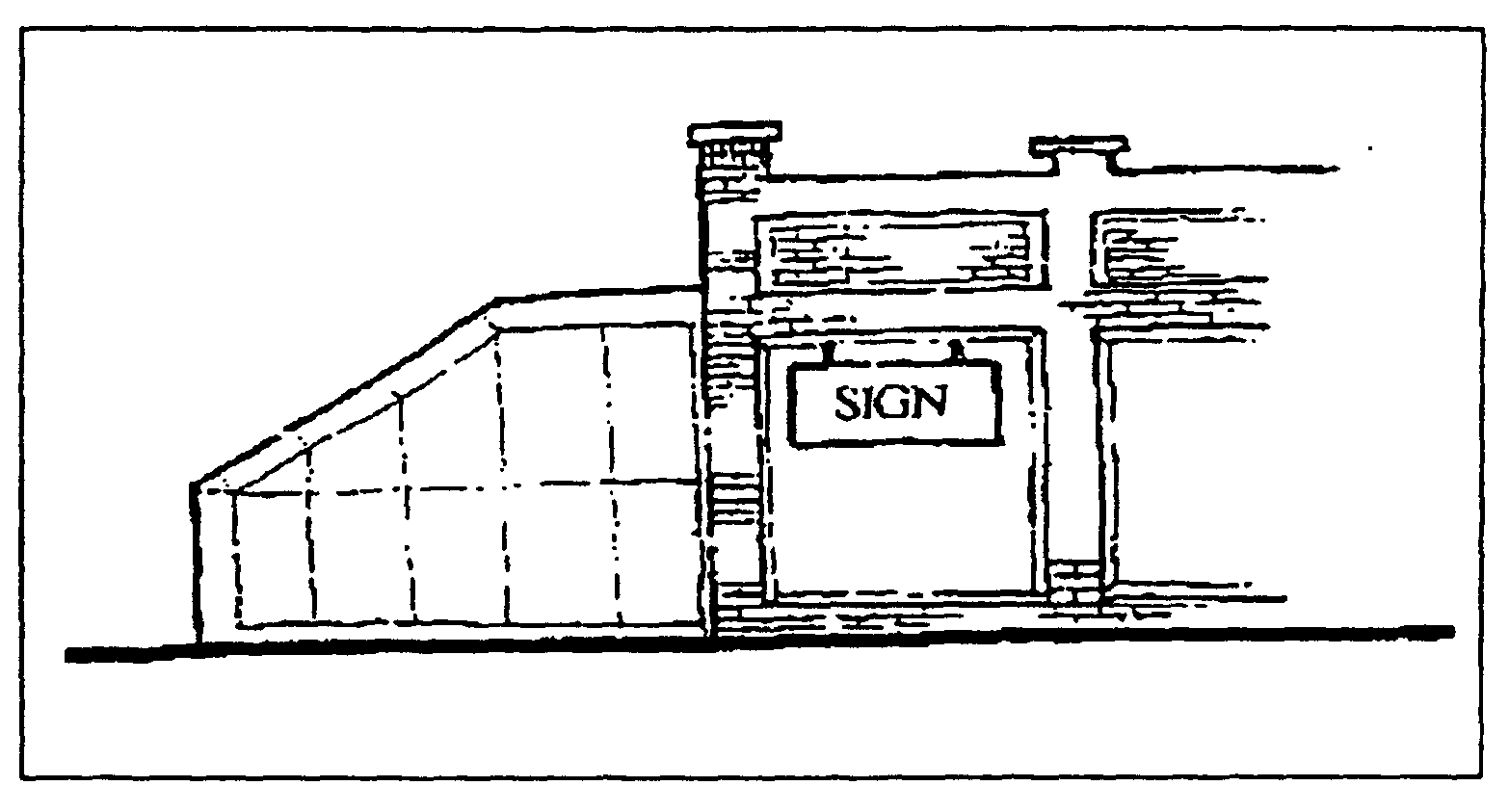
FIGURE 13. WINDOW SIGN
(Code 1987, app. A, § 56; Ord. No. 7365, § 1(part), 2-5-2001; Ord. No. 7394, § 1(part), 6-18-2001; Ord. No. 8278, § 1, 11-17-2008; Ord. No. 8279, § 1, 11-17-2008)
Sec. 46-240. - Prohibited signs.
(a)
Signs on public property. Any sign installed or placed on public property, except in conformance with the requirements, shall be forfeited to the public and subject to confiscation, except that logo signs on public athletic fields shall be allowed. In addition to other remedies hereunder, the city shall have the right to recover from the owner or person placing such a sign the full costs of removal and disposal of such sign.
(b)
Obscene or indecent advertisement. No person shall display upon any sign or other advertising structure any obscene, indecent or immoral matter.
(c)
Located on right-of-way. Any sign located on public right-of-way, except those signs required by governmental authority or political signs as may be permitted.
(d)
Blocking access way or window. No sign shall block any required access way or window.
(e)
Attached to utility pole or tree. No sign shall be attached to any utility pole or tree.
(f)
Creating traffic hazards. No sign shall be maintained at any location where by reason of its position, size, shape or color, may obstruct, impair, obscure, interfere with the view of, or be confused with any traffic or railroad control sign, signal or device, or where it may interfere with, mislead, or confuse traffic. Any sign located within three feet of a driveway, alley, or within a parking area shall have its lowest elevation at least eight feet above the curb level; however, in no event shall any sign be placed so as to project over any public right-of-way, except in the B-2, Central Business District, where signs may project over a sidewalk. No sign may be placed in the sight triangle.
(Code 1987, app. A, §§ 57(e), (f), (g), 59; Ord. No. 7365, § 1(part), 2-5-2001; Ord. No. 7394, § 1(part), 6-18-2001; Ord. No. 8280, § 1, 11-17-2008)
Sec. 46-241. - Permits and inspections.
(a)
Required. No new or replacement sign except temporary signs, as defined in this article, may be erected or altered until a sign permit has been issued by the building inspector.
(b)
Application. Application for permits required under this article shall be made on forms provided by the building inspector and accompanied by the following, if required by the building inspector or if required by the provisions hereof:
(1)
Plans and specifications of the proposed sign; the right to inspect all permanent signs and marquees prior to their installation and erection and prior to the issuance of a permit.
(2)
A certificate of accident public liability insurance issued to the person or firm installing or erecting a sign or marquee over public property and providing coverage of $50,000.00 per person, $100,000.00 per accident and $25,000.00 property damage.
(c)
Fees. Every application before being granted a permit hereunder, shall pay to the city clerk the following permit fee for each such sign or other advertising structure regulated by this article:
(1)
All signs requiring a permit other than temporary portable display signs and real estate signs over 32 square feet; as provided in the city fee schedule.
(2)
Temporary portable display signs and real estate signs over 32 square feet; as provided in the city fee schedule.
(d)
Inspection. As soon as a sign has been erected, the permittee shall notify the building inspector who shall inspect such sign and approve the same if it complies with the provisions of this article. The building inspector may, from time to time, as he deems necessary, inspect all signs or other advertising structure regulated by this article to ascertain whether the same is secure or insecure or whether it needs removal or repair.
(e)
Review and action. The zoning administrator shall review the sign permit application in detail to determine whether the proposed sign complies with all the applicable sign regulations of this article, if applicable. Within 15 days of the submission of a complete application for a sign permit, the zoning director shall either issue the sign permit, if the sign complies in every respect with the standards of this article, if applicable or deny the sign permit if the sign fails in any way to comply with the standards of this article. The zoning administrator shall specify all reasons for the denial.
(f)
Revocation. All rights and privileges acquired under the provisions of this article or any amendment thereto, are mere licenses revocable at any time by the building inspector; and all such permits shall contain this provision.
(Code 1987, app. A, §§ 54, 55; Ord. No. 7365, § 1(part), 2-5-2001)
Sec. 46-242. - Maintenance.
(a)
All signs within the city shall be maintained in a safe condition and in such a manner that they shall not become a visual detriment to the community at large. The building inspector shall be charged with the responsibility and authority to inspect all signs within the city and direct the maintenance of the signs. Maintenance of signs is defined as keeping sign structures in a safe condition, free of rust, with broken glass or plastic replaced, electrical lights and other electrical operations in operable condition, letters and other sign components in the equivalent condition as on the sign permit or as approved.
(b)
Should the building inspector find a non-maintained sign as defined above, it shall cause the owner of the sign to be notified as to the deficiency and the corrective action that needs to be taken.
(c)
Should the owner fail to exhibit evidence of compliance within 30 days after the mailing of the letter of notification, the building inspector shall cause the owner to be cited for violation of this section or the building inspector shall ensure that the noncompliant sign is removed through the process of administrative abatement.
(d)
Painted sign maintenance. The owner of any sign as defined and regulated by this regulation shall be required to have properly painted, at least once every two years, all parts and supports of the sign, unless the same are galvanized or otherwise treated to prevent rust.
(Code 1987, app. A, § 62; Ord. No. 7365, § 1(part), 2-5-2001)
Sec. 46-243. - Gross sign area.
(a)
Gross area shall include the entire area within a single continuous perimeter enclosing the extreme limits of the sign, exclusive of the base on which it is mounted or from which it is suspended. If more than one side of a sign is utilized as a sign, then only the largest side shall be computed and shall be counted as a portion of the gross area. On lots where more than one sign is located, the total gross area of all the signs shall not exceed the maximum gross area for one sign permitted by this regulation.
(b)
For computing the gross area of any wall sign which consists of letters mounted or painted on a wall, the area shall be deemed to be the area of the smallest rectangular figure which can encompass the letters. Sign height shall be measured from the ground elevation at the base of the sign to the highest element of the sign.
(Code 1987, app. A, § 57(a), (b); Ord. No. 7365, § 1(part), 2-5-2001; Ord. No. 7394, § 1(part), 6-18-2001; Ord. No. 8280, § 1, 11-17-2008)
Sec. 46-244. - Linear street frontage measurement.
In those districts where gross sign area is allocated based on linear street frontage and the tract or parcel is adjacent to more than one street, the linear street frontage shall be the distance of that property line abutting the major street.
(Code 1987, app. A, § 57(h); Ord. No. 7365, § 1(part), 2-5-2001; Ord. No. 7394, § 1(part), 6-18-2001; Ord. No. 8280, § 1, 11-17-2008)
Sec. 46-245. - Scale and context.
Signs shall be in scale with the site or structure where located and in context with the site, structure and service offered. Scale includes both human scale and proportion. Signs shall be proportional to the element they are attached to and the façade as a whole. Context includes form, style, color, balance and structure lines as follows:
(1)
Form. Sign shape and its relationship to the structure or service offered.
(2)
Style. Historical, eclectic, modem or contemporary shapes, texts and colors.
(3)
Color. Analogous or complementary in relation to site or structure.
(4)
Balance. Location of sign in structure element relating to balance through location, mass and color.
(5)
Structure lines. Major lines of building elements and compatibility to outlines, horizontal and vertical lines such as roof line, ground line, window lines, etc.
(Code 1987, app. A, § 57(j); Ord. No. 7365, § 1(part), 2-5-2001; Ord. No. 7394, § 1(part), 6-18-2001; Ord. No. 8280, § 1, 11-17-2008)
Sec. 46-246. - Construction materials.
All signs must be constructed of permanent all-weather materials.
(Code 1987, app. A, § 57(k); Ord. No. 7365, § 1(part), 2-5-2001; Ord. No. 7394, § 1(part), 6-18-2001; Ord. No. 8280, § 1, 11-17-2008)
Sec. 46-247. - Landscaping.
Ground signs and elevated signs shall be landscaped to match the natural state of the land. A combination of landscaping and decorative planter is permitted and shall extend no less than two vertical feet from ground level. Landscape planters shall be constructed of brick, concrete block, CCA or other materials as approved on the site plans.
(Code 1987, app. A, § 57(i); Ord. No. 7365, § 1(part), 2-5-2001; Ord. No. 7394, § 1(part), 6-18-2001; Ord. No. 8280, § 1, 11-17-2008)
Sec. 46-248. - Temporary signs.
(a)
Generally. Temporary signs shall be erected and maintained in a safe and attractive manner and shall be subject to applicable regulations except as specifically modified herein.
(b)
Real estate signs. Real estate signs shall be removed within one week of the date of sale, rental, or lease. Signs over 32 square feet in area shall be authorized by the board of zoning appeals, which shall base its decision on setback, traffic speed, sign design, and surroundings.
(c)
Construction signs. Construction signs shall be 32 square feet or less. Such signs are subject to yard area requirements and may be erected at the start of construction and shall be removed upon project completion.
(d)
Portable display signs. Portable display signs shall be allowed on a premises in a commercial or industrial zoning district for not more than 14 consecutive days, and no more than 30 days in a 12-month period.
(Code 1987, app. A, §§ 60, 61; Ord. No. 7365, § 1(part), 2-5-2001)
Sec. 46-249. - Illuminated signs.
A sign designed to give forth artificial light or designed to reflect light derived from any source is an illuminated sign. Illuminated signs shall be designed as to reflect or direct light away from any residential dwelling district and any illuminated sign located on a lot adjacent to, in front of or across the street from any residential district, which sign is visible from such residential district, shall not be illuminated between the hours of 11:00 p.m. and 7:00 a.m. Illuminated signs in direct vision of a traffic signal shall not be in red, amber or green illumination.
(Code 1987, app. A, § 57(c); Ord. No. 7365, § 1(part), 2-5-2001; Ord. No. 7394, § 1(part), 6-18-2001; Ord. No. 8280, § 1, 11-17-2008)
Sec. 46-250. - Flashing or moving signs.
Any sign that is revolving, rotating, moving, animated, has moving lights or creates the illusion of movement shall be considered a moving sign. Any illuminated sign on which the artificial light is not constant in intensity and color at all times is considered a flashing sign. Flashing signs shall not be permitted which are in any way similar to traffic signals or emergency vehicle lights. A sign which displays the current time or temperature by use of intermittent lighting shall not be deemed a flashing sign if the lighting changes are limited to text indicating time, temperature or other public messages. Such sign shall not in any case exceed 32 square feet in area.
(Code 1987, app. A, § 57(d); Ord. No. 7365, § 1(part), 2-5-2001; Ord. No. 7394, § 1(part), 6-18-2001; Ord. No. 8280, § 1, 11-17-2008)
Sec. 46-279. - District standard table.
(Code 1987, app. A, § 64; Ord. No. 7365, § 1(part), 2-5-2001)
Sec. 46-280. - N-1 Nonurban District and R-1, R-2, R-3 and MP Residential Districts.
In N-1 Nonurban Districts, R-1 Single-Family Residential Districts, R-2 Two-Family Residential Districts, R-3 Multifamily Dwelling Districts, and MP Manufactured Home Park Residential District, the following sign restrictions apply:
(1)
Number of signs permitted: One sign per zoning lot; and two signs per zoning lot on a corner lot, with one sign facing each street.
(2)
Maximum gross area:
a.
Business signs; home occupations: four square feet.
b.
Identification signs: 36 square feet. (In the N-1 district only.)
c.
Temporary signs: as regulated by section 46-239.
d.
Name plate signs: four square feet.
e.
Monument sign: 36 square feet. (In association with an approved conditional use permit only.)
f.
Subdivision monument signs: 36 square feet.
(3)
Maximum height: 15 feet.
(4)
Required setback: No sign shall be placed closer to the front property line than one-half the distance of the front yard setback; except that real estate signs shall be exempt from setback requirements. Subdivision monument signs shall only be located in the right-of-way at the entrance to the subdivision.
(5)
Illumination: Bulletin board signs may be indirectly illuminated with incandescent or fluorescent lighting.
(Code 1987, app. A, § 65(a); Ord. No. 7365, § 1(part), 2-5-2001; Ord. No. 7394, § 1(part), 6-18-2001; Ord. No. 7595, § 1, 6-16-2003; Ord. No. 8372, § 1, 7-20-2009)
Sec. 46-281. - B-3 General Commercial District.
In the B-3 General Commercial District, the following sign restrictions apply:
(1)
Number of signs permitted:
a.
Awning, canopy or marquee signs and wall signs: No limitations.
b.
Ground, monument, elevated, or projecting signs: One per zoning lot except that:
1.
Lots with more than 500 feet of street frontage on a single street may have one sign per drive approach off that street.
2.
Lots that are located on a corner, with separate drive approaches on adjacent streets, when the combined street frontage off both streets is more than 500 feet, may have up to two signs, located one on each of the adjacent streets (but not two on the same street frontage).
(2)
Maximum gross surface area: Four square feet for each linear foot of street frontage; provided no single sign shall exceed a gross surface area of 100 square feet; provided further, no elevated sign shall exceed 250 square feet in gross surface area. A building wall with 1,000 square feet or less shall be limited to 100 square feet of wall sign area. A building wall over 1,000 square feet of area could have up to ten percent in wall signs.
(3)
Maximum height: 30 feet, except as otherwise limited in height by this article.
(4)
Required setback: No sign shall be placed closer to the front property line than ten feet, and no sign shall be closer than 25 feet to a residentially zoned lot.
(5)
Illumination: Illuminated signs shall be permitted.
(6)
Elevated signs:
a.
One elevated sign shall be permitted on the premises of any business located on a platted lot which has no less than 150 feet of frontage on 24/63 Highway rights-of-way.
b.
The height of the elevated sign shall be no greater than 50 feet or 30 above the highest elevation of the finished grade of the highway pavement, whichever is less, except signs on property located at the exits off Highway 63, which shall be no greater than 50 feet in height.
c.
The gross surface area of the face of the sign shall not exceed 250 square feet.
(7)
Advertising signs (billboards): Advertising signs (billboards) may be established along the 24/63 Highway rights-of-way however, they meet the following conditions:
a.
No advertising sign shall be located within 660 feet of another advertising sign abutting either side of the same street or highway.
b.
No advertising sign shall be located closer than 20 feet from a property line adjoining a public right-of-way, 200 feet from any property line which is residentially zoned or ten feet from any interior boundary lines of the premises on which the advertising sign is located. Setbacks shall be measured from the surface display area to the vertical extension of the property line.
c.
The surface display area of any side of an advertising sign may not exceed 400 feet. In the case of advertising sign structures with tandem or stacked advertising sign faces, the combined surface display area of both faces may not exceed 400 square feet.
d.
The height of an advertising sign shall not exceed 35 feet above the grade of the ground on which the advertising sign sits or the grade of the abutting roadway, whichever is higher.
e.
No advertising sign shall be on top of, cantilevered, or otherwise suspended above the roof of any building.
f.
An advertising sign may be illuminated, provided such illumination is concentrated on the surface of the sign and is so located as to avoid glare or reflection onto any portion of an adjacent street or highway, the path of oncoming vehicles, or any adjacent premises. In no event shall any advertising sign have flashing or intermittent lights, nor shall the lights be permitted to rotate or oscillate.
g.
An advertising sign must be constructed in such a fashion that it will withstand all wind and vibration forces that can normally be expected to occur in the vicinity. An advertising sign must be maintained so as to ensure proper alignment of structure, continued structural soundness, and continued readability of message.
h.
An advertising sign established within a business, commercial, or industrial area, as defined in the Highway Advertising Act of 1972 (1972 PA 106, as amended) bordering interstate highways, freeways, or primary highways as defined in the Act shall, in addition to complying with the above conditions, also comply with all applicable provisions of the Act and the regulations provided thereunder, as such may from time to time be amended.
(Code 1987, app. A, § 65(b); Ord. No. 7365, § 1(part), 2-5-2001; Ord. No. 7394, § 1(part), 6-18-2001; Ord. No. 7595, § 1, 6-16-2003; Ord. No. 8372, § 1, 7-20-2009)
Sec. 46-282. - B-2 Central Business District.
In the B-2 Central Business District, the following sign restrictions apply:
(1)
Number of signs permitted: no limit.
(2)
Maximum gross surface area: Four square feet for each linear foot of street frontage, provided no single sign shall exceed a gross surface area of 100 square feet.
(3)
Maximum height: N/A; except wall and projecting signs may extend to the roof eave line.
(4)
Required setback: No sign shall be placed closer to the front property line than one-half the distance of the front yard, and no sign shall be closer than 25 feet to a residentially zoned lot.
(5)
Illumination: Illuminated signs shall be permitted.
(Code 1987, app. A, § 65(c); Ord. No. 7365, § 1(part), 2-5-2001; Ord. No. 7394, § 1(part), 6-18-2001; Ord. No. 7595, § 1, 6-16-2003; Ord. No. 8372, § 1, 7-20-2009)
Sec. 46-283. - B-1 Business Park District and M-1 Industrial District.
In the B-1 Business Park and M-1 Industrial Districts, the following sign restrictions apply:
(1)
Number of signs permitted: Same as B-3, except as modified by advertising signs in subsection (6) of this section.
(2)
Maximum gross surface area: Four square feet per linear foot of street, frontage, provided no single sign exceeds a gross surface area of 300 square feet, except as modified by advertising signs in subsection (6) of this section.
(3)
Maximum height: 30 feet above highest point for roof and wall signs and 30 feet for all others, except as modified by advertising signs in subsection (6) of this section.
(4)
Required setback: No sign shall be placed closer to the front property line than one-half the distance of the front yard, except that no sign shall be closer than 25 feet to a residentially zoned lot.
(5)
Illumination: Illuminated signs shall be permitted, except as modified by advertising signs in subsection (6)(d) of this section.
(6)
Advertising signs (billboards); Advertising signs (billboards) may be established along the 24/63 Highway rights-of-way however, they must meet the following conditions:
a.
No advertising sign shall be located within 660 feet of another advertising sign abutting either side of the same street or highway.
b.
No advertising, elevated sign shall be located closer than ten feet from any interior boundary line adjoining a public right-of-way, 200 feet from any property line which is residentially zoned or ten feet from an interior boundary of the premises on which the advertising, elevated sign is located. No advertising billboard sign shall be located closer than 20 feet from a property line adjoining a public right-of-way, 200 feet from any property line which is residentially zoned or ten feet from any interior boundary lines of the premises on which the advertising sign is located. Setbacks shall be measured from the surface display area to the vertical extension of the property line.
c.
The surface display area of any side of an advertising sign may not exceed 400 feet. In the case of advertising sign structures with tandem or stacked advertising sign faces, the combined surface display area of both faces may not exceed 400 square feet.
d.
The height of an advertising sign shall not exceed 35 feet above the grade of the ground on which the advertising sign sits or the grade of the abutting roadway, whichever is higher.
e.
No advertising sign shall be on top of, cantilevered, or otherwise suspended above the roof of any building.
f.
An advertising sign may be illuminated, provided such illumination is concentrated on the surface of the sign and is so located as to avoid glare or reflection onto any portion of an adjacent street or highway, the path of oncoming vehicles, or any adjacent premises. In no event shall any advertising sign have flashing or intermittent lights, nor shall the lights be permitted to rotate or oscillate.
g.
An advertising sign must be constructed in such a fashion that it will withstand all wind and vibration forces that can normally be expected to occur in the vicinity. An advertising sign must be maintained so as to ensure proper alignment of structure, continued structural soundness, and continued readability of message.
h.
An advertising sign established within a business, commercial, or industrial area, as defined in the Highway Advertising Act of 1972 (1972 PA 106, as amended) bordering interstate highways, freeways or primary highways as defined in the Act shall, in addition to complying with the above conditions, also comply with all applicable provisions of the Act and the regulations provided thereunder, as such may from time to time be amended.
(Code 1987, app. A, § 65(d); Ord. No. 7365, § 1(part), 2-5-2001; Ord. No. 7394, § 1(part), 6-18-2001; Ord. No. 7595, § 1, 6-16-2003; Ord. No. 8372, § 1, 7-20-2009)
Sec. 46-284. - Office parks, shopping centers and planned districts.
(a)
In the case of a proposed office park, shopping center, or other grouping of three or more tenants or establishments (new or remodeled), the developer shall prepare and submit to the planning and zoning commission a master signage plan for all permanent exterior signs. Such plan shall set standards that shall run with all leases or sales of portions of the development. A full and accurate description of all signs shall be included indicating location, placement, materials, graphic design styles, type of illumination, etc. Final development plans shall not be approved until the planning and zoning commission has approved the sign standards. For purposes of this section, the term "shopping center, office park, or their groupings," shall mean a project of one or more buildings that has been planned as an integrated unit or cluster of units on property under unified control or ownership. The sale, subdivision, or other partition of the site does not exempt the project or portions thereof from complying with this article.
(b)
In the case of a shopping center, office park or other grouping which is occupied by more than one tenant, one monument sign and one elevated sign may be permitted in addition to the wall mounted signs on the tenant stores of the center; except that, for centers whose tenant stores are set back from the front lot line more than 330 feet, with a minimum of 300 feet frontage, a third sign may be permitted as either another monument sign or another elevated sign. The design and location of the signs shall be subject to site plan review by the planning and zoning commission.
(c)
Where all tenants or property owners within a building or shopping center, office park or other grouping agree in writing, one tenant may, in lieu of the wall sign permitted, have one monument sign or ground sign depicting the business or product. The design and location of this sign shall be subject to approval of the planning and zoning commission.
(Code 1987, app. A, § 63; Ord. No. 7365, § 1(part), 2-5-2001; Ord. No. 7574, § 1, 4-21-2003)

