
Monroe City Zoning Code
ARTICLE V
- SITE DEVELOPMENT STANDARDS
Sec. 37-71. - Purpose.
The purpose of this article is to address the site improvements on a lot other than the principal building. This includes adequate public facilities, protection standards, exterior lighting regulations, accessory structures and uses, architectural projections into required yards, landscaping, and corridor design standards.
(Ord. No. 11,443, 11-12-13)
Sec. 37-72. - Adequate public facilities.
Land proposed for development must be served adequately by essential public facilities and services. Land will not be approved for development unless and until adequate public facilities exist or provision has been made for water facilities, wastewater facilities, drainage facilities, and transportation facilities necessary to serve the proposed development, whether such facilities are located within the property being platted or outside the site. This policy may be defined further and supplemented by other city ordinances.
(1)
Conformance to plans. Proposed improvements should conform to the City of Monroe Comprehensive Plan and all applicable public facilities and capital improvements plans.
(2)
Water. All platted lots must be connected to a public water system or properly permitted to ensure water for health and emergency purposes, including adequate fire protection.
(3)
Wastewater. All platted lots must be served by an approved means of wastewater collection and treatment.
(4)
Streets. All streets must provide a safe, convenient, and functional system for vehicular and pedestrian circulation and must be appropriate for the traffic characteristics and impacts of the proposed development.
(5)
Drainage. Drainage improvements must accommodate potential runoff from upstream drainage areas, and be designed to prevent overloading the capacity of the downstream drainage system. The city engineer may require the phasing of development; the use of control methods such as retention, detention, or pumping systems; and/or the construction of off-site drainage improvements to mitigate the impacts of the proposed development.
(6)
Phasing. The city may require the phasing of development or improvements to maintain current levels of service for existing public services and facilities, or for other reasons based upon maintaining the health, safety and general welfare of the city's inhabitants.
(7)
Subdivision regulations. All subdivisions must comply with the City of Monroe Subdivision Regulations.
(8)
Wetlands. Any development of lots located, or partially located, within the area subject to the Section 404 of the Clean Water Act, 33 U.S.C. 1344, as amended, shall not be issued a development permit or building permit until a jurisdictional wetland determination has been completed and either of the following occurs:
a.
The U.S. Army Corps of Engineers determines that there are jurisdictional wetlands present on the proposed development site, a Section 404 permit is required, and either a Section 404 permit or a letter of permission is issued by the Corps for the proposed development; or
b.
The U.S. Army Corps of Engineers determines that jurisdictional wetlands are not present on the proposed development site, and no Section 404 permit or letter of permission is required.
(Ord. No. 11,443, 11-12-13)
Sec. 37-73. - Protection standards.
All uses must be operated to comply with the performance standards described in this section below and all other relevant building, fire, and safety codes. In addition to these performance standards, all uses must be constructed, maintained, and operated to prevent negative impacts to the use and occupation of adjacent properties, including impacts from the emission or creation of noise, vibration, odor, radiation, fire, explosive hazards, or glare. Nothing in this section is intended to alter, change, modify or abrogate any authority granted exclusively to any state commission, or to exempt developers, property owners, or lessees from all other relevant regulations. These standards do not apply to construction sites.
(1)
Noise. No activity or use may be conducted in a manner that generates a level of sound, which at any property line is in excess of the average intensity of street and traffic noise at that same boundary.
(2)
Glare, heat and vibration. Any activity or the operation of any use that produces glare, heat, or vibration must be conducted so that no glare, heat, or vibration from the activity or operation is detectable from any point at the property line.
(3)
Dust and air pollution. Dust and other types of air pollution, borne by the wind from sources such as storage areas, yards, conveying equipment and the like, within lot boundaries, must be kept to a minimum by appropriate landscaping, screening, sheltering, paving, fencing, wetting, collecting or other acceptable means.
(4)
Radioactive, toxic and hazardous waste. The discharge of fluid and the disposal of solid radioactive, toxic, and hazardous waste materials must comply with all applicable federal, state and local laws and regulations governing such materials or waste. No operation that produces radioactive, toxic, and/or hazardous materials may commence without prior notice to the city as required by all local, state, and federal regulations. Radioactive, toxic and hazardous materials and waste must be transported, stored, and used in conformance with all applicable federal, state, and local laws.
(5)
Odors. Any condition or operation that results in the creation of odors of such intensity and character as to be detrimental to the health and welfare of the public, or that interferes unreasonably with the comfort of the public, must be removed, stopped, or modified so as to remove the odor.
(6)
Fire and explosive hazards. Materials that present potential fire and explosive hazards must be transported, stored, and used only in conformance with all applicable federal, state, and local regulations.
(7)
Proper drainage. The operation of any use in any district must provide for adequate storm water drainage of the site and be designed to prevent overloading of the capacity of the drainage system.
(Ord. No. 11,443, 11-12-13)
Sec. 37-74. - Use of land and structures.
(a)
Number of structures on a lot. Only one (1) principal building per lot is permitted in R-1, R-2, R-3, and B-1 zoning districts, unless approved as part of a planned unit development as described in Article IV of this ordinance. In all other districts, more than one (1) principal building may be erected on a single lot, provided that each structure complies with all yard and bulk requirements of the district as if it were a principal building on an individual lot.
(b)
Frontage on a public or private street. All lots must front on a public or private street.
(c)
Applicability of bulk and yard requirements. All structures erected after the effective date of this ordinance must meet the bulk and yard requirements for the zoning district in which the structure is located. No existing structure may be enlarged, altered, reconstructed or relocated in such a manner that conflicts with the requirements of the zoning district in which the structure is located, unless a variance (subsection 37-130(d)) is approved by the board of adjustment.
(Ord. No. 11,443, 11-12-13)
Sec. 37-75. - Exterior lighting.
(a)
Light trespass and distraction.
(1)
No exterior lighting may glare into, or upon, the neighboring properties or any residential premises. In addition, no exterior lighting may be used in any manner that could interfere with the safe movement of motor vehicles on public streets.
(2)
Specifically, the following types of light trespass are prohibited:
a.
Any light not designed for roadway illumination that produces direct or reflected glare that could disturb the operator of a motor vehicle.
b.
Any light that may be confused with, or construed as, a traffic controls device, except as authorized by state, federal or local government.
(b)
Unshielded light. The use of unshielded lighting, including incandescent light bulbs hung or strung on poles, wires, or other type of support, are prohibited, except on a temporary basis in areas where approved fairs, Christmas tree sales, or similar activities are held and only when such activities are taking place.
(Ord. No. 11,443, 11-12-13)
Sec. 37-76. - Accessory structures and uses.
(a)
General application.
(1)
All accessory structures and uses are subject to the requirements of this section and the requirements of subsection 37-78(c) (architectural projections) below. Additional accessory structures not regulated in this section may be regulated in subsection 37-78(c) (architectural projections).
(2)
Only those accessory structures permitted by this section or subsection 37-78(c) (architectural projections) are permitted in required yards.
(3)
The combined square footage of all detached accessory structures located in the rear yard are limited to no more than thirty per cent (30%) of the required rear yard.
(4)
No accessory structure shall exceed the height of the main structure.
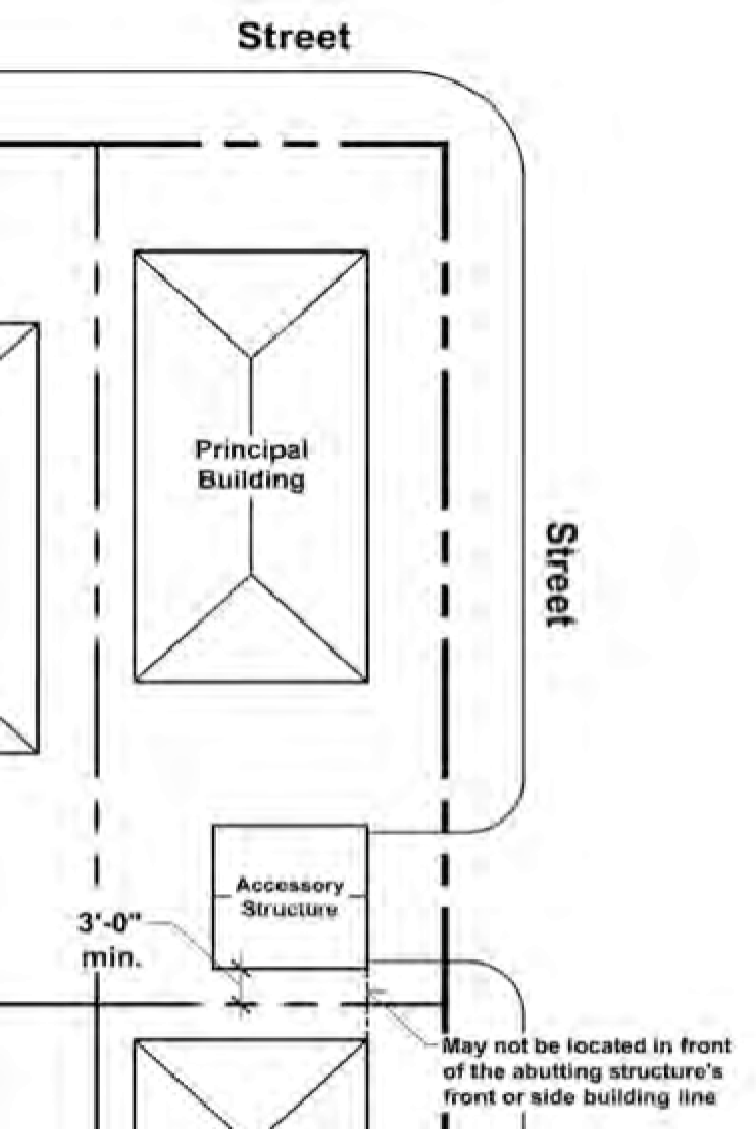
FIGURE 5.1: ACCESSORY STRUCTURE ON CORNER LOT SETBACK
(5)
No accessory structure shall occupy any part of the required front, side or side corner yard.
(6)
In the case of a corner lot, when an accessory structure is located in the rear yard and the rear yard abuts the interior side and/or front yard of a lot, the accessory structure must be located five feet (5') from the rear yard line and may not be located in the front of the abutting structure's front or side building line. In such case, the accessory structure may encroach into the corner side yard but may not be located in front of the abutting structure's front or side building line. (See figure 5.1: accessory structure on corner lot setback)
(7)
No detached accessory structure may be constructed prior to construction of the principal building to which it is an accessory.
(8)
No detached accessory structure may be used for habitation.
(b)
Accessibility ramp.
(1)
Accessibility ramps are permitted in a required front, interior side, or rear yard.
a.
Ramps within the front yard must be designed to minimize encroachment into the front yard.
b.
Ramps may extend or project into a required rear yard without limitation.
(2)
Weather protection may be provided over the ramp and landing provided there is a two-foot (2') distance between the awning or canopy and any lot line.
(c)
Animal regulations commercial kennels. Commercial kennels for breeding of dogs and cats are subject to the following requirements:
(1)
The minimum site area shall be three (3) acres;
(2)
Run areas shall be completely surrounded by an eight foot (8') solid wall or fence; and
(3)
Structures housing animals and outdoor animal runs shall be a minimum distance of fifty feet (50') from property lines abutting residential zones.
(d)
Boathouses and docks. In those instances where the standards of all applicable ordinances of the city and applicable regulatory agencies have been met, boathouses and docks must meet the following conditions:
(1)
There is a limit of one (1) each per building site.
(2)
No boathouse or pier shall extend more than thirty feet (30') from a retaining wall into the public body of water.
(3)
Boathouses and docks together shall not exceed one thousand (1,000) square feet in total size.
a.
The measurement of the square footage for a boathouse shall be the length times the width of the entire structure.
b.
The measurement of the square footage for the dock shall be the length times the width of the entire dock.
c.
The structure shall not include any kitchen, sleeping, and/or sanitary facilities.
d.
Boathouses shall not exceed a single story, or fourteen feet (14'), in height.
e.
All boathouses and docks shall be considered accessory structures. A primary structure must be present on the lot to which a boathouse and/or dock is attached.
f.
No boathouse or dock shall be constructed so as to interfere with normal navigation or with responsible access to adjacent docks.
(e)
Columbarium. A columbarium is permitted as an accessory structure to places of worship or cemeteries on lots with a minimum area of twenty thousand (20,000) square feet. No columbarium shall be closer than five feet (5') from any lot line.
(f)
Fences, gates and walls.
(1)
Reserved.
(2)
No person shall construct or rebuild any fence without obtaining a fence permit from the planning and zoning office. The fee for the fence permit shall be available from the planning and zoning director's office and may be altered or amended only by the city council.
(3)
General requirements.
a.
No person shall erect or rebuild any fence, gate, retaining or free-standing wall that extends beyond the property line.
b.
No person shall plant the trunk of any hedge closer than two feet (2') within any property line.
c.
No person shall erect or rebuild any fence, gate, retaining or free-standing wall, or any combination thereof, in excess of eight feet (8'), except as allowed under subsection 37-76(f)(6) (exceptions) of this article.
d.
The height of any fence, gate or wall shall be measured from the highest grade of the property along the fence, gate, wall or property line on the non-owners side.
e.
All commercial and industrial uses shall have all enclosed outdoor storage and materials within a fenced area at least eight feet (8') in height. The fence shall be solid along the rear and side property lines and open along the front property lines.
f.
All fences, gate or wall must be maintained in a clean, orderly and stable condition at the expense of the owner or lessee.
g.
Materials.
1.
Solid fences, gates and walls shall be constructed of the following materials: wood, brick, stone or rock, masonry, vinyl, hedges, or any combination thereof. (Solid fences should include "weep-holes" if applicable.)
2.
Open fences or gates shall be constructed of ornamental iron, wood, woven wire, or chain link, or a combination ornamental iron and brick, stone/rock, or masonry.
3.
Commercial and Industrial businesses may use metal as a fence material provided that:
•
Any exposed edges with the exception of the bottom of the fence be trimmed with factory made accessory trim with hemmed edges.
•
It is only allowed in B-3, General Business/Commercial; B-4, Heavy Commercial District; I-1, Commercial/Industrial Business Park District; and I-2 Heavy Industrial/Manufacturing Districts
(4)
Location.
a.
All residential and B-1 districts.
1.
Any solid fence, gate, divisional, retaining, or free-standing wall or hedge not over thirty-six inches (36") in height and fences at least fifty per cent (50%) open and not over forty-two inches (42") in height may be erected or rebuilt along the front yard boundaries of a lot or yard in a residential or B-1 district, except as limited in other sections of this article.
2.
No chain link fence shall be erected or rebuilt in any required front or side corner yard in any residential or B-1 district that exceeds five feet (5') in height.
3.
Any fence, gate, divisional, retaining, or free-standing wall or hedge not over eight feet (8') in height in a residential or B-1 district may be erected or rebuilt along the side or rear yard boundaries, except in the line of sight clearance area.
b.
Non-residential districts.
1.
Any fence, gate, divisional, retaining, or free-standing wall or hedge not to exceed eight feet (8') in height may be erected or rebuilt along any boundaries of a lot or yard in non-residential districts, excluding B-1 districts, except as limited in other sections of this article.
2.
Any fence, gate, divisional, retaining, or free-standing wall or hedge constructed on vacant property may be allowed, but only for recreational or security purposes, and only at the discretion of the zoning administrator.
(5)
Prohibited fences.
a.
The installation of an electronically charged fence is prohibited, with the exception of invisible dog fences.
b.
No barbed wire or razor wire fence shall be erected or maintained, except that not more than four (4) strands of horizontal wire may be strung in the top of chain link fences for security purposes on land zoned B-4, I-1, I-2, or C (campus), provided that the lowest strand of wire is a minimum of six feet (6') above the ground.
c.
Temporary fences. Land under development may be surrounded by a construction fence or a temporary chain link fence up to seven feet (7') in height and allowed for a specified period of time as a temporary fence at the discretion of the zoning administrator, upon application. Gates into the fence enclosure may be located at the discretion of the zoning administrator, upon application.
(6)
Height and location exceptions.
a.
The zoning administrator at his/her discretion may, after finding the circumstances meet the following criteria, consider exceptions to the location and height requirements of a fence:
1.
That the adjacent property owner will not be adversely affected;
2.
That pedestrian access will not be hampered, and;
3.
The line of sight clearance area will be clear.
b.
For location exceptions: On through lots;
c.
For height exceptions:
1.
Recreational fences and walls such as those surrounding tennis courts, baseball fields, driving ranges and other similar uses may exceed eight feet (8') to protect the health, safety and welfare of the community.
2.
In the event of a use that is particularly noxious or detrimental to environmental or aesthetic values, it may deemed necessary for the general health, safety and welfare of the community to erect a fence around commercial or industrial uses higher than the eight feet (8') presently allowed by ordinance.
(7)
Electronic theft deterrent device. The construction and use of electric theft deterrent devices shall be allowed in the city only as provided in this section, subject to the following standards:
a.
Unless otherwise specified herein, electric theft deterrent devices shall be constructed or installed in conformance with the specifications set forth in International Electro Technical Commission (IEC) Standard No. 60335-2-76.
b.
Electrification:
i.
The energizer for electric theft deterrent devices must be driven by a commercial storage battery not to exceed twelve (12) volts DC. The storage battery is charged primarily by a solar panel. However, the solar panel may be augmented by a commercial trickle charger.
ii.
The electric charge produced by the fence upon contact shall not exceed energizer characteristics set forth in paragraph 122.108 of the IEC code.
c.
Perimeter fence or wall:
i.
No electric theft deterrent devices shall be installed or used unless it is completely surrounded by a non-electrical fence or wall that is not less than six feet (6').
d.
Location: Electric theft deterrent devices shall be permitted in B-4—heavy commercial district, I-1—industrial business park district and I-2—heavy industrial district (uses with outdoor storage).
e.
Height: Electric theft deterrent devices shall be no taller than eight (8') feet.
f.
Warning signs: Electric deterrent devices shall be clearly identified with warning signs that read: "Warning-Electric Fence" at intervals of not less than sixty (60') feet.
g.
Electric theft deterrent devices shall require a fence permit and any other permit required by the city such as an electrical permit.
h.
It shall be unlawful for any person to install, maintain, or operate an electric theft deterrent device in violation of this section.
(g)
Mechanical equipment.
(1)
Ground-based mechanical equipment including, but not limited to, heating, ventilating and air-conditioning (HVAC) units, swimming pool equipment and back-up electrical generators, may be located in the interior side or rear yard but must be located at least five feet (5') from a rear lot line and three feet (3') from an interior side lot line, where at least two feet (2') of that distance remains open to the sky. Ground-based mechanical equipment is prohibited in the front or side corner yard.
(2)
Any roof-mounted mechanical equipment must be set back at least six feet (6') from any wall of the building to permit safe access to the roof.
(h)
Outdoor sales, storage and display.
(1)
Outdoor sales and display. Retail goods establishments and motor vehicle dealerships are allowed to have outdoor sales and display of merchandise, by either a storeowner or occupant, outside of the store and within the same lot under the following conditions:
a.
No sales and display is permitted in any public right-of-way or located so as to obstruct pedestrian or vehicular traffic.
b.
No sales and display is permitted in a required yard for retail goods establishments, motor vehicle dealerships are exempt.
c.
No required parking areas may be used as an outdoor sales and display area.
d.
The outdoor sales and display of automobile parts, such as tires, is prohibited.
e.
Ice and propane storage machines must be placed against the exterior of the principal commercial building and cannot encroach into any public right-of-way or into any required yard.
f.
All other vending machines, such as DVD vending machines and coin converter machines, must be located inside the principal building.
(2)
Outdoor storage. The following uses are allowed to have outdoor storage: nursery, including the growing of plants in the open, heavy sales, rental and service, motor vehicle dealership and rental establishment, motor vehicle service and repair (minor or major), light and heavy-manufacturing, outdoor storage yards and contractor yards. These uses are permitted outdoor storage under the following conditions:
a.
No outdoor storage is permitted in any public right-of-way or located so as to obstruct pedestrian or vehicular traffic. No outdoor storage is permitted in a required front yard.
b.
All manufacturing, assembly, repair or work activity must take place inside an enclosed building. This does not apply to heavy industrial uses that are typically conducted outside or have an outdoor component.
c.
No required parking area may be used as an outdoor storage area.
d.
No materials stored or displayed outdoors may be of a greater height than that of the required screening, with the exception of storage of construction equipment.
e.
All outdoor storage must comply with the screening requirements of section 37-77.
(i)
Swimming pools.
(1)
Swimming pools may not be located in the required front or side yard abutting a public street. Swimming pools may be located within a required rear or side yard provided the pool is not located closer than five feet (5') to a rear or interior side lot line.
(2)
Every swimming pool of five thousand (5,000) gallon capacity or greater must be protected by a safety fence of at least six feet (6') in height. A walk space at least three feet (3') in width must be provided between the pool and the protective fence.
(j)
Solar panels.
(1)
Roof-mounted solar panels should be placed in a location least visible from the public street; however, this does not prohibit the installation of solar panels on a roof that may be visible when that exposure, particularly southern exposure, is the most viable location. When feasible, solar panels must be integrated into the surface as an architectural feature.
(2)
Solar panels must be mounted to minimize glare onto adjacent properties.
(3)
A solar panel is considered a permitted appurtenance and is not subject to the building height limitations of the district.
(k)
Cargo containers.
(1)
Cargo containers may be placed, used, allowed or maintained on property on a temporary basis for additional storage to support seasonal events or for the duration of a construction project. Proposed length of time shall be approved by the planning commission.
(2)
Cargo containers may not be placed, used, allowed or maintained on property where permitted, unless there is a legal primary use located on the site.
(3)
Cargo containers shall not be stored in a manner that impedes access to public rights-of-way, utility or drainage easements or adjacent structures and buildings. The cargo container(s) shall not block, obstruct, or reduce in any manner any required exits, windows, vent shafts, parking spaces and/or access driveways.
(4)
Cargo containers shall not be used for human habitation or for commercial business purposes.
(5)
Cargo containers shall not be used to store hazardous materials in violation of any local, state or federal requirements.
(6)
No signage shall be allowed on any cargo container.
(7)
Cargo containers shall not be stacked on top of each other or on another structure.
(8)
Containers shall be prohibited from having windows, heating and cooling, plumbing, or multiple entrances. Cargo containers may include passive systems to provide appropriate ventilation.
(9)
Cargo containers shall not contain any holes, peeling paint, rust, damage or structural modifications and shall be painted a non-reflective neutral color that is compatible with the primary structure or to blend in with the surrounding environment.
(10)
Nothing should be stored or stacked on top of any permitted container.
(11)
Containers shall be screened. Acceptable screening features include landscaping, terrain, existing structures, exterior architectural enhancements or a combination of these features.
(12)
Cargo containers require a minor conditional use permit.
(13)
Location:
•
The rear or other non-conspicuous areas of the site.
•
The containers shall not be located within the front yards of the site or high visibility areas from the public right-of-way.
•
Containers may not occupy any required off-street parking spaces, loading/unloading areas or fire lanes.
•
Parking spaces may be used for temporary storage in commercial zones for construction projects and to support seasonal events provided the amount of spaces is not more than ten (10) per cent of the required parking spaces for the sponsoring business or five (5) per cent of the overall spaces within a commercial center containing multiple tenants. Cargo container(s) may not be placed within any designated landscape or storm water facility.
(Ord. No. 11,443, 11-12-13; Ord. No. 11,590, 7-28-15; Ord. No. 11,757, 2-28-17; Ord. No. 11,810, 11-28-17; Ord. No. 11,860, 6-12-18)
Sec. 37-77. - Buffer protection and screening.
(a)
Purpose. Landscaped buffers are required to be provided and maintained when certain land uses are adjacent to, or directly across from each other in order to protect uses from the traffic, noise, glare, trash, vibration, and odor likely to be associated with a more intensive land use. Landscaped buffers are also required to conserve the values of land and buildings and to provide adequate light and air.
(b)
Buffer and screening requirements. Buffering shall be provided in accordance with the following requirements:
(Ord. No. 11,443, 11-12-13)
Sec. 37-78. - Supplemental height, yard, and open space regulations.
(a)
Height exceptions. The height limits for each zoning district shall not apply to the following: church spires, belfries, cupolas, mechanical penthouses or appurtenances, domes not use for human habitation, chimneys, water tanks, ventilators, skylights, solar panels, parapet walls, cornices.
(b)
Supplementary yard regulations.
(1)
Front yard depth. In any residential district, any building site lying between two (2) building sites having dwellings erected on them shall have a front yard equal in depth at least to the average depth of the front yards of the adjacent building sites; provided, however, that no front yard shall be less than twenty feet (20') in depth, and no front yard shall be required to be more than thirty per cent (30%) of the depth of the building site.
(2)
Minimum side yard widths. In any district where side yards are not required by the district regulations, if side yard is provided it shall have a width of at least five feet (5').
(3)
Corner building sites. In any district, a corner building site having to its rear a building site with the potential of facing toward the intersecting or side street shall provide on the intersecting or side street side a side corner yard having a width of at least twenty feet (20'); however, this regulation shall not be applied to reduce the buildable width of the corner lot to less than thirty feet (30').
(4)
Major street lines. Front yard depth and, in the case of a corner building site, side corner yard width shall be measured from the current or future street right-of-way line of a major street where such line has been established and where such major street follows the general direction of, and includes the right-of-way contained in, an existing street on which said building abuts.
(c)
Architectural projections into required yards.
(1)
Every part of a required yard shall be open and unobstructed from the ground to the sky except for permitted accessory structures for the ordinary projections of sills, belt courses, cornices, buttresses, eaves, and similar architectural features, provided that such projections shall not extend more than two feet (2') into any required yard.
(2)
Open fire escapes may extend into any required yard not more than three and one-half feet (3.5').
(3)
Carports and patio covers, when attached to the main dwelling unit may occupy any required yard under the following circumstances:
a.
The carport is no closer than five feet (5') to the side or rear property line; and
b.
The carport is no closer than ten feet (10') to the street right-of-way line.
(Ord. No. 11,443, 11-12-13; Ord. No. 12,031, 12-8-20)
Sec. 37-79. - Off-street parking and loading requirements.
(a)
Purpose. The off-street vehicle parking, bicycle parking and loading regulations of this ordinance are intended to provide accessible, attractive, secure and well-maintained off-street parking and loading areas, provide the appropriate number of spaces in proportion to the demands of the proposed use, increase public safety by reducing congestions of public streets, and encourage the use of alternative modes of transportation.
(b)
General. Off-street parking and loading facilities shall be provided in compliance with this section whenever any building or use is erected, altered, enlarged, converted or otherwise increased in size or capacity. The provision and maintenance of the off-street parking and loading facilities herein required shall be the joint responsibility of the operator and/or owner of the use and the owner of the property or structure on which the use requiring off-street parking and loading facilities are located.
(1)
Existing facilities. The existing number of off-street vehicle and bicycle parking and loading spaces shall not be reduced below the minimum requirements of this section.
(2)
Provision of additional vehicle spaces.
a.
Nothing in this section prevents the voluntary provision of additional off-street vehicle and bicycle parking spaces above that required by this ordinance. There is no limit on the number of bicycle parking spaces that may be provided.
b.
In an effort to limit the amount of impervious surface associated with development, the maximum number of vehicle parking spaces shall be one hundred twenty-five per cent (125%) of the number of required parking spaces. Structured parking facilities are exempt from this maximum.
c.
Where a use exceeds the minimum number of vehicle spaces required by subsection 37-79(d), the area used for additional spaces must either be paved with semi-pervious material, such as permeable paves, porous asphalt, porous concrete, grass-crete, reinforced grass, or other storm water management methods during the site plan review process with final approval by the city engineer.
(3)
Prohibition on use of parking spaces. The sale, repair, dismantling or servicing of any vehicles, equipment, materials or supplies, or the display of goods on off-street parking areas is prohibited, unless otherwise permitted by this ordinance.
(4)
Shared parking facilities. Off-street parking spaces for separate uses may be provided collectively for two (2) or more uses with different hours of operation in order for each use to meet its minimum off-street parking requirements.
a.
Authorization.
1.
The director of planning and zoning or a designee is authorized to approve shared parking arrangements for uses with different hours of operation.
2.
The director of planning and zoning or his/her designee may permit parking required for one use to be supplied by the off-street parking spaces provided for another use if he/she determines that the uses or activities will have peak parking demands at different periods of the day or week.
3.
In order to approve a parking plan for shared parking, the director of planning and zoning or designee must find, based on competent evidence provided by the applicant, that there is no substantial conflict in the principal operating hours of the uses for which the sharing of parking is proposed.
4.
A request for approval of a shared parking arrangement must be accompanied by such information determined by the director of planning and zoning or his/her designee to be necessary to evaluate the peak parking demand characteristics or difference in hours and/or days of operation, including, but not limited to, a description of the uses and their operational characteristics, a site plan, and a parking plan that justifies the reduction in parking requested.
5.
Once all information deemed necessary by the Director of Planning and Zoning or his/her designee to evaluate the shared parking arrangement has been received, approval (with or without conditions) or denial from the director of planning and zoning will occur within fifteen (15) days.
b.
Specifications for shared parking.
1.
The use of such facility by each user does not take place at the same hours during the same days of the week.
2.
The shared parking facility must be located within three hundred feet (300') of both uses.
3.
All other location and design requirements of this article are met.
c.
Shared parking agreement.
1.
The users of the shared parking facility must submit a written, notarized agreement to share parking facilities. A copy of the notarized agreement must be filed with the planning and zoning office.
2.
Shared parking agreements are binding upon applicants and their successors. Shared parking privileges remain in effect only as long as the agreement, binding on all parties, remains in force. If a shared parking agreement lapses or is no longer valid, then parking must be provided as otherwise required by this article.
3.
Pursuant to the same procedure and subject to the same limitations and requirements by which the parking plans was approved and recorded, any parking plan may be amended or withdrawn, either partially or completely, if all land and structures remaining under the parking plan comply with all requirements of this section.
(c)
Computation of parking and loading requirements.
(1)
Where multiple uses with different parking requirements occupy the same structure or lot, the required vehicle and bicycle parking and loading spaces is the sum of the requirements for each use computed separately, unless otherwise permitted by this ordinance.
(2)
A fraction of less than one-half (½) is disregarded, and a fraction of one-half (½) or more is considered one (1) parking or loading space.
(3)
For uses where patrons or spectators occupy benches, pews or open floor areas used for service, each twenty-four (24) linear inches of benches, pews or permanent seating is counted as one (1) seat for the purpose of determining the requirement for the required number of parking and loading spaces.
(4)
Parking or loading spaces required on a public use floor area basis is based on the total floor area accessible to the public. This excludes areas such as locker rooms, storage rooms and similar functions that are accessible only to employees. Public use floor area includes seating areas in restaurants, the entire bar area, and all public waiting areas. When a use includes both public use areas and private offices, the office areas are not considered part of the public use area calculations but must be calculated separately.
(d)
Required off-street vehicle parking spaces. The off-street parking spaces required for each use permitted by this ordinance shall not be less than that found in table 5.4. For uses not mentioned in this section, the director of planning and zoning or his/her designee shall determine the requirements for off-street parking and loading facilities. The determination shall be based upon the most comparable use listed, AASHTO or ITE standards, and/or the specific needs of the development as determined by the city.
(e)
Maintenance. Off-street parking facilities shall be constructed, maintained and operated in accordance with the following specifications:
(1)
Drainage.
a.
Off-street parking facilities must be drained to eliminate standing water and prevent damage to abutting property and/or public streets and alleys, and surfaced with erosion resistant material in accordance with applicable city standards.
b.
Any new surface parking lot with twenty-five (25) or more parking spaces or additions to existing parking lots of twenty-five (25) or more vehicle parking spaces must be designed to filter or store the first inch of rainwater during each rain event. This can be accomplished through the use of pervious paving, rain gardens, bio swales, detention areas, constructed wetlands, and other methods deemed appropriate by the city engineer. Where installed, detention areas should be appropriately designed and located to filter, store and convey the expected storm water flows from surrounding paved areas.
c.
Off-street parking areas must be maintained in a clean, orderly and dust-free condition at the expense of the owner or lessee. A minimum of one (1) litter receptacle must be included in any parking lot.
(2)
Surfacing.
a.
All surface parking lots must be paved with a durable, all-weather material such as concrete or asphalt, or a semi-pervious material such as permeable pavers, porous asphalt, porous concrete, grass-crete or gravel-crete, or a similar surface.
b.
All single-family and two-family dwellings are permitted to construct driveways that consist of two (2) concrete wheel strips, each of which is at least eighteen inches (18") wide and at least twenty feet (20') long. A permeable surface, such as turf, must be maintained between such wheel strips.
c.
Shells, gravel, crushed stone, and bare earth paving are permitted paving materials only in the OS (open space district).
(3)
Wheel guards and curbs. Wheel stops and curbing must be provided to prevent vehicles from damaging or encroaching upon and adjacent parking or loading space, sidewalk, landscaped area or parking lot island, fence, wall or building. Within non-residential or mixed-use development parking lots, box curbs at least six inches (6") in height are required. In some cases, where deemed appropriate by the director of planning and zoning or his/her designee, earth mounds not exceeding two feet (2') in height may be used.
(4)
Striping. Off-street parking areas must be marked by painted or paved lines maintained in clearly visible condition, curbs or other means to indicate individual spaces. Signs or markers should be used as necessary to insure efficient and safe circulations within the lot. Vehicle parking spaces for handicapped persons must be clearly identified with the appropriate signage and striping, regardless of plant growth or other conditions.
(5)
Lighting. Parking lot lighting must comply with section 37-75 of this ordinance. Adequate lighting must be provided for off-street parking spaces that are to be used at night. All lighting must be arranged to eliminate glare on residential property by location of light fixtures or use of fixtures designed to eliminate direct view of luminaries in fixtures from residential property.
(6)
Landscaping requirement. All parking lots shall be landscaped in accordance with chapter 19.5, landscape requirements, of the City of Monroe Code of Ordinances.
(f)
Required bicycle parking spaces.
(1)
Where off-street parking facilities are provided, the number of bicycle parking spaces must be provided as required by table 5.5.
a.
All uses listed within table 5.5 are required to provide short-term bicycle parking spaces, which are areas where bicycles will be left for short stops, requiring a high degree of convenience (close proximity to destination).
b.
Certain uses listed within table 5.5 require a per centage of the required bicycle parking to provide long-term bicycle parking spaces, where bicycles will be left for longer periods of time and thus require a safe and weatherproof storage area, including racks in covered areas, lockers, storage rooms, and/or fenced areas with restricted access.
(2)
In all cases where bicycle parking is required, a minimum of two (2) bicycle spaces is required.
(3)
After the first thirty (30) required bicycle parking spaces are provided, additional bicycle parking spaces are required at one-half (½) space per unit of measure listed in table 5.5.
(4)
When a use is exempt from vehicle parking requirements by the section, the use is also exempt from bicycle parking requirements. If a use exempt from vehicle parking provides parking, bicycle parking, as required by this section, is also required.
(5)
The following reductions in the number of vehicle parking spaces are permitted when bicycle parking and facilities are provided. An applicant may only use one (1) of these two (2) options.
a.
A non-residential use may use up to two (2) required vehicle parking spaces as space for bicycle parking. The area equivalent to two (2) vehicle parking spaces must be used for bicycle parking.
b.
Where a non-residential use provides shower facilities for use by bicyclists, a reduction of up to two (2) vehicle parking spaces is permitted. The area of vehicle parking spaces must be used for bicycle parking.
(6)
Shower and locker facilities for bicyclists are encouraged for offices and government offices, university and vocational school facilities, hospitals and industrial uses over twenty-five thousand (25,000) square feet in gross floor area.
a.
A minimum of two (2) showers in projects between twenty-five thousand (25,000) and one-hundred twenty-five thousand (125,000) square feet, and three (3) showers for any project over one-hundred twenty-five thousand (125,000) square feet. Dressing areas and lockers must be provided as part of the shower facilities.
b.
Lockers for clothing and other personal effects must be located in close proximity to showers and dressing areas to permit access to the locker areas by either gender. A minimum of one (1) clothes locker is required for each long-term bicycle parking space provided.
(g)
Off-street loading facilities.
(1)
General.
a.
Except in the B-1 district, whenever a non-residential building is erected, altered, enlarged, converted or otherwise increased in size or capacity, the off-street loading facilities herein required shall be provided for uses that distribute or receive materials or merchandise by trucks or other commercial vehicles in accordance with table 5.6.
b.
In the case of multi-tenant developments, required loading spaces are calculated on the basis of each individual tenant. For example, if only one (1) commercial tenant of a multi-tenant development is over ten thousand (10,000) square feet only one (1) loading space is required; if all tenants are less than ten thousand (10,000) square feet, no loading is required.
(2)
Computation of off-street loading requirements. The off-street loading requirements for each use permitted by this ordinance shall not be less than that found in table 5.6. For uses not mentioned in this section, the director of planning and zoning or his/her designee shall determine the requirements for off-street loading facilities. The determination shall be based upon the most comparable use listed, AASHTO or ITE standards, and/or the specific needs of the development as determined by the city.
(3)
Combined off-street loading facilities. Requirements for the provision of off-street loading facilities for two (2) or more structures may be satisfied by the permanent allocation of the requisite number of spaces for each use in a common loading facility, provided that the total number of spaces designated is not less than the sum of the individual requirements.
(Ord. No. 11,443, 11-12-13; Ord. No. 11,977, 12-23-19)
Sec. 37-80. - Parking design standard.
(a)
Site plan review.
(1)
Applicability.
a.
Site plan review, in accordance with subsection 37-130(e) (site plan review), is required prior to any construction, alteration or addition of any vehicle parking lot or structure providing ten (10) or more vehicle parking spaces and for any loading facility.
b.
For purposes of this section, construction, alteration or addition includes all paving of previously unpaved surfaces, replacement of pavement with new binder and surface courses, construction of curbing, and installation of new parking lot landscaping and bicycle parking facilities. Construction, alteration or addition does not include maintenance activities such as replacement of existing landscaping, repair of existing curbing, ordinary repairs, sealing, re-striping or placement of surface course pavement over previously paved areas.
(2)
Requirements. Projects that require site plan review must incorporate all of the following items into the required site plan:
a.
Setbacks;
b.
Parking design including type of parking, parking space size, accessible spaces, paving, safety curbing, and visibility triangles;
c.
Landscape requirements;
d.
Fencing and visual screening for uses such as dumpsters;
e.
Drainage of the parking lot including the path of storm water drainage, location of catch basins, storm water retention, and all other storm water devices;
f.
Driveways.
(b)
Permitted vehicle parking locations.
(1)
Residential uses.
a.
All residential off-street vehicle parking spaces required in this section shall be located on the same lot as the building or use being served, including residential uses in mixed-use developments.
b.
For single-family, two-family and townhouse dwellings, required vehicle parking spaces are permitted in private driveways or parking pads, but must not encroach onto the public right-of-way. Tandem vehicle parking is permitted for residential uses but both spaces must be allotted to the same dwelling unit and located on the same lot as the dwelling.
c.
No required off-street vehicle parking is permitted in any required front yard or in front of the front building line. This does not include parking in any permitted driveway. However, in all single-family districts non-required parking may be placed in up to thirty-five percent (35%) of the front yard, provided all driveways access a legal parking space.
(2)
Non-residential users.
a.
Vehicle parking for a non-residential use may be located within three hundred feet (300') of the use served.
b.
No required off-street vehicle parking space is permitted in any required front yard in B-1 districts. However, in B-1 districts non-required parking may be placed in up to thirty-five per cent (35%) of the front yard, provided all driveways access a legal parking space.
(c)
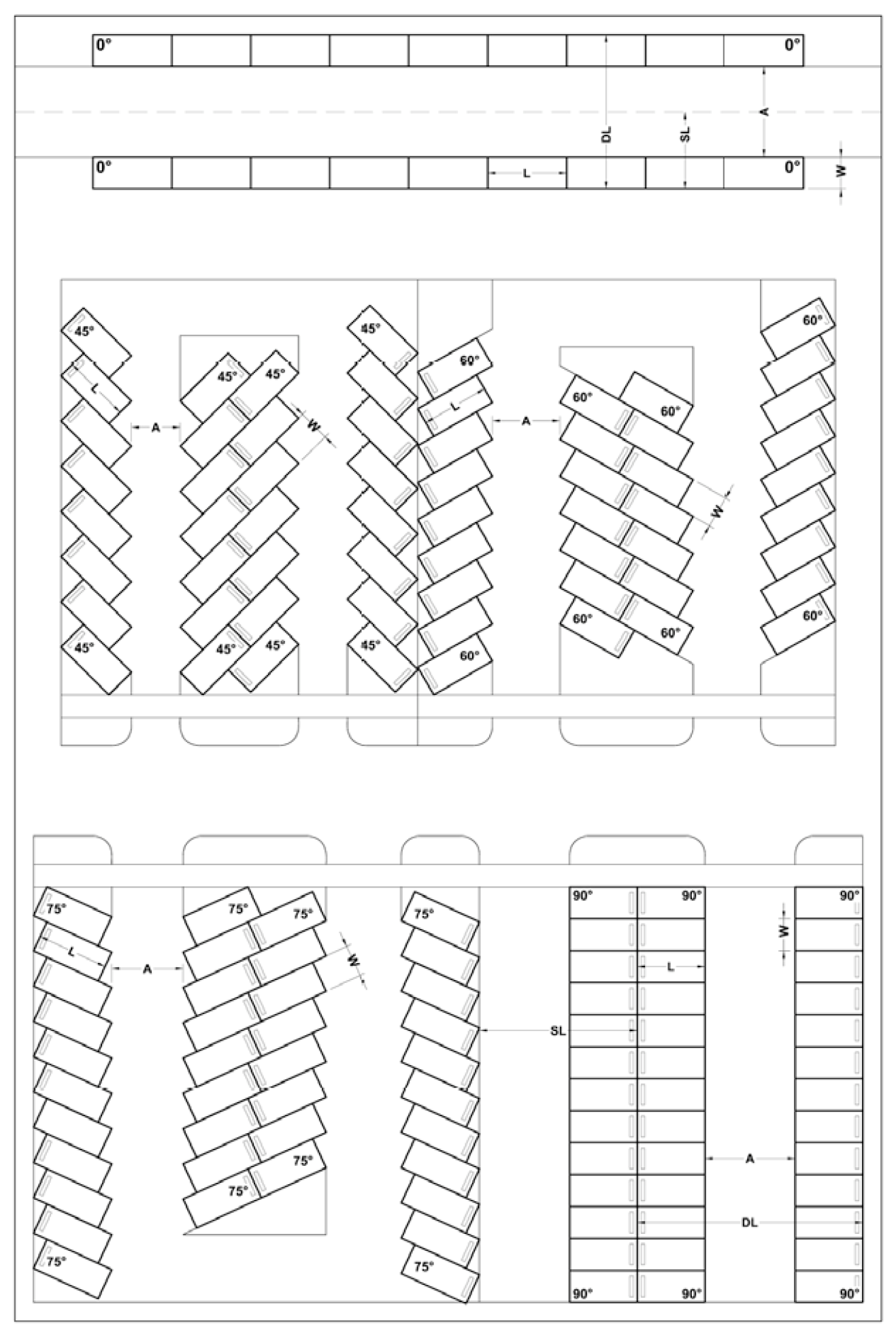
Dimensions of vehicle parking spaces. Off-street vehicle parking spaces must be designed in accordance with figure 5.2.
(d)
Access requirements for off-street vehicle parking.
(1)
Each off-street parking space must be open directly upon an aisle or driveway of adequate width to provide access to a vehicle parking space. All off-street vehicle parking facilities must provide access in a manner that least interferes with traffic movement. For all uses except single-family and two-family dwellings, the parking area must be designed so that the driver of the vehicle proceeds forward into traffic rather than backs out.
(2)
All required off-street parking facilities must have vehicular access from a street, alley, driveway or cross-access connection.
(3)
Within off-street parking lots and structures, one-way traffic aisles must be a minimum of twelve feet (12') in width and two-way traffic aisles must be a minimum of twenty-four feet (24') in width. Furthermore, all aisles must be designed in accordance with Figure 5.2.
(4)
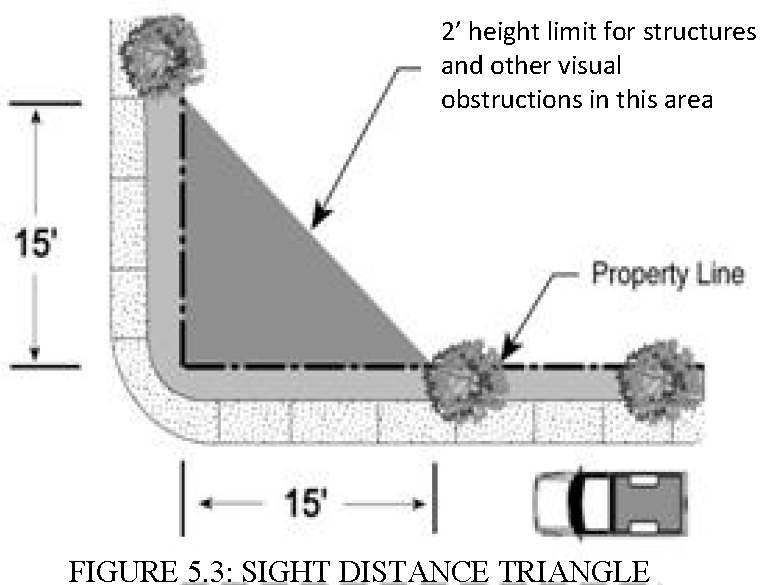
A sight distance triangle must be provided for each driveway access point for a parking facility. The triangle is measured from the point where each side of the driveway intersects the property line. At the point of intersection at each side of the driveway and the property line, a line of fifteen feet (15') in length must be drawn toward the interior of the structure to form the sight-distance triangle. Parking, fencing, planting material or other obstructions taller than two feet (2') in height that would block the view of the driver are prohibited in the sight distance triangle (See figure 5.3: sight distance triangle).
 | |||||
|---|---|---|---|---|---|
| FIGURE 5.2: OFF-STREET PARKING DIMENSIONS (STANDARD SPACE) | |||||
| Parking Angle |
Stall Width
(W) |
Stall Length
(L) |
Aisle Width
(A) |
Single Loaded Module
2
Width
(SL) |
Double Loaded Module
2
Width
(DL) |
| 0° | 9' | 26' | 12'/24' | 20.5'/32.5' 1 | 29'/41' |
| 45° | 9' | 18' | 13' | 32' | 51' |
| 60° | 9' | 18' | 18' | 38' | 58' |
| 75° | 9' | 19' | 20' | 40.8' | 61.6' |
| 90° | 9' | 18' | 24' 1 | 42' 1 | 60' 1 |
| 1 Two-way traffic permitted | |||||
| 2 A module is defined as a drive aisle with automobiles parked on one (1) side of the drive aisle. A single loaded module is this drive aisle and parking area indicated by an SL on the above diagram. A double-loaded module is the drive aisle flanked by parking areas on each side as indicated by a DL on the above diagram. | |||||
(e)
Driveway design.
(1)
All off-street parking facilities shall be provided with driveways so located as to result in no undue interference with traffic. When possible, entrances and exits shall be developed on two (2) or more frontages to facilitate traffic movement on through streets and to minimize congestion.
(2)
The permissible number, arrangement, and width of driveways are dictated by the street frontage of the property. The number of driveways shall be the minimum number required to adequately serve the needs of the development. Non-residential uses with frontages less than seventy-five feet (75') are limited to the following:
a.
One (1) two-directional driveway; or
b.
Two (2) one-directional driveways.
(3)
Driveway width. The width of required driveways shall be adequate to handle the anticipated volume and type of traffic, and shall conform with the dimensions outlined in table 5.7 and measured at the narrowest point parallel to the right-of-way.
(4)
Driveway approaches shall be at least twelve feet (12') wide at the curb and shall taper to driveway width at the front property line.
(5)
Driveways must be located a minimum of two feet (2') from the side lot lines on residential properties and five feet (5') from the side lot lines on non-residential properties. Single-family residential driveways must be located a minimum of four feet (4') from the curb radius return on a corner lot.
(6)
Driveway clearance at street rights-of-way.
a.
All driveway approaches shall have a minimum clearance from the side property line as specified below:
1.
Residential and B-1 districts: two feet (2') minimum side clearance.
2.
All other districts: Ten feet (10') minimum side clearance.
b.
All driveway approaches shall have a minimum corner clearance from an intersecting street, bridge, culvert crossing, overpass, underpass, tunnel, or similar obstruction as specified below:
1.
Residential and B-1 Districts: Fifty feet (50') minimum corner clearance.
2.
All other Districts: Sixty feet (60') minimum corner clearance.
(f)
Accessible space design. All parking lots must comply with the "ADA Accessibility Guidelines for Buildings and Facilities" regulations issued by federal agencies under the Americans with Disabilities Act of 1990 (ADA) for the amount and design of accessible vehicle parking spaces required in parking lots and structures.
(g)
Vehicle stacking spaces for drive-through facilities. Every drive-through facility must provide a minimum of three (3) vehicle stacking spaces per bay, unless otherwise required by table 5.4 of this ordinance. Vehicle stacking spaces provided for drive-through uses must be:
(1)
A minimum of nine feet (9') in width, as measured from the outermost point of any service window to the edge of the driveway, and eighteen feet (18') in length (See figure 5.4 measurement of drive-through and figure 5.5: stacking spaces).
(2)
Placed in a single line behind the drive-through facility.
(3)
Located so that, when in use, they do not obstruct ingress or egress to the site and do not obstruct access to required parking or loading spaces.
(4)
Stacking spaces must begin behind the vehicle parked at a last point of service, such as window or car wash bay.
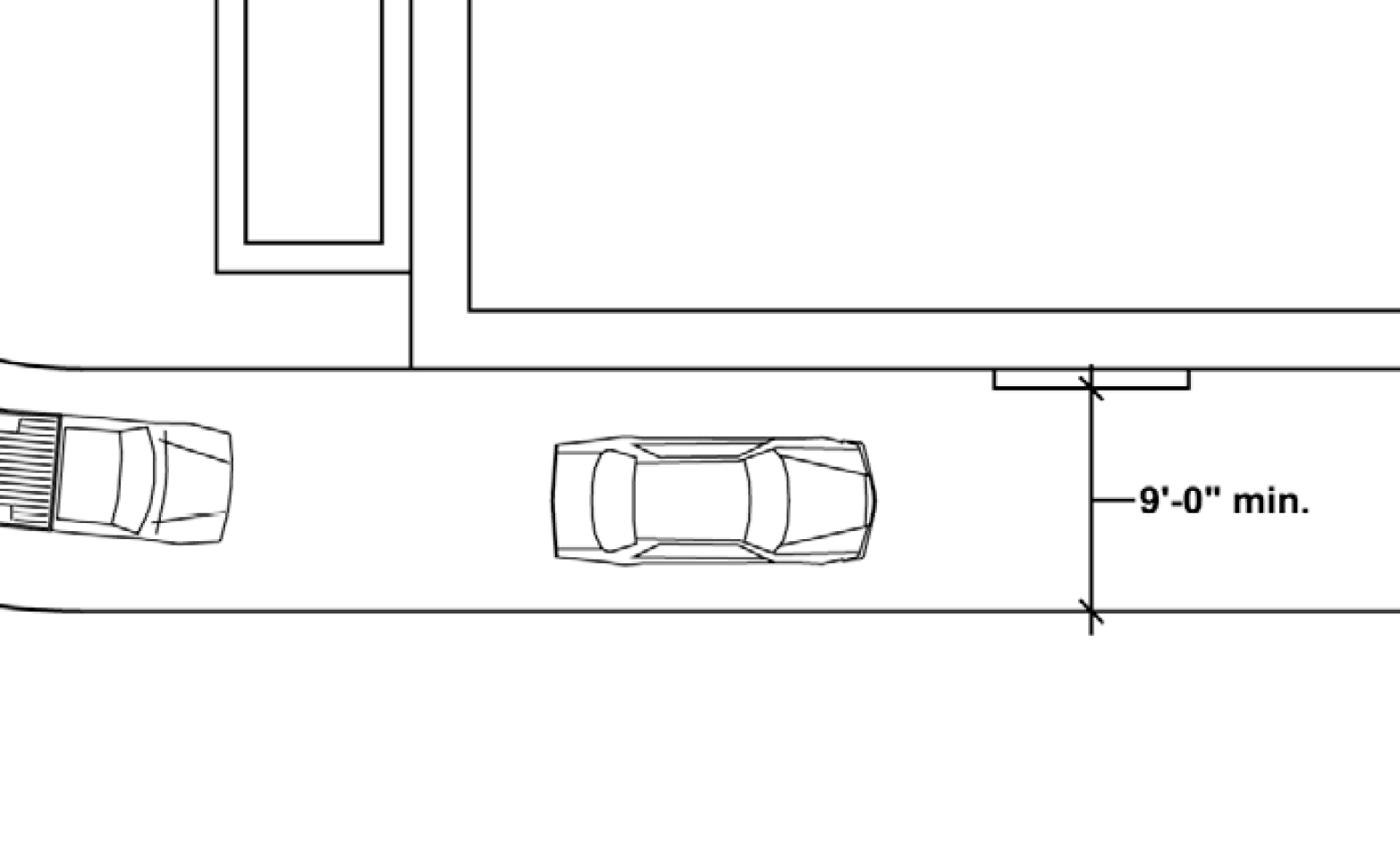
FIGURE 5.4: MEASUREMENT OF DRIVE-THROUGH
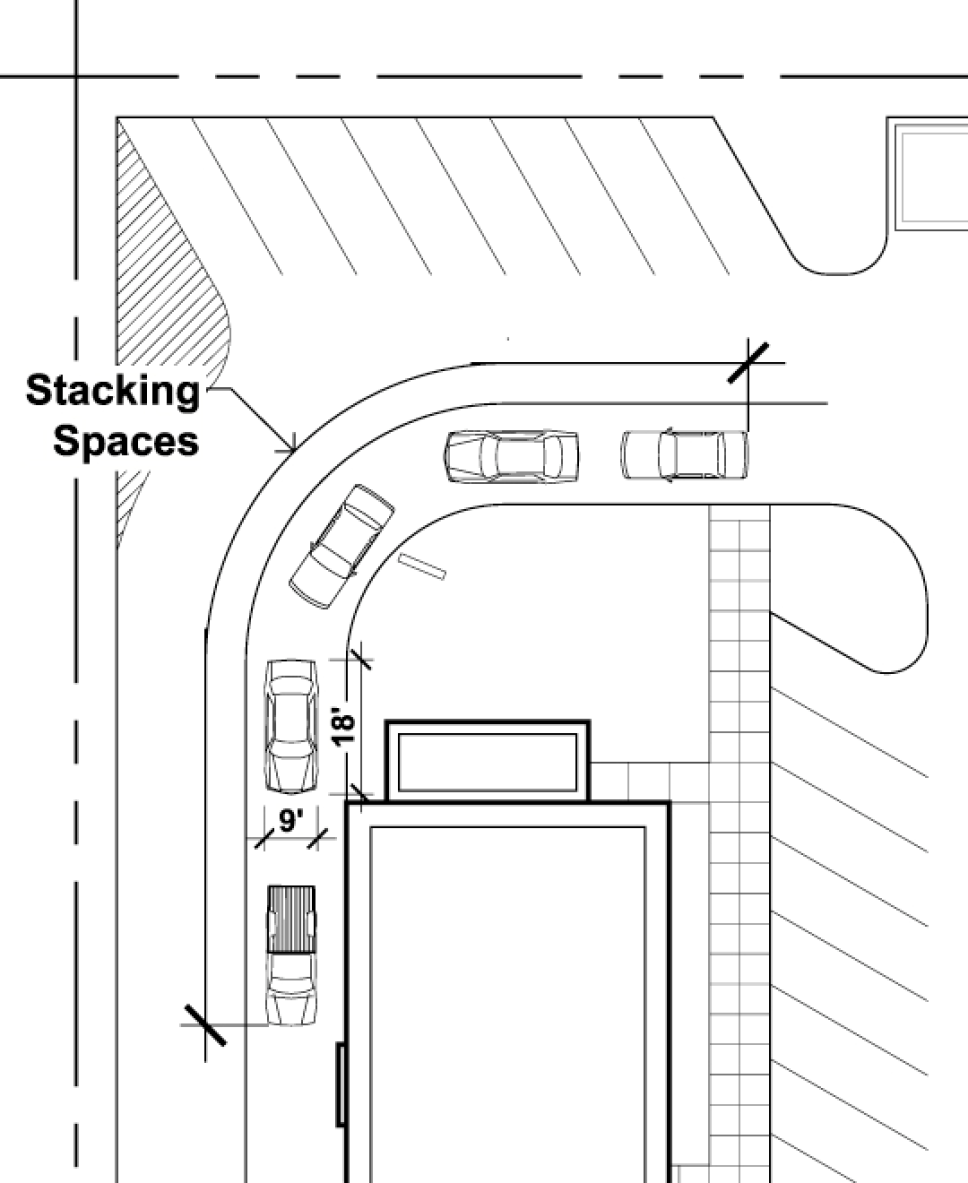
FIGURE 5.5: STACKING SPACES
(h)
Bicycle space design.
(1)
Location.
a.
The bicycle parking area must be convenient to building entrances and street access, but may not interfere with normal pedestrian and vehicle traffic.
b.
Bicyclists must not be required to travel over stairs to access parking.
c.
All required bicycle spaces must be located on the same lot as the use, or within fifty feet (50') of the lot on private property.
d.
While all parking in the right-of-way is discouraged, the property owner may make suitable arrangement with the City of Monroe to place bike parking spaces in the public right-of-way through a use maintenance agreement at the city's discretion. Parking in the public right-of-way must be within fifty feet (50') of the zoning lot.
e.
Short-term bicycle parking spaces must be located no more than fifty feet (50') for the principal building entrance and at the same grade as the sidewalk or an accessible route.
f.
Long-term bicycle parking spaces must be located in a covered area that is easily accessible from the public right-of-way and building entrances.
g.
Required bicycle parking for multi-family residential uses may be provided in garages, storage rooms, and other resident-accessible, secure areas. Spaces within dwelling units or on balconies do not count toward satisfying bicycle parking requirements.
(2)
Design.
a.
Required bicycle spaces must have a minimum dimension of two feet (2') in width by six feet (6') in length, with a minimum overhead vertical clearance of seven feet (7'). Each required bicycle parking space must be accessible without moving another bicycle. There must be an aisle at least five feet (5') wide between each row of bicycle parking to allow room for bicycle maneuvering.
b.
The area devoted to bicycle parking must be surfaced as required for vehicle parking areas.
c.
All long-term bicycle parking spaces must be covered, which can be achieved through use of an existing overhang or covered pedestrian connection, weatherproof outdoor bicycle lockers or an indoor storage area. Where bicycle parking is not located within a building or locker, the cover design must be of permanent construction, designed to protect bicycles from rainfall and a minimum overhead vertical clearance of seven feet (7').
d.
Bicycle parking facilities must provide lockable enclosed lockers or racks, or similar structures, where the bicycle may be locked by the user. Racks must permit the bicycle frame and one (1) wheel to be locked to the rack and support the bicycle in a stable position. Structures that require a user-supplied locking device must be designed to accommodate U-shaped locking devices. All lockers and racks must be securely anchored to the ground or a structure to prevent the racks and locker from being removed from the location.
e.
If required bicycle parking facilities are not visible from the street or principal building entrance, signs must be posted indicating their location. Signs must meet the requirements of article VII (sign regulations).
(i)
Off-street loading design.
(1)
Location.
a.
All off-street loading spaces must be located on the same lot as the use served.
b.
No off-street loading spaces may project into a public right-of-way.
c.
No off-street loading space is permitted in a front yard.
(2)
Dimensions.
a.
All minimum off-street loading spaces must be a minimum of twelve feet (12') in width, and a minimum of twenty-five feet (25') in length, exclusive of aisle and maneuvering space, and maintain a vertical clearance of at least fourteen feet (14').
b.
Loading spaces for a funeral home may be reduced in size to ten feet (10') by twenty-five feet (25') and a vertical clearance reduced to eight feet (8').
c.
Structures that are fifty (50) years of age or older and maintain loading spaces that do not comply with the dimensions of this section, are deemed legally conforming in terms of loading space dimensions. If new loading spaces are constructed, such spaces may be designed to match the dimensions of existing loading spaces rather than the requirements of this section.
(3)
Surfacing. All off-street loading spaces must be paved with a durable, all-weather material, such as concrete or asphalt.
(4)
Drainage and Maintenance. Off-street loading facilities must be drained to eliminate standing water and prevent damage to abutting property and/or public streets and alleys, and surfaced with erosion-resistant material in accordance with applicable city specifications. Off-street loading areas must be maintained in a clean, orderly and dust-free condition at the expense of the owner or lessee.
(5)
Lighting. Loading facility lighting must meet the requirements of section 37-75 of this ordinance. Illumination of an off-street loading facility must be arranged so as to deflect the direct rays of light away from adjacent properties and streets.
(6)
Access control and signs. Each required off-street loading space must be designed with adequate means of vehicular access to a street or alley, in accordance with article VII (sign regulations) of this ordinance, and in a manner that will minimize interference with traffic movement.
(7)
Landscaping and screening. All loading facilities must be landscaped and screened in accordance with chapter 19.5 (landscaping requirements).
(Ord. No. 11,443, 11-12-13)
Sec. 37-81. - Corridor design standards.
(a)
Purpose. The purpose of these standards is to provide guidance with respect to the appearance and function of development along the major corridors in the City of Monroe. These standards are intended to encourage high-quality design, including site planning, lighting, landscaping, screening, signage, infrastructure and traffic flow along Monroe's commercial corridors. These standards provide direction to potential developers, redevelopers, current landowners, and business owners on new development and the redevelopment of existing properties. Over time, adherence to and enforcement of these design standards in designated areas will improve the identity of Monroe, reduce the number of curb cuts, increase the amount and variety of vegetation, de-clutter signage, promote unified development planning of multiple tracts, diversify architecture and land uses, minimize surface runoff through a reduction of redundant parking, improve pedestrian safety, and integrate commercial and residential land uses along major corridors. It is the intent of these standards to provide substantive direction while providing flexibility in their application.
(b)
Applicability. These corridor design standards assist in the design and review of both new construction and modifications to existing sites and structures along the city's major commercial corridors. Specifically, the boundaries of the commercial corridor design districts are hereby established as follows:
(1)
Level one corridors. These standards apply to all properties within three hundred feet (300') of either side of the street right-of-way (existing or future if additional right-of-way has been identified) for the following identified corridors:
a.
DeSiard Street, from Martin Luther King, Jr. Drive to the eastern Monroe city limit line.
b.
Louisville Avenue, from Riverside Drive to Martin Luther King, Jr. Drive.
(2)
Level two corridors. These standards apply to all properties within one hundred fifty feet (150') of either side of the street right-of-way (existing or future if additional right-of-way has been identified) for the following identified corridors:
a.
N. 18th Street, from Forsythe Avenue to DeSiard St.
b.
Forsythe Avenue Bypass (State Route 840-6) from N. 18th Street to Sterlington Road.
(3)
New construction. These standards will be used to assist in the design and review process of new construction projects, major and minor conditional use permits, and site plan review in identified corridors.
(4)
Redevelopment. For all development other than the construction of a new building or structure on a vacant site, these standards apply to all projects involving modifications to existing sites and structures that require planning commission approval. Where a change of building occupancy occurs, and no significant physical change is made to the building, the standards shall not be triggered. However, if a change in building occupancy occurs that requires modification to the site or planning commission approval, the standards shall be triggered. In such cases, opportunities to bring the existing site into compliance with the commercial corridor design standards shall be explored, with special consideration of those items that are most feasible and would achieve the greatest overall results in the appearance and functionality of the site.
(5)
Additional applicability provisions. Notwithstanding anything to the contrary in this ordinance, development of tracts of land within indicated commercial corridor design districts shall be required to comply with this section when the approval of a site plan is required.
(c)
Transit.
(1)
Prior to the issuance of building permits on developments of thirty (30) or more dwelling units or on non-residential developments of fifty thousand (50,000) square feet or greater, the planning and zoning director shall notify the City of Monroe Transit General Manager, who will determine if transit circulation or a transit stop is warranted within the development or at the intersection based on existing or future transit service and the roadway circulation pattern in the vicinity.
(2)
Commercial structures of seventy-five thousand (75,000) square feet or greater shall provide at least one enclosed, protected transit shelter on-site if located on an existing or future transit route. The shelter shall be located such that it is close to the transit stop, as determined by the City of Monroe Transit General Manager.
(d)
Circulation and parking.
(1)
Access standard. The following site access standards are applicable to all commercial corridor design districts within the City of Monroe:
a.
Adjacent properties shall utilize joint use driveways whenever possible and provide connections between parking lots. Owners shall provide cross access easement areas between adjacent properties and developments to provide vehicular access to adjacent sites without having to re-enter the public right-of-way.
b.
Joint driveways and parking lot cross connections shall provide sufficient width to accommodate two-way vehicular travel.
c.
Joint driveways and parking lot cross connections shall provide pedestrian and bicycle connections of at least six feet (6') in width that include a sidewalk. The driveway should be designed to provide the shortest practical length across the driveway for pedestrian and bicycle movement.
(2)
Clearly define vehicular, pedestrian and bicycle patterns. The following standards shall be followed in all to create clearly defined patterns for both vehicles and pedestrians in all level one corridor areas and in parking lots over fifteen thousand (15,000) square feet in level two corridors.
a.
Clearly defined pedestrian/bicycle connections shall be provided:
1.
Between a public right-of-way and building entrances when buildings are not located directly adjacent to the sidewalk.
2.
Between parking facilities and building entrances.
3.
Between parking facilities and sidewalks along streets and other public rights-of-way.
4.
From adjacent developments to both residential and commercial developments, creating connections with existing and future developments.
b.
Pedestrian/bicycle connections shall be clearly defined in a combination of two (2) or more of the following ways:
1.
A continuous landscape area at least three feet (3') wide on at least one side of the pedestrian connection, except where connections cross over vehicular travel lanes.
2.
Where pedestrian connections within parking areas abut a public right-of-way and/or driving aisles, a landscaped area shall be provided between the pedestrian connection and the public right-of-way or driving aisle and a six-inch (6") curb must be used.
3.
Pedestrian connections within parking areas shall be clearly defined by pedestrian scale lighting, accent lighting or a combination thereof to aid pedestrian way-finding.
4.
At intersections with traffic signals or stop signs and all other pedestrian crossings, connections shall be distinguished from driving surfaces with durable, low-maintenance materials such as pavers, bricks, or scored concrete extended across vehicle lanes to define the pedestrian connections enhance pedestrian safety and comfort.
c.
Concrete sidewalks shall be constructed along all streets and public rights-of-way that are a minimum of four feet (4') in width.
(e)
Parking. In order for the city's commercial corridors to function efficiently and conveniently, vehicular, bicycle and pedestrian connections between individual commercial uses shall be provided. The following parking standards shall be applicable to all commercial corridor design districts within the City of Monroe:
(1)
Parking lots of adjoining uses shall be connected to allow for convenient circulation between commercial uses and parking lots, and to maintain safety and efficiency on the city's roads by reducing multiple curb cuts. The city shall require proof of shared parking agreements or easements as outlined in subsection 37-79(b)(4) of this ordinance.
(2)
Parking lot connections shall be provided in a manner that reinforces a clearly defined pedestrian and vehicular circulation pattern across multiple properties.
(3)
Vehicular and/or pedestrian and bicycle links shall be made with adjoining residential areas and transportation networks.
(f)
Landscaping/open space. Landscaping is an integral part of any site plan. Trees and shrubs soften parking lots, define pedestrian and automobile circulation, and are environmentally beneficial and aesthetically pleasing. The intent of these landscape standards is to maintain a consistent street frontage along commercial corridors in the City of Monroe.
(1)
Every parking lot over fifty (50) spaces shall include landscaped islands within the parking area equivalent to at least ten per cent (10%) of the total paved area of the parking lot, not including pervious paving surfaces.
(2)
Landscaping in parking lots shall contain at least one (1) shade tree (minimum six feet (6') tall and two inch (2") caliper diameter breast height (DBH) at time of planting and thirty-five feet (35') tall at maturity) for each two hundred (200) square feet of landscaping. Shade trees shall be planted in a bed of ground cover, sod, and/or low shrubbery.
(3)
Landscaped islands and other pervious surfaces on the site shall be used as opportunities to treat storm water in an environmentally-friendly manner and to assist in water table recharge. Where feasible pervious materials shall be used instead of impervious surfaces to allow water to percolate.
(g)
Lighting. Parking lot lighting shall be provided to allow for a safe pedestrian and vehicular area, while protecting adjacent properties from light spillover. As such, more numerous, shorter and lower-powered lighting fixtures are preferred over fewer, tall, high-powered fixtures. The following provides lighting standards for all commercial corridor design districts within the City of Monroe:
(1)
Parking lot lighting fixtures shall be designed to direct the light toward the development and prevent light spillage to other users and adjacent streets.
(2)
Pedestrian-scale lighting shall be used to define pedestrian crosswalks, connections, bicycle parking and/or other pedestrian/bicycle areas within the development.
(3)
Pedestrian-scale lighting shall be a maximum of fourteen feet (14') in height.
(4)
All lighting shall be shielded from the sky and adjacent properties and structures, whether through exterior shields or through optics within the fixture.
(5)
Using lighting to highlight, complement and reinforce landscape and architectural design focal points is strongly encouraged.
(h)
Signage. The intent of this section is to ensure that signage within Monroe's commercial corridors is consistent with the location and appearance of buildings on the property and neighboring properties, and that the signage is part of an overall design approach to the development. The type, amount and size of signage allowed on a property shall be in accordance with article VII (sign regulations) of this ordinance. However, the following provides additional signage standards for all commercial corridor design districts within the City of Monroe:
(1)
Lower, monument-style signs are preferred where visibility from the right-of-way is not an issue. Preferred monument signs are low, horizontal with raised lettering and set off by flowers, shrubs and/or a lawn.
(2)
Sign materials shall relate to the materials and style of the building(s) they serve.
(3)
The pole element of a pole-mounted sign shall be architecturally pleasing and in proportion to the sign that it carries.
(4)
Ample landscaping shall be provided at the base of all signs.
(5)
In general, multi-tenant signs are discouraged, especially where building mounted signs are easily read from the main street upon which the businesses front. In such cases, a single, plaza sign denoting the name of the plaza is preferred.
(6)
Signs oriented to pedestrians (e.g., projecting signs supported by ornamental brackets) are strongly encouraged.
(7)
Keep signs simple. Too many combinations of colors, type faces and symbols can result in visual chaos and should be avoided.
(Ord. No. 11,443, 11-12-13)
Sec. 37-82. - Floodplain overlay standards.
(a)
Purpose. The purpose of the floodplain overlay is to promote the public health, safety, and general welfare, and to minimize public and private loses due to flood damage and establish methods and provisions designed to recognize such hazards.
(b)
Applicability. The provisions of this section shall apply only to those areas of special flood hazards in the city identified as the floodplain overlay district, and includes those areas of special flood hazard identified by the Federal Emergency Management Agency Digital Flood Insurance Rate Map (DFIRM), or equivalent. The floodplain overlay district shall maintain its underlying zoning, and may be applied to any zoning district pursuant to this ordinance. All property within the floodplain overlay district shall be subject both to the provisions of this section and to the provisions of the underlying zoning district. Nothing in this section shall be construed as a waiver or suspension of the provisions of any underlying zoning district.
(c)
Floodplain overlay district use provisions. All uses of land and water provided for in the underlying zoning district may be permitted in the floodplain overlay district, with the provisions that those uses shall be subject to the provisions set forth in subsection 37-82(d) of this ordinance. The following uses shall be exempt from these provisions, unless the uses involve fill or are otherwise determined to constitute construction or development:
(1)
Accessory residential uses such as lawns, gardens, parking areas, and play areas.
(2)
Agricultural uses such as farming, pasture, grazing, outdoor plant nurseries, horticulture, viticulture, truck farming, forestry, sod farming, and crop harvesting.
(d)
Floodplain overlay district general standards. In all areas within the floodplain overlay district the following standards shall apply:
(1)
Manufactured housing.
a.
No new manufactured home communities or subdivisions shall be developed in the floodplain overlay district.
b.
Anchoring. All new construction and substantial improvements shall be anchored to prevent flotation, collapse or lateral movement of the structure by providing over-the-top and frame ties to ground anchors, subject to the following specifications:
1.
Over-the-top ties shall be provided at each corner of the manufactured home, with two (2) additional ties per side at intermediate points, or with one (1) additional tie per side for manufactured homes less than fifty feet (50') in length.
2.
Frame tie shall be provided at each corner of the manufactured home, with five (5) additional ties per side at intermediate points, or with four (4) additional ties per side for manufactured homes less than fifty feet (50') in length.
3.
All components of the anchoring system shall be capable of withstanding a force of four thousand eight hundred (4,800) pounds per square inch.
4.
Any structure appurtenant to the manufactured home shall be similarly anchored.
(2)
Construction materials methods and certification.
a.
All new construction and substantial improvements shall be constructed using methods and practices that minimize flood damage.
b.
Electrical, heating, ventilation, plumbing, and air conditioning equipment and other service facilities shall be designed and/or otherwise elevated or located so as to prevent water from entering or accumulating within the components during conditions of flooding.
c.
All new construction and substantial improvements with fully enclosed areas below the floor and subject to flooding shall be designed to automatically equalize hydrostatic forces to exterior walls by allowing entry and exit of floodwaters. A minimum of two (2) openings having a net total area of not less than one (1) square inch for every foot of floor area subject to flooding shall be provided. The bottom of all openings shall be no higher than one (1) foot above grade, and may be equipped with screens, louvers, or other devices that automatically permit entry and exit of floodwaters.
(Ord. No. 11,443, 11-12-13)

