
Monroe City Zoning Code
ARTICLE VII
- SIGN REGULATIONS
Sec. 37-100. - Purpose.
The purpose of this article is to establish uniform, comprehensive sign standards governing the display, design, construction, installation and maintenance of signs, which are necessary to accomplish the following goals:
(1)
To promote and protect the health, safety and welfare of the city by ensuring the compatibility of signs with surrounding architecture and land uses.
(2)
To create a more attractive business and economic climate, and encourage revitalization by enhancing and protecting the orderly and effective display of signs.
(3)
To discourage an excessive number of signs, and unsightly and inappropriate signs.
(4)
To protect the public from hazardous conditions that result from the indiscriminate use and placement of signs, structurally unsafe signs, sign that obscure the vision of pedestrians or motorists, and sign that compete with necessary traffic signals and warning signs.
(Ord. No. 11,443, 11-12-13)
Sec. 37-101. - Definitions.
Definitions for different types of signs and related elements are found in article II (definitions and rules of interpretation) of this ordinance.
(Ord. No. 11,443, 11-12-13)
Sec. 37-102. - Sign regulations in historic districts.
Signs located or proposed to be located in historic districts are also subject to the historic district regulations and review by the City of Monroe Heritage Preservation Commission.
(Ord. No. 11,443, 11-12-13)
Sec. 37-103. - Sign permit required.
(a)
Unless specifically permitted as exempt sign by this article, all signs shall require a sign permit.
(b)
A certificate of occupancy only is required to erect a monument sign, unless lighted, and then an electrical permit is also required. Freestanding signs require certificate of occupancy in addition to the sign permit and electrical permit, if applicable.
(c)
The following activities are exempt for sign permit requirements:
(1)
Changing of advertising copy or message on an existing legally permitted or legal non-conforming changeable sign or similar approved sign.
(2)
Painting, repainting, cleaning, changing permitted items of information, or other normal maintenance and repair of a sign.
(3)
Construction signs of thirty-two (32) square feet or less.
(4)
Directional/informational signs of five (5) square feet or less.
(5)
Nameplates and identification signs of two (2) square feet or less.
(6)
Political signs.
(7)
Public signs or notices, or any sign relating to an emergency.
(8)
Real estate signs of thirty-two (32) square feet or less that notify that the property or premises are for sale, lease, or rent, provided:
a.
The signs are on the property or premises being advertised.
b.
Only one (1) sign is placed for each street frontage.
c.
All signs are removed within thirty (30) days of the sale, lease or rental of the property or premises.
d.
All such signs are thirty-two (32) square feet or less and contain no commercial message other that the information indicating that the property is available for sale or lease.
(9)
Window signs or displays.
(10)
Incidental signs.
(11)
Point of purchase display signs.
(12)
Subdivision identification signs of thirty-two (32) square feet or less.
(13)
Any grave marker, headstone, memorial statue, or other similar remembrances that is noncommercial in nature.
(14)
Names and addresses on postal boxes.
(15)
Residential address numbers.
(16)
Names of newspapers and similar publications on their delivery boxes.
(17)
The posting of privately owned land and/or buildings or structures against trespass, hunting, fishing, swimming or any other activity, and/or the warning of any person against any danger, hazard or condition pertaining to such land and/or buildings and structures.
(18)
Cornerstones, memorial tablets, and similar markers made of masonry, bronze and other incombustible and durable material and used to indicate, without advertising matter, information relating to the development of the facility on which they are located such as those involved in planning, financing and construction of buildings.
(19)
Historical signs and markers designating places of historical significance.
(20)
City entry and park identification signs designating entry points to or parks located in the City of Monroe.
(21)
Flags, pennants or insignia of any government, except when such flags are used in connection with a commercial promotion or as an advertising device.
(22)
Works of fine art which in no way identify a product or business and which are not displayed in conjunction with a commercial enterprise, which enterprise may benefit or realize direct commercial gain from such display.
(23)
Temporary decorations or displays clearly incidental and customary and commonly associated with national, local or religious holiday celebrations or special events.
(24)
Traffic and other official signs of any public or governmental agency.
(25)
Small outdoor signs directed to persons who have already entered the premises, such as filling station fuel pump signs or instructions on using an automatic car wash. To qualify for this exception, no lettering on the sign shall be greater than four inches (4") tall.
(26)
Menu boards for drive-thru food establishments.
(27)
Signs indicating special events, such as a fair, carnival, festival, grand opening, sale, or similar temporary activity.
(28)
Reserved.
(29)
Garage sale signs may be placed on public property two (2) days before the garage sale and removed the day after the sale.
(c)
Penalty. Any person engaging in the business of erecting, altering, relocating, or constructing a sign without a valid sign permit may have his/her license either suspended or revoked by the building inspector in addition to any fines imposed by the building inspector.
(Ord. No. 11,443, 11-12-13; Ord. No. 11,786, 8-8-17)
Sec. 37-104. - Location restrictions.
(a)
No signs, other than those placed by agencies of government or signs whose placement has been authorized by this article or by another designee of the city, may be erected on public property. Any sign placed on public property without authorization may be removed without notice.
(b)
No signs may be placed on any private property without prior consent of the owner thereof and, where applicable, issuance of a sign permit.
(c)
No sign mounted on the exterior of a building may cover any windows or doors.
(Ord. No. 11,443, 11-12-13)
Sec. 37-105. - Sign dimension computations.
(a)
Computation of sign area.
(1)
The surface area of a sign shall be calculated by enclosing the extreme limits of all lettering, background, emblem, logo, corporate banding, representation, or other display within a single continuous perimeter composed of squares or rectangles with no more than eight (8) lines drawn at right angles. (See figure 7.1: sign measurement area)
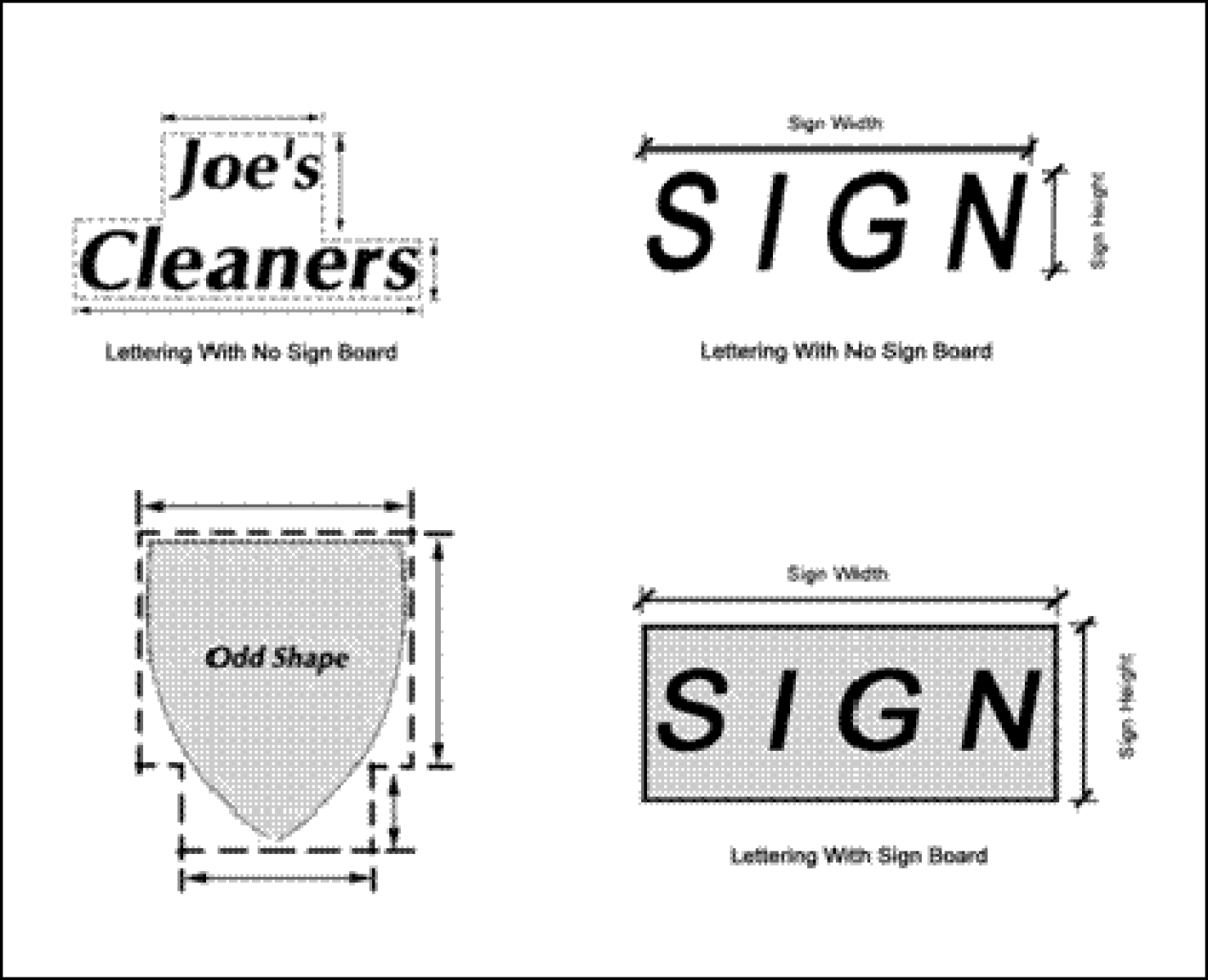
Figure 7.1: SIGN MEASUREMENT AREA
(2)
Supporting framework or bracing that is clearly incidental to the display itself shall not be computed as sign area.
(3)
Double-faced signs with back-to-back sign faces shall be regarded as a single face sign if the distance between each sign face does not exceed two feet (2') at any point.
(4)
Where a sign contains three-dimensional objects (e.g., balls, cubes, clusters of objects, sculpture, or statue-like objects), the sign area shall be measured as the maximum projection of the objects upon a single vertical plane.
(b)
Measurement of sign height. Sign height is measured as follows: When measuring sign height, the height of the entire structure, including decorative elements, must be included. (see figure 7.2: sign height computation)
(1)
For freestanding signs, height is calculated as the vertical distance measured from grade to the highest point of the sign.
(2)
For signs attached to buildings, height is calculated as the vertical distance from the base of the building to which a sign is attached to the highest point of the sign.
(3)
Sign clearance is calculated as the vertical distance from grade or the base of the building to which the sign is attached to the lowest point of the sign. (See figure 7.3: sign clearance)
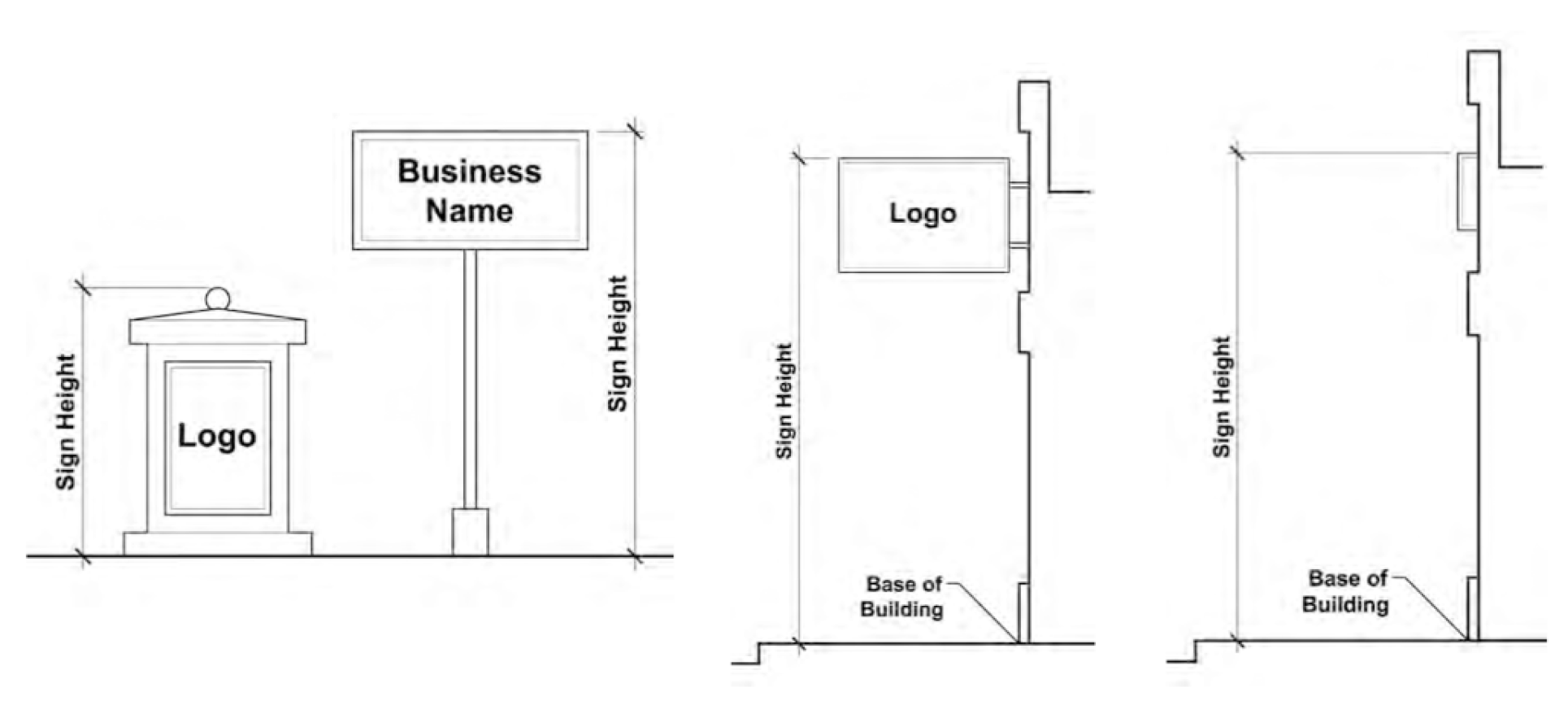
Figure 7.2: SIGN HEIGHT COMPUTATION
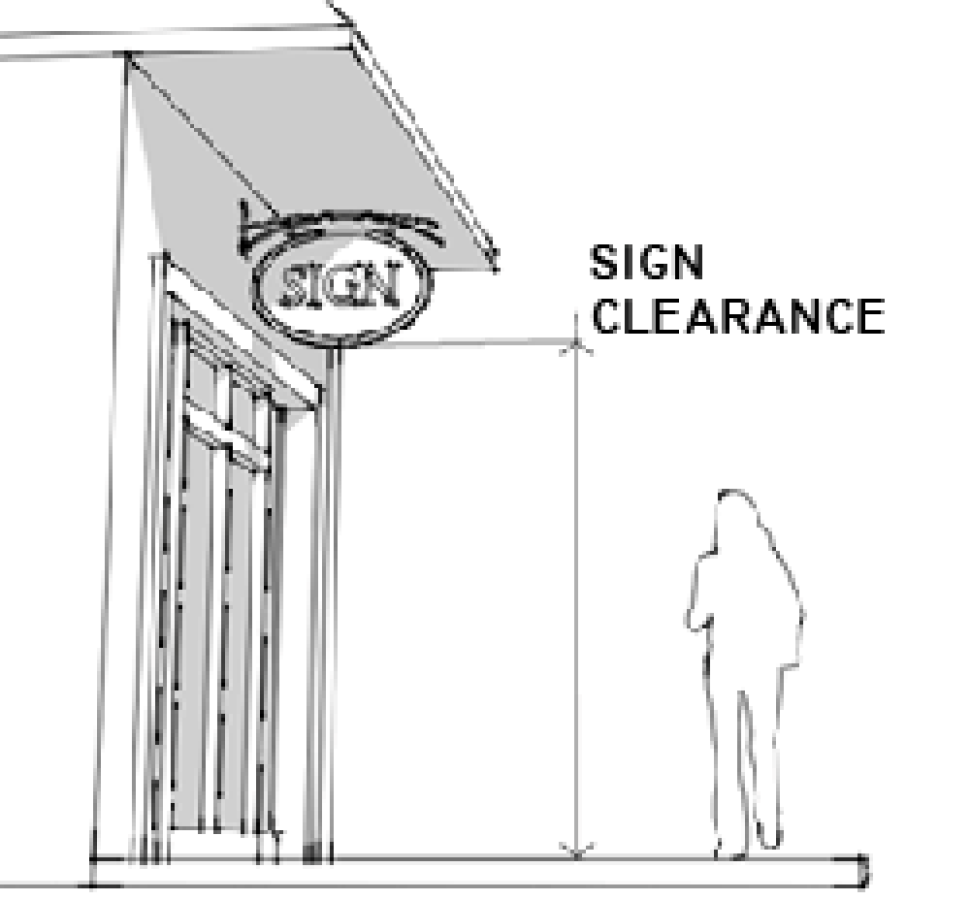
Figure 7.3: SIGN CLEARANCE
(Ord. No. 11,443, 11-12-13)
Sec. 37-106. - General construction standards.
(a)
Compliance with city codes. All signs constructed, erected, modified, or altered shall comply with the applicable provisions and requirements of the City of Monroe Building Code. All electrical fixtures, devices, circuits, conduits, raceways or apparatus used to illuminate, move, or project any sign must be installed and maintained as required in the City of Monroe Electrical Code.
(b)
Wind pressure and direct load requirements. All signs must be designed and constructed to withstand a wind pressure and receive dead loads as required by the City of Monroe Building and Electrical Codes.
(c)
Sign structure and installation. Supports and braces must be designed as an integral part of the sign. Supports or braces must be hidden from public view to the extent possible. All signs attached to a building must be installed and maintained so that wall penetrations are water-tight and the structure does not exceed allowable stresses of supporting materials.
(d)
Sign clearance. All signs proposed to overhang any public sidewalk and all freestanding signs shall have a clearance of at least ten feet (10') from the lowest point of the sign, including framework and embellishments, to the finished grade directly below the sign.
(e)
Maintenance required. All signs shall be maintained in a safe, attractive, clean, and structurally sound condition. The premises surrounding all signs shall be kept free and clear of safety and health hazards, rubbish, high weeds, and grass.
(f)
Illumination.
(1)
All lighting must concentrate illumination upon the area of the sign to prevent glare upon the street and adjacent properties. All sign illumination must be designed, located, shielded, and directed to prevent both the casting of glare or direct light upon adjacent publicly dedicated roadways and surrounding properties and the distraction of operators of vehicles or pedestrians in the public right-of-way.
(2)
All sign illumination must meet the requirements of section 37-75 (exterior lighting) of this ordinance.
(Ord. No. 11,443, 11-12-13)
Sec. 37-107. - Permanent signs.
The following permanent signs in all districts require a sign permit (freestanding and monument signs also require a certificate of occupancy) and are subject to the requirements of this article.
(1)
Residential districts. The following regulations shall apply to all on-premises signs located in R-1, R-2, R-3, R-4, RMH, and B-1 zoning districts (see table 7.1 signage standards):
a.
Signs are allowed as an accessory use to legal, large multi-family and non-residential uses only, including churches, hospitals, schools, and legal non-conforming uses.
b.
Parking lot directional signs for multi-family.
1.
A maximum of two (2) parking lot directional signs are permitted for the parking areas of multi-family residential uses (five (5) units+).
2.
Parking lot directional signs are limited to a maximum height of five (5) feet and a maximum sign area of five (5) square feet.
c.
Multi-family identification sign.
1.
One (1) multi-family identification sign is permitted per multi-family use (5+ units) identifying the name of the development and address, wall-mounted or freestanding.
2.
Multi-family identification signs are limited to twenty-four (24) square feet in area. Freestanding signs are limited to six (6) feet in height. Monument signs are preferred when a freestanding structure is used.
d.
Residential subdivision identification sign.
1.
One (1) residential subdivision identification sign is permitted per subdivision development of five (5) residential lots or more.
2.
Residential subdivision identification signs are limited to thirty-two (32) square feet in area and six (6) feet in height. Residential subdivision identification signs must be located five (5) feet from any lot line within the dedicated street entrance.
e.
The total size of on-premises signs at any given location shall not exceed fifty (50) square feet. When more than one (1) establishment is located in the same building a sign in accordance with the above formula is permitted for each.
(b)
Non-residential districts. The following regulations shall apply to all on-premises signs located in B-2, B-3, B-4, CBD, I-1, I-2, C, RF, or OS zoning districts (see table 7.1 signage standards):
(1)
Number of signs.
a.
Signs are allowed on each dedicated street right-of-way frontage on corner lots. Parking lots and private drives are not dedicated street rights-of-way.
b.
More than one (1) wall sign may be erected provided the total square footage allowed is not exceeded,
c.
Only one (1) freestanding sign (including monument signs) is allowed per dedicated street right-of-way frontage.
(2)
Electronic message boards including digital signage.
a.
One freestanding electronic message board to convey information by words, letters, or still images per lot or parcel in compliance with the zoning district regulations.
b.
The electronic message board must be located with the primary freestanding sign and is included in the total sign square footage.
c.
The maximum height, allowable sign surface, and all other requirements for freestanding signs shall govern electronic message boards as permitted by the underlying zoning district.
d.
No animation, flashing, running or twinkle lights.
(3)
Planned commercial center.
a.
One (1) freestanding sign limited to an area of one (1) square foot per linear foot of lot frontage, is allowed per planned commercial center.
b.
On corner lots, there may be one (1) such sign per street frontage.
c.
The size of each sign shall not exceed three hundred (300) square feet in area.
d.
Planned commercial centers shall have coordinated building signage that does not exceed the size allowed for their zoning classification.
e.
There shall be no separate freestanding signs allowed for individual businesses located in a planned commercial/shopping center.
(Ord. No. 11,443, 11-12-13; Ord. No. 11,786, 8-8-17)
Sec. 37-108. - Prohibited signs.
It is unlawful to erect or maintain the following signs in all zoning districts:
(1)
Portable arrow signs.
(2)
Portable signs, or any prohibited sign designed to be portable, shall not be altered to become permanent.
(3)
Signs that are considered abandoned or unsafe.
(4)
Signs imitating or resembling official traffic or government signs or signals.
(5)
Signs that are erected or maintained upon trees or painted or drawn upon rocks or other features.
(6)
Signs that contain certain words, statements or pictures which would be considered obscene or indecent by local community standards.
(7)
Signs that do not comply with the restrictions applicable to the zoning district in which such signs are located.
(8)
Signs, banners and streamers suspended over or above dedicated streets.
(9)
Signs that contain or display animation, moving video/pictures or scrolling word advertising.
(10)
Signs placed on public property or any public right-of-way, subject to the exceptions in subsection 37-103(b) excluding political signs.
(11)
Signs placed in any location that would violate any state or federal regulation or law.
(Ord. No. 11,443, 11-12-13)
Sec. 37-109. - Temporary signs.
(a)
General provisions for temporary signs.
(1)
Any sign listed in section 37-108 (prohibited signs) is also prohibited as a temporary sign.
(2)
Temporary signs shall not be located within any public right-of-way nor in any area that may constitute a safety hazard.
(3)
Temporary signs must be related to on-premises services. Non-commercial messages are also permitted. Temporary off-premises signs are prohibited.
(4)
No temporary sign may be illuminated.
(5)
Only one (1) temporary sign is permitted per business on a single lot.
(6)
All temporary signs must remain in good condition during the display period. Throughout the display period, corrective action must be taken immediately should there be any problems with the appearance, condition, or maintenance of the sign and/or support hardware.
(b)
Permitted temporary signs and advertising devices.
(1)
Construction signs greater than thirty-two (32) square feet. One temporary sign denoting the architect, engineer and/or general contractor placed on the premises where construction, repair, or renovation is proposed or is in progress may be allowed subject to the following:
a.
Only one construction sign shall be permitted per site.
b.
Construction sign permits shall expire one (1) year from the date of issuance or on the date that the first certificate of occupancy is issued for the project for which the permit was acquired, whichever occurs first.
(2)
Real estate signs greater than thirty-two (32) square feet. Temporary signs greater than thirty-two (32) square feet advertising the sale, lease, or rental of non-residential property upon which the sign is located may be allowed for new construction or redevelopment subject to the following:
a.
Only one real estate sign shall be permitted per site.
b.
Commercial real estate signs shall be removed from the site upon sale of property.
(3)
Temporary Promotional Signs. Temporary promotional signs on site in connection with the opening of a business, major remodeling under an active building permit, new owner of a business, closure of a business, sale, or special events may be permitted subject to the following:
a.
Such signs shall be limited to three (3) events and an aggregate maximum of forty-five (45) days per calendar year.
b.
Promotional signs that advertise an event shall not be erected more than thirty (30) days before the event and shall be removed within seven (7) days of the event's conclusion.
c.
Banners, string pennants, and streamers are permitted; however, if the materials become tattered, torn, and/or a litter problem they must be replaced or removed.
d.
Such signs shall have a maximum total sign area of thirty-two (32) square feet.
e.
A new business or a business with a new location with no permanent sign may display a banner until their permanent signage is installed.
(4)
A-frame signs.
a.
A-frame signs are limited to six (6) square feet in area per sign face and four feet (4') in height.
b.
The use of A-frame signs is limited to business hours only and must be stored indoors at all other times.
c.
Only one (1) A-frame sign is permitted per business and a minimum twenty-foot (20') separation is required between all A-frame signs.
d.
An A-frame sign must be placed within twenty feet (20') of the primary entrance of the business, and must not interfere with pedestrian traffic or violate standards of accessibility as required by the ADA or other accessibility codes.
(5)
Point of service display signs.
a.
Point of service display signs shall be located on or near the display or product dispenser.
b.
Point of service display signs shall be located within the structure.
c.
A point of service sign shall not be attached to any light/sign pole or pump island canopy, nor shall they be located in the parking lot or within the public right-of-way.
(Ord. No. 11,443, 11-12-13)
Sec. 37-110. - Repair or removal of signs.
(a)
Business closure. All business related signs shall be removed within thirty (30) days of the close of a business. It is the responsibility of the business owner for such removal. If the business owner does not remove the signs by the end of the thirty (30) days, it shall be the responsibility of the property owner. In the case of a building sign cabinet or freestanding sign cabinet that is to remain on the property, either the existing sign face(s) may be turned around or a blank face(s) shall replace the advertising face.
(b)
Immediate removal. The code enforcement officer, building inspector or their designee, may cause a sign to be removed immediately and without notice and stored at the cost of the permit holder, or in the absence of a valid permit, at the cost of the possessor or owner of the sign at a cost of no less than twenty-five dollars ($25.00) per day), under any of the following conditions:
(1)
The sign is in violation of this article;
(2)
The sign presents an immediate threat of danger to the safety of the public;
(3)
Any sign that is installed after the date this ordinance goes into effect without a permit being issued or without a certificate of insurance on file with the building inspector or both.
(4)
If the code enforcement officer, building inspector or their designee, elects to cause the sign to be removed without notice, he or she shall thereafter give written notice to the permit holder, or to the possessor or owner of the sign, as applicable, stating with reasonable clarity the reason the sign has been removed.
(c)
If sixty per cent (60%) or more of an illuminated sign is not working, it must be repaired immediately.
(Ord. No. 11,443, 11-12-13)
Sec. 37-111. - Nonconforming signs.
(a)
On-premises signs legally existing prior to the adoption of this article and not conforming to these provisions will be allowed to remain (Nonconformity does not include UL requirements). Nonconforming signs shall be removed if any one of the following conditions occurs:
(1)
The sign is relocated on the same or different premises, or replaced.
(2)
The structure or size of the sign is altered in any way.
(3)
The sign is damaged to an extent of one-half (½) of its current replacement value. Such sign shall not be rebuilt and shall be removed. (Replacement value shall be determined by the property owner obtaining the cost of the sign's replacement value from several sign companies).
(4)
There is a change in use, ownership, or occupancy that requires issuance of a new certificate of occupancy.
(b)
Nothing contained herein shall be construed to prevent normal maintenance and repairs or repainting of such signs or structures.
(c)
For planned commercial centers, freestanding signage advertising more than one (1) tenant must be brought into compliance with this article if either a change in ownership for the entire center or if more than fifty (50%) per cent of tenants are discontinued or changed. Existing signage will be allowed to remain as long as allowed per existing lease agreements. New lease agreements shall reflect the requirements of this article once this article is adopted.
(d)
Nonconforming temporary signs shall conform to all provisions of this article upon its adoption. These signs shall be removed within ten (10) days of official notification of nonconforming status by the governing authority.
(e)
Exempt. Signs that are at least fifty (50) years old, are in good condition, are located within a designated historic district, and advertise an existing business, or a sign that is particularly unique in character, design, or history, or that is part of the historic character of a business or building shall be allowed to remain. These signs shall be included in the total square footage allowed the business.
(Ord. No. 11,443, 11-12-13)
Sec. 37-112. - Enforcement.
Section 37-121 of this ordinance shall cover all administration, penalties and violations regarding signs in the City of Monroe. However, the following provisions shall also apply to non-compliant signage.
(1)
Administration. The requirements of this article shall be administered by the planning and zoning division and/or its designated representative.
(2)
Inspection authority. All signs for which a permit is required shall be subject to inspection or re-inspection by the building inspector or his/her designee and the electrical sign inspector, if applicable.
(3)
Removal of non-compliant signs, notice of violation.
a.
When a violation of this article exists, the code enforcement officer shall issue a citation to be delivered by certified mail or in person to the owner of the sign or the property owner. The citation shall state the nature of the violation, whether the sign must be repaired or removed, and the amount of time allowed in which to remedy the violation. (At the discretion of the code enforcement officer or designee, the time limit on a sign may be extended. The extension shall not exceed thirty (30) days.) The following provide the allotted time to bring signs into compliance:
1.
For permanent signs, within thirty (30) days of receipt of citation.
2.
For temporary signs, within forty-eight (48) hours of receipt of citation.
3.
For signs that are unsafe or otherwise constitute an immediate danger to public health and safety, within twenty-four (24) hours of receipt of the citation.
4.
The owner of the sign or the property owner may file an appeal with the board of adjustment. Such appeal shall be in writing, accompanied by the appropriate fee, and be filed within ten (10) days of receipt of the citation.
b.
Any temporary sign, poster or banner found to be in violation of any section of this article may be removed by the code enforcement officer, building inspector or their designee. The cost of such removal shall be at least twenty-five dollars ($25.00) per sign and may be charged to the person or entity responsible for the activity described on the sign, poster or banner.
(4)
Non-complying signs, failure to comply with notice. If no action is taken to bring the sign(s) into compliance in accordance with notice given according to subsection 37-112(3) above or within thirty (30) days after the final denial by the board of adjustment, then the city shall order the removal of the sign(s) and the cost attributable to the removal shall be paid by the owner of the sign or the property owner. The city may also file and have a lien placed upon real estate for the removal costs.
(5)
Other violations. In all other cases, and in cases where the code enforcement officer elects not to use his or her authority to cause the sign to be removed without prior notice, if the permit holder, or the possessor or owner of the sign, as applicable, fails to remove, alter, or otherwise bring the sign into compliance with the provisions and standards of this article, and all applicable building standards of this article, and all applicable building and/or electrical codes, within ten (10) days after notice has been issued, citations for the violations shall be issued. Service of notice shall be delivered by certified mail, return receipt requested, or in person to the owner of the sign or the property owner. The code enforcement officer shall cause the sign to be removed and stored at the expense of the permittee, or possessor or owner of the signs. The cost of storing the sign or signs shall be at least twenty-five dollars ($25.00) per day. The sign shall be held by the code enforcement officer until such time as the expense of removing and storing the sign has been reimbursed to the code enforcement officer. License and permit violations shall be enforced by the building inspector.
(Ord. No. 11,443, 11-12-13)

