
Monroe County Unincorporated
City Zoning Code
City Zoning Code
CHAPTER 131
BULK REGULATIONS
Sec. 131-1.- Required Setbacks.
(a)
Unless otherwise allowed for in this Land Development Code, no structure or land shall be developed, used or occupied except in accordance with the bulk regulations set out in the following table.
(b)
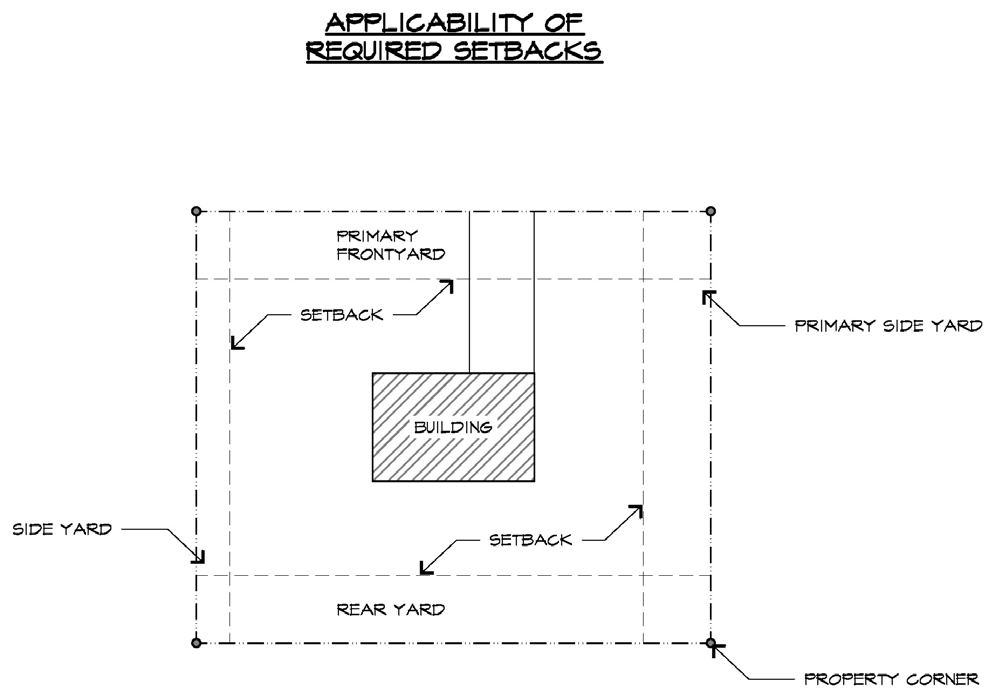
Applicability of required setbacks.
(Ord. No. 006-2016, § 1(Exh. 1), 4-13-2016; Ord. No. 022-2022, § 2, 10-19-2022)
Sec. 131-2. - Maximum Height.
No structure or building shall be developed that exceeds a maximum height of 35 feet. Exceptions will be allowed for chimneys; spires and/or steeples on structures used for institutional and/or public uses only; radio and/or television antenna; flagpoles; solar apparatus; utility poles and/or transmission towers; and certain antenna supporting structures with attached antenna and/or collocations as permitted in chapter 146. Exceptions will be allowed for flood protection as specifically permitted in Policies 101.5.32 and 101.5.33, and within Ocean Reef as provided in Comprehensive Plan Policy 101.5.31 and restated in subsection (a) below. However, in no event shall any of the exclusions enumerated in this section be construed to permit any habitable or usable space to exceed the maximum height limitation, except as specifically permitted in Policies 101.5.31, 101.5.32 and 101.5.33. In the case of airport districts, the height limitations there in shall be absolute and the exclusions enumerated in this section shall not apply.
(a)
Within the Ocean Reef master planned community which is gated, isolated and inaccessible to the surrounding community, and has a distinct community character, buildings may include non-habitable architectural decorative features (such as finials, railings, widow's walk, parapets) that exceed the 35-foot height limit in Policy 101.5.30, but such features shall not exceed 5 feet above the building's roof-line. This exception shall not result in a building together with any architectural decorative feature with a height that would exceed 40 feet.
In addition, within the Ocean Reef gated master planned community, upon evidence submitted that the proposed building height has been approved by the master association, Ocean Reef Community Association Inc., pursuant to its building regulations and restrictions, buildings containing multifamily residential, transient, and/or nonresidential uses may be developed or redeveloped to a total maximum building height of 60 feet, provided the buildings are limited to four habitable floors. Such development on property owned by Ocean Reef Club, Inc. shall not be required to provide evidence it has been approved by the master association, based on its exemption from master association review under the Ocean Reef gated master planned community's governing documents.
(b)
As provided in Policy 101.5.32, buildings voluntarily elevated to meet or exceed the FEMA Base Flood Elevation (BFE) may exceed the 35-foot height limit as follows:
(1)
For NEW single family (detached dwelling unit) and multi-family (attached dwelling unit) buildings which are voluntarily elevated to exceed the building's minimum required BFE, an exception of a maximum of three (3) feet above the 35-foot height limit may be permitted. The amount of the height exception shall be no greater than the amount of voluntary elevation above BFE. In no event shall a new building exceed 38 feet in height or two (2) habitable floors. The space below the lowest habitable floor of an elevated structure shall be limited to a maximum of 299 square feet of enclosed floor area and shall be used exclusively for parking of vehicles, elevators, limited storage and/or building access purposes. This exception shall apply to the substantial improvement of buildings, whether voluntary or not.
(2)
For lawfully established EXISTING (detached and attached dwelling unit) buildings which do not exceed the 35-foot height limit and are voluntarily retrofitted to meet and/or exceed the building's minimum required BFE, an exception of a maximum of five (5) feet above the 35-foot height limit may be permitted. The amount of the height exception shall be no greater than the distance necessary to elevate the building to meet BFE plus up to three (3) feet of voluntary elevation above BFE. In no event shall an existing building be elevated to exceed a total building height of 40 feet.
(3)
No exception shall result in a total building height that exceeds 40 feet.
(4)
Buildings not being elevated to at least meet the required FEMA BFE are not eligible for this exception.
(c)
As provided in Policy 101.5.32, after the adoption and on the effective date of updated FEMA flood insurance rate maps (FIRMs), residential buildings elevated to meet or exceed the FEMA base flood elevation (BFE) may exceed the 35-foot height limit as follows:
(1)
Lawfully established existing residential buildings and new residential buildings (includes substantial improvements) located within the special flood hazard area, shall have a maximum height limit of 40 feet in order to elevate to or maintain the required elevation based on the Florida Building Code, as specified in R322.2.1 and R322.3.2 (elevation requirements).
a.
In no event shall a new residential building exceed 40 feet in height.
b.
Additions to lawfully established existing residential buildings that are substantial improvements shall have a maximum height limit of 40 feet in order to elevate the addition to the Florida Building Code required flood elevation.
c.
Additions to lawfully established existing residential buildings that are not substantial improvements shall have a maximum height limit of 40 feet, if the addition meets the Florida Building Code flood elevation requirements in R322.2.1 and R322.3.2; the remaining lawfully established existing building shall not receive the flood height exception of 40 feet.
d.
Any portion of the building that meets the required flood elevation of the updated FEMA FIRMs shall be given a height limit of 40 feet.
(2)
The updated FEMA flood insurance rate maps are the maps adopted subsequent to FEMA flood insurance study and the accompanying flood insurance rate maps, dated February 18, 2005.
(3)
The total building height shall not exceed 40 feet. Buildings not elevated to or maintaining the required elevation based on the Florida Building Code, are not eligible to use the height limit within this subsection.
(d)
As provided in Policy 101.5.33, lawfully established EXISTING multi-family (attached dwelling unit) buildings which exceed the 35-foot height limit may be repaired, improved, redeveloped and/or elevated to meet the required FEMA BFE provided the building does not exceed a total maximum building height of 40 feet, and the building is limited to the existing lawfully established intensity, floor area, building envelope (floor to floor height), density and type of use. A Flood Protection Height Exception of a maximum of five (5) feet may be permitted to meet the building's minimum required FEMA BFE. The amount of the exception shall be no greater than the amount of elevation necessary to meet BFE. Buildings not being elevated to at least meet the required FEMA BFE are not eligible for this exception.
(e)
As provided in Policy 101.5.33, for lawfully established EXISTING multi-family (attached dwelling unit) buildings which exceed the 35-foot height limit that are proposed to exceed a total height of 40 feet, a public hearing before the Planning Commission and Board of County Commissioners to review and specify the maximum approved height shall be required prior to issuance of any county permit or development approval. The Planning Commission shall provide a recommendation to the BOCC on the maximum height of a building. The BOCC shall adopt a resolution specifying the maximum approved height.
(1)
For lawfully established EXISTING multi-family (attached dwelling unit) buildings that are voluntarily repaired, improved, redeveloped and/or elevated to meet the building's minimum required FEMA BFE, but will require a height exception of more than five (5) feet, a Flood Protection Height Exception exceeding the 35-foot height limit may be provided by the BOCC based on the following criteria:
a.
The flood zone of the parcel;
b.
The number of dwelling units lawfully established and an analysis of the number of dwelling units which may not be able to redevelop on the subject parcel without a height exception;
c.
The physical characteristics of the existing building and parcel;
d.
The susceptibility of the existing building and its contents to flood damage and the effects of such damage on the property owner;
e.
The possibility that materials from the existing building may be swept onto other lands to the injury of others;
f.
The availability of alternate solutions;
g.
If the new proposed building height will result in increased flood risk; result in additional threats to public safety; result in extraordinary public expense; create nuisance; or cause fraud on or victimization of the public; and
h.
Community character.
i.
Buildings not being elevated to at least meet the required FEMA BFE are not eligible for this exception.
(2)
A BOCC resolution shall specify the findings of criteria of (d)(1) a. through i. (above) and specify the approved maximum total height for the proposed building.
(Ord. No. 006-2016, § 1(Exh. 1), 4-13-2016; Ord. No. 017-2017, § 1, 9-27-2017; Ord. No. 047-2019, § 1, 12-11-2019; Ord. No. 029-2022, § 2, 11-15-2022)
Sec. 131-3. - Applicability of Required Setbacks.
(a)
Bufferyards. When a bufferyard is required under the provisions of Chapter 114, Article V, compliance with the bufferyard provisions along a property line shall relieve the necessity of complying with the setback provisions along the same property line if the width of the bufferyard is greater than the applicable setback requirement set forth in Section 131-1.
(b)
Shoreline setbacks. All development shall be set back from shorelines as required in Section 118-12. Docking and mooring facilities within the shoreline setback shall be set back from side property lines in accordance with Section 118-12. The side yard setback does not apply to a utility pole, utility rack, seawall, fence, retaining wall, or marginal dock.
(c)
Front yard setbacks. A front yard is a required setback on a parcel of land that is located along the full length of the front property line of the parcel, is generally the property frontage to which development on the parcel is oriented and is generally adjacent a road. On parcels fronting more than one road, such as corner lots and double frontage parcels, each yard along a road shall be a front yard. The front yard setback does not apply to a utility pole or utility rack.
(1)
Single frontage parcels. For a parcel that has only a single road frontage, the primary front yard requirement set forth in Section 131-1 shall be applied.
(2)
Double frontage parcels. For a parcel that has road frontage along two or more roads, the primary front yard requirement set forth in Section 131-1 shall generally be applied to the front yard to which development on the parcel is oriented. The secondary front yard requirement set forth in Section 131-1 shall be applied to the remaining front yard(s). For parcels located within the median of U.S. Highway 1, the primary front yard requirements shall be applied to both front yards situated along the highway rights-of-way.
(3)
Accessory driveways and walkways. Accessory structures, limited to driveways and walkways, may be permitted within a required front yard setback provided they do not exceed six (6) inches in height as measured from grade. In no event shall the total combined area of all accessory structures occupy more than 60 percent of the required front yard setback area.
(4)
Off-street parking on residentially developed parcels. Any required off-street parking spaces may be located on an accessory driveway within the front yard setback on a parcel developed exclusively with a residential use. Any vehicle utilizing such an off-street parking space shall be properly licensed and operable.
(5)
Signs, fences and landscaping. Signs as permitted in Chapter 142, fences as permitted in Chapter 114 and landscaping may be permitted in a required front yard setback.
(6)
Ingress and egress for lawfully established residential dwelling units retrofitted to elevate the structure above base flood level. Retrofitting a lawfully existing residential dwelling unit, not including mobile homes, to elevate the unit above base flood level to reduce flood damage may encroach the front yard requirement set forth in Section 131-1 to allow necessary improvements to access the dwelling unit. The necessary improvements are limited to ingress/egress structures (stairs, ramps, landings, elevators, etc.). The waiver provided shall be the minimum necessary to provide access to the structure that is in compliance with fire code requirements.
(d)
Side yard setbacks. A side yard is a required setback on a parcel of land that is located along the full length of the side property line and is generally between the front and rear property lines. The side yard setback does not apply to a utility pole, utility rack, seawall, fence, retaining wall, or marginal dock.
(1)
Side yard requirements (excluding four-sided platted corner lots). With the exception of four-sided platted corner lots, the primary side yard requirement set forth in Section 131-1 shall be applied to one side yard. The secondary side yard requirement set forth in Section 131-1 shall be applied to any remaining side yards.
(2)
Side yard requirements for four-sided platted corner lots. On a platted corner lot with only four sides, there shall be a primary front yard, secondary front yard, rear yard, and a single side yard. For such lots, there shall be no primary side yard setback requirement, and the single side yard shall be subject to the secondary side yard setback requirement set forth in Section 131-1.
(3)
Accessory driveways, walkways, patios and decking on residentially developed parcels. Accessory structures, limited to driveways, walkways, patios, and decks, may be permitted within a required side yard setback on a parcel developed exclusively with a residential use if the structure meets the provisions of this subsection. Such an accessory structure shall a) not exceed six (6) inches in height as measured from grade; b) be situated at least one (1) foot from the side yard property line; and c) be constructed to avoid any off-site discharge of stormwater from the subject parcel in accordance with Section 114-3. In no event shall the total combined area of all accessory structures occupy more than 80 percent of the required side yard setback area.
(4)
Accessory stairs and platforms to elevate mechanical, plumbing and electrical equipment. Accessory structures, limited to stairs and platforms, may be permitted within a required side yard setback on a parcel developed exclusively with a residential use if the following provisions are met:
a.
The accessory structure is required to elevate mechanical, plumbing and electrical equipment at or above required flood elevations;
b.
The accessory structures are situated at least two (2) feet from the side yard property line; and
c.
The accessory structures must be constructed to avoid any off-site discharge of stormwater from the subject parcel in accordance with Section 114-3; and
d.
In no event shall the total combined area of all accessory structures occupy more than 80 percent (80%) of the required side yard setback area.
(5)
Ingress and egress for lawfully established residential dwelling units retrofitted to elevate the structure above base flood level. Retrofitting a lawfully existing residential dwelling unit, not including mobile homes, to elevate the unit above base flood level to reduce flood damage may encroach the primary side yard requirement set forth in Section 131-1 to allow necessary improvements to access the dwelling unit. The necessary improvements are limited to ingress/egress structures (stairs, ramps, landings, elevators, etc.). The waiver provided shall be the minimum necessary to provide access to the structure that is in compliance with fire code requirements.
(e)
Rear yard setbacks. A rear yard is a required setback on a parcel of land that is located along the full length of the rear property line and is generally on the side opposite to the primary front yard. The rear yard setback does not apply to a utility pole or utility rack or plumbing and electric fixtures for a vessel pumpout.
(1)
Accessory structures on residentially developed parcels. An accessory structure may be permitted within a required rear yard setback on a parcel developed exclusively with a residential use if the structure meets the provisions of this subsection. An accessory structure not exceeding eighteen (18) inches in height as measured from grade may be permitted if the structure is a) situated at least one (1) foot from the rear yard property line and b) constructed to avoid any off-site discharge of stormwater from the subject parcel in accordance with Section 114-3. An accessory structure not exceeding twelve feet (12) feet in height as measured from grade may be permitted if the structure is a) situated at least ten (10) feet from the rear property line. In no event shall the total combined area of all accessory structures occupy more than 60 percent of the required rear yard setback area.
(2)
Ingress and egress for lawfully established residential dwelling units retrofitted to elevate the structure above base flood level. Retrofitting a lawfully existing residential dwelling unit, not including mobile homes, to elevate the unit above base flood level to reduce flood damage may encroach the rear yard requirement set forth in Section 131-1 to allow necessary improvements to access the dwelling unit. The necessary improvements are limited to ingress/egress structures (stairs, ramps, landings, elevators, etc.). The waiver provided shall be the minimum necessary to provide access to the structure that is in compliance with fire code requirements.
(3)
Accessory stairs and platforms to elevate mechanical, plumbing and electrical equipment. Accessory structures, limited to stairs and platforms, may be permitted within a required rear setback on a parcel developed exclusively with a residential use if the following provisions are met:
a.
The accessory structure is required to elevate mechanical, plumbing and electrical equipment at or above required flood elevations;
b.
The accessory structures are situated at least five (5) feet from the rear yard property line; and
c.
Maximum shoreline setbacks are to be maintained and, in no event shall a shoreline setback be less than ten (10) feet from mean high water;
d.
The accessory structures must be constructed to avoid any off-site discharge of stormwater from the subject parcel in accordance with Section 114-3; and
e.
In no event shall the total combined area of all accessory structures occupy more than 60 percent (60%) of the required rear yard setback area.
(Ord. No. 006-2016, § 1(Exh. 1), 4-13-2016; Ord. No. 022-2022, § 2, 10-19-2022)

