
Monroe County Unincorporated
City Zoning Code
City Zoning Code
CHAPTER 118
ENVIRONMENTAL PROTECTION
Sec. 118-1. - Purpose of Environmental Performance Standards.
It is the purpose of this chapter to provide for the conservation and protection of the environmental resources of Monroe County by ensuring that the functional integrity of natural areas is protected when land is developed.
(Ord. No. 006-2016, § 1(Exh. 1), 4-13-2016; Ord. No. 025-2021, § 2, 9-15-2021)
Sec. 118-2. - Existing Conditions Report.
As part of an application for approval on lands containing wetlands or upland native vegetation communities, the applicant shall prepare and submit an existing conditions report, including a survey that identifies the distribution and quality of native habitats and any endangered/threatened or protected species that are known to utilize the available habitats on the site and/or are observed within the parcel or lot proposed to be developed in accordance with the standards of this chapter. The existing conditions report shall be prepared by a biologist qualified under Section 102-25 in a form approved by the Planning Director and contain, at a minimum, the following:
(a)
Cover page. The cover page shall contain the following:
(1)
Legal description of parcel, including the real estate number;
(2)
Property owner's name and address;
(3)
Date of report and site visits;
(4)
Affidavit from the property owner authorizing Monroe County staff to access the property for purposes of verifying the information contained in the Existing Conditions Report;
(5)
Consultant's name, agency and contact information; and
(6)
Consultant's signature.
(b)
Summary. A general description of the site, including discussion of habitat type(s), important features, and presence and location of any disturbed areas.
(c)
Plant species list. A list of species found in the survey, and those proposed for removal (if applicable), provided in a matrix with a minimum of the following five columns:
(1)
Common Name;
(2)
Scientific Name;
(3)
Status Indicate species' status as TH: Threatened; END: Endangered; RI: Regionally Important; RM: those species identified in this Section as reaching Reproductive Maturity at less than four inches diameter at breast height (DBH); N: Non-listed Native; EX: Exotic; INV: Invasive Exotic; or other status;
(4)
Number and Size to Remain
a.
For those species listed as TH/END/RI, indicate the number of plants to remain on the site and their sizes;
b.
For those species named in this Section as reaching reproductive maturity at less than four (4) inches in diameter at breast height (DBH), indicate the number of reproductively mature plants to remain on the site;
c.
For all other native species, indicate the number of plants to remain on the site with a DBH of 4 inches or greater.
(5)
Number and Size to Be Removed (if applicable)
a.
For those species listed as TH/END/RI, indicate the number of plants to be removed and the size of each plant;
b.
For those species named in this Section as reaching reproductive maturity at less than four (4) inches diameter at breast height (DBH), indicate the number of reproductively mature plants to be removed and the size of each plant;
c.
For all other native species, indicate the number of plants to be removed with a DBH of four (4) inches or greater.
(d)
Animal species list. A list of the endangered, threatened, or otherwise protected animal species observed during the site survey. This Section shall also include a list of protected species that may not have been actually observed, but may use the site for foraging, roosting, breeding, or nesting. In addition, if the proposed development is within the Species Focus Area for the Key Largo cotton mouse, the Key Largo woodrat, the silver rice rat, or the Stock Island tree snail, surveys for these species may be required in accordance with Chapter 122-8.
(e)
Site plan. A site plan identifying the proposed development at a scale of at least one inch equals 20 feet showing the location and sizes of the following:
(1)
All listed threatened and endangered native plants and regionally important native plants;
(2)
All native plants that reach reproductive maturity at less than four inches DBH, as named in this Section;
(3)
All other native plants with a DBH of four inches or greater;
(4)
Champion trees (listed nationally by the State of Florida);
(5)
Native specimen trees (with a DBH greater than seventy-five percent of the record tree of the same species for the State of Florida);
(6)
The extent of wetlands;
(7)
Areas of disturbance and invasive exotic species; and
(8)
Proposed boundary of area(s) to be cleared and location of species to be removed (if applicable), including, but not limited to, building footprint, construction impact zone as defined in Section 101-1, installation of buried utilities, driveways and walkways.
(Ord. No. 006-2016, § 1(Exh. 1), 4-13-2016; Ord. No. 025-2021, § 2, 9-15-2021)
Sec. 118-3. - Administration and Compliance.
Before a certificate of occupancy or final inspection approval may be issued for any structure, portion, or phase of a project subject to this chapter, a grant of conservation easement running in favor of the County shall be approved by the Planning Director and the County Attorney and recorded in the official public records of the County for any conservation easement required pursuant to Sections 118-9, 118-10(d)(7), 118-12(b)(4)b, and 118-12(c)(2), or elsewhere in this chapter at the applicant's expense. The conservation easement shall state the amount of required upland native vegetation protected area and the prohibited activities within that protected area, including removal, trimming or pruning of native vegetation; acts detrimental to wildlife or wildlife habitat preservation; excavation, dredging, removal or manipulation of the substrate; activities detrimental to drainage, flood control, or water or soil conservation; dumping or placing soil, trash, or other materials; and any other restrictions as may be stated on the conservation easement. Fencing shall not be allowed in a conservation easement unless the fencing abuts developed land and contributes to the protection of the conservation area. Fence construction shall be completed with hand tools and not cause any form of tree abuse. No areas subject to the conservation easement shall be less than five feet in width.
(Ord. No. 006-2016, § 1(Exh. 1), 4-13-2016; Ord. No. 025-2021, § 2, 9-15-2021)
Sec. 118-4. - Wetland Open Space Requirements.
Except as provided for in this chapter, no development, or development-related activity(ies), is/are permitted in submerged lands, mangroves, salt ponds, freshwater wetlands, freshwater ponds, or in undisturbed salt marsh and buttonwood wetlands; the open space requirement is 100 percent.
Allocated density (dwelling units per acre) shall be assigned to freshwater wetlands and undisturbed salt marsh and buttonwood wetlands only for use as transferable development rights away from these habitats. Submerged lands, salt ponds, freshwater ponds and mangroves shall not be assigned any density or intensity.
(Ord. No. 006-2016, § 1(Exh. 1), 4-13-2016; Ord. No. 025-2021, § 2, 9-15-2021; Ord. No. 015-2023, § 2, 6-21-2023)
Sec. 118-5. - Habitat Analysis for Palm Hammocks.
If a hammock has an abundance and density of thatch palms such that 20 percent of the dominant canopy plants are palms, the hammock shall be considered a palm hammock.
(Ord. No. 006-2016, § 1(Exh. 1), 4-13-2016)
Sec. 118-6. - Environmental Design Criteria.
No land shall be developed, used or occupied except in accordance with the criteria in this chapter unless the County Biologist recommends an authorized deviation in order to better serve the goals, objectives and policies of the Comprehensive Plan and the Planning Director or Planning Commission approves the recommendation as a minor or major conditional use subject to the standards and procedures set forth in Chapter 110, Article III. No recommendation for an authorized deviation from these environmental design criteria shall be made unless the County Biologist makes written findings of fact and conclusions of biological opinion that substantiate the need and/or benefits to be derived from the authorized deviation.
(Ord. No. 006-2016, § 1(Exh. 1), 4-13-2016)
Sec. 118-7. - General Environmental Design Criteria.
No land shall be developed except in accordance with the following general criteria:
(a)
Development shall not disturb the following vegetation:
(1)
Champion trees (listed nationally or in the State of Florida);
(2)
Native specimen trees (diameter at breast height that is greater than seventy-five percent [75%] of the record tree of the same species for the State of Florida); and
(3)
Plant species listed by the USFWS as threatened or endangered.
(b)
To the maximum extent practicable, development shall be sited so as to preserve all listed threatened and endangered native plant species; species of special concern; and regionally important native plant species. In those instances where an applicant can demonstrate that avoidance of such species is not possible by clustering or by an alternate design approach, then the applicant shall make a payment into the Monroe County Land Management and Restoration Fund in accordance with Section 118-8.
(c)
The habitat of protected plants and animals (including but not limited to species listed as endangered, threatened, species of special concern, or protected under State or Federal law) shall be preserved to the maximum extent practicable through the configuration of protected natural areas. Habitat includes, but is not limited to, foraging, roosting, breeding, and natural and artificial nesting habitat. This includes, but is not limited to, bird rookeries and bird nesting areas. No habitat of protected species shall be disturbed without prior notification and approval by the County Biologist. Impacts to endangered species habitat that result in a "May Affect" determination through the application of the U.S. Fish and Wildlife Service (USFWS) Species Assessment Guides will require coordination with the USFWS in accordance with Chapter 122-8.
(d)
All areas of disturbance shall be managed to avoid the introduction and/or establishment of invasive exotic plant species as defined in Section 101-1.
(e)
All invasive exotic plant species shall be removed from the parcel proposed for development.
(f)
It is the purpose of this subsection to minimize the environmental impacts of development by requiring design of a development on a parcel of land to incorporate clustering of the development away from the natural areas on the parcel that are the most susceptible to harmful impacts of development. Clustering requirements shall apply to all development, including plat design, and shall be achieved in the following manner:
(1)
When a parcel proposed for development contains more than one habitat type, all development shall be clustered on the least sensitive portions of the parcel. For the purpose of this subsection, the relative sensitivity of separate habitat types shall be as listed below with subsection (f)(1)a. of this Section being the most sensitive and subsection (f)(1)j. of this Section being the least sensitive.
a.
Cactus hammock;
b.
Palm hammock;
c.
Beach/berm;
d.
Pinelands;
e.
Hammock;
f.
Disturbed beach/berm;
g.
Disturbed with slash pines;
h.
Disturbed with hammock;
i.
Disturbed; and
j.
Disturbed with exotics.
(2)
Development within the least sensitive habitat shall achieve the maximum density or intensity allowable by Chapter 130, and shall fully use the net buildable area of the habitat prior to expanding to the next least sensitive habitat type on the site. For proposed plats, these clustering requirements shall be applied such that the number of proposed lots are sized and configured to achieve the highest allowable density within the least sensitive habitat prior to locating additional lots within the next least sensitive habitat. For disturbed habitats only, development or proposed plats shall use 100 percent of the disturbed habitat, except for the area of any required setbacks, before expanding to the next least sensitive habitat type.
(3)
In addition to the requirements of subsections (f)(1) and (f)(2) of this Section, development shall be clustered within the least ecologically valuable area of each habitat as determined by the County Biologist.
(4)
All development shall be clustered in a manner that reduces habitat fragmentation and preserves the largest possible area of contiguous, undisturbed habitat. The Planning Director may vary the clustering requirements described above in order to reduce habitat fragmentation.
(g)
The Planning Director, in consultation with the County Biologist, may approve an application that modifies or waives the minimum yard requirements set out in this Land Development Code in order to preserve champion and specimen trees or the habitat of protected species.
(Ord. No. 006-2016, § 1(Exh. 1), 4-13-2016; Ord. No. 025-2021, § 2, 9-15-2021)
Sec. 118-8. - Mitigation Standards and County Environmental Land Management and Restoration Fund.
(a)
Mitigation standards. Unless alternative mitigation is approved as part of a minor or major conditional use pursuant to Section 118-6, the removal of any listed threatened or endangered native plants; any regionally important native plants; any native plants that reach reproductive maturity at less than four (4) inches diameter breast height (DBH) as identified in Section 118-2(c); and any other native plants with a DBH of four inches or greater shall require payment to the Monroe County Environmental Land Management and Restoration Fund in an amount sufficient to replace each removed plant or tree on a 2:1 basis, as determined in accordance with subsection (b). The number, species, and sizes of trees and plants to be mitigated shall be identified in the existing conditions report provided pursuant to Section 118-2 and approved by the County Biologist.
(b)
Mitigation fees determination. The mitigation fee shall be based on the replacement cost of the specific plants and trees. The costs for replacement plants and trees shall be based upon a price schedule maintained by the County Biologist. This schedule shall be based on price quotes by at least three private plant nurseries within the County or Miami-Dade County.
(c)
County environmental land management and restoration fund. Mitigation fees shall be paid into the Monroe County Environmental Land Management and Restoration Fund. Revenues and fees deposited in this fund shall be used for restoration and management activities of public resource protection and conservation lands, as specifically detailed by resolution of the BOCC.
(Ord. No. 006-2016, § 1(Exh. 1), 4-13-2016; Ord. No. 025-2021, § 2, 9-15-2021)
Sec. 118-9. - Clearing Allowances.
(a)
Purpose. It is the purpose of this Section to provide for protected areas as a part of a development plan in order to ensure the continued existence of natural wildlife habitat and to provide open green areas for the movement, aesthetics, and safety of the human population utilizing the development. Upland native vegetation communities shall be considered required protected natural areas and shall not be cleared or otherwise disturbed, beyond the limits specified in subsection (b), including ground cover, understory, midstory, and canopy vegetation. All such areas shall be maintained in their natural condition and shall be protected by a grant of conservation easement running in favor of the County.
(b)
Percentage of clearing. Clearing of upland native vegetation communities in tiers I, II, III, and III-A shall be limited to the following percentages:
(c)
Baseline conditions. The legal conditions of land existing as of February 28, 1986, and as depicted on the December 1985 Habitat Classification Aerial Photographs, shall be used as a baseline to determine the clearing that may be permitted on a site. The 1985 maps shall be supplemented by recent aerial photography and existing site analysis to determine any increases in the amount of upland native vegetated areas. Upland native vegetated areas cleared between 1986 and the time of permit application shall be considered to still include upland native vegetation for purposes of determining the amount of protected natural areas and clearing permitted.
(d)
Ocean Reef Club clearing. For the purpose of this Section, upland native vegetated areas in the Ocean Reef Club shall be limited to clearing of 40 percent of the upland native vegetation.
(e)
Big Pine Key and No Name Key clearing. Clearing of native habitat on Big Pine Key and No Name Key will be limited to parcels to be developed for residential use or for local road widening. The total amount of clearing over the 20-year life of the Habitat Conservation Plan (2003-2023) will be limited to no more than seven (7) acres. No clearing of native habitat, other than that necessary and authorized for new residential development, local road widening, or fire breaks to protect residential areas will be allowed.
(f)
Lot aggregation and clearing. For ROGO applications that receive points for lot aggregation under Section 138-28(4), permitted clearing of vegetation on the combined parcels shall be limited to the percentage of the property indicated in subsection (b) of this Section or a total of 7,500 square feet, whichever is less.
(g)
Vesting provisions. Applications for building permits received prior to January 13, 2013, and any building permits issued or to be issued pursuant to an active conditional use permit development order approved prior to January 13, 2013, shall be permitted to use the clearing allowances in effect at the time of building permit application or approved in the conditional use permit. Redevelopment of a site where clearing of native upland vegetation communities was authorized in excess of standards of this section shall be limited to the approved clearing footprint of the previously issued building permit. Any revisions to the extent of clearing approved by the building permits or conditional use permits referenced above shall be required to comply with the clearing limits currently in effect.
(Ord. No. 006-2016, § 1(Exh. 1), 4-13-2016; Ord. No. 025-2021, § 2, 9-15-2021)
Sec. 118-10. - Environmental Design for Specific Habitat Types.
In addition to the general criteria set forth in this chapter, specific criteria shall apply to individual habitats as outlined in this Section.
(a)
Hammock. All structures developed, used or occupied on land classified as hammock (all types and all levels of quality) shall be designed, located and constructed such that:
(1)
All required protected natural areas are maintained in their natural condition, including the preservation of canopy, midstory, understory vegetation, ground cover and leaf litter layer; and
(2)
Clearing of native vegetation is limited to the area of approved clearing shown on the approved site plan, which shall include a construction impact zone around all structures. Construction barriers shall be required at the outer edge of the construction impact zone and shall be visible and of durable material such as wood, fabric, wire fencing, plastic safety fencing, or similar types that provide openings to allow the passage of wind and water through them. Barriers shall be staked and remain in place and maintained in a functional condition until final inspection for a certificate of occupancy has been approved. During construction, there shall be no disturbances of the ground surface and vegetation within required protected natural areas.
(b)
Pinelands. All structures developed, used or occupied on land classified as pinelands (all types and all levels of quality) shall be designed, located and constructed such that:
(1)
All required protected natural areas are maintained in their natural condition, including canopy, midstory, understory vegetation, and ground cover. Dead vegetative matter, including leaf litter layer, may be removed for fire safety; and
(2)
All structures are separated from the body of the pinelands by a clear, unvegetated fire break of at least 15 feet width. Any clearing required to create this firebreak shall be deducted from the total area of clearing allowed for the parcel. Clearing of native vegetation shall be limited to the area of approved clearing shown on the approved site plan, and the required firebreak. Construction barriers shall be required at the outer edge of the area to be cleared and shall be visible and of durable material such as wood, fabric, wire fencing, plastic safety fencing, or similar types, that provide openings to allow the passage of wind and water through them. Barriers shall be staked and remain in place and maintained in a functional condition until final inspection for a certificate of occupancy has been approved. During construction, there shall be no disturbances of the ground surface and vegetation within required protected natural areas.
(c)
Beach berm complex or disturbed with beach berm. All structures developed, used or occupied on land classified as a beach berm complex or as disturbed with beach berm shall be designed, located and constructed such that:
(1)
All structures are elevated on pilings or other supports.
(2)
No beach berm material is excavated or removed and no fill is deposited on a beach berm except as needed for shoreline stabilization or beach renourishment projects with a valid public purpose that furthers the goals of the Monroe County Comprehensive Plan, as determined by the Planning Director. If applicable, all such projects shall require approval by the Florida Department of Environmental Protection and the U.S. Army Corps of Engineers prior to the commencement of development or construction and/or prior to the issuance of a County 'Notice to Proceed.'
(3)
The clearing of beach berm vegetation is limited to the minimum clearing required to allow development of a permitted use. Beach berm areas disturbed during construction shall be immediately restored to stable condition pursuant to a restoration plan approved by the County Biologist. Restoration techniques shall be designed to achieve the maximum stability possible. Native plants shall be used exclusively in re-vegetation.
(4)
A construction impact zone is provided and construction barriers are required at the outer edge of the construction impact zone and shall be visible and of durable material such as wood, rope or wire cable. No fencing or other material that can entrap wildlife may be used as a construction barrier on a beach berm. No vehicular or pedestrian traffic shall be permitted outside of the construction barriers for the duration of the construction period. Barriers shall remain in place and maintained in a functional condition until final inspection for a certificate of occupancy has been approved.
(d)
Offshore islands. All structures developed, used or occupied on land classified as an offshore island shall be designed, located and constructed such that:
(1)
Development shall be prohibited on offshore islands (including spoil islands) which have been documented as an established bird rookery or nesting area based on resource agency best available data or surveys (see Conservation and Coastal Management Policy 206.1.2.);
(2)
New resource extraction pits shall be prohibited on offshore islands;
(3)
Campgrounds and marinas shall not be permitted on offshore islands; however, temporary primitive camping by the owner, in which no land clearing or other alteration of the island occurs, shall be the only use of an offshore island which may occur without necessity of a permit;
(4)
The use of any motorized vehicles including, but not limited to, trucks, carts, buses, motorcycles, all-terrain vehicles and golf carts shall be prohibited on offshore islands that do not contain any development;
(5)
Planting with native vegetation shall be encouraged whenever possible on spoil islands; and
(6)
County public facilities and services, excluding electricity over which the Public Services Commission of the State of Florida exercises jurisdiction, shall not be extended to offshore islands. The extension of public facilities shall be required to comply with Policy 101.12.2.
(e)
Mangroves, wetlands, and submerged lands. All structures developed, used or occupied on land classified as mangroves, wetlands or submerged lands (all types and all levels of quality) shall be designed, located and constructed such that:
(1)
Generally. Only docks and docking facilities, boat ramps, walkways, water access walkways, water observation platforms, boat shelters, nonenclosed gazebos, riprap, seawalls, bulkheads, pile supported automobile or pedestrian access to lawfully established dwelling units located on upland areas (as provided in Comprehensive Plan Policy 204.2.4) and utility pilings shall be permitted on or over mangroves, wetlands, and submerged lands, subject to the specific restrictions of this subsection. Trimming and/or removal of mangroves shall meet Florida Department of Environmental Protection requirements.
(2)
Protection of circulation patterns. Shoreline structures shall be designed to protect tidal flushing and circulation patterns.
(3)
Dredging. The following restrictions shall apply to dredging activities:
a.
No new dredging shall be allowed in the county except as specified for boat ramps in section 118-12(1) (shoreline setback, boat ramps).
b.
No maintenance dredging shall be permitted within areas vegetated with seagrass beds or characterized by hard bottom communities except for maintenance dredging in public navigation channels; in canal restoration projects pursuant to Comprehensive Plan Policy 202.4.6; or in the manmade artificial canals of Duck Key (MM 61), to restore navigational access obstructed by natural depositions, subject to the requirements of Section 118-10(d)(3)f.3.
c.
In order to facilitate establishment and prevent degradation of bottom vegetation, maintenance dredging in artificial waterways shall not exceed depths greater than six feet at mean low water (MLW). This restriction does not apply to the entrance channels into Key West Harbor and Safe Harbor.
d.
All dredged spoil materials shall be placed on permitted upland sites designed and located to prevent runoff of spoil material into wetlands or surface waters.
e.
All dredge activities require approvals by the Florida Department of Environmental Protection and the U.S. Army Corps of Engineers prior to issuance of a county permit.
f.
Exemptions:
1.
Pursuant to Policy 202.4.7, canal restoration projects developed to determine the effectiveness of water quality strategies of the Florida Keys National Marine Sanctuary Water Quality Protection Program that meet the following criteria are exempt from the restrictions in [Section] 118-10(d)(3)b:
i.
Projects are limited to previously dredged artificial canals characterized as having poor or fair water quality within the 2013 Monroe County Canal Management Master Plan;
ii.
Projects are performed or funded by public entities (county, state, or federal) for organic material removal; and
iii.
Projects are backfilled to a depth of six to eight feet, or an alternative depth as determined by best available scientific data and authorized by the state and federal permitting agencies; and
iv.
Hydraulic (vacuum) dredging shall be considered the preferred means of removal of the organic material. If hydraulic dredging is not proposed to accomplish the organic material removal, a public hearing before the Board of County Commissioners (BOCC) shall be required prior to issuance of a county permit.
2.
Pursuant to Policy 202.4.6, two demonstration pilot canal restoration projects to remove decomposing organic material from previously dredged artificial canals (down to the bedrock) without backfilling will be performed and evaluated for effectiveness. Water quality monitoring of these two organic removal pilot projects shall be conducted at a two-year point of time and a ten-year point of time after completion of the pilot projects, and a water quality report shall be reviewed to determine the effectiveness in improving dissolved oxygen concentrations, as identified in the surface water quality criteria in Chapter 62-302.530, F.A.C., in the two organic removal pilot projects canals.
3.
Pursuant to Comprehensive Plan Policies 202.4.3 and 202.4.4, maintenance dredging of the manmade artificial canals within Duck Key (MM 61) for the purpose of restoring navigational access is exempt from the restrictions in Section 118-10(d)(3)b. if all of the following criteria are met:
i.
Shoaling or natural deposition has obstructed or reduced reasonable access to open water;
ii.
The maintenance dredging cannot be used to dredge natural barriers (areas that have not been previously dredged) separating canals from adjacent wetlands and/or other surface waters;
iii.
The maintenance dredging shall not exceed depths greater than minus six (-6) feet mean low water, or to the depths of refusal (rock), whichever is more restrictive (e.g. the shallowest depth shall control);
iv.
The maintenance dredging methodology shall not cause degradation of water quality or secondary and/or cumulative impacts to surrounding benthic resources;
v.
Turbidity controls shall be used to prevent reduction of light availability to seagrasses and increased sedimentation in adjacent surface waters and benthic resources.
vi.
The quantity of mitigation for seagrass/hardbottom community resource impacts shall meet the requirements specified by the State of Florida's Uniform Mitigation Assessment Method (UMAM); and
vii.
The proposed maintenance dredging is in the "public interest" (for the purposes of this policy, "public interest" means demonstrable environmental, social, and economic benefits which would accrue to the public at large as a result of a proposed action). The applicant shall be responsible for providing justification that the proposed maintenance dredging is in the "public interest."
(4)
Placement of fill. No fill shall be permitted in any mangroves, wetlands, or submerged lands except:
a.
As specifically allowed by this Section or by Section 118-12(k) (Bulkheads, Seawalls, Riprap) and 118-12(l) (Boat Ramps);
b.
To fill a manmade, excavated water body such as a canal, boat ramp, boat slip, boat basin or swimming pool if the County Biologist determines that such filling will not have a significant adverse impact on marine or wetland communities provided regulatory approval by the Florida Department of Environmental Protection and the U.S. Army Corps of Engineers is received prior to the commencement of development or construction and/or prior to issuance of a County 'Notice to Proceed';
c.
As needed for shoreline stabilization or beach renourishment projects with a valid public purpose that furthers the goals of the Monroe County Comprehensive Plan, as determined by the County Biologist;
d.
For bridges extending over wetlands that are required to provide automobile or pedestrian access to lawfully established dwelling units located on upland areas within the same property for which there is no alternate means of access. Such bridges shall be elevated on pilings so that the natural movement of water, including volume, rate and direction of flow shall not be disrupted or altered; or
e.
As approved for Disturbed Salt Marsh and Buttonwood Association Wetlands with appropriate mitigation as defined by the wetland regulations of subsection (e)(6) of this Section.
(5)
After-the-fact exclusion. No after-the-fact permits shall be issued that violate the County dredge and filling regulations. All fill shall be removed and all damages mitigated.
(6)
Development in disturbed wetlands. Lands classified as disturbed with salt marsh and buttonwood association may be filled for development in accordance with the following criteria:
a.
Disturbed wetlands proposed for filling will be evaluated by a County Biologist using the Keys Wetlands Evaluation Procedure (KEYWEP) and assigned a KEYWEP score. The County Biologist may conduct a current KEYWEP analysis to confirm or update a parcel's KEYWEP scores.
1.
Wetland quality categories based on KEYWEP scoring:
i.
High functional capacity wetlands: those wetlands that score higher than 5.5, regardless of previous disturbance. Development is prohibited under any circumstances.
ii.
Moderate functional capacity wetlands: those wetlands that score 5.5 or less, but greater than or equal to 4.6. These wetlands are suitable for development with appropriate mitigation.
iii.
Low functional capacity wetlands: those wetlands that score less than 4.6 or are assigned a green-flag designation as suitable for development. These wetlands are suitable for development with appropriate mitigation.
2.
Wetlands determined by KEYWEP to have a high functional capacity (those wetlands that score above 5.5 or those wetlands that are assigned a red flag) are not suitable for filling. The open space ratio for such wetlands will be 1.0 (100%).
3.
Wetlands determined by KEYWEP to have moderate or low functional capacity (those wetlands that score 5.5 or less or are assigned a green flag) are suitable for filling with appropriate mitigation, as determined by the Florida Department of Environmental Protection (DEP) and the U.S. Army Corps of Engineers (ACOE). All such projects shall require documentation that all aspects of DEP and ACOE mitigation have been satisfied prior to the commencement of construction and/or prior to the issuance of a County 'Notice to Proceed.'
b.
Placement of fill within disturbed wetlands is subject to the environmental design clustering criteria (see Section 118-7(f)). Less sensitive habitats on the subject parcel must be developed before disturbed wetlands are filled.
c.
Any portion of a wetland filled under these provisions shall be considered disturbed habitat with a required open space ratio of 0.20. In the event that state and/or federal permits restrict fill to the development area only, this provision will not apply.
d.
Any development within a wetland so filled shall conform to the setbacks established by the DEP and the ACOE permits, and to the minimum yards required by Chapter 131 of this LDC.
(7)
Vegetated buffer required between development and wetlands. Except as allowed in Section 118-7 (general environmental design criteria), a minimum vegetated setback of 50 feet shall be maintained as an open space buffer and shall be protected by a grant of conservation easement running in favor of the County for development occurring adjacent to all types of wetlands, with the following exceptions:
a.
If a 50-foot setback results in less than 2,000 square feet of principal structure footprint of reasonable configuration, then the setback may be reduced to allow for 2,000 square feet of principal structure footprint of reasonable configuration, provided that the setback is not reduced to less than 25 feet.
b.
On properties classified as scarified adjacent to wetlands, the wetland setback may be reduced to 25 feet, without regard to buildable area, if the entire setback area:
1.
Is planted and maintained in native vegetation meeting the standards of a class D bufferyard or a bufferyard providing similar protection (Section 114-128 Bufferyard standards) with the exception that understory trees may be substituted for canopy trees;
2.
Contains a site-suitable stormwater management plan approved by the County Biologist; and
3.
Is placed under a conservation easement.
c.
The wetland setback required by this subsection shall not apply to mangrove or wetland fringes occurring along manmade canals, channels, or basins.
d.
The wetland setback required by this section shall not apply to areas filled in accordance with 118-10(d)(6) where state and/or federal permits establish limits of the fill.
e.
On properties where the wetland is located between the development and water (shoreline), the terms of the grant of conservation easement may be amended to allow up to a four-foot wide (4 ft) boardwalk or similar water-access structure to allow access to the water. The terms may only be amended if the County Biologist makes written findings of fact and conclusions of biological opinion that substantiate the need and/or benefits to be derived from the amendment.
(Ord. No. 006-2016, § 1(Exh. 1), 4-13-2016;Ord. No. 011-2018, § 1, 5-16-2018; Ord. No. 015-2019, § 2, 5-22-2019; Ord. No. 025-2021, § 2, 9-15-2021)
Sec. 118-11. - Environmental Restoration Standards.
(a)
In the event any land clearing is occurring on a site and such clearing is outside the scope of any permit issued or for which no permit was issued, the Building Official or other authorized County official shall issue a stop work order. If any land clearing has occurred for which no permit has been issued or which is beyond the scope of an issued permit, such activity shall be subject to code enforcement proceedings under Chapter 8. Except for issuance of an approved after-the-fact permit for restoration, the stop work order shall remain in effect and no application for a building permit shall be processed or issued for the site until the violation for unlawful land clearing is corrected pursuant to subsection (b) of this Section.
(b)
A land clearing violation is corrected if all of the following conditions are met in accordance with a restoration site plan approved by the County Biologist:
(1)
Submission of a restoration plan and site plan showing the location of the restoration plantings.
(2)
The site shall be restored to its pre-violation grade.
(3)
Native canopy trees, understory and shrubs on the unlawfully cleared site shall be replaced with native plant species as appropriate and as determined by the County Biologist. Two canopy and four understory trees will be required per 100 square feet of impact. A lesser density of required trees and/or substituting shrubs for understory may be permitted at the discretion of the County Biologist based upon written findings that the reduction is necessary. The replanted canopy, understory and shrubs must be distributed evenly throughout the restoration area(s) and may not be clustered in any one location. Canopy trees shall have a minimum of three inches in diameter at breast height (DBH) or be at least ten feet tall, understory shall be a minimum of five feet tall.
(4)
The species composition of the restoration plan shall consist of a minimum of 20 percent of the species listed as endangered, threatened, or regionally important.
(5)
The restoration work to correct the land clearing violation shall be deemed complete after four passed inspections by the County Biologist. An initial restoration planting inspection is required immediately after the installation of the replacement plants and inspections are required annually for two years after the passed initial planting inspection. A final inspection is required at the end of the third year after the initial planting inspection. A final inspection may only be approved provided that three consecutive inspections as described in this section have been approved.
(c)
Any violation for land clearing that has been corrected pursuant to subsection (b) of this section shall be subject to the following additional conditions to ensure the growth and viability of the restored habitat:
(1)
The restoration area(s) shall be maintained free from all invasive exotic plant species.
(2)
At least 80 percent of the trees replaced, as described in subsection (b)(3-4) of this Section, shall be viable at the end of a three-year period from the date of the first inspection of the restoration work. Dead or dying trees may be replaced, subject to prior approval by the County Biologist, during the three-year period in order to ensure the 80 percent minimum is met at the end of three years. The County Biologist may direct that dead or dying trees be replaced as he or she deems necessary to ensure the 80 percent standard will be met at the end of the three years.
(d)
Failure to meet the conditions of subsection (c) of this Section shall be considered a violation of this Land Development Code and subject to code enforcement proceedings under chapter 8.
(e)
The permit holder may be required through a financial guarantee approved by the Planning Director and the County Attorney, to guarantee the satisfactory completion of the restoration work in accordance with the approved restoration site plan and the survival of at least 80 percent of the replanted trees for a period of at least three years after the issuance of the after-the-fact permit for the restoration work.
(1)
Guarantee amount. The amount of the restoration guarantee shall cover the full costs of the restoration work described in subsection (b)(1)-(3) of this Section. The estimated costs of the restoration described in subsection (b) of this Section shall be the sum of subsections (e)(1)a. and (e)(1)b. of this Section:
a.
One-hundred percent of the estimated cost of the restoration described in subsection (b)(2) of this Section as estimated by the County Engineer; or alternatively, 150 percent of the price of a binding contract for the restoration work required by subsection (b)(2) of this Section, entered into with a contractor qualified to perform such work.
b.
One-hundred percent of the estimated cost, as estimated by the Building Official, of performing the restoration work described in subsections (b)(3) and (b)(4) of this Section; or, alternatively, 150 percent of the price of a binding contract for the restoration work described in subsections (b)(3) and (4) of this Section, entered into with a state licensed landscape architect.
(2)
Form of Guarantee. The guarantee shall be in a form approved by the Planning Director and the County Attorney. The guarantee shall be payable to the county in the amount of the estimated total cost for restoration work as calculated in subsection (e)(1) of this Section, and enforceable, on or beyond a date 36 months from the date of the permit issued for the restoration work. Release of any guarantee shall be conditioned upon final approval by the County Biologist of the restoration work as stipulated in subsection (c)(2) of this Section.
(3)
Default. All guarantees shall provide that if the permit holder failed to complete required restoration work in accordance with the restoration site plan and failed to comply with the requirements of subsection (c)(2) of this Section, the Planning Director in consultation with the County Attorney, may take the following action: inform the guarantee company in writing of default by the permit holder and request that it take necessary actions to complete the required improvements.
Sec. 118-12. - Shoreline Setback.
(a)
Purpose. The purpose of this Section is to allow for reasonable access between the land and water, provide secure boat storage, ensure good water quality, provide an appearance consistent with community character, protect structures from the effects of long-term sea level rise, protect beaches and shores from erosion, protect over-water views, avoid adverse impacts on navigation, and protect marine and terrestrial natural resources.
(b)
Principal structures. Principal structures shall be set back as follows:
(1)
Along lawfully altered shorelines adjacent to manmade canals, channels, and basins, principal structures shall be set back at least 20 feet as measured from the mean high water (MHW) line, except as allowed in subsections (b)(2) and (b)(3) of this Section.
(2)
Along lawfully altered shorelines adjacent to manmade canals, channels, and basins, where the 20-foot setback from an existing cut-in slip or boat ramp would result in less than 2,000 square feet of principal structure footprint of reasonable configuration, the setback from the existing cut-in slip or boat ramp may be reduced to allow for 2,000 square feet of principal structure footprint of reasonable configuration, provided that the setback is not reduced to less than ten (10) feet from the MHW line of the slip or ramp.
(3)
Along lawfully altered shorelines adjacent to manmade canals, channels, and basins that, are developed with a lawfully established principal use, principal structures on parcels less than 4,000 square feet may encroach a maximum of ten (10) feet into the required 20-foot shoreline setback, provided that:
a.
The total combined area of all structures, principal and accessory, does not occupy more than 60 percent of the upland area of the required 20-foot shoreline setback;
b.
The proposed development protects the character and over-water views of the community;
c.
Shoreline vegetation is protected;
d.
Open space ratios are maintained; and
e.
Stormwater runoff from the entire site is managed on-site using best management practices utilizing berms and infiltrating runoff.
(4)
Along open water shorelines not adjacent to manmade canals, channels, or basins, and which have been altered by the legal placement of fill:
a.
And where a mangrove fringe of at least ten feet in width occurs across the entire shoreline of the property, principal structures shall be set back at least 30 feet as measured from the MHW line or the landward extent of the mangroves, whichever is farther inland.
b.
And where no mangrove fringe of at least ten feet in width exists, principal structures shall be set back at least 30 feet from the MHW line, provided that native vegetation exists or is planted and maintained in a ten-foot width across the entire shoreline as approved by the County Biologist, and is placed under a grant of conservation easement running in favor of the County; otherwise the setback shall be 50 feet as measured from the MHW line.
c.
A Special Approval for Shoreline Setback Deviation may be requested on infill lots surrounded by significant development where principal structures are set back less than 50 feet from mean high water (MHW) or the landward extent of mangroves. The Planning and Environmental Resources Director may evaluate the community character, the presence or absence of environmental features, and the setbacks on adjacent developed properties within two parcels on either side of proposed development, and may allow principal structures to be set back as far as practicable or in line with adjacent principal structures. In no event shall the setback be less than 20 feet. On shorelines where the existing pattern of setback is greater than 30 feet, the greater setback shall apply.
(5)
Along unaltered and unlawfully altered shorelines located adjacent to natural nondredged waterways and open water, principal structures shall be set back 50 feet as measured from the MHW line or the landward extent of the mangroves, whichever is farther landward.
(c)
Accessory structures. Accessory structures, as defined in Section 101-1, within the shoreline setback shall be constructed at a foundation height not to exceed 18 inches above existing grade and shall meet the following design criteria:
(1)
Along lawfully altered shorelines adjacent to manmade canals, channels, and basins:
a.
In no event shall the total, combined area of all structures occupy more than 60 percent (60%) of the upland area of the required 20-foot shoreline setback.
b.
Accessory structures, including, but not limited to, pools, spas, and any screen enclosure over pools or spas shall be set back a minimum of ten (10) feet, as measured from the MHW line. With the exception of docks and erosion control structures, an accessory structure other than those listed above not exceeding 18 inches in height as measured from grade may be permitted within the 20-foot shoreline setback if the structure is situated at least one (1) foot from the MHW line and constructed to avoid any off-site discharge of stormwater from the subject parcel in accordance with Section 114-3.
c.
At grade decks not exceeding 6 inches in height as measured from grade may be permitted within the shoreline setback if the structure is situated at least one (1) foot from the MHW line and constructed to avoid any off-site discharge of stormwater from the subject parcel in accordance with Section 114-3.
(2)
Along open water shorelines not adjacent to manmade canals, channels, or basins, and which have been altered by the legal placement of fill, and where a mangrove fringe of at least ten (10) feet in width exists, or native vegetation exists or is planted and maintained in a ten-foot (10) width across the entire shoreline of the property and is placed under a grant of conservation easement running in favor of the County:
a.
In no event shall the total combined area of all structures occupy more than 30 percent (30%) of the shoreline setback required for the principal structure.
b.
Accessory structures other than docks and erosion control structures shall be set back a minimum of 15 feet as measured from the MHW line or the landward extent of the mangroves, whichever is farther landward, and shall be located in upland areas. An exception shall be made for a maximum four-foot-wide walkway to the shoreline or docking facility constructed in accordance with Section 118-12(m)(6). One walkway shall be permitted per 100 linear feet of shoreline.
(3)
Along open water shorelines not adjacent to manmade canals, channels, or basins, and which have been altered by the legal placement of fill, and where no mangrove fringe exists, and no conservation easement of native shoreline vegetation exists pursuant to Section 118-12(b)(4)b.:
a.
In no event shall the total combined area of all structures occupy more than 30 percent (30%) of the shoreline setback required for the principal structure.
b.
Accessory structures other than docks and erosion control structures, shall be set back at least half the distance of the setback required for the principal structure, or 15 feet, whichever is greater, as measured from the MHW line, and shall be located in upland areas. An exception shall be made for a maximum four-foot-wide walkway connecting the developed area to a dock or water access structure constructed in accordance with Section 118-12(m)(6).
(4)
Along unaltered or unlawfully altered shorelines:
a.
In no event shall the total combined area of all structures occupy more than 30 percent (30%) of the shoreline setback required for the principal structure.
b.
Accessory structures other than docks and erosion control structures, shall be set back a minimum of 25 feet, as measured from the MHW line or the landward extent of the mangroves, whichever is farther landward, and shall be located in upland areas. An exception shall be made for a maximum four-foot-wide walkway connecting the developed area to a dock or water access structure constructed in accordance with Section 118-l2(m)(6).
(d)
Stormwater and pollutant runoff. All structures shall be designed such that stormwater and pollutant runoff is contained on site, consistent with the stormwater management standards of this Land Development Code. Pools, spas, fish cleaning tables, and similar pollutant sources shall not discharge directly into surface waters. Structures should be made of permeable materials, whenever practical, to allow the infiltration of stormwater runoff.
(e)
Applicability of open space and bufferyard requirements. All structures within the shoreline setback shall be located such that the open space ratios for the entire parcel and all scenic corridors and bufferyards are maintained.
(f)
Enclosed structures and gazebos. No enclosed structures, other than a dock box of five feet or less in height, a screened gazebo, and a screen enclosure over a pool or spa, shall be allowed within the shoreline setback. Gazebos must be detached from any principal structure on the parcel. No decks or habitable spaces shall be constructed on the roof of any gazebo. Any individual gazebo within the shoreline setback shall not exceed 200 square feet in area and the highest portion of the roof shall be no more than 12 feet above grade. Screen enclosures over pools shall not exceed 12 feet in height. Multiple gazebos within the shoreline setback shall be a minimum of 10 linear feet from each other.
(g)
Boat shelter criteria. Non-enclosed boat shelters may be erected only over a cut-in boat slip, basin, or ramp and may not extend into the adjacent waterbody beyond the mouth of the cut-in area, nor extend over any mangroves, seagrasses or hardbottom communities. The roof and supporting members of a boat shelter may extend up to two feet (2 ft) into the shoreline setback around the perimeter of a boat basin or boat ramp. No decks or habitable spaces shall be constructed on the roof of any boat shelter. The highest portion of the roof of any boat shelter shall be no more than 12 feet above grade.
(h)
Preservation of native vegetation. Structures shall be located in existing cleared areas before encroaching into native vegetation. The remaining upland area of the shoreline setback shall be maintained as native vegetation or landscaped areas that allow the infiltration of stormwater runoff.
(i)
Applicability of side yard setbacks. Side yard setbacks required pursuant to Chapter 131 shall be maintained for all structures in the shoreline setback except for docks, seawalls, fences, and retaining walls. Pier docks and mooring facilities such as davits, elevator lifts, floating boat lifts and floating vessel platforms shall be set back a minimum of five (5) feet from the side property lines (including the property line as extended into the water perpendicular to the shore), or as specified within Section 118-12(m) Docking Facilities, whichever is greater.
(j)
Tidal flushing and circulation. Shoreline structures shall be designed to protect tidal flushing and circulation patterns. Any project that may produce changes in circulation patterns shall be approved only after sufficient hydrographic information is available to allow an accurate evaluation of the possible impacts of the project. Previously existing manmade alterations shall be evaluated so as to determine if more hydrological benefits will accrue through their removal as part of the project.
(k)
Bulkheads, seawalls, and riprap. Bulkheads, seawalls or riprap shall be permitted, provided that:
(1)
Bulkheads, seawalls and/or riprap may be allowed without a principal use where it is demonstrated that their purpose is necessary for erosion control. Any attachments to seawalls or bulkheads, such as davits, cleats, and platforms, or any other elements that constitute docking facilities shall not be allowed except as accessory to a principal use. Seawalls without a principal use may have a cap of no more than two feet in width.
(2)
Existing grade landward of the bulkhead shall be at least six inches lower than the top of the bulkhead.
(3)
Vertical type seawalls or bulkheads shall be permitted only to stabilize severely eroding shorelines and only on manmade canals, channels, or basins. Such seawalls or bulkheads shall be permitted only if native vegetation and/or riprap and filter cloth is not a feasible means to control erosion. No new seawalls, bulkheads, or other hardened vertical structures shall be permitted on open water.
(4)
Lawfully existing, deteriorated seawalls and bulkheads may be repaired and/or replaced and are exempt from the nonsubstantial improvements limitations except on known or potential sea turtle nesting beaches. Repairs and/or replacements must maintain the existing footprint to the maximum extent practicable.
(5)
Whenever feasible, riprap, bulkheads, retaining walls and seawalls should be placed landward of any existing mangroves or wetland vegetation. Native upland, wetland, and aquatic biotic communities shall be preserved to the maximum extent possible.
(6)
Wherever feasible, riprap shall be placed at the toe of solid seawalls to dissipate wave energy and provide substrate for marine organisms.
(7)
No seawalls, bulkheads, riprap or other shoreline hardening structures shall be permitted on or waterward of any portion of any beach berm complex that is known to be or is potential nesting area for marine turtles as determined by the County Biologist, the state, and/or other appropriate agencies. Within known or potential nesting areas, the County Biologist may, in cooperation with the Florida Department of Environmental Protection, determine that specific segments of shorelines have been previously lawfully altered to such a degree that suitable nesting habitat for marine turtles is no longer present. In such cases, the County Biologist in cooperation with the Florida Department of Environmental Protection may recommend reasonable measures to restore the nesting habitat. If such measures are not feasible, the setback requirements of this subsection do not apply. Restoration of suitable nesting habitat shall be required for unlawfully altered beaches.
(8)
Beach renourishment projects on open water may be approved only upon a determination by the County Biologist that the project has a valid public purpose that furthers the goals of the Monroe County Comprehensive Plan.
(9)
All such projects shall require state and/or federal permits prior to the commencement of development or construction and prior to the issuance of a county 'Notice to Proceed.'
(l)
Boat ramps. Boat ramps shall be permitted provided that:
(1)
All boat ramps shall be located and designed so as not to create a setback nonconformity for existing structures from the new MHW line created by the boat ramp.
(2)
All boat ramps shall be confined to shorelines of manmade canals, channels, and basins with little or no native vegetation.
(3)
The width of boat ramps, including side slopes, shall be limited to 15 feet, except that ramps serving commercial uses, public uses, or more than three dwelling units may be 35 feet in width.
(4)
All above-water ramp, side slope or wall structures shall be located landward of the original MHW line. This area shall be subtracted from the total area allowed for structures in the shoreline setback in Section 118-12(c).
(5)
A maximum of two accessory docks, abutting either or both sides of the ramp, are allowed provided setback requirements are met. These docks may extend beyond MHW, but shall comply with all requirements of this Section and Section 118-10(d).
(6)
Construction of a boat ramp shall not involve any filling of surface waters except for the minimum amount needed for the actual boat ramp surface, side slopes, walls or pilings for accessory docks. Walls may not exceed two feet in width.
(7)
Dredging shall be limited to the minimum amount necessary to construct the boat ramp and may not exceed 100 cubic yards of total excavation above and below MHW. No dredging of submerged grass beds or hardbottom communities shall be allowed.
(8)
All such projects shall require approval by the Florida Department of Environmental Protection and the U.S. Army Corps of Engineers prior to commencement of construction and/or issuance of a County 'Notice to Proceed.'
(m)
Docking facilities. Docking facilities shall be permitted, provided that:
(1)
Permit. All required permits from the Florida Department of Environmental Protection and Army Corps of Engineers shall be obtained prior to commencement of construction and/or issuance of a County permit or 'Notice to Proceed.'
(2)
Width. Docks shall not exceed ten percent (10%) of the width of the waterbody as measured laterally across the waterbody from the point of mean low water (MLW) of the proposed location of placement, prior to construction of any dock, to the opposing point of mean low water, prior to construction of any dock. The County Biologist shall use the best available data to determine the point of MLW prior to construction of docks. Along open water shorelines adjacent to manmade waterways where no breakwater, rip-rap, or structure(s) exists along the outside of the waterway, the opposing point of mean low water shall be measured as the edge of the lawfully dredged area.
(3)
Setback Requirements. No vessel shall be moored or docked or otherwise secured to a mooring facility in such a way that the vessel extends beyond the side property lines (including the property line as extended into the water perpendicular to the shore).
a.
Davits shall be set back from the side property lines (including the property line as extended into the water perpendicular to the shore) the same distance as the required principal structure setback on the property or five feet (5 ft), whichever is greater, except that one (1) davit support may be located within five feet (5 ft) of the property line provided the davit arm is designed to swing to the interior of the property.
b.
Elevator lifts shall be set back a minimum of 7.5 feet from the side property lines (including the property line as extended into the water perpendicular to the shore), except that personal watercraft lifts with a maximum capacity of 1,500 pounds shall be set back a minimum of five (5) feet from the side property lines (including the property line as extended into the water perpendicular to the shore).
c.
Floating boat lifts and vessel platforms shall be set back from the side property lines (including the property line as extended into the water perpendicular to the shore) a minimum of 10 feet, if installed laterally and a minimum of five (5) feet, if installed perpendicular to the shoreline, so as not to create a navigational hazard.
d.
4-post hoists/cradle lifts shall be permitted on parcels that are a minimum of 70 feet wide and are located on manmade waterways that are 60 feet wide or greater. 4-post hoists/cradle lifts shall be set back a minimum of 7.5 feet from the side property lines (including the property line as extended into the water perpendicular to the shore). 4-post hoists/cradle lifts shall also be permitted on parcels located on open water shorelines (not adjacent to manmade canals, channels, or basins), and if installed perpendicular to the shoreline shall be set back a minimum of five (5) feet from the side property lines (including the property line as extended into the water perpendicular to the shore).
(4)
Navigable portion. No dock together with a moored vessel and/or lift structure shall preempt more than 25 percent of the navigable portion of a waterbody. As used in this section, navigable portion is measured laterally across the waterbody from the point of mean low water prior to construction of any dock, to the opposing point of mean low water, prior to construction of any dock. The County Biologist shall use the best available data to determine the point of mean low water prior to construction of docks. Along open water shorelines adjacent to manmade waterways where no breakwater, rip-rap, or structure(s) exists along the outside of the waterway, the opposing point of mean low water shall be measured as the edge of the lawfully dredged area.
(5)
Adjacent parcel. Notwithstanding the provisions of the definitions of "accessory use or accessory structure" and "adjacent parcel" in Section 101-1, docks or docking facilities may be constructed on adjacent parcels under the same ownership and within the same land use (zoning) district, provided that a legally established principal use and/or structure exists on one parcel. In the event that ownership of the adjacent parcel containing such an accessory dock is severed from the parcel containing the principal use/structure, the dock and any other improvements must be removed and the shoreline restored unless the new owner can also come into compliance with the adjacency requirements of this Section.
Utilities may be permitted for docks or docking facilities located on such adjacent parcels, however limited in the following manner:
a.
The principal use served by the accessory dock or docking facility shall be a single-family residence or two-family residence (duplex).
b.
Electrical service shall be limited to 30 amperes service with a maximum of two circuits. Electric service may be permitted for dock or docking facility use only and shall not be used to service appliances such as, but not limited to, bait boxes or freezers.
c.
Water service shall be limited to a ⅝ inch meter with back-flow preventer which shall provide service to a single-hose bib located at the dock or docking facility.
d.
Use of the dock or docking facility shall be restricted to occupants of the principal residential use. Use by any other persons or entities is expressly prohibited.
e.
Parking of motorized vehicles or trailers is prohibited.
f.
Storing of boats on a dry portion of the lot or parcel that is not considered part of a dock or docking facility is prohibited.
g.
Outdoor storage is prohibited.
h.
Live-aboard use of vessels stored at the dock or docking facility is prohibited.
(6)
Required conditions. Any docking facility shall meet the following conditions:
a.
All pilings associated with the construction of any dock shall be non-CCA-leaching (recycled plastic, concrete) or be wrapped with impermeable plastic or PVC sleeves. Impermeable plastic or PVC sleeves shall have a minimum of 30 millimeter thickness and shall extend from at least 6 inches below the level of the substrate to at least 2 feet above the mean high water line.
b.
Docking facilities that do not terminate over seagrass beds or hardbottom communities must have at least four feet (4ft) of water depth at MLW at the terminal end of the docking facility, and continuous access to open water. A benthic survey shall be submitted to document the presence or absence of seagrass beds and/or hardbottom communities;
c.
A docking facility that extends across a full ten percent of the width of any body of water may terminate in water less than four feet (4ft) at MLW if this water depth occurs within five horizontal feet of the terminal end of the docking facility such that the centerline of an average vessel will rest in water of adequate depth, and continuous access to open water is available;
d.
Docking facilities may be developed on the shoreline of lots in a subdivision that was approved before September 15, 1986, if the docking facility is located in a channel or canal that was dredged before September 15, 1986, and if there is a MLW depth of at least four feet (4ft) at the terminal end of the docking facility. Such docks shall not exceed ten percent of the width of the channel or canal; and
e.
Docking facilities that terminate over seagrass beds or hardbottom communities may only be permitted when the water depth at the terminal platform is at least four feet (4ft) above the top of all seagrasses, corals, macro algae, sponges, or other sessile organisms at MLW and continuous access to open water of navigable depth is available. The height of pier type docks over benthic biological resources shall be a minimum of 5 feet above mean high water (MHW) as measured from the top surface of the decking, and the total size of the platform shall be limited to 160 square feet. The configuration of the platform shall be a maximum of 8 feet by 20 feet. A minimum of 5 feet by 20 feet shall conform to the 5-foot height requirement; a 3 feet by 20 feet section may be placed 3 feet above MHW to facilitate boat access. A benthic survey shall be submitted to document the presence or absence of seagrass beds and/or hardbottom communities. A bathymetric survey shall be submitted to document the water depth at the terminal end of the pier and/or platform and to ensure that continuous access to open water of navigable depth is available. All such projects shall require approval by the Florida Department of Environmental Protection and the U.S. Army Corps of Engineers prior to commencement of construction or issuance of a County 'Notice to Proceed.'
(7)
Location of boat mooring on docking facilities. Except as specified in Section 118-12(m)(6)b, moored vessels and mooring facilities attached to docking facilities shall not be located in less than four feet water depth at MLW. If a moored vessel and/or mooring facility attached to a docking facility is located over seagrass beds or hardbottom communities, it may only be permitted where the water depth is at least four feet above the top of all seagrasses, corals, macro algae, sponges, or other sessile organisms at MLW and continuous access to open water is available.
(8)
Navigation interference. All docking facilities shall be constructed so as not to interfere with normal navigation or reasonable access to adjacent docks or moorings.
(9)
Primary dock design. Where a mangrove fringe of at least ten (10) feet in width or wetland vegetation exists along the shoreline, a dock with a walkway perpendicular to the shoreline, such as a "T" or "L" dock (subject to the requirements of subsection (m)(14)), shall be the primary design permitted, unless an alternate design is authorized by state and federal permits.
(10)
Secure tie-down provisions. All docks with boat lifts, davits or similar lifting mechanisms shall provide cleats, rings, or similar features that can be used to tie down the vessel when it is out of the water in order to stabilize the vessel during high winds.
(11)
Floating dock allowance. Any docking portions extending over water of at least four feet at MLW may be supported by floats. Floating docks shall be subject to the length and width requirements of the applicable dock type (marginal, T-style or Pier).
(12)
Floating boat lifts and vessel platforms. The construction, installation, operation, or maintenance of floating vessel platforms or floating boat lifts are permitted provided that such structures:
a.
Float at all times in the water for the sole purpose of supporting a vessel so that the vessel is out of the water when not in use;
b.
Are not for mooring vessels that remain in the water when not in use;
c.
Do not substantially impede the flow of water, create a navigational hazard, or unreasonably infringe upon the riparian rights of adjacent property owners, as defined in Section 253.141, Florida Statutes;
d.
Are set back from the side property lines (including the property line as extended into the water perpendicular to the shore) a minimum of 10 feet if installed laterally, and a minimum of five (5) feet if installed perpendicular to the shoreline, so as not to create a navigational hazard;
e.
Are secured to a stationary docking facility and, together with the dock, do not exceed 25% of the navigable portion of a manmade waterbody as required by subsection (m)(4) of this Section;
f.
Are located in at least four (4) feet water depth at MLW;
g.
Are not located over benthic resources; and
h.
Are not located in manatee zones.
(13)
Marginal docks. On shorelines landward of a seawall, revetment or manmade canal or channel, a dock may run the entire length of the shoreline, parallel to the water's edge, provided that:
a.
The dock shall not exceed eight (8) feet in width or ten percent of the width of the waterbody as required in Section 118-12(m)(2), whichever is less;
b.
The landward edge of the dock is located entirely on the upland shoreline and no walkway is needed to provide access to the dock;
c.
All portions of the dock that extend over submerged lands are cantilever beam or pile supported;
d.
The dock is located so as to avoid or minimize covering or impacting wetland vegetation or a mangrove fringe of more than ten (10) feet in width;
e.
No 4-post hoists/cradle lifts shall be permitted on marginal docks located on altered shorelines adjacent to manmade canals, channels, and basins, unless located in a cut-in slip, or on a lot having a minimum of 70 feet of shoreline and where such manmade canal, channel, or basin has a minimum width of 60 feet, as measured from MLW to MLW prior to construction.
(14)
T-style docks. Any dock with a walkway perpendicular to the shoreline, such as a "T" or "L" dock, shall be designed as follows:
a.
The portion of the dock parallel to the shoreline (whether floating or stationary) may run the entire shoreline length of the parcel and shall not exceed eight (8) feet in width or ten percent of the width of the waterbody as required in subsection (m)(2), whichever is less.
b.
The dock and walkway shall be located so as to avoid or minimize covering wetland vegetation or mangroves.
c.
The walkway connecting the dock to the shore shall not exceed four feet in width. One such walkway shall be allowed for every 100 feet of shoreline length or fraction thereof (for example, 75 feet of shoreline may have one walkway and 101 feet of shoreline may have two).
d.
Where a mangrove fringe of more than ten (10) feet in width or wetland vegetation exists along the shoreline and a "T" or "L" style dock would extend over more than ten percent of the width of the waterbody, the County Biologist will coordinate with the Florida Department of Environmental Protection and the U.S. Army Corps of Engineers to evaluate an alternative design. Such alternative design shall only have the minimum deviations from this subsection to address this unique situation. On shorelines exceeding 100 feet in length, one such dock shall be allowed for every 100 feet of shoreline.
(15)
Pier type docks. Pier type docks shall be permitted provided that:
a.
Such structures are oriented approximately perpendicular to the shoreline;
b.
Such structures are located in an existing break in the mangroves or shoreline vegetation; however, if no such break exists, a walkway no more than four (4) feet in width, may be cut through the mangroves or shoreline vegetation;
c.
Such structures are located such that no portion of the dock (including the terminal platform and mooring facilities) is less than five (5) feet from the side property lines as extended into the water perpendicular to the shore;
d.
Such structures do not exceed four (4) feet in width, except for a terminal platform, as allowed by subsection (m)(15)f;
e.
Such structures are no longer than twice the linear shoreline frontage of the parcel or 100 feet, whichever is less. For purposes of this subsection (m)(15)e., dock length shall be measured from MLW out to the waterward extension of the dock. A special exception may be granted by the Planning and Environmental Resources Director to allow the minimum relaxation of this length restriction as is necessary to provide the upland owner with access to adequate water depths specified for docking facilities. Such special exceptions shall only be granted based on a written determination that, among other criteria, the proposed dock will not be inconsistent with community character, will not interfere with public recreational uses in or on adjacent waters, and will pose no navigational or safety hazard. At least 30 calendar days prior to the issuance of a county permit issued under such a special exception, the Planning and Environmental Resources Director shall ensure that shoreline property owners within 300 feet of the subject parcel are notified by regular mail of the proposed special exception in order to allow an opportunity for appeal; and
f.
If proposed, the terminal platform is no wider than eight (8) feet in one dimension and does not exceed a total of 160 square feet in area. The terminal platform shall be constructed of grated materials to allow the maximum amount of sunlight infiltration to the water under the platform. The terminal platform may include stairways for swimming access, provided that all stairways are contained within the square footage allowed for the terminal platform. The terminal platform may include a non-enclosed gazebo that does not exceed 100 square feet in area and the highest portion of the roof shall be no more than 12 feet above the decking or terminal platform level.
(n)
Water access structures. The following specific types of structures, or portions thereof, extending over mangroves, wetlands, or submerged lands, shall be permitted only on shorelines of water bodies other than manmade canals, channels, and basins. All required permits from the Florida Department of Environmental Protection and the Army Corps of Engineers shall be obtained prior to commencement of construction or issuance of a County 'Notice to Proceed.'
(1)
Water access walkways. Water access walkways shall be permitted provided that such structures are:
a.
Oriented approximately perpendicular to the shoreline;
b.
Designed to terminate in water no deeper than twelve (12) inches at MLW or extend farther than ten feet from the waterward extent of mangroves;
c.
Designed so that the decking is elevated at least two (2) feet above MHW, except for a ramp or stair section at the waterward end which must be limited to no more than ten (10) foot long;
d.
Do not exceed four (4) feet in width and do not include a terminal platform or gazebo or roof structures;
e.
Designated by signs of at least one square foot each to be placed on each side of the structure that states "No Mooring of Motorized Vessels Allowed"; and
f.
Designed not to terminate over seagrasses or hardbottom communities.
(2)
Water observation platforms. Water observations platforms shall be permitted provided that such structures are:
a.
Oriented approximately perpendicular to the shoreline;
b.
Designed to terminate in water no deeper than six (6) inches at MLW or begin the terminal platform no farther than ten (10) feet beyond the waterward extent of mangroves;
c.
Designed so that the top of the decking, including the terminal platform, must be elevated at least five (5) feet above MHW, except for a ladder or steps that may be added for swimming access only in the absence of seagrasses or hardbottom communities;
d.
Designed with a terminal platform that does not exceed 160 square feet, inclusive of any steps or ladder. The terminal platform shall be constructed of grated materials to allow the maximum amount of sunlight infiltration to the water under the platform. The terminal platform may include a non-enclosed gazebo that does not exceed 100 square feet in area and the highest portion of the roof shall be no more than 12 feet above the decking or terminal platform level; and
e.
Shall be designed with handrails and designated by signs of at least one square foot each to be placed on each side of the structure that states "No Mooring of Motorized Vessels Allowed."
(o)
Special approvals.
(1)
For accessory structures serving commercial uses, public uses, or more than three dwelling units, the Planning and Environmental Resources Director or the Planning Commission may approve deviations from the requirements of the subsection above as part of a minor or major conditional use permit. Such approval may include additional structures or uses, provided that such approval is consistent with any permitted uses, densities, and intensities of the land use (zoning) district, furthers the purposes of this Section, is consistent with the general standards applicable to all uses, and the proposed structures are located in a disturbed area of an altered shoreline. Such additional uses are limited to waterfront dining areas, pedestrian walkways, public monuments or statues, informational kiosks, fuel or septic facilities, and water-dependent marina uses. Any such development shall make adequate provision for a water quality monitoring program for a period of five (5) years after the completion of the development.
(2)
For accessory structures serving three or fewer dwelling units the Planning and Environmental Resources Director may approve designs that address unique circumstances such as odd shaped lots or shorelines, even if such designs are inconsistent with the above standards. Such approval may be granted only upon the Planning Director's written concurrence with the applicant's written finding that the proposed design furthers the purpose of this Section and the goals of the Monroe County Comprehensive Plan. Only the minimum possible deviation from the above standards will be allowed in order to address the unique circumstances. No such special approval will be available for after-the-fact permits submitted to remedy a code enforcement violation.
(3)
Docks or docking facilities lawfully existing along the shoreline of manmade canals, channels, or basins, or serving three or fewer dwelling units on any shoreline, may be expanded or extended beyond the size limitations contained in this Section in order to reach the water depths specified for docking facilities. Any such modifications shall comply with each and every other requirement of this Section and Section 118-10(d).
(4)
All principal structures lawfully existing within the shoreline setback along manmade canals, channels, or basins, on parcels less than 4,000 square feet, may be rebuilt in the same footprint, provided that there will be no expansion of the footprint within ten (10) feet of the MHW line and there will be no adverse impacts on stormwater runoff, navigation or turtle nesting habitat.
(5)
In licensed RV parks adjacent to manmade canals, channels, or basins, road ready vehicles may be parked no closer than ten (10) feet from the MHW line, provided that:
a.
No previously approved site plan has established shoreline setbacks greater than ten (10) feet from MHW for RV parking;
b.
The total combined area of all structures, principal and accessory, does not occupy more than 60 percent of the upland area of the required 20-foot shoreline setback;
c.
Shoreline vegetation is protected and any required district boundary bufferyards are provided;
d.
Open space ratios are maintained; and
e.
Stormwater runoff from the entire site is managed onsite using best management practices.
(p)
Requirements for marine turtle nesting areas. Notwithstanding the provisions of subsection (o) of this Section, no development other than pile-supported docks and walkways designed to minimize adverse impacts on marine turtles shall be allowed within 50 feet of any portion of any beach berm complex that is known to be or is a potential nesting area for marine turtles. Beaches known to serve as nesting areas for marine turtles are those areas documented as such on the County's threatened and endangered species maps and any areas for which nesting or nesting attempts ("crawls") have been otherwise documented. Any development shall comply with Sections 12-114 through 12-120.
(1)
The 50-foot setback shall be measured from either the landward toe of the most landward beach berm or from 50 feet landward of MHW, whichever is less. The maximum total setback shall be 100 feet from MHW.
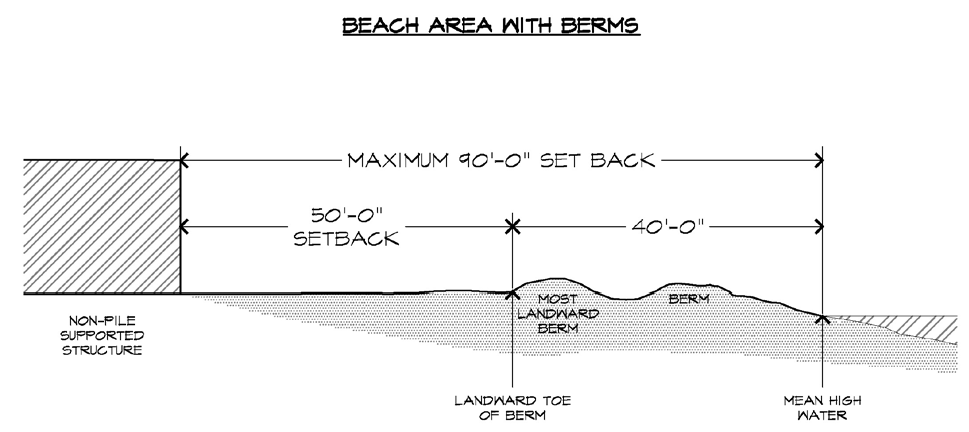
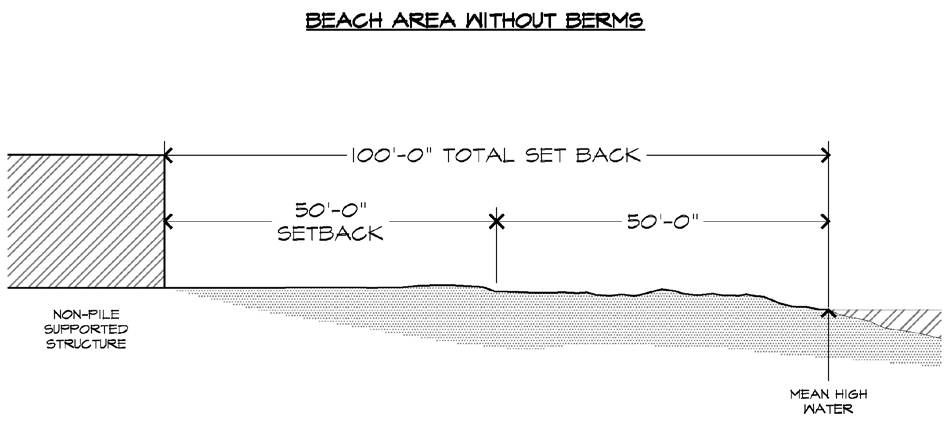
(2)
Within known or potential nesting areas for marine turtles, as determined by the County Biologist, the state, and/or other appropriate agencies, the County Biologist may, in cooperation with other appropriate agencies, determine in writing that specific segments of shorelines have been previously lawfully altered to such a degree that suitable nesting habitat for marine turtles is no longer present. In such cases, the County Biologist in cooperation with the Florida Department of Environmental Protection may recommend reasonable measures to restore the nesting habitat. If such measures are not feasible, the specific requirements of this subsection do not apply. Restoration of suitable nesting habitat shall be required for unlawfully altered beaches.
(3)
Any such dock or walkway shall be designed to the following criteria to minimize adverse impacts on marine turtles:
a.
The structure shall have a minimum horizontal distance of four (4) feet between pilings or other upright members.
b.
The structure shall have a minimum clearance of two (2) feet above grade.
c.
If stairs or a ramp with less than the minimum two (2) feet clearance above grade is required, such stairs or ramp shall be enclosed with vertical barriers no greater than two (2) inches apart.
(4)
All outdoor and indoor artificial lighting complies with Sections 12-116 and 12-117.
(Ord. No. 006-2016, § 1(Exh. 1), 4-13-2016; Ord. No. 025-2021, § 2, 9-15-2021; Ord. No. 015-2022, § 2, 8-17-2022; Ord. No. 015-2022, § 2, 8-17-2022)
Sec. 118-13. - Endangered Species.
(a)
Applicability. On parcels that the U.S. Fish and Wildlife Service has determined are within critical habitat or designated potentially suitable habitat for federally listed threatened or endangered species, no development shall occur without full compliance with the terms of this chapter in addition to other applicable regulations, including, but not limited to, Section 122-8.
(b)
Technical assistance required. For any development permit application filed with Monroe County for properties located within critical habitat or designated potentially suitable habitat for federally listed threatened and endangered species that are not included in the U.S. Fish and Wildlife Service's April 30, 2010 Biological Opinion, and/or are not included in the species addressed under Section 122-8 of the Monroe County Land Development Code, the property owner shall be required to consult directly with the U.S. Fish and Wildlife Service and provide authorization from the U.S. Fish and Wildlife Service to Monroe County before commencement of development. Any conditions imposed by the U.S. Fish and Wildlife Service shall be incorporated as conditions of the Monroe County development permit.
Sec. 118-14. - Protection of Freshwater Lenses.
(a)
No new water supply wells, including but not limited to domestic water supply wells (for drinking, bathing, eating, cooking or sanitation) and irrigation wells, shall be installed in areas that have a discernible groundwater freshwater lens.
(b)
Existing water supply wells, including but not limited to domestic water supply wells and irrigation wells that are within a discernible groundwater freshwater lens shall be properly abandoned by pressure-grouting from bottom to top with neat cement grout in accordance with plugging requirements described in FDEP Chapter 62-532.500(4), F.A.C. Abandonment must be completed prior to issuance of any building permits or modifications for the property.
(c)
Chemicals that have a groundwater cleanup target level in Chapter 62-777, F.A.C., shall be protected from entering a groundwater freshwater lens by the following restrictions on lands overlying a discernible groundwater freshwater lens:
(1)
Production of these chemicals is prohibited.
(2)
Storage, handling, and use of these chemicals shall be solely for the onsite maintenance or operation of the business or residence. Commercial storage, commercial handling, or commercial use of these chemicals to serve offsite facilities is prohibited.
(3)
These chemicals shall be stored, handled, and used only in accordance with the manufacturer's instructions.
(4)
These chemicals shall be stored solely in original consumer packages in which they are typically distributed for consumer or commercial use, or in other suitable containers properly labeled so as to indicate their contents.
(5)
Liquids that contain these chemicals shall be stored with secondary containment. Secondary containment shall be an impermeable coating, membrane, surface, or structure in which tanks or containers are placed. For tanks or containers larger than 110 gallons, the secondary containment shall hold at least 110% of the volume of the largest tank or container. For tanks or containers of one (1) to 110 gallons, the secondary containment shall hold at least twenty percent (20%) of the combined volume of all the tanks or containers within the secondary containment, but no less than the volume of the single largest tank or container. A double-walled tank is considered secondary containment. All materials in a secondary containment shall be stored in a manner which, in the event of a release, prevents contact of the chemicals with soil, groundwater, or surface water.
(6)
Buildings that contain these chemicals shall have no floor drains or outlets, except those plumbed to a sanitary sewer system.
(7)
Release of these chemicals in any quantity on soils, in groundwater, or in surface waters is prohibited except when used according to the manufacturer's instructions, including but not limited to, the quantity and frequency of application.
(8)
Untreated water that contains these chemicals in concentrations above groundwater cleanup target levels shall not be released to the soil, groundwater, or surface water.
(9)
All waste products and containers containing these chemicals shall be properly disposed of in accordance with federal, state, and county requirements.
(Ord. No. 006-2016, § 1(Exh. 1), 4-13-2016)
Sec. 118-15. - Marina Siting Criteria.
(a)
Siting criteria. The development of new marina facilities shall be located in areas where maximum physical advantages exist and where no unreasonable or excessive impacts are foreseen on marine resources. Proposed new marina facilities shall meet the following requirements:
(1)
Benthic vegetation and hardbottom communities. Siting of marinas in areas of seagrass or hardbottom (including hard and soft corals) should be avoided. Boat mooring sites (slips or docks) shall not be located over a seagrass bed community or hardbottom community regardless of water depth. No impacts to seagrass beds or hardbottom communities should result from the construction or use of new marina development.
(2)
Adequacy of circulation and tidal flushing. The proposed marina site shall exhibit adequate circulation and tidal flushing. The waterway upon which the marina is proposed to be sited shall meet or exceed state water quality standards, and must currently have "Good" water quality as indicated in the County's most current canal inventory and assessment data (as applicable). New marina development shall not adversely impact the quality of water during construction or use.
(3)
Adequate water depth and access. There shall be a minimum of four (4) feet of water depth at MLW at the marina site (including the mooring slips, turning basin, and access channels), and the water depth shall be continuous to open water over a channel width of twenty (20) feet. Water depth shall be adequate for the proposed vessel use such that there be a minimum of one (1) foot clearance between the deepest draft of the vessel and the bottom at MLW. Greater water depths shall be required for those facilities proposed for accommodating vessels having greater than a three (3) foot draft. Sites shall not require dredging or filling to provide access.
(4)
Minimal shoreline modification. Marinas shall not be sited adjacent to unaltered shorelines as defined in Sec. 101-1 of the Land Development Code. Minimal modification to the shoreline shall be permitted per County Land Development Code Section 118-1, 118-12(m), and (o).
(5)
Quality of upland areas and degree of alteration necessary. Marinas shall not be sited on lands designated as Tier I or Tier III-A, if clearing is proposed. Marina development shall not adversely impact the upland area of, or adjacent to, a proposed marina site. Additionally, marinas shall not be permitted on offshore islands or on units of the Coastal Barrier Resources System (CBRS). Notwithstanding the preceding sentence and Policy 102.7.2 of the Monroe County Comprehensive Plan, marinas may be permitted on parcels that are both within Unit 57 of the Coastal Barrier Resources System (CBRS) and located within the Safe Harbor Community Center Overlay District.
(6)
Propeller dredging problem areas. Siting of marinas in areas of seagrass propeller scarring should be avoided. Marinas shall not be located adjacent to areas of severe seagrass scarring, based on the most current data available from the Florida Fish and Wildlife Research Institute.
(7)
Impact of boats on Florida manatee, American crocodile, and sea turtles. Marinas shall be sited so as to prevent impacts to the Florida manatee, American crocodile, and marine turtles and protect their habitat by avoiding areas of known American crocodile range, areas with high watercraft Florida manatee mortality, or areas that include a beach known to be used for marine turtle nesting. Site characteristics can be assessed using current data from the Florida Fish and Wildlife Conservation Commission.
(8)
Other significant resources. No adverse impact shall be permitted on archaeological or historic resources/sites.
(b)
Applicants for new marina development shall be responsible for providing existing physical and environmental site data specific to the proposed site to demonstrate the marina siting criteria described above are met.
(c)
Applicants for development approval of marinas with three (3) or more wet slips shall meet the following:
(1)
Monroe County's marina siting criteria (Section 118-15(a));
(2)
Monroe County's dock siting criteria (Section 118-12(m)); and
(3)
Criteria of Rules 62-312 and 18-21.0041, F.A.C. and § 163.3178(2)(g), F.S.
(d)
Applicants for development approval of docking facilities for fewer than three (3) wet slips shall meet the following criteria:
(1)
Monroe County's dock siting criteria (Section 118-12(m)); and
(2)
Criteria of Rules 62-312 and 18-21.0041, F.A.C.
(Ord. No. 006-2016, § 1(Exh. 1), 4-13-2016; Ord. No. 003-2025, § 3, 1-15-2025)
Sec. 118-16. - Marina Pumpout Requirement.
(a)
New marinas. New marinas and marine facilities with ten slips or more, or one live-aboard slip, shall provide a fixed pumpout station.
(b)
Signage. All marinas, regardless of size, shall provide signage conspicuously posted at dockage sites educating the live-aboard public about the importance of pumping out and giving clear directions to the nearest pumpout stations.
(c)
Existing facilities. Existing marinas and marine facilities that do not have an on-site pumpout station, as identified through the Monroe County Marine Facility Survey or other best available data sources, shall be notified in writing of the requirements for on-site pumpout facilities and signage (and any available funding assistance, such as the DEP Clean Vessel Act grant program) within 18 months after the adoption this Land Development Code. Such marinas and marine facilities shall have 12 months from the written notification to provide an on-site pumpout station and associated signage. All marine facilities and marinas that are required to provide on-site pumpout stations shall keep those pumpout stations operational, and ensure that pumpout service is available to the patrons of those marine facilities and marinas.
(Ord. No. 006-2016, § 1(Exh. 1), 4-13-2016)
Sec. 118-40. - General.
All resource exploration and extraction activities in the County shall comply with the provision of this article in order to ensure that such activities do not adversely affect long-term ecological values in the County and that abandoned exploration and extraction sites will be restored.
(Ord. No. 006-2016, § 1(Exh. 1), 4-13-2016)
Sec. 118-41. - Resource Exploration and Extraction Standards.
(a)
New resource exploration and extraction activities and expansions of existing resource exploration and extraction operations shall be prohibited.
(b)
Oil and gas exploration, extraction and production shall be prohibited. Hydraulic fracturing, commonly called fracking, for extracting oil or natural gas from deep underground shall be prohibited.
(c)
Blasting shall be prohibited for resource extraction activities.
(d)
All resource exploration and extraction activities shall:
(1)
Be designed so that no area of excavation, storage area for equipment or machinery, or other structure or facility is closer than:
a.
Two-hundred feet to any property line; and
b.
Five-hundred feet to any residential or nonresource exploration or extraction related nonresidential use in existence on the date the permit is issued;
(2)
Be located on a parcel of at least 20 acres;
(3)
Be fenced or blocked so as to prevent unauthorized entry into the resource exploration or extraction operation through access roads;
(4)
Not involve excavation greater than 60 feet below natural grade;
(5)
Not cause the introduction of saline aquifer waters into freshwater aquifers;
(6)
Involve restoration of disturbed areas at the completion of the resource exploration or extraction operation in accordance with Section 118-42, and the implementation of the restoration plan shall be secured by a surety bond or other financial guarantee of performance approved by the County;
(7)
Operate solely between the hours of 8:00 a.m. and 5:00 p.m.;
(8)
Be conducted in accordance with FDEP standards including FDEP Rule 62C-36 (Limestone Reclamation Requirements); and
(9)
Utilize methods to prevent groundwater and surface water contamination during resource exploration or extraction operations. These shall include but not be limited to the following:
a.
The first flush of runoff from the resource exploration or extraction site shall be retained on-site;
b.
Turbidity controls shall be used to prevent contamination of adjacent off-site surface waters; and
c.
All point sources of pollution shall be managed in accordance with applicable regulations of the FDEP and the U.S. Army Corps of Engineers.
(e)
An annual permit from the County shall be required for the continued operation of existing resource exploration or extraction operations. When an application for an annual permit for existing resource extraction operations is submitted, the required groundwater and surface water quality protection measures shall be outlined by the applicant, and shall be attached as permit conditions when the permit is issued.
(f)
Monitoring shall be required to determine compliance with state water quality standards. In the event that water quality standards are violated as a result of a mining operation, the mining activity shall be stopped, and relevant fines and required mitigation of habitat impacts shall be fulfilled.
(g)
Authorization to operate a permitted resource exploration or extraction site shall remain valid and in force in accordance with the permit(s). Should resource exploration or extraction activities cease for a period of three (3) years, regardless of permit status, resource exploration or extraction permission shall expire unless extended. Extension of authorization from the Planning and Environmental Resources Department shall be requested in writing by the applicant or operator and, subject to BOCC's approval, may be extended for a period of up to three (3) years.
(h)
All existing resource exploration or extraction sites shall register with the County Biologist by December 30, 2016. Any resource exploration or extraction site for which an application for registration has not been submitted to the County Biologist within the time period specified above shall lose any vested rights for the operation of the resource exploration or extraction site. Registration shall be accomplished by providing the following information to the County Biologist:
(1)
Name, address, and telephone number of current owner and operator;
(2)
Survey with a legal description of the entire site;
(3)
Recent aerial imagery of the entire site delineating areas previously mined and reclaimed, areas of active mining and areas of future mining; and
(4)
Copies of all other permits for the resource exploration or extraction operation, including site plans, operations plans and reclamation plans associated with the permits issued, if applicable, by the Florida Department of Environmental Protection, South Florida Water Management District, U.S. Army Corps of Engineers, and U.S. Environmental Protection Agency.
(i)
If a change in the ownership or operator of a mine takes place at any time, the new owner or operator shall notify the County Biologist, in writing, of the current name, address and telephone number of the owner and operator of the resource exploration or extraction site. Notification shall take place within 60 days of the change of ownership or operator. The transferee shall provide, in a form acceptable to the County Biologist, proof of financial responsibility as required by subsection 118-42(c).
(j)
The operator of every approved or registered resource exploration or extraction site shall file a written annual report with the County Biologist within 45 days after the end of each fiscal year (September 30th) to include the following:
(1)
Identification of lands mined during the preceding year and lands expected to be mined during the current year;
(2)
Discussion of the reclamation progress for each area where reclamation has been completed in the last year or where reclamation is in progress and a discussion of reclamation planned for the current year;
(3)
Aerial photographs at a scale of 1 inch = 200 feet or 1 inch = 400 feet (photos of flight most recently available through the County, FDOT, NRCS or other agency will be accepted) showing the extent of land disturbance and reclamation during the last year;
(4)
A summary of results of the previous year's environmental monitoring program if required in the operating permit;
(5)
Copies of all related inspection reports not previously furnished which are required by state, federal, regional or local regulatory agencies;
(6)
An update on major access routes, impacted intersections closest to the site and daily volume of vehicles hauling mined materials; and
(7)
A notarized document from a licensed Florida registered professional engineer, professional geologist, or an authorized representative familiar with the resource exploration or extraction activities, certifying that the project is being developed and operated in strict accordance with the conditions set forth in the approved permits and reclamation plan.
Failure to file the required annual progress report shall be grounds for suspension of the operating permit. An extension of time for filing of 45 additional days may be granted by the County Biologist upon request and for good cause shown.
(Ord. No. 006-2016, § 1(Exh. 1), 4-13-2016)
Sec. 118-42. - Restoration Standards.
(a)
As a condition of renewal for operating permits, existing resource exploration or extraction operators shall submit a reclamation plan for approval by the County. If the site has valid and current permits to operate and such permits do not require reclamation, the operator shall provide documentation of such to the County.
(b)
All parcels of land that are used for resource exploration or extraction operations shall be restored as follows (unless otherwise specified in valid and current permits):
(1)
Restoration shall be a continuous process, and each portion of the parcel shall be restored within two years after resource exploration or extraction is completed for that portion;
(2)
Topsoil shall be restored in approximately the same quality and quantity as existed at the time the resource exploration or extraction operation was initiated;
(3)
Any body of water created by the resource exploration or extraction operation shall have a graded shoreline with a slope not to exceed one (1) foot vertical to five (5) feet horizontal from mean high water (MHW) to a depth of six (6) feet below the mean low water (MLW) elevation, unless an alternate slope is approved by the County Biologist. Although no minimum slope below the littoral zone is required, the slope below the littoral zone shall be constructed so that natural soil movement will not reduce the littoral zone area. Such slopes shall be subject to approval by the County Biologist.
(4)
All equipment, machinery and structures, except for structures that are usable for recreational purposes or any other use authorized in the area, shall be removed within six months after the resource exploration or extraction operation is terminated and restoration is completed; and
(5)
Reclamation shall to the maximum extent practical result in the reestablishment of the vegetation association that existed prior to the exploration or extraction activity or native habitat appropriate to the area as determined by the County Biologist, subject to the following:
a.
Revegetation of all disturbed areas shall be conducted in a manner so as to achieve permanent revegetation which will minimize soil erosion and surface water runoff, conceal the effects of surface mining, and recognize the requirements for appropriate habitat for fish and wildlife. Should washes, rills, gullies or the like develop after revegetation and before final County approval of the reclamation area, such eroded areas shall be repaired and the slopes stabilized.
b.
Vegetation types utilized for revegetation shall consist of species of grasses, shrubs, trees and aquatic and wetlands vegetation native to the area and well-adapted to the soil conditions and terrain features prevalent on the site being restored. In no instance shall any invasive exotic plant species be planted.
(c)
Before an operating permit is issued or renewed, the operator shall provide proof of financial responsibility including a reclamation guarantee to ensure monies will be available to complete the reclamation plan, subject to the following:
(1)
Acceptable forms of the financial guarantee include cash, irrevocable letters of credit, or surety bonds. The security may be provided in an alternate form acceptable to the County Attorney. In all cases, the form of the guarantee shall be subject to approval by the County Attorney.
(2)
The amount of the guarantee shall be set by the BOCC, in an amount not less than 110% of the estimated cost of reclamation based upon the phase of work that is being permitted.
(3)
The amount required to complete the reclamation may increase or decrease because of, among other things, progress that has occurred in compliance with the reclamation plan or changes in technology or inflation. If the owner or operator feels that the amount of the guarantee held by the County exceeds 110% of the amount necessary to complete the reclamation plan, then the owner or operator may submit a request for a proportionate reduction and return of funds. Such request shall accompany the annual progress report and shall provide justification for the request. If the County Biologist feels that the amount of the guarantee held by the County is less than 110% of the amount necessary to complete the reclamation, the County may request additional amounts of guarantee. After review, the County Biologist shall recommend to the BOCC that the amount of the guarantee be reduced or that additional guarantee amounts are necessary. The BOCC shall review the recommendation of the County Biologist and determine the amount by which the guarantee shall be reduced or increased accordingly. Failure of the operator to post such additional guarantee amount shall be grounds for suspension or revocation of the operating permit. Reduction in the amount of the financial security shall not occur more often than once in each year.
(Ord. No. 006-2016, § 1(Exh. 1), 4-13-2016)

