
Monticello City Zoning Code
ARTICLE VIII
TRANSPORTATION
Sec. 54-491. - Location of parking facilities generally.
Off-street parking facilities required by this article shall be located upon the same plot or parcel of land such facilities are intended to serve, or upon a plot of land, the nearest property line of which is located within 600 feet air line measurement of the nearest property line it is intended to serve, in instances of off-street parking facilities not contiguous to the parcel of land such facilities are intended to serve. The owner shall furnish to the development administrator a binding legal agreement assuring that the parking facilities will remain available as long as the facility that they are intended to serve exists. All off-street parking facilities required under this article shall be located on property whereon such off-street parking use is a permissible use and shall be designed, developed and maintained in accordance with all applicable provisions of this article.
(Ord. No. 90-13, § 09.01, 8-7-1990; Ord. No. 2001-06, § 2(09.01), 11-6-2001)
Sec. 54-492. - Utilization of yards for parking facilities.
(a)
Residential districts. In all residential districts, required parking spaces for single-family and two family dwellings may be permitted in any setback areas or yards and shall be counted as meeting off-street parking requirements, except that, within a required front yard, all parking shall be located in a driveway or turn-around.
(b)
Other districts. In all districts for all other permitted uses, approved permitted uses with site plan review or approved special exception uses, required front, street side or street rear yards may be used for off-street parking, except as limited herein. A maximum of 80 percent of a required front yard may be used for off-street parking. Parking area surfaces shall not extend closer than five feet to any abutting side or rear property line.
(Ord. No. 90-13, § 09.02, 8-7-1990; Ord. No. 2001-06, § 2(09.02), 11-6-2001)
Sec. 54-493. - Size of parking spaces.
Each parking space required and provided pursuant to the provisions of this division shall not be less than nine feet in width and 19 feet in length.
(Ord. No. 90-13, § 09.03, 8-7-1990; Ord. No. 2001-06, § 2(09.03), 11-6-2001)
Sec. 54-494. - Handicapped parking.
Every parking area designed to serve a use available for the public shall provide spaces measuring 12 feet in width by 19 feet in length and designate such spaces as "handicapped parking." The placement of such spaces shall be convenient to the entrance of the principal building and shall be designed so that the handicapped person need not go around the vehicle to get to a curb cut. One space per each 25 parking spaces or portion thereof shall be provided. In no case shall more than four spaces per principal use be required. The number and placement of such handicapped parking shall be the subject of development plan review.
(Ord. No. 90-13, § 09.04, 8-7-1990; Ord. No. 2001-06, § 2(09.04), 11-6-2001)
Sec. 54-495. - Access to parking area.
The plan for ingress and egress to and from the off-street parking area and landscaping shall be subject to the approval of the city. No curbs or sidewalks may be cut or altered in any manner without a permit from the city and all other applicable county or state agencies. Minimum width of an aisle designed and intended for the maneuvering of an automobile into a parking space shall be in conformance with the accompanying illustration. The parking plan must be so arranged that each automobile may be placed and removed from the parking space assigned thereto and taken to and from the property without the necessity of moving any other automobile to complete the maneuver. No access or egress way shall be closer than 30 feet to an existing street intersection.
(Ord. No. 90-13, § 09.05, 8-7-1990; Ord. No. 2001-06, § 2(09.05), 11-6-2001)
Sec. 54-496. - Identification of parking spaces.
Each parking space required and provided pursuant to the provisions of this division shall be distinguished and separated from adjoining parking spaces by means of three-inch painted stripes. It shall be the responsibility and obligation of the owner or operator of any building, structure or use affected by this division to maintain such identification markings so that parking spaces at all times are distinguishable from on another.
(Ord. No. 90-13, § 09.06, 8-7-1990; Ord. No. 2001-06, § 2(09.06), 11-6-2001)
Sec. 54-497. - Number of parking spaces required.
(a)
There shall be provided at the time of the construction of any main building or structure, or at the time any main building or structure is enlarged or increased in capacity, or at the time any use or occupancy of an existing building is changed to a use or occupancy which increases the requirements for off-street parking, minimum off-street parking facilities with adequate provisions for ingress and egress, in accordance with the requirements of this section and the schedule of off-street parking requirements, as prescribed in this division.
(b)
When units or measurements determining number of required off-street parking spaces result in requirement of a fractional space, any such fraction equal to or greater than one-half shall require a full off-street parking space.
(Ord. No. 90-13, § 09.07, 8-7-1990; Ord. No. 2001-06, § 2(09.07), 11-6-2001)
Sec. 54-498. - Combined parking facilities.
Nothing in this division shall be construed to prevent collective provision for, or joint use of, off-street parking facilities for two or more buildings or uses by two or more operators, provided that the total of parking spaces when combined or used together shall not be less than the sum of the requirements of the several individual uses computed separately in accordance with this division.
(Ord. No. 90-13, § 09.08, 8-7-1990; Ord. No. 2001-06, § 2(09.08), 11-6-2001)
Sec. 54-499. - Use of parking facilities for parking of commercial vehicles.
Off-street parking facilities supplied by the owner or operator to meet the requirements of this division shall not be used by commercial vehicles owned, operated or used in the business of such owner during regular hours.
(Ord. No. 90-13, § 09.09, 8-7-1990; Ord. No. 2001-06, § 2(09.09), 11-6-2001)
Sec. 54-500. - Parking lot design criteria.
All surface parking areas shall meet the following criteria:
(1)
Materials. Off-street parking facilities including access aisles and driveways shall be surfaced with a hard, dustless materials, and maintained in a smooth, well-graded condition; provided that driveways, access aisles and parking spaces for public and private schools offering academic courses may be surfaced with grass or lawn. In all instances bumper stops shall be required.
(2)
Drainage. All off-street facilities for the use of the public required by this division shall be drained so as not to cause any nuisance on adjacent or public property, and any lighting thereon shall be so arranged and designed as to prevent any glare or excessive light on adjacent property. Such facilities shall be arranged for convenient access and safety of pedestrians and vehicles.
(3)
Landscaping.
a.
Perimeter landscape area requirements.
1.
Front perimeter landscape area. A ten-foot-wide strip of land along the entire front perimeter of a site, located between the front property line and any vehicular use area, shall be landscaped. Width of sidewalks shall not be included within the ten-foot-wide front perimeter landscape area.
2.
Side and rear perimeter landscape areas. A six-foot-wide strip of land along the entire side and rear perimeter of a site, located between the side and rear property lines and any vehicular use area, shall be landscaped, except that where a perimeter landscape area is between a side or rear property line and a vehicular use area used as an accessway, only a four-foot-wide strip of land shall be required to be landscaped.
3.
Agreement with adjacent property owner. When side or rear perimeter landscape areas are required on adjacent properties, the owners of such adjacent properties may agree to the installation of only one such landscape area on the adjacent boundary, as long as such agreement is binding on both property owners and their successors in interest and is approved as part of the permit application by the development administrator.
b.
Landscape material requirements in perimeter landscape areas.
1.
Tree count. The total tree requirement within the perimeter landscape areas shall be determined by using a ratio of one tree for each 25 linear feet of required landscape perimeter area, or major portion thereof, with no less than 75 percent of said trees being shade trees. All trees shall be provided at least 133 square feet of planting area each. This provision is not intended to require trees to be equally spaced 25 feet apart. Creating design and spacing is encouraged.
2.
Ground cover. Grass or other ground cover shall be placed on all areas within all perimeter landscape areas not occupied by other landscape material or permitted accessways.
c.
Visual screen in perimeter landscape areas. A visual screen shall be placed within required perimeter setback landscape areas, running the entire length of such areas except for permitted accessways. The visual screen shall consist of landscape materials sufficient to provide, at a minimum, an opaque, continuous screen at least 30 inches high at maturity.
d.
Use of perimeter landscape areas. Overhang areas, vehicle stops or other design features shall be used so that parked vehicles do not overhang more than two feet into perimeter landscape areas.
e.
Interior landscape areas.
1.
Size. In vehicular use areas within the interior of a site, one 400-square-foot planting area shall be required for every 5,000 square feet of vehicular use area, or major portion thereof, and at least three two-inch, or two three-inch, caliper shade trees together with other landscape material shall be planted within each such planting area. Interior planting areas shall be located to most effectively relieve the monotony of large expanses of paving and contribute to orderly circulation of vehicular and pedestrian traffic, and shall be no less than 12 feet in width, exclusive of curbing. Whenever linear medians at least 50 feet long having shade trees spaced no greater than 15 feet on center are used, the minimum width may be reduced to eight feet exclusive of curbing. There shall be an additional 400 square feet of planting area for every eight parking spaces above the minimum number required in this chapter.
2.
Overhang. Vehicle stops or other design features shall be used so that parked vehicles do not overhang more than two feet into any interior landscape area.
3.
Ground cover. Interior landscape areas shall be planted in grass, or other ground cover, not exceeding eight inches in height.
4.
Natural areas landscaping waiver. As an incentive to preserving natural areas, up to one-half of the required interior landscape area may be waived when an equal area within the vehicle use area is preserved in a natural state. To qualify for such a waiver, preserved natural areas must be at least 800 square feet in size and be approved by the development administrator as meeting the objectives of this section.
5.
Landscaping functional waiver. When an applicant demonstrates to the satisfaction of the development administrator that strict application of this subsection will interfere with the function of vehicular use areas, the development administrator may permit relocation of required landscaping or other substitutions which will improve functioning provided that the intent of this subsection is met by such modifications.
(4)
Aisle widths. Aisle widths for various types are as follows:
Aisles shall be not less than 22 feet in width when not designed to serve a particular parking configuration or when designed to serve parallel parking. Aisles may be reduced to not less than 11 feet in width when serving parallel parking on a one-way drive providing the parking spaces are located only on one side of said drive.
(5)
Permeable off-street parking facilities. When ten or more off-street parking spaces are required for any nonresidential use, a percentage of the required number of spaces may be surfaced with a stable, porous material which may include grass, gravel or other permanent but permeable surface material. These parking areas shall be clearly marked as to purpose and maintained for that purpose. Within grassed or sodded parking areas, if parking demand is such that grass or lawn is damaged to such an extent that it ceases to grow, then surfacing of the area with either a hard, dustless material or other porous material in accordance with this subsection is required. The maximum number of parking spaces that may be grassed is as follows:
All off-street parking spaces provided above the minimum number required both for residential and nonresidential land use may be surfaced with pervious material in accordance with this subsection. All access aisles must be surfaced with a hard, dustless material in accordance with subsection (1) of this section.
(Ord. No. 90-13, § 09.10, 8-7-1990; Ord. No. 2001-06, § 2(09.10), 11-6-2001)
Sec. 54-501. - Off-street loading berths.
In any district, in connection with every building or building group or part thereof, hereafter erected and having a gross floor area of 4,000 square feet or more, which is to be occupied by commercial or industrial uses or other uses similarly requiring the receipt or distribution by vehicles of material or merchandise, there shall be provided and maintained, on the same lot with such building, off-street loading berths or unloading berths as follows:
(Ord. No. 90-13, § 09.11, 8-7-1990; Ord. No. 2001-06, § 2(09.11), 11-6-2001)
Sec. 54-502. - Schedule of off-street parking requirements.
(a)
The schedule of off-street parking requirements is as follows:
(b)
The number of required off-street parking spaces may be reduced as follows:
(1)
Reduction in number of required off-street parking spaces for multifamily housing for the elderly and handicapped.
a.
The definition of multifamily housing for the elderly and handicapped for the purpose of determining required parking spaces is as follows: Residential development occupied exclusively by elderly or handicapped persons as either tenants or owners. To qualify as an elderly or handicapped person or family, the occupants must meet one or more of the following definitions:
1.
Elderly person means a person who is 62 years of age or over.
2.
Handicapped person means any person who is 18 years of age or over and who has an impairment or a developmental disability which is expected to be of a long-continued and indefinite duration and is a substantial impediment to his or her ability to live independently or to operate an automobile.
3.
Elderly or handicapped family means:
i.
A family of two or more persons, one of whom is elderly or handicapped;
ii.
The surviving members of any family described in subsection i. above living with the elderly or handicapped member of the family at the time of his or her death; or
iii.
Two or more elderly or handicapped persons living together or one or more such persons living with an individual who assists in their care.
(2)
Reduction in number of required paved off-street parking spaces. The project site plan must demonstrate that the total number of off-street parking spaces required for multifamily dwellings can be provided. However, only 0.75 parking space per dwelling unit is required to be installed. Of this required amount, a minimum of 0.5 parking space per dwelling unit shall be surfaced with a hard, dustless material. The remaining 0.25 parking space per dwelling unit and any additional spaces provided may be surfaced with grass or other permeable material. The balance of the area required for off-street parking may be left in its natural state but must be available for additional off-street parking if the facility changes to multiple-family uses for the nonelderly or nonhandicapped. If housing for the elderly and/or handicapped changes to multiple-family uses, then the full provisions of off-street parking shall be met for such multiple-family use prior to any multifamily occupancy on a multiple-family basis.
(Ord. No. 90-13, § 09.12, 8-7-1990; Ord. No. 2001-06, § 2(09.12), 11-6-2001; Ord. No. 2008-03, § 1, 4-1-2008)
Sec. 54-521. - Purpose; scope.
This division establishes minimum requirements applicable to the development transportation system, including access management, street design, parking and loading, and bicycle and pedestrian access. The standards in this division are intended to minimize the traffic impacts of development, and to assure that all developments adequately and safely provide for the storage and movement of vehicles consistent with good engineering and development design practices.
(Ord. No. 2001-06, § 2(09.13), 11-6-2001)
Sec. 54-522. - Access management.
(a)
Generally. In order to maximize roadway level of service this section shall set standards for the number of access points, the separation between access points, frontage on service roads and common driveways, alternative designs and access to residential lots. All proposed developments shall meet the following standards for vehicular access and circulation:
(1)
Number of access points.
a.
All projects shall have access to a public right-of-way. The number of access points shall be as follows:
*Additional access can be allowed to accommodate clustering or to allow for protection of natural features.
(2)
Additional access points. Notwithstanding the provisions in subsection (1) above:
a.
A nonresidential development, or a multifamily residential development, on a corner lot may be allowed one or more points of access. However, no more than one access shall be onto an arterial.
b.
Schools may have one additional access, provided that the additional access drive is limited to school bus use only.
(b)
Separation of access points.
(1)
The separation between access points onto arterial and collector roadways, or between an access point and an intersection of an arterial or collector with another road, shall be as shown in the following table:
*Except as provided by section 54-523(a).
(2)
The distance between access points shall be measured from the centerline of the proposed driveway or roadway to the centerline of the nearest adjacent roadway or driveway.
(3)
The city may reduce the connection spacing requirements in situations where they prove impractical.
(4)
Variations from these standards may be granted by the city at the discretion of the planning official where the effect would be to enhance the safety or operation of the roadway. An example might include a pair of one-way driveways in lieu of a two-way driveway or alignment of driveways with existing median openings.
(c)
Frontage on service roads and common driveways.
(1)
Projects proposed on arterials and major collectors shall include frontage or service roads, and shall take access from the frontage road rather than the arterial or major collector. Frontage road design shall conform to FDOT standards. This access requirement may be met through the use of interconnecting parking lots which abut the arterial or major collector facility.
(2)
Adjacent uses are encouraged and may be required by the county to share a common driveway provided that appropriate access easements are granted between or among the property owners.
(d)
Alternative designs. Where natural features or spacing of existing driveways and roadways cause the foregoing access requirements to be physically infeasible, alternate designs may be approved.
(e)
Access to residential lots.
(1)
Access to nonresidential uses shall not be through an area designed, approved, or developed solely for residential use, except when the nonresidential use and the residential use areas are all included within and approved as part of a master plan development.
(2)
All lots in a proposed residential subdivision shall have frontage on and legal access from a public street meeting the requirements of this chapter, except as specifically provided herein.
(3)
No new residential subdivision lot shall have driveway access to an arterial street, except where specifically approved for such access by the planning commission.
(4)
A residential subdivision shall have only one entranceway to one abutting public street, except when:
a.
A second entranceway is necessary to alleviate a demonstrated traffic safety hazard.
b.
The subdivision is located on both sides of the public street providing access, in which case one entranceway is permitted on each side of the public street.
c.
The entranceway provides the only access to more than 75 lots, in which case a second entranceway is permitted.
d.
Clustering of the density is involved and to allow for proper clusters when other entrances are needed.
e.
The subdivision abuts two public streets then equal access is allowed on both streets.
(f)
Joint and cross access.
(1)
Adjacent commercial or office developments that are major traffic generators shall provide a cross access drive and pedestrian access to allow circulation between sites.
(2)
A system of joint use driveways and cross access easements, shall be established wherever feasible along arterial roadways.
(3)
Shared parking areas shall be allowed to reduce required parking spaces, as determined by the city.
(4)
Pursuant to this section, property owners shall:
a.
Record an easement with the deed allowing cross access to and from other properties served by the joint use of driveway and cross access.
b.
Record an agreement with the deed that the remaining access rights along the roadway will be dedicated to the city and pre-existing driveways will be closed and eliminated after construction of the joint-use driveway.
c.
Record a joint maintenance agreement with the deed defining maintenance responsibilities of the property owners.
(g)
Access connection and driveway design. Driveway width shall meet the following guidelines:
(1)
If the driveway is a one-way in or one-way out driveway, then the driveway shall be a minimum width of 12 feet and shall have appropriate signage designating the driveway as a one-way connection.
(2)
For two-way access, each lane shall have a width of ten feet and a maximum of four lanes shall be allowed. Whenever more than two lanes are proposed, entrance and exit lanes shall be divided by a median.
a.
Driveway grades shall conform to the requirements of FDOT Standards Index, Roadways and Traffic Design Standard Indices, latest edition.
b.
Driveway approaches shall be designed and located to provide an exiting vehicle with an unobstructed view.
c.
Driveway width and flare shall be adequate to serve the volume of traffic and provide for rapid movement of vehicles off of the major roadway.
d.
The length of driveways shall be designed in accordance with the anticipated storage length for entering and exiting vehicles to prevent vehicles from backing into the flow of traffic on the public street or causing unsafe conflicts with on-site circulation.
(h)
Emergency access. In addition to the minimum side, front and rear yard setbacks, all building and other development activities such as landscaping shall be arranged on-site so as to provide safe and convenient access for emergency vehicles.
(i)
Nonconforming access features. Permitted nonresidential access connections in place as of the date of adoption of the ordinance from which this chapter is derived that do not conform with the standards herein shall be designated as nonconforming, and shall be brought into compliance with applicable standards under the following conditions:
(1)
When new access connections permits are requested.
(2)
Substantial enlargement or improvement.
(3)
Significant change in trip generation.
(4)
As roadway improvement allows.
(j)
Double or reverse frontage lots.
(1)
Access to double or reverse frontage lots shall be required to be on the street with the lower functional classification.
(2)
When a residential subdivision is proposed that would abut an arterial, it shall be designed to provide through lots along the arterial with access from the interior local road.
(k)
Shared access. Subdivisions with frontage on the state highway system shall be designed into shared access points to and from the highway. Normally a maximum of two accesses shall be allowed regardless of the number of lots or businesses to be served.
(l)
Connectivity.
(1)
The street system of proposed subdivisions shall be designed to coordinate with the existing, proposed, and planned streets outside of the subdivision.
(2)
Wherever a proposed development abuts unplatted land or a future development phase of the same development, street stubs shall be provided as deemed necessary by the city to provide access to adjoining properties or to logically extend the street system into the surrounding areas.
(3)
Collector and local residential streets shall connect with surrounding streets to permit the convenient movement of traffic between residential neighborhoods or facilitate emergency access and evacuation.
(m)
Site plan review checklist for transportation.
(1)
Applicants shall submit a preliminary site plan for review by the planning department. At a minimum, the site plan shall show:
a.
Location of access points on both sides of the road where applicable.
b.
Distances to neighboring constructed access points, median openings, traffic signals, intersections, and other transportation features on both sides of the property.
c.
Number and direction of lanes to be constructed on the driveway, plus striping plans.
d.
All planned transportation features (such as auxiliary lanes, signals, etc.).
e.
Trip generation data or appropriate traffic studies.
f.
Parking and internal circulation plans.
g.
A detailed description of any requested variance and the reason the variance is requested.
(2)
Subdivisions and site plan review shall address the following access considerations:
a.
Is the road system designed to meet the projected traffic demand and does the road network consist of a hierarchy of roads designed according to the function?
b.
Does the road network follow the natural topography and preserve natural features of the site as much as possible? Have alignments been planned so that grading requirements are minimized?
c.
Is access properly placed in relation to sight distance, driveway spacing and other related considerations, including opportunities for joint and cross access? Are entry roads clearly visible from the major arterial?
d.
Do units front on residential access streets rather than major roadways?
e.
Is automobile movement within the site provided without having to use the peripheral road network?
f.
Does the road system provide adequate access to buildings for residents, visitors, deliveries, emergency vehicles and garbage collection?
g.
Does the pedestrian path system link buildings with parking areas, entrances to the development, open space and recreational and other community facilities?
(3)
The city reserves the right to require traffic and safety analysis where safety is an issue or where significant problems already exist.
(4)
Upon review of the access application, the planning department may approve the access application, approve with conditions or deny the application.
(5)
Any application that involves access to the state highway system shall be reviewed by the state department of transportation for conformance with state access management standards. Where the applicant requires access to the state highway system and a zoning change, subdivision or site plan review is also required, development shall be coordinated with the state department of transportation.
(6)
If the application is approved with conditions, the applicant shall resubmit the plan with the conditional changes made. Second applications may only be rejected if conditional changes are not made.
(7)
If the application is denied, the city shall provide an itemized letter detailing why the application has been rejected.
(8)
All applications, whose application is approved or approved with conditions, have 30 days to accept the permit. Applicants whose permits are rejected or approved with conditions have 60 days to appeal.
(Ord. No. 2001-06, § 2(09.13.01), 11-6-2001)
Sec. 54-523. - Street design standards.
(a)
General design standards.
(1)
All new streets in a new development shall be designed and constructed pursuant to the standards herein. Paved streets which the city has agreed to accept shall be dedicated to the city upon completion, inspection, and acceptance by the city.
(2)
The street system of the proposed development shall, to the extent practicable, conform to the natural topography of the site, preserving existing hydrological and vegetative patterns, and minimizing erosion potential, runoff, and the need for site alteration. Particular effort should be directed toward securing the flattest possible grade near intersections.
(3)
Streets shall be laid out to avoid environmentally sensitive areas as defined in article VII of this chapter.
(4)
Private local streets may be allowed within developments that will remain under common ownership or control, provided they are designed and constructed pursuant to the standards contained in this division. If the land included in the development is to be subdivided, the requirements of subsections 54-523(e) (2)—4) and section 54-493 must be met. If all the land included in the development is not under common ownership when the development plan is approved, the development plan approval must be contingent on the requirements of subsections 54-523(e) (2)—(4) and section 54-493 being met the same as for a private street subdivision.
(5)
The street layout in all new developments shall be coordinated with and interconnected to the street system of the surrounding area.
(6)
Streets in proposed subdivisions shall be connected to rights-of-way in adjacent areas to allow for proper inter-neighborhood traffic flow. If adjacent lands are unplatted, stub outs in the new development shall be provided for future connection to the adjacent unplatted land.
(7)
Residential streets shall be arranged to discourage through traffic. This shall not be construed to encourage or discourage traditional grid traffic patterns.
(8)
Streets shall intersect as nearly as possible at right angles and in no case shall be less than 75 degrees.
(9)
New intersections along one side of an existing street shall, where possible, coincide with existing intersections. Where an offset (jog) is necessary at an intersection, the distance between centerlines of the intersecting streets shall be no less than 150 feet.
(10)
No two streets may intersect with any other street on the same side at a distance of less than 400 feet measured from centerline to centerline of the intersecting street.
(b)
Sidewalks. Sidewalks shall be provided along:
(1)
Arterial streets: Both sides.
(2)
Collectors: One side.
(3)
Local streets: One side. Sidewalks shall be designed and constructed in accordance with city standards and policies.
(4)
Where new development is adjacent to existing development with sidewalks, the new development shall be required to provide a connecting sidewalk.
(c)
Paving widths. Paving widths for each street classification shall be as provided in Table 54-523.
TABLE 54-523
*For cul-de-sac and loop streets only (stub street dead ending into undeveloped property is to be considered a subcollector).
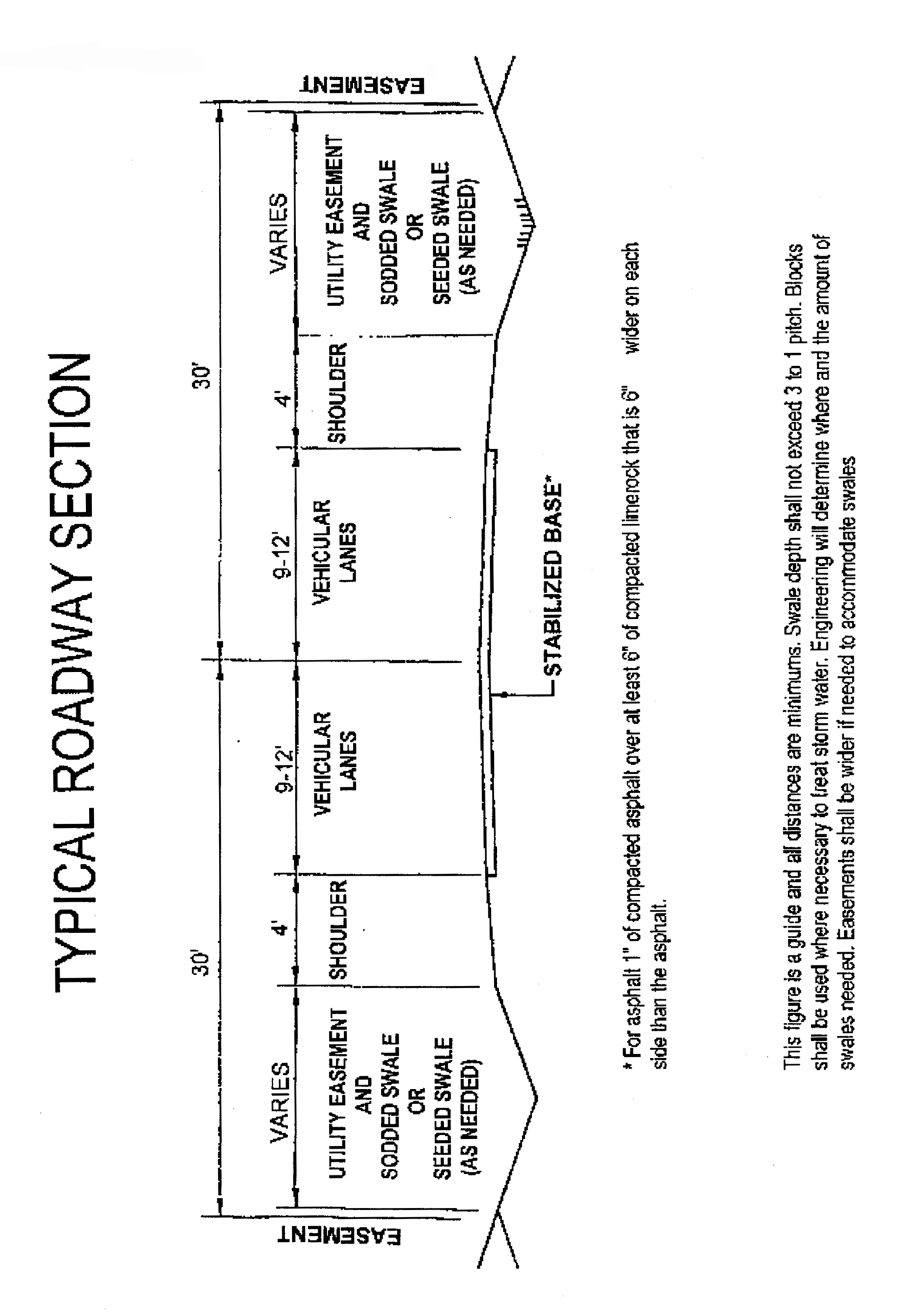
FIGURE 54-523A. TYPICAL ROADWAY SECTION
(d)
Curbing requirements.
(1)
Curbing may be required for the purposes of drainage, safety, and delineation and protection of pavement edge along some proposed streets where determined necessary through the development review process.
(2)
All curbing shall conform to the construction standards contained in this section or as permitted by the development administrator.
(e)
Shoulders. Shoulders, where required, shall measure at least four feet in width and shall be required on each side of streets and shall be located within the right-of-way. Shoulders shall consist of stabilized turf or other material permitted by the development administrator. Shoulders and/or drainage swales are required as follows:
(1)
Shoulders are required on all residential access and residential subcollector streets.
(2)
All residential collector streets shall provide four-foot-wide shoulders on both sides of the street. Shoulders should be grass surfaced. In no case shall the shoulders be paved. Pedestrian or bicycle traffic areas that are paved shall have shoulders on both sides unless they are connected to the street paving. Then a shoulder is only required on the side not connected to the paving.
(3)
Where shoulders are required by the state department of transportation.
(4)
Collector streets where curbing is not required.
(5)
Arterial streets where curbing is not required.
(6)
Shoulders are not required when curbing is used.
(f)
Acceleration, deceleration, and turning lanes.
(1)
Deceleration or turning lanes may be required by the city along existing and proposed streets as determined by a traffic impact study required by article VIII of this chapter or where the city can justify the need.
(2)
Deceleration lanes shall be designed to the following standards:
a.
The lane width shall be the same as the required width of the roadway moving lanes.
b.
The lane shall provide the full required lane width for its full length. It shall not be tapered.
c.
The minimum lane length shall be as follows:
(3)
Acceleration lanes are only required when indicated as needed by a traffic impact study. The design shall be as per FDOT standards. Where needed, a paved taper shall be provided for right hand turns.
(g)
Cul-de-sac turnarounds. An unobstructed 12-foot-wide moving lane with a minimum outside turning radius of 42 feet shall be provided at the terminus of every permanent cul-de-sac.
(h)
Stub streets.
(1)
Residential collector and higher order stub streets may be permitted or required by the city provided that the future extension of the street is deemed desirable by the city or conforms to the comprehensive plan.
(2)
Temporary turnarounds shall be provided for all stub streets providing access to five or more lots or housing units. Where four or fewer units or lots are being served, a sign indicating a dead-end street shall be posted.
(i)
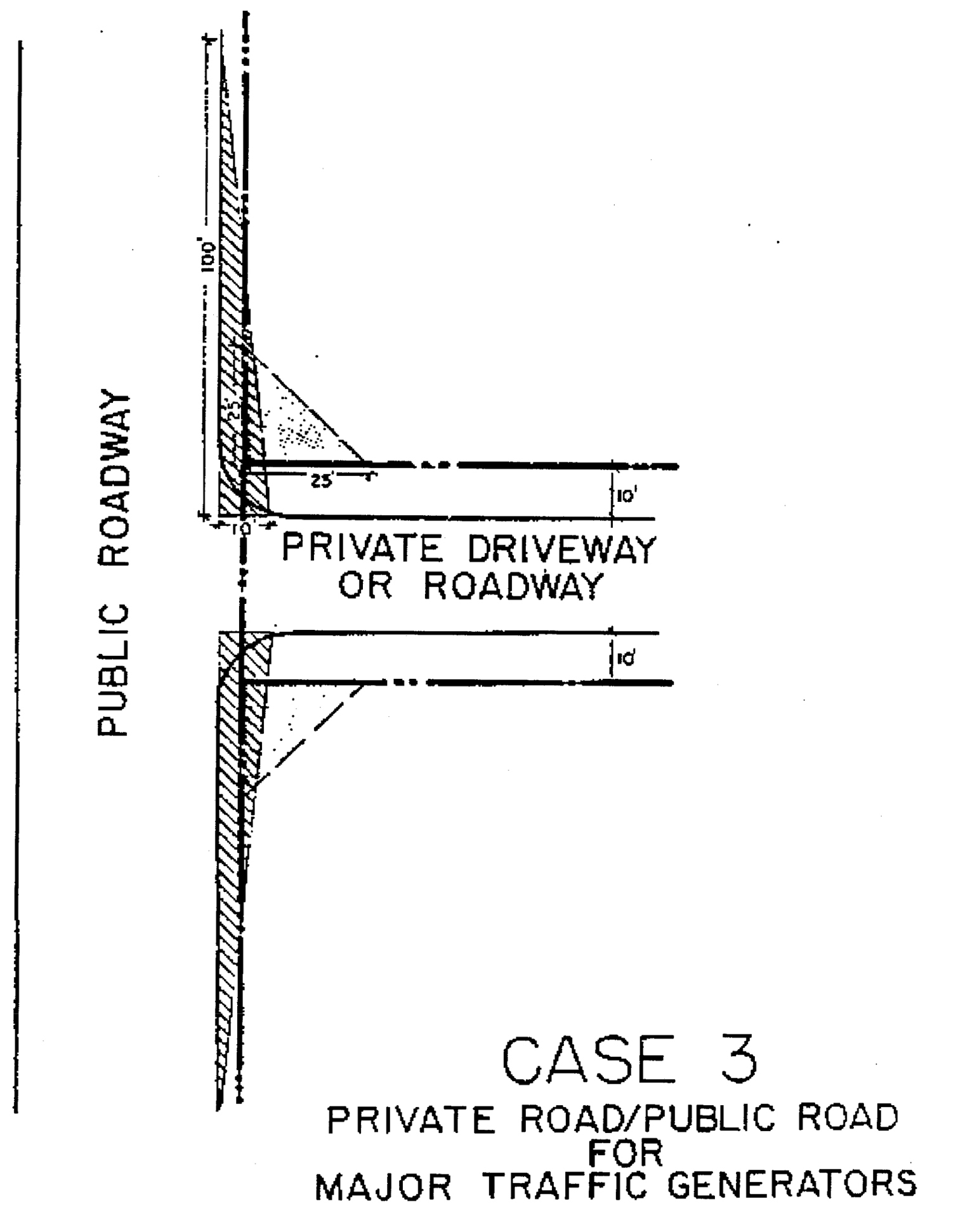
Clear visibility triangle. For new subdivisions the clear visibility triangle shall be a part of the required easement or common area for the road. It shall be unlawful to construct, erect, place, grow, maintain or allow to be constructed, erected, placed, grown or maintained, any building structure, fence, wall, sign, canopy, tree, vegetation or obstruction of any kind within the clear visibility triangle on any property which is located at the corner of intersecting streets or driveways, as described below:
(1)
Nothing shall be erected, placed, parked, planted, or allowed to grow in such a manner as to materially impede vision between a height of two feet and ten feet above the grade, measured at the centerline of the intersection.
(2)
The horizontal area formed by a triangle, the apex of which is the point of intersection of the street right-of-way lines, the legs of which extend 25 feet along said street right-of-way lines and the hypotenuse of which connects the ends of the legs; and
(3)
When the street right-of-way line adjacent to the major road is ten feet or less from the face of the curb, edge of pavement or edge of the driving surface the horizontal area formed by a triangle, the apex of which is the point of the intersection of the lines formed by the projection of either the face of the curb, edge of pavement, or the edge of the driving surface, the legs of which extend ten feet along the minor road, and the hypotenuse of which connects the ends of the legs; or
(4)
In the event of balanced traffic volume or equally controlled right-of-way (i.e., no major/minor roadway condition) or as determined by the director of public works, or his or her designee, based upon sound engineering practices, the additional ten-foot by 100-foot triangle as defined in this section shall apply to all approaches. See Figures 54-523A, B, C and D.
(5)
As used in this subsection the following terms shall have the following meaning:
a.
Major road means one which has the right-of-way or larger traffic volume; or as determined by the director of public works, or his or her designee, based upon sound engineering practices.
b.
Intersecting streets in addition to meaning the intersection of streets of public right-of-way may also mean a private driveway or a private street and its intersection with a public street.
c.
Street right-of-way line means that line denoting the edge of the right-of-way of the street and being identical with the property lines of persons owning property fronting on the streets. For the purposes of establishing the clear visibility triangle as described in this subsection, the "street right-of-way line" for a private driveway or private street shall be set as a parallel line ten feet from the face of the curb, edge of pavement or edge of the driving surface.
(6)
The provisions of this subsection shall not apply to the following:
a.
Utility facilities;
b.
Traffic control devices.
(j)
Signage and signalization. The developer shall deposit with the county sufficient funds to provide all necessary roadway signs and traffic signalization as may be required by the county, based upon county or state traffic standards. At least two street name signs shall be placed at each four-way street intersection, and one at each "T" intersection. Signs shall be installed under light standards and free of visual obstruction. The design of street name signs shall conform to county standards.
FIGURE 54-523B
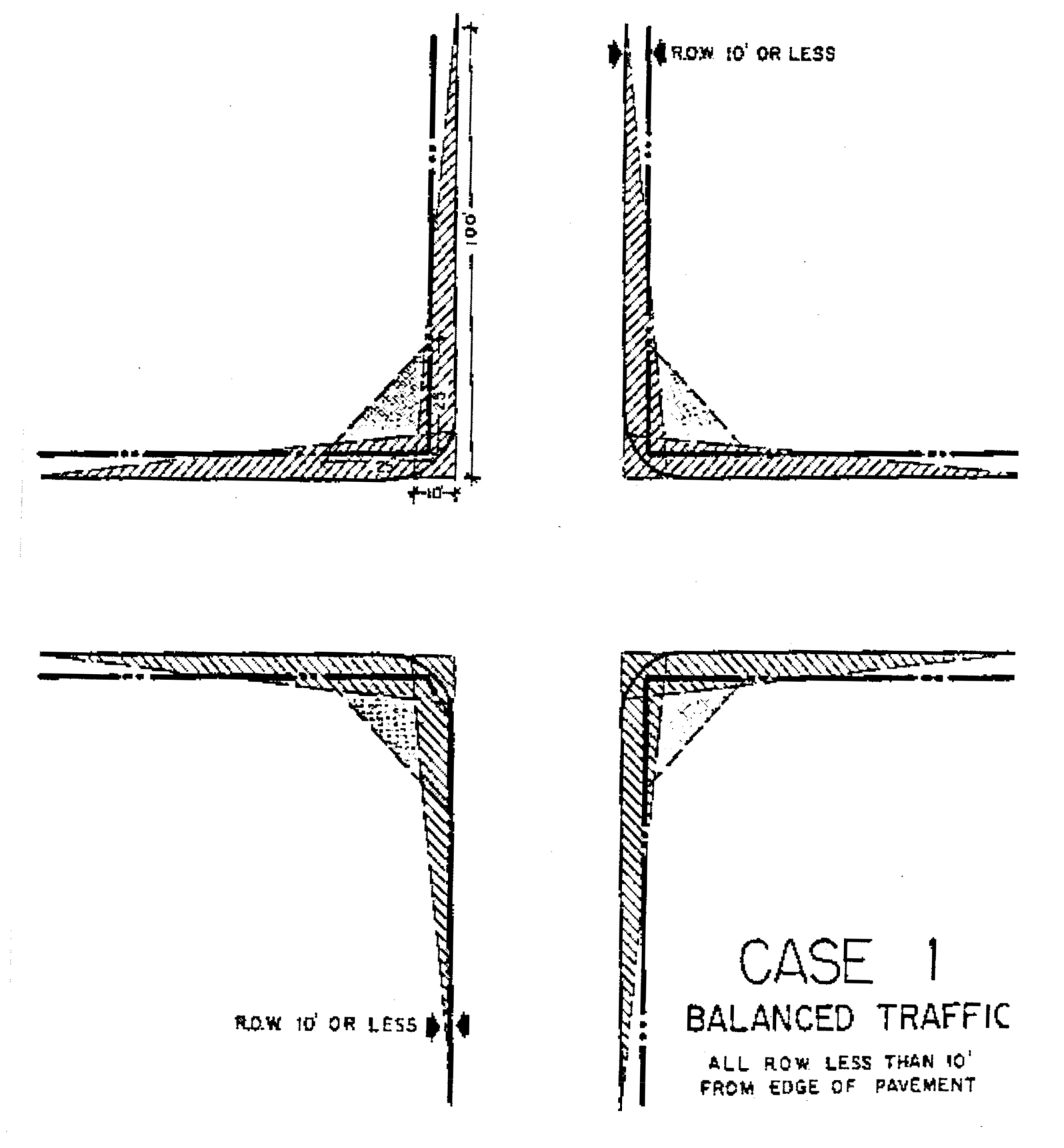
FIGURE 54-523C
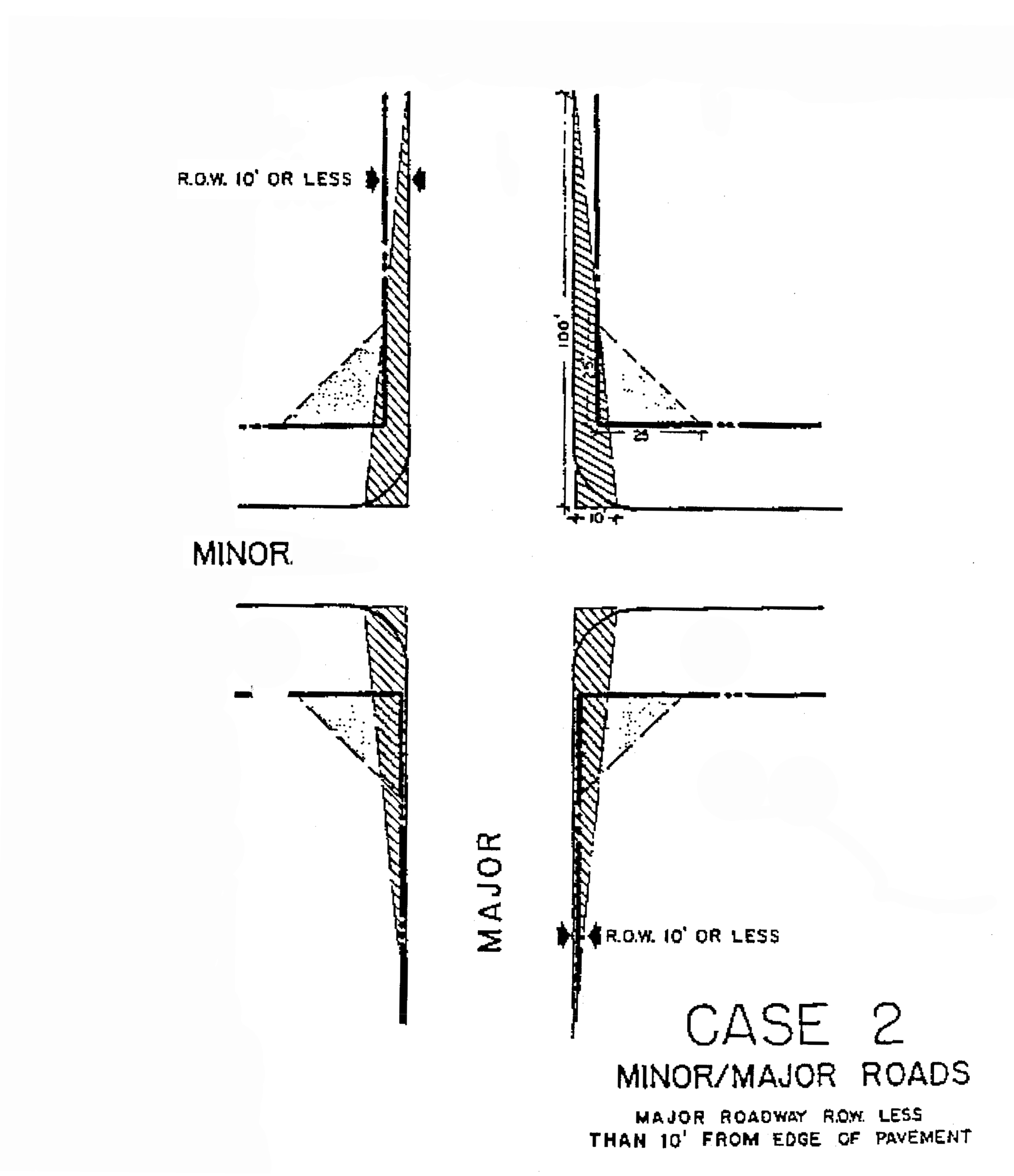
FIGURE 54-523D
(Ord. No. 2001-06, § 2(09.13.02), 11-6-2001)

