
Morton City Zoning Code
CHAPTER 10
4 GENERAL REGULATIONS AND EXCEPTIONS
10-4-1: Application Of Regulations, Zoning Permits, And Certificates
No building or land shall hereafter be used or occupied, and no building or part thereof shall be erected, moved, or altered, unless in conformity with the regulations herein specified for the district in which it is located, and unless having received the appropriate required permits or certificates as outlined in this Title. (Ord. 78-31, 3-5-79)
10-4-2: Nonconforming Uses
Any lawfully established use of land or buildings at the effective date of this Title or of amendments, which does not comply with the regulations of the district in which it is located, is subject to the following regulations:
- Continuance Of Use: A nonconforming use may be continued in use provided there is no physical change other than necessary maintenance and repair except as otherwise provided herein.
- Nonconforming Use Discontinued For One (1) Year Not To Re-Establish: If a nonconforming use involving a building or structure has discontinued for a period of one (1) year or more, it shall not be re-established unless it was in a building specifically designed for such use. If nonconforming use of land not involving a principal building or structure is discontinued for six (6) months, it shall not be re-established.
- Reconstruction, Alterations, Or Expansions Of Nonconforming Building Limited: A nonconforming building may not be structurally altered or reconstructed within its bounding walls to an extent exceeding in aggregate cost twenty five percent (25%) of its fair market value including land value except for non-conforming buildings which are used as an owner occupied residence, in which case the 25% limitation does not apply. A nonconforming use may not expand its bounding walls or increase its building area. In instances where a building has been specifically designed for a nonconforming use, the Board of Appeals, by variance action, may permit this limitation to be exceeded after required public hearing. (Ord. 78-31, 3-5-79; amd. Ord. 08-17, 10-06-08)
Notwithstanding the foregoing, a nonconforming building may be added on to or attached to where the following applies:- The building is in a district zoned R-1, “One-family and Planned Residential District”; and
- Pursuant to the zoning law in effect at the time the building was constructed, the building was allowed to be built up to five feet (5’) from the side lot line; and
- Any addition shall not be closer to the side lot line than five feet (5’). (Ord. 83-12, 8-1-83)
- The building is in a district zoned industrial, and pursuant to the zoning law in effect at the time the building was constructed, the building was allowed to be built up to thirty feet (30’) from the side lot line. Any addition shall not be closer to the side lot line than thirty feet (30’). (Ord. 92-23, 11-2-92)
- Conforming Uses Not To Revert To Nonconforming Uses: Once changed to a conforming use, no building or land shall be permitted to revert to a nonconforming use.
- Substitution Of Nonconforming Uses Prohibited: Except where otherwise provided herein, nonconforming use shall not be substituted for or added to another nonconforming use. (Ord. 78-31, 3-5-79)
- Property adjacent to Detroit Avenue between West Jackson Street and West Birchwood Street where the owner dedicated right-of-way for the widening of Detroit Avenue will not be considered to be a nonconforming property because it doesn’t meet the required front setback. Nonconforming property includes lots that are presently vacant. (Ord. 10-38, 4-4-11; amd. Ord. 10-42, 4-25-11)
10-4-3: Building Height, Bulk, Lot Coverage, And Yards
- General Application: No building shall be erected, reconstructed, relocated, or structurally altered to have a greater height, lot coverage, or smaller open spaces than permitted under the restrictions for the district in which it is located, except as otherwise provided in this Title. (Ord. 78-31, 3-5-79)
- Exceptions To Height Limitations: All structural or architectural towers, spires, cupolas, parapet walls, chimneys, cooling towers, water towers, elevator bulkheads, stacks, stage towers or scenery lofts, mechanical appurtenances, structures, towers, antennas, or other similar structures may exceed the general height limitations in a zoning district only if a special use in accordance with the provisions of Section 10-10-2 of this Title is granted. Notwithstanding the foregoing, no special use shall be granted for a tower or other structure that can or will accommodate a personal wireless service facility as defined in Title 13 Chapter 1 of this Code. Warning sirens are exempt from any height limitation imposed by any other Sections of this Code. (Ord. 81-21, 8-17-81; amd. Ord. 00-52, 3-5-01; amd. Ord. 06-01, 5-1-06)
- Open Space To Meet Requirements For One Property Not To Be Used For Another: No space allocated to a building or group of buildings for the purpose of satisfying the yard, open space, or lot area requirements of one property shall be used to satisfy the yard, open space, or lot area requirements of another property. (Ord. 78-31, 3-5-79)
- Exceptions to Yard Requirements: Notwithstanding the yard requirements specified in this Title, the following shall be permitted in the required yards in any zoning district:
- Bay Windows, Chimneys, Eaves, Gutters, Balconies, Decks and Patios: One story bay windows, chimneys, overhanging eaves, gutters, balconies, decks, and patios projecting no more than twenty four inches (24”) into side yards nor more than thirty six inches (36”) into front and rear yards. Down spouts or any piped drainage may project into the front, side or rear yards a distance of no more than one-half of the applicable setback.
- Open Fire Escapes: Open fire escapes, providing they do not project into required yards more than four and one-half feet (4 1/2’)
- Front Yards To Be Measured From Edge Of Proposed Right Of Way: Where the street(s) upon which a property fronts is below the proposed right of way width, as indicated on the Morton Official Map, the required front yard shall be measured from the edge of the proposed right of way line which, unless otherwise indicated, shall be a line parallel to the edge of the existing right of way and set into the property a distance equal to one-half (1/2) the distance the existing right of way is below the proposed width.
- Landscaped Front Yards Required: All uses in all districts, except agricultural uses, shall maintain a landscaped front yard of a depth equal to the lesser of the actual building setback imposed under the regulations of the applicable zoning district, or (b) twenty five feet (25') in depth measured from the edge of the right of way. Within the landscaped front yard,
- Obstructions To Visibility At Intersections Prohibited: On a corner lot, no obstruction to visibility shall be allowed within a triangular area formed by the intersecting property lines along the fronting streets and a straight line joining said lot lines at points the following distances from the intersection of such intersecting lot lines for types of streets as designated on the Official Map:
- Twenty feet (20’) for local streets, and
- Thirty five feet (35’) for all other streets.
- Zoning Of Bona Fide Agricultural Uses: Notwithstanding the above, none of the following regulations, with the exception of yard requirements, shall be applicable to bona fide agricultural uses. This shall not be construed, however, as eliminating the necessity of agricultural uses from applying for and obtaining the necessary building and zoning permits prior to construction, alteration, or moving of buildings. No fee, however, shall be required for a zoning permit for such bona fide agricultural uses. (Ord. 78-31, 3-5-79)
- Shipping Containers as Accessory Use: A semi-trailer, truck body, container, manufactured home, or trailer coach shall not be used as a storage structure other than as a temporary field office for contractors or on-site equipment storage on a permitted construction site, or in conjunction with the sale of goods or the manufacturing of goods by a business located on the site where such equipment is located. The use of such equipment as a storage structure is expressly prohibited. A trailer coach may be used by a bona fide not-for-profit organization in conjunction with the sale of merchandise, provided such does not exceed once a year for a period of thirty (30) consecutive days and is in a district zoned for business or industrial uses. Except to the extent allowed for a bona fide not-for-profit organization, a semi-trailer, truck body, container, manufactured home, or trailer coach shall not be used for the sale of merchandise.
A semi-trailer, truck body, or container may only be stored on a property that is used as a truck terminal or has a special use permit for contractor outdoor storage. A trailer coach or manufactured home may only be stored in a MH (mobile home) district. (Ord. 00-57, 4-2-01)
Trucks and/or shipping containers may not be stacked. This provision applies to all districts where storage of truck and/or shipping containers is allowed, either as a permitted use or a special use. (amd. Ord. 05-04, 5-16-05)
Amended by Ord. 19-26 Amends D(6)(b) on 3/4/2019
Amended by Ord. 19-27 Amends D(3) on 3/4/2019
Amended by Ord. 19-28 Amends D(3) on 4/1/2019
Amended by Ord. 20-14 Amends D(1)(g) on 11/4/2019
Amended by Ord. 20-20 Amends D(1)(b) on 12/2/2019
Amended by Ord. 21-02 Amends D(1)(h) on 6/1/2020
Amended by Ord. 21-40 Amends D(5) on 3/15/2021
Amended by Ord. 22-08 Amended G to include map on 8/2/2021
Amended by Ord. 23-07 on 9/6/2022
Amended by Ord. 23-15 on 3/6/2023
10-4-4: Lots Of Record, Reduced Side And Rear Setbacks
- Reduced Side and Rear Setbacks: To facilitate the development of lots which were platted prior to the adoption of this Title, the required area, lot width, and side or rear yards may be reduced to not less than seventy five percent (75%) of the required dimensions on lots within the area indicated on the following map.
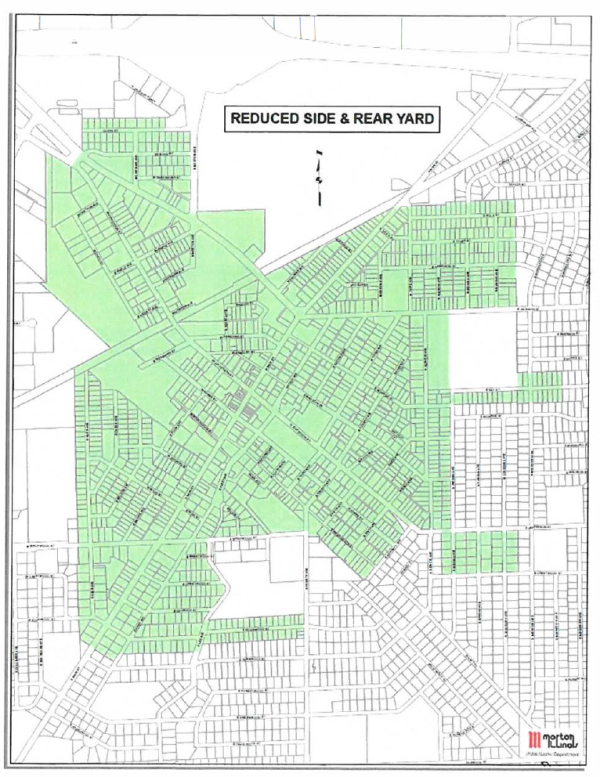
- Adjoining Lots Of Record Under Single Ownership: When two (2) or more lots of record at the date of adoption of this Title, lacking the required area and dimension for a permitted use are contiguous and in single ownership, they shall be combined to the extent necessary to meet the zoning requirements for that district.
- Buildings Under Construction Or Approved For Construction; Status Of Buildings On Previously Approved Plats: Buildings lawfully under construction or approved for such construction prior to the adoption of this Title shall not be required to modify or change the approved plans providing that such construction is completed within one year from the date of passage of this Title. Building will be allowed to proceed on lots within plats having Village Board approval prior to the adoption of this Title, even though lacking the required area and dimensions, providing only that such construction is completed within five (5) years of the date of passage of this Title. (Ord. 78-31, 3-5-79)
10-4-5: Buildings, Required Street, And Lot Relationships
- Buildings To Have Access To Public Streets: Except for private street planned developments and access easements as included on the approved plat, or as otherwise specifically provided for in this Title, every building shall be constructed upon a lot or parcel abutting a public street. (Ord. 78-31, 3-5-79)
- Buildings On Zoning Lot: Except for planned developments, multifamily residential, multi-building institutional, commercial and industrial uses, and two (2) duplexes as provided in 10-5-4-B-3, every principal building erected or structurally altered shall be on a zoning lot, and in no case shall there be more than one (1) principal building per zoning lot. (Ord. 78-31, 3-5-79; amd. Ord. 83-15, 8-1-83; amd. Ord. 02-12, 7-1-02)
- All towers or other structures that can or will accommodate a personal wireless service facility as defined in Title 13 Chapter 1, shall not be considered buildings for purposes of general height requirements. All such towers or structures shall be regulated pursuant to Title 13 Chapter 1 of this Code. Any height limitations shall be determined pursuant to the provisions in that Chapter. (amd. Ord. 00-52, 3-5-01)
10-4-6: Site Plan Review
- Uses For Which Site Plan Review Is Required: In order to minimize adverse effects of any proposed development upon existing uses, to clarify the concept of a proposed development when seeking local building and zoning approvals, and to better conserve and enhance the visual environment of the Village, the following types of proposed uses or developments shall not be permitted without administrative site plan review and approval by the DPW.
- All R-3 and R-4 residential, commercial, or industrial uses indicated as “permitted use” in the district in which located, and mobile home districts. (amd. Ord. 05-46, 3-6-06)
- Any special use for any zoning category. (Ord. 78-31, 3-5-79)
- Any property except that located in a district zoned R-1 (single family) and R-2 (two-family) within an interstate corridor shall also be subject to the provisions of Title 10, Chapter 4, Section 7. (Ord. 94-31, 5-15-95)
- Any large scale developments shall also be subject to the provisions of Title 10, Chapter 4, Section 11. (amd. Ord. 02-26, 1-6-03)
- Any rezoning of property within the Old Morton District from the B-2 Zoning District to the B-3 Zoning District
- Site plans submitted for site plan review by the DPW shall include a hard paper copy, as well as a digital media copy in an ESRI Shapefile, or other computer readable format compatible with the Village of Morton mapping software, and shall be drawn to the following scales and include the following data: (amd. Ord. 05-46, 3-6-06)
- A scale of not smaller than one inch equals fifty feet (1” = 50’) for areas of fifteen (15) acres or less or where the longest dimension does not exceed eight hundred feet (800’); for all larger projects, one inch equals one hundred feet (1” = 100’), plan to show date, north point, and scale.
- Property lines of the subject and abutting properties.
- Location of existing and proposed structures, drives, and parking areas on the subject property and existing structures within one hundred feet (100’) of the subject property.
- Location, right-of-way width, and street width of abutting streets and alleys.
- Landscaping and screening
- All landscape plans shall fully meet the following performance standards in order to receive approval from the Zoning Officer:
- Landscaping shall not hinder the vision of motorists and pedestrians necessary for safe movement into, out of, and within the site.
- Landscaping materials shall be selected and placed in such a manner so as not to interfere with or damage existing utilities.
- Landscaping materials shall be selected and placed so as not to inhibit the safe and enjoyable use of surrounding properties.
- Landscaping shall be selected and placed with a sensitivity toward the ultimate size to be achieved over time through growth of vegetation.
- Landscaping with thorns, berries, and other unsuitable characteristics shall be carefully placed to avoid potential harm to people or property on- and off-site.
- Weak wooded trees shall be used only where other species are not available.
- The amount of landscaping required shall be calculated by the point system hereinafter described. The requirements for any zoning lot shall be the total of all front yards. In calculating any requirement, a fraction of one-half (0.5) or greater shall be rounded up to the next whole number.
The following point allocations shall apply for all required landscaping:At the time of planting, shade trees and intermediate trees shall have a caliper size of not less than two inches (2”). Evergreen trees shall be a minimum of five feet (5’) in height and evergreen shrubs shall be a minimum of two feet (2’) in height at the time of planting. (amd. Ord. 05-44, 2-6-06)Tree Classification Base Value Shade Tree 15 points Evergreen Tree 15 points Intermediate Tree 10 points Shrub Classification Base Value Evergreen Shrubs 2 points Deciduous Shrubs 1 point - All developed zoning lots, other than those located within R-1 and R-2 zoning districts, shall have front yard landscaping installed, as provided for in this subsection. All yards, such as those on corner lots or irregularly shaped lots, which are adjacent to any street, road, or interstate highway, shall meet the landscaping requirements for front yards.
- The number of points required for landscaping of front yards shall be based on the overall lot frontage, as measured along the property line, divided by two (2). For example, if the front yard lot frontage is two hundred twenty feet (220’) in length, then the landscaping must generate one hundred ten (110) points.
- Not less than fifty percent (50%) of the points required for landscaping of front yards shall be achieved by utilizing plants from tree classification.
- Front yard landscaping shall be planted in the required front yard. If there is an additional area between the required front yard and the closest on-site parking lot or building, all or some of the required landscaping may be planted within such additional area upon approval by the Zoning Officer.
- Screening requirements in accordance with Section 10-4-3-H of this Title shall meet the size requirements set forth in this section. The screening requirements shall be greater than landscaping requirements so as to achieve the desired visual barrier, as approved by the Zoning Officer.
- Any landscaping materials required in this section which may, for any reason, die or fail to thrive shall be replaced with other landscaping materials having an equal or greater point value and similar characteristics as soon as good horticultural practice permits, though not to exceed six (6) months.
- Landscaping shall be completed within one (1) year of the issue date of the building permit. If landscaping is not completed within the required time frame, then the procedure outlined in Section 4-1-7 of this Code shall be applied. (amd. Ord. 00-51, 3-19-01)
- All landscape plans shall fully meet the following performance standards in order to receive approval from the Zoning Officer:
- Names and addresses of the architect, engineer, landscape architect, planner, or designer responsible for the site plan.
- Location of utilities, existing and proposed, on the subject property and within one hundred feet (100’) of the subject property.
- Location of existing storm water drainage conduits and ditches on the subject property and within one hundred feet (100’) of the subject property.
- For the purposes of this section, decorative masonry shall consist of the following: brick, natural/native stone, split-faced block, ground-faced block, fluted block, glazed block, concrete mortarless veneer siding systems, exterior insulation and finish systems (EIFS), exposed aggregate concrete wall panels, pre-cast concrete wall panels that have been painted or stained, glass block, and simulated stone. Neither simulated panelized sheeting mechanically attached to the structure, nor painted and/or scored block, shall be considered decorative masonry.
The following materials are acceptable as decorative finishes for exterior walls that front a street or highway: glass, prefinished steel or aluminum, decorative masonry finishes, and wood (cedar, redwood, or cypress). In addition to these materials, all other building walls may be of concrete block, prefabricated exterior materials, and other similar materials, excluding non-coated galvanized siding.
In commercially zoned areas and the interstate corridor, there shall be a minimum percentage of decorative masonry and/or decorative finish required for exterior walls, as follows:On all other projects requiring site plan review, there shall be thirty five percent (35%) of brick stone work or decorative masonry on the portion of the building fronting a street or highway.Street frontage, or any elevation with public access or facing a public parking lot A minimum of fifty percent (50%) decorative masonry with the remainder to be a decorative finish Side or rear abutting an interstate A minimum of fifty percent (50%) decorative masonry, which must run the length of the building to a minimum of three feet (3') from grade level up Side or rear adjacent to a residential area A minimum of fifty percent (50%) decorative finish Side or rear not fronting a street or abutting a residential area No requirements
The Board of Trustees may alter or waive the requirements subject to the following: suitable landscaping and an alternative material of decorative wood which is stained or painted. In allowing an altering or waiving of the requirements, the Board of Trustees may impose such additional conditions as it may deem appropriate.
The Board of Trustees may alter or waive the requirements for additions to existing buildings that at the time of the addition do not have the required brick stone work or decorative masonry or any building that is being remodeled, and may impose such conditions as it may deem appropriate in granting such waiver.
Notwithstanding the foregoing provisions, there shall be no requirement for brick stone work or decorative masonry for a metal-clad and station-type cubical switchgear, which includes equipment for the control and protection of apparatus used for power generation, conversion, and transmission and distribution. (amd. Ord. 04-03, 5-3-04; amd. Ord. 09-34, 12-21-09; amd. Ord. 13-34, 4-7-14) - Storm water detention plans and calculations.
- Erosion control plans.
- EPA water and sewer permit applications, as required. (amd. Ord. 05-46, 3-6-06)
- Review Of Site Plan: In reviewing site plans, the DPW shall consider:
- Location of drives, ingress and egress points to public streets, and installation of sidewalks.
- Traffic circulation and location of building, parking, loading, and storage areas within the site to ensure that use of the site creates minimum adverse effects on bounding streets and properties.
- Less attractive or possible nuisance uses to be accommodated on the site which might require landscape screening or fencing. The DPW may require relocation of such uses to areas of the site where they will have less adverse visual or nuisance impact on surrounding properties and bounding roads.
- Connection to Village utilities, storm water detention, and drainage.
- Wall Length: Buildings should not exceed one hundred (100) lineal feet of wall length without providing architectural relief in the facade. Architectural relief as used herein shall mean using arcades, cornices, eaves, focal points, and offsets in elevation.
- Director of Public Works’ Action; Applicant’s Petition To Village Board: Following the review, the DPW shall, by action, approve or disapprove the issuance of a zoning permit and shall notify the applicant and Zoning Enforcing Officer of his actions including, if disapproved, the reasons for disapproval. If approved, the Zoning Enforcing Officer shall issue the necessary permits providing the proposed structure or use is otherwise in compliance with regulations of the Village.
If the DPW disapproves the project or approves the project with conditions to which the applicant is not agreeable, the applicant may petition the Village Board for review of the project. The Village Board may concur or reverse the action of the DPW by a simple majority vote but shall take no action without receiving a written report from the DPW of the findings and action unless such report is not received within forty five (45) days of his action on the matter.
Site plans upon which issuance of zoning permits have been based after site plan review shall be filed in the office of the Zoning Enforcing Officer. Substantial variance from that site plan without concurrence of the DPW in carrying forth the proposed project shall be deemed to be a violation of this Title, subject to the penalties prescribed herein. (Ord. 78-31, 3-5-79; amd. Ord. 79-42, 4-7-80; amd. Ord. 94-4, 5-2-94; amd. Ord. 98-31, 12-21-98; amd. Ord. 00-35, 10-16-00; amd. Ord. 00-46, 12-18-00; amd. Ord. 02-34, 3-17-03; amd. Ord. 03-31, 11-17-03; amd. Ord. 03-39, 1-19-04)
10-4-7: Site Plan Review For Interstate Corridor
- Purpose: This Section provides for additional requirements for all development within an interstate corridor, (except for areas zoned R-1 or R-2). The requirements in this Section are in addition to the requirements in Title 10, Chapter 4, Section 6, and any other parts of Title 10 that might apply, and where there is any conflict between the two (2) sections, the more restrictive provisions shall apply.
- Required Lot Size: The minimum lot size shall be forty three thousand five hundred sixty (43,560) square feet [one (1) acre] with a minimum frontage width (meaning width at the building setback line) of one hundred seventy five feet (175’).
- Required Yard Areas: Every building hereafter erected or structurally enlarged shall provide the following yard requirements:
- Front Yard: The front yard shall be at least equal to the building height, and in no case shall be less than forty five feet (45’), with a landscaped front yard of no less than thirty five feet (35’).
- Side Yard: The side yard shall be not less than fifteen feet (15’). Where the side yard abuts the Interstate, it shall be forty five feet (45’), with a landscaped side yard of no less than twenty five feet (25’).
- Rear Yards: The rear yard shall not be less than twenty feet (20’). Where the rear yard abuts the Interstate, it shall be forty five feet (45’), with a landscaped rear yard of no less than twenty five feet (25’).
- Driveways And Parking Areas: Driveways and parking areas shall not be closer than ten feet (10’) from the side and rear property lines. Driveways connecting adjacent lots are permissible subject to site plan review.
- Building Height: No building shall be erected or enlarged to exceed a height of thirty five feet (35’), except for those general exceptions to height limitations listed in Title 10, Chapter 4, Section 3. Buildings in excess of the aforesaid height may be permitted a special use, subject to the public hearing and other special permit requirements as outlined in Chapter 10 of this Title.
- Required Off-Street Parking And Loading: Required off-street parking and loading shall be provided as outlined in Chapter 8 of this Title.
- Signs: The provisions of Title 10, Chapter 9, pertaining to sign regulations, shall apply to all signs that are located within an interstate corridor.
- Application Of Provisions: The provisions of Subsection (B) set forth above shall apply to any parcel located wholly or partially within an interstate corridor. The provisions of Subsections (C) through (F), inclusive, set forth above, shall apply to any buildings or structures located wholly or partially within an interstate corridor.
- Existing Structures Or Unimproved Land: Notwithstanding the other provisions of this section, the following provisions apply to structures or unimproved land which existed at the time of the adoption of this Section:
- If the structure was conforming at the time it was built, then it may be expanded, provided that such expansion continues along the same building line, meaning that there would be no further encroachment into the setback requirements.
- If, when a structure was built, it encroached into the required setback area (meaning a variance was granted or it was otherwise nonconforming) then such structure may be expanded, with no greater encroachment, only if a variance is obtained pursuant to the provisions of Title 10, Chapter 10, Subsection 2(C).
- If, at the time of the adoption of this Section, there existed a lot of record of less than one (1) acre within an interstate corridor, then no structures can be erected without obtaining a variance pursuant to the provisions of Title 10, Chapter 10, Subsection 2(C). Variances for signs or building setbacks shall be the only permitted variances. (Ord. 94-31, 5-15-95)
10-4-8: Existing Buildings In Interstate Corridors
All buildings located within an interstate corridor at the date of adoption of Title 10, Chapter 4, Section 7 are nonconforming buildings, (if the building is located within a setback area as defined by this Chapter) and all of the provisions of Title 10, Chapter 4 shall apply to them. Variances may be applied for in conformity with the applicable provisions of Title 10, Chapter 10. (Ord. 94-31, 5-15-95)
10-4-9: Special Variance Procedure For Property In Interstate Corridor
- In the event an owner desires a variance from any of the regulations pertaining to property in an interstate corridor, and the variance is for a matter which is not specified in Title 10, Chapter 10, Subsection 2(C)4 as now in effect or as may be amended by proposed Ordinance 94-32, then such owner may request that the Board of Trustees grant a variance. All applications shall be made in the same form, shall require the same fee, and provide public notice all in the same manner as a variance request that would be heard by the Zoning Board of Appeals. (amd. Ord. 17-04, 6-5-17; amd. Ord. 17-27, 12-4-17)
- It shall take the affirmative vote of five (5) members of the appropriate authorities to grant such variance. (The President may provide a fifth vote if necessary.)
- The provisions of Subsection 10-10-2(C) of this Code shall apply to the consideration of any variance request. (Ord. 94-31, 5-15-95)
10-4-10: Planned Commercial Developments
- Purpose: The purpose of this Section is to allow ownership of business premises while otherwise maintaining all zoning provisions of the applicable zoning district.
- Covenants and Easements: The plan of development shall include covenants, easements, and other provisions as are necessary to the orderly development of the property.
- Application: The planned commercial development shall be reviewed by the plan director. It shall also be subject to site plan review, as provided in Title 10, Chapter 4, Section 6.
- Application of Zoning: All other zoning Ordinances shall apply to the planned commercial development.
- Variances: No variances shall be granted for a planned commercial development.
- Plat: The owner of the property shall provide a plat in accordance with the provisions of the Condominium Property Act and shall provide three (3) copies of same to the plan director. (Ord. 99-49, 3-20-00)
10-4-11: Large Scale Development
- Purpose: This Section provides for additional requirements for all large scale development within any district zoned B-1, B-2, or B-3. The requirements in this Section are in addition to the requirements in Title 10, Chapter 4, Section 6, and any other parts of Title 10 that might apply, and where there is any conflict between the two (2) sections, the more restrictive provisions shall apply. Large scale development is defined as a building of eighty thousand (80,000) total square feet or more, whether one (1) story or more than one (1) story.
- Wall Length: Buildings should not exceed one hundred (100) lineal feet of wall length without providing architectural relief in the facade. Architectural relief, as used herein, shall mean using arcades, cornices, eaves, focal points, or offsets in elevation on the three (3) sides provided for in Sub-paragraph C.
- Bricks and Stone: Buildings will provide thirty five percent (35%) brick or stone, on a minimum of three (3) sides, as defined in Section 10-4-6-B-9. If Quik Brik is used it must cover one hundred percent (100%) of all sides of the building.
- Set Backs: Buildings, drives, and parking area pavements must maintain side and rear setbacks as required by the regulations of the particular zoning district, but in no event shall they be less than fifteen feet (15’).
- Landscaping: The following landscaping provisions shall apply:
- The provisions of Section 10-4-6-B-5 shall apply to all landscaping requirements.
- On the perimeter of the property (the setback area), landscaping shall be provided on three (3) sides.
- Landscaping on the interior portion of the lot (being all the lot except the setback area) shall be subject to the following:
- Provide one hundred and forty (140) points of landscape material for each acre of developed property.
- Not less than fifteen percent (15%) of the developed property shall be landscaped area. A landscaped area is a pervious surface of grass or mulch, and shall not include areas used for stormwater detention. Mulch area shall not be larger than necessary to protect trees, shrubs, and flowerbeds. A pervious surface is not paved or covered by a structure.
- Provide one hundred and forty (140) points of landscape material for each acre of developed property.
- The minimum width of a curbed island on the interior shall be ten feet (10’), and the minimum size shall be one hundred (100) square feet.
Parking lot islands shall be curbed with concrete or a functionally equivalent material that must be approved by the Zoning Administrator. The following materials are not considered functionally equivalent to concrete curbs and are therefore unacceptable for use as curbs within the Village of Morton:- Landscaping timbers
- Railroad ties
- Wood/lumber
- Concrete wheel stops
- Ninety-eight percent (98%) of all parking spaces shall be within seventy-five feet (75’) of a shade tree trunk.
- All trees must have a clear trunk of at least six feet (6’) above the finished grade to allow vehicular circulation beneath the tree canopy.
- All shrubs shall be of a variety that when fully grown will not exceed three feet (3’) in height.
- Variances Expressly Prohibited: There shall be no variances from any of the provisions of this section. (Ord. 02-26, 1-6-03; amd. Ord. 03-31, 11-17-03)
10-4-12: Wind Energy Conversion System (WECS)
- All WECS that receive a special use shall be subject to all of the provisions of this Section.
- In addition to the information required for any special use permit, the application shall include the following:
- Evidence that the proposed tower height does not exceed the height recommended by the manufacturer or distributor of the system.
- A line drawing of the electrical components of the system in sufficient detail to allow for a determination that the manner of installation conforms to the Electric Code.
- Sufficient information demonstrating the system will be used primarily to reduce on-site consumption of electricity.
- Written evidence that the electric utility service provider that serves the proposed site has been informed of the applicant’s intent to install an interconnected customer-owned electricity generator, unless the applicant does not plan, and so states in the application, to connect the system to the electricity grid.
- A visual analysis of the WECS as installed, which may include a computerized photographic simulation, demonstrating the visual impacts from nearby strategic vantage points. The visual analysis shall also indicate the color treatment of the system’s components and any visual screening incorporated into the project intended to lessen the system’s visual prominence.
- All WECS shall adhere to the following standards:
- No habitable structure shall be within 1.1 times the height of any tower used in the WECS from the property line where the WECS is located. (amd. Ord. 09-40, 2-1-10)
- The system’s tower and blades shall be painted a non-reflective, unobtrusive color that blends the system and its components into the surrounding landscape to the greatest extent possible and incorporates non-reflective surfaces to minimize any visual disruption.
- The system shall be designed and located in such a manner to minimize adverse visual impacts from public viewing areas (e.g. public parks, roads, trails).
- Exterior lighting on any structure associated with the system shall not be allowed except that which is specifically required by the Federal Aviation Administration.
- All on-site electrical wires associated with the system shall be installed underground except for connections to a public utility company and public utility company transmission poles, towers, and lines. This standard may be modified by the Village Board if the project terrain is determined to be unsuitable due to reasons of excessive grading, ecological impacts, or similar factors.
- The system shall be operated such that no disruptive electromagnetic interference is caused, nor can there be any interference to radio reception or television reception on any property. If it has been demonstrated that a system is causing harmful interference, the system operator shall promptly mitigate the harmful interference or cease operation of the system.
- At least one (1) sign shall be posted on the tower at a height of five feet (5’) warning of electrical shock or high voltage and harm from revolving machinery. No brand names, logo, or advertising shall be placed or painted on the tower, rotor, generator, or tail vane where it would be visible from the ground, except the system or tower’s manufacturer’s logo may be displayed on a system generator housing in an unobtrusive manner.
- Towers shall be constructed to provide one of the following means of access control, or other appropriate method of access:
- Tower-climbing apparatus located no closer than twelve feet (12’) from the ground.
- A locked anti-climb device installed on the tower.
- A locked, protective fence at least six feet (6’) in height enclosing the tower.
- Anchor points for any guy wires for a system tower shall be located within the property the system is located on and not on or across any above-ground electric transmission or distribution lines. The point of attachment for the guy wires shall be enclosed by a fence six feet (6’) high or sheathed in bright orange or yellow covering from three to eight feet (3 to 8’) above the ground.
- Construction of on-site access roadways shall be minimized. Temporary access roads utilized for initial installation shall be regraded and re-vegetated to the pre-existing natural condition upon completion of installation, and before the WECS is put into operation.
- To prevent harmful wind turbulence from existing structures, the minimum height of the lowest part of any horizontal axis wind turbine blade shall be at least thirty feet (30’) above the highest structure or tree within a two hundred fifty foot (250’) radius. Modification of this standard may be made when the applicant demonstrates a lower height will not jeopardize the safety of the wind turbine structure.
- All small wind energy system tower structures shall be designed and constructed to be in compliance with pertinent provisions of the International Building Code and National Electric Code.
- All small wind energy systems shall be equipped with manual and automatic over-speed controls. The conformance of the rotor and over-speed control design and fabrication shall meet good engineering practices and be certified by the manufacturer.
- Noise levels shall be regulated by the Illinois Pollution Control Agency rules and regulations, and the applicant shall certify that applicant’s facility is in compliance with the same.
- The general height limitations for a zoning district shall not apply to any WECS.
- When a system reaches the end of its useful life and can no longer function, the owner of the system shall remove the system within one hundred twenty (120) days of the day on which the system last functioned. The owner is solely responsible for removal of the system and all costs, financial or otherwise, of system removal. The owner shall mean the owner of the property upon which the WECS is located.
- All WECS shall be maintained in good and operable condition. A WECS that is not functional shall be repaired by the owner or removed. In the event the Village becomes aware of any system that is not operated for a continuous period of three (3) months, the Village will notify the landowner by registered mail and provide forty-five (45) days for a written response. The written response shall include reasons for the operational difficulty, the corrective actions to be performed, and a reasonable timetable for completing the corrective actions. If the Village deems the corrective actions and/or the timetable for completing corrective actions as unfeasible and/or unreasonable, the Village shall notify the landowner and such landowner shall remove the turbine within one hundred twenty (120) days of receiving said notice.
- All WECS shall meet all applicable state and federal safety standards and, where applicable, all federal aviation requirements.
- The Village shall require a certification, by a professional engineer qualified to give such certification, stating the WECS complies with all provisions of this ordinance and all applicable state and federal laws. The owner of the property upon which the WECS is located shall pay an annual fee of fifty dollars ($50.00).
- In addition to general conditions that apply to any special use request, the following shall also be applied and considered:
- The height of the system relative to the size of the parcel on which the system is proposed to be located;
- The need for the proposed height of the system in order to allow the system to operate effectively;
- The visual impact of the system on adjacent properties and the general area in which the system is proposed to be located;
- The building density of the general area in which the system is proposed to be located;
- Whether a substantial adverse effect on public safety will result from the height of the system or some other aspect of the system’s design or proposed construction, but only if that aspect of design or construction is modifiable by the applicant.
- The existing uses on adjacent and nearby properties. (Ord. 07-04, 5-7-07)
10-4-13: Dumpsters
Dumpsters may be used as follows:
- There shall be no more than one (1) on the property.
- The storage capacity shall not exceed thirty (30) cubic yards.
- The dumpster shall be located as close as practical to the structure and shall not be put on the street or on any right-of-way.
- If the dumpster is being used while the occupant is in the process of moving, it shall not be on the property for more than thirty (30) consecutive days or thirty (30) days in a calendar year.
- If the dumpster is being used in conjunction with the construction, alteration, or renovation of a principle structure, it shall be removed immediately upon completion of the construction, alteration, or renovation. (Ord. 07-41, 10-1-07; amd. Ord. 14-11, 7-7-14)
10-4-14: Portable Storage Units
- There shall be no more than one (1) portable outdoor storage unit on a property. Stacking of portable outdoor storage units on top of each other is not permissible.
- The property on which the portable storage unit is located must also have a principal building.
- No portable outdoor storage unit shall remain on the property for more than thirty (30) consecutive days or more than a total of thirty (30) days in any calendar year.
- Portable outdoor storage units shall not exceed one hundred twenty eight (128) square feet in size.
- Portable outdoor storage units shall be placed only on a hard surface.
- Portable outdoor storage units shall not be placed in any location that obstructs traffic visibility.
- No permit or permit fee shall be required for any portable outdoor storage unit.
- Portable outdoor storage units shall be maintained in good condition, free from rust, peeling paint, and other forms of visible decay. (Ord. 07-41, 10-1-07)
10-4-15: Shelters/Tents
Shelters and tents are permitted if they are not to be used to store or shelter motor vehicles, boats, or any other personal property. (Ord. 07-41, 10-1-07)
10-4-16: Solar Energy Systems
- Purpose: The purpose of this ordinance is to facilitate the construction, installation, and operation of Solar Energy Systems (SES) in the Village of Morton in a manner that promotes economic development and ensures the protection of health, safety, and welfare while also avoiding adverse impacts to important areas such as agricultural lands, endangered species habitats, conservation lands, and other sensitive lands. It is the intent of this ordinance to encourage the development of SESs that reduce reliance on foreign and out-of-state energy resources, bolster local economic development and job creation. This ordinance is not intended to abridge safety, health or environmental requirements contained in other applicable codes, standards, or ordinances. The provisions of this ordinance shall not be deemed to nullify any provisions of local, state or federal law.
- Definitions:
- BUILDING INTEGRATED PHOTOVOLTAIC SYSTEMS: A solar energy system that consists of integrating photovoltaic modules into the building structure as the roof or façade and which does not alter the relief of the roof.
- COLLECTIVE SOLAR: Solar installations owned collectively through subdivision homeowner associations, college student groups, or other similar arrangements.
- COMMERCIAL/LARGE SCALE SOLAR FARM: A utility scale commercial facility that converts sunlight to electricity, whether by photovoltaics, concentrating solar thermal devices, or various experimental technologies for onsite or offsite use with the primary purpose of selling wholesale or retail generated electricity.
- COMMUNITY SOLAR GARDEN: A community solar-electric (photovoltaic) array, of no more than 5 acres in size, that provides retail electric power (or financial proxy for retail power) to multiple households or businesses residing in or located off-site from the location of the solar energy system.
- GROUND MOUNT SOLAR ENERGY SYSTEM: A solar energy system that is directly installed into the ground and is not attached or affixed to an existing structure.
- NET METERING: A billing arrangement that allows solar customers to get credit for excess electricity that they generate and deliver back to the grid so that they only pay for their net electricity usage at the end of the month.
- PHOTOVOLTAIC SYSTEM: A solar energy system that produces electricity by the use of semiconductor devices calls photovoltaic cells that generate electricity whenever light strikes them.
- QUALIFIED SOLAR INSTALLER: A trained and qualified electrical professional who has the skills and knowledge related to the construction and operation of solar electrical equipment and installations and has received safety training on the hazards involved.
- ROOF MOUNT: A solar energy system in which solar panels are mounted on top of a building roof as either a flush mounted system or as modules fixed to frames which can be tilted toward the south at an optical angle.
- SOLAR ACCESS: Unobstructed access to direct sunlight on a lot or building through the entire year, including access across adjacent parcel air rights, for the purpose of capturing direct sunlight to operate a solar energy system.
- SOLAR COLLECTOR: A device, structure or part of a device or structure for which the primary purpose is to transform solar radiant energy into thermal, mechanical, chemical or electrical energy.
- SOLAR ENERGY: Radiant energy received from the sun that can be collected in the form of heat or light by a solar collector.
- SOLAR ENERGY SYSTEM (SES): The components and subsystems required to convert solar energy into electric or thermal energy suitable for use. The area of the system includes all the land inside the perimeter of the system, which extends to any fencing. The term applies, but is not limited to, solar photovoltaic systems, solar thermal systems and solar hot water systems.
- SOLAR STORAGE BATTERY/UNIT: A component of a solar energy device that is used to store solar generated electricity or heat for later use.
- SOLAR THERMAL SYSTEMS: Solar thermal systems directly heat water or other liquid using sunlight. The heated liquid is used for such purposes as space heating and cooling, domestic hot water and heating pool water.
- Permitted Ground Mount and Roof Mount SES: Ground Mount SES shall be permitted as an accessory use in all zoning districts where there is a principal structure. Roof Mount SES shall be permitted in all zoning districts and may be located on a principal or an accessory structure. A building permit shall be required to construct a ground mount or roof mount SES. The following additional information shall be provided with the building permit application to demonstrate compliance with the following restrictions:
- Height:
- Building or roof mounted solar energy systems shall not exceed the maximum allowed height for principal structures in any zoning district.
- Ground or pole-mounted solar energy systems shall not exceed the maximum permitted height for an accessory structure when oriented at maximum tilt.
- Ground mounted solar energy systems may not be placed in the front yard.
- Setbacks:
- Ground mounted solar energy systems shall meet the applicable setbacks for the zoning district in which the unit is located.
- Ground mounted solar energy systems shall not extend beyond the side yard or rear yard setback when oriented at minimum design tilt.
- In addition to building setbacks the collector surface and mounting devises for roof mounted systems shall not extend beyond the exterior perimeter of the building on which the systems is mounted or built, unless the collector or mounting system has been engineered to safely extend beyond the edge, and setback requirements are not violated. Exterior piping for solar thermal systems shall be allowed to extend beyond the perimeter of the building on a side yard exposure.
- Reflection Angles: Reflection angles for solar collectors shall be oriented such that they do not project glare onto adjacent properties.
- Visibility: Solar energy systems shall be located in a manner to reasonably minimize view blockage for surrounding properties and shading of property to the North while still providing adequate solar access for collectors.
- Safety:
- Roof or building mounted solar energy systems, excluding building integrated systems, shall allow for adequate roof access for firefighting purposes to the south facing or flat roof upon which the panels are mounted.
- Roof or building mounted solar energy systems shall meet the requirements of the Morton Municipal Code regarding building regulations.
- Plans bearing the seal of a state licensed structural engineer shall be required for all roof mounted solar energy systems.
- Any connection to the public utility grid shall be inspected by the appropriate public utility.
- All solar energy systems shall be maintained and kept in good working order. If it is determined that a solar energy system is not being maintained, kept in good working order, or is no longer being utilized to perform its intended use for 6 consecutive months, the property owner shall be given 30-day notice for removal or repair of the unit and all equipment. It shall be a violation of this ordinance if the solar energy system is not removed or repaired within thirty (30) days.
- Approved Solar Components: Electric Solar energy system components shall have a UL listing or approved equivalent and solar hot water systems shall have an SRCC rating.
- Restrictions on Solar Energy Systems Limited: Consistent with 765 ILCS 165/1 et seq. no homeowner’s agreement, covenant, common interest community or other contracts between multiple property owners within a subdivision of incorporated Village of Morton shall prohibit or restrict homeowners from installing solar energy systems.
- Height:
- Building Integrated Systems. Building Integrated Photovoltaic Systems shall be permitted in all Zoning Districts.
- Community Solar Gardens (SES). Development of Community Solar Gardens is permitted by Special Use as a principal use in all zoning districts subject to the following requirements:
- Rooftop Gardens Permitted: Rooftop gardens are a special use in all zoning districts where buildings are permitted.
- Ground Mount Gardens: Ground mount community solar energy systems must be less than five (5) acres in total size, and require a Special Use in all districts. Ground-mount solar developments covering more than five (5) acres shall be considered a solar farm.
- Interconnection: An interconnection agreement must be completed with the electric utility in whose service the territory the system is located.
- Dimensional Standards: All solar garden related structures in newly platted and existing platted subdivisions shall comply with the applicable setback, height, and coverage limitations for the district in which the system is located.
- Other Standards:
- Ground Mount Systems shall comply with all required standards for structures in the district in which the system is located.
- All solar gardens shall comply with Article 10 Chapter 10 procedures regarding special use permits.
- All solar gardens shall also comply with all other State and Local requirements.
- Commercial/Large Scale Solar Farm (SES): Ground Mount solar energy systems that are the primary use of the lot, designed for providing energy to off-site uses or export to the wholesale market require a Special Use, and shall be permitted with such special use only in the I-2 Districts. The following information shall also be submitted as part of the application and/or the following restrictions shall apply:
- A site plan with existing conditions showing the following:
- Existing property lines and property lines extending one hundred feet from the exterior boundaries including the names of adjacent property owners and the current use of those properties.
- Existing public and private roads, showing widths of the road and any associated easements.
- Location and size of any abandoned wells or sewage treatment systems.
- Existing buildings and impervious surfaces.
- A contour map showing topography at two (2) foot intervals. A contour map of surrounding properties may also be required.
- Existing vegetation (list type and percent of coverage: i.e. cropland/plowed fields, grassland, wooded areas, etc.).
- Any delineated wetland boundaries.
- A copy of the current FEMA FIRM maps that shows the subject property including the one-hundred-year floor elevation and any regulated flood protection elevation, if available.
- Surface water drainage patterns.
- The location of any subsurface drainage tiles.
- A Site Plan of proposed conditions showing the following:
- Location and spacing of the solar panels.
- Location of access roads.
- Location of underground or overhead electric lines connecting the solar farm to a building, substation or other electric load.
- New electrical equipment other than at the existing building or substation that is to be the connection point for the solar farm.
- Fencing and Weed/Grass Control:
- The applicant shall submit an acceptable weed/grass control plan for property inside and outside the fenced area for the entire property. The Operating Company or Successor during the operation of the Solar Farm shall adhere to the weed/grass control plan.
- Perimeter fencing having a maximum height of eight (8) feet shall be installed around the boundary of the solar farm. The fence shall contain appropriate warning signage that is posted such that it is clearly visible on the site.
- The applicant shall maintain the fence and adhere to the weed/grass control plan. If the Operating Company does not adhere to the proposed plan a fine of $500 per week will be assessed until the Operating Company or Successor complies with the weed/grass control and fencing requirements.
- Manufacturer's Specifications: The manufacturer’s specifications and recommended installation methods for all major equipment, including solar panels, mounting systems and foundations for poles and racks.
- Connection and Interconnection:
- A description of the method of connecting the SOLAR array to a building or substation.
- Utility interconnection details and a copy of written notification to the utility company requesting the proposed interconnection.
- Setbacks: A minimum of fifty (50) feet must be maintained on all property lines. Solar panels shall be kept at least two hundred fifty (250) feet from a residence that is not part the Special Use permit.
- Fire Protection: A fire protection plan for the construction and the operation of the facility, and emergency access to the site.
- Endangered Species and Wetlands: Solar Farm developers shall be required to initiate a natural resource review consultation with the Illinois Department of Natural Resources (IDNR) through the Department’s online EcoCat Program. Areas reviewed through this process will be endangered species and wetlands. The cost of the EcoCat consultation shall be borne by the developer.
- Road Use Agreements: All routes on Village Roads that will be used for the construction and maintenance purposes shall be identified on the site plan. All routes for either egress or ingress need to be shown. The routing shall be approved subject to the approval of the Village of Morton. The Solar Farm Developer shall complete and provide a preconstruction baseline survey to determine existing road conditions for assessing potential future damage due to development related traffic. The development shall provide a road repair plan to ameliorate any and all damage, installation or replacement of roads that might be required by the Village or the Developer. The developer shall provide a letter of credit or surety bond in an amount and form approved by Village officials when warranted.
- Decommissioning of the Solar Farm: The Developer shall provide a decommissioning plan for the anticipated service life of the facility or in the event the facility is abandoned or had reached its life expectancy. If the solar farm is out of service or not producing electrical energy for a period of twelve (12) months, it will be deemed nonoperational and decommissioning and removal of that facility will need to commence according to the decommissioning plan as provided and approved. A cost estimate for the decommissioning of the facility shall be prepared by a professional engineer or contractor who has expertise in the removal of the solar farm. The decommissioning cost estimate shall explicitly detail the cost before considering any projected salvage value of the out of service solar farm. The decommissioning cost shall be made by a cash, surety bond or irrevocable letter of credit before construction commences. Further a restoration plan shall be provided for the site with the application. The decommissioning plan shall have the following provided:
- Removal of the following within six (6) months:
- All solar collectors and components, aboveground improvements and outside storage.
- Foundations, pads and underground electrical wires ad reclaim site to a depth of four (4) feet below the surface of the ground.
- Hazardous material from the property and dispose in accordance with Federal and State law.
- The decommissioning plan shall also recite an agreement between the applicant and the Village that:
- The financial resources for decommissioning shall be in the form of a Surety Bond, or shall be deposited in an escrow account with an escrow agent acceptable to the Zoning Enforcement Officer.
- A written escrow agreement will be prepared, establishing upon what conditions the funds will be disbursed.
- The Village shall have access to the escrow account funds for the expressed purpose of completing decommissioning if decommissioning is not completed by the applicant within six (6) months of the end of project life or facility abandonment.
- The Village is granted the right of entry onto the site, pursuant to reasonable notice, to effect or complete decommissioning.
- The Village is granted the right to seek injunctive relief to effect or complete decommissioning, as well as the Village's right to seek reimbursement from applicant or applicant successor for decommissioning costs in excess of the amount deposited in escrow and to file a lien against any real estate owned by applicant or applicant's successor, or in which they have an interest, for the amount of the excess, and to take all steps allowed by law to enforce said lien.
- Removal of the following within six (6) months:
- A site plan with existing conditions showing the following:
- Compliance with Building Code. All solar energy systems shall comply with the ordinances of the Village of Morton as well as all Federal and State requirements.
- Liability Insurance. The owner operator of the solar farm shall maintain a current general liability policy covering bodily injury and property damage and name the Village of Morton as an additional insured with limits of at least two million dollars ($2,000,000.00) per occurrence and five million ($5,000,000.00) in the aggregate with a deductible of no more than five thousand dollars ($5,000.00).
- Administration and Enforcement. The Zoning Enforcement Officer shall enforce the provisions of this section through an inspection of the solar farm every year. The Zoning Enforcement Officer is hereby granted the power and authority to enter upon the premises of the solar farm at any time by coordinating a reasonable time with the operator/owner of the facility. Any person, firm or cooperation who violates, disobeys, omits, neglects, refuses to comply with, or resists enforcement of any of the provisions of this section may face fines of not less than twenty-five dollars ($25.00) nor more than seven hundred fifty dollars ($750.00) for each offense.
(Ord. 17-38, 2-5-18)

