
Mount Clemens City Zoning Code
ARTICLE 10
OFF-STREET PARKING & LOADING REQUIREMENTS
SEC. 10.1 - INTENT
The off-street parking and loading requirements of this Ordinance are established to prevent congestion on public streets by providing clearly defined parking areas that are separated from roadways; to remove the hazard to pedestrians of emerging between parked vehicles onto a public street; to facilitate proper storm-water runoff; to prevent the generation of dust; and to ensure safe, on-site circulation for pedestrians and automobiles.
(ord. eff. April 24, 2021)
SEC. 10.2 - GENERAL PARKING REQUIREMENTS
It shall be the duty of both the owner and occupant of any premises to provide off-street parking areas as required in this Article. Such off-street parking areas shall be laid out, constructed and maintained in accordance with the following standards and regulations:
1.
Whenever a use or an activity requiring off-street parking is created, enlarged or increased in activity or intensity, off-street parking spaces shall be provided on site and maintained as required by this Ordinance.
2.
The amount of required off-street parking for new uses of buildings, additions to existing buildings, new uses of land and accessory buildings shall be determined in accordance with the regulations in effect at the time the new use or addition is proposed, and the space so required shall be shown on the site plan and shall be irrevocably reserved for such use.
3.
Off-street parking existing at the effective date of this Ordinance in conjunction with the operation of an existing building or use shall not be reduced to an amount less than hereinafter required for a similar new building or new use.
4.
Nothing in this Section shall be construed to prevent the collective provisions of off-street parking areas for two or more buildings or uses. Such collective parking may be reduced by up to fifteen (15) percent of the required minimum number of spaces for the various uses computed separately, provided that a parking study is presented to the Planning Commission which substantiates the requested reduction.
5.
Where the owners of two (2) buildings, whose peak operating hours do not overlap, desire to utilize common off-street parking areas, the Planning Commission may permit such dual function provided that the following conditions have been met:
a.
The peak business hours of the two (2) buildings or uses do not overlap. The applicant requesting shared parking shall demonstrate to the Planning Commission that the amount of parking required for each individual site may be accommodated for in the future. In the event that there is a change of uses that no longer meets the criteria established for shared parking, the required number of spaces as provided in Section 10.3 shall be installed.
b.
The common parking area meets the off-street parking requirements of the larger building or more intensive use.
c.
The common parking area meets all of the locational requirements of this Ordinance with respect to each building or use.
6.
Off-street parking areas required herein shall be located within three hundred (300') feet of the permitted use it is intended to serve, such distance to be measured along lines of public access to the property between the nearest point of the parking area and the building to be served, provided that the said off-street parking area shall not be separated from the building to be served by any major or secondary thoroughfare, drain or physical barrier, or public improvement.
7.
Required off-street parking may not be enclosed with a gate that would permit it to be closed to either employees or patrons.
8.
When units or measurements determining the number of required parking spaces result in the requirement of a fractional space, any fraction shall require one (1) parking space.
9.
For the purpose of determining off-street parking requirements for all uses, floor area shall mean one hundred (100) percent of the gross floor area as measured from the interior of all exterior walls.
10.
Whenever drive-through or vehicle stacking lanes are provided, such lanes shall be located so as not to impede pedestrian or vehicular circulation on the site or on abutting sites, nor shall any drive-through lane cross a vehicle maneuvering lane or aisle or block any space used for parking.
(ord. eff. April 24, 2021)
SEC. 10.3 - OFF-STREET PARKING REQUIREMENTS
The minimum number of off-street parking spaces by type of use shall be determined in accordance with the following schedule. For those uses not specifically mentioned, the requirements for off-street parking facilities shall be in accord with a use which is most similar in type as determined by the Planning Commission.
A.
RESIDENTIAL.
1.
The off-street parking area required for single-family dwellings shall be located on the same lot or plot of ground of the building they are intended to serve and shall consist of a paved parking strip, parking apron, carport and/or garage on the basis of two (2) parking spaces for each dwelling unit. Parking shall be restricted to paved areas. The parking of recreation vehicles shall by regulated by all applicable ordinances within the City.
2.
Multiple-family residential dwellings shall have two (2) paved off-street parking spaces for each one-bedroom dwelling unit. Multiple-family dwelling units in the Central Business Zoning District shall be required .75 paved off-street parking spaces per each dwelling unit.
3.
Housing for the Elderly. Two (2) spaces for each three (3) dwelling units, and one (1) for each employee. Should the dwelling units revert to general occupancy, then two (2) spaces per unit shall be provided. The location of this reserved parking area shall be shown on the site plan at the time of the original approval.
4.
Manufactured Homes. Two (2) spaces per unit, plus one (1) space for every three (3) manufactured home sites for visitor parking. Visitor parking shall be located within three hundred (300') feet of the manufactured home sites they are intended to serve.
5.
Community Buildings (Multiple-Family and Manufactured Housing Community). One (1) space for each four (4) persons allowed within the maximum occupancy load, as determined by the Fire Department.
In Multiple-Family Residential Districts and Manufactured Housing Communities where recreation vehicles are permitted, a secured storage area for such vehicles shall be provided and buffered from adjacent uses. Such parking shall be collective and in a central location. In no case, however, shall a recreation vehicle be parked or stored closer than thirty (30') feet to any building or site boundary line. No unlicensed motor vehicle of any type shall be parked within the development at any time, except within a covered building or the enclosed storage area. In the Manufactured Housing Community District, no motorized recreation vehicles or boats shall be parked on individual home sites. All group off-street parking lots shall be adequately lighted during hours of darkness with no more than one-half (1/2) foot candle of illumination. Storage of commercial vehicles or trailers on the premises is prohibited.
B.
INSTITUTIONAL.
C.
RECREATIONAL.
D.
OFFICES.
E.
AUTO-RELATED USES.
F.
COMMERCIAL.
G.
INDUSTRIAL.
H.
Maximum Number of Parking Spaces Permitted.
1.
In no circumstance shall any use provide a number of surface parking spaces which exceeds the required minimum amount defined in Section 10.3 by more than ten (10%) percent, unless otherwise stated in this Ordinance.
I.
PARKING Requirements for the Central Business District.
1.
Intent. It is the intent of this Section of the Ordinance to minimize the amount of privately owned surface parking areas in the Central Business Zoning District. The City of Mount Clemens shall provide primary parking areas to service the Central Business District, concentrated in publicly owned lots and/or structures. By limiting on-site surface parking the City aims to achieve the following goals:
a.
Preserve an environment that is unique to the City of Mount Clemens and Macomb County by preventing the future development of scattered, random areas of surface parking that break up the continuity of the built environment in the Central Business District.
b.
Preserve the high density character that defines downtown Mount Clemens by minimizing the space reserved for parking, thus allowing sites to be developed at a greater intensity.
c.
Preserve the aesthetic and environmental appeal of downtown Mount Clemens by limiting the amount of impervious surface dedicated to surface parking.
d.
Create a downtown environment that minimizes pedestrian conflicts with the automobile. By regulating the location and number of off-street parking areas, the potential for conflict is greatly reduced.
e.
Enhance the visual quality of downtown, while preserving and/or enhancing each individual property's economic value.
f.
Maintain the character of the downtown district by allowing structures, not pavement, to define its space.
2.
CBD STANDARDS.
a.
Property zoned CB, Central Business, shall not be required to provide an off-street parking area, with the exception of residential uses, which shall meet the requirements of Section 10.3A2.
b.
Privately owned off-street parking shall not be permitted in the Central Business Zoning District except where one of the following requirements can be met:
i.
The property owner is providing an off-street parking area through the construction of a parking structure meeting the requirements of Section 10.5.
ii.
The off-street parking area is located at the rear of the site and does not exceed 4,500 square feet or 20% of the gross site area, whichever is less.
J.
Mixed-Use District Reduction Standards
The required parking in Section 10.3 may be reduced in the Mixed-Use District according to the following standards:
1.
Shared Parking: The parking requirement may be satisfied through shared parking with an adjacent use. All uses must be located within 300 feet of the shared parking with a copy of an executed easement that provides for continued use and maintenance of the parking is filed with the County Register of Deeds and a copy is submitted to the City. Where uses with different peak hour parking demands, such as a restaurant and office share the same parking lot, the total cumulative parking requirement for all uses may reduce by up to 50%.
2.
Mixed-Use: In a mixed-use project, parking may be shared by the different uses. A mixed-use project composed of residential and retail uses may reduce the total vehicle parking up to 30 percent of the total required parking. A mixed-use project composed of residential and office or institutional uses may reduce the total vehicle parking up to 40 percent of the total required parking. A mixed-use project composed of office or institutional uses and retail uses may reduce the total vehicle parking up to 20 percent of the total required parking. The reduction in parking for mixed-use development may be below the noted percentage by may not exceed. The Zoning Administrator or his/her designee, shall determine the reduction by taking into consideration the proposed land use, peak parking usage periods, and Institute of Transportation Engineers (ITE) parking generation rates manual.
3.
On-street Parking: Public on-street parking that is located along the developments frontage shall be counted towards the number of spaces required for the commercial component, but not for the residential component, within the development.
4.
Reductions: The parking requirement may be reduced where the applicant can demonstrate, based on supporting documentation provided by the applicant, the parking need for that particular use is less than required by this Ordinance or valet service to a satellite parking lot will be provided.
(ord. eff. April 24, 2021)
SEC. 10.4 - OFF-STREET PARKING DESIGN
Wherever the requirements in Section 10.3 require the construction of an off-street parking area, such off-street parking area shall be laid out, constructed and maintained in accordance with the following standards and regulations:
1.
No parking lot shall be constructed unless and until a permit therefore is issued by the Community Development Department. Applications for a permit shall be submitted as per the requirements of Site Plan Review (Article 3).
2.
All parking serving other than single-family dwellings shall be side-by-side or parallel. Tandem parking shall be prohibited, except where a multiple-family unit has its own separate two-car garage, their separate approach apron can be used for visitor parking. Tandem parking to a depth of three (3) cars may be permitted in vehicle storage and inventory areas provided such areas are under the control of employees and are not accessible by the general public. Any parking or vehicle circulation areas accessible to the public shall meet the size standards specified in this Section.
3.
Except as otherwise provided in this Article, required off-street parking space shall be for the use of occupants, employees, visitors, customers, clients and patrons. Off-street parking areas shall not be used for other than parking purposes or allowed to become unusable, except for temporary repairs. The storage of vehicles or merchandise in any off-street parking space is prohibited, except as permitted in conjunction with the approved principal or accessory use. Further, no repairs or service to vehicles and no display of vehicles for the purpose of sale shall be carried on or permitted upon any off-street parking area, except as permitted in conjunction with the approved principal or accessory use.
4.
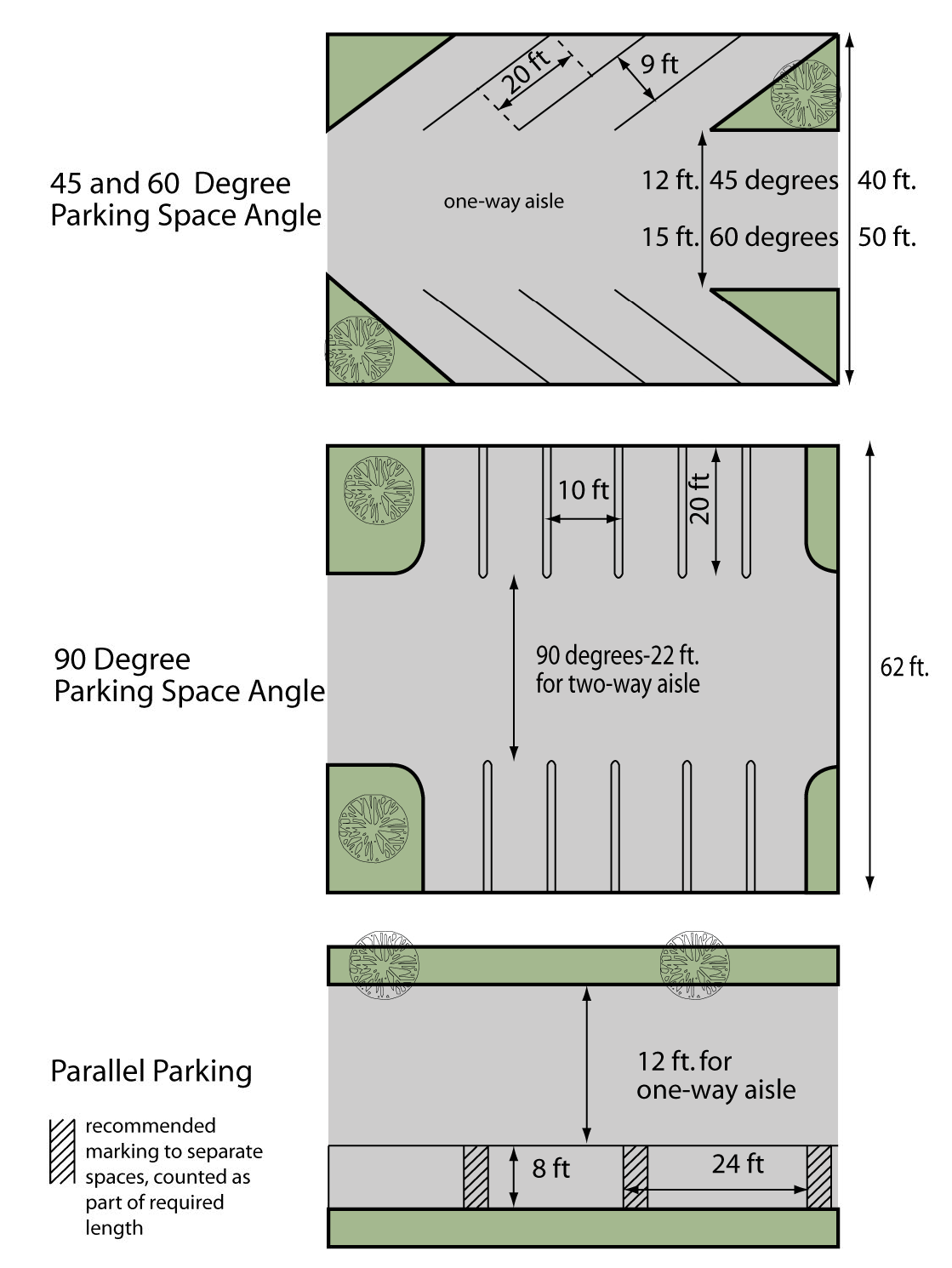
Dimensions. Plans for the layout of an off-street parking area shall have dimensions consistent with the following standards:
a.
All other two-way drives or maneuvering lanes not indicated above shall have a minimum width of twenty-two (22') feet. One-way drives shall have a minimum width of ten (10') feet. All proposed maneuvering lanes less than twenty-two (22') feet in width are subject to approval by the City of Mount Clemens Fire Department.
b.
Parking spaces to accommodate vehicles with trailers (boats and recreational vehicles) shall be at least ten (10') feet by forty (40') feet.
c.
All parking area stalls shall be striped and maintained.
d.
In any area where front-end parking abuts a curbed area or a raised sidewalk, a two (2') foot vehicle overhang shall be required.
e.
In any area where a row of front-end parking abuts a curbed lawn area at least two (2) feet in width or a raised sidewalk having a minimum width of at least five (5) feet, the minimum parking stall depth may be reduced by up to two (2) feet in depth in order to allow for a vehicle to overhang such area or such sidewalk. In no case shall the parking stall depth be decreased to allow a vehicle to overhang a required parking setback or property line.
5.
Drainage. Site drainage and water detention/retention in a proposed parking area shall be approved by the City of Mount Clemens Engineer. On-site stormwater filtration through the provision of rain gardens and bioswales is encouraged.
6.
ADA Accessibility. Barrier Free parking spaces shall be furnished as required by State and Federal law.
7.
Pavement. The entire parking area, including parking spaces, maneuvering lanes and drives required under this Section, shall be provided with asphaltic or concrete surfacing in accordance with the City of Mount Clemens Engineering Standards or a permeable pavement alternative as approved by the City Engineer. The parking area shall be surfaced prior to the issuance of the certificate of occupancy for the building or buildings which it serves.
8.
Landscaping. Curbed, landscaped islands shall be placed at the ends of parking space groupings to separate parking spaces from maneuvering aisles and provide for safe traffic flow.
a.
All off-street parking areas shall incorporate and provide curbed tree planting spaces to be laid out square and constructed to provide not less than one hundred and twenty-six (126) square feet of land area for each tree planting. These curbed islands shall be planted with sod (landscape rock, gravel, or other similar material is prohibited).
b.
All landscaped areas shall be protected by a six (6) inch standard or rolled concrete curb, except where landscape islands are being utilized as part of a stormwater detention or conveyance system.
c.
Curbed, landscaped islands shall be placed at the ends of all parking space groupings to separate the parking spaces from the maneuvering lanes and to provide for safe traffic flow. These planting areas shall not be less than seven (7') feet in width.
d.
Trees shall be planted throughout the parking area. Trees shall be a minimum of three (3") inches caliper at the time of planting and shall be provided at a ratio of one (1) tree for each six (6) parking spaces or fraction thereof. These trees shall not be counted towards street frontage tree requirements. The following trees or similar types are suitable for parking lot and urban conditions:
i.
White Fir (only when clear vision is maintained)
ii.
Norway Maple
iii.
Tulip Tree
iv.
Ginkgo Tree (male only)
v.
Red Oak.
9.
Lighting. Parking lot lighting shall meet the requirements of Section 9.6.
10.
Maintenance. The surface of the parking lot area, shall be maintained and kept free from weeds, rubbish, refuse and debris.
11.
Ingress/Egress. Adequate ingress and egress to the parking area by means of clearly limited and defined paved drives shall be provided for all vehicles.
a.
All parking areas shall be provided with an entrance and exit from the abutting public thoroughfare. Such entrance and exit may be combined as one, which shall be thirty (30') feet in width.
b.
Each site shall be limited to one access drive per road frontage that the property abuts subject to the provisions of Section 4.15B.
c.
Ingress and egress to a parking lot for non-residential purposes shall not be provided across land zoned for single-family residential purposes. All such entrances and exits shall also be located at least ten (10') feet from any property zoned for single-family residential use.
12.
Cross Access. The Planning Commission may require an access easement to provide for vehicular access to existing or contemplated adjacent parking areas to minimize the need for driveways to each facility and thereby decreasing hazards to vehicular traffic. In such instances, a reciprocal use agreement shall be signed by each owner.
13.
Space Access. All parking spaces shall be provided with adequate access by means of maneuvering lanes. Spaces shall not be designed to permit or encourage vehicles from backing out of a space directly onto a street or alley, with the exception of single-family residential uses.
14.
Curbs. Reinforced concrete curbs, meeting the City of Mount Clemens Engineering Standards, and as approved by the City Engineer, shall be required. The use of bumper blocks is prohibited, except in such circumstances as determined by the Planning Commission where the site characteristics warrant their use.
15.
Location and Screening
a.
Location in Rear Yard. Parking areas shall be located in the rear yard of all uses, with the exception of single-family residential. Where the applicant can show that the placement of a parking area in the rear yard is not feasible due to unique characteristics of the site or the location of an existing structure, the Planning Commission may approve placement of a screened parking area in the side yard.
b.
Through Lots. Surface parking is not permitted directly between a building facade and a street frontage except on through lots' secondary frontages where any surface parking shall be screened.
c.
Setbacks. No parking area shall be located closer than five (5') feet to any property line. Single-family residential development shall not be required to meet this provision.
d.
Screening. In cases where parking or other vehicle circulation areas are visible from a public street, a three (3) foot tall brick wall shall be installed between the parking/vehicle circulation area and the sidewalk. Alternatives can be considered by the approving body such as a hedge row with trees, wrought iron fencing with brick pilasters, or a combination of these improvements. The hedgerow shall consist of evergreen shrubs planted four (4) feet on center to create a solid row of shrubs.
e.
Adjacent to single-family residential. Where a parking lot or loading area for a nonresidential use adjoins a single-family residential district or use, a minimum six (6) foot tall wall shall be provided between the parking lot and residential lot.
i.
Walls shall be constructed of brick or other masonry material compatible with the front facade of the principal building as determined by the City. Poured concrete with false brick design or plain concrete slag blocks are not permitted.
ii.
The City may approve a privacy fence where it is more compatible with adjacent residential uses.
16.
Noise. The use of any outdoor noise-producing device or public address system that is deemed a nuisance to neighboring properties shall be prohibited.
SEC. 10.5 - PARKING STRUCTURE DEVELOPMENT STANDARDS
It is intended that the provision of parking within structures or buildings shall serve to increase the value and convenience of related development and to enhance, rather than detract from, the appearance of the overall development. It is further intended that the provision of such facilities shall not negatively impact the safety and security of the public. All parking structures shall observe the layout, construction and maintenance requirements of Section 10.5, plus the following additional standards:
1.
Parking structures shall be considered a permitted use in the following zoning districts: GC General Commercial, CB Central Business and I-2 Heavy Industrial. In all other zoning districts a parking structure shall require special land use approval (Article 13).
2.
Parking structures shall be physically integrated into the overall design and functioning of the site, as well as the surrounding area. The exterior treatment of the parking structure element of a building complex shall be substantially the same in appearance to that of the main building element, and shall further be designed so that all architectural and vehicular lighting is shielded or screened from view from adjacent properties.
3.
For storefront frontages, the ground floor shall have a minimum depth of 20 feet to be occupied by active uses as permitted in the district. Elsewhere and above the first story, parking structures are encouraged, but not required, to be lined on exterior elevations by non-parking uses.
4.
Access drives shall be permitted on the ground floor, provided they are collectively no more than 25% of the frontage.
5.
New parking structures shall be designed with an upper story minimum clear height of 9'.
6.
The development of parking structures shall be in accordance with safety and security requirements established by the City.
(ord. eff. April 24, 2021)
SEC. 10.6 - OFF-STREET LOADING AND UNLOADING
On the same premises with every building, structure, or part thereof, erected and occupied for manufacturing, storage, warehouse goods, a wholesale store, a market, a hotel, a hospital, a mortuary, or other uses similarly involving the receipt or distribution of vehicles, materials or merchandise, there shall be provided and maintained on the lot adequate space for standing, loading, and unloading services adjacent to the opening used for loading and unloading in order to avoid interference with public use of the streets and alleys. Such loading and unloading shall be provided in accordance with the following:
1.
All loading or unloading areas shall provide a minimum area of ten (10') feet by fifty (50') feet with a height clearance of fourteen (14') feet.
2.
Loading and unloading areas shall be so located and designed that the vehicles intended to use them can maneuver safely and conveniently to and from a public right-of-way and complete loading and unloading operations without obstructing or interfering with any public right-of-way or any parking space or parking lot maneuvering lane or aisle. When required, loading and unloading areas shall be designated and defined.
3.
No area allocated to loading and unloading facilities may be used to satisfy the area requirements for off-street parking, nor shall any portion of any off-street parking area be used to satisfy the area requirements for loading and unloading facilities, except as specifically authorized by this Ordinance.
4.
Unless otherwise specified, loading and unloading areas shall be provided only in rear yards. Side yard loading may be permitted by the Planning Commission when it is determined that such space and loading facilities would not interfere with parking and circulation, either vehicular or pedestrian, or with abutting uses.
5.
All loading and unloading areas shall be surfaced, drained, and otherwise developed in accordance with the provisions applicable to off-street parking areas (Section 10.5).
6.
Loading and unloading in the Central Business Zoning District shall be provided for on a case by case basis, as determined necessary by the Planning Commission.
7.
Overhead doors shall be considered as loading/unloading areas and shall not be placed on the front of the building.
(ord. eff. April 24, 2021)
SEC. 10.7 - ACCESS MANAGEMENT
A.
DRIVEWAYS FOR RESIDENTIAL USES.
1.
For any residential use, no driveway located in the front yard may exceed a width greater than thirty-three (33%) percent of the entire lot frontage or twenty (20') feet, whichever is less. Driveways entering from the rear or side yard shall not be subject to this requirement.
2.
For new construction, no new drive may be constructed at the front yard of any residential property if the property is currently accessible through the use of a public alleyway. Such alleyway shall continue to function as the primary access to the site.
3.
The new construction of horseshoe shaped driveways shall be prohibited.
B.
NON-RESIDENTIAL DRIVEWAYS.
1.
Non-residential driveways, entrances and exits shall be subject to approval by the Road Commission of Macomb County and the Michigan Department of Transportation, where applicable, and by the Planning Commission for applications requiring site plan review after considering the effects on surrounding property, pedestrian and vehicular traffic and the movement of emergency vehicles.
2.
All non-residential sites shall be permitted one (1) access drive onto the abutting public thoroughfare. Additional driveways may be permitted subject to special land use approval by the Planning Commission.
a.
The Planning Commission shall consider the request for special land use approval after a traffic study has been submitted by the applicant which substantiates the need for additional access drives.
b.
Tapers and bypass lanes shall be required, as determined by the Planning Commission. In making the determination as to whether or not additional access drives are necessary, the Planning Commission shall consider the location of driveways on adjacent sites and across the street, turning movements and traffic volumes.
c.
In the case of a corner lot or double frontage lot, the site shall be allowed the permitted number of driveways on each roadway frontage.
C.
GRATIOT AVENUE CORRIDOR OVERLAY ZONE.
1.
INTENT.
a.
The intent of the Gratiot Avenue Corridor Overlay Zone is to improve traffic operations; reduce potential for crashes; improve pedestrian and transit environments; and preserve the vehicular carrying capacity of Gratiot Avenue through regulations on the number, spacing, placement and design of access points (driveways and intersections). Published reports and recommendations by the Michigan Department of Transportation (MDOT) show a relationship between the number of access points and the number of crashes.
b.
Recognizing the existing built character and downtown land use characteristics in Mount Clemens relative to those of other communities along the Gratiot Avenue Corridor, this ordinance intends to apply the MDOT access management standards where practical, but to allow flexibility in their application, given the unique needs of this more urbanized area. The segment of Gratiot Avenue within Mount Clemens splits into north bound and south bound components referred to as "one-way pairs" which present unique traffic operations; therefore, this ordinance places less emphasis on the spacing and offsets of access from other driveways and greater emphasis on the design and placement of driveways relative to other nearby access and intersections, especially signalized intersections.
2.
APPLICABILITY. This overlay zone shall apply to all land with frontage along Gratiot Avenue, except for single-family homes, duplexes or essential service facility structures. The following applications must comply with the standards in this section.
a.
New or Enlarged Building or Structure. Any new principal building or structure, or the enlargement of any principal building or structure by more than 25%.
b.
Land Division, Subdivision or Site Condominium. Any land division or subdivision or site condominium development, including residential developments.
c.
Change in Use or Intensity of Use. Any intensity of use as defined in Section 13.1.C. (15.0130.C.), or any increase in vehicle trips generated.
3.
ACCESS MANAGEMENT STANDARDS. The following regulations of this Section shall be considered by the Planning Commission:
a.
Compliance with Corridor Plan. Access shall generally be provided as shown in the Gratiot Avenue Corridor Improvement Plan.
b.
Number of Driveways. The number of resulting driveways shall be the fewest necessary to provide reasonable access to the site. Each lot shall be permitted one driveway, which may consist of an individual driveway, a shared access with an adjacent use, or access via a service drive.
c.
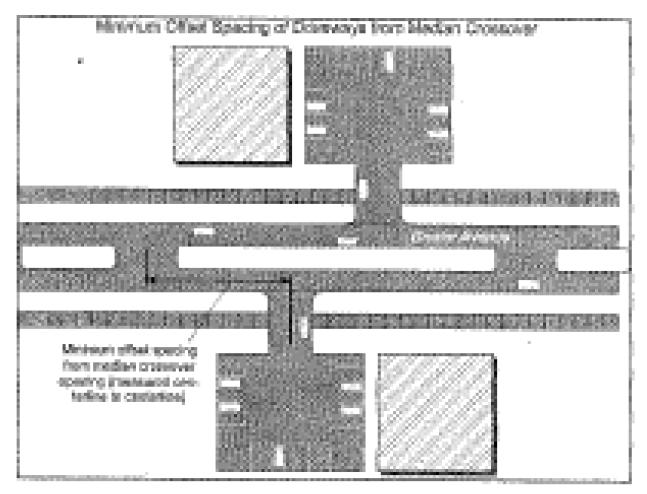
Offsets and Spacing from Intersections. Driveways shall be either directly aligned or spaced/offset as far from intersections as practical, especially signalized intersections. A minimum spacing or offset of 150 feet is preferred.
d.
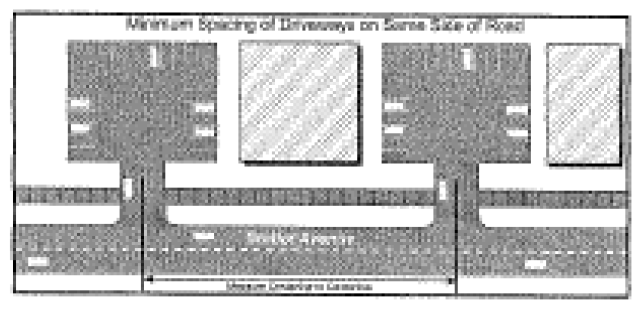
Spacing from Other Driveways on the Same Side of Gratiot. Driveways shall be spaced/offset as far as practical from other driveways along Gratiot. A minimum spacing of 150 feet is preferred.
e.
Offsets from Driveways on the Opposite Side of Gratiot. Driveways shall be either aligned with driveways on the opposite side of Gratiot or offset to the greatest distance practical. Consideration for weaving across travel lanes shall be given, especially where signalized intersections are present.
f.
Consideration of Adjacent Sites. Where the subject site adjoins land that may be developed or redeveloped in the future, the access shall be located to ensure the adjacent site(s) can also meet the access location standards in the future.
g.
Shared Driveways. Where direct access consistent with the above regulations cannot be achieved, access should be provided via a shared driveway or service drive.
h.
Access Design. Where practical given right-of-way constraints, driveways shall be designed with radii, tapers and other geometrics as determined by MDOT that are required to minimize the impacts of inbound right turns on traffic flow.
4.
REVIEW PROCEDURE. It is recognized that certain existing site conditions may prohibit full compliance with this Section. Modifications to the standards herein may be permitted by the Planning Commission according to the following procedure:
a.
Submittal Information. Along with any other required information, developments subject to review according to this Section shall submit:
i.
Detailed information showing nearby intersections; existing driveways on adjacent sites; proposed driveways; changes to existing access; and any information requested by the City necessary to review site access.
ii.
The Planning Commission may require submittal of a traffic impact report, prepared by a qualified traffic engineer, to verify the need for additional driveways or to justify a modification.
b.
Allowed Modifications. The Planning Commission may, after considering the criteria in #3 below, modify the standards of this Section in the following situations:
i.
The modification will allow an existing driveway to remain that does not meet the standards of this Section but that has, or is expected to have very low traffic volumes (less than 50 in- and out-bound trips per day) and is not expected to significantly impact safe traffic operations.
ii.
The use is expected to generate a relatively high number of trips and an additional driveway will improve overall traffic operations.
iii.
Practical difficulties exist on the site that make compliance unreasonable (sight distance limitations, existing development, topography, unique site configuration or shape), or existing off-site driveways make it impractical to fully comply with the standards.
iv.
Because of restricted turning movements or presence of a median that restricts turning movements, the driveway does not contribute to congestion or an unsafe situation.
c.
Modification Criteria. The Planning Commission may waive certain requirements of this Section upon consideration of the following:
i.
The proposed modification is consistent with the general intent of the standards of this overlay zone, the recommendations of the Gratiot Avenue Corridor Improvement Plan, and published MDOT guidelines.
ii.
MDOT staff endorse the proposed access design.
iii.
Driveway geometrics have been improved to the extent practical to reduce impacts on traffic flow.
iv.
Shared access has been provided, or the applicant has demonstrated it is not practical.
v.
Such modification is the minimum necessary to provide reasonable access, will not impair public safety or prevent the logical development or redevelopment of adjacent sites and is not simply for convenience of the development.
(ord. eff. April 24, 2021)
SEC. 10.8 - BICYCLE PARKING
A.
Intent. The intent of this section is to provide adequate and safe facilities for the temporary placement and use of bicycles. This section is intended to specify the required type, number, and location of bicycle parking spaces on a site. The regulations and requirements are designed to promote and encourage the safety and general welfare of the community by:
1.
Promoting an alternative and energy-efficient mode of transportation.
2.
Encouraging a healthy lifestyle by promoting and accommodating the use of bicycles.
3.
Providing adequate and safe facilities for the temporary placement of bicycles.
B.
Applicability.
1.
Bicycle parking shall be provided for any new building constructed after the effective date of this section. After the effective date of this section, bicycle parking shall also be provided on all sites when an addition to an existing building is constructed that results in the need for additional motor vehicle parking spaces or for any change in the use of a building that results in the need for additional motor vehicle parking spaces.
2.
This section does not prohibit the voluntary installation of bicycle parking that conforms to the requirements set forth in this section.
3.
Except as otherwise required, a bicycle parking area shall be treated in a similar manner as required motor vehicle parking area.
C.
Exceptions. Bicycle parking shall be required for all uses, with the exception of one- and two-family residential uses.
D.
Location.
1.
A bicycle parking area shall be located such that it is visible, safe, and convenient with adequate lighting provided.
2.
Bicycle parking areas shall be located to maximize accessibility to building entrances.
E.
Design criteria and dimensions. Bicycle parking racks and lockers are encouraged to be unique in design and appearance; however, the bicycle parking area shall be functional, operational, and shall provide for the following:
1.
A bicycle rack, bicycle locker, or functionally equivalent structures shall be used to secure a bicycle.
2.
Bicycle parking areas incorporating the standard inverted "U" shaped bicycle rack, or functionally equivalent structure, shall have the following dimensions:
a.
The minimum height of the bicycle rack shall be thirty-six (36) inches from the base to the top of the rack.
b.
The minimum length for the bicycle rack shall be two feet.
3.
A bicycle rack shall accommodate at least two bicycles.
4.
The exterior surface of bicycle racks and bicycle lockers shall be non-abrasive, non-marring, and durable.
5.
The bicycle parking area shall be constructed with adequate space to allow operation of the locking mechanism and each bicycle parking space shall be easily accessible. A bicycle parking area shall not interfere with any designated pedestrian sidewalk or pathway, required vehicle parking spaces or vehicle maneuvering lanes, and shall not eliminate any required landscape area.
6.
The bicycle parking rack shall be installed so that the rack supports the bicycle in an upright position and allows for the bicycle frame and front wheel to be securely locked.
7.
The bicycle parking area shall be hard surfaced with material such as asphalt, concrete, or a brick paving system and shall be adequately maintained and kept free of mud, dust, ice, and snow.
8.
The bicycle racks, bicycle lockers or functionally equivalent structures must be securely anchored.
9.
Up to one-half (1/2) of the required bicycle parking spaces on the site may be located inside of a building.
F.
Shared bicycle parking facilities. For sites containing multiple uses or tenants, a single bicycle parking area may be provided as long as the total number of bicycle parking spaces provided is not less than the sum of all of the separate uses combined.
1.
Bicycle parking requirements. Unless otherwise provided, one bicycle parking space shall be provided for every ten motor vehicle parking spaces required. The minimum number of bicycle parking spaces provided shall not be less than two. The maximum number of bicycle parking spaces shall not exceed fifty (50).
2.
Reduction of required motor vehicle parking spaces. The number of required motor vehicle parking spaces on a site may be reduced by one motor vehicle parking space for every two bicycle parking spaces installed on a site in compliance with this section. Motor vehicle parking spaces may not be reduced by more than ten (10) percent of the total number of required motor vehicle parking spaces.
G.
Waiver. An individual may submit a written request to the Community Development Director, or designee, for a waiver from the requirements of this section. The request shall state the reason(s) for the waiver and contain any other applicable information related to the waiver. In making a determination regarding a waiver the Community Development Director, or designee, may consider characteristics of the site including the type of use, site layout (accessibility, maneuverability, design, and other related elements), or unique circumstances.
(ord. eff. April 24, 2021)

