
Mount Clemens City Zoning Code
ARTICLE 4
RESIDENTIAL DISTRICTS
SEC. 4.1 - RESIDENTIAL USE TABLE
In the Residential Districts, land, buildings, and other structures shall be used only for one or more of the uses specified in the table below. Uses denoted by a "P" are permitted by right and uses denoted by a "SLU" are considered special land uses and may be approved by the Planning Commission subject to the applicable general and specific standards in Article 13: Special Land Uses. Additional applicable use standards are listed in the column at right.
Accessory commercial uses may be conducted in a manufactured housing community in separate, permanent structures and for such purposes as the office of the manager, laundry and dry cleaning facilities, or other services for the residents of the park. Accessory uses may also include clubhouses and recreational facilities. Adequate parking for such services shall be provided. All accessory uses shall require full site plan review and approval.
(ord. eff. April 24, 2021)
SEC. 4.2 - PROVISIONS APPLICABLE TO RESIDENTIAL DISTRICTS.
A.
ACCESSORY BUILDINGS IN THE RESIDENTIAL DISTRICTS shall be subject to the following regulations (also see City Building Code):
1.
The sum total floor area of all accessory buildings, whether attached or detached, shall not exceed 20% of the lot area, provided that in no instance shall the total ground floor area of all accessory buildings never be below 920 square feet.
2.
No more than two accessory buildings shall be allowed for each lot.
3.
The height of detached accessory buildings and sheds shall not exceed eighteen (18) feet in total height.
4.
When an accessory building is structurally attached to a main building, it shall conform to all regulations of this Ordinance applicable to the main building.
5.
A detached accessory building incidental to the main building shall not be located in a front yard. No accessory building shall be located closer than three (3') feet to any lot line. Accessory buildings shall be setback a minimum of five (5') feet from any lot line directly abutting an alley.
6.
No detached accessory building shall be located closer than ten (10) feet to any main building. No accessory building shall be constructed over or located within one (1') foot of a recorded easement.
7.
No accessory building shall be constructed prior to the enclosure of the main building.
8.
An accessory building, irrespective of location, shall be incidental to the principal permitted use and shall not involve any business, profession, trade or occupation.
9.
All accessory buildings, including sheds, shall have a foundation and/or ratwall.
B.
DWELLINGS PER LOT OR PARCEL. No more than one (1) single-family residential dwelling shall be permitted per lot or parcel, except as provided in subsection F. below.
C.
DWELLINGS WITHOUT BASEMENTS. Each one-family and two-family dwelling unit without a basement shall provide not less than an additional one hundred (100) square feet of floor area for utility rooms and/or storage space greater than the minimum floor area per dwelling unit.
D.
MEASURING MINIMUM FLOOR SPACE REQUIREMENTS. Minimum floor space requirements as established by the various provisions of this Ordinance for residential dwelling shall be measured from the exterior surface of enclosing walls and the centerline of common partition walls for each dwelling unit. Minimum floor area shall not include cellars or basements, attached garages or attics, unheated breezeways, porches or decks.
E.
RESIDENTIAL ENTRANCEWAY. In all residential districts, so-called entranceway structures, including, but not limited to, walls, columns and gates, marking entrances to single-family subdivisions may be permitted and may be located in a required setback, provided that such entranceway structures shall comply with all codes and ordinances of the City and be approved by the Planning Commission.
F.
SITE CONDOMINIUM SUBDIVISION. The intent of these requirements is to ensure that all site condominium subdivisions are developed in compliance with accepted planning and engineering standards applicable to similar forms of development, as reflected in the City's ordinances and requirements.
One-family detached condominiums may be allowed as a permitted use in any single-family zoning district, subject to site plan review by the Planning Commission. Commercial and industrial condominiums that result in condominium unit(s) shall also be regulated by this Section and the district in which they are located.
1.
Submission Requirements. All site condominium subdivision plans shall be submitted for review, as required by Article 3 of this Ordinance and Section 66 of the Condominium Act, and include the following additional information:
a.
A boundary survey of the site condominium subdivision site.
b.
A plan delineating all natural and man-made features on the site, including, but not limited to, drains, ponds, lakes, streams, floodplains, wetlands and woodland areas.
c.
The location, size, shape, area and width of all condominium units and common areas and the location of all proposed streets.
d.
A copy of the Master Deed and a copy of all restrictive covenants to be applied to the project. Such deeds shall include an acceptable means of converting the project to a platted subdivision, under the provisions of Act 288 of 1967, at some future date.
2.
Review Procedures. Pursuant to authority conferred by Section 141 of the Condominium Act, all site condominium subdivision plans shall require approval by the Planning Commission before units may be sold or site improvement initiated. In determining whether to approve a site condominium subdivision plan, the Planning Commission shall consult with the City Attorney, Planner and Engineer regarding the adequacy of the submission as it relates to the City of Mount Clemens Zoning Ordinance and requirements of the Condominium Act. The review process shall consist of the following two steps:
a.
Preliminary Plan Review. In the preliminary review phase, the Planning Commission shall review the overall plan for the site, including basic road and unit configurations and the consistency of the plans, with all applicable provisions of the City of Mount Clemens Zoning Ordinance. Plans submitted for preliminary review shall include information specified in items a. to c. of the Submission Requirements in subsection 1. above.
b.
Final Plan Review. Upon receipt of Preliminary Plan Approval, the applicant shall prepare the appropriate engineering plans and apply for Final Review by the Planning Commission. Final plans shall include information as required by the Submission Requirements in subsection 1. above. Such plans and information shall be reviewed by the City Attorney, Engineer and Planner. Further, such plans shall be submitted for review and comment to all applicable local, County and State agencies. Final approval shall not be granted until such time as all applicable review agencies have had an opportunity to comment on said plans.
3.
District Requirements. The development of all site condominium subdivisions shall observe the applicable yard setback and minimum floor area requirements of the zoning district within which the project is located. The density of development of the project shall be no greater and spacing no less than would be permitted if the property were a platted subdivision.
4.
Design Standards. All development in a site condominium subdivision shall conform to the design and improvement standards of the City of Mount Clemens Subdivision Regulations. All streets and roads shall be dedicated to the public, unless otherwise permitted by the Planning Commission as essential to the preservation of the overall character of the proposal. Street and road connections and/or stubs shall be required, where necessary to provide continuity to the public road system.
5.
In any of the foregoing referenced sections, the term "plat" shall be substituted with the term "site condominium subdivision plan"; the term "tentative preliminary plat approval" shall be substituted with the term "preliminary plan review"; the term "final preliminary plat approval" shall be substituted with the term "final plan review"; and the term "proprietor" shall be deemed to refer to the applicant pursuant to this Ordinance. Any applications, fees, procedures for review or hearing, as set forth in these ordinances and their other provisions, shall be fully complied with, except as provided herein.
6.
Utility Easements. The site condominium subdivision plan shall include all necessary easements granted to appropriate authority for the purpose of constructing, operating, inspecting, maintaining, repairing, altering, replacing and/or removing pipelines, mains, conduits and other installations of a similar character for the purpose of providing public utilities, including, but not limited to, the conveyance of sewage, water and stormwater run-off across, through and under the property, subject to said easement.
7.
Final Acceptance. The City shall also require all the appropriate inspections. After construction of the site condominium subdivision, an as-built reproducible mylar of the completed site improvements (excluding dwelling units) is to be submitted to the City for review by the City Engineer. A final certificate of occupancy and any construction bonds or letter of credit will not be released to the developer/owner until said as-built mylar has been reviewed and accepted by the City.
G.
OCCUPANCY OF PORTABLE UNITS. In no case shall a travel trailer, motor home, automobile chassis, tent or portable building be considered a dwelling. Mobile homes shall not be used as dwellings, except when located in, and as part of, a mobile home park; or when located in zoning districts set forth in this Ordinance. All travel trailers, motor homes and mobile homes parked or stored on lands not approved for such use as herein set forth shall not be occupied.
(ord. eff. April 24, 2021)
SEC. 4.3 - SINGLE-FAMILY RESIDENTIAL DISTRICTS, R1-A AND R1-B
A.
Intent. The Single-Family Residential Districts are established to provide principally for one-family dwellings at a scale consistent with existing residential development in the City. The specific interest of these districts is to encourage the continued use of single-family dwellings, prohibit land use which would substantially interfere with the development of one-family dwellings and to discourage any land use which, because of its character and size, would result in the depreciation of existing property values.
B.
DESIGN STANDARDS. In any single-family residential district, there shall be variation in the appearance of dwelling units using the following as minimum standards. The foregoing standards shall not apply to a manufactured home located in a licensed manufactured housing community, except to the extent required by State or Federal law or otherwise specifically required in the Zoning Ordinance of the City pertaining to such parks.
1.
The front elevation of single-family detached dwelling units shall not recur in the same or a substantially similar structural form on another dwelling within the same block frontage, without there being at least three (3) other dwellings with a different building elevation between the dwellings that repeat the front elevation. Different colors alone will not constitute different front elevations.
2.
Plans for modulars, prefabricated units and similarly constructed units shall be approved by the State of Michigan Construction Code Commission as meeting the State Construction Code (Public Act 230 of 1972 and Public Act 371 of 1980, as amended) prior to the issuance of a building or occupancy permit. Manufactured/mobile homes or trailers shall meet or exceed the requirements imposed by the United States Department of Housing and Urban Development Mobile Home Construction and Safety Standards (24 CFR 3280 and as, from time-to-time, such standards may be amended). The Planning Commission shall be furnished a certificate stating that such dwelling meets the minimum building code requirements applicable to such structure or shall include a seal attached to the unit. Any addition to such manufactured home must be designed and constructed by the manufacturer of such home or must be based upon an architectural plan deemed compatible with the overall design of the manufactured home and approved by the Planning Commission.
3.
All one-family dwelling units shall have a minimum width across any front, side or rear elevation of twenty-four (24') feet.
4.
All dwelling units shall be attached to a permanent foundation constructed on the site in accordance with the building code and shall have a wall of the same perimeter dimensions of the dwelling and additions thereto and constructed of such materials and type as required in the building code. In the event that the dwelling is a manufactured home, as defined herein, such dwelling shall also be installed pursuant to the manufacturer's set-up instructions and shall be secured to the premises by an anchoring system or device complying with the rules and regulations of the Michigan Mobile Home Commission and shall have a continuous perimeter wall, as required above.
5.
Single-family dwellings shall be aesthetically compatible in design and appearance with other residences in the vicinity. In making such determination of compatibility, the Planning Commission, while taking into consideration comments made by the Community Development Director and/or the Mount Clemens Historic Commission, may consider the following factors: total square footage; length-to-depth proportions; value and quality of construction; exterior building materials; architectural style and design and roof line; as well as the character, design and appearance of a majority of the residential dwellings (excluding manufactured housing communities) within two thousand (2,000) feet of the subject dwelling. The foregoing shall not be construed to prohibit innovative design concepts involving such matters as solar energy, view, unique land contour, or relief from the common or standard designed home.
6.
AREA, HEIGHT, BULK, AND PLACEMENT REGULATIONS.
(ord. eff. April 24, 2021)
SEC. 4.4 - RM-1—MIXED RESIDENTIAL DISTRICT
A.
Intent. The RM-1 district is intended for a mixture of housing types along corridors, adjacent to single-family detached neighborhoods, and near the downtown. Infill development consisting of urban-style attached residential units including townhouses, flats, and small apartment buildings should be designed to fit the context of the adjacent residential neighborhoods.
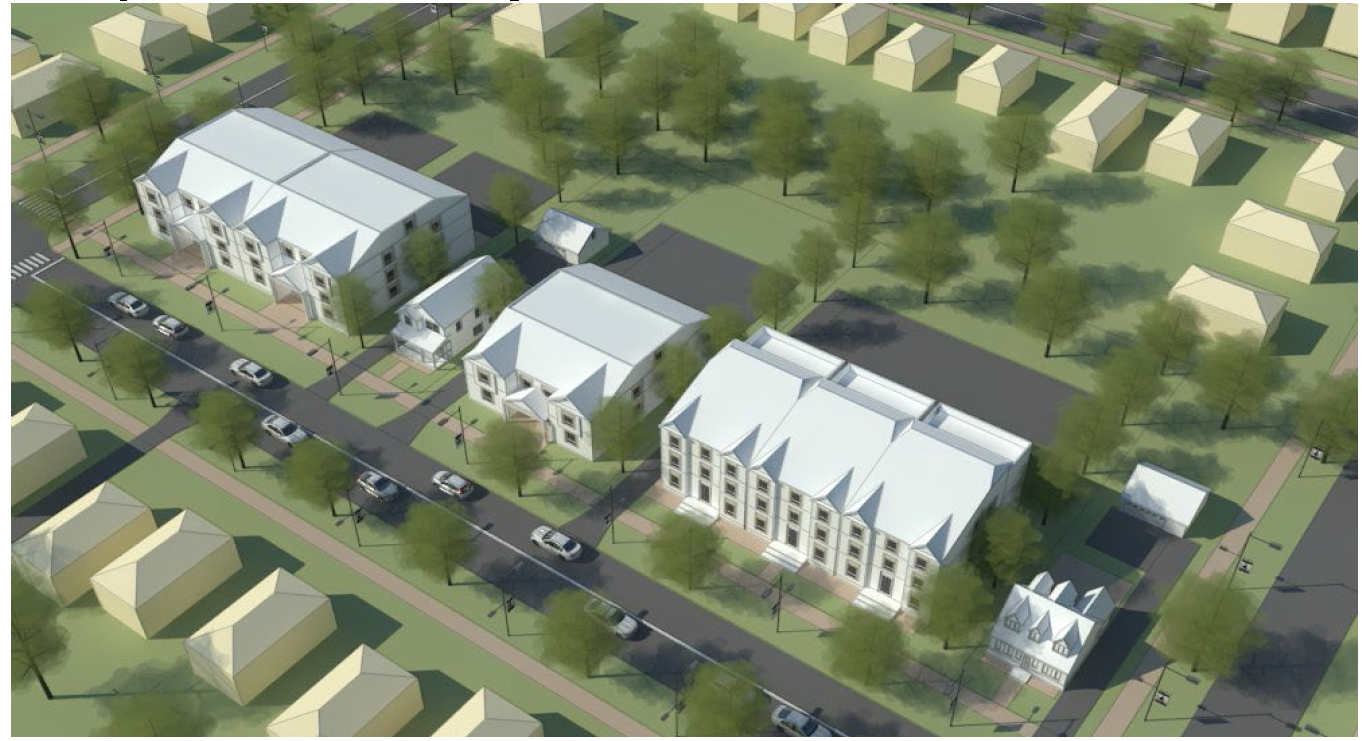
Illustrative example of the intent of this district.
B.
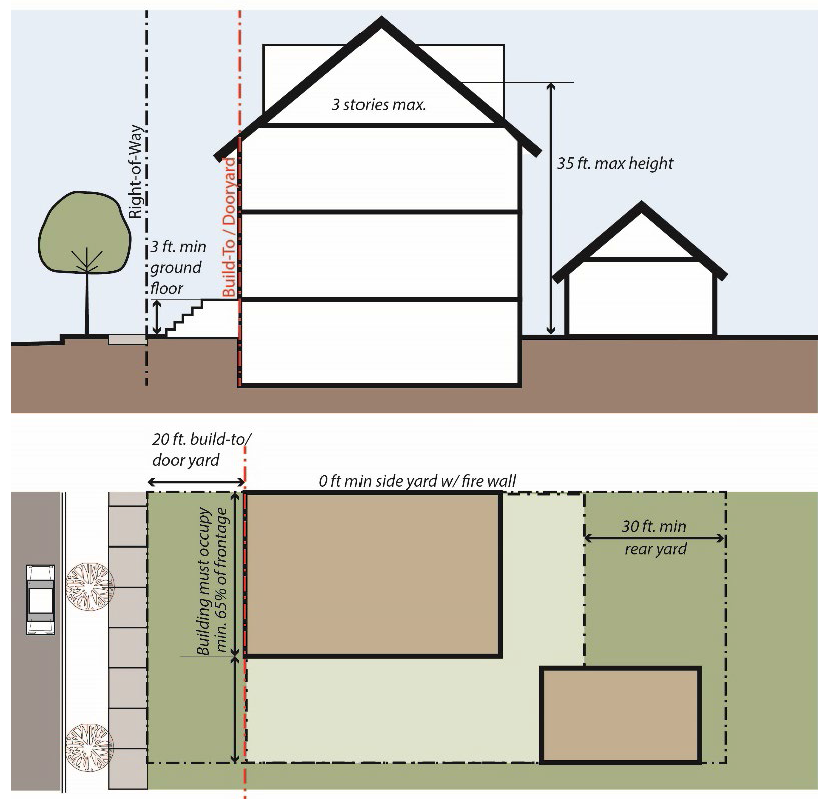
Siting and Building Requirements
(ord. eff. April 24, 2021)
SEC. 4.5 - RM-2—PLANNED MULTI-FAMILY CAMPUS DISTRICT
A.
Intent. The RM-2 district is intended for larger scale, planned multi-family development consisting of apartment buildings. RM-2 complexes should be designed with a campus-like character, providing shared open space, landscape buffering, and consistent site design features.
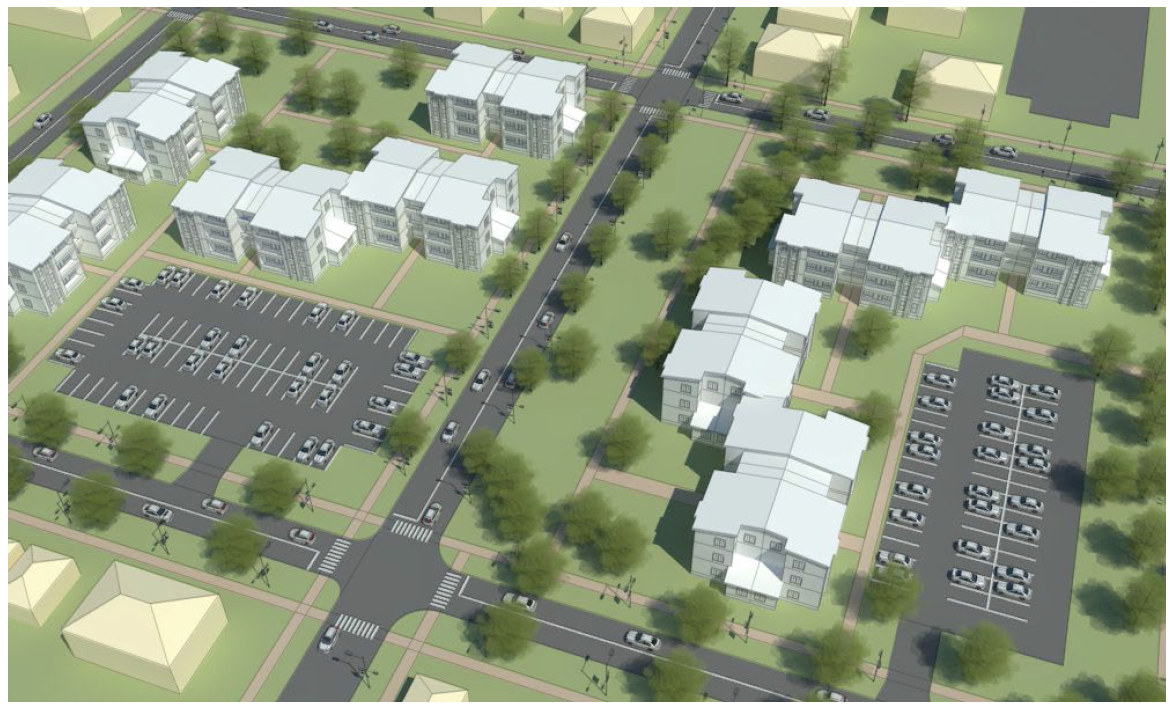
Illustrative example of the intent of this district.
B.
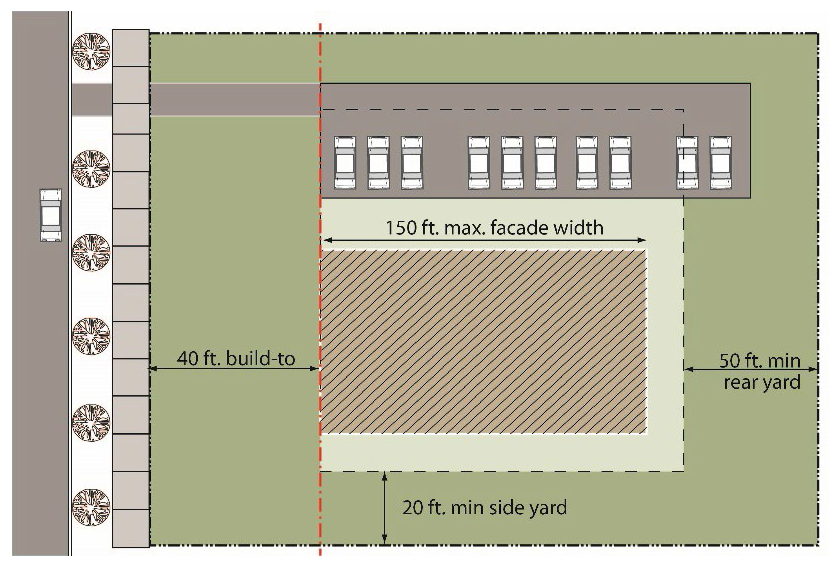
Siting and Building Requirements
(ord. eff. April 24, 2021)
SEC. 4.6 - RMH—MULTIPLE-FAMILY HIGH RISE DISTRICT
A.
Intent. The Multiple-Family High-Rise District is designed to provide sites adjacent to high traffic generators commonly found in the proximity of large acreage non-residential development and areas abutting major thoroughfares. This district is further designed to provide a zone of transition between traffic generators and residential districts through the requirements of lesser land coverage which, in turn, will result in more open space.
B.
SITE REQUIREMENTS.
1.
Minimum lot width: one hundred (100) feet.
2.
Maximum lot coverage: The overall ratio of residential useable floor area to total area shall not exceed one to one (1:1).
3.
Minimum Yard Setback from the Project's Perimeter: Perimeter setbacks shall not be based on building orientation.
a.
The minimum front, side and rear setbacks shall be equal to one-half the building height, but not less than twenty-five (25') feet. Subject to site plan review the Planning Commission may approve and recommend a greater building height and lesser building setbacks than provided for above, taking into consideration the particular location and environs, building design, and adjoining uses, all subject to final approval by the City Planning Commission.
Units with more than three (3) bedrooms shall provide an additional 1,000 square feet of site area for each additional bedroom.
b.
Plans presented which include a den, library or extra room shall have such extra room counted as a bedroom for purposes of this Ordinance.
c.
Efficiency units shall be regulated the same as one (1) bedroom units
d.
The minimum number of square feet of open space area shall be provided in addition to all required setbacks and greenbelts.
4.
Landscaped greenbelts must be provided adjacent to, and surrounding each building on the following basis:
5.
Buildings which include attached garages may eliminate the required greenbelt on sides of the building where garages are located in order to permit a parking apron and paved access to garages. However, pavement shall not surround more than forty (40) percent of the overall perimeter of the building.
a.
Each square foot of pavement which encroaches into a required greenbelt must be replaced on another side of the same building. Site plans must clearly dimension landscaped greenbelts and provide calculations in instances of greenbelt transfer.
b.
Areas used to facilitate utilities must maintain a thirty (30') foot greenbelt.
6.
Landscaping. Areas of the site not required to be hard-surfaced shall be sodded and, where appropriate, planted with trees and shrubs as provided in Article 9 of this Ordinance. In addition to the requirements of Article 9, one (1) tree shall be provided for each unit within the development. Such trees shall be placed within the required front yard greenbelt for each building. The Planning Commission may also approve decorative plants and art objects which must be maintained as required for greenbelts and planted strips under this Ordinance.
7.
Driveways. All drives shall be twenty-four (24') feet in width. For the purposes of this Section, all paved areas within the site utilized for vehicular access and circulation shall be considered drives.
8.
Lighting. Adequate lighting facilities shall be provided for service drives and parking areas and indicated on the site plan approved by the Planning Commission. Lighting shall not exceed the standards provided in Section 9.6 of this Ordinance.
9.
Sidewalks. Sidewalks shall be provided along both sides of all drives within the development.
10.
Parking. In the RMH District, areas devoted to off-street parking, drives or maneuvering lanes may not cover more than thirty (30) percent of the area of any required setback.
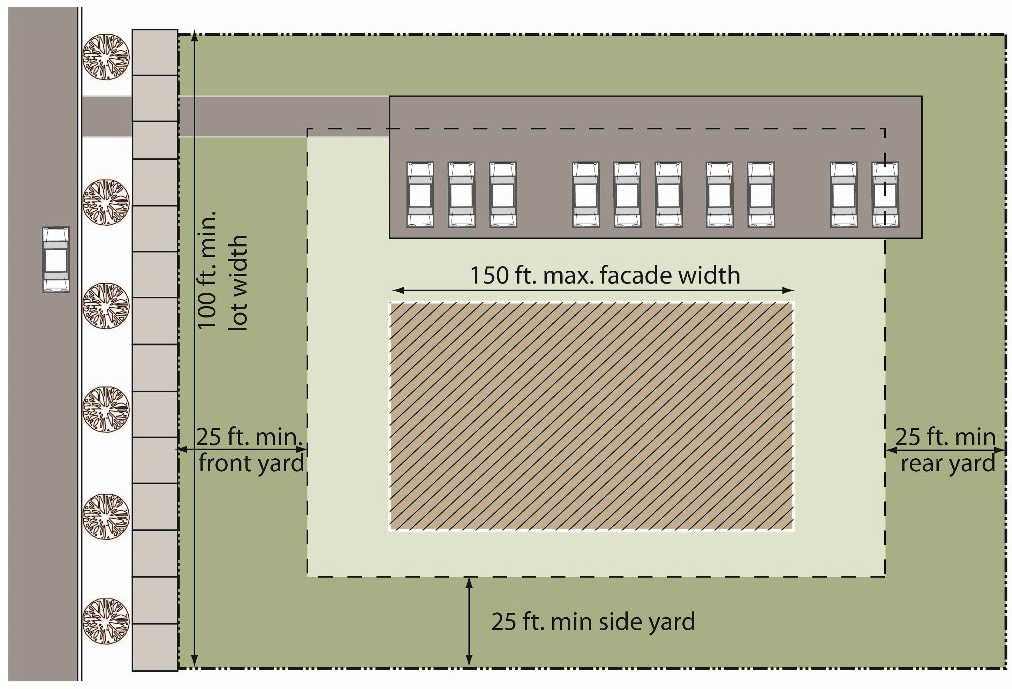
* all setbacks shall be equal to one-half the building height but not less than 25 ft.
C.
BUILDING REQUIREMENTS.
1.
Maximum Height of Each Building:
a.
In Stories: Six (6).
b.
In Feet: Eighty (80).
2.
Building Length. No multiple-family building shall exceed one hundred fifty (150') feet in length along any one face of the building.
3.
Minimum Floor Areas for Multiple-Family shall be as follows:
a.
EFFICIENCY UNIT. The term "Efficiency Unit" shall mean a dwelling unit containing a minimum of six hundred fifty (650) square feet of floor area and consisting of not more than one (1) room in addition to kitchen, dining and necessary sanitary facilities.
b.
ONE-BEDROOM UNIT. The term "One-Bedroom Unit" shall mean a dwelling unit containing a minimum floor area of at least seven hundred fifty (750) square feet per unit, consisting of not more than two (2) rooms in addition to kitchen, dining and necessary sanitary facilities.
c.
TWO-BEDROOM UNIT. The term "Two-Bedroom Unit" shall mean a dwelling unit containing a minimum floor area of at least nine hundred fifty (950) square feet per unit, consisting of not more than three (3) rooms in addition to kitchen, dining and necessary sanitary facilities.
d.
THREE OR MORE BEDROOM UNIT[S]. The term "Three or More Bedroom Unit" shall mean a dwelling unit wherein for each room, in addition to the three (3) rooms permitted in a two (2) bedroom unit, there shall be provided an additional area of two hundred (200) square feet to be minimum floor area of one thousand one hundred fifty (1,150) square feet.
i.
In addition to the above minimum floor area per unit, thirty-two (32) square feet shall be provided in each unit for utilities space (washer, dryer and work space). Buildings with enclosed common tenant or occupant hallways, such as apartment structures, may provide central utility rooms in lieu of the individual unit spaces required above. In each building where a central utility room is permitted, internal access shall be provided from each dwelling unit; the central utility room shall contain twenty (20) square feet for each dwelling unit in the building; and there shall be one (1) washer and one (1) dryer for every four (4) dwelling units or fraction thereof.
4.
Each development shall be limited to a maximum of ten (10) percent efficiency units and a maximum of fifty (50) percent one-bedroom units.
(ord. eff. April 24, 2021)
SEC. 4.7 - MANUFACTURED HOUSING COMMUNITY DISTRICT, MHC
A.
Intent. The Manufactured Housing Community District is a residential district. The rules are those set forth by the Mobile Home Commission, except for the following regulations designed to provide adequate space and land use separation in harmony with the City's other zoning districts.
B.
GENERAL SITE REGULATIONS.
1.
Building Height. The maximum height of service buildings and permitted office structures shall be two (2) stories or thirty-five (35') feet.
2.
Fire Hydrants. Fire hydrants of a size and a pressure to be used by the Mount Clemens Fire Department shall be placed within said trailer coach park so that no trailer coach shall be more than three hundred (300') feet from a fire hydrant measured along roadway or parking area.
3.
Plumbing, Electrical and Cable TV. Plumbing and electrical installations shall be maintained in accordance with Mount Clemens Plumbing and Electrical Codes. All electric and telephone wiring shall be underground. Externally-mounted antennas shall be prohibited, except that a master antenna shall be constructed and maintained with underground leads servicing each manufactured home site.
4.
Access to Public Roads. A manufactured housing community access road shall be hard-surfaced and not less than thirty-six (36') feet in width. Access roads shall meet construction and all other requirements as determined by the City of Mount Clemens, the Road Commission of Macomb County, and/or the Michigan Department of Transportation.
5.
Reference is hereby made to Sections 11, 12 and 13 of the Mobile Home Commission Act (No. 419, P.A. 1976) which required, among other things, that a person who desires to develop a manufactured housing community shall submit a preliminary plan to the Mount Clemens Planning Commission for approval. The preliminary plan shall include the location, layout, general design and a general description of the project (see Article 3 for submission requirements and procedures). The preliminary plan shall not include detailed construction plans.
(ord. eff. April 24, 2021)
SEC. 4.8 - RESIDENTIAL RENTAL RESTRICTION OVERLAY DISTRICTS.
Residential rental restriction overlay districts "RO-1" are hereby established.
A.
PURPOSE AND OBJECTIVES.
1.
The residential rental restriction overlay district "RO-1" is a zoning classification which permits owners of property within R1-A and R1-B residential zoning districts to petition the City Commission to establish an overlay district, and district use regulations in their residential neighborhood, which would prohibit or restrict the rental uses of single- family dwellings within the neighborhood. These districts establish restrictions which operate to preserve the attractiveness, desirability and privacy of residential neighborhoods by precluding all or certain types of rental properties and thereby preclude the deleterious effects rental properties can have on a neighborhood with regard to property deterioration, increased density, congestion, crime, noise and traffic levels and reduction of property values. The goal of the overlay district is to allow owners of property within residential neighborhoods to control the types of rental properties, if any, that are permitted in one-family dwellings within their neighborhood.
2.
It is also the purpose of the districts to achieve the following objectives:
a.
To protect the privacy of residents and to minimize noise, congestion and nuisance impacts by regulating the types of rental properties;
b.
To maintain an attractive community appearance and to provide a desirable living environment for residents by preserving the owner-occupied character of the neighborhood; and
c.
To prevent excessive traffic and parking problems in the neighborhoods.
B.
PERMITTED USES. Uses permitted in the Residential Rental Restriction Overlay District RO-1 are as follows:
1.
In a Residential Rental Restriction Overlay District RO-1 that overlaps a portion of a district zoned as an R1-A or R1-B district, permitted uses are all uses permitted in the underlying zoning district except the use or occupancy of a single-family dwelling unit as a rental unit within the meaning of Section 16.202, Sec. 2 et seq. of the city code is prohibited and a single-family dwelling converted into a two-family dwelling unit after the introduction of an ordinance to create said overlay district, may not be used or occupied as a rental unit within the meaning of Section 16.202, Sec. 2 et seq.
2.
Notwithstanding the foregoing, the overlay restriction does not impact properties that already have a valid rental certificate of compliance, or have begun the rental certificate of compliance process, as such will be considered a pre-existing non-conforming use and will be "grandfathered". However, if a property owner allows a rental certificate of compliance to remain expired more than 12 months, then the property would lose any prior legal, non-conforming grandfathering and the property will be subject to the restrictions set forth in 15.077 Sec. 7.7(B)(1) and/or 15.077 Sec. 7.7(B)(2).
C.
PROCEDURES TO ESTABLISH A RESIDENTIAL RENTAL RESTRICTION OVERLAY DISTRICT RO-1. The following procedures must be complied with in order to establish a Residential Rental Restriction Overlay District:
1.
A petition requesting an overlay district must be submitted to the City Clerk on forms provided by the City Clerk. The petition requirements are as follows:
a.
The proposed boundaries of the overlay district must be entirely within an R1-A or R1-B zoning district and the parcels within the proposed district must be contiguous.
b.
There must be at least 40 separate lots or parcels within the proposed district as described in the petition or the proposed district must constitute a discrete neighborhood geographic area.
c.
The proposed boundaries may not overlap a boundary of existing overlay districts or the boundary of an overlay district that is already the subject of an introduced ordinance pursuant to this section.
d.
The proposed district boundaries must be approved by the Community Development Department in conjunction with the petitioner prior to the petition being circulated for signatures. Once approved by the Community Development Department and the petitioner, the proposed district boundaries may not be changed.
e.
The petition must identify the specific overlay district that is sought by specifying the proposed boundary of the overlay district. The proposed boundaries of the overlay district must be described in the petition and the boundaries must, if practicable, consist of streets, alleys, platted subdivision boundaries or existing zoning district lines which totally enclose the proposed district.
f.
The petition must accurately advise the signer of the rental restriction that would be imposed on the property if the overlay district is established.
g.
Each petition must be circulated by a person who owns property within the proposed district and be signed by the circulator.
h.
The petition must contain the signature and address of two-thirds of the parcel owners within the proposed boundary of the overlay district, exclusive of public property. Jointly owned parcels will be considered owned by a single person for purpose of petitioning and any co-owner may sign a petition for such parcel. Only one owner of each parcel will count towards the two-thirds requirement. If a person owns more than one parcel of property within the proposed district, they may sign the petition for each parcel they own.
i.
Each person signing the petition must also enter on the petition, adjacent to their signature, the date that the person signed the petition and the address of the parcel they own.
j.
When submitted, no signature dated earlier than six months prior to the time the petition is filed with the City Clerk shall be counted in determining the validity of the petition.
2.
Upon presentation to the City Clerk for review, the Clerk shall verify the signatures and property ownership and dates on the petitions. If insufficient signatures are presented, the Clerk shall return the petitions to the person filing the petitions and identify the valid and invalid signatures. If sufficient valid signatures are presented, the Clerk shall refer the petitions to the Community Development Department which shall then, within 30 days, determine whether the petitions are in conformity with the remaining conditions of this section.
a.
If the petition is determined to be in conformity with the requirements of this section, the Community Development Director shall draft an appropriate ordinance in accordance with the petition procedures set forth in 15.0157 Sec. 15.7. All procedures set forth in 15.0157 Sec. 15.7 for zoning changes by petition shall thereafter be followed.
b.
If the petition is not in conformity with the requirements of this section, the Community Development Director shall reject the petition and return it to the Clerk with a written explanation as to why the petition does not meet the requirements of this section. The Clerk shall then forward the petitions, and the explanation, to the person who filed the petitions.
c.
If the petition is rejected for failure to comply with the boundary requirements, it may be resubmitted with the proper boundary lines if it is accompanied by certification that a copy of the petition and written notice was mailed to each property affected by the change, notifying them that their property was either added to or deleted from the petition and if by the correction of the boundary line the petition still meets all other requirements of the code.
d.
If the petition is rejected for an insufficient number of valid signatures, it may be resubmitted with the additional signatures necessary to have it comply as long as the other signatures remain valid.
3.
No earlier than one year after the adoption of an ordinance establishing an overlay district, a petition for a change or removal of the overlay district may be submitted by following the procedures for establishing an initial overlay district.
D.
EFFECT OF OVERLAY DISTRICT ORDINANCE.
1.
Upon introduction of an ordinance to create an overlay district and at all times while the ordinance is pending final decision there shall be a moratorium on the issuance of initial rental unit certifications to the extent that no initial rental housing certification shall be issued within the proposed overlay district to the owner of a single-family dwelling unit that would be precluded if the overlay district was adopted, or a single-family dwelling converted into a two-family dwelling unit after the introduction of an ordinance to create said overlay district, regardless of whether the license was applied for prior to or subsequent to the ordinance's introduction.
2.
Upon passage of an ordinance by the City Commission establishing an overlay district, no initial rental unit certification shall be issued to an owner of property in the overlay district inconsistent with the restrictions of the overlay district and it shall be unlawful to use or allow any property to be used except in conformity with the requirements of the underlying zoning district and overlay district. Any property in the overlay district that has an existing rental housing certification, or has had a rental certification within one year of adoption of the overlay district, shall be allowed to continue its use and occupancy in accordance with the law existing prior to the date of the adoption of the overlay district. No existing rental housing use or occupancy in an overlay district shall be considered to be a nonconforming use as the result of adoption of an overlay district unless the rental license expires for more than one year. If an owner surrenders an existing certification or allows, either intentionally or unintentionally, a license to remain expired for more than one year, any subsequent use of the property shall be subject to the restrictions imposed by the overlay district.
3.
If an ordinance introduced pursuant to this section is denied, a subsequent ordinance for an overlay district that includes the same parcels may not be introduced for one year following introduction of the previous ordinance.
4.
Any ordinance which is not adopted within six months of its introduction shall be deemed denied.
E.
RENTAL CERTIFICATION HARDSHIP EXCEPTION. In zoning districts RO-1, Residential Rental Restriction Overlay Districts, where new residential rental certifications are prohibited, no new rental certifications shall be issued except a rental certification obtained through the following procedure established for a hardship exception:
1.
Any property owner desiring a "hardship exception" must submit their request for a hardship exception in writing to the Zoning Board of Appeals, which shall make a determination of whether a hardship exists as defined by this article.
2.
A "hardship" for purposes of this article shall be defined as the inability of the owner to purchase or pay for one or more of the following without the ability to obtain rents on the subject property:
a.
Medical care or a medical device for the owner or the owner's dependents;
b.
Debts of the owner resulting from a mortgage, land contract or other loan used to purchase the subject property where there is no other available source to pay such debts; or
c.
Debts of the owner due to child support, alimony, a tax lien, funeral expenses, or a judgment.
3.
A "hardship" shall also include the following circumstances: Where a homeowner owns property that is occupied by the owner and a change in the owner's personal circumstances require a rental to preserve the financial stability of the owner. For example, this section would apply to a person who is required to temporarily relocate their residence for a period of time and needs to rent their home in their absence.
4.
The hardship exception allows the issuance of a rental certification for a period of 12 months or less and only one appeal per property is permitted per year.
5.
Any owner who has already been renting property without having obtained the required rental certification is disqualified from seeking a hardship exception.
6.
It shall be the burden of the person seeking the hardship exception to provide proof of the hardship, including submission of financial documentation necessary for the Zoning Board of Appeals to make a reasoned decision on the request.
7.
Any person requesting a hardship exception shall have a right to a hearing before the Zoning Board of Appeals within 30 days of the initiation of the request, and the Zoning Board of Appeals shall issue a final and binding written decision within 14 days of the hearing.
(ord. eff. April 24, 2021)

