
Mountain View City Zoning Code
ARTICLE X
- PARKING AND LOADING
SEC. 36.32. - Purpose.
The purpose of off-street parking and loading standards is to:
a.
Provide sufficient parking, loading and delivery facilities to meet the needs generated by the proposed use;
b.
Provide accessible, attractive, secure, properly lighted and well-maintained and screened off-street parking and loading facilities;
c.
Reduce traffic congestion and hazards;
d.
Encourage the use of alternative modes of transportation by providing for safe, adequate and convenient bicycle and carpool parking;
e.
Protect neighborhoods by providing adequate parking and landscaped buffers; and
f.
Ensure access and maneuverability for emergency vehicles.
(Ord. No. 18.13, § 1, 12/10/13.)
SEC. 36.32.05. - Applicability.
Every permanent use (including a change of use) and every structure shall have permanently maintained off-street parking areas in compliance with the following provisions.
(Ord. No. 18.13, § 1, 12/10/13.)
SEC. 36.32.10. - Expansion of structure, change in use.
When a structure is enlarged or increased in capacity, or when a change in use creates an increase in the required amount of parking, additional parking spaces shall be provided in compliance with the provisions of this section;
(Ord. No. 18.13, § 1, 12/10/13.)
SEC. 36.32.15. - Mixed uses/multiple tenants.
A site or facility proposed for multiple tenants or uses (e.g., a hotel with meeting halls, a building with ground-floor shops and second-floor offices, etc.) shall provide the aggregate number of parking spaces required by Section 36.32.50 (Required Parking Spaces) for each separate use;
(Ord. No. 18.13, § 1, 12/10/13.)
SEC. 36.32.20. - Single-family homes.
For each dwelling in any single-family residential zoning district, a garage or carport shall be provided and permanently maintained for parking.
(Ord. No. 18.13, § 1, 12/10/13.)
SEC. 36.32.25. - Deferral of parking installation.
For nonresidential developments of ten thousand (10,000) square feet or more of gross floor area, the zoning administrator may approve deferral of one (1) or more required off-street parking spaces to a future date. The applicant shall demonstrate, to the satisfaction of the zoning administrator, that the occupant of the subject parcel will not need the required parking spaces and that the area temporarily utilized for landscaping or other aesthetic amenities can, in the future, be used for the required parking spaces. The zoning administrator may impose reasonable conditions, including the recordation of a legal agreement which would provide that the landscaping or other amenity is to be removed by the applicant and the required off-street parking spaces are to be installed if they are needed to serve the use(s) on the subject parcel.
(Ord. No. 18.13, § 1, 12/10/13.)
SEC. 36.32.30. - Adjacent site access.
Applicants for nonresidential developments should be encouraged to provide cross-access to adjacent nonresidential properties for convenience, safety and efficient circulation of motor vehicles. A mutual access agreement should be executed where cross-access is provided.
(Ord. No. 18.13, § 1, 12/10/13.)
SEC. 36.32.35. - Rounding of quantities.
Where the number of required parking spaces results in a fraction of 0.50 or higher, the requirements shall be rounded up to the next whole space. Where the number of required spaces results in a fraction less than 0.50, the requirements shall be rounded down to the next whole space.
(Ord. No. 18.13, § 1, 12/10/13.)
SEC. 36.32.40. - Parking required by precise plans.
Parking requirements established in compliance with Section 36.50.60 (Precise Plans) shall supersede the provisions of Section 36.32.50 (Required parking spaces).
(Ord. No. 18.13, § 1, 12/10/13.)
SEC. 36.32.45. - No assignment of parking spaces without approval.
Parking spaces in parking lots shall be available to all users of the premises and shall not be assigned or in any way restricted for use except pursuant to an approval by the city as part of the underlying permit or CC&Rs.
(Ord. No. 18.13, § 1, 12/10/13.)
SEC. 36.32.50. - Required number of parking spaces.
Each land use shall provide the minimum number of off-street parking spaces required by this Section, inclusive of accessible and electric vehicle (EV) charging spaces required per Chapter 8 of the city code.
a.
Uses not listed. Land uses not specifically listed in subsection c below shall provide parking as required by the zoning administrator. In determining appropriate off-street parking requirements, the zoning administrator shall use the requirements of subsection c below as a general guide in determining the minimum number of off-street parking spaces necessary to avoid undue interference with public use of streets and alleys.
b.
Exemptions.
1.
Parking requirements near major transit stops.
(a)
No minimum number of parking spaces is required for residential or nonresidential development on properties located within one-half (1/2) mile of a major transit stop as defined in Section 21155 of the Public Resources Code, unless the city makes written findings in accordance with Government Code Section 65863.2 (b).
(b)
Subsection (a) above shall not apply to a project where any portion is designated for use as a hotel (except a residential hotel as defined in Section 50519 of the Health and Safety Code), motel, bed and breakfast inn or other transient lodging (i.e., short-term rentals), which shall instead meet the minimum number of parking spaces required for each applicable use in subsection c (Parking requirements by land use), below. Notwithstanding subsection (a), an event center shall provide parking as required for employees and other workers.
(c)
Any new development exempt from minimum parking standards per Government Code Section 65863.2 must provide electric vehicle equipment-installed parking spaces or parking spaces that are accessible to persons with disabilities that would have otherwise applied to the development as required by Government Code Section 65863.2(f).
(d)
If parking is provided voluntarily under subsection (a), the city may impose requirements for car-share vehicles, require spaces for public use or require parking owners to charge for parking.
2.
Moffett Boulevard general plan change area.
(a)
No minimum number of parking spaces is required for the residential component of any development in the Moffett Boulevard general plan change area.
3.
Specific small footprint commercial land uses.
(a)
Specific land uses permitted in an underlying zoning district consistent with the provisions of Section 36.18.27 (Standards for specific small-footprint land uses in commercial zones) are exempt from providing any new or additional parking spaces to comply with the requirements of subsection c.
c.
Parking requirements by land use. The following minimum number of parking spaces shall be provided for each use:
REQUIRED PARKING BY LAND USE
(Ord. No. 18.13, § 1, 12/10/13; Ord. No. 3.17, § 5, 4/25/17; Ord. No. 5.18, § 8, 4/24/18; Ord. No. 20.19, § 8, 12/10/19; Ord. No. 7.20, § 5, 6/23/20; Ord. No. 4.22, § 26, 4/12/22; Ord. No. 01.2024, § 24, 1/23/24; Ord. No. 10.2024, § 2, 12/10/24; Ord. No. 3.2026, § 18, 3/10/26.)
SEC. 36.32.55. - Handicapped parking requirements.
Handicapped parking requirements are established by the state and are contained in the California Code of Regulations, Title 24. State law may be amended from time to time, so reference should be made directly to the California Code of Regulations for standards on the required number, dimensions and location of handicapped parking spaces, signage and related facilities. The community development department will provide information on current requirements and space design upon request.
(Ord. No. 18.13, § 1, 12/10/13; Ord. No. 3.17, § 5, 4/25/17.)
SEC. 36.32.60. - Number of loading spaces required.
Unless modified/adjusted by the zoning administrator in compliance with Section 36.48 (Conditional Use Permits), off-street freight and equipment loading spaces shall be provided for all nonresidential uses. The following minimum number of loading spaces shall be provided for each use unless modified by the zoning administrator:
Table 36.32-1
Requirements for uses not specifically listed shall be determined by the zoning administrator based upon the requirements for comparable uses and upon the particular characteristics of the proposed use, in compliance with Section 36.32.50 (Required Parking Spaces).
(Ord. No. 18.13, § 1, 12/10/13.)
_____
SEC. 36.32.65. - Parking reduction.
The zoning administrator may grant a reduction in off-street parking requirements in compliance with Division 6 of Article XVI (Conditional Use Permits). The applicant shall provide evidence to demonstrate, to the satisfaction of the zoning administrator, that changes in conditions or issues justify such reduction and will not result in a parking deficiency.
(Ord. No. 18.13, § 1, 12/10/13; Ord. No. 01.2024, § 25, 1/23/24.)
SEC. 36.32.67. - Parking reduction exemptions from a conditional use permit.
The following parking reductions do not require a conditional use permit and may instead be approved as described in this Section:
a.
Electric vehicle charging stations. In accordance with Government Code Sections 65850.7 and 65850.71, the removal, reduction or elimination of any required off-street parking space(s) at an existing site to accommodate the installation of a new or upgraded electric vehicle charging station(s) and associated equipment is permitted if deemed necessary for installation. The reduction in the number of required parking spaces must be the minimal amount necessary to accommodate the electric vehicle charging station and equipment. No zoning permit is required.
b.
Additional bedrooms within existing multiple-family residential units. In accordance with Government Code Section 65850.02, where up to two (2) new bedrooms are created within an existing multi-family residential unit which impacts the required number of parking spaces on the subject parcel, the zoning administrator may grant a reduction in off-street parking requirements per the procedures of Division 2 of Article XVI (Development Review Process) if the applicant provides sufficient evidence demonstrating no additional parking spaces can be accommodated on-site in compliance with the standards of this Chapter and the city code. If the addition of new bedrooms does not impact the required number of parking spaces on the subject parcel, no zoning permit is required.
(Ord. No. 01.2024, § 26, 1/23/24.)
SEC. 36.32.70. - Shared parking reduction.
Parking facilities may be shared if multiple uses cooperatively establish and operate the facilities and if these uses generate parking demands primarily during different hours than the remaining uses. The applicant shall apply for a use permit in compliance with Section 36.48 (Conditional Use Permit) and provide documentation (i.e., shared parking use analysis) to the satisfaction of the zoning administrator, substantiating the reasons for the requested shared parking reduction. Shared parking may only be approved if:
a.
A sufficient number of spaces are provided to meet the maximum cumulative parking demand of the participating uses at any time;
b.
Satisfactory evidence, as deemed by the zoning administrator, has been submitted by the parties operating the shared parking facility regarding the nature of the uses and the times when the uses operate, so as to demonstrate the lack of potential conflict between them; and
c.
Additional documents, covenants, deed restrictions or other agreements as may be deemed necessary by the zoning administrator are executed to ensure that the required parking spaces provided are maintained and used as approved for the life of the nonresidential development.
(Ord. No. 18.13, § 1, 12/10/13.)
SEC. 36.32.75. - Development standards for off-street loading.
Off-street loading areas shall be provided in the following manner:
a.
Dimensions. Required freight and equipment loading spaces shall be not less than ten (10) feet in width, twenty-five (25) feet in length, with twelve (12) feet of vertical clearance;
b.
Lighting. Loading areas shall have lighting capable of providing adequate illumination for security and safety. Lighting standards shall be energy-efficient and in scale with the height and use of the structure(s). Any illumination, including security lighting, shall be directed away from adjoining parcels and public rights-of-way;
c.
Location. Freight and equipment loading spaces shall be located and designed as follows:
1.
Next to, or as close as possible to, the main structure;
2.
Situated or screened to ensure that the loading facility shall not be visible from any major public rights-of-way;
3.
Situated to ensure that all loading and unloading takes place on-site, and in no case within adjacent public rights-of-way, or other traffic areas on-site;
4.
Situated to ensure that all vehicular maneuvers occur on-site; and
5.
Situated to avoid adverse noise impacts upon neighboring residential properties.
d.
Screening. All loading areas abutting residentially zoned parcels shall have a seven (7) foot high solid architecturally treated decorative masonry wall, approved by the zoning administrator, to properly screen the loading area(s). All wall treatments shall occur on both sides.
e.
Security. All loading facilities shall be designed, constructed and maintained with security as a priority to protect the safety of the users.
f.
Loading doors and gates. Loading bays and roll-up doors shall generally be located on the rear of the structure. Bays and doors may be located on the side of a building away from a street frontage where it can be demonstrated that the bays, doors and related trucks will be adequately screened from public view from any street or public right-of-way.
g.
Striping. Loading areas shall be striped indicating the loading spaces and identifying the spaces for "loading only." The striping shall be permanently maintained in a clear and visible manner at all times.
(Ord. No. 18.13, § 1, 12/10/13.)
SEC. 36.32.80. - Development standards for off-street parking.
When off-street parking is required or voluntarily provided on-site, off-street parking areas shall be provided in the following manner:
a.
Access.
1.
Parking areas shall provide suitable maneuvering room so that all vehicles may enter an abutting street in a forward direction. Single-family homes and duplexes are exempt from this requirement, and the zoning administrator may approve exceptions for other residential projects; and
2.
No parking space back-up area shall occur in the first twenty (20) feet from the street right-of-way and a parking lot entrance or exit.
b.
Commercial vehicle parking. No commercial vehicle exceeding eight (8) feet in height and/or twenty (20) feet in combined total length, or towed equipment, shall park between the hours of 6:00 p.m. and 6:00 a.m. on private property (or public rights-of-way within residential zoning districts in compliance with City Code Section 19.79.1 (Parking of certain commercial vehicles on residential streets prohibited). This prohibition shall not apply to construction sites during the construction process or to vehicles in the process of making delivery or pickup.
c.
Dimensional requirements.
1.
General requirements. Minimum parking stall dimensions shall be eight and one-half (8.5) feet by eighteen (18) feet except as indicated in the following table and as illustrated by Figure 36.32-1, Parking space design and layout:
Table 36.32-2
2.
Dimensions for private garages or carports. A minimum unobstructed inside dimension of nine (9) feet by twenty (20) feet shall be maintained, for a private one (1) car garage or carport and shall be increased nine (9) feet in width for each additional parking space. The minimum unobstructed ceiling height shall be seven (7) feet six (6) inches; and
3.
Parallel parking spaces. For a parallel space, the minimum width shall be eight (8) feet and the minimum length shall be twenty-four (24) feet.
d.
Drainage. All required off-street parking/loading areas shall be designed so that surface water will not drain over any sidewalk or adjacent parcels.
e.
Driveways. Driveways providing ingress and egress to off-street parking spaces shall be designed, constructed and maintained as follows:
1.
R1 and R2 zoning districts. See Section 36.10.25 (R1 zone development standards) and 36.10.50 (R2 zone development standards) for details.
2.
Other zoning districts. Driveways shall be a minimum width of twelve (12) feet for a one (1) way driveway and eighteen (18) feet for a two (2) way driveway; and
3.
Obstructions. The driveway width shall be maintained free and clear of all obstructions.
f.
Landscaping. Required landscaping within the parking area(s) shall be provided as follows, unless otherwise specified in this chapter:
1.
Where parking areas with more than ten (10) spaces adjoin a public right-of-way, a landscaped planting strip with an average width of ten (10) feet and no less than five (5) feet shall be established and continuously maintained between the public right-of-way and parking area(s). Any planting, sign, or other structures near a driveway shall not exceed thirty-six (36) inches in height;
2.
Parking areas shall have at least one (1) fifteen (15) gallon tree for every three (3) spaces, with some appropriate clustering of trees permitted, and six (6) foot by eighteen (18) foot projecting landscaped islands generally every ten (10) parking spaces (see Figure 36.32-1). Whenever possible, interior parking spaces should have a continuous planter strip six (6) feet wide between rows of parking. Where appropriate, provisions shall be made to ensure that adequate pedestrian paths are provided throughout the landscaped areas;
Figure 36.32-1
PARKING SPACE DESIGN AND LAYOUT
For Reference Only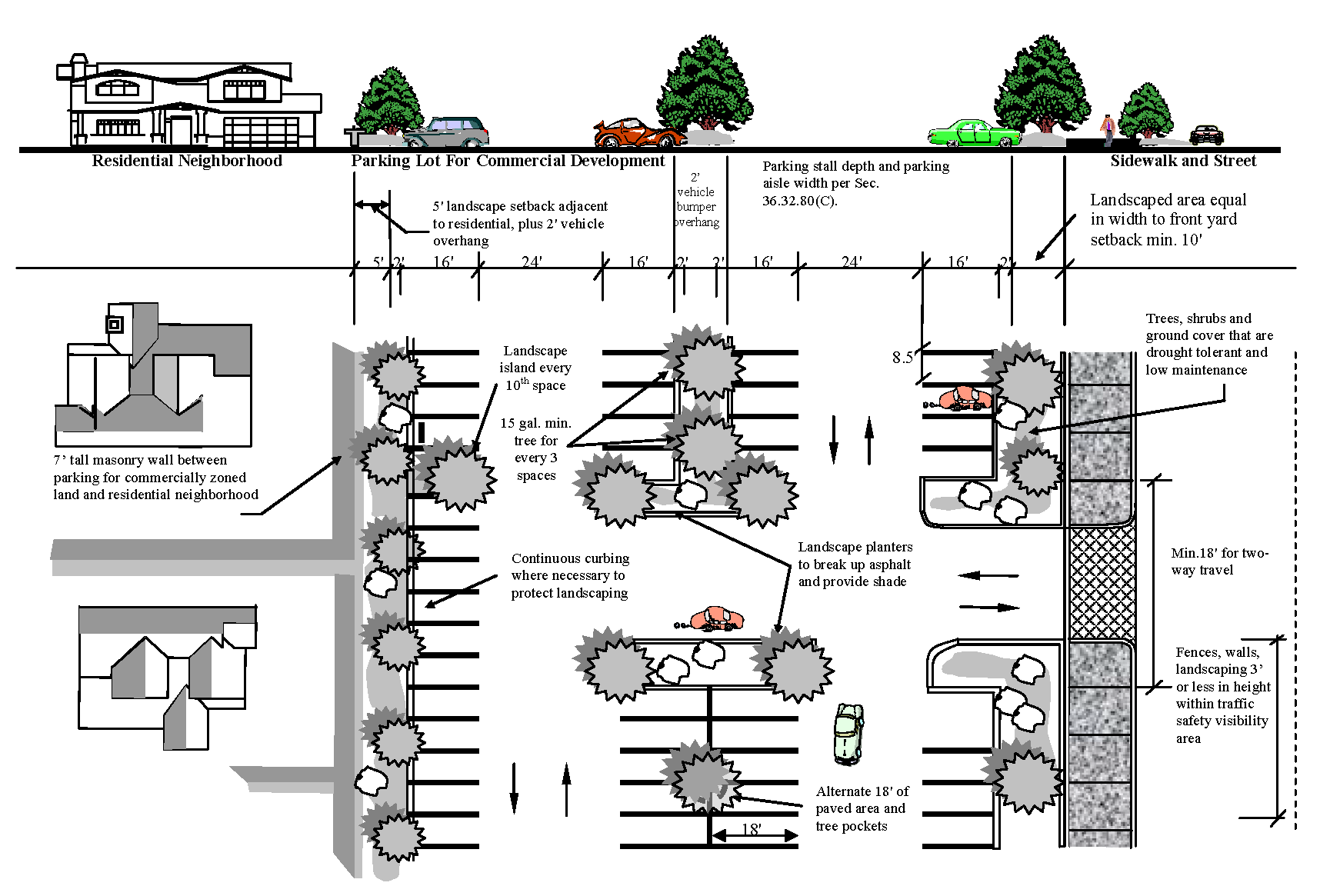
3.
Areas in a parking lot not used for driveways, maneuvering areas, parking spaces, or walks, shall be permanently landscaped with suitable materials and permanently maintained, in compliance with a program submitted by the applicant and approved by the zoning administrator;
4.
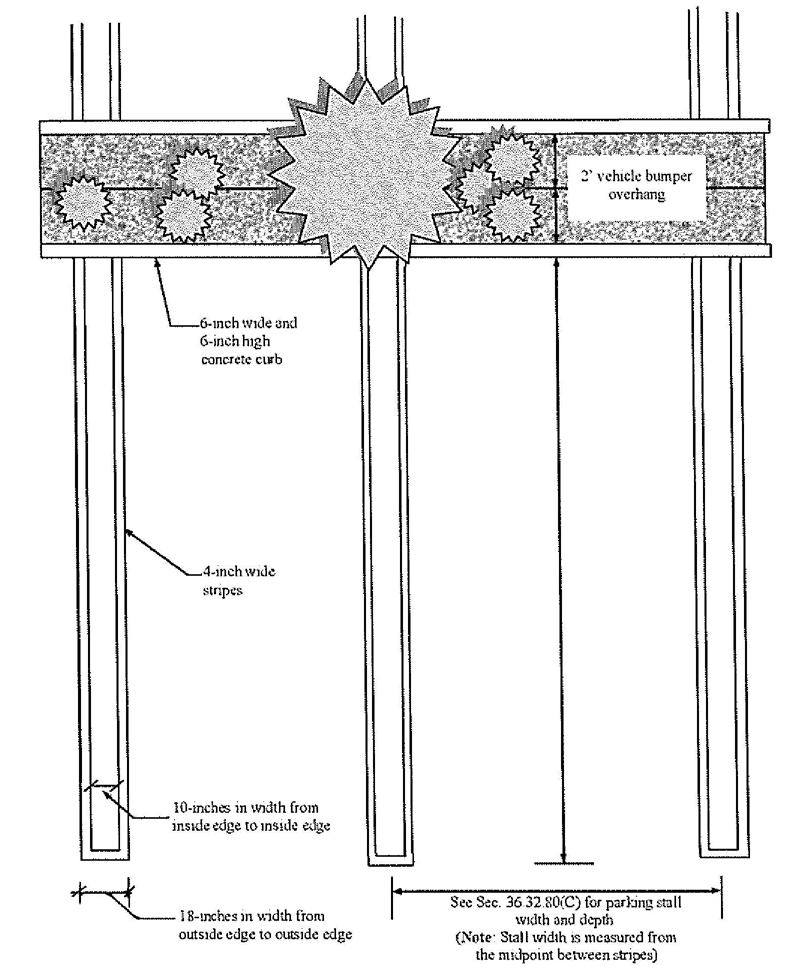
All landscaped areas shall be bordered by a concrete curb that is at least six (6) inches high and six (6) inches wide; and
5.
To increase the parking lot landscaped area, a maximum of two (2) feet of the parking stall depth may be landscaped with low-growth, hearty materials in lieu of asphalt, allowing a bumper overhang while maintaining the required parking dimensions.
g.
Lighting. Parking areas shall have lighting capable of providing adequate illumination for security and safety. Lighting standards shall be energy-efficient and in scale with the height and use of the on-site structure(s). Any illumination, including security lighting, shall be directed away from adjoining properties and public rights-of-way in compliance with City Code Sections 8.242 and 8.252.
h.
Location of required parking spaces. All parking spaces shall be located on the same parcel as the primary structure or use, unless approved otherwise by the zoning administrator. The zoning administrator may approve a portion or all of the required off-street spaces to be located on a parcel that adjoins the parcel containing the primary structure or use. This approval shall be based on accessibility to the primary structure or use and the use and development of the adjacent parcel. The applicant shall provide evidence, to the satisfaction of the zoning administrator, that a suitable long-term lease or other legal agreement can be executed and recorded which would guarantee that the parcel containing the primary structure or use has the irrevocable right to utilize the adjacent parcel for parking. The zoning administrator may allow parking spaces located along a new public street dedicated as part of the project to be counted towards guest parking requirements as part of a planned unit development permit or planned community permit, but only for sites proposing a new public street(s) internal to the original project site area.
i.
Maintenance. All required parking facilities shall be permanently maintained, free of litter and debris, potholes, obstructions and stored material.
j.
Recreational vehicle parking—Residential. Recreational vehicle parking shall be in compliance with City Code Section 19.111 (Regulation of storage or parking of vehicles in residential areas).
k.
Screening. Commercial/industrial and public parking areas abutting residentially zoned parcels shall have an acoustically designed seven (7) foot high wood or decorative masonry wall, to properly screen the parking area(s), subject to approval by the zoning administrator, who may waive or modify this requirement to protect the views of adjacent residences. All wall treatments shall occur on both sides.
l.
Security. All parking facilities shall be designed, constructed and maintained with security as a priority to protect the safety of the users.
m.
Striping. Parking stalls shall be identified by four (4) inch wide stripes of paint, or other durable striping material approved by the zoning administrator, on the parking lot surface. All parking stalls shall be clearly outlined with double stripes (see Figure 36.32-2, Parking stall striping), except parallel spaces which may be marked with single lines.
n.
Tandem parking. Tandem parking shall not be permitted to satisfy off-street parking requirements except where appropriate for developments of single- or two (2) family units, and then only when the tandem space is behind the covered space serving the same unit, and per the Townhouse Guidelines, Rowhouse Guidelines and the R4 Standards and Guidelines, subject to the approval of the zoning administrator.
o.
Wheel stops/curbing. Continuous concrete curbing at least six (6) inches high and six (6) inches wide shall be provided for all parking spaces located adjacent to walls, fences, property lines and structures and be located at least two (2) feet from those structures. All parking lots shall have continuous curbing at least six (6) inches high and six (6) inches wide around all parking areas and aisle planters.
Figure 36.32-2
PARKING STALL STRIPING
(For Reference Only)
(Ord. No. 18.13, § 1, 12/10/13; Ord. No. 20.19, § 9, 12/10/19; Ord. No. 10.2024, § 3, 12/10/24.)
SEC. 36.32.85. - Bicycle parking facilities.
Bicycle parking facilities shall be provided in compliance with this Section and the Bicycle Parking Guidelines provided by the community development department.
a.
Classification of bicycle parking facilities.
1.
Class I facilities. Intended for long-term parking (e.g., for employees); protects against theft of entire bicycle and of its components and accessories. The facility shall also protect the bicycles from inclement weather, including wind-driven rain. Design alternatives for Class I facilities are as follows:
(a)
Bicycle locker. A fully enclosed, weather-resistant space accessible only by the owner or operator of the bicycle. Bicycle lockers may be premanufactured or designed for individual sites. All bicycle lockers shall be fitted with key locking mechanisms. This is the preferred Class I facility;
(b)
Restricted access. Class I bicycle parking facilities located within an interior locked room or locked enclosure accessible by key only to the owners or operators of the bicycles parked within. The maximum capacity of each restricted room or enclosure shall be ten (10) bicycles;
(c)
Enclosed cages. An exterior enclosure for individual bicycles, where contents are visible from the sides but the top is covered and which can be securely locked by a user-provided lock. This type of facility is only to be used for retail and service uses and multiple-family development; or
(d)
Other. Class I facilities other than lockers, restricted access rooms or enclosed cages, but providing the same level of security, may be approved by the zoning administrator. A written building management policy of permitting bicycles to be stored in private offices or multi-family dwellings (including apartments, townhomes and condominiums), or in designated areas within the structure where adequate security is provided, may be approved by the zoning administrator as an alternative to Class I facilities.
2.
Class II and Class III facilities. Intended for short-term parking (e.g., for shoppers, visitors). A stationary object to which the user can lock the frame and both wheels. Should be protected from weather whenever possible. The zoning administrator may require either a Class II or Class III facility depending on where the facilities are to be located.
(a)
Class II. Class II facilities are designed so that the lock is protected from physical assault and, therefore, the facility need not be within constant visual range. A Class II rack shall accept padlocks and high-security, U-shaped locks.
(b)
Class III. Class III facilities are less secure and, therefore, shall be within constant visual range of persons within the adjacent structure or located in well-traveled pedestrian areas.
b.
Bicycle parking design standards.
1.
Clearance. Class I(b), Class II and Class III facilities shall provide at least a twenty-four (24) inch clearance from the centerline of each adjacent bicycle, and at least eighteen (18) inches from walls or other obstructions;
2.
Aisle. An aisle or other space shall be provided for bicycles to enter and leave the facility. This aisle shall have a width of at least five (5) feet to the front or the rear of a standard six (6) foot bicycle parked in the facility;
3.
Building entrance—Class I. Class I facilities at employment sites shall be located near the structure entrances used by employees;
4.
Building entrance—Class II and III. Class II or Class III facilities intended for customers or visitors shall be located near the main structure used by the public;
5.
Paving. Paving of bicycle parking areas is required;
6.
Convenience. Convenient access to bicycle parking facilities shall be provided. Where access is via a sidewalk or pathway, curb ramps shall be installed where appropriate;
7.
Lighting. Lighting shall be provided in all bicycle parking areas. In both exterior and interior locations, lighting of not less than one (1) footcandle of illumination at ground level shall be provided; and
8.
Review. The zoning administrator shall have the authority to review the design of all bicycle parking facilities required by this Section with respect to safety, security and convenience. The zoning administrator shall consider the bicycle parking guidelines in determining the type, location and design of bicycle parking facilities.
c.
Number and type of bicycle spaces required. The following standards shall apply:
1.
Number of bicycle parking spaces. The number of bicycle parking spaces required is determined by Section 36.32.50 (Required Parking Spaces); and
2.
Class of bicycle parking spaces. The zoning administrator may require that a certain percentage of the spaces be Class I, Class II or Class III depending on the potential users. The zoning administrator shall use the Bicycle Parking Guidelines in determining the appropriate proportions of each class.
d.
Showers and changing room standards. Two (2) employee shower and changing room facilities, one (1) each for male and female employees, shall be provided for any new structure constructed or for any addition to or enlargement of any existing structure requiring over two hundred (200) employee parking spaces. This requirement is applicable to industrial, research and development, corporate office and similar high-employment businesses. The floor area used for shower and changing rooms shall not be included in the calculations for floor area ratio limits.
(Ord. No. 18.13, § 1, 12/10/13; Ord. No. 01.2024, § 27, 1/23/24.)
SEC. 36.32.90. - Nonconforming parking areas.
Any automobile or bicycle parking facilities lawfully existing on the effective date of this ordinance shall be "grandfathered" and may continue pursuant to Section 36.06.65, Continuing existing uses, of this chapter except that parking required for additions and expansions of existing buildings and changes in land use shall comply with all provisions of this article.
(Ord. No. 18.13, § 1, 12/10/13.)

