
Mountain View City Zoning Code
ARTICLE IV
RESIDENTIAL ZONES
DIVISION 10. - ACCESSORY DWELLING UNITS[2]
Editor's note—Ord. No. 11.20, §§ 4—16, adopted November 10, 2020 amended Division 10 in its entirety to read as herein set out. Former Division 10, §§ 36.12.60—36.12.75, pertained to similar subject matter, and derived from Ord. No. 18.13, adopted December 10, 2013; Ord. No. 9.16, adopted June 14, 2016; and Ord. No. 3.17, adopted April 25, 2017.
SEC. 36.10. - Purpose.
This article provides regulations applicable to development and new land uses in the residential zoning districts established by Section 36.04 (Zoning Districts Established). The purposes of the individual residential zoning districts are as follows:
a.
R1 (residential—Single-family) district. The R1 zoning district is intended for detached, single-family dwellings, dual urban opportunity developments and similar and related uses compatible with a quiet, family living environment. The R1 zoning district is consistent with the low-density residential land use designation of the general plan. The designation of an area in the R1 zoning district may include establishing a minimum lot area for new subdivisions, expressed as a suffix to the R1 zoning map symbol (e.g., R1-8, R1-10, etc.).
b.
R2 (residential—One (1) and two (2) family) district. The R2 zoning district is intended for single-family dwellings, duplexes, low-density rowhouse developments, low-density townhouse developments, small-lot single-family developments and similar and related compatible uses. The R2 zoning district is consistent with the medium-low density residential land use designation of the general plan. The designation of an area in the R2 zoning district may include establishing a minimum lot area for new subdivisions, expressed as a suffix to the R2 zoning map symbol (e.g., R2-8, R2-10, etc.).
c.
R3 (residential—Multiple-family) district. The R3 zoning district is intended for multiple-family housing, including apartments, condominium development, rowhouse development, townhouse development, small-lot single-family development and similar and related compatible uses. The R3 zoning district is consistent with the medium, medium-high and high-density residential land use designation of the general plan. The designation of an area in the R3 zoning district will include establishing a specific maximum density for multiple-family development, expressed as a subcategory to the R3 zoning map symbol (e.g., R3-2, R3-1.5, etc.).
d.
R4 (Residential—High-density multiple-family) district. The R4 zoning district is intended for multiple-family housing, including apartments, condominium development, rowhouse development, townhouse development, small-lot, single-family development and similar and related compatible uses. The R4 zoning district is consistent with the high-density residential land use designation of the general plan.
e.
RMH (mobile home park) district. The RMH zoning district is intended for areas of the city best suited for mobile homes within a mobile home park or mobile home subdivision with shared recreational and open space facilities, together with similar and related compatible uses. The RMH zoning district is consistent with the mobile home residential land use designation of the general plan.
(Ord. No. 18.13, § 1, 12/10/13; Ord. No. 4.22, § 3, 4/12/22.)
SEC. 36.10.05. - Residential zone land uses and permit requirements.
The uses of land allowed by this Chapter in each residential zoning district are identified in the following tables as being:
a.
Permitted subject to compliance with all applicable provisions of this Chapter, including development review where required and parking requirements, and subject to obtaining any building permit or other permit required by the City Code ("P" uses on the tables).
b.
Allowed subject to approval of a conditional use permit ("CUP") (Sec. 36.48).
c.
Allowed subject to approval of a temporary use permit ("TUP") (Sec. 36.46).
d.
Allowed subject to approval of a planned unit development permit ("PUD") (Sec. 36.46.70).
e.
Allowed subject to approval of a mobile home park permit ("MHPP") (Sec. 36.48.35).
Land uses that are not listed on the table for a particular zoning district are not allowed in that district, except where otherwise provided by Section 36.06.40 (Determination of allowable land uses) or Section 36.06.50 (Exemptions from zoning permit requirements).
LAND USES AND PERMIT REQUIREMENTS BY RESIDENTIAL DISTRICT
NOTE: Where the last column on the following tables ("See Section") includes a section number, the regulations in the referenced section apply to the use and/or a specific definition; however, provisions in other sections may apply as well.
1 Subject to the same permitting requirements as a single-family dwelling.
2 Subject to the same requirements as a single-family dwelling or duplex if serving six (6) or fewer clients, or subject to the underlying zoning requirements if serving seven (7) or more clients.
3 Safe parking shall only be allowed on sites used for, and in conjunction with, the following uses in residential zones: churches; community centers; membership organization facilities; and schools, public and private.
(Ord. No. 18.13, § 1, 12/10/13; Ord. No. 3.17, § 4, 4/25/17; Ord. No. 16.19, § 8, 10/22/19; Ord. No. 7.20, § 2, 6/23/20; Ord. No. 11.20, § 3, 11/10/20; Ord. No. 4.22, § 4, 4/12/22; Ord. No. 01.2024, § 7, 1/23/24; Ord. No. 3.2026, § 2, 3/10/26; Ord. No. 10.2026, § 2, 6/9/26.)
SEC. 36.10.10. - R1 zoning district standards.
New land uses and structures, and alterations to existing land uses and structures, shall be designed and constructed in compliance with this section.
(Ord. No. 18.13, § 1, 12/10/13.)
SEC. 36.10.15. - Minimum lot area and width for subdivisions.
The minimum area and width of parcels proposed in new subdivisions in the R1 zoning district is determined below, except in areas of special limitations or when smaller lots are approved as part of a larger planned unit development or through an urban lot split. These areas are identified on the zoning map by a suffix to the R1 map symbol (e.g., R1-8, R1-10, etc.), and are subject to the following requirements:
If the minimum lot area required by a suffix to the R1 zoning map symbol is within the ranges shown above (i.e., more than six thousand (6,000) square feet but less than ten thousand (10,000) square feet, etc.), the required lot width shall be determined by the zoning administrator based on the values specified in the table above.
For standards applicable to lots created through a planned unit development, see Section 36.10.35. For standards applicable to lots created through urban lot splits, see Section 36.13.50 through Section 36.13.75."
(Ord. No. 18.13, § 1, 12/10/13; Ord. No. 4.22, § 5, 4/12/22.)
_____
SEC. 36.10.20. - Minimum street frontage for any residential use.
Parcels in the R1 zoning district shall have a minimum frontage of thirty-five (35) feet on a public street, unless the lot has been created by an urban lot split pursuant to the provisions of Section 36.13.50 through Section 36.13.75 or is a lot without the required frontage on a public street pursuant to the provisions of Section 36.10.35 (Subdivisions in the R1 zone creating parcels without the required frontage on a public street.)
(Ord. No. 18.13, § 1, 12/10/13; Ord. No. 4.22, § 6, 4/12/22.)
SEC. 36.10.25. - R1 zone development standards.
The following table entitled "R1 Zone Development Standards" defines standards for minimum parcel size, density, setbacks and height limits within the R1 zoning district. See Section 36.14.75 for exceptions to the site layout standards that may be granted for home improvements and minor additions. For standards applicable to dual urban opportunity developments, see Section 36.13.10 through Section 36.13.45.
R1 ZONE DEVELOPMENT STANDARDS
(Ord. No. 18.13, § 1, 12/10/13; Ord. No. 5.18, § 1, 4/24/18; Ord. No. 4.22, § 7, 4/12/22; Ord. No. 01.2024, § 8, 1/23/24.)
SEC. 36.10.30. - Development review required.
The following types of proposed development in the R1 zoning district shall be subject to development review in compliance with Section 36.44.45 (Development Review):
a.
Structures in new subdivisions of five (5) or more parcels;
b.
Requests for FAR exceptions;
c.
Fences over six (6) feet in height and up to seven (7) feet;
d.
Planned unit developments in accordance with Section 36.46.70; and
e.
Conditional use permits in accordance with Section 36.48.
Figure 36.10-1
SINGLE FAMILY SETBACK REQUIREMENTS
(For Reference Only)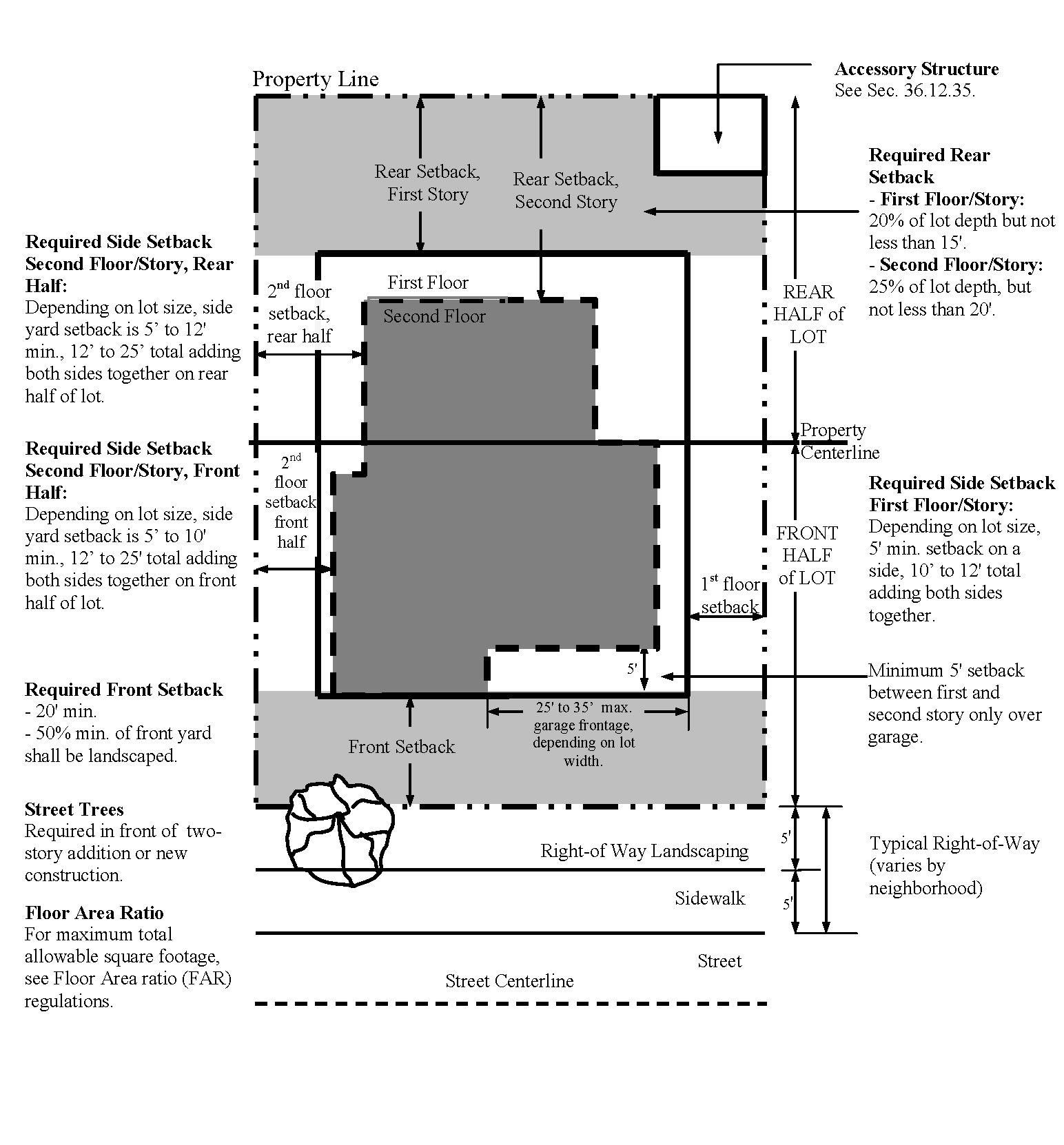
Figure 36.10-2
SINGLE-FAMILY HEIGHT LIMITS
(For Reference Only)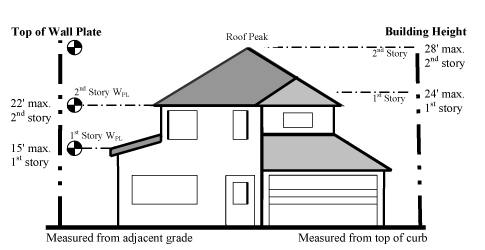
(Ord. No. 18.13, § 1, 12/10/13; Ord. No. 4.22, § 8, 4/12/22.)
SEC. 36.10.35. - Subdivisions in the R1 zone creating parcels without the required frontage on a public street.
The approval of a subdivision in compliance with Chapter 28 of the City Code (Subdivisions) that results in three (3) or more lots, where at least one (1) lot does not have the required frontage on a public street, shall require approval of a planned unit development permit to evaluate the appropriateness of the lots, establish setbacks, and address any lot design problems. this section does not pertain to urban lot splits, as defined in Section 36.60.45. For standards pertaining to urban lot splits, refer to Section 36.13.10.
a.
Minimum lot size. The developable portion of any flag lot or other lot that does not have the required frontage on a public street, exclusive of the "flag pole" portion of a flag lot or the private drive in a subdivisions with up to four (4) buildable lots, shall comply with the minimum lot size requirements of the applicable zoning district. The individual lots in a subdivision involving five (5) or more buildable lots may be less than the minimum lot size required in the applicable zoning district provided that the density, based on all of the land area including private streets and common areas, does not exceed the maximum density for the applicable zoning district.
b.
Floor area ratio (FAR). Allowable FAR shall be calculated on the developable portion of the lot only. Floor area exceptions are not allowed on lots that do not have the required frontage on a public street.
c.
Density. A flag lot or other lot without the required frontage on a public street may contain one (1) single-family dwelling, one (1) accessory dwelling unit and one (1) junior accessory dwelling unit.
d.
Number of lots. At least one (1) of the lots in a flag lot subdivision or other subdivision that includes parcels without the required frontage on a public street shall have the street frontage normally required by the applicable zoning district. No more than two (2) additional flag lots shall be permitted to extend behind the lot with full street frontage.
e.
Setback requirements. Setbacks shall comply with the standards found in Section 36.10.25 except for the following special setback requirements:
1.
All lots.
(a)
Garage setback. The setback from a garage face shall be a minimum of twenty (20) feet.
(b)
Side yards adjacent to a flag pole or private driveway. Side yards adjacent to a flag "pole" shall be a minimum of five (5) feet for first story and seven (7) feet for the second story. Side yards adjacent to a private driveway serving two (2) or more units shall be a minimum of ten (10) feet for the first and second stories. If a garage faces the flag pole or private driveway, the setback shall be a minimum of twenty (20) feet.
2.
Lots that front on a public street. Side yards adjacent to existing lots shall be a minimum of seven (7) feet for the first story and eight (8) feet for the second story except for that portion of the second story that is on the rear half of the parcel which shall be a minimum of twelve (12) feet.
3.
Lots without the required frontage. For lots that are at the rear of the site and do not have the required frontage on a public street, the zoning administrator shall determine which of the yards on the sides that are adjacent to existing lots is the rear yard, taking into consideration whether the yards of the adjacent lots are rear yards or side yards. Any remaining yard which is adjacent to a side yard for sixty-six (66) percent of the length of the adjacent property may have the side yard setbacks defined in Section 36.10.25. Any remaining yard adjacent to a rear yard must have a minimum first-story setback of fifteen (15) feet and a minimum second-story setback of twenty (20) feet.
4.
Access requirements for flag lots. A flag "pole" serving two (2) or more lots shall be a minimum of twenty-five (25) feet with sixteen (16) feet paved, provided that there is at least eight (8) feet of street frontage per lot. A wider paved access and adequate turnaround for emergency vehicles may also be required by the Uniform Fire Code, depending on distance of the house from the street.
Figure 36.10-3
FLAG LOT SETBACK REQUIREMENTS
(For Reference Only)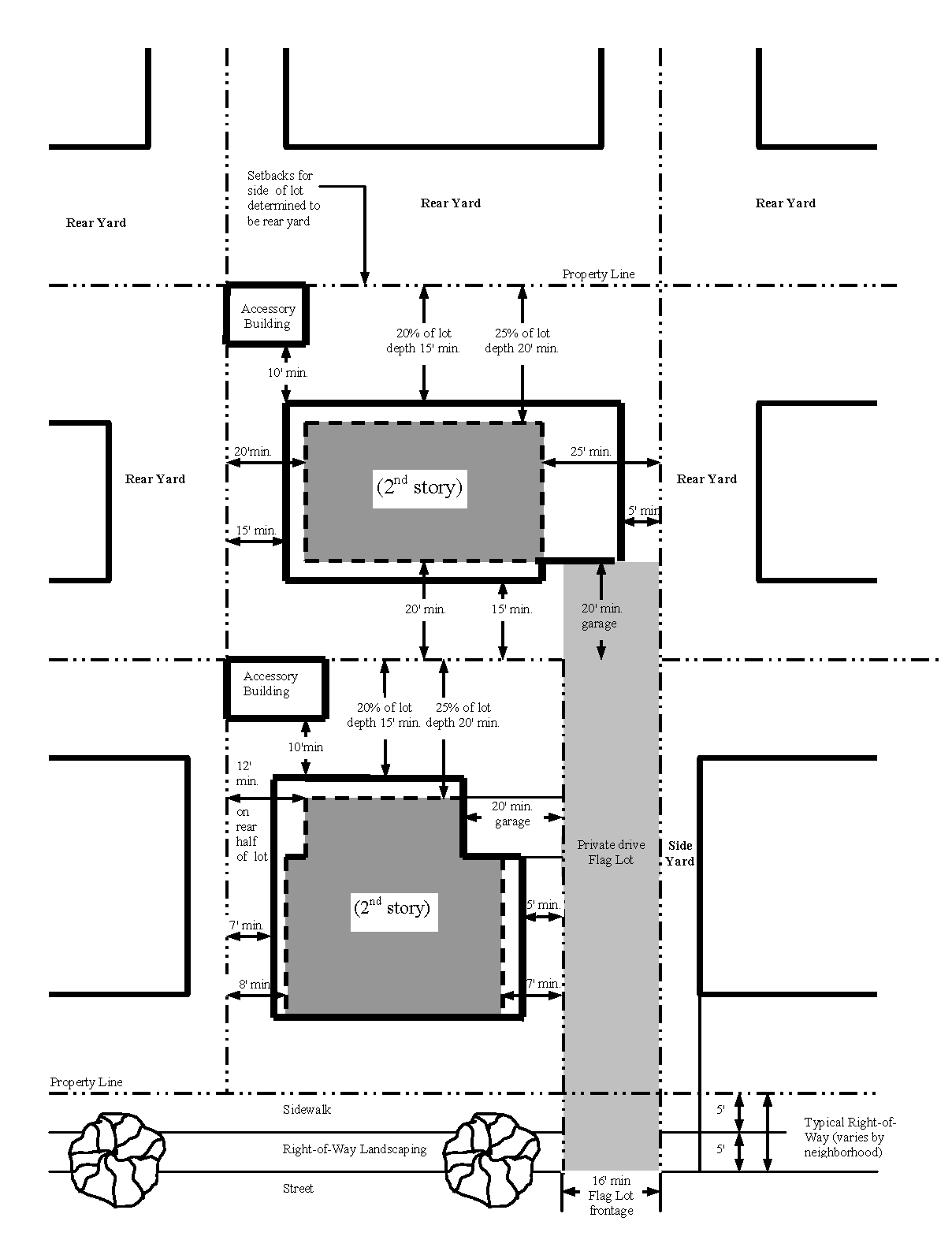
Figure 36.10-4
SETBACK REQUIREMENTS FOR SUBDIVISIONS WITH
SEVERAL LOTS ON A PRIVATE STREET
(For Reference Only)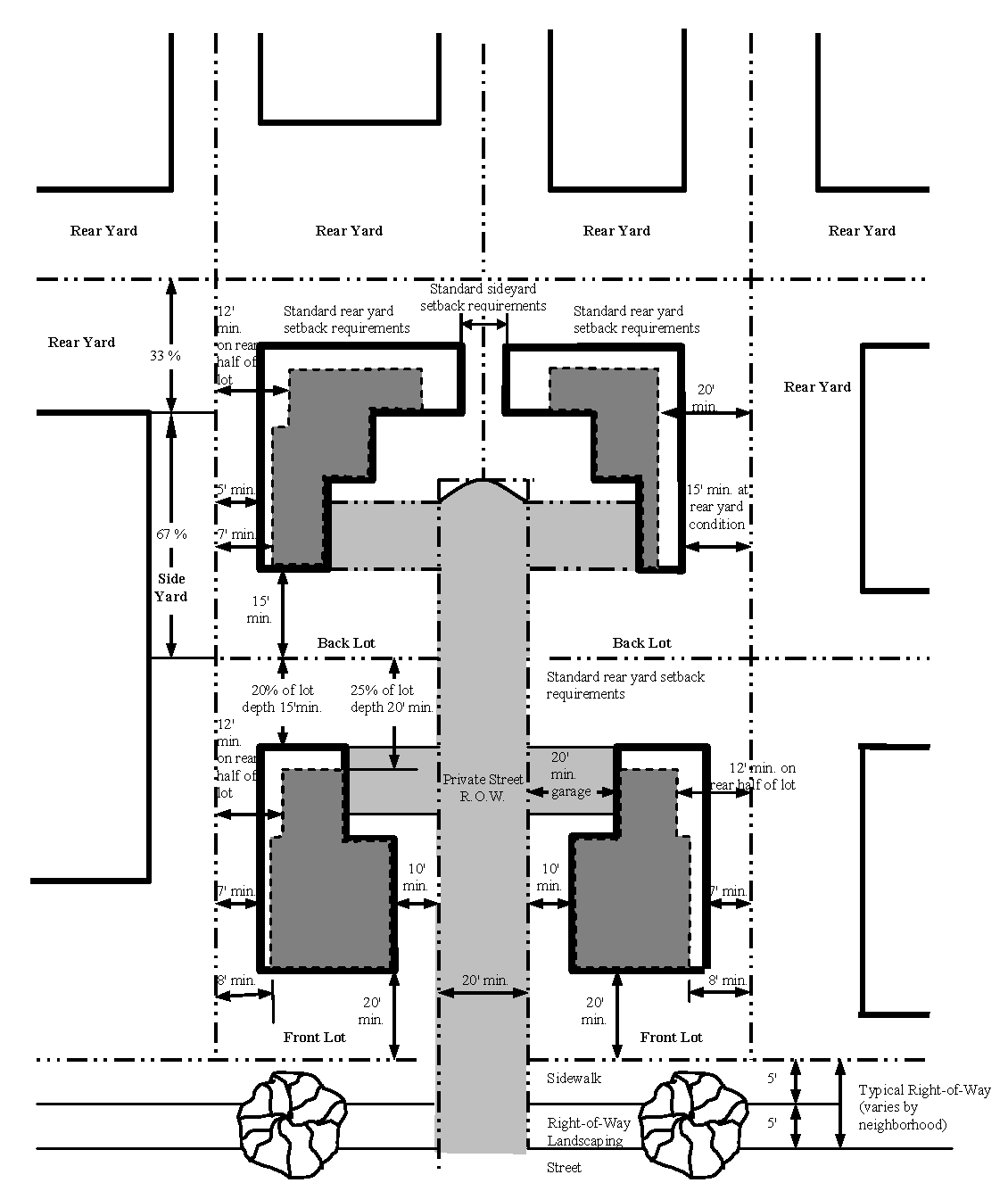
(Ord. No. 18.13, § 1, 12/10/13; Ord. No. 4.22, § 9, 4/12/22.)
SEC. 36.10.40. - R2 zoning district standards.
New land uses and structures, and alterations to existing land uses and structures, shall be designed and constructed in compliance with this section.
(Ord. No. 18.13, § 1, 12/10/13.)
SEC. 36.10.45. - Minimum lot area and width for subdivisions.
The minimum area and width of parcels proposed in new subdivisions in the R2 zoning district are subject to the following requirements. Areas of special limitations are identified on the zoning map by a suffix to the R2 map symbol (e.g., R2-8, R2-10, etc.).
If the minimum parcel area required by a suffix to the R2 zoning map symbol is within the ranges shown above (e.g., more than eight thousand (8,000) but less than ten thousand (10,000) square feet), the required lot width shall be determined by the zoning administrator.
(Ord. No. 18.13, § 1, 12/10/13.)
SEC. 36.10.50. - R2 zone development standards.
The following table entitled "R2 Zone Development Standards" defines minimum standards for development within the R2 zoning district. See Sec. 36.14.75 for exceptions to the site layout standards that may be granted for home improvements and minor additions. See Sec. 36.16 for development standards for small-lot single-family developments, Sec. 36.16.10 for development standards for townhouses and Sec. 36.16.20 for development standards for rowhouses. If only one (1) single-family dwelling can be built on an existing lot, then the dwelling is subject to R1 development standards (Sec. 36.10.25).
R2 ZONE DEVELOPMENT STANDARDS
(Ord. No. 18.13, § 1, 12/10/13.)
SEC. 36.10.55. - Development review required.
The following types of development in the R2 zoning district shall be subject to development review in compliance with Sec. 36.44.45 (Development Review):
a.
Fences over six (6) feet in height and up to seven (7) feet;
b.
Development on sites with existing nonconforming structures (see Sec. 36.06.60, Nonconforming Structures and Uses);
c.
Exceptions to standard site development regulations, in compliance with Sec. 36.14.75 (Setback Exceptions) and 36.08.30 (Exceptions to Height Limits); and
d.
Small-lot, single-family developments, townhouse developments and rowhouse developments.
Figure 36.10-5
R2 SETBACK REQUIREMENTS
(For Reference Only)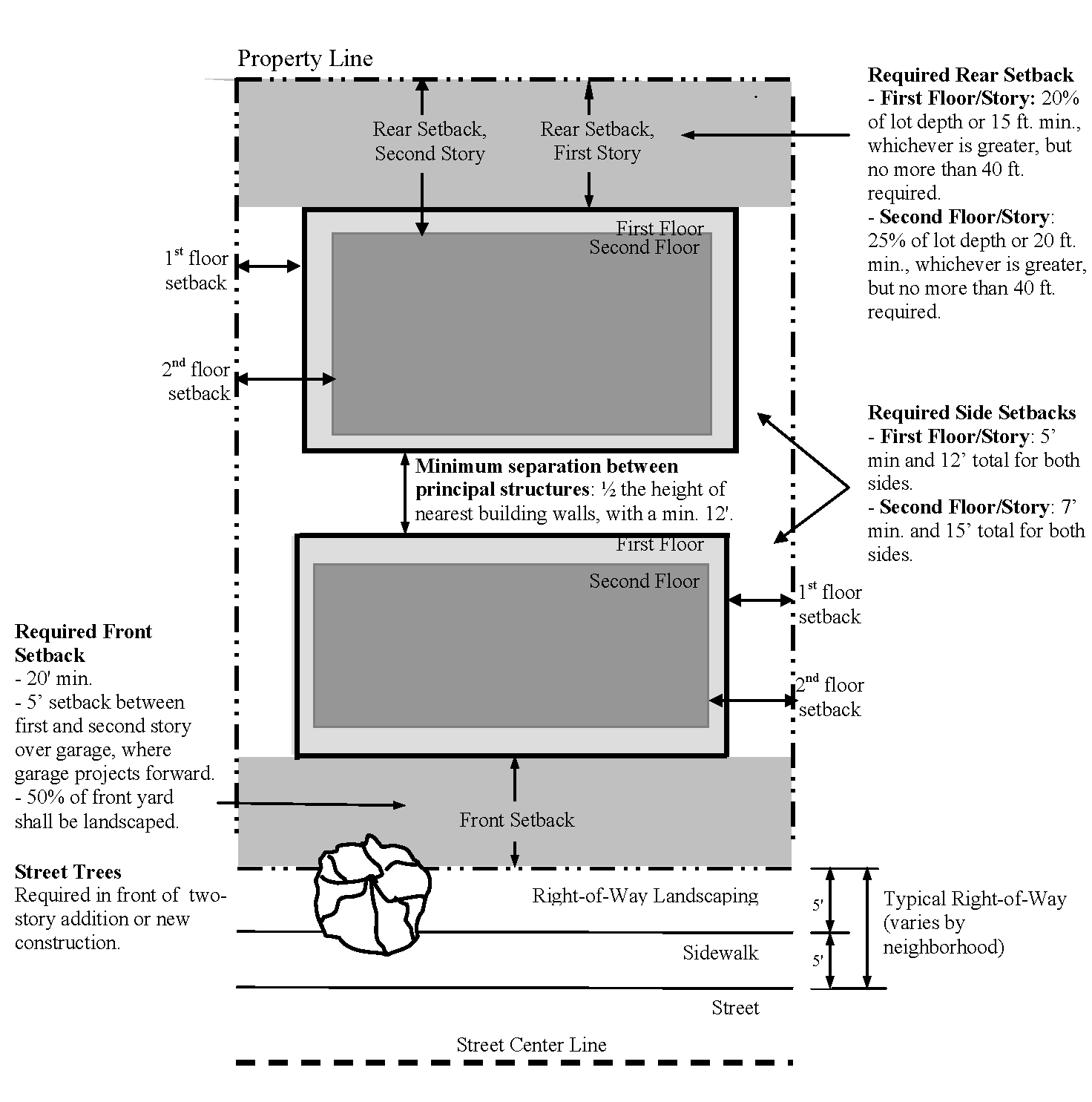
(Ord. No. 18.13, § 1, 12/10/13.)
SEC. 36.10.60. - R3 zoning district standards.
New land uses and structures, and alterations to existing land uses and structures, shall be designed and constructed in compliance with this section.
For the purposes of determining the allowed density (number of dwellings) and other appropriate standards for development in specific R3 areas of the city, the R3 symbol on the zoning map may include a suffix. Areas on the zoning map with numerical suffixes (e.g., R3-2) are subject to limitations on the number of dwellings allowed (see Sec. 36.10.75). Areas designated R3-D on the zoning map are intended for high-density residential development and are subject to both density limitations and other development standards that apply only in R3-D areas.
(Ord. No. 18.13, § 1, 12/10/13.)
SEC. 36.10.65. - Limitation on single-family and two (2) units.
If only one (1) single-family unit can be built on an existing lot, then the unit is subject to R1 standards (Sec. 36.10.25). If only two (2) units can be built on an existing lot, then the units are subject to R2 standards (Sec. 36.10.50). Except R1 or R2 subdivision standards (i.e., lot area, width, frontage) shall not apply in the R3 district.
(Ord. No. 18.13, § 1, 12/10/13.)
SEC. 36.10.70. - R3 zone development standards.
The following table entitled "R3 Zone Development Standards" defines minimum standards for development within the R3 zoning district. See Sec. 36.14.75 for exceptions to the standards that may be granted for home improvements and minor additions to properties subject to R1 or R2 development standards. See Sec. 36.16 for development standards for small-lot, single-family developments and Sec. 36.16.10 for development standards for townhouse developments and Sec. 36.16.20 for development standards for rowhouse developments.
R3 ZONE DEVELOPMENT STANDARDS
Figure 36.10-6
R3 SETBACK REQUIREMENTS
(For Reference Only)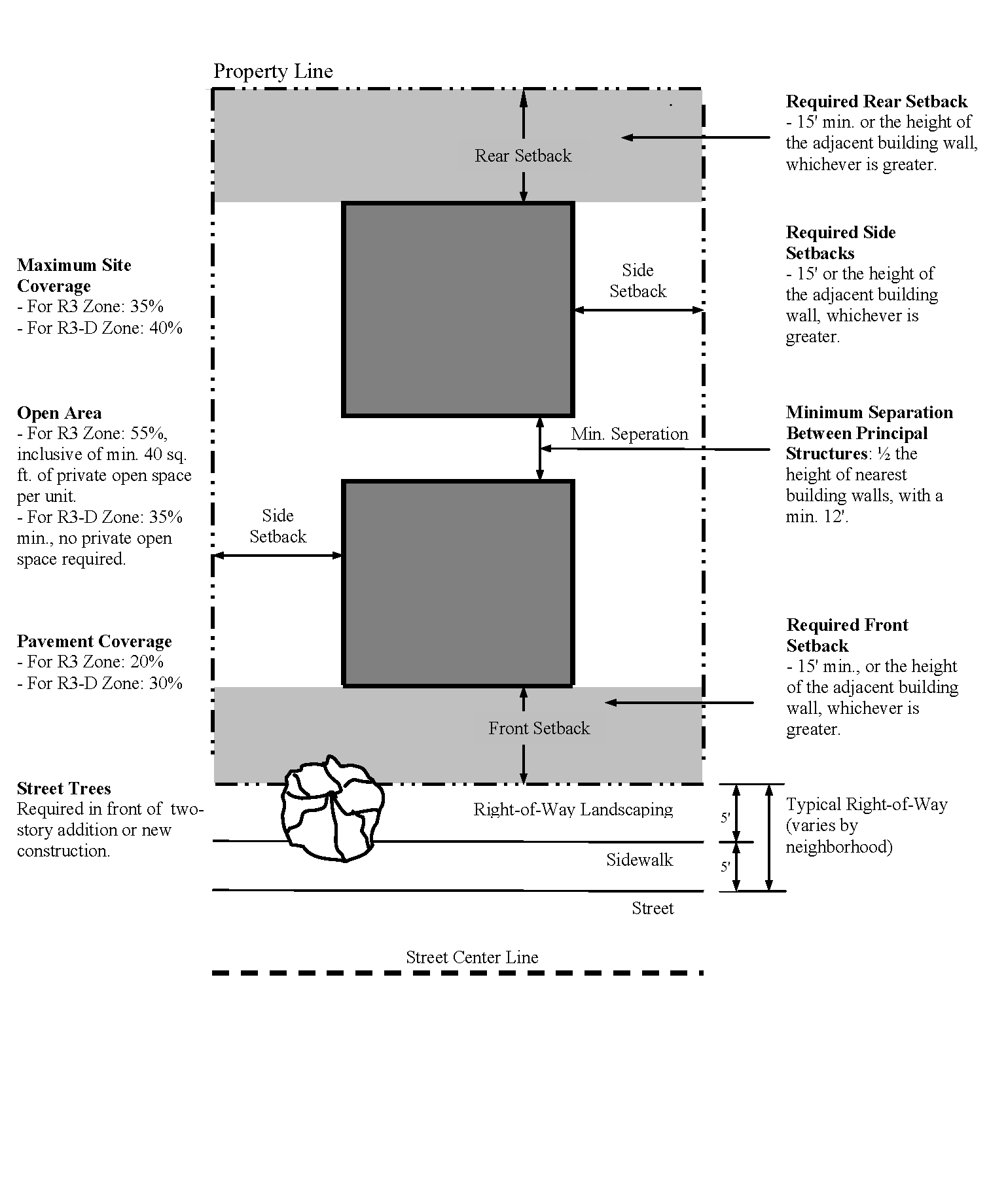
(Ord. No. 18.13, § 1, 12/10/13.)
SEC. 36.10.75. - Density.
The number of multi-family dwellings allowed on a site in the R3 zoning district is determined by the minimum lot area required for each dwelling as given in the following table, except that:
a.
An existing lot of record that is less than seven thousand (7,000) square feet is permitted a maximum of one (1) dwelling unit, subject to the R1 development standards;
b.
An existing lot of record that is seven thousand (7,000) square feet or greater, but less than twelve thousand (12,000) square feet, is permitted two (2) dwelling units in all cases, subject to the R2 development standards; or
c.
An existing lot of record having a lot width of less than eighty (80) feet shall not be developed with more than two (2) dwelling units, regardless of the depth of the lot, subject to the R2 development standards.
(For maximum densities in small-lot single-family development, see Sec. 36.16; for maximum densities for townhouse developments, see Sec. 36.16.10; and for maximum densities for rowhouse developments, see Sec. 36.16.20).
MINIMUM LOT AREA REQUIREMENTS
FOR MULTI-FAMILY DWELLINGS IN R3 ZONE
(Ord. No. 18.13, § 1, 12/10/13.)
SEC. 36.10.80. - Development review required.
All development, including exterior modifications to existing structures or site improvements, within the R3 zoning district shall be subject to development review in compliance with Sec. 36.44.45 (Development Review).
(Ord. No. 18.13, § 1, 12/10/13.)
SEC. 36.10.85. - Rooming and boarding—R3 zoning district.
The rooming and boarding of two (2) persons maximum in addition to permanent residents of a dwelling is permitted in the R3 zoning district only in single-family dwellings and duplexes. Rooming and boarding is not allowed in multi-family dwellings.
(Ord. No. 18.13, § 1, 12/10/13.)
SEC. 36.12. - R4 zoning district standards.
New land uses, new structures, and alterations or modifications to existing land uses and structures, shall be designed and constructed in compliance with this section.
(Ord. No. 18.13, § 1, 12/10/13.)
SEC. 36.12.05. - Limitation on single-family housing.
If only one (1) single-family dwelling can be built on an existing lot, the dwelling is subject to R1 development standards (Sec. 36.10.25).
(Ord. No. 18.13, § 1, 12/10/13.)
SEC. 36.12.10. - R4 zone development standards.
The following are minimum standards for development within the R4 zoning district. In addition to the following requirements, multi-family buildings in the R4 zone will also be reviewed in the context of the R4 standards and guidelines. See Sec. 36.16 for small-lot, single-family developments; Sec. 36.16.10 for townhouse developments; and Sec. 36.16.20 for rowhouse developments.
R4 ZONE DEVELOPMENT STANDARDS
(Ord. No. 18.13, § 1, 12/10/13; Ord. No. 4.19, § 2, 5/14/19; Ord. No. 1.2023, § 2, 2/14/23.)
SEC. 36.12.15. - RMH district development standards.
New structures and alterations to existing structures shall be designed and constructed in compliance with this section. All requirements shown are minimums except where otherwise noted.
(Ord. No. 18.13, § 1, 12/10/13.)
SEC. 36.12.20. - Standards for other uses.
The standards for land uses allowed in the RMH district other than mobile home parks shall be the same as provided for the R2 zoning district by Sec. 36.10.40.
(Ord. No. 18.13, § 1, 12/10/13.)
SEC. 36.12.25. - Mobile home parks/subdivisions.
The following standards are intended to ensure that new, expanded or redeveloped mobile home parks, and new mobile home subdivisions are located and established so as to be compatible with adjacent residential neighborhoods and commercial areas. The planning and design of mobile home parks, including lots and other areas within parks, and the permitting of individual mobile homes within mobile home parks are regulated by the California Department of Housing and Community Development, and is not subject to the provisions of this section.
a.
Site planning and design standards. Mobile home parks and subdivisions shall conform to the following minimum standards.
1.
Minimum site area: five (5) acres.
2.
Density: a maximum of eight (8) mobile home spaces per acre.
3.
Setbacks. All structures, including but not limited to mobile homes, shall be set back from property lines as follows:
(a)
Street frontage lot lines: thirty (30) feet.
(b)
Exterior park lot lines not abutting streets: ten (10) feet.
4.
Landscaping. Mobile home parks shall be landscaped as follows:
(a)
Street frontages. Required setbacks shall be provided with a landscaped buffer at least fifteen (15) feet wide, except where cut by access driveways. Landscaping shall occupy a minimum of sixty (60) percent of the required street frontage setback area required by subsection a.3.(a), above.
(b)
A minimum ten (10) foot wide screen planting shall be established between the mobile home park and peripheral property lines.
(c)
A minimum twenty (20) percent of the total site area for each mobile home shall be permanently landscaped.
(d)
A minimum of forty-five (45) percent of the total common area(s) of a mobile home park shall be permanently landscaped.
(e)
At least one (1) fifteen (15) gallon tree shall be provided on each mobile home lot.
5.
Fencing. The perimeter of a mobile home park or subdivision shall be enclosed by a six (6) foot high solid masonry wall (or alternate approved by the zoning administrator), located at the setback line along street frontages, and adjacent to property lines not abutting streets.
6.
Signs. Sign area shall be limited to one (1) identification sign of fifty (50) square feet and one (1) directional sign of twenty-five (25) square feet, subject to zoning administrator approval.
b.
Accessory commercial uses permitted. A mobile home park may contain commercial uses for the convenience of park residents; i.e., coin-operated laundry, soft drink, cigarette and similar machines, provided that these uses shall be located in the interior of the park and shall not occupy more than five hundred (500) square feet for each fifty (50) mobile homes or fraction thereof.
c.
Use of mobile home lots. No more than one (1) occupied mobile home shall be allowed on any one (1) lot. No travel trailer, camper or other recreational vehicle shall be placed on any mobile home lot, either for occupancy or storage.
d.
Recreational vehicle areas. Mobile home parks in the RMH zoning district may include spaces for occupied recreational vehicles, and/or recreational vehicle storage areas, provided that the location, number and size of spaces shall be authorized as part of the conditional use permit approval.
(Ord. No. 18.13, § 1, 12/10/13.)
SEC. 36.12.30. - Mobile homes and manufactured housing.
Mobile homes (identified as manufactured homes by the National Manufactured Housing Construction and Safety Standards Act of 1974) on lots zoned for conventional single-family dwellings, and the storage of mobile homes are subject to the requirements of this section. Mobile homes placed in mobile home parks (Sec. 36.12.25) that are regulated by the State Department of Housing and Community Development, are not subject to the provisions of this section. Modular (also known as factory-built) housing units are considered the same as single-family dwellings for the purposes of this chapter, and are not subject to the provisions of this section.
Mobile homes to be used as permanent dwellings in compliance with this section are subject to the following requirements:
a.
Certified mobile homes. Mobile homes that are certified under the National Manufactured Housing Construction and Safety Standards Act of 1974 (42 USC Sec. 5401, et seq.) are subject to the following standards:
1.
Location. As required by Government Code § 65852.3, mobile homes for permanent occupancy are considered the same as single-family dwellings, and are permitted by Sec. 36.10.05 (Residential Zone Land Uses and Permit Requirements) in all zoning districts that allow single-family dwellings;
2.
Foundation system. The mobile home shall be placed on a foundation system in compliance with Health and Safety Code § 18551; and
3.
Architectural standards. Mobile homes shall be designed and constructed with roof eave and gable overhangs of not less than one (1) foot measured from the vertical side of the structure.
b.
Noncertified mobile homes. Mobile homes that are not certified under the National Mobile Home Construction and Safety Act of 1974, and that do not meet the requirements of Sec. 36.12.30.a above shall be placed only in mobile home parks.
c.
Density. The number of certified mobile homes (as described in Sec. 36.12.30.a above) that may be placed on a single parcel shall be the same as the number of single-family dwellings permitted by Sec. 36.10.10. (R1 District Development Standards). The number of mobile homes that may be placed in a mobile home park is determined by Sec. 36.12.15 (Mobile Home Parks).
d.
Storage of unoccupied mobile homes. Unoccupied mobile homes or portions thereof that are not fixed to a foundation shall be stored only in a mobile home sales lot, or an approved storage yard.
(Ord. No. 18.13, § 1, 12/10/13.)
SEC. 36.12.35. - Residential accessory uses and structures.
When permitted in the zoning district applicable to a site (see Section 36.10.05, Land Uses and Permit Requirements by Residential Zone), specific residential accessory uses are subject to the provisions of this section. Residential accessory uses and structures include any use or structure that is customarily related to a residence, including, but not limited to, swimming pool structures, workshops, studios, storage sheds, greenhouses, garages, gazebos, arbors and fences.
(Ord. No. 18.13, § 1, 12/10/13.)
SEC. 36.12.40. - General requirements.
All accessory uses and structures are subject to the following standards, except where more restrictive requirements are established by other provisions of this chapter for specific uses.
a.
Relationship of accessory use to principal use. Accessory uses and structures shall be incidental to and not alter the character of the site from that created by the principal use.
b.
Attached structures. If an accessory structure is attached to a principal structure, it shall be architecturally compatible with, and made structurally a part of the principal structure. It shall also comply with all the requirements of this chapter applicable to the principal structure, including setback standards for the principal structure and all applicable building and fire codes.
c.
Kitchens. Accessory structures are not to be used as separate dwelling units and kitchens are not allowed.
(Ord. No. 18.13, § 1, 12/10/13.)
SEC. 36.12.45. - Multiple-family ownership projects—Plans required.
Multiple-family; townhouse; rowhouse; and small-lot, single-family developments proposed with individual unit ownership and a homeowners' association, and existing projects of the same type that are proposed for alteration, shall require approval through the development review process (Section 36.44.45) of an overall plan for all site improvements (e.g., decks, fences, arbors, hot tubs and spas, gazebos, etc.). The construction of site improvements in compliance with the approved plan are subject to design review and may require building permit approval. In the case of proposed changes to an existing project, the plan shall be approved by the homeowners association before submittal to the community development department.
(Ord. No. 18.13, § 1, 12/10/13.)
SEC. 36.12.50. - Development standards for detached structures in the R1 and R2 zoning districts.
The following standards, in addition to those in Section 36.12.40, shall apply to detached accessory structures in the R1 and R2 zoning districts:
a.
Location: Allowed to the rear or side of the principal structure, prohibited in the front setback, and subject to special setback requirements as listed in this section.
b.
Maximum lot coverage: All accessory structure(s) shall not cumulatively cover more than thirty (30) percent of the required rear yard, excluding accessory structures less than five (5) feet in height which shall not count toward lot coverage. Any roof eaves greater than one (1) foot in depth on an accessory structure shall count toward lot coverage.
c.
Maximum size: An accessory structure cannot cover more than a maximum of five hundred (500) square feet of area. Depending on the size of the required rear yard of a property, the maximum size of an accessory structure may be less than five hundred (500) square feet in accordance with the maximum rear yard coverage.
d.
Floor area: Enclosed accessory structures shall count toward the total floor area for the lot. Open accessory structures shall not count toward the total floor area for the lot.
e.
Maximum height: An accessory structure shall have a one (1) story limit with a total building height of sixteen (16) feet and a nine (9) foot wall plate measured from the adjacent grade.
f.
Separation from structure(s): An accessory structure shall be set back ten (10) feet from the principal structure and any other accessory structure on-site, excluding accessory structures less than five (5) feet in height and open accessory structures, which shall have no minimum separation between structures.
g.
Side setback: Accessory structures located entirely within the required rear yard may be reduced to a zero (0) foot setback from side property line(s); otherwise, a minimum seven (7) foot setback to side property line(s) is required. Detached garages may have a zero (0) foot setback from side property line(s) whether or not it is located within the required rear yard. In no case shall an accessory structure be located less than five (5) feet from a street side property line.
h.
Rear setback and building width: The minimum rear setback for all accessory structures is seven (7) feet. If the cumulative width of all accessory structures in, or partially in, the required rear yard is less than thirty-three (33) percent of the width of the lot, then the minimum rear setback for these structures can be reduced to zero (0) feet. In no case shall the maximum cumulative width of accessory structures in, or partially in, the required rear yard exceed fifty (50) percent of the width of the lot.
i.
Cooking and smoke-producing facilities. Any accessory structure which includes cooking or smoke-producing components, such as barbecues, fire pits, chimneys and outdoor kitchens, shall maintain a minimum five (5) foot setback from all side and rear property lines.
j.
Eaves. All accessory structures are allowed up to one (1) foot roof eaves, which does not count toward lot coverage, so long as the eaves do not extend beyond the property line and comply with the roof drainage requirement.
k.
Roof drainage: All allowances for zero (0) foot setback listed above are conditioned on the requirement that in no case shall roof drainage of an accessory structure drain onto a neighboring property.
l.
Maximum number of plumbing fixtures: Three (3), not including water heater fixtures.
m.
Building and fire codes. All accessory structures must comply with building and fire codes.
(Ord. No. 18.13, § 1, 12/10/13.)
SEC. 36.12.55. - Other accessory structures and uses.
a.
Antennas. Antennas are subject to the provisions of Sec. 36.28.25.
b.
Garage/yard sales. The sale of miscellaneous items by residents from a yard or open garage is permitted up to four (4) times per year per property, for a maximum of three (3) days per sale.
c.
Home occupations. Home occupations are subject to the requirements of Sec. 36.28.75.
d.
Swimming pools/spas/hot tubs. Private swimming pools, spas and hot tubs are permitted accessory to approved residential uses on the same site, subject to the following provisions:
1.
Limitation on use. The pool is to be used solely by occupants of the dwelling(s) on the same site and their guests;
2.
Setbacks. At least five (5) feet from any property line, for the pool/spa/tub, three (3) feet for related equipment; and
3.
Fencing. The swimming pool shall be secured by fencing and/or building walls to prevent uncontrolled access by children, in compliance with the building code (Chapter 8).
e.
Tennis and other recreational courts. Noncommercial outdoor tennis courts and courts for other sports (e.g., racquetball, etc.) accessory to a residential use are subject to the following requirements:
1.
Fencing. Shall be subject to height limits approved by the zoning administrator; and
2.
Lighting. Court lighting shall not exceed a maximum height of twenty (20) feet, measured from the court surface. The lighting shall be directed downward, shall only illuminate the court, and shall not illuminate adjacent property.
f.
Vehicle storage. The storage of vehicles, including incidental restoration and repair, is subject to Sec. 25.4.j, Chapter 19, Article IX (Vehicle Parking and Storage in Residential Areas) and Chapter 39 of the City Code (Vehicles Abandoned, Wrecked, Dismantled or Inoperative).
g.
Animal Keeping. The keeping of dogs, cats and small animals (for noncommercial purposes) in residential zoning districts is allowable subject to the provisions of Chapter 5 of the City Code.
h.
Mechanical equipment. Mechanical equipment, including, but not limited to, air conditioner units, can encroach into the required side or rear yard setback, but must be at least three (3) feet from the property line. No mechanical equipment can be located within the front yard setback or be visible from the public street. Mechanical equipment may be located in a street side yard setback, but must be within a fenced yard consistent with fence setback requirements and traffic safety visibility area(s).
(Ord. No. 18.13, § 1, 12/10/13; Ord. No. 20.19, § 5, 12/10/19.)
SEC. 36.12.60. - Accessory dwelling units and junior accessory dwelling units.
Sec. 36.12.60 through Sec. 36.12.120 establish standards for accessory dwelling units and junior accessory dwelling units in conformance with the City Code and all applicable state laws.
(Ord. No. 11.20, § 4, 11/10/20.)
SEC. 36.12.65. - Accessory dwelling unit and junior accessory dwelling unit definitions.
For the purposes of this division, the following definitions shall apply:
Attached unit. An accessory dwelling unit created by the addition of new floor area which is attached to at least one (1) primary dwelling.
Detached unit. An accessory dwelling unit created by the addition of a new structure which is detached from any primary dwelling.
Dual urban opportunity housing site. An R1-zoned lot which contains two (2) primary dwelling units and/or was created through an urban lot split.
Multi-family dwelling structure. A residential structure or group of attached structures with two (2) or more dwelling units, including, but not limited to, duplexes, triplexes, fourplexes, apartments, condominiums, rowhouses and townhouses. Multi-family dwelling structures are designed such that multiple families are living independently of each other.
Multi-family interior unit. An accessory dwelling unit created within a portion of an existing multi-family dwelling structure that was not previously used as livable space.
Multi-family residential site. A site containing one (1) or more multi-family dwelling structures or more than one (1) single-family home in a zone that permits single-family or multi-family uses.
Single-family interior unit. An accessory dwelling unit created within a portion of an existing single-family residence or within an existing accessory structure on a single-family residential site.
Single-family residential site. A site containing one (1) single-family home, including a lot within a small-lot, single-family development, in a zone that permits single-family or multi-family uses.
(Ord. No. 11.20, § 5, 11/10/20; Ord. No. 4.22, § 10, 4/12/22.)
SEC. 36.12.70. - Findings.
As required by Government Code § 65852.2, the city finds that accessory dwelling units and junior accessory dwelling units are residential uses that are consistent with the allowable density, with the general plan, and zoning designation for the site, provided the units are located on properties zoned to allow single-family or multi-family dwelling residential uses.
(Ord. No. 11.20, § 6, 11/10/20.)
Editor's note— Ord. No. 01.2024, § 9, adopted Jan. 23, 2024, repealed §§ 36.12.75—36.12.115, and renumbered and amended §§ 36.12.80—36.12.120 as set out herein. The former §§ 36.12.75—36.12.115 pertained to similar subject matter and derived from Ord. No. 11.20, § 7, adopted Nov. 10, 2020.
SEC. 36.12.75. - Maximum number of units.
Accessory dwelling units and/or a junior accessory dwelling unit are permitted on a residential site as follows:
a.
One (1) accessory dwelling unit and one (1) junior accessory dwelling unit per lot with a proposed or existing single-family dwelling subject to the provisions of Government Code Section 65852.2(A).
b.
One (1) detached, new construction, accessory dwelling unit that does not exceed four (4) foot side- and rear-yard setbacks for a lot with a proposed or existing single-family dwelling. The accessory dwelling unit may be combined with a junior accessory dwelling unit.
c.
Multiple accessory dwelling units are allowed within the portions of existing multi-family dwelling structures that are not used as livable space, including, but not limited to, storage rooms, boiler rooms, passageways, attics, basements or garages, if each unit complies with Chapter 8 of the city code. At least one (1) accessory dwelling unit within an existing multi-family dwelling is allowed, and up to twenty-five (25) percent of the existing multi-family dwelling units are allowed.
d.
Not more than two (2) accessory dwelling units that are located on a lot that has an existing multi-family dwelling are allowed to be detached from that multi-family dwelling subject to a height limit in compliance with Section 36.12.85 and four (4) foot rear yard and side setbacks.
(Ord. No. 11.20, § 8, 11/10/20; Ord. No. 4.22, § 11, 4/12/22; Ord. No. 01.2024, § 9, 1/23/24.)
SEC. 36.12.80. - Provisions applicable to single-family accessory dwelling units.
Except as provided in subsection 36.12.95 b., an accessory dwelling unit is only allowed on a single-family residential site subject to the following requirements. All requirements of the underlying zoning district shall apply unless they are in conflict with this Section.
SINGLE-FAMILY ACCESSORY DWELLING UNIT REQUIREMENTS
(Ord. No. 11.20, § 9, 11/10/20; Ord. No. 01.2024, § 9, 1/23/24.)
SEC. 36.12.85. - Provisions applicable to multi-family accessory dwelling units.
Except as provided in subsection 36.12.95 b., accessory dwelling unit(s) may be permitted on a multi-family residential site subject to the following requirements. All requirements of the underlying zoning district shall apply unless they are in conflict with this Section.
MULTI-FAMILY ACCESSORY DWELLING UNIT REQUIREMENTS
(Ord. No. 11.20, § 10, 11/10/20; Ord. No. 01.2024, § 9, 1/23/24.)
SEC. 36.12.90. - Provisions applicable to junior accessory dwelling units.
A junior accessory dwelling unit may be permitted on a single-family residential site subject to the following requirements.
JUNIOR ACCESSORY DWELLING UNIT REQUIREMENTS
(Ord. No. 11.20, § 11, 11/10/20; Ord. No. 01.2024, § 9, 1/23/24.)
_____
SEC. 36.12.95. - Exceptions.
a.
Parking exceptions. No parking space is required for an accessory dwelling unit if any of the following conditions are met:
1.
The unit is located within one-half (1/2) mile walking distance of public transit.
2.
The unit is located within an architecturally and historically significant historic district.
3.
The unit is part of the existing primary dwelling unit or an existing accessory structure.
4.
On-street parking permits are required but not offered to the occupant of the accessory dwelling unit.
5.
There is a car-share vehicle parking space located within one (1) block of the accessory dwelling unit.
6.
When an existing garage, carport or covered parking structure is demolished in conjunction with the construction of an accessory dwelling unit or converted to an accessory dwelling unit, no replacement parking spaces shall be required.
b.
Development standard exceptions.
1.
An attached or detached accessory dwelling unit no more than eight hundred (800) square feet in size with heights consistent with this Division and minimum side and rear setbacks of four (4) feet shall be permitted regardless of any development standard that would prevent construction of the unit, including, but not limited to, limits on the front setback, lot coverage, floor area ratio, open space or detached accessory dwelling unit location.
2.
An expansion of no more than one hundred fifty (150) square feet of an existing accessory structure to accommodate ingress and egress shall be allowed when an accessory dwelling unit is otherwise within the existing space of an accessory structure or within the existing space of an existing single-family dwelling.
3.
The height and setback standards listed in Section 36.12.80 do not apply to accessory dwelling units located entirely within a single-family dwelling, nonlivable space of a multi-family dwelling structure, or accessory structure; or in the place of and to the same dimensions, including height, as an existing accessory structure. The side and rear setbacks must be sufficient for fire and safety.
4.
Up to two (2) feet of roof eave may encroach into required setbacks in accordance with building and fire codes.
5.
The gross floor area for a single-family accessory dwelling unit may be exempt from the subject parcel's maximum allowable floor area per the underlying zoning district, up to a maximum of eight hundred (800) square feet.
(Ord. No. 11.20, § 12, 11/10/20; Ord. No. 01.2024, § 9, 1/23/24.)
SEC. 36.12.100. - Sale of units.
Accessory dwelling units and junior accessory dwelling units may be rented independently of the primary single-family dwelling or multi-family dwelling structure but may not be sold or conveyed separately from the primary dwelling(s) on the lot except as provided in Government Code Section 65852.26.
(Ord. No. 11.20, § 13, 11/10/20; Ord. No. 01.2024, § 9, 1/23/24.)
SEC. 36.12.105. - Short-term rentals.
Short-term rentals with a term thirty (30) days or shorter are prohibited in: all junior accessory dwelling units; all accessory dwelling units of eight hundred (800) square feet or less; single-family interior units; detached units created under subsection 36.12.95 b.1.; multi-family interior units; and detached units on multi-family residential sites.
(Ord. No. 11.20, § 14, 11/10/20; Ord. No. 01.2024, § 9, 1/23/24.)
SEC. 36.12.110. - Corrections of nonconforming conditions or violations.
The correction of nonconforming zoning conditions, building code violations or unpermitted structures shall not be required of an accessory dwelling unit unless the improvements present a threat to public health and safety, which are affected by the construction of the accessory dwelling unit, or a correction is necessary to the primary dwelling unit to protect health and safety as determined by the chief building official.
(Ord. No. 11.20, § 15, 11/10/20; Ord. No. 01.2024, § 9, 1/23/24.)
SEC. 36.12.115. - Utilities.
a.
Except as provided in subsection b. below, an accessory dwelling unit may be required to have a new or separate utility connection, including a separate sewer lateral, between the accessory dwelling unit and the utility. A connection fee or capacity charge may be charged that is proportionate to the size in square feet of the accessory dwelling unit or its drainage fixture unit (DFU) values. Separate electric and water meters shall be required for the second unit.
b.
Junior accessory dwelling units and accessory dwelling units converted from the existing space of a single-family dwelling or accessory structure are exempt from any requirement to install a new or separate utility connection and to pay any associated connection or capacity fees or charges.
c.
All utility extensions shall be placed underground.
d.
No accessory dwelling unit shall be permitted if it is determined that there is not adequate water or sewer service to the property.
(Ord. No. 11.20, § 16, 11/10/20; Ord. No. 01.2024, § 9, 1/23/24.)
Editor's note— Ord. No. 01.2024, § 9, adopted Jan. 23, 2024, repealed the former § 36.12.115, and enacted a new § 36.12.115 as set out herein. The former § 36.12.115 pertained to fire sprinklers and derived from Ord. No. 11.20,§ 15, adopted Nov. 10, 2020.
SEC. 36.13.10. - Dual urban opportunity housing.
This division aims to promote residential development by allowing dual urban opportunity housing sites. Dual urban opportunity housing sites include any R1-zoned lot which contains two (2) primary dwelling units and/or was created through an urban lot in compliance with the provisions of this division. It is the purpose of this Division to implement Section 65852.21 of the Government Code pertaining to the development of two (2) primary residential units on single-family zoned lots and to implement Section 66411.7 of the Government Code pertaining to urban lot splits."
(Ord. No. 4.22, § 12, 4/12/22.)
SEC. 36.13.15. - Rental term.
No dwelling unit located on a dual urban opportunity housing site may be rented for a period of less than thirty-one (31) days.
(Ord. No. 4.22, § 13, 4/12/22.)
SEC. 36.13.20. - Dual urban opportunity developments.
Where allowed by Section 36.10.05 (Land Uses and Permit Requirements by Residential Zone), this section establishes standards for dual urban opportunity developments.
(Ord. No. 4.22, § 14, 4/12/22.)
SEC. 36.13.25. - Eligibility.
A dual urban opportunity development must comply with the following eligibility requirements:
a.
Historic. Not permitted on any lot containing a historic resource, as defined in Section 36.54.55, or located within a historic district.
b.
Withdrawal from rental market. Not permitted on any lot that contained a dwelling unit that was withdrawn from rental or lease under the Ellis Act at any time within fifteen (15) years before the date that the application for the dual urban opportunity development is submitted to the city.
c.
Demolition or alteration of protected units. Shall not result in the demolition or structural modification of any portion of an existing residential unit that:
1.
Is protected by a recorded covenant, ordinance or law that restricts rents to levels affordable to persons and families of moderate, low or very low income;
2.
Is protected under the City of Mountain View Community Stabilization and Fair Rent Act; or
3.
Has been occupied by a tenant within the three (3) years prior to the submittal of an application for a dual urban opportunity development.
(Ord. No. 4.22, § 15, 4/12/22.)
SEC. 36.13.30. - Sale of units.
Each primary dwelling unit of a dual urban opportunity development may be rented independently but shall not be sold or conveyed separately from the other unit.
(Ord. No. 4.22, § 16, 4/12/22.)
SEC. 36.13.35. - Maximum number of units.
a.
No more than two (2) primary dwelling units are permitted on a single existing lot or newly created lot through an urban lot split.
b.
For existing lots not established through an urban lot split, in addition to a primary dwelling unit(s), an accessory dwelling unit(s) and/or a junior accessory dwelling unit(s) may also be allowed for a maximum of four (4) total units (inclusive of primary units, accessory dwelling units and junior accessory dwelling units).
c.
For lots established through an urban lot split, in addition to a primary dwelling unit, a second primary unit or an accessory dwelling unit or junior accessory dwelling unit may also be allowed for a maximum of two (2) units per resulting lot (inclusive of primary units, accessory dwelling units and junior accessory dwelling units)."
(Ord. No. 4.22, § 17, 4/12/22.)
SEC. 36.13.40. - Development standards.
Except as provided in Section 36.13.45, dual urban opportunity developments must comply with the following requirements:
DUAL URBAN OPPORTUNITY DEVELOPMENT STANDARDS
(Ord. No. 4.22, § 18, 4/12/22.)
SEC. 36.13.45. - Exceptions.
a.
Parking exceptions. No parking shall be required for either unit of a dual urban opportunity development if any of the following conditions are met:
1.
The lot is located within one-half (1/2) mile walking distance of a high-quality transit corridor, as defined in subdivision (b) of Section 21155 of the Public Resources Code;
2.
The lot is located within one-half (1/2) mile walking distance of a major transit stop, as defined in Section 21064.3 of the Public Resources Code; or
3.
There is a car-share vehicle parking space located within one (1) block of the lot.
b.
Development standard exceptions.
1.
A dual urban opportunity development consisting of two (2) attached or detached primary dwelling units, each no more than eight hundred (800) square feet in size with side and rear setbacks of four (4) feet, shall be permitted regardless of any development standard that would prevent construction of the units.
2.
A dual urban opportunity development consisting of one (1) attached or detached primary dwelling unit that is no more than eight hundred (800) square feet in size with side and rear setbacks of four (4) feet that is added to an existing primary dwelling unit shall be permitted regardless of any development standard that would prevent construction of the second primary dwelling unit, including, but not limited to, limits on lot size, lot width, lot coverage, floor area ratio and open space.
3.
The setback requirements described in Section 36.13.40 shall not apply to any legal dwelling unit on a site that existed prior to the construction of the dual urban opportunity development or any legal dwelling unit that was constructed within the footprint of a legal dwelling unit that existed on the site prior to the construction of the dual urban opportunity development.
4.
Correction of any legal nonconforming zoning condition shall not be required as a condition of approval for a dual urban opportunity development.
(Ord. No. 4.22, § 19, 4/12/22.)
SEC. 36.13.50. - Findings for denial.
The city may deny an application for a dual urban opportunity development if the chief building official makes a written finding, based on a preponderance of the evidence, that the project would have a "specific, adverse impact" on either public health and safety or on the physical environment and for which there is no feasible method to satisfactorily mitigate or avoid the specific adverse impact. "Specific adverse impact" has the same meaning as in Government Code Section 65589.5(d)(2): "a significant, quantifiable, direct, and unavoidable impact, based on objective, identified written public health or safety standards, policies, or conditions as they existed on the date the application was deemed complete" and does not include: (1) inconsistency with the zoning ordinance or general plan land use designation; or (2) the eligibility to claim a welfare exemption under Revenue and Taxation Code Section 214(g).
(Ord. No. 4.22, § 20, 4/12/22.)
SEC. 36.13.55. - Urban lot split.
Sec. 36.13.55 through Section 36.13.80 establish eligibility requirements and standards for urban lot splits. Refer to Mountain View City Code Chapter 28, Article III, for information pertaining to submittal requirements and review procedures of urban lot splits.
(Ord. No. 4.22, § 21, 4/12/22.)
SEC. 36.13.60. - Map Act compliance.
The urban lot split shall conform to all applicable objective requirements of the Subdivision Map Act (Gov. Code § 66410, et. seq.) ("SMA"), including implementing requirements in this Code, except as otherwise expressly provided in Section 36.13.10 through Section 36.13.75.
(Ord. No. 4.22, § 22, 4/12/22.)
SEC. 36.13.65. - Eligibility.
A lot is eligible to be subdivided through an urban lot split if it meets all of the following eligibility requirements:
a.
Zoning district. The lot to be subdivided must be located within the R1 zoning district.
b.
Historic. The lot to be subdivided shall not contain a historic resource, as defined in Section 36.54.55, or located within a historic district.
c.
Withdrawal from rental market. The lot to be subdivided contains a dwelling unit that was withdrawn from rental or lease under the Ellis Act at any time within fifteen (15) years before the date that the application for the urban lot split is submitted to the city.
d.
Demolition or alteration of protected units. The urban lot split shall not result in the demolition or structural modification of any portion of an existing dwelling unit that:
1.
Is protected by a recorded covenant, ordinance or law that restricts rents to levels affordable to persons and families of moderate, low or very low income;
2.
Is protected under the City of Mountain View Community Stabilization and Fair Rent Act; or
3.
Has been occupied by a tenant within the three (3) years prior to the submittal of an application for an urban lot split.
d.
Lot location. The lot to be subdivided shall not be located on a site that is any of the following, as contained within Government Code Section 65913.4(a)(6)(B) through (K), as may be amended from time to time:
1.
Prime farmland, farmland of statewide importance or land that is zoned or designated for agricultural protection or preservation by the voters.
2.
A wetland.
3.
Within a very high fire hazard severity zone, unless the site complies with all fire-hazard mitigation measures required by existing building standards.
4.
A hazardous waste site that has not been cleared for residential use.
5.
Within a delineated earthquake fault zone, unless all development on the site complies with applicable seismic protection building code standards.
6.
Within a one hundred (100) year flood hazard area, unless the site has either been subject to a letter of map revision prepared by the Federal Emergency Management Agency and issued to the local jurisdiction, or meets Federal Emergency Management Agency requirements necessary to meet minimum flood plain management criteria of the National Flood Insurance Program.
7.
Within a regulatory floodway, unless all development on the site has received a no-rise certification.
8.
Land identified for conservation in an adopted natural community conservation plan, habitat conservation plan or other adopted natural resource protection plan.
9.
Habitat for protected species.
10.
Land under conservation easement.
e.
No prior lot split. The lot to be subdivided shall not be a lot that was established through a prior urban lot split.
f.
Subdivision of adjacent parcels. The lot to be subdivided shall not abut any lot that was previously subdivided through an urban lot split by the owner of the lot proposed to be subdivided or any party acting in concert with the owner. For the purpose of this section, any party acting in concert with the owner shall include any individual with a familial relation to the property owner (including, but not limited to, parents, children, siblings and spouses) or any business entity in which the property owner has more than ten (10) percent ownership."
(Ord. No. 4.22, § 23, 4/12/22.)
SEC. 36.13.70. - Urban lot split standards.
Any lot created by an urban lot split shall comply with the following standards:
URBAN LOT SPLIT STANDARDS
(Ord. No. 4.22, § 24, 4/12/22.)
SEC. 36.13.75. - Owner occupancy.
Upon submittal of an application for an urban lot split, the property owner shall sign an affidavit stating they intend to occupy one (1) of the units as their primary residence for at least three (3) years, unless the owner is a community land trust, as defined in clause (ii) of subparagraph (C) of paragraph (11) of subdivision (a) of Section 402.1 of the Revenue and Taxation Code, or is a qualified nonprofit corporation as described in Section 214.15 of the Revenue and Taxation Code.
(Ord. No. 4.22, § 25, 4/12/22.)
SEC. 36.13.80. - Retained structure setbacks on lots created by urban lot splits.
If one (1) or more dwellings are retained on a site that is subdivided by an urban lot split, no setback shall be required for the retained dwelling(s) if compliance with the required setbacks would prevent the urban lot split, subject to compliance with all applicable building and fire codes.
(Ord. No. 4.22, § 26, 4/12/22.)
SEC. 36.14.75. - Setback and floor area ratio exceptions.
This section provides exceptions to the residential yard setback and floor area ratio requirements of Section 36.10.25 (R1 Zone Development Standards) and 36.10.50 (R2 Zone Development Standards) under specified circumstances. In no case shall the projection exemptions result in less than the required interior setback or minimum building separation between two (2) structures in R1 or R2 districts. All setback and projection exceptions that comply with this section are exempt from development review. All floor area ratio exceptions require development review in compliance with Section 36.44.45.
(Ord. No. 18.13, § 1, 12/10/13.)
SEC. 36.14.80. - Principal structure setback exceptions into front, side and rear yards and minor floor area ratio exceptions.
Projections of a principal structure into required setbacks and minor floor area ratio exceptions may be permitted for the purpose of home improvements or minor additions, in compliance with this section. The purpose of this section is to allow the upgrading of existing dwellings that may otherwise be prevented by the provisions of this section.
(Ord. No. 18.13, § 1, 12/10/13.)
SEC. 36.14.85. - Setback exceptions and projections.
a.
Projections into front and side setbacks of the principal structure. Projections of the principal structure, including roof eaves, into front or side setbacks of up to three (3) feet may be permitted where the projections do not exceed a cumulative ten (10) feet in length along a given building side, and where the total cumulative footprint area of the projections does not exceed fifty (50) square feet. Projections may be on the first or second story or both.
b.
Projections into rear setbacks of the principal structure. A portion of the principal structure, including roof eaves, may project into the required rear setback, subject to the following requirements:
1.
Height limit. The projection shall be no more than one (1) story or twenty-four (24) feet in height and no more than fifteen (15) feet at the top of the wall plate;
2.
Rear setback. The projection shall be located no closer than ten (10) feet to the rear lot line, including any projections or overhang;
3.
Maximum coverage. The projection(s), including any existing projections, shall not cover more than a cumulative twelve and one-half (12½) percent of the required rear yard area;
4.
Design. The projection shall conform in general to the principal structure in terms of design, materials and color.
c.
Findings for approval. A projection into a setback for home improvements/minor additions shall not be approved unless the proposed exception:
1.
Is minor, involving a particular area or room of the structure, and does not propose a setback encroachment along the entire length of any one (1) facade;
2.
Is only intended to increase the habitability and function of a particular area or room of the structure, or is desirable for the preservation of an existing architectural style or neighborhood character that could not otherwise be accomplished; and
3.
The granting of the exception will not be detrimental or injurious to property or improvements in the vicinity and will not be detrimental to the public health, safety or welfare.
(Ord. No. 18.13, § 1, 12/10/13; Ord. No. 5.18, § 2, 4/24/18)
SEC. 36.14.90. - Floor area ratio exceptions.
a.
Minor floor area ratio exception, R1 zoning district. Up to a cumulative seventy-five (75) square feet may be allowed beyond the FAR limit in the R1 zoning district (without approval of a major floor area exception under Section 36.14.90.b), provided that the total square footage of the dwelling does not exceed the maximum floor area allowed under the major floor area exception process. This additional floor area is only intended to increase the habitability and function of a particular room or area of the structure. Development review in compliance with Section 36.44.45 is required for this exception.
1.
Findings for approval. A minor floor area ratio exception for home improvements/minor additions shall not be approved unless the proposed exception:
(a)
Is minor, involving a particular area or room of the structure, and does not propose a setback encroachment along the entire length of any one (1) facade;
(b)
Is only intended to increase the habitability and function of a particular area or room of the structure, or is desirable for the preservation of an existing architectural style or neighborhood character that could not otherwise be accomplished; and
(c)
The granting of the exception will not be detrimental or injurious to property or improvements in the vicinity and will not be detrimental to the public health, safety or welfare.
b.
Major FAR exception, R1 zoning district. When requested by a project applicant, a major floor area ratio exception of up to ten (10) percent greater than the base floor area may be granted by the zoning administrator for an addition to an existing house after a public hearing in compliance with Section 36.56 (Applications, Hearings and Appeals).
1.
Findings for approval. A major floor area exception shall not be approved unless the zoning administrator makes Finding (a) or all three of findings (b), (c) and (d) below:
(a)
There are exceptional or extraordinary circumstances related to the design of the existing house or building code compliance or other code compliance that make it difficult or impossible to enlarge the house within the base floor area ratio requirements, and that the additions is of superior design quality and compatible with the existing neighborhood character; or
(b)
The additional floor area is only intended to increase the habitability and function of the structure; and
(c)
The granting of the major floor area exception is desirable for the preservation of an existing architectural style or neighborhood character which would not otherwise be accomplished through the strict application of the provisions of this chapter; and
(d)
It can be demonstrated that the design of the proposed addition is of superior design quality; compatible with existing neighborhood character; effective in minimizing the perceived size of the dwelling; not overly intrusive to the privacy and sunlight access of neighboring dwellings; and is in substantial compliance with the design guidelines for single-family homes.
(Ord. No. 18.13, § 1, 12/10/13.)
SEC. 36.14.95. - Architectural projections into front, side, and rear setbacks.
Architectural
projections attached to a principal structure or accessory structure into required setbacks may be permitted for the purpose of home improvements, additions, or new construction in compliance with this section.
a.
Architectural projections eighteen (18) inches or less in height, front, side and rear yards. Decks, stoops, landings, concrete patios and other architectural features eighteen (18) inches or less in height above natural grade may encroach into any side or rear yard, provided the structure causes no drainage onto adjacent properties.
b.
Architectural projections greater than eighteen (18) inches in height, front, side and rear yards. First and second-story architectural features attached to principal or accessory structures that are not part of the habitable interior area (e.g., eaves, canopies, trellises, arbors, open porches, balconies, decks, patio covers, chimneys, outside stairways, basement light wells, all greater than eighteen (18) inches in height, etc.), and first-story bay windows no more than twelve (12) feet long, may project into required setbacks the following maximum distances, except that second-story bay windows, balconies, or decks are not allowed to project into the required side and rear setbacks:
1.
Six (6) feet into the front setback;
2.
Two (2) feet into the side setback; and
3.
Six (6) feet into the rear setback.
(Ord. No. 5.18, § 3, 4/24/18)
SEC. 36.16. - Small-lot, single-family development.
Small-lot, single-family developments are permitted within the R2 and R3 districts through the planned unit development (PUD) process (Section 36.46.70). This process allows consideration of creation of individual lots that are smaller than the minimum lot size otherwise required by the zone district provided that the total density (dwelling units per acre) of the project is equal to or less than the allowed density of the applicable zone district. Through the PUD process, the development is reviewed as a whole for consistency with the general purpose of the applicable zone district and the requirements and guidelines of this section.
(Ord. No. 18.13, § 1, 12/10/13.)
SEC. 36.16.05. - Small-lot, single-family development standards.
New small-lot, single-family developments shall conform to the following standards. In addition to the following requirements, small-lot, single-family developments will also be reviewed in the context of the design guidelines for small-lot, single-family development.
SMALL-LOT, SINGLE-FAMILY DEVELOPMENT STANDARDS
(Ord. No. 18.13, § 1, 12/10/13.)
SEC. 36.16.10. - Townhouse development.
Townhouse developments are permitted within the R2 and R3 districts through the planned unit development permit (PUD) process (Section 36.46.70). This process allows consideration of creation of townhouse developments provided that the total density (dwelling units per acre) of the project is equal to or less than the allowed density of the applicable zone district. Through the PUD process, the development is reviewed as a whole for consistency with the general purpose of the applicable zone district and the requirements and guidelines of this section.
(Ord. No. 18.13, § 1, 12/10/13.)
SEC. 36.16.15. - Townhouse development standards.
New townhouse developments shall conform to the following standards. In addition to the following requirements, townhouse developments will also be reviewed in the context of the design guidelines for townhouse development.
TOWNHOUSE DEVELOPMENT STANDARDS
;adv=6;(Ord. No. 18.13, § 1, 12/10/13.)
SEC. 36.16.20. - Rowhouse development.
Rowhouse developments are permitted within the R2 and R3 districts through the planned unit development (PUD) process (Section 36.46.70). This process allows consideration of creation of rowhouse developments provided that the total density (dwelling units per acre) of the project is equal to or less than the allowed density of the applicable zone district. Through the PUD process, the development is reviewed as a whole for consistency with the general purpose of the applicable zone district and the requirements and guidelines of this section.
(Ord. No. 18.13, § 1, 12/10/13.)
SEC. 36.16.25. - Rowhouse development standards.
New rowhouse developments shall conform to the following standards. In addition to the following requirements, rowhouse developments will also be reviewed in the context of the design guidelines for rowhouse development.
ROWHOUSE DEVELOPMENT STANDARDS
;adv=6;(Ord. No. 18.13, § 1, 12/10/13.)

