
Mountain View City Zoning Code
ARTICLE III
GENERAL REGULATIONS, SPECIAL PROVISIONS, EXCEPTIONS AND INTERPRETATIONS
SEC. 36.06. - Zoning district regulations—General.
a.
Purpose.Sec. 36.10.05 (Residential Districts), 36.18.05 (Commercial Districts), 36.20.05 (Industrial Districts), 36.22, 36.24, 36.24.35, 36.26, and 36.26.35 (Special Purpose Zones), determine which land uses are allowed in each zoning district, what zoning permit is required to establish each use and the basic development standards that apply to allowed land uses in each of the zoning districts established by Sec. 36.04 (Zoning Districts Established).
b.
Conflicts between provisions. In the event of any conflict between the following zoning district regulations and other requirements of this chapter, the regulations more specific to the type of use or structure shall control.
c.
Single parcel in two zoning districts. In the event two (2) or more parcels under different zone districts are proposed to be consolidated through the approval of a lot line adjustment, parcel or tentative map in compliance with Chapter 28 of the City Code (Subdivisions), resulting in a single parcel covered by two (2) or more zoning districts, an application to rezone the resulting parcel to a single zoning district shall be made prior to completion of the lot line adjustment, parcel or tentative map. In the event that the consolidated single-zoned parcel would not result in greater neighborhood compatibility and a superior site layout, the decision-making body may allow a single parcel covered by two (2) or more zoning districts.
d.
Measurements, calculations. Explanations of how height limits, site coverage requirements and floor area ratios (FAR) apply to sites and projects are in the Zoning Calculations: Methods, Definitions and Clarifications handout, in the community development department.
e.
Compliance with this chapter. Except as otherwise provided in this chapter, no building or part thereof or other structure shall be erected, altered, added to or enlarged, nor shall any land, building, structure or premises be used, designated or intended to be used for any purpose, or in any manner other than is included among the uses hereinafter listed as permitted in the district in which such building, land or premises are located; and no building or part thereof or structure shall be erected, nor shall any existing building be altered, enlarged or rebuilt or moved into any district, except in conformity to the development regulations hereinafter designated for the district in which such building is located.
(Ord. No. 18.13, § 1, 12/10/13.)
SEC. 36.06.05. - Disaster container accessory structures.
Disaster storage container accessory structures shall conform to this chapter and City Code Sec. 25.5 and shall obtain all proper permits for installation.
(Ord. No. 18.13, § 1, 12/10/13.)
SEC. 36.06.10. - Unsafe buildings.
Nothing in this chapter shall prevent the strengthening or restoring to a safe condition of any part of any building or structure declared unsafe by proper authority, except as limited in Sec. 36.06.60.
(Ord. No. 18.13, § 1, 12/10/13.)
SEC. 36.06.15. - Pending building permits.
Nothing herein contained shall require any change in the overall layout, plans, construction, size or designated use of any development, building, structure, or part thereof, for which official approvals and required building permits have been granted before the enactment of this chapter, and the construction of which, conforming with such plans, shall have been started prior to the effective date of this chapter and completion thereof carried on in a normal manner within the subsequent six (6) month period and not discontinued until completion, except for reasons beyond the builder's control.
(Ord. No. 18.13, § 1, 12/10/13.)
SEC. 36.06.20. - Building permits and all other land use entitlements during rezoning or zoning amendments.
Following the initiation of a rezoning, precise plan, adoption or amendment, or a zoning amendment by the environmental planning commission or the city council or a property owner and prior to its adoption by the city council, no building permit or zoning permit or any other land use entitlement, except as specifically exempted herein, shall be issued for construction or use on said property unless the proposed construction and use shall conform to both the existing zoning regulations and the proposed zoning regulations for said property.
a.
Zoning Actions. For purposes of this section, the following proposed or pending zoning actions shall be subject to this section:
1.
Adoption of or amendments to a precise plan, area plan, or any other specific plan; or
2.
Reclassification of property from one zoning district to another ("rezoning"); or
3.
Amendment(s) to regulations or design criteria within a zoning district, or to general and special provisions, exceptions and interpretations as set forth in this chapter.
b.
Exceptions. The following activities shall be excepted from the restrictions of this section, provided that such activities shall remain subject to the usual application process, and the applicant demonstrates to the satisfaction of the chief building official or zoning administrator, as appropriate, that the requested changes are minor and incidental and will not materially affect the purposes or intent of the zoning action:
1.
Minor interior or exterior modifications for existing uses with no change in the entity exercising the use; or
2.
Minor modifications and/or improvements to landscaping; or
3.
Minor changes in existing signs, including changes to the face of an existing sign.
(Ord. No. 18.13, § 1, 12/10/13.)
SEC. 36.06.25. - Existing lots of record.
Any lot which conformed to law at the time of its creation, and any lot legally created prior to annexation to the city may be used as a building site even when said lot or parcel is of less area or width than required by the regulations for the district within which it is located which are applicable at the time of its development; provided, however, that all other regulations of such district shall apply to such lots or parcel.
(Ord. No. 18.13, § 1, 12/10/13.)
SEC. 36.06.26. - Short-term rentals.
Short-term rentals shall conform to City Code Chapter 44, including all application, registration, licensing and operational requirements.
(Ord. No. 20.19, § 2, 12/10/19.)
SEC. 36.06.28. - Avigation easements.
Projects proposing any action that would either permit or result in the development or construction of a land use considered to be conditionally compatible with aircraft noise of CNEL 65 dB or greater, as mapped in the Moffett Federal Airfield Comprehensive Land Use Plan ("CLUP"), shall include the grant of an avigation easement to the U.S. Government and the County of Santa Clara prior to issuance of a building permit(s) for any proposed buildings or structures, consistent with the CLUP.
(Ord. No. 2.2026, § 2, 1/27/26.)
SEC. 36.06.35. - Restriction on new land uses.
No use of land or structures shall be established, constructed, reconstructed, altered, allowed or replaced unless:
a.
The land use is identified by as being allowable in the zoning district applied to the site;
b.
Any zoning permit required by this chapter is obtained before the proposed use is constructed, otherwise established or put into operation, unless the proposed use is listed in Sec. 36.06.50, exemptions from land use permit requirements. The zoning permit requirements of this chapter are established by Sec. 36.10.05 (Residential Zones), 36.18.05 (Commercial Zones), 36.20.05 (Industrial Zones), 36.22, 36.24, 36.24.35, 36.26 and 36.26.35 (Special Purpose Zones).
In determining whether to grant a zoning permit, the reviewing authority, as specified in Article XVI, shall consider an analysis of the fiscal impacts of the development covered by any application involving two (2) or more acres of land that proposes to change the allowed type or quantity of development or change the allowed land uses. The fiscal analysis shall, at the minimum, evaluate the change in revenues paid to the city by the uses or development proposed to be allowed compared to the uses or development currently permitted. The fiscal analysis may be expanded to cover additional detail or the fiscal impact on other agencies if the basic analysis indicates that the potential fiscal impacts may have a significant impact on the city or other agencies. If the reviewing authority, established by Article XVI, is other than the city council, any project application with a potentially adverse fiscal impact shall be referred to the city council for final action on the zoning permit;
c.
The use is in compliance with all other applicable requirements of this chapter including, but not limited to, the development standards of this chapter; and
d.
The use is in compliance with any applicable site design conditions imposed by previous land use approvals.
(Ord. No. 18.13, § 1, 12/10/13.)
SEC. 36.06.40. - Determination of allowable land uses.
Any questions about whether a proposed land use is allowed in a particular zoning district by Sec. 36.10.05 (Residential Zones), 36.18.05 (Commercial Zones), 36.20.05 (Industrial Zones), 36.22, 36.24, 36.24.35, 36.26 and 36.26.35 (Special Purpose Zones), shall be resolved by the zoning administrator in compliance with Sec. 36.58.30 (Procedures for Interpretation), except that land uses listed, as specifically defined in this chapter, and on the tables in a particular zoning district(s) shall only be allowed in the specific zoning district(s) in which it is listed. Such uses can only be allowed in other zoning district(s) upon approval of a text amendment as provided by Sec. 36.52.35 (Zoning Amendments). These uses cannot be named as similar uses as determined by the zoning administrator through the conditional use permit process or Sec. 36.58.30 (Procedures for Interpretation). Land uses that are not listed on the tables are not allowed, except where otherwise provided by Sec. 36.06.40 (Determination of allowable land uses) or Sec. 36.06.50 (Exemptions from zoning permit requirements).
(Ord. No. 18.13, § 1, 12/10/13.)
SEC. 36.06.45. - Temporary uses.
Requirements for establishing a temporary use are in Sec. 36.46 (Temporary Use Permits).
(Ord. No. 18.13, § 1, 12/10/13.)
SEC. 36.06.50. - Exemptions from zoning permit requirements.
The zoning permit requirements of this Chapter do not apply to the following activities, land uses and structures except as otherwise provided below.
a.
Accessory dwelling units and junior accessory dwelling units. Accessory dwelling units, as defined in Section 36.60.05, or junior accessory dwelling units, as defined in Section 36.60.23, shall be designed in compliance with Section 36.12.60 through Section 36.12.120.
b.
Accessory structures with less than one hundred twenty (120) square feet in floor area. One (1) story detached structures used as tool and storage sheds, playhouses and similar uses, provided the floor area does not exceed one hundred twenty (120) square feet, and the structure is not required to have building or grading permits by Chapter 8 (Buildings) of the City Code. However, the floor area shall count toward the allowed floor area for the parcel, and the structure(s) shall comply with Section 36.12.35.
c.
Antennas, communication facilities. Communication facilities and antennas, as defined in Section 36.60.03, are allowed in all zoning districts subject to a development review permit (Section 36.44.45), unless prohibited by state and/or federal law, and shall comply with the development standards for the applicable district, except that they are prohibited on any R1 or R2 zoned property used primarily for a single-family residence. This Section shall apply to any facility proposed within a city zoning district, excluding the city's rights-of-way. All of the aspects enumerated in Government Code § 65850.6(b) (which include, but are not limited to, aesthetics, design, height, location, bulk and size) will be considered given the facts and circumstances of each proposed facility and its compatibility with the neighborhood and adjacent uses.
d.
Decks, paths and driveways. Decks, platforms, on-site paths and driveways that are not required to have building or grading permits by Chapter 8 (Buildings) of the City Code and are not over eighteen (18) inches above natural grade and not over any basement or story below.
e.
Dual urban opportunity development. A dual urban opportunity development, as defined in Section 36.30.11, shall be designed in compliance with Section 36.13.10 through 36.13.45.
f.
Emergency shelters. Emergency shelters, as defined in Section 36.60.13, shall be exempt from all planning permits except a conditional or provisional use permits when required by the applicable zoning district.
g.
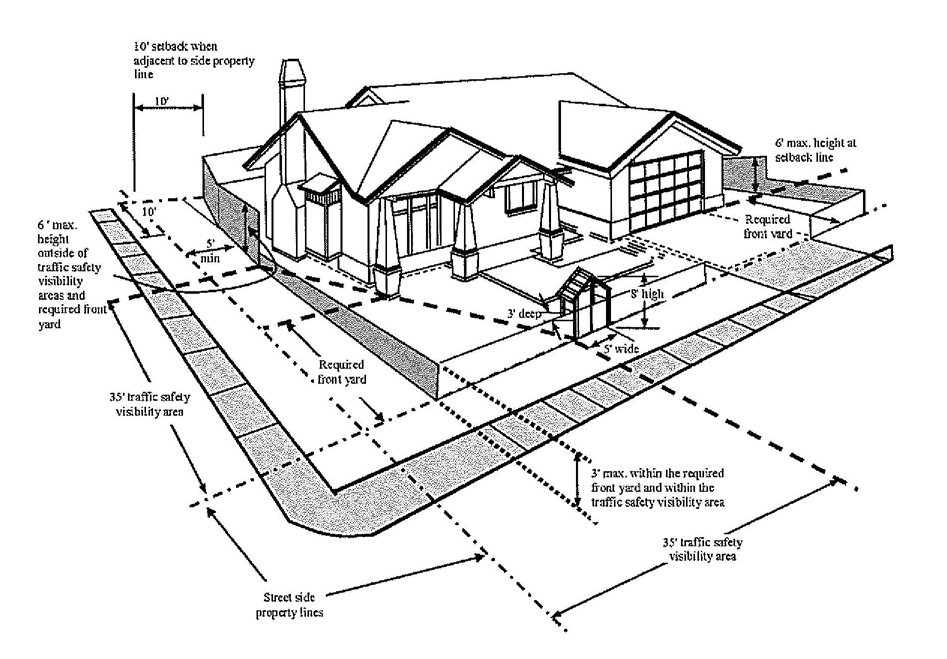
Fences—R1 and R2 zoning districts. The following types of fences in the R1 and R2 zoning districts are exempt from zoning permit requirements. Allowed fence heights and locations are illustrated in Figure 36.06-1 (Fence and Wall Standards).
1.
Interior lots. Fences up to three (3) feet in height when located within the required front yard, or up to six (6) feet in height located on rear or side property lines outside the required front yard, and entry features over front yard gates (e.g., open-latticed arbors and trellises) not exceeding eight (8) feet in height, three (3) feet in depth or five (5) feet in width, when located within the required front yard.
2.
Corner lots.
(a)
Fences up to three (3) feet in height within the required front yard and traffic safety visibility areas—front and side (or rear). The front traffic safety visibility area is formed by measuring thirty-five (35) feet from the intersection of the street side property line and the front property line of the corner parcel, along both property lines, and then connecting the two (2) points across the corner of the lot;
(b)
Entry features over front yard gates (e.g., open-latticed arbors and trellises), not exceeding eight (8) feet in height, three (3) feet in depth or five (5) feet in width, when located within the required front yard but outside the traffic safety visibility areas; and
(c)
Fences up to six (6) feet in height located on rear and side property lines outside the required front yard and traffic safety visibility areas, and at least five (5) feet from the street side property line. Further, fences over three (3) feet in height adjacent to the side street property line shall be set back where the side street fence approaches an adjacent lot's front yard in order to create a side (or rear) triangular traffic safety visibility area for the adjacent lot at the side (or rear) of the corner parcel. This triangle is formed by measuring ten (10) feet from the intersection of the street side property line of the corner parcel and the side property line of the adjacent parcel, along both property lines, and then connecting the two (2) points across the corner parcel. See Figure 36.06-1.
Figure 36.06-1
FENCE AND WALL STANDARDS
(For Reference Only)
h.
Electric vehicle charging stations. Electric vehicle charging stations are permitted in all zoning districts subject to Chapter 8 of the City Code.
i.
Governmental activities. Activities of the city, state or an agency of the state or the federal government on land owned or leased by a governmental agency.
j.
Irrigation. The installation of irrigation lines.
k.
Interior remodeling. Interior alterations that do not result in an increase in the gross floor area within the structure, or a change in the permitted use of the structure.
l.
Repairs and maintenance. Ordinary repairs and maintenance, if the work does not result in any change in the approved land use of the site or structure, or the addition to, enlargement or expansion of the structure, and if any exterior repairs employ the same materials and design as the original.
m.
Retaining walls. Retaining walls (retaining earth only) that result in grade changes of eighteen (18) inches or less and are not required by Chapter 8 of the City Code to have a grading permit.
n.
School facilities. Public school facilities, in compliance with Government Code § 53091, et seq., except where a site is proposed to be occupied exclusively by nonclassroom facilities.
o.
Single- and two (2) family dwellings. The construction of four (4) or fewer single-family dwellings or two (2) duplexes and the remodeling of single-family or duplexes in the R1 and R2 zoning districts, provided that the proposed development is in compliance with all applicable provisions of this Chapter, except as provided in Sections 36.10.30 (Development Review Required, R1 Zone), 36.10.55 (Development Review Required, R2 Zone) and 36.10.80 (Development Review Required, R3 Zone).
p.
Solar collectors. The addition of solar collection systems to the roofs of existing structures, provided that the collectors are located on the ground level and screened from ground-level public view or, if roof-mounted, are mounted at approximately the same angle as the roof. Solar collectors must comply with the height limitations of the zoning district in which they are located.
q.
Spas, hot tubs and fish ponds. Spas, hot tubs, ponds, etc., that do not exceed one hundred twenty (120) square feet in total surface area, including related equipment, contain more than two thousand (2,000) gallons of water, or exceed three (3) feet in depth.
r.
Utilities. The erection, construction, alteration or maintenance by a public utility, public agency or private company determined by the city to fulfill a public function of underground or overhead utilities (i.e., water, gas, electric, telecommunication, supply or disposal systems, including wires, mains, drains, sewers, pipes, conduits, cables, fire-alarm boxes, police call boxes, traffic signals, hydrants, etc.), but not including occupiable or storage structures, shall be permitted in any zoning district, provided that the route of any electrical transmission line(s) having the potential of fifty thousand (50,000) volts or more shall be subject to council review and approval prior to acquisition of rights-of-way.
(Ord. No. 18.13, § 1, 12/10/13; Ord. No. 3.17, § 3, 4/25/17; Ord. No. 20.19, § 3, 12/10/19; Ord. No. 11.20, § 2, 11/10/20; Ord. No. 4.22, § 2, 4/12/22; Ord. No. 4.2024, § 2, 4/23/24.)
SEC. 36.06.55. - Other permits may still be required.
A permitted land use that is exempt from a zoning permit, or has been granted a zoning permit, may still be required to obtain other permits before the use is constructed or otherwise established and put into operation. Nothing in this Chapter shall eliminate the need to obtain any permits, approvals or authorizations required by other provisions of the City Code, including, but not limited to, building, grading or other construction permits if they are required by Chapter 8, a business license if required by Chapter 18, hazardous materials storage permits if required by Chapter 24, subdivision approval if required by Chapter 28, or any other permit, approval or authorization required by a regional, state or federal agency. All necessary permits, approvals and authorizations shall be obtained before starting work or establishing new uses.
(Ord. No. 18.13, § 1, 12/10/13; Ord. No. 4.2024, § 2, 4/23/24.)
SECS. 36.06.56—36.06.59. - Reserved.
Editor's note— Ord. No. 01.2024, § 3, adopted Jan. 23, 2024, repealed §§ 36.06.56—36.06.59, which pertained to marijuana and derived from Ord. No. 14.16, § 1, adopted Nov. 1, 2016.
SEC. 36.06.65. - Continuing existing uses.
Except as hereinafter specified, any use, building or structure lawfully existing at the time of the enactment of this chapter, may be continued even though such use, building or structure may not conform with the provisions of this chapter for the district in which it is located; provided, however, that this section does not apply to any use, building, or structure established in violation of any zoning ordinance previously in effect.
(Ord. No. 18.13, § 1, 12/10/13.)
SEC. 36.06.70. - Nonconforming uses and nonconforming structures.
Existing uses and structures which do not conform to the regulations of the district where they are located shall be subject to these specific regulations in addition to the general regulations of the particular district in order to ensure that such uses and structures are not detrimental to the community, and to provide for their gradual elimination or improvement in order to further the general plan and overall goals of the city for orderly community development.
(Ord. No. 18.13, § 1, 12/10/13.)
SEC. 36.06.75. - Nonconforming uses of land.
The nonconforming use of land not involving any building or structure except minor structures, such as fences and signs, or buildings less than four hundred (400) square feet in area, may be continued for a period of five years from the date the use becomes nonconforming, at the end of which period such nonconforming use shall cease or shall be changed to a conforming use.
Where a nonconforming use on a lot has ceased for six (6) months or more, such lot shall not again be used for a nonconforming use. Nonconforming use of land as used in this section shall include the use of either unimproved land or land containing minor structures such as fences, signs or buildings less than four hundred (400) square feet in area.
(Ord. No. 18.13, § 1, 12/10/13.)
SEC. 36.06.80. - Nonconforming uses of structures or buildings.
a.
The nonconforming use of any commercial, industrial or office building located in an "R" district, or in an area designated for residential use in the Mountain View general plan shall be terminated within forty (40) years of the date the use became nonconforming, unless a conditional use permit is obtained from the zoning administrator in accordance with the provisions of Sec. 36.48 (Conditional Use Permit) to authorize the continuation of such use.
In considering whether or not such a permit may be issued, in addition to procedures and criteria contained in Sec. 36.48 (Conditional Use Permit), the following criteria shall be applied:
1.
The degree to which the use serves a need, which is directly related or complementary to permitted uses of the property;
2.
The degree to which the nonconforming use creates parking, traffic or congestion problems;
3.
The degree to which the nonconforming use can be assured not to be detrimental to the habitability of adjacent properties throughout the period of its continued use; and
4.
The degree to which the general appearance will not detract from the neighborhood character or desirability.
b.
The use of a nonconforming residential building or mobile home, located in a "C" or "M" district, shall be allowed to continue for the structural life of the building.
c.
The nonconforming use of a conforming building or structure may be continued for a period of five (5) years from the date the use becomes nonconforming, at the end of which period such nonconforming use shall be changed to a conforming use or be terminated.
d.
No existing building, structure or land devoted to a nonconforming use shall be enlarged, extended, reconstituted or substituted, or substantially altered, unless the use thereof is changed to a permitted use in the district in which such building, structure or land is located, except as follows:
1.
When authorized by the zoning administrator and in accordance with the provisions of Sec. 36.48 (Conditional Use Permit), a nonconforming use may be changed to a use of the same or more restrictive nature.
2.
When authorized by the zoning administrator and in accordance with the provisions of Sec. 36.48 (Conditional Use Permit), a nonconforming use of a building may be extended throughout those parts of the building which were manifestly designed or arranged for such use prior to the date when such use or such building became nonconforming, if no structural alterations, except for those required by law, are made therein.
3.
When authorized by the zoning administrator and in accordance with the provisions of Sec. 36.48 (Conditional Use Permit), minor alterations to nonconforming residential developments may be authorized which do not exceed four hundred (400) square feet or twenty-five (25) percent of the floor area of the residential structure when it became nonconforming, whichever is less, and are only intended to increase the habitability of the residential unit.
4.
Repairs and maintenance may be made to a legal nonconforming use of buildings or structures as required to keep it in safe condition provided no structural alteration or replacement shall be made except as required by law or ordinance, or for seismic retrofit (as approved by the chief building official or his/her designee) related to soft-story buildings. For purposes of this provision, a "soft-story" building shall be a wood frame building, including a multi-unit residential building, constructed before January 1, 1978, where the ground-floor portion of the structure contains parking or other similar open floor space that causes soft, weak or open-front wall lines.
Seismic retrofit means either structural strengthening or providing the means necessary to modify the seismic response that would otherwise be expected by an existing building during an earthquake, to significantly reduce hazards to life and safety while also providing for the substantial safe ingress and egress of the building occupants immediately after an earthquake.
e.
Whenever a nonconforming use has been changed to a conforming use, such use shall not thereafter be changed to a nonconforming use.
f.
If the nonconforming use of a building, structure or premises ceases for a period of six (6) months or more, said use shall be considered abandoned; and said building, structure or premise shall thereafter be used only for uses permitted in the district in which it is located.
g.
Where a structure or building containing a nonconforming use is damaged or destroyed by any natural disaster or accident and repair or replacement exceeds fifty (50) percent of the cost of construction of a comparable new building (as determined by the chief building official), it shall not be reconstructed to accommodate a nonconforming use. It may only be restored and used in conformity with the provision of the district.
h.
All uses nonconforming at the time of adoption of this chapter, by reason of noncompliance with the performance standards stipulated, shall adopt necessary measures and conform within three (3) years of the adoption of this chapter or shall be discontinued.
i.
All uses, nonconforming by reason of noncompliance with the provisions related to private swimming pools, shall be made to conform therewith prior to April 1, 1971.
(Ord. No. 18.13, § 1, 12/10/13; Ord. No. 21.16, § 2, 12/13/16.)
SEC. 36.06.85. - Nonconforming structures or buildings.
a.
Any nonconforming commercial, industrial or office building located in an "R" district or in an area designated for residential uses in the Mountain View general plan shall be removed within forty (40) years of the date the building or structure became nonconforming unless a conditional use permit is obtained from the zoning administrator in accordance with the provisions of Sec. 36.48 (Conditional Use Permit), to authorize the continuation of the building or structure.
b.
Any nonconforming residential building, structure or mobile home located in a "C" or "M" district shall be allowed to continue for the structural life of the building, structure or mobile home.
c.
Any expansion of a nonconforming building or structure must comply with the latest applicable property development standards of the district and not increase the degree of nonconformity which exists on the property.
d.
Repairs and maintenance may be made to a legal nonconforming building or structure as required to keep it in safe condition provided no structural alteration or replacement shall be made except as required by law, ordinance or for seismic retrofits (as approved by the chief building official or his/her designee) of soft-story buildings. For purposes of this provision, a "soft-story" building shall be a wood frame building, including a multi-unit residential building, constructed before January 1, 1978, where the ground-floor portion of the structure contains parking or other similar open floor space that causes soft, weak or open-front wall lines.
e.
An existing nonconforming building or structure which is damaged by natural disaster or accident and the cost of restoration does not exceed fifty (50) percent of the cost of construction of a comparable new building (as determined by the chief building official) may be restored and used as before, provided that such restoration be completed within one (1) year of such happening. Where damage exceeds fifty (50) percent, such building may only be restored or replaced in accordance with the latest applicable property development standards of the district except as provided in subsection 36.06.80.f.
f.
If a nonconforming residential development located in any residential district is destroyed by any natural disaster or accident by more than fifty (50) percent of the cost of construction of a comparable new building (as determined by the chief building official), the building or structure may be reconstructed within one (1) year of such happening with the same number of units, provided that the reconstructed portions conform to the latest property development standards of the district applicable to the total number of units on the site at the time of reconstruction (e.g., R3 development standards must be complied with of any development having three (3) or more units).
g.
When authorized by the zoning administrator in accordance with the provisions of Sec. 36.48 (Conditional Use Permit), minor alterations to nonconforming residential developments may be authorized which do not exceed four hundred (400) square feet or twenty-five (25) percent of the floor area of the residential structure when it became nonconforming, whichever is less, and are only intended to increase the habitability of the residential unit.
h.
When a development does not meet development standards of the zone, modifications which bring the development more into conformance with the zone may be permitted with development review approval.
i.
If an existing nonconforming structure in the R1 district is expanded such that the expanded structure is more than twice the size of the original structure, the entire structure must comply with the latest applicable property development standards of the district.
(Ord. No. 18.13, § 1, 12/10/13; Ord. No. 21.16, § 3, 12/13/16.)
SEC. 36.06.90. - Development of a remnant parcel.
A nonconforming remnant parcel or parcels, as defined in Sec. 36.48 (Conditional Use Permit), which is merged with a contiguous developed parcel, may, after merger of these parcels, be developed or redeveloped at a density equal to the legal nonconforming density of the previously developed parcel. Except as specifically exempted herein, such development of the remnant parcel shall comply with all other applicable sections of this chapter. The development shall not result in an overall reduction of existing landscaping, amenities or parking.
(Ord. No. 18.13, § 1, 12/10/13.)
SEC. 36.06.95. - Nonconforming signs.
All signs, billboards or commercial advertising structures except window signs which do not conform to the requirements of this chapter may be continued five (5) years from the date it becomes nonconforming, at which time such nonconforming signs shall be modified to conform to the requirements of this chapter or shall be removed.
All signs, billboards or commercial advertising structures in a planned community (P) district which do not conform to the provisions of the precise plan applicable thereto shall be removed or modified to conform to the provisions of such precise plan by the date, if any, specified in such plan or five (5) years from the date such sign, billboard or commercial advertising structure became nonconforming, whichever is later. Any modification of the standards applicable to a sign, either by ordinance change or by imposition or amendment of the sign standards in a precise plan, shall not be construed as extending the amortization period of any sign which was nonconforming prior to such modification.
Any sign, billboard or commercial advertising structure not removed or brought into conformity with the requirements of this chapter, or any applicable precise plan, by the date specified above, is hereby declared to be a public nuisance and may be abated by the city attorney or other appropriate city official.
(Ord. No. 18.13, § 1, 12/10/13.)
SEC. 36.08.05. - Corner setbacks for buildings.
a.
Uncontrolled intersection. No portion of any building or structure greater than three (3) feet in height located on a corner lot at an uncontrolled intersection may extend within the required setback along either street frontage or within a line with a radius equivalent to the street corner radius tangent to these two (2) setback lines.
b.
Controlled intersection. A building or structure, or any portion thereof, greater than three (3) feet in height located on a corner lot at a controlled intersection must comply with the required setbacks along either street frontage and may not extend beyond the intersection point of the two required setbacks.
(Ord. No. 18.13, § 1, 12/10/13.)
SEC. 36.08.10. - Unlawful erection of buildings in setback zones.
It shall be unlawful for any person, firm or corporation to erect, construct, or locate, or contract for the erection, construction or location of any building or other structure, excepting fences three (3) feet in height or less above grade and signs erected or installed pursuant to the provisions of this chapter within any setback line as established herein, and the zoning administrator, city council or building inspector shall refuse to issue a permit for the construction or erection of any building or structure within such setback contrary to provisions of this chapter.
(Ord. No. 18.13, § 1, 12/10/13.)
SEC. 36.08.15. - Storage of habitable trailer in setback prohibited.
Habitable trailers shall not be stored or parked within any required street setback area in any office, commercial or industrial zone except where limited display areas may be permitted by the zoning administrator, using the conditional use permit procedure under Sec. 36.48.
(Ord. No. 18.13, § 1, 12/10/13.)
SEC. 36.08.20. - Fences and walls—Nonresidential property.
In all nonresidential districts, in required yards other than front yards and street setback areas, fences and walls may not exceed seven (7) feet in height, subject to development review (see Sec. 36.44.45). On a case-by-case basis, the zoning administrator may consider fences or walls of additional height.
(Ord. No. 18.13, § 1, 12/10/13.)
SEC. 36.08.25. - Interpretations and exceptions.
The requirements and regulations specified in this chapter shall be subject to the following exceptions and interpretations.
(Ord. No. 18.13, § 1, 12/10/13.)
SEC. 36.08.30. - Height limits.
Height limitations set forth elsewhere in this Chapter shall not apply to:
a.
Barns, silos, water towers or tanks, windmills or other farm buildings or structures on farms, provided these are not less than fifty (50) feet from every lot line; church spires, belfries, cupolas and domes; smokestacks; flag poles; elevator penthouses; cooling towers; grain elevators; and outdoor theater screens, provided said screens contain no advertising matter other than the name of the theater.
b.
Places of public assembly in churches, schools and other permitted public and semipublic buildings, provided that these are not more than one (1) story in height, and provided that for each one (1) foot by which the height of such building exceeds the maximum height otherwise permitted in the district, its side and rear yards shall be increased in width or depth by an additional foot over the side and rear yards required for the highest building otherwise permitted in the district.
c.
Other structures where the manufacturing process requires a greater height, provided, however, that all such structures above the heights otherwise permitted in the district shall not occupy more than twenty-five (25) percent of the area of the lot and shall be distant not less than twenty-five (25) feet in all parts from every lot line not a street lot line.
d.
Antennas and communication facilities on utility poles, utility towers and light standards in all zoning districts, excluding the city's rights-of-way, provided:
1.
The applicant submits a development review permit and goes through the review process pursuant to Section 36.44.45;
2.
The applicant submits a description of the efforts made to consider alternative sites and demonstrates the proposal for the facility, including all associated equipment (whether or not installed by the applicant), is the least intrusive alternative;
3.
The proposed height exception is proven, by the applicant, to be the minimum amount of additional height needed to address a significant gap in coverage;
4.
The proposed extension and other changes to the pole or equipment are proven, by the applicant, to be structurally sound and safe; and
5.
Equipment associated with the facility does not impede pedestrian or vehicular accessibility along any public or private pathways, sidewalks, driveways or roadways, visually impede any safe use of the same or otherwise present a hazard to pedestrian or vehicular use of the same.
e.
Roof screens, parapets or any architectural feature intended to provide screening of rooftop equipment in all zoning districts shall be the minimum necessary height to fully screen rooftop equipment on all sides, not to exceed an additional ten (10) feet beyond the maximum building height, excluding residential structures in all R1 and R2 zones in which roof screens must comply with the maximum building height.
(Ord. No. 18.13, § 1, 12/10/13; Ord. No. 20.19, § 4, 12/10/19; Ord. No. 01.2024, § 4, 1/23/24.)
SEC. 36.08.35. - Basements.
Where less than one-half (½) the height of a basement or cellar, or ground floor, is below ground level, measured by reference to the average elevation of land within one hundred (100) feet of the building, said basement, cellar or ground floor shall be considered a story and floor area.
(Ord. No. 18.13, § 1, 12/10/13.)
SEC. 36.08.45. - Purpose.
This division is established to provide a formal procedure to request reasonable accommodation for persons with disabilities seeking equal access to housing under the Federal Fair Housing Act and the California Fair Employment and Housing Act (the Acts) in the application of zoning laws and other land use regulations, policies and procedures, and to establish relevant criteria to be used when considering such requests to new or existing residential structures.
(Ord. No. 18.13, § 1, 12/10/13.)
SEC. 36.08.50. - Applicability.
In order to provide housing accessible to an individual with a disability, any person may request a modification or exception to the rules, standards and practices for the siting, development and use of housing or housing-related facilities that would eliminate regulatory barriers and provide a person with a disability equal opportunity to housing of their choice.
A person with a disability is a person who has a physical or mental impairment that limits or substantially limits one or more major life activities, anyone who is regarded as having such impairment or anyone who has a record of such impairment. This section applies only to those persons who are defined as disabled under the Acts and is permitted for residential properties in all zoning districts.
(Ord. No. 18.13, § 1, 12/10/13.)
SEC. 36.08.55. - Application requirements.
a.
Requests for reasonable accommodation shall be made with an application submitted to the community development department, together with the appropriate fee, as established by resolution adopted by the city council, and other required information. If the request for reasonable accommodation also requires some other discretionary approval under this chapter (including, but not limited to, a conditional use permit, design review, variance, general plan amendment or zone change), the application shall be submitted and reviewed at the same time as the related applications.
b.
All requests shall be reasonable and limited to the minimum modifications the applicant believes are necessary to accommodate the disability. The applicant shall provide all information identified in the reasonable accommodations handout located in the community development department.
c.
Any health information protected as confidential in accordance with state and federal law shall be retained by the city in a manner so as to respect the privacy rights of the individual with a disability and shall not be made available for public inspection. The application is otherwise a public record and subject to inspection pursuant to the Public Records Act.
d.
A request for reasonable accommodation in regulations, policies, practices and procedures may be filed at any time that the accommodation(s) may be necessary to ensure equal access to housing. A reasonable accommodation does not affect an applicant's obligation to comply with other applicable regulations not at issue in the requested reasonable accommodation.
(Ord. No. 18.13, § 1, 12/10/13.)
SEC. 36.08.60. - Approval process, decision and appeals.
A reasonable accommodation request shall be processed in the same manner as a development review permit. Applications shall be processed and a decision made by the zoning administrator in accordance with Sec. 36.44.45 (Development Review Process), subject to the findings in Sec. 36.08.65. If appealed, the city council shall be the final decision authority in accordance with Sec. 36.56 (Applications, Hearings and Appeals).
(Ord. No. 18.13, § 1, 12/10/13.)
SEC. 36.08.65. - Findings.
a.
Any decision on an application under this Section shall be supported by written findings addressing the criteria set forth in this subsection. An application under this Section for a reasonable accommodation shall be granted if all of the following findings are made:
1.
The housing, which is the subject of the request, will be used by an individual disabled as defined under the Acts.
2.
The requested reasonable accommodation is necessary to provide housing accessible to an individual with a disability under the Acts.
3.
The requested reasonable accommodation would not impose an undue financial or administrative burden on the city.
4.
The requested reasonable accommodation would not require a fundamental alteration in the nature of a city program or law, including, but not limited to, land use and zoning or building codes.
b.
In granting a request for reasonable accommodation, the reviewing authority may impose any conditions of approval deemed reasonable and necessary to ensure that the reasonable accommodation would comply with the findings required by Subsection "a." above.
(Ord. No. 18.13, § 1, 12/10/13; Ord. No. 01.2024, § 5, 1/23/24.)
SEC. 36.08.70. - Definitions.
For the purpose of this Division, the following words shall have the meanings respectively ascribed to them by this Section:
a.
Building. A structure designed, built or occupied as a shelter or roofed enclosure for persons, animals or property and used for residential, business, mercantile, storage, commercial, industrial, institutional, assembly, educational or recreational purposes. A structure containing one hundred (100) square feet or less of floor space shall not fall within this definition.
b.
Public works director. The public works director for the city or their designee.
c.
Zoning permit. A permit issued pursuant to the provisions of this Chapter, including, but not limited to, a development review permit and historic preservation permit required for the placement, modification, rehabilitation or improvement of a relocated building and any associated site improvements to accommodate said building.
(Ord. No. 01.2024, § 6, 1/23/24.)
SEC. 36.08.75. - Applicability.
The provisions of this Division shall apply to any development project or activity that involves the movement of a building to any location within the City of Mountain View. These provisions shall not apply to buildings moved to a location within the city for the purpose of temporary storage, so long as such activity is conducted in compliance with the provisions of Section 8.149 of the city code.
(Ord. No. 01.2024, § 6, 1/23/24.)
SEC. 36.08.80. - Special application requirements.
In addition to the application requirements of Article XVI of this Chapter, applications for moving buildings shall include: a project description regarding how the structure conforms to the general form, scale and character of the neighborhood and what modifications will occur to the project site as a result of the project; information of any proposed structural modifications (i.e., windows, new roofing, etc.); and, if the structure has historic qualities, explanation of how the character and architectural style of the period shall be retained in any proposed expansion and/or accessory structures (e.g., avoid stucco over wood, replacing or mixing wood windows with aluminum, etc.).
(Ord. No. 01.2024, § 6, 1/23/24.)
SEC. 36.08.85. - Moving notice.
At least fifteen (15) calendar days prior to review of a request for a zoning permit to move any building to a location inside the city, the applicant shall post a moving notice both at the proposed new location to be moved and at the existing building location in accordance with city standards for project identification signs.
Hearing notices shall be mailed in accordance with Section 36.56.20. Failure of any property owner, tenant or other person to receive said notice of hearing will not invalidate the proceedings or the permit.
(Ord. No. 01.2024, § 6, 1/23/24.)
SEC. 36.08.90. - Approval process.
1.
Zoning permit. A zoning permit shall be obtained in accordance with the hearing procedures in Sections 36.56.25 and 36.56.30 prior to receiving approval from the public works director that the structure and the route are approved for moving and prior to receiving a building permit.
2.
Premove inspection. A person seeking to move a building or structure onto a parcel within the city shall, concurrently with applying for a zoning permit, file an application for a premove inspection with the chief building official. The chief building official shall perform a premove inspection of the building or structure and the proposed location of the same, and the chief building official shall submit to the zoning administrator a report describing the improvements which must be made to the building or structure to conform to the current building codes.
3.
Public works director approval. The public works director shall approve the route the building is to be moved from the original site to the new location.
4.
Other approvals. A building permit for work as a result of moving the building shall be obtained as well as a moving permit for the moving of the structure. See Article VII in Chapter 8 on the application and additional procedures for the premove inspection, a building permit and a moving permit.
(Ord. No. 01.2024, § 6, 1/23/24.)
SEC. 36.08.95. - Decision and appeal.
a.
Denial. If the zoning administrator finds and determines that the relocation of the building to the proposed site is inconsistent with the development standards of the underlying zoning district; would cause appreciable damage to, or be materially detrimental to, the property or improvements within the immediate vicinity of the proposed new location; or if the structure is of a type prohibited at the proposed new location by any law or city regulation, the zoning administrator shall deny the zoning permit and inform the applicant in writing.
b.
Appeal. Any person may appeal the decision of the zoning administrator made pursuant to this Division per Section 36.56.50.
(Ord. No. 01.2024, § 6, 1/23/24.)

