
Muskegon Charter Township
City Zoning Code
City Zoning Code
ARTICLE V
- SIGNS
Sec. 58-366.- Definitions.
The following words, terms and phrases, when used in this article, shall have the meanings ascribed to them in this section, except where the context clearly indicates a different meaning:
Alteration. As used in this chapter, the term "alteration" means any change in a sign, including, but not limited to, any change in a sign's dimensions, shape, area, height, number or orientation of sign faces, structural support, location on the property, materials or lighting. A change solely in the wording of the copy of a sign shall not constitute an "alteration" for purposes of this chapter, unless the result of the change would cause the sign to be reclassified to a type of sign subject to different or more restrictive regulation (e.g., a change from an on-premises to an off-premises sign).
Billboard means any sign, including a sign on the wall of a building used for advertising a business, service, entertainment or other matter which is not conducted on the land where the sign is located or products not principally sold, manufactured, processed or fabricated on such land.
Business sign means any sign, including a sign on the wall of a business, on which lettered, figured or pictorial material is displayed for advertising a business, service, entertainment or other enterprise conducted on the land where the sign is located, or products primarily sold, manufactured, processed or fabricated on such land.
Community special event sign means any sign, either portable or non-portable, displayed only for a limited time, to call attention to special events of interest to the general public which are sponsored by governmental agencies, schools or other groups which are nonprofit and whose purpose is charitable, philanthropic, religious or benevolent.
Construction sign means any sign that identifies the owners, lenders, contractors, architects, and engineers of a project under construction, as well as the project itself.
Directional sign means any sign which gives directions, instructions, or facility information for the movement of vehicles or pedestrians on the lot on which the sign is located, such as parking or exit and entrance signs, but not including a commercial message.
Electronic reader board or changeable message sign means a permanent sign on which copy is changed manually, mechanically or electronically, including any electronically displayed sign.
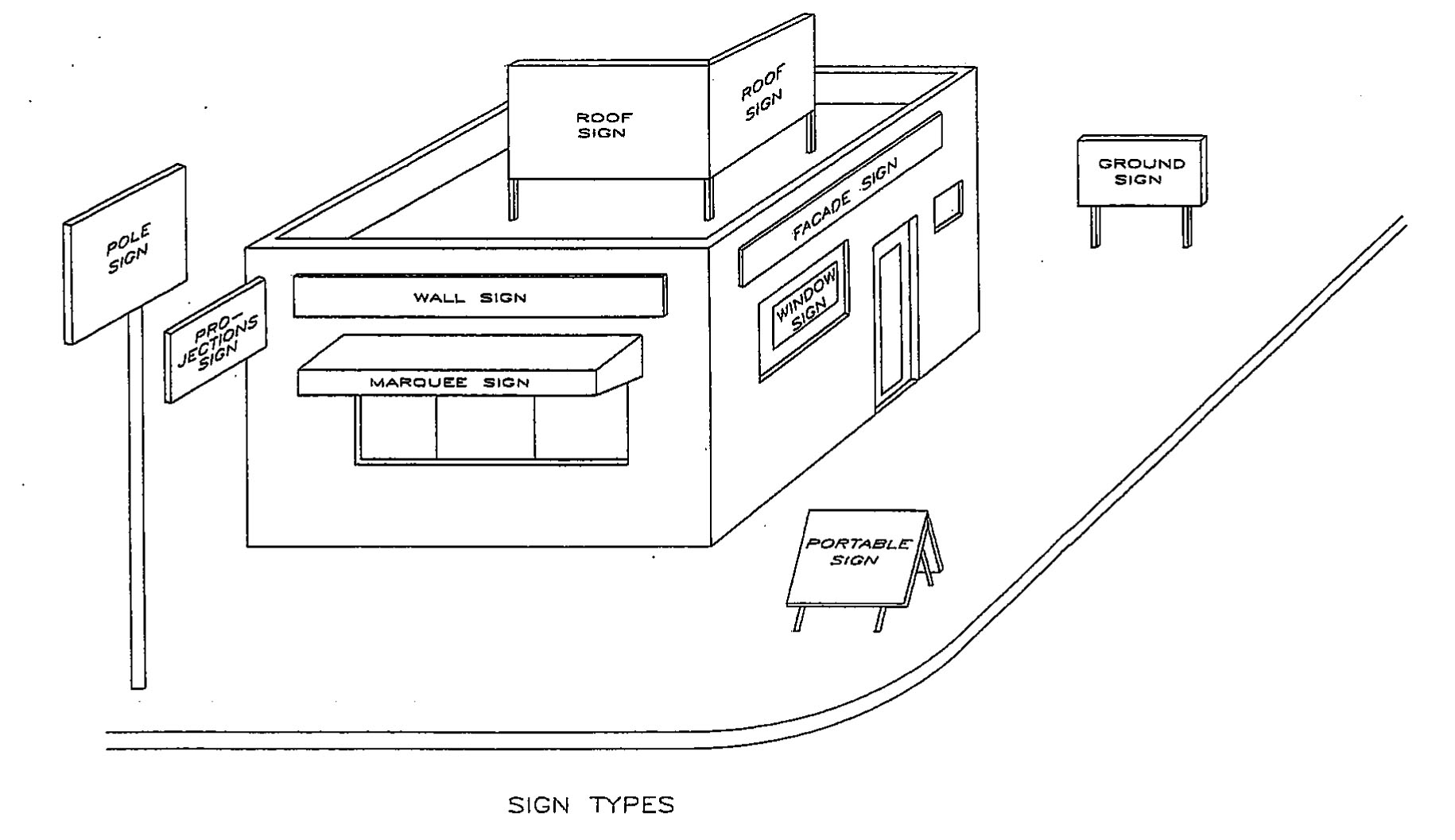
Freestanding sign means a sign supported on poles not attached to a building or wall.
Ground sign means a sign resting directly on the ground or on a foundation, or supported by short poles not attached to a building or wall, the bottom of which is no more than 24 inches above the finished grade.
Identifying sign means any sign on the same premises it identifies which serves only to tell the name or use of any public or semipublic building or recreation area, club, lodge, church or institution; to tell the name or address of an apartment building, garden apartment, hotel, motel or similar business enterprise; or to inform the public as to the use of a parking lot.
Non-permanent sign means a non-lit sign which is not permanently installed and which is intended to be displayed for a limited period of time; including freestanding, sandwich boards, and flags, but not including certain on-premises signs as described in this ordinance.
Off-premises sign means any sign which relates to or advertises an establishment, product, merchandise, good, service or entertainment which is not located, sold, offered, produced, manufactured or furnished at the property on which the sign is located (including, but not limited to, billboards).
On-premises sign means any sign which solely identifies the name of the subdivision, mobile home community, or a multiple-family development of five or more dwelling units; or identifying the owner or occupant; or directing traffic on the premises.
Park sponsorship sign means an accessory sign that is isolated at a park owned and operated by Muskegon Charter Township (MCT), used by the public for athletic activities, and that identifies a sponsor in recognition of the sponsor's financial support for the parks, activities and facilities therein.
Political sign means any temporary sign used for advertising a political candidate and/or issue.
Portable sign means any sign that is not permanent or affixed to a building or structure and by its nature may be or is intended to be moved from one location to another, whether rented or owned, including "A" frame signs or signs attached to or painted on vehicles parked and visible from the public right-of-way, unless the vehicle is used for vehicular purposes in the normal day-to-day operations of the business.
Real estate sign means a temporary sign used to advertise the pertinent information of sale, rental or leasing of the premises upon which it is located.
Sign means any device, structure, fixture, billboard or placard and its supporting structure, which is designed, intended or used to direct attention to any service, place, institution, organization, or business.
Sunset provision means a measure within an ordinance that provides that the ordinance shall cease to have effect after a specific date, unless further legislative action is taken to extend the ordinance.
Temporary sign means any sign not permanently attached to the ground, a structure or a building. Temporary signs include banners, portable signs and any other sign displayed for a limited period of time.
(Ord. No. 7, § 21.1, 4-18-83; Ord. No. 11-05, § 2, 6-6-11; Ord. No. 17-01, § 2, 1-17-17)
Cross reference— Definitions and rules of construction generally, § 1-2.
Sec. 58-367. - Permit required.
(a)
Except as specifically excused hereinafter, no sign shall be constructed, erected, attached to a building, installed, structurally altered, or relocated prior to the issuance of a permit therefor by the building official. The application for the sign permit shall include the name of the applicant, the size of the sign, plans and specifications for the sign, the proposed method of construction, erection, structural alteration, or relocation, and description and the equipment to be used for such work.
(b)
No permit shall be required for any of the following:
(1)
Normal maintenance and repair.
(2)
Change of lettering or display panels.
(3)
Real estate signs.
(4)
Highway signs erected by the United States of America, the state, the county or the township.
(5)
Governmental-use signs erected by governmental agencies to designate hours of activity or conditions for use for parks, parking lots, recreational areas, other public areas, or for governmental buildings.
(6)
The following on-premises signs: signs having a message which is limited to a warning of danger, directional signs in conjunction with the prohibition or regulation of the use of property, traffic or parking thereon, signs advertising the premises for sale or rent or for help wanted. These on- premises signs shall not exceed six square feet each in area.
(7)
Signs identifying a building's address and/or the name(s) of the building's occupant(s), not exceeding four square feet in area.
(8)
Historic signs designating sites recognized by the state historical commission as Centennial Farms and Historic Landmarks.
(9)
Signs posted to control or prohibit hunting or trespassing within the township not to exceed three square feet.
(10)
Essential public service signs denoting utility lines, railroad lines, hazards and precautions.
(11)
Memorial signs or tablets which are either cut into the face of a masonry surface or constructed of bronze or other incombustible material when located flat on the face of a building.
(12)
One construction sign per project, of no more than 32 square feet in area, denoting architects, engineers, or contractors connected with the work under construction.
(13)
Signs for political advertising.
(14)
Menu and order boards for drive-through facilities provided such signs shall be located on the interior of the lot and not legible from adjacent properties. The placement, size, content, manner of illumination and sound level of such signs shall not constitute a traffic or pedestrian hazard. Such signs shall be limited to four per establishment. Any proposal for signage not meeting these requirements shall be submitted to the planning commission for a decision.
(15)
Permanent signs on vending machines, gas pumps or ice containers.
(16)
Residential yard and garage sale signs.
(17)
Flags. The flag of any civic organization, municipality, state or nation respectfully displayed, including one flag bearing the official design insignia, name or logo of the on-premises business subject to the following conditions: Flags shall be attached to freestanding flagpoles located within the property. Placement of flagpoles shall not impede vehicular or pedestrian traffic. Flags may not project beyond the property lines, and flags shall not project into the existing or proposed right-of-way. All flags shall be maintained in good repair, free of tearing, fraying or other deterioration.
(c)
Signs for political advertising are permitted in all zoning districts provided they are temporary, not illuminated, and do not exceed 32 square feet in area per sign face. Such signs shall be removed within ten days after the election with which the political sign is concerned.
(Ord. No. 7, § 21.2, 4-18-83; Ord. No. 7, 5-6-91; Ord. No. 11-05, § 3, 6-6-11; Ord. No. 17-01, § 3, 1-17-17)
Sec. 58-368. - Legal nonconforming signs.
(a)
Continuance. Notwithstanding any other provision of this chapter to the contrary, a permanent sign which was erected legally and which lawfully exists at the time of the enactment of this chapter, but which does not conform to the height, size, area or location requirements of this chapter, is deemed to be nonconforming and may continue to be used subsequent to that time, as provided by this section.
(b)
Loss of legal nonconforming status. A legal nonconforming sign shall immediately lose its legal nonconforming designation if:
(1)
The sign is altered in any way in structure or copy (see definition of "alteration", section 58-366), which tends to or makes the sign less in compliance with the requirements of this article than it was before the alteration;
(2)
The sign is relocated to a position making it less in compliance with the requirements of this article;
(3)
The sign is replaced; or
(4)
On the happening of any one of subsections (1), (2) or (3), the sign shall be immediately brought into compliance with this article with a new permit secured therefore, or shall be removed.
(c)
Legal nonconforming sign maintenance and repair. Routine repair to maintain a nonconforming sign in a safe and aesthetic condition exactly as it existed at the time of the enactment of this chapter and so as to continue the useful life of the sign shall not constitute an alteration for purposes of this chapter. If damaged, a legal nonconforming sign may be restored to the condition exactly as it existed immediately prior to the damage or destruction if the estimated cost of restoration does not exceed 50 percent of the estimated replacement cost as determined by the township; based on a written estimate from a licensed sign contractor. If the estimated cost of restoration exceeds 50 percent of the estimated replacement cost, the right to continue using the nonconforming sign shall thereupon terminate and the sign shall be brought into full compliance with all applicable provisions and requirements of this chapter prior to further use.
(Ord. No. 7, § 21.3, 4-18-83; Ord. No. 11-05, § 4, 6-6-11)
Sec. 58-369. - Maintenance.
All signs shall be maintained in good condition and repair, including, without limiting the foregoing, maintenance of supports and fastenings to prevent the sign from falling.
(Ord. No. 7, § 21.4, 4-18-83)
Sec. 58-370. - Traffic hazard.
No signs shall be constructed, erected or reconstructed or located in such a manner as to cause a hazard to vehicle or pedestrian traffic, including, without limiting the foregoing, visual hazard caused by flashing lights or glare where the visual hazard impairs vision or is unreasonably distracting.
(Ord. No. 7, § 21.5, 4-18-83)
Sec. 58-371. - Right-of-way.
No sign, temporary or permanent, shall be constructed, erected or reconstructed upon or over any sidewalk, street, alley or other public right-of-way, except in the instance where the sign has first been authorized by the planning commission as a special use. In considering such authorization, the planning commission shall consider the following standards:
(1)
The type and nature of sign to be constructed out over the public right-of-way; and
(2)
Whether or not the construction of the sign out over the public right-of-way is necessary for the sign to be viewed by potential viewers.
(Ord. No. 7, § 21.6, 4-18-83)
Sec. 58-372. - Illumination.
All signs which are to be illuminated shall be illuminated by electrical power. All electrical wiring and electrical installation shall be in conformance with the National Electrical Code, as amended from time to time. Illumination of signs shall not be flashing, blinking, intermittent, or of an on-and-off type, and shall not be directional. Open neon lights are prohibited. All sign illumination shall be employed in such a manner so as to prevent shining onto any street or adjacent or nearby properties.
(Ord. No. 7, § 21.7, 4-18-83; Ord. No. 11-05, § 5, 6-6-11)
Sec. 58-373. - General conditions.
The following regulations are applicable to signs in all zoning districts.
(a)
No sign shall be erected, constructed or reconstructed in any location where it may interfere with, obscure the view of, or be confused with an authorized traffic sign.
(b)
All signs shall be secured in a manner that the unit remains stationary on the property. Any moving parts on the sign must be able to execute their full range of motion within the setback requirements defined in this ordinance.
(c)
Signs shall be constructed of metal, wood, plastic, foam, paint and/or comparable weather-resistant material, and shall be kept in good repair and maintained in safe, neat, clean condition. Banners shall not be allowed as permanent signs.
(d)
No freestanding sign shall exceed 30 feet in height, measured from the highest point of the sign to the grade of the nearest street, and shall not be less than four feet measured from the grade of the nearest street to the bottom of the sign. The sign may be placed at the property line, but no part of it may be in or project over the road right-of-way or any easement.
(e)
Freestanding sign materials. All freestanding sign structures or poles shall be self-supporting structures erected on, and permanently attached to, concrete foundations. Such structures or poles shall be fabricated only from painted steel or such other materials as may be approved by the building official in accordance with the building code of the township which may be amended from time to time.
(1)
Glass. When glass is used for sign letters or transparent panels, it shall be plexiglass for sign areas up to and including 300 square inches. When glass is used for sign letters or transparent panels for sign areas in excess of 300 square inches, at least one-quarter-inch wire glass shall be used and the maximum span between supports shall be four feet.
(2)
Strength of parapet wall. A parapet wall must be designed for, and have sufficient strength to, support any sign which is attached thereto.
(3)
Supports and braces. Metal supports or braces shall be adequate for wind loading and wire or cable supports shall have a safety factor of four. All metal, wire cable supports and braces and all bolts used to attach sign to bracket or brackets and sign to the support building or structure shall be of galvanized metal or equivalent material. There shall be no visible angle irons or unsightly supports. All such sign supports shall be an integral part of the sign design. There shall be a pole cover on all freestanding signs unless the pole is an integral part of the sign.
(4)
Wind loads. All signs, except those attached flat against the wall of a building, shall be constructed to meet the standards of the currently adopted state of Michigan Building Code.
(5)
Sign anchoring. No sign shall be suspended by chains or other devices that will allow the sign to swing due to wind action. Signs shall be anchored to prevent any lateral movement that would cause wear on supporting members or connections.
(f)
No sign, temporary or permanent, shall be erected, constructed, installed or located on private property without the written consent of the owner of such property.
(g)
No sign, including, political signs, shall be located in the public right-of-way or attached to any tree, utility pole, street sign, traffic control device or any other similar objects. Political signs are prohibited on any township owned property.
(h)
Signs which are not an integral part of a building may not extend more than four feet above the roof line.
(i)
No ground sign shall exceed eight feet in height and shall be no larger than 60 square feet and must be permanently attached to the ground or concrete foundation.
(j)
Community special event signs must be approved by the township before being displayed. A Community Special Event sign application must be submitted before installation of the sign. The following regulations apply:
Community special event sign regulations:
(1)
The display of signs for special events shall be limited to 30 days.
(2)
A maximum size of 32 square feet in area, and a maximum height above ground level of six feet and shall be set back from any side or rear property line a minimum of 15 feet. The front setback shall be as required for signs in the zoning district in which the sign is to be located.
(3)
The signs shall be removed within 48 hours of the conclusion of the event which is being advertised.
(4)
No sign may be affixed, attached or otherwise placed on any utility pole or traffic control sign, signal or device.
(5)
The sign must be placed outside of the road right-of-way.
(6)
If the sign is illuminated, it must comply with section 58-372 of this chapter.
(7)
Nonprofit/charitable events. A 501 C3 registered nonprofit organization hosting an event within the township may utilize signage to advertise the event and provide direction to the event provided the following conditions are met:
a.
If the event is reoccurring, application must specify exact dates of planned event and the sign must be removed within 48 hours of the planned event.
b.
The sign must not violate subsection 58-373(i)(2)—(6).
(8)
Grand opening events are subject to approval by fire inspector, building inspector and zoning administrator after review of site plan.
(k)
Residential yard and garage sale signage. Signs used to advertise a residential yard or garage sale are permitted subject to the following restrictions:
(1)
One sign per lot or parcel is permitted, located on the lot or parcel on which such sale is being conducted.
(2)
Such sign shall not exceed six square feet in area.
(3)
Such sign shall be erected no more than seven days prior to the day of the sale and shall be removed within one day after completion of the sale.
(l)
Changeable message signs. Changeable message signs may be manual or electronic, and shall comply with the maximum area and site location requirements of the applicable zone district.
(1)
The changeable copy portion of a ground, pylon or wall sign shall not exceed 50 percent of the total sign area and shall be integral to the sign cabinet. The remainder of the sign shall be of a permanent character as otherwise required under this chapter.
(2)
Electronic signs include electronic message boards and changeable message centers, multimedia or computer-controlled variable message signs, and similar devices. Electronic signs shall be permitted under the conditions described in this subsection.
a.
Display regulations.
1.
Scrolling or traveling of a message onto and/or off of the display shall be allowed; provided the message is coming from one direction only and that no message shall take more than five seconds to be displayed in its entirety. Once scrolled, the screen may not change for ten seconds.
2.
If nonscrolling, the screen of the sign shall not change more than once every ten seconds.
3.
The display shall not, or shall not appear to flash, undulate, pulse, or portray explosions, fireworks, flashes of light or blinking or chasing lights; the display shall not appear to move toward or away from the viewer, expand or contract, bounce, rotate, spin, twist or other similar movements.
4.
All electronic signs in any residential zone district, or within 150 feet of a residential zone district, shall discontinue the display between the hours of 11:00 p.m. and 6:00 a.m.
b.
Light levels requirements.
1.
In order to prevent glare, electronic signs shall not operate at a brightness level greater than the manufacturer's recommended levels, except as provided in this or other township codes.
2.
All signs shall have installed ambient light monitors and shall at all times allow such monitors to automatically adjust the brightness level of the electronic sign based on ambient light conditions.
3.
Maximum brightness levels for electronic signs shall not exceed 5,000 nits when measured from the sign's face at its maximum brightness during daylight hours and 500 nits when measured from the sign's face at its maximum brightness between dusk and dawn.
c.
Additional requirements.
1.
Electronic sign permit applications shall include a copy of the manufacturer's specifications for luminosity.
2.
Electronic sign permit applications shall also include certification from the sign manufacturer that the individual sign's maximum light intensity has been preset not to exceed the maximum illumination levels established by the code, and that the maximum intensity level is protected from end user manipulation by password protected software or other method approved by the township.
3.
If the sign is programmed from the site or from a remote location, the computer interface that programs the sign shall be available to township staff for inspection upon request. If the computer interface is not immediately available, the sign shall cease operation until such information can be provided.
4.
No parcel or abutting parcels under common ownership shall be permitted more than one electronic sign.
(m)
A Non-permanent Sign Application must be submitted before installation/display of the sign(s). The following regulations apply:
a.
Non-permanent sign regulations.
1.
Annual application and payment of fee is required along with the business license renewal before installation. Applications may be submitted at a later date, but the expiration date will remain April 30 th of the following year.
2.
Must be secured in a manner that the unit remains stationary on the property. Any moving parts on the sign must be able to execute their full range of motion within the setback requirements defined in this ordinance.
3.
Must be maintained so as not to be torn, tattered, frayed or faded.
4.
Two non-permanent sign allowed per business. Parcels with more than one business are allowed one per 80 feet of frontage, not to exceed five.
5.
Maximum aggregate size allowed is 32 sf in area, with no single sign exceeding 20 sf and a maximum height above ground level of 14 feet. Non-permanent signs shall be set back from the front property line a minimum ten feet and must be kept out of the "line of vision area". Setback area must include fall zone footage for sign(s).
6.
Violation of these regulations for a non-permanent sign will result in a fine as determined by the township board. Each day the violation exists constitutes a new violation. There will be no violation warning notice issued prior to citation being issued.
(n)
Sunset provision. The township board is enacting these non-permanent sign regulations in order to address the needs requested of business owners in the township. In order to gauge the impact on the township code enforcement officer, the township board hereby institutes a sunset provision on section 58-373(m) non-permanent sign regulations, of April 30, 2018. In the first quarter of 2018, the township board shall review the impact of this amendment to determine whether to delete the sunset provision entirely, modify, or extend the same.
(Ord. No. 7, § 21.8, 4-18-83; Ord. No. 7, 5-6-91; Ord. No. 11-05, § 6, 6-6-11; Ord. No. 17-01, § 4, 1-17-17)
Sec. 58-374. - Billboards.
(a)
All billboards shall be located:
(1)
No closer than 1,000 feet from any other billboard on the same side of the street.
(2)
No closer than 500 feet from a billboard on the other side of a street.
(3)
More than 500 feet from any major arterial or primary collector street intersections or from expressway access or exit ramps.
(4)
No closer than 35 feet to the street right-of-way.
(5)
No closer than 300 feet to the property line of a lot or parcel of land on which a residence is located.
(b)
No billboard shall be stacked or placed on or above another, and not more than one billboard shall be permitted on a single location other than a double-faced billboard. A V billboard shall be considered as one billboard.
(c)
No billboard shall have an area in excess of 300 square feet per sign face, including border and trim, but excluding uprights and supports.
(d)
No permit for the erection or construction of a billboard shall be issued unless and until a signed written consent from the owner of the property on which the billboard is to be located has been filed with the building official.
(e)
All permits for the erection, construction, location and maintenance of a billboard shall expire on January 1 in the fifth year following the grant of such permit. The sign owner shall make application for renewal of such permit no less than 90 days before such January 1. The building official may renew the permit for the billboard one or more times for an additional term of five years, if he shall determine that the billboard has been maintained in good condition and repair and has been maintained, utilized and located at all times in full conformance with all the terms and provisions of this article, and that the billboard is, on the date of such renewal, in compliance with all the terms and provisions of this article.
(f)
Electronic billboards are allowed under the following conditions:
(1)
A billboard may be illuminated, provided that such illumination is concentrated on the surface of the sign and is so located as to avoid glare or reflection onto any portion of an adjacent street or highway, the path of oncoming vehicles, or any adjacent premises. No billboard shall have one or more flashing, strobing, intermittent, moving, rotating, or oscillating lights or images.
(2)
Billboards shall not be erected or maintained which shall be so illuminated that they interfere with the effectiveness of or obscure any official traffic sign, device or signal.
(3)
The rate of change between two static messages or images cannot exceed more than one change per ten seconds and each change must be completed in one second or less.
(g)
To the extent they are not specifically inconsistent with the terms and provisions of this section dealing specifically with billboards, all of the other terms and provisions of this chapter pertaining to signs shall be applicable to billboards.
(Ord. No. 7, § 21.9, 4-18-83; Ord. No. 11-05, § 7, 6-6-11)
Sec. 58-375. - Permitted sign locations.
Signs may be located, as hereinafter specified, subject to the regulations hereinafter contained, in the following zoning districts:
(1)
RR zoning district. Signs shall be permitted in this zoning district only as follows:
a.
On farms, signs advertising the sale of agricultural products sold at a roadside stand on the farm where the sign is located. Sign shall not exceed 32 square feet.
b.
Billboards, subject to the regulations contained in section 58-374.
(2)
R-1, R-1S, R-2 and R-2S zoning districts. Signs shall be permitted in these zoning districts only as follows:
a.
One real estate sign not in excess of six square feet in area, if the real estate sign is not illuminated, and is placed entirely within the boundaries of the parcel of land or lot to which the sign refers.
b.
One unilluminated business sign not in excess of three square feet in area.
c.
Plat advertising signs, provided there shall be only two such signs per plat, and that no such sign shall exceed 32 square feet in area. Plat advertising signs shall be removed when 75 percent of the lots within the plat have buildings located thereon.
d.
Identifying signs when authorized by the planning commission. In considering the granting of such authorization, the planning commission shall consider the following standards:
1.
The type, kind, size and nature of the identifying sign.
2.
The type and kind of buildings and structures adjoining and in the neighborhood surrounding the lot or parcel of land upon which the sign is to be located.
3.
The effect of the sign upon adjoining property.
4.
The reasons and necessity for the sign.
(3)
R-3 and R-4 zoning district. Signs shall be permitted in this zoning district only as follows:
a.
All signs authorized in the R-1 zoning district, subject to the same conditions, restrictions and requirements, as provided in the R-1 zoning district.
b.
A building identifying sign, provided it is not greater than 32 square feet in area and is attached flat against the building it identifies.
c.
Freestanding identifying signs, when authorized by the planning commission. In considering such authorization, the planning commission shall consider the following standards:
1.
The nature, kind, size and character of the identifying sign.
2.
The proposed location of the identifying sign.
3.
The reasons why the identifying sign must be freestanding as opposed to being attached to the side of the building it identifies.
4.
The effect of the freestanding sign on adjoining properties and the surrounding neighborhood.
(4)
C-1 zoning district. Signs shall be permitted in this zoning district only as follows:
a.
All signs permitted in the R-1 zoning district, subject to the same conditions, restrictions and requirements, as provided in the R-1 zoning district, except that real estate signs may be larger than permitted in the R-1 zoning district but shall not be greater than 32 square feet in area.
b.
Business signs, if the signs are:
1.
Placed flat against the building on which they are located.
2.
Are limited to the side or sides of the building which front on the principal street or streets providing access to the building.
a.
One for building face areas 6,000 square feet or less.
b.
Two for building face areas 6,001 to 12,000 square feet.
c.
Three for building face areas greater than 12,000 square feet.
3.
Are not in excess of 100 square feet in area. If multiple signs are permitted in accordance with 58-375 b(2) the square foot in area allowed is accumulative.
4.
Have no dimension greater than 20 feet.
c.
One freestanding sign, if it is located in the front yard and does not exceed two square feet in area for each five feet of lot frontage measured at the building setback line for the business premises on which the sign is located, subject to a maximum of 300 square feet. A ground sign may be allowed in place of a freestanding sign, provided it meets the requirements of section 58-373(h). One ground sign allowed for each street side providing access to the building.
d.
Temporary signs for a new business are permitted for a period of not to exceed 30 days. Application for a permit must be acquired from the building department. After 30 days the temporary sign must be removed from the premises.
e.
Buildings with multiple tenants. Each tenant in a strip mall or building with multiple tenants may have one business sign (wall sign) if the sign is:
1.
Placed flat against the building on which it is located.
2.
Limited to one sign only on the side of the building which fronts on the street providing access to the building. Parcels which have frontage on more than one street are allowed one sign on each side which fronts a street.
3.
No greater in size than 15 percent of the face area of the portion of the building occupied, and in no case may the sign exceed 100 square feet in area. In the case of a corner parcel, total signage cannot be greater than 15 percent of each wall face on the sides of the suite which front the street providing access to the building.
4.
Have no dimension greater than 20 feet.
(5)
C-2 zoning district. Signs shall be permitted in this district only as follows:
a.
All signs permitted in the C-1 zoning district, subject to the same conditions, restrictions and requirements, as provided in the C-1 zoning district.
b.
Billboards, when authorized by the planning commission. In considering such authorization, the planning commission shall consider the following standards:
1.
The nature, kind, size and character of the billboard.
2.
The proposed location of the billboard.
3.
The effect of the billboard on adjoining properties and the surrounding neighborhood. All billboards permitted in this zoning district pursuant to board of appeals authorization shall comply in all respects with the provisions of section 58-374.
(6)
I and IP zoning districts. Signs shall be permitted in these zoning districts only as follows:
a.
All signs permitted in the R-1 zoning district, subject to the same conditions, restrictions and requirements, as provided in the R-1 zoning district, except that real estate signs may be larger than permitted in the R-1 zoning district but shall not be greater than 32 square feet in area.
b.
Business signs attached to a wall of a building, provided the area of the sign does not exceed 15 percent of the total area of the wall to which it is attached, or 100 square feet, whichever is lesser. Parcels which have frontage on more than one street are allowed one sign on each side which fronts a street.
c.
A freestanding or ground business sign, in the front yard setback provided the sign does not exceed 48 square feet in area or two percent of the area of the front wall of the building, whichever is greater, and is not greater than four feet in height. Such freestanding sign shall complement the architecture of the building and be appropriately landscaped. d. One identifying sign can be erected at each entrance to an industrial park to identify the name of the park and the industries located therein. Such sign may be freestanding or attached to a wall or fence and shall be appropriately landscaped.
e.
Billboards, when authorized by the planning commission. In considering such authorization, the planning commission shall consider the following standards:
1.
The nature, kind, size and character of the billboard.
2.
The proposed location of the billboard.
3.
The effect of the billboard on adjoining properties and the surrounding neighborhood. All billboards permitted in this zoning district pursuant to board of appeals authorization shall comply in all respects with the provisions of section 58-374.
f.
Buildings with multiple tenants. Each tenant in a building with multiple tenants may have one business sign (wall sign) if the sign is:
1.
Placed flat against the building on which it is located.
2.
Limited to one sign only on the side of the building which fronts on the street providing access to the building. Parcels which have frontage on more than one street are allowed one sign on each side which fronts a street.
3.
No greater in size than 15 percent of the face area of the portion of the building occupied. No building may have wall signage totaling greater than 15 percent of the face of the building and in no case may the sign exceed 100 square feet in area. In the case of a corner parcel, total signage cannot be greater than 15 percent of each wall face on the sides of the building which front the street providing access to the building.
4.
Have no dimension greater than 20 feet.
(7)
M/S zoning district. Signs shall be permitted in this zoning district only as follows:
All signs as permitted in the C-1 zoning district, subject to the same conditions, restrictions and requirements, as provided in the C-1 zoning district.
(8)
M zoning district. Signs shall be permitted in this zoning district as follows:
a.
All signs as permitted in the C-1 zoning district, subject to the same conditions, restrictions and requirements, as provided in the C-1 zoning district.
(9)
RMH zoning district. Signs shall be permitted in this zoning district as follows:
a.
Signs advertising the mobile home park shall be restricted to 32 square feet of sign area to be limited to the street(s) frontage serving as access to the mobile home park.
b.
One sign permitted on each access street.
c.
Signs shall be reviewed by the planning commission.
(Ord. No. 7, § 21.10, 4-18-83; Ord. No. 7, 5-6-91; Ord. No. 11-05, § 8, 6-6-11; Ord. No. 12-01, § 2, 2-20-12; Ord. No. 12-11, § 2, 9-4-12; Ord. No. 13-04, §§ 2—4, 4-15-13; Ord. No. 16-09, § 2, 11-7-16; Ord. No. 20-1, § 1, Adoption date not provided)
Sec. 58-376. - Prohibited signs.
All signs not expressly allowed under this chapter (unless exempted from regulation under this chapter) are prohibited in the township. Further, the following types of signs are expressly prohibited:
(1)
Portable signs, except as allowed by section 58-373 (j) and (m) of this chapter.
(2)
Roof signs.
(3)
Off-premises signs except for noncommercial.
(4)
Signs using high intensity, flashing or oscillating with the exception of changeable message signs otherwise permitted by this chapter.
(Ord. No. 11-05, § 9, 6-6-11; Ord. No. 17-01, § 5, 1-17-17)
Sec. 58-377. - Park sponsorship sign (PSS).
The sponsors and participants of scheduled events operating under a permit issued by Muskegon Charter Township (MCT) may erect signs or banners for the duration of the permit period. Signs for seasonal activities such as sports leagues may keep the sign up for the duration of the sport season.
Signs are required to follow township policies regarding donor recognition and site sponsorship. Signs at baseball and softball fields shall be on the outfield fences and/or scoreboards and orientated toward the field of play and within the borders of the park. All signs shall be nonilluminating and be installed under the supervision of authorized township personnel.
(a)
Limits.
Sponsors are responsible for all costs incurred in the development, manufacturing and repair of a PSS. Sign design, size, content and location must meet all requirements and are subject to individual approval and disapproval by the Muskegon Township board through recommendation from the parks and recreation committee.
PSS size will be 32 square feet (four feet by eight feet) for all seasonal activities. Smaller sign sizes for events operating under a permit may be used with approval from the Muskegon Township board through recommendation from the parks and recreation committee.
The Muskegon Township board may stop the sponsorships if it is determined the signs are excessive. Sponsorships will be granted on a first come, first accept basis.
PSS rates will be established by the MCT board and will be reviewed annually.
(b)
Rates.
A PSS may only be displayed during the use period. The current cost per sign will be paid in full to the township before installation of the sign. Costs for smaller signs under special permit will he determined at the time of the request through parks and recreation recommendation to the township board.
(Ord. No. 11-05, § 10, 6-6-11)

