
New Braunfels City Zoning Code
ARTICLE III
- ZONING DISTRICTS
Sec. 144-3.1. - Creation of districts.
3.1-1. Zoning districts created prior to June 22, 1987. For the purpose of regulating and restricting the use of land and the erection, construction, and alteration of buildings or structures, the city is hereby divided into 12 districts as follows:
(a)
"R-1" single-family district.
(b)
"R-2" single-family and two-family district.
(c)
"R-3" multifamily district.
(d)
"B-1" conventional and mobile home district.
(e)
"TH" townhouse district.
(f)
"ZH" zero lot line home district.
(g)
"C-1" local business district.
(h)
"C-2" general business district.
(i)
"C-3" commercial district.
(j)
"C-4" resort commercial district.
(k)
"M-1" light industrial district.
(l)
"M-2" heavy industrial district.
3.1-2. Zoning districts created subsequent to June 22, 1987. For the purpose of regulating and restricting the use of land and the erection, construction, alteration of and use of buildings or structures, the following additional zoning districts are hereby created subsequent to June 22, 1987:
(a)
"APD" agricultural/pre-development district.
(b)
"R-1A-43.5" single-family district.
(c)
"R-1A-12" single-family district.
(d)
"R-1A-8" single-family district.
(e)
"R-1A-6.6" single-family district.
(f)
"R-2A" single-family and two-family district.
(g)
"R-3L" multifamily low density district.
(h)
"R-3H" multifamily high density district.
(i)
"B-1A" conventional and mobile home district.
(j)
"B-1B" mobile home park district.
(k)
"TH-A" townhouse residential district.
(l)
"ZH-A" zero lot line home district.
(m)
"MU-A" low intensity mixed use district.
(n)
"MU-B" high intensity mixed use district.
(o)
"C-1A" neighborhood business district.
(p)
"C-1B" general business district.
(q)
"C-2A" central business district.
(r)
"C-4A" resort commercial district.
(s)
"C-4B" resort facilities district.
(t)
"C-O" commercial office district.
(u)
"M-1A" light industrial district.
(v)
"M-2A" heavy industrial district.
(w)
"SD" Special districts and planned development districts as defined by ordinance.
All applications for the rezoning of property shall be to one of the zoning districts created subsequent to June 22, 1987, with the exception of "C-4B resort facilities district."
(Ord. No. 2012-49, § 1(Exh. A), 9-10-12)
Sec. 144-3.2. - Regulations for all districts.
Except as provided in sections 144-2.2 and 144-2.3, the following shall apply:
3.2-1. Use. No building or structure shall be erected, constructed, reconstructed or altered, nor shall any building, structure or land be used for any purpose other than is permitted in the district in which such building, structure or land is situated.
3.2-2. Height. No building or structure shall be erected, constructed, reconstructed or altered to exceed the height limit herein established for the district in which such building or structure is located.
3.2-3. Area. No lot area shall be reduced or diminished so that the building setbacks or other open spaces shall be less than prescribed by this chapter, nor shall the density of dwelling units be increased in any manner, except in conformity with the area regulations established herein. No parking area, parking space, or loading space which existed at the time this chapter became effective and as amended thereafter shall thereafter be relinquished or reduced in any manner below the requirements established by this chapter. Every building hereafter erected shall be located on a lot as herein described. Buildings shall not cross lot lines.
3.2-4. Number of buildings on a lot or parcel. More than one main building is allowed on a lot or parcel in duplex, multifamily, commercial, industrial, mixed use, resort commercial and commercial office districts. See section 144-5.4 for accessory building standards.
(Ord. No. 2012-49, § 1(Exh. A), 9-10-12)
Sec. 144-3.3. - Zoning districts and regulations for property zoned prior to June 22, 1987.
3.3-1. "R-1" single-family district. The following regulations shall apply in all "R-1" districts:
(a)
Authorized uses. Uses permitted by right shall be those set forth in the land use matrix in section 144-4.2. The allowed uses in the district, which are intended to be identical with those listed in the land use matrix, are as follows:
(1)
Uses permitted by right.
Residential uses:
Accessory building/structure.
Accessory dwelling (one accessory dwelling per lot).
Community home (see definition).
Family home adult care.
Family home child care.
Home occupation (see section 144-5.5).
One-family dwelling, detached.
Single-family industrialized home (see section 144-5.8).
Non-residential uses:
Barns and farm equipment storage (related to agricultural uses).
Cemetery and/or mausoleum.
Church/place of religious assembly.
Community building (associated with residential uses).
Contractor's temporary on-site construction office (only with permit from building official; see section 144-5.10).
Country club (private).
Farms, general (crops) (see chapter 6 and section 144-5.9).
Farms, general (livestock/ranch) (see chapter 6 and section 144-5.9).
Golf course, public and private.
Governmental building or use with no outside storage.
Park and/or playground (private and public).
Plant nursery (growing for commercial purposes but no retail sales on site).
Public recreation/services building for public park/playground areas.
Recreation buildings (public).
School, K-12 (public or private).
Stables (as a business) (see chapter 6).
Stables (private, accessory use) (see chapter 6).
Water storage (surface, underground or overhead), water wells and pumping stations that are part of a public or municipal system.
(2)
Conflict. In the event of conflict between the uses listed in the land use matrix and those listed in subsection (1), the uses listed in this subsection shall be deemed those authorized in the district.
(b)
Maximum height, minimum area and setback requirements.
(1)
Residential uses.
(i)
Height. 35 feet.
(ii)
Front building setback. 25 feet.
(iii)
Side building setback. There shall be a side building setback on each side of a building not less than five feet in width. Buildings on corner lots shall have 15-foot side building setbacks adjacent to the street where the rear lot lines of the corner lots coincide with the rear lot lines of the adjacent lots. Buildings on corner lots shall have 25-foot side building setbacks adjacent to the street where the rear lot lines of the corner lots coincide with the side lot lines of the adjacent lots.
(iv)
Garage setback. Where a driveway is located in front of a garage, the garage shall be set back at least 20 feet from the right-of-way or the driveway to the garage shall be at least 20 feet long to provide enough space for a vehicle to park without overhanging into the right-of-way, if the garage door is closed. (See Illustration 8 in section 144-5.1-1.)
(v)
Rear building setback. 20 feet.
(vi)
Width of lot. Interior lots 60 feet. Corner lots 70 feet. Where a lot has less width than herein required, and such lot was in separate ownership prior to September 25, 1967, this requirement will not prohibit the erection of a one-family dwelling.
(vii)
Lot area per family. Every single-family dwelling hereafter erected or altered shall provide a lot area of not less than 6,600 square feet per dwelling for interior lots, and 7,000 square feet per dwelling for corner lots, provided that where a lot has less area than herein required and such lot was in separate ownership prior to September 25, 1967, this requirement will not prohibit the erection of a one-family dwelling. Where public or community sewer is not available and in use, for the disposal of all sanitary sewage, each lot shall provide not less than one-half acre per single-family residence or one acre on the Edwards Aquifer Recharge Zone.
(viii)
Lot depth. 100 feet.
(2)
Non-residential uses.
(i)
Height. 35 feet.
(ii)
Front building setback. 25 feet.
(iii)
Side building setback. There shall be a side building setback on each side of a building not less than five feet in width. Where any building abuts a property with a one- or two-family use, the setback from the one- or two-family property line shall be at least 20 feet plus one foot for each foot of building height over 20 feet.
(iv)
Corner lots. Buildings on corner lots shall have 15-foot side building setbacks adjacent to the street where the rear lot lines of the corner lots coincide with the rear lot lines of the adjacent lots. Buildings on corner lots shall have 25-foot side building setbacks adjacent to the street where the rear lines of the corner lots coincide with the side lot lines of the adjacent lots. Where a minimum 25-foot setback is required, a canopy at least eight feet in height, attached to the main building, may be built within 15 feet of the property line so long as such construction will not obstruct the vision of vehicular or pedestrian traffic.
(v)
Garage setback. Where a driveway is located in front of a garage, the garage shall be setback 20 feet from the right-of-way or the driveway to the garage shall be at least 20 feet long to provide enough space for a vehicle to park without overhanging into the right-of-way, if the garage door is closed. (See Illustration 8 in section 144-5.1-1.)
(vi)
Rear building setback. 20 feet.
(vii)
Width of lot. 60 feet.
(viii)
Lot depth. 100 feet.
3.3-2. "R-2" single-family and two-family district. The following regulations shall apply in all "R-2" districts:
(a)
Authorized uses. Uses permitted by right shall be those set forth in the land use matrix in section 144-4.2. The allowed uses in the district, which are intended to be identical with those listed in the land use matrix, are as follows:
(1)
Uses permitted by right.
Residential uses:
Accessory dwelling (one accessory dwelling per lot).
Accessory building/structure.
Community home (see definition).
Duplex/two-family/duplex condominium.
Family home adult care.
Family home child care.
Home occupation (see section 144-5.5).
One-family dwelling, detached.
Single-family industrialized home (see section 144-5.8).
Non-residential uses:
Barns and farm equipment storage (related to agricultural uses).
Cemetery and/or mausoleum.
Church/place of religious assembly.
Community building (associated with residential uses).
Contractor's temporary on-site construction office (only with permit from building official; see section 144-5.10).
Country club (private).
Farms, general (crops) (see chapter 6 and section 144-5.9).
Farms, general (livestock/ranch) (see chapter 6 and section 144-5.9).
Golf course, public and private.
Governmental building or use with no outside storage.
Park and/or playground (private and public).
Plant nursery (growing for commercial purposes but no retail sales on site).
Public recreation/services building for public park/playground areas.
Recreation buildings (public).
School, K-12 (public or private).
Water storage (surface, underground or overhead), water wells and pumping stations that are part of a public or municipal system.
(2)
Conflict. In the event of conflict between the uses listed in the land use matrix and those listed in subsection (1), the uses listed in this subsection shall be deemed those authorized in the district.
(b)
Maximum height, minimum area and setback requirements.
(1)
One-family and duplex dwellings.
(i)
Height. 35 feet.
(ii)
Front building setback. 25 feet.
(iii)
Side building setback. There shall be a side building setback on each side of a building not less than five feet in width. Buildings on corner lots shall have 15-foot side building setbacks adjacent to the street where the rear lot lines of the corner lots coincide with the rear lot lines of the adjacent lots. Buildings on corner lots shall have 25-foot side building setbacks adjacent to the street where the rear lot lines of the corner lots coincide with the side lot lines of the adjacent lots.
(iv)
Garage setback. Where a driveway is located in front of a garage, the garage shall be setback 20 feet from the right-of-way or the driveway to the garage shall be at least 20 feet long to provide enough space for a vehicle to park without overhanging into the right-of-way, if the garage door is closed. (See Illustration 8 in section 144-5.1-1.)
(v)
Rear building setback. 20 feet.
(vi)
Width of lot. The minimum width of an interior lot shall be 60 feet and the minimum width of a corner lot shall be 70 feet. The purpose of the width and depth requirements is to provide guidance and standards for the development of new duplex lots and shall not be used as a factor to determine if existing lots that otherwise meet the minimum lot size herein shall allow the construction of a duplex.
(vii)
Lot area. Minimum 6,600 square feet for interior lots, and 7,000 square feet for corner lots. Where a lot was legally under separate ownership prior to September 25, 1967, but has an area less than the minimum required in this provision, this regulation shall not prohibit the erection of a one-family residence. Where a public or community sewer is not available and in use for the disposal of all sanitary sewage, each lot shall provide not less than one-half acre or one acre on the Edwards Aquifer Recharge Zone.
(viii)
Lot depth. Minimum of 100 feet. The purpose of the width and depth requirements is to provide guidance and standards for the development of new duplex lots and shall not be used as a factor to determine if existing lots that otherwise meet the minimum lot size herein shall allow the construction of a duplex.
(2)
Non-residential uses.
(i)
Height. 35 feet.
(ii)
Front building setback. 25 feet.
(iii)
Side building setback. There shall be a side building setback on each side of a building not less than five feet in width. Where any building abuts a property with a one- or two-family use, the setback from the one- or two-family property line shall be at least 20 feet plus one foot for each foot of building height over 20 feet.
(iv)
Corner lots. Buildings on corner lots shall have 15-foot side building setbacks adjacent to the street where the rear lot lines of the corner lots coincide with the rear lot lines of the adjacent lots. Buildings on corner lots shall have 25-foot side building setbacks adjacent to the street where the rear lines of the corner lots coincide with the side lot lines of the adjacent lots. Where a minimum 25-foot setback is required, a canopy at least eight feet in height, attached to the main building, may be built within 15 feet of the property line so long as such construction will not obstruct the vision of vehicular or pedestrian traffic.
(v)
Garage setback. Where a driveway is located in front of a garage, the garage shall be setback 20 feet from the right-of-way or the driveway to the garage shall be at least 20 feet long to provide enough space for a vehicle to park without overhanging into the right-of-way, if the garage door is closed. (See Illustration 8 in section 144-5.1-1.)
(vi)
Rear building setback. 20 feet.
(vii)
Width of lot. 60 feet.
(viii)
Lot depth. 100 feet.
3.3-3. "R-3" multifamily district. The following regulations shall apply in all "R-3" districts:
(a)
Authorized uses. Uses permitted by right shall be those set forth in the land use matrix in section 144-4.2. The allowed uses in the district, which are intended to be identical with those listed in the land use matrix, are as follows:
(1)
Uses permitted by right.
Residential uses:
Accessory building/structure.
Accessory dwelling (one accessory dwelling per lot).
Boardinghouse/lodging house.
Community home (see definition).
Duplex/two-family/duplex condominiums.
Family home adult care.
Family home child care.
Home occupation (see section 144-5.5).
Hospice.
Multi-family (apartments/condominiums).
One-family dwelling, detached.
Rental or occupancy for less than one month (see section 144-5.17).
Single-family or two-family industrialized home (see section 144-5.8).
Non-residential uses:
Adult daycare (with overnight stay).
Assisted living facility/retirement home.
Barns and farm equipment storage (related to agricultural uses).
Cemetery and/or mausoleum.
Church/place of religious assembly.
Community building (associated with residential uses).
Contractor's temporary on-site construction office (only with permit from building official; see section 144-5.10).
Country club (private).
Electrical substation.
Farms, general (crops) (see chapter 6 and section 144-5.9).
Farms, general (livestock/ranch) (see chapter 6 and section 144-5.9).
Fraternal organization/civic club (private club).
Golf course, public or private.
Governmental building or use with no outside storage.
Museum.
Nursing/convalescent home/sanitarium.
Park and/or playground (public or private).
Plant nursery (growing for commercial purposes but no retail sales on site).
Public recreation/services building for public park/playground areas.
Recreation buildings (private or public).
Retirement home/home for the aged—Public.
School, K-12 (public or private).
Telephone exchange buildings (office only).
University or college (public or private).
Water storage (surface, underground or overhead), water wells and pumping stations that are part of a public or municipal system.
(2)
Conflict. In the event of conflict between the uses listed in the land use matrix and those listed in subsection (1), the uses listed in this subsection shall be deemed those authorized in the district.
(b)
Maximum height, minimum area and setback requirements.
(1)
One-family and duplex dwellings.
(i)
Height. 35 feet.
(ii)
Front building setback. 25 feet.
(iii)
Side building setback. There shall be a side building setback on each side of a building not less than five feet in width. Buildings on corner lots shall have 15-foot side building setbacks adjacent to the street where the rear lot lines of the corner lots coincide with the rear lot lines of the adjacent lots. Buildings on corner lots shall have 25-foot side building setbacks adjacent to the street where the rear lot lines of the corner lots coincide with the side lot lines of the adjacent lots.
(iv)
Garage setback. Where a driveway is located in front of a garage, the garage shall be setback 20 feet from the right-of-way or the driveway to the garage shall be at least 20 feet long to provide enough space for a vehicle to park without overhanging into the right-of-way, if the garage door is closed. (See Illustration 8 in section 144-5.1-1.)
(v)
Rear building setback. 20 feet.
(vi)
Width of lot. Interior lots 60 feet. Corner lots 70 feet. The purpose of the width and depth requirements is to provide guidance and standards for the development of new duplex lots and shall not be used as a factor to determine if existing lots that otherwise meet the minimum lot size herein shall allow the construction of a duplex.
(vii)
Lot area. Minimum 6,600 square feet for interior lots, and 7,000 square feet for corner lots, provided that where a lot has less area than herein required and such lot was in separate ownership prior to September 25, 1967, this requirement will not prohibit the erection of a one-family dwelling. Where public or community sewer is not available and in use, for the disposal of all sanitary sewage, each lot shall provide not less than one-half acre and one acre on the Edwards Aquifer Recharge Zone.
(viii)
Lot depth. Minimum of 100 feet. The purpose of the width and depth requirements is to provide guidance and standards for the development of new duplex lots and shall not be used as a factor to determine if existing lots that otherwise meet the minimum lot size herein shall allow the construction of a duplex.
(2)
Multifamily dwellings.
(i)
Height. 45 feet, 60 feet when a pitched roof is used (minimum 4:12 pitch).
(ii)
Front building setback. 25 feet.
(iii)
Rear building setback. 25 feet.
(iv)
Side building setback. There shall be a side building setback on each side of a building not less than five feet in width. Buildings on corner lots shall have 15-foot side building setbacks adjacent to the street where the rear lot lines of the corner lots coincide with the rear lot lines of the adjacent lots. Buildings on corner lots shall have 25-foot side building setbacks adjacent to the street where the rear lot lines of the corner lots coincide with the side lot lines of the adjacent lots.
(v)
Garage setback. Where a driveway is located in front of a garage, the garage shall be setback 20 feet from the right-of-way or the driveway to the garage shall be at least 20 feet long to provide enough space for a vehicle to park without overhanging into the right-of-way, if the garage door is closed. (See Illustration 8 in section 144-5.1-1).
(vi)
Residential setback. Effective November 8, 2006, where a multifamily dwelling abuts a one- or two-family use or zoning district, the setback from the one- or two-family property line shall be at least 20 feet plus one foot for each foot of building height over 20 feet.
(vii)
Width of lot. The minimum width of an interior lot shall be 60 feet and the minimum width of a corner lot shall be 70 feet, provided that where a lot has less width than herein required, and such lot was in separate ownership prior to September 25, 1967, this requirement will not prohibit the erection of a one-family dwelling.
(viii)
Lot area. The minimum lot area for a multifamily dwelling shall be 15,000 square feet; for each unit over ten an additional 1,500 square feet of lot area shall be required. Where public or community sewer is not available and in use, for the disposal of all sanitary sewage, multifamily developments shall be approved by the city sanitarian.
(ix)
Lot coverage. The combined area of all yards shall be at least 55 percent of the total lot or tract; provided, however, that in the event enclosed parking is provided the minimum total yard area requirement shall be 40 percent of the total lot or tract.
(x)
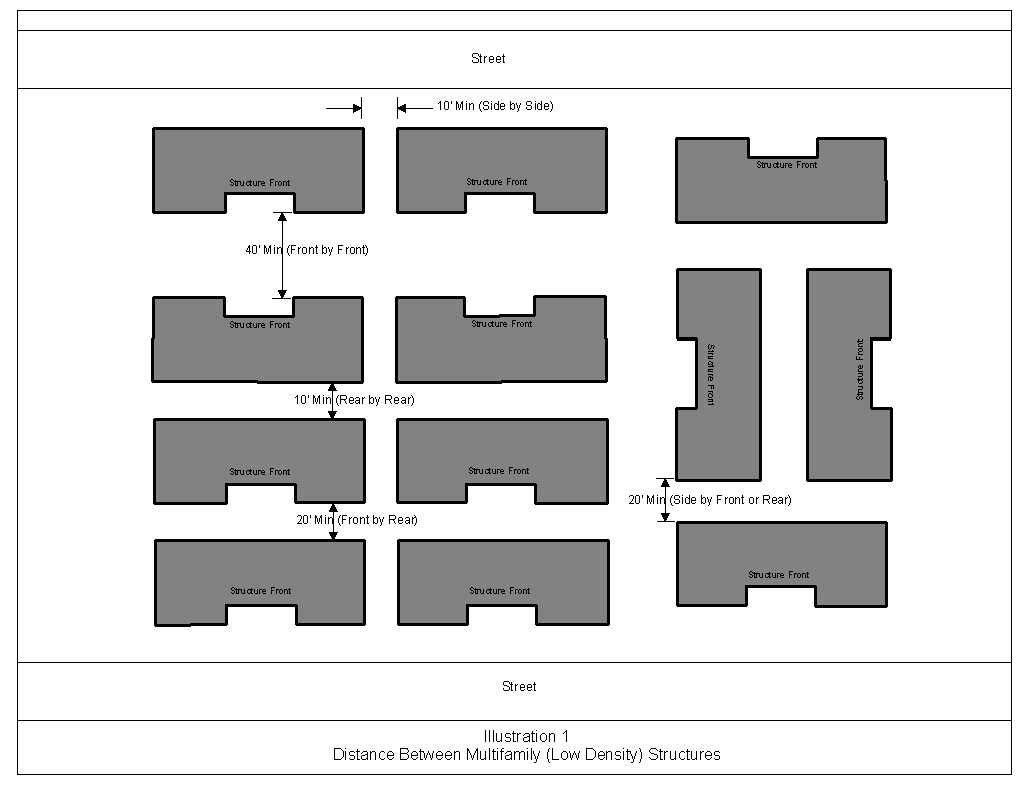
Distance between structures. For multifamily structures, there shall be a minimum of ten feet between structures side by side; a minimum of 20 feet between structures side by front or rear; a minimum of 40 feet between structures front to front; and a minimum of ten feet between structures backing rear to rear, and a minimum of 20 feet front to rear. (See Illustration 1.)
(xi)
Lot depth. 100 feet.
(3)
Non-residential uses.
(i)
Height. 45 feet.
(ii)
Front building setback. 25 feet.
(iii)
Side building setback. There shall be a side building setback on each side of a building not less than five feet in width. Where any building abuts a property with a one- or two-family use, the setback from the one- or two-family property line shall be at least 20 feet plus one foot for each foot of building height over 20 feet.
(iv)
Corner lots. Buildings on corner lots shall have 15-foot side building setbacks adjacent to the street where the rear lot lines of the corner lots coincide with the rear lot lines of the adjacent lots. Buildings on corner lots shall have 25-foot side building setbacks adjacent to the street where the rear lines of the corner lots coincide with the side lot lines of the adjacent lots. Where a minimum 25-foot setback is required, a canopy at least eight feet in height, attached to the main building, may be built within 15 feet of the property line so long as such construction will not obstruct the vision of vehicular or pedestrian traffic.
(v)
Garage setback. Where a driveway is located in front of a garage, the garage shall be setback 20 feet from the right-of-way or the driveway to the garage shall be at least 20 feet long to provide enough space for a vehicle to park without overhanging into the right-of-way, if the garage door is closed. (See Illustration 8 in section 144-5.1-1.)
(vi)
Rear building setback. 20 feet.
(vii)
Width of lot. 60 feet.
(viii)
Lot depth. 100 feet.
3.3-4. "B-1" conventional and mobile home district. The following regulations shall apply in all "B-1" districts:
(a)
Authorized uses. Uses permitted by right shall be those set forth in the land use matrix in section 144-4.2. The allowed uses in the district, which are intended to be identical with those listed in the land use matrix, are as follows:
(1)
Uses permitted by right.
Residential uses:
Accessory building/structure.
Boardinghouse/lodging house.
Community home (see definition).
Duplex/two-family/duplex condominiums.
Family home adult care.
Family home child care.
Home occupation (see section 144-5.5).
HUD-Code manufactured home/mobile homes, after a permit is obtained from the building inspector to permit removal of wheels or transporting device and attaching the home to a permanent foundation on the ground, which home shall thereafter be regarded as a permanent structure and shall meet all applicable codes and chapters.
Multifamily (apartments/condominiums).
One-family dwelling, detached.
Single-family industrialized home (section 144-5.8 does not apply).
Non-residential uses:
Barns and farm equipment storage (related to agricultural uses).
Cemetery and/or mausoleum.
Church/place of religious assembly.
Community building (associated with residential uses).
Contractor's temporary on-site construction office (only with permit from building official; see section 144-5.10).
Country club (private).
Electrical substation.
Farms, general (crops) (see chapter 6 and section 144-5.9).
Farms, general (livestock/ranch) (see chapter 6 and section 144-5.9).
Fraternal organization/civic club (private club).
Golf course, public and private.
Governmental building or use with no outside storage.
Museum.
Nursing/convalescent home/sanitarium.
Park and/or playground (public or private).
Plant nursery (growing for commercial purposes but no retail sales on site).
Public recreation/services building for public park/playground areas.
Recreation buildings (public).
Retirement home/home for the aged—Public.
School, K-12 (public or private).
Telephone exchange buildings (office only).
University or college (public or private).
Water storage (surface, underground or overhead), water wells and pumping stations that are part of a public or municipal system.
(2)
Conflict. In the event of conflict between the uses listed in the land use matrix and those listed in subsection (1), the uses listed in this subsection shall be deemed those authorized in the district.
(b)
Maximum height, minimum area and setback requirements.
(1)
One-family and duplex dwellings.
(i)
Height. 35 feet.
(ii)
Front building setback. 25 feet.
(iii)
Side building setback. There shall be a side building setback on each side of a building not less than five feet in width. Buildings on corner lots shall have 15-foot side building setbacks adjacent to the street where the rear lot lines of the corner lots coincide with the rear lot lines of the adjacent lots. Buildings on corner lots shall have 25-foot side building setbacks adjacent to the street where the rear lot lines of the corner lots coincide with the side lot lines of the adjacent lots.
(iv)
Garage setback. Where a driveway is located in front of a garage, the garage shall be setback 20 feet from the right-of-way or the driveway to the garage shall be at least 20 feet long to provide enough space for a vehicle to park without overhanging into the right-of-way, if the garage door is closed. (See Illustration 8 in section 144-5.1-1.)
(v)
Rear building setback. 20 feet.
(vi)
Width of lot. The minimum width of an interior lot shall be 60 feet and the minimum width of a corner lot shall be 70 feet. The purpose of the lot width and depth requirements is to provide guidance and standards for the development of new duplex lots and shall not be used as a factor in determining if existing lots that otherwise meet the minimum lot size herein shall allow construction of a duplex.
(vii)
Lot area. Minimum 6,600 square feet for interior lots, and 7,000 square feet for corner lots. Where a lot was legally under separate ownership prior to September 25, 1967, but has an area less than the minimum required in this provision, this regulation shall not prohibit the erection of a one-family residence. Where a public or community sewer is not available and in use for the disposal of all sanitary sewage, each lot shall provide not less than one-half acre or one acre on the Edwards Aquifer Recharge Zone.
(viii)
Lot depth. Minimum of 100 feet. The purpose of the lot width and depth requirements is to provide guidance and standards for the development of new duplex lots and shall not be used as a factor in determining if existing lots that otherwise meet the minimum lot size herein shall allow construction of a duplex.
(2)
Multifamily dwellings.
(i)
Height. 45 feet, 60 feet when a pitched roof is used (minimum 4:12).
(ii)
Front building setback. 25 feet.
(iii)
Rear building setback. 25 feet.
(iv)
Side building setback. There shall be a side building setback on each side of a building not less than five feet in width. Buildings on corner lots shall have 15-foot side building setbacks adjacent to the street where the rear lot lines of the corner lots coincide with the rear lot lines of the adjacent lots. Buildings on corner lots shall have 25-foot side building setbacks adjacent to the street where the rear lot lines of the corner lots coincide with the side lot lines of the adjacent lots.
(v)
Garage setback. Where a driveway is located in front of a garage, the garage shall be setback 20 feet from the right-of-way or the driveway to the garage shall be at least 20 feet long to provide enough space for a vehicle to park without overhanging into the right-of-way, if the garage door is closed. (See Illustration 8 in section 144-5.1-1.)
(vi)
Residential setback. Effective November 8, 2006, where a multifamily dwelling abuts a one- or two-family use or zoning district, the setback from the one- or two-family property line shall be at least 20 feet plus one foot for each foot of building height over 20 feet.
(vii)
Width of lot. The minimum width of an interior lot shall be 60 feet and the minimum width of a corner lot shall be 70 feet, provided that where a lot has less width than herein required, and such lot was in separate ownership prior to September 25, 1967, this requirement will not prohibit the erection of a one-family dwelling.
(viii)
Lot area. The minimum lot area for a multifamily dwelling shall be 15,000 square feet; for each unit over ten an additional 1,500 square feet of lot area shall be required. Where public or community sewer is not available and in use, for the disposal of all sanitary sewage, multifamily developments shall be approved by the city sanitarian.
(ix)
Lot coverage. The combined area of all yards shall be at least 55 percent of the total lot or tract; provided, however, that in the event enclosed parking is provided the minimum total yard area requirement shall be 40 percent of the total lot or tract.
(x)
Distance between structures. For multifamily structures, there shall be a minimum of ten feet between structures side by side; a minimum of 20 feet between structures side by front or rear; a minimum of 40 feet between structures front to front; and a minimum of ten feet between structures backing rear to rear, and a minimum of 20 feet front to rear. (See Illustration 1.)
(xi)
Lot depth. 100 feet.
3.3-5. "TH" townhouse residential district. The following regulations shall apply in all "TH" districts:
(a)
Authorized uses. Uses permitted by right shall be those set forth in the land use matrix in section 144-4.2. The allowed uses in the district, which are intended to be identical with those listed in the land use matrix, are as follows:
(1)
Uses permitted by right.
Residential uses:
Accessory building/structure.
Community home (see definition).
Family home adult care.
Family home child care.
Home occupation (see section 144-5.5).
Townhouse (attached).
Non-residential uses:
Barns and farm equipment storage (related to agricultural uses).
Church/place of religious assembly.
Community building (associated with residential uses).
Contractor's temporary on-site construction office (only with permit from building official; see section 144-5.10).
Farms, general (crops) (see chapter 6 and section 144-5.9).
Farms, general (livestock/ranch) (see chapter 6 and section 144-5.9).
Golf course, public or private.
Governmental building or use with no outside storage.
Park and/or playground (private or public).
Recreation buildings (public).
School, K-12 (public or private).
Water storage (surface, underground or overhead), water wells and pumping stations that are part of a public or municipal system.
(2)
Conflict. In the event of conflict between the uses listed in the land use matrix and those listed in subsection (1), the uses listed in this subsection shall be deemed those authorized in the district.
(b)
Maximum height, minimum area and setback requirements.
(1)
Height. 35 feet.
(2)
Front building setback. Ten feet. If front entry garages/carports are provided, a minimum front yard of 20 feet shall be provided to the garage/carport.
(3)
Side building setback. No side building setbacks are required for interior lots except the minimum distance between two building groups shall be 20 feet and the minimum distance between a building group and any abutting subdivision boundary or zoning district boundary line shall be 20 feet. Buildings on corner lots shall have 15-foot side building setbacks adjacent to the street, except where the rear lot line of a corner lot coincides with a side lot line of an adjacent lot, then 25-foot minimum side yards adjacent to the street shall be provided.
(4)
Garage setback. Where a driveway is located in front of a garage, the garage shall be setback 20 feet from the right-of-way or the driveway to the garage shall be at least 20 feet long to provide enough space for a vehicle to park without overhanging into the right-of-way, if the garage door is closed. (See Illustration 8 in section 144-5.1-1.)
(5)
Rear building setback. No building shall be constructed closer than ten feet from the rear property line. If the rear of the lots abut any other residential zoning district, the rear building setback shall have a minimum depth of 20 feet.
(6)
Width of lot. Interior lots shall have a minimum width of 25 feet. Corner lots shall have a minimum width of 40 feet except where the rear lot line of a corner lot coincides with a side lot line of an adjacent lot, then the corner lot shall have a minimum width of 50 feet.
(7)
Lot depth. 100 feet.
(8)
Lot area per family. 2,500 square feet.
(9)
Common open space. A minimum of 250 square feet of common open space per lot shall be provided within the townhouse project. In computing the required common open space, individually owned townhouse lots, required front, rear, or side setbacks, streets, alleys, or public rights-of-way of any kind, vehicular drives, parking areas, service drives, or utility easements containing or permitting overhead pole carried service shall not be included. Drainage easements and detention ponds may be used in computing common open space.
(c)
Other requirements.
(1)
Building group. There shall be no less than two nor more than eight individual dwelling units in each building or dwelling group. Each building group shall be at least 20 feet from any other building group, measured from the nearest points of their foundations. Each building or building group shall be at least 20 feet from any subdivision or zoning district boundary line.
(2)
Accessory buildings. Any detached accessory buildings permitted, except carports open on at least two sides, shall be set at least three feet away from the side lot line unless their walls are equal in fire resistance to the common walls of the main structure. Detached carports, open on at least two sides, may be built to the property line with no common wall required. Rear building setback for an accessory building shall be three feet. Any accessory building permitted in district "R-1" shall be permitted in district "TH."
3.3-6. "ZH" zero lot line home district. The following regulations shall apply in all "ZH" districts:
(a)
Authorized uses. Uses permitted by right shall be those set forth in the land use matrix in section 144-4.2. The allowed uses in the district, which are intended to be identical with those listed in the land use matrix, are as follows:
(1)
Uses permitted by right.
Residential uses:
Accessory building/structure.
Accessory dwelling (one accessory dwelling per lot).
Community home (see definition).
Family home adult care.
Family home child care.
Home occupation (see section 144-5.5).
Single-family industrialized home (see section 144-5.8).
Zero lot line/patio homes.
Non-residential uses:
Barns and farm equipment storage (related to agricultural uses).
Church/place of religious assembly.
Community building (associated with residential uses).
Contractor's temporary on-site construction office (only with permit from building official; see section 144-5.10).
Farms, general (crops) (see chapter 6 and section 144-5.9).
Farms, general (livestock/ranch) (see chapter 6 and section 144-5.9).
Golf course, public and private.
Governmental building or use with no outside storage.
Park and/or playground (private or public).
Recreation buildings (public).
School, K-12 (public or private).
Water storage (surface, underground or overhead), water wells and pumping stations that are part of a public or municipal system.
(2)
Conflict. In the event of conflict between the uses listed in the land use matrix and those listed in subsection (1), the uses listed in this subsection shall be deemed those authorized in the district.
(b)
Maximum height, minimum area and setback requirements.
(1)
Height. 35 feet.
(2)
Front building setback. Ten feet. If front entry garages/carports are provided, a minimum front yard of 20 feet shall be provided to the garage/carport.
(3)
Side building setback. There shall be no side building setback required on one side of the lot and a minimum of ten feet in the opposite side yard. If the side of the lot abuts any other residential zoning district, that side building setback shall have a minimum of ten feet. The dwelling on the "no side building setback required" side may be off-set from the property line by no more than one foot. However, a provision can be made for five-foot setbacks on both sides if it meets all applicable building codes.
(4)
Corner lots. Buildings on corner lots shall provide a minimum exterior side building setback of ten feet. If entry to a garage/carport is provided on the exterior side, a minimum yard of 20 feet shall be provided to the garage/carport.
(5)
Rear building setback. If rear entry garages/carports are provided from an alley, the rear building setback shall have a minimum depth of 20 feet. If no alley is provided and garage/carport entries are from the front, the rear building setback shall have a minimum depth of ten feet. If the rear of the lots abut any other residential zoning district, the rear building setback shall have a minimum depth of 20 feet.
(6)
Width of lot. 40 feet.
(7)
Lot area. 4,000 square feet.
(8)
Lot depth. 100 feet.
(c)
Other requirements.
(1)
Minimum area zoned. Not less than three lots with common side lot lines will be zoned for zero lot line homes. When facing on the same street within the same block, mixing of ZH structures and other residential structures will not be allowed. However, this does not preclude other residential uses on one side of a street with ZH uses on the opposite side of the street within the same block or different blocks.
(2)
Zero lot line wall. No door or window openings shall be built into the side wall facing the zero lot line except those that are more than three feet from the property line and screened by a masonry wall at least eight feet in height so that the opening(s) is not visible from the adjoining property. (See Illustration 3, "ZH-A" district.)
(3)
Maintenance, drainage and overhang easement. A maintenance, drainage and overhang easement of five feet shall be provided on each lot that is adjacent to a lot with a zero setback allowance. This easement shall be for the purpose of maintaining the wall and foundation that is adjacent to one side property line to provide for proper maintenance and drainage.
(4)
Overhang. Eaves and gutters may overhang the zero lot line side of the lot by no more than 18 inches. If there is an overhang over the lot line, a gutter is required such that roof runoff shall not be deposited over the lot line onto adjoining property.
3.3-7. "C-1" local business district. The following regulations shall apply in all "C-1" districts:
(a)
Authorized uses. Uses permitted by right shall be those set forth in the land use matrix in section 144-4.2. The allowed uses in the district, which are intended to be identical with those listed in the land use matrix, are as follows:
(1)
Uses permitted by right.
Residential uses:
Accessory building/structure.
Accessory dwelling (one accessory dwelling per lot).
Assisted living facility/retirement home.
Boardinghouse/lodging house.
Community home (see definition).
Duplex/two-family/duplex condominiums.
Family home adult care.
Family home child care.
Home occupation (see section 144-5.5).
Multifamily (apartments/condominiums).
One-family dwelling, detached.
Rental or occupancy for less than one month (see section 144-5.17).
Residential use in buildings with the following non-residential uses.
Single- or two-family industrialized home (see section 144-5.8).
Non-residential uses:
Accounting, auditing, bookkeeping, and tax preparations.
Adult day care (no overnight stay).
Adult day care with overnight stay.
Ambulance service (private).
Animal grooming shop.
Answering and message services.
Antique shop.
Appliance repair.
Armed services recruiting center.
Art dealer/gallery.
Artist or artisan's studio.
Automobile driving school (including defensive driving).
Bakery (retail).
Bank, savings and loan, or credit union.
Bar/tavern (no outdoor music).
Barber/beauty college (barber or cosmetology school or college).
Barns and farm equipment storage (related to agricultural uses).
Battery charging station.
Bicycle sales and/or repair.
Book binding.
Book store.
Cafeteria/cafe/delicatessen.
Campers' supplies.
Cemetery and/or mausoleum.
Check cashing service.
Child day care/children's nursery (business).
Church/place of religious assembly.
Cleaning, pressing and dyeing (non-explosive fluids used).
Clinic (dental).
Clinic (medical).
Clinic (emergency care).
Club (private).
Coffee shop.
Communication equipment (installation and/or repair).
Community building (associated with residential uses).
Computer and electronic sales.
Computer repair.
Consignment shop.
Contractor's temporary on-site construction office (only with permit from building official; see section 144-5.10).
Convenience store with or without fuel sales.
Country club (private).
Credit agency.
Curio shops.
Custom work shops.
Day camp.
Department store.
Drapery shop/blind shop.
Drug sales/pharmacy.
Electrical repair shop.
Electrical substation.
Exterminator service.
Farmers market (produce market—wholesale).
Farms, general (crops) (see chapter 6 and section 144-5.9).
Farms, general (livestock/ranch) (see chapter 6 and section 144-5.9).
Filling station (fuel tanks must be below the ground).
Florist.
Food or grocery store with or without fuel sales.
Fraternal organization/civic club (private club).
Frozen food storage for individual or family use.
Funeral home/mortuary.
Furniture sales (indoor).
Garden shops and greenhouses.
Golf course (miniature).
Golf course, public or private.
Governmental building or use with no outside storage.
Greenhouse (commercial).
Handicraft shop.
Hardware store.
Health club (physical fitness; indoors only).
Hospice.
Hospital, general (acute care/chronic care).
Hospital, rehabilitation.
Hotel/motel.
Hotels/motels—Extended stay (residence hotels).
Ice delivery stations (for storage and sale of ice at retail only).
Kiosk (providing a retail service).
Laundromat and laundry pickup stations.
Laundry/dry cleaning (drop off/pick up).
Laundry/washateria (self serve).
Lawnmower sales and/or repair.
Locksmith.
Martial arts school.
Medical supplies and equipment.
Mini-warehouse/self storage units (no boat/RV storage permitted; no outside storage).
Motion picture studio, commercial film.
Motion picture theater (indoors).
Museum.
Needlework shop.
Nursing/convalescent home/sanitarium.
Offices, brokerage services.
Offices, business or professional.
Offices, computer programming and data processing.
Offices, consulting.
Offices, engineering, architecture, surveying or similar.
Offices, health services.
Offices, insurance agency.
Offices, legal services, including court reporting.
Offices, medical offices.
Offices, real estate.
Offices, security/commodity brokers, dealers, exchanges and financial services.
Park and/or playground (public or private).
Parking lots (for passenger car only) (not as incidental to the main use).
Pawn shop.
Personal services.
Pet shop/supplies (10,000 square feet or less).
Photographic printing/duplicating/copy shop or printing shop.
Photographic studio (no sale of cameras or supplies).
Photographic supply.
Plant nursery (growing for commercial purposes with retail sales on site).
Plant nursery (retail sales/outdoor storage).
Plumbing shop.
Public recreation/services building for public park/playground areas.
Radio/television shop, electronics, computer repair.
Recreation buildings (public).
Refreshment/beverage stand.
Restaurant/prepared food sales.
Restaurant with drive-through service.
Retail store and shopping center with drive-through service (50,000 square feet building or less).
Retirement home/home for the aged.
School, K-12 (public or private).
School, vocational (business/commercial trade).
Security monitoring company telemarketing agency.
Shoe repair shops.
Studios (art, dance, music, drama, reducing, photo, interior decorating, etc.).
Studio for radio or television (without tower).
Tailor shop (see home occupation).
Telecommunications towers/antennas (see section 144-5.7).
Telemarketing agency.
Telephone exchange buildings (office only).
Theater (non-motion picture; live drama).
Tool rental.
Travel agency.
University or college (public or private).
Upholstery shop (non-auto).
Vacuum cleaner sales and repair.
Video rental/sales.
Water storage (surface, underground or overhead), water wells and pumping stations that are part of a public or municipal system.
Woodworking shop (ornamental).
Any comparable business or use not included in or excluded from any other district described herein.
(2)
Conflict. In the event of conflict between the uses listed in the land use matrix and those listed in subsection (1), the uses listed in this subsection shall be deemed those authorized in the district.
(b)
Maximum height, minimum area and setback requirements.
(1)
Non-residential uses.
(i)
Height. 35 feet.
(ii)
Front building setback. 25 feet.
(iii)
Side building setback. No side building setback is required except that where a side line of a lot in this district abuts upon the side line of a lot in a "R" or "B-1" zone, a side building setback of not less than six feet shall be provided.
(iv)
Rear building setback. 20 feet.
(v)
Residential setback. Effective November 8, 2006, where a non-residential building abuts a one- or two-family use or zoning district, the setback from the one- or two-family property line shall be at least 20 feet plus one foot for each foot of building height over 20 feet.
(vi)
Width of lot. The minimum width of a lot shall be 40 feet, provided that where a lot has less width than required and such lot was in separate ownership prior to February 4, 1984, this requirement will not prohibit the construction of a use enumerated in this district.
(vii)
Corner lots. A minimum 25-foot front yard and side building setback adjacent to streets shall be required on all corner lots. A canopy at least six feet in height, attached to the main building, may be built within 15 feet of the street line so long as such construction is not supported by columns which will obstruct the vision of vehicles driving upon adjacent streets.
(2)
One-family and duplex dwellings.
(i)
Height. 35 feet.
(ii)
Front building setback. 25 feet.
(iii)
Side building setback. There shall be a side building setback on each side of a building not less than five feet in width. Buildings on corner lots shall have 15-foot side building setbacks adjacent to the street where the rear lot lines of the corner lots coincide with the rear lot lines of the adjacent lots. Buildings on corner lots shall have 25-foot side building setbacks adjacent to the street where the rear lot lines of the corner lots coincide with the side lot lines of the adjacent lots.
(iv)
Garage setback. Where a driveway is located in front of a garage, the garage shall be setback 20 feet from the right-of-way or the driveway to the garage shall be at least 20 feet long to provide enough space for a vehicle to park without overhanging into the right-of-way, if the garage door is closed. (See Illustration 8 in section 144-5.1-1.)
(v)
Rear building setback. 20 feet.
(vi)
Width of lot. The minimum width of an interior lot shall be 60 feet and the minimum width of a corner lot shall be 70 feet. The purpose of the lot width and depth requirements is to provide guidance and standards for the development of new duplex lots and shall not be used as a factor in determining if existing lots that otherwise meet the minimum lot size herein shall allow construction of a duplex.
(vii)
Lot area. Minimum 6,600 square feet for interior lots, and 7,000 square feet for corner lots. Where a lot was legally under separate ownership prior to September 25, 1967, but has an area less than the minimum required in this provision, this regulation shall not prohibit the erection of a one-family residence. Where a public or community sewer is not available and in use for the disposal of all sanitary sewage, each lot shall provide not less than one-half acre or one acre on the Edwards Aquifer Recharge Zone.
(viii)
Lot depth. Minimum of 100 feet. The purpose of the lot width and depth requirements is to provide guidance and standards for the development of new duplex lots and shall not be used as a factor in determining if existing lots that otherwise meet the minimum lot size herein shall allow the construction of a duplex.
(3)
Multifamily dwellings.
(i)
Height. 35 feet; 50 feet when a pitched roof is used (minimum 4:12 slope).
(ii)
Front building setback. 25 feet.
(iii)
Rear building setback. 25 feet.
(iv)
Side building setback. There shall be a side building setback on each side of a building not less than five feet in width. Buildings on corner lots shall have 15-foot side building setbacks adjacent to the street where the rear lot lines of the corner lots coincide with the rear lot lines of the adjacent lots. Buildings on corner lots shall have 25-foot side building setbacks adjacent to the street where the rear lot lines of the corner lots coincide with the side lot lines of the adjacent lots.
(v)
Garage setback. Where a driveway is located in front of a garage, the garage shall be setback 20 feet from the right-of-way or the driveway to the garage shall be at least 20 feet long to provide enough space for a vehicle to park without overhanging into the right-of-way, if the garage door is closed. (See Illustration 8 in section 144-5.1-1.)
(vi)
Residential setback. Effective November 8, 2006, where a multifamily dwelling abuts a one- or two-family use or zoning district, the setback from the one- or two-family property line shall be at least 20 feet plus one foot for each foot of building height over 20 feet.
(vii)
Width of lot. The minimum width of an interior lot shall be 60 feet and the minimum width of a corner lot shall be 70 feet, provided that where a lot has less width than herein required, and such lot was in separate ownership prior to September 25, 1967, this requirement will not prohibit the erection of a one-family dwelling.
(viii)
Lot area. The minimum lot area for a multifamily dwelling shall be 15,000 square feet; for each unit over ten an additional 1,500 square feet of lot area shall be required. Where public or community sewer is not available and in use, for the disposal of all sanitary sewage, multifamily developments shall be approved by the city sanitarian.
(ix)
Lot coverage. For multifamily structures, the combined area of all yards shall be at least 55 percent of the total lot or tract; provided, however, that in the event enclosed parking is provided the minimum total yard area requirement shall be 40 percent of the total lot or tract.
(x)
Distance between structures. For multifamily structures, there shall be a minimum of ten feet between structures side by side; a minimum of 20 feet between structures side by front or rear; a minimum of 40 feet between structures front to front; and a minimum of ten feet between structures backing rear to rear, and a minimum of 20 feet front to rear. (See Illustration 1.)
(xi)
Lot depth. 100 feet.
3.3-8. "C-2" general business district. The following regulations shall apply in all "C-2" districts:
(a)
Authorized uses. Uses permitted by right shall be those set forth in the land use matrix in section 144-4.2. The allowed uses in the district, which are intended to be identical with those listed in the land use matrix, are as follows:
(1)
Uses permitted by right.
Residential uses:
Accessory building/structure.
Accessory dwelling (one accessory dwelling per lot).
Assisted living facility/retirement home.
Bed and breakfast inn (see section 144-5.6).
Boardinghouse/lodging house.
Community home (see definition).
Duplex/two-family/duplex condominiums.
Family home adult care.
Family home child care.
Home occupation (see section 144-5.5).
Multifamily (apartments/condominiums).
One-family dwelling, detached.
Rental or occupancy for less than one month (see section 144-5.17).
Residential use in buildings with the following non-residential uses.
Single-family industrialized home (see section 144-5.8).
Non-residential uses:
Accounting, auditing, bookkeeping, and tax preparations.
Adult day care (no overnight stay).
Adult day care (with overnight stay).
All terrain vehicle (ATV) dealer/sales.
Ambulance service (private).
Amphitheater.
Amusement devices/arcade (four or more devices).
Amusement services or venues (indoors) (see section 144-5.13).
Animal grooming shop.
Answering and message services.
Antique shop.
Appliance repair.
Art dealer/gallery.
Artist or artisan's studio.
Armed services recruiting center.
Assembly/exhibition hall or areas.
Athletic fields.
Auction sales (non-vehicle).
Auto body repair, garages (see section 144-5.11).
Auto leasing.
Auto glass repair/tinting.
Auto interior shop/upholstery.
Auto muffler shop.
Auto or trailer sales rooms or yards.
Auto or truck sales rooms or yards—Primarily new.
Auto paint shop.
Auto repair garage (general).
Auto repair as an accessory use to retail sales.
Auto supply store for new and factory rebuilt parts.
Auto tire repair/sales (indoor).
Automobile driving school (including defensive driving).
Bakery (retail).
Bank, savings and loan, or credit union.
Bar/tavern.
Barber/beauty college (barber or cosmetology school or college).
Barns and farm equipment storage (related to agricultural uses).
Battery charging station.
Bicycle sales and/or repair.
Billiard/pool facility.
Bingo facility.
Bio-medical facilities.
Book binding.
Book store.
Bowling alley/center (see section 144-5.13).
Broadcast station (with tower) (see section 144-5.7).
Bus passenger stations.
Cafeteria/cafe/delicatessen.
Campers' supplies.
Car wash, full service (detail shop).
Car wash (self service; automated).
Caterer.
Cemetery and/or mausoleum.
Check cashing service.
Child day care/children's nursery (business).
Church/place of religious assembly.
Civic/conference center and facilities.
Cleaning, pressing and dyeing (non-explosive fluids used).
Clinic (dental).
Clinic (emergency care).
Clinic (medical).
Club (private).
Coffee shop.
Commercial amusement concessions and facilities.
Communication equipment (installation and/or repair).
Community building (associated with residential uses).
Computer and electronic sales.
Computer repair.
Confectionery store (retail).
Consignment shop.
Contractor's temporary on-site construction office (only with permit from building official; see section 144-5.10).
Convenience store with or without fuel sales.
Convenience store with fuel sales.
Country club (private).
Credit agency.
Curio shops.
Custom work shops.
Dance hall/dancing facility (see section 144-5.13).
Day camp.
Department store.
Drapery shop/blind shop.
Drug sales/pharmacy.
Electrical repair shop.
Electrical substation.
Exterminator service.
Farmers market (produce market—wholesale).
Farms, general (crops) (see chapter 6 and section 144-5.9).
Farms, general (livestock/ranch) (see chapter 6 and section 144-5.9).
Feed and grain store.
Filling station (fuel tanks must be below the ground).
Florist.
Food or grocery store with or without fuel sales.
Fraternal organization/civic club (private club).
Frozen food storage for individual or family use.
Funeral home/mortuary.
Furniture sales (indoor).
Garden shops and greenhouses.
Golf course (miniature).
Golf course, public or private.
Governmental building or use.
Greenhouse (commercial).
Handicraft shop.
Hardware store.
Health club (physical fitness; indoors only).
Heating and air-conditioning sales/services.
Hospice.
Hospital, general (acute care/chronic care).
Hospital, rehabilitation.
Hotel/motel.
Hotels/motels—Extended stay (residence hotels).
Ice delivery stations (for storage and sale of ice at retail only).
Kiosk (providing a retail service).
Laundromat and laundry pickup stations.
Laundry, commercial (without self serve).
Laundry/dry cleaning (drop off/pick up).
Laundry/washateria (self serve).
Lawnmower sales and/or repair.
Limousine/taxi service.
Locksmith.
Martial arts school.
Medical supplies and equipment.
Micro brewery (onsite manufacturing and/or sales).
Mini-warehouse/self storage units (no boat/RV storage permitted).
Motion picture studio, commercial film.
Motion picture theater (indoors).
Motorcycle dealer (primarily new/repair).
Museum.
Needlework shop.
Nursing/convalescent home/sanitarium.
Offices, brokerage services.
Offices, business or professional.
Offices, computer programming and data processing.
Offices, consulting.
Offices, engineering, architecture, surveying or similar.
Offices, health services.
Offices, insurance agency.
Offices, legal services, including court reporting.
Offices, medical offices.
Offices, real estate.
Offices, security/commodity brokers, dealers, exchanges and financial services.
Park and/or playground (private or public).
Parking lots (for passenger car only) (not as incidental to the main use).
Parking structure/public garage.
Pawn shop.
Personal services.
Personal watercraft sales (primarily new/repair).
Pet shop/supplies (than 10,000 square feet or less).
Photographic printing/duplicating/copy shop or printing shop.
Photographic studio (no sale of cameras or supplies).
Photographic supply.
Plant nursery.
Plant nursery, with retail sales.
Plumbing shop (no outside storage).
Public recreation/services building for public park/playground areas.
Publishing/printing company (e.g., newspaper).
Quick lube/oil change/minor inspection.
Radio/television shop, electronics, computer repair.
Recreation buildings (private or public).
Recreation buildings (public).
Recycling kiosk.
Refreshment/beverage stand.
Restaurant/prepared food sales.
Restaurant with drive-through.
Retail store and shopping center (misc.).
Retirement home/home for the aged (public).
RV/travel trailer sales.
School, K-12 (public or private).
School, vocational (business/commercial trade).
Security monitoring company.
Security systems installation company (with outside storage).
Shoe repair shops.
Storage in bulk.
Studios (art, dance, music, drama, reducing, photo, interior decorating, etc.).
Studio for radio or television (without tower).
Tailor shop.
Telecommunications towers/antennas (see section 144-5.7).
Telemarketing agency.
Telephone exchange buildings (office only).
Tennis court (commercial).
Theater (non-motion picture; live drama).
Tire sales (outdoors).
Tool rental.
Travel agency.
University or college (public or private).
Upholstery shop (non-auto).
Used or second hand merchandise/furniture store.
Vacuum cleaner sales and repair.
Video rental/sales.
Warehouse/office and storage/distribution center.
Waterfront amusement facilities—Berthing facilities sales and rentals.
Waterfront amusement facilities—Boat fuel storage/dispensing facilities.
Waterfront amusement facilities—Boat landing piers/launching ramps.
Waterfront amusement facilities—Swimming/wading pools/bathhouses.
Water storage (surface, underground or overhead), water wells and pumping stations that are part of a public or municipal system.
Wholesale sales offices and sample rooms.
Woodworking shop (ornamental).
Any comparable use not included in or excluded from any other district described herein.
(2)
Conflict. In the event of conflict between the uses listed in the land use matrix and those listed in subsection (1), the uses listed in this subsection shall be deemed those authorized in the district.
(b)
Maximum height, minimum area and setback requirements.
(1)
Non-residential uses.
(i)
Height. 75 feet.
(ii)
Front building setback. No building setback required.
(iii)
Width of lot. 60 feet. Where a lot has less width than required and such lot was in separate ownership prior to February 4, 1984, this requirement will not prohibit the construction of a use enumerated in this district.
(iv)
Corner lots. No setback from a street is required.
(v)
Side building setback. No side building setback is required except that where a side lot line of a lot in this district abuts upon the side line of a lot in a "R" or "B-1" zone, a side building setback of not less than six feet shall be provided.
(vi)
Rear building setback. No building setback is required.
(vii)
Residential setback. Effective November 8, 2006, where a non-residential building abuts a one- or two-family use or zoning district, the setback from the one- or two-family property line shall be at least 20 feet plus one foot for each foot of building height over 20 feet.
(viii)
Lot depth. 100 feet.
(2)
One-family and duplex dwellings.
(i)
Height. 45 feet.
(ii)
Front building setback. 25 feet.
(iii)
Side building setback. There shall be a side building setback on each side of a building not less than five feet in width. Buildings on corner lots shall have 15-foot side building setbacks adjacent to the street where the rear lot lines of the corner lots coincide with the rear lot lines of the adjacent lots. Buildings on corner lots shall have 25-foot side building setbacks adjacent to the street where the rear lot lines of the corner lots coincide with the side lot lines of the adjacent lots.
(iv)
Garage setback. Where a driveway is located in front of a garage, the garage shall be setback 20 feet from the right-of-way or the driveway to the garage shall be at least 20 feet long to provide enough space for a vehicle to park without overhanging into the right-of-way, if the garage door is closed. (See Illustration 8 in section 144-5.1-1.)
(v)
Rear building setback. 20 feet.
(vi)
Width of lot. The minimum width of an interior lot shall be 60 feet and the minimum width of a corner lot shall be 70 feet. The purpose of the lot width and depth requirements is to provide guidance and standards for the development of new duplex lots and shall not be used as a factor in determining if existing lots that otherwise meet the minimum lot size herein shall allow construction of a duplex.
(vii)
Lot area. Minimum 6,600 square feet for interior lots, and 7,000 square feet for corner lots. Where a lot was legally under separate ownership prior to September 25, 1967, but has an area less than the minimum required in this provision, this regulation shall not prohibit the erection of a one-family residence. Where a public or community sewer is not available and in use for the disposal of all sanitary sewage, each lot shall provide not less than one-half acre or one acre on the Edwards Aquifer Recharge Zone.
(viii)
Lot depth. Minimum of 100 feet. The purpose of the lot width and depth requirements is to provide guidance and standards for the development of new duplex lots and shall not be used as a factor in determining if existing lots that otherwise meet the minimum lot size herein shall allow construction of a duplex.
(3)
Multifamily dwellings.
(i)
Height. 45 feet; 60 feet when a pitched roof is used (minimum 4:12 slope).
(ii)
Front building setback. 25 feet.
(iii)
Rear building setback. 25 feet.
(iv)
Side building setback. There shall be a side building setback on each side of a building not less than five feet in width. Buildings on corner lots shall have 15-foot side building setbacks adjacent to the street where the rear lot lines of the corner lots coincide with the rear lot lines of the adjacent lots. Buildings on corner lots shall have 25-foot side building setbacks adjacent to the street where the rear lot lines of the corner lots coincide with the side lot lines of the adjacent lots.
(v)
Garage setback. Where a driveway is located in front of a garage, the garage shall be setback 20 feet from the right-of-way or the driveway to the garage shall be at least 20 feet long to provide enough space for a vehicle to park without overhanging into the right-of-way, if the garage door is closed. (See Illustration 8 in section 144-5.1-1.)
(vi)
Width of lot. The minimum width of an interior lot shall be 60 feet and the minimum width of a corner lot shall be 70 feet, provided that where a lot has less width than herein required, and such lot was in separate ownership prior to September 25, 1967, this requirement will not prohibit the erection of a one-family dwelling.
(vii)
Lot area. The minimum lot area for a multifamily dwelling shall be 15,000 square feet; for each unit over ten an additional 1,500 square feet of lot area shall be required. Where public or community sewer is not available and in use, for the disposal of all sanitary sewage, multifamily developments shall be approved by the city sanitarian.
(viii)
Residential setback. Effective November 8, 2006, where a multifamily dwelling abuts a one- or two-family use or zoning district, the setback from the one- or two-family property line shall be at least 20 feet plus one foot for each foot of building height over 20 feet.
(ix)
Lot coverage. For multifamily structures, the combined area of all yards shall be at least 55 percent of the total lot or tract; provided, however, that in the event enclosed parking is provided the minimum total yard area requirement shall be 40 percent of the total lot or tract.
(x)
Distance between structures. For multifamily structures, there shall be a minimum of ten feet between structures side by side; a minimum of 20 feet between structures side by front or rear; a minimum of 40 feet between structures front to front; and a minimum of ten feet between structures backing rear to rear, and a minimum of 20 feet front to rear. (See Illustration 1 in section 144-3.3-3.)
(xi)
Lot depth. 100 feet.
3.3-9. "C-3" commercial district. The following regulations shall apply in all "C-3" districts:
(a)
Authorized uses. Uses permitted by right shall be those set forth in the land use matrix in section 144-4.2. The allowed uses in the district, which are intended to be identical with those listed in the land use matrix, are as follows:
(1)
Uses permitted by right.
Residential uses:
Accessory building/structure.
Accessory dwelling (one accessory dwelling per lot).
Bed and breakfast inn (see section 144-5.6).
Boardinghouse/lodging house.
Community home (see definition).
Duplex/two-family/duplex condominiums.
Family home adult care.
Family home child care.
Home occupation (see section 144-5.5).
Multifamily (apartments/condominiums).
One-family dwelling, detached.
Rental or occupancy for less than one month (see section 144-5.17).
Residential use in buildings with the following non-residential uses.
Single-family industrialized home (see section 144-5.8).
Non-residential uses:
Accounting, auditing, bookkeeping, and tax preparations.
Adult day care (no overnight stay).
Adult day care (with overnight stay).
Aircraft support and related services.
All terrain vehicle (ATV) dealer/sales.
Ambulance service (private).
Amphitheater.
Amusement devices/arcade (four or more devices).
Amusement services or venues (indoors) (see section 144-5.13).
Amusement services or venues (outdoors).
Animal grooming shop.
Answering and message services.
Antique shop.
Appliance repair.
Armed services recruiting center.
Art dealer/gallery.
Artist or artisan's studio.
Assembly/exhibition hall or areas.
Athletic fields.
Auction sales (non-vehicle).
Auto body repair, garages (see section 144-5.11).
Auto glass repair/tinting (see section 144-5.11).
Auto interior shop/upholstery (see section 144-5.11).
Auto leasing.
Auto muffler shop (see section 144-5.11).
Auto or trailer sales rooms or yards (see section 144-5.12).
Auto or truck sales rooms or yards—Primarily new (see section 144-5.11).
Auto paint shop.
Auto repair as an accessory use to retail sales (see section 144-5.11).
Auto repair garage (general) (see section 144-5.11).
Auto supply store for new and factory rebuilt parts.
Auto tire repair/sales (indoor).
Automobile driving school (including defensive driving).
Bakery (retail).
Bank, savings and loan, or credit.
Bar/tavern.
Barber/beauty college (barber or cosmetology school or college).
Barns and farm equipment storage (related to agricultural uses).
Battery charging station.
Bicycle sales and/or repair.
Billiard/pool facility.
Bingo facility.
Bio-medical facilities.
Book binding.
Book store.
Bottling or distribution plants (milk).
Bottling works.
Bowling alley/center (see section 144-5.13).
Broadcast station (with tower) (see section 144-5.7).
Bus barns or lots.
Bus passenger stations.
Cafeteria/cafe/delicatessen.
Campers' supplies.
Car wash (self service; automated).
Car wash, full service (detail shop).
Carpet cleaning establishments.
Caterer.
Cemetery and/or mausoleum.
Check cashing service.
Chemical laboratories (not producing noxious fumes or odors).
Child day care/children's nursery (business).
Church/place of religious assembly.
Civic/conference center and facilities.
Cleaning, pressing and dyeing (non-explosive fluids used).
Clinic (dental).
Clinic (emergency care).
Clinic (medical).
Club (private).
Coffee shop.
Commercial amusement concessions and facilities.
Communication equipment installation and/or repair.
Community building (associated with residential uses).
Computer and electronic sales.
Computer repair.
Confectionery store (retail).
Consignment shop.
Contractor's office/sales, with outside storage including vehicles.
Contractor's temporary on-site construction office (only with permit from building official; see section 144-5.10).
Convenience store with or without fuel sales.
Country club (private).
Credit agency.
Curio shops.
Custom work shops.
Dance hall/dancing facility (see section 144-5.13).
Day camp.
Department store.
Drapery shop/blind shop.
Drug sales/pharmacy.
Electrical repair shop.
Electrical substation.
Exterminator service.
Farmers market (produce market—wholesale).
Farms, general (crops) (see chapter 6 and section 144-5.9).
Farms, general (livestock/ranch) (see chapter 6 and section 144-5.9).
Feed and grain store.
Filling station (fuel tanks must be below the ground).
Florist.
Food or grocery store with or without fuel sales.
Fraternal organization/civic club (private club).
Freight terminal, truck (all storage of freight in an enclosed building).
Frozen food storage for individual or family use.
Funeral home/mortuary.
Furniture manufacture.
Furniture sales (indoor).
Garden shops and greenhouses.
Golf course (miniature).
Golf course, public or private.
Governmental building or use.
Greenhouse (commercial).
Handicraft shop.
Hardware store.
Health club (physical fitness; indoors only).
Heating and air-conditioning sales/services.
Heavy load (farm) vehicle sales/repair (see section 144-5.14).
Home repair and yard equipment retail and rental outlets (no outside storage).
Hospice.
Hospital, general (acute care/chronic care).
Hospital, rehabilitation.
Hotel/motel.
Hotels/motels—Extended stay (residence hotels).
Ice delivery stations (for storage and sale of ice at retail only).
Kiosk (providing a retail service).
Laundromat and laundry pickup stations.
Laundry, commercial (without self serve).
Laundry/dry cleaning (drop off/pick up).
Laundry/washateria (self serve).
Lawnmower sales and/or repair.
Limousine/taxi service.
Locksmith.
Lumberyard (see section 144-5.15).
Lumberyard or building material sales (see section 144-5.15).
Maintenance/janitorial service.
Major appliance sales (indoor).
Market (public, flea).
Martial arts school.
Medical supplies and equipment.
Metal fabrication shop.
Micro brewery (onsite manufacturing and/or sales).
Micro distillery (onsite manufacturing and/or sales).
Mini-warehouse/self storage units with outside boat and RV storage.
Mini-warehouse/self storage units (no outside boat/RV storage permitted).
Motion picture studio, commercial film.
Motion picture theater (indoors).
Motion picture theater (outdoors, drive-in).
Motorcycle dealer (primarily new/repair).
Moving storage company.
Moving, transfer, or storage plant.
Museum.
Needlework shop.
Non-bulk storage of fuel, petroleum products and liquefied petroleum.
Nursing/convalescent home/sanitarium.
Offices, brokerage services.
Offices, business or professional.
Offices, computer programming and data processing.
Offices, consulting.
Offices, engineering, architecture, surveying or similar.
Offices, health services.
Offices, insurance agency.
Offices, legal services, including court reporting.
Offices, medical offices.
Offices, real estate.
Offices, security/commodity brokers, dealers, exchanges and financial services.
Park and/or playground (private or public).
Parking lots (for passenger car only) (not as incidental to the main use).
Parking structure/public garage.
Pawn shop.
Personal services.
Personal watercraft sales (primarily new/repair).
Pet shop/supplies (10,000 square feet or less).
Pet store (more than 10,000 square feet).
Photo engraving plant.
Photographic printing/duplicating/copy shop or printing shop.
Photographic studio (no sale of cameras or supplies).
Photographic supply.
Plant nursery.
Plant nursery, with retail sales.
Plumbing shop.
Portable building sales.
Propane sales (retail).
Public recreation/services building for public park/playground areas.
Publishing/printing company (e.g., newspaper).
Quick lube/oil change/minor inspection.
Radio/television shop, electronics, computer repair.
Recreation buildings (private or public).
Recycling kiosk.
Refreshment/beverage stand.
Research lab (non-hazardous).
Restaurant with drive-through.
Restaurant/prepared food sales.
Retail store and shopping center.
Retirement home/home for the aged (public).
RV park.
RV/travel trailer sales.
School, K-12 (public or private).
School, vocational (business/commercial trade).
Security monitoring company.
Security systems installation company.
Shoe repair shops.
Sign manufacturing/painting plant.
Storage—Exterior storage for boats and recreational vehicles.
Storage in bulk.
Studio for radio or television (without tower).
Studios (art, dance, music, drama, reducing, photo, interior decorating, etc.).
Tailor shop.
Tattoo and body piercing studio.
Taxidermist.
Telemarketing agency.
Telephone exchange buildings (office only).
Tennis court (commercial).
Theater (non-motion picture; live drama).
Tire sales (outdoors).
Tool rental.
Transfer station (refuse/pick-up).
Travel agency.
Truck stop.
University or college (public or private).
Upholstery shop (non-auto).
Used or second hand merchandise/furniture store.
Vacuum cleaner sales and repair.
Veterinary hospital (with or without outside animal runs or kennels) with the exception that outdoor kennels may not be used between the hours of 9:00 p.m. and 7:00 a.m. and are prohibited adjacent to residential.
Video rental/sales.
Warehouse/office and storage/distribution center.
Waterfront amusement facilities—Berthing facilities sales and rentals.
Waterfront amusement facilities—Boat fuel storage/dispensing facilities.
Waterfront amusement facilities—Boat landing piers/launching ramps.
Waterfront amusement facilities—Swimming/wading pools/bathhouses.
Water storage (surface, underground or overhead), water wells and pumping stations that are part of a public or municipal system.
Welding shop.
Wholesale sales offices and sample rooms.
Woodworking shop (ornamental).
Any comparable business or use not included in or excluded from any other district described herein.
(2)
Conflict. In the event of conflict between the uses listed in the land use matrix and those listed in subsection (1), the uses listed in this subsection shall be deemed those authorized in the district.
(b)
Maximum height, minimum area and setback requirements.
(1)
Non-residential uses.
(i)
Height. 120 feet.
(ii)
Front building setback. No building setback required.
(iii)
Side building setback. No side building setback is required except that where a side line of a lot in this district abuts upon the side line of a lot in a "R" or "B-1" zone, a side building setback of not less than five feet shall be provided.
(iv)
Rear building setback. 20 feet.
(v)
Residential setback. Effective November 8, 2006, where a non-residential building abuts a one- or two-family use or zoning district, the setback from the one- or two-family property line shall be at least 20 feet plus one foot for each foot of building height over 20 feet.
(vi)
Width of lot. The minimum width of a lot shall be 60 feet, provided that where a lot has less width than required and such lot was in separate ownership prior to February 4, 1984, this requirements will not prohibit the construction of a use enumerated in this district.
(vii)
Lot depth. 100 feet.
(2)
One-family and duplex dwellings.
(i)
Height. 45 feet.
(ii)
Front building setback. 25 feet.
(iii)
Side building setback. There shall be a side building setback on each side of a building not less than five feet in width. Buildings on corner lots shall have 15-foot side building setbacks adjacent to the street where the rear lot lines of the corner lots coincide with the rear lot lines of the adjacent lots. Buildings on corner lots shall have 25-foot side building setbacks adjacent to the street where the rear lot lines of the corner lots coincide with the side lot lines of the adjacent lots.
(iv)
Garage setback. Where a driveway is located in front of a garage, the garage shall be setback 20 feet from the right-of-way or the driveway to the garage shall be at least 20 feet long to provide enough space for a vehicle to park without overhanging into the right-of-way, if the garage door is closed. (See Illustration 8 in section 144-5.1-1.)
(v)
Rear building setback. 20 feet.
(vi)
Width of lot. The minimum width of an interior lot shall be 60 feet and the minimum width of a corner lot shall be 70 feet. The purpose of the lot width and depth requirements is to provide guidance and standards for the development of new duplex lots and shall not be used as a factor in determining if existing lots that otherwise meet the minimum lot size herein shall allow the construction of a duplex.
(vii)
Lot area. Minimum 6,600 square feet for interior lots, and 7,000 square feet for corner lots. Where a lot was legally under separate ownership prior to September 25, 1967, but has an area less than the minimum required in this provision, this regulation shall not prohibit the erection of a one-family residence. Where a public or community sewer is not available and in use for the disposal of all sanitary sewage, each lot shall provide not less than one-half acre or one acre on the Edwards Aquifer Recharge Zone.
(viii)
Lot depth. Minimum of 100 feet. The purpose of the lot width and depth requirements is to provide guidance and standards for the development of new duplex lots and shall not be used as a factor in determining if existing lots that otherwise meet the minimum lot size herein shall allow the construction of a duplex.
(3)
Multifamily dwellings.
(i)
Height. 45 feet; 60 feet when a pitched roof is used (minimum 4:12 slope).
(ii)
Front building setback. 25 feet.
(iii)
Rear building setback. 25 feet.
(iv)
Side building setback. There shall be a side building setback on each side of a building not less than five feet in width. Buildings on corner lots shall have 15-foot side building setbacks adjacent to the street where the rear lot lines of the corner lots coincide with the rear lot lines of the adjacent lots. Buildings on corner lots shall have 25-foot side building setbacks adjacent to the street where the rear lot lines of the corner lots coincide with the side lot lines of the adjacent lots.
(v)
Garage setback. Where a driveway is located in front of a garage, the garage shall be setback 20 feet from the right-of-way or the driveway to the garage shall be at least 20 feet long to provide enough space for a vehicle to park without overhanging into the right-of-way, if the garage door is closed. (See Illustration 8 in section 144-5.1-1.)
(vi)
Residential setback. Effective November 8, 2006, where a multifamily dwelling abuts a one- or two-family use or zoning district, the setback from the one- or two-family property line shall be at least 20 feet plus one foot for each foot of building height over 20 feet.
(vii)
Width of lot. The minimum width of an interior lot shall be 60 feet and the minimum width of a corner lot shall be 70 feet, provided that where a lot has less width than herein required, and such lot was in separate ownership prior to September 25, 1967, this requirement will not prohibit the erection of a one-family dwelling.
(viii)
Lot area. The minimum lot area for a multifamily dwelling shall be 15,000 square feet; for each unit over ten an additional 1,500 square feet of lot area shall be required. Where public or community sewer is not available and in use, for the disposal of all sanitary sewage, multifamily developments shall be approved by the city sanitarian.
(ix)
Lot coverage. For multifamily structures, the combined area of all yards shall be at least 55 percent of the total lot or tract; provided, however, that in the event enclosed parking is provided the minimum total yard area requirement shall be 40 percent of the total lot or tract.
(x)
Distance between structures. For multifamily structures, there shall be a minimum of ten feet between structures side by side; a minimum of 20 feet between structures side by front or rear; a minimum of 40 feet between structures front to front; and a minimum of ten feet between structures backing rear to rear, and a minimum of 20 feet front to rear. (See Illustration 1 in section 144-3.3-3.)
(xi)
Lot depth. 100 feet.
3.3-10. "C-4" resort commercial district. The following regulations shall apply in all "C-4" districts:
(a)
Authorized uses. Uses permitted by right shall be those set forth in the land use matrix in section 144-4.2. The allowed uses in the district, which are intended to be identical with those listed in the land use matrix, are as follows:
(1)
Uses permitted by right.
Residential uses:
Accessory building/structure.
Accessory dwelling (one accessory dwelling per lot).
Bed and breakfast inn (see section 144-5.6).
Boardinghouse/lodging house.
Cabin or cottage, either separate or connected, for rental to tourists or vacationers, but shall not include mobile homes, or mobile home communities (parks).
Campgrounds.
Community home (see definition).
Dormitory (in which individual rooms are for rental).
Duplex/two-family/duplex condominiums.
Family home adult care.
Family home child care.
Home occupation (see section 144-5.5).
Multifamily (apartments/condominiums—for three or more families).
One-family dwelling, detached.
Rental or occupancy for less than one month (see section 144-5.17).
Residential use in buildings with the following non-residential uses.
Single-family industrialized home (see section 144-5.8).
Non-residential uses:
Accounting, auditing, bookkeeping, and tax preparations.
Adult day care (no overnight stay).
Adult day care (with overnight stay).
Amphitheater.
Amusement devices/arcade (four or more devices).
Amusement services or venues (indoors) (see section 144-5.13).
Amusement services or venues (outdoors).
Answering and message services.
Archery range.
Armed services recruiting center.
Art dealer/gallery.
Artist or artisan's studio.
Assembly/exhibition hall or areas.
Bakery (retail).
Bank, savings and loan, or credit union.
Bar/tavern.
Barns and farm equipment storage (related to agricultural uses).
Bicycle sales and/or repair.
Billiard/pool facility.
Bingo facility.
Book store.
Bowling alley/center (see section 144-5.13).
Cafeteria/cafe/delicatessen.
Campers' supplies.
Car wash (self service; automated).
Car wash, full service (detail shop).
Caterer.
Check cashing service.
Child day care/children's nursery (business).
Church/place of religious assembly.
Civic/conference center and facilities.
Club (private).
Coffee shop.
Commercial amusement concessions and facilities.
Community building (associated with residential uses).
Confectionery store (retail).
Contractor's temporary on-site construction office (only with permit from building official; see section 144-5.10).
Convenience store, with or without fuel sales.
Country club (private).
Credit agency.
Curio shops.
Day camp.
Driving range.
Drug sales/pharmacy.
Electrical substation.
Farmers market (produce market—wholesale).
Farms, general (crops) (see chapter 6 and section 144-5.9).
Farms, general (livestock/ranch) (see chapter 6 and section 144-5.9).
Feed and grain store.
Filling station (fuel tanks must be below the ground).
Florist.
Food or grocery store with or without fuel sales.
Fraternal organization/civic club (private club).
Golf course (miniature).
Golf course, public or private.
Governmental building or use.
Handicraft shop.
Health club (physical fitness; indoors only).
Hospital, general (acute care/chronic care).
Hospital, rehabilitation.
Hotel/motel.
Hotels/motels—Extended stay (residence hotels).
Kiosk (providing a retail service).
Laundromat and laundry pickup stations.
Limousine/taxi service.
Micro brewery (onsite manufacturing and/or sales).
Micro distillery (onsite manufacturing and/or sales).
Motion picture studio, commercial film.
Motion picture theater (indoors).
Motion picture theater (outdoors, drive-in).
Museum.
Nursing/convalescent home/sanitarium.
Offices, brokerage services.
Offices, business or professional.
Offices, computer programming and data processing.
Offices, consulting.
Offices, engineering, architecture, surveying or similar.
Offices, health services.
Offices, insurance agency.
Offices, legal services, including court reporting.
Offices, medical offices.
Offices, real estate.
Offices, security/commodity brokers, dealers, exchanges and financial services.
Park and/or playground (public or private).
Parking lots (for passenger car only) (not as incidental to the main use).
Parking structure/public garage.
Photographic studio (no sale of cameras or supplies).
Plant nursery (no retail sales on site).
Public recreation/services building for public park/playground areas.
Quick lube/oil change/minor inspection.
Rappelling facilities.
Recreation buildings (public and private).
Refreshment/beverage stand.
Restaurant with drive-through.
Restaurant/prepared food sales.
Retirement home/home for the aged—Public.
Rodeo grounds.
RV park.
RV/travel trailer sales.
School, K-12 (public or private).
Security monitoring company (no outside storage or installation).
Specialty shops in support of project guests and tourists.
Tattoo or body piercing studio.
Telemarketing agency.
Telephone exchange buildings (office only).
Tennis court (commercial).
Theater (non-motion picture; live drama).
Travel agency.
University or college (public or private).
Video rental/sales.
Waterfront amusement facilities—Berthing facilities sales and rentals.
Waterfront amusement facilities—Boat fuel storage/dispensing facilities.
Waterfront amusement facilities—Boat landing piers/launching ramps.
Waterfront amusement facilities—Swimming/wading pools/bathhouses.
Water storage (surface, underground or overhead), water wells and pumping stations that are part of a public or municipal system.
Woodworking shop (ornamental).
Any comparable business or use not included in or excluded from any other district described herein.
(2)
Conflict. In the event of conflict between the uses listed in the land use matrix and those listed in subsection (1), the uses listed in this subsection shall be deemed those authorized in the district.
(b)
Maximum height, minimum area and setback requirements.
(1)
Commercial rental living units (short term).
(i)
Height. 75 feet.
(ii)
Front building setback. 25 feet.
(iii)
Rear building setback. 20 feet.
(iv)
Side building setbacks. There shall be a side building setback on each side of a building not less than five feet in width. Buildings on corner lots shall have 15-foot side building setbacks adjacent to the street where the rear lot lines of the corner lots coincide with the rear lot lines of the adjacent lots. Buildings on corner lots shall have 25-foot side building setbacks adjacent to the street where the rear lot lines of the corner lots coincide with the side lot lines of the adjacent lots.
(v)
Residential setback. Effective November 8, 2006, where a multifamily dwelling abuts a one- or two-family use or zoning district, the setback from the one- or two-family property line shall be at least 20 feet plus one foot for each foot of building height over 20 feet.
(vi)
Width of lot. The minimum width of an interior lot shall be 60 feet and the minimum width of a corner lot shall be 70 feet, provided that where a lot has less width than herein required, and such lot was in separate ownership prior to September 25, 1967, this requirement will not prohibit the erection of a one-family dwelling.
(vii)
Sanitary facilities. Each rental unit shall be provided with an individual enclosed space for sanitation, accessible from within the living unit, in which shall be located a water closet furnished with cold water, and a lavatory and bathtub or shower furnished with hot and cold water.
(viii)
Lot depth. 100 feet.
(2)
Non-residential.
(i)
Height. 75 feet.
(ii)
Front building setback. 25 feet.
(iii)
Rear building setback. 20 feet.
(iv)
Side building setback. No side building setback is required except that where a side line of a lot in this district abuts upon the side line of a lot in a "R" or "B-1" zone, a side building setback of not less than five feet shall be provided.
(v)
Residential setback. Effective November 8, 2006, where a non-residential building abuts a one- or two-family use or zoning district, the setback from the one- or two-family property line shall be at least 20 feet plus one foot for each foot of building height over 20 feet.
(vi)
Width of lot. The minimum width of an interior lot shall be 60 feet and the minimum width of a corner lot shall be 70 feet.
(vii)
Corner lots. A minimum 25-foot front yard and side building setback adjacent to streets shall be required on all corner lots. A canopy at least six feet in height, attached to the main building, may be built within 15 feet of the street line so long as such construction is not supported by columns which will obstruct the vision of vehicles driving upon adjacent streets.
(viii)
Lot depth. 100 feet.
(3)
Non-commercial rental living units (not short term). Buildings hereinafter erected, constructed, reconstructed or altered in district "C-4," that are not for commercial or commercial-residential use but are for private residences, duplexes, or apartments, or for any use also permitted in the "R" districts, shall be subject to the following:
(a)
One-family and duplex dwellings.
(i)
Height. 45 feet.
(ii)
Front building setback. 25 feet.
(iii)
Side building setback. There shall be a side building setback on each side of a building not less than five feet in width. Buildings on corner lots shall have 15-foot side building setbacks adjacent to the street where the rear lot lines of the corner lots coincide with the rear lot lines of the adjacent lots. Buildings on corner lots shall have 25-foot side building setbacks adjacent to the street where the rear lot lines of the corner lots coincide with the side lot lines of the adjacent lots.
(iv)
Garage setback. Where a driveway is located in front of a garage, the garage shall be setback 20 feet from the right-of-way or the driveway to the garage shall be at least 20 feet long to provide enough space for a vehicle to park without overhanging into the right-of-way, if the garage door is closed. (See Illustration 8 in section 144-5.1-1.)
(v)
Rear building setback. 20 feet.
(vi)
Width of lot. The minimum width of an interior lot shall be 60 feet and the minimum width of a corner lot shall be 70 feet. The purpose of the lot width and depth requirements is to provide guidance and standards for the development of new duplex lots and shall not be used as a factor in determining if existing lots that otherwise meet the minimum lot size herein shall allow the construction of a duplex.
(vii)
Lot area. Minimum 6,600 square feet for interior lots, and 7,000 square feet for corner lots. Where a lot was legally under separate ownership prior to September 25, 1967, but has an area less than the minimum required in this provision, this regulation shall not prohibit the erection of a one-family residence. Where a public or community sewer is not available and in use for the disposal of all sanitary sewage, each lot shall provide not less than one-half acre or one acre on the Edwards Aquifer Recharge Zone.
(viii)
Lot depth. Minimum of 100 feet. The purpose of the lot width and depth requirements is to provide guidance and standards for the development of new duplex lots and shall not be used as a factor in determining if existing lots that otherwise meet the minimum lot size herein shall allow the construction of a duplex.
(b)
Multifamily dwellings.
(i)
Height. 45 feet; 60 feet when a pitched roof is used (minimum 4:12 slope).
(ii)
Front building setback. 25 feet.
(iii)
Rear building setback. 25 feet.
(iv)
Side building setback. There shall be a side building setback on each side of a building not less than five feet in width. Buildings on corner lots shall have 15-foot side building setbacks adjacent to the street where the rear lot lines of the corner lots coincide with the rear lot lines of the adjacent lots. Buildings on corner lots shall have 25-foot side building setbacks adjacent to the street where the rear lot lines of the corner lots coincide with the side lot lines of the adjacent lots.
(v)
Garage setback. Where a driveway is located in front of a garage, the garage shall be setback 20 feet from the right-of-way or the driveway to the garage shall be at least 20 feet long to provide enough space for a vehicle to park without overhanging into the right-of-way, if the garage door is closed. (See Illustration 8 in section 144-5.1-1.)
(vi)
Residential setback. Effective November 8, 2006, where a multifamily dwelling abuts a one- or two-family use or zoning district, the setback from the one- or two-family property line shall be at least 20 feet plus one foot for each foot of building height over 20 feet.
(vii)
Width of lot. The minimum width of an interior lot shall be 60 feet and the minimum width of a corner lot shall be 70 feet, provided that where a lot has less width than herein required, and such lot was in separate ownership prior to September 25, 1967, this requirement will not prohibit the erection of a one-family dwelling.
(viii)
Lot area. The minimum lot area for a multifamily dwelling shall be 15,000 square feet; for each unit over ten an additional 1,500 square feet of lot area shall be required. Where public or community sewer is not available and in use, for the disposal of all sanitary sewage, multifamily developments shall be approved by the planning commission upon recommendation of the city sanitarian.
(ix)
Lot coverage. For multifamily structures, the combined area of all yards shall be at least 55 percent of the total lot or tract; provided, however, that in the event enclosed parking is provided the minimum total yard area requirement shall be 40 percent of the total lot or tract.
(x)
Distance between structures. For multifamily structures, there shall be a minimum of ten feet between structures side by side; a minimum of 20 feet between structures side by front or rear; a minimum of 40 feet between structures front to front; and a minimum of ten feet between structures backing rear to rear, and a minimum of 20 feet front to rear. (See Illustration 1 in section 144-3.3-3.)
(xi)
Lot depth. 100 feet.
3.3-11. "M-1" light industrial district. The following regulations shall apply in all "M-1" districts:
(a)
Authorized uses. Uses permitted by right shall be those set forth in the land use matrix in section 144-4.2. The allowed uses in the district, which are intended to be identical with those listed in the land use matrix, are as follows:
(1)
Uses permitted by right.
Accounting, auditing, bookkeeping, and tax preparations.
Aircraft support and related services.
Airport.
All terrain vehicle (ATV) dealer/sales.
Ambulance service (private).
Amphitheater.
Amusement devices/arcade (four or more devices).
Amusement services or venues (indoors) (see section 144-5.13).
Amusement services or venues (outdoors).
Animal grooming shop.
Answering and message services.
Antique shop.
Appliance repair.
Archery range.
Armed services recruiting center.
Art dealer/gallery.
Artist or artisan's studio.
Assembly/exhibition hall or areas.
Athletic fields.
Auction sales (non-vehicle).
Auto body repair, garages (see section 144-5.11).
Auto glass repair/tinting (see section 144-5.11).
Auto interior shop/upholstery (see section 144-5.11).
Auto leasing.
Auto muffler shop.
Auto or trailer sales rooms or yards (see section 144-5.12).
Auto or truck sales rooms or yards—Primarily new (see section 144-5.11).
Auto paint shop (see section 144-5.11).
Auto repair as an accessory use to retail sales (see section 144-5.11).
Auto repair garage (general) (see section 144-5.11).
Auto supply store for new and factory rebuilt parts.
Auto tire repair/sales (indoor).
Automobile driving school (including defensive driving).
Bakery (retail).
Bank, savings and loan, or credit union.
Bar/tavern.
Barber/beauty college (barber or cosmetology school or college).
Barns and farm equipment storage (related to agricultural uses).
Battery charging station.
Bicycle sales and/or repair.
Billiard/pool facility.
Bingo facility.
Bio-medical facilities.
Blacksmith or wagon shops.
Book binding.
Book store.
Bottling or distribution plants (milk).
Bottling works.
Bowling alley/center (see section 144-5.13).
Broadcast station (with tower) (see section 144-5.7).
Bus barns or lots.
Bus passenger stations.
Cafeteria/cafe/delicatessen.
Campers' supplies.
Car wash (self service; automated).
Car wash, full service (detail shop).
Carpenter, cabinet, or pattern shops.
Carpet cleaning establishments.
Caterer.
Cemetery and/or mausoleum.
Check cashing service.
Chemical laboratories (not producing noxious fumes or odors).
Church/place of religious assembly.
Civic/conference center and facilities.
Cleaning, pressing and dyeing (non-explosive fluids used).
Clinic (dental).
Clinic (emergency care).
Clinic (medical).
Club (private).
Coffee shop.
Cold storage plant.
Commercial amusement concessions and facilities.
Communication equipment (installation and/or repair).
Community building (associated with residential uses).
Computer and electronic sales.
Computer repair.
Confectionery store (retail).
Consignment shop.
Contractor's office/sales, with outside storage including vehicles.
Contractor's temporary on-site construction office (only with permit from building official; see section 144-5.10).
Convenience store with or without fuel sales.
Country club (private).
Credit agency.
Crematorium.
Curio shops.
Custom work shops.
Dance hall/dancing facility.
Day camp.
Department store.
Drapery shop/blind shop.
Driving range.
Drug sales/pharmacy.
Electrical repair shop.
Electrical substation.
Electronic assembly/high tech manufacturing.
Electroplating works.
Engine repair/motor manufacturing re-manufacturing and/or repair.
Exterminator service (with outside storage).
Fair ground.
Farmers market (produce market—wholesale).
Farms, general (crops) (see chapter 6).
Farms, general (livestock/ranch) (see chapter 6).
Feed and grain store.
Filling station (fuel tanks must be below the ground).
Florist.
Flour mills, feed mills, and grain processing.
Food or grocery store with or without fuel sales.
Food processing (no outside public consumption).
Forge (hand).
Forge (power).
Fraternal organization/civic club (private club).
Freight terminal, rail/truck (when any storage of freight is wholly outside an enclosed building).
Freight terminal, truck (all storage of freight in an enclosed building).
Frozen food storage for individual or family use.
Funeral home/mortuary.
Furniture manufacture.
Furniture sales (indoor).
Galvanizing works.
Garden shops and greenhouses.
Golf course (miniature).
Golf course, public or private.
Government building or use with no outside storage.
Grain elevator.
Greenhouse (commercial).
Handicraft shop.
Hardware store.
Health club (physical fitness; indoors only).
Heating and air-conditioning sales/services.
Heavy load (farm) vehicle sales/repair (see section 144-5.14).
Heliport.
Home repair and yard equipment retail and rental outlets.
Hospital, general (acute care/chronic care).
Hospital, rehabilitation.
Hotel/motel.
Ice delivery stations (for storage and sale of ice at retail only).
Ice plants.
Industrial laundries.
Kiosk (providing a retail service).
Laboratory equipment manufacturing.
Laundromat and laundry pickup stations.
Laundry, commercial (without self serve).
Laundry/dry cleaning (drop off/pick up).
Laundry/washateria (self serve).
Lawnmower sales and/or repair.
Leather products manufacturing.
Light manufacturing.
Limousine/taxi service.
Locksmith.
Lumberyard (see section 144-5.15).
Lumberyard or building material sales (see section 144-5.15).
Machine shop.
Maintenance/janitorial service.
Major appliance sales (indoor).
Manufactured home sales.
Manufacturing and processes.
Market (public, flea).
Martial arts school.
Medical supplies and equipment.
Metal fabrication shop.
Micro brewery (on-site manufacturing and/or sales).
Micro distillery (onsite manufacturing and/or sales).
Mini-warehouse/self storage units (no outside boat and RV storage permitted).
Mini-warehouse/self-storage units (with outside boat and RV storage permitted).
Motion picture studio, commercial film.
Motion picture theater (indoors).
Motion picture theater (outdoors, drive-in).
Motorcycle dealer (primarily new/repair).
Moving storage company.
Moving, transfer, or storage plant.
Museum.
Needlework shop.
Non-bulk storage of fuel, petroleum products and liquefied petroleum.
Offices, brokerage services.
Offices, business or professional.
Offices, computer programming and data processing.
Offices, consulting.
Offices, engineering, architecture, surveying or similar.
Offices, health services.
Offices, insurance agency.
Offices, legal services, including court reporting.
Offices, medical offices.
Offices, real estate.
Offices, security/commodity brokers, dealers, exchanges and financial services.
Outside storage (as primary use).
Park and/or playground (public or private).
Parking lots (for passenger car only) (not as incidental to the main use).
Parking structure/public garage.
Pawn shop.
Personal services.
Personal watercraft sales (primarily new/repair).
Pet shop/supplies (10,000 square feet or less).
Pet store (more than 10,000 square feet).
Photo engraving plant.
Photographic printing/duplicating/copy shop or printing shop.
Photographic studio (no sale of cameras or supplies).
Photographic supply.
Plant nursery (no retail sales on site).
Plant nursery (growing for commercial purposes with retail sales on site).
Plastic products molding/reshaping.
Plumbing shop.
Portable building sales.
Poultry killing or dressing for commercial purposes.
Propane sales (retail).
Public recreation/services building for public park/playground areas.
Publishing/printing company (e.g., newspaper).
Quick lube/oil change/minor inspection.
Radio/television shop, electronics, computer repair.
Rappelling facilities.
Recreation buildings (public or private).
Recycling kiosk.
Refreshment/beverage stand.
Research lab (non-hazardous).
Restaurant with drive-through service.
Restaurant/prepared food sales.
Retail store and shopping center.
Rodeo grounds.
RV/Travel trailer sales.
School, K-12 (public or private).
School, vocational (business/commercial trade).
Security monitoring company (no outside storage or installation).
Security systems installation company (with outside storage).
Sheet metal shop.
Shoe repair shops.
Shooting gallery—Indoor (see section 144-5.13).
Shopping center.
Sign manufacturing/painting plant.
Specialty shop in support of guests and tourism.
Stone/clay/glass manufacturing.
Storage—Exterior storage for boats and recreational vehicles.
Storage in bulk.
Studio for radio or television (with tower) (see section 144-5.7).
Studios (art, dance, music, drama, reducing, photo, interior decorating, etc.).
Tailor shop.
Tattoo or body piercing studio.
Taxidermist.
Telemarketing agency.
Telephone exchange buildings (office only).
Tennis court (commercial).
Theater (non-motion picture; live drama).
Tire sales (outdoors).
Tool rental.
Transfer station (refuse/pick-up).
Travel agency.
Truck or transit terminal.
Truck stop.
University or college (public or private).
Upholstery shop (non-auto).
Used or second hand merchandise/furniture store.
Vacuum cleaner sales and repair.
Veterinary hospital (with or without outside animal runs or kennels) with the exception that outdoor kennels may not be used between the hours of 9:00 p.m. and 7:00 a.m. and are prohibited adjacent to residential.
Video rental/sales.
Warehouse/office and storage/distribution center.
Waterfront amusement facilities—Berthing facilities sales and rentals.
Waterfront amusement facilities—Boat fuel storage/dispensing facilities.
Waterfront amusement facilities—Boat landing piers/launching ramps.
Waterfront amusement facilities—Swimming/wading pools/bathhouses.
Water storage (surface, underground or overhead), water wells and pumping stations that are part of a public or municipal system.
Welding shop.
Wholesale sales offices and sample rooms.
Woodworking shop (ornamental).
Any comparable business or use not included in or excluded from any other district described herein, provided that such use is not noxious or offensive by reason of vibration, noise, odor, dust, smoke or gas.
(2)
Conflict. In the event of conflict between the uses listed in the land use matrix and those listed in subsection (1), the uses listed in this subsection shall be deemed those authorized in the district.
(b)
Maximum height, minimum area and setback requirements.
(1)
Height. 120 feet.
(2)
Front building setback. 25 feet.
(3)
Side building setback. No side building setback is required except that where a side line of a lot in this district abuts upon the side line of a lot in a "R" or "B-1" zone, a side building setback of not less than six feet shall be provided.
(4)
Rear building setback. 20 feet.
(5)
Residential setback. Effective November 8, 2006, where a non-residential building abuts a one- or two-family use or zoning district, the setback from the one- or two-family property line shall be at least 20 feet plus one foot for each foot of building height over 20 feet.
(6)
Width of lot. The minimum width of a lot shall be 60 feet, provided that where a lot has less width than required and such lot was in separate ownership prior to February 4, 1984, this requirement will not prohibit the construction of a use enumerated in this district.
(7)
Corner lots. A minimum 25-foot front yard setback and side building setback adjacent to streets shall be required on all corner lots. A canopy at least six feet in height, attached to the main building, may be built within 15 feet of the street line so long as such construction is not supported by columns which will obstruct the vision of vehicles driving upon adjacent streets.
(8)
Lot depth. 100 feet.
3.3-12. "M-2" heavy industrial district. The following regulations shall apply in all "M-2" districts:
(a)
Authorized uses. Uses permitted by right shall be those set forth in the land use matrix in section 144-4.2. The allowed uses in the district, which are intended to be identical with those listed in the land use matrix, are as follows:
(1)
Uses permitted by right.
Accounting, auditing, bookkeeping, and tax preparations.
Aircraft support and related services.
Airport.
All terrain vehicle (ATV) dealer/sales.
Ambulance service (private).
Amphitheater.
Amusement devices/arcade (four or more devices).
Amusement services or venues (indoors) (see section 144-5.13).
Amusement services or venues (outdoors).
Animal grooming shop.
Answering and message services.
Antique shop.
Appliance repair.
Archery range.
Armed services recruiting center.
Art dealer/gallery.
Artist or artisan's studio.
Assembly/exhibition hall or areas.
Athletic fields.
Auction sales (non-vehicle).
Auto body repair, garages (see section 144-5.11).
Auto glass repair/tinting (see section 144-5.11).
Auto interior shop/upholstery (see section 144-5.11).
Auto leasing.
Auto muffler shop (see section 144-5.11).
Auto or trailer sales rooms or yards (see section 144-5.11).
Auto or truck sales rooms or yards—Primarily new (see section 144-5.11).
Auto paint shop (see section 144-5.11).
Auto repair as an accessory use to retail sales (see section 144-5.11).
Auto repair garage (general) (see section 144-5.11).
Auto supply store for new and factory rebuilt parts.
Auto tire repair/sales (indoor).
Automobile driving school (including defensive driving).
Bakery (retail).
Bank, savings and loan, or credit union.
Bar/tavern.
Barber/beauty college (barber or cosmetology school or college).
Barns and farm equipment storage (related to agricultural uses).
Battery charging station.
Bicycle sales and/or repair.
Billiard/pool facility.
Bingo facility.
Bio-medical facilities.
Blacksmith or wagon shops.
Blooming or rolling mills.
Book binding.
Book store.
Bottling or distribution plants (milk).
Bottling works.
Bowling alley/center (see section 144-5.13).
Breweries/distilleries and manufacture of alcohol and alcoholic beverages.
Broadcast station (with tower) (see section 144-5.7).
Bus barns or lots.
Bus passenger stations.
Cafeteria/cafe/delicatessen.
Campers' supplies.
Canning/preserving factories.
Car wash (self service; automated).
Car wash, full service (detail shop).
Carpenter, cabinet, or pattern shops.
Carpet cleaning establishments.
Caterer.
Cemetery and/or mausoleum.
Check cashing service.
Chemical laboratories (e.g., ammonia, bleaching powder).
Chemical laboratories (not producing noxious fumes or odors).
Church/place of religious assembly.
Cider mills.
Civic/conference center and facilities.
Cleaning, pressing and dyeing (non-explosive fluids used).
Club (private).
Coffee shop.
Cold storage plant.
Commercial amusement concessions and facilities.
Communication equipment (installation and/or repair).
Community building (associated with residential uses).
Computer and electronic sales.
Computer repair.
Concrete or asphalt mixing plants—Permanent.
Concrete or asphalt mixing plants—Temporary.
Confectionery store (retail).
Consignment shop.
Contractor's office/sales, with outside storage including vehicles.
Contractor's temporary on-site construction office (only with permit from building official; see section 144-5.10).
Convenience store with or without fuel sales.
Cotton ginning or baling works.
Country club (private).
Credit agency.
Crematorium.
Curio shops.
Custom work shops.
Dance hall/dancing facility.
Department store.
Drapery shop/blind shop.
Driving range.
Drug sales/pharmacy.
Electrical generating plant.
Electrical repair shop.
Electrical substation.
Electronic assembly/high tech manufacturing.
Electroplating works.
Enameling works.
Engine repair/motor manufacturing re-manufacturing and/or repair.
Exterminator service.
Fair ground.
Farmers market (produce market—wholesale).
Farms, general (crops) (see chapter 6).
Farms, general (livestock/ranch) (see chapter 6).
Feed and grain store.
Filling station (fuel tanks must be below the ground).
Florist.
Flour mills, feed mills, and grain processing.
Food or grocery store with or without fuel sales.
Food processing (no outside public consumption).
Forge (hand).
Forge (power).
Fraternal organization/civic club (private club).
Freight terminal, rail/truck (when any storage of freight is outside an enclosed building).
Freight terminal, truck (all storage of freight in an enclosed building).
Frozen food storage for individual or family use.
Funeral home/mortuary.
Furniture manufacture.
Furniture sales (indoor).
Galvanizing works.
Garden shops and greenhouses.
Golf course (miniature).
Golf course, public or private.
Government building or use.
Grain elevator.
Greenhouse (commercial).
Handicraft shop.
Hardware store.
Health club (physical fitness; indoors only).
Heating and air-conditioning sales/services.
Heavy load (farm) vehicle sales/repair (see section 144-5.14).
Heavy manufacturing.
Heliport.
Hides/skins (tanning).
Home repair and yard equipment retail and rental outlets.
Hospital, general (acute care/chronic care).
Hospital, rehabilitation.
Hotel/motel.
Ice delivery stations (for storage and sale of ice at retail only).
Ice plants.
Industrial laundries.
Kiosk (providing a retail service).
Laboratory equipment manufacturing.
Laundromat and laundry pickup stations.
Laundry, commercial (without self serve).
Laundry/dry cleaning (drop off/pick up).
Laundry/washateria (self serve).
Lawnmower sales and/or repair.
Leather products manufacturing.
Light manufacturing.
Limousine/taxi service.
Livestock sale and auction.
Locksmith.
Lumber mill.
Lumberyard (see section 144-5.15).
Lumberyard or building material sales.
Machine shop.
Maintenance/janitorial service.
Major appliance sales (indoor).
Manufactured home sales.
Manufacturing and processes.
Market (public, flea).
Martial arts school.
Meat or fish packing/storage plants.
Medical supplies and equipment.
Metal fabrication shop.
Micro brewery (onsite manufacturing and/or sales).
Micro distillery (onsite manufacturing and/or sales).
Mini-warehouse/self storage units (no outside boat and RV storage permitted).
Mini-warehouse/self storage units (with outside storage permitted).
Motion picture studio, commercial film.
Motion picture theater (indoors).
Motion picture theatre (outdoors, drive-in).
Motorcycle dealer (primarily new/repair)
Moving storage company.
Moving, transfer, or storage plant.
Museum.
Needlework shop.
Non-bulk storage of fuel, petroleum products and liquefied petroleum.
Offices, brokerage services.
Offices, business or professional.
Offices, computer programming and data processing.
Offices, consulting.
Offices, engineering, architecture, surveying or similar.
Offices, health services.
Offices, insurance agency.
Offices, legal services, including court reporting.
Offices, medical offices.
Offices, real estate.
Offices, security/commodity brokers, dealers, exchanges and financial services.
Outside storage (as primary use).
Paint manufacturing.
Park and/or playground (private or public).
Parking lots (for passenger car only) (not as incidental to the main use).
Parking structure/public garage.
Pawn shop.
Personal services.
Personal watercraft sales (primarily new/repair).
Pet shop/supplies (10,000 square feet or less).
Pet store (more than 10,000 square feet).
Photo engraving plant.
Photographic printing/duplicating/copy shop or printing shop.
Photographic studio (no sale of cameras or supplies).
Photographic supply.
Plant nursery (growing for commercial purposes but no retail sales on site).
Plant nursery (retail sales/outdoor storage).
Plastic products molding/reshaping.
Plumbing shop.
Portable building sales.
Poultry killing or dressing for commercial purposes.
Propane sales (retail).
Public recreation/services building for public park/playground areas.
Publishing/printing company (e.g., newspaper).
Quick lube/oil change/minor inspection.
Radio/television shop, electronics, computer repair.
Rappelling facilities.
Recreation buildings (public or private).
Recycling kiosk.
Refreshment/beverage stand.
Research lab (non-hazardous).
Restaurant with drive-through.
Restaurant/prepared food sales.
Retail store and shopping center.
Rodeo grounds.
RV/travel trailer sales.
Sand/gravel sales (storage or sales).
School, K-12 (public or private).
School, vocational (business/commercial trade).
Security monitoring company.
Security systems installation company (with outside storage).
Sheet metal shop.
Shoe repair shops.
Shooting gallery—Indoor (see section 144-5.13).
Shopping center.
Sign manufacturing/painting plant.
Specialty shop in support of guests and tourism.
Stone/clay/glass manufacturing.
Storage—Exterior storage for boats and recreational vehicles.
Storage in bulk.
Studio for radio or television (without tower).
Studios (art, dance, music, drama, reducing, photo, interior decorating, etc.).
Tailor shop.
Tattoo or body piercing studio.
Taxidermist.
Telemarketing agency.
Telephone exchange buildings (office only).
Tennis court (commercial).
Theater (non-motion picture; live drama).
Tire sales (outdoors).
Tool rental.
Transfer station (refuse/pick-up).
Travel agency.
Truck or transit terminal.
Truck stop.
University or college (public or private).
Upholstery shop (non-auto).
Used or second hand merchandise/furniture store.
Vacuum cleaner sales and repair.
Veterinary hospital (with or without outside animal runs or kennels) with the exception that outdoor kennels may not be used between the hours of 9:00 p.m. and 7:00 a.m. and are prohibited adjacent to residential.
Video rental/sales.
Warehouse/office and storage/distribution center.
Waterfront amusement facilities—Berthing facilities sales and rentals.
Waterfront amusement facilities—Boat fuel storage/dispensing facilities.
Waterfront amusement facilities—Boat landing piers/launching ramps.
Waterfront amusement facilities—Swimming/wading pools/bathhouses.
Water storage (surface, underground or overhead), water wells and pumping stations that are part of a public or municipal system.
Welding shop.
Wholesale sales offices and sample rooms.
Woodworking shop (ornamental).
Any comparable business or use not included in or excluded from any other district described herein.
(2)
Any other uses not now or hereinafter prohibited by ordinance of the city regulating nuisances, except that the following uses will be permitted only by approval of the city council after report from the health department, fire department, and the planning commission:
Acid manufacture.
Auto wrecking yards.
Bulk storage of fuel, liquefied petroleum and flammable liquids.
Cement, lime, gypsum or plaster of Paris manufacture.
Distillation of bones.
Explosives manufacture or storage.
Fertilizer manufacture and storage.
Garbage, offal or dead animal reduction or dumping.
Gas manufacture.
Iron and steel manufacture.
Junkyards, including storage, sorting, baling or processing of rags.
Manufacture of carbon batteries.
Manufacture of paint, lacquer, oil, turpentine, varnish, enamel, etc.
Manufacture of rubber, glucose, or dextrin.
Monument or marble works.
Oil compounding and barreling plants.
Paper or pulp manufacture.
Petroleum or its products (refining of).
Railroad roundhouses or shops.
Rock crushers.
Smelting of tin, copper, zinc or iron ores.
Steel furnaces.
Stockyards or slaughtering.
Structural iron or pipe works.
Sugar refineries.
Tar distillation or manufacture.
Tar products.
Wire or rod mills.
Wood distillation plants (charcoal, tar, turpentine, etc.).
Wool scouring.
(3)
Conflict. In the event of conflict between the uses listed in the land use matrix and those listed in subsection (1), the uses listed in this subsection shall be deemed those authorized in the district.
(b)
Maximum height, minimum area and setback requirements.
(1)
Height. 120 feet.
(2)
Front building setback. 25 feet.
(3)
Side building setbacks. No side building setback is required except that where a side line of a lot in this district abuts upon the side line of a lot in a "R" or "B-1" zone, a side building setback of not less than six feet shall be provided.
(4)
Rear building setback. 20 feet.
(5)
Residential setback. Effective November 8, 2006, where a non-residential building abuts a one- or two-family use or zoning district, the setback from the one- or two-family property line shall be at least 20 feet plus one foot for each foot of building height over 20 feet.
(6)
Width of lot. The minimum width of a lot shall be 60 feet, provided that where a lot has less width than required and such lot was in separate ownership prior to February 4, 1984, this requirement will not prohibit the construction of a use enumerated in this district.
(7)
Corner lots. A minimum 25-foot front yard setback and side building setback adjacent to streets shall be required on all corner lots. A canopy at least six feet in height, attached to the main building, may be built within 15 feet of the street line so long as such construction is not supported by columns which will obstruct the vision of vehicles driving upon adjacent streets.
(8)
Lot depth. The depth of the lot shall be at least 100 feet.
(Ord. No. 2012-49, § 1(Exh. A), 9-10-12; Ord. No. 2017-79, § 1, 10-23-17; Ord. No. 2019-55, §§ 1, 2, 8-26-19; Ord. No. 2019-76, §§ 1, 2, 11-11-19; Ord. No. 2021-07, § 2, 2-8-21; Ord. No. 2023-06, § 4, 2-27-23; Ord. No. 2023-30, § 3, 4-24-23; Ord. No. 2024-22, § 1, 2-26-24; Ord. No. 2024-83, § 1, 11-12-24)
Sec. 144-3.4. - Zoning districts and regulations for property zoned subsequent to June 22, 1987.
3.4-1. "APD" agricultural/pre-development district.
Purpose. This district is designed for newly annexed areas, agricultural uses, and for areas where development is premature because of a lack of utilities, capacity, or service, or where the ultimate use has not been determined. The following regulations shall apply in all "APD" districts:
(a)
Authorized uses. Uses permitted by right shall be those set forth in the land use matrix in section 144-4.2. The allowed uses in the district, which are intended to be identical with those listed in the land use matrix, are as follows
(1)
Uses permitted by right.
Residential uses:
Accessory building/structure.
Accessory dwelling (one accessory dwelling per lot).
Community home (see definition).
Family home adult care.
Family home child care.
Home occupation (see section 144-5.5).
One-family, dwelling, detached.
Single-family industrialized home (see section 144-5.8).
Non-residential uses:
Barns and farm equipment storage (related to agricultural uses).
Cemetery and/or mausoleum.
Church/place of religious assembly.
Contractor's temporary on-site construction office (only with permit from building official; see section 144-5.10).
Country club (private).
Farmers market (produce market—wholesale).
Farms, general (crops) (see chapter 6) (section 144-5.9 is not applicable).
Farms, general (livestock/ranch) (see chapter 6) (section 144-5.9 is not applicable).
Flour mills, feed mills, and grain processing.
Golf course, public or private.
Governmental building or use with no outside storage.
Grain elevator.
Hay, grain, and/or feed sales (wholesale).
Livestock sales/auction.
Park and/or playground (public).
Plant nursery (growing for commercial purposes but no retail sales on site).
Recreation buildings (public).
Rodeo grounds.
School, K-12 (public or private).
Stables (as a business) (see chapter 6).
Stables (private, accessory use) (see chapter 6).
Water storage (surface, underground or overhead), water wells and pumping stations that are part of a public or municipal system.
Any comparable use not included in or excluded from any other district described herein.
(2)
Conflict. In the event of conflict between the uses listed in the land use matrix and those listed in subsection (1), the uses listed in this subsection shall be deemed those authorized in the district.
(b)
Maximum height, minimum area and setback requirements.
(1)
Height. 35 feet.
(2)
Front yards. 25 feet.
(3)
Side building setbacks. There shall be a side building setback on each side of a building not less than ten feet in width. Buildings on corner lots shall have 15-foot side building setbacks adjacent to the street where the rear lot lines of the corner lots coincide with the rear lot lines of the adjacent lots. Buildings on corner lots shall have 25-foot side building setbacks adjacent to the street where the rear lines of the corner lots coincide with the side lot lines of the adjacent lots.
(4)
Garage setback. Where a driveway is located in front of a garage, the garage shall be setback 20 feet from the right-of-way or the driveway to the garage shall be at least 20 feet long to provide enough space for a vehicle to park without overhanging into the right-of-way, if the garage door is closed. (See Illustration 8 in section 144-5.1-1.)
(5)
Rear building setbacks. 30 feet.
(6)
Width of lot. 100 feet.
(7)
Lot area per family. Every single-family dwelling hereafter erected or altered shall provide a lot area of not less than 15,000 square feet per dwelling, provided that where a lot has less area than herein required and such lot was in separate ownership prior to September 25, 1967, this requirement will not prohibit the erection of a one-family dwelling. Where public or community sewer is not available and in use, for the disposal of all sanitary sewage, each lot shall provide not less than one-half acre and one acre on the Edwards Aquifer Recharge Zone.
(8)
Lot depth. 100 feet.
3.4-2. "R-1A-43.5" single-family district.
Purpose. The R-1A-43.5 single-family district is intended for development of primarily detached, single-family residences and customary accessory uses on lots of at least 43,560 square feet (one acre) in size. The following regulations shall apply in all "R-1A-43.5" districts:
(a)
Authorized uses. Uses permitted by right shall be those set forth in the land use matrix in section 144-4.2. The allowed uses in the district, which are intended to be identical with those listed in the land use matrix, are as follows:
(1)
Uses permitted by right:
Residential uses:
Accessory building/structure.
Accessory dwelling (one accessory dwelling per lot).
Community home (see definition).
Family home adult care.
Family home child care.
Home occupation (see section 144-5.5).
One-family dwelling, detached.
Single-family industrialized home (see section 144-5.8).
Non-residential uses:
Barns and farm equipment storage (related to agricultural uses).
Church/place of religious assembly.
Contractor's temporary on-site construction office (only with permit from building official; see section 144-5.10).
Community building (associated with residential uses).
Farms, general (crops) (see chapter 6 and section 144-5.9).
Farms, general (livestock/ranch) (see chapter 6 and section 144-5.9).
Golf course, public or private.
Governmental building or use with no outside storage.
Park and/or playground (public).
Public recreation/services building for public park/playground areas.
Recreation buildings (public).
School, K-12 (public or private).
Water storage (surface, underground or overhead), water wells and pumping stations that are part of a public or municipal system.
(2)
Conflict. In the event of conflict between the uses listed in the land use matrix and those listed in subsection (1), the uses listed in this subsection shall be deemed those authorized in the district.
(b)
Maximum height, minimum area and setback requirements.
(1)
Residential uses.
(i)
Height. 35 feet.
(ii)
Front yards. 25 feet.
(iii)
Side building setback. There shall be a side building setback on each side of a building not less than ten feet in width. Buildings on corner lots shall have 15-foot side building setbacks adjacent to the street where the rear lot lines of the corner lots coincide with the rear lot lines of the adjacent lots. Buildings on corner lots shall have 25-foot side building setbacks adjacent to the street where the rear lines of the corner lots coincide with the side lot lines of the adjacent lots.
(iv)
Garage setback. Where a driveway is located in front of a garage, the garage shall be setback 20 feet from the right-of-way or the driveway to the garage shall be at least 20 feet long to provide enough space for a vehicle to park without overhanging into the right-of-way, if the garage door is closed. (See Illustration 8 in section 144-5.1-1.)
(v)
Rear building setback. 20 feet.
(vi)
Width of lot. 100 feet.
(vii)
Lot area per family. Every single-family dwelling hereafter erected or altered shall provide a lot area of not less than 43,560 square feet per dwelling provided that where a lot has less area than herein required and such lot was in separate ownership prior to September 25, 1967, this requirement will not prohibit the erection of a one-family dwelling.
(viii)
Lot depth. 100 feet.
(ix)
Parking. Two off-street parking spaces shall be provided for each one-family detached dwelling. See section 144-5.1 for other permitted uses' parking.
(2)
Non residential uses.
(i)
Height. 35 feet.
(ii)
Front building setback. 25 feet.
(iii)
Side building setback. There shall be a side building setback on each side of a building not less than five feet in width. Where any building abuts a property with a one- or two-family use, the setback from the one- or two-family property line shall be at least 20 feet plus one foot for each foot of building height over 20 feet.
(iv)
Corner lots. Buildings on corner lots shall have 15-foot side building setbacks adjacent to the street where the rear lot lines of the corner lots coincide with the rear lot lines of the adjacent lots. Buildings on corner lots shall have 25-foot side building setbacks adjacent to the street where the rear lines of the corner lots coincide with the side lot lines of the adjacent lots. Where a minimum 25-foot setback is required, a canopy at least eight feet in height, attached to the main building, may be built within 15 feet of the property line so long as such construction will not obstruct the vision of vehicular or pedestrian traffic.
(v)
Garage setback. Where a driveway is located in front of a garage, the garage shall be setback 20 feet from the right-of-way or the driveway to the garage shall be at least 20 feet long to provide enough space for a vehicle to park without overhanging into the right-of-way, if the garage door is closed. (See Illustration 8 in section 144-5.1-1.)
(vi)
Rear building setback. 20 feet.
(vii)
Width of lot. 100 feet.
(viii)
Lot depth. 100 feet.
3.4-2. "R-1A-12" single-family district.
Purpose. The R-1A-12 single-family district is intended for development of primarily detached, single-family residences and customary accessory uses on lots of at least 12,000 square feet in size. The following regulations shall apply in all "R-1A-12" districts:
(a)
Authorized uses. Uses permitted by right shall be those set forth in the land use matrix in section 144-4.2. The allowed uses in the district, which are intended to be identical with those listed in the land use matrix, are as follows:
(1)
Uses permitted by right.
Residential uses:
Accessory building/structure.
Accessory dwelling (one accessory dwelling per lot).
Community home (see definition).
Family home adult care.
Family home child care.
Home occupation (see section 144-5.5).
One-family dwelling, detached.
Single-family industrialized home (see section 144-5.8).
Non-residential uses:
Barns and farm equipment storage (related to agricultural uses).
Church/place of religious assembly.
Community building (associated with residential uses).
Contractor's temporary on-site construction office (only with permit from building official; see section 144-5.10).
Farms, general (crops) (see chapter 6 and section 144-5.9).
Farms, general (livestock/ranch) (see chapter 6 and section 144-5.9).
Golf course, public or private.
Governmental building or use with no outside storage.
Park and/or playground (public).
Public recreation/services building for public park/playground areas.
Recreation buildings (public).
School, K-12 (public or private).
Water storage (surface, underground or overhead), water wells and pumping stations that are part of a public or municipal system.
(2)
Conflict. In the event of conflict between the uses listed in the land use matrix and those listed in subsection (1), the uses listed in this subsection shall be deemed those authorized in the district.
(b)
Height and area requirements.
(1)
Residential uses.
(i)
Height. 35 feet.
(ii)
Front building setback. 25 feet.
(iii)
Side building setbacks. There shall be a side building setback on each side of a building not less than ten feet in width. Buildings on corner lots shall have 15-foot side building setbacks adjacent to the street where the rear lot lines of the corner lots coincide with the rear lot lines of the adjacent lots. Buildings on corner lots shall have 25-foot side building setbacks adjacent to the street where the rear lines of the corner lots coincide with the side lot lines of the adjacent lots.
(iv)
Garage setback. Where a driveway is located in front of a garage, the garage shall be setback 20 feet from the right-of-way or the driveway to the garage shall be at least 20 feet long to provide enough space for a vehicle to park without overhanging into the right-of-way, if the garage door is closed. (See Illustration 8 in section 144-5.1-1.)
(v)
Rear building setback. 20 feet.
(vi)
Width of lot. The minimum width of an interior lot shall be 80 feet and the minimum width of a corner lot shall be 85 feet.
(vii)
Lot area per family. Every single-family dwelling hereafter erected or altered shall provide a lot area of not less than 12,000 square feet per dwelling, provided that where a lot has less area than herein required and such lot was in separate ownership prior to September 25, 1967, this requirement will not prohibit the erection of a one-family dwelling. Where public or community sewer is not available and in use, for the disposal of all sanitary sewage, each lot shall provide not less than one-half acre per dwelling unit not located over the recharge zone and one acre per dwelling unit located over the recharge zone.
(viii)
Lot depth. 100 feet.
(2)
Non-residential uses.
(i)
Height. 35 feet.
(ii)
Front building setback. 25 feet.
(iii)
Side building setback. There shall be a side building setback on each side of a building not less than five feet in width. Where any building abuts a property with a one- or two-family use, the setback from the one- or two-family property line shall be at least 20 feet plus one foot for each foot of building height over 20 feet.
(iv)
Corner lots. Buildings on corner lots shall have 15-foot side building setbacks adjacent to the street where the rear lot lines of the corner lots coincide with the rear lot lines of the adjacent lots. Buildings on corner lots shall have 25-foot side building setbacks adjacent to the street where the rear lines of the corner lots coincide with the side lot lines of the adjacent lots. Where a minimum 25-foot setback is required, a canopy at least eight feet in height, attached to the main building, may be built within 15 feet of the property line so long as such construction will not obstruct the vision of vehicular or pedestrian traffic.
(v)
Garage setback. Where a driveway is located in front of a garage, the garage shall be setback 20 feet from the right-of-way or the driveway to the garage shall be at least 20 feet long to provide enough space for a vehicle to park without overhanging into the right-of-way, if the garage door is closed. (See Illustration 8 in section 144-5.1-1.)
(vi)
Rear building setback. 20 feet.
(vii)
Width of lot. 60 feet.
(viii)
Lot depth. 100 feet.
3.4-2. "R-1A-8" single-family district.
Purpose. The R-1A-8 single-family district is intended for development of primarily detached, single-family residences and customary accessory uses on lots of at least 8,000 square feet in size. The following regulations shall apply in all "R-1A-8" districts:
(a)
Authorized uses. Uses permitted by right shall be those set forth in the land use matrix in section 144-4.2. The allowed uses in the district, which are intended to be identical with those listed in the land use matrix, are as follows:
(1)
Uses permitted by right.
Residential uses:
Accessory building/structure.
Accessory dwelling (one accessory dwelling per lot).
Community home (see definition).
Family home adult care.
Family home child care.
Home occupation (see section 144-5.5).
One-family dwelling, detached.
Single-family industrialized home (see section 144-5.8).
Non-residential uses:
Barns and farm equipment storage (related to agricultural uses).
Church/place of religious assembly.
Community building (associated with residential uses).
Contractor's temporary on-site construction office (only with permit from building official; see section 144-5.10).
Farms, general (crops) (see chapter 6 and section 144-5.9).
Farms, general (livestock/ranch) (see chapter 6 and section 144-5.9).
Golf course, public and private.
Governmental building or use with no outside storage.
Park and/or playground (public).
Public recreation/services building for public park/playground areas.
Recreation buildings (public).
School, K-12 (public or private).
Water storage (surface, underground or overhead), water wells and pumping stations that are part of a public or municipal system.
(2)
Conflict. In the event of conflict between the uses listed in the land use matrix and those listed in subsection (1), the uses listed in this subsection shall be deemed those authorized in the district.
(b)
Maximum height, minimum area and setback requirements.
(1)
Residential uses.
(i)
Height. 35 feet.
(ii)
Front building setback. 25 feet.
(iii)
Side building setbacks. There shall be a side building setback on each side of a building not less than ten feet in width. Buildings on corner lots shall have 15-foot side building setbacks adjacent to the street where the rear lot lines of the corner lots coincide with the rear lot lines of the adjacent lots. Buildings on corner lots shall have 25-foot side building setbacks adjacent to the street where the rear lines of the corner lots coincide with the side lot lines of the adjacent lots.
(iv)
Garage setback. Where a driveway is located in front of a garage, the garage shall be setback 20 feet from the right-of-way or the driveway to the garage shall be at least 20 feet long to provide enough space for a vehicle to park without overhanging into the right-of-way, if the garage door is closed. (See Illustration 8 in section 144-5.1-1.)
(v)
Rear building setback. 20 feet.
(vi)
Width of lot. The minimum width of an interior lot shall be 80 feet and the minimum width of a corner lot shall be 85 feet.
(vii)
Lot area per family. Every single-family dwelling hereafter erected or altered shall provide a lot area of not less than 8,000 square feet per dwelling, provided that where a lot has less area than herein required and such lot was in separate ownership prior to September 25, 1967, this requirement will not prohibit the erection of a one-family dwelling. Where public or community sewer is not available and in use, for the disposal of all sanitary sewage, each lot shall provide not less than one-half acre per dwelling unit not located over the recharge zone and one acre per dwelling unit located over the recharge zone.
(viii)
Lot depth. 100 feet.
(2)
Non-residential uses.
(i)
Height. 35 feet.
(ii)
Front building setback. 25 feet.
(iii)
Side building setback. There shall be a side building setback on each side of a building not less than five feet in width. Where any building abuts a property with a one- or two-family use, the setback from the one- or two-family property line shall be at least 20 feet plus one foot for each foot of building height over 20 feet.
(iv)
Corner lots. Buildings on corner lots shall have 15-foot side building setbacks adjacent to the street where the rear lot lines of the corner lots coincide with the rear lot lines of the adjacent lots. Buildings on corner lots shall have 25-foot side building setbacks adjacent to the street where the rear lines of the corner lots coincide with the side lot lines of the adjacent lots. Where a minimum 25-foot setback is required, a canopy at least eight feet in height, attached to the main building, may be built within 15 feet of the property line so long as such construction will not obstruct the vision of vehicular or pedestrian traffic.
(v)
Garage setback. Where a driveway is located in front of a garage, the garage shall be setback 20 feet from the right-of-way or the driveway to the garage shall be at least 20 feet long to provide enough space for a vehicle to park without overhanging into the right-of-way, if the garage door is closed. (See Illustration 8 in section 144-5.1-1.)
(vi)
Rear building setback. 20 feet.
(vii)
Width of lot. 60 feet.
(viii)
Lot depth. 100 feet.
3.4-2. "R-1A-6.6" single-family district.
Purpose. The R-1A-6.6 single-family district is intended for development of primarily detached, single-family residences and customary accessory uses on lots of at least 6,600 square feet in size. The following regulations shall apply in all "R-1A-6.6" districts:
"R-1A" district. The district called "R-1A" shall be renamed and shown on the zoning map as "R-1A-6.6".
(a)
Authorized uses. Uses permitted by right shall be those set forth in the land use matrix in section 144-4.2. The allowed uses in the district, which are intended to be identical with those listed in the land use matrix, are as follows:
(1)
Uses permitted by right.
Residential uses:
Accessory building/structure.
Accessory dwelling (one accessory dwelling per lot).
Community home (see definition).
Family home adult care.
Family home child care.
Home occupation (see section 144-5.5).
One-family dwelling, detached.
Single-family industrialized home (see section 144-5.8).
Non-residential uses:
Barns and farm equipment storage (related to agricultural uses).
Church/place of religious assembly.
Community building (associated with residential uses).
Contractor's temporary on-site construction office (only with permit from building official; see section 144-5.10).
Farms, general (crops) (see chapter 6 and section 144-5.9).
Farms, general (livestock/ranch) (see chapter 6 and section 144-5.9).
Golf course, public or private.
Governmental building or use with no outside storage.
Park and/or playground (public).
Public recreation/services building for public park/playground areas.
Recreation buildings (public).
School, K-12 (public or private).
Water storage (surface, underground or overhead), water wells and pumping stations that are part of a public or municipal system.
(2)
Conflict. In the event of conflict between the uses listed in the land use matrix and those listed in subsection (1), the uses listed in this subsection shall be deemed those authorized in the district.
(b)
Height and area requirements.
(1)
Residential uses.
(i)
Height. 35 feet.
(ii)
Front building setback. 25 feet.
(iii)
Side building setbacks. There shall be a side building setback on each side of a building not less than five feet in width. Buildings on corner lots shall have 15-foot side building setbacks adjacent to the street where the rear lot lines of the corner lots coincide with the rear lot lines of the adjacent lots. Buildings on corner lots shall have 25-foot side building setbacks adjacent to the street where the rear lines of the corner lots coincide with the side lot lines of the adjacent lots.
(iv)
Garage setback. Where a driveway is located in front of a garage, the garage shall be setback 20 feet from the right-of-way or the driveway to the garage shall be at least 20 feet long to provide enough space for a vehicle to park without overhanging into the right-of-way, if the garage door is closed. (See Illustration 8 in section 144-5.1-1.)
(v)
Rear building setback. 20 feet.
(vi)
Width of lot. The minimum width of an interior lot shall be 60 feet and the minimum width of a corner lot shall be 70 feet.
(vii)
Lot area per family. Every single-family dwelling hereafter erected or altered shall provide a lot area of not less than 6,600 square feet per dwelling for interior lots, and 7,000 square feet per dwelling for corner lots, provided that where a lot has less area than herein required and such lot was in separate ownership prior to September 25, 1967, this requirement will not prohibit the erection of a one-family dwelling. Where public or community sewer is not available and in use, for the disposal of all sanitary sewage, each lot shall provide not less than one-half acre per dwelling unit not located over the recharge zone and one acre per dwelling unit located over the recharge zone.
(viii)
Lot depth. 100 feet.
(2)
Non-residential uses.
(i)
Height. 35 feet.
(ii)
Front building setback. 25 feet.
(iii)
Side building setback. There shall be a side building setback on each side of a building not less than five feet in width. Where any building abuts a property with a one- or two-family use, the setback from the one- or two-family property line shall be at least 20 feet plus one foot for each foot of building height over 20 feet.
(iv)
Corner lots. Buildings on corner lots shall have 15-foot side building setbacks adjacent to the street where the rear lot lines of the corner lots coincide with the rear lot lines of the adjacent lots. Buildings on corner lots shall have 25-foot side building setbacks adjacent to the street where the rear lines of the corner lots coincide with the side lot lines of the adjacent lots. Where a minimum 25-foot setback is required, a canopy at least eight feet in height, attached to the main building, may be built within 15 feet of the property line so long as such construction will not obstruct the vision of vehicular or pedestrian traffic.
(v)
Garage setback. Where a driveway is located in front of a garage, the garage shall be setback 20 feet from the right-of-way or the driveway to the garage shall be at least 20 feet long to provide enough space for a vehicle to park without overhanging into the right-of-way, if the garage door is closed. (See Illustration 8 in section 144-5.1-1.)
(vi)
Rear building setback. 20 feet.
(vii)
Width of lot. 60 feet.
(viii)
Lot depth. 100 feet.
3.4-2. "R-1A-5.5" single-family residential district.
Purpose. The R-1A-5.5 single-family residential zoning district is intended for development of primarily detached, single-family residences and customary accessory uses on lots of at least 5,500 square feet in size. The following regulations shall apply in all R-1A-5.5 districts:
"R-1A-5.5" district. The district called "R-1A-5.5" shall be shown on the zoning map as R-1A-5.5.
(a)
Authorized uses. Uses permitted by right shall be those set forth in the land use matrix in section 144-4.2 of this chapter. The allowed uses in the district, which are intended to be identical with those listed in the land use matrix, are as follows
(1)
Uses permitted by right:
Residential uses:
Accessory building/structure
Accessory dwelling (one accessory dwelling per lot)
Community home (see definition)
Family home adult care
Family home childcare
Home occupation (see section 144-5.5)
One-family dwelling, detached
Single-family industrialized home (see section 144-5.8)
Non-residential uses:
Barns and farm equipment storage (related to agricultural uses)
Church/place of religious assembly
Community building (associated with residential uses)
Contractor's temporary on-site construction office (see section 144-5.10)
Farms, general (crops) (see chapter 6, Municipal Code, and section 144-5.9)
Farms, general (livestock/ranch) (see chapter 6, Municipal Code, and section 144-5.9)
Golf course, public or private
Governmental building or use with no outside storage
Park and/or playground (public)
Public recreation/services building for public park/playground areas
Recreation buildings (public)
School, K-12 (public or private)
Water storage (surface, underground or overhead), water wells and pumping stations that are part of a public or municipal system
(2)
Conflict. In the event of conflict between the uses listed in the land use matrix and those listed in subsection (1), the uses listed in this subsection shall be deemed those authorized in the district.
(b)
Height and area requirements:
(1)
Residential uses.
(i)
Height. Maximum 35 feet.
(ii)
Front building setback. Minimum 25 feet.
(iii)
Side building setbacks. There shall be a side building setback on each side of a building not less than five feet in width. Buildings on corner lots shall have a 20-foot side building setback adjacent to the secondary street.
(iv)
Garage setback. Where a driveway is located in front of a garage, the garage shall be setback 20 feet from the right-of-way or the driveway to the garage shall be at least 20 feet long to provide enough space for a vehicle to park without overhanging into the right-of-way, if the garage door is closed. (See Illustration 8 in section 144-5.1-1)
(v)
Rear building setback. Minimum 15 feet.
(vi)
Width of lot. The minimum width of an interior lot shall be 50 feet and the minimum width of a corner lot shall be 60 feet.
(vii)
Lot area. Every single-family dwelling hereafter erected or altered shall provide a lot area of not less than 5,500 square feet per dwelling for interior lots, and 6,000 square feet per dwelling for corner lots, provided that where a lot has less area than herein required and such lot was in separate ownership prior to September 25, 1967, this requirement will not prohibit the erection of a one-family dwelling. Where public or community sewer is not available and in use, for the disposal of all sanitary sewage, each lot shall provide not less than one-half acre per dwelling unit not located over the recharge zone and one acre per dwelling unit located over the recharge zone.
(viii)
Lot depth. Minimum 110 feet.
(2)
Non-residential uses.
(i)
Height. Maximum 35 feet.
(ii)
Front building setback. Minimum 25 feet.
(iii)
Side building setback. There shall be a side building setback on each side of a building not less than five feet in width. Where any building abuts a property with a one- or two-family use, the setback from the one- or two-family property line shall be at least 20 feet plus one foot for each foot of building height over 20 feet.
(iv)
Corner lots. Buildings on corner lots shall have 20-foot side building setback adjacent to the secondary street.
(v)
Rear building setback. Minimum 15 feet.
(vi)
Width of lot. Minimum 50 feet and the minimum width of a corner lot shall be 60 feet.
(vii)
Lot depth. Minimum 110 feet.
3.4-2. "R-1A-4" single-family small lot residential district.
Purpose. The R-1-A-4 single-family residential zoning district is intended for development of smaller scale primarily detached, single-family residences and customary accessory uses on lots at least 4,000 square feet in size. The following regulations shall apply in the "R-1-A-4" district:
The district called "R-1-A-4" shall be shown on the zoning map as R-1-A-4.
(a)
Authorized uses. Uses permitted by right shall be those set forth in the land use matrix in section 4 of this chapter. The allowed uses in the district, which are intended to be identical with those listed in the land use matrix, are as follows:
(1)
Uses permitted by right:
Residential uses:
Accessory building/structure
Accessory dwelling (one accessory dwelling per lot)
Community home (see definition)
Family home adult care
Family home childcare
Home occupation (see section 144-5.5)
One-family dwelling detached
Single-family industrialized home (see section 144-5.8)
Non-residential uses:
Barns and farm equipment storage (related to agricultural uses)
Church/place of religious assembly
Community building (associated with residential uses)
Contractor's temporary on-site construction office (see section 144-5.10)
Farms, general (crops) (see chapter 6, Municipal Code, and section 144-5.9)
Farms, general (livestock/ranch) (see chapter 6, Municipal Code, and section 144-5.9)
Golf course, public or private
Governmental building or use with no outside storage
Park and/or playground (public)
Public recreation/services building for public park/playground areas
Recreation buildings (public)
School, K-12 (public or private)
Water storage (surface, underground or overhead), water wells and pumping stations that are part of a public or municipal system
(2)
Conflict. In the event of conflict between the uses listed in the land use matrix and those listed in subsection (1), the uses listed in this subsection shall be deemed those authorized in the district.
(b)
Height and area requirements:
(1)
Residential uses.
(i)
Height. 35 feet maximum.
(ii)
Front building setback. 15 feet minimum. The front setback can be reduced to a ten feet minimum where rear loading alleys which provide all access for driveways and garages are utilized (see below for garage setback).
(iii)
Side building setbacks. There shall be a five foot minimum side building setback on each side of a building. Buildings on corner lots shall have minimum 10-foot side building setbacks adjacent to the secondary street.
(iv)
Garage setback.
(a)
Where a driveway is located in front of a garage, the garage shall be setback a minimum of 20 feet from the right-of-way and the driveway to the garage shall be at least 20 feet long to provide enough space for a vehicle to park without overhanging into the right-of-way, if the garage door is closed. (See Illustration 8 in section 144-5.1-1.)
(b)
If rear loading alleys provide all driveway and garage access, then rear access garages on corner lots may be located a minimum of five feet from the side property line, a minimum of 15 feet from the rear property line, and a minimum of ten feet from the adjacent secondary street right-of-way line (however, the clear vision area at intersections must still be maintained).
(c)
Garages must be located a minimum of 15 feet from the rear property line where garage doors face and load from the alley.
(v)
Rear building setback. 15 feet minimum. The rear setback may be reduced to ten feet minimum when rear loading alleys which provide all driveway and garage access are utilized (see above for garage setback).
(vi)
Width of lot. The minimum width of an interior lot shall be 45 feet and the minimum width of a corner lot shall be 50 feet. Lot width of an interior lot may be reduced to a minimum of 40 feet when rear loading alleys which provide all driveway and garage access are utilized.
(vii)
Minimum depth of lot. There is no minimum depth of lot requirement.
(viii)
Lot area. Every single-family dwelling hereafter erected or altered shall provide a lot area of not less than 4,000 square feet. Where a lot has less area than herein required and such lot was in separate ownership prior to September 25, 1967, this requirement will not prohibit the erection of a one-family dwelling. Where public or community sewer is not available and in use, for the disposal of all sanitary sewage, each lot shall provide not less than one-half acre per dwelling unit not located over the Edwards Aquifer Recharge Zone and one acre per dwelling unit located over the recharge zone.
(2)
Non-residential uses.
(i)
Height. 35 feet maximum.
(ii)
Front building setback. 15 feet minimum.
(iii)
Side building setback. There shall be a five-foot minimum side building setback on each side of a building. Where any building abuts a property with a one- or two-family use, the setback from the one- or two-family property line shall be at least 20 feet plus one foot for each foot of building height over 20 feet.
(iv)
Corner lots. Buildings on corner lots shall have 15-foot side minimum building setbacks adjacent to the secondary street.
(v)
Rear building setback. 15 feet minimum.
(vi)
The minimum width of an interior lot shall be 45 feet and the minimum width of a corner lot shall be 50 feet.
3.4-3. "R-2A" single-family and two-family district.
Purpose. The R-2A single-family and two-family districts intended for development of single-family residences and associated uses as well as for development on larger parcels of land of low density two-family duplex units. The following regulations shall apply in all "R-2A" districts:
(a)
Authorized uses. Uses permitted by right and by special use permit shall be those set forth in the land use matrix in section 144-4.2. The allowed uses in the district, which are intended to be identical with those listed in the land use matrix, are as follows:
(1)
Uses permitted by right.
Residential uses:
Accessory building/structure.
Accessory dwelling (one accessory dwelling per lot).
Community home (see definition).
Duplex/two-family/duplex condominiums.
Family home adult care.
Family home child care.
Home occupation (see section 144-5.5).
One-family dwelling, detached.
Single- or two-family industrialized home (see section 144-5.8).
Non-residential uses:
Barns and farm equipment storage (related to agricultural uses).
Cemetery and/or mausoleum.
Church/place of religious assembly.
Community building (associated with residential uses).
Contractor's temporary on-site construction office (only with permit from building official; see section 144-5.10).
Farms, general (crops) (see chapter 6 and section 144-5.9).
Farms, general (live stock/ranch) (see chapter 6 and section 144-5.9).
Golf course, public or private.
Governmental building or use with no outside storage.
Park and/or playground (public or private).
Public recreation/services building for public park/playground areas.
Recreation buildings (public).
School, K-12 (public or private).
Water storage (surface, underground or overhead), water wells and pumping stations that are part of a public or municipal system.
(2)
Conflict. In the event of conflict between the uses listed in the land use matrix and those listed in subsection (1), the uses listed in this subsection shall be deemed those authorized in the district.
(b)
Maximum height, minimum area and setback requirements.
(1)
One-family and duplex dwellings.
(i)
Height. 35 feet.
(ii)
Front building setback. 25 feet.
(iii)
Side building setback. There shall be a side building setback on each side of a building not less than five feet in width. Buildings on corner lots shall have 15-foot side building setbacks adjacent to the street where the rear lot lines of the corner lots coincide with the rear lot lines of the adjacent lots. Buildings on corner lots shall have 25-foot side building setbacks adjacent to the street where the rear lines of the corner lots coincide with the side lot lines of the adjacent lots.
(iv)
Garage setback. Where a driveway is located in front of a garage, the garage shall be setback 20 feet from the right-of-way or the driveway to the garage shall be at least 20 feet long to provide enough space for a vehicle to park without overhanging into the right-of-way, if the garage door is closed. (See Illustration 8 in section 144-5.1-1.)
(v)
Rear building setback. 20 feet.
(vi)
Width of lot. The minimum width of an interior lot shall be 60 feet and the minimum width of a corner lot shall be 70 feet. The purpose of the lot width and depth requirements is to provide guidance and standards for the development of new duplex lots and shall not be used as a factor in determining if existing lots that otherwise meet the minimum lot size herein shall allow construction of a duplex.
(vii)
Lot area. Minimum 6,600 square feet for interior lots, and 7,000 square feet for corner lots, provided that where a lot has less area than herein required and such lot was in separate ownership prior to September 25, 1967, this requirement will not prohibit the erection of a one-family dwelling. Where a public or community sewer is not available and in use for the disposal of all sanitary sewage, each lot shall provide not less than one-half acre and one acre on the Edwards Aquifer Recharge Zone.
(viii)
Lot depth. Minimum of 100 feet. The purpose of the lot width and depth requirements is to provide guidance and standards for the development of new duplex lots and shall not be used as a factor in determining if existing lots that otherwise meet the minimum lot size herein shall allow the construction of a duplex.
(2)
Non-residential uses.
(i)
Height. 35 feet.
(ii)
Front building setback. 25 feet.
(iii)
Side building setback. There shall be a side building setback on each side of a building not less than five feet in width. Where any building abuts a property with a one- or two-family use, the setback from the one- or two-family property line shall be at least 20 feet plus one foot for each foot of building height over 20 feet.
(iv)
Corner lots. Buildings on corner lots shall have 15-foot side building setbacks adjacent to the street where the rear lot lines of the corner lots coincide with the rear lot lines of the adjacent lots. Buildings on corner lots shall have 25-foot side building setbacks adjacent to the street where the rear lines of the corner lots coincide with the side lot lines of the adjacent lots. Where a minimum 25-foot setback is required, a canopy at least eight feet in height, attached to the main building, may be built within 15 feet of the property line so long as such construction will not obstruct the vision of vehicular or pedestrian traffic.
(v)
Garage setback. Where a driveway is located in front of a garage, the garage shall be setback 20 feet from the right-of-way or the driveway to the garage shall be at least 20 feet long to provide enough space for a vehicle to park without overhanging into the right-of-way, if the garage door is closed. (See Illustration 8 in section 144-5.1-1.)
(vi)
Rear building setback. 20 feet.
(vii)
Width of lot. 60 feet.
(viii)
Lot depth. 100 feet.
3.4-4. "R-3L" multifamily low density district.
Purpose. The R-3L multifamily low density district is intended for development of multiple-family, Apartment residences at not more than 12 units per acre. The following regulations shall apply in all "R-3L" districts:
(a)
Authorized uses. Uses permitted by right shall be those set forth in the land use matrix in section 144-4.2. The allowed uses in the district, which are intended to be identical with those listed in the land use matrix, are as follows:
(1)
Uses permitted by right.
Residential uses:
Accessory building/structure.
Bed and breakfast inn (see section 144-5.6).
Boardinghouse/lodging house.
Community home (see definition).
Dormitory (in which individual rooms are for rental).
Family home adult care.
Family home child care.
Hospice.
Multifamily (apartments/condominiums).
Rental or occupancy for less than one month (see section 144-5.17).
Non-residential uses:
Adult day care (no overnight stay).
Barns and farm equipment storage (related to agricultural uses).
Cemetery and/or mausoleum.
Church/place of religious assembly.
Community building (associated with residential uses).
Contractor's temporary on-site construction office (only with permit from building official).
Electrical substation.
Farms, general (crops) (see chapter 6 and section 144-5.9).
Farms, general (livestock/ranch) (see chapter 6 and section 144-5.9).
Golf course, public or private.
Governmental building or use with no outside storage.
Park and/or playground (public or private).
Public recreation/services building for public park/playground areas.
Recreation buildings (public).
Retirement home/home for the aged—Public.
School, K-12 (public or private).
Telephone exchange buildings (office only).
University or college (public or private).
Water storage (surface, underground or overhead), water wells and pumping stations that are part of a public or municipal system.
(2)
Conflict. In the event of conflict between the uses listed in the land use matrix and those listed in subsection (1), the uses listed in this subsection shall be deemed those authorized in the district.
(b)
Maximum height, minimum area and setback requirements.
(1)
Residential uses.
(i)
Height. 35 feet or 50 feet when a pitched roof is used (minimum 4:12 pitch).
(ii)
Front building setback. 25 feet.
(iii)
Side building setback. A side building setback of 20 feet shall be provided adjacent to residentially zoned property. A side building setback of only six feet shall be provided adjacent to multifamily, commercially and industrially zoned property. Buildings on corner lots shall have 15-foot side building setbacks adjacent to the street where the rear lot lines of the corner lots coincide with the rear lot lines of the adjacent lots. Buildings on corner lots shall have 25-foot side building setbacks adjacent to the street where the rear lines of the corner lots coincide with the side lot lines of the adjacent lots.
(iv)
Garage setback. Where a driveway is located in front of a garage, the garage shall be setback 20 feet from the right-of-way or the driveway to the garage shall be at least 20 feet long to provide enough space for a vehicle to park without overhanging into the right-of-way, if the garage door is closed. (See Illustration 8 in section 144-5.1-1.)
(v)
Rear building setback. 25 feet.
(vi)
Residential setback. Effective November 8, 2006, where a multifamily dwelling abuts a one- or two-family use or zoning district, the setback from the one- or two-family property line shall be at least 20 feet plus one foot for each foot of building height over 20 feet.
(vii)
Accessory uses. Accessory uses such as swimming pools, tennis courts and playgrounds will not be permitted within any required yard.
(viii)
Width of lot. The minimum width of an interior lot shall be 60 feet and the minimum width of a corner lot shall be 70 feet.
(ix)
Density. 12 units per acre.
(x)
Lot area. 15,000 square feet.
(xi)
Lot coverage. The combined area of all yards shall not be less than 50 percent of the total lot or tract; provided however, that in the event enclosed or covered parking is provided, the minimum total yard area requirement shall be 40 percent of the total lot or tract.
(xii)
Distance between structures. There shall be a minimum of 12 feet between structures side by side; a minimum of 30 feet between structures side by front or rear; a minimum of 50 feet between structures front to front; and a minimum of 20 feet between structures backing rear to rear; and a minimum of 20 feet between structures front to rear. The following illustration (Illustration 2) is a visual depiction of the distances between multifamily structures.
(xiii)
Lot depth. 100 feet.
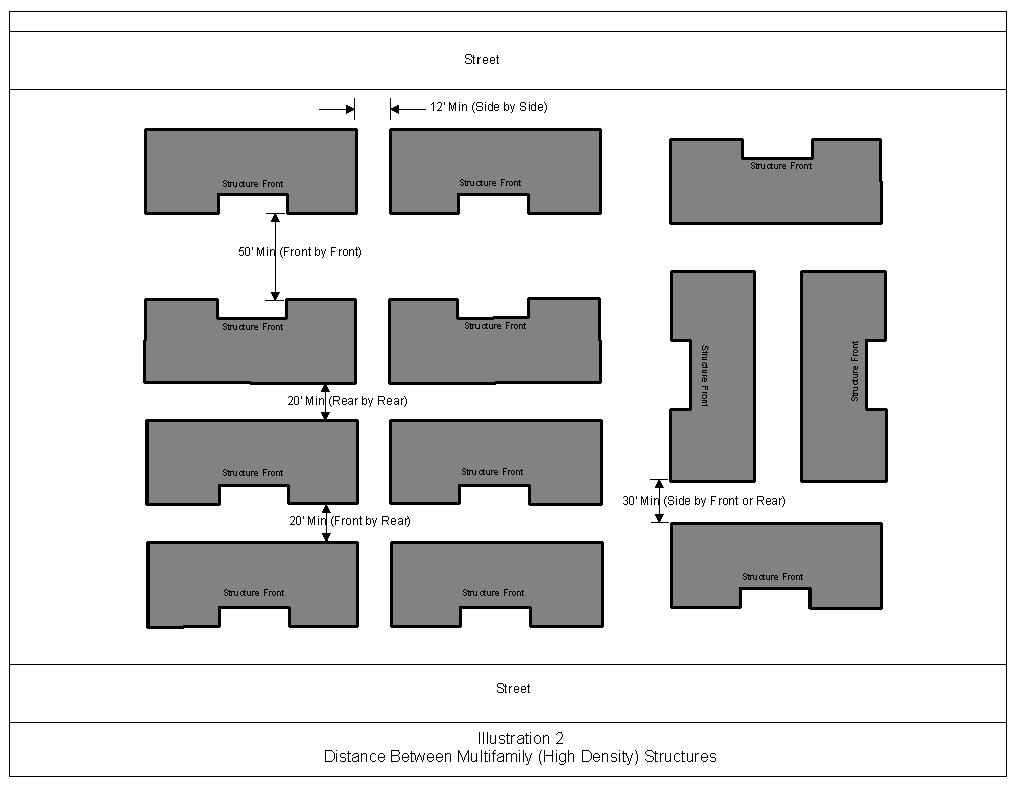
(2)
Non-residential uses.
(i)
Height. 35 feet.
(ii)
Front building setback. 25 feet.
(iii)
Side building setback. There shall be a side building setback on each side of a building not less than five feet in width. Where any building abuts a property with a one- or two-family use, the setback from the one- or two-family property line shall be at least 20 feet plus one foot for each foot of building height over 20 feet.
(iv)
Corner lots. Buildings on corner lots shall have 15-foot side building setbacks adjacent to the street where the rear lot lines of the corner lots coincide with the rear lot lines of the adjacent lots. Buildings on corner lots shall have 25-foot side building setbacks adjacent to the street where the rear lines of the corner lots coincide with the side lot lines of the adjacent lots. Where a minimum 25-foot setback is required, a canopy at least eight feet in height, attached to the main building, may be built within 15 feet of the property line so long as such construction will not obstruct the vision of vehicular or pedestrian traffic.
(v)
Garage setback. Where a driveway is located in front of a garage, the garage shall be setback 20 feet from the right-of-way or the driveway to the garage shall be at least 20 feet long to provide enough space for a vehicle to park without overhanging into the right-of-way, if the garage door is closed. (See Illustration 8 in section 144-5.1-1.)
(vi)
Rear building setback. 20 feet.
(vii)
Width of lot. 60 feet.
(viii)
Lot depth. 100 feet.
(ix)
Parking. See section 144-5.1 for permitted uses' parking.
3.4-5. "R-3H" multifamily high density.
Purpose. The R-3H multifamily high density district is intended for development of multiple-family residences at not more than 24 units per acre. "R-3H" uses should be located on arterials and state roads and not be accessed through single-family and duplex areas. The following regulations shall apply in all "R-3H" districts:
(a)
Authorized uses. Uses permitted by right shall be those set forth in the land use matrix in section 144-4.2. The allowed uses in the district, which are intended to be identical with those listed in the land use matrix, are as follows:
(1)
Uses permitted by right.
Residential uses:
Accessory building/structure.
Bed and breakfast inn (see section 144-5.6).
Boardinghouse/lodging house.
Community home (see definition).
Dormitory (in which individual rooms are for rental).
Family home adult care.
Family home child care.
Hospice.
Multifamily (apartments/condominiums).
Rental or occupancy for less than one month (see section 144-5.17).
Residential use in buildings with the following non-residential uses.
Non-residential uses:
Adult day care (no overnight stay).
Art dealer/gallery.
Barns and farm equipment storage (related to agricultural uses).
Cemetery and/or mausoleum.
Church/place of religious assembly.
Community building (associated with residential uses).
Contractor's temporary on-site construction office (only with permit from building official; see section 144-5.10).
Electrical substation.
Farms, general (crops) (see chapter 6 and section 144-5.9).
Farms, general (livestock/ranch) (see chapter 6 and section 144-5.9).
Golf course, public or private.
Governmental building or use with no outside storage.
Museum.
Nursing/convalescent home/sanitarium.
Park and/or playground (public or private).
Public recreation/services building for public park/playground areas.
Recreation buildings (public).
Retirement home/home for the aged—Public.
School, K-12 (public or private).
Telephone exchange buildings (office only).
University or college (public or private).
Water storage (surface, underground or overhead), water wells and pumping stations that are part of a public or municipal system.
(2)
Conflict. In the event of conflict between the uses listed in the land use matrix and those listed in subsection (1), the uses listed in this subsection shall be deemed those authorized in the district.
(b)
Maximum height, minimum area and setback requirements.
(1)
Residential uses.
(i)
Height. 45 feet or 60 feet when a pitched roof is used (minimum 4:12).
(ii)
Front building setbacks. 25 feet.
(iii)
Rear building setback. 25 feet.
(iv)
Side building setback. A side building setback of 20 feet shall be provided. Buildings on corner lots shall have 15-foot side building setbacks adjacent to the street where the rear lot lines of the corner lots coincide with the rear lot lines of the adjacent lots. Buildings on corner lots shall have 25-foot side building setbacks adjacent to the street where the rear lines of the corner lots coincide with the side lot lines of the adjacent lots.
(v)
Garage setback. Where a driveway is located in front of a garage, the garage shall be setback 20 feet from the right-of-way or the driveway to the garage shall be at least 20 feet long to provide enough space for a vehicle to park without overhanging into the right-of-way, if the garage door is closed. (See Illustration 8 in section 144-5.1-1.)
(vi)
Residential setback. Effective November 8, 2006, where a multifamily dwelling abuts a one- or two-family use or zoning district, the setback from the one- or two-family property line shall be at least 20 feet plus one foot for each foot of building height over 20 feet.
(vii)
Parking and accessory uses. Parking may encroach into the interior side and rear building setback as long as a solid screening fence or wall of six to eight feet in height is erected along the interior side and rear property lines. Accessory uses such as swimming pools, tennis courts and playgrounds will not be permitted within any required yard.
(viii)
Width of lot. The minimum width of an interior lot shall be 60 feet and the minimum width of a corner lot shall be 72 feet.
(ix)
Density. 24 units per acre.
(x)
Lot area. 20,000 square feet.
(xi)
Lot coverage. The combined area of all yards shall be at least 50 percent of the total lot or tract; provided however, that in the event enclosed or covered parking is provided, the minimum total yard area requirement shall be 40 percent of the total lot or tract.
(xii)
Distance between structures. There shall be a minimum of ten feet between structures side by side; a minimum of 20 feet between structures side by front or rear; a minimum of 40 feet between structures front to front; a minimum of 20 feet between structures backing rear to rear, and a minimum of 20 feet between structures front to rear. (See Illustration 1.)
(xiii)
Access to an arterial roadway or state highway required. developments in this district must have direct access to either an arterial roadway or state highway.
(xiv)
Lot depth. 100 feet.
(2)
Non-residential uses.
(i)
Height. 45 feet.
(ii)
Front building setback. 25 feet.
(iii)
Side building setback. There shall be a side building setback on each side of a building not less than five feet in width. Where any building abuts a property with a one- or two-family use, the setback from the one- or two-family property line shall be at least 20 feet plus one foot for each foot of building height over 20 feet.
(iv)
Corner lots. Buildings on corner lots shall have 15-foot side building setbacks adjacent to the street where the rear lot lines of the corner lots coincide with the rear lot lines of the adjacent lots. Buildings on corner lots shall have 25-foot side building setbacks adjacent to the street where the rear lines of the corner lots coincide with the side lot lines of the adjacent lots. Where a minimum 25-foot setback is required, a canopy at least eight feet in height, attached to the main building, may be built within 15 feet of the property line so long as such construction will not obstruct the vision of vehicular or pedestrian traffic.
(v)
Garage setback. Where a driveway is located in front of a garage, the garage shall be setback 20 feet from the right-of-way or the driveway to the garage shall be at least 20 feet long to provide enough space for a vehicle to park without overhanging into the right-of-way, if the garage door is closed. (See Illustration 8 in section 144-5.1-1.)
(vi)
Rear building setback. 20 feet.
(vii)
Width of lot. 60 feet.
(viii)
Lot depth. 100 feet.
3.4-6. "B-1A" conventional and manufactured home district.
Purpose. This district is to recognize that certain areas of the city are suitable for a mixture of single-family dwelling units, manufactured homes, and mobile homes, and to provide adequate space and site diversification for residential purposes designed to accommodate the peculiarities and design criteria of manufactured homes, along with single-family residences. The following regulations shall apply in all "B-1A" districts:
(a)
Authorized uses. Uses permitted by right shall be those set forth in the land use matrix in section 144-4.2. The allowed uses in the district, which are intended to be identical with those listed in the land use matrix, are as follows:
(1)
Uses permitted by right.
Residential uses:
Accessory building/structure.
Community home (see definition).
Duplex/two-family/duplex condominiums.
Home occupation (see section 144-5.5).
HUD-Code manufactured home/mobile homes, after a permit is obtained from the building inspector to permit removal of wheels or transporting device and attaching the home to a permanent foundation on the ground, which home shall thereafter be regarded as a permanent structure and shall meet all applicable codes and chapters.
HUD-Code manufactured home subdivision.
One-family dwelling, detached.
Single-family industrialized home (section 144-5.8 does not apply).
Non-residential uses:
Barns and farm equipment storage (related to agricultural uses).
Church/place of religious assembly.
Community building (associated with residential uses).
Contractor's temporary on-site construction office (only with permit from building official; see section 144-5.10).
Farms, general (crops) (see chapter 6 and section 144-5.9).
Farms, general (livestock/ranch) (see chapter 6 and section 144-5.9).
Golf course (public or private).
Governmental building or use with no outside storage.
Park and/or playground (public or private).
Public recreation/services building for public park/playground areas.
Recreation buildings (public).
Recycling kiosk.
Retirement home/home for the aged.
School, K-12 (public or private).
Water storage (surface, underground or overhead), water wells and pumping stations that are part of a public or municipal system.
(2)
Conflict. In the event of conflict between the uses listed in the land use matrix and those listed in subsection (1), the uses listed in this subsection shall be deemed those authorized in the district.
(b)
Maximum height, minimum area and setback requirements.
(1)
Height. 35 feet.
(2)
Front building setback. 25 feet.
(3)
Side building setback. There shall be a side building setback on each side of a building not less than five feet in width. Buildings on corner lots shall have 15-foot side building setbacks adjacent to the street where the rear lot lines of the corner lots coincide with the rear lot lines of the adjacent lots. Buildings on corner lots shall have 25-foot side building setbacks adjacent to the street where the rear lines of the corner lots coincide with the side lot lines of the adjacent lots.
(4)
Garage setback. Where a driveway is located in front of a garage, the garage shall be setback 20 feet from the right-of-way or the driveway to the garage shall be at least 20 feet long to provide enough space for a vehicle to park without overhanging into the right-of-way, if the garage door is closed. (See Illustration 8 in section 144-5.1-1.)
(5)
Rear building setback. 20 feet.
(6)
Width of lot. The minimum width of an interior lot shall be 60 feet and the minimum width of a corner lot shall be 70 feet. The purpose of the lot width and depth requirements is to provide guidance and standards for the development of new duplex lots and shall not be used as a factor in determining if existing lots that otherwise meet the minimum lot size herein shall allow construction of a duplex.
(7)
Lot area per family. Every single-family and duplex dwelling hereafter erected or altered shall have a lot area of not less than 6,600 square feet per family for interior lots, and 7,000 square feet per family for corner lots, provided that where a lot has less area than herein required and such lot was in separate ownership prior to September 25, 1967, this requirement will not prohibit the erection of a one-family dwelling. Where a public or community sewer is not available and in use for the disposal of all sanitary sewage, each lot shall provide not less than one-half acre and one acre on the Edwards Aquifer Recharge Zone.
3.4-7. "B-1B" manufactured home park district.
Purpose. This district is to recognize that certain areas of the city are suitable for manufactured home parks located on a single tract of land under one ownership wherein spaces are leased for the placement of manufactured homes. On-site amenities such as recreation and green areas, vehicle parking, and storage areas should be provided. The following regulations shall apply in all "B-1B" districts:
(a)
Authorized uses. Uses permitted by right shall be those set forth in the land use matrix in section 144-4.2. The allowed uses in the district, which are intended to be identical with those listed in the land use matrix, are as follows:
(1)
Uses permitted by right:
Residential uses:
Accessory building/structure.
Community home (see definition).
Home occupation (see section 144-5.5).
HUD-Code manufactured home.
Manufactured or mobile home parks located on a single tract of land under one ownership wherein spaces are leased for placement of a mobile home or manufactured or industrialized housing in accordance with appendix B of this Code.
Single-family industrialized home (section 144-5.8 does not apply).
Non-residential uses:
Barns and farm equipment storage (related to agricultural uses).
Church/place of religious assembly.
Community building (associated with residential uses).
Contractor's temporary on-site construction office (only with permit from building official; see section 144-5.10).
Farms, general (crops) (see chapter 6 and section 144-5.9).
Farms, general (livestock/ranch) (see chapter 6 and section 144-5.9).
Golf course (public or private).
Governmental building or use with no outside storage.
Park and/or playground (public or private).
Recreation buildings (public).
School, K-12 (public or private).
Water storage (surface, underground or overhead), water wells and pumping stations that are part of a public or municipal system.
(2)
Conflict. In the event of conflict between the uses listed in the land use matrix and those listed in subsection (1), the uses listed in this subsection shall be deemed those authorized in the district.
(b)
Height and area requirements. All mobile home parks shall comply with those regulations set forth in appendix B of this Code.
3.4-8. "TH-A" townhouse residential district.
Purpose. The TH-A townhouse residential district is intended for development of single-family residential townhomes and associated uses. The following regulations shall apply in all "TH-A" districts:
(a)
Authorized uses. Uses permitted by right shall be those set forth in the land use matrix in section 144-4.2. The allowed uses in the district, which are intended to be identical with those listed in the land use matrix, are as follows:
(1)
Uses permitted by right.
Residential uses:
Accessory building/structure.
Community home (see definition).
Family home adult care.
Family home child care.
Home occupation (see section 144-5.5).
Townhouse (attached).
Non-residential uses:
Barns and farm equipment storage (related to agricultural uses).
Church/place of religious assembly.
Community building (associated with residential uses).
Contractor's temporary on-site construction office (only with permit from building official; see section 144-5.10).
Farms, general (crops) (see chapter 6 and section 144-5.9).
Farms, general (livestock/ranch) (see chapter 6 and section 144-5.9).
Golf course, public or private.
Governmental building or use with no outside storage.
Park and/or playground (public or private).
Recreation buildings (public).
School, K-12 (public or private).
Water storage (surface, underground or overhead), water wells and pumping stations that are part of a public or municipal system.
(2)
Conflict. In the event of conflict between the uses listed in the land use matrix and those listed in subsection (1), the uses listed in this subsection shall be deemed those authorized in the district.
(b)
Maximum height, minimum area and setback requirements.
(1)
Height. 35 feet.
(2)
Front building setback. A minimum front yard of ten feet shall be provided to the front of the house. If front entry garages/carports are provided, a minimum front yard of 20 feet shall be provided to the garage/carport.
(3)
Side building setback. No side building setbacks are required for interior lots except the minimum distance between two building groups shall be 20 feet and the minimum distance between a building group and any abutting subdivision boundary or zoning district boundary line shall be 20 feet. Buildings on corner lots shall have 15-foot side building setbacks adjacent to the street, except where the rear lot line of a corner lot coincides with a side lot line of an adjacent lot, then 25-foot minimum side building setbacks adjacent to the street shall be provided.
(4)
Garage setback. Where a driveway is located in front of a garage, the garage shall be setback 20 feet from the right-of-way or the driveway to the garage shall be at least 20 feet long to provide enough space for a vehicle to park without overhanging into the right-of-way, if the garage door is closed. (See Illustration 8 in section 144-5.1-1.)
(5)
Rear building setback. No building shall be constructed closer than ten feet from the rear property line. If the rear of the lots abut any other residential zoning district, the rear building setback shall have a minimum depth of 20 feet.
(6)
Width of lot. Interior lots shall have a minimum width of 25 feet. Corner lots shall have a minimum width of 40 feet except where the rear lot line of a corner lot coincides with a side lot line of an adjacent lot, then the corner lot shall have a minimum width of 50 feet.
(7)
Lot area per family. 2,500 square feet.
(8)
Lot depth. 100 feet.
(c)
Other requirements.
(1)
Common open space. A minimum of 250 square feet of common open space per lot shall be provided within the townhouse project. In computing the required common open space, individually owned townhouse lots, required front, rear, or side setbacks, streets, alleys, or public rights-of-way of any kind, vehicular drives, parking areas, service drives, or utility easements shall not be included. Drainage easements and detention ponds may be used in computing common open space.
(2)
Building group. There shall be no less than two nor more than eight individual dwelling units in each building or dwelling group. Each building group shall be at least 20 feet from any other building group, measured from the nearest points of their foundations. Each building or building group shall be at least 20 feet from any subdivision or zoning district boundary line.
(3)
Accessory buildings. Any detached accessory buildings permitted, except carports open on at least two sides, shall be set at least three feet away from the side lot line unless their walls are equal in fire resistance to the common walls of the main structure. Detached carports, open on at least two sides, may be built to the property line with no common wall required. Rear building setbacks for an accessory building shall be three feet. Any accessory building permitted in a "R-1A-43.5," "R-1A-12," "R-1A-8," or "R-1A-6.6" district shall be permitted in district "TH-A."
3.4-9. "ZH-A" zero lot line home district.
Purpose. The ZH-A zero lot line home district is intended for development of detached single-family residences on compact lots having one side building setback reduced to zero feet, also commonly referred to as "zero lot line," and having a minimum lot size of 4,000 square feet. The following regulations shall apply in all "ZH-A" districts:
(a)
Authorized uses. Uses permitted by right shall be those set forth in the land use matrix in section 144-4.2. The allowed uses in the district, which are intended to be identical with those listed in the land use matrix, are as follows:
(1)
Uses permitted by right.
Residential uses:
Accessory building/structure.
Accessory dwelling (one accessory dwelling per lot).
Community home (see definition).
Family home adult care.
Family home child care.
Home occupation (see section 144-5.5).
Single-family industrialized housing (see section 144-5.8).
Zero lot line/patio homes.
Non-residential uses:
Barns and farm equipment storage (related to agricultural uses).
Church/place of religious assembly.
Community building (associated with residential uses).
Contractor's temporary on-site construction office (only with permit from building official; see section 144-5.10).
Farms, general (crops) (see chapter 6 and section 144-5.9).
Farms, general (livestock/ranch) (see chapter 6 and section 144-5.9).
Golf course, public or private.
Governmental building or use with no outside storage.
Park and/or playground (public or private).
Recreation buildings (public).
School, K-12 (public or private).
Water storage (surface, underground or overhead), water wells and pumping stations that are part of a public or municipal system.
(2)
Conflict. In the event of conflict between the uses listed in the land use matrix and those listed in subsection (1), the uses listed in this subsection shall be deemed those authorized in the district.
(b)
Maximum height, minimum area and setback requirements.
(1)
Height. 35 feet.
(2)
Front building setback. A minimum front yard of ten feet shall be provided to the front of the house. If front entry garages/carports are provided, a minimum front yard of 20 feet shall be provided to the garage/carport.
(3)
Side building setback. There shall be no side building setback required on one side of the lot and a minimum of ten feet in the opposite side yard. If the side of the lot abuts any other residential zoning district, that side building setback shall have a minimum depth of ten feet. The dwelling on the "no side building setback required" side may be off-set from the property line by no more than one foot. However, a provision can be made for five-foot setbacks on both sides if it meets all applicable building codes.
(4)
Corner lots. Buildings on corner lots shall provide a minimum exterior side building setback of ten feet. If entry to a garage/carport is provided on the exterior side a minimum yard of 20 feet shall be provided to the garage/carport.
(5)
Rear building setbacks. If rear entry garages/carports are provided from an alley, the rear building setback shall have a minimum depth of 20 feet. If no alley is provided and garage/carport entries are from the front, the rear building setback shall have a minimum depth of ten feet. If the rear of the lots abut any other residential zoning district, the rear building setback shall have a minimum depth of 20 feet.
(6)
Width of lot. 40 feet.
(7)
Lot area. 4,000 square feet.
(8)
Lot depth. 100 feet.
(c)
Other requirements.
(1)
Minimum area zoned. Not less than three lots with common side lot lines will be zoned for zero lot line homes. When facing on the same street within the same block, mixing of ZH structures and other residential structures will not be allowed. However, this does not preclude other residential uses on one side of a street with ZH uses on the opposite side of the street within the same block or different blocks.
(2)
Zero lot line wall. No door or window openings shall be built into the side wall facing the zero lot line except those that are more than three feet from the property line and screened by a masonry wall at least eight feet in height so that the opening(s) is not visible from the adjoining property. (See Illustration 3, "ZH-A" district.)
(3)
Overhang. Eaves and gutters may overhang the zero lot line side of the lot by no more than 18 inches. If there is an overhang over the lot line, a gutter is required such that roof runoff shall not be deposited over the lot line onto adjoining property.
(4)
Maintenance, drainage and overhang easement. A maintenance, drainage and overhang easement of five feet shall be provided on each lot that is adjacent to a lot with a zero setback allowance. This easement shall be for the purpose of maintaining the wall and foundation that is adjacent to one side property line to provide for proper maintenance and drainage.
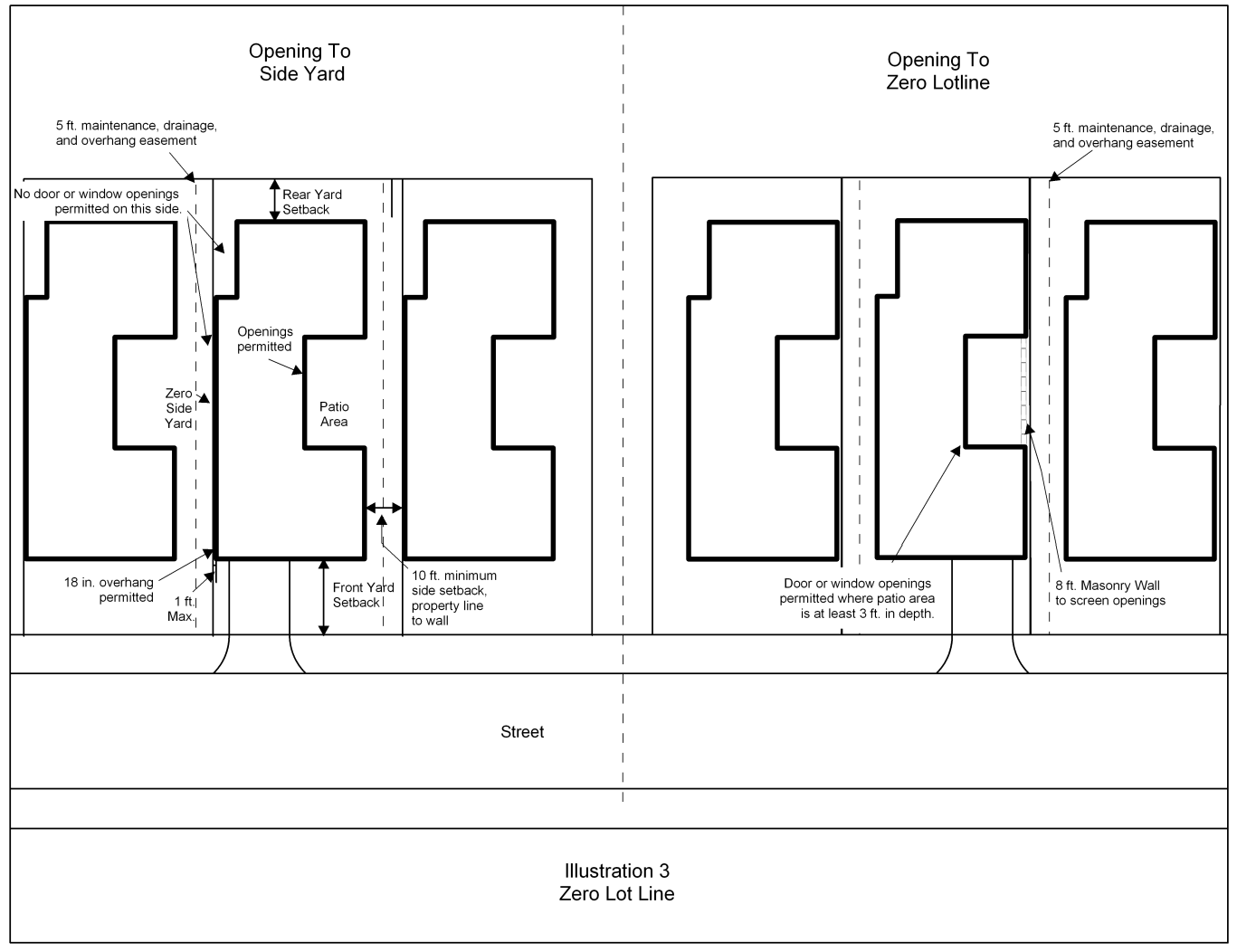
3.4-10. "MU-A" low intensity mixed use district.
Purpose. The MU-A low intensity mixed use district is intended to provide for a mixture of retail, office, and residential uses in close proximity to enable people to live, work and shop in a single location. Bed-and-breakfast establishments could also be located in this district. Pedestrian walkways and open areas are desired in order to promote a pedestrian-friendly environment.
(a)
Authorized uses. Uses permitted by right shall be those set forth in the land use matrix in section 144-4.2. The allowed uses in the district, which are intended to be identical with those listed in the land use matrix, are as follows:
(1)
Uses permitted by right.
Residential uses:
Accessory building/structure.
Accessory dwelling (one accessory dwelling per lot).
Bed and breakfast inn (see section 144-5.6).
Community home (see definition).
Duplex/two-family dwelling/duplex condominiums.
Family home adult care.
Family home child care.
Home occupation (see section 144-5.5).
Hospice.
Multifamily (apartments/condominiums).
One-family dwelling, detached.
Residential use in buildings with the following non-residential uses.
Single-family industrialized housing (see section 144-5.8).
Townhouse (attached).
Zero lot line/patio homes.
Non-residential uses:
Accounting, auditing, bookkeeping, and tax preparations.
Adult day care (no overnight stay).
Adult day care (with overnight stay).
Amusement devices/arcade (four or more devices).
Animal grooming shop.
Answering and message services.
Antique shop.
Appliance repair.
Armed services recruiting center.
Art dealer/gallery.
Artist or artisan's studio.
Assisted living facility/retirement home.
Auto leasing.
Auto supply store for new and factory rebuilt parts.
Auto tire repair/sales (indoor).
Bakery (retail).
Bank, savings and loan, or credit union.
Bar/tavern.
Barns and farm equipment storage (related to agricultural uses).
Battery charging station.
Bicycle sales and/or repair.
Bingo facility.
Book binding.
Book store.
Cafeteria/cafe/delicatessen.
Campers' supplies.
Caterer.
Cemetery and/or mausoleum.
Check cashing service.
Child day care/children's nursery (business).
Church/place of religious assembly.
Cleaning, pressing and dyeing (non-explosive fluids used).
Clinic (dental).
Clinic (emergency care).
Clinic (medical).
Coffee shop.
Communication equipment—Installation and/or repair.
Community building (associated with residential uses).
Computer and electronic sales.
Computer repair.
Confectionery store (retail).
Consignment shop.
Contractor's temporary on-site construction office (only with permit from building official; see section 144-5.10).
Convenience store without fuel sales.
Credit agency.
Curio shops.
Custom work shops.
Department store.
Drapery shop/blind shop.
Drug sales/pharmacy.
Electrical repair shop.
Electrical substation.
Farms, general (crops) (see chapter 6 and section 144-5.9).
Farms, general (livestock/ranch) (see chapter 6 and section 144-5.9).
Florist.
Food or grocery store without fuel sales (100,000 square feet or less).
Frozen food storage for individual or family use.
Garden shops and greenhouses.
Golf course.
Governmental building or use with no outside storage.
Greenhouse (commercial).
Handicraft shop.
Hardware store.
Health club (physical fitness; indoors only).
Heating and air-conditioning sales/services.
Hospital, rehabilitation.
Kiosk (providing a retail service).
Laundromat and laundry pickup stations.
Laundry/dry cleaning (drop off/pick up).
Laundry/washateria (self serve).
Lawnmower sales and/or repair.
Locksmith.
Martial arts school.
Museum.
Needlework shop.
Nursing/convalescent home/sanitarium.
Offices, brokerage services.
Offices, business or professional.
Offices, computer programming and data processing.
Offices, consulting.
Offices, engineering, architecture, surveying or similar.
Offices, health services.
Offices, insurance agency.
Offices, legal services, including court reporting.
Offices, medical offices.
Offices, real estate.
Offices, security/commodity brokers, dealers, exchanges and financial services.
Park and/or playground (private).
Park and/or playground (public).
Parking lots (for passenger car only) (not as incidental to the main use).
Parking structure/public garage.
Pawn shop.
Personal services.
Pet shop/supplies (10,000 square feet or less).
Photographic printing/duplicating/copy shop or printing shop.
Photographic studio (no sale of cameras or supplies).
Photographic supply.
Plant nursery (no retail sales on site).
Plant nursery (retail sales/outdoor storage).
Public recreation/services building for public park/playground areas.
Quick lube/oil change/minor inspection.
Radio/television shop, electronics, computer repair.
Recreation buildings (private).
Recreation buildings (public).
Recycling kiosk.
Refreshment/beverage stand.
Restaurant with drive-through service.
Restaurant/prepared food sales.
Retail store and shopping center with drive-through service (50,000 square foot building or less).
Retirement home/home for the aged.
School, K-12 (public or private).
School, vocational (business/commercial trade).
Security monitoring company.
Security systems installation company.
Shoe repair shops.
Shopping center.
Specialty shops in support of project guests and tourists.
Studios (art, dance, music, drama, reducing, photo, interior decorating, etc.).
Tailor shop.
Tattoo or body piercing studio.
Telemarketing agency.
Telephone exchange buildings (office only).
Theater (non-motion picture; live drama).
Tool rental.
Travel agency.
University or college (public or private).
Vacuum cleaner sales and repair.
Veterinary hospital (no outside animal runs or kennels).
Video rental/sales.
Water storage (surface, underground or overhead), water wells and pumping stations that are part of a public or municipal system.
Woodworking shop (ornamental).
Any comparable business or use not included in or excluded from any other district described herein.
(2)
Conflict. In the event of conflict between the uses listed in the land use matrix and those listed in subsection (1), the uses listed in this subsection shall be deemed those authorized in the district.
(b)
Maximum height, minimum area and setback requirements.
(1)
Non-residential uses.
(i)
Height. Buildings and structures shall not exceed 35 feet in height; however buildings and structures higher than 35 feet may be approved by SUP.
(ii)
Front building setback. No building setback required.
(iii)
Side building setback. No side building setback is required.
(iv)
Rear building setback. Five feet minimum with an additional two feet required for each story above 24 feet, up to a maximum setback of 25 feet; there shall be no encroachment or overhangs into this required rear building setback.
(v)
Residential setback. Where a non-residential use or a multifamily development of more than three units abuts a one- or two-family use or zoning district, the setback from the residential property line shall be at least 20 feet plus one foot for each foot of building height over 20 feet.
(vi)
Minimum lot area. The minimum internal lot area shall be 6,000 square feet or 7,000 square feet for a corner lot.
(vii)
Minimum lot frontage. 60 feet.
(viii)
Lot depth. 100 feet.
(2)
One-family and duplex dwellings.
(i)
Height. 35 feet.
(ii)
Front building setback. 25 feet.
(iii)
Side building setback. There shall be a side building setback on each side of a building not less than five feet in width. Buildings on corner lots shall have 15-foot side building setbacks adjacent to the street where the rear lot lines of the corner lots coincide with the rear lot lines of the adjacent lots. Buildings on corner lots shall have 25-foot side building setbacks adjacent to the street where the rear lot lines of the corner lots coincide with the side lot lines of the adjacent lots.
(iv)
Garage setback. Where a driveway is located in front of a garage, the garage shall be setback 20 feet from the right-of-way or the driveway to the garage shall be at least 20 feet long to provide enough space for a vehicle to park without overhanging into the right-of-way, if the garage door is closed. (See Illustration 8 in section 144-5.1-1.)
(v)
Rear building setback. 20 feet.
(vi)
Width of lot. The minimum width of an interior lot shall be 60 feet and the minimum width of a corner lot shall be 70 feet. The purpose of the lot width and depth requirements is to provide guidance and standards for the development of new duplex lots and shall not be used as a factor in determining if existing lots that otherwise meet the minimum lot size herein shall allow the construction of a duplex.
(vii)
Lot area. Minimum 6,600 square feet for interior lots, and 7,000 square feet for corner lots. Where a lot was legally under separate ownership prior to September 25, 1967, but has an area less than the minimum required in this provision, this regulation shall not prohibit the erection of a one-family residence. Where a public or community sewer is not available and in use for the disposal of all sanitary sewage, each lot shall provide not less than one-half acre or one acre on the Edwards Aquifer Recharge Zone.
(viii)
Lot depth. Minimum of 100 feet. The purpose of the lot width and depth requirements is to provide guidance and standards for the development of new duplex lots and shall not be used as a factor in determining if existing lots that otherwise meet the minimum lot size herein shall allow the construction of a duplex.
(3)
Multifamily dwelling.
(i)
Height. 35 feet; 50 feet when a pitched roof is used (minimum 4:12 slope).
(ii)
Front building setback. 25 feet.
(iii)
Side building setback. A side building setback of 20 feet shall be provided adjacent to property zoned "R-1," "R-1A-43.5," "R-1A-12," "R-1A-8," "R-1A-6.6," "R-2," "R-2A," "TH," "TH-A," "ZH," "ZH-A," "MU-A," "B-1," "B-1A" and "B-1B". A side building setback of only six feet shall be provided adjacent to multifamily, commercially and industrially zoned property. Buildings on corner lots shall have 15-foot side building setbacks adjacent to the street where the rear lot lines of the corner lots coincide with the rear lot lines of the adjacent lots. Buildings on corner lots shall have 25-foot side building setbacks adjacent to the street where the rear lines of the corner lots coincide with the side lot lines of the adjacent lots.
(iv)
Garage setback. Where a driveway is located in front of a garage, the garage shall be setback 20 feet from the right-of-way or the driveway to the garage shall be at least 20 feet long to provide enough space for a vehicle to park without overhanging into the right-of-way, if the garage door is closed. (See Illustration 8 in section 144-5.1-1.)
(v)
Rear building setback. The depth of the rear building setback shall be at least 25 percent of the depth of the lot, but such depth need not be more than 25 feet.
(vi)
Accessory uses. Accessory uses such as swimming pools, tennis courts and playgrounds will not be permitted within any required yard.
(vii)
Width of lot. The minimum width of an interior lot shall be 60 feet and the minimum width of a corner lot shall be 70 feet.
(viii)
Density. 12 units per acre.
(ix)
Lot area. 15,000 square feet.
(x)
Lot coverage. The combined area of all yards shall not be less than 50 percent of the total lot or tract; provided however, that in the event enclosed or covered parking is provided, the minimum total yard area requirement shall be 40 percent of the total lot or tract.
(xi)
Distance between structures. There shall be a minimum of 12 feet between structures side by side; a minimum of 30 feet between structures side by front or rear; a minimum of 50 feet between structures front to front; and a minimum of 20 feet between structures backing rear to rear; and a minimum of 20 feet between structures front to rear. (See Illustration 2.)
(xii)
Lot depth. 100 feet.
(4)
Townhouses.
(i)
Height. 35 feet.
(ii)
Front building setback. Ten feet. If front entry garages/carports are provided, a minimum front yard of 20 feet shall be provided to the garage/carport.
(iii)
Side building setback. No side building setbacks are required for interior lots except the minimum distance between two building groups shall be 20 feet and the minimum distance between a building group and any abutting subdivision boundary or zoning district boundary line shall be 20 feet. Buildings on corner lots shall have 15-foot side building setbacks adjacent to the street, except where the rear lot line of a corner lot coincides with a side lot line of an adjacent lot, then 25-foot minimum side yards adjacent to the street shall be provided.
(iv)
Garage setback. Where a driveway is located in front of a garage, the garage shall be setback 20 feet from the right-of-way or the driveway to the garage shall be at least 20 feet long to provide enough space for a vehicle to park without overhanging into the right-of-way, if the garage door is closed. (See Illustration 8 in section 144-5.1-1.)
(v)
Rear building setback. No building shall be constructed closer than ten feet from the rear property line. If the rear of the lots abut any other residential zoning district, the rear building setback shall have a minimum depth of 20 feet.
(vi)
Width of lot. Interior lots shall have a minimum width of 25 feet. Corner lots shall have a minimum width of 40 feet except where the rear lot line of a corner lot coincides with a side lot line of an adjacent lot, then the corner lot shall have a minimum width of 50 feet.
(vii)
Lot depth. 100 feet.
(viii)
Lot area per family. 2,500 square feet.
(ix)
Common open space. A minimum of 250 square feet of common open space per lot shall be provided within the townhouse project. In computing the required common open space, individually owned townhouse lots, required front, rear, or side setbacks, streets, alleys, or public rights-of-way of any kind, vehicular drives, parking areas, service drives, or utility easements containing or permitting overhead pole carried service shall not be included. Drainage easements and detention ponds may be used in computing common open space.
(x)
Building group. There shall be no less than two nor more than eight individual dwelling units in each building or dwelling group. Each building group shall be at least 20 feet from any other building group, measured from the nearest points of their foundations. Each building or building group shall be at least 20 feet from any subdivision or zoning district boundary line.
(xi)
Accessory buildings. Any detached accessory buildings permitted, except carports open on at least two sides, shall be set at least three feet away from the side lot line unless their walls are equal in fire resistance to the common walls of the main structure. Detached carports, open on at least two sides, may be built to the property line with no common wall required. Rear building setback for an accessory building shall be three feet. Any accessory building permitted in district "R-1" shall be permitted in district "TH."
(5)
Zero lot line/patio homes.
(i)
Height. 35 feet.
(ii)
Front building setback. Ten feet. If front entry garages/carports are provided, a minimum front yard of 20 feet shall be provided to the garage/carport.
(iii)
Side building setback. There shall be no side building setback required on one side of the lot and a minimum of ten feet in the opposite side yard. If the side of the lot abuts any other residential zoning district, that side building setback shall have a minimum of ten feet. The dwelling on the "no side building setback required" side may be off-set from the property line by no more than one foot.
(iv)
Corner lots. Buildings on corner lots shall provide a minimum exterior side building setback of ten feet. If entry to a garage/carport is provided on the exterior side, a minimum yard of 20 feet shall be provided to the garage/carport.
(v)
Rear building setback. If rear entry garages/carports are provided from an alley, the rear building setback shall have a minimum depth of 20 feet. If no alley is provided and garage/carport entries are from the front, the rear building setback shall have a minimum depth of ten feet. If the rear of the lots abut any other residential zoning district, the rear building setback shall have a minimum depth of 20 feet.
(vi)
Width of lot. 40 feet.
(vii)
Lot area. 4,000 square feet.
(viii)
Lot depth. 100 feet.
(ix)
Minimum area zoned. Not less than three lots with common side lot lines will be zoned for zero lot line homes. When facing on the same street within the same block, mixing of ZH structures and other residential structures will not be allowed. However, this does not preclude other residential uses on one side of a street with ZH uses on the opposite side of the street within the same block or different blocks.
(x)
Zero lot line wall. No door or window openings shall be built into the side wall facing the zero lot line except those that are more than three feet from the property line and screened by a masonry wall at least eight feet in height so that the opening(s) is not visible from the adjoining property. (See Illustration 3, "ZH-A" district.)
(xi)
Maintenance, drainage and overhang easement. A maintenance, drainage and overhang easement of five feet shall be provided on each lot that is adjacent to a lot with a zero setback allowance. This easement shall be for the purpose of maintaining the wall and foundation that is adjacent to one side property line to provide for proper maintenance and drainage.
(xii)
Overhang. Eaves and gutters may overhang the zero lot line side of the lot by no more than 18 inches. If there is an overhang over the lot line, a gutter is required such that roof runoff shall not be deposited over the lot line onto adjoining property.
3.4-11. "MU-B" high intensity mixed use district.
Purpose. The MU-B high intensity mixed use district is intended to provide for a mixture of more intense retail, office, and industrial uses in close proximity to enable people to live, work and shop in a single location. Bed-and-breakfast establishments could also be located in this district. Pedestrian walkways and open areas are desired in order to promote a pedestrian-friendly environment.
(a)
Authorized uses. Uses permitted by right shall be those set forth in the land use matrix in section 144-4.2. The allowed uses in the district, which are intended to be identical with those listed in the land use matrix, are as follows:
(1)
Uses permitted by right.
Residential uses:
Accessory building/structure.
Bed and breakfast inn (see section 144-5.6).
Boardinghouse/lodging house.
Community home (see definition).
Dormitory (in which individual rooms are for rental).
Hospice.
Multifamily (apartments/condominiums—at least five units).
Rental or occupancy for less than one month (see section 144-5.17).
Residential use in buildings with the following non-residential uses.
Townhouse (at least five lots).
Non-residential uses:
Accounting, auditing, bookkeeping, and tax preparations.
Adult day care (no overnight stay).
Adult day care (with overnight stay).
Aircraft support and related services.
Airport.
All terrain vehicle (ATV) dealer/sales.
Ambulance service (private).
Amphitheater.
Amusement devices/arcade (four or more devices).
Amusement services or venues (indoors) (see section 144-5.13).
Amusement services or venues (outdoors).
Animal grooming shop.
Answering and message services.
Antique shop.
Appliance repair.
Archery range.
Armed services recruiting center.
Art dealer/gallery.
Artist or artisan's studio.
Assembly/exhibition hall or areas.
Assisted living facility/retirement home.
Athletic fields.
Auction sales (non-vehicle).
Auto body repair, garages (see section 144-5.11).
Auto glass repair/tinting (see section 144-5.11).
Auto interior shop/upholstery (see section 144-5.11).
Auto leasing.
Auto muffler shop (see section 144-5.11).
Auto or trailer sales rooms or yards (see section 144-5.12).
Auto or truck sales rooms or yards—Primarily new (see section 144-5.11).
Auto paint shop.
Auto repair as an accessory use to retail sales.
Auto repair garage (general) (see section 144-5.11).
Auto supply store for new and factory rebuilt parts.
Auto tire repair/sales (indoor).
Automobile driving school (including defensive driving).
Bakery (retail).
Bank, savings and loan, or credit union.
Bar/tavern.
Barber/beauty college (barber or cosmetology school or college).
Barns and farm equipment storage (related to agricultural uses).
Battery charging station.
Bicycle sales and/or repair.
Billiard/pool facility.
Bingo facility.
Bio-medical facilities.
Blacksmith or wagon shops.
Book binding.
Book store.
Bottling or distribution plants (milk).
Bottling works.
Bowling alley/center (see section 144-5.13).
Broadcast station (with tower) (see section 144-5.6).
Bus barns or lots.
Bus passenger stations.
Cafeteria/cafe/delicatessen.
Campers' supplies.
Car wash (self service; automated).
Car wash, full service (detail shop).
Carpenter, cabinet, or pattern shops.
Carpet cleaning establishments.
Caterer.
Cemetery and/or mausoleum.
Check cashing service.
Chemical laboratories (not producing noxious fumes or odors).
Child day care/children's nursery (business).
Church/place of religious assembly.
Civic/conference center and facilities.
Cleaning, pressing and dyeing (non-explosive fluids used).
Clinic (dental).
Clinic (emergency care).
Clinic (medical).
Club (private).
Coffee shop.
Cold storage plant.
Commercial amusement concessions and facilities.
Communication equipment—Installation and/or repair.
Computer and electronic sales.
Computer repair.
Confectionery store (retail).
Consignment shop.
Contractor's office/sales, with outside storage including vehicles.
Contractor's temporary on-site construction office (only with permit from building official; see section 144-5.10).
Convenience store with or without fuel sales.
Country club (private).
Credit agency.
Curio shops.
Custom work shops.
Dance hall/dancing facility (see section 144-5.13).
Day camp.
Department store.
Drapery shop/blind shop.
Driving range.
Drug sales/pharmacy.
Electrical repair shop.
Electrical substation.
Electronic assembly/high tech manufacturing.
Electroplating works.
Engine repair/motor manufacturing re-manufacturing and/or repair.
Exterminator service.
Fair ground.
Farmers market (produce market—wholesale).
Farms, general (crops) (see chapter 6 and section 144-5.9).
Farms, general (livestock/ranch) (see chapter 6 and section 144-5.9).
Feed and grain store.
Filling station (fuel tanks must be below the ground).
Florist.
Food or grocery store with or without fuel sales.
Food processing (no outside public consumption).
Forge (hand).
Forge (power).
Fraternal organization/civic club (private club).
Freight terminal, rail/truck (when any storage of freight is outside an enclosed building).
Freight terminal, truck (all storage of freight in an enclosed building).
Frozen food storage for individual or family use.
Funeral home/mortuary.
Furniture manufacture.
Furniture sales (indoor).
Galvanizing works.
Garden shops and greenhouses.
Golf course (public or private).
Golf course (miniature).
Governmental building or use with no outside storage.
Greenhouse (commercial).
Handicraft shop.
Hardware store.
Health club (physical fitness; indoors only).
Heating and air-conditioning sales/services.
Heavy load (farm) vehicle sales/repair (see section 144-5.14).
Heliport.
Home repair and yard equipment retail and rental outlets.
Hospital, general (acute care/chronic care).
Hospital, rehabilitation.
Hotel/motel.
Hotels/motels—Extended stay (residence hotels).
Ice delivery stations (for storage and sale of ice at retail only).
Ice plants.
Industrial laundries.
Kiosk (providing a retail service).
Laboratory equipment manufacturing.
Laundromat and laundry pickup stations.
Laundry, commercial (without self serve).
Laundry/dry cleaning (drop off/pick up).
Laundry/washateria (self serve).
Lawnmower sales and/or repair.
Leather products manufacturing.
Light manufacturing.
Limousine/taxi service.
Locksmith.
Lumberyard (see section 144-5.15).
Lumberyard or building material sales (see section 144-5.15).
Machine shop.
Maintenance/janitorial service.
Major appliance sales (indoor).
Manufactured home sales.
Manufacturing and processes.
Market (public, flea).
Martial arts school.
Medical supplies and equipment.
Metal fabrication shop.
Micro brewery (onsite manufacturing and sales).
Micro distillery (onsite manufacturing and/or sales).
Mini-warehouse/self storage units (no outside boat and RV storage permitted).
Motion picture studio, commercial film.
Motion picture theater (indoors).
Motion picture theater (outdoors, drive-in).
Motorcycle dealer (primarily new/repair).
Moving storage company.
Moving, transfer, or storage plant.
Museum.
Needlework shop.
Non-bulk storage of fuel, petroleum products and liquefied petroleum.
Nursing/convalescent home/sanitarium.
Offices, brokerage services.
Offices, business or professional.
Offices, computer programming and data processing.
Offices, consulting.
Offices, engineering, architecture, surveying or similar.
Offices, health services.
Offices, insurance agency.
Offices, legal services, including court reporting.
Offices, medical offices.
Offices, real estate.
Offices, security/commodity brokers, dealers, exchanges and financial services.
Outside storage (as primary use).
Park and/or playground (private or public).
Parking lots (for passenger car only) (not as incidental to the main use).
Parking structure/public garage.
Pawn shop.
Personal services.
Personal watercraft sales (primarily new/repair).
Pet shop/supplies (10,000 square feet or less).
Pet store (more than 10,000 square feet).
Photo engraving plant.
Photographic printing/duplicating/copy shop or printing shop.
Photographic studio (no sale of cameras or supplies).
Photographic supply.
Plant nursery.
Plant nursery (growing for commercial purposes with retail sales on site).
Plastic products molding/reshaping.
Plumbing shop.
Portable building sales.
Propane sales (retail).
Public recreation/services building for public park/playground areas.
Publishing/printing company (e.g., newspaper).
Quick lube/oil change/minor inspection.
Radio/television shop, electronics, computer repair.
Rappelling facilities.
Recreation buildings (public or private).
Recycling kiosk.
Refreshment/beverage stand.
Research lab (non-hazardous).
Restaurant with drive-through.
Restaurant/prepared food sales.
Retail store and shopping center.
Retirement home/home for the aged.
Rodeo grounds.
RV park.
RV/travel trailer sales.
School, K-12 (public or private).
School, vocational (business/commercial trade).
Security monitoring company.
Security systems installation company.
Sheet metal shop.
Shoe repair shops.
Shooting gallery—Indoor (see section 144-5.13).
Shopping center.
Sign manufacturing/painting plant.
Specialty shops in support of project guests and tourists.
Storage—Exterior storage for boats and recreational vehicles.
Storage in bulk.
Studio for radio or television (with tower) (see section 144-5.7).
Studios (art, dance, music, drama, reducing, photo, interior decorating, etc.).
Tailor shop.
Tattoo or body piercing studio.
Taxidermist.
Telemarketing agency.
Telephone exchange (office and other structures).
Tennis court (commercial).
Theater (non-motion picture; live drama).
Tire sales (outdoors).
Tool rental.
Transfer station (refuse/pick-up).
Travel agency.
Truck or transit terminal (with outside storage).
Truck stop.
University or college (public or private).
Upholstery shop (non-auto).
Used or second hand merchandise/furniture store.
Vacuum cleaner sales and repair.
Veterinary hospital with or without outside animal runs or kennels) with the exception that outdoor kennels may not be used between the hours of 9:00 p.m. and 7:00 a.m. and are prohibited adjacent to residential.
Video rental/sales.
Warehouse/office and storage/distribution center.
Waterfront amusement facilities—Berthing facilities sales and rentals.
Waterfront amusement facilities—Boat fuel storage/dispensing facilities.
Waterfront amusement facilities—Boat landing piers/launching ramps.
Waterfront amusement facilities—Swimming/wading pools/bathhouses.
Water storage (surface, underground or overhead), water wells and pumping stations that are part of a public or municipal system.
Welding shop.
Wholesale sales offices and sample rooms.
Woodworking shop (ornamental).
Any comparable business or use not included in or excluded from any other district described herein.
(2)
Conflict. In the event of conflict between the uses listed in the land use matrix and those listed in subsection (1), the uses listed in this subsection shall be deemed those authorized in the district.
(b)
Maximum height, minimum area and setback requirements.
(1)
Non-residential uses.
(i)
Height. 120 feet.
(ii)
Front building setback. No front building setback required.
(iii)
Side building setback. No side building setback is required.
(iv)
Rear building setback. Five feet minimum with an additional two feet required for each story above 24 feet, up to a maximum setback of 25 feet; there shall be no encroachment or overhangs into this required rear building setback.
(v)
Residential setback. Where a non-residential building or a multifamily development of more than three units abuts a one- or two-family use or zoning district, the setback from the residential property line shall be at least 20 feet plus one foot for each foot of building height over 20 feet.
(vi)
Minimum lot area. The minimum internal lot area shall be 6,000 square feet or 7,000 square feet for a corner lot.
(vii)
Reserved.
(viii)
Minimum lot frontage. 60 feet.
(ix)
Lot depth. 100 feet.
(2)
Multifamily dwellings.
(i)
Height. 120 feet.
(ii)
Front building setbacks. 25 feet.
(iii)
Rear building setback. 25 feet.
(iv)
Side building setback. A side building setback of 20 feet shall be provided. Buildings on corner lots shall have 15-foot side building setbacks adjacent to the street where the rear lot lines of the corner lots coincide with the rear lot lines of the adjacent lots. Buildings on corner lots shall have 25-foot side building setbacks adjacent to the street where the rear lines of the corner lots coincide with the side lot lines of the adjacent lots.
(v)
Garage setback. Where a driveway is located in front of a garage, the garage shall be setback 20 feet from the right-of-way or the driveway to the garage shall be at least 20 feet long to provide enough space for a vehicle to park without overhanging into the right-of-way, if the garage door is closed. (See Illustration 8 in section 144-5.1-1.)
(vi)
Parking and accessory uses. Parking may encroach into the interior side and rear building setback as long as a solid screening fence or wall of six to eight feet in height is erected along the interior side and rear property lines. Accessory uses such as swimming pools, tennis courts and playgrounds will not be permitted within any required yard.
(vii)
Width of lot. The minimum width of an interior lot shall be 60 feet and the minimum width of a corner lot shall be 70 feet.
(viii)
Density. No maximum.
(ix)
Lot area. 20,000 square feet.
(x)
Lot coverage. The combined area of all yards shall not be less than 50 percent of the total lot or tract; provided however, that in the event enclosed or covered parking is provided, the minimum total yard area requirement shall be 40 percent of the total lot or tract.
(xi)
Distance between structures. There shall be a minimum of ten feet between structures side by side; a minimum of 20 feet between structures side by front or rear; a minimum of 40 feet between structures front to front; a minimum of 20 feet between structures backing rear to rear, and a minimum of 20 feet between structures front to rear. (See Illustration 1.)
(xii)
Access to an arterial roadway or state highway required. Developments in this district must have direct access to either an arterial roadway or state highway.
(xiii)
Lot depth. 100 feet.
(3)
Townhouses.
(i)
Height. 35 feet.
(ii)
Front building setback. Ten feet. If front entry garages/carports are provided, a minimum front yard of 20 feet shall be provided to the garage/carport.
(iii)
Side building setback. No side building setbacks are required for interior lots except the minimum distance between two building groups shall be 20 feet and the minimum distance between a building group and any abutting subdivision boundary or zoning district boundary line shall be 20 feet. Buildings on corner lots shall have 15-foot side building setbacks adjacent to the street, except where the rear lot line of a corner lot coincides with a side lot line of an adjacent lot, then 25-foot minimum side yards adjacent to the street shall be provided.
(iv)
Garage setback. Where a driveway is located in front of a garage, the garage shall be setback 20 feet from the right-of-way or the driveway to the garage shall be at least 20 feet long to provide enough space for a vehicle to park without overhanging into the right-of-way, if the garage door is closed. (See Illustration 8 in section 144-5.1-1.)
(v)
Rear building setback. No building shall be constructed closer than ten feet from the rear property line. If the rear of the lots abut any other residential zoning district, the rear building setback shall have a minimum depth of 20 feet.
(vi)
Width of lot. Interior lots shall have a minimum width of 25 feet. Corner lots shall have a minimum width of 40 feet except where the rear lot line of a corner lot coincides with a side lot line of an adjacent lot, then the corner lot shall have a minimum width of 50 feet.
(vii)
Lot depth. 100 feet.
(viii)
Lot area per family. 2,500 square feet.
(ix)
Common open space. A minimum of 250 square feet of common open space per lot shall be provided within the townhouse project. In computing the required common open space, individually owned townhouse lots, required front, rear, or side setbacks, streets, alleys, or public rights-of-way of any kind, vehicular drives, parking areas, service drives, or utility easements containing or permitting overhead pole carried service shall not be included. Drainage easements and detention ponds may be used in computing common open space.
(x)
Building group. There shall be no less than five lots. There shall be no less than two nor more than eight individual dwelling units in each building or dwelling group. Each building group shall be at least 20 feet from any other building group, measured from the nearest points of their foundations. Each building or building group shall be at least 20 feet from any subdivision or zoning district boundary line.
(xi)
Accessory buildings. Any detached accessory buildings permitted, except carports open on at least two sides, shall be set at least three feet away from the side lot line unless their walls are equal in fire resistance to the common walls of the main structure. Detached carports, open on at least two sides, may be built to the property line with no common wall required. Rear building setback for an accessory building shall be three feet. Any accessory building permitted in district "R-1" shall be permitted in district "TH."
3.4-12. "C-1A" neighborhood business district.
Purpose. This district is established to provide office, business and professional services, and light retail and commercial uses to serve adjacent neighborhoods. The uses found in the neighborhood business district are generally clustered at major intersections of collector streets near the perimeters of residential neighborhoods. No major shopping or office centers are included in this district. No use that is noxious or offensive by reason of vibration, noise, odor, dust, smoke or gas shall be included in this district. The following regulations shall apply in all "C-1A" districts:
(a)
Authorized uses. Uses permitted by right shall be those set forth in the land use matrix in section 144-4.2. The allowed uses in the district, which are intended to be identical with those listed in the land use matrix, are as follows:
(1)
Uses permitted by right.
Residential uses:
Accessory building/structure.
Assisted living facility/retirement home.
Bed and breakfast inn (see section 144-5.6).
Community home (see definition).
Hospice.
Non-residential uses:
Accounting, auditing, bookkeeping, and tax preparations.
Adult day care (no overnight stay).
Adult day care (with overnight stay).
Amusement devices/arcade (four or more devices).
Animal grooming shop.
Answering and message services.
Antique shop.
Appliance repair.
Armed services recruiting center.
Art dealer/gallery.
Artist or artisan's studio.
Auto leasing.
Auto supply store for new and factory rebuilt parts.
Auto tire repair/sales (indoor).
Bakery (retail).
Bank, savings and loan, or credit union.
Bars and taverns (no outdoor music).
Barns and farm equipment storage (related to agricultural uses).
Battery charging station.
Bicycle sales and/or repair.
Bingo facility.
Book binding.
Book store.
Cafeteria/cafe/delicatessen.
Campers' supplies.
Caterer.
Cemetery and/or mausoleum.
Check cashing service.
Child day care/children's nursery (business).
Church/place of religious assembly.
Cleaning, pressing and dyeing (non-explosive fluids used).
Clinic (dental).
Clinic (emergency care).
Clinic (medical).
Coffee shop.
Communication equipment—Installation and/or repair.
Computer and electronic sales.
Computer repair.
Confectionery store (retail).
Consignment shop.
Contractor's temporary on-site construction office (only with permit from building official; see section 144-5.10).
Convenience store without fuel sales.
Credit agency.
Curio shops.
Custom work shops.
Department store.
Drapery shop/blind shop.
Drug sales/pharmacy.
Electrical repair shop.
Electrical substation.
Farms, general (crops) (see chapter 6 and section 144-5.9).
Farms, general (livestock/ranch) (see chapter 6 and section 144-5.9).
Florist.
Food or grocery store without fuel sales (50,000 square feet or less).
Frozen food storage for individual or family use.
Garden shops and greenhouses.
Golf course (public or private).
Governmental building or use.
Greenhouse (commercial).
Handicraft shop.
Hardware store.
Health club (physical fitness; indoors only).
Heating and air-conditioning sales/services.
Hospital, rehabilitation.
Kiosk (providing a retail service).
Laundromat and laundry pickup stations.
Laundry/dry cleaning (drop off/pick up).
Laundry/washateria (self serve).
Lawnmower sales and/or repair.
Locksmith.
Martial arts school.
Museum.
Needlework shop.
Nursing/convalescent home/sanitarium.
Offices, brokerage services.
Offices, business or professional.
Offices, computer programming and data processing.
Offices, consulting.
Offices, engineering, architecture, surveying or similar.
Offices, health services.
Offices, insurance agency.
Offices, legal services, including court reporting.
Offices, medical offices.
Offices, real estate.
Offices, security/commodity brokers, dealers, exchanges and financial services.
Park and/or playground (private or public).
Parking lots (for passenger car only) (not as incidental to the main use).
Parking structure/public garage.
Pawn shop.
Personal services.
Pet shop/supplies (10,000 square feet or less).
Photographic printing/duplicating/copy shop or printing shop.
Photographic studio (no sale of cameras or supplies).
Photographic supply.
Plant nursery.
Plant nursery (retail sales/outdoor storage).
Public recreation/services building for public park/playground areas.
Quick lube/oil change/minor inspection.
Radio/television shop, electronics, computer repair.
Recreation buildings (private or public).
Recycling kiosk.
Refreshment/beverage stand.
Restaurant.
Restaurant/prepared food sales with drive-throughs.
Retail store and shopping center with drive-through service (50,000 square foot building or less).
Retirement home/home for the aged.
School, K-12 (public or private).
School, vocational (business/commercial trade).
Security monitoring company.
Security systems installation company.
Shoe repair shops.
Shopping center.
Specialty shops in support of project guests and tourists.
Studios (art, dance, music, drama, reducing, photo, interior decorating, etc.).
Tailor shop.
Telemarketing agency.
Telephone exchange buildings (office only).
Theater (non-motion picture; live drama).
Tool rental.
Travel agency.
University or college (public or private).
Vacuum cleaner sales and repair.
Veterinary hospital (no outside animal runs or kennels).
Video rental/sales.
Water storage (surface, underground or overhead), water wells and pumping stations that are part of a public or municipal system.
Woodworking shop (ornamental).
Any comparable business or use not included in or excluded from any other district described herein.
(2)
Conflict. In the event of conflict between the uses listed in the land use matrix and those listed in subsection (1), the uses listed in this subsection shall be deemed those authorized in the district.
(b)
Maximum height, minimum area and setback requirements.
(1)
Height. 35 feet.
(2)
Front building setback. 25 feet.
(3)
Side building setback. No side building setback is required except that where a side line of a lot in this district abuts upon the side line of a lot in any residential zone, a side building setback of not less than six feet shall be provided.
(4)
Residential/non-residential garage setback. Where a driveway is located in front of a garage, the garage shall be setback 20 feet from the right-of-way or the driveway to the garage shall be at least 20 feet long to provide enough space for a vehicle to park without overhanging into the right-of-way, if the garage door is closed. (See Illustration 8 in section 144-5.1-1.)
(5)
Rear building setback. 20 feet.
(6)
Residential setback. Effective November 8, 2006, where any building abuts a one- or two-family use or zoning district, the setback from the one- or two-family property line shall be at least 20 feet plus one foot for each foot of building height over 20 feet.
(7)
Width of lot. 60 feet.
(8)
Corner lots. Buildings on corner lots shall have 15-foot side building setbacks adjacent to the street where the rear lot lines of the corner lots coincide with the rear lot lines of the adjacent lots. Buildings on corner lots shall have 25-foot side building setbacks adjacent to the street where the rear lines of the corner lots coincide with the side lot lines of the adjacent lots. Where a minimum 25-foot setback is required, a canopy at least eight feet in height, attached to the main building, may be built within 15 feet of the property line so long as such construction will not obstruct the vision of vehicular or pedestrian traffic.
(9)
Lot depth. 100 feet.
(10)
Size. Any building on a lot shall be 50,000 square feet or less in size.
3.4-13. "C-1B" general business district.
Purpose. The general business district is established to provide areas for a broad range of office and retail uses. This district should generally consist of retail nodes located along or at the intersection of major collectors or thoroughfares to accommodate high traffic volumes generated by general retail uses. The following regulations shall apply in all "C-1B" districts:
(a)
Authorized uses. Uses permitted by right shall be those set forth in the land use matrix in section 144-4.2. The allowed uses in the district, which are intended to be identical with those listed in the land use matrix, are as follows:
(1)
Uses permitted by right.
Residential uses:
Accessory building/structure.
Assisted living facility/retirement home.
Bed and breakfast inn (see section 144-5.6).
Community home (see definition).
Hospice.
Non-residential uses:
Accounting, auditing, bookkeeping, and tax preparations.
Adult day care (no overnight stay).
Adult day care (with overnight stay).
All terrain vehicle (ATV) dealer/sales.
Ambulance service (private).
Amphitheater.
Amusement devices/arcade (four or more devices).
Amusement services or venues (indoors).
Amusement services or venues (outdoors).
Animal grooming shop.
Answering and message services.
Antique shop.
Appliance repair.
Armed services recruiting center.
Art dealer/gallery.
Artist or artisan's studio.
Assembly/exhibition hall or areas.
Athletic fields.
Auction sales (non-vehicle).
Auto body repair, garages (see section 144-5.11).
Auto glass repair/tinting (see section 144-5.11).
Auto interior shop/upholstery (see section 144-5.11).
Auto leasing.
Auto muffler shop (see section 144-5.11).
Auto or trailer sales rooms or yards (see section 144-5.11).
Auto or truck sales rooms or yards—Primarily new (see section 144-5.11).
Auto paint shop (see section 144-5.11).
Auto repair as an accessory use to retail sales (see section 144-5.11).
Auto repair garage (general) (see section 144-5.11).
Auto supply store for new and factory rebuilt parts.
Auto tire repair/sales (indoor).
Automobile driving school (including defensive driving).
Bakery (retail).
Bank, savings and loan, or credit.
Bar/tavern.
Barber/beauty college (barber or cosmetology school or college).
Barns and farm equipment storage (related to agricultural uses).
Battery charging station.
Bicycle sales and/or repair.
Billiard/pool facility.
Bingo facility.
Bio-medical facilities.
Book binding.
Book store.
Bowling alley/center (see section 144-5.13).
Broadcast station (with tower) (see section 144-5.7).
Bus barns or lots.
Bus passenger stations.
Cafeteria/cafe/delicatessen.
Campers' supplies.
Car wash (self service; automated).
Car wash, full service (detail shop).
Carpenter, cabinet, or pattern shops.
Carpet cleaning establishments.
Caterer.
Cemetery and/or mausoleum.
Check cashing service.
Child day care/children's nursery (business).
Church/place of religious assembly.
Civic/conference center and facilities.
Cleaning, pressing and dyeing (non-explosive fluids used).
Clinic (dental).
Clinic (emergency care).
Clinic (medical).
Club (private).
Coffee shop.
Commercial amusement concessions and facilities.
Communication equipment—Installation and/or repair.
Computer and electronic sales.
Computer repair.
Confectionery store (retail).
Consignment shop.
Contractor's temporary on-site construction office (only with permit from building official; see section 144-5.10).
Convenience store with or without fuel sales.
Country club (private).
Credit agency.
Curio shops.
Custom work shops.
Dance hall/dancing facility (see section 144-5.13).
Day camp.
Department store.
Drapery shop/blind shop.
Driving range.
Drug sales/pharmacy.
Electrical repair shop.
Electrical substation.
Exterminator service.
Farmers market (produce market—wholesale).
Farms, general (crops) (see chapter 6 and section 144-5.9).
Farms, general (livestock/ranch) (see chapter 6 and section 144-5.9).
Feed and grain store.
Filling station (fuel tanks must be below the ground).
Florist.
Food or grocery store with or without fuel sales.
Fraternal organization/civic club (private club).
Frozen food storage for individual or family use.
Funeral home/mortuary.
Furniture sales (indoor).
Garden shops and greenhouses.
Golf course (public or private).
Golf course (miniature).
Greenhouse.
Handicraft shop.
Hardware store.
Health club (physical fitness; indoors only).
Heavy load (farm) vehicle sales/repair (see section 144-5.14).
Home repair and yard equipment retail and rental outlets.
Hospital, general (acute care/chronic care).
Hospital, rehabilitation.
Hotel/motel.
Hotels/motels—Extended stay (residence hotels).
Ice delivery stations (for storage and sale of ice at retail only).
Kiosk (providing a retail service).
Laundromat and laundry pickup stations.
Laundry, commercial (without self serve).
Laundry/dry cleaning (drop off/pick up).
Laundry/washateria (self serve).
Lawnmower sales and/or repair.
Limousine/taxi service.
Locksmith.
Maintenance/janitorial service.
Major appliance sales (indoor).
Martial arts school.
Medical supplies and equipment.
Micro brewery (onsite manufacturing and/or sales).
Micro distillery (onsite manufacturing and/or sales).
Mini-warehouse/self storage units with outside boat and RV storage.
Mini-warehouse/self storage units (no outside boat and RV storage permitted).
Motion picture studio, commercial film.
Motion picture theater (indoors).
Motion picture theater (outdoors, drive-in).
Motorcycle dealer (primarily new/repair).
Moving storage company.
Museum.
Needlework shop.
Nursing/convalescent home/sanitarium.
Offices, brokerage services.
Offices, business or professional.
Offices, computer programming and data processing.
Offices, consulting.
Offices, engineering, architecture, surveying or similar.
Offices, health services.
Offices, insurance agency.
Offices, legal services, including court reporting.
Offices, medical offices.
Offices, real estate.
Offices, security/commodity brokers, dealers, exchanges and financial services.
Park and/or playground (public or private).
Parking lots (for passenger car only) (not as incidental to the main use).
Parking structure/public garage.
Pawn shop.
Personal services.
Personal watercraft sales (primarily new/repair).
Pet shop/supplies (10,000 square feet or less).
Pet store (more than 10,000 square feet).
Photographic printing/duplicating/copy shop or printing shop.
Photographic studio (no sale of cameras or supplies).
Photographic supply.
Plant nursery.
Plant nursery (retail sales/outdoor storage).
Plumbing shop.
Portable building sales.
Public recreation/services building for public park/playground areas.
Publishing/printing company (e.g., newspaper).
Quick lube/oil change/minor Inspection.
Radio/television shop, electronics, computer repair.
Recreation buildings (private).
Recreation buildings (public).
Recycling kiosk.
Refreshment/beverage stand.
Research lab (non-hazardous).
Restaurant.
Restaurant/prepared food sales.
Retail store and shopping center.
Retirement home/home for the aged.
RV park.
RV/travel trailer sales.
School, K-12 (public or private).
School, vocational (business/commercial trade).
Security monitoring company.
Security systems installation company (with outside storage).
Shoe repair shops.
Shooting gallery—Indoor (see section 144-5.13).
Shopping center.
Sign manufacturing/painting plant.
Specialty shops in support of project guests and tourists.
Storage—Exterior storage for boats and recreational vehicles.
Studio for radio or television (without tower).
Studios (art, dance, music, drama, reducing, photo, interior decorating, etc.).
Tailor shop.
Tattoo or body piercing studio.
Taxidermist.
Telemarketing agency.
Telephone exchange buildings (office only).
Tennis court (commercial).
Theater (non-motion picture; live drama).
Tire sales (outdoors).
Tool rental.
Travel agency.
University or college (public or private).
Upholstery shop (non-auto).
Used or second hand merchandise/furniture store.
Vacuum cleaner sales and repair.
Vehicle storage facility.
Veterinary hospital (no outside animal runs or kennels).
Video rental/sales.
Waterfront amusement facilities—Swimming/wading pools/bathhouses.
Water storage (surface, underground or overhead), water wells and pumping stations that are part of a public or municipal system.
Wholesale sales offices and sample rooms.
Woodworking shop (ornamental).
Any comparable business or use not included in or excluded from any other district described herein.
(2)
Conflict. In the event of conflict between the uses listed in the land use matrix and those listed in subsection (1), the uses listed in this subsection shall be deemed those authorized in the district.
(b)
Maximum height, minimum area and setback requirements.
(1)
Height. 75 feet.
(2)
Front building setback. 25 feet.
(3)
Side building setback. No side building setback is required except that where a side line of a lot in this district abuts upon the side line of a lot in any residential zone, a side building setback of not less than six feet shall be provided.
(4)
Corner lots. Buildings on corner lots shall have 15-foot side building setbacks adjacent to the street where the rear lot lines of the corner lots coincide with the rear lot lines of the adjacent lots. Buildings on corner lots shall have 25-foot side building setbacks adjacent to the street where the rear lines of the corner lots coincide with the side lot lines of the adjacent lots. Where a minimum 25-foot setback is required, a canopy at least eight feet in height, attached to the main building, may be built within 15 feet of the property line so long as such construction will not obstruct the vision of vehicular or pedestrian traffic.
(5)
Garage setback. Where a driveway is located in front of a garage, the garage shall be setback 20 feet from the right-of-way or the driveway to the garage shall be at least 20 feet long to provide enough space for a vehicle to park without overhanging into the right-of-way, if the garage door is closed. (See Illustration 8 in section 144-5.1-1.)
(6)
Residential setback. Effective November 8, 2006, where any building abuts a one- or two-family use or zoning district, the setback from the one- or two-family property line shall be at least 20 feet plus one foot for each foot of building height over 20 feet.
(7)
Rear building setback. 20 feet.
(8)
Width of lot. 60 feet.
(9)
Lot depth. 100 feet.
3.4-14. "C-2A" central business district.
Purpose. This high density mixed use district is intended for central business district (CBD) uses. Any expansion of the existing "C-2" zoning would be limited to those changing areas that abut the core CBD. The following regulations shall apply in all "C-2A" districts:
(a)
Authorized uses. Uses permitted by right shall be those set forth in the land use matrix in section 144-4.2. The allowed uses in the district, which are intended to be identical with those listed in the land use matrix, are as follows:
(1)
Uses permitted by right.
Residential uses:
Accessory building/structure (see section 144-5.2).
Bed and breakfast inn (see section 144-5.6).
Boardinghouse/lodging house.
Cabin or cottage, either separate or connected, for rental to tourists or vacationers, but shall not include mobile homes, recreational vehicles or RV parks or mobile home communities (parks).
Community home (see definition).
Dormitory (in which individual rooms are for rental).
Duplex/two-family/duplex condominiums.
Hospice.
Multifamily (apartments/condominiums).
Rental or occupancy for less than one month (see section 144-5.17).
Residential use in buildings with the following non-residential uses.
Non-residential uses:
Accounting, auditing, bookkeeping, and tax preparations.
Adult day care (no overnight stay).
Adult day care (with overnight stay).
All terrain vehicle (ATV) dealer/sales.
Ambulance service (private).
Amphitheater.
Amusement devices/arcade (four or more devices).
Amusement services or venues (indoors) (see section 144-5.13).
Animal grooming shop.
Answering and message services.
Antique shop.
Appliance repair.
Armed services recruiting center.
Art dealer/gallery.
Artist or artisan's studio.
Assembly/exhibition hall or areas.
Auto body repair, garages (see section 144-5.11).
Auto leasing.
Auto or trailer sales rooms or yards (see section 144-5.12).
Auto or truck sales rooms or yards—Primarily new (see section 144-5.11).
Auto repair as an accessory use to retail sales (see section 144-5.11).
Auto repair garage (general) (see section 144-5.11).
Auto supply store for new and factory rebuilt parts.
Auto tire repair/sales (indoor).
Automobile driving school (including defensive driving).
Bakery (retail).
Bank, savings and loan, or credit union.
Bar/tavern.
Barber/beauty college (barber or cosmetology school or college).
Barns and farm equipment storage (related to agricultural uses).
Battery charging station.
Bicycle sales and/or repair.
Billiard/pool facility.
Bingo facility.
Bio-medical facilities.
Blacksmith or wagon shops.
Book binding.
Book store.
Bowling alley/center (see section 144-5.13).
Broadcast station (with tower) (see section 144-5.7).
Bus barns or lots.
Bus passenger stations.
Cafeteria/cafe/delicatessen.
Campers' supplies.
Car wash (self service; automated).
Car wash, full service (detail shop).
Carpenter, cabinet, or pattern shops.
Caterer.
Cemetery and/or mausoleum.
Check cashing service.
Child day care/children's nursery (business).
Church/place of religious assembly.
Civic/conference center and facilities.
Cleaning, pressing and dyeing (non-explosive fluids used).
Clinic (dental).
Clinic (emergency care).
Clinic (medical).
Club (private).
Coffee shop.
Commercial amusement concessions and facilities.
Communication equipment—Installation and/or repair.
Computer and electronic sales.
Computer repair.
Confectionery store (retail).
Consignment shop.
Contractor's office/sales, with outside storage including vehicles.
Contractor's temporary on-site construction office (only with permit from building official; see section 144-5.10).
Convenience store with or without fuel sales.
Credit agency.
Curio shops.
Custom work shops.
Dance hall/dancing facility (see section 144-5.13).
Day camp.
Department store.
Drapery shop/blind shop.
Drug sales/pharmacy.
Electrical repair shop.
Electrical substation.
Exterminator service.
Farmers market (produce market—wholesale).
Farms, general (crops) (see chapter 6 and section 144-5.9).
Farms, general (livestock/ranch) (see chapter 6 and section 144-5.9).
Feed and grain store.
Filling station (fuel tanks must be below the ground).
Florist.
Food or grocery store with or without fuel sales.
Fraternal organization/civic club (private club).
Frozen food storage for individual or family use.
Funeral home/mortuary.
Furniture sales (indoor).
Garden shops and greenhouses.
Golf course.
Golf course (miniature).
Governmental building or use.
Greenhouse (commercial).
Handicraft shop.
Hardware store.
Health club (physical fitness; indoors only).
Heating and air-conditioning sales/services.
Heavy load (farm) vehicle sales/repair (see section 144-5.14).
Heliport.
Home repair and yard equipment retail and rental outlets.
Hospital, general (acute care/chronic care).
Hospital, rehabilitation.
Hotel/motel.
Hotels/motels—Extended stay (residence hotels).
Ice delivery stations (for storage and sale of ice at retail only).
Kiosk (providing a retail service).
Laundromat and laundry pickup stations.
Laundry, commercial (without self serve).
Laundry/dry cleaning (drop off/pick up).
Laundry/washateria (self serve).
Lawnmower sales and/or repair.
Limousine/taxi service.
Locksmith.
Maintenance/janitorial service.
Major appliance sales (indoor).
Martial arts school.
Medical supplies and equipment.
Micro brewery (onsite manufacturing and/or sales).
Micro distillery (onsite manufacturing and/or sales).
Mini-warehouse/self storage units (no outside boat and RV storage permitted).
Motion picture studio, commercial film.
Motion picture theater (indoors).
Motorcycle dealer (primarily new/repair).
Moving storage company.
Museum.
Needlework shop.
Nursing/convalescent home/sanitarium.
Offices, brokerage services.
Offices, business or professional.
Offices, computer programming and data processing.
Offices, consulting.
Offices, engineering, architecture, surveying or similar.
Offices, health services.
Offices, insurance agency.
Offices, legal services, including court reporting.
Offices, medical offices.
Offices, real estate.
Offices, security/commodity brokers, dealers, exchanges and financial services.
Park and/or playground (public or private).
Parking lots (for passenger car only) (not as incidental to the main use).
Parking structure/public garage.
Pawn shop.
Personal services.
Pet shop/supplies (10,000 square feet or less).
Pet store (more than 10,000 square feet).
Photographic printing/duplicating/copy shop or printing shop.
Photographic studio (no sale of cameras or supplies).
Photographic supply.
Plant nursery.
Plant nursery (retail sales/outdoor storage).
Plumbing shop.
Propane sales (retail).
Public recreation/services building for public park/playground areas.
Publishing/printing company (e.g., newspaper).
Quick lube/oil change/minor inspection.
Radio/television shop, electronics, computer repair.
Recreation buildings (private).
Recreation buildings (public).
Refreshment/beverage stand.
Research lab (non-hazardous).
Restaurant.
Restaurant/prepared food sales.
Retail store and shopping center (50,000 square feet building or less).
Retirement home/home for the aged.
RV/travel trailer sales.
School, K-12 (public or private).
School, vocational (business/commercial trade).
Security monitoring company.
Security systems installation company.
Shoe repair shops.
Shopping center.
Specialty shops in support of project guests and tourists.
Storage in bulk.
Studio for radio or television (without tower).
Studios (art, dance, music, drama, reducing, photo, interior decorating, etc.).
Tailor shop.
Taxidermist.
Telemarketing agency.
Telephone exchange buildings (office only).
Tennis court (commercial).
Theater (non-motion picture; live drama).
Tire sales (outdoors).
Tool rental.
Travel agency.
Truck or transit terminal.
University or college (public and private).
Upholstery shop (non-auto).
Used or second hand merchandise/furniture store.
Vacuum cleaner sales and repair.
Veterinary hospital (no outside animal runs or kennels).
Video rental/sales.
Waterfront amusement facilities—Swimming/wading pools/bathhouses.
Water storage (surface, underground or overhead), water wells and pumping stations that are part of a public or municipal system.
Wholesale sales offices and sample rooms.
Woodworking shop (ornamental).
Any comparable business or use not included in or excluded from any other district described herein.
(2)
Conflict. In the event of conflict between the uses listed in the land use matrix and those listed in subsection (1), the uses listed in this subsection shall be deemed those authorized in the district.
(b)
Maximum height, minimum area and setback requirements.
(1)
Non-residential uses.
(i)
Height. 75 feet.
(ii)
Front building setback. No building setback required.
(iii)
Corner lots. Buildings on corner lots shall have 15-foot side building setbacks adjacent to the street where the rear lot lines of the corner lots coincide with the rear lot lines of the adjacent lots. Buildings on corner lots shall have 25-foot side building setbacks adjacent to the street where the rear lines of the corner lots coincide with the side lot lines of the adjacent lots. Where a minimum 25-foot setback is required, a canopy at least eight feet in height, attached to the main building, may be built within 15 feet of the property line so long as such construction will not obstruct the vision of vehicular or pedestrian traffic.
(iv)
Garage setback. Where a driveway is located in front of a garage, the garage shall be setback 20 feet from the right-of-way or the driveway to the garage shall be at least 20 feet long to provide enough space for a vehicle to park without overhanging into the right-of-way, if the garage door is closed. (See Illustration 8 in section 144-5.1-1.)
(v)
Side building setback. No side building setback is required except that where a side line of a lot in this district abuts upon the side line of a lot in any residential zone, a side building setback of not less than six feet shall be provided.
(vi)
Rear building setback. 20 feet.
(vii)
Residential setback. Effective November 8, 2006, where a non-residential building abuts a one- or two-family use or zoning district, the setback from the one- or two-family property line shall be at least 20 feet plus one foot for each foot of building height over 20 feet.
(viii)
Width of lot. 60 feet.
(ix)
Lot depth. 100 feet.
(2)
Duplexes.
(i)
Height. 35 feet.
(ii)
Front building setback. 25 feet.
(iii)
Side building setback. There shall be a side building setback on each side of a building not less than five feet in width. Buildings on corner lots shall have 15-foot side building setbacks adjacent to the street where the rear lot lines of the corner lots coincide with the rear lot lines of the adjacent lots. Buildings on corner lots shall have 25-foot side building setbacks adjacent to the street where the rear lines of the corner lots coincide with the side lot lines of the adjacent lots.
(iv)
Garage setback. Where a driveway is located in front of a garage, the garage shall be setback 20 feet from the right-of-way or the driveway to the garage shall be at least 20 feet long to provide enough space for a vehicle to park without overhanging into the right-of-way, if the garage door is closed. (See Illustration 8 in section 144-5.1-1.)
(v)
Rear building setback. 20 feet.
(vi)
Width of lot. The minimum width of an interior lot shall be 60 feet and the minimum width of a corner lot shall be 70 feet. The purpose of the lot width and depth requirements is to provide guidance and standards for the development of new duplex lots and shall not be used as a factor in determining if existing lots that otherwise meet the minimum lot size herein shall allow the construction of a duplex.
(vii)
Lot area per family. a Minimum 6,600 square feet for interior lots, and 7,000 square feet for corner lots. Where a lot was legally under separate ownership prior to September 25, 1967, but has an area less than the minimum required in this provision, this regulation shall not prohibit the erection of a one-family residence. Where public or community sewer is not available and in use for the disposal of all sanitary sewage, each lot shall provide not less than one acre and approved by the city sanitarian.
(viii)
Lot depth. Minimum of 100 feet. The purpose of the lot width and depth requirements is to provide guidance and standards for the development of new duplex lots and shall not be used as a factor in determining if existing lots that otherwise meet the minimum lot size herein shall allow the construction of a duplex.
(3)
Multifamily dwellings.
(i)
Height. 45 feet; 60 feet when a pitched roof is used (minimum 4:12 slope).
(ii)
Front building setback. 25 feet.
(iii)
Rear building setback. 25 feet.
(iv)
Side building setback. A side building setback of 20 feet shall be provided. Buildings on corner lots shall have 15-foot side building setbacks adjacent to the street where the rear lot lines of the corner lots coincide with the rear lot lines of the adjacent lots. Buildings on corner lots shall have 25-foot side building setbacks adjacent to the street where the rear lines of the corner lots coincide with the side lot lines of the adjacent lots.
(v)
Garage setback. Where a driveway is located in front of a garage, the garage shall be setback 20 feet from the right-of-way or the driveway to the garage shall be at least 20 feet long to provide enough space for a vehicle to park without overhanging into the right-of-way, if the garage door is closed. (See Illustration 8 in section 144-5.1-1.)
(vi)
Residential setback. Effective November 8, 2006, where a multifamily dwelling abuts a one- or two-family use or zoning district, the setback from the one- or two-family property line shall be at least 20 feet plus one foot for each foot of building height over 20 feet.
(vii)
Parking and accessory uses. Parking may encroach into the interior side and rear building setback as long as a solid screening fence or wall of six to eight feet in height is erected along the interior side and rear property lines. Accessory uses such as swimming pools, tennis courts and playgrounds will not be permitted within any required yard.
(viii)
Width of lot. The minimum width of an interior lot shall be 60 feet and the minimum width of a corner lot shall be 70 feet.
(ix)
Density. 24 units per acre.
(x)
Lot area. 20,000 square feet.
(xi)
Lot coverage. The combined area of all yards shall be at least 50 percent of the total lot or tract; provided however, that in the event enclosed or covered parking is provided, the minimum total yard area requirement shall be 40 percent of the total lot or tract.
(xii)
Distance between structures. There shall be a minimum of ten feet between structures side by side; a minimum of 20 feet between structures side by front or rear; a minimum of 40 feet between structures front to front; a minimum of 20 feet between structures backing rear to rear, and a minimum of 20 feet between structures front to rear. (See Illustration 1.)
(xiii)
Access to an arterial roadway or state highway required. developments in this district must have direct access to either an arterial roadway or state highway.
(xiv)
Lot depth. 100 feet.
3.4-15. "C-4A" resort commercial district.
Purpose. This zoning classification is intended to be developed as resort commercial property with the purpose to serve tourists, vacationing public, conference center attendees, sports related programs and support service facilities including garden office, retail and specialty shops. The following regulations shall apply in all "C-4A" districts:
(a)
Authorized uses. Uses permitted by right and by special use permit shall be those set forth in the land use matrix in section 144-4.2. The allowed uses in the district, which are intended to be identical with those listed in the land use matrix, are as follows:
(1)
Uses permitted by right.
Residential uses:
Accessory building/structure.
Bed and breakfast inn (see section 144-5.6).
Boardinghouse/lodging house.
Cabin or cottage, either separate or connected, for rental to tourists or vacationers.
Campground.
Community home (see definition).
Dormitory (in which individual rooms are for rental).
Multifamily (apartments/condominiums).
Rental or occupancy for less than one month (see section 144-5.17).
Residential use in buildings with the following non-residential uses.
Non-residential uses:
Accounting, auditing, bookkeeping, and tax preparations.
Adult day care (no overnight stay).
Adult day care (with overnight stay).
All terrain vehicle (ATV) dealer/sales.
Amphitheater.
Amusement devices/arcade (four or more devices).
Amusement services or venues (indoors) (see section 144-5.13).
Amusement services or venues (outdoors).
Animal grooming shop.
Answering and message services.
Antique shop.
Archery range.
Armed services recruiting center.
Art dealer/gallery.
Artist or artisan's studio.
Assembly/exhibition hall or areas.
Athletic fields.
Bakery (retail).
Bank, savings and loan, or credit union.
Bar/tavern (with no outdoor music).
Barns and farm equipment storage (related to agricultural uses).
Bicycle sales and/or repair.
Billiard/pool facility.
Bingo facility.
Book store.
Bowling alley/center (see section 144-5.13).
Cafeteria/cafe/delicatessen.
Campers' supplies.
Car wash (self service; automated).
Car wash, full service (detail shop).
Caterer.
Check cashing service.
Church/place of religious assembly.
Civic/conference center and facilities.
Club (private).
Coffee shop.
Commercial amusement concessions and facilities.
Computer repair.
Confectionery store (retail).
Contractor's temporary on-site construction office (only with permit from building official; see section 144-5.10).
Convenience store with or without fuel sales.
Country club (private).
Credit agency.
Curio shops.
Dance hall/dancing facility.
Day camp.
Driving range.
Drug sales/pharmacy.
Electrical repair shop.
Fair ground.
Farms, general (crops) (see chapter 6 and section 144-5.9).
Farms, general (livestock/ranch) (see chapter 6 and section 144-5.9).
Filling station (fuel tanks must be below ground).
Florist.
Food or grocery store with or without fuel sales.
Fraternal organization/civic club (private club).
Garden shops and greenhouses.
Golf course.
Golf course (miniature).
Governmental building or use.
Greenhouse (commercial).
Handicraft shop.
Health club (physical fitness; indoors only).
Hotel/motel.
Hotels/motels—Extended stay (residence hotels).
Kiosk (providing a retail service).
Laundromat and laundry pickup stations.
Laundry/dry cleaning (drop off/pick up).
Laundry/washateria (self serve).
Limousine/taxi service.
Locksmith.
Martial arts school.
Micro brewery (onsite manufacturing and/or sales).
Micro distillery (onsite manufacturing and/or sales).
Motion picture studio, commercial film.
Motion picture theater (indoors).
Motion picture theater (outdoors, drive-in).
Museum.
Needlework shop.
Offices, brokerage services.
Offices, business or professional.
Offices, computer programming and data processing.
Offices, consulting.
Offices, engineering, architecture, surveying or similar.
Offices, health services.
Offices, insurance agency.
Offices, legal services, including court reporting.
Offices, medical offices.
Offices, real estate.
Offices, security/commodity brokers, dealers, exchanges and financial services.
Park and/or playground (private or public).
Parking lots (for passenger car only) (not as incidental to the main use).
Parking structure/public garage.
Pawn shop.
Personal services.
Personal watercraft sales (primarily new/repair).
Photographic studio (no sale of cameras or supplies).
Photographic supply.
Plant nursery (growing for commercial purposes with retail sales on site).
Public recreation/services building for public park/playground areas.
Quick lube/oil change/minor inspection.
Radio/television shop, electronics, computer repair.
Rappelling facilities.
Recreation buildings (private).
Recreation buildings (public).
Refreshment/beverage stand.
Restaurant.
Restaurant/prepared food sales.
Retail store and shopping center.
Rodeo grounds.
RV park.
RV/travel trailer sales.
School, K-12 (public or private).
Security monitoring company.
Shoe repair shops.
Specialty shops in support of project guests and tourists.
Studios (art, dance, music, drama, reducing, photo, interior decorating, etc.).
Tailor shop (see home occupation).
Tattoo or body piercing studio.
Telemarketing agency.
Tennis court (commercial).
Theater (non-motion picture; live drama).
Tool rental (indoor storage only).
Travel agency.
University or college (public or private).
Video rental/sales.
Waterfront amusement facilities—Berthing facilities sales and rentals.
Waterfront amusement facilities—Boat fuel storage/dispensing facilities.
Waterfront amusement facilities—Boat landing piers/launching ramps.
Waterfront amusement facilities—Swimming/wading pools/bathhouses.
Water storage (surface, underground or overhead), water wells and pumping stations that are part of a public or municipal system.
Any comparable business or use not included in or excluded from any other district described herein.
(2)
Conflict. In the event of conflict between the uses listed in the land use matrix and those listed in subsection (1), the uses listed in this subsection shall be deemed those authorized in the district.
(b)
Maximum height, minimum area and setback requirements.
(1)
Non-residential uses.
(i)
Height. 75 feet.
(ii)
Front building setback. 25 feet.
(iii)
Side building setback. No side building setback is required except that where a side line of a lot in this district abuts upon the side line of a lot in any residential zone, a side building setback of not less than six feet shall be provided.
(iv)
Rear building setback. 20 feet.
(v)
Residential setback. Effective November 8, 2006, where a non-residential building abuts a one- or two-family use or zoning district, the setback from the one- or two-family property line shall be at least 20 feet plus one foot for each foot of building height over 20 feet.
(vi)
Width of lot. The minimum width of an interior lot shall be 60 feet and the minimum width of a corner lot shall be 72 feet.
(vii)
Lot depth. 100 feet.
(2)
Cabins and cottages (separate or connected).
(i)
Height. 75 feet.
(ii)
Front building setback. 25 feet.
(iii)
Side building setback. There shall be a side building setback on each side of a building not less than five feet in width. Buildings on corner lots shall have 15-foot side building setbacks adjacent to the street where the rear lot lines of the corner lots coincide with the rear lot lines of the adjacent lots. Buildings on corner lots shall have 25-foot side building setbacks adjacent to the street where the rear lines of the corner lots coincide with the side lot lines of the adjacent lots.
(iv)
Garage setback. Where a driveway is located in front of a garage, the garage shall be setback 20 feet from the right-of-way or the driveway to the garage shall be at least 20 feet long to provide enough space for a vehicle to park without overhanging into the right-of-way, if the garage door is closed. (See Illustration 8 in section 144-5.1-1.)
(v)
Rear building setback. 20 feet.
(vi)
Width of lot. The minimum width of an interior lot shall be 60 feet and the minimum width of a corner lot shall be 70 feet.
(vii)
Sanitary facilities. Each rental unit shall be provided with an individual enclosed space for sanitation, accessible from within the living unit, in which shall be located a water closet furnished with cold water, and a lavatory and bathtub or shower furnished with hot and cold water.
(viii)
Lot depth. 100 feet.
(3)
Multifamily dwellings.
(i)
Height. 45 feet; 60 feet when a pitched roof is used (minimum 4:12 slope).
(ii)
Front building setback. 25 feet.
(iii)
Rear building setback. 25 feet.
(iv)
Side building setback. A side building setback of 20 feet shall be provided. Buildings on corner lots shall have 15-foot side building setbacks adjacent to the street where the rear lot lines of the corner lots coincide with the rear lot lines of the adjacent lots. Buildings on corner lots shall have 25-foot side building setbacks adjacent to the street where the rear lines of the corner lots coincide with the side lot lines of the adjacent lots.
(v)
Garage setback. Where a driveway is located in front of a garage, the garage shall be setback 20 feet from the right-of-way or the driveway to the garage shall be at least 20 feet long to provide enough space for a vehicle to park without overhanging into the right-of-way, if the garage door is closed. (See Illustration 8 in section 144-5.1-1.)
(vi)
Residential setback. Effective November 8, 2006, where a multifamily dwelling abuts a one- or two-family use or zoning district, the setback from the one- or two-family property line shall be at least 20 feet plus one foot for each foot of building height over 20 feet.
(vii)
Parking and accessory uses. Parking may encroach into the interior side and rear building setback as long as a solid screening fence or wall of six to eight feet in height is erected along the interior side and rear property lines. Accessory uses such as swimming pools, tennis courts and playgrounds will not be permitted within any required yard.
(viii)
Width of lot. The minimum width of an interior lot shall be 60 feet and the minimum width of a corner lot shall be 70 feet.
(ix)
Density. 24 units per acre.
(x)
Lot area. 20,000 square feet.
(xi)
Lot coverage. The combined area of all yards shall not be less than 50 percent of the total lot or tract; provided however, that in the event enclosed or covered parking is provided, the minimum total yard area requirement shall be 40 percent of the total lot or tract.
(xii)
Distance between structures. There shall be a minimum of ten feet between structures side by side; a minimum of 20 feet between structures side by front or rear; a minimum of 40 feet between structures front to front; a minimum of 20 feet between structures backing rear to rear, and a minimum of 20 feet between structures front to rear. (See Illustration 1.)
(xiii)
Access to an arterial roadway or state highway required. Developments in this district must have direct access to either an arterial roadway or state highway.
(xiv)
Lot depth. 100 feet.
3.4-16. "C-4B" resort facilities district.
Purpose. This zoning classification is applicable to land not fronting on, or having access to, rivers and streams such as the Comal River, Comal Springs, and Guadalupe River. It applies to land, ten acres and greater, developed as resort commercial property with the purpose to serve tourists, vacationing public, conference center attendees, sports related programs and support service facilities including garden office, retail and specialty shops. The primary reason for classification of these uses separately from standard commercial uses is to allow recognition of their individual characteristics and to call attention to their influence on the economic base of the community. The following regulations shall apply in all "C-4B" districts:
Rezoning to this district shall not be allowed after November 8, 2006.
(a)
Authorized uses. Uses permitted are as follows:
Uses permitted by right:
Residential uses:
Cottages or cabins, either separate or connected for rental to tourists, vacationers, or attendees of conferences or planned programs, but shall not include mobile homes or mobile home communities (parks).
Dormitory (in which individual rooms are for rental).
Multifamily (apartments/condominiums).
Residential use in buildings with the following non-residential uses.
Non-residential uses:
Accounting, auditing, bookkeeping, and tax preparations.
All terrain vehicle (ATV) dealer/sales.
Amphitheaters (outdoor live performances).
Amusement devices/arcade (four or more devices).
Amusement services or venues (indoors) (see section 144-5.13).
Amusement services or venues (outdoors, excluding outdoor firearms ranges, car and motorbike tracks).
Animal grooming shop.
Answering and message services.
Antique shop.
Archery range.
Armed services recruiting center.
Art dealer/gallery.
Artist or artisans studio.
Assembly/exhibition hall or areas.
Athletic fields.
Bakery (retail).
Bank, savings and loan, or credit union.
Bar/tavern.
Barns and farm equipment storage (related to agricultural uses).
Bed and breakfast inn (see section 144-5.6).
Bicycle sales and/or repair.
Billiard/pool facility.
Bingo facility.
Boarding house/lodging house.
Book store.
Bowling alley/center (see section 144-5.13).
Cafeteria/cafe/delicatessen.
Campers' supplies.
Campground.
Caterer.
Check cashing service.
Church/place of religious assembly.
Civic/conference center and facilities.
Club (private).
Coffee shop.
Commercial amusement concessions and facilities.
Community home (see definition).
Computer repair.
Confectionery store (retail).
Contractor's temporary on-site construction office.
Convenience store with fuel sales.
Convenience store without fuel sales.
Country club (private).
Credit agency.
Curio shops.
Dance hall/dancing facility (see section 144-5.13).
Day camp.
Drug sales/pharmacy.
Electrical repair shop.
Farms, general (crops) (see chapter 6 and section 144-5.9).
Farms, general (livestock/ranch) (see chapter 6 and section 144-5.9).
Filling station (fuel tanks must be below ground).
Florist.
Food or grocery store with or without fuel sales.
Fraternal organization/civic club (private club).
Garden shops and greenhouses.
Golf course (public or private).
Governmental building or use.
Greenhouse (commercial).
Handicraft shop.
Health club (physical fitness; indoors only).
Hotel/motel.
Hotels/motels—Extended stay (residence hotels).
Indoor or covered sports facilities.
Kiosks (providing a retail service).
Laundromat and laundry pickup stations.
Laundry/dry cleaning (drop off/pick up).
Laundry/washateria (self serve).
Locksmith.
Martial arts school.
Micro brewery (onsite manufacturing and/or sales).
Micro distillery (onsite manufacturing and/or sales).
Motion picture studio, commercial film.
Motion picture theater (indoors).
Motion picture theater (outdoor, drive-in).
Museum.
Needlework shop.
Offices, brokerage services.
Offices, business or professional.
Offices, computer programming and data processing.
Offices, consulting.
Offices, engineering, architecture, surveying or similar.
Offices, health services.
Offices, insurance agency.
Offices, legal services, including court reporting.
Offices, medical offices.
Offices, real estate.
Offices, security/commodity brokers, dealers, exchanges and financial services.
Park and/or playground (private or public).
Parking lots (for passenger car only) (not as incidental to the main use).
Parking structure/public garage.
Pawn shop.
Personal services.
Personal watercraft sales (primarily new/repair).
Photographic studio (no sale of cameras or supplies).
Photographic supply.
Plant nursery (growing for commercial purposes with retail sales on site).
Public recreation/services building for public park/playground areas.
Quick lube/oil change/minor inspection.
Radio/television shop, electronics, computer repair.
Rappelling facilities.
Recreation buildings (public).
Refreshment/beverage stand.
Restaurant.
Restaurant/prepared food sales.
Retail store and shopping center.
RV park.
School, K-12, public or private.
Security monitoring company.
Shoe repair shops.
Specialty shops in support of project guests and tourists.
Studios (art, dance, music, drama, reducing, photo, interior decorating, etc.).
Tailor shop (see home occupation).
Tattoo or body piercing studio.
Telemarketing agency.
Tennis court (commercial).
Travel agency.
University or college (public or private).
Video rental/sales.
Waterfront amusement facilities—Swimming/wading pools/bathhouses.
Water storage (surface, underground or overhead), water wells and pumping stations that are part of a public or municipal system.
Any comparable business or use not included in or excluded from any other district described herein.
(b)
Maximum height, minimum area and setback requirements.
(1)
Height. 75 feet.
(2)
Front building setback. 25 feet.
(3)
Side building setback. There shall be a side building setback on each side of a building not less than five feet in width. Buildings on corner lots shall have 15-foot side building setbacks adjacent to the street where the rear lot lines of the corner lots coincide with the rear lot lines of the adjacent lots. Buildings on corner lots shall have 25-foot side building setbacks adjacent to the street where the rear lines of the corner lots coincide with the side lot lines of the adjacent lots.
(4)
Garage setback. Where a driveway is located in front of a garage, the garage shall be setback 20 feet from the right-of-way or the driveway to the garage shall be at least 20 feet long to provide enough space for a vehicle to park without overhanging into the right-of-way, if the garage door is closed. (See Illustration 8 in section 144-5.1-1.)
(5)
Rear building setback. 20 feet.
(6)
Width of lot. The minimum width of an interior lot shall be 60 feet and the minimum width of a corner lot shall be 70 feet.
(7)
Sanitary facilities. Each rental or permanent dwelling unit shall be provided with an individual enclosed space for sanitation, accessible from within the living unit, in which shall be located a water closet furnished with cold water, and a lavatory and bathtub or shower furnished with hot and cold water.
(8)
Commercial use structures not used for human habitation.
a.
Front building setback. 25 feet.
b.
Side building setback. No side building setback is required except that where a side line of a lot in this district abuts upon the side line of a lot in any residential zone, a side building setback of not less than six feet shall be provided.
c.
Rear building setback. 20 feet.
d.
Width of lot. The minimum width of an interior lot shall be 60 feet and the minimum width of a corner lot shall be 72 feet.
(9)
Distance between structures. There shall be a minimum of ten feet between structures side by side; a minimum of 20 feet between structures side by front or rear; a minimum of 40 feet between structures front to front; and a minimum of ten feet between structures backing rear to rear. (See Illustration 2.)
(10)
Residential setback. Effective November 8, 2006, where any building abuts a one- or two-family use or zoning district, the setback from the one- or two-family property line shall be at least 20 feet plus one foot for each foot of building height over 20 feet.
3.4-17. "C-O" commercial office district.
Purpose. The commercial office district is established to create a mixed-use district of professional offices and residential use. The regulations set forth in this article are intended to encourage adaptive reuse of buildings or new office developments of the highest character in areas that are compatible and sensitive to the surroundings and ensure historic integrity. Such uses should not generate excess additional traffic or access problems.
(a)
Authorized uses. Uses permitted by right shall be those set forth in the land use matrix in section 144-4.2. The allowed uses in the district, which are intended to be identical with those listed in the land use matrix, are as follows:
(1)
Uses permitted by right.
Residential uses:
Accessory building/structure.
Accessory dwelling (one accessory dwelling per lot, no kitchen).
Bed and breakfast inn (see section 144-5.6).
Boardinghouse/lodging house. Community home (see definition).
Dormitory (in which individual rooms are for rental).
Duplex/two-family/duplex condominiums.
Family home childcare.
Hospice.
Multifamily (apartments/condominiums).
One-family dwelling, detached.
Residential use in buildings with the following non-residential uses.
Single-family industrialized home (see section 144-5.8).
Townhouse (attached).
Zero lot line/patio homes.
Non-residential uses:
Accounting, auditing, bookkeeping, and tax preparations.
Adult day care (no overnight stay).
Answering and message services.
Antique shop (household items).
Armed services recruiting center.
Art dealer/gallery.
Artist or artisan's studio.
Bakery (retail).
Bank, savings and loan, or credit union.
Barns and farm equipment storage (related to agricultural uses).
Book store.
Cemetery and/or mausoleum.
Check cashing service.
Church/place of religious assembly.
Child day care/children's nursery (business).
Clinic (dental).
Clinic (emergency care).
Clinic (medical).
Coffee shop.
Community building (associated with residential uses).
Confectionery store (retail).
Contractor's temporary on-site construction office (only with permit from building official).
Credit agency.
Electrical substation.
Farms, general (crops) (see chapter 6 and section 144-5.9).
Farms, general (livestock/ranch) (see chapter 6 and section 144-5.9).
Garden shops and greenhouses.
Golf course (public or private).
Governmental building or use.
Kiosk (providing a retail service).
Laundry/dry cleaning (drop off/pick up).
Locksmith.
Needlework shop.
Offices, brokerage services.
Offices, business or professional.
Offices, computer programming and data processing.
Offices, consulting.
Offices, engineering, architecture, surveying or similar.
Offices, health services.
Offices, insurance agency.
Offices, legal services, including court reporting.
Offices, medical offices.
Offices, real estate.
Offices, security/commodity brokers, dealers, exchanges and financial services.
Park and/or playground (private or public).
Personal services.
Photographic printing/duplicating/copy shop or printing shop.
Photographic studio (no sale of cameras or supplies).
Photographic supply.
Public recreation/services building for public park/playground areas.
Recreation buildings (public).
Research lab (non-hazardous).
Retirement home/home for the aged—Public.
School, K-12 (public or private).
School, vocational (business/commercial trade).
Security monitoring company (no outside storage or installation).
Shoe repair shops.
Telemarketing agency.
Telephone exchange buildings (office only).
Tennis court (commercial).
Travel agency.
University or college (public or private).
Water storage (surface, underground or overhead), water wells and pumping stations that are part of a public or municipal system.
Any comparable business or use not included in or excluded from any other district described herein.
(2)
Conflict. In the event of conflict between the uses listed in the land use matrix and those listed in subsection (1), the uses listed in this subsection shall be deemed those authorized in the district.
(b)
Maximum height, minimum area and setback requirements.
(1)
Non-residential uses.
(i)
Height. 35 feet.
(ii)
Front building setback. 15 feet.
(iii)
Side building setback. A side building setback of not less than five feet shall be provided for a single story building or structure in which there are no openings to the side yard. A minimum ten-foot side building setback shall be provided for a single story building or structure with openings to the side yard.
(iv)
Rear building setback. 20 feet.
(v)
Residential setback. Effective November 8, 2006, where a non-residential building abuts a one- or two-family use or zoning district, the setback from the one- or two-family property line shall be at least 20 feet plus one foot for each foot of building height over 20 feet.
(vi)
Width of lot. 60 feet.
(vii)
Corner lots. Buildings on corner lots shall have 15-foot side building setbacks adjacent to the street except when abutting any residential district where the side building setback shall than become a minimum of 25 feet.
(viii)
Garage setback. Where a driveway is located in front of a garage, the garage shall be setback 20 feet from the right-of-way or the driveway to the garage shall be at least 20 feet long to provide enough space for a vehicle to park without overhanging into the right-of-way, if the garage door is closed. (See Illustration 8 in section 144-5.1-1.)
(2)
One-family and duplex dwellings.
(i)
Height. 35 feet.
(ii)
Front building setback. 25 feet.
(iii)
Side building setback. There shall be a side building setback on each side of a building not less than five feet in width. Buildings on corner lots shall have 15-foot side building setbacks adjacent to the street where the rear lot lines of the corner lots coincide with the rear lot lines of the adjacent lots. Buildings on corner lots shall have 25-foot side building setbacks adjacent to the street where the rear lot lines of the corner lots coincide with the side lot lines of the adjacent lots.
(iv)
Garage setback. Where a driveway is located in front of a garage, the garage shall be setback 20 feet from the right-of-way or the driveway to the garage shall be at least 20 feet long to provide enough space for a vehicle to park without overhanging into the right-of-way, if the garage door is closed. (See Illustration 8 in section 144-5.1-1.)
(v)
Rear building setback. 20 feet.
(vi)
Width of lot. The minimum width of an interior lot shall be 60 feet and the minimum width of a corner lot shall be 70 feet. The purpose of the lot width and depth requirements is to provide guidance and standards for the development of new duplex lots and shall not be used as a factor in determining if existing lots that otherwise meet the minimum lot size herein shall allow the construction of a duplex.
(vii)
Lot area. Minimum 6,600 square feet for interior lots, and 7,000 square feet for corner lots. Where a lot was legally under separate ownership prior to September 25, 1967, but has an area less than the minimum required in this provision, this regulation shall not prohibit the erection of a one-family residence. Where a public or community sewer is not available and in use for the disposal of all sanitary sewage, each lot shall provide not less than one-half acre or one acre on the Edwards Aquifer Recharge Zone.
(viii)
Lot depth. Minimum of 100 feet. The purpose of the lot width and depth requirements is to provide guidance and standards for the development of new duplex lots and shall not be used as a factor in determining if existing lots that otherwise meet the minimum lot size herein shall allow the construction of a duplex.
(3)
Multifamily dwellings.
(i)
Height. 45 feet; 60 feet when a pitched roof is used (minimum 4:12 slope).
(ii)
Front building setback. 25 feet.
(iii)
Rear building setback. 25 feet.
(iv)
Side building setback. A side building setback of 20 feet shall be provided. Buildings on corner lots shall have 15-foot side building setbacks adjacent to the street where the rear lot lines of the corner lots coincide with the rear lot lines of the adjacent lots. Buildings on corner lots shall have 25-foot side building setbacks adjacent to the street where the rear lines of the corner lots coincide with the side lot lines of the adjacent lots.
(v)
Garage setback. Where a driveway is located in front of a garage, the garage shall be setback 20 feet from the right-of-way or the driveway to the garage shall be at least 20 feet long to provide enough space for a vehicle to park without overhanging into the right-of-way, if the garage door is closed. (See Illustration 8 in section 144-5.1-1.)
(vi)
Residential setback. Effective November 8, 2006, where a multifamily dwelling abuts a one- or two-family use or zoning district, the setback from the one- or two-family property line shall be at least 20 feet plus one foot for each foot of building height over 20 feet.
(vii)
Parking and accessory uses. Parking may encroach into the interior side and rear building setback as long as a solid screening fence or wall of six to eight feet in height is erected along the interior side and rear property lines. Accessory uses such as swimming pools, tennis courts and playgrounds will not be permitted within any required yard.
(viii)
Width of lot. The minimum width of an interior lot shall be 60 feet and the minimum width of a corner lot shall be 70 feet.
(ix)
Density. 12 units per acre.
(x)
Lot area. 20,000 square feet.
(xi)
Lot coverage. The combined area of all yards shall not be less than 50 percent of the total lot or tract; provided however, that in the event enclosed or covered parking is provided, the minimum total yard area requirement shall be 40 percent of the total lot or tract.
(xii)
Distance between structures. There shall be a minimum of ten feet between structures side by side; a minimum of 20 feet between structures side by front or rear; a minimum of 40 feet between structures front to front; and a minimum of 20 feet between structures backing rear to rear. (See Illustration 2.)
(4)
Townhouses.
(i)
Height. 35 feet.
(ii)
Front building setback. Ten feet. If front entry garages/carports are provided, a minimum front yard of 20 feet shall be provided to the garage/carport.
(iii)
Side building setback. No side building setbacks are required for interior lots except the minimum distance between two building groups shall be 20 feet and the minimum distance between a building group and any abutting subdivision boundary or zoning district boundary line shall be 20 feet. Buildings on corner lots shall have 15-foot side building setbacks adjacent to the street, except where the rear lot line of a corner lot coincides with a side lot line of an adjacent lot, then 25-foot minimum side yards adjacent to the street shall be provided.
(iv)
Garage setback. Where a driveway is located in front of a garage, the garage shall be setback 20 feet from the right-of-way or the driveway to the garage shall be at least 20 feet long to provide enough space for a vehicle to park without overhanging into the right-of-way, if the garage door is closed. (See Illustration 8 in section 144-5.1-1.)
(v)
Rear building setback. No building shall be constructed closer than ten feet from the rear property line. If the rear of the lots abut any other residential zoning district, the rear building setback shall have a minimum depth of 20 feet.
(vi)
Width of lot. Interior lots shall have a minimum width of 25 feet. Corner lots shall have a minimum width of 40 feet except where the rear lot line of a corner lot coincides with a side lot line of an adjacent lot, then the corner lot shall have a minimum width of 50 feet.
(vii)
Lot depth. 100 feet.
(viii)
Lot area per family. 2,500 square feet.
(ix)
Common open space. A minimum of 250 square feet of common open space per lot shall be provided within the townhouse project. In computing the required common open space, individually owned townhouse lots, required front, rear, or side setbacks, streets, alleys, or public rights-of-way of any kind, vehicular drives, parking areas, service drives, or utility easements containing or permitting overhead pole carried service shall not be included. Drainage easements and detention ponds may be used in computing common open space.
(x)
Building group. There shall be no less than two nor more than eight individual dwelling units in each building or dwelling group. Each building group shall be at least 20 feet from any other building group, measured from the nearest points of their foundations. Each building or building group shall be at least 20 feet from any subdivision or zoning district boundary line.
(xi)
Accessory buildings. Any detached accessory buildings permitted, except carports open on at least two sides, shall be set at least three feet away from the side lot line unless their walls are equal in fire resistance to the common walls of the main structure. Detached carports, open on at least two sides, may be built to the property line with no common wall required. Rear building setback for an accessory building shall be three feet. Any accessory building permitted in district "R-1" shall be permitted in district "TH."
(5)
Zero lot line/patio homes.
(i)
Height. 35 feet.
(ii)
Front building setback. Ten feet. If front entry garages/carports are provided, a minimum front yard of 20 feet shall be provided to the garage/carport.
(iii)
Side building setback. There shall be no side building setback required on one side of the lot and a minimum of ten feet in the opposite side yard. If the side of the lot abuts any other residential zoning district, that side building setback shall have a minimum of ten feet. The dwelling on the "no side building setback required" side may be off-set from the property line by no more than one foot.
(iv)
Corner lots. Buildings on corner lots shall provide a minimum exterior side building setback of ten feet. If entry to a garage/carport is provided on the exterior side, a minimum yard of 20 feet shall be provided to the garage/carport.
(v)
Rear building setback. If rear entry garages/carports are provided from an alley, the rear building setback shall have a minimum depth of 20 feet. If no alley is provided and garage/carport entries are from the front, the rear building setback shall have a minimum depth of ten feet. If the rear of the lots abut any other residential zoning district, the rear building setback shall have a minimum depth of 20 feet.
(vi)
Width of lot. 40 feet.
(vii)
Lot area. 4,000 square feet.
(viii)
Lot depth. 100 feet.
(ix)
Minimum area zoned. Not less than three lots with common side lot lines will be zoned for zero lot line homes. When facing on the same street within the same block, mixing of ZH structures and other residential structures will not be allowed. However, this does not preclude other residential uses on one side of a street with ZH uses on the opposite side of the street within the same block or different blocks.
(x)
Zero lot line wall. No door or window openings shall be built into the side wall facing the zero lot line except those that are more than three feet from the property line and screened by a masonry wall at least eight feet in height so that the opening(s) is not visible from the adjoining property. (See Illustration 3, "ZH-A" district.)
(xi)
Maintenance, drainage and overhang easement. A maintenance, drainage and overhang easement of five feet shall be provided on each lot that is adjacent to a lot with a zero setback allowance. This easement shall be for the purpose of maintaining the wall and foundation that is adjacent to one side property line to provide for proper maintenance and drainage.
(xii)
Overhang. Eaves and gutters may overhang the zero lot line side of the lot by no more than 18 inches. If there is an overhang over the lot line, a gutter is required such that roof runoff shall not be deposited over the lot line onto adjoining property.
3.4-18. "M-1A" light industrial district.
Purpose. The M-1A light industrial district is intended primarily for the conduct of light manufacturing, assembling and fabrication activities, distribution, and for warehousing, research and development, wholesaling and service operations that do not typically depend upon frequent customer or client visits. Such uses generally require accessibility to major thoroughfares, major highways, and/or other means of transportation. The following regulations shall apply in all "M-1A" districts:
(a)
Authorized uses. Uses permitted by right shall be those set forth in the land use matrix in section 144-4.2. The allowed uses in the district, which are intended to be identical with those listed in the land use matrix, are as follows:
(1)
Uses permitted by right.
Accounting, auditing, bookkeeping, and tax preparations.
Aircraft support and related services.
Airport.
All terrain vehicle (ATV) dealer/sales.
Ambulance service (private).
Amphitheater.
Amusement devices/arcade (four or more devices).
Amusement services or venues (indoors) (see section 144-5.13).
Amusement services or venues (outdoors).
Animal grooming shop.
Answering and message services.
Antique shop.
Appliance repair.
Archery range.
Armed services recruiting center.
Art dealer/gallery.
Artist or artisan's studio.
Assembly/exhibition hall or areas.
Athletic fields.
Auction sales (non-vehicle).
Auto body repair, garages (see section 144-5.11).
Auto glass repair/tinting (see section 144-5.11).
Auto interior shop/upholstery (see section 144-5.11).
Auto leasing.
Auto muffler shop (see section 144-5.11).
Auto or trailer sales rooms or yards (see section 144-5.12).
Auto or truck sales rooms or yards—Primarily new (see section 144-5.11).
Auto paint shop.
Auto repair as an accessory use to retail sales.
Auto repair garage (general) (see section 144-5.11).
Auto supply store for new and factory rebuilt parts.
Auto tire repair/sales (indoor).
Automobile driving school (including defensive driving).
Bakery (retail).
Bank, savings and loan, or credit union.
Bar/tavern.
Barber/beauty college (barber or cosmetology school or college).
Barns and farm equipment storage (related to agricultural uses).
Battery charging station.
Bicycle sales and/or repair.
Billiard/pool facility.
Bingo facility.
Bio-medical facilities.
Blacksmith or wagon shops.
Book binding.
Book store.
Bottling or distribution plants (milk).
Bottling works.
Bowling alley/center (see section 144-5.13).
Broadcast station (with tower) (see section 144-5.7).
Bus barns or lots.
Bus passenger stations.
Cafeteria/cafe/delicatessen.
Campers' supplies.
Car wash (self service; automated).
Car wash, full service (detail shop).
Carpenter, cabinet, or pattern shops.
Carpet cleaning establishments.
Caterer.
Cemetery and/or mausoleum.
Check cashing service.
Chemical laboratories (not producing noxious fumes or odors).
Church/place of religious assembly.
Civic/conference center and facilities.
Cleaning, pressing and dyeing (non-explosive fluids used).
Clinic (dental).
Clinic (emergency care).
Clinic (medical).
Club (private).
Coffee shop.
Cold storage plant.
Commercial amusement concessions and facilities.
Communication equipment—Installation and/or repair.
Community building (associated with residential use).
Computer and electronic sales.
Computer repair.
Confectionery store (retail).
Consignment shop.
Contractor's office/sales, with outside storage including vehicles.
Contractor's temporary on-site construction office (only with permit from building official; see section 144-5.10).
Convenience store with or without fuel sales.
Country club.
Credit agency.
Crematorium.
Curio shops.
Custom work shops.
Dance hall/dancing facility (see section 144-5.13).
Day camp.
Department store.
Drapery shop/blind shop.
Driving range.
Drug sales/pharmacy.
Electrical repair shop.
Electrical substation.
Electronic assembly/high tech manufacturing.
Electroplating works.
Engine repair/motor manufacturing re-manufacturing and/or repair.
Exterminator service.
Fair ground.
Farmers market (produce market—wholesale).
Farms, general (crops) (see chapter 6 and section 144-5.9).
Farms, general (livestock/ranch) (see chapter 6 and section 144-5.9).
Feed and grain store.
Filling station (fuel tanks must be below the ground).
Florist.
Food or grocery store with or without fuel sales.
Food processing (no outside public consumption).
Forge (hand).
Forge (power).
Fraternal organization/civic club (private club).
Freight terminal, rail/truck (when any storage of freight is outside an enclosed building).
Freight terminal, truck (all storage of freight in an enclosed building).
Frozen food storage for individual or family use.
Funeral home/mortuary.
Furniture manufacture.
Furniture sales (indoor).
Galvanizing works.
Garden shops and greenhouses.
Golf course (public or private).
Golf course (miniature).
Government building or use with no outside storage.
Greenhouse (commercial).
Handicraft shop.
Hardware store.
Health club (physical fitness; indoors only).
Heating and air-conditioning sales/services.
Heavy load (farm) vehicle sales/repair (see section 144-5.14).
Heliport.
Home repair and yard equipment retail and rental outlets.
Hospital, general (acute care/chronic care).
Hospital, rehabilitation.
Hotel/motel.
Ice delivery stations (for storage and sale of ice at retail only).
Ice plants.
Industrial laundries.
Kiosk (providing a retail service).
Laboratory equipment manufacturing.
Laundromat and laundry pickup stations.
Laundry, commercial (without self serve).
Laundry/dry cleaning (drop off/pick up).
Laundry/washateria (self serve).
Lawnmower sales and/or repair.
Leather products manufacturing.
Light manufacturing.
Limousine/taxi service.
Locksmith.
Lumberyard (see section 144-5.15).
Lumberyard or building material sales (see section 144-5.15).
Machine shop.
Maintenance/janitorial service.
Major appliance sales (indoor).
Manufactured home sales.
Manufacturing and processes.
Market (public, flea).
Martial arts school.
Medical supplies and equipment.
Metal fabrication shop.
Micro brewery (onsite manufacturing and/or sales).
Micro distillery (onsite manufacturing and/or sales).
Mini-warehouse/self storage units (with or without outside boat and RV storage).
Motion picture studio, commercial film.
Motion picture theater (indoors).
Motion picture theater (outdoors, drive-in).
Motorcycle dealer (primarily new/repair).
Moving storage company.
Moving, transfer, or storage plant.
Museum.
Needlework shop.
Non-bulk storage of fuel, petroleum products and liquefied petroleum.
Offices, brokerage services.
Offices, business or professional.
Offices, computer programming and data processing.
Offices, consulting.
Offices, engineering, architecture, surveying or similar.
Offices, health services.
Offices, insurance agency.
Offices, legal services, including court reporting.
Offices, medical offices.
Offices, real estate.
Offices, security/commodity brokers, dealers, exchanges and financial services.
Outside storage (as primary use).
Park and/or playground (private).
Park and/or playground (public).
Parking lots (for passenger car only) (not as incidental to the main use).
Parking structure/public garage.
Pawn shop.
Personal services.
Personal watercraft sales (primarily new/repair).
Pet shop/supplies (10,000 square feet or less).
Pet store (more than 10,000 square feet).
Photo engraving plant.
Photographic printing/duplicating/copy shop or printing shop.
Photographic studio (no sale of cameras or supplies).
Photographic supply.
Plant nursery.
Plant nursery (growing for commercial purposes with retail sales on site).
Plastic products molding/reshaping.
Plumbing shop.
Portable building sales.
Propane sales (retail).
Public recreation/services building for public park/playground areas.
Publishing/printing company (e.g., newspaper).
Quick lube/oil change/minor inspection.
Radio/television shop, electronics, computer repair.
Rappelling facilities.
Recreation buildings (private).
Recreation buildings (public).
Recycling kiosk.
Refreshment/beverage stand.
Research lab (non-hazardous).
Restaurant.
Restaurant/prepared food sales.
Retail store and shopping center.
Rodeo grounds.
RV/travel trailer sales.
School, K-12 (public or private).
School, vocational (business/commercial trade).
Security monitoring company.
Security systems installation company.
Sheet metal shop.
Shoe repair shops.
Shooting gallery—Indoor (see section 144-5.13).
Shopping center.
Sign manufacturing/painting plant.
Specialty shops in support of project guests and tourists.
Stone/clay/glass manufacturing.
Storage—Exterior storage for boats and recreational vehicles.
Storage in bulk.
Studio for radio or television (with tower) (see section 144-5.7).
Studios (art, dance, music, drama, reducing, photo, interior decorating, etc.).
Tailor shop.
Tattoo or body piercing studio.
Taxidermist.
Telemarketing agency.
Telephone exchange (office and other structures).
Tennis court (commercial).
Theater (non-motion picture; live drama).
Tire sales (outdoor).
Tool rental.
Transfer station (refuse/pick-up).
Travel agency.
Truck or transit terminal (with outside storage).
Truck stop.
University or college (public or private).
Upholstery shop (non-auto).
Used or second hand merchandise/furniture store.
Vacuum cleaner sales and repair.
Veterinary hospital (with or without outside animal runs or kennels) with the exception that outdoor kennels may not be used between the hours of 9:00 p.m. and 7:00 a.m. and are prohibited adjacent to residential.
Video rental/sales.
Warehouse/office and storage/distribution center.
Waterfront amusement facilities—Berthing facilities sales and rentals.
Waterfront amusement facilities—Boat fuel storage/dispensing facilities.
Waterfront amusement facilities—Boat landing piers/launching ramps.
Waterfront amusement facilities—Swimming/wading pools/bathhouses.
Water storage (surface, underground or overhead), water wells and pumping stations that are part of a public or municipal system.
Welding shop.
Wholesale sales offices and sample rooms.
Woodworking shop (ornamental).
Any comparable business or use not included in or excluded from any other district described herein, provided that such use is not noxious or offensive by reason of vibration, noise, odor, dust, smoke or gas.
(2)
Only the following manufacturing and processes are permitted when they meet the following requirements:
No use is permitted that would emit or cause radiation, dust, odor, smoke, gas or fumes objectionable to persons of ordinary sensitivity or reasonably hazardous to health, beyond the boundary property lines of the lot or tract upon which the use is located, and which do not generate noise or vibration at the boundary of the M-1A district which is generally perceptible in frequency or pressure above the ambient level of noise in the adjacent areas.
Assaying works.
Cooperage works.
Foundries (iron, brass, bronze, aluminum).
Hides and skins (storage and curing).
Manufacture of adding machines, cash registers, typewriters, basket material, boxes, electric lamps, clay, shale and glass products, cutlery tools, bicycles, electrical machinery, tools, fiberglass products, and piping subassemblies.
Metal stamping, shearing, punching, forming, cutting, cleaning, heat treating, etc.
Sheet metal shops.
Welding.
(3)
Conflict. In the event of conflict between the uses listed in the land use matrix and those listed in subsection (1), the uses listed in this subsection shall be deemed those authorized in the district.
(b)
Maximum height, minimum area and setback requirements.
(1)
Height. 120 feet.
(2)
Front building setback. 25 feet.
(3)
Side building setback. No side building setback is required.
(4)
Corner lots. Buildings on corner lots shall have 15-foot side building setbacks adjacent to the street where the rear lot lines of the corner lots coincide with the rear lot lines of the adjacent lots. Buildings on corner lots shall have 25-foot side building setbacks adjacent to the street where the rear lines of the corner lots coincide with the side lot lines of the adjacent lots. Where a minimum 25-foot setback is required, a canopy at least eight feet in height, attached to the main building, may be built within 15 feet of the property line so long as such construction will not obstruct the vision of vehicular or pedestrian traffic.
(5)
Garage setback. Where a driveway is located in front of a garage, the garage shall be setback 20 feet from the right-of-way or the driveway to the garage shall be at least 20 feet long to provide enough space for a vehicle to park without overhanging into the right-of-way, if the garage door is closed. (See Illustration 8 in section 144-5.1-1.)
(6)
Residential setback. Where a non-residential building abuts a one- or two-family use or zoning district, the setback from the residential property line shall be at least 20 feet plus one foot for each foot of building height over 20 feet.
(7)
Rear building setback. 20 feet.
(8)
Width of lot. 60 feet.
(9)
Lot depth. 100 feet.
3.4-19. "M-2A" heavy industrial district.
Purpose. The M-2A heavy industrial district is intended primarily for the conduct of heavy manufacturing, assembling and fabrication activities that do not typically depend upon frequent customer or client visits. Such uses generally require accessibility to major thoroughfares, major highways, and/or other means of transportation such as the railroad. The following regulations shall apply in all "M-2A" districts:
(a)
Authorized uses. Uses permitted by right and by special use permit shall be those set forth in the land use matrix in section 144-4.2. The allowed uses in the district, which are intended to be identical with those listed in the land use matrix, are as follows:
(1)
Uses permitted by right.
Accounting, auditing, bookkeeping, and tax preparations.
Aircraft support and related services.
Airport.
All terrain vehicle (ATV) dealer/sales.
Ambulance service (private).
Amphitheater.
Amusement devices/arcade (four or more devices).
Amusement services or venues (indoors) (see section 144-5.13).
Amusement services or venues (outdoors).
Animal grooming shop.
Answering and message services.
Antique shop.
Appliance repair.
Archery range.
Armed services recruiting center.
Art dealer/gallery.
Artist or artisan's studio.
Assembly/exhibition hall or areas.
Athletic fields.
Auction sales (non-vehicle).
Auto body repair, garages (see section 144-5.11).
Auto glass repair/tinting (see section 144-5.11).
Auto interior shop/upholstery (see section 144-5.11).
Auto leasing.
Auto muffler shop (see section 144-5.11).
Auto or trailer sales rooms or yards (see section 144-5.11).
Auto or truck sales rooms or yards—Primarily new (see section 144-5.12).
Auto paint shop.
Auto repair as an accessory use to retail sales (see section 144-5.11).
Auto repair (general) (see section 144-5.11).
Auto supply store for new and factory rebuilt parts.
Auto tire repair/sales (indoor).
Automobile driving school (including defensive driving).
Bakery (retail).
Bank, savings and loan, or credit union.
Bar/tavern.
Barber/beauty college (barber or cosmetology school or college).
Barns and farm equipment storage (related to agricultural uses).
Battery charging station.
Bicycle sales and/or repair.
Billiard/pool facility.
Bingo facility.
Bio-medical facilities.
Blacksmith or wagon shops.
Blooming or rolling mills.
Book binding.
Book store.
Bottling or distribution plants (milk).
Bottling works.
Bowling alley/center (see section 144-5.13).
Breweries/distilleries and manufacture of alcohol and alcoholic beverages.
Broadcast station (with tower) (see section 144-5.7).
Bus barns or lots.
Bus passenger stations.
Cafeteria/cafe/delicatessen.
Campers' supplies.
Canning/preserving factories.
Car wash (self service; automated)
Car wash, full service (detail shop).
Carpenter, cabinet, or pattern shops.
Carpet cleaning establishments.
Caterer.
Cemetery and/or mausoleum.
Check cashing service.
Chemical laboratories (e.g., ammonia, bleaching powder).
Chemical laboratories (not producing noxious fumes or odors).
Church/place of religious assembly.
Cider mills.
Civic/conference center and facilities.
Cleaning, pressing and dyeing (non-explosive fluids used).
Club (private).
Coffee shop.
Cold storage plant.
Commercial amusement concessions and facilities.
Communication equipment—Installation and/or repair.
Community building (associated with residential uses).
Computer and electronic sales.
Computer repair.
Concrete or asphalt mixing plants—Permanent.
Concrete or asphalt mixing plants—Temporary.
Confectionery store (retail).
Consignment shop.
Contractor's office/sales, with outside storage including vehicles.
Contractor's temporary on-site construction office (only with permit from building official; see section 144-5.10).
Convenience store with or without fuel sales.
Cotton ginning or baling works.
Country club.
Credit agency.
Crematorium.
Curio shops.
Custom work shops.
Dance hall/dancing facility (see section 144-5.13).
Department store.
Drapery shop/blind shop.
Driving range.
Drug sales/pharmacy.
Electrical generating plant.
Electrical repair shop.
Electrical substation.
Electronic assembly/high tech manufacturing.
Electroplating works.
Enameling works.
Engine repair/motor manufacturing re-manufacturing and/or repair.
Exterminator service.
Fair ground.
Farmers market(produce market—wholesale).
Farms, general (crops) (see chapter 6 and section 144-5.9).
Farms, general (livestock/ranch) (see chapter 6 and section 144-5.9).
Feed and grain store.
Filling station (fuel tanks must be below the ground).
Florist.
Flour mills, feed mills, and grain processing.
Food or grocery store with or without fuel sales.
Food processing (no outside public consumption).
Forge (hand).
Forge (power).
Fraternal organization/civic club (private club).
Freight terminal, rail/truck (when any storage of freight is wholly outside an enclosed building).
Freight terminal, truck (all storage of freight in an enclosed building).
Frozen food storage for individual or family use.
Funeral home/mortuary.
Furniture manufacture.
Furniture sales (indoor).
Galvanizing works.
Garden shops and greenhouses.
Golf course.
Golf course (miniature).
Government building or use.
Grain elevator.
Greenhouse (commercial).
Handicraft shop.
Hardware store.
Health club (physical fitness; indoors only).
Heating and air-conditioning sales/services.
Heavy load (farm) vehicle sales/repair (see section 144-5.14).
Heavy manufacturing.
Heliport.
Hides/skins (tanning).
Home repair and yard equipment retail and rental outlets.
Hospital, general (acute care/chronic care).
Hospital, rehabilitation.
Hotel/motel.
Ice delivery stations (for storage and sale of ice at retail only).
Ice plants.
Industrial laundries.
Kiosk (providing a retail service).
Laboratory equipment manufacturing.
Laundromat and laundry pickup stations.
Laundry, commercial (without self serve).
Laundry/dry cleaning (drop off/pick up).
Laundry/washateria (self serve).
Lawnmower sales and/or repair.
Leather products manufacturing.
Light manufacturing.
Limousine/taxi service.
Livestock sales/auction.
Locksmith.
Lumbermill.
Lumberyard (see section 144-5.15).
Lumberyard or building material sales (see section 144-5.15).
Machine shop.
Maintenance/janitorial service.
Major appliance sales (indoor).
Manufactured home sales.
Manufacturing and processes.
Market (public, flea).
Martial arts school.
Meat or fish packing/storage plants.
Medical supplies and equipment.
Metal fabrication shop.
Micro brewery (onsite manufacturing and/or sales).
Micro distillery (onsite manufacturing and/or sales).
Mini-warehouse/self storage units (no outside boat and RV storage permitted).
Mini-warehouse/self storage units with outside boat and RV storage.
Motion picture studio, commercial film.
Motion picture theater (indoors).
Motion picture theater (outdoors, drive-in).
Motorcycle dealer (primarily new/repair).
Moving storage company.
Moving, transfer, or storage plant.
Museum.
Needlework shop.
Non-bulk storage of fuel, petroleum products and liquefied petroleum.
Offices, brokerage services.
Offices, business or professional.
Offices, computer programming and data processing.
Offices, consulting.
Offices, engineering, architecture, surveying or similar.
Offices, health services.
Offices, insurance agency.
Offices, legal services, including court reporting.
Offices, medical offices.
Offices, real estate.
Offices, security/commodity brokers, dealers, exchanges and financial services.
Outside storage (as primary use).
Paint manufacturing.
Park and/or playground (private or public).
Parking lots (for passenger car only) (not as incidental to the main use).
Parking structure/public garage.
Pawn shop.
Personal services.
Personal watercraft sales (primarily new/repair).
Pet shop/supplies (10,000 square feet or less).
Pet store (more than 10,000 square feet).
Photo engraving plant.
Photographic printing/duplicating/copy shop or printing shop.
Photographic studio (no sale of cameras or supplies).
Photographic supply.
Plant nursery.
Plant nursery (growing for commercial purposes with retail sales on site).
Plastic products molding/reshaping.
Plumbing shop.
Portable building sales.
Poultry killing or dressing for commercial purposes.
Propane sales (retail).
Public recreation/services building for public park/playground areas.
Publishing/printing company (e.g., newspaper).
Quick lube/oil change/minor inspection.
Radio/television shop, electronics, computer repair.
Rappelling facilities.
Recreation buildings (private).
Recreation buildings (public).
Recycling kiosk.
Refreshment/beverage stand.
Research lab (non-hazardous).
Restaurant.
Restaurant/prepared food sales.
Retail store and shopping center.
Rodeo grounds.
RV/travel trailer sales.
Sand/gravel sales (storage or sales).
School, K-12 (public or private).
School, vocational (business/commercial trade).
Security monitoring company.
Security systems installation company (with outside storage).
Sheet metal shop.
Shoe repair shops.
Shooting gallery—Indoor (see section 144-5.13).
Shopping center.
Sign manufacturing/painting plant.
Specialty shops in support of project guests and tourists.
Stone/clay/glass manufacturing.
Storage—Interior and exterior storage for boats and recreational vehicles.
Storage in bulk.
Studio for radio or television (with tower) (see section 144-5.7).
Studios (art, dance, music, drama, reducing, photo, interior decorating, etc.).
Tailor shop (see home occupation).
Tattoo or body piercing studio.
Taxidermist.
Telemarketing agency.
Telephone exchange buildings (office only).
Tennis court (commercial).
Theater (non-motion picture; live drama).
Tire sales (outdoors).
Tool rental.
Transfer station (refuse/pick-up).
Travel agency.
Truck or transit terminal (with outside storage).
Truck stop.
University or college (public or private).
Upholstery shop (non-auto).
Used or second hand merchandise/furniture store.
Vacuum cleaner sales and repair.
Veterinary hospital (with or without outside animal runs or kennels) with the exception that outdoor kennels may not be used between the hours of 9:00 p.m. and 7:00 a.m. and are prohibited adjacent to residential.
Video rental/sales.
Warehouse/office and storage/distribution center.
Waterfront amusement facilities—Berthing facilities sales and rentals.
Waterfront amusement facilities—Boat fuel storage/dispensing facilities.
Waterfront amusement facilities—Boat landing piers/launching ramps.
Waterfront amusement facilities—Swimming/wading pools/bathhouses.
Water storage (surface, underground or overhead), water wells and pumping stations that are part of a public or municipal system.
Welding shop.
Wholesale sales offices and sample rooms.
Woodworking shop (ornamental).
Any comparable business or use not included in or excluded from any other district described herein, provided that such use is not obnoxious or offensive by reason of vibration, noise, odor, dust, smoke or gas.
(2)
Any other uses not now or hereinafter prohibited by ordinance of the city regulating nuisances, except that the following uses will be permitted only by approval of the city council after report from the health department, fire department, and planning commission:
Acid manufacture.
Auto wrecking yards.
Bulk storage of fuel, liquefied petroleum and flammable liquids.
Cement, lime, gypsum or plaster of Paris manufacture.
Distillation of bones.
Explosives manufacture or storage.
Fertilizer manufacture and storage.
Garbage, offal or dead animal reduction or dumping.
Gas manufacture.
Iron and steel manufacture.
Junkyards, including storage, sorting, baling or processing of rags.
Manufacture of carbon batteries.
Manufacture of paint, lacquer, oil, turpentine, varnish, enamel, etc.
Manufacture of rubber, glucose, or dextrin.
Monument or marble works.
Oil compounding and barreling plants.
Paper or pulp manufacture.
Petroleum or its products (refining of).
Railroad roundhouses or shops.
Rock crushers.
Smelting of tin, copper, zinc or iron ores.
Steel furnaces.
Stockyards or slaughtering.
Structural iron or pipe works.
Sugar refineries.
Tar distillation or manufacture.
Tar products.
Wire or rod mills.
Wood distillation plants (charcoal, tar, turpentine, etc.).
Wool scouring.
(3)
Conflict. In the event of conflict between the uses listed in the land use matrix and those listed in subsection (1), the uses listed in this subsection shall be deemed those authorized in the district.
(b)
Maximum height, minimum area and setback requirements.
(1)
Height. 120 feet.
(2)
Front building setback. 25 feet.
(3)
Side building setback. No side building setback is required.
(4)
Corner lots. Buildings on corner lots shall have 15-foot side building setbacks adjacent to the street where the rear lot lines of the corner lots coincide with the rear lot lines of the adjacent lots. Buildings on corner lots shall have 25-foot side building setbacks adjacent to the street where the rear lines of the corner lots coincide with the side lot lines of the adjacent lots. Where a minimum 25-foot setback is required, a canopy at least eight feet in height, attached to the main building, may be built within 15 feet of the property line so long as such construction will not obstruct the vision of vehicular or pedestrian traffic.
(5)
Garage setback. Where a driveway is located in front of a garage, the garage shall be setback 20 feet from the right-of-way or the driveway to the garage shall be at least 20 feet long to provide enough space for a vehicle to park without overhanging into the right-of-way, if the garage door is closed. (See Illustration 8 in section 144-5.1-1.)
(6)
Residential setback. Where a non-residential building abuts a one- or two-family use or zoning district, the setback from the residential property line shall be at least 20 feet plus one foot for each foot of building height over 20 feet.
(7)
Rear building setback. 20 feet.
(8)
Width of lot. 60 feet.
(9)
Lot depth. 100 feet.
(Ord. No. 2012-49, § 1(Exh. A), 9-10-12; Ord. No. 2017-78, § 2, 10-23-17; Ord. No. 2019-55, §§ 3, 4, 8-26-19; Ord. No. 2019-76, §§ 3, 4, 11-11-19; Ord. No. 2020-27, § 1, 4-13-20; Ord. No. 2020-28, § 1, 4-13-20; Ord. No. 2021-07, § 3, 2-8-21; Ord. No. 2023-06, § 5, 2-27-23; Ord. No. 2023-30, § 3, 4-24-23; Ord. No. 2024-22, § 2, 2-26-24; Ord. No. 2024-96, § 2, 12-9-24; Ord. No. 2025-14, § 1, 2-24-25)
Sec. 144-3.5. - Planned development districts.
3.5-1. Purpose. The planned development district is a free-standing district designed to provide for the development of land as an integral unit for single or mixed uses in accordance with a plan that may vary from the established regulations of other zoning districts. It is the intent in such a district to insure compliance with good zoning practices while allowing certain desirable departures from the strict provisions of specific zoning classifications.
3.5-2. Application. An application for a planned development district shall be processed in accordance with this chapter. A pre-planning conference is required between the applicant and the planning director prior to the actual filing of the application.
3.5-3. Base district. A base zoning district shall be specified. The regulations in the base zoning district shall control unless specifically stated otherwise in the PD.
3.5-4. District plans and requirements. There are two types of plans that may be used in the planned development process. The general purpose and use of each plan is described as follows:
(a)
Concept plan. This plan is intended to be used as the first step in the planned development process. It establishes the most general guidelines for the district by identifying the land use types, development standards, approximate road locations and project boundaries and illustrates the integration of these elements into a master plan for the whole district.
(b)
Detail plan. The detail plan is the final step of the planned development process. It contains the details of development for the property. For smaller tracts or where final development plans are otherwise known, the detail plan may be used to establish the district and be the only required step in the planned development process.
3.5-5. Concept plan requirements. Said concept plan shall include the following:
(a)
Relation to the comprehensive plan. A general statement setting forth how the proposed district will relate to the city's comprehensive plan and the degree to which it is or is not consistent with that plan and the proposed base zoning district.
(b)
Acreage. The total acreage within the proposed district.
(c)
Survey. An accurate survey of the boundaries of the district.
(d)
Land uses. Proposed general land uses and the acreage for each use, including open space. For residential development, the total number of units and the number of units per acre.
(e)
General thoroughfare layout. Proposed streets, as a minimum to arterial street level. (Showing collector and local streets is optional.)
(f)
Development standards. Development standards, if different from the base zoning district, for each proposed land use, as follows:
(1)
Minimum lot area.
(2)
Minimum lot width and depth.
(3)
Minimum front, side, and rear building setback areas.
(4)
Maximum height of buildings.
(5)
Maximum building coverage.
(6)
Maximum floor to area ratios for non-residential uses.
(7)
Minimum parking standards for each general land use.
(8)
Other standards as deemed appropriate.
(g)
Existing conditions. On a scaled map sufficient to determine detail, the following shall be shown for the area within the proposed district.
(1)
Topographic contours of ten feet or less.
(2)
Existing streets.
(3)
Existing 100-year floodplain, floodway and major drainage ways.
(4)
City limits and E.T.J. boundaries.
(5)
Zoning districts within and adjacent to the proposed district.
(6)
Land use.
(7)
Utilities, including water, wastewater and electric lines.
3.5-6. Detail plan requirements. The application for a planned development district shall include a detail plan consistent with the concept plan. Said detail plan shall include the following:
(a)
Acreage. The acreage in the plan as shown by a survey, certified by a registered surveyor.
(b)
Land uses. Permitted uses, specified in detail, and the acreage for each use.
(c)
Off-site information. Adjacent or surrounding land uses, zoning, streets, drainage facilities and other existing or proposed off-site improvements, as specified by the department, sufficient to demonstrate the relationship and compatibility of the district to the surrounding properties, uses, and facilities.
(d)
Traffic and transportation. The location and size of all streets, alleys, parking lots and parking spaces, loading areas or other areas to be used for vehicular traffic; the proposed access and connection to existing or proposed streets adjacent to the district; and the traffic generated by the proposed uses.
(e)
Buildings. The locations, maximum height, maximum floor area and minimum setbacks for all non-residential buildings.
(f)
Residential development. The numbers, location, and dimensions of the lots, the minimum setbacks, the number of dwelling units, and number of units per acre (density).
(g)
Water and drainage. The location of all creeks, ponds, lakes, floodplains or other water retention or major drainage facilities and improvements.
(h)
Utilities. The location and route of all major sewer, water, or electrical lines and facilities necessary to serve the district.
(i)
Open space. The approximate location and size of greenbelt, open, common, or recreation areas, the proposed use of such areas, and whether they are to be for public or private use.
(j)
Sidewalks and bike paths. Sidewalks or other improved ways for pedestrian or bicycle use.
(k)
If multifamily or non-residential development, a landscape plan.
A detailed plan, with all of the information required of a concept plan, may be submitted in lieu of a concept plan.
3.5-7. Phasing schedule. PD districts larger than 350 acres shall provide a phasing schedule depicting the different construction phases.
3.5-8. Approval of district. The city council may, after receiving a recommendation from the planning commission, approve by ordinance the creation of a district based upon a concept plan or a detail plan. The approved plan shall be made part of the ordinance establishing the district. Upon approval said change shall be indicated on the zoning maps of the city.
The development standards and requirements including, but not limited to, maximum height, lot width, lot depth, floor area, lot area, setbacks and maximum off-street parking and loading requirements for uses proposed shall be established for each planned development district based upon the particular merits of the development design and layout. Such standards and requirements shall comply with or be more restrictive than the standards established in the base zoning district for the specific type uses allowed in the district, except that modifications in these regulations may be granted if it shall be found that such modifications are in the public interest, are in harmony with the purposes of this chapter and will not adversely affect nearby properties.
3.5-9. Planning commission approval of detail plan. The planning commission is authorized to approve a detail plan or the amendment of a detail plan for property for which a concept plan has been approved by the city council. If the city council initially approved a detail plan in establishing the district, the detail plan may only be amended by the city council. The approved detail plan shall be permanently filed in the planning department. The planning commission shall approve the detail plan if it finds that:
(a)
Compliance. The plan complies with the concept plan approved for that property and the standards and conditions of the PD district;
(b)
Compatibility. The plan provides for a compatible arrangement of buildings and land uses and would not adversely affect adjoining neighborhood or properties outside the plan; and
(c)
Circulation of vehicular traffic. The plan provides for the adequate and safe circulation of vehicular traffic.
If no detail plan has been approved for the property within ten years of the date of approval of a concept plan, the detail plan must be approved by the city council, after receiving a recommendation from the planning commission, after notice and hearing.
3.5-10. Expiration of detail plan. A detail plan shall be valid for five years from the date of its approval. If a building permit has not been issued or construction begun on the detail plan within the five years, the detail plan shall automatically expire and no longer be valid. The planning commission may, prior to expiration of the detail plan, for good cause shown, extend for up to 24 months the time for which the detail plan is valid.
3.5-11. Appeals from planning commission action. If the planning commission disapproves a detail plan over which it has final approval authority, or imposes conditions, or refuses to grant an extension of time for which a detail plan is valid, the applicant may appeal the decision to the city council by filing a written request with the planning director within ten days of the decision.
3.5-12. Changes in detail plan. Changes in the detail plan shall be considered the same as changes in the zoning ordinance and shall be processed as required in section 144-2.3. Those changes which do not alter the basic relationship of the proposed development to adjacent property and which do not alter the uses permitted or increase the density, floor area ratio, height, or coverage of the site, or which do not decrease the off-street parking ratio or reduce the yards provided at the boundary of the site, as indicated on the approved detail plan, may be authorized by the planning director. Any applicant may appeal the decision of the planning director to the planning commission for review and decision as to whether an amendment to the planned development district ordinance shall be required.
3.5-13. Minimum development size. The total initial development of any planned development district shall not be less than two acres for non-residential developments and five acres for residential developments.
3.5-14. Deviation from Code standards. The city council may approve a PD concept plan with deviations from any provision in the Code of Ordinances. Such deviations shall be listed or shown as part of the ordinance that approves the concept plan.
(Ord. No. 2012-49, § 1(Exh. A), 9-10-12)
Sec. 144-3.6. - Special use permits.
3.6-1. Compatible and orderly development. As defined in section 144-1.4, Definitions, a special use permit may be granted to allow compatible and orderly development which may be suitable only in certain locations and zoning districts if developed in a specific way or only for a limited period of time.
3.6-2. Application processing. Application for a special use permit shall be processed in accordance with section 144-2.1 and shall include the pertinent information as determined by the type of special use permit and additional information as determined by the planning and development services department director or his/her designee, the planning commission or the city council.
Types of special use permits:
Type 1. Regulates land use only; does not require specific site plan or schedule. Construction within a Type 1 special use permit will comply with all of the standard construction requirements for the approved use at the time of construction permit, including drainage plans, TIA, driveway location, and landscaping.
Type 2. Requires a site plan drawn to scale and shall show the arrangement of the project in detail, including parking facilities, locations of buildings, uses to be permitted, landscaping, and means of egress and ingress.
3.6-3. Standards. When considering applications for a special use permit, the planning commission in making its recommendation and the city council in rendering its decision on the application shall, on the basis of the site plan, if a Type 2, and other information submitted, evaluate the impact of the special use on, and the compatibility of the use with, surrounding properties and neighborhoods to ensure the appropriateness of the use at a particular location. The planning commission and the city council shall specifically consider the extent to which:
(a)
Comprehensive plan consistency. The proposed use at the specified location is consistent with the goals, strategies and actions contained in the adopted comprehensive plan;
(b)
Zoning district consistency. The proposed use is consistent with the general purpose and intent of the applicable zoning district regulations;
(c)
Supplemental standards. The proposed use meets all supplemental standards specifically applicable to the use as set forth in this chapter;
(d)
Character and integrity. The proposed use is compatible with and preserves the character and integrity of adjacent development and neighborhoods and, as required by the particular circumstances.
A Type 2 special use permit may include improvements or modifications either on-site or within the public rights-of-way to mitigate development-related adverse impacts, including but not limited to:
(1)
Adequate ingress and egress to property and proposed structures thereon with particular reference to vehicular and pedestrian safety and convenience, and access in case of fire;
(2)
Off-street parking and loading areas;
(3)
Refuse and service areas;
(4)
Utilities with reference to location, availability, and compatibility;
(5)
Screening and buffering, features to minimize visual impacts, and/or set-backs from adjacent uses;
(6)
Control of signs, if any, and proposed exterior lighting with reference to glare, traffic safety, economic effect, and compatibility and harmony with properties in the district;
(7)
Required yards and open space;
(8)
Height and bulk of structures;
(9)
Hours of operation;
(10)
Paving of streets, alleys, and sidewalks;
(11)
Provisions for drainage;
(12)
Reference to exterior construction material in this subsection (12) is suspended until authorized by a change in state law or case law: Exterior construction material;
(13)
Building design; and
(14)
Roadway adjustments, traffic control devices or mechanisms, and access restrictions to control traffic flow or divert traffic as may be needed to reduce or eliminate development-generated traffic on neighborhood streets.
(e)
Public health, safety, convenience and welfare. The proposed use is not materially detrimental to the public health, safety, convenience and welfare, or results in material damage or prejudice to other property in the vicinity.
3.6-4. Procedures for special use permit (SUP). Granting of an SUP is considered zoning and as such, all the procedures for changing a zoning district apply to an application for an SUP. After a public hearing and upon the recommendation of the planning commission, the city council may approve, deny or modify the site plan and issue a special use permit containing such requirements and safeguards as necessary to protect adjoining property, including conditions addressing the standards in subsection 144-3.6-3(d).
3.6-5. Revocation.
(a)
A Type 1 SUP may be considered for revocation if:
1.
A use other than the use approved in the SUP or in the underlying zoning district is developed, or
2.
Other stated requirements or conditions are not met
(b)
A Type 2 SUP may be considered for revocation for any of the following reasons:
1.
Construction is not begun within three years of the date of approval of the SUP.
2.
Progress toward completion is not being made. Progress toward completion includes the following:
i.
An application for a final plat is submitted;
ii.
A good faith effort is made to file with a regulatory agency an application for a permit necessary to begin or continue completion of the project;
iii.
Costs have been incurred for developing the project including, without limitation, costs associated with roadway, utility, and other infrastructure facilities designed to serve in whole or in part, the project (but exclusive of land acquisition) in the aggregate amount of five percent of the most recent appraised market value of the real property on which the project is located;
iv.
Security is posted with the city to ensure performance of an obligation required by the city; or
v.
Utility connection fees or impact fees for the project have been paid to the city or pertinent utility provider.
3.
Abandonment of the project. Abandonment includes development of the property in a way other than provided for by the SUP.
4.
Failure to satisfy the conditions of the SUP or follow the site plan made part of the SUP or meet other stated requirements.
5.
Code violations. If the code compliance division finds that there is credible evidence that the Code of Ordinances has been violated, or there have been convictions or guilty pleas in any court of competent jurisdiction, on at least three separate occasions within a 730-day period, the city shall initiate the SUP revocation process, which follows the rezoning process including all notice and public hearing requirements for consideration.
(c)
Revocation process. The revocation process shall be the same as for a zoning district change, with notice to property owners within 200 feet, public hearing and recommendation by the planning commission, and public hearing and ordinance consideration by the city council.
(d)
The city council may deny the SUP revocation, approve the revocation, deny the revocation and add additional restrictions to the SUP, suspend the SUP for a period the council determines, or amend the SUP with probationary requirements and terms the council determines.
(e)
Upon revocation of a special use permit the property subject to the special use permit may be used for any permitted use within the applicable base zoning district.
(f)
Not withstanding the foregoing, city council reserves the right to initiate a rezoning of the subject property and remove the SUP or make other changes.
3.6-6. Compliance with conditions. Conditions which may have been imposed by the city council in granting such SUP shall be complied with by the grantee before a certificate of occupancy may be issued by the building safety division for the use of the building on such property.
3.6-7. Telecommunication towers and/or antennas. See section 144-5.7.
3.6-8. Deviation from Code. The city council may approve a special use permit with deviations to any provision of the Code of Ordinances. Such deviations shall be listed or shown in or as part of the ordinance approving the special use permit.
(Ord. No. 2012-49, § 1(Exh. A), 9-10-12; Ord. No. 2020-05, § 1, 1-27-20; Ord. No. 2020-32, § 1, 4-27-20)
Sec. 144-3.7. - Overlay zoning districts.
3.7-1. Definition. The city is hereby authorized to create overlay zoning districts that implement policies or objectives in the comprehensive plan. An overlay zoning district is a set of zoning regulations that is described in the overlay zoning district ordinance, is mapped and requires standards or uses in addition to those of the underlying base zoning district. Developments within the overlay zone must conform to the requirements of both the base district and the overlay zone district or the more restrictive of the two.
3.7-2. Regulations for an overlay zoning district. The overlay zoning district can address specific issues for a geographic area, which may benefit from additional land management (zoning) practices.
3.7-3. Process and requirements for creating overlay zones. The process for creating an overlay zoning district shall follow the same zoning notification process as set forth in this chapter. Each application shall meet the following information requirements:
(a)
Area. A description of the area to be covered by the proposed overlay district;
(b)
Purpose. A description of the purpose of the district;
(c)
Development standards. A list of the proposed development standards if different from the base district(s);
(d)
Uses. A list of permitted uses or uses which are not allowed; and
(e)
Special requirements. Any special requirements particular to the overlay zone.
3.7-4. Approval of development as an overlay district. Each overlay zoning district shall prescribe the types of review and approval of development or building permit application.
3.7-5. Main Plaza Overlay District - 1 "MP-1".
(a)
Area. MP-1 shall apply to property legally described as Lots 36, 40, 41 and 42, City Block 1005, New Braunfels, Comal County, Texas. This irregular shaped tract comprises 1.274 acres with approximately 97 feet of frontage along the east side of Seguin Avenue, 285 feet along Main Plaza, 97 feet along the south side of East San Antonio Street, and 96 feet along the west side of Comal Avenue. This is generally the northeast corner of Main Plaza and is illustrated in Exhibit A below.
EXHIBIT A
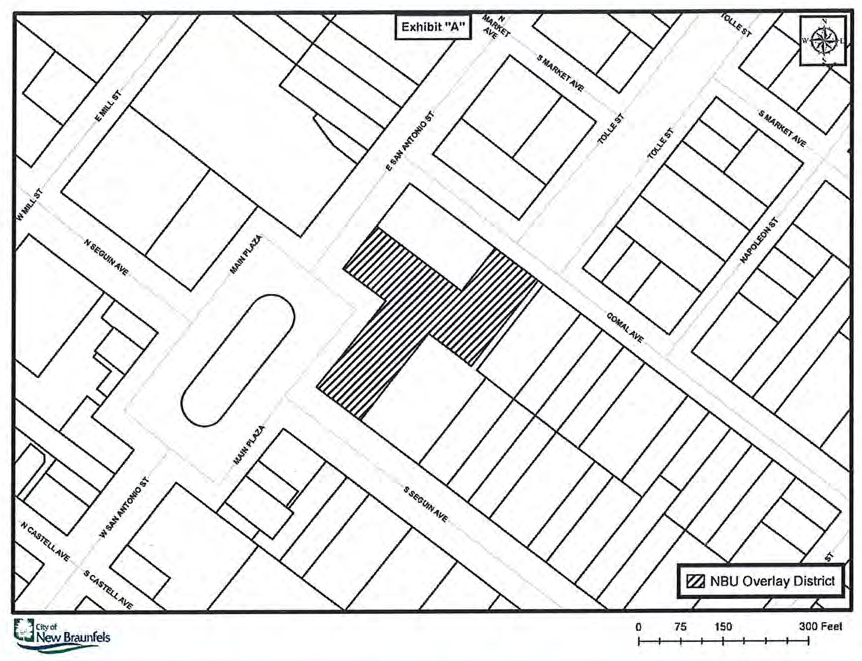
_____
(b)
Purpose. This overlay district is established to protect the character and integrity of the northeast corner of Main Plaza, and to honor the legacy of this important historic downtown focal point by ensuring appropriate uses for the site, and that any future development or redevelopment is compatible for its unique location in the city in accordance with the comprehensive plan.
(c)
Definitions.
Primary facade means the facade oriented toward the street.
Secondary facade means the facades not oriented toward the street.
(d)
Development standards. The standards below are in addition to or in lieu of the requirements of the base zoning district.
(1)
Setbacks. Minimum: zero feet.
(2)
Build-to line. The first floor of buildings shall be built to the front property lines along San Antonio Street, Seguin Avenue and Main Plaza. Public assembly areas in the form of patios, gardens, outdoor dining, courtyards or similar settings are allowed when incorporated with complementary building design and public access to the street or public sidewalk.
(3)
Building height. In accordance with the base zoning district of C-2, maximum heights for the mixed use buildings shall be 75 feet. Parapet walls above 75 feet shall be exempt from the maximum building height, consistent with chapter 144, and in order to meet the articulation requirements and ensure rooftop equipment is screened in accordance with subsection (4)(i). In no instance shall any portion of the structures, including parapets and rooftop equipment, elevator housings, etc. exceed the height of the Comal County Courthouse.
(4)
Massing. Buildings should be broken into smaller subsets with varied parapet heights to blend into the scale and context of the neighborhood:
(i)
Roof forms. Roofs shall be flat or low-pitched (1/12 maximum) with parapet walls to screen roof pitch/mechanical equipment. Rooftop equipment (air conditioners, antennas, elevators, etc.) shall be screened so as not to be visible from street level. Rooftop patios or bars are not required to be screened. Flagpoles are allowed on the roof.
(ii)
Building form. Rectilinear forms shall blend with existing buildings downtown to maintain the character and integrity of the historic district and time within which the existing buildings were built.
1.
Vertical articulation. Building fronting onto East San Antonio Street, Main Plaza, and Seguin Avenue shall be vertically articulated into segments measuring between 25 feet and 100 feet on facades fronting onto public right-of-way to break up the appearance of large buildings. This articulation can be achieved via offsets, breaks in fenestration patterns, change in material or material color, pilasters or engaged columns, and variety in parapet height and design or other architectural detail.
2.
Horizontal articulation. Buildings fronting onto East San Antonio Street, Main Plaza, and Seguin Avenue shall be horizontally articulated to reflect the traditional base, middle, and cap facade arrangement on facades fronting the public right-of-way. The base shall include the ground-level floor, the cap the top floor, and the middle the intervening floors. This articulation can be achieved via the use of canopies, coping, transom window courses, changes in material or material colors, offsets and projections, or other architectural details.
3.
Floor to floor height. Ground-level floor shall have a floor-to-floor height between 16 and 22 feet.
(iii)
Structured parking. Parking garages shall maintain pedestrian friendly frontages that blend with the existing block face. Low-level screening is required along street frontages to block views of parked vehicles, exhaust pipes, and headlights. Facades shall include various treatments to soften massing, and reduce light reflection and heat reflectivity. Solid walls with no penetrations that "wall-off" views and overshadow the surrounding neighborhood are prohibited. Interior garage lighting shall not produce glaring sources toward adjacent residential uses. To achieve the above requirements, one or more of the following shall be included:
1.
Materials. Ground floor level fronting onto Comal Avenue shall be clad in brick, stone, patterned concrete, or other masonry product and be articulated as to separate the ground level from upper levels. This articulation can be achieved via the use of canopies, coping, transom window courses, changes in material or material colors, offsets and projections, or other architectural details. Upper levels fronting onto Comal Avenue shall be clad in brick, stone, or masonry or use decorative trellises, artwork, or plantings to screen exposed concrete. If planted materials are used for screening, they must be planted and maintained with live plantings that cover a minimum of 50 percent of upper level exterior wall surfaces.
2.
Street level landscaping.
3.
Liner retail on the first floor.
4.
Awnings or canopies over the first floor. Awnings and canopies must maintain a minimum two foot clear zone from the adjacent curb face.
5.
Varied building materials that blend with existing surrounding Downtown buildings.
(5)
Exterior building materials. Traditional building materials that complement the types, textures, and colors of materials in the downtown historic district shall be used.
(i)
A minimum of 80 percent of primary facades (excluding windows) shall be clad in brick or stone consistent with other masonry materials in the downtown historic district.
(ii)
The remaining 20 percent of primary facades, and all secondary facades may be clad in other materials, however mirrored glass, dark tinted glass, reflective or opaque glazing, rolled asphalt, polished stone, and cinder block/concrete masonry unit (cmu) are prohibited.
(iii)
Primary exterior materials shall be earth tones (tan, ochre, cream, deep red). Contrasting colors shall be used for trim and architectural details/decorative elements.
(6)
Facades and fenestration.
(i)
Primary entrances shall be clearly defined with awnings, porches, recessions, or other architectural features and shall be located on primary facades with access from the public sidewalk. Secondary public entrances may be located on secondary facades and shall have architectural features that are subordinate to the primary entrance in scale and detail.
(ii)
Horizontal elements such as but not limited to bulkheads/kickplates, window sills, canopies, and roof wall junctions shall maintain alignment and division with Building A (see Exhibit B below) as well as with buildings on the adjacent block faces.
(iii)
Balconies may be used on all facades.
(iv)
Primary facades shall maintain a minimum of 75 percent transparency. Transparency can be achieved through glass windows or glass partitions that open onto the public sidewalk to engage pedestrians.
(v)
Windows above street level shall be vertical, rectangularly proportioned, punched openings in masonry walls. The rectangular windows may have arched tops. Windows visible from street level shall have a minimum two inches exterior reveal.
(vi)
Windows shall be trimmed in wood or painted metal or anodized aluminum, and dimensioned similar to historic windows in the adjacent block faces.
(vii)
Backlit awnings are prohibited.
(7)
Parking.
(i)
A parking structure may be located at the northeast corner of the zoned area.
(ii)
The parking structure may be a maximum of 55 feet in height.
(iii)
Minimum parking ratios for land uses shall be cumulative and in accordance with parking requirements in chapter 144, article V.
(iv)
Shared parking and off-site parking agreements as authorized in article V of chapter 144 are allowed.
(v)
Any on-street public parking eliminated by redevelopment shall be incorporated into the parking garage.
(8)
Signage. Signs shall be reflective of each building's facade and shall not obscure or harm architectural elements or features.
(i)
Materials: Signs shall be constructed of wood, metal, or of material similar to the facade.
1.
Prohibited materials: Plastic, nylon, reflective, and canvas.
(ii)
Illumination: Lighting shall be ambient, subdued, and warm in color.
1.
Internally lit signage is prohibited.
2.
Lighting shall not produce a glare into the public right-of-way.
3.
Sources for externally lit signage shall point downward toward the sign rather than upward.
(iii)
Allowed sign types: attached, awning, parapet, window, blade and projecting signage. Painted windows are permitted on a 60-day temporary basis.
(iv)
Sign area:
1.
Attached/blade/projecting signs: Eight square feet.
2.
Window signs: Eight square feet.
3.
Awning/parapet signs: Eight square feet.
(v)
Clearance. Signs overhanging the sidewalk or public right-of-way shall have a minimum clearance of nine feet from the bottom of the sign to the sidewalk, and shall maintain a two foot clear zone from the adjacent curb face.
(vi)
Prohibited signs: Roof, electronic message, and inflatable. Signs along the sidewalk shall follow the rules and permitting process outlined in chapter 114.
(vii)
Murals: Murals are allowed and encouraged, and must be reviewed by the historic preservation officer and downtown coordinator.
(viii)
Signs, other than murals, that cover more than 20 percent of the building facade are prohibited.
(ix)
Signage not addressed above shall be governed by chapters 106 and 114 accordingly.
(e)
Uses.
(1)
Permitted uses: Retail, restaurant, bar, office, multifamily residential, hotel and/or any combination thereof. Office and bar uses are to be accessory and incidental to a primary use.
(2)
Ground floors shall be designed for and accommodate active pedestrian friendly uses, such as the retail or restaurant. Tenant spaces shall be oriented to the street with storefronts and entries along the sidewalks to sustain street level interest and promote pedestrian traffic. A minimum 50 percent of street level uses shall be retail. A lobby bar and lounge area incidental to a hotel can qualify as retail area assignment.
(3)
A parking structure is permitted and may only be located on the northeast portion of the zoned area.
(4)
Rooftop garden, bar, restaurant, and/or other public assembly is permitted.
(5)
No other uses are permitted as principle uses in this overlay district.
(f)
Special requirements. Reference Exhibit B below.
EXHIBIT B
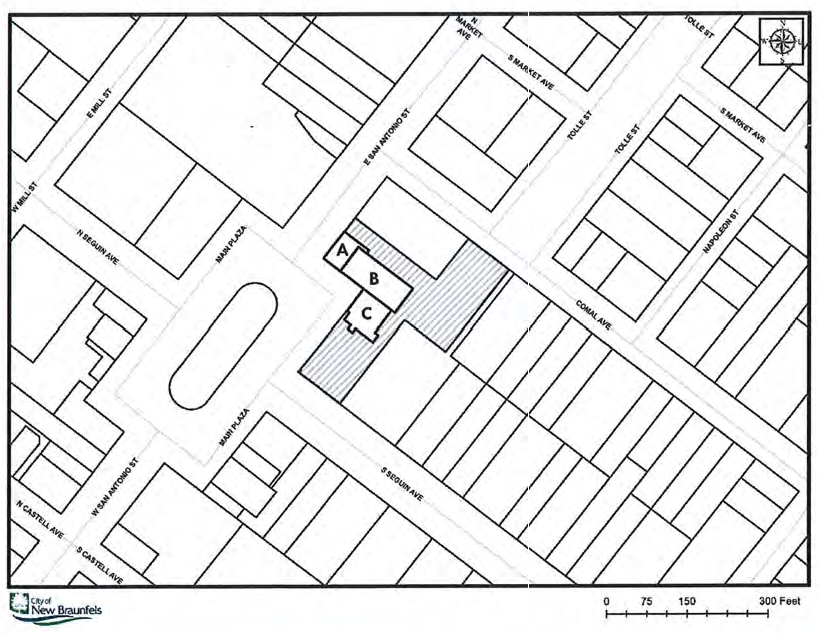
(1)
Building A shall be retained and refurbished. It shall be permissible to use the rooftop of Building A for open-air activity, provided the additions of any requisite railings, furnishings, or other appurtenances are set back from the building edges and scales so as not to be obstructively perceptible from the street frontage. A second story may be added to Building A, but only if designed and constructed so that the exterior appears as originally planned by the original architect/designer as depicted in Exhibit C below.
EXHIBIT C
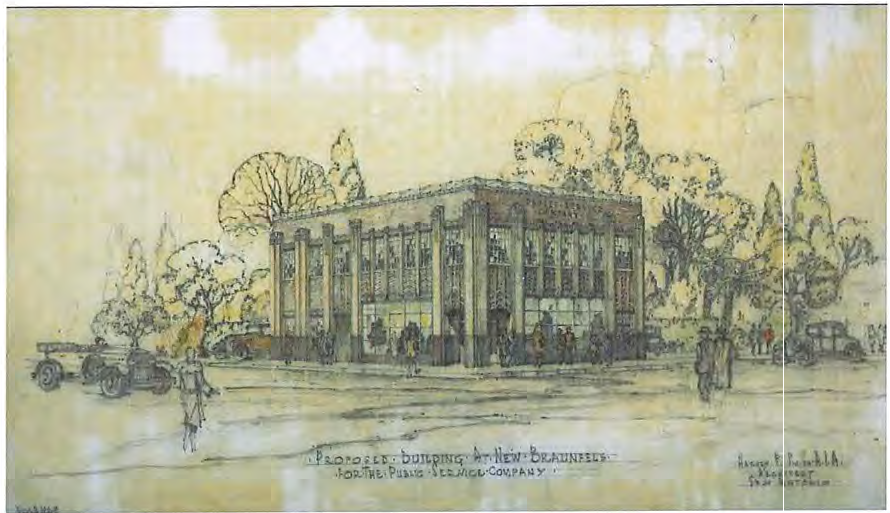
_____
(2)
Facades of Building C must be incorporated into any proposed development plan.
(3)
Existing trees may be removed; replacement trees in compliance with the city's tree ordinance in chapter 144 of the city's Code of Ordinances may be planted within the overlay district or within the public right-of-way anywhere downtown. Street trees must meet species, spacing and planting standards of chapter 144, and maintain distances to accommodate the opening of car doors, facilitate bench placement for shade provision, and include tree wells that protect the tree roots while also meeting ADA standards.
(4)
To reduce glare, building and landscape lighting shall be placed so that the source of the light is not visible and shall be directed toward the building facade or landscape intended to be illuminated.
(5)
Electrical transformers, meters, mechanical equipment and other equipment shall not be located along the ground floor street wall. All utility lines, including pre-existing utilities, shall be placed underground.
(6)
Any redevelopment must include improvements to the public realm such as improved safety, pedestrian lighting, and pedestrian linkage to the plaza.
(7)
Vehicular access from Seguin Avenue shall be entering the subject property only. Exiting the subject property to Sequin Avenue is unsafe.
(8)
Vehicular access from San Antonio Street shall be exiting the subject property only. Entering the subject property from San Antonio Street is unsafe.
(9)
No demolition can occur without proof of financing and completed building and demolition permit documents in accordance with the city's code of ordinances.
(g)
Review process.
(1)
In addition to standard permit and plan review application requirements, permit application documents shall include a three dimensional building information modeling (BIM) style perspective view denoting building materials and detailing.
(2)
The historic preservation officer shall review building permit applications and plan submissions and issue design clearance for those projects that clearly demonstrate objective conformance with the standards of this overlay district. Said review will satisfy the requirements of sections 58 and 59 of chapter 66 of the city's Code of Ordinances.
(3)
An application which does not clearly demonstrate objective conformance with these standards will be forwarded to the historic landmark commission for review and consideration.
(4)
Appeals. Any decision made by the historic preservation officer may be appealed to the historic landmark commission. Any decision made by the historic landmark commission may be appealed to city council.
(5)
Variances. As this is a zoning overlay district, variance requests shall be heard and considered by the zoning board of adjustment in accordance with section 2.2 of this chapter and V.T.C.A., Local Government Code ch. 211.
(Ord. No. 2012-49, § 1(Exh. A), 9-10-12; Ord. No. 2020-22, §§ 1, 3-23-20)
Sec. 144-3.8. - Special districts.
3.8-1. Definition. The city is hereby authorized to create special zoning districts that implement policies or objectives in the comprehensive plan. A special zoning district is a set of zoning regulations that is described in the overlay zoning district ordinance and is mapped.
3.8-2. Regulations for a special zoning district. The special zoning district can address specific issues for a geographic area, which may benefit from additional land management (zoning) practices.
3.8-3. Process and requirements for creating special zoning districts. The process for creating a special zoning district shall follow the same zoning notification process as set forth in this chapter.
3.8-4. Special Neighborhood District-1.
Purpose. The "SND-1" district is intended for development of primarily detached, single-family residences, customary accessory uses, and accessory dwellings such as garage apartments. The following regulations shall apply to the "SND-1" district:
(a)
Authorized uses.
(1)
Uses permitted by right.
Residential uses:
Accessory building/structure.
Accessory dwelling (one accessory dwelling per lot, may include a kitchen).
Community home (see definition).
Family home adult care.
Family home child care.
Home occupation (see section 144-5.5).
One-family dwelling, detached.
Single-family industrialized home (see section 144-5.8).
Non-residential uses:
Barns and farm equipment storage (related to agricultural uses).
Church/place of religious assembly.
Community building (associated with residential uses).
Contractor's temporary on-site construction office (only with permit from building official; see section 144-5.10).
Farms, general (crops) (see chapter 6 and section 144-5.9).
Farms, general (livestock/ranch) (see chapter 6 and section 144-5.9).
Golf course, public or private.
Governmental building or use with no outdoor storage.
Museums.
Park and/or playground (public).
Public recreation/services building for public park/playground areas.
Recreation buildings (public).
School, K-12 (public or private).
Water storage (surface, underground or overhead), water wells and pumping stations that are part of a public or municipal system.
(b)
Height and area requirements.
(1)
Height. 35 feet. The height of the accessory building may not exceed that of the main dwelling.
(2)
Front building setback. 25 feet.
(3)
Side building setback. There shall be a side building setback on each side of a building not less than six feet in width. Buildings on corner lots shall have 15-foot side building setbacks adjacent to the street where the rear lot lines of the corner lots coincide with the rear lot lines of the adjacent lots. Buildings on corner lots shall have 25-foot side building setbacks adjacent to the street where the rear lines of the corner lots coincide with the side lot lines of the adjacent lots.
(4)
Garage setback. Where a driveway is located in front of a garage, the garage shall be setback 20 feet from the right-of-way or the driveway to the garage shall be at least 20 feet long to provide enough space for a vehicle to park without overhanging into the right-of-way, if the garage door is closed. (See Illustration 8 in section 144-5.1-1.)
(5)
Rear building setback. 20 feet for the main dwelling. Six feet for the accessory dwelling.
(6)
Width of lot. The minimum width of an interior lot shall be 60 feet and the minimum width of a corner lot shall be 70 feet.
(7)
Lot area per family. Every single-family dwelling hereafter erected or altered shall provide a lot area of not less than 6,600 square feet per dwelling for interior lots, and 7,000 square feet per dwelling for corner lots, provided that where a lot has less area than herein required and such lot was in separate ownership prior to September 25, 1967, this requirement will not prohibit the erection of a dwelling, including the accessory dwelling. A lot platted after January 1, 2007, on which there would be two dwelling units must be at least 8,000 square feet in size for an interior lot and at least 8,500 square feet for a corner lot.
(8)
Lot depth. 100 feet.
(9)
Parking. Two off-street parking spaces shall be provided for each one-family detached dwelling, and two off-street parking spaces for an accessory dwelling. See section 144-5.1 for other permitted uses' parking.
(10)
Accessory building size. One story: 500 square feet. Two story: 1,000 square feet. The intent is to allow an accessory building over a garage or storage area and not to permit a two-story accessory dwelling or two accessory dwellings.
(11)
Term of occupancy. Occupancy for less than one month is not permitted.
(c)
Area included in SND-1. See Exhibit "A".
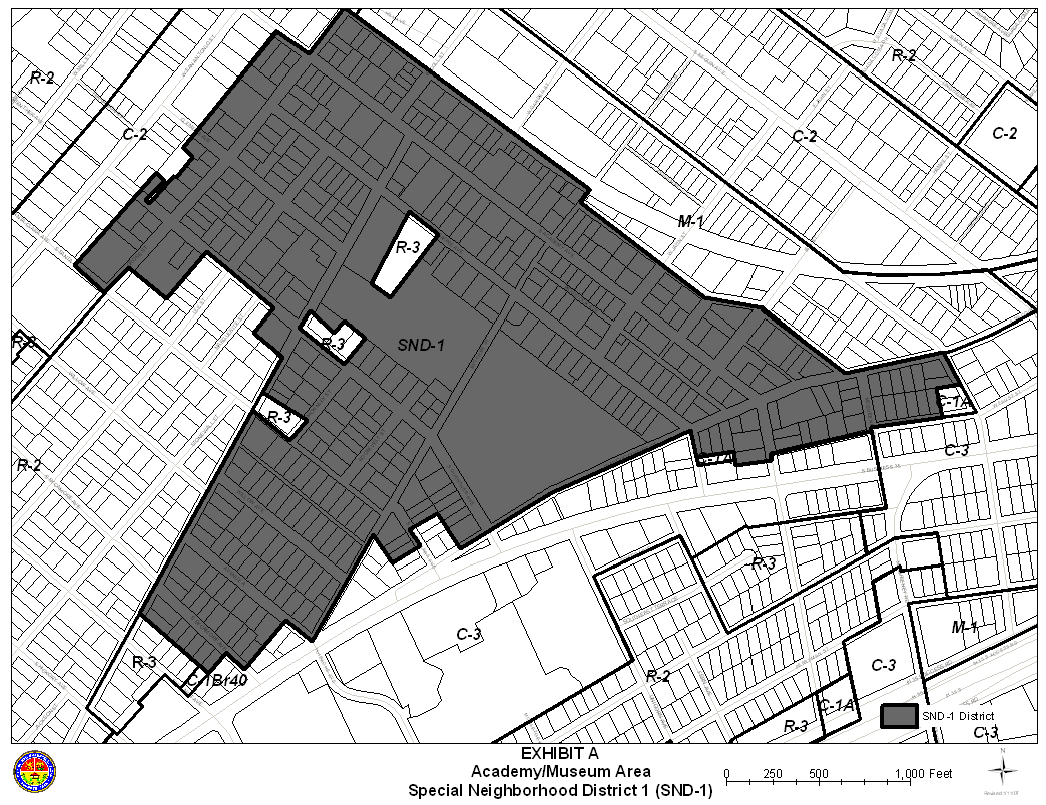
3.8-5. Special District—Gruene Lake Village.
Purpose. The "Gruene Lake Village" special district is intended for a broad range of office and retail uses for development of Lots 1, 2 and 3, Block 1, Cotton Crossing Subdivision, Unit 10. The following regulations shall apply to the "Gruene Lake Village" special district:
(a)
Authorized uses.
(1)
Uses permitted by right.
Residential uses:
Residential use in buildings with the following non-residential uses.
Non-residential uses:
Adult day care (no overnight stay).
Adult day care (with overnight stay).
Amusement devices/arcade (four or more devices).
Antique shop.
Art dealer/gallery.
Artist or artisan's studio.
Bakery (retail).
Bank, savings and loan, or credit.
Barber/beauty shop, haircutting (non-college).
Bed and breakfast establishments.
Book store.
Boutique hotel (a small hotel with a maximum of six rooms).
Caterer.
Check cashing service.
Church/place of religious assembly.
Cleaning, pressing, and dyeing pickup stations.
Clinic (dental).
Clinic (emergency care).
Clinic (medical).
Coffee shop.
Confectionery store (retail).
Consignment shop.
Contractor's temporary on-site construction office (only with permit from building official; see section 144-5.9).
Convenience store without gas sales.
Credit agency.
Curio shops.
Custom work shops.
Drapery shop/blind shop.
Drug sales/pharmacy.
Electrical substation.
Florist.
Garden shops and greenhouses.
Golf course (public or private).
Governmental building or use (state/federally owned and operated).
Greenhouse.
Handicraft shop.
Kiosk (providing a retail service).
Laundromat and laundry pickup stations.
Locksmith.
Martial arts school.
Municipal use owned or operated by the city, including libraries.
Museum.
Needlework shop.
Offices, business or professional including banks.
Park and/or playground (public or private).
Photographic studio (no sale of cameras or supplies).
Photographic supply and printing.
Refreshment/beverage stand.
Restaurant.
Restaurant/prepared food sales.
Shoe repair shops.
Small equipment repair (i.e. computer, bicycle, appliance).
Specialty shops in support of project guests and tourists.
Stores, shops and markets for neighborhood retail trade.
Studios (art, dance, music, drama, reducing, photo, interior decorating, etc.).
Tailor shop.
Travel agency.
Video rental/sales.
Water storage (surface, underground or overhead), water wells and pumping stations that are part of a public or municipal system.
(b)
Maximum height, minimum area and setback requirements.
(1)
Height. 75 feet.
(2)
Front building setback. 25 feet.
(3)
Side building setback. No side building setback is required except that where a side line of a lot in this district abuts upon the side line of a lot in any residential zone, a side building setback of not less than six feet shall be provided.
(4)
Corner lots. Buildings on corner lots shall have 15-foot side building setbacks adjacent to the street where the rear lot lines of the corner lots coincide with the rear lot lines of the adjacent lots. Buildings on corner lots shall have 25-foot side building setbacks adjacent to the street where the rear lines of the corner lots coincide with the side lot lines of the adjacent lots. Where a minimum 25-foot setback is required, a canopy at least eight feet in height, attached to the main building, may be built within 15 feet of the property line so long as such construction will not obstruct the vision of vehicular or pedestrian traffic.
(5)
Garage setback. Where a driveway is located in front of a garage, the garage shall be setback 20 feet from the right-of-way or the driveway to the garage shall be at least 20 feet long to provide enough space for a vehicle to park without overhanging into the right-of-way, if the garage door is closed. (See Illustration 8 in section 144-5.1-1.)
(6)
Residential setback. Effective November 8, 2006, where any building abuts a one- or two-family use or zoning district, the setback from the one- or two-family property line shall be at least 20 feet plus one foot for each foot of building height over 20 feet.
(7)
Rear building setback. The depth of the rear yard shall be at least 15 percent of lot depth, but such depth need not be more than 20 feet.
(8)
Width of lot. 45 feet.
(9)
Lot depth. None.
(10)
Parking. See section 144-5.1 for permitted uses' parking.
(c)
Area included in SND-Gruene Lake Village. See Exhibit "A".
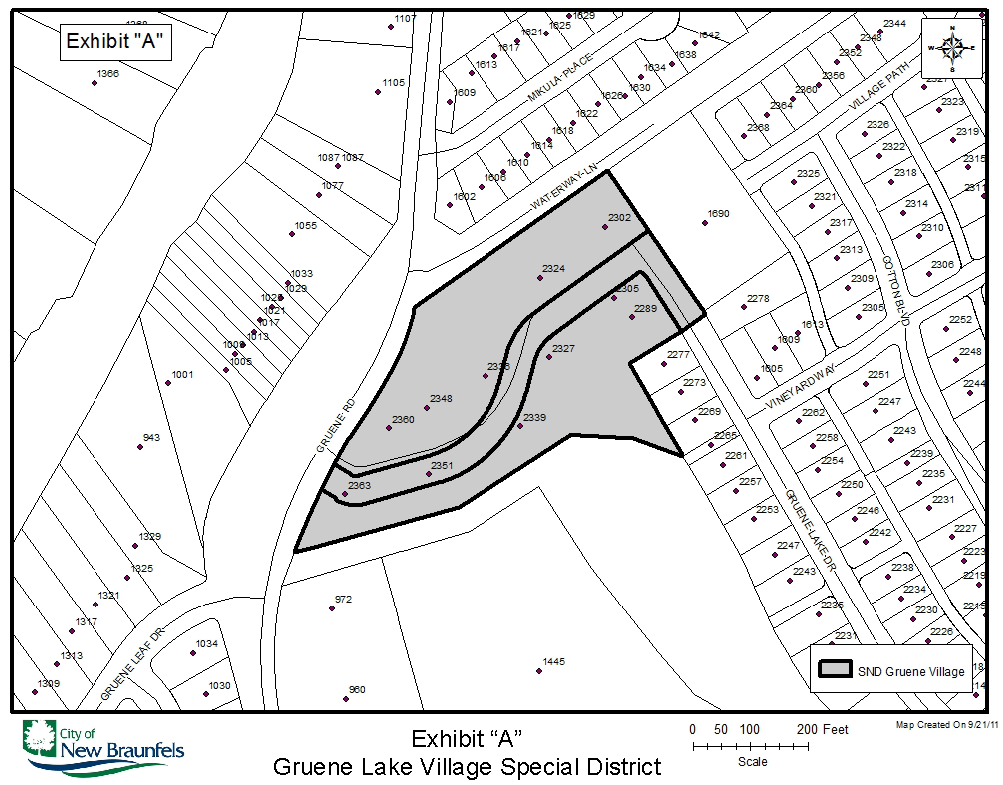
3.8-6. Special district—"ADSD" Advantage Drive.
Purpose. The "ADSD" Advantage Drive special district is intended for the development of a variety low density residential uses on an infill tract at the terminus of Advantage Drive, transitioning from non-residential uses to low density residential uses. The following regulations shall apply in the "AD" special district:
(a)
Authorized uses.
(1)
Uses permitted by right.
Residential uses:
Accessory building/structure.
Accessory dwelling (one accessory dwelling per lot, no kitchen).
Community home (see definition).
Duplex/two-family/duplex condominiums.
Family home adult care.
Family home child care.
Home occupation (see section 144-5.4).
One-family dwelling, detached.
Single- or two-family industrialized home (see section 144-5.7).
Townhouse (attached).
Non-residential uses:
Church/place of religious assembly.
Community building (associated with residential uses).
Contractor's temporary on-site construction office (only with permit from building official; see section 144-5.9).
Governmental building or use with no outside storage.
Park and/or playground (public or private).
(b)
Maximum height, minimum area and setback requirements.
(1)
One-family, two-family and townhouse residential uses.
(i)
Height. 35 feet.
(ii)
Front building setback. 20 feet.
(iii)
Side building setback. There shall be a side building setback on each side of a building not less than five feet in width, unless the residences are attached.
(iv)
Garage setback. Where a driveway is located in front of a garage, the garage shall be setback 20 feet from the right-of-way or the driveway to the garage shall be at least 20 feet long to provide enough space for a vehicle to park without overhanging into the right-of-way, if the garage door is closed. (See Illustration 8 in section 144-5.1-1.)
(v)
Rear building setback. A rear building setback of 12 feet shall be provided adjacent to property zoned residentially including mobile homes.
(vi)
Width of lot. The minimum width of a lot shall be 40 feet per duplex or 20 feet per townhouse measured at the front of the residential building structure.
(vii)
Lot area per single-family. Every single-family dwelling hereafter erected or altered shall have a lot area of not less than 6,600 square feet per lot.
(viii)
Lot area per duplex/townhouse pair. Duplex (one structure with two dwellings) and townhouse pair (two attached townhouses) hereafter erected or altered shall have a combined lot area of not less than 3,600 square feet where the overall density of the district area does not exceed 12 units per acre. (See sample layout below.)
(ix)
Lot depth. 90 feet.
(x)
Parking. Two off-street parking spaces shall be provided for each dwelling unit. Required parking may be located on a common lot, but must be located within 75 feet of the property it serves and restricted for that property. See section 144-5.1 for other permitted uses' parking.
(2)
Non-residential uses.
(i)
Height. 35 feet.
(ii)
Front building setback. 20 feet.
(iii)
Side building setback. There shall be a side building setback on each side of a building not less than five feet in width. Where any building abuts a property with a one- or two-family use, the setback from the one- or two-family property line shall be at least 20 feet plus one foot for each foot of building height over 20 feet.
(iv)
Corner lots. Buildings on corner lots shall have 15-foot side building setbacks adjacent to the street where the rear lot lines of the corner lots coincide with the rear lot lines of the adjacent lots. Buildings on corner lots shall have 25-foot side building setbacks adjacent to the street where the rear lines of the corner lots coincide with the side lot lines of the adjacent lots. Where a minimum 25-foot setback is required, a canopy at least eight feet in height, attached to the main building, may be built within 15 feet of the property line so long as such construction will not obstruct the vision of vehicular or pedestrian traffic.
(v)
Rear building setback. 20 feet.
(vi)
Width of lot. 60 feet.
(vii)
Lot depth. 100 feet.
(viii)
Parking. See section 144-5.1 for permitted uses' parking.
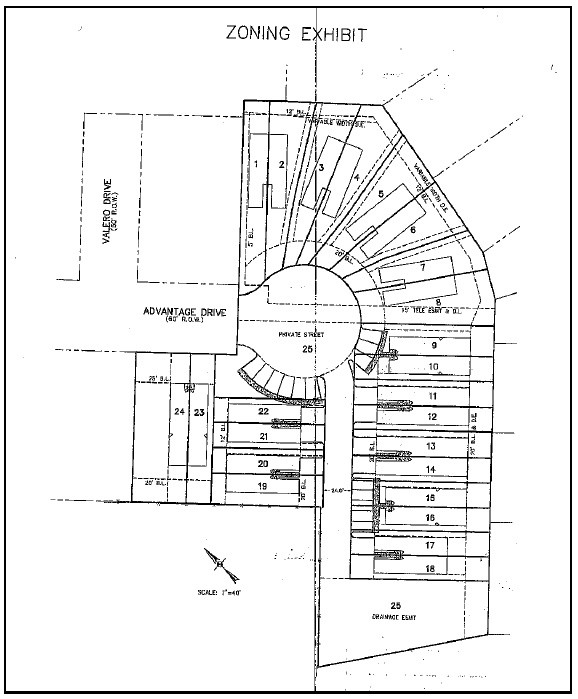
Sample Layout
3.8-7. Special District—Walnut Neighborhood.
Purpose. The "Walnut Neighborhood Special District" (WNSD) includes those properties immediately adjacent to Walnut Avenue along the west side between Katy Street and approximately 250 feet south of Coll Street, excluding approximately 188 linear feet north and south of West San Antonio Street (Exhibit A). This district is intended to provide a mixture of land uses, to maintain a traditional residential neighborhood streetscape, and provide a transition area between a major transportation roadway and a residential district. To better achieve neighborhood goals the WNSD includes subdistricts; Walnut Neighborhood Commercial and Walnut Neighborhood Mixed Use (Exhibit B). The following regulations shall apply to the Walnut Neighborhood Special District as a whole:
(a)
Definitions. The following additional definitions shall apply to this section.
Coffee house is an establishment that sells coffee and other light refreshments that are premade and/or pre-packaged. No on-site cooking is allowed.
Mixed use is the use of a structure for non-residential use in conjunction with a residential dwelling unit. The dwelling unit must be occupied by the owner or employee of a non-residential use taking place within the same structure.
Personal service (non-medical) is an establishment or place of business primarily engaged in the provision of frequent or recurrent needed services of a personal nature. Typical uses include, but are not limited to, beauty and barber shops, shoe repair shops, and tailor shops.
(b)
Authorized uses.
(c)
Height and area requirements.
(d)
Access and parking.
(1)
Parking lots must interconnect with adjacent parking lots where not physically impeded by an existing main structure or a protected or heritage tree.
(2)
Shared access from Walnut is required for mixed-use or non-residential uses unless impeded by existing an existing main structure or a protected or heritage tree.
(3)
Four foot wide sidewalks shall be constructed along the side street the length of the property when a property is converted to mixed-use or non-residential.
(4)
Minimum required spaces:
(A)
Two off-street parking spaces shall be provided for each dwelling unit.
(B)
One off-street parking space for an accessory dwelling unit.
(C)
In a mixed-use structure, one parking space shall be provided for a studio or one bedroom dwelling unit and two parking spaces shall be provided for a two or more bedroom dwelling unit in addition to other permitted uses' parking requirements specified in section 5.1, Parking.
(D)
A minimum of one bike rack for two bikes for a mixed-use or non-residential use.
(E)
No circular drives.
(F)
Parking must be located behind the primary building. Parking may be provided to the side of a structure if an existing structure is being reused and prohibits access to the rear.
(G)
Wheel stops are required in all parking spaces to prevent the encroachment of vehicles beyond the specified parking space.
(H)
See Section 5.1 for other permitted uses' parking requirements and standards.
(5)
Combined/shared parking lots can reduce the number of required parking spaces by ten percent.
(e)
Building design standards. This section below (1) regarding building materials is suspended until authorized by a change in state law or case law. The intent is to keep the existing building to maintain the traditional neighborhood streetscape setting. Additions or new structures for residential, mixed-use or non-residential uses must maintain and enhance the residential feel by complying with the following standards.
(1)
Material.
(A)
The same, similar or complimentary material shall be used on additions to existing structures.
(B)
The existing housing stock along Walnut is an eclectic mix of building types and materials which is encouraged to continue. Styles include Minimal Traditional, Craftsman, Neo Classical Revival, Ranch, Tudor Revival, and Vernacular.
Materials include stucco, rock, brick, and wood siding with various roof materials such as standing metal seam, composition shingle and Spanish tile. New construction shall utilize materials that are complimentary to the other structures within the block. Cementious fiber board planks (i.e. hardi-plank) may be utilized in lieu of wood siding.
(2)
Architectural features.
(A)
Structures shall have horizontal (depth) articulation adjacent Walnut Avenue typical of single family residences. One offset at a minimum depth equal to 15 percent of the building's width is required.
(B)
No flat roofs. Gable, hip, pyramid or shed roofs are allowed.
(C)
No roof terraces.
(D)
No towers.
(f)
Buffering. When a mixed-use or non-residential development is adjacent to land used or zoned for single-family or two-family development a combination of fencing and plantings help disperse sound waves.
(1)
Along the side or rear property line that mirrors the boundary of the Walnut Neighborhood Special District boundary a six-foot tall rear yard fence/wall shall be constructed of solid masonry such as precast concrete fences or rock walls. The style of the wall or fence shall be complimentary of the main building.
(2)
Along all common property lines where both lots are within the Walnut Neighborhood Special District, no masonry wall or fencing is allowed, but a minimum five-foot wide landscape buffer is required. The buffer shall include:
(A)
A minimum two-inch diameter tree per 20 linear feet shall be planted along the common property line of the single-family or two-family property. A variety of native tree species shall be used. Shade trees must be used, unless near utility lines where ornamental trees must be used. (see Appendix A, Approved Plant List). All new trees shall be provided with a permeable surface of 60 square feet per tree under the drip line.
(B)
A minimum of one 24-inch tall native Texas bush/shrub per five linear feet. Plantings may be clustered in the buffer area.
(3)
All fences and walls require building permits.
(4)
See section 5.3-2 for additional regulations. When there is conflict, this section applies.
(g)
Additional landscaping. The following standards apply to mixed-use or nonresidential uses.
(1)
Yards adjacent public street right-of-way shall consist of 80 permeable surface, not including the driveway, and must contain a minimum of 50 percent vegetative cover.
(2)
Vegetative cover must consist of a minimum of two types of plantings such as ground cover and shrubs.
(3)
One shade tree per 25 linear feet of street frontage. Existing trees that are included on the city's approved plant list (Appendix A) may be credited toward this requirement.
(4)
All planting areas shall be a minimum of five feet in width.
(5)
All landscaping shall be maintained in compliance with section 5.3-1b(9), Maintenance.
(6)
Parking areas visible from the public street must be screened by hedges/shrubberies which will be a minimum of 36 inches tall within three years of planting.
(h)
Lighting and glare standards.
(1)
See section 5.3-3, Lighting and glare standards for requirements.
(i)
Signage. Non-residential uses shall comply with the following standards.
(1)
Signage shall be in compliance with chapter 106, Signs, of the City of New Braunfels Code of Ordinances. The most restrictive rule prevails.
(2)
Illumination of monument and wall signage shall be restricted to internal illumination where only the lettering or the logo is illuminated. Logos where more than 50 percent of the image is white or light in color shall be restricted to 25 percent of the sign face.
(3)
Flashing or chasing lights are prohibited.
(4)
Electronic message boards are prohibited.
(5)
Temporary A-Frame or T-Frame sign must be stored indoors when business is closed.
(6)
All other forms of temporary signage are prohibited including, but not limited to, banners, streamers, pennants, yard flags and inflatable signs.
(j)
Hours of operation. Regular business hours for any business may be 7:00 a.m. to 7:00 p.m.
(k)
Hours for deliveries. Deliveries may occur business days, Monday through Friday, from 8:00 a.m. to 6:00 p.m., excluding U.S. Mail, Fed Ex, UPS or other similar services.
(l)
Additional prohibitions.
(1)
Outdoor seating, display of products or storage of products. All business related activities must be conducted indoors.
(2)
Outdoor speakers, speaker box or live music.
(3)
Short term rental
(4)
Tube rental.
(5)
Retail liquor stores or retail package store (defined by Texas Alcohol Beverage Commission definition).
(6)
Drive-through facility use or service.
(7)
Dumpsters.
(8)
Parking lots as primary use.
(9)
Outside vending.
(10)
Live music.
(m)
Area included in Walnut Neighborhood Special District.
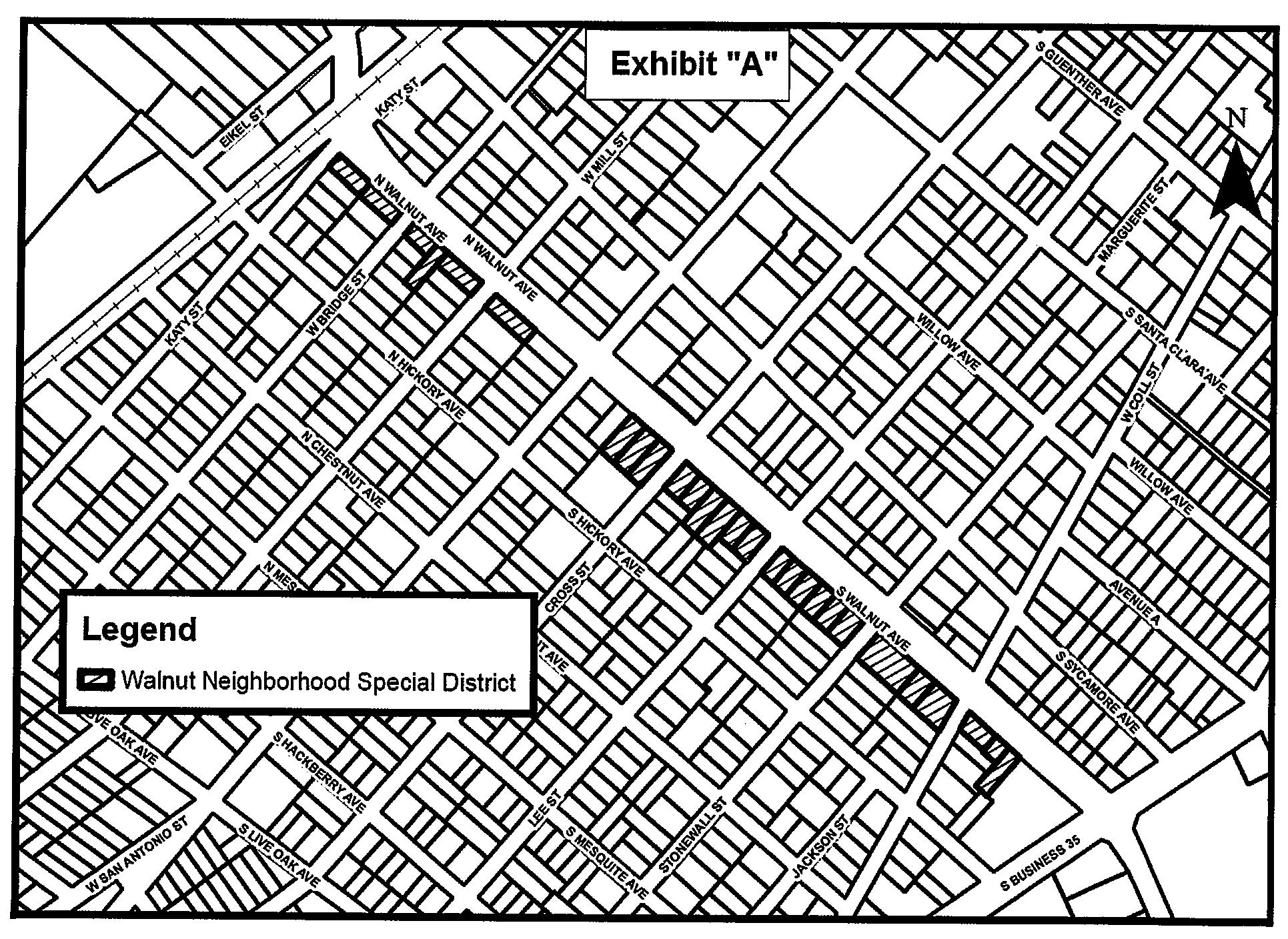
(n)
Areas included in Subdistricts of the Walnut Neighborhood Special District.
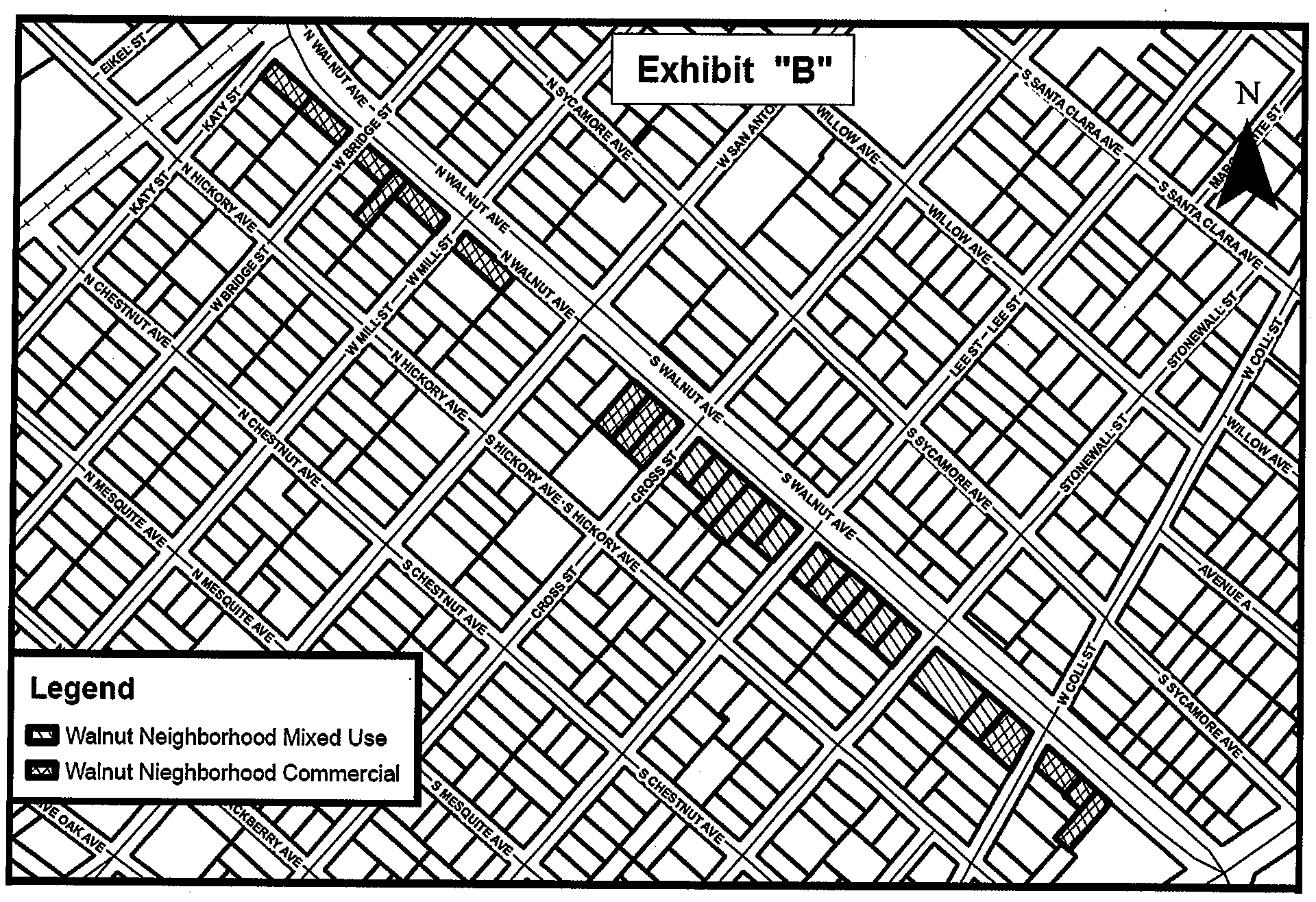
3.8-8. Special District—Wurstfest.
Purpose. The Wurstfest Special District is intended to serve tourists and the vacationing public, and support entertainment facilities including dance halls, performance and amusement venues, specialty shops and food sales. The following standards shall apply in the Wurstfest Special District:
(a)
Authorized uses.
(1)
Uses permitted by right:
Amphitheater
Amusement services or venues (indoors) (see section 144-5.13)
Amusement services or venues (outdoors)
Assembly/exhibition hall or areas
Athletic fields
Bar/tavern
Civic/conference center and facilities
Commercial amusement concessions and facilities
Dance hall/dancing facility
Fair ground
Fraternal organization/civic club (private club)
Governmental building or use
Handicraft shop
Live music (indoors and outdoors)
Museum
Offices, business or professional
Park and/or playground (private or public)
Parking lots (for passenger car only) (not as incidental to the main use)
Parking structure/public garage
Public recreation/services building for public park/playground areas
Public tuber entrance or take out facilities
Recreation buildings (public)
Refreshment/beverage stand
Restaurant
Restaurant/prepared food sales
Retail store and shopping center
Specialty shops in support of project guests and tourists
Theater (non-motion picture; live drama)
Waterfront amusement facilities
Any comparable business or use not included in or excluded from any other district described herein.
(2)
Conflict. In the event of conflict between the uses listed in the land use matrix and those listed in subsection (1), the uses listed in this subsection shall be deemed those authorized in the district.
(b)
Maximum height, minimum area and setback requirements:
(1)
Non-residential uses.
(i)
Height. 75 feet.
(ii)
Public street building setback. No setback except no more than 50 percent of the linear length of the property line adjacent the street may accommodate structures with no setback. All remaining structures must be setback a minimum of 15 feet.
(iii)
Side building setback. No side building setback is required except that where a side line of a lot in this district abuts upon the side line of a lot in any residential zoning district, a side building setback of not less than six feet shall be provided.
(iv)
River building setback. A building setback of 20 feet is required along a property line adjacent to the Comal River.
(v)
Parking. Any required parking is permitted to be located off-site.
(2)
Signage. Signage must comply with the standards as set forth in chapter 106, Signs, for the C-4 zoning district.
(c)
Area included in Wurstfest Special District.
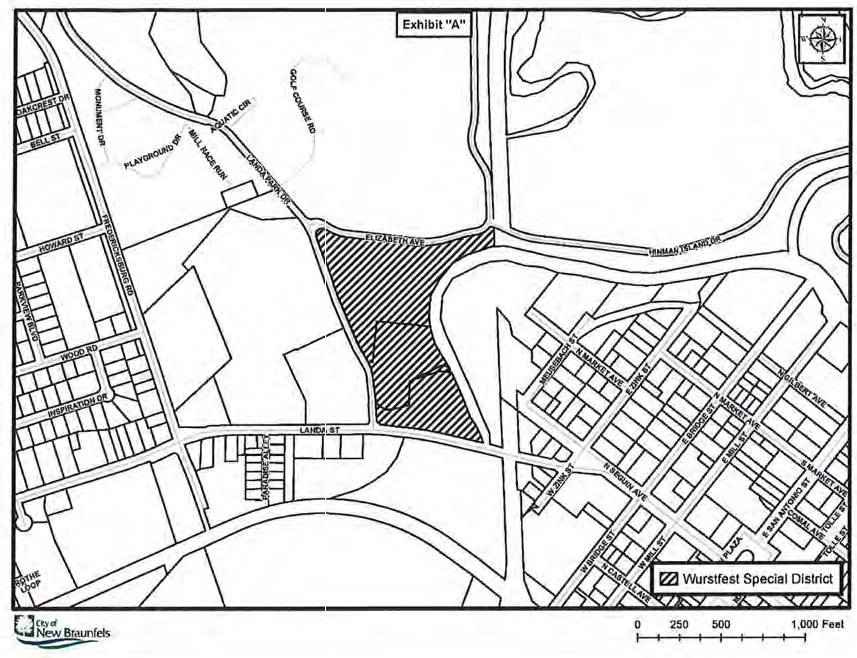
(Ord. No. 2012-49, § 1(Exh. A), 9-10-12; Ord. No. 2012-64, § 1, 12-10-12; Ord. No. 2015-08, § 1, 1-26-15; Ord. No. 2018-26, § 1(Exh. A), 5-14-18; Ord. No. 2020-29, § 1, 4-6-20; Ord. No. 2021-07, § 4, 2-8-21)

