
New Braunfels City Zoning Code
ARTICLE V
- DEVELOPMENT STANDARDS
Sec. 144-5.1. - Parking, loading, stacking and vehicular circulation.
5.1-1. General provisions.
(a)
Application to existing and future uses. Except as provided hereafter, the parking space requirements of this chapter shall apply to all buildings hereafter erected, to all changes in use hereafter made, and to all expansions of present uses. Existing uses not meeting the requirements of this section may be continued, and such uses shall be considered as nonconforming uses. Except as provided hereafter, no change in use shall be permitted unless the number of off-street parking spaces required by this section for such proposed use shall have been provided.
(b)
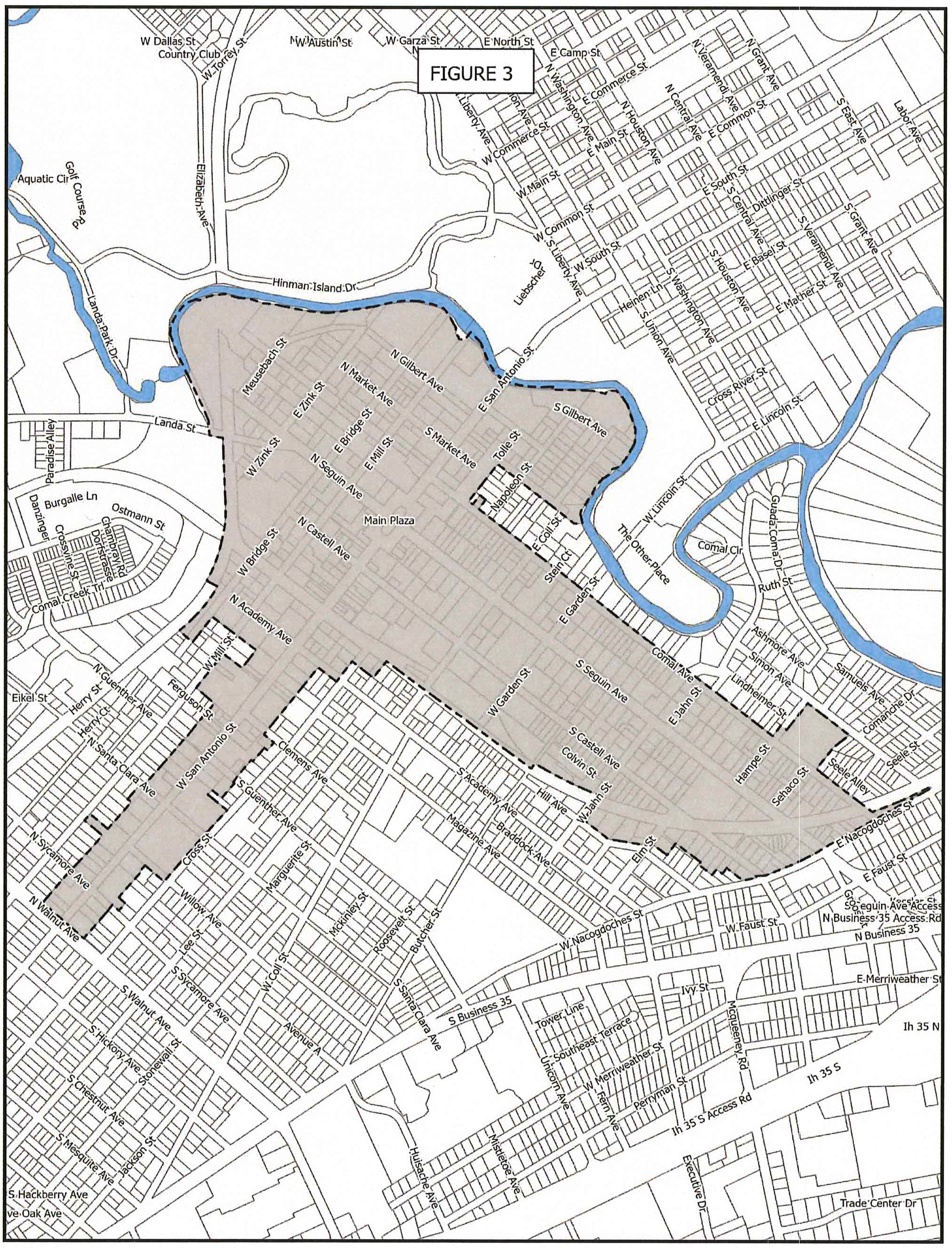
Exception to application for existing uses and changes in uses. Buildings existing in the area defined by the boundary shown on Figure 3 are exempt from having the number of off-street parking spaces required by this section when:
(1)
The use of the building is being changed, but the gross floor area of the building is not being enlarged;
(2)
The building is being reconstructed or renovated, but the gross floor area of the building is not being enlarged; or
(3)
The building is being brought back into use after being vacant.
(4)
Where a building is being enlarged or reconstructed and the building's gross floor area is being enlarged by more than ten percent, the parking shall be required in proportion to the building's expanded gross floor area only.
(5)
Uses not eligible to be exempt include outfitters, special events, or event venues.
(c)
Location. The off-street parking facilities required for the uses mentioned in this regulation and for other similar uses shall be on the same lot or parcel of land as the structures they are intended to serve, unless an off-site parking application is approved, in accordance with this chapter.
(d)
Continuing character of obligation. The schedule of requirements for off-street parking applicable to newly erected or substantially altered structures shall be a continuing obligation of the owner of the real estate on which such structure is located, so long as the structure is in existence or its use requiring vehicle parking continues. No owner of any building affected by these regulations shall discontinue, change or dispense with, or cause the discontinuance or change of, the required vehicle parking spaces apart from the discontinuance or transfer of such structure or without establishing adequate parking spaces which meet with the requirements of, and are in compliance with, these provisions. No person, firm or corporation shall use such building without acquiring such land for vehicle parking which meets the requirements of, and is in compliance with, this section.
(e)
Construction and maintenance. Commercial and residential off-street parking facilities shall be constructed, maintained and operated in accord with the following specifications:
(1)
Areas shall be properly graded for drainage; surfaced with concrete, asphaltic concrete, or asphalt; and maintained in good condition, free of weeds, dust, trash and debris.
(i)
In order to enable parking lots to better withstand the natural elements, asphalt in the above section shall be interpreted to include a two-course treatment of asphalt.
(ii)
In order to address varying development situations, the city engineer, at his or her discretion, may allow the use of substitute materials, such as pavestone or permeable pavement for construction purposes.
(2)
The residential buffer wall requirements are applicable as outlined in subsection 144-5.3-2(h).
(3)
Lighting facilities shall be arranged so that the source of light is concealed from view from adjacent residential property and does not interfere with traffic.
(4)
Construction and location of entrances, exits, aprons, stops, etc., shall be according to standard city specifications found in chapter 114 and shall be located so as to minimize traffic congestion.
(5)
Any use requiring off-street parking spaces under the provisions of this section shall be required to delineate or mark each space in a manner acceptable to the city. Said delineation or marking shall be in accordance with the parking plan as approved in conjunction with the building permit.
(6)
Reserved.
(7)
Reserved.
(8)
Reserved.
(9)
Reserved.
(10)
Reserved.
(11)
Reserved.
(12)
Curbside pickup, ADA parking, and all other specially designated or reserved parking shall count toward the total minimum required parking for a specific use.
(f)
Minimum dimensions and specifications for off-street parking facilities. Off-street parking facilities shall be designed to meet the following minimum dimensions and specifications:
(1)
Ninety-degree angle parking. Each parking space shall not be less than nine feet in width and 18 feet in length. Maneuvering space shall not be less than 24 feet for one-way or two-way traffic operation. (See Illustration 4.)
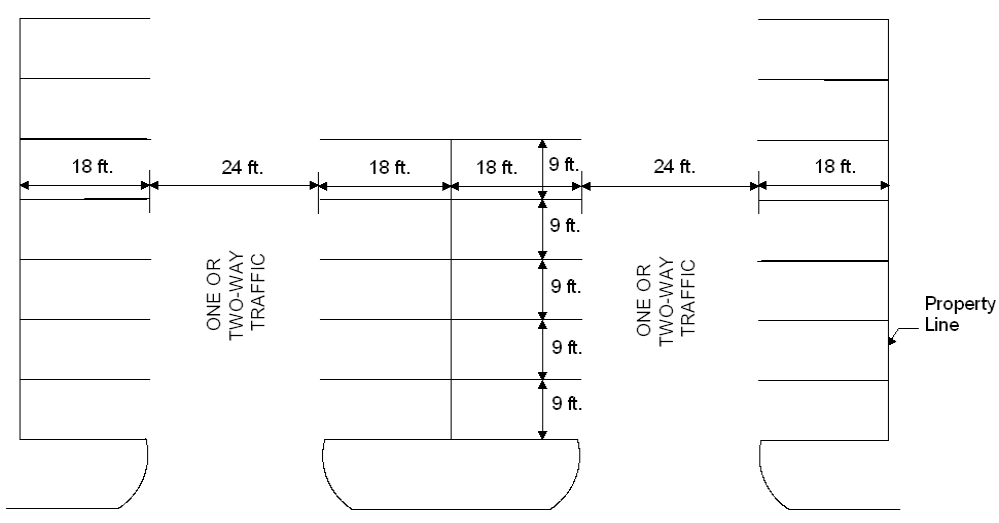
Illustration 4. 90-Degree Layout
(2)
Sixty-degree angle parking. Each parking space shall not be less than nine feet wide perpendicular to the parking angle and not less than 20 feet in length when measured at right angles to the building or parking line. Maneuvering space shall not be less than 17 feet six inches for one-way traffic operation, and 20 feet for two-way traffic operation perpendicular to the building or parking line. (See Illustration 5.)
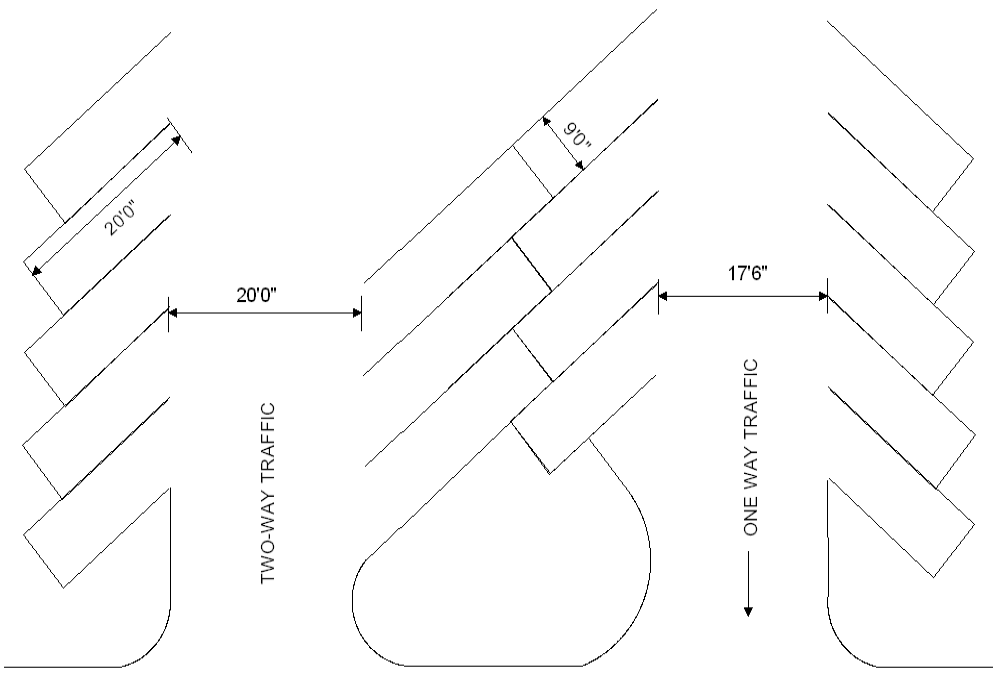
Illustration 5. 60-Degree Layout
(3)
Forty-five-degree angle parking. Each parking space shall not be less than nine feet wide perpendicular to the parking angle nor less than 19 feet in length when measured at right angles to the building or parking line. Maneuvering space shall not be less than 13 feet five inches for one-way traffic operation and 20 feet for two-way traffic operation perpendicular to the building or parking line. (See Illustration 6.)
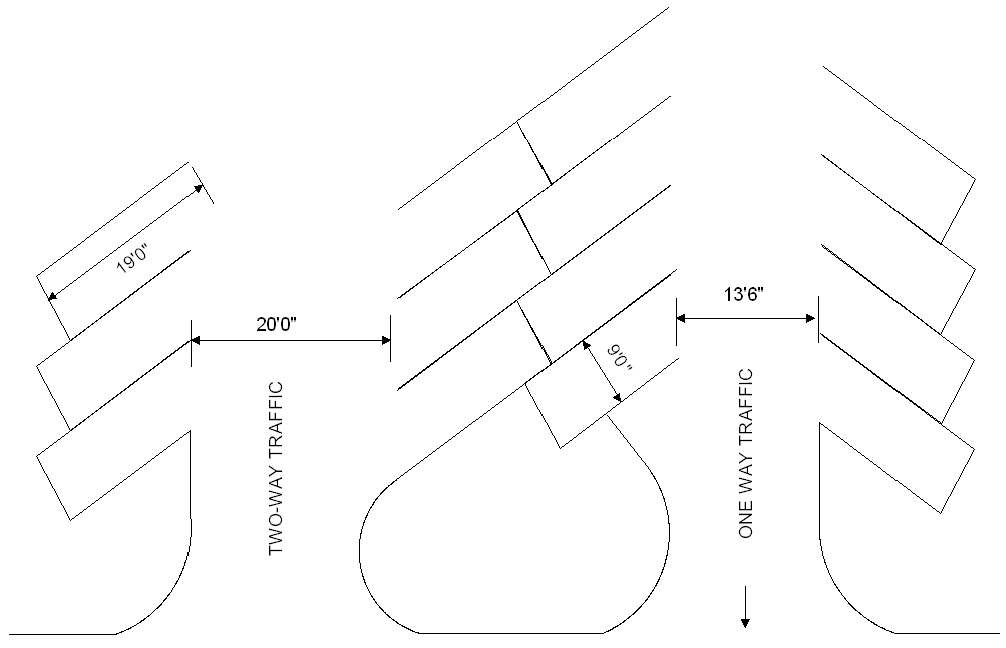
Illustration 6. 45-Degree Layout
(4)
Thirty-degree angle parking. Each parking space shall not be less than nine feet wide perpendicular to the parking angle nor less than 15 feet 11 inches in length when measured at right angles to the building or parking line. Maneuvering space shall not be less than 12 feet eight inches for one-way traffic operation and 20 feet for two-way traffic operation perpendicular to the building or parking line. (See Illustration 7.)
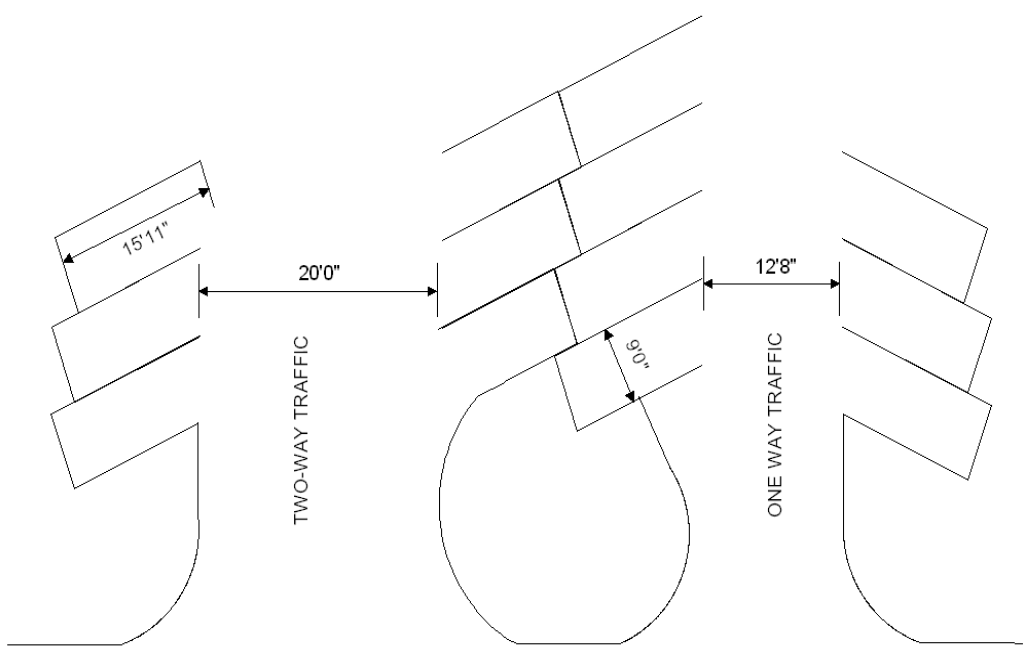
Illustration 7. 30-Degree Layout
(5)
Parallel parking. Each parking space shall not be less than nine feet wide perpendicular to the curb or parking line nor less than 22 feet in length measured parallel with the curb or parking line. Maneuvering space shall not be less than ten feet for one-way traffic operation and 20 feet for two-way traffic operation parallel to the parking line.
(6)
Island requirements for single row parking. An island, not less than six inches in height and encompassing not less than 180 square feet in area, shall be located at both ends of every single parking row of 25 parking spaces or greater.
(7)
Island requirements for double row parking. An island, not less than six inches in height and encompassing not less than 360 square feet in area, shall be located at both ends of every double parking row of 25 parking spaces or greater.
(8)
When off-street parking facilities are provided in excess of the minimum amounts herein specified, or when off-street parking facilities are provided, but not required by this section, said off-street parking facilities shall comply with the minimum requirements for parking and maneuvering space herein specified.
(9)
Maneuvering space shall not be required for single-family dwellings or two-family dwellings.
(10)
Compact parking areas. No more than ten percent of the required number of parking spaces may be compact car spaces. Each compact car parking space shall have the letter "C" painted within the compact space. The letter shall be at least two feet tall. A compact parking space shall be not less than nine feet wide and 16 feet long, if in a 90-degree parking arrangement; 18 feet long for 60-degree parking spaces; 14 feet long for 30-degree parking spaces and 20 feet long for parallel parking.
(11)
Parking space overhang. The length of a parking space may include a two-foot overhang of a curb or wheel stop, so long as the overhang is not over a walkway.
(g)
Shared parking. Shared parking may be allowed in the case of mixed uses (different buildings) under the following conditions:
(1)
Up to 50 percent of the parking spaces required for a theater or other place of evening entertainment (after 6:00 p.m.), or for a church, may be provided and used jointly by banks, offices, and similar uses not normally open, used, or operated during evening hours.
(2)
The planning director may approve shared parking based on an applicant-submitted parking study demonstrating significantly different peak hours of parking demand.
(3)
Shared parking must be on the same parking lot, unless an off-site parking application is approved.
(4)
Reduction due to shared parking shall only be allowed if approved on the site plan, the building permit site plan, SUP site plan or PD detail plan.
(5)
To assure retention of the shared parking spaces, each property owner shall properly draw and execute an irrevocable mutual parking agreement document expressing the same, approved by the planning director, shall file this agreement with the county, and shall provide a copy of the filed agreement to the city prior to issuance of a certificate of occupancy for any use that relies upon the parking agreement.
(h)
Garage setback. Where a driveway is located in front of a garage, the garage shall be setback 20 feet from the right-of-way or the driveway to the garage shall be at least 20 feet long to provide enough space for a vehicle to park without overhanging into the right-of-way, if the garage door is closed. (See Illustration 8.)
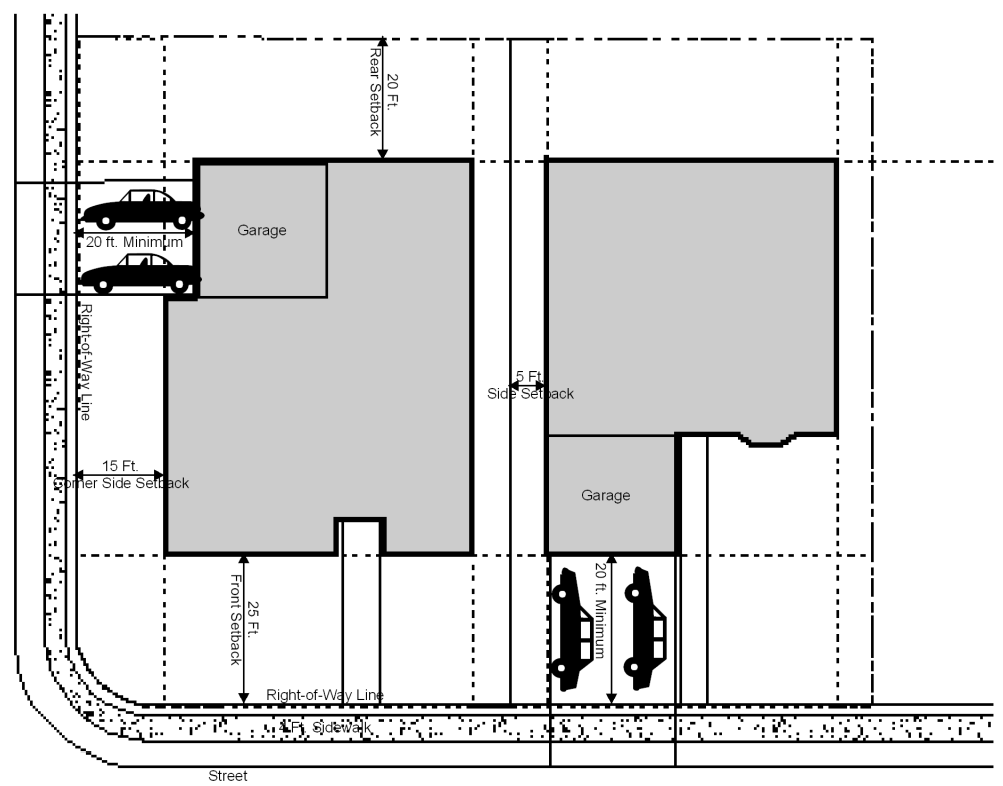
Illustration 8. Residential Garage Setbacks
(i)
Off-site parking. As a means of satisfying off-street parking requirements, off-site parking shall be permitted with the approval of an application for off-site parking. Off-site parking is subject to the following:
(1)
The applicant has submitted an application for off-site parking that includes an access plan demonstrating that access to the off-site parking is reasonably and safely accessible by the public by foot;
(2)
The nearest edge of the closest parking space of the off-site parking is no further than one-quarter mile (1,320 linear feet) from the lot or parcel of the premises using the off-site parking (subject property);
(3)
The off-site parking spaces are not shared with any other off-premises use and are not required parking for any other premises;
(4)
The off-site parking spaces shall be paved and striped to city code prior to a certificate of occupancy being granted to the premise using the off-site parking;
(5)
An off-site parking agreement between the off-site parking area property owner and the property owner of the subject property on a form approved by the city attorney. The term of the agreement shall be no less than ten years. The agreement shall bind future owners or assigns. The agreement shall state that, if for any reason the agreement is not followed, the owner of the subject property shall acknowledge that the property is in violation of this chapter and that the certificate of occupancy may be voided by the city. The agreement shall state that it cannot be cancelled or amended unless by written agreement from the city, is replaced with on-site parking in accordance with code, or is replaced with another off-site parking agreement;
(6)
Failure to renew or maintain an off-site parking agreement for required parking may result in loss of compliance with off-street parking requirements resulting in the revocation of the certificate of occupancy; and
(7)
Directional signage shall be provided as follows:
(a)
At the entrance to the off-site parking. There shall be no more than one such directional sign, it shall be no larger than four square feet per face, and state parking is allowed for the establishment using the off-site parking.
(b)
In the on-site parking area of the subject property, stating and/or showing where the off-site parking is located. There shall be no more than one such sign that shall be no larger than four square feet per face.
(8)
Consideration of application. The planning and development services department shall approve or deny any completed application based on the above criteria and any additional information deemed necessary for a thorough review. Any application that is missing information will be considered incomplete and will not be processed. If approved, the off-site parking agreement shall be recorded in the appropriate county deed records and a copy shall be provided to the planning and development services department.
(9)
Appeal procedures. Aggrieved parties may appeal an off-site parking administrative decision. Appeals are considered by the board of adjustment.
(i)
An appeal must be made with an application form available in the planning and development services department with the requirements to file an appeal as outlined in section 144-2.2 of this chapter.
(ii)
The board of adjustment shall review the site plan and shall approve, approve subject to certain conditions, or disapprove the off-site parking plan appeal.
(iii)
The board of adjustment shall determine final approval of disapproval of all off-site parking appeals.
(j)
Valet parking.
(1)
Purpose. Valet parking benefits businesses and their patrons by helping alleviate perceived parking deficiencies, enhancing customer service, and encouraging maximum use of less accessible parking spaces. However, unregulated valet parking may cause traffic flow stoppages, unanticipated traffic movements, parking violations and unauthorized use of public areas and private parking spaces. The purpose of this section is to regulate valet parking where its undesirable effects significantly affect public areas or public safety.
(2)
Definitions. For the purposes of this section, the following definitions shall apply unless the context clearly indicates or requires a different meeting:
Attendant. A person employed by a licensee who drives a vehicle while providing valet parking.
Person. A natural person, firm, partnership, association, corporation or other business entity, and employees, agents and subcontractors thereof.
Sponsor. Any person who operates, or causes to be operated, a valet parking operation at the sponsor's place of business or function.
Valet parking operation. The receiving, taking possession of, driving, moving, parking, or leaving standing, any vehicle that is left at one location to be driven to another location for parking, whether or not a charge is levied and whether or not done under contract to the business or organization for which the vehicles are being parked, or done independently. It does not include operators of public or private off-street parking operations or facilities where customers park their own vehicles and remove the keys themselves.
Valet parking operator. A person who employs one or more attendants for the purpose of providing a valet parking service or who provides such services as a contractor, but not in the capacity of employee, at any business establishment, for the purpose of providing a valet parking service to such establishment.
Valet parking service. A parking service provided to accommodate patrons of any business establishment, which service is incidental to the business of the establishment and by which an attendant on behalf of the establishments takes temporary custody of the patron's motor vehicle and moves, parks, stores, or retrieves the vehicle for the patron's convenience.
(3)
Permit required. After the effective date of this chapter, no person shall conduct a valet parking service unless the person has obtained a valid valet parking operator permit, and no valet parking operations shall be conducted, except in accordance with a valid valet parking operation permit issued by the planning director.
(4)
Valet parking operator permit. No valet parking permit shall be issued unless the following conditions are met:
(i)
The valet parking operator shall park all cars entrusted to the applicant in legal, off-street or legal on-street sites and shall conduct valet parking operations according to the valet parking plan approved by the planning director or designee.
(ii)
The applicant provides proof to the city that the applicant has met all the requirements of V.T.C.A., Transportation Code ch. 686, which is adopted by reference into this chapter.
(iii)
The permit fee shall be per appendix D of this Code.
(5)
Valet parking operations.
(i)
The holder of a valet parking permit shall at all time conduct valet parking operations in accordance with this section and in accordance with an approved valet parking plan.
(ii)
The valet parking operator and his employees shall, when conducting a valet parking operation, wear a clearly legible patch, insignia, or badge on the clothing stating the name of the valet operation.
(iii)
Valet parking spaces may be designated with a portable device, no taller than four feet (cones, for instance) with no markings, letters, words, numbers or lights on them. These devices may only be placed no earlier than one hour before valeting begins, and must be removed within one hour of the cessation of valet parking operations.
(iv)
No permanent signs for valet or other signs or devices designating valet parking spaces may be used other than the portable devices defined in subsection (c) of this section.
(v)
Circulation in a parking lot shall not be impeded by valet parking operations.
(vi)
"Stadium parking," tandem parking, double or triple parking may be approved if circulation is not impeded and is part of an approved valet parking plan.
(vii)
If off-site property is used for valet parking, as shown on an approved valet parking plan, and the owner of the off-site property revokes or otherwise abrogates the use of that off-site property for valet parking, said valet parking operation which utilized said off-site parking shall cease to use that property for valet parking. The sponsor must submit a new valet parking plan within 30 days of such loss of off-site parking.
(viii)
Valet parking operations may only be conducted in areas shown on an approved valet parking plan. In an event that all of the parking spaces available in that parking plan are in use, the valet parking operations may use other available spaces in the subject parking lot. Under no circumstances will these parking spaces outside the approved valet parking plan be reserved at any time. Valet parking operations outside the approved plan area shall cease when vacancies occur within the approved plan area. Valet parking located on a separate parcel cannot count toward commercial off-street parking requirements unless an off-site parking agreement is approved allowing cars to be parked on a separate lot.
(ix)
Vehicles in staging areas used for valet drop off as shown on an approved valet parking plan, may be stored or parked for no longer than five minutes per vehicle.
(x)
All temporary structures used in a valet parking operation shall be portable and placed in operation and in view of the public no earlier than one hour before valet parking operations commence and must be removed from the view of the public no later than one hour after the cessation of valet parking operations. These structures may not impede pedestrian circulation nor create a driver view obstruction.
(xi)
Fire lanes may not be used to "hold," park, or store vehicles and may not be blocked or impeded by any valet parking operation activity.
(xii)
It shall be a violation of this section for a valet to drive a vehicle that violates any law related to moving vehicles or parking.
(xiii)
Dashboard ticket. Every valet parking operator shall place or cause the operator's agent to place on the dashboard of each patron's vehicle a ticket stating the valet company and its phone number in such a manner so as to be conspicuously visible through the windshield of the patron's vehicle.
(xiv)
Valet parking receipt. All valet parking attendants must, upon taking custody of a patron's vehicle, issue a numbered receipt to each customer, containing the name, address, and telephone number of the company providing the valet service, a statement that the company has liability insurance as required by this chapter, and the charge for the valet service.
(6)
Valet parking plan—Permit required.
(i)
No business or person in the city shall provide a valet parking service nor shall any valet parking operation be conducted unless a valet parking plan for that business or person has been approved by the planning director, and a valet parking permit has been issued in accordance with this section.
(ii)
The valet parking sponsor, or his designee appointed in writing by the sponsor, shall be responsible for submitting the valet parking plan.
(iii)
The valet parking permit shall be issued to the valet parking operator.
(iv)
Valet parking plan contents:
1.
On a sheet no larger than 24 inches by 36 inches, drawn to a scale of one inch equals 20, 30, 40 or 50 feet.
a.
All buildings, parking lot layouts, streets, and fire hydrants within 150 feet of where valet parking operations will take place.
b.
The location of all valet parking spaces.
c.
The location of drop-off and holding areas.
d.
The location and elevations (pictures, renditions) of all structures to be used during valet parking operations.
e.
Valet parking, circulation routes, and patterns.
f.
The time of valet parking operations.
g.
The number of parking spaces to be reserved for valet parking.
h.
The parking pattern (vehicle movement pattern).
2.
A valet parking report, including the following:
a.
Data showing that the reserved spaces are available. Parking calculations as follows: that the valet parking spaces are in excess of those required by this chapter; or, if said spaces are not in excess, that the valet spaces are not needed when the valet operations will occur or required; or as part of a condition of a special use permit for any other business than the sponsor; and, or if the valet parking will be conducted on shared parking spaces or off-site.
b.
If spaces off the property being served or the spaces are shared by others than the sponsor, in a shopping center for instance, are utilized, a letter from the off-site property owner of the owner of the spaces that are shared with others than the sponsor, agreeing to the time and location of the designated valet spaces shall be provided. Unless the off-site valet spaces are excess to those required by code, a parking study shall be provided showing the off-site spaces are actually available when valet parking operations.
c.
The time valet parking operations will be conducted.
d.
The number of valet parking spaces to be used by the valet parking operator.
e.
The number of valets to be used.
3.
Copies of the valet parking operator's valid valet parking operator's license.
4.
The name, address and telephone number of the sponsor and all valet parking operators to be used.
5.
If applicable, agreements with off-site businesses to use their property for valet operations and a parking study showing such spaces are available.
6.
Any other information deemed necessary by the planning director.
5.1-2. Measurement and computation.
(a)
Mixed uses. Where more than one use exists on the same site or in the same building, the portion of such site or building devoted to each use shall be used in computing the number of off-street parking spaces required for such use. For such site or building the total requirements for off-street parking spaces shall be the sum of the requirements of the various uses computed separately. The off-street parking space for one use shall not be considered as providing the required off-street parking space for another use.
(b)
Fractional measurement. When the requirement for each separate use is computed, fractions shall be counted at their actual value. When units of measurements determining the total number of required off-street parking spaces result in a requirement of a fractional space, any fraction less than one-half shall be disregarded. Any fraction of one-half or over shall require one off-street parking space.
5.1-3. Schedule of required spaces.
(a)
Interpretation. The classification of uses enumerated in this schedule are general and are intended to include all similar uses. Where classification of use is not determinable from said schedule, the planning director shall fix the classification.
(b)
Seating for benches, booths, picnic tables and similar seating furnishings that are not single occupancy seats, chairs or stools shall be calculated as one seat per every 18 inches of width of seating area.
(c)
For each structure designed for any of the following uses, or for any like use, no less than the number of parking spaces required shall be provided according to the following schedule:
(d)
Parking demand study.
(1)
A parking demand study may be provided to demonstrate the need for a lower quantity of off-street parking than required by the above-referenced schedule of parking.
(2)
A traffic engineer shall prepare the parking demand study and shall estimate parking demand for the proposed use based on the recommendations of the Institute of Traffic Engineers (ITE), Urban Land Institute, the American Planning Association, or other acceptable source of parking demand data for uses and/or combinations of uses of comparable activities, scale, bulk, area, and location.
(3)
The parking demand study shall be subject to review and approval by the planning and development services department, confirming that the information and assumptions used in the study are reasonable and that the study accurately reflects anticipated off-street parking demand for the proposed use, development, or combination of uses.
(4)
If an applicant submits a parking demand study demonstrating that anticipated off-street parking demand for the proposed use, development, or combination of uses will be less than that required in the above-referenced schedule of parking, and the planning and development services department determines that the information and assumptions used in the study are reasonable and that the study accurately reflects anticipated off-street parking demand for the proposed use, development, or combination of uses, the planning and development services department may authorize a reduction in the required off-street parking spaces based on that study.
(e)
Bicycle parking incentives.
(1)
Minimum off-street vehicle parking for non-residential uses may be reduced by one space for every two off-street bicycle parking spaces provided, in accordance with the following design standards:
(i)
Bicycle spaces may be provided as short-term outdoor spaces, or long-term indoor or secured spaces.
(ii)
Bicycle parking facilities shall be racks securely anchored on a hard surface or enclosed lockers installed to prevent removal except by authorized personnel.
(iii)
Bicycle parking facilities must not be located within the clear vision area of street or driveway intersections.
(iv)
A bicycle rack must allow a bicycle to be securely held upright with its frame supported in at least two places and allow the frame and one wheel to be locked with a U-lock, or other high-security lock. The figure below provides three examples of acceptable bicycle rack design, but other designs that meet the standards described in this provision are also permitted.
Short-Term Bicycle Rack Design Examples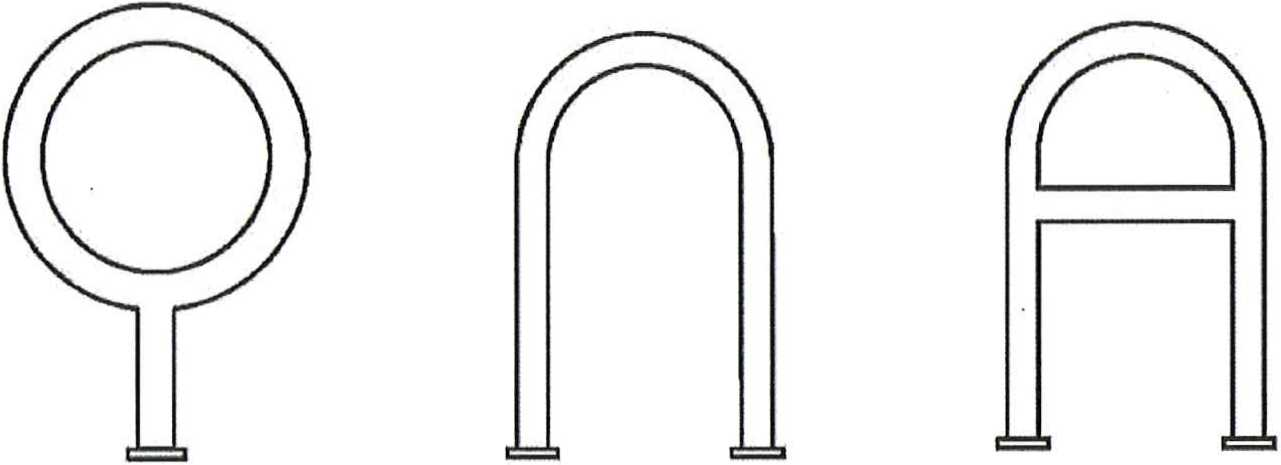
Post and Loop Inverted "U"
One rack element supports two bikes One rack element supports two bikes
"A"
One rack element supports two bikes
5.1-4. Parking and storage of certain vehicles.
(a)
Parking, standing or storing of vehicles as described below in residential districts.
(1)
It shall be unlawful for any person or owner to allow to park, stand or store any Oversized Vehicle upon any private premises, private street, private alley, private parkway, vacant or undeveloped lot/land, or public place within a residential district of the city.
(2)
This section shall not prevent the parking or standing of the above described vehicles in such areas for the purpose of expeditiously loading and unloading of passengers, freight, merchandise or property; nor prevent the parking of any such vehicles owned and operated for the normal course of business operations in any permitted non-residential use, such as farms, churches, daycare centers and school district facilities.
(3)
Provided further, that this subsection shall not apply to street construction, maintenance and repair equipment trucks, rollers and implements, or to trucks, equipment, trailers and vehicles used by any public service utility companies, the city or its contractors engaged in repairing or extending public service utilities, providing city services or as engaged in an active permitted construction project.
(Ord. No. 2012-49, § 1(Exh. A), 9-10-12; Ord. No. 2016-75, § 2, 12-12-16; Ord. No. 2017-80, § 2, 10-23-17; Ord. No. 2018-21, § 2, 3-26-18; Ord. No. 2019-78, § 3, 11-11-19; Ord. No. 2021-07, § 6, 2-8-21; Ord. No. 2021-52, § 2, 7-12-21; Ord. No. 2021-91, § 1, 12-13-21; Ord. No. 2023-06, § 6, 2-27-23; Ord. No. 2024-22, § 4, 2-26-24; Ord. No. 2024-39, § 1, 5-13-24; Ord. No. 2024-96, § 3, 12-9-24)
Sec. 144-5.2. - Drive-through facility or use with drive-through service.
5.2-1. Applicability. This section applies to an accessory use to principal use such as a bank or fast food restaurant, designed to enable customers in parked vehicles to transact business with persons inside of the principal building.
5.2-2. Purpose and intent. Products of the automobile age, drive-through facilities have become a common amenity for a specific range of uses, including banks, freestanding drug stores, and fast food restaurants. A well designed drive-through on a parcel with adequate area can be convenient for motorists and have minimal impact upon the streetscape and pedestrians. Conversely, a poorly designed drive-through on a parcel of inadequate size can cause problems with traffic circulation and create areas that are hostile to the pedestrian. Moreover, drive-throughs have the potential to generate undesirable impacts for adjacent properties such as odors from vehicle exhaust and noise from engines, car stereos, and menu board speakers. The purpose and intent of this section is to establish appropriate standards which allow for the typical range of activities while ensuring public safety and mitigating the associated impacts.
5.2-3. Establishment. Drive-through facility with drive-through service uses shall be allowed as provided in the matrix: Use permissions and parking requirements and shall comply with the development standards of the zoning district, the general development standards and this section.
5.2-4. Special use standards.
5.2-5. Minimum stacking requirements.
(a)
Restaurant and retail establishments, such as drug stores, pharmacies, or beverage stores, shall provide not less than five stacking spaces at or behind the menu board.
(b)
Financial institutions shall provide not less than three stacking spaces at or behind the pneumatic tube for the drive-through.
(c)
Drive-through stacking lanes shall be delineated from other vehicular use areas by means of a landscaped divider median. Stacking lanes may include part of the drive aisles in a parking area.
5.2-6. Pedestrian connections.
(a)
Drive-through lanes that obstruct the pathway between parking areas and entries into the building shall be designed with a pedestrian crossing that is delineated by landscaping, curbing, raised or decorative pavement, and signage.
(b)
Where a drive-through lane intersects a public or private sidewalk, the sidewalk pavement shall be continued through the driveway to clearly delineate the pedestrian network. The maximum width of a driveway shall be 24 feet at the intersection of a public sidewalk.
5.2-7. Speaker box. No drive-through speaker shall be oriented to face a single-family residential use or "residential" zoning district.
5.2-8. Hours of operation. When the drive-through facility abuts a residential use or "residential" zoning district, drive-through services shall be prohibited from the hours of 12:00 a.m. and 6:00 a.m. weekdays and between 1:00 a.m. and 6:00 a.m. Saturday and Sunday, This prohibition shall apply to any drive-through facility operation after the passage of this ordinance (September 10, 2012) except those facilities that were on that date, and continue to be, operating during the prohibited hours. Any drive-through facility that was legally operating during the prohibited hours before the passage of this ordinance (September 10, 2012) and ceases such operation for any period of time shall, thereafter, comply with this requirement that drive-through services are prohibited during certain hours.
5.2-9. Location. Drive-through facilities shall be located to take advantage of the first available alternative in the following prioritized list:
1.
Interior side or rear yard when either yard abuts a non-residential use;
2.
Street side yard when the interior side and rear yard abut an existing residential use or a "residential" zoning district, or when abutting a non-residential use, the interior side and rear yard are impractical due to the lot's physical constraints or concerns regarding vehicle and pedestrian safety.
5.2-10. Lighting. Lighting shall be shielded in accordance with the general development standards for lighting per section [5.3-3] of this chapter.
5.2-11. Landscape and buffering. The drive-through, drop off or drive up facility shall be buffered and visually screened from residential development with a masonry wall and landscaping.
(a)
When a multifamily or non-residential development is adjacent to land used or zoned for single-family or two-family development the combination of fencing and plantings help disperse sound waves, therefore:
(1)
A minimum two-inch diameter tree per 20 linear feet shall be planted along the common property line of the single-family or two-family property. A variety of native tree species shall be used. Shade trees must be used, unless near utility lines where ornamental trees must be used. All new trees shall be provided with a permeable surface of 60 square feet per tree under the drip line. All planting areas shall be a minimum of five feet in width.
(2)
A minimum of one 24-inch high native Texas bush/shrub per five linear feet. Plantings may be clustered in the buffer area.
(3)
Maintenance. All plant material shall be regularly maintained in conformity with accepted practices for landscape maintenance; Each planting bed shall be served by at least one permanent automatically controlled irrigation line.
(4)
Parking areas visible from the public street must be screened by hedges/shrubberies which will be a minimum of 36 inches high within three years of planting.
(b)
Sidewalks of six feet width, abutting the curb, will be installed when no sidewalk exist.
(c)
Front yard landscaping.
(1)
The front yard setback must maintain a 50-percent permeable surface. Of that area, 50 percent must be living plant material.
(2)
There must be a minimum of one shade tree per 25 linear feet of street frontage.
(d)
Trash cans shall be located in the rear yard and screened from view from the public right-of-way.
(Ord. No. 2012-49, § 1(Exh. A), 9-10-12)
Sec. 144-5.3. - Landscaping, tree preservation, public trees, screening, fences, buffering and lighting.
5.3-1. Landscaping, tree preservation, public trees and screening.
(a)
Jurisdiction. The terms and provisions of these regulations shall apply to the city limits.
(b)
Landscaping and screening.
(1)
Purpose. Landscaping is accepted as adding value to property and is in the interest of the general welfare of the city. The provision of landscaped areas also serves to increase the amount of a property that is devoted to pervious surface area which, in turn, helps to reduce the amount of impervious surface area, storm water runoff, and consequent non-point pollution in local waterways. Therefore, landscaping is hereafter required of new development as provided in this section, except landscaping is not required for single-family and two-family, and agricultural uses.
(2)
Scope and enforcement.
(i)
The standards and criteria contained within this article are deemed to be minimum standards and shall apply, as of the effective date of this section (August 29, 2005), to all new construction requiring a building permit (including uses such as schools, day care centers, and churches) as well as city and county uses occurring within the city, except that single-family or two-family dwellings shall be exempt. Additionally, any special use permit or a PD zoning application for those uses that are not single-family or two-family dwellings, must comply with these landscape standards unless special landscaping standards are otherwise provided for in the ordinance establishing the SUP or PD district.
(ii)
The provisions of this article shall be administered by the planning and development services department.
(iii)
For all landscaping installed as a requirement of this section, if at any time after the issuance of a certificate of occupancy, the approved landscaping is found to be not in conformance with the standards and criteria of this article, the code compliance division shall issue notice to the owner, citing the violation and describing what action is required to comply with this article. The owner shall have 90 days from date of said notice to establish/restore the landscaping, as required. If the landscaping is not established/restored within the allotted time, then such person shall be in violation of this chapter.
(iv)
Existing development.
1.
No additional landscaping shall be required when a building is enlarged on an existing tract of land or lot.
2.
Where a parking lot is being enlarged, only the parking lot area being added shall be required to meet the standards of this section. For instance, if a parking lot is expanded in an area not adjacent to a street, no street yard landscaping is required, and only the area being added would be subject to the parking lot shade standards.
(3)
Permits and certificate of occupancy.
(i)
Permits. No building permit shall be issued until a landscape plan, as provided for in subsection 144-5-3-1(a), is submitted and approved by the planning and development services department director or his/her designee (hereinafter referred to as "director or designee"). A landscape plan shall be required as part of the building permit application submission for all applicable properties.
(ii)
Certificate of occupancy. Prior to the issuance of a certificate of occupancy for any applicable building or structure, all landscaping shall be in place in accordance with the landscape plan, unless a temporary certificate of occupancy is issued in accordance with the provisions of this article.
(iii)
In any case in which a certificate of occupancy is sought in which the director or designee determines that it would be impractical (too wet, too dry, too hot or too cold) to plant trees, shrubs or groundcover, or to successfully establish turf areas, a temporary certificate of occupancy may be issued provided there is agreement between the property owner and the director or designee as to when installation will occur. All landscaping required by the approved landscape plan shall be installed within six months of the date of the issuance of the temporary certificate of occupancy.
(4)
Approval procedures.
(i)
Approvals. The planning and development services department shall review and the director or designee shall approve or disapprove such landscape plan within ten days of the receipt of an application for a building permit and landscape plan. If the landscape plans are in accordance with the criteria of these regulations, the director or designee shall approve same. If the plans are not in conformance, they shall be disapproved and shall be accompanied by a written statement setting forth the changes necessary for compliance.
(ii)
Alternate landscape plan. The director or designee may approve an alternate landscape plan. The applicant shall demonstrate that the reasons for the reduction in landscaping or deviations from other provisions of this section are appropriate, why the alternative plan is appropriate, and why it is consistent with the purposes of this section. The director or designee for any reason may forward the alternate landscape plan to the zoning board of adjustment for its consideration.
(iii)
Appeal.
1.
If the director or designee disapproves the landscape plan or alternate landscape plan, appeal may be made in writing to the zoning board of adjustment. Such appeal must be made within 90 days of the director's or designee's denial. The zoning board of adjustment shall have the authority to approve the existing plan or to approve an alternate landscape plan. The applicant shall demonstrate reasons the reduction in landscaping or other site design features are appropriate. The zoning board of adjustment shall make a decision on all appeals within 60 days of the date of appeal application. A simple majority vote of the members present is necessary to approve or approve with conditions an alternate landscape plan.
2.
Other appeals concerning the interpretation of this section by any city official shall be processed and considered in accordance with the zoning ordinance.
(iv)
Alternate landscape plan criteria. The director or designee and the zoning board of adjustment shall use the following criteria and standards when considering an alternate landscape plan:
1.
The landscape standards are not intended to be so specific as to inhibit creative development. Project conditions associated with individual sites may justify approval of alternative methods of compliance. Conditions may arise where normal compliance is impractical or where the aesthetic and environmental purposes of this section can be better achieved through alternative compliance.
2.
Conditions which shall be considered when evaluating alternative compliance include:
i.
Topography, soil, vegetation, drainage, and other site conditions are such that full compliance is impractical.
ii.
Existing vegetation—Priority shall be given to protection of existing trees. Sites with significant stands of trees, including protected and/or heritage trees, may request an alternate landscape plan if that plan provides for superior protection of existing trees over standard landscaping compliance.
iii.
Improved environmental quality would result from the alternative plan.
iv.
The land is unusually shaped or oddly configured.
v.
Public safety is a consideration.
vi.
Conformity to and compatibility with the existing character of the surrounding or nearby area lend themselves to alternative compliance.
3.
Landscaping required by this section may be evenly distributed throughout the site, except that the distribution and location of the landscaped area may accommodate existing trees or other natural vegetation and features if the design meets the intent of the landscape ordinance, and existing trees and vegetation preserved are in good health and can reasonably be expected to survive given the site layout proposed.
4.
If proposed landscape plan calls for a reduction of the landscape requirements by more than 25 percent, the proposed plan shall not be considered an alternate plan but rather a variance. This will require application for a variance. An affirmative vote of four members of the zoning board of adjustment shall be required to approve a variance or a variance with conditions.
(v)
Variances. Variances to provisions of this section shall be processed and considered in accordance with the zoning ordinance.
(5)
Landscape plan. Landscaping plans shall contain the following minimum information:
(i)
Minimum scale of one inch equals 100 feet; show scale in both written and graphic form.
(ii)
Location, size and common name of existing trees that are greater than or equal to an eight-inch diameter measured four and one-half feet above the ground, except those listed in Appendix B [to this subsection 144-5.3-1]. Any non-Appendix B tree which is proposed to be saved as credit for the landscaping requirements in this article shall also be shown, with its size and common name, and must be indicated on the plan as preserved. When "preserved" trees are included on the landscape plan, the protective tree measures detail must be shown on appropriate plan pages.
(iii)
Location, size (container size, planted height, etc.) and common name of all trees and shrubs to be planted as part of the landscape plan.
(iv)
Location and design of all landscaping materials to be used, including paving, screens, earthen berms and ponds.
(v)
Spacing of plant material where appropriate.
(vi)
Layout and description of irrigation, hose bibs, or water systems including location of water sources.
(vii)
Description of maintenance provisions.
(viii)
Name and address of the person(s) responsible for the preparation of the landscape plan including the name and address of the project.
(ix)
North arrow/symbol.
(x)
A legible location map showing where the property is located.
(xi)
Dumpster and outside trash receptacle areas.
(xii)
Fences by height and material and any other screening devices or vegetation.
(xiii)
Date of the landscape plan.
(6)
General standards. The following criteria and standards shall apply to landscape materials and installation:
(i)
Landscaping materials such as wood chips, mulch or gravel may be used under trees, shrubs and other plants.
(ii)
Plant materials shall conform to the standards of the current edition of the "American Standard for Nursery Stock" (as amended), published by the American Association of Nurserymen. Grass seed, sod and other material shall be clean and reasonably free of weeds and noxious pests and insects. All landscaping shall be selected from the approved plant list in Appendix A.
(iii)
Grass areas shall be sodded, plugged, sprigged, hydro-mulched and/or seeded, except that solid sod or other erosion control devices shall be used in swales, earthen berms or other areas subject to erosion.
(iv)
Ground covers shall be planted in such a manner as to present a finished appearance and reasonably completed coverage within one year of planting.
(v)
Preserved tree credit. Any healthy trees preserved on a site may be credited toward meeting the total tree requirement of this article, except those undesirable species included in Appendix B of this chapter. Existing tree preservation credit shall be granted according to the following table:
* Applicant may submit an alternative landscape plan to request additional tree preservation credit for native understory trees, including but not limited to Texas Madrone, Texas Mountain Laurel, Redbuds, Yaupons, Buckeyes, Texas Persimmon, as these species will not achieve the size upon maturity as the shade trees, which may be appropriate based on site conditions.
Every two and one-half inches of tree credit shall equal one required tree.
Should any required tree designated for preservation in the landscape plan die, the owner shall replace the tree with a one and one-half-inch minimum diameter tree measured six inches above the ground.
(vi)
Earthen berms shall have side slopes not to exceed 33 percent (three feet of horizontal distance for each one foot of vertical height). All berms shall contain necessary drainage provisions as may be required by the city's engineer.
(vii)
Utilities. No trees or other landscaping may be planted on public or private property that will mature within ten lateral feet of any overhead utility wire, or over or within five lateral feet of any underground water line, sewer line, electric line or other utility. Ornamental trees as listed in Appendix A shall be installed in the affected landscaping areas as required, including street frontage trees and shrubs in accordance with subsection 144-5.2-1(c)(7)(A)2.
(7)
Minimum landscaping and screening requirements.
(i)
Parking lot screening and landscaping. See Illustrations 9 and 10. Subject to the provisions of section 144-5.3-1, the following landscaping is required for parking lots:
1.
Street frontage landscape buffer area. Where a parking lot is adjacent to and within 50 feet of public street right-of-way, a minimum five-foot landscape buffer adjacent to the right-of-way of any street is required. Lots adjacent to two streets or more shall be required to observe the five-foot buffer on all frontages. Trees within street rights-of-way shall not count toward the number of trees required for a development site, unless approved by the director or designee.
2.
Street frontage trees and shrubs. Where a parking lot is adjacent to and within 50 feet of public street right-of-way, a minimum of one minimum one and one-half-inch diameter tree and four five-gallon or three-foot tall shrubs for every 40 feet (or portion thereof) of street frontage shall be installed using trees from the approved plant list (Appendix A). Shade trees must be used, unless under the canopy of an existing preserved tree, or near utility lines where ornamental trees must be used, as required in subsection 144-5.3-1(b)(6)ii. Trees shall be planted no closer than 20 feet apart. In no event may trees other than ornamental trees listed in Appendix A be planted under overhead power lines. All new trees shall be provided with a permeable surface of 60 square feet per tree under the drip line. All planting areas shall be a minimum of five feet in width.
3.
Parking lot shading. At least one minimum one and one-half-inch (1½") diameter tree per 14 parking spaces shall be planted in or adjacent to a parking lot. Shade trees must be used, unless under the canopy of an existing preserved tree, or near utility lines where ornamental trees must be used, as required in subsection 144-5.3-1(b)(6)(ii). All trees shall be planted in a minimum permeable area of 100 square feet per tree. These trees may be clustered for the purposes of existing tree preservation or to accommodate topographic constraints, but otherwise must be spread generally throughout the parking lot. Trees planted or preserved to meet this parking lot shading requirement are in addition to the required street frontage trees.
4.
Turf. No more than 30 percent of the parking lot landscaped area, not including detention ponds, shall be turf grasses, except buffalo and prairie grasses may be planted. Xeriscaping is preferred.
5.
Residential buffer. In addition to the masonry wall requirement in subsection 144-5.3-2(h), at least one tree per 25 linear feet of property, or part thereof, a minimum one and one-half inches (1½") in diameter, shall be planted along the common property line of the single-family or two-family property. Shade trees must be used, unless under the canopy of an existing preserved tree, or near utility lines where ornamental trees must be used, as required in subsection 144-5.3-1(b)(6)(ii). All new trees shall be provided with a permeable surface of 60 square feet per tree under the drip line. All planting areas shall be a minimum of five feet in width. Existing trees can be credited toward meeting the residential buffer requirement, per subsection 144-5.3-1(b)(6)(v), so long as the location and number of required trees is satisfied, or alternate compliance is demonstrated.
(ii)
Trash and dumpster screening. All commercial or multifamily trash container areas visible from a public or private street, or from adjacent property, shall be screened by solid material in accordance with section 110-58 of the New Braunfels Code of Ordinances so that the container cannot be seen from the street or adjacent properties. Acceptable screening materials include wood, masonry, metal R-panel, or other solid material approved by the solid waste manager that provides concealment and matches the building.
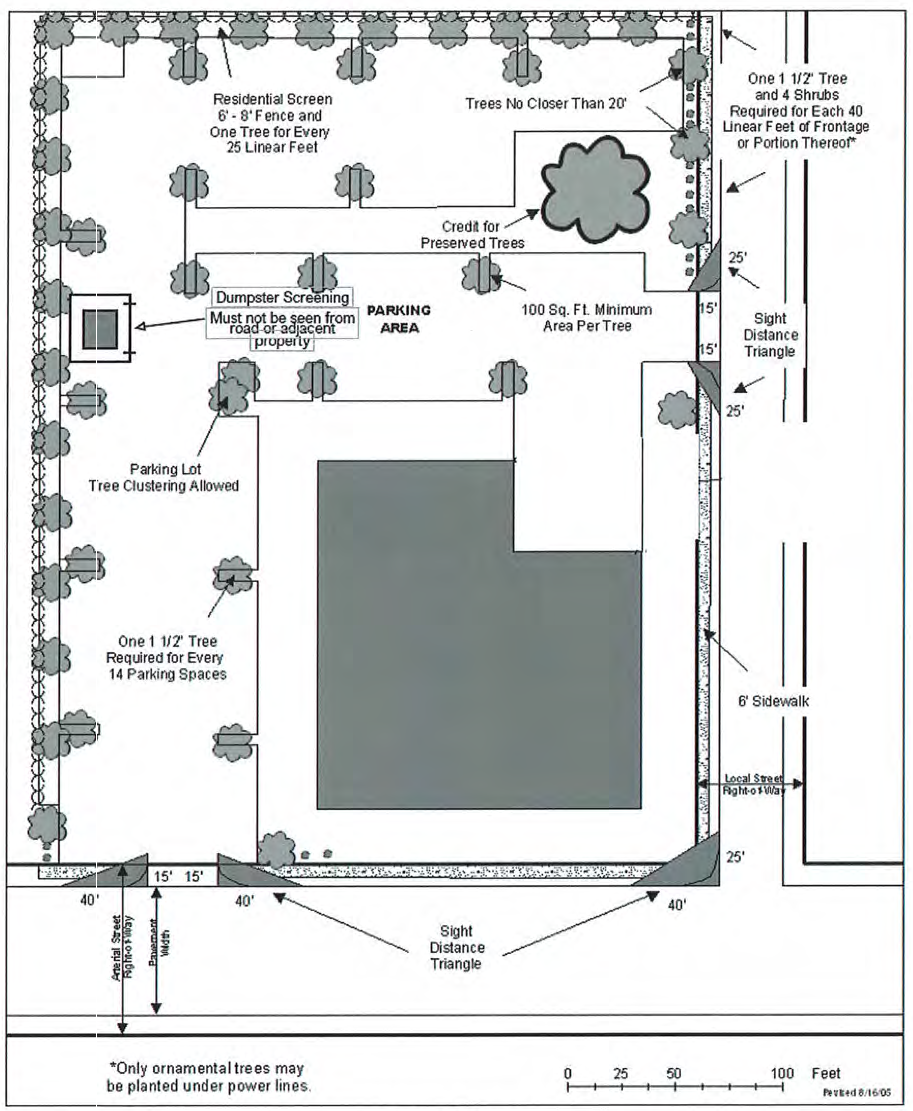
Illustration 9. Landscaping Requirements—Rear Parking Lot
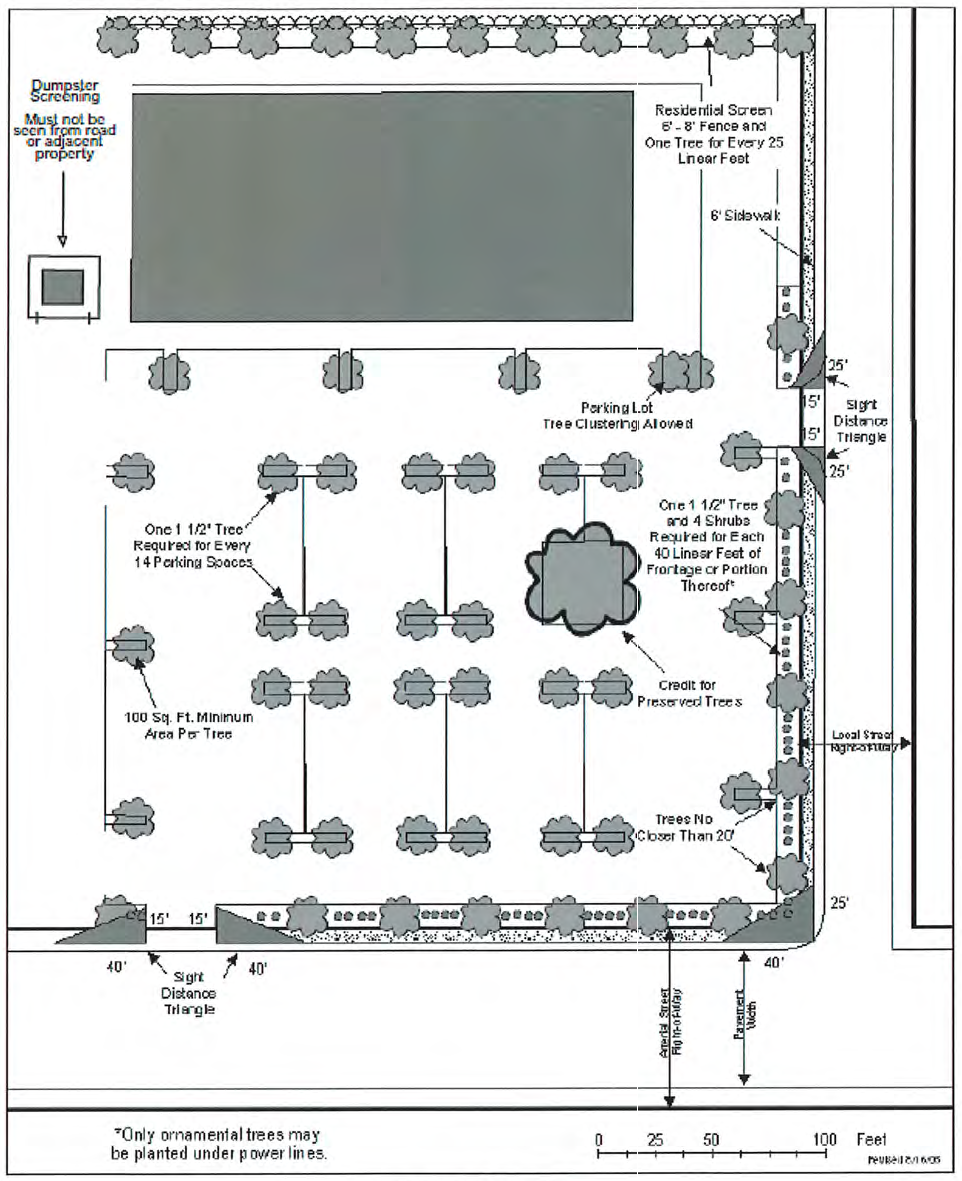
Illustration 10. Landscaping Requirements—Front Parking Lot
(8)
Sight distance and visibility. To ensure that landscape materials do not constitute a driving and pedestrian hazard, a "sight triangle" will be observed at all street intersections, street and alley intersections, and intersections of driveways with streets. Within the "sight triangle," no landscape material, wall, or other obstruction shall be permitted between the height of two and one-half feet and seven feet above the street, alley or driveway elevation. The sight triangle shall consist of the following; or other dimensions having a similar effect when intersections are not 90 degrees.
* Uncontrolled street means a street without a yield, stop, or traffic signal at the intersection.
See the following diagrams:
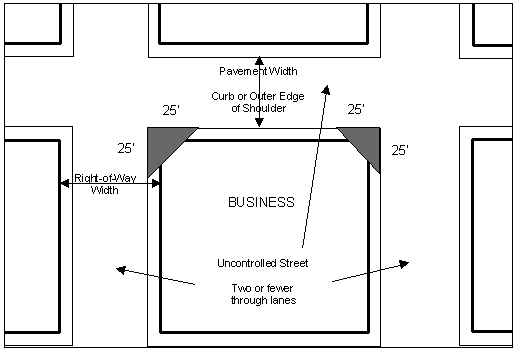
Illustration 11
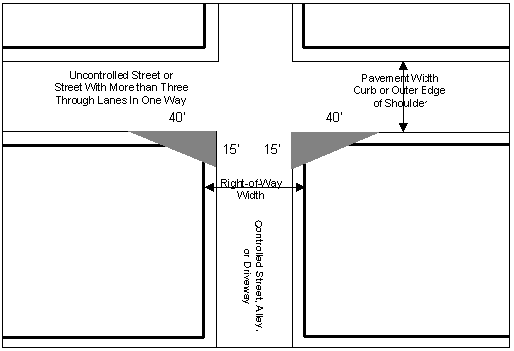
Illustration 12
(9)
Maintenance.
(i)
The owner, tenant and/or their agent, if any, shall be jointly and severally responsible for the maintenance of all landscaping. All required landscaping shall be maintained in a neat and orderly manner at all times. This shall include, but not to be limited to, mowing, edging, pruning, fertilizing, watering, weeding, and other such activities common to the maintenance of landscaping. Landscaped areas shall be kept free of trash, litter, weeds, and other such material or plants not a part of the landscaping. All plant material shall be maintained in a healthy and growing condition as is appropriate for the season of the year. Plant materials which die shall be replaced with plant material of similar variety, within 120 days. Trees having a trunk diameter of no less than one and one-half inches measured six inches above the ground may be used to replace dead trees. A time extension of six months may be granted by the planning director, if substantial evidence is presented to indicate abnormal circumstances beyond the control of the owner.
(ii)
All landscaped areas shall be irrigated, unless waived by the planning director for xeriscaped landscaping or where preserved landscaping is established. An underground automatic drip or bubbler system is preferred. If spray type irrigation heads are used, irrigation spray outside of the landscaped area is prohibited. Landscaped areas located more than 100 feet from an outside hose bib (faucet) are required to have an underground automatic irrigation system.
(iii)
Clearance.
1.
Over sidewalks and rights-of-way. It shall be unlawful for any tree, shrub, vine, palm or any similar plant of any description or kind to be grown, maintained or cultivated in such a manner that any portion of such tree, shrub, vine, palm, or other plant may overhang or obtrude upon or over any sidewalk and/or the city right-of-way between the curb line and the property line of any business, commercial or residential property, unless there is a full seven-foot clearance between the surface of all portions of such sidewalk or right-of-way and the overhanging tree, limb, shrub, vine, palm or plant of any description or kind.
2.
Over streets. It shall be unlawful for any tree, shrub, vine, palm or any similar plant of any description or kind to be grown, maintained or cultivated in such a manner that any portion of such tree, shrub, vine, palm, or other plant may overhang or obtrude upon or over any street or highway in the city, unless there is a full 12-foot clearance between the surface of all portions of such street or highway and the overhanging tree, limb, shrub, vine, palm or plant.
3.
Near fire plugs. It shall be unlawful for any tree, shrub, vine, palm, hedge or any similar plant of any description or kind to be planted, cultivated, grown or permitted to be planted, cultivated or grown between the sidewalk and/or the city's right-of-way and the curb or ditch line on any street or highway at a lesser distance than ten feet from any fire plug in the city; provided, however, that all shade trees growing prior to March 10, 1975, between the sidewalk and/or the city's right-of-way and the curb on any public street or highway in the city less than ten feet from any such fire plug shall not be affected by the terms of this section.
(iv)
Failure to maintain any landscape area in compliance with this article is considered a violation of this article and may be subject to penalties of this chapter.
(v)
The provisions of this article are subject to the provisions of chapter 130. However, trees or other landscaping which die or which may be permanently damaged for lack of water during periods of required water conservation must nevertheless be replaced in accordance with the provisions of this chapter.
(c)
Tree protection and tree removal.
(1)
Purpose. The purpose of this article is to protect existing protected and heritage trees.
(2)
General provisions.
(i)
It shall be unlawful for any person or corporation to recklessly remove, or cause the removal of any protected or heritage tree without first submitting the appropriate application for a permit and securing approval in the form and manner specified by this chapter.
(ii)
A tree removal permit is not needed if:
1.
The protected or heritage tree(s) to be removed is located on property zoned or used for agricultural or single-family or two-family dwellings.
2.
The protected or heritage tree(s) is diseased or sustained damage, which was not recklessly inflicted by the owner, his agents or employees, in the form of a broken trunk, broken limbs or uprooting, which creates a hazard to life or property.
3.
The tree(s) to be removed is one of those listed in Appendix B.
4.
The protected or heritage tree(s) to be removed is removed by a governmental agency in the scope of its authority.
(3)
Tree removal permit approval authority and appeal.
(i)
The planning director shall have the authority to approve a tree removal permit.
(ii)
If a request to remove a protected or heritage tree(s) is denied by the planning and community development director, the applicant may appeal the denial to the zoning board of adjustment by filing written notice of such appeal, along with a nonrefundable fee per appendix D of this Code, with the city, within 90 days of the notice of denial. The hearing shall be conducted in compliance with the Texas Open Meetings Act.
(iii)
The zoning board of adjustment may seek the testimony of a qualified arborist. If such expert testimony is requested by the board, it shall be provided by the city.
(iv)
The decision of the zoning board of adjustment shall be final.
(4)
Application for tree removal permit.
(i)
An application for tree removal permit must provide the following information:
1.
The location of the tree.
2.
The trunk circumference of the tree.
3.
The approximate drip-line area of the tree.
4.
The species/common name of the tree.
5.
The reason for removal.
6.
The planning director may require a professional arborist's report that defines the impact of the development upon existing trees affected by proposed construction. This report shall further define methods of tree protection during construction, impervious cover limitations adjacent to protected trees, proposal for tree replacement, and maintenance requirements for new planting.
7.
Such other information as may be required by the planning director.
(ii)
Where practical, an application for protected or heritage tree removal shall be combined with any other applications and site plans required for development projects.
(iii)
Failure to provide any of the above and foregoing information may constitute the sole grounds for denial of the permit.
(5)
Action on application for tree removal permit. The following actions shall occur upon receipt of an application:
(i)
Upon receipt of an application to remove a protected or heritage tree, the planning director or his designee shall promptly inspect the tree to be removed and shall approve or deny the application in accordance with the provisions of this article. Approval is automatically granted within 30 days if the application is not otherwise formally denied during the 30-day review period.
(ii)
The planning director shall approve an application for the removal of a protected or heritage tree when a valid application is received and a determination is made that:
a.
The tree is so located as to prevent reasonable access to the property or as to preclude reasonable and lawful use of the property;
b.
The tree is dead, dying or diseased such that recovery is not practicable, or that an infestation is likely; or
c.
The tree constitutes a hazard to life or property which cannot be mitigated without its removal.
(6)
Protection measures.
(i)
Prior to construction or land development, four-foot high safety fencing shall be installed around the root protection zone of a protected or heritage tree that is to be preserved.
The root protection zone is an area with a radius of one-half-foot for each inch of trunk measured four and one-half feet above the ground, or if branching occurs at four and one-half feet, the diameter is measured at the point where the smallest diameter closest to the branching occurs. The zone need not be exactly centered around the tree or circular in shape, but it should be positioned so that no disturbance occurs closer to the tree than one-half of the radius of the zone or within five feet of the tree, whichever is less. For any tree or groups of trees, the zone need not exceed 1,000 square feet in size. The radial root protection zones of trees may overlap one another so that the area of protection required for one tree may be shared by the area of protection required for another tree to minimize the total square footage of protected area where possible.
(ii)
During construction, the cleaning of equipment or materials and/or the disposal of any waste material, including, but not limited to paint, oil, solvents, asphalt, concrete, mortar, etc., under the canopy or drip line of any protected tree shall be prohibited.
(iii)
No attachments or wires of any kind, other than those of a protective nature, shall be attached to any protected tree.
(iv)
Grading or fill in an area under the drip line of a protected tree shall be prohibited unless approved by the planning director and city engineer. If grading or filling were to occur within five feet of the protected or heritage tree to be preserved, a retaining wall or tree well of rock, brick, landscape timbers or other approved materials shall be constructed around the tree no closer than the drip line of the protected tree. The top of the retaining wall or tree well shall be constructed at the new grade.
(7)
Tree replacement.
(i)
The planning director may require as a condition for approval that replacement trees be planted. Replacement trees must be of the species placed on the approved plant list (Appendix A). Shade trees must be used, unless near utility lines where ornamental trees must be used, as required in subsection 144-5.2-1(c)(6)(vii). Standards for planting shall conform to current Texas Forest Service standards. Planting requirements shall conform to the following:
a.
Replacement trees shall have a diameter of at least one and one-half inches.
b.
Tree replacement must occur within 12 months of the removal of a protected or heritage tree.
c.
Replacement trees that do not survive for a period of at least 12 months shall be replaced by the original applicant for removal until they survive a 12-month period.
d.
If ten or more replacement trees are required, no more than 25 percent of the trees shall be of the same species. The replacement trees shall be of any of the species described in Appendix A.
e.
No artificial plant materials may be used to satisfy the requirements of this article.
(ii)
Determination of the number of replacement trees shall be calculated in accordance with the following procedure:
a.
The trunk circumference, in inches shall be recorded for each healthy protected or heritage tree to be removed.
b.
Where more than one healthy protected or heritage tree is to be removed, the respective trunk circumferences shall be added together to produce a total aggregate value expressed in circumference inches.
c.
Replacement trees of sufficient number and trunk circumference shall be provided to produce a total aggregate value of 50 percent of the total aggregate value of the healthy protected or heritage tree(s) to be removed.
(iii)
If the planning and development services department determines that it is not practical to plant the number of replacement trees required at the removal property, then the planning and development services department may require only the amount of trees that are practical at the removal property and may authorize the remainder to be planted on other public properties.
(iv)
Tree mitigation fund option. In lieu of meeting the minimum tree replacement standards of this section, a payment to the tree mitigation fund may be provided in accordance with appendix D.
(8)
Penalties.
(i)
The violation of any provision of this section shall be a misdemeanor and shall be punishable, upon conviction, by a fine of not more than $2,000.00.
(ii)
Tree removal violations. Removing trees without a tree removal permit or removing trees in violation of any provision of this section shall be punishable, upon conviction, by a fine as noted in appendix D.
APPENDIX A.
APPROVED PLANT LIST
* denotes recommended species.
TREES
APPENDIX B
UNDESIRABLE TREES
5.3-2. Fences and walls.
(a)
Maximum height of fence or wall:
(1)
Non-residential, multifamily and park: Eight feet.
(2)
One- or two-family: Eight feet.
Ornamental features may be placed on top of the screening fence or wall so long as the features obstruct less than 50 percent of the opening on top of the fence or wall.
(b)
No fence or wall shall be constructed in any required front yard, except fences and walls no taller than 36 inches unless the fence is at least 50 percent open, in which case the fence may be four and one-half feet tall.
(c)
If an existing, legally non-conforming building has less than the required setback, the front yard shall be measured from the front building line.
(d)
A fence from the front or rear corners of a building may extend through the side yard at the maximum height allowed.
(e)
Fences and walls must comply with all permit/plan review submittal requirements including engineered foundation when necessary, as required in applicable adopted code(s).
(f)
Public easement. Fences within public easements. Fences within a public easement shall have a gate or removable panel to allow for maintenance access to such easement. The entity responsible for the public easement must approve the fence.
(g)
Fences are prohibited within drainage easements.
(h)
Residential buffer wall. Where a five-unit or greater multifamily or non-residential development is adjacent to land used or zoned only for single-family, two-family (duplex), three-family (triplex) or four-family (quad-plex) development, a six-foot tall (minimum) to eight-foot tall (maximum) solid screen residential buffer wall must be installed and maintained by the commercial/multifamily property owner/developer as a buffer between the properties. The wall must be constructed of any of the following materials:
• Brick,
• Stone,
• Cast stone,
• Rock,
• Marble,
• Granite,
• Split-face concrete block,
• Poured-in place concrete, or
• Precast concrete.
In no instance shall any residential buffer wall be constructed of fiber cement, such as James Hardie brand products or equivalent.
Any new buffer wall must be consistent with any pre-existing wall so long as it meets the materials requirements above.
(1)
Exemption.
(i)
In the event that the owner(s) of the adjacent residential property intended to be protected object to the residential buffer wall, they may submit their objection in writing to the planning and community development department. Upon receipt of the written objection, the planning and community development department will authorize an exemption from the requirement that a residential buffer wall be erected for that single property line.
(ii)
In order to maintain wall design consistency in the event that multiple single- or two-family residential properties abut the multifamily or non-residential development along a single linear property line:
• All owners of property adjoining a single linear property line of the exemption request shall be notified.
• A two-thirds majority of the adjoining property line (measured in length of shared property line) must be represented by written opposition from the adjoining property owners in order for the residential buffer wall exemption to be administratively authorized along that linear property line.
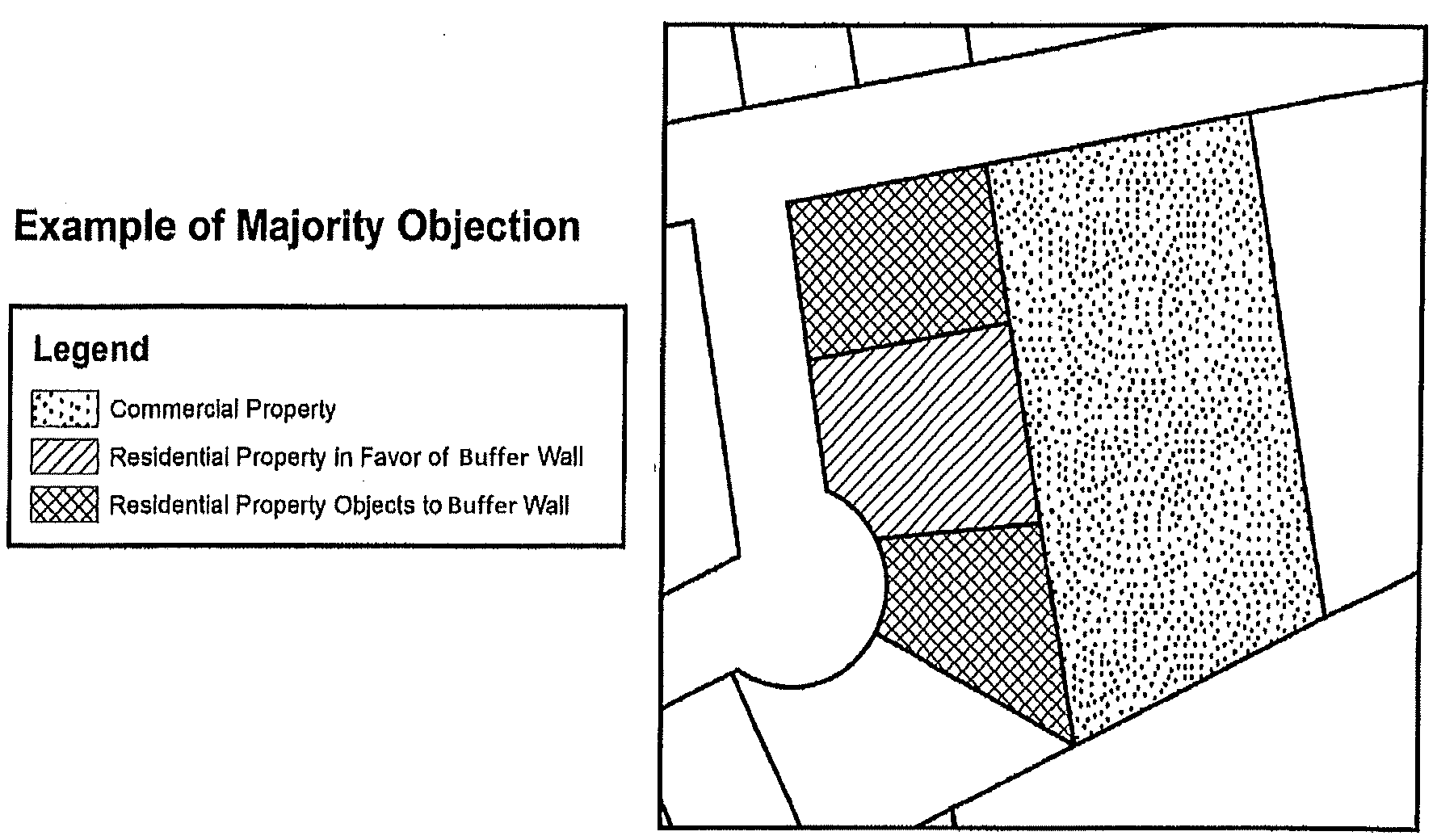
(iii)
Before a certificate of occupancy (C of O) can be issued for any subsequent commercial/multi-family development, any previous exemption from the residential buffer wall requirement is voided and must be re-evaluated.
Maintenance. Any fence or wall erected by the commercial or multi-family development, regardless of material used, must be maintained by the commercial or multi-family property owner/developer.
(i)
The front, side or rear yard of a park may include a fence or wall no taller than 36 inches unless the fence or wall is at least 50 percent open. Solid walls in existence at the time of the adoption of this section (March 24, 2014) are allowed to be reconstructed within 12 months of damage or removal. This does not preclude the construction of a solid fence or wall along the shared property line of property used or zoned for single or two-family residences when the residential property is within 175 feet of an arterial roadway.
5.3-3. Lighting and glare standards.
(a)
Non-residential and multifamily.
(1)
Lighting limited. Any light fixture for non-residential or multifamily development shall be operated so as not to produce an obnoxious and intense glare or direct illumination across the bounding property line, and shall not be of such intensity as to create a nuisance or detract from the use or enjoyment of adjacent property. All outside lights shall be made up of a light source and reflector so selected that acting together, the light beam is controlled and not directed across any bounding property line above a height of three feet. The allowable maximum intensity measured at the property line of a residential use in a residential zoning district shall be 0.25 foot candles.
(2)
Outdoor lighting used to illuminate parking spaces, driveways, maneuvering areas, or buildings shall conform to the definition for "fully shielded light fixtures" and be designed, arranged and screened so that the point light source shall not be visible from adjoining lots or streets. No portion of the bulb or direct lamp image may be visible beyond a distance equal to or greater than twice the mounting height of the fixture. For example, for a fixture with a mounting height of 12 feet, no portion of the bulb or direct lamp image may be visible from 24 feet away in any direction. Light poles or wall-mounted fixtures shall be full-cutoff fixtures only. All perimeter fixtures shall possess house-side shielding; bollards shall be louvered and utilize coated lamps.
(3)
Setback or shielding requirements. Outdoor lighting fixtures are allowed with no additional "house-side" shielding in accordance with the following formula: Height (H) < 3 + (D/3); where D equals the distance in feet from light source to the nearest residential lot line (extended vertically). Additional "house-side shielding" shall be added in all cases where the Height (H) is greater than 3 +(D/3).
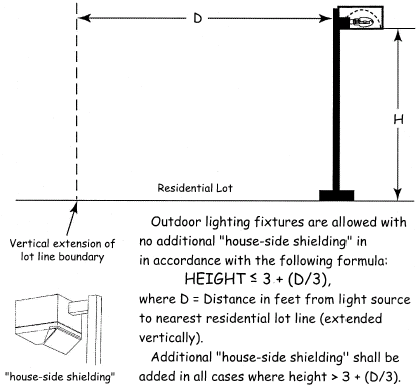
Illustration 13. Light Fixture Setback/Shielding Diagram
(b)
Residential. Residential lighting for one- or two-family development for security and night recreation use is permitted provided the following requirements are met:
(1)
Direct lighting over ten feet in height must be shielded from adjacent property.
(2)
No light source shall exceed 20 feet in height. Street lights and other traffic safety lighting are exempt from this standard.
(3)
Lighting shall not directly shine on adjacent dwellings.
(c)
Luminaries. Light sources shall be of a down-light type, indirect, diffused, or shielded type luminaries installed and maintained so as to reduce glare effect and consequent interference with use of adjacent properties and boundary streets. Low wattage temporary lighting is permitted.
(d)
Where a multifamily or non-residential development is adjacent to land used or zoned for single-family or two-family development all canopies and awning lighting must be shielded from residential uses or residential zoning.
5.3-4. Additional residential buffering requirements.
(a)
Residential setback. Where a non-residential building or a multifamily development of more than three units abuts a one- or two-family use or zoning district, the setback from the one- or two-family property line shall be at least 20 feet plus one foot for each foot of building height over 20 feet.
(b)
Where a non-residential building or a multifamily development is adjacent to residential uses or residential zoning outdoor audio or speakers are prohibited unless being used to provide ADA access at fuel pumps.
(c)
Where a non-residential building or a multifamily development is adjacent to residential uses or residential zoning outside music is prohibited.
(d)
Where a non-residential building or a multifamily development is adjacent to residential uses or residential zoning an additional 30-foot setback buffer will be required as separation between the residential property and any fuel pumps or fuel tanks.
(Ord. No. 2012-49, § 1(Exh. A), 9-10-12; Ord. No. 2014-24, § 1, 3-24-14; Ord. No. 2015-53, §§ 1, 2, 10-26-15; Ord. No. 2015-56, §§ 1, 2, 10-26-15; Ord. No. 2018-21, § 2, 3-26-18; Ord. No. 2018-76, § 2, 11-12-18; Ord. No. 2020-19, § 1, 3-9-20; Ord. No. 2020-33, § 1, 4-27-20; Ord. No. 2023-06, § 7, 2-27-23; Ord. No. 2024-03, § 2, 1-8-24; Ord. No. 2025-73, § 1, 11-24-25)
Sec. 144-5.4. - Accessory uses and structures.
(a)
General. Accessory buildings are subordinate buildings detached from the main building, the use of which is incidental to and used only in conjunction with the main building. Accessory buildings include, but are not limited to, an automobile storage garage, storage building (for storage belonging to the owner or tenant), greenhouse or home workshop, and shall not be utilized for human habitation. Residential outdoor fireplaces must also meet the minimum accessory structure setbacks.
(b)
Front yard/location requirement. Any accessory building hereafter constructed or placed on any lot shall provide a front yard of 60 feet or shall be located behind the main building, whichever is less.
(c)
Side building setback requirement. Except for townhouses, there shall be a side building setback on each side of an accessory building not less than five feet. In the case of a corner lot, the exterior side setbacks for the particular zoning district shall govern. Townhouse accessory building setback is a minimum of three feet.
(d)
Rear building setback requirement. The depth of the rear yard shall be at least three feet. The building(s) shall not occupy more than 30 percent of the rear yard. In the case of a through lot, the depth of the rear yard shall be 25 feet.
(e)
Height. The height of the accessory building shall not exceed the height of the main building.
(f)
Maximum number of buildings per lot. In no instance shall more than two detached accessory buildings be allowed on one lot. Outdoor fireplaces and covered patios (with roof but no side walls) are considered structures subject to setbacks but are not considered accessory buildings for the purpose of determining the maximum number of accessory buildings in the yard.
(g)
Building spacing. As per adopted building codes.
(h)
Accessory dwellings. A secondary living space that is on-site with a primary living space is allowed and may be contained within the same structure as the primary dwelling, or may be contained in a separate structure. A guest house and a garage loft are examples of accessory dwellings.
(i)
Accessory equipment requirements. Air conditioning compressors, swimming pool pumps and similar accessory structures shall observe all front and exterior side yard setbacks specified for the particular zoning district in which the property is located. A minimum interior side building setback and rear building setback of three feet shall be observed, unless otherwise approved by the building official in accordance with the city adopted building codes.
(Ord. No. 2012-49, § 1(Exh. A), 9-10-12; Ord. No. 2021-07, § 7, 2-8-21; Ord. No. 2023-06, § 8, 2-27-23)
Sec. 144-5.5. - Home occupation regulations.
5.5-1. Purpose. Standards for controlling home occupations are set forth to minimize annoyance and inconvenience to neighboring property owners within residential areas. These standards are intended to allow reasonable and comfortable enjoyment of adjacent and nearby property by their owners and by occupants of neighboring residential dwellings, while providing opportunities for the pursuit of home-based businesses.
5.5-2. Special provisions for home occupations.
(a)
Home occupations shall be permitted as accessory use in all residential zoning districts provided that they comply with all restrictions herein;
(b)
This subsection, 5.5-2(b), is suspended until authorized by a change in state or case law. The occupation shall produce no alteration or change in the character or exterior appearance of the principal building from that of a residential dwelling;
(c)
Performance of the occupation activity shall not be visible from the street;
(d)
Such use shall be incidental and secondary to the use of the premises for residential purposes, and shall not utilize floor area exceeding 30 percent of the combined gross floor area of dwelling unit and any accessory building(s) that are used for the home occupation (in no case shall the combined floor area utilized for a home occupation exceed 600 square feet);
(e)
The occupation shall not employ more than one person who is not a member of the household in which the home occupation occurs;
(f)
Not more than one business-related commercial vehicle shall be present at one time;
(g)
The operation of such an occupation shall be between the hours of 8:00 a.m. and 9:00 p.m. for outdoor activities;
(h)
One commercial vehicle, gross vehicle weight capacity of one ton or less, according to the manufacturer's classification, may be used, or parked behind the front building line on the property, in connection with the home occupation, but said vehicle may not be parked in the street;
(i)
The occupation activity shall not increase vehicular traffic flow beyond what normally occurs within a residential district, and shall not require regular and frequent deliveries (more than twice per day) by large delivery trucks or vehicles with a rated capacity in excess of one and one-half tons, according to the manufacturer's classification;
(j)
The home occupation use/activity shall take place primarily within the dwelling, and there shall be no outside storage, including trailers, or outside display related to the home occupation use;
(k)
No mechanical or electrical equipment shall be employed on the premises other than that which is customarily found in a home office environment, and that which is customarily associated with a hobby or avocation which is conducted solely for pleasure and not for profit or financial gain;
(l)
The home occupation shall not generate noise, vibration, glare, fumes or odors, heat or electrical interference beyond what normally occurs within a residential district;
(m)
The occupation shall not require the use of chemicals on the property that are obnoxious or hazardous to the welfare of the neighborhood;
(n)
One non-illuminated identification sign that is physically attached to the exterior of the structure, with a sign area no larger than four square feet is permitted;
(o)
The occupation shall not offer any commodity for sale on the premises.
5.5-3. Applicability of other regulations. Home occupations shall also be subject to any and all other provisions of local, state and federal regulations and laws that govern such uses.
5.5-4. Uses allowed as home occupations. Subject to the provisions of this division, home occupations may include the following uses:
(a)
Office facility of an accountant, architect, landscape architect, attorney, engineer, consultant, insurance agent, realtor, broker, or similar profession;
(b)
Author, artist, artisan, or sculptor;
(c)
Dressmaker, seamstress or tailor;
(d)
Music or dance teacher, or similar types of instruction, provided that instruction shall be limited to no more than five pupils at a time;
(e)
Individual tutoring;
(f)
Office facility of a minister, rabbi, priest or other cleric;
(g)
Home crafts, such as rug weaving, model making, etc.;
(h)
Office facility of a salesman, sales or manufacturer's representative, provided that no retail or wholesale transactions or provision of services are personally and physically made on the premises;
(i)
Repair shop for small electrical appliances, cameras, watches and clocks, and other small items, provided that the items can be carried by one person without using special equipment, and provided that the items are not equipped with an internal combustion engine;
(j)
Food preparation establishments such as cake making, decorating or catering, provided that there is no on-premises consumption by customers, and provided that all aspects of the business comply with all state and local health regulations;
(k)
Family homes, in compliance with applicable state laws, which are incorporated herein by reference, with no more than six children or adults;
(l)
Barber shop or beauty salon or manicure studio, provided that no more than one customer is served on the premises at any one time;
(m)
Swimming lessons and water safety instruction, provided that such instruction involves no more than two pupils at any one time;
(n)
Activity involving primarily a computer;
(o)
Contractor, provided that there shall be no outside storage of materials related to the operation of the business and any interior storage shall count toward the maximum area allowed in subsection 144-5.4(b)(3).
(p)
Such uses must be located in the dwelling used by the person who has the home occupation as his or her private residence.
(q)
Said incidental use shall never be permitted as a principal use but only as a secondary use when indispensably necessary to the enjoyment of the premises.
5.5-5. Uses prohibited as home occupations. Home occupations shall not, in any event, be deemed to include the following uses:
(a)
Animal hospitals or clinics, commercial stables having more than two horses per acre or kennels;
(b)
Restaurants or on-premises food or beverage, including private clubs, consumption of any kind, except for limited food or meal consumption associated with the operation of a licensed registered family home or a bed and breakfast facility;
(c)
Automobile, boat or trailer paint or repair shop; small engine or motorcycle repair shop; welding shop; large household appliance repair shop; or other similar type of business;
(d)
On-premises retail or wholesale sales of any kind where multiple customers patronize the sales business on-site, except for items that are produced entirely on the premises in conformance with this Code, and except for occasional garage sales (no more than two per calendar year and shall not be held within six months of each other);
(e)
Commercial clothing laundering or cleaning;
(f)
Mortuaries or funeral homes;
(g)
Trailer, vehicle, tool or equipment rentals;
(h)
Repair shops for any items having internal combustion engines; and
(i)
Any use that would be defined by the building code as an assembly, factory or industrial, hazardous, institutional or mercantile occupancy.
5.5-6. Home occupation uses not classified herein. Any use that is not either expressly allowed nor expressly prohibited by this division is considered prohibited, unless and until such use is classified by amendment to this chapter by the city council, subsequent to an affirmative recommendation by the planning commission.
5.5-7. Effect of section 144-5.5 upon existing home occupations. Any home occupation that was legally in existence as of the effective date of this chapter and that is not in full conformity with the provisions herein shall be deemed a legal nonconforming use, and provided that the home occupation use was not in violation of any other local, state or federal law or regulation on that date. Proof of the existence of such home occupation use prior to the effective date of this Code may be required by the planning department.
(Ord. No. 2012-49, § 1(Exh. A), 9-10-12; Ord. No. 2020-05, § 2, 1-27-20)
Sec. 144-5.6. - Bed and breakfasts.
Bed and breakfasts are subject to the following requirements:
5.6-1. Parking. One off-street parking space per guest room.
5.6-2. Number of guest rooms. The maximum number of guest rooms shall be eight.
5.6-3. Length of stay. The maximum length of stay for each guest shall be limited to 14 consecutive days within any 30-day time period.
5.6-4. Management. The facility shall be owner occupied in the residential zoning districts and may be manager occupied in other zoning districts.
5.6-5. Signs. Signs shall conform to chapter 106.
5.6-6. Health factors.
(a)
Only overnight guests may be served meals. Cooking in a guest room is prohibited, however microwaves and coffee makers are allowed.
(b)
The owner of the facility shall provide clean linens and towels on a daily basis, provide adequate heating, air conditioning, ventilation and lighting; provide adequate hot and cold water; provide adequate sewage disposal; maintain the outside area in a clean and sanitary manner; maintain the structure(s) in suitable state of repair; and properly clean the premises and facilities during the guests stay and after each guest has departed.
(c)
A separate food establishment permit will be required from the neighborhood services division if:
(1)
The bed and breakfast has seven or more rooms,
(2)
The number of guests served is 19 or more, or
(3)
Breakfast is not the only meal served to guests.
(d)
Inspections by the neighborhood services division will be made upon demand as required by a complaint. If a food establishment permit is required, inspections by the neighborhood services division will be made on a regular basis in accordance with the permit type. The inspections must be successfully passed.
(e)
Building and fire protection considerations.
(1)
The owner of the bed and breakfast must obtain a certificate of occupancy (C-of-O) from the city building official after a special use permit (SUP) is issued, if an SUP is required. The facility must successfully pass the C-of-O inspection.
(2)
The structure(s) must conform to all city and state building codes for existing or new construction as the situation dictates.
(3)
The city fire marshal or his/her representative shall inspect all bed and breakfasts before a C-of-O is issued. The facility must successfully pass the inspection. Regular inspections shall be made on an annual basis.
(4)
Each bed and breakfast must comply with the appropriate section on "Lodging and Rooming Houses" contained in NFPA 101 Life Safety Code.
(5)
Each facility must have at least one battery operated or regular hard wired smoke detector in all guest rooms, stairwells and/or corridors on each floor of the structure.
(6)
An approved fire extinguisher shall be provided in close proximity to the guest units on each floor.
(f)
Other activities. Other activities such as weddings, parties, and other functions are not permitted unless approved through an SUP in accordance with section 144-3.6.
(Ord. No. 2012-49, § 1(Exh. A), 9-10-12; Ord. No. 2023-06, § 9, 2-27-23; Ord. No. 2024-96, § 4, 12-9-24)
Sec. 144-5.7. - Telecommunication towers/antennas.
5.7-1. Purposes. The regulations for telecommunications towers and antennas set forth in this section are intended to:
(a)
Be nondiscriminatory and competitively neutral.
(b)
Facilitate the provision of wireless telecommunications services to the residents and businesses of the city while complying with federal statutory requirements adopted in the Telecommunications Act of 1996.
(c)
Minimize adverse visual effects of telecommunications towers through design and siting standards.
(d)
Protect historic, residential and scenic areas from potential adverse impacts of telecommunications towers.
(e)
Avoid potential damage to adjacent properties from tower failure through structural standards and setback requirements.
(f)
Discourage unnecessary proliferation of telecommunications towers and antennas by maximizing the use of existing and approved towers and buildings to accommodate new wireless telecommunication antennas.
5.7-2. Application and exemptions.
(a)
This section shall apply to the installation, renovation, or modification of any telecommunications tower, including lattice style towers and towers secured by guy wires.
(b)
Exemptions. The following facilities shall be exempt from the requirements of this section:
(1)
Structures intended only for and capable only of use as amateur radio facilities;
(2)
Ground based telecommunications towers that do not exceed a height of 40 feet from the base of the tower and are not lattice style towers or towers secured by guy wires.
(3)
Telecommunications facilities and tower structures that are attached to, placed upon, or constructed on top of a building, provided the height of the tower structure does not exceed ten feet above the height of the building upon which the tower is constructed and the tower structure is not a lattice style tower or tower secured by guy wires;
(4)
Towers or other facilities placed on land or right-of-way owned by the federal government, the state, or the city;
(5)
Telecommunications towers that were constructed prior to January 14, 2002. This section shall apply to the renovation, modification or repair of any telecommunication tower for any purpose other than installing additional antennas or complying with applicable FCC, FAA or other applicable federal requirements where the anticipated cost of the renovations, modifications or repairs exceeds the percentage of the original cost of the tower by more than the amount provided in the following schedule:
5.7-3. Development/approval process. Prior to the issuance of a building permit for the installation of any tower or antenna pursuant to this chapter, the owner of such tower or antenna shall send written notice to the planning department, which notice shall include:
(a)
The legal description, parcel number, and address of the parcel of land upon which the proposed tower is to be situated.
(b)
The name, address, and telephone number of the owner and/or lessee of the parcel of land upon which the proposed tower is to be situated. If the applicant is not the owner of the parcel of land upon which the proposed tower is to be situated, a copy of the lease agreement is required.
(c)
A full site plan showing the location of the tower on the site, the type and height of the proposed tower, on-site land uses and zoning, adjacent land uses and zoning, adjacent roadways, proposed means of access, setbacks from property lines, elevation drawings of the proposed facility, the location of existing structures, trees, and other significant site features, the type and location of plant materials used to screen the facility, fencing, proposed color(s), and any other proposed structures.
(d)
(Not required if applicant is co-locating antenna on an existing tower). Applicant must identify whether or not it is utilizing the most compact or least obtrusive technological design for the proposed tower. The applicant must provide written technical evidence from an engineer(s) of the tower's capability of supporting at least two additional antennas for future users at a reasonable, market-based cost. If accommodation of future co-location is not proposed, information must be submitted with the application detailing why future co-location is not possible.
(e)
(Not required if applicant is co-locating antenna on an existing tower). An inventory of the applicant's existing towers within the corporate limits and ETJ of the city, including the location, height, and design of each tower and the number of antennas that may be supported by each structure. Co-location is encouraged, and the planning department may share such information with other applicants seeking to locate antennas within the city. The applicant shall demonstrate how the proposed site fits into its overall telecommunications network within the city.
(f)
(Not required if applicant is co-locating antenna on an existing tower). The names, addresses, and telephone numbers of owners of all other towers or antenna support structures, capable of supporting the applicant's telecommunications facilities, within a one-half mile radius of the proposed tower site, including city-owned property. An affidavit shall be submitted attesting to the fact that the applicant made diligent efforts to obtain permission to install or co-locate the proposed telecommunications facilities on existing towers or antenna support structures located within a one-half-mile radius of the proposed tower site, but, due to physical, economic, or technological constraints, no such existing tower or antenna support structure is available or feasible. Evidence submitted by the applicant or owner to demonstrate that no existing tower or structure can accommodate the applicant's proposed antenna may consist of any of the following:
(1)
No existing towers or structures are located within the geographic area required to meet applicant's engineering requirements.
(2)
Existing towers or structures are not of sufficient height to meet applicant's engineering requirements.
(3)
Existing towers or structures do not have sufficient structural strength to support applicant's proposed antenna and related equipment.
(4)
The applicant's proposed antenna would cause electromagnetic interference with the antenna on the existing towers or structures, or the antenna on the existing towers or structures would cause interference with the applicant's proposed antenna.
(5)
The fees or costs required to share an existing tower or structure or to adapt an existing tower or structure for sharing are unreasonable. Costs exceeding new tower development are presumed unreasonable.
(6)
Property owners or owners of existing towers or structures are unwilling to accommodate reasonably with the applicant's needs.
(7)
The applicant demonstrates that there are other limiting factors that render existing towers and structures unsuitable.
(g)
An affidavit from the applicant that the construction and placement of the proposed tower and/or antenna will meet FCC requirements and not interfere with public communications and the usual and customary transmission or reception of radio, television, or other communications services enjoyed by adjacent properties.
(h)
(Not required if applicant is co-locating antenna on an existing tower.) Certification from an engineer that the tower is structurally sound, will be fixed to the land, and, at a minimum, in conformance with the building code and any other standards set forth in this chapter.
(i)
A written statement by the applicant stating the tower and telecommunications facilities will comply with all FAA regulations and EIA Standards and all other applicable federal, state and local laws and regulations.
(j)
Copies of any environmental documents required by any federal, state, or local agency, if available. These shall include the environmental assessment required by FCC Para. 1.1307. 1.1307, or, in the event that a FCC environmental assessment is not required, a statement that describes the specific factors that obviate the requirement for an environmental assessment.
(k)
The city shall have on file any requirements from law enforcement, fire and emergency services agencies within the city that want to be included in a particular area for future communications and would be interested in co-location. If any such agency decides to co-locate, then any new towers approved under this chapter shall be designed for, and the owner shall not deny, co-location.
The city may require a qualified, independent third-party review by a city-approved consultant to validate and review the technical information contained in the application submittals. The cost of such review shall be borne by the applicant.
5.7-4. Administrative approval. Administrative approval for the following towers may be obtained by submitting the required information to the planning department:
(a)
Installation of antennae on existing tower or structure.
(1)
In any zoning district, the installation of an antenna on an existing stealth tower that is less than 50 feet in height or on an existing structure other than tower (such as a sign, light pole, or other freestanding non-residential structure) that is less than 50 feet in height, so long as such addition does not add more than five feet to the height of the existing tower or structure. Any antenna installed on a structure other than a tower must be of a neutral color that is compatible with the color of the supporting structure so as to make the antenna and related equipment as visually unobtrusive as possible.
(2)
In any commercial or industrial zoning district , the installation of an antenna on an existing stealth tower of any height or on an existing structure other than a tower (such as a sign, light pole, water tower or other freestanding non-residential structure) of any height, so long as the addition adds no more than 20 feet to the height of the existing tower or structure. Any antenna installed on a structure other than a tower must be of a neutral color that is compatible with the color of the supporting structure so as to make the antenna and related equipment as visually unobtrusive as possible.
(3)
In any industrial zoning district except those industrial districts located within the New Braunfels Downtown Area as defined in chapter 114, the installation of an antenna on any existing tower so long as the antenna adds no more than 20 feet to the height of the existing tower.
(b)
Installation of new towers.
(1)
In any zoning district, the installation of a stealth tower that is less than 50 feet in height. The tower must be set back from the nearest property line of any off-site residential structure a distance equal to one foot for each foot of height of the tower plus 15 feet.
(2)
In any commercial or industrial zoning district, the installation of a stealth tower that is 150 [feet] in height or less. The tower must be set back from the nearest property line of any existing off-site residential structure, platted residential subdivision, or historically designated building or landmark a distance equal to one foot for each foot of height of the tower plus 25 feet.
(3)
In any industrial zoning district except those industrial districts located within the New Braunfels Downtown Area as defined in chapter 114, the installation of a tower that is not a stealth tower, proposed by the applicants as follows:
(i)
For a single user, up to 90 feet in height.
(ii)
For two users, up to 120 [feet] in height.
(iii)
For three or more users, up to 150 feet in height.
Said tower must be set back from the nearest property line of any existing off-site residential structure, platted residential subdivision, or historically designated building or landmark a distance equal to one foot for each foot of height of the tower plus 25 feet. Said tower must be set back at least 100 feet from the centerlines of the Comal and Guadalupe Rivers. Said tower shall maintain a galvanized steel finish or, subject to any applicable standards of the FAA, be painted sky blue or gray, so as to reduce visual obtrusiveness.
5.7-5. Additional guidelines.
(a)
Towers and antennas may be considered either principal or accessory uses. A different existing use or an existing structure on the same lot shall not preclude the installation of a tower or antenna on such lot. For purposes of determining whether the installation of a tower or antenna complies with district development regulations, including but not limited to setback requirements, lot coverage requirements, and other such requirements, the dimensions of the entire lot shall control, even though the towers or antennas may be located on leased parcels within such lots.
(b)
At any tower site, the design of buildings and related structures shall use materials, colors, textures, screening and landscaping that will blend the tower facilities to the natural setting and built environment. Existing vegetation around the facility shall be preserved to the extent possible. A combination of hedges (preferably fast-growing plants) and/or evergreen trees, at least four feet in height when planted, shall be planted and maintained around the site and spaced close enough together to provide a visual screen. Shrubs shall also be planted and maintained around guy anchors for visual screening purposes. Towers shall not be artificially lighted, unless required by the FAA or other applicable authority. If lighting is required, the planning department may review the available lighting alternative s and approve the design that would cause the least disturbance to the surrounding views. No signs, including company identification or its logo, or advertising shall be permitted on any tower or antenna.
(c)
FCC Requirements: All towers and antennas must meet or exceed current standards and regulations of the FAA, the FCC, and any other agency of the federal government with the authority to regulate towers and antennas. If such standards and regulations are changed, then the owners of the towers and antennas governed by this chapter shall bring such towers and antennas into compliance with such revised standards and regulations within six months of the effective date of such standards and regulations. Failure to bring towers and antennas into compliance with such revised standards and regulations shall constitute grounds for the removal of the tower or antenna at the owner's expense.
(d)
Separation requirement.
(1)
Proposed towers must meet the following minimum separation requirements from existing towers or towers which have a building permit but are not yet constructed at the time that a building permit is granted:
(i)
Monopole tower structures 90 feet in height or less shall be separated from other telecommunications towers by a minimum of 750 feet. Monopole towers over 90 feet in height shall not be located within one-quarter of a mile from any existing tower that is over 90 feet in height.
(ii)
Self-supporting lattice or guyed tower structures of any height shall not be located within one-quarter of a mile from any existing tower that is over 90 feet in height.
(iii)
There is no required separation distance for stealth towers.
(2)
For the purpose of this section, the separation distances between towers shall be measured by drawing or following a straight line between the base of the existing or approved structure and the proposed base, pursuant to a site plan of the proposed tower. The minimum tower separation distances from other towers shall be calculated and applied irrespective of city jurisdictional boundaries.
(e)
If the applicant meets the requirements of this chapter, administrative approval for the tower location shall be granted by the planning department, and the applicant may apply for a building permit. It shall be a condition of approval that all towers must be designed and certified by an engineer to be structurally sound and at a minimum in conformance with the building code and any other standards set forth in this chapter.
5.7-6. Special use permit. If, in the opinion of the planning department, a tower or antenna is not a permitted use or the planning department declines to approve administratively any application, pursuant to section 144-5.7-5, the applicant may seek a special use permit.
(a)
Application. In addition to the requirements for a tower application in section 144-5.7-2 above, the applicant must provide:
(1)
A description of how the proposed plan addresses any adverse impact that might occur as a result of approving the modification.
(2)
A description of off-site or on-site factors which mitigate any adverse impacts which might affect the granting of a special use permit.
(b)
Special use permit provisions. The following provisions shall govern the issuance of special use permits for telecommunications towers and/or antennas:
(1)
In granting a special use permit, the city council may impose certain conditions to the extent the city council concludes such conditions are necessary to buffer or otherwise minimize any adverse effect of the proposed tower on adjoining properties.
(2)
Any information of an engineering nature that the applicant submits, whether civil, mechanical, or electrical shall be certified by a qualified professional engineer.
(3)
Each applicant requesting a special use permit under this chapter shall submit a scaled site plan and a scaled elevation view and other supporting drawings, calculations, and other documentation, signed and sealed by appropriate professional engineers, showing the location and dimensions of all improvements, including information concerning topography, radio frequency coverage, tower height requirements, setbacks, drives, parking, fencing, landscaping, adjacent uses, and other information necessary to assess compliance with this chapter.
(4)
The city council shall consider the following factors in determining whether to issue a special use permit, although the city council may waive or reduce the burden on the applicant of one or more of these criteria, if, at the sole discretion of the city council, the goals of this chapter are better served thereby:
(i)
Height of the proposed tower;
(ii)
Proximity of the tower to residential structures and residential district boundaries;
(iii)
Nature of uses on adjacent and nearby properties;
(iv)
Surrounding topography;
(v)
Surrounding tree coverage and foliage;
(vi)
Design of the tower, with particular reference to design characteristics that have the effect of reducing or eliminating visual obtrusiveness; and
(vii)
Availability of suitable existing towers and other structures as discussed in this chapter.
(5)
The following setbacks and separation requirements shall apply to all towers and antennas for which a special use permit is required; provided, however, that the city council may, at its sole discretion, reduce the standard setbacks and separations requirements if the goals of this chapter would be better served thereby.
(i)
Towers must be set back a distance equal to the height of the tower from any off-site residential structure plus 25 feet.
(ii)
Towers, guys, and accessory facilities must satisfy the minimum district yard setback requirements.
(iii)
In zoning districts other than industrial zoning districts, towers over 90 feet in height shall not be located within one-quarter of a mile from any existing tower that is over 90 feet in height.
(6)
Towers shall be enclosed by security fencing not less than six feet in height and shall be equipped with an appropriate anti-climbing device; provided, however, that the city council may, in its sole discretion, waive such requirements, as it deems appropriate.
(7)
The following guidelines shall govern the landscaping surrounding towers for which a special use permit is required; provided, however, that the city council may, in its sole discretion, waive such requirements if the goals of this chapter would be better served thereby.
(i)
Tower facilities shall be landscaped with a buffer of plant materials that effectively screens the view of the tower compound from adjacent public rights-of-way or property, or adjacent to residentially zoned or used properties. The standard buffer shall consist of a landscaped strip at least six feet wide outside the perimeter of the compound.
(ii)
The buffer zone may consist of a variety of plant material, including trees, which are evergreen in nature and can be expected to grow to form a continuous hedge at least six feet in height within two years.
(iii)
In locations where the visual impact of the tower would be minimal, the landscaping requirement may be reduced or waived altogether.
(iv)
Existing mature tree growth and natural land forms on the site shall be preserved. In some cases, such as towers sited on large, wooded lots, natural growth around the property perimeter may be a sufficient buffer.
(v)
Maintenance and replacement of which plant material shall be the responsibility of the owner. Replacement of plant material shall mean, for the proposes of this chapter, which such plant material does not grow to the prescribed height as stated herein or dies. The plant material shall be replaced within 15 calendar days, weather permitting, and shall be of the same size and kind as the plant material being replaced.
5.7-7. Removal deposit. If a tower installation is approved, a removal deposit is required before a building permit will be issued; applicant will provide a letter from a licensed engineer to estimate the cost of removing the tower. The amount shall be held by the city and shall be refundable to the owner of the property upon which the tower is located, after the owner has removed the tower in accordance with city requirements. If the deposit is returned to the owner, it shall be returned with accumulated interest at the rate received by the city, less a processing fee of ten percent of the aggregated amount of the deposit and interest. Upon written request, the planning director shall lower the tower removal deposit to a level proven by an applicant to be sufficient to cover the estimated probable cost of removing the tower. The director's actions in failing to lower deposit in accordance with a request may be appealed to the zoning board of adjustment.
The planning director may allow the applicant to post a performance bond in lieu of the removal deposit. The performance bond shall be equal to or greater than 125 percent of the amount calculated for the removal deposit. Proof of performance bonds shall be submitted before a building permit will be issued.
5.7-8. Maintenance. To ensure the structural integrity of towers and antennas, the owner of a tower shall ensure that it is maintained in compliance with standards contained in applicable local building codes and the applicable standards fort towers that are published by the Electronic Industries Association, as amended from time to time, and all FCC and state regulations. If, upon inspection, the inspection department concludes that the tower fails to comply with such codes and standards and constitutes a danger to persons or property, then upon notice being provided to the owner of the tower, the owner shall have 90 days to bring such tower into compliance with such codes and standards. If the owner fails to bring such tower into compliance within said 90 days, the city council may remove such tower at the owner's expense.
5.7-9. Abandonment. Any tower or antenna that ceases to operate for a continuous period of 12 months shall be considered abandoned, and the owner of such antenna or tower shall remove same within 90 days of receipt of notice from the city notifying the owner of such abandonment. If such antenna or tower is not removed within said 90 days, the city council may cause the removal of such antenna or tower at the owner's or user's expense or with the removal deposit. If payment is not made within 30 days of removal, or the removal deposit does not cover the cost of removal, the city may place a lien on the property. If there are two or more users of a single tower, then this provision shall not become effective until all users cease using the tower.
(Ord. No. 2012-49, § 1(Exh. A), 9-10-12)
Sec. 144-5.8. - Industrialized housing.
The following provisions shall be met by single-family and duplex industrialized housing in accordance to the V.T.C.A., Occupations Code § 1202.253, not located in the B-1, B-1A or B-1B districts:
(a)
Single-family or duplex industrialized housing must have all local permits and licenses that are applicable to other single-family or duplex dwellings.
(b)
Single-family or duplex industrialized housing shall:
(1)
Have a value equal to or greater than the median taxable value for each single-family dwelling located within 500 feet of the lot on which the industrialized housing is proposed to be located, as determined by the most recent certified tax appraisal roll for each county in which the properties are located;
(2)
Have roof pitch, foundation fascia, and fenestration compatible with the single-family dwellings located within 500 feet of the lot on which the industrialized housing is proposed to be located;
(3)
Comply with building setbacks, side and rear building setback offsets, subdivision control, architectural landscaping, square footage, and other site requirements applicable to single-family dwellings; and
(4)
Be securely fixed to a permanent foundation.
(c)
For purposes of subsection (2), "value" means the taxable value of the industrialized housing and the lot after installation of the housing.
(Ord. No. 2012-49, § 1(Exh. A), 9-10-12; Ord. No. 2020-05, § 3, 1-27-20)
Sec. 144-5.9. - Agricultural uses.
Farms and ranches are permitted in residential and commercial districts provided that no obnoxious fertilizer is stored upon the premises and no obnoxious soil or fertilizer renovation is conducted thereon.
(Ord. No. 2012-49, § 1(Exh. A), 9-10-12)
Sec. 144-5.10. - Temporary uses.
(a)
Contractor's office, tool and construction sheds. Contractor's office, tool and construction sheds are allowed in all zoning districts provided that they are used for construction purposes only, and which shall be removed upon completion or abandonment of construction work.
(b)
Temporary real estate sales office. Temporary real estate sales office, whether portable or non-portable, shall be permitted in any residential zoning district or on residentially used property. The sales office shall be removed when the development is completely sold.
(c)
Special events. See chapter 91.
(Ord. No. 2012-49, § 1(Exh. A), 9-10-12; Ord. No. 2017-77, § 2, 10-23-17; Ord. No. 2023-07, § 2, 2-27-23)
Sec. 144-5.11. - Auto body repair and garages (public).
Other than premises where used vehicles are dismantled or used parts are sold, garages shall not have repair facilities or activities maintained or carried on outside of the building. No body or fender repairs shall be conducted on any premises adjacent at the side or rear to a residential zoning district. No wrecked, junked, or otherwise inoperative vehicle shall be stored or parked on the premises except while awaiting repair and except under cover of a permanent screening fence of masonry and/or solid wood (weather-resistant redwood, cedar, or equal not less than six feet in height).
(Ord. No. 2012-49, § 1(Exh. A), 9-10-12)
Sec. 144-5.12. - Sale or rental of automobiles, trailers, and outdoor merchandise.
Vehicles or merchandise displayed or parked outdoors must be located on private property and not in the public right-of-way. No vehicle or merchandise shall be displayed or parked within the sight distance and visibility area requirement located in subsection 144-5.3-1(b)(8). No outdoor merchandise taller than eight feet shall be located within five feet of the property line of a residence or residential district.
Vehicles or merchandise must be located on a paved surface with adequate parking as provided in section 144-5.1.
(Ord. No. 2012-49, § 1(Exh. A), 9-10-12; Ord. No. 2024-48, § 1, 6-10-24)
Editor's note— Ord. No. 2024-48, § 1, adopted June 10, 2024, changed the title of section 144-5.12 from "Automobile or trailer sales rooms or yards or sales of outdoor merchandise" to "Sale or rental of automobiles, trailers, and outdoor merchandise." The historical notation has been preserved for reference purposes.
Sec. 144-5.13. - Bowling alleys, dance halls, shooting galleries, shooting ranges, skating rinks, commercial or public tuber entrance or take out facilities, and similar commercial recreation buildings or activities.
(a)
These uses or activities shall be at least 200 feet from any property line with an existing clinic, hospital, school or church, and shall be atleast 200 feet from a "R-1," "R-2," "R-1A-43.5," "R-1A-12," "R-1A-8," "R-1A-6.6," or "R-2A" district.
(b)
Effective November 8, 2006, no commercial or public tuber entrance or take out facility shall be developed without approval of a special use permit.
(Ord. No. 2012-49, § 1(Exh. A), 9-10-12)
Sec. 144-5.14. - Heavy load and farm machinery sales and service.
No repair facilities shall be maintained or carried on outside the building, and no machinery shall be displayed outside that is within 30 feet of the front lot line.
(Ord. No. 2012-49, § 1(Exh. A), 9-10-12)
Sec. 144-5.15. - Lumberyards.
A lumberyard storage yard, whether a principal or accessory use, must be completely surrounded, excepting entrance points, on all sides by a solid wall or fence not less than eight feet high.
(Ord. No. 2012-49, § 1(Exh. A), 9-10-12)
Sec. 144-5.16. - Accessory recreation.
Parks, playgrounds, swimming pools, tennis courts, recreation building, community rooms, fitness centers, gyms, and the like, are authorized when they are an accessory use in any residential district or non-residential development. This accessory use may not be open to the public.
(Ord. No. 2012-49, § 1(Exh. A), 9-10-12)
Sec. 144-5.17. - Short term rental or occupancy.
5.17-1. Purpose. This section is intended to provide a procedure to allow the rental of private dwellings to visitors on a short term basis, while ensuring that such rental use does not create adverse impacts to surrounding neighborhoods due to excessive traffic, noise, and density. Additionally, this section is intended to ensure that the number of occupants within such rental units does not exceed the reasonable capacity of the structure to cause health and safety concerns, and that minimum health and safety standards are maintained in such units to protect visitors from unsafe or unsanitary conditions.
5.17-2. Definitions.
Floodway means the channel for a river or other water course and the adjacent land areas that must be reserved in order to discharge the base flood without cumulatively increasing the water surface elevation more than a designated height.
Habitable space means a space in a dwelling for living, sleeping, eating or cooking. Bathrooms, toilet rooms, closets, halls, storage or utility spaces and similar areas are not considered habitable spaces.
Non-residential district means the following zoning districts: R-3, R-3L, R-3H, MU-A, MU-B, C-1, C-1A, C-1B, C-2, C-2A, C-3, C-4, C-4A, C-4B, C-O, M-1, M-1A, and M-2A. This includes all subsequently approved special districts identified as non-residential unless otherwise specified within the special district.
Occupant means the person or people over the age of three who are sleeping in the short term rental.
Operator means every natural person, firm, partnership, association, social or fraternal organization, corporation, estate, trust, receiver, syndicate, branch of government or any other group or combination acting as a unit who is the proprietor of a short term rental, whether in the capacity of owner, lessee, sub-lessee, mortgagee in possession, license or any capacity. Where the operator performs his or her functions through a managing agent of any type of character, other than an employee, or where the operator performs his or her functions through a rental agent, the managing agent or the rental agent shall have the same duties as his or her principal.
Owner means the person or entity that holds legal and/or equitable title to the private property.
Resort condominiums means a form of housing tenure and other real property where a specified part of a piece of real estate (usually of an apartment house) is individually owned and rented out for use of persons for less than 30 days while use of and access to common facilities in the piece such as hallways, heating system, elevators, exterior areas is executed under legal rights associated with the individual ownership and controlled by the association of owners that jointly represent ownership of the whole piece.
Resort property means a compound of buildings and facilities located together that provides lodging, entertainment and a relaxing environment to people on vacation. This includes 24-hour security and 24-hour front desk personnel. These units comply with all commercial building code standards.
Short term rental means the rental for compensation of a privately owned dwelling, including but not limited to, a single-family dwelling, two-family dwelling (duplex), tri-plex, quadraplex, multifamily dwelling, apartment house, tiny home, townhome, manufactured home, industrialized home, or garage apartment, rented by the public for consideration and used for dwelling, lodging or sleeping purposes for a period of not less than one night and not more than 30 days other than ongoing month-to-month tenancy granted to the same renter for the same unit. This term is not applicable to hotels, motels, bed and breakfasts, dormitories, recreational vehicle parks, hospitals, medical clinics, nursing homes, convalescent homes, foster homes, halfway houses, transitional housing facilities, resort properties as defined in this chapter, or resort condominiums.
Short term rental decal means the decal issued by the city as part of a short term rental permit that identifies the subject property as a short term rental, the short term rental permit number, the owner or rental agent's name and 24-hour emergency contact phone number of either the owner or the rental agent, or via an electronic database available to emergency responders and code enforcement officers as provided by the city.
Sleeping room means a habitable space within a dwelling designed or used for sleeping, as referred to in the adopted International Residential Code (as amended) in the following sections: Light, ventilation and heating (R305), Minimum room areas (R304), Ceiling height R(305) and Emergency escape and rescue openings (R310), including a bedroom. Tents, hammocks, yurts, recreational vehicles, and non-habitable spaces shall not be considered a sleeping room. Every sleeping room must have at least one operable emergency escape and rescue opening as per all applicable city-adopted codes, regulations and ordinances.
5.17-3. Applicability.
(a)
Short term rental within residential districts is prohibited.
(b)
Short term rental is prohibited in any floodway located within the city limits, regardless of zoning district.
(c)
Short term rental permit. A short term rental permit is required in all zoning districts. Subject to subsection 144-5.17-5, an owner shall obtain and maintain a current permit for all short term rentals as defined in this chapter. Inspections are required as specified in subsection 144-5.17-6.
(d)
Special use permit. In addition to the short term rental permit, a special use permit, as defined in section 144-1.4 of this chapter, is required in all zoning districts except C-4, C-4A and C-4B where a short term rental is proposed in a single-family dwelling or a duplex only, constructed pursuant to the International Residential Code, where not otherwise prohibited in this chapter. The process for requesting consideration of a special use permit is outlined in section 144-3.6 of this chapter.
5.17-4. Standards. All short term rentals permitted pursuant to this chapter are subject to the following standard requirements:
(a)
Occupancy. The maximum number of occupants allowed to sleep in a short term rental is two occupants per sleeping room plus an additional two occupants.
(b)
Bathrooms. Not less than one full bathroom shall be provided for each five occupants of the short term rental, according to the chart provided below. This full bathroom must meet the minimum International Residential Code standards (R306, Sanitation) and include a wash basin, toilet and tub or shower. Half bathrooms must contain, at a minimum, a washbasin and toilet for the purposes of this section; a full bathroom may be used in lieu of a half bath.
(c)
Short term rental decal display. As part of a short term rental permit, the city issued short term rental decal shall be posted on the front of each short term rental in a location that is accessible and legible to an individual at the entry of the short term rental, or via an electronic database available to emergency responders and code enforcement officers as provided by the city.
(d)
Advertising. The short term rental permit number, maximum occupancy as permitted, and life-safety inspection expiration date must be listed in all advertising for the short term rental.
(e)
Parking. A minimum of one off-street parking space per sleeping room shall be provided. No required parking shall be permitted within public right-of-way or access easements as defined by city and state regulations regarding parking.
(f)
Life safety.
(1)
All building and fire related construction shall conform to the city's adopted building codes.
(2)
A 2A:10B:C type fire extinguisher (a standard five-pound extinguisher) shall be properly mounted within 75 feet of all portions of the structure on each floor and will be maintained in accordance with the manufacturer's specifications.
(3)
Every sleeping room shall have at least one operable emergency escape and rescue opening.
(4)
An evacuation plan shall be posted conspicuously in each sleeping room.
(g)
Conduct on premises.
(1)
Each occupant and visitor to a short term rental shall comply with all applicable provisions of the City Code, including, without limitation: noise and disorderly conduct restrictions from chapter 82, Offenses and miscellaneous provisions; litter prohibition from chapter 50, Environment; and others such as parking, and trespassing provisions. No occupant of or visitor to a short term rental shall cause or permit a public nuisance to be maintained on such property. This information shall be included in the rental agreement and inside the short term rental as specified in subsection (7), Tenant indoor notification, below.
(2)
All occupants shall be informed in writing of relevant city ordinances including, but not limited to, the city's nuisance, water conservation, noise and disorderly conduct ordinances by the owner/operator of the short term rental.
(3)
Excessive noise or other disturbance outside the short term rental is prohibited between the hours of 10:00 p.m. and 8:00 a.m. This includes, but is not limited to, decks, portals, porches, balconies, patios, hot tubs, pools, saunas or spas.
(4)
No sleeping is allowed outdoors.
(h)
Signage. Signage shall be in compliance with the city's current sign code.
(i)
Tenant indoor notification. The operator shall post in a conspicuous location of the dwelling the following minimum information:
(1)
Maximum number of occupants.
(2)
Location of required off-street parking, other available parking and prohibition of parking on landscaped areas.
(3)
Quiet hours and noise restrictions.
(4)
Restrictions of outdoor facilities.
(5)
24-hour contact person and phone number.
(6)
Property cleanliness requirements.
(7)
Trash pick-up requirements, including location of trash cans.
(8)
Flooding hazards and evacuation routes. Including information on the emergency siren system.
(9)
Emergency numbers.
(10)
Notice that failure to conform to the occupancy and parking requirements is a violation of the City Code and occupant or visitor can be cited.
(11)
Other useful information about the community.
(j)
Rental agreement notification. The rental agreement between the owner/operator of the short term rental and the occupant shall include by attachment, all of the information provided on the tenant indoor notification signage.
5.17-5. Short term rental permit.
(a)
Application. Application for a short term rental permit shall be in writing on an application form available in the planning and development services department, shall be accompanied by a one-time payment of the fee per appendix D of this Code and shall include the following information, at a minimum:
(1)
A list of all owners of the short term rental including names, address and telephone numbers.
(2)
A sketch or narrative describing the location of the available parking spaces as required by this section.
(3)
A sketch of the floor plan.
(4)
The name, address and 24-hour telephone numbers of a contact person who shall be responsible and authorized to respond to complaints concerning the use of the short term rental.
(5)
Proof of hotel occupancy tax compliance with V.T.C.A., Tax Code ch. 351, before permit is granted.
(6)
A statement that the owner of the short term rental has met and will continue to comply with the standards and other requirements of this section.
(7)
Provide current email address of owner/operator, if applicable.
(8)
If owner/operator has a property management or agent, owner/operator shall provide property management or agent phone number, mailing address and email address.
(b)
Completeness of application. If the application is incomplete or the full fee has not been paid, the planning director shall notify the applicant in writing, within ten business days of the date of the application, that the application is incomplete and will not be considered by the city until the application is complete and/or the full fee is paid. If the full fee is not paid or the application is not compete within 45 days of the date of the application, the application shall expire.
(c)
Insurance. General commercial liability insurance (or its equivalent) coverage of a minimum of $500,000.00 per occurrence of coverage is required for all short term rentals. The owner must provide a copy of the certificate of insurance which shows the name insured, any additional insureds, the location address, the effective date, the coverage limit and type. The owner must notify the city within 30 days if the insurance status changes and provide the city with updated insurance information. The short-term rental permit shall be suspended until proof of updated insurance is provided.
(d)
Annual renewal. A short-term rental permit may be renewed annually if:
(1)
The permittee pays inspection fee and passes inspection to be conducted by the fire marshal in accordance with subsection 144-5.17-6.
(2)
The permittee provides documentation showing that local hotel occupancy taxes have been paid for the permitted unit as required for the previous year.
(3)
The permittee provides documentation of insurance requirements of subsection (c) above.
(4)
The property is not subject to outstanding city code or state law violations.
(5)
The permittee or operator has no outstanding city fees or fines.
(6)
The permittee or operator does not meet the standards described in subsection 144-5.17-7 regarding repeat offenses.
(7)
The city shall deny an application to renew a permit if, on the date the renewal application was submitted, 12 months has not expired since a revocation pursuant to subsection 144-5.17-8.
(e)
Transferability. A short term rental permit is transferable to a new property owner, if the new property owner submits a short term rental permit application and agrees in writing to comply with the requirements of this section. A new owner must apply for a short term rental permit within 90 days from the closing date of the purchase. The new owner must provide a copy of the closing statement with the short term rental permit application form. Failure of the new property owner to apply for permit within 90 days from the closing date will revoke the short term rental permit.
(f)
Appeal. If an application for a short term rental permit or renewal is denied, the owner or operator may appeal to the planning commission by written notice delivered within 30 days of denial or revocation.
5.17-6. Inspections. To ensure continued compliance with the requirements of this section a short term rental shall be inspected in the following methods:
(a)
Transfer inspection. As part of the transfer of a short term rental permit to a new owner, in accordance with subsection 144-5.17-5(e), Transferability, and the issuance of a new short term rental permit the city's fire marshal shall conduct an inspection to verify compliance with this section.
(b)
Fire extinguishers. The owner/operator is responsible for obtaining annual independent inspections of the fire extinguishers in compliance with the city's current fire code and is responsible for its maintenance in accordance with the manufacturer's specifications.
(c)
Immediate inspection. The city's code enforcement division and fire marshal's office will perform inspections immediately when a violation is suspected.
(d)
Fire inspection. The city's fire marshal's office will perform inspections annually for non-sprinklered structures and perform inspections every other year for sprinklered structures for compliance with this section. The fee for fire inspections is per appendix D of this Code.
5.17-7. Enforcement/penalty.
(a)
Emergency contact. The owner/operator of the short term rental shall provide the city with a 24-hour contact number. The 24-hour contact is required to be able to travel to the short-term rental within 60 minutes under reasonable circumstances. Should a law enforcement officer or code enforcement officer respond to the short term rental and issue a citation/notice of violation for any violation of city ordinances, the owner/operator shall be called by the officer. The owner/operator shall attempt to contact the occupants within one hour of the call to address the occupants about the complaints. Should a second complaint be filed and citation/notice of violation issued to any part of the occupants or guests, the owner/operator must take appropriate steps, in accordance with the individual rental agreement, to assure future complaints do not occur. Should three separate citations/notices of violation be issued to an occupant or their guest(s), involving separate occupants under separate rental agreements within a six-month period, the short term rental permit and/or special use permit may be revoked in accordance with the revocation process specified in subsection 144-5.17-8, Revocation.
(b)
Violations of any subsection of this section may result in revocation of the short term rental permit and/or special use permit in accordance with subsection 144-5.17-8, Revocation.
(c)
Failure to pay hotel occupancy tax timely is considered a violation of this section and may result in revocation of the short term rental permit and/or special use permit in accordance with subsection 144-5.17-8, Revocation. Owner shall have 30 days from the date the city or state issue a notice of delinquency to submit delinquent hotel occupancy tax to city and state before revocation of the short term rental permit/special use permit begins.
(d)
Failure to successfully complete the renewal process of a short term rental permit is considered a violation of this section. Owner shall have 45 days from the date city issues notice of denial to gain compliance of noncompliant items before the revocation of the short term rental permit begins.
(e)
The provisions of this subsection are in addition to and not in lieu of any criminal prosecution or penalties as provided by city ordinances or county or state law.
(f)
Prima facie proof of violation of this section is established if it is shown that visual inspection of more than the posted occupancy load (subsection 144-5.17-4(i)(1)) was made by a code enforcement officer, building inspector, fire inspector or police officer at a unit.
Establishment of a prima facie level of proof in this subsection does not preclude a showing of illegal "occupancy" of a dwelling by a person in any other manner.
(g)
Offense. It is an offense for the property owner, any agent of the property owner, or the occupant(s) to directly occupy or indirectly allow, permit, cause, or fail to prohibit an occupancy in violation of this section 144-5.17. Each day that a unit is occupied in violation of this ordinance shall be considered a separate offense, and, upon conviction, shall be subject to a minimum fine of $500.00 to a maximum fine of $2,000.00 per violation. Should a property owner operate a short-term rental without a permit, a non-compliance fee of $2,000.00 will be assessed.
(h)
Each day of violation of said standards and provisions of this section constitutes a separate offense and is separately punishable, but may be joined in a single prosecution.
(i)
Repeat offenses. It shall be deemed a repeat offense:
(1)
If the permittee, operator, owner or person in control of the property fails to comply with any of the provisions of this section (144-5.17) more than twice in a 12-month period, and/or
(2)
If the property is the subject of repeated health or safety violations of city code or state law during a 24-month period prior to applying for a permit or renewing a permit to operate a short term rental.
5.17-8. Revocation. If any violations stated in subsection 144-5.17-7, Enforcement/penalty, of this section have been committed and not corrected within the time specified, the city shall begin the procedures to revoke the special use permit in accordance with subsection 144-3.6-5(f), and revoke the short term rental permit in accordance with the following:
(a)
The city shall give 30-day written notice to the owner/operator regarding the public hearing dates which include a recommendation by the planning commission, and public hearing and decision by the city council.
(b)
The city shall provide written notice to property owners within 200 feet of the subject property at least 15 days prior to the public hearings.
(c)
If a short term rental permit and/or special use permit is revoked, the owner/operator may not reapply for the same property for a period of 12 months.
5.17-9. Abrogation and greater restrictions. This section is not intended to repeal, abrogate, or impair any existing easements, covenants, or deed restrictions. However, where this section and another ordinance, easement, covenant, or deed restriction conflict or overlap, whichever imposes the more stringent restrictions shall prevail.
(Ord. No. 2012-49, § 1(Exh. A), 9-10-12; Ord No. 2017-06, § 2, 1-9-17; Ord. No. 2018-21, § 2, 3-26-18; Ord. No. 2020-20, § 2, 3-9-20; Ord. No. 2024-96, § 5, 12-9-24)
Sec. 144-5.18. - Sale of alcoholic beverages.
A place of business where alcoholic beverages are sold shall be prohibited within 300 feet of a church, private or public school, daycare center or child-care facility or public hospital. The measurement of this distance shall be along the property lines of the street fronts and from front door to front door, and in direct line across intersections. The measurement of this distance shall be from the nearest property line of the public school to the nearest doorway by which the public may enter the place of business, along street lines and in direct line across intersections. On premises selling alcoholic beverages where minors are prohibited from entering, the measurement of the distance between the premises and a public school shall be along the property lines of the street fronts and from front door to front door and in a direct line across intersections. This section does not apply to any establishment that is licensed for the sale or consumption of alcoholic beverages at the time a church, private or public school, daycare center or child-care facility or hospital begins construction or occupancy of a building within 300 feet of the licensed establishment. Nor shall it apply to churches, public schools or hospitals that are themselves licensed for the sale or consumption of alcoholic beverages.
(Ord. No. 2012-49, § 1(Exh. A), 9-10-12)
Sec. 144-5.19. - Historic landmarks and districts.
See chapter 66, Historic preservation.
(Ord. No. 2012-49, § 1(Exh. A), 9-10-12)
Sec. 144-5.20. - Airport hazard zoning district.
5.20-1. Definitions. The following words, terms and phrases, when used in this section, shall have the meanings ascribed to them in this section, except where the context clearly indicates a different meaning:
Airport means the New Braunfels Regional Airport, once known as the New Braunfels Municipal Airport and the Clear Springs Auxiliary Air Force Base.
Airport elevation means the established elevation of the highest point on the useable landing area measured in feet from mean sea level.
Airport hazard means a structure or object of natural growth that obstructs the air space required for the taking off, landing, and flight of aircraft or that interferes with visual, radar, radio, or other systems for tracking, acquiring data relating to, monitoring, or controlling aircraft.
Airport hazard area means any area of land or water upon which an airport hazard might be established if not prevented as provided in this article.
Airport reference point means the point established as the approximate geographic center of the airport landing area and so designated.
Approach surface means a surface longitudinally centered on the extended runway centerline, extending outward and upward from the end of the primary surface and at the same slope as the approach zones height limitation slope set forth in subsection 5.20-4. In plan, the perimeter of the approach surface coincides with the perimeter of the approach zone.
Approach, transitional, horizontal, and conical zones. These zones are set forth in subsection 5.20-4 of this article.
Conical surface means a surface extending outward and upward from the periphery of the horizontal surface at a slope of 20 to one for a horizontal distance of 4,000 feet.
Hazard to air navigation means an obstruction determined to have a substantially adverse effect on the safe and efficient utilization of the navigable airspace.
Height. For the purpose of determining the height limits in all zones set forth in this section and shown on the zoning map, the datum shall be mean sea level elevation unless otherwise specified.
Horizontal surface means a horizontal surface 150 feet above the established airport elevation, the perimeter of which in plan coincides with the perimeter of the horizontal zone.
Landing area means the surface area of the airport used for the landing, takeoff or taxiing of aircraft.
Nonconforming use means any preexisting structure, object of natural growth, or use of land which is inconsistent with the provisions of this article or an amendment thereto.
Nonprecision instrument runway means a runway having an existing instrument approach procedure utilizing air navigation facilities with only horizontal guidance, or area type navigation equipment, for which a straight-in nonprecision instrument approach procedure has been approved or planned.
Obstruction means any structure, growth, or other object, including a mobile object, which exceeds a limiting height set forth in subsection 5.20-5.
Overlay zone means the defined areas establishing land use restrictions set forth in subsection 5.20-8.
Precision instrument runway means a runway having an existing instrument approach procedure utilizing Instrument Landing System (ILS) or Localizer Precision, Vertical (LPV) air navigation facilities with vertical and horizontal guidance for which a straight-in precision instrument approach procedure has been approved or planned.
Primary surface means a surface longitudinally centered on a runway. When the runway has a specially prepared or planned hard surface, the primary surface extends 200 feet beyond each end of that hard surface runway; but when the runway has no specially prepared hard surface or planned hard surface, the primary surface ends at each end of that runway. The width of the primary surface of a runway will be that width prescribed in Part 77 of the Federal Aviation Regulations for the most precise approach existing or planned for either end of that runway. The elevation of any point on the primary surface is the same as the elevation of the nearest point on the runway centerline. The width of the primary surface is 500 feet for the nonprecision instrument runway and 1,000 feet for the precision runways having visibility minimums greater than three-fourths statute mile.
Runway means a defined area on an airport prepared for landing and takeoff of aircraft along its length.
Runway protection zone (RPZ) means an area off the runway end to enhance the protection of people and property on the ground in a trapezoidal shape established in guidelines published in the Advisory Circular 150/5300-13A by the FAA. Structure means an object, including a mobile object, constructed or installed by man, including, but not limited to, buildings, towers, cranes, smokestacks, earth formations, and overhead transmission lines.
Transitional surfaces means surfaces that extend outward at 90-degree angles to the runway centerline and the runway centerline extended at a slope of seven feet horizontally for each foot vertically from the sides of the primary and approach surfaces to where they intersect the horizontal surface.
Tree means any object of natural growth.
5.20-2. Purpose. The purpose of this section is provide compatible land use regulations for the airport by establishing development standards that will protect property and occupants of land in the vicinity of the airport from airport hazards and protect the airport from incompatible development. The regulations and districts herein have been established in accordance with V.T.C.A., Local Government Code chs. 241 (Airport Zoning Act) and 211.
5.20-3. Compliance. No structure or land shall hereafter be located, altered, or have its use changed without full compliance with the terms of this article and any other applicable regulations.
5.20-4. Zones established. In order to carry out the provisions of this section, there are hereby created and established certain zones which include all of the land lying beneath the approach surfaces, transitional surfaces, horizontal surface and conical surface as they apply to airport. Such zones for height limitations are shown on Figure 1 and will be reflected on the city's zoning map. The various zones are hereby established and defined as follows:
(a)
Approach zones. An approach zone is established beneath the approach surface at the end of all existing and proposed runways of the airport for precision and nonprecision instrument landings and takeoffs. The limit of approach zones largest overall dimensions is the location at which they intersect with the horizontal surface. These zones have been divided into inner and outer areas in subsections 5.20-5(a)(1) and (2).
(1)
Precision Approach Zone (Runways 13, 17, and 35): The precision approach zone for precision instrument landings and take-offs is established as the area beneath the precision approach surface, and is horizontally centered on the extended runway centerline. The inner edge of the precision approach zone shall have a width of 1,000 feet at a distance of 200 feet beyond each end of the runways, widening thereafter uniformly to a width of 16,000 feet at a horizontal distance of 50,000 feet beyond the end of the primary surface of each runway. The centerline of the precision approach surface is the continuation of the centerline of the runway.
(2)
Nonprecision Approach Zone (Runway 31): The inner nonprecision approach zone is established as the area beneath the nonprecision approach surface, and is horizontally centered on the extended runway centerline. The inner edge of the nonprecision approach zone shall have a width of 500 feet at a distance of 200 feet beyond the end of the runways, widening thereafter uniformly to a width of 3,500 feet at a horizontal distance of 10,000 feet beyond the end of the primary surface of each runway. The centerline of the nonprecision approach surface is the continuation of the centerline of the runway.
(b)
Transition zones. Transition zones are hereby established beneath the transitional surface adjacent to each runway and approach surface as indicated on Figure 1. Transitional surfaces, symmetrically located on either side of runways, have variable widths as shown on the zoning map. Transitional surfaces extend outward and upward at right angles to the runway centerline and the runway centerline extends at a slope of seven to one (7:1) from the sides of the primary surface and from the sides of approach surfaces.
(c)
Horizontal zone. A horizontal zone is established as the area beneath a horizontal surface 150 feet above the established airport elevation, the perimeter of which is constructed by swinging arcs of 10,000 feet radii from the center of each end of the primary surface of Runway(s) 13/31 and 17/35 and connecting the adjacent arcs by lines tangent to those arcs.
(d)
Conical zone. A conical zone is established as the area beneath the conical surface extending outward and upward from the periphery of the horizontal surface at a slope of 20 to one (20:1) for a horizontal distance of 4,000 feet.
(e)
Inner turning zone. The inner turning zone is an area located on each side of the transitional zone. The inner turning zone reflects the special impacts on areas that lay underneath the varying paths that aircraft take in the pattern on final approach and/or departure. The outer limits of the inner turning zone are defined as beginning at 200 feet from the runway end, and extending outward on each side of the runway at 45 degrees from the runway centerline, for a length determined by the applicable approach zone. The outer limits of each inner turning zone is constructed by a swinging arc, which connects the point determined by the airport's approach zone (as described above), to the 45-degree line extending outward from each runway end.
(f)
Overlay zones. Overlay zones are hereby established as described below and depicted on Figure 2 to implement land use restrictions as specified in subsection 5.20-8.
(1)
Primary zone. A primary zone is established on the ground directly beneath and following the boundaries of the primary surface.
(2)
Clear zone. A clear zone is established on the ground directly beneath and following the boundaries of a runway protection zone.
(i)
The RPZ for Runways 13 and 31 have a width of 1,000 feet at a distance of 200 feet beyond the end of each runway, widening thereafter uniformly to a width of 1,750 feet at a horizontal distance of 2,500 feet.
(ii)
The RPZ for Runways 17 and 35 have a width of 500 feet at a distance of 200 feet beyond the end of each runway, widening thereafter uniformly to a width of 1,010 feet at a horizontal distance of 1,700 feet.
(3)
Approach 1 (A-1) zone. An A-1 zone is established on the ground directly beneath and following the boundaries of the first third of an inner and outer precision approach zone extending outward from the clear zone.
(4)
Approach 2 (A-2) zone. An A-2 zone is established on the ground directly beneath and following the boundaries of the middle third of an inner and outer precision approach zone.
(5)
Approach 3 (A-3) zone. An A-3 zone is established on the ground directly beneath and following the boundaries of the outer third of an inner and outer precision approach zone.
(6)
Transition zone. A transition zone is established on the ground symmetrically located on either side of the primary, clear, A-1, and A-2 zones described above, has a variable width as shown on the zoning map. The width of the transition zone is determined in the same manner as transitional surfaces, extends outward and upward at right angles to the centerline of the primary, clear, A-1 and A-1 zones extended at a slope of seven to one (7:1) from the sides of the primary, clear, A-1, and A-2 zones to where they intersect with the horizontal surface.
5.20-5. Height limitations. Except as otherwise provided in this article, no structure shall be erected, altered, or maintained, and no tree shall be allowed to grow, in any zone created by this article to a height in excess of the applicable height limit established in this section for such zone. Such applicable height limitations are hereby established for each of the zones in question. An area located in more than one of the following zones is considered to be only in the zone with the more restrictive height limitation:
(a)
Approach zones. Horizontal distance beginning at the end of and at the elevation of the primary surface and sloping upward from the end of the primary surface.
(1)
Inner Precision Approach Zone (Runways 13, 17 and 35): It is horizontally centered on the extended runway centerline, extending 50 feet outward for each one foot upward (50:1) from the end of the primary surface and for a distance of 10,000 feet.
(2)
Outer Precision Approach Zone (Runways 13, 17 and 35): It is horizontally centered on the extended runway centerline, extending 40 feet outward for each one foot upward (40:1) from the end of the inner precision approach zone (10,000 feet) to a distance 50,000 feet beyond the end of the primary surface of each runway.
(3)
Nonprecision Approach Zone (Runway 31): It is horizontally centered on the extended runway centerline, extending 34 feet outward for each one foot upward (34:1) from the end of the primary surface and for a distance of 10,000 feet.
(b)
Transition zones. Slope seven feet outward for each foot upward beginning at the sides of and at the same elevation as the primary surface and the approach surface, and extending to a height of 150 feet above the airport elevation, which is 651 feet above mean sea level, adjacent the primary surface or for 5,000 feet adjacent an approach surface.
(c)
Horizontal zone. Established at 150 feet above the airport elevation, or a height of 801 feet above mean sea level.
(d)
Conical zone. Slopes 20 feet outward for each foot upward beginning at the periphery of the horizontal zone and at 150 feet above the airport elevation and extending to a height of 350 feet above the airport elevation.
(e)
Inner turning zone. Based on the most demanding approach published for each runway end, the following height controls are established:
(1)
Precision approach. The 50:1 slope for a precision approach places the outer limit of the inner turning zone at 5,000 feet from a point 200 feet from the runway end, along the runway centerline.
(2)
Nonprecision approach. The 34:1 slope for a nonprecision approach places the outer limit of the inner turning zone at 3,400 feet from a point 200 feet from the runway end, along the runway centerline.
5.20-6. Interference prohibited. Notwithstanding any other provisions of this article, no use may be made of land or water within any zone established by this article in such a manner as to create electrical interference with navigational signals or radio communications between the airport and aircraft, make it difficult for pilots to distinguish between airport lights and others, result in glare in the eyes of pilots using the airport, impair visibility in the vicinity of the airport, create bird strike hazards, or otherwise in any way endanger or interfere with the landing, taking off, or maneuvering of aircraft intending to use the airport.
5.20-7. Nonconforming uses.
(a)
Regulations are not retroactive. The regulations prescribed by this article shall not be construed to require the removal, lowering, or other change or alteration of any structure or tree not conforming to the regulations as of the effective date of this article, or to otherwise interfere with the continuance of any nonconforming use. Nothing contained in this article shall require any change in the construction, alteration, or intended use of any structure, the construction or alteration of which was begun prior to the passing of the ordinance from which this section derives and which is diligently prosecuted.
(b)
Marking and lighting. Notwithstanding the preceding provisions of this section, the owner of any nonconforming structure or tree is hereby required to give permission for the installation, operation, and maintenance of markers and lights that are deemed necessary by the city manager to indicate to the operators of aircraft in the vicinity of the airport the presence of such airport hazards. Such markers and lights shall be installed, operated, and maintained at the expense of the city.
5.20-8. Land use restrictions: Conforming and nonconforming land uses by overlay zone.
(a)
The following table specifies uses allowed (conforming land use) and those that are not allowed (non-conforming land use) unless they were established prior to the effective date of this section. The overlay zones depicted in Figure 2 are in addition to the underlying zoning standards when located within the city limits. The following restrictions do not eliminate an allowable use or reduce the allowable residential density as specified in the zoning district, approved permit or development agreement on the affected property at the passing of the ordinance.
(b)
Plat note. A plat note shall be added to all subdivision plats located within the overlay zones indicating that the subdivision is subject to the airport hazard zoning district standards and regulations.
5.20-9. Construction methods and materials. The type of all newly constructed occupied structures within the overlay zones constructed after the effective date of the ordinance from which this section derives are to be constructed to achieve a minimum 25 decibel sound level reduction from the exterior to the interior of the structure. Compliance with the following construction standards are intended to achieve that result. Structures excluded from these standards include hangars, warehouses, barns and other similar structures and additions to existing occupied structures.
(a)
General.
(1)
Brick veneer, masonry blocks, or stucco exterior walls shall be grouted or caulked airtight.
(2)
At the penetration of exterior walls by pipes, ducts, or conduits, the space between the wall and pipes, ducts or conduits shall be caulked or filled with mortar.
(3)
Window and/or through-the-wall ventilation units shall not be used.
(b)
Exterior walls.
(1)
Exterior walls other than as described in this section shall have a laboratory sound transmission class rating of at least STC-39.
(2)
Masonry walls having a surface weight of at least 25 pounds per square foot do not require a furred (stud) interior wall. At least one surface of concrete block walls shall be plastered or painted with heavy "bridging" paint.
(3)
Stud walls shall be at least four inches in nominal depth and shall be finished on the outside with siding-on-sheathing, stucco, or brick veneer.
(i)
Interior surface of the exterior walls shall be gypsum board or plaster at least one-half-inch thick, installed on the studs.
(ii)
Continuous composition board, plywood or gypsum board sheathing at least one-half-inch thick shall cover the exterior side of the wall studs behind wood or metal siding. Asphalt or wood shake shingles are acceptable in lieu of siding; however, multi-family and non-residential structures located within the city limits must also comply with non-residential and multi-family design standards.
(iii)
Sheathing panels shall be butted tightly and covered on the exterior with overlapping building paper. The top and bottom edges of the sheathing shall be sealed.
(c)
Windows.
(1)
Windows other than as described in this section shall have a laboratory sound transmission class rating of at least STC-28.
(2)
Glass shall be at least three-sixteenths-inch thick.
(3)
All operable windows shall be weather stripped and airtight when closed so as to conform to an air infiltration test not to exceed one-half cubic foot per minute per foot of crack length in accordance with ASTM E-283-65-T.
(4)
Glass of fixed-sash windows shall be sealed in an airtight manner with a non-hardening sealant, or a soft elastomer gasket or glazing tape.
(5)
The perimeter of window frames shall be sealed airtight to the exterior wall construction with a sealant conforming to one of the following Federal Specifications: TT-S-00227.
(6)
The total area of glass in both windows and doors in sleeping spaces shall not exceed 20 percent of the floor area.
(d)
Doors.
(1)
Doors, other than as described in this section shall have a laboratory sound transmission class rating of at least STC-28.
(2)
All exterior side-hinged doors shall be solid-core wood or insulated hollow metal at least one and three-fourths-inch thick and shall be fully weather stripped.
(3)
Exterior sliding doors shall be weather stripped with an efficient airtight gasket system with performance as specified in Section 1-4C. The glass in the sliding doors shall be at least three-sixteenths-inch thick.
(4)
Glass in doors shall be sealed in airtight non-hardening sealant or in soft elastomer gasket or glazing tape.
(5)
The perimeter of door frames shall be sealed airtight to the exterior wall construction as described in paragraph (e5) [(d)(3)] above.
(e)
Roofs.
(1)
Combined roof and ceiling construction other than described in this section and subsection (f) shall have a laboratory sound transmission class rating of at least STC-39.
(2)
With an attic or rafter space at least six inches deep, and with a ceiling below, the roof shall consist of closely butted one-half-inch composition board, plywood or gypsum board sheathing topped by roofing as required.
(3)
If the underside of the roof is exposed, or if the attic or rafter spacing is less than six inches, the roof construction shall have a surface weight of at least 25 pounds per square foot. Rafters, joists or other framing may not be included in the surface weight calculation.
(4)
Windows or dome skylights shall have laboratory sound transmission class rating of at least STC-28.
(f)
Ceilings.
(1)
Gypsum board or plaster ceilings at least one-half-inch thick shall be provided where required by paragraph (e)(2) above. Ceilings shall be substantially airtight, with a minimum number of penetrations.
(2)
Glass fiber or mineral wool insulation at least two inches thick shall be provided above the ceiling between joists.
(g)
Floors.
(1)
Openings to any crawl spaces below the floor of the lowest occupied rooms shall not exceed two percent of the floor area of the occupied rooms.
(h)
Ventilations.
(1)
A mechanical ventilation system shall be installed that will provide the minimum air circulation and fresh air supply requirements for various uses in occupied rooms without the need to open any windows, doors, or other openings to the exterior.
(2)
Gravity vent openings in attic shall not exceed code minimum in number and size.
(3)
If a fan is used for forced ventilation, the attic inlet and discharge openings shall be fitted with sheet metal transfer ducts of at least 20 gauge steel, which shall be lined with one-inch thick coated glass fiber, and shall be at least five feet long with one 90-degree bend.
(4)
All vent ducts connecting the interior space to the outdoors, excepting domestic range exhaust ducts, shall contain at least a five-foot length of internal sound absorbing duct lining. Each duct shall be provided with a bend in the duct such that there is no direct line of sight through the duct from the venting cross section to the room-opening cross section.
(5)
Duct lining shall be coated glass fiber duct liner at least one inch thick.
(6)
Domestic range exhaust ducts connecting the interior space to the outdoors shall contain a baffle plate across the exterior termination which allows proper ventilation. The dimensions of the baffle plat should extend at least one diameter beyond the line of sight into the vent duct. The baffle plate shall be of the same material and thickness as the bent duct material.
(7)
Fireplaces shall be provided with well-fitted dampers.
5.20-10. Permits and variances.
(a)
Establishment of development permit. An airport hazard zoning district development permit (AHZD development permit) shall be required to ensure conformance with the provisions of this section.
(b)
Abrogation and greater restrictions. This section is not intended to repeal, abrogate, or impair any existing easements, covenants, or deed restrictions. However, where this article and another ordinance, easement, covenant, or deed restriction conflict or overlap, whichever imposes the more stringent restrictions shall prevail.
(c)
Future uses. Except as specifically provided in subsections (1) and (2) of this subsection 5.19-10(c), no material change shall be made in the use of land, no structure shall be erected or otherwise established, and no tree shall be planted in any zone created by this article unless a permit therefore shall have been applied for and granted. Each application for a permit shall indicate the purpose for which the permit is desired, with sufficient details to determine whether the resulting use, structure, or tree would conform to the regulations prescribed in this section. If such determination is in the affirmative, the permit shall be granted. No permit for a use inconsistent with the provisions of this article shall be granted unless a variance has been approved in accordance with this chapter.
(1)
In the area lying within the limits of the horizontal zone and conical zone, no permit shall be required for any tree or structure less than 75 feet of vertical height above the ground, except when, because of terrain, land contour, or topographic features, such tree or structure would extend above the height limits prescribed for such zones.
(2)
In areas lying within the limits of the approach zones, but at a horizontal distance of not less than 4,200 feet from each end of the runway, no permit shall be required for any tree or structure less than 75 feet of vertical height above the ground, except when such tree or structure would extend above the height limit prescribed for such approach zones.
Nothing contained in any of the foregoing exceptions shall be construed as permitting or intending to permit any construction or alteration of any structure, or growth of any tree, in excess of any height limits established by this article.
(d)
Permit procedures.
(1)
Application for a AHZD development permit shall be presented to the building division on forms furnished by him/her and may include, but not be limited to, plans in duplicate drawn to scale showing the location, dimensions, and maximum elevation of proposed landscape alterations all existing and proposed structures, including the placement of manufactured homes, and the location of the foregoing in relation to areas of AHZD. Additional information to assist in determining compliance with this section may be required.
(2)
The applicant should understand that a AHZD development permit is only a permit to complete the proposed development. It is not a permit to, for example, build a house, construct a baseball field, install a drainage ditch or septic system or grade a parcel of land; a building permit must be obtained for the actual construction for those properties located within the city limits.
(3)
When filed separately prior to application for building permit. Three complete sets of plans, sealed by a Texas registered engineer, architect or land surveyor are required.
(4)
Applicants applying for an AHZD development permit in the ETJ shall submit to the city a letter of construction compliance for subsection 5.20-9, Construction methods and materials from a qualified engineer, architect or new construction inspection firm licensed and insured in the state of Texas prior occupancy.
(5)
The AHZD development permit application shall include the following information:
(i)
Completed AHZD development permit application form.
(ii)
Applicable permit fees in city limits shall be per appendix D of this Code.
When applicable, the AHZD development permit application may be filed with the application for building permit or separately prior to application for building permit.
(iii)
Applicable permit fees in the ETJ shall be per appendix D of this Code.
(6)
Where there is conflict between the code adopted in this section and any city, state, or federal law, the more restrictive requirements shall govern unless the less restrictive requirements are preemptive under state or federal law.
(7)
The AHZD development permit shall include a checklist of other possible state or federal agency approvals needed in addition to the city.
(e)
Existing uses. No permit shall be granted that would allow the establishment or creation of any airport hazard or permit a nonconforming use, structure, or tree to be made or become higher, or become a greater hazard to air navigation, than it was on the date of the ordinance adoption, or any amendments to this article or than it is when the application for a permit is made. Except as indicated, all applications for such a permit shall be granted.
(f)
Variance. Any person desiring to erect or increase the height of any structure, or permit the growth of any tree, or use his property, in violation of the regulations prescribed in this section may apply to the zoning board of adjustment for a variance from such regulations in question. The application for variance shall be accompanied by a determination from the Federal Aviation Administration as to the effect of the proposal on the operation of air navigation facilities and the safe, efficient use of navigable airspace. Such variance shall be allowed where it is duly found that a literal application or enforcement of such regulations will result in unnecessary hardship and the relief granted would not be contrary to the public interest, but would do substantial justice and be in accordance with the spirit of this article. Additionally, no application for variance to the requirements of this article may be considered by the zoning board of adjustment unless a copy of the application has been furnished to the airport advisory board of the city for advice as to the aeronautical effects of the variance. If the airport advisory board does not respond to the application within 15 days after receipt, the zoning board of adjustment may act on its own to grant or deny such application.
(g)
Obstruction marking and lighting. Any permit or variance granted may, if such action is deemed advisable by the city manager or the zoning board of adjustment to effectuate the purpose of this article and be reasonable in the circumstances, be so conditioned as to require the owner of the structure or tree in question to allow the city manager to install, operate, and maintain, at the expense of the city, such markings and lights as may be necessary.
5.20-11. Abatement of violations. The city council may institute in any court of competent jurisdiction an action to prevent, restrain, correct, or abate any violation of this article or of any order or ruling made in connection with the administration or enforcement of this article, including, but not limited to, an action for injunctive relief as provided by the Airport Zoning Act, as amended, V.T.C.A., Local Government Code § 241.044.
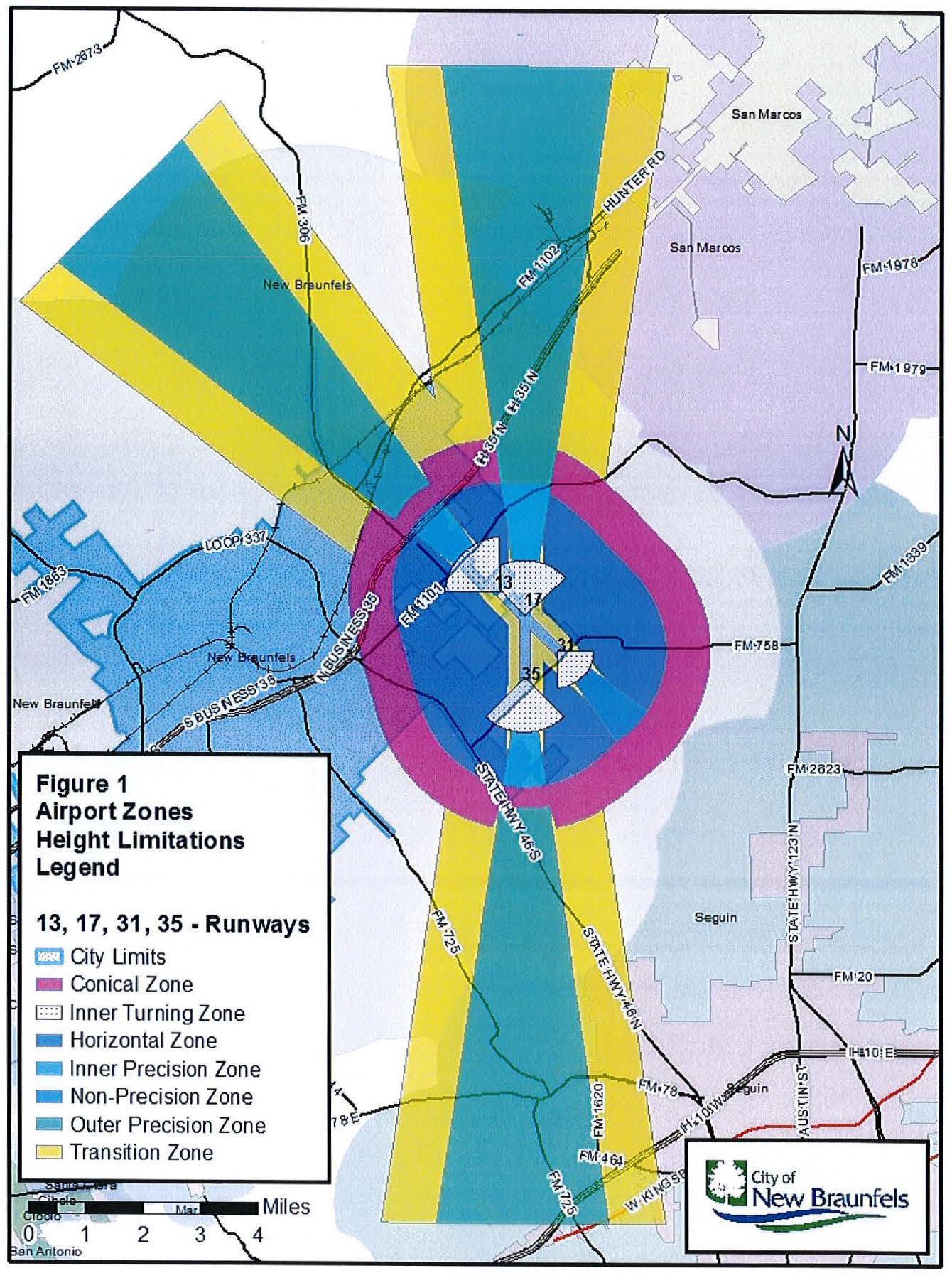
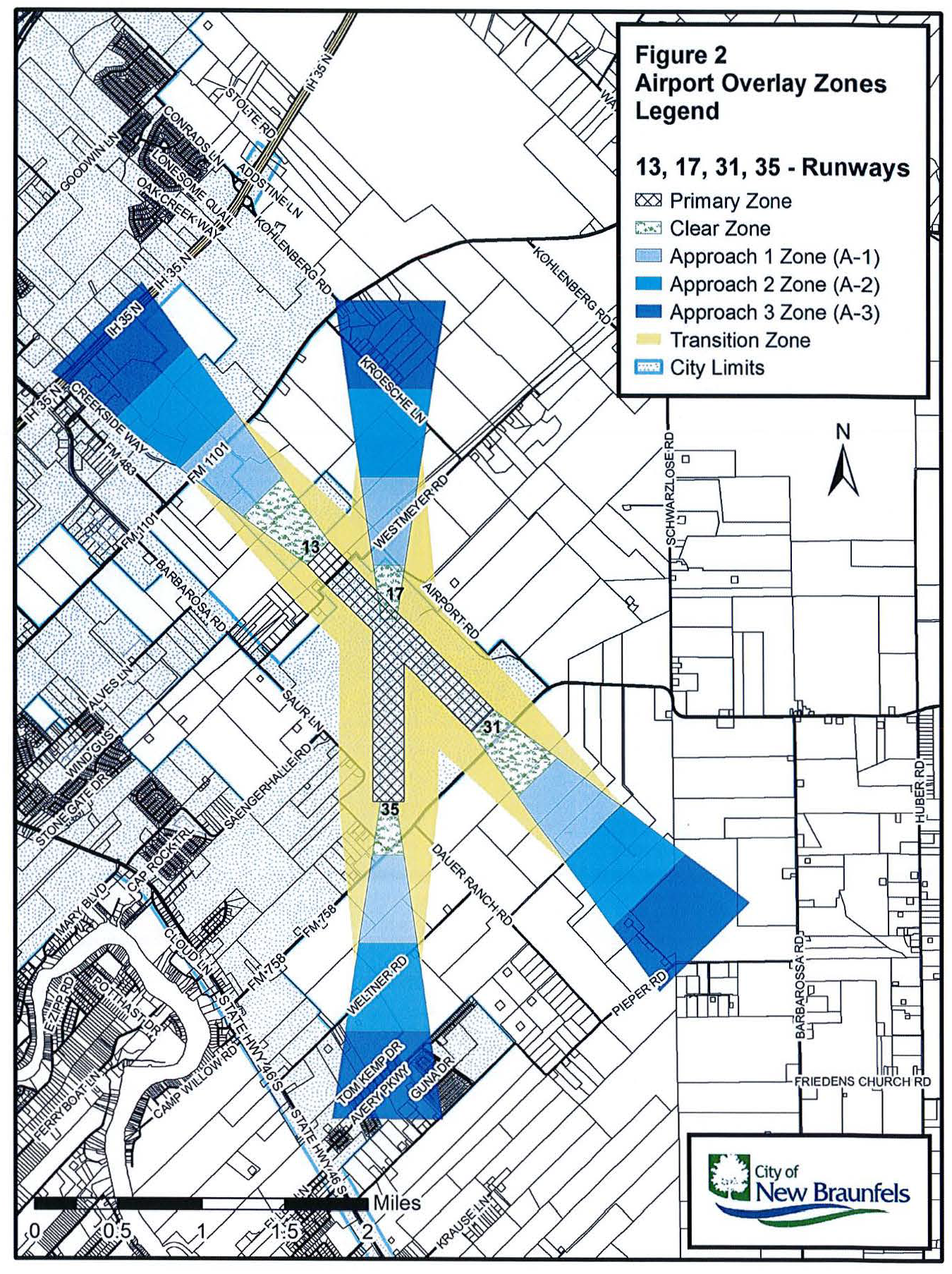
(Ord. No. 2013-24, § 1(Exh. A), 4-22-13; Ord. No. 2018-21, § 2, 3-26-18)
Editor's note— Ord. No. 2013-24, § 1(Exh. A), adopted April 22, 2013, amended section 144-5.20 in its entirety to read as herein set out. Formerly, section 144-5.20 pertained to airport zoning, and derived from Ord. No. 2012-49, § 1(Exh. A), adopted September 10, 2012.
Sec. 144-5.21. - General provisions and exceptions; use, height and area regulations.
5.21-1. General provisions.
(a)
Conformity to regulations. No structure shall be constructed, erected, or moved in or onto any location in the city if such structure does not conform to the sanitary, health and building regulations of such location. This section shall not apply to those temporary buildings used in connection with a construction project, provided that such buildings shall be removed within 30 days after completion of the permanent building being constructed.
(b)
Open storage or display and storage containers.
(1)
No open accessory storage or display of materials and commodities shall be permitted unless the storage or display is set back at least 25 feet from all right-of-way lines and screened on all sides by a solid wall or fence not less than eight feet in height. This shall not apply to automobile or trailer sales lots.
(2)
Mobile storage pod for onsite storage may not be larger than eight feet wide by 16 feet long by eight feet high and may not be placed on a lot for more than 30 days in a one-year period unless the property ownership changes or there is a change in occupancy of a rental unit as per lease agreement.
(3)
Roll-off dumpsters are permitted in residential areas for the temporary storage of construction and demolition debris, prior to disposal. They may be kept on private property for up to three consecutive months per year and they must be placed on the driveway or other hard surface. Roll-off dumpsters must be emptied every two weeks.
(c)
Reserved.
(d)
Sight distance and visibility. To ensure that obstructions do not constitute a driving and pedestrian hazard, a "sight triangle" will be observed at all street intersections, street and alley intersections, and intersections of driveways with streets. Within the "sight triangle," no landscape material, wall, or other obstruction shall be permitted between the height of two and one-half feet and seven feet above the street, alley or driveway elevation. The sight triangle shall consist of the following; or other dimensions having a similar effect when intersections are not 90 degrees.
* Uncontrolled street means a street without a yield, stop, or traffic signal at the intersection.
See the following diagrams:
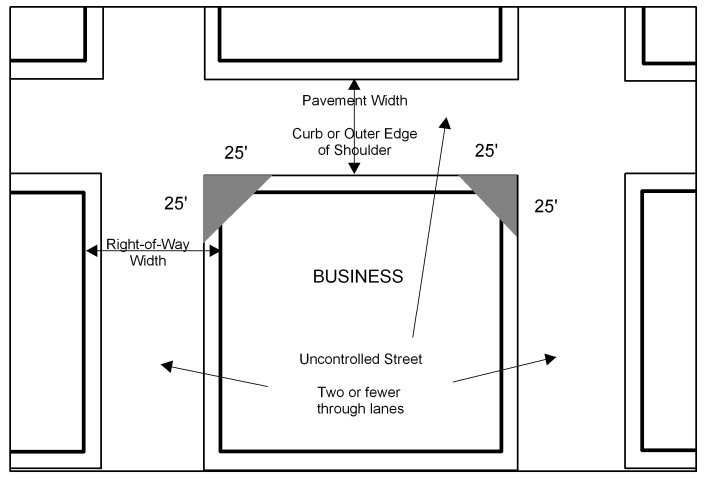
Illustration 14. Sight distance and visibility triangle—Uncontrolled street
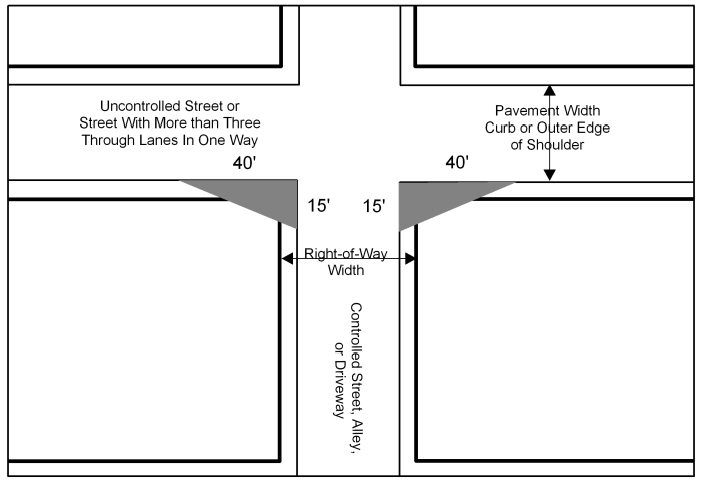
Illustration 15. Sight distance and visibility triangle—Controlled street
5.21-2. Height exceptions.
(a)
The height limits for the various districts shall not apply to church spires, belfries, cupolas or domes not used for human habitation or to chimneys, ventilators, skylights, water tanks, parapet walls, cornices, solar energy systems, or necessary mechanical appurtenances usually located on the roof level, provided that such features are limited to that height necessary for their proper functioning.
(b)
Towers and antennas. The height limitations applicable to buildings and structures shall not apply to towers and antennas. The requirements set forth in section 144-5.7 shall govern the location of towers and antennas that are installed at a height in excess of the height limitations specified for each zoning district.
5.21-3. Yard and setback exceptions.
(a)
Front setback determination. In any zoning district where lots on the same side of the street between two intersecting streets are developed with varying front yard depths and no plat has been filed showing a setback line, the front setback shall be determined by the planning director.
(b)
Official line and measurement. Where an official line has been established for future widening or opening of a street upon which a lot abuts, then the depth or width of such yard shall be measured from such official line to the nearest line of the building.
(c)
Open yard. Every part of a required yard shall be open from its lowest point to the sky unobstructed, except for the ordinary projection of sills, belt courses, cornices, chimneys, buttresses, ornamental features and eaves, provided that none of the above projections shall extend into a required yard more than 24 inches. In residential districts, canopies or open porches having a roof area not exceeding 120 square feet may project a maximum of six feet into the required front or side yard. In zero lot line districts canopies or open porches having a roof area not exceeding 120 square feet may project a maximum of five feet into the required side building setback, except in the case of a corner lot, where the required side yard is adjacent to the street, no encroachment may be allowed.
(d)
Exterior stairway. Any exterior stairway, open or enclosed, may project not more than four feet into a required rear building setback.
(e)
Commercially or industrially zoned lots. No rear building setback shall be required on any lot commercially or industrially zoned, the rear line of which adjoins a railway right-of-way or which has a rear railway tract connection, provided the lot is not utilized for residential purposes.
(f)
Computing the depth of a rear yard. In computing the depth of a rear yard for any building where such yard abuts a dedicated alley or a drainage easement which is open-space and cannot be built upon, one-half of the width of such alley or easement may be assumed to be a portion of the rear yard.
(g)
Private garages on corner lots. On a corner lot, a private garage, when attached to the main building and not exceeding the height of the main building, may extend into the required rear building setback to a point not less than 18 feet from the rear yard lot line, and shall not occupy more than 30 percent of the required rear yard.
(h)
Decreasing rear yard setbacks. In any mobile or manufactured home subdivision in the mobile home zoning district, the rear yard setback requirement may be decreased one foot for every foot the side yard is increased above the minimum; provided that under no circumstances shall the rear yard be less than ten feet. This exception shall apply only to mobile homes and not to site-built residences.
(i)
Interior side yard. In any district, an interior side yard of five feet may be permitted for a one- or two-family dwelling or an addition to a one- or two-family dwelling if the lot on which it is to be built is less than 60 feet wide at the front setback line and the lot was in separate ownership prior to September 25, 1967.
(j)
Screen enclosures. A screen enclosure without a solid roof and made from open mesh screening material, attached or detached to a main structure, shall be located behind the front facade of the main structure, not less than five feet from interior side lot lines and rear lot lines, and shall maintain a minimum 15-foot corner street side setback, or the required corner side street setback for main structures, whichever is greater. No screen enclosure shall exceed the height of the principal structure where it can be seen above the roofline from the street at the front of the lot. Screen enclosures shall be maintained in good repair free of fraying and tears. Repair or replacement of the mesh screen must take place when three or more 12-inch tears/holes, or cumulative equivalent, occurs. Screen enclosures with a solid roof attached to the main structure shall be considered part of the main structure and all main structure setbacks for the respective zoning district shall apply.
5.21-4. Lot width and area exceptions.
(a)
[Where] A lot or parcel has less than the required width or area prescribed for the particular zoning district and the lot or parcel was in separate ownership or platted prior to September 25, 1967, the lot area or width requirement will not prohibit erection of a one-family dwelling.
(b)
Non-habitable residential or commercial lots (e.g. utility infrastructure lots, drainage lots, landscape lots, etc.) are not required to meet the minimal dimensional standards of the zoning ordinance but must provide for adequate access for maintenance of the lot.
5.21-5. Lot area and on-site sewage facilities. Where on-site sewage facilities are used, lot area for duplex, townhouse, multifamily and non-residential uses may be determined by the city sanitarian, but shall not be less than required by the applicable zoning district or state law.
(Ord. No. 2012-49, § 1(Exh. A), 9-10-12; Ord. No. 2013-6, § II, 1-28-13; Ord. No. 2020-42, § 1, 7-27-20; Ord. No. 2021-07, § 8, 2-8-21; Ord. No. 2023-30, § 5, 4-24-23)
Sec. 144-5.22. - Non-residential and multifamily design standards.
5.22-1. Applicability of non-residential design standards. All non-residential and multifamily buildings, with the exception of those described in subsection 144-5.22-2, below, that are adjacent to or front a public roadway, public park or residential district must comply with the standards of this section.
5.22-2. Structures exempt from design standards.
(a)
Industrial uses. Industrial use buildings shall be exempt from the design standards when located in a zoning district that allows industrial use and where adjacent to other properties zoned and/or used for industrial purposes;
(b)
Expansions of existing buildings containing 10,000 square feet or less gross floor area, if the expansion is no more than 40 percent of the existing building area;
(c)
Expansions of existing buildings containing more than 10,000 square feet gross floor area, if the expansion is no more than 20 percent of the existing building area;
(d)
Metal buildings used for industrial uses are not exempt from additional landscape standards as required in subsection 144-5.22-3(e).
(e)
Additional landscaping for metal buildings for industrial uses. All metal industrial buildings shall incorporate the following elements in addition to subsection 144-5.3 of the zoning ordinance:
(1)
A minimum of one tree and four shrubs for every 40 feet (or portion thereof) of building facade that is adjacent to or fronting a public roadway, public park or residential district shall be installed using trees from the approved plant list (zoning ordinance: chapter 144). The above requirements shall be planted within 40 feet of the building facade.
(2)
Trees shall be planted no closer than 20 feet apart.
(3)
In no event may trees other than ornamental trees listed in appendix A of the zoning ordinance be planted under overhead power lines.
(4)
All new trees shall be provided with a permeable surface of 60 square feet per tree under the drip line.
(5)
All planting areas shall be a minimum of five feet in width.
5.22-3. Building mass, articulation and building elements.
(a)
Purpose. In order to provide building articulation and interest in design and human scale to the facade of a building, a variety of building techniques are required. The purpose of this section is to ensure that the front of non-residential and multifamily structures have a variety of offsets, relief, and insets to provide a more interesting facade appearance.
(b)
Applicability. The following articulation standards shall apply to building facades facing a public street.
(c)
Building articulation.
(1)
Horizontal (or depth) articulation.
(i)
Maximum distance between offsets. No building facade shall extend for a distance greater than three times its average height without a perpendicular offset.
(ii)
Minimum depth of offsets. Offset depth shall be a minimum 15 percent of the average building height.
(iii)
Minimum length of offsets. Offset shall extend laterally for a distance equal to at least ten percent of the entire facade.
(iv)
Offset depth variation. Offsets can be of varying depth as long as the minimal standard is satisfied.
(v)
Facade calculation. For calculation purposes, the facade shall be considered the total distance of the building line.
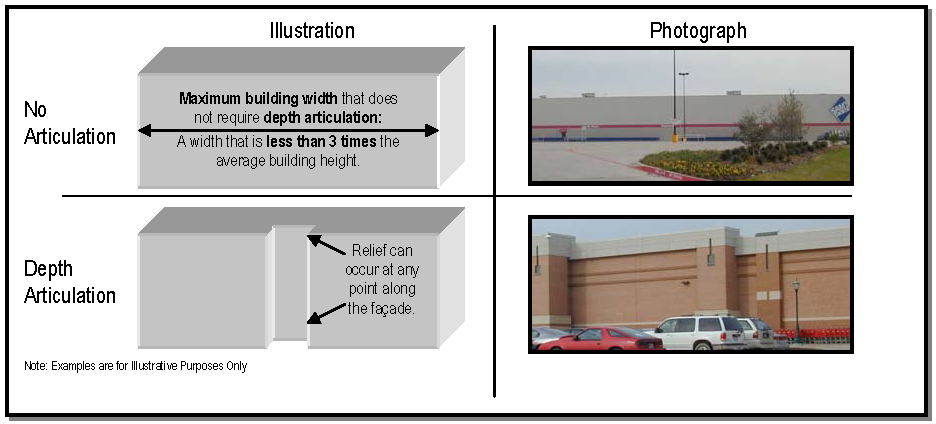
Image 1. Horizontal (or Depth) Articulation Examples
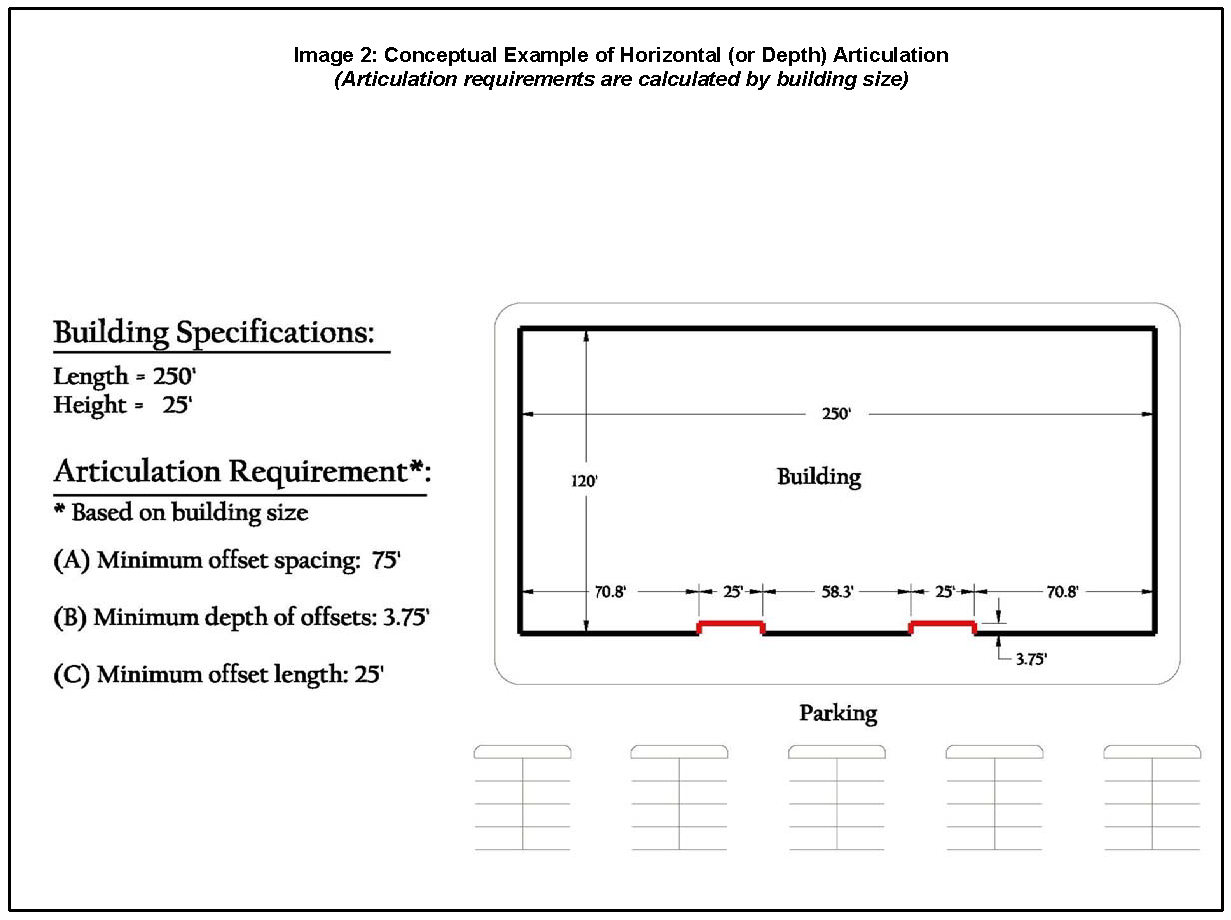
(2)
Vertical (or height) articulation.
(i)
Maximum distance between elevation changes. No wall shall extend horizontally for a distance greater than three times its average height without a change in elevation.
(ii)
Minimum height of elevation changes. An elevation change height shall be a minimum 15 percent of the average building height.
(iii)
Minimum length of elevation changes. An elevation change shall continue to extend laterally for a distance equal to at least ten percent of the entire facade.
(iv)
Elevation change variation. Elevation changes can be of varying heights as long as the minimal standard is satisfied.
(v)
Facade calculation. For calculation purposes, the facade shall be considered the total distance of the building facade.
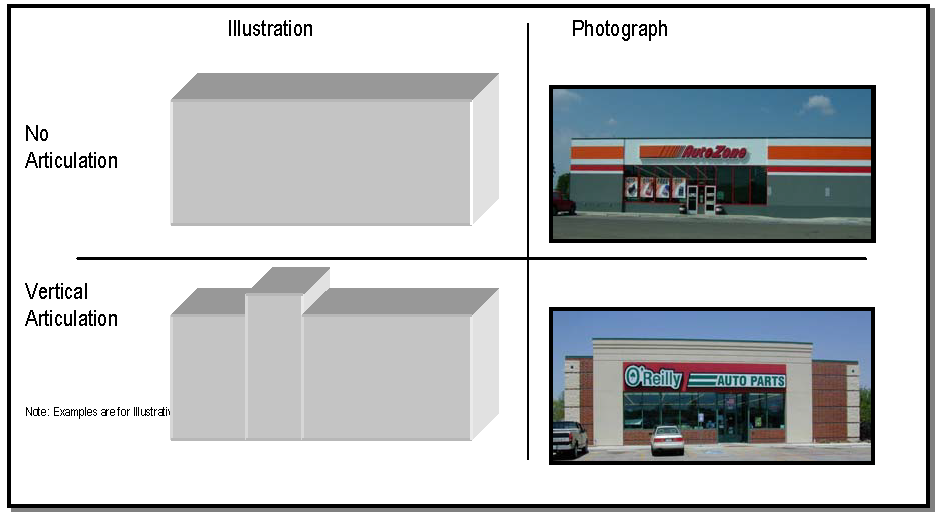
Image 3. Vertical (or Height) Articulation Examples
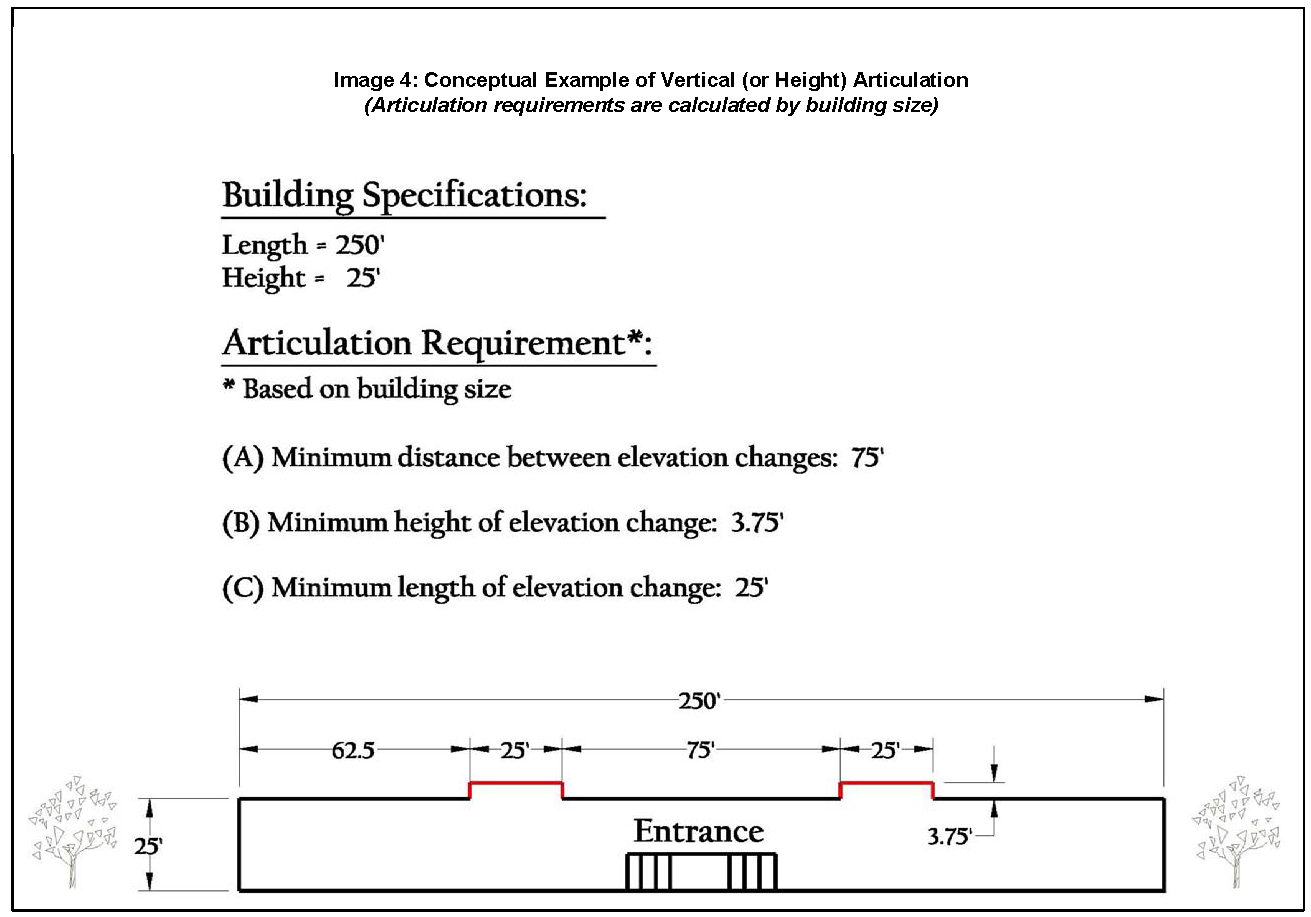
(d)
Building elements. All buildings shall incorporate at least four of the following building elements:
(1)
Lighting features;
(2)
Awnings;
(3)
Canopies;
(4)
Alcoves;
(5)
Windows;
(6)
Recessed entries;
(7)
Ornamental cornices;
(8)
Pillar posts;
(9)
Other building elements that contribute to the human scale of a building.
(e)
Additional landscaping for metal buildings for industrial uses. All metal industrial buildings shall incorporate the following elements in addition to section 144-5.3:
(1)
A minimum of one tree and four shrubs for every 40 feet (or portion thereof) of building facade shall be installed using trees from the approved plant list (subsection 144-5.3-1.). The above requirements shall be planted within 40 feet of the building facade.
(2)
Trees shall be planted no closer than 20 feet apart.
(3)
In no event may trees other than ornamental trees listed in Appendix A of subsection 144-5.3-1 be planted under overhead power lines.
(4)
All new trees shall be provided with a permeable surface of 60 square feet per tree under the drip line.
(5)
All planting areas shall be a minimum of five feet in width.
5.22-4. Exterior building materials. This section, 5.22-4, is suspended until authorized through a change in state law or case law.
Exterior finish requirement. At least 80 percent of the vertical walls of all buildings (excluding doors and windows) to which these standards apply, shall be finished in one or more primary materials. In every instance, the lower four feet of the vertical walls of all buildings must be finished in one or more of the primary materials.
(a)
Primary materials.
(1)
Brick, stone, cast stone, rock, marble, granite;
(2)
Glass block, tile;
(3)
Stucco or plaster;
(4)
Glass with less than 20 percent reflectance (however, only a maximum of 50 percent of a building may be constructed in glass);
(5)
Split-face concrete block, poured-in-place concrete, and tilt-wall concrete. Any use of concrete products shall have an integrated color and be textured or patterned. Tilt-wall concrete structures shall include reveals, punch-outs, or other similar surface characteristics to enhance the facade on at least ten percent of each facade.
(6)
Fiber cement, such as James Hardie brand products or equivalent.
(b)
Masonry. In every instance, the lower four feet of the vertical walls of all buildings must be finished in one or more of the primary materials noted in subsection (a)(1) or (a)(5) above.
(c)
Secondary materials. The remaining 20 percent of the exterior finish is discretionary and may include, but is not limited to, Exterior Insulation and Finish System (EIFS), wood, metal (including stamped, embossed, or coated panels) or other non-reflective materials.
(d)
Additions to existing structures with vertical walls made of wood, including shingles and siding, may utilize wood in an amount consistent with the percentage of wood on the original structure.
5.22-5. Consistent facade standard.
(a)
The reference to building materials in this subsection, 5.22-5(a), is suspended until authorized through a change in state law or case law. All facades or sides of a building shall be designed with architectural style and building materials consistent with the front facade.
(b)
Side or rear facing facades, not on a public roadway, are not required to meet the articulation standards in section 144-5.22-3.
5.22-6. Roof treatments.
(a)
Parapets shall be used to conceal roof top equipment on flat roofs. If a sight line drawing is provided with the site plan showing that all roof top equipment will not be visible from the public right-of-way or adjacent property, then a parapet wall shall not be required.
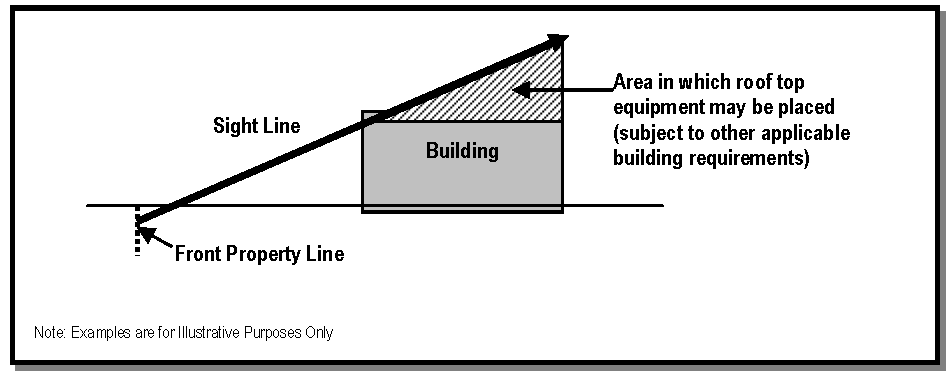
Image 5. Sight Line Example
(b)
Where overhanging eaves are used, overhangs may be no less than two feet beyond the supporting walls.
(c)
This subsection, 5.22-6(c), is suspended until authorized through a change in state or case law. Any roof using shingles shall use dimensional shingles (shingles that have a shadow at the top exposure to give added depth and definition).
(d)
Red tile roofs. Red tile roofs are not considered shingles for the purpose of the section.
5.22-7. Roof types. The following types of roofs are prohibited:
(a)
Mansard roofs and canopies without a minimum vertical distance of eight feet and at an angle not less than 25 degrees, and not greater than 70 degrees;
(b)
Back-lit awnings used as a mansard or canopy roof.
5.22-8. Entryways/customer entrance treatments and pedestrian routes.
(a)
Any front entry shall be set back from the drive a minimum distance of 15 feet.
(b)
Single-use or multi-tenant buildings over 60,000 square feet in size must provide clearly defined, highly visible customer entrances that include an outdoor patio area, at least 200 square feet in area, that incorporates the following:
(1)
Benches or other seating components;
(2)
Decorative landscape planters or wing walls that incorporate landscaped areas;
(3)
Structural or vegetative shading; and
(4)
Pedestrian routes between parking areas and buildings.
5.22-9. Applications procedures. The above standards shall be required to be shown on a site plan that is part of a building permit application. Facade elevation drawings shall also be required.
5.22-10. Appeal procedures.
(a)
Enforcement of this section may be appealed to the planning commission.
(b)
Appeal procedures.
(1)
Any appeal shall be submitted by the applicant within 30 days of the denial.
(2)
An appeal must be made in writing on an application form available in the planning and development services department and shall be accompanied by an application fee per appendix D of this Code.
(3)
The appeal shall be scheduled for consideration on the next available agenda of the planning commission.
(4)
The planning commission shall review the appeal and shall approve, approve subject to certain conditions, or disapprove the appeal.
(5)
The planning commission shall determine final approval or disapproval of all appeals.
(Ord. No. 2012-49, § 1(Exh. A), 9-10-12; Ord No. 2017-06, § 3, 1-9-17; Ord. No. 2018-21, § 2, 3-26-18; Ord. No. 2020-05, § 4, 1-27-20; Ord. No. 2021-91, § 2, 12-13-21)
Sec. 144-5.23. - Temporary vending operations.
5.23-1. Applicability. The following rules for temporary vending operations do not alleviate such operations or uses from also adhering to other applicable municipal, state, or federal rules and regulations.
(a)
Temporary vending operations are allowed in all non-residential districts. Anyone wishing to temporarily peddle, solicit, or vend from private property may do so as long as all applicable codes and ordinances of the city are met, and a temporary vending operation permit is issued by the city.
(b)
No permanent foundation may be placed or constructed for a temporary vending operation. All structures (including but not limited to booths, vehicles, trailers and any ancillary equipment and furnishings such as generators, tables and decks) employed for temporary vending operations must be removed from the subject property at the end of the permitted period.
(c)
This section does not apply to:
(1)
Individual food trucks (mobile food units) or other food-related temporary uses. Mobile food units are governed by chapter 62.
(2)
Mobile food courts; see § 5.26.
(3)
Special events; see chapter 91.
(4)
Farmer's markets.
5.23-2. Permit and fee.
(a)
An application processing fee per appendix D of the City's Code of Ordinances is required for each temporary vending operation permit application. No fee is required for applications with non-profit status; proof of tax-exemption from the IRS is required.
(b)
Temporary vending operation permits are not transferable. A permit at any location is valid for one temporary vending operation regardless of any sale, lease, name change or any ownership transfer of the temporary vending operation.
5.23-3. Temporary/Time. A temporary vending operation permit is valid for a period not to exceed 90 consecutive days. After the permit has expired, the temporary vending operation shall leave the property, parcel, lot or address where the vending has occurred for a minimum of 30 consecutive days after which time the temporary vending operation may return to the same location with approval of a new permit. Temporary vending operations exceeding the term of the permit shall void their temporary status and shall come into compliance with all permanent structure and use regulations.
5.23-4. Location.
(a)
All vending activities must occur on private property. There can be no such activity on vacant, unimproved property.
(b)
No activity, parking, or signage may be located on public property or street right-of-way.
(c)
Building setbacks do not apply to temporary vending operations except that sight distance triangles at intersections of streets and driveways shall be maintained in accordance with § 5.21-1 (d).
(d)
Temporary vending operations shall not impede traffic nor visually impair any motorist or pedestrian within a parking lot, driveway, street, sidewalk, bike path, or trail.
5.23-5. Refuse. A sufficient quantity of garbage receptacles shall be provided and maintained so that permitted sites are kept clean of all debris, trash, and litter at all times. Trash generated on site is not allowed to blow or spill onto abutting or surrounding sites or onto the public right-of-way.
5.23-6. Noises. No temporary vending operation shall use a sound device, including but not limited to a bell, horn, whistle, or voice (amplified or not) to attract attention. Temporary vending operations and all associated mechanical equipment shall comply with the city's noise provisions in chapter 82.
5.23-7. Lighting. All lighting associated with a temporary vending operation shall comply with the lighting requirements in this chapter as well as chapter 82.
5.23-8. Codes and ordinances. The existing property, uses, and temporary vending operation must be and remain in compliance with all applicable codes and ordinances.
5.23-9. Restroom facilities. No portable restrooms may be erected or used.
5.23-10. Utilities. No permanent water, sewer, electric, fuel, or phone facilities may be connected to the vending operation. Connections must have a quick disconnect. Any use of extension cords must be no longer than 50 feet, including multiple cords. A maximum of two cords may be utilized. Extension cords crossing areas of traffic (vehicular, pedestrian, etc.) must be encased in a cable protector rated for the specific traffic. Documentation of this rating must be provided.
5.23-11. Maximum number of vendors. An existing non-residential property may have a maximum number of two permitted temporary vending operations at any one time.
5.23-12. Storage of inventory. All storage must be within a building or container.
5.23-13. Signage. All temporary vending operations must comply with chapter 106, Signs. Sandwich boards, banners attached to a building or vending structure, and pennants are allowed. No banners may be utilized which stand independently utilizing stakes, t-posts, or otherwise attached to the ground.
5.23-14. Application procedures. An application shall be submitted to the city for review and decision in accordance with this section.
5.23-15. Application elements.
(a)
A temporary vending operation shall provide with the application a letter and drawing from the owner of the property stating:
(1)
The name and home address of the temporary vending operation;
(2)
The purpose of the temporary vending operation (for example, "sell Christmas light decorations");
(3)
The dates and times of the temporary vending operation;
(4)
A site plan showing the location on the property where the temporary vending operation will take place, along with any external structures (decks, stairs, etc.);
(5)
Miscellaneous information necessary to determine the compliance of the property, improvements, and vendor operations with city applicable codes and ordinances.
(b)
The temporary vending operation shall provide with the application a copy of a state sales tax certificate issued for the proposed temporary vending operation if the vended items are taxable.
(c)
The permit must be visibly posted on all temporary vending operations with the expiration date.
5.23-16. Penalties.
(a)
Permits may be revoked by the city for any of the following causes:
(1)
Fraud, misrepresentation, or a false statement contained in the application for the permit;
(2)
Fraud, misrepresentation, or a false statement made in the course of conducting business;
(3)
Any violation of any city code or ordinance that has not been brought into compliance within 24 hours of notification.
(4)
Conviction of any crime or misdemeanor involving moral turpitude;
(5)
Conducting the business in an unlawful manner so as to constitute a breach of the peace or a menace to the health, safety, or general welfare of the public.
(b)
If a temporary vending operation has violated this or any other applicable part of the City's Municipal Code while conducting business with a permit issued under this section, the business owner shall be penalized as follows:
(1)
The first offense shall result in a warning and the operator shall bring the temporary vending operation into compliance within 24 hours or the permit shall be revoked. $500.00 for each offense per day.
(2)
The second offense shall result in the operation having the permit revoked immediately and the temporary vending operation shall be prohibited from obtaining a permit under this section for one year from the date of the offense. $1,000.00 for each offense per day.
(3)
The third offense shall result in the operation having the permit revoked immediately and the temporary vending operation shall be prohibited from obtaining a permit under this section indefinitely. $2,000.00 for each offense per day.
(c)
If a host business has violated this or any other applicable part of the City Code while allowing temporary vending operations to be conducted with or without a permit issued under this section, the business owner shall be penalized as follows:
(1)
The first offense shall result in a warning and the host shall correct the violation within 24 hours or the permit shall be revoked. $500.00 for each offense per day.
(2)
The second offense shall result in the operation having the permits of all the host's temporary vending operations revoked immediately and the host shall be prohibited from hosting temporary vending operations for one year from the date of the offense. $1,000.00 for each offense per day.
(3)
The third offense shall result in the operation having the permits of all the host's temporary vending operations revoked immediately and the host shall be prohibited from hosting temporary vending operations indefinitely. $2,000.00 for each offense per day.
5.23-17. Appeal procedures.
Enforcement of this section may be appealed to the board of adjustment in accordance with section 144-2.2 of this chapter.
(Ord. No. 2012-49, § 1(Exh. A), 9-10-12; Ord. No. 2016-38, § 1, 7-11-16; Ord. No. 2017-12, § 1, 1-23-17; Ord. No. 2017-77, § 4, 10-23-17; Ord. No. 2018-21, § 2, 3-26-18; Ord. No. 2021-91, § 3, 12-13-21; Ord. No. 2023-06, § 10, 2-27-23; Ord. No. 2024-74, § 2, 9-9-24)
Sec. 144-5.24. - Temporary mobile storage units.
5.24-1. Applicability. A property owner or lessor may place a temporary mobile storage unit on a property used for non residential purposes as long as a permit is issued.
5.24-2. Permit and fee. An application processing fee per appendix D of this Code is required for each application to place a temporary mobile storage unit.
5.24-3. Time. The temporary storage unit permit is valid for a period not to exceed 180 days in the same location. The temporary storage unit permit can be renewed for one additional 90-day period by approval of a special exception by the zoning board of adjustment pursuant to subsection 144-2.2-4(b). A new temporary storage unit permit cannot be approved on the same property within 30 days of expiration of the first.
5.24-4. Parking. Parking allocated to meet the minimum parking requirements of the primary business shall not be utilized for placement of the temporary storage unit.
5.24-5. Location. All temporary mobile storage units may only be placed in non-residential zoning districts.
(a)
Units must be placed behind the main structure on a paved surface. Or, units may be placed on construction sites if the unit is being utilized by the builders or contractors as part of the active and properly permitted construction project.
(b)
No units may be placed on public property, drainage ways, the floodway, street right-of-way or within the clear vision area of a street or driveway intersection.
5.24-6. Screening. Any temporary structure that can be seen from any adjoining residential use or zoning district that allows a residential use must be screened from view through the placement of a six- to eight-foot tall solid screening fence.
5.24-7. Setbacks. All temporary storage units must be placed a minimum of ten feet from the primary business. All units must be located a minimum of 100 feet from flammable combustible liquid or fuel storage and dispensing structures.
5.24-8. Codes and ordinances. The existing property and uses must be and remain in compliance with all applicable codes and ordinances.
5.24-9. Utilities. No permanent water, sewer, electric, fuel, or phone facilities may be connected to the temporary storage unit. Extension cords must meet the adopted electrical code requirements and may not cross an area of vehicular traffic.
5.24-10. Maximum number of temporary storage units. An existing non-residential property may have a maximum number of one unit.
5.24-11. Signage. No signage of any type may be attached to the storage unit, except for any manufacturer's/owner's signage that is permanently affixed to the unit.
5.24-12. Application procedures and elements. An application shall be submitted to the planning and development services department for review and decision. The application shall include:
(a)
The number, size, and company providing the temporary storage containers.
(b)
The expected date of placement and date of removal of the containers.
(c)
A site plan showing the placement of each container and distances from property lines and buildings. The site plan shall include the location of fencing or other screening as required in subsection 144-5.22-2.
5.24-13. Penalties.
(a)
Permits may be revoked by the director of planning, chief of police, neighborhood services manager, building official, fire marshal, or other city authority for any of the following causes:
(1)
Fraud, misrepresentation, or a false statement contained in the application for the permit;
(2)
Fraud, misrepresentation, or a false statement made in the course of conducting business;
(3)
Any violation of any city code or ordinance that has not been brought into compliance within 24 hours of notification.
(4)
Conducting the business in an unlawful manner so as to constitute a breach of the peace or a menace to the health, safety, or general welfare of the public.
(b)
If a business has violated this or any other applicable part of the City Code while conducting business with a permit issued under this section, the business owner shall be penalized as follows:
(1)
The first offense shall result in a warning and the operation shall bring the business into compliance within 24 hours or the permit shall be revoked. $500.00 for each offense per day.
(2)
The second offense shall result in the operation having the permit revoked immediately and the vendor shall be prohibited from obtaining a permit under this section for one year from the date of the offense. $1,000.00 for each offense per day.
(3)
The third offense shall result in the operation having the permit revoked immediately and the vendor shall be prohibited from obtaining a permit under this section indefinitely. $2,000.00 for each offense per day.
5.24-14. Temporary storage pods.
(a)
Storage pods that are no more than eight feet in width, eight feet in height, and 16 feet in length may be placed on residential or non-residential properties for a maximum of 60 days to accommodate relocations, remodels, change in occupancy, or similar activity.
(b)
Storage pods must be placed on a paved surface or in the driveway.
(c)
Storage pods must comply with the clear vision area at street and driveway intersections.
(d)
Storage pods may not be placed within the floodway.
(e)
If the property's topography or configuration makes placing the storage pod on it impossible, the storage pod may be placed in the right-of-way against the curb, the same as parking an automobile. The same time limits, clear vision limitations, and no-parking zones apply.
(f)
A permit is not required for temporary storage pods.
5.24-15. Appeal procedures.
(a)
Enforcement of this section may be appealed to the board of adjustment.
(b)
Appeal actions.
(1)
Any appeal shall be submitted by the applicant within 30 days of the denial.
(2)
The appeal shall be scheduled for consideration on the next available agenda of the board of adjustment.
(3)
The board of adjustment shall review the appeal and shall approve, approve subject to certain conditions, or disapprove the appeal.
(4)
The board of adjustment shall determine final approval or disapproval of all appeals.
(Ord. No. 2012-49, § 1(Exh. A), 9-10-12; Ord. No. 2018-21, § 2, 3-26-18; Ord. No. 2021-91, § 4, 12-13-21; Ord. No. 2023-06, § 11, 2-27-23; Ord. No. 2023-91, § 3, 12-11-23)
Sec. 144-5.25. - Heliports and helistops.
5.25-1. Applicability. Heliports and helistops shall conform to all FAA rules governing such uses.
5.25-2. Permit and fee. An application processing fee per appendix D of this Code is required for each application to operate a heliport or helistop in the appropriate zoning district and according to FAA and other regulations.
5.25-3. Parking. A heliport/helistop must not take up existing parking spaces allocated to another use. Parking spaces must be available for the heliport/helistop use.
5.25-4. Location. No heliport or helistop shall be located within 1,000 feet from a residential zoning district or a public or private school or within 500 feet from a park. Helistops for emergency use may be within 500 feet of a residential zoning district, school, or park. Temporary landing sites may be permitted through a special use permit.
5.25-5. Setbacks from property lines. 100 feet for takeoff and landing area; 25 feet for helicopter maintenance facilities; 15 feet for administration and operations building.
5.25-6. Approach and departure paths. Heliports and helistops shall establish and utilize approach and departure routes over non residential uses to the maximum extent possible.
5.25-7. Codes and ordinances. The existing property and uses must be and remain in compliance with all applicable codes and ordinances.
5.25-8. Landing/takeoff area. Shall be of a paved surface and free of gravel, dirt, dust, structures, and debris.
5.25-9. Signage. A sign advertising a commercial operation may be provided following the city's sign ordinance.
5.25-10. Lighting. All lighting shall be directed away from adjacent properties and public rights-of-way.
5.25-11. Minimum separation. Minimum separation between all heliports and helistops shall be one and one-half miles, except for helistops used for emergency use.
5.25-12. Hospital helistop. Helistops for emergency use shall have a standard landing area with the words "emergency only". Helistops shall be limited to touchdown and liftoff only, and shall have no maintenance, storage, or refueling facilities. Helistops may be located at ground level or rooftop and shall be paved and maintained.
5.25-13. Application procedures. An application shall be submitted to the planning department for review and decision. The following items shall be included in an application submission:
(a)
A site plan which includes existing and proposed structures and trees.
(b)
A land use map showing the current land uses and zonings within a one-mile area of the takeoff and landing area must be provided that clearly shows the proposed flight path.
(c)
A description of the proposed operations, type and size of helicopters expected to use the facilities, and projected number and timing of daily flights. Commercial operations must provide hours of operation, if applicable. Hours shall be approved based on use.
(d)
A noise study showing existing day/night average noise levels in decibels (LDN contours) and future day/night average after operation begins. The study must also provide single event maximum sounds levels expected from certain types of helicopters that may utilize the facility.
The planning director shall have the authority to make decisions concerning the site plan and other information provided during the consideration of a heliport/helistop permit.
5.25-14. Penalties.
(a)
Permits may be revoked by the director of planning, chief of police, health department, or other city authority for any of the following causes:
(1)
Fraud, misrepresentation, or a false statement contained in the application for the license;
(2)
Fraud, misrepresentation, or a false statement made in the course of conducting business;
(3)
Any violation of any city code or ordinance that has not been brought into compliance within 24 hours of notification.
(4)
Conviction of any crime or misdemeanor involving moral turpitude;
(5)
Conducting the business in an unlawful manner so as to constitute a breach of the peace or a menace to the health, safety, or general welfare of the public.
(b)
If a business has violated this or any other applicable part of the City Code while conducting business with a permit issued under this section, the business owner shall be penalized as follows:
(1)
The first offense shall result in a warning and the operation shall bring the business into compliance within 24 hours or the permit shall be revoked. $500.00 for each offense per day.
(2)
The second offense shall result in the operation having the permit revoked immediately and the vendor shall be prohibited from obtaining a permit under this section for one year from the date of the offense. $1,000.00 for each offense per day.
(3)
The third offense shall result in the operation having the permit revoked immediately and the vendor shall be prohibited from obtaining a permit under this section indefinitely. $2,000.00 for each offense per day.
5.25-15. Appeal procedures.
(a)
Enforcement of this section may be appealed to the city council.
(b)
Appeal actions.
(1)
All appeal actions for a site plan application denied by the planning director or his/her designee shall be submitted to and reviewed by the city council, if requested by the applicant.
(2)
The appeal shall be scheduled for consideration of the site plan on the regular agenda of the council within 30 days after the submission is received, or, in the case of an incomplete submission, 30 days after the submission is deemed complete.
(3)
The council shall review the site plan and shall recommend approval, approval subject to certain conditions, or disapproval of the concept plan or site plan.
(4)
The city council shall determine final approval or disapproval of all site plan appeals.
(Ord. No. 2012-49, § 1(Exh. A), 9-10-12; Ord. No. 2018-21, § 2, 3-26-18)
Sec. 144-5.26. - Mobile food courts.
5.26-1. Purpose. Establish development and operational standards for outdoor food venues so as to minimize potential negative impacts on surrounding property while enhancing additional dining experiences within the community.
5.26-2. Location.
(a)
Mobile food courts are allowed in those zoning districts allowing restaurants.
(b)
All activity, signage and advertisement must occur on private property outside of the public right-of-way unless the city has executed a license agreement authorizing such activity.
(c)
Mobile food units shall be allowed to change out daily.
5.26-3. Site development standards.
(a)
No more than ten individual mobile food units are permitted per mobile food court site.
(b)
All setback requirements in the underlying zoning district shall be adhered to. No mobile food unit, structures associated with the mobile food court, nor any associated seating areas shall be located in a required zoning setback, buffer yard, access easement, drainage easement, floodplain, floodway, driveway, utility easement and/or fire lane(s). Sight distance triangles at intersections of streets and driveways shall be maintained in accordance with section 5.21-1(d).
(c)
There shall be at least ten feet of clearance between all individual mobile food units and all permanent, accessory or non-accessory structures.
(d)
Each mobile food unit shall be located on asphalt, concrete, pavers or an all-weather surface pad as approved by the building official or the city engineer.
(e)
Vehicular drive-through service of food and/or beverages shall not be permitted unless it is allowed in the underlying zoning district. Compliance with additional drive-through requirements as specified within the City's Code of Ordinances is required.
(f)
All mobile food court related activity, such as seating or recreation, must occur on site.
(g)
All mobile food units and related activities must be located in compliance with the city's adopted fire code standards regarding the storage or dispensing of flammable combustible liquid or gas.
(h)
Mobile food courts shall not impede traffic nor visually impair any motorist or pedestrian within a parking lot, driveway, street, sidewalk, bike path, or trail.
(i)
A fire lane shall be provided within a mobile food court as required in the city's adopted fire code.
(j)
All lighting associated with a mobile food court shall comply with the lighting requirements of this chapter as well as chapter 82.
(k)
Accessible restroom facilities shall be provided within a permanent structure in accordance with adopted building and plumbing codes. No portable restrooms may be erected or used.
(l)
Electrical service may be provided to the mobile food units by permanent permitted connections provided by an electric utility, a permitted temporary electrical connection, or on-board generators. The use of on-board generators shall require sound absorbing devices used to contain or deflect noise from any external generator.
(m)
Refuse.
(1)
A sufficient quantity of garbage receptacles shall be provided and maintained so the mobile food court is kept clean of trash, debris and litter at all times.
(2)
Trash generated on site is not allowed to blow or spill onto abutting or surrounding sites or onto the public right-of-way.
(3)
The garbage receptacles shall be maintained in compliance with the Texas Food Establishment Rules.
(4)
Mobile food courts shall comply with all solid waste and refuse requirements of the City's Code of Ordinances.
(n)
Above-ground grease traps are not allowed at mobile food courts.
5.26-4. Performance standards.
(a)
The visual and structural integrity of each mobile food unit must be maintained continuously.
(b)
No outside sound amplifying equipment or noisemakers, such as bells, horns, or whistles shall be allowed. Mobile food courts and all associated activity and mechanical equipment including any generators shall comply with the city's noise provisions in chapter 82.
(c)
All signage shall be on private property and not in the right-of-way, and shall comply with chapter 106, signs.
(1)
For the purposes of on-premises signs, a mobile food court shall be allowed the following:
(i)
Freestanding sign(s) allowed in the underlying zoning district to identify the name of the mobile food court in compliance with chapter 106.
(ii)
One sandwich board per mobile food unit that must be placed within ten feet of the mobile food unit.
(iii)
Signs attached to the exterior of the mobile food unit, excluding roof signs, shall be considered wall signage and exempt from permitting.
(2)
Prohibited signs.
(i)
Temporary signs, including banners.
(ii)
Off-premises signs.
(iii)
Digital display signs.
(d)
Any off-street parking provided shall be constructed in accordance with section 5.1 of this chapter.
5.26-5. Permit required and procedures.
(a)
A commercial permit for a mobile food court shall be required to ensure conformance with the provisions of this section and all other applicable adopted city codes and ordinances.
(b)
The commercial permit application shall include, but not be limited to, plans drawn to scale showing the location, dimensions, and specifications of proposed and required facilities as indicated in this section. Additional information to assist in determining compliance with adopted codes and ordinances may be required.
(1)
As part of the commercial permit process all plans for site work, installation, construction, utility connection, and signs must be reviewed by the building safety division, health and food safety division, planning division, fire marshal's office, and other divisions and departments as applicable for compliance with adopted codes and ordinances.
(2)
Mobile food courts and individual mobile food units shall be registered, inspected, and additionally permitted by the city's health and food safety division in accordance with chapter 62.
(3)
All permit applications shall include the corresponding fee(s) as indicated in appendix D of the City's Code of Ordinances.
5.26-6. Conflict. Where there is conflict between the code adopted in this section and any city, state, or federal law, the more restrictive requirements shall govern unless the less restrictive requirements are preemptive under state or federal law.
(Ord. No. 2013-40, § 2, 7-22-13; Ord. No. 2018-21, § 2, 3-26-18; Ord. No. 2024-74, § 3, 9-9-24)
Sec. 144-5.27. - Bulk storage.
5.27-1. Applicability. Bulk storage of fuel and flammable liquids is as defined in subsection 144-1.3.
5.27-2. Retail sales. Pursuant to V.T.C.A., Health and Safety Code ch. 753, flammable liquids may not be stored at a retail service station in a tank that has a gross capacity of more than 60 gallons above the surface of the ground. The individual or combined capacity or size of an underground flammable liquid tank at a retail service station may not be limited, however other state and local regulations concerning the location and construction of underground storage of flammable liquids or fuels still governs.
(Ord. No. 2019-01, § 1, 1-14-19)
Sec. 144-5.28. - Truck stops.
5.28-1. Purpose. This section is intended to establish development and operational standards for truck stops to minimize potential negative impacts on surrounding property.
5.28-2. Reserved.
5.28-3. Additional requirements.
(a)
Special use permit.
1.
No truck stop shall be developed without approval of a special use permit. A special use permit, as defined in section 144-1.4 of this chapter, is required in all zoning districts. A Type 2 special use permit is required. The process for requesting consideration of a special use permit is outlined in section 144-3.6 of this chapter.
2.
In addition to the required documents to be submitted within the special use permit application:
i.
A completed traffic impact analysis is required to be submitted for consideration of a special use permit application for a truck stop.
ii.
A feasibility study indicating the anticipated demand for truck fueling and overnight parking is required to be submitted for consideration of a special use permit application.
3.
Truck stops must comply with the supplemental standards set forth in subsection 144-5.28-3(b).
(b)
Development standards.
1.
Property improved with truck stop facilities must maintain a minimum setback of 300 feet measured from any property line to the property line of property used or zoned for a residential use including single-family, two-family, multifamily or a manufactured home park use.
2.
Buffering.
i.
A truck stop is not eligible for a residential buffer wall exemption adjacent land used or zoned for single-family and two-family development.
ii.
The masonry wall requirement in subsection 144-5.3-2(h) is required adjacent all residential development, including multifamily and manufactured home park.
iii.
In addition to the masonry wall requirement in subsection 144-5.3-2(h), the following landscape materials are required in lieu of other residential landscape buffer standards.
1.
A minimum of one shade tree, three inches in caliper, per 15 linear feet of the property line shared with the residential property is required and trees must be planted evenly spaced. The trees shall be any of the shade species described in Appendix A.
2.
A minimum of one 24-inch-tall shrub for every five linear feet of the property line shared with the residential property is required and shrub plantings must be evenly spaced. The shrubs shall be any of the shrub species described in Appendix A.
3.
Idling.
i.
Overnight truck idling is prohibited within the city limits. No person shall allow the primary propulsion engine of a motor vehicle to idle for more than ten consecutive minutes when the motor vehicle is not in motion.
ii.
If a truck stop is to provide overnight parking facilities, signage indicating overnight idling is prohibited must be submitted at the time of building permit for approval.
1.
Signage must be located at the entrance of overnight parking lots in a visible manner to truck drivers.
iii.
Affirmative defenses. The following constitute affirmative defenses to prosecution under this division:
1.
A motor vehicle that has a gross vehicle weight rating of 19,500 pounds or less;
2.
The primary propulsion engine of a motor vehicle being used to provide air conditioning or heating necessary for employee health or safety in an armored vehicle while the employee remains inside the vehicle to guard the contents or while the vehicle is being loaded or unloaded;
3.
A motor vehicle forced to remain motionless because of traffic conditions over which the operator has no control;
4.
A motor vehicle being used by the United States military, national guard, or reserve forces, or as an emergency or law enforcement motor vehicle;
5.
The primary propulsion engine of a motor vehicle providing a power source necessary for maintaining cargo climate control where truck stop electrification technologies are not provided for motor vehicles.
6.
The primary propulsion engine of a motor vehicle being operated for minor maintenance or diagnostic purposes;
7.
The primary propulsion engine of a motor vehicle being operated solely to defrost a windshield;
8.
The primary propulsion engine of a motor vehicle that is being used for commercial or public passenger transportation, or passenger transit operations, in which case idling up to a maximum of 30 minutes is allowed;
9.
The primary propulsion engine of a motor vehicle being used to perform an essential job function related to roadway construction or maintenance;
iv.
For any violation of this article, the person seeking to establish a. affirmative defense shall have the burden of proving by a preponderance of the evidence that an event that would otherwise be a violation of this Section was caused by one of the affirmative defenses listed in this section.
v.
Overnight truck idling may only be authorized within a special use permit. The following may be considered as a condition of approval for overnight truck idling:
1.
Vehicles with a gross vehicle weight rating greater than 19,500 pounds that idle overnight must be equipped with a 2008 or subsequent model year heavy-duty diesel engine or liquefied or compressed natural gas engine that has been certified by the United States Environmental Protection Agency or another state environmental agency to emit no more than 30 grams of nitrogen oxides emissions per hour when idling.
4.
Property within 300 feet of water as defined in the Texas Water Code may not be used for a truck stop.
5.
Truck stops shall not be allowed over an aquifer recharge zone or contributing zone.
(Ord. No. 2020-78, § 3, 12-14-20)
Editor's note— Ord. No. 2020-78, § 3, adopted December 14, 2020, enacted provisions intended for use as section 144-5.27. Inasmuch as there are already provisions so designated, and at the discretion of the editor, said provisions have been redesignated as section 144-5.28.
Sec. 144-5.29. - Cemetery application.
5.29-1. Applicability. An individual, corporation, partnership, firm, trust, or association may file a written application to establish or use a cemetery located within the city limits.
5.29-2. Use. The development or the use of a cemetery within the boundaries of the city are subject to all laws of the state and ordinances and regulations of the city, including but not limited to the City's Code of Ordinances.
5.29-3. Location.
(a)
Must be an allowed use within the zoning district.
(b)
Must be located so that patient rooms located within a hospital, psychiatric hospital or a crisis stabilization unit don't have a view of the cemetery.
(c)
Burial plots are prohibited within a FEMA defined floodway.
(d)
Burial plots are prohibited within the special flood hazard areas (SFHAs).
5.29-4. Application procedures and elements. Complete cemetery applications shall be submitted to the planning and development services department. Incomplete applications will not be accepted. The following items shall be included in an application submission to be considered complete:
(a)
The application submission shall be made on an application form available in the planning and development services department that demonstrates the cemetery's compatibility with the goals and objectives of the of the city's comprehensive plan and compliance with laws, ordinances and regulations as specified herein.
(b)
An accurate legal description with a plat or survey of the area proposed for the cemetery.
(c)
A site plan that includes the minimum information necessary to demonstrate compliance with this chapter. The site plan shall show the following:
(1)
The proposed name of the cemetery.
(2)
Date of preparation, scale of site plan, and north arrow.
(3)
Property boundary lines indicated by heavy lines and the computed acreage of the cemetery.
(4)
Land subject to any special flood hazard zone according to the city's adopted flood maps.
(5)
The locations of identified streams, rivers, and sensitive features.
(6)
The location and name existing or recorded streets, alleys, drainage structures, reservations, easements or public rights-of-way within the cemetery, intersecting or contiguous with its boundaries or forming such boundaries.
(7)
The location, dimensions, description and name of all proposed internal drives, areas for burial plots, mausoleums, public areas, buildings, structures, and driveway approach details: flares/radii; width and spacing between driveways; distance from intersection; and any associated parking.
(8)
Topographical information shall include contours on the basis of five vertical feet in terrain with a slope of two percent or more, and on a basis of two vertical feet in terrain of less than two percent. Contour lines shall be based upon city datum, if available.
(9)
Location of city limits line and zoning district boundaries.
(10)
Additional information as may be required by state law, the planning director, city engineer, or city council.
(d)
[Reserved.]
(e)
Accompanied by payment of the fee.
5.29-5. Licenses and permits.
(a)
No cemetery shall be developed or operated within the city unless the developer or operator, as applicable, shall receive from all state and local jurisdictions all licenses and permits required for such development or operation when required. The developer or operator, as applicable, shall promptly upon receipt deliver to the city a copy of all such licenses and permits issued by all entities other than the city.
(b)
All other necessary permits for development must be obtained to develop and operate a cemetery subsequent to the approval of a cemetery applications, including but not limited to: grading and drainage permits, applicable building permits, and sign permits.
5-29-6. Timing and approval. Completed cemetery applications must be filed with the city council no later than December 1, 2022. No cemetery application will be considered by the city council after December 1, 2022. Placement on a city council agenda with a staff recommendation of approval will constitute acceptance (but not approval) and filing of the cemetery application. Approval of the cemetery application by an ordinance adopted on final reading by the city council shall constitute the city's official approval of the application.
(Ord. No. 2022-71, § 1, 9-26-22)
Sec. 144-5.30. - Schools.
5.30-1. Purpose. This section is intended to establish building height allowances and clarify landscaping, fencing and articulation requirements for public and private schools to ensure schools can achieve their public purpose of education in a safe environment while minimizing potential impacts on surrounding land uses.
5.30-2. Height.
(a)
The height of any point on a structure on a school property must have at least an equal distant setback from an adjacent property used or zoned for single-, two- (duplex), three- (triplex), or four- (quadplex) family residential.
(b)
Except for auditoriums/performing arts centers, stadiums, stadium press boxes, and associated lighting, the maximum height of any structure on a school property may not exceed 65 feet.
(c)
For the purposes of calculating building height, rooftop appurtenances such as air conditioners, elevator shafts, chimneys, solar panels, telecommunications equipment, fly lofts, roof access doors, safety barriers, etc. are not calculated in that height so long as they do not exceed a height of ten feet above the rooftop. Decorative elements such as parapets, cupolas, ornamental steeples, and dormers are encouraged and are also not counted toward the building height.
5.30-3. Landscaping, tree preservation, fences and buffers.
(a)
Schools shall comply with section 144-5.3.
(b)
In consideration of student and staff safety, as well as the unique utilization of school grounds, schools may avail themselves of the following alternate landscaping and fencing options and processes.
(1)
Alternate landscaping plan.
i.
The planning and development services department may approve an alternative landscaping plan. The applicant shall demonstrate that the reasons for the deviation in landscaping requirements and the alternative plan is appropriate, and why it is consistent with the purposes of this section.
ii.
The planning and development services department's decision must include findings consistent with the purpose stated in subsection 144-5.29-1, criteria outlined in subsection 144-5.3-1(b)(4), and how the applicant's proposal does not negatively impact surrounding residential uses.
iii.
The planning and development services department for any reason may forward the alternate landscaping plan to the zoning board of adjustment for its consideration as an appeal.
iv.
The applicant may appeal a denial by the planning and development services department to the zoning board of adjustment in accordance with subsection 144-5.3-1(b)(4).
(c)
Fencing. Schools shall comply with the residential buffer wall standards in subsection 144-5.3-2. To ensure schools have all tools at their disposal to protect students, faculty, staff and visitors, schools may meet this requirement with alternative fencing materials and/or additional landscaping or wider tree buffers if demonstrated to the city that the alternatives will enhance security or safety while not negatively impacting abutting residential uses.
5.30-4. Design standards.
(a)
Schools shall comply with section 144-5.22.
(b)
The intent of articulation requirements is to prevent future urban blight, uninteresting and out-of-character structures, and unsafe public spaces due to long stretches of overwhelming walls with no variation, and to ensure streetscape visual interest and pedestrian scale design. However, some structures have a unique intent that inhibits the strict adherence to the letter of the ordinance. In consideration of student and staff safety, as well as the unique utilization of school buildings, schools may avail themselves of the following alternative options to the strict articulation requirements of subsections 144-5.22-3(c)(1) and (2).
(1)
Other visual elements that are not otherwise required can be added as an alternative to the articulation requirements. At least three of the following elements per wall can be used in place of the horizontal and vertical articulation requirements of each wall:
i.
Awnings extending 50 percent or more along the wall,
ii.
Windows comprising 35 percent or more of the facade,
iii.
Balconies,
iv.
Vertical breaks,
v.
Columns,
vi.
Arches,
vii.
Pediments,
viii.
Pilasters,
ix.
Terracing to accommodate topographic elevation changes, or
x.
Other decorative or functional elements approved by the planning and development services department.
(2)
If the specific depth or height requirements for each required horizontal or each required vertical offset cannot be achieved, then the requirements can be met if the cumulative depth or height of all horizontal or all vertical offsets equal the dimensions that would have been required otherwise.
(3)
Horizontal offsets do not have to be precisely perpendicular.
(Ord. No. 2023-06, § 12, 2-27-23)
Editor's note— Ord. No. 2023-06, § 12, adopted February 27, 2023, enacted provisions intended for use as section 144-5.29. Inasmuch as there are already provisions so designated, and at the discretion of the editor, said provisions have been redesignated as section 144-5.30.
Sec. 144-5.31. - Sidewalks.
(a)
Requirement of installation. Sidewalks shall be installed on the development side of all streets and shall be constructed in accordance with city standards and specifications with the permitting of any new structure(s) on a property, excluding accessory structures. A certificate of occupancy shall not be issued until all required sidewalks are installed.
(b)
Minimum width.
(1)
Along a local street: Four feet.
(2)
Along a collector, arterial, parkway, expressway, or interstate: Six feet.
(c)
Requests for alternate pedestrian access plans, variances, waivers or exceptions shall follow the procedures outlined in § 118-49.
(Ord. No. 2025-43, § 1, 7-14-25)

