
New Hope City Zoning Code
XIII
LIGHTING, PARKING AND LANDSCAPE STANDARDS
13.1 - LIGHTING REGULATIONS
The purpose of these lighting regulations is to permit reasonable uses of outdoor lighting for nighttime safety, utility, security and enjoyment while preserving the ambiance of the night. By minimizing glare and obtrusive light that is misdirected, excessive or unnecessary, energy and resources are conserved and the natural environment is protected from the damaging effects of night lighting.
A.
Directional Control.
1.
All luminaires of one thousand eight hundred (1,800) or more lumens must be full-cutoff as installed. For luminaires under one thousand eight hundred (1,800) the bulb must be frosted glass or installed behind a translucent cover. Floodlights must be aimed no higher than forty-five degrees (45°) below horizontal. This can be accomplished by the use of full-cutoff fixture design, shielding, visors, louvers or other devices.
2.
Exterior lighting must have soft, indirect illumination concealed behind landscaping or placed in outdoor lighting fixtures that do not produce direct glare. Lighting must be focused and provide the minimum amount of illumination required for safety.
3.
On-site lighting design must be used to identify and illuminate entries, walks and parking areas. Site lighting used for building illumination must be down wall washing only. No flood lighting or up lighting is permitted.
4.
Security lighting must be designed to avoid glare, and must direct light toward the building or storage area instead of away.
B.
Reasonableness of Intensity.
1.
The maximum allowable total lumens generated on each parcel are eighty thousand (80,000) lumens per net acre with full-cutoff lighting. Parcels less than one (1) net acre are allowed full-cutoff lumens in a portion equal to the parcel's portion of a net acre.
2.
Lights mounted on the underside of a roof fifteen (15) or more feet from any edge of the roof count one-quarter toward the limit. Lights on the underside of a roofless than fifteen feet (15') from the edge of the roof count one-half toward total lumens.
3.
Exterior lighting must have soft, indirect illumination concealed behind landscaping or placed in outdoor lighting fixtures that do not produce direct glare.
4.
Lighting must be focused and provide the minimum amount of illumination required for safety.
5.
Outdoor lighting fixtures must be a maximum of thirty feet (30') in height. All light fixtures located within fifty feet (50') of any residential use must not exceed fifteen feet (15') in height.
6.
Lighting that flashes, blinks or moves in any way is not allowed.
7.
Mercury vapor lighting is not allowed.
C.
Light Trespass.
1.
The maximum illumination at five feet (5') inside an adjacent residential parcel or public street right-of-way, or beyond, from light emitted from an artificial light source is 0.1 horizontal foot-candles and 0.1 vertical foot-candles. Such illumination at ten feet (10') inside an adjacent nonresidential parcel or on a public roadway, or beyond, must not exceed 0.1 horizontal foot-candles or 0.1 vertical foot-candles.
2.
No line of sight to a bulb is permitted five feet or more beyond a residential property line or public street right-of-way by an observer viewing from a position that is level with or higher than the ground below the fixture. Compliance is achieved with fixture shielding, directional control designed into the fixture, fixture location, fixture height, fixture aim or a combination of these factors.
D.
Parking Lot/Open Area Lighting. Parking lots with fifty (50) or fewer spaces and open area requiring lighting for general purposes shall have light poles that do not exceed ten feet (10') overall height. Parking lots having more than fifty (50) spaces shall have light poles that do not exceed twenty feet (20') overall height.
E.
Sign Lighting. All illuminated signs must be lighted in compliance with the City of New Hope Sign Ordinance.
F.
Temporary Lighting. The temporary use of low wattage or low voltage lighting for public festivals, celebrations and the observance of holidays are exempt from regulation except where they create a hazard or nuisance from glare. Light trespass requirements remain in effect. Permits are required for commercial activities such as carnivals and are valid for up to seven (7) consecutive days. Where possible, lighting should be full-cutoff.
G.
All-Night Lighting. Lighting at places of business or public venues, except for security, must be turned off no later than one (1) hour after closing. The lights of vacant parking lots must not remain lighted except for illuminating entryways by the fixtures closest to building entrances.
H.
Lighting Exemptions. The following uses or features are exempt from the standards of this Section unless otherwise noted:
1.
Swimming pools and other water features, monuments, historic structures, or flags;
2.
Stairs and ramps, as required by the Building Code;
3.
Signs must meet the requirements in this Ordinance, but all signs are recommended to be fully shielded;
4.
Holiday and temporary lighting must meet the requirements in this Section;
5.
Sports lighting is exempt from the lumens per net acre limitations as to the playing field only, but full-cutoff fixture design is required and light trespass requirements apply; and
6.
Low voltage landscape lighting, but such lighting should be shielded in such a way as to eliminate glare and light trespass.
13.2 - SITE ACCESS AND INTERNAL CIRCULATION
A.
Intent. Site access and internal circulation standards are intended to balance the need for site-access by vehicles with pedestrian movement. Design elements are intended to create a smooth transition from the public rights-of-way to the private property, and to improve the appearance and function of the public rights-of-way for all users including pedestrians, bicycles, and automobiles.
B.
Sidewalks. The purpose of this Section is to provide safe, continuous pedestrian access along arterial and collector streets, for linking residential areas, neighborhood services, retail services and public facilities.
1.
When Required. Sidewalks built in accordance with the following standards are required adjacent to streets if:
a.
A new building or structure is built requiring a building permit; or
b.
The cost to remodel an existing structure is by fifty percent (50%) or more of the assessed value of the property per the current tax rolls.
2.
Where Required.
a.
Sidewalks must be provided in the public street right-of-way, along both sides of arterial streets and along at least one side of collector streets.
b.
The location of new sidewalks along a collector street must be in the established pattern, or as the Zoning Officer determines, considering available public street right-of-way and existing or future infrastructure, or, all factors being equal, along the north and east sides of the collector.
3.
Dimensional and Construction Standards. The following standards apply to sidewalks City-wide:
a.
Sidewalks along arterial streets must be a minimum of six feet (6') wide.
b.
Sidewalks along local (if provided) and collector streets must be a minimum of four feet (4') wide.
c.
Sidewalks must be built in line with existing sidewalks. In the absence of an adjoining sidewalk, the edge of the sidewalk closest to the street must be a minimum of two feet (2') from the curb. This Section should not be construed to prohibit paving the area between the sidewalk and the street.
d.
Construction plans must be submitted with the building permit application. Required sidewalks must be constructed before the Building Official issues a certificate of occupancy.
e.
Obstructions including, but not limited to, utility poles and signs are not permitted in sidewalks.
C.
Curb Cuts. Curb cuts for property not being subdivided shall be allowed according to the same lot access standards established in the Subdivision Regulations. When the development process requires access standards different from those standards, either from a traffic study or through a subdivision waiver process, the revised standards shall comply with the goals of the Comprehensive Master Plan, the Subdivision Regulations, and this Ordinance.
D.
Internal Driveways, Aisles and Driveway Lanes. All driveways shall be set back a minimum distance of three feet (3') from the side lot line, except where shared access driveways are provided. To the extent practical, all internal driveway aisles should be designed and dimensioned as closely as possible to the public street standards in the Subdivision Regulations, including sidewalks, planting strips, and parking lanes.
E.
Clear Site Lines. Clear sight lines shall be maintained for all lot access points and internal circulation intersections in accordance with the standards for public street intersections specified in the Subdivision Regulations.
F.
Off-Street Loading/Unloading. Off-street loading/unloading spaces shall be provided according to the following:
1.
Size of Spaces. Each off-street loading/unloading space shall have minimum dimensions of fourteen feet (14') in height, twelve feet (12') in width, and fifty-five feet (55') in length. However, upon sufficient demonstration that a particular loading space will be used exclusively by shorter trucks, the Zoning Board of Adjustment may reduce the minimum length accordingly to as little as thirty-five feet (35').
2.
Connection to Street or Lane. Each required off-street loading/unloading space shall have direct access to a street or lane, or have a driveway which offers satisfactory ingress and egress for trucks.
3.
Required spaces. All non-residential buildings with uses requiring the receipt or distribution of materials or merchandise shall:
a.
Provide, on the same lot as the building or use, at least one (1) off-street loading/unloading space per each ten thousand (10,000) square feet of floor area, or fraction thereof.
b.
Share loading/unloading spaces, which are within three hundred (300) feet of the loading/unloading entrance, with adjacent buildings or uses of less than ten thousand (10,000) square feet.
c.
Allow free movement of pedestrians or vehicles along a sidewalk, street, or lane, through the proper design, location and construction of off-street loading/unloading spaces that will not impede it.
4.
Permanent Reservation. Areas reserved for off-street loading/unloading in accordance with the requirement of this Ordinance shall not be reduced in area or changed to any other use unless the permitted use which is served is discontinued or modified unless alternate and equivalent loading/unloading space is provided and approved by the Zoning Board of Adjustment.
13.3 - AUTOMOBILE PARKING STANDARDS
A.
Intent. Parking standards are intended to provide adequate access and vehicle storage for land uses, but also minimize negative impacts of large expanses of parking such as poor pedestrian environments, degraded community aesthetics, additional storm water runoff from excess impervious surfaces, and under utilized space.
B.
Required Parking. The following Table is the parking schedule and represents the minimum required parking spaces for specific land uses. These standards shall apply in any Zoning District the use is allowed, or permitted by special exception. These standards shall not apply to the downtown business area, where on-street parking is permitted. However, wherever practicable, businesses in the Zoning Districts zoned as B1 or B2 are encouraged to provide off-street parking facilities. Any specific use or Zoning District condition in this Ordinance shall apply along with the standards and conditions of this Section. Any area reserved for off-street parking in accordance with the requirements of this Ordinance shall not be reduced in area or changed to any other use unless the permitted use, which it serves, is discontinued or modified, or alternate and equivalent parking space is provided to the satisfaction of the Zoning Board of Adjustment.
Table 13-1—Parking Schedule
C.
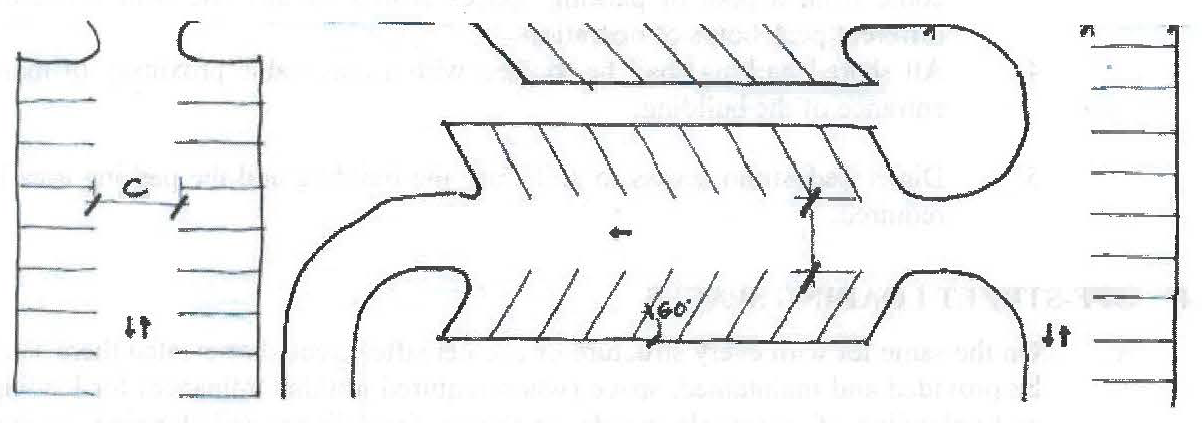
Parking Dimensions and Size. Parking drive aisle widths may vary depending on the configuration and angle of parking that the drive aisle supports.
Table 13-2—Parking Lot Dimensions
Figure 13-A—Parking Figure
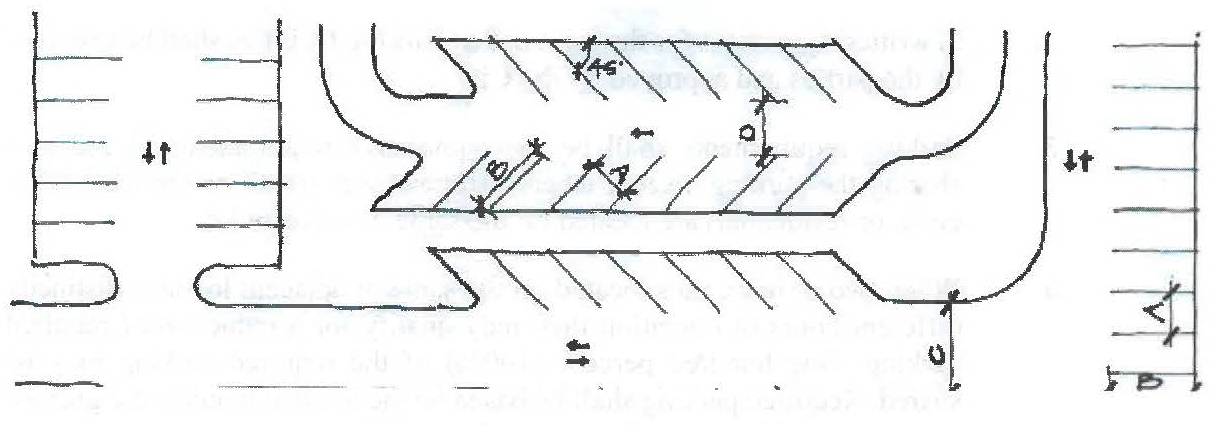
Figure 13-B—Parking Drive Aisles
D.
Parking Lot Limits.
1.
No use shall provide more than twenty percent (20%) more than the parking required by the above Table.
2.
Any parking provided that is more than the parking required by the above Table shall be designed with a pervious surface approved by the City.
3.
No off-street parking area in any area zoned for residential uses shall exceed forty (40) spaces.
E.
Shared Parking. In meeting the requirements of the above Table, adjacent uses may share parking under the following conditions and standards:
1.
Adjacent landowners shall execute the necessary cross access easements to facilitate shared parking and record all easement documents with the Madison County Judge of Probate.
2.
A written agreement for the joint use of parking facilities shall be executed by the parties and approved by the City.
3.
Parking requirements shall be the cumulative requirements of the uses sharing the parking, except where different uses (retail or service, office, civic, or residential) are located on the same or adjacent lot.
a.
When two or more uses located on the same or adjacent lot have distinctly different hours of operation they may qualify for a reduction of required parking. One hundred percent (100%) of the required parking may be shared. Required parking shall be based on the use that requires the greatest amount of parking according to the above Table.
b.
If two or more uses located on the same or adjacent lot have distinctly different peak hours of operation, they may qualify for a reduction of required parking. Fifty percent (50%) of the required parking for each use shall be dedicated to only that use, while the other fifty percent (50%) may come from a pool of parking spaces shared by any use with distinctly different peak hours of operation.
4.
All shared parking shall be located within reasonable proximity of main entrance of the building.
5.
Direct pedestrian access to and from the building and the parking area is required.
13.4 - OFF-STREET LOADING SPACES
A.
On the same lot with every structure or use hereafter erected or created there shall be provided and maintained, space (when required in this Ordinance) for loading and unloading of materials, goods, or things, for delivery and shipping, so that vehicles for these services may use this space without encroaching on or interfering with the public use of streets and alleys by pedestrians and vehicles.
B.
Where any structure is enlarged, or any use is extended so that the size of the resulting occupancy comes within the scope of this Section, the full amount of off-street loading space shall be supplied and maintained for the structure or use in its enlarged or extended size. Where the use of a structure or land or any part thereof is changed to a use requiring off-street loading space under this Section, the full amount of off-street loading space shall be supplied and maintained to comply with this Section.
C.
For the purpose of this Section, an off-street loading space shall be an area at least twelve feet (12') wide by forty-five feet (45') long with fourteen and one-half foot (14-1/2') vertical clearance. Each off-street loading, space or alley shall be arranged for convenience and safe ingress and egress by motor truck and for trailer combination.
D.
Off-street loading space shall be provided and maintained in accordance with the following schedule:
1.
For each retail store, storage, warehouse, wholesale establishment, industrial plant; factory, freight terminal, market, restaurant, mortuary, laundry, dry-cleaning establishment, or similar use which has an aggregate floor area of:
a.
Over 10,000 sq. ft. but not over 25,000 sq. ft.—1 space
b.
Over 25,000 sq. ft. but not over 60,000 sq. ft.—2 spaces
c.
Over 60,000 sq. ft. but not over 120,000 sq. ft.—3 spaces
d.
Over 120,000 sq. ft. but not over 200,000 sq. ft.—4 spaces
e.
Over 200,000 sq. ft. but not over 290,000 sq. ft.—5 spaces
f.
For each additional 90,000 sq. ft. over 290,000 sq. ft. or fraction thereof—1 space.
2.
For each apartment building having over fifty (50) dwelling units, two (2) spaces.
3.
For each auditorium, convention hall, exhibition hall, museum, hotel, apartment- hotel, sports arena, stadium, hospital, sanitarium, welfare institution or similar use, which has an aggregate gross floor area of:
a.
Over 10,000 sq. ft. but not over 40,000 sq. ft.—2 spaces
b.
For each additional 60,000 sq. ft. over 40,000 sq. ft. or major fraction thereof—1 space
4.
For any use not specifically mentioned in this Section, the requirements for off-street loading for a use which is so mentioned, and to which the unmentioned use is similar, shall apply.
E.
Off-street loading facilities supplied to meet the needs of one use shall not be considered as meeting the off-street loading needs of any other use.
F.
No area or facility supplied to meet the required off-street parking facilities for a use shall be utilized for or deemed to meet the requirements of this Section for off-street loading facilities.
G.
Nothing in this Section shall prevent the collective, joint or combined provision of off-street loading facilities for two (2) or more buildings or uses provided that such off-street loading facilities are equal in size and capacity to the combined requirements of the several buildings or uses and are so located and arranged as to be useable thereby.
H.
Plans for buildings or uses requiring off-street loading facilities under the provisions of this Ordinance shall clearly indicate the location, dimensions, clearance and access of all such required off-street loading facilities.
13.5 - BICYCLE PARKING
A.
Intent. The requirements for bicycle parking are established for the purpose of ensuring provision of adequate and safe facilities to accommodate bicycle parking and to encourage use of bicycles for travel as an alternative to use of motorized vehicles.
B.
Minimum Parking Space Requirements.
1.
Bicycle parking facilities shall be provided for every new automobile parking lot or garage where twenty (20) or more automobile parking spaces are required. Bicycle parking facilities shall also be provided for during the expansion of an existing automobile parking lot or garage where twenty (20) or more automobile parking spaces are required when such expansion increases the required automobile parking by five percent (5%) or more.
2.
Unless otherwise expressly stated, bicycle parking spaces shall be provided for at a rate of one (1) bicycle space for each twenty (20) automobile parking spaces as automobile parking spaces are required under this Ordinance, with a minimum requirement of two (2) bicycle parking spaces. Unless otherwise expressly stated, no automobile parking lot or garage shall be required to provide more than thirty (30) bicycle parking spaces.
3.
No bicycle parking shall be required for residential uses other than multi-family residential developments. For multi-family residential uses, the bicycle parking requirement shall be one (1) bicycle parking space for each five (5) dwelling units and there is no maximum number of bicycle parking spaces.
4.
The total number of required automobile parking spaces shall be reduced at the ratio of one (1) automobile parking space for each six (6) bicycle spaces provided. The total number of required automobile parking spaces shall not be reduced by more than five percent (5%) for any automobile parking lot or garage.
5.
When the number of required automobile parking spaces for a new or expanded use is reduced by means of a Zoning variance, the number of required bicycle spaces shall be calculated on the basis of the number of required automobile parking spaces, unless a variance is granted to reduce the number of required bicycle parking spaces.
C.
Parking Facility Access and Location Requirements.
1.
Required bicycle parking spaces must have a minimum dimension of two feet (2') in width by six feet (6') in length with an access aisle of at least five [feet] (5') and a vertical clearance of at least seven feet (7'). A hard surfaced parking area is required for the bicycle racks. Bicycle racks must be securely anchored to the ground or the building structure to prevent the racks from being removed from the location.
2.
Bicycle racks must be installed with adequate space beside the parked bicycle so that a bicyclist will be able to reach and operate the locking mechanism. There must be a minimum of twenty-four inches (24") beside each parked bicycle for access.
3.
This access may be shared by adjacent bicycles. However, each bicycle parking space must be accessible without moving another bicycle.
4.
Bicycle racks should be located so that parked bicycles do not block or impede the pedestrian path, handicapped access or vehicular circulation. Bicycle parking facilities located on sidewalks or other pedestrian access ways must leave clear pedestrian access of a minimum width of five feet (5'). Bicycle parking facilities within automobile parking areas shall be separated by a physical barrier, such as a curb, wheel stop, pole, bollard or other similar feature, to protect bicycles from damage by automobiles.
5.
Areas set aside for bicycle parking shall have signs clearly posted and the bicycle parking spaces shall be reserved for bicycle parking only.
6.
Required bicycle parking spaces shall be located at least as close to the entrance of the building, facility or multi-family dwelling unit as the nearest non-handicapped automobile parking space associated with said building, facility or multifamily dwelling unit. Where there are shopping centers or multi-tenant buildings with multiple entrances, the bicycle parking spaces must be well distributed and located as close to the entrances as the nearest non-handicapped automobile parking spaces.
7.
Where automobile parking is provided in an enclosed area, bicycle parking shall be provided within the enclosure or in such a way as to provide comparable protection from the elements. For any use where bicycle parking is required, if the automobile parking is covered or partly covered, the bicycle parking shall be covered at the same ratio. Bicycle parking facilities shall be located in highly visible and well lighted areas to increase safety and to minimize theft and vandalism.
D.
Bicycle Rack/Parking Facility Requirements. Bicycle racks shall meet the following requirements:
1.
The bike rack must support the bicycle frame in two places and enable the frame and one or both wheels of the bicycle to be secured. The bicycle must be able to be securely held with its frame supported in an upright position so that the bicycle cannot be pushed or fall in manner that will damage the wheels or components of the bicycle. Bicycle racks that support the bicycle by the wheel only are not permitted.
2.
The bicycle rack must be able to accommodate high-security U-shaped bicycle locks.
3.
The bicycle rack shall have a durable finish that will protect the rack and the bicycle.
13.6 - LANDSCAPE STANDARDS
The use of properly planted and maintained buffer areas may reduce and ease potential incompatibility between or among different uses of land in proximity to each other.
A.
Screening Required.
1.
Where this Ordinance requires a landscaped buffer area, the requirements of this Section shall apply.
2.
Where this Ordinance requires a landscaped buffer area, types and numbers of plantings for landscaped buffers shall be submitted with the application for a building permit, along with plans and statements demonstrating how the buffer will be irrigated in the future. No building permit shall be issued without such data, where this Ordinance requires a landscaped buffer area or areas. Where questions may arise as to the suitability of proposed plant materials to meet this requirement, final determination of suitability shall be made by the Building Official.
3.
In any Zoning District, all mechanical or operating equipment, materials, or activities not contained within a building, such as drive-through equipment, outdoor storage of materials, stationary machinery, and outdoor servicing activities, shall be enclosed by a wall or fence of solid appearance or a landscaped buffer area that meets the requirements set out in this Section. If the owner elects to build a wall or fence of bare or severe appearance it shall be enhanced with the planting of shrubs.
4.
In any Zoning District where a commercial or industrial use abuts a residential use, screening/buffering shall be required on the parcel containing the commercial or industrial use. Acceptable screening/buffering shall include a wall or fence of solid appearance, or tight evergreen hedge not less than six feet (6') in height, or a buffer of screen planting as described in this Section. If the owner elects to build a wall or fence of bare or severe appearance it shall be enhanced with the planting of shrubs.
B.
Landscaped Buffer of Screen Planting. A landscaped buffer shall consist of a strip of land not less than fifteen feet (15') wide containing plant materials planted and maintained as follows:
1.
The area shall be so designed, planted, and maintained as to be eighty percent (80%) or more opaque between two (2) and six (6) feet above average ground level when viewed horizontally.
2.
Plantings shall be of a size and type which will insure the meeting of eighty percent (80%) opacity requirement within no longer than twelve (12) months of the date of first planting. Where questions may arise as to the suitability of proposed plant materials to meet this requirement, final determination of suitability shall be made by the Building Official.
3.
A screening shrub shall be a locally adapted species of a type capable of reaching a minimum height of five feet (5') and a minimum spread of five feet (5') within three (3) years of planting. All such shrubs shall be a minimum twenty-four inches (24") in height and spread at time of installation.
4.
A screening tree shall be any deciduous or evergreen tree whose mature height can be expected to exceed thirty-five feet (35') and which has an expected crown spread of twenty feet (20') or more. In no case shall any tree required herein be of a height of less than six feet (6'), or of a crown width of less than three feet (3') at the time of planting.
5.
In the case where there is an easement on the property in the area on the property in the area where the landscaped buffer is required and said easement prevents the planting of landscape materials as required in the landscaped buffer, then the required buffer shall be located outside of and alongside the easement and shall meet the full requirements of the buffer or screen planting.
6.
In the case where there are overhead utility lines located within fifteen feet (15') of the boundary of the required landscaped buffer, the required screening trees shall be replaced by tree species with an expected mature height of no less than ten feet (10'), and no greater than twenty feet (20').
7.
Failure to maintain a landscaped buffer area required by the Ordinance shall be a violation of the Ordinance.
C.
Waiver of Requirements. When the Building Official finds that the public safety requires, he or she may waive or modify the buffer requirements set out above. The finding of the Building Official shall be in writing and shall be filed with the approved building permit.

