
New Hope City Zoning Code
Sec. 4-20
I, industrial district.
(a)
Purpose. The purpose of the I, industrial district is to provide for the establishment of heavy industrial and manufacturing development use which, because of the nature of the product or character of activity, requires isolation from residential or noncompatible commercial uses due to noise, smoke, odor, low pedestrian vehicle traffic volumes, and high semi-truck traffic volumes. The I district is also intended to provide for large scale activities of a sociological nature not suited to other districts, but reasonably compatible with the same characteristics suitable for general industrial use.
(b)
Permitted uses. The following are permitted uses in an I district:
(1)
Radio and television antenna farm.
(2)
Research, medical, dental or optical laboratories.
(3)
Trade schools.
(4)
Warehouses.
(5)
Essential services.
(6)
Governmental and public utility buildings and structures.
(7)
Building materials/appliance and furniture retail sales.
(8)
Engraving, printing and publishing.
(9)
Wholesale business.
(10)
Manufacturing etc. The manufacturing, compounding, assembly, packaging, processing, treatment or storage of products and materials.
(11)
Automobile major repair.
(12)
Office business.
(13)
Cable TV. Limited scope production studio for franchised cable TV company allowing for production of community oriented cable television programming produced by and for members of the community or commercial programming limited to presentation on the cable system serving only New Hope and other member cities of the Northwest Suburban Cable Communications Commission. Said use shall require all antennae conform to height limits of subsection 4-3(b)(5). Additional antenna height may be permitted by conditional use permit pursuant to those procedures set forth and regulated by section 4-33. Notwithstanding section 4-33, no conditional use permit shall be granted unless a public hearing is held and there is a finding that the additional height is technically necessary to serve the New Hope area and that this additional height will have no adverse effect on the area surrounding the studio.
(14)
Veterinary clinics. Provided the clinic boards without treatment ten or fewer animals in a 24-hour period.
(15)
Cannabis cultivator, cannabis manufacturer, cannabis wholesaler, cannabis transporter, cannabis testing facility, cannabis delivery service, and medical cannabis combination business subject to all requirements in section 8-41 and the buffer zones set forth in section 4-3(o), and lower-potency hemp edible manufacturer subject to all requirements in section 8-41.
(c)
Permitted accessory uses. The following are permitted accessory uses in an I district:
(1)
Accessory building. Accessory building for commercial uses shall not exceed 30 percent of the gross floor space of the principal building.
(2)
Parking. Off-street parking as regulated by subsection 4-3(e).
(3)
Off-street loading. Off-street loading as regulated by subsection 4-3(f).
(4)
Signs. Signs in compliance with chapter 3.
(5)
Personal wireless service antennas. Personal wireless service antennas in conformance with subsection 4-3(l) of this Code.
(6)
Accessory antennas. Accessory antennas in conformance with subsection 4-3(b)(6)h of this Code.
(7)
Eating establishments. Cafeterias, restaurants, snack bars and similar uses, provided such uses are primarily for the use of employees in the immediate area.
(8)
Reserved.
(9)
Rental of trailers and trucks. Rental of trailers and trucks shall be a permitted accessory use to an approved self-storage (mini-warehouse) facility granted a conditional use permit pursuant to section 4-20(e)(7) of this Code provided that:
a.
Accessory use. Rental of trailers and trucks must be an accessory use, as defined by subsection 4-2(b) of this Code, to the conditional principal use of self-storage (mini-warehouse) facility on the site.
b.
[Additional regulations.] Rental of trailers and trucks are further regulated by section 8-16 of this Code.
c.
Display area boundaries. The designated display area for trailers and trucks shall be marked by clearly visible boundaries.
d.
Vehicle location. Rental trailers and trucks shall not be permitted to occupy any area except the designated display area.
e.
Off-street parking interference. The display area shall not occupy any part of the required off-street parking area.
f.
Display area surface. The display area shall be surfaced with concrete or bituminous surfacing.
g.
Display area condition. The display area shall be kept free from dirt, weeds, garbage, trash, and other debris.
h.
Vehicle placement. The trailers and trucks shall be arranged in an orderly fashion, in rows and the parking area shall be stripped to identify individual parking stalls.
(10)
Semi-truck parking. Semi-truck parking as defined in section 4-2 of this Code shall be a permitted accessory use when in accordance with the following provisions:
a.
Semi-truck parking shall maintain a five-foot setback from side and rear yards and a ten-foot setback from front and side yards abutting a street.
b.
Semi-truck parking shall not occupy required automobile parking stalls and shall not interfere with on-site traffic circulation, access or egress to required parking or on-site loading areas.
c.
Semi-truck parking in designated off-street loading areas shall be permitted when the area complies with this subsection and section 4-3(e)(4) of this Code.
d.
Semi-truck parking shall comply with the stall and drive aisle dimensions as follows:
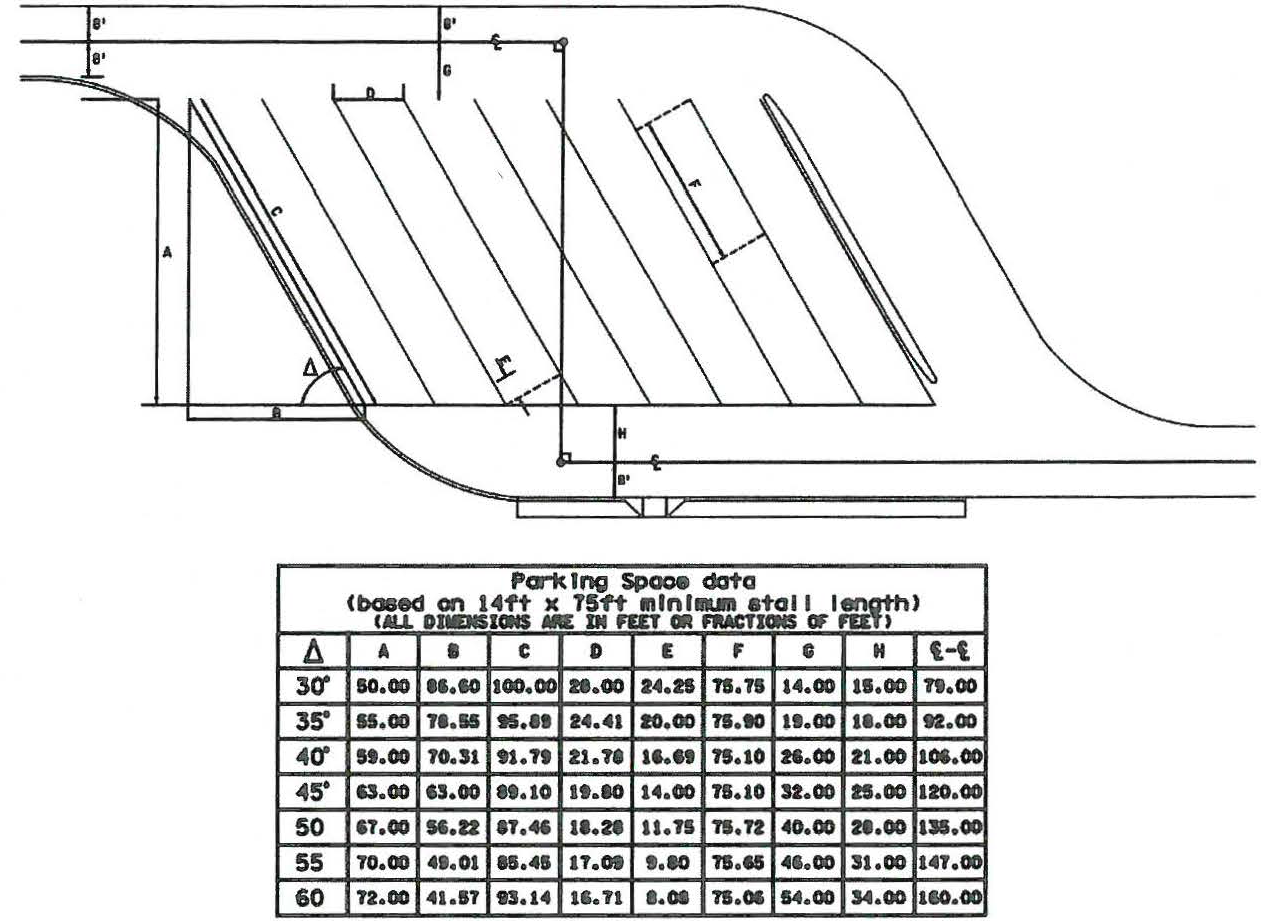
e.
Semi-truck parking shall comply with all the curbing, paving, and striping requirements set forth in section 4-3(e)(4)h of this Code.
f.
Semi-truck parking abutting a residential property shall be subject to screening standards set forth in section 4-3(d)(3)d of this Code.
(d)
Uses by administrative permit. The following are uses by administrative permit in the I district. (Requires an administrative permit based on the procedures set forth in and regulated by section 4-31 and the performance standards set forth in section 4-3 of this Code.
(1)
Personal wireless antennas per subsection 4-3(l)(2) of this Code.
(2)
Outdoor sales of seasonal produce subject to the permit requirements of chapter 8 of this Code.
(3)
Retail sales, limited. Retail sales of products manufactured or processed or delivered in bulk and repackaged for sale on the site, provided that the sales area not exceed 30 percent of the gross floor area of the principal building.
(4)
Outdoor sales and display, accessory. Open or outdoor service, sale and rental as an accessory use provided that:
a.
Area limit. Accessory outside service, sales and equipment rental connected with a principal use is limited to 30 percent of the gross floor area of the principal use.
b.
Screened from residential. Outside sales areas are fenced or screened from view of neighboring residential uses.
c.
Surfacing. Sales area is surfaced with concrete or bituminous.
(5)
Outdoor storage of propane or LP gas, accessory. Outdoor storage of propane or LP gas shall be allowed as a conditional accessory use provided it is used exclusively by the occupant of site where it is stored for a use incidental to said occupant's business, it is not stored for wholesale or retail sale unless specifically permitted by another section of this Code, and the following requirements are satisfied.
a.
Location. All propane or LP gas outdoor storage tanks shall be located in the rear yard not less than 25 feet from any property boundary lines. No tanks shall be permitted in the front yard and side yard abutting public streets.
b.
Open area. Storage tanks shall be surrounded by 25 feet of open area. Storage of any kind is prohibited in said open area, except equipment incidental to the storage tank. Approved parking areas must be set back ten feet from any storage tank.
c.
Setbacks from building. Storage tanks shall be set back from existing structures, as outlined in the International Fire Code, based on tank size.
d.
Circulation. Storage tanks shall not interfere with site circulation including, but not limited to, parking, driveway, curb cuts and loading areas.
e.
Fencing. A wire weave/chain link security fence shall be required around all storage tanks. The location of the fence shall be as per the international fire code.
f.
Access. Storage sites shall be accessible by service and emergency vehicles.
g.
Valves. All filling valves of the storage tanks shall be enclosed and have locking devices.
h.
Warning signage. A warning sign shall be required for every tank and shall be placed in a conspicuous location directly on the tank indicating a supplier's name, address, phone number, that highly dangerous and flammable material is stored therein and that no smoking requirements must be observed or a sufficient warning to that affect. Said signage may not exceed four square feet nor may it be used for advertising purposes.
(6)
Open outdoor storage provided that:
a.
Accessory use. Open outdoor storage areas must be an accessory use, as defined by subsection 4-2(b) of this Code, to a permitted or conditional principal use on the site.
b.
Maximum space. Open outdoor storage areas connected with the principal use are limited to 20 percent of the gross floor area of principal structure.
c.
Setbacks. The open outdoor storage area are not located within any front yard or side yard abutting a public right-of-way. Open outdoor storage areas are set back five feet from all side and rear lot lines and not located within a utility or drainage easement.
d.
Surfacing. Open outdoor storage areas are surfaced with concrete or bituminous.
e.
Fencing. A wire weave/chain link security fence is erected around the open outdoor storage area in conformance with subsection 4-3(d)(3)c of this Code. Open outdoor storage areas intended for the exclusive storage of semitrailers may be exempt from the required security fencing provided the storage area is delineated and the individual trailers are secured.
f.
Screening/landscaping. Open outdoor storage areas are landscaped, fenced, and screened from view of adjacent residential properties and public rights-of-way in accordance with the provisions of subsection 4-3(d)(3) of this Code.
g.
Required parking. Open outdoor storage areas do not utilize any required off-street parking, loading areas, or access space, as required by subsections 4-3(e) and 4-3(f) of this Code.
h.
Hazardous materials. The open outdoor storage areas are not used for storage of hazardous liquids, solids, gases or wastes. This provision does not prohibit the property owner from obtaining an administrative permit for the outdoor storage of propane or LP gas per subsection 4-20(d)(5) of this Code.
i.
Refuse and upkeep. Open outdoor storage areas are kept free of refuse, trash, debris, weeds, and waste fill.
j.
Lighting. All lighting is hooded and so directed that the light source is not visible from the public right-of-way or from neighboring residences.
(e)
Conditional uses, I. The following are conditional uses in an I district: (Requires a conditional use permit based upon procedures set forth in and regulated by sections 4-30(c) and 4-33 and performance standards set forth in section 4-3 of this Code:
(1)
Open outdoor storage as a principal or accessory use. Open outdoor storage as a conditional accessory use, where the open outdoor storage area exceeds 20 percent of the gross floor area of the principal structure provided that:
a.
Setbacks. Open outdoor storage areas are not located within any front yard or side yard abutting a public right-of-way. Open outdoor storage areas are set back five feet from all side and rear lot lines and not located within a utility or drainage easement.
b.
Surfacing. Open outdoor storage areas are surfaced with concrete or bituminous.
c.
Fencing. A wire weave/chain link security fence is erected around the open outdoor storage area in conformance with subsection 4-3(d)(3)c of this Code. Open outdoor storage areas intended for the exclusive storage of semitrailers may be exempt from the required security fencing provided the storage area is delineated and the individual trailers are secured.
d.
Screening/landscaping. Open outdoor storage areas are landscaped, fenced, and screened from view of adjacent residential properties and public rights-of-way in accordance with the provisions of subsection 4-3(d)(3) of this Code.
e.
Required parking. Open outdoor storage areas do not utilize any required off-street parking, loading areas, or access space, as required by subsections 4-3(e) and 4-3(f) of this Code.
f.
Hazardous materials. Open outdoor storage areas are not used for storage of hazardous liquids, solids, gases or wastes. This provision does not prohibit the property owner from obtaining an administrative permit for the outdoor storage of propane or LP gas per subsection 4-20(d)(5) of this Code.
g.
Refuse and upkeep. Open outdoor storage areas are kept free of refuse, trash, debris, weeds, and waste fill.
h.
Lighting. All lighting is hooded and so directed that the light source is not visible from the public right-of-way or from neighboring residences.
(2)
Planned unit development, industrial. Industrial planned unit development as regulated by section 4-34 of this Code.
(3)
Restaurants.
(4)
Motels/hotels.
(5)
Commercial recreation facilities. Commercial recreation, provided that:
a.
Access. The site of the proposed use has direct access to an arterial or collector street as defined in the City Code, without utilizing public streets of a lower traffic handling classification to reach the arterial or collector street.
b.
Compatibility. The architectural appearance and functional plan of the building and site shall not be so dissimilar to the existing buildings or area as to cause impairment in property values or constitute a blighting influence.
c.
Lighting shielded. All lighting shall be hooded and so directed that the light source is not visible from the right-of-way or from a residential zone or use.
d.
Surfacing. The entire area other than that occupied by buildings, structures or plantings shall be surfaced with a bituminous or concrete material which will control dust and drainage. The material and grading shall be subject to the approval of the city.
e.
Landscaping. Landscaping shall be provided and the type of planting material and the number and size of plants shall be subject to the approval of the city.
(6)
Solid and hazardous waste transfer stations.
a.
Purpose. The purpose of this section is to establish standards for the development of energy resource recovery-solid and hazardous waste transfer facilities.
b.
General provisions.
1.
Area. The site must be five acres, or larger.
2.
Access. The site shall not be more than one mile from a nine ton roadway. Sites adjacent to State Highway No. 169, or arterial streets, are to be preferred.
3.
Development. The site development shall not require major slope cutting, filling or off-site utility work.
4.
Ownership. The site must be owned by Hennepin County or privately held and currently for sale.
5.
Traffic. A thorough traffic Analysis must be made of the existing and anticipated impacts upon streets within the city. This study would be based upon the Goals and Objectives of the 1998 New Hope Transportation Plan. Development shall be consistent with this plan and shall be evidenced by the traffic analysis.
6.
Environmental. The site must be well-buffered and have minimal visual, activity, and noise impact on residences.
7.
Noise. The site must be 1,000 feet from the nearest residence and well buffered from residential areas as to sound pollution, and shall conform with the noise ordinance of the city.
8.
Water quality. The site development shall minimize impacts on wetlands, streams, lakes and ponding areas.
9.
Recreation. The site development shall not conflict with existing recreational facilities in the city.
(7)
Reserved.
(8)
Personal wireless service antenna towers. Personal wireless service antenna towers in conformance with subsection 4-3(l) of this Code.
(9)
Commercial and public radio and television transmitting antennas and public utility microwave antennas and related antenna towers. Commercial and public radio and television transmitting antennas and public utility microwave antennas and related antenna towers in conformance with subsection 4-3(l) of this Code.
(10)
Trucking operation. Truck terminals and major truck repair, provided that:
a.
Regardless of whether the dispensing, sale or offering for sale of motor fuels and/or oil is incidental to the conduct of the use or business, the standards and requirements imposed by this Code for motor fuel stations shall apply. These standards and requirements are, however, in addition to other requirements which are imposed for other uses of the property.
b.
The entire site other than that taken up by a building, structure or plantings shall be surfaced with blacktop or concrete to control dust and drainage which is subject to the approval of the city engineer.
c.
A drainage plan subject to the approval of the city engineer shall be installed.
d.
The lighting shall be accomplished in such a way as to have no direct source of light visible from adjacent land in residential use or from the public right-of-way and shall be in compliance with subsection 4-3(d)(5) of this Code.
e.
Wherever fuel pumps are to be installed, pump islands shall be installed.
f.
Parking or truck magazine storage space shall be screened from view of abutting residential districts in compliance with subsection 4-3(d)(3) of this Code.
g.
No outside storage, sales, service or rental shall be permitted, unless otherwise approved in accordance with applicable provisions of this Code.
(11)
Health and social services. Private, nonprofit social service organizations providing broad based family and individual activities of a health, athletic and social nature, provided the site is adjacent to an arterial or collector street.
(12)
Day care centers. Group day care centers operated in conjunction with a health and social services use which qualified under subsection 4-20(e)(11).
(13)
Adult use, principal. Subject to the regulations of subsection 4-3(k) of this Code.
(14)
County, state or federal government buildings or structures necessary for the health, safety or welfare of the community.
(15)
Reserved.
(16)
Animal kennels and animal day care. Subject to the following conditions:
a.
The facility's minimum size must provide for 75 square feet per dog and 20 square feet per cat or any other animal boarded at any one time, exclusive of office or storage area. The facility must provide one cage or air kennel per animal.
b.
Related ancillary services including training, grooming and food and accessory sales may be conducted or provided at the facility.
c.
An exercise area shall be provided to accommodate the periodic exercising of animals boarded at the facility. The exercise area must be 100 square feet in size for each animal that occupies that area at any one time. Any outdoor exercise area must be fenced, must have a three-foot vegetative buffer, must be cleaned regularly, and any animal waste must be appropriately treated before it is allowed to enter any stormwater pond or storm sewer.
d.
The facility must have a ventilation system that prohibits the transmission of odors or organisms between tenant bays. The ventilation system must be capable of completely exchanging internal air at a rate of 1.00 cfm/square foot of floor space per area dedicated for the keeping of animals exclusive of offices pursuant to Chapter 1346 of the Minnesota State Building Code, as may be amended, these requirements can be met by the submission of an air exchange analysis, acceptable to the city from a Minnesota licensed contractor or engineer confirming compliance with said standards, otherwise, the facility ventilation system must be completely separate and independent of other tenant space within the building. Facility air temperature must be maintained between 60 degrees and 80 degrees Fahrenheit.
e.
A sufficiently sized room/cage separate from the facility areas shall be provided to adequately separate sick or injured animals from healthy animals.
f.
Wall finish materials below 48 inches in height shall be impervious, washable materials like sealed masonry, ceramic tile, glassboard, or marlite. Floor finish shall be sealed concrete or other approved impervious surface. Liquid-tight curbing, at least six inches high, shall be installed along shared walls for sanitary confinement and water wash-down cleaning.
g.
Animal wastes shall be immediately cleaned up with solid wastes being enclosed in a container of sufficient construction to eliminate odors and organisms. All animal waste must be properly disposed of daily.
h.
The facility must be appropriately licensed per section 7-4 of this Code and all conditions of said section must be satisfied.
i.
The property owner shall provide the city with at least 14 days' notice of the animal kennel/day care intention to vacate the premises and allow a city inspection of the premises.
j.
The facility must provide sufficient, uniformly distributed lighting to the kennel area.
k.
Exemption. Veterinary clinics that board ten or fewer animals and pet stores are exempt from this conditional use permit requirement.
l.
Caretaker apartment. If an "on premises" caretaker dwelling unit is provided on site, construction of said dwelling unit shall conform to all design standard regulations for multiple-family dwelling units of the state building code and the city zoning and building code. Two off-street parking spaces and one garage stall must be provided for the caretaker dwelling unit. The minimum dwelling unit and room floor sizes shall be controlled by subsection 4-3(b)(2)b. of this Code.
m.
Guest room. If a guest room is provided within the kennel facility it must meet efficiency unit size requirements as listed in subsection 4-3(b)(2)b. of this Code. One additional parking stall must be provided for the guest room. Guest rooms shall only be used by persons obtaining services or receiving training from the kennel facility. Guest stays are limited to a maximum of ten business days per training visit.
(17)
Brewery with taproom. Brewery with taproom as defined by section 4-2(b) of this Code provided that:
a.
The owner of the brewery qualifies for and receives a brewer license and a malt liquor wholesale license (if wholesale of malt liquor is an intended activity) from the State of Minnesota, according to Minn. Stat. § 340A.301.
b.
An accessory brewer's taproom for the on-sale of malt liquor produced on-site shall require a brewery taproom license from the City of New Hope according to chapter 10 of this Code.
c.
Off-sale of malt liquor in the form of growlers shall require a brewery license for off-sale of malt liquor according to chapter 10 of this Code.
d.
The site provides adequate parking for taproom and other uses per section 4-3(e) of this Code. Taproom parking shall not interfere with on-site circulation or other operations sharing the site.
e.
The brewery shall meet all off-street loading standards of section 4-3(f) of this Code.
f.
Outdoor dining, drinking, or service as an accessory use for taprooms may be allowed subject to the following conditions:
1.
The applicant shall be required to submit a site plan and other pertinent information demonstrating the location and type of all tables, refuse receptacles, and wait stations.
2.
Access to the dining area shall be provided only via the principal building if the dining area is a full service restaurant, including table waiting service.
3.
The size of the dining area is restricted to 30 percent of the total customer floor area within the principal structure.
4.
The dining area shall be screened from view from adjacent residential uses in accordance with subsection 4-3(d)(3) of this Code.
5.
All lighting shall be hooded and directed away from adjacent residential uses in accordance with subsection 4-3(d)(5) of this Code.
6.
The applicant demonstrates that pedestrian circulation shall not be disrupted as a result of the outdoor dining area by providing the following:
i.
Outdoor dining area shall be segregated from through pedestrian circulation by means of temporary fencing, bollards, ropes, plantings, or other methods, and shall be subject to review and approval by the city council.
ii.
Minimum clear passage zone for pedestrians at the perimeter of the restaurant shall be at least five feet without interference from parked motor vehicles, bollards, trees, tree gates, curbs, stairways, trash receptacles, street lights, parking meters, or the like.
iii.
Overstory canopy of trees, umbrellas or other structures extending into the pedestrian clear passage zone or pedestrian aisle shall have a minimum clearance of seven feet above sidewalk.
7.
The dining area shall be surfaced with concrete, bituminous or decorative pavers or may consist of a deck with wood or other flooring material that provides a clean, attractive, and functional surface.
8.
A minimum width of 36 inches shall be provided within aisles of the outdoor dining area.
9.
Storage of furniture shall not be permitted on the sidewalk between November 1 and March 31. Sidewalk furniture that is immovable or permanently fixed or attached to the sidewalk shall not be subject to the storage prohibition of this section. However, any immovable or permanently fixed or attached furniture must be approved as part of the administrative permit application.
10.
Additional off-street parking shall be required pursuant to the requirements set forth in subsection 4-3(e) of this Code based on the additional seating area provided by the outdoor dining area.
11.
Refuse containers shall be provided for self-service outdoor dining areas. Such containers shall be placed in a manner which does not disrupt pedestrian circulation, and must be designed to prevent spillage and blowing litter.
12.
Rooftop dining facilities shall be permitted provided they meet all applicable conditions as listed herein and in addition:
i.
Provide permanent walls of fencing around the periphery of the dining area at a minimum height of 42 inches to ensure the safety of persons/property.
ii.
Any permanent structures, including divider walls, trellis work, etc. shall be included as part of the building upon which they are located and are subject to the building height limitations as specified in subsection 4-16(f)(3) of this Code.
iii.
The submitted plans for a rooftop dining facility as well as the building upon which the proposed outdoor dining is to occur are subject to review by the city building inspector. The inspector will determine whether the building is structurally capable of handling the additional weight of persons and equipment.
(18)
Microdistillery cocktail room. Microdistillery cocktail room as defined by section 4-2(b) of this Code provided that:
a.
The owner of the microdistillery qualifies for and receives a microdistillery license from the State of Minnesota, according to Minn. Stat. § 340A.
b.
The owner of the microdistillery qualifies for and receives a microdistillery cocktail room on-sale license from the City of New Hope according to chapter 10 of this Code.
c.
Off-sale of liquor produced in the microdistillery shall require a microdistillery license for off-sale of liquor according to chapter 10 of this Code.
d.
The site provides adequate parking for cocktail room and other uses per section 4-3(e) of this Code. Cocktail room parking shall not interfere with on-site circulation or other operations sharing the site.
e.
The cocktail room shall meet all off-street loading standards of section 4-3(f) of this Code.
f.
Outdoor dining, drinking, or service as an accessory use for cocktail room may be allowed subject to the following conditions:
1.
The applicant shall be required to submit a site plan and other pertinent information demonstrating the location and type of all tables, refuse receptacles, and wait stations.
2.
Access to the dining area shall be provided only via the principal building if the dining area is a full service restaurant, including table waiting service.
3.
The size of the dining area is restricted to 30 percent of the total customer floor area within the principal structure.
4.
The dining area shall be screened from view from adjacent residential uses in accordance with subsection 4-3(d)(3) of this Code.
5.
All lighting shall be hooded and directed away from adjacent residential uses in accordance with subsection 4-3(d)(5) of this Code.
6.
The applicant demonstrates that pedestrian circulation shall not be disrupted as a result of the outdoor dining area by providing the following:
i.
Outdoor dining area shall be segregated from through pedestrian circulation by means of temporary fencing, bollards, ropes, plantings, or other methods, and shall be subject to review and approval by the city council.
ii.
Minimum clear passage zone for pedestrians at the perimeter of the restaurant shall be at least five feet without interference from parked motor vehicles, bollards, trees, tree gates, curbs, stairways, trash receptacles, street lights, parking meters, or the like.
iii.
Overstory canopy of trees, umbrellas or other structures extending into the pedestrian clear passage zone or pedestrian aisle shall have a minimum clearance of seven feet above sidewalk.
7.
The dining area shall be surfaced with concrete, bituminous or decorative pavers or may consist of a deck with wood or other flooring material that provides a clean, attractive, and functional surface.
8.
A minimum width of 36 inches shall be provided within aisles of the outdoor dining area.
9.
Storage of furniture shall not be permitted on the sidewalk between November 1 and March 31. Sidewalk furniture that is immovable or permanently fixed or attached to the sidewalk shall not be subject to the storage prohibition of this section. However, any immovable or permanently fixed or attached furniture must be approved as part of the administrative permit application.
10.
Additional off-street parking shall be required pursuant to the requirements set forth in subsection 4-3(e) of this Code based on the additional seating area provided by the outdoor dining area.
11.
Refuse containers shall be provided for self-service outdoor dining areas. Such containers shall be placed in a manner which does not disrupt pedestrian circulation, and must be designed to prevent spillage and blowing litter.
12.
Rooftop dining facilities shall be permitted provided they meet all applicable conditions as listed herein and in addition:
i.
Provide permanent walls of fencing around the periphery of the dining area at a minimum height of 42 inches to ensure the safety of persons/property.
ii.
Any permanent structures, including divider walls, trellis work, etc. shall be included as part of the building upon which they are located and are subject to the building height limitations as specified in subsection 4-16(f)(3) of this Code.
iii.
The submitted plans for a rooftop dining facility as well as the building upon which the proposed outdoor dining is to occur are subject to review by the city building inspector. The inspector will determine whether the building is structurally capable of handling the additional weight of persons and equipment.
(19)
Health clubs, provided that:
a.
The facility has adequate parking for the use per section 4-3(e) of this Code.
b.
A traffic study shall be required under the following conditions:
1.
The use generates traffic beyond the existing traffic level and resulting in more than 100 trips in any peak hour.
2.
The city engineer determines that the site location, access, or traffic generation may result in traffic conflicts, safety issues, or a reduction of the street service level classification.
3.
The conditional use permit must address all issues identified in the traffic study and the property owner shall be assessed for costs associated with improvements deemed necessary to mitigate traffic issues generated by the proposed use.
(20)
Sports training centers, provided that:
a.
The facility has adequate parking for the use per section 4-3(e) of this Code.
b.
A traffic study shall be required under the following conditions:
1.
The use generates traffic beyond the existing traffic level and resulting in more than 100 trips in any peak hour.
2.
The city engineer determines that the site location, access, or traffic generation may result in traffic conflicts, safety issues, or a reduction of the street service level classification.
3.
The conditional use permit must address all issues identified in the traffic study and the property owner shall be assessed for costs associated with improvements deemed necessary to mitigate traffic issues generated by the proposed use.
(f)
Lot requirements, building heights, and setbacks. The following minimum requirements shall be observed in the I district subject to additional requirements, exception, and modification set forth in this Code.
(1)
Minimum lot area. One acre.
(2)
Minimum lot width. 100 feet.
(3)
Impervious surface. Not more than 80 percent of the lot area shall be impervious surface.
a.
The pervious portion of the lot area shall be maintained as landscaping in conformance with subsection 4-3(d)(4) of this Code.
(4)
Building height. Six stories or 72 feet, whichever is greater. Four stories or 48 feet, whichever is greater, shall be required where an I district lot abuts the side or rear lot lines of lots in an R-1 or R-2 zoning district.
(5)
Setbacks.
(a) See subsection 4-3(c)(6)b of this Code.
(b) A 75 foot side or rear yard setback will be required where the lot abuts an R-1 or R-2 zoning district.
(c) For each additional story over three stories or for each additional ten feet over 40 feet, the rear and side yard setback requirements shall be increased by five feet.
(Ord. No. 2001-14; Ord. No. 2001-17; Ord. No. 03-02, §§ 1, 2, 5-27-2003; Ord. No. 03-09, § 25, 5-27-2003; Ord. No. 04-07, § 5, 7-26-2004; Ord. No. 09-05, § 1, 6-8-2009; Ord. No. 12-08, § 1, 8-27-2012; Ord. No. 15-06, § 1, 5-26-2015; Ord. No. 15-10, § 6, 5-11-2015; Ord. No. 15-15, §§ 6, 7-27-2015; Ord. No. 16-07, §§ 1, 2, 6-27-2016; Ord. No. 18-08, §§ 4, 5, 1-28-2019; Ord. No. 18-09, § 2, 2-25-2019; Ord. No. 20-01, §§ 2—4, 1-27-2020; Ord. No. 24-15, § 8, 12-9-2024)

