
New Hope City Zoning Code
Sec. 4-3
General provisions.
(a)
Nonconforming buildings, structures and uses.
(1)
Purpose. It is the purpose of this section to provide for the regulation of nonconforming buildings, structures and uses and to specify those requirements, circumstances and conditions under which nonconforming buildings, structures and uses will be operated and maintained. The zoning code establishes separate districts, each of which is an appropriate area for the location of uses which are permitted in that district. It is necessary and consistent with the establishment of these districts that nonconforming buildings, structures and uses not be permitted to continue without restriction. Furthermore, it is the intent of this section that all nonconforming uses shall be eventually brought into conformity.
(2)
Grandfather clause. Any structure or use lawfully existing on July 5, 1979, shall not be enlarged, but may be continued at the size and in the manner of operation existing upon such date except as hereinafter specified or, subsequently amended.
(3)
Remedial work. Nothing in this Code shall prevent the placing of a structure in safe condition when said structure is declared unsafe by the building official providing the necessary repairs shall not constitute more than 50 percent of fair market value of such structure. Said value shall be determined by the city assessor.
(4)
Moving of nonconforming structures. No nonconforming building, structure or use shall be moved to another lot or to any other part of the parcel of land upon which the same was constructed or was conducted at the time of this Code adoption unless such movement shall bring the nonconformance into compliance with the requirements of this Code.
(5)
Reversal of nonconformity. When any lawful nonconforming use of any structure or land in any district has been changed to a conforming use, it shall not thereafter be changed to any nonconforming use.
(6)
Reduction of nonconformity. A lawful nonconforming use of a structure or parcel of land may be changed to lessen the nonconformity of use. Once a nonconforming structure or parcel of land has been changed, it shall not thereafter be so altered as to increase the nonconformity.
(7)
Partial destruction. If at any time a nonconforming building, structure or use shall be destroyed to the extent of more than 50 percent of its fair market value, said value to be determined by the city assessor, it may be reestablished to its prior size and form, but not expanded, if the property owner applies for a building permit within 180 days of the damage event. If no building permit is applied for within the specified time period, then, without further action by the council, the building and the land on which such building was located or maintained shall, from and after the date of said destruction, be subject to all the regulations specified by this ordinance for the district in which such land and building are located. Any building which is damaged to an extent of less than 50 percent of its value may be restored to its former extent provided reconstruction is completed within 12 months of said damage. Estimate of the extent of the damage or destruction shall be made by the building official.
(8)
Discontinuance. Whenever a lawful nonconforming use of a structure or land is discontinued for a period of 12 months, any future use of said structure or land shall be made to conform with the provisions of this Code.
(9)
Alterations. Alteration and normal maintenance to a lawful nonconforming building or structure may be made provided:
a.
The alterations do not expand the building size.
b.
The alterations do not change the building occupancy capacity or parking demand.
c.
The alteration does not increase the nonconformity of the building or the use.
(10)
Expansion of nonconforming buildings or structures.
a.
Administrative approvals. The expansions of lawful nonconforming single-family or two-family residential buildings and structures may be approved through the administrative permit process by the zoning administrator subject to provisions of section 4-31 of this Code. The zoning administrator shall make a determination that the building expansion will have no external negative impacts upon adjacent properties or public rights-of-way.
1.
Expansion of buildings found to be nonconforming only by reason of height, yard setback, lot area or off-street parking may be permitted provided the structural nonconformity is not increased and the expansion complies with the performance standards of this Code.
2.
Lawful nonconforming single-family and two-family units may be expanded to improve the livability provided the nonconformity of the structure is not increased.
b.
Conditional use permit. Lawful nonconforming commercial, industrial, public, semipublic, and multiple-family structures may be expanded on the same lot by conditional use permit in accordance with section 4-33 of this Code.
1.
Expansion of buildings found to be nonconforming only by reason of height and setback are exempt from requiring a conditional use permit.
2.
Except for the above, the expansion will not increase the nonconformity of the building or site.
3.
The new building expansion will conform with all applicable performance standards of this Code. A conditional use permit shall not be issued under this section for a deviation from other requirements of this Code unless variances are also approved.
4.
The request for conditional use permit shall be evaluated based on standards and criteria set forth in subsection 4-33(c) of this Code.
(11)
Nonconforming lots. A lot of record, existing upon the effective date of this Code in a residential district, which does not meet the requirements of this Code as to area or width may be utilized for single-family detached dwelling purposes provided the building setbacks of the applicable zoning district or subsection 4-3(c)(6) of this Code are met.
(b)
General building requirements.
(1)
Dwelling unit restriction.
a.
Garages and tents as dwellings. No garage, tent or accessory building shall at any time be used as living quarters, temporarily or permanently. Camping trailers or recreational vehicles may be used for temporary living quarters on private property for periods not to exceed one week.
b.
Basements as living quarters. Basements and cellars may be used as living quarters or rooms as a portion of the principal residential dwelling, provided they meet the applicable regulations of the building code.
c.
Recreational uses. Tents, playhouses, playground equipment, swing sets, or similar structures may be used for play or recreational purposes.
d.
Temporary family heath care dwelling. Pursuant to authority granted by Minn. Stat. § 462.3593, subdivision 9, the city hereby opts-out of the requirements of Minn. Stat. § 462.3593, which defines and regulates temporary family health care dwellings. These temporary dwellings are not permitted within the city.
(2)
Minimum floor area per dwelling unit.
a.
One-, two-family dwellings and townhouses. The minimum habitable floor area for these types of buildings shall be as follows:
b.
Multiple dwelling units. Except for elderly housing, living units classified as multiple dwellings shall have the following minimum floor areas per unit:
More than two bedroom units—An additional 100 square feet for each additional bedroom.
c.
Elderly (senior citizen) and/or physically disabled housing. Living units classified as elderly (senior citizen), physically disabled or R-5 housing units shall have the following minimum floor areas per unit:
(3)
Maximum unit type.
a.
Efficiency apartments. Except for elderly (senior citizen or R-5) housing, the number of efficiency apartments in a multiple dwelling shall not exceed five percent of the total number of apartments. In the case of elderly (senior citizen or R-5) housing, efficiency apartments shall not exceed 20 percent of the total number of apartments.
b.
Three or more bedroom apartments. The number of dwelling units containing three or more bedrooms in a multiple dwelling containing eight or more units shall not exceed 40 percent of the total number of apartments within a single building.
(4)
Building width. In no event shall either the length or width of a residential principal building referred to in subsection 4-3(b)(2) be less than 24 feet.
(5)
Building and structure heights.
a.
All buildings and structures shall comply with the maximum building height of the applicable zoning districts.
b.
Exceptions. The building height limits established herein for zoning districts shall not apply to the following:
1.
Belfries.
2.
Chimneys or flues.
3.
Church spires.
4.
Cooling towers.
5.
Cupolas and domes which do not contain useable space.
6.
Elevator penthouses.
7.
Flag-poles mounted on a building and freestanding flagpoles, which must be set back five feet from property lines.
8.
Parapet walls extending not more than three feet above the limiting height of the building.
9.
Water towers.
10.
Necessary mechanical and electrical appurtenances.
11.
Poles, towers and other structures for essential services.
12.
Personal wireless service and commercial broadcasting antennas not exceeding 20 feet above the roof of the antenna support structure.
13.
Antenna towers.
c.
Mechanical and rooftop equipment must meet the following standards:
1.
Rooftop mechanical equipment shall not exceed the allowable building height standards for the applicable zoning district by more than 15 feet.
2.
All rooftop and ground mounted mechanical equipment shall be buffered so as to mitigate noise in compliance with chapter 9 of the City Code. This shall not apply to air conditioning cooling structures or condensers (ground mounted), which must be in compliance with subsection 4-3(b)(6)g. of this Code.
3.
All ground mounted equipment shall be completely screened from view from adjacent properties and the public right-of-way by enclosures constructed of durable and permanent materials with architectural elements (type, quality and appearance) similar and compatible to the principal structure.
4.
All rooftop equipment shall be screened from view from across adjacent streets 15 feet behind the curb or adjacent properties at the property line.
5.
Rooftop equipment shall be completely screened by the building parapet, or the equipment should be grouped behind an enclosure and set back a distance of one and one-half times its height from any primary facade fronting a public street.
6.
Screens shall be of durable, permanent materials (not including wood) that are compatible with the primary building materials.
7.
Exterior mechanical equipment, such as ductwork, shall not be located on primary building facades.
d.
Aviation obstructions. In the case of any proposal to construct or alter a structure which will exceed a height of 200 feet above ground level of the site, or any proposal to construct or alter a structure to a height greater than an imaginary surface extending upward and outward at a slope of one hundred to one (100:1) from the nearest point of the runway of a public airport, the applicant shall notify the Commissioner of the Minnesota Department of Transportation in writing of the plans at least 30 days in advance of making applicable permit requests to the city. The applicant shall provide the zoning administrator with any comments received from the Commissioner of the Minnesota Department of Transportation as part of the required applicable permit request. This local reporting is in addition to any federal permitting and review processing which may be simultaneously required.
(6)
Accessory buildings, uses and equipment. An attached garage or attached accessory building shall be considered an integral part of the principal building. Attached garages and attached accessory buildings shall meet all required building setbacks of the applicable zoning district. Detached garages and accessory buildings must comply with the location, setback, size and area restrictions of this section and may not be constructed with sheet metal, scrap metal, corrugated metal; plywood or scrap wood; canvas, nylon, or other non-rigid material; or cast-off, secondhand, or other materials not originally intended to be used for constructing an accessory structure.
a.
Permitted locations and setbacks. Accessory garages and buildings, both attached and detached, are permitted in side yards and rear yards. Detached structures are also subject to the following setback conditions:
1.
Side yard interior .....5 feet
2.
Side yard abutting a street .....20 feet
3.
Side yard abutting a collector or arterial street .....30 feet
4.
All rear yards—Accessory buildings .....5 feet
5.
All rear yards—Garages and carports .....10 feet
b.
Prohibited locations. No garage or accessory building shall be located in any front yard or a drainage and utility easement.
c.
Permitted side yard setback reduction. Notwithstanding subsection 4-3(b)(6)a.1 and 3 of this Code, a three foot reduction into a required side yard abutting a street will be permitted for construction of an accessory building or garage subject to an administrative permit and the following conditions
1.
The physical constraints of the lot make the encroachment necessary to maximize indoor storage on the property which would be prevented by strict compliance with setback standards.
2.
The proposed structure will not be located in a drainage or utility easement.
3.
The city shall determine that the building will not negatively impact the neighboring or adjacent property.
4.
The same or similar quality building material shall be used in the accessory building as in the principal building. Additionally, the exterior appearance and architectural design of the accessory building are to be similar to that of the principal building.
d.
Area limits, general. Accessory building and garage area in the R-1 and R-2 zoning districts shall be limited to a combined total area of 1,400 square feet. Also, no individual garage shall exceed 1,000 square feet of floor area or exceed 15 feet in height. No storage type building shall exceed 400 square feet of floor area or exceed 12 feet in height. Construction of storage type accessory buildings or garages are regulated by Minnesota State Building Code as identified as chapter 3 of this Code.
e.
Garages for single-family and two-family lots. Every single-family and two-family dwelling unit hereafter erected shall be so located on the lot so that garage space for at least two vehicles, either attached or detached, can be located on said lot. The elimination of private garage space or conversion of a garage space into living space shall require the construction and/or availability of private garage space for at least two passenger automobiles on the premises. Off-street parking for any residential use shall be in accordance with subsection 4-3(e) of this Code.
f.
Limit on numbers. Every lot in the R-1 and R-2 zoning districts shall be limited to no more than two accessory buildings, including an attached garage. An exception for a third accessory building may be accommodated, if the structure qualifies as an outdoor living spaces, as defined in subsection 4-2(b) and falls within the parameters of the cumulative floor area allowed for the district.
g.
Air conditioners. Accessory uses or equipment such as air conditioning cooling structures or condensers (ground mounted) are permitted in side or rear yards subject to the following conditions:
1.
The cooling structure or condenser shall not produce noise levels contrary to subsections 9-42(c) and 9-42(d) of this Code.
2.
The cooling structure or condenser shall not lie within a required drainage and/or utility easement.
h.
Accessory antennas. Accessory antennas shall be limited to radio and television receiving antennas, satellite dishes, TVROs, short-wave dispatching antennas, and amateur short-wave radio transmitting and receiving antennas. Accessory antennas that are accessory to the principal use of property are permitted accessory uses in all zoning districts provided they meet the following conditions:
1.
Height. A ground mounted accessory antenna shall not exceed 20 feet in height from ground level. The height of an accessory antenna attached to an antenna support structure may not exceed five feet above the peak of the roof of the principal building. An accessory antenna in excess of the aforementioned height standards may be allowed by conditional use permit.
2.
Yards. Accessory antennas greater than one meter in diameter shall not be located within the required front yard setback or side yard setback abutting a street.
3.
Roofs. If vegetation or obstructions interfere with satellite signals at a location in any allowable placement area, the accessory antenna may be placed on the roof of any authorized structure on the premises.
4.
Setbacks. Accessory antennas greater than one meter in diameter shall not be located within five feet of any lot lines of adjoining lots or within a drainage or utility easement. The cost to repair or replace any antenna one meter or less located in a public easement inadvertently damaged by or removed by the city necessitated by maintenance, construction or repair of the easement or infrastructure located on, over or under the easement shall be borne by the owner of the antenna or the owner or occupant of the property served by the antenna.
5.
Building permits. A building permit shall be required for the installation of any accessory antenna requiring a conditional use permit. Building permit applications shall be accompanied by a site plan and structural components data for the accessory antenna, including details of anchoring. The building official must approve the plans before installation.
6.
Lightning protection. Each accessory antenna shall be grounded to protect against natural lightning strikes in conformance with the National Electrical Code as adopted by the city.
7.
Electrical code. Accessory antenna electrical equipment and connections shall be designed and installed in conformance with the National Electrical Code as adopted by the city.
8.
Color/content. Accessory antennas shall be of a neutral color and any lettering or scenes contained on said device qualifying it as a sign shall be subject to the regulations of section 3-50 of the New Hope Sign Code.
9.
Effective date. The provisions of this section shall be applicable to all accessory antennas erected after April 7, 1988. All such structures existing prior to this date shall be addressed as legal nonconforming uses.
i.
Trash enclosures. Industrial, commercial, multiple-family, and institutional uses must provide trash enclosures for any waste containers that contain refuse and recyclable material or equipment that meet the following standards:
1.
Trash enclosures located forward of the principal building must meet all of the setback requirements for the principal.
2.
Trash enclosures located in the rear or side yards shall meet all applicable accessory building setback requirements.
3.
Trash enclosures for waste containers must fully screen the containers from view from adjacent properties and the public right-of-way.
4.
Trash enclosures must be constructed with walls of architectural elements (type, quality, and appearance) similar to the principal structure.
5.
Trash enclosures shall be located in an accessible location for pick-up vehicles.
(c)
Lot and yard requirements.
(1)
Purpose. This section identifies minimum yard spaces, exceptions, and areas to be provided for in each zoning district.
(2)
Minimum lot area requirements. The minimum lot area shall conform to the standards of the applicable zoning district. No lot, yard or other open space shall be reduced in area or dimension so as to make such lot, yard or open space less than the minimum required by this Code, and if an existing yard or other open space is less than the minimum required, it shall not be further reduced. No required open space provided about any building or structure shall be included as a part of any open space required for another structure.
(3)
Platted and unplatted property.
a.
Platting required. No building shall be constructed on unplatted property, except for the addition of accessory structures or additions to existing buildings. Platting is required in all instances where industrial development revenue bonds or tax increment districts or like governmentally sponsored financing is involved.
b.
Detailed data required. Any person desiring to improve property shall submit to the building official a survey or acceptable scale drawing of the premises and information on the location and dimensions of existing and proposed structures, location of easements crossing the property, encroachments, and any other information which may be necessary to insure conformance to this Code.
c.
Future streets. All buildings shall be so placed that they will not obstruct future streets which may be constructed by the city in conformity with existing streets and according to the system and standards employed by the city.
d.
Principal building. Except in the case of planned unit development as provided for in section 4-34 of this Code, not more than one principal building shall be located on a lot. The words "principal building" shall be given their common, ordinary meaning; in case of doubt or on any question of interpretation, the decision of the building official shall be final, subject to the right of appeal as provided in chapter 1. For purposes of this Code, all shopping centers shall be interpreted as having more than one principal building, thus requiring that they be handled under section 4-34, planned unit development.
(4)
Open space.
a.
Residential open space. In residential zoning districts, buildings and structures of any type, parking areas or other features shall not occupy more than 65 percent of the lot area resulting in less than 35 percent open space.
b.
Recreation areas. Each multiple-family building or complex of two or more buildings containing eight or more dwelling units shall include visually defined or fenced active recreation areas. Said areas need not be contiguous. The size of the recreation area shall be 2,000 square feet plus an additional 50 square feet per unit for over 20 dwelling units exclusive of parking or loading areas. For senior or physically disabled housing, 20 percent of the gross lot area must be reserved for active or passive recreation area.
(5)
Setbacks. All buildings and structures shall comply with the setbacks within the applicable district except as may be required within other sections of this Code. All setbacks shall be measured from the appropriate lot line.
(6)
District setback exceptions.
a.
Where adjacent structures within the same block have front yard setbacks less than the required minimum, the front yard minimum setback shall be the average of the adjacent structures. If there is only one adjacent structure, the front yard minimum setback shall be the average of the required setback and the setback of the adjacent structure.
b.
Reserved.
Editor's note— Ord. No. 04-07, § 1, adopted July 26, 2004, repealed § 4-3(c)(6)b.
c.
Side and rear yard setbacks for industrial districts adjacent to railroads. In either the industrial district, the minimum side or rear yard setback from the lot line of the side or rear yard of the parcel adjacent to a railroad right-of-way shall be ten feet.
d.
Sight triangle setback. On corner lots in all districts, no structure or plantings shall be placed or constructed within the sight visibility triangle setback in a manner that may interfere with traffic or pedestrian visibility along a public right-of-way between the heights of two feet and eight feet of the street centerline grade. The sight triangle is defined as follows: beginning at the intersection of the projected property lines of two intersecting streets, thence 20 feet along one property line, thence diagonally to a point 20 feet from the point of beginning on the other property line, thence to the point of beginning.
e.
Permitted encroachments. This subsection is not intended to effect or make nonconforming any existing building, structure or use. Accordingly, the following provisions shall pertain to new construction only. Buildings shall not be built upon or extend over easements of record. The following structural elements or equipment shall not be considered as encroachments on yard setback requirements:
1.
Building extensions in all yards: Chimneys, flues, bay or bow windows, leaders, sills, pilasters, lintels, ornamental features, cornices, eaves, gutters, and the like provided they do not project more than two feet into a yard.
2.
Decks, stoops, etc. in all yards: Terraces, steps, decks, stoops or similar features provided they do not extend above the height of the ground floor level of the principal structure and does not encroach further than five feet into the front yard setback.
3.
In rear yards: Recreational and laundry drying equipment, arbors and trellises, balconies, breezeways, open porches, decks, detached outdoor living rooms, garages, and air conditioning or heating equipment. Porches, outdoor living rooms which become closed in and attached to the dwelling subsequent to initial construction of the principal dwelling shall not remain exempt from yard setback requirements.
(7)
Subdivision of twinhome, quadraminium, or townhouse lots. The subdivision of base lots containing twinhomes, quadraminiums, or townhouses to permit individual private ownership of a single dwelling unit within such a structure is acceptable upon approval by the city council, but is contingent on the following requirements:
a.
Meet zoning requirements. Prior to a twinhome, quadraminium, or townhouse subdivision, the base lot must meet all the requirements of the zoning district.
b.
Minimum area and width. The following are minimum unit lot requirements for twinhome, quadraminium, or townhouse subdivisions:
c.
Principal structure. There shall be no more than one principal structure on a base lot in all residential districts. The principal structure on a unit lot created in a twinhome, quadraminium, or townhouse subdivision will be the portion of the attached dwelling existing or constructed on the platted unit lots.
d.
Conformity to existing setbacks. The principal structure on the base lot shall conform to the established setbacks and yard requirements of the zoning district.
e.
Accessory uses. Permitted accessory uses as defined by the zoning districts are acceptable provided they meet all the zoning requirements.
f.
Individual public utilities. Separate public utility services shall be provided to each subdivided unit and shall be subject to the review and approval of the city engineer.
g.
Platting required. The subdivision shall be platted and recorded in conformance to all other requirements of the New Hope Platting Code, specifically including the providing of a subdivision bond.
(d)
Performance standards.
(1)
Purpose. The performance standards established in this section are designed to encourage high quality development by providing assurance that neighboring land uses will be compatible. The performance standards also designed to prevent and eliminate those conditions that cause blight. Certain conditions as stated herein constitute a public nuisance and may be subject to administrative citation, civil penalty, abatement order, and/or charge of a misdemeanor. All future development in the city shall be required to meet these standards. The standards shall also apply to existing development where so stated. The building official shall be responsible for enforcing these standards and may require the submission of information showing compliance or noncompliance with the standards.
(2)
Conformance to standards. Before any building permit or certificate of occupancy is approved, the building official shall determine whether the proposed use is likely to conform to the performance standards. The developer shall supply additional data about the proposed use (such as equipment to be used, hours of operation, method of refuse disposal, type and location of exterior storage, etc.), where required to do so by the building official. It may occasionally be necessary for a developer or business to employ specialized consultants to demonstrate that a given use will conform with the performance standards.
(3)
Fencing and screening.
a.
General provisions.
1.
The required screening provisions as specified in subsection (4) of this section, shall supersede, where applicable, the provisions of this subsection.
2.
All posts or similar supporting instruments used in the construction of fences shall be faced inward toward the property being fenced, unless symmetrical.
3.
No fence shall obstruct natural drainage. No fence shall be placed within an easement that obstructs or impedes the free flow of surface water from, or within any drainage easements. If a fence is constructed within the easement and it is required to be removed, the city shall not be required to pay compensation for any such fence.
4.
The height of a fence, in the case of grade separation, shall be determined on the basis of measurement from the average point between the highest and lowest grade.
5.
The following types of fences are prohibited:
i.
Electric.
ii.
Barbed wire or razor wire.
iii.
Sheet metal, scrap metal, corrugated metal, or metal building, siding, or roofing material.
iv.
Plywood or scrap wood.
v.
Canvas, nylon, or other non-rigid material or fabric.
vi.
Cast-off, secondhand, or other materials not originally intended to be used for constructing or maintaining a fence.
6.
A building permit shall be required for the installation of any fence that is seven feet in height or taller.
b.
Residential fencing and screening. Subject to the general provisions of this section:
1.
Short fences. Fences 42 inches in height or less may be located on any part of a lot.
2.
Tall fences.
i.
Fences up to six-and-one-half feet in height may be located in rear yards and/or side yards that do not abut a street, regardless of house orientation.
ii.
Fences up to eight feet in height may be located in rear yards and/or side yards that do not abut a street, when meeting setback requirements for principal buildings within the applicable zoning district.
iii.
Fences up to eight feet in height may be located within rear yards and/or side yards where the lot directly abuts a commercial or industrial zoned property (includes CB, CC, I, LB, R-B, and R-O districts).
c.
Commercial and industrial district fences. Fences in the CB, CC, I, LB, R-B, and R-O districts are subject to the general provisions of this section:
1.
Commercial and industrial fences may be erected up to eight feet in height. Fences in excess of eight feet shall require a conditional use permit.
2.
Commercial and industrial fences up to eight feet in height may be located in rear yards and/or side yards that do not abut a street, regardless of building orientation. Fences up to eight feet in height may be located in front yards and/or side yards that abut a street when meeting setback requirements for principal buildings within the applicable zoning district. Shorter fences may be allowed within the required setback in front yards and/or side yards abutting a street when approved as part of a site plan review.
d.
Required fencing and screening. Where any business or industrial use (i.e., structure, parking or storage) abuts property zoned for residential use, that business or industry shall provide screening along the boundary of the residential property. Screening shall also be provided where a business or industry is across the street from a residential zone, but not on that side of a business or industry considered to be the front (as determined by the building official). All the fencing and screening specifically required by this Code shall be subject to a, above, and shall consist of either a fence or green belt planting strip as provided for below:
1.
Green belts. A green belt planting strip shall consist of evergreen trees and/or deciduous trees and large shrubs and shall be of sufficient width and density to provide an effective visual screen. This planting strip shall contain no structures. Such planting strips shall be designed to provide complete visual screening to a minimum height of six feet. Earth mounding or berms may be used but shall not be used to achieve more than three feet of the required screen. The planting plan and type of plantings shall require the approval of the city council, which shall have before it the recommendations of the planning commission, city engineer or building official.
2.
Screen fencing. A required screening fence shall be constructed of masonry, brick, wood or steel. Such fence shall provide a solid screening effect and not exceed eight feet in height or be less than six feet in height. The design and materials used in constructing a required screening fence shall be subject to the approval of the city council, which shall have before it recommendations of the planning commission, city engineer or building official.
(4)
Landscaping.
a.
Required landscaping—General residential. The lot area remaining after providing for off-street parking, off-street loading, sidewalks, driveways, building site and/or other requirements shall be landscaped using ground cover, ornamental grass, shrubs, trees or other acceptable vegetation or treatment generally used for landscaping. Synthetic turfs, artificial grasses, and other similar materials are prohibited. Fences, retaining walls, or trees placed upon utility easements are subject to removal if required for the maintenance or improvement of the utility. The city shall not be required to pay compensation for the items to be removed from a utility easement. Trees under overhead wires within an easement are restricted to tree types having mature height that will not interfere with the overhead wires.
b.
Required landscaping—Semi-public and all income producing property uses. Prior to approval of a building permit, all of the above uses shall be subject to a mandatory landscape plan requirement. Said landscape plan should be developed with an emphasis upon the following areas:
The boundary or perimeter of the proposed site at points adjoining another existing or proposed site or sites: the immediate perimeter of the structure or building at points of its placement on the site; and the public boulevard areas at points of interface with streets or sidewalk areas of the city. Landscape plans must identify and protect significant preferred trees as defined in section 4-2(b) whenever possible. The landscape plan shall include tree preservation measures to be used on the site.
All landscaping incorporated in a landscape plan shall conform to the following standards and criteria:
1.
Minimum plant sizes. All plants must equal not less than the following minimum sizes:
Type and mode are dependent upon time of planting season, availability, and site conditions (soils, climate, ground water, manmade irrigation, grading, etc. Tree diameters are measured at six inches above ground level for trees four inches or less in diameter and for trees larger than four inches in diameter, the measurement will be taken 12 inches above ground level.
2.
Spacing.
i.
Trees shall not be placed closer than five feet from the fence line or property line and shall not be planted to conflict with public planting.
ii.
Where plant materials are planted in two or more rows, plantings shall be staggered in rows unless otherwise approved by the city.
iii.
Deciduous boulevard trees shall be planted not more than 40 feet apart.
iv.
Massing of plants where screening is intended, large deciduous shrubs shall not be planted more than four feet on center, and/or, evergreen shrubs shall not be planted more than three feet on center.
3.
Prohibited boulevard/street trees. The following trees are specifically prohibited within the public right-of-way:
4.
Design.
i.
The landscape plan must show a form of designed site amenities, (i.e. composition of plant materials, and/or creative site grading, decorative lighting, exterior sculpture, etc., which are largely intended for aesthetic purposes).
ii.
All area within the property lines (or beyond, if site grading extends beyond) not paved or designated for off-street parking, off-street loading, sidewalks, driveways, open outdoor storage, or buildings shall be landscaped using ground cover, ornamental grass, shrubs, trees, or other acceptable vegetation generally used for landscaping. Synthetic turfs, artificial grasses, and other similar materials are prohibited.
iii.
Turf slopes in excess of three to one (3:1) are prohibited.
iv.
All landscape areas must be irrigated or have access to an exterior building water spigot in a location adequate for providing for landscape maintenance.
v.
Except for single-family and two-family residential properties, all landscape areas within the property lines utilizing an automatic irrigation system shall be controlled by a moisture sensor irrigation controller.
vi.
Landscape maintenance: All plants required as part of an approved landscaping plan shall be maintained and kept alive. Dead plants shall be replaced in accordance with the approved landscape plan.
c.
Tree preservation and replacement. Landscape plans associated with commercial, industrial, multiple family, or institutional uses shall include measures to preserve or replace significant, preferred trees within any site development or redevelopment projects whenever possible, in accordance with this section of the New Hope City Code.
1.
Inspection. With submission of a development application, the tree inspector shall conduct a site inspection and identify significant, preferred trees that may be impacted or lost due to site improvements, grading, and/or utility work associated with the project.
2.
Preservation measures. The applicant shall include tree preservation measures on the landscape measures that will be put in place during site construction to protect significant, preferred trees, including:
i.
Snow fencing or polyethylene laminar safety netting placed at the drip line or critical root zones.
ii.
Installation of signage at all tree protection areas that instructs workers to stay out.
iii.
Erosion control methods.
iv.
Tree removal procedures including directional felling away from existing trees to be saved and trenching to separate root systems prior to bulldozing trees or stumps.
v.
Coordination of utility planning with tree preservation plan to strategically extend utility connections from the street to the building in a manner that protects trees intended to be saved.
vi.
Measures for preventing changes in soil chemistry due to concrete wash-out and leakage or spillage of toxic materials such as fuels or paints.
vii.
No soil disturbance shall occur within the lot until the tree preservation plan is approved and tree protection measures are in place.
viii.
Builders, contractors, or others working on site shall not fill, stockpile materials, or store equipment or vehicles against the trunk of the tree, in the critical root zone, or under the drip line of a tree to be saved.
3.
Replacement.
i.
No tree replacement is required for the following:
(A)
Removal of non-significant, preferred trees.
(B)
Removal of non-preferred trees/invasive vegetation, nuisance plants or trees that are diseased or dead.
(C)
Removal of significant, preferred trees within 15 feet of the building footprint of a proposed building or building addition.
ii.
Tree replacement will be required for the loss of any significant, preferred trees from the site due to site grading, construction of parking lots, loading areas, open outdoor storage areas, or stormwater management features.
iii.
The City will require the replacement of all trees at a one-inch to 0.5-inch ratio.
iv.
Replacement trees shall consist of tree(s) from the preferred tree list as defined in section 4-2(b) of the City Code and shall meet the minimum size requirements as set forth in subsection (d)(4)b.1. of this section.
v.
The site landscape plan shall identify tree locations, species, and sizes for replacement trees being planted on site. If the site plan does not offer space for the required number of replacement trees, the city may permit off-site replacement trees planted on public property.
vi.
Any replacement tree which is not alive or healthy, as determined by the tree inspector, or which subsequently dies due to construction activity within two years after the date of project closure, shall be removed by the applicant and replaced with a new healthy tree meeting the same minimum size requirements.
4.
Compliance with plan. The applicant shall implement the tree preservation plan prior to and during any construction. The tree protection measures of the plan shall remain in place until all grading and construction activity is terminated, or until a request is made to and approved by the city. The city shall have the right to inspect the development and/or building site in order to determine compliance with the approved tree preservation plan. The city shall determine whether compliance with the tree preservation plan has been met.
(5)
Outdoor lighting.
a.
Purpose. The standards established in this section are designed to encourage the use of lighting systems that will reduce light pollution, minimize glare and overspill onto adjacent properties, and promote energy conservation while increasing night time safety, utility, security and productivity.
b.
Exemptions. The provisions of this section shall not apply to the following:
1.
The use of temporary outdoor lighting used during customary holiday seasons.
2.
The use of temporary outdoor lighting used for civic celebrations and promotions.
3.
Lighting required by a government agency for the safe operation of airplanes, or security lighting required on government buildings or structures.
4.
Emergency lighting used by police, fire and rescue authorities.
c.
Nonconforming uses.
1.
Existing fixtures. All outdoor lighting fixtures or illuminated signs existing and legally installed prior to August 1, 2007 are exempt from the regulations of this section, but shall comply with the then existing requirements for glare as follows: Any lighting used to illuminate an off-street parking area, sign or other structure, shall be arranged as to deflect light away from any adjoining residential zone or from the public streets. Direct or sky-reflected glare, whether from flood lights or from high temperature processes, such as combustion or welding, shall not be directed into any adjoining property. The source of lights shall be hooded or controlled in some manner so as not to light adjacent property. Bare incandescent light bulbs shall not be permitted in view of adjacent property or public right-of-way. Any light source which casts light on a public street shall not exceed one foot candle (meter reading) as measured from the right-of-way light of said street. Any light source which casts light on residential property shall not exceed four-tenths foot candles (meter reading) as measured from said property.
2.
New fixtures. Whenever a light fixture that was existing on August 1, 2007 is replaced by a new outdoor light fixture, the provisions of this section shall be satisfied.
d.
Intensity. No light source which casts light on a public street shall exceed one foot candle (meter reading) as measured from the right-of-way line of said street nor shall any light source or combination thereof which casts light on adjacent residential property exceed four-tenths foot candles (meter reading) as measured at the property line per the method outlined in subsection d. of this section.
e.
Method of measuring light intensity. The foot-candle level of a light source shall be taken after dark with the light meter held six inches above the ground with the meter facing the light source. A reading shall be taken with the light source on, then with the light source off. The difference between the two readings will be identified as the light intensity.
f.
Performance standards.
1.
Residential district standards. In all residential districts, any lighting used to illuminate a structure, an off-street parking area, or other area shall be arranged as to deflect light away from any adjoining residential property or from any public right-of-way. All lighting shall be installed in accordance with the following provisions:
i.
The light source shall be hooded or controlled so as not to light adjacent property in excess of the maximum intensity defined in subsection d of this section.
ii.
Bare light bulbs shall not be permitted in view of adjacent property or public right-of-way, unless part of a permanent or decorative fixture.
2.
Business/commercial/industrial district standards. In all business, commercial, and industrial districts, any lighting used to illuminate a structure, an off-street parking area, or other area shall be arranged so as to deflect light away from any adjoining residential property or from any public right-of-way. All lighting shall be installed in accordance with the following provisions:
i.
The luminaire shall contain a cutoff fixture so that light intensity at or above 90 degrees is no more than two and one-half percent of lamp lumens, and no more than ten percent of lamp lumens at a vertical angle of 80 degrees above nadir.
ii.
Light sources shall not be permitted so as to light adjacent property in excess of the maximum intensity defined in subsection d of this section.
iii.
Architectural/historical light fixtures that feature globes that are not shielded, or lighting of entire facades or architectural features of a building may be approved by the city council. In no case shall the light affect adjacent property in excess of the maximum intensity defined in subsection d of this section.
iv.
The maximum height of the fixture and pole above the ground grade permitted for light sources is 25 feet. Ground mounted and building mounted lighting located adjacent to walkways at building entrances shall not exceed 15 feet in height. A light source mounted on a building shall not exceed the height of the building. In no case shall the height of a light source mounted on a pole or on a building exceed the height limits of the zoning district in which the use is located, unless allowed by conditional use permit.
v.
Location. The light source of an outdoor light fixture shall be set back a minimum of ten feet from a street right-of-way or where a lot line abuts a residential property and five feet from an interior side or rear lot line.
vi.
Direct or reflected glare from high temperature processes, such as combustion or welding, shall not be visible from any adjoining property.
3.
Outdoor recreation. Outdoor commercial or public recreational uses such as, but not limited to, baseball fields, football fields, hockey rinks, skate parks and tennis courts, have special requirements for night time lighting. Due to these unique circumstances, they shall comply with the following provisions:
i.
No outdoor recreation facility, whether public or private, shall be illuminated after 12:00 a.m., except for security lighting.
ii.
Off-street parking areas for outdoor recreation uses which are illuminated shall meet the requirements stated for business/commercial/industrial district standards as found in subsection f.2. of this section.
g.
Submission of plans. All applications, except single-family residential, that include outdoor lighting shall include evidence the proposed outdoor lighting will comply with this section. The application shall contain the following information, in addition to other required information:
1.
Site plans indicating the location on the premises of all illuminating devices, fixtures, lamps, supports, reflectors, and other lighting devices.
2.
Description of the type of illuminating devices, fixtures, lamps, supports, reflectors, and other lighting devices (angle of cutoff). The description shall include, but is not limited to, catalog cuts by manufacturers and drawings (including sections where required).
3.
Photometric plans illustrating the light emissions, and illumination field of the proposed lighting.
h.
Minimum lighting requirements. Adequate light levels shall be provided for parking and pedestrian areas, subject to the following performance standards:
(6)
Dust, odor and smoke. The emission of smoke odors, dust, and other particulate matter by any use shall be in compliance with and regulated by the State of Minnesota Pollution Control Standards.
(7)
Noise. Noise shall not exceed the standards in the noise provisions of chapter 9.
(8)
Exterior storage. The storage or accumulation of junk, refuse, and debris or items not intended for exterior use shall not be allowed. This includes, but is not limited to, appliances, upholstered furniture, waste fill, garbage, recyclables, inoperable vehicles or recreational vehicles, vehicles or recreational vehicles with license plate tabs that are more than three months expired, vehicle parts, fluids and accessories, hazardous waste, maintenance equipment, bagged yard waste, and yard waste piles consisting of twigs, branches, or leaves not meeting the definition of a compost site as defined by section 1-2 of this Code. The storage of such items affects public peace and/or safety and constitutes a public nuisance which may be subject to administrative citation, civil penalty, abatement order, and/or charge of a misdemeanor. All materials and equipment, except as specifically authorized elsewhere in this Code shall be stored within a building or completely screened so as not to be visible from adjoining properties or public street right-of-way, except for the following:
a.
Clothesline pole and wires.
b.
Vehicles. All passenger vehicles including, but not limited to, cars, station wagons, trucks, motorized vehicles, trailers, campers that are licensed by the state and capable of movement under their own power. Such vehicles may not exceed a gross vehicle weight of 12,000 pounds (must have "A" through "F" sticker on license plate) in the R-1, R-2, R-3, R-4, R-5 and R-O districts. The exterior storage of the following categories of non-passenger vehicles, regardless of the gross vehicle weight, shall not be allowed: dump trucks, step vans, cargo trucks, tow trucks, semi-trailer tractors, boom trucks, tank trucks, hearses, and mobile food units, unless loading, unloading or rendering a service. In no event shall non-passenger vehicles be parked overnight in the R-1, R-2, R-3, R-4, R-5 and R-O districts. Vehicles incapable of movement under their own power, partially dismantled, used for repair or replacement parts or salvage of any kind, or unlicensed may not be parked or stored outside for a period in excess of seven consecutive days.
1.
Vehicles with license plate tabs that are more than three months expired, or which are because of mechanical deficiency incapable of movement under their own power, parked or stored outside for a period in excess of seven consecutive days shall be removed from premises in the city.
2.
In the R-1, R-2, R-3, R-4, R-5 and R-O zoning districts, the following commercial vehicles and equipment may be stored or parked in a building if said storage or parking does not utilize a minimum required parking space for the property per section 4-3(e)(10) of this Code and the vehicle or equipment is owned by a resident of the property. However, in no event may such vehicles and equipment be stored or parked outside as exterior storage in the R-1, R-2, R-3, R-4, R-5 and R-O zoning districts:
i.
Farm tractors and equipment.
ii.
Military vehicles, including but not limited to, half-tracks, troop transports and tanks.
iii.
Semi-tractors or trailers.
iv.
Snow plow units detached from a truck or vehicle used to plow snow.
v.
Skid loaders.
vi.
Any commercial vehicles or trailers not defined as recreational vehicles with a registered or licensed gross vehicle weight greater than 12,000 pounds ("G" through "T" or "X" sticker on license plate.
vii.
The following categories of non-passenger vehicles, regardless of the gross vehicle weight: dump trucks, step vans, cargo trucks, tow trucks, semi-trailer tractors, boom trucks, tank trucks, hearses, and mobile food units.
c.
Recreational equipment and vehicles.
1.
Recreational equipment and vehicles may be stored in the front, side, or rear yards except for recreational vehicles and equipment not licensed for or permitted to be operated on public streets such as boats, all terrain vehicles, off road vehicles, snowmobiles, golf carts, race cars and stock cars. Such vehicles must be stored or placed on or inside of a licensed trailer or licensed motor vehicle. Canoes, kayaks, and other small non-motorized boats not on trailers may be stored in the side or rear yard in the following manner:
i.
Hung off the ground on a garage or other accessory building or structure.
ii.
Stored on the ground if screened from view from any adjoining residential property and the public right-of-way in accordance with section 4-3(d)(8)c.3.ii. and iii. of this Code.
iii.
On residential lots abutting Meadow Lake or Northwood Lake, canoes, kayaks, and other small boats may be stored or maintained on the ground at or within 20 feet of the shoreline of the lake provided that the three-foot side yard setback is maintained.
2.
Front yard and side yard corner lots with curb cut access storage of recreational equipment or vehicles not otherwise prohibited from exterior storage in this section shall meet the following standards:
i.
Storage must be on bituminous, asphalt, or other hard surface material that is durable, weather resistant and suitable to control dust and drainage. Class 5 gravel or rock and landscaped yard or grass areas are not suitable for storage.
ii.
Storage must be set back 15 feet from the street curb and shall not encroach on any sidewalk.
iii.
Storage is not permitted in a minimum required parking space per section 4-3(e)(10) of this Code.
3.
Side and rear yard storage of recreational equipment or vehicles not otherwise prohibited from exterior storage in this section shall meet the following standards:
i.
Storage must be on bituminous, asphalt, or other hard surface material that is durable, weather resistant and suitable to control dust and drainage. Class 5 gravel or rock and landscaped yard or grass areas are not suitable for storage.
ii.
Storage of all recreational equipment or vehicles shall maintain at least a three foot setback from the side or rear yard property lines except for canoes, kayaks, and other small boats stored at the shoreline of Meadow Lake and Northwood Lake as provided in section 4-3(d)(8)c.1.iii. of this Code.
iii.
Storage must be at least 50 percent screened to break up the visual appearance of the exterior storage from adjoining properties through landscaping or fencing.
iv.
Fences used for screening purposes shall be erected in accordance with section 4-3(d)(3) of this Code.
4.
No more than three recreational vehicles or equipment may be stored outside as exterior storage on a property. Any recreational equipment or vehicles stored on a property in excess of three must be stored in a building. One or more recreational vehicles stored on a trailer shall constitute one vehicle for the purpose of this section.
d.
Construction and landscaping material currently being used for an active project on the premises.
e.
Temporary storage units including, but not limited to, cargo containers, portable on demand storage units, and dumpsters, are not allowed as permanent storage structures. Temporary storage units being used for household relocation and improvement projects are permitted subject to the following conditions:
1.
The temporary storage unit is enclosed and secure.
2.
The temporary storage unit is located on a property for no more than 30 consecutive days in one calendar year, unless there is an active building permit in place for the property, in which case the temporary storage unit may be located on the property for no more than 90 consecutive days.
3.
The temporary storage unit is located on a driveway or hard surface area in the front yard, must be setback a minimum of 15 feet from the public street curb and five feet from a private street curb, and five feet from side property lines, and may not intrude on sidewalks.
4.
No permit is required for the temporary storage unit. The city may require information appertaining to the dates upon which the temporary storage unit was placed on a property and when it will be removed if concerns are raised over the duration of time during which the storage unit is located on the property.
f.
Residential dumpster bags being used for household relocation and improvement projects are permitted subject to the following conditions:
1.
The residential dumpster bag is located on a property for no more than 30 consecutive days in one calendar year, unless there is an active building permit in place for the property, in which case the residential dumpster bag may be located on the property for no more than 90 consecutive days.
2.
The residential dumpster bag must be setback a minimum of 15 feet from the public street curb and five feet from a private street curb, and five feet from side property lines, and may not intrude on sidewalks.
3.
No permit is required for the residential dumpster bag. The city may require information pertaining to the dates upon which the residential dumpster bag was placed on a property and when it will be removed if concerns are raised over the duration of time during which the residential dumpster bag is located on the property.
g.
Firewood stacks are permitted in residential districts subject to the following conditions:
1.
Stacks shall be located in the rear yard in an area that does not promote rodent harborage and does not adversely affect adjoining premises.
2.
Firewood shall be placed in neat and secure stacks on a decay-resistant surface or elevated at least four inches off the ground.
3.
Individual firewood stacks shall not exceed five feet in height, four feet in width, and ten feet in length and no more than 400 cubic feet of stored firewood shall be allowed per lot.
4.
Stacks shall not contain the types of wood specified in chapter 9-80(c)(1)b. of this Code.
(9)
Radiation and electrical emissions. No activity shall be permitted that emits dangerous radioactivity beyond enclosed areas. There shall be no electrical disturbance adversely affecting the operations at any point of any equipment other than that of the creator of such disturbances.
(e)
Off-street parking requirements.
(1)
Purpose. The regulation of off-street parking spaces in these zoning regulations is intended to alleviate or prevent congestion of the public right-of-way and to promote the safety and general welfare of the public, by establishing minimum requirements for off-street parking of motor vehicles in accordance with the intensity of utilization of the various parcels of land or structures.
(2)
Application of off-street parking regulations. The regulations and requirements set forth herein shall apply to all off-street parking facilities in all of the zoning districts of the city.
(3)
Site plan drawing necessary. All applications for a building or an occupancy permit in all zoning districts shall be accompanied by a site plan drawn to scale and dimensioned indicating the location of off-street parking and loading spaces in compliance with the requirements set forth in this section.
(4)
General provisions.
a.
Floor area. The term "floor area" for the purpose of calculating the number of off-street parking spaces required shall be determined on the basis of the exterior floor area dimensions of the buildings, structure or use times the number of floors, minus ten percent except as may be hereinafter modified.
b.
Reduction of existing off-street parking space or lot area. Off-street parking spaces and loading spaces or lot area existing upon the effective date of this Code shall not be reduced in number or size unless said number or size exceeds the requirements set forth herein for a similar new use.
c.
Nonconforming structures. Should a nonconforming structure or use be damaged or destroyed by fire, it may be re-established if elsewhere permitted in these zoning regulations, except that in doing so, any off-street parking or loading space which existed before shall be retained.
d.
Change of use or occupancy of land. No change of use or occupancy of land already dedicated to a parking area, parking spaces, or loading spaces shall reduce the area necessary for parking, parking stalls, or parking requirements below the minimum prescribed by these zoning regulations.
e.
Change of use or occupancy of buildings. Any change of use or occupancy of any building or buildings including additions thereto requiring more parking area shall not be permitted until there is furnished such additional parking spaces as required by these zoning regulations.
f.
Residential off-street parking. The parking spaces of any off-street parking facilities accessory to residential use shall be utilized solely for the parking of licensed and operable passenger automobiles, operable trucks not exceeding a licensed gross vehicle weight of 12,000 pounds ("A" through "F" sticker on license plate) and licensed and operable recreational vehicles and equipment as defined by section 4-2(b) of this Code. The following categories of non-passenger vehicles are prohibited from parking in any off-street parking facilities, regardless of the gross vehicle weight: dump trucks, step vans, cargo trucks, tow trucks, semi-trailer tractors, boom trucks, tank trucks, hearses, and mobile food units. Passenger vehicles must have license plate tabs that are active or no more than three months expired. Under no circumstances shall any off-street parking spaces or off-street parking facilities accessory to residential structures be used for the storage or parking of commercial vehicles or equipment or for the storage or parking of automobiles belonging to the employees, owners, tenants, or customers of business or manufacturing establishments not a resident at the residential site. Non-passenger vehicles may not be parked anywhere in any off-street parking facilities accessory to residential use unless loading, unloading or rendering a service. In no event shall non-passenger vehicles be parked overnight in any off-street parking facilities accessory to residential use.
g.
Calculating space.
1.
Fractions of a space. When determining the number of off-street parking spaces results in a fraction, each fraction of one-half or more shall constitute another space.
2.
Places of public assembly. In stadiums, sports arenas, churches and other places of public assembly in which patrons or spectators occupy benches, pews or other similar seating facilities, each 22 inches of such seating facilities shall be counted as one seat for the purpose of determining requirements.
3.
Floor area. The gross floor area of each use shall be calculated and a ten percent reduction shall be made for nonproductive space. The resulting net useable floor space figure shall be utilized to determine the off-street parking requirement.
4.
Snow storage in parking stalls. Provision shall be made in the parking area for adequate snow storage or removal to ensure that the required number of spaces are available at all times during the year.
5.
Commercial vehicles in parking stalls. Provision shall be made in the parking area for commercial or business vehicles to be regularly parked or stored on-site to ensure that the required number of spaces are available at all times.
h.
Stall, aisle and driveway design.
1.
Parking space size. Each parking space shall be not less than eight feet nine inches wide and 19 feet in length exclusive of access aisles, and each space shall be served adequately by access aisles.
2.
Parking stall standards. Except in the case of single-family, two-family and townhouse dwellings, parking areas and their aisles shall be developed in compliance with the following standards:
*The parking lot dimensions may be reduced upon submission and prior city council approval of a comprehensive snow removal site plan. The snow removal site plan shall be contractual in nature, signed by the property owner and filed with the city clerk. The reduction shall not be allowed until the conditions of this section are met.
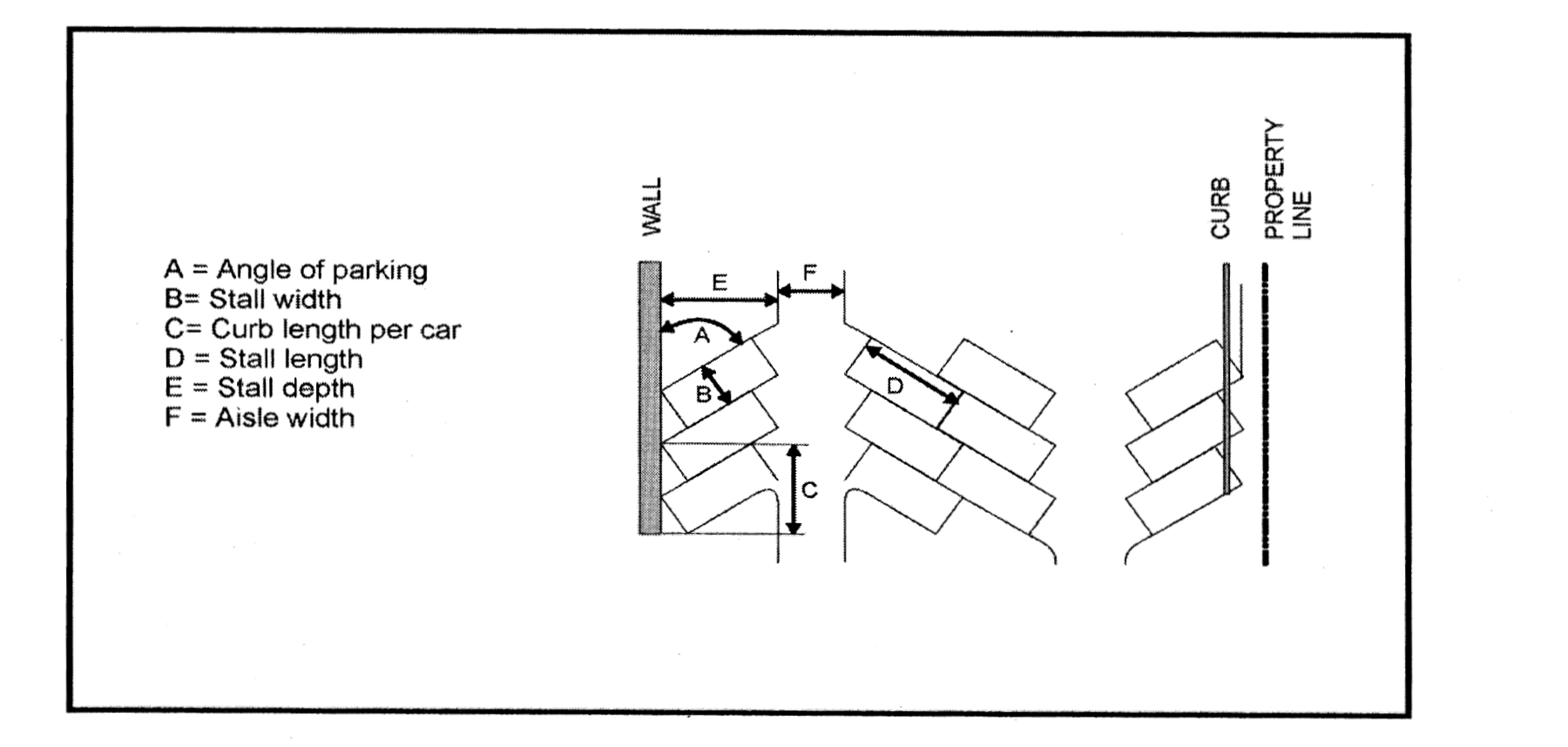
Parking Lot Dimensions
3.
Within structures. The off-street parking requirements may be furnished by providing a space so designed within the principal building or one structure attached thereto; however, unless provisions are made, no building permit shall be issued to convert said parking structure into a dwelling unit or living area or other activity until other adequate provisions are made to comply with the required off-street parking provisions of this Code.
4.
Streets not used. Except under joint parking provisions or in the case of single-, two-family and townhouse dwellings, parking areas shall be designed so that circulation between parking bays or aisles occurs within the designated parking lot and does not depend upon a public street or alley. Except in the case of single-, two- family and townhouse dwellings, parking area design which requires backing into the public street is prohibited.
5.
Curb cut proximity to intersection. No curb cut or other driveway access shall be located less than 40 feet from the intersection of two or more street rights-of-way. This distance shall be measured from the intersection of lot lines, not curb lines.
6.
Curb cut maximum. No curb cut access shall exceed the following width dimensions measured at the property line:
Residential .....24 feet
Residential single-family
with a three car garage .....28 feet
Commercial/industrial .....26 feet
All curb cuts shall be installed to comply with the city's curb cut design standards. The curb radius for any curb cut shall not exceed 35 feet. Curb cut widths up to 32 feet may be permitted subject to review and recommendation of the city engineer and approval of the city manager. Before the city engineer recommends a curb cut exceeding the maximum widths set out herein, they shall consider the type of land use the curb cut will serve, the extent and nature of the vehicular traffic anticipated the type, the width of the street serving the property where the curb cut will be located, and any regulations promulgated by the Minnesota Commissioner of Transportation relative to driveway and curb cut dimensions.
7.
Curb cut minimum. Curb cut openings shall be located at minimum five feet from the side yard lot line in all districts except the R-1 and R-2 districts. In the R-1 and R-2 districts, curb cuts may be three feet from the side yard lot line. Further, there shall be no set-back requirement from a shared lot line for dwellings defined as "zero lot line" Twinhomes by subsection 4-2(2) of this Code.
8.
Curb cut separation. Driveway access curb openings on a public street except for single-, two-family and townhouse dwellings shall not be located less than 40 feet from one another.
9.
Parking area grades. The grade elevation of any parking area shall not exceed five percent.
10.
Driveway access minimum. All property shall be entitled to at least one driveway access. Each property shall be allowed one driveway access for each 125 feet of street frontage. Single-family uses shall be limited to one driveway access per lot.
11.
Surfacing. In all zoning districts, all parking areas, driveways, and driveway aprons shall be constructed and surfaced with concrete, asphalt, paving block or other forms of concrete in compliance with adopted city construction specifications. All driveways and parking stalls shall, at a minimum, be surfaced with a six-inch Class 5 base and two-inch asphalt topping and maintained free of potholes, broken surface material and be graded, and maintained so as to adequately dispose of all surface water accumulation within the area. Plans for surfacing and drainage of driveways and stalls for five or more vehicles shall be submitted to the city engineer for review and the final drainage plan shall be subject to written approval of the engineer. For construction of new garages, homes and/or any new driveway permits in all R-1 and R-2 districts, areas intended to be used for vehicle parking spaces and driveways shall comply with the above-stated requirement. Parking areas and driveways for existing garages and/or homes shall be surfaced with a material suitable to control dust and drainage. A covering permitting the growth of grass in the R-1 or R-2 districts does not constitute an acceptable surfacing material.
12.
Striping. Except for single-family, two-family and townhouses, all parking stalls shall be marked with painted lines not less than four inches wide, which striping shall be maintained for legibility on a regular basis.
13.
Lighting. Any lighting used to illuminate an off-street parking area shall be so arranged as to reflect the light away from adjoining property, abutting residential uses and public rights-of-way and be in compliance with subsection 4-3(d)(5) of this Code.
14.
Signs. No sign shall be so located as to restrict the sight lines and orderly operation and traffic movement within any parking lot.
15.
Curbing and landscaping. All open off-street parking shall have a continuous perimeter concrete curbing, unless otherwise recommended by the city engineer, around the entire parking lot, said curb barrier shall not be closer than five feet to any lot line. Plantings or surfacing material shall be provided in all areas bordering the parking area. No landscaping in the boulevard shall interfere with the view of the street for drivers entering or exiting the premises. This requirement shall not apply to off-street parking areas for single-family or two-family dwellings or townhouse units with direct street access to garages.
16.
Required screening. All open, off-street parking areas of five or more spaces shall be screened and landscaped from abutting or surrounding residential districts in compliance with subsection 4-3(d)(3) of this Code.
17.
Parking area landscaping.
i.
All exposed parking areas of six or more required spaces shall be landscaped on all sides of the parking lot abutting public rights-of-way or adjoining properties.
ii.
When a parking area of six spaces or more is adjacent to a street or residential area, a berm, wall, or fence not less than three feet in height shall be erected along the parking area. Grass or plantings shall occupy the space between the parking lot curb or fence and the street surface.
(5)
Maintenance. It shall be the joint and several responsibility of the owner of the principal use (or lessee, if there be one), to use and to maintain in a neat and adequate manner, the parking space, accessways, striping, landscaping, and required fences.
(6)
Location. All accessory off-street parking facilities required by this Code shall be located and restricted as follows:
a.
Same lot. Required accessory off-street parking shall be on the same lot under the same ownership as the principal use being serviced, except under the provisions of subsections 4-3(e)(11) and 4-3(e)(12) of this Code.
b.
Head in parking. Except for single-, two-family and townhouse dwellings, head-in parking, directly off of and adjacent to a public street, with each stall having its own direct access to the public street, shall be prohibited.
c.
Parking distance from property line. There shall be no driveways or off-street parking within three feet of any property line abutting another property. This prohibition shall not apply to zero lot line parcels in any residential zoning district containing adjacent garages that share a common wall on the zero lot line when the driveway is shared by the dwelling units and the driveway curb cut also abuts the shared or zero lot line. For one- and two-family residential districts, parking in front yards and side yard corner lots with curb cut accesses must be set back at least eight feet from the street curb, shall not encroach on any sidewalk, and must be on an approved surface. All other zoning districts shall meet the minimum parking lot requirements as set forth in this code. Recreational vehicles stored in the front yard or side corner lots with curb cut access must be set back at least 15 feet from the street curb and shall not encroach on any sidewalk. Recreational vehicles stored in the side yard or rear yard shall maintain at least a three foot setback from the side or rear yard property lines, with exceptions and complete standards set forth in section 4-3(d)(8)c. of this Code.
d.
Boulevard parking prohibited. The boulevard portion of the street right-of-way shall not be used for parking.
(7)
Other use of required parking area. Required accessory off-street parking spaces in any district shall not be utilized for open storage, sale or rental of goods, storage of commercial or inoperable vehicles as regulated by subsection 4-3(d)(8)b of this Code, and/or storage of snow. No parking area shall be used for sales, dead storage, body repair work, including, but not limited to, frame or fender repair, or mechanical repairs of any kind, except that this shall not apply to home maintenance work of a customary or routine nature necessary for the efficient operation of a vehicle, provided that it does not result in oil spillage, litter or other damage to the parking area surface, and provided that such routine home maintenance and upkeep work is completed within 48 hours.
(8)
Sidewalks. Sidewalks shall be provided from apartment parking areas, loading zones and recreation areas to the entrances to the building. Portland cement type concrete sidewalks to a width of not less than five feet shall be provided in the boulevards along all streets abutting the property.
(9)
Garages. A private garage shall be provided in connection with the erection or increase of units of any multiple-family dwelling structure as follows: One private garage per dwelling unit. No such private garage shall be less than ten feet in width nor less than 20 feet in depth. Each garage shall have an individual door for vehicular access shall be not less than nine feet in width. If more than one private garage is contained in a single building, an area of each such private garage shall be separated by a continuous fire-resistant wall extending from the foundation up to the roof at all points. The side of the garage building containing the doorway for vehicular access shall be not less than 30 feet from other garage buildings or apartment house buildings, or from other structures which may interfere with vehicular movement.
(10)
Number of spaces required. The following minimum number of off-street parking spaces shall be provided and maintained by ownership, easement and/or lease for and during the life of the respective uses hereinafter set forth:
a.
Single-family dwellings. One enclosed and one open space, except that all structures with existing or potential floor area, as calculated under subsection 4-3(e)(4)a of this Code, in excess of 2,200 square feet shall require one enclosed and two open spaces for parking.
b.
Two-family dwellings and townhomes. One enclosed and one and one-half open parking spaces per unit.
c.
Townhomes and multiple-family dwellings. At least one enclosed and one and one-fourth open spaces per unit.
1.
Senior citizen residential housing. One space per unit. plus one space per employee on maximum shift. One-half of required stalls may be provided at initial development for projects with occupancy restricted to persons age 55 and older. A proof of parking restrictive covenant shall be entered into by property owner and filed with property permitting the city to require, at its sole discretion, addition of parking required by this section in the event the city determines there is a need for this deferred parking.
2.
Physically disabled citizen residential housing. One parking space for each unit, plus one space per employee on maximum shift.
d.
Convalescent homes, rest homes, nursing homes. One for each four beds for which accommodations are offered plus one per each two employees.
e.
Motels, motor hotels, hotels. One space per each rental unit and one space for each employee on any shift.
f.
School, elementary, and junior high school or church schools. At least one parking space for each seven students based on design capacity plus one for each three classrooms.
g.
Schools, trade school/specialty schools such as gymnastic training. One and one-half parking spaces for every two pupils at student capacity, unless it can be demonstrated that a differing amount of parking is required by that activity.
h.
Senior high school and post high school facilities (public and private). One space based on four students based on building design capacity.
i.
Church, theatre, auditorium. At least one parking space for each three seats based on the design capacity of the main assembly hall. Facilities as may be provided in conjunction with such buildings or uses shall be subject to additional requirements which are imposed by this Code.
j.
Community centers, libraries, private health clubs, museums, art galleries. One parking space for each 300 square feet of floor area.
k.
Bowling alley. At least six parking spaces for each alley, plus additional spaces as may be required herein for related uses contained within the principal structure.
l.
Office buildings, medical and professional offices. Three spaces plus at least one space for each 300 square feet of floor area.
m.
Retail store, service/ shopping center or convenience food take-out/delivery establishment. At least one off-street parking space for each 200 square feet of floor area.
n.
Retail sales and service business with 50 percent or more of gross floor area devoted to storage, warehouses. At least eight spaces or one space for each 200 square feet devoted to public sales or service plus one space for each 1,500 square feet of storage area.
o.
Restaurants, cafes, private clubs serving food and/or drinks, bars, taverns, night clubs. At least one space for each 40 square feet of gross floor area of dining and bar area and one space for each 80 square feet of kitchen area.
p.
Drive-in establishment and convenience food. At least one space for each 40 square feet of floor area or dining area, plus one space per 80 square feet of kitchen area, plus one space per 15 square feet of lobby and service center area.
q.
Funeral parlor. At least 20 parking spaces for each chapel or parlor, plus one parking space for each funeral vehicle maintained on the premises. Aisle space shall also be provided off the street for making up a funeral procession.
r.
Automobile repair and motor fuel station. At least five off-street parking spaces plus three off-street parking spaces for each service stall. Those facilities designed for sale of other items than strictly automotive products, parts or service shall be required to provide additional parking in compliance with other applicable sections of this Code.
s.
Automobile sales. At least one space for each 500 square feet of showroom, plus one space for every 3,000 square feet of outdoor sales lot, plus parking required for any ancillary automobile service or repair.
t.
Garden supply, nursery, lumber yard. At least one space per 250 square feet of interior sales floor area plus one space for each 3,000 square feet of outdoor sales area.
u.
Manufacturing, fabricating or processing of a product or material. One space for each 500 square feet of floor area, plus one space for each company owned vehicle (if not stored inside principal building).
v.
Warehousing, storage or handling of bulk goods. That space which is solely used as office ancillary to the larger warehouse facility shall provide one space for each 300 square feet of floor area used as office and one space per each 1,500 square feet of floor area used as warehouse, plus one space for each company owned vehicle (if not stored inside).
w.
Other uses. Other uses not specifically mentioned herein shall be determined on an individual basis by the city council. Factors to be considered in such determination shall include (without limitation) national parking standards, parking standards for similar businesses or land uses, size of building, type of use, number of employees, expected volume and turnover of customer traffic and expected frequency and number of delivery or service vehicles.
(11)
Joint facilities.
a.
Off-site joint use of parking. The city council may, after receiving a report and recommendation from the planning commission, approve a conditional use permit for one or more businesses to provide the required off-street parking facilities by joint use of one or more sites where the total number of spaces provided are less than the sum of the total required for each business should they provide them separately. When considering a request for such a permit, the planning commission shall not recommend that such permit be granted except when the following conditions are found to exist.
1.
Entertainment uses. Up to 50 percent of the parking facilities required for a theatre, bowling alley, dance hall, bar or restaurant may be supplied by the off-street parking facilities provided by types of uses specified as primarily daytime uses in subsection 4. below.
2.
Night time or Sunday uses. Up to 50 percent of the off-street parking facilities required for any use specified under iv below as primary daytime uses may be supplied by the parking facilities provided by the following night-time or Sunday uses; auditoriums incidental to a public or parochial school, churches, bowling alleys, dance halls, theatres, bars, restaurants or apartments.
3.
School auditorium and church uses. Up to 80 percent of the parking facilities required by this section for a church or for an auditorium incidental to a public or parochial school may be supplied by the off-street parking facilities provided by uses specified under subsection iv below as primarily daytime uses.
4.
Daytime uses. For the purpose of this section the following uses are considered as primarily daytime uses: banks, business offices, retail stores, personal service shops, household equipment or furniture shops, clothing or shoe repair or service shops, manufacturing, wholesale and similar uses.
b.
Additional criteria for joint parking. In addition to the preceding requirements, the following conditions are required for joint parking usage:
1.
Proximity. The building or use for which application is being made to utilize the off-street parking facilities provided by another building or use shall be located within 300 feet of such parking facilities.
2.
Conflict in hours. The applicant shall show that there is no substantial conflict in the principal operating hours of the two buildings or uses for which joint use of off-street parking facilities is proposed.
3.
Written consent and agreement. A legally binding instrument, executed by the parties concerned, for joint use of off-street parking facilities, duly approved as to title of grantors or lessors, and form and manner of execution by the city attorney, shall be filed with the city clerk and recorded with the Hennepin county recorder or registrar of titles, and a certified copy of the recorded document shall be filed with the city within 60 days after approval of the joint parking use by the city.
(12)
Off-site parking.
a.
A conditional use. Any off-site parking which is used to meet the requirements of this Code shall be a conditional use permit as regulated by section 4-33 of this Code and shall be subject to the conditions listed below.
b.
Code compliance. Off-site parking shall be developed and maintained in compliance with all requirements and standards of this Code.
c.
Access. Reasonable access from off-street parking facilities to the use being serviced shall be provided.
d.
Lessee agreement required. The site used for meeting the off-site parking requirements of this Code shall be secured by a lease agreement between the parties, with term approved by the city council subject to the review and approval of the city attorney, filed with the city clerk and recorded with the Hennepin County Recorder or Registrar of Title, and a certified copy of the recorded document shall be filed with the city clerk within 60 days after approval of the agreement by the city council.
e.
Proximity to multiple residence. Off-site parking for multiple-family dwellings shall not be located more than 100 feet from any normally used entrance of the principal use serviced.
f.
Proximity for nonresidential uses. Off-site parking for nonresidential uses shall not be located more than 300 feet from the main entrance of the principal use being served. No more than one main entrance shall be recognized for each principal building.
g.
Term of parking agreement. Any use which depends upon off-site parking to meet the requirements of this Code shall maintain ownership and parking utilization of the off-site location until such time as on-site parking is provided or a site in closer proximity to the principal use is acquired and developed for parking.
(13)
Deferment of required parking. A reduction in the number of required parking stalls may be permitted by conditional use permit provided that:
a.
Evidence is provided demonstrating that the parking requirements of the proposed use will be less than the parking required under subsection 4-3(e) of this Code during the peak demand period. Factors to be considered when reviewing the proposed parking demand shall include, but not be limited to:
1.
Size, type and use of building.
2.
Number of employees.
3.
Projected volume and turnover of employee and/or customer traffic.
4.
Projected frequency and volume of delivery or service vehicles.
5.
Number of company owned vehicles.
6.
Storage of vehicles on site.
b.
In no case shall the amount of parking provided be less than one-half to the amount of parking required by ordinance.
c.
The property owner can demonstrate that the site has sufficient property under the same ownership to accommodate the expansion of the parking facilities to meet the minimum requirements of subsection 4-3(e) of this Code if the parking demand exceeds on-site supply.
d.
On-site parking shall only occur in areas designed and constructed for parking in accordance with subsection 4-3(e) of this Code. The area reserved as "proof of parking" shall be sodded or seeded and maintained as green space or a recreational area. No permanent buildings shall be permitted in the "proof of parking" area.
e.
The property owner shall record a restrictive covenant against the title to the property providing that additional parking shall be constructed in accordance with subsection 4-3(e) of this Code if the site parking demand exceeds the actual on-site parking supply in the sole opinion of the city. The form of the restrictive covenant shall be approved by the city attorney before the issuance of the conditional use permit.
f.
To qualify for a parking deferment, the site plan must comply with all current zoning standards.
g.
Application for and approval of a conditional use permit for deferment of required parking shall also be subject to the provisions of section 4-33 et al of this Code.
(14)
Bicycle parking. Bicycle parking shall be required for all commercial land uses within the R-O (residential-office), R-B (residential-business), L-B (limited business) and C-B (community business) zoning districts meeting the following standards:
a.
Required bicycle parking. The following minimum on-site spaces shall be provided:
b.
Bicycle parking shall consist of city approved bicycle racks capable of accommodating the required number of bicycle parking spaces.
c.
Bicycle parking shall be integrated into the site design and shall be located to not interfere with on-site vehicle or pedestrian traffic movements, required automobile parking or on-site loading.
(f)
Off-street loading.
(1)
Purpose. The regulation of loading spaces in these zoning regulations is to alleviate or prevent congestion of the public right-of-way and in off-street parking areas so to promote the safety and general welfare of the public, by establishing minimum requirements for off-street loading and unloading from motor vehicles in accordance with the specific and appropriate utilization of various parcels of land or structures.
(2)
Location.
a.
Off-street. All required loading berths shall be off-street and located on the same lot as the building or use to be served.
b.
Distance from intersection. All loading berth curb cuts shall be located at minimum 50 feet from the intersection of two or more street rights-of-way. This distance shall be measured from the property line.
c.
Prohibited in front yards. Loading berths shall not occupy the front yard setbacks.
d.
Front or side yard locations. A conditional use permit shall be required for loading berths for nonresidential uses located at the front of the building or at the side of the building on a corner lot must comply with the following standards:
1.
Pedestrians. Loading berths shall not conflict with pedestrian movement.
2.
Visibility. Loading berths shall not obstruct the view of the public right-of-way from off-street parking access.
3.
General compliance. Loading berths shall comply with all other requirements of this section.
e.
Traffic interference. Each loading berth shall be located with appropriate means of vehicular access to a street or public alley in a manner which will cause the least interference with traffic.
f.
Distance from residential use. No loading berth for an industrial use shall be located closer than 100 feet from a residential district unless within a structure.
(3)
Surfacing. All loading berths and accessways shall be improved with not less than six inch class five base and two inch bituminous surfacing to control the dust and drainage according to a plan submitted to and subject to the approval of the city engineer.
(4)
Accessory use; parking and storage. Any space allocated as a required loading berth or access drive so as to comply with the terms of these zoning regulations shall not be used for the storage of goods, inoperable vehicles or snow and shall not be included as part of the space requirements to meet the off-street parking requirements.
(5)
Screening. Except in the case of multiple dwellings all loading areas shall be screened and landscaped from abutting and surrounding residential uses in compliance with subsection 4-3(d)(3) of this Code.
(6)
Number and size of loading berths. The number of required off-street loading berths shall be as follows:
a.
Commercial or industrial uses.
1.
One loading berth and one additional berth for each additional 100,000 square feet or fraction thereof. The first loading berth shall be not less than 70 feet in length and additional berths required shall be not less than 30 feet in length and all loading berths shall be not less than ten feet in width and 14 feet in height, exclusive of aisle and maneuvering space.
2.
Reduction in size of space. For commercial or industrial buildings 7,000 square feet or less, the size of the loading area may be reduced or the requirement may be waived upon administrative approval. To qualify for such exception, the following provisions must be met:
i.
It must be demonstrated that the site cannot physically accommodate a loading berth to the size required.
ii.
It must be demonstrated that semitrailer truck deliveries will not occur at the site or all deliveries will occur at such a time as to not conflict with customer or employee access to the building and parking demand.
b.
Multiple residential type uses. One loading area shall be provided for each multiple-family structure containing five or more units and shall be exclusively reserved for loading and unloading. The space shall be at minimum 40 feet in length and ten feet in width. Said area may be parallel to a driveway aisle, but shall not serve to block the flow of traffic or parking spaces.
c.
Reuse of the building shall be held to the aforementioned condition if site is approved for loading area waiver.
(g)
Home occupation.
(1)
Purpose. The regulation of home occupations within residential structures is intended to ensure that the occupational use is clearly accessory or secondary to the principal dwelling use and that compatibility with surrounding residential uses is maintained.
(2)
Application. For purposes of this Code, home occupations, as defined in section 4-2, shall be further defined to distinguish permitted home occupations from prohibited home occupations. Accordingly, all home occupations which satisfy the permitted home occupation criteria shall be considered as a permitted accessory use in all residential zoning districts. Permitted home occupations shall be required to register with the city. Home occupations which satisfy the prohibited home occupation criteria shall not be allowed in residential zoning districts.
a.
Registration required. No person, firm, corporation or other entity shall conduct any home business within without having first registered the business with the city. The one-time application must be submitted prior to operation of the business. No registration fee shall be required.
b.
Registration nontransferable. No registration issued pursuant to this section shall be transferable or assignable to any person, firm, corporation or other entity. Any change in ownership or occupancy of premises, change in proprietor or owner of a business or material change in the business use of the premises by the same owner or occupant of the premises shall constitute a change for which a new home occupation registration shall be required. Any change of the person or entity from that which is shown on the issued registration shall require that a new registration be obtained.
(3)
Permitted home occupations. Home occupations which meet the following criteria:
a.
Structural changes. Businesses shall require no interior or exterior changes necessary to conduct the business and shall require no mechanical or electrical equipment not customarily found in a home.
b.
Traffic. Businesses shall not significantly alter the traffic pattern of the neighborhood.
c.
Parking. Parking related to the business shall be provided only in the garage or on the driveway of the property where it operates and shall be in compliance with subsection 4-3(e)(4)f of this Code.
d.
Deliveries. Deliveries shall be limited to the type that typically service residences.
e.
Employees. Businesses shall not require employees other than those living on the premises.
f.
Clients. Businesses shall not generate more than eight client trips per day and serve no more than two clients at one time.
g.
Area permitted. Businesses shall not be allowed in accessory buildings and shall require no more than 20 percent of the gross floor area of a dwelling, not to exceed 300 square feet.
h.
Sales on premises. No physical products shall be displayed or sold on the premises except such that are incidental to the permitted home occupation.
i.
Open outdoor storage. Businesses shall have no open outdoor storage of equipment, machinery, inventory, tools or any other item required for use by the business.
j.
Adverse effects. Business shall not produce light, glare, noise, odor, smoke, fumes, dust, heat, vibration, radiation, or other hazardous or particulate matter that will in any way have an objectionable effect upon adjacent properties.
k.
Signage. Businesses shall be allowed one non-illuminated wall sign that is no larger than six square feet in size. The sign may identify the home occupation, resident and address but may contain no other information.
l.
Other regulations. Businesses shall meet all other applicable city, state and federal licenses, codes and regulations.
m.
Day care in home. Businesses shall be subject to applicable county and state licensing requirements, serving up to 12 persons, in permitted zoning districts. Such use shall be exempt from client and gross floor area restrictions within this subsection.
(4)
Prohibited home occupations. Home occupations which meet the following criteria:
a.
Conducting of retail business other than by U.S. mail, commercial delivery services by a vehicle no larger than a step van, or by taking and ordering delivery of orders by telephone or internet sales.
b.
Manufacturing business.
c.
Repair, service, building, rebuilding or painting of autos, trucks, boats, engines, and other vehicles.
d.
Businesses, educational programs or similar gatherings which meet on a regular basis and have more than five non-residents in attendance at a time.
(h)
Temporary uses.
(1)
Purpose. Certain uses that are generally not suitable within a particular zoning district are potentially suitable on a temporary basis. This may be due to the lack of development on existing property due to a short-term need (such as highway construction), or to the limited degree of adverse affects upon adjacent land use. Accordingly, it is the intention of this subdivision to recognize certain temporary uses as being potentially allowable and provide regulations for their control, if permitted.
(2)
Application. Where not specifically listed, all temporary uses shall be permitted in any zoning district provided they apply for and receive approval of an administrative permit or appropriate city license (as may be required by the nature of the use).
(3)
Temporary uses subject to licensing.
a.
Christmas trees. Christmas tree sales for a period not to exceed 90 days.
b.
Sales promotions. Carnivals and circuses held as promotional activities in conjunction with developed commercial uses in the "LB" or "CB" districts only.
c.
Civic activities. Community activities by nonprofit civic groups, upon approval by the city council of the proposed program as being in harmony with area uses, and upon issuance of appropriate permits and licenses.
d.
Outdoor sales of seasonal farm produce.
(4)
Temporary uses requiring an administrative permit.
a.
Road materials. Black-top or crushing plant for highway materials.
b.
Excavating for sale. Excavating businesses—Sand, gravel, or black dirt.
c.
Stockpiling. Stockpiling of material for use in highway construction.
d.
Religious. Religious meeting in a temporary structure for a period not to exceed ten days.
e.
Carnival. Carnivals or circuses when operated as a separate commercial business for a period not to exceed 15 days.
f.
Outdoor sales of seasonal farm produce. Subject to the requirements of section 8-31 of this Code.
(5)
Additional criteria. All permitted temporary uses shall satisfy the following criteria in addition to the general criteria imposed for all administrative permits as provided for in section 4-31.
a.
Site plan. A detailed site plan, consistent with section 4-35, must be submitted for review and approved by city staff.
b.
Adjacent sites. Adjacent vacant land is not yet impacted by development pressures or will not be affected by the proposed use.
c.
Noise and nuisance. Adjacent developed land will not be adversely affected by the proposed use because of traffic, noise, dust, smoke, unsightliness, or other nuisance characteristic.
d.
Term of permit. The period of time for which the administrative permit is to be granted will terminate before any adverse effects are felt upon adjacent property.
e.
Performance bond. There is adequate assurance, guaranteed by performance bond in a form accepted by the city council, if deemed necessary by the council, that the property will be left in suitable condition after the temporary use is terminated.
(6)
Garage sale—Temporary use not subject to license or permit. Garage sales are a permitted temporary use in all residential zoning districts, subject to the following conditions:
a.
No more than three garage sales shall be permitted on one property per calendar year.
b.
The duration of each garage sale shall not exceed three consecutive days.
c.
Garages sales shall be exempt from the provisions of subsection 4-3(h)(5) of this Code.
d.
Garage sale signs must comply with all regulations of chapter 3 of this Code.
(i)
A drainage plan. In the case of all residential plats, multiple-family dwellings, businesses, and industrial developments, grading and drainage plans shall be required. Grading and drainage plans shall demonstrate compliance with:
a.
The performance standards of subsection (j) of this Code;
b.
The policies, standards, and implementation measures in the city's most current adopted local water management plan;
c.
All applicable requirements of the jurisdictional watershed management organization; and
d.
shall be subject to the review and written approval of the city engineer.
(j)
Grading, erosion and sediment control regulations.
(1)
Title. This section shall be known as the "Grading, Erosion and Sediment Control Regulations" and may be so cited.
(2)
Purpose. The purpose of these regulations are to promote, preserve and enhance the natural resources within the city and protect them from adverse effects occasioned by poorly sited development or incompatible activities by regulating land disturbing or development activities that would have an adverse and potentially irreversible impact on water quality and environmentally sensitive land; by minimizing conflicts and encouraging proper installation and maintenance of best management practices (BMPs) for land disturbing or development activities; and by requiring detailed review standards and procedures for land disturbing or development activities proposed for such areas, thereby achieving a balance between development and protection of water quality and natural areas.
(3)
Scope. This section sets forth rules and regulations to control land disturbances, land fill, soil storage, and erosion and sedimentation resulting from such activities. This section establishes procedures for issuance, administration and enforcement of a land disturbance permit.
(4)
Other laws. Neither this section nor any administrative decision made under it:
a.
Exempts the permittee from procuring other required permits or complying with the requirements and conditions of such permit; or
b.
Limits the right of any person to maintain, at any time, any appropriate action at law or in equity, for relief or damages against the permittee arising from the permitted activity.
(5)
Severability and validity. If any part of this section is not found valid, the remainder of this section shall remain.
(6)
Permit and stormwater pollution prevention plan (SWPPP) required.
a.
Applicability. No person shall conduct land disturbing activities that meet any of the following criteria without a land disturbance permit and submitting a stormwater pollution prevention plan (SWPPP) pursuant to this chapter.
1.
Land disturbance greater than or equal to one acre or which will be part of a larger common plan or development that will include land disturbing activities greater or equal to one acre.
2.
Grading, excavation, or fill, which is greater than or equal to 50 cubic yards (CY).
3.
Grading, excavation, fill, or disturbed areas which are greater than or equal to 15,000 square feet.
b.
No building permit, subdivision approval, or other permit that will result in land disturbing activities shall be issued until approval of the stormwater pollution prevention plan or a waiver of the approval requirement has been obtained in conformance with the provisions of this section.
c.
Exemptions. The provisions of this chapter do not apply to:
1.
Any part of a subdivision if a plat for the subdivision has been approved by the city council on or before the adoption of [ordinance no. 09-13]; or
2.
A lot for which a building permit has been approved on or before the adoption of [ordinance no. 09-13]; or
3.
Emergency work to protect life, limb or property; or
4.
Tilling, planting, or harvesting of agricultural, horticultural, or silvicultural (forestry) crops.
(7)
Application. The application for a permit must include all of the following items:
a.
Application.
b.
[Stormwater] pollution prevention plan.
c.
Work schedule.
d.
Application fees.
e.
Performance bond or other acceptable security (see subsection (j)(13)).
f.
Any supplementary material required by the issuing authority.
(8)
Application form. The following information is required on the application form:
a.
Name, address and telephone number of the applicant.
b.
Name(s), address(es) and telephone number(s) of any and all contractors, subcontractors or persons actually doing the land-disturbing and land-filling activities and their respective tasks.
c.
Name(s), address(es) and telephone number(s) of the person responsible for the preparation of the stormwater prevention plan.
d.
Name(s), address(es) and telephone number(s) of the registered engineer(s) responsible for the preparation of the soil engineering and engineering geology reports, where required.
e.
A vicinity map showing the location of the site in relationship to the surrounding area's watercourses, water bodies and other significant geographic features, and roads and other significant structures. A description of the land on which the proposed work is to be done by legal description, street address or similar description that will readily identify and definitely locate the proposed building or work.
f.
Date of the application.
g.
Signature(s) of the owner(s) of the site or of an authorized representative.
(9)
Stormwater pollution prevention plan (SWPPP). Each application for a land disturbance permit shall be accompanied by two copies of a stormwater pollution prevention plan consisting of the following dependent upon the type and size of land disturbance activity conducted as described below:
a.
For all individual residential platted lots or any commercial and industrial land which disturbs less than one acre and includes fill or excavation less than 100 cubic yards:
1.
Identification of proposed contour grading on the site at vertical intervals of not more than two feet;
2.
Drainage patterns clearly shown using arrows depicting direction of surface water flow;
3.
A map showing the stages or limits of grading together with the existing or proposed finished elevations;
4.
Identification of proposed building bench elevations;
5.
Submission of preliminary plans or program for water supply, sewage disposal, drainage and flood control (if applicable);
6.
Soil borings, if required by the city engineer;
7.
Locations of any wetlands, lakes, streams, or other critical water resource areas;
8.
Appropriate best management practices set forth in this chapter; and
9.
Other information as required by the city based on specific project characteristics.
b.
For all subdivisions and commercial or industrial sites in which land disturbance activities will impact one or more acres; or fill or excavate over 100 cubic yards, whichever is more restrictive; or any other site if determined appropriate by the city engineer due to potential impacts to wetlands, lakes, or sensitive receiving waters.
1.
Grading plan. A grading plan shall be provided that clearly indicates the proposed land disturbance activities. Both existing and proposed topography shall be shown and have a maximum contour interval of two feet. Drainage patterns shall be clearly shown using arrows depicting direction of flow. Other information shall be shown as required by the city based on specific project characteristics.
2.
Phasing plan. A phasing plan shall be provided that clearly indicates the areas in the order they are to be disturbed and restored. The phasing plan shall consider minimization of area and duration of exposed soil and unstable conditions, minimization of the disturbance of natural soil cover and vegetation, erosion and sediment control measure installation, weather conditions and the schedule for temporary and permanent restoration. The area and duration of each phase shall be indicated on the plan.
3.
Pond detail sheet. A pond detail sheet shall be provided for each proposed stormwater pond that shows detailed pond design including normal water level, high water level, aquatic bench, maintenance bench, outlet structures, emergency overflow locations and other project specific data required by the city.
4.
Standard detail sheet. A standard detail sheet shall be provided that consists of applicable construction details for approved erosion and sediment control measures as developed by the city. Other techniques may be used upon prior approval by the city with details provided by the designer.
5.
Buffers. Native or natural vegetation buffers must be established or preserved in accordance with this chapter. Buffer zone widths are defined as follows:
i.
Lakes. Minimum of 10 feet in width measured from the Ordinary High Water Level (OHWL).
ii.
Streams. 10 feet in width or 25% of the distance between the OHWL and the nearest existing structure, whichever is less.
iii.
Wetlands. Based on Minnesota Routine Assessment Methodology classification, or a similar classification system, buffer widths are required as follows (measured from the delineated wetland edge):
(a)
Preserve: 75 feet average and minimum of 50 feet.
(b)
Manage 1: 50 feet average and minimum of 30 feet
(c)
Manage 2 or 3: 25 feet average and minimum of 15 feet.
iv.
Exceptions. Public recreational facilities, such as trails, can run parallel to shoreline up to 20 feet in width. The width of the facility must be added to the required buffer width.
6.
Specifications. Written specifications for land disturbance activities such as product descriptions, installation and maintenance procedures required by the applicant to carry out the project in accordance with this chapter.
7.
Stormwater pollution prevention plan as required under the NPDES stormwater permit issued by the MPCA. The stormwater pollution prevention plan shall consist of three components:
i.
Temporary erosion and sediment control plan: Indicate the location of perimeter controls, construction fence, temporary sedimentation basins, inlet protection, areas to be seeded, areas to be mulched or blanketed, location of construction waste control (dumpsters, chemical storage, concrete washout, portable restroom facilities, etc.) and all other required temporary erosion and sediment control measures as described in section. This plan shall also indicate staging of temporary erosion control measures.
ii.
Permanent erosion and sediment control plan: Indicates areas to be seeded and sodded, sediment ponds, storm sewer systems and all other required permanent erosion and sediment control measures. Permanent stormwater pollution controls including, but not limited to ponds, vegetated buffers and structural measures shall be designed and constructed in accordance with other chapters of this Code and requirements of other agencies having jurisdiction.
iii.
Narrative: Describes, at a minimum, the nature of construction activity, person(s) responsible for inspection and maintenance of site erosion and sediment control including contact information, project phasing, schedules, along with the timing, installation and maintenance of erosion and sediment control measures and specifications necessary to carry out the project.
8.
Permit documentation: The property owner or owner's agent shall apply for and be issued a National Pollutant Discharge Elimination System (NPDES) general stormwater permit from the Minnesota Pollution Control Agency (MPCA) and any appropriate watershed district permits; and shall submit to the city a copy of the MPCA certificate of permit coverage or watershed district approval.
(10)
Stormwater pollution prevention plan process.
a.
Process. For any subdivision, the stormwater pollution prevention plan shall be submitted with the preliminary plat application. For all other applications, the stormwater pollution prevention plan meeting the requirements of this section and minimum BMP requirements of this section must be reviewed by the city engineer or designated representative who may approve, approve with conditions, or deny the stormwater pollution prevention plan prior to any land disturbing activity on the site.
b.
Duration. Approval of a stormwater pollution prevention plan submitted under the provisions of this article shall expire one single year after the date of approval or expiration of the permit, which ever is sooner, unless construction has commenced in accordance with the plan. However, if prior to the expiration of the approval, the applicant makes a written request to the city for an extension of time to commence construction setting forth the reason for the requested extension, the city engineer may grant one extension of not more than one single year. Receipt of any request for an extension shall be acknowledged by the city within 15 days. The city shall make a decision on the extension within 30 days of receipt. Any plan may be revised in the same manner as originally approved.
c.
Conditions. A stormwater pollution prevention plan may be approved subject to compliance with conditions reasonable and necessary to ensure that the requirements contained in these regulations are met. Such conditions may, among other matters, limit the size, kind or character of the proposed development, require replacement of vegetation, establish required monitoring procedures, stage the work over time, or require alteration of the site design to ensure buffering, and require the conveyance to the city or other public entity of certain lands or interests therein.
d.
Financial security. The adequacy, conditions and acceptability of any financial security shall be determined by the city.
(11)
Minimum SWPPP best management practices (BMPs).
a.
No stormwater pollution prevention plan that fails to meet the standards contained in this section shall be approved by the city council or designated representative.
b.
Site dewatering. Water pumped from the site shall be treated by temporary sedimentation basins, grit chambers, sand filters, upflow chambers, hydrocyclones, swirl concentrators or other appropriate controls as appropriate. All water from dewatering must be discharged in a manner that does not cause nuisance conditions, erosion in receiving channels or on downslope properties, or inundation in wetlands causing significant adverse impact to the wetland.
All discharge points must be adequately protected from erosion and scour. The discharge must be dispersed over natural rock riprap, sand bags, plastic sheeting or other accepted energy dissipation measures. Adequate sedimentation control measures are required for discharge water that contains suspended solids.
c.
Construction site waste.
1.
Waste and material disposal: All waste, unused building material (including garbage debris, cleaning wastes, wastewater, toxic materials or hazardous materials), collected sediment, asphalt and concrete millings, floating debris, paper, plastic, fabric, construction and demolition debris and other wastes must be properly contained on site and disposed of off site, not allowed to be carried by runoff into receiving channel or storage sewer system, and must comply with MPCA disposal requirements.
2.
Hazardous materials: Oil, gasoline, paint and any hazardous substances must be properly stored, including secondary containment, to prevent spill, leaks or other discharge. Restricted access to storage areas must be provided to prevent vandalism. Concrete wash must be limited to a defined area of the site and runoff must be contained within the defined area. Storage and disposal of hazardous waste must be in compliance with MPCA regulations.
3.
Liquid waste: All non stormwater discharges (concrete truck washout, vehicle washing, maintenance spills, etc.) conducted during the construction activity must comply with the newest version of the state NPDES permit.
4.
Sanitary facilities; Adequate onsite sanitary facilities shall be provided in convenient location(s) for all persons who work on the site.
d.
Tracking. Each site shall have graveled roads, access drives and parking areas of sufficient width and length to prevent sediment from being tracked onto public or private roadways. Any sediment reaching a public or private road shall be removed by street cleaning before the end of each workday.
e.
Drain inlet protection. All storm drain inlets shall be protected during construction with control measures as approved by the city. These devices shall remain in place until final stabilization of the site. A regular inspection and maintenance plan shall be developed and implemented to assure these devices are operational at all times.
f.
Site erosion control.
1.
Channelized runoff from adjacent areas passing through the site shall be diverted around disturbed areas, if practical. Diverted runoff shall be conveyed in a manner that will not erode the conveyance at receiving channels. All temporary or permanent drainage channels must be stabilized within 24 hours of being connected to a water of the state. Sediment control is required along channel edges to reduce sediment reaching the channel.
2.
All activities on the site shall be conducted in a logical sequence to minimize the area of bare soil exposed at any one time.
3.
All disturbed ground left inactive for 14 or more days must have temporary or permanent stabilization year round.
4.
For sites with more than ten acres disturbed at one time, or if a channel originates in the disturbed area, one or more temporary or permanent sedimentation basins shall be constructed. Each sedimentation basin shall have a surface area of at least one percent of the area draining to the basin and at least three feet of depth and constructed in accordance with accepted design specifications. Sediment shall be removed to maintain a depth of three feet. The basin discharge rate shall also be sufficiently low as to not cause erosion along the discharge channel or the receiving water.
5.
Perimeter sediment control measures shall be placed along all down gradient perimeters of the site. If a channel or area of concentrated runoff passes through the site, perimeter sediment control measures shall be placed along the channel edges to reduce sediment reaching the channel. All down gradient perimeter sediment control measures must include a maintenance and inspection schedule.
6.
Any soil or dirt storage piles containing more than ten cubic yards of material should not be located within 25 feet from a roadway or drainage channel. If remaining for more than 14 days, they shall be stabilized by mulching vegetative cover, tarps or other means and enclosed with down gradient perimeter sediment controls. Piles which will be in existence for less than 14 days shall be enclosed with perimeter sediment controls.
7.
Pipe outlets must have energy dissipation installed within 24 hours of connection to waters of the state.
g.
Inspections and maintenance. The applicant shall be responsible for conducting inspections and maintenance of all erosion and sediment control BMPs on site.
1.
Inspections, maintenance, and rainfall on site must be documented and readily available for review. Inspections are required as followed:
i.
Once every seven days on exposed soil areas.
ii.
Within 24 hours after a one-half inch or greater rain event over 24 hours.
iii.
Once every 30 days on stabilized areas.
iv.
As soon as runoff occurs or prior to resuming construction on frozen ground.
2.
Maintenance is required as follows:
i.
When sediment reaches one-third the height of the BMP on perimeter control devices, sediment must be removed within 24 hours of discovery.
ii.
If the perimeter control device is not functional it must be repaired or replaced within 24 hours of discovery.
iii.
Temporary sediment basins shall be maintained when sediment reaches ½ the outlet height or one-half the basin storage volume. Basins must be drained or sediment removed within 72 hours of discovery.
iv.
Sediment must be removed from paved surfaces within 24 hours of discovery.
3.
Erosion into streets, wetlands or water bodies. If eroded soils (including tracked soils from construction activities) enter or appear likely to enter streets, wetlands, or other water bodies, prevention strategies, cleanup and repair must be immediate with the appropriate approvals from the DNR, MPCA, or any other state, federal, or local agencies as necessary. The applicant shall provide all traffic control and flagging required to protect the traveling public during cleanup operations.
4.
Erosion offsite. If erosion breaches the perimeter of the site, the applicant shall immediately develop a cleanup and restoration plan, obtain right-of- entry from the adjoining property owner and get appropriate approvals from all state, federal, and local agencies as necessary. Then implement the cleanup and restoration plan within 48 hours of obtaining the adjoining property owner's permission and approval from any appropriate state, federal, and local agencies.
h.
Completion of work. Work will be considered complete when all exposed soil areas have undergone final stabilization, as defined in this section, is constructed to finish grade, and is in conformance with all permit conditions of approval to the satisfaction of the city. The applicant or representative shall notify the city when the land disturbing operations are ready for final inspection. Final approval shall not be given until all work, including installation of all drainage facilities and their protective devices, and all erosion control measures, have been completed and final stabilization has occurred in accordance with this section.
(12)
Work schedule. The applicant must submit a master work schedule showing the following information:
a.
Proposed grading schedule.
b.
Proposed conditions of the site on the fifteenth of each month between and including the months of April through October.
c.
Proposed schedule for installation of all best management practices measures including, but not limited to, the stage of completion of erosion and sediment control devices and vegetative measures on each of the dates set forth in subsection b.
d.
Schedule for construction of final improvements, if any.
e.
Schedule for installation of permanent erosion and sediment control devices where required.
(13)
Security.
a.
The applicant shall provide security for the performance of the work described and delineated on the approved grading plan in an amount to be set by the city. The form of security shall be one or a combination of the following to be determined by the city.
1.
Bond or bonds issued by one or more fully authorized corporate sureties. The form of the bond or bonds shall be subject to the approval of the (city) (watershed management organization) attorney.
2.
Deposit, either with the (city) (watershed management organization) or a responsible escrow agent or trust company at the option of the (city) (watershed management organization), of money, negotiable bonds of the kind approved for securing deposits of public monies, or other instrument of credit from one or more financial institutions subject to regulation by the state or federal government wherein said financial institution pledges funds are on deposit and guaranteed for payment.
3.
Cash in United States currency.
b.
The applicant shall provide security for the performance of the work described in the SWPPP in an amount to be determined by the city but not less than 100 percent of the approved estimated cost of performing said work. The form of the security shall be as set forth in subsections a.2 and 3 above.
c.
The applicant shall provide security for the performance of the work described and delineated in the final plan in an amount to be determined by the city but not less than 100 percent of the approved estimated cost of performing said work. The form of the security shall be as set forth in subsections a.2 and 3 above.
(14)
Fees. Fees are to be paid pursuant to a schedule of fees as set forth in the city's fee schedule.
(15)
Decision on a permit. The city shall review all documents submitted pursuant to this section, and, if necessary, request additional data, clarification of submitted data or correction of defective submissions within ten working days after the date of submission. The city shall notify applicant of the decision on the permit within 40 days of submission by the applicant, which submission shall include action by any affected permitting authority having jurisdiction.
(16)
Notice. Applicant shall be notified of the city's decision on the application within three working days of the decision.
(17)
Permit duration. Permits issued under this chapter shall be valid for the period during which the proposed land-disturbing or filling activities and soil storage takes place or is scheduled to take place, whichever is shorter. Permittee shall commence permitted activities within 60 days of the scheduled commencement date for grading or the permittee shall resubmit all required application forms, maps, plans, schedules and security to the city except where an item to be resubmitted is waived by the city.
(18)
Permit denial. The applicant may request a hearing before the city council within five working days of notification of a permit denial. The hearing shall be held at the earliest possible regularly scheduled city council meeting following the date of the request for a hearing, allowing adequate time for all background materials to be submitted to councilmembers in the regular course of business.
(19)
Assignment of permit. A permit issued pursuant to this chapter may be assigned, provided:
a.
The permittee notifies the city of the proposed assignment.
b.
The proposed assignee:
1.
Submits an application form pursuant to subsection (j)(7); and
2.
Agrees in writing to all the conditions and duties imposed by the permit; and
3.
Agrees in writing to assume responsibility for all work performed prior to the assignment; and
4.
Provides security pursuant to subsection (j)(13); and
5.
Agrees to pay all applicable fees.
c.
The city approves the assignment. The city shall set forth in writing the reasons for its approval or disapproval of an assignment.
(20)
Issuance of permits. The city shall issue a permit upon approval of a grading plan, interim plan, SWPPP and where required, a final plan, soils engineering report, and engineering geology report, deposit of appropriate security and payment of fees. The permit shall be issued subject to the following conditions:
a.
The permittee shall maintain a copy of the permit, approved plans and reports required under subsection (j)(21) on the work site and available for public inspection during all working hours.
b.
The permittee shall, at all times, be in conformity with approved grading plan, interim and final plans.
(21)
Implementation of permits—Permittee's duties. In addition to performing as required under subsection (j)(20):
a.
Unless this requirement is waived by the city, permittee shall notify the city within 72 hours of:
1.
The beginning of the permitted activity.
2.
The completion of rough grading.
3.
The completion of finished grading.
4.
The installation of all erosion and sediment control BMPs and the completion of planting requirements.
5.
Readiness of the site for final inspection, including, but not limited to, finished grading, installation of drainage devices and final erosion control measures.
b.
Permittee shall submit to the city, reports if:
1.
There are delays in obtaining materials, machinery, services or manpower necessary to the implementation of the grading, interim or final plans as scheduled.
2.
There are any delays in land-disturbing or filling activities or soil storage.
3.
The work is not being done in conformance with the approved grading, interim or final plans.
4.
There are any departures from the approved grading plan which may affect implementation of the interim or final plans as scheduled.
5.
There are any delays in the implementation of the interim or final plans.
6.
There are any other departures from implementation of the interim or final plans.
c.
Unless this requirement is waived by the city, permittee shall submit recommendations for corrective measures, if necessary and appropriate, with the reports made under subsection b. above.
(22)
Implementation of permits.
a.
The city shall review all reports submitted by permittee. The city may require permittee to modify the grading plan, interim or final plans, and maintenance methods and schedules. The city shall notify the permittee in writing of the requirement and specify a reasonable period of time within which permittee must comply. All modifications are subject to city's approval.
b.
The city may inspect the site:
1.
Upon receipt of a report by permittee under provisions of subsections (j)(21)a and b.
2.
To verify completion of modifications required under subsection (j)(22)a.
3.
During and following any rainfall.
4.
At any other time, at the city's discretion.
c.
Upon completion of the rough grading work and at the final completion of the work, the city may require the following reports and drawings and supplements thereto:
1.
An as-graded grading plan prepared by the civil engineer including original ground surface elevations, as-graded ground surface elevations, lot drainage patterns and locations, and elevations of all surfaces and subsurface drainage facilities. The engineer shall provide approval that the work was done in accordance with the final approved grading plan.
2.
A soil grading report prepared by the soils engineer including locations and elevations of field density tests, summaries of field and laboratory tests and other substantiating data and comments on any changes made during grading and their effect on the recommendations made in the soil engineering investigation report. The engineer shall provide approval as to the adequacy of the site for the intended use.
3.
A geologic grading report prepared by the engineering geologist including a final description of the geology of the site including any new information disclosed during the grading and the effect of same on recommendations incorporated in the approved grading plan. The geologist shall provide approval as to the adequacy of the site for the intended use as affected by geologic factors.
(23)
Post grading procedures. Upon completion of final grading and permanent improvements, where such permanent improvements are planned at the time grading is performed, permittee shall submit:
a.
Executed contract(s) for maintenance and upkeep of final plan runoff and erosion control measures for a period of three years. (Less desirable alternatives: deed restrictions requiring maintenance; instructions on maintenance provided subsequent owners.)
(24)
Enforcement procedures.
a.
Right of entry. The applicant shall promptly allow the city and its authorized representatives, upon presentation of credentials to:
1.
Enter upon the permitted site for the purpose of obtaining information, examination of records, conducting investigations, inspections or surveys.
2.
Bring such equipment upon the permitted site as is necessary to conduct such surveys and investigations.
3.
Examine and copy any books, papers, records, or memoranda pertaining to activities or records required to be kept under the terms and conditions of this permitted site.
4.
Inspect the stormwater pollution control measures.
5.
Sample and monitor any items or activities pertaining to stormwater pollution control measures.
6.
Require removal of any temporary or permanent obstruction to the safe and easy access of such an inspection upon the inspector's request. The cost of providing such access shall be born by the applicant.
b.
Letter of warning. The city may inspect the project at any time to determine that adequate construction site runoff control is being exercised in accordance with the provisions of this chapter or approved stormwater pollution prevention plan. If, based on the city inspection, the site is out of compliance with said provisions, the city will issue a letter of warning to the permit holder outlining the areas of the site in noncompliance and specify a time period in which corrections shall occur.
c.
Notice of violation. If the corrective work is not completed and compliance with the plan has not occurred within the time period set forth in the letter of warning, the city will issue a notice of violation which describes the type of penalty being issued to the applicant as described in this section.
d.
Emergency corrective action. In the event circumstances exist such that noncompliance poses an immediate danger to the public health, safety and welfare, as determined by the city, the city may take emergency corrective action to prevent any such danger. The city shall make a reasonable effort to contact and direct the owner of the subject property to take any necessary action. Any costs incurred by the city in connection with any emergency action may be recovered from the applicant's financial security.
(25)
Fines and penalties. When an applicant fails to conform to any provision of this policy within the time stipulated, the city may take the following actions:
a.
Issue a stop work order.
b.
Withhold the scheduling of building inspections.
c.
Withhold the issuance of a certificate of occupancy.
d.
Revoke any permit issued by the city to the applicant for the site in question or any other of the applicant's sites within the city's jurisdiction.
e.
Direct the correction of the deficiency by city forces or by a separate contract. All costs incurred by the city in correcting erosion and sediment control deficiencies must be reimbursed by the applicant.
f.
Action against the financial security. If appropriate actions by the applicant have not been completed within seven days after notification by the city, the city may act against the financial security if any of the conditions listed below exist. The city shall use funds from this security to finance any corrective or remedial work undertaken by the city or a contractor under contract to the city and to reimburse the city for all direct cost incurred in the process of remedial work including, but not limited to, staff time, consultant's time, and attorney's fees.
1.
The applicant ceases land disturbing activities and/or filling and abandons the work site prior to completion of the city approved grading plan.
2.
The applicant fails to conform to any city approved grading plan and/or stormwater pollution prevention plan as approved by the city, or related supplementary instructions.
3.
The techniques utilized under the stormwater pollution prevention plan fail within one year of installation.
4.
The applicant fails to reimburse the city for corrective action taken under this section.
5.
Emergency action as described in this section.
g.
Any person, firm, or corporation failing to comply with or violating any of these regulations, shall be deemed guilty of a misdemeanor and subject to a fine or imprisonment or both. All land use and building permits must be suspended until the developer has corrected the violation. Each day that a separate violation exists constitute a separate offense.
(26)
Release of security. Security deposited with the city for faithful performance of the grading and erosion control work and to finance necessary remedial work shall be released according to the following schedule:
a.
Securities held against the successful completion of the grading plan and the SWPPP shall be released to the permittee after inspection by the city at the termination of the permit, provided all conditions have been met and no action against such security is filed prior to that date.
b.
Securities held against the successful completion of the final plan and an interim plan described in subsection (j)(23) shall be released to the permittee after inspection by the city and approval of all work and either one year after termination of the permit or when a final plan is submitted for the unimproved site, whichever is later, provided all conditions have been met and no action against such security has been filed prior to that date.
(27)
Cumulative enforcement procedures. The procedures for enforcement of a permit, as set forth in this section, are cumulative and not exclusive.
(28)
Handbook. The standards and specifications contained in the manual of standards are hereby incorporated into this section and made a part hereof by reference for the purpose of delineating procedures and methods of operation under site development and erosion and sedimentation control plans approved under Article III. In the event of conflict between provisions of said manual and of this section, the section shall govern.
(29)
Local water management plan. The information provided in the most current adopted local water management plan is hereby incorporated into this section and made a part of hereof by reference for purposes of identifying surface water management policies, standards, and implementation measures to inform the permit review process and guide proper surface water management.
(30)
Other controls. In the event of any conflict between other ordinances adopted by the city council, the more restrictive standard prevails.
(k)
Regulation of sexually oriented businesses and adult uses.
(1)
Purpose and intent. The regulations of this section have neither the purpose nor effect of imposing a limitation or restriction on the content of any communicative materials, including sexually oriented materials. It is not the intent nor effect of this Code to restrict or deny access by adults to sexually oriented materials protected by the first amendment, or to deny access by distributors and exhibitors of sexually oriented entertainment to their intended market. It is the purpose of this Code to regulate sexually oriented businesses and adult uses to promote the health, safety, morals, and general welfare of the citizens of the city and to establish reasonable and uniform regulations to:
a.
Prevent additional criminal activity within the city;
b.
Prevent deterioration of neighborhoods and its consequent adverse effect on real estate values of properties within the neighborhood;
c.
To locate sexually oriented businesses away from residential areas, schools, churches, and parks and playgrounds;
d.
Prevent concentration of sexually oriented businesses within certain areas of the city;
e.
Prevent the spread of sexually transmitted diseases.
(2)
General provisions. Sexually oriented businesses or adult uses as defined in subsection 4-2(b) of this Code shall be subject to the following general provisions:
a.
Activities defined as obscene by Minn. Stat. § 617.241 are not permitted and are prohibited.
b.
Sexually oriented businesses and adult uses, either principal or accessory, shall be prohibited from locating in any building which is also utilized for residential purposes.
c.
Sexually oriented businesses and adult uses, either principal or accessory, shall be prohibited from locating in any place which is also used to dispense, consume or sell alcoholic beverages.
d.
A sexually oriented business or adult use which does not qualify as an accessory use shall be classified as an adult use-principal.
e.
Sexually oriented businesses or adult uses classified as an adult use-principal may not locate or operate within the city without first obtaining a sexually oriented businesses adult uses principal license as required by section 8-27 of this Code.
(3)
Adult uses—Principal.
a.
Sexually oriented businesses classified as adult use-principal shall be located at least 300 radial feet, as measured in a straight line from the closest point of the property line of the building upon which the adult use-principal is located to the property line of:
1.
Residentially zoned property or residential uses.
2.
A licensed day care center.
3.
Public or private educational facilities including preschools, elementary, junior high or senior high schools.
4.
A public library.
5.
A public park.
6.
Another adult use, principal.
7.
An on-sale liquor, wine or beer establishment.
8.
Churches.
9.
Commercial recreational facilities if the majority of its customers consist of minors.
10.
Specialty schools if the majority of its students consist of minors.
b.
Adult use—Principal activities, as defined by this Code shall be classified as one use. Two or more sexually oriented businesses or adult uses-principal shall not be located in the same building or upon the same property.
c.
Sexually oriented businesses shall adhere to the following signing regulations.
1.
Sign messages shall be generic in nature and shall only identify the type of business or use which is being conducted; and
2.
Shall not contain material classified as advertising; and
3.
Shall comply with the requirements of size and number for the district in which they are located.
d.
Adult use-principal activities shall be prohibited at any public show, movie, caravan, circus, carnival, theatrical, or other performance or exhibition presented to the general public where minors are permitted.
(4)
Adult uses—Accessory.
a.
Adult use-accessory shall:
1.
Comprise no more than ten percent of the floor area of the establishment in which it is located.
2.
Comprise no more than 20 percent of the gross receipts of the entire business operation.
3.
Not involve or include any activity except the sale or rental of merchandise.
b.
Adult use-accessory shall be restricted from and prohibit access to minors by the physical separation of such items from areas of general public access. Business owner shall make every reasonable precaution to limit access to minors.
1.
Movie rentals. Display areas shall be restricted from general view and shall be situated in such fashion as to prohibit access and visibility to minors, the access of which is in clear view and under the control of the persons responsible for the operation.
2.
Magazines. Publications classified or qualifying as adult uses shall not be accessible to minors and shall be covered with a wrapper or other means to prevent display of any material other than the publication title.
3.
Other use. Adult uses-accessory not specifically cited shall comply with the intent of this section subject to the approval of the city council.
c.
Adult use-accessory shall be prohibited from both internal and external advertising and signing of adult materials and products.
(l)
Personal wireless service antennas and towers.
(1)
Purpose and intent. The purpose of this section is to establish predictable, balanced regulations for the siting and screening of wireless communication equipment in order to accommodate the growth of wireless communication systems within the city while protecting the public against any adverse impacts on the city's aesthetic resources and the public welfare.
(2)
Personal wireless service antennas. Personal wireless service antennas erected on an antenna support structure may be allowed as a permitted secondary use in all zoning districts by administrative permit and provided they comply with the following standards:
a.
Unless the antenna/antenna support structure and land is under the same ownership, written authorization for antenna erection shall be provided by the property owner as well as the applicant.
b.
In commercial and industrial zoning districts, the antenna support structure must be 20 feet in height or greater. Within residential zoning districts, the support structure must be 36 feet in height or greater.
c.
The antenna shall not extend beyond the height of the antenna support structure by greater than 20 feet.
d.
The antenna support structure and antenna shall be in compliance with the Minnesota State Building Code and all other applicable federal and state regulations and permits.
e.
The structural design and mounting plans of the antenna on the existing antenna support structure shall be in compliance with manufacturer's specifications and shall be verified and approved by a registered professional engineer.
f.
No advertising message shall be affixed to the antenna. The owner/operator of the antenna shall place a sign, not to exceed two square feet, on the associated ground equipment. This sign shall identify the owner of the tower and emergency and maintenance contact information.
g.
Antennas shall not be artificially illuminated unless required by law or by the Federal Aviation Administration (FAA) to protect the public's health and safety.
h.
When applicable, proposals to erect new antenna shall be accompanied by any required federal, state, or local agency licenses.
i.
Transmitting, receiving, and switching equipment which is not self-contained shall be housed within the existing antenna support structure whenever possible. Self-contained transmitting, receiving and switching equipment shall be located at the base of the antenna and screened from view from residential uses and public rights-of-way.
j.
All obsolete and unused antennas shall be removed within 12 months of cessation of operation at the site, unless an exemption is granted by the city manager or designate. The removal shall be the joint or several responsibility of the utility or communication provider and land owner.
k.
Antennas shall be of a color and configuration as to minimize adverse visual effect. Antennas mounted to the side of an antenna support structure shall be of a matching color in order that such facilities harmonize with the character and environment of the area in which they are located.
(3)
Personal wireless service antenna towers. Personal wireless service antennas erected on an antenna tower may be allowed as a conditionally permitted use within industrial zoning districts, provided they comply with the following standards:
a.
Unless the antenna tower and land is under the same ownership, written authorization for antenna and antenna tower erection shall be provided by the property owner as well as the applicant.
b.
All obsolete and unused antenna towers shall be removed within 12 months of cessation of operation at the site, unless an exemption is granted by the city manager or designate. The removal shall be the joint and several responsibility of the antenna tower owner and land owner.
c.
All antenna towers shall be in compliance with the Minnesota State Building Code and all other applicable federal and state regulations and permits.
d.
Structural design and construction plans of the antenna towers shall be in compliance with manufacturer's specifications and shall be verified and approved by a registered professional engineer.
e.
When applicable, proposals to erect new antenna towers shall be accompanied by any required federal state, or local agency licenses.
f.
The city may authorize the use of city property for an antenna tower in appropriately zoned districts in accordance with the procedures of the City Code. The city shall have no obligation whatsoever to use city property for such purposes.
g.
Antenna towers shall maintain a minimum setback to the nearest property line of 75 percent of tower height and a minimum setback from a building in the same lot of 50 percent of tower height. The setback requirements may be reduced if the applicant provides documentation by a registered engineer that any collapse of the tower will occur in a lesser distance under all foreseeable circumstances. The setback requirements shall not be reduced below the collapse area of the tower or the minimum setback requirements of the base zoning district, whichever is greater.
h.
Only one antenna tower shall be permitted on any lot or parcel of land within the city and all antenna towers shall maintain a minimum separation of 1,000 feet from existing towers at the time the conditional use permit is approved. This minimum separation requirement may be reduced to 350 feet if the following conditions have been met:
1.
New antennas are not able to collocate on existing towers due to tower functionality and not due to financial or economic circumstances. Written documentation acceptable to the city must be provided evidencing that the functionality of existing towers are not available for new antenna locations.
2.
The antenna tower is a minimum of 120 feet in height and is able to accommodate a minimum of three service providers (the initial service provider and collocations for a minimum of two additional providers).
3.
The antenna tower has a minimum service area of ½ mile.
4.
The antenna tower meets all other conditions of approval.
i.
Maximum height of a two antenna array tower shall be 145 feet. A tower providing for three or more antenna arrays may have a maximum height of 165 feet.
j.
Antenna towers shall not be artificially illuminated unless required by law or by the Federal Aviation Administration (FAA) to protect the public's health and safety.
k.
No advertising message shall be affixed to the antenna tower. The owner/operator of the tower shall place a sign, not to exceed two square feet, on the fence surrounding the associated ground equipment. This sign shall identify the owner of the tower and emergency and maintenance contact information.
l.
Antenna towers shall be painted silver or have a galvanized finish to reduce visual impact, unless otherwise required by federal law.
m.
Antenna towers shall be of a color and configuration as to minimize adverse visual effects in order that such facilities harmonize with the character and environment of the area in which they are located.
n.
A security fence eight feet in height shall be provided around the base of the antenna tower. A locked anticlimb device shall be installed on all towers extending 12 feet above the ground.
o.
Transmitting, receiving and switching equipment, whether self-contained or located in a free-standing equipment building, shall be located at the base of the antenna tower and shall be screened from view from residential uses and public rights-of-way.
p.
If a new antenna tower is to be constructed it shall be designed to accommodate at least two antenna arrays including, but not limited to, other personal wireless service companies, local police, fire, and ambulance companies.
q.
The conditional use permit provisions of section 4-33 of this Code must also be satisfied.
(4)
Commercial and public radio and television transmitting antennas, and public utility microwave antennas and related antenna towers. Such antennas shall be considered a conditionally permitted use within the industrial district of the city and shall be subject to the regulations and requirements of section 4-33 of this Code. Commercial and public radio and television transmitting, public utility microwave antennas and antenna towers shall also comply with the following standards:
a.
The applicant must demonstrate by certification of a registered engineer that any antenna support structure is structurally capable of supporting the antenna and related equipment and complies with the Minnesota State Building Code.
b.
Antennas located in an existing structure shall not extend more than 20 feet above the height of the structure to which they are attached.
c.
Antennas attached to a tower shall comply with the tower provisions set forth in subsection 4-3(l)(3) of this Code.
d.
No advertising message shall be affixed to the antenna. The owner/operator of the tower shall place a sign, not to exceed two square feet, on the fence surrounding the associated ground equipment. This sign shall identify the owner of the tower and emergency and maintenance contact information.
(m)
Wetland conservation regulations.
(1)
Purpose. The council finds that wetlands serve a variety of beneficial functions. Wetlands maintain water quality, reduce flooding and erosion, provide food and habitat for wildlife, provide open space, and are an integral part of the city's environment. Wetlands are important physical, educational, ecological, aesthetic, recreational and economic assets to the city. They are critical to the city's stormwater management and other aspects of health, safety and general welfare. Regulating wetlands and the land uses around them are therefore in the public interest.
(2)
Minnesota Wetland Conservation Act Incorporation By Reference. This section incorporates by reference the Minnesota Wetland Conservation Act of 1991 and related Rules (Minn. Stat. 103G.221 et seq, hereinafter referred to as the WCA) and any future amendments adopted by the legislature. Any activities exempted from the provisions of the WCA are also exempted from the requirements of this Code insofar as they relate to the WCA. All wetlands, including those governed by the department of natural resources, are covered by the provisions of this Code. Terms used in this Code which are defined in the Act or the Rules have the meanings given there.
(3)
Scope. This section regulates the draining and filling of wetlands and parts of wetlands within the city. It is part of the official controls of the city. Conflicts with other official controls must be resolved in favor of providing the most wetland protection.
(4)
Procedures.
a.
Exemptions and no loss determinations. Exemptions and no loss determinations under Minnesota Rules part 8420.0210 and 8420.0220 shall be made by the zoning administrator. The zoning administrator should seek the advice of the technical evaluation panel on questions of wetland delineations and type. (The WCA requires that the technical evaluation panel include representatives of the board of water and soil resources, Hennepin Conservation District, the watershed management organization, and the city. It is recommended that representatives from the U.S. Army Corps of Engineers be included on the technical evaluation panel. When dealing with a DNR protected water, a regional DNR representative should be invited to participate.) The zoning administrator's decision is final unless appealed to the board of adjustment within 30 days.
b.
Sequencing and replacement plan decisions. Sequencing and replacement plan decisions under Minnesota Rule part 8420.0520-8420.0550 shall be made following the same procedures as for conditional use permits (per Section 4.33) plus the additional notice and time requirements of part 8420.0230. If the amount of wetland to be drained or filled is less than one-tenth of an acre, the sequencing determination under Minnesota Rule part 8420.0520 shall be made by the zoning administrator.
c.
Monitoring. The zoning administrator shall assure that the replacement plan monitoring and enforcement requirements of Minnesota Rule part 8420.0600-8420.0630 are fulfilled. Subsection 4-3(m)(4)(d) wetland banking. Wetlands may be restored or recreated within the city for purposes of deposit in the wetland bank in accordance with Minnesota Rule part 8420.0700-8420.0720. The zoning administrator is responsible for approving bank plans, certifying deposits, and monitoring of banked wetlands and enforcement under the rules.
d.
Wetland banking. Wetlands may be restored or recreated within the city for purposes of deposit in the wetland bank in accordance with Minnesota Rule part 8420.0700-8420.0720. The zoning administrator is responsible for approving bank plans, certifying deposits, and monitoring of banked wetlands and enforcement under the rules.
e.
Appeals. Decisions made under this section may be appealed to the board of water and soil resources under Minnesota Rule 8420.0250, after administrative appeal rights under the official controls have been exhausted.
f.
Variances. The city council may issue variances from the official controls of the city so long as variances do not vary requirements of the Act or the Rules.
g.
Technical evaluation panel. The city shall appoint a person to serve on the technical evaluation panel. The person must be a technical professional with expertise in water resources management.
h.
Decisions under this section must not be made until after receiving the determination of the technical evaluation panel regarding wetland public values, location, size, and/or type if the decision-maker, the landowner, or a member of the technical panel asks for such determinations.
i.
The planning commission and/or city council may seek and may consider recommendations, if any, made by the technical evaluation panel in making replacement decisions.
(5)
High priority areas. Decisions regarding sequencing, replacement plans, and banking shall particularly favor preservation, restoration and creation of wetlands in high quality wetland areas, as identified in the city's wetland inventory and management plan (1998).
(6)
Delegation. The city may by joint powers agreement delegate to the appropriate local water management organization the authority to administer all or part of this section.
(n)
Solar energy systems.
(1)
Purpose and intent. The purpose of this section is to:
a.
Accommodate solar energy systems that may be integrated into local buildings and sites and create a clear regulatory path for approving solar energy systems.
b.
Create a livable community where development incorporates sustainable design elements such as resource and energy conservation and use of renewable energy.
c.
Protect and enhance air quality and decrease use of fossil fuels.
d.
Accommodate solar energy development in locations where the technology is viable and environmental, economic, and social impacts can be mitigated.
(2)
Solar energy systems zoning district allowances.
a.
Exemption. Passive solar energy systems are exempt from the requirements of this section and shall be regulated as any other building element in all zoning districts.
b.
Roof-mounted solar energy systems in accordance with the standards in this section shall be allowed as a permitted accessory use in all zoning districts.
c.
Ground-mounted solar energy systems in accordance with the standards of this section shall be allowed with an administrative permit in the B-W, CB, CC, GPO Industrial, LB, R-B, and R-O zoning districts.
(3)
General requirements. The following standards are applicable to all solar energy systems in the city.
a.
Exemption. Passive solar energy systems are exempt from the requirements of this section and shall be regulated as any other building element in all zoning districts.
1.
Standards. Solar energy systems shall meet the minimum standards outlined by the International Electrotechnical Commission (IEC), the American Society of Heating, Refrigerating, and Air-conditioning Engineers (ASHRAE), ASTM International, British Standards Institution (BSI), International Electrotechnical Commission (IEC), International Organization for Standardization (ISO), Underwriter's Laboratory (UL), the Solar Rating and Certification Corporation (SRCC), or other standards as determined by the city building official.
2.
Certification. Solar energy systems shall be certified by the Underwriters Laboratories, Inc. and the National Renewable Energy Laboratory, the Solar Rating and Certification Corporation or other body as determined by the Community Development Director. The city reserves the right to deny a building permit for proposed solar energy systems if deemed to have inadequate certification.
3.
Utility connection. All grid-connected systems shall have an agreement with the local utility prior to the issuance of a building permit. A visible external disconnect shall be provided if required by the utility.
4.
Building Code. All solar energy systems shall meet approval of the city building official, consistent with the Minnesota State Building Code, and solar thermal systems shall comply with HVAC-related requirements of the Energy Code.
5.
Electrical Code. All photovoltaic systems shall comply with applicable National Electrical Code requirements.
6.
Plumbing Code. Solar thermal systems shall comply with applicable Minnesota State Plumbing Code requirements.
7.
Abandonment. If a solar energy system remains nonfunctional or inoperative for a continuous period of one year, the system shall be deemed to be abandoned and shall constitute a public nuisance. The property owner shall remove the abandoned system and restore vegetation upon the site at his/her expense after a demolition permit has been obtained. Removal includes the entire structure including transmission equipment.
8.
Tree removal associated with the installation of a solar energy system shall be subject to tree replacement standards of Section 4-3(d)(4)c. of this Code.
9.
Glare. All solar energy systems shall be erected and maintained in a manner that prevents beams or rays of light from being directed at any portion of the right-of-way of such intensity or brilliance so as to cause glare or impair the vision of the operator of any motor vehicle. All systems shall be constructed as to prevent beams or rays of light from being directed at any portion of a building or residence, as determined by the building official. The use of reflectors to enhance solar production shall be prohibited.
b.
Roof-mounted solar energy systems.
1.
Shall comply with maximum height requirements in the applicable zoning district.
2.
Systems on pitch roofs shall not have a finished pitch steeper than the roof pitch on which it is mounted. The system and its framing shall be no higher than ten inches above the roof surface.
3.
On flat roofs solar energy systems shall not extend more than 15 feet above the roof surface and may not be pitched at an angle greater than 45 degrees.
4.
Shall comply with applicable principal or accessory building setback requirements in the applicable zoning district and shall not extend beyond the exterior perimeter of the building on which the system is mounted.
5.
May be flush-mounted or bracket-mounted. Bracket-mounted collectors shall be permitted only when the city building official makes a determination that the underlying roof structure will support apparatus, wind, and snow loads and all applicable building standards are satisfied.
6.
Shall be spaced to provide a three-foot aisle between solar panel arrays to allow for fire access and equipment maintenance.
c.
Ground-mounted solar systems:
1.
Height. Ground-mounted solar energy systems shall not exceed 20 feet in height and may not be pitched at an angle greater than 45 degrees.
2.
Setbacks. Ground-mounted solar energy systems shall comply with the following setbacks:
Front yard: 30 feet
Side yard interior: five feet
Side yard abutting a street: 20 feet
Rear yard: five feet
3.
Easements. Solar energy systems shall not encroach on public drainage, utility roadway or trail easements.
4.
Parking. Ground-mounted solar systems shall not be located in required parking areas and shall not interfere with the on-site traffic circulation patterns.
5.
Maximum area. Ground-mounted solar energy systems shall be limited in lot coverage to no more than 30 percent of the floor area of the principal building on the lot provided all setbacks and locational restrictions are adhered to.
6.
Feeder lines. The electrical collection system shall be placed underground within the interior of each lot. The collection system may be placed overhead near substations or points of interconnection to the electric grid.
7.
Tree removal associated with the installation of a solar energy system shall be subject to tree replacement standards of Section 4-3(d)(4)c. of this Code.
(4)
Review process.
a.
Roof-mounted solar energy systems shall be processed as a building permit. Full building and electrical permits and plans illustrating the proposed system design components and installation information for the building and the solar energy system are required.
b.
Ground-mounted solar energy systems shall be processed as an administrative permit per section 4-31 of this Code. Building and electrical permits and plans are required. Submission information for ground-mounted solar energy systems shall consist of a narrative and site plan including the informational requirements outlined in section 4-35(f) of this Code.
(o)
Regulation of locations of cannabis businesses.
(1)
Purpose and intent. It is the purpose of this section to regulate the location of cannabis businesses, to create a buffer zone around various other nearby property uses. It is the intention of the city to promote the health, safety, morals, and general welfare of the citizens of the city and establish reasonable and uniform regulations to:
a.
Prevent additional criminal activity within the city;
b.
Prevent deterioration of neighborhoods and its consequent adverse effect on the real estate values of properties within the neighborhood; and
c.
To locate cannabis businesses away from minors.
(2)
Minimum buffer zones for cannabis businesses.
a.
The city shall prohibit the operation of a cannabis business within 1,000 feet of a school, as measured in a straight line from the closest point of the property line of the building upon which the cannabis business is located to the property line of the school.
b.
The city shall prohibit the operation of a cannabis business within 500 feet of a day care facility for minor children, as measured in a straight line from the closest point of the property line of the building upon which the cannabis business is located to the property line of the day care facility for minor children.
c.
The city shall prohibit the operation of a cannabis business within 500 feet of a residential treatment center, as measured in a straight line from the closest point of the property line of the building upon which the cannabis business is located to the property line of the residential treatment center.
d.
The city shall prohibit the operation of a cannabis business within 500 feet of an attraction within a public park that is regularly used by minors, including a playground or athletic field, as measured in a straight line from the closest point of the property line of the building upon which the cannabis business is located to the property line of the attraction.
e.
Pursuant to Minn. Stat. § 462.367, subd. 14, nothing in section 3.1 shall prohibit an active cannabis business or a cannabis business seeking registration from continuing operation at the same site if a school/day care facility for minor children/residential treatment facility/attraction within a public park that is regularly used by minors moves within the minimum buffer zone.
(Ord. No. 2001-11; Ord. No. 04-04, § 4, 2-9-2004; Ord. No. 04-07, §§ 1—4, 7-26-2004; Ord. No. 05-06, § 1, 3-14-2005; Ord. No. 05-16, §§ 1, 2, 11-28-2005; Ord. No. 05-17, § 1, 11-28-2005; Ord. No. 07-02, § 2, 8-13-2007; Ord. No. 07-03, § 2, 8-27-2007; Ord. No. 07-10, §§ 1—4, 9-24-2007; Ord. No. 08-01, §§ 2, 3, 3-24-2008; Ord. No. 09-11, §§ 2, 3, 8-10-2009; Ord. No. 09-13, § 1, 10-26-2009; Ord. No. 12-12, § 1, 9-24-2012; Ord. No. 2013-07, § 1, 7-22-2013; Ord. No. 14-02, § 2, 1-27-2014; Ord. No. 15-04, § 2, 2-9-2015; Ord. No. 15-16, §§ 2, 3, 9-28-2015; Ord. No. 16-03, § 1. 6-27-2016; 16-14, § 1, 8-22-2016; Ord. No. 17-02, § 2, 2-27-2017; Ord. No. 17-12, § 1, 12-11-2017; Ord. No. 17-14, § 1, 12-11-2017; Memo. of 2-5-2018; Memo. of 6-18-2018; Ord. No. 18-25, § 3, 12-10-2018; Ord. No. 18-10, § 1, 1-28-2019; Ord. No. 18-11, § 1, 1-28-2019; Ord. No. 18-12, §§ 1, 2, 1-28-2019; Ord. No. 18-13, §§ 2, 3, 2-25-2019; Ord. No. 18-14, § 1, 2-25-2019; Ord. No. 18-15, § 1, 2-25-2019; Ord. No. 18-16, §§ 1—4, 2-25-2019; Ord. No. 18-22, § 1, 2-25-2019; Ord. No. 18-23, § 1, 2-25-2019; Ord. No. 18-26, § 1, 2-25-2019; Ord. No. 19-01, § 2, 4-22-2019; Ord. No. 20-01, § 6, 1-27-2020;Ord. No. 20-13, § 1, 11-23-2020; Ord. No. 20-14, § 1, 11-23-2020; Ord. No. 20-15, § 1, 11-23-2020; Ord. No. 20-16, § 1, 11-23-2020; Ord. No. 20-18, §§ 1, 2, 11-23-2020; Ord. No. 21-01, § 1, 2-22-2021; Ord. No. 21-05, § 2, 11-22-2021; Ord. No. 24-03, §§ 1—3, 5-28-2024; Ord. No. 24-04, § 1, 5-28-2024; Ord. No. 24-05, § 2, 5-28-2024; Ord. No. 24-06, § 1, 5-28-2024; Ord. No. 24-15, § 2, 12-9-2024; Ord. No. 25-02, §§ 1, 2, 7-28-2025)

