
Newburyport City Zoning Code
SECTION II
DEFINITIONS
II-A - General.
The intent of this section is to provide definitions for certain terms, words and/or series of words which are to be utilized in the interpretation of this ordinance whether or not the definition stated herein is contrary to common usage or contrary as quoted in a dictionary, except as may be otherwise defined. All words in the plural number include the singular number. All words used in the present tense include the future tense. The word "person" includes a firm, association, organization, partnership, trust, company or corporation as well as an individual. The word "shall" is mandatory and directory. The word "may" is permissive. The word "used" includes "designed, intended, proposed, existing, or arranged to be used."
Terms or words not defined herein but defined in the state building code shall have meanings given therein, unless a contrary intention clearly appears, otherwise as the meaning quoted in the most recent edition of Webster's Unabridged Dictionary.
II-B - Definitions.
1. Abandonment. The cessation of a use as indicated by the visible or otherwise apparent intention of an owner to discontinue a use of a structure or lot; or the removal of the characteristic equipment or furnishing used in the performance of the use, without its replacement of a nonconforming use or structure by a conforming use or structure.
2. Accessory building or use. A subordinate use, structure, or building, the purpose of which is incidental to that of the principal use or building and on the same lot.
3. Alteration. Any construction, reconstruction or other similar action resulting in a change in the structural parts, height, number of stories, exits, size, use or location of a building or other structure.
4. Awning. A structure comprised of canvas, metal or any other material extended before a window or door intended as a protection from the sun or rain, which may be fixed or retractable.
5. Building. A combination of any materials, whether portable or fixed, having a roof, enclosed within exterior (external) walls or fire walls, built to form a structure for the shelter of persons, animals or property. For purposes of this ordinance, "roof" shall include an awning or any similar covering, whether or not permanent in nature, and "exterior" or "external" walls shall include columns supporting a roof and screened enclosures.
6. Building area. The aggregate of the areas of all roofed spaces of all buildings located at a lot including without limitation roofed porches or decks, regardless of the height of such buildings, including both the principal building and all accessory buildings; all such areas shall be computed by using maximum outside building dimensions measured on a horizontal plane, excepting roof overhang.
7. Building, attached. A building having any portion of one (1) or more walls in common with adjoining buildings. Buildings shall be considered to be attached if is [are] contiguous to existing structure whether actually joined or not.
8. Building coverage. The building area expressed as a percent of the total lot area.
9. Building, detached. A building having open space on all sides.
10. Building height. Building height is measured from the mean grade elevation (average grade around perimeter of building) to the mean highest roof line (one-half the vertical distance from eave to ridge) not including architectural features explicitly exempted from the height requirements of this ordinance.
11. Building line. A line formed by the intersection of a horizontal plane at average outside grade level and a vertical plane at ground surface that coincides with the exterior surface of the building on any side. All yard requirements are to be measured to the building line except where otherwise expressly provided in this ordinance.
In case of a cantilevered section of a building, or projected roof greater than two (2) feet, or porch, the vertical plane will coincide with the most projected surface. An entrance way, permanently installed canopy and similar projections measuring less than one-third of the length of the elevation from which they are projected, and also projecting less than one-half of the required setback, are excluded from the setback requirements of this ordinance.
12. Building, principal. A building or buildings or structure in which is conducted the main or principal use of the lot on which said building or structure is situated.
13. Certificate of occupancy. A statement signed by the inspector of buildings, setting forth either that a building or structure compiles [complies] with the zoning ordinance or that a building, structure or parcel of land may lawfully be employed for specified uses, or both.
14. Cluster development. A residential development in which the buildings and accessory uses are clustered together into one (1) or more groups separated from adjacent property and other groups within the development by intervening open land.
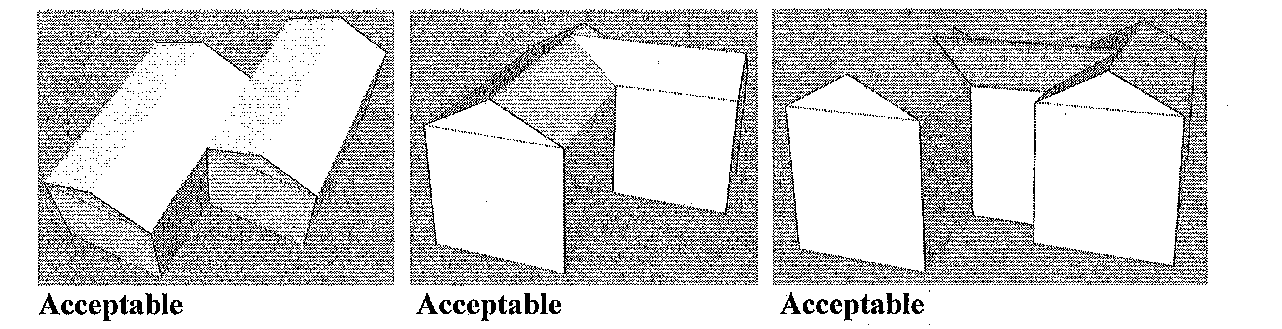
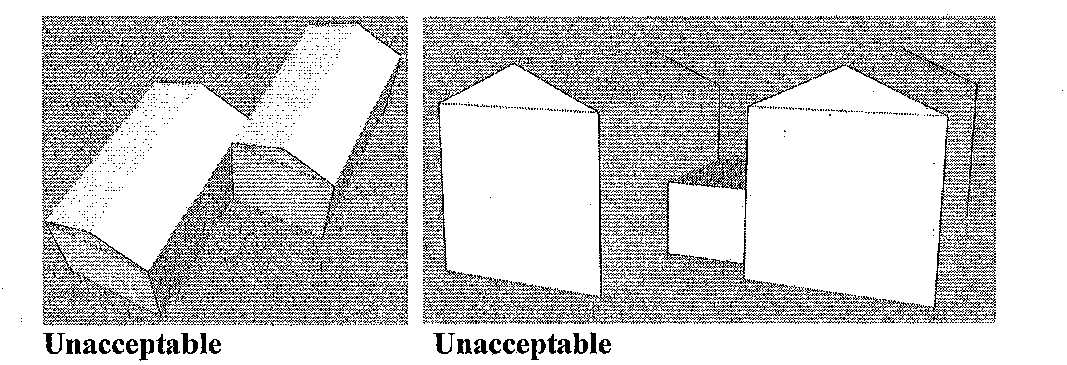
15. Common Wall Connector. An interior wall that is shared by and separates the two dwelling units of a two-family dwelling, or the dwelling units of a multifamily dwelling, and meets all four of the following requirements: (1) the shared length of the common wall is no less than 50% of the longest dimension of the rectangle in which the footprint of the larger unit exists; (2) it exists at the ground-level story and is at least as high as the eaves line of the lowest dwelling unit; (3) it separates enclosed interior space(s) in each of the dwelling units it separates; and (4) it connects the dwelling units in such a way that the building or structure containing them appears to be an integral whole rather than conjoined masses, as depicted in the diagrams below.
Common Wall Connector Diagrams: The following is an example of two-family or multifamily use contained in a building or structure that appears an integral whole.
The following is an example of a building or structure that appears as conjoined masses, and so shall not meet the definition of two-family or multifamily use.
16. District. A zoning district as established by section III of this ordinance.
17. Dwelling. A structure or portion thereof which is used exclusively for human habitation.
18. Floodline. The limits of flooding from a particular body of water caused by a storm whose frequency or occurrence is once in a given number of years.
19. Floor area, total. The sum of the gross horizontal areas of the floor or floors of a building which are enclosed and usable for occupancy or the conduct of business and shall be measured between the inside face of exterior walls, or from the centerline of walls separating two (2) uses, but garage space, accessory building space, or cellar space is excluded, except if these areas are utilized by the principal use occupying or conducted within the lot and/or building.
20. Frontage. The uninterrupted length of the front lot line(s), as defined herein, whether straight or not, and is on:
A.
A public way or a way which the city clerk certifies is maintained and used as a public way; or
B.
A way shown on a previously approved subdivision plan; or
C.
A way that predates subdivision control that has, in the planning board's opinion, sufficient width, suitable grades, and adequate construction to provide for vehicular traffic, including emergency and snow removal vehicles, and the installation of utilities.
21. Inspector of buildings. The person appointed and confirmed to serve in such office under section 5-41 of the Newburyport Code.
22. Lot. A designated, parcel, tract, or area of land established by plat, subdivision, or as otherwise permitted by law, to be used, developed or built open as a unit.
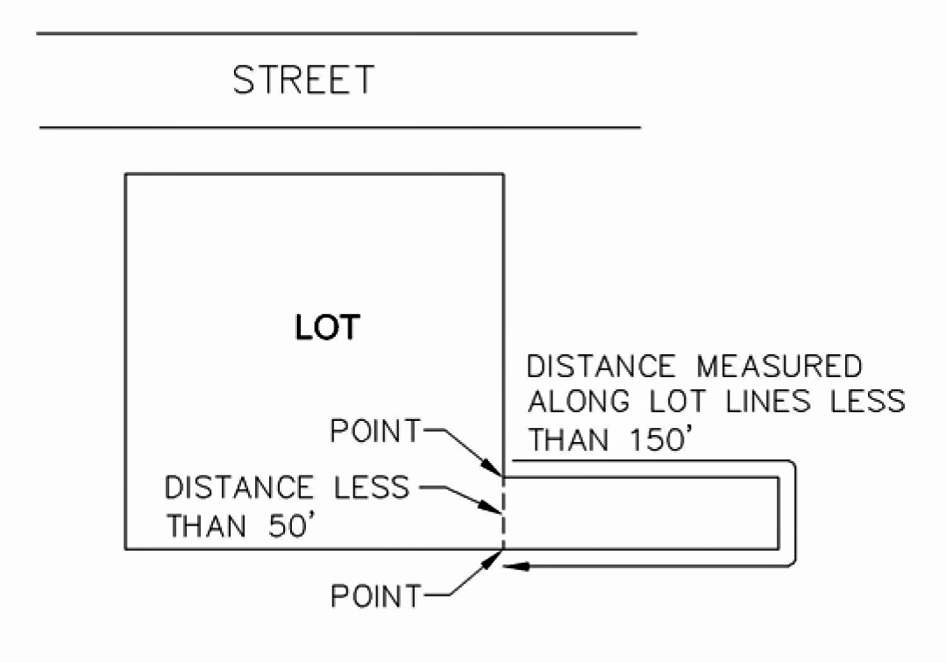
23. Lot area. An area of land which is determined by the limits of the lot lines of land under one (1) ownership bounding that area and expressed in terms of square feet or acres. When the distance between any two (2) points of lot lines is less than fifty (50) feet, measured in a straight line, the smaller portion of the lot which is bounded by such line and lot lines shall not be considered in computing minimum lot area unless the distance along such lot lines between such two points is less than one hundred and fifty (150) feet.
Lot Area Diagram: The area between the two points called out in the adjacent diagram would count toward lot area since the distance along the lot lines is less than one hundred fifty (150) feet.
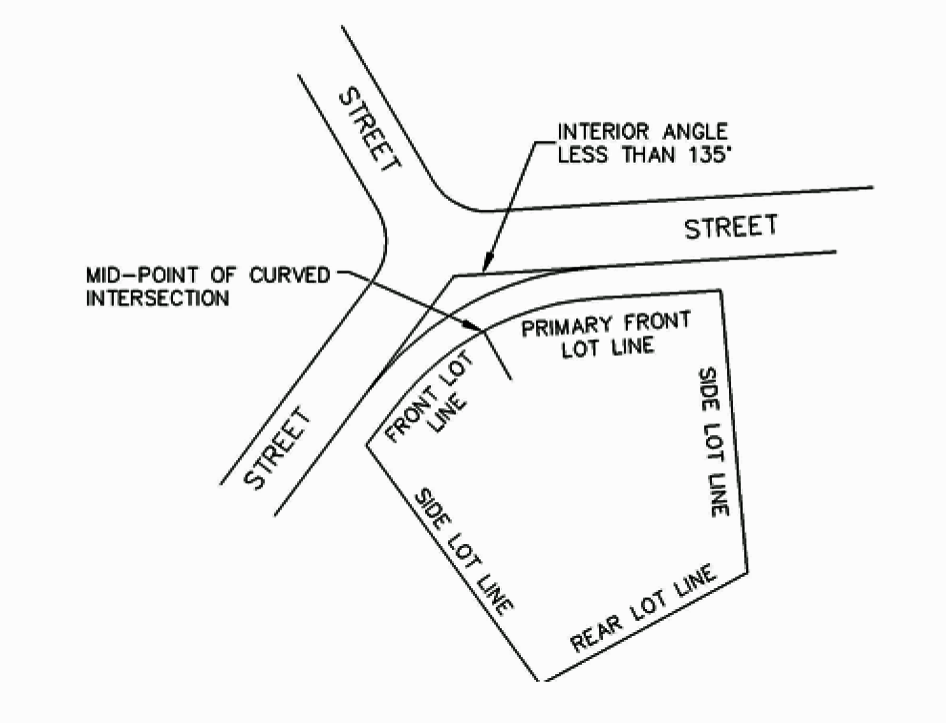
24. Lot, corner. A lot at the point of intersection of and abutting on two (2) or more intersecting streets, the interior angle of intersection of the street lot lines, or extended lot lines in case of a curved street being not more than one-hundred thirty-five degrees (135°). For purposes of this ordinance, the yard adjacent to each street shall be considered a front yard; provided, however, this will not affect designation of the front lot line.
Corner Lot Diagrams: A corner lot shall have two (2) front lot lines. The front lot line of greater length shall be known as the primary front lot line, and the front lot line of lesser length shall be known as the secondary front lot line. When an unbuilt corner lot has front lot lines of equal length, the owner shall designate a single front lot line as the primary front lot line, on the applicable plan and/or application. This shall be known as the primary front lot line.
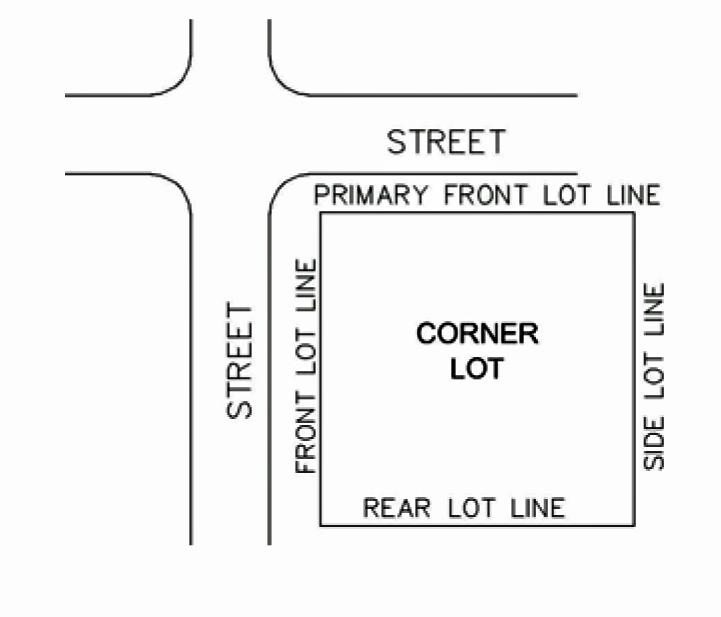
Where the interior angle of intersecting street is less than one-hundred thirty-five degrees (135°) degrees, the lot shall be considered a corner lot.
25. Lot coverage. That percentage of the lot area which is devoted to building area, regardless of such building's building height.
26. Lot line, front. The property line dividing a lot from the adjacent a single street right-of-way. In the case of a corner lot the front lot line of greater length shall be known as the primary front lot line.
27. Lot line, rear. The property line most nearly opposite and furthest from the front lot line, or the primary front lot line in the case of corner lots. In a wedge- or pie-shaped lot, the rear lot line is assumed to be where a line can be drawn with a ten-foot offset from the rear-most point parallel to the front lot line and intersecting two (2) adjacent side lot lines.
28. Lot line, side. Any property line not a front or rear lot line.
29. Lot, nonconforming. A lot lawfully existing at the effective date of this ordinance, or any subsequent amendment thereto, which is not in accordance with all provisions of this ordinance.
30. Nonconforming building. A building, lawfully existing at the time of adoption of this ordinance or any subsequent amendment thereto, which does not conform to one (1) or more [of] the applicable dimensional and density regulations for the district in which the building is located.
31. Nonconforming use. Use of a building or of land that does not conform with the regulations of this ordinance.
32. Office. A place in which functions such as directing, consulting, recording, clerical work, and sales (without the presence of merchandise) of a firm are carried on; also, a place in which a professional person conducts its professional business.
33. Open space. The space on a lot unoccupied by buildings, unobstructed to the sky, not devoted to streets, driveways or off-street parking or loading spaces, and expressed as a percentage of total lot area. Open space areas shall be used for landscape areas and for active or passive recreation including, but not limited to, non-roofed decks (one (1) level only), patios, pools or tennis courts.
34. Open (outdoor) storage area. A space outside a building which is used to keep merchandise for use, goods to be processed, or machinery for use.
35. Owner. The duly authorized agent, attorney, purchaser, devisee, trustee, lessee, or any person having vested or equitable interest in the use, structure or lot in question.
36. Parking space. An area, whether interior or exterior, that is intended or used for occupancy by a motor vehicle in compliance with this ordinance.
37. Planning board. The City of Newburyport Planning Board.
38. Principal use. The main use to which building, structure, or lot is utilized.
39. Repair. With respect to a building or structure, any construction which replaces materials and does not change the height, number of stories, size, use or location of a structure.
40. School, private. An accredited, nonprofit educational facility, but not correctional in intent, purpose, scope, and/or operation.
41. Setback. The horizontal distance measured perpendicularly from the lot line to the nearest building line.
42. Sign. Please refer to section VIII-A for sign definitions.
43. Special permit. A use of a structure or lot or any action upon a [the] premises which may be permitted under this ordinance only upon application to, and the approval of, the board of appeals, planning board or city council and in accordance with provisions of this ordinance.
44. Street. A public thoroughfare which has been accepted for public use; an existing private thoroughfare in use which has not been accepted for public use; or a planning board approved subdivision street.
45. Street line. The outside limit of a street or way either existing or contemplated, to which the public and/or abutters have rights, dividing the street and the lots which abut the street.
46. Structure. A combination of materials, which may or may not constitute a building, that is erected, placed, or constructed to form a configuration. Structures include, but are not limited to, unroofed stadiums, platforms, radio towers, sheds, unroofed pens, storage bins (lidded or unlidded), mechanical equipment greater than six (6) feet in height, signs, swimming pools, and fences.
46a.
Substantial rehabilitation. A project that causes alterations, extension, reconstruction, or repairs to be made to a structure or structures within any period of twelve (12) months that cost more than fifty (50) percent of the physical value of the entire property, where physical value is based upon the assessed value by the city assessor as of the January 1 preceding the date of filing of the building permit application for the project.
47. Use. The specific purposes for which land or a building is designed, arranged, intended, or for which it is or may be occupied or maintained.
48. Variance. Such departures from the terms of the ordinance as the board of appeals, upon appeal in specific cases, is empowered to authorize under the terms of this ordinance and the zoning act.
49. Way. For purpose of this ordinance, a way shall be any public land, which is not a street as defined herein, used by the general public as a footpath, walkway, bridle path or other similar use. A way cannot provide frontage for purpose of subdivision and no construction can take place within the bounds of a way.
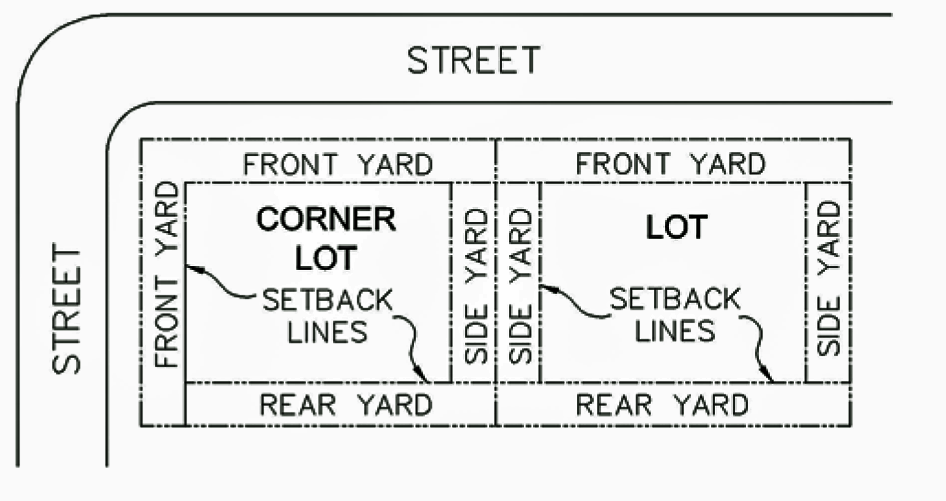
50. Yard. The area within a lot extending along a lot line and inward to the building line. The size of a required yard setback shall be measured as the shortest distance between the building line and the lot line. Those portions of buildings or structures that are below the finished grade, including, but not limited to, basements, shall not be deemed to occupy required yard setbacks. Unroofed deck structures may project into applicable yard setbacks to the extent of up to fifty (50) percent of the required lateral dimension.
51. Yard, front. The portion of a lot lying between the front line and the front setback line.
52. Yard, rear. The portion of a lot lying between the rear line and the rear setback line.
53. Yard, side. The portion of a lot lying between a side line and the corresponding side setback line and extending from the front yard to the rear yard. In the case of a lot of odd shape, any yard that is not a front yard or a rear yard shall be considered a side yard.
Yard diagram: Setbacks are measured from all lot lines. Yards exist between lot lines and setback lines. Corner lots have two front setbacks.
54. Zoning administrator. The zoning code enforcement officer for the City of Newburyport, Massachusetts, duly appointed and confirmed under section X-B of this ordinance.
55. Zoning board of appeals. The Zoning Board of Appeals of the City of Newburyport, Massachusetts.
(Ord. of 3-28-88(2), §§ 1, 14; Ord. of 9-14-92; Ord. of 11-28-94; Ord. of 12-12-94; Ord. of 3-13-00; Ord. of 12-8-03, § 2; Ord. of 9-14-04; Ord. of 2-13-12; Ord. of 7-13-15; Ord. of 6-13-16(4); Ord. of 8-30-21(1))

