
Newburyport City Zoning Code
SECTION XXVII
DOWNTOWN OVERLAY DISTRICT DOD
XXVII-A - Determinations.
The city hereby determines all of the following:
1.
The architectural, cultural, economic, political and social history of the City of Newburyport is one (1) of its most valued and important assets.
2.
The city's history is partly embodied in the federal and state Newburyport Historic District, which was listed on the National Register of Historic Places and the State Register of Historic Places on August 2, 1984. On that date, the federal and state Newburyport Historic District subsumed the smaller Market Square Historic District, which had been listed on the National Register and the State Historic Register on February 25, 1971.
3.
Downtown Newburyport includes one of the last seaport business districts remaining from the golden days of New England shipping. The former Market Square Historic District is located entirely within downtown Newburyport, and downtown is located entirely within the state and federal Newburyport Historic District.
4.
In 1960, the city established the Newburyport Redevelopment Authority (NRA), whose charge was to revitalize what was then a deteriorated downtown. During much of the 1960s, the prevailing viewpoint, as expressed in a 1964 The Daily News article, was that the city's historic buildings downtown were "lost years ago to the elements and are now beyond repair." An early plan called for wholesale demolition of 22 acres downtown and on the central waterfront. Most demolition was completed on the central waterfront. By 1968, 67 buildings had been demolished.
5.
In response to objections to demolition of historic buildings by dedicated and concerned citizens, most notably certain members of the Historical Society of Old Newbury, and through the efforts of Mayors George H. Lawler and Byron J. Matthews, the NRA amended its urban renewal plan to facilitate historic preservation. After a public hearing in 1970, the necessary city and state approvals were obtained, the Newburyport Historical Commission submitted an application to list an historic district on the State and National Registers of Historic Places, and the NRA filed a grant application to the U.S. Department of Housing and Urban Development (HUD) for funding to rehabilitate and preserve historic buildings downtown. After initially rejecting the application, HUD approved such funds in 1971, as a result of the listing of the Market Square Historic District on the State and National Registers of Historic Places.
6.
During the following decades, NRA's Urban Renewal Plan for downtown required the rehabilitation and preservation of historic buildings subject to its control. Thereby, Newburyport set a national precedent by using urban renewal funding for historic rehabilitation and preservation. The consequent revitalization of downtown catalyzed a renaissance for the entire city.
7.
The NRA's Urban Renewal Plan for downtown expired in 2005. It no longer has any regulatory effect, and deed restrictions placed on historic buildings formerly subject to that plan to ensure their preservation are now unenforceable. At present, no city ordinance can prevent even the complete demolition of an historic building or structure in downtown Newburyport.
8.
On the 250 th anniversary of the setting off from the Town of Newbury of the "waterside" as the new Town of Newburyport, Mayor Donna D. Holaday has directed the office of planning and development to undertake a comprehensive review and update of the city's master plan and zoning ordinance. Until such comprehensive review and update is completed, there will continue to be inadequate regulatory protections for the historic buildings and structures downtown.
9.
The preservation, rehabilitation and enhancement of the city's historic downtown is critical to the preservation of the city's heritage and land values, its recently state-approved Cultural District, and otherwise to benefit the general welfare of its citizens and property owners.
10.
Therefore, the city adopts these downtown land use controls. As part of the comprehensive review and update of the city's master plan and zoning ordinance, it is anticipated that this section shall be reviewed, and may be amended and/or replaced by different controls.
(Ord. of 4-15-14(1))
XXVII-B - Purposes.
Pursuant to M.G.L.A. c. 40A, as well as under the home-rule powers of the city pursuant to Sections 1 and 6 of Article II of the Articles of Amendment of the Constitution of the Commonwealth of Massachusetts, as amended by Article LXXXIX of said Articles of Amendment, a downtown overlay district (DOD) and discretionary DOD special permit (DOD-SP) are hereby established due to the unique land use pattern, and architectural, economic and cultural character of the buildings, structures and lots, both individually and as a group, that are located in downtown Newburyport. This section is intended to further implementation of the recommendations of the city's 1991 historic preservation plan, 2001 master plan and 2003 waterfront strategic plan, all as amended and supplemented from time to time, and otherwise to promote the health, safety, convenience and general welfare of the inhabitants of the City of Newburyport, by, among other things protecting the land use pattern, and architectural, cultural, economic, political and social heritage of the city through the rehabilitation, preservation and enhancement of its historic downtown, which will help to maintain and perpetuate the established skills of local architects, craftspeople and tradespeople, promote energy efficiency, smart growth and affordable housing through adaptive reuse, and enhance opportunities for cultural tourism.
(Ord. of 4-15-14(1))
XXVII-C - Establishment.
The DOD is hereby established as an overlay zoning district consisting of all such parcels of land depicted on a map entitled "Downtown Overlay District (DOD)," prepared by the office of planning and development, and dated March 13, 2014.
1.
Underlying zoning: Within the DOD, all the other provisions of the zoning ordinance, including, but not limited to, those specific to any underlying districts, shall remain in full force and effect except to the extent the provisions of this section apply, in which case all such provisions shall apply together. To the extent that there is a conflict between other provisions of the ordinance and the provisions of this section, then the provisions of this section shall control.
2.
SPGA: Consistent with subsection XXVII-F, the planning board shall serve as the special permit granting authority (SPGA) in administering both this section and any other provisions of this ordinance that apply within the DOD and require action by an SPGA.
3.
No demolition delay: The provisions of article X of section 5 of the Newburyport Code (Building Demolition) shall not apply within the DOD except to that category of work excluded from review by the SPGA under this section, upon a written determination by the zoning administrator, under subsection XXVII-E.5, below.
4.
Vested rights: The provisions of this section shall not apply to any new construction, demolition or alteration undertaken pursuant to a valid building permit issued by the building commissioner prior to the effective date of this section, nor to any construction, demolition or alteration that is the subject of a determination or decision of the historical commission and that was issued and/or filed with the building commissioner prior to the effective date of this section.
(Ord. of 4-15-14(1); Ord. of 8-19-19(1))
XXVII-D - Definitions.
1.
Addition, to add: An extension or increase in total floor area, footprint, building height, or lot coverage.
2.
Alteration, to alter: (a) Any addition, change, enlargement, expansion, maintenance other than in-kind, rebuilding, reconstruction or replacement, repair other than in-kind, restoration, replication, or other similar work; or (b) the moving from one portion of a lot to another, or from one lot to another, regardless of where the receiving lot is located.
3.
Character-defining exterior architectural feature: An exterior architectural feature, whether existing historically or currently, that was understood to contribute to the significance of the relevant historic building or structure at the time of its listing on the State or National Register. The SPGA or the office of planning and development, as the case may be, shall refer to any photographs, data sheets or survey forms for such historic building or structure that have been prepared in connection with the Newburyport Historic District, whether dated earlier, contemporaneously, or later than its original listing on August 2, 1984.
4.
Construction, to construct: The act or the fact of building, erecting, installing, or other similar activities.
5.
Demolition, to demolish: The act, whether partial or complete, of pulling or tearing down, razing, or otherwise destroying.
6.
Demolition of a building or structure: Demolition of greater than twenty-five (25) percent of all external walls of a building or structure, measured based upon their total surface area, regardless of the visibility of such walls from a street, way, or public body of water. The mere replacement of siding, such as clapboards or shingles, shall not constitute demolition of an external wall. Nor shall demolition of a building or structure include the demolition of a single external wall in order to build an addition, which shall be regulated under this section as an alteration.
6A.
Dormer: A rooftop appurtenance, as distinguished from a vertical addition, to a building or structure, built out from a sloping roof, and not extending above the ridge line of the roof from which it projects, set back from all walls of the building or structure below it, and containing one or more windows. A dormer may be either a shed dormer or a gabled (a.k.a. doghouse) dormer: a shed dormer has a roof with a single slope with its eave line parallel to the ridge line of the roof from which it projects; and a gabled dormer has a gabled, hipped, or arched roof with its ridge line perpendicular to the ridge line of the roof from which it projects.
7.
Exterior architectural feature: Any feature of the exterior of a building or structure that is open to view from any street, other way open to public travel, or the Merrimack River. Exterior architectural features may include, but are not limited to, the architectural style and general arrangement and setting thereof, the kind and texture of exterior building materials, and the type and style of windows, doors, lights, chimneys, signs, dormers, and other appurtenant exterior fixtures.
8.
Historic building or structure: A building or structure that: (a) is listed individually on the State and National Registers of Historic Places, as they may be amended from time to time; (b) was listed as "Contributory" to the Newburyport Historic District as of August 2, 1984; or (c) subsequent to the adoption of this section is added automatically to the list of historic buildings or structures subject to this section pursuant to subsection XXVII-F.7. In consultation with the historical commission, the office of planning and development shall compile and maintain a list of all historic buildings or structures subject to this section, [a] copy of which list shall be kept also by the city clerk, and posted on the city's website.
9.
Historic exterior architectural feature: Any character-defining exterior architectural feature of an historic building or structure.
10.
Historic masonry: An historic exterior architectural feature of brick or masonry material.
11.
Historical commission: The Newburyport Historical Commission established pursuant to M.G.L. c. 40, § 8D.
12.
Newburyport Historic District: The historic district known as the "Newburyport Historic District," originally listed on the State and National Registers of Historic Places on August 2, 1984, as amended.
13.
Ordinary maintenance, repair, or replacement in kind: Alteration that does not involve any material change in the design, construction materials, or outward appearance of the exterior architectural feature so altered, with the express exception of any maintenance and repair of historic masonry, which is regulated under subsection XXVII-H. For purposes of this definition, a change in the color of paint is expressly understood not to involve a material change in the design, construction materials, or outward appearance of the exterior architectural feature so painted.
14.
Substantial evidence: Such evidence as a reasonable mind might accept as adequate to support a conclusion.
15.
Temporary building or structure: (a) Any building or structure designed or intended to be, or actually, in existence for a period of no more than twelve (12) months; or (b) any temporary sign as that term is defined in subsection VIII-B.
16.
Zoning Ordinance: The Zoning Ordinance of the City of Newburyport, Massachusetts.
(Ord. of 4-15-14(1); Ord. of 8-19-19(1))
XXVII-E - Exclusions.
Consistent with the city's intent for the DOD under subsection XXVII-A, a DOD-SP shall not be required for any of the following categories of work, which are hereby excluded from review by the SPGA under this section, upon a written determination by the zoning administrator:
1.
Any ordinary maintenance, repair, or replacement in kind;
2.
Any alteration or demolition of a building, structure, or exterior architectural feature that is not also an historic building, structure, or exterior architectural feature;
3.
Any (i) alteration, demolition, or replacement of windows, doors, signs, and/or awnings, or (ii) construction, alteration, demolition, or replacement of fences or site walls, that is reviewed and approved by the office of planning and development under subsection XXVII-F.5.d.;
4.
Any new construction, alteration, or demolition of a temporary building or structure;
5.
Any alteration of a one-family (use 101) or two-family (use 202) building that is located (a) within an underlying residential one (R-1), residential two (R-2), or residential three (R-3) district, or (b) at assessors map-lot 1-9 (6 Prince Place) or map-lot 1-7-A/B (2-4 Prince Place."
6.
Any landscaping with plants, trees or shrubs;
7.
Any work undertaken to meet requirements certified by a duly authorized public officer to be necessary for public safety because of an unsafe or dangerous condition, such as the demolition of an historic building damaged or destroyed by fire, storm or other disaster; and
8.
Any rebuilding, reconstruction, restoration, or replication of an historic exterior architectural feature that has been damaged or destroyed by fire, storm or other disaster, provided that both of the following conditions are satisfied: (a) the result of such work is the same in design, material and outward appearance as the damaged or destroyed historic exterior architectural feature; and (b) such work commences within two (2) years after such catastrophe, or three (3) years if extended upon good cause shown in a written request granted by vote of the SPGA.
Before determining whether exclusions 1, 2, 3 and/or 8 apply, the zoning administrator shall consult with the office of planning and development. All decisions by the zoning administrator under this subsection regarding exclusions are expressly made subject to appeal to the zoning board of appeals pursuant to subsection X-H.5.
(Ord. of 4-15-14(1); Ord. of 8-11-14(9); Ord. of 6-26-17(2); Ord. of 8-19-19(1); Ord. of 7-13-20(1))
XXVII-F - Procedure and criteria.
Application, review and required findings: Unless an exclusion applies pursuant to subsection XXVII-E, all new construction, alteration, or demolition within the DOD shall require the owner of the relevant property to submit an application for a DOD-SP for the SPGA to review and approve such new construction, alteration, or demolition. Said approval shall be granted by the SPGA prior to the issuance of a building or demolition permit for any such work within the DOD. The planning board shall act as the SPGA for purposes of this section, and it shall review and may approve, approve with conditions, or deny all applications hereunder in accordance with the procedures listed in subsection X-H.8. The SPGA shall approve a DOD-SP only if the SPGA first determines that the proposed new construction, alteration, or demolition as described in the application meets all the requirements of this section and, in addition, the special permit criteria of subsection X-H.7.
1.
Streamlining and harmonization: For the purposes of streamlining and harmonizing regulatory review by the city of proposed work subject to this zoning ordinance, and notwithstanding anything in this zoning ordinance to the contrary, the planning board shall serve as the SPGA for any proposed work within the DOD that requires action by an SPGA. If proposed work is subject to site plan review under section XV, then the SPGA shall conduct DOD-SP review in conjunction with site plan review whenever reasonably possible.
2.
Documentation required to support an application:
a.
To support an application for a DOD-SP, the owner shall provide as part of the application to the SPGA documentation regarding:
i.
The historic building, structure, or exterior architectural feature proposed to be demolished or altered, including, but not limited to, any data sheets or survey forms for such historic building or structure that have been prepared in connection with the Newburyport Historic District;
ii.
Historic, if any, and current photographs of the relevant elevations and exterior architectural features;
iii.
Architectural plans, elevations and/or renderings depicting the proposed new construction, demolition, or alteration; and
iv.
Photographs of the adjacent buildings or structures, or setting.
b.
The owner (applicant) shall also be responsible for submitting a copy of the above materials to the historical commission no less than thirty (30) calendar days prior to the submission of an application to the SPGA. Such submission shall be a prerequisite for the submission of an application to the SPGA under this section.
c.
The office of planning and development shall develop a standardized application form for use by the SPGA and applicants, and for the purposes of determining the completeness of all applications in accordance with this section.
3.
U.S. Secretary of the Interior's standards:
a.
In reviewing any application under this section, and except as otherwise provided herein, the SPGA or the office of planning and development, as the case may be, shall adhere to any relevant provisions of the United States Secretary of the Interior's "Standards for the Treatment of Historic Properties With Guidelines for Preserving, Rehabilitating, Restoring and Reconstructing Historic Buildings," as they may be amended from time to time, including all related guidelines, bulletins and other official guidance promulgated by the National Park Service (Secretary's Standards).
b.
The Secretary's Standards offer four (4) distinct approaches to the treatment of historic properties, in order of preference—(i) preservation, (ii) rehabilitation, (iii) restoration, and, last, (iv) reconstruction or replacement—with accompanying guidelines for each. One set of standards will apply to a property undergoing treatment, depending upon the property's significance, existing physical condition, the extent of documentation available and interpretive goals, when applicable.
c.
The Secretary' s Standards are an industry-accepted series of concepts about maintaining, repairing, and replacing historic materials, as well as designing new additions or making alterations. The related guidelines offer general design and technical recommendations to assist in applying the Standards to a specific property. Together, they provide a framework and guidance for decision-making about work or changes to a historic property.
d.
The Secretary's Standards and related guidelines shall be applied to all work involving historic properties of all types, materials, construction, sizes, and use located within the DOD, and extend to a property's landscape features, site, environment, as well as related new construction, unless an exclusion applies under section XXVII-E.
4.
Procedure, requirements and criteria for review of proposed demolition:
a.
Demolition generally prohibited: The intent of this section XXVII is to prevent the demolition of historic buildings, structures, and exterior architectural features located within the DOD unless the SPGA determines that the application meets all the requirements of this subsection XXVII-F.4 and, in addition, the special permit criteria of subsection X-H.7. Accordingly, such historic buildings, structures, and exterior architectural features shall be preserved and repaired, rather than demolished, except as otherwise allowed under this subsection XXVII-F.4.
b.
Demolition of historic buildings and structures:The SPGA may approve demolition of an historic building or structure only if it makes written findings based upon substantial evidence in the record that such historic building or structure retains no substantial remaining market value or reasonable use, taking into account the cost of rehabilitation to meet the requirements of the state building code as it applies to historic buildings or structures, or of other applicable laws. Costs necessitated by any new construction, alteration, or demolition conducted in violation of this section shall not be included in the calculation of rehabilitation costs. Notwithstanding the foregoing, the SPGA may approve the moving of an historic building or structure from one (1) portion of a lot to another, or from one (1) lot to another, regardless of where the receiving lot is located.
Advisory reports: Pursuant to M.G.L.A. c. 44, § 53G, and to aid the SPGA in its review, the applicant shall pay all costs for the SPGA to engage an architect specializing in historic preservation, architectural historian, builder specializing in historic preservation, engineer specializing in historic preservation, or other similar consultant deemed necessary by the SPGA in its reasonable discretion to investigate and prepare a written report upon the existing condition and feasibility of preservation of the historic building or structure proposed for demolition (conditions report). The SPGA shall engage such architect, engineer, or specialist by vote at any time after opening the required public hearing on the matter. Said conditions report shall include an estimate of the reasonable cost to rehabilitate the relevant building or structure to meet the requirements of the state building code as it applies to historic buildings or structures. The conditions report required in connection with the proposed demolition of an historic building or structure shall not be waived by any city board, commission, or officer, including, without limitation by variance.
No later than thirty (30) calendar days after the historical commission has received: (a) a complete application; or (b) new materials in the case of a further revised submission, the historical commission shall submit to the SPGA its written report (historical report) regarding: (x) the significance of the historic building or structure proposed for demolition; and (y) the relative importance of such historic building or structure to its setting within the DOD.
In addition, pursuant to M.G.L.A. c. 44, § 53G, the applicant shall pay all costs for the SPGA to engage a properly licensed real estate appraiser deemed necessary to investigate and prepare a written report upon the existing market value of the relevant historic building or structure (appraisal report), for the purposes of comparing this value against the cost estimate contained within the conditions report. The SPGA shall engage such appraiser by vote at any time after opening the required public hearing on the matter. The appraisal report required in connection with the proposed demolition of an historic building or structure shall not be waived by any city board, commission, or officer, including, without limitation by variance.
Before acting on a DOD-SP application to demolish an historic building or structure, the SPGA shall consider any and all advisory reports generated in relation to the subject application, including, but not limited to: (a) the conditions report; (b) any historical report(s) submitted by the historical commission; and (c) the appraisal report.
c.
Demolition of historic exterior architectural features: Historic exterior architectural features shall be retained and repaired whenever reasonably feasible. If the SPGA determines that such features cannot reasonably be retained and repaired, then they shall be replaced in kind, both in design and materials, whenever reasonably feasible.
Advisory reports: Pursuant to M.G.L.A. c. 44, § 53G, and to aid the SPGA in its review, the applicant shall pay all costs for the SPGA to engage an architect specializing in historic preservation, architectural historian, builder specializing in historic preservation, engineer specializing in historic preservation, or other similar consultant deemed necessary to investigate and prepare a written report upon the existing conditions and feasibility of preservation of the relevant historic exterior architectural features (conditions report). Said conditions report shall include an estimate of the reasonable cost of all work required to preserve, rehabilitate, or restore the relevant historic exterior architectural features. The SPGA shall engage such architect, engineer, or specialist by vote at any time after opening the required public hearing on the matter, unless the conditions report required in connection with the proposed demolition of historic exterior architectural features is waived by unanimous vote of the SPGA.
No later than thirty (30) calendar days after the historical commission has received (a) a complete application, or (b) new materials in the case of a further revised submission, the historical commission shall submit to the SPGA a written report regarding application of the relevant criteria of this section to the proposed work (historical report).
Before acting on a DOD-SP application, the SPGA shall consider both the conditions report, if any, and any historical report submitted by the historical commission.
d.
Employment of outside consultants: The portions of this subsection XXVII-F.4 (and its regulations, if any) requiring the payment of consultant fees by the owner are promulgated under the concurrent authority of M.G.L. c. 44, § 53G.
e.
Replacement must be approved: The SPGA shall not approve a DOD-SP application to demolish an historic building, structure, or exterior architectural feature without the SPGA's having earlier granted, or concurrently granting, all relief required under this zoning ordinance, if any, for the replacement building, structure, or exterior architectural features. In addition to the owner's submitting plans, specifications, and such other materials as are normally required by the SPGA to enable its review of new construction or alteration within the DOD, the owner shall also submit a timetable and such guarantees and assurances for the completion of the replacement building, structure, or exterior architectural feature as the SPGA may reasonably require.
f.
Documentation before demolition: When the SPGA approves or approves with conditions a DOD-SP to demolish an historic building, structure, or exterior architectural feature, the SPGA may require documentation of the historic building, structure, or architectural feature to be demolished, including, but not limited to, photographs of elevations and details of specific exterior architectural features. If so required, such documentation shall be completed and submitted to the historical commission before demolition may commence.
g.
Additional penalties for unauthorized demolition: In addition to any other penalties under applicable law, without prior written approval by the SPGA, no building permit shall be issued for a period of three (3) years with respect to any premises at which an historic building, structure, or exterior architectural feature has been intentionally demolished without a DOD-SP having been first obtained in compliance with this section. Such three-year period shall commence after the date upon which such demolition has been completed or suspended, whether voluntarily or by legal compulsion. For purposes of this subsection, "premises" shall mean both (i) the lot upon which the demolished historic building, structure or architectural feature was located, and (ii) all abutting lots under common ownership or control of such lot at the time of demolition.
5.
Procedure, requirements and criteria for review of proposed new construction and alterations:
a.
New construction and alterations must be compatible with existing historic buildings and structures within the DOD: New construction and alteration within the DOD shall not disrupt the essential form and integrity of (i) the subject historic building, structure or exterior architectural features, (ii) the lot where it is located, or (iii) its setting within the DOD. Moreover, new construction and alteration within the DOD shall be compatible with the size, scale, height, color (excepting paint color), material, and character of the (x) subject historic building, structure or exterior architectural feature, (y) the lot where it is located, and (z) its setting within the DOD, as the case may be.
i.
Reversibility: New additions and other alterations to an historic building, structure, or exterior architectural feature shall be designed so that if they were to be removed or reversed in the future, the essential form and integrity of the overall historic building or structure would be unimpaired.
ii.
Composite materials: The SPGA or the office of planning and development, as the case may be, shall review and may approve on a case-by-case basis proposed composite materials when used in custom design for alterations to an historic building, structure, or exterior architectural feature that were unavailable when the subject historic building, structure, or exterior architectural feature was originally constructed.
iii.
Advisory reports: Pursuant to M.G.L. c. 44, § 53G, and to aid the SPGA in its review, the owner shall pay all costs for the SPGA to engage an architect specializing in historic preservation, architectural historian, builder specializing in historic preservation, engineer specializing in historic preservation, or other similar consultant selected by the SPGA in its reasonable discretion to investigate and prepare a written report upon the existing conditions and feasibility of preservation of the relevant historic exterior architectural feature (Conditions Report). Said Conditions Report shall include an estimate of the reasonable cost to rehabilitate the relevant historic exterior architectural feature to meet the requirements of the State Building Code as it applies to historic buildings or structures. The SPGA shall engage such architect, engineer, or specialist no later than ten (10) calendar days after its having opened the required public hearing on the matter, unless the Conditions Report required in connection with the proposed demolition of historic exterior architectural features is waived by unanimous vote of the SPGA.
No later than thirty (30) calendar days after the historical commission has received a complete application, the historical commission shall submit to the SPGA a written report regarding application of the relevant criteria of this section to the proposed new construction or alteration (Historical Report)
Before acting on a DOD-SP application, the SPGA shall consider both the Conditions Report, if any, and any Historical Report submitted by the historical commission.
The portions of this subsection XXVII-F.5 (and its regulations, if any) requiring the payment of consultant fees are promulgated under the concurrent authority of M.G.L. c. 44, § 53G.
b.
Missing historic exterior architectural features: When replacing or restoring an historic exterior architectural feature that is missing or has been significantly altered, such as storefronts, porches, or outbuildings, the approved design shall be based upon accurate documentation of such historic exterior architectural feature. If no such documentation is available, then the design shall be compatible in scale, proportions, material, and detail with the historic character of the building, structure or lot.
c.
Non-historic styles permitted for new construction and additions: The design of new construction and additions (as distinct from other alterations) within the DOD may reflect non-historic styles so long as they remain compatible with the historic character and scale of the subject historic building, structure, or exterior architectural feature, its lot, and its setting within the DOD, as the case may be. So long as new construction and additions are so compatible, the SPGA shall not require the reproduction of historic styles, and, on the contrary, shall encourage contemporary styles of architecture to aid differentiation of old from new.
d.
Staff-level review: The office of planning and development may review and approve for consistency with this section (i) the proposed alteration, demolition or replacement of windows, doors, signs, and/or awnings, and (ii) the proposed construction, alteration, demolition or replacement of fences or site walls, when such work is unaccompanied by any other work subject to this section over a period of three (3) consecutive years, in which case exclusion 3 shall apply under subsection XXVII-E and no DOD-SP shall be required. Notwithstanding the foregoing, any proposed new opening in an external wall of an historic building or structure for a window or door shall require a DOD-SP.
e.
Windows:
i.
No application for demolition, new construction, or alteration involving windows shall be complete without submission by the owner of an inventory of those windows to be affected (window inventory), which submission requirement shall not be waived by any city board, commission, or officer.
The window inventory shall indicate concisely by photographs, drawings, and/or text: (A) the locations of affected windows; (B) their exterior paint conditions; (C) their frame and sill conditions; (D) their sash conditions (rails, stiles and muntins); (E) their glazing conditions; and (F) their hardware conditions.
The SPGA or the office of planning and development, as the case may be, shall review and may approve on a case-by-case basis work involving windows by determining, first, whether some or all of such affected windows are historic exterior architectural features, as defined under this section XXVII, and so subject to review, second, the overall condition of each affected window that is an historic exterior architectural feature as "good," "fair," and "poor." and, third and finally, determining the appropriate treatment for such each affected window that is an historic architectural feature under the Secretary's Standards, which are, in order of preference, preservation, rehabilitation, restoration, and, last, reconstruction or replacement.
A "good" window is one that is intact, structurally sound, and performing its intended purpose, such that it needs no repair and only minor or routine maintenance.
A "fair" window is one: (A) with early signs of wear, failure or deterioration, although the window is generally sound structurally, and is performing its intended purpose; (B) with failure of at least one (1) part; and/or (C) where replacement of up to thirty (30) percent of the area of such window or replacement of a defective part is required.
A "poor" window is one: (A) that is no longer performing its intended purpose and cannot be made to do so; (B) that is missing; (C) deterioration and damage affects more than thirty (30) percent of the area of such window and adjustment and repair is not possible; and (D) that shows signs of imminent failure.
A "good" window shall be preserved, "fair" windows shall be rehabilitated or restored, and "poor" windows shall be reconstructed or replaced.
In approving appropriate treatments, the SPGA or the office of planning and development, as the case may be, shall incorporate into its decision a schedule that lists all of the parts of each window unit and notes their existing conditions by reference to the window inventory, or otherwise, and the precise tasks to be performed regarding each window part (window schedule).
ii. Mirrored, tinted or heat-reflective glass or coatings, as well as interior applied or removable muntin bars, shall be prohibited.
iii. Parts of replacement windows, such as exterior sills, molding and/or casing, exterior frames, and exterior sash windows shall match exactly those of the historic windows whenever reasonably feasible. Otherwise, replacement shall match the historic windows in dimensions, configuration, and other general characteristics, but materials need not be duplicated exactly. Proposed replacement windows may include the new modes of operation, provided, however, that such modes shall be approved by the SPGA under a DOD-SP.
iv. Muntins, whether structural or applied, shall have an exterior, three-dimensional profile, and a width appropriate to the architectural style of the historic building or structure.
v. The SPGA, rather than the office of planning and development, shall review and may approve on a case-by-case basis all proposed new window openings in the external walls of an historic building or structure to ensure that they are consistent with historically accurate window arrangements.
vi. Otherwise, the SPGA or the office of planning and development, as the case may be, shall review and may approve on a case-by-case basis work involving windows, consistent with the Guidelines for Preservation and Replacement of historic Wood Windows in Newburyport, dated June 24, 2019, a copy of which is on file with the office of planning and development.
f.
Doors:
i.
Replacement doors shall not incorporate leaded or stained glass except when replicating the original appearance of the historic building or structure. If part of a replacement door is glazed or has a window insert, such glazing or inserts shall include true or simulated divided lights. Mirrored, tinted or heat-reflective glass or coatings, as well as interior applied or removable muntin bars, shall be prohibited.
ii.
Otherwise, the SPGA, rather than the office of planning and development, shall review and may approve on a case-by-case basis proposed new door openings in the external walls of an historic building or structure to ensure that they are consistent with historically accurate door arrangements.
iii.
For historic buildings and structures other than one-family and two-family buildings, when the historic entrance will no longer be used, such historic entrance shall be left in place and secured, such that the alteration is reversible and the doorway can be reopened in the future with minimal work.
g.
Roofs, dormers and other roof features: Rooftop features, such as elevator or stair towers, decks or terraces, dormers, or skylights, shall not damage or obscure character-defining exterior historic features, and should be inconspicuous and minimally visible on the site and from public ways.
i.
Roofing materials shall be compatible with the character of the DOD, and the overall geometry and proportions of the historic roof shapes and planes of an historic building or structure should be preserved.
ii.
New skylights shall be constructed to minimize their visibility from any street, way, or public body of water, shall not be made of curved plastic or in bubble form, and shall follow the plane of the roofline.
iii.
Historic chimneys, including, but not limited to, their historic dimensions and decorative brickwork patterns, shall be retained and repaired, regardless of the existence or usability of interior fireplaces.
iv.
All dormers shall be set back at least one (1) foot, six (6) inches from the wall below of the building or structure that is parallel to the ridge of the roof from which the dormer projects, and at least three (3) feet, six (6) inches from a wall below of the building or structure that is perpendicular to the ridge of the roof from which the dormers project.
v.
No dormer shall extend above the ridge line of the roof from which it projects.
vi.
The roof of any dormer shall not lack slope or otherwise be constructed flat. The roof pitch of a shed dormer may vary according to the pitch of the roof from which it projects, but the roof pitch of a gabled dormer shall match the pitch of the roof from which it projects, except in the case of gambrel or mansard roof.
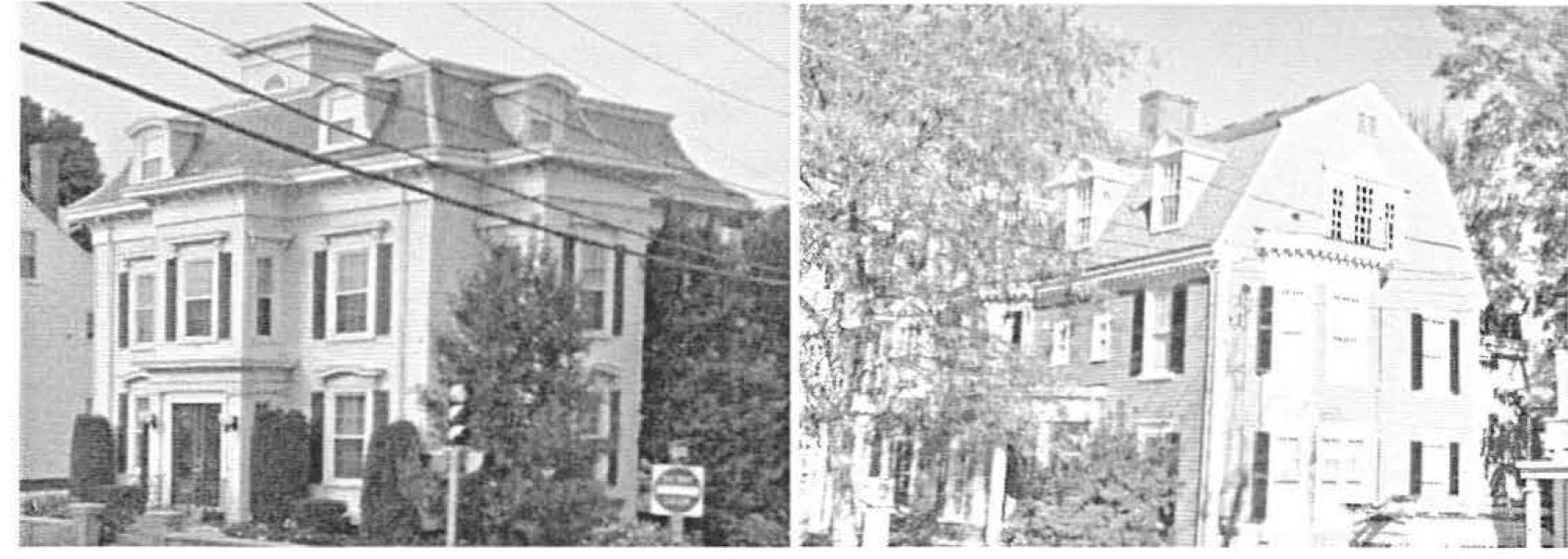
Gabled dormers in the DOD that project from mansard and gambrel roofs.
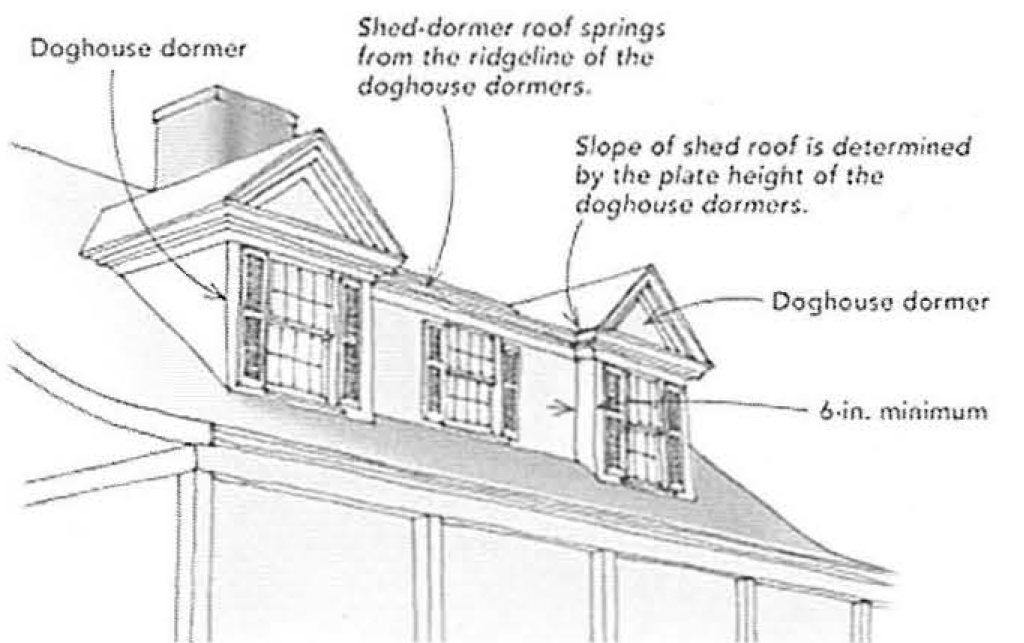
Shed dormer with matching gabled dormers at either end.
vii.
In no case shall windows be allowed in the side walls of dormers.
viii.
Inset roof decks, created by cutting into a section of roof and inserting a decked opening, shall follow the same setback standards stipulated for dormers.
ix.
Otherwise, the SPGA shall review and may approve on a case-by-case basis the proposed new construction and alteration of roofs, dormers and other roof features, including, without being limited to, balconies, towers, widow walks, roof decks, and cupolas, consistent with the Design Guidelines for Roof Dormers, prepared for the City of Cambridge, Massachusetts, Board of Zoning Appeal, and dated 1996, a copy of which is on file with the office of planning and development.
h.
Porches and entrance porticos: The SPGA shall review and may approve on a case-by-case basis proposed new construction and alteration of porches and entrance porticos, including the proposed enclosure or glazing of historic porches and entrance porticos.
i.
Fences and site walls: Fences and site walls, whether newly constructed, altered, or replaced, shall be appropriate in scale, materials and architectural style to the historic buildings and structures located on the same lot, to the lot itself, and to its setting. Fences or site walls that will be visible from a public way or the Merrimack River warrant additional scrutiny for appropriateness. New fences and site walls shall not substantially block significant views from any street, way, or the Merrimack River of the primary facades of historic buildings and structures located within the DOD. Placement of fences and site walls along lot lines confirms historic lot patterns of neighborhoods, as opposed to placement along arbitrary lines, and is favored. Wood, wrought-iron, masonry, or other historic materials shall be used instead of plastic, vinyl, aluminum or other contemporary materials. Where a more ornate style of fencing or site walls can be documented as having been present at the subject property, then such historic style may be replicated. In other cases, simpler historic designs, such as wood-picket, wrought-iron, or masonry shall be used instead of contemporary styles, such a unfinished, pressure-treated lumber, dog-eared, or chain-linked fencing. Fences and site walls shall be at a height from grade that is proportional to the structure(s) they accompany and the area they enclose, and, in all cases, solely the SPGA may approve heights in excess of four (4) feet for those fences or site walls visible from a public way or the Merrimack River.
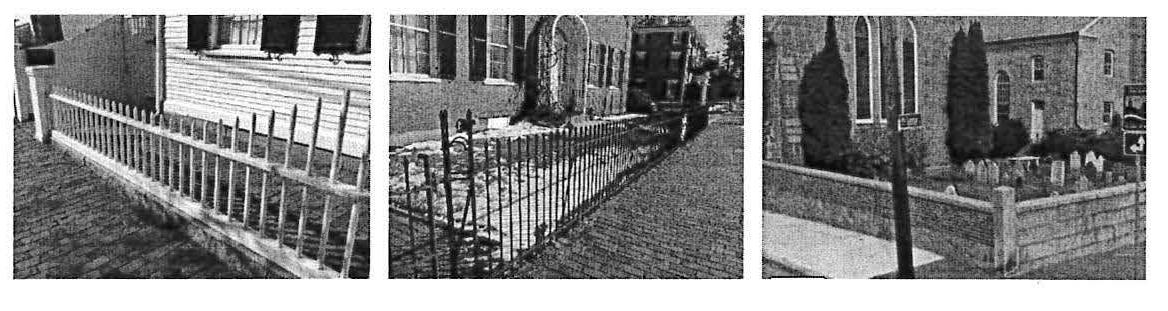
(Simpler historic fence and site wall design.)
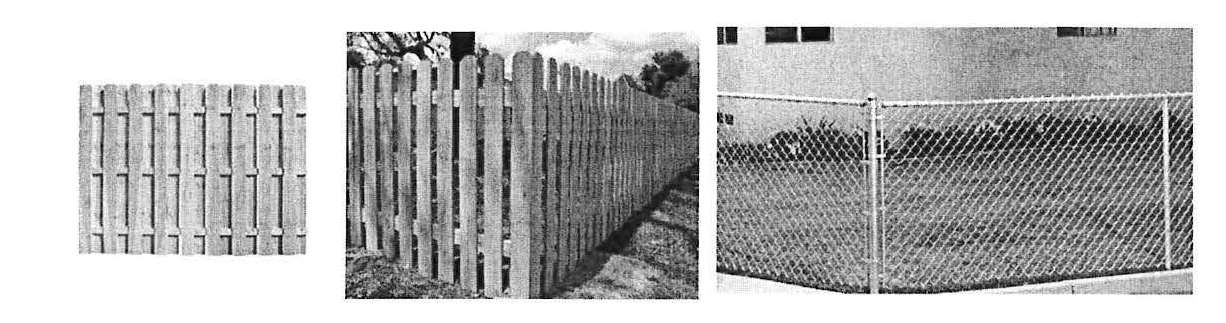
(Unacceptable contemporary fence and site wall styles.)
j.
Outbuildings: When the SPGA approves the replacement of an historic barn or other outbuilding, or of its historic exterior architectural features, the replacement outbuilding or exterior architectural features should be compatible with the historic features in design, material, dimension, sash or panel configuration, detail, and texture.
k.
Signs and awnings: In addition to any other regulations of commercial signs under the Newburyport Code: (i) the maximum size for first-floor projected, hanging, window, and wall signs shall be twelve (12) square feet; (ii) projected, hanging, window, and wall signs shall be prohibited on upper floors; (iii) signs may be constructed of painted wood, metal, or stone; (iv) signs constructed of particle board, plastic, or highly reflective metal shall be prohibited (provided, however, that the SPGA or the office of planning and development, as the case may be, may approve the use of carved high-density sign foam or foam board when the finished surface will have a matte [non-glossy] finish); (v) downlit signs shall use shielded bulbs to prevent light scatter; internally-lit signs are not permitted; (vi) all signs and hardware thereto attached to historic masonry shall be attached through mortar; and (vii) any adhesive used for signs affixed to historic buildings or structures shall be preservation quality. The SPGA or the office of planning and development, as the case may be, shall review and may approve on a case-by-case basis the proposed installation of new awnings. Installation of signage that does not comply with this section shall be subject to a variance from the zoning board of appeals in accordance with section X-H.6.
l.
Access for persons with disabilities: Alterations to an historic building or structure for the purposes of providing accessibility shall provide persons with disabilities the level of physical access to such building or structure that is required under applicable law, consistent with the preservation of historic exterior architectural features of such building or structure, and with the goal of providing the highest level of access with the lowest level of impact on historic integrity.
m.
Solar energy systems: Consistent with state laws encouraging the installation of solar energy systems, as defined in M.G.L. c. 40A, § 1A, new construction or alteration of solar collectors shall not irreversibly change or alter any historic exterior architectural features, and collector panels and other elements of solar energy systems, such as framing, piping and insulation, shall be installed so as to minimize their visibility from any street, way, or public body of water. Otherwise, the SPGA shall review and may approve on a case-by-case basis the new construction or alteration of solar energy systems while considering the policy of the commonwealth to encourage the use of solar energy systems and to protect solar access.
6.
DOD-SP amendments: Amendments to an approved DOD-SP shall be based upon the provisions of the zoning ordinance that were in effect at the time of issuance of the approved DOD-SP, unless the owner and the SPGA mutually agree that such amendment shall be based upon the provisions of the zoning ordinance that are in effect at the time of application for such amendment.
7.
Change in historic status:
a.
Removal of historic status: The owner of any historic building or structure that was listed as "Contributory" to the Newburyport Historic District as of August 2, 1984, may petition the historical commission for removal of such building or structure from the list of historic buildings or structures subject to this section. The historical commission may approve any such petition if it determines that: (i) the qualities that caused the building or structure to be originally listed have been lost or destroyed, and such loss or destruction has not occurred in violation of this section; (ii) additional information shows that the building or structure does not meet the National Register criteria for evaluation; or (iii) there was an error in professional judgment as to whether the building or structure originally met the criteria for evaluation.
b.
Addition of historic status: Subsequent to the adoption of this section, a building or structure located within the DOD shall be added automatically to the list of historic buildings or structures subject to this section upon such property's being added to the National Register in accordance with the National Historic Preservation Act of 1966, as amended, either individually or as "contributory" to an historic district.
c.
Notice of change in historic status: No later than seven (7) calendar days after the office of planning and development or the historical commission receives written notice of the removal or addition of any building or structure from the list of historic buildings or structures subject to this section, the office of planning and development shall provide written notice of such change to all of the following: (i) the owner of the relevant building or structure; (ii) the historical commission, (iii) the building commissioner, (iv) the zoning board of appeal, and (v) the planning board. The office of planning and development shall keep on file a copy of the relevant documentation, which shall remain available for public inspection.
(Ord. of 4-15-14(1); Ord. of 8-11-14(9); Ord. of 8-19-19(1); Ord. of 7-13-20(1); Ord. of 8-30-21(1))
XXVII-G - Historic masonry.
Notwithstanding anything in the Newburyport Code to the contrary, within the DOD the maintenance, repair and/or replacement of historic masonry shall be subject to all of the following requirements, which shall be administered and enforced by the building commissioner and the zoning administrator pursuant to section X.
1.
Deteriorated historic masonry may be repaired or replaced where necessary, using new materials that duplicate the historic size, color, and composition of bricks at the building or structure, whenever reasonably feasible.
2.
To protect historic masonry from damage, repointing shall use historic, lime mortar mixes as prescribed by the U.S. Secretary of the Interior's Preservation Brief 2: Repointing Mortar Joints in Historic Masonry Buildings, rather than harder Portland cement.
3.
Deteriorated mortar of historic masonry shall be carefully removed by hand-raking the joints, although the building commissioner shall review and may approve on a case-by-case basis the use of mechanical saws, provided, however, that such use shall adhere to any relevant provisions of the United States Secretary of the Interior's "Standards for the Treatment of Historic Properties With Guidelines for Preserving, Rehabilitating, Restoring and Reconstructing Historic Buildings," as they may be amended from time to time, including all related guidelines, bulletins and other official guidance promulgated by the National Park Service (Secretary's Standards), such as Robert C. Mack and John P. Speweik, Preservation Brief 2, Repointing Mortar Joints in Historic Masonry Buildings.
4.
Historic masonry shall not be sandblasted, and shall only be cleaned when necessary to halt deterioration using the mildest methods feasible, as approved by the SPGA in writing prior to the commencement of work.
5.
Unpainted historic masonry shall not be painted unless this was done historically. Historic advertisements painted on historic masonry walls shall be retained where feasible.
6.
The application of sealants, waterproofing, and water-repellent coatings to historic masonry shall be prohibited unless it can be demonstrated that such products will not substantially impair water-vapor permeability or otherwise contribute to deterioration of the historic masonry.
(Ord. of 4-15-14(1); Ord. of 6-26-17(2))
XXVII-H - Protection of unoccupied historic buildings and structures.
For the limited purpose of preventing the acceleration of decay of unoccupied historic buildings and structures within the DOD, the owner of any such building or structure shall ensure that it is reasonably secure from significant damage due to weather, fire, trespass, or vandalism, including by: securing all doors, windows and other exterior openings; employing effective waterproofing of exterior walls, roofs (including chimneys), and foundations; and protecting against fire or water damage. The zoning administrator, upon his or her own initiative, in response to a filed written request for enforcement of this section, or at the request of the SPGA, shall enforce this subsection consistent with section X.
(Ord. of 4-15-14(1); Ord. of 6-26-17(2))
XXVII-I - Severability.
The provisions of this section are severable. If any of its provisions, sections, subsections, paragraphs, sentences, or clauses, or the application thereof to any person, entity, establishment, or circumstances shall be held to be invalid or unconstitutional by any court of competent jurisdiction, then the remainder of this section shall continue to be in full force and effect.
(Ord. of 4-15-14(1))

