
Niceville City Zoning Code
ARTICLE 8
- TRANSPORTATION, CONNECTIVITY, ACCESS AND PARKING6
Editor's note— Ord. No. 21-08-03, § 3, adopted Aug. 10, 2021, repealed the former Art. 8, §§ 8.00.00—8.05.05, and enacted a new Art. 8 as set out herein. The former Art. 8 pertained to transportation and derived from Ord. No. 00-10-01, adopted Oct. 10, 2000; Ord. No. 11-04-02, adopted April 12, 2011; and Ord. No. 11-05-01, adopted May 10, 2011.
8.00.00 - Purpose and applicability.
8.00.01 Purpose.
The purpose of this article is to establish requirements for a transportation system that operates by moving people and goods efficiently, safely, and provides a balance between mobility and accessibility.
8.00.02 Applicability.
All new development shall be required to provide: efficient access to the nearest public roads; safe and convenient on-site traffic flow; pedestrian and bicycle facilities to the greatest extent feasible and/or required by specific development orders; and sufficient vehicular parking to accommodate the needs of the development.
(a)
Roadway improvements scheduled in the transportation improvement program (TIP) most recently approved by the Okaloosa-Walton Transportation Planning Organization (TPO), whether funded or unfunded, may be considered positively in the approval of development orders.
(b)
Transportation improvements scheduled in the TIP program which requires part or complete funding by the local government shall be included in the local government's capital improvement program (CIP) before approval of development orders can be rendered.
(c)
It shall be incumbent upon the local government to prioritize local roadway improvements with the TPO when the level of service (LOS) of any roadway is degraded from a level of "D" to "E."
(Ord. No. 21-08-03, § 3, 8-10-21)
8.01.00 - Transportation and connectivity.
8.01.01 Streets.
(a)
Street improvements. All streets and public ways shall be paved and curbed in accordance with standards established by the city engineer and the following requirements:
(1)
Additional improvements for existing thoroughfares. Where any existing arterial or collector lying within or abutting a proposed development requires construction of additional lanes or other improvements to meet the standards of the public works director, the amount of construction required (or money escrowed) for such improvements shall be commensurate with the impact of the proposed development.
(2)
Missing arterial or collector links. Where there are missing segments in the arterial or collector system or new arterials or collectors are to be constructed which are designated in the comprehensive plan, such segments lying within or abutting the proposed development shall be improved (or money escrowed in an appropriate manner) by the developer along with other required improvements.
(3)
Traffic control features. Intersection improvements and traffic control features such as acceleration, deceleration, and turning lanes, signalization devices, and other traffic control devices required by the development shall be installed at the developer's expense in accordance with the State of Florida Manual for Uniform Traffic Control Devices.
(4)
Improvements required to nearest acceptable paved public street. Each development shall abut, or have as its primary access, a street improved to city standards. Wherever the abutting street does not meet these requirements, the developer shall construct the street where it abuts the development and to the nearest structurally acceptable paved public street as determined by the public works director.
(b)
General design standards.
(1)
All proposed developments, except for sites developed with utility facilities such as communication towers, etc., shall front on a paved street or paved access easement. This street, if not already paved, shall be paved by the developer from the entrance of the development to the nearest public paved street(s).
(2)
All streets in a new development shall be designed and constructed pursuant to the standards of the "American Association of State Highway Officials" manual, most current edition, and shall be dedicated to the city upon completion, inspection, and acceptance by the city after the two-year maintenance period.
(3)
The street system of the proposed development shall, to the extent practicable, conform to the natural topography of the site, preserving existing hydrological vegetative patterns and minimizing erosion potential, runoff and the need for site alteration. Particular effort should be directed toward securing the flattest possible grade near intersections.
(4)
Streets shall be laid out to avoid environmentally sensitive areas.
(5)
Private streets.
a.
All newly platted streets intended to serve residential uses shall be public. The city manager or designee may approve private streets, provided all such streets meet all design and construction criteria of the city, and a condominium or homeowners association is created with all duties and powers necessary to ensure perpetual maintenance of such private streets. All streets shall be constructed to the exterior property lines of the development unless they are permanently terminated by a cul-de-sac or an intersection with another street.
b.
Newly platted streets intended to serve business or industrial uses may be private if approved by the city council. In such cases, all streets shall meet the design and construction criteria of the city unless overriding conditions, such as sharing entrances or parking areas, require different design criteria as determined by the city manager or designee. A property owners' association shall be created, with all duties and powers necessary to ensure perpetual maintenance of such private streets.
(c)
Arrangement of streets.
(1)
Developments shall provide an efficient and orderly hierarchy of streets.
(2)
The street layout in all new developments shall be integrated with the existing and planned street system of the surrounding area in a manner that allows for proper inter-neighborhood traffic flow. If adjacent lands are unplatted, stub outs in the new development shall be provided for future connection to the adjacent unplatted land.
(3)
Local residential streets shall be arranged to discourage through traffic and shall be patterned in such a way that continuous traffic from a collector road to another collector road is discouraged.
(4)
Streets shall intersect as nearly as possible at right angles and in no case shall be less than seventy-five (75) degrees. Intersections involving more than four (4) basic street approaches shall be prohibited.
(5)
New intersections along one (1) side of an existing street shall, where possible, coincide with existing intersections. Where an offset (jog) is necessary at an intersection, the distance between centerlines of the intersecting streets shall be no less than one hundred fifty (150) feet.
(6)
No two (2) streets may intersect with any other street on the same side at a distance of less than four hundred (400) feet measured from centerline of the intersecting street. When the intersected street is an arterial, the distance between intersecting streets shall be no less than one thousand (1,000) feet.
(Ord. No. 21-08-03, § 3, 8-10-21)
8.02.00 - Right-of-way (ROW) protection.
8.02.01 Rights-of-way (ROW).
(a)
No encroachment shall be permitted into existing ROW, except for temporary use authorized by the city. The city recognizes F.S. § 337.406 prohibiting uses of the right-of-way to include:
(1)
Any use which interferes with the safety and efficiency of the road.
(2)
Display of advertising of any sort.
(3)
Solicitation, including for charitable purposes.
(4)
Sale, display, or free distribution of any merchandise, goods, property or services.
(5)
Parking (disabled vehicles or trailers of any kind), storage, servicing or non-emergency repairing of vehicles and trailers.
(6)
Any and all structures excluding mailboxes.
(b)
All encroachments to the right-of-way require an encroachment agreement approved by the city manager or his designee, see attachment 8.02 A, which is attached to ordinance number 21-08-03 and available on file in city hall.
(c)
Use of ROW for public or private utilities, including, but not limited to, sanitary sewer, potable water, telephone wires, cable television wires, gas lines, or electricity transmission, shall be allowed subject to the placement specifications included in applicable existing or future city regulations.
(d)
Sidewalks, recreational trails and bicycle ways shall be permissible in ROWs.
8.02.02 Vacations of ROW.
Applications to vacate ROWs may be approved upon a finding that all of the following requirements are met:
(a)
The requested vacation is consistent with the comprehensive plan.
(b)
The ROW does not provide the sole access to any property. Remaining access shall not be by easement.
(c)
The vacation would not jeopardize the current or future location of any utility.
(d)
The proposed vacation is not detrimental to the public interest.
8.02.03 Provision for adequate setbacks along all roadways.
Setbacks or ROW requirements serve the needs of a development project and/or anticipated future needs of the city. Table 8.1 provides a summary of roadway design characteristics of arterial, collector and local streets. Minimum lane/pavement widths for moving traffic is shown, as is minimum ROW widths, roadway base thickness and curbing dimensions.
Table 8.1 Roadway Design Summary
8.02.04 Additional right-of-way.
(a)
Within the area of the setbacks required by this Code, additional right-of-way may be required to promote public safety and convenience or to ensure adequate access, circulation, and parking based upon a rational nexus and rough proportionality analysis.
(b)
Whenever a street is programmed for improvement (in the adopted budget and the capital improvements element of the comprehensive plan) and the need for the improvement is due to development being approved, as determined in a rational nexus and rough proportionality analysis, necessary right-of-way shall be required to be conveyed to the city.
(c)
Where a proposed subdivision or site development abuts an existing street of inadequate right-of-way, and the need for additional right-of-way is rationally related to the development being approved, additional right-of-way shall be dedicated based upon a rational nexus and rough proportionality analysis.
(d)
All right-of-way dedications, except easements, shall be conveyed to the city by means of a warranty deed or dedication by plat. Easements shall be conveyed to the city in a form acceptable to the city.
(e)
All right-of-way dedications are subject to acceptance by the city council. The city attorney shall review all right-of-way dedications and dedication of easements.
(f)
The following requirements shall be adhered to regarding right-of-way for corner clip radius:
(1)
On any corner parcel with access to at least one (1) adjacent road classified as a collector or above, additional right-of-way shall be dedicated to the city if needed to accommodate intersection radius improvements.
(2)
Property lines at street intersections shall be rounded with a minimum radius of twenty-five (25) feet. A greater radius shall be required at an angle of intersection of less than seventy-five (75) degrees, as determined by the planning administrator based upon sound and generally accepted engineering practices and principles.
8.02.05 Street design specifications
Table 8.2 Identifies the required specifications for all streets in the city.
Table 8-2 Street Design Specifications
1 Flexibility in design and less ROW required for developments that provide innovative plans that calm traffic, reduce impervious surface, and desire to preserve existing natural features and tree canopy. The design of one-way streets shall be reviewed on a case by case basis. The table above does not preclude the development of one-way streets. One-way streets shall have a pavement width between twelve (12) and sixteen (16) feet.
2 For roadways under two thousand five hundred (2,500) ADT, any lane widths that are proposed greater than the minimum shall be accompanied by mitigating traffic calming measures placed at least every six hundred (600) feet.
3 Unstriped on-street parking shall be allowed on roadways less than one thousand two hundred (1,200) ADT. Provision of on-street parking shall be adequate to serve the proposed intensity of development in order that the required clearances for public safety vehicles are maintained. For roadways of two thousand five hundred (2,500) ADT or more, on-street parking is allowed via angled or parallel parking spaces with landscaped traffic separators.
8.02.06 Roadway shoulders.
Shoulders, where required, shall measure at least four (4) feet in width and shall be required on each side of the street and shall be located within the right-of-way (shoulders on state roads shall be a minimum of six (6) feet). Shoulders and/or drainage swales are required as follows:
(a)
Shoulders are required on residential collector and local streets only where necessary for stormwater management or road stabilization.
(b)
All residential collector streets shall provide two (2) four-foot wide shoulders. Shoulders shall consist of stabilized turf or other material permitted by the city, as approved by the public works director, except in circumstances where grass cannot be expected to survive. In no case shall the shoulders be paved.
(c)
Where shoulders are required by the FDOT.
(d)
Collector streets where curbing is not required.
(e)
Arterial streets where curbing is not required.
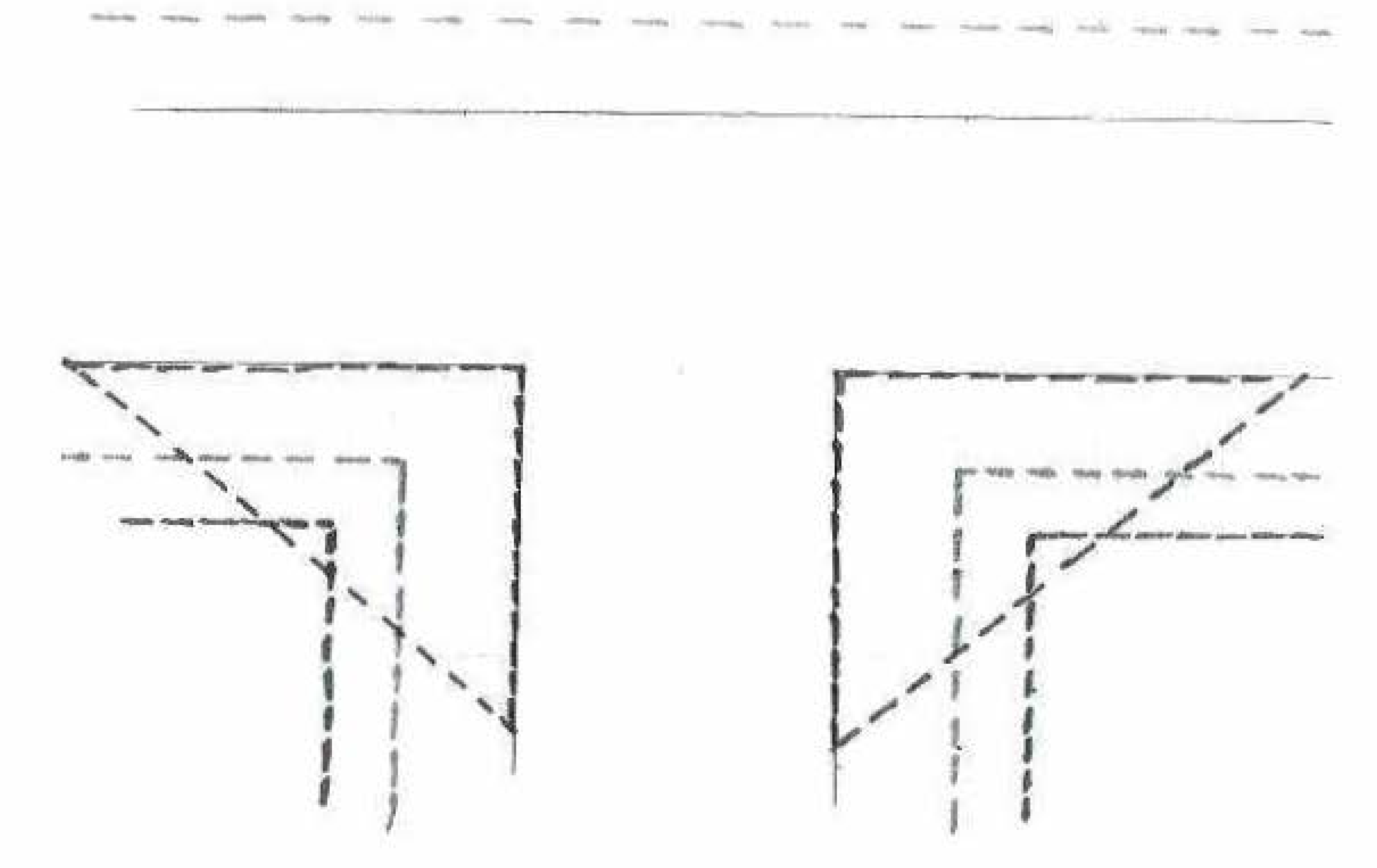
8.02.07 Clear visibility triangle.
In order to provide a clear view of intersecting streets to the motorist, there shall be a triangular area of clear visibility formed by two (2) intersecting streets or the intersection of a driveway and a street. The following standards shall be met:
(a)
Nothing shall be erected, placed, parked, planted or allowed to grow in such a manner as to materially impede vision between a height of two (2) feet and ten (10) feet above the grade, measured at the centerline of the intersection.
(b)
The clear visibility triangle shall be formed by connecting a point on each street centerline, to be located at the distance from the intersection of the street centerlines indicated below, and a third line connecting two (2) points (see Figure 8.02.07).
Figure 8.02.07 Clear Visibility Triangle Corner Lot Setback Parameters:

(c)
The distance from the intersection of the street centerlines for the various road classifications shall be as follows:
8.02.08 Signage and signalization.
(a)
The developer shall deposit with the city sufficient funds to provide all necessary roadway signs and traffic signalization as may be required by the city, based upon city or state traffic standards.
(b)
At least two (2) street name signs shall be placed at each four-way street intersection, and one (1) at each "T" intersection.
(c)
Signs shall be installed under light standards and free visual obstruction.
(d)
The design of street name signs shall be consistent with the State of Florida Manual for Uniform Traffic Control Devices standard specifications latest version. If a developer installs custom signs in a development, the maintenance of those signs will be the responsibility of the homeowner's association.
(Ord. No. 21-08-03, § 3, 8-10-21)
8.03.00 - Access management.
8.03.01 Vehicular access.
(a)
Access management, location, design, and construction of driveway connections to the city's road network shall, at a minimum, follow criteria and standard practices as established by the FDOT design standards and the city.
(b)
All development sites shall provide permanent access from a paved street to each lot or parcel within the development in accordance with city standards.
(c)
Cutting or altering a curb on a public street is prohibited without a permit issued by the city
(d)
In addition to city approval, approval from FDOT for state roads, or Okaloosa County for county roads, is also required for any access onto roads under their jurisdiction.
(e)
All driveways shall be designed and constructed to comply with all drainage standards as outlined in article 10 and shall be constructed utilizing an approved paving material in accordance with city standards including the installation of an expansion joint at the right-of-way line. Pavers or any other decorative materials installed are the owner's responsibility to maintain, replace and/or repair. If the decorative driveway is removed to facilitate City of Niceville and/or a utility company to perform utility installation and/or maintenance, the paver(s) or other decorative hard-scape may not be matched.
8.03.02 Pedestrian access.
(a)
All development providing paved sidewalks shall meet the latest ADA (Americans with Disabilities Act) and city standards.
(b)
Where new nonresidential and multi-family development abuts a collector or arterial road, a five-foot paved sidewalk shall be provided to connect the public sidewalk to the principal building(s).
(c)
All new nonresidential and multifamily residential development shall provide safe pedestrian access and connectivity throughout the site.
8.03.03 Surfacing.
Access to any project or development shall require a hard surface driveway apron meeting city standard connecting the driveway to the pavement of a public street.
8.03.04 Driveway and curb cut design along arterial, collector, and local streets.
Recognizing that the traffic movement function of streets can be compromised by the provision of unlimited access to individual properties, whenever any building site will require vehicular access from an arterial, collector, or local street, the development shall be designed in accordance with the requirements of this paragraph.
(a)
Curb cut spacing. The minimum distance between curb cuts on arterial and collector streets, whether or not such curb cuts are located on the same property and provided another state or county standard does not apply based on maintenance entity, shall be based upon the posted speed of the thoroughfare, in accordance with Table 8-3. The minimum distance between such curb cuts on local streets shall be forty-two (42) feet.
TABLE 8-3: ARTERIAL AND COLLECTOR CURBCUT SPACING SCHEDULE
(b)
Spacing reductions and joint-use driveways. Where the existing configuration of properties and curb cuts in the vicinity of the building site precludes spacing of a curb cut access in accordance with the schedule above, the public works director shall be authorized to reduce the spacing requirement if he finds that all of the following conditions have been met: wherever feasible, the city engineer shall require the establishment of a joint-use driveway serving two (2) abutting building sites, with cross-access easements provided; the property owner shall agree to close and eliminate any pre-existing curb cuts on the building site after the construction of both sides of the joint-use driveway; and where feasible, the building site shall incorporate unified access and circulation in accordance with the requirements of paragraph (i), below.
(c)
Width.
(1)
Residential except multi-family residential. Properties developed for residential other than multi-family residential use shall have curb cuts for driveways not less than twelve (12) feet wide and not more than twenty-four (24) feet wide. A joint use driveway shall have a minimum driveway width of not less than twenty (20) feet and not more than twenty-four (24) [feet].
(2)
Residential multi-family. Properties developed for residential multi-family use shall have curb cuts for driveways not less than twenty-four (24) feet wide and not more than forty (40) feet wide.
(3)
Non-residential. Properties developed for residential multi-family use shall have curb cuts for driveways not less than twelve (12) feet wide and not more than forty (40) feet wide.
(d)
Distance from drainage inlet. No curb curt shall be made within three (3) feet of a drainage inlet.
(e)
Number and location on midblock properties. Except where specific approval is granted as provided above, there shall be no more than two (2) curb cuts which sum to meet the specified maximum and minimum widths for the use of any single property fronting any single local street, and no more than one (1) curb cut for the use of any single property fronting on any single arterial or collector.
(f)
Number and location on corner properties. Where property is located on a corner lot fronting more than one (1) street, not more than one (1) curb cut for the benefit of such property shall be made on each street. Corner safety islands shall be provided at all corners and no curb cuts or driveway shall be constructed or maintained on the radius of any curved curbing nor closer to the point of curvature than fifteen (15) feet on a local street and not within thirty (30) feet on the point of curvature of an intersecting arterial or collector street.
(g)
Joint use driveways. No curb cut for a driveway approach shall be made within one (1) foot of the extended side property line of the property to be serviced by the driveway unless a joint-use driveway for the two (2) adjoining properties shall be located on the common property line by written agreement running with the land, recorded in the public records of Okaloosa County and signed by all the owners of the adjoining property using the common driveway. The public works director shall be authorized to require the establishment of joint-use driveways in connection with the reduction of the driveway spacing requirements of this subsection and article 8 of this Code.
(h)
Authority to alter curb cuts. Where the use, convenience and necessity of the public require, the public works director shall have the authority to order the owners or agents in charge of property adjacent to which curb cuts are maintained, to alter the curb cut in such manner as he or she shall find reasonably necessary under the circumstances. The notice required by this section shall require compliance by permittee within thirty (30) days of such notice; be in writing; and be served upon permittee as required by law.
(i)
Unified access and circulation. The city engineer, in coordination with the public works director, shall be authorized to designate cross-access corridors on properties adjacent to arterial or collector streets. Such designation may be made in connection with the approval of any site plan within the affected area, or as part of an overall planning program. The city engineer, in coordination with the public works director, shall be authorized to modify the requirements of this paragraph where he or she finds that abutting properties have been so developed that it is clearly impractical to create a unified access and circulation system within part or all of the affected area.
(Ord. No. 21-08-0, § 3, 8-10-21; Ord. No. 24-10-04, § 4, 11-12-24)
8.04.00 - Connectivity and interconnectivity.
8.04.01 All development.
(a)
All developments abutting collector or arterial streets shall provide sidewalks, multi-use trails or bicycle paths adjacent to the collector or arterial streets on at least one (1) side of the street.
(b)
Where a proposed development includes improvements or new construction of collector or arterial roads, these roads shall be designed and constructed for the provision of pedestrian and bicycle access.
(1)
Sidewalks shall be at least five (5) feet in width and fully accessible. All driveway approaches constructed in areas of the city with existing or required sidewalks shall contain a sidewalk section of the width and grade and minimum construction standards established by the public works director for sidewalks in such areas.
(2)
The desirability of adding facilities such as bicycle lanes, bicycle routes, shoulder improvements, and wide curb lanes shall be considered. Bicycle safe design practices shall be followed including, but not limited to, safe drainage grates, railroad crossings, smooth pavements, and signals responsive to bicycles.
(c)
All residential and nonresidential development that abuts an existing or proposed trail system shall provide pedestrian and bicycle links to the trail system.
(d)
Crosswalks, whether on or above the surface of roadways, not less than five (5) feet in width, may be required before a final development order is approved. Such pedestrian ways shall be placed in the center of blocks more than eight hundred (800) feet long where deemed necessary to provide safe access to the neighborhood, schools, playgrounds, shopping centers, transportation or other community facilities.
8.04.02. Nonresidential development.
(a)
When nonresidential developments are proposed to front on public streets, the city shall require the use of joint driveways and/or cross-access easements when feasible in order to minimize the number and maximize the spacing of access connections.
(b)
Whenever cross-access corridors or coordinated or joint parking designs are provided to accomplish access management, each applicant for development approval shall provide such easements or agreements as may be necessary to ensure that adjoining properties shall be appropriately connected in order to implement a unified system allowing general cross-access to and from the other properties in the affected area. Such easements or agreements shall be recorded in the Public Records of Okaloosa County and shall constitute a covenant running with the land.
(c)
Nonresidential development abutting undeveloped properties shall provide for future bicycle and pedestrian interconnectivity where practicable.
8.04.03. Residential development.
(a)
All residential developments shall provide for current or future bicycle and pedestrian interconnectivity, when deemed feasible by the public works department, between the residential development and adjacent nonresidential development(s) to reduce traffic on collector and arterial roads.
(b)
Residential projects adjacent to or in the immediate vicinity of an activity center comprised of commercial, office, service or recreational activities shall provide pedestrian and bicycle transportation facilities from the development to the activity center.
(c)
All new residential developments of more than fifty (50) dwelling units or two thousand five hundred (2,500) feet of road length are encouraged to provide a minimum of two (2) vehicular entrances from a public road.
(Ord. No. 24-10-04, § 4, 11-12-24)
8.05.00 - Off-street parking spaces required.
8.05.01 Off-street vehicle parking.
Off-street parking and loading facilities shall be provided for any new use established, for any addition or enlargement of an existing use, or any change of occupancy or manner of operation that would result in additional parking. Additional parking may be required only for such addition, enlargement, or change, and not for the entire building or use, unless it is determined that the conformity with the required parking is such that, based on the historical function of the use or similar such uses, there is need for additional parking. The city planning administrator shall evaluate the applicability for requiring additional parking spaces resulting from the addition, remodeling, or expansion of a use.
8.05.02 Off-street parking spaces required.
The required number of off-street motor vehicle spaces and any special requirements that may apply is provided for in Table 8-4. When the number of off-street spaces required by this Code results in a fractional space, the number shall be rounded up to next whole number.
Table 8-4: Parking Ratios (Based on the Institute of Traffic Engineering Manual)
8.05.03 Shared parking and joint use of facilities.
(a)
The planning administrator may permit the required off-street parking spaces for a use to be shared as required parking spaces for another use upon finding that:
(1)
The shared parking spaces are in close proximity and readily accessible to the uses served thereby;
(2)
The uses served thereby have different peak periods; and
(3)
The design of the parking area in terms of traffic circulation, vehicular and pedestrian access, stormwater management, landscaping, open space preservation, and public safety meets the requirements of this Code.
(b)
Calculating parking requirements for multiple uses.
(1)
The minimum number of parking spaces for a mixed-use development or where shared parking strategies are proposed shall be determined by a study prepared by the applicant following the procedures of the Institute of Traffic Engineering (ITE) Shared Parking Guidelines, or other approved procedures.
(2)
A formal parking study may be waived for small developments where there is established experience with the land use mix and its impact is expected to be minimal.
(3)
The actual number of parking spaces required shall be based on well-recognized sources of parking data such as the ITE reports. If standard rates are not available or limited, the applicant may collect data at similar sites to establish local parking demand rates. If the shared parking plan assumes use of an existing parking facility, then field surveys shall be conducted to determine actual parking accumulation. If applicable, these surveys should consider the seasonal peak period for the combination of land uses involved.
(c)
Handicap spaces shall be based on the single use parking requirement. The shared parking methodology shall only reduce the general parking requirement.
(d)
Upon a finding by the planning administrator that shared parking is appropriate, the applicant for the development order must submit an agreement for shared parking, which shall be enforceable by the city, which must be approved by the city council concurrently with the development order, and shall be recorded in the public records of Okaloosa County.
8.05.04 Standards for handicap parking accessibility.
(a)
Handicap accessible parking standards shall comply with the revised regulations for Titles II and III of the Americans with Disabilities Act of 1990 (ADA), contained in chapters 2, 4, and 5 of the 2010 Standards for Accessible Design. The regulations establish standards for:
(1)
Accessible routes;
(2)
Number of spaces required (for general uses and specific uses such as residential facilities;
(3)
Parking space identification signage;
(4)
Design of ramps, location of access aisles;
(5)
Dimensions of spaces and access aisles for cars and vans.
(b)
Table 8-5 describes the minimum number of accessible parking spaces needed in a parking facility.
Table 8-5 Minimum Number of Accessible Parking Spaces Required
(Ord. No. 21-08-03, § 3, 8-10-21)
8.06.00 - Parking facility design.
8.06.01 Parking plans required.
Off-street parking and loading space plans shall be submitted and approved during the appropriate development plan review process as outlined in Article 2.
8.06.02 Off-street circulation.
(a)
Internal circulation patterns, and the location and traffic direction of all access drives, shall be designed and maintained in accordance with accepted principles of traffic engineering and traffic safety, and clearly marked as required by the city.
(b)
Vehicular circulation shall be completely contained within the property and vehicles located within a portion of the development must have access to all other portions without using the adjacent street system.
8.06.03 Parking facility design.
(a)
All parking facilities shall be graded and provided with permanent storm drainage facilities meeting the construction specifications set by the city. Surfacing, curbing, and drainage improvements shall be sufficient to preclude the free flow of water onto adjacent properties or public streets or alleys, and to provide adequate drainage.
(b)
Off-street parking, loading areas, and pedestrian and bicyclist circulation facilities shall be designed to be safe and convenient.
(c)
Any off-street parking facility shall have either driveway approaches of sufficient width to allow for two-way traffic, or one-way driveways connected to aisles, parking areas, or maneuvering areas in such a manner as to permit traffic to simultaneously enter and leave the property. A driveway that is only wide enough for one-way traffic shall be signed for one-way operation.
(d)
Single-lane driveways shall be a minimum of sixteen (16) feet wide. Two-lane driveways shall be a minimum of twenty-four (24) feet wide, unless a median is provided.
(e)
Parking spaces perpendicular to sidewalks and/or walkways shall have wheel stops installed two (2) feet from the abutting sidewalk/walkway to prevent vehicle encroachment. Applicants are encouraged to reduce paved areas by reducing the perpendicular depth of standard parking spaces to eighteen (18) feet of pavement with two (2) feet of overhang area, subject to the following conditions:
(1)
Continuous curbing shall be used at the overhang.
(2)
The overhang will not interfere with the healthy growth of adjacent landscaping material.
(3)
The abutting sidewalk is raised a minimum of six (6) inches and is a minimum of seven (7) feet wide.
(f)
Parking spaces shall be designed in accordance with Table 8-6.
TABLE 8-6 MINIMUM PARKING DESIGN STANDARDS
* Subject to appropriate parking angle application
(g)
Parking stalls shall be delineated with a white pavement striping that is six (6) inches wide.
(h)
All off-street parking and loading and unloading areas, except for overflow areas, shall be surfaced with brick, asphalt, bituminous concrete, or concrete material and maintained in a smooth, well-graded condition.
8.06.04 Maintenance.
(a)
All required parking facilities shall be maintained in perpetuity by the property owner or appropriate property owners association. Such facilities shall be used exclusively for the temporary parking of motor vehicles. Parking facilities shall not be used for the sale, display, or storage of merchandise, for the storage or repair of vehicles or equipment, or activities other than providing public and employee parking.
(b)
All parking and loading facilities shall be maintained to ensure the desirability and usefulness of the facility. Such facilities shall be maintained free of pot holes, refuse, debris, or other accumulated matter and shall at all times be available for the off-street parking or loading use consistent with applicable development approvals.
8.06.05 Bicycle parking.
(a)
Applicability. All developments (except for single-family and duplex platted lots) requiring off-street parking shall provide parking for bicycles in accordance with the following standards:
(1)
Multifamily development shall provide the equivalent of ten (10) percent of the required vehicular parking spaces.
(2)
Nonresidential developments shall provide bicycle rack spaces in accordance with Table 8-7.
Table 8-7: Bicycle Rack Ratios
(b)
Bicycle rack facilities shall meet the following standards:
(1)
Shall be designed to allow each bicycle to be secured against theft.
(2)
Shall be installed in a permanent manner to resist removal.
(3)
Shall be installed to resist damage by rust, corrosion, or vandalism.
(4)
Shall accommodate a range of bicycle shapes and sizes and allow easy locking without interfering with adjacent bicycles.
(5)
Shall not interfere with pedestrian or vehicular movement.
8.06.06 Parking lot lighting.
The lighting design for new and redevelopment sites shall meet the lighting requirements set forth in section 10.09.00, or if the development is located within the Military Influence Planning Area zoning overlay, shall meet the lighting requirements set forth in section 7.10.00.
8.06.07 Off-street loading and unloading space requirements.
(a)
At the time of construction of the uses listed in paragraph (e) below, or at the time of structural alteration for an increase in size or capacity for such uses, off-street loading and unloading spaces with adequate means of ingress and egress from a public alley or, if there is no alley, from a public street are required to be provided. Off-street parking spaces shall not be used to meet off-street loading requirements.
(b)
The dimensions, design, and location of all off-street loading spaces shall meet the requirements as outlined in this section.
(c)
Loading spaces shall not block streets, alleys, driveways, or sidewalks. Loading spaces shall not impair the movement of vehicles or pedestrians on streets, alleys, or sidewalks. Loading areas shall not use a public right-of-way or adjacent property as part of a maneuvering area, or use a public right-of-way or adjacent property as part of a temporary or permanent parking area for loading or unloading, unless permitted by provisions in section 7.09.00 pertaining to the community redevelopment area zoning overlay.
(d)
Loading spaces shall, whenever possible, be located to the rear of the principal structure and screened from view of the public right-of-way or adjacent residential development.
(e)
Number of off-street loading spaces required. Every building used for business, trade or industry shall provide spaces as indicated below for the loading and unloading of vehicles:
(1)
Retail business and services—One (1) space ten (10) feet by twenty-five (25) feet to each ten thousand (10,000) square feet of floor area or part thereof.
(2)
Wholesale businesses and industries—One (1) space ten (10) feet by fifty (50) feet for each ten thousand (10,000) square feet of floor area or part thereof.
(Ord. No. 21-08-03, § 3, 8-10-21)

