
Nisswa City Zoning Code
ARTICLE VI
SIGNS
Sec. 20-469. - Findings, purpose and intent.
(a)
Findings. Exterior signs have a substantial impact on the character and quality of the environment. Signs provide an important medium through which individuals may convey a variety of messages. Signs can create traffic hazards, aesthetic concerns and detriments to property values, thereby threatening the public health, safety and welfare.
(b)
Purpose and intent. It is not the purpose or intent of this article to regulate the message displayed on any sign; nor is it the purpose or intent of this article to regulate any building design or any display not defined as a sign, or any sign that is located inside a building. The purpose and intent of this article is to:
(1)
Regulate the number, location, size, type, illumination and other physical characteristics of signs within the city in order to promote the public health, safety and welfare.
(2)
Maintain, enhance and improve the aesthetic environment of the city by preventing visual clutter that is harmful to the appearance of the community.
(3)
Improve the visual appearance of the city while providing for effective means of communication, consistent with constitutional guarantees and the city's goals of public safety and aesthetics.
(4)
Provide for fair and consistent enforcement of the sign regulations set forth herein under the zoning authority of the city.
(Ord. No. 8 (Fourth Series), § 2, 3-21-2023)
Sec. 20-470. - Required permits; permits conditions and restrictions.
(a)
Except for signs listed in section 20-473 and signs placed by the city, county or state to relate the laws or ordinances, all other signs require a sign permit issued by the city planner, unless otherwise stated in this article.
(b)
The city planner may require planning and zoning commission review of any sign permit. The planning and zoning commission may restrict signs or revise design standards to ensure the preservation of the unique small-town character of the city.
(Ord. No. 8 (Fourth Series), § 2, 3-21-2023)
Sec. 20-471. - Substitution of noncommercial messages.
For every sign that is allowed, any noncommercial message can be substituted.
(Ord. No. 8 (Fourth Series), § 2, 3-21-2023)
Sec. 20-472. - Landscaping plant required for freestanding signs.
All permanent freestanding signs must have a landscaping plan submitted with the application to be approved by the city planner.
(Ord. No. 8 (Fourth Series), § 2, 3-21-2023)
Sec. 20-473. - Signs exempt from permit requirements.
The following signs can be erected without a permit:
(1)
All noncommercial signs of any size may be posted in any number beginning 46 days before the state primary in a state general election year until ten days following the state general election and 13 weeks prior to any special election until ten days following the special election.
(2)
Signs that are the same dimensions, in the same location, and use the same type of materials as a previously, legally existing sign. In these situations, the city planner must be contacted to verify that a permit is not required. If the previously permitted sign has been removed for over a year, a new sign permit is required.
(3)
Signs in the public and recreation district; provided, however, these signs may only be placed by the city.
(4)
Temporary signs within the Central Business, Highway Business and Commercial Waterfront zoning districts.
(Ord. No. 8 (Fourth Series), § 2, 3-21-2023; Ord. No. 24 (Fourth Series), § 1, 2-18-2025)
Sec. 20-474. - Prohibited signs.
The following signs shall not be allowed within the city:
(a)
Signs not authorized by a local unit of government.
(b)
Signs located within the city right-of-way. City staff has the authority to immediately remove any sign that is placed in the public right-of-way. Signs will be stored at city hall for 30 days upon removal to allow the owner an opportunity to retrieve the sign.
(c)
Flashing or rotating signs resembling emergency vehicles.
(d)
A sign that obstructs any window, door, fire escape, stairway or opening intended to provide air or access to any building or structure.
(e)
Illuminated blinking and flashing signs or devices giving off an intermittent or rotating beam consisting of a collection or concentration of rays of light.
(f)
A sign on private property placed without the permission of the property owner.
(g)
Freestanding signs supported by guy wires, braces or other means of non-base support.
(h)
Signs on parked vehicles. Signs placed on or affixed to vehicles or trailers which are parked on a public right-of-way, private property, or public property so as to be visible from a public right-of-way. Such vehicle or trailer or other portable structure shall not remain parked for longer than 72 consecutive hours on the same property. This is not in any way intended to prohibit signs placed on or affixed to vehicles or trailers such as lettering on motor vehicles where the sign is incidental to the primary use of the motor vehicle or trailer, or signage intended to convey a message to the motoring or pedestrian public while in operation on public roadways.
(i)
Obsolete signs.
(j)
A sign that is declared to be illegal, unsafe, deteriorated, or abandoned.
(k)
Large portable signs.
(Ord. No. 8 (Fourth Series), § 2, 3-21-2023)
Sec. 20-475. - Repair or removal of signs.
(a)
Illegal, prohibited, obsolete, unsafe signs. Upon notification by the city that a sign is illegal, prohibited, obsolete, unsafe or abandoned:
(1)
The owner of the sign or owner of property there under shall remove same.
(2)
Ten days' notice, in writing, shall be given to the owners of such sign, or the owner of the building, structure or premises on which sign is located, to either bring the sign into compliance with this article or cause its removal.
(3)
Upon failure to remove the sign or to comply with this notice, the city shall remove the sign immediately and without notice, if it reasonably appears that the condition of the sign is such as to present an immediate threat to the safety of the public.
(4)
Any cost of removal incurred by the city shall be assessed to the owner of the property on which such sign is located or may be collected in appropriate legal proceedings.
(b)
Abandoned signs. If a business moves to another location, or ceases to operate, the permittee or property owner has 30 days to remove the sign. If the sign remains for longer than 30 days after the business ceases operations or moves to another location, with ten days' notice to the permittee, the city may remove the sign and charge the permittee the costs of removal and storage of the sign.
(c)
Deteriorated signs. Any sign or sign structure which may be, or may hereafter become, rotted, unsafe, unsightly or otherwise deteriorated shall be repaired or removed by the lessee, licensee, owner or agent of the owner of the property upon which the sign is located after receipt of written notice from the city. Structural repair of a nonconforming sign shall not be permitted.
(Ord. No. 8 (Fourth Series), § 2, 3-21-2023)
Sec. 20-476. - Residential district standards.
Tables 20-486.1 and 20-486.2 indicate the types of signs that are allowed in residential districts and the standards relating to the number, size, height, type, and permitted illumination for the signs allowed in the OSR, SR and UR districts.
(Ord. No. 8 (Fourth Series), § 2, 3-21-2023)
Sec. 20-477. - Commercial district standards.
(a)
Generally. Tables 20-486.1 through 20-486.6 indicate the types of signs that are allowed in commercial districts generally and the standards relating to the number, size, height, type, and illumination for the signs allowed in the CB, HB and CW districts.
(b)
Additional standards for CW district. In the CW district, outside lighting may be located within the shore impact zone or over public waters if it is used primarily to illuminate potential safety hazards and is shielded or otherwise directed to prevent direct illumination out across public waters. This does not preclude use of navigational lights. No signs or supporting facilities for signs may be placed in on or upon public waters, except as authorized by the DNR or the county sheriff's office for purposes of public safety.
(Ord. No. 8 (Fourth Series), § 2, 3-21-2023)
Sec. 20-478. - Dynamic display signs.
(a)
Location and number restricted. Dynamic display signs are allowed in the highway business district only and require a conditional use permit. Only one contiguous dynamic display area is allowed on a sign face.
(b)
Minimum display duration. The full sign image or any portion thereof must have a minimum duration of 15 seconds.
(c)
Image characteristics. The images and messages displayed must be static, and the transition from one static display to another must be instantaneous without any special effects. No portion of the image may flash, scroll, twirl, change color, or in any manner imitate movement. No portion of any dynamic display sign may fluctuate in light intensity or use intermittent, strobe, or moving light or light that changes in intensity in sudden transitory bursts, streams, zooms, twinkles, sparkles, or in any manner that creates the illusion of movement.
(d)
Serial images and messages prohibited. The images and messages displayed must be complete in themselves, without continuation in content to the next image or message or to any other sign.
(e)
Hardwiring required. A dynamic display may only be placed on a freestanding sign that is hardwired (one is allowed per property).
(f)
Maximum total sign area. The total amount of area of a dynamic display shall not exceed 50 percent of the total sign size or 50 square feet, whichever is smaller.
(g)
Brightness standards. Dynamic display signs must comply with the following brightness standards:
(1)
No sign may be of such intensity or brilliance that it interferes with the effectiveness of an official traffic sign, device, or signal.
(2)
The luminance values of 5,000 nits (daytime limit) and 500 nits (nighttime limit) shall not be exceeded by the dynamic display sign manufacturer.
(3)
All permitted dynamic display signs shall be equipped with a photoelectric cell that automatically determines the ambient illumination and is programmed to automatically dim the sign according to ambient light conditions, or that can be adjusted to comply with the 0.3 footcandle measurements. If the photoelectric cell fails, the dynamic display sign must automatically go to the nighttime setting.
(4)
The illuminance of a dynamic display sign shall be measured with an illuminance meter set to measure footcandles accurate to a least two decimals. Illuminance shall be measured with the dynamic display sign off, and again with the dynamic display sign displaying a white image for a full color-capable dynamic display sign, or a solid message for a single-color dynamic display sign. All measurements shall be taken as close as practical to a perpendicular plane of the sign at the distance in feet determined by the following formula:
SQUARE FOOTAGE OF SIGN EQUATION

(5)
The difference between the off and solid-message measurement shall not exceed 0.3 footcandles at night.
(6)
These signs must also be equipped with an on/off switch so that the sign can be immediately turned off if it malfunctions. A malfunction shall be defined as more than one panel failing to work correctly. The sign owner or operator must immediately turn off the sign or lighting when notified by the city that it is not complying with the standards in this section.
(7)
No dynamic display sign may be located within 100 feet of any residentially zoned property.
(8)
The architectural design for freestanding signs that include a dynamic display shall be that of high quality. The base shall be landscaped, and the sign structure shall use natural materials such as wood, stone, or brick to fit the "up north" character of the city. The planning and zoning commission shall approve the design of the sign as part of the CUP process.
(9)
Nonconforming signs are not allowed to add a dynamic display.
(10)
Properties that have a dynamic display sign are allowed two fewer banners, feather flags, yard signs than they normally would be allowed. (See also section 20-482.)
(Ord. No. 8 (Fourth Series), § 2, 3-21-2023)
Sec. 20-479. - Illuminated digit display standards.
(a)
Only motor fuel stations are allowed illuminated digit displays to be incorporated into their freestanding sign. This display shall only use seven-segment displays, as shown in the image below. The display must be static and may not exceed 20 square feet.
(b)
The size of an illuminated digit display shall count towards the maximum allowable dynamic display area of 50 percent of the total sign size or 50 square feet. Illuminated digit displays shall comply with the same brightness standards as dynamic display signs. If an illuminated digit display malfunctions, it must be immediately turned off.

(Ord. No. 8 (Fourth Series), § 2, 3-21-2023)
Sec. 20-480. - Off-site advertising signs.
(a)
Generally. The city recognizes that the size of off-site advertising signage can have a detrimental impact on surrounding land uses. It is the policy of the city to restrict the size, location and height of off-site advertising signs so as to minimize those impacts. New off-site advertising signs are not allowed, but existing ones may continue their use.
(b)
District prohibition. Off-site advertising signs shall not be allowed in the OSR, SR, LR, UR, CB, HB, CW and PDD districts within the city.
(c)
Preexisting off-site signs. Existing off-site signs shall not be added to but shall be maintained at the present size and location. Off-site signs shall display in a conspicuous manner the owner's name, permit number, and registration number or both and date of construction. In the case where there is at least a 50 percent reduction in the sign area, the supports of the sign may be replaced upon notification of the city planner. Materials for supports shall be made of similar material as the original supports.
(d)
Removal and replacement of nonconforming signs. Commercial nonconforming off-site signs shall not be replaced. Residential off-site signs shall be removed upon the placement of a directional assistance sign at the same intersection.
(e)
New on-site signs take precedence over off-site signs. New on-site sign will take precedence over off-site signs and will require the removal of the off-site sign.
(f)
Minimum construction standards. Off-site signs shall be securely built, constructed and erected on posts sunk at least three feet below the natural surface of the ground. All wood posts shall be treated to protect them structurally when they enter into the ground. The owner of any off-site sign shall be required to have it properly maintained, as determined by the city planner.
(g)
Lighting provided by city. Directional assistance signs may be provided by the city at other locations, with the costs borne by the parties named.
(Ord. No. 8 (Fourth Series), § 2, 3-21-2023; Ord. No. 24 (Fourth Series), § 1, 2-18-2025)
Sec. 20-481. - Sign area measurement.
(a)
The area of a sign shall be measured as the square feet enclosed by the exterior perimeter of a sign not including the structural supports. For cut-out letter signs, draw the smallest rectangle that encloses the limits of sign.
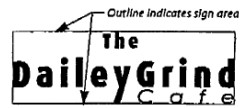
(b)
Only the largest side of a double-faced sign or a vee-shaped sign with no greater than a 30-degree angle between faces shall be considered. If the angle between faces is greater than 30 degrees, the area of both faces shall be considered.
(c)
Height of a freestanding sign shall be measured from the top of the sign structure to the top of the ground surface.
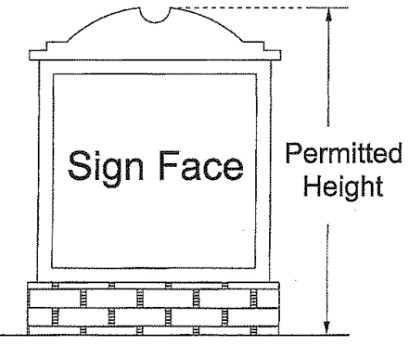
(d)
When two walls facing the same direction are 20 feet or greater from each other, they shall be counted as two separate walls.
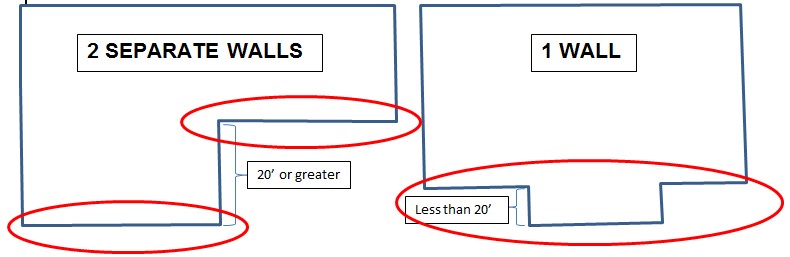
(e)
Wall size measurement shall be in accordance with the graphic below.
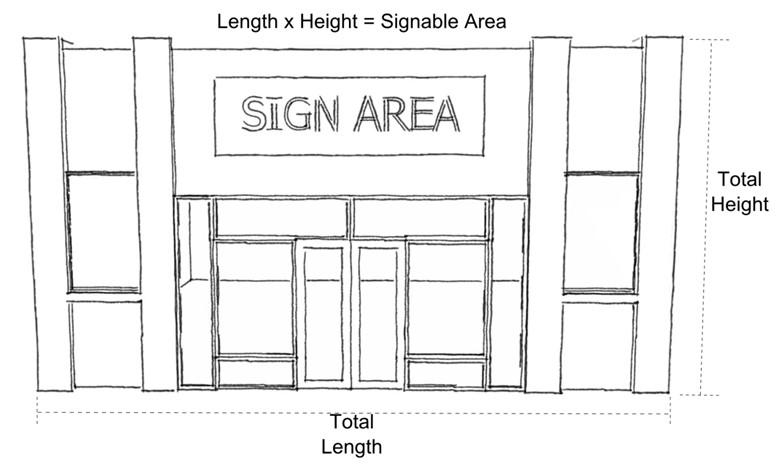
(Ord. No. 8 (Fourth Series), § 2, 3-21-2023)
Sec. 20-482. - Temporary signs in commercial districts.
(a)
Temporary signs in commercial districts shall conform to the following standards:
(1)
Temporary signs must not interfere with pedestrian traffic or sight lines for vehicular traffic.
(2)
No temporary sign may be specifically illuminated.
(3)
No temporary sign may use fluorescent colors.
(4)
All temporary signs must present a professional appearance and must be maintained in good condition.
(5)
Sidewalk signs must be removed each night and must be in compliance with OSHA egress standards (28 inches).
(6)
Properties that are currently for sale or rent may have one additional sign per street frontage, provided that it does not exceed 18 square feet when the speed limit of the abutting road is under 45 miles per hour and does not exceed 32 square feet when the speed limit of the abutting road is 45 miles per hour or greater. The sign must be removed within 30 days of the sale or rental. No permit is required.
(b)
Tables 20-486.5 and 20-486.6 show the temporary signage that developed properties in each commercial district may display on their property. Inflatables, air puppets, large portable signs, pennants, streamers, and any other forms of temporary signage, are prohibited.
(Ord. No. 8 (Fourth Series), § 2, 3-21-2023)
Sec. 20-483. - Shielding of illumination other than neon lighting.
Lighting shall be downcast or backlit and illuminate the sign only. External and indirect illumination of signs shall be designed, located, shielded and directed in such a manner that the light source is fixed and is not directly visible from and does not cast glare on any adjacent public right-of-way, motorists' vision or adjacent residential property. Such illumination shall also be so directed and shielded so as to prevent casting illumination out across public waters. This section does not apply to neon lighting.
(Ord. No. 8 (Fourth Series), § 2, 3-21-2023)
Sec. 20-484. - Sign permit applications to documented sign location.
The location of all signs must be documented as part of the sign permit application. This documentation may be with photographs, sketches or a written description that is clear and correct.
(Ord. No. 8 (Fourth Series), § 2, 3-21-2023)
Sec. 20-485. - Ground sign area maintenance required.
The owner, lessee or manager of any ground sign and the owner of the land on which the same is located shall keep grass or weeds and other growth cut and debris and rubbish cleaned up and removed from the lot on which a sign is located.
(Ord. No. 8 (Fourth Series), § 2, 3-21-2023)
Sec. 20-509. - Minimum sign standard requirements.
The following tables cover the minimum sign standards for each district:
* These signs that are 50 square feet or less, with a height less than eight feet from the ground, may use ground lighting, provided that the light and fixture are not visible from a public right-of-way and the light does not extend beyond the sign.
1 The allowable wall signage of one street fronting wall may be transferred to one wall that does not front a public street, but which fronts a parking area and contains pedestrian entry, as long as no more than five percent of the face of the building (one side), 100 square foot maximum, is cumulatively used for signage.
2 These signs that are 50 square feet or less, with a height less than eight feet from the ground, may use ground lighting, provided that the light and fixture are not visible from a public right-of-way and the light does not extend beyond the sign.
Note: For multi-tenant buildings, each tenant is allowed wall signage in accordance with the table above.
1 The allowable wall signage of one street fronting wall may be transferred to one wall that does not front a public street, but which fronts a parking area and contains pedestrian entry, as long as no more than five percent of the face of the building (one side), 100 square feet maximum, is cumulatively used for signage.
2 These signs that are 50 square feet or less, with a height less than eight feet from the ground, may use ground lighting, provided that the light and fixture are not visible from a public right-of-way and the light does not extend beyond the sign.
Note: For multi-tenant buildings, each tenant is allowed wall signage in accordance with the table above.
1 The allowable wall signage of one street fronting wall may be transferred to one wall that does not front a public street, but which fronts a parking area and contains pedestrian entry, as long as no more than five percent of the face of the building (one side), 100 square feet maximum, is cumulatively used for signage.
2 These signs that are 50 square feet or less, with a height less than eight feet from the ground, may use ground lighting, provided that the light and fixture are not visible from a public right-of-way and the light does not extend beyond the sign.
Note: For multi-tenant buildings, each tenant is allowed wall signage in accordance with the table above.
Note: For multi-tenant buildings, each tenant is allowed the signage in the table as if it were a separate property.
* Properties with at least 400 linear feet of frontage on a public road are allowed three at one time.
* Properties with at least 600 linear feet of frontage on a public road are allowed four at one time, and one of those may be an inflatable, provided that it does not exceed 90 square feet, 20 feet in height, is located within 50 feet from the building, and is displayed no more than 90 days in one calendar year.
* CW parcels that do not abut a county road or a state highway may display these signs in any number.
(Ord. No. 8 (Fourth Series), § 2, 3-21-2023; Ord. No. 18, Fourth Series, § 2, 4-16-2024)

