
North Las Vegas City Zoning Code
CHAPTER 17
12 - REVIEW AND APPROVAL PROCEDURES
Sections:
17.12.010 - Purpose and Intent.
This chapter establishes the rules, procedures, and criteria by which the City of North Las Vegas will review proposed land development activities for compliance with the provisions of this Code.
(Ord. No. 2591, § 1, 6-15-2011, eff. 10-1-2011)
17.12.020 - Summary and Organization.
A.
Description of Procedures. This chapter describes the procedures for review and approval of all applications for development activity in the City. Common procedures that are applicable to all or most types of development applications are set forth in Section 17.12.040, Common Procedures and Requirements. Section 17.12.070, Specific Review Procedures, sets forth additional provisions that are unique to each type of application such as review standards.
B.
Summary Table. Table 17.12-1, Table of Procedures, summarizes the review and decision-making responsibilities for the administration of the procedures described in this chapter. The table is a summary tool and does not describe all possible types of decisions made under this Code. Other duties and responsibilities are described in this chapter.
C.
Director Referral. The Director may also refer applications to other boards, Commissions, government agencies, and non-governmental agencies not referenced in this chapter.
D.
Timeframes. All timeframes not required for compliance with NRS are advisory only, and the failure of the City to comply with such timetables shall not require either an approval or denial of any application, shall not affect the processing of the application in any way, and shall not create any cause of action against the City or any of its officials involved in the implementation of this zoning ordinance.
(Ord. No. 2591, § 1, 6-15-2011, eff. 10-1-2011)
17.12.030 - Table of Procedures.
Table 17.12-1 summarizes which common procedural steps apply to a specific type of land development application as well as the role of relevant review bodies. Provisions specific to each type of land development application are found in Section 17.12.070.
(Ord. No. 2591, § 1, 6-15-2011, eff. 10-1-2011; Ord. No. 2714, § 1, 6-17-2015; Ord. No. 3048, § 1, 1-20-2021)
17.12.040 - Common Procedures and Requirements.
Figure 17.12-1 Common Review Procedures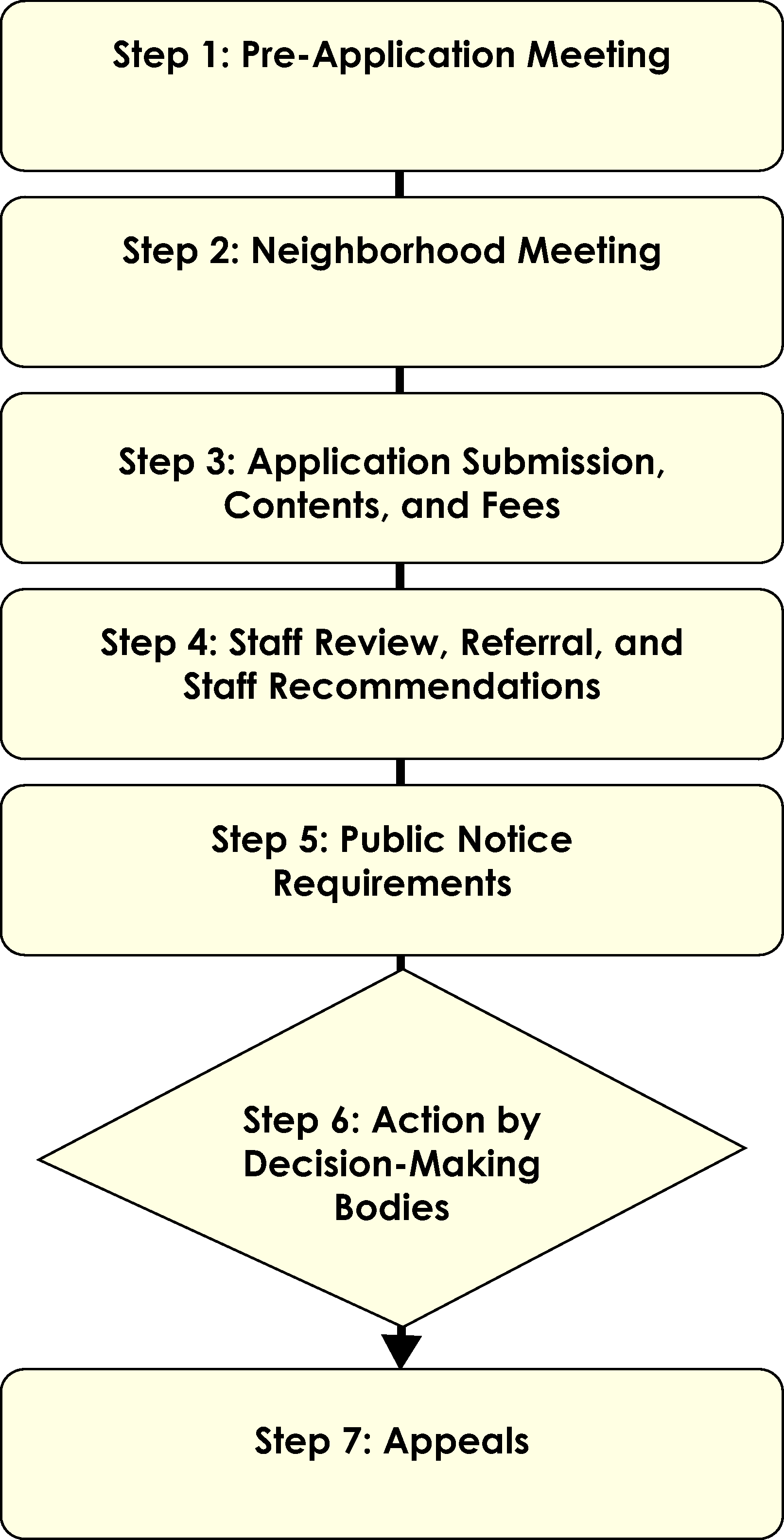
This section describes the procedural steps, requirements, and review criteria that are common to all or some land development applications. These provisions shall apply to all applications for land development submitted pursuant to this section, unless otherwise expressly exempted or alternative procedures are specified in this section or Section 17.12.070.
This Code is supplemented by, and should be read in conjunction with, the City of North Las Vegas Land Development Application Manual. The application manual is a citizen's guide to the Land Development Code and includes samples of application forms, detailed submittal requirements for different types of development approvals, required text for plat notes, and other information designed to simplify use of this Code.
A.
Step 1: Pre-Application Meeting.
1.
Purpose. The purpose of the pre-application meeting is to provide an opportunity for the applicant and the City to discuss the development proposal in order to:
a.
Determine the required application(s) and the timing of multiple application submittals (i.e., whether they may be processed concurrently or must be processed sequentially);
b.
Provide the applicant with application materials and inform the applicant of submittal requirements, including any requirements supplemental to those listed in the application manual for the type of application;
c.
Provide the applicant with an estimated time frame for the review process;
d.
Based on a conceptual plan of the proposal (if required), discuss generally compliance with the Code's zoning, use, density, development, and design standards, and attempt to identify potentially significant issues regarding compliance;
e.
Discuss the need for any neighborhood meetings and public notice requirements; and
f.
Refer the applicant to other departments or agencies to discuss potential significant issues prior to application submittal.
2.
Applicability.
a.
Pre-Application Meeting Required. A pre-application meeting is required prior to certain types of applications, as listed in Table 17.12-1. Applications for these types of approvals shall not be accepted until after the pre-application meeting is completed. The meeting should take place prior to any substantial investment, such as a land acquisition for a proposed development, site and engineering design, or the preparation of other data.
b.
Optional for All Other Applications. A pre-application meeting is optional prior to submission of any other application under this Code not listed as requiring a pre-application meeting above.
3.
Record of Pre-Application Conference. At the City's option, a summary of topics discussed at the pre-application conference may be documented by staff during the meeting and given to the applicant at the close of the pre-application conference.
4.
Submittal Requirements for Pre-Application Conferences. All documents required for the pre-application conference shall be submitted at least 14 days prior to the initial meeting with City staff. With the request for a pre-application conference, the applicant shall provide to the Director a description of the character, location, and magnitude of the proposed development and any other available supporting materials, such as maps, drawings, or models. It is the applicant's responsibility to provide sufficiently detailed plans and descriptions of the proposal for staff to conduct an informed evaluation of the proposed project.
B.
Step 2: Neighborhood Meeting.
1.
Purpose and Intent. The purpose of the neighborhood meeting is for applicants to educate residents, occupants, and owners of nearby lands about the proposed development and application, receive comments, address concerns about the development proposal, and resolve conflicts and outstanding issues, where possible. Applicants shall be responsible for scheduling and conducting neighborhood meetings consistent with the purposes described in this section.
2.
Applicability. A neighborhood meeting is required prior to certain types of applications, as listed in Table 17.12-1. The Director may require a neighborhood meeting if the Director determines the application may have significant adverse neighborhood impacts, including but not limited to traffic, noise, visual, or environmental impacts, or where substantial objections have been raised by neighbors on previous projects in the City or the current proposed project.
3.
Procedure. If a neighborhood meeting is held by the applicant, it shall comply with the following procedures:
a.
Time and Place. The official neighborhood meeting shall be held at a place that is convenient and generally accessible to neighbors that reside in proximity to the land subject to the application. The neighborhood meeting shall be held no later than seven days prior to the application submittal.
b.
Notification. The applicant shall be responsible for providing notice of the neighborhood meeting in accordance with the NRS requirements for notice for the type of application or approval being requested in the application. For example, a neighborhood meeting concerning a proposed zone map amendment would require the applicant to provide notices as required for a public hearing on a zone map amendment.
c.
Conduct of Meetings. At the official neighborhood meeting, the applicant shall explain the development proposal and application, answer any questions, and respond to concerns neighbors have about the application and proposed ways to resolve conflicts.
d.
Staff Attendance. The applicant shall be responsible for scheduling the meeting, coordinating the meeting, and for retaining an independent facilitator if needed. Attendance at the neighborhood meeting by City planning staff is not required.
e.
Written Summary of Neighborhood Meeting. The applicant shall provide the Director a written summary or transcript of the official neighborhood meeting with the application materials, and that summary shall be made available for public inspection. The written summary shall include a sign-in sheet, a summary of the issues related to the development proposal discussed, comments by those in attendance about the development proposal, and any other information the applicant deems appropriate.
f.
Failure to Hold Meeting. Failure to hold a required public meeting shall result in the application being deemed incomplete, and the application shall not be accepted until the neighborhood meeting is held. An applicant may appeal this decision to the decision-making body reviewing the application who may determine that because of the small size or lack of significant planning issues or apparent controversy adequate public input can be achieved through the remainder of the review process.
C.
Step 3: Application Submission, Contents, and Fees.
1.
Form of Application. Application submittal requirements, contents, and fees shall be established by the City and maintained in the City of North Las Vegas Land Development Application Manual that shall be made available in the offices of the Community Development Department and on the City's website.
2.
City of North Las Vegas Land Development Application Manual. The Director shall compile the requirements for application contents forms, fees, submission materials, and review schedule in an application manual, which shall be made available to the public. The Director may amend and update the application manual from time-to-time, except that the Director may not amend application fees. Application fees shall be adopted by City Council, but after approval may be included in the application manual for the convenience of users.
3.
Authority To File Applications. The record owner, a purchaser under a sale or option to purchase, the duly authorized agent of the record owner, or any person having legal authority to take actions with respect to the approval sought may file an application under this Code. In addition, the City Council, Planning Commission, or Director may file an application under this Code.
4.
Applications. All applications required by this section shall be submitted to the Community Development Department, unless otherwise specified.
5.
Simultaneous Processing of Applications.
a.
At the election of the applicant, and with the concurrence of the Director, applications for different types of development approvals may be processed simultaneously to expedite total review and processing time for a project. For example, an application for PUD preliminary development plan approval and tentative map approval may be submitted together for simultaneous review. Another example would be simultaneous processing of an application for a special use permit with an application for site plan approval.
b.
Whenever two or more forms of development approval are being processed simultaneously and this Code provides different time frames for review or decision-making for the different forms of approval, all related applications and approvals shall be completed within the longest time frame applicable to any of the simultaneous procedures, or as required by NRS.
6.
Contact Person Designation.
a.
The applicant shall designate one person on the application as the primary contact person who will be responsible for all notification, including meeting dates, deadlines, and requirements. The City will communicate with the contact person in any matter regarding the application. It is the contact person's responsibility to inform the owners or applicant of such information.
b.
The applicant shall notify the Director in writing if there is to be a change in the contact person. The Director will continue to communicate with the designated contact person until the notice of change has been received.
7.
Application Contents and Fees.
a.
Application Contents—General. The Director is authorized to establish submittal requirements within the application manual for all land use development applications required by this section and to update and amend such requirements as necessary to ensure effective and efficient City review. Applicants shall refer to the application manual for submittal requirements for each type of land use development application. The applicant shall provide any additional information, documents, or other material relevant to the application that the Director reasonably believes is necessary in order for the City to evaluate, analyze, and understand the subject matter of the application.
b.
Submittal Waivers Pursuant to Pre-Application Meetings. At or following a pre-application meeting, the Director may waive certain submittal requirements set forth in the application manual, except for fees, in order to reduce the burden on the applicant and to tailor the requirements to the information necessary to review a particular application. The Director may waive such requirements where he finds that the projected size, complexity, anticipated impacts, or other factors associated with the proposed development or subdivision clearly justify such waiver. This discretion may only be exercised if a pre-application meeting is held.
c.
Fees. Non-refundable fees are required at the time of the filing of any development application and are payable to the City in accordance with the fee schedules adopted by City Council. The City may require, in addition to the fees above, that the applicant pay all or a portion of the reasonable fees charged by private consultants retained by the City for the purposes of reviewing the application and advising City officials and agencies with respect thereto.
(i)
Authorization and Payment Required. The City Council shall adopt and amend from time-to-time a fee schedule setting forth an assessment of fees to defray the cost of processing land development applications under this section. The fee schedule, as amended, can be found in the application manual. At the time of submittal, all applications shall include payment of the processing fee, as well as any review fees charged by agencies for which the City has agreed to collect.
(ii)
No Required Fees for City-Initiated Applications. No fee shall be required for land development applications initiated by the City on its own initiative, rather than by a private party.
D.
Step 4: Staff Review, Referral, and Staff Recommendation.
1.
Complete Application Required for Processing. The City shall accept an application for further processing only if the application is submitted in the required form, including all submittal information and all items or exhibits specified by the Director during a pre-application meeting, and is accompanied by the applicable processing fee. If an application satisfies these prerequisites for formal submittal, the City will deem the application "provisionally complete" and subject to further completeness review as described in this section, and shall accept the application and fee for staff review, referral, and recommendation according to this subsection.
2.
Staff Review of Application. Upon submission of an application, the Director, along with any consultants the City retains to review the proposed application and advise City officials and agencies, shall review the application and accompanying documentation for legal sufficiency, consistency with related prior approvals, completeness (in terms of quality of submittals to enable detailed City review), compliance with technical plan and report requirements, conformance with the provisions contained in applicable sections of this Code, consistency with the adopted Comprehensive Master Plan for the City, and applicable specific plans and relevant City policies. Staff shall complete its review within ten (10) calendar days from the date the City accepts the application and application fee. However, failure to complete such review within the specified time shall not be deemed to constitute approval.
3.
Determination of Complete or Incomplete Application.
a.
If the Director determines that the application is complete, the application shall then be processed according to the remainder of this section, including referrals to outside agencies and scheduling for public hearing, as applicable.
b.
If the Director determines that the application is incomplete during this review, the applicant shall be notified and given the opportunity to submit the missing or corrected materials within ten (10) days. If the applicant does not submit the necessary materials within this ten-day period, the application shall be returned to the applicant along with all supporting materials and a written description of the application's specific deficiencies. All paid fees will be refunded to the applicant less a fee of one hundred dollars ($100.00) for staff administrative time to conduct review of the application up until this point.
c.
Failure of the Director to make a completeness determination within the required ten-day time frame shall not be deemed a finding that the application is complete. Nor shall failure of the Director to make a determination be construed as a bar to subsequent City or referral agency requests for plan revisions or additional or supplemental submittal materials and shall not be prejudicial to the City's subsequent review of and final action upon the application.
d.
No further City action is required on an application returned to the applicant as incomplete. The applicant may reinitiate review of the proposed development only upon submittal of a new application and the payment of all fees in place and applicable at the time of re-submittal.
4.
Referral of Complete Application to Outside Agencies and Departments.
a.
Staff may distribute the complete application to other City departments and agencies and to any other appropriate governmental or quasi-governmental agencies and bodies to solicit comments and ensure that the proposal complies with all applicable standards, requirements, and review criteria. The applicant shall be responsible for submitting any additional information or revised plans required by staff or the referral agencies, sufficient copies of the application to enable department and agency review, and for covering reasonable costs, such as postage and scheduled review fees, associated with distribution of the application to reviewing bodies.
b.
As applicable, the review and decision-making bodies shall consider the services and facilities provided by the referral agencies as a factor in approval of the complete application. The criteria for evaluating sufficiency of the services that must be satisfied for the approval of the application shall be provided to the review and decision-making bodies as a part of any referral response.
c.
Referral agencies may comment in writing within fifteen (15) days of receiving a complete application. At the discretion of the City, the failure of any agency to respond within fifteen (15) days may be considered "no comment" on the application by that agency. As applicable, referring agencies will provide the review and decision-making bodies with a summary of any capacity evaluation study. The summary will include an explanation of the agency's assumptions regarding available capacity.
5.
Subsequent Requests for Information. Staff and referral agencies shall use best efforts to identify all major issues and to request additional information, data, or reports from the applicant, during the first referral and review period described in subsection 4. above. This provision shall not be interpreted to preclude staff or referral agencies from requesting revisions or corrections to previously submitted materials if such materials are subsequently found to be inaccurate, incomplete, or if subsequent plan revisions do not comply with this section.
6.
Subsequent Meeting with Applicant. During preparation of the staff report, staff may schedule a response meeting with the applicant to discuss the staff report and specific referral comments. In addition to planning staff, the Director or project planner may request the attendance of other City staff, key referral agencies, and other interested parties to address any concerns directly with the applicant.
7.
Submission of Revised Application, Scheduling, and Final Staff Report/Recommendation.
a.
The applicant is encouraged to work with the various departments and agencies to resolve any concerns raised, to revise plans, and to assemble the appropriate documentation for issues.
b.
Unless the Director agrees to an extension of time, the applicant shall submit the revised application and related materials to the Director no later than one hundred eighty (180) days after receipt of the preliminary report. If the applicant does not submit a revised application within this time frame, the application shall be considered automatically withdrawn, and the City shall treat submittals after expiration of the time period as a new application for purposes of review, scheduling, and payment of application fees.
8.
Scheduling for Review and/or Decision. At the close of the time frame for receipt of referral comments on the applicant's revised application and plans, the Director shall schedule the application for consideration on the next regular meeting agenda, or as soon thereafter as meeting agendas allow, before the applicable review or decision-making body. The Director shall notify the applicant of the scheduled dates. As applicable, public notice of a required public hearing shall be given according to the requirements stated in Section 17.12.040.E and any specific additional notice requirements as contained in Section 17.12.070.
9.
Applicant Request for Additional Revisions and Staff Review. At the applicant's option, in-lieu of proceeding to review by the appropriate review or decision-making body at the scheduled meeting or hearing, the applicant may submit additional application and plan revisions to further respond to referral and Director comments. Each additional round of revision and Director review requested by the applicant shall follow the process of review, referral, and Director written response described in this chapter.
10.
Preparation of Staff Report and Recommendation. After scheduling the application for review and decision-making authority action, the Director shall prepare a written staff report. The report shall include discussion of the relevant issues pertaining to the compliance of the application with the standards of this Code. The staff report shall incorporate the relevant responses and comments from reviewing departments and agencies. The staff report shall conclude with a recommendation for action. Conditions for approval may be recommended to eliminate any areas of noncompliance or to mitigate any adverse impacts from the development proposal.
11.
Distribution of Staff Report. Upon request, staff will make copies of the staff report and the applicant's written responses, if any, available to the applicant, adjacent property owners, any member of the public the relevant review or decision-making body, or the City Attorney as appropriate. The City Council shall also be sent copies of the recommendation of the Planning Commission or other body as appropriate prior to any required City Council hearing.
E.
Step 5: Public Notice Requirements. Applications for development approval shall comply with the Nevada Revised Statutes (NRS) and the provisions of this chapter with regard to public notification.
1.
General Notice Requirements Timing of the Notice. Unless otherwise stated in this Code, notice for all public hearings shall be pursuant to this Section 17.12.040.E. Notice of the time and place of the hearing, including a general description of the area affected, shall be given at least ten (10) days before the hearing by publication at least once in a newspaper of general circulation published or circulated in the City of North Las Vegas, or if there is none, by posting on the affected property so as to be legible from the public right-of-way and in at least ten (10) public places in the City.
2.
Specific Notice Requirements. Table 17.12-1 sets forth the specific notice requirements for applications requiring any type of notification.
3.
Content. Notices, whether by publication or mail (written notice), shall at a minimum:
a.
Identify the application by number or title of the project;
b.
Identify the name of the applicant or the applicant's agent;
c.
Identify the subject property by parcel number and street address. If no street address has been assigned, provide reference to nearest cross-streets;
d.
Specify the date, time, and place of the public hearing;
e.
Describe the nature and scope of the application;
f.
Notify the public where to view the application and related documents;
g.
Include a statement that the public may appear at the public hearing or be heard, if any, and submit evidence and written comments with respect to the application; and
h.
Include a statement stating that written comments will be accepted and describing where written comments will be received prior to the public hearing or meeting.
4.
Published Notice. When the provisions of this Code require that notice be published, the Director shall be responsible for preparing the content of the notice and publishing the notice in a newspaper of general circulation that has been selected by the City. The content and form of the published notice shall be consistent with this subsection 3. above and the requirements of the Nevada Revised Statutes.
5.
Written (Mailed) Notice.
a.
When the provisions of this Code require that written or mailed notice be provided by the City, the Director shall be responsible for preparing and mailing the written notice. The City will provide the notification boundary map to be submitted with the project application. Written notice shall be provided to:
(i)
Property owner of record and any known tenants at the property address as required by NRS, and
(ii)
The owner of the property for which the approval is sought, and all the following additional property owners in the following cases:
(1)
In the case of applications not listed in Table 17.12-1, that will result in a variation of thirty (30) percent or more to otherwise applicable standards, property owners immediately adjacent (excluding streets and alleys) within five hundred (500) feet of the subject property;
(2)
In the case of applications not listed in Table 17.12-1, that will result in a variation of less than thirty (30) percent to otherwise applicable standards, property owners immediately adjacent (excluding streets and alleys) within one hundred (100) feet of the subject property; and
(3)
Representatives of any neighborhood organizations that have registered with the City Clerk shall be notified if any area within the boundaries of such organization falls within the five hundred-foot radius area for property owner notice. Notice will be provided to neighborhood organizations using predefined boundary maps that shall be submitted to the City by the neighborhood organization.
b.
The notification of property owners shall apply only to the initial presentation of the proposed development to the public hearing unless otherwise directed by the City.
6.
Posted Notice. Any posted notice shall be a minimum of twenty-four (24) inches by thirty-six (36) inches and printed so that the following are visible from a distance of one hundred (100) feet from a public street or right-of-way: the word "zoning," the current zoning classification, the proposed zoning classification, the proposed type of development review (e.g., rezoning, subdivision, variances), contact information regarding the application, and the date and time of the hearing. Projects abutting more than one right-of-way shall post at least one notice facing each right-of-way. Unless otherwise stated in the specific review procedures, signs shall be posted by the City at least ten (10) days before any public hearing or decision on the application.
7.
Other Notices. Applicants shall be responsible for compliance with any additional notice requirements in this Code, other City ordinances, or state law.
8.
Constructive Notice.
a.
Minor defects in any notice shall not impair the notice or invalidate proceedings pursuant to the notice if a bona fide attempt has been made to comply with applicable notice requirements. Minor defects in notice shall be limited to errors in a legal description, typographical or grammatical errors, or errors of actual acreage that do not impede communication of the notice to affected parties. Failure of a party to receive written notice shall not invalidate subsequent action. In all cases, however, the requirements for the timing of the notice and for specifying the time, date, and place of a hearing shall be strictly construed.
b.
When the records of the City document the publication, mailing, and posting of notices as required by this section, it shall be presumed that notice of a public hearing was given as required by this section.
F.
Step 6: Action by Review and Decision-Making Authorities.
1.
Permitted Actions.
a.
Recommendations by Review Body.
(i)
A review body as set forth in Section 17.12.070, Specific Review Procedures, shall evaluate the application, referral comments, staff report, and public testimony, if any, and make a recommendation for action to the decision-making body.
(ii)
The review body's actions shall be based on the evidence presented and compliance with the review criteria for the subject application, as set forth in this Section 17.12.040.F, and the relevant specific review procedures set forth in Section 17.12.070.
b.
Review and Action by Decision-Making Body.
(i)
A decision-making body may take action on an application or appeal by approving, approving with conditions, continuing, or remanding for additional information or for further study, or denying the application or appeal.
(ii)
In taking action, the decision-making body shall evaluate the application, referral comments, staff report, public testimony, if any, and the review body's recommendation. All final decision actions shall be based on the application or appeal's compliance with the review criteria for the subject application, as set forth in Section 17.12.040.F.7 and in the relevant specific sections of this chapter.
2.
Withdrawal of Application by Applicant. An applicant shall have the right to withdraw an application, at any time prior to action on the application at a public hearing or meeting. The applicant shall submit in writing the withdrawal request to the Director. After a withdrawal, the City will not take further action on the application. To re-initiate review, the applicant shall submit a new application. Withdrawal of an application from a public hearing or meeting agenda is at the review or decision-making body's discretion.
3.
Applicant is Responsible to be Present at Public Hearing. The applicant, property owner, or authorized user of Bureau of Land Management land or appropriate representative is responsible to be present at all public hearings. If the applicant fails to appear at the public hearing without prior notice the item may, at the discretion of the City, be issued a continuance. If the applicant misses two hearings, the applications may be denied with prejudice.
4.
Continuation of Public Hearings. The review or decision-making body may continue a public hearing for its consideration of an application for a definite time not to exceed sixty (60) days, unless a longer period is agreed to by the applicant in writing or at a public hearing. The continuance may be granted by the review or decision-making body on its own initiative or at the request of the applicant or affected property owners.
5.
Site Visits by Review or Decision-Making Body. As part of its consideration of an application, the review or decision-making body may, as a group or through a committee appointed for that purpose, inspect the site of the proposed land use or development activity. The site visit may occur at any time prior to the review or decision-making body's final recommendation or action on the application. Upon reasonable request by the Director, the applicant shall mark the development site prior to the site visit to generally locate property boundaries, building envelopes, and other key site planning features. Attendance at a site visit by a quorum of the subject review or decision-making body membership shall be properly noticed according to law.
6.
Written Findings of Fact. Recommendations or decisions at the conclusion of any required public hearing shall be accompanied by written findings of fact addressing how the application does or does not comply with the general review criteria or specific review criteria stated in this Code for that type of application. All findings of fact shall be based on information contained in the application, or submitted or arising during the public hearing.
7.
Conditions of Approval.
a.
The review or decision-making body may recommend or impose such conditions upon the subject development as is necessary to carry out the general purpose and intent of this Code. Conditions and additional information requirements shall be in written form and attached to the approved plan, plat, or permit.
b.
Conditions of approval shall be reasonably related to the anticipated impacts of the proposed use or development.
c.
The decision-making body may place specific time limits on the satisfaction of any condition of approval.
d.
The decision-making body may require financial guarantees from the applicant pursuant to Title 16 of the North Las Vegas Municipal Code.
e.
The decision-making body may establish conditions under which a lot or parcel of land may be used, or a building constructed or altered, or make requirements as to the architecture, height of a building or structure, open spaces, parking areas or vehicle storage and conditions of operation of any enterprise, or may make any other conditions, requirements or safeguards that they may consider necessary to the public health, safety, and welfare.
f.
The conditions, stipulations, or limitations shall be binding upon the applicants, heirs, successors, and assigns. All conditions, stipulations, and limitations shall be fulfilled within a two-year period of time. Failure to complete the conditions, stipulations, or limitations within the time limit shall render the application null and void, unless an extension of time is granted by the decision-making body.
8.
Approval Criteria. To approve a development application, the decision-maker shall find that the development application has satisfied and followed the applicable requirements of this chapter, all of the approval criteria required for the applicable development application as set forth in this chapter, and all other applicable development standards of this Code.
G.
Step 7: Appeals.
1.
Purpose. Where an aggrieved person alleges that there is an error in any order, requirements, decision, or refusal made by an administrative official in the enforcement of this Code or of any ordinance adopted pursuant thereto, or any other requirement of a City department not covered by a particular code, an appeal may be made as prescribed in the following section.
2.
Appeals to the Planning Commission. An aggrieved person may appeal decisions by an administrative officer in the enforcement of this Code in a manner provided in this subsection. The appeal shall be made to the Planning Commission in the following manner:
a.
Application. The aggrieved person shall state in a letter to the Commission the specific requirement that is to be appealed and the circumstances why the requirement is imposing an undue hardship upon the proposed development. The letter shall be filed with the Community Development Department within ten (10) days of receipt of certified letter from staff documenting decision to be appealed. Upon receipt of said letter, the Community Development Department shall set a date at which such appeal will be heard by the Planning Commission.
b.
Hearing. The Planning Commission shall hold a hearing on the appeal request not more than forty-five (45) calendar days following the filing of the aggrieved person's letter of appeal. The aggrieved person must be present at the meeting at which the appeal will be heard.
c.
Decision.
(i)
Timing of Decision. A decision of the Planning Commission shall be made not later than thirty (30) days following the public hearing unless an extension of time is agreed upon by the aggrieved person and the Planning Commission.
(ii)
Form of Decision. The Planning Commission in granting an appeal may establish conditions under which a lot or parcel of land may be used, or a building constructed or altered, or make requirements as to the architecture, height of building or structure, open spaces, parking areas, or vehicle storage and other conditions, requirements, or safeguards that the Commission may consider necessary to the public health, safety, and welfare. The Planning Commission may require guarantees to insure compliance with the conditions prescribed in any appeal granted. In the event of a denial by the Commission, the motion shall set forth the reasons for such denial.
(iii)
Final Action of the Planning Commission. A decision of approval or denial by the Planning Commission shall be made by motion. This motion shall be final on the eighth day following said decision unless an appeal is made to the City Council as prescribed in subsection 5. of this section.
3.
Appeals to the City Council.
a.
Filing. An appeal from the decision of the Planning Commission as provided in this section may be taken to the City Council by an aggrieved person the City Manager, any property owner as shown on the latest tax rolls of the Clark County Assessor's Office within a radius as established by NRS, or any other person who may establish that his or her property rights are or may be affected by the decision. Such appeal shall be in writing and shall be filed with the City Clerk on forms provided within seven calendar days of the decision appealed from. The appeal shall specify where there was error in the decision of the Planning Commission. Additionally, any person filing an appeal from a decision of the Planning Commission on the basis that his or her property rights are or may be affected by said decision shall include an affidavit stating the nature and location of the property interest and the manner in which this property interest will be affected by the decision being appealed. To partially defray the cost of making maps, noticing public hearings, and other incidental administrative and investigative expenses involved in any application, a nonrefundable fee shall be charged. This fee shall be due and payable at the time of the filing of the application. No application shall be accepted for processing unless such fee is paid.
b.
Automatic Stay. If an appeal is filed within the time specified, it automatically stays proceeding in the matter until determination is made by the City Council.
c.
Consolidation of Appeals. If more than one appeal is filed concerning a decision of the Planning Commission, all such appeals shall be consolidated into a single matter to be heard by the City Council.
d.
Hearing. Upon the filing of the appeal, the City Clerk shall set the matter for City Council consideration at a hearing. Notice by mail shall be given to all persons who appeared in person or through a representative at the Planning Commission hearing. At the hearing, City Council will consider the appeal as a new matter for determination, rather than reviewing for error in the Planning Commission decision. The City Council shall base its decision on the intent of this Code as stated in Section 17.04.010 as well as well as those purposes stated in NRS 278.020.
e.
Decision. A decision by the City Council shall be made not later than thirty (30) calendar days following the public hearing at which the appeal is first considered, and within forty-five (45) calendar days of the decision appealed from, unless continued without objection of the appellant. Planning Commission action shall prevail if the City Council fails to make a decision within the prescribed time or agreed upon extension of time. The City Council may grant no appellant more than two continuances on any appeal unless it determines, upon good cause shown, that additional continuances are warranted.
f.
Council Limitations. Upon consideration of such appeal, the City Council may, by motion, affirm, reverse, or modify in whole or in part any determination of the Planning Commission subject to the same limitations as are placed upon the Planning Commission by this Code. A motion to reverse a Commission decision shall contain a finding of facts showing why the Commission decision was in error.
g.
Final Decision. The decision of the City Council shall be a considered a final decision for purposes of judicial review.
(Ord. No. 2591, § 1, 6-15-2011, eff. 10-1-2011)
17.12.050 - Inactive Applications.
A.
Notification. The Director may notify the applicant in writing that an application that was previously determined to be a complete application will be considered inactive unless corrective action is taken within thirty (30) days, if at any point in a development review process either:
1.
The Director or a referral body/agency has notified the applicant that additional or corrected materials are required, and the applicant has not submitted such materials within forty-five (45) days after the date of such notification; or
2.
The applicant fails to attend any scheduled mandatory neighborhood meeting, meeting with the Director, or meeting or hearing before the Planning Commission, board of adjustment, or City Council; or
3.
The applicant has not responded to a staff report, has not agreed to a date for a meeting or hearing before the Planning Commission, has not given proper public notice as required by this chapter, or has not taken some other affirmative step within a reasonable time frame that is within the applicant's control and is necessary to advance the application for a final determination. A "reasonable time frame" shall be determined by the Director taking into account average response times from similar applicants on similar applications; or
B.
Processing Stops. No further processing of such application shall occur until the deficiencies are corrected. If the applicant does not correct the deficiencies within the thirty-day correction period, the application shall be considered automatically withdrawn. Any re-submittal of the application by the applicant will be treated as a new application for purposes of review, scheduling, and payment of application fees.
(Ord. No. 2591, § 1, 6-15-2011, eff. 10-1-2011)
17.12.060 - Actions and Limitations Following Development Approval or Denial.
A.
Standard Notes and Certifications. Each approved development plan or plat shall contain standard notes, specific notes, dedication, conditions, and certifications that the City finds to be applicable and appropriate.
B.
General Recordation Requirements. After approval of the development plan or plat by the City, the applicant shall record with Clark County within thirty (30) working days after approval. The applicant shall provide the Director with three copies of the recorded plat. The applicant shall be responsible for all fees associated with the recording. In the event the applicant does not record the plan or plat within the required thirty (30) days, the Director may notify the applicant that the plan or plat may become null and void if action is not taken within a specified time frame. If such a notice is given and applicant does not take the required action within the time specified by the Director, the Director may notify the City Council of the situation and the City Council may, in its discretion, declare the plan or plat null and void.
C.
Lapse of Approval Provisions/Extension of Approval Period.
1.
All permits and approvals under this Code, shall lapse if certain actions related to the approved application are not taken within a specified time period. Specific actions that must be taken with regard to each form of permit or approval to avoid lapsing of the approval are set forth in Section 17.12.070.
2.
After consultation with other departments whose services, facilities, or plans for future services and facilities may be affected, the Director may grant an extension of an approval period up to twelve (12) months for good cause. All requests for extensions shall be submitted to the Director in writing at least thirty (30) days prior to the expiration of approval. An extension request shall include payment of required fees and a narrative stating the reasons for the applicant's inability to comply with the specified deadlines, listing any changes in the character of the neighborhood, any changes to the Comprehensive Master Plan or this Code that have occurred since approval of the permit/plan as these changes affect the permit/plan, and the anticipated time schedule for completing the review project and/or the specific project. Additional review of the permit/plan may result in additional conditions, as applicable.
3.
Any denial of the extension may be appealed to the Planning Commission. If the extension is denied, the applicant may re-submit a new application, subject to the fees and regulations in effect at the time of re-submittal, for the same project.
D.
Limitations on Successive Applications. Unless otherwise specified in Section 17.12.070 for a specific type of application, upon denial of an application submitted pursuant to this Code, no new application for the same or substantially the same request, as determined by the Director, shall be submitted or accepted within one year of the date of such denial. However, if the Director determines that the resubmitted application has been modified to correct the stated objections, then the resubmittal will be accepted prior to expiration of the one year period. Resubmittals are subject to all processing fees, submittal requirements, and review standards in effect at the time the resubmittal is accepted by the Department.
E.
Modifications of and Amendments to Approved Plans.
1.
Amendments. All changes, modifications, removal, or release of the provisions of an approved plan or plat shall be considered amendments. Amendments shall include, but are not be limited to, changes in use, access, layout, any condition of approval, any change resulting in significant increased off-site impacts, and similar changes as determined by the Director. All amendments to applications not listed in subsections 2. through 5. below shall be subject to the provisions of this subsection 1.
a.
Minor Amendments. All amendments that do not modify any numerical development standard by more than ten (10) percent and do not include a change in any permitted or conditional use or any increase in permitted building height or any increase in development density or intensity, or any reduction in approved open space, shall be minor amendments and shall be subject to approval by the Director.
b.
Major Amendments. All amendments that do not meet the definition of a minor amendment in subsection (a) above shall be major amendments. Major amendments must be reviewed and approved through the same procedure used for the initial approval of the development application. For purposes of review and scheduling, major amendments are treated as new applications subject to the applicable procedures and review criteria set forth in this chapter unless otherwise noted in the specific review procedures.
c.
Recording. All approved amendments to a recorded plan or plat shall be recorded within ninety (90) days of the amendment's approval.
2.
Planned Unit Development Amendments. Amendments to any approved Planned Unit Development (PUD) shall be processed in accordance with Section 17.12.070.E.6.
3.
Mixed-Use Development Amendments. Amendments to any approved Mixed-Use Development (MUD) shall be processed in accordance with Section 17.12.070.F.9.
4.
Residential Design Incentive System Amendments. Amendments to any approved Residential Design Incentive System (RDIS) shall be processed in accordance with Section 17.12.070.G.5.
5.
Site Plan Amendments. Amendments to any approved Site Plan shall be processed in accordance with Section 17.12.070.H.6.
(Ord. No. 2591, § 1, 6-15-2011, eff. 10-1-2011)
17.12.070 - Specific Review Procedures.
A.
Zoning Text Amendments.
Figure 17.12-2: Zoning Text Amendments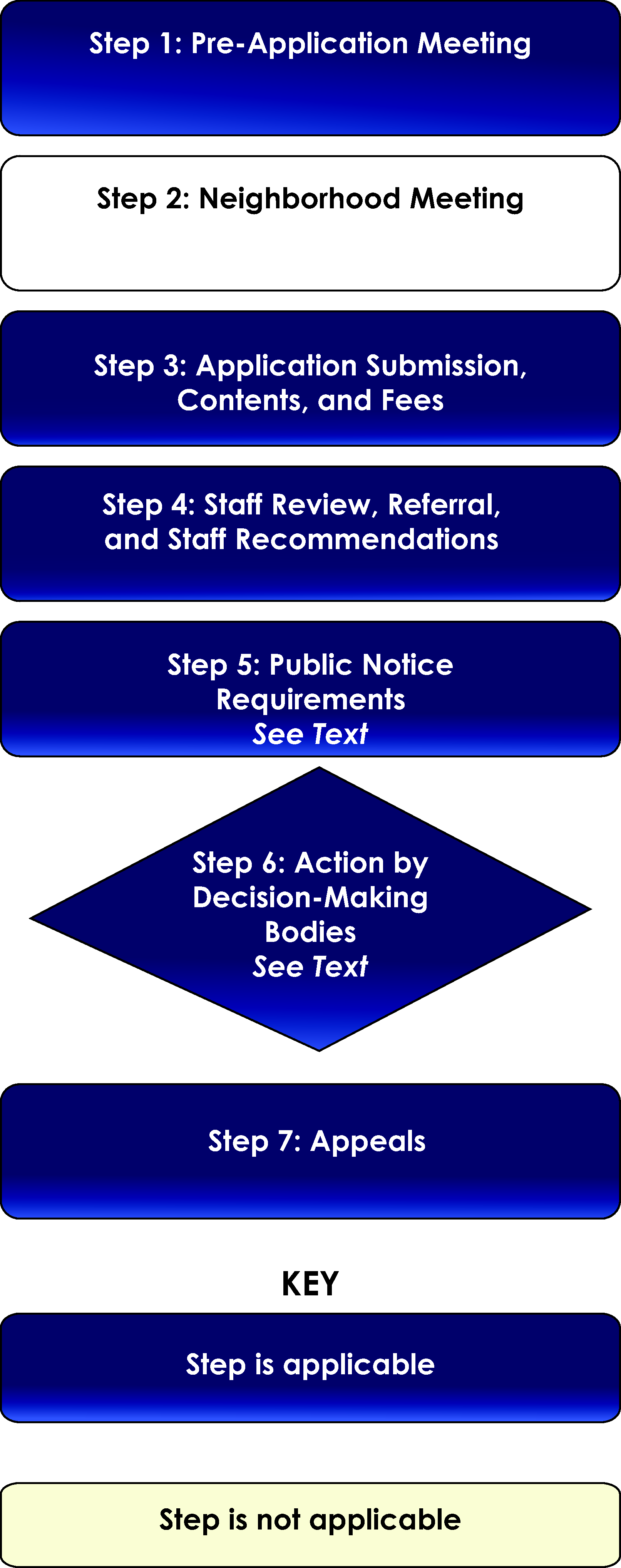
1.
Purpose. In accordance with the provisions of Nevada Revised Statutes, the City Council may from time-to-time adopt amendments to this Code. An amendment to this Code may involve changes to its text and wording, including but not limited to changes in the regulations regarding uses, setbacks, heights, lot areas, definitions, administration, and/or procedures.
2.
Applicability. Amendments shall be initiated by a motion of the City Council, Planning Commission, or Director, or by petition of a person whose property would be affected by the amendment.
3.
Procedures. Figure 17.12-2 shows the steps of the common development review procedures that apply in the review of applications for zoning text amendments. The common procedures are described in Section 17.12.040. Specific additions and modifications to the common review procedures are identified below.
a.
Step 6: Action by Review and Decision-Making Bodies.
(i)
Hearing and Recommendation by the Planning Commission. An amendment not initiated by the Planning Commission shall be referred to the Commission for study and public hearing. In its deliberations on the matter, the Commission shall consider oral or written statements from the petitioner, the public, City staff, and its own members in addition to the criteria in subsection (iii) below. The Planning Commission may approve, disapprove, or table an amendment application. Upon making a decision, the Planning Commission shall notify the City Council of its recommendation, together with a report of findings, hearings, and other supporting data.
(ii)
Hearing and Decision by the City Council. The City Council, after receipt of the report and recommendation of the Planning Commission, shall consider the proposed amendment and the recommendations of the Planning Commission. In its deliberations on the matter, the Council shall consider oral or written statements from the petitioner, the public, City staff members, and its own members in addition to the criteria in subsection (iii) below. If, for the evidence presented and the recommendations of the Planning Commission, the City Council determines that the proposed amendment will not adversely affect the health and general welfare, the City Council may approve, or change, or modify and approve, the proposed amendment by ordinance.
(iii)
Approval Criteria. Recommendations and decisions on zoning text amendments may be approved if all of the following criteria are met:
(1)
The proposed amendment is consistent with the Comprehensive Master Plan, other adopted City plans, and the stated purposes of this Code; and
(2)
The proposed amendment is necessary or desirable because of changing conditions, new planning concepts, or other social or economic conditions.
B.
Zoning Map Amendments (Rezonings).
Figure 17.12-3: Zoning Map Amendments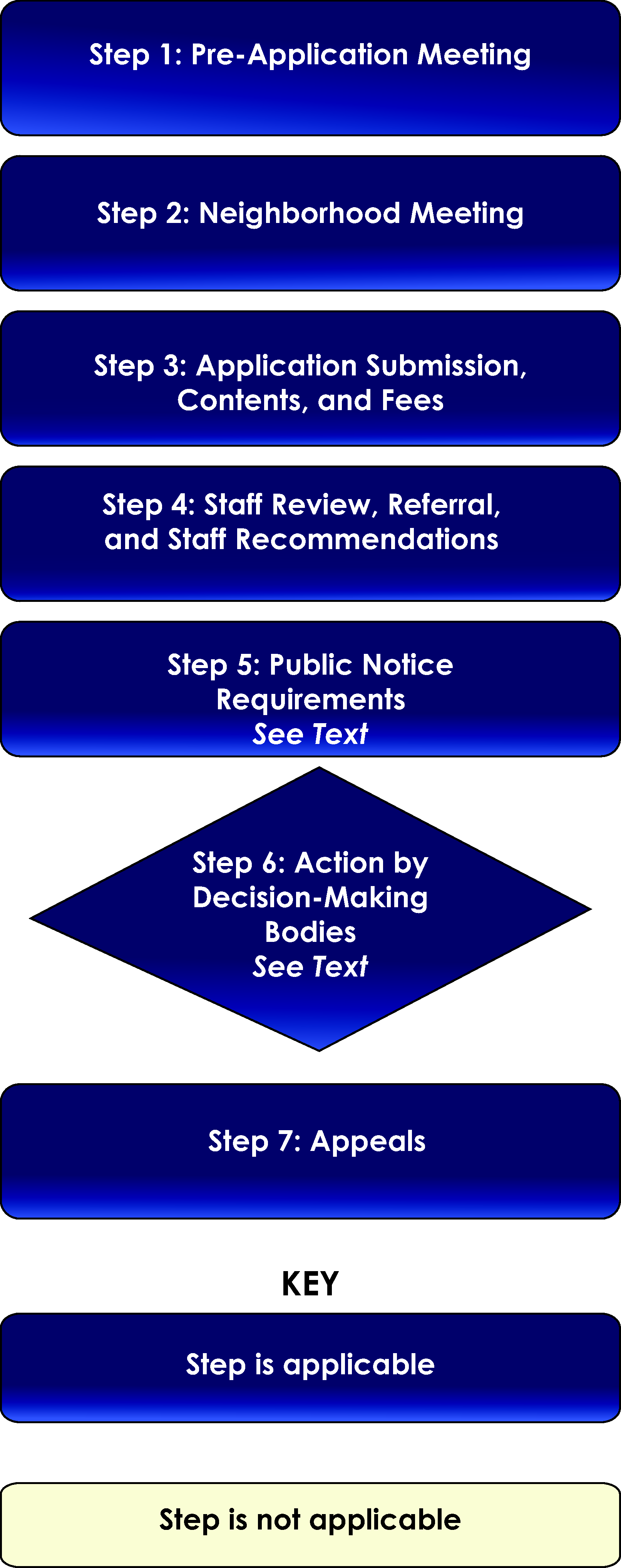
1.
Purpose. In accordance with the provisions of Nevada Revised Statutes, the City Council may from time-to-time change the zoning of parcels of and within the municipality. These changes in zoning classification are for the purpose of meeting the land use needs of the residents of the City in conformance with the City's Comprehensive Master Plan.
2.
Applicability.
a.
Initiation. Rezonings may be initiated by the City Council, the Planning Commission, the owner of property proposed for rezoning, or authorized user(s) of Bureau of Land Management land.
b.
Rezonings to Planned Unit Development. Applications for Rezonings to Planned Unit Developments shall be made in accordance with Section 17.12.070.D.
c.
Rezonings to Mixed-Use Development. Applications for Rezonings to Mixed-Use Developments shall be made in accordance with Section 17.12.070.F.
d.
Planned Community Districts. Applications for Planned Community Districts shall be made in accordance with Section 17.12.070.E.
3.
Procedures. Figure 17.12-3 shows the steps of the common development review procedures that apply in the review of applications for zoning map amendments. The common procedures are described in Section 17.12.040. Specific additions and modifications to the common review procedures are identified below.
a.
Step 5: Public Notice Requirements. Notice shall be provided as set forth in Section 17.12.040.E and Table 17.12-1, and additional procedures as set forth in the application manual.
b.
Step 6: Action by Review and Decision-Making Authorities.
(i)
Hearing and Recommendation by the Planning Commission.
(1)
Public Hearing. All proposed amendments not initiated by the planning commission or City Council shall be submitted to the planning commission for a public hearing. The planning commission shall hold a public hearing on the application not more than forty-five (45) calendar days following the filing of a complete application or following the motion of the City Council initiating the proposed change, unless an alternative time frame is agreed upon by the applicant. The property owner(s), authorized user(s) of Bureau of Land Management land, or appropriate representative must be present at all public hearings.
(2)
Recommendation. Following the conduct of a public hearing and within thirty (30) calendar days of the hearing, the planning commission shall report its findings and recommendations on the proposed amendment to the City Council unless an extension of time is agreed upon. The commission, in making its recommendation concerning a reclassification of property, may change or modify the proposed amendment. If the commission also considers reclassifying other adjacent property, it shall be necessary to notify the additional persons required and set another public hearing per this chapter.
(3)
Planning Commission Denial. A Planning Commission recommendation of denial of an application for a zoning map amendment submitted by petition shall terminate proceedings unless appealed. All other Planning Commission actions on proposed zoning map or zoning ordinance amendments shall be automatically referred to the City Council for a public hearing.
(ii)
Hearing and Decision by the City Council.
(1)
Public Hearing. The City Council shall consider the proposed amendment and the recommendations of the Planning Commission at the Council's next regular public hearing following receipt of the recommendations of the Planning Commission.
(2)
Determination. If, based on the evidence presented and the recommendations of the Planning Commission, the City Council determines that the proposed amendment will not adversely affect the health and general welfare; the City Council shall approve the proposed amendment by ordinance based on the criteria in subsection (iii) below.
(iii)
Approval Criteria. The City Council may approve zoning map amendments, and the Planning Commission may recommend approval, if the zoning map amendment meets all of the following criteria:
(1)
The rezoning will promote the public health, safety, and general welfare;
(2)
The rezoning is consistent with the Comprehensive Master Plan and the purposes of this Code;
(3)
The rezoning is consistent with the stated purpose of the proposed zoning district(s);
(4)
Facilities and services (including roads and transportation, water, gas, electricity, police and fire protection, and sewage and waste disposal, as applicable) will be available to serve the subject property while maintaining adequate levels of service to existing development;
(5)
The rezoning is not likely to result in significant adverse impacts upon the natural environment, including air, water, noise, storm water management, wildlife, and vegetation, or such impacts will be substantially mitigated;
(6)
The rezoning is not likely to result in significant adverse impacts upon other property in the vicinity of the subject tract; and
(7)
Future uses on the subject tract will be compatible in scale with uses on other properties in the vicinity of the subject tract.
4.
Limits on Successive Applications. When a rezoning request for property is denied by the Council, a new application to rezone the property to the same district or any other district shall not be made within one year of the date of Council denial. However, this paragraph shall not preclude the submittal of an application to rezone property to a district that is in conformance with the existing Comprehensive Master Plan land use designation; provided, the application is not submitted within one year of the date of Council denial of a previous attempt to amend the Comprehensive Master Plan for the same property.
C.
Comprehensive Master Plan Amendments.
Figure 17.12-4: Comp. Plan Amendments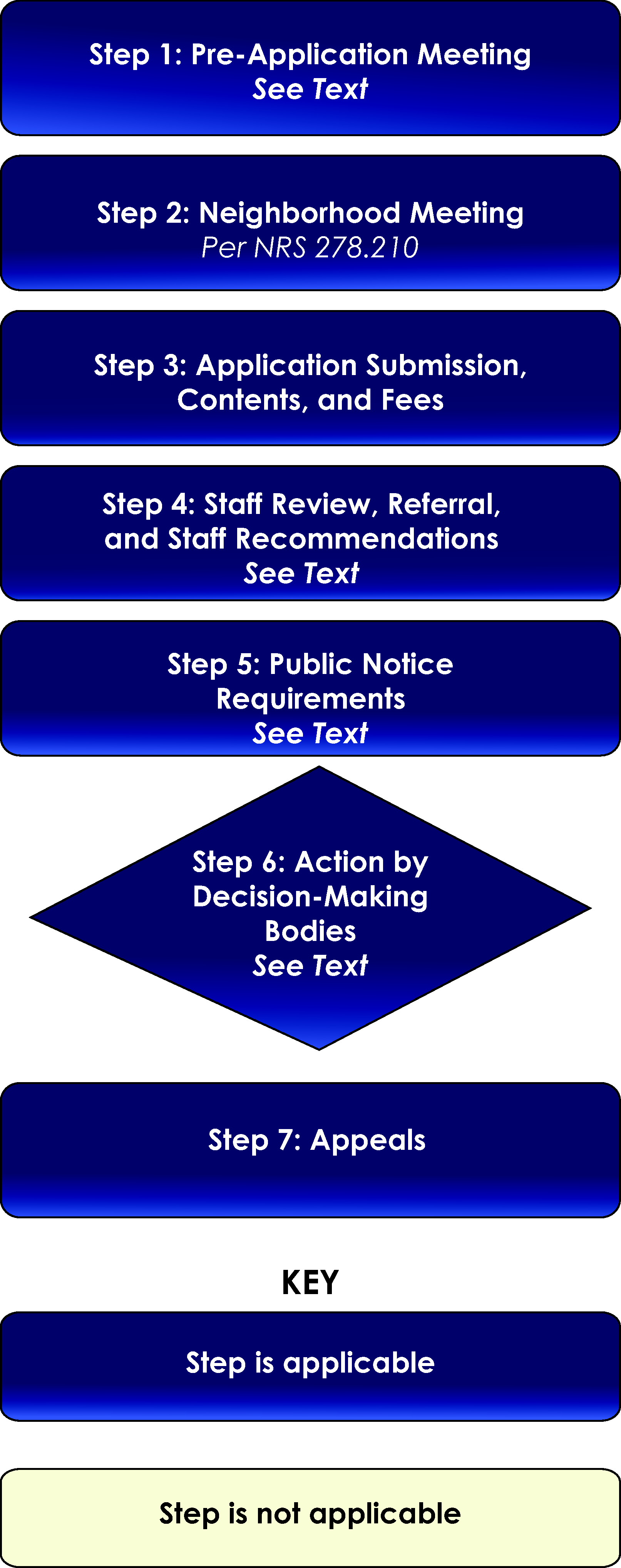
1.
Purpose. The purpose of this section is to provide procedures and standards for amending the text or maps of the North Las Vegas Comprehensive Master Plan as authorized by NRS 278.210-220. The amendment process is established in order to provide flexibility in response to changing circumstances, to accommodate potential change where such change meets the intent of the plan, to reflect changes in public policy, and to advance the general welfare of the City.
2.
Applicability. An application for a Comprehensive Master Plan amendment may be initiated by the City Council, Planning Commission, Director, public utility or requested by an owner of land in the City.
3.
Procedure. Figure 17.12-4 shows the steps of the common development review procedures that apply in the review of applications for Comprehensive Master Plan amendments. The common procedures are described in Section 17.12.040. Specific additions and modifications to the common review procedures are identified below.
a.
Step 1: Pre-Application Meeting. A pre-application shall be required for applications initiated by a property owner in the City or his or her representative(s).
b.
Step 4: Staff Review, Referral, and Staff Recommendation.
(i)
Director Review and Staff Report. The Director and the City Council shall, as appropriate, consult with, advise, and provide an opportunity for official comment by public officials and agencies, the county, school districts, associations of governments, public land management agencies, other appropriate government jurisdictions, public utility companies, civic, educational, professional and other organizations, property owners, and citizens generally to secure maximum coordination of plans and to indicate properly located sites for all public purposes in the Comprehensive Master Plan.
c.
Step 5: Public Notice Requirements. Notice shall be provided as set forth in Section 17.12.040.E and Table 17.12-1, and the City shall comply with those special procedures for notification of neighborhood meeting(s), public hearing(s) before the Planning Commission, and public hearing(s) before the City Council required by NRS 278.210, 278.220, and 278.225.
d.
Step 6: Action by Review and Decision-Making Authorities.
(i)
Hearing and Recommendation by Planning Commission. The Planning Commission shall hold a public hearing on the application. The property owner(s), authorized user(s) of Bureau of Land Management land, or appropriate representative must be present at all public hearings. Following a public hearing, and after reviewing the report and recommendation of the Director, the Planning Commission shall make a recommendation for action to the City Council based on the approval criteria in subsection (iii) below.
(ii)
Hearing and Decision by City Council. Following a public hearing, and after reviewing the reports and recommendations of the Director and the Planning Commission, the City Council shall vote to approve, approve with amendments, deny, or continue the Comprehensive Master Plan amendment based on the approval criteria in Step 8 below. The City Council also may refer the proposed amendment back to the Planning Commission for further consideration.
(iii)
Approval Criteria. Recommendations and decisions on Comprehensive Master Plan amendments may be approved if the City Council finds the proposed amendment will not diminish the supply of essential land uses in the City, including industrial zones that provide a critical employment base for the City, and that the proposed amendment meets at least one of the following:
(1)
The proposed amendment is based on a change in projections or assumptions from those on which the Comprehensive Master Plan is based;
(2)
The proposed amendment is based on identification of new issues, needs, or opportunities that are not adequately addressed in the Comprehensive Master Plan;
(3)
The proposed amendment is based on a change in the policies, objectives, principles, or standards governing the physical development of the City;
(4)
The proposed amendment may result in unique development opportunities that will offer substantial benefits to the City; or
(5)
The proposed amendment is based on an identification of errors or omissions in the Comprehensive Master Plan.
D.
Planned Unit Developments.
Figure 17.12-5: PUD, Preliminary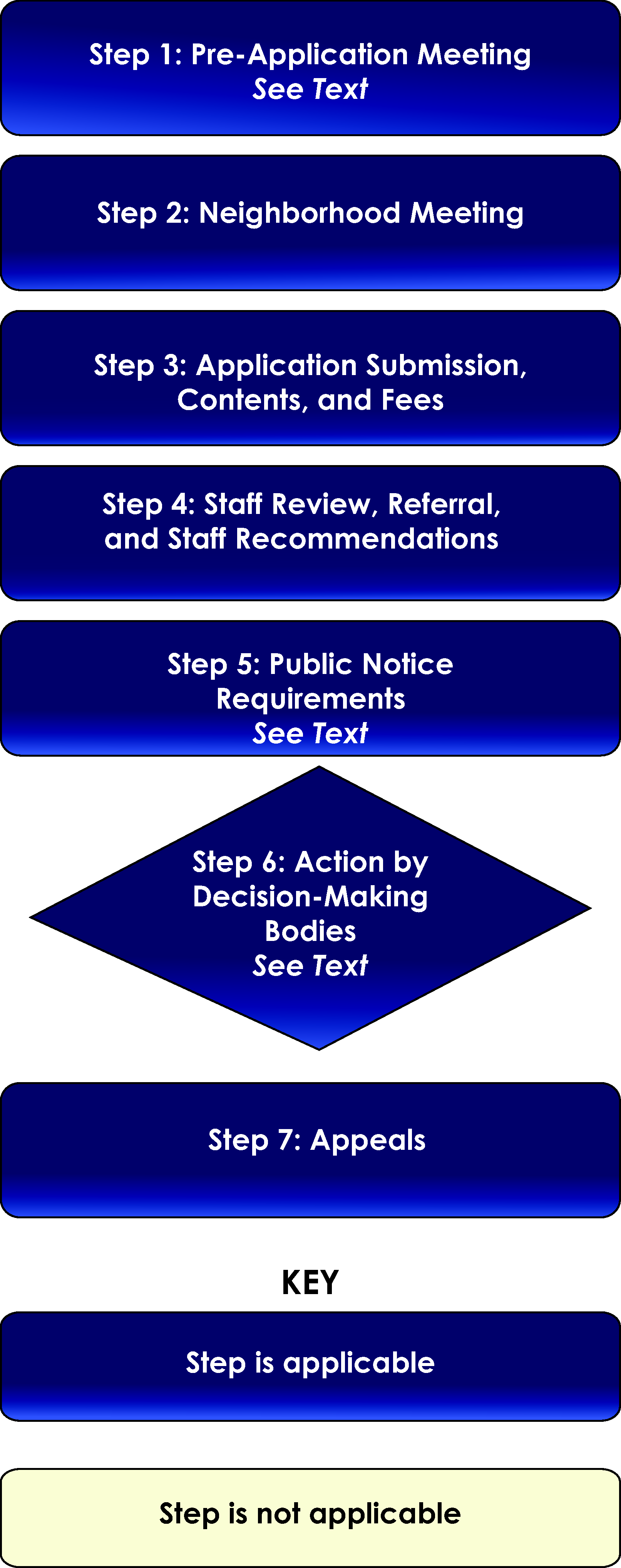
1.
Purpose. The purpose of this section is to provide procedures and standards for creating and approving a planned unit development district (PUD). All PUD applications shall be reviewed according to the provisions of this section. All PUD applications shall be reviewed and approved by the Planning Commission and City Council prior to any physical development on the subject property.
2.
Applicability. Planned unit developments may be initiated by the City Council, Planning Commission, owner of property proposed for rezoning, or authorized user of Bureau of Land Management land.
3.
Procedures, Preliminary Development Plan. Figure 17.12-5 shows the steps of the common development review procedures that apply in the review of applications for PUD preliminary development plans. The common procedures are described in Section 17.12.040. Specific additions and modifications to the common review procedures are identified below.
a.
Step 1: Pre-Application Meeting. In addition to the submittal requirements for pre-application meetings set forth in the application manual, the applicant shall also submit a computation table showing proposed land use allocations in acres and percent of total site area shall be included on the concept plan.
b.
Step 6: Action by Review and Decision-Making Authorities.
(i)
Hearing and Recommendation by Planning Commission. The Planning Commission shall hold a public hearing on the application. The property owner(s), authorized user(s) of Bureau of Land Management land, or appropriate representative must be present at all public hearings. Following a public hearing, and after reviewing the report and recommendation of the Director, the Planning Commission shall make a recommendation for action to the City Council based on the approval criteria in subsection (iii) below.
(ii)
City Council Consideration and Hearing and Action by City Council. Following a public hearing, and after reviewing the reports and recommendations of the Director and the Planning Commission, the City Council shall vote to approve, approve with amendments, table, or deny the PUD preliminary development plan based on the approval criteria in subsection (iii) below. The City Council also may refer the proposed amendment back to the Planning Commission for further consideration. In its deliberations on the preliminary development plan, the Council shall consider oral or written statements from the applicant, City staff, the public, and its own members. The Council's review shall encompass the same issues as did the Commission's review but may consider any evidence related to those issues presented at the City Council public hearing. Conditions may be applied to the approval and/or periodic review of the approval may be required. Approvals, if granted, shall be for a particular development, not for a particular applicant.
(iii)
Review Criteria. The Planning Commission may recommend approval, and the City Council may approve planned unit developments, if the planned unit development meets all of the following criteria:
(1)
The PUD addresses a unique situation, confers a substantial benefit to the City, or incorporates creative site design such that it achieves the purposes of this Code and represents an improvement in quality over what could have been accomplished through strict application of the otherwise applicable district or development standards. Such improvements in quality may include, but are not limited to: improvements in open space provision and access; environmental protection; tree/ vegetation preservation; efficient provision of streets, roads, and other utilities and services; or increased choice of living and housing environments.
(2)
The PUD is consistent with the Future Land Use Map of the Comprehensive Master Plan and the purposes of this Code;
(3)
The PUD is consistent with the development standards in Section 17.24;
(4)
Facilities and services (including roads and transportation, water, gas, electricity, police and fire protection, and sewage and waste disposal, as applicable) will be available to serve the subject property while maintaining adequate levels of service to existing development;
(5)
The PUD is not likely to result in significant adverse impacts upon the natural environment, or such impacts will be substantially mitigated;
(6)
The PUD is not likely to result in significant adverse impacts upon other property in the vicinity of the subject tract; and
(7)
Future uses on the subject tract will be compatible with uses on other properties in the vicinity of the subject tract.
(iv)
Exceptions to Grant Waivers. No decision-making body shall approve a waiver as part of the PUD process that results in a variation from the standards of Section 17.24.020, Open Space and Parks.
Figure 17.12-6: PUD, Final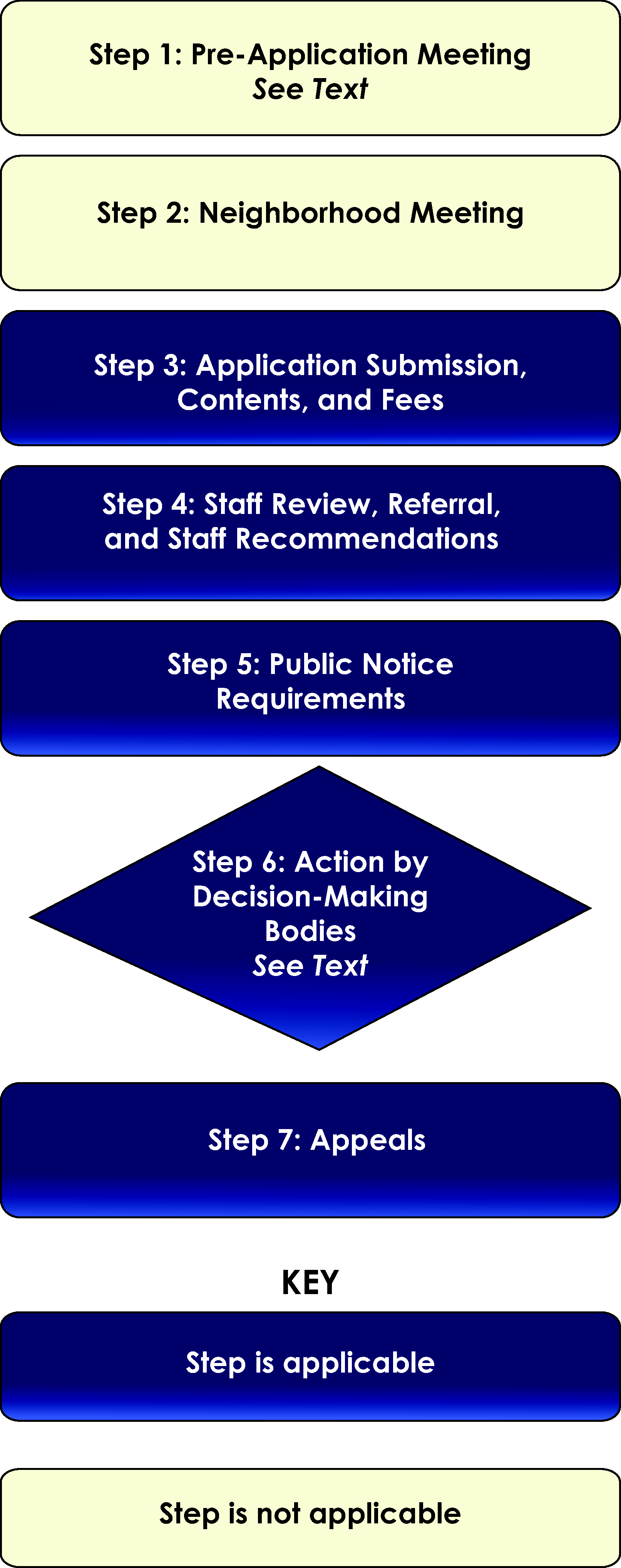
4.
Procedures, Final Development Plan. Figure 17.12-6 shows the steps of the common development review procedures that apply in the review of applications for PUD, final development plans. The common procedures are described in Section 17.12.040. Specific additions and modifications to the common review procedures are identified below.
a.
Step 6: Action by Review and Decision-Making Authorities.
(i)
Director Action. Final PUD development plan approval and the issuance of a building permit for any portion of a PUD shall occur only when:
(1)
A reproducible copy of the approved preliminary development plan with appropriate signatures (e.g., preparer's signature, owner's signature) has been submitted to the Director.
(2)
A final subdivision map is submitted and approved for the portion of the PUD in question, as per City subdivision regulations.
(3)
The design and construction specifications for all utilities, property, and street improvements have been approved by the Director of Public Works.
(4)
A site plan, subject to the requirements of Section 17.12.070.H for the specific portion of the PUD in question has been submitted and has been approved by the Planning Commission or Director as applicable, in conformance with the preliminary development plan. Upon approval of the site plan, a reproducible copy shall be submitted.
(5)
Architectural elevations of the buildings, with materials lists, are submitted and approved by the Planning Commission or Director, as applicable.
(6)
A landscaping plan is submitted and approved by the Planning Commission or Director, as applicable.
(7)
A performance bond, cash escrow agreement, or other acceptable instrument has been deposited with the City in an amount as set by the City Council based upon the Director of Public Works' recommendation. This financial guarantee shall be used to ensure the full completion, as specified, of:
(a)
Public and private streets and utilities;
(b)
Common area landscaping; and
(c)
Privately owned and maintained recreational facilities.
(8)
Any land dedication agreements made as part of the preliminary development plan approval are fulfilled.
5.
Platting Requirements. All applicants for a planned unit development permit shall be required to file with Clark County appropriate mapping of the planned unit development complying with all of the requirements of the subdivision ordinance of the City, codified in Section 16.16 of this Code, except that the Council may waive specific portions of Section 16.16. The City Council, however, may not waive any portion of Section 16.16 required by Nevada Revised Statutes relative to Divisions of Land Sections 278.320 — 278.460. Such required maps shall contain on their face a cross-reference to the PUD development plan.
6.
Method of Withdrawing an Application for PUD Approval. Any application for a planned unit development permit may be withdrawn by the applicant at any time prior to PUD approval upon written notification to the Director. The PUD shall be null and void upon receipt of such notice by the City and the Planning Commission and City Council shall be notified of such action.
7.
Amendments to PUD Approval.
a.
Minor Amendments. Minor changes in the location and placement of roads, buildings, or parking may be authorized by the Director where unforeseen circumstances such as engineering requirements, dictate such change. When in question, the Director and the Director of Public Works may determine whether the changes shall be classified as a minor or major amendment, or may refer the question to the Planning Commission if they deem it necessary.
b.
Major Amendments. Major changes, such as alterations in structural types, in the shapes and arrangements of lots and blocks, in the allocation of open space or other land uses which increase density and/or intensity of the project, in project phasing, and all changes to an approved PUD shall be referred to the Planning Commission, after which the Commission shall consider and recommend approval or denial of the changes in the planned unit development to the City Council. If such changes are authorized, the developer shall submit a revised plan showing the authorized changes.
8.
Denial of PUD Approval. If an application for planned unit development approval is denied at either the preliminary development plan or final development plan stage, a new application for a PUD approval shall be required.
E.
Planned Community Districts.
Figure 17.12-7: Planned Community District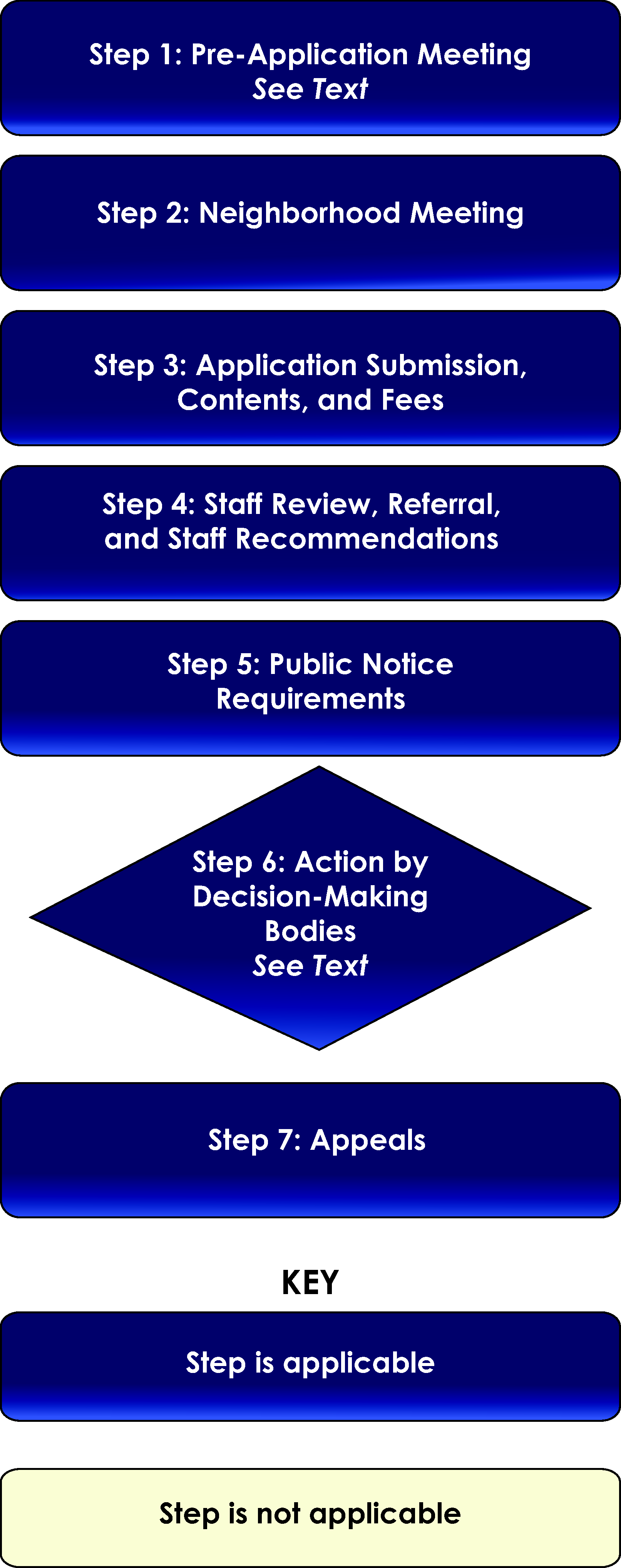
1.
Purpose. The Planned Community District ("PCD") is established to permit and encourage the development of comprehensively planned communities with a minimum of five hundred (500) contiguous gross acres of land under single ownership or control. The goal is to ensure orderly planning of large areas of land and to create efficient, desirable, and stable developments offering a combination of planned land uses and distinct advantages. This district is designed to provide for flexibility in the zoning of large master planned communities. The intent of this procedure is to provide applicants with the opportunity to establish a master development plan for large parcels.
2.
Applicability.
a.
Zoning Map Designator/Applicability to Zoning Map. The PCD shall only be applied to an area of contiguous property of at least five hundred (500) gross acres in size, or, upon approval of the Council, an area of property less than five hundred (500) gross acres in size if immediately adjacent to a PCD.
b.
Initiation. The PCD may be initiated by the City Council, Planning Commission, or an owner of property in the City.
c.
Applicable Development Regulations.
(i)
A master development agreement consistent with the master development plan must be drafted and submitted by the applicant as part of the application, and shall be reviewed for approval concurrently with the master development plan.
(ii)
Unless the agreement otherwise provides, the ordinances, resolutions, or regulations applicable to that land and governing the permitted uses of that land, density, and standards for design, improvements and construction are those in effect at the time the agreement is made. No land division in an area subject to a PCD shall be permitted without an approved master development plan. Master development plans are defined in Section 17.12.070.E.9 and Section 17.32, Definitions.
(iii)
The City's approval of the master development plan and the master development agreement shall constitute sufficient findings to justify any waivers, variances, exceptions, or deviations set forth in the master development plan or any master development agreement to those provisions of the Municipal Code of the City that would otherwise be required, and such waivers, variances, exceptions, or deviations shall be deemed granted.
3.
Procedures. Figure 17.12-7 shows the steps of the common development review procedures that apply in the review of applications for planned community districts. The common procedures are described in Section 17.12.040. Specific additions and modifications to the common review procedures are identified below.
a.
Step 6: Action by Review and Decision-Making Authorities. The zoning approval of a PCD shall consist of a review and recommendation by the Planning Commission and approval by the Council, in accordance with the provisions of this Code. The approval of a PCD by the Council shall be accomplished directly by ordinance and shall include the approval and adoption of a master development plan after approval of the master development agreement.
(i)
Hearing and Recommendation by the Planning Commission.
(1)
Public Hearing. The Planning Commission shall hold a public hearing on the proposed rezoning, master development agreement, and master development plan not more than forty-five (45) calendar days following the filing of a complete application or following the motion of the City Council initiating the proposed change, unless an alternative time frame is agreed upon by the applicant. The property owner(s), authorized user(s) of Bureau of Land Management land, or appropriate representative must be present at all public hearings.
(2)
Recommendation. Following the conduct of a public hearing and within thirty (30) calendar days of the hearing, the Planning Commission shall report its findings and recommendations for action on the proposed rezoning, master development agreement, and master development plan to the City Council unless an extension of time is agreed upon. The Planning Commission, in making its recommendation concerning a reclassification of property, may change or modify the proposed amendment. If the Commission also considers reclassifying other adjacent property, it shall be necessary to notify the additional persons required and set another public hearing per this chapter.
(ii)
Hearing and Decision by the City Council.
(1)
Public Hearing. The City Council shall consider the proposed rezoning, master development agreement, and master development plan and the recommendations of the Planning Commission at the Council's next regular public hearing following receipt of the recommendations of the Planning Commission.
(2)
Determination. If, for the evidence presented and the recommendations of the Planning Commission, the City Council determines that the proposed rezoning, master development plan, and master development agreement will not adversely affect the health and general welfare, the City Council shall approve the proposed amendment by ordinance based on the criteria in subsection (iii) below.
(iii)
Review Criteria for PCD District. In order for property to qualify for PCD zoning, the master developer must demonstrate the potential for achievement of the following specific objectives during the planning and development process:
(1)
Ensure orderly planning for the development of large, unsubdivided parcels of the City in a manner consistent with the City's Comprehensive Master Plan;
(2)
Ensure adequate provision of open space, recreational facilities, and other community amenities;
(3)
Provide exemplary community benefits;
(4)
Provide for an orderly and creative arrangement of land uses with respect to each other, to the entire master planned community, and to all adjacent land;
(5)
Provide for a variety of housing types, employment opportunities, and commercial services to achieve a balanced community for families of a wide variety of ages, sizes, and levels of income;
(6)
Provide for a planned and integrated transportation system for pedestrian and vehicular traffic, which will include provisions for transportation and roadways, bicycle and/or equestrian paths, pedestrian walkways, and other similar transportation facilities;
(7)
Encourage sensitive site planning and design with enhanced landscaping and other site amenities; and
(8)
Encourage high-quality structures in terms of community design standards, materials and layout.
(iv)
Review Criteria for Master Development Agreement. In reviewing and acting upon proposed development agreement, review and decision-making bodies shall consider the following additional approval criteria for the development agreement:
(1)
Whether the benefit of the development agreement to the City outweighs its costs;
(2)
Whether the development agreement is required to mitigate impacts that would otherwise make the proposed development unacceptable; and
(3)
Whether the City has received adequate assurances that the development will go forward as planned.
In the event that the Master Development Agreement does not address a particular development or design standard, the generally applicable development standards set forth in Chapter 17.24 shall apply.
(v)
Planned Community District Master Development Plan.
(1)
In connection with the approval of a PCD, the City Council shall adopt a master development plan.
(2)
A "master development plan" means a specific written plan and accompanying maps that identify, with respect to a PCD development, the proposed location and size of development parcels, land uses, and zoning designations; transportation plans and a traffic impact analysis; open space and community facilities; and the development standards.
(3)
"Development standards" means the minimum standards for development in the PCD, including but not limited to standards for intensity and type of use, densities, heights, spacing, bulk and setback requirements, provisions for utilities, topography and drainage patterns. Conceptual standards for building designs, layout, configuration, signage, open space and landscaping, vehicular and pedestrian circulation, and parking shall also be included.
(4)
Development of the PCD may consist of any land use or combination of land uses that are contemplated for the property in the master development plan provided the property is appropriately zoned.
(5)
The developer shall include in the master development plan a listing of the land uses proposed and the general arrangement for each land use category within the proposed PCD.
(6)
The listing and general arrangement of the contemplated land uses shall be shown in the master development plan that is adopted as part of the PCD approval.
4.
Amendments to an Adopted Planned Community District.
a.
No modification or deviation to the planned community district shall be effective unless it is approved in accordance with this section. The Director may request modification of a plan in accordance with the modification procedures set forth in this subsection 4.
b.
The development of the property within the PCD may proceed only in strict accordance with the approved planned community district including the development standards and any master development agreement. Any request by or on behalf of the property owner or any proposal by the City to modify the approved planned community district or the development standards shall be filed with the Director. In accordance with this section, the Director shall determine if the proposed modification is "minor or "major," and the request or proposal shall be processed accordingly.
(i)
Minor Modification. A minor modification is a modification that is requested or agreed to by the property owner and that is intended to accomplish one or more of the following:
(1)
A change in the species of plant material proposed for the PCD;
(2)
A decrease in the density or intensity of development from that previously approved for the PCD;
(3)
An adjustment of the boundary line between two abutting parcels that does not result in the creation or deletion of any additional parcels; or
(4)
Any other change or modification that will not have a significant adverse impact on the district or its surroundings or that is contemplated by any master development agreement for the property.
The Director shall process and make an administrative decision regarding all minor modifications. In the event that Director's decision results in an aggrieved person, that individual shall be afforded an administrative appeal of the Director's decision pursuant to Section 17.28.070.M.
(ii)
Major Modification. A major modification includes any modification that does not qualify as a minor modification. A major modification shall be processed and reviewed in the same manner as a new planned community district application.
c.
Additional amendments to the master development plan shall be deemed approved by providing notice to the Director if an approved master development agreement permits such notice amendments.
d.
Amendments to the master development agreement shall proceed as provided by the master development agreement and the applicable provisions of state law.
5.
Subdivision Applications Within A PCD District. All development within an established PCD is also subject to the subdivision tentative map procedures except as otherwise provided in an approved master development plan or master development agreement.
6.
Issue Resolution—Analogous Standards. With regard to any issue of land use regulation that may arise in connection with a PCD and that is not addressed or provided for specifically in this section, in the approved master development plan including the development standards, or any master development agreements, the Director may apply by analogy the general definitions, principles, standards and procedures set forth in this Code, taking into consideration the intent of the approved master development plan including the development standards.
F.
Mixed-Use Developments.
Figure 17.12-8: MUD, Conceptual
1.
Purpose. Any development proposal that meets the requirements of Section 17.16.050.E, Mixed Use Development District (MUD), shall be reviewed according to the provisions of this section. All MUD applications shall be reviewed and approved by the Planning Commission and City Council prior to any physical development on the subject property.
2.
Applicability. Mixed-use developments may be initiated by the City Council, Planning Commission, owner of property proposed for the mixed-use development, or the authorized user of Bureau of Land Management land.
3.
Procedures, Conceptual Development Plan. The mixed-use development process involves three steps: conceptual, preliminary, and the final development plan. Figure 17.12-8 shows the steps of the common development review procedures that apply in the review of applications for mixed-use development, conceptual development plan. The common procedures are described in Section 17.12.040. Specific additions and modifications to the common review procedures are identified below:
a.
Step 2: Neighborhood Meeting. In addition to meeting with City staff, applicants are required to hold an informational meeting with adjoining property owners to outline their development proposals. Neighborhood meetings shall follow the procedures set forth in Section 17.12.040.B.
b.
Step 4: Staff Review, Referral, and Staff Recommendation.
(i)
Performance Measures. The City shall use the following performance measures to evaluate conceptual development plans for mixed-use development:
(1)
The conceptual development plans demonstrate conformance with the purposes of the mixed-use development district as outlined in Section 17.16.050.E.
(2)
The conceptual plans demonstrate that the proposed site is appropriate for mixed-use development based on at least one of the criteria listed in Section 17.16.050.E.
(3)
The conceptual plans show an orderly and creative arrangement of land uses that includes a balanced mix of residential, commercial, employment, recreational, and/or open space areas designed to achieve a pedestrian-friendly urban form.
(4)
The conceptual plans demonstrate that the proposed development does not include incompatible uses, establish undesirable precedents, or create traffic and public service demands exceeding the capacity of existing or planned facilities.
(5)
The conceptual plans demonstrate compatibility and connectivity with adjacent development.
(6)
The conceptual plans identify effective measures to mitigate impacts on adjacent roadways, neighborhood traffic, public facilities, schools, and other infrastructure.
(ii)
Project Performance Measures Recommendation. Based on review of the conceptual plans during the pre-application meeting, staff will forward to the Director their recommendation as to whether the proposed project complies with the performance measures listed above.
(iii)
Application Meets Performance Standards. Upon a determination by the Director that the conceptual plans meet the performance measures listed above, the applicant may submit a mixed-use development application.
(iv)
Application Does Not Meet Performance Standards. If the Director determines that additional alterations to the conceptual plans are needed, the applicant will have the ability to schedule follow-up pre-application meetings with staff to further refine the conceptual plans. The Director's determination shall be accompanied with a description of the aspects of the conceptual plans that need to be addressed by the applicant.
(v)
Notification of Director's Determination. The applicant will be notified by letter of the Director's determination as to whether their conceptual plans meet the performance measures.
Figure 17.12-9: MUD, Preliminary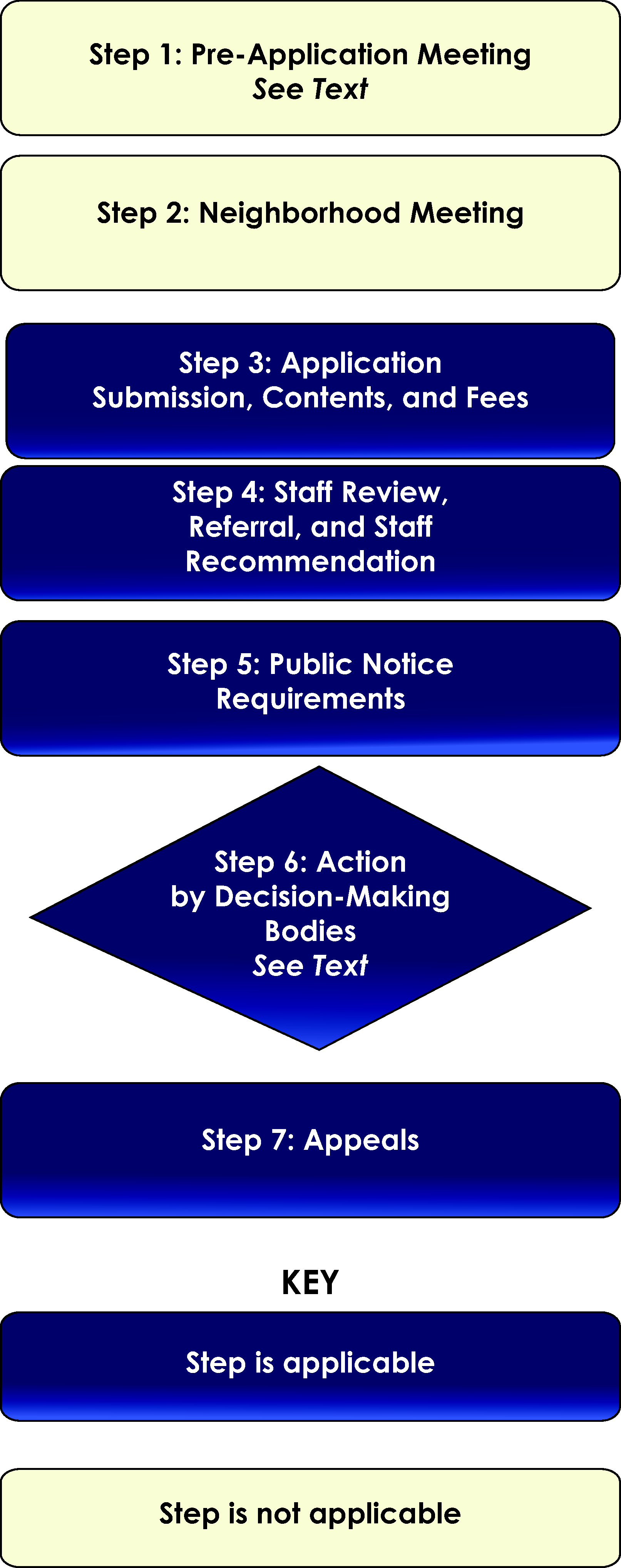
4.
Procedures, Preliminary Development Plan. Figure 17.12-9 shows the steps of the common development review procedures that apply in the review of applications for mixed-use development, preliminary development plans. This is the second step in the process, following conceptual development plan approval and preceding the final development plan. The common procedures are described in Section 17.12.040. Specific additions and modifications to the common review procedures are identified below. The applicant may only proceed to preliminary development plan approval if the Director has determined the performance measures in Section 17.12.070.F.3.b, above have been met.
a.
Step 5: Public Notice Requirements.
(i)
Notice of Planning Commission Hearing. Notice shall be provided as set forth in Section 17.12.040.E and Table 17.12-1, and the following additional procedures shall apply. Written notice shall be mailed at least ten (10) days before the day of the hearing to each owner of property situated wholly or partly within seven hundred fifty (750) feet of the property to which the MUD relates as set forth in Table 17.12-3. The Director shall be responsible for placing and mailing such notices.
b.
Step 6: Action by Review and Decision-Making Authorities.
(i)
Hearing and Recommendation by Planning Commission. The Planning Commission shall hold a public hearing on the application. The property owner(s), authorized user(s) of Bureau of Land Management land, or appropriate representative must be present at all public hearings. Following a public hearing, and after reviewing the report and recommendation of the Director, the Planning Commission shall make a recommendation for action to the City Council based on the approval criteria in subsection (iii) below.
(ii)
Hearing and Decision by City Council. Following a public hearing, and after reviewing the reports and recommendations of the Director and the Planning Commission, the City Council shall vote to approve, approve with amendments, deny, or continue the preliminary development plan based on the approval criteria in subsection (iii) below. The City Council also may refer the proposed plan back to the Planning Commission for further consideration.
(iii)
Approval Criteria. In reviewing MUD preliminary development plans, the Planning Commission and City Council may consider:
(1)
Interrelationship of plan elements to conditions both on and off the property,
(2)
Conformance to the City of North Las Vegas Comprehensive Master Plan,
(3)
The impact on the existing and anticipated traffic and parking conditions,
(4)
The adequacy of the plan with respect to mix of land uses,
(5)
Pedestrian and vehicular ingress and egress,
(6)
Architectural and urban design,
(7)
Landscaping,
(8)
Provisions for utilities and other infrastructure,
(9)
Site drainage,
(10)
Open space and/or public land dedications,
(11)
Grading, and
(12)
Other related matters.
(iv)
Conditions of Approval. Conditions may be applied to the approval and/or periodic review of the approval may be required.
Figure 17.12-10: MUD, Final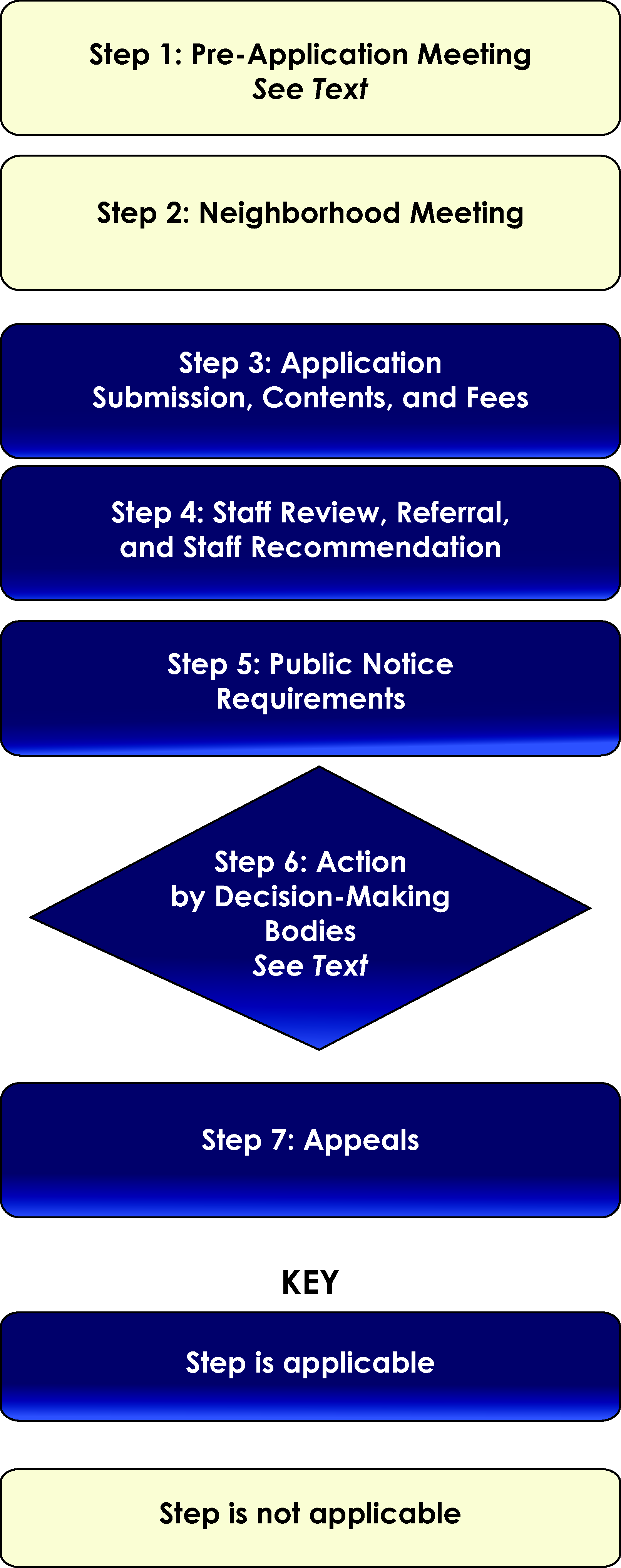
5.
Procedures, Final Development Plan. Figure 17.12-10 shows the steps of the common development review procedures that apply in the review of applications for mixed-use development, final development plans. The common procedures are described in Section 17.12.040. Specific additions and modifications to the common review procedures are identified below
a.
Step 6: Action by Review and Decision-Making Authorities.
(i)
Hearing and Recommendation by Planning Commission. The Planning Commission shall hold a public hearing on the application. The property owner(s), authorized user(s) of Bureau of Land Management land, or appropriate representative must be present at all public hearings. Following a public hearing, and after reviewing the report and recommendation of the Director, the Planning Commission shall make a recommendation for action to the City Council based on the approval criteria in subsection (iii) below.
(ii)
Hearing and Decision by City Council. Following a public hearing, and after reviewing the reports and recommendations of the Director and the Planning Commission, the City Council shall vote to approve, approve with amendments, deny, or continue the final development plan based on the approval criteria in subsection (iii) below. The City Council also may refer the proposed plan back to the Planning Commission for further consideration.
(iii)
Approval Criteria. Final MUD development plan approval and the issuance of a building permit by the Director for any portion of the MUD shall occur only when:
(1)
A reproducible copy of the approved preliminary development plan with appropriate signatures (e.g., preparer's signature, owner's signature) has been submitted to the Director.
(2)
A final subdivision map is submitted and approved for the portion of the MUD in question, as per City subdivision regulations.
(3)
The design and construction specifications for all utilities, property, and street improvements have been approved by the Director of Public Works.
(4)
If applicable, a site plan, subject to the requirements of Section 17.28.070.H of this Code for the specific portion of the MUD in question has been submitted and has been approved by the Planning Commission or Director, as applicable, as in conformance with the preliminary development plan. (Upon approval of the site plan, a reproducible copy shall be submitted.)
(5)
Architectural elevations of the buildings, with materials lists, are submitted and approved by the Planning Commission.
(6)
A landscaping plan is submitted and approved by the Planning Commission.
(7)
Any land dedication agreements made as part of the preliminary development plan approval are fulfilled.
(8)
A performance bond, cash escrow agreement, or other acceptable instrument has been deposited with the City in an amount as set by the City Council based upon a recommendation from the Director of Public Works. This financial guarantee shall be used to ensure the full completion of:
(a)
Public and private streets and utilities,
(b)
Landscaping, and
(c)
Privately owned and maintained recreational facilities.
6.
Duration of MUD Zoning Approval. The MUD zoning and conditions shall remain in effect until the MUD is amended or repealed pursuant to an approved rezoning.
7.
Platting Requirements. All applicants for a mixed-use development permit shall file with Clark County a final map of the mixed-use development complying with all of the requirements of the subdivision ordinance of the City, codified in Section 16.16 of this Code, except that the Council may waive specific portions of Section 16.16. The City Council, however, may not waive any portion of Section 16.16 required by Nevada Revised Statutes relative to Divisions of Land Sections 278.320—278.460. Such maps shall contain on their face a cross-reference to the MUD development plan.
8.
Method of Withdrawing an Application for MUD Approval. Any application for a mixed-use development permit may be withdrawn by the applicant at any time prior to final MUD approval upon written notification to the Director and/or City Clerk. The MUD shall be null and void upon receipt of such notice by the City, and the Planning Commission and City Council shall be notified of such action.
9.
Amendments to MUD Approval.
a.
Minor Changes. Minor changes in the location and placement of buildings may be authorized by the Director where unforeseen circumstances require such change. When in question, the Director and the Director of Public Works may determine whether the changes shall be classified as a minor or major, or may refer the question to the Planning Commission if they deem it necessary.
b.
Major Changes. Major changes, such as alterations in structural types, the shapes and arrangements of lots and blocks, the allocation of open space or other land uses that increase density and/or intensity of the project, project phasing, and all other changes that significantly affect the overall design or intent of the project shall be referred to the Planning Commission. The Planning Commission shall consider and shall either approve or deny the changes in the final development plan. If such changes are authorized, the developer shall submit a revised plan showing the authorized changes.
10.
Denial of MUD Application. If an application for mixed use development approval is denied by City Council, a new application for a MUD approval shall be required.
G.
Residential Design Incentive System.
1.
Purpose. The purpose of the residential design incentive system is to provide a procedure that creates incentives for high quality residential design based on performance measures.
2.
Applicability. Any development proposal that seeks to utilize Section 17.24.090.I, Residential Design Incentive System (RDIS), shall be reviewed according to the provisions of this section. All RDIS applications shall be reviewed and approved by the Planning Commission prior to any physical development on the subject property.
3.
Procedures. Figure 17.12-11 shows the steps of the common development review procedures that apply in the review of applications for the residential design incentive system. The common procedures are described in Section 17.12.040. Specific additions and modifications to the common review procedures are identified below.
a.
Step 1: Pre-Application Meeting. The following documents shall be provided for the pre-application conference. Incomplete documents shall postpone the pre-application process.
Figure 17.12-11: Res. Design Incentive System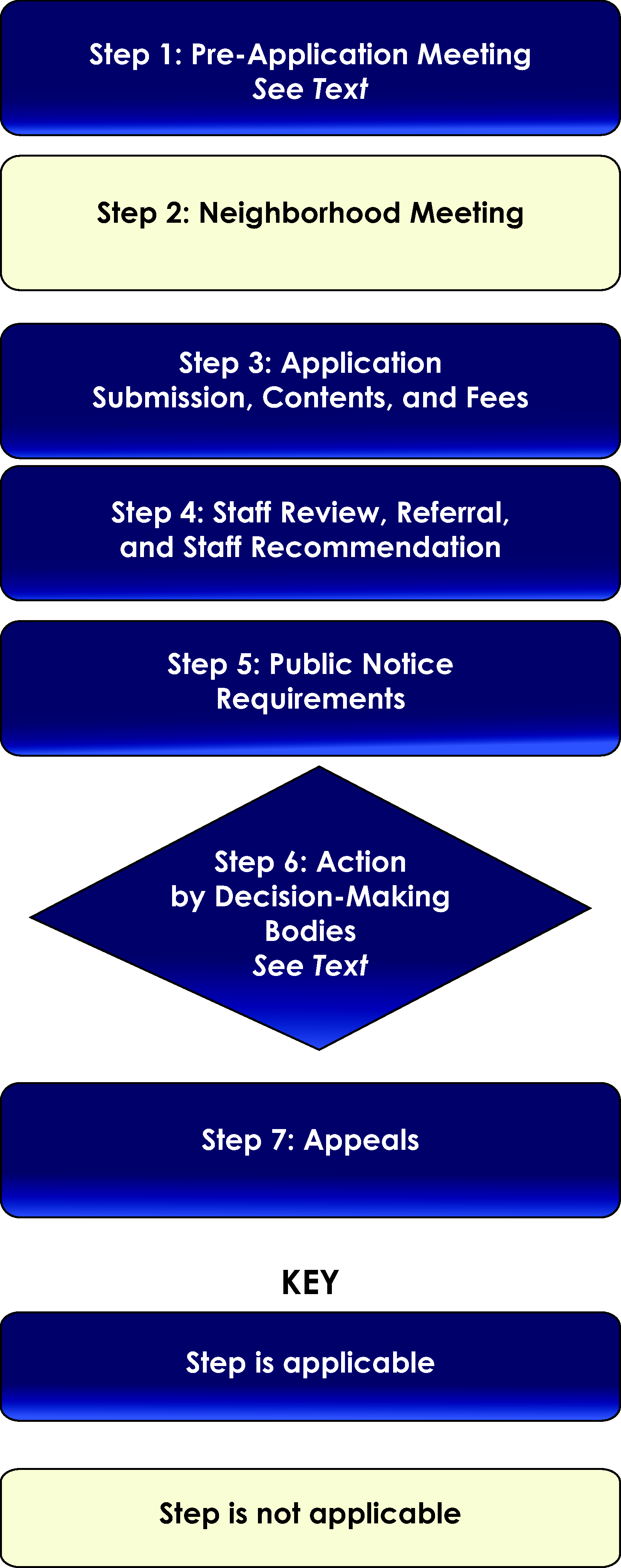
(i)
Project description (one page maximum);
(ii)
Residential Design Incentive Matrix clearly indicating the following:
(1)
Site Plans (may be conceptual for pre-application only);
(2)
Supporting documents and plans relevant to the points being claimed for the development;
(3)
Existing conditions map identifying all buildings, driveways, streets, utilities, etc. within five hundred (500) feet of the subject site;
(4)
Circulation plan for vehicles showing all roads, driveways, and parking areas;
(5)
Circulation plan for pedestrians and bicycles identifying all sidewalks, bike lanes, pathways, trails, and other features;
(6)
Open space plan identifying all open space and amenities proposed for the site, including the general location of all proposed pedestrian priority areas;
(7)
Building elevations (may be conceptual for pre-application only);
(8)
Renderings (may be conceptual for pre-application only); and
(9)
A statement identifying all special uses proposed for the site.
b.
Step 3: Application Submission, Contents, and Fees.
(i)
Conceptual Development Plan. The applicant shall submit a conceptual development plan for evaluation by the City. Required elements of the conceptual development plan are set forth in the application manual.
(ii)
Step 5: Public Notice Requirements Notice of Planning Commission Hearing. Notice shall be provided as set forth in Section 17.12.040.E and Table 17.12-1, and the following additional procedures shall apply. Written notice shall be mailed at least ten (10) days before the day of the hearing to each owner of property situated wholly or partly within seven hundred fifty (750) feet of the property to which the RDIS relates as set forth in Table 17.12-3. The Director shall be responsible for placing and mailing such notices.
c.
Step 6: Action by Review and Decision-Making Authorities.
(i)
Performance Measures. The City shall use the following performance measures to evaluate conceptual development plans for RDIS development:
(1)
The conceptual development plan demonstrates conformance with the purposes of the RDIS development as outlined in Section 17.24.090.I of this Code.
(2)
The conceptual plan demonstrates that the proposed site is appropriate for RDIS development based on consistency with the Comprehensive Master Plan and achievement of minimum qualifying density points as defined in Section 17.24.090.I of this Code.
(ii)
Application Must Meet Performance Measures. Upon a determination by the Director that the conceptual plans meet the performance measures listed above, the applicant may obtain the necessary application forms from the Community Development Department regarding relevant procedure and required materials for complete application packets. Application forms properly completed with all supporting plans and documents and accompanied by the required fee shall be submitted to the Community Development Department.
(iii)
Hearing and Decision by Planning Commission. The Planning Commission shall hold a public hearing on the application. The property owner(s), authorized user(s) of Bureau of Land Management land, or appropriate representative must be present at all public hearings. Following a public hearing and after reviewing the report and recommendation of the Director, the Planning Commission shall approve or deny the residential design incentive system request based on the approval criteria in subsection (iv) below.
(iv)
Approval Criteria. In reviewing RDIS applications, the Planning Commission may consider:
(1)
Interrelationship of plan elements to conditions both on and off the property,
(2)
Conformance to the City of North Las Vegas Comprehensive Master Plan,
(3)
Allocation of points in the RDIS matrix and appropriate density,
(4)
The impact on the existing and anticipated traffic and parking conditions,
(5)
The adequacy of the plan with respect to mix of land uses,
(6)
Pedestrian and vehicular ingress and egress,
(7)
Architectural and urban design,
(8)
Landscaping,
(9)
Provisions for utilities and other infrastructure,
(10)
Site drainage,
(11)
Open space and/or public land dedications,
(12)
Grading, and
(13)
Other related matters.
4.
Method of Withdrawing Application for RDIS Approval. Any application for a RDIS development permit may be withdrawn by the applicant at any time prior to filing the final play upon written notification to the Director and/or City Clerk. The RDIS shall be null and void upon receipt of such notice by the City and the Commission shall be notified of such action.
5.
Amendments to RDIS Approval.
a.
Minor Changes. Minor changes in the location and placement of buildings may be authorized by the Director where unforeseen circumstances require such change. When in question, the Director and the Director of Public Works may determine whether the changes shall be classified as a minor or major, or may refer the question to the Planning Commission, if they deem it necessary.
b.
Major Changes. Major changes, such as alterations in structural types, in the shapes and arrangements of lots and blocks, in the allocation of open space or other land uses which increase density and/or intensity of the project, in project phasing, and all other changes which significantly affect the overall design or intent of the project shall be referred to the Planning Commission, after which the Planning Commission shall consider and shall either approve or deny the changes in the plan in accordance with step 6, above. If such changes are authorized, the developer shall submit a revised plan showing the authorized changes.
6.
Denial of RDIS Approval. If an application for RDIS development approval is denied, the applicant has the option of appealing the decision to the City Council or holding a pre-application conference pursuant to Section 17.12.070.A before submitting a revised application for RDIS approval.
H.
Site Plan Review.
Figure 17.12-12: Site Plan Review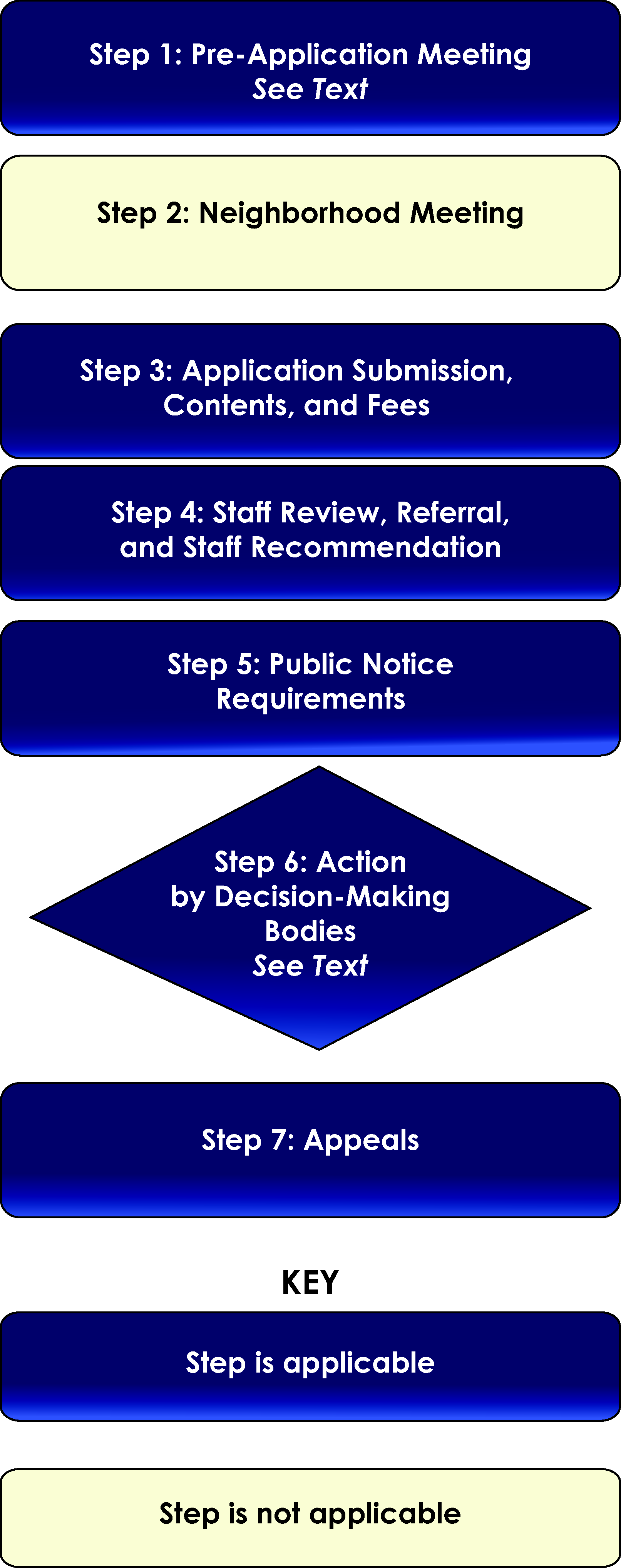
1.
Purpose. The purpose of the site plan review process is to ensure compliance with the development and design standards and provisions of this Code. It is designed to encourage quality development reflective of the goals, policies, and objectives of the Comprehensive Master Plan. For land uses requiring a site plan review, such uses may be established in the City, and building or land use permits may be issued, only after a site plan showing the proposed development has been approved in accordance with the procedures and requirements of this section.
2.
Applicability.
a.
General Applicability. For purposes of this Code, site plans may be classified as major or minor site plans. All developments within the City except individual single-family and duplex residential units shall be subject to this section.
(i)
Major Site Plan Review. A major site plan involves any of the following:
(1)
Sixty (60) or more dwelling units in a multi-family residential structure or structures;
(2)
Eighty thousand (80,000) or more square feet of nonresidential floor area on one lot;
(3)
Sixty thousand (60,000) or more square feet of exterior storage of materials or goods; or
(4)
Parking for more than three hundred fifty (350) vehicles.
(ii)
Minor Site Plan Review. All other site plans (except for a planned unit development) are considered a minor site plan. Any planned unit development shall be reviewed according to the regulations of Section 17.12.070.D.
(iii)
Planning Commission Review. The Planning Commission has the right to review and require revisions to any proposed major site plans, or minor site plans upon appeal. Additionally, if the Planning Commission so desires, it may authorize by Commission resolution the Community Development Department to conduct review of all site plans.
3.
Procedures. Figure 17.12-12 shows the steps of the common development review procedures that apply in the review of applications for site plan review. The common procedures are described in Section 17.12.040. Specific additions and modifications to the common review procedures are identified below.
a.
Step 1: Pre-Application Meeting. A pre-application meeting shall be required for all major site plans.
b.
Step 4: Staff Review, Referral, and Staff Recommendation.
(i)
Minor Site Plan Review. Minor site plan review shall be conducted by the Director as part of the building permit process.
c.
Step 5: Public Notice. Published, written, and posted notice required for major site plan review as set forth in Section 17.12.040.E.
d.
Step 6: Action by Review and Decision-Making Authorities.
(i)
Minor Site Plans - Director Decision. The Director shall review and decide on applications for minor site plan review in accordance with the review criteria in subsection (iii) below.
(ii)
Major Site Plans - Planning Commission Hearing and Decision. Following a public hearing, and after reviewing the report and recommendation of the Director, the Planning Commission shall approve or deny the major site plan review request based on the approval criteria in subsection (iii) below.
(iii)
Approval Criteria. In considering applications for site plan approval under this Code, the City staff in the case of a minor site plan, and the Planning Commission in the case of a major site plan, shall consider the following. Site plans shall only be approved if:
(1)
The site plan is consistent with the Comprehensive Master Plan;
(2)
The site plan is consistent with any previously approved subdivision plat, planned development, or any other precedent plan or land use approval as applicable;
(3)
The site plan complies with all applicable development and design standards set forth in this Code, including but not limited to the provisions in Chapter 17.16, Zoning Districts, Chapter 17.20, Use Regulations, and Chapter 17.24, Development Standards;
(4)
Any significant adverse impacts reasonably anticipated to result from the use will be mitigated or offset to the maximum extent practicable;
(5)
The development proposed in the plan and its general location is or will be compatible with the character of surrounding land uses; and
(6)
The development can be adequately served by City services including but not limited to roads, water, and wastewater.
(iv)
Planning Commission Involvement. If unusual or significantly difficult conditions exist that affect the minor site plan, the Director may require that the site plan be reviewed and acted upon by the Planning Commission.
e.
Step 7: Appeals. When a minor site plan is denied by the Director, an appeal may be taken to the Planning Commission in accordance with Section 17.12.040 G.2. When a major site plan is denied by the Planning Commission, an appeal may be taken to the City Council in accordance with Section 17.12.040.G.3.
4.
Expiration or Violation of Site Plan Approval. An approved major site plan shall be valid for two years from its date of approval, or until a building permit has been issued, whichever occurs first. Minor site plans shall be processed with an application for a building permit and valid for as long as the building permit is valid. Failure to comply with any of the conditions of approval set forth in the approval shall make the application subject to Chapter 17.28, Enforcement, Violations, and Penalties. Projects with construction activity shall be considered active for the purposes of this subsection.
5.
Amendments to an Approved Site Plan. Substantial changes to an approved site plan shall be subject to the same procedures for approval as for the original approved plan. A substantial change is any change in the use or character of the development and any dimensional change beyond the ranges specified on the approved site plan. Any other changes are considered minor changes as determined by the Director and may be approved by the Director.
I.
Conditional Uses.
Figure 17.12-13: Conditional Use Permit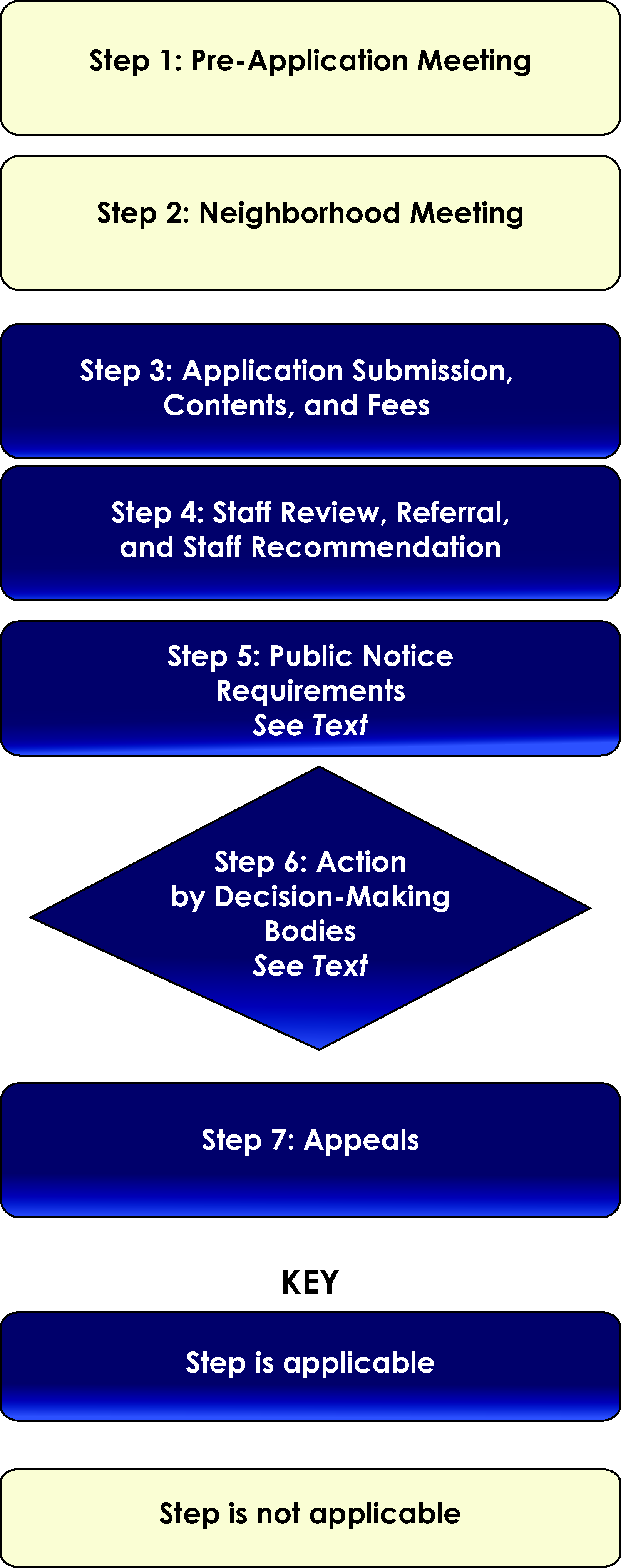
1.
Purpose. This section provides an approval process for conditional uses that are subject to objective criteria designed to ensure that each proposed conditional uses will not have a significant adverse impact on surrounding uses or on the community-at-large and to mitigate any unavoidable impacts without the need for individualized review or design of impact mitigation measures. Specific conditional uses allowed in each zone district are listed in Table 17.20-1, Permitted Use Table.
2.
Applicability. All uses listed as "conditional" in Table 17.20-1, Permitted Use Table, shall be required to follow the procedures set forth below. If a conditional use cannot or will not meet the required conditions, a Special Use Permit shall be required and the procedure listed in 17.12.070.10 shall be used.
3.
Procedures. Figure 17.12-13 shows the steps of the common development review procedures that apply in the review of applications for conditional use permits. The common procedures are described in Section 17.12.040. Specific additions and modifications to the common review procedures are identified below.
a.
Step 4: Staff Review, Referral, and Staff Recommendation. If the Director determines that no further review is necessary, he shall prepare a written statement of approval, denial, or approval with conditions of the conditional use within sixty (60) days of acceptance of a complete application, and the decision shall be final, subject to appeal to the Planning Commission. If the Director determines that additional review by the Planning Commission is appropriate to ensure consistency and compatibility of uses or with the scale or character of the surrounding area, he or she shall forward the application to the Planning Commission for review, public hearing, and final decision.
b.
Step 5: Public Notice. A public hearing is required only if the application is forwarded to the Planning Commission for review and decision. In these cases, notice shall be provided as set forth in Section 17.12.040.E and Table 17.12-1. All required notices shall comply with NRS 278.315 and 178.319.
c.
Step 6: Action by Review and Decision-Making Authorities.
(i)
Planning Commission Hearing, Review, and Decision. For applications that have been forwarded to the Planning Commission, the Planning Commission shall hold a public hearing on the application The property owner(s), authorized user(s) of Bureau of Land Management land, or appropriate representative must be present at all public hearings. Following the hearing, the Planning Commission shall consider the comments and evidence presented at the hearing and the staff report and recommendations from the Director, and approve, conditionally approve, or deny the conditional use permit, based on the criteria in subsection (ii) below.
(ii)
Approval Criteria. The Director (or the Planning Commission, if the application was referred to that body) shall approve a proposed conditional use that meets all of the applicable criteria:
(1)
The proposed use is consistent with the Comprehensive Master Plan and all applicable provisions of this Code and applicable state and federal regulations; and
(2)
The proposed use is consistent with the purpose and intent of the zoning district in which it is located and any applicable use-specific standards in Chapter 17.20 of this Code.
d.
Step 7: Appeals. When a conditional use is denied by the Director, an appeal may be taken to the Planning Commission, in accordance with Section 17.12.040 G.2. When a conditional use referred to the Planning Commission is denied by the Planning Commission, an appeal may be taken to the City Council in accordance with Section 17.12.040.G.3.
4.
Subsequent Ownership. Successors and/or assigns of the person(s) who originally obtained conditional use permits may make use of the land or structures covered under the issued permits and must abide by all the terms and conditions of the permits, unless otherwise stipulated in the approval process. Successors and/or assigns of an issued permit must change the names on the original permit and have a letter of acknowledgment signed, filed with the Director, and recorded by the subject property owner.
5.
Lapse of Approval.
a.
A conditional use permit shall lapse and have no further effect one year after its effective date or at such alternate time specified in the approval unless one or more of the following criteria has been met:
(i)
A building permit has been issued and construction diligently pursued,
(ii)
A certificate of occupancy has been issued,
(iii)
The use is established, or
(iv)
The conditional use permit is renewed.
b.
A conditional use permit shall lapse upon termination of a project or expiration of a building permit.
c.
A conditional use permit shall lapse if the rights granted by it are discontinued for one hundred eighty (180) consecutive days or other period of time as specified in the original approval.
J.
Special Use Permits.
1.
Purpose. The purpose of a special use permit is to allow the Planning Commission (and the City Council where applicable) the opportunity to review in detail certain uses to assure that they will be compatible with surrounding land uses, either existing or anticipated, by the proper implementation of the Comprehensive Master Plan.
2.
Applicability. An application for a special use permit on a parcel or parcels of property may be initiated by the City Council upon its own motion, the Planning Commission upon its own motion, or by application of the property owners(s), authorized tenants or property interest holders, or authorized user(s) of Bureau of Land Management land.
a.
City Council Hearing Required. Special use permits for the following uses shall be forwarded to the City Council for final action following a public hearing and recommendation by the Planning Commission:
(i)
Casinos.
b.
Planning Commission Hearing Required. All other applications for special use permits shall require a hearing and decision by the Planning Commission.
(i)
Medical Marijuana Establishments.
Figure 17.12-14: Special Use Permit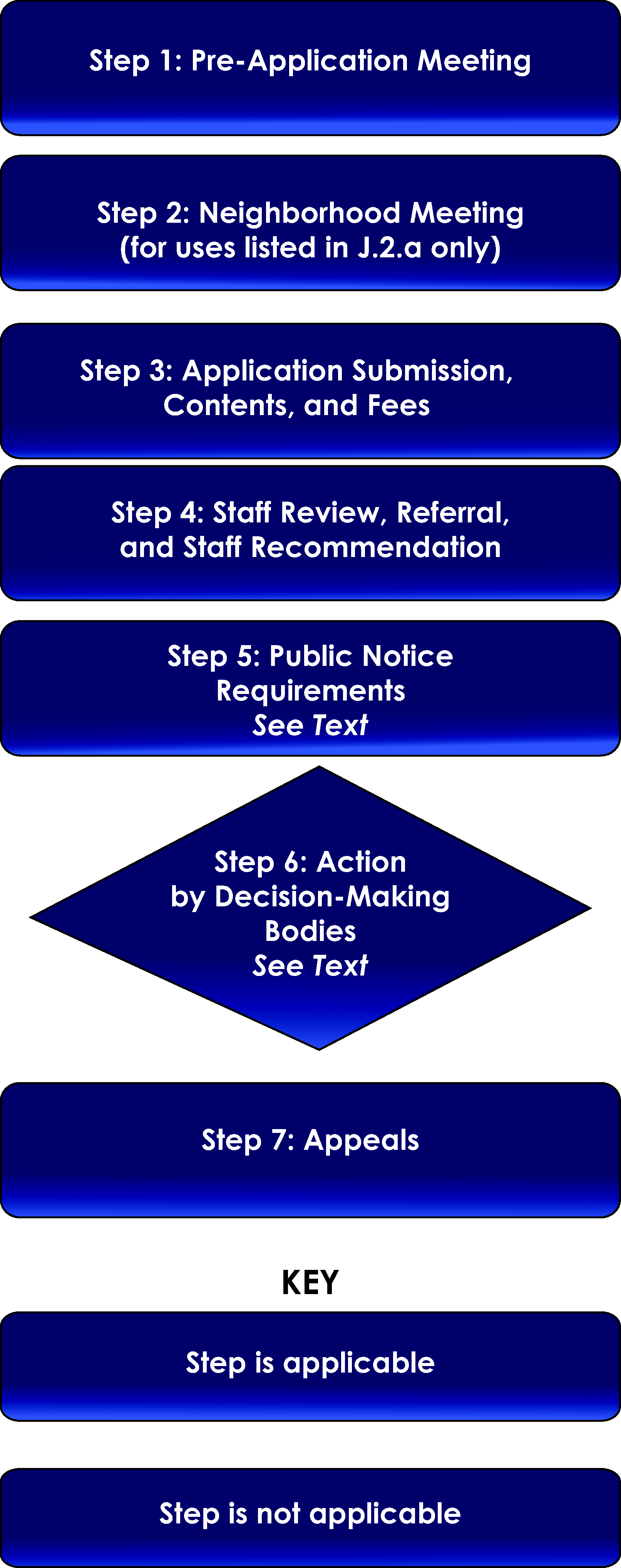
3.
Procedures. Figure 17.12-14 shows the steps of the common development review procedures that apply in the review of applications for special use permits. The common procedures are described in Section 17.12.040. Specific additions and modifications to the common review procedures are identified below.
a.
Step 2: Neighborhood Meeting Requirement. A neighborhood meeting is only required if the application is for a use listed in subsection 17.12.070.J.2.a. above.
b.
Step 5: Public Notice Requirements. Notice shall be provided as set forth in Section 17.12.040.E. All required notices shall comply with NRS 278.315 and 178.319. Step 6: Action by Review and Decision-Making Authorities
(i)
Hearing and Decision by Planning Commission. The Planning Commission shall hold a public hearing on the application. The property owner(s), authorized user(s) of Bureau of Land Management land, or appropriate representative must be present at all public hearings. Following a public hearing, and after reviewing the report and recommendation of the Director, the Planning Commission shall approve, approve with conditions, or deny the special use permit based on the approval criteria in subsection (ii) below. A decision of approval or denial by the Planning Commission shall be made by motion. This motion shall be final on the eighth calendar day following said decision unless an appeal is made to the City Council in accordance with subsection d of this section. A decision of approval or denial by the Planning Commission shall be made not later than thirty (30) calendar days following the public hearing at which the application is first considered unless an extension of time is agreed upon by the applicant and the Planning Commission.
(ii)
Approval Criteria. After the public hearing, the Planning Commission may, by motion, grant a special use permit if the Planning Commission finds from the evidence presented that all of the following facts exist:
(1)
The proposed use is consistent with the Comprehensive Master Plan and all applicable provisions of this Code and applicable state and federal regulations;
(2)
The proposed use is consistent with the purpose and intent of the zoning district in which it is located and any applicable use-specific standards and criteria in Chapter 17.20 of this Code;
(3)
The proposed use is compatible with adjacent uses in terms of scale, site design, and operating characteristics (such as, but not limited to, hours of operation, traffic generation, lighting, noise, odor, dust, and other external impacts);
(4)
Any significant adverse impacts anticipated to result from the use will be mitigated or offset to the maximum extent practicable; and
(5)
Facilities and services (including sewage and waste disposal, water, gas, electricity, police and fire protection, and roads and transportation, as applicable) will be available to serve the subject property while maintaining adequate levels of service for existing development.
(iii)
Conditions of Approval. Any conditions, stipulations, or limitations imposed by the Planning Commission on a special use permit shall be binding upon the applicant, heirs, successors, and assigns. All conditions, stipulations and limitations shall be fulfilled within a two-year period of time, except otherwise provided below. Failure to complete the conditions, stipulations or limitations within the prescribed time limits shall render the special use permit null and void, unless an extension of time is granted by the Planning Commission.
(iv)
Special Use Permits for Publicly Funded Capital Improvements, Public Utility Companies, and Exclusive Franchisees of the City. Publicly funded capital improvements, a public utility company, or an exclusive franchisee of the City may be granted a special use permit requiring that all conditions, stipulations and limitations be fulfilled within a ten-year period of time. In doing so, however, the publicly funded capital improvement project, utility, or exclusive franchisee shall be subject to all applicable regulations of this Code in effect at the time of commencement of construction of the publicly funded capital improvement project, utility, or exclusive franchisee project.
(v)
Hearing and Decision by City Council (if Applicable). As indicated by this section, or otherwise required by this Code or laws applicable to this municipality, final action on special uses listed in subsection J.2.a above is required to be taken by the City Council. In such a case, the decision of the City Council is final.
c.
Step 7: Appeals.
(i)
Filing. An appeal from the decision of the Planning Commission granting or denying any special use permit may be taken to the City Council by the applicant or the City Manager. An appeal may also be taken by any property owner as shown on the latest tax rolls of the Clark County Assessor's Office within a radius of three hundred (300) feet of the exterior boundary of the lot or parcel of land described in the application, or by any other person who may establish that his or her property rights are or may be affected by the decision.
(ii)
Requirements. Such appeal shall be in writing, shall be filed with the City Clerk on forms provided, and shall specify where there was error in the decision of the Planning Commission. Additionally, any person filing an appeal from a decision of the Planning Commission on the basis that his or her property rights or property value are or may be affected by said decision shall include an affidavit stating the nature and location of the property interest and the manner in which this property interest will be affected by the decision being appealed.
(iii)
Automatic Stay. If an appeal is filed within the time specified, it automatically stays proceeding in the matter until determination is made by the City Council.
(iv)
Public Hearing. Upon the filing of the appeal, the City Clerk shall set the matter for City Council consideration at a public hearing. Notice by mail shall be given to all persons who appeared in person or through a representative at the Planning Commission public hearing. A hearing de novo shall be conducted by the City Council.
(v)
City Council Decision on Appeal. A decision by the City Council shall be made not later than thirty (30) calendar days following the public hearing at which the appeal is first considered unless continued without objection of the appellant. Planning Commission action shall prevail if the City Council fails to make a decision within the prescribed time or agreed upon extension of time.
(vi)
Council Limitations. Upon consideration of such appeal, the City Council may, by motion, affirm, reverse, or modify in whole or in part any determination of the Planning Commission subject to the same limitations as are placed upon the Planning Commission by this Code. A motion to reverse a Planning Commission recommendation shall contain a finding of facts showing how the proposed special use permit fails to meet the requirements as set forth in step 6 of this section.
4.
Violation of Special Use Permits. Violations to the conditions of a special use permit shall constitute a violation of this Code and shall be subject to the regulations of Chapter 17.28, Enforcement, Violations, and Penalties.
5.
Modification or Enlargement of Structures Authorized Under a Special Use Permit. Any proposed additions, enlargements, or modifications of the structures approved in any special use permit or any proposed extension of the use into areas not approved in any such permit shall be subject to review by the Director based on the criteria set forth in this section. Such a proposal may also be required to reapply for the special use permit as set forth in this section at the discretion of the Director.
6.
Discontinuation of Use. Whenever a special use is discontinued for a period of six months or more it becomes null and void. All subsequent uses of the land shall be in conformance with this Code.
K.
Variances.
1.
Purpose. Variances are intended to allow a variation from application of the regulations of this title, such as setbacks, building height, or tower height, and to provide a reasonable use for a parcel or property having unique characteristics by virtue of its size, location, or topographical features. The purpose of a variance is not to grant any special privilege or concession not enjoyed by other properties in the same zone and vicinity. The variance may not be used to correct improper zoning, to adjust minimum lot areas or permitted development densities. In no case shall a variance be granted to permit a use other than a use permitted in the district in which the subject property is situated.
2.
Applicability. A variance for a parcel of property may be initiated by the City Council upon its own motion, the Planning Commission upon its own motion, by application of the property owner(s), or by authorized user(s) of Bureau of Land Management land.
3.
Procedures. Figure 17.12-15 shows the steps of the common development review procedures that apply in the review of applications for variances. The common procedures are described in Section 17.12.040. Specific additions and modifications to the common review procedures are identified below.
a.
Step 5: Public Notice. Notice shall be provided as set forth in Section 17.12.040.E and Table 17.12-1, except in the case of an administrative variance, where no notice is required. All required notices shall comply with NRS 278.315 and 178.319.
b.
Step 6: Action by Review and Decision-Making Authorities.
Figure 17.12-15: Variances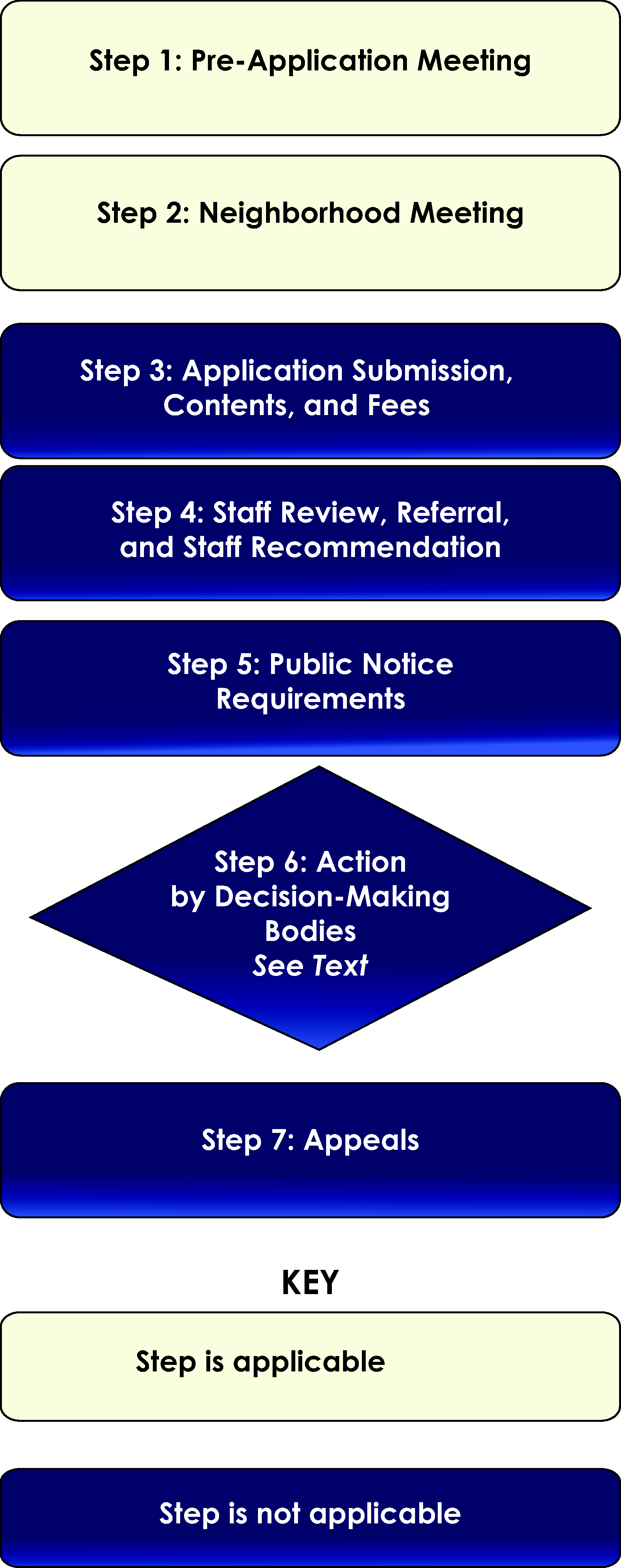
(i)
Evidence Required for Variance. At the public hearing on a variance application, the applicant shall present a statement and adequate evidence in such form as the Planning Commission may require for the purpose of showing that the criteria set forth in subsection (iii)(2) below have been met.
(ii)
Planning Commission Public Hearing. The Planning Commission shall hold a public hearing on the application not more than sixty (60) calendar days following the filing of a complete application unless an alternative time frame is agreed upon by the applicant. The property owner(s), authorized user(s) of Bureau of Land Management land, or appropriate representative must be present at all public hearings. A decision of approval or denial by the Planning Commission shall be made not later than thirty (30) calendar days following the public hearing at which the application is first considered unless an extension of time is agreed upon by the applicant and the Planning Commission.
(iii)
Consideration. Before any decision is made on a variance application, the Commission must find that the following has been met:
(1)
There are exceptional and extraordinary circumstances and conditions applicable to the property involved and that such circumstances and conditions do not apply generally to other properties in the same vicinity and zoning district;
(2)
Such variance is necessary for the preservation and enjoyment of a substantial property right that is possessed by property in the same vicinity and zoning district and denied to the property in question; and
(3)
The granting of such variance will not be materially detrimental to the public safety and welfare or injurious to other property or improvements in the same vicinity and zoning district.
(iv)
Expiration and Extension of Time. Within two years of the approval of a variance: (a) a building permit reflecting the approved variance must be issued and construction pursuant to that permit must be diligently pursued; or (b) a permitted, conditional, or special use of the land reflecting the terms of the variance must be in operation. If neither of those two events has occurred within two years, the waiver shall expire unless an application for extension of time shall be made in writing and filed with the Director on forms provided within the two-year period. To partially defray the cost of noticing public hearings and other incidental administrative and investigative expenses involved in the application, a nonrefundable fee shall be charged. This fee shall be due and payable at the time of the filing of the application. No application shall be accepted for processing unless such fees have been paid or waived by motion of the City Council.
4.
Administrative Variances.
a.
Circumstances for Requesting an Administrative Variance. If a requested variance is for ten (10) percent or less of the Title 17 dimensional requirement, as allowed in a variance, the applicant may apply for an administrative variance instead of a variance. An administrative variance is reviewed by the Director and may only be approved if it is consistent with the following standards:
(i)
It will not reduce, increase, or vary the requirements of this Code by more than ten (10) percent.
(ii)
It is agreed to in writing by owners of affected abutting developed property.
(iii)
It is significantly more practical than other options.
(iv)
It will not be significantly detrimental to adjacent property.
b.
Appeals. If an administrative variance request is denied by the Director, the applicant may appeal by applying for a variance as set forth in this section.
L.
Waivers.
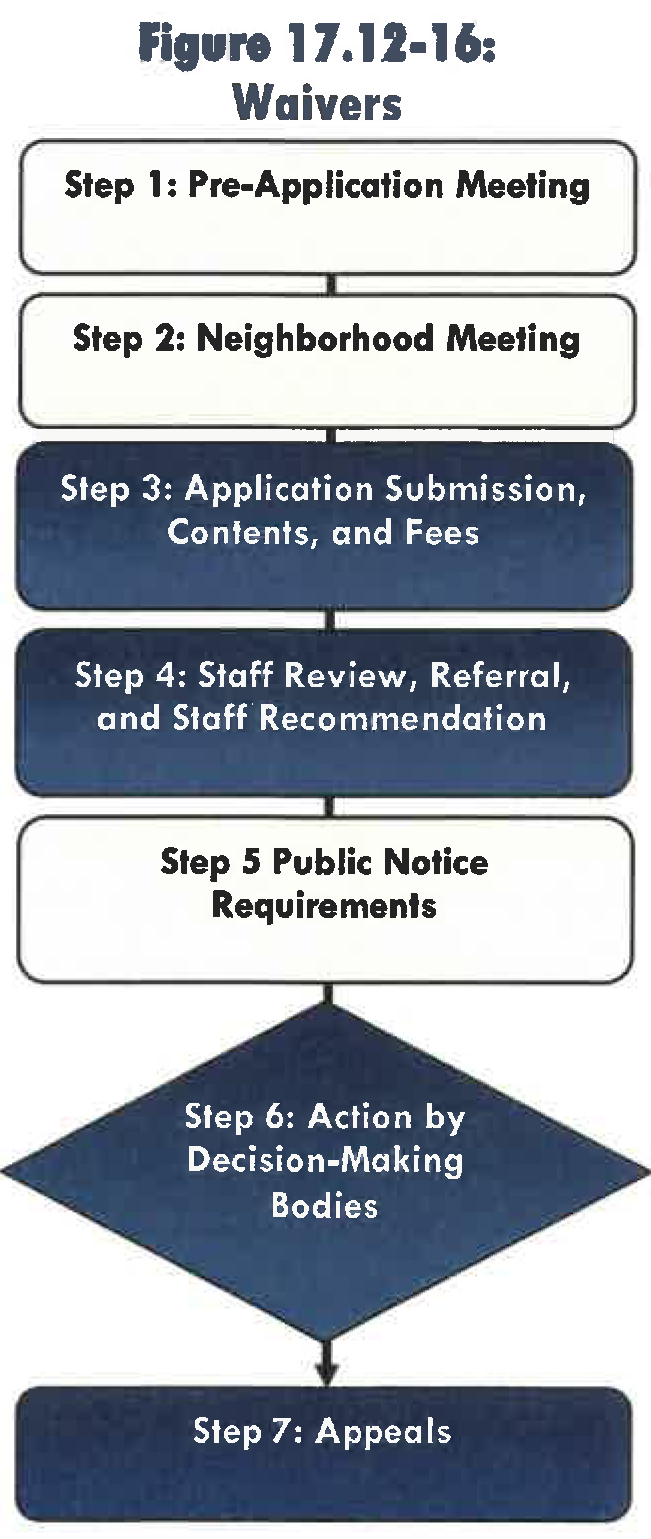
1.
Purpose. The purpose of this section is to provide a procedure whereby applicants may apply for waivers to particular standards in Title 17 in exchange for compensating public benefits to offset the potential impacts of such waivers. The compensating public benefits set forth in this section are intended to achieve comprehensive master plan goals of improved park and recreational amenities, open space protection, energy conservation, and overall improved community character and design. While this also provides a certain degree of flexibility to the applicants, this system shall not be construed to mean a guarantee of a waiver.
2.
Applicability. Waiver requests may be made by any property owner in the City as a freestanding request or concurrently with any other application set forth in this section.
3.
Compensating Public Benefits. The public benefits required to offset waivers are set forth in Table 17.12-2, below. Waivers can only be requested from the standards listed under "eligible waiver requests" in the table below. Waiver requests shall not be granted through this process for the following items:
a.
An increase in overall project density;
b.
A change in permitted uses or mix of uses;
c.
An increase in building height;
d.
A change in conditions attached to the approval of any site plan or special use permit;
e.
A change to a development feature already modified through a variance or minor change authorized by the Director as permitted in this Code; or requirements for sanitary sewer, central water, and access to or construction of utilities.
4.
Procedures. Figure 17.12-16 shows the steps of the common development review procedures that apply in the review of applications for waivers. The common procedures are described in Section 17.12.040. Specific additions and modifications to the common review procedures are identified below.
a.
Step 5: Public Notice. Written notice shall be required. Notice may be given concurrently with notice of a related development application.
b.
Step 6: Action by Review and Decision-Making Authorities.
(i)
Decision by Planning Commission. After reviewing the report and recommendation of the Director, the planning commission shall make a decision based on the approval criteria in subsection (iii) below.
(ii)
Approval Criteria. In order for a waiver request to be approved, the application must meet all of the following criteria:
(1)
The applicant has provided compensating public benefits in accordance with the request in Table 17.12-3; and
(2)
That the granting of such application will not materially affect the health or safety of persons residing or working in the neighborhood and will not be materially detrimental to the public welfare or injurious to property or improvements of the neighborhood.
4.
Waiver Requests and Associated Number of Compensating Public Benefits.
a.
Major Waiver. Any request for a waiver from any eligible numerical standard contained in Chapters 17.16, Zone Districts, or 17.24, Development Standards, greater than fifty (50) percent shall be considered a major waiver. A major waiver shall require the provision of at least two compensating benefits from the corresponding list set forth in Table 17.12-2.
b.
Minor Waiver. Any request for a waiver from any eligible numerical standard contained in Chapters 17.16, Zone Districts, or 17.24, Development Standards, of fifty (50) percent or less shall be considered a minor waiver. A minor waiver shall require the provision of at least one compensating community benefit from the corresponding list set forth in Table 17.12-2.
llustrative examples:
1.
Assume a commercial developer requests two waivers. The first is for a reduction of a side setback from fifty (50) to twenty (20) feet sixty (60) percent—requiring a major waiver. The second is to reduce parking spaces required by ten (10) percent—requiring a minor waiver. To secure the major waiver, the developer offers to increase landscaping on the site by twenty (20) percent, concentrating it in the perimeter buffer, and to build an attractive masonry wall on the side of property on which the setback will be reduced. To secure the minor waiver for parking, he offers to complete the public sidewalk connection on the adjoining vacant parcel.
2.
Assume the developer of a residential subdivision (one hundred (100) units) requests two waivers. The first is to reduce the open space requirement by eighty (80) percent (major waiver) and all front yard setbacks throughout the development by twenty-five (25) percent (minor). In order to compensate for the impacts of open space reduction, the developer offers to install enhanced active open space amenities, recreational facilities, and pedestrian amenities. Additionally, the developer offers to provide additional front-yard landscaping and street trees to secure the minor waiver for setbacks.
Table of Compensating Public Benefits
M.
Gaming Enterprise District (GED).
1.
Purpose. In accordance with the provisions of Nevada Revised Statutes, the City may from time-to-time amend the official map for Gaming Enterprise Districts to either add new gaming districts or remove expired gaming districts within the municipality.
2.
Applicability.
a.
Initiation. A petition for a Gaming Enterprise District may be initiated by a property owner or authorized agent of the property owner. If the property is not under a single ownership, all owners shall join the application, and a map showing the extent of ownership shall be submitted with the application, if applicable.
3.
Procedures. Figure 17.12-17 shows the steps of the common development review procedures that apply in the review of applications for gaming enterprise districts. The common procedures are described in Section 17.12.040. Specific additions and modifications to the common review procedures are identified below.
a.
Step 3: Required Application, Plans, and Materials.
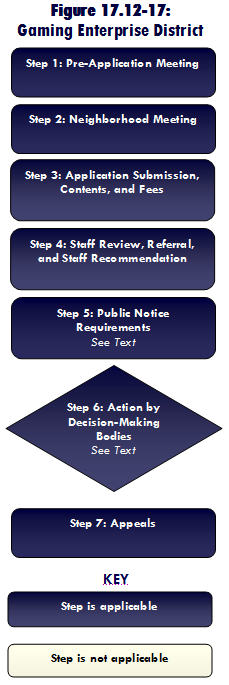
A property owner or authorized agent shall initiate an application (petition) for a GED district by filing a complete application with the City that shall contain the following:
(i)
A completed application form.
(ii)
A vicinity map showing the location and street address (if applicable) of the subject site and showing all residential, commercial, industrial, and public uses and zoning districts within 3,000 feet of all boundaries of the subject site.
(iii)
A separate and complete application for a special use permit for the proposed casino.
(iv)
An analysis of any adverse impacts upon surrounding properties and proposed mitigation methods including, but not limited to, construction traffic, noise, and other construction-related impacts, post-construction traffic, parking, signage, lighting, and any other impacts associated with the casino operations.
(v)
An analysis that demonstrates the proposed request complies with the provisions of NRS 463 to establish a Gaming Enterprise District.
(vi)
A preliminary development schedule indicating phases and the sequence and timing of development.
(vii)
The required application fee.
b.
Step 5: Public Notice Requirements. Notice shall be provided as set forth in Section 17.12.040.E and Table 17.12-1, and additional procedures as set forth in the application manual.
c.
Step 6: Action by Review and Decision-Making Authorities.
(i)
Hearing and Recommendation by the Planning Commission
(1)
Public Hearing. All proposed amendments shall be submitted to the planning commission for a public hearing. The planning commission shall hold a public hearing on the application not more than 45 calendar days following the filing of a complete application, unless an alternative time frame is agreed upon by the applicant. The property owner(s), or appropriate representative must be present at all public hearings.
(2)
Recommendation. Following the conduct of a public hearing and within 30 calendar days of the hearing, the planning commission shall report its findings and recommendations on the proposed amendment to the City Council unless an extension of time is agreed upon.
(3)
Reporting and Transcript. The applicant shall be responsible to ensure each public hearing conducted by the Planning Commission is recorded by a court reporter and that a transcript of each hearing is filed with the City. The applicant shall also be responsible to schedule and pay the costs of the court reporter.
(ii)
Hearing and Decision by the City Council.
(1)
Public Hearing. The City Council shall consider the proposed amendment and the recommendations of the Planning Commission at the Council's next regular public hearing following receipt of the recommendations of the Planning Commission.
(2)
Determination. If, based on the evidence presented and the recommendations of the Planning Commission, the City Council determines that the proposed amendment will not adversely affect the health and general welfare; the City Council shall approve the proposed amendment. An affirmative vote of ¾ of the City Council shall be required to approve the addition of the GED designation to any district.
(3)
Reporting and Transcript. The applicant shall be responsible to ensure each public hearing conducted by the City Council is recorded by a court reporter and that a transcript of each hearing is filed with the City. The applicant shall also be responsible to schedule and pay the costs of the court reporter.
(iii)
Approval Criteria. The City Council may approve gaming enterprise amendments, and the Planning Commission may recommend approval, if the applicant proves by clear and convincing evidence of the following criteria:
(1)
The road, water, sanitation, utilities, and related services to the location are adequate.
(2)
The proposed establishment will not unduly impact public services, consumption of natural resources, and the quality of life enjoyed by residents of the surrounding neighborhoods.
(3)
The proposed establishment will enhance, expand, and stabilize employment and the local economy.
(4)
The proposed establishment will be located in an area planned or zoned for that purpose pursuant to NRS 278.010 to 278.630, inclusive.
(5)
The proposed establishment will not be detrimental to the health, safety, or general welfare of the community or be incompatible with the surrounding area.
(6)
On the date that the application was filed:
(a)
The property line of the proposed establishment was not less than five hundred (500) feet from the property line of a developed residential district as defined in NRS 463.3086(9)(a).
(b)
The property line of the proposed establishment was not less than one thousand five hundred (1,500) feet from the property line of a public school, private school, or structure used primarily for religious services or worship.
(c)
The proposed establishment will not adversely affect:
i.
Any developed residential district whose property line is within two thousand five hundred (2,500) feet of the property line of the proposed establishment.
ii.
A public school, private school, or structure used primarily for religious purposes, whose property line is within two thousand five hundred (2,500) feet of the property line of the proposed establishment.
d.
Step 7: Appeals. Appeals of the City Council decision regarding Gaming Enterprise Districts shall be in accordance with NRS 463.3088.
5.
Limits on Successive Applications. If the City Council denies a petition submitted pursuant to this Section, it shall not consider another petition concerning the same location or any portion thereof for one year after the date of the denial.
6.
Amendments to Gaming Enterprise Districts. Any amendment to an approved plan shall require a new application and approval in accordance with this Zoning Ordinance.
7.
Expiration, Extension, and Transfer. Unless extended, an application for a GED shall expire two years from the date of approval, with the following exceptions:
a.
The project for which the GED was approved has begun construction or is complete.
b.
Existing GEDs approved prior to the effective date of this ordinance and where no construction has begun shall run concurrently with the associated special use permit. Should the special use permit expire, then the GED associated with the special use permit shall also expire.
c.
The GED runs with the land and automatically transfers to subsequent property owners as long as there is no change in the development plan.
(Ord. No. 2591, § 1, 6-15-2011, eff. 10-1-2011; Ord. No. 2669, § 1, 6-18-2014; Ord. No. 2685, § 1, 8-6-2014; Ord. No. 2714, §§ 2, 3, 6-17-2015; Ord. No. 2730, § 1, 10-21-2015; Ord. No. 2874, § 1, 3-21-2018; Ord. No. 3048, §§ 2—4, 1-20-2021)

