
North Miami City Zoning Code
ARTICLE 5
- DEVELOPMENT STANDARDS
DIVISION 8. - DESIGN
DIVISION 9. - ALCOHOLIC BEVERAGES
FOOTNOTE(S):
--- (1) ---
Editor's note— Ord. No. 1251, § 1, adopted February 26, 2008, repealed the former Ch. 3, §§ 3-1—3-15, and enacted a new Ch. 3, §§ 3-1—3-18, as set out herein. The former Ch. 3 pertained to similar subject matter. See also the Code Comparative Table.
Cross reference— City clerk, § 2-231; buildings and building regulations, Ch. 5; finance, Ch. 7; licenses and business regulations, Ch. 11; miscellaneous offenses, Ch. 13; nuisances, Ch. 12; parks and recreation, Ch. 14; public places, Ch. 16; streets and sidewalks, Ch. 17; zoning, App. A. (Back)
State Law reference— Authority to locate and regulate hours of sale, F.S. §§ 562.14(1) and 562.45(2). (Back)
Sec. 5-101. - Accessory uses and structures; Permits required.
A. Except as explicitly provided herein, no use designated as an accessory use in this division shall be established until after the person proposing such use has applied for and received all required development permits which may include; a building permit, zoning improvement permit (ZIP), certificate of use, and a certificate of occupancy all pursuant to the requirements of this division. No permit shall be issued for an accessory building for any use unless the principal building and established use exists on the property, or unless a permit is obtained simultaneously for both buildings and construction progress concurrently.
B. Prohibited uses. Any accessory use not specifically listed as permitted, or listed as a related use, and which the administrative official cannot categorize as similar to a permitted use or related use, shall be considered expressly prohibited.
C. Applicability of principal use and building regulations. An accessory use and building or structure shall be subject to the same regulations that apply to the principal use, building and structure in each district, except as otherwise provided herein.
D. Location. All accessory uses, buildings and structures, except for approved off-site parking, shall be located on the same lot as the principal or main use.
E. The following accessory use table shall be used to determine the required zoning district in which a use may be established. Unless otherwise stated herein, setback and spacing regulations shall adhere to the minimum requirements of this division and the applicable zoning district. Additional standards shall be complied with for the establishment of the accessory use.
| Accessory Use Generalized Table by Zoning District | ||||||||||||||||
| Zoning District/Accessory Use and Structures | R-1 | R-2 | R-4 | R-5 | R-6 | C-1 | C-2BE | C-2BW | C-3 | M-1 | PU | RO | BZ | PD | AOD | NRO |
|---|---|---|---|---|---|---|---|---|---|---|---|---|---|---|---|---|
| Awnings, canopies, carports, roof overhangs, balconies, architectural structures | P | P | P | P | P | P | P | P | P | P | P | P | P | P | P | P |
| Commercial recyclable material storage area | P | P | P | P | P | P | P | P | P | P | P | P | P | P | P | P |
| Commercial use—incidental | P | P | P | P | P | P | P | P | P | P | ||||||
| Construction trailer—temporary | P | P | P | P | P | P | P | P | P | P | P | P | P | P | P | P |
| Customary and incidental uses | P | P | P | P | P | P | P | P | P | P | ||||||
| Detached accessory dwelling unit | P* | P* | ||||||||||||||
| Donation bins | P | P | P | P | P | |||||||||||
| Drive-through facilities | SE | SE | SE | SE | P | SE | ||||||||||
| Dumpster enclosures | P | P | P | P | P | P | P | P | P | P | P | P | P | P | ||
| Enclosed recreation areas—common | P | P | P | P | P | P | P | P | P | P | P | P | P | P | P | P |
| Gatehouses, guardhouses | P | P | P | P | P | P | P | P | P | P** | ||||||
| Generators—permanent | P | P | P | P | P | P | P | P | P | P | P | P | P | P | P | P |
| Maintenance building—common | P | P | P | P | P | P | P | P | P | P | P | P | P | P | ||
| Zoning District/Accessory Use and Structures | R-1 | R-2 | R-4 | R-5 | R-6 | C-1 | C-2BE | C-2BW | C-3 | M-1 | PU | RO | BZ | PD | AOD | NRO |
| Management office, sales office | P | P | P | P | P | P | P | P | P | P | P | P | P | P | P | |
| Mobile Food Dispensing Vehicles 1 & 2 | P*3 | P* | ||||||||||||||
| Mobile medical, professional unit | P | P | P | P | P | P | P | P | P | P | P | P | P | P | P | P |
| Multifamily recyclable material storage areas | P | P | P | P | P | P | P** | |||||||||
| News kiosk | P | P | P | P | P | P | P | P | ||||||||
| Off-street parking structures | P | P | P | P | P | P | P | P | ||||||||
| Outdoor dining | P* | P* | P* | P* | P* | P | P* | P* | ||||||||
| Outdoor recreation areas—common | P | P | P | P | P | P | P | P | P | P | P | P | P | P | P | P |
| Outdoor storage | P | |||||||||||||||
| Portable storage units | P* | P* | P* | P* | P* | P* | P* | P* | P* | P* | P* | P* | P* | P* | P* | P* |
| Screen enclosures | P | P | P | P | P | P | P | P | P | P | ||||||
| Swimming pools, spas, tennis courts, ball courts | P | P | P | P | P | P | P | P | P | P | P | P | P | P | P | P |
| Unattached garages, carports | P | P | P | P | P | P | P | P | ||||||||
| Utility sheds, storage buildings, fallout shelters | P | P | P | P | P | P | P | P | P | P | P | P | P | P | P | P |
| Zoning District/Accessory Use and Structures | R-1 | R-2 | R-4 | R-5 | R-6 | C-1 | C-2BE | C-2BW | C-3 | M-1 | PU | RO | BZ | PD | AOD | NRO |
| Vending machines, video arcade games | P | P | P | P | P | P | P | P | P | P | P | P | P | P | ||
| Watchman, manager or caretaker quarters—permanent, temporary | P | P | P | P | P | P | P | P | P | P | P | P | ||||
| Wireless antenna support structures, amateur radio antennas | SE | SE | SE | SE | SE | SE | SE | SE | SE | SE | SE | SE | SE | SE | SE | SE |
| Legend: P indicates permitted P* indicates permitted through Admin. Site Plan approval P** indicates permitted through the underlying zoning district Blank indicates not permitted | ||||||||||||||||
Note: See additional standards and requirements and criteria for specific accessory uses set forth in this division and the master permitted uses list in section 4-202. 1 Subject to the standards in section 5-1611. 2 This use may be accommodated in other zoning districts as a special event through the temporary use permit process as provided in section 5-1903. 3 In this district, MFDVs shall only be associated with a permitted primary use of a mechanical car wash. | ||||||||||||||||
(Ord. No. 1466, § 1(exh. 1), 8-24-21; Ord. No. 1469, § 1(exh. 1), 9-28-21; Ord. No. XXXX § 1(exh. 1), 6-14-22)
Sec. 5-102. - Accessory dwellings units.
A. Purpose. The purpose of this section is to promote and encourage the creation of legal detached accessory dwelling units (ADUs) in a manner that enhances residential neighborhoods and helps residents meet their housing needs and realize the benefits of ADUs.
B. With the exception of those ADUs permitted as of the date of the LDRs, new accessory dwelling units are permitted only within the R-1 and R-2 districts, in accordance with the criteria established in subsections D and E in this section.
1. Prima facie evidence of an illegal accessory dwelling unit in connection. It shall be presumed that an accessory dwelling unit has been established when one or more of the following conditions are observed:
a. There are two or more electrical, water gas or other types of utility meters, or mailboxes on the premises.
b. There is evidence of a liquid propane (LP) gas tank installed in an unauthorized detached structure on the premises.
c. There is more than one cooking area in the primary structure, not exclusively for servant use or religious purposes.
d. All living areas within the dwelling are not logically interconnected.
e. Rooms with separate outside entrance that can be logically partitioned to be exclusive of all other living areas of the residence.
f. Multiple paved numbered parking spaces.
g. An unauthorized detached building with air conditioning, or interior cooking areas or utility meters.
h. There is more than one different house address unit number posted on the premises.
i. An advertisement indicating the availability of more than one living unit on the premises, where only one living unit is permitted.
j. An unpermitted exterior door.
k. A second kitchen or facilities for cooking provided not exclusively for servant use or religious purposes.
2. The presumption may be rebutted by the property owner with the submission of
a. a valid building permit of record; and
b. a current floor plan prepared by an engineer or architect, depicting the residence and accessory structures and showing all rooms in the primary residence are interconnected as a single-family dwelling; and
c. a notarized affidavit from the property owner attesting that the residence or accessory structure is being maintained for single-family occupancy; and/or
d. substantiated by an interior inspection of the dwelling by a compliance officer.
3. If the compliance officer is able to enter the interior of the property and verify its use as a single-family dwelling, and property is constructed in accordance with building permit of record, the property owner is exempt from the submission of a current plan.
a. If it is found that adequate evidence of an illegal accessory dwelling unit has occurred, it shall be considered a violation of this chapter.
b. Nothing contained in this section shall prevent the enforcement actions authorized by the LDRs independent of this subsection.
C. In addition to the general standards and requirements for accessory structures, the nonconforming detached ADUs existing on the date of adoption of these LDRs, as evidenced by the list maintained by the city manager’s office, may continue to be located on the same lot as a single-family detached home provided that the following requirements are met:
1. The accessory dwelling unit shall contain no more than one (1) full bath and kitchen facilities.
2. The accessory dwelling unit shall use the same street address as the principal dwelling.
3. An application for a certificate of re-occupancy for an existing nonconforming ADU must include an affidavit from the applicant which attests that the unit will be rented at an affordable rate to an extremely low income, very low income, low income or moderate income person.
D. Notwithstanding the provisions in article 6 regarding nonconforming uses and structures, ADUs existing on the date of adoption of these LDRs may be rebuilt if destroyed more than fifty (50) percent of its replacement cost at the time of the damage and may be repaired if otherwise damaged; provided however that while the dwelling may be rebuilt at the same height and with the same setbacks, the repair or reconstruction must be in accordance with the Florida Building Code. Any rebuilding of a nonconforming ADU shall require a vested right's application and approval in accordance with the provisions of article III, division 12.
E. One (1) detached ADU per principal dwelling unit may be allowed within the R-1 and R-2 residential zoning districts through the DRC site plan review process, subject to the following conditions:
1. Lot size: 12,500 square feet minimum lot size for the total parcel.
2. Unit size: Shall be a minimum of 500 sq. ft., up to a maximum of 25% of the size of the principal residence.
3. Design requirements: To ensure compatibility and maintain the aesthetic character of the neighborhood, the ADU must be similar in design and color as the principal dwelling unit.
4. Stormwater: Construction of the ADU shall assure sufficient pervious land is available to prevent stormwater runoff from the site.
5. Height and setbacks: Height and setback requirements are the same as the principal dwelling. Notwithstanding the foregoing, ADUs located in the rear of the property that are not visible from the street may, with screening, have a setback of ten feet (10’) from the rear property line; however, no window, except for the bath may face the rear property line. For properties whereby the existing principal dwelling unit does not meet the district setback requirements, no portion of any window of the ADU that faces the lot line where the setback for the principal dwelling unit is not met shall be higher than ten feet (10’) from the ground.
6. Parking: The entire property must meet the parking requirements established in Article 5, Division 14, including the required number of parking spaces pursuant to Section 5-1402.
7. Utilities: The property shall not be served by a septic system, and must have sufficient water and wastewater capacity as certified by the department of public works. Separate water and sanitary sewer connections between the ADU and the city utility mains are not required, provided that the existing on-site utilities can be extended from the existing principal dwelling unit to the ADU. If the property owner requests separate utility connections for the ADU, then all connection improvements and associated connection fees shall be required.
8. Occupancy restrictions:
- A lot or parcel of land containing an ADU shall be occupied by the owner of the premises. The owner may live in either the ADU or the principal dwelling unit.
- Within thirty (30) days of obtaining a building permit for the construction of an ADU, the owner shall record against the deed to the subject property, a deed restriction running in favor of the City limiting occupancy of either the principal dwelling unit or the ADU to the owner of the property; that occupancy of the ADU is further limited to seniors (55 and over years of age) or to those qualifying as extremely-low-income, very-low-income, low-income, or moderate-income person or persons; and, that the ADU shall not be sold separately from the principal dwelling unit. Proof that such restriction has been recorded in the Miami-Dade County records shall be provided prior to the issuance of a certificate of occupancy for the ADU.
- The occupants of the ADU shall not exceed two (2) persons.
- If the ADU is rented, the unit shall comply with all minimum housing standards established in Chapter 5, Article IV. of the City’s Code of Ordinances.
- The ADU shall not be rented or leased for a period of less than six (6) months.
9. Noticing and consent. Within five (5) days after receiving a complete application for approval of an ADU, the zoning manager, or designee, shall provide written mailed notice to the abutting property owners proposed for an ADU. Abutting owners for this ordinance shall include owners of those properties sharing a lot line, and across the street unless the public right-of-way measures seventy (70) feet or greater, nor shall consent be required when a body of water completely separates the subject parcel from another parcel.
10. Monitoring: The owner must file an annual affidavit or other means for monitoring with the community planning director to ensure that the ADU continues to be used in accordance with the requirements of the LDRs. At a minimum, proof of income, e.g., social security, annuities, retirement funds, pensions, disability or death benefits, and/or Federal Income Tax returns with W-2 forms for all adults residing in the household must be provided as proof of compliance.
11. Certificate of Use: If the ADU will be rented, prior to occupancy, the Applicant must obtain, and annually maintain, a Certificate of Use (CU). At the time of application for a CU, the Applicant must submit an affidavit of occupancy. Such affidavit shall assert that occupants of the ADU will be limited to the property owner, or seniors (55 and over years old), or to those qualifying as extremely-low-income, very-low-income, low-income, or moderate-income person or persons.
12. Business Tax Receipt: If the ADU will be rented, prior to occupancy, the Applicant must obtain, and annually maintain a Business Tax Receipt.
(Ord. No. 1278, § 1(exh. 1), 4-28-09; Ord. No. 1466, § 1(exh. 1), 8-24-21)
Sec. 5-103. - Roof overhangs, eaves, cornices and balconies, awnings and other sun-shading devices, canopies, entryway features, pergolas, trellises and other similar structures, other architectural structures, and covered carports. The following minimum standards shall apply:
A. Roof overhangs, eaves, cornices and balconies. On all buildings, roof overhangs and balconies shall not encroach more than five (5) feet into the required yard setback area, and shall not protrude closer than two feet from any property line, except as provided in the NRO district. In addition, balconies shall not be enclosed by jalousies, windows, walls or otherwise. Balconies may be screened only if all balconies in any building are screened at the same time. Balconies may be used for outdoor living and may contain furniture and plants, said plants not to be placed on balcony railings or external ledges of said balcony. Balconies shall be specifically prohibited for use as storage, laundry drying, barbecuing or cooking and sleeping quarters. It is intended that the use of balconies be restricted to those activities that will not make them unsightly to neighbors or pedestrians or will not endanger the safety of the building or will not create a weight load beyond that for which the balcony was designed.
B. Awnings and other sun shading devices. On residential buildings awnings shall not encroach more than five and one-half feet (5 ½) into the required yard setback area, and shall not protrude closer than two (2) feet from any property line. On nonresidential buildings, awnings shall not encroach more than nine (9) feet into the required yard setback area, and shall not protrude closer than two (2) feet from any property line.
C. Canopies. Canopies shall be permitted to encroach into the required yard setback area providing they are no closer than two (2) feet from any property line.
D. Entryway features. Entryways, such as porte-cocheres, may be permitted that encroach into the front setback provided that the design of the feature is integrated into the design of the principal structure, is in scale with the size of the principal structure and is no more than one-third (1/3) the width of the principal structure. The required side setbacks of the zoning district shall be maintained and the front setback shall be at least ten (10) feet.
E. Pergolas, trellises and other similar structures. On single-family residential, duplex or townhouse unit lots, pergolas, trellises and other similar structures shall be sited within the required yard setback areas of a principal building provided:
1. The encroachment does not exceed 75 percent of the required yard setback areas.
2. That, at no time, the structure is closer than five (5) feet to any property line, with the exception of townhouse lots, which shall permit a minimum setback of three (3) feet from an interior property line.
3. The structure cannot exceed 400 square feet in total area,
4. The maximum height shall not exceed twelve (12) feet as measured from grade to the highest point of the structure.
5. The structure shall be open on all four (4) sides, with no one supporting column wider than six (6) inches.
6. Only one (1) such structure shall be permitted to encroach into a required yard setback area of a principal building.
7. The structure shall be open from floor to sky.
F. Other architectural features. On single-family residential, duplex or townhouse unit lots, architectural features shall not encroach more than 75 percent into the required yard setback areas. Such features shall not exceed more than 20 percent of the building height.
G. Covered carports. When attached to the principal structure and constructed of a masonry material, carports shall maintain the same yard setbacks as required for the principal structure. When detached and constructed of fabric, aluminum or other nonmasonry material approved by the community planning and development department, covered carports shall adhere to the following minimum dimensional requirements:
1. For covered carports located in rear yard, the dimensional requirements for accessory structures as set forth later in this division shall apply. For covered carports located in the front or side yard, the following setbacks shall apply:
a. The front setback shall be a minimum of ten (10) feet and may be reduced to five (5) feet through the granting of an administrative variance.
b. The side setback shall be a minimum of five (5) feet;
c. The side street setback (for corner lot properties) shall be a minimum of ten (10) feet.
d. Notwithstanding the requirements of this subsection, under no circumstances, shall a covered carport be permitted within the sight visibility triangle.
2. Covered carports shall not exceed twenty (20) feet x twenty (20) feet.
3. All covered carports shall have a cover on at all times, which shall be maintained in good condition. If the cover is canvas or other similar material, it shall be free from tears, holes and fading. Should any cover become deteriorated, it shall be the owner's responsibility to ensure that this cover is properly restored to its original condition, or in the event restoration is not possible, that it is replaced with a new, permitted cover. Under no circumstances shall a carport structure remain coverless or with a deteriorated cover for more than sixty (60) days subsequent to notification by the city that a violation exists.
4. Only one (1) canopy carport structure shall be permitted per residence. The canopy carport structure shall remain open on all sides at all times.
(Ord. No. 1278, § 1(exh. 1), 4-28-09)
Sec. 5-104. - Drive-throughs, walk-up windows, and automated teller machines.
Drive-throughs, walk-up windows, and ATMs accessory to banks, restaurants, and retail sales and service shall be permitted provided that:
A. In addition to the sight visibility standards of section 5-1004, such uses are designed so as to not interfere with the circulation of pedestrian or vehicular traffic on the site itself, and on the adjoining streets, alleys or sidewalks.
B. Drive-through lanes and vehicle stacking areas adjacent to public streets or sidewalks shall be separated from such streets or sidewalks by railings, or hedges at least thirty-six (36) inches in height.
C. Drive-through, ATMs and walk-up elements should be architecturally integrated into the building, rather than appearing to be applied or "stuck on" to the building.
D. Drive-through displays, ordering areas, walk-up windows, ATMs and parking canopies shall not serve as the singularly dominant feature on the site or as a sign or an attention-getting device.
E. Entries and/or exits to drive-through facilities shall be a minimum of one hundred (100) feet from any intersection as measured from the edge of the drive closest to the intersection to the property line at the intersection. Shorter distances from road intersections may be approved if the city determines that public safety and/or the efficiency of traffic circulation are not being compromised.
F. Drive-through stacking lanes shall be a minimum of one hundred (100) feet from any single-family residential parcel unless the community planning and development department determines that an adequate buffer exists through the use of landscaping or other means.
G. All service areas, restrooms and ground mounted equipment associated with the drive-through shall be screened from public view.
H. Landscaping shall screen drive-through aisles from the public right-of-way and adjacent uses and shall be used to minimize the visual impacts of readerboard signs and directional signs.
I. Drive-throughs shall not be permitted in the NRO district, except those existing prior to the adoption of these regulations or this amendment.
(Ord. No. 1278, § 1(exh. 1), 4-28-09)
Sec. 5-105. – Private/non-public educational facilities and child care facilities
A. Applicability. Provisions of this section shall be applicable to all non-public day nurseries, kindergartens and after school care within the boundaries of the city. Pursuant to Section 33-151.11 of the Miami-Dade County Code, the physical standards adopted herein are not less stringent than, and, in fact, mirror, those adopted by Miami-Dade County for day nurseries, kindergartens and after school care. Uses that are intended to be controlled by this article include, but are not limited to, the following:
1. Day nurseries: Child care for infants and children up to and including age six (6).
2. Kindergartens: Child care and preschool programs for children ages four (4) through six (6).
3. After-school care: Child care and recreation for children above the age of five (5) when no formal schooling program is conducted and where the care provided is generally after school, on weekends, school holidays and vacations.
4. Babysitting service for shoppers: Child care for limited time periods (maximum four (4) hours) provided within a shopping center or business establishment solely for the convenience of the patrons, and limited to not more than forty (40) children at any one (1) time.
5. Private college/university: An institution of higher learning beyond the high school level.
6. Family day care homes: Child care and recreation with a maximum of five (5) children including the day care operator's own children.
7. Private school: This term as used herein refers to any private institution providing child care and/or instruction at any level from infants through the college level.
8. Child, student, pupil: The terms "child," "student," "pupil," and their plurals are used interchangeably in this section.
9. Elementary, junior and senior high schools: References to these schools are to be loosely interpreted to encompass any schools, graded or ungraded, whose students are within the age ranges typically found at these school levels.
B. Religious activities. This section shall not be applicable to facilities used principally for weekend or intermittent nonacademic religious instruction or for the care of children whose parents or guardians are attending religious services or meetings on the premises.
C. Zoning district requirements.
1. All day nurseries, after-school centers, kindergartens and private schools shall meet the requirements included herein and the requirements of the particular zoning district in which they are located if that district is one in which the facility is a permitted use; facilities in other districts shall meet R-4 requirements.
2. Notwithstanding any other provisions of these LDRs to the contrary, horses used to provide therapy as a part of the curriculum of private schools primarily dedicated to the education of developmentally disabled children as specified in Section 393.063, Fla. Stat., shall be permitted in conjunction with school use that has been approved in the R-1 and R-2 zoning districts. The number of horses and the location of the accessory structure(s) to house them shall comply with the underlying zoning district regulations.
3. Required information. All nonpublic educational facilities, as defined in this article, shall submit the following applicable information to the community planning and development department for review.
4. Written information.
a. Total size of the site;
b. Maximum number of students to be served;
c. Number of teachers, administrative and clerical personnel;
d. Number of classrooms and total square footage of classroom space;
e. Total square footage of nonclassroom space;
f. Amount of exterior recreational/play area in square footage;
g. Number and type of vehicles that will be used in conjunction with the operation of the facility;
h. Number of parking spaces provided for staff, visitors, and transportation vehicles, and justification that those spaces are sufficient for this facility;
i. Grades or age groups that will be served;
j. Days and hours of operations;
k. Means of compliance with requirements of the Miami-Dade County Fire Department, Miami-Dade County Department of Public Health, the Department of Health and Rehabilitative Services, and any federal guidelines applicable to the specific application.
5. Graphic information, less than fifty (50) students.
a. A detailed site plan shall be submitted to the community planning and development department, drawn to scale and including dimensions to indicate lot size, street rights-of-way and pavement measured from center line, size of building or buildings, interior floor layout and interior uses, location and size of recreation and/or play areas, location of fences and/or walls that shall enclose recreation and/or play areas; said plans shall include, but not be limited to, off-street parking areas and driveways, walls, fences, signs and landscaping.
b. Other data shall be furnished as requested by the director where such data may be needed in order to determine that standards as specified in this section have been met.
6. Graphic information, fifty (50) or more students. The following graphic information shall be prepared by design professionals, such as registered Florida architects and landscape architects, for proposed facilities with fifty (50) or more students. A site plan indicating existing zoning on the site and adjacent areas, as well as the following:
a. Location of all structures;
b. Parking layout and drives;
c. Walkways;
d. Location of recreation areas and play equipment which shall include surrounding fences and/or walls;
e. Any other features which can appropriately be shown in plan form;
f. Floor plans and elevations of all proposed structures; and
g. Landscape development plan listing quantities, size, and names of all plants in accordance with article 5, division 12.
7. Calculation of physical space requirements for multiple-use facilities. Where a private educational facility is to be operated in a structure simultaneously used as a residence, religious institution or other facility, the area which will be specifically used for a private school or child care facility during the hours of operation shall be clearly defined and depicted on a plan. The area so delineated shall be used as the basis for determining physical space requirements as provided in this article. No physical space credit will be given for interior or exterior areas that are not restricted to the school or child care use during the hours of operation of said facility.
8. Combination of residential and nonpublic educational facilities. No combination of residential use and nonpublic educational facility will be permitted on the same property except as follows:
a. A single-family residential use will be permitted in the same building with a nursery or kindergarten use, where the same is used only by the nursery-kindergarten operator.
b. In connection with day nursery and kindergarten facilities, a residential unit for a caretaker may be permitted only when the facility operator does not reside on the premises.
c. A residential unit will be permitted for a caretaker on the site of an elementary, junior and/or senior high school.
d. An existing multifamily apartment building or complex may incorporate a day nursery and/or kindergarten for the accommodation of residents only; provided, that such facility will not be contrary to any site plans previously approved at a public hearing.
e. Nonpublic educational facilities may be incorporated into a proposed apartment building or complex, provided such schools are included in the plans submitted for approval at public hearing (in case of apartment complex) and/or for permit (in case of apartment building).
9. Physical standards.
a. Outdoor areas. Outdoor recreation/play areas shall be in accordance with the following minimum standards, calculated in terms of the proposed maximum number of children for attendance at the school at any one (1) time unless otherwise indicated.
b. Where there are category combinations, each classification shall be calculated individually.
c. Minimum Standards for Outdoor Recreation Playground/Play Areas
| School categories | Required area |
| Day nursery/kindergarten and preschool and after-school care | 45 square feet per child calculated in terms of half of the proposed maximum number of children for attendance at the school at one (1) time |
| Elementary school (grades 1—6) | 500 square feet per student for the first 30 students; thereafter, 300 square feet per student |
| Junior and senior high school (grades 7—12) | 800 square feet per student for the first 30 students; 300 square feet per student for the next 300 students; thereafter, 150 square feet per student |
d. Signs. Signs shall comply with district regulations as contained in these LDRs; provided, however, that the total square footage of all freestanding signs in any residential district shall not exceed six (6) square feet in size.
e. Auto stacking. Stacking space, defined as that space in which pickup and delivery of children can take place, shall be provided for a minimum of two (2) automobiles for schools with twenty (20) to forty (40) children; schools with forty (40) to sixty (60) [children] shall provide four (4) spaces; thereafter there shall be provided a space sufficient to stack five (5) automobiles.
f. Parking requirements. Parking requirements shall be as provided in article 5, division 14.
g. Classroom size. All spaces shall be calculated on the effective net area usable for instruction or general care of the group to be housed. This space shall not include kitchen areas, bathrooms, hallways, teachers' conference rooms, storage areas, or any other interior space that is not used for instruction, play or other similar activities. The minimum classroom space shall be determined by multiplying the maximum proposed number of pupils for attendance at any one time by the minimum square footages, (1) through (4) below. Where a private educational facility is nongraded, calculations shall be based on the age level that corresponds to the grade level in the public school system. Where a school includes more than one (1) of the following categories, each category shall be individually computed:
(1) Day nursery and kindergarten, preschool and afterschool care, 35 square feet per pupil.
(2) Elementary (grades 1—6), 30 square feet per pupil.
(3) Junior high and senior high (grades 7—12), 25 square feet per pupil.
(4) Baby-sitting service, 22 square feet of room area per child.
h. Height. The structure height shall not exceed the height permitted for that site by the existing zoning.
i. Trees. Landscaping and trees shall be provided in accordance with the landscaping requirements of these LDRs.
j. Exemptions. Baby-sitting services are exempted from the "Outdoor Areas," "Auto Stacking," "Parking" and "Trees," requirements of this section. Schools permitted within existing multifamily structures are exempted from the “Auto Stacking” and “Parking” requirements of this section, provided such schools are limited to the occupants of the subject multifamily structures.
k. Child care facilities shall be prohibited from operating on property abutting or containing a water body such as a pond, lake, canal, irrigation well, river, bay, or the ocean unless a safety barrier is provided which totally encloses or affords complete separation from such water hazards. Swimming pools and permanent wading pools in excess of eighteen (18) inches in depth shall be totally enclosed and separated from the balance of the property so as to prevent unrestricted admittance. All such barriers shall be a minimum of forty-eight (48) inches in height and shall comply with the following standards:
(1) Gates shall be of the spring back type so that they shall automatically be in a closed and fastened position at all times. Gates shall also be equipped with a safe lock and shall be locked when the area is without adult supervision.
(2) All safety barriers shall be constructed in accordance with the standards established in section 5-1209 of the City Code, except that screen enclosures shall not constitute a safety barrier for these purposes.
l. Location requirement for outdoor recreation playground/play areas for Child Care facilities. Where the front or side street property line of a child care facility as described in this section, abuts a major corridor, no outdoor recreation playground/play area shall be located between the right-of-way and the building line parallel to the right-of-way.
(1) As of May 27, 2016, all existing child care facilities shall either comply with the foregoing requirement or install an anti-ram fixture with a minimum Department of State protection rating of K4 or a safety barrier from vehicular traffic designed by a professional engineer and approved by the Department of Transportation and Public Works. The safety barrier shall be installed along the entire length of the playground/play area that abuts the right-of-way.
(2) For any existing child care facility which is required to either relocate its outdoor recreation playground/play area or provide a safety barrier, any resulting reduction in outdoor recreation playground/play area shall be deemed in compliance with the minimum playground/play area requirements of this section. Any such reduction shall also be deemed to be in substantial compliance with any site plan previously approved at public hearing. In event that such a child care facility whose site plan was approved at public hearing seeks to relocate its playground/play area, such relocation shall be subject to approval after public hearing upon appropriate application. No fee shall be charged for such application.
(3) This subsection shall not be deemed to allow the future expansion of any child care facility to occur without complying with the requirements of this section.
(4) Notwithstanding anything in the LDRs to the contrary, the provisions of this subsection shall also apply to child care facilities operated by the city and Miami-Dade County, if any.
(5) Variances of the location requirements of this subsection shall only be approved with a condition requiring the installation of a safety barrier meeting the requirements set forth above.
10. Review standards. The following review standards shall be utilized by the department, and, where a hearing is required, by the public hearing body.
a. Study guide. The study entitled "Physical Standards for Proposed Private Educational Facilities in Unincorporated Miami-Dade County," dated 1977, may be used as a general guide in the review of proposed nonpublic educational facilities; provided, however, that in no case shall the educational philosophy of a school be considered in the evaluation of the application.
b. Planning and neighborhood studies. Planning and neighborhood studies accepted or approved by the city council that include recommendations relevant to the facility site shall be used in the review process.
c. Scale. Scale of proposed nonpublic educational facilities shall be compatible with surrounding proposed and existing uses and shall be made compatible by the use of buffering elements.
d. Compatibility. The design of the nonpublic educational facilities shall be compatible with the design, kind and intensity of uses and scale of the surrounding area.
e. Buffers. Buffering elements shall be utilized for visual screening and substantial reduction of noise levels at all property lines where necessary.
f. Landscape. Landscape shall be preserved in its natural state insofar as is practicable by minimizing the removal of trees or the alteration of favorable characteristics of the site. Landscaping and trees shall be provided in accordance with the requirements of these LDRs.
g. Circulation. Pedestrian and auto circulation shall be separated insofar as is practicable, and all circulation systems shall adequately serve the needs of the facility and be compatible and functional with circulation systems outside the facility.
h. Noise. Where noise from such sources as automobile traffic is a problem, effective measures shall be provided to reduce such noise to acceptable levels.
i. Service areas. Wherever service areas are provided they shall be screened and so located as not to interfere with the livability of the adjacent residential properties.
j. Parking areas. Parking areas shall be screened and so located as not to interfere with the livability of the adjacent residential properties.
k. Operating time. The operational hours of a nonpublic educational facility shall be such that the impact upon the immediate residential neighborhood is minimized.
l. Industrial and commercial. Where schools are permitted in industrial or commercial areas it shall be clearly demonstrated in graphic form how the impact of the commercial or industrial area has been minimized through design techniques.
m. Fences and walls. Recreation and/or play areas shall be enclosed with fences and/or walls.
11. Certificate of use. The certificate of use shall be automatically renewable annually by the community planning and development department upon compliance with all terms and conditions including maintenance of the facility in accordance with the approved plan.
12. Enforcement. This article shall be enforced by the community planning and development director along with the code compliance division.
Sec. 5-106. - Reserved.
Sec. 5-107. - Permanently installed stand-by generators.
A. General. In addition to any other county, state, or federal regulations, this section shall govern the placement of permanently installed stand-by generators. A permanent stand-by generator installation shall be allowed for the purpose of providing temporary power during incidental power outages and emergency power outages due to storms, hurricanes and other natural and or man-made disasters as an auxiliary or accessory use in all residential zoning districts. Permanently installed stand-by generators may not be used as a permanent source of power for a building structure or property.
B. Standards for a permanent generator in all residential districts. Permanently installed stand-by generators shall be permitted as an accessory use in accordance with the following:
1. Rear setback. Five (5) feet minimum from the rear property line.
2. Interior side setback. Five (5) feet minimum from the side property line.
3. Side street setback. If there is no area in an interior side yard or the rear yard for a permanently installed stand-by generator then the side street setback may be fifteen (15) feet minimum to the side street property line.
4. Rear street setback. Fifteen (15) feet minimum from a rear street property line.
5. Spacing. The spacing requirement from other structures or equipment will be in accordance with the manufacturer's guidelines.
6. Permanently installed generators must meet the noise level requirements of the city's code.
7. In no event shall a permanently installed generator be closer than ten (10) feet from any adjoining or neighboring building or structure that may be used as a dwelling.
8. Number permitted in residential districts. A maximum of one (1) permanent stand-by generator shall be permitted as an accessory use to a single-family residence, individual duplex unit or individual townhouse unit. A maximum of one (1) generator per structure shall be permitted for multifamily developments.
9. Permanent stand-by generator installations on improved properties may encroach into required landscaping.
10. Permanently installed stand-by generators shall be screened from view of a street, canal, waterway, lake, bay, or golf course with landscaping. Permanently installed stand-by generators shall also be screened from view of adjacent properties with landscaping.
C.Standards for a permanently installed stand-by generator in nonresidential districts.
1. Rear setback. Ten (10) feet minimum from the rear property line.
2. Interior side setback. Five (5) feet minimum from the side property line.
3. Side street setback. If there is no area in an interior side yard or the rear yard for a permanently installed stand-by generator then the side street setback may be fifteen (15) feet minimum to the side street property line.
4. Rear street setback. Fifteen (15) feet minimum from a rear street property line.
5. Permanently installed generators must meet the noise level requirements of the city's code.
6. In no event shall a permanently installed generator be closer than ten (10) feet from any adjoining or neighboring building or structure that may be used as a dwelling.
7. Permanent stand-by generator installations on improved properties may encroach into required landscaping.
8. Permanently installed stand-by generators shall be screened from view of a street, canal, waterway, lake, bay, or golf course with landscaping. Permanently installed stand-by generators shall also be screened from view of adjacent properties with landscaping.
(Ord. No. 1278, § 1(exh. 1), 4-28-09)
Sec. 5-108. - Private noncommercial dish antennas.
A.Location.
1. Private noncommercial dish antennas may be permitted for new construction provided they are:
a. Located in the rear yard or other suitable location on the building as determined by the director of the community planning and development department;
b. They maintain a minimum rear setback that is at least equal to their height, but not less than five (5) feet; and
c. They do not encroach on any of the required side setbacks for the district in which they are located.
2. In connection with multifamily buildings of four (4) stories or more, roof top installation shall be permitted as long as they are anchored in accordance with the requirements of the Florida Building Code relative to structures.
B. Requirements. The requirements of this section may be varied if suitable, as determined by the director of the community planning and development department. The term "suitable" or "suitable location," as used in this section, means a location, dimension or height which enables the efficient functioning of the dish antenna without detriment to adjoining lawful residential use.
C. Screening. If not a roof installation, private noncommercial dish antennas shall be screened by landscaping on its sides so as to obscure their visibility from the abutting properties' ground view. No landscaping shall be required in the front or rear of the dish that would create reception interference or prevent a shift in the position of the dish.
D. Number allowed. One (1) private, noncommercial dish antenna shall be allowed per single-family home, duplex unit, triplex unit, or townhouse unit. Multifamily apartment buildings and commercial or industrial buildings shall be allowed up to three (3) dish antennas per building.
E. Anchorage. Dish antennas shall be anchored securely to a building's roof in conformance with requirements of the Florida Building Code relative to structures.
F. Maintenance. Once installed, dish antennas and related appurtenances must be maintained in good and operable condition. Surrounding landscaping shall also be maintained.
(Ord. No. 1278, § 1(exh. 1), 4-28-09)
Sec. 5-109. - Restaurant, open air.
A. Open air dining on private property, as accessory to a restaurant, is permitted provided that:
1. The operation of such business shall not interfere with the circulation of pedestrian or vehicular traffic on the site, the adjoining streets, alleys or sidewalks.
2. The open-air dining area shall be unenclosed and shall be open except that it may be covered with a canvas cover or structural canopy of a building's arcade, loggia or overhang.
3. All kitchen equipment used to service the open-air dining area shall be located within the kitchen of the primary restaurant or business.
4. The open-air dining area shall be kept in a neat and orderly appearance and shall be kept free from refuse and debris.
5. All venues hosting live music or performances shall be required to obtain a musice and entertainment license pursuant to Section 5-911(a) and 5-912; outdoor venues shall have no amplified sound after 11 p.m., unless special permission is obtained from the City Manager.
B. Open-air dining on public property, as accessory to a restaurant, is permitted provided that:
1. A sidewalk cafe permit for open-air dining located on public property shall be issued for a period of one (1) year, renewable annually by the community planning and development department. Such permit shall not be transferable in any manner. No vested rights, or guarantee of renewal, shall arise from the issuance or renewal of a sidewalk café permit.
2. Open-air dining area shall be restricted to the length of the sidewalk or public right-of-way immediately fronting the cafe and/or restaurant. The utilization of space extending no more than ten (10) linear feet on either side beyond the subject property frontage may be authorized subject to annual written consent provided by owners or tenants in front of whose businesses the outdoor dining service would occur.
3. There shall be maintained a minimum of five-foot clear distance of public sidewalk, free of all obstructions, in order to allow adequate pedestrian movement. The minimum distance shall be measured from the portion of the open-air dining area nearest either the curb line or the nearest obstruction.
4.Tables, chairs, umbrellas and other permissible objects, including planters, shall be approved by the development review committee prior to the issuance of the sidewalk cafe permit. Such permissible materials provided with the sidewalk cafe shall be of high quality design, materials, and workmanship to ensure the safety and convenience of the public.
5. No awning, canopy or covering of any kind, except individual table umbrellas or retractable awnings, shall be allowed over any portion of the open-air dining area located on public property except as allowed through sidewalk café permit review by the director of community planning and development.
6. No perimeter structures such as fences, railings, planters or other such barriers shall surround the open-air dining area which would restrict the free and unobstructed pedestrian flow or discouraging the free use of the tables or chairs by the general public.
7. For new application, one (1) menu board plus one (1) specials board shall be permitted per sidewalk cafe. The location, size, design, materials and color of the menu board and specials board shall be approved by the development review committee, prior to the issuance of a sidewalk cafe permit, and the menu board and specials board location shall be shown on the permit exhibit. The menu board and specials board shall not be a sandwich board or A-frame sign.
8. All open-air dining areas shall be at the same elevation as the adjoining sidewalk or public right-of-way.
9. Under no circumstances shall any open-air dining interfere with the free and unobstructed public access to any bus stop, crosswalks, public seating areas and conveniences, street intersections, alley, service easements, handicap facilities or access to adjacent commercial establishments.
10. The property owner/operator shall be responsible for maintaining the outdoor dining area in a clean and safe condition. All trash and litter and tables and chairs shall be removed daily, except for tables with attached umbrellas.
11. Tables, chairs, umbrellas and any other objects associated with the sidewalk cafe shall be of quality, design, materials and workmanship, to ensure the safety and convenience of users, and to enhance the visual and aesthetic quality of the urban environment. Design, materials and colors shall be sympathetic and harmonious with the urban environment and compliment the design and paint colors on the building. Umbrellas and other decorative material shall be fire-retardant, pressure-treated or manufactured of fire-resistant material. All umbrellas shall be reviewed and approved on a case-by-case basis by the development review committee based on compatibility with the surrounding urban area, the number, and proposed location of such umbrellas. No portion of an umbrella shall be less than six (6) feet eight (8) inches (eighty (80) inches) above the sidewalk. Signs are prohibited on umbrellas, chairs, tables and other permissible fixtures which are located on the public right-of-way, except that the establishment name and/or its logo is permitted on umbrellas. Lettering and/or logos may not exceed six (6) inches in height.
12. The hours of operation shall coincide with that of the primary restaurant. Tables, chairs and all other furniture used in the operation of an outdoor dining area shall not be anchored or restrained in any visible manner as with a chain, rope or wire.
13. Open-air dining may be suspended by the city manager for community or special events, utility, sidewalk or road repairs, or emergency situations or violations of provisions contained herein. The length of suspension shall be for a duration as determined necessary by the city manager. Removal of all street furniture and related obstructions shall be the responsibility of the cafe and/or restaurant owner/operator. The city may cause the immediate removal or relocation of all or parts of the sidewalks cafe in emergency situations or for safety considerations. The city and its officers and employees shall not be responsible for sidewalk cafe fixtures relocated during emergencies.
14. No food preparation, plastic food displays, food storage, kitchen equipment or serving furniture, or refrigeration apparatus or equipment, or fire or fire apparatus or equipment, shall be allowed on the public sidewalk, whether or not such area is covered by a sidewalk cafe permit. However, space heaters are permitted provided that they are an outdoor approved type, are located in accordance with the manufacturer's recommendations, and are located at least two (2) feet from the edge of any umbrella canvas, any foliage, or any other flammable object or material.
15. Upon the issuance of a hurricane warning by the county, the permittee shall immediately, but no later than three (3) hours after a hurricane warning has been issued, place indoors and secure all tables, chairs and other equipment located on the sidewalk. The issuance of such a hurricane warning shall constitute an emergency situation as referenced in this article. Failure to comply with this subsection shall be cause for immediate revocation of the sidewalk cafe's permit.
(Ord. No. 1278, § 1(exh. 1), 4-28-09)
Sec. 5-110. - Solid waste containers/mechanical equipment.
A. All solid waste container, recycling or trash handling areas are permitted as accessory uses and shall be screened on three (3) sides by a fence or wall from view from public streets and abutting properties or as approved by the development review committee in accordance with applicable regulations. An opaque gate shall be used on the fourth side. If such screening is provided by means of a fence or wall, materials which are consistent with those used in the construction of and the architectural style of the principal building shall be utilized.
B. Mechanical equipment shall be screened on four (4) sides by a fence, wall, or landscaping from view from public streets and abutting properties and may encroach up to four (4) feet into required side setbacks. If located on a roof, then screening of the equipment must be provided so that the equipment may not be viewed from a public street.
C. Screening of mechanical equipment shall be accomplished in a manner that does not interfere with the proper operation and/or maintenance of such equipment.
D. If it is necessary in order to accommodate a solid waste container in the redevelopment of an existing building, the required number of parking spaces may be reduced by a maximum of two (2) spaces.
E. Solid waste containers and recycling or trash handling areas shall not be located in the front yard unless site considerations make it impossible for them to be located elsewhere on the site and they comply with the following setback: a minimum of five (5) feet from the front property line or more so that when the doors are open, the doors do not encroach into any public right-of-way.
F. Solid waste containers and recycling or trash handling areas to the side or rear of a structure shall be placed in a manner so that when the doors are open, they do not encroach into a public right-of-way, vehicle access areas, or swing over a property line.
(Ord. No. 1278, § 1(exh. 1), 4-28-09)
Sec. 5-111. - Swimming pools, all districts.
For swimming pools, a seven and one-half (7½) foot setback for the swimming pool screen enclosures, a ten-foot rear setback for the swimming pool itself and front and side setback requirements equal to the setback required for the main structure shall be maintained.
(Ord. No. 1278, § 1(exh. 1), 4-28-09)
Sec. 5-112. - Unattached accessory structures.
A. Unattached accessory structures, other than fences, walls or other similar structures, and including but not limited to gazebos, summer kitchens, pool houses, awnings, utility sheds, and garages (CBS only) which are not attached to a principal structure may be erected in all residential districts in accordance with the following requirements:
1. Maximum Height: twelve (12) feet.
2. Setbacks:
a. Front: same as principal.
b. Side: same as principal. For structures less than 100 square feet, side setback may be decreased to five (5) feet, subject to the review and approval of community planning and development staff, through administrative variance procedures.
c. Rear: five (5) feet, ten (10) feet if abutting water.
d. For corner lots the setback from the side street shall be 15 feet for structures less than 100 square feet, but may be decreased to ten (10) feet, subject to the review and approval of community planning and development staff, through administrative variance procedures.
B. No utility shed or other pre-fabricated structure shall exceed one hundred twenty (120) square feet in area; other permitted unattached accessory structures shall not exceed four hundred (400) square feet.
C. Except as provided in subsection D. below, unattached accessory structures shall not be used as living area or occupied as dwelling units.
D. Except for grandfathered accessory dwelling units and as provided in this subsection, no plumbing shall be provided in unattached accessory structures:
1. Pool houses may have a half bath.
2. Summer kitchens may have a sink.
E. The total lot coverage of all accessory structures in the rear yard shall not exceed 30%.
(Ord. No. 1278, § 1(exh. 1), 4-28-09)
Sec. 5-113. – Paving on side and rear yards.
For side and rear yards, no impervious area or concrete slabs shall be allowed within five (5) feet of the property line, except that permeable pavement or pavers may be allowed subject to the review and approval of community planning and development staff within three (3) feet of the property line.
Sec. 5-201. - Daycare and child care.
Adult daycare and child daycare centers shall meet all standards for a State of Florida approved daycare center, as set forth by the Florida Department of Health (DOH), this section and other applicable provisions of this article 5. In addition to the parking requirements of article 5, division 14, adult daycare and childcare centers, which have buses associated with the use, shall provide the following:
A. A paved unobstructed drop-off/pick-up space with adequate stacking area (as determined by the community planning and development department), and
B. A pedestrian walkway system (as approved by same) between the drop-off/pick-up space and the building entrance.
(Ord. No. 1278, § 1(exh. 1), 4-28-09)
Sec. 5-202. - Adult living facilities.
A. All adult living facilities shall comply with the occupancy standards of chapter 5 of the city's code.
B. All adult living facilities which are not owner-occupied shall have a primary designated manager(s) on a twenty-four-hour basis for which the owner(s) assume liability regarding actions, activities, and operation. The name and contact information of the primary manager(s) shall be conspicuously posted for both resident and public knowledge.
C. There shall be a minimum of two thousand (2,000) feet spacing between any two (2) adult living facilities, as measured from the nearest property line of an existing adult living facility to the property line of the proposed adult living facility.
D. All adult living facilities shall be considered commercial enterprises for purposes of all city utilities and sanitation services.
E. All development standards in the R-4 and R-5 districts and all other state criteria regulating an adult living facility shall apply.
F. Maximum of two (2) people per bedroom.
(Ord. No. 1278, § 1(exh. 1), 4-28-09)
Sec. 5-203. - Community residential homes.
A. Community residential homes with six (6) or fewer residents are permitted within any residential district provided that:
1. Such homes shall not be located within a radius of one thousand (1,000) feet of another existing such home with six (6) or fewer residents. The manager of the community residential home shall notify the city clerk in writing of the manager’s and home’s name and address, and proposed occupancy, along with a copy of licenses obtained, prior to commencing operations.
2. Contact information, including telephone number, for the manager shall be posted in a conspicuous location on the outside of the structure.
B. Community residential homes with seven (7) to fourteen (14) unrelated residents may be permitted in any multifamily residential districts provided that:
1. If new construction, the home complies with all regulations applicable to other multifamily uses in the area;
2. All applicable licensing requirements are met, including obtaining a city issued Business Tax Receipt; contact information, including telephone number, for the manager shall be posted in a conspicuous location on the outside of the structure.
3. The home would not result in a concentration of such homes such that the character and nature of the area would be substantially altered;
4. The home is not located within a radius of one thousand two hundred (1,200) feet (from the nearest portion of the existing property boundary to the nearest portion of the proposed property boundary) of another existing community residential home in a multifamily area; and
5. The home is not located within a radius of five hundred (500) feet (from the nearest portion of the existing property boundary to the nearest portion of the proposed property boundary) of an area zoned for single-family.
6. Provided that the dwelling unit receives a certificate of use.
Sec. 5-204. – Recovery residences.
A. “Recovery residence” means a residential dwelling unit, or other form of group housing, that is offered or advertised through any means, including oral, written, electronic, or printed means, by any person or entity as a residence that provides a peer-supported, alcohol-free, and drug-free living environment.
B. A “certified recovery residence” means a recovery residence that holds a valid certificate of compliance and is actively managed by a certified recovery residence administrator.
C. The city manager shall maintain a database of recovery residences within the city.
D. The director of community planning and development upon request shall provide verification of compliance with applicable state and local regulations.
(Ord. No. 1278, § 1(exh. 1), 4-28-09)
Sec. 5-301. - Purpose, construction.
The purpose of this division is to regulate the location of adult entertainment businesses so as to prevent the adverse secondary effects on the public health, safety, and welfare, which, are "caused by the presence of even one (1) such establishment." This section is designed to eliminate or lessen such adverse secondary effects by preventing or lessening the concentration of such adult entertainment businesses by maintaining minimum distances between such adult entertainment businesses and between certain other uses, and allowing adult entertainment businesses to locate in appropriate areas only. This section is based upon the fundamental zoning principle that certain uses, by the very nature of the adverse secondary effects such uses are recognized to have upon the surrounding community, must be subjected to particular restrictions so that such uses may exist without destroying the vitality of existence of other lawful and reasonable uses. The sole purpose of the legislative body of the city in enacting this section is the desire to preserve and protect the quality of life, public health, safety, and general welfare of the citizens of the city, and not to suppress free speech or impair the constitutional rights of any person. Nothing herein shall be construed to authorize a commission of any obscenity offense or other criminal offense, as proscribed by the laws of the State of Florida and the laws of the city.
(Ord. No. 1278, § 1(exh. 1), 4-28-09)
Sec. 5-302. - Locations and distance restrictions.
A. Adult entertainment businesses shall be allowed within the M-1 industrial district only.
B. No adult entertainment business shall be located within five hundred (500) feet of:
1. Any lawfully pre-existing adult entertainment business that is located within jurisdictional boundaries of the city, unless such location is within the same building as the lawful pre-existing adult entertainment business;
2. Any pre-existing zoning district within the city that is zoned for residential use, including, but not limited to, residential planned unit development districts;
3. Any lawfully pre-existing place of religious worship, public park, or school that is located within jurisdictional boundaries of the city;
4. The distances provided for in this subsection shall be measured in a straight line, without regard to intervening structures or objects, from the nearest property line of the parcel upon which the adult entertainment business is located to the nearest property line of a parcel:
a. Upon which such a lawfully pre-existing adult entertainment business, place of religious worship, public park, or school, is located; or
b. Within a district zoned for residential use.
(Ord. No. 1278, § 1(exh. 1), 4-28-09)
Sec. 5-303. - No additional zoning conditions, restrictions, safeguards, or conditions.
No zoning conditions, restrictions, safeguards, or standards shall apply to or be imposed on any adult entertainment business protected by the first amendment to the United States Constitution, other than:
A. The distance requirements set forth under section 5-909 of the City Code shall apply only to those adult entertainment businesses providing alcoholic beverages for consumption on the premises;
B. Those prohibitions and restrictions expressly set forth in this section; and
C. Signage, parking and landscaping requirements of article 5 of these LDRs.
(Ord. No. 1278, § 1(exh. 1), 4-28-09; Ord. No. 1338, § 1, 6-26-12)
Sec. 5-304. - No application, license, or permit.
With the express exception of those applications, licenses, and permits required by chapter 11, article II, of the city’s code, no application or permit shall be required for the establishment of any adult entertainment business protected by the first amendment to the United States Constitution and no such adult entertainment business shall be subject to section 11-34 of the city's code.
(Ord. No. 1278, § 1(exh. 1), 4-28-09)
Sec. 5-305. - No variances.
No variances from the criteria set forth in this division shall be permitted for any reason.
(Ord. No. 1278, § 1(exh. 1), 4-28-09)
Sec. 5-401. - Animal care facilities.
A. Animal grooming establishments.
The following criteria shall apply to animal grooming establishments:
1. Keeping overnight. No animal grooming establishment shall keep overnight for the purpose of boarding or otherwise any animal or mammal.
2. Use as living quarters prohibited. No animal grooming establishment shall be utilized as living quarters by any person, nor shall the same be equipped or furnished with sleeping or cooking facilities for humans.
B. Veterinary clinics or animal boarding facilities.
The following criteria shall apply to veterinary clinics or animal boarding facilities:
1. Seventy-five (75) feet setback from residential property of any outdoor pen or run/feeding station.
2. All outdoor runs shall be screened by an opaque barrier such that the runs are not visible from adjacent properties or public rights-of-way. If vegetative material is used with a fence for the opaque barrier, such material shall form an opaque barrier within one (1) year from the time of first planting.
3. If adjacent to residential property, no dogs shall be permitted in open run areas between the hours of 7:00 p.m. and 7:00 a.m.
4. Indoor animal boarding is permitted.
(Ord. No. 1278, § 1(exh. 1), 4-28-09)
Sec. 5-501. - Automobile service stations and vehicular service, minor.
A. Minimum lot size. Lot size shall not be less than one hundred (100) feet in width and one hundred forty (140) feet in depth.
B. Location of oil holding tanks and hydraulic lifts. All hydraulic lifts shall be located within an enclosed permanent structure and oil holding tanks shall be located no closer than fifty (50) feet to any property line.
C. Gasoline pumps. Automobile service stations shall have their gasoline pumps, including other service facilities, setback at least fifteen (15) feet from any property line.
D. Protective walls. A four-foot high masonry wall of good quality and design shall be built on all rear and side property lines of a lot occupied by an automobile service station. The wall, the design of which shall be reviewed by the community planning and development department, shall be solid and unpierced except that a wall along an alley line may have a three-foot opening, closed by a substantial gate when the opening is not in use. The height of the wall shall be reduced to three (3) feet for a distance of ten (10) feet back from its intersection with the street right-of-way line. The board of adjustment may waive the requirement of a wall upon a finding that such wall is unnecessary for the protection of contiguous property or would interfere unduly with ingress and egress to the service station.
E. Ingress and egress. For each one hundred (100) feet of lot frontage or major fraction thereof, there must be two (2) driveways for entrance and exit. There must be ten (10) feet distance between the two (2) driveways and no driveway shall be over fifty (50) feet in width at the lot line. Driveways must be ten (10) feet from an alley or private property lines. On a corner lot, all driveways must be a least ten (10) feet from the intersection of lot lines or from the intersection of the lot lines or from the intersection of the lot lines produced. If located on a state or county road, the access management standards of FDOT or the county, as the case may be, control.
F. Storage of petroleum products. All tanks for the storage of gasoline, kerosene, or other petroleum products shall be located underground.
G. Tow trucks. A single tow truck may be maintained on the premises of an automobile service station.
H. Services. All services, other than the provision of gasoline, shall be performed within an enclosed structure.
(Ord. No. 1278, § 1(exh. 1), 4-28-09)
Sec. 5-502. - Hand carwash establishments.
A. Hand car washing establishments shall be allowed as an accessory use on the site of an automobile service station and/or vehicle repair establishment in any nonresidential district.
B. Water reclamation required. All wash water shall be collected under a roofed structure and disposed of into a grease/sand trap and thence to a sanitary sewer as reviewed and approved by the public works department.
C. In no case shall a carwash bay exceed fifteen (15) feet in width, twenty-four (24) feet in depth, or twelve (12) feet in height for each vehicle being washed.
D. If the hand car wash use is located in a nonresidential district, other than the C-1 district, then the car washing activity shall occur entirely within a parking garage.
E. A building containing functional bathroom facilities shall be available on-site.
F. All car washing operations shall be confined to within a fixed (nonmovable) and roofed structure, to be located on a concrete slab or existing paved surface; the color of such structure shall be harmonious with that (those) of the existing principal structure, as determined by the director of building department, and such structure shall be maintained in a good condition and state of repair.
G. The setback requirements for hand carwash structures shall be the same as for principal structures in the applicable district, however, in no case shall such structure be located closer than twenty-five (25) feet to a residential property line.
(Ord. No. 1278, § 1(exh. 1), 4-28-09)
Sec. 5-503. - Mechanical automobile washing establishments.
In addition to meeting the minimum district regulations, these establishments shall be subject to the following regulations:
A. Such establishments shall not be closer than fifty (50) feet to a residential zoning district.
B. Such establishments shall have a collection system for wash water with a grease/sand trap and sanitary sewer, as reviewed and approved by the public works department.
C. Such establishments shall be located on a public street having a pavement width of not less than thirty (30) feet and shall provide ingress and egress so as to minimize traffic congestion.
D. Such establishments, in addition to meeting the standard off-street parking requirements, in article 5, division 14, shall provide at least three (3) spaces per station of waiting spaces on the lot in the moving lane to the automobile washing building entrance so as to reduce the number of waiting automobiles in the public street.
(Ord. No. 1278, § 1(exh. 1), 4-28-09)
Sec. 5-504. - Vehicular service, major.
All major vehicular service must be performed within an enclosed structure. Outdoor storage is prohibited.
(Ord. No. 1278, § 1(exh. 1), 4-28-09)
Sec. 5-601. - Boats.
A. Location. Boat repair activities shall be conducted solely upon the premises of the boat repair business and shall not encroach upon any public street, public right-of-way or upon the private property of others.
B. Houseboats. No person, firm or corporation shall use or occupy, or permit the use of or occupancy of a houseboat, floating home, or boat for living quarters, either permanently or on a temporary basis, on the waters of North Miami.
C. Boathouses and boat slips. The following limitations shall apply to boathouses and boat slips accessory to residential uses in residential districts:
1. No boathouse shall be erected or altered to exceed a height of fifteen (15) feet from grade.
2. No boathouse, permanent covering or temporary covering over a boat slip shall be permitted within or shall cover any portion of any public waterway.
3. No boathouse or boat slip shall exceed twenty (20) feet in width or forty (40) feet in depth. Boathouses and/or boat slips shall not occupy more than thirty-five (35) percent of the waterfront yard, provided that, where such coverage would result in exceeding the permitted total lot coverage by all buildings, it shall be reduced proportionately, except as restricted by section 5-602.
D. Minimum setbacks of structures. All mooring piles, docks, wharves, boat slips and/or similar structures shall maintain the same minimum setback from the adjacent owner's property line extended as established for the main structure permitted on the building site.
E. Mooring of boats. The following regulations shall apply to the mooring of boats within the city:
1.In all residential districts, where boats are permitted to be moored in canals or waterways, all boats shall be moored to mooring piles, docks, boatlifts, boat davits, hoists or similar mooring structures, and at no time shall boats or vessels be moored to another boat or vessel. No boats shall be moored to floating vessel platforms, hydro-hoists or similar structures. All boats (excluding personal watercraft) on perpendicularly situated lifts shall be positioned sternway, such that the stern is closest to the property line.
2. No boat shall be docked or anchored adjacent to residential property in such a position that causes it to extend beyond the lot line of any adjacent property, unless there is a written agreement from the adjacent property owner(s) to allow such an extension.
3. No boat slips, docks, boat davits, hoists, mooring pilings and similar mooring structures may be constructed by any owner of any single family lot unless a principal residence exists on such lot.
4. No boat lift may be constructed by any owner of any townhouse without the express written permission of adjacent property owner(s).
5. The renting of docks, dock space, or moorings, and the rental of boats or any portion thereof, for any purpose whatsoever shall be specifically prohibited in residential districts.
6. Nothing in this division shall relieve any property owner from complying with any applicable federal, state or county regulations or requirements.
7. A property owner may request a variance from the provisions of this section upon a showing that any required approval from any federal, state or county agency requires that the provisions of this section be varied.
F.Maintenance of watercraft.
1. Repair and/or maintenance of boats in residential areas shall be permitted when such repair or maintenance is routine or minor in nature and does not involve major exterior alteration, rebuilding, complete refinishing, and/or removal of engines, generators or similar equipment, or the use of tools and equipment beyond hand held power tools.
2. No boat or watercraft of any kind which is found to be of unsightly appearance or in badly deteriorated condition or which is likely to cause damage to private or public property or which may be a hazard to navigation, shall be permitted to moor or tie up at any dock or in any waterway within the city, except that such boats may moor at licensed boat yards or marinas for the purpose of repair.
1. Except as provided in subparagraph 2. below, no person shall cause or allow any commercial watercraft to be docked or moored in any public waterway in the city within any residential zoning district.
2. A commercial watercraft shall be permitted to be docked or moored in a residential zoning district, provided that:
a. The commercial watercraft, as docked or moored, is not a hazard to navigation;
b. The commercial watercraft is in a seaworthy and operable condition and is maintained in a state of good repair; and
c. The commercial watercraft is actively engaged in the construction, repair or maintenance of a dock, seawall, pilings, or other structure and a valid building permit has been obtained for such work.
(Ord. No. 1278, § 1(exh. 1), 4-28-09; Ord. No. 1287, § 1, 10-27-09; Ord. No. 1309, § 1, 10-26-10)
Sec. 5-602. - Docks.
A. Regulation. The regulation of boat docks, piers, wharves, floating vessel platforms, hydro-hoists, boatlifts, dolphins and mooring piles or piers of any nature shall be in accordance with applicable Florida State, City, or Miami-Dade County laws.
B. Projection into waterways.
1. No dock, wharf or similar structure shall be constructed over or in any navigable canal or waterway, or on abutting land which extends more than six (6) feet outward from either the property line or the bank of such navigable canal or waterway, or the face of the seawall cap whichever is closest to the edge of water, or greater than fifteen (15) feet into Biscayne Bay from either the property line or the established bulkhead line, or the face of the seawall cap, whichever is closest to the edge of water.
2. The extension of mooring piles (dolphins), floating vessel platforms, hydro-hoists, boatlifts and watercraft shall be limited as follows:
a. Waterways or canals: No more than twenty-five (25) percent of the width of the waterway or canal, or a maximum of twenty-five (25) feet, whichever is less, as measured from the property line.
b. Biscayne Bay: no more than thirty-five (35) feet from the property line.
c. Nighttime reflectors shall be affixed to all docks and mooring piles that extend more than five (5) feet into any waterway.
C.Projection above seawall.
1. Deck. Unless otherwise approved by the community planning and development director for consideration of sea level rise, for residential properties adjacent to waterways, deck floors which extend past the rear lot line or seawall shall not be constructed more than twenty (20) inches above the seawall or retaining wall; the width and length of decks shall be the same as those allowed for docks in the particular district.
2. Dock or pier. Unless otherwise approved by the community planning and development director for consideration of sea level rise, no dock or pier shall project more than twenty (20) inches above the uppermost edge of the seawall or retaining wall onto which it is attached or to which it is adjacent.
The length of any dock or pier, measured parallel to the seawall or retaining wall, shall not encroach into the required side yard setbacks; provided, however, that a variation of up to twenty (20) percent may be administratively granted by the community planning and development department under the same standards provided by article 3, division 6.
D. Maintenance of docks, piers, boatlifts and other marine construction.
1. All docks, dolphins, finger piers, boatlifts and other marine construction shall be maintained by the owner of said property in a safe and structurally sound condition as deemed by the building official. Lack of maintenance of any marine construction shall constitute a violation of this section.
2. All docks, dolphins, finger piers, boatlifts and other marine construction which are determined by the building official to be in an unsafe condition, are hereby declared a public nuisance, required to be abated in accordance with the provisions of chapter 12 of the City Code.
(Ord. No. 1278, § 1(exh. 1), 4-28-09; Ord. No. 1309, § 1, 10-26-10)
Sec. 5-603. - Seawalls/bulkheads.
A. All walls in existence or constructed after the effective date of this Code, immediately adjacent to a canal, river, bay or any other waterway shall constitute a seawall.
B. Newly constructed seawalls shall be constructed of materials approved by the city building official and shall be built in compliance with applicable county, state, and federal regulations.
C. All seawalls shall be maintained by the owner of said property where such seawall is abutting in a safe and structurally sound condition as determined by the building official. Lack of maintenance of any seawall shall constitute a violation of this ordinance. All seawalls which are determined by the building official to be in an unsafe condition are hereby declared a public nuisance, required to be abated in accordance with the provisions of chapter 12 of the city Code.
D. No bulkhead or retaining wall shall be built waterward of the mean high water line, as established under applicable state, county, or city laws.
E. All bulkhead, retaining wall and seawall construction shall require the city building official's approval prior to the issuance of a building permit.
F. Applicants for repair or new construction of seawalls shall be encouraged to account for sea level rise.
(Ord. No. 1278, § 1(exh. 1), 4-28-09; Ord. No. 1309, § 1, 10-26-10)
Sec. 5-604. - Nonconforming marine structures.
Unless otherwise provided for, any existing marine structure that does not meet the requirements of this section shall not be added to or altered in any manner so as to increase the extent to which the structure is in violation of applicable requirements. Any existing marine structure may be repaired subject to the review and approval of the required agencies, provided that the original structure received the required permits and approvals.
(Ord. No. 1309, § 1, 10-26-10)
Sec. 5-701. – Transportation concurrency exemption.
Pursuant to the comprehensive plan of the City of North Miami, all land within the municipal boundaries of the city has been designated a transportation concurrency exception area ("TCEA") in accordance with the requirements of F.S. § 163.3180(5)(f) in order to reduce the adverse impact that transportation concurrency may have on the urban infill development and redevelopment goals of the City of North Miami. All development within the city for which a development order is issued on or after January 14, 2004, shall be exempt from the concurrency requirements of F.S. § 163.3180.
(Ord. No. 1278, § 1(exh. 1), 4-28-09)
Sec. 5-702. - Transportation demand management.
A. Applicability.
1. This division applies to new construction or substantial rehabilitation of an existing structure, authorized pursuant to a development approval after the adoption of these LDRs, provided that the new construction or substantial rehabilitation directly impacts roads classified as having a level of service E or F.
2. Prior to the issuance of a building permit, the owner/applicant shall agree, in a notarized statement of compliance, to provide and maintain in a state of good repair applicable transportation demand management and trip reduction measures.
3. In the event that an applicant for development approval demonstrates to the community planning and development department that the applicant will not only comply with the literal terms of this division but that transportation demand management and trip reduction measures will result in trip reduction of more than twenty-five (25) percent, then a reduction in required parking may be approved, up to fifteen (15) percent of the total required under the provisions of article 5, division 14.
B. Transportation demand management requirements.
The property owner of any development within the scope of subsection 5-702A.1. shall:
1. Design driveways and parking areas to accommodate the use of vans and shuttle buses;
2. Provide a bus shelter or transit/bus pickup facility if the development has frontage on any transit route unless the developer can demonstrate that a suitable facility is already available within six hundred (600) feet of the property on which the development is located;
3. Provide reserved priority employee parking spaces for qualifying multiple occupant vehicles;
4. Provide facilities for the posting of TDM program information in the location within the development, which is readily visible to employees;
5. Provide secure facilities for the storage of bicycles;
6. Designate an individual to act as the TDM program coordinator. This person will be the contact person between the development and the city and shall monitor all TDM program activities for the development, disseminate information and act as a resource of information for employees;
7. Within five (5) years of the issuance of the certificate of occupancy for development with fifty (50) or more employees, commuter van service shall be made available to all employees in the development at the expense of the employer or employee. If at the expense of the employee, the cost of such service to the employee shall be no more than the actual cost of the service.
C. Annual report. The property owner of each new development within the scope of this division shall file an annual report with the community planning and development department describing in detail the TDM program implemented for the development or existing development during the preceding calendar year. In the event that the implementation of the TDM program involves employees employed by persons other than the owner of the development or existing development, the annual report shall also include information compiled by the property owner regarding each such employer identifying the participation of such employees in the TDM program. The annual report shall be due on January 15, or the 15th day of January of each year after the third anniversary of issuance of the certificate of occupancy for the development, whichever is later, and shall include a detailed description of the TDM Program implemented during the preceding calendar year and an explanation of how the TDM Program will achieve a twenty-five (25) percent reduction in peak hour trip generation.
D. Statement of compliance with TDM program participation required.
1. Sworn statement required. The property owner of any development within the scope of this division pursuant to subsection 5-702A.1., shall within two (2) years of the issuance of a building permit, submit a sworn statement of compliance to the community planning and development department.
2. Contents of statement. The sworn, notarized statement of compliance shall describe in detail the TDM program, which has been implemented for the development, including the name, address and telephone number of any third party providers involved in the provision of TDM program services. In addition, the statement of compliance shall contain text as follows:
COMES NOW [name of property owner, and authorized officer and title of officer of same, if officer is executing on behalf of the property owner], being duly sworn, states that [name and address of development] is in full and complete compliance with each and every requirement of article 5, division 7, sections ____________ through ____________ of these LDRs.
(Ord. No. 1278, § 1(exh. 1), 4-28-09)
Sec. 5-801. - Color selection and building materials.
A. Color selection. No person shall paint any residential or nonresidential structure in any color other than those listed on the approved city color palette, on file with the building department.
B. Building materials. The exterior finish material on all facades shall be primarily stucco or any creative and innovative high quality building materials. Emphasis shall be placed on utilizing recycled materials whenever possible. Building facades shall incorporate at least two different materials other than window glass. Genuine materials shall be utilized rather than simulated materials. Stone, brick, split-faced concrete block, coquina, metal, or wood may be used as a secondary material, provided that such materials comprise no more than one third of any building elevation. Use of accent materials shall be used on all facades of the building, not just the front of the building.
C. Any person wishing to paint such structure a color other than that which is authorized in subsection A. above, shall submit a proposed paint color sample to the building department for approval. In the event that the department rejects such paint color sample, the owner or lessee shall have the right to appeal such decision to the zoning appeals board pursuant to the provisions of section 3-701.
(Ord. No. 1278, § 1(exh. 1), 4-28-09)
Sec. 5-802. – Design standards
A. Applicability.
The provisions in sections 5-802 and 803 shall apply to nonresidential and multifamily development only along the commercial corridors of the city (Biscayne Boulevard, West Dixie Highway, 135th, 125th-123rd Streets, NE 6th Avenue and NW 7th Avenue), and within the NRO, and shall also apply if an applicant is seeking a bonus incentive in accordance with the provisions in article 4 of these LDRs.
(Ord. No. 1278, § 1(exh. 1), 4-28-09; Ord. No. 1442, § 1(exh. 1), 9-10-19)
B. Design standards
1. Minimum sidewalk standards.
a. Sidewalks must be hard-surfaced and at least six feet (6’) in width along collector streets within single family residential neighborhoods, and ten (10) feet along commercial corridors in the city.
b. Sidewalks and the circulation system must be adequately illuminated to a level where the system can be used at night by employees, residents and customers.
c. Pedestrian scale decorative lighting fixtures no greater than fifteen (15) feet in height shall be provided.
d. An on-site pedestrian circulation system which connects the street to the primary entrances of the structure(s) on the site shall be provided.
e. Sidewalks shall be provided along the frontage of all public streets.
f. Sidewalks or pedestrian ways must connect the required pedestrian system to existing pedestrian systems on adjacent properties if physically possible.
2. Minimum streetscape standards.
Canopies, awnings, cornices and similar architectural accents are permitted on exterior building walls.
a. Such features shall be constructed of rigid or flexible material designed to complement the streetscape of the area.
b. Any such feature may extend from the building up to one-half (½) of the width of the setback area in front of the building or eight (8) feet, whichever is less, and may not be closer than two (2) feet to the back of the curb. In no instance shall such features extend over, or interface with the growth or maintenance of any required tree planting.
c. Minimum overhead clearance shall be eight (8) feet. Ground supports for these features are not permitted in the minimum setback.
d. Arcades or colonnades shall have a minimum interior height of 15 feet with a minimum interior width of 10 feet.
3. Sidewalk easements or dedication shall be required if the sidewalk is not located within the public right-of-way.
4. Required landscaping shall consist of at least 80 percent native plants. City encourages the use of potted plants meeting the height and caliper requirements of these LDRs, which may count toward tree requirements, where the built environment does not permit planting.
C. Minimum standards for public spaces and transit stops.
Public spaces adjacent to a street and transit stops should be welcoming to the pedestrian with landscaping, benches, bicycle stands, public art and other attractive elements.
D. Parking.
1. Lighting shall be provided to ensure personal safety and shall be integrated into the architectural character of the development both in terms of illumination and fixtures. When use is not open, only motion activated lights for security is permitted. Lighting shall not produce glare or negatively impact offsite uses or traffic on adjacent streets.
2. Except as provided in subsection 5-1404 for residential office districts, no vehicle parking or garage shall be allowed in a required setback which abuts a public street, except for service entrances or loading zones restricted for deliveries and not available for use by the general public for parking purposes.
3. Shared or nonconcurrent parking may be permitted if the applicant for development approval demonstrates that adequate parking will exist in accordance with the provisions of article 5, division 14.
4. Off-street parking areas shall only be allowed in surface lots on the side or rear of a lot, in an underground lot or in a parking structure; provided however, that parking may be allowed between a public street or pedestrian way and a building if (a) it does not obstruct pedestrian access; (b) there are unusual site characteristics making it impossible to meet the minimum parking requirement on the side or rear of a building; and (c) no more than two (2) rows of parking are provided.
5. Retail uses shall be incorporated in the ground floor of parking structures adjacent to major corridors in the NRO.
6. The joint use of driveways and parking areas should be connected to encourage and reduce overall parking needs.
7. Parking areas are encouraged to be linked to adjacent properties by use of sidewalks, trails, and pathways
8. On-site parking between the front property line and the building is strongly discouraged. Parking is encouraged to be integrated within the building or the rear and/or side of the property.
9. Parking areas should easily connect to public transportation, if available.
10. Where pedestrian circulation paths cross vehicular circulation paths, a material change, contrasting color, or slightly raised crossing shall be used to clearly delineate the continuing pedestrian path.
11. Parking areas are encouraged to utilize angled parking stalls.
E. Architectural design.
1. In order to encourage pedestrian related activity at the street level and in a manner which creates a more desirable and enjoyable pedestrian experience, setbacks shall not exceed fifteen (15) feet, as measured from the back edge of the sidewalk to the building front. Within the setback area, streetscaping shall be required, including a ten (10) foot wide sidewalk (existing sidewalk may be counted toward the required width), and minimum of five (5) feet of pedestrian amenities, e.g., public seating area or plaza provided in front of the building.
2. Primary ground floor building entrances shall have an entrance oriented to pedestrian oriented streets, plazas, or parks. Other entrances may be provided so long as direct pedestrian access is provided from all entrances.
3. At least seventy-five (75) percent of the width of any new or reconstructed first story building wall facing a public street or pedestrian way and fifty (50) percent of the ground level wall area (ten (10) feet above grade) shall be devoted to interest creating features, such as pedestrian entrances, reliefs, landscaping, transparent show or display windows or windows affording views into retail, office or lobby space.
4. All buildings shall articulate the line between the ground and upper levels with a cornice, canopy, balcony, arcade or other visual device to provide for weather protection and shade.
5. New buildings shall be oriented and shall have their main entrance so as to face the street or active public open space, open to the general public.
6. If a building has frontage on more than one (1) public street, the building need only have one (1) main entrance oriented to the public street or alternatively to the corner where the two (2) public streets intersect. At the discretion of the director of community planning and development, buildings having frontage on more than two (2) public streets may have an increased setback provided that:
a. A public open space is included;
b. A continuous improved façade continues the length of both sides of corner in question;
c. Integration of artwork is provided in the overall public design.
d. Private amenities, such as courtyards, that are not accessible to the public shall be located within the project site or on upper floors and not along the street.
e. Loading docks, utility equipment, and trash enclosures shall be located in areas that have the least amount of impact on residential uses and be screened utilizing landscaping and/or harmonious materials compatible with the buildings design. Dumpsters and recycling areas shall not be placed within 25 feet of a public entrance.
F. Connectivity.
1. Except as provided in this subsection, no solid free-standing walls, hedges or fences shall be allowed along a public street or sidewalk unless the solid wall, fence or hedge does not exceed four (4) feet in height.
2. Decorative walls, fences and hedges that allow visibility, such as wrought iron and split rail fences, shall be allowed throughout provided they do not exceed six (6) feet in height.
3. Allowable walls, hedges or fences shall have openings or gates operable from both sides at least every one hundred (100) feet.
4. Each project shall:
a. Provide neighborhood pedestrian connections between adjacent uses; and
b. Improved pedestrian way connecting to nearest arterial with wayfinding signage; and
c. Internal bike and pedestrian system; and
d. A sheltered bus stop.
(1) The Applicant shall construct and maintain a sheltered bus stop adjacent to the project site in accordance with Section 5-802 (C).
(2) The Applicant shall provide an easement dedication, if necessary, and construction of a sheltered bus stop adjacent to the project.
(3) NOTE: If there is an existing sheltered bus stop located within 1/4 mile of the proposed development, the Applicant will not be required to provide a sheltered bus stop adjacent to the project site.
G. Bicycle Standards.
1. Requirement
a. Bicycle racks or other means of bicycle storage that can secure at least four (4) bicycles shall be required for all new parks, government facilities, schools, and nonresidential developments.
b. New multifamily developments and certain other uses as indicated in subsection 2.b, shall provide bicycle parking in accordance with the requirements of this subsection.
2. Quantity of bicycle parking spaces required:
a. For all land uses except the ones listed under subsection 2.b., the following bicycle parking requirements shall apply:
| Total Parking Spaces in Lot | Required Number of Bicycle Parking Spaces |
| 1 to 50 | 4 |
| 51 to 100 | 8 |
| 101 to 500 | 12 |
| 501 to 1000 | 16 |
| Over 1,000 | four (4) additional spaces for each 500 parking spaces over 1,000 |
b. For the uses listed under this subsection the following bicycle parking requirements shall apply:
(1) Elementary, Middle and Senior high schools, vocational/trade schools, colleges, public, private or parochial—One hundred (100) percent of the required number of motor vehicle parking.
(2) Dormitories, fraternities and sororities—Fifty (50) percent of the required number of motor vehicle parking.
(3) Public or private transportation facilities—Twenty (20) percent of the required number of motor vehicle parking.
(4) Sports and recreation facilities (parks, playgrounds, bowling alleys, racquetball, tennis and similar court facilities)—Twenty (20) percent of the required number of motor vehicle parking.
3. Exemption: Single-family, duplex and townhouse units are exempt from the provisions of this subsection.
4. Location and design of bicycle parking spaces: The bicycle parking spaces shall be located near the principal entrance to the building. At building and shopping centers that have multiple parking lots, the bicycle parking spaces should be installed near the entrance to the buildings served by the lots. The bicycle parking spaces should be in a highly visible, well lighted location that provides enough clear space to facilitate easy use and does not impede pedestrian traffic or handicap accessibility and is protected from the weather by being located under roof overhangs and canopies. No private bicycle parking required by this section may be placed in the public right-of-way. The design of the bicycle rack should permit the locking of the frame and at least one (1) wheel with a standard size "U" lock and accommodate the typical range of bicycle sizes. The bicycle rack must resist removal, must be solidly constructed to resist rust, corrosion and vandalism and must be properly maintained.
5. Other acceptable forms of bicycle storage: At the owner's option, bicycle parking may also be installed in the form of storage rooms, lockers or cages.
6. Signage and markings: All bicycle parking spaces shall be posted with a permanent and properly maintained above-ground sign entitled "Secured Bicycle Parking." The bottom of the sign must be at least five (5) feet above grade if attached to a building, or seven (7) feet above grade for a detached sign.
7. Reduction in number of required parking spaces: The director of community planning and development may authorize a reduction in the number of required bicycle parking spaces if requested by the owner/petitioner with good cause and is found to be in compliance with the below four (4) criteria. The director of community planning and development's decision may be appealed to the zoning appeals board.
a. Evidence that there is adequate number of bicycle parking spaces within one hundred (100) feet of the development available for public use.
b. Evidence that the proposed future use of the development will generate less bicycle parking than required.
c. Evidence that the reduction of bicycle parking will not result in unauthorized use of pedestrian areas for bicycle parking.
d. Evidence that bicycle parking/storage space is available for employees and the general public within a building or structure on the development site.
8. Bicycle parking facilities. Off-street parking facilities in multi-family and nonresidential zoning districts shall include a bicycle parking area in a convenient location to encourage the use of bicycles. Required bicycle parking facilities shall be designed, constructed and maintained in accordance with this ordinance and the City of North Miami Engineering Design Standards. Where not specified, both short term and long term parking facilities are permissible. Long term facilities are required at large employment centers and major transit hubs, as determined by the city.
a. "Short term bicycle parking" shall mean a stationary parking device on a concrete surface, which adequately supports the bicycle and must hold at least one hundred eighty (180) degrees of the wheel arc. The short term parking facilities approved by the city shall consist of the "Inverted-U" rack or the "post-and-ring" rack. The inverted-U rack shall be designed to park two (2) bicycles, facing in opposite directions, parallel to the rack. Racks in a parallel series need to be four (4) feet apart to provide adequate access to each bicycle. If adjacent racks are spaced less than four (4) feet apart, they shall be counted as one (1) bicycle parking space, not two (2). The inverted-U rack shall be a minimum of thirty (30) inches long. The height of the inverted-U rack shall be approximately thirty (30) to thirty-two (32) inches.
b. "Long term bicycle parking" shall mean a locker consisting of a fully enclosed lockable space accessible only to the owner/operator of the bicycle, attendant parking with a check-in system accessible only to the attendant(s), a secure, lighted, covered area, or a locked room or office inside a building. The bicycle lockers shall provide secure locking mechanisms that store bicycles with protection from the elements. Existing developments that do not have the necessary space on site to provide for secure bicycle lockers can accommodate long term bicycle parking by converting an existing easily accessible room as a bike room or locker room. Other long term bicycle parking facilities that meet the intent of this Code shall be reviewed and may be accepted by the city on a case-by-case basis.
H. Design excellence. In judging the design excellence of a particular design, the city shall consider the extent to which the use of at least five (5) of the following elements creates the character and diversity of excellence:
1. Cornice lines on buildings facades fronting on public streets at a height between eighteen (18) and forty-two (42) feet to define the vertical element of the streetscape.
2. Facade articulations to animate buildings and to mitigate the mass of the building.
3. Decorative building tops to give the building a visible identity and signature quality and character.
4. Arcades fronting on sidewalks along major streets.
5. Architectural windows and doors.
6. Street level grand entrance.
7. Natural materials and high quality finishes.
8. Sidewalks, plazas, lobbies of stone or pavers.
9. Balconies and loggias to break up the mass of building walls.
10. Decorative ground level lighting, including street lights.
11. Disguised parking structures with an integrated architectural scheme.
12. Integrated public art program.
13. Comprehensive sign program with integrated architectural scheme.
(Ord. No. 1278, § 1(exh. 1), 4-28-09; Ord. No. 1290, § 1, 12-8-09; Ord. No. 1442, 9-10-19)
Sec. 5-803. - Sustainable building program.
A. Sustainable building program incentives for green buildings. For any program participant seeking program certification for new commercial or multifamily construction or commercial substantial improvement meeting the requirements of this section, the city shall provide the following incentives:
1. Fast-track review and permitting for the development review committee (DRC) and building permits (see subsection 3-202G.);
2. Reduced permitting fee, which shall equal five (5) percent of the fee required, subject to availability of funds;
3. Final project recognition by the city;
4. Press releases;
5. Featured on the city greennorthmiami website;
6. Bonuses as provided in article 4.
B. An applicant seeking a bonus under the provisions of article 4, shall submit a signed and sealed statement by an architect that the required number of criteria for the applicable nationally certified green building rating system are satisfied. After approval of a bonus, a design phase rating shall be issued by the USGBC or other certifying entity prior to the issuance of a building permit. Upon completion of the project, the developer shall submit all documentation to the certifying entity for review and final certification.
C. Except as provided in subsection I., any new building or addition to a city-owned building shall be required to attain "silver" or higher designation under the leadership in energy and environmental design for new construction (LEED-NC or equivalent) rating system.
D. Except as provided in subsection I., substantial renovation to improve or repair to the condition of an existing city-owned building/structure:
1. Substantially improved projects, shall be required to attain a "certified" or higher designation under the LEED-NC or equivalent rating system.
2. Renovation, remodels, and other building upgrades which are not substantially improved projects are encouraged to incorporate the maximum number of LEED-or equivalent approved green building practices as are feasible from a practical and fiscal perspective, however, LEED or equivalent certification will not be required.
E. Affordable housing constructed or substantially improved by the city: All new affordable housing units constructed or substantially improved by the city are required to comply with the green residential rehabilitation standards as adopted by the city council.
F. All community redevelopment agency (CRA) owned or funded projects within the redevelopment area shall be required to attain a "silver" or higher designation under the leadership in energy and environmental design for new construction (LEED-NC or equivalent) rating system.
G. Except as provided in subsection I., substantial renovation to improve or repair the condition of an existing CRA owned or funded building/structure within the redevelopment area shall be required:
1. Substantially improved projects, shall be required to attain a "certified" or higher designation under the LEED-NC or equivalent rating system.
2. Renovation, remodels, and other building upgrades which are not substantially improved projects are encouraged to incorporate the maximum number of LEED-or equivalent approved green building practices as are feasible from a practical and fiscal perspective, however, LEED or equivalent certification will not be required.
3. Exemption from the LEED or equivalent certification standards will apply in accordance with subsection I. below.
H. Except as provided in subsection I., new commercial/noncity construction, addition or substantial improvement for commercial property shall be required:
1. To attain a "certified" or higher designation under the LEED-NC or equivalent Rating System.
2. Renovation, remodels, and other building upgrades not meeting the above criteria are encouraged to incorporate the maximum number of LEED-or equivalent approved green building practices as are feasible from a practical and fiscal perspective, however, LEED or equivalent certification will not be required.
I. Exemption:
1.The requirement for applying the appropriate LEED or equivalent standard under any of the above-referenced categories may be exempted or modified due to special circumstances of the project. Such exemption or modification shall be for the express purpose of ensuring the use of the most appropriate or relevant rating standard, and shall not, in any way, exempt the requirement to apply green building practices to the maximum extent possible. This substitution process shall be administered by and through the development review committee.
2. Guidelines for requests for exemption from the LEED or equivalent certification standards: The development review committee shall address petitions for specific exemptions and make recommendations to the applicant. The unique characteristics of a particular project shall not exempt it from applying green building practices to the maximum extent possible, and it is expected that all projects will incorporate as many LEED-or equivalent approved green building practices as are feasible from a practical and fiscal perspective. The development review committee may, where it deems appropriate, substitute an alternative rating system such as The Florida Green Building Coalition standards, the Green Building Initiative's Green Globes rating system or a nationally recognized, high performance green building rating system as approved by the community planning and development department.
J. At the minimum, the following green building principles shall be incorporated into the project:
1. Energy Star rated equipment and/or appliances;
2. LED lighting and compact fluorescent bulbs must be used and reported to the city's community planning and development department by completing the Energy Star pledge;
3. Utilization of water re-use for irrigation; and/or rain sensors on irrigation system;
4. Utilization of plant materials for landscaping of the Florida Friendly Plant List;
5. Maximize water use efficiency in buildings to obtain reductions in water usage through the utilization of high-efficiency fixtures (water faucets, water closets, urinals, showerheads, etc.);
6. Design the building/project to maximize energy performance through compliance with the mandatory and prescriptive requirements of ASHRAE/IESNA 90.1;
7. Limit disruption of natural water flows by managing stormwater runoff through the implementation of a stormwater management plan that reduces impervious cover, promotes infiltration, and captures and treats stormwater runoff using acceptable best management practices (BMPs);
8. Reduce heat-island effect by using roofing materials having a solar reflectants index (SRI) equal to or greater than:
| Roof-type | Slope | SRI |
| Low-sloped roof | Less than or equal to 2:12 | 78 |
| Steep sloped roof | Greater than 2:12 | 29 |
For a minimum of seventy-five (75) percent of the roof surface.
9. Utilize two (2) of the following low-emitting materials:
a. Adhesives;
b. Sealants;
c. Paints and coatings;
d. Carpet;
e. Composite wood;
f. Agri-fiber products.
10. Low Impact Development
10.a. Sa. Stormwater Management
- 1. The project shall include stormwater retention infrastructure designed as a public amenity; or
- 2. Site design to achieve at least 10% more stormwater retention than minimum required; and Permeable Paving System for minimum of 80% of the site’s hardscape, exclusive of parking areas.
b. Other Elements (Must include at least 4 of 7)
- Green Wall(s) in High-Traffic Areas (minimum 1000 sf required)
- Rainwater Harvesting
- Rooftop Gardens
- Minimal Excavation Foundations
- Graywater Re-use
- Bioswales
- Rain gardens
11. Sustainable Landscape Design
a. 100% Florida native; and
b. 100% native tree preservation (if applicable); and
c. Additional trees in areas identified as deficient within the North Miami Street Tree Management Plan.
(Ord. No. 1278, § 1(exh. 1), 4-28-09; Ord. No. 1442, § 1(exh. 1), 9-10-19)
Sec. 5-901. - Construction of chapter.
It is intended that the provisions of this chapter shall apply solely to those beverages constituting alcoholic beverages under the laws of the state. Every violation of the laws of the state relating to the sale of alcoholic beverages is hereby specifically made a violation of this chapter, with the same force and effect as if the provisions of such laws were fully set forth herein. Notwithstanding any provision of this chapter that may appear to be contrary, this chapter shall in each instance be construed within the lawful confines of the authority of the city and shall be effective to the fullest extent authorized by the beverage law.
(Ord. No. 1251, § 1, 2-26-08)
Sec. 5-902. - Definitions.
The following words, terms and phrases, when used in this chapter, shall have the meanings ascribed to them in this section, except where the context clearly indicates a different meaning:
Adult entertainment businessshall mean any premises within the city where members of the public, or any person for consideration, are offered any live or recorded performance, or any visual image tangibly fixed in any medium, which performance, image, or recording has as its primary or dominant theme subject matter depicting, describing, or relating to specified sexual activities or specified anatomical areas, and which performance, recording, or visual image requires the exclusion of minors from the premises pursuant to F.S. Ch. 847.
Alcoholic beverages shall mean distilled spirits and all beverages containing one-half of one (0.5) percent or more by volume pursuant to F.S. § 561.01.
Bar, loungeor tavern shall mean any place of business where alcoholic beverages are sold or offered for sale for consumption on the premises and where the sale of food is incidental to the sale of such beverages or where no food is sold, and includes any establishment in receipt of a valid alcoholic beverage license from the state which permits the sale for consumption on the premises of alcoholic beverages as a principal use. Establishments where alcoholic beverages are permitted for consumption on the premises as an incidental or accessory use are not considered a bar.
Beer or malt beverage shall mean all brewed alcoholic beverages containing malt.
Beverages law shall refer to F.S. Chs. 561, 562, 563, 564, 565, 567 and 568.
Bottle club shall mean a commercial establishment wherein patrons consume alcoholic beverages which are brought onto the licensed premises and not sold or supplied to the patrons by the establishment, whether the patrons bring in and maintain custody of their own alcoholic beverages or surrender custody to the establishment for dispensing on the licensed premises. A bottle club can be a private club or a public business establishment in which the principal revenue would be derived from the sale of setups, mixers, ice and water, and charges for any entertainment provided. A bottle club does not include a civic, fraternal or veteran organization or association which only occasionally or intermittently provides facilities for on-premises consumption of alcoholic beverages by its members and their guests.
Cafe means an establishment in which coffee and light meals are served along with the sale of beer or wine for consumption on the premises and that may seat fewer than 20 patrons pursuant to a valid license issued by the state in connection with the operation of said food service establishment. Cafes must derive at least 60 percent of its gross food and beverage revenue from the sale of food and non-alcoholic beverages during the first 60-day operating period and each six-month operating period thereafter. Cafes may include, but are not limited to, Cafes, coffee shops, sandwich shops, and cafeterias. Cafes shall not sell alcoholic beverages after the hours of serving or consumption of food have elapsed.
Civic, fraternalorveterans organizations or associations shall mean a vendor of alcoholic beverages whose character is that of a fraternal or social nature selling only to members and guests of the organization or association and which is not operated or maintained for profit.
Consumption off the premises or package sales permits only the sale of alcoholic beverages in their original sealed containers and consumption on the premises is not allowed.
Consumption on the premises orCOP shall mean consumption of alcoholic beverages on the licensed premises where such beverages were purchased or the right to sell by the drink, bottle or can, alcoholic beverages for consumption only on the licensed premises.
Convenience storeshall mean any retail business opened primarily for the sale of products other than alcoholic beverages and which may sell beer and wine in sealed containers only for consumption off the premises. Grocery stores and supermarkets are considered to be convenience stores for purposes of this chapter.
Corporation shall mean any corporation, partnership, individual, sole proprietorship, joint-stock company, joint venture, professional association or any other public or private legal entity operated for profit or not for profit.
Licensed premises shall mean not only rooms where alcoholic beverages are stored, sold or dispensed by the licensee, but also all other rooms in the building which are so closely connected therewith as to admit free passage from one (1) room or area to another over which the licensee has dominion or control.
Licensee shall mean a corporation, person, or persons holding an alcoholic beverage license issued by the state.
Liquor shall include all spirituous beverages created by distillation and the blending of distilled beverages into a mixture.
Nightclub shall mean a restaurant, dining room or other establishment, which operates after 3:30 a.m., where food and/or alcoholic beverages are licensed to be sold and consumed on the premises, and where music, dance, floor shows and/or other forms of entertainment are provided for guests and patrons with or without an admission fee. Establishment of nightclubs shall rquire approval by the Board of Adjustment and issuance of a music and entertainment license, if applicable. In the CAIOD, nightclubs are limited to the east side of NW 7th Avenue.
Package store shall mean a vendor selling alcoholic beverages in sealed containers only for consumption off the premises.
Park or recreation area shall mean any lot, tract or parcel of land primarily devoted for the enjoyment of the public.
Public place shall mean streets, sidewalks, parkways, parks, playgrounds, ball fields, school buildings, school yards, and public buildings, facilities and stadiums owned or in the possession of the city, county or state, or other governmental agencies.
Restaurantorcafeteria shall mean a business holding a current city business tax receipt with a restaurant license issued by the state and which is advertised and held out to the public to be a place where food is prepared for consumption. The primary operation of the restaurant shall be the serving of food and the sale of alcoholic beverages is entirely incidental to the principal use of selling food.
Sale and sell shall mean any transfer of an alcoholic beverage with or without a consideration, any gift of an alcoholic beverage in connection with, or as a part of, a transfer of property other than an alcoholic beverage, or the serving or dispensing of an alcoholic beverage by a licensee under the beverage law.
State alcoholic beverage retail licenses:
| 1-COP | Beer only, consumption on the premises. |
| 2-COP | Beer and wine only, consumption on the premises. |
| 4-COP | Beer, wine and liquor, consumption on the premises. |
| 4-COP-SRX | Beer, wine and liquor, consumption on the premises, restaurant license. |
| 1-APS | Beer only, consumption off the premises. |
| 2-APS | Beer and wine only, consumption off the premises. |
| 3-PS | Beer, wine and liquor, consumption off the premises. |
| 11-C | Club license to sell to members and member's guests only. |
Wine shall mean all alcoholic beverages made from fruits, berries, or grapes, created either by natural fermentation or by natural fermentation with brandy added, in the manner required by the laws and regulations of the United States and further includes all vinous beverages such as sparkling wines, champagnes, vermouths and like products.
(Ord. No. 1251, § 1, 2-26-08; Ord. No. 1337, § 1, 6-26-12; Ord. No. 1541, § 1, 12-09-25)
Sec. 5-903. - Licensing requirements.
A. Required. Any person in the city desiring to engage in the business of manufacturing, selling, serving, bartering or exchanging or in any way dealing in alcoholic beverages shall, before engaging in such business and in addition to the requirements of state law, obtain a business tax receipt and a certificate of use from the city.
B. Application filing and contents. Any person desiring a license required by this section shall file under oath, on forms provided by the city, a written or printed application to conduct such business at a specified location not prohibited by this chapter or any other ordinance or section of this chapter. The application shall state the following:
1. The name, mailing address, the bona fide residence of the applicant as shown on their driver’s license;
2. The length of such residence;
3. The character of the business to be engaged in;
4. The kind of license the applicant desires;
5. The address of the existing building sought to be licensed;
6. The names and addresses of all persons interested directly or indirectly with the applicant in the business for which the license is being sought; plus
7. Any other information in the application as requested by the licensing section;
8. In addition, the city may require written sworn statements by the applicant acknowledging that the applicant has been made aware of and understands the city's guidelines and requirements for a license or to guarantee compliance with such regulations.
9. Each application shall contain a certificate by the applicant or by the applicant's agent, that he has read this chapter, will comply with the provisions contained in this chapter, and that the applicant agrees that if the beverage license sought is issued, it shall always be subject to all terms and provisions of this chapter and any amendments hereto.
a. Investigation. Upon an application being filed pursuant to this section, the city shall cause an investigation to be made of the location of the business to be licensed and its compliance with this chapter, as pertaining to zoning and other city ordinances including the following:
b. Review as to compliance with building, sanitary and zoning ordinances shall be made by the department or departments responsible for administration of these sections and the results of this review subsequently passed on to the city clerk's office.
c. Within thirty (30) days from filing the application as provided herein, the city shall recommend either approval or disapproval of the application and shall endorse such recommendation on the face of the application.
d. Lack of cooperation on the part of the applicant as to the investigation of his qualifications and investigation of his application shall at be all times good and sufficient cause for disapproval thereof.
e. Authority to sign for property zoning. Under this article, the community planning and development department will be the only department authorized to sign for the city as to the proper zoning as requested in the application to be filed with the state division of alcoholic beverages and tobacco for the corresponding state license. A request for authorization under this provision shall be accompanied by the applicable review fee.
f. Denial of license. A certificate of use may be denied by the zoning administrator to any person or entity, vendor or establishment offering the sale of alcoholic beverages, when the applicant, person in charge, president, principal or member of the firm or corporation has any one (1) of the following:
(1) Had a previous license for any of such revoked by the city in the preceding 12 months.
(2) Made misrepresentations or false statements in the application.
(3) The establishment does not conform to the requirements of this article or any section of this chapter or city ordinance.
(4) A request for denial has been made by the police chief for good and sufficient reasons accepted as the basis for denial, with review on appeal by the zoning appeals board.
C. Prerequisites to use of premises as exception. For the purpose of this chapter, the right to use premises for the sale of beer, wine or liquor for consumption on, or off, such premises shall be established when a building permit is issued. In cases where the use is to be established in an existing structure, such use will be considered as existing at such time as the occupancy permit for such use has been issued, provided the use has been established within the time prescribed in the permit.
D. Expansion of nonconforming use. Legally existing alcoholic beverage uses made nonconforming by reason of the regulations establishing distance restrictions between such uses, or any of them, or between any such uses and religious facilities or schools, shall not be expanded unless and until such expansion shall have been approved by the city council as a non-use variance after a public hearing. "Expansion" as used herein, shall include the enlargement of space for such use and uses incidental thereto, and the extension of a beer and wine bar to include intoxicating liquor.
E. State law. Nothing herein, however, shall be deemed an attempt to modify any prohibition or make less restrictive any requirement imposed by the laws of the state.
F. Certificate void after 30 days if premises not established. All alcoholic beverage uses must be established on the premises within 30 days of the date of the issuance of a certificate of use and occupancy; otherwise said certificate of use and occupancy shall be invalid.
G. Approval by fire department. No license shall be issued to an establishment providing entertainment unless the establishment has been approved for operation by the fire department.
Sec. 5-904. - Licensing compliance.
A. Prerequisite to issuance of license. Anything to the contrary notwithstanding, no alcoholic beverage license of any type may be used in a manner contrary to this chapter. The license as issued shall note thereon any special limitations or restrictions applicable due to the zoning on the property.
B. Prerequisite of sketch indicating location. No certificate of use or occupancy, license, building or other permit shall be issued to any person, firm or corporation for the sale of alcoholic beverages to be consumed on or off the premises where the proposed place of business does not conform to the spacing requirements as set forth in section 5-907. Applications for certificate of uses for those establishments not exempt from spacing requirements as set forth in section 5-907, shall for establishing the distance between alcoholic beverage uses, and between such uses and religious facilities or schools, shall furnish a certified sketch of survey from a registered engineer or surveyor. Such sketch shall indicate the distance between the proposed place of business and any existing alcoholic beverage establishment within 1,500 feet, and any religious facility or school within 2,500 feet. Each sketch shall indicate all such distances and routes. In event of dispute, the measurement scaled by the city shall govern.
C. Banquet halls/hall for hire/dancehall. A banquet/hall for hire or dancehall may offer packages that include food, beverages, flowers, photography, entertainment, printed invitations, and other items related to a particular event, provided that each one of those services is offered by a person or corporation who has a valid city business tax receipt and who complies with all other requirements of city, county and state law. Whenever a banquet hall operator seeks to provide the additional services directly, it will be necessary that the banquet hall operator obtain the additional licenses necessary for those particular services. A banquet hall operator shall not seek to act as a host offering activities other than leasing or renting the space or providing party packages to those leasing the premises for those purposes. Banquet hall operators or persons renting or leasing banquet halls shall not be permitted to charge an admission price to patrons.
D. Bars/lounges/taverns. A bar/lounge/tavern may be licensed as an accessory or incidental use to a restaurant, or outdoor cafe. Bars/lounges may be licensed as a principal use subject to compliance with this chapter. Bars/lounges may be licensed as an accessory use to the indoor and outdoor premises of a racetrack or casino gaming facility.
E. Food stores/grocery stores/retail drug stores, gas stations. Food store/grocery stores/retail drug stores/as stations shall be permitted to sell beer and wine providing compliance with the following:
1. The licensee holds a valid city certificate of use and business tax receipt from the city as a food store/grocery store/retail drug store, or gas station.
2. The licensee holds a valid state license for the sale of alcoholic beverages.
3. The establishment does not derive more than 15 percent of its revenue from the sale of beer and wine. The required percentage must be maintained on a daily basis.
4. The licensee shall not deflate the price of beer and wine or inflate the price of the served meal from what would be the regular price for the beer or wine sold by similar establishments in the city as a means or method of meeting the minimum required percentage of gross revenue required by this subpart.
5. Records of all purchases and gross sales of food and nonalcoholic beverages must be maintained separately from records of all purchases and gross sales of beer and wine. Upon request of the city, the licensee shall provide an independent audit by a certified public accountant indicating revenues derived from the sale of alcoholic beverages. The burden is on the licensee to demonstrate compliance with the requirements for the license, the records required to be kept shall be legible, clear, and readable.
6. Sale of beer and wine shall only be permitted during the normal operating hours of the establishment where all products and items are for sale. Sale of beer and wine must be made from within the enclosed premises; sales through windows, a pass-through, or drive-through shall be prohibited.
F. Golf course clubhouses and refreshment stands located on said golf course. May serve alcoholic beverages provided a bona fide regular, standard golf course is maintained and consists of at least nine holes, with clubhouse, locker rooms and related attendant facilities.
G. Nightclubs, discotheques, clubs. Any licensee approved by the city to operate as a nightclub, discotheque, or club as herein defined shall apply for and obtain a special permit to operate. Such special permit shall be paid for on or before October 1 and shall expire the succeeding October 1; provided that any licensee beginning business after October 1 may obtain a special permit, and such permit shall expire on the succeeding October 1; provided further that any person beginning such business on or after April 1 of any year may procure a special permit expiring October 1 of the same year on the payment of one-half the fee herein required for the annual special permit. Such special permit shall be posted at a conspicuous place in the place where such nightclub operates.
H. Package stores. Licensee and vendors shall only sell, offer, or expose for sale alcoholic beverages in compliance with its city certificate of use, business tax receipt and state license, and such places of business shall be devoted exclusively to such sales; provided, however, that such vendors shall be permitted to sell bitters, grenadine, nonalcoholic mixer-type beverages fruit juices, home bar, and party supplies and equipment (including but not limited to glassware and party-type foods), miniatures of no alcoholic content, and tobacco products. Such places of business shall have no openings permitting direct access to any other building or room, except to a cigar display room, or private office or storage room of the place of business from which patrons are excluded.
I. Private clubs. Shall conform to all the requirements of a private club as stated in the state beverage law and other applicable state laws, and shall not allow signs of any type that indicate alcoholic beverages are served to be exhibited or displayed or allow any other indications that can be seen by the general public from the exterior of the clubhouse, building or structure. Before a certificate of use and occupancy to serve alcoholic beverages will be issued, the applicant must submit necessary data to prove that it is eligible for the use and complies with the state beverage law or other applicable state laws; provided, anything to the contrary notwithstanding, these requirements must be complied with.
J. Compliance for restaurants, coffee shop/sandwich shop/cafeteria/outdoor cafe. A restaurant, cafeteria, coffee shop/sandwich shop, cafeteria, or outdoor cafe, as defined herein, may only serve alcoholic beverages upon compliance with the following conditions:
1. The sale of alcoholic beverages must be incidental to the sale and consumption of food. The establishment must derive at least 51 percent of its gross revenue from the sale of food and nonalcoholic beverages. The required percentage must be maintained on a daily basis.
2. The licensee shall not deflate the price of alcoholic beverages or inflate the price of the served meal from what would be the regular price for the alcoholic beverages, or meal served by a similar establishment in the city as a means or method of meeting the minimum required percentage of gross revenue required by this subpart.
3. Records of all purchases and gross sales of food and nonalcoholic beverages must be maintained separately from records of all purchases and gross sales of beer and wine. Upon request of the city, the licensee shall provide an independent audit by a certified public accountant indicating revenues derived from the sale of alcoholic beverages. The burden is on the licensee to demonstrate compliance with the requirements for the license, the records required to be kept shall be legible, clear, and readable.
4. The licensee must serve full-course meals prepared, served and sold daily for immediate consumption on the premises at any time when open for business, from a kitchen or facility inspected and approved regularly and as required by all state departments for compliance with regulations. Full kitchen facilities shall mean facilities containing commercial grade burners, ovens, range hoods and refrigeration units of such size and capacity to accommodate the seating of the restaurant. Meals prepared off the premises, snacks, prepackaged foods or sandwiches will not be considered full-course meals for purposes of this section.
5. The licensee must provide written menus readily available to patrons. A majority of the food listed in the menu shall be available for consumption while the business is open.
K. Sport facilities, tennis clubs, racquetball clubs, and fitness clubs. There shall be no signs of any type exhibited or displayed or other indications that can be seen by the general public from the exterior of the clubhouse, building or structure that alcoholic beverages are served.
L. Compliance for places providing music and entertainment. Unless otherwise exempted, a music and entertainment license is required pursuant to sections 5-911(a) and 5-912.
Sec. 5-905. - Alcoholic beverages in the NW 7th avenue cultural arts and innovation overlay district (CAIOD).
Purpose. To establish specialized regulations for the sale, service, and consumption of alcoholic beverages within the NW 7th Avenue Cultural Arts and Innovation Overlay District that encourage cultural and entertainment activities while protecting public health, safety, and welfare.
(A) Applicability.
This section applies exclusively to properties located within the CAIOD boundaries (NW 119th Street to NW 135th Street, both sides of NW 7th Avenue).
(B) Distance separation requirements.
1. There shall be a minimum 300 feet from any school, measured from the front door of the licensed premises to the closest point of the school property line along the pedestrian route. This is not applicable to nightclubs, which are subject to the distance separation requirements established in Sec. 5-907 of this article.
2. With the exception of night clubs, which are subject to the distance separation requirements established in Sec. 5-907 of this article, there is no separation requirement from:
1. Religious facilities
2. Other alcohol-serving establishments
3. Residential uses
4. Public parks or recreational areas
(C) Permitted alcohol-related establishments.
1. Bars
2. Lounges
3. Nightclubs
4. Breweries and Microbreweries
5. Restaurants, Cafes, and Food Halls
6. Music and Entertainment Venues
7. Art Galleries (with accessory alcohol service)
(D) Hours of sale and consumption.
1. Monday–Thursday:
a) Sale of alcoholic beverages permitted until 2:00 a.m.
b) On-premises consumption permitted until 2:30 a.m.
2. Friday - Sunday:
a) Sale of alcoholic beverages permitted until 3:00 a.m.
b) On-premises consumption permitted until 3:30 a.m.
3. Extensions until 5:00 a.m. may be allowed by the City Manager for special events, through a temporary use permit.
(E) Operational requirements for large establishments. For establishments with an indoor occupancy of 300 or more persons, the following plans must be submitted as part of their Certificate of Use application:
1. Security Plan
2. Crowd Management Plan
3. Noise Control Plan (if within 200 feet of any residential use)
4. Sanitation Plan (for events, gatherings, and ongoing operations)
(F) Compliance and enforcement.
1. All establishments are subject to regular inspections.
2. Violations may result in suspension, revocation, or non-renewal of the Certificate of Use and Business Tax Receipt.
(G) Recognition of existing establishments.
Any alcohol-serving establishment lawfully operating within the NW 7th Avenue Cultural Arts and Innovation Overlay District prior to the effective date of this ordinance shall be deemed to have a legal nonconforming status and shall be allowed to continue operating under the terms and conditions existing at the time of approval. Future expansions, intensifications, or changes of use must comply with the provisions of this section.
(Ord. No. 1541, § 1, 12-09-25)
Editor's note—
Ord. No. 1337, § 1, adopted June 26, 2012, repealed the former section 3-3 in its entirety, which pertained to alcoholic beverages in adult entertainment establishment business prohibited, and derived from Ord. No. 1251, § 1, adopted February 26, 2008.
Sec. 5-906. - Bottle clubs prohibited.
No bottle clubs will be licensed or authorized to do business within the city and they are prohibited.
(Ord. No. 1251, § 1, 2-26-08)
Sec. 5-907. - Location of premises.
A. Distance from other establishments. Unless the property is located in the NW 7th Avenue Cultural Arts and Innovation Overlay District and is not a nightclub, or approved as a variance, no premises shall be used for the sale of any alcoholic beverages, as defined herein, to be consumed on or off the premises where the structure or place of business intended for such use is located less than 1,500 feet from a place of business having an existing, un-abandoned, legally established (and not one of the uses excepted from the spacing requirements hereinafter provided) alcoholic beverage use which permits consumption on or off the premises. The 1,500 feet distance requirements shall be measured by following a straight line from the nearest portion of the structure of the place of business.
B. Distance from religious facility or school. Unless the property is located in the NW 7th Avenue Cultural Arts and Innovation Overlay District and is not a nightclub, or approved as a variance, no premises shall be used for the sale of alcoholic beverages to be consumed on or off the premises where the structure or place of business intended for such use is located less than 2,500 feet from a religious facility or school. The 2,500-foot distance requirement shall be measured and computed as follows: From a religious facility or school, the distance shall be measured by following a straight line from the front door of the proposed place of business to the nearest point of the religious facility grounds or school grounds.
C. Distance from public parks and recreational areas and residential zoned property. Unless the property is located in the NW 7th Avenue Cultural Arts and Innovation Overlay District and is not a nightclub, or approved as a variance, no premises shall be used for the sale of alcoholic beverages to be consumed on or off the premises where the structure or place of business intended for such use that is located less than 500 feet from a public park or residentially zoned property. The 500-foot distance requirement shall be measured and computed as follows: From a public park or residentially zoned property, the distance shall be measured by following a straight line from the front door of the proposed place of business to the nearest point of the parks or residentially zoned property.
D. Exceptions to spacing and distance requirements. The restrictions and spacing requirements set forth in subsections A. through C. of this section shall not apply to the following:
1. Restaurants, bar/lounges accessory to restaurants.
2. Caterers.
3. Food stores/grocery stores/retail drug stores. With sale of beer and wine only as a grocery item for consumption off the premises.
4. Golf course clubhouses and refreshment stands located on the golf course.
5. Hotels and motels, which contain 100 or more guest rooms.
6. Private clubs.
7. Sport facilities, tennis clubs, racquetball clubs, and fitness clubs.
8. Bars/lounges/nightclubs/discotheques/clubs approved as accessory to a racetrack or casino gaming facility.
9. Wholesaler, distributors, manufacturers of alcoholic products.
(Ord. No. 1541, § 1, 12-09-25)
Sec. 5-908. - Generalized table of sale of alcoholic beverage regulations.
| Type of Establishment | Spacing From OtherUses (Feet) | Spacing From Religious institution(Feet) | Spacing FromSchools (Feet) | Spacing From Parks andResidential (Feet) | Required License |
| Banquet hall or dancehall for hire | N/A | N/A | N/A | N/A | 2-COP or 4-COP |
| Bar, lounge, tavern | 1,5001 | 2,5001 | 2,5002 | 1,5001 | 2-COP or 4-COP |
| Accessory bar/lounge to restaurant | N/A | N/A | N/A | N/A | 2-COP or 4-COP-SRX |
| Bar/lounge/nightclub/discotheque/club accessory to racetrack or casino gaming facility | 1,5001 | 2,5001 | 2,5002 | 1,5001 | 2-COP or 4-COP-SRX |
| Caterer | 1,5001 | 2,5001 | 2,5002 | 1,5001 | 2-COP or 4-COP-SRX or 4-COP |
| Coffee shop/ sandwich shop Cafeteria Outdoor Café | N/A | N/A | N/A | N/A | 2-COP or 4-COP-SRX |
| Food stores/ grocery stores/retail drug stores | N/A | N/A | N/A | N/A | 1-APS or 2-APS |
| Nightclub, Discotheque, Club | 1,500 | 2,500 | 2,500 | 1,500 | 4-COP or 4-COP-SRX |
| Package store | 1,500 | 2,500 | 2,500 | 1,500 | 3-PS |
| Restaurant | N/A | N/A | N/A | N/A | 2-COP or 4-COP-SRX |
| Sport facilities, tennis clubs, racquetball clubs, fitness clubs, golf course clubhouses and refreshment stands | N/A | N/A | N/A | N/A | 2-COP or 11-C |
1 N/A in the NW 7th Avenue Cultural Arts and Innovation Overlay District 2 300 feet in the NW 7th Avenue Cultural Arts and Innovation Overlay District |
(Ord. No. 1541, § 1, 12-09-25)
Sec. 5-909. - Distance requirements.
A. Unless a variance is obtained from the board of adjustment, no alcoholic beverage application or business tax receipt shall be approved when the place of business designated in the application does not satisfy the following distance separation requirements of alcoholic beverage establishments from schools, houses of worship, city parks and recreational areas, residential uses and similar uses:
B. The distance limitations provided in this section for similar uses shall not apply to motels and hotels of not less than fifty (50) guestrooms that do not have any entrance from the street to the bar or room primarily devoted to the serving of alcoholic beverages and that do not exhibit any sign or display on the outside denoting that alcoholic beverages are sold or obtainable therein.
C. The distance limitations provided in this section shall not apply to existing licensees and shall not be construed to prevent the renewal of a state alcoholic beverage license.
D. The distance limitations provided in this section shall not apply to a licensee who had procured the beverage license prior to the establishment of a school, a house of worship, a city park or recreational area, or a residential use.
E. The distances provided for in this section shall be measured in a straight line without regard to intervening structures or objects, from the nearest property line of the applicant's premises for which a state beverage license is sought to the nearest point of the lot, tract or parcel of land in use by an established house of worship, school, park or recreational area or other similarly licensed premises. [Note: 5-907, a-c, measures distance from structures].
(Ord. No. 1251, § 1, 2-26-08; Ord. No. 1337, § 1, 6-26-12)
(See Licensing Requirements) (See Licensing Compliance)
Sec. 5-910. - Nightclubs soundproofing required.
Nightclubs shall be soundproofed and their windows, doors and other openings kept closed in order that the noises therefrom may not disturb the peace and quiet of the surrounding neighborhood.
(Ord. No. 1251, § 1, 2-26-08)
Sec. 5-911. - License required for music and entertainment.
A. Any vendor licensed to sell alcoholic beverages for consumption on the premises may provide music and entertainment for patrons upon approval of the city manager or designee, and by paying the city clerk a special regulatory license fee. Any licensee who provides music and entertainment without first obtaining the approval and paying the regulatory license fee is committing a violation subject to a code enforcement ticket or citation pursuant to chapter 2 of this Code and is subject to denial of the issuance of a license for a minimum of six (6) months from the date of the violation.
B. Any vendor providing only one (1) musician or one (1) coin-operated machine and where no dancing or other forms of entertainment are provided for, shall not be required to obtain a music and entertainment license.
(Ord. No. 1251, § 1, 2-26-08)
Sec. 5-912. - Standards for providing music and entertainment license.
In reviewing an application for the provision of music and entertainment, the city manager or designee shall determine whether the applicant meets the following standards:
A. The granting of a music and entertainment license will not substantially injure or detract from the use of surrounding properties or from the character of the neighborhood;
B. There is sufficient parking for patrons and appropriate access facilities adequate for the estimated traffic from public streets and sidewalks so as to assure the public safety and to avoid traffic congestion;
C. Where the installation of outdoor floodlighting or spotlighting is intended, that such lighting will not have any detrimental effect on neighboring property or traffic; and
D. Noise caused by the establishment shall be kept at such a level so as to conform to this Code.
E. Whether or not there is adequate security provided by the establishment.
(Ord. No. 1251, § 1, 2-26-08)
Sec. 5-913. - Hours during which sales are allowed; consumption.
A. It shall be unlawful for any person to purchase and for any licensee and any manager, agent or employee of any licensee to sell, serve or distribute in any form or by any method any alcoholic beverage between the hours of 1:00 a.m. and 7:00 a.m. on Monday through Thursday; and between the hours of 2:00 a.m. and 7:00 a.m. on Friday through Sunday.
B. It shall be unlawful for any person to consume and for any licensee and any manager, agent or employee of any licensee to permit a person to consume any alcoholic beverage, in any place of business between the hours of 1:30 a.m. and 7:00 a.m. on Monday through Thursday; and between the hours of 2:30 a.m. and 7:00 a.m. on Friday through Sunday.
C. Notwithstanding the foregoing, for properties located in the NW 7th Avenue Cultural Arts and Innovation Overlay District, the hours are between 2:00 a.m. and 7 a.m. on Monday through Thursday; and between the hours of 3:00 a.m. and 7:00 a.m. on Friday through Sunday.Extensions until 5:00 a.m. may be allowed by the City Manager for special events, through a temporary use permit.
D. The provisions of subsections (a) and (b) of this section shall apply to any licensee under the state beverage law and to any premises licensed under such law. The city manager may extend the above hours of sale for alcoholic beverages for consumption on or off the premises on special occasions through a temporary use permit.
E. No alcoholic beverages shall be sold in restaurants or cafeterias after the hours of serving food.
(Ord. No. 1251, § 1, 2-26-08; Ord. No. 1374, § 1, 6-24-14; Ord. No. 1541, § 1, 12-09-25)
Sec. 5-914. - Licensee moving to new location.
A licensee may move the licensed place of business and operate at a new location upon making application for such change of location to the city clerk and upon such application being approved as to zoning, distance and other city requirements. The transfer procedure will be the same as outlined in sections 3-5 and 3-6. Approval of the new location must be obtained prior to manufacturing, distributing or selling alcoholic beverages at the new business location.
(Ord. No. 1251, § 1, 2-26-08)
Sec. 5-915. - Change of beverage license series.
When a current alcoholic beverage licensee in the city applies to the state for a change of series, the zoning administrator is authorized to sign the certificate of zoning if the location is properly zoned for the operation applied for and all other city requirements, including the distance requirement are met.
(Ord. No. 1251, § 1, 2-26-08)
Sec. 5-916. - Variances.
Sec. 5-917. - Consumption restricted.
A. Consuming alcoholic beverages in public places or in places solely licensed to sell alcoholic beverages for consumption off the premises is unlawful and prohibited. However, this prohibition shall not be construed to prohibit the sale of alcoholic beverages by a duly licensed concessionaire for individual events in public places, such as in public parks, at public functions, or on the premises of a municipal sports stadium located in the city, in accordance with applicable regulations governing such activities.
B. It shall be unlawful for any person to sell or serve any alcoholic beverage for consumption on the premises except within a building on such licensed premises or at tables on a patio on the licensed premises, or a licensed sidewalk cafe.
(Ord. No. 1251, § 1, 2-26-08)
Sec. 5-918. - Moonshine; ownership, possession, or control prohibited; penalties; seizure of apparatus.
A. Any person who owns or has in their possession or under their control less than one (1) gallon of liquor which was not made or manufactured in accordance with the laws in effect at the time shall be guilty of a misdemeanor of the second degree, punishable as provided in F.S. §§ 775.082 or 775.083.
B. Any person who owns or has in their possession or under their control one (1) gallon or more of liquor which was not made or manufactured in accordance with the laws in effect at the time shall be guilty of a felony of the third degree, punishable as provided in F.S. §§ 775.082, 775.083 or 775.084.
C. Any vehicle, vessel, or aircraft used in the transportation or removal of, or for the deposit or concealment of any illicit liquor still or stilling apparatus, or any mash, wort, wash, or other fermented liquids capable of being distilled or manufactured into an alcoholic beverage, commonly known and referred to as moonshine whiskey, where seized by a city police officer within the city, shall be forfeited, as provided for by the Florida Contraband Forfeiture Act.
(Ord. No. 1251, § 1, 2-26-08)
Sec. 5-919. - Enforcement.
Unless otherwise provided, the provisions of this division may be enforced by:
A. Code compliance violations pursuant to chapter 2 of the North Miami city code; and/or
B. A suit brought by the city in a court of competent jurisdiction for declaratory, injunctive or other appropriate relief.
(Ord. No. 1251, § 1, 2-26-08)
Sec. 5-920. - Regulations to be supplemental to county and state laws.
The regulations contained within this chapter shall be deemed supplemental and additional to all county and state laws or regulations dealing with alcoholic beverages. All county and state laws and regulations shall have full force and effect within the corporate limits of the city.
(Ord. No. 1251, § 1, 2-26-08)
Sec. 5-1001. - General requirements.
A.No person shall install, maintain, keep, or utilize any sign advertising firearms or ammunition which sign is visible from the outside, for any multipurpose business dealing in firearms and dealing in other items, not directly related to firearms, to such an extent that the primary business at the premises is for such other items rather than firearms.
B.No firearm sales will be made thereon between the hours of 9:00 p.m. and 7:00 a.m. of the next day.
C.No person shall engage in the operation of a pawnshop or conduct a pawnshop business at the premises of a gun shop.
(Ord. No. 1278, § 1(exh. 1), 4-28-09)
Sec. 5-1002. - Location.
Gun shops shall be allowed only in an authorized zoning district, subject to the following restrictions:
A. No such gun shop shall be located within two thousand (2,000) feet of an existing similar type of business use. The term "similar type of business" shall include both shops dealing solely in firearms as well as multipurpose businesses dealing in firearms and other items. The two-thousand-foot distance shall be measured in a straight line, without regard to intervening structures, from the nearest property line of the gun shop to the nearest property line of an existing similar type business.
B. No such gun shop shall be located within two thousand (2,000) feet of any previously existing child care center, public park, place of public assemblage, school, religious institution or hospital. Said distance shall be measured in the same manner as subsection A. of this section. Businesses lawfully engaged in the sale of firearms in any of the city's commercial districts, and existing as of June 25, 1985, shall enjoy grandfathered status and shall constitute a legal nonconforming use, but shall be subject to the limitation upon hours of operation provided by this division.
(Ord. No. 1278, § 1(exh. 1), 4-28-09)
Sec. 5-1101. – Purpose, authorization, and requirements.
A.Purpose. The purpose of this section is to allow the conduct of certain limited home occupations in residential districts. All home occupations shall conform with all requirements and stipulations of this section prior to the issuance of a business tax receipt and certificate of use by the city.
B.Authorization. Any home occupation which may be conducted entirely within the interior premises of a dwelling unit and which home occupation otherwise complies with all mandatory provisions of this section shall be authorized.
C.Requirements
1. Certificate of use issued by the City for the dwelling unit.
2. Business Tax Receipt. A business tax receipt issued for home occupation use in a residential district by the city shall be clearly marked "special" and shall contain a provision to the effect that such a receipt is revocable upon violation of any of the provisions of this division. The applicant shall further sign a sworn statement attesting to intention of strictly complying with all the provisions regulating home occupations and stating that he/she has completely read and understands such provisions.
(Ord. No. 1278, § 1(exh. 1), 4-28-09)
Sec. 5-1102. - Prohibited home occupations.
Home occupations shall not at any time be deemed to include:
A. Barbershops and beauty parlors;
B. Dancing schools or other special and technical schools;
C. Funeral homes;
D. Nursery schools and day care centers not including family day care;
E. Restaurants;
F. Stables, kennels or animal hospitals;
G. Medical or dental offices and clinics of any kind; or
H. Motor vehicle or boat repair and/or service.
(Ord. No. 1278, § 1(exh. 1), 4-28-09)
Sec. 5-1103. - Use limitations.
In addition to any additional restrictions which may be applicable to the residential districts where the home occupation is being conducted, no home occupation shall be permitted unless it complies with the following provisions:
A. No materials of any sort such as equipment, tools, stock, work product, or commercial vehicles related to the home occupation shall be kept, used, displayed or be visible at any time outside of the dwelling unit where the home occupation is being conducted.
B. No more than one (1) individual in addition to members of the family residing on the premises shall be engaged in such occupation.
C. The use may not increase vehicular traffic, including parking, at the site by more than two (2) vehicles.
D. Signs shall not be posted on or about the premises of the building where the home occupation is conducted, with the purpose of advertising the business or giving the residential address as a business address. Further, the services provided by the home occupation shall not be advertised by way of newspaper, leaflets, fliers, mail, radio, television or any other form of advertisement in any manner which may tend to invite, attract or draw persons to the home location. The service provider shall not use such advertisement as a mechanism to establish further contact by which the person attracted by the advertisement is invited to the home location in connection with the provision of such services.
E. Under no circumstances shall the exterior of the unit be altered or the occupation within the unit be conducted in such a way which may cause deterioration of the neighborhood (i.e., exterior displays of lighting, signs, posters, objects or advertising).
F. No services rendered nor any product fabricated shall be prominently and commercially displayed on the premises of the dwelling unit in which the home occupation is conducted.
G. The home occupation shall not be permitted to create a hazard or nuisance to the residents of the surrounding area.
H. No odors or noises, directly resultant from the conduct of the home occupation shall be permitted to emanate from the dwelling unit.
I. Except as provided in subsections B. and J. of this section, no client of the home occupation may be permitted at the site.
J. No teacher, tutor or babysitter shall gather more than five (5) students at any one (1) time in the conduct of the home occupation.
(Ord. No. 1278, § 1(exh. 1), 4-28-09)
Sec. 5-1201. – In General.
A. Purpose and intent. The purpose this division is to establish minimum standards for the design, installation, and maintenance of landscaped areas that require the use of appropriate vegetation and to promote the preservation of native plant communities on site. The city recognizes the significant benefits of establishing and protecting appropriate vegetation and, therefore, the necessity of maximizing the use of appropriate vegetation in all public and private landscaped areas within the city. It is the policy of the city council to encourage lush landscape and buffering and maximum greenery, and to preserve and maintain natural vegetative communities, and maintain and conserve all natural and conservation areas within the city as identified in the city’s comprehensive plan. Moreover, it is the intent of this division that these minimum landscaping and buffering standards be incorporated in order to promote public health, safety, and welfare by:
1. Protecting and promoting appropriate vegetation;
2. Promoting wildlife habitat, maintaining the natural character of neighborhoods, preserving the natural diversity of species, and recognizing the numerous beneficial effects of native trees and sound landscaping practices;
3. Recognizing that trees and landscaping assist in reducing flooding from stormwater runoff, increase aquifer recharge, provide shade for residents and businesses, and reduce heat and noise pollution;
4. Requiring sound landscaping practices, minimizing the loss of native trees and vegetation, and establishing a robust and uniform natural landscape in the city;
5. Promoting Florida Friendly landscaping principles through the use of drought-tolerant plant species, the grouping of plant material by water requirements, and the use of irrigation systems that conserve water, in addition to restricting the amount of lawn area, promoting appropriate plant choice and placement, and appropriate plant fertilization and mulching;
6. Using landscape material, particularly street trees to visually define the hierarchy of roadways, and providing shade and a visual edge along city roadways.
7. Preventing the destruction of the community’s existing tree canopy and promoting its expansion;
8. Providing for the preservation of existing natural forest communities and specimen-sized trees in conformance with Section 24-60 of the Miami-Dade County Code as may be amended from time to time;
9. Re-establishing native habitat where appropriate, and encourage the appropriate use of native plant material in the landscape;
10. Promoting the use of trees and shrubs for energy conservation by encouraging cooling through the provision of shade and channeling of breeze;
11. Contributing to the processes of air movement, air purification, oxygen regeneration, groundwater recharge, and stormwater runoff retention, while aiding in the abatement of noise, glare, heat, air pollution and dust generated by major roadways and intense use areas;
12. Improving the aesthetic appearance of commercial, industrial, and residential development through the use of appropriate landscaping, thereby protecting and increasing property values within the community, and protecting designated historic landscapes;
13. Reducing the negative impacts of exotic pest plant species and prohibiting the use of noxious exotic plants, which may be harmful to native plant communities;
14. Promoting the use of trees to protect structures from the effects of high winds; and
15. Promoting the concept of planting the right tree or plant in the right place in order to avoid problems such as clogged sewers, cracked sidewalks, and power service interruptions.
B. Applicability; and compliance of nonconforming developments. The landscaping and buffering requirements of this division shall apply to all new development and redevelopment where the associated cost exceeds fifty (50) percent of the total improvement value or results in a fifty (50) percent or more increase in total building square footage, as well as to any expansion of an existing parking lot within the city.
1. Existing developments that become nonconforming at the effective date of adoption of these LDRs shall be subject to compliance as follows:
2. Existing development that becomes nonconforming as of the effective date of the adoption of these LDRs or amendments thereto may maintain legally nonconforming status for a period of five (5) years, at which time all landscaping and buffering requirements not in compliance with this division shall be a violation of this division, with the exception of the following:
a. Existing developments that become nonconforming as of the effective date of adoption of the adoption of or amendments to these LDRs, which, due to physical site limitations or other physical hardships, cannot otherwise comply with the adopted regulations may be found to be in compliance, upon a determination of legal conformity for landscaping and buffering requirements by the community planning and development department.
b. Developments that have obtained a vested rights determination.
c. Single-family residences, duplex residences, and townhouse residences that were built and obtained a certificate of occupancy prior to the effective date of adoption of or amendment to these LDRs.
3. Existing developments that become nonconforming as of the effective date of adoption of or amendment to these LDRs shall submit plans to the city for landscape plan and buffering approval within five (5) years.
C. Additional regulating documents. The minimum landscape requirements for the City of North Miami are governed by all requirements within the following regulating documents, as may be amended from time to time:
1. Chapter 18A, Landscaping Ordinance of the Miami-Dade County Code;
2. Chapter 24, Environmental Protection Ordinance of the Miami-Dade County Code;
3. The Miami-Dade County Landscape Manual;
4. The Miami-Dade Street Tree Master Plan;
5. The Noxious Weed and Invasive Plant List, State of Florida Department of Agriculture and Consumer Services (FLA. Admin. Code r. 5B-57.007);
6. The North Miami Street Tree Management Plan;
7. American National Standards Institute A-300 Tree Care Standards Manual (“ANSI A-300 Standards”);
8. Florida Yards and Neighborhoods Handbook titled "A Guide to Florida Friendly Landscaping" by the University of Florida, Institute of Food and Agricultural Sciences (UF/IFAS)
9. The Florida-Friendly Landscaping List, UF/IFAS Extension;
10. The University of Florida's Low-Maintenance Landscape Plants for South Florida;
11. Grades & Standards for Nursery Plants 2015, State of Florida, Department of Agriculture;
12. Florida Power and Light Publication Right Tree, Right Place;
13. Builder's Manual, State of Florida Department of Agriculture; and
14. A Flora of Tropical Florida by Long and Lakela.
Sec. 5-1203. - General standards.
The following standards shall be considered minimum requirements unless otherwise indicated:
A. Installation. All landscaping shall be installed in a sound workmanship like manner and according to accepted good planting procedures with the quality of plant materials as hereinafter described. All elements of landscaping shall be installed so as to meet all other applicable ordinances and code requirements. Landscaped areas shall require protection from vehicular encroachment.
B. Maintenance. All landscaping shall be permanently maintained in good condition with at least the same quality and quantity of landscaping as initially approved so as to present a healthy, neat and orderly appearance; and shall be provided with adequate irrigation within fifty (50) feet for the maintenance of grass, shrubs, ground covering and other landscaping by utilizing an irrigation system which complies with the following standards: Dead trees shall be replaced immediately with similar, minimum sized trees.
1. Use of nontreated water for irrigation is encouraged if a permanent suitable supply is available.
2. Required landscaping shall be irrigated with a permanent irrigation system unless 100% of required plants are native species and survive after one (1) year of installation. If plants die before one (1) year, then dead plants must be replaced with the same or similar native species at a one (1) to one (1) ratio.
3. Temporary irrigation may be used to establish native grasses and vegetation.
4. Separate landscape water meters shall be installed for all regulated landscapes.
5. All automatic lawn sprinkler systems shall be equipped with an automatic rain shut-off device. Any person who purchases and installs an automatic lawn sprinkler system must install, operate, and maintain a rain sensor device or automatic switch to override the irrigation cycle of the sprinkler system when adequate rainfall has occurred.
C. Plant standards.
1. Type. Landscape materials shall be selected from and follow the guiding principles of the Florida Friendly Landscaping Plant Selection Guide on file with the community planning and development department with due regard to drought-tolerant species, including:
a. Well-planned planting schemes;
b. Use of mulch to maintain soil moisture and reduce evaporation;
c. Zoning of plant materials according to their microclimatic needs and water requirements;
d. Improvement of the soil with organic matter if needed;
e. Efficient irrigation systems; and
f. Proper maintenance and irrigation schedules.
2. Quality. Plant materials used in conformance with provisions of this division shall conform to the Standards for Florida No. 1 or better as given in "Grades & Standards for Nursery Plants" Part I, 1973 and Part II, State of Florida, Department of Agriculture, Tallahassee, or equal thereto. Grass sod shall be clean and reasonably free of weeds and noxious pests or diseases. Grass seed shall be delivered to the job site in bags with Florida Department of Agriculture tags attached indicating the seed growers’ compliance with the department's quality control program.
D. Lawn area (turf) standards. Grass areas shall be planted in species well adopted to localized growing conditions in Miami-Dade County. Grass areas may be sodded, plugged, sprigged, hydromulched, or seeded except that solid sod shall be used in swales or other areas subject to erosion. In areas where other than solid sod or grass seed is used, overseeding shall be sown for immediate effect and protection until coverage is otherwise achieved.
E. Irrigation.
1. All newly-planted and relocated plant material shall be watered by temporary or permanent irrigation systems until such time as they are established and subsequently on as-needed basis to prevent stress and die-off in compliance with existing water use restrictions.
2. Irrigation shall be prohibited within native plant communities and natural forest communities, except for temporary systems needed to establish newly planted material. Temporary irrigation systems shall be disconnected immediately after establishment of plant communities.
3. Irrigation systems shall be designed, operated and maintained to:
a. Meet the needs of all the plants in the landscape.
b. Conserve water by allowing differential operation schedules based on hydrozone.
c. Consider soil, slope and other site characteristics in order to minimize water waste, including overspray or overflow on to impervious surfaces and other non-vegetated areas, and off-site runoff.
d. Minimize free flow conditions in case of damage or other mechanical failure.
e. Use low trajectory spray heads, and/or low volume water distributing or application devices.
f. Maximize uniformity, considering factors such as:
(1) Emitters types,
(2) Head spacing,
(3) Sprinkler pattern, and
(4) Water pressure at the emitter.
g. Use the lowest quality water feasible (graywater shall be used where approved systems are available).
h. Use the lowest quality water feasible (graywater shall be used where approved systems are available).
i. Rain switches or other devices, such as soil moisture sensors, shall be used with automatic controls.
j. Where feasible, drip irrigation or micro-sprinklers shall be used.
k. During dry periods, irrigation application rates of between one (1) and one and one-half (1½) inches per week are recommended for turf areas.
l. If an irrigation system is not provided, a hose bib shall be provided within seventy-five (75) feet of any landscape area.
F. Trees.
1. Tree size. All trees, except street trees, shall be a minimum of twelve (12) feet high and have a minimum caliper of two (2) inches at time of planting except that thirty (30) percent of the tree requirement may be met by native species with a minimum height of eight (10) feet and a minimum caliper of one and one-half (1½) inches at time of planting.
2. Street tree size and spacing. Street trees shall be of a species typically grown in Miami-Dade County which normally mature to a height of at least twenty (20) feet. Street trees shall have a clear trunk of four (4) feet, an overall height of twelve (12) feet and a minimum caliper of two (2) inches at time of planting, and shall be provided along all roadways at a maximum average spacing of thirty-five (35) feet on center, except as otherwise provided in this chapter. Street trees are not required when a colonnade open to the public is located within four (4) feet of the edge of the roadway. The thirty-five (35) foot average spacing requirement for multiple single family units such as zero-lot-line and townhouse shall be based on the total lineal footage of roadway for the entire project and not based on individual lot widths. Street trees shall be placed within the swale area or shall be placed on private property where demonstrated to be necessary due to right-of-way obstructions as determined by the Public Works Department or the appropriate authority within the municipality. Street trees planted along private roadways shall be placed within seven (7) feet of the edge of roadway pavement and/or where present within seven (7) feet of the sidewalk.
3. Power lines. Where the height and location of overhead powerlines requires the planting of low growing trees, street trees shall have a minimum height of eight (8) feet, a minimum caliper of one and one-half (1½) inches at time of planting, and shall meet the following requirements:
4. Single trunk trees clear of lateral branches to four (4) feet and/or multitrunk trees or tree/shrubs, as referenced in the Landscape Manual, cleared of foliage to a height of four (4) feet.
5. A maximum average spacing of twenty-five (25) feet on center.
6. Maturing to a height and spread not encroaching within five (5) feet of overhead power distribution lines.
7. Under high voltage (50kV and above) transmission lines installed independent of underbuilt distribution lines, tree height and spread shall not exceed the minimum approach distances specified in the current ANSI (American National Standards Institute) Z133.1 Standards, as referenced in the Landscape Manual.
8. Palms. Palms which meet all of the following requirements shall count as a required street tree on the basis of one (1) palm per tree.
9. Minimum canopy of fifteen (15) feet at maturity.
10. Provided at an average maximum spacing of twenty-five (25) feet on center.
11. Fourteen-foot minimum overall height or minimum caliper of four (4) inches at time of planting.
12. It is provided however that queen palms (Syagrus romanzoffiana) shall not be allowed as street trees.
13. Minimum number of required trees. Within the City of North Miami, the minimum number of required trees, in addition to street trees, is referenced in the following table:
| Development Type | Acres | Lot | Number of Trees |
| Commercial | Per Acre | 28 | |
| Multi-Family Residential | Per Acre | 28 | |
| Industrial | Per Acre | 22 | |
| Townhouse | Per Acre | 28 | |
| Single Family | Per Lot | 3 |
14. Grassed areas that are to be used for organized sports such as football and soccer or other similar sports or playgrounds, that are clearly identified on a landscape plan shall not be counted toward calculating tree requirements.
15. Trees shall be planted to provide shade to residential structures of a height of thirty-five (35) feet or less. At least two (2) required lot trees shall be positioned in the energy conservation zone as defined herein. All exterior air conditioning units, except for air conditioning units placed on the roof, shall be shaded by trees and/or shrubs as referenced in the Landscape Manual.
16. Palms of a ten-foot minimum overall height or minimum caliper of three (3) inches at time of planting shall count as a required tree on the basis of three (3) palms-per tree, except as provided herein for palms used as of street trees. No more than thirty (30) percent of the minimum tree requirements may be met by palms.
17. Existing trees required by law to be preserved on site and that meet the requirements of this division, may be counted toward fulfilling the minimum tree requirements.
18. Prohibited and controlled tree species shall not be counted toward fulfilling minimum tree requirements. Prohibited trees shall be removed from the site.
19. Of the required trees, at least:
a. Thirty (30) percent shall be native species; and
b. Fifty (50) percent shall be low maintenance and drought tolerant; and
c. No more than thirty (30) percent shall be palms.
d. Eighty (80) percent of the trees shall be listed in any of the above-mentioned regulating documents.
e. In order to prevent adverse environmental impacts to existing native plant communities, cabbage palms (Sabal palmetto) that are harvested from the wild shall not be used to satisfy minimum landscaping requirements.
f. Only existing cabbage palms, which are rescued from government approved donor sites, transplanted within the site, or commercially grown from seed shall be counted towards the minimum tree and native plant requirements.
g. Consideration shall be given to the selection of trees, plants and planting site to avoid serious problems such as clogged sewers, cracked sidewalks, and power service interruptions.
G. Shrubs.
1. All shrubs shall be a minimum of eighteen (18) inches in height when measured immediately after planting. Shrubs shall be provided at ratio of ten (10) per required tree. Of the provided shrubs, at least:
a. Thirty (30) percent shall be native species; and \
b. Fifty (50) percent shall be low maintenance and drought tolerant; and
c. Eighty (80) percent shall be listed in the Miami-Dade Landscape Manual, the North Miami Street Tree Management Plan and/or the University of Florida's Low-Maintenance Landscape Plants for South Florida list.
2. When used as a visual screen, buffer, or hedge, shrubs shall be planted at a maximum average spacing of thirty (30) inches on center or if planted at a minimum height of thirty-six (36) inches, shall have a maximum average spacing of forty-eight (48) inches on center and shall be maintained so as to form a continuous, unbroken and solid visual screen within one (1) year after time of planting. Shrubs used as a buffer, visual screen, or hedge need not be of the same species.
H. Vines. Vines shall be a minimum of twelve (12) inches in length immediately after planting and may be used in conjunction with fences, screens, or walls to meet physical barrier requirements as specified. Planting of perimeter walls with vines is recommended as a deterrent to painting of graffiti.
I. Ground covers. Ground cover plants used in lieu of grass, in whole or in part, shall be planted in such a manner as to present a finished appearance and reasonably complete coverage within one (1) year after planting.
J. Mulch.
1. Mulches shall be applied and maintained in accordance with the most recent edition of the Florida Yards and Neighborhoods Handbook titled “A Guide to Florida Friendly Landscaping” by the University of Florida, Institute of Food and Agricultural Sciences (UF/IFAS).
2. Cypress mulch shall not be used because its harvest degrades cypress wetlands.
K. Buffers between dissimilar land uses. Where dissimilar land uses exist on adjacent properties, and where such areas will not be entirely visually screened by an intervening building or structure from abutting property, that portion of such area not so screened shall be provided with a buffer consisting of a six (6) foot wall or fence with a life expectancy of at least ten (10) years, or shrubs which normally grow to a minimum height of six (6) feet. Where chain link fencing is used, shrubs shall also be required. Shrubs used as a buffer shall be a minimum of thirty (30) inches in height at time of planting, and shall be planted at a maximum average spacing of thirty-six (36) inches on center, or a minimum of thirty-six (36) inches in height at time of planting and planted at a maximum average spacing of forty-eight (48) inches on center. Said buffer shall form a continuous screen between the dissimilar land uses within one (1) year after planting. Buffers screening dissimilar uses shall include trees planted at a maximum average spacing of thirty-five (35) feet on center within a minimum five (5) foot landscaped strip.
L. Parking lot buffers. All parking lots adjacent to a right-of-way or private street shall be screened by a continuous planting and/or three (3) foot high wall with a seven (7) foot landscaped strip incorporating said planting and/or wall on private property. Planting material at time of planting shall be either a minimum height of eighteen (18) inches with a maximum average spacing of thirty (30) inches on center, or a minimum height of thirty-six (36) inches with a maximum average spacing of forty-eight (48) inches on center.
M. Landscaped areas in parking lots. Ten (10) square feet of landscaped area per parking space shall be provided within a parking lot. In order to maximize the distribution of shade, trees shall be planted throughout the interior of the parking lot at a minimum density of one (1) tree per eighty (80) square feet of landscaped area, exclusive of parking lot buffers. Planting areas for each tree shall have a minimum width of five (5) feet, exclusive of the curb dimension, and shall be planted or covered with other landscape materials.
N. Plant quality.
1. Plants installed pursuant to this Code shall conform to, or exceed, the minimum standards for Florida Number One as provided in the most current edition of "Grades and Standards for Nursery Plants, Part I and II," prepared by the State of Florida Department of Agriculture and Consumer Services.
2. Trees installed pursuant to this Code shall have one (1) primary vertical trunk and secondary branches free of included bark up to a height of six (6) feet above natural grade.
O. Stormwater retention/detention areas.
1. Stormwater retention/detention areas shall be designed to maximize the perimeter dimension, where feasible.
2. Stormwater retention/detention areas shall be planted throughout with native herbaceous facultative plants, with the following exceptions:
a. In areas that are designated and actively used for play and/or picnic areas, overflow parking, or sports shall be planted with grasses which are very drought tolerant, as referenced in the Landscape Manual, as well as tolerant to wet soils.
b. In areas where the minimum required stormwater retention capacity would be adversely affected.
c. The minimum required number of native herbaceous facultative plants shall be one (1) plant per square foot of retention/ detention area, including the slope. Minimum required herbaceous plant container size shall be one and one-half (1½) inches, commonly, referred to as a liner. Sprigging, seeding, plugging, hydro-mulching or sodding with native herbaceous facultative plants grown from local seed sources may be used in lieu of liners. Herbaceous plants shall be planted in such a manner as to present a finished appearance and reasonably complete coverage within one (1) year after planting.
d. Native facultative trees or shrubs may be used in lieu of native herbaceous facultative plants, provided that the minimum required stormwater retention capacity is not adversely affected.
P. Generalized table of minimum landscape and buffering requirements. The following table shall be used as general interpretation of the required minimum landscape and buffering standards for the underlying zoning district that all development shall comply with.
| Minimum Landscape and Buffering Standards Generalized Table | ||||||||||||||
| Zoning district/ landscape requirement | R-1 R-2 | R-4 R-5 R-6 | C-1 | C-2BE C-2BW | C-3 | M-1 | PU | RO | BZ | PD | AOD | NRO | PCD | PCUD |
| Shade trees | Min. 3 per lot | 28 per net acre | 22 per net acre | 22 per net acre | 22 per net acre | 15 per net acre | 28 per net acre | 28 per net acre | 28 per net acre | * | * | * | * | * |
| Shade trees—off street parking areas | N/A | N/A | 1 per req. landscape island | 1 per req. landscape island | 1 per req. landscape island | 1 per req. landscape island | 1 per req. landscape island | 1 per req. landscape island | 1 per req. landscape island | * | * | * | * | * |
| Street trees | 1 per 30′ lot frontage | 1 per 30′ lot frontage | 1 per 30′ lot frontage | 1 per 30′ lot frontage | 1 per 30′ lot frontage | 1 per 30′ lot frontage | 1 per 30′ lot frontage | 1 per 30′ lot frontage | 1 per 30′ lot frontage | * | * | * | * | * |
| Shrubs/Hedging | Min. 10 per req. shade tree | 10 per req. tree per req. shade tree | 10 per req. tree | 10 per req. tree | 10 per req. tree | 10 per req. tree | 10 per req. tree | 10 per req. tree | 10 per req. tree | * | * | * | * | * |
| Zoning district/ landscape requirement | R-1 R-2 | R-4 R-5 R-6 | C-1 | C-2BE C-2BW | C-3 | M-1 | PU | RO | BZ | PD | AOD | NRO | PCD | PCUD |
| Knee wall, off-street parking areas | N/A | N/A | 30” | 30” | 30” | 30” | 30” | 30” | 30” | * | * | * | * | * |
| Sod, lawn area, ground cover | Min. 50% | Min. 50% | Req. | Req. | Req. | Req. | Req. | Req. | Req. | * | * | * | * | * |
| Landscaped open space | N/A | Min 20% | Min. 20% | Min. 20% | Min. 20% | Min. 25% | * | * | * | * | * | |||
| Landscape buffers—front yard/ROW | N/A | N/A | Min. 5′ | Min. 5′ | Min. 5’ | Min. 5′ | Min. 5′ | Min. 5′ | Min. 5′ | * | * | * | * | * |
| Landscape buffers—side yard | N/A | N/A | Min. 5′ | Min. 5′ | Min. 5’ | Min. 5′ | Min. 5′ | Min. 5′ | Min. 5′ | * | * | * | * | * |
| Landscape buffers—rear yard | N/A | N/A | Min. 5′ | Min. 5′ | Min. 5’ | Min. 5′ | Min. 5′ | Min. 5′ | Min. 5′ | * | * | * | * | * |
| Zoning district/ landscape requirement | R-1 R-2 | R-4 R-5 R-6 | C-1 | C-2BE C-2BW | C-3 | M-1 | PU | RO | BZ | PD | AOD | NRO | PCD | PCUD | ||
| Landscape buffers—off-street parking areas | N/A | N/A | Min. 5′ | Min. 5′ | Min. 5’ | Min. 5′ | Min. 5′ | Min. 5′ | Min. 5′ | * | * | * | * | * | ||
| Landscape islands—off-street parking areas | N/A | N/A | 1 per every 10 req. parking spaces | 1 per every 10 req. parking spaces | 1 per every 0—10 req. parking spaces* | 1 per every 10 req. parking spaces | 1 per every 10 req. parking spaces | 1 per every 10 req. parking spaces | 1 per every 10 req. parking spaces | * | * | * | * | * | ||
| Fence, wall, hedge heights—maximum | 6’ rear, 5’ front, 30” hedge (front) | 6’ rear, 5’ front, 30” hedge (front) | Max. 6′; hedges 8′ | Max. 8′; hedges 8′ | Max. 8′; hedges 8' | Max. 8'; hedges 8′ | Max. 8′; hedges 8′ | Max. 8′; hedges 8′ | Max. 8′; hedges 8′ | * | * | * | * | * | ||
| * denotes reference to the underlying Zoning District. | ||||||||||||||||
| ** denotes additional requirements | ||||||||||||||||
| *** denotes exceptions | ||||||||||||||||
Sec. 5-1204. - Extra standards, exceptions, prohibitions.
The generalized table of landscape and buffering requirements are subject to extra requirements and subject to certain exceptions. All landscaping and buffering shall be in compliance with the following standards:
A. Shade trees. All developments shall provide the required number of shade trees in compliance with the following standards:
1. All trees, shall be a minimum of 12 feet high and have a minimum caliper of three inches at time of planting and four feet of clear trunk;
2. Thirty (30) percent shall be native species;
3. Fifty (50) percent shall be low maintenance and drought tolerant; and
4. No more than thirty (30) percent of required shade trees shall be palms, where every three palms shall equal one required shade tree;
5. Minimum species diversity standards. When more than ten (10) trees are required to be planted in accordance with the provisions of this division, a diversity of species shall be required. The number of species to be planted shall be based on the overall number of trees required. The applicant shall be required to meet the following minimum diversity standards, except that applicant shall not be required to plant in excess of six species:
| Minimum Diversity Standards | |
| Required Number of Trees | Minimum Number Species |
| 11—20 | 3 |
| 21—50 | 4 |
| 51 or more | 8 |
6. Eighty (80) percent of the trees used shall be as otherwise listed in the applicable regulating documents listed in this division.
7. Residential shade trees. Trees shall be planted to as to provide shade to residential structures that are of a height of thirty-five (35) feet or less. At least two required shade trees shall be positioned in the energy conservation zone as defined herein this chapter. All exterior air conditioning units, except for air conditioning units placed on the roof, shall be shaded by trees and/or shrubs as referenced in the applicable regulating documents listed in this division.
8. Shade trees, off-street parking areas. A minimum of one (1) shade tree shall be provided per required landscape island in parking lots. The provision of shade trees in off-street parking areas shall count towards the required number of shade trees, otherwise required.
9. Shade trees, grassed areas. Grassed areas that are to be used for organized sports such as football and soccer or other similar sports or playgrounds, that are clearly identified on a landscape plan shall not be counted as part of the net lot area for the purpose of calculating tree requirements.
B. Street tree requirements.
1. Height, spacing and species. Street trees shall be of a species as listed in the Landscape manual and which normally mature at a height of at least twenty (20) feet. Street trees shall have a clear trunk of four feet, an overall height of fourteen (14) feet and a minimum caliper of three (3) inches at time of planting, and shall be provided along all roadways at a maximum average spacing of twenty-five (25) feet on center, except as otherwise provided in these tree regulations. The 25-foot average spacing requirement for multiple single-family units such as zero-lot-line and townhouse units shall be based on the total linear footage of roadway for the entire project and not based on individual lot widths. Street trees shall be planted no further apart than 60-foot intervals and no closer than eighteen (18) feet apart depending on the species.
2. Location. Street trees shall be installed on private property within seven (7) feet of the property line. Street trees planted along private roadways shall be placed within seven (7) feet of the edge of roadway pavement or, where present, within seven feet of the sidewalk. Appropriate types of street trees shall be in compliance as listed in the city’s adopted Street Tree Management Plan.
3. Maintenance of street streets. When trees are planted within the right-of-way, the owners of land adjacent to the areas where street trees are planted must maintain those areas including the trees, plants and sod, using pruning methods specified in this chapter. Where the city determines that the planting of trees and other landscape material is not appropriate in the public right-of-way, they may require that said trees and landscape material be placed on private property.
4. Exceptions.
a. Power lines. Where the height and location of overhead power lines require the planting of low growing trees, street trees shall have a minimum height of eight feet, a minimum caliper of two inches at time of planting with a maximum average spacing of twenty-five (25) feet on center.
b. Street lights. No street trees shall be located closer than 12 feet from street lights, no palms may be closer than seven (7) feet.
c. Electric, utility lines. The spacing of trees from electric utility lines must follow those guidelines established by Florida Power and Light Publication Right Tree, Right Place.
C. Shrubs, hedging. A continuous, extensively planted greenbelt of shrubs and hedging shall be provided along all property lines abutting a public right-of-way in accordance the following minimum standards, except as otherwise permitted in this division. All shrubs shall be a minimum of eighteen (18) inches in height when measured immediately after planting. Shrubs shall be provided at ratio of ten (10) per required tree and shall include a minimum of:
1. Thirty (30) percent shall be native species;
2. Fifty (50) percent shall be low maintenance and drought tolerant; and
3. Eighty (80) percent shall be as otherwise listed in the applicable regulating documents listed in this division.
4. When used as a visual screen, buffer, or hedge, shrubs shall be planted at a maximum average spacing of thirty (30) inches on center, or, if planted at a minimum height of 36 inches, shall have a maximum average spacing of forty-eight (48) inches on center, and shall be maintained so as to form a continuous, unbroken and solid visual screen within one (1) year after time of planting, except penetrated only at approved points for ingress or egress to the property. Shrubs used as a buffer, visual screen, or hedge need not be of the same species;
5. The height of any hedge shall not exceed eight (8) feet in height;
6. Hedges may be placed on the property lines; however, this regulation shall not be construed to permit such hedges to extend beyond the official right-of-way lines or property lines.
D. Bioswales. The following standards shall be considered minimum requirements unless otherwise indicated:
1. In general.
a. A bioswale is a conventional ditch or swale, modified and planted with deep rooted native and Florida Friendly plants that increase water percolation and pollutant removal as stormwater flows through it. Bioswales shall be composed of a combination of low growing plants that can survive wet and dry conditions over extended periods of time.
b. Bio-swales shall be designed to maximize the perimeter dimension, where feasible;
c. Bio-swales shall be planted throughout with native herbaceous facultative plants, with the following exceptions:
d. In areas that are actively used for play, overflow parking, or sports shall be planted with grasses which are very drought tolerant as well as tolerant to wet soils
e. The minimum required number of native herbaceous facultative plants shall be one (1) plant per square foot of retention/detention area, including the slope. Minimum required herbaceous plant container size shall be one and one-half (1 ½) inches, commonly referred to as a liner. Sprigging, seeding, plugging, hydro-mulching or sodding with native herbaceous facultative plants grown from local seed sources may be used in lieu of liners. Herbaceous plants shall be planted in such a manner as to present a finished appearance and reasonably complete coverage within one (1) year after planting.
f. Native facultative trees or shrubs may be used in lieu of native herbaceous facultative plants, provided that the minimum required stormwater retention capacity is not adversely affected.
2. Swale Composition.
Swale shall mean a natural or manmade trench that:
a. Has a top width-to-depth ratio of the cross-section equal to or greater than 6:1, or side slopes equal to or greater than four (4) feet horizontal to one (1) foot vertical; and
b. Contains contiguous areas of standing or flowing water only following a rainfall event; and
c. Is planted with or has stabilized vegetation suitable for soil stabilization, surface water treatment, and nutrient uptake; and
d. Is designed to take into account the soil erodibility, soil percolation, slope, slope length, and drainage area so as to prevent erosion and reduce pollutant concentration of any Stormwater as defined in of the Miami-Dade County Water Quality Standards.
e. Swale shall be mulched at all times and shall have a 12” minimum sad boarder around the bioswale area to create a boarder for the swale.
f. Vegetation in the swale shall not exceed over 30” inches in overall height above the driveway elevation.
g. Wet detention shall mean water storage with the bottom elevation lower than one (1) foot below the control elevation of the system.
3. Design Considerations: Bioswales must be functional, maintainable and attractive to ensure long-term success. While similar in design, bioswales are more linear than bioretention areas or rain gardens, and are designed for conveyance. Only shallow slopes are effective. Steep slopes result in rapid travel and less filtration. Check for or consider installing dams that may enhance pollutant removal. They are primarily used for small sites and may not be effective on larger sites. Choosing the proper landscaping is critical to the performance of a bioswale: Select native vegetation with deep root structures. Select species that withstand the frequent and substantial water flow. Plants that can tolerate both wet and dry conditions may work best. Consider the flow path to maximize conveyance. Bioswales may be more linear or curvaceous, depending on site characteristics. Design the planting layout to allow for easy access and to facilitate periodic removal of sediments without significant disruption or removal of plant materials. A lack of consideration for these details can lead to failed plantings and site flooding.
4. Standard of Maintenance.
a. Swale areas will be considered maintained if all of the following requirements are met:
(1) Areas must be kept free from any accumulation of debris, litter, decayed vegetable matter, filth, rubbish, trash, discarded building materials, glass, or any other materials which are dangerous to the public health, safety and welfare;
(2) Areas must not be allowed to become overgrown with untended vegetation.
b. Sodding of the swale area shall be permitted. All such sodded areas shall be kept in good condition. The paving of any swale shall be prohibited.
c. The placement of swings or similar apparatus on trees located in the swale area shall be prohibited.
d. Owner shall only permit parking of motor vehicles in swale area if it does not damage the sod or paved material on the swale.
e. Swale areas, which are not maintained in accordance with the provisions set forth in this section are hereby declared to be nuisances; detrimental and dangerous to the public health, safety and welfare. Any violation of this section may be subject to landscape mitigation and/or penalties.
5. Plans required. Any person wanting to install a bioswale either on their property or on an adjacent public right-of-way shall apply for a landscape permit (for which no fees shall be charged) with the community planning and development department. The permit application shall be accompanied by a site plan and a cut section drawn to scale no smaller than one (1) inch equals sixteen (16) feet indicating size, location, composition, drainage and plant type installed in the swale. Said permit shall be reviewed by both the city’s public works department and community planning and development department for engineering and plant types, respectively.
E. Prohibitions.
1. Prohibited plant species. Prohibited species shall not be planted and shall be removed from any site which is subject to the requirements of this division.
2. Controlled plant species. Controlled species shall not be planted within five hundred (500) feet of a Natural Forest Community or native habitats as defined herein.
3. West Indian Mahogany. West Indian Mahogany, Swietenia mahagoni, shall not be planted within five hundred (500) feet of a rockland hammock or pine rockland.
4. Tree abuse. Tree abuse is prohibited. Abused trees shall not be counted toward fulfilling the minimum tree requirements.
Sec. 5-1205. - Landscape plans and permit required.
Prior to the issuance of a building permit, a landscape plan shall be submitted to and approved by the community planning and development department, except for installation of landscape and related improvements in rights-of-way by the city.
A. Permit application. The applicant must file an application for a landscape permit to the planning and development department in a form approved by the department containing all the information necessary which may include, but not be limited to, the following.
B. Landscape plan required. The landscape plan shall be drawn to a scale not less than one (1) inch: thirty (30) feet, including dimensions, areas and distances, and clearly delineate the existing and proposed parking spaces, or other vehicular use areas, access aisles, driveways, coverage of required irrigation systems, water outlet locations and the location and size of buildings. The plan shall also designate, by name, size and location, the plant material to be installed, or if existing, to be used in accordance with the requirements hereof. No permit shall be issued for such building unless such landscape plan complies with the provisions herein. Only the design professional whose seal is affixed to the landscape plan or his designee may make minor modifications to the landscape plans. In R-1, R-2 districts only, a landscape plan is not required, but shall be in the form of a plot plan or drawing that may be prepared by the owner or the owner's representative showing required landscaping detail, including quantity, size and location. A landscape permit is required for all landscape installations including new single-family homes that are not part of a planned community. No trees or other plant material may be planted in public rights-of-way (swale areas) without a landscape permit from the city.
C. Vegetation survey. A vegetation survey shall be provided for all sites at the same scale as the landscape plan. The vegetation survey shall provide the following information.
D. Location and graphic representation. The accurate location and graphic representation by size DBH, canopy, and type of tree, in relation to existing development of all existing trees of a minimum two inches DBH or ten feet in height or, for native trees, of a minimum 1½ inches DBH or eight feet in height, including those which are proposed to be removed, relocated or preserved on-site in accordance with the requirements of landscape regulations. The boundaries of any native habitat, native plant community, native plant species, and/or natural forest community and associated understory that exists on site, as determined by the planning and zoning administrative official.
E. Table. A table showing the following information:
1. The scientific and common name of each tree, each of which shall be numbered;
2. The diameter at breast height (DBH) of each tree, or if a multiple trunk tree, the sum DBH for all;
3. Estimated height, canopy cover, and physical condition of each tree, and whether specimen trees exist on-site;
4. Common areas within residential zoning districts, such as amenity centers, project entrances, and miscellaneous open spaces including but not limited to tot lots and recreation areas, shall have a minimum of one tree and 20 shrubs for each 2,000 square feet of site area or portion thereof, and shall not utilized for structures or vehicular use areas; and
5. Common areas within a private community;
6. All ground-mounted mechanical equipment, storage areas, walls, fences, and common trash receptacles shall be screened from view using trees, shrubs, and/or hedges in addition to the common area requirement noted above.
F. Irrigation plan required. An irrigation plan shall be submitted in conjunction with a landscape plan and shall be subject to the following standards:
1. For a new one-family or duplex dwelling the irrigation plan may be indicated on a plot plan or a separate drawing prepared by the owner or the owner's agent indicating area(s) to be irrigated, location and specifications of lines and heads and pump specifications.
2. All other development other than those provided in a subsection (a) above shall:
a. Be drawn on a base plan at the same scale as landscape plan(s);
b. Delineate landscape areas, major landscape features, and hydrozones;
c. Delineate existing and proposed structures, parking areas or other vehicular use areas, access aisles, sidewalks, driveways, the location of utilities and easements, and similar features;
d. Include water source, design operating pressure and flow rate per zone, total volume required for typical depths of application, and application rate;
e. Include locations of pipes, controllers, valves, sprinklers, back flow prevention devices, rain switches or soil moisture sensors, and electrical supply.
f. Irrigation details.
G. Drip line encroachment plan. This plan shall be presented as part of the tree permit and shall be required for all trees whose drip line is planned to be encroached upon by any construction, excavation, fill or other activities associated with the development of the site. It shall include:
1. Designation of each tree subject to any drip line encroachment;
2. The reasons for the encroachment;
3. Detailed description of the proposed efforts to protect the tree from damage due to the encroachment; and
4. A plan to ensure its survivability as described in the Builder's Manual of Department of Agriculture.
H. Consideration of credits for existing plant material. In instances where healthy plant material exists on a site, and is to be retained, the administrative official or his designee may adjust the application of the minimum requirements to allow credit for or consideration of such plant material, if such an adjustment is in keeping with and will preserve the intent of this chapter. When allowances are given, in no case shall the quantities of existing plant materials retained to be less than the quantities required in this chapter. In such cases, the applicant shall provide a survey specifying the species, approximate height and caliper, as well as the location and condition of any plant material used as a basis for requesting this adjustment. Any adjustment shall be based on unique circumstances applicable to the plot in question with the object of such adjustment being to preserve existing vegetation or to maintain a tree canopy.
I. Landscape plan review criteria. Landscape plans shall be reviewed in accordance with the following criteria:
1. Compliance with division. Compliance with all applicable regulations set forth in this division. Landscape design.
2. Landscape design shall enhance architectural features, relate structure design to the site, visually screen dissimilar uses and unsightly views, reduce noise impacts from major roadways and incompatible uses, strengthen important vistas and reinforce neighboring site design and architecture.
3. Preservation requirement. Existing specimen trees and native vegetation (including canopy, understory, and ground cover) shall be preserved to the maximum extent possible and to all applicable requirements of these landscape regulations.
4. Water conservation. In order to conserve water, reduce maintenance, and promote plant health, plant species shall be selected and installed based on their water needs, growth rate and size, and resource needs. Plants with similar needs shall be grouped in hydrozones. Adequate growth area based on natural mature shape and size shall be provided for all plant materials.
5. Use of native plant species. The plan shall include use of native plant species in order to reestablish an aesthetic regional quality and take advantage of the unique diversity and adaptability of native species to the environmental conditions of South Florida. Where feasible, the reestablishment of native habitats shall be incorporated into the landscape plan.
6. Planting in energy conservation zone. Trees and shrubs shall be planted in the energy conservation zone where feasible, in order to reduce energy consumption by shading buildings and shall be used to reduce heat island effects by shading paved surfaces.
7. Street trees. Street trees shall be used to shade roadways and provide visual order. Where feasible, selected species shall be used to establish a road hierarchy by defining different road types.
8. Planting material near utility lines. Special attention shall be given to the use of appropriate species located under, or adjacent to, overhead power lines, near native plant communities, and near underground utility lines. Adequate growth area shall be provided for all plant materials.
9. Avoidance of visual obstructions. Landscaping shall be designed to provide safe and unobstructed views at intersections of roadways, driveways, recreational paths and sidewalks. Historic landscapes and features.
10. Historic landscapes and landscape features designated by local, state or federal governments shall be preserved.
J. Issuance of landscape permit. Upon processing and reviewing a landscape permit, the community planning and development department official shall approve, approve with conditions, or deny the permit application. A denial of the permit application may require the applicant to provide additional information or an alternative plan for consideration.
K. Issuance of certificate of occupancy. The community planning and development department official shall inspect all landscaping, and no certificate of occupancy or similar authorization will be issued unless the landscaping meets the requirements herein provided. Under certain circumstances, a temporary certificate of occupancy may be issued to allow an applicant time to comply with the requirements herein.
L. Certification of landscape compliance required. Prior to issuance of any final certificate of occupancy for all new development and redevelopment where the associated cost exceeds fifty (50) percent of the total improvement value or results in a fifty (50) percent or more increase in total building square footage, a preparer’s certificate of landscape compliance bearing the original letterhead of the designing firm and licensing number shall be submitted to and approved by the community planning and development department official. The preparer’s certification of landscape compliance shall contain a statement signed and sealed by the landscape architect or by persons authorized to prepare plans, who prepared the approved plans, that the landscape and irrigation plans have been implemented and that all requirements of these landscape regulations have been met. Any changes or substitutions to the approved plan shall be approved by the planning and zoning administrative official prior to the implementation of said changes and substitutions. All changes or substitutions to the approved plan shall be noted on all copies and a revision shall be submitted and approved before installation. Changes and substitutions of plant material shall be of similar quality, quantity and size, as originally approved and shall be in compliance with the intent and requirements of these landscape regulations.
M. For a new single-family or duplex residence on its own lot or applicable existing development, the owner or owner’s agent may certify in writing that landscape and irrigation improvements have been installed as per the requirements of this division or approved plans.
(Ord. No. 1278, § 1(exh. 1), 4-28-09)
Sec. 5-1206. - Perimeter landscaping relating to abutting properties.
A. It is the purpose and intent of this section to require adequate landscaping which shall provide reasonable protection for contiguous property against undesirable effects from the creation and operation of parking areas, including garages, and to protect and preserve the appearance and character of the surrounding neighborhood through the screening effects and aesthetic qualities of such landscaping. Such landscape barrier shall be located between the common lot line and the off-street parking area, garage or other vehicular use area exposed to the abutting property so that the screening of off-street parking areas and other vehicular use areas is accomplished. If such barrier consists of all or in part of plant materials, such plant materials shall be planted in a planting strip of not less than two and one-half (2½) feet in width.
B. The landscaping shall include, to the extent necessary to further the intent of this section, screening elements such as shrubs, bushes, hedges, and trees.
C. One (1) tree shall be provided for each fifty (50) lineal feet of such landscape barrier or fractional part thereof. Each such tree shall be planted in at least fifty (50) square feet of planting area with a minimum dimension of at least five (5) feet. Each such planting area shall be landscaped with grass, ground covermulch, or other landscape material, excluding paving, in addition to the required tree.
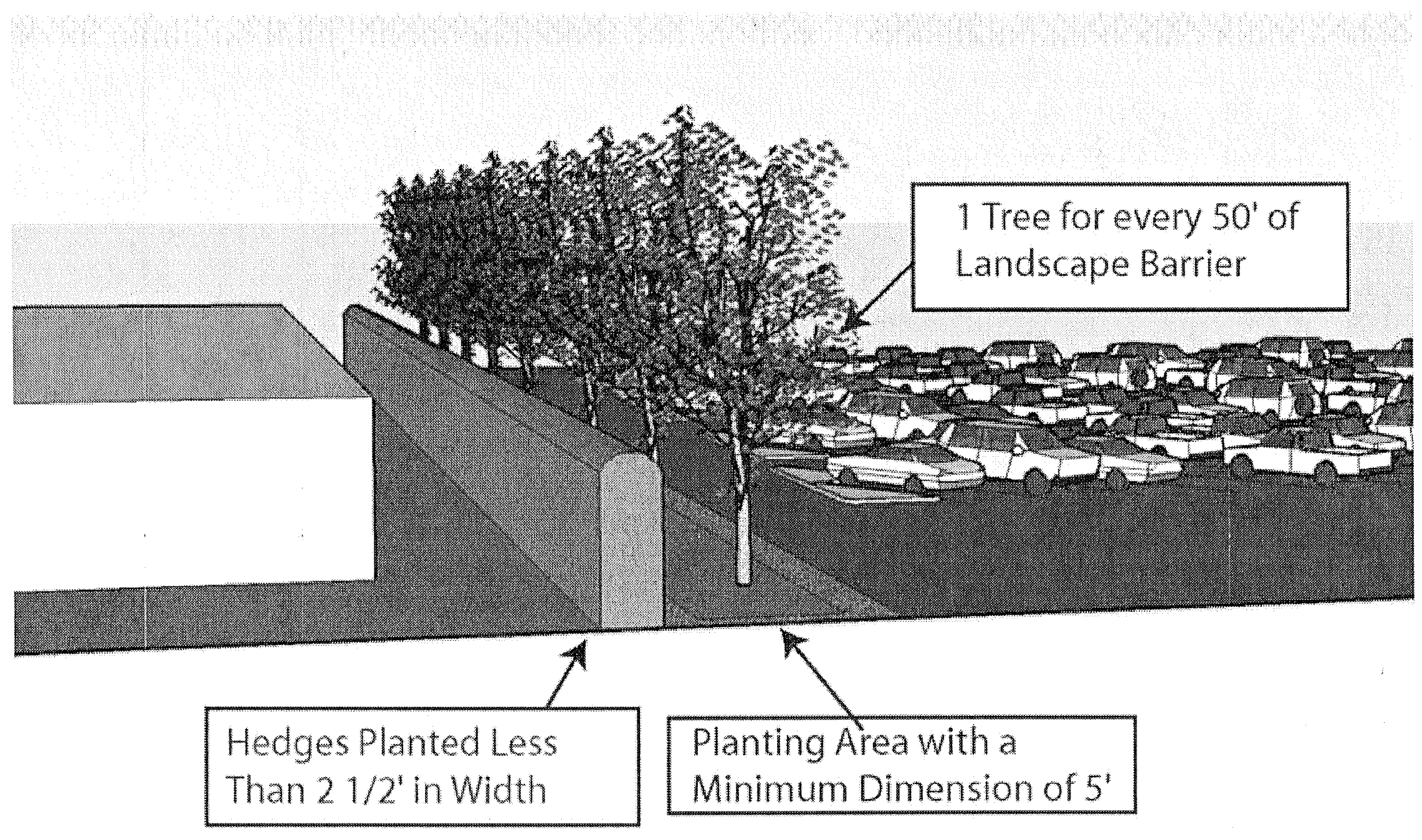
D. The provisions of this subsection shall not be applicable in the following situations:
1.Where a proposed parking area or other vehicular use area abuts an existing hedge, wall or other durable landscape barrier on an abutting property, said existing barrier may be used to satisfy the landscape barrier requirements of this section provided that said existing barrier meets all applicable standards and protection against vehicular encroachment is provided for the hedges.
2.Where the abutting property is zoned or used for nonresidential uses, only the tree provision with its planting area as prescribed in this subsection shall be required; however, the number of trees may be reduced to one (1) tree for every one hundred twenty-five (125) lineal feet or fraction thereof.
(Ord. No. 1278, § 1(exh. 1), 4-28-09)
Sec. 5-1207. - Protection of solar access.
A. The proposed landscape plan by its approval shall not result in the shading of a solar collector.
B. In choosing the species of trees and other vegetation, and the placement planting of such vegetation, the effect on existing or future solar access of neighborhood properties must be considered.
(Ord. No. 1278, § 1(exh. 1), 4-28-09)
Sec. 5-1208. - Required landscaping for off-street parking adjacent to public rights-of-way.
In multifamily and nonresidential districts, on the site of an off-street parking area or other vehicular use area, where such area will not be entirely screened visually by an intervening or structure from any abutting right-of-way, there shall be provided landscaping between such area and such right-of-way, as follows:
A. Off-street parking and vehicle use areas in multifamily and nonresidential districts abutting a public right-of-way shall be landscaped as follows:
1. A landscape buffer of at least five (5) feet in width parallel to the public right-of-way planted with grass, ground cover or other permeable landscape treatment.
2. One (1) tree for each thirty (30) lineal feet of landscape buffer.
3. A hedge, wall or other durable landscape barrier shall be installed between the parking area and the landscape buffer. If the barrier is of nonliving material, the barrier shall be planted with shrubs or vines along the right-of-way side of the landscape buffer or along the non-right-of-way side if the shrubs or vines are of sufficient height to be visible above the landscape barrier.
4. These requirements are in addition to any other requirement listed in this division and as shown in the following picture.
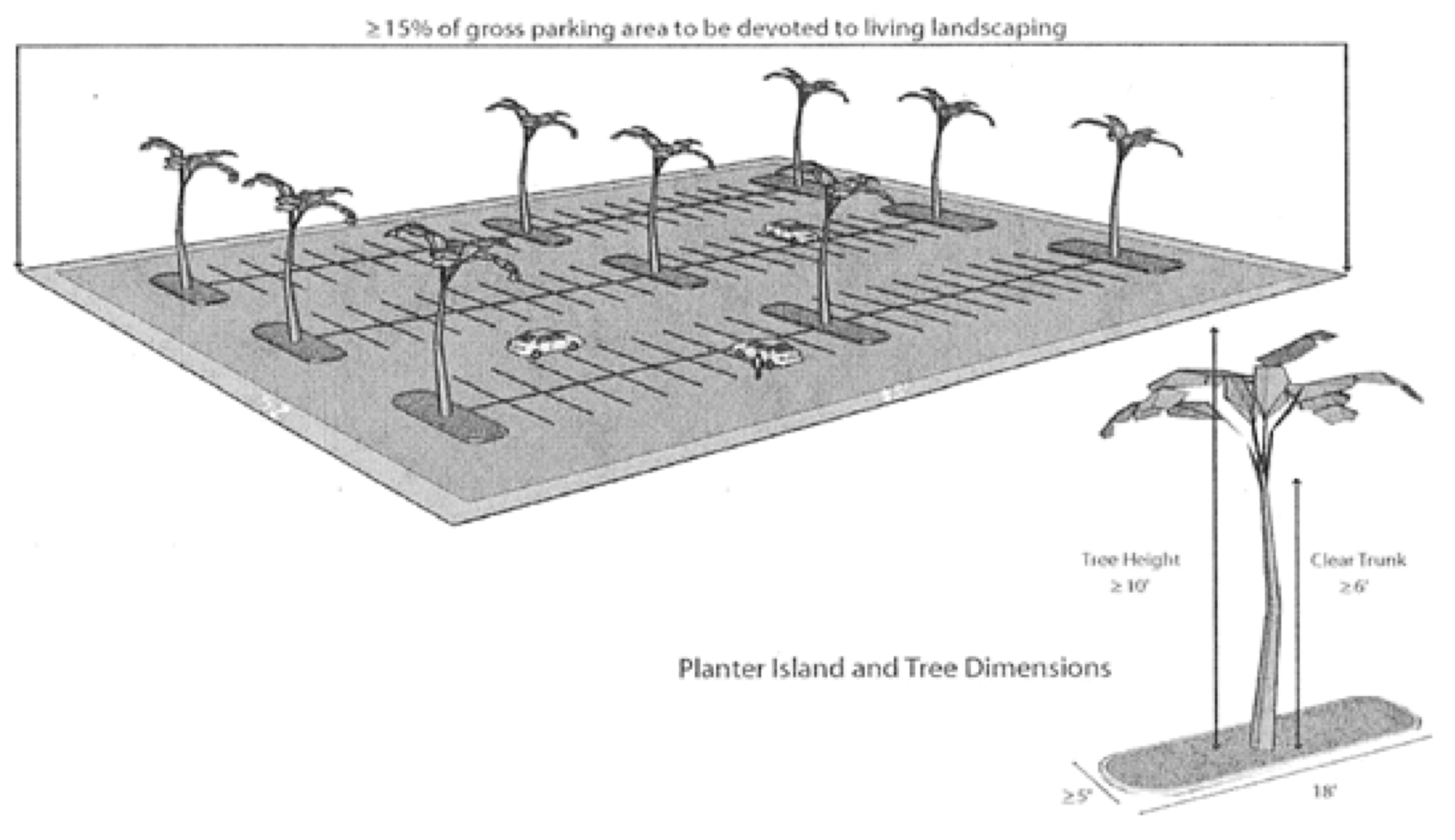
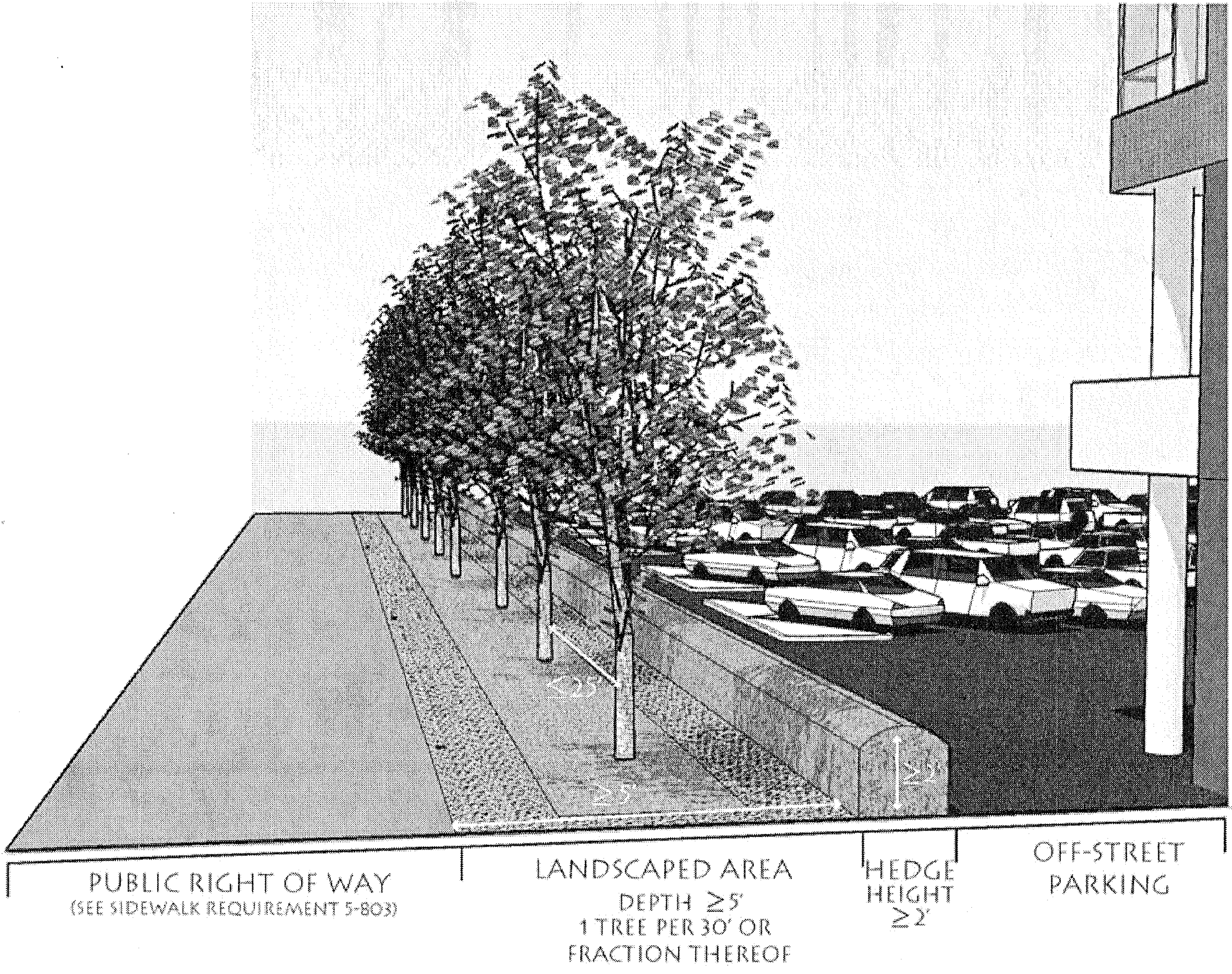
B.Necessary accessways from the public right-of-way through all such landscaping shall be permitted to service the parking or other vehicular use areas and such accessways may be subtracted from the lineal dimension used to determine the number of trees required.
(Ord. No. 1278, § 1(exh. 1), 4-28-09)
Sec. 5-1209. – Fences, walls and hedges; safety barriers for swimming pools.
A. Public safety. No fence, wall or hedge shall be constructed or maintained within three feet of a fire hydrant, water connection, or other emergency apparatus placed for the purpose of fire protection. Fences, walls or hedges shall not be placed within the area required by applicable fire and life safety codes to be clear and unobstructed for passage of emergency vehicles or for the ingress and egress of persons or animals.
B. Permits required. All fences, walls, or hedges shall comply with appropriate zoning clearance and building permit procedures. A certificate of occupancy or certificate of use shall not be issued until all required fences, walls, or screening hedges are erected, constructed, or installed.
C. Location on property lines. Except as hereinafter restricted, all walls, fences or hedges may be placed on the property lines. This section, however, shall not be construed to permit such walls, fences to extend beyond the official right-of-way lines or property lines. In addition, no fence, wall, gate, or opening shall be permitted to swing, roll or otherwise encroach into the right-of-way
D. Maintenance. All fences and walls shall be maintained in a safe and nonhazardous condition and in good appearance. Walls and fences, unless of natural materials or galvanized, shall be properly painted.
E. Special fence prohibitions.
1. No barbed wire, spike and/or spears, broken glass, electrical elements, exposed sharp projections, or other hazardous materials shall be maintained as a fence or part of a fence or wall, except as provided in this section. The top surface of any chain link or cyclone fence shall be crimped to eliminate the exposure of sharp edges. All other use of barb wire, electrical elements or other hazardous materials shall only be allowed after special exception approval in the M-1 district as set forth herein.
2. No fence or wall in any zoning district may be used to store or hang items such as, but not limited to: laundry, towels, sheets, rags, clothing or similar items. Fences and walls shall be solely for the demarcation and separation of properties for privacy and use purposes.
F. Construction. All fences and walls shall be constructed in compliance with the Florida Building Code. No fence or wall shall be constructed of materials that will be hazardous to the health, safety or welfare of persons or animals. All masonry walls shall be constructed and maintained with a finish of stucco and paint on all external portions and all such inside portions as are observable from rights-of-way or from abutting property.
G. Encroachment on recorded easement. No fence, wall or other similar structure may be constructed within an identified and duly recorded easement unless the property owner has:
1. Obtained a written, notarized release from all public agencies or utility entities having rights to the easement; or
2. Obtained a written, notarized release from all private interests and parties having rights to the easement; and
3. Submitted a notarized letter to the city’s attention and acknowledging that should access or improvements to infrastructure be necessary on the property, the property owner will assume all responsibilities for costs incurred to obtain access to the easement area (which may include removal of the fence, wall or other similar structures) and the property owner shall be responsible for the full restoration of the area - all at property owner’s sole cost. Such letter shall hold harmless the city, its officials and agents, as well as all other officials or agents of governmental agencies and public utilities, or any private party interest having a right of access to such easement.
H. Chainlink fence prohibited in all districts front yards, side yards and side street yards. Notwithstanding anything in the LDRs to the contrary, chain link fences shall be permitted only behind the rear building line, and shall not be permitted along property lines abutting side streets or on through (double frontage) lots. It is provided, however, that the aforementioned restriction on chain link fences shall not apply in the M-1 district.
I. Wall or fence required between dissimilar land uses. Where dissimilar land usesabut to or are adjacent to each other, a six-foot-high wall or fence meeting the approval of the community planning and development director shall be provided along common property lines, except for dissimilar land uses that are separated by a right-of-way. Where an adjacent or abutting property is undeveloped land, said wall shall be not be required until such time the unimproved land is developed. In this event, the requirement of the wall shall be borne by the developer of the unimproved land.
J. Height between different districts. Notwithstanding any provision in this division to the contrary, where an R-1 or R-2 district abuts another district, a fence, wall or hedge on the R-1 or R-2 property may be erected, or maintained on the common property line of the height permitted in the abutting district.
K. Increase and decrease of height. Fence, wall, and hedge heights shall be increased, or decreased for compliance with the following:
1. Double frontage lots. When a higher wall, fence or hedge is required as a visual screening buffer at the rear of double frontage lots as set forth in this division, such fence or wall may be increased to a height of eight (8) feet, if not otherwise permitted in the underlying zoning district.
2. Height at intersection. Fences, walls, or hedges shall not exceed two and one half (2½) feet in height within the safe sight distance triangle, as defined in this division.
3. Height limitation. The height of fences, walls, and hedges shall not exceed two and one half (2½) feet in height within ten (10) feet of the edge of driveway leading to a public right-of-way, except that in the R-1 or R-2 district, a fence may be permitted up to the maximum permitted height providing such fence is a maximum twenty-five (25) percent opaque, and no other structures or portions of the fence or wall interferes with the safe distance visibility triangle.
4. Fences for tennis courts; fences and walls for other recreational uses. Fences, and walls for tennis courts may be erected up to fourteen (14) feet in height, if such fence conforms to accessory use setbacks. Fences and/or walls in connection with other permitted recreational uses, such as baseball backstops, handball courts, and the like, shall be permitted of a height necessary for the particular use if required accessory use setbacks are observed.
L. Exterior finish of wooden fences and walls. When a wooden fence is installed, the wrong or unfinished side shall not face the adjoining property. When a CBS wall is installed, it shall be completely finished with stucco and paint. Each side of a decorative masonry wall shall be completely painted. If a wall is to be placed on a shared property line, consent for access must be obtained from the adjoining property owner prior to finishing the opposite side of the wall. If such consent cannot be obtained, the property owner erecting the wall must present proof that a request for access approval was mailed to every adjacent property owner, by certified mail, return receipt requested, to the mailing addresses as listed in the most current county tax roll, and the mailing was returned undeliverable or the adjacent property owners failed to respond to the request within thirty (30) days after receipt. Upon such a showing, the property owner erecting the wall shall not be required to finish the opposite side of the wall.
M. Measuring height of wall, fence, and hedge. The height of a wall, fence or hedge shall be the vertical distance measured from the finished grade of the lot or from the average elevation of the finished building site to the top of the wall, hedge or fence. The average elevation shall be measured along both sides of the wall, hedge or fence line. Vacant or undeveloped land may not be increased or decreased to affect the permitted (or required) height of a wall, hedge or fence unless the entire building site is graded to even out the level of the site or to increase it to the required the city flood criteria elevation. Average elevation shall be determined by taking elevations along both sides of the wall, hedge or fence line, at five-foot intervals and totaling the same and then dividing the total by the number of stations at which the elevations were taken. No fence or wall may be placed on any portion of an earthen mound or berm unless the height of the fence or wall is cumulatively not higher than the allowable height in the zoning district from the finished grade of the lot. Decorative columns, or other types of architectural features shall not be measured as the fence or wall height provided said decorative columns or other types of architectural features do not exceed twenty (20) percent of the permitted height of the fence or wall.
N. Temporary construction fences. All temporary construction fences used at construction or development sites, may, at the discretion of the community planning and development director, be exempt from the height, opacity and landscaping provisions of this division, provided that they do not obstruct the vision of motor vehicle operations, in accordance with the sight triangle provided herein or create other hazards to public safety.
Sec. 5-1210. - General standards for residential and residential office districts, nonresidential districts, safety barriers for swimming pools, and barbed wire.
A. Minimum standards for fences or walls in residential and residential office districts. All fences or walls in the residential or residential office district shall be subject to the following minimum requirements:
1. Opaque fences or walls. Completely opaque fences or walls exceeding three (3) feet in height shall be prohibited in the required front yard setback. Opaque fences or walls shall be allowed in the required rear yard, side yard, or side street setback not exceeding six (6) feet in height and subject to the safe sight distance triangle requirements set forth in section 5-1211.
2. Side yard and rear yard setbacks. No fence or wall shall exceed six (6) feet in height within the required side and rear yard setbacks.
3. Front yard setbacks. In all single-family residential districts, no fence or wall shall exceed five (5) feet in height within the required front yard; provided however, that decorative arches for gates and driveway gates may extend twelve (12) inches above the approved fence and post exteriors are permitted six (6) inches above the approved fence.
4. No chain link except in rear yard.
5. All fences must be of a decorative design.
6. In all multifamily residential districts (excluding townhouse developments) no fence or wall shall exceed six (6) feet in height within the required front yard.
B. Fences or walls in nonresidential districts shall be subject to the following minimum requirements:
1. Screening adjacent to residential properties. A six-foot-high masonry wall shall be required on all nonresidential properties with a side or rear lot line abutting or separated by a public right-of-way from residentially zoned property. The wall shall be subject to the vision clearance requirements set forth in this division.
2. Outdoor storage. All permitted outdoor commercial or industrial storage shall be visually screened from public view by an opaque fence or masonry wall of eight (8) feet in height and shall be without openings, except entrance and exit. Any gate/opening shall be of an opaque material providing screening of interior properties’ content from public view. In no case shall the items stored project above the fence or wall.
3. All fences and walls in nonresidential districts shall be harmonious in color, type and material with adjacent architecture and lots. The community planning and development director may approve the installation of a fence with the “wrong side” (post side) facing the adjacent or affected properties if the applicant obtains notarized approval letters from all adjacent or affected property owners.
4. Wood and chain link fences in commercial districts. All fence posts shall face the property upon which the fence is erected. All chain link fences shall be installed with the knuckled side up and shall be plastic coated. All straps, for chain link fences, shall be consistent in color with the color of the principal structure and be maintained in good condition and not weathered, cracked or faded.
5. Nonresidential districts maximum height. In all non-residential districts, no fence or wall shall exceed eight (8) feet in height, except that for commercial properties that abut single family neighborhoods no fence or wall may exceed six (6) feet in height.
C. Required safety barriers for swimming pools.
1. Required for final inspection of pool. No final inspection and approval for a swimming pool shall be given by the building services department, unless there has been erected a safety barrier as hereinafter provided. No pool shall be filled with water unless a final inspection has been made and approved, except for testing purposes as may be approved by the community planning and development department.
2. Types permitted. The safety barrier shall take the form of a screened-in patio, a wooden fence, a wire fence, a rock wall, a concrete block wall or other materials, so as to enable the owner to blend the same with the style of architecture planned or in existence on the property.
3. Height. The minimum height of the safety barrier shall be not less than four (4) feet.
4. Location of barrier. The safety barrier shall be erected either around the swimming pool or around the premises or a portion thereof on which the swimming pool is erected. In either event, it shall enclose the area entirely, prohibiting unrestrained admittance to the enclosed area. Pools located in enclosed structures or on the roofs of buildings shall not require the installation of barriers as required herein.
5. Gates. Gates shall be of the spring lock type, so that they shall automatically be in a closed and fastened position at all times. Gates shall also be equipped with a safe lock and shall be locked when the swimming pool is not in use.
6. Permits required. Before any work is commenced, permits shall be secured for all swimming pools and for the safety barriers. Plans shall contain all details necessary to show compliance with the terms and conditions of this chapter. No swimming pool permit shall be issued unless simultaneously therewith a permit is secured for the erection of the required safety barrier, provided however, that in lieu of the permit for a safety barrier, a written statement from the owner certifying that he understands and agrees that the pool cannot be used or filled with water until a permit has been obtained for an approved safety barrier and such barrier erected, inspected and approved will be acceptable. This certification, however, will not eliminate the need for obtaining a permit and erecting an approved barrier prior to final inspection and use of the pool. If the premises are already enclosed, as hereinbefore provided, permit for the safety barrier shall not be required, if, upon inspection of the premises, the existing barrier and gates are proven to be satisfactory.
7. Wooden fences. In the wooden type fence, the boards, pickets, louvers, or other such members, shall be spaced, constructed, and erected, so as to make the fence nonclimbable and impenetrable.
8. Walls. Walls, whether of the rock or block type, shall be so erected to make them nonclimbable.
9. Wire fences. Wire fences shall be the two-inch chain link or diamond weave nonclimbable type, or of an approved equal, with top rail, they shall be of a heavy, galvanized material.
10. Refusal of permit. It shall be within the discretion of the community planning and development director to deny a permit application for a safety barrier, which does not meet the safety requirements of this section.
11. Maintenance. It shall be the responsibility of the owner and/or occupant of the premises upon which the swimming pool is hereafter erected to maintain and keep in proper and safe condition the safety barrier required and erected in accordance with this division.
D. Barbed wire.
1. General.
a. A one-foot-high, nonelectrical, barbed wire extension may be allowed in addition to the maximum allowable height through special exception approval in the M-1, district.
b. The installation of security wire other than linear-strung barbed wire is prohibited.
c. No barbed wire or other form of security wire shall be permitted in any yard abutting a residential use or street abutting a residential use.
d. If installed, the barbed wire shall be maintained as originally installed.
2. Standards.
a. The merchandise or items to be protected are of such a nature that other means of secured storage are not feasible.
b. No other practical alternatives exist.
c. The incidence and type of crime (if any) indicates the use of security wire may be a reasonable safety measure.
d. The area to be enclosed by the barbed wire is reasonable in terms of the total property area.
e. The proposed method of installation will not result in encroachment upon adjacent property or right-of-way.
f. The distance of the barbed wire from ground level is sufficient for the protection of passersby.
Sec. 5-1211. – Safe sight distance triangle.
A. Safe sight distance triangle. The safe sight distance triangle area shall not contain obstructions to cross-visibility at a height of two and one half (2 ½) feet to seven (7) feet above grade, in order to minimize traffic hazards at street or driveway intersections. Potential obstructions include, but are not limited to, structures, grass, ground covers, shrubs, vines, hedges, trees, rocks, walls and fences.
B. The following table represents minimum criteria for determining the required area of cross-visibility:
| Safe Sight Distance Triangle | |||
| Required Visibility | |||
| Functional Classification of Through Street | Left (ft.)* | Right (ft.)* | Depth on Minor Street (ft.)** |
| Local | |||
| (50-foot or less right-of-way) | (triangle lies within public right-of-way) | ||
| Collector | 190 | 40 | 7 |
| (60-foot—70-foot right-of-way) | |||
| Arterial | 260 | 40 | 7 |
| (80-foot or over right-of-way) | |||
C. Visibility distances measured from center line of minor street, along right-of-way line of through street.
D. Depth visibility on minor street measured from right-of-way line of through street, along center line of minor street (public or private street).
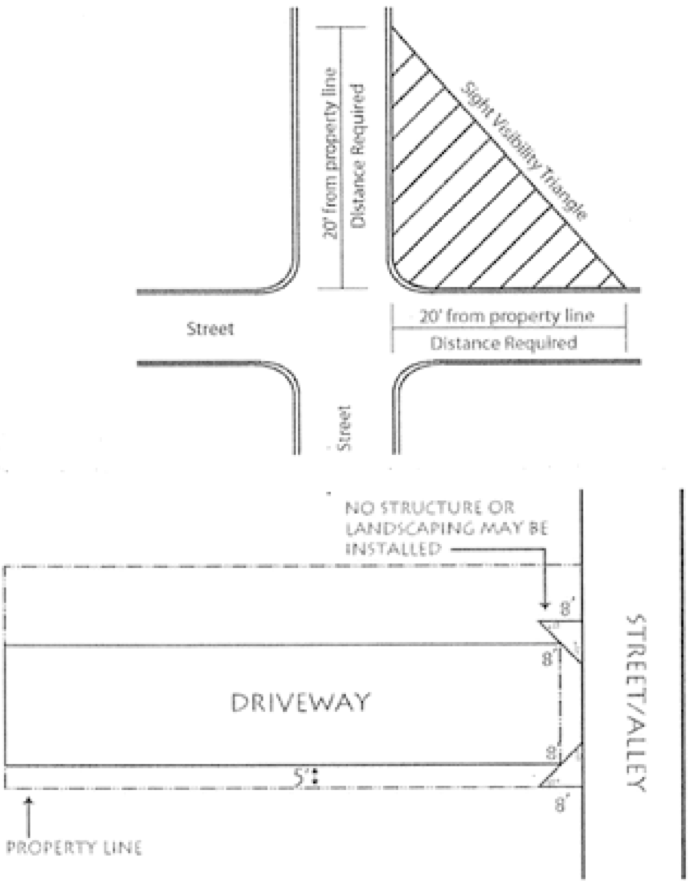
Sec. 5-1301. - Purpose.
The purpose of this division is to establish minimum standards for the provision and use of outdoor lighting in order to provide for the safe and secure night time use of public and private property while at the same time protecting adjacent land uses from intrusive light conditions.
(Ord. No. 1278, § 1(exh. 1), 4-28-09)
Sec. 5-1302. - Site lighting.
All outdoor lighting, other than outdoor recreational facility and street lighting, shall comply with the following requirements:
A. Fixture-type. All light fixtures which are visible from the boundaries of the parcel of land, other than fixtures which are designed and installed to illuminate a wall and are directed away from adjacent properties, shall be cut-off lights where direct illumination is cut-off above forty (40) degrees below horizontal.
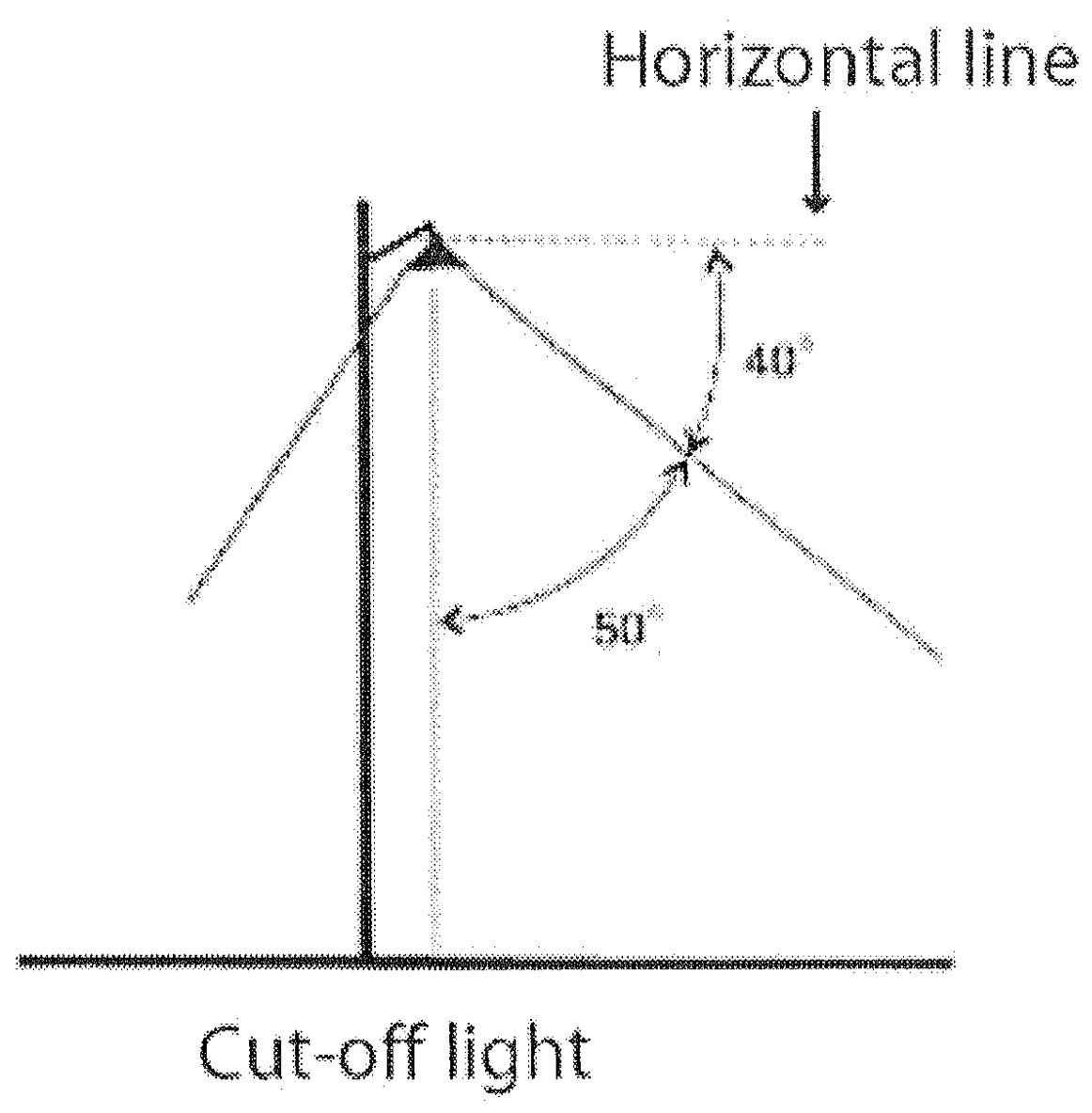
B. Location. All outdoor light fixtures shall be located so that objects or land which are located beyond the boundaries of the parcel of land are not illuminated to an extent of producing more than a diffuse shadow.
C. Height.
1. Cut-off fixtures. The height of the lamp in a light fixture shall not exceed thirty-five (35) feet, or one (1) foot in height for each one (1) foot the light fixture is setback from the setback in subsection B., whichever is less.
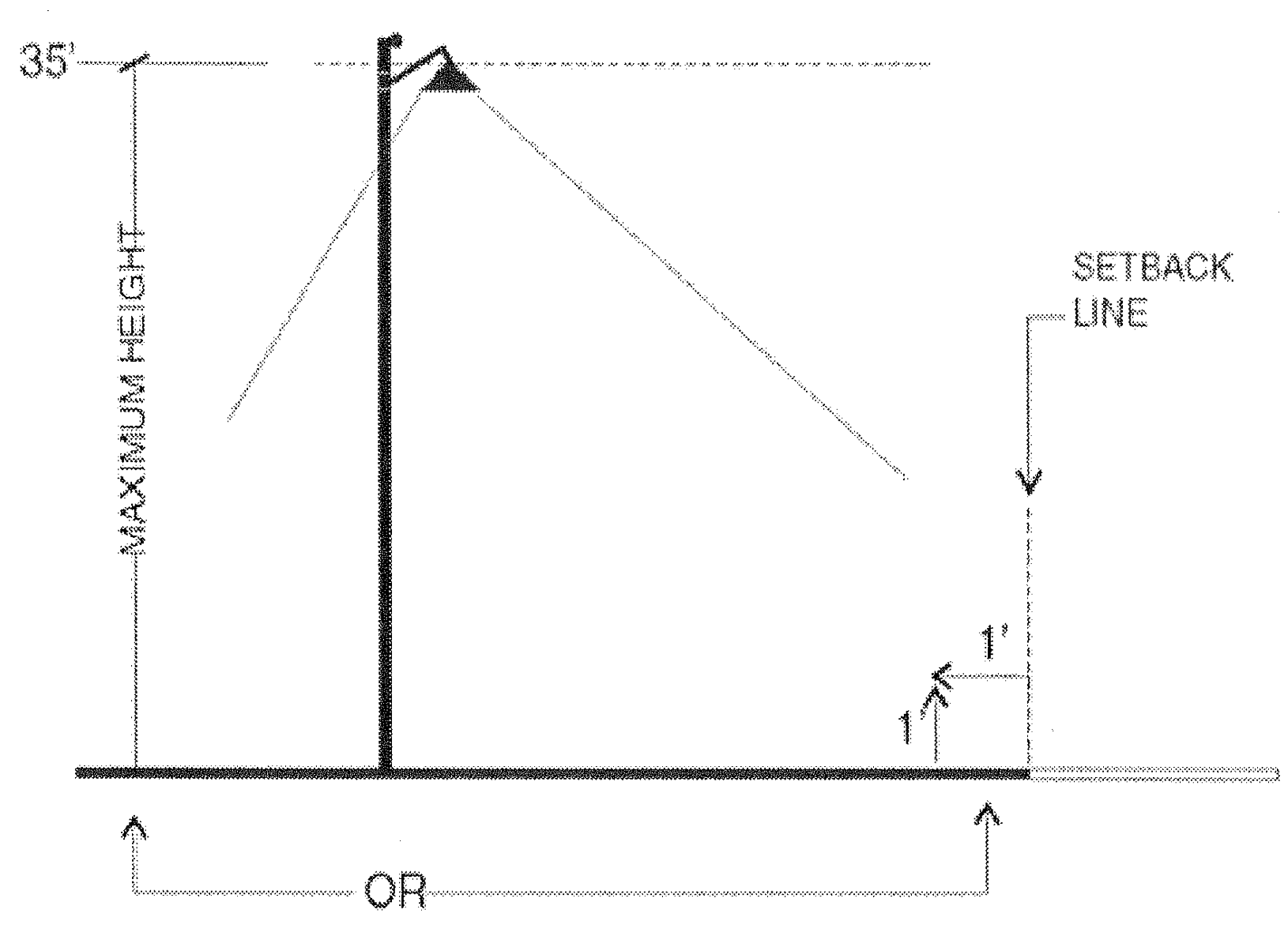
2. Down-lights. The height of a down-light shall not exceed eighteen (18) feet or two-thirds (2/3) of the height of the structure or tree which is being downlighted, whichever is less.
3. Up-lights. The height of the lamp in an up-light light fixture shall not exceed eighteen (18) feet or one-half (½) of the height of the structure or tree which is being uplighted, whichever is less.
(Ord. No. 1278, § 1(exh. 1), 4-28-09)
Sec. 5-1303. - Outdoor recreational facility lighting.
A.Orientation. All outdoor recreational facility lighting shall be located as close as possible to the recreational facility to be lighted and the light from such fixtures shall be oriented, to the maximum extent possible, away from adjacent residential areas.
B.Operation. Outdoor recreational facility lighting installed at a recreational facility, located adjacent to residential areas, shall be operated only when such facilities are in use and a period of one-half (½) hour before such use and one-half (½) hour after such use.
C.Location and intensity. Outdoor recreational facility lighting shall be located so that objects or land which are located beyond the boundaries of the parcel proposed for development are not illuminated to the extent of more than a diffuse shadow on the objects or land.
(Ord. No. 1278, § 1(exh. 1), 4-28-09)
Sec. 5-1304. - Adequate lighting of off-street parking.
A.Adequate lighting shall be provided of off-street parking areas for nonresidential properties and multifamily development over fifteen (15) units and shall be approved by the planning and community development department.
B.Except as provided in subsection C., adequate lighting is a combination of first class equipment during all nondaylight hours in compliance with the standards of the Illuminating Engineering Society of North America (IESNA) RP-33 and Crime Prevention Through Environmental Design (CPTED) standards.
C.Adequate lighting shall be maintained on parking areas adjacent to single-family only during the hours of operation of the use.
D.Parking lot lighting shall follow American Society of Heating, Refrigerating and Air Conditioning Engineers/Illuminating Engineering Society of North America (ASHRAE/IESNA) standards 90.1-2004, Section 9.4.4.
E.Landscaping shall be installed in a manner that does not interfere with the adequacy of the lighting of off-street parking areas.
(Ord. No. 1278, § 1(exh. 1), 4-28-09)
Sec. 5-1305. - Energy conservation/lighting.
All new construction and substantial renovations shall utilize new energy star qualified compact fluorescent light bulbs to the extent feasible.
(Ord. No. 1278, § 1(exh. 1), 4-28-09)
Sec. 5-1401. - General criteria.
A. Purpose and intent. The intent of this division is to ensure adequate and appropriately located off-street parking and loading, to avoid undue congestion on streets, to avoid unnecessary conflicts between vehicles and pedestrians, to preserve and enhance pedestrian activity areas within the city, and to facilitate vehicular access from public rights-of-way to off-street parking facilities.
B. General criteria. In all districts there shall be provided at the time any development is commenced, off-street parking spaces in accordance with the requirements set forth in this division.
C. Dimensional requirements.
1. All off-street parking spaces shall be 8.5 feet in width and 18 feet in depth, unless modified in the table below based upon the angle at which the parking spaces intersect the drive aisle.
2. A minimum 25 feet spacing shall be required between the edge of pavement and an intersecting drive aisle or off-street parking space.
3. Dimensions for parking aisles and parking spaces for various angles of parking shall be as provided in figure 1 in this section. Two-way directional movement requires a minimum of 24 feet of wide aisle width regardless of parking angle and dimensions.
| General Parking Dimensions | ||||||
| A | B | C | D | E | F | G |
| Parking Angle | Stall Width | Stall Depth | Aisle Width | Curb Length | Half Bay | Full Bay |
| 8'6" | 8'6" | 12'0" | 22' | 20'6" | 29'0" | |
| 30 | 8'6" | 16'4" | 12'0" | 17'0" | 28'4" | 44'8" |
| 40 | 8'6" | 18'1" | 12'0" | 13'3" | 30'1" | 48'2" |
| 45 | 8'6" | 18'9" | 13'0" | 12'0" | 31'9" | 50'6" |
| 50 | 8'6" | 19'3" | 15'0" | 11'1" | 34'3" | 53'6" |
| 60 | 8'6" | 19'10" | 18'0" | 9'10" | 37'10" | 57'8" |
| 70 | 8'6" | 19'10" | 20'4" | 9'0" | 40'2" | 60'0" |
| 75 | 8'6" | 19'7" | 20'10" | 8'10" | 40'5" | 60'0" |
| 80 | 8'6" | 19'2" | 21'8" | 8'8" | 40'10" | 60'0" |
| 90 | 8'6" | 18'0" | 24'0" | 8'6" | 42'0" | 60'0" |
4. Tandem and valet parking dimensions. Where tandem and valet parking is provided towards required off-street parking or as additional parking, such parking areas shall conform to the dimensional standards set forth in the figure below. Except that the tandem parking stalls may be stacked no more than two spaces deep.
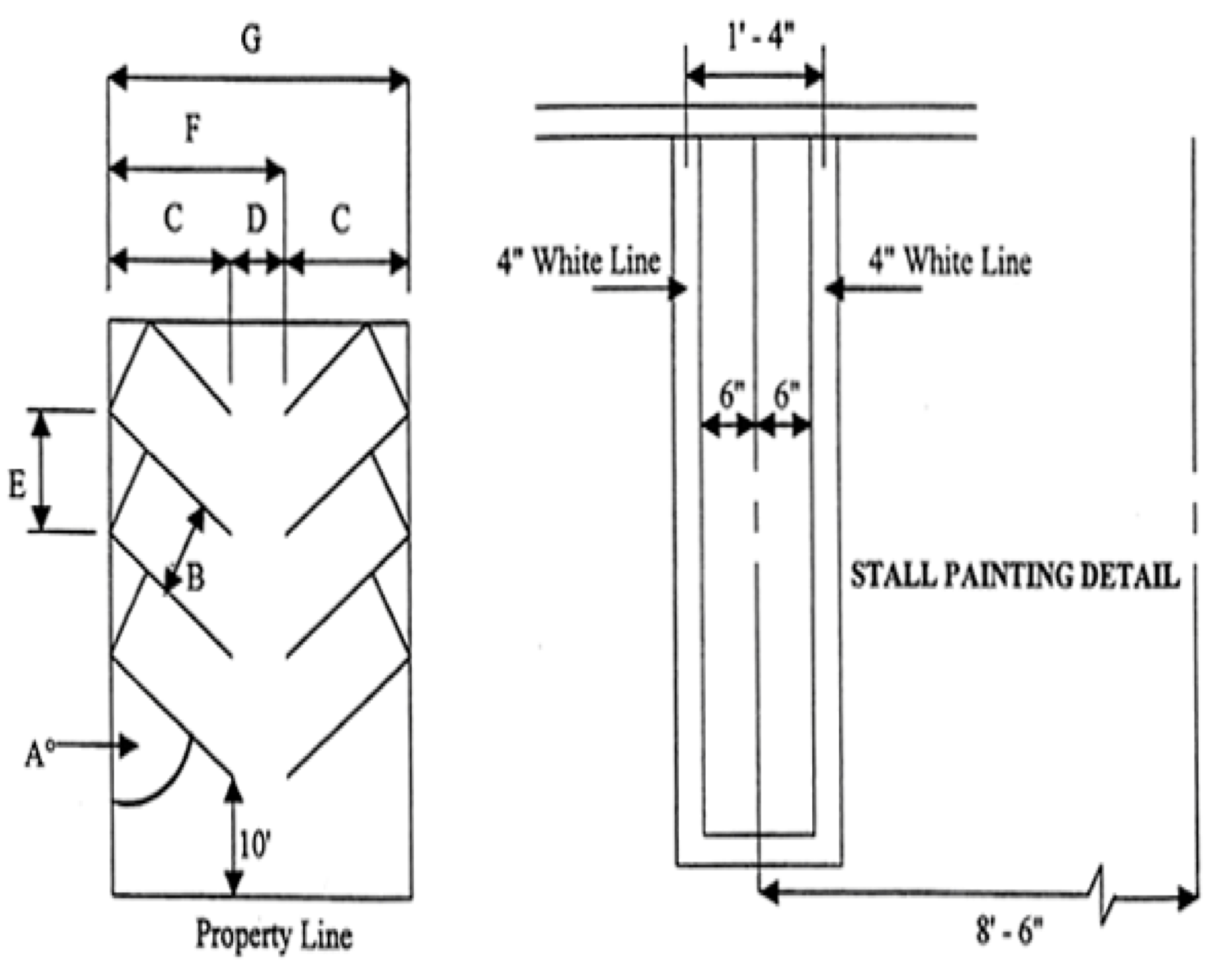
D. Number of parking spaces required. Except as provided in sections 5-1403 and 5-1404, the number of off-street parking spaces required shall be as set forth in the off-street parking schedule in section 5-1402.
E. Construction standards, markings and signage.
1. All parking areas shall be paved per requirements of the city public works department. It shall be a violation of this chapter to park on any unpaved areas as described in this division.
2. Markings and signage. Traffic control signs and pavement markings shall be used as necessary to ensure safe and efficient traffic operations within all parking and loading areas. Required off-street parking spaces shall be delineated by four-inch white double striped lines. All signs shall comply with the Manual of Uniform Traffic Control Devices Federal Highway Administration, United States Department of Transportation, 1978, as adopted by the state department of transportation, as revised.
3. Curbs, wheel-stops, or bollards: Precast concrete wheel-stops, or curbing shall be provided for all angled parking spaces that abut landscaped areas, pedestrian areas, buildings, or property lines, such that cars are curbed at sixteen and one-half (16.5) feet. The balance of the required depth of the parking spaces between the wheel stop or curb and the sidewalk shall be clear of obstructions. All landscaped areas in or adjacent to parking areas or other vehicular use areas shall be provided with type D curbing, or extruded curbing in combination with wheel stops, to restrict the destruction of the landscaped areas by vehicles. Bollards may be provided in lieu of wheel-stops or curbing, upon a determination by the DRC committee. Adequate scuppers and/or weep holes shall be provided to permit proper drainage, as required by the city
F. Storm drainage for parking and loading spaces. Off-street parking and loading spaces, for other than single-family residences and duplexes, shall be provided with drainage systems adequately designed and maintained as required by the following:
1. To prevent the accumulation of water from normal rainfall; and
2. To prevent the runoff of rainfall onto neighborhood property at rates greater than would result if the site were undeveloped. Drainage systems shall be designed in accordance with standards set forth in the city's public works manual and meeting the approval of the public works department.
3. Maintenance and good repair. All required off-street parking areas shall be maintained in good repair and shall be kept in a reasonably clean and sanitary condition free from rodents, insects and vermin.
4. Maximum front yard coverage for single-family residences. No single-family residential driveways or parking areas shall be paved more than sixty (60) percent of the front yard.
G. Parking area and lot screening. All parking areas shall contain adequate screening, as required by the city's landscaping regulations in article 5, division 12.
H. Location.
1. Off-street parking areas shall be located on the same lot, parcel or premises as the use to be served or on a parcel of land within six hundred (600) feet, provided there is a unity of title, or covenant in lieu of unity of title, between the parcel being served and the parcel on which such off-street parking is located, or provided that a parking agreement, in conformance with the provisions of section 5-1403, which ensures the availability of parking has met with the approval of the city manager and city attorney before being recorded in the public records of Miami-Dade County.
2. Parking in open space areas prohibited. Parking in areas for open space, landscaped areas, and lawns shall be prohibited.
I. Materials. Driveways and parking areas shall be composed of asphalt, pavers, permeable structured grass, gravel or concrete and not concrete strips.
1. Concrete strip driveways existing at the time of adoption of these LDRs for single-family dwellings shall be allowed to remain in perpetuity, provided that they are properly maintained.
2. Gravel parking surfaces shall be built with a permanent perimeter border consisting of suitable material. The border shall be a minimum of four (4) inches below the surface, with the width of the border being sixteen (16) inches immediately adjacent to the road perimeter, and four (4) inches along the entire length of both edges of the parking surface. Gravel driveways shall be level with the top of the adjacent sidewalk and street with slope downhill, away, so that gravel will not spread to these surfaces. To facilitate percolation over time and control weeds, use of a geotextile fabric as an underlayment is recommended. The community planning and development department will determine suitable border materials.
*Gravel material exception: Florida crushed limestone shall be permitted as long as the rock sizes are no larger than #78 stone/nominal size 1/2” diameter (reference Florida Department of Transportation Standard Specification Section 901-1 Aggregate).
J. Access. All driveways to parking lots shall be designed in accordance with the following:
1. Except as provided for corner lots or in subsection 3. hereof, driveways shall be setback from the side property line at least five (5) feet.
2. Except as provided for corner lots, an administrative variance may be obtained for a setback from the side property line of two and one-half (2.5) feet provided that the driveway is composed of pervious materials.
3. No driveway shall be located closer than fifteen (15) feet to the corner, or as measured in accordance with standards of the public works department.
4. Adjacent nonresidential properties shall provide a cross access drive and pedestrian access to allow circulation between sites wherever feasible.
5. All driveways shall be constructed in accordance with the engineering standards of the public works department.
K. Configuration of parking and loading ingress and egress.
1. Ingress to and egress from parking and loading spaces shall be provided in either of the following ways:
a. Ingress and egress from parking and loading spaces shall be provided by means of clearly defined drives which lead from public rights-of-way to clearly defined maneuvering lanes which in turn provide access to individual parking or loading spaces. Configurations which require backing directly onto a street, excluding alleys, from a parking or loading space are prohibited except as provided in section 5-1408(B). There shall be a minimum of ten feet separation between all access drives. The separation shall be measured along the curb line.
b. Ingress and egress from parking stalls may be provided directly from public alleys. If existing alley width does not comply with minimum aisle requirements, additional parking space aisle or setbacks shall be required as indicated in subsection C of this section.
2. Common vehicular access points.
a. Applicability. The community planning and development director, in conjunction with the recommendation of the development review committee, may require the provision of common vehicular access points between abutting lots or tracts when all of the following criteria are met:
(1) The proposed use is nonresidential.
(2) The lot or tract has frontage on a street classified as an arterial or collector in the traffic circulation plan element of the comprehensive development master plan.
(3) The provision of common vehicular access points and related common access ways will help mitigate future adverse transportation impact of the proposed use upon traffic safety and vehicular operating capacity of the major thoroughfare in question.
(4) The existing or anticipated land uses adjacent to the lot or tract in question are generally of a similar or compatible character to the proposed use of the lot or tract in question.
(5) The provision of common vehicular access points between lots or tracts is not impractical due to the configuration of existing buildings, structures or other related circumstances.
3. Design of common vehicular access points. When common vehicular access points are required, the following design criteria shall apply:
a. Common vehicular access points shall provide two-way traffic circulation to accommodate a 12-foot-wide access way in each direction.
b. Common vehicular access points should be located between the parcel line with frontage on the major thoroughfare and the required front yard building setback or base building line, whichever is greater.
c. Stub-outs and other design features shall be provided to the parcel line in question in order to tie together on-site vehicular traffic circulation of abutting properties.
d. Off-street parking, common vehicular access ways and related facilities shall be arranged in a manner that coordinates on-site vehicular circulation between abutting lots and tracts.
4. Submittal of draft common vehicular access point agreement. When a common vehicular access point agreement is required, a draft copy of such agreement, easement or other similar instrument shall be submitted with a proposed site plan or a proposed tentative plat, whichever is applicable.
5. Recording and evidence of common vehicular access point agreement. All common vehicular access point agreements, easements or other similar legal instruments required by the provisions of this schedule shall be recorded in the public records of Miami-Dade County. A notarized copy of such recorded agreement, easement or instrument shall be provided to the community planning and development department prior to the issuance of a building permit or certificate of completion.
6. Identification of common vehicular access point agreements on official zoning map. Upon receipt of evidence of common vehicular access point agreement, the community planning and development department shall cause such agreement to be identified on the properties party to the agreement.
7. Temporary vehicular access points. When the lot in question is developed prior to an abutting lot, a temporary vehicular access point on a major thoroughfare may be approved provided, however, that a condition of approval of such temporary vehicular access point shall be removal of same when development of the abutting lot or tract provides common vehicular access and a coordinated system of on-site traffic circulation for both premises. The community planning and development director shall notify the owner of record of the lot in question by certified mail as to when the temporary vehicular access point shall be removed and any applicable conditions for its removal. The owner shall be responsible for all costs involved in removing the temporary vehicular access point.
L. Interior drives or aisles as specified above in this section, interior drives or aisles shall be a minimum of twelve (12) feet for one-way directional movement and a minimum of twenty-four (24) feet for two-way directional movement, regardless of parking angles, in order to serve the arrangement of parking spaces.
M. Renovation or change of use. In the event a building is substantially renovated or a use is changed so that there is a substantial change in the intensity of use, additional parking shall be provided in accordance with the terms of this division to the maximum extent practical. A substantial change in the intensity of use shall be construed to be a twenty-five (25) percent increase in required parking and a substantial increase in retail and pedestrian activity.
N. Reduction in parking requirements.
1. Preferential parking is encouraged to promote sustainable practices and encourage a reduction in the number of vehicles needed to transport individuals to destinations. Buildings may dedicate ten (10) percent of their parking spaces to these modes of transportation which may include:
a. Hybrid vehicles;
b. Van pools;
c. Car pools.
2. In the event such preferential parking is provided, a ten (10) percent reduction in required parking may be allowed.
3. Exchanging vehicle parking spaces for bicycle facilities is encouraged to promote cleaner, more sustainable energy saving trips and is required pursuant to subsection 5-803G. Buildings may substitute bicycle accommodations for vehicle spaces on a five-to-one basis or two-to-one for motorcycle spaces.
4. In no instance shall the number of vehicle parking spaces provided be reduced pursuant to this subsection, or the TDM provisions in section 5-702 by more than fifteen (15) percent of the requirements of this division.
(Ord. No. 1278, § 1(exh. 1), 4-28-09)
Sec. 5-1402. - Schedule of required parking.
| USE | MINIMUM PARKING REQUIREMENT |
|---|---|
| Accessory dwelling | One (1) parking space. |
| Adult entertainment businesses | See "Retail." |
| Adult day care | One (1) space per three hundred seventy-five (375) s.f. of floor area. |
| Adult living facility | One (1) parking space per bedroom. |
| Auto service station | See "Retail." |
| Banquet | See "Community facilities." |
| Bar, lounge or tavern | One (1) space for every three hundred fifty (350) s.f. of gross floor area. |
| Beauty, barber shop and nail salon | 1/300 s.f. (retail). |
| Catering kitchen | See "Light industrial." |
| Check cashing store | See "Retail." |
| Childcare centers | One (1) space for two hundred (200) s.f. of gross floor area. |
| Community facilities | 1/200 s.f. |
| Community residential homes | One (1) per each 2 beds plus 1 per each 2 employees |
| Convention centers | One (1) parking space for each five (5) spectator seats, or one (1) parking space for each two hundred (200) s.f. of gross floor area, whichever is greater. |
| Country club | One (1) space per every four (4) members. |
| Day spa | One (1) parking space for each four hundred (400) s.f. of gross floor area. |
| Dry cleaning drop-off and pick-up | One (1) parking space per four hundred (400) s.f. of gross floor area. |
| Dry cleaning establishment (retail and plant) | One (1) parking space per four hundred (400) s.f. of gross floor area, plus one (1) per six hundred (600) s.f. of plant area. |
| Dry cleaning plant | One (1) per six hundred (600) s.f. of gross floor area. |
| Educational facilities | The greater of one (1) space per two hundred (200) s.f. of floor area. |
| Elderly Housing | One (1) space per dwelling unit (available only if 100% of the residents are 55 and over, as guaranteed through a deed restriction) |
| Family day care home | One (1) parking space per five hundred (500) s.f. of floor area. |
| Film studios | One (1) per six hundred (600) s.f. of gross floor area. |
| Fitness center | One (1) parking space per three hundred (300) s.f. of gross floor area. |
| Funeral homes | One (1) parking space for each one hundred (100) s.f. of chapel and/or parlor area. |
| Government uses | One (1) parking space for each three hundred (300) s.f. of gross floor area. |
| Gun shops | See "Retail." |
| Hospitals | Two (2) parking spaces for each bed. |
| Hotels | One (1) parking space for each guest room, cabin or rental unit, plus 1 (one) space per each one hundred (100) s.f. of banquet, assembly, meeting, and restaurant seating area. |
| Institutional uses | One (1) parking space for each four hundred (400) s.f. of gross floor area. |
| Light industrial and manufacturing | One (1) parking space per each three hundred (300) gross s.f. of office area, and showroom or retail space, if any, plus one (1) space per one thousand (1,000) s.f. of all other floor area. |
| Marinas | One (1) per eight (8) dry racks and one (1) per two (2) wet slips, plus such parking as may be required for accessory uses. |
| Mechanical car washing (stand-alone) | Four (4) nonstacking parking spaces plus stacking areas not obstructing vehicles ingressing or egressing the site. |
| Medical | One (1) parking space for each three hundred (300) s.f. of gross floor area. |
| Mixed use | See section 5-1403. |
| Movie theaters | One (1) parking space for each four (4) fixed seats. |
| Museum | One (1) space for every three hundred (300) s.f. of gross floor area devoted to office or retail space, plus one (1) space for every three hundred (300) s.f. of gross floor area. |
| New car rental/vehicle rental | One (1) space per three hundred (300) s.f. of gross floor area, plus one (1) per rental vehicle. |
| Nightclubs | Five (5) parking spaces plus one (1) parking customer space for each fifty (50) s.f. of floor area of customer service area. |
| Nursing and convalescent homes | One (1) parking space per bedroom. |
| Offices | One (1) parking space for each three hundred (300) s.f. of gross floor area. |
| Radio or TV stations | One (1) parking space per each six hundred (600) gross s.f. of office area. |
| Recreation, indoor | For bowling alleys, two (2) parking spaces for each bowling lane. For other indoor recreation uses, one (1) space per three hundred (300) s.f. of floor area |
| Recycling machines | No spaces required. |
| Religious institutions | One (1) space for one hundred (100) s.f. of gross floor area. |
| Research and technology uses | One (1) per three hundred (300) s.f. office floor area plus one (1) space per one thousand (1,000) s.f. of all other floor area. |
| Residential: single-family | Two (2) spaces per dwelling unit. |
| Residential: multifamily | One and one-half (1.50) spaces per dwelling unit plus five (5) percent of total required parking for guest parking. |
| Restaurants; restaurants, fast-food (with indoor dining) | One (1) space for each one hundred fifty (150) s.f. of gross floor area. No additional parking required for outdoor dining. |
| Retail sales and services | One (1) parking space for each three hundred (300) s.f. of gross floor area. |
| Schools, elementary | See "State requirements for educational facilities (Florida State Board of Education 2008)." |
| Schools, junior and senior high | See "State requirements for educational facilities (Florida State Board of Education 2008)." |
| Schools, special and technical | One (1) for each two hundred (200) s.f. of gross floor area. |
| Self-service laundry facilities | One (1) space per three (3) washers plus one (1) space. |
| Self-storage facilities | One (1) parking space per five thousand (5,000) s.f. of gross floor area, for the first twenty thousand (20,000) square feet of building; one (1) parking space per ten thousand (10,000) square feet (or fraction thereof) of building area thereafter. One (1) parking space per four hundred (400) square feet of gross office area (or fraction thereof) shall also be provided. |
| Sound recording studios | One (1) space for each six hundred (600) s.f. of gross floor area. |
| Vehicle rental | One (1) space per three hundred (300) s.f. office floor area plus one (1) space for each vehicle to be rented. |
| Vehicle sales/displays | One (1) space per three hundred (300) s.f. office and customer floor area, plus one (1) space per seven hundred (700) s.f. showroom floor area, plus one (1) space per five hundred (500) s.f. of all other floor area. |
| Vehicle sales/displays, major | One (1) parking space per each three hundred (300) gross s.f. of office and customer floor area, plus one (1) parking space for each one thousand (1,000) s.f. of remaining gross building area. |
| Vehicle service, major | One (1) space per three hundred (300) s.f. office and customer floor area, plus one (1) space per seven hundred (700) s.f. of all other floor area. |
| Veterinary clinics, animal boarding and grooming | One (1) space per three hundred (300) s.f. of floor area. |
| Warehouses | One (1) space per three hundred (300) s.f. of office floor area, plus one (1) space per one thousand five hundred (1,500) s.f. of all other floor area. |
(Ord. No. 1278, § 1(exh. 1), 4-28-09)
Sec. 5-1403. - Shared parking.
A. General. Shared parking occurs when one or more required parking spaces are shared by more than one use. Shared parking may be proposed in conjunction with development approval and shall comply with the methodologies and standards set forth herein. Single-family residential. Single-family residential uses shall not be eligible for shared parking.
B. Methodology. The determination of the required number of parking spaces for a specific use under an approved shared parking program shall be based upon the minimum required parking spaces set forth in section 5-1402. The methodology for calculating the required parking for a use under a shared parking program shall be as follows:
1. Multiply the minimum parking requirement for each individual use, as provided in section 5-1402 by the appropriate percentage in this section for each of the five designated time periods.
2. Add the resulting sum for each of the five vertical columns in the table.
C. Minimum requirement. The minimum requirement for shared parking is the highest sum among the five columns resulting from the calculation in subsection (b)(1) of this section.
D. Shared parking shall not result in a reduction of more than 25 percent from the minimum parking required without shared parking.
E. Parking spaces that are reserved for use by specified individuals, classes of individuals or specified businesses shall not be counted toward meeting shared parking requirements.
F. Reserved parking for the disabled shall not be counted towards meeting shared parking requirements.
G. Shared parking agreement. The owner or owners of record of a property for which shared parking is requested shall be responsible for preparing a written agreement between the owners of the properties sharing parking, indicating the terms under which the shared parking shall be used. The agreement shall be approved by the city attorney and the community planning and development department, and shall be recorded in the county official records. The owners of record shall update the shared parking agreement to address any change in the uses identified in the agreement which would cause an increase in peak parking demand, or a finding of any other related change in conditions by the city. The modified agreement shall be subject to the review and approval of the city attorney and the community planning and development department.
H. Percent Demand for Parking by Use and Time of Day.
| Night | Weekday | Weekend | |||
| Uses | 12:00 a.m.—7:00 a.m. | 7:00 a.m.—6:00 p.m. | 6:00 p.m.—12:00 a.m. | 7:00 a.m.—6:00 p.m. | 6:00 p.m.—12:00 a.m. |
| Residential | 100% | 60% | 90% | 80% | 90% |
| Office/Industrial | 5% | 100% | 10% | 10% | 5% |
| Commercial/Retail | 5% | 70% | 90% | 100% | 70% |
| Hotel | 80% | 55% | 100% | 50% | 100% |
| Restaurant | 10% | 50% | 100% | 50% | 100% |
| Entertainment | 10% | 40% | 100% | 70% | 100% |
| Places of Public Assembly | 50% | 40% | 50% | 100% | 100% |
| All Others | 100% | 100% | 100% | 100% | 100% |
Source: Shared Parking, Urban Land Institute
I. Other methodologies for the calculation of shared parking requirements. In lieu of using the table in this section, the minimum total number of required parking spaces may be determined using other acceptable methodologies, as reviewed and approved by the city.
J. All shared parking agreement applications shall be accompanied by an application fee sufficient to cover all costs associated with the review and processing of such application. The amount of the application fee and cost recovery shall be as set forth in the fee schedule adopted by resolution of the City Council, as per article 3, division 2, section 3-202 of these LDRs.
Sec. 5-1404. - Exempt parking areas.
Any redevelopment of an existing structure or change of use on a parcel of land located between the area bounded by the following streets: centerline of 126th Street, 124th Street, 9th Avenue, and Dixie or within two hundred (200) feet of a municipal parking lot shall not be required to provide on-site parking.
(Ord. No. 1278, § 1(exh. 1), 4-28-09)
Sec. 5-1405. - Storage, maintenance and/or parking of trucks, boats and/or recreational vehicles.
A. Parking and/or storage of boats, mounted or un-mounted, boattrailers, recreational vehicles, camping trailers, converted and chopped vans, full-tent trailers, mini-motor homes, motor homes, motorized homes, pickup campers and travel trailers may be permitted by administrative variance accordance with the following:
1. On paved material, only in the side or rear, on any lot or parcel of property within a single-family residential zone subject to the following:
a. Not closer than two (2) feet to any lot line, except however, that in the case of a corner lot, parking of any of the above-listed vehicles within the setbacks of the side yard which fronts on the right-of-way shall be subject to the same landscaping requirements as outlined in subsection B. of this section.
b. In the case of a corner lot, parking of any of the above-listed vehicles within the setbacks of the side yard which fronts on the right-of-way shall be in accordance with subsection B. of this section.
2. Only one (1) boat, boat trailer and one (1) travel trailer, motorcoach, converted and chopped van, motor home or recreational vehicle shall be permitted provided they are lawfully registered to occupants of the residence; or in the case of a vacant parcel or lot, the owner of the property.
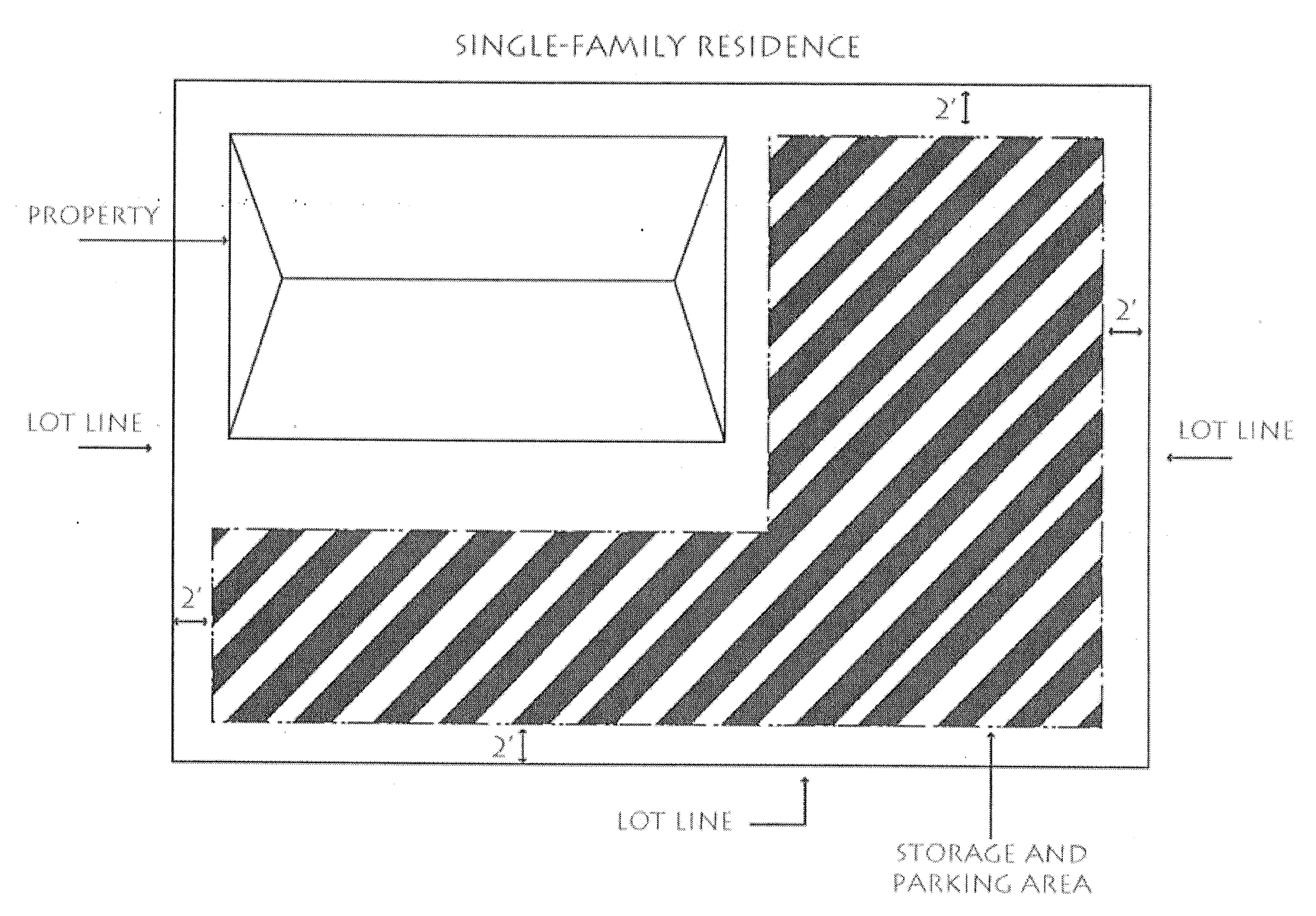
B. The paved area, except for access thereto, reserved for storage shall have placed upon the periphery thereof, where visible from an alley, street or highway, a hedge or landscaping to aesthetically screen a recreation vehicle from public view, which said screening and landscaping plan shall be as approved by the community planning and development department. Such landscaping shall be thirty-six (36) inches at the time of planting, two (2) feet on center so that it appears as a solid continuous screen.
C. Existing areas reserved for storage of recreational vehicles where no such screening exists along the boundaries thereof shall within ninety (90) days from the effective date of this ordinance provide such screening as heretofore required.
1. In a legally marked and designated parking stall in any area zoned for multifamily development with the approval of the owner or owners.
2. A recreational vehicle may be stored or parked in a lot or parcel of property in a single-family residential zone without regard to subsections A., and B. of this section for the sole express purpose of loading or unloading, not in excess of a twenty-four-hour period.
(Ord. No. 1278, § 1(exh. 1), 4-28-09)
Sec. 5-1406. - Prohibited parking and/or storage.
A. No recreational vehicle, truck, van, or bus shall be used for human habitation overnight in any area of the city.
B. No recreational vehicle, truck, van or bus or unmounted boat which is in a state of externally visible disrepair or partial construction shall be stored or parked upon any single-family or multiple-family zoned properties, or upon commercially zoned properties, except as may be permitted under junk or derelict property, article II of chapter 10 of the city's code.
C. No recreational vehicle or bus except as otherwise provided herein, shall be stored or parked overnight upon a street or public right-of-way, nor upon any property designated or used for a park or public land.
D. No truck in excess of one and one-half (11/2) ton load capacity shall be stored or parked in any residential area of the city unless said truck is actively engaged in the loading or unloading of materials.
E. No bus shall be stored or parked in any residential area of the city, except that a bus used by a school or religious institution lawfully established in a residential area may be stored or parked on the premises of said school or religious institution property.
F. No wrecker shall be maintained, parked or stored in residential district of the city upon any private or public property or right-of-way within said districts or upon any street abutting said districts. Nothing in this paragraph shall prohibit the temporary parking of a wrecker while actively engaged in the process of removing or towing a vehicle.
(Ord. No. 1278, § 1(exh. 1), 4-28-09)
Sec. 5-1407. - Off-street loading.
A. In connection with every building, or building group or part thereof thereafter erected and having a gross floor area of four thousand (4,000) square feet or more, there shall be provided and maintained, on the same lot with such building, off-street loading berths or unloading berths as follows:
Four thousand (4,000)—Twenty-five thousand (25,000) square feet—One (1) space.
For each additional twenty-five thousand (25,000) square feet or part thereof —One (1) space.
B. The loading berth required for each building under twenty-five thousand (25,000) square feet shall be scaled to the delivery vehicles expected.
C. If the building is greater than twenty-five thousand (25,000) square feet, loading spaces shall be a minimum of ten (10) feet in width and a length of not less than twenty-five (25) feet and shall be directly accessible from a street or alley without crossing or entering any other required off-street loading or off-street parking spaces. All loading spaces shall be arranged for convenient and safe ingress and egress by delivery vehicles, both motor truck and/or trailer combination.
(Ord. No. 1278, § 1(exh. 1), 4-28-09)
Sec. 5-1408. - Parking garages abutting single family.
A. Parking garages.
1. All parking garages on parcels of land which are adjacent or abutting the R-1 and R-2 districts shall:
a. Be set back a minimum of thirty-five (35) feet from the adjacent or abutting property line, or set back one (1) foot for every one (1) foot of building height, whichever is greater;
b. Be separated from the R-1 or R-2 district by a landscape buffer-yard of at least fifteen (15) feet in width which is landscaped with over-story canopy or palm trees and under-story trees at a density of one (1) over-story and one (1) under-story tree per one hundred fifty (150) square feet of buffer-yard;
c. Be designed and constructed with architectural features so that the use of the structure for a parking garage is masked from the R-1 or R-2 sides of the structure;
d. Be designed so that automobile headlamps are screened with an opaque structure to height of at least four (4) feet above any drive surface within the garage;
e. Screening shall use the architectural elements used in the building development and will incorporate at a minimum: architectural screening, awnings, Bahama shutters or similar treatments to assure that the garage is both architecturally pleasing and provides a buffer for light intrusion and allows for privacy of adjacent or abutting residential neighbors; and
f. Provide lighting fixtures which are cut-off fixtures or directed (aimed) so that they are not directly visible from any property in the R-1 or R-2 district within two hundred (200) feet of the parking structure.
2. All parking garages on all other parcels of land shall:
a. Not abut street intersections, be adjacent to squares or parks except when specifically designed to incorporate massing, scale and detail that contributes to the adjoining public space.
b. Unless otherwise provided in these LDRs, at least 75% of the ground floor space abutting a major corridor shall include retail.
c. Unless included as a part of a multifamily structure, the garage shall be setback a minimum of fifteen (15) feet from R-4, R-5, R-6 or BZ parcels and be separated by a buffer- yard of at least ten (10) feet in width.
d. Be designed and constructed with architectural features so that the use of the structure for a parking garage is masked from the R-4 R-5, R-6 or BZ sides of the structure;
e. Be designed so that automobile headlamps are screened with an opaque structure to height of at least four (4) feet above any drive surface within the garage;
f. Screening shall use the architectural elements used in the building development and will incorporate at a minimum: architectural screening, awnings, Bahama shutters or similar treatments to assure that the garage is both architecturally pleasing and provides a buffer for light intrusion and allows for privacy of adjacent or abutting residential neighbors; and
g. Provide lighting fixtures which are cut-off fixtures or directed (aimed) so that they are not directly visible from any property in the R-4, R-5, R-6 or BZ district within two hundred (200) feet of the parking structure.
3. All parking garage entry or exit drives shall be architecturally designed with pavers and other aesthetic treatments which ensure that the drive area is consistent with the streetscape on either side of the drive.
4. All parking garages shall be designed in the same architectural style with the same materials and finishes at the principal building or buildings which are served by the garage structure.
5. No light fixture on the top floor of a parking garage shall be located at height above the surface of the top parking level of greater than three and one-half (3½) feet.
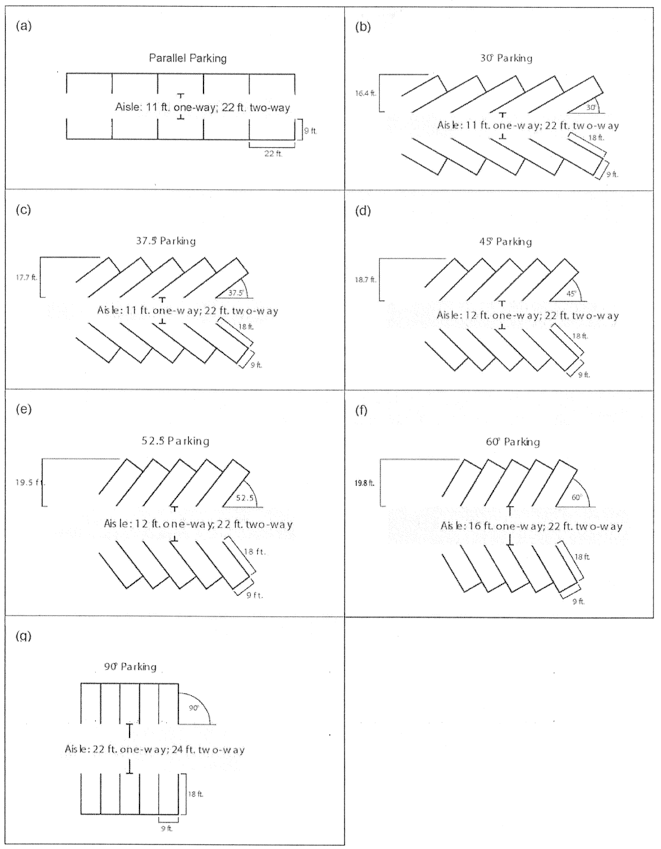
* Parallel parking spaces shall be setback an additional one and one-half (1½) feet from walls.
** Ninety-degree parking spaces shall be setback an additional one (1) foot from walls.
6. The maximum dimensions of new garages and carports are:
| Type | Interior Width | Interior Length |
| One-car garage | 12 ft. | 20 ft. |
| Two-car garage | 20 ft. | 20 ft. |
| Carport | 20 ft. | 20 ft. |
B.Configuration and connectivity of access driveways and aisles.
1.Access to parking spaces. Access to parking spaces shall be provided in accordance with the following:
| Access toparkingspaces from: | Permittedmethods ofaccess toparking: | Permittedmethods ofegress fromparking: |
| Alley | Direct access from alley to parking space; or access from aisle to parking space | Directly from parking space to alley or from aisle to alley. Forward and reverse (back-out) movements are permitted. |
| Local residential street | Direct access from street to parking space; or access from aisle to parking space | Directly from parking space to street or from aisle to street. Forward and reverse (back-out) movements are only permitted for single-family, including townhouse residences. |
| Arterials | Access only from aisle | Directly from aisle to street; back out for single-family residence on lots of less than 75′ in width. |
2.Ingress and egress driveways.
a.The minimum width of ingress and egress driveways shall be:
i.One-way drive: twelve (12) feet.
ii.Two-way drive: twenty (20) feet.
b.Ingress and egress driveways shall be designed such that:
i.Drivers can enter and exit from the property without endangering themselves, pedestrians, or vehicles traveling on abutting streets;
ii.Interference with the free and convenient flow of traffic on adjacent streets or alleys is minimized.
3.No dead-end parking areas shall be provided. A turnaround space shall be provided.
C. Configuration of parking bays within mechanical parking systems. Mechanical parking systems shall be designed or restricted such that the positioning of any one (1) vehicle within the mechanical parking system does not prevent access to any other vehicle, unless the bays that contain the obstructing vehicle and obstructed vehicle are under the control of the same person.
(Ord. No. 1278, § 1(exh. 1), 4-28-09)
Sec. 5-1409. - Vehicle rental.
Required parking for a vehicle rental facility shall only be provided with stacking or tandem spaces if expressly approved as part of site plan review.
(Ord. No. 1278, § 1(exh. 1), 4-28-09)
Sec. 5-1410. - Valet parking.
A.Valet parking services may be provided for development within multifamily residential districts or any of the nonresidential districts in the city upon approval of a plan for such services by the community planning and development department. Such plan shall be submitted by the valet company and the owner of the property for which valet services approval is sought.
B.Up to fifty (50) percent of required parking for the site may be designated for use by valet parking, except that a larger percentage may be approved by the planning director at time of site plan review upon a demonstration that the site and/or use is suitable for such increased percentage.
C.Valet operator's booths and signage shall be well marked and portable. A clear path for pedestrians on the sidewalk where the valet operations may be located shall be maintained at all times.
D.Drop-off and pick-up of vehicles shall not interfere with the safe and efficient operation of traffic on adjacent streets. Drop-off and pick-up areas may be designated for street parking areas adjacent to the site but no parking of valet vehicles shall be allowed in the public right-of-way.
E.The valet operator shall provide the city with indemnification and insurance as may be required by the city manager.
(Ord. No. 1278, § 1(exh. 1), 4-28-09)
Sec. 5-1411. - Prohibition against operating helipad.
In all zoning districts, except the M-1 Industrial district, it shall be unlawful for any person to operate a helipad or to land any aircraft, including helicopters, within the city limits at any time except at established landing sites which have been licensed and certified by the federal and state government in accordance with applicable statutes and regulations. However, nothing in this section shall be construed to prohibit landings by government agencies, landings for medical emergencies, and landings by law enforcement officers in the performance of their law enforcement duties.
(Ord. No. 1285, § 1, 10-27-09)
Sec. 5-1412. - Penalty.
Any violation of this section shall constitute a fine in the amount of five hundred dollars ($500.00), with each incident of the violation constituting a separate offense.
(Ord. No. 1285, § 1, 10-27-09)
Sec. 5-1501. - Purpose.
A. Short Title. This article shall hereafter be known and cited as “The North Miami Sign Code.”
B. Purpose and Intent. The purpose of this article is to set forth the regulations for the use of signs within the city’s jurisdictional limits for site identification, communication, and advertisement. It is the intent of this article to promote the health, safety, convenience, aesthetics, morality, and general welfare of the city by regulating signs in order to meet the following objectives:
1. Identification. Promote and aid in the identification and location of an establishment, organization, residence or neighborhood;
2. Aesthetics. Preserve the beauty and unique character of the city by protecting it from visual blight and providing a pleasing environmental setting and community appearance, which is deemed vital to the attraction and retention of business and commerce;
3. Land Values.Protect property values by assuring the compatibility of signage with surrounding land uses;
4. Safety. Promote general safety and protect the general public from damage or injury caused by, or partially attributed to, the distractions, hazards, and obstructions that result from improperly designed, constructed, maintained, or located signs;
5. Compatibility.Ensure that signs are compatible with the surrounding built environment, including adjacent architecture and neighborhoods, and they complement each other rather than detract from one another; and
6. Sustainability.To promote signage and support structures that employ sustainable designs and technologies with respect to their construction, maintenance, and operation (e.g. recycled materials, energy efficient, low energy usage bulbs, etc.).
C. Administration. The community planning and development director or designee shall have the authority to coordinate, interpret, and administer this article.
D. Applicability. The provisions of this article shall be considered the minimum standards and are applicable to all new signs constructed or displayed after the date of enactment of these regulations or modification to signs which were permitted prior to the date of adoption of these regulations. Signs shall only be permitted as provided for herein. Billboards within the city are regulated pursuant to Ordinance no. 1246, adopted October 23, 2007, which provides:
Outdoor Advertising Billboards in proximity to expressways. Outdoor advertising billboards shall be permitted only within the area bordered to the east by Interstate 95 right-of-way extending west 400 feet from Interstate 95 right-of-way. No billboard shall be placed north of 143rd Street or south of 119th Street. The number of billboards permitted shall be limited to a total of six (6) billboards and shall have no more than two (2) sides each. Notwithstanding the foregoing, the southernmost sign may be a triangular sign, with a third side facing west. The billboards shall be placed so as to be primarily visible from the traffic lanes on Interstate 95. The billboards must meet the Florida Department of Transportation permitting requirements, including state limitations on size, shape, and height. No part of any billboard shall extend over any property line. No billboard shall be illuminated in a manner that interferes in any way with traffic or obscures a traffic sign, device, or signal. The location of each billboard must be in an area zoned business, commercial, or industrial. All billboards shall first be permitted by the city prior to its placement. A licensing fee shall be payable monthly to the city in an amount to be agreed upon by the city and billboard agent.
E. Definitions. See chapter 29, article 7 for definitions of signs and related equipment.
F. Assure that murals are reviewed and approved pursuant to section 5-2102, Art Selection Committee.
G. All new signage proposed for properties within the CAIOD shall be subject to the design standards established in the NW 7th Avenue Cultural Arts and Innovation District Design Guidelines.
(Ord. No. 1278, § 1(exh. 1), 4-28-09; Ord. No. 1345, § 1, 12-11-12; Ord. No. 1541, § 1, 12-09-25).
Sec. 5-1502. - Prohibited signs.
The following types of signs are prohibited, and are not eligible for a variance:
A. Abandoned signs. When an establishment, organization, or service is discontinued, and the planning director has determined that the use is abandoned, all signs relating to such establishment, organization, or service shall be removed within forty-five days from the date of discontinuance. The sign structure may remain in place if the sign text is not visible, provided the sign text is covered with an approved durable material. Failure to so remove such a sign shall subject the sign to removal and disposition pursuant to the provisions of this article.
B. Balloons, cold air inflatable, streamers, and strings of pennants, except where allowed as governmental and public purpose signs for special events of limited time and frequency, such as special events, as approved and permitted by the community planning and development department and located in a safe and proper location with at least eight-foot (8') clearance (banners).
C. Except as provided in subsection 5-1506B., changeable message signs, , on which the message changes more rapidly than once every twenty-four (24) hours.
D. Pavement markings, except official traffic-control markings and street addresses.
E. Portable signs, except for in the C-3 district.
F. Roof and above roof signs. Any sign erected, placed, or affixed 1) to the slope of a hip or gable roof; 2) above the roofline or parapet wall; or 3) on rooftop structures, including but not limited to mechanical enclosures, mechanical equipment, or chimneys. All signs shall be located a minimum of six (6) inches below the top of the mansard or parapet wall, where applicable.
G. Rooftop balloons.
H. Sandwich board signs.
I. Signs attached to or painted on piers or seawalls, other than official regulatory or warning signs.
J. Signs in or upon any river, bay, lake, or other body of water, except government signs that aid in navigation or protect water quality or wildlife.
K. Signs located on publicly owned land or easements or inside street rights-of-way, except official government informational, directional or safety signs.
L. Handbills, posters, advertisements, or notices that are attached in any way upon lampposts, telephone poles, utility poles, cars, bridges, and sidewalks.
M. Signs that emit sound, vapor, smoke, odor, particles, or gaseous matter.
N. Signs that have unshielded illuminating devices or which reflect lighting onto public rights-of-way thereby creating a potential traffic or pedestrian hazard.
O. Signs that move, revolve, twirl, rotate, flash, including animated signs, and multi-prism signs. This prohibition shall not include indoor or outdoor electronic message centers and electronic scrolling signs operating in conformance with this ordinance.
P. Signs that obstruct, conceal, hide, or otherwise obscure from view any official traffic or government sign, signal, or device.
Q. Signs that present a potential traffic or pedestrian hazard, including signs which obstruct visibility.
R. Signs maintained at any location where by reason of color, illumination, position, size or shape may obstruct, impair, obscure, or be confused with, any traffic control sign, signal or device, or where it may interfere with, mislead, or confuse vehicular traffic.
S. Signs attached to or placed on any tree or other vegetation.
T. Signs carried, waved or otherwise displayed by persons either on public rights-of-way or in a manner visible from public rights-of-way. This provision is directed toward such displays intended to draw attention for a commercial purpose, and is not intended to limit the display of placards, banners, flags or other signage by persons participating in demonstrations, political rallies and similar events or other individual or group expressive activity.
U. Signs that obstruct any window, door or other opening used as a means of regular ingress and egress, or used for required light and ventilation or used for fire escapes and other openings for emergency access and escape.
V. Signs on vacant or unimproved land, except real estate signs and/or development and construction signs, and city-approved government-issued signs (both regulatory and notice).
W. Illuminated signs which, by virtue of intensity, direction, or color of lighting or illumination, interfere with the proper operation of or cause confusion to the operator of a motor vehicle on the public streets. No sign shall be illuminated to an intensity in excess of that of the public street lamp in the immediate vicinity.
X. Signs whose area, characters, letters, illustrations, or ornamentation consists of light bulbs except for holiday decorations.
Y. A sign that significantly covers, interrupts, or disrupts the architectural features of a building.
Z. Any sign affixed temporarily or permanently to a vehicle where the principle purpose of the vehicle as used is not transportation, but merely the support of the sign itself. Signs mounted on taxis, buses, trucks, or other modes of general transportation, when in the course of their normal service and use, are expressly excluded.
AA. Window coverings and signs, whether placed on the interior or exterior of windows, constructed of any kind of thickness, are prohibited when such covering or sign exceeds fifteen (15) percent of the total transparent area of any window(s).
BB. Snipe signs.
CC. Window signs in residential districts, except for sale or for rent signs in the window of the property to be sold or rented, and signs with noncommercial messages.
DD. Three-dimensional objects that are used as signs.
EE. Vehicle sign and portable trailer sign intended to serve as a portable sign that can be viewed from a public right-of-way and that does not meet the definition established in article 7.
FF. Any sign that is not specifically described or enumerated as permitted within the specific zoning district classifications in this Code.
GG. Pole or pylon signs.
HH. Box or painted signs, except in M-1 districts.
Note: In the event any word, sentence, clause, or other portion of this section is determined invalid, then any sign otherwise prohibited by this section shall comply with the requirements set forth in this code as if this section was never enacted.
(Ord. No. 1278, § 1(exh. 1), 4-28-09; Ord. No. 1345, § 1, 12-11-12)
Sec. 5-1503. - General standards.
The following general standards shall apply to all signs city-wide:
A. Noncommercial copy. Any sign authorized in this article may contain noncommercial copy in lieu of any other copy so long as the sign complies with the size, height, area and other requirements of this article.
B. Setback. No portion of any sign shall be located within five (5) feet of a property line of a parcel proposed for development, except as required or permitted by law. Neon signs and lighting.
C. Neon signs and lighting shall be permitted as freestanding and attached signage as provided in this division. When neon lighting is utilized to emphasize the architectural features of a building, such as when used to outline doorways, windows, facades, or architectural detailing, or when used to accentuate site landscaping, it shall not be regarded as signage. In addition, neon lighting used as freestanding designs or murals or as attached murals or designs unrelated to the architectural features of the building to which the lighting is attached shall be permitted, but shall be counted toward the allowable area of the property's or occupancy's freestanding or attached signage, as applicable. No neon sign shall be a flashing, animated or rotating sign.
D. In areas accessible to or within reach of the general public, exposed neon strings shall be covered with a clear acrylic cover, or electrode sleeves, or electrode boots. Neon connections must be insulated with glass or other appropriate material; transformers must be enclosed within transformer cans; and secondary voltage wires must be insulated with piping.
E. Illuminated signs.
1. The light from any illuminated sign shall be shaded, shielded, or directed away from adjoining street rights-of-way and properties.
2. No sign shall have blinking, flashing, or fluttering lights or other illumination devices which have a changing light intensity, brightness, or direction. This prohibition shall not include electronic message centers or indoor electronic scrolling signs operating in conformance with this ordinance.
3. No colored lights shall be used at any location or in any manner so as to be confused with or construed as traffic-control devices.
4. Neither the direct nor the reflected light from primary light sources shall create a traffic hazard to operators of motor vehicles on public thoroughfares.
5. The light which illuminates a sign shall be shaded, shielded, or directed so that no structure, including sign supports or awnings, are illuminated by such lighting.
F. Banners and flags. A banner or flag may be used as a permitted attached sign and, if so used, the area of the banner or flag shall be included in, and limited by, the computation of allowable area for freestanding or attached signs on the property.
G. Gasoline price signs. Gasoline price display signs shall be allowed in all districts where automobile service stations are permitted. Gasoline price display signs shall not exceed twelve (12) square feet and shall be placed in the immediate vicinity of the pump islands and shall not extend above any pump island canopy or they shall be attached to the primary freestanding sign for the property. The area of the gasoline price display sign shall be counted toward the allowable area for the freestanding sign.
H. Electronic message center. Electronic message center signs shall be allowed in all nonresidential districts on major corridors and not face local streets. The maximum area for the electronic message center portion only shall not exceed fifty (50) percent of the allowed sign area for monument or freestanding shopping center sign on which it is placed. The area of an electronic message center sign, whether attached or freestanding, shall be included in determining the cumulative area of signs on a property.
1. Such signs shall display static images for a period of at least eight (8) seconds at a time.
2. Transitions from one static image to the next shall appear instantaneously without the appearance of animation, flashing or movement of any kind.
3. All electronic message centers shall come equipped with automatic dimming technology which automatically adjusts the sign's brightness in direct correlation with ambient light conditions.
4. No electronic message center shall exceed a brightness level of 0.3 foot candles above ambient light as measured using a foot candle (Lux) meter at a preset distance depending on sign area. The measurement distance shall be calculated with the following formula: The square root of the product of the sign area and one-hundred.
Example using a twelve (12) square foot sign:
Measurement Distance = √(12 Sq. Ft. x 100) = 34.6
5. Intensities in illumination shall be subject to review by the city's electrical inspector. The applicant will be required to submit an affidavit attesting to the intensities in illumination as outlined in subsection 4a above.
6. The electronic message center sign shall contain a default mechanism that freezes the image in one (1) position in the event of malfunction. The sign owner shall respond to a malfunction within one (1) day of a city notification of malfunction.
7. Indoor electronic scrolling signs. Such signs are allowed indoors with scrolling text and shall not exceed four (4) square feet in size. Images or text that flash are prohibited. These signs are intended primarily for pedestrian view and not vehicular traffic. Such signs are subject to the illumination standards listed in subsections 5-1503.F.4a. and 4b.
I. Building and electrical code compliance. All signs shall comply with applicable building and electrical code requirements.
J. Sign projection. No sign or any part shall project above the roof line or be located within five (5) feet of property lines or within the visibility triangle in section 5-904.
K. Sign attachment. Attached signs shall be parallel and flush to the building.
L. Sign maintenance. All signs shall be maintained in good condition, free from fading, peeling or any other condition which renders the sign unreadable, either partially or totally.
M. A non-residential building located on a corner of two (2) public streets shall be allowed wall-mounted signage on the wall not considered to be the front (i.e., a side street) equal in area to one (1) square foot times the length of such wall.
N. The side of a nonresidential building not on a corner of two (2) public streets shall be allowed wall-mounted signage on the side walls equal in area to one-half (1/2) square foot times the length of the side of the building.
(Ord. No. 1278, § 1(exh. 1), 4-28-09; Ord. No. 1345, § 1, 12-11-12)
Sec. 5-1504. - Signs permitted without a permit.
The following signs may be developed without a permit pursuant to article 3 of this Code:
A. One (1) address sign of no more than four (4) square feet of total sign face area for each parcel of land used for residential or nonresidential purposes.
B. One (1) nameplate sign per single-family dwelling, not exceeding two (2) square feet in area attached at the entrance to the building, not above the top of the first floor of building.
C. One (1) nameplate sign per multifamily dwelling per street frontage of the multiple-family dwelling only, attached to and parallel with the face of the building facing such street, not exceeding twelve (12) square feet in area, not projecting above the roofline.
D. Holiday decorations.
E. A single sign indicating a valet parking station no more than four (4) square feet visible only during hours that the valet is operating.
F. One (1) garage and yard sale sign of no more than four (4) square feet of total sign face area located on the parcel of land where the garage or yard sale is to be conducted only on the date or dates on which the garage or yard sale is conducted. In addition, no more than two (2) directional signs of no more than four (4) square feet of total sign face area per sign related to a garage or yard sale which are located on privately owned parcels of land other than the parcel of land where the garage or yard sale is to be conducted only on the date or dates on which the garage or yard sale is conducted.
G. A temporary open house sign is permitted in a public right-of-way or with permission of a private property owner, provided that such sign does not exceed four (4) square feet in area per face, is composed of durable materials (not paper, handbills, or posters), is placed for a period of time not exceeding seventy-two (72) hours during a weekend, and is promptly removed no later than 7:00 p.m. on Sunday. No such sign shall be attached in any way to lampposts, telephone poles, utility poles, bridges, sidewalks or trees/landscaping.
H. Signs which are integral and incidental to equipment, or machinery and cover not more than twenty (20) percent of the exterior surface of such equipment, facilities or machinery.
I. Attached menu signs of no more than four (4) square feet of sign face area located at the entrance or service window of a restaurant.
J. Onsite directional and traffic control signs of no more than four (4) square feet of sign face area provided that business logos or other nontraffic control symbols do not exceed twenty-five (25) percent of the sign face area.
K. Signs identifying parking space numbers provided that such signs are painted on the paved surface of each space or do not exceed one-half (½) square foot of sign face area per sign.
L. Signs identifying bicycle parking in accordance with subsection 5-803G.
M. Signs identifying marina slip numbers provided that such signs are painted on the dock in front of each slip or do not exceed one (1) square feet of sign face area per sign.
N. In lieu of a development sign or banner, one (1) freestanding nonilluminated double-face real estate sign per parcel of land per street frontage indicating that a parcel of land or a building located on the parcel of land or part thereof is for sale, for lease or otherwise available for conveyance, provided that such sign does not exceed:
1. Four (4) square feet per sign face area plus required rider on parcels of land designated or used for single-family residential purposes.
2. Six (6) square feet per sign face on parcels of land designated or used for multifamily purposes.
3. Twelve (12) square feet of total sign face area on parcels of land designated or used for nonresidential purposes.
O. Signs located within a stadium which are not visible from outside of a stadium, except for illuminated or structural signs.
P. Window signs which occupy fifteen (15) percent or less of the total area of the window where the sign is located.
Q. Safety or warning signs which do not exceed four (4) square feet of sign face area per sign.
R. A change in the changeable copy portion of a sign message on a previously approved, lawful sign.
S. Any flag shall not exceed fifteen (15) square feet. If a flag is proposed to be installed in the ground, it is subject to the requirements in section 5-1505A.1.
T. Painted pavement markings.
U. Governmental instruction signs or public notice signs (e.g., self-service, no smoking etc.), to the extent necessary to comply with state, federal, or county laws; provided however, that unless required by law, such signs shall not exceed four (4) square feet in area or one (1) per service island for automotive uses.
V. Signs of a noncommercial nature erected by public utilities.
W. Nonelectric or plug-in only window signage; incidental signage (ATMs, gas pumps, clearance); safety signs.
X. Awning or canopy signs provided that the lettering cannot exceed six (6) inches in height and shall be no more than one (1) inch below the bottom of the awning or canopy.
(Ord. No. 1278, § 1(exh. 1), 4-28-09; Ord. No. 1345, § 1, 12-11-12)
Sec. 5-1505. - Permitted signs requiring development review.
A. Residential districts.
1. In single family residential districts, any flag shall not exceed fifteen (15) square feet or fifteen (15) feet in height if the flag is proposed to be installed in the ground.
2. Any flag shall not to exceed fifteen (15) square feet or twenty (20) feet in height per parcel of land used for multifamily residential purposes.
3. Freestanding identification sign for multifamily development with at least two hundred (200) lineal feet of street frontage: One (1) per entrance of not more than twelve (12) square feet of total sign face per sign, two (2) not exceeding forty (40) square feet for all identification signs (including attached identification signs). The height shall not exceed six (6) feet.
4. Attached identification sign per multifamily building not exceeding twelve (12) square feet of sign face, unless two (2) freestanding identification signs are used.
5. Except in single-family residential districts, one (1) development sign is authorized per active construction or redevelopment site. Such sign shall be single-faced, not exceeding fifty (50) square feet in area and shall not be illuminated. If the sign is mounted on a building, it shall be attached flush to and parallel with the face of the building below the roof line. If it is freestanding, it shall not exceed ten (10) feet in height. Such sign shall be removed upon the issuance of a partial or final certificate of occupancy.
6. Banner sign for multifamily properties not exceeding six (6) months or during the construction or redevelopment of a property. The placement of and size of such signs shall be approved by the director of community planning and development but shall not exceed one hundred fifty (150) square feet or be erected for more than six (6) months. The six-month period is automatically extended for an additional six (6) months if after inspection by code enforcement, the banners are substantially in the same condition as originally approved. An extension beyond one (1) year may only be obtained through the special exception process.
B. Nonresidential districts. The following signs are permitted in nonresidential districts subject to review of and approval of a sign permit:
| Type | Number | Maximum Size | Maximum Height | Other |
|---|---|---|---|---|
| Identification | One (1) single-faced sign per street frontage (if for a single use). If a multiuse building, a single-faced sign per use which has direct entrance to the street (may also have a blade sign). Plus One (1) per rear of building or one (1) per accessway if multiple uses opposite the facade. | One hundred fifty (150) s.f. max.; one (1) s.f. for each lineal foot of building frontage, including corner lots, facing the street or one-half (.5) s.f. for each lineal foot of that portion of the building opposite the facade. Except that wall signs for large scale single-use developments with property frontages exceeding 500 feet, then the maximum shall be 300 s.f. blade sign = 3 s.f. The building name shall not count toward allowable sign square footage | If a multitenant office building, specific listing of occupancies shall only be identified on a nameplate sign identification signs, except for franchise or chain companies; must be consistent in total size, letter size and color with other ID signs on a building or in shopping centers, except for rear signs, may be illuminated. | |
| Shopping center, ground, monument, or freestanding sign | One (1) single or double-faced sign may also have a ground sign for out parcels only. | For properties with less than 500 feet frontage, max. 250 s.f., and 500 feet frontage or more, max. 500 s.f. | Twenty (20) ft. | May be illuminated or include electronic message center; landscaping required. |
| Temporary sign | One (1) per active construction site, single-faced. | Not exceeding fifty (50) s.f. in area | If freestanding, not exceeding ten (10) ft. | Not illuminated |
| Development banner sign | One (1)(if no temporary sign). | Not exceeding one hundred fifty (150) s.f. | Not more than six (6) months; may be automatically extended another six (6) months if inspected by city and it is determined that it is substantially in same condition as originally approved. Additional extension may be obtained through the special exception process. | |
| Real estate sign | One (1) single or double-faced per street frontage. | Twelve (12) s.f.; Banner sign, up to 150 s.f., max. | Twelve (12) ft. if freestanding; if mounted on a building, attached to and parallel with the face of the building below the roof line. | Not more than six (6) months; may be automatically extended another six (6) months if inspected by city and it is determined that it is substantially in same condition as originally approved. Additional extension may be obtained through the special exception process. |
| Marquee | One (1) sign per theater with changeable copy. | Sign face located on the face of the marquee and not projecting above or below the marquee; may be illuminated. | ||
| Directional | Hospitals: no more than six (6); nonresidential: one (1) or more if determined to be necessary by the department of community planning and development. | Fifteen (15) s.f. (hospitals); or four (4) s.f. per face for other nonresidential. | If freestanding cannot exceed three and one-half (3½) ft. in height. | Minimum distance between multiple signs to be determined by the community planning and development department. |
| Changeable copy | one (1) changeable copy sign allowed | If in addition to identification sign, cannot exceed fifty (50) percent of allowed sign area | See monument, pole or shopping center sign | |
| Electronic message centers | One (1) electronic message center as a component to a pole, ground or monument shopping center sign | Cannot exceed fifty (50) percent of allowed sign area of a pole, ground or monument shopping center sign | See monument, pole or shopping center sign | See additional regulations for electronic message centers in subsection 5-1503.F. |
| Indoor electronic scrolling sign | One (1) sign per business with a distance separation of ten (10) ft. from another similar indoor message sign | Not to exceed four (4) sq. ft. in size | Not to exceed two (2) ft. in height. | |
| Nameplate | One (1) per entrance | Two (2) s.f.; if more than one (1) occupancy, may be increased one (1) s.f. for each additional occupant up to four (4) s.f. | Attached to main structure at entrance and flush and parallel with face of building unless there is an overhang protecting pedestrian sidewalk in which case it may be hung from the overhang so as to be perpendicular to building face with a minimum clearance of seven (7) ft. | |
| Sandwich sign | One (1) per restaurant | 4' x 6' | Six (6) ft. | Only in the C-3 district |
| Flag | Two (2) flags per parcel of land | 5' x 8' | Thirty (30) ft. | |
| Special event/grand opening | One (1) banner per business per street frontage of business. In multitenant office buildings, banner signs are restricted to one (1) banner sign per building. | Fifty (50) s.f. | Allowed for forty (40) days two (2) times/year maximum; no flags, pennants or streamers (or other attention getting mechanisms). |
Note: In the event any word, sentence, clause, or other portion of this section is determined invalid, then any sign otherwise allowed by this section shall comply with the requirements set forth in this code as if this section was never enacted.
(Ord. No. 1278, § 1(exh. 1), 4-28-09; Ord. No. 1345, § 1, 12-11-12)
Sec. 5-1506. - Comprehensive sign program.
A. General principles.
1. The intent of the comprehensive sign program is to provide private property owners and businesses with flexibility to develop innovative, creative and effective signage and to improve the aesthetics of the City of North Miami.
2. The minimum sign standards established in this division ensure that signage will not have an adverse impact on the aesthetics, community character and quality of life of the city. The city recognizes, however, that in many circumstances, there are innovative and creative alternatives to minimum standard signage which are desirable and attractive and will enhance community character and individual property values.
3. The purpose of the comprehensive sign program is to provide an alternative to minimum standard signage subject to flexibility criteria which ensure that alternative signage will not have an adverse impact on the aesthetics, community character and quality of life of the City of North Miami.
B. Eligibility. The following forms of development are eligible to utilize the comprehensive sign program: new large scale development, shopping centers, institutions, mixed use, office complex and residential complex.
C. Permitted signage. Signage which is proposed as a part of a comprehensive sign program may deviate from the minimum sign standards in terms of numbers of signs per business or parcel of land, maximum area of a sign face per parcel of land and the total area of sign faces per business or parcel of land subject to compliance with the flexibility criteria set out in subsection 5-1506D. A comprehensive sign program shall be approved as a part of the approval required for the development to which it relates.
D. Flexibility criteria.
1. Architectural theme.
a. The signs proposed in a comprehensive sign program shall be designed as a part of the architectural theme of the principal buildings proposed or developed on the parcel proposed for development and shall be constructed of materials and colors which reflect an integrated architectural vocabulary for the parcel proposed for development; or
b. The design, character, location and/or materials of the signs proposed in a comprehensive sign program shall be related to the size of a site and be demonstrably more attractive than signs otherwise permitted on the parcel proposed for development under the minimum sign standards.
2. Community character. The signage proposed in a comprehensive sign program shall not have an adverse impact on the community character of the city.
3. Property values. The signage proposed in a comprehensive sign program will not have an adverse impact on the value of property in the immediate vicinity of the parcel proposed for development.
4. Elimination of unattractive or nonconforming signage. The signage proposed in a comprehensive sign program will result in the elimination of existing unattractive signage or will result in an improvement to the appearance of the parcel proposed for development in comparison to signs otherwise permitted under the minimum sign standards.
Sec. 5-1507. - Nonconforming Signs
A. General. A sign that does not conform to the requirements of this division shall be deemed nonconforming. A nonconforming sign cannot be modified (excluding re-lettering or change of copy) unless the modification brings the sign into compliance with all sections of this division, or as outlined in section 5-1507.C., below.
B. Nonconforming Freestanding Signs at Shopping Centers. The city's objectives to improve the visual aesthetics, appearance, and economic vitality of multi-tenant properties along city thoroughfares will permit property owners to modify nonconforming freestanding signs at shopping centers beyond the limitations contained within section 5-1507.A., above, in conformance with the following requirements:
1. The shopping center shall have an adopted sign program in place, or adopts a sign program as part of this process.
2. A request for an amendment to the existing sign program is approved.
3. The amended sign program will allow improvements to the existing sign structure(s) which do not increase the mass of the sign (i.e. height, length, width), including removal, repair and/or replacement of sign cabinets.
4. The proposed improvements will bring the sign into further compliance with the sign regulations, and improve the aesthetics of the sign.
5. As part of the city's economic development initiatives, additional sign square footage, also known as "copy area," may be added to the sign in instances when aesthetic improvements and required landscape improvements are made to, and immediately surrounding the sign, and in situations where the additional signage does not increase the mass of the sign (i.e., height, length, width).
6. The amount of future repairs of the newly renovated sign that the property owner will be allowed to complete may not to exceed fifty percent (50%) of the new value of the sign, as determined by a licensed sign contractor and confirmed by staff.
7. The regulations contained in this section are not intended to allow removal and reconstruction of the sign in entirety, as removal would require the sign to come into compliance with current sign regulation.
C. Repair or Removal. Any nonconforming sign and corresponding support structure that is damaged or otherwise in need of repair, to such an extent that the cost of repairing the sign equals fifty percent (50%) or more of the original cost of the sign, then its classification as a "nonconforming" sign under this section shall be automatically revoked and either repairs be made so that such sign shall meet all the requirements of this article or such sign shall be removed from the property. Furthermore, any nonconforming sign and corresponding support structure shall be removed by the owner, agent, or person having beneficial use of the building, structure, or premises, where such sign may be found if a bona fide establishment, organization, or residential development ceases its operation or occupancy for more than six (6) consecutive months.
D. Annexation of Nonconforming Freestanding Signs. Any freestanding monument, pylon, pole, or similar type of sign located on a property that is proposed to be annexed into the city shall comply with all provisions of this article within six (6) months following the date of such annexation. Any signs subject to this requirement shall be documented by the city in any applicable ordinance, development order, or annexation agreement.
Sec. 5-1508. - Abandoned signs.
When an establishment, organization, or service is discontinued, and the planning director determines that the use is abandoned, all signs relating to such establishment, organization, or service shall be removed within forty-five (45) days from the date of discontinuance. The sign structure may remain in place if the sign text is not visible, provided the sign text is covered with an approved durable material. Failure to so remove such a sign shall subject the sign to removal and disposition pursuant to the provisions of this article.
Sec. 5-1509. - Nuisances and hazards prohibited.
Any nonconforming sign that creates a nuisance or poses a hazard to the public shall be either repaired, removed or brought into compliance with these regulations within ten (10) days of notification of the nuisance or hazard, unless the enforcing official determines that earlier compliance is required due to risks to the public health, safety and welfare.
Sec. 5-1510. - Conflict.
Whenever the regulations and requirements of this code conflict with any other lawfully enacted and adopted rules, regulations, ordinances, or laws, the most restrictive shall apply, unless otherwise stated herein.
Sec. 5-1511. - Severability.
Should any section, subsection, paragraph, sentence, clause, phrase, or other part of this division be declared by a court of competent jurisdiction to be invalid, such decision shall not affect the validity of this division as a whole or any section, subsection, paragraph, sentence, clause, phrase, or word thereof, other than that so declared to be invalid.
Sec. 5-1512. - Relief from standards.
A. Unless described otherwise, any deviation from the sign standards contained herein shall require approval of a variance application, which is subject to review and approval by the board of adjustment. Any request for a variance shall be reviewed in accordance with article 3, division 6. No variance may be granted for any sign expressly prohibited by this article. The board of adjustment however, may grant a variance if it finds that the unusual shape or topography of the property or other mitigating factors (e.g., required landscape buffers), prevent signage allowable under the provisions of these LDRs from adequately identifying the business or other activity located on such property or prevent the viewing of non-commercial messages. The board of adjustment may only grant a variance to the following:
1. Required Setback. Allow a setback less than that required under the chapter;
2. Sign Area or Height. Allow the area and/or height of a sign to be increased by up to twenty-five percent (25%) of the maximum allowable height or area; or
3. Number of Signs. Allow the number of signs to be increased over the maximum allowed by this code.
B. City approval required. No signs, including support structures shall be erected, altered, displayed, or modified on private property, public lands, or within city rights-of-way without first securing the necessary city approvals and permits as provided hereunder, except in instances when exempt from these LDRs. The following processes and permits are intended to ensure that all signage complies with the standards of this article:
1. Site plan review. Except for individually platted lots containing single-family and duplex homes located within single-family and two-family residential zoning districts, the site plan review process shall be required and reviewed in accordance with the procedures set forth in these LDRs prior to the issuance of any sign permit. For the purposes of this subsection, the term "site plan" is construed to include master site plan and technical site plan applications.
2. Sign permit. The sign permit process shall be required, and initiated only subsequent to the approval of a site plan application, except in those instances when site plan review is not required.
a. The sign permit application shall be processed in accordance with the procedures set forth in these LDRs, unless the building official determines that compliance with the Florida Building Code is necessary. In these instances, the sign permit shall be processed in accordance with the procedures set forth in as set forth in the LDRs.
b. Any sign, including the support structure, which is erected, altered, displayed, or changed without a sign permit is considered an illegal sign, and shall be subject to the penalties set forth herein.
c. Any sign proposed within a city right-of-way shall require approval from the engineering division.
d. The issuance of a sign permit shall not relieve any party from obtaining the necessary permits which may be required by the various federal, state, or local government agencies.
3. Sign permit review and approval; appeals.
a. Upon submission of an application, the director of community planning and development shall review and evaluate the application as follows:
b. No application shall be accepted until it is deemed complete by the director.
c. The director shall review all of the information submitted to determine conformity with this article, including without limitation the location of the proposed sign.
d. The submitted application will be reviewed within twenty business days and any corrections, revisions or deficiencies provided to the applicant within that twenty-day period.
e. Upon each re-submittal of corrected plans, the director shall have ten business days to review the application and provide any corrections, revisions or deficiencies to the applicant. This process shall continue until the applicant has submitted a complete application or demands that the application be reviewed as is, without further revisions.
f. If an applicant fails to provide additional information as requested by the director within ninety days of the request or respond to the director or designee with a time when the information will be submitted, the application shall be deemed to be withdrawn by the applicant. The applicant shall be entitled to one ninety calendar-day extension upon request, providing the request for extension is granted prior to the expiration of the ninety-day period.
g. The director shall approve or deny the sign permit within twenty business days of receipt of the complete application or the applicant’s demand for review as submitted, based on whether it complies with the requirements of this article. The director shall prepare a written notice of the decision, either in the form of an approved sign permit or written notice of denial, and provide such written notice to the applicant of its decision within the twenty-day period.
h. Appeals. In the event a sign permit is denied by the director, the decision may be appealed to the zoning appeals board. Such appeal shall be submitted on a form approved by the city and accompanied with the established fee. Such appeal shall be filed with the city clerk within thirty days of the date of the decision being appealed. The zoning appeals board shall hold a hearing within thirty days following receipt of the written appeal. The appeal shall not be a de novo review, using the quasi-judicial procedures of these LDRs. The zoning appeals board shall render a written decision within twenty days following the hearing. The decision of the zoning appeals board shall be the final action of the city. If the zoning appeals board does not grant the appeal, then the appellant may seek relief in the Circuit Court for Miami-Dade County, as provided by law.
(Ord. No. 1278, § 1(exh. 1), 4-28-09; Ord. No. 1345, § 1, 12-11-12)
Sec. 5-1601. - Boarding up/covering of buildings and windows.
Windows and other openings may only be covered or boarded up in accordance with a building permit and only for a period not exceeding six (6) months. Boarded up commercial buildings must have the boards painted the same color as the building.
(Ord. No. 1278, § 1(exh. 1), 4-28-09)
Sec. 5-1602. - Check cashing store.
A check cashing store shall not be located within fifteen hundred (1,500) feet of a residential use or zoning district.
(Ord. No. 1278, § 1(exh. 1), 4-28-09)
Sec. 5-1603. - Consignment shops.
There shall be a minimum distance requirement between consignment shops of fifteen hundred (1,500) feet. This distance shall be measured in a straight line, without regard for intervening structures or objects, from the nearest property line of the proposed use to the nearest property line of the premises of an existing consignment shop.
(Ord. No. 1278, § 1(exh. 1), 4-28-09)
Sec. 5-1604. - Conversion of second floor of commercial buildings to residential.
A.Intent and purpose. The intent and purpose of this section is to allow the owner of a business in an existing freestanding building of two (2) stories in the C-3 district to convert all or a portion of that building's second floor, as further elaborated in subsection C.1. below, for his/her own residence, provided strict compliance with the criteria outlined in [subsection] C. below is met and subsequently observed.
B.Development review committee. All applications for residential conversion as allowed for in this division shall be reviewed by the development review committee. Approval from this committee shall be obtained prior to the issuance of a building permit.
C.Criteria.
1.Conversion requirements. Retrofitting of space for dwelling purposes by the property owner shall be in compliance with the Florida Building Code, as would apply to new residential buildings.
2.Other miscellaneous requirements:
a.(Re)conversions: Once approval is received for conversion of commercial space to residential in accordance with these regulations, (re)conversion of said space back to commercial shall not be permitted unless so approved by the development review committee.
b.Time limitation: Implementation of the conversion of commercial space to residential shall be completed no later than six (6) months following approval of said conversion. Requests for a time extension shall be processed through the development review committee. If the property owner fails to request such an extension, the conversion approval shall be null and void, and any subsequent request shall be treated as a new application.
c.Minimum housing standards: The provisions of the city's minimum housing standards shall apply for purposes of enforcement, except that where the requirements herein are more stringent, they shall control.
(Ord. No. 1278, § 1(exh. 1), 4-28-09)
Sec. 5-1605. - Nightclubs.
A. A nightclub shall be soundproofed, including such as but not limited to double doors, and its windows, doors and other openings kept closed in order that the noises therefrom may not disturb the peace and quiet of the surrounding neighborhood;
B. Unless only one (1) musician or one (1) coin-operated machine are utilized and no dancing or other forms of entertainment are provided, a music and entertainment license shall be obtained as part of a special exception approvals;
C. In reviewing an application for the provision of music and entertainment, the city manager or designee shall determine whether the applicant meets the following standards:
1. The granting of a music and entertainment license will not substantially injure or detract from the use of surrounding properties or from the character of the neighborhood;
2. There is sufficient parking for patrons and appropriate access facilities adequate for the estimated traffic from public streets and sidewalks so as to assure the public safety and to avoid traffic congestion;
3. Where the installation of outdoor floodlighting or spotlighting is intended, that such lighting will not have any detrimental effect on neighboring property or traffic;
4. Noise caused by the establishment shall be kept at such a level so as to conform with these regulations; and
5. Adequate security shall be provided by the establishment.
D. The nightclub shall comply with the city's alcoholic beverage provisions, distance separation, and adequate security.
(Ord. No. 1278, § 1(exh. 1), 4-28-09)
Sec. 5-1606. - Gun shops.
A. A gun shop shall not be located within two thousand (2,000) feet of another gun shop or other use which includes a gun shop.
B. No firearm sales will be made thereon between the hours of 9:00 p.m. and 7:00 a.m. of the next day. The term "firearm sales," as used herein, means any component portion of the sale transaction, including the agreement to purchase or the payment of whole or part of purchase price or the delivery of the firearm.
C. No person shall engage in the operation of a pawnshop or conduct a pawnshop business at the premises of a gun shop.
D. No such gun shop shall be located within two thousand (2,000) feet of any previously existing child care center, public park, place of public assemblage, school, religious institution or hospital.
E .No person shall install, maintain, keep, or utilize any sign advertising firearms or ammunition which sign is visible from the outside, for any multipurpose business dealing in firearms and dealing in other items, not directly related to firearms, to such an extent that the primary business at the premises is for such other items rather than firearms.
(Ord. No. 1278, § 1(exh. 1), 4-28-09)
Sec. 5-1607. - Pawnshops.
A. Pawnshops which existed on September 12, 1989, in the nonresidential districts may continue as a nonconforming use subject to the provisions of article 6 and this section.
B. Each pawnshop operator shall comply with the following:
1. Locate any signs posted in the windows so as to provide a clear and unobstructed view of the cash register and sales area from the street.
2. Locate the sales area so that the clerk and customer are fully visible from the street at the time of any sales transaction.
C. Limitation on hours of operation. No pawnshop shall be open for business between the hours of 5:00 p.m. of one (1) day and 7:00 a.m. of the next day and no component portion of a pawn transaction shall be conducted during such hours. This provision shall apply to all pawnshops, including those enjoying grandfathered status under subsection 2. above. In the event that section 21-29 of the Miami-Dade County Code is hereafter amended to allow greater hours of pawnshop operation, the hours of operation specified herein shall be deemed to be amended to coincide therewith.
(Ord. No. 1278, § 1(exh. 1), 4-28-09)
Sec. 5-1608. - Room additions to residential structures and conversions of garages or carports to living space.
A. Room additions to residential structures, or conversions of garages and carports attached to residential structures on the same parcel of property for the purpose of creating living space are permitted as follows:
1. The newly created living space shall be directly accessible through an interior doorway or doorways, to the existing residence and must be completely integrated within the existing residence so that it is a logical extension of the residence. New additions shall have the same roof line (level, peak, etc.) as the existing structure so as to harmoniously blend; provided however, that flat roofs may be permitted on additions to the rear of the property, if not visible from a street frontage consistent with the minimum bedroom size and housing standards under Article II, Section 17-26, Miami-Dade County. Ordinances.
2. Exterior doorways from the newly created living space shall not exit into the outdoor area lying to the front of the residential structure, unless the doorway is intended to and does replace an existing front entrance. Such exterior doorways shall not exit into the area adjacent to a secondary drive or parking area for the residential structure.
3. No cooking facilities, kitchen counter and sink combinations, kitchen cabinets, or electrical or plumbing connections for such facilities shall be permitted within the newly created living space unless the approved building plans for such space demonstrate clearly that such facilities are to be used as an expansion or replacement of an already lawfully existing kitchen.
B. Conversion of detached garages or other accessory structures for the purpose of creating living space shall be permitted only if the newly created living space qualifies as an allowable dwelling unit within the applicable zoning district, and all municipal code requirements for its use as a dwelling unit are satisfied.
C. Any required off-street parking that is deleted or rendered unusable by a conversion or addition pursuant to the provisions of this section shall be replaced in a manner consistent with the provisions of article 5, division 14.
(Ord. No. 1278, § 1(exh. 1), 4-28-09; Ord. No. 1400, § 1, 5-10-16)
Sec. 5-1609. - Self-service/coin laundries.
A. There shall be a minimum distance of fifteen hundred (1,500) feet between any new self-service/coin laundry use established and any other lawfully existing self-service/coin laundry;
B. Hours of operation shall be no earlier than 7 a.m. and no later than midnight;
C. No pay phones shall be permitted outside the premises of the self-service/coin laundry and any pay phones on the inside shall be counter-type and shall be used for outbound calls only;
D. There shall be an attendant on duty at all times during the hours of operation;
E. The facility must be entirely enclosed.
(Ord. No. 1278, § 1(exh. 1), 4-28-09)
Sec. 5-1610. - Short-term rentals in residential districts.
It shall be unlawful for the owner of single family dwelling units, including townhouses, located in a residential zoning district to rent or lease the dwelling to another person(s) for a period of three (3) months or less, or to lease or rent the subject dwelling more than four (4) times in a twelve-month period. The lease or rental of a single family residential dwelling, including townhouses, more than four (4) times within a twelve-month period shall create a presumption that the owner is acting in violation of this section.
(Ord. No. 1283, § 1, 10-27-09)
Sec. 5-1611. - Mobile food dispensing vehicles.
A. Purpose and intent. The purpose and intent of this section is to establish land use and zoning regulations for real property upon which a mobile food-dispensing vehicle (“MFDV”), e.g., “food truck” is authorized and to allow ice cream trucks to operate under certain conditions within the jurisdictional limits of the city. Unless authorized by this section, or allowed under a temporary use permit, MFDVs on other real property are prohibited and unlawful. This section is intended to neither prohibit MFDVs from operating within the entirety of the city, nor regulate the licensing, registration, permitting and fees of MFDVs, preempted by the state under section 509.102, Florida Statutes.
B. Definition.
- Mobile food dispensing vehicle, e.g., "food trucks", shall have the same meaning as that term is defined in section 509.102(1), Florida Statutes, and upon the effective date of this section, means, "... a vehicle that is a public food service establishment that is selfpropelled or otherwise moveable from place to place, and includes self-contained utilities, included, but not limited to, gas, water, electricity, or liquid waste disposal."
- Ice cream trucks. These vehicles vend pre-packaged frozen dairy or frozen water-based food products or hand-dipped frozen dairy, and pre-packaged beverages and snack foods.
- Vend means to sell or offer to sell products from a mobile food truck.
C. Ice cream truck operations generally.
1. Operator. An ice cream truck operator:
- Shall ensure that each ice cream truck obtains and maintains a business tax receipt from the city, and a certificate of use, if determined necessary by the development services department.
- Is not required by any governmental jurisdiction to register as a sexual offender, sexual predator, or such other similar classification as may exist in the state or territory of conviction; and shall ensure the same for each driver;
- Shall ensure that each vehicle has a valid Florida license plate affixed; and that all drivers:
- Possess a current Florida Driver's License and;
- That no driver has convictions within the preceding three years in any governmental jurisdiction for reckless driving, driving under the influence, or such similar offenses as may exist in the jurisdiction of conviction; and
- Has no more than three (3) total convictions during his or her lifetime in any governmental jurisdiction for reckless driving, driving under the influence, or such similar offenses as may exist in the jurisdiction of conviction.
- d. A state and national criminal history record check shall be utilized by the development services department, to either approve or deny the ice cream truck BTR and CU approval or renewal, as set forth in this Section.
2. Vehicle.
- The vehicle must be clean, inside and outside, painted, and in good condition. The service window for customers must be on the curbside of the vehicle.
- The vehicle must be equipped with left and right outside rear-view mirrors along with two wide-angle mirrors, one located in the front and one located in the back of the vehicle.
- The vehicle must be equipped with signs reading WATCH FOR CHILDREN and/or STOP FOR CHILDREN in 3" letters on both the front and the back of the vehicle. It is recommended that signs be present on all four (4) sides of the vehicle.
- The vehicle must have the business name and Certificate of Use ("CU") number permanently affixed on both sides in three inch (3") letters prior to operating within the city.
- All vehicles must be equipped with operable four-way hazard lights and at least one permanently affixed flashing amber light on the top of the vehicle.
- As may be applicable based on the vehicle body type, it is recommended that a shield be installed along the rear bumper to prohibit children from standing or jumping on it.
3. Vending.
- All ice cream must be pre-wrapped, sealed, labeled, and obtained from an approved source as determined by an applicable regulatory agency, e.g. Florida Department of Agriculture and Consumer Services.
- Pre-packaged candy, chips, and soft drinks must be sold in single-portion units.
- A trash receptacle must be available to the customer from outside of the vehicle.
- No vending before 10:00 a.m. or after sunset;
- No vending on public roads where the speed limit exceeds thirty (30) miles per hour;
- Vending is allowed only at locations where the view of the roadway is clear and unobstructed for at least two hundred (200) feet both ahead of and behind the vehicle;
- No vending within five hundred (500) feet of any property used as a school from one hour before the start of the regular school day to one hour after the end of the regular school day; except on days when school is not attended by children or when such vending occurs on school property pursuant to the written approval of the school's principal or other chief administrator;
- Vending is allowed only when the ice cream truck is lawfully parked or stopped pursuant to this section and all other applicable laws:
- Vending is allowed only from the side of the truck away from moving traffic and as near as possible to the curb or edge of the public road;
- No vending to a person standing in the roadway;
- No stopping on the left side of any public road to vend or attempt to vend; and
- The operator of an ice cream truck that is stopped on a public road for the purpose of vending shall actuate the signal lamps. Such lights shall not be used when the truck is in motion nor at any time the truck is stopped for a purpose other than vending.
4. Sound amplification.
If used, shall be restricted to the playing of nonvocal music, shall not be used while the vehicle is stopped or parked, shall not be audible at a distance exceeding five hundred (500) feet, and shall not be used within five hundred (500) feet of hospitals, schools, or houses of worship.
D. MFVD standards.
1. Authorized locations. Subject to the terms and conditions set forth in this section, long-term MFDVs shall be allowed to operate within the jurisdictional limits of the city as an accessory use as follows:
- On property zoned C-1 located within the CAIOD, which shall not be subject to the distance separation requirements noted herein.
- On property zoned C-1, accessory to a permitted primary use of a mechanical car wash, providing it is separated by a minimum of five hundred (500) linear feet from another MFDV. Notwithstanding the foregoing, MFDVs approved under a temporary use permit shall not be included for the purposes of calculating the required distance separation.
- On property zoned M-1.
- MFDVs, as part of a special event, may be accommodated in other districts through the temporary use permit as outlined in section 5-1903.
2. Land use conditions for MFVDs. With the exception of MFVDs operating as part of a special event approved under a temporary use permit, the following shall apply to all MFDVs operating within the city:
- The property owner must obtain specific administrative site plan approval from the community planning and development department.
- As required for all businesses operating in the City, the property owner shall assure that each MFDV obtain, and maintain a business tax license from the city, and a certificate of use, if determined necessary by the community planning and development department.
- The subject property shall be developed with a legally operating permanent business. MFDVs shall operate only during such business’ normal hours of operation.
3. Operational standards. The following operational standards shall apply to all MFDVs operating within the city, whether long-term or as part of a special event approved under a temporary use permit, and violation of which shall subject the vendor to revocation of a business tax receipt and/or certificate of use, and temporary use permit:
- Unless otherwise approved under a temporary use permit, no portion of the MFDV shall extend onto an adjacent property or into any right-of-way.
- The MFDV shall not interfere with vehicular and pedestrian movement or visibility, block access to loading/service areas, emergency access and fire lanes, driveways, sidewalks, or damage landscaped areas.
- MFDVs must be located on a paved surface.
- MFDVs that occupy any site parking space(s) shall only utilize those parking space(s) that are not required for the host business location, or any business-required parking space on the site. .
- The food vendor shall provide receptacles, adjacent to the MFDV, for litter associated with the sales activity, and shall remove all litter, debris and other waste attributable to the vendor and/or customers on a daily basis.
- The MFDV must not discharge waste, fat, oil, grease or such other similar substances from the vehicle. All such substances related to or generated from the vehicle shall be taken with the vehicle when the vehicle leaves the subject property.
- No food shall be sold, prepared or displayed outside of the MFDV while in operation on the subject site.
- Adequate sanitary facilities must be provided to serve employees and patrons.
- Vendors shall not use any flashing, blinking, or strobe lights or similar effects to draw attention to the MFDV.
- Vendors shall not use loud music, amplification devices, bullhorns, crying out, or any other audible methods to gain attention.
- With the exception of one (1) A-frame sign located directly next to the MFDV’s customer service area, there shall be no signage used by vendors except for what is allowed on the MFDV itself.
- With the exception of dining furniture approved through the administrative site plan, vendors are prohibited from locating, placing or putting personal property outside of the MFDV, including but not limited, to fixtures, and equipment. All allowable dining furniture shall be removed at the end of daily operations.
- Vendors shall comply with all applicable city laws, regulations, and ordinances, including those regulating noise, signage, and loitering.
- With the exception of ancillary sales of branded items consistent with the food or vendor, such as a cup or tee shirt that bears the name of the company, restaurant or organization engaged in MFDV vending, the sale of products other than food and beverages under the permit authorized in this section is prohibited.
- Unless otherwise approved as part of a temporary use permit issued under article 5, division 19, no more than two (2) MFDVs are allowed to operate simultaneously per site.
- No overnight parking of the MFDV allowed on-site.
- A MFDV shall not be located on private property upon which there are unpaid liens or open code violations.
- MFDVs selling or dispensing of food to customers in a moving vehicle or otherwise engaging in drive-up sales is prohibited.
- MFDV vendor ceases to meet any requirement of this section; or, who violates any other federal, state or local law, ordinance or regulation; or conducts activity in a manner that is adverse to the protection of the public health, safety, and welfare.
- If the MFDV site plan approval is denied or revoked, the property owner may appeal the decision to the zoning appeals board pursuant to article 2, division 5, “Zoning Appeals Board”.
E. Additional permits and licenses. A copy of the appropriate license(s) issued from the Florida Department of Business & Professional Regulation (Division of Hotels and Restaurants) shall be maintained on the MFDV at all times when the vehicles is in operation on real property located within the city, and shall be made available for inspection upon request by the city’s law or code compliance officers.
F. Penalties and appeals.
1. Owners and operators of MFDVs, property owners on which such vehicles operate, and the temporary use permittee, shall be jointly and severably liable for any violations of this section. The code compliance department shall revoke the property owners’ MFVD site plan or the temporary use permit if any MFDV vendor ceases to meet any requirement of this section; or, who violates any other federal, state or local law, ordinance or regulation; or conducts activity in a manner that is adverse to the protection of the public health, safety, and welfare.
2. If the MFDV site plan approval is denied or revoked, the property owner may appeal the decision to the zoning appeals board pursuant to article 2, division 5, “Zoning Appeals Board”.
(Ord. No. 1469, § 1(exh.1), 9-28-21; Ord. No. 1482 § 1(exh. 1), 6-14-22; Ord. No. 1528, § 1 (exh. 1), 10-11-24; Ord. No. 1541, § 1 (exh. 1), 12-09-25)
Sec. 5-1612. - Outdoor venues.
A. Music and entertainment: For places providing music and entertainment, a music and enterainment licese is required pursuant to Section 5-911(a) and 5-912. Amplified sound (e.g., speakers, live music) after 11 p.m. for all outdoor venues is prohibited, unless otherwise approved by the city manager through a temporary use permit.
B. Accessory outdoor restaurant: Subject to the standards within Section 5-109 of the LDRs.
C. Sanitation: Food-serving venues must follow FDA Food Code (Chapter 61C-1, Florida Administrative Code) for hygiene and cleaning.
D. Fire Safety: Comply with Florida Fire Prevention Code (NFPA 1 and 101.)
E. Alcohol Service:
1. Subject to the standards of Article 5, Division 9 of the City of North Miami LDRs.
2. Mandatory Alcohol Server Training (MAST)-certified staff required for areas without direct indoor access.
3. Must display signs city open-container laws (Section 316.1936, F.S.).
(Ord. No. 1541, § 1 (exh. 1), 12-09-25)
Sec. 5-1701. - General.
All storage of furniture, appliances or other items shall be within permanent buildings and completely obscured from public view. For each bedroom in a dwelling unit, there shall be a minimum of twenty (20) cubic feet of enclosed storage within the overall structure, independent of the dwelling unit. Required yards shall not be used for the storage of trailers, boats, self-propelled recreation vehicles, house trailers, or for the storage of any materials except as provided in section 5-1405.
(Ord. No. 1278, § 1(exh. 1), 4-28-09)
Sec. 5-1702. - Self-storage facilities.
A. The maximum size of any individual rental space shall be four hundred (400) square feet and the interior height shall not exceed twelve (12) feet.
B. Controlled access shall be provided to the complex and an adequate security/surveillance system shall be installed, whether electronic or otherwise, so that security personnel may keep vigilance over the facility and may be easily contacted in emergency or distress situations.
C. Access to all storage spaces shall be from the interior of the structure and each storage space shall have independent and exclusive access through a secured door or gate.
D. Self-storage facilities shall be designed or remodeled so as to agree in character and scale with the prevalent character and scale of the surrounding area. Careful consideration shall be given to the treatment of blank walls generally associated with this use and to the way the ground floor addresses the street.
E. Loading and unloading areas shall be evaluated on an individual basis for compliance with the following criteria:
1. Loading and unloading activities shall be limited to locations which are not visible from adjacent public rights-of-way.
2. The area set aside for such activities shall be arranged in a manner that will not obstruct the flow of on-site traffic.
3. The size and number of loading/unloading spaces shall be proportionate to the number and size of the storage spaces provided. To this effect, the applicant shall provide a statement specifying the type and number of vehicles anticipated at peak hours and make all necessary provisions to ensure that only those vehicles access the site.
4. Recreational or seasonal vehicles, including boats, trailers, etc., stored in these facilities shall not exceed on overall length of twenty-five (25) feet and shall be stored within completely enclosed, adequately ventilated structures.
5. Hours of operation shall be established in response to the perceived demand for services but shall not exceed fifteen (15) continuous hours and shall not extend beyond 10:00 p.m. nor commence before 6:00 a.m.
F. Additional criteria applicable to storage facilities on properties within the C-2BE zoning district:
1. Property must have public streets abutting on at least three (3) sides.
2. No outside storage permitted.
3. Not permitted contiguous or adjacent to single-family residential zoned land.
4. Not permitted contiguous to a public park or waterway.
5. Not permitted contiguous or adjacent to Biscayne Boulevard.
6. Minimum lot size required – 0.50 acres (21,780 square feet).
7. Development must obtain site plan approval.
8. No vehicular access allowed on major corridors.
G. Additional criteria applicable to self-storage facilities.
Except as otherwise provided in these LDRs:
1. No self-storage facilities shall be located within five hundred (500) feet of a single-family district.
2. Minimum lot size required - 1 acre (43,560 sq. ft.).
H. Self-storage facilities are prohibited on prime lands, which are defined as properties located with the Planned Corridor Development Overlay District or fronting along Biscayne Boulevard, NE 123rd/125th Street, NE 6th Avenue, NW 119th Street, or 135th Street.
(Ord. No. 1278, § 1(exh. 1), 4-28-09; Ord. No. 1452, § 1(exh. 1), 4-28-20)
Sec. 5-1703. - Outdoor storage areas. M-1 zoning district only.
A. Outdoor storage areas, including but not limited to, junkyards, automobile wrecking areas, contractor’s yard, lumberyard, and storage of materials. Such uses shall only be located in M-1 district and shall not be located within five hundred (500) feet from the nearest property in a residential district and the operation shall be governed by the following provisions in this section and any other conditions as may be required by the board of adjustment, if permitted as a special exception, to protect the public health, safety, comfort, convenience and general welfare and especially with regard to abutting properties and the occupants. At the time a business tax receipt to operate an outdoor storage area in the M-1 district is applied for, or renewal of such is sought, the city engineer or director of community planning and development may request that the applicant provide a listing of all materials to be stored. Such request may be made if the director or city engineer has reason to believe that the applicant would be storing materials which would pose a threat to the community, as described more fully in subsection B. below.
B. Inflammable, explosive, toxic, and/or hazardous liquids/materials. Highly flammable or explosive liquids, solids, or gases, or those of a toxic or otherwise hazardous nature, shall not be stored in bulk aboveground without first receiving certification from the city engineer that they do not present any hazard to surrounding properties and/or persons. If, upon review, the city engineer determines that materials to be stored are of a flammable, explosive, toxic, or hazardous nature, and would present a threat to the health, safety, or welfare of the community, then approval shall be obtained from the Dade County Fire Department and from the Dade County Department of Environmental Resource Management (DERM) for the use at the proposed site. Said approvals shall be recorded on a site plan and shall be submitted to the city before an occupational license is issued or renewed.
C. Deposit of wastes. No materials or wastes shall be deposited on any premises in such form or manner that they may be transferred off such premises by natural causes or forces, and approval from DERM for such deposit shall be required.
D. Other hazardous materials. All materials or wastes which might cause fumes or dust or which constitute a fire hazard or which may be edible by or otherwise attractive to rodents or insects shall be stored outdoors only in closed containers, and approval from DERM and the North Miami police and Miami-Dade fire departments, for such materials shall be required.
E. As to existing businesses with outdoor storage areas, the city engineer or director of community planning and development may require those businesses that conduct outdoor storage, either as the primary use or as a use incidental to the primary use, to submit a listing of all materials that are currently being stored, or are planned to be stored. Such request may be made if the city engineer or director has reason to believe that the nature of the business would involve the storage of materials that present a threat to the community, as described in subsection A. above. Upon determination that such a threat would be presented, then the city engineer may require those businesses to obtain the approval of Dade County Fire Department and DERM. In any case, all such businesses shall be required to comply with the applicable portions of this section. Failure to abide by the regulations established shall result in temporary revocation of the occupational license, which shall not be reissued until such time as compliance by the business owner is achieved.
F. Outdoor storage as an accessory use in nonresidential areas may be permitted provided that all setbacks are met and provided that no outdoor storage is visible from the public right-of-way, unless otherwise prohibited by these LDRs.
G. Permanent outdoor storage containers may be permitted through administrative site plan approval. At a minimum, the proposed permanent outdoor storage containers shall:
1. Meet the required setbacks;
2. Be painted the same color as the primary building;
3. May not be placed upon required parking spaces;
4. Shall not block any points of ingress or egress, or impede access to the site;
5. Other conditions may be required by the city.
(Ord. No. 1278, § 1(exh. 1), 4-28-09)
Sec. 5-1801. – Purpose and applicability.
A. Purpose. The regulations and requirements establish general guidelines for the siting of wireless telecommunications towers and antennas and are intended to accomplish the following purposes: (a) protect and promote the public health, safety and general welfare of the residents of the city; (b) minimize residential areas and land uses from potential adverse impacts of towers and antennas; (c) encourage the location of towers in nonresidential areas and to locate them, to the extent possible, in areas where the adverse impact on the community is minimal; (d) minimize the total number of towers throughout the community by strongly encouraging the colocation of antennas on new and pre-existing tower sites as a primary option rather than construction of additional single-use towers; (e) encourage users of towers and antennas to configure them in a way that minimizes the adverse visual impact of the towers and antennas through careful design, siting, landscape screening, and innovative camouflaging techniques; (f) enhance the ability of the providers of telecommunications services to provide such services to the community through an efficient and timely application process. In furtherance of these goals, the city shall at all times give due consideration to the city's master plan, zoning map, existing land uses, and environmentally sensitive areas, including hurricane preparedness areas, in approving sites for the location of towers and antennas.
(Ord. No. 1278, § 1(exh. 1), 4-28-09)
B. Applicability.
1. New towers and antennas. All new towers or antennas in the city shall be subject to these regulations and shall be reviewed and approved by the director of information technology, except as provided in this article.
2. Broadcasting facilities/amateur radio station operators/receive only antennas. Radio and television broadcasting towers. This division shall govern any tower or the installation of any antenna, that is for the use of a radio or television broadcasting facility or is owned or operated by a federally-licensed amateur radio station operator or is used exclusively for receive only antennas. Radio and television towers shall only be permitted within the M-1 district and shall comply with all other provisions in this division. The height of a radio or television tower may be increased to one hundred sixty-five (165) feet if of a monopole design, regardless of the number of users. However, colocation requirements shall apply to subsequent applications.
3. Pre-existing towers or antennas. Pre-existing towers and pre-existing antennas shall not be required to meet the requirements of this division, other than the requirements of Section 5-1803, subsections (10-12).
Sec. 5-1802. - AM array. For purposes of implementing this division, an AM array, consisting of one (1) or more tower units and supporting ground system which functions as one (1) AM broadcasting antenna, shall be considered one (1) tower. Measurements for setbacks and separation distances shall be measured from the outer perimeter of the towers included in the AM array. Additional tower units may be added within the perimeter of the AM array by right.
(Ord. No. 1278, § 1(exh. 1), 4-28-09)
Sec. 5-1803. - General requirements/minimum standards.
A. The city shall grant or deny a properly completed application for a permit for the siting of a new wireless tower or antenna on property, buildings, or structures within the city's jurisdiction within forty-five (45) business days after the date the properly completed application is submitted in accordance with the city's application procedures, provided that such permit complies with applicable federal regulations and is consistent with state law and applicable local zoning or land development regulations, including any aesthetic requirements. Local building regulations shall apply.
B. The city shall notify the permit applicant within twenty (20) business days after the date the application is submitted as to whether the application is, for administrative purposes only, properly completed and has been properly submitted. However, such determination shall not be deemed as an approval of the application. Any notification shall indicate with specificity any deficiencies which, if cured, shall make the application properly completed. If the city fails to grant or deny a properly completed application for a permit which has been properly submitted within the timeframes set forth in this section, the permit shall be deemed automatically approved and the provider may proceed with placement of such facilities without interference or penalty. The timeframes specified in this section shall be extended only to the extent that the permit has not been granted or denied because the city's procedures generally applicable to all permits require action by the city and such action has not taken place within the timeframes specified in this section. Under such circumstances, the city must act to either grant or deny the permit at its next regularly scheduled meeting or, otherwise, the permit shall be deemed to be automatically approved.
C. Applicants regulated by this division may request a preapplication conference with the city. Such requests shall be submitted with a nonrefundable fee of five hundred dollars ($500.00) to reimburse the city for the cost and fees incurred by the conference. Every new telecommunications tower and antenna shall be subject to the following minimum standards:
1. Lease required. Any construction, installation or placement of a telecommunications facility on any property owned, leased or otherwise controlled by the city shall require a lease agreement executed by the city and the owner of the facility, unless otherwise prohibited by applicable law. The city may require, as a condition of entering into a lease agreement with a telecommunications service provider, the dedication of space on the facility for public health and safety purposes, as well as property improvement on the leased space. Any dedications and improvements shall be negotiated prior to execution of the lease.
2. Principal or accessory use. Antennas and towers may be considered either principal or accessory uses. A different existing use of an existing structure on the same lot shall not preclude the installation of an antenna or tower on such lot.
3. Lot size. For purposes of determining whether the installation of a tower or antenna complies with these regulations, in particular articles 4 and 5 of these LDRs, including, but not limited to, setback requirements, lot coverage requirements, and other such requirements, the dimensions of the entire lot shall control, even though the antenna or tower may be located on leased parcels within such lot.
4. Inventory of existing sites.
a. Each applicant shall review the city's inventory of existing towers, antennas, and approved sites. All requests for sites shall include specific information about the proposed location, height, and design of the proposed tower. No new tower shall be permitted unless the applicant demonstrates to the reasonable satisfaction of the city that no existing tower, structure or state-of-the-art technology that does not require the use of new towers or new structures can accommodate, or be modified to accommodate, the applicant's proposed antenna. Evidence submitted to demonstrate that no existing tower, structure or state-of-the-art technology is suitable shall consist of any of the following:
(1) An evaluation of the feasibility of sharing a tower, indicating that existing towers or structures located within the geographic search as determined by a radio frequency engineer do not have the capacity to provide reasonable technical service consistent with the applicant's technical system, including, but not limited to, applicable FCC requirements.
(2) Existing towers or structures are not of sufficient height to meet applicable FCC requirements.
(3) Existing towers or structures do not have sufficient structural strength to support applicant's proposed antenna and related equipment.
(4) The applicant's proposed antenna would cause electromagnetic/radio frequency interference with the antenna on the existing towers or structures, or the antenna on the existing towers or structures would cause interference with the applicant's proposed antenna.
(5) The fees, costs, or contractual provisions required by the owner in order to share an existing tower or structure or to adapt an existing tower or structure for sharing are unreasonable. Costs exceeding new tower development are presumed to be unreasonable.
(6) The applicant demonstrates that there are other limiting factors that render existing towers and structures unsuitable.
(7) The applicant demonstrates that state-of-the-art technology, used in the wireless telecommunications business and within the scope of applicant's FCC license, is unsuitable. Costs of state-of-the-art technology that exceed new tower or antenna development shall not be presumed to render the technology unsuitable.
b. The city may share such information with other applicants applying for a permitted use on private property and special exception use under this article or other organizations seeking to locate antennas within the jurisdiction of the city provided, however, that the city is not, by sharing such information, in any way representing or warranting that such information is accurate or that such sites are available or suitable.
5. Engineering report. All applicants for new towers and towers, which are modified or reconstructed to accommodate additional antennas shall submit a written report certified by a professional engineer licensed to practice in the State of Florida. The report shall include:
a. Site development plan of the entire subject property drawn to scale, including, without limitation:
(1) A tax parcel number, legal description of the parent tract and leased parcel, total acres, and section/township/range of the subject property;
(2) The lease parcel fully dimensioned, including property lines, setbacks, roads on or adjacent to the subject property and any easements;
(3) Outline of all existing buildings, including purpose (i.e. residential buildings, garages, accessory structures, etc.) on the subject property;
(4) All existing vegetation, by mass or individually by diameter, measured four (4) feet from the ground of each stand-alone tree on the subject property;
(5) Any proposed/existing security barrier, indicating type and extent as well as point of controlled entry;
(6) Proposed/existing access easements, utility easements, and parking for the telecommunications tower;
(7) All proposed changes to the subject property, including grading, vegetation removal, temporary or permanent roads and driveways, stormwater management facilities and any other construction or development attendant to the telecommunications tower;
(8) Scaled elevation drawing of any proposed telecommunications tower, including the location of all mounts, antennas, equipment buildings, fencing and landscaping;
(9) If applicable, on-site and adjacent land uses, and master plan classification of the site;
(10) If applicable, a narrative of why the proposed tower cannot comply with the requirements as stated in this section;
(11) Type of tower and specifics of design.
b. Equipment brochures for the proposed tower, such as all manufacturer's specifications or trade journal reprints. These shall be provided for the antennas, mounts, equipment shelters, cables as well as cable runs, and security barrier, if any;
c. Materials of the proposed tower specified by generic type and specific treatment (i.e., anodized aluminum, stained wood, painted fiberglass, etc.). These shall be provided for the antennas, mounts, equipment shelters, cables as well as cable runs, and security barrier, if any;
d. Colors of the proposed tower represented by a color board showing actual colors proposed. Colors shall be provided for the antennas, mounts, equipment shelters, cables as well as cable runs, and security barrier, if any;
e. Dimensions of the tower specified for all three (3) directions: height, width and breadth. These shall be provided for the antennas, mounts, equipment shelters and security barrier, if any;
f. A visual impact analysis, with a minimum of two (2) photo digitalization or photographic superimpositions of the tower within the subject property. The photo digitalization or photographic superimpositions shall be provided for all attachments, including: the antennas, mounts, equipment shelters, cables as well as cable runs, and security barrier, if any for the total height, width and breadth, as well as at a distance of two hundred fifty (250) feet and five hundred (500) feet from all properties within that range, or at other points agreed upon in a preapplication conference.
g. Current wind-loading capacity and a projection of wind-loading capacity using different types of antennas as contemplated by the applicant. No tower shall be permitted to exceed its wind-loading capacity, as provided for by the Florida Building Code.
h. A statement that the proposed tower, including reception and transmission functions, will not interfere with the visual and customary transmission or reception of radio, television or similar services as well as other wireless services enjoyed by adjacent residential and nonresidential properties.
(1) A statement of compliance with all applicable building codes, associated regulations and safety standards as provided in section 5-2003 herein. For all towers attached to existing structures, the statement shall include certification that the structure can support the load superimposed from the tower. Except where provided in these LDRs, all towers hall have the capacity to permit multiple users: at a minimum, monopole towers shall be able to accommodate two (2) users and, at a minimum, self-support/lattice or guyed towers shall be able to accommodate three (3) users.
(2) Any additional information deemed by the city to be necessary to assess compliance with this division.
(3) Special fee. The city shall have the right to retain independent technical consultants and experts that it deems necessary to properly evaluate applications for individual towers. The special fee shall be based upon the hourly rate of the independent technical consultant or expert the city deems necessary to properly evaluate applications for tower. The special fee shall be applied to those applications requiring special review or evaluation. The special fee shall be reimbursed by the applicant to the city no later than the city issuing any denial or approval to the applicant.
6. Colocation. Pursuant to the intent of this division, colocation of telecommunications antennas by more than one (1) provider on existing telecommunications towers shall take precedence over the construction of new telecommunications towers. Accordingly, in addition to submitting the information required in subsection (d) of this section, each application shall include a written report certified by a professional engineer licensed to practice in the State of Florida, stating: 1) the geographical service area requirements; 2) mechanical or electrical incompatibility; 3) any restrictions or limitations of the Federal Communications Commission that would preclude the shared use of the tower; and 4) any additional information required by the city. If the city does not accept the full evaluation as provided as accurate, or if the city disagrees with any part of the evaluation, the city may deny the application, or advise the applicant that there are deficiencies in the application that need to be addressed, following which time the application processed pursuant to this division shall be tolled pending further response by the applicant.
7. Application. The city shall grant or deny a properly completed application for a permit, as provided in this division, for the colocation of a wireless communications facility on property, buildings, or structures within the city's jurisdiction within forty-five (45) business days after the date the properly completed application is initially submitted in accordance with the city's application procedures, provided that such permit complies with all applicable federal regulations and applicable local zoning or land development regulations, including but not limited to any aesthetic requirements. Local building regulations shall apply.
8. Aesthetics. Towers and antennas shall meet the following requirements:
a. Towers shall either maintain a galvanized steel finish or, subject to any applicable standards of the FAA, be painted a neutral color so as to reduce visual obtrusiveness.
b. At a tower site, the design of the buildings and related structures shall, to the extent possible, use materials, colors, textures, screening, and landscaping that will blend them into the natural setting and surrounding buildings to minimize the visual impact.
c. All tower sites must comply with any landscaping requirements of article 5, division 12 of these LDRs and all applicable requirements of the city, and the city may require landscaping in excess of those requirements in order to enhance compatibility with adjacent residential and nonresidential land uses. All landscaping shall be properly maintained to ensure good health and viability at the owner's expense. Tower facilities shall be landscaped with a buffer of plant materials that effectively screens the view of the tower compound consisting of the telecommunications tower and antennas, backhaul network and any structure or equipment cabinet, from property used for residences. The standard buffer shall consist of a landscaped strip at least four (4) feet wide outside the perimeter of the compound. In locations where the visual impact of the tower would be minimal, the landscaping requirement may be reduced or waived. Existing mature tree growth and natural land forms on the site shall be preserved to the maximum extent possible. In some cases, such as towers sited on large, wooded lots, natural growth around the property perimeter may be sufficient buffer.
d. If an antenna is installed on a structure other than a tower, the antenna and supporting electrical and mechanical equipment must be of a neutral color that is identical to, or closely compatible with, the color of the supporting structure so as to make the antenna and related equipment as visually unobtrusive as possible.
9. Lighting. No signals, artificial lights, or illumination shall be permitted on any antenna or tower unless required by the FAA or other applicable authority. If lighting is required, the lighting alternatives and design chosen must cause the least disturbance to the surrounding views.
10. Setbacks. Towers must be set back from all property lines a minimum distance of one hundred ten (110) percent of the height of the tower.
11. Separation. Any tower shall be separated from any other tower by a distance of no less than one (1) mile as measured by a straight line between the bases of the towers.
12. Height. Towers shall not be constructed at any heights in excess of those provided below:
a. For a single user, up to ninety (90) feet in height;
b. For two (2) users, up to one hundred twenty (120) feet in height;
c. For three (3) or more users, up to one hundred fifty (150) feet in height.
13. Local, state or federal requirements. The construction, operation and repair of telecommunications facilities are subject to the supervision of the city, and shall be performed in compliance with all laws, ordinances and practices affecting such system including, but not limited to, zoning codes, building codes, and safety codes, and as provided in this division. The construction, operation and repair shall be performed in a manner consistent with applicable industry standards, including the electronic industries association. All telecommunication towers and antennas must meet or exceed current standards and regulations of the FAA, the FCC, including emissions standards, and any other agency of the local, state or federal government with the authority to regulate towers and antennas prior to issuance of a building permit by the city. If such applicable standards and regulations require retroactive application, then the owners of the towers and antennas governed by this division shall bring such towers and antennas into compliance with such revised standards and regulations shall constitute grounds for the removal of the tower or antenna at the owner's expense.
14. Building codes; safety standards.
a. To ensure the structural integrity of towers, the owner shall construct and maintain the tower in compliance with the Florida Building Code, and all other applicable codes and standards, as amended from time to time. A statement shall be submitted by a professional engineer certifying compliance with this subsection. Where a preexisting structure, including light and power poles, is requested as a stealth facility, the facility, and all modifications thereof, shall comply with all requirements as provided in this division. Following the issuance of a building permit, the city shall require an analysis of a soil sample from the base of the tower site to assure integrity of the foundation.
b. If, upon inspection, the city concludes that a tower fails to comply with such codes and standards and constitutes a danger to persons or property, then, upon notice being provided to the owner of the tower, the owner shall have no more than thirty (30) days to bring such tower into compliance with such standards. Failure to bring such tower into compliance within thirty (30) days shall constitute grounds for the removal of the tower or antenna at the owner's expense.
15. Warning signs. Notwithstanding any contrary provisions of the city's LDRs, the following shall be utilized in connection with any tower or antenna site, as applicable.
a. If high voltage is necessary for the operation of the communication tower or any accessory structures, "HIGH VOLTAGE-DANGER" warning signs shall be permanently attached to the fence or wall surrounding the structure and spaced no more than forty (40) feet apart.
b. "NO TRESPASSING" warning signs shall be permanently attached to the fence or wall and spaced no more than forty (40) feet apart.
c. The height of the lettering of the warning signs shall be at least twelve (12) inches in height. The warning signs shall be installed at least five (5) feet above the finished grade.
d. The warning signs may be attached to free standing poles if the content of the signs may be obstructed by landscaping.
16. Security fencing. Towers shall be enclosed by security fencing not less than six (6) feet in height and shall also be equipped with an appropriate anti-climbing device; provided, however, that the city may waive such requirements.
17. Measurement. For purposes of measurement, tower setbacks and separation distances shall be calculated and applied to facilities located in the city irrespective of municipal and county jurisdictional boundaries.
18. Not essential services. Towers and antennas shall be regulated and permitted pursuant to this division and shall not be regulated or permitted as essential services, public utilities, or private utilities.
19. Franchises/licenses. Owners and/or operators of towers or antennas shall certify that all franchises/licenses required by law for the construction and/or operation of a wireless communication system in the city have been obtained and shall file a copy of all required franchises/licenses with the city.
20. Public notice. For purposes of this division and notwithstanding any other requirements with regard to public notice in the city's LDRs, any request for a special exception use on private property shall require a public hearing that shall be advertised at least seven (7) days before the public hearing in a newspaper of general circulation and readership in the municipality. Notice shall also be mailed to all affected property owners within five hundred (500) feet of the subject property prior to the public hearing. If approved, the owner of any tower approved for shared use shall provide notice of the location of the tower and the tower's load capacity to all other providers regulated by this division. All costs related to the public notice shall be paid by the applicant.
21. Signs. No signs, including commercial advertising, logo, political signs, flyers, flags, or banners, whether or not posted temporarily, shall be allowed on any part of an antenna or tower, unless required by law.
22. Buildings and support equipment. Buildings and support equipment associated with antennas or towers shall comply with the requirements of section 5-1806 below.
23. Inspections; reports; fees.
a. Telecommunications tower owners shall submit a report to the city certifying structural and electrical integrity every two (2) years. The report shall be accompanied by a nonrefundable fee of two hundred dollars ($200.00) to reimburse the city for the cost of review, except as provided in subsection 5-1803 5.k., above (special fee).
b. The city may conduct periodic inspections of telecommunications towers, at the owner's expense, to ensure structural and electrical integrity and compliance with the provisions of this division. The owner of the telecommunications tower may be required by the city to have more frequent inspections should there be an emergency, extraordinary condition or other reason to believe that the structural and electrical integrity of the tower is jeopardized. There shall be a maximum of one (1) inspection per year unless emergency or extraordinary conditions warrant.
(Ord. No. 1278, § 1(exh. 1), 4-28-09)
Sec. 5-1804. - Permitted uses on public property.
A. General. The uses listed in this section apply specifically to all wireless telecommunications antennas and towers located on property owned, leased, or otherwise controlled as specified in section 5-1803 by the city, provided a lease agreement pursuant to section 5-1803 has been approved by the city. The city reserves the right to modify or waive the requirements for use on public property, but shall not be required to provide access to city property. A determination whether to grant or deny a waiver request shall be made in accordance with standards to be adopted by administrative regulation of the city.
B. Uses. The city manager is authorized to execute lease agreements and waive requirements as provided in section 5-1803 on behalf of the city. The uses permitted under this section are as follows:
1. Rooftop mounted communication towers and antennas.
2. The height, including support structures, shall not extend more than thirty (30) feet above the average height of the roofline;
3. Screening shall be required to minimize the visual impact upon adjacent properties;
4. No more than one (1) tower shall be located on a single lot or single building site; and
5. Rooftop communication towers shall not adversely affect adjacent properties.
C. Exemption. Towers and/or antennas constructed pursuant to this section shall be exempt from the minimum distances from residential zoning districts as provided in section 5-1806 below.
D. Lease.
1. No lease granted under this section shall convey any exclusive right, privilege, permit or franchise to occupy or use the public lands of the city for delivery of telecommunications services or any other purpose.
2. No lease granted under this section shall convey any right, title or interest in the public lands other than a leasehold interest, but shall be deemed only to allow the use of the public lands for the limited purposes and term stated in the license. No lease shall be construed as a conveyance of a title interest in the property.
(Ord. No. 1278, § 1(exh. 1), 4-28-09)
Sec. 5-1805. - Permitted uses on private property.
A. General. The uses listed in this section apply to all wireless telecommunications antennas and towers located on private property. The following provisions shall govern the issuance of approval by the city pursuant to this section.
1. Each applicant shall apply to the city for a building and zoning permit providing the information as set forth in sections 5-1803 and 5-1806 of this division, and a nonrefundable fee of one thousand five hundred dollars ($1,500.00) to reimburse the city for the costs of reviewing the application.
2. The city shall review the application and determine if the proposed use complies with applicable sections of this division.
3. The city shall respond to each such application pursuant to section 5-1803 of this division, taking into consideration the time dictated by the nature and scope of the individual request, subject to the generally applicable time frames and pursuant to the intent of Section 704 of the Telecommunications Act of 1996, but in no event more than thirty (30) days for administrative zoning decisions. Building permit applications shall be processed within a reasonable period of time.
4. In connection with any such approval, the city may, to encourage the use of monopole towers, allow the reconstruction of an existing tower to monopole construction. The reconstruction shall, at all times, comply with the standards and requirements of this division.
5. If an application pursuant to this section is denied, the applicant shall file an application for a special exception use permit pursuant to section 5-1806 prior to filing an appeal before the city's zoning board of appeals.
B. Uses. The following uses may be approved by the city manager after conducting an administrative review:
1. Industrial. Placement of additional buildings or other supporting equipment used in connection with the tower or antenna, in any industrial or zoning district, designated by the city as the M-1 districts.
2. Antennas on existing structures.
3. Any additional wireless communications facilities, such as communication cables, adjacent accessory structures, or adjacent accessory equipment used in the provision of cellular, enhanced specialized mobile radio, or personal communications services, required within the existing secured equipment compound within the existing site shall be deemed a permitted use or activity. Local building and land development regulations, including any aesthetic requirements, shall apply.
4. Any antenna which is not attached to a tower may be approved by the city as an accessory use to any commercial, industrial, professional, institutional, or multifamily structure of eight (8) or more dwelling units, provided:
a. The antenna does not extend more than thirty (30) feet above the highest point of the structure.
b. The antenna complies with all applicable FCC and FAA regulations and all applicable building codes; and
c. To minimize adverse visual impacts, antennas shall be selected based upon the following priority: (1) any stealth antenna; (2) panel; (3) whip; and (4) dish. The applicant shall demonstrate, in a manner acceptable to the city, why each choice cannot be used for a particular application if that choice is not the top priority.
5. Antennas on existing towers. An antenna which is attached to an existing tower may be approved by the city provided such co-location is accomplished in a manner consistent with the following:
a. A tower which is modified or reconstructed to accommodate the co-location of an additional antenna shall be of the same tower type as the existing tower, unless the city allows reconstruction as a monopole pursuant to this section.
b. Height.
(1) An existing tower may be modified or rebuilt to a taller height, to accommodate the co-location of an additional antenna(s), only if the modification or reconstruction is in full compliance with this division. This provision shall include utility and power poles.
(2) The additional height referred to in subsection b.i. above shall not require an additional distance separation as set forth in section 5-1806. The tower's remodification height shall be used to calculate such distance separations.
c. Onsite location.
(1) A tower which is being rebuilt to accommodate the co-location of an additional antenna may be moved onsite within fifty (50) feet of its existing location.
(2) After the tower is rebuilt to accommodate co-location, only one (1) tower may remain on the site.
(3) A relocated onsite tower shall continue to be measured from the original tower location for purposes of calculating separation distances between towers pursuant to section 5-1805. The relocation of a tower shall in no way be deemed to cause a violation of section 5-1803.
d. Microwave dish antennas located below sixty-five (65) feet above the ground may not exceed six (6) feet in diameter. Microwave dish antennas located sixty-five (65) feet and higher above the ground may not exceed eight (8) feet in diameter. Ground-mounted dish antennas must be located or screened so as not to be visible from abutting public streets.
6. Cable microcell network. Installing a cable microcell network through the use of multiple low-powered transmitters/receivers attached to existing wireline systems, such as conventional cable or telephone wires, or similar technology that does not require the use of towers. Any additional wireless communications facilities, such as communication cables, adjacent accessory structures, or adjacent accessory equipment used in the provision of cellular, enhanced specialized mobile radio, or personal communications services, required within the existing secured equipment compound within the existing site shall be deemed a permitted use or activity. Local building and land development regulations, including any aesthetic requirements, shall apply.
7. Additional wireless communications facilities. Any additional wireless communications facilities, such as communication cables, adjacent accessory structures, or adjacent accessory equipment used in the provision of cellular, enhanced specialized mobile radio, or personal communications services, required within the existing secured equipment compound within the existing site shall be deemed a permitted use or activity. Local building and land development regulations, including any aesthetic requirements, shall apply.
(Ord. No. 1278, § 1(exh. 1), 4-28-09)
Sec. 5-1806. - Special exception use.
A. General. The provisions listed in this section apply only where an application for the construction of a tower or the placement of an antenna in a zoning district does not meet the criteria for approval as provided in sections 5-1803—5-1805 of this division. An applicant for a special exception use permit shall submit information described in section 5-1803 and the city's regulations and any other reasonable information the city may require. The following provisions shall govern the issuance for special exception use permits:
1. Compliance with the procedures and requirements of special exception uses as stated in article 3, division 5.
2. In granting a permit, the city may impose conditions to the extent the city concludes such conditions are necessary to minimize any adverse effect of the proposed tower or antenna on adjoining properties.
3. Any information of an engineering nature that the applicant submits, whether civil, mechanical, or electrical, shall be certified by a licensed professional engineer.
4. A nonrefundable fee of five hundred dollars ($500.00) to reimburse the city for the costs of reviewing the application, in addition to all other applicable fees required by the city.
B. Setbacks. Notwithstanding any contrary provision of the city's LDRs, the following setback requirements shall apply to all towers for which a permit under this section is required:
1. Towers must be set back from all property lines a minimum distance of one hundred ten (110) percent of the height of the tower.
2. The base of any guys and accessory buildings must satisfy the minimum zoning district setback requirements with reference to special exception use, but not to include reference to rights-of-way controlled by the city.
C. Separation. The following separation requirements shall apply to all towers and antennas for which a special exception use permit is required:
D. Separation from offsite uses/designated areas.
1. Tower separation shall be measured from the base of the tower to the lot line of the offsite uses and/or designated areas as specified in table 1, except as otherwise provided in table 1.
2. Separation requirements for towers shall comply with the minimum standards established in table 1.
E. The site plan submitted by the applicant shall identify any towers listed on the city's inventory of existing sites that are within one (1) mile of the proposed tower. The applicant shall also identify the type of construction of the existing tower(s) and the owner/operator of the existing tower(s), if known.
TABLE 1: Offsite Use/Designated Area Separation Distance
| Single-family or duplex residential units1 | 500 feet or 300% height of tower whichever is greater |
| Vacant single-family or duplex residentially zoned land | 500 feet or 300% height of tower2 whichever is greater |
| Existing multifamily residential units greater than duplex units | 100 feet or 100% height of tower whichever is greater |
| Nonresidentially zoned lands or nonresidential uses | None, only setbacks apply |
1 Includes modular homes and mobile homes used for living purposes.
2 Separation measured from base of tower to closest building setback line.
F. Separation distances between towers. Separation distances between towers shall be applicable for and measured between the proposed tower and pre-existing towers. The separation distances shall be measured by drawing or following a straight line between the base of the existing tower and the proposed base, pursuant to a site plan, of the proposed tower. The separation distance shall be a minimum of one (1) mile, regardless of type of towers.
G. Factors considered in granting special exception permits for towers. In addition to any standards for consideration of permit applications pursuant to these regulations, the city shall consider the following factors in determining whether to issue a permit:
1. Availability of suitable existing towers, other structures, or state of the art technologies not requiring the use of towers or structures, as discussed in section 5-1806 of this division;
2. Height of the proposed tower;
3. The setback and separation distances between the proposed tower and the nearest residential units or residentially zoned properties;
4. Proximity of the tower to residential structures and residential district boundaries;
5. Nature of uses on adjacent and nearby properties;
6. Surrounding topography;
7. Surrounding tree coverage and foliage;
8. Design of the tower, with particular reference to design characteristics that have the effect of reducing or eliminating visual obtrusiveness; and
9. Proposed ingress and egress.
(Ord. No. 1278, § 1(exh. 1), 4-28-09)
Sec. 5-1807. - Buildings or other equipment facilities.
A. Antennas mounted on structures or rooftops. The equipment cabinet or structure used in association with antennas shall comply with all of the following:
1. The cabinet or structure shall not contain more than three hundred (300) square feet of gross floor area or be more than eighty (80) inches in height. In addition, for buildings and structures which are less than four (4) stories in height, the related unmanned equipment structure, if over one hundred (100) square feet of gross floor area or three (3) feet in height, shall be located on the ground and shall not be located on the roof of the structure unless the building or structure is completely screened from site pursuant to the requirements of section 5-1803.
2. If the equipment structure is located on the roof of a building, the area of the equipment structure and other equipment and structures shall not occupy more than five (5) percent of the roof area.
3. Equipment buildings or cabinets shall comply with all applicable building codes, including minimum setback requirements, as provided in section 5-1806.
4. Mobile or immobile equipment not used in direct support of a tower facility shall not be stored or parked on the site of the telecommunication tower, unless repairs to the tower are being made.
5. All buildings and equipment cabinets shall be unoccupied at all times.
B. Antennas not located on telecommunications tower. Mounted on utility poles or light poles. The equipment cabinet or structure used in association with antennas shall be located in accordance with the following:
1. In the R-5 and R-6 residential districts, the equipment cabinet or structure may be located:
a. In a side yard setback provided the cabinet or structure is no greater than three (3) feet in height or sixteen (16) square feet of gross floor area and the cabinet/structure is located a minimum of five (5) feet from all lot lines. The cabinet/structure shall be screened by an evergreen hedge with an ultimate height of at least forty-two (42) to forty-eight (48) inches and a planted height of at least thirty-six (36) inches.
b. In a rear yard setback, provided the cabinet or structure is no greater than five (5) feet in height or sixteen (16) square feet in gross floor area. The cabinet/structure shall be screened by an evergreen hedge with an ultimate height of seventy-two (72) inches and a planted height of at least thirty-six (36) inches.
2. In commercial or industrial districts, the equipment cabinet or structure shall be no greater than five (5) feet in height or twenty-five (25) square feet in gross floor area. The structure or cabinet shall be screened by an evergreen hedge with an ultimate height of seventy-two (72) inches and a planted height of at least thirty-six (36) inches. In all other instances, structures or cabinets shall be screened from view of all residential properties which abut or are directly across the street from the structure or cabinet by a solid masonry fence six (6) feet in height or an evergreen hedge with an ultimate height of six (6) feet and a planted height of at least thirty-six (36) inches.
C. Antennas located on towers. The related unmanned equipment structure shall not contain more than one thousand five hundred (1,500) square feet of gross floor area or be more than eight (8) feet in height, and shall be located in accordance with the minimum yard requirements of the zoning district in which located.
(Ord. No. 1278, § 1(exh. 1), 4-28-09)
Sec. 5-1808. - Removal of abandoned antennas and towers.
Any antenna or tower that is not operated for a continuous period of twelve (12) months shall be considered abandoned, and the owner of such antenna or tower shall remove the same within ninety (90) days of receipt of notice from the city notifying the owner of such abandonment. Failure to remove an abandoned antenna or tower within the ninety (90) days shall be grounds to remove the tower or antenna at the owner's expense. If there are two (2) or more users of a single tower, then this provision shall not become effective until all users cease using the tower.
(Ord. No. 1278, § 1(exh. 1), 4-28-09)
Sec. 5-1809. - Nonconforming uses.
A. Not expansion of nonconforming use. Towers that are constructed, and antennas that are installed, in accordance with the provisions of this division shall not be deemed to constitute the expansion of a nonconforming use or structure.
B. Preexisting towers. Preexisting towers shall be allowed to continue their usage as they presently exist. Routine maintenance (including replacement with a new tower of like construction and height) shall be permitted on such preexisting towers. New construction other than routine maintenance on a preexisting tower shall comply with the requirements of this division.
C. Rebuilding damaged or destroyed nonconforming towers or antennas. Notwithstanding section 5-1807, bona fide nonconforming towers or antennas that are damaged or destroyed may be rebuilt without having to first obtain administrative approval or a permit and without having to meet the separation requirements specified in this division. The type, height, and location of the tower onsite shall be of the same type and intensity as the original facility approval. Building permits to rebuild the facility shall comply with the then applicable building codes and shall be obtained within one hundred eighty (180) days from the date the facility is damaged or destroyed. If no permit is obtained or if the permit expires, the tower or antenna shall be deemed abandoned as specified in section 5-1808.
(Ord. No. 1278, § 1(exh. 1), 4-28-09)
Sec. 5-1810. - Protection of the city and residents.
A. Indemnification. The city shall not enter into any lease agreement until and unless the city obtains an adequate indemnity from such provider. The indemnity must at least:
1. Release the city from and against any and all liability and responsibility in or arising out of the construction, operation or repair of the communications facility. Each communications facility operator must further agree not to sue or seek any money or damages from the city in connection with the above mentioned matters;
2. Indemnify and hold harmless the city, its trustees, elected and appointed officers, agents, servants and employees, from and against any and all claims, demands, or causes of action of whatsoever kind or nature, and the resulting losses, costs, expenses, reasonable attorneys' fees, liabilities, damages, orders, judgments, or decrees, sustained by the city or any third party arising out of, or by reason of, or resulting from or of each communications facility operator, or its agents, employees, or servants negligent acts, errors, or omissions.
3. Provide that the covenants and representations relating to the indemnification provision shall survive the term of any agreement and continue in full force and effect as to the party's responsibility to indemnify.
B. Insurance.
1. The city may not enter into any lease agreement until and unless the city obtains assurance that such operator (and those acting on its behalf) have adequate insurance. At a minimum, the following requirements must be satisfied:
a. A telecommunications facility operator shall not commence construction or operation of the facility without obtaining all insurance required under this section and approval of such insurance by the risk manager of the city, nor shall a communications facility operator allow any contractor or subcontractor to commence work on its contract or subcontract until all similar such insurance required of the same has been obtained and approved. The required insurance must be obtained and maintained for the entire period the communications facility is in existence. If the operator, its contractors or subcontractors do not have the required insurance, the city may order such entities to stop operations until the insurance is obtained and approved.
b. Certificates of insurance, reflecting evidence of the required insurance, shall be filed with the risk manager. For entities that are entering the market, the certificates shall be filed prior to the commencement of construction and once a year thereafter, and as provided below in the event of a lapse in coverage.
c. These certificates shall contain a provision that coverages afforded under these policies will not be canceled until at least thirty (30) days prior written notice has been given to the city. Policies shall be issued by companies authorized to do business under the laws of the State of Florida.
d. In the event that the insurance certificate provided indicates that the insurance shall terminate or lapse during the period of the lease agreement with the city, then in that event, the communications facility operator shall furnish, at least thirty (30) days prior to the expiration of the date of such insurance, a renewed certificate of insurance as proof that equal and like coverage for the balance of the period.
2. Comprehensive general liability. A communications facility operator and its contractors or subcontractors engaged in work on the operator's behalf, shall maintain minimum insurance to cover liability bodily injury and property damage. Exposures to be covered are: premises, operations, and certain contracts. Coverage shall be written on an occurrence basis and shall be included, as applicable, in the lease agreement between the city and the telecommunications facility operator.
(Ord. No. 1278, § 1(exh. 1), 4-28-09)
Sec. 5-1811. - Security fund.
Every telecommunications service provider whether on public or private property shall establish a cash security fund, or provide the city with an irrevocable letter of credit in the same amount, to secure the payment of removing an antenna or tower that has been determined to be abandoned. In the event the owner is not in compliance with section 5-1808. The amount to be provided for each tower shall be twenty-five thousand dollars ($25,000.00); the amount for each antenna array shall be five thousand dollars ($5,000.00). In the alternative, at the city's discretion, an operator may, in lieu of a cash security fund or letter of credit, file and maintain with the city a bond with an acceptable surety in the amount of twenty-five thousand dollars ($25,000.00). The operator and the surety shall be jointly and severally liable under the terms of the bond. In the alternative, at the city's discretion, an operator may, in lieu of the cash security fund, letter of credit or bond, file with the city a corporate guarantee in a form acceptable to the city to be used as a security fund.
(Ord. No. 1278, § 1(exh. 1), 4-28-09)
Sec. 5-1812. - Penalties.
Any person, firm or corporation who knowingly breaches any provision of this division, shall upon receipt of written notice from the city be given a time schedule to cure the violation. Failure to commence to cure within thirty (30) days and to complete cure to the city's satisfaction within sixty (60) days, or such longer time as the city may specify, shall result in revocation of any permit or license and the city shall seek any remedy or damages to the full extent of the law.
(Ord. No. 1278, § 1(exh. 1), 4-28-09)
Sec. 5-1813. - Severability.
The various parts, sections and clauses of this division are hereby declared to be severable. If any part, sentence, paragraph, section or clause is adjudged unconstitutional or invalid by a court of competent jurisdiction, the remainder of the division shall not be affected thereby. In the event of a subsequent change in applicable law, so the provision which had been held invalid is no longer invalid the provision shall thereupon return to full force and effect without further action by the city and shall thereafter be binding under this division.
(Ord. No. 1278, § 1(exh. 1), 4-28-09)
Sec. 5-1901. - General.
The temporary uses set out in this division are permitted subject to the approval of the city manager or designee, and shall be subject to such conditions as may be imposed by the city manager or designee.
(Ord. No. 1278, § 1(exh. 1), 4-28-09)
Sec. 5-1902. - Permitted temporary uses
A. Contractors offices.
B. Temporary recreational or entertainment related events or activities such as fairs, concerts, festivals.
C. Block and neighborhood parties.
D. Outdoor bazaars, special fund-raising sales and/or similar activities.
E. Farmer's markets.
F. Yard sales.
G. Temporary filming.
H. Tents for grand opening and special events.
I. Temporary parking for development purposes.
J. Temporary emergency housing structures.
K. Temporary medical facilities and clinics.
L. Other uses, as determined by the city manager or designee, that are in direct response to a need created by a declared disaster.
(Ord. No. 1278, § 1(exh. 1), 4-28-09; Ord. No 1456, § 1(exh. 1), 7-28-20 )
Sec. 5-1903. - Permit and Standards.
No temporary use shall be established on private or public property without obtaining a temporary use permit from the city manager or designee, establishing compliance with the following standards:
A. The temporary use will not create hazardous vehicular or pedestrian traffic conditions.
B. The design and installation of all practicable temporary traffic control devices including signage to minimize traffic congestion.
C. Adequate sanitary facilities, utility, drainage, refuse management, emergency services and access, and similar necessary facilities and services will be available to serve employees, patrons or participants.
D. Where a tent or similar structure is to be used, such structure shall:
1. Comply with the requirements of the fire marshal.
2. Provide the city with a certificate of insurance to cover the liability of the applicant or sponsor.
3. Demonstrate that the tent is flame resistant by providing a certificate of flame resistance or other assurance that the structure has been properly treated with flame retarder and has been maintained as such.
E. Signage, pursuant to 5-1501, related to the temporary use, including signs attached to vehicles associated with the use, shall not exceed twenty-four (24) square feet of sign face area and no more than one (1) sign face per street frontage shall be permitted. During the period of a declared disaster, additional allowances for banners and other removable signage may be considered.
F. Mobile food-dispensing vehicles (MFDVs), proposed as part of the temporary use permit, may be accommodated in all zoning districts, subject to the requirements herein, and the applicable standards outlined in section 5-1611.
No temporary use shall be permitted which allows the sale of Christmas trees or fireworks.
(Ord. No. 1278, § 1(exh. 1), 4-28-09; Ord. No 1456, § 1(exh. 1), 7-28-20; Ord. No. 1469, § 1(exh.1), 9-28-21)
Sec. 5-1904. - Temporary construction trailer.
Subject to the approval of the community planning and development department and in accordance with applicable provisions of the Florida Building Code, a construction trailer may be parked and stored upon any construction site for such period as may be prescribed by the director but such approval shall not extend longer than sixty (60) days after a certificate of occupancy has been issued for the project.
(Ord. No. 1278, § 1(exh. 1), 4-28-09)
Sec. 5-1905. - Yard sales.
A. Yard sale permit required. No yard sale shall be conducted unless a residential occupant obtains a yard sale permit from the community planning and development department. Only the owner or lessee of the property upon which the yard sale is being conducted may obtain such permit.
B. Requirements for yard sales.
1. Only the personal property owned by the seller and usual to a household may be sold or offered for sale by the owner or lessee of the residence.
2. No more than two (2) yard sales shall be held from the same property within any calendar year.
3. No more than two (2) consecutive days shall be permitted for any yard sale, not including legal holidays. Consecutive days shall count as one (1) sale.
(Ord. No. 1278, § 1(exh. 1), 4-28-09)
Sec. 5-1906. - Temporary storage containers/pods—Residential districts.
A. Purpose and permitted use. The purpose of a temporary storage container in residential districts shall be to provide a temporary venue for the storage of furniture, clothing and other personal belongings, as part of the process of household moving, repair or construction, and/or as part of a household's intent to store items off premises, at a designated storage location. A temporary storage container shall not be used for human shelter or habitation or for the habitation or sheltering of household pets or other animals. A zoning permit shall be required.
B. Standards.
1. No more than one (1) temporary storage container shall be allowed at one (1) time at any single-family, duplex, triplex or townhouse site, and no more than two (2) temporary storage containers shall be allowed at one (1) time at any multifamily site (four (4) or more units);
2. No part of the proposed container(s) shall encroach upon any portion of a public right-of-way;
3. A minimum setback of ten (10) feet from the front property line and the same side setback as exists for the main structure, but not less than five (5) feet shall be maintained;
4. The maximum height of the temporary storage container(s), as measured from the ground level to the highest point shall not exceed eight (8) feet;
5. The maximum amount of time each container may remain on site shall be thirty (30) consecutive calendar days, unless extended through an administrative variance by the community planning and development department upon payment of an additional thirty-day permit fee;
6. No more than one (1) application for temporary storage container(s) per applicant per site, per year, shall be approved by the city in connection with single-family, duplex, triplex townhouse uses, and multifamily uses (four (4) or more units).
(Ord. No. 1278, § 1(exh. 1), 4-28-09)
Sec. 5-1907. - Temporary medical facilities and clinics.
1. May be established upon a declaration of a disaster.
2. Shall meet the criteria established in Section 5-1903, and may be subject to other conditions to ensure compatibility with surrounding neighborhoods.
3. All temporary structures must be removed from the site no later than ten (10) days after the discontinuance of the use or within ten (10) days of the expiration of the disaster period, whichever occurs first.
4. Failure to remove the temporary structure shall authorize the city to remove it without further notice and at the expense of the permit holder or property owner.
(Ord. No. 1456, § 1(exh. 1), 7-28-20)
Sec. 5-1908. - Other temporary uses
1. Must be approved by the city manager or designee after demonstrating that such use will meet a specific need arising from a delared disaster..
2. Shall meet the criteria established in Section 5-1903, and may be subject to other conditions to ensure compatibility with surrounding neighborhoods.
3. Approval of the use terminates at the expiration of the disaster declaration.
4. Any approved temporary structures associated with the use must be removed from the site no later than ten (10) days after the discontinuance of the use or within ten (10) days of the expiration of the disaster period, whichever occurs first.
5. Failure to remove the temporary structure shall authorize the city to remove it without further notice and at the expense of the permit holder or property owner.
(Ord. No. 1456, § 1(exh. 1), 7-28-20)
Sec. 5-2001. - Purposes
The purposes of these provisions relating to live/work units are to:
A. Promote the conservation of energy;
B. Encourage mixed-use development and reuse of existing buildings; and
C. Promote affordable, diverse house choices.
Sec. 5-2002. – Live/Work Definition
For the purposes of this division, live/work units are defined as units that include a complete dwelling unit with kitchen and bathroom, as well as space suitable for running a business, provided that the business is a permitted or lawfully approved special exception use in the zoning district. To qualify as a live/work unit for the purposes of this part, the live/work unit must be occupied entirely by a single housekeeping unit where the resident owner or employee is responsible for the commercial activity performed and where the commercial activity conducted takes place subject to a valid business license associated with the premises.
Sec. 5-2003. – Location and Uses
A. Location. Live/work units shall be allowed by right in mixed-use, industrial and commercial areas where residential uses are allowed. Live/work units are not allowed in any zoning district that is exclusively residential, except such units shall be permitted in the Arts Overlay District.
B. Uses. Any non-residential use allowed in the zoning district within which a live/work unit is legally located may be conducted on the premises of that live/work unit.
Sec. 5-2004. Development Standards
Live/work units shall comply with all of the following standards:
A. The residential portion of the unit shall not occupy over 50 percent of the gross floor area.
B. The nonresidential portion of the building shall be located on the ground floor and the residential unit on the second floor. An entry to the second floor residential unit may be located on the ground floor.
C. The use shall comply with the parking, landscaping, and other development standards set forth in the respective zoning district as provided for in these regulations.
D. All nonresidential off-street parking shall be located as far as practicable from existing adjacent residential dwellings.
E. Drive-through facilities are prohibited.
F. Employees shall be limited to occupants of the residential portion of the building plus up to three persons not residing in the residential portion.
(Ord. No. 1278, § 1(exh. 1), 4-28-09)
Sec. 5-2101. - General.
A. Intent. The City of North Miami hereby prescribes an art in public places program for the acquisition, management and maintenance of works of art in new public buildings, pursuant to Miami-Dade County regulations.
B. Definitions. For the purpose of this section, the following terms are hereby defined:
1. Construction cost is defined to include architectural and engineering fees, consulting fees, site work, and contingency allowances. It does not include land acquisition or subsequent changes to the construction contract through change orders. All construction costs shall be calculated as of the date the contract is executed.
2. New public building is defined as new construction of a public facility, or the substantial rehabilitation or improvement of an existing public facility if:
a. The cost of the rehabilitation or improvement exceeds fifty (50) percent of the total value of the existing public facility; or
b. The rehabilitation or improvement results in a fifty (50) percent or more increase in the existing public facility's square footage.
3. Works of art is defined as the application of skill and taste to production of tangible objects, according to aesthetic principles, including, but not limited to, paintings, sculptures, engravings, carvings, frescoes, mobiles, murals, collages, mosaics, statues, bas-reliefs, tapestries, photographs, lighting designs and drawings.
C. Appropriation for construction to include amount for works of art. The city shall provide for the acquisition of works of art equivalent in value to not less than one and one-half (1.5) percent of the construction cost of new public buildings. Municipal, state, federal, private and other non-city funds for capital projects are subject to the 1.5% public art requirement. In addition to acquisition, the appropriation may be used for:
1. Program administrative costs, insurance costs, the repair and maintenance cost of any works of art acquired under this section; or
2. To supplement other appropriations for the acquisition of works of art under this section or to place works of art in, on, or near government facilities which have already been constructed.
D. Procurement process. Works of art shall be chosen by a selection committee through a transparent, competitive, quality based procurement process. Procurement decisions shall be based on those responses received from artists to the city's request for proposals or city's request for qualifications, pursuant to the city's procurement code.
E. Waiver of requirements. The requirements of this section may be waived by resolution of the city council when and if it appears to the council that a construction project covered hereunder is not appropriate for the application of the above requirements.
F. Murals.
1. Intent. It is the intent of the city that the display of art or graphics on buildings and walls be permitted within certain commercial and special art overlay districts of the city in order to aesthetically enhance otherwise blank walls and unoccupied buildings, and that the funds generated by permits issued with respect to such displays be utilized to ensure quality of life and prevention of visual clutter or blight. The city shall comply with state and federal requirements as specified in the agreements executed with the Federal Highway Administration ("FHWA") and the State of Florida Department of Transportation ("FDOT") and to keep FDOT informed of issues pertaining to oversight of the mural ordinance to ensure effective control of the mural program within the city municipal boundaries.
2. Permitting and review required: Permit reviewed, recommendation made to the Art Selection Committee; review by the Art Selection Committee, pursuant to section 5-2102; and permit issued by the City of North Miami.
3. Standards. Murals shall only be permitted in the C-1 zoning district within the CAIOD, the C-3 zoning district, in commercial corridors in the Arts Overlay District, areas in the C-2BW zoning district along NE 123rd Street, and within the West Dixie Highway Planned Corridor Development District between NE 135th Street and NE 143rd Street, in accordance with the following design criteria:
a. Murals shall be applied utilizing weather resistant paint or materials;
b. Murals shall not be designed as to constitute or create a traffic hazard; and
c. Does not serve as advertising for a business.
(Ord. No. 1291, § 1, 1-12-10; Ord. No. 1459, § 1, 10-27-20; Ord. No. 1541, § 1, 12-09-25)
Sec. 5-2102. - Art selection committee.
A. Establishment. The city manager or city manager designee shall establish the art selection committee to administer the program and facilitate the program's intent.
B. Powers and duties. The art selection committee shall screen artists' submissions and will select the acquisitions of work of art for each qualified project. In addition to selection, the committee's responsibility shall include planning, inventory and the provision of maintenance services of all works of art acquired by the program.
C. Membership; qualifications. The committee shall be composed of five (5) members appointed by the city manager. Committee members must be knowledgeable in the field of art, architecture, art education, art history, or architectural history, and may not operate, own or be employed by any art dealer, art gallery or artists' representative. Committee members serve at the pleasure of the city manager.
D. Selection criteria. All selections of artists and acquisitions of works of art shall be in accordance with the city's procurement code, as may be amended from time to time. In the selection process, the following principles shall be observed:
1. Works of art shall be located in areas where residents and visitors live and congregate and shall be highly accessible and visible.
2. Committee members should consider the inherently intrusive nature of public art on the lives of those frequenting public places. Artworks reflecting enduring artistic concepts, not transitory ones, should be sought.
3. The committee's selections must reflect the cultural and ethnic diversity of the city without deviation from a standard of excellence.
4. Consideration will be given to previous artistic accomplishments as demonstrated in images of previously completed artwork, public art experience, and/or initial approach the project as demonstrated in the artist's proposal.
5. Final selection shall also take into account appropriateness to the site, permanence of the work in light of environmental conditions at the site, maintenance requirements, quality of the work, likelihood that the artist can successfully complete the work within the available funding, diversity of works already acquired by the city, diversity of the artists whose work has been acquired by the city.
6. Art in public places funds will be used solely for commissioning works of art with professional artists contracted with to create the works of art.
7. For building better communities general obligation bonds program-funded projects, art in public places funds must be expended within the facility that generates the public art monies.
8. Selections of artists and acquisitions of works of art pursuant to these guidelines shall be reflected on the city manager's report section of the city council agenda, but shall not require council approval.
(Ord. No. 1291, § 1, 1-12-10)
Sec. 5-2103. - Ownership and upkeep.
Ownership of all works of art acquired by the city under this division is vested in the City of North Miami. The city manager is charged with the custody, supervision, maintenance and preservation of such works of art. In each instance, the city shall acquire title to each work of art acquired.
(Ord. No. 1291, § 1, 1-12-10)
Sec. 5-2104. - Personnel.
The city manager shall provide adequate and competent clerical and administrative personnel as may be reasonably required by for the proper performance of the duties under this division, subject to budget limitations.
(Ord. No. 1291, § 1, 1-12-10)
Sec. 5-2201. - Purpose, legislative intent.
The purpose of this division is to regulate the location of hair salons, barber shops, consignment shops, convenience stores, tax preparation businesses, self-storage facilities and other businesses that present concerns of the effect of their location on the aesthetic and economic viability of certain neighborhoods, so as to prevent the saturation and proliferation of such uses within a specific and limited commercial area, in order to obtain a more balanced use of limited commercial zoning area within the central core of the city. This section is designed to eliminate or lessen such adverse effects by preventing or lessening the concentration of such businesses by maintaining minimum distances between such businesses and between certain other uses, and allowing hair salons, barber shops, tax preparation businesses, self-storage facilities and other specified businesses to be located in appropriate areas only. The sole purpose of the legislative body of the city in enacting this section is the desire to preserve and protect the quality of life, public health, safety, and general welfare of the citizens of the city.
(Ord. No. 1368, § 1, 4-8-14; Ord. No. 1452, § 1(exh. 1), 4-28-20)
Sec. 5-2202. - Definitions.
For the purposes of this division, the following words and terms have the meaning so specified:
Barber shop means any place of business wherein the practice of barbering is carried on, including, but not limited to, shaving, cutting trimming, coloring, shampooing, arranging, dressing, curling, or weaving the hair or beard or applying oils, creams, lotions, or other preparations to the face, scalp, or neck, either by hand or by mechanical device.
Consignment shop means a shop engaging in the business of accepting for sale, on consignment, secondhand goods which, having once been used or transferred from the manufacturer to the dealer, are then received into the possession of a third party. [F.S. 538.03]
Convenience store means a use consisting of the sale of goods, products, materials, or services directly to the consumer from within an enclosed building, including, but not limited to, bill paying services, phone card sales, money transfer services, immigration consulting, notary public, tax preparation services, dollar stores, and laundry or dry cleaning establishments.
Discount variety storemeans a that sells a wide range of inexpensive household goods, including but not limited to a broad range of close-out, discontinued, liquidation, or overstock and general merchandise, primarily at a single discount price and/or in the low and very low price ranges.
Hair salon means any place of business wherein the practice of cosmetology is carried on for the treatment of the head, face, and scalp for aesthetic rather than medical purposes, including, but not limited to, hair shampooing, hair cutting, hair arranging, hair coloring, permanent waving, and hair relaxing. This term also includes performing hair removal, including wax treatments, manicures, pedicures, and skin care services.
Self-storage facilities mean fully enclosed spaces used for warehousing which contain individual storage units with floor area no greater than four hundred (400) square feet and an interior height not to exceed twelve (12) feet. No wholesale or retail sales are permitted.
Smoke shopmeans a retail establishment dedicated to the display, sale, distribution, delivery, offering, furnishing, or marketing of tobacco, tobacco products, cannabidiol ("CBD"), hemp, synthetic marijuana, synthetic THC, Delta 8 (Tetrahydrocannabinols), and any other associated paraphernalia, including the inhaling or exhaling of smoke or vapor from an electronic device ("vaping"), and the smoking, inhaling, or vaping of substances or products legally permissible by federal, state, and local regulation, for adult consumption off-premises. Exclusions: Grocery stores, supermarkets, convenience stores, or similar retail uses that derive less than 25% of their annual gross revenue from the aforementioned products, cigar shops/bars, and medicalmarijuana treatment center dispensing facilities.
Tax preparation business means accountants and tax professionals that prepare individual or business tax returns for submission to the IRS.
(Ord. No. 1368, § 1, 4-8-14; Ord. No. 1452, § 1(exh. 1), 4-28-20; Ord. No. 1541, § 1, 12-09-25)
Sec. 5-2203. - Location and distance restriction within the C-3 zoning district.
A. Hair salons, consignment shops, barber shops, convenience stores, businesses devoted to tax preparation services, and discount variety stores shall be allowed within the C-3 commercial zoning district, subject to the distance requirement provided herein.
B. No hair salon, barber shop, convenience store, discount variety store or tax preparation business shall be located within one thousand five hundred (1,500) feet of an identical or similar use of:
1. Any lawfully pre-existing hair salon, barber shop, convenience store, or tax preparation business that is located within the C-3 commercial zoning district; or
2. Any pre-existing zoning district within the city that is zoned for residential use.
C. The distances provided for in this subsection shall be measured in a straight line, without regard to intervening structures or objects, from the nearest property line of the parcel upon which the hair salon business or tax preparation business is located to the nearest property line of a parcel:
1. Upon which such a lawfully pre-existing hair salon, barber shop, convenience store, or tax preparation business, is located; or
2. Within a district zoned for residential use.
Sec. 5-2204. – Location and distance restriction within the C-1 zoning district along N.W. 7th Avenue, known as the NW 7th Avenue Cultural Arts and Innovation Overlay District.
A. Subject to the NW 7th Avenue Cultural Arts and Innovation Overlay District design guidelines.
B. No tire shops, discount variety stores, barber shops, hair salons, or convenience stores, shall be located within one thousand five hundred (1,500) feet of an identical or similar use.
(Ord. No. 1368, § 1, 4-8-14; Ord. No. 1541, § 1, 12-09-25)
Sec. 5-2205. – Location and distance restriction for self-storage facilities.
No self-storage facilities shall be located within five hundred (500) feet of a single family district or another self-storage use.
(Ord. No. 1452, § 1(exh. 1), 4-28-20)
Sec. 5-2206. – Location and distance restriction for smoke shops.
No smoke shops shall be located within five hundred (500) feet of a single-family district or another smoke shop.
(Ord. No. 1541, § 1, 12-09-25)
Sec. 5-2301 - In general.
A. Applicability. The provisions contained in this division shall be considered minimum standards applicable to all public or private property within the city, unless otherwise exempted by law. The applicable City Code provisions, as amended, are adopted and incorporated by reference as if fully set forth herein, provided that, in the event of an express conflict between a county ordinance and a provision of this division, the latter shall prevail.
B. Intent and purpose. In recognizing that trees benefit the city by decreasing urban noise and air pollution, conserving energy and retaining soil, minimizing flooding, providing food and shelter to birds and wildlife, and preserving the community's character and quality of life, it is the intent of the city council to regulate the removal, relocation, replacement and abuse of trees and to protect, preserve and restore the city's tree canopy. The purpose of this division is to recognize the contribution of trees to the environment and the positive correlation of trees to the health, safety, and welfare of residents. This division strives to achieve the tree preservation and protection through;
C. The increase, renewal, and proliferation of trees and the tree canopy; and
1. The protection of existing trees, especially specimen trees, specimen palms and Florida’s Protected Trees; and
2. The reduction of the adverse impacts of invasive or controlled plant species.
D. Tree removal permit required. It shall be unlawful for any person, directly or indirectly, to cut down, destroy, remove or move, or effectively remove through damaging, any tree within the city without first obtaining a tree removal permit, unless the tree is exempted herein. In addition to code compliance fines and penalties pursuant to section 21-76 of the city code, the city may require the tree to be replaced, or the equivalent monetary amount be paid to the tree mitigation fund, pursuant to the provisions of this division. A tree removal permit shall be required for the pruning of any tree roots, except for the pruning of roots when essential for any repairs or improvements performed by the city public works department
E. Authority to administer this division. The community planning & development department shall have the general management and supervision of all trees, shrubs and plants embraced by this division.
F. Review of permits for removal in rights-of-way, government properties. The city public works department shall review and make the determination for tree removal for trees in rights-of-way and on government properties.
G. Cutting or injuring trees and shrubs on public property prohibited. No person without a written permit from the community planning and development department shall cut, prune, break, incline, injure, remove or in any way deface any tree, shrub or vine in or on public property or cut, disturb or interfere in any way with the roots of any tree, shrub or vine in or on public property.
H. Injurious substances around trees. It shall be unlawful for any person to throw or allow to be thrown any salt water, oil or injurious substance upon any area where such material may enter the ground at the roots of any tree.
I. Joint and several liability of agent and owner of record. Any agent or representative, including without limitation a contractor or subcontractor, who applies for a tree removal permit on behalf of an owner of record or, who on behalf of said owner removes a tree without a permit or otherwise violates this division, is jointly and severally liable with the owner of the property for resulting costs, fees, or fines. The city may pursue, in its sole discretion, one or more liable parties to recover said costs, fees, or fines.
J. Liability for unpaid costs, fees or fines. Any person or entity who is liable for unpaid costs, fees, or fines under this division is subject to the placement of a "stop work" order on any project involving said person or entity until such time as the costs, fees, or fines are paid to the city. No person or entity liable for unpaid costs, fees, or fines under this chapter shall be entitled to obtain or perform work under any other permits until such time as the costs, fees, or fines are paid to the city.
K. Building permits affecting trees. No building permit for any work that has the potential of affecting trees, including new construction, additions, demolition, installation of carports, pools, decks, fences, driveways, parking lots, tennis courts, or similar work, shall be issued, unless the building department has determined that a tree removal permit is not required or that a valid tree removal permit has been issued in accordance with this division.
L. Emergencies. If any tree is determined to be in hazardous or dangerous condition so as to endanger the public health, welfare, or safety, and requires immediate removal without delay, verbal authorization by phone may be given by the community planning and development department, the parks and recreation department, the public works department, or the city manager, and the tree removed without obtaining a written permit as required by this article. In the case of emergencies such as a hurricane or other disaster, the requirements of this article may be waived by the city manager during this period.
Sec. 5-2302 – Tree removal permit.
Prior to cutting down, destroying, removing or moving, or effectively removing through damaging any tree, or pruning any tree roots within the city, a tree removal permit shall first be submitted and approved by the community planning and development departments, except for the pruning of roots when essential for any repairs or improvements performed by the city public works department, or unless the tree is otherwise exempt herein.
A. Application for tree removal permit. Application for removal not in conjunction with building permit. Any person wishing to remove any non-exempt tree, which is not exempted herein and is not in conjunction with building permit, shall file an application with the required fee to the community planning and development department on a form provided by the city, prior to the removal of the tree. The application shall include the reasons for removal and be accompanied by a site plan drawn to scale, and a current property survey with a valid reason or justification for removal and with pictures of the tree to be removed.
1. Application for removal in conjunction with building permit. Any person wishing to remove any non-exempt tree in conjunction with a development or improvement to property for which a building permit is required, shall file an application with the community planning and development on a form provided by the city, prior to the removal of the tree. The application shall include the common name of the tree to be removed, reasons for removal, and be accompanied by:
a. A certified site survey of the property showing:
(1) Locations of streets, rights-of-way, easements, setback lines, walls, fences, and other improvements in order to clearly indicate how the proposed development relates to existing trees on the property.
(2) The location, size in estimated height and trunk diameter at four and one-half (4½) feet aboveground, the botanical name of all trees and notes of potential conflicts.
b. A tree disposition plan drawn to scale no smaller than one (1) inch equals sixteen (16) feet indicating: Designation of those trees to be removed, retained, moved to another location on site, and proposed location of new trees; and Proposed grade changes due to flood criteria fill requirements, or grade changes resulting from the proposed site development, which might adversely affect or endanger any trees on the site.
B. No building permit shall be issued until the tree disposition plan required by this section has been reviewed and approved by the community planning and development department and all mitigation requirements are satisfied. No certificate of occupancy shall be issued until tree replacement, relocation or monetary payment to the city’s tree mitigation fund, if required, has been accomplished. Issuance of tree removal permit.
1. On receipt of an application, the site shall be field checked by the community planning and development department, which shall review the application and issue a tree canopy calculation report indicating the canopy mitigation required for the permit, and evaluate the site to determine what effect it will have upon the drainage, topography, and the natural resources of the area and, if necessary, forward to the city public works department for review. Based upon a review of the above factors, and conditions set forth below, the tree removal permit shall either be granted or denied by the community planning and development department. The applicant shall comply with all requirements of the permit and ensure that the tree removal permit is displayed until the authorized work is completed.
2. No tree removal permit shall be issued for the removal of any tree unless one (1) or more of the following criteria is established:
a. The tree is located in the buildable area or yard area where a structure or improvement may be placed and the tree unreasonably restricts the permitted use of the property. Trees located within the zoning setback or public right of way, are not considered located within the buildable or yard area.
b. The location of the tree is in the portion of the site where a structure is proposed, and the relocation of the structure is not feasible or possible.
c. The tree is diseased, injured or in danger of falling; interferes with utility services; creates unsafe vision clearance; or is in danger of materially impairing the structural integrity of an existing structure.
d. The tree is an exotic tree species and will be replaced with a native tree species to promote good forestry practices; creates a health hazard; interferes with native tree species; or creates a negative impact on natural land features such as rock outcroppings, sink holes or other geological, historical or archeological features.
e. It is in the interest of the general public welfare that the tree be removed for a reason other than set forth above.
3. Upon the determination that an application for a tree removal permit is to be denied, the community planning and development department shall state the basis for such denial specifically and shall notify the applicant in writing, of the criteria upon which such denial is predicated. An aggrieved party may appeal the decision of the community planning and development to the zoning appeals board, pursuant to the provisions of the applicable sections of these LDRs.
4. Each permit for tree removal shall remain in effect for six (6) months from the date of issuance of the tree removal permit If the tree is not removed within the permit's effective date, the existing permit is void and a new tree removal permit must be applied for and obtained, prior to the removal of any tree.
5. Final inspection shall be no later than three (3) months following the completion of the authorized work. The permit applicant shall schedule a final inspection with the city for verification and acceptance of the final authorized work.
C. Transfer of tree removal permit.
1. A tree removal permit including all conditions of removal, may be transferred from the original permit holder to any subsequent property owner to which the permit pertains subject to the conditions of this section.
2. Requests for transfer of a tree removal permit must be submitted to the department of building and zoning in writing, verifying that no conditions have changed on the property that would otherwise affect the continued approval of the permit.
3. The property owner holding the tree removal permit is responsible for the transferring of the permit to the new owner.
4. The new property owner is bound by all terms and conditions of the tree removal permit.
D. Posting of tree removal permit. Approved tree removal permits are to be posted on site in a water proof enclosure and where possible, visible from the public right of way prior to commencement of tree removal.
E. After-the-Fact (ATF) tree removal permit is required for trees that have been removed or effectively destroyed without a permit. The application and per-tree fees for an ATF is double the normal cost. Failure to adhere shall result in further enforcement action, including a civil penalty, the requirement to correct the violation and the replacement of tree canopy, pursuant to the provisions of this division and chapter 21 of the city Code.
F. Application and permit fees. All tree removal permit applications shall be accompanied by the applicable permit fees established in the fee schedule adopted by resolution of the city council. Applications from government agencies for tree removals in areas dedicated to public use may, in the discretion of the city manager, be exempted from application and permit fees.
Sec. 5-2303. - Relocation, replacement, payment to tree mitigation fund.
A. Except for an application to remove a tree pursuant to subsections 20-18(3), as a requirement for approval of a tree removal permit, the community planning and development department may allow an applicant to choose one (1) of the following conditions:
1. Relocate the tree on the same site or to another location within the city, and guarantee its survival for a period of one (1) year, at tree owner’s expense;
2. Plant and maintain replacement tree(s) pursuant to section 20-29 on the same site or at another location within the city, and guarantee survival of tree(s) for a period of one (1) year, at tree owner’s expense; or
3. Replace the tree with an equivalent value payment (pursuant to section 20-29) to cover the costs of transportation, delivery, installation and tree replacement. This payment shall be made to the city’s tree mitigation fund at the community planning and development department before the permit is approved.
B. Except for the tree mitigation payment in subsection (3) above, all conditions required by the applicant in this section are to be completed within the time specified in the tree removal permit section.
C. Failure to meet the permit conditions imposed by this section within the time allowed shall constitute a violation subject to fines and penalties pursuant to section 21-76 of the city code. Unpaid fines and penalties shall cause the city to file a lien upon the property.
Sec. 5-2304. - Replacement trees/tree mitigation.
A. All trees removed, abused or effectively destroyed must be replaced with an equal amount of the tree canopy, removed, abused or effectively destroyed. No fees shall be assessed for removal of verified prohibited tree species. Replacement trees are not required for the removal of any prohibited species except Ficus altissima (Lofty Fig), Ficus benghalensis (Banyan Tree), Ficus lyrata (Fiddle Leaf), and Ficus rubiginosa (Rusty Fig).
B. The tree replacement/mitigation chart below shall be used by the community planning and development department to determine the total number of trees to be mitigated for all trees removed, abused or effectively destroyed.
1. Minimum standards for replacement trees. All replacement trees shall have a minimum quality of a Florida No. 1 grade or better. The community planning and development department shall maintain a list of species for each category of replacement tree. This list may be amended from time to time, as necessary. Replacement tree heights shall be determined by overall height measured from where the tree meets the ground to the top-most branch, as set forth below.
a. All category 1 replacement shade trees or shade trees 1 shall be a minimum of twelve (12) feet in height at the time of planting and at maturity should have a canopy coverage of 500 square feet under normal growing conditions.
b. All category 2 replacement shade trees or shade trees 2 shall be a minimum of eight (8) feet in height at the time of planting and at maturity should have a canopy coverage of 300 square feet under normal growing conditions.
c. All category 1 replacement palm trees or palms 1 shall have a minimum height of ten (10) feet at the time of planting and at maturity should have canopy coverage of 300 square feet under normal growing conditions.
d. All category 2 replacement palm trees or palms 2 shall have a minimum height of three (3) feet at the time of planting and at maturity should have canopy coverage of 100 square feet under normal growing conditions.
e. All replacement small trees shall have a minimum height of six (6) feet at the time of planting and at maturity should have canopy coverage of 200 square feet under normal growing conditions.
* OAH means overall height.
2. Survival warranty. All tree replacements require a one (1) year survival warranty. Subsequent replacement trees require the same warranty until such time the mitigation is deemed successfully accomplished as determined by the Sustainability Administrator.
3. Replacement of specimen trees. Trees over eighteen (18) inches in diameter (DBH) removed, abused or effectively destroyed shall require double the canopy size for replacement.
4. Percentage of replacement trees by type. The required replacement trees shall include
a. At least thirty (30) percent of native trees;
b. Fifty (50) percent of low maintenance and drought tolerant; and
c. No more than thirty (30) percent trees shall be palms.
5. Trees planted as replacement trees shall be planted at grade or ground level according to ISA best management practices manual, incorporated herein by reference.
C. Exemptions. In order to provide for development of exceptional or unique landscape designs, which cannot meet the express terms of this division, the community planning and development department may accept an alternative landscape enhancement plan whereby tree replacement credit may be granted for planting shrubs or ground covers, based upon the following table, provided, however, that a minimum of fifty (50) percent of the required canopy replacement is achieved by using shade trees and palm trees.
| Category of TreeAlternative Shrubor Ground Cover: | Portion of Impact Area that Each Tree Alternative Shrub, or Ground Cover Compensates for in Square Feet: |
| Shrub 1 (including small palms) | 60 |
| Shrub 2/Ground Cover | 30 |
1. All category 1 tree alternative shrubs shall be a minimum of two (2) feet in height at the time of planting and at maturity should have a canopy coverage of sixty (60) square feet under normal growing conditions.
2. All category 2 tree alternative shrubs or ground covers shall have a root system sufficient to sustain growth and at maturity should have a canopy coverage of ten (10) to twenty (20) square feet under normal growing conditions.
Sec. 5-2305. - Removal and replacement of trees located on canal banks.
Removal of any tree of eight (8) inches diameter (DBH) or greater shall be permitted only if a potential replacement tree is planted on the same property. Replacement trees must be a minimum of eight (8) feet in height with a trunk caliper of one and one-half (1½) inches. Should more than six (6) trees be removed, a tree removal and replacement plan shall be submitted to and approved by the community planning and development department.
Sec. 5-2306. - Tree mitigation fund.
Where an applicant chooses to pay an equivalent value, as determined by the community planning and development department for the replacement and installation of a removed, abused or effectively destroyed tree, that equivalent value shall be deposited into the tree mitigation fund to be dispersed for the acquisition of trees to be planted on public land or on a public right-of-way by the city public works department.
Funds collected by the city as recoveries for damage or loss of trees located on public or private properties shall be used for the purchase and replacement of trees, or for any other purpose that is in keeping with the purpose and intent of this division.
Sec. 5-2307. - Pruning or trimming standards.
Although no permit is required, tree pruning or trimming shall follow acceptable pruning/trimming practices as established by the ANSI A-300 Standards as may be amended, and shall be consistent with the following standards:
A. All cuts shall be clean, flush and at junctions, laterals or crotches. Tunneling, including tunneling or drop crotch trimming for overhead utility lines shall be followed. The utility company’s arborist shall contact the city public department works prior to the commencement of trimming trees by the utility.
B. Removal of dead wood, crossings, weak or insignificant branches shall be accomplished simultaneously with any reduction in crown.
Sec. 5-2308. - Tree protection during construction or improvements to property.
A. It shall be unlawful for any person during the construction of any structure or other improvement to place material, machinery, temporary soil deposits, or let any liquid that may cause disease or destruction on the ground under the tree within a distance as measured from the tree trunk which is equivalent to one-half (½) of the dripline of any tree covered by the provisions of this article. During construction or other improvements to property the owner, utility companies, and all contractors shall be responsible for erecting suitable, protective, rigid barriers around all trees to be preserved; and no attachments or wires other than protective guy wires shall be attached to any such trees.
B. The city may require a performance bond in addition to the protective barrier in order to guarantee the protection of tree(s) or to ensure the restoration of a replacement tree(s) or transplanted tree(s). The amount of bond shall equal the actual market value of the tree(s) specifically covered, including a one (1) year warranty of survival. The bond is to remain in effect until sixty (60) days six (6) months subsequent to the completion of the construction activities or the improvements to the property, unless otherwise determined by the community planning and development department.
C. Any owner, contractor, or agent thereof who fails to provide tree protection as provided herein shall be guilty of tree abuse and subject to fines and penalties established in section 2-110 21-76 of the city code.
D. The trees to be protected during construction or improvement activities by the use of protective barriers shall be selected by the building department or community planning and development department. Trees that are to remain in place shall be clearly identified with tags. A protected area with a radius of ten at least (10) feet shall be maintained around such trees, unless an arborist determines in writing that a smaller or larger protected area is acceptable for each tee, or an alternative tree protection method is approved.
E. During construction or development activities, including installation of irrigation or other water systems, protective barriers shall be placed around each tree and shall remain in order to prevent the destruction or damaging of roots, stems or crowns of such trees. The protective barriers shall remain in place until approved landscaping operations begin. Protective barriers may be removed temporarily with city approval to accommodate construction or development activities. The trees shall be properly irrigated throughout the protection period using any type of above ground irrigation system acceptable by the community planning and development department.
F. Trees damaged during construction shall be subject to replacement as set forth in the provisions within this ordinance.
Sec. 5-2309. - Tree abuse—prohibited.
A. Tree abuse unlawful. It shall be unlawful for any person to abuse a tree. In addition to code compliance fines and penalties pursuant to section 21-76 of the City Code, the city shall require abused trees to be replaced, pursuant to the provisions set forth in this division. Tree abuse shall include:
1. Damage inflicted upon any part of a tree, including the root system, by machinery, mechanical attachment, storage of materials, soil compaction, excavation, vehicle accidents, chemical application or spillage or change to the natural grade;
2. Damage inflicted to or cutting upon a tree which permits infection or pest infestation;
3. Cutting upon any tree which destroys the natural shape, or causes it to go into shock;
4. Hatracking as defined in article 7;
5. Girdling, spiking or bark removal of the trunk more than one-third (1/3) of the tree diameter;
6. Tears and splitting of limb ends or peeling and stripping of bark;
7. Use of climbing spikes;
8. Removal of tree without a tree removal permit;
9. Excessive root cutting or excavation; and
10. Pruning or trimming a tree in a manner that does not follow acceptable pruning or trimming practices established by the ANSI A-300 Standards.
11. Spiking as defined in article 7.
B. Penalties for violation of tree regulations. In addition to all other applicable penalties set forth in the City Code, the following penalties shall be assessed for violations of this division:
1. First offense with no prior knowledge. Amount of fine is per tree and double the amount of canopy replacement required by code:
a. Less than 18-inch diameter at four-foot height $ 500.00
b. 18 inches to 36 inches $ 2,000.00
c. Greater than 36 inches $ 3,000.00
2. Second offense or prior knowledge. Double the fines assessed for the first offense, or the fine that would have been required for the first offense in the case of prior knowledge. Double the amount of canopy replacement required by code if a permit had been issued.
3. Subsequent offenses. Triple the fine assessed for the first offense, or the fine that would have been assessed for the first offense in the case of prior knowledge. Double the amount of canopy replacement required by code if a permit had been issued.
Sec. 5-2310. - Complaint procedures.
A. Upon receipt of a complaint that a tree has been abused in one (1) or more of the ways described in division, a code compliance officer shall make a site visit and may request an opinion from the community planning and development department to assist in determining the validity of the complaint. If the tree is found to have been abused, the owner of the property shall be subject to prosecution as outlined herein.
B. A code compliance officer may initiate enforcement action by issuing a civil violation ticket to a person or entity when the code compliance officer, upon personal investigation, has reasonable cause to believe that a person or entity has committed a violation of this chapter.
C. A tree abuse evaluation will be generated by the community planning and development department to determine the value of the loss and fines, based on the tree replacement/mitigation chart provided in this division. These fines shall be deposited into the city’s tree mitigation fund account.
Sec. 5-2311. - Exemptions.
A. Licensed plant and/or tree nurseries shall be exempt from the terms of this division, only in relation to those trees planted and growing for sale in the ordinary course of licensee's business.
B. Utilities and their agents shall be exempt from the terms of this division provided that they comply with the following conditions:
1. They shall not prune or remove trees other than for the purpose of removing hazards to public safety or to the provision of uninterrupted services.
2. All pruning or trimming shall be according to the standards of the ANSI A-300 Standards for utility line clearing.
C. Trees that are confirmed by the city to be dead, damaged by fire, windstorm, lighting, or other acts of nature or by accident, which pose imminent danger to life or property.
D. In addition to the list of prohibited plant species published in the Miami-Dade County Landscaping Manual, as amended, the following species of trees are also exempted from the provisions of this chapter: Ricinus communis (castorbean); Psidium guajava (guava); Schinus terbinthinfolius (Brazilian pepper tree); Aibezzia lebbek (woman's tongue); Metropium toxiferum (poison wood); Melaleuca leucadendra (melaleuca); Bischofia javanica (bishop wood); Casuarina equisetifolia (Australian pine); Brassia actino-phylla (schefflera); Ficus benjamina (ficus); Ficus elastica (rubber tree plant or ficus); Ficus aurea (strangler fig); Araucaria heterophylla (Norfolk Island pine); and Euphorbia tirucalli (pencil tree) provided that removal along canal banks of those species of trees as set forth in this subsection shall be governed by section 20-30 of this chapter.
E. If a tree is removed without a permit, the property owner shall have the burden of proof to show that the removed tree was exempted pursuant to this section.
Sec. 5-2312. - Code compliance; appeals.
This division is subject to enforcement pursuant to the Local Code Enforcement Boards Act, Chapter 162, Florida Statutes, as amended, and chapter 21 of the City Code. A code compliance officer may issue a civil violation ticket to any person or entity when the code compliance officer has reasonable cause to believe that a person or entity violated a provision of this division. Enforcement may also be by suit for declaratory, injunctive or other appropriate relief in a court of competent jurisdiction. Each tree removed, abused or effectively destroyed shall constitute a separate and distinct violation, each subject to code compliance fines and penalties. Any person aggrieved by a decision of the public works, parks and recreation, and community planning and development departments, as it relates to compliance with this division, shall have the right to appeal such a decision by filing an appeal in writing within thirty (30) days of the decision. Notice of the appeal shall be provided to the community planning and development department. Such appeal shall be heard and decided by the zoning appeal board, pursuant to the provisions of the applicable sections of these LDRs. Decisions of the special magistrate may be appealed by an aggrieved party, including the city, to the circuit court's division of appeals. Such appeal must be filed within thirty (30) days of the rendition of the order to be appealed.

