
Northfield Township
City Zoning Code
City Zoning Code
ARTICLE XXVI
SIGN REGULATIONS9
Editor's note— Ord. No. 19-63, §§ 2, 3, adopted Apr. 9, 2019, amended Art. XXVI in its entirety to read as herein set out. Former Art. XXVI, §§ 36-788—36-805, pertained to similar subject matter. The historical notations of former §§ 36-788—36-805 have been preserved for reference purposes.
Sec. 36-788.- Purpose.
The purpose of this article is to provide regulations for signs in a manner that will minimize their negative effects while allowing for creative and effective communication of information. These regulations are intended to balance the public and private interests, with the goal of promoting a safe, well-maintained, vibrant, and attractive community while accommodating the need for signs to inform, direct, identify, advertise, advocate, promote, endorse, and otherwise communicate information. It is a basic tenet of this article that unrestricted signage does not benefit the community. The objectives of this article are:
(a)
Public safety. To promote free flow of motorized and non-motorized traffic and protect motorists, passengers, and pedestrians from injury and property damage caused by, or which may be fully or partially attributable to, visual clutter that confuses or misleads traffic, obstructs vision and is potentially harmful to property values, businesses, and community appearance, and to protect public safety by prohibiting or removing signs that are structurally unsafe or poorly maintained.
(b)
Community aesthetics. To preserve the appearance of the township by preventing the placement of oversized signs that are out of scale with surrounding buildings and structures, or the placement of signs with materials or illumination that detracts from the character of the surrounding area, so as to protect the character of neighborhoods in the township, and to protect the public welfare.
(c)
Effective communication. To encourage the appropriate design, scale, and placement of signs in a manner that communicates effectively to the intended reader.
(d)
Economic development. To allow for adequate and effective signage for businesses to inform, identify, and communicate effectively.
(e)
Ease of administration. To have standards and administrative review procedures that are simple for property owners, tenants, and sign installers to understand and follow, and are easily enforceable by township staff.
(f)
Reduce blight. To reduce blight caused by poorly maintained signs and the proliferation of signs beyond what is permitted in this article.
(Ord. of 7-22-2013, § 62.01; Ord. of 6-4-2014, § 62.01; Ord. No. 19-63, § 3, 4-9-2019)
Sec. 36-789. - Definitions.
(a)
Sign definitions, sign types. The following definitions apply to types of signs based on the characteristics of the sign without respect to the content of the message:
Animated sign means a sign that has any visible moving part either constantly or at intervals; flashing, scintillating, intermittent, or osculating lights; visible mechanical movement of any description; or other apparent visible movement achieved by any means that move, change, flash, osculate or visibly alters in appearance to depict action, create an image of a living creature or person, or create a special effect or scene. An "animated sign" does not include an "electronic message sign" as defined in this chapter.
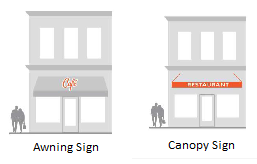
Awning sign or canopy sign means a sign that is painted on or attached to an awning or canopy.
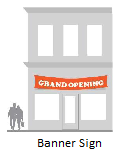
Banner sign means a sign on paper, cloth, fabric or other flexible or combustible material of any kind that is attached flat either to a wall or temporarily to a permanent sign face.
Billboard. See outdoor advertising sign.
Building-mounted sign means a display sign that is painted on, adjacent to or attached to a building wall, door, and window or related architectural feature including building directories, canopy signs, projecting signs or marquee signs, wall signs, and window signs.
Changeable copy sign means a permanent sign or portion thereof on which the copy or symbols change, either automatically through electrical or electronic means, or manually through the placement of copy and symbols on a panel mounted in or on a track system.
Electronic message sign (EMS) means an electrically activated changeable copy sign whose variable message capability can be electronically programmed.
Festoon means a string of ribbons, pennants, spinners, streamers, tinsel, small flags, pinwheels, or lights, typically strung overhead and/or in loops.
Flag means a sign on paper, cloth, fabric or other flexible or combustible material of any kind that is attached to a permanent conforming pole or attached flat to a wall.
Freestanding sign means any sign that is affixed to the ground surface and supported by one or more uprights, poles, pylons, monuments, or braces placed in the ground and independent of any building or other structure. Signs on water towers or other elevated tanks should be considered as free standing signs.
a.
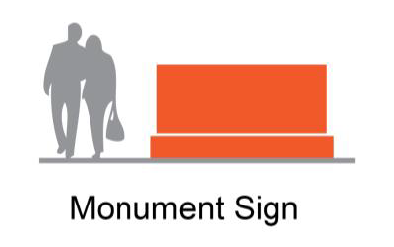
Freestanding sign, ground sign or monument sign means a freestanding sign supported by structures, columns, braces, or other supports that are placed on, or anchored in, the ground and that are independent from any building or other structure. A ground sign or monument sign must have a solid supporting base equal to or greater than the width of the sign face constructed of a decorative and durable material, and shall have no separations between the sign face and the base.
b.
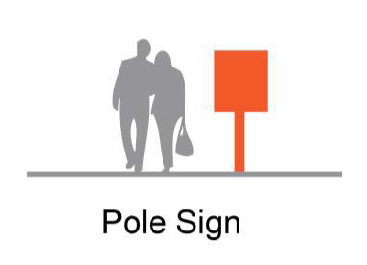
Freestanding sign, pole sign means a type of freestanding sign that is elevated above the ground on poles or braces.
Incidental sign means a small sign, usually two square feet or less, designed and located to be read only by people within the site and generally not visible or legible from the right-of-way or adjacent properties. Examples of incidental signs include, but are not limited to, credit card signs, signs indicating hours of business, no smoking signs, signs used to designate bathrooms, handicapped signs, traffic control signs that conform to the requirements of the Michigan Manual of Uniform Traffic Control Devices, and other signs providing information to be read at close proximity. The zoning administrator shall determine whether a sign is an incidental sign, based on the visibility of the sign from the lot line and right-of-way and/or the number of signs in close proximity of each other, and the zoning administrator may deny a incidental sign if it is a sign that is regulated by another standard in this article.
Interior sign means a sign placed within a building, but not including a window sign as defined by this article, that is not visible from any public street, sidewalk, alley, park or public property.
Mural means any image or design that is painted or otherwise attached flat to a wall that is primarily artwork and does not function like a sign. For purposes of this article, a mural shall not be considered a sign. The building official or zoning administrator shall as necessary make a determination as to whether a design is a mural or a sign.
Outdoor advertising sign means a sign intended to advertise a use located on other premises and which is intended primarily for advertising purposes. Such sign, by virtue of its size and scale, would constitute the principal use of the premises on which the sign is located.
People sign means a portable sign held by a person and displayed for the purposes of expressing a message.
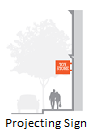
Projecting sign means a display sign attached to or hung from a structure projecting from and supported by the building and extending beyond the building wall, building line or street right-of-way line. A "projecting sign" is differentiated from a "wall sign" based on the distance the sign projects from the surface of the building.
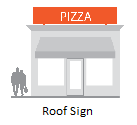
Roof sign means a display sign that is erected, constructed and maintained on or above the roof of the building, or that extends above the roofline.
Street furniture sign means a sign applied to or affixed to the seat or back of a bench, lamp post, garbage can, tree, utility pole, or other public street furniture.
Temporary sign means a sign, with or without a structural frame, intended for a limited period of display.
a.
Temporary sign, air-activated sign means a temporary sign that is an air inflated object, which may be of various shapes, is made of flexible fabric, rests on the ground or structure and is equipped with a portable blower motor that provides a constant flow of air into the device. Air-activated signs are restrained, attached, or held in place by a cord, rope, cable, or similar method.
b.
Temporary sign, balloon sign means a temporary sign that is an air inflated object, which, unlike air-activated signs, retains its shape. A balloon sign is made of flexible fabric, rests on the ground or structure, and may be equipped with a portable blower motor that provides a constant flow of air into the device. Balloon signs are restrained, attached, or held in place by a cord, rope, cable, or similar method.
c.
Temporary sign, portable sidewalk, sandwich board, or A-frame sign means a sign that is not permanent, not affixed to a building or structure, or permanently attached to the ground. Such sign is usually placed along the sidewalk or road frontage of a business and is capable of being moved within the zoning lot on which it is located or from one zoning lot to another. Often referred to as "sidewalk signs," sandwich board signs include, but are not limited to, so called "A" frame, "T" shaped, or inverted "T" shaped stands.
d.
Temporary sign, support pole sign means a temporary sign that is attached as an appendage to a sign, sign support, light pole, utility pole, or any part of a pole or support.
e.
Temporary sign, yard sign means a portable temporary sign or sign board that is freestanding and temporarily anchored or secured to the ground.
Vehicle sign means any sign on a vehicle, trailer, truck, and similar vehicle used for transport, where the primary purpose of the vehicle is for transportation as part of the normal course of business.
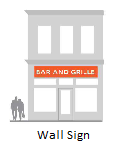
Wall sign means any sign attached parallel to a wall, painted on the wall surface of, or erected and confined within the limits of an outside wall of any building or structure, which is supported by such wall or building and displays only one sign surface. A wall sign shall not project from the surface of the building wall more than 12 inches.
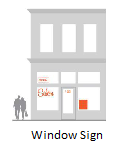
Window sign means a sign affixed to a window or so as to be observable from the exterior of the window to which such sign is located or affixed, including signs located inside a building but visible from the outside of the building.
(b)
Sign definitions, general.
Abandoned sign means a sign or supporting structure that is no longer regularly maintained or a sign located on a lot with a vacant building. Whether a sign has been abandoned shall be determined by the intent of the sign owner and shall be governed by the applicable case law and statutory law on abandoned structures.
Alteration means any change in copy, color, size, or shape, which changes appearance of a sign, or a change in position, location, construction, or supporting structure of a sign, except that a non-structural copy change on a sign is not an alteration.
Awning means a fireproof space frame structure with translucent flexible reinforced vinyl or canvas covering designed in awning form, and extending outward from the building wall.
Building frontage means the length of the front (entry) portion of a building occupied by a single tenant, often facing a street fronting to the premises on which the tenant is located.
Canopy means a multi-sided overhead structure used as a common building architectural feature.
a.
Canopy, attached means a multi-sided overhead structure or architectural projection supported by attachment to a building on one or more sides and either cantilevered from such building or also supported by columns at additional points.
b.
Canopy, freestanding means a multi-sided overhead structure supported by columns, but not enclosed by a wall.
Clearance means the vertical distance between the surface grade beneath the sign and the lowest point of the sign, including framework and embellishments.
Damaged sign means a sign or supporting structure that is torn, defaced, dented, smashed, broken, vandalized, or destroyed.
Decorative display means a decorative display designed for the entertainment or cultural enrichment of the public and intended to serve as a cosmetic adornment rather than to convey a message. A decorative display shall not be considered a sign and shall be temporary in nature.
Directional sign means a sign that controls or directs traffic, pedestrian, or parking movements.
Grade, sign means the average elevation of an area within a horizontal radius, equal to the height of the sign, extending around sign base.
Height, sign means the vertical distance measured from the sign grade at the center point of the sign location to the highest point of the sign.
a.
Height, maximum shall be measured from sign grade to the highest edge of the sign surface or its projecting structure.
b.
Height, minimum shall be measured from sign grade to the lowest edge of the sign surface or its projecting structure.
Illegal sign means a sign for which no valid permit was issued by the township at the time such sign was erected, or a sign that is not in compliance with the current zoning chapter and does not meet the definition of a nonconforming sign.
Noncombustible material means any material that will not ignite at or below a temperature of 1,200 degrees Fahrenheit and will not continue to burn or glow at that temperature.
Nonconforming sign means a sign that was lawful at the time of its construction but which is not in compliance with current ordinance provisions for signs.
Owner means a person, firm, partnership, association, company, or corporation and/or its legal heirs, successors, and assigns.
Sign means any structure or part thereof, or device attached thereto or painted or represented thereon, or any material or thing, illuminated or otherwise, which displays or includes any numeral, letter, word, model, banner, emblem, insignia, device, code mark, or other representation used as, or in the nature of, an announcement, advertisement, direction, or designation of any person, firm, organization, place, commodity, service, business, profession, or industry which is located upon any land attached on or attached to any building, in such manner as to attract attention from outside the premises.
Sign area means the entire area within a circle, triangle, rectangle, oval, or other geometric shape enclosing the extreme limits of writing, representation, emblem or any figure of similar character, together with any frame or other material or element forming an integral part of the display or used to differentiate the sign from the background against which it is placed, excluding the necessary supports or uprights on which such sign is placed, as long as those supports do not contain signs. An awning shall not be deemed to be a sign frame.
Sign copy means the words and images constituting the message of a sign.
a.
Sign copy, animated copy means any type of sign copy that flashes, moves, revolves, cycles or is otherwise altered or changed by mechanical or electrical means.
b.
Sign copy, changeable means moveable letters or other forms of sign copy, not including animated copy, that can be altered by natural, mechanical or electrical means without replacing the sign copy area.
Unsafe sign means a sign that is not properly secured; is in danger of falling or has otherwise been found to be in a condition that is hazardous to the public health, safety or welfare by the building official or code enforcement officer.
(Ord. No. 19-63, § 3, 4-9-2019)
Sec. 36-790. - General sign regulations.
The following general sign regulations apply to all zoning districts within the township:
(1)
Traffic control. No sign shall be erected or replaced at any location where, by reason of position, size, shape, color, or illumination, it may interfere with, obstruct the view of, or be confused with, any authorized traffic sign, signal, or device so as to interfere with, mislead, or confuse traffic.
(2)
Sign character and setbacks. All signs shall be designed, constructed, and maintained so as to be appropriate in appearance with the existing or intended character of their vicinity so as not to change the essential character of such area. All ground signs shall maintain a minimum setback of 15 feet from all road rights-of-way and shall be located no closer than 15 feet from the edge of the principal entrance driveway and all property lines.
(3)
Permit required. Unless exempt under the provisions of this article, a permit for any sign, whether freestanding or mounted on or applied to a building, including signs painted on building walls or other structures, or for any change in copy, shall be obtained from the township zoning administrator before such sign may be erected, replaced, or relocated.
(4)
Sign height.
a.
No freestanding sign shall exceed a height of 15 feet above the sign grade.
b.
Computation of height. The height of a sign shall be computed as the distance from the base of the sign at the center of the sign grade to the top of the highest attached component of the sign.
c.
In cases where the sign grade cannot reasonably be determined, sign height shall be computed on the assumption that the elevation of the sign grade at the base of the sign is equal to the elevation of the nearest point of the crown of a public street or the grade of the land at the principal entrance to the principal structure on the lot, whichever is lower.
(5)
Maintenance. All portions of signs and sign structures shall undergo maintenance as needed to keep them in good repair and working order.
(6)
Illumination. The following regulations shall apply to all signs.
a.
The light from any illuminated sign or from any light source, including the interior of a building, shall be so shaded, shielded, or directed that the light intensity or brightness shall not adversely affect surrounding or facing premises nor adversely affect safe vision of operators of vehicles moving on public or private roads, highways, or parking areas. Light shall not shine or reflect onto or into residential structures.
b.
No sign shall have blinding, flashing, or fluttering lights or other illuminating devices which have a changing light intensity, brightness, or color, or which are so constructed and operated as to create an appearance or illusion of writing or printing. Illumination for electronic message signs (EMS) shall be regulated pursuant to section 36-797(6). Illumination for LED billboards shall be regulated pursuant to section 36-796(6). Nothing contained in this article shall, however, be construed as preventing the use of lighting as a decorative display.
c.
No exposed reflective type bulbs and no strobe lights or incandescent lamps shall be used on the exterior surface of any sign so as to expose the face of the bulb, light, or lamp to any public street or adjacent property.
(Ord. of 7-22-2013, § 62.02; Ord. of 6-4-2014, § 62.02; Ord. No. 19-63, § 3, 4-9-2019)
Sec. 36-791. - Signs permitted in recreation-conservation and agricultural districts.
Signs permitted in the AR and RC zoning districts include the following:
(Ord. of 7-22-2013, § 62.04; Ord. of 6-4-2014, § 62.04; Ord. No. 19-63, § 3, 4-9-2019)
Sec. 36-792. - Signs permitted in residential districts.
Signs permitted in the LR, MR, MHP, SR1, and SR2 zoning districts include the following:
(Ord. of 7-22-2013, § 62.05; Ord. of 6-4-2014, § 62.05; Ord. No. 19-63, § 3, 4-9-2019)
Sec. 36-793. - Signs permitted in business districts.
Signs permitted within the LC, GC, RO, WLD-D, WLD-NV, WLD-W, PSC, and RTM zoning districts include the following:
(Ord. of 7-22-2013, § 62.06; Ord. of 6-4-2014, § 62.06; Ord. No. 17-53, §§ 12, 13, 2-14-2017; Ord. No. 19-63, § 3, 4-9-2019)
Sec. 36-794. - Signs permitted in industrial districts.
Signs permitted within the LI and GI zoning districts include the following:
(Ord. No. 19-63, § 3, 4-9-2019)
Sec. 36-795. - Signage in conjunction with an approved temporary use in the WLD, LC, GC, RO, LI, GI, PSC, RTM and non-residential PUD districts.
Banners, pennants, searchlights, balloons, or other gas-filled or fan powered figures shall be permitted in conjunction with an approved temporary use permit in the WLD, LC, GC, RO, LI, GI, PSC, RTM, and non-residential PUDs for a period not to exceed 14 days in any 30-day period. The days of display must be specified on the temporary use permit and sign permit. Each of these types of signs shall require a separate permit. Six of these types of signs (occasions) shall be permitted in any one calendar year per zoning lot. Such signs shall not obstruct pedestrian or vehicular view and shall not interfere in any way with traffic flow. Banners shall have a maximum area of 32 square feet. Balloons and gas-filled or fan-powered figures shall not exceed the maximum height restrictions for the district in which they are located. The setback standards of section 36-789(2) must be met for these types of signs.
(Ord. No. 19-63, § 3, 4-9-2019)
Sec. 36-796. - Billboards (outdoor advertising signs).
Billboards shall be permitted in LI—limited industrial district, RTM—research/technology/manufacturing district, and GI—general industrial district, and shall be considered a principal use of the lot. In addition, billboards must meet the following regulations:
(1)
Spacing. Billboards shall be spaced so that not more than three billboards structures may be located per linear mile of street or highway regardless of the fact that such billboards may be located on different sides of the subject street or highway. The linear mile measurement shall not be limited to the boundaries of the township where the particular street or highway extends beyond such boundaries.
(2)
Display areas. Billboards that face U.S. 23 within an appropriate district shall have a maximum surface display area of 672 square feet, known as a bulletin billboard. Billboards facing all other streets within the township within an appropriate zoning district shall have a maximum surface display area of 288 square feet, known as a poster billboard. The maximum size limitations shall apply to each side of a sign structure. Signs may be placed back to back or in V-type construction. Stacked signs and side by shall not be permitted. If both sides of a V-type sign are visible from any one location it shall not be considered a single sign for the purposes of calculating maximum sign area.
(3)
Height. The billboard shall not exceed 30 feet above the average grade of:
a.
The ground on which the billboard sits; or
b.
The grade of the abutting roadway, whichever is higher.
(4)
Placement on roof. The billboard shall not be on top of, cantilevered, or otherwise suspended above the roof of any building.
(5)
Setbacks. No billboard shall be located closer than 50 feet to a non-right-of-way property line and must maintain a minimum of 15 feet from any right-of-way on the property. No billboard shall project over public property. Billboard signs shall be no closer than 25 feet to any other nonresidential structure on or off the same premises upon which the billboard is located. Billboards are prohibited from locating within 300 feet of a residential zone and/or existing residence. No digital or LED billboard shall be located within 1,000 feet of an existing residence.
(6)
Illumination. Digital or LED billboards are allowed if the digital or electronic changeable copy portion of the billboard and the billboard meet all the following additional standards:
a.
A billboard shall have automatic dimming capabilities so that the maximum luminescence level is not more than 0.3 footcandles over ambient light levels measured at the following distance in relation to billboard size, rounded to the nearest whole square foot:
b.
Any illumination shall be concentrated on the surface of the sign and is so located to avoid glare or reflection onto any portion of the street or highway, the path of on-coming vehicles, or any adjacent properties.
c.
No billboard shall have flashing, strobing, intermittent, moving, rotating, or oscillating lights or images.
d.
No digital or LED billboard shall be permitted within 4,000 feet of another digital or LED billboard or 3,000 feet of a nondigital or non-LED billboard.
e.
The rate of change between two static messages shall be one second or less.
f.
There shall be a minimum of no less than seven seconds between copy changes.
g.
The owner of a digital or LED billboard must reasonably coordinate with relevant public agencies to allow for the display of real-time emergency information such as Amber Alerts or natural disaster directives.
h.
The digital or LED billboard will not distract, endanger, or disorient motorists.
(7)
Construction. Billboards shall be self-supported, pole-mounted structures constructed in such a fashion that it will withstand all wind and vibration forces that can normally be expected to occur in the vicinity. A billboard must be maintained so as to assure proper alignment of structure, continued structural soundness and continued readability of message.
(Ord. of 7-22-2013, § 62.07; Ord. of 6-4-2014, § 62.07; Ord. No. 17-53, § 14, 2-14-2017; Ord. No. 19-63, § 3, 4-9-2019)
Sec. 36-797. - Electronic message signs.
Electronic message signs (EMS) shall be permitted within all nonresidential zoning districts, as either a free-standing or wall-mounted sign subject to the sign regulations for each zoning district and to the following additional regulations:
(1)
An electronic message sign (EMS) shall only be permitted as part of a static sign and shall be limited to 50 percent of the total sign area of the static sign.
(2)
Frequency of message change shall be no more than once every 30 seconds.
(3)
The rate of change between two static messages shall be one second or less.
(4)
Scrolling words or images are prohibited;
(5)
EMS owners shall permit township, state, and federal governments to post messages in the event of an emergency; and
(6)
The electronic message sign may not display light of such intensity or brilliance to cause glare, impair the vision of an ordinary driver, or constitute a nuisance. Maximum sign luminance shall not exceed 0.3 footcandles above ambient light measurement based upon the size of the sign rounded to the nearest whole square foot, and the distance measured perpendicular to the sign face in accordance with the following table:
* Measured in feet, perpendicular to the face of the sign.
Source: Model Code, Illuminating Engineering Society of North America
(7)
Prior to the issuance of a sign permit, the applicant shall provide written certification from the sign manufacturer that the light intensity has been factory-programmed not to exceed the above listed light levels.
(8)
In no case shall EMS luminance exceed 0.1 footcandles above ambient light along any adjacent property line that is zoned or used for residential purposes.
(Ord. of 7-22-2013, § 62.09; Ord. of 6-4-2014, § 62.09; Ord. No. 19-63, § 3, 4-9-2019)
Sec. 36-798. - Exemptions.
The following types of signs shall not require a permit and are exempted from all the provisions of this article except for construction and safety regulations, the setback provisions of section 36-789(2), and the following standards:
(1)
Signs erected by an official governmental agency or a public officer in the performance of their public duty, as necessary to preserve the health, safety, and welfare of the community.
(2)
Sign copy carved into stone, concrete, or other similar material or permanent type construction and made an integral part of the structure or architecture of the building.
(3)
Signs recognizing an official national or state historical site or building.
(4)
Directional signs as necessary to direct traffic movement onto a property or within a property, not exceeding eight square feet in area for each sign. Horizontal directional signs on and flush with paved areas are exempt from these standards.
(5)
Incidental signs, subject to the approval of the zoning administrator.
(6)
"No trespassing," "no hunting," and similar signs prohibiting invasion of private property, provided the area of such sign shall not exceed two square feet. The basis for exempting these types of signs is for the public safety benefit provided informing people that trespassing is prohibited.
(7)
Address numbers, being essential for public safety and emergency response, with a numeral height no greater than six inches for each dwelling unit and 18 inches for any other use, including multiple-family buildings. The police chief or fire chief may approve a larger numeral height if deemed necessary for public safety and emergency response.
(8)
Interior signs.
(9)
Vehicle signs, provided the vehicle is licensed, registered, and lawfully parked in accordance with this article.
(10)
Any lawful sign in a public or private right-of-way installed by an authorized public agency.
(11)
Temporary signs authorized elsewhere within this chapter.
(Ord. of 7-22-2013, § 62.10; Ord. of 6-4-2014, § 62.10; Ord. No. 19-63, § 3, 4-9-2019)
Sec. 36-799. - Prohibited signs.
The following signs are prohibited anywhere within the township:
(1)
Signs which imitate an official traffic sign or signal, which contain the words "stop," "go," "slow," "caution," "danger," "warning," or similar words.
(2)
Signs which are of a size, location, content, coloring, or manner of illumination which may be confused with or construed as a traffic control device or which hide from view any traffic or street sign or signal or which obstruct the view in any direction at a street or road intersection.
(3)
Signs which are placed on a street or other public right-of-way, unless otherwise permitted by these regulations.
(4)
All temporary signs, unless authorized elsewhere within this chapter.
(5)
Abandoned signs.
(6)
Festoons, except for decorations commemorating a holiday or approved in conjunction with a temporary land use.
(7)
Street furniture signs, unless otherwise permitted within this chapter.
(8)
Signs attached to other signs, unless otherwise permitted within this chapter.
(9)
Animated signs.
(10)
Roof signs.
(11)
Illegal signs.
(12)
Damaged signs.
(13)
Unsafe signs.
(14)
People signs. The basis for prohibiting people signs is that the movement and proliferation of people signs would degrade traffic safety and community aesthetics.
(Ord. of 7-22-2013, § 62.11; Ord. of 6-4-2014, § 62.11; Ord. No. 19-63, § 3, 4-9-2019)
Sec. 36-800. - Permit and fees.
(a)
Application for a permit to erect or replace a sign, or to change copy thereon, shall be made by the owner of the property on which the sign is to be located, or his authorized agent; to the township zoning administrator, by submitting the required forms, fees, exhibits, and information. Fees for sign permits shall be determined by resolution of the township board and no part of such fee shall be returnable to the applicant. No fee shall be required of any governmental body or agency.
(b)
The application shall contain the following information:
(1)
The applicant's name and address in full, and a complete description of relationship to the property owner.
(2)
The signature of the property owner concurring in submittal of said application.
(3)
An accurate detailed drawing of the property showing location of all buildings and structures and their uses, and location of the proposed sign.
(4)
A complete description and scale drawings of the sign, including all dimensions and the area in square feet.
(c)
All signs shall be inspected by the township zoning administrator for conformance to this chapter prior to placement on the site. Foundations shall be inspected by the building inspector on the site prior to pouring of the concrete for the sign support structure.
(d)
Any sign involving electrical components shall be wired by a licensed electrician in accordance with the township electrical code and the electrical components used shall bear an Underwriters Laboratories, Inc., seal of inspection.
(e)
A sign permit shall become null and void if the work for which the permit was issued has not been completed within a period of six months after the date of the permit. A permit may be renewed prior to expiration and no additional fee shall be collected for the renewal.
(f)
Painting, repainting, cleaning, and other normal maintenance and repair of a sign or a sign structure, unless a structural or copy change is made, shall not require a sign permit.
(g)
All signs shall comply with the requirements of the building code of the township.
(Ord. of 7-22-2013, § 62.12; Ord. of 6-4-2014, § 62.12; Ord. No. 19-63, § 3, 4-9-2019)
Sec. 36-801. - Computation of surface area.
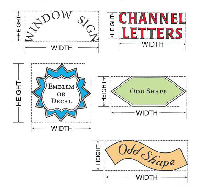
The surface area of a sign shall be computed as including the entire area within a regular geometric form or combination of such forms comprising all of the display area of the sign and including all of the elements of the matter displayed. Frames and structural members not bearing copy or display material shall not be included in computation of surface area. Where a sign has two or more faces, the area of all faces shall be included in determining the area of the sign, except that where two such faces are placed back to back, parallel to one another, and no more than 24 inches apart, the area of the sign shall be the area of one face.
(Ord. of 7-22-2013, § 62.14; Ord. of 6-4-2014, § 62.14; Ord. No. 19-63, § 3, 4-9-2019)
Sec. 36-802. - Removal.
(a)
The zoning administrator shall order the removal of any sign erected or maintained in violation of this article. Thirty days' notice in writing shall be given to the owner of such sign or of the building, structure, or premises on which such sign is located, to remove the sign or to bring it into compliance with the article. Upon failure to remove the sign or to comply with this notice, the township shall take action to force the removal of the sign. The township shall also remove a sign immediately and without notice if it reasonably appears that the condition of the sign is such as to present an immediate threat to the safety of the public. Any cost of removal incurred by the township shall be assessed to the owner of the property on which such sign is located and may be collected in the manner of ordinary debt or in the manner of taxes and such charge shall be a lien on the property.
(b)
A sign shall be removed by the owner or lessees of the premises upon which the sign is located when the business which it advertises is no longer conducted on the premises, thereby making the sign an abandoned sign. If the owner or lessee fails to remove the sign, the township shall take action to force the removal of the sign in accordance with subsection (a) of this section. These removal provisions shall not apply where a subsequent owner or lessee agrees to maintain the signs as provided in this article, and provided the signs comply with the other provisions of this chapter.
(Ord. of 7-22-2013, § 62.15; Ord. of 6-4-2014, § 62.15; Ord. No. 19-63, § 3, 4-9-2019)
Sec. 36-803. - Nonconforming signs.
(a)
Copy may be changed on nonconforming signs, provided that the sign area is not increased, and provided that no structural changes are made in the sign. All nonconforming signs are subject to the provisions included in article XXIX of this chapter, pertaining to nonconformities.
(b)
Nonconforming signs must be brought into compliance with the standards of this article for all projects that require site plan approval.
(Ord. of 7-22-2013, § 62.16; Ord. of 6-4-2014, § 62.16; Ord. No. 19-63, § 3, 4-9-2019)
Sec. 36-804. - Responsibilities for signs.
The following regulations apply to all signs:
(1)
The sign user is hereby made responsible for copy, structure, lighting, and all other parts of a sign.
(2)
When or where applicable, signs requiring a permit shall be constructed and erected only by individuals or companies licensed in the State of Michigan for such purpose.
(3)
All signs requiring permits shall display, in a conspicuous place, evidence of the permit and containing such data as might be required by the zoning administrator, including the name of the individual or company erecting the sign.
(4)
Each individual or company erecting signs within the township shall annually provide the zoning administrator with a certificate of public liability insurance. A permit for erecting a sign shall not be issued unless such certificate is on file with the zoning administrator.
(5)
All signs and components thereof shall be kept in good repair and in a safe, clean, neat, and attractive appearance.
(Ord. of 7-22-2013, § 62.17; Ord. of 6-4-2014, § 62.17; Ord. No. 19-63, § 3, 4-9-2019)
Sec. 36-805. - Registry.
The zoning administrator shall maintain an up-to-date registry of each sign erected in the township after the effective date of the ordinance from which this article is derived. The registry shall contain the following information: location of the sign, name and address of the property owner, sign user, and individual or company erecting a sign and height, dimensions, and face area, and date of placement on the site.
(Ord. of 7-22-2013, § 62.18; Ord. of 6-4-2014, § 62.18; Ord. No. 19-63, § 3, 4-9-2019)

