
Norwich City Zoning Code
CHAPTER 4
GENERAL REQUIREMENTS
4.1 - Conformity Required.
Except as otherwise specifically provided in these regulations:
4.1.1
Conformity of buildings and land (use, location and occupancy). No building or lot shall be used or occupied, and no building or part thereof shall be erected, raised, moved, placed, reconstructed, extended, enlarged, or altered except in conformity with the regulations herein specified for the district in which it is located. No building shall be occupied by more dwelling units or persons than prescribed for such building or lot for the district in which it is located.
4.1.2
Conformity of open spaces. No yard, or open space, or part thereof, shall be included as a part of the yard or open space similarly required for any other building or dwelling under the provisions of these regulations.
4.1.3
Reduction of dimension of lot areas. No lot shall be diminished in area nor shall any yard or open space be reduced except in conformity with the provisions of these regulations.
4.1.4
Principal building. In residential districts, no lot shall be occupied by more than one permitted principal building except in accordance with the following provisions. Where more than one principal building is permitted on a lot, the bulk requirements of sections 1.1 and 2.1 of these regulations shall be applicable. More than one principal building is permitted on a lot under the following conditions:
.1
All principal buildings on a lot are part of an active adult community previously permitted by the Commission (use has been discontinued).
.2
The lot is located in a zone other than R-80, R-40 or R-20, and either:
.1
The permitted principal buildings are under the same ownership, or
.2
The lot and buildings constitute common interest ownership property. In all cases, the bulk requirements of section 1.1 of these regulations shall be applicable.
4.2 - Building on existing lots.
Nothing in these regulations shall prevent the construction of a permitted building or establishment of a permitted use on a lot which at the time of the adoption of these regulations was owned separately from an adjoining lot, as evidenced by a deed recorded in the land records of the City of Norwich (provided that such building or use shall comply with all applicable yard, health, and sanitation requirements), except that adjoining lots shall merge if:
4.2.1
They were owned by the same person at the time of adoption of these regulations;
4.2.2
And one or more of the lots is undeveloped;
4.2.3
And one or more of the lots does not conform to the dimensional and/or area requirements as noted in sections 1.1 or 2.1 of the zoning regulations;
4.2.4
And if taken together, the resulting combined lot would meet or more nearly meet the requirements of the zoning regulations. If, at the time of the enactment of these regulations, an existing lot has been described by the tax assessor as a separate parcel of land as evidenced by an individual street card for the parcel, then the lot shall not be merged with contiguous lots unless a new deed is recorded in the land records of the City of Norwich.
4.3 - Lot Requirements.
4.3.1
Existing front yard setback. When the lots adjoining on each side of a proposed site for a building are developed, the minimum front yard setback on the proposed site may be equal to the average setback of the adjoining lots only if more than 50 percent of the buildings located within 500 feet on each side of the proposed site, on the same side of the street, do not observe the minimum applicable front yard setback.
4.3.2
Lots in more than one district. Where a lot lies in more than one district, the provisions of the less restrictive district may be applied for a distance of not over 25 feet into the more restrictive district provided that such lot has frontage on a street in the less restrictive district and access solely therefrom.
4.3.3
Lots on narrow streets. Where lots front on a street right-of-way less than 50 feet in width, the front yard setback required by the provisions of these regulations shall be increased by one-half the difference between 50 feet and the actual right-of-way width of the street.
4.3.4
New street lines. Where a new street line has been established, the Commission may require an additional front yard setback not to exceed a total of 65 feet where the Commission finds that future traffic conditions may require street widening.
4.3.5
Through lots. On any through lot there shall be, on all streets, a building setback equal in depth to the applicable front yard requirements and all other yards shall be deemed to be side yards.
4.3.6
Corner lots. On any corner lot there shall be, on all streets, a building setback line equal in depth to the applicable front yard requirements. The yard opposite the smaller front yard shall be deemed to be a rear yard and the other, or others, side yards.
4.3.7
Typical accessory uses locations:
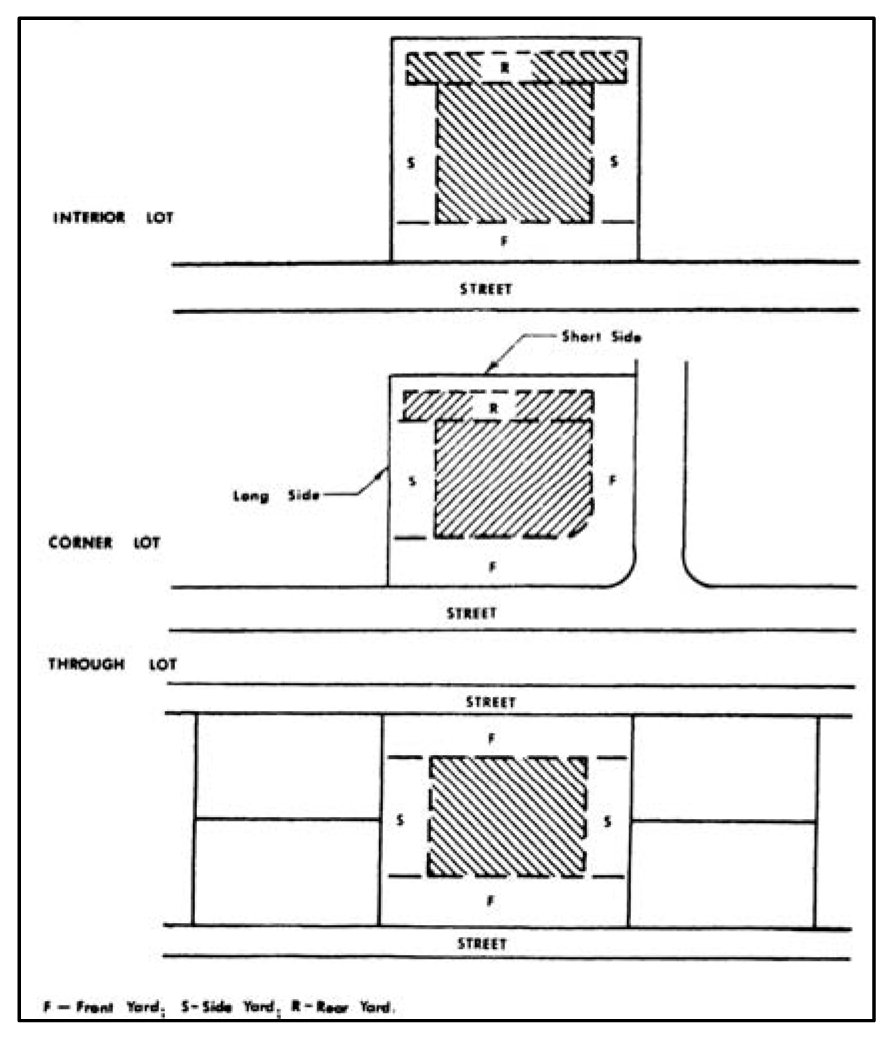
4.3.8
Corner visibility. On a corner lot in any street no fence, wall, hedge or other structure or planting more than three feet in height shall be erected, placed or maintained within the triangular area formed by the intersecting street lines and a straight line adjoining said street lines at points which are 50 feet distant from the point of intersection, measured along said street lines.
4.3.9
Projections into yards. Nothing in these regulations shall prohibit the projection of not more than one foot into any required yard or open space of pilasters, belt courses, sills, cornices or similar architectural features.
4.3.10
Height limitations. Spires, cupolas, towers, chimneys, flagpoles, penthouses, ventilators, tanks and similar features occupying in the aggregate not more than ten percent of the building area, and not used for human occupancy, may be erected to a reasonable and necessary height.
4.3.11
Minimum lot areas required where public or state-approved water and sewerage systems not available. Notwithstanding the minimum lot areas specified for each zoning district in sections 1.1 or 2.1, the following minimum lot areas shall be required, as recommended by the state department of health:
.1
Where no public or state-approved sewerage and water systems are available, a residential lot shall have a minimum lot area of 40,000 square feet, and
.2
Where a public or state-approved water system is available, but a public or state-approved sewerage system is not, a residential lot shall have a minimum lot area of 20,000 square feet.
4.3.12
Rear lots. A rear lot is permitted in a R-20, R-40 or R-80 district, provided the following items are complied with:
.1
The lot must be a minimum of twice the lot size that is required in the district in the zone in which it is located, excluding the driveway area. The lot area shall be calculated at the point that the lot meets the lot width requirement.
.2
The lot is accessible from an approved city street over a private driveway.
.3
Other dimensional requirements within the district are to be complied with.
.4
Minimum frontage on a street and width of drive for a rear lot shall be 25 feet, and in the event a drive serving a rear lot is excessive in length, the Commission on the City Plan or the zoning enforcement officer may require additional width for passing purposes or other safety purposes.
.5
The front yard setback line shall meet minimum requirements of the specific district and run parallel to the road line.
.6
No private drive serving a rear lot shall be closer than 300 feet to another private driveway serving a rear lot on the same side of the street. Construction of driveways shall comply with section 4.6 of these regulations.
4.4 - Performance standards.
The following performance standards shall apply to all uses of land, buildings and other structures wherever located:
4.4.1
Dust, dirt, fly ash and smoke. No dust, dirt, fly ash or smoke shall be emitted into the air so as to endanger the public health, safety or general welfare, or to decrease the value or enjoyment of other property or to constitute an objectionable source of air pollution.
4.4.2
Odors, gases and fumes. No offensive odors or noxious, toxic or corrosive fumes or gases shall be emitted into the air.
4.4.3
Noise. With the exception of time signals and emergency signals and noise necessarily involved in the construction or demolition of buildings or other structures, no noise which is unreasonable in volume, intermittence, frequency or shrillness shall be transmitted beyond the boundaries of the lot on which it originates.
4.4.4
Vibration. With the exception of vibration necessarily involved in the construction or demolition of buildings or other structures, no vibration shall be transmitted beyond the boundaries of the lot on which it originates.
4.4.5
Glare and heat. Any glare or radiant heat produced shall be shielded so as not to be perceptible at or beyond the boundaries of the lot on which it originates.
4.4.6
Fire and explosion hazards. Uses shall conform to the fire safety code of the State of Connecticut, the regulations of the City of Norwich, and any other applicable regulation.
4.4.7
Ionizing radiation and radioactive materials. Uses shall conform to the regulations of the sanitary code of the State of Connecticut with regard to sources of ionizing radiation and radioactive materials, and to any other applicable regulation.
4.4.8
Electromagnetic interference. Uses shall conform to the regulations of the Federal Communications Commission with regard to electromagnetic radiation and interference, and to any other applicable regulation.
4.4.9
Wastes. No offensive or injurious wastes such as discarded building materials, concrete truck washout, chemicals, litter, sanitary waste, or other waste shall be discharged or emitted into any river, stream, storm drain, lake or pond, or other body of water, or onto the surface of any land so as to endanger the public health, safety or general welfare, or to decrease the value or enjoyment of other property or to constitute an objectionable source of pollution.
4.5 - Access to commercial and industrial districts through residential districts.
No vehicular access to a commercial or industrial district shall be permitted through a residential district except by means of a public street.
4.6 - Driveways.
4.6.1
Shared Driveways in Residential Districts. Shared driveways shall not be permitted for any residential use unless such shared driveway existed prior to the adoption of these regulations, the project is approved as a common interest ownership community, involves a mixed use development or an open space development in accordance with these regulations.
4.6.2
Shared Driveways in Business Districts.
.1
The Commission may permit shared driveways for commercial, multifamily dwellings, mixed use, open space development and industrial uses.
.2
The following note should be added to the deed: "City services will not be provided for common/shared drives."
4.6.3
No driveway shall exceed 8 percent grade unless paved with bituminous concrete or any alternate acceptable to the director of public works.
4.6.4
Permit for driveway shall be obtained from the Director of Public Works.
4.7 - Handicap Ramps.
4.7.1
Nothing in Appendix A, Zoning, of the Code of Ordinances of Norwich, Connecticut shall prohibit the extension or projection of wheelchair or other access to a dwelling or structure into any yard required by the Schedule of Lot and Building Requirements set forth in sections 1.1 and 2.1 so long as said wheelchair or handicap access is constructed in accordance with all federal, state and municipal requirements, and provided safe ingress and egress to the site and dwelling or structure are maintained and no parking required in connection with the use of the dwelling or structure is eliminated.
4.7.2
Any wheelchair or other handicap access shall be required to be constructed so as to minimally invade any front yard, side yard or rear yard required under the bulk requirements set forth in sections 1.1 and 2.1 while maintaining required design and construction specifications.
4.8 - Nonconforming Buildings and Uses.
Any nonconforming use of a building or lot lawfully existing at the effective date of these regulations or of any amendments thereto may be continued and any building so existing which was designed, arranged, intended for or devoted to a nonconforming use may be reconstructed and structurally altered, and the nonconforming uses therein changed subject to the following regulations:
4.8.1
Strengthening and restoration. Nothing in these regulations shall prevent the strengthening or restoring to a safe condition of any portion of a building or structure declared unsafe by a proper authority.
4.8.2
Extension. A nonconforming use may be extended to another part of a building designed for such use but not at the expense of a conforming use.
4.8.3
Change to conforming use. No building devoted to a nonconforming use shall be enlarged or extended unless the use therein is changed to a conforming use. Once a nonconforming use has been converted to a conforming use, it may not revert to a nonconforming use.
4.8.4
Change to a less nonconforming use. By Special Permit, the Commission may allow a change from an existing nonconforming use to another use of like or similar character, provided that the degree of existing non-conformity is not expanded by the new use.
4.8.5
Alterations. Structural alterations which do not materially alter the characteristics or exterior appearance of any nonconforming building may be permitted, provided the total costs of such alterations do not exceed 50 percent of the assessed valuation of such building at the time it becomes nonconforming, unless the use thereof is changed to a conforming use.
4.8.6
Uses With Nonconforming Parking and Loading. See section 5.1.16.
4.8.7
Reconstruction. When a building in which there is a nonconforming use is damaged by fire, collapse, explosion, act of God or act of the public enemy, it may be reconstructed, repaired or rebuilt only to its previous floor area and cubical content. Any such reconstruction, if located within the floodplain, shall be subject to the provisions of section 3.4 of these regulations.
4.8.8
Abandonment.
.1
Any nonconforming use which has been abandoned shall not thereafter be reestablished, and such structure or property shall not again be devoted to the original nonconforming use. The term abandonment shall mean the voluntary discontinuance of a use, including but not limited to, an intent not to reestablish such use by the owner.
.2
Any one of the following shall constitute prima-facie evidence of permanent intent-to-abandon, which prima-facie evidence may be rebutted by the owner:
.1
Approval of a site plan application or Special Permit which changes, reduces or eliminates the overall non-conformity of the use, structure or property.
.2
Intentional discontinuance of the nonconforming use for 12 consecutive months, or for a total of 18 months during any 3-year period.
.3
Shorter, temporary interruptions or suspensions of a nonconforming use, with or without substitution of a conforming use, do not terminate the right to resume such nonconforming use.
4.9 - Construction Approved Prior to Ordinance.
Nothing herein contained shall require any change in plans, construction or designated use of a building for which a building permit has been issued, provided the entire building shall be completed according to such plans as filed within two years from the date of the adoption of these regulations, except as otherwise provided by the General Statutes of Connecticut.
4.10 - Building Expansion.
No building which does not conform to the requirements of these regulations regarding building height limit, area and width of lot, percentage of lot coverage and required yards shall be enlarged unless such enlarged portion conforms to the regulations applying to the applicable district; except that vertical and lateral extensions of existing buildings shall be permitted so long as any lateral extension or extensions do not extend beyond the outmost dimensions of the existing structure.
4.11 - Unlawful Use Not Authorized.
Nothing in these regulations shall be construed as authorization for or approval of the continuance of the use of a building or lot in violation of the zoning ordinance in effect at that time.
4.12 - Certificate of Zoning Compliance.
No use of land or buildings, the use of or area or construction of which has been changed, extended, enlarged or altered after the adoption of these regulations, shall be occupied or used in whole or in part until a certificate of occupancy shall have been issued showing compliance with the provisions of these regulations.
4.13 - District Changes.
Whenever the boundaries of a district shall be changed so as to transfer an area from one district to another district of a different classification, the foregoing provisions shall also apply to any nonconforming uses existing therein.
4.14 - Accessory Buildings.
4.14.1
Except as hereinafter specifically provided for, buildings accessory to a permitted farm or agricultural use and detached accessory buildings not used for human habitation shall be located not nearer than ten feet to any lot line when located in the rear yard, and shall otherwise observe all front and side yard requirements.
4.14.2
Accessory building on through lots. No accessory buildings shall be located in any required yard.
4.14.3
Time of erecting accessory building. No accessory building shall be erected prior to the erection of the principal building on the lot except that this provision shall not prohibit the completion and occupancy of an accessory building before the completion of the principal building then under construction on the same lot.
4.14.4
When accessory building part of principal building. A building attached to a principal building by a roofed structure at least three feet wide shall be considered as an integral part of the principal building.
4.15 - Fences.
The yard requirements of these regulations shall not be deemed to prohibit any wall or fence provided that no wall or fence shall exceed six feet in height above the finished grade for any required yard nor be located nearer than six inches to any lot line, subject to the limitation of section 4.15 hereof. See also the Connecticut Coastal Management Act, Chapter 444 of the Connecticut General Statutes.
4.16 - Swimming Pools.
Swimming pools may be installed in any district as an accessory use. When such use is accessory to a dwelling, it shall be installed in the rear or side yard of the lot, if located outside the dwelling.
4.17 - Prohibited Uses.
The following uses are prohibited in all zoning districts:
4.17.1
Garbage and refuse incinerations not originating on the lot of a principal building except by the City of Norwich.
4.17.2
The distillation of bones, rendering of fat or reduction of animal matter.
4.17.3
Oil refining.
4.17.4
Slaughterhouses, stockyards or feeding pens.
4.17.5
Storage or treatment of ash or other similar material causing dust.
4.17.6
Any use that is dangerous by reason of fire or explosion hazard, injurious, noxious or detrimental to the community or neighborhood by reason of the emission of dust, odor, fumes, smoke, wastes, refuse matter, noise, vibration, or because of any other objectionable feature that is offensive to an extent equal to or greater than the enumerated permitted uses, special uses or Special Permits in the applicable zoning district.

