
Norwich City Zoning Code
CHAPTER 5
BASIC STANDARDS
5.1 - Off-street parking.
5.1.1
Purpose.
.1
This section is intended to provide adequate parking and loading facilities to serve all existing and proposed uses and activities. It is the goal of this section to assure that parking spaces and loading spaces are provided off the street in such number and location and with suitable design and construction to accommodate the motor vehicles of all persons normally using or visiting a use, building or other structure at any one time.
.2
It is the goal of the Norwich Commission on the City Plan to weigh the need for parking against the potential impact of stormwater from impervious surfaces required for off-street parking.
5.1.2
Applicability. These parking standards shall apply to any development in Norwich.
5.1.3
Required off-street parking and loading facilities.
.1
Bicycle parking and racks.
.1
Bicycle parking facilities shall be provided as part of new multi-family developments of 4 dwelling units or more, new retail, office and institutional developments greater than 5,000 square feet, and all transit transfer stations and park-and-ride lots.
.2
Bicycle parking requirements shall apply to new construction, changes of use, or substantial improvement.
.3
Bicycle parking spaces shall:
(i)
Provide a convenient place to lock a bicycle, and shall be at least 6 feet long, 2 feet wide, and shall provide at least 7 feet of vertical clearance, unless a bicycle locker is provided;
(ii)
Be capable of locking the bicycle and supporting the bicycle in an upright position; and
(iii)
Be securely anchored to a supporting surface.
.4
Bicycle parking shall not interfere with pedestrian circulation and shall be separated from automobile parking.
.5
For any use where bicycle parking is required, if the vehicular parking is covered or partly covered the bicycle parking will be covered at the same ratio.
.6
Bicycle racks shall be located at each main building entrance, and placed in an area that is highly visible.
.2
Motor vehicles. The following chart specifies the minimum parking requirement for each land use. Parking shall be located on the same lot as the use it serves unless the Commission approves off-site parking as part of a site plan or Special Permit application in accordance with these Regulations.
TABLE NOTES
A.
Other uses not covered in this section. The Commission shall determine the number of parking spaces required based on the requirements applicable to comparable uses, reliable documentation provided by the applicant or others and/or national standards.
B.
Shopping center. The parking requirements for a Shopping Center shall be computed on the basis of the overall "gross floor area" built therein, without regard to the specific use of each store, bay, or other leasable unit contained therein.
C.
SF= square feet
D.
GFA = gross floor area
.3
Handicapped Parking
.1
Parking spaces for handicapped persons shall be required in accordance with CGS § 14-253a and the Connecticut Building Code, with regard to location, size, marking, signage, and required number of handicapped accessible spaces based on use and size of parking lot.
.2
Parking spaces for the handicapped shall be as close as possible to a building entrance or walkway leading directly to a building entrance and shall be adjacent to curb cuts or other unobstructed methods permitting sidewalk access to a handicapped person.
.3
Van Parking. Where handicapped accessibility is required, a minimum of 1 van parking space shall be provided, and additional van spaces shall be provided at a rate of 1 van space for every 6 handicapped accessible parking spaces required. The van parking space shall be of such size as to accommodate a van designed for wheelchair elevation and transport. Each public parking garage or terminal shall have a minimum of two van- accessible parking spaces complying with this section.
.4
Chelsea Central District. The required off-street parking and loading facilities for motor vehicles (Section 5.1.3.2) do not apply for existing buildings in the Chelsea Central District.
5.1.4
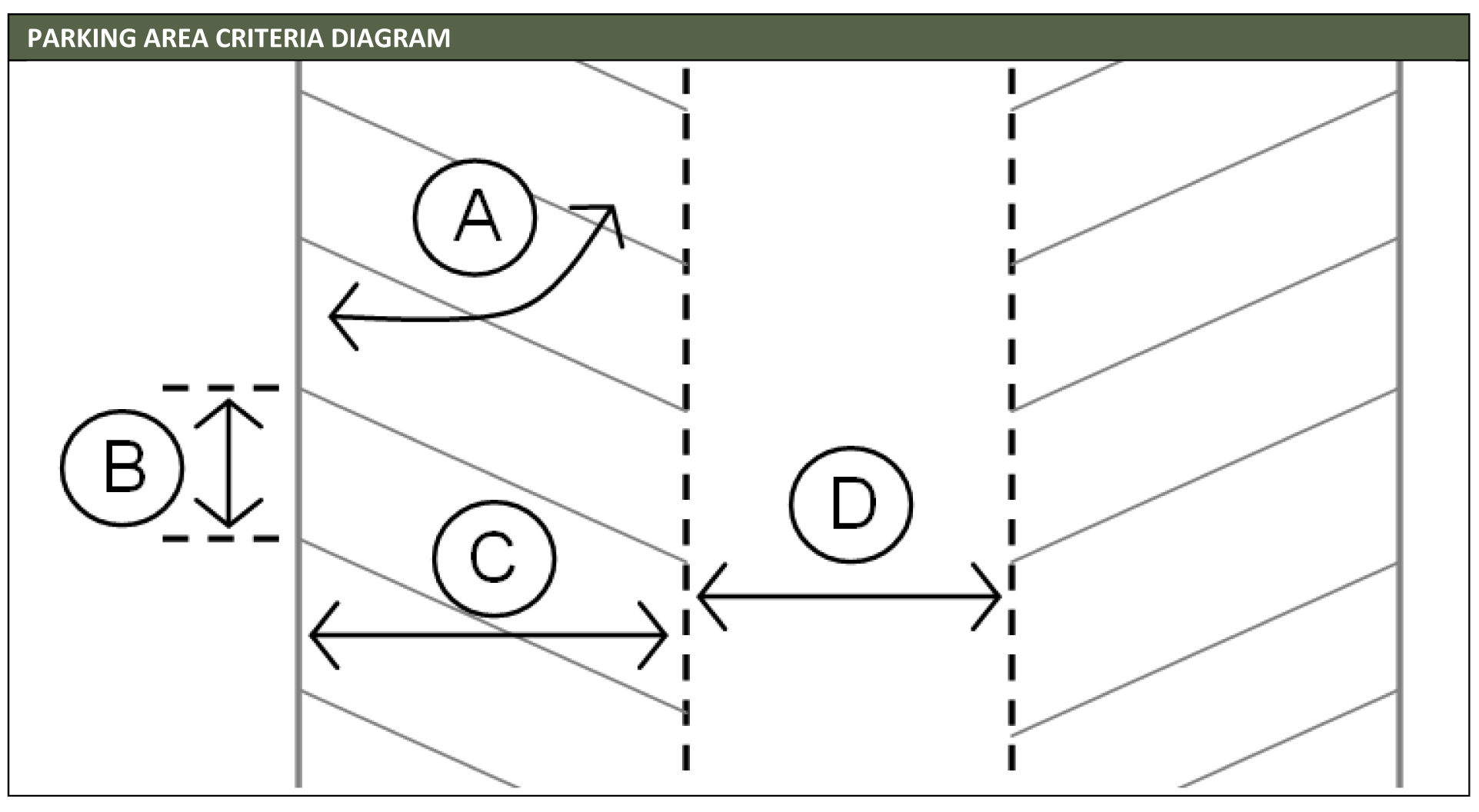
Dimensions of parking space. Required off-street parking spaces and aisles shall be installed and maintained as follows:
5.1.5
Dimensions of loading berth. A required loading space shall not be less than ten feet wide, 25 feet long, and 15 feet high, exclusive of access.
5.1.6
Location of parking facilities. Required parking facilities shall be provided on the same lot as the building they serve or on a lot within 600 feet from such building.
5.1.7
Common/shared spaces.
.1
Nothing in this section shall be deemed to prohibit a cooperative action on the part of any group designed to provide in common the parking spaces required for the individual members of the group, provided that the area or a sufficient portion thereof, is located within 600 feet of the building which it serves.
.2
Access. Common spaces of two or more parking facilities on adjoining lots, if designed for use as a single parking area, may use the same means of access.
5.1.8
Mixed uses. In the case of mixed uses, the parking facilities required shall be the sum of the requirements for the various uses, computed separately. The Commission may modify this requirement based upon parking demands for different uses at different times.
5.1.9
Fractions of spaces. When the number of calculated parking spaces results in the requirements of a fractional space, any fraction under one-half may be disregarded, and any fraction over the one-half shall be construed as requiring a full space.
5.1.10
Municipal parking facilities. Subject to a special permit and site plan review, the Commission may waive the minimum off-street parking requirements for any commercial or industrial use hereafter constructed, reconstructed, or enlarged if said use can be reasonably served by an existing off-street municipal parking facility.
.1
The Commission shall refer said application to the city parking commission who shall review and report to the commission within 30 days as to the adequacy of the existing off-street municipal parking facility for handling the contemplated additional users at the time of application.
.2
Subject to a favorable review from the city parking commission, the minimum required off-street parking spaces for the use in question may be reduced by the Commission on the City Plan in accordance with the following schedule:
TABLE NOTES
*The walking distance shall be measured in straight lines along public right-of-way or established pedestrian access ways extending between the nearest entrance of the proposed building and the nearest vehicular or pedestrian entrance to the existing off-street municipal parking facility.
5.1.11
Parking lot layout. All off-street parking and loading facilities shall be designed with appropriate means of vehicular access to a street as well as maneuvering areas. Detailed plans shall be submitted to the city director of public works and where appropriate to the state highway department for approval of all curb cuts or driveway openings before a permit may be obtained therefor.
.1
All parking spaces, loading facilities and access roadways shall have adequate all-weather surfacing treated to inhibit dust, adequate drainage, and shall allow free and safe movement of all vehicles customarily using the facility.
.2
Any parking area designed for three or more vehicles located adjacent to any public sidewalk or area reserved for a public sidewalk shall be separated from such sidewalk or reserved area by a suitable barrier so placed as to prevent the encroachment or parking of vehicles on such public sidewalk or reserved area.
.3
The light, including illuminated signs, on any parking area or driveway shall be located and arranged to reflect away from residential areas and public streets.
.4
Pedestrian safety. All off-street parking areas shall be designed to provide for the safe and convenient movement of pedestrians through such areas.
5.1.12
Parking lot construction. Parking layout construction shall be in accordance with the following parking specifications:
.1
Parking Surface. The parking surface shall be treated with bituminous pavement products unless the Commission approves an alternative surface.
.2
Alternative Parking Surface.
.1
The Commission may allow an alternate surface if the use is a low traffic generator and the Commission is satisfied with the maintenance provisions.
.2
Use of porous pavement, specially designed brick or block should be considered to increase on-site water retention for plant material and groundwater recharge and to reduce problems related to runoff.
5.1.13
Landscaping. Parking lots in commercial and industrial districts shall have, in addition to required landscaped buffer strips, at least 18 square feet of green space, seeded to grass and planted with trees and shrubs, within the parking lot, for each parking space. In all parking lots of more than 50 spaces, a landscaped divider strip at least 6 feet wide planted to trees and evergreen shrubs, shall be provided not more than 150 feet on center.
5.1.14
Deferred Installation. With respect to the installation of parking spaces required by this Section, the Commission may, upon request by any property owner or other applicant, defer the immediate installation of a portion of the required number of parking spaces upon the following conditions:
.1
That the parking plan submitted to the Commission show the layout for the full parking requirement and identify those spaces for which deferral of immediate installation is requested;
.2
That the Commission find the reduced number of parking proposed to be installed will adequately serve the proposed development;
.3
That the owner file with the Commission, and note on the parking plan, an agreement obligating the owner, his heirs or successors and assigns to install such remaining parking spaces within 6 months after the date of any request by the Commission to do so; and that such agreement be incorporated by reference as a condition of any Special Permit, the parking for which is affected by this subparagraph, and be so recited in the document evidencing such Special Permit recorded on the land records.
5.1.15
Existing off-street parking and loading facilities.
.1
Where, as of the effective date of this section, off-street parking facilities and off-street loading spaces are provided conforming in whole or in part to the provisions of this section, such off-street parking facilities and off-street loading spaces shall not be altered or reduced in area below the requirements set forth herein.
.2
In the event, however, that there shall be an enlargement or alteration of any building served by such off-street parking facilities or off-street loading spaces or a new or changed use of the property requiring additional off-street parking facilities or off-street loading spaces under the provisions of this section, such additional off-street parking facilities or off-street loading spaces shall be provided as required herein.
5.1.16
Uses with nonconforming parking. A legally-established use of a lot which does not meet the requirements for vehicular parking, bicycle parking or loading area established by this section is nonconforming with respect to parking and loading and shall be governed by the following:
.1
Continuation. Uses which have nonconforming parking or loading may be continued indefinitely subject to the provisions of this section.
.2
Enlargement or Intensification of Uses located in the CC district, or the Adaptive Reuse Overlay. Enlargement of any existing structure or use, or any change of occupancy or manner of operation that would increase the number of parking, loading or bicycle spaces required by 50% or more shall require improvements to parking layout, loading, circulation, lighting or landscaping, but no additional parking spaces shall be required.
.3
Enlargement or Intensification of Uses in all other districts. Enlargement of any existing structure or use, or any change of occupancy or manner of operation that would increase the number of parking, loading or bicycle spaces required shall require improvements to parking layout, loading, circulation, lighting or landscaping. Additional parking spaces shall also be required for the enlargement or change. Where numbers of parking spaces for the existing structure or use are deficient, additional parking spaces may also be required where feasible.
.4
Change of Use in all districts. Any change in a use which requires more off-street parking and/or loading than the most recent legally-established use shall provide parking and/or loading in accordance with the current parking requirements for the changed use minus the number of parking spaces by which the previous use was legally deficient.
.5
Determination of Improvements. Determination of the amount of parking improvements required to upgrade or improve existing parking conditions shall be made by the Director of Planning and Neighborhood Services.
.6
Changes to Parking Area. Any changes to a parking area layout, loading area, circulation aisles, access, lighting or landscaping may only be changed when the change reduces or corrects an existing substandard condition. Any such proposed change must be approved by the city.
.7
Process. Applicants proposing to change a parking area shall prepare a parking plan, which shall be reviewed and approved by the Director of Planning and Neighborhood Services prior to any modifications. The Director of Planning and Neighborhood Services may refer the plan to the Director of Public Works, or his/her appointee.
5.1.17
Policing of Parking Spaces. Nothing contained in this section shall be construed to prohibit the owner or owners of the land on which such off-street parking facilities are located from policing the same and from forbidding the parking of motor vehicles thereon when the owner or user of such motor vehicle is not making use of the facilities, uses or buildings for which such parking area is provided.
(Ord. No. 1809, 11-15-21; Ord. No. 1850, 12-4-23)
5.2 - Signs.
5.2.1
Procedure. After the adoption of these regulations as amended and except as otherwise provided herein, no person shall erect, structurally alter, or relocate any sign without first obtaining approval for a permit as required in each zoning district.
5.2.2
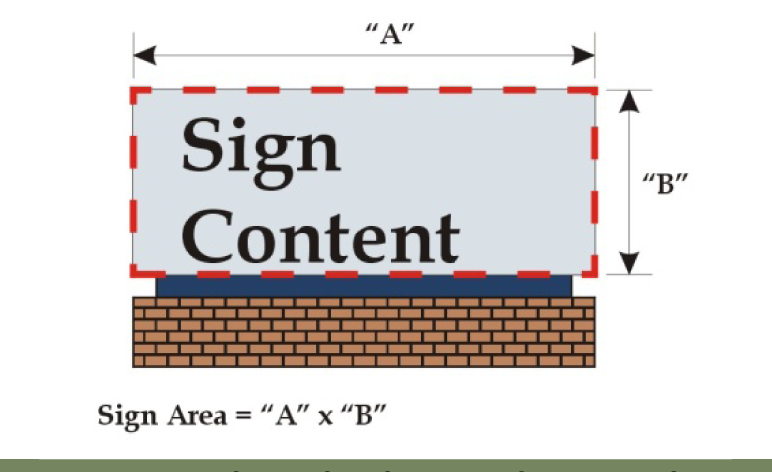
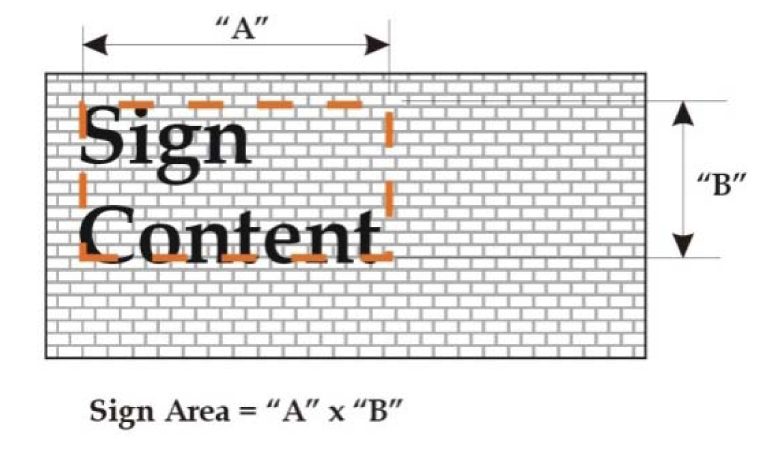
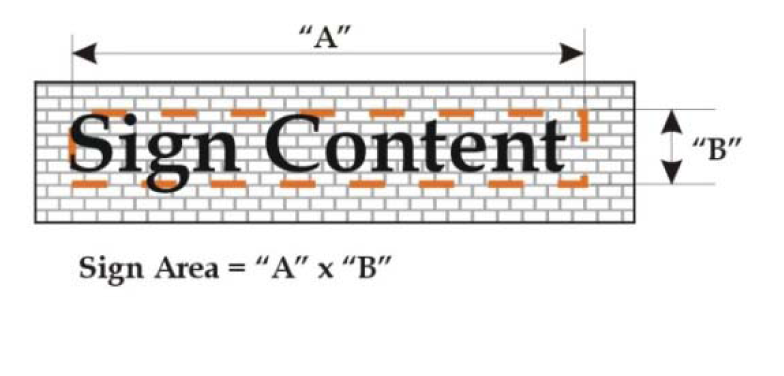
Measurement of sign area. The area of a sign shall be considered to be that of the smallest rectangle or triangle which encompasses all lettering, wording, design, or symbols. If attached to or located on a wall, the area of the sign shall include any background different from the balance of the wall if such background is designed as an integral part of and obviously related to the sign.
.1
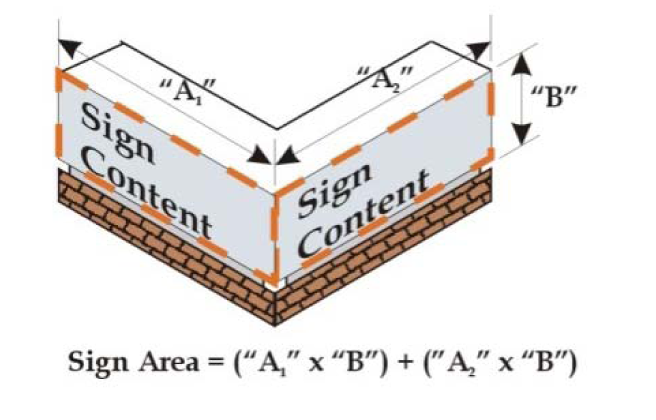
The area of a sign which is designed to be seen from more than 1 side shall be considered to be that of the aggregate of the largest rectangle or triangle which encompasses all lettering, wording, designs, or symbols together with any background on 1 side of the sign.
.2
The supports which affix a sign to the ground or to a building shall not be included in the area of the sign unless such supports are obviously designed to be part of the sign.
5.2.3
Sign location. Signs attached to buildings shall project no more than 36 inches from the face of the building unless otherwise outlined in these regulations.
.1
A business sign permitted in any commercial or industrial district may be displayed on the front or sides of a building. No sign may be placed on the rear of a building that is located within a distance of 100 feet from a residence district unless it is shielded from view with a permanent physical barrier which is located within the same zone as the sign.
.2
Commercial and industrial buildings which abut and possess public entrance on more than one street shall be deemed to have more than one front and may display signs in accordance with section .1 above.
5.2.4
Height of sign. Ground business signs, including supports, and signs used in conjunction with or accessory to gasoline service stations, shall not exceed a height of 12 feet in a residence district, or 24 feet in a commercial or industrial district, above the surface of the ground where located.
Signs attached to buildings shall project not more than ten feet above the top of the exterior wall or roof of such building (except that in an industrial district, a sign may project up to 10 feet above the top of the exterior wall of such building), provided the sign is not within 200 feet of the boundary of a residence district or street.
5.2.5
Illuminated and moving signs. A sign may be illuminated if the illumination is consistent in intensity and is confined to or directed to the surface of the sign. No flashing or intermittent illumination shall be permitted except signs indicating time and/or temperature by means of white, intermittent lighting, provided the longest dimension of such a sign does not exceed 5 feet.
.1
No sign or any part thereof shall be permitted to be mechanically rotated or moved except traditional signs of barber shops, provided the longest dimension of such signs does not exceed three feet.
.2
The light sources of signs shall be so designed and shielded that it will not create a glare, except that signs with exposed neon or fluorescent tubes shall be permitted in all commercial and industrial districts.
5.2.6
Construction of signs. All signs shall be constructed of sound weatherproof materials, firmly supported and maintained in good condition and repair. Permits for signs may be revoked by the zoning enforcement officer if such sign is not maintained in good condition.
Signs in residence districts. Unless otherwise specified, one sign per lot shall be allowed in residence districts and shall be located at least 20 feet back of the street line. The following signs shall be allowed in all residence districts:
5.2.7
Signs allowed in business districts:
| SIGN TYPE | DESCRIPTION | ||
|---|---|---|---|
| REQUIREMENTS | CC AND NC | OTHER ZONES | |
 | Permitted Number | 1 for each three (3) acres of lot area | |
| Maximum Size | 40 square feet |
300 square feet within street line setback;
Outside street line setback up to 300 square feet. | |
| Maximum Height Above Ground | 10 feet | 24 feet | |
| Minimum Height Above Ground | n/a | 10 feet | |
| SIGN TYPE | DESCRIPTION | ||
|---|---|---|---|
| REQUIREMENTS | CC AND NC | OTHER ZONES | |
 | Size Determination | 2 square feet per linear foot of wall | |
| Increased Size Provision | For each 5 feet of setback beyond the street line, an additional 5 percent of sign area shall be permitted but in no case shall the square footage of such sign exceed 3 times the lineal frontage of the building. | ||
| Maximum Extension from Wall |
12 inches
8 feet of vertical clearance from the sidewalk | 12 inches | |
| Maximum Height | 4 feet above top of wall of a building | ||
| Setback from property line | Signs mounted flush to the wall may project into the area required for setbacks provided the sign does not project more than 12 inches from the wall of the building it is mounted on | ||
| Notes: | |||
| • Signs attached to a wall of a building plus signs mounted to the roof of a building and designed to viewed from the same side of the building as such wall sign shall not have an aggregate area greater than 1.5 square feet for each horizontal foot of such wall. | |||
| • There are no restrictions on the number of wall signs. | |||
| SIGN TYPE | DESCRIPTION | ||
|---|---|---|---|
| REQUIREMENTS | CC AND NC | OTHER ZONES | |
 | Permitted Number | 1.5 square feet per linear foot of wall | |
| Maximum Size | 6 square feet | 12 square feet | |
| Maximum Projection from Wall | Not more than 4 feet provided the projection does not occur within 8 feet of vertical clearance of the ground | ||
| Setback from Property line | Projecting signs may project into the area required for setbacks provided the sign does not project more than 12 inches from the wall of the building it is mounted on | ||
5.2.8
Signs within the Chelsea Central district (CC). In order to enhance the aesthetic value of the Chelsea Central district and encourage harmonious and creative development of signs within the CC, the following criteria shall apply to all signs within the CC.
.1
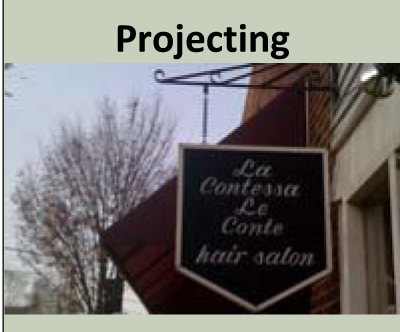
Perpendicular signs may be attached to a building provided that the base of the sign is a minimum of eight feet from the ground level and shall not extend above the sill of windows on the second floor (this does not include braces necessary for the attachment of the sign to the building). Such signs shall be located not less than 12 inches from the face of the building, and all such signs shall be double-faced. No such sign shall exceed 30 square feet in area per side and shall not extend beyond six feet from the building.
.2
Awnings and canopies are permitted within the CC provided they are ground supported and/or adequately secured to the building. An awning or canopy shall be a minimum of eight feet to ground level so as not to obstruct pedestrian access along the sidewalk and shall not exceed beyond the curb line of the sidewalk.
.3
Painted murals are permitted provided approval is obtained by the Director of Planning and Neighborhood Services.
.4
Neon signs. Neon signs are permitted, provided they are in compliance with the maximum sign size requirements in these regulations.
.5
The Director of Planning and Neighborhood Services shall approve the design of all signage prior to the issuance of a zoning permit by the zoning enforcement officer. Items to be considered for review are as follows:
.1
Materials used shall be durable. Wood-carved signs are preferable.
.2
Color schemes should be harmonious to the Chelsea central district. Historic color schemes are recommended but not required.
.3
Architectural design and details of building shall be considered in location of the sign on the building.
.4
Letter size shall be proportionate to the sign frieze and the building facade; in general the size of the letters should not exceed 18 inches in height.
5.2.9
Multi-Tenant Sign Program. Multiple tenant commercial and industrial buildings shall submit a sign program to the Director of Planning and Neighborhood Services for approval before permits for new signs are issued at the property.
.1
Program Scope. Such sign program shall address size, materials, placement, illumination, and other information as may be required for the Commission to evaluate all attached and detached signs which may be installed on a given site.
.2
Approved Program. Such approved sign program shall guide the owner, tenants, Commission, and Zoning Enforcement Officer in the application for and issuance of any permits required by these Regulations.
.3
Existing Sites. A Multi-Tenant Sign Program is required when a property owner can not demonstrate compliance with the standards listed above.
.4
Modifications to existing signs and temporary signs shall be reviewed and approved by the Commission's staff unless said staff believes the proposal needs to be referred to the Commission for their action.
.5
No sign shall be erected, relocated, or altered, except for normal maintenance, without the proper permits being issued by the Commission or its staff.
5.2.10
Illustration of sign types.
| SIGN ILLUSTRATIONS | |
|---|---|
| Sign with Background Panel | Sign With Multiple Faces |
 |  |
| Sign With No background or Panel (letters on building wall) | Sign with No Background or Panel (letters on stone wall) |
 |  |
5.2.11
Prohibited Signs.
Prohibited signs. The prohibitions contained in this section shall apply to all signs, all artificial lighting and all districts regardless of designation.
.1
No sign or other object shall be erected, used or maintained which in any way causes obstruction of official, directional or warning signs to be erected or maintained by the state or municipality or by any railroad or public utility or similar agency concerned with the protection of the public health or safety.
.2
No sign shall be erected or maintained at the intersection of streets in such a manner as to obstruct free and clear vision of the intersection.
.3
Any sign which uses a series of 2 or more freestanding signs placed in a line parallel to a street, or in similar fashion, is prohibited.
.4
In no event shall an illuminated sign or lighting device be so placed or directed so as to permit the beams and illumination therefrom to be directed or beamed upon a public street, highway, sidewalk or adjacent lot so as to cause glare or reflection that may constitute a traffic hazard or nuisance.
.5
In addition, the following types of signs are prohibited:
5.2.12
Nonconforming signs. A nonconforming sign, once removed, shall not be replaced except in accordance with the provisions of these regulations.
5.2.13
Conflict. Where there is a conflict between the provisions of these regulations and any building code regulations, the more restrictive provision shall apply.
5.3 - Landscaping.
5.3.1
Buffer screening of commercial and industrial districts.
.1
Where any lot or part thereof in a commercial or industrial district adjoins or fronts on a street opposite a residential district, a landscaped buffer strip 50 feet wide shall extend the length of such district boundaries and/or street frontage of which 12 feet in width shall be planted to evergreen shrubs and trees at least six feet high, of a density sufficient to obscure lights and other visually objectionable items, satisfactory to the Commission as will safeguard the residential character of the adjoining properties.
.2
The Commission may reduce the requirements for part of such landscaped buffer strip, where topography, permanent natural features, public lands or building design accomplish the purpose of separation and screening of commercial and industrial districts from residential districts. In no case shall the landscaped buffer strip be reduced to less than 20 feet.
.3
Where a building exceeds 25 feet in height, an additional one foot of landscaped buffer strip shall be required for each additional foot of building height in excess of 25 feet.
.4
Where any lot or part thereof abuts on a major water course, the landscaped buffer strip 50 feet wide, as described above, shall be provided adjacent to such major water course in addition to any required side or rear yards. Said 50-foot buffer may be reduced in the waterfront development (WD) district if permanent public access to and along a waterfront is provided in the form of an easement at least ten feet wide.
5.3.2
Maintenance of buffer strips and recreation areas. Failure to maintain any required landscaped buffer strip or usable recreation area, or improvements thereon, shall constitute a violation of the provisions of these regulations.
5.4 - Erosion, Sediment, and Stormwater Runoff Control Plan.
5.4.1
When submission of plan required. A soil erosion, sediment, and stormwater runoff control plan shall be submitted for any development or redevelopment when the disturbed area of such development is cumulatively more than one-half acre. The purpose of this plan is to prevent or minimize water quality impacts during construction and to provide for the operation and maintenance of post-construction facilities.
5.4.2
Exemptions. A lot proposed to be developed for a single-family dwelling that is not part of a subdivision. This exemption is applicable to land disturbed solely for the development of the single-family dwelling and the necessary amenities such as septic systems at sites where the proposed land disturbance is less than 1 acre.
5.4.3
Activities requiring a soil erosion, sediment, and stormwater runoff control plan. Projects where site disturbance:
.1
Is cumulatively more than ½ acre;
.2
Would result in excavation or filling involving 500 cubic yards or more of earth materials;
.3
Is within 100 feet of critical coastal resources; or
.4
Involves slopes greater than 15 percent.
.5
This plan may be incorporated into other documents associated with Site Plan and Special Permit applications.
5.4.4
Permit Requirement. If more than 500 cubic yards of material is to be disturbed, the soil erosion, sediment, and stormwater runoff control plan shall be certified by a professional engineer licensed in the State of Connecticut.
.1
The applicant may request a waiver for certification by a professional engineer. The Commission shall determine if a waiver is acceptable based on the size and scope of the proposed development.
.2
Said plan shall then be submitted to and certified by the Commission on the City Plan.
.3
Where a site plan is not required and more than ½ acre of land will be disturbed, a soil erosion, sediment, and stormwater runoff control plan must be submitted to the Commission for certification.
.4
This includes all municipal projects that disturb over ½ acre of property.
5.4.5
Principles, methods and practices for certification. To be eligible for certification, a soil erosion, sediment, and stormwater runoff control plan shall contain proper provisions to adequately control accelerated erosion and sedimentation, prevent downstream flooding or sedimentation and reduce the danger from stormwater runoff on the proposed site based on the best available technology. Such principles, methods and practices necessary for certification are found in the "Connecticut Guidelines for Soil Erosion and Sediment Control," as amended. Alternative principles, methods and practices may be used with approval of the Commission. Both structural and non-structural post-construction facilities are acceptable, provided the facility serves the necessary purpose. In the event that structural stormwater management facilities are called for, the applicant will coordinate with the public works director to determine which facilities best serve the proposed development.
5.4.6
Plan requirements. Said soil erosion, sediment, and stormwater runoff control plan shall include, but not be limited to, the following:
.1
A narrative describing:
.1
The development;
.2
The schedule for grading and construction activities including:
(i)
Start and completion dates;
(ii)
Sequence of grading and construction activities;
(iii)
Sequence for installation and/or application of soil erosion and sediment control measures;
(iv)
Sequence for final stabilization of the project site;
.3
The design criteria for proposed erosion and sediment control measures and post-construction stormwater management facilities. All structural stormwater management facilities, except for those facilities regulated by the Connecticut Department of Environmental Protection, shall be designed for the twenty-five-year storm and shall be designed to ensure non-erosive velocities of stormwater runoff. Any detention facility whose failure could cause significant damage or loss of life shall be regulated as a dam pursuant to CGS §§ 22a-401 through 22a-409. Copies of all stormwater runoff calculations shall be submitted with the plan.
.4
The construction details for the proposed soil erosion and sediment control measures (and post-construction stormwater management facilities);
.5
The operations and maintenance program for proposed soil erosion and sediment control measures (and post-construction stormwater management facilities) shall provide for the periodic inspection no less than two times per year, removal of foreign materials from the system, silt removal (when needed to ensure that neither the storage volume nor the outlet capacity is reduced by more than twenty-five percent), and the general repairs to the facility. In addition, the submitted plan shall include:
(i)
The proposed operating plan for the stormwater management facilities;
(ii)
The proposed schedule of maintenance for the stormwater management facilities;
(iii)
The person or organization responsible for said operation and maintenance.
.2
A site plan map at a sufficient scale (1:40) to show:
.1
Location of the proposed development and adjacent properties;
.2
The existing and proposed topographic conditions including soil types, wetlands, watercourses and water bodies;
.3
The existing structures on the project site, if any;
.4
The proposed area of alterations, including cleared, excavated, filled or graded areas and proposed structures, utilities, roads and, if applicable, new property lines;
.5
Location of and design details for all proposed soil erosion and sediment control measures (and post-construction stormwater management facilities);
.6
The sequence of grading and construction activities;
.7
The sequence of installation and/or application and maintenance of soil erosion control measures;
.8
The sequence for final stabilization of the development site.
.3
Any other information deemed necessary and appropriate by the Commission.
5.4.7
Minimum acceptable standards.
.1
Plans for soil erosion, sediment, and stormwater runoff control shall be developed in accordance with these regulations using the principles as outlined in the current "Connecticut Guidelines for Soil Erosion and Sediment Control," as amended. Soil erosion, sediment, and stormwater runoff control plans shall result in a development that: minimizes erosion and sedimentation during construction, is stabilized and protected from erosion when completed, and does not cause off-site erosion and/or sedimentation.
.2
The minimum standards for individual measures are those in the "Connecticut Guidelines for Soil Erosion and Sediment Control," as amended. The Commission on the City Plan may grant exceptions when requested by the applicant if technically sound reasons are presented.
.3
The appropriate methods from the "Connecticut Guidelines for Soil Erosion and Sediment Control," as amended, shall be used in determining peak flow rates and volumes of runoff unless an alternative method is approved by the Commission on the City Plan.
5.4.8
Issuance or denial of certification.
.1
The Commission on the City Plan shall either certify that the soil erosion, sediment, and stormwater runoff control plan, as filed, complies with the requirements and objectives of this regulation or deny certification when the development proposal does not comply with these regulations.
.2
Nothing in these regulations shall be construed as extending the time limits for the approval of any application under CGS Chapter 124, 124A or 126.
.3
Prior to certification, any plan submitted to the municipality may be reviewed by the county soil and water conservation district which may make recommendations concerning such plan, provided such review shall be completed within 30 days of the receipt of such plan.
.4
The Commission may forward a copy of the development proposal to the conservation commission or other review agency or consultant for review and comment.
5.4.9
Conditions relating to soil erosion and sediment control.
.1
The estimated costs of measures required to control soil erosion and sedimentation, as specified in the certified plan, may be covered in a performance bond or other assurance acceptable to the Commission.
.2
Site development shall not begin unless the soil erosion, sediment, and stormwater runoff control plan is certified and those control measures and facilities in the plan scheduled for installation prior to site development are installed and functional.
.3
Planned soil erosion and sediment control measures and facilities shall be installed as scheduled according to the certified plan.
.4
All control measures and facilities shall be maintained in effective condition to ensure the compliance of the certified plan.
5.4.10
Inspection. Inspections shall be made by the Commission or its designated agent(s) during and after development to ensure compliance with the certified plan and that control measures and facilities are properly performed or installed and maintained. If private land must be entered to inspect facilities, the designated agent, after showing proper credentials, shall not be refused access. The Commission may require the permittee to verify through progress reports that soil erosion and sediment control measures and facilities have been performed or installed according to the certified plan and are being operated and maintained in accordance with the certified plan.
.1
If during construction, said measures are found to be ineffective, the Commission or its designated agent shall notify the applicant in writing. All earth moving related work on site shall cease until a revised plan has been submitted and approved by the Commission or its designated agent.
.2
If said measures and facilities are found to not be in compliance with the certified plan, the plan shall become invalid:
.1
If construction has not yet been completed, all earth moving related work on site shall cease until the site is in compliance with the plan and any damage resulting from non-compliance has been repaired. If necessary, the Commission or its designated agent may issue a stop-work order until the site is in compliance with the plan.
.2
If the construction has been completed, the responsible party shall be served a notice of violation and will be given ten days to return the site to plan compliance. If, after 20 days, the responsible party has not returned the site to plan compliance, the city, or its designated agent, may perform the necessary corrective action and bill the responsible party for all associated costs.
.3
If emergency action is required due to an imminent and substantial danger to public health, safety, welfare or natural resources, the city, or its designated agent, may perform any and all necessary work to bring the site into plan compliance. The responsible party will be billed for all costs associated with the emergency action.
Also see Chapter 18.5 of the City Ordinances concerning excavations.
5.5 - Outdoor Lighting.
5.5.1
Purpose. These Regulations provide standards for the responsible use of exterior lighting within the community with regards to the lighting's effectiveness, energy efficiency and its impact to the residents, wildlife and to the environment.
5.5.2
Applicability. The standards herein shall apply to all new and renovated exterior lighting where a Site Plan or Special Exception application is required. The standards herein will also apply to exterior lighting on city municipal buildings, facilities and structures and public parks.
5.5.3
Exterior Lighting Use Standards. These requirements apply to all exterior light fixtures mounted on: buildings, signs, structures, poles, bollards, and ground surfaces.
.1
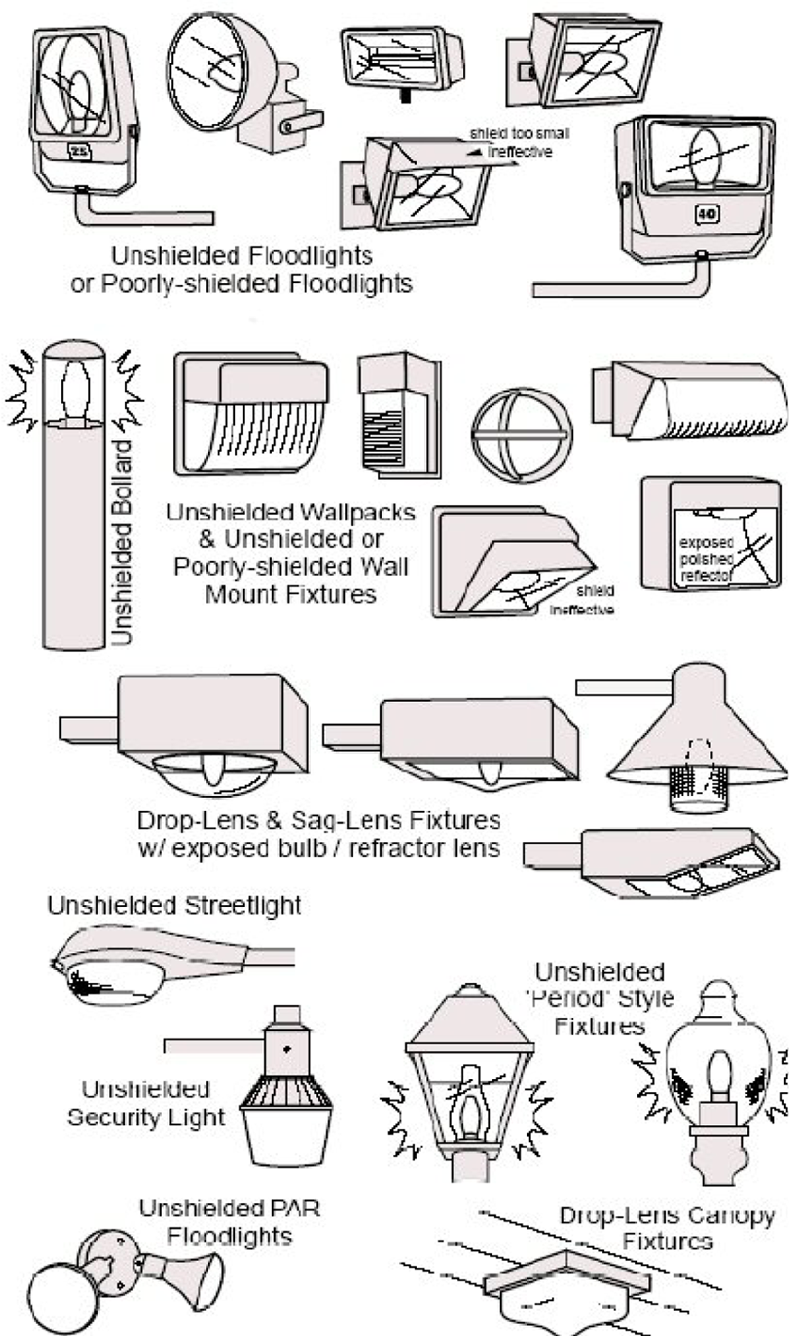
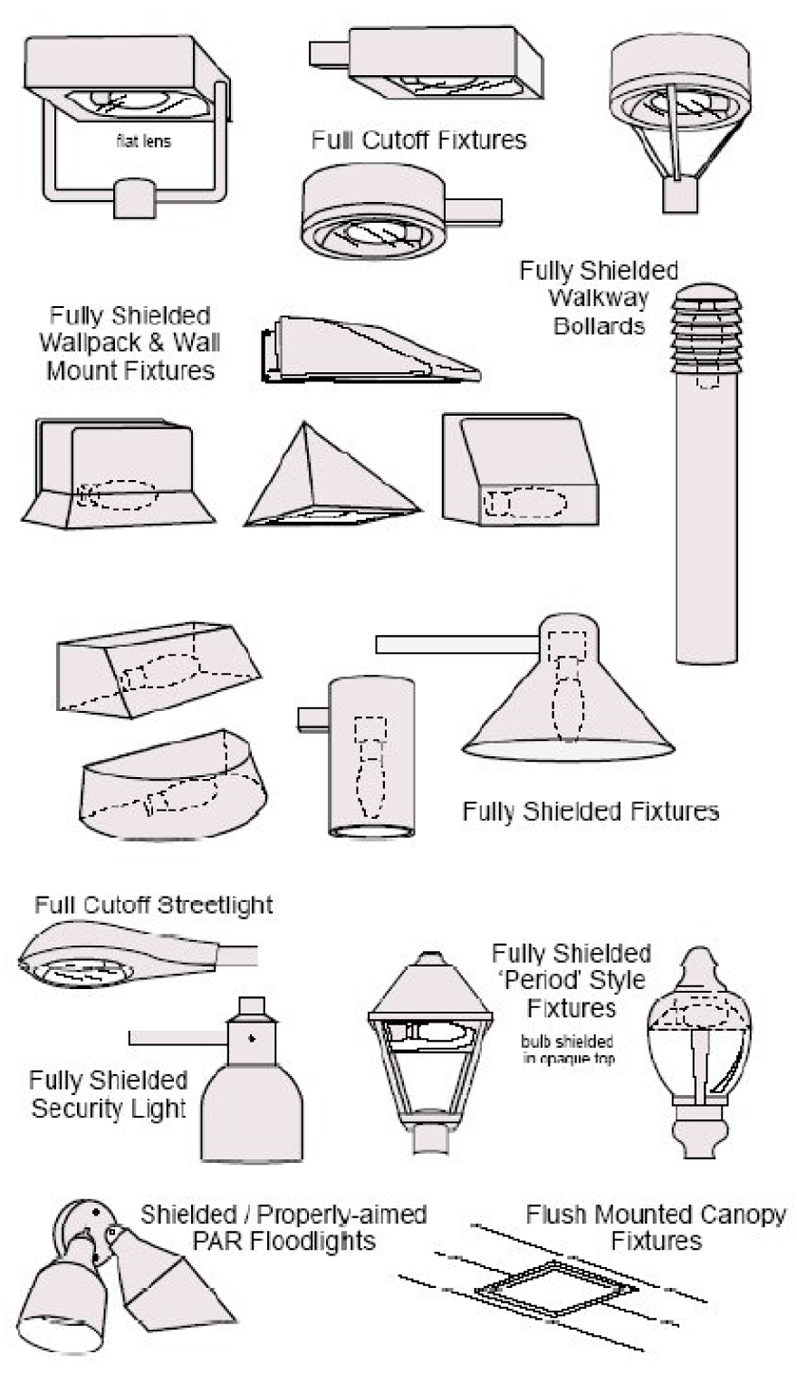
To control glare and uplight. All exterior light fixtures that use a light source(s) rated at 900 lumens or higher must be:
.1
A full cutoff type, or
.2
Provide equivalent performance to full cutoff type through proper shielding, or mounting.
.3
Refer to Appendix for examples.
.2
To control light trespass. All exterior light fixtures shall be mounted, installed or aimed so that no direct light is visible from within the property boundaries of all surrounding properties.
.3
To control over-lighting. Refer to Appendix for illuminance level requirements for site lighting, listed by site size, type and lighting zone.
.4
To limit sky glow and interference with nocturnal life and bird migration. Decorative uplighting is prohibited. This prohibition includes exterior lighting used to uplight trees, flora, building facades, commercial icons, statues and monuments. Uplighting of small scale signs is permitted with limitations - see Sign Lighting.
.5
To promote visibility and boater safety along waterways. All exterior light fixtures installed adjacent to city waterways shall be mounted, installed or aimed so that, to the greatest extent possible, no direct light is visible from the waterway.
.6
To promote energy conservation. All non-essential exterior lighting shall be required to be turned off after business hours, leaving only lighting deemed essential for building security. ("Non-essential" can apply to: display, aesthetic, parking and sign lighting.)
.7
Pole-mounted lighting requirements. For all exterior light fixtures mounted on poles within a site: the height of the pole shall be limited to the highest elevation where it does not produce direct light into properties adjacent to the site.
5.5.4
Other Lighting Use Standards.
.1
Lighting of Small Scale Sign (less than 8 feet in height and less than 40 square feet in size.)
.1
For exterior signage illuminated by ground-mounted light fixtures:
(i)
Limits: 2 fixtures per sign in Zone 1, 4 fixtures per sign in Zone 2,
(ii)
Each light source shall not exceed 900 lumens,
(iii)
All sign light fixtures must be shielded to:
(iv)
Prevent direct light from shining into adjacent roadways and properties,
(v)
Contain the illumination, to the greatest extent possible, onto the sign surface area.
.2
For internally lighted signs (back-lit signs). To reduce light trespass from the translucent sign surface, the sign shall consist of a dark colored background with light-colored lettering, logos or symbols.
.2
Lighting of Large Scale Sign (greater than eight feet in height or greater than 40 square feet in size).
.1
For exterior signage illuminated by light fixtures. The sign surface shall be lit from the top of the sign and shine downward. All sign light fixtures must be shielded to:
(i)
Prevent direct light from shining into adjacent roadways and properties,
(ii)
Contain the illumination, to the greatest extent possible, onto the sign surface area.
.2
For internally lighted signs (back-lit signs). To reduce light trespass from the translucent sign surface, the sign shall consist of a dark colored background with light-colored lettering, logos or symbols.
.3
Flag Lighting. Lighting to illuminate the American flag at night may be used (American flags only), provided the light fixture meets the following requirements. The light fixture:
.1
Is mounted at, or below ground level within a 7 foot radius of the pole,
.2
Is rated at no more than 7,000 lumens,
.3
Is designed to cast a narrow beam focused directly at the flag, and
.4
Is fully shielded to prevent glare or light trespass to surrounding areas.
.4
Outdoor Sports Lighting. Lighting used for outdoor sports fields and outdoor playing courts must be, to the greatest extent possible, contained to the field/court property area. All exterior light fixtures shall be shielded, installed or aimed so that no direct light is visible from within the property boundaries of all surrounding properties. All sport field/court lighting shall be turned off after use, or no later than 1 hour after the end of a sporting event.
| LIGHT FIXTURE DIAGRAM | |
|---|---|
| Fixtures Which Might Produce Glare or Light Trespass | Fixtures Which Might Not Produce Glare or Light Trespass |
 |  |

