
Oak Hill City Zoning Code
ARTICLE II
RULES OF INTERPRETATION AND DEFINITIONS
Sec. 24-39.- Rules of interpretation.
(a)
Generally. In the interpretation and application of these regulations all provisions shall be liberally construed in favor of the objectives and purposes of the city and deemed neither to limit nor repeal any other powers granted under state statutes.
(b)
Responsibility for interpretation. In the event that any question arises concerning the application of regulations, performance standards, definitions, development criteria, or any other provision of these regulations, the development regulations administrator shall be responsible for interpretation and shall look to the city's comprehensive plan for guidance. Responsibility for interpretation by the development regulations administrator shall be limited to standards, regulations and requirements of these regulations, but shall not be construed to include interpretation of any technical codes adopted by reference in these regulations, nor be construed as overriding the responsibilities given to any commission, board or official named in other sections or articles of these regulations.
(c)
Computation of time. The time within which an act is to be done shall be computed by excluding the first and including the last day; if the last day is a Saturday, Sunday or legal holiday, that day shall be excluded.
(d)
Delegation of authority. Whenever a provision appears requiring the head of a department or some other city officer or employee to do some act or perform some duty, it is to be construed to authorize delegation to professional-level subordinates to perform the required act or duty unless the terms of the provision or section specify otherwise.
(e)
Gender. Words signifying the masculine gender shall be construed to include the feminine and neuter.
(f)
Number. Words in the singular shall include the plural and words in the plural shall include the singular.
(g)
Shall, may. The term "shall" is mandatory; the term "may" is permissive.
(h)
Written or in writing. The term "written" or "in writing" shall be construed to include any representation of words, letters or figures, whether by printing or otherwise.
(i)
Year. The word "year" shall mean a calendar year, unless otherwise indicated.
(j)
Day. The word "day" shall mean a calendar day, unless a working day is indicated.
(k)
Zoning district boundaries. The rules set forth in section 24-364 shall be used to interpret the exact location of the zoning district boundaries reflected on the official zoning map.
(l)
Relationship of specific to general provisions. More specific provisions of these regulations shall be followed in lieu of more general provisions that may be more lenient than or in conflict with the more specific provision.
(m)
Words not defined. Webster's New Collegiate Dictionary (G. & C. Merriam Co., 9th Ed., 1983) shall be used for the definition of any words not defined in these regulations.
(Ord. No. 93-01, § 2.1, 11-16-1992)
Sec. 24-40. - Definitions.
The following words, terms and phrases, when used in this chapter, shall have the meanings ascribed to them in this section, except where the context clearly indicates a different meaning:
25-year frequency storm means the rainfall event which has a four percent chance of being equaled or exceeded during any one given year.
100-year frequency storm means the rainfall event which has a one percent chance of being equaled or exceeded during any one given year.
AASHTO means American Association of State Highway and Transportation Officials.
Abandon means any cessation of an existing use of land or of any structure thereon for a period greater than that specified by these regulations, other than a cessation necessarily incident to probate or mortgage foreclosure proceedings, or to the temporary absences of part-time residents.
Abut means to physically touch or border upon, or to share a common property line.
Accessory apartment means a second dwelling unit, either in or attached to a single-family detached dwelling, for use as a complete, independent living facility with provision within the accessory apartment for cooking, eating, sanitation, and sleeping.
Accessory sign means a permanent ground or building sign that is permitted under these regulations as incidental to an existing or proposed use of land.
Accessory use or structure means any use or structure, clearly incidental, subordinate and related to the principal use or structure and located on the same lot with such principal use or structure. The term shall include, but not be limited to, satellite dish antennas, windmills, solar energy equipment, detached garages and carports, abovegrade swimming pools and utility sheds.
Adjacent to, as used in regard to notice of plan review, means having a common border with, or being separated from such common border only by a right-of-way or easement.
Adjacent to a protected environmentally sensitive area means any location within 500 feet of the boundary of any protected environmentally sensitive area, whether the location is on or off the development site.
Adult congregate living facilities means a premises in which the owners or operators are subject to licensing and approval by the state agency for health care administration, which is operated as a facility to provide room and board and one or more personal services to unrelated adults, as authorized under F.S. ch. 400, and F.A.C. ch. 59-1 et seq.
Adverse effects means any modifications, alterations, or effects on waters, associated wetlands, or shorelands, including their quality, quantity, hydrology, surface area, species composition, or usefulness for human or natural uses which are or may potentially be harmful or injurious to human health, welfare, safety or property, to biological productivity, diversity, or stability or which unreasonably interfere with the reasonable use of property, including outdoor recreation. The term "adverse effects" includes secondary and cumulative as well as direct impacts.
Adversely affected person means any person who is suffering or will suffer an adverse effect to an interest protected or furthered by the local government comprehensive plan, including, but not limited to: interests related to health and safety; police and fire protection services; densities or intensities of development; transportation facilities; recreational facilities; educational facilities; health care facilities, equipment, or services; and environmental or natural resources. The alleged adverse effect may be shared in common with other members of the community at large, but must exceed in degree the general interest in community good shared by all persons.
Advertising means sign copy intended to directly or indirectly promote the sale or use of a product, service, commodity, entertainment, or real or personal property.
Alley means a right-of-way providing a secondary means of access and services to abutting property.
Alteration means any changes in structural parts; type of construction; kind or class of occupancy. The term "alteration" shall include the words alter or reconstruct.
Altered wetland means wetlands which have been substantially affected by man, but which continue to be dominated by wetland or transitional vegetation.
Animals includes, but is not limited to, both domesticated household pets and farm animals.
Aquifer means an underground formation, group of formations, or part of a formation that is permeable enough to transmit, store or yield usable quantities of water.
Area of shallow flooding means a designated AO, AH or VO zone on the flood insurance rate map, or other area designated on a map by the development regulations administrator with base flood depths from one to three feet where a clearly defined channel does not exist, where the path of flooding is unpredictable, and where velocity flow may be evident.
Area of special flood hazard includes:
(1)
All areas designated on a flood hazard boundary map as zone A or a flood insurance rate map as zones A, AO, AH, A1 - 30, AE, A99, VO, or V1-30, VE, or V. The relevant flood hazard boundary map and flood insurance rate maps, and any revisions thereto, are adopted by reference and declared to be a part of these regulations.
(2)
Other areas of the city designated on a map by the development regulations administrator as having a one percent or greater chance of flooding in any given year. This may include isolated topographic depressions with a history of flooding or a high potential for flooding.
Artificial drainage system means any canal, ditch, culvert, dike, storm sewer or other manmade facility which tends to control the surface flow of water.
As-built plans means revised construction plans reflecting the public improvements as they were actually constructed and as they actually exist in the subdivision.
Associated wetland means any wetland that is adjacent or contiguous to waters, or which has a direct hydrologic connection to waters.
Automobile service station, type A, means any premises used or designed to be used for the sale of gasoline in conjunction with another principal retail use.
Automobile service station, type B, means any premises used for the servicing of motor vehicles, including engine tune-ups, and repair, wheel balancing, alignment, brake service; the retail sale of fuel, lubricants, and other products necessary to the operation and maintenance of motor vehicles, and the installation of such products; the sale of refreshments; but excluding the rebuilding or reconditioning of engines, and body repair.
Automobile service station, type C, means, in addition to type A uses, any body repair, rebuilding or reconditioning of any motor vehicle or machinery.
Bar means a premises devoted primarily to the retailing and drinking of malt, vinous or other alcoholic beverages, or any other premises where any sign is exhibited or displayed indicating that alcoholic beverages are obtainable for consumption on the premises. The term "bar" shall be considered synonymous with the words "saloon," "tavern," "pub," "barroom," "cocktail lounge," and "cabaret."
Base flood means the flood having a one percent chance of being equaled or exceeded in any given year.
Basement means that portion of a building having its floor below ground level on all sides.
Beneficial functions of a protected environmentally sensitive area means those functions, described in the coastal management/conservation element of the comprehensive plan, that justify designating an area as environmentally sensitive.
Best management practices (BMPs) means management practices as found in Silviculture Best Management Practices Manual, state department of agriculture and consumer services, division of forestry.
Block means a tract of land bounded by streets, or by a combination of streets and public parks, cemeteries, shorelines of waterways, or other definite barriers.
Board means the planning and land development regulation board of the city.
Boardinghouse means a premises other than a hotel, restaurant, or congregate living facility where meals and lodging are furnished for compensation to five or more persons unrelated to the owner of the premises by marriage, birth or legal adoption.
Boat rental means keeping of boats in readiness to be hired without crew (bareboat charters).
Boathouse means an accessory structure designed solely for the protection or storage of watercraft.
Bond means any form of security including a cash deposit, surety bond, collateral, property or instrument of credit in an amount and form satisfactory to the city commission. All bonds shall be approved by the city commission upon advice of the city attorney whenever a bond is required by these regulations. The surety company executing the bond shall be listed by the U.S. Treasury Department as being approved for writing bonds for federal projects on its current list in an amount not less than the amount of the bond tendered to the city.
Boulevard means a street in which a landscaped median may be included within the right-of-way to separate opposing traffic lanes.
Boundary survey means a survey, the primary purpose of which includes, but is not limited to, the determining of the perimeters of a parcel or tract of land by establishing or re-establishing corners, monuments, and boundary lines for the purpose of describing, locating of fixed improvements, or platting or dividing the parcel. Such survey shall be certified by the registered surveyor in charge as meeting the Minimum Technical Standards set forth by the state board of land surveyors, pursuant to F.S. § 472.027. In addition to any other features required by the Minimum Technical Standards, the boundary survey shall show the boundaries of the parcel, section lines, location of all existing streets, buildings, bulkhead lines, coastal construction control line, easements, and foundations and structures either on or adjacent to the parcel.
Breakaway wall means a wall that is designed and constructed to collapse under specified lateral loading forces without causing damage to the elevated portion of the building or the supporting foundation system.
Buffer means upland areas adjacent to wetlands which are necessary to protect the wetlands and wetland species from the detrimental impacts of development or alteration. The buffer shall include canopy, understory and groundcover which consists of preserved existing vegetation or planted native species.
Building means any relatively permanent, immobile structure with an impervious roof built for the support, shelter or enclosure of persons, animals, chattels, or property of any kind. The term "building" shall be construed as if followed by the words "or part thereof."
Building, accessory, means any building other than the principal building.
Building area means that area within and bounded by the building lines established by required yards and setbacks.
Building height means the vertical distance measured in feet from the finished grade, along the front of the structure, to the highest point of a roof, or if no roof, to the highest point of any structure.
Building line means the line established by minimum yard requirements outside of which no principal structure may be erected.
Building, principal, means a building in which is conducted the principal use of the lot on which it is situated. In a residential district any dwelling shall be deemed to be the principal building on the lot on which the same is situated. Any attached carport, shed, garage or any other structure with one or more walls or a part of one wall being a part of the principal building and structurally dependent, totally or in part, on the principal building, shall comprise a part of the principal building and be subject to all regulations applicable to the principal building. A detached and structurally independent garage, carport or other structure which may be attached to the principal building by an open breezeway in excess of six feet and/or enclosed on one or both sides, including louvers, lattice or screening, shall cause the entire structure to be construed as the principal building and shall be subject to the regulations applicable to the principal building.
Building requirements means that lot and building requirements, as used in these regulations, do not imply reference to building requirements set forth in the Building Codes of the City of Oak Hill.
Building setback line means that line parallel to and of the same configuration as the lot line, and which is located behind the front lot line, the minimum distance required by the front yard requirements of these regulations, in front of which no structure shall be permitted, erected, or placed, unless otherwise expressly permitted by section 24-415 and 24-416. (See Yard.)
Building sign means a sign displayed upon or attached to any part of the exterior of a building, including walls, windows, doors, parapets, marquees and roof slopes of 45 degrees or steeper.
Bulkhead line means on land abutting the Atlantic Ocean the bulkhead line shall mean the coastal setback line established and defined by the state. On land abutting the inlet and/or intracoastal waterway or any arm, canal or tributary thereof the bulkhead line shall mean the mean high-water line.
Business office, family. See Family business office.
Business services means any commercial activity primarily conducted in an office, not involving the sale of goods or commodities available in the office, and not dispensing personal services, and including such businesses as real estate broker, insurance, accountants, financial institutions, or any similar use.
Cafeteria means a premises where a variety of foods and beverages are prepared in advance and then selected by customers from a buffet for consumption on the premises.
Caliper means the trunk diameter of a tree measured three feet above the average ground level at the base of the tree. Provided however, if the tree forks above 3½ feet above ground level, it is measured below the swell resulting from a double stem.
Camper. See Travel trailer.
Campground. See Recreational shelter and vehicle park.
Carwash facility means a business which has as its principal use the washing, cleaning, and polishing of motor vehicles, and which may include the sale of gasoline to its customers as an accessory use.
Chief building official means the chief building official of the city or his duly authorized representative.
Child care center means a premises where five or more children, other than members of the immediate family occupying the premises, are kept under supervision. The term "child care center" includes day nurseries, kindergartens, day-care services, day-care center, day-care agency, nursery school, play school, pre-school or any other terms indicating that children are under day-care control.
Church. See House of worship.
City means the City of Oak Hill, Florida.
City commission means the governing body of the City of Oak Hill.
City engineer means a professional engineer, or engineering firm, registered in the state, whether employed or retained by the city, authorized by the city commission to perform the duties of that office.
Clearing means the removal of trees and brush from the land, not including the ordinary mowing of grass.
Clinic, medical or dental, means a premises where patients who are not lodged overnight are admitted for examination and treatment by one or more persons practicing any form of the human healing arts, whether they are medical doctors, chiropractors, osteopaths, chiropodists, optometrists, dentists, or any similar professional licensed by the state. The term "clinic, medical or dental," does not include a veterinarian clinic.
Club, night, and nightclub means a commercial premises where food, alcoholic beverages, or other refreshments may be obtained for consumption on the premises and where floor shows or other forms of entertainment may be provided for customers.
Club, private, means nonprofit associations and organizations of a fraternal, social, leisure or recreational character. Also, a building or premises primarily designed for the gathering of its membership for entertainment and pleasure to include facilities and services for providing entertainment, in addition to food and drink, for consumption by members and their invited guests.
Coastal construction setback line means that legally-described line along Oak Hill's Atlantic coastal beach area officially adopted by the Governor and the Cabinet on June 5, 1973, or as it may be amended, and east of which the erection of any structure requires prior approval from an agency of the state.
Coastal high hazard area means all areas designated on a flood insurance rate map as V1 - 30, VE or V.
Commercial fish processing plant means a premises used for the receiving, processing, packaging, storage, and wholesale or retail distribution and sale of sea and fresh water food products.
Commercially developed parcel means a parcel of property on which there is at least one walled and roofed structure used, or designed to be used, for other than residential or agricultural purposes.
Common open space means a commonly owned area of land reserved primarily for the leisure or recreational use of the owners of a residential development.
Comprehensive plan means the long-range planning guide prepared and adopted by the City of Oak Hill pursuant to the requirements of F.S. § 163.3161 et seq., known as the Local Government Comprehensive Planning Act of 1975 (LGCPA).
Concurrency means a condition where specified facilities and services have or will have the necessary capacity to meet the adopted level of service standard at the time of impact of the development project.
Construction, start of, means the duly-permitted permanent placing or erection of construction materials into position. When excavation or removal of an existing structure has commenced in preparation for new construction, such excavation or removal shall be deemed to be the start of construction provided that work continues thereafter, uninterrupted for a period longer than 30 days, until the new construction is completed. The term includes built, constructed, reconstructed, moved upon or any physical operation on the premises required for building.
Convenience store means a premises from which is offered for sale food, drugs, and sundries commonly used for the day-to-day living needs of the residents of the immediate neighborhood.
Copy, sign, means the linguistic or graphic content of a sign.
Crosswalk means that portion of the right-of-way within a roadway dedicated to, and intended primarily for pedestrian use.
Crown, tree, means the main mass of branching of a plant above the ground.
Cul-de-sac means a local street with only one outlet and having an appropriate turnaround for the safe and convenient reversal of traffic movement.
Cultural resource means a site, object, structure, building or district listed on the city's survey of cultural resources or in the historic preservation element of the city comprehensive plan or on the local register of historic places.
DBH means diameter at breast height. The term "breast height" is defined to be 54 inches above the surface of the ground at the base of the plant or tree. In the case of a tree with multiple main stems, the diameter shall be the sum of the diameters of the stems.
Demolition means the tearing down or razing of 25 percent or more of a structure's external walls.
Density means the total number of dwellings per acre of usable land. For purposes of applying a specified density regulation a fractional part of an acre will permit that fractional part of the number of dwellings allowed for a full acre; calculations resulting in a fractional part of a dwelling shall be rounded up to the next whole number of dwellings whenever the fractional part of a dwelling is 0.5 or greater. Usable land is that land which is clearly suitable for development, and not excluded from development by act of law or nature. Submerged lands, lands lying seaward of the coastal construction control line, and lands designated as "mangroves" or "environmentally sensitive" by local, state or federal law shall not be considered usable land, and shall be excluded from density calculations.
Detention means the collection and storage of surface water for subsequent gradual discharge.
Deteriorated tree means degenerated or damaged to the point where death of the tree is imminent or to the point where the tree poses a significant hazard.
Developer means any person who engages in or proposes to engage in a development activity on a lot or group of lots for use, or occupancy, or sale, either as the owner or as the agent of an owner of property.
Development or development activity means any of the following activities:
(1)
Construction, clearing, filling, excavating, grading, paving, dredging, mining, drilling or otherwise significantly disturbing the soil of a site.
(2)
Building, installing, enlarging, replacing or substantially restoring a structure, impervious surface, or water management system, and including the long-term storage of materials.
(3)
Subdividing land into two or more parcels.
(4)
A tree removal for which authorization is required under these regulations.
(5)
Erection of a permanent sign unless expressly exempted by article VIII, division 2 of these regulations.
(6)
Alteration of a historic property for which authorization is required under these regulations, pertaining to exempt signs.
(7)
Changing the use of a site so that the need for parking is increased.
(8)
Construction, elimination or alteration of a driveway onto a public street.
Development order means an order granting, denying, or granting with conditions an application for a building permit, zoning permit, subdivision approval, rezoning certification, special exception, variance, or any other official action of the city having the effect of permitting the development, use or occupancy of land or structure. A distinction is made between development order, which encompasses all orders and permits, and three distinct types of development orders: preliminary development order, final development order, and development permit. See subdefinitions below:
Preliminary development order means any preliminary approval which does not authorize actual construction, mining, or alterations to land and/or structures. A preliminary development order may authorize a change in the allowable use of land or a building, and may include conceptual and conditional approvals where a series of sequential approvals are required before action authorizes commencement of construction or land alteration. For purposes of these regulations preliminary development orders include future land use map amendments, comprehensive plan amendments which affect land use or development standards, preliminary development plan approval, and master plan approval.
Final development order means the final authorization of a development project; the authorization which must be granted prior to issuance of a development permit as defined for purposes of these regulations. (The final development order authorizes the project, whereas the development permit authorizes specific components of the project, such as building construction, parking lot installation, landscaping, and the like.) For purposes of these regulations, the final development plan approval is the final development order.
Development permit means, for purposes of these regulations, that official city document which authorizes the commencement of construction or land alteration without need for further application and approval. Development permits include: all types of construction permits (plumbing, electrical, foundation, mechanical, and so forth, in addition to the building permit itself), grading and clearing permits, septic tank permits, tree removal permits, sign permits, etc.
Development plan means a graphic presentation or map drawn to approximate scale depicting a proposed method of land subdivision.
Development regulations administrator means the municipal official designated by the city commission with the responsibility to administer and enforce these land development regulations. The term "enforcement official" is synonymous.
Direct hydrologic connection means a surface water connection which, under normal hydrological conditions, occurs on an average of 30 or more consecutive days per year. In the absence of reliable hydrologic records, a continuum of wetlands may be used to establish a direct hydrologic connection.
Discharge or discharge point means the outflow of water from a project site, aquifer, drainage basin or facility.
Dock. See Pier.
Dockyard means storage area for boats, naval stores, supplies, materials, timber, etc.
Domesticated animal means any animal ordinarily and customarily kept as a domesticated house pet, including, but not limited to, dogs, cats, birds, guinea pigs, hamsters, gerbils, and rabbits.
Dredging means excavation by any means in water or wetland. It also means the excavation or creation of a water body which is, or is to be connected to waters, directly or via excavated water bodies or a series of excavated water bodies.
Drip line means the outermost perimeter of the crown of a plant as projected vertically to the ground.
Driveway means an area of land which provides vehicular access from the street to the off-street parking space of a premises.
Due public notice, as used in regard to the phrase "public hearing," means publication of notice of the time, place, and purpose of such hearing as required by state law. In addition, except where the hearing applies to all of the lands within the area, similar notices setting forth the time, place, and purpose of such hearing shall be mailed by the applicant to the last known address of the owners of the contiguous property, and such notices shall also be posted by the applicant in a conspicuous place or places on or around such lots, parcels, or tracts of land as may be involved in or directly affected by the hearing. Affidavit proof of the required publication, mailing, and posting of the notice shall be presented at the hearing.
Dwelling means a room in a building forming a separate and independent housekeeping establishment, designed to be occupied by one family, and containing sleeping facilities, sanitary facilities and one kitchen. The term "dwelling" shall not include hotels, motels, tourist courts or other buildings intended for short-term occupancy by transients. The term "dwelling unit" is synonymous.
Dwelling, attached, means a dwelling attached to another dwelling's foundation, wall or roof.
Dwelling, detached, means a dwelling entirely surrounded by open space and not attached to another dwelling's foundation, wall or roof.
Dwelling, manufactured modular, means a dwelling fabricated in a manufacturing facility and bearing a seal certifying it is constructed to standards as adopted under the authority of part I, F.S. ch. 553, and rules adopted by the state department of community affairs under F.A.C. ch. 9B-1 et seq.
Dwelling, mobile home, means a single-family dwelling fabricated in a manufacturing facility, having a width of more than eight feet and a length of more than 40 feet, and bearing a seal certifying it is constructed either to the Federal Manufactured Housing Construction and Safety Standards Code or to obsolete ANSI 119.1 Mobile Home Design and Construction Standards. See Manufactured home.
Dwelling, multiple-family, means a building containing three or more dwellings intended to be occupied primarily by permanent residents.
Dwelling, single-family, means a building containing only one dwelling.
Dwelling, standard, means a dwelling built on the site where it is to be occupied and constructed to the Florida Building Code as promulgated by the state.
Dwelling, two-family, means a building containing only two dwellings. The term "duplex" is synonymous.
Dwelling unit means a single housing unit providing complete, independent living facilities for one housekeeping unit, including permanent provisions for living, sleeping, eating, cooking and sanitation. The term "dwelling" is synonymous.
Easement means any area dedicated for public or private utilities, drainage, sanitation or other specified uses having limitations, the title to which shall remain in the name of the property owner, subject to the right of use designated in the reservation of the servitude.
Efficiency unit means a dwelling consisting of not more than one room in addition to kitchen and bath. It is synonymous with studio unit.
Electric sign means any sign containing electric wiring.
Enclosed storage area means an area that is surrounded on all sides by a continuously connected fence or wall except where it is necessary to provide for pedestrian or vehicle openings.
Enforcement official means the city manager or his duly authorized representative. The city commission shall be the enforcement official in lieu of the city manager.
Engineer means a professional engineer, currently registered under F.S. ch. 471, as amended or hereafter amended.
Erect a sign means to construct, reconstruct, build, relocate, raise, assemble, place, affix, attach, create, paint, draw, or in any other way bring into being or establish; but it shall not include any of the foregoing activities when performed as an incident to the change of message, or routine maintenance.
Erected. See Construction, start of.
Erosion means the wearing or washing away of soil by the action of wind or water.
Essential utility services means publicly owned or regulated utility distribution systems for gas, water, sewer, telephone, television, radio or electricity of 230 kilovolts or less, including poles, wires, mains, drains, sewers, pipes, conduits, cable towers, and antennas 70 feet or less in height, and other similar equipment and accessories which are necessary for furnishing of service by such public utilities, but not including electric power plants, substations, water tanks, gas transfer stations, and water and sewage treatment plants, buildings, lift stations and municipal water supply wells.
Excavations, exempt means any of the following activities:
(1)
Installation of utilities, provided a valid underground utility permit or right-of-way utilization permit has been issued by the applicable governing body.
(2)
Grading and filling in conjunction with commercial, industrial, or residential construction provided a development order or permit has been obtained.
(3)
Foundations and building pads for any building or structure, provided that a valid building permit has been issued by the city.
(4)
Minor landscaping projects provided they do not encroach in floodprone areas as depicted on the flood insurance rate maps, promulgated by the Federal Emergency Management Agency, or change the natural drainage pattern of the ground surface at the property line.
(5)
Swimming pool construction provided a building permit has been issued for construction of the pool.
(6)
Farm ponds. Accessory ponds may be established in conjunction with an agricultural use with an existing agricultural exemption granted by the property appraiser if said pond is three-fourths of an acre or less in size. The landowner shall forward to the city for approval a copy of the proposed plans prior to construction of any farm pond. The boundaries of excavation are to be wholly within a single landowner's property, which is used for agricultural purposes. Off-site drainage is not to be affected. Farm ponds are to be constructed to the standards and specifications promulgated by the U.S. Department of Agriculture, Soil Conservation Service.
Existing means the average condition immediately before development or redevelopment commences.
Family means one or more persons living together, inter-related by marriage, birth or legal adoption, and occupying one dwelling. A family may also include up to four unrelated persons living together as a single housekeeping unit occupying one dwelling unit.
Family business office means a limited business operation consisting solely of an office for a business operation of the residence owner, or a bona fide residential lessee, who is actually residing in said residence at the time, for a business operation that is conducted elsewhere. The operations permitted to be conducted on the premises shall be limited solely to bookkeeping, telephone answering (or solicitation, subject to other ordinances of the city), and a mailing address. There shall be no employees present other than the proprietor and his immediate family who reside on the premises. No outside advertising shall be permitted on the premises or elsewhere when such advertising shall reasonably be designed to attract customers to the residential premises. No stock-in-trade, parts or other materials used in the business may be kept, stored, sold, loaded or unloaded or otherwise transferred to or from the residential premises. No business equipment or vehicles may be used, stored or parked on the residential premises except as may be otherwise provided in these regulations. No goods or services may be dispensed from the residential premises.
FAR. See Floor area ratio.
Federal Manufactured Housing Construction and Safety Standard Codes means Title VI of the 1974 Housing and Community Development Act (42 USC 5401 et seq.), as amended (previously known as the federal Mobile Home Construction and Safety Standards), rules and regulations adopted thereunder (including information supplied by the home manufacturer, which has been stamped and approved by a design approval primary inspection agency, an agent of the U.S. Department of Housing and Urban Development pursuant to HUD rules), and regulations and interpretations of said code by the state department of highway safety and motor vehicles bureau of mobile home construction; all of which became effective for mobile/manufactured home construction on June 15, 1976.
Fence means a vertical barrier enclosing or bordering a field, yard, etc., usually made of posts and wire or wood, used to prevent entrance, confine, or mark a boundary.
Filling means the deposit or burial of materials, such as land clearing debris, soil, rock or other solid minerals, onto any land, water or wetlands. The term "filling" does not include land filling with garbage or other similar waste matter; land filling.
Flea markets means the retail sale of merchandise from individually rented spaces or temporary structures on a lot. The term is not intended to apply to similar activities by churches or other nonprofit organizations, or to a homeowner's garage sale, if no more than two such garage sales are held in any 12-month period.
Flood or flooding means a temporary partial or complete inundation of normally dry land from the overflow of inland or tidal waters, or from the unusual and rapid accumulation of runoff or surface waters from any source.
Flood hazard boundary map (FHBM) means the map issued by the Federal Emergency Management Agency showing floodprone areas. Drawn from United States Geological Survey Maps, it does not provide flood elevations and is intended to be used only until the flood insurance rate map is produced.
Flood insurance rate map (FIRM) means the official map issued by the Federal Emergency Management Agency showing both the area of special flood hazard and the risk premium zones within the city.
Flood protection elevation means the elevation of the base flood plus one foot.
Floodplain means land which will be inundated by floods known to have occurred or reasonably characteristic of what can be expected to occur from the overflow of inland or tidal waters and the accumulation or runoff of surface waters from rainfall.
Floodway means the channel of a natural stream or river and portions of the floodplain adjoining the channel, which are reasonably required to carry and discharge the floodwater or flood flow of any natural stream or river.
Floor area means the sum of the gross horizontal areas of the several floors of a dwelling, measured from the exterior faces of the exterior walls or from the centerline of walls separating two buildings, but excluding:
(1)
Attic areas with a headroom of less than seven feet;
(2)
Unenclosed stairs or fire escapes;
(3)
Elevator structures;
(4)
Cooling towers;
(5)
Vehicle parking structures;
(6)
Basement space not devoted to residential use;
(7)
Porches, patios, breezeways, sun porches or other similar structural additions that are unenclosed or are enclosed with screening.
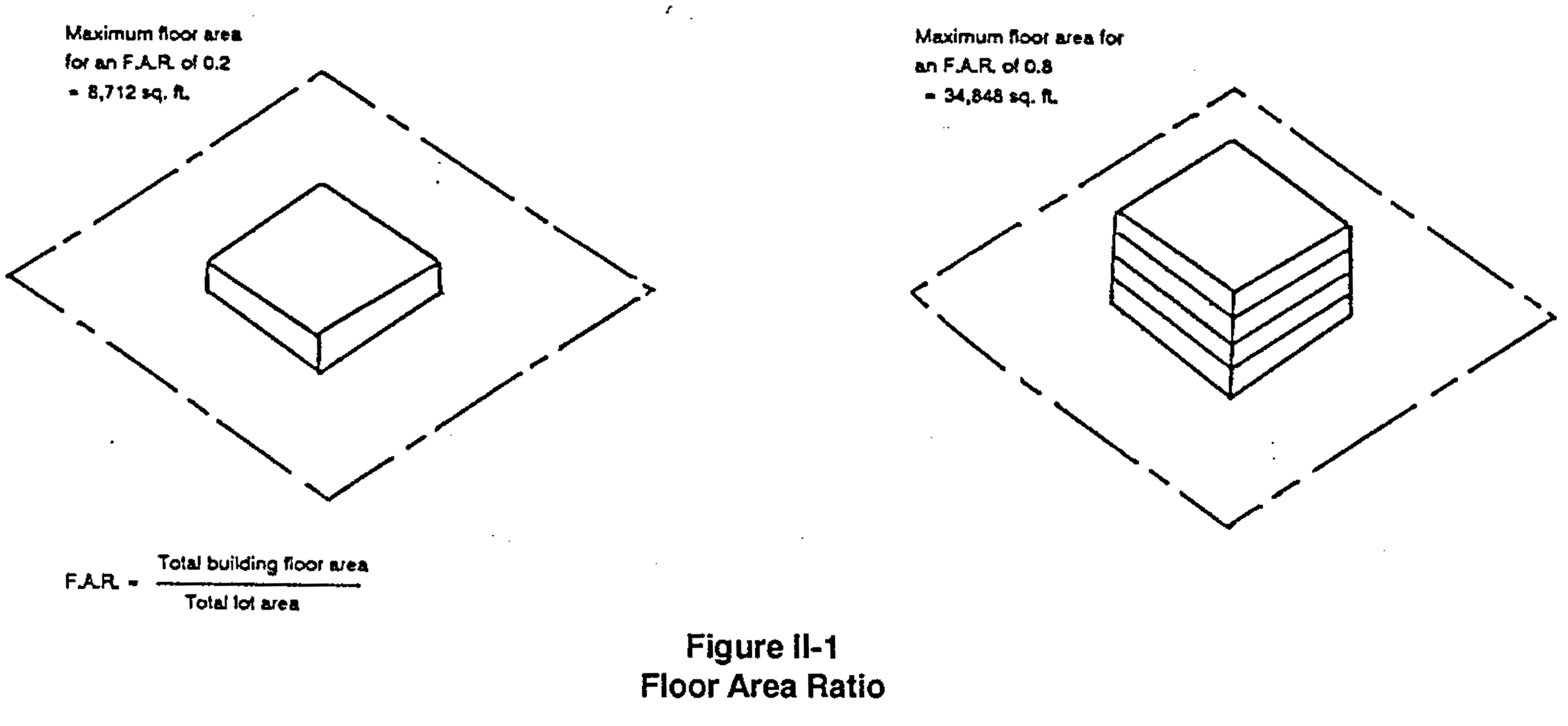
Floor area ratio (FAR) means a measurement of the intensity of development on a site. The floor area ratio
is the relationship between the total floor area on a site and the gross site area.
It is calculated by adding together all floor areas of all floors and dividing this
total by the gross site area. See Figure II-1, a graphic illustration of this concept.
Frontage means the length of the property line of any one parcel along a street on which it borders.
Functionally dependent use means a use which cannot be used for its intended purpose unless it is located or carried out in close proximity to water, such as a docking, loading and unloading of cargo or passengers, ship building and ship repair, or processing seafood. The term "functionally dependent use" does not include long-term storage or related manufacturing uses.
Fur-bearing animal means an animal that bears fur of a commercially-desired quality that is harbored in a lawful, permitted business that collects the fur for commercial purposes. These animals include, but are not limited to, rabbit, mink, fox, and raccoon.
Garage apartment means a detached, accessory building with ground floor storage for automobiles and with single-family living quarters which shall not exceed two stories in height.
General office means a premises on which the administrative, managerial or professional services of a business, professional person, government, etc. are carried out in a room, a series of rooms or in a building solely devoted to such use.
Golf course means a relatively large premises designed and constructed to accommodate the sport of golf. The term "golf course" is not intended to include independent driving ranges or miniature golf courses.
Grade means the slope of improvements, specified in percent, (feet per 100 feet expressed as a decimal). Also the term "grade" means the horizontal location of the ground surface.
Existing grade means the natural grade of the land prior to alteration by the holder of a current grading, clearing, or building permit.
Rough grade means the stage at which the grade approximately conforms to an approved building plan or subdivision requirement.
Finish grade means the final grade of the site which conforms to an approved building plan or subdivision requirement.
Gross density or density means the total number of dwelling units divided by the total site area, less public right-of-way.
Gross floor area means the sum of the gross horizontal areas of the several floors of a building measured from the exterior face of exterior walls, or from the centerline of a wall separating two buildings, but not including interior parking spaces, loading space for motor vehicles, or any space where the floor-to-ceiling height is less than six feet.
Ground sign means a sign that is supported by one or more columns, upright poles, or braces extended from the ground or from an object on the ground, or that is erected on the ground, where no part of the sign is attached to any part of a building.
Groundwater means water beneath the surface of the ground whether or not flowing through known or definite channels.
Harboring means the act of keeping and caring for an animal or of providing premises to which the animal returns for food, shelter or care for a period of at least 24 hours. Veterinary clinics shall be exempt from the harboring time limitation.
Harmful to minors.
(1)
The term "harmful to minors" means, with regard to sign content, any description or representation, in whatever form, of nudity, sexual conduct, or sexual excitement, when it:
a.
Predominately appeals to the prurient, shameful, or morbid interest of minors in sex;
b.
Is patently offensive to contemporary standards in the adult community as a whole with respect to what is suitable sexual material for minors; and
c.
Taken as a whole, lacks serious literary, artistic, political, or scientific value.
(2)
The term "harmful to minors" shall also include any non-erotic word or picture when it:
a.
Is patently offensive to contemporary standards in the adult community as a whole with respect to what is suitable for viewing by minors; and
b.
Taken as a whole, lacks serious literary, artistic, political, or scientific value.
Highest adjacent grade means the highest natural elevation of the ground surface adjacent to the proposed walls of a structure.
Hospital means a premises with overnight facilities providing medical or surgical care for sick or injured persons.
Hospital, animal, means a premises with overnight facilities for the medical or surgical care of sick or injured animals.
Hotel/motel means a premises in which sleeping accommodations are offered for rental primarily to transients. The term "hotel/motel" is synonymous with motel, boatel, and tourist homes or cabins.
House of worship means a premises used for worship and permitted customary accessory uses by an organization of religious believers.
Hydrograph means a graph of discharge versus time for a selected outfall period.
Hydrologic cycle means the movement of water through the environment on, above or below the surface of the earth.
Hydroperiod means a measure of the time (usually in days per year) that water is at or above soil surface under normal hydrologic conditions.
Illuminated sign means a sign which contains a source of light or which is designed or arranged to reflect light from an artificial source including indirect lighting, neon, incandescent lights, backlighting, and shall also include signs with reflectors that depend upon automobile headlights for an image.
Impervious surface means a surface that has been compacted or covered with a layer of material so that it is highly resistant to infiltration by water. It includes, but is not limited to, semi-impervious surfaces such as compacted clay, as well as most conventionally surfaced streets, roofs, sidewalks parking lots and other similar structures.
Improvement means any manmade, immovable item which becomes part of, is placed upon, or is affixed to real estate.
Improvement, public, and/or private, means, but is not limited to, any sanitary sewer, storm sewer, drainage ditch, water main, roadway, parkway, sidewalk, bike path, pedestrian way, planting strip, off-street parking area, permanent reference monuments (PRMs), permanent control points (PCPs), or any other improvements required by the city, or other facility for which the city may ultimately assume the responsibility for maintenance and operation.
Industry means any activity involving the manufacture, assembly, packaging, canning, bottling or processing of any item.
Isolated wetlands means wetlands that have no hydrological or vegetative connections with waters of the state as defined in F.S. § 403.032(3).
Junkyard means a premises where junk materials such as scrapped metal, rubber tires, appliances, construction materials and paper are bought, sold, exchanged, stored, baled, packaged, packed, disassembled or handled. The term "junkyard" is synonymous with automobile wrecking yard and salvage yard operations. Any premises on which is stored, unenclosed by a building, more than four wrecked or partly dismantled motor vehicles, parts of dismantled motor vehicles, or the sale of parts thereof, not capable of or not intended to be restored to highway operating condition shall also constitute a junkyard.
Kennel means a premises where five or more domesticated house pets over six months of age are harbored, whether for profit or for personal use.
Land is intended to refer to water, marsh or swamp as well as to the solid surface of the earth.
Landfills, exempt means that no special exception for the deposition of material is required for the following activities provided that the activity does not violate any federal or state laws, rules, regulations or orders:
(1)
Normal farming operations/agricultural use.
(2)
Grading, filling and moving of earth in conjunction with commercial, industrial or subdivision construction provided a development order or permit has been obtained.
(3)
Foundations and building pads for any building or structure, provided that a valid building permit has been issued by the city.
(4)
Minor landscaping projects provided they do not encroach in flood-prone areas as depicted on the flood insurance rate maps, promulgated by the Federal Emergency Management Agency, or change the natural drainage pattern of the ground surface at the property line.
(5)
Exemptions contained in Rule 62-701.320(2), F.A.C.
Livestock means any cow, goat, horse, mule, sheep, pig, poultry, rabbit or other fur-bearing animal raised for commercial breeding, food production or sale.
Lot means a piece, parcel, tract or plot of land occupied or intended to be occupied by one principal building and its accessory buildings, and being of sufficient size to meet the minimum zoning requirements for use, coverage, and area, and to provide such yards and other open spaces required by these regulations. Such lot shall have frontage on an improved public street, or an approved private street. Also, the least fractional part of subdivided lands having limited fixed boundaries, having an assigned number, letter, or other name by which it may be identified and which is intended as a unit for building development or transfer of ownership or both.
Lot classifications. Lots shall be classified as corner lots, interior lots, through lots, and atypical
lots. Figure II-2 illustrates these lot types.
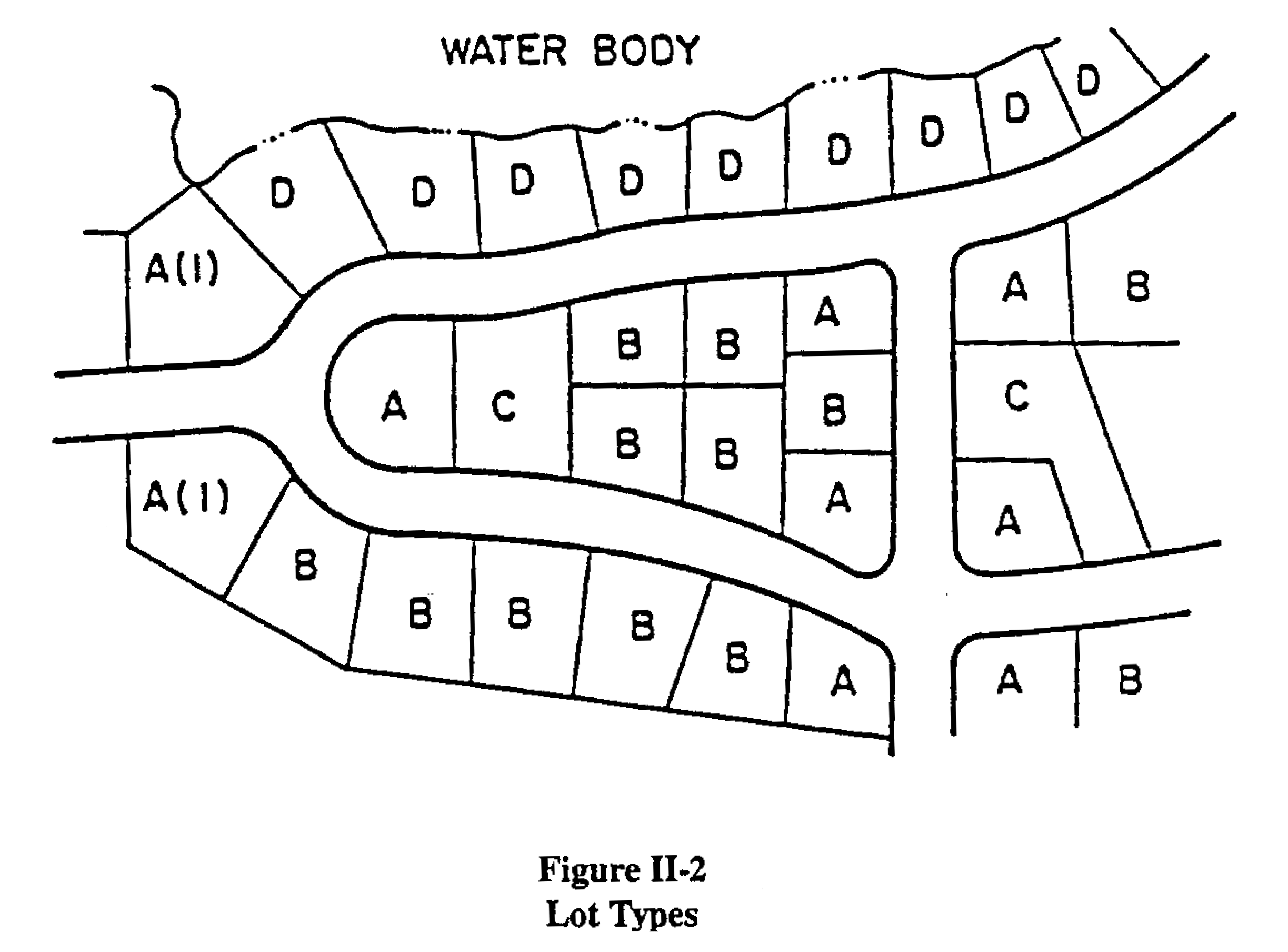
In the diagram, A designates corner lots. Corner lots are defined as lots located at the intersection of two or more streets. A lot abutting a curved street or streets shall be considered a corner lot if straight lines drawn from the front-most points of the side lot lines to the front-most point of the lot meet at an interior angle of less than 135 degrees. See lots marked A(1) in the diagram. B designates interior lots. Interior lots are defined as lots with only one frontage on a street. C designates through lots. Through lots are defined as lots other than corner lots with frontage on more than one street. Through lots abutting two streets may also be referred to as double-frontage lots. D designates atypical lots. Atypical lots are defined as lots within a subdivision where, as a result of subdivision design, the lots abut a street at one end and any of the following at the opposite end: (a) The Atlantic Ocean; (b) A waterway or body either of which are 100 feet or more in width; (c) A golf course fairway or green; (d) An open space area which by itself, or when combined with other open space areas within the same subdivision comprises at least 15 percent of the total land area in said subdivision, and in which an undivided interest is conveyed with each lot.
Lot coverage means that area of a lot from the ground up, which is occupied by principal and accessory buildings.
Lot depth means the average horizontal distance between the front and rear lot lines.
Lot line, front, means the property line abutting any street right-of-way, or for arterial streets with less than 60 feet of dedicated right-of-way, an imaginary line located 30 feet from and parallel to the centerline of the existing right-of-way.
Lot line, rear, means the property line most distant from and most nearly parallel to the front lot line, with the exception that on corner lots, the property line most distant from and parallel to the front lot lines shall be considered side lot lines.
Lot line, side, means any property line that is not a front or rear property line.
Lot lines means the perimeter property lines around the lot or the space line of a rental space.
Lot width means the horizontal distance between the side lot lines, measured along the front building setback line.
Lowest floor means the lowest floor of the lowest enclosed area (including basement). An unfinished or flood-resistant enclosure, usable solely for parking of vehicles, building access or storage in an area other than a basement area is not considered a building's lowest floor; provided that such enclosure is not built so as to render the structure in violation of the applicable nonelevation design requirements as set out in article VII of this chapter.
Mangrove means rooted trees and seedlings of the following species, but only when having a coastal or estuarine association:
(1)
Red Mangrove (Rhizophora mangle L.);
(2)
White Mangrove (Laguncularia racemosa Gaertn.);
(3)
Black Mangrove (Avicennla germinans (L) L.); and
(4)
Buttonwood Mangrove (Conocarpus erecta L.).
Mangrove stand means an assemblage of one or more of the following species:
(1)
Black mangrove (Avicennia nitida);
(2)
Red mangrove (Rhizophora mangle);
(3)
White mangrove (Languncularia racemosa); and
(4)
Buttonwoood (Conocarpus erecta).
Manufactured building means a closed construction building assembly, or system of subassemblies, which may include structural, electrical, plumbing, heating, ventilating, or other service systems manufactured in manufacturing facilities for installation or erection, with or without specified components, as a finished building or as part of a finished building, and shall include but not be limited to residential, commercial, institutional, storage, and industrial structures. This part does not apply to mobile homes or manufactured housing, as defined by the United States Department of Housing and Urban Development (HUD). This part does apply to mobile offices or other units not insigniaed by HUD or otherwise inspected by the state department of motor vehicles, except for mobile offices at construction sites and mobile homes used as temporary offices. Manufactured buildings are expressly excluded from the federal standards for mobile or manufactured homes and are in fact not the same as mobile homes.
Manufactured home means a mobile home fabricated on or after June 15, 1976, in an off-site manufacturing facility for installation or assembly at the building site, with each section bearing a seal certifying that it is built in compliance with the federal Manufactured Home Construction and Safety Standard Act.
Marina means a boat dock or basin with facilities for berthing, securing, fueling, and servicing various types of recreational watercraft. It may include the provision of supplies and storage. It does not include boat docks that are accessory to residential uses.
Marquee means a structure projecting from and supported by a building which extends beyond the building line or property line and fully or partially covers a sidewalk, public entrance or other pedestrian way.
Mean sea level means the average height of the sea for all stages of the tide. For purposes of these regulations the term "mean sea level" is synonymous with National Geodetic Vertical Datum (NGVD).
Mini-warehouse means an enclosed storage area containing individually rented or owned compartments or stalls for storage only.
Minor replat means the subdivision of a single lot or parcel of land into two lots or parcels, or the subdivision of a parcel into two or more lots solely for the purpose of increasing the area of two or more adjacent lots or parcels of land, where there are no roadway, drainage or other required improvements, and were the resultant lots comply with the standards of these regulations.
Mitigation means actions including, but not limited to, restoration, enhancement, or creation of wetlands, required to be taken by a person to offset environmental impacts of permitted activities.
Mobile home. See Dwelling, mobile home.
Motor vehicle sales means any establishment that offers for sale or lease three or more new or used automobiles, trucks, motor homes, recreational vehicles, or other self-propelled vehicles or any combination thereof.
Multiple occupancy complex means a commercial use, i.e. any use other than residential or agricultural, consisting of a parcel of property, or parcel of contiguous properties, existing as a unified or coordinated project, with a building or buildings housing more than one occupant.
Natural flow pattern means the rate, volume and direction of the surface or groundwater flow occurring under natural conditions for any given area.
Natural systems means systems which predominantly consist of or are used by those communities of plants, animals, bacteria and other flora and fauna which occur indigenously on the land, in the soil or in the water.
New construction means structures or substantial improvements for which the start of construction occurred on or after the effective date of the ordinance from which these regulations are derived, and any alteration, repair, reconstruction or improvements to a structure which is in compliance with these flood damage prevention regulations.
Nonconforming lot means any lot which does not meet the minimum dimensions, area or other regulations of the zoning district in which it is located.
Nonconforming use of building means the use of any building other than a use specifically permitted in the district in which the building is located.
Nonconforming use of land means the use of any land other than a use specifically permitted in the district in which the land is located.
Nursing home means a premises where meals, lodging, nursing care and related medical services are furnished for compensation to five or more persons unrelated by marriage, birth or legal adoption. It does not include hospitals, clinics or similar institutions devoted primarily to the diagnosis and treatment of the sick or injured.
Occupant (occupancy) means a commercial use (i.e., any use other than residential or agricultural).
Official zoning map means a graphic illustration of zoning boundaries and classifications drawn and approved as part of the records of the city.
Off-street loading space means a permanently located off-street space for the temporary parking of vehicles which pick up, deliver, load or unload goods, supplies and merchandise.
Off-street parking space means a permanently located off-street space for the temporary parking of vehicles.
Open space means that portion of land or water not used for buildings, street rights-of-way or off-street parking and loading areas.
Ordinance means an official, legislative, policy-making action of a governing body.
Ordinary maintenance means work which does not require a construction permit and is done to repair damage or to prevent deterioration or decay of a building or structure or part thereof as nearly as practicable to its condition prior to the damage, deterioration, or decay.
Outdoor advertising sign means a permanent ground sign supported by a single metallic pole attached to which is a sign face the bottom of which is at least 20 feet above the ground and which is at least 200 square feet in size.
Out-parcel means any area of land lying within the boundary of a proposed subdivision, but which is not included for purposes of these regulations as part of the proposed subdivision.
Outside storage, display, sale and servicing of goods and equipment means the placement of any goods, equipment, products, merchandise, materials, vehicles, or other personal property on a premises, in a location other than within a fully enclosed building or below the ground surface, for the purpose of storage, display sale or servicing. the following personal properties are expressly included within the term; motor vehicle, boats, mobile homes, recreational vehicles, travel trailers, plant stock, mulch, gravel, sand and other such materials normally handled in bulk quantities, prefabricated storage sheds and accessory buildings, lumber, building materials and components and toxic or volatile chemicals, the term does not include short-term parking of customer's vehicles employees' vehicle or vehicles and equipment normally used for the conduct of business; nor does it include any signs, landscaping or accessory structures otherwise permitted by these regulations.
Owner means any person, group of persons, firm or firms, corporation or corporations, or any other legal entity having legal title to any specific lands in question.
Parcel means a unit of land within legally established property lines. If, however, the property lines are such as to defeat the purposes of these regulations or lead to absured results, a parcel may be as designated for a particular site by the development regulations administrator.
Permanent means designed, constructed and intended for more than short-term use.
Person means an individual, firm, association, organization, whether social, fraternal or business partnership, joint venture, trust, company, corporation, receiver, syndicate, business trust or other group or combination acting as a unit.
Person aggrieved means a person whose legal right is invaded by a decision complained of, or whose pecuniary interest is directly affected by a decision. The person's interest must be specific and personal; not common to all members of the community. When the decision affects any public recreation area, however, the term "person aggrieved" shall include any user of that area.
Person, interested, means any person who presents evidence, testimony or argument at any public hearings, whether oral or written, in person or by representative, and who provides his name and address to the hearing body.
Personal pet means any domesticated animal owned by a person.
Personal service means any retail service in which a practitioner, licensed by the state department of professional regulations, provides to persons a service specifically relating to the physical or mental well-being, physical appearance or physical hygiene of those persons, personal services include but are not limited to the following; acupuncture, barbering, chiropractic, cosmetology, dietetics, marriage and family therapy, massage therapy, opticianry and optometry, physical therapy, psychotherapy, and speech-language therapy, the following, whether licensed or not, are specifically excluded from the definition of "personal services": tattooing and any sexual conduct as defined in F.S. § 847.001.
Pharmacy means a retail establishment with on-site dispensing of prescription drugs, nonprescription drugs or both. The term "pharmacy" includes every location where medicinal drugs are compounded, dispensed, stored, or sold or where prescriptions are filled or dispensed on an outpatient basis. Pharmacies shall include community pharmacy, drug store and medical marijuana treatment center dispensing facility. All pharmacies shall be staffed by a state licensed and/or certified medical professional as required by Florida Statute.
Pier means a structure extending into navigable water for use as a landing place for the loading or unloading of passengers or cargo, a promenade or to protect or form a harbor. The term "pier" shall include dock and wharf.
Planned unit development means a tract of land under unified ownership, to be planned and developed according to the comprehensive and detailed plans and regulations specified in the planned unit development classification in section 24-462.
Planning and Land Development Regulation Commission (PLDRC) means the planning commission of the city designated by the city commission.
Plat means a map or drawing depicting the division of land into lots, blocks, parcels, tracts, sites or other divisions, being a complete, exact representation of the subdivision and containing other information in compliance with the requirements of applicable sections of these regulations and F.S. ch. 177, and may include the terms "replat," "amended plat" or "revised plat."
PLDRC. See Planning and Land Development Regulation Commission.
Pollutant means any substance, contaminant, noise, or manmade or man-induced alteration of the chemical, physical, biological, or radiological integrity of air or water in quantities or at levels which are or may be potentially harmful or injurious to human health or welfare, animal or plant life, or property, or which unreasonably interfere with the enjoyment of life or property, including outdoor recreation.
Portable sign means any sign which is manifestly designed to be transported by trailer or on its own wheels, including such signs even though the wheels may be removed and the remaining chassis or support structure converted to an A-frame or T-frame sign and attached temporarily or permanently to the ground.
Premises means a lot, together with all buildings and structures thereon.
Principal structure means any structure occupied by the principal use.
Principal use means the primary purpose for which the premises is intended to be used.
PRM means permanent reference monument, as defined in F.S. ch. 177.
Profession means a calling requiring specialized knowledge, often long and intensive academic preparation, and involving mental rather than manual labor.
Project means any area of land that is planned, designed, and developed in an integral and unified arrangement. It includes all structures, improvements, and equipment of every kind, nature or description incident to the development.
Project initiation means all acts antecedent to actual construction activities and includes, but is not limited to, land clearing, utility construction, subdivision plat approval, and the like.
Protected environmentally sensitive area means an environmentally sensitive area designated for protection in the conservation element of the city's comprehensive plan.
Public use means a use of any premises by a public body, board, commission or authority, such as a municipal, county, state or federal government, or any agency or department thereof for a governmental or proprietary purpose. Public schools are included.
Public utility means any publicly owned or privately owned utility, such as, but not limited to, storm drainage, sanitary sewers, electric power, water service, gas service, telephone lines, and other cable communication lines such as television cable systems, whether underground or overhead, which serves the general public.
Public utility uses and structures means publicly owned or regulated electrical substations, water tanks, gas transfer stations, water and sewage treatment plants, municipal water supply wells, lift stations and other buildings and uses not defined as essential utility services not including electrical power generating plants.
Rate means volume per unit of time.
Recharge means the inflow of water into a project site, aquifer, drainage basin or facility.
Recovery homes means a group residential facility with one or more supervisors residing on the premises, with professional staff service as needed, providing board, lodging, supervision, medication and other treatment and counseling for persons progressing from relatively intensive treatment for crime, delinquency, mental or emotional illness, alcoholism, drug addiction, or similar conditions, to full normal participation in community life, or persons otherwise in need of a structured environment to deal with such conditions.
Recreation vehicle means a vehicular-type portable structure without permanent foundation, which can be towed, hauled or driven and primarily designed as temporary living accommodation for recreation, camping, and travel use and including, but not limited to, travel trailers, truck campers, camping trailers, and self-propelled motor home.
Recreational shelter and vehicle park means a place set aside for either direct or indirect remuneration of the owner, lessor, or operator of such place, for the parking and accommodation of six or more recreational vehicles or tents utilized for sleeping or eating; and the term "recreational shelter and vehicle park" also includes buildings and sites set aside for group camping and similar recreational facilities. For the purposes of these regulations, the terms "campground," "camping resort," "RV resort," "travel resort," and "travel park," or any variations of these terms, shall be considered synonymous with the term "recreational shelter and vehicle park." See F.S. ch. 513.
Regulatory floodway means the channel of a river or other watercourse and the adjacent land areas that must be unobstructed in order to discharge the base flood with increasing the water surface elevation of that flood more than one foot at any point.
Remove means to relocate, cut down, damage, poison, or in any manner destroy a tree or cause a tree to be destroyed.
Rendition means the filing of a signed, written decision with the enforcement official. If a timely petition for rehearing has been filed, the decision shall not be deemed rendered until its disposition.
Replacement stock means any immature tree having an overall height of at least six feet but does not include any tree listed as exempt in section 14-130. In addition, replacement stock shall have a minimum diameter of 1½ inches, measured at the caliper.
Resort dwelling means any individually or collectively owned one-family, two-family, three-family or four-family dwelling unit which is advertised for/held out to the public for rental for more than three times in a calendar year for periods of less than 30 days or one calendar month, whichever is less.
Restaurant means a premises where meals or prepared food, including beverages or confections, are served to customers. Restaurants are classified as:
(1)
Type A: Restaurants where the customers normally order from individual menus while seated at a table. The order is then normally served by a restaurant employee to the same table and there consumed by the customer. This group also includes cafeterias.
(2)
Type B: Any restaurant other than type A.
Retail sales and services means the duly licensed selling of general or specialized merchandise directly to the consumer from within a fully enclosed store, shop, or similar building. The repair, installation, servicing and making of that merchandise is allowed as an accessory use to the permitted sales. This definition does not include a flea market or curb market.
Retail specialty shops means the duly licensed selling of specialized merchandise from a store, shop, or similar building. The repair, installation, servicing and making of that merchandise is allowed as an accessory use to the permitted sales. This definition does not include a flea market or curb market.
Retention means the collection and storage of runoff without subsequent discharge to surface waters.
Right-of-way means an area of land occupied or intended to be occupied by a street, electric transmission line, oil or gas pipeline water main, sanitary or storm sewer main, or for another special use of public purpose. The usage of the term "right-of-way" for land platting purposes shall mean that every right-of-way hereafter established and shown on a plat is to be separate and distinct from the lots or parcels adjoining such right-of-way and not included within the dimensions or areas of such lots or parcels. Rights-of-way intended for streets, water mains, sanitary sewers, storm drains, or any other use involving maintenance by the city shall be dedicated to public use by the subdivider and shown on the plat on which such right-of-way is established.
Roadway means that portion of the street available for vehicular traffic.
Roof sign means a sign placed above the roofline of a building or on or against a roof slope of less than 45 degrees.
Roofline means a horizontal line intersecting the highest point of a roof.
Roominghouse. See Boardinghouse.
Runoff means only that part of rainfall which, as surface water, flows off the land without infiltration into the ground.
Runoff coefficient means ratio of the amount of rain which runs off a surface to that which falls on it; a factor from which runoff can be calculated.
Sediment means the mineral or organic particulate material that is in suspension or has settled in surface or groundwaters.
Self-service laundry means a premises where equipment for washing and drying laundry is made available to retail customers for a charge. The term "self-service laundry" is synonymous with the term "laundromat."
Sewage disposal system, individual, means a septic tank, seepage tile sewage disposal system or any other sewage treatment device approved by the city engineer and the county health department and/or state department of environmental protection.
Shopping center means a premises containing a group of commercial establishments planned, developed and organized as a unit.
Sidewalk means that portion of the public and/or private right-of-way paved or otherwise improved and intended primarily for pedestrian traffic.
Sign means any structure that displays letters, numbers, symbols, pictures, illustrations, announcements, cut-outs, insignia, trademarks or demonstrations, designed to advertise, inform, identify or to attract the attention of persons not on the premises on which the device or display is located.
Sign face means the part of a sign that is or may be used for copy.
Sign face area means the area of any regular geometric shape which contains the entire surface area of a sign upon which copy may be placed.
Sign, off-site, means any sign relating in its subject matter to the commodities, accommodations, services, or activities on premises other than the premises on which the sign is located.
Significant adverse effect means any modification, alteration, or effect upon a protected environmentally sensitive area which measurably reduces the area's beneficial functions as delineated in the conservation element of the city comprehensive plan.
Site means the location of a significant event, activity, building, structure, or archaeological resource where the significance of the location and any archaeological resource where the significance of the location and any archaeological remains outweighs the significance of any existing structures.
Site plan means the combination of documents and exhibits required by section 24-198 et seq.
Special exception, permitted, means a use expressly so designated that it would not be appropriate generally or without restriction throughout a particular zoning classification but that would not adversely affect the public health, safety, comfort, good order, appearance, convenience, morals or general welfare, if controlled in number, area, location, relation to the neighborhood, or in other appropriate respects. The term "conditional use" is synonymous.
Special flood hazard area means that portion of the floodplain that, on the average, is likely to be flooded at least once every 100 years. These areas are designated zone A (area of special flood hazards) or zone V (area of special flood hazards with velocity) on the flood insurance rate maps prepared by the Federal Emergency Management Agency.
Special master. See section 2-206.
Specimen or historic tree means a tree which is determined by the city commission to be of such unique and intrinsic value to the general public because of its size, age, historic association, or ecological value as to justify this classification.
Start of construction means the date the construction permit was issued, provided the "actual start of construction" was within 180 days of the permit date. The "actual start of construction" means the first placement of permanent elements of a structure on a site, such as the pouring of slabs or footings, installation of piles, construction of columns, or any work beyond the stage of excavation or of the placement of a manufactured home on a foundation. Permanent construction does not include land preparation, such as clearing, grading and filling; installation of streets and/or walkways; excavation for a basement, footings, piers or foundations; erection of temporary forms; or the installation of appurtenant structures. This definition does not apply to new construction or substantial improvements under the Coastal Barrier Resources Act (P.L. 97-348).
Stormwater means the flow of water which results from, and that occurs immediately following, a rainfall.
Stormwater conveyance system means any natural or manmade system which transports excess rainfall from the land to a point of discharge; the term shall include, but is not limited to, retention, or detention; drainage canal, drainage ditch, culvert, storm sewer, and gutter.
Stormwater management system means the system, or combination of systems, designed to treat stormwater, or collect, convey, channel, hold, inhibit, or divert the movement of stormwater on, through and from a site.
Stormwater runoff means that portion of the stormwater that flows from the land surface of a site either naturally, in manmade ditches, or in a closed conduit system.
Story means that portion of a building included between the upper surface of any floor and the upper surface of the floor next above; or any portion of a building used for human occupancy between the top most floor and the roof. A basement or cellar not used for human occupancy shall not be counted as a story.
Street means any access way which affords a primary means of vehicular access to abutting properties whether designated a street, road, lane, highway, avenue, boulevard, parkway, circle, court, terrace, place, or cul-de-sac. It also includes all the land lying between the right-of-way lines as delineated on a plat showing such streets whether improved or unimproved, but shall not include those accessways such as easements and rights-of-way intended solely for limited utility purposes, such as for electric power lines, gas lines, telephone lines, water lines or drainage and sanitary sewers, easements of ingress and egress, and driveways to buildings.
Street, arterial, means a major, high-capacity street designed primarily to carry large volumes of inter-city traffic, and so designated by the city's comprehensive plan.
Street centerline means the line midway between the street right-of-way lines or the surveyed and platted centerline of a street which may or may not be the line midway between the existing right-of-way lines.
Street, collector, means a street which carries traffic from local streets to the arterial street system, and so designated by the city's comprehensive plan.
Street, local (or minor), means a street of limited continuity used primarily for access to abutting properties and local needs of a neighborhood, and so designated by the city's comprehensive plan.
Street, marginal access, means a minor street which parallels and is adjacent to a major street or highway and which provides access to abutting properties and protection from through traffic.
Street, private, means an easement intended for vehicular access to abutting lots or spaces, which has not been dedicated to the public and not accepted by the city for maintenance. When such easement is created, the easement shall be over the boundaries of the underlying lots, unless otherwise authorized by the city commission.
Street right-of-way line means the line which bounds the right-of-way set aside for use as a street.
Street, subcollector, means a street which carries traffic from local streets to the collector and arterial street system, and so designated by the city's comprehensive plan.
Structure means anything constructed or erected on the ground or attached to anything constructed or erected on the ground.
Subdivider. See Developer.
Subdivision.
(1)
The term "subdivision" means any division of a parcel of land, whether improved or unimproved, into two or more lots, or parcels of land for the purpose, whether immediate or future, of transfer of ownership or building development where the subdivider advocates, proposes, suggests or exhibits a proposed plan, map, or plat of development of the land. The term "subdivision" includes a resubdivision and replatting and, when appropriate to the context, shall refer to the act of subdividing or to the land subdivided.
(2)
The following shall be exempt and not subject to the regulations prescribed by these regulations: the combination or recombination of portions of previously platted lots where no new parcels or residual parcels result in lots of less area, width, or depth than the original lots of record and where the resultant lots are equal to or exceed the standards of the city as required by the current zoning ordinance of the city.
Subdivision, cluster, means a subdivision of land into lots smaller than otherwise permitted in its zoning classification, in order to provide common open space equal to the area by which the lot size was reduced.
Substantial improvement means any combination of repairs, reconstruction, alteration, or improvements to a structure, taking place during a one-year period, in which the cumulative cost equals or exceeds 50 percent of the market value of the structure. The market value of the structure is the appraised value of the structure prior to the start of the initial repair or improvement, or, in the case of damage, the value of the structure prior to the occurrence of the damage. For the purposes of this definition, substantial improvement occurs when the first alteration of any wall, ceiling, floor, or other structural part of the structure commences, whether or not that alteration affects the external dimensions of the structure. The term does not, however, include any improvement of a structure to comply with existing health, sanitary, or safety codes, or any alteration of a structure listed on the National Register of Historic Places, the Local Register of Historic Places, or a State Inventory of Historic Places, unless that alteration will cause the structure to lose its historical designation.
Surface water means water above the surface of the ground whether or not flowing through definite channels, including the following:
(1)
Any natural or artificial pond, lake, reservoir, or other area which ordinarily or intermittently contains water and which has a discernible shoreline;
(2)
Any natural or artificial stream, river, creek, channel, ditch, canal, conduit, culvert, drain, waterway, gully, ravine, street, roadway, swale or wash in which water flows in a definite direction, either continuously or intermittently, and which has a definite channel, bed or banks; or
(3)
Any wetland.
Surveyor means a land surveyor registered under F.S. ch. 472, who is in good standing with the state board of professional surveyors and mappers.
Technical review committee means the technical review committee of the city whose members are appointed by the city commission and may include, but need not be limited to, the development regulations administrator, city engineer, city planner, city clerk and police chief.
Temporary means designed, constructed, and intended to be used on a short-term basis.
To plat means, in whatever tense used, to divide or subdivide lands into lots, blocks, parcels, tracts, sites, or other divisions, however the same may be designated and the recording of the plat in the office of the clerk of the circuit court of the county.
Topographic survey means a survey of the natural and selected manmade features of a part of the earth's surface by remote sensing and/or ground measurements to determine horizontal and vertical spatial relations. Such survey shall be certified by the registered surveyor in charge as meeting the Minimum Technical Standards set forth in F.S. § 472.027. In addition to any other features required by the Minimum Technical Standards, the topographic survey shall show wooded areas, wetland areas, 100-year floodplain areas, natural or manmade drainage courses, ponds, and topography, based on National Geodetic Vertical Datum (NGVD), at a minimum contour interval of two feet.
Townhouse means a single-family dwelling constructed as a group of three or more attached single-family dwellings each occupying the total space between the ground and roof and having an entrance separate and apart from the entrance to any other dwelling. Townhouses shall be located only in multifamily zoning districts.
Trailer means a vehicle without motor power of its own, designed for carrying passengers or property, and drawn by an automobile, motor truck, or tractor. It is intended to include tractor-trailers and semitrailers, but not to include mobile homes or mobile recreational shelters or vehicles.
Travel trailer or mobile camper means a self-powered or non-self-powered hard-shell or noncollapsible conveyance less than eight feet in width capable of being towed by an ordinary automobile or by the self-powered vehicle upon which it is constructed, whose primary use is temporary lodging while traveling or camping, and is not used for habitation except in designated camp sites while in the corporation limits of the city. These vehicles are excluded from the definition of "mobile homes" unless used for habitation in locations other than designated campsites.
Tree means any self-supporting woody plant of a species which normally grows, or is capable of growing, to an overall minimum height of 15 feet in the coastal portion of the state and which has a trunk diameter of not less than four inches as measured three feet above the average ground level at the base of the tree.
Unit means a room in a building forming a separate and independent housekeeping establishment, designed to be occupied by one family, and containing sleeping facilities, sanitary facilities and one kitchen. The term is synonymous with the term "dwelling."
Use means:
(1)
Any purpose for which a premises may be designed, arranged, intended, maintained, or occupied; or
(2)
Any activity, occupation, business, or operation conducted or intended to be conducted on the premises.
Utilities includes, but is not limited to, water systems, electrical power, gas systems, sanitary sewer systems, storm drainage systems, and telephone and other cable communication lines such as television cable systems.
Utility building means a building whose principal use is that of storage for yard maintenance equipment and/or tools.
Variance means a modification of these land regulations when such variance will not be contrary to the public interest and when, owing to conditions peculiar to the property and not the result of the actions of the applicant, a literal enforcement of the regulations would result in unnecessary and undue hardship. A variance is authorized only for area and size of structure or size of yards and open spaces. Establishment or expansion of a use otherwise prohibited shall not be allowed by variance nor shall a variance be granted because of the presence of nonconformities in the zoning district or in adjoining zoning districts. No variance shall be granted as to height.
Vehicle means any self-propelled conveyance designed and used for the purpose of transporting or moving persons, animals, freight, merchandise or any substance on land, and includes passenger cars, trucks, buses, motorcycles, scooters, but shall not include tractors, construction equipment, or machinery, or any device used in performing a job as stated in this definition.
Vehicle sign means any sign affixed to a vehicle.
Vehicle use area means an area used for circulation, parking, and/or display of motorized vehicles, except junk or automobile salvage yards.
Veterinary clinic means a premises for the medical and surgical care of sick or injured animals, with limited overnight facilities.
Volume means occupied space measured in cubic units.
Wall means a solid fence usually constructed of masonry or stone.
Water orwaters includes, but is not limited to, water on or beneath the surface of the ground or in the atmosphere, including natural or artificial watercourses, streams, rivers, lakes, ponds, or diffused surface water and water percolating, standing, or flowing beneath the surface of the ground.
Water body means any natural or artificial pond, lake, reservoir, or other area with a discernible shoreline which ordinarily or intermittently contains water.
Water detention structure or water management structure means a facility which provides for storage of stormwater runoff and the controlled release of such runoff during and after a flood or storm.
Water retention structure means a facility which provides for storage of stormwater runoff.
Watercourse means any natural or artificial channel, ditch, canal, stream, river, creek, waterway or wetland through which water flows in a definite direction, either continuously or intermittently, and which has a definite channel, bed, banks, or other discernible boundary.
Water's edge means the boundary established by the average annual high-water mark.
Wetland vegetation means as defined in F.A.C. ch. 62-340.
Wetland's edge means the wetland's edge shall be determined by whichever of the following indices yields the most landward extent of waters or wetlands:
(1)
The landward boundary of hydric soils; or
(2)
The landward boundary of wetland vegetation. Wetland vegetation shall be determined as provided in F.A.C. ch. 62-340.
Wetlands means lands which are identified by being inundated or saturated by surface water or groundwater at a frequency and duration sufficient to support, and that under normal circumstances do or would support, a prevalence of vegetation typically adapted for life in saturated soil conditions. The definition includes all contiguous and noncontiguous or isolated wetlands to waters, water bodies, and watercourses. Wetlands include, but are not limited to, swamp hammocks, hardwood hydric hammocks, riverine cypress, cypress ponds, bayheads, bogs, wet prairies, freshwater marshes, tidal flats, salt marshes, mangrove swamps and marine meadows. Dominant wetland vegetation shall be determined as provided in F.A.C. ch. 62-340.
Wharf/wharves. See Pier.
Yard means that minimum area of land required by these regulations, within which no structure or portion thereof shall be erected from the ground up unless otherwise expressly permitted by these regulations. The various types of yards are illustrated in Figure II-3.
Yard, front, means a yard extending across the front of a lot. It is bounded on the front by the
front lot line, on the side by the side lot lines and on the rear by a line parallel
to and located the minimum distance from the front lot line permitted by the applicable
classification.
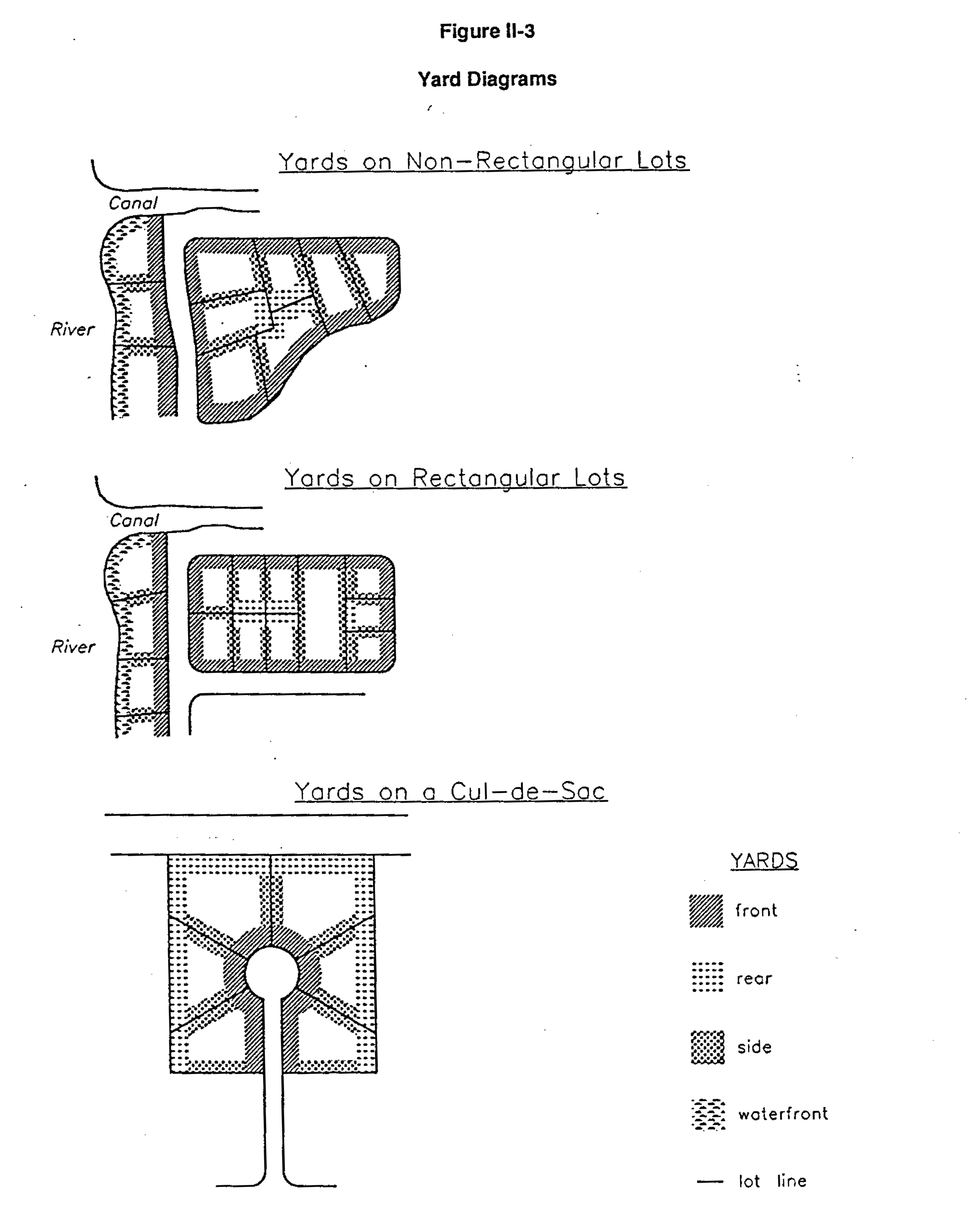
Yard, rear, means a yard extending across the rear of a lot. It is bounded on the rear by the rear lot line, on the side by the side lot lines and on the front by a line parallel to and located the minimum distance from the rear lot line permitted by the applicable classification.
Yard, side, means a yard between the side lot line and a line parallel to and located the minimum distance from the side lot line permitted by the applicable classification.
Yard, waterfront, means a yard abutting a body of water. The line determining the edge of the waterfront yard shall be the bulkhead line. If a bulkhead line is not established, the mean high-water mark shall be interpreted as the edge of the waterfront yard.
Zoning code means the zoning regulations of the City of Oak Hill, Florida, including the zoning map and all amendments to such zoning code and zoning map. The term is synonymous with the term "zoning ordinance."
Zoning district means an area identified on the zoning map, assigned a zoning classification as indicated on said map, consisting of any one of several zoning districts as set forth and established in article V of this chapter. Reference to the term "district" or "zone" shall mean zoning district.
Zoning map means the official zoning map of the City of Oak Hill, Florida, as amended.
(Ord. No. 93-01, § 2.2, 11-16-1992; Ord. No. 93-05, § 2.2, 8-23-1993; Ord. No. 95-01, § 1(A), 11-21-1994; Ord. No. 95-10, § 1(A), 12-18-1995; Ord. No. 98-02, § 1, 2-16-1998; Ord. No. 2003-17, § 1, 10-13-2003; Ord. No. 2007-07, § 1, 4-23-2007; Ord. No. 2008-11, § 1, 10-27-2008; Ord. No. 2009-05, § 1, 3-23-2009; Ord. No. 2015-12, § 2(Exh. B), 6-22-2015; Ord. No. 2016-03, Pt. A, 5-23-2016; Ord. No. 2017-09, Pt. A, 2-12-2018)

