
Oak Hill City Zoning Code
ARTICLE VI
REQUIRED IMPROVEMENTS
Sec. 24-534. - Inspection and certification.
(a)
No development shall be approved by the city without the developer having first provided, as hereafter set forth, all improvements, dedications, and maintenance guarantees required by this chapter. The city engineer shall be responsible for ensuring adequate inspection of construction of all improvements except sanitary sewer system and private utilities for compliance with the approved plans and specifications. He shall issue a certificate of completion upon the approved completion of the work subject to the maintenance period provided for.
(b)
The engineer of record shall certify in writing that the completed improvements are completed in accordance with the approved plans and specifications. No certificates of occupancy shall be issued within the development until all improvements for the development have been accepted by the city.
(Ord. No. 93-01, § 6.0, 11-16-1992)
Sec. 24-535. - Maintenance guarantee for improvements to be dedicated to the city.
(a)
Following acceptance by the city of the construction of improvements which are to be dedicated to the city, the developer shall be required to maintain the improvements in first class condition until the city commission accepts the improvements for city maintenance. Said developer's maintenance period shall be a minimum of one year. The city commission shall require cash in escrow or a first mortgage (or some other type of cash guarantee as recommended by the city attorney) guaranteeing all improvements against defects in design, material and workmanship, and further guaranteeing that the developer shall maintain all said improvements in first class condition for the required period of time. This guarantee shall be in the amount of ten percent of the construction cost of the improvements.
(b)
Should the developer fail to maintain any of the improvements in first class condition during the developer's maintenance period as herein specified, the city engineer shall notify the developer, in writing, giving the developer 15 days to take corrective actions. Should the developer fail to take the appropriate corrective action, the city may correct the problem, deducting the cost from the developer's guarantee.
(c)
The developer may request the city commission to accept the improvements for maintenance at the time of or after the acceptance of the construction improvements, but prior to the expiration of the developer's one-year maintenance period. When this occurs, it shall be the responsibility of the developer to sod all areas of the constructed improvements, where the potential for erosion exists because of an inadequate stand of grass. Such areas which may require sodding shall include, but not be limited to, shoulders, swales, and drainage retention areas. When such sodding is completed in a manner acceptable to the city engineer, the city commission may accept the improvements for maintenance by the city, provided that all improvements are in first class condition. However, the cash guarantee will be retained for the full one-year maintenance period to guarantee all improvements against defects in design, materials, and workmanship.
(d)
The city commission shall not accept the improvements for maintenance by the city nor release the cash guarantee until it has been determined that all improvements are in first class and acceptable condition.
(Ord. No. 93-01, § 6.1, 11-16-1992)
Sec. 24-536. - Roadway and utility improvements.
The following improvements are required within all developments. In addition, any unpaved streets which provide access to a development from a paved street shall be improved by the developer in accordance with the specifications set forth herein:
(1)
Survey reference markers.
(2)
Street grading, base preparation, surface course, and curb and gutter.
(3)
Storm drainage/retention systems.
(4)
Sidewalks.
(5)
Sanitary sewage collection systems
(6)
Potable water distribution systems.
(7)
Street name markers and traffic control signs.
(8)
Bridges.
(9)
Street lighting.
(Ord. No. 93-01, § 6.2, 11-16-1992)
Sec. 24-566. - Compliance with division standards and specifications required.
All improvements shall be installed in accordance with the standards and specifications set forth herein.
(Ord. No. 93-01, § 6.3, 11-16-1992)
Sec. 24-567. - Permanent survey reference monuments.
Permanent survey reference monuments shall be installed in all subdivisions in accordance with F.S. ch. 177, and the following requirements:
(1)
Subdivision corner tie. At least one corner of the subdivision shall be designated by course and distance (tie) from a readily discernible reference marker such as a U.S. government marker, section corner, or quarter-section corner. When such a monument or station is not available, the tie shall be made to some permanent and readily recognizable landmark or identifiable point, physical object or structure.
(2)
Monuments. At least two monuments, shall be installed as control corners within each block within the subdivision. The surveyor shall install additional monuments if required by the city engineer. All monuments shall be constructed of concrete and shall be at least four inches in diameter or square and not less than two feet in length. Each monument shall have embedded in its top or attached by a suitable means a noncorrosive metal place marked plainly with the point, the surveyor's registration number, and the month and year it was installed, and the words "Permanent Reference Monument" or the initials "PRM." Monuments shall be set securely in the ground so that the top is flush with the finished grade.
(3)
Property markers. Property markers shall be installed on all corners and at all points of curvature changes on lands dedicated for public use, and on all properties prior to deeding or building constructions. A three-fourths-inch diameter steel pipe at least 30 inches in length shall be used for this purpose. Markers shall be set securely in the ground so that the top is flush with the finish grade.
(4)
Subdivision benchmark. The surveyor shall establish the elevation in feet above the National Geodetic Vertical Datum (NGVD) for at least two permanent reference monuments in the subdivision.
(Ord. No. 93-01, § 6.3.1, 11-16-1992)
Sec. 24-568. - Survey accuracy.
The allowable angular error of closure and linear error of closure for surveys shall be as follows:
(1)
Angular error. The angular error of closure shall not exceed 15 seconds times the square root of the number of angles turned.
(2)
Linear error. The linear error of closure shall not exceed one foot per 10,000 feet measured on the perimeter (1:10,000).
(Ord. No. 93-01, § 6.3.2, 11-16-1992)
Sec. 24-569. - Access control.
No curb, parkway, or sidewalk shall be cut or altered and no point of access or opening for vehicles onto a public street shall be established without a permit issued by the development regulations administrator. For any point of access or opening onto a county-maintained road, a permit issued by the county shall also be required.
(1)
Application and plans. Applications for driveway or access to a public street shall be made to the development regulations administrator and shall furnish plot plans of the property to be used for driveway and parking purposes.
(2)
Number of access points. The maximum number of points of access permitted onto any one street shall be as follows:
(3)
Access to business uses. Where business district property abuts two streets, and where that portion of such street abutting business district property also abuts any residential district, access to such business district property shall be provided only from the street not abutting a residential district, or, where both streets abut residential districts, access shall be permitted from only one street.
(4)
Location of driveways. There shall be a minimum distance of ten feet between any two openings on the same street for any one use. No point of access shall be allowed within ten feet of the intersection of the right-of-way lines of two public streets. Where right-of-way lines intersect in the form of an arc, the required ten feet shall be established as near as practical to the center of the arc. The location and width of driveways required by these regulations shall be established by measurements taken along the right-of-way line. Driveway entrance shall have no less than a 30-degree flare between the right-of-way line and the curb, or if no curb, the traveled street, to provide for the turning arc of vehicles entering and leaving the abutting property.
(5)
Single-family residential driveway widths. Driveways serving individual single-family residences shall not be greater than 24 feet in width measured at the curbline, or if no curb, the traveled street.
(6)
Multifamily and nonresidential driveway widths. Driveways serving multifamily developments and any nonresidential development or use shall be at least 20 feet in width, but not more than 30 feet, measured at the curbline, or if no curbline, the traveled street.
(7)
Driveway materials. That portion of any driveway which is on the public right-of-way shall be constructed of concrete or other approved permanent paving material, in accordance with specifications established by the city engineering department, provided that said driveway opens onto a paved street.
(Ord. No. 93-01, § 6.3.3, 11-16-1992)
Sec. 24-570. - General street layout.
Proposed streets within developments shall be laid out with consideration of existing and planned streets in the surrounding area, topographical conditions, public convenience and safety, and the proposed use of land to be served by such streets.
(1)
Streets shall conform to the traffic circulation element of the city's comprehensive plan and other official maps or plans.
(2)
Where the city commission determines it desirable to provide street access to an adjoining property, proposed streets shall be extended by dedication to the boundary of such property, and the temporary turn-around provided.
(3)
The proposed arrangement of streets shall provide for the continuation of existing streets in adjoining areas.
(Ord. No. 93-01, § 6.3.4, 11-16-1992)
Sec. 24-571. - Private streets.
Private streets may be allowed within developments that will remain under single ownership, provided they are designed and constructed in accordance with the standards for public streets contained herein.
(Ord. No. 93-01, § 6.3.5, 11-16-1992)
Sec. 24-572. - Public streets.
All streets shall be public unless private streets are permitted in accordance with section 24-571 or as may otherwise be approved by the city commission upon recommendation of the city planner, city engineer and city attorney. The city commission shall not approve a private street in a proposed development if it can be reasonably assumed that such street will be needed to serve the area adjoining the proposed development. All public streets shall be dedicated to the perimeter of the proposed subdivision unless they are permanently terminated by a cul-de-sac or an intersection with another street.
(Ord. No. 93-01, § 6.3.6, 11-16-1992)
Sec. 24-573. - Street names.
A proposed street which is obviously in alignment with another existing and named street, shall bear the assigned name of such existing street. In no case, except as provided for in the preceding sentence, shall the name of a proposed street duplicate or be phonetically similar to the assigned name of an existing street in the county, irrespective of the use of a suffix (e.g., street, avenue, boulevard, drive, place, court, etc.). Such suffix shall be determined according to the guidelines set forth in the Street Naming Chart (Appendix A) which is on file in the office of the city clerk. Street names shall require approval by the city commission.
(Ord. No. 93-01, § 6.3.7, 11-16-1992)
Sec. 24-574. - Design standards for streets.
The standards set forth here below shall be considered the minimum standards for design of streets. The classification of streets shall be as specified in the city's comprehensive plan.
(1)
Right-of-way widths.
a.
Streets with curb and gutter.
b.
Streets with swale drainage.
(2)
Street paving.
a.
All streets shall be paved by the developer to the full required minimum paving width, except multiple-lane arterial streets where the city council may excuse the developer from paving more than two lanes.
b.
All street paving shall conform to the specifications of the city and shall be installed by a contractor licensed to do paving work in the state. All paving materials used shall be obtained from a plant approved by the city engineer.
c.
Paving widths, minimum. Street pavement widths, measured from back of curb to back of curb, shall not be less than the following:
(3)
Shoulder preparation. Every street right-of-way shall be cleared, graded and stabilized with turf or other material to its full width so as to provide adequate clearance for errant drivers, and space for drainage and sidewalks.
(4)
Centerline grade. Minimum centerline grade for all streets shall be 0.2 percent. Maximum centerline grade shall not exceed five percent for arterial streets and eight percent for collector and local streets.
(5)
Culs-de-sac (permanent and temporary).
a.
Maximum length: 1,000 feet (as measured along the centerline from the nearest right-of-way line of the intersecting street to the center point of the turnaround.)
b.
The turnaround area shall have a right-of-way diameter of at least 100 feet and a minimum paved surface diameter of 84 feet including curbs. A landscaped island may be permitted in the center of the turnaround (maximum diameter of 32 feet).
(6)
Horizontal curves. Where a centerline deflection angle of more than two degrees occurs, a circular curve shall be inserted having a centerline radius of not less than the following:
a.
Principal arterial: 500 feet.
b.
Secondary arterial: 500 feet.
c.
Minor arterial: 300 feet.
d.
Collector: 200 feet.
e.
Local: 100 feet.
(7)
Intersections.
a.
Streets shall intersect at an angle of approximately 90 degrees, unless circumstances make it necessary to allow a lesser angle of intersection. In no case shall the angles of intersection be less than 60 degrees.
b.
Street jogs or centerline offsets between streets shall not be less than 150 feet.
c.
Street curblines (or pavement edge) at all typical intersections approximately right angle shall be rounded with a minimum radius as follows:
1.
Local street intersecting local street: 30 feet.
2.
Local street intersecting collector: 35 feet.
3.
Local street intersecting arterial: 35 feet.
4.
Collector intersecting collector: 40 feet.
5.
Collector intersecting arterial: 40 feet.
The city commission may, upon a recommendation from the city engineer, require other appropriate radii for other than right-angle intersections.
(8)
Bridges.
a.
Bridges shall be designed and constructed to comply with the standards and criteria for geometry and loading set forth in the latest edition of the American Association of State Highway and Transportation Officials "Standard Specifications for Highway Bridges." The load criteria shall also comply with the state's Manual of Uniform Minimum Standards For Design, Construction, and Maintenance For Streets and Highways. Prior to design of bridges, the subdivider shall submit design load criteria to the city engineer for approval.
b.
Bridges shall be constructed with curbs along the pavement edge. Sidewalks at least four feet wide shall be constructed on both sides. Approach guardrails shall be provided where deemed by the city engineer to be necessary for safety.
(9)
Culverts. The type and size of culvert pipe, design of bulkheads, depth of pipe, thickness of cover, and other design and construction considerations shall be subject to approval by the city engineer.
(Ord. No. 93-01, § 6.3.8, 11-16-1992)
Sec. 24-575. - Street construction standards.
All streets shall be constructed in accordance with the following minimum standards:
(1)
Grading and landscaping. All rights-of-way other than the roadway area shall be sodded. Unless special ditch protection is required due to high velocities, the following will be the standard protection for ditches unless engineering calculations indicate the need for an exception:
(2)
Pavement subgrade.
a.
Subgrade shall be defined as that portion of the roadbed immediately below the base course of pavement including below the curb and gutter. The limits of subgrade shall be considered to extend to a depth of six inches below the bottom of the base for local streets and 12 inches below the bottom of the base for collector streets and outward to 12 inches beyond the curb.
b.
The stabilizing material, if any is required, shall be high-bearing value soil, sand-clay, lime rock, shell, or other material approved by the city engineer. Where the existing soils to be used in the roadway subgrade have the required bearing value, no additional stabilizing material need be added or mixed in.
c.
A stabilized subgrade shall be constructed to support the curb and pavement base and shall be stabilized to not less than 75 pounds Florida Bearing Value (FBV) or not less than 40 pounds Lime rock Bearing Ratio (LBR) to a six-inch minimum depth. A compaction of 98 percent of maximum density (AASHTO T-180) shall be required.
d.
Tests for the subgrade bearing capacity and compaction shall be located no more than 300 feet apart and shall be staggered to the left, right and on the centerline of the roadway. When, in the judgment of the city engineer, conditions warrant additional testing to ensure compliance with the specifications, the developer's engineer will be advised in writing that additional tests will be required and the extent of such additional tests. Test results shall be submitted to the city engineer.
(3)
Pavement base.
a.
Bases for all local streets shall have a six-inch depth. Bases for all collector streets shall have an eight-inch depth. Portland cement, concrete, lime rock, or full-depth asphalt pavement may be used. Soil cement shall not be permitted.
b.
Mix designs shall be submitted to the city engineer for approval prior to the start of subgrade preparation. Cement delivery tickets shall be provided for the city engineer at the time of placement.
c.
Testing of the in-place base shall be at intervals equivalent to subgrade testing and shall consist of a minimum of moisture content tests and compaction tests. Test results shall be submitted to the city engineer.
d.
All base and roadway designs shall be subject to the approval of the city engineer.
e.
The pavement base shall be crowned a minimum of one-quarter inch per foot.
f.
Design mixes shall be submitted to the city engineer no less than three working days prior to any construction roadway bases, and will be subject to his approval.
(4)
Pavement surface.
a.
Asphalt specifications shall be submitted by the developer's engineer with final plans. Florida State Certified batch plants must certify that approved specifications have been met. The developer shall furnish all required street striping and markings on all roadways.
b.
Pavement crown shall be one-quarter inch per foot or greater. Finish pavement shall be one-quarter inch higher than the lip of any concrete gutter. Asphalt concrete surface course thickness shall be 1¼ inches after compaction.
c.
Testing of the density of the asphalt surface shall be at intervals as given under pavement subgrade. Gradation and asphalt extraction test results shall also be provided to the city engineer. Core borings shall be required to verify the thickness of the base and surface courses.
(5)
Concrete curb.
a.
A curb shall be provided on both sides of all streets.
b.
Valley curbs shall be 24 inches wide, and designed by a registered engineer, licensed by the state. Minimum thicknesses shall be six inches.
c.
Ribbon curbs, provided in association with swale drainage, shall be six inches wide and 18 inches deep.
d.
Concrete shall have a minimum 28-day compressive strength of 2,500 pounds per square inch.
e.
Curbs shall be saw-cut at intervals of ten feet with expansion joints at intervals of 25 feet. In addition, an "X" shall be cut in the curb to mark the location of all water distribution system valves, a "V" shall be cut in the curb to mark the location of all sewer services and an inverted "V" shall be cut to mark the location of all water services.
f.
Four concrete cylinders shall be taken and tested (two at seven days and two at 28 days) for each 75 cubic yards of concrete placed or fraction thereof. Test results shall be provided to the city engineer.
(6)
Sidewalks.
a.
Four-foot-wide sidewalks shall be constructed along both sides of all streets. Double frontage lots shall have sidewalks constructed on both frontages. Sidewalks shall be constructed within the right-of-way.
b.
Sub-bases for sidewalks shall be of good clean acceptable material compacted to 95 percent (AASHTO T-180) of maximum density. Sidewalks shall be constructed of at least 2,500 pounds per square inch 28-day, natural concrete with a minimum thickness of four inches.
c.
In the event sidewalks have not been constructed by builders or the developer at the time of the final inspection for acceptance, it will be necessary for the developer to provide a cash escrow or letter of credit to ensure construction of all remaining sidewalks within a two-year period.
d.
A one-half-inch expansion joint shall separate the sidewalk and driveway, the sidewalk and driveway apron, and the driveway apron and curb. In addition, an expansion joint shall be installed along the sidewalk length at spacings not to exceed 25 feet. Tooled contraction joints shall be cut at four-foot intervals for four-foot-wide sidewalks and at five-foot intervals for five-foot-wide sidewalks.
(Ord. No. 93-01, § 6.3.9, 11-16-1992)
Sec. 24-576. - Off-street parking and loading facilities.
Where required by these regulations, every use or structure shall have an adequate number of off-street parking and loading spaces for use of occupants, employees, customers, visitors, patrons or suppliers. The following regulations shall apply to the design and construction of all required off-street parking and loading areas:
(1)
Surfacing, drainage, lighting and access. Every required off-street parking and loading area shall be surfaced with brick, asphalt, bituminous, concrete or packed shell or marl material, and maintained in a smooth, well-graded condition. If lighted, no artificial lighting shall be directed upon adjacent property. All areas shall be designed for the safety and convenient access of pedestrians and vehicles.
(2)
Location. Required off-street parking and loading spaces shall be located no less than five feet from any lot lines on the same lot they are intended to serve. If the required off-street parking spaces cannot reasonably be provided on the same lot on which the principal building or use is located, such required off-street parking spaces may be located on another lot properly zoned for the permitted principal use it is intended to serve, owned or leased by the owner on which the principal structure or use is located, provided that the parking is located within 200 feet of the premises to be served.
(3)
Plan requirements. An application for a building permit shall be accompanied by an off-street parking or loading space plan. The plan shall accurately illustrate the number, location and dimensions of parking spaces, access aisles, driveways, vehicle turnarounds, or backup areas, areas designated for trash collection, off-street loading spaces, if required, and any required landscaped buffer areas.
(4)
Dimensional requirements for off-street parking areas. Off-street parking areas shall be designed to meet the following angles, dimensions and requirements:
DIMENSION TABLE
Dimensions for parking at any of these angles are:
*;sz=8q;
Letters refer to Figure VI-1.
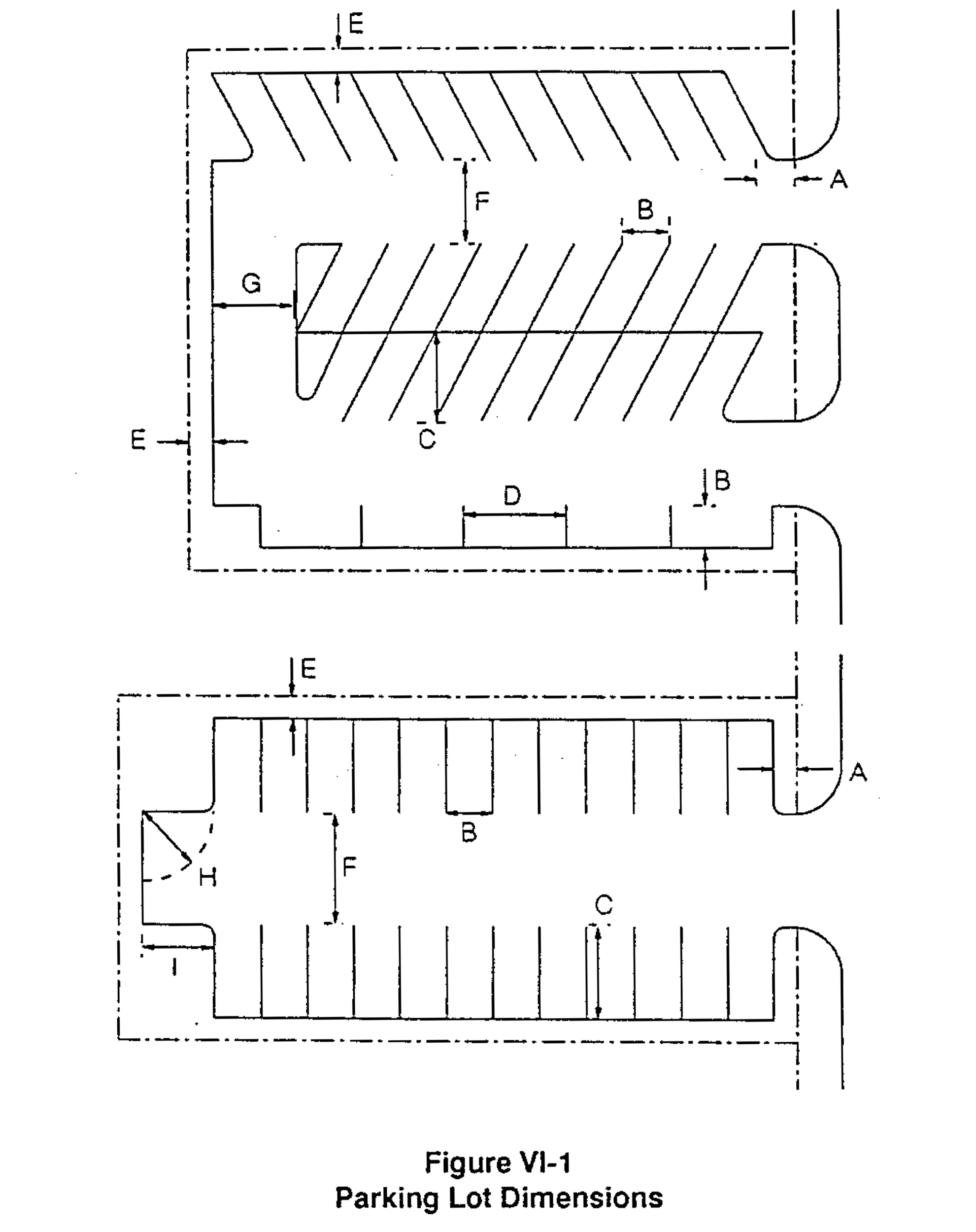
(5)
Minimum off-street parking spaces. The minimum number of off-street parking spaces shall be determined from the following table. Numbers of spaces for any use not specifically mentioned shall be the same as for the use most similar to the one sought. Fractional spaces shall be rounded to the closest number. In houses of worship and other assembly places where occupants sit on bench-type seats without dividing arms, each 18 linear inches of such seat shall be counted as one seat.
(6)
Required off-street loading spaces. Every hotel/motel, hospital, institution, commercial or industrial building or similar use having a floor area of 10,000 square feet or greater shall provide sufficient space for loading and unloading operations in order that the free movement of vehicles and pedestrians over a sidewalk, street or alley shall not be impaired. Every off-street loading space shall have direct access to a public street, and shall have the following minimum dimensions:
a.
Length: 20 feet.
b.
Width: 12 feet.
c.
Unobstructed overhead clearance: 14 feet.
(Ord. No. 93-01, § 6.3.10, 11-16-1992; Ord. No. 2002-03, § 1(E), 6-10-2002)
Sec. 24-577. - Block and lot layout.
(a)
Block lengths shall not exceed 1,400 feet nor be less than 700 feet.
(b)
The width of any block shall be sufficient to accommodate two tiers of lots except where one tier of lots abuts an area of nonresidential development, an arterial street, a utility right-of-way, or a land fill finger.
(c)
Where land is subdivided into larger parcels than ordinarily expected for building lots, such parcels shall be arranged to allow for the opening of future streets and drainage, and logical further subdivision.
(d)
The size, shape and orientation of lots shall be appropriate for the type of development and use contemplated.
(e)
No lot or lots fronting on an existing street shall be subdivided so as to permit new structures to conflict with the orientation of the majority of existing structures.
(f)
Lot dimensions shall comply with the requirements of article V of this chapter.
(g)
Side lot lines shall be substantially at right angles or radial to street right-of-way lines.
(h)
All lots fronting on a curve shall have a minimum width at the street line of 25 feet.
(i)
Corner lots shall be 15 percent greater in width and area then the minimum requirements for interior lots, unless otherwise approved by the city commission.
(Ord. No. 93-01, § 6.3.11, 11-16-1992)
Sec. 24-578. - Potable water, sanitary sewer, and stormwater conveyance systems.
Except as provided below, no development shall be approved without a potable water distribution system, a sanitary sewage collection system, and a stormwater conveyance system designed and constructed in accordance with the provisions of this section, the state department of environmental protection requirements, manufacturers' recommended guidelines as may be applicable, and the city's comprehensive plan. Such systems shall be designed by a state-registered engineer.
(1)
Potable water facilities.
a.
Exemptions.
1.
Residential developments of four or fewer dwelling units which are more than 500 feet from an existing potable water facility with available capacity may utilize individual wells.
2.
All nonresidential developments and residential developments of more than four dwelling units which are more than 1,000 feet from an existing potable water facility with available capacity may utilize individual wells.
b.
Design and construction standards.
1.
A looped water distribution system of six-inch water mains, or larger as determined by the city engineer, connected to the city's potable water distribution system shall be provided in all subdivisions. This distribution system shall be capable of delivering, in addition to domestic requirements at peak demand, residual pressures of not less than 20 pounds per square inch, fire flows of at least 500 gallons per minute in single-family residential subdivisions, and 1,000 gallons per minute in commercial and industrial areas.
2.
Water main material shall be polyvinyl chloride (PVC) integral bell pipe, SDR 18, approved for potable water systems or ductile iron pipe. PVC pipe shall be in accordance with the requirements of AWWA C-900. Fittings for either PVC or ductile iron pipe shall be ductile iron class 250.
3.
Fire hydrants shall be breakaway flange type, five-foot, four-inch valve seat (Mueller Centurion or equivalent approved by the city engineer) with shut-off value. Hydrants shall be generally located at all street intersections and at points which provide a maximum hose lay of 375 feet in single-family residential areas, 250 feet in multifamily residential and commercial areas, and 175 feet in industrial areas. The barrel of the fire hydrant shall be set perpendicular to the ground with the lowest discharge outlet center point a minimum of 24 inches above the finished grade.
4.
Mechanical joint gate valves conforming to American Water Works Association standard (AWWA) C500 shall be installed at all water main intersections and at intervals not greater than 1,000 feet along straight runs. The number of valves to be installed at intersections shall be one less than the number of legs of the intersection. Valves shall be equipped with cast iron valve boxes and shall be located outside the pavement area where possible.
5.
Water service taps shall be located on side lot lines. A three-quarter-inch tap shall be provided for single services; a one-inch tap for double services. The location of the end of all services shall be marked with a piece of two inches by four inches minimum size which shall extend from one foot below the service to four feet above grade.
(2)
Sanitary sewer system standards.
a.
Exemptions.
1.
Where connection to the regional sewage collection/treatment system cannot reasonably be made for any reason, including inadequate treatment plant capacity or excessive distance to the connection point, the city commission may authorize the temporary use of an approved on-site sewage treatment and disposal system. Approval of a temporary system shall not relieve the subdivider of the requirement to install a sewage collection system for future connection to the regional sewage collection/treatment system.
b.
Design and construction standards.
1.
A sanitary sewage collection system shall be provided in all subdivisions. Connection shall be made to the regional sewage collection/treatment system.
2.
All sanitary sewage collection system improvements installed within easements or public rights-of-way, including sewage pumping stations, force mains, manholes, gravity mains and other appurtenances, shall be dedicated to the city for the purposes of ownership, operation, maintenance and renewal.
(3)
Stormwater conveyance systems.
a.
Exemptions. Reserved.
b.
Design and construction standards.
1.
A complete stormwater conveyance system shall be provided in order to suitably drain all lots, streets, and other areas of the subdivision which are required to be drained. In addition, where stormwater runoff from outside the subdivision passes over or through the area of the subdivision, such runoff shall be included in the stormwater conveyance system design.
2.
The design of the stormwater conveyance system shall comply with provisions of the city's stormwater management regulations, and any applicable regulations of the county, the St. Johns River Water Management District, and the state department of environmental protection.
3.
The system shall be designed for long life, and shall require only low-cost maintenance by normal maintenance methods.
4.
All natural drainageways shall be preserved at their natural gradient and shall not be filled or interfered with in any way except as approved by the city engineer.
5.
If the added runoff from the subdivision will, in the judgment of the city engineer, overtax or overload existing stormwater conveyance facilities, then the subdivider shall upgrade such facilities to accommodate the additional runoff.
6.
Roadside swales within street rights-of-way shall have side slopes and back slopes no steeper than 4:1. Normal swale sections shall be no deeper than necessary; but in no case shall they exceed 18 inches in depth below the outside edge of the street pavement. Runoff may be accumulated and carried in the street right-of-way up to but not above the point where flooding of the roadway would occur. Water in excess of this quantity shall be diverted from roadside swales and carried away by storm sewers or other approved means.
7.
Where, in the judgment of the city engineer, a potential for erosion exists, the subdivider shall provide erosion control by the use of culvert pipes, concrete swales, sandbag riprap, headwalls with spillways, or other suitable means approved by the city engineer.
8.
Storm sewers and culverts shall be constructed of reinforced concrete or corrugated metal. Where pipe will be subjected to vehicular traffic loads, reinforced concrete pipe shall be used. Pipe class, gauge, corrosion resistant coating, and joint material shall be approved by the city engineer.
9.
Inlets, manholes and catchbasins shall be either poured-in-place or pre-cast, reinforced concrete. A structure shall be required at each change of pipe grade or alignment.
10.
The stormwater conveyance system shall be designed as a minimum to accommodate the stormwater runoff within the street rights-of-way and all other anticipated impervious surfaces within the subdivision.
11.
Where a stormwater retention area is to be used outside the normal limits of the street right-of-way, dedication of a suitable area shall be made to accommodate the retention area.
(4)
Excavation and backfill. The contractor installing potable water, sanitary sewer and stormwater conveyance systems shall do so in accordance with the following:
a.
An adequate excavation or sheeting and bracing shall be provided to ensure the safety of workmen, as well as the representatives of the city, the design engineer and the developer.
b.
During pipe laying, groundwater shall be kept a minimum of six inches below the bottom of the trench.
c.
All pipes shall be laid on a firm foundation. Soft or spongy bedding for pipes will not be accepted. Any unsuitable material shall be removed and replaced with a dry, compacted material approved by the city engineer.
d.
All trenches shall be backfilled with material approved by the city engineer. Backfill material shall be compacted to a minimum compaction of 98 percent maximum density (AASHTO T-180) under roadways and 95 percent maximum density in all other places. The contractor shall employ an independent testing laboratory to ensure compaction of backfill material at points one foot above the pipe and at two-foot vertical intervals, or fraction thereof.
e.
The contractor shall install a metallicized foil core pipe location tape, or similar device as may be approved by the city engineer, for the full length of all nonmetallic water mains and sewage force mains. This pipe location side shall be installed 15 inches below grade or as directed by the manufacturer.
(Ord. No. 93-01, § 6.3.12, 11-16-1992)
Sec. 24-579. - Traffic control devices; street name signs.
(a)
Traffic signals, signs, striping and other control devices shall be installed by the subdivider at locations determined by the city engineer in accordance with the U.S. Department of Transportation's Manual on Uniform Traffic Control Devices.
(b)
Street name signs shall be installed by the subdivider at all intersections in the locations approved by the city engineer.
(Ord. No. 93-01, § 6.3.13, 11-16-1992)
Sec. 24-580. - Streetlights.
Streetlights providing 9,500 lumens or such lumens as otherwise established by resolution of the commission shall be installed by the subdivider at all intersections and at points along the road, such as sharp curves and turnarounds on culs-de-sac, where streetlights would, in the judgment of the city engineer, reduce the potential for accidents. The subdivider shall, prior to commencement of construction pursuant to an approved preliminary plat, pay to the city in advance the total cost of the street lights in an amount equal to 110 percent of the charge by Florida Power & Light Company per month per street light times 36. The payment prescribed herein shall be in lieu of the subdivider's installation of the streetlights.
(Ord. No. 93-01, § 6.3.14, 11-16-1992)
Sec. 24-581. - Other utilities.
Utility lines for electricity (except primary transmission and subdivision feeder lines), telephone, gas, and television communications shall be installed underground unless otherwise approved by the city commission.
(Ord. No. 93-01, § 6.3.15, 11-16-1992)
Sec. 24-582. - Easements.
(a)
Drainage easements. Where a proposed subdivision is traversed by a watercourse, drainageway, canal or stream, dedication shall be made of an easement suitable to accommodate stormwater and drainage through and from the proposed subdivision. Said dedication or easement shall conform substantially with the lines of said watercourse, and be of sufficient width to allow maintenance.
(b)
Lot line easements. Easements shall be provided on all front, rear and side lot lines for drainage and utility purposes. Front lot line easements shall be a minimum of ten feet in width. Said rear and side lot line easements shall be a minimum of 15 feet in width, measured 7.5 feet on either side of the lot line. Wherever utility easements are planned adjacent to the subdivision boundary, the full width necessary shall be provided within the proposed subdivision.
(c)
Dedications for retention areas. Areas dedicated for retention or detention areas shall allow for access by maintenance equipment, and a continuous 20-foot maintenance berm around the perimeter, graded away from the edge of the retention or detention area.
(d)
Pedestrian easements. Pedestrian easements shall be provided through the interior of blocks where such easements are required by the city to facilitate pedestrian circulation. Said easements shall be at least ten feet wide, and shall be laid out along side or rear property lines.
(e)
Private easements. Private easements or reserve strips are prohibited along the perimeter of a subdivision or at the ends of street rights-of-way.
(f)
Maintenance of easements. The city will maintain only those easements, rights-of-way and public sites which it accepts for maintenance.
(Ord. No. 93-01, § 6.3.16, 11-16-1992)

